

Submitted:
02 June 2026
Posted:
04 June 2026
You are already at the latest version
Abstract
Staphylococcus aureus is a Gram-positive bacterium responsible for a broad spectrum of human infections. Staphyloxanthin (STX), a golden carotenoid pigment synthesized by the crtOPQMN operon, contributes to S. aureus virulence by enhancing resistance to oxidative stress and promoting immune evasion. STX functions as an antioxidant by scavenging free radicals and neutralizing reactive oxygen species, thereby helping S. aureus withstand neutrophil-mediated killing. In murine infection models, STX-producing strains form larger abscesses than pigment-deficient mutants, supporting a role for pigment production in bacterial survival and pathogenicity. Accordingly, targeting STX biosynthesis has emerged as a promising anti-virulence strategy. Several natural and synthetic compounds have been reported to inhibit STX production, reducing pigment synthesis without directly inhibiting bacterial growth and rendering bacteria more vulnerable to immune clearance. This review summarizes the genetic basis, regulation, and virulence-associated functions of STX and discusses recent advances in anti-virulence strategies that target pigment biosynthesis. These approaches may provide new therapeutic avenues for weakening antibiotic-resistant S. aureus strains while reducing direct selective pressure for resistance compared with conventional bactericidal antibiotics.
Keywords:
Staphylococcus aureus
; staphyloxanthin
; carotenoid biosynthesis
; crtOPQMN operon
; oxidative stress resistance
; immune evasion
; anti-virulence therapy
; MRSA
; CrtM
; CrtN
‡ Current Address/Affiliation: Department of Medical Laboratory Science, College of Applied, Medical Sciences, University of Bisha, Saudi Arabia.
1. Introduction
In 1880, Alexander Ogston identified Staphylococcus aureus as micrococci associated with suppuration in human abscesses (1). This observation represented an important advance in medical bacteriology by linking a defined bacterial organism with purulent infection and helped establish S. aureus as a major agent of human disease (1). S. aureus is a Gram-positive coccus that colonizes the human skin and anterior nares but can also cause a wide spectrum of infections, including skin and soft tissue infections, necrotizing pneumonia, bacteremia, and sepsis (2-4). The morbidity and mortality associated with both community-acquired and nosocomial S. aureus infections continue to impose a substantial public health burden (5-8). In 2017, S. aureus caused approximately 120,000 bloodstream infections and nearly 20,000 deaths in the United States alone (9).
The widespread use of penicillin, the first β-lactam antibiotic discovered in 1928, contributed to the emergence of antibiotic-resistant clinical S. aureus isolates (2, 3). As early as 1946, S. aureus exhibited reduced susceptibility to newly introduced antibiotics, as reflected by diminished zones of inhibition in their presence (10, 11). Methicillin-resistant S. aureus (MRSA) had emerged by 1961 (2, 3, 5-8). Since then, multidrug-resistant S. aureus isolates, including MRSA and vancomycin-intermediate S. aureus (VISA), have further exacerbated the bacterial public health burden. Approximately 2.8 million antibiotic-resistant infections occur each year in the United States (12), while bacterial antimicrobial resistance was associated with approximately 1.27 million deaths globally in 2019 (13). Drug-resistant infections are projected to impose an increasing global health burden in the coming decades (14). Drug-resistant strains of S. aureus are expected to contribute substantially to this persistent public health crisis. Consequently, the discovery of new anti-virulence targets remains an important priority.
In addition to antibiotic resistance, the ability of S. aureus to adapt to diverse host-associated environments contributes significantly to its success as a pathogen (3, 10). Its capacity to evade host immune responses further complicates the management of S. aureus-induced bacteremia and sepsis. During infection, phagocytic cells attempt to eliminate invading bacteria by engulfing them and exposing them to reactive oxygen and nitrogen species that damage bacterial cells. To withstand these antimicrobial pressures, S. aureus employs multiple defense strategies, including anti-neutrophil proteins, biofilm formation, and capsular polysaccharides, which collectively enhance bacterial survival and virulence (15-18).
Like many bacterial pathogens, S. aureus encodes a broad repertoire of virulence factors that facilitate host colonization, tissue persistence, and immune evasion. Many of these factors are particularly important during bloodstream infection, where evasion of host surveillance can promote bacteremia and sepsis. Accordingly, S. aureus-derived molecular effectors that mediate immune evasion represent promising targets for anti-virulence therapeutic development (19, 20). Such effectors encoded within the S. aureus genome include staphylococcal protein A (Spa), staphylococcal IgG-binding protein (Sbi), coagulase (Coa), staphylococcal complement inhibitor (SCIN), formyl peptide receptor-like inhibitor (FLIPr), leukocidins, hemolysins, and staphyloxanthin (STX) (21). Spa and Sbi promote immune evasion by altering the orientation of immunoglobulins on the bacterial surface, thereby reducing effective opsonization of S. aureus (21). Coa further supports immune evasion by promoting fibrin deposition, which coats S. aureus cells and helps shield the bacteria from opsonization (21). SCIN contributes to accessory virulence by binding to and inhibiting C3 convertase, thereby disrupting complement activation (21). Additionally, FLIPr binds the immune receptor FcγRIIa to inhibit neutrophil activation and chemotaxis (21). Cytolytic toxins, including leukocidins and hemolysins, directly damage neutrophils, monocytes, and macrophages to promote immune evasion (21).
Among these immune-evasion determinants, STX is distinctive because it is not a secreted toxin or surface adhesin, but a carotenoid pigment produced through a defined biosynthetic pathway that contributes to the characteristic golden pigmentation of S. aureus. Importantly, this pigment also functions as an antioxidant defense factor that can protect bacterial cells from oxidative killing, linking a visible colony phenotype to stress resistance, immune evasion, and virulence-associated fitness. Thus, understanding STX is important not only for explaining the biology underlying the golden appearance of S. aureus, but also for evaluating pigment biosynthesis as a potential anti-virulence target. In this review, we focus specifically on STX, its biosynthesis and regulation, its contribution to oxidative stress resistance and virulence, and the emerging therapeutic potential of targeting STX production (22).
2. Genetic Basis of Staphyloxanthin Biosynthesis
The genetic basis of STX production was established through studies that identified the key biochemical intermediates and genes required for STX biosynthesis (23). In 1981, Marshall and Wilmoth proposed a pathway for triterpenoid carotenoid biosynthesis in S. aureus (23). Using methanol extraction and pigment analysis of S. aureus mutants, they identified aldehyde 4,4′-diaponeurosporenal as a major carotenoid intermediate in mutant strains (23). They also identified additional intermediates, including 4,4′-diapophytoene, 4,4′-diapophytofluene, 4,4′-diapo-7,8,11,12-tetrahydrolycopene, 4,4′-diaponeurosporene, and 4,4′-diaponeurosporenoic acid. The terminal products of the carotenoid biosynthetic pathway were identified as glucosyl-diaponeurosporenoate and STX, which were primarily detected in wild-type strains (23).
Building upon these biochemical studies, Pelz et al. (2005) mapped genes within the crt operon to specific intermediates in STX biosynthesis (20). The sequential steps involved in staphyloxanthin synthesis are outlined in Figure 1. The crtM and crtN genes encode dehydrosqualene synthase and dehydrosqualene desaturase, respectively. CrtM catalyzes the condensation of two farnesyl diphosphate molecules to form dehydrosqualene, whereas CrtN subsequently converts dehydrosqualene into 4,4′-diaponeurosporene (22).
Further oxidation by CrtP, glycosylation by CrtQ, and acylation by CrtO ultimately result in formation of mature STX (20, 24). Inhibition of early steps in this pathway, particularly those mediated by CrtM and CrtN, can reduce S. aureus virulence-associated phenotypes without directly inhibiting bacterial growth (22). The crt gene cluster responsible for STX production is conserved across S. aureus strains, supporting the idea that STX contributes to the ability of the bacterium to withstand host immune attack (22). This gene cluster is therefore important not only for pigmentation but also for virulence-associated physiology, particularly in MRSA strains (22). Defining the genetic basis of STX biosynthesis provides an essential foundation for understanding how pigment production contributes to S. aureus virulence, environmental adaptation, and anti-staphylococcal therapeutic targeting. Although the crt genes encode the enzymatic machinery for STX biosynthesis, pigment production is further shaped by multiple layers of regulation, including transcriptional control, metabolic signaling, and post-transcriptional mechanisms.
3. Regulation of Staphyloxanthin Gene Expression
The expression of the crtOPQMN operon is regulated at the transcriptional level by the stationary phase/alternative stress sigma factor B (SigB) (19, 20, 25-27). SigB is a key regulator of stress adaptation in S. aureus and influences biofilm formation, virulence, and other stress-associated phenotypes (25-27). Within the rsbUVWsigB operon, rsbW encodes an anti-sigma factor that modulates SigB activity and thereby affects pigment biosynthesis (25) (Figure 2). In addition to the canonical SigB-dependent regulation, CspA has also been implicated in the control of carotenoid levels and SigB activity (28). Donegan et al. (2019) showed that CspA-dependent regulation of S. aureus carotenoid production and σB activity is controlled by YjbH and Spx, further linking pigment production to broader stress-response regulatory networks (28). In addition to SigB dependent regulation, the transcription factors AirR and MsaA modulate crtOPQMN expression (29), while the small RNA SsrA directly interacts with crtM mRNA to regulate the operon post-transcriptionally (30).
CodY is a global transcriptional regulator that links metabolic status to virulence gene expression in S. aureus (31-33). CodY modulates gene expression in response to intracellular GTP and branched-chain amino acids. When these metabolites are limited, CodY DNA-binding affinity decreases, altering expression of its target genes (34). Agr, a quorum-sensing locus, also regulates virulence gene expression in S. aureus (32, 35). Pohl et al. (2009) suggested that CodY acts as a metabolic sensor that links nutrient availability to virulence gene expression in this pathogen.
Under isoleucine-rich conditions, CodY remains active and represses Agr, helping to coordinate the timing of Agr-regulated virulence factor expression. However, under isoleucine-limited conditions, reduced CodY activity leads to premature de-repression of Agr (32, 36, 37). CodY also regulates a subset of virulence genes independently of Agr, particularly fnbA and spa. These genes remain CodY-dependent even in Agr-negative backgrounds during post-exponential growth phases (33, 34).
While isoleucine availability represents one metabolic signal that modulates CodY activity, guanine nucleotide limitation represents another metabolic cue that influences CodY-dependent regulation (34). Guanine nucleotide limitation is characterized by reduced intracellular guanine nucleotide pools and is broadly associated with bacterial stress responses and shifts in gene expression. In S. aureus, guanine nucleotide limitation reduces CodY activity (34). A ΔguaA mutant, which experiences guanine nucleotide limitation, produces higher levels of STX than the wild-type strain (34). This increase is linked to activation of SigB, further connecting metabolic stress to STX biosynthesis (34).
Post-transcriptional regulation provides an additional layer of control over STX biosynthesis. Liu et al. (2010) proposed that the small RNA SsrA regulates crtM through direct interaction with crtM mRNA and that this process may require the RNA chaperone Hfq, although the role of Hfq remains debated. While earlier studies supported a role for Hfq in regulation of the crt operon (38), subsequent reports challenged this model after examining STX phenotypes in hfq mutants across multiple S. aureus genetic backgrounds (30). Together, these findings illustrate that STX biosynthesis is not governed by a single regulatory mechanism, but instead reflects the integrated output of transcriptional regulators, metabolic signals, stress-response pathways, and post-transcriptional factors.
4. Staphyloxanthin in Virulence and Immune Evasion
Microbial pigments are increasingly recognized as functional virulence determinants rather than passive visual phenotypes. In several bacterial pathogens, pigment production contributes to immune evasion, stress resistance, cytotoxicity, and host-pathogen interactions, and STX represents one of the best-characterized examples of a pigment linked to virulence in S. aureus (39). Liu et al. (2005) demonstrated that the golden carotenoid pigment of S. aureus is not merely a distinctive feature of colony appearance, but also a functional contributor to pathogenicity (19). STX acts as an antioxidant that protects S. aureus from oxidative stress by scavenging free radicals and quenching singlet oxygen, both of which are generated during host antimicrobial responses (19). This antioxidant activity protects S. aureus cells from reactive species produced by phagocytic immune cells, thereby enhancing bacterial survival during host infection (19).
Beyond its role in oxidative stress resistance, STX contributes to immune evasion by increasing the ability of S. aureus to withstand neutrophil-mediated killing. Pigmented bacteria exhibit increased survival in assays using human neutrophils and whole blood from both human donors and mice. Notably, this increased resistance was not attributed to differences in phagocytic uptake or neutrophil oxidative burst, suggesting that STX promotes survival after immune-cell encounter rather than preventing recognition or engulfment (19). STX may also influence nonoxidative host defense mechanisms through effects on the bacterial envelope. Carotenoid-dependent changes in membrane fluidity and membrane integrity have been linked to altered susceptibility of S. aureus to host defense peptides, suggesting that STX can contribute to immune evasion not only by neutralizing reactive oxygen species but also by modifying membrane properties that affect resistance to antimicrobial peptides (40).
The contribution of STX to virulence has also been demonstrated in animal models. In a murine subcutaneous abscess model, wild-type S. aureus produced abscess lesions that reached a cumulative size of 80 mm² by day 4, whereas carotenoid-deficient mutants failed to produce visible lesions under the same conditions (19). These findings support a role for STX in lesion formation, bacterial persistence, and survival in infected tissue.
However, subsequent studies have added important nuance to the relationship between pigmentation and virulence. Zhang et al. (2018) examined the contribution of STX to oxidative stress resistance and pathogenicity by comparing pigmented and non-pigmented clinical isolates across different genetic backgrounds (41). Although pigmented and non-pigmented isolates differed in genotype distribution and selected virulence-factor profiles, these differences did not translate into clear differences in pathogenicity. In a murine infection model, pigmented and non-pigmented S. aureus isolates produced comparable levels of infection severity across tissues (41). These findings suggest that while STX can enhance resistance to immune-mediated oxidative stress, it is not universally required for virulence in all strain backgrounds or infection models (41). Thus, S. aureus pathogenicity is best understood as the product of a broader virulence network in which pigmentation can contribute to, but does not solely determine, disease outcome.
5. Therapeutic Targeting of Staphyloxanthin Biosynthesis
Targeting STX biosynthesis has emerged as a promising anti-virulence strategy against antibiotic-resistant S. aureus strains. Because STX contributes to oxidative stress resistance, immune evasion, and virulence-associated fitness, inhibition of pigment production has the potential to weaken bacterial defenses without directly inhibiting bacterial growth. Several natural and synthetic compounds, including flavonoids, have been reported to inhibit STX biosynthesis and increase bacterial susceptibility to immune-mediated clearance (22, 42). A foundational proof-of-concept for STX-targeted therapy came from studies showing that pharmacologic inhibition of dehydrosqualene synthase, also known as CrtM, could block STX biosynthesis and attenuate S. aureus virulence. Liu et al. (2008) demonstrated that a cholesterol biosynthesis inhibitor could inhibit CrtM, reduce pigment production, and increase bacterial susceptibility to host immune clearance, thereby establishing pigment biosynthesis as a tractable anti-virulence target (43). Building upon this concept, Song et al (2009) synthesized phosphonosulfonate and bisphosphonate compounds to evaluate their ability to inhibit dehydrosqualene synthase (CrtM), an early enzyme in the STX biosynthetic pathway (44). Their study combined enzyme inhibition assays, cell-based pigment inhibition experiments, and in vivo infection models. These approaches demonstrated that diphenyl ether phosphonosulfonates could inhibit CrtM and reduce STX production in S. aureus (44). Specifically, the authors measured CrtM inhibition using IC50 and Ki values, quantified STX production, and assessed functional consequences by showing that treated, non-pigmented bacteria exhibited increased susceptibility to hydrogen peroxide killing and reduced survival in human whole blood and murine infection models (44).
Building upon these early CrtM-targeting studies, additional natural and repurposed compounds were found to reduce STX production. Lee et al. (2012) demonstrated that flavone, a simple flavonoid, reduced production of both STX and α-hemolysin in S. aureus (38). Notably, reduced STX production rendered S. aureus cells approximately 100-fold more susceptible to hydrogen peroxide-mediated oxidative stress (45). Lee et al. (2013) subsequently reported that rhodomyrtone increased S. aureus susceptibility to hydrogen peroxide and singlet oxygen in a dose-dependent manner, further supporting the therapeutic potential of pigment-targeting anti-virulence strategies (46). In 2016, naftifine, an FDA-approved antifungal, was identified as an inhibitor of STX biosynthesis (47). Naftifine enhanced S. aureus susceptibility to blood-mediated immune clearance, with naftifine-treated bacteria exhibiting approximately 20-fold lower survival in human whole blood than untreated controls following inhibition of STX production (47).
In addition to CrtM, CrtN has emerged as another major enzymatic target in the STX biosynthetic pathway. Gao et al. (2017) focused on identified NP16, a compound that inhibits STX production by targeting CrtN, thereby blocking desaturation of 4,4′-diapophytoene and preventing downstream carotenoid formation without affecting bacterial growth. This approach reduced the ability of S. aureus to withstand host immune defenses (48). Further advances came when Ni et al. (2018) synthesized 38 1,4-benzodioxan-derived CrtN inhibitors to improve upon limitations of the lead compound 4a (49). Although compound 4a was potent, it was limited by poor water solubility, cardiotoxicity concerns, and high dosage requirements. These CrtN-targeting compounds, including NP16 and 1,4-benzodioxan-derived inhibitors, demonstrated the potential of targeting STX biosynthesis as a therapeutic strategy against S. aureus infections (49).
Other studies have identified compounds that reduce STX production as part of broader anti-virulence activity. Abbas et al. (2020) investigated diclofenac, a non-steroidal anti-inflammatory drug (NSAID), for anti-virulence activity against MRSA. Diclofenac reduced biofilm formation, hemolysin activity, and STX production. The reduction in biofilm formation was associated with downregulation of icaA, fnbA, and hla expression, while decreased STX production was linked to downregulation of crtM and regulatory genes including sarA, agrA, and sigB. These findings support diclofenac as a potential anti-virulence agent (50). Rao et al. (2022) also identified SYG-180-2-2, a small molecule with anti-virulence activity against S. aureus. SYG-180-2-2 inhibited production of virulence factors, including hemolysin and STX, by altering expression of genes associated with hemolytic activity and pigment synthesis (51).
Additional molecular approaches have expanded the range of candidate STX-targeting strategies. Ye et al. (2021) investigated MSI-1, an antimicrobial peptide, and showed that it inhibited STX production through interaction with CrtN. MSI-1 also displayed antibacterial activity against drug-resistant S. aureus strains and weakened virulence-associated phenotypes (52). Yehia et al. (2022) examined celastrol, a redox-active compound, and found that it reduced both biofilm formation and STX production, supporting its potential as an anti-virulence agent (53). Vijayakumar et al. (2022) also reported that hesperidin, a plant-derived flavonoid, inhibited biofilm formation, virulence gene expression, and STX synthesis in MRSA, further supporting the potential of non-antibiotic approaches that target virulence rather than bacterial viability (54).
More recent studies have continued to identify compounds and biological products that suppress carotenoid production. Elmesseri et al. (2023) demonstrated that diclofenac and meloxicam exhibit anti-virulence activity against MRSA by inhibiting STX production by up to 98% at sub-minimum inhibitory concentrations (55). Cella et al. (2023) reported that bioactive metabolites produced by probiotic lactic acid bacteria, including Enterococcus faecium Ef 30616, significantly reduced carotenoid production in MRSA strains. In some strains, treatment with these metabolites resulted in a six-fold reduction in pigment concentration in bacterial cell pellets (56). Although several compounds, including naftifine derivatives and benzodioxan-based inhibitors, have shown efficacy in experimental models, the number of well-characterized STX-targeting compounds remains limited. Continued development of STX inhibitors will require improved potency, selectivity, solubility, safety, and validation across diverse S. aureus strain backgrounds and infection models.
A summary of STX inhibitors is provided in Table 1. By targeting enzymes and regulatory pathways involved in pigment biosynthesis, STX-directed anti-virulence strategies offer a potential means to weaken bacterial defenses and enhance immune clearance while reducing direct selective pressure for resistance compared with conventional bactericidal antibiotics. However, the therapeutic promise of STX inhibition must be considered alongside important unresolved questions, including strain-to-strain variability in STX dependence, the physiological contexts in which pigment inhibition is most effective, and the potential for combination strategies with antibiotics or other anti-virulence agents.
6. Discussion and Future Perspectives
The extent to which S. aureus depends on STX for virulence in vivo remains incompletely resolved. Many studies support a role for STX in oxidative stress resistance, bacterial persistence, abscess formation, and tissue damage. However, not all strains appear to rely equally on STX for immune evasion or pathogenicity (41). This variability suggests that STX contributes to virulence in a strain and context-dependent manner rather than functioning as an absolute determinant of disease outcome. An important future direction will be to define the compensatory virulence mechanisms that allow non-pigmented or weakly pigmented strains to remain pathogenic. Identifying these pathways could reveal additional therapeutic targets and clarify when STX inhibition is most likely to be effective.
The therapeutic value of targeting STX biosynthesis also remains an active area of investigation. Although inhibition of key enzymes such as CrtM and CrtN has been proposed as an anti-virulence strategy, the effectiveness of this approach may vary across strain backgrounds, infection sites, and host environments. This variability suggests that a one-size-fits-all strategy may not be sufficient. Although substantial progress has been made in identifying compounds that inhibit STX production, including naftifine, diclofenac, MSI-1, and celastrol, several important gaps remain.
One major gap is the incomplete understanding of the regulatory networks that control STX production beyond the crtOPQMN operon and SigB. While transcription factors such as AirR and post-transcriptional regulators such as SsrA have been implicated, the full extent to which S. aureus modulates pigment production in response to environmental, metabolic, and host-associated signals remains unclear. Ongoing work in our laboratory is focused on defining transcriptional and post-transcriptional regulatory factors that influence STX levels in S. aureus, with the broader goal of clarifying how pigment production is tuned across environmental and genetic contexts. This knowledge gap is important because STX production is dynamically regulated; without clearer definition of the conditions that promote or suppress pigment biosynthesis, STX-targeting compounds may show variable efficacy across physiological contexts. A more integrated view of STX biosynthesis, regulation, and strain-specific expression will therefore be necessary for designing robust anti-virulence strategies.
Another unresolved issue is whether S. aureus can evolve mechanisms that bypass or compensate for STX-targeting therapies. Anti-virulence approaches are often proposed to reduce selective pressure for resistance because they do not directly inhibit bacterial growth. However, long-term studies assessing adaptation to STX inhibitors remain limited. Future studies should therefore evaluate whether bacteria can restore oxidative stress resistance through alternative antioxidant systems, altered virulence regulation, changes in membrane physiology, or compensatory immune-evasion pathways. These studies will be important for determining whether STX inhibition is best deployed alone or as part of a combination strategy.
Given the growing need for alternatives to traditional antibiotics, future research should focus on expanding the library of STX inhibitors, improving their potency and specificity, and testing their activity across diverse S. aureus strain backgrounds and infection models. Combination approaches may be especially valuable. For example, pairing STX inhibitors with antibiotics, biofilm disruptors, immune-enhancing therapies, or other anti-virulence agents could produce stronger therapeutic effects, particularly against antibiotic-resistant strains such as MRSA and VRSA. In parallel, naturally derived metabolites, including those produced by probiotic or commensal bacteria, may provide additional routes for suppressing pigment biosynthesis and enhancing immune clearance without broadly disrupting beneficial host-associated microbial communities.
Overall, STX represents an important link between pigmentation, oxidative stress resistance, immune evasion, and virulence-associated fitness in S. aureus. However, its contribution to disease is shaped by strain background, regulatory context, and infection environment. Continued work should therefore move beyond simply defining whether STX contributes to virulence and instead determine when, where, and in which strains pigment production is most important. Such studies will be essential for evaluating STX biosynthesis as a tractable anti-virulence target and for developing therapeutic strategies that exploit vulnerabilities in S. aureus stress resistance and immune evasion.
Author Contributions
A.H. drafted the initial manuscript and contributed to literature review. A.A. contributed conceptual background from prior dissertation work related to S. aureus pigmentation and provided critical input on the scientific framing of the review. S.P. contributed expertise on pigment regulation dynamics and assisted with interpretation of how stress-response, metabolic, and post-transcriptional regulatory mechanisms influence staphyloxanthin production. K.M.T. conceptualized the review, supervised manuscript development, and revised the manuscript. All authors reviewed and approved the final manuscript.
Funding
This work was supported by the National Institute of General Medical Sciences of the National Institutes of Health under award number R35GM152163 and by the Chan Zuckerberg Initiative Access to Precision Health Initiative to K.M.T.
Acknowledgments
The authors thank Joseph Aubee, Jalisa Nurse, and Jamilah Alsulami for mentorship, training, and support provided to A.H. during her undergraduate research experience in the Thompson Lab. A.H. also acknowledges the Karsh STEM Scholars Program at Howard University for supporting her undergraduate research training and professional development.
Conflicts of Interest
The authors declare no conflicts of interest.
References
- Anonymous. Classics in infectious diseases. "On abscesses". Alexander Ogston (1844-1929). Rev. Infect. Dis. 1984, 6, 122–8. [Google Scholar]
- Barber, M. Sensitization of penicillin-resistant staphylococci. Lancet 1948, 1, 730. [Google Scholar] [CrossRef]
- Barber, M.; Rozwadowska-Dowzenko, M. Infection by penicillin-resistant staphylococci. Lancet 1948, 2, 641–4. [Google Scholar] [CrossRef] [PubMed]
- Vandendriessche, S.; Vanderhaeghen, W.; Soares, F.V.; Hallin, M.; Catry, B.; Hermans, K.; Butaye, P.; Haesebrouck, F.; Struelens, M.J.; Denis, O. Prevalence, risk factors and genetic diversity of methicillin-resistant Staphylococcus aureus carried by humans and animals across livestock production sectors. J. Antimicrob. Chemother. 2013, 68, 1510–6. [Google Scholar] [CrossRef]
- Barber, M. Methicillin-resistant staphylococci. J. Clin. Pathol. 1961, 14, 385–93. [Google Scholar] [CrossRef]
- Federspiel, J.J.; Stearns, S.C.; Peppercorn, A.F.; Chu, V.H.; Fowler, V.G. Increasing US rates of endocarditis with Staphylococcus aureus: 1999-2008. Arch. Intern Med. 2012, 172, 363–5. [Google Scholar] [CrossRef]
- System NNIS. National Nosocomial Infections Surveillance (NNIS) System Report, data summary from January 1992 through June 2004. Am. J. Infect. Control 2004, 32, 470–85. [Google Scholar] [CrossRef]
- Shorr, A.F. Epidemiology of staphylococcal resistance. Clin. Infect. Dis. 2007, 45 Suppl 3, S171–6. [Google Scholar] [CrossRef]
- Kourtis, A.P.; Hatfield, K.; Baggs, J.; Mu, Y.; See, I.; Epson, E.; Nadle, J.; Kainer, M.A.; Dumyati, G.; Petit, S.; Ray, S.M.; Mag, Emerging Infections Program; Ham, D.; Capers, C.; Ewing, H.; Coffin, N.; McDonald, L.C.; Jernigan, J.; Cardo, D. Vital Signs: Epidemiology and Recent Trends in Methicillin-Resistant and in Methicillin-Susceptible Staphylococcus aureus Bloodstream Infections - United States. MMWR Morb. Mortal. Wkly. Rep. 2019, 68, 214–219. [Google Scholar] [CrossRef]
- Abraham, E.P.; Callow, D.; Gilliver, K. Adaptation of Staphylococcus aureus to growth in the presence of certain antibiotics. Nature 1946, 158, 818–21. [Google Scholar] [CrossRef] [PubMed]
- Sullivan, M.; Stahly, G.L. Reciprocal sensitivities of Staphylococcus aureus to streptomycin, streptothricin, and penicillin. Science 1946, 104, 397. [Google Scholar] [CrossRef] [PubMed]
- Prevention CfDCa. 2019. Antibiotic resistance threats in the United States, 2019. U.S. Department of Health and Human Services CfDCaP.
- Collaborators AR. Global burden of bacterial antimicrobial resistance in 2019: a systematic analysis. Lancet 2022, 399, 629–655. [Google Scholar] [CrossRef] [PubMed]
- O’Neill, J. Tackling drug-resistant infections globally: final report and recommendations. In Review on Antimicrobial Resistance; Trust HGaW: London, United Kingdom, 2016. [Google Scholar]
- Pietrocola, G.; Nobile, G.; Rindi, S.; Speziale, P. Staphylococcus aureus manipulates innate immunity through own and host-expressed proteases. Front Cell Infect. Microbiol. 2017, 7, 166. [Google Scholar]
- DeLeo, F.R.; Diep, B.A.; Otto, M. Host defense and pathogenesis in Staphylococcus aureus infections. Infect. Dis. Clin. North Am. 2009, 23, 17–34. [Google Scholar] [CrossRef]
- Foster, T.J. Immune evasion by staphylococci. Nat. Rev. Microbiol. 2005, 3, 948–58. [Google Scholar] [CrossRef]
- Klevens, R.M.; Morrison, M.A.; Nadle, J.; Petit, S.; Gershman, K.; Ray, S.; Harrison, L.H.; Lynfield, R.; Dumyati, G.; Townes, J.M.; Craig, A.S.; Zell, E.R.; Fosheim, G.E.; McDougal, L.K.; Carey, R.B.; Fridkin, S.K.; Investigators ABCsAM. Invasive methicillin-resistant Staphylococcus aureus infections in the United States. JAMA 2007, 298, 1763–71. [Google Scholar] [CrossRef]
- Liu, G.Y.; Essex, A.; Buchanan, J.T.; Datta, V.; Hoffman, H.M.; Bastian, J.F.; Fierer, J.; Nizet, V. Staphylococcus aureus golden pigment impairs neutrophil killing and promotes virulence through its antioxidant activity. J. Exp. Med. 2005, 202, 209–15. [Google Scholar] [CrossRef] [PubMed]
- Pelz, A.; Wieland, K.P.; Putzbach, K.; Hentschel, P.; Albert, K.; Gotz, F. Structure and biosynthesis of staphyloxanthin from Staphylococcus aureus. J. Biol. Chem. 2005, 280, 32493–8. [Google Scholar] [CrossRef]
- Pozzi, C.; Bagnoli, F.; Rappuoli, R. Staphylococcus aureus coagulase R domain, a new evasion mechanism and vaccine target. J. Exp. Med. 2016, 213, 292. [Google Scholar] [CrossRef]
- Xue, L.; Chen, Y.Y.; Yan, Z.; Lu, W.; Wan, D.; Zhu, H. Staphyloxanthin: a potential target for antivirulence therapy. Infect. Drug Resist 2019, 12, 2151–2160. [Google Scholar] [CrossRef]
- Marshall, J.H.; Wilmoth, G.J. Proposed pathway of triterpenoid carotenoid biosynthesis in Staphylococcus aureus: evidence from a study of mutants. J. Bacteriol. 1981, 147, 914–9. [Google Scholar] [CrossRef]
- Zamudio-Chávez, L.; Suesca, E.; López, G.D.; Carazzone, C.; Manrique-Moreno, M.; Leidy, C. Staphylococcus aureus modulates carotenoid and phospholipid content in response to oxygen-restricted growth conditions, triggering changes in membrane biophysical properties. Int. J. Mol. Sci. 2023, 24, 14906. [Google Scholar] [CrossRef] [PubMed]
- van Schaik, W.; Abee, T. The role of sigmaB in the stress response of Gram-positive bacteria -- targets for food preservation and safety. Curr. Opin. Biotechnol. 2005, 16, 218–24. [Google Scholar] [CrossRef]
- Nicholas, R.O.; Li, T.; McDevitt, D.; Marra, A.; Sucoloski, S.; Demarsh, P.L.; Gentry, D.R. Isolation and characterization of a sigB deletion mutant of Staphylococcus aureus. Infect. Immun. 1999, 67, 3667–9. [Google Scholar] [CrossRef]
- Mitchell, G.; Fugere, A.; Pepin Gaudreau, K.; Brouillette, E.; Frost, E.H.; Cantin, A.M.; Malouin, F. SigB is a dominant regulator of virulence in Staphylococcus aureus small-colony variants. PLoS ONE 2013, 8, e65018. [Google Scholar] [CrossRef]
- Donegan, N.P.; Manna, A.C.; Tseng, C.W.; Liu, G.Y.; Cheung, A.L. CspA regulation of Staphylococcus aureus carotenoid levels and sigma(B) activity is controlled by YjbH and Spx. Mol. Microbiol. 2019, 112, 532–551. [Google Scholar] [CrossRef]
- Hall, J.W.; Yang, J.; Guo, H.; Ji, Y. The Staphylococcus aureus AirSR Two-Component System Mediates Reactive Oxygen Species Resistance via Transcriptional Regulation of Staphyloxanthin Production. Infect. Immun. 2017, 85, e00838-16. [Google Scholar] [CrossRef] [PubMed]
- Liu, Y.; Wu, N.; Dong, J.; Gao, Y.; Zhang, X.; Shao, N.; Yang, G. SsrA (tmRNA) acts as an antisense RNA to regulate Staphylococcus aureus pigment synthesis by base pairing with crtMN mRNA. FEBS Lett. 2010, 584, 4325–9. [Google Scholar] [CrossRef] [PubMed]
- Sonenshein, A.L. CodY, a global regulator of stationary phase and virulence in Gram-positive bacteria. Curr. Opin. Microbiol. 2005, 8, 203–7. [Google Scholar] [CrossRef]
- Pohl, K.; Francois, P.; Stenz, L.; Schlink, F.; Geiger, T.; Herbert, S.; Goerke, C.; Schrenzel, J.; Wolz, C. CodY in Staphylococcus aureus: a regulatory link between metabolism and virulence gene expression. J. Bacteriol. 2009, 191, 2953–63. [Google Scholar] [CrossRef]
- Brinsmade, S.R. CodY, a master integrator of metabolism and virulence in Gram-positive bacteria. Curr. Genet 2017, 63, 417–425. [Google Scholar] [CrossRef]
- King, A.N.; Borkar, S.A.; Samuels, D.J.; Batz, Z.; Bulock, L.L.; Sadykov, M.R.; Bayles, K.W.; Brinsmade, S.R. Guanine Limitation Results in CodY-Dependent and -Independent Alteration of Staphylococcus aureus Physiology and Gene Expression. J. Bacteriol. 2018, 200, e00136-18. [Google Scholar] [CrossRef]
- Podkowik, M.; Perault, A.I.; Putzel, G.; Pountain, A.; Kim, J.; DuMont, A.L.; Zwack, E.E.; Ulrich, R.J.; Karagounis, T.K.; Zhou, C.; Haag, A.F.; Shenderovich, J.; Wasserman, G.A.; Kwon, J.; Chen, J.; Richardson, A.R.; Weiser, J.N.; Nowosad, C.R.; Lun, D.S.; Parker, D.; Pironti, A.; Zhao, X.; Drlica, K.; Yanai, I.; Torres, V.J.; Shopsin, B. Quorum-sensing agr system of Staphylococcus aureus primes gene expression for protection from lethal oxidative stress. eLife 2024, 12, RP89098. [Google Scholar] [CrossRef]
- Xiong, Y.Q.; Willard, J.; Yeaman, M.R.; Cheung, A.L.; Bayer, A.S. Regulation of Staphylococcus aureus alpha-toxin gene (hla) expression by agr, sarA, and sae in vitro and in experimental infective endocarditis. J. Infect. Dis. 2006, 194, 1267–75. [Google Scholar] [CrossRef] [PubMed]
- Goerke, C.; Fluckiger, U.; Steinhuber, A.; Zimmerli, W.; Wolz, C. Impact of the regulatory loci agr, sarA and sae of Staphylococcus aureus on the induction of alpha-toxin during device-related infection resolved by direct quantitative transcript analysis. Mol. Microbiol. 2001, 40, 1439–47. [Google Scholar] [CrossRef] [PubMed]
- Liu, Y.; Wu, N.; Dong, J.; Gao, Y.; Zhang, X.; Mu, C.; Shao, N.; Yang, G. Hfq is a global regulator that controls the pathogenicity of Staphylococcus aureus. PLoS ONE 2010, 5, e13069. [Google Scholar] [CrossRef] [PubMed]
- Liu, G.Y.; Nizet, V. Color me bad: microbial pigments as virulence factors. Trends Microbiol. 2009, 17, 406–13. [Google Scholar] [CrossRef]
- Mishra, N.N.; Liu, G.Y.; Yeaman, M.R.; Nast, C.C.; Proctor, R.A.; McKinnell, J.; Bayer, A.S. Carotenoid-related alteration of cell membrane fluidity impacts Staphylococcus aureus susceptibility to host defense peptides. Antimicrob. Agents Chemother. 2011, 55, 526–31. [Google Scholar] [CrossRef]
- Zhang, J.; Suo, Y.; Zhang, D.; Jin, F.; Zhao, H.; Shi, C. Genetic and virulent difference between pigmented and non-pigmented Staphylococcus aureus. Front Microbiol. 2018, 9, 598. [Google Scholar] [CrossRef]
- Elmesseri, R.A.; Saleh, S.E.; Elsherif, H.M.; Yahia, I.S.; Aboshanab, K.M. Staphyloxanthin as a potential novel target for deciphering promising anti-Staphylococcus aureus agents. Antibiotics 2022, 11, 298. [Google Scholar] [CrossRef]
- Liu, C.I.; Liu, G.Y.; Song, Y.; Yin, F.; Hensler, M.E.; Jeng, W.Y.; Nizet, V.; Wang, A.H.; Oldfield, E. A cholesterol biosynthesis inhibitor blocks Staphylococcus aureus virulence. Science 2008, 319, 1391–4. [Google Scholar] [CrossRef] [PubMed]
- Song, Y.; Lin, F.Y.; Yin, F.; Hensler, M.; Rodrígues Poveda, C.A.; Mukkamala, D.; Cao, R.; Wang, H.; Morita, C.T.; González Pacanowska, D.; Nizet, V.; Oldfield, E. Phosphonosulfonates are potent, selective inhibitors of dehydrosqualene synthase and staphyloxanthin biosynthesis in Staphylococcus aureus. J. Med. Chem. 2009, 52, 976–88. [Google Scholar] [CrossRef]
- Lee, J.H.; Park, J.H.; Cho, M.H.; Lee, J. Flavone reduces the production of virulence factors, staphyloxanthin and α-hemolysin, in Staphylococcus aureus. Curr. Microbiol. 2012, 65, 726–32. [Google Scholar] [CrossRef]
- Leejae, S.; Hasap, L.; Voravuthikunchai, S.P. Inhibition of staphyloxanthin biosynthesis in Staphylococcus aureus by rhodomyrtone, a novel antibiotic candidate. J. Med. Microbiol. 2013, 62, 421–428. [Google Scholar]
- Chen, F.; Di, H.; Wang, Y.; Cao, Q.; Xu, B.; Zhang, X.; Yang, N.; Liu, G.; Yang, C.G.; Xu, Y.; Jiang, H.; Lian, F.; Zhang, N.; Li, J.; Lan, L. Small-molecule targeting of a diapophytoene desaturase inhibits S. aureus virulence. Nat. Chem. Biol. 2016, 12, 174–9. [Google Scholar] [CrossRef]
- Gao, P.; Davies, J.; Kao, R.Y.T. Dehydrosqualene desaturase as a novel target for anti-virulence therapy against Staphylococcus aureus. mBio 2017, 8, e01224-17. [Google Scholar] [CrossRef]
- Ni, S.; Li, B.; Chen, F.; Wei, H.; Mao, F.; Liu, Y.; Xu, Y.; Qiu, X.; Li, X.; Liu, W.; Hu, L.; Ling, D.; Wang, M.; Zheng, X.; Zhu, J.; Lan, L.; Li, J. Novel staphyloxanthin inhibitors with improved potency against multidrug resistant Staphylococcus aureus. ACS Med. Chem. Lett. 2018, 9, 233–237. [Google Scholar] [CrossRef] [PubMed]
- Abbas, H.A.; Atallah, H.; El-Sayed, M.A.; El-Ganiny, A.M. Diclofenac mitigates virulence of multidrug-resistant Staphylococcus aureus. Arch. Microbiol. 2020, 202, 2751–2760. [Google Scholar] [CrossRef] [PubMed]
- Rao, L.; Xu, Y.; Shen, L.; Wang, X.; Zhao, H.; Wang, B.; Zhang, J.; Xiao, Y.; Guo, Y.; Sheng, Y.; Cheng, L.; Song, Z.; Yu, F. Small-molecule compound SYG-180-2-2 attenuates Staphylococcus aureus virulence by inhibiting hemolysin and staphyloxanthin production. Front Cell Infect. Microbiol. 2022, 12, 1008289. [Google Scholar] [CrossRef]
- Ye, X.; Huang, Y.; Zhou, C.; Liu, X.; Zhao, W.; Zhao, X.; Xie, X.; Wang, L.; Bai, Z.; Ma, L. MSI-1 combats drug-resistant S. aureus by affecting bacterial viability and inhibiting carotenoid pigment production. Microbiol. Res. 2021, 255, 126909. [Google Scholar]
- Yehia, F.A.A.; Yousef, N.; Askoura, M. Celastrol mitigates staphyloxanthin biosynthesis and biofilm formation in Staphylococcus aureus via targeting key regulators of virulence; in vitro and in vivo approach. BMC Microbiol. 2022, 22, 106. [Google Scholar] [CrossRef] [PubMed]
- Vijayakumar, K.; Muhilvannan, S.; Arun Vignesh, M. Hesperidin inhibits biofilm formation, virulence and staphyloxanthin synthesis in methicillin resistant Staphylococcus aureus by targeting SarA and CrtM: an in vitro and in silico approach. World J. Microbiol. Biotechnol. 2022, 38, 44. [Google Scholar] [CrossRef] [PubMed]
- Elmesseri, R.A.; Saleh, S.E.; Ghobish, S.A.; Majrashi, T.A.; Elsherif, H.M.; Aboshanab, K.M. Diclofenac and meloxicam exhibited anti-virulence activities targeting staphyloxanthin production in methicillin-resistant Staphylococcus aureus. Antibiotics 2023, 12, 277. [Google Scholar] [CrossRef]
- Cella, M.A.; Coulson, T.; MacEachern, S.; Badr, S.; Ahmadi, A.; Tabatabaei, M.S.; Labbe, A.; Griffiths, M.W. Probiotic disruption of quorum sensing reduces virulence and increases cefoxitin sensitivity in methicillin-resistant Staphylococcus aureus. Sci. Rep. 2023, 13, 4373. [Google Scholar] [CrossRef] [PubMed]
Figure 1.
Staphyloxanthin biosynthetic pathway in Staphylococcus aureus. Schematic representation of the enzymatic steps leading to production of the golden carotenoid pigment staphyloxanthin. Farnesyl diphosphate is converted through sequential intermediates by the staphyloxanthin biosynthetic enzymes CrtM, CrtN, CrtP, CrtQ, and CrtO. These reactions generate 4,4′-diapophytoene, 4,4′-diaponeurosporene, 4,4′-diaponeurosporen-4-al, and glucosyl-4,4′-diaponeurosporenoic acid prior to formation of mature staphyloxanthin. This pathway contributes to the characteristic yellow-orange pigmentation of S. aureus colonies and is regulated in part by SigB-dependent stress-response pathways.
Figure 1.
Staphyloxanthin biosynthetic pathway in Staphylococcus aureus. Schematic representation of the enzymatic steps leading to production of the golden carotenoid pigment staphyloxanthin. Farnesyl diphosphate is converted through sequential intermediates by the staphyloxanthin biosynthetic enzymes CrtM, CrtN, CrtP, CrtQ, and CrtO. These reactions generate 4,4′-diapophytoene, 4,4′-diaponeurosporene, 4,4′-diaponeurosporen-4-al, and glucosyl-4,4′-diaponeurosporenoic acid prior to formation of mature staphyloxanthin. This pathway contributes to the characteristic yellow-orange pigmentation of S. aureus colonies and is regulated in part by SigB-dependent stress-response pathways.
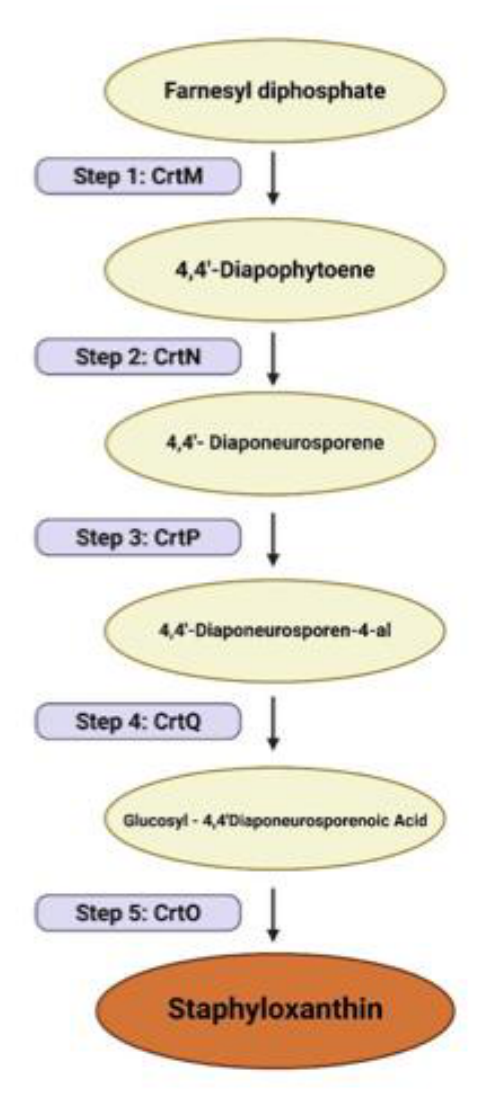
Figure 2.
SigB regulation of staphyloxanthin pigment production. The alternative sigma factor SigB positively influences staphyloxanthin biosynthesis in Staphylococcus aureus by promoting expression of the crtOPQMN carotenoid biosynthetic operon. The sigB operon encodes SigB and its regulatory proteins, while the crt operon encodes enzymes required for production of the golden carotenoid pigment staphyloxanthin. This regulatory connection links stress-response control to pigmentation, oxidative stress resistance, and virulence-associated physiology. Gene organization is schematic and not drawn to scale.
Figure 2.
SigB regulation of staphyloxanthin pigment production. The alternative sigma factor SigB positively influences staphyloxanthin biosynthesis in Staphylococcus aureus by promoting expression of the crtOPQMN carotenoid biosynthetic operon. The sigB operon encodes SigB and its regulatory proteins, while the crt operon encodes enzymes required for production of the golden carotenoid pigment staphyloxanthin. This regulatory connection links stress-response control to pigmentation, oxidative stress resistance, and virulence-associated physiology. Gene organization is schematic and not drawn to scale.
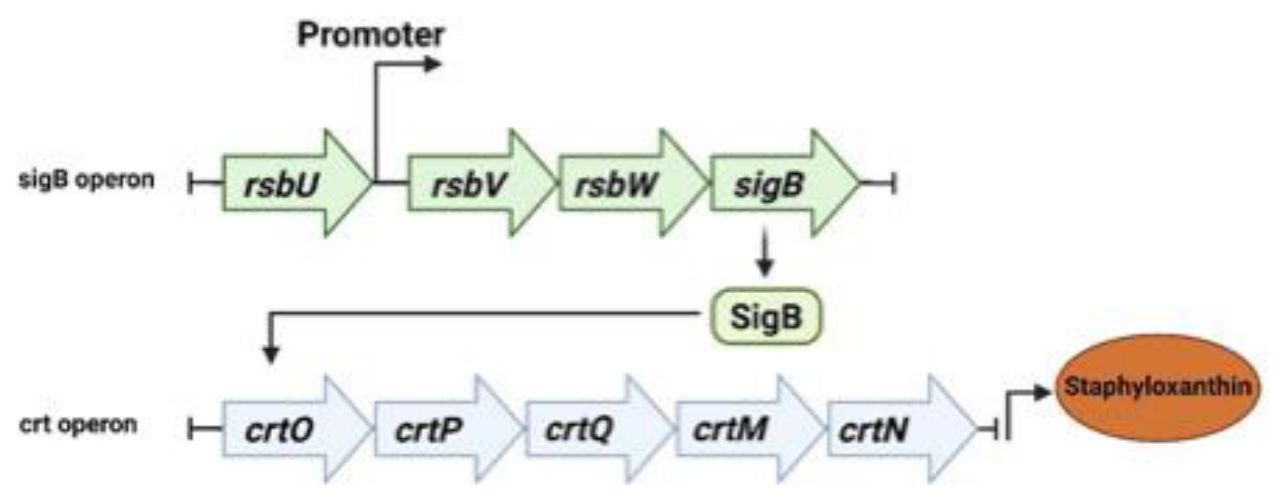

Table 1.
Summary of major compounds and their targets with impact on STX production.
| Compound | Target | Mode of action | Effect on STX | References |
|---|---|---|---|---|
| Diphenyl phosphonosulfonates | CrtM | Enzyme inhibition | ↓ STX production | (43, 44) |
| Flavone | Unknown | Natural flavonoid, antioxidant | ↓ STX, ↑ H₂O₂ sensitivity | (44, 45) |
| Rhodomyrtone | Unknown | Antioxidative agent | Dose-dependent ↓ STX | (46) |
| Naftifine | CrtN | FDA-approved antifungal | ↓ STX, ↑ immune clearance | (47) |
| NP16 | CrtN | Small molecule inhibitor | ↓ STX | (48) |
| Benzodioxan derivatives | CrtN | Synthetic inhibitors | ↓ STX | (49) |
| Diclofenac | Multiple | NSAID, biofilm disruption | ↓ STX, ↓ hemolysin | (50, 55) |
| SYG-180-2-2 | Unknown | Gene expression suppression | ↓ STX, ↓ virulence factors | (51) |
| MSI-1 | CrtN | Antimicrobial peptide | ↓ STX, ↑ immune clearance | (52) |
| Celastrol | Unknown | Redox-active natural compound | ↓ STX, ↓ biofilms | (53) |
| Hesperidin | Unknown | Plant-derived flavonoid | ↓ STX, ↓ biofilms, ↓ virulence | (54) |
| Ef 30616 | Unknown | Microbiome-derived metabolite | ↓ STX | (56) |
Abbreviations: STX (staphyloxanthin), NSAID (non-steroidal anti-inflammatory drug), H₂O₂ (hydrogen peroxide), ↓ (decrease/inhibition), ↑ (increase/enhancement).
Disclaimer/Publisher’s Note: The statements, opinions and data contained in all publications are solely those of the individual author(s) and contributor(s) and not of MDPI and/or the editor(s). MDPI and/or the editor(s) disclaim responsibility for any injury to people or property resulting from any ideas, methods, instructions or products referred to in the content. |
© 2026 by the authors. Licensee MDPI, Basel, Switzerland. This article is an open access article distributed under the terms and conditions of the Creative Commons Attribution (CC BY) license (http://creativecommons.org/licenses/by/4.0/).
Copyright: This open access article is published under a Creative Commons CC BY 4.0 license, which permit the free download, distribution, and reuse, provided that the author and preprint are cited in any reuse.


