Preprint
Article

This version is not peer-reviewed.

Antimicrobial Activity and Probiotic Potential of Lactic Acid Bacteria Isolated from São Jorge Cheese

Submitted:

02 June 2026

Posted:

03 June 2026

You are already at the latest version

Abstract

Six lactic acid bacteria isolated from São Jorge PDO cheese were characterised for technological, safety, antimicrobial, and probiotic properties. All isolates fermented a broad range of carbohydrates and lacked lipolytic activity, while SJC115 and SJC119 showed proteolysis. Safety profiling revealed γ‑haemolysis, no DNase or gelatinase activity, and generally favourable antibiotic susceptibility, although tetracycline resistance in Lacticaseibacillus paracasei and Levilactobacillus brevis isolates warrants caution. L. paracasei and L. brevis isolates inhibited a wide range of foodborne pathogens (Listeria monocytogenes, Escherichia coli, Pseudomonas aeruginosa, Salmonella enterica, Bacillus spp.) and spoilage fungi (Penicillium and Aspergillus spp.). Notably, two isolates (SJC117 and SJC120) exhibited antibacterial activity in neutralized cell-free supernatants, indicating bacteriocin-like inhibitory substances (BLIS). The isolates survived intestinal conditions above the probiotic threshold, yet only SJC117 and SJC120 tolerated gastric acidity (pH2.5, 1h) with >5logCFU/mL. Despite low hydrophobicity, strains showed good autoaggregation and pathogen coaggregation. All isolates produced exopolysaccharides (EPS) and angiotensin-converting enzyme (ACE) inhibitory peptides, whereas some exhibited moderate conjugated linoleic acid (CLA) production and glutamate decarboxylase (GAD) activity. L. paracasei SJC117 stood out by combining BLIS/antifungal activity, superior gastric tolerance, and an exceptional bioactive profile, making it a promising candidate for biopreservation and functional food applications.

Keywords: 
;  ;  ;  ;  ;  ;  

1. Introduction

Lactic acid bacteria (LAB) are essential components of traditional fermented foods, contributing to preservation, safety, flavour development, and textural properties. In raw milk cheeses, particularly those with Protected Designation of Origin (PDO) status, the indigenous LAB microbiota is uniquely shaped by geographical origin, manufacturing practices, and ripening conditions [1,2]. São Jorge cheese—a semi-hard PDO cheese produced from raw cow’s milk in the Azores archipelago—harbours a rich and distinctive LAB community dominated by lactobacilli and Leuconostoc species [1]. However, while the technological roles of starter cultures are well established, the functional potential of autochthonous non-starter LAB remains underexplored.
This knowledge gap is particularly relevant given the growing consumer demand for clean-label products, which has intensified interest in biopreservation strategies that reduce reliance on chemical preservatives. LAB can inhibit spoilage microorganisms and foodborne pathogens through multiple mechanisms, including organic acid production, competition for nutrients, and synthesis of bacteriocins or bacteriocin-like inhibitory substances (BLIS) [3,4]. Nevertheless, the relative contribution of each mechanism varies considerably among strains, and the discovery of novel BLIS-producing strains from underexplored ecological niches remains a priority.
Beyond antimicrobial activity, certain LAB also exhibit probiotic traits such as tolerance to gastrointestinal transit, adhesion to intestinal epithelium, and production of bioactive compounds that confer additional health benefits [5,6]. Among these bioactive metabolites, exopolysaccharides (EPS) produced by LAB have gained attention not only for their technofunctional properties—improving texture, water retention, and stability in fermented dairy products—but also for their prebiotic, immunomodulatory, and cholesterol-lowering effects [7]. Similarly, angiotensin-converting enzyme (ACE) inhibitory peptides, generated by LAB proteolysis of milk proteins, are recognized for their antihypertensive potential and have been identified in various fermented dairy products [8]. Conjugated linoleic acid (CLA), produced by LAB through biohydrogenation of linoleic acid, exhibits anticarcinogenic, anti-atherogenic, and anti-adipogenic properties, although strain-dependent production levels vary considerably [9].
Another desirable trait is glutamate decarboxylase (GAD) activity, which converts glutamate to gamma-aminobutyric acid (GABA), a compound known for its hypotensive, anxiolytic, and sleep-regulating effects [10]. Consequently, screening LAB for the simultaneous production of multiple bioactive compounds represents a promising strategy for developing functional foods with enhanced health-promoting properties. However, controversy persists regarding the safety of some LAB species, particularly concerning antibiotic resistance and biogenic amine production. Although many lactobacilli carry intrinsic resistance to certain antibiotics (e.g., vancomycin) that is not transferable, the potential for acquired resistance via mobile genetic elements raises concerns [11]. Therefore, a comprehensive safety assessment is mandatory for any strain proposed for industrial or probiotic application.
The present study aimed to characterize LAB, particularly lactobacilli strains, isolated from São Jorge cheese, with a primary focus on their antimicrobial potential against major foodborne pathogens and fungi. In addition, we evaluated their technological properties, safety profile, tolerance to simulated gastrointestinal conditions, adhesion potential, and capacity to produce EPS, ACE inhibitory peptides, CLA, and GABA (via GAD activity).

2. Materials and Methods

2.1. Bacterial Isolation

Lactic acid bacteria (LAB) were isolated from São Jorge Cheese (The Azores, Portugal), following the procedure described by Coelho, et al. [12]. The 16S rDNA sequences were deposited in the GenBank under accession number Lentilactobacillus parabuchneri SJC114 OQ457274, Lacticaseibacillus paracasei SJC115 OQ457275, L. paracasei SJC116 PZ326616, L. paracasei SJC117 OQ457276, Levilactobacillus brevis SJC119 OQ457278 and L. brevis strain SJC120 OQ457279. Stock cultures were kept at −80 °C in 30% (v/v) glycerol and propagated twice in MRS broth (Biokar Diagnostics, Allonne, France), with 1% (v/v) of inoculum at 30 °C for 24 h.

2.2. Tecnological Characterization

2.2.1. Acidification Capacity

The acidification capacity of lactic acid bacteria (LAB) was evaluated in Skim milk (VWR Chemicals, Leuven, Belgium). Firstly, isolates were inoculated into MRS broth and incubated at 30°C for 24 hours. After this incubation, a 1% inoculum was prepared in skimmed milk and incubated again at 30°C for 24 hours. During this time, the pH of the cultures was measured using a potentiometer. The pH measurements were taken after 0, 6 and 24 hours.

2.2.2. Sugar Fermentation

The isolates were analysed for their ability to ferment several sugars: glucose, fructose, galactose, ribose, arabinose, sucrose, lactose, maltose, raffinose, starch, mannitol, xylose, trehalose, rhamnose, dextrin, sorbitol, glycerol and inulin. Each sugar (1%) was added to the bacterial suspension (adjusted to 2 McFarland), covered with mineral oil and incubated at 30°C for 48 hours [13]. The fermentation was evaluated by the acidification of the medium, which was visible by the colour change of the indicator.

2.2.3. Enzymatic Activity

The APIZYM kit was used according to the manufacturer's instructions as a semi-quantitative method to detect the enzymatic activities of 19 enzymes: alkaline phosphatase, esterase (C4), esterase-lipase (C8), lipase (C14), leucine arylamidase, valine arylamidase, cystine arylamidase, trypsin, α-chymotrypsin, acid phosphatase, naphthol-AS-BI phosphohydrolase, α-galactosidase, β-galactosidase, β-glucuronidase, α-glucosidase, β-glucosidase, N-acetyl-β-glucosaminidase, α-mannosidase and α-fucosidase [14]. The results were recorded on a scale of 0-5 according to colour intensity. Scores of 0–2 indicate a negative reaction, whereas scores of 3–5 indicate a positive reaction.

2.2.4. Proteolytic Activity

Extracellular proteolytic activity was determined by plating the isolates on Plate Count Agar (PCA, Biokar Diagnostics, France) supplemented with 10% (w/v) Skim milk. The isolates were then incubated at 30°C and after 72 hours the plates were flooded with 1% HCl. Proteolytic activity was indicated by a clear zone around the colonies [15]. Staphylococcus aureus subsp. aureus ATCC 25923 was used as a positive control.

2.2.5. Lipolytic Activity

To evaluate the lipolytic activity, the bacteria were inoculated on Tributyrin agar (Merck, Germany) and incubated at 30°C for 72 hours. After incubation, the presence of colonies surrounded by a clear halo indicated a positive result [16]. S. aureus ATCC29423 was used as a positive control.

2.3. Safety Evaluation

2.3.1. Haemolytic Activity

To determine haemolytic activity, the isolates were inoculated onto blood agar medium prepared from Tryptose Blood Agar (Merck Germany) with the addition of sheep's blood. The plates were incubated at 37°C for 48 hours. After this time, the blood agar plates were analysed and classified as follows: β-haemolysis, when a translucent halo appeared around the colonies; α-haemolysis, corresponding to a greenish halo around the colonies; and γ- haemolysis, indicating the absence of a halo around the colonies [17].

2.3.2. DNase Activity

DNAse activity was analysed by plating isolates on DNAse-Test agar (Sigma-Aldrich, USA), following by incubation for 48 hours at 37°C. A positive reaction was indicated by the appearance of a pink halo around the colonies [18].

2.3.3. Gelatinase Activity

The production of the enzyme gelatinase was determined according to the methodology of Terzić-Vidojević, et al. [19]. In this assay, the presence of a transparent halo around the colonies is considered an indicator of a positive reaction. S. aureus ATCC29423 was used as a positive control.

2.3.4. Antibiotic Susceptibility

Antibiotic resistance was assessed using the Kirby-Bauer method (agar diffusion). Seven antibiotics were tested: Ampicillin, Oxacillin, Vancomycin, Tetracycline, Chloramphenicol, Streptomycin and Kanamycin. The discs were then incubated at 30 °C for 24-48 hours. After incubation, the zones of inhibition, including the disc diameter, were measured using a ruler. The reference values from CLSI [20] were used to categorize isolates into resistant (R), intermediate (I) and sensitive (S). S. aureus ATCC 25923 was used as positive control.

2.4 Antimicrobial Activity

2.4.1. Antimicrobial Activity

The antimicrobial activity of the isolates was determined using the agar diffusion method as described by Ribeiro, et al. [21]. Briefly, cell-free supernatants (CFS) from 48-h MRS cultures (30 °C) were obtained by centrifugation and filter-sterilized. Neutralized supernatants (pH 6.5–7.0) were also prepared (neutralized CFS). Indicator strains included Listeria innocua ATCC 33090, Listeria monocytogenes ATCC 35152, L. monocytogenes ATCC 13932, Escherichia coli ATCC 15922, E. coli ATCC 8739, E. coli ATCC 25922, Staphylococcus aureus ATCC 25923, Pseudomonas aeruginosa ATCC 27853, Salmonella enterica subsp. enterica serovar Enteritidis ATCC 13076, S. enterica serovar Typhimurium ATCC 14028, Bacillus spizizenii ATCC 6633 and Bacillus cereus ATCC 11778. Prior to use, all indicator strains were propagated in Nutrient Broth at 37 °C for 18 h. These cultures were adjusted to 0.5 McFarland and inoculated into PCA (100 μL per 200 mL medium). After solidification, 6-mm wells were filled with 60 μL of CFS or neutralized CFS from each strain. Following overnight incubation at 37 °C, inhibition halos were measured.

2.4.2. Antifungal Activity

Antifungal activity was evaluated following the method of Cheong, et al. [22], with minor modifications. Bacterial cultures were grown in MRS broth at 30 °C until abundant growth. Each isolate was then streaked in two 5-cm lines on MRS agar plates using a sterile swab and incubated at 30 °C for 48 h. After incubation, plates were overlaid with 10 mL of Potato Dextrose Agar (PDA) containing 10⁴ spores/mL of test fungi. The fungal species tested included Aspergillus flavus MUM 16.106 (isolated from cheese rind), Penicillium nordicum MUM 16.93 (from cheese ripening room), Aspergillus chevalieri MUM 00.07 (cheese curing chamber air), Penicillium commune MUM 16.56 (cheese rind), and Penicillium brevicompactum MUM 9906 (curing chamber surface), obtained from the University of Minho Mycotheca. Inhibition zones around LAB growth were scored as: (−) no inhibition (colonies fully overgrown by mould); (−/+) weak inhibition (inhibition on the LAB colony but no adjacent clearing); (+) low inhibition (small clearing zone); (++) moderate inhibition (clearing zone ~50% of the plate); (+++) strong inhibition (large clearing zone covering most or all of the plate).

2.5. Probiotic Evaluation

2.5.1. Gastrointestinal Resistance

Gastrointestinal tolerance was assessed by measuring survival under conditions mimicking the stomach (pH 2.5) and the small intestine (exposure to bile acids and pancreatin), following the procedure described by Jurášková et al. [13].

2.5.2. Hydrophobicity

Bacterial hydrophobicity was evaluated using the solvent partitioning method with chloroform and ethyl acetate [23]. Isolates were grown in MRS broth at 30 °C for 24 h, harvested by centrifugation (4000 × g, 20 min, 20 °C), washed twice with phosphate-buffered saline (PBS), and resuspended in PBS to an initial optical density at 600 nm (ODbefore) of 0.5–0.6. Aliquots (3 mL) of the bacterial suspension were transferred to sealable tubes containing 1 mL of each solvent. The mixtures were vortexed for 2 min and left to stand for 10 min to allow phase separation. After removal of the organic (upper) layer, the OD600 of the aqueous phase was measured (ODafter). The assay was performed in quadruplicate per isolate. Hydrophobicity (%) was calculated as:
H y d r o p h o b i c i t y   % =   1 O D a f t e r O D b e f o r e   ×   100

2.5.3. Autoaggregation

Autoaggregation capacity was evaluated following the method of Todorov and Dicks [24]. Isolates were cultured in MRS broth at 30 °C for 24 h, harvested by centrifugation (4000 × g, 20 min, 20 °C), washed twice with PBS, and resuspended in PBS. The initial optical density at 600 nm was recorded (ODbefore). After 60 min of static incubation at room temperature, the bacterial suspension was gently centrifuged (300×g, 2 min, 20 °C), and the final (ODafter) of the supernatant was measured. Assays were performed in quadruplicate per isolate. Autoaggregation (%) was calculated as:
A u t o a g g r e g a t i o n   % =   ( A b s b e f o r e A b s a f t e r l ) A b s b e f o r e ×   100

2.5.4. Coaggregation

The coaggregation ability of LAB isolates with pathogenic bacteria was assessed according to Chen, et al. [25]. The pathogens tested included E. coli ATCC 25922, L. monocytogenes ATCC 13932, S. aureus ATCC 2523 and S. Typhimurium ATCC 14028. LAB isolates and pathogen suspensions (prepared as for autoaggregation) were mixed in equal volumes (2 mL each) and left undisturbed for 60 min at room temperature. Coaggregation was calculated from OD measurements at 600 nm, using the following equation:
C o a g g r e g a t i o n   % =   A x + A y / 2 A x + y A x + A y   ×   100
where Ax and Ay designate the absorbance (600 nm) of the two bacteria cell suspensions and Ax+y is the absorbance of mixed bacteria cell suspensions.

2.5.5. Production of EPS

The determination of exopolysaccharide production was carried out in solid and liquid media according to the methods of Smitinont, et al. [26] and Cirrincione, et al. [27]. The LAB isolates were inoculated on MRS agar plates and in liquid MRS broth containing 10% (w/v) of each of the following sugars: glucose, fructose, sucrose and lactose. The isolates were incubated at 30°C for 3 days to determine which isolates could produce EPS. In solid medium, all cultures that exhibited slime colonies were considered positive for EPS. After incubation, the liquid LAB cultures were centrifuged (4000 × g, 20 min, 4°C) and the supernatants discarded. The ropy phenotype was assessed by inserting an inoculation loop into the pellet and visually inspecting the filament when the loop was lifted (EPS-positive – filament formation). All measurements were performed in duplicate.

2.5.6. Angiotensin-Converting Enzyme (ACE) Inhibitory Activity

ACE inhibitory activity was measured according to Cushman and Cheung [28], based on the release of hippuric acid from hippuryl-L-histidyl-L-leucine (HHL) catalysed by ACE. LAB isolates were incubated in skim milk (10% v/v) at 30 °C for 24 h. Then, 40 µL of fermented milk were mixed with 400 µL of buffered substrate solution (5 mM HHL in 100 mM sodium borate buffer containing 300 mM NaCl, pH 8.3). Subsequently, 80 µL of ACE solution (0.1 U/mL) were added, and the mixture was incubated at 37 °C for 30 min. The reaction was stopped by adding 250 µL of 1 M HCl. Hippuric acid released during the reaction was extracted with 1.7 mL of ethyl acetate. After centrifugation (4000 × g, 5 min), 1 mL of the organic phase was transferred to a glass tube and evaporated in a water bath at 95 °C for 20 min. The residue was dissolved in 1 mL of distilled water, and its absorbance was measured at 228 nm.
ACE inhibition (%) was calculated using the formula:
Inhibition % = A B A C × 100
where A is the absorbance of the control without sample, B is the absorbance in the presence of ACE and sample, and C is the absorbance in the absence of ACE and sample. All measurements were performed in duplicate.

2.5.7. Conjugated Linoleic Acid (CLA) Production

CLA production was assessed using the spectrophotometric method as described by Ribeiro, et al. [29]. Briefly, LAB strains were grown in MRS broth supplemented with free linoleic acid (0.5 mg/mL) and 2% (w/v) Tween 80 at 30 °C for 48 h. After centrifugation (20,800×g, 1 min), the supernatant was mixed with isopropanol (2 mL) and allowed to stand for 3 min. Fatty acids were extracted by adding hexane (1.5 mL), followed by vortexing and a further 3-min incubation. The hexane layer was transferred to a 96-well plate, and absorbance was measured at 233 nm in a microtiter reader (Fluostar Omega, BMG Labtech, Germany). Pure cis-9, trans-11 CLA was used for standard curve. All measurements were performed in duplicate.

2.5.8. GABA Production Capacity

Potential for GABA production was screened using a GAD colorimetric assay [30]. Cells from fresh cultures were harvested by centrifugation (4000 × g, 20 min, 25 °C), washed with 0.9% NaCl, and re-centrifuged. The pellet was resuspended in a GAD solution (1 g glutamic acid, 0.3 mL Triton X-100, 90 g NaCl, 0.05 g/L bromocresol green, pH 4) and incubated anaerobically at 37 °C for 4 h. A colour change from green to blue indicated GABA production, as confirmed by the positive control Enterococcus malodoratus SJC62 [12].

3. Results

3.1. Technological Characterization

All six LAB isolates were assessed for acidification capacity in skim milk, sugar fermentation profile, enzymatic activity, and proteolytic/lipolytic activity (Figure 1).
After 24 h of incubation, the highest milk acidification (ΔpH) was observed for Lacticaseibacillus paracasei SJC115 (ΔpH = 1.8), followed by SJC117 (ΔpH = 1.5) and SJC116 (ΔpH = 1.3). Lentilactobacillus parabuchneri SJC114 and both Levilactobacillus brevis strains (SJC119 and SJC120) showed weak acidification (ΔpH < 0.8) (Figure 1a).
Proteolytic activity (clear zones on milk-PCA) was positive for SJC115 and SJC119, while the remaining isolates showed no proteolysis (Figure 1b).
Concerning carbohydrate fermentation (Figure 1c), all isolates fermented glucose, fructose, galactose, sucrose, lactose, maltose, trehalose, and mannitol. Strain-dependent variability was observed for ribose, arabinose, raffinose, xylose, rhamnose, sorbitol, and glycerol. Starch, dextrin, and inulin were not fermented by any isolate.
Enzymatic profiling (Figure 1d) revealed that all isolates produced high levels of β-galactosidase, leucine arylamidase, valine arylamidase, and acid phosphatase. Moderate to high α- and β-glucosidase activities were also present. Undesirable enzyme activities such as trypsin and α-chymotrypsin were absent in isolates, whereas low levels of N-acetyl-β-glucosaminidase was detected in L. brevis SJC119, and low activity of β-glucuronidase was detected in L. paracasei SJC116. Alkaline phosphatase, lipase (C14), α-manosidase and α-fucosidase activities were absent in all isolates.

3.2. Safety Evaluation

Haemolytic activity on blood agar was γ-haemolysis (no halo) for all isolates, indicating absence of β-haemolysis (data not shown). In addition, no DNase or gelatinase activity was detected for any strain (data not shown).
Antibiotic susceptibility test (Table 1) showed that all isolates were sensitive to ampicillin and chloramphenicol, except for L. brevis SJC119. In contrast, all isolates were resistant to oxacillin. Resistance to vancomycin was observed for SJC116, SJC119 (resistant) and SJC117, SJC120 (intermediate). Tetracycline resistance was found in all L. paracasei and L. brevis isolates, whereas L. parabuchneri SJC114 was sensitive. For aminoglycosides, streptomycin resistance was observed for SJC115 and intermediate susceptibility for SJC116 and SJC119; kanamycin resistance was present in SJC115, SJC116, and intermediate for SJC117, SJC119, SJC120 (Table 1).

3.3. Antimicrobial Activity

The antimicrobial activity was evaluated against key foodborne pathogens and spoilage fungi. The target bacteria included several gram-positive strains: L. innocua, L. monocytogenes, S. aureus, B. spizizenii and B. cereus; and gram negative: E. coli, P. aeruginosa, and S. enterica serovars Enteritis and Typhimurium (Table 2). None of the crude supernatants (CFS) from isolate SJC114 inhibited any indicator strain. For the remaining isolates, CFS exhibited variable inhibition zones against L. innocua, L. monocytogenes (both strains), E. coli strains, S. aureus, P. aeruginosa, Salmonella serovars, B. spizizenii, and B. cereus.
Notably, neutralized supernatants (NS, pH 6.5–7.0) retained inhibitory activity only for isolates SJC117 and SJC120. The NS of SJC117 inhibited L. monocytogenes ATCC 13932 (5.2 ± 4.2 mm), E. coli ATCC 25922 (6.3 ± 8.9 mm), and B. spizizenii (9.1 ± 0.2 mm). SJC120 NS showed activity only against L. monocytogenes ATCC 13932 (5.6 ± 7.9 mm). All other neutralized supernatants showed no inhibition, indicating that the antimicrobial activity was mostly due to organic acids, except for SJC117 and SJC120 where BLIS production is suggested.
LAB's antifungal activity is an important parameter for its technological use. Various filamentous fungi from the Aspergillus and Penicillium genera isolated from cheese rind and cheese-making environment were evaluated (Table 3). Strong inhibition (large clearing zone covering most or all the plate) against P. commune, P. brevicompactum, P. nordicum, A. chevalieri, and A. flavus was observed for isolates SJC116, SJC117, SJC119, and SJC120. L. parabuchneri SJC114 showed strong inhibition against P. brevicompactum, P. nordicum, and A. chevalieri, but weak inhibition (±) against P. commune and A. flavus. SJC115 exhibited moderate to strong inhibition against most moulds, except P. commune (low inhibition, +) and A. flavus (low, +).

3.3. Probiotic Potential

3.3.1. Gastrointestinal Tolerance

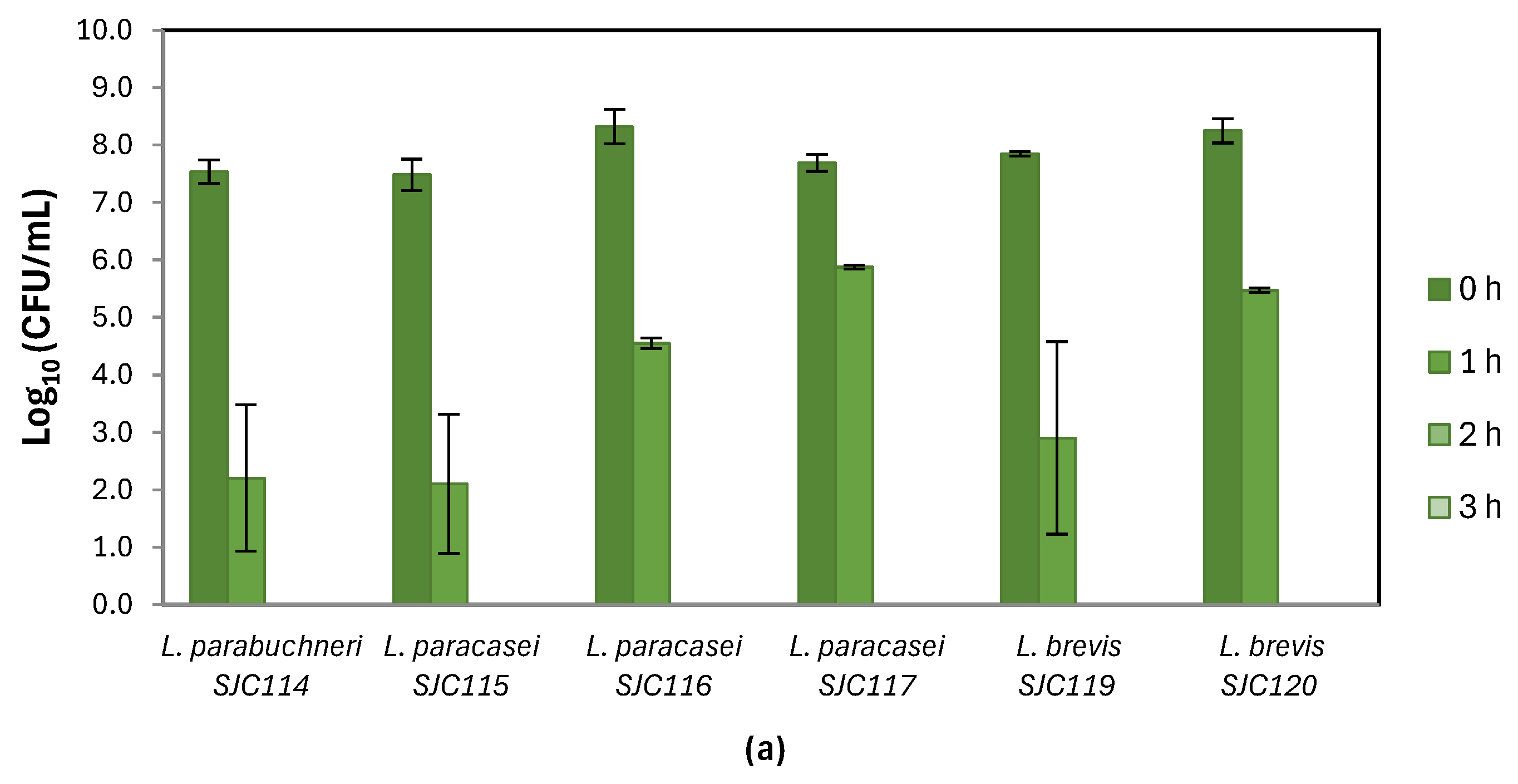
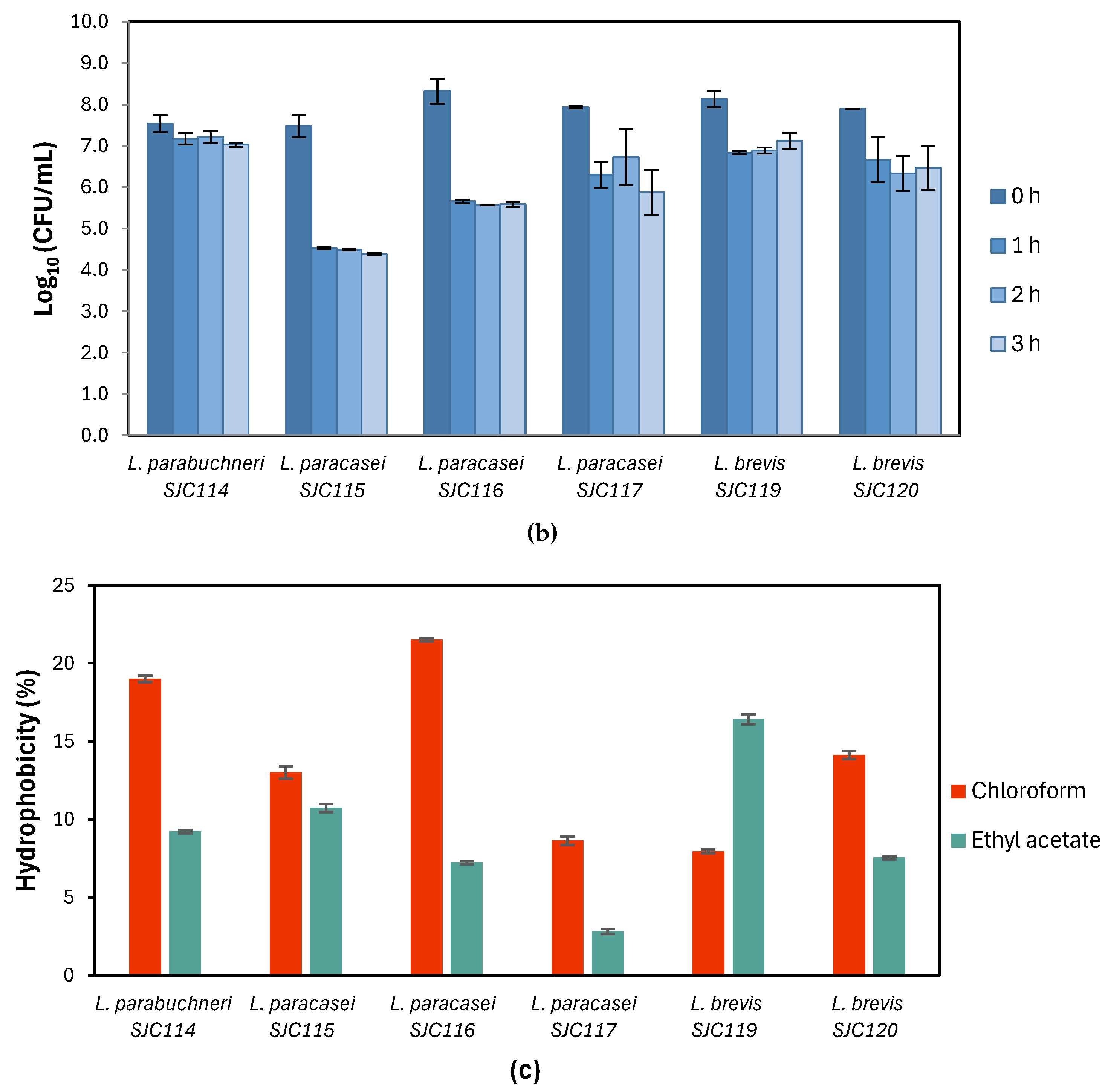
To be considered probiotic, bacteria must be able to survive at low pH in the stomach and to tolerate the conditions of the intestine (presence of bile acids and pancreatin). Thus, viable colony counts of LAB were performed over 3 hours (simulating digestion time) under gastrointestinal conditions. Resistance to gastrointestinal conditions was evaluated based on two parameters: pH 2.5 (acidic stomach conditions) and 0.3% bile acids with 0.1% pancreatin (intestinal conditions). The results, expressed in colony-forming units (CFU/mL), are presented in Figure 2a,b.
All isolates showed greater tolerance to bile acids and pancreatin than to acidic pH (2.5). Under acidic conditions, a time-dependent reduction in viability was observed for all isolates, with no detectable viable counts after 2 h. Nevertheless, all isolates maintained countable levels during the first hour, with L. paracasei SJC117 exhibiting the highest count (5.9 log CFU/mL).
Regarding survival in the presence of bile acids and pancreatin, all isolates remained viable after 3 h of exposure (Figure 2b). Although a slight reduction in counts occurred for some isolates after the first hour, viability remained stable thereafter until 3 h.

3.3.2. Hydrophobicity

The hydrophobicity of the isolates was tested with chloroform (electron acceptor, indicative of basic surface properties) and ethyl acetate (electron donor). The results are presented in Figure 2c.
Adhesion to chloroform ranged from 8% (SJC119) to 22% (SJC116), while adhesion to ethyl acetate was lower, varying between 3% (SJC117) and 16% (SJC119). SJC115 was the isolate that showed the most comparable hydrophobicity values between the two solvents.
Figure 2. Tolerance of LAB isolates (log CFU/mL) to (a) acidic conditions (pH 2.5), (b) bile acids (0.3%) and pancreatin (0.1%); (c) Percentage of LAB adhesion (hydrophobicity) to chloroform and ethyl acetate. Results are expressed as mean ± SEM of two independent experiments.
Preprints 216707 g002aPreprints 216707 g002b

3.3.3. Autoaggregation and Coaggregation

Autoaggregation after 60 min was highest for L. paracasei SJC115 (32.8 ± 0.08%), followed by SJC116 (10.2 ± 0.02%). SJC117 and SJC119 showed no autoaggregation (0%), while SJC114 (7.3 ± 0.06%) and SJC120 (2.4 ± 0.05%) exhibited low values (Table 4).
Coaggregation percentages with pathogenic bacteria ranged from 26.7% to 40.7% (Table 4). The highest values were observed for SJC116 with E. coli (40.7 ± 0.01%) and S. aureus (35.1 ± 0.02%), and for SJC120 with L. monocytogenes (36.7 ± 0.07%) and Salmonella Typhimurium (40.5 ± 0.01%). All isolates exhibited moderate to high coaggregation (≥27%) against every pathogen tested.

3.3.4. EPS Production

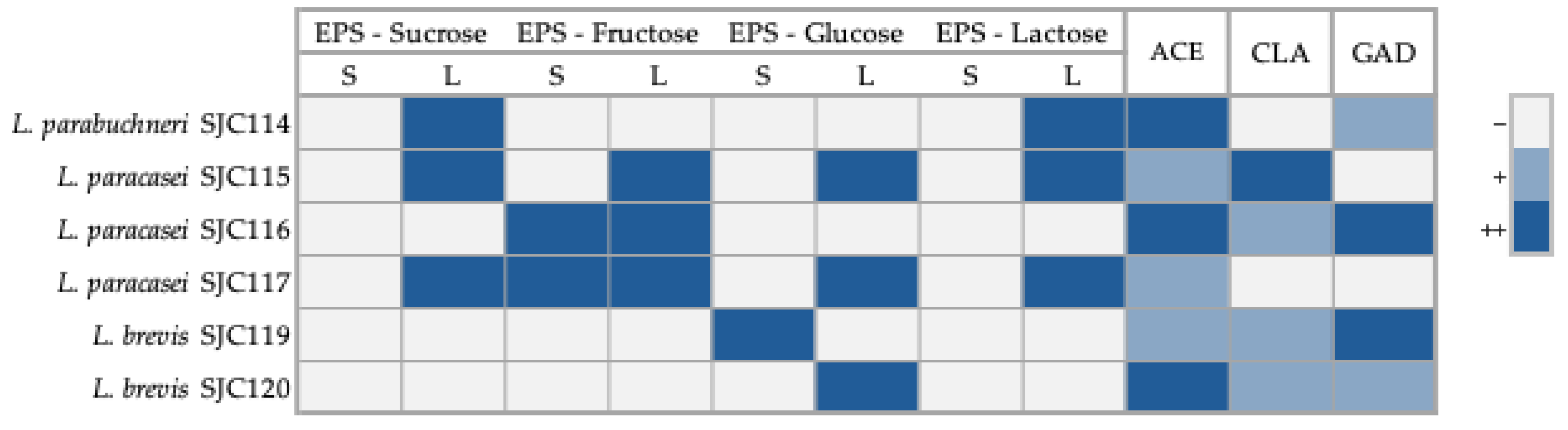
Figure 3 presents the EPS-producing ability of the LAB isolates from various sugars. All isolates produced EPS from at least one tested sugar.
Isolates SJC114, SJC115, and SJC120 produced EPS only in liquid medium. Isolates SJC115 and SJC117 produced EPS with all tested sugars (sucrose, fructose, glucose, and lactose), whereas other isolates were more selective. For example, L. paracasei SJC116 used only fructose for EPS production (in either solid or liquid medium), and the L. brevis isolates used only glucose (L. brevis SJC119 in solid medium and SJC120 in liquid medium). EPS production in solid medium was observed only with fructose (for L. paracasei SJC116 and SJC117) and with glucose (for SJC120).

3.3.5. ACE Inhibitory Activity

All LAB isolates were found to possess the ability to produce ACE-inhibitory peptides (Figure 3). Isolates SJC114, SJC116, and SJC120 showed the highest ACE inhibition by the fermented milk peptides (>85%).

3.3.6. CLA Production

Conjugated linoleic acid (CLA) production varied among LAB isolates (Figure 3). Although several isolates could produce CLA from linoleic acid, the achieved CLA concentrations remained relatively low. The highest CLA production (3.54 µg/mL) was observed for L. paracasei SJC115. Low production (0.6–2 µg/mL) was observed for SJC116, SJC119, and SJC120, while SJC114 and SJC117 did not produce CLA.

3.3.7. GAD Activity

The ability of the isolates to convert monosodium glutamate (MSG) into γ-aminobutyric acid (GABA) — i.e., glutamate decarboxylase (GAD) enzyme activity — was also evaluated. The isolates L. paracasei SJC116 and L. brevis SJC119 exhibited high GAD activity (Figure 3).
Figure 3. Screening of LAB isolates for the production of EPS with sucrose, fructose, glucose and lactose (negative – or positive + in solid S / liquid L medium), ACE-inhibitory peptides (negative –, high +, 80–85%, very high ++, >85%), CLA (negative –, low +, <2 µg/mL, high ++, 3.5 µg/mL), and GAD activity (negative –, low +, high ++).
Preprints 216707 g003

4. Discussion

In this study, six LAB isolates (QPS status) from São Jorge PDO cheese were evaluated for technological properties, safety, antimicrobial activity, and probiotic potential. The results revealed strain-specific differences, with Lacticaseibacillus paracasei SJC117 consistently standing out as the most promising candidate for biopreservation and functional food applications.
All isolates acidified milk only moderately (ΔpH < 1.8 after 24 h), which is typical for non-starter LAB (NSLAB) that are not selected for rapid fermentation [5]. Nevertheless, their ability to ferment a broad range of carbohydrates, including lactose and galactose, indicates good adaptation to the dairy environment. The absence of lipolytic activity is desirable because it prevents off-flavour development during cheese ripening, whereas the proteolytic activity observed in SJC115 and SJC119 may contribute to texture and flavour formation [31,32]. These results agree with those reported by other studies, which refer to a weak lipolytic capacity of LAB, although some strains exhibit proteolytic activity [33,34].
The high levels of β-galactosidase, leucine arylamidase, valine arylamidase, and acid phosphatase observed in the LAB isolates, together with moderate to high α- and β-glucosidase activities, are technologically advantageous for dairy applications. The presence of high β galactosidase activity in all strains is technologically relevant for lactose hydrolysis, enabling LAB to ferment milk efficiently and produce lactic acid, which drives curd acidification and prevents spoilage [5]. Moreover, strains with high β-galactosidase activity are valuable for producing lactose-free or low-lactose dairy products, addressing the needs of lactose-intolerant consumers [35].
Leucine arylamidase and valine arylamidase are aminopeptidases that play a key role in cheese ripening [36]. They hydrolyse bitter-tasting peptides derived from casein breakdown, thereby reducing bitterness and contributing to the development of typical cheese flavour and texture [33]. High aminopeptidase activity is considered a desirable trait for adjunct cultures [37]. In addition, acid phosphatase is involved in the dephosphorylation of phosphoproteins and phosphopeptides, which can affect the mineral balance and texture of fermented dairy products [38]. Its presence has been linked to improved cheese ripening and enhanced bioavailability of phosphorus [39].
The α- and β-glucosidase activities detected at moderate to high levels further expand the metabolic versatility of these strains. β-Glucosidase can hydrolyse glucosides present in plant-based ingredients, potentially increasing the availability of bioactive aglycones (e.g., isoflavones) in functional dairy products [40]. α-Glucosidase activity may also contribute to the breakdown of α-linked oligosaccharides, although some studies suggest that probiotics with low α-glucosidase activity could be beneficial for diabetic individuals by reducing postprandial hyperglycaemia [41]. Nevertheless, in the context of dairy fermentation, moderate to high α-glucosidase activity is generally considered neutral or positive [42].
Undesirable enzymes (e.g., α-chymotrypsin, β-glucuronidase, and N-acetyl-β-glucosaminidase), which are associated with intestinal diseases and potential colonic harm, were either absent or present at low levels in some isolates. These enzymes can exert negative effects in the colon and have been associated with gastrointestinal diseases [43]. β-Glucuronidase can hydrolyse various glucuronides (or glucuronosides), leading to the release of carcinogenic compounds in the colon, including polycyclic aromatic hydrocarbons [44]. N-Acetyl-β-glucosaminidase reduces N-nitro compounds (e.g., nitrobenzenes) to amines, which are often mutagenic and carcinogenic [45]. In the present study, low activity of N-acetyl-β-glucosaminidase was observed in isolate SJC119, and β-glucuronidase in isolate SJC116. Although the detected intensities were not high, the presence of these enzymatic activities in these isolates may preclude their use as probiotics.
Regarding safety, all isolates were negative for DNase, gelatinase, and haemolysis — key safety criteria for potential probiotic or starter cultures [46]. Antibiotic susceptibility testing revealed a generally favourable profile, with most isolates sensitive to clinically relevant antibiotics such as ampicillin and chloramphenicol. Antibiotic resistance in LAB is not considered a safety concern unless actual transfer of resistance genes occurs. Resistance to oxacillin (all isolates), vancomycin (several L. paracasei and L. brevis strains), and aminoglycosides (including kanamycin and streptomycin) is commonly reported as intrinsic in many lactobacilli and is not considered a safety concern due to lack of transferability [47]. However, resistance to other antibiotics, such as tetracycline (observed in all paracasei and brevis isolates), is often acquired — although in some groups it may also be intrinsic [47]. The absence of β-haemolysis and gelatinase activity further supports the non-pathogenic nature of these strains. Nevertheless, a full genomic assessment for mobile genetic elements would be advisable before industrial application.
Evaluating the antimicrobial activity of LAB isolates is essential for identifying strains that can enhance food safety by inhibiting foodborne pathogens and spoilage microorganisms, serve as natural biopreservatives (including bacteriocin producers), and provide probiotic benefits through competition against enteric pathogens. With the exception of L. parabuchneri SJC114, all other isolates (L. paracasei and L. brevis) exhibited antibacterial activity in their crude supernatants against a broad range of foodborne pathogens, including L. monocytogenes, E. coli, S. enterica, Pseudomonas, and Bacillus. For most isolates, this activity was largely lost after neutralisation, indicating that organic acids are the primary inhibitory mechanism. Nevertheless, because acidic foods such as fruit juices are particularly susceptible to contamination by spoilage bacteria [48], these strains show potential as natural preservatives for food applications.
Remarkably, neutralised CFS from L. paracasei SJC117 retained activity against L. monocytogenes, E. coli, and B. spizizenii, strongly indicating the production of bacteriocin-like inhibitory substances (BLIS). Likewise, neutralised CFS from L. brevis SJC120 remained active against L. monocytogenes. This is a notable finding, as BLIS-producing lactic acid bacteria can serve as biopreservatives in foods without adversely affecting sensory properties [49].
The antifungal activity against major spoilage moulds (Penicillium and Aspergillus spp.) was remarkably strong for most isolates, especially SJC116, SJC117, SJC119, and SJC120, which showed the highest inhibition against all test fungi. Such a broad antifungal spectrum, rarely reported for dairy-derived lactic acid bacteria, suggests that these strains could effectively control mould contamination in cheese ripening rooms and packaged products [22]. Given the harmful effects of fungal contamination, strategies to mitigate mycotoxin production are of growing interest [50]. The antifungal activity of LAB has been shown to result from a range of metabolites, including phenyllactic acid (PLA), cyclic dipeptides, fatty acids, and organic acids [51]; however, further research is necessary to identify the specific compounds responsible in these strains.
To be considered probiotic, it is important that bacteria have the ability to survive low pH in order to tolerate the initial stress in the stomach and the conditions of the intestine (presence of bile acids and digestive enzymes) [52]. The gastrointestinal tolerance assays revealed a clear differentiation among the isolates. While all strains survived the simulated intestinal conditions with viable counts above 6 log CFU/mL, the ability to withstand gastric acidity (pH 2.5 for 1 h) was strain-dependent. Only L. paracasei SJC117 and L. brevis SJC120 maintained counts above 5 log CFU/mL, whereas the remaining isolates dropped to between 2 and 4.6 log CFU/mL. This is noteworthy because survival through the stomach is often the most restrictive step for orally delivered probiotics; a reduction of 3–6 log units at pH 2.5 is commonly observed even in robust strains, and the ability to retain >5 log CFU/mL indicates strong acid tolerance [53,54]. The threshold of 10⁶ CFU/mL in the small bowel is widely accepted to ensure that a sufficient number of viable cells reach the intestinal epithelium to exert health benefits [53]. The fact that only SJC117 and SJC120 isolates remained close to or above this threshold after the gastric challenge suggests they are the most promising candidates for further probiotic development, although all isolates remain viable under intestinal stress, which is encouraging.
The surface properties, however, revealed a different pattern. All isolates displayed relatively low cell surface hydrophobicity (<20 % adhesion to both chloroform and ethyl acetate), indicating a predominantly hydrophilic cell surface. While high hydrophobicity is often used as a rapid indicator of potential adhesion to intestinal mucosa and epithelial cells, low values do not preclude effective mucosal interaction, as adhesion is a multifactorial process mediated by specific surface proteins, lipoteichoic acids, and exopolysaccharides that can compensate for a hydrophilic surface [55]. Despite the low hydrophobicity, the isolates exhibited favourable autoaggregation and coaggregation traits, which are desirable for competitive exclusion of pathogens. Notably, L. paracasei SJC117 showed no autoaggregation yet displayed moderate to high coaggregation (≈32–33 %) with all four tested pathogens (L. monocytogenes, E. coli, S. aureus and S. Typhimurium). This pattern—effective pathogen coaggregation in the absence of self-aggregation, even with a hydrophilic surface—has been observed in other lactobacilli and may indicate a cell-surface architecture that preferentially favours interspecies interactions [56]. Meanwhile, isolates such as L. paracasei SJC115 and SJC116 demonstrated both autoaggregation and good coaggregation, potentially reflecting a greater capacity for biofilm formation. Overall, despite low hydrophobicity, the adhesive and anti-pathogenic traits support the probiotic functionality of these strains, with SJC117 and SJC120 emerging as the most robust candidates based on combined acid tolerance, intestinal survival, and pathogen coaggregation. Further in vivo studies are warranted to confirm these properties.
The simultaneous production of multiple bioactive metabolites represents a key strength of the strains analysed in this study. All isolates produced exopolysaccharides (EPS) on all tested sugars, a trait that is technologically advantageous for improving food texture and water retention while also conferring prebiotic and immunomodulatory effects on the host. Recent reviews highlight that LAB-derived EPS can act as prebiotics, modulate the immune system, and provide antioxidant and hypocholesterolemic benefits, making them highly desirable in functional food formulations [57]. In addition, ACE-inhibitory activity was high (>90 %) for SJC115, SJC116, SJC117, and SJC120, values that compare favourably with those reported for other dairy-derived lactobacilli and indicate a strong potential for blood pressure regulation via the renin–angiotensin system. For instance, milk fermented by Lacticaseibacillus rhamnosus GG and Lactobacillus delbrueckii ssp. bulgaricus has been shown to achieve up to 79 % ACE inhibition through the release of bioactive peptides during fermentation, underscoring the antihypertensive potential of proteolytic LAB in dairy matrices [58].
The production of conjugated linoleic acid (CLA) was particularly elevated in SJC117 and SJC120 (>3.5 µg/mL), which is notable because CLA has been associated with anticarcinogenic, anti-adipogenic, antidiabetic, and anti-inflammatory activities. Microbial biosynthesis of CLA by LAB is increasingly regarded as a practical and safe approach for enriching foods with this health-promoting compound, with strain type, pH, temperature, and incubation time being key determinants of yield and isomer profile [59]. Furthermore, glutamate decarboxylase (GAD) activity, responsible for the biosynthesis of γ-aminobutyric acid (GABA), was strongly positive only in SJC117 and SJC120, moderately positive in SJC115, SJC116, and SJC119, and absent in SJC114. GABA is a non-proteinogenic amino acid with well-documented hypotensive and anxiolytic effects, and its microbial production in fermented foods is highly sought after. As reviewed comprehensively, LAB in fermented dairy foods can synthesise GABA through GAD activity, with beneficial effects on cardiovascular health, anxiety reduction, diabetes control, and sleep improvement [60].
The unique combination of these functionalities in a single strain—especially SJC117 and SJC120, which simultaneously exhibit high EPS synthesis, potent ACE inhibition, elevated CLA production, and strong GABA-generating capacity—positions them as promising multifunctional candidates for the development of next-generation functional foods. This multifunctionality aligns with recent trends in LAB research, where strategies to enhance the production of multiple bioactive metabolites—including short-chain fatty acids, bacteriocins, vitamins, and EPS—are being pursued to maximise probiotic and technological benefits in food, pharmaceutical, and biotechnological applications [61].
A limitation of this study is the reliance on in vitro assays; further validation using food matrices (e.g., cheese challenge tests) and in vivo models would be necessary to confirm the in-situ efficacy and health benefits. Additionally, whole-genome sequencing could identify the genetic basis for BLIS production and confirm the absence of acquired resistance genes.

5. Conclusions

The present study characterised six LAB isolates from São Jorge PDO cheese with respect to their technological, safety, antimicrobial, and probiotic potential. All isolates proved technologically suitable for dairy applications, displaying broad carbohydrate fermentation and an absence of lipolytic activity, although proteolytic activity was detected in two isolates (SJC115 and SJC119). The enzymatic profiles observed support their use as starter or adjunct cultures, with the capacity to enhance lactose digestion, flavour development, ripening efficiency, and potentially the release of bioactive compounds.
Safety assessment revealed γ-haemolysis, no DNase or gelatinase activity, and a generally favourable antibiotic susceptibility profile; nevertheless, tetracycline resistance detected in the L. paracasei and L. brevis isolates warrants careful consideration. Notably, L. paracasei SJC117 and L. brevis SJC120—produced BLIS, as evidenced by retained antibacterial activity after neutralisation of the supernatant, while all isolates exhibited strong antifungal activity against common cheese spoilage moulds.
Under simulated gastrointestinal conditions, all isolates survived the intestinal phase (bile salts and pancreatin), maintaining viable counts above the probiotic threshold of 10⁶ CFU/mL; however, only SJC117 and SJC120 withstood the gastric challenge (pH 2.5, 1 h) with counts remaining above 5 log CFU/mL. Despite low cell-surface hydrophobicity (<20 %), the isolates displayed favourable autoaggregation and pathogen-coaggregation properties, indicative of probiotic functionality. While all isolates produced EPS and ACE-inhibitory metabolites; SJC117 and SJC120 stood out as the highest producers of CLA (>3.5 µg/mL) and GABA. Taken together, L. paracasei SJC117 combines strong antimicrobial activity (BLIS and antifungal) with superior gastrointestinal tolerance and an exceptional profile of bioactive compounds, positioning it as a particularly promising candidate for biopreservation and functional dairy applications. Further in situ and in vivo studies are warranted to confirm its efficacy and safety.

Author Contributions

Conceptualization, S.R. and C.S.; methodology, S.R., S.S. and V.P., formal analysis, S.R., S.S, V.P. and C.S.; investigation, S.R., S.S. and V.P.; data curation, C.S.; writing—original draft preparation, S.R. and V.P.; writing—review and editing, C.S. All authors have read and agreed to the published version of the manuscript.

Funding

This research was carried out within the SolFoodPack project (ACORES2030-FEDER-01908700), co-financed by the European Union through the European Regional Development Fund (ERDF/FEDER) under the Açores 2030 Programme. This work was also co-financed by the Vice-Presidency of the Government of the Azores, under the co-funding scheme M1.1.C/COFUND AÇORES 2030/011/2025. Authors also acknowledge the financial support of Fundação para a Ciência e a Tecnologia – FCT under the multiannual funding of the R&D Unit UID/153/2025 (https://doi.org/10.54499/UID/00153/2025), Institute of Agricultural and Environmental Research and Technology – IITAA, University of the Azores, as well as UID/PRR/00153/2025 (https://doi.org/10.54499/UID/PRR/00153/2025).

Institutional Review Board Statement

Not applicable.

Data Availability Statement

The original contributions presented in this study are included in the article. Further inquiries can be directed to the corresponding author.

Acknowledgments

Authors acknowledge the financial support of Fundação para a Ciência e a Tecnologia – FCT under the multiannual funding of the R&D Unit UID/153/2025 (https://doi.org/10.54499/UID/00153/2025), Institute of Agricultural and Environmental Research and Technology – IITAA, University of the Azores, as well as UID/PRR/00153/2025 (https://doi.org/10.54499/UID/PRR/00153/2025).

Conflicts of Interest

The authors declare no conflicts of interest.

Abbreviations

The following abbreviations are used in this manuscript:
ACE Angiotensin-converting enzyme
A. chevalieri Aspergillus chevalieri
A. flavus Aspergillus flavus
B. cereus Bacillus cereus
BLIS Bacteriocin-like inhibitory substances
B. spizizenii Bacillus spizizenii
CFS Cell-free supernatant
CFU Colony-forming unit
CLA Conjugated linoleic acid
E. coli Escherichia coli
EPS Exopolysaccharides
GAD Glutamate decarboxylase
GABA gamma-aminobutyric acid
LAB Lactic acid bacteria
L. parabuchneri Lentilactobacillus parabuchneri
L. paracasei Lacticaseibacillus paracasei
L. brevis Levilactobacillus brevis
L. innocua Listeria innocua
L. monocytogenes Listeria monocytogenes
MRS De Man, Rogosa, and Sharpe
MSG monosodium glutamate
NSLAB Non starter lactic acid bacteria
OD Optical density
P. aeruginosa Pseudomonas aeruginosa
P. brevicompactum Penicillium brevicompactum
P. commune Penicilliumcommune
PCA Plate Count Agar
PDO Protected Designation of Origin
PLA Phenyllactic acid
P. nordicum Penicillium nordicum
QPS Quality Presumption of Safety
S. aureus Staphylococcus aureus
S. enterica Salmonella enterica

References

  1. Coelho, M.C.; Malcata, F.X.; Silva, C.C. Distinct bacterial communities in São Jorge cheese with protected designation of origin (PDO). Foods 2023, 12, 990. [Google Scholar] [CrossRef] [PubMed]
  2. Neviani, E.; Gatti, M.; Gardini, F.; Levante, A. Microbiota of cheese ecosystems: A perspective on cheesemaking. Foods 2025, 14, 830. [Google Scholar] [CrossRef]
  3. Cirat, R.; Capozzi, V.; Benmechernene, Z.; Spano, G.; Grieco, F.; Fragasso, M. LAB antagonistic activities and their significance in food biotechnology: Molecular mechanisms, food targets, and other related traits of interest. Fermentation 2024, 10, 222. [Google Scholar] [CrossRef]
  4. Parada Fabián, J.C.; Álvarez Contreras, A.K.; Natividad Bonifacio, I.; Hernández Robles, M.F.; Vázquez Quiñones, C.R.; Quiñones Ramírez, E.I.; Vázquez Salinas, C. Toward safer and sustainable food preservation: A comprehensive review of bacteriocins in the food industry. Biosci. Rep. 2025, 45, 277–302. [Google Scholar] [CrossRef]
  5. Coelho, M.C.; Malcata, F.X.; Silva, C.C. Lactic acid bacteria in raw-milk cheeses: From starter cultures to probiotic functions. Foods 2022, 11, 2276. [Google Scholar] [CrossRef]
  6. Maftei, N.-M.; Raileanu, C.R.; Balta, A.A.; Ambrose, L.; Boev, M.; Marin, D.B.; Lisa, E.L. The potential impact of probiotics on human health: an update on their health-promoting properties. Microorganisms 2024, 12, 234. [Google Scholar] [CrossRef] [PubMed]
  7. Jurášková, D.; Ribeiro, S.C.; Silva, C.C. Exopolysaccharides produced by lactic acid bacteria: from biosynthesis to health-promoting properties. Foods 2022, 11, 156. [Google Scholar] [CrossRef]
  8. Abedin, M.M.; Chourasia, R.; Phukon, L.C.; Sarkar, P.; Ray, R.C.; Singh, S.P.; Rai, A.K. Lactic acid bacteria in the functional food industry: Biotechnological properties and potential applications. Crit. Rev. Food Sci. Nutr. 2024, 64, 10730–10748. [Google Scholar] [CrossRef]
  9. Iorizzo, M.; Di Martino, C.; Letizia, F.; Crawford, T.W., Jr.; Paventi, G. Production of conjugated linoleic acid (CLA) by Lactiplantibacillus plantarum: A review with emphasis on fermented foods. Foods 2024, 13, 975. [Google Scholar] [CrossRef]
  10. Cui, Y.; Miao, K.; Niyaphorn, S.; Qu, X. Production of gamma-aminobutyric acid from lactic acid bacteria: A systematic review. Int. J. Mol. Sci. 2020, 21, 995. [Google Scholar] [CrossRef]
  11. Shahali, A.; Soltani, R.; Akbari, V. Probiotic Lactobacillus and the potential risk of spreading antibiotic resistance: a systematic review. Res. Pharm. Sci. 2023, 18, 468–477. [Google Scholar] [CrossRef]
  12. Coelho, M.C.; Ribeiro, S.C.; Malcata, F.X.; Silva, C.C. High gamma-aminobutyric acid (GABA) producing Enterococcus malodoratus isolated from protected denomination of origin (PDO) cheese. Int. Dairy J. 2025, 161, 106112. [Google Scholar] [CrossRef]
  13. Jurášková, D.; Pires, V.C.; Ribeiro, S.C.; Ferreira, S.S.; Bernardo, F.; Evtyugin, D.; Coimbra, M.A.; Silva, C.C. Exopolysaccharide (EPS)-producing Streptococcus thermophilus: functional and probiotic potential. Foods 2025, 14, 3013. [Google Scholar] [CrossRef]
  14. Hickey, D.K.; Kilcawley, K.N.; Beresford, T.P.; Wilkinson, M.G. Lipolysis in Cheddar Cheese Made from Raw, Thermized, and Pasteurized Milks. J. Dairy Sci. 2007, 90, 47–56. [Google Scholar] [CrossRef] [PubMed]
  15. Franciosi, E.; Settanni, L.; Cavazza, A.; Poznanski, E. Biodiversity and technological potential of wild lactic acid bacteria from raw cows' milk. Int. Dairy J. 2009, 19, 3–11. [Google Scholar] [CrossRef]
  16. Hantsis-Zacharov, E.; Halpern, M. Culturable psychrotrophic bacterial communities in raw milk and their proteolytic and lipolytic traits. Appl. Environ. Microbiol. 2007, 73, 7162–7168. [Google Scholar] [CrossRef] [PubMed]
  17. Asteri, I.-A.; Robertson, N.; Kagkli, D.-M.; Andrewes, P.; Nychas, G.; Coolbear, T.; Holland, R.; Crow, V.; Tsakalidou, E. Technological and flavour potential of cultures isolated from traditional Greek cheeses–A pool of novel species and starters. Int. Dairy J. 2009, 19, 595–604. [Google Scholar] [CrossRef]
  18. Gupta, H.; Malik, R.K. Incidence of virulence in bacteriocin-producing enterococcal isolates. Le Lait 2007, 87, 587–601. [Google Scholar] [CrossRef]
  19. Terzić-Vidojević, A.; Veljović, K.; Tolinački, M.; Nikolić, M.; Ostojić, M.; Topisirović, L. Characterization of lactic acid bacteria isolated from artisanal Zlatar cheeses produced at two different geographical location. Genetika 2009, 41, 117–136. [Google Scholar] [CrossRef]
  20. CLSI, C.a.L.S.I. Performance Standards for Antimicrobial Susceptibility Testing. 26th ed. CLSI supplement M100S. 2016.
  21. Ribeiro, S.; Coelho, M.; Todorov, S.D.; Franco, B.D.G.d.M.; Dapkevicius, M.; Silva, C. Technological properties of bacteriocin-producing lactic acid bacteria isolated from Pico cheese an artisanal cow's milk cheese. J. Appl. Microbiol. 2014, 116, 573–585. [Google Scholar] [CrossRef]
  22. Cheong, E.Y.; Sandhu, A.; Jayabalan, J.; Le, T.T.K.; Nhiep, N.T.; Ho, H.T.M.; Zwielehner, J.; Bansal, N.; Turner, M.S. Isolation of lactic acid bacteria with antifungal activity against the common cheese spoilage mould Penicillium commune and their potential as biopreservatives in cheese. Food Control 2014, 46, 91–97. [Google Scholar] [CrossRef]
  23. Pires, V.; Ribeiro, S.C.; Silva, S.P.; Juraskova, D.; Silva, C.C. Probiotic, technological, and health-related characteristics of lactobacilli isolated from breast milk. J. Appl. Microbiol. 2023, 134, lxad122. [Google Scholar] [CrossRef]
  24. Todorov, S.D.; Dicks, L.M. Evaluation of lactic acid bacteria from kefir, molasses and olive brine as possible probiotics based on physiological properties. Ann. Microbiol. 2008, 58, 661–670. [Google Scholar] [CrossRef]
  25. Chen, T.; Wang, L.; Li, Q.; Long, Y.; Lin, Y.; Yin, J.; Zeng, Y.; Huang, L.; Yao, T.; Abbasi, M.N. Functional probiotics of lactic acid bacteria from Hu sheep milk. BMC Microbiol. 2020, 20, 228. [Google Scholar] [CrossRef] [PubMed]
  26. Smitinont, T.; Tansakul, C.; Tanasupawat, S.; Keeratipibul, S.; Navarini, L.; Bosco, M.; Cescutti, P. Exopolysaccharide-producing lactic acid bacteria strains from traditional Thai fermented foods: isolation, identification and exopolysaccharide characterization. Int. J. Food Microbiol. 1999, 51, 105–111. [Google Scholar] [CrossRef] [PubMed]
  27. Cirrincione, S.; Breuer, Y.; Mangiapane, E.; Mazzoli, R.; Pessione, E. 'Ropy' phenotype, exopolysaccharides and metabolism: Study on food isolated potential probiotics LAB. Microbiol. Res. 2018, 214, 137–145. [Google Scholar] [CrossRef]
  28. Cushman, D.; Cheung, H. Spectrophotometric assay and properties of the angiotensin-converting enzyme of rabbit lung. Biochem. Pharmacol. 1971, 20, 1637–1648. [Google Scholar] [CrossRef]
  29. Ribeiro, S.C.; Stanton, C.; Yang, B.; Ross, R.P.; Silva, C.C. Conjugated linoleic acid production and probiotic assessment of Lactobacillus plantarum isolated from Pico cheese. LWT 2018, 90, 403–411. [Google Scholar] [CrossRef]
  30. Santos-Espinosa, A.; Beltrán-Barrientos, L.M.; Reyes-Díaz, R.; Mazorra-Manzano, M.Á.; Hernández-Mendoza, A.; González-Aguilar, G.A.; Sáyago-Ayerdi, S.G.; Vallejo-Cordoba, B.; González-Córdova, A.F. Gamma-aminobutyric acid (GABA) production in milk fermented by specific wild lactic acid bacteria strains isolated from artisanal Mexican cheeses. Ann. Microbiol. 2020, 70, 12. [Google Scholar] [CrossRef]
  31. Pripp, A.H.; Skeie, S.; Isaksson, T.; Borge, G.I.; Sørhaug, T. Multivariate modelling of relationships between proteolysis and sensory quality of Präst cheese. Int. Dairy J. 2006, 16, 225–235. [Google Scholar] [CrossRef]
  32. Kheadr, E.E.; Vuillemard, J.-C.; El Deeb, S.A. Accelerated Cheddar cheese ripening with encapsulated proteinases. Int. J. Food Sci. Technol. 2000, 35, 483–495. [Google Scholar] [CrossRef]
  33. Meng, Z.; Zhang, L.; Xin, L.; Lin, K.; Yi, H.; Han, X. Technological characterization of Lactobacillus in semihard artisanal goat cheeses from different Mediterranean areas for potential use as nonstarter lactic acid bacteria. J. Dairy Sci. 2018, 101, 2887–2896. [Google Scholar] [CrossRef]
  34. McSweeney, P.L.; Sousa, M.J. Biochemical pathways for the production of flavour compounds in cheeses during ripening: A review. Le. Lait. 2000, 80, 293–324. [Google Scholar] [CrossRef]
  35. Taeger, M.; Thiele, S. Additional costs of lactose-reduced diets: Lactose-free dairy product substitutes are a cost-effective alternative for people with lactose intolerance. Public Health Nutr. 2021, 24, 4043–4053. [Google Scholar] [CrossRef]
  36. Ardö, Y. Enzymes in Cheese Ripening. In Agents of Change: Enzymes in Milk and Dairy Products; Kelly, A.L., Larsen, L.B., Eds.; Springer International Publishing: Cham, 2021; pp. 363–395. [Google Scholar]
  37. Randazzo, C.L.; Liotta, L.; Angelis, M.D.; Celano, G.; Russo, N.; Hoorde, K.V.; Chiofalo, V.; Pino, A.; Caggia, C. Adjunct culture of non-starter lactic acid bacteria for the production of Provola Dei Nebrodi PDO cheese: in vitro screening and pilot-scale cheese-making. Microorganisms 2021, 9, 179. [Google Scholar] [CrossRef]
  38. Farkye, N.; Yim, B. A preliminary study on the role of alkaline phosphatase in cheese ripening. Int. Dairy J. 2006, 16, 697–700. [Google Scholar] [CrossRef]
  39. Braïek, O.B.; Morandi, S.; Cremonesi, P.; Smaoui, S.; Hani, K.; Ghrairi, T. Biotechnological potential, probiotic and safety properties of newly isolated enterocin-producing Enterococcus lactis strains. Lwt 2018, 92, 361–370. [Google Scholar] [CrossRef]
  40. Michlmayr, H.; Kneifel, W. β-Glucosidase activities of lactic acid bacteria: mechanisms, impact on fermented food and human health. FEMS Microbiol. Lett. 2014, 352, 1–10. [Google Scholar] [CrossRef] [PubMed]
  41. Huligere, S.S.; Kumari VB, C.; Desai, S.M.; Wong, L.S.; Firdose, N.; Ramu, R. Investigating the antidiabetic efficacy of dairy-derived Lacticaseibacillus paracasei probiotic strains: modulating α-amylase and α-glucosidase enzyme functions. Front. Microbiol. 2023, 14, 1288487. [Google Scholar] [CrossRef] [PubMed]
  42. Paventi, G.; Di Martino, C.; Coppola, F.; Iorizzo, M. β-Glucosidase activity of Lactiplantibacillus plantarum: A key player in food fermentation and human health. Foods 2025, 14, 1451. [Google Scholar] [CrossRef]
  43. Heavey, P.M.; Rowland, I.R. Gastrointestinal cancer. Best Pract. Res. Clin. Gastroenterol. 2004, 18, 323–336. [Google Scholar] [CrossRef]
  44. Śliżewska, K.; Markowiak-Kopeć, P.; Śliżewska, W. The role of probiotics in cancer prevention. Cancers 2020, 13, 20. [Google Scholar] [CrossRef]
  45. Benigni, R.; Giuliani, A.; Franke, R.; Gruska, A. Quantitative structure− activity relationships of mutagenic and carcinogenic aromatic amines. Chem. Rev. 2000, 100, 3697–3714. [Google Scholar] [CrossRef]
  46. Haranahalli Nataraj, B.; Behare, P.V.; Yadav, H.; Srivastava, A.K. Emerging pre-clinical safety assessments for potential probiotic strains: A review. Crit. Rev. Food Sci. Nutr. 2024, 64, 8155–8183. [Google Scholar] [CrossRef] [PubMed]
  47. Das, D.J.; Shankar, A.; Johnson, J.B.; Thomas, S. Critical insights into antibiotic resistance transferability in probiotic Lactobacillus. Nutrition 2020, 69, 110567. [Google Scholar] [CrossRef]
  48. Wei, F.; Sun, Y.; Mi, Y.; Liang, C.; Yue, M.; Zhang, K.; Dong, R.; Zhang, Z.; Yang, Q.; Guo, S. Integrative metabolomic and genomic characterization of the high antimicrobial activity of Lacticaseibacillus paracasei and its potential for juice preservation. Food Res. Int. 2026, 119217. [Google Scholar] [CrossRef]
  49. Cleveland, J.; Montville, T.J.; Nes, I.F.; Chikindas, M.L. Bacteriocins: safe, natural antimicrobials for food preservation. Int. J. Food Microbiol. 2001, 71, 1–20. [Google Scholar] [CrossRef] [PubMed]
  50. Khan, R. Mycotoxins in food: Occurrence, health implications, and control strategies-A comprehensive review. Toxicon 2024, 248, 108038. [Google Scholar] [CrossRef] [PubMed]
  51. Sehar, N.; Pino, R.; Pellegrino, M.; Loizzo, M.R. Lactic Acid Bacteria for Fungal Control and Shelf-Life Extension in Fresh Pasta: Mechanistic Insights and Clean-Label Strategies. Molecules 2026, 31, 389. [Google Scholar] [CrossRef]
  52. Castro-López, C.; Romero-Luna, H.E.; García, H.S.; Vallejo-Cordoba, B.; González-Córdova, A.F.; Hernández-Mendoza, A. Key stress response mechanisms of probiotics during their journey through the digestive system: a review. Probiotics Antimicrob. Proteins 2023, 15, 1250–1270. [Google Scholar] [CrossRef]
  53. Binda, S.; Hill, C.; Johansen, E.; Obis, D.; Pot, B.; Sanders, M.E.; Tremblay, A.; Ouwehand, A.C. Criteria to qualify microorganisms as “probiotic” in foods and dietary supplements. Front. Microbiol. 2020, 11, 1662. [Google Scholar] [CrossRef]
  54. Huang, Y.; Adams, M.C. In vitro assessment of the upper gastrointestinal tolerance of potential probiotic dairy propionibacteria. Int. J. Food Microbiol. 2004, 91, 253–260. [Google Scholar] [CrossRef]
  55. Phùng, T.T.T.; Dupont, S.; Beney, L.; Chanut, J.; Karbowiak, T. Unlocking probiotic potential: physicochemical approaches to evaluate probiotic bacterial adhesion potential to the intestinal tract. Mol. Nutr. Food Res. 2025, 69, e202400705. [Google Scholar] [CrossRef]
  56. Lee, J.; Jo, J.; Wan, J.; Seo, H.; Han, S.-W.; Shin, Y.-J.; Kim, D.-H. In vitro evaluation of probiotic properties and anti-pathogenic effects of Lactobacillus and Bifidobacterium strains as potential probiotics. Foods 2024, 13, 2301. [Google Scholar] [CrossRef]
  57. Ouarabi, L.; Ouarabi, L.; Hamma-Faradji, S.; Mohedano, M.L.; López, P.; Drider, D. Exopolysaccharides from lactic acid bacteria: Structure, biosynthesis, and health benefits. Microbes Infect. 2025, 105581. [Google Scholar] [CrossRef]
  58. Guzmán-Rodríguez, F.; Gómez-Ruiz, L.; Cruz-Guerrero, A. Antithrombotic and ACE-inhibitory activity of milk fermented by Lacticaseibacillus rhamnosus GG and Lactobacillus delbrueckii ssp. bulgaricus. Int. J. Food Sci. Technol. 2024, 59, 9417–9424. [Google Scholar] [CrossRef]
  59. Nasrollahzadeh, A.; Tavani, S.M.; Arjeh, E.; Jafari, S.M. Production of conjugated linoleic acid by lactic acid bacteria; important factors and optimum conditions. Food Chem. X 2023, 20, 100942. [Google Scholar] [CrossRef]
  60. Jena, R.; Choudhury, P.K. Lactic acid bacteria in fermented dairy foods: Gamma-aminobutyric acid (GABA) production and its therapeutic implications. Food Biosci. 2024, 62, 105276. [Google Scholar] [CrossRef]
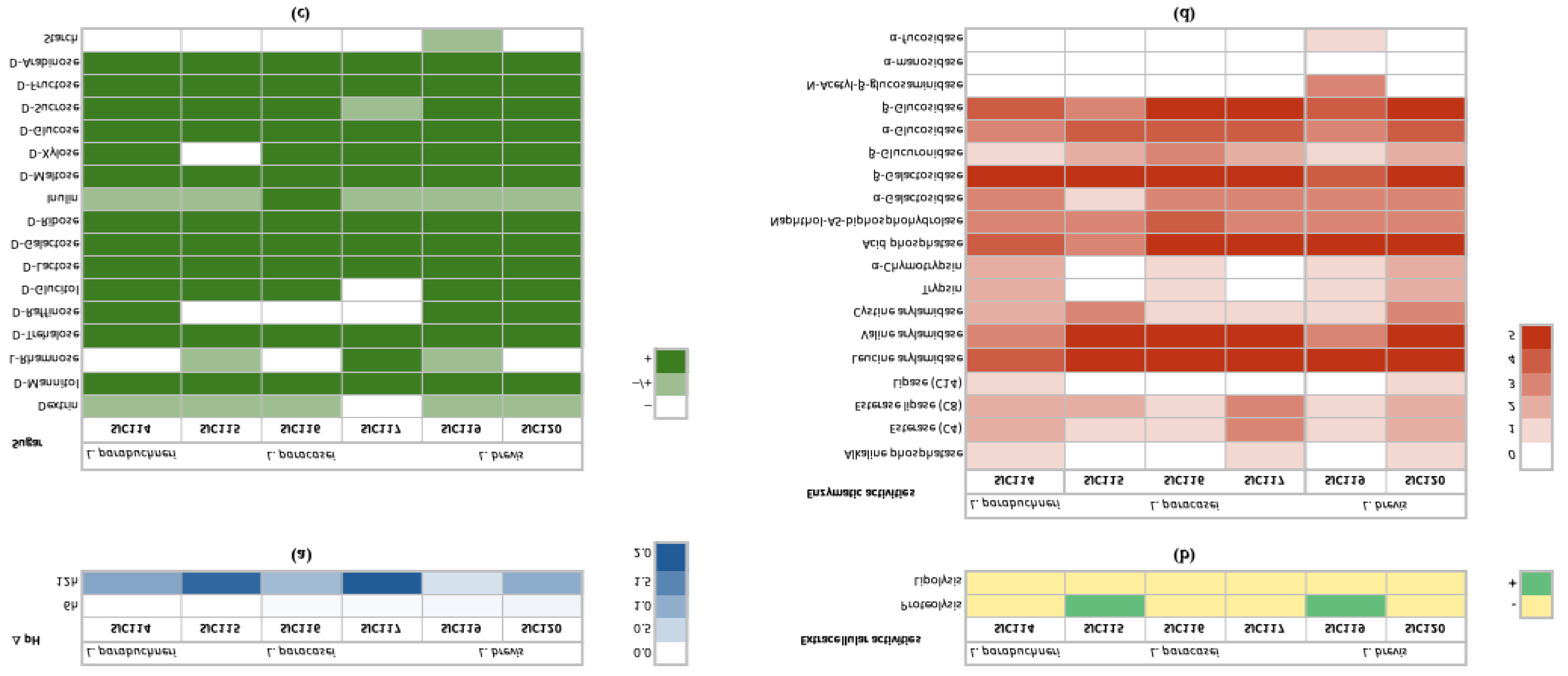
Figure 1. Heatmap of LAB isolates showing (a) acidification (ΔpH) in milk after 6 and 24 h, (b) proteolytic and lipolytic activities (negative −, and positive), (c) carbohydrate fermentation (classified as negative −, slight positive −/+, and positive +); (d) enzymatic activities: ranging from 0 (no activity) to 5 (40 nmol hydrolysed substrate).
Preprints 216707 g001
Table 1. Results of resistance/sensitivity tests of LAB isolates toward seven antibiotics.
Group Antibiotic* L. parabuchneri L. paracasei L. brevis
SJC114 SJC115 SJC116 SJC117 SJC119 SJC120
Penicillins Ampicillin S S S S R S
Oxacillin R R R R R R
Glycopeptides Vancomycin S S R I R I
Tetracyclines Tetracycline S R R R R R
Phenicols Chloramphenicol S S S S R S
Aminoglycosides Streptomycin S R I S I S
Kanamycin S R R I I I
* S – Sensitive, I – Intermediate sensitivity, R – Resistant.
Table 2. Antibacterial activity of LAB isolates. Data are presented as mean ± SEM of inhibition zone diameters (mm) obtained with crude cell-free supernatant (CFS) and neutralized supernatant (NS).
Target strains L. parabuchneri L. paracasei L. brevis
SJC114 SJC115 SJC116 SJC117 SJC119 SJC120
CFS CFS NS CFS NS CFS NS CFS NS CFS NS
L. innocua ATCC 33090 0 10.1±0.4 0 10.4±0.1 0 5.3±7.4 0 9.6±1.0 0 9.2±0.1 0
L. monocytogenes ATCC 35152 0 0 0 0 0 10.1±0.8 0 0 0 4.8±6.7 0
L. monocytogenes ATCC 13932 0 11.2±1.1 0 10.2±0.5 0 10.5±0.7 5.2±4.2 9.5±0.7 0 10.5±0.1 5.6±7.9
E. coli ATCC 15922 0 0 0 5.5±7.8 0 5.0±7.0 0 0 0 5.2±7.4 0
E. coli ATCC 8739 0 0 0 9.9±1.1 0 4.9±7.0 0 0 0 9.2±0.9 0
E. coli ATCC 25922 0 5.3±7.5 0 10.6±0.1 0 5.3±7.5 6.3±8.9 4.5±6.3 0 10.4±0.9 0
S. aureus ATCC 25923 0 0 0 0 0 5.9±8.4 0 0 0 0 0
P. aeruginosa ATCC 27853 0 7.8±0.2 0 9.3±0.3 0 0 0 8.4±0.6 0 7.9±0.3 0
S. Enteritis ATCC 13076 0 10.5±0.1 0 11.2±0.9 0 9.6±0.6 0 8.9±0.3 0 10.2±0.1 0
S. Typhimurium ATCC 14028 0 0 0 11.3±0.8 0 9.2±0.8 0 9.7±0.4 0 6.2±6.1 0
B. spizizenii ATCC 6333 0 10.5±0.3 0 11.8±0.3 0 10.4±0.6 9.1±0.2 10.8±0.5 0 10.9±0.1 0
B. cereus ATCC 11778 0 0 0 9.6±0.1 0 0 0 0 0 9.2±0.1 0
Table 3. Antifungal activity of LAB isolates. The following filamentous fungi were tested: Penicillium commune, P. brevicompactum, P. nordicum, Aspergillus chevalieri, and A. flavus.
Penicillium1 Aspergillus1
LAB isolates P. commune P. brevicompactum P. nordicum A. chevalieri A. flavus
L. parabuchneri
SJC114 +/- +++ +++ +++ +/-
L. paracasei
SJC115 + +++ +++ +++ +
SJC116 ++ +++ +++ +++ +++
SJC117 +++ +++ +++ +++ +++
L. brevis
SJC119 +++ +++ +++ +++ +++
SJC120 +++ +++ +++ +++ +++
1 No inhibition (-), very weak inhibition (+/-), low inhibition (+), moderate inhibition (++), strong inhibition (+++).
Table 4. Autoaggregation (%) of LAB isolates and coaggregation (%) with pathogenic bacteria: E. coli ATCC 25922, L. monocytogenes ATCC 13932, S. aureus ATCC 25923, and S. Typhimurium ATCC 14028.
LAB isolates Auto- aggregation (%) Coaggregation (%)
E. coli L. monocytogenes S. aureus S. Typhimurium
L. parabuchneri
SJC114 7.28 ± 0.06 38.06 ± 0.01 28.08 ± 0.01 30.84 ± 0.02 39.80 ± 0.01
L. paracasei
SJC115 32.77 ± 0.08 27.42 ± 0.02 31.80 ± 0.03 27.42 ± 0.02 31.73 ± 0.02
SJC116 10.17 ± 0.02 40.73 ± 0.01 34.02 ± 0.01 35.09 ± 0.02 38.88 ± 0.02
SJC117 0 ± 0 31.72 ± 0.03 31.89 ± 0.01 31.72 ± 0.03 32.60 ± 0.02
L. brevis
SJC119 0 ± 0 27.85 ± 0.01 26.73 ± 0.01 27.85 ± 0.01 39.69 ± 0.00
SJC120 2.39 ± 0.05 34.48 ± 0.02 36.73 ± 0.07 34.48 ± 0.02 40.46 ± 0.01
Disclaimer/Publisher’s Note: The statements, opinions and data contained in all publications are solely those of the individual author(s) and contributor(s) and not of MDPI and/or the editor(s). MDPI and/or the editor(s) disclaim responsibility for any injury to people or property resulting from any ideas, methods, instructions or products referred to in the content.
Copyright: This open access article is published under a Creative Commons CC BY 4.0 license, which permit the free download, distribution, and reuse, provided that the author and preprint are cited in any reuse.
Prerpints.org logo

Preprints.org is a free preprint server supported by MDPI in Basel, Switzerland.

Subscribe

Disclaimer

Terms of Use

Privacy Policy

Privacy Settings

© 2026 MDPI (Basel, Switzerland) unless otherwise stated