

Submitted:
02 June 2026
Posted:
04 June 2026
You are already at the latest version
Abstract
This comprehensive review investigates hybrid propulsion technologies as a pathway to decarbonization and improved energy efficiency in the maritime sector. Through a review of recent literature, this study synthesizes current knowledge on energy management strategies and capacity sizing approaches for hybrid ship propulsion systems. Reported results indicate that optimized energy management can reduce fuel consumption and greenhouse gas emissions while minimizing total operational costs. Among real-time strategies, the equivalent consumption minimization strategy emerges as particularly suitable for maritime use due to its low computational demand and independence from full voyage profile knowledge, yet its maritime application remains far less developed than in the automotive domain. Capacity sizing and energy management are usually treated as separate optimization problems, limiting the achievability of truly optimal solutions. Only a few studies adopt integrated co-optimization frameworks, and these are typically built around simplified or fixed operational profiles. Moreover, the coupling between energy management parameters, such as the ECMS equivalence factor, and hardware sizing remains insufficiently explored. The findings suggest that future research should prioritize adaptive energy management formulations calibrated for stochastic maritime duty cycles, the incorporation of battery degradation models into co-optimization, and validation against stochastic, real-world operating conditions.
Keywords:
hybrid ship propulsion
; energy management strategy
; equivalent consumption minimization strategy
; capacity sizing
; battery degradation
; co-optimization
1. Introduction
Since ships contribute to 3% of the world’s anthropogenic greenhouse gas (GHG) emissions [1], the maritime industry currently considers three fundamental approaches to reducing it: the application of new technologies, the use of alternative fuels, and the electrification of propulsion systems combined with the use of multiple energy sources for propulsion [2].
Direct technological innovations for emission reduction have been in use for many years and have already led to significant emission reductions, such as Exhaust Gas Recirculation (EGR), the use of scrubbers, dual-fuel systems, Fuel Water Emulsion (FWE), Waste Heat Recovery (WHR) systems, and Selective Catalytic Reduction (SCR) [3,4,5]. Despite their effectiveness in reducing greenhouse gases, these technologies increase capital and operational costs due to additional installation and maintenance expenses [6].
Alternative fuels such as methanol, biodiesel, ammonia, biogas, hydrogen, and Liquefied Petroleum Gas (LPG) are also being considered as promising solutions due to their potential for emission reduction [7,8]. The use of methanol in internal combustion engines is being investigated as a possible way to reduce CO2 emissions due to its chemical composition since it contains only 37.5% carbon compared to 85.7% in marine gas oil, which results in a lower CO2 emission factor of 1.375, and consequently lower specific CO2 emissions despite its higher specific fuel consumption [9]. On the other hand, hydrogen and ammonia, due to their carbon-free structure, represent promising alternative fuels in the maritime sector. Biodiesel is considered the most developed biofuel in terms of the production process and supply chain [10]. Through the esterification process, oils and fats are converted into fatty acid methyl esters, resulting in a fuel with properties similar to diesel but with lower SOx emissions. Alternative fuels offer the potential to simultaneously reduce CO2, NOx, SOx, and particulate matter emissions across the entire well-to-wake lifecycle when produced from renewable sources [9]. However, there is the need for significant investment in ship engine modifications in order to ensure safe and reliable operation with low-flashpoint and chemically aggressive fuels such as methanol and ammonia, which require compatible materials, revised safety protocols, and adequate bunkering infrastructure [11].
Hybrid-electric propulsion, which is used for ships to reduce harmful gas emissions through reduced fuel consumption, represents the third option. By adopting such systems not only for propulsion but also for supplying electrical energy to auxiliary ship systems, numerous advantages can be achieved, not only in reducing CO2, NOx, and other pollutant emissions [12,13,14]. Hybridization technologies in the maritime sector include the use of batteries, supercapacitors, and even flywheels as energy storage devices, which are combined with internal combustion engines and fuel cells [15,16,17], with batteries being the most widely adopted option.
Experimental tests on inland navigation vessels have shown that hybrid propulsion in "zero emission" mode can achieve up to four times greater energy efficiency compared to conventional propulsion, with significant reductions in emissions and noise [18]. Data-driven modeling of the efficiency of fully electric ship powertrains has revealed that hybridizing ship energy systems increases overall efficiency and operational flexibility, with hybrid DC systems showing further improvements due to variable-speed engine operation [19]. Hybrid diesel-electric systems can achieve fuel savings of 6.9–8.8% depending on management strategies, with cruise vessels such as yachts and cruise ships showing the greatest potential [20]. Hybrid systems based on fuel cells can increase overall energy efficiency by 22.5% if they are part of a cogeneration plant [21].
Previous studies have focused on various approaches for reducing emissions in the maritime industry, including direct technological innovations such as EGR, SCR, and WHR systems as well as the use of alternative fuels. However, few studies have comprehensively reviewed hybrid propulsion technologies in conjunction with energy management strategies for hybrid ship systems. Since the system capacity sizing and energy management strategies are usually addressed as independent optimization problems, potential for achieving globally optimal solutions is limited. This paper provides a comprehensive review of energy management strategies and optimal sizing approaches for hybrid ship systems. Hence, integrated co-optimization frameworks are examined as a promising pathway toward globally optimal hybrid ship system design.
2. Energy Management Strategies
The implementation of a smart real-time energy management strategy is of critical importance for vessels with hybrid propulsion to ensure greater system and component efficiency and economical, safe, and reliable operation. Given that hybrid energy systems contain multiple energy sources and several consumers, different dynamic characteristics may arise during different types of operations. Therefore, the Energy Management System (EMS) must be well organized and implemented to provide a clear response to the changing dynamic demands of the system and ensure safe power supply for auxiliary systems and propulsion systems of the vessel. An appropriate EMS can improve energy efficiency and reduce fuel consumption by controlling each energy source to achieve optimal operating conditions. In general, there are two types of EMS that can be considered for ships: rule-based strategies and optimized management strategies [22] as can be seen in Figure 1.
2.1. Rule-Based Strategies
A rule-based energy management strategy is a static control approach that exhibits good robustness and low computational demand, enabling real-time implementation through practical control rules derived from prior operational experience and expert knowledge [23]. Various management strategies using the same approach have been proposed for hybrid systems with multiple energy sources [24].
The most rudimentary formulation within this category is the on-off (threshold-based) control, which is conceptually analogous to the thermostat control strategy historically deployed in the automotive domain [25]. In a marine hybrid configuration, this strategy activates or deactivates specific power sources based on rigid, predefined thresholds, such as the battery State of Charge (SOC) limits or total grid load demands. The key benefits of this strategy are shorter battery charging and discharging times and higher average engine efficiency. In the context of hybrid ship power systems, this strategy is straightforward to implement and provides reliable real-time control, making it suitable for vessels with relatively stable load profiles, but it is limited in its ability to handle the dynamic and unpredictable nature of maritime operations.
Another rule-based strategy often used is the power follower control strategy [23], known in maritime literature as the load following or load levelling strategy which adjusts generator output to directly track the instantaneous load demand, with the battery compensating for transient fluctuations. In hybrid ship applications, the load following strategy is closely related to the peak shaving approach, in which the battery compensates for transient load peaks while generators operate at or near their optimal specific fuel oil consumption (SFOC) point. The deployment of backup systems to follow the load in load following mode results in the engine operating outside its rated conditions, consuming more fuel and leading to higher emissions and increased operating costs.
On the other hand, since the rule-based management strategy largely depends on the designer's experience, it becomes difficult to find the optimal point for more complex and dynamic systems. Given that maritime conditions are unpredictable and subject to external influences such as sea and wind effects, more complex management strategies become more important when managing dynamic, time-varying, nonlinear problems. Fuzzy logic control is one of the control methods that does not require an exact mathematical model while maintaining acceptable error.
Yuan et al. [26] developed a fuzzy logic-based management method for energy management of a photovoltaic systems, battery, diesel hybrid ships designed to carry wheeled cargo (RORO). As a result of the research, a reduction in fuel consumption and emissions was achieved by improving the overall performance of the ship through comparison of actual ship data and simulation results. Another comparison between fuzzy logic-based and proportional-integral (PI) control-based EMS was conducted for medium-voltage DC all-electric ship power systems [27]. Although both EMS successfully supply the ship power system under different energy demands, fuzzy logic control showed better results in managing battery SOC by varying charging and discharging rates. However, establishing fuzzy rules requires high expertise in system management and behaviour prediction. Ships are dynamic systems and are difficult to fit into a stable linear mathematical model.
A more advanced form of rule-based strategy that bridges the gap between rule-based and optimization-based approaches is the hierarchical management strategy. It addresses the limitation of achieving both economic goals and local dynamic stability of the system simultaneously [28]. Instead of one control layer, this management strategy organizes management in two or more levels which operate on different time scales and have different goals. The upper layer is in charge of generator control, managing power distribution between generators and batteries in order to achieve optimal fuel consumption and long-term economic efficiency. It operates at a slower pace, based on generation cost, with a lower update frequency. The lower layer executes real-time cascade control, including DC bus voltage regulation, load balancing between components, and ensuring overall system stability. It handles short-term, local decisions and operates in real time, responding to instantaneous fluctuations. Moreover, the upper layer can also incorporate optimization-based approaches [29,30]. In literature, hierarchical strategies are therefore often considered as a separate category, positioned between purely rule-based and optimization-based strategies, as they may combine elements of both.

Table 1.
Comparison of rule-based energy management strategies for hybrid ship systems.
| Method | Reference | Description | Advantages | Disadvantages |
|---|---|---|---|---|
| Deterministic Threshold-Based Control | [25] | Energy sources activated/deactivated based on predefined SOC and load demand thresholds | Simple implementation, reliable real-time control, higher average engine efficiency | Not suitable for complex dynamic load profiles |
| Power Follower / Dynamic Load Following | [23] | Generator output tracks instantaneous load demand; battery compensates for transient fluctuations | Straightforward implementation, effective peak shaving | Engine may operate outside rated conditions, higher fuel consumption and emissions |
| Fuzzy Logic Supervisory Control (FLC) | [26,27] | Control method without precise mathematical model, applied to PV-battery-diesel hybrid ships | Flexible, effective reduction of fuel consumption and emissions | High expertise required for rule setting; less suitable for highly dynamic systems |
| Hierarchical Multi-Layer Management | [28] | Multi-layer strategy operating on different time scales; upper layer handles economic optimization, lower layer ensures real-time stability | Ensures cost optimization and SOC balance; combines rule-based and optimization elements | Complex implementation; may depend on predefined rules |
2.2. Optimized Management Strategies
Optimization-based energy management strategies can be broadly categorized into two paradigms: Offline Global Optimization (GO) and Online Real-Time Optimization (RTO) which primarily differ in their planning time-frame and the information available in the moment of optimization. While GO optimizes energy distribution over the entire voyage assuming a known or predicted mission profile, RTO relies on real-time system state feedback and operates over a short, receding time horizon to respond to instantaneous load demands and disturbances.
GO uses all system models and conditions with a theoretical basis and precise mathematical equations to perform a comprehensive optimization within a given period. GO can include the Dynamic Programming Algorithm (DPA) [31], Genetic Algorithm (GA) [32], Particle Swarm Optimization (PSO) [33], Grey Wolf Optimizer (GWO) algorithm [34] Ant Colony Optimization Algorithm (ACOA) [35], the simulated annealing algorithm [36], and the Differential Evolution Algorithm (DEA) [37], or other advanced optimization algorithms.
DPA requires all information about the optimization problem in advance. In research on optimizing energy production scheduling for a fully electric ship using DPA, with respect to operational constraints such as greenhouse gas emissions or travel schedules, and assuming that ship load changes can be predicted, it is possible to achieve a reduction in operational costs and greenhouse gas emissions [31].
GA demonstrates versatility and wide applicability with low algorithm complexity. For example, Ancona et al. [32], proposed a GA optimization for reducing fuel consumption by optimizing load distribution with different energy source configurations for a cruise ship. As a result, hybrid systems showed the best performance among the analyzed parameters, such as economic and environmental.
In another study for a tanker, Kumar and Fozdar [33] used two different PSO variants on optimal sizing of solar panels, Energy Storage Systems (ESS), and diesel generators, concluding that without ESS, the solar-diesel hybrid system configuration is not economically feasible.
In order to ensure the efficiency and safety of ship operation with photovoltaic/battery/diesel systems and a "cold ironing" system, a three-stage ideal energy management model and management strategy using adaptive multi-context cooperative evolving PSO was developed by Tang et al. [38]. Although the proposed strategy can reduce the ship's electricity costs while increasing solar energy utilization, the extensive optimization process requires a very large volume of data, which increases computational load and extends the time required to obtain results.
Al-Falahi et al. [34] applied two management strategies (rule-based and GWO algorithm), where fuel consumption and emission reduction were set as performance indicators. GWO outperforms the traditional rule-based method, which relies on predetermined conditions, in terms of fuel consumption and emission reduction. The study concluded that GWO can solve multi-objective optimization problems with many operational constraints, while traditional methods use predetermined conditions. The management strategy obtained by GWO optimization serves to minimize fuel consumption and power distribution for a ferry with diesel generators, a battery energy storage system, and a ferry load profile.
The algorithm developed by Al-Falahi et al. in another study [39] incorporates a fuzzy logic optimization method with GWO (FL-GWO) to reduce the operational costs of a hybrid electric ferry. Findings show that the proposed FL-GWO outperforms GWO in fuel savings, with an increase of 3.14% and 1.81% under normal and high load conditions, respectively. However, in both papers [34,39], comparisons with other types of metaheuristic optimization algorithms were not conducted to further confirm the effectiveness of the proposed management algorithm.
The application of the ACOA algorithm with the RTO method called Equivalent Consumption Minimization Strategy (ECMS) on a diesel-electric hybrid ship with the aim of reducing fuel consumption and battery state of charge fluctuations was given by Xiang and Yang [35]. The ACOA-based EMS nearly doubled efficiency compared to the rule-based strategy, reducing fuel consumption by 6.9% to 12.1%.
Zhao, and Wang [40] proposed an energy management strategy for a ship power system using DEA to simultaneously optimize ship speed, generator on/off scheduling, and power distribution among generator sets and diesel engines. The goal was to minimize total operating costs while satisfying greenhouse gas emission constraints. The strategy was validated through simulation using navigation data from a cruise ferry with 3 generators and 2 diesel engines. The authors highlighted that the algorithm was fully parameterized and applicable to any ship type, as its primary input was the fuel consumption curve of the engine and generator. However, the reported cost reduction of approximately 3% is relatively modest. Also, the study did not compare DEA against other GO methods. Thus, the comparative advantage of DEA over alternative approaches remains unclear.
Overview of GO energy management strategies for hybrid ship systems are given in Table 2.
The second primary paradigm within optimization-based power management is RTO. RTO architectures focus exclusively on instantaneous or short-horizon energy demands by formulating causal, real-time cost-minimization functions. Pontryagin’s Minimum Principle (PMP) and previously mentioned ECMS represent two of the most widely adopted mathematical frameworks in this category. PMP minimizes global, time-dependent optimization problems by decomposing them into instantaneous local sub-problems through the minimization of the Hamiltonian function at each time step, significantly reducing the computational burden relative to global search algorithms.
PMP has been widely studied in road hybrid vehicle applications [41], where real-time minimization of fuel consumption under unpredictable driving cycles has demonstrated superior performance compared to rule-based management. Although PMP is mainly used for Plug-in Hybrid Electric Vehicles (PHEV), it can be applied in shipping as well.
The Model Predictive Control (MPC) method was used by Shagar, V. et al [42], to avoid frequency transients caused by the propeller in the ship's energy system. The mitigation device was a battery energy storage system, directly connected to a DC frequency converter. Simulation results show that the proposed solution with the battery system and MPC can maintain transient frequency disturbances in the ship's energy system within permissible values prescribed by quality standards.
Chen et al. [43] proposed a hybrid ship propulsion energy management strategy that integrates MPC with PMP to overcome the robustness shortcomings of conventional PMP-based approaches. The method uses proportional state feedback to dynamically correct boundary conditions at each control interval, preserving solution optimality while compensating for real-world disturbances. Beyond providing closed-loop correction to the PMP framework, the MPC prediction horizon effectively reduces the scope of energy management from the full voyage to a shorter rolling window, enabling more practical real-time implementation.
Zahedi et al. [44] proposed an optimization algorithm for determining optimal loading conditions to reduce fuel consumption of a hybrid ship propulsion system. The studied system included diesel engines, a synchronous generator, rectifier units, and a Li-Ion battery as energy storage. The resulting fuel consumption in the simulation was compared with that of a conventional AC system and a DC power system without energy storage. Results showed that while the DC system without energy storage provides noticeable fuel savings compared to the conventional AC system (15% fuel savings), optimal utilization of energy storage in the DC system can result in an additional 7% savings compared to the DC system without energy storage.
Wu et al. [45] developed an EMS based on a Double Q-learning model. Although reinforcement learning methods are sometimes classified as a distinct data-driven category in the literature, Double Q-learning is treated here within the RTO framework due to its ability to make real-time decisions based on current system states without requiring prior knowledge of the voyage profile. The Double Q model was trained using stochastic power profiles collected by continuously monitoring a passenger ferry, using a plug-in hybrid model composed of fuel cells and a battery propulsion system. Energy management strategies generated by the model were validated using a second test dataset collected during another measurement period. The limitation of this method is the need for a large amount of data due to the method's validation requirements. Furthermore, as the Q model includes maximization biases, system performance may produce unsatisfactory results. Investment and operational costs were also not considered, which may affect the economic viability of the method.
ECMS aims to calculate optimal power management reference points and optimal management formulations to minimize engine fuel consumption [46]. In a demonstration of ECMS on a hybrid ferry, a 10% reduction in fuel consumption was achieved by optimizing the power balance between energy sources [47]. Furthermore, ECMS is particularly well-suited for marine applications due to its real-time optimization capability and low computational demand, without requiring complete prior knowledge of the voyage profile [48]. For this reason, ECMS is investigated in greater depth.
Overview of RTO management strategies for hybrid ship systems is given in Table 3.
2.2.1. Equivalent Consumption Minimization Strategy
ECMS is one of the well-known real-time energy management optimization strategies, which originated from the work of Paganelli et al. [49]. The main idea of ECMS is to reformulate the global optimization problem into a local optimization problem by minimizing equivalent fuel consumption. Equivalent fuel consumption is defined as the sum of actual fuel consumption from the internal combustion engine and converted fuel consumption from energy storage (most commonly batteries). Based on PMP, an equivalence factor is proposed for converting electrical energy into equivalent fuel energy [50].
Various approaches have been used to determine the equivalence factor. However, the majority of research on equivalence factor determination has been conducted in the context of road hybrid vehicles. While the underlying mathematical framework is transferable, the specific methods require significant adaptation before they can be applied to maritime systems.
The first approach is to set the equivalence factor as a constant during the entire optimization process. This is the simplest approach, but the selection of the constant value is crucial as it directly affects algorithm performance. Therefore, many works have used different methods to optimize this value, such as bibliometric analysis [51], driving pattern recognition-based adaptation [52], static optimization with system constraints [53], dynamic programming combined with ECMS [54], and equivalence factor tuning for different hybrid configurations [55].
The second approach uses different optimization methods to determine the equivalence factor, adapting it to the driving cycle. For instance, ant colony optimization has been applied for this purpose [56], as well as route information-based strategies [57]. Some researchers have developed models where the equivalence factor varies based on vehicle speed, power demand, and SOC [58], while others have used combined cost map approaches [59].
The third approach does not require complete knowledge of the driving cycle and can therefore be applied in a real-time management system using past, current, and future information from 3D maps in the vehicle [60], GPS-based navigation systems [61,62,63], and telemetry systems [64]. ECMS based on this estimation method is also called Adaptive ECMS (A-ECMS) or Telemetric ECMS (T-ECMS). The weakness of this approach is that driving cycle information prediction methods usually suffer from prediction errors and high computational costs.
Regarding the use of ECMS in the maritime sector, several studies have recognized the potential benefits of this method as an energy management strategy. A hybrid management technique using ECMS and a rule-based strategy, including a SOC controller and engine start-stop logic, was described by Škugor et al. [65]. Vu et al. [66] introduced a new method for predicting loads that requires only information about the general operating characteristics of the ship, predicting load requirements at a given moment from historical data. Simulation results show that the optimal operating cost of a hybrid tugboat is 9.31% lower compared to the rule-based energy management strategy. In the case of load uncertainty, the algorithm yields a cost 8.90% lower compared to the rule-based energy management strategy.
Kalikatzarakis et al. [50] applied both ECMS and A-ECMS to a hybrid tugboat with the aim of reducing fuel consumption, comparing the strategies against a rule-based controller and the global optimum obtained via Dynamic Programming. Results showed fuel savings of 5–10% for typical operating profiles with ECMS, within 1–2% of the global optimum. However, A-ECMS does not consistently outperform conventional ECMS, as the adaptive algorithm is limited by its short prediction horizon and the unpredictability of load demand distribution.
3. Optimal Capacity Sizing Methods
The performance and economic viability of a hybrid ship energy system depend not only on how energy is managed during operation, but also on how its components are dimensioned at the design stage. This review focuses on BESS sizing as the most widely adopted energy storage technology in maritime hybrid systems. While supercapacitors and flywheels have been mentioned in the literature as alternative storage options, their sizing methodologies remain largely underdeveloped in the maritime context and are therefore outside the scope of this review. Determining the optimal capacity of the battery energy storage system (BESS) is one of the greatest challenges in hybrid ship system design [67], as it directly affects investment costs, fuel savings, and the estimated lifetime of the energy storage system [68]. Sizing decisions are made prior to vessel operation and have long-term consequences that are difficult to reverse. The best sizing options depend on the vessel's performance characteristics and safety constraints in different operating modes. The storage systems are often used, but there are limitations on their dimensions [69]. An undersized BESS may fail to deliver the expected fuel savings or operational flexibility, while an oversized system leads to unnecessary capital expenditure, accelerated battery degradation, and a suboptimal cost-benefit ratio [70]. The sizing problem is therefore a constrained optimization challenge because the vessel's operational profile, battery aging characteristics, regulatory requirements, and economic constraints must be considered.
3.1. Conventional Optimization Methods for Capacity Sizing
The conventional approach determines the optimal Battery Energy Storage System (BESS) capacity by deriving and evaluating a series of mathematical equations [71]. During the selection process, objective functions and established system constraints are continuously evaluated with multiple parameters, and the parameters with the best results, including BESS capacity, are selected as the best solution. Barrera-Cardenas et al. [72] developed a methodology for sizing BESS for hybrid maritime energy systems and applied it to cases with two operational profiles: the first in which BESS is used as a power reserve, or the second, which strategically loads the engine to keep it in the optimal operating range. This methodology proposes a range of different system capacities using three key performance indices: annual fuel savings, expected battery lifetime, and the Cost Benefit Index (CBI). Battery lifetime is crucial for the economic sustainability of BESS and primarily depends on battery cell aging, which loses capacity and increases internal resistance over time. For lithium-ion batteries, capacity degradation is a more reliable end-of-life criterion than increased internal resistance [73]. The study defined two modes of battery aging. Calendar degradation occurs during rest periods and depends on temperature and SOC, while cycling degradation occurs during active use. Total degradation in a given period is calculated based on cycling degradation and calendar degradation. The study concluded that BESS use for strategic loading should be limited. However, the cost analysis conducted in this work has significant limitations because estimates of some variables, such as operational and maintenance costs and BESS lifetime, are difficult to determine. This finding is corroborated by [74], where cost-benefit analysis similarly concluded that BESS use for strategic loading is economically irrelevant, with high-capacity installations leading to decreased CBI and accelerated battery degradation.
Kim et al. [75] proposed an approach for determining battery capacity where the optimal BESS capacity was determined based on the most demanding power supply condition, and was calculated according to IEEE Standard Std. 485-2010 [76]. Given that the standard has been superseded, the proposed calculation method is no longer suitable for use in the current system.
3.2. Metaheuristic Optimization Methods for Capacity Sizing
Modern optimization methods are increasingly gaining popularity, leading to the emergence of a new field of optimization known as metaheuristic optimization. Most metaheuristic algorithms are nature-inspired, simple, and easy to implement, relying on a strong theoretical foundation rather than empirical techniques to identify the best solution in a short time period [77]. Nature-inspired metaheuristic optimization can be divided into four groups [78], and some algorithms have already been mentioned in previous chapters.
The first category of nature-inspired algorithms includes evolutionary algorithms, which use selection, crossover, mutation, and reproduction operators to identify superior solutions [79]. The previously discussed GA and DEA are representative members of this category.
Algorithms based on physical laws constitute the second category. Physical laws serve as inspiration for these optimization techniques [79], with well-known algorithms such as simulated annealing and the Multi-Verse Optimizer (MVO).
The third category consists of algorithms based on human behaviour, which are inspired by various circumstances often associated with human behaviour and perception [79]. The most recognized algorithms in this category are Harmony Search (HS) and Human Group Formation (HGF).
Swarm intelligence optimization techniques are included in the last category. The social behaviour of swarms or communities such as animal herds, insect colonies, and bird flocks inspires these algorithms [80]. PSO is the most commonly used algorithm in this category, while others include the GWO and Harris Hawks Optimization (HHO).
Metaheuristic optimization was demonstrated by Sciberras and Norman [81], where the GA was applied to find the optimal BESS capacity. The amount of fuel savings achieved by the proposed method depended on system capacity and weight as well as costs, but a comparison with a baseline system without BESS was not conducted. Thus, the absolute benefit of BESS integration cannot be established, limiting the practical applicability of the reported results.
Optimal BESS sizing was considered in a multi-objective optimization approach in the work of Zhu et al. [82] from 2018. The Non-dominated Sorting Genetic Algorithm II (NSGA-II) applied in this work brings benefits in all three objective functions, reducing fuel consumption by 14.99%, greenhouse gas emissions by 14.12%, and life cycle costs by 12.11%. The proposed strategy was verified using the hardware-in-the-loop method, but the rule-based EMS with static parameters applied limits the performance of the optimal solution.
Damian et al. [83] performed BESS capacity optimization in two steps using the HHO algorithm, where the optimal BESS capacity was determined after finding the optimal operating point, but the BESS state of charge during operation was not considered. This is a significant methodological limitation, as SOC directly determines the usable capacity of the battery at any given moment and constrains both charging and discharging behavior. Neglecting SOC dynamics in a sizing study risks overestimating the effective capacity of the selected BESS, potentially leading to undersized systems in real operational conditions.
Wen et al. [84] conducted a cost analysis using the PSO algorithm for optimizing the capacity of three types of storage technologies: lead-acid batteries, Li-ion batteries, and supercapacitors, in a tanker with a hybrid diesel generator and PV system. Simulation results suggest that the use of ESS saves money compared to traditional storage, but battery maintenance and longevity were not taken into account, resulting in suboptimal results.
Optimal BESS sizing was proposed by Tjandra et al. [85] using MOPSO and NSGA-II algorithms to reduce fuel consumption and installed BESS capacity, with battery lifetime as one of the constraints. Results showed that fuel savings in the hybrid electric ferry differ depending on the installed BESS capacity. The limitation of this method is that the designer must sacrifice one of the objectives for greater benefits. To reduce fuel consumption, a large BESS must be integrated into the system and replaced to meet constraints, leading to high investment costs.
Lan et al. [86] investigated the challenge of optimal sizing of a hybrid ship energy system composed of a PV/diesel system and energy storage system by using different PSO variants. Triangular PSO (TRIPSO) and PSO with Time-Varying Inertia Weight (TVIW-PSO) result in significant savings and pollution reduction. The findings suggest that using TVIW on PSO and TRIPSO can improve optimization results but increases computational complexity. Unfortunately, when the task becomes more complex and the dimensionality grows, the algorithms have difficulty finding the optimal solution within a reasonable time frame, which complicates their practical application [78].
4. Co-Optimisation of System Sizing and Energy Management
Treating system sizing and energy management as independent optimization problems inherently limits the achievability of globally optimal solutions. An increasing number of studies address this limitation through integrated co-optimization frameworks that simultaneously optimize component sizing and energy management strategy.
Zhang et al. [87] introduced an early concept of co-optimization back in 2012. They developed an improved PSO algorithm that more efficiently finds optimal solutions for complex engineering problems. They added mechanisms that prevent poor solutions and integrated it with a simulation tool that automatically adapts data formats. The approach was tested on an electric ship power system design example, and they concluded that the improved PSO achieved up to 52% reduction in fuel consumption compared to proportional power distribution, and outperformed a validated hybrid PSO-GA method by up to 2.4% in solution accuracy and 32% in reliability. The study established that equipment selection, system configuration, and operational control strategy must be addressed collectively rather than sequentially to achieve truly optimal system performance.
In 2020, Zhu et al. [88] proposed a two-stage multi-objective optimization that uses PSO for component sizing at the higher level and a Modified Adaptive Equivalent Consumption Minimization Strategy for energy management at the lower level. The optimization encompassed three objectives: fuel consumption, GHG emissions, and total life cycle costs. In the absence of a standardized operational cycle for ships, a generic tugboat route with two standard cruising styles was analysed. A single voyage profile lasted 4800 seconds, and the tugboat operates 6 trips per day, 200 days per year. Experiments on a HIL platform show that the two-stage optimization reduces fuel consumption by 3.37%, GHG emissions by 6.70%, and costs by 13.95% compared to single-stage optimization. This method is particularly important for HEPS design and can be applied to various types of vessels. This is one of the rare works that simultaneously addressed sizing and management strategy of components, but it only worked on a load profile for a tugboat and used an ECMS method that did not take into account the vessel's route.
Cha et al. [89] introduced a co-optimization framework for a fuel cell and battery hybrid electric ferry, integrating MOGAQPSO-based component sizing with deterministic dynamic programming for energy management in a nested two-layer architecture. While the outer layer focuses on optimizing fuel cell stack configuration and battery capacity through cost minimization and efficiency maximization, the inner layer resolves the optimal power distribution over the voyage cycle. When applied to a short-haul ferry route, the framework revealed that fuel cell degradation costs constitute a dominant share of total operational expenses, reaching up to 58%. The authors further categorize co-optimization strategies into sequential, iterative, nested, and simultaneous approaches, noting that sequential methods are prone to suboptimal outcomes due to the decoupling of sizing and control decisions.
Furthermore, Feng et al. [90] highlighted the distinctions between sequential, nested, and simultaneous optimization approaches, and introduced a simultaneous optimization method for jointly optimizing propulsion system components and the energy management strategy of an LNG-fueled hybrid electric ship. The proposed method achieved a reduction in carbon dioxide equivalent emissions by 40% and a decrease in fuel costs by 76% compared to conventional diesel-mechanical propulsion.
Pang et al. [91] proposed an integrated approach that simultaneously optimizes propulsion system sizing and energy management for an LNG-fueled hybrid electric ferry. They used Dynamic programming to determine the optimal sizing of the engine and battery energy storage system alongside a baseline energy management strategy, while an extended Kalman filter-based model predictive control scheme was subsequently introduced for real-time optimal power control. The results demonstrated a reduction in CO2 equivalent emissions by 12.28%, a decrease in battery capacity loss by 12%, and a reduction in ferry operating costs by $305,286 over ten years of operation. A key distinguishing feature of this study is the explicit inclusion of battery degradation costs within the integrated optimization framework, enabling a more comprehensive assessment of lifecycle performance.
Maloberti and Zaccone [92] proposed a nested optimization framework for hybrid marine propulsion systems that simultaneously addresses component sizing and energy management through a two-layer structure. The outer layer employs NSGA-II to optimize battery capacity and generator sizing, while the inner layer minimizes equivalent CO2 emissions through optimal power management for each candidate design. Applied to a small ferry case study, the integrated framework demonstrated reductions of up to 27% in greenhouse gas emissions at the same investment cost compared to the industry-standard requirement-based design approach. Alternatively, the framework showed 6% reduction in investment cost at equivalent emission levels. The study showed that optimizing power management in isolation is insufficient, as a static requirement-based sizing procedure still produces a dominated solution. This confirms that sizing and energy management must be addressed jointly in order to achieve Pareto-optimal performance.
Ke et al. [93] explicitly addressed the coupling between system sizing and energy management as a key optimization challenge. Using model predictive control for energy management and the Harris Hawks Optimization algorithm for capacity sizing, the two problems were treated as an integrated optimization framework. The proposed co-optimization method reduced the average power fluctuation rate of the generator by 73.24%, decreased the HESS investment cost by 27.01% compared to single-layer optimization, and lowered the battery degradation cost by 77% relative to the single-layer approach.
One of the few studies to directly address the co-optimization of hardware configuration and energy management parameters was presented by Guo et al. [94]. They developed a co-optimization approach for the hardware configuration and energy management parameters of a diesel-electric hybrid ship, using an ECMS-based energy management strategy combined with a hybrid Ivy-SA optimization algorithm. The optimization simultaneously addressed engine parameters, battery capacity, and ECMS equivalence factors as interdependent variables, explicitly recognizing that optimizing hardware configuration and energy management parameters in isolation cannot guarantee optimal system performance. Applied to a series-parallel hybrid ro-pax vessel under real operating conditions, the Ivy-SA algorithm achieved a 14.49% reduction in lifecycle costs compared to the baseline configuration, outperforming PSO, GWO, and other algorithms. The study further confirmed that the charge and discharge equivalence factors of ECMS are strongly coupled with battery sizing, reinforcing the need for integrated optimization approaches that jointly address system design and energy management.
Joint optimization of system sizing and energy management under realistic maritime operating conditions remains an underexplored area, representing a key direction for future research. Based on the principles identified in the reviewed co-optimization studies, a generalized two-loop framework is synthesized (Figure 2), illustrating how component sizing and ECMS can be coupled within a single optimization process.
The logic is a two-loop co-optimization of sizing (outer loop) and ECMS (inner loop).
An optimizer in the outer loop (e.g. GA or PSO) proposes the design vector: engine size, battery capacity, electric motor power. For each candidate it calls the inner loop. In the inner loop, for the given component sizes, the ECMS controller splits power between the engine and the battery by minimizing total equivalent fuel consumption, where an equivalence factor converts battery power into an equivalent fuel rate. The powertrain simulation runs through the entire mission profile, and SOC and power are fed back at every time step.
For the evaluation, a combined objective function (fuel + capital cost + emissions) and a constraint check (feasibility, SOC balance at the end of the cycle) produce a "fitness" value that is returned to the outer optimizer. Upon convergence, the optimal component sizes together with the corresponding ECMS policy can be obtained.
The key idea is that sizing and ECMS are not separated and every evaluation of a component size includes the full optimal ECMS strategy, so the optimum is not local but genuinely coupled.
5. Concluding Remarks and Perspectives
This review investigated hybrid propulsion technologies and energy management strategies for hybrid ship systems, aiming to map the current state of the art and identify the key research gaps that prevent the realization of truly optimal solutions. An analysis of rule-based, global optimization, and real-time optimization strategies highlighted ECMS as especially promising for maritime applications, given its modest computational demands and its ability to function without full voyage profile knowledge. Despite this potential, its application to maritime systems, and in particular the determination of the equivalence factor under realistic ship load conditions, has received far less attention than comparable work in the road vehicle domain. As for the sizing approaches, both analytical and metaheuristic methods reveal recurring trade-offs between fuel savings and cost-benefit performance, while battery degradation has emerged as a significant yet frequently neglected consideration.
The primary finding of this review is that system sizing and energy management continue to be treated as independent optimization problems throughout the existing literature. Integrated co-optimization frameworks that explicitly account for this coupling consistently surpass sequential approaches, delivering measurable gains in lifecycle costs, emissions, and battery degradation across a variety of vessel types and operational scenarios. Even so, the majority of these frameworks are built around simplified or fixed operational profiles, and the relationship between ECMS equivalence factors and hardware sizing parameters, while confirmed in recent studies, has yet to receive adequate attention in the wider literature. To this end, this review also synthesizes a generalized two-loop co-optimization framework (Figure 2) that can serve as a conceptual starting point for jointly optimizing sizing and ECMS under realistic maritime profiles.
Three directions should be prioritized in future research. The first should involve developing adaptive ECMS formulations calibrated specifically for maritime load profiles. The second direction should involve the integration of battery degradation models into co-optimization frameworks to enable decisions that account for the full system lifecycle. The third direction should be focused on validating integrated optimization methods against stochastic, real-world maritime operating conditions rather than idealized voyage assumptions. Progress in these areas would make a substantial advancement toward hybrid ship systems that are comprehensively optimized for environmental performance, economic viability, and operational reliability.
Author Contributions
Conceptualization, T.V., N.P. and G.R.; methodology, T.V., N.P. and G.R.; formal analysis, T.V., N.P. and G.R.; investigation, T.V., N.P. and B.L.; resources, T.V., N.P. and G.R.; data curation, T.V., N.P. and B.L; writing—original draft preparation, T.V., N.P. and G.R.; writing—review and editing, N.P., B.L. and G.R.; visualization, N.P. and G.R. All authors have read and agreed to the published version of the manuscript.
Acknowledgments
This work has been supported by: the European Union – NextGenerationEU through the National Recovery and Resilience Plan 2021–2026, under projects 'Energy Efficiency and Reduction of Harmful Gas Emissions in Maritime Transport through the Application of Integrated Technical and Operational Measures – EnEMar', grant number IP-UNIST-39 (066 NPOO – EnEMar IP-UNIST-39) and “Advanced Technologies for Autonomous Systems- ATASYS”, grant number, IP-UNIST-06, awarded within the Call for Funding Institutional Research Projects of the University of Split; the Croatian Science Foundation - under the project IP-2025-02-1981 - HyRefuelStat;.
Data Availability Statement
The original contributions presented in this study are included in the article.
Conflicts of Interest
The authors declare no conflicts of interest.
References
- International Maritime Organization (IMO). Fourth IMO GHG Study 2020 Executive Summary; IMO: London, UK, 2025. [Google Scholar]
- Vidović, T.; Šimunović, J.; Radica, G.; Penga, Ž. Systematic Overview of Newly Available Technologies in the Green Maritime Sector. Energies 2023, 16, 641. [Google Scholar] [CrossRef]
- Zhao, Y.; Fan, Y.; Fagerholt, K.; Zhou, J. Reducing Sulfur and Nitrogen Emissions in Shipping Economically. Transp. Res. Part D. Transp. Environ. 2021, 90, 102641. [Google Scholar] [CrossRef]
- Zis, T.P.; Cullinane, K.; Ricci, S. Economic and Environmental Impacts of Scrubbers Investments in Shipping: A Multi-Sectoral Analysis. Marit. Policy Manag. 2022, 49, 1097–1115. [Google Scholar] [CrossRef]
- Kosmadakis, G.; Neofytou, P. Reversible High-Temperature Heat Pump/ORC for Waste Heat Recovery in Various Ships: A Techno-Economic Assessment. Energy 2022, 256, 124634. [Google Scholar] [CrossRef]
- Bilgili, L. Comparative Assessment of Alternative Marine Fuels in Life Cycle Perspective. Renew. Sustain. Energy Rev. 2021, 144, 110985. [Google Scholar] [CrossRef]
- Xing, H.; Stuart, C.; Spence, S.; Chen, H. Alternative Fuel Options for Low Carbon Maritime Transportation: Pathways to 2050. J. Clean. Prod. 2021, 297, 126651. [Google Scholar] [CrossRef]
- Rony, Z.I.; Mofijur, M.; Hasan, M.M.; Rasul, M.G.; Jahirul, M.I.; Ahmed, S.F.; Kalam, M.A.; Badruddin, I.A.; Khan, T.M.Y.; Show, P.L. Alternative Fuels to Reduce Greenhouse Gas Emissions from Marine Transport and Promote UN Sustainable Development Goals. Fuel 2023, 338, 127220. [Google Scholar] [CrossRef]
- Zincir, B.; Deniz, C.; Tunér, M. Investigation of Environmental, Operational and Economic Performance of Methanol Partially Premixed Combustion at Slow Speed Operation of a Marine Engine. J. Clean. Prod. 2019, 235, 1006–1019. [Google Scholar] [CrossRef]
- Watanabe, M.D.B.; Cherubini, F.; Cavalett, O. Climate Change Mitigation of Drop-In Biofuels for Deep-Sea Shipping under a Prospective Life-Cycle Assessment. J. Clean. Prod. 2022, 364, 132662. [Google Scholar] [CrossRef]
- Campbell, M.; et al. Study on the Readiness and Availability of Low- and Zero-Carbon Ship Technology and Marine Fuels. 2023. Available online: https://greenvoyage2050.imo.org/wp-content/uploads/2023/08/Readiness-of-Low-Zero-Carbon-Marine-Fuels-Technology-Full-Report-v1.pdf.
- Dedes, E.K.; Hudson, D.A.; Turnock, S.R. Investigation of Diesel Hybrid Systems for Fuel Oil Reduction in Slow Speed Ocean Going Ships. Energy 2016, 114, 444–456. [Google Scholar] [CrossRef]
- Yuan, Y.; Wang, J.; Yan, X.; Shen, B.; Long, T. A Review of Multi-Energy Hybrid Power System for Ships. Renew. Sustain. Energy Rev. 2020, 132, 110081. [Google Scholar] [CrossRef]
- Inal, O.B.; Charpentier, J.-F.; Deniz, C. Hybrid Power and Propulsion Systems for Ships: Current Status and Future Challenges. Renew. Sustain. Energy Rev. 2022, 14 156, 111965. [Google Scholar] [CrossRef]
- Haxhiu, A.; Abdelhakim, A.; Kanerva, S.; Bogen, J. Electric Power Integration Schemes of the Hybrid Fuel Cells and Batteries-Fed Marine Vessels—An Overview. IEEE Trans. Transp. Electrif. 2021, 8, 1885–1905. [Google Scholar] [CrossRef]
- Hou, J.; Sun, J.; Hofmann, H. Control Development and Performance Evaluation for Battery/Flywheel Hybrid Energy Storage Solutions to Mitigate Load Fluctuations in All-Electric Ship Propulsion Systems. Appl. Energy 2018, 212, 919–930. [Google Scholar] [CrossRef]
- Jelić, M.; Mrzljak, V.; Radica, G.; Račić, N. An Alternative and Hybrid Propulsion for Merchant Ships: Current State and Perspective. Energy Sources Part A Recovery Util. Environ. Eff. 2021, 1–33. [Google Scholar]
- Litwin, W.; Leśniewski, W.; Piątek, D.; Niklas, K. Experimental Research on the Energy Efficiency of a Parallel Hybrid Drive for an Inland Ship. Energies 2019, 12, 1675. [Google Scholar] [CrossRef]
- Ghimire, P.; Zadeh, M.; Thorstensen, J.; Pedersen, E. Data-Driven Efficiency Modeling and Analysis of All-Electric Ship Powertrain: A Comparison of Power System Architectures. IEEE Trans. Transp. Electrif. 2021, 8, 1930–1943. [Google Scholar] [CrossRef]
- Ghimire, P.; Zadeh, M.; Thapa, S.; Thorstensen, J.; Pedersen, E. Operational Efficiency and Emissions Assessment of Ship Hybrid Power Systems with Battery; Effect of Control Strategies. IEEE Trans. Transp. Electrif. 2024.
- Oh, D.; Cho, D.-S.; Kim, T.-W. Design and Evaluation of Hybrid Propulsion Ship Powered by Fuel Cell and Bottoming Cycle. Int. J. Hydrogen Energy 2023, 48, 8273–8285. [Google Scholar] [CrossRef]
- Balsamo, F.; Capasso, C.; Miccione, G.; Veneri, O. Hybrid Storage System Control Strategy for All-Electric Powered Ships. Energy Procedia 2017, 22 126, 1083–1090. [Google Scholar] [CrossRef]
- Azim Mohseni, N.; Bayati, N.; Ebel, T. Energy Management Strategies of Hybrid Electric Vehicles: A Comparative Review. IET Smart Grid 2024, 7, 191–220. [Google Scholar] [CrossRef]
- Jamal, S.; Pasupuleti, J.; Ekanayake, J. A Rule-Based Energy Management System for Hybrid Renewable Energy Sources with Battery Bank Optimized by Genetic Algorithm Optimization. Sci. Rep. 2024, 14, 1–17. [Google Scholar] [CrossRef]
- Da Rù, D.; Morandin, M.; Bolognani, S.; Castiello, M. A Threshold Logic Control Strategy for Parallel Light Hybrid Electric Vehicle Implementation. In Proceedings of the 8th IET International Conference on Power Electronics, Machines and Drives (PEMD 2016), Glasgow, UK, 19–21 April 2016; pp. 1–6. [Google Scholar]
- Yuan, Y.; Zhang, T.; Shen, B.; Yan, X.; Long, T. A Fuzzy Logic Energy Management Strategy for a Photovoltaic/Diesel/Battery Hybrid Ship Based on Experimental Database. Energies 2018, 26 11, 2211. [Google Scholar] [CrossRef]
- Khan, M.M.S.; Faruque, M.O.; Newaz, A. Fuzzy Logic Based Energy Storage Management System for MVDC Power System of All Electric Ship. IEEE Trans. Energy Convers. 2017, 32, 798–809. [Google Scholar] [CrossRef]
- Torreglosa, J.; García, P.; Fernández, L.; Jurado, F. Hierarchical Energy Management System for Stand-Alone Hybrid System Based on Generation Costs and Cascade Control. Energy Convers. Manag. 2014, 28 77, 514–526. [Google Scholar] [CrossRef]
- Li, X.; Zhang, H.; Liu, C.; Gao, J.; Li, P. Hierarchical Real-Time Energy Management Strategy of eVTOL Hybrid Power System Based on Finite-Set. Aerosp. Sci. Technol. 2026, 170, 111546. [Google Scholar] [CrossRef]
- Liu, H.; Fan, A.; Li, Y.; Bucknall, R.; Vladimir, N. Multi-Objective Hierarchical Energy Management Strategy for Fuel Cell/Battery Hybrid Power Ships. Appl. Energy 2025, 379, 124981. [Google Scholar] [CrossRef]
- Kanellos, F.D.; Tsekouras, G.J.; Hatziargyriou, N.D. Optimal Demand-Side Management and Power Generation Scheduling in an All-Electric Ship. IEEE Trans. Sustain. Energy 2014, 5, 1166–1175. [Google Scholar] [CrossRef]
- Ancona, M.A.; Bianchi, M.; Branchini, L.; De Pascale, A.; Melino, F.; Peretto, A.; Poletto, C.; Torricelli, N. Efficiency Improvement on a Cruise Ship: Load Allocation Optimization. Energy Convers. Manag. 2018, 164, 42–58. [Google Scholar] [CrossRef]
- Kumar, R.; Fozdar, M. Optimal Sizing of Hybrid Ship Power System Using Variants of Particle Swarm Optimization. In Proceedings of the 2017 Recent Developments in Control, Automation & Power Engineering (RDCAPE), Noida, India, 26–27 October 2017; pp. 527–532. [Google Scholar]
- Al-Falahi, M.D.; Nimma, K.S.; Jayasinghe, S.D.; Enshaei, H.; Guerrero, J.M. Power Management Optimization of Hybrid Power Systems in Electric Ferries. Energy Convers. Manag. 2018, 172, 50–66. [Google Scholar] [CrossRef]
- Xiang, Y.; Yang, X. An ECMS for Multi-Objective Energy Management Strategy of Parallel Diesel Electric Hybrid Ship Based on Ant Colony Optimization Algorithm. Energies 2021, 14, 810. [Google Scholar] [CrossRef]
- Wang, B.; Xu, J.; Cao, B.; Ning, B. Adaptive Mode Switch Strategy Based on Simulated Annealing Optimization of a Multi-Mode Hybrid Energy Storage System for Electric Vehicles. Appl. Energy 2017, 194, 596–608. [Google Scholar] [CrossRef]
- Wu, L.; Wang, Y.; Yuan, X.; Chen, Z. Multiobjective Optimization of HEV Fuel Economy and Emissions Using the Self-Adaptive Differential Evolution Algorithm. IEEE Trans. Veh. Technol. 2011, 60, 2458–2470. [Google Scholar] [CrossRef]
- Tang, R.; Li, X.; Lai, J. A Novel Optimal Energy-Management Strategy for a Maritime Hybrid Energy System Based on Large-Scale Global Optimization. Appl. Energy 2018, 228, 254–264. [Google Scholar] [CrossRef]
- Al-Falahi, M.D.; Jayasinghe, S.D.; Enshaei, H. Hybrid Algorithm for Optimal Operation of Hybrid Energy Systems in Electric Ferries. Energy 2019, 187, 115923. [Google Scholar] [CrossRef]
- Zhao, F.; Wang, X. Ship Energy Management Based on Differential Evolution Algorithm. 2019, 5, 6. [Google Scholar]
- Song, K.; Wang, X.; Li, F.; Sorrentino, M.; Zheng, B. Pontryagin's Minimum Principle-Based Real-Time Energy Management Strategy for Fuel Cell Hybrid Electric Vehicle Considering Both Fuel Economy and Power Source Durability. Energy 2020, 205, 118064. [Google Scholar] [CrossRef]
- Shagar, V.; Jayasinghe, S.G.; Enshaei, H. Frequency Transient Suppression in Hybrid Electric Ship Power Systems: A Model Predictive Control Strategy for Converter Control with Energy Storage. Inventions 2018, 3, 13. [Google Scholar] [CrossRef]
- Chen, C.; Liyun, F.; Zejun, J.; Kui, X.; Quan, D.; Chongchong, S. PMP-Based Predictive Energy Management for Hybrid Ship Propulsion System. In Proceedings of the 2025 China Automation Congress (CAC), 2025; pp. 1159–1164. [Google Scholar] [CrossRef]
- Zahedi, B.; Norum, L.E.; Ludvigsen, K.B. Optimized Efficiency of All-Electric Ships by DC Hybrid Power Systems. J. Power Sources 2014, 255, 341–354. [Google Scholar] [CrossRef]
- Wu, P.; Partridge, J.; Bucknall, R. Cost-Effective Reinforcement Learning Energy Management for Plug-In Hybrid Fuel Cell and Battery Ships. Appl. Energy 2020, 275, 115258. [Google Scholar] [CrossRef]
- Geertsma, R.D. Autonomous Control for Adaptive Ships: With Hybrid Propulsion and Power Generation. Ph.D. Thesis, Delft University of Technology, Delft, The Netherlands, 2019. [Google Scholar]
- Geertsma, R.D.; Negenborn, R.R.; Visser, K.; Hopman, J.J. Design and Control of Hybrid Power and Propulsion Systems for Smart Ships: A Review of Developments. Appl. Energy 2017, 194, 30–54. [Google Scholar] [CrossRef]
- Xiong, Z.; Yuan, Y.; Tong, L.; Chu, J.; Shen, B. Optimal Hierarchical Control of Speed and Energy Usage for Hybrid Ships Considering Navigational Environment. J. Zhejiang Univ. Sci. A 2026, 27, 58–75. [Google Scholar] [CrossRef]
- Paganelli, G.; Guerra, T.M.; Delprat, S.; Santin, J.-J.; Delhom, M.; Combes, E. Simulation and Assessment of Power Control Strategies for a Parallel Hybrid Car. Proc. Inst. Mech. Eng. Part D. J. Automob. Eng. 2000, 214, 705–717. [Google Scholar] [CrossRef]
- Kalikatzarakis, M.; Geertsma, R.; Boonen, E.; Visser, K.; Negenborn, R. Ship Energy Management for Hybrid Propulsion and Power Supply with Shore Charging. Control Eng. Pract. 2018, 76, 133–154. [Google Scholar] [CrossRef]
- Zhang, P.; Yan, F.; Du, C. A Comprehensive Analysis of Energy Management Strategies for Hybrid Electric Vehicles Based on Bibliometrics. Renew. Sustain. Energy Rev. 2015, 48, 88–104. [Google Scholar] [CrossRef]
- Vidal-Naquet, F.; Zito, G. Adapted Optimal Energy Management Strategy for Drivability. In Proceedings of the 2012 IEEE Vehicle Power and Propulsion Conference, Seoul, Republic of Korea, 9–12 October 2012; pp. 358–363. [Google Scholar]
- Sinoquet, D.; Rousseau, G.; Milhau, Y. Design Optimization and Optimal Control for Hybrid Vehicles. Optim. Eng. 2011, 12, 199–213. [Google Scholar] [CrossRef]
- Pei, D.; Leamy, M.J. Dynamic Programming-Informed Equivalent Cost Minimization Control Strategies for Hybrid-Electric Vehicles. J. Dyn. Syst. Meas. Control 2013, 135, 051013. [Google Scholar] [CrossRef]
- Park, J.; Park, J.-H. Development of Equivalent Fuel Consumption Minimization Strategy for Hybrid Electric Vehicles. Int. J. Automot. Technol. 2012, 13, 835–843. [Google Scholar] [CrossRef]
- Li, L.; You, S.; Yang, C.; Yan, B.; Song, J.; Chen, Z. Research of Ant Colony Optimized Adaptive Control Strategy for Hybrid Electric Vehicle. Math. Probl. Eng. 2014, 2014, 239130. [Google Scholar] [CrossRef]
- van Keulen, T.; de Jager, B.; Serrarens, A.; Steinbuch, M. Optimal Energy Management in Hybrid Electric Trucks Using Route Information. Oil Gas. Sci. Technol. 2010, 65, 103–113. [Google Scholar] [CrossRef]
- Ye, X.; Jin, Z.; Hu, X.; Li, Y.; Lu, Q. Modeling and Control Strategy Development of a Parallel Hybrid Electric Bus. Int. J. Automot. Technol. 2013, 14, 971–985. [Google Scholar] [CrossRef]
- Sezer, V.; Gokasan, M.; Bogosyan, S. A Novel ECMS and Combined Cost Map Approach for High-Efficiency Series Hybrid Electric Vehicles. IEEE Trans. Veh. Technol. 2011, 60, 3557–3570. [Google Scholar] [CrossRef]
- Zhang, C.; Vahid, A. Real-Time Optimal Control of Plug-In Hybrid Vehicles with Trip Preview. In Proceedings of the 2010 American Control Conference, Baltimore, MD, USA, 30 June–2 July 2010; pp. 6917–6922. [Google Scholar]
- Ambuhl, D.; Guzzella, L. Predictive Reference Signal Generator for Hybrid Electric Vehicles. IEEE Trans. Veh. Technol. 2009, 58, 4730–4740. [Google Scholar] [CrossRef]
- Musardo, C.; Rizzoni, G.; Guezennec, Y.; Staccia, B. A-ECMS: An Adaptive Algorithm for Hybrid Electric Vehicle Energy Management. Eur. J. Control 2005, 11, 509–524. [Google Scholar] [CrossRef]
- Zhang, C.; Vahidi, A. Route Preview in Energy Management of Plug-In Hybrid Vehicles. IEEE Trans. Control Syst. Technol. 2011, 20, 546–553. [Google Scholar] [CrossRef]
- Geng, B.; Mills, J.K.; Sun, D. Energy Management Control of Microturbine-Powered Plug-In Hybrid Electric Vehicles Using the Telemetry Equivalent Consumption Minimization Strategy. IEEE Trans. Veh. Technol. 2011, 60, 4238–4248. [Google Scholar] [CrossRef]
- Škugor, B.; Deur, J.; Cipek, M.; Pavković, D. Design of a Power-Split Hybrid Electric Vehicle Control System Utilizing a Rule-Based Controller and an Equivalent Consumption Minimization Strategy. Proc. Inst. Mech. Eng. Part D. J. Automob. Eng. 2014, 228, 631–648. [Google Scholar] [CrossRef]
- Vu, T.L.; Ayu, A.A.; Dhupia, J.S.; Kennedy, L.; Adnanes, A.K. Power Management for Electric Tugboats Through Operating Load Estimation. IEEE Trans. Control Syst. Technol. 2015, 23, 2375–2382. [Google Scholar] [CrossRef]
- Hannan, M.A.; Wali, S.B.; Ker, P.J.; Abd Rahman, M.S.; Mansor, M.; Ramachandaramurthy, V.K.; Muttaqi, K.M.; Mahlia, T.M.I.; Dong, Z.Y. Battery Energy-Storage System: A Review of Technologies, Optimization Objectives, Constraints, Approaches, and Outstanding Issues. J. Energy Storage 2021, 42, 103023. [Google Scholar] [CrossRef]
- Bordin, C.; Mo, O. Including Power Management Strategies and Load Profiles in the Mathematical Optimization of Energy Storage Sizing for Fuel Consumption Reduction in Maritime Vessels. J. Energy Storage 2019, 23, 425–441. [Google Scholar] [CrossRef]
- Patel, M.R. Shipboard Electrical Power Systems; CRC Press: Boca Raton, FL, USA, 2021. [Google Scholar]
- Martins, R.; Hesse, H.C.; Jungbauer, J.; Vorbuchner, T.; Musilek, P. Optimal Component Sizing for Peak Shaving in Battery Energy Storage System for Industrial Applications. Energies 2018, 11, 2048. [Google Scholar] [CrossRef]
- Wong, L.A.; Ramachandaramurthy, V.K.; Taylor, P.; Ekanayake, J.; Walker, S.L.; Padmanaban, S. Review on the Optimal Placement, Sizing and Control of an Energy Storage System in the Distribution Network. J. Energy Storage 2019, 21, 489–504. [Google Scholar] [CrossRef]
- Barrera-Cardenas, R.; Mo, O.; Guidi, G. Optimal Sizing of Battery Energy Storage Systems for Hybrid Marine Power Systems. In Proceedings of the 2019 IEEE Electric Ship Technologies Symposium (ESTS), Washington, DC, USA, 14–16 August 2019; 72, pp. 293–302. [Google Scholar]
- Swierczynski, M.; Stroe, D.I.; Stan, A.I.; Teodorescu, R. Lifetime and Economic Analyses of Lithium-Ion Batteries for Balancing Wind Power Forecast Error. Int. J. Energy Res. 2015, 39, 760–770. [Google Scholar] [CrossRef]
- Masaud, T.M.; Eluyemi, F.; Challoo, R. Optimal Sizing of Battery Storage Systems for Microgrid Expansion Applications. In Proceedings of the 2018 IEEE Power & Energy Society Innovative Smart Grid Technologies Conference (ISGT), Washington, DC, USA, 19–22 February 2018; pp. 1–5. [Google Scholar]
- 75; Kim, K.; Park, K.; Lee, J.; Chun, K.; Lee, S.-H. Analysis of Battery/Generator Hybrid Container Ship for CO2 Reduction. IEEE Access 2018, 6, 14537–14543. [Google Scholar] [CrossRef]
- IEEE Standards Association. IEEE Std. 485-2010; IEEE Recommended Practice for Sizing Lead-Acid Batteries for Stationary Applications. IEEE: New York, NY, USA, 2010.
- Yang, X.-S. Metaheuristic Optimization: Algorithm Analysis and Open Problems. In Proceedings of the International Symposium on Experimental Algorithms, Kolimpari, Greece, 5–7 May 2011; Springer: Berlin/Heidelberg, Germany, 2011; pp. 21–32. [Google Scholar]
- Abdel-Basset, M.; Mohamed, R.; Abouhawwash, M. Fungal Growth Optimizer: A Novel Nature-Inspired Metaheuristic Algorithm for Stochastic Optimization. Comput. Methods Appl. Mech. Eng. 2025, 78 437, 117825. [Google Scholar] [CrossRef]
- Meraihi, Y.; Gabis, A.B.; Ramdane-Cherif, A.; Acheli, D. A Comprehensive Survey of Crow Search Algorithm and Its Applications. Artif. Intell. Rev. 2021, 54, 2669–2716. [Google Scholar] [CrossRef]
- Fausto, F.; Reyna-Orta, A.; Cuevas, E.; Andrade, Á.G.; Perez-Cisneros, M. From Ants to Whales: Metaheuristics for All Tastes. Artif. Intell. Rev. 2020, 53, 753–810. [Google Scholar] [CrossRef]
- Sciberras, E.; Norman, R. Multi-Objective Design of a Hybrid Propulsion System for Marine Vessels. IET Electr. Syst. Transp. 2012, 2, 148–157. [Google Scholar] [CrossRef]
- Zhu, J.; Chen, L.; Wang, B.; Xia, L. Optimal Design of a Hybrid Electric Propulsive System for an Anchor Handling Tug Supply Vessel. Appl. Energy 2018, 226, 423–436. [Google Scholar] [CrossRef]
- Damian, S.E.; Wong, L.A. Optimal Energy Storage Placement and Sizing in Distribution System. In Proceedings of the 2022 IEEE International Conference in Power Engineering Application (ICPEA), Shah Alam, Malaysia, 7–8 March 2022; pp. 1–6. [Google Scholar]
- Wen, S.; Lan, H.; Hong, Y.-Y.; Yu, D.C.; Zhang, L.; Cheng, P. Optimal Sizing of Hybrid Energy Storage Sub-Systems in PV/Diesel Ship Power System Using Frequency Analysis. Energy 2017, 140, 198–208. [Google Scholar] [CrossRef]
- Tjandra, R.; Wen, S.; Zhou, D.; Tang, Y. Optimal Sizing of BESS for Hybrid Electric Ship Using Multi-Objective Particle Swarm Optimization. In Proceedings of the 2019 10th International Conference on Power Electronics and ECCE Asia (ICPE 2019-ECCE Asia), Busan, Republic of Korea, 27–30 May 2019; pp. 1460–1466. [Google Scholar]
- Lan, H.; Wen, S.; Hong, Y.-Y.; Yu, D.C.; Zhang, L. Optimal Sizing of Hybrid PV/Diesel/Battery in Ship Power System. Appl. Energy 2015, 158, 26–34. [Google Scholar] [CrossRef]
- Zhang, T.; Conklin, G.; Zhang, Y.; Dougal, R.A. Accounting for 'Mission' During Co-Optimization of System Designs. In Proceedings of the SysCon 2012 - 2012 IEEE International Systems Conference, 2012; pp. 334–341. [Google Scholar] [CrossRef]
- Zhu, J.; Chen, L.; Wang, X.; Yu, L. Bi-Level Optimal Sizing and Energy Management of Hybrid Electric Propulsion Systems. Appl. Energy 2020, 260, 114134. [Google Scholar] [CrossRef]
- Cha, M.; Enshaei, H.; Nguyen, H.; Jayasinghe, S.G. Optimal Sizing and Evaluation of Efficient Fuel Cell Utilization for Fuel Cell Battery Hybrid Electric Ferry. Energy Convers. Manag. 2024, 315, 118723. [Google Scholar] [CrossRef]
- Feng, Y.; Zhu, H.; Dong, Z. Simultaneous and Global Optimizations of LNG-Fueled Hybrid Electric Ship for Substantial Fuel Cost, CO2, and Methane Emission Reduction. IEEE Trans. Transp. Electrif. 2023, 9, 2282–2295. [Google Scholar] [CrossRef]
- Pang, B.; Liu, S.; Zhu, H.; Feng, Y.; Dong, Z. Real-Time Optimal Control of an LNG-Fueled Hybrid Electric Ship Considering Battery Degradations. Energy 2024, 296, 131170. [Google Scholar] [CrossRef]
- Maloberti, L.; Zaccone, R. A Nested Optimization Framework for Ship Hybrid Propulsion Systems Considering Equivalent CO2 Emissions. Ocean Eng. 2026, 355, 125076. [Google Scholar] [CrossRef]
- Ke, S.; Yang, X.; Li, X.; Wang, Y.; Duan, Q.; Tang, T. Collaborative Optimization for Planning and Operation Strategy of Shipboard Hybrid Energy Storage Systems Based on MPC-HHO. Chin. J. Ship Res. 2025, 20, 233–245. [Google Scholar] [CrossRef]
- Guo, Q.; Fu, Z.; Zhang, X. Co-Optimization of the Hardware Configuration and Energy Management Parameters of Ship Hybrid Power Systems Based on the Hybrid Ivy-SA Algorithm. J. Mar. Sci. Eng. 2025, 13, 1–27. [Google Scholar] [CrossRef]
Figure 1.
Classification of management strategies.
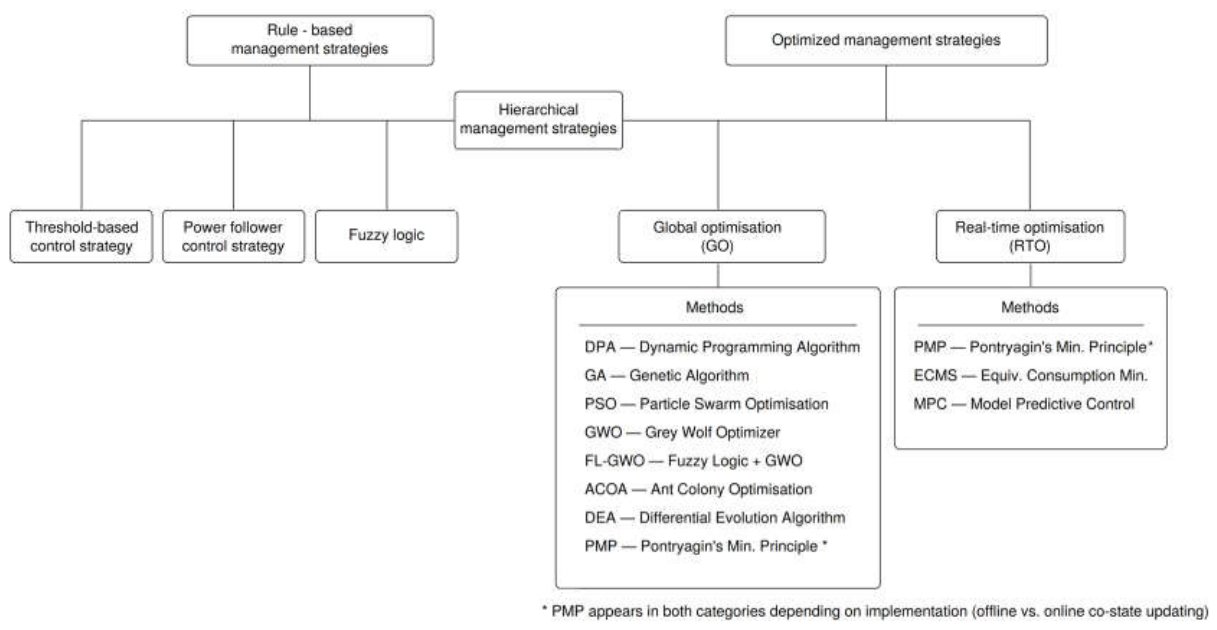
Figure 2.
Example block diagram of the co-optimization framework.
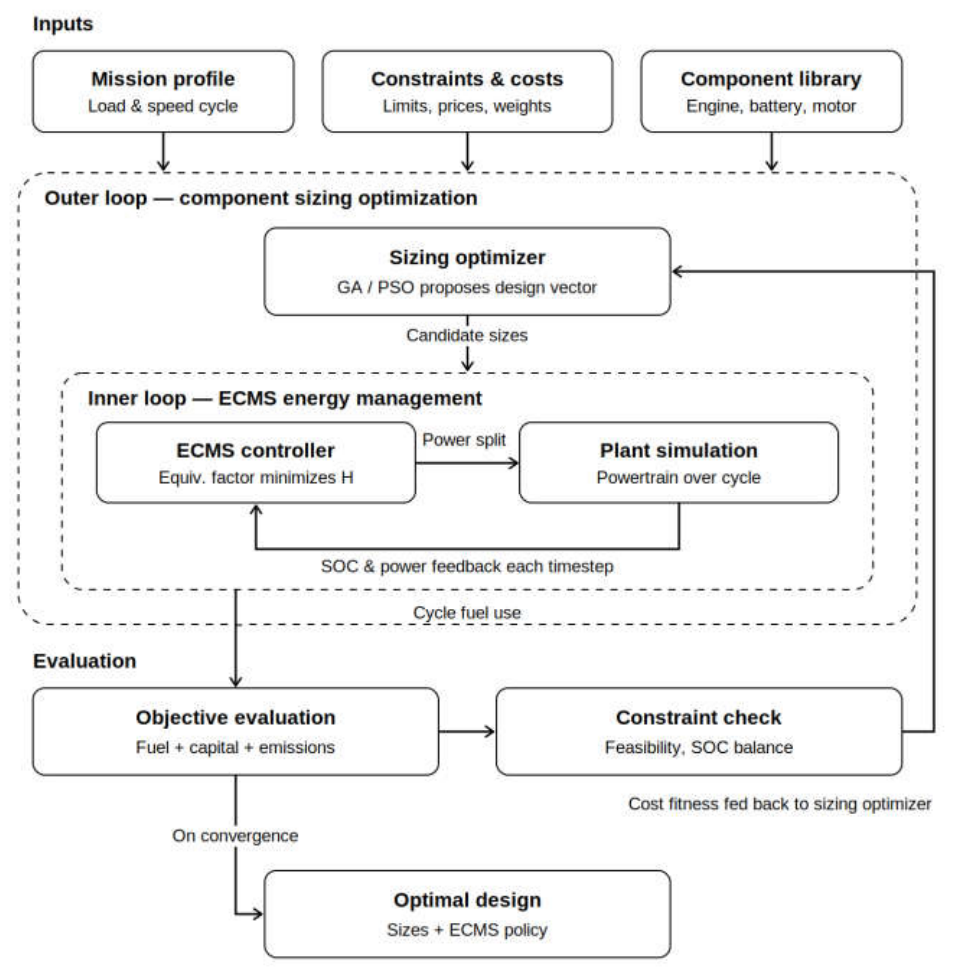
Table 2.
Comparison of GO energy management strategies for hybrid ship systems.
| Optimization Methodology | Reference | Description | Advantages | Disadvantages |
|---|---|---|---|---|
| Dynamic Programming Algorithm (DPA) | [31] | Optimizes energy scheduling over full voyage assuming known load profile | Globally optimal solution; accounts for operational constraints | Requires complete prior knowledge of mission profile; high computational demand |
| Genetic Algorithm (GA) | [32] | Optimizes load distribution across different energy source configurations | Versatile, low algorithm complexity, applicable to various ship types | May converge to local optima; computationally intensive for large problems |
| Grey Wolf Optimization (GWO) | [34] | Minimizes fuel consumption and power distribution; outperforms rule-based methods | Solves multi-objective problems with operational constraints | High data and resource requirements for validation |
| Fuzzy-Hybrid Grey Wolf Optimization (FL-GWO) | [39] | Combination of fuzzy logic and GWO for fuel savings on hybrid ferries | Fuel savings improvement of 1.81–3.14% over GWO alone | Lack of comparison with other metaheuristic algorithms |
| Ant Colony Optimization (ACO) | [35] | Combined with ECMS for fuel consumption reduction and SOC stabilization | Nearly doubled efficiency vs. rule-based; fuel savings of 6.9–12.1% | Complexity of combining with other methods |
| Differential Evolution (DE) | [40] | Simultaneously optimizes speed, power distribution, and generator scheduling | Operational cost reduction; applicable to any ship type | Modest cost reduction (~3%); lack of comparison with other GO methods |
Table 3.
Comparison of RTO management strategies for hybrid ship systems.
| Real-Time Control Method | Reference | Description | Advantages | Disadvantages |
|---|---|---|---|---|
| Pontryagin’s Minimum Principle (PMP) | [41] | Decomposes global optimization into local subproblems for real-time fuel consumption minimization | Improved adaptability; applicable to varying load conditions | Limited maritime application; less robust to real-world disturbances |
| Hybrid PMP + Model Predictive Control (MPC) | [43] | Integrates MPC prediction horizon with PMP to overcome robustness shortcomings; uses proportional state feedback | Closed-loop correction; maintains optimality under real-world disturbances | Higher implementation complexity |
| Model Predictive Control (MPC) | [42] | Maintains system stability during transient states; mitigates frequency disturbances via battery system | Maintains system stability according to quality standards | High implementation complexity; requires battery system |
| Equivalent Consumption Minimization Strategy (ECMS) | [46,47] | Minimizes equivalent fuel consumption by converting electrical energy to equivalent fuel via equivalence factor | Low computational demand; no complete voyage profile required; 10% fuel reduction demonstrated | Equivalence factor difficult to determine optimally |
| Adaptive Equivalent Consumption Minimization (A-ECMS) | [50] | Adaptive version of ECMS; equivalence factor updated based on real-time SOC, load, and navigation data | Better adaptation to varying conditions than standard ECMS | Prediction errors; high computational cost; does not consistently outperform standard ECMS |
| Model-Free Double Q-Learning | [45] | Reinforcement learning approach trained on stochastic power profiles; makes real-time decisions without prior voyage knowledge | Model-free; adapts to real operational data | Requires large dataset; maximization bias may affect performance; investment costs not considered |
Disclaimer/Publisher’s Note: The statements, opinions and data contained in all publications are solely those of the individual author(s) and contributor(s) and not of MDPI and/or the editor(s). MDPI and/or the editor(s) disclaim responsibility for any injury to people or property resulting from any ideas, methods, instructions or products referred to in the content. |
© 2026 by the authors. Licensee MDPI, Basel, Switzerland. This article is an open access article distributed under the terms and conditions of the Creative Commons Attribution (CC BY) license (http://creativecommons.org/licenses/by/4.0/).
Copyright: This open access article is published under a Creative Commons CC BY 4.0 license, which permit the free download, distribution, and reuse, provided that the author and preprint are cited in any reuse.


