

Submitted:
02 June 2026
Posted:
03 June 2026
You are already at the latest version
Abstract
Geographic information generalization is central to multi-scale spatial database construction and cartographic representation. The quality of terrain generalization for Digital Elevation Models (DEMs) directly determines geomorphological fidelity during scale transformation. However, existing DEM generalization methods, which are mostly limited to local geometric filtering or surface simplification, lack global awareness of macroscopic terrain structures. This limitation often causes “geographic alienation,” such as ridge breakage and gradient distortion. To address this issue, we propose TG-GAN, a terrain morphological factor-constrained multi-rate deep learning model for DEM generalization. This model overcomes the indiscriminate smoothing of conventional downsampling by embedding the “structure-first” principle into a deep learning framework. Specifically, a Generative Adversarial Network is used to enhance the generator's simulation capacity. Terrain morphological factors, including local relief and gradient, are innovatively incorporated as physical error terms into the loss function, guiding the network to adaptively reinforce primary terrain skeletons while smoothing secondary micro-terrain features during downscaling. A multi-objective loss function integrating elevation fidelity and gradient preservation enables intelligent terrain generalization in a physically constrained manner. Experiments conducted in mountainous regions of Chongqing, China, Alaska, USA, and Colorado, USA, with downscaling factors of 2× to 5× demonstrate that TG-GAN achieves robust multi-rate generalization while preserving the overall terrain structure. Compared with traditional interpolation methods, TG-GAN effectively avoids over-smoothing and structural breakage, excelling in preserving elevation extremes and slope morphology. Compared with conventional CNN-based methods, TG-GAN shows significant advantages in MAE, RMSE, and SSIM, especially under high downscaling factors. Overall, the proposed model offers a new data- and physics-driven paradigm for automated, multi-scale, and high-fidelity DEM generalization, supporting multi-scale mapping and related geomorphological analysis.
Keywords:
terrain generalization
; terrain morphological factors
; local terrain relief
; terrain gradient
; geomorphological structure preservation
1. Introduction
With the advancement of global geospatial data acquisition technologies, ranging from spaceborne LiDAR (e.g., ICESat-2, GEDI) to UAV photogrammetry and airborne LiDAR, the dynamic updating and efficient representation of multi-scale geographic information have become core topics in Geographic Information Science (GIScience). Geographic information generalization, as a bridge connecting spatial data at different scales, essentially involves applying operators such as selection, simplification, and exaggeration according to specific cartographic purposes and application scenarios, reducing data complexity while maintaining the spatial structure and semantic consistency of geographic entities [1,2]. Therefore, how to extract macroscopic and clear skeleton information that conforms to human geographic cognition from massive high-resolution data has become an urgent challenge for achieving “one dataset for multiple” and “multi-scale representation” [3,4].
However, terrain generalization of continuous spatial data, such as DEMs, is fundamentally different from the generalization of discrete features such as roads and settlements. As continuous representations of terrain surface, DEMs undergo terrain generalization that essentially involves geometric reconstruction and topological preservation of the terrain surface during scale transformation [5,6]. This process requires suppressing high-frequency, low-amplitude micro-terrain noise while preserving, or even enhancing, low-frequency, high-amplitude macroscopic structures, making it far more complex than the selection and displacement of discrete features.
DEM terrain generalization presents unique technical challenges. Traditional methods are primarily derived from image processing approaches, such as smoothing-based downsampling using mean filtering or Gaussian filtering, or node simplification based on Triangulated Irregular Networks (TINs). However, these “geometry-first” paradigms have several limitations:
(1) Loss of geographic semantics. Treating terrain as ordinary grayscale images for indiscriminate smoothing leads to the erasure of geographically significant features (e.g., ridge lines, watershed boundaries, scarps) while filtering noise [7,8].
(2) Destruction of structural connectivity. Local filtering operators often sever terrain skeletons, leading to interrupted hydrological flow paths or distorted catchment areas, thereby causing the generalized DEM to lose geomorphological significance [2].
(3) Limited automation and heavy reliance on manual intervention. Generalization tools provided by existing commercial software often require expert experience for post-processing and manual editing, making them inadequate for rapid response demands in the era of big geospatial data.
To overcome these deficiencies, researchers have developed TIN simplification methods based on geomorphological structural lines [9] and enforced channel correction methods for hydrological continuity preservation [10]. In recent years, methods such as the Integrated Graph Laplacian Downsampling (IGLD) [8], watershed-based drainage unit generalization [6], and error-metric-based simplification methods [11] have made progress in structure preservation. However, these algorithms still rely excessively on local geometric statistics or heuristic thresholds, struggle to model nonlinear patterns of terrain evolution in complex geomorphological regions, and remain limited in automation and generalizability.
Deep learning (DL), with its powerful nonlinear mapping and feature abstraction capabilities, offers a new perspective for addressing these challenges [12,13]. Currently, deep learning applications in the DEM domain are primarily concentrated on super-resolution reconstruction (SR), which aims to recover high-frequency details lost in low-resolution DEMs by training deep networks [14,15]. However, this “low-to-high” detail enhancement paradigm is diametrically opposed to the “high-to-low” simplification requirement of DEM terrain generalization in terms of mathematical objectives: SR pursues the recovery of lost high-frequency components, while terrain generalization pursues the selective removal of unimportant high-frequency components.
Although a few studies have attempted to adapt SR models for downscaling, their network architecture and loss function are originally designed for detail generation. As a result, the downsampling process cannot actively discard secondary information and often produces blurry results that fail to meet cartographic requirements. On the one hand, the model lacks constraints imposed by terrain morphological characteristics and is prone to generating “pseudo-terrain.” On the other hand, the logic of generalization is inconsistent: image compression pursues pixel-error minimization, which is inconsistent with the goals of terrain generalization, namely “preserving the essential while discarding the secondary” and achieving semantic simplification. In the field of 3D geometry processing, the Quadric Error Metrics (QEM) method proposed by Garland et al. [11] laid an important foundation for surface simplification. However, dedicated contractive generation architectures for regular-grid DEMs remain immature to date.
In response to the above challenges, this paper proposes a Terrain Morphological Factor-Constrained Multi-Rate DEM Terrain Generalization Deep Learning Model (TG-GAN). The core idea is to incorporate terrain morphological factors, including local terrain relief and terrain gradient, as differentiable physical error terms directly into the loss function, thereby updating network parameters through backpropagation. This design ensures that, during training, the model not only learns elevation value fitting but is also forced to learn how to maintain the statistical consistency of terrain in terms of relief amplitude and gradient variation, thereby achieving intelligent terrain generalization under physical constraints.
The specific research objectives are as follows: (1) to construct a GAN oriented toward multi-rate terrain generalization, capable of simultaneously outputting DEMs at 2×, 3×, 4×, and 5× downscaling factors; (2) to design local terrain relief error and terrain gradient error and incorporate them as terrain morphological factor constraints into backpropagation, enabling the network to automatically prioritize the preservation of high-relief and high-gradient geomorphological skeletons during simplification while suppressing gentle micro-terrain features; (3) to combine elevation fidelity, gradient structural similarity, and hydrological connectivity losses to achieve multi-objective physically aware training; and (4) to systematically evaluate model performance on 2× to 5× generalization tasks and conduct comprehensive comparisons with traditional and deep learning methods. Through this research, we aim to provide a new data- and physics-driven solution for automated, multi-scale, and high-fidelity DEM generalization.
2. Related Literature
This section reviews the literature from three perspectives: traditional DEM terrain generalization methods, exploratory applications of deep learning in terrain processing, and the origins of pseudo-terrain effects and the potential solutions offered by Generative Adversarial Networks. Based on this review, the research gap addressed in this study is identified.
2.1. Traditional DEM Terrain Generalization Methods
Over the past three decades, research on DEM generalization can be broadly divided into two categories: error-driven and structure-driven methods. The key distinction between these two categories lies in how they define the terrain features that should be preserved during generalization.
Error-driven methods usually take RMSE as the main optimization objective, assuming that elevation points with larger numerical errors carry more important information. Typical methods include the maximum Z-tolerance method, the Very Important Points (VIP) algorithm, and various filtering-based schemes. However, as pointed out by Chen et al. [8], such methods have an inherent limitation: the maximum Z-tolerance method tends to retain only points with the largest elevation errors, while local structural details that are essential for maintaining slope morphology and surface roughness may be discarded. In other words, RMSE measures numerical deviation rather than structural deviation.
Structure-driven methods have been developed precisely to compensate for this deficiency. Ai et al. [6] explicitly proposed that DEM generalization should be understood as “information abstraction” rather than “data compression,” and proposed a dual-layer framework that separates geographic decision-making from geometric operations. Jenny et al. [16] further decomposed terrain generalization into two directional processes: “valley filling” and “ridge reduction.” The Integrated Graph Laplacian Downsampling (IGLD) method proposed by Chen et al. [8] represents elevation points as a graph structure and uses the maximum eigenvector of the Laplacian matrix to distinguish terrain structural skeletons from removable details at a global level. This method significantly improves slope preservation compared with the maximum Z-tolerance method. Feciskanin et al. [17,18] introduced the QEMS method and demonstrated that quadric error minimization can effectively balance global accuracy and local feature preservation in DEM simplification.
Despite these advances, structure-driven methods still face a common bottleneck: their performance often depends on explicit rules or manually defined thresholds. For example, IGLD requires a preset number of retained points; QEMS depends on the extrema of the K0 curve and becomes unreliable when the number of triangles is less than approximately 100 [17], and structural-line-based methods require setting valley depth thresholds [19]. Although these thresholds may be effective in specific geomorphological settings, they are difficult to transfer across different terrain types because terrain “importance” is highly context-dependent. The experiments of Callow et al. [19] also revealed a deeper dilemma: any local modification to a DEM inevitably affects derived terrain variables such as slope, and different methods produce inconsistent results. This means that methods optimizing only a single dimension inevitably introduce unpredictable trade-offs in other terrain properties.
2.2. Deep Learning in Terrain Processing: Exploratory Applications
Deep learning provides a potential solution to the above challenges by shifting the generalization process from expert-defined rule design to data-driven representation learning. Instead of requiring experts to explicitly prescribe “what is important,” deep learning models can autonomously learn mapping relationships from large numbers of samples. Hinton et al. [20] demonstrated that deep autoencoders can learn nonlinear low-dimensional manifolds of high-dimensional data and preserve richer structural information than PCA during dimensionality reduction. This suggests that neural networks can implicitly discover, through end-to-end training, which structures in the data are essential and which are removable. Goodfellow et al. [21] further showed that adversarial training can implicitly learn complex data distributions without explicit probabilistic modeling. This aligns with the perspective proposed by Reichstein et al. [12,13] who argued that machine learning can not only support prediction but also help reveal intrinsic structures and physical regularities behind data.
However, existing deep learning studies in the DEM domain exhibit a prominent directional imbalance. From SRCNN proposed by Dong et al. [14] and SRGAN proposed by Ledig et al. [15], to D-SRGAN proposed by Demiray et al. [22], TfaSR proposed by Zhang et al. [23], and the Transformer-based multi-path network proposed by Guo et al. [24], most models are designed to recover high-resolution DEMs from low-resolution inputs. These methods learn a "low-to-high" mapping, and their encoder-decoder or symmetric hourglass architectures are tailored for detail restoration and enhancement.
In contrast, DEM terrain generalization follows the opposite direction: it starts from high-resolution data and generates a low-resolution representation. This process is not a simple reversal of super-resolution. The objective of terrain generalization is not to approximate a predefined high-resolution “true value,” but to reduce data resolution while maximizing the recognizability of essential geomorphological structures. Therefore, directly adapting SR networks for DEM terrain generalization is theoretically problematic, because models designed for detail recovery are not naturally suited to selective detail removal. Existing studies related to dimensionality reduction are also not specifically designed for terrain generalization. For example, Gavriil et al. [25] focused on DEM void filling, which is essentially a restoration task rather than a generalization task. The deep learning mesh simplification method proposed by Lan et al. [26] targets 3D meshes rather than regular-grid DEMs. To date, dedicated contractive generation architectures for regular-grid DEMs that incorporate terrain-specific physical constraints remain underdeveloped.
2.3. Origins of Pseudo-Terrain and the Potential of GANs
Even if the directional misalignment problem is resolved, contractive generation networks still face the risk of pseudo-terrain distortion under a purely supervised learning paradigm. When elevation Mean Squared Error is used as the only optimization objective, the network tends to generate results that are “numerically correct but morphologically inconsistent.” In such cases, elevation values statistically approximate the reference DEM, but local slopes are distorted, ridges may become blunted, and aspect patterns may become disordered. These distortions are not always sufficiently reflected in MSE-based evaluation. Courtial et al. [27] revealed a similar dilemma in the deep learning-based evaluation of road generalization, showing that pixel-level accuracy alone is insufficient for judging the quality of cartographic generalization.
Physics-Informed Neural Networks (PINNs) provide an important reference for addressing this problem. Raissi et al. [28] demonstrated that embedding residual terms of physical equations into the loss function enables neural networks to satisfy physical laws while fitting data. Wu et al. [29] further validated this strategy in geophysical inversion. In the DEM domain, Zhang et al. [23] and Guo et al. [24] incorporated slope constraints into the loss function and effectively alleviated over-smoothing. However, a common limitation of these studies is that physical constraints mainly act as post-hoc penalty terms. That is, when the network outputs a DEM with abnormal slopes, the loss function penalizes the result and updates the parameters through backpropagation. However, during the feature extraction stage of forward propagation, the network still lacks an active mechanism for recognizing and preserving key terrain structures.
This limitation provides the core motivation for introducing GANs into DEM terrain generalization in this paper. The GAN framework proposed by Goodfellow et al. [21] enables the generator to implicitly learn the structural distribution of data through the dynamic adversarial competition between the generator and discriminator, that is, to learn “what kind of output looks realistic.” Ledig et al. [15] and Demiray et al. [22] have demonstrated that adversarial loss can recover structural features smoothed out by MSE. However, this paper applies GANs in a fundamentally different direction: rather than using the discriminator to distinguish “high-resolution DEM” from “super-resolved generated DEM,” it is used to distinguish “terrain conforming to geomorphological regularities” from “pseudo-terrain with close elevation but distorted morphology.” The discriminator is trained to recognize the structural consistency of terrain in derived dimensions such as overall elevation distribution, local terrain relief, and terrain gradient. When the generator produces terrain with abnormal relief or gradient, the discriminator can detect this morphological-level distortion and feed it back to the generator for correction.
On this basis, this paper further incorporates terrain morphological factors, such as local terrain relief and terrain gradient, into the parameter update process. This dual-channel physically aware mechanism, which combines adversarial constraints with terrain morphological factor learning, is the core feature that distinguishes TG-GAN from existing methods.
2.4. Research Gap and Positioning of This Paper
From the foregoing review, the impasse confronting current DEM terrain generalization research has come into sharp focus. It is not a single-dimensional shortcoming but rather a set of mutually reinforcing problems.
The most conspicuous problem is task direction. Deep learning applications in the DEM domain have been overwhelmingly concentrated on super-resolution reconstruction [14,15,22,23,24], which learns a “low-to-high” mapping and pursues detail recovery. Terrain generalization, by contrast, demands “high-to-low” abstraction. Its “ground truth” is non-unique, and the task involves complex trade-offs. Traditional structure-driven methods [6,8,17] do target generalization tasks, but the generalizability of their explicit rules remains fundamentally constrained. The few works that touch upon dimensionality reduction [25,26] belong to the domains of restoration and irregular-grid meshes, respectively; neither addresses regular-grid DEM generalization. The second problem, tightly coupled with the first, concerns how physical constraints are deployed. PINNs [28] and sensing prior constraints [29] have demonstrated the value of incorporating domain knowledge into neural networks, and within the DEM field, attempts have been made to add slope constraints to the loss function [23,24]. Yet terrain factors have consistently played the role of an “examiner,” judging at the output end rather than guiding the feature extraction process. The third problem pertains to the generation mechanism itself. Under a purely supervised learning framework, even if the network direction is correct and physical constraints have been introduced, an MSE-dominated loss may still tolerate results that are “numerically correct but morphologically suspect.” GANs offer a mechanism for implicitly learning structural distributions [21], but existing work usually positions the discriminator to distinguish high-resolution ground truth from super-resolved outputs, serving an enhancement-oriented logic. If the discriminator is repositioned to distinguish terrain conforming to morphological regularities from morphologically distorted pseudo-terrain, the adversarial mechanism could instead serve a morphological-fidelity preservation objective. However, this line of thought remains in its infancy.
The three problems described above are mutually reinforcing: directional misalignment deprives existing networks of the structural foundation for “preserving the essential while discarding the secondary”; the superficial deployment of constraints means that even with correct direction, an effective terrain-perception mechanism is still lacking; and the purely supervised mechanism, at the most fundamental level, may tolerate the existence of pseudo-terrain.
The TG-GAN model proposed in this paper is a holistic response to this interrelated problem cluster. At the architectural level, inspired by the SRDCGAN super-resolution generative adversarial network proposed by Hu et al. [30], this study adopts a GAN architecture that fundamentally differs from the symmetric encoder-decoder structures commonly used in super-resolution tasks. At the constraint level, local terrain relief and terrain gradient, collectively referred to as terrain morphological factors, are incorporated as physical error terms into the backpropagation process, enabling the model to be explicitly driven by geomorphological attribute consistency during parameter updates. At the generation-mechanism level, the discriminator’s objective is adjusted to distinguish surfaces conforming to real terrain morphological regularities from pseudo-surfaces with close elevation values but distorted morphology. This mechanism forms a complementary relationship with the multi-objective loss function that integrates elevation fidelity and terrain gradient preservation. Through systematic comparisons with traditional methods, including nearest-neighbor interpolation, bilinear interpolation, and cubic convolution, as well as conventional CNNs and the baseline GAN model, the effectiveness and advantages of the proposed approach are validated.
3. Data and Methods
3.1. Study Areas
3.1.1. Training Areas
To ensure the generalization capability of model training and avoid overfitting caused by single landform samples, this study selected two mountainous study areas with typical geomorphological characteristics and distinct terrain formation mechanisms as training data sources. Both areas have a pixel size of 1500×1500, providing rich sample support for the model to learn universal terrain generalization rules.
The first training area is the mountain-hill transitional zone in northeastern Chongqing, China (Figure 1), located at the intersection of the eastern Sichuan parallel ridge-and-valley region and the Daba Mountain range, with geographic coordinates between 108°30′–109°E and 31°–31°30′N. This area, subjected to long-term fluvial erosion, has formed typical erosional mountainous terrain characterized by high mountains and deep valleys with crisscrossing gullies. The elevation span reaches 2131 m, from 102 m to 2233 m, and the significant relative relief provides an ideal scenario for the model to capture terrain gradient variations. This study uses DEM data at 30 m and 90 m resolutions from this area, which from an exact 3× downscaling relationship, specifically dedicated to model training for 3× terrain generalization tasks.
The second training area is the Valdez region in southern Alaska, USA (Table 1), located in the middle section of the Alaska Range, and represents to high-altitude fold-and-fault mountainous terrain. Under the combined effects of tectonic uplift and glacial erosion, the terrain relief is dramatic and the geomorphological forms are complex. This study uses the multi-resolution DEM dataset released by Tom Patterson (Version 1.0, 2019), which is constructed based on the NAD83 datum with Albers Equal-Area projection, covering data at multiple resolutions. From this dataset, DEMs at 15 m, 30 m, 250 m, and 1000 m resolutions were selected to construct training samples for 2× (15 m→30 m) and 4× (250 m→1000 m) downscaling tasks, covering terrain generalization scenarios with different simplification extents.
Although both training areas are dominated by mountainous landforms, their terrain genesis, relief morphology, and micro-topographic characteristics show significant differences: the Chongqing area is characterized by parallel ridge-and-valley systems shaped by fluvial processes, while the Valdez area combines the dual influences of tectonics and glaciation. The complementary landform types of these two areas provide the model with diverse samples of ridge lines, valley networks, and terrain gradients, effectively mitigating the overfitting risk of single landform samples and ensuring the generalizability of the proposed model across different mountainous environments.
3.1.2. Testing Area
This study selected the Gore Range in Colorado, USA, as the testing area, using the multi-resolution DEM dataset released by Tom Patterson in 2020. Four sub-regions were constructed corresponding to 2–5× downscaling tasks, with resolution pairs of 15/30 m, 30/90 m, 250/1000 m, and 500/2500 m, respectively. The data originate from USGS 3DEP and multi-source integration products. The low-resolution DEMs were generated by bicubic interpolation, with elevation differences of only a few decimeters. The landforms are complementary to the training areas, enabling objective evaluation of the model's generalization capability.

Table 2.
Testing Area Details.
| Region | Geographical range | Elevation range | Resolutions |
|---|---|---|---|
| Gore Range1 | 106°27′W to 106°11′W,39°38′N to 39°50′N | 2419.79m to 4129.81m | 15m,30m |
| Gore Range2 | 106°35′W to 106°03′W,39°32′N to 39°56′N | 2075.42m to 4127.10m | 30m,90m |
| Gore Range3 | 108°35′W to 104°04′W,38°02′N to 41°24′N | 1335.9m to 4373.30m | 250m,1000m |
| Gore Range4 | 110°58′W to 101°42′W,36°18′N to 43°05′N | 917.2m to 4313.2m | 500m,2500m |
3.2. Experimental Data and Preprocessing
The experimental data used in this study can be divided into two categories: the Valdez and Gore Range areas use the multi-resolution DEM benchmark dataset released by Tom Patterson (Zenodo archive), providing standardized multi-scale mountainous terrain samples for terrain research; the Chongqing area uses SRTM DEM (30 m/90 m resolution), covering typical mountainous terrain at the intersection zone of the eastern Sichuan hills and the Daba Mountains.
The high-resolution DEMs used in this study were uniformly standardized to a size of 1500 × 1500 pixels. To ensure strict geospatial correspondence between high- and low-resolution DEMs, the real low-resolution DEMs were first precisely spatially cropped to make their spatial extent completely match that of the high-resolution DEMs, eliminating terrain feature misalignment problems caused by spatial offsets.
Before model training, a standardized preprocessing workflow was executed on the spatially matched DEM data: first, a fixed window of 100×100 pixels was used to tile both high- and low-resolution DEMs, constructing one-to-one corresponding training sample pairs to improve model training efficiency. For null values, NaN values, and infinite values anomalies in the DEM data, zero filling was applied to ensure data validity and stability. To eliminate differences in elevation numerical magnitude across different regions, min-max normalization was performed on all elevation data, mapping values to the [0, 1] interval to accelerate model convergence.
To enhance the model's generalization capability and avoid overfitting, an online data augmentation strategy was introduced during the training phase: random horizontal flipping, random vertical flipping, and random rotations of 90°, 180°, and 270° were consistently applied to the high- and low-resolution DEM sample pairs, and slight Gaussian noise was added with a small probability, expanding the diversity of training samples without destroying the core terrain features.
All preprocessing operations were completed under the premise of maintaining the physical meaning and spatial topological relationships of the terrain, providing high-quality, high-consistency sample data for subsequent model training.
3.3. Neural Network Architecture
3.3.1. SRDCGAN
SRDCGAN is a Generative Adversarial Network for DEM super-resolution reconstruction proposed by Hu et al. [30], specifically designed to address the problems of noticeable artifacts, noise, and insufficient terrain feature preservation in traditional interpolation and deep learning methods for DEM reconstruction, achieving 4× resolution enhancement. Its overall adversarial architecture follows the generator-discriminator game framework, as shown in Figure 2: the low-resolution DEM is fed into the generator to obtain the super-resolution reconstruction result, while the discriminator simultaneously receives the real high-resolution DEM and the generated result, performing real/fake discrimination on the samples. Through adversarial training, the reconstruction accuracy is continuously improved.
The specific structure of the generator is shown in Figure 3. The generator uses Residual-in-Residual Dense Block (RRDB) with Batch Normalization (BN) layers removed as the core feature extraction unit. This module is composed of multiple Residual Dense Blocks (RDBs) stacked together: each RDB adopts a dense connection structure, in which the outputs of convolutional layers are concatenated across layers to achieve efficient reuse and transmission of terrain features. Local residual connections are then used to strengthen feature propagation. The removal of BN layers avoids artifact introduction during reconstruction while enhancing the model's generalization capability across different terrain scenarios. The network realizes the reuse and enhancement of multi-scale terrain features by stacking multiple groups of RRDB modules, while introducing Deformable Convolutional Network (DCN) modules that allow the network to adaptively adjust the sampling positions of convolutional kernels and better learning irregular terrain features such as ridges and valleys. Global skip connections and point-wise addition operations effectively alleviate the gradient vanishing problem in deep networks.
The discriminator adopts a U-Net architecture with integrated attention mechanisms, as shown in Figure 4; in the encoding path, the input DEM undergoes three downsampling stages to construct a multi-scale feature space, while Integrated Attention Modules and concatenation modules are introduced to enhance attention to key terrain regions and suppress background noise interference through signal gating mechanisms, completing feature fusion and normalization. The decoding path recovers feature dimensions through upsampling and the decoded features are fused with the attention features from the encoding path via skip connections, ultimately producing pixel-level discrimination results. This design not only expands the receptive field to capture semantic contextual information from large-scale terrain but also focuses on critical details through attention mechanisms, thereby improving training stability and discrimination accuracy.
The network’s loss function combines global content loss, measured by MSE, with adversarial loss, guiding the generator to simultaneously optimize overall error and local feature consistency by balancing elevation accuracy and terrain detail recovery. Experimental results demonstrate that, compared with bicubic interpolation, SRGAN, and other baseline methods, SRDCGAN achieves significant reductions in error metrics such as RMSE and MAE. It effectively removes artifacts and noise from reconstruction results while preserving critical terrain topological features, providing a robust baseline architecture for DEM super-resolution reconstruction tasks.
3.3.2. TG-GAN
Inspired by the above SRDCGAN model, this paper proposes a Multi-Rate DEM Terrain Generalization model, TG-GAN (Terrain Generalization Generative Adversarial Network). Its overall architecture is shown in Figure 5. The model has been adapted and extended to accommodate the specific characteristics of multi-rate DEM downscaling. It retains the generator-discriminator adversarial learning framework and achieves robust scale transformation from a high-resolution DEM to a low-resolution DEM through game-theoretic optimization between the two networks. In the overall workflow, the high-resolution DEM is fed into the generator, which produces the target low-resolution DEM via multi-scale feature extraction and downsampling operations. The discriminator simultaneously receives the real low-resolution DEM and the generated output from the generator, and supplies gradient feedback to the generator through pixel-level “real/fake” discrimination. The two networks are optimized jointly, preserving critical terrain features while ensuring elevation numerical accuracy.
The detailed structure of the generator is shown in Figure 6. The generator draws on the core strengths of SRDCGAN. It employs a Residual-in-Residual Dense Block (RRDB) without batch normalization as the primary feature extraction unit, where stacked Residual Dense Blocks (RDBs) reuse and strengthen multi-scale terrain features. Skip connections and element-wise addition propagate features across modules, alleviating gradient vanishing. To tailor the architecture to the downscaling task, three key modifications were made: (1) the original low-to-high super-resolution workflow was inverted into a high-to-low downscaling workflow; (2) sub-pixel convolution upsampling was replaced with max-pooling layers to support multiple downscaling factors; and (3) the deformable convolution module was substituted with a lightweight Adaptive Residual Block (ARB) after the RRDB modules, preserving adaptive feature learning while reducing complexity. The two terminal layers of the generator use large-kernel convolutions to expand the receptive field for capturing large-scale terrain context. The discriminator follows the attention-augmented U-Net architecture of SRDCGAN, achieving pixel-level discrimination through a multi-scale encoder-decoder structure with attention mechanisms that focus on critical terrain regions. As its structure deviates minimally from the original, it is not further elaborated here.
3.4. Training Loss Function of TG-GAN
To ensure both the elevation accuracy and topographic integrity in DEM downscaling results, TG-GAN employs a composite loss function that balances global numerical consistency and local terrain feature preservation. The loss function consists of four components, each targeting a specific aspect of the downscaling task.
3.4.1. Content Loss
The content loss enforces global elevation consistency between the generated low-resolution DEM and the reference low-resolution DEM using Mean Squared Error (MSE), thereby ensuring the overall numerical accuracy of the model.
where is the content loss, denotes the expectation operation, is the downscaling DEM output by the generator, and is the real low-resolution DEM.
3.4.2. Adversarial Loss
The adversarial loss narrows the data distribution gap between generated samples and real samples through adversarial training, guiding the generator to produce realistic DEM outputs that match the true data distribution.
where is the generator's adversarial loss, is the prediction score output by the discriminator, and 1 is the label assigned to real samples.
3.4.3. Terrain Roughness Loss
The terrain roughness loss constrains the consistency of local topographic texture features. It calculates the local standard deviation of elevation via a 3×3 average pooling window to characterize terrain roughness, ensuring the generated DEM preserves the undulation patterns of the real terrain.
where is the terrain roughness loss, is the local elevation mean calculated by 3×3 average pooling, is the local terrain roughness of the input DEM, and denotes the 3×3 window average
3.4.4. Gradient Loss
The gradient loss preserves critical topographic edges (e.g., ridges, valleys, and slope breaks) using the Sobel operator to extract gradient features in horizontal and vertical directions. It constrains the gradient amplitude consistency between the generated and real DEMs, ensuring fine-scale terrain features are retained.
where is the gradient loss, and are the 3×3 Sobel convolution kernels in the x and y directions, and are the gradient components of the DEM in the horizontal and vertical directions, is the gradient amplitude of the input DEM, and denotes the convolution operation.
3.4.5. Total Generator Loss
The total loss fuses the four loss components with fixed weights to balance the optimization objectives of numerical accuracy and topographic feature preservation.
where is the total loss of the generator, and , , are the weight coefficients for the adversarial loss, terrain roughness loss, and gradient loss, respectively.
4. Experiments
The experimental environment is a Windows 11 system equipped with NVIDIA RTX 4070 Ti GPU (driver 591.86, CUDA 12.4). The software is built on Python 3.10 and PyTorch 2.5.1. Training employed the Adam optimizer with cosine annealing learning rate scheduling, combined with mixed-precision training, gradient accumulation, and early stopping mechanisms. Data augmentation is applied during training, together with composite loss supervision. The dataset is split at an 8:2 ratio, and model performance is evaluated using MAE and RMSE. Table 3 presents the training and test set information for different generalization ratios.
To address the terrain-detail deviation in the model-generated low-resolution DEM, a post-processing optimization method based on Inverse Distance Weighted (IDW) interpolation was proposed. First, the initial predicted low-resolution DEM is obtained through the trained generative model. Then, using the high-resolution DEM as a reference, a 3×3 window is used to extract neighboring elevation points, and the reference elevation of the target pixel is calculated through IDW interpolation:
where is the Euclidean distance between the target pixel and the k-th sampling point extracted from the high-resolution reference DEM, are the coordinates of the target pixel in the low-resolution DEM, are the coordinates of the k-th sampling point, is the reference elevation value of the target pixel calculated by IDW interpolation, is the elevation value of the k-th sampling point, p is the power parameter controlling the distance weight attenuation (set to 2 in this study), M is the total number of sampling points in the 3×3 local window, is the final optimized elevation value of the low-resolution DEM at position , is the weight coefficient balancing the predicted and interpolated values (set to 0.5 in this study), and is the initial predicted elevation value from the generator model.
The resulting images, using 3× and 4× generalization as examples, are shown in Figure 7.
5. Results and Discussion
5.1. Multi-Scale Terrain Generalization Performance of TG-GAN
To intuitively present the performance of TG-GAN in multi-scale terrain generalization tasks, this study first employed Global Mapper software to conduct a visual comparative analysis of the relevant DEM data, completing a qualitative assessment of the results, followed by a quantitative accuracy assessment based on evaluation metrics.
Three key data types were selected for display: the input high-resolution DEM, the real low-resolution reference DEM, and the predicted low-resolution DEM generated by TG-GAN. Using Global Mapper's terrain hillshading functionality, synchronized comparative display was achieved for the same area at the same scale. Through the visualization results, the overall changes in terrain skeleton and key geomorphological units can be grasped at the macroscopic level, intuitively presenting the evolutionary characteristics of terrain morphology during the multi-scale terrain generalization process. Simultaneously, through direct comparison between the predicted results and the real low-resolution DEM, the model's ability to reconstruct reference low-resolution terrain can be verified, and its consistency in terrain morphology can be assessed. For testing scenarios with different resolution gradients (e.g., 15 m–30 m, 30 m–90 m, 250 m–1000 m, etc.), comparing the downscaling performance at different scales also allows intuitive verification of TG-GAN's generalization robustness in multi-scale terrain tasks.
As shown in Figure 8, three rows correspond to the high-resolution input DEM, the reference low-resolution reference DEM, and the model prediction results, respectively. The four columns cover the four typical downscaling scenarios of 15 m→30 m, 30 m→90 m, 250 m→1000 m, and 500 m→2500 m, allowing a clear comparison of the model's generalization performance at different terrain scales.
In high-resolution downscaling scenarios, the model prediction results show high consistency with the reference low-resolution DEM in terms of terrain texture, ridge-valley orientation, and micro-topographic relief. No obvious over-smoothing, edge distortion, or pseudo-terrain artifacts are observed. Meanwhile, the core geomorphological features of the high-resolution input are retained, achieving morphological matching with the reference data. In low-resolution downscaling scenarios, as the resolution decreases, terrain details are reasonably simplified, but the model prediction results still stably maintain the overall terrain skeleton and geomorphological pattern of the real low-resolution DEM. The spatial positions and orientations of ridge lines and valley lines are highly consistent with the reference data, without terrain structural misalignment or overall morphological distortion.
Overall, the model-predicted results exhibit extremely high morphological consistency with the real low-resolution DEM across all tested scales, reconstructing the micro-topographic details of high-resolution scenarios while stably maintaining the terrain structure of low-resolution scenarios, without obvious artifacts or deviations. This intuitively verifies the effectiveness and robustness of TG-GAN in multi-scale terrain generalization tasks, providing reliable qualitative support for subsequent quantitative evaluation.
5.2. Quantitative Evaluation of TG-GAN and Comparison with Traditional Terrain Generalization Methods
Building upon the qualitative visualization analysis of multi-scale terrain generalization, this study conducts a multi-scale quantitative comparative evaluation to further and objectively quantify TG-GAN’s downscaling performance and overcome the limitations of subjective visual interpretation.
This study selected three mainstream traditional DEM resampling methods as comparison baselines: nearest-neighbor interpolation, bilinear interpolation, and cubic convolution resampling. These methods cover interpolation strategies ranging from simple to complex and represent the most typical approaches for terrain downscaling tasks. The evaluation uses the reference low-resolution DEM as the benchmark and conducts multi-metric comparisons of the prediction results of each method across four typical downscaling scenarios: 15 m→30 m, 30 m→90 m, 250 m→1000 m, and 500 m→2500 m.
The evaluation employs three core metrics (as shown in Equations (14)、(15)、(16):Mean Absolute Error (MAE) and Root Mean Square Error (RMSE) are used to quantify elevation numerical deviation, reflecting the overall error level and sensitivity to large errors, respectively; the Structural Similarity Index (SSIM) measures the terrain structural consistency between the prediction results and the reference DEM, reflecting the model's ability to reconstruct terrain morphology and texture features. Through a comprehensive comparison across multi-scale, method, and metric, TG-GAN's prediction accuracy at different downscaling factors can be thoroughly analyzed. This evaluation verifies its capability in numerical error control and terrain structure preservation and provides quantitative support for model performance assessment.
where RMSE is the root mean square error, MAE is the mean absolute error, is the structural similarity index between the reference DEM x and predicted DEM y, n is the number of valid sampling points, and are the elevation values of the i-th point in the reference and predicted DEMs,、 are the mean elevations,, are the variances, is the covariance, and 、 are stability constants.
According to the comparison results in Table 4, the MAE and RMSE values between TG-GAN's terrain generalization prediction results and the reference low-resolution DEM are within a controllable range, indicating that the model can serve as a stable terrain generalization approach. Its SSIM values generally exceed 0.95, indicating that the differences between predicted and real results are small, demonstrating the model's reconstruction capability. Comparing TG-GAN with traditional methods, it can be observed that TG-GAN's metrics are generally superior to the nearest neighbor interpolation method across all scales. Although the errors are slightly higher than bilinear interpolation and cubic convolution resampling, the overall performance is relatively strong.
5.3. Comparison of Terrain Characteristics Before and After DEM Generalization
To evaluate model performance more comprehensively, relying solely on generic metrics such as MAE, RMSE, and SSIM has limitations. These metrics primarily reflect overall elevation numerical deviation and structural similarity, making it difficult to deeply characterize the preservation capability of key terrain features, especially the reconstruction effectiveness of geomorphological elements such as slope and aspect. Therefore, building upon elevation accuracy assessment, this study further introduces a multi-dimensional terrain feature evaluation framework, conducting verification at the distributional statistical level of elevation, slope, and aspect (calculated using Equations (17) and (18), to systematically assess TG-GAN's capability in preserving the key terrain features of high-resolution DEMs, providing a more comprehensive and geomorphologically meaningful evaluation basis for the model's overall effectiveness. Meanwhile, to demonstrate TG-GAN's ability to extract primary terrain and smooth secondary terrain during terrain generalization, we introduce ridge and valley lines to evaluate the model's extraction capability for the main terrain skeleton.
where and are the x- and y-direction gradients of the DEM (computed via the Sobel operator and normalized by the DEM cell size), is the slope in radians, and is the final slope converted to degrees.
where represents the elevation value at pixel (i, j), and c represents the resolution of the DEM.
Combining the statistical metrics in Table 5 with the frequency distribution results in Figure 9, Figure 10, Figure 11 and Figure 12, an objective comparison between TG-GAN and Bilinear interpolation in multi-scale terrain reconstruction can be conducted. The two methods show respective advantages and disadvantages across different metrics and downscaling factors. Overall, TG-GAN shows more balanced performance in reconstructing core terrain features, though some detail deviations still exist.
From the perspective of elevation characteristics, bilinear interpolation performs more stably in reconstructing mean elevation, with deviations between its predicted mean elevation and that of the reference low-resolution (LR) DEM generally smaller than those of TG-GAN. Especially in the full 2–5× scale range, the mean elevation deviations of bilinear interpolation remain within 1 m, while TG-GAN's mean elevation deviations in high-factor downscaling scenarios (4–5×) can exceed 10 m, showing slightly inferior reconstruction accuracy for the overall elevation level compared to traditional methods. However, in terms of elevation extremes and distribution patterns, TG-GAN shows clear advantages: its predicted maximum and minimum elevation values have smaller deviations from the LR DEM than bilinear interpolation overall, and its elevation frequency distribution curves fit the LR DEM more closely, more accurately reconstructing the LR DEM's elevation distribution trends and avoiding the extreme value loss problem caused by over-smoothing in traditional interpolation.
For slope—a core indicator reflecting terrain relief—the performance of the two methods shows significant differences with varying downscaling factors. In low-factor downscaling scenarios (2–3×), bilinear interpolation's mean slope and slope standard deviation almost perfectly match the LR DEM, outperforming TG-GAN. In high-factor downscaling scenarios (4–5×), however, TG-GAN's mean slope and standard deviation deviations are both smaller than those of bilinear interpolation, and its slope frequency distribution curves also more closely match the LR DEM's distribution patterns, effectively preserving the low-slope proportion characteristics of the LR DEM while avoiding the retention of high-resolution DEM slope features. The aspect frequency distribution results show that TG-GAN's aspect distribution curves at most scales have comparable overlap with the LR DEM compared to bilinear interpolation, and at some scales even fit the LR distribution trends better, though slight deviations still exist in high-factor downscaling scenarios.
Overall, TG-GAN demonstrates superior terrain feature capture capability compared to traditional interpolation methods in multi-scale terrain reconstruction, particularly advantageous in reconstructing elevation extremes and slope morphology, more closely matching the geomorphological characteristics of the LR DEM. However, it still falls short of bilinear interpolation in terms of elevation mean stability and detail accuracy at low-factor downscaling. Future work can focus on optimizing the elevation deviation issue in high-factor scenarios.
Figure 13 presents a comparison of ridge and valley lines before and after TG-GAN terrain generalization. In low-factor downscaling scenarios (2–3×), the ridge lines of the high-resolution (HR) DEM contain numerous secondary branches by micro-terrain features, while the reference LR DEM has already completed the simplification of secondary ridges, retaining only the main ridges and key secondary skeletons that control the overall terrain pattern. TG-GAN's predicted ridge line distribution is highly consistent with the LR DEM: it both eliminates the micro-ridge branches in the HR DEM that lack terrain-controlling significance and completely preserves the orientation, extension path, and topological relationships of the main ridges, clearly delineating the overall terrain skeleton while avoiding the skeleton weakening problem caused by over-smoothing, meeting the simplification requirements of small-scale terrain representation.
In high-factor downscaling scenarios (4–5×), as the resolution decreases substantially, the identifiability of terrain details drops significantly. The LR DEM's ridge lines have been further simplified to a core skeleton that only reflects the macroscopic terrain pattern. TG-GAN's prediction results follow this same reasonable simplification logic: its extracted ridge lines are highly consistent with the LR DEM's main skeleton, accurately capturing the core ridges that control watershed boundaries and terrain orientation. The disappearance of secondary ridges is a normal generalization result under resolution constraints. The model neither loses critical terrain skeletons through over-simplification nor introduces false ridge lines, ensuring the accuracy and readability of the downscaled DEM's terrain representation in small-scale scenarios.
5.4. Comparison Between TG-GAN and Convolutional Neural Networks
After completing the multi-dimensional comparison with traditional interpolation methods, this study further introduces a conventional downsampling Convolutional Neural Network (CNN) as a deep learning baseline model to highlight TG-GAN’s performance advantages in multi-scale terrain generalization tasks from the perspective of model architecture. The CNN was trained using exactly the same data as the TG-GAN model, but its architecture consists only of several simple residual blocks, convolutional layers, and max-pooling downsampling layers. A comparative evaluation was conducted from two core dimensions—quantitative accuracy and terrain feature reconstruction—to analyze the performance differences between the two types of models at different downscaling factors.
As shown in the comparison results of Table 6, Table 7, in 2–4× downscaling scenarios, TG-GAN's MAE and RMSE are significantly lower than those of the conventional CNN, and its SSIM values are closer to 1, indicating clear numerical accuracy advantages. Furthermore, its elevation extremes, mean slope, and slope standard deviation are also closer to the real LR DEM, with its terrain feature reconstruction capability surpasses that of the CNN. The advantage is particularly pronounced at high downscaling factors, making TG-GAN more suitable for multi-scale terrain generalization tasks.
6. Conclusions
To address the problems that traditional DEM terrain generalization methods tend to destroy geomorphological structures and produce pseudo-terrain, and that existing deep learning models suffer from directional misalignment and a lack of physical constraints, this paper proposes TG-GAN, a Terrain Morphological Factor-Constrained Multi-Rate DEM Learning Model for DEM Terrain Generalization. The model is based on a Generative Adversarial Network, inverts the super-resolution model workflow to adapt to downscaling tasks, innovatively embeds local terrain relief and terrain gradient as physical error terms into the loss function, and constructs a multi-objective loss function combining elevation, adversarial, roughness, and gradient components, achieving 2–5× multi-rate terrain generalization that balances numerical accuracy and geomorphological fidelity.
Experiments were conducted across typical mountainous landform regions including Chongqing (China), Alaska (USA), and Colorado (USA). The results demonstrate that: compared with traditional methods such as nearest-neighbor interpolation, bilinear interpolation, and cubic convolution interpolation, TG-GAN performs well in reconstructing elevation extremes, preserving slope morphology, and extracting ridge-valley line skeletons, effectively avoiding over-smoothing and structural breakage. Compared with conventional CNNs, the model leads in MAE, RMSE, and SSIM metrics, with particularly prominent advantages at high downscaling factors, accurately preserving core terrain skeletons while reasonably simplifying secondary micro-terrain. This demonstrates the effectiveness of the TG-GAN model for terrain generalization.
However, the model still has certain limitations. Under high downscaling factors, the stability of the mean elevation is slightly inferior to that of bilinear interpolation, and minor deviations remain in aspect detail restoration. Overall, TG-GAN provides a new paradigm for automated, high-fidelity, and multi-scale DEM generalization, which can support multi-scale mapping and geomorphological analysis. Future work may focus on optimizing accuracy at high magnification ratios and extending the approach to more complex landform types.
Author Contributions
Conceptualization, Yanchen Wan and Wenping Jiang; methodology, Yanchen Wan and Wenping Jiang; software, Yanchen Wan; validation, Yanchen Wan; formal analysis, Yanchen Wan and Yue Wang; resources, Wenping Jiang; data curation, Yanchen Wan and Haowen Jiang; writing—original draft preparation, Yanchen Wan and Haowen Jiang; writing—review & editing, Wenping Jiang and Yue Wang; visualization, Yanchen Wan and Xinyue Lyu; supervision, Wenping Jiang; project administration, Wenping Jiang; funding acquisition, Wenping Jiang.All authors have read and agreed to the published version of the manuscript.
Funding
This study is supported by National Key Research and Development Program of China [grant number 2022YFB3904100]; the National Natural Science Foundation of China [grant number 41371428]; and LIESMARS Special Research Funding.
Data Availability Statement
All research data and visualisation examples are published on the Figshare open research platform and can be accessed via https://doi.org/10.6084/m9.figshare.32440548.
Conflicts of Interest
The authors declare no conflicts of interest.
Abbreviations
The following abbreviations are used in this manuscript:
| DEM | Digital Elevation Model; |
| GAN | Generative Adversarial Network |
| TG-GAN | Terrain Generalization Generative Adversarial Network |
| SRDCGAN | Super-Resolution Deep Convolutional Generative Adversarial Network |
| RMSE | Root Mean Square Error |
| MAE | Mean Absolute Error; SSIM: Structural Similarity Index |
| SSIM | Structural Similarity Index Measure |
| IDW | Inverse Distance Weighted |
| TIN | Triangulated Irregular Network |
| QEM | Quadric Error Metrics |
| IGLD | Integrated Graph Laplacian Downsample |
| PINN | Physics-Informed Neural Network |
| CNN | Convolutional Neural Network |
| SRTM | Shuttle Radar Topography Mission |
| USGS | United States Geological Survey |
References
- Mackaness, W.; Ruas, A.; Sarjakoski, L.T., Eds. Generalisation of Geographic Information: Cartographic Modelling and Applications; Elsevier: Amsterdam, The Netherlands, 2007. [CrossRef]
- Li, Z.; Zhu, C.; Gold, C. Digital Terrain Modeling: Principles and Methodology; CRC Press: Boca Raton, FL, USA, 2004. [CrossRef]
- Goodchild, M.F.; Guo, H.; Annoni, A.; Bian, L.; de Bie, K.; Campbell, F.; Craglia, M.; Ehlers, M.; van Genderen, J.; Jackson, D.; et al. Next-generation Digital Earth. Proc. Natl. Acad. Sci. USA 2012, 109, 11088–11094. [CrossRef]
- Guo, H.; Wang, L.; Liang, D. Big Earth Data from space: a new engine for Earth science. Sci. Bull. 2016, 61, 505–513. [CrossRef]
- Weibel, R.; Dutton, G. Generalizing Spatial Data and Dealing with Multiple Representations. In Geographical Information Systems: Principles, Techniques, Management and Applications, 2nd ed.; Longley, P.A., Goodchild, M.F., Maguire, D.J., Rhind, D.W., Eds.; Wiley: New York, NY, USA, 1999; pp. 125–155.
- Ai, T.; Li, J. A DEM generalization by minor valley branch detection and grid filling. ISPRS J. Photogramm. Remote Sens. 2010, 65, 198–207. [CrossRef]
- Yu, W.; Zhang, Y.; Ai, T.; Chen, Z. An integrated method for DEM simplification with terrain structural features and smooth morphology preserved. Int. J. Geogr. Inf. Sci. 2021, 35, 273–295. [CrossRef]
- Chen, Z.; Ma, X.; Yu, W.; Wu, L. An integrated graph Laplacian downsample (IGLD)-based method for DEM generalization. Earth Sci. Inform. 2020, 13, 973–987. [CrossRef]
- Weibel, R. Generalization of spatial data: Principles and selected algorithms. In Algorithmic Foundations of Geographic Information Systems; van Kreveld, M., Nievergelt, J., Roos, T., Widmayer, P., Eds.; Springer: Berlin, Germany, 1997; pp. 99–152. [CrossRef]
- Hutchinson, M.F. A new procedure for gridding elevation and stream line data with automatic removal of spurious pits. J. Hydrol. 1989, 106, 211–232. [CrossRef]
- Garland, M.; Heckbert, P.S. Surface simplification using quadric error metrics. In Proceedings of the 24th Annual Conference on Computer Graphics and Interactive Techniques (SIGGRAPH '97), Los Angeles, CA, USA, 3–8 August 1997; pp. 209–216. [CrossRef]
- Reichstein, M.; Camps-Valls, G.; Stevens, B.; Jung, M.; Denzler, J.; Carvalhais, N.; Prabhat. Deep learning and process understanding for data-driven Earth system science. Nature 2019, 566, 195-204. [CrossRef]
- Bergen, K.J.; Johnson, P.A.; de Hoop, M.V.; Beroza, G.C. Machine learning for data-driven discovery in solid Earth geoscience. Science 2019. 363, eaau0323. [CrossRef]
- Dong, C.; Loy, C.C.; He, K.; Tang, X. Learning a Deep Convolutional Network for Image Super-Resolution. In Proceedings of the European Conference on Computer Vision (ECCV), Zurich, Switzerland, 6–12 September 2014; pp. 184–199. [CrossRef]
- Ledig, C.; Theis, L.; Huszár, F.; Caballero, J.; Cunningham, A.; Acosta, A.; Aitken, A.; Tejani, A.; Totz, J.; Wang, Z.; et al. Photo-Realistic Single Image Super-Resolution Using a Generative Adversarial Network. In Proceedings of the 2017 IEEE Conference on Computer Vision and Pattern Recognition (CVPR), Honolulu, HI, USA, 21–26 July 2017; pp. 4681–4690. [CrossRef]
- Jenny, B.; Jenny, H.; Hurni, L. Terrain Generalization with Multi-scale Pyramids Constrained by Curvature. Cartogr. Geogr. Inf. Sci. 2011, 38, 110–116. [CrossRef]
- Feciskanin, R.; Minár, J. Polygonal simplification and its use in DEM generalization for land surface segmentation. Trans. GIS 2021, 25, 2361–2375. [CrossRef]
- Feciskanin, R.; Minár, J. Advancing Raster DEM Generalization with a Quadric Error Metric Approach. Comput. Geosci. 2025, 202, 105963. [CrossRef]
- Callow, J.N.; Van Niel, K.P.; Boggs, G.S. How does modifying a DEM to reflect known hydrology affect subsequent terrain analysis? J. Hydrol. 2007, 332, 30–39. [CrossRef]
- Hinton, G.E.; Salakhutdinov, R.R. Reducing the Dimensionality of Data with Neural Networks. Science 2006, 313, 504–507. [CrossRef]
- Goodfellow, I.; Pouget-Abadie, J.; Mirza, M.; Xu, B.; Warde-Farley, D.; Ozair, S.; Courville, A.; Bengio, Y. Generative adversarial networks. Commun. ACM 2020, 63, 139–144. [CrossRef]
- Demiray, B.Z.; Sit, M.; Demir, I. D-SRGAN: DEM Super-Resolution with Generative Adversarial Networks. SN Comput. Sci. 2021, 2, 48. [CrossRef]
- Zhang, Y.; Yu, W.; Zhu, D. Terrain feature-aware deep learning network for digital elevation model superresolution. ISPRS J. Photogramm. Remote Sens. 2022, 189, 143–162. [CrossRef]
- Guo, M.; Xiong, F.; Huang, Y.; Zhang, Z.; Zhang, J. A Multi-Path Feature Extraction and Transformer Feature Enhancement DEM Super-Resolution Reconstruction Network. Remote Sens. 2025, 17, 1737. [CrossRef]
- Gavriil, K.; Muntingh, G.; Barrowclough, O.J.D. Void Filling of Digital Elevation Models With Deep Generative Models. IEEE Geosci. Remote Sens. Lett. 2019, 16, 1645–1649. [CrossRef]
- Lan, J.; Zeng, B.; Li, S.; Zhang, W.; Shi, X. A Deep Learning-Based Salient Feature-Preserving Algorithm for Mesh Simplification. Comput. Mater. Contin. 2025, 83, 2865–2888. [CrossRef]
- Courtial, A.; Touya, G.; Zhang, X. Constraint-Based Evaluation of Map Images Generalized by Deep Learning. J. Geovis. Spat. Anal. 2022, 6, 13. [CrossRef]
- Raissi, M.; Perdikaris, P.; Karniadakis, G.E. Physics-informed neural networks: A deep learning framework for solving forward and inverse problems involving nonlinear partial differential equations. J. Comput. Phys. 2019, 378, 686–707. [CrossRef]
- Wu, X.; Ma, J.; Si, X.; Bi, Z.; Yang, J.; Gao, H.; Xie, D.; Guo, Z.; Zhang, J. Sensing prior constraints in deep neural networks for solving exploration geophysical problems. Proc. Natl. Acad. Sci. USA 2023, 120, e2219573120. [CrossRef]
- Hou, X.; Deng, X.; Hua, W.; Yin, W.; Li, P.; Qi, C. DEM Super-Resolution Reconstruction Method Based on Adaptive Generative Adversarial Network. Geomat. Inf. Sci. Wuhan Univ. 2024, 51, 557–566. [CrossRef]
Figure 1.
Training area1.
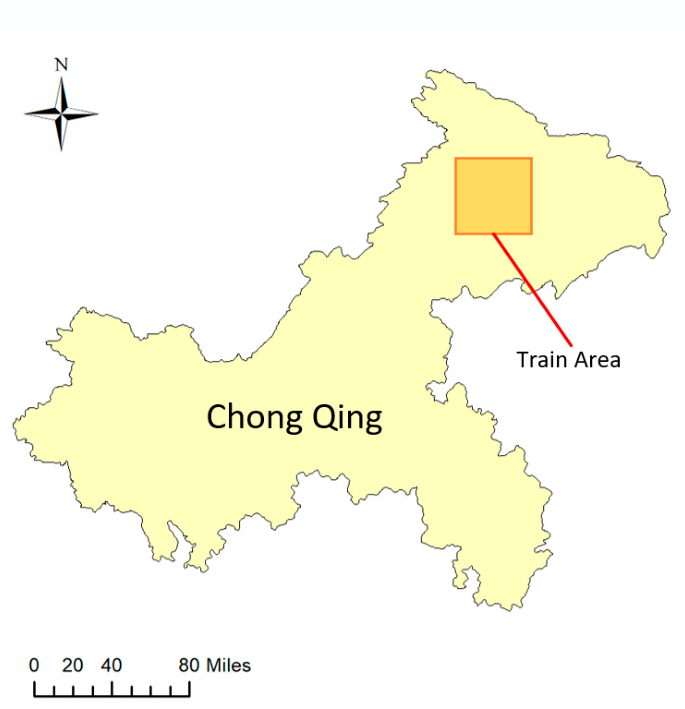
Figure 2.
Architecture of SRDCGAN.
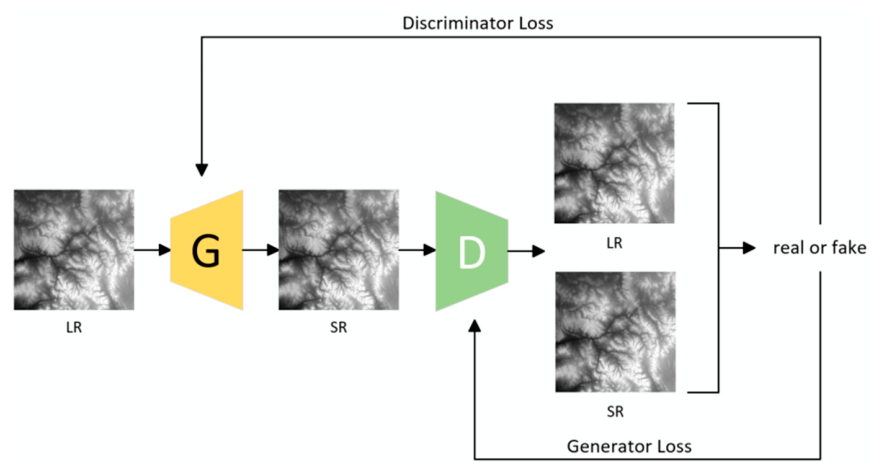
Figure 3.
Generator Architecture of SRDCGAN.
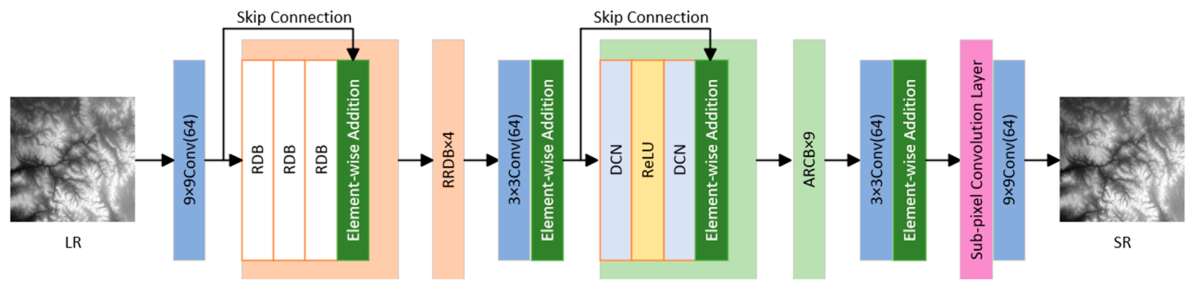
Figure 4.
Discriminator Architecture of SRDCGAN.
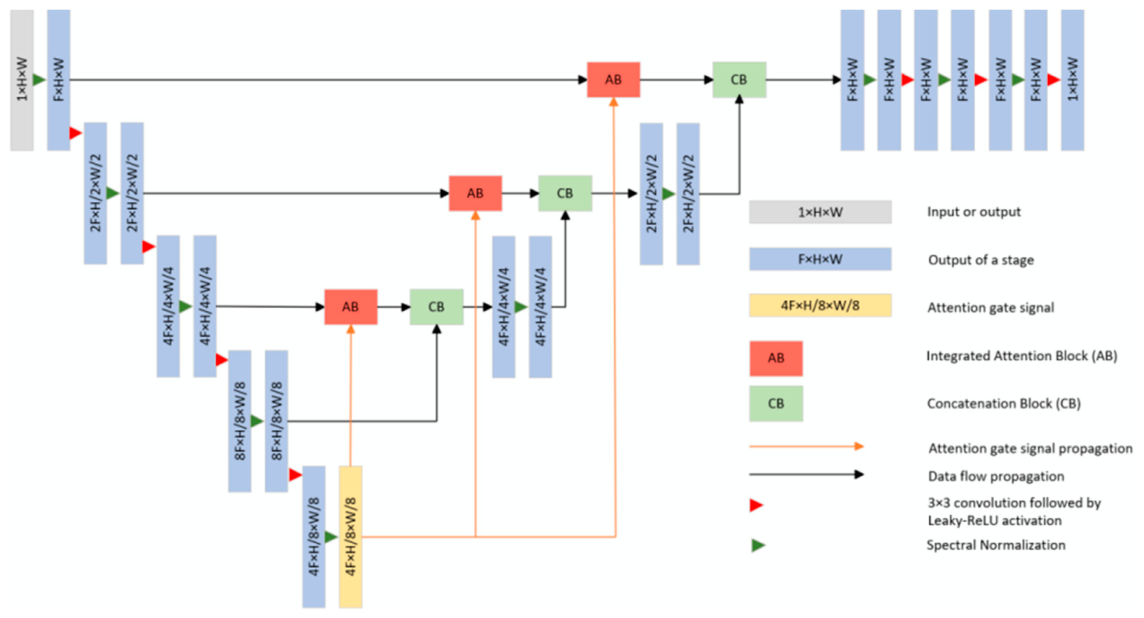
Figure 5.
Architecture of TG-GAN.
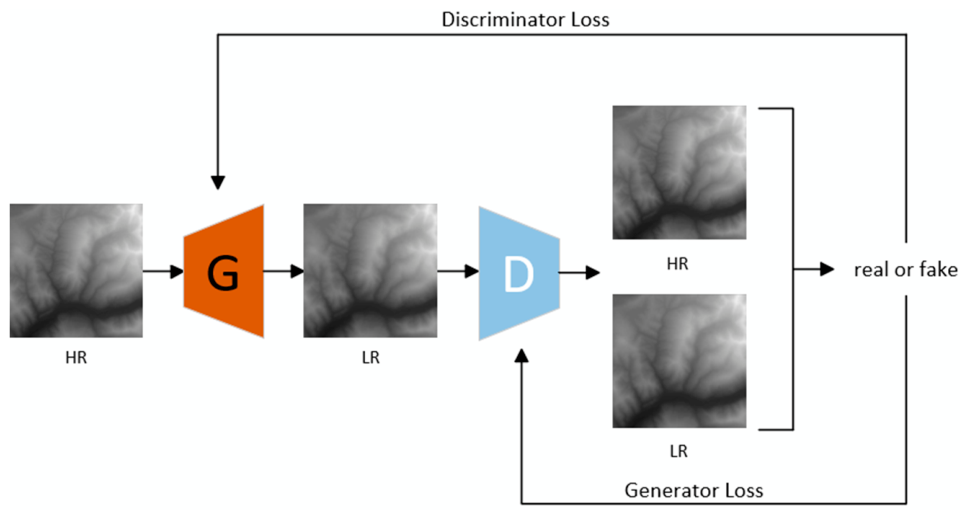
Figure 6.
Generator Architecture of SRDCGAN.
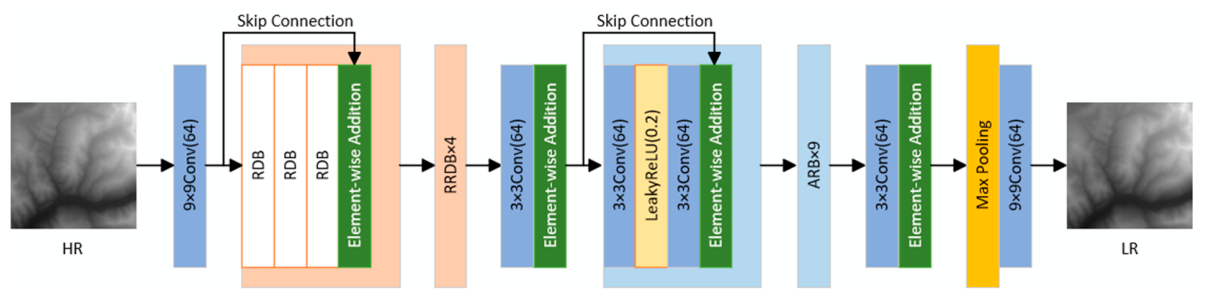
Figure 7.
Results of generalization. Downscaling Factor: a)3. b)4.
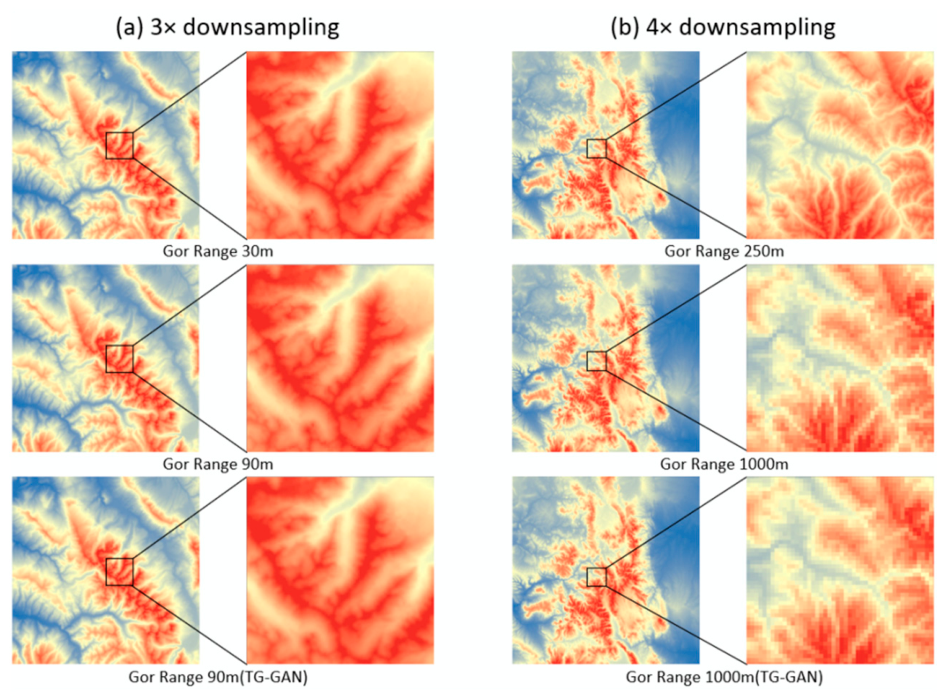
Figure 8.
Visualization of Multi-scale Terrain Generalization. Downscaling Factor: a)2. b)3.c)4. d)5.
Figure 8.
Visualization of Multi-scale Terrain Generalization. Downscaling Factor: a)2. b)3.c)4. d)5.
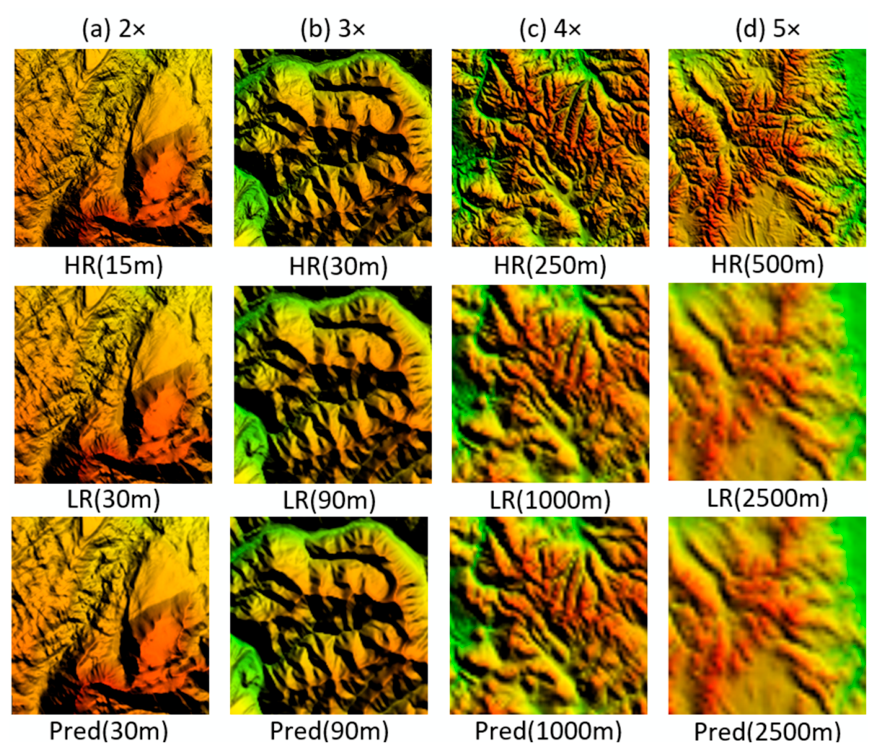
Figure 9.
Frequency Distribution Maps of Elevation, Slope and Aspect(Downscaling Factor:2).
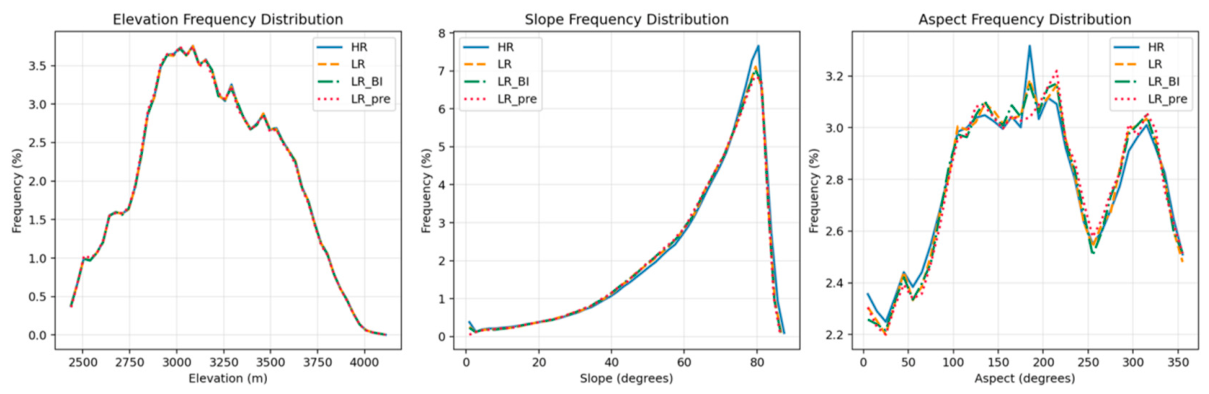
Figure 10.
Frequency Distribution Maps of Elevation, Slope and Aspect(Downscaling Factor:3).
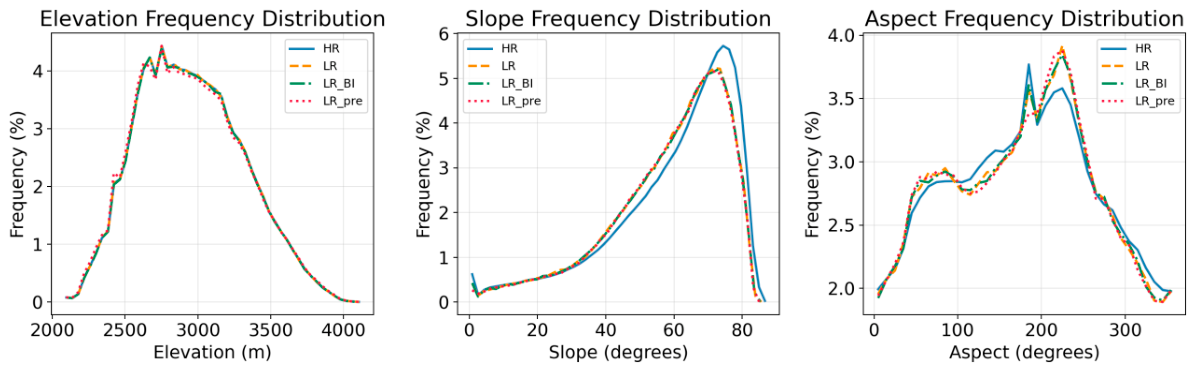
Figure 11.
Frequency Distribution Maps of Elevation, Slope and Aspect(Downscaling Factor:4).
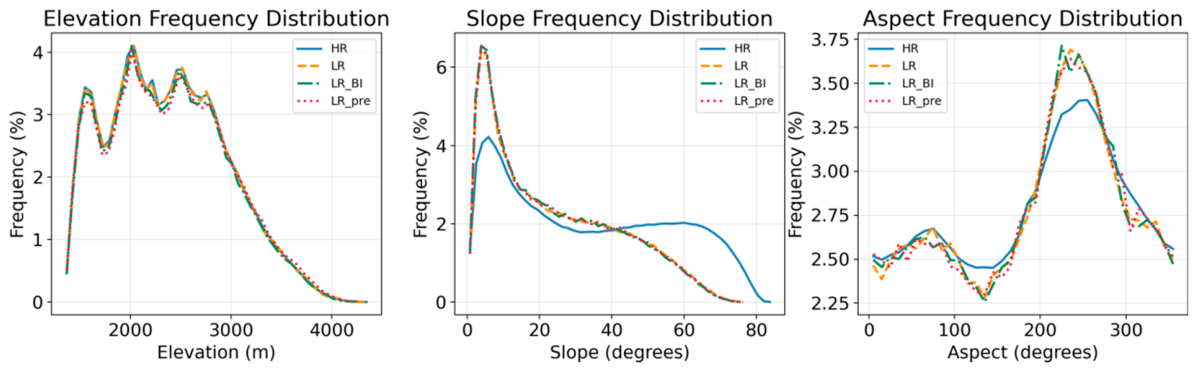
Figure 12.
Frequency Distribution Maps of Elevation, Slope and Aspect (Downscaling Factor:5).
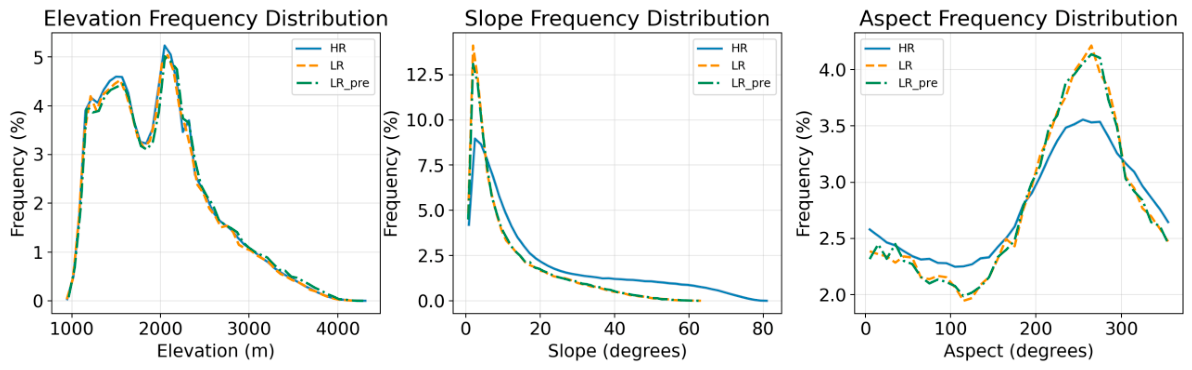
Figure 13.
Comparison of Ridge and Valley Lines Before and After Terrain Generalization Downscaling Factor: a)2.b)3.c)4.d)5.
Figure 13.
Comparison of Ridge and Valley Lines Before and After Terrain Generalization Downscaling Factor: a)2.b)3.c)4.d)5.
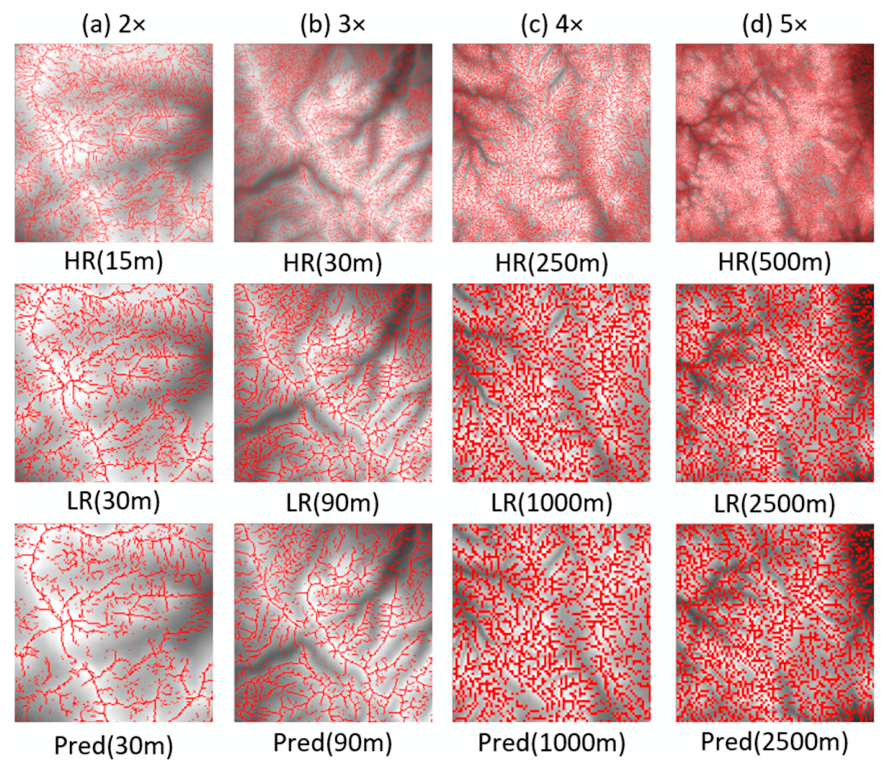
Table 1.
Training Area 2 Details.
| Region | Geographical range | Elevation range | Resolutions |
|---|---|---|---|
| Valdez1 | 146°46′W to 146°09′W,61°02′N to 61°14′N | -1.31m to 1915.76m | 15m,30m |
| Valdez2 | 150°02′W to 142°41′W,59°25′N to 62°49′N | -9.6m to 4983.1m | 250m,1000m |
| Valdez3 | 154°08′W to 138°33′W,57°36′N to 64°30′N | -12m to 5938.5m | 500m,2500m |
Table 3.
Experiment Dataset.
| Generalization ratio | Training set | Testing set | Resolutions |
|---|---|---|---|
| 2 scale | Valdez1 | Gore Range1 | 15m,30m |
| 3 scale | Chong Qing | Gore Range2 | 30m,90m |
| 4 scale | Valdez2 | Gore Range3 | 250m,1000m |
| 5 scale | Valdez3 | Gore Range4 | 500m,2500m |
Table 4.
Comparison of Loss.
| Downscaling Factor | Method | MAE | RMSE | SSIM |
|---|---|---|---|---|
| 2 | TG-GAN | 10.8581 | 7.9411 | 0.9995 |
| Nearest | 12.4863 | 9.0690 | 0.9994 | |
| Bilinear | 8.6421 | 6.2719 | 0.9997 | |
| Cubic | 8.7395 | 6.3222 | 0.9997 | |
| 3 | TG-GAN | 13.8643 | 10.7526 | 0.9994 |
| Nearest | 13.1851 | 8.9229 | 0.9994 | |
| Bilinear | 9.8980 | 7.2316 | 0.9996 | |
| Cubic | 12.4028 | 8.5028 | 0.9994 | |
| 4 | TG-GAN | 59.8203 | 94.2038 | 0.9876 |
| Nearest | 63.7173 | 101.8336 | 0.9848 | |
| Bilinear | 55.5025 | 88.8006 | 0.9884 | |
| Cubic | 56.7585 | 90.9541 | 0.9878 |
Table 5.
Comparison of Elevation and Slope.
| Downscaling Factor | Method | Maximum Elevation (m) |
Minimum Elevation (m) |
Average Elevation (m) |
Average Slope (°) |
Slope Standard Deviation (°) |
|---|---|---|---|---|---|---|
| 2 | HR | 4129.81 | 2419.79 | 3180.24 | 64.2791 | 17.3389 |
| LR | 4127.10 | 2419.69 | 3180.45 | 63.7898 | 17.0058 | |
| Bilinear | 4126.04 | 2419.79 | 3180.24 | 63.7205 | 16.9698 | |
| TG-GAN | 4127.76 | 2421.53 | 3178.22 | 63.7211 | 16.7713 | |
| 3 | HR | 4127.10 | 2075.42 | 2953.31 | 59.9417 | 18.0537 |
| LR | 4127.44 | 2075.55 | 2952.84 | 58.2947 | 17.3145 | |
| Bilinear | 4119.98 | 2075.51 | 2953.30 | 58.3039 | 17.3153 | |
| TG-GAN | 4123.31 | 2074.30 | 2947.84 | 58.3448 | 17.1100 | |
| 4 | HR | 4373.30 | 1335.90 | 2369.31 | 33.5900 | 22.7205 |
| LR | 4352.10 | 1337.70 | 2370.09 | 23.9106 | 17.8004 | |
| Bilinear | 4271.88 | 1337.75 | 2369.32 | 23.5931 | 17.6294 | |
| TG-GAN | 4284.94 | 1337.94 | 2386.38 | 23.8305 | 17.6879 | |
| 5 | HR | 4373.30 | 1335.90 | 2369.30 | 20.3283 | 18.9676 |
| LR(Bilinear) | 4352.10 | 1337.70 | 2370.08 | 11.3454 | 11.1788 | |
| TG-GAN | 4284.93 | 1337.94 | 2386.38 | 11.6366 | 11.2961 |
Table 6.
Comparison of Loss(TG-GAN and CNN) .
| Downscaling Factor | Method | MAE | RMSE | SSIM |
|---|---|---|---|---|
| 2 | TG-GAN | 10.8581 | 7.9411 | 0.9995 |
| CNN | 11.2127 | 49.6612 | 0.9904 | |
| 3 | TG-GAN | 13.8643 | 10.7526 | 0.9994 |
| CNN | 15.5825 | 62.1924 | 0.9860 | |
| 4 | TG-GAN | 59.8203 | 94.2038 | 0.9876 |
| CNN | 421.9673 | 445.3428 | 0.9582 |
Table 7.
Comparison of Elevation and Slope (TG-GAN and CNN).
| Downscaling Factor | Method | Maximum Elevation (m) |
Minimum Elevation (m) |
Average Elevation (m) |
Average Slope (°) |
Slope Standard Deviation (°) |
|---|---|---|---|---|---|---|
| 2 | HR | 4129.81 | 2419.79 | 3180.24 | 64.2791 | 17.3389 |
| LR | 4127.10 | 2419.69 | 3180.45 | 63.7898 | 17.0058 | |
| CNN | 4110.04 | 1614.04 | 3172.63 | 64.2677 | 16.2724 | |
| TG-GAN | 4127.76 | 2421.53 | 3178.22 | 63.7211 | 16.7713 | |
| 3 | HR | 4127.10 | 2075.42 | 2953.31 | 59.9417 | 18.0537 |
| LR | 4127.44 | 2075.55 | 2952.84 | 58.2947 | 17.3145 | |
| CNN | 4114.48 | 1491.26 | 2951.06 | 59.4480 | 16.3509 | |
| TG-GAN | 4123.31 | 2074.30 | 2947.84 | 58.3448 | 17.1100 | |
| 4 | HR | 4373.30 | 1335.90 | 2369.31 | 33.5900 | 22.7205 |
| LR | 4352.10 | 1337.70 | 2370.09 | 23.9106 | 17.8004 | |
| CNN | 4205.20 | 885.99 | 2346.72 | 23.3395 | 16.9515 | |
| TG-GAN | 4284.94 | 1337.94 | 2386.38 | 23.8305 | 17.6879 |
Disclaimer/Publisher’s Note: The statements, opinions and data contained in all publications are solely those of the individual author(s) and contributor(s) and not of MDPI and/or the editor(s). MDPI and/or the editor(s) disclaim responsibility for any injury to people or property resulting from any ideas, methods, instructions or products referred to in the content. |
© 2026 by the authors. Licensee MDPI, Basel, Switzerland. This article is an open access article distributed under the terms and conditions of the Creative Commons Attribution (CC BY) license (http://creativecommons.org/licenses/by/4.0/).
Copyright: This open access article is published under a Creative Commons CC BY 4.0 license, which permit the free download, distribution, and reuse, provided that the author and preprint are cited in any reuse.


