

Submitted:
02 June 2026
Posted:
03 June 2026
You are already at the latest version
Abstract
This study investigated subcritical water extraction (SWE) as an alternative to hydroalcoholic extraction for the production of Echinacea purpurea root extracts standardized to hydroxycinnamic acids (cichoric and caftaric acids). Extractions were performed at 100°C, 125°C, 150°C, and 170°C for 10 min–30 min. The recovery of hydroxycinnamic acids was strongly influenced by extraction temperature, with the highest values obtained within the range of 100°C–125°C. Further optimization identified 110°C for 10min as the optimal condition, yielding the highest cumulative recovery of hydroxycinnamic acids (1.87±0.10% of dry material). In the resulting dry extracts, SWE at 100°C–125°C produced hydroxycinnamic acid contents of 5.5%–7.1%, whereas the total dry extract yield increased from 24%–28% at 100°C to 40%–41% at 150°C–170°C. Higher temperatures, however, reduced hydroxycinnamic acid content to 0.6%–1.7%, indicating degradation of the target compounds. In contrast, total polyphenol recovery increased continuously with temperature, reaching 4.86% at 170°C for 30 min. This was accompanied by marked increases in free caffeic acid and gallic acid, reaching 458.5 mg/100g DW and 945.7 mg/100g DW, respectively, suggesting the release of bound phenolics following partial disruption of plant cell wall structures. SWE also enhanced the extraction of carbohydrates, uronic acids, fructans, proteins and organic acids, demonstrating extensive temperature-dependent modification of the root matrix. 5-HMF was not detected in extracts obtained below 125°C, but increased progressively at higher temperatures, reaching 200 mg/100 g at 170°C. Biological evaluation in HT29 cells showed favorable cytocompatibility of SWE extracts, confirmed by cell viability, morphological assessment and low DNA damage in the Comet assay. Overall, SWE enables the production of hydroxycinnamic acid-standardized E. purpurea extracts without organic solvents, supporting its application in pharmaceutical, nutraceutical, food and cosmeceutical products.
Keywords:
subcritical water extraction
; Echinacea purpurea
; hydroxycinnamic acids
; standardized extracts
; nutraceuticals
; pharmaceuticals
1. Introduction
Medicinal plants represent a key source of biologically active compounds widely utilized in medicine and pharmacy. Their therapeutic value is determined by a diverse range of secondary metabolites, including phenolic compounds, alkaloids and terpenoids, which exhibit antioxidant, anti-inflammatory, antimicrobial, and immunomodulatory activities. These properties underpin the growing interest in plant-derived extracts as components of pharmaceuticals, nutraceuticals, and functional foods, particularly in the context of developing safe and standardized natural products. Among medicinal plants, species of the genus Echinacea (Asteraceae) are of particular importance due to their long-standing use in traditional and modern phytotherapy. Traditionally plants of the Echinacea genus (Echinacea purpurea, Echinacea angustifolia, and Echinacea pallida) have been used in the traditional medicine of Native Americans in North America for centuries to prevent and treat infections, particularly those affecting the respiratory tract [1,2,3,4]. Currently, Echinacea species are widely incorporated into dietary supplements, herbal medicinal products and functional foods, where they serve as a natural source of bioactive compounds with antioxidant and immunomodulatory properties [5,6,7].
Echinacea purpurea (L.) Moench is the most extensively utilized and commercially exploited species from Echinacea genus due to its well-characterized phytochemical profile and documented pharmacological effects [8]. Its biological activity is attributed to a complex mixture of bioactive compounds, including hydroxycinnamic acid derivatives (such as cichoric acid and caftaric acid), alkamides, polysaccharides, etc. [6,9,10,11,12]. The most well-documented biological activities of Echinacea extracts are their immunomodulatory and anti-inflammatory effects. Numerous studies have demonstrated their ability to stimulate immune responses, enhance phagocytic activity, modulate cytokine production, and influence innate immune mechanisms [3,6,7,12,13,14]. In addition, E. purpurea extracts exhibit antioxidant and antiviral activities, largely associated with their phenolic constituents [15,16]. As a result, Echinacea-based preparations are widely used to support immune function and reduce the severity and duration of respiratory infections [2,3].
In the EU, purple coneflower root is recognized as a traditional herbal medicinal product for the relief of symptoms of common cold and as a traditional herbal medicinal product used for the relief of spots and pimples due to mild acne. According to the European Pharmacopoeia E. purpurea root must contain at least 0.5% hydroxycinnamic acids, expressed as the sum of cichoric and caftaric acids, but there are any requirements established for E. purpurea powdered extracts [17]. According to US pharmacopoeia E. purpurea root must contain at least 0.5% total phenols, calculated as the sum of caftaric acid, cichoric acid and chlorogenic acid and at least 0.025% alkylamides, whereas E. purpurea powdered extract must contain at least 4% total phenols, calculated as the sum of caftaric acid, cichoric acid and chlorogenic acid and at least 0.025% alkylamides [18].
The development of efficient extraction techniques is crucial for obtaining standardized E. purpurea extracts with reproducible composition and biological activity. Conventional extraction methods, such as maceration, Soxhlet extraction, and heat reflux extraction, typically employing organic solvents, can achieve relatively high yields but are associated with long extraction times, high solvent consumption, and potential degradation of thermolabile compounds [19,20,21]. Advanced techniques, including ultrasound-assisted, microwave-assisted, and enzyme-assisted extraction, have been introduced to improve efficiency and reduce processing time [22,23,24]. In line with the principles of green chemistry, subcritical water extraction (SWE) has emerged as a highly promising alternative for the recovery of bioactive compounds from plant materials [21,25]. SWE employs water under elevated temperature and pressure (100–374°C), leading to significant changes in its physicochemical properties, including reduced polarity, which enhances its ability to solubilize a wide range of compounds [26,27,28]. This approach eliminates the need for toxic organic solvents, reduces extraction time, and improves environmental sustainability.
Standardized botanical extracts are plant extracts containing a defined amount of one or more marker compounds or bioactive constituents within a specified range, ensuring batch-to-batch consistency and predictable biological activity [29,30,31]. Standardization is a key element of quality control in herbal and plant-based products, supporting identity, purity, potency, and safety [32,33].
Following the high demand for E. purpurea extracts for pharmaceutical and nutraceutical industries, there are numerous studies devoted on extraction of purple coneflower aerial parts and roots using different extraction techniques (supercritical CO2 extraction, subcritical solvent extraction, microwave-assisted extraction) and solvents (water, ethanol, glycerol, acetic acid, etc.) [34,35,36]. However, despite its potential, research specifically investigating subcritical water extraction of E. purpurea remains scarce, with the study by Lekar et al. (2013) representing the only available report addressing this topic [37]. To our knowledge, the present study is the first to adopt a systematic approach to the development of extracts from E. purpurea roots standardized to hydroxycinnamic acid content in accordance with pharmacopeial requirements, while also evaluating the biological activity of subcritical water extracts in comparison with conventional extracts. The development and optimization of subcritical water extraction for E. purpurea roots represent an important step toward producing standardized, high-quality extracts using a green extraction method. Such extracts have the potential to meet regulatory standards and support the application of subcritical water extracts in pharmaceuticals, nutraceuticals, and functional products.
2. Results and Discussion
2.1. Proximate Composition Analysis of E. purpurea Roots
To assess the effectiveness of subcritical water extraction of hydroxycinnamic acids from E. purpurea roots, as well as its impact on plant cell wall structure, a detailed chemical characterization of three independent batches of the raw plant material was first performed (Table 1). This baseline analysis provides essential insight into the initial composition, enabling evaluation of extraction efficiency and treatment-induced structural changes. In addition, the analysis allows selection of raw material with a high hydroxycinnamic acid content, which is important for the development of standardized extracts and for reducing variability associated with the starting plant material.
Across the three batches of E. purpurea roots, carbohydrates are the predominant component, with the highest levels in EP1 (52.1%) and EP3 (49.5%), and a lower content in EP2 (43.0%). Amongst carbohydrates, cellulose (13.8–17.0%) and fructans (11.9–16.7%) are major constituents, with fructans notably highest in EP3. Cellulose, together with fructans, accounts for more than 55% of the total carbohydrates of plant material, whereas soluble sugars represent a small part (between 10-18%). EP2 is characterized by a higher soluble sugar content compared to the other two batches (8%). Amongst them, fructose is the major sugar, followed by sucrose and glucose. The lowest fructose content was found in EP3, which negatively correlated with the higher fructan content of the sample. As can be seen, ligno-cellulose matrix occupies a higher proportion in the first E. purpurea batch, while in the other it represents a smaller amount. This is not only related to the development of the plant itself, but could also have a negative impact on the efficiency of the extraction of target compounds in this E. purpurea batch due to its high resistance. In addition, it is known that in purple coneflower, fructan content (mainly inulin-type) follows a distinct seasonal dynamics tied to the plant's energy storage and survival strategy. In general, fructan levels reach their peak during the winter months, while in the spring, stored fructans are hydrolyzed into simple sugars to fuel rapid development. In late autumn, fructan production increases significantly as the plant prepares for dormancy [38,39]. As shown (Table 1), the uronic acids are the second most abundant carbohydrate constituents (15-18%), which build up the pectic polysaccharides. Our analysis shows that the level of uronic acids does not vary significantly between different E. purpurea batches. Crude protein is the second most abundant component of purple coneflower root, and its content varies between 11-16.5%, peaking in EP2. Crude lipids are the smallest constituents of E. purpurea root and remain low and relatively constant across all batches (0.4–0.6%). The ash content of the different batches (4.8-6.0%) is within the limits set by the European Pharmacopoeia (≤9.0%). The most pronounced variation is observed in phenolic compounds: EP3 shows markedly higher total polyphenols (2516.5 mg/100 g) and hydroxycinnamic acids (2.17%), especially cichoric acid, compared to EP1 and EP2. This is reflected in its superior antioxidant activity (ORAC 672.5 µmol TE/g DW and HORAC 139.3 µmol GAE/g DW), making EP3 the most bioactive batch overall, and pointing it out as the most suitable raw material to perform experiments with subcritical water extraction.
2.2. Efficiency of Subcritical Water for Extraction of Hydroxycinnamic Acids and Polyphenols from E. purpurea Roots
In developing standardized botanical extracts, it is important to distinguish two aspects of SWE efficiency, the first being the recovery of target bioactive metabolites into the extraction medium and the second is the content of the target metabolites in the final dried extract. The assess that, we performed SWE extractions in twelve different combinations of temperature (100°C, 125°C, 150°C, 170°C) for three different extraction times (10 min, 20 min and 30 min) and results are presented on Figure 1. Temperature was the most influential factor governing the recovery of hydroxycinnamic acids and polyphenols from E. purpurea roots. Increasing the temperature up to 125°C maintained a relatively constant cumulative amount of hydroxycinnamic acids, reaching a maximum of 1.86±0.10% at 125°C for 20 min. However, a notable compositional shift in the extracted hydroxycinnamic acids occurred at elevating temperatures. In particular, the relative content of cichoric acid in extracts decreased, while that of caftaric acid increased significantly (p<0.05). For example, the ratio of the recovered individual phenolic acids was 12.0:88.0 (cichoric acid:caftaric acid) for ethanolic extractions, 19.9:80.1, 24,2:75.8 and 39.7:60.3 for SWE100/10, SWE125/10, and SWE150/10, respectively, indicating partial cleavage of ester bonds in cichoric acid (which contains two tartaric acid moieties), leading to its conversion into simpler derivatives such as caftaric acid. At higher temperatures (up to 170°C), a sharp decline in both total hydroxycinnamic acids and their individual components is observed. This can be attributed to thermal degradation, decarboxylation, or further breakdown of these relatively heat-sensitive compounds under subcritical water conditions. In contrast, total polyphenol content increases steadily with temperature, even at the highest levels, suggesting that a significant portion of polyphenols was initially bound to cell wall components, and elevated temperatures promote cell wall disruption and hydrolysis, enhancing their release. Additionally, the improved mass transfer and decreased solvent polarity of subcritical water at higher temperatures may further facilitate extraction. Overall, these results highlight a clear trade-off between preserving specific hydroxycinnamic acids and maximizing total polyphenol recovery. Numerous studies have evaluated the efficiency of subcritical water extraction primarily based on the recovery of broad compound groups, such as total polyphenols or total flavonoids [40]. However, the present results demonstrate that such an approach may be misleading, as these non-specific parameters do not necessarily reflect the recovery of the target bioactive constituents. In the case of E. purpurea, a substantial discrepancy was observed between the recovery of hydroxycinnamic acids and total polyphenols, particularly at elevated extraction temperatures. While total polyphenol content continued to increase, the concentration of hydroxycinnamic acids declined markedly due to their thermal degradation and transformation. These findings emphasize the importance of employing selective analytical approaches and monitoring specific marker compounds when developing standardized botanical extracts, rather than relying solely on global phytochemical indicators.
From the results, it is evident that the optimal conditions for hydroxycinnamic acids recovery were somewhere within the interval between 100°C and 125°C. Therefore, to find the optimal conditions, we performed fine tuning of extraction parameters, performing additional extractions starting from 105°C with 5°C for 10 min and 20 min. The maximum recovery of hydroxycinnamic acids was achieved either at 105°C for 20 min (1.89±0.09%) or at 110°C for 10 min (1.87±0.10%) and the latter was chosen as optimal due to the reduced extraction time. At these conditions, SWE has the 91% of the efficiency of ethanol extraction and was equally effective to water maceration, which was performed for prolonged time of 45 min.
2.3. Characterization of E. purpurea Root Dried Extracts, Obtained by Subcritical Water in Comparison to Conventional Extraction
As already stated, the second very important aspect of SWE efficiency relates to the content of the target metabolites in the final dried extract, which is typically obtained after solvent removal and drying of the liquid extract. Therefore, it of particular importance to analyze the content of the target metabolites, in our case hydroxycinnamic acids in the dry extracts. For the aim, subcritical water extracts were freeze-dried and analyzed. The results were compared to the TADEM and WM extracts, which were freeze-dried, as well (Figure 2). Both extraction yield and hydroxycinnamic acid content were strongly influenced by temperature and extraction time, with temperature again being the dominant factor. The yield of total extract increased steadily with temperature, reaching its highest values at 150–170°C (≈40–41%), indicating enhanced solubilization and mass transfer under subcritical water conditions. In contrast, the hydroxycinnamic acid content in the dry extracts shows an opposite trend. It increases from 100°C to a maximum at 125°C, suggesting optimal recovery at moderate temperatures, but then declines sharply at higher temperatures (150°C–170°C), dropping to as low as 0.6%.
It is known that during SWE, elevated temperatures may cause partial degradation of plant cell walls and promote the solubilization of structural polysaccharides, proteins and other macromolecules from plant tissues [41,42,43]. Our results confirmed that although higher temperatures improve overall extraction yield, they promoted degradation or transformation of hydroxycinnamic acids, reducing their concentration in the final extracts. Notably, shorter extraction times at elevated temperatures tend to preserve slightly higher levels of these acids compared to prolonged treatments, indicating time-dependent degradation effects. Compared to conventional methods (e.g., water maceration), SWE provides both higher yield and enriched hydroxycinnamic acid content, while excessive thermal input compromises extract quality. The relative content of hydroxycinnamic acids was the highest in TADEM extract – approx. 34% of the weight of the dry extract, indicating certain cell wall components (i.e., proteins, pectic polysaccharides, etc.) are not extracted with this solvent.
Although water maceration was equally efficient in recovery of hydroxycinnamic acids from the plant matrix as SWE at temperatures in the range 100°C-125°C from Figure 2, it is evident that due to the prolonged extraction time water maceration yields significantly higher amount of dry extract, which results in significantly lower amount of hydroxycinnamic acids in the dried extract (7,1% vs 5.4%, p<0.05).
In order to get more details on the changes in the chemical composition of the extracts, we performed additional analysis of the main phenolic components, besides cichoric and caftaric acids, in the extracts and their antioxidant activity (Table 2).
Caffeic acid and gallic acid emerged as principle phenolic components, with their concentrations varying drastically across thermal regimes, indicating that extract phenolic composition was strongly influenced by the temperature and duration of the SWE. Specifically, increasing water temperature from 100°C to 150°C resulted in a more than 15-fold increase in the amount of free caffeic acid, rising from 28.6 mg/100 g DW to 440.9 mg/100 g DW. This occurrence is likely due to the hydrolysis of ester bonds in cichoric and caftaric acids and the liberation of free caffeic acid, which supports the observed trend on Figure 1 towards decreasing the content of cichoric acid at moderate temperatures and the decrease of the total amount of hydroxycinnamic acids at higher temperatures. The amount of chlorogenic acid also decreased with the elevation of temperature indicating again the break of the ester bonds in the molecule and the liberation of free caffeic acid. Another possible reason for the liberation of caffeic acid and especially gallic acid could be the hydrolysis of complex phenolic structures like lignin or the degradation of plant material at elevated temperatures [34,44]. Gallic acid reached its peak concentration of 945.7 mg/100 g DW at SWE150/10 [45]. The increased amount of phenolic compounds possessing more free (non-esterified) hydroxyl groups resulted in elevated peroxyl radical scavenging values, indicating that antioxidant properties of the E. purpurea extracts could be influenced by the individual phenolic profile and the specific chemical transformations occurring at different extraction temperatures [46].
2.4. Influence of Subcritical Water Extraction on Primary and Secondary of E. purpurea Root Cell Wall Constituents
To understand and evaluate how subcritical water impacts the plant material, we analyzed the protein, cellulose, uronic acid, fructan, and lignin levels in the solid extraction residues. The data in Table 3 shows that both extraction time and temperature alter the primary cell wall components. Protein levels in the extraction residues remained unchanged (12–13%). However, based on the yield of residue (residue yield), only 38% of the original crude protein remained in the SWE150/20 residue, suggesting that a significant portion of the initial proteins (>60%) is already present in the extract. In contrast, the milder SWE treatment (100/10 and 100/20) left 55% of the proteins in the residue, meaning that 45% passed into the extract. Evidence indicates that proteins are generally more stable than some carbohydrate polymers, only showing significant breakdown at temperatures above 190°C. Researchers suggest that heat-induced denaturation and clumping (between 40–80°C) actually improve protein stability by making them less soluble [47]. While higher temperatures eventually break proteins down into peptides and amino acids, studies show that 150°C for 15 minutes is sufficient to extract maximum protein from sunflower by-products without causing degradation [48].
Uronic acids, which comprise acidic polysaccharides like pectin, followed a similar pattern. The levels of uronic acids in the residues dropped 33% and 50% after SWE treatment at 150/10 and 150/20, respectively, showing that a significant portion was extracted. Notably, only 34% of the initial uronic acids remained in the SWE150/20 residue, meaning 66% were solubilized and removed. Under milder extraction conditions (100/10 or 100/20), however, the cell walls remained largely intact, as the residues retained most of their initial uronic acid content. By contrast, the results in Table 3 suggested that fructans were much more easily extracted and affected by SWE conditions than other cell wall components. Under harsher conditions, fructan content in the residues was reduced more than 2-3 times (2-3%). Interestingly enough, not more than 37% of the initial fructans were recovered in the residue after a 100/10 SWE extraction, showing that 63% can be found in the extract. It is interesting to note that the 150/20 residue contained not more than 10% of the initial total fructan content, expecting that >90% to be found in the extract. It should be mentioned that a greater extent of decomposition of fructans to different intermediates was achieved at a significantly lower temperature (100°C) [49]. Cellulose, the structural backbone of plant cell walls and the primary component of lignocellulose, remained largely unaffected by SWE, showing much higher stability than uronic acids, proteins, and fructans. In residues, 98% to 108% of the initial cellulose was retained, indicating minimal impact and poor solubilization at the employed SWE conditions. Significant breakdown of the cellulose structure only began under more intense conditions (>350°C) [50]. Similar to cellulose, SWE treatment led to an increase in acid-insoluble lignin within the residues, peaking at nearly 21% in the SWE150/20 residue. Unlike some polysaccharide constituents of E. purpurea root, which suffered some degradation, acid-insoluble lignin remained virtually unchanged by the milder treatment, similar to cellulose. This stability is confirmed by the recovery rates, with SWE100/10 residue retaining 101% of the initial lignin found in the purple coneflower root. Under harsher extraction conditions (150/10 and 150/20), however, it seemed that lignin degradation was initiated, since the residues retained a smaller amount of their initial lignin content (88-90%). It is quite possible that under SWE acidic conditions, a minor portion of acid-soluble lignin was dissolved, while the majority of lignin typically forms an insoluble precipitate and was retained in the residue. Regarding the degradation of lignin under SWE conditions, a previous study noted that it began to break down in naked oat stems at 170°C. The process peaked at 190°C, where nearly 50% of the lignin was removed through autohydrolysis [51].
Table 4 presents data for the uronic acids content of the extracts, as well as the total carbohydrate and organic acid contents. The lyophilized extracts were characterized by total carbohydrate content in the range 40-57%. The lack of a clear trend in total carbohydrate content may reflect the highly complex and variable composition of the extracts across different preparation conditions. This is further complicated by the limited specificity, the difficulty of standardizing the analytical method used to measure carbohydrate concentrations (glucose equivalents), and varying molar absorption coefficients that depend on the chemical reactivity of carbohydrates with the derivatization reagent. Concerning uronic acids, an increase in both the temperature and the duration of the extraction process resulted in an increase in their content in the extracts from 2.8% to 6.2% (SWE125/20). This suggests that pressurized hot water enhances the diffusion rate and solubility of uronic acid-containing polysaccharides (e.g., pectin). However, further raising the temperature and especially the extraction time led to a gradual decrease in content (2.5% in SWE170/30). An interesting comment could be made by further analysis of recovery data and information in Table 3. Based on the uronic acid content (Table 3 and Table 4), the SWE100/10 and 100/20 extracts contained only a minor part of the initial uronic acids—about 8% and 14% (Table 4). Theoretically, this implies that nearly 92% and 86% of the initial uronic acids should remain in the residues after extraction. Results obtained confirmed this statement. The data from Table 3 show that residues from SWE100/10 and SWE100/20 experiments retained 91% and 85% of the initial uronic acids, respectively. This is not the case when considering extracts obtained at higher temperatures and for longer durations. For example, the SWE150/10 and SWE150/20 extracts had uronic acid contents of 4.6% and 4.3%, respectively, representing 20% of the raw material's initial uronic acid content. These findings indicate that the residues should retain 80% of the initial uronic acid content. However, data from Table 3 show that residues from SWE150/10 and SWE150/20 recovered only 49% and 34% of the initial uronic acids, respectively. This discrepancy indicates that 31% and 46% of the uronic acid constituents underwent degradation (decarboxylation, dehydration, etc.) into forms that could not be estimated.
In Table 4, the free sugar composition pattern is also included. It can be seen that fructose and glucose levels were stable at lower temperatures (< 125°C and times – 10, 20 min), but higher temperatures caused a gradual increase in their concentration. Sucrose concentration remained stable under these conditions (<150°C/10 min). Fructose and glucose concentration in dried extracts peaked at SWE150/20, negatively correlated with the sucrose level. However, prolonged extraction times (SWE150/30) further reduced both disaccharide and the monosaccharides glucose and fructose amounts, likely due to thermal degradation. Notably, fructose levels significantly exceeded those of sucrose, indicating that inulin-type fructans, rather than just sucrose, were the primary source of fructose during breakdown. The results obtained revealed that fructose decomposed much faster than glucose. At 150°C for 30 minutes, sucrose levels dropped nearly 20 times. Beyond these conditions, higher temperatures and longer extraction times resulted in the near-total disappearance of sucrose from the extracts. Different studies showed that a pronounced conversion of sucrose into fructose and glucose occurs more rapidly at acidic conditions for short residence times [52,53]. In addition, monosaccharides, especially fructose, are highly susceptible to further acid-catalyzed and thermal decomposition, resulting in intermediate and secondary products (5-HMF, furfural, and organic acids) formation [54]. There were clear indications for such a process, examining organic acids results (Table 4). For example, higher temperatures caused a gradual increase in acetic acid levels having a maximum value at 150°C. The amount of oxalic acid, a fragmentation product of furfural derivatives, was observed to decline with increasing temperature and time of extraction. It is important to note that oxalic acid is thermally unstable at high temperatures (125–175°C), which probably explains the decrease in its amount with the increasing of temperature. Other organic acids, such as malic and citric acids, can also be formed as a result of amino acids' decomposition (decarboxylation, deamination, etc.). This could explain the considerable increase in their levels at temperatures exceeding 150°C and treatment longer than 10 min. A review of the scientific literature on the topic shows that aspartic acid primarily degrades via deamination into maleic and fumaric acids. Subsequent rehydration forms malic acid, a precursor to pyruvic acid, which ultimately yields acetic or lactic acid [55]. In order to gain a better insight into the breakdown products and changes in carbohydrate components during extraction, we analyzed the resulting extracts for 5-hydroxymethylfurfural content. The results are also included in Table 4. The presence of 5-HMF revealed that carbohydrate constituents (mainly fructose, sucrose, and inulin) were actively decomposed at higher temperatures. The table data indicate that 5-HMF was undetectable in extracts obtained below 125°C. However, higher extraction temperatures led to a progressive increase in its content, reaching a peak of 200 mg/100 g at 170°C. It seemed that the decomposition of carbohydrate constituents began at temperatures higher than 125 °C. Our findings were in line with those of earlier studies, which demonstrated that significant accumulation of 5-HMF begins between 120–140°C [56]. Below 140°C, formation is negligible. However, yields increase sharply, peaking between 180–200°C [57,58]. The 5-HMF levels obtained in this study were comparable to those reported in previous literature. Fan and Gao observed that 5-HMF content increased from 200 mg/100 g at 160°C to a peak of 430 mg/100 g at 200°C [56]. In contrast, our results were lower than the values reported by Herrero et al. (~300 mg/100 g at 175°C) [57], but in close agreement with the findings of Natolino et al. [59], who reported 5-HMF concentrations ranging from 31 to 239 mg/100 g in extracts obtained between 120 and 200°C.
2.5. Comparative Biological Evaluation of E. purpurea Root Extracts Obtained by Subcritical Water and Conventional Extraction Methods
The biological activity of four E. purpurea extracts obtained by subcritical water extraction (SWE100/10, SWE125/10, SWE150/10, SWE170/10) was comparatively evaluated against conventionally extracted fractions (WM and TADEM) in HT29 colorectal adenocarcinoma cells following 24h and 48h exposure at concentrations of 100 and 200 µg/mL. A multiparametric analysis was performed, including cell viability, cellular morphology and DNA damage assessment (Comet assay), enabling a comprehensive comparison of extract performance.
2.5.1. Effects of E. purpurea Extracts on Cell Viability
Figure 3 demonstrates the comparative cytocompatibility and time-dependent antiproliferative effects of subcritical water versus conventionally extracted fractions. One of the most notable observations in this study was the higher cytocompatibility of the SWE fractions, particularly during the early treatment period. At 24 h, several SWE extracts maintained or slightly increased HT29 metabolic activity relative to untreated controls, whereas the conventionally obtained WM fraction reduced viability, indicating a less favourable short-term cytocompatibility profile (Figure 3). Among all tested samples, SWE125/10 showed the strongest positive effect on cellular metabolic activity, reaching 114.34% viability at 100 µg/mL and 112.66% at 200 µg/mL. Similarly, SWE150/10 maintained high viability values of 113.03% and 103.26%, respectively, while SWE100/10 preserved cell viability close to control levels (104.25% at 100 µg/mL). SWE170/10 also demonstrated a moderate but stable effect. In contrast, the conventional extract WM reduced viability to 92.67% at 100 µg/mL, whereas TADEM remained near baseline but did not outperform the SWE fractions. These findings suggest that the extraction strategy plays an important role in preserving functionally active phytochemicals. The results are consistent with previous reports indicating that aqueous and subcritical extraction approaches can improve the recovery of bioactive phenolics and phytoconstituents while reducing solvent-associated degradation [61].
2.5.2. Morphological Assessment of HT29 Cells Following Extract Treatment
Morphological changes in HT29 cells were evaluated after 24 h and 48 h of treatment with six E. purpurea extracts. Extracts were applied at final concentrations of 100 µg/mL and 200 µg/mL. Representative images are shown in Figure 4. At 24 h, untreated control cells displayed typical epithelial morphology, characterized by high confluency and tight cell-cell contacts. Cells treated with E. purpurea extracts exhibited largely preserved morphology, particularly at 100 µg/mL. Mild alterations were observed at 200 µg/mL, including slight cell rounding and modest reductions in confluency only in SWE170/10 and WM-treated cells. At 48 h, the morphological changes across all treatment groups were minimal. Control cells maintained a dense monolayer, whereas treated groups, mostly those treated with conventional extracts, showed slowly reduced confluency and increased intercellular spaces, likely due to partial cell detachment.
The morphological assessment further supported the favourable biocompatibility profile of SWE-derived extracts. The limited structural alterations observed in SWE-treated cells indicate that these fractions do not induce pronounced membrane damage or loss of adhesion. In contrast, conventional extracts produced more noticeable reductions in confluency and increased signs of cellular detachment, suggesting a greater stress burden on treated cells. Taken together, these observations indicate that SWE extracts preserve cellular structural integrity more effectively than conventional fractions.
2.5.3. DNA Damage and Genomic Stability (Comet Assay)
Genotoxicity testing through the Comet assay further highlighted the advantages of SWE-derived extracts (Figure 5). At 24 h, all SWE extracts produced substantially lower DNA damage than the H2O2 positive control (55.4) (Figure 5A). The most favourable response was observed for SWE100/10, with mean Olive Moment values of 8.47 (100 µg/mL) and 6.38 (200 µg/mL). SWE125/10 also demonstrated low DNA damage values (11.24–14.14), comparable to or lower than those of the conventional fractions. By comparison, WM and TADEM exhibited values ranging from 11.89 to 16.22, indicating a slightly higher genotoxic burden than the best-performing SWE fractions. At 48 h, DNA damage remained moderate in the SWE groups, with no evidence of excessive genomic instability (Figure 5B). This finding is particularly important because it demonstrates that the stronger biological activity of SWE extracts is achieved without inducing marked DNA damage, supporting their favourable safety and functional profile.
The comet assay results additionally reinforce the biological advantages of SWE-derived extracts. Although all treatment groups produced substantially lower DNA damage than the positive control, several SWE fractions, particularly SWE100/10 and SWE125/10, showed lower Olive Tail Moment values compared with conventionally extracted fractions. This finding suggests that SWE-derived extracts exert their biological effects without inducing substantial genomic instability. It also supports the possibility that SWE fractions contain bioactive compounds with protective redox-modulating and DNA-stabilizing properties, as evidenced similarly in phytochemical modulation studies [60,61].
Collectively, the results support a favourable biological profile characterized by preserved cellular viability, maintenance of structural integrity, and low genotoxic burden. Among all tested extracts, SWE125/10 clearly emerged as the lead fraction, demonstrating the most consistent performance across the evaluated biological endpoints. From a translational perspective, these results highlight subcritical water extraction as a promising green extraction strategy for generating biologically active E. purpurea fractions with potential anticancer relevance. The improved functional performance of SWE extracts likely reflects enhanced preservation or enrichment of polyphenols, phenolic acids, and other bioactive phytochemicals responsible for their cytocompatible and protective effects.
3. Materials and Methods
3.1. Plant Material
Three distinct batches of Echinacea purpurea (L.) Moench roots were investigated in this study. EP1 was sourced directly from a licensed producer - Fatma Kichukova, in Gotse Delchev, Bulgaria (net weight 5 kg). EP2 was purchased from Bulgarian Bio Product LTD (Simitli, Bulgaria; Batch L21032025, net weight 5 kg), and EP3 was obtained from Bioprogramme EAD (Dobroslavtsi, Bulgaria; Batch L20032028, net weight 5 kg). All batches of E. purpurea were acquired in March 2025 and kept in paper bags at room temperature.
3.2. Preparation of E. purpurea Root Extracts
3.2.1. Reference Extraction Procedure of Caftaric Acid and Cichoric Acid, and Phenolic Components
Reference extraction procedure of caftaric acid and cichoric acid was conducted in accordance with the methodology prescribed by the European Pharmacopoeia [17]. Approximately 0.5 g of finely powdered E. purpurea root was combined with 80 mL of a 70% (v/v) ethanol solution in a 100 mL volumetric flask. The mixture was subjected to ultrasonic extraction for 15 minutes, after which the volume was adjusted to 100 mL using the same solvent. Following filtration through a 0.45 µm PTFE membrane, the filtrate was analyzed for caftaric acid, cichoric acid, and other phenolic constituents.
3.2.2. Static Water Maceration (WM)
For this procedure, 20 g of powdered E. purpurea root was mixed with 400 mL of distilled water (solid-to-liquid ratio 1:20) in round bottom glass flasks. The extraction was carried out at 90–100 °C for 45 min. After the extraction process, the mixture was filtered. The procedure was performed in duplicate, and the resulting extract was denoted as water maceration (WM) extract. The sample obtained at 100°C for 45 min was used for the subsequent determination of phenolic compounds and other bioactive constituents.
3.2.3. Temperature-Assisted Dynamic Ethanol Maceration (TADEM)
For this procedure, 20 g of powdered plant material was mixed with 400 mL of 70% (v/v) ethanol (solid-to-liquid ratio 1:20) in 1 L glass bottles. The bottles were shaken in a water bath manufactured by NUVE (Asagi Ovecler, Ankara, Turkey) at 60°C for 1 h. The bottles were then cooled, and the extract was filtered. The extraction procedure was repeated twice, and the resulting extract was denoted as the Temperature-Assisted Dynamic Ethanol Maceration (TADEM) extract.
3.2.4. Subcritical Water Extraction
Subcritical water extraction was executed using a 2 L apparatus (InnoSolv Ltd., Plovdiv, Bulgaria) featuring an insulated extraction chamber, an electrical heating unit, and a circulation pump. To maintain the solvent in a liquid state at the selected temperatures (100°C, 125°C, 150°C and 170°C), a constant nitrogen-induced pressure of 10 bar was regulated within the system. The procedure involved loading 100 g of botanical substrate into a metal sieve insert (1:20 solid-to-solvent ratio). Once the target temperature was stabilized, the 2 L of water was continuously circulated through the material for durations of 10, 20, or 30 min. Post-extraction, the resulting fluids were cooled in situ to ambient temperature.
Samples were labeled according to their specific extraction conditions used as follows:

Table 5.
Extraction conditions applied for subcritical water and conventional extraction of E. purpurea roots.
Table 5.
Extraction conditions applied for subcritical water and conventional extraction of E. purpurea roots.
| Extraction | Extragent | Temperature | Time | L/S ratio |
|---|---|---|---|---|
| SWE100/10 | water | 100°C | 10 min | 1:20 |
| SWE100/20 | water | 100°C | 20 min | 1:20 |
| SWE100/30 | water | 100°C | 30 min | 1:20 |
| SWE110/10 | water | 110°C | 10 min | 1:20 |
| SWE125/10 | water | 125°C | 10 min | 1:20 |
| SWE125/20 | water | 125°C | 20 min | 1:20 |
| SWE125/30 | water | 125°C | 30 min | 1:20 |
| SWE150/10 | water | 150°C | 10 min | 1:20 |
| SWE150/20 | water | 150°C | 20 min | 1:20 |
| SWE150/30 | water | 150°C | 30 min | 1:20 |
| SWE170/10 | water | 170°C | 10 min | 1:20 |
| SWE170/20 | water | 170°C | 20 min | 1:20 |
| SWE170/30 | water | 170°C | 30 min | 1:20 |
| Water maceration (WM) | water | 100°C | 45 min | 1:20 |
| Temperature assisted dynamic ethanol maceration (TADEM) |
70% ethanol | 60°C | 60 min | 1:20 |
3.3. Preparation of Freeze-Dried Extracts
Following SWE, WM and TADEM, the crude extracts were clarified via filtration and centrifugation (6,000 rpm, 10 min). The organic solvent was eliminated through rotary evaporation, after which all extracts were freeze-dried. To prevent phytochemical degradation, the dry residues were maintained in a moisture-free, dark environment. Analytical solutions were prepared by dissolving the lyophilized material in ultra-pure water (5 mg/mL).
3.4. Proximate Composition Analysis of Plant Material
Moisture content was determined gravimetrically by drying the milled sample (~1.0 g) in an automated moisture analyzer (KERN DLB 160-3A, Bensheim, Germany) at 105°C until constant weight. Ash content was determined gravimetrically by placing the pulverized sample (1.0 g) in a crucible and igniting it in a Dentamatic 6000-M muffle furnace (Tokmet-TK Ltd., Varna, Bulgaria) at 560°C to a constant mass. Crude lipid content was estimated gravimetrically using a Randall extractor SER 148 (VELP Scientifica Srl, Usmate, Italy). Initially, the ground samples (2.0 g) were packed in a cellulose thimble (33×88 mm) and subjected to a petroleum ether (70 mL) two-step extraction, including immersion for 30 min, and washing for 2 hours, followed by a 2-hour solvent recovery phase. The crude extract was additionally dried under vacuum, and its weight was used to calculate lipid content. The temperature of the heating plate and seal type were chosen according to the manufacturer’s instructions. Crude protein content was tested by the micro-Kjeldahl method (N × 6.25). Ammonia nitrogen, in the digested sample, was determined by the acetylacetone–formaldehyde colorimetric method, using ammonium sulfate as a standard [62]. The total carbohydrate content of the roots was analyzed by the phenol-sulfuric acid method, using glucose to construct the calibration curve [63]. After solubilizing the sample in 72% (w/w) H2SO4 (1 h, 30°C), a 3-hour acid hydrolysis (100°C, 1M H2SO4) was further performed. The obtained hydrolyzate was used as the sample for analysis. Absorbance was measured at 490 nm.
3.5. Uronic Acid, Cellulose, Starch, and Total Fructan Content
For the estimation of the uronic acid content of the raw material, the method of Ahmed and Labavitch was used [64]. In brief, the sample was threefold-extracted with ethanol (70% (v/v), 50°C, 1 h). The mixture was centrifuged (18.187× g) to separate solid material before each repetition. In addition, the residue was soaked (2×, 1 h) with pure acetone at room temperature and vacuum dried. Finally, the sample was hydrolyzed as described in 2.x., and the filtrated hydrolyzate was run as a sample for analysis. The hydrolyzates were assayed employing the colorimetric 3-phenylphenol method according to Blumenkrantz and Asboe-Hansen [65]. The absorbance was measured at 520 nm.
Cellulose content was quantified using a modified version of Updegraff’s spectrophotometric semi-micro method [66]. Briefly, a 30–35 mg sample was gently boiled for 30 minutes in a microtube with an O-ring screw cap containing 2 mL of an acetic acid-nitric acid reagent (acetic acid:H2O:HNO3 8:2:1 v/v/v). After colling, the solid residue was centrifuged and washed with water until it reached a neutral pH. The remaining solids were dissolved in 72% w/w sulfuric acid and, after an appropriate dilution, run via the phenol-sulfuric acid method.
The total fructan content of purple coneflower roots was estimated using a resorcinol-thiourea method of Roe [67]. Initially, the powdered root was subjected to double extraction (1:10 w/v, 20 min, 65°C) with water in an ultrasonic bath Elmasonic p 70 H (Elma Schmidbauer GmbH, Singen, Germany) (37-80 kHz, 220 W) [63]. The combined extracts were further analyzed by the method. The resorcinol solution was prepared by dissolving 0.1 g resorcinol and 0.25 g thiourea in 100 mL of glacial acetic acid. A 30% hydrochloric acid solution was prepared separately. The working solution was then obtained by mixing hydrochloric acid and resorcinol solutions in a 7:1 (v/v) ratio. A volume of 0.5 mL of the extracts was mixed with 2 mL of the working solution. Then the mixture was incubated in a water bath at 80°C for 10 minutes. After cooling, the absorbance of the samples was recorded at 515 nm against a reagent blank prepared in a similar way using distilled water. Fructose (10-50 µg/ml) was used for the construction of a calibration curve [68].
Total starch analysis was performed by a combination of the α-amylase/amyloglucosidase method for conversion of starch into glucose and the glucose oxidase/peroxidase/4-aminoantipyrine (GOPOD) method of measuring glucose quantity. The analysis was conducted according to the analytical protocol established by Hall [69].
3.6. Lignin Content
The lignin content in the initial E. purpurea batches was evaluated by the spectroscopic acetyl bromide lignin (ABL) method [70]. The Klason lignin gravimetric method (KL) was employed for the determination of lignin content in the residue after SWE extraction [71]. Before performing the analysis, the plant material (3-4 g) was packed in nylon filter bags and successively extracted in a Randall extractor SER 148 (VELP Scientifica Srl, Usmate, Italy) using 70 mL of each solvent: water, ethanol (96% v/v), chloroform:methanol (2:1 v/v), and acetone [70]. Each solvent cycle (20 min immersion, 30 min washing) was repeated 3 times or until the resulting extract was colorless. The temperature of the heating plate and seal type were chosen according to the manufacturer’s instructions.
3.7. High-Performance Liquid Chromatography Analysis of Caftaric Acid and Cichoric Acid
Caftaric and cichoric acids were quantified following the procedure outlined in the European Pharmacopoeia [17]. The separation was carried out on a ProntoSIL 120-5-C18 SH (4.6 x 250 mm, 5µm) joined to a Nexera-i LC-2040C Plus UHPLC system (Shimadzu Corporation, Kyoto, Japan) with a UV detector set at 330 nm. The elution of the sample (10 µL) was conducted at 35°C and a flow rate of 1.0 mL/min with mobile phase consisted of (A)—phosphoric acid:water (1:999 v/v) and (B)—acetonitrile using the following gradient: 0 min—90% (A); 0–13 min 90%→78% (A); 13–14 min 78%→60% (A); 14–20 min 60% (A). The peaks identification was based on relative retention regarding the chlorogenic acid standard: caftaric acid = about 0.8; cichoric acid = about 2.3. The percentage content of each phenolic acid in the sample was calculated using the equations described in the corresponding monograph [17].
3.8. High-Performance Liquid Chromatography Analysis of Phenolic Components
Phenolic compounds were analyzed via UHPLC on a Shimadzu Nexera-i LC2040C Plus system. The setup included a UV-VIS detector and a Shimadzu Shim-pack GIST C18 column (4.6 × 250 mm, 5 µm) and Shimadzu Shim-pack Guard Column Holder (10 mm) operated at 26°C. A gradient elution was applied at 0.8 mL/min using 0.5% acetic acid (A) and acetonitrile (B), starting at 14% B, then increasing to 25% (6-30 min) and 50% (40 min). Detection was set at 280 nm with a 5 µL sample injection. Identification was validated by matching retention times against a broad range of phenolic standards (gallic acid, neochlorogenic acid, 3,4-dihydroxybenzoic acid, chlorogenic acid, catechin, vanillic acid, caffeic acid, epicatechin, p-coumaric acid, ferulic acid, rutin, ellagic acid, quercetin-3-β-glucoside, naringin, rosmarinic acid, myricetin, cinnamic acid, quercetin, luteolin, naringenin, apigenin, and kaempferol). Results were calculated based on standard calibration curves and expressed in mg/100 g DW±SD [72].
3.9. High-Performance Liquid Chromatography Analysis of Organic Acids
The quantitation of organic acids in the lyophilized extracts was conducted on a Nexera-i LC2040C Plus UHPLC system (Shimadzu Corporation, Kyoto, Japan) with a UV detector. The system was controlled by LabSolutions (ver. 5.98) software (Shimadzu Corp.). The separation was performed on a Shimadzu Shim-pack GIST C18 (4.6 mm × 250 mm, 5 µm) column at 25 °C and a flow rate of 1.0 mL/min. A 20 μL sample was auto-injected and eluted isocratically using a mobile phase composed of 25 mM K2HPO4 (pH adjusted to 2.4 with H3PO4). After UV detection of organic acids at 210 nm, their concentrations were calculated using a five-point calibration curve for each acid, with peak identities confirmed by comparing retention times against known standards.
3.10. High-Performance Liquid Chromatography Analysis of Free Sugars
One gram of powdered plant material was extracted with 30 mL of water for one hour at 30 °C while being continuously shaken in a water bath. The resulting extract was used for analysis after being recovered through centrifugation at 6000× g for 20 minutes and filtration through a 0.45 μm PTFE filter. A UHPLC system Nexera-i LC2040C Plus (Shimadzu Corporation, Kyoto, Japan) with a binary pump and a 20 A refractive index detector, was employed for analysis. Free sugar content was separated on a ZORBAX Carbohydrate, Agilent (4.6 × 150 mm, 5 μm) and a ZORBAX Reliance Cartridge guard column. A mobile phase composed of a mixture of acetonitrile and water (80:20 v/v) was used to elute the sample at a flow rate of 1.0 mL/min at 25°C. A calibration curve built by plotting the peak area against the concentrations of each standard was used to find the concentration of sugars in the sample as detected by their retention time.
3.11. Total Polyphenol Content
Total polyphenols were quantified using the Folin-Ciocalteu’s reagent according to the method of Singleton & Rossi [73]. Gallic acid was used as a calibration standard, and the results were expressed in mg gallic acid equivalents (GAE) per 100 g.
3.12. Antioxidant Activity Assays
Oxygen radical absorbance capacity (ORAC) activity was assessed using a FLUOstar OPTIMA (BMG Labtech, Ortenberg, Germany) microplate reader (excitation λ = 485 nm, emission λ = 520 nm, following the procedure established by Ou et al. [74] as modified by Denev et al. [75]. Trolox was used to build the calibration curve, and results were expressed in micromole Trolox equivalents (μmol TE) per gram DW ± SD (n = 8).
Hydroxyl radical averting capacity (HORAC) activity was determined (excitation λ = 485 nm, emission λ = 520 nm), following the procedure described by Ou et al. [76]. Gallic acid was used as a standard, and results were expressed in micromole gallic acid equivalents (μmol GAE) per gram DW ± SD (n = 8).
3.13. Determination of 5-HMF Content
The 5-HMF content in the extracts was estimated using the method of Winkler with the p-toluidine-barbituric acid reagent as described by Zembrzuska et al. [77]. The results were calculated from the following equation:
where Abs is absorbance at 550 nm, 19.2 is the factor for dilution and absorption coefficient, and Yextr. is the yield of dry extract.
3.14. Cell Culture and Experimental Setup
The human colorectal adenocarcinoma cell line HT29, obtained from ATCC, was used as the experimental model. Cells were cultured in Dulbecco's Modified Eagle Medium (DMEM, Gibco) supplemented with 10% fetal bovine serum (FBS, Gibco) and maintained at 37°C in a humidified incubator with 5% CO2. Cells were passaged 2–3 times per week using 0.25% trypsin-EDTA to maintain exponential growth and ensure consistent cell density for experiments. For all experimental procedures, cells were seeded at a density of 2×10⁴ or 1×10⁵ cells per well in culture plates appropriate for the downstream analyses: 96-well plates for cell proliferation and viability (WST-1 assay) and phase-contrast visualization, 6-well plates for flow cytometry (FACS), for reverse transcription quantitative PCR (RT-qPCR), and for the neutral comet assay. After seeding, cells were allowed to adhere for 24 h under standard culture conditions. Following attachment, cells were treated with four subcritical water extracts (SWE100/10, SWE125/10, SWE150/10, SWE170/10) and two conventional extracts (WM and TADEM) of E. purpurea at final concentrations of 100 μg/mL and 200 μg/mL. Extracts were freshly prepared in culture medium immediately before treatment, ensuring uniform exposure. Control cells received an equivalent volume of vehicle (medium without extracts). Cells were incubated for 24 h and 48 h post-treatment under standard conditions. At each time point, cells were processed according to the specific assay requirements: harvested and fixed for FACS analysis, lysed for RNA isolation in RT-qPCR experiments, or subjected to the neutral comet assay to assess DNA damage. All experiments were performed in triplicate to ensure reproducibility, and cell viability was routinely monitored using trypan blue exclusion before treatment.
3.15. WST-1 Cell Proliferation Assay
The WST-1 assay (TaKaRa Bio INC., Japan) was used to evaluate the effects of the E. purpurea extracts on cell proliferation and viability after 24 h of supplementation, following a previously described protocol [78]. Cells were placed into 96-well plates at a density of 1×10⁴cells per well and allowed to adhere for 24 hours at 37°C in a 5% CO₂ atmosphere. The next day, the old culture medium was replaced with fresh medium, and the cells were incubated at increasing concentrations of the tested extracts for an additional 24 hours. After this exposure period, the medium was replaced with fresh medium, and the WST-1 reagent was introduced directly to the cells at a 1:10 dilution, following the manufacturer's guidelines. Following a 1-hour incubation at 37°C in the dark, the amount of formazan produced by the cells was measured by reading the absorbance at 450 nm using a standard microplate reader (INNO-S, LTEK, Gyeonggi-do, South Korea). The optical density (OD) data from the cell proliferation assay were used to calculate cell viability as a percentage relative to the untreated control group.
3.16. Phase-Contrast Microscopy
Changes in cell morphology following 24 h and 48 h of treatment with the tested extracts were assessed using phase-contrast microscopy. Phase-contrast images were captured at 10× and 20× magnifications with an Axiovert 25 inverted microscope (Carl Zeiss, Germany) fitted with a Leica K5C digital camera.
3.17. Comet Assay (Single Cell Gel Electrophoresis, SCGE)
DNA damage at the single-cell level was evaluated using the neutral comet assay (SCGE) in HT-29 cells following exposure to the tested extracts. As a positive control, cells were treated with 250 mM hydrogen peroxide (H2O2) for 30 min to induce DNA damage, while untreated cells served as the negative control. After treatment, cells were harvested and resuspended, then mixed with 0.7% (w/v) low-melting-point agarose (Sigma-Aldrich) and immediately spread onto microscope slides pre-coated with a layer of normal-melting-point agarose to form microgels. The slides were allowed to solidify at 4°C. Subsequently, the embedded cells were lysed in a cold lysis buffer containing 146 mM NaCl, 30 mM EDTA (pH 7.0), 10 mM Tris-HCl (pH 7.0), and 0.1% N-lauroylsarcosine for 20 min at 4 °C to remove cellular membranes and proteins while preserving nucleoids. Following lysis, slides were rinsed twice with 0.5× Tris-borate-EDTA (TBE) buffer to remove residual lysis components. Electrophoresis was then performed under neutral conditions at 0.46 V/cm for 10 min. After electrophoresis, DNA was stained with SYBR Green (Invitrogen) and visualized using a fluorescence microscope. Comet images were analyzed quantitatively using CometScore software (Version 2.0, TriTek Corp., USA), and DNA damage was expressed as the Olive tail moment. All samples were processed under low-light conditions to prevent additional DNA damage.
3.18. Statistical Analysis
All extractions were performed in duplicate. The HPLC analyses were performed twice for every single sample (n = 4), whereas other analyses were run at least in triplicate for each sample (n = 6). Results were expressed as mean values ± standard deviations. One-way analysis of variance (ANOVA) and Student’s t-test were used to evaluate the differences in the mean between groups. p-values less than 0.05 were considered to be significant. Microsoft Excel, 2013 (Microsoft Corporation, Redmond, Washington, USA) was used in the analyses.
4. Conclusions
This study demonstrates that subcritical water extraction is an effective approach for producing Echinacea purpurea root extracts standardized to hydroxycinnamic acids. Extraction temperature was identified as the key factor affecting both hydroxycinnamic acid recovery and extract composition, with optimal conditions established at 110°C for 10min while eliminating the need for organic solvents. The results revealed a clear distinction between the recovery of hydroxycinnamic acids and total polyphenols, demonstrating that optimization of SWE based solely on total polyphenol content is insufficient and may lead to misleading conclusions regarding the recovery of the target compounds. Biological evaluation confirmed the favorable cytocompatibility of SWE-derived extracts and their comparable or superior performance relative to conventionally prepared extracts. The low content of 5-HMF in extracts obtained under mild extraction conditions (100°C–125°C) provides an additional indication of their safety. Overall, SWE represents a promising green technology for the production of high-quality E. purpurea extracts for pharmaceutical, nutraceutical, food and cosmeceutical applications.
Author Contributions
Conceptualization, P.D.; methodology, P.D., M.O., M.G.; formal analysis, P.D., M.O., K.H-P, N.K., G.M., M.G.; investigation, D.T., M.O., M.P., A.P., G.D., B.V. K.H-P, N.K., G.M., M.G.; resources, P.D., M.G.; data curation, P.D., D.T., M.O., M.G.; writing—original draft preparation, P.D., D.T., M.O., M.P., M.G.; writing—review and editing, P.D.; supervision, P.D.; project administration, P.D.; funding acquisition, P.D., M.G.. All authors have read and agreed to the published version of the manuscript.
Funding
The study was funded by project No. BG-RRP-2.017-0043/16.12.2024, funded by the European Union through the NextGenerationEU instrument from the Recovery and Resilience Mechanism for the implementation of an investment under C2I2 “Enhancing the innovation capacity of the Bulgarian Academy of Sciences in the field of green and digital technologies”.
Institutional Review Board Statement
Not applicable.
Informed Consent Statement
Not applicable.
Data Availability Statement
The original contributions presented in this study are included in the article. Further inquiries can be directed to the corresponding author.
Conflicts of Interest
The authors declare no conflicts of interest.
Abbreviations
The following abbreviations are used in this manuscript:
| HORAC | Hydroxyl radical averting capacity |
| ORAC | Oxygen radical absorbance capacity |
| SWE | Subcritical water extraction |
| TADEM | Temperature-Assisted Dynamic Ethanol Maceration |
| WM | Static Water Maceration |
| GOPOD | glucose oxidase/peroxidase/4-aminoantipyrine |
| ABL | acetyl bromide lignin |
| 5-HMF | 5-(hydroxymethyl)furfural |
References
- Puchalski, K.; Gerstel, J.A.; Jimoh, A.; Shokoohinia, Y.; Langland, J. Effects of Echinacea purpurea and Alkylamides on Respiratory Virus Replication and IL-8 Expression In Vitro. Molecules 2025, 30, 386. https://doi.org/10.3390/molecules30020386. [CrossRef]
- David, S.; Cunningham, R. Echinacea for the Prevention and Treatment of Upper Respiratory Tract Infections: A Systematic Review and Meta-Analysis. Complement. Ther. Med. 2019, 44, 18–26. https://doi.org/10.1016/j.ctim.2019.03.011. [CrossRef]
- Kakouri, E.; Talebi, M.; Tarantilis, P.A. Echinacea spp.: The cold-fighter herbal remedy? Pharmacol. Res. - Mod. Chin. Med. 2024, 10, 100397. https://doi.org/10.1016/j.prmcm.2024.100397. [CrossRef]
- Hudson, J.B. Applications of the Phytomedicine Echinacea purpurea (Purple Coneflower) in Infectious Diseases. J. Biomed. Biotechnol. 2012, 2012, 769896. https://doi.org/10.1155/2012/769896. [CrossRef]
- Percival, S.S. Use of echinacea in medicine. Biochem. Pharmacol. 2000, 60, 155–158. https://doi.org/10.1016/S0006-2952(99)00413-X. [CrossRef]
- Ahmadi, F. Phytochemistry, Mechanisms, and Preclinical Studies of Echinacea Extracts in Modulating Immune Responses to Bacterial and Viral Infections: A Comprehensive Review. Antibiotics 2024, 13, 947. https://doi.org/10.3390/antibiotics13100947. [CrossRef]
- Espinoza, J.P.; Guajardo, V.; Rodríguez-Díaz, M.; Moreno, M.; Klagges, C.; Castillo-Ruiz, M.; Otero, M.C. Pharmacological Insights and Technological Innovations in Curcuma longa L. and Echinacea purpurea (L.) Moench as Plant-Derived Immunomodulators. Pharmaceuticals 2026, 19, 93. https://doi.org/10.3390/ph19010093. [CrossRef]
- Burlou-Nagy, C.; Bănică, F.; Negrean, R.A.; Jurca, T.; Vicaș, L.G.; Marian, E.; Bácskay, I.; Kiss, R.; Fehér, P.; Vicaș, S.I.; et al. Determination of the Bioactive Compounds from Echinacea purpurea (L.) Moench Leaves Extracts in Correlation with the Antimicrobial Activity and the In Vitro Wound Healing Potential. Molecules 2023, 28, 5711. https://doi.org/10.3390/molecules28155711. [CrossRef]
- Burlou-Nagy, C.; Bănică, F.; Jurca, T.; Vicaș, L.G.; Marian, E.; Muresan, M.E.; Bácskay, I.; Kiss, R.; Fehér, P.; Pallag, A. Echinacea purpurea (L.) Moench: Biological and Pharmacological Properties. A Review. Plants 2022, 11, 1244. https://doi.org/10.3390/plants11091244. [CrossRef]
- Sharifi-Rad, M.; Mnayer, D.; Morais-Braga, M.F.B.; Carneiro, J.N.P.; Bezerra, C.F.; Coutinho, H.D.M.; Salehi, B.; Martorell, M.; Del Mar Contreras, M.; Soltani-Nejad, A.; Uribe, Y.A.H.; Yousaf, Z.; Iriti, M.; Sharifi-Rad, J. Echinacea Plants as Antioxidant and Antibacterial Agents: From Traditional Medicine to Biotechnological Applications. Phytother. Res. 2018, 32, 1653–1663. https://doi.org/10.1002/ptr.6101. [CrossRef]
- Petrova, A.; Ognyanov, M.; Petkova, N.; Denev, P. Phytochemical Characterization of Purple Coneflower Roots (Echinacea purpurea (L.) Moench.) and Their Extracts. Molecules 2023, 28, 3956. https://doi.org/10.3390/molecules28093956. [CrossRef]
- Šutovská, M.; Capek, P.; Kazimierová, I.; Pappová, L.; Jošková, M.; Matulová, M.; Fraňová, S.; Pawlaczyk, I.; Gancarz, R. Echinacea Complex – Chemical View and Anti-Asthmatic Profile. J. Ethnopharmacol. 2015, 175, 163–171. https://doi.org/10.1016/j.jep.2015.09.007. [CrossRef]
- Xue, C.H.; A, S.X.; Wang, M.J.; Wu, Q.; Liu, J.H.; Zhang, L.F.; Wu, Y.; Wu, H.; Chai, S.T. Echinacea Purpurea Extract (Cichoric Acid) Exerts an Anti-Inflammatory Effect on Yak PBMCs and Regulates the TLR4 Signalling Pathway. J. Vet. Res. 2021, 65, 109–115. https://doi.org/10.2478/jvetres-2021-0016. [CrossRef]
- Vieira, S.F.; Gonçalves, S.M.; Gonçalves, V.M.F.; Llaguno, C.P.; Macías, F.; Tiritan, M.E.; Cunha, C.; Carvalho, A.; Reis, R.L.; Ferreira, H.; et al. Echinacea purpurea Fractions Represent Promising Plant-Based Anti-Inflammatory Formulations. Antioxidants 2023, 12, 425. https://doi.org/10.3390/antiox12020425. [CrossRef]
- Ciganović, P.; Jakupović, L.; Momchev, P.; Nižić Nodilo, L.; Hafner, A.; Zovko Končić, M. Extraction Optimization, Antioxidant, Cosmeceutical and Wound Healing Potential of Echinacea purpurea Glycerolic Extracts. Molecules 2023, 28, 1177. https://doi.org/10.3390/molecules28031177. [CrossRef]
- Thygesen, L.; Thulin, J.; Mortensen, A.; Skibsted, L.H.; Molgaard, P. Antioxidant activity of cichoric acid and alkamides from Echinacea purpurea, alone and in combination. Food Chem. 2007, 101, 74–81. https://doi.org/10.1016/j.foodchem.2005.11.048. [CrossRef]
- European Pharmacopoeia Commission. 01/2008:1824. Purple coneflower root. In European Pharmacopoeia, 7th ed.; Council of Europe: Strasbourg, France, 2011; Volume 1, pp. 1219–1221.
- United States Pharmacopeial Convention. United States Pharmacopeia and National Formulary (USP 43–NF 38); USP Convention: Rockville, MD, USA, 2020.
- Picot-Allain, C.; Mahomoodally, M.F.; Ak, G.; Zengin, G. Conventional versus green extraction techniques—A comparative perspective. Curr. Opin. Food Sci. 2021, 40, 144–156. https://doi.org/10.1016/j.cofs.2021.02.009. [CrossRef]
- Plyduang, T.; Monton, C.; Suksaeree, J. Sustainable Green Extraction Approaches for Herbal Phytochemicals Supporting Environmentally Friendly and Climate Responsive Product Development. Sustain. Chem. Clim. Action. 2026, 8, 100184. https://doi.org/10.1016/j.scca.2026.100184. [CrossRef]
- Sun, S.; Yu, Y.; Jo, Y.; Han, J.H.; Xue, Y.; Cho, M.; Bae, S.J.; Ryu, D.; Park, W.; Ha, K.T.; et al. Impact of Extraction Techniques on Phytochemical Composition and Bioactivity of Natural Product Mixtures. Front. Pharmacol. 2025, 16, 1615338. https://doi.org/10.3389/fphar.2025.1615338. [CrossRef]
- Zia, S.; Khan, M.R.; Shabbir, M.A.; Aslam Maan, A.; Khan, M.K.I.; Nadeem, M.; Ahmed, Z.; Aadil, R.M. An Inclusive Overview of Advanced Thermal and Nonthermal Extraction Techniques for Bioactive Compounds in Food and Food-Related Matrices. Food Rev. Int. 2022, 38, 1166–1196. https://doi.org/10.1080/87559129.2020.1772283. [CrossRef]
- Rifna, E.J.; Misra, N.N.; Dwivedi, M. Recent Advances in Extraction Technologies for Recovery of Bioactive Compounds Derived from Fruit and Vegetable Waste Peels: A Review. Crit. Rev. Food Sci. Nutr. 2023, 63, 719–752. https://doi.org/10.1080/10408398.2021.1952923. [CrossRef]
- Sobhani, A.; Noormohammadi, N.; Moradi, K.; Ebrahimi, M.; Khanahmadi, M. Optimization of heat- and ultrasound-assisted extraction of bioactive compounds from Echinacea purpurea using response surface methodology. J. Appl. Res. Med. Aromat. Plants 2022, 31, 100399. https://doi.org/10.1016/j.jarmap.2022.100399. [CrossRef]
- Plaza M.; Marina M. L Pressurized hot water extraction of bioactives. TrAC Trends Anal. Chem. 2023, 166, 117201. https://doi.org/10.1016/j.trac.2023.117201. [CrossRef]
- Mustafa, A.; Turner, C. Pressurized liquid extraction as a green approach in food and herbal plants. Anal. Chim. Acta 2011, 703, 8–18. https://doi.org/10.1016/j.aca.2011.07.018. [CrossRef]
- Žagar, T.; Hrnčič, M.K.; Škerget, M.; Knez, Ž.; Bren, U. Polyphenol-rich extracts obtained by subcritical water extraction: Composition and antioxidant activity. Foods 2024, 13, 1224. https://doi.org/10.3390/foods13081224. [CrossRef]
- Smith, R.M. Extractions with superheated water. J. Chromatogr. A 2002, 975, 31–46. https://doi.org/10.1016/S0021-9673(02)01318-3. [CrossRef]
- Monagas, M.; Urpi-Sarda, M.; Sánchez-Patán, F.; Llorach, R.; Garrido, I.; Gómez-Cordovés, C.; Andres-Lacueva, C.; Bartolomé, B. Insights into plant extract standardization and bioactive compounds. Nutrients 2022, 14, 4456. https://doi.org/10.3390/nu14204456. [CrossRef]
- Umamaheswari, D.; Muthuraja, R.; Kumar, M.; Venkateswarlu, B.S. Standardization of herbal drugs—an overview. Int. J. Pharm. Sci. Rev. Res. 2021, 68, 213–219. http://dx.doi.org/10.47583/ijpsrr.2021.v68i01.033. [CrossRef]
- Kaundal, R.; Kumar, D. Current demands for standardization of Indian medicinal plants: A critical review. Med. Drug Discov. 2025, 27, 100211. https://doi.org/10.1016/j.medidd.2025.100211. [CrossRef]
- van Breemen, R.B.; Fong, H.H.S.; Farnsworth, N.R. Ensuring the safety and quality of botanical dietary supplements. Am. J. Clin. Nutr. 2008, 87, 509S–513S. https://doi.org/10.1093/ajcn/87.2.509S. [CrossRef]
- Srinivasan, V.S. Challenges in standardization of herbal medicines. J. Pharm. Pharmacol. 2006, 58, 1017–1023.
- Senica, M.; Mlinšek, G.; Rusjan, D.; Mikulic-Petkovsek, M. Innovative Approaches to Extracting Phenolics from Echinacea purpurea: Maximizing Yield and Efficacy. Foods 2025, 14, 2325. https://doi.org/10.3390/foods14132325. [CrossRef]
- Lepojević, I.; Lepojević, Ž.; Pavlić, B.; Ristić, M.; Zeković, Z.; Vidović, S. Solid–liquid and high-pressure (liquid and supercritical carbon dioxide) extraction of Echinacea purpurea L. J. Supercrit. Fluids 2017, 119, 159–168. https://doi.org/10.1016/j.supflu.2016.09.002. [CrossRef]
- Temerdashev, Z.; Vinitskaya, E.; Meshcheryakova, E.; Shpigun, O. Chromatographic analysis of water and water–alcohol extracts of Echinacea purpurea L. obtained by various methods. Microchem. J. 2022, 179, 107507. https://doi.org/10.1016/j.microc.2022.107507. [CrossRef]
- Lekar, A.V.; Borisenko, S.N.; Filonova, O.V.; Vetrova, E.V.; Maksimenko, E.V.; Borisenko, N.I.; Minkin, V.I. Extraction of caftaric and cichoric acids from Echinacea purpurea L. in subcritical water. Russ. J. Phys. Chem. B 2013, 7, 968–975. https://doi.org/10.1134/S199079311308006X. [CrossRef]
- Abeynayake, S.W.; Etzerodt, T.P.; Jonavičienė, K.; Byrne, S.; Asp, T.; Boelt, B. Fructan metabolism and changes in fructan composition during cold acclimation in perennial ryegrass. Front. Plant Sci. 2015, 6, 329. https://doi.org/10.3389/fpls.2015.00329. [CrossRef]
- Yoshida, M. Fructan Structure and Metabolism in Overwintering Plants. Plants 2021, 10, 933. https://doi.org/10.3390/plants10050933. [CrossRef]
- Denev, P.; Ognyanov, M.; Pimpilova, M.; Teneva, D. Subcritical Water Extraction as a Green Technology for the Development of Standardized Plant Extracts for Food and Pharmaceutical Uses. Processes 2026, 14, 1564. https://doi.org/10.3390/pr14101564. [CrossRef]
- Ko, M.-J.; Cheigh, C.-I.; Cho, S.-W.; Chung, M.-S. Subcritical water extraction of flavonol quercetin from onion skin. J. Food Eng. 2011, 102, 327–333. https://doi.org/10.1016/j.jfoodeng.2010.09.008. [CrossRef]
- Ibáñez, E.; Herrero, M.; Mendiola, J.A.; Castro-Puyana, M. Extraction and characterization of bioactive compounds with subcritical water. J. Chromatogr. A 2012, 1250, 37–46. https://doi.org/10.1016/j.chroma.2012.05.018. [CrossRef]
- Jacyna, J.; Kordalewska, M.; Markuszewski, M.J. Design of experiments in metabolomics-related studies: An overview. J. Pharm. Biomed. Anal. 2019, 164, 598–606. https://doi.org/10.1016/j.jpba.2018.11.027. [CrossRef]
- Khuwijitjaru, P.; Suaylam, B.; Adachi, S. Degradation of caffeic acid in subcritical water and online HPLC–DPPH assay of degradation products. J. Agric. Food Chem. 2014, 62, 1945–1949. https://doi.org/10.1021/jf404850a. [CrossRef]
- Yildiz, E.; Karabulut, D.; Yesil-Celiktas, O. A bioactivity-based comparison of Echinacea purpurea extracts obtained by various processes. J. Supercrit. Fluids 2014, 89, 8–15. https://doi.org/10.1016/j.supflu.2014.02.005. [CrossRef]
- Sudeep, H.V.; Gouthamchandra, K.; Ramanaiah, I.; Raj, A.; Naveen, P.; Shyamprasad, K. A standardized extract of Echinacea purpurea containing higher cichoric acid content enhances immune function in murine macrophages and cyclophosphamide-induced immunosuppression mice. Pharm. Biol. 2023, 61, 1211–1222. https://doi.org/10.1080/13880209.2023.2244000. [CrossRef]
- Ravber, M.; Knez, Ž.; Škerget, M. Hydrothermal degradation of fats, carbohydrates and proteins in sunflower seeds after treatment with subcritical water. Chem. Biochem. Eng. Q. 2015, 29, 351–355. https://doi.org/10.15255/CABEQ.2015.2193. [CrossRef]
- Náthia-Neves, G.; Alonso, E. Optimization of the subcritical water treatment from sunflower by-product for producing protein and sugar extracts. Biomass Conv. Bioref. 2024, 14, 1637–1650. https://doi.org/10.1007/s13399-022-02380-w. [CrossRef]
- Zong, X.; Lei, N.; Yin, J.; He, W.; Nie, S.; Xie, M. Exploration and improvement of acid hydrolysis conditions for inulin-type fructans monosaccharide composition analysis: monosaccharide recovery and by-product identification. Foods 2024, 13, 1241. https://doi.org/10.3390/foods13081241. [CrossRef]
- Sasaki, M.; Fang, Z.; Fukushima, Y.; Adschiri, T.; Arai, K. Dissolution and hydrolysis of cellulose in subcritical and supercritical water. Ind. Eng. Chem. Res. 2000, 39, 2883–2890. https://doi.org/10.1021/ie990690j. [CrossRef]
- Jiang, L.; Zhu, Y.; Wei, J.; Ren, H.; Zhai, H. Solubilization and structural changes of lignin in naked oat stems during subcritical water autohydrolysis. Int. J. Biol. Macromol. 2024, 265, 130911. https://doi.org/10.1016/j.ijbiomac.2024.130911. [CrossRef]
- Oomori, T.; Khajavi, S.H.; Kimura, Y.; Adachi, S.; Matsuno, R. Hydrolysis of disaccharides containing glucose residue in subcritical water. Biochem. Eng. J. 2004, 18, 143-147.
- Khajavi, S.H.; Kimura, Y.; Oomori, T.; Matsuno, R.; Adachi, S. Kinetics on sucrose decomposition in subcritical water. LWT - Food Sci. Technol. 2005, 38, 297-302. https://doi.org/10.1016/j.lwt.2004.06.005. [CrossRef]
- Shaw, P.E.; Tatum, J.H.; Berry, R.E. Acid-catalyzed degradation of d-fructose. Carbohydr. Res. 1967, 5, 266-273. https://doi.org/10.1016/S0008-6215(00)80500-5. [CrossRef]
- Körner, P. Hydrothermal degradation of amino acids. ChemSusChem 2021, 14, 4947-4957. https://doi.org/10.1002/cssc.202101487. [CrossRef]
- Fan, R.; Gao, Y. Maillard and Hydrolytic Reactions in Subcritical Water Extraction of Bioactive Compounds from Licorice. Molecules 2022, 27, 6851. https://doi.org/10.3390/molecules27206851. [CrossRef]
- Herrero, M.; Castro-Puyana, M.; Rocamora-Reverte, L.; Ferragut, J.A.; Cifuentes, A.; Ibáñez, E. Formation and relevance of 5-hydroxymethylfurfural in bioactive subcritical water extracts from olive leaves. Food Res. Int. 2012, 47, 31-37. https://doi.org/10.1016/j.foodres.2012.01.008. [CrossRef]
- Özkaynak Kanmaz, E. 5-Hydroxymethylfurfural (HMF) formation during subcritical water extraction. Food Sci. Biotechnol. 2018, 27, 981–986. https://doi.org/10.1007/s10068-018-0328-y. [CrossRef]
- Natolino, A.; Manfé, L.; Voce, S.; Barp, L. Polysaccharides recovery by subcritical water as an additional step for a biorefinery valorisation of grape marc with pressurized fluids. LWT - Food Sci. Technol. 2025, 235, 118573. https://doi.org/10.1016/j.lwt.2025.118573. [CrossRef]
- Aiello, P.; Sharghi, M.; Mansourkhani, S.M.; Ardekan, A.P.; Jouybari, L.; Daraei, N.; Peiro, K.; Mohamadian, S.; Rezaei, M.; Heidari, M.; Peluso, I.; Ghorat, F.; Bishayee, A.; Kooti, W. Medicinal Plants in the Prevention and Treatment of Colon Cancer. Oxid Med Cell Longev. 2019, 2019, 2075614, 51 pages. https://doi.org/10.1155/2019/2075614. [CrossRef]
- Gerasimova, T.; Gateva, S.; Jovtchev, G.; Dobreva, A,; Mileva, M.; Kokanova-Nedialkova, Z.; Gospodinova, M.; Angelova, T.; Nedialkov, P.; Screening of Cytotoxic and Genotoxic Activities of Subcritical Water Extracts from R. amascena and R. alba Flowers. Molecules. 2025, 30, 4294. https://doi.org/10.3390/molecules30214294. [CrossRef]
- GB 5009.5-2016; Determination of Protein in Foods. National Food Safety Standard (NFSS) of the People’s Republic of China. China National Center for Food Safety Risk Assessment: Beijing, China, 2016.
- DuBois, M.; Gilles, K.A.; Hamilton, J.K.; Rebers, P.A.; Smith, F. Colorimetric method for determination of sugars and related substances. Anal. Chem. 1956, 28, 350–356. https://doi.org/10.1021/ac60111a017. [CrossRef]
- Ahmed, A.E.R.; Labavitch, J.M. A simplified method for accurate determination of cell wall uronide content. J. Food Biochem. 1978, 1, 361-365. https://doi.org/10.1111/j.1745-4514.1978.tb00193.x. [CrossRef]
- Blumenkrantz, N.; Asboe-Hansen, G. New method for quantitative determination of uronic acids. Anal. Biochem. 1973, 54, 484-489. https://doi.org/10.1016/0003-2697(73)90377-1. [CrossRef]
- Updegraff, D.M. Semimicro determination of cellulose in biological materials. Anal. Biochem. 1969, 32, 420–424. https://doi.org/10.1016/S0003-2697(69)80009-6. [CrossRef]
- Dische, Z. Color reactions of hexoses. In Methods in Carbohydrate Chemistry, 1st ed.; Whistler, R.L.; Wolfrom, M.L., Eds.; Academic Press Inc., New York, USA, 1962; Volume 1, pp. 488–493.
- Petkova, N.T.; Sherova, G.; Denev, P.P. Characterization of inulin from dahlia tubers isolated by microwave and ultrasound-assisted extractions. Int. Food Res. J. 2018, 25, 1876–1884.
- Hall, M.B. Determination of starch, including maltooligosaccharides, in animal feeds: Comparison of methods and a method recommended for AOAC collaborative study. J. AOAC Int. 2009, 92, 42–49. https://doi.org/10.1093/jaoac/92.1.42. [CrossRef]
- Fukushima, R.S.; Kerley, M.S.; Ramos, M.H.; Porter, J.H.; Kallenbach, R.L. Comparison of acetyl bromide lignin with acid detergent lignin and Klason lignin and correlation with in vitro forage degradability. Anim. Feed Sci. Technol. 2015, 201, 25–37. https://doi.org/10.1016/j.anifeedsci.2014.12.007. [CrossRef]
- Dence, C.W. The determination of lignin. In Methods in Lignin Chemistry; Lin, S.Y., Dence, C.W., Eds.; Springer: Berlin/Heidelberg, Germany, 1992; pp. 33–61.
- Atanasova, A.; Petrova, A.; Teneva, D.; Ognyanov, M.; Georgiev, Y.; Nenov, N.; Denev, P. Subcritical Water Extraction of Rosmarinic Acid from Lemon Balm (Melissa officinalis L.) and Its Effect on Plant Cell Wall Constituents. Antioxidants 2023, 12, 888. https://doi.org/10.3390/antiox12040888. [CrossRef]
- Singleton, V.; Rossi, J. Colorimetry of total phenolic with phosphomolibdiphosphotungstic acid reagents. Am. J. Enol. Vitic. 1965, 16, 144–158. https://doi.org/10.5344/ajev.1965.16.3.144. [CrossRef]
- Ou, B.; Hampsch-Woodill, M.; Prior, R.L. Development and validation of an improved oxygen radical absorbance capacity assay using fluorescein as the fluorescence probe. J. Agric. Food Chem. 2001, 49, 4619–4626. https://doi.org/10.1021/jf010586o. [CrossRef]
- Denev, P.; Ciz, M.; Ambrozova, G.; Lojek, A.; Yanakieva, I.; Kratchanova, M. Solid-phase extraction of berries’ anthocyanins and evaluation of their antioxidative properties. Food Chem. 2010, 123, 1055–1061. https://doi.org/10.1016/j.foodchem.2010.05.061. [CrossRef]
- Ou, B.; Hampsch-Woodill, M.; Flanagan, J.; Deemer, E.K.; Prior, R.L.; Huang, D. Novel fluorometric assay for hydroxyl radical prevention capacity using fluorescein as the probe. J. Agric. Food Chem. 2002, 50, 2772–2777. https://doi.org/10.1021/jf011480w. [CrossRef]
- Zembrzuska, J.; Pakulski, Ł.; Karbowska, B.; Bartoszewicz, J.; Janeba-Bartoszewicz, E.; Selech, J.; Kurczewski, P. Comparison of Different Methods for Determining 5-hydroxymethylfurfural in Assessing the Quality of Honey from Greater Poland. Sustainability 2024, 16, 4568. https://doi.org/10.3390/su16114568. [CrossRef]
- Georgieva, M.; Gospodinova, Z.; Keremidarska-Markova, M.; Kamenska, T.; Gencheva, G.; Krasteva, N. PEGylated nanographene oxide in combination with near-infrared laser irradiation as a smart nanocarrier in colon cancer targeted therapy. Pharmaceutics 2021, 13, 424. https://doi.org/10.3390/pharmaceutics13030424. [CrossRef]
Figure 1.
Effect of extraction method on the recovery hydroxycinnamic acids (panel A) and polyphenols (panel B) from E. Purpurea roots. Results are presented as mean values ± SD. There are no significant differences among values marked with the same letters within individual groups.
Figure 1.
Effect of extraction method on the recovery hydroxycinnamic acids (panel A) and polyphenols (panel B) from E. Purpurea roots. Results are presented as mean values ± SD. There are no significant differences among values marked with the same letters within individual groups.
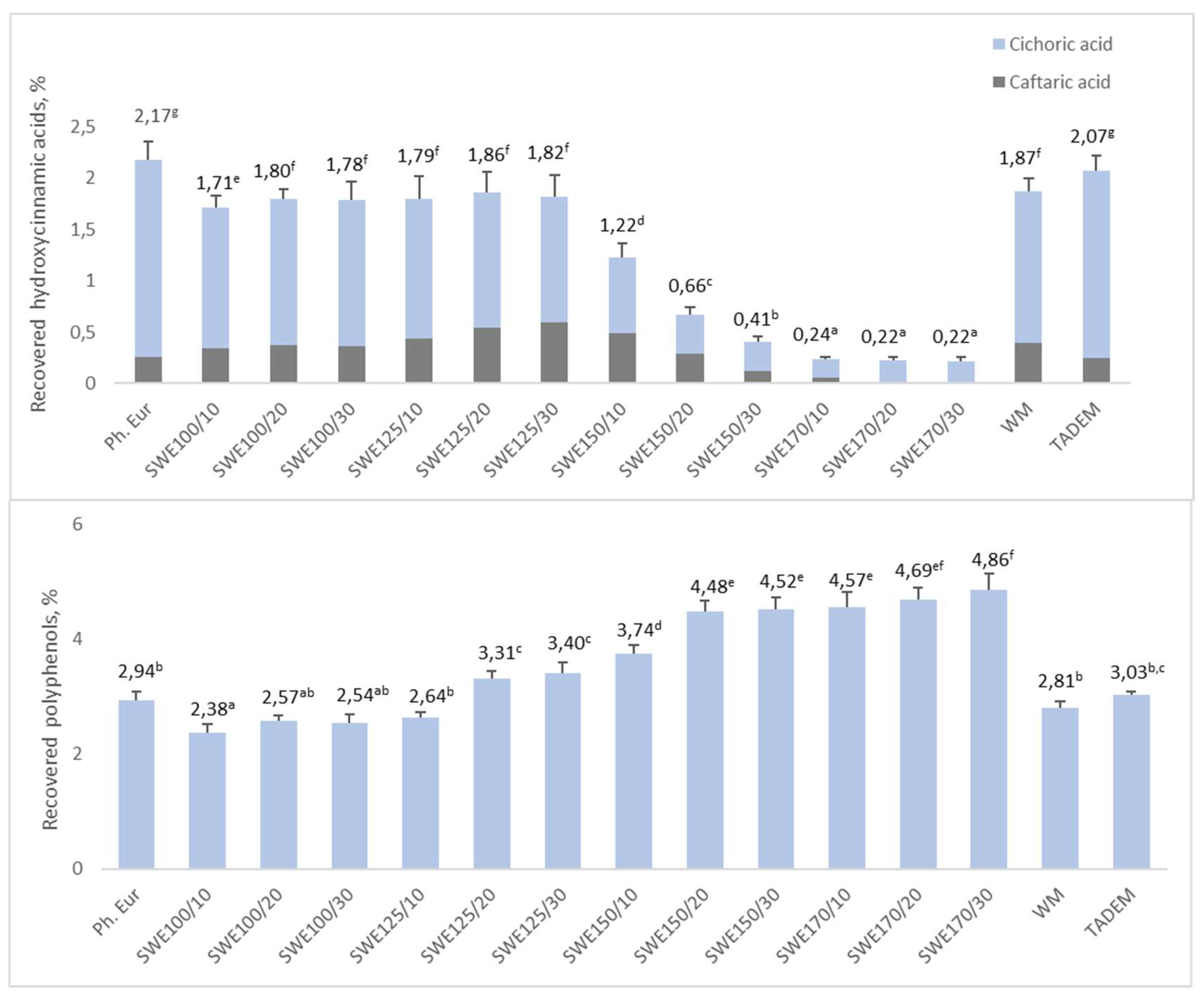
Figure 2.
Yield of extract and hydroxycinnamic acids content in dry extracts, obtained by different extraction methods. Results are presented as mean values ± SD. There are no significant differences among values marked with the same letters within individual groups.
Figure 2.
Yield of extract and hydroxycinnamic acids content in dry extracts, obtained by different extraction methods. Results are presented as mean values ± SD. There are no significant differences among values marked with the same letters within individual groups.
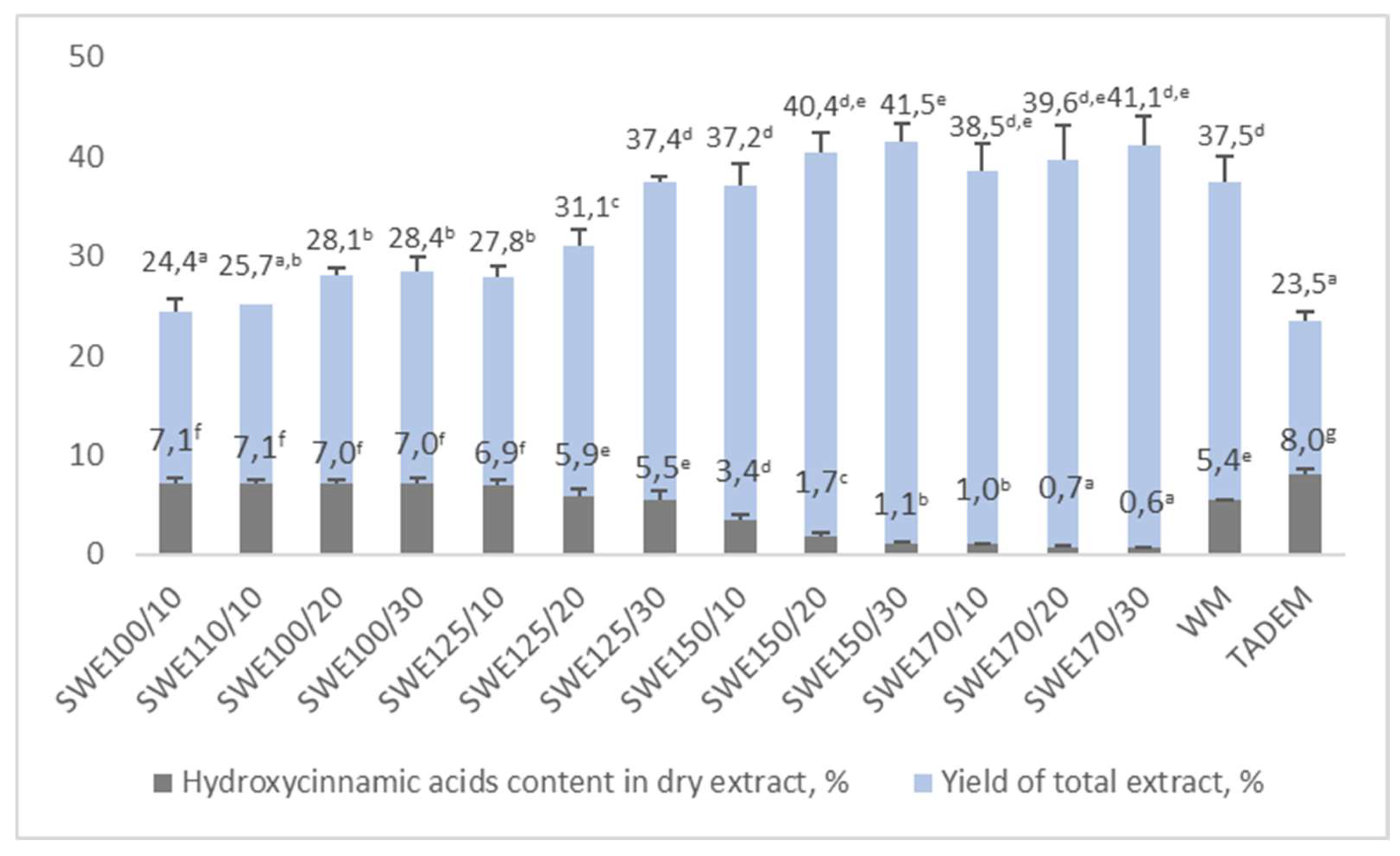
Figure 3.
Cell viability of HT29 cells following 24h and 48h treatment with SWE100/10, SWE125/10, SWE150/10, SWЕ170/10, WM and TADEM extracts at 100 and 200 μg/mL, determined by WST-1 assay. Results are expressed as percentage of viability relative to untreated control cells (set as 100%) and presented as mean ± SD of three independent experiments performed in replicates.
Figure 3.
Cell viability of HT29 cells following 24h and 48h treatment with SWE100/10, SWE125/10, SWE150/10, SWЕ170/10, WM and TADEM extracts at 100 and 200 μg/mL, determined by WST-1 assay. Results are expressed as percentage of viability relative to untreated control cells (set as 100%) and presented as mean ± SD of three independent experiments performed in replicates.
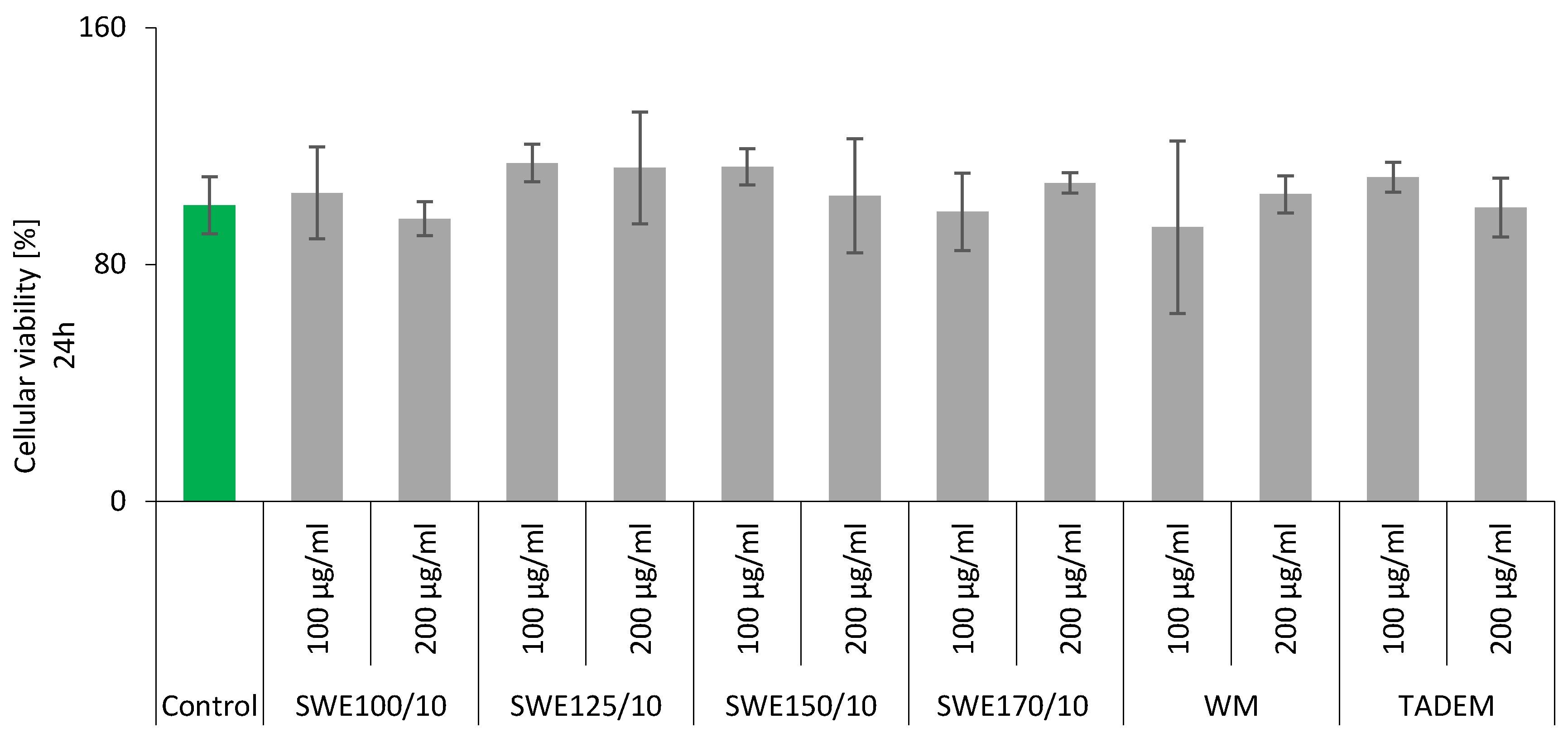
Figure 4.
Morphological changes in HT29 cells following treatment with E. purpurea after A) 24h and B) 48h exposure to SWE100/10, SWE125/10, SWE150/10, SWЕ170/10, WM and TADEM) at final concentrations of 100 and 200 μg/mL. The scale bar is 100 µm.
Figure 4.
Morphological changes in HT29 cells following treatment with E. purpurea after A) 24h and B) 48h exposure to SWE100/10, SWE125/10, SWE150/10, SWЕ170/10, WM and TADEM) at final concentrations of 100 and 200 μg/mL. The scale bar is 100 µm.
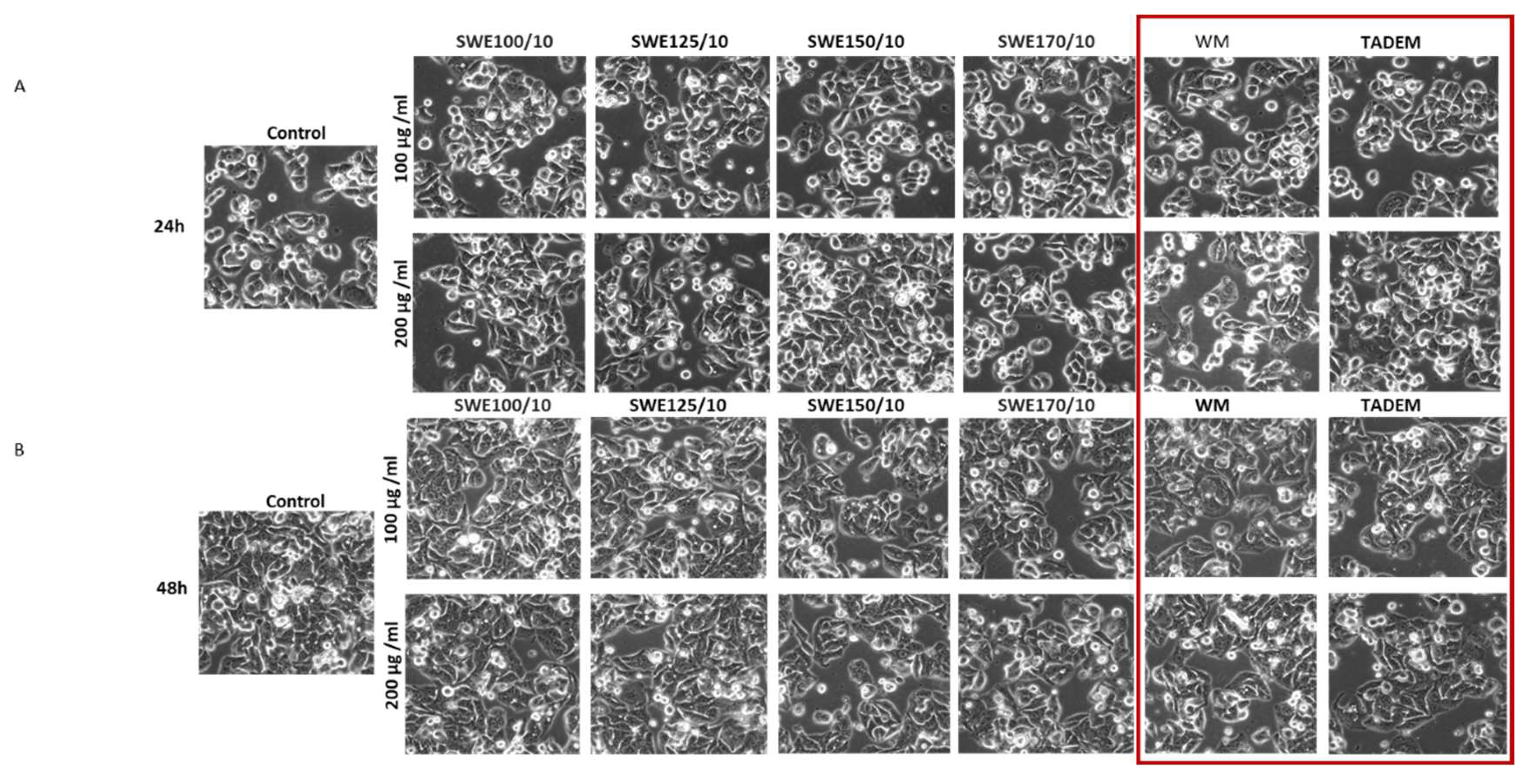
Figure 5.
Genotoxic effects of E. purpurea extracts in HT29 cells assessed by comet assay after A) 24h and B) 48h treatment with SWE100/10, SWE125/10, SWE150/10, SWE170/10, WM, and TADEM extracts (100 and 200 μg/mL). Data are presented as mean ± SD from biological replicates. The Comet Assay quantitative analysis indicate the relative genotoxic burden induced by each extract and highlight the genomic stability profile of SWE fractions.
Figure 5.
Genotoxic effects of E. purpurea extracts in HT29 cells assessed by comet assay after A) 24h and B) 48h treatment with SWE100/10, SWE125/10, SWE150/10, SWE170/10, WM, and TADEM extracts (100 and 200 μg/mL). Data are presented as mean ± SD from biological replicates. The Comet Assay quantitative analysis indicate the relative genotoxic burden induced by each extract and highlight the genomic stability profile of SWE fractions.
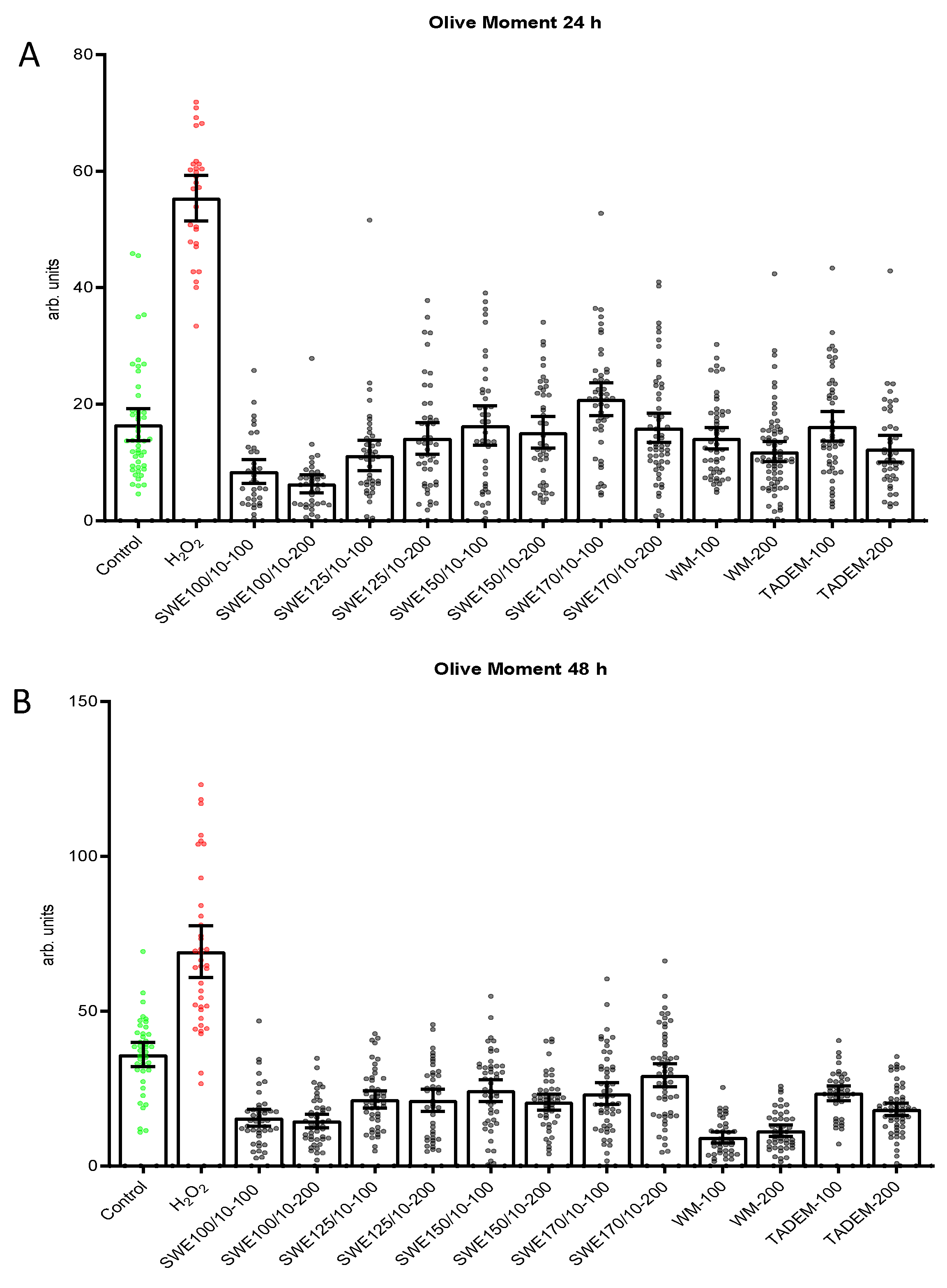
Table 1.
Chemical characterization and antioxidant activity of E. Purpurea roots.
| EP1 | EP2 | EP3 | |
|---|---|---|---|
| A. Moisture, % | 4.3b±0.1 | 6.5a±0.2 | 6.3a±0.1 |
| B. Crude protein (N×6.25), % | 13.0b±0.2 | 16.5a±0.3 | 11.0c±0.1 |
| C. Total lipids, % | 0.4b±0.0 | 0.6a±0.1 | 0.5a±0.0 |
| D. Total carbohydrates, % | 52.1a±3.0 | 43.0b±1.1 | 49.5a±4.2 |
| Glucose (Glc) | 0.1a±0.0 | 0.1a±0.0 | 0.1a±0.1 |
| Fructose (Fru) | 5.1b±0.1 | 5.8a±0.2 | 2.9c±0.1 |
| Sucrose (Suc) | 1.6b±0.0 | 2.1a±0.1 | 2.3a±0.1 |
| Total uronic acids | 8.1a±0.2 | 7.8b±0.1 | 8.5a±0.2 |
| Cellulose | 17.0a±0.5 | 13.8c±0.3 | 15.0b±0.4 |
| Total fructans | 11.9b±0.5 | 12.8b±0.2 | 16.7a±0.6 |
| Starch | 1.1a±0.1 | 1.0a±0.0 | 0.8b±0.0 |
| E. Ash, % | 4.8b±0.0 | 6.0a±0.1 | 5.3b±0.1 |
| F. Lignin (ABSL), % | 5.8a±0.1 | 4.0b±0.1 | 4.5b±0.2 |
| G. Phenolics *, mg/100 g | |||
| Total polyphenols | 1376.4b±18 | 1137.0c±25 | 2516.5a±15 |
| Hydroxycinnamic acids, % | |||
| Caftaric acid | 0.09b±0.01 | 0.10b±0.02 | 0.25a±0.01 |
| Cichoric acid | 0.82b±0.05 | 0.59c±0.06 | 1.92a±0.05 |
| Sum | 0.91 | 0.69 | 2.17 |
| H. Antioxidant activity | |||
| ORAC, µmol TE/g DW | 431.6c±5.0 | 457.7b±4.0 | 672.5a±10.0 |
| HORAC, µmol GAE/g DW | 90.4b±2.5 | 94.4b±1.5 | 139.3a±3.0 |
Results are presented as mean values ± SD. There are no significant differences among values marked with the same letters (a, b, c) within individual groups.
Table 2.
Content of individual phenolics and antioxidant activity of freeze-dried extracts, obtained by different extraction methods.
Table 2.
Content of individual phenolics and antioxidant activity of freeze-dried extracts, obtained by different extraction methods.
| Extract | Gallic acid, mg/100 g DW | Chlorogenic acid, mg/100 g DW |
Caffeic acid, mg/100 g DW |
Rutin, mg/100 g DW |
ORAC, µmol TE/g DW |
|---|---|---|---|---|---|
| SWE100/10 | 44.1±3.6 | 132.3±10.4 | 72.7±6.4 | 28.6±2.1 | 3340±158 |
| SWE100/20 | 48.0±4.1 | 139.9±11.6 | 114.5±10.1 | 51.1±4.8 | 3369±162 |
| SWE100/30 | 47.1±3.9 | 122.7±11.8 | 104.5±9.8 | 40.8±3.4 | 3252±143 |
| SWE125/10 | 53.8±4.6 | 138.3±12.6 | 255.7±20.3 | 92.7±8.6 | 3238±138 |
| SWE125/20 | 67.3±5.7 | 133.4±11.2 | 387.1±30.6 | 147.3±12.1 | 3485±161 |
| SWE125/30 | 72.5±6.1 | 133.1±11.4 | 427.7±38.2 | 169.7±13.3 | 3259±136 |
| SWE150/10 | 122.8±10.6 | 128.8±10.2 | 945.7±89.1 | 440.9±42.3 | 3487±156 |
| SWE150/20 | 119.9±10.1 | 36.7±2.7 | 695.7±54.2 | 458.5±42.7 | 4036±248 |
| SWE150/30 | 118.9±9.8 | 21.9±1.1 | 380.8±30.2 | 454.3±41.8 | 4238±226 |
| SWE170/10 | 121.6±11.3 | 10.3±0.9 | 474.4±39.2 | 461.7±43.0 | 3851±201 |
| SWE170/20 | 175.5±14.1 | 23.7±2.1 | 18.7±1.2 | 143.9±13.8 | 4238±234 |
| SWE170/30 | 157.4±12.3 | 31.2±2.8 | 8.8±0.2 | 85.4±7.8 | 3715±198 |
| TADEM | 40.5±3.4 | 27.3±1.2 | 46.4±3.4 | 23.2±1.9 | 3732±167 |
| WM | 41.3±3.0 | 19.9±0.9 | 24.0±2.1 | 9.3±0.3 | 2483±120 |
Table 3.
Yield and chemical characterization of residue after subcritical water extraction (w/w%).
| Constituents | SWE100/10 | SWE100/20 | SWE150/10 | SWE150/20 |
|---|---|---|---|---|
| A. Yield of cell wall material, % | 77.1b±1.0 | 82.7a±2.0 | 76.8b±0.5 | 79.8a±1.5 |
| B. Yield of residue, % | 71.7a±1.5 | 65.9b±1.2 | 55.3c±0.5 | 51.0d±1.0 |
| C. Crude protein (N×6.25) | 12.3b±0.1 | 13.5a±0.2 | 13.4a±0.2 | 11.9b±0.0 |
| Recovery, % | 55.0 | 55.6 | 46.2 | 37.7 |
| D. Total uronic acids | 11.8a±0.2 | 11.9a±0.1 | 8.1b±0.1 | 6.1c±0.0 |
| Recovery, % | 91.2 | 84.7 | 48.6 | 33.7 |
| E. Cellulose | 20.9b±0.3 | 21.2b±0.2 | 27.7a±0.1 | 28.1a±0.2 |
| Recovery, % | 105.2 | 97.9 | 107.7 | 100.7 |
| F. Total fructans, % | 6.2a±0.2 | 3.9b±0.1 | 3.2c±0.2 | 2.2d±0.1 |
| Recovery, % | 36.6 | 21.3 | 14.6 | 9.4 |
| G. Lignin (Klason) | 17.0b±0.0 | 16.9b±0.0 | 19.7a±1.0 | 20.8a±0.5 |
| Recovery, % | 101.1 | 92.6 | 90.3 | 88.2 |
Results are presented as mean values ± SD. There are no significant differences among values marked with the same letters (a, b, c, d) within individual groups.
Table 4.
Total carbohydrate, uronic acids, 5-(hydroxymethyl)furfural (5-HMF) content, sugar and organic acids composition of dried purple coneflower root subcritical water extracts.
Table 4.
Total carbohydrate, uronic acids, 5-(hydroxymethyl)furfural (5-HMF) content, sugar and organic acids composition of dried purple coneflower root subcritical water extracts.
| Constituents | SWE 100/10 |
SWE 100/20 |
SWE 100/30 |
SWE 125/10 |
SWE 125/20 |
SWE 125/30 |
SWE 150/10 |
SWE 150/20 |
SWE 150/30 |
SWE 170/10 |
SWE 170/20 |
SWE 170/30 |
| Total carbohydrates, % | 42.4 | 50.7 | 48.0 | 43.2 | 50.3 | 57.6 | 40.5 | 50.1 | 43.2 | 42.2 | 42.3 | 42.5 |
| Total uronic acids, % | 2.8 | 4.3 | 3.8 | 4.6 | 6.2 | 5.3 | 4.6 | 4.3 | 3.3 | 3.0 | 2.6 | 2.5 |
| Recovery, % (100-%) |
8.2 (91.8) |
14.1 (85.9) |
12.9 (87.1) |
15.1 (84.9) |
31.8 (68.2) |
23.5 (76.5) |
20.0 (80.0) |
20.2 (79.8) |
16.3 (83.7) |
9.3 (90.7) |
11.9 (88.1) |
11.9 (88.1) |
| Glucose (Glc) | 0.8 | 1.4 | 1.1 | 1.4 | 1.4 | 1.6 | 3.0 | 5.3 | 4.5 | 4.2 | 3.8 | 3.5 |
| Fructose (Fru) | 7.1 | 7.3 | 6.8 | 8.3 | 10.5 | 13.1 | 26.7 | 32.1 | 27.0 | 19.2 | 12.6 | 9.8 |
| Sucrose (Suc) | 5.9 | 5.6 | 5.0 | 6.5 | 5.4 | 5.2 | 5.1 | 2.0 | 0.3 | 0.3 | 0.1 | 0.1 |
| Total | 13.7 | 14.3 | 12.9 | 16.3 | 17.4 | 19.9 | 34.8 | 39.4 | 31.7 | 23.7 | 16.5 | 13.3 |
| 5-HMF (mg/100 g) | n.f | n.f | n.f | 6 | 25 | 30 | 101 | 125 | 139 | 168 | 201 | 198 |
| Organic acids, % | ||||||||||||
| Malic acid | 1.5 | 1.6 | 1.5 | 2.7 | 3.6 | 4.6 | 7.1 | 7.0 | 7.7 | 5.6 | 7.0 | 9.0 |
| Acetic acid | 1.2 | 1.0 | 1.0 | 1.0 | 1.0 | 1.0 | 1.6 | 2.0 | 2.2 | 2.0 | 2.1 | 2.1 |
| Oxalic acid | 0.9 | 0.9 | 0.8 | 0.7 | 0.5 | 0.4 | 0.2 | 0.1 | 0.1 | 0.1 | 0.1 | 0.1 |
| Citric acid | 0.3 | 0.2 | 0.2 | 0.3 | 0.4 | 0.4 | 1.1 | 1.4 | 1.4 | 1.4 | 1.6 | 1.6 |
| Total | 3.9 | 3.7 | 3.6 | 4.8 | 5.5 | 6.4 | 9.9 | 10.6 | 11.4 | 9.2 | 10.8 | 12.8 |
Disclaimer/Publisher’s Note: The statements, opinions and data contained in all publications are solely those of the individual author(s) and contributor(s) and not of MDPI and/or the editor(s). MDPI and/or the editor(s) disclaim responsibility for any injury to people or property resulting from any ideas, methods, instructions or products referred to in the content. |
© 2026 by the authors. Licensee MDPI, Basel, Switzerland. This article is an open access article distributed under the terms and conditions of the Creative Commons Attribution (CC BY) license (http://creativecommons.org/licenses/by/4.0/).
Copyright: This open access article is published under a Creative Commons CC BY 4.0 license, which permit the free download, distribution, and reuse, provided that the author and preprint are cited in any reuse.


