

Submitted:
02 June 2026
Posted:
02 June 2026
You are already at the latest version
Abstract
The unique production life cycles of perennial crops make them vulnerable to predicted future climate changes. This paper presents how a new framework specific to perennial crops was developed and integrated into an existing spatio-temporal agricultural land sequencer (STALS) to generate real-world land use insights for a case study region, the Murrumbidgee Irrigation Area, Australia. Model outputs illuminate the role of perennials in a water-constrained future and highlighted the benefit of the operational tactic of deficit irrigation in maintaining the feasibility of perennial crops in the mid-to long range planning horizon. Furthermore, diversity of life-cycle in land use was shown to maintain economically viable agriculture in the study region. The future of perennial crops as a proportion of land use area in a climate-smart landscape may need to be reevaluated.
Keywords:
digital agriculture
; land use
; water resource management
; climate change adaptation
; multi-objective optimisation
; decision support system
1. Introduction
Agriculture may be a small share of the global economy, but it remains indispensable to human life [1] and underpins regional economies worldwide, regardless of economic status or scale [2,3,4]. The future sustainability of these economies is threatened by predicted climates that elevate food production risk. In semi-arid regions, which include Australia, increasing water productivity has become a national priority [5].
Regional-scale land use often includes annual crops (cereals, cotton and horticulture) and perennials (tree crops and vines). This diversity of crop mix, production systems (dryland or irrigated), and soil type complicates water allocation options.
Globally, bulk grains of cereals and pulse crops (annual crops) feed humanity. These can be complemented by perennial fruits (pome fruits, stone fruits, vines, citrus, and nuts). Perennial fruits can be considered luxury foods due to their seasonal production and increased water needs (reflected in commodity prices). However, in the 21st century, dietary choices prioritise the health benefits of plant derived sterols and Omega 3 contained in nuts [6], and sustainable food production. This is expressed in the increased uptake of plant derived products such as almond `milk’ [7] and the willingness of consumers to pay a premium for sustainably produced food [8]. Perennial crops also have value-add activities that increase the economic multiplier factor of their contribution to regional economies [9]. These include processed citrus, which is used not only in long-life juice drinks, but also as additives in other food products [10] and grape seed oil, used in cosmetics [11].
With increases in minimum temperatures that shorten the duration of winter [12], coupled with predicted reductions in irrigation water availability [13], perennial crop production systems face an uncertain future. Water use efficiency is critical to maximising farm income in scenarios of water scarcity [14]. In a future where these critical abiotic inputs may be outside of the historical range of perennial crop needs, economic benefit can be reduced [15,16], with impacts not only for farm income but also regional communities dependent on agriculture.
Perennial crop production can be considered rigid, compared to the flexibility of annual cropping systems where fallow land use can be adopted in times of drought [17]. This fixed land use limits the economic adaptability of a region with perennial crops under climate uncertainty. A further impediment to the change in land use for perennial crop systems is the investment of financial capital required to establish and successfully manage biotic assets and accompanying processing infrastructure [18]. Perennial systems experience a 3–7 year delay period from planting to economic benefit [19], and breeding programs take 3–15 years [20]. In addition, the perennial response to production interruptions, such as drought, can be carried forward after the cessation of the event [21].
The present study temporally quantifies the role of perennial crop land use in improving economic water productivity of a region. The findings elucidate land use that maximises farm net revenue premised on water availability. These forecasts of possible futures may help with regional policy development and industry preparedness to ameliorate the impact of climate change on perennial crops. This work fills a gap in assessing the role of perennial tree and vine crop production in Australia [22].
Previous work in perennial crop modelling has investigated: regional land use [23]; nutritive value obtained from water resources [24]; impact of climate change on physiology and production [25]; water use strategies [26]; and optimisation approaches [27,28]. Although all of these studies have advanced our understanding of agricultural production under climate uncertainty, each of them had a limitation in its scope. The regional land use objectives of Abdelkader and Elshorbagy [23] and the inclusion of future production climates are sensible, yet no consideration is given to temporal land use modifications that may be required to achieve the objectives in the medium to long range future. A further limitation of that study is the methodological approach limits its external application from the case study country. A case study of California investigating the nutritional value of food measured against crop water consumption, classified crops according to economic value and water consumed [24]. However, it did not consider future production environments and water availability, nor set the investigated parameters as objectives for optimisation. Expanding on the water-food nexus, a case study of the southern region of California’s Central Valley identified that perennial crops account for 60% of land use, driven by market demand with little relationship to water availability [29]. When future water availability is considered, crop demand may not be satisfied, with possible revenue losses [29].
A deficiency in understanding the impact of climate change on the nutritional value of food highlighted the gap in perennial crop research to prepare for the predicted abiotic constrained production environment [25]. The review noted the importance of using climate models that realistically depict the future climate and its uncertainty. Consistent with this result, Randall et al. [30] identified in their systematic review that the inclusion of climate projections is integral to robust optimisation of agricultural land use-water nexus optimisation.
Nature inspired optimisation algorithms have proven useful in solving problems which would benefit from timely insights facilitating early responses [28,31]. To date, Randall et al. [27]’s model is one of the more comprehensive approaches which includes perennial crops (grapes, citrus, stone fruit). Although it did factor in the lead-time for a tree crop to become commercially viable, the model did not consider nut crops. Further shortfalls are: a simplified assumption of available irrigation water volumes; homogeneous representation of the soil, omitting characteristics that influence the yield potential; and a simplified crop coefficient () with an impact on crop water requirement.
To address food security concerns, producers, food agribusiness, and regional policy developers must understand alternative land uses that maximise economic benefit to farmers and regional economies. This research addresses these gaps, using two contrasting climate models that are dynamically downscaled to the case study region (see Section 2.1), using crop revenue and diversity as objectives, and incorporates temporal land use identification. The use of land by nut crops is expanding in the case study region [32] which warrants their inclusion in future land use investigations.
1.1. Background
Digital agricultural modelling supports problem-solving by mathematically representing the production environment and its interconnected relationships, enabling an optimisation tool to derive feasible land-use options that meet the specified objectives. The following sections present background information on these components that is relevant for understanding the present study, namely perennial crop phenology, water regulation, perennial crop water needs, the rationale of operational tactics, and computer-based optimisation of land use.
1.1.1. Crop Phenology
The long life of perennial crops is based on the need for exposure to all seasons (vernal, estival, autumnal and hibernal) to meet growth and fruit development [33]. Perennial crops of agricultural importance can be categorised as deciduous (vines, stone fruits, and nuts) and evergreen (citrus and olives). Of these two subgroups, the deciduous require specific abiotic metrics to achieve agricultural economic benefit, namely temperature triggers.
This dependence on abiotic thresholds for growth and the generation of economic benefit from fruit development increases the risk of perennial crop failure under climate uncertainty [34,35,36]. Furthermore, predicted reductions in precipitation and available irrigation water [37], compounded by increases in temperature and evapotranspiration [38,39], exacerbate future production problems for perennial crops. The capacity of orchard production to adapt to these abiotic changes requires long lead times of selective breeding programs and may involve geographical relocation of production [40,41].
1.1.2. Water Regulation and Reform
In Australia, water access entitlements were historically linked to land and were not transferable. Therefore, to increase water access, the purchase of land with existing water entitlement was required [42]. As modern Australia developed, government policy focused on initiatives to `drought proof’ the southern Murray-Darling Basin (MDB) [43]. The material legacy of this policy shift is the Burrinjuck Dam and the Murrumbidgee Irrigation Area (MIA) [44].
The nation’s reform of water resources reached a milestone with the Council of Australian Governments (COAG) National Water Initiative 2004 [45], closely followed by the Commonwealth Water Act 2007 [46], and the Basin Plan 2012 [47]. This Commonwealth legislation is supported by the NSW Government Water Management Act 2000 [48] and Water Sharing Plan for the Murrumbidgee Regulated River Water Source Amendment Order 2025 [49]. While these legislative Acts direct and inform the datasets used in this study, the project’s motivation comes from the 2004 National Water Initiative objective [45, p. 1]:
…to increase productivity and efficiency of Australia’s water use, to service rural and urban communities and to ensure the health of river and groundwater systems.
The most significant change in Australia’s water resource management arising from the National Water Initiative was the creation of water rights. This separation of water entitlement from land established a water trading market and facilitated the expansion of food and fibre crops to areas previously constrained to livestock production systems [50].
1.1.3. Perennial Crop Water Needs and Deficit Irrigation
The water infrastructure (dams and conveyancing canals) of the MIA has facilitated agricultural production, while water reform has encouraged water efficiency—an attempt to balance economic productivity with limited resources. Nevertheless, the recent expansion of perennial crops into the MIA challenges both these critical components by placing year long demand on water resources.
The water needs of perennial crops are spread throughout the year, year-on-year, for the life of the plant (20–40 years). Evergreen perennial crops (citrus) are watered throughout the year. In comparison, the dormancy period of deciduous crops (nuts, stone fruits, and vines) enables the timing of water application to align to yield-critical events such as bud set and fruit fill. The year long need for water access makes perennial crop systems rigid, increasing the risk impact of climate change. This is further exacerbated by predicted volatility in precipitation timing and volume [37], accompanied by increased evaporation due to climate change [51].
To counteract the impact of water stress, perennial crops have been observed to adjust their water consumption in accordance with seasonal realities. An example is that walnut trees can access deep soil water, buffering the impact of low rainfall [26]. This tactic increases their plasticity to climate change but, as climate change diminishes the reliability of precipitation, the opportunity to recharge soil profiles to depth is reduced. A further metabolic strategy in response to limited water availability is the slowing of growth [52].
An operational management decision that manipulates the physiological response of plants to water stress is deficit irrigation (DI) [53]. There are a number of different DI approaches: regulated deficit irrigation, where the limited volume of water is administered at strategic times (bud set, or fruit fill) to maximise commodity quality and yield [54]; root zone drying, involves the delivery of water to only a portion of a plant’s root system [55], and classic deficit irrigation, where the volume of water applied to the crop is below the full water needs of the crop, and delivered consistently throughout the growth cycle [56]. Each unique approach has its own mathematical representation.
The linkage between abiotic parameters with crop coefficients () is consistent with the modelling approach adopted in this research. Although improving the representation of production realism, it is acknowledged that the values of perennial crops are not well established globally, which limits the modelling of perennial water needs [57].
For this work, classical deficit irrigation is defined as the intentional application of irrigation water at levels below the full water requirement of the crop, based on crop coefficients () and evapotranspiration. This strategy seeks to increase water use efficiency by imposing controlled water stress on a plant while avoiding significant reductions in economic benefit [58]. This tactic facilitates the reassignment of a critical production resource to other crops. It assists in maximising total food and fibre production for an area from a finite resource.
Deficit irrigation is gaining momentum as a commercial strategy in the face of receding agricultural water resources [59,60]. Until now, research into this strategy in Australia has focused on annual crops such as rice, soybean, and cotton (see, for example, [61,62,63]. This is now being addressed by including perennial fruit crops in the Australian Agricultural Production Systems Simulator (APSIM) [64], although the impact of the strategy on yield is still unknown.1 Inclusion of deficit irrigation in this research is an important aspect in quantifying the region’s perennial crop water productivity.
1.1.4. Economic Water Productivity
The objective of maximising farm gate net revenue is to identify commodities that generate profit, with consideration to the cost of water, the price of which is inversely aligned to seasonal supply volumes. One strategy to achieve this end is dryland cropping, where crops produced solely on precipitation may experience higher gross margins associated with reduced water costs. Alternatively, as mentioned previously, DI is another strategy being developed and adopted to increase water productivity, but balancing deficit irrigation volumes and yield impact is still in its infancy [65].
Research is being conducted to identify the impact of DI on economic benefit around the world. In Israel, almonds grown under DI for two years resulted in a 35% reduction in yield [66], while research in Spain found that DI improved market desirable parameters in almonds, potentially increasing profits [67]. There is a dearth of Australian research in this area.
Recent Australian research found that an 11% reduction in full irrigation resulted in a reduced diameter of the almond tree truck and kernel weight, but did not significantly decrease the yield [68]. A Hort Innovation technical report [69] on improving citrus quality with deficit irrigation found that DI modified quality parameters such as Brix values (sugar levels) and produced smaller fruit, with negative economic consequences. In comparison, a study on the irrigation behaviour of Australian wine grape growers identified that water use efficiency is a high priority, although DI was not directly identified as a strategy [70]. These findings highlight why the inclusion of DI in this research contributes to Australia’s understanding of future perennial crop capabilities in water constrained production environments.
1.1.5. Optimisation of Perennial Land Use
The modelling of perennial crops has mostly involved simulations such as CropWat [71] and APSIM [64], with optimisation approaches focused on identifying when to rejuvenate a plantation [28,72]. Within these optimisation studies, linear programming has been dominant [72,73], and only a very few papers worldwide have employed multi-objective optimisation approaches in which multiple conflicting objectives are simultaneously optimised. Within these multi-objective approaches, perennial crops included are citrus and stone fruit [27], and nuts [23]. To generate answers to real world agricultural problems, new optimisation models should include mathematical representation of current agronomic activity and the inclusion of identified feasible alternatives such as DI.
Previous work by Schiller et al. [74] developed a spatio-temporal agricultural land use sequencer (STALS) and applied it to annual cropping systems. In that work the model demonstrated an ability to capture key features of real-world agricultural decision-making through the explicit representation of crop rotation constraints and temporal memory within the optimisation algorithms. The solver eliminated annual crops from consideration based on soil compatibility, previous land use, crop life duration, sowing temperature, available water for the lifetime of the crop, and the requirement for positive economic return [74].
Investigating perennial crops with STALS requires modifications that capture the fixed land use for the duration of a crop’s lifecycle, with the primary elimination rule being available water (generally available irrigation water), followed by a positive economic return. This combinatorial problem suits constructive solution approaches that build cropping plans by successively adding land uses to parcels of land, in contrast to iterative techniques that progressively adjust existing plans.
As a result of the above and, in particular, the unique water needs of perennial crops, the main objective of the study is to quantify the role perennial crops play in maximising economic water productivity of a case study region in Australia. Furthermore, it qualifies possible agricultural land use pathways that contribute to a climate smart landscape. It seeks to answer the research question:
How can regional economies maintain economically viable agriculture production that contributes to food security under increasing water constraints and uncertain climatic conditions?
2. Materials and Methods
This research builds upon Schiller et al. ’s [74] STALS model by extending the framework to support perennial crop production. The core model inputs remain unchanged. There are two climate projections representing plausible future production environments, a hotter and drier (ACCESS1.3), and a warmer and wetter scenario (CanESM2) [75]. In addition there are five water-availability scenarios that drive crop selection, and the concept of Land Management Units (LMU) [76] which captures spatial variation in productivity for the six key soil types within the study area.
The incorporation of DI enables the introduction of a novel experiment: the optimisation of water productivity at the regional scale. This requires several enhancements to the STALS solver:
- 1.
- expanding water availability data to accommodate DI (Section 2.2)
- 2.
- enhancing economic measures to more accurately represent market behaviour (demand) and supply realities (yield penalties) associated with DI, and (Section 2.3)
- 3.
- modifying constraint handling to accommodate the unique biological and temporal requirements of perennial crops (Section 2.5).
The overall experimental design is detailed in Section 2.6, while the key assumptions underpinning this work are presented in Section 2.7.
2.1. Case Study Area
The Murrumbidgee Irrigation Area (MIA), New South Wales, Australia (depicted in Figure 1), is the selected test region based on its diverse perennial and crop mix, similar resource allocation issues and characteristics comparable to those observed in other food-producing areas such as the Central Valley of California (USA) [77], the Mediterranean [78], and the interior of the Horn of Africa and Western Cape of South Africa within Sub-Saharan Africa [79].
Centred at 34°S, 146°E, the area has a cold semi-arid climate [80] which experiences dry, hot summers with maximum temperatures of 30–35°C, and average winter maximum temperatures of 15°C [81]. The winter minimum temperature range is –3°C to 0°C, and summer maximum temperature range of 31°C to 36°C [82]. The average annual rainfall is 400 mm with some winter dominance [83]. There are two agro-climate zones: East, which experiences higher rainfall and lower daily average temperatures, compared to West [84]. The MIA is suitable for perennial fruit trees and vines due to the availability of water, a range of suitable soil types and climate characteristics that satisfy some species’ vernalisation and chill portion requirements. Table 1 presents the soil types and their respective areas (rounded to the nearest 1000 ha for modelling purposes).
The first perennial crops introduced to the area were citrus, stone fruits, and grapes [86]. The wine grape industry was expanded by Italian immigrants in the 1950s [87], and nuts (almonds and walnuts) are the most recent addition, arriving in the early 2000s [32,88]. Land use is dynamic, evidenced by the recent introduction of pistachio nuts based on their lower water needs compared to almonds (the dominant nut crop in 2025).2 Table 2 presents the current area of perennial crop land use in the study area. The examined footprint comprises a total area of 141,000 ha.
The governance structure of many perennial crop producers in the study region are owner-operators. Recently, corporate agribusiness is expanding its holdings within the nut sector [90]. The economic dependence of the region on agriculture [91] increases its susceptibility to future climate changes, with a higher risk to perennial production due to phenological needs.
2.2. Water Usage
Perennial crop values reported in the FAO Irrigation and Drainage Paper No. 56. FAO56 [92] have been identified as inadequate by [93], who proposes alternative values derived from field-based observations. In recognition of these improvements, this study adopts a dynamic approach rather than relying on the static coefficients presented in FAO56. Specifically, average monthly values of the tree crop coefficients are calculated from the Almond Optimisation Spreadsheet [94].3 Twelve watering periods were defined in the calendar year, with duration coefficients assigned to these based on the seasonal growth phase of a crop.
Extending the model to include production realities of DI strategies in low water allocation scenarios required further adjustments to the values. The were reduced as a percentage of the coefficient of a crop, thus reducing the water needs of a crop to achieve economic yield. For this research, the following reduced proportions of the full water needs of a crop were applied in a given water allocation scenario: low water allocation 50%; very low 30%, and drought 7%.
There are two main paths of classical deficit irrigation: 1) apply the full amount of available water to the highest performing land in the hope of securing maximum quality and yield, and 2) apply the full amount available across all farm land (hedging), accept a possibly degraded quality, but hope to achieve an economically insignificant loss. For this research, the latter is employed. All land parcels receive irrigation water. The yield potential of the mid-range water scenario was set at 100%, based on production realities, where any shortfall in crop water requirement could be purchased at a reasonable price. Water trading is not considered in this research, although it has been flagged as a model addition in future iterations.
2.3. Economic
Prior work with the STALS model [74] incorporated a market behaviour mechanism to adjust the projected crop income based on the projected water scenario for each planning year. It is assumed consumer demand is constant throughout the planning year, leading to premium prices when projected low water availability led to commodity scarcity. To capture the dynamics of supply and demand more realistically, the present work adds a second supply side mechanism relating to yield potential, representing the attainable supply under constrained water availability, which informs the DI target watering as a percentage of full crop watering requirements. Table 3 provides the details of this combined approach, which represents a supply and demand curve and the impact this has on commodity prices. Values are informed by global research and reality checked by industry sources [94]
2.4. Climate’s Economic Impact
The chosen global circulation models project two differing climates, one generally hotter and drier (ACCESS1.3), the other generally warmer and wetter (CanESM2). Figure 2 depicts the temporal differences of precipitation and evapotranspiration values for the two models. The parameters in question are similar for the 2020s but there is a distinct divergence in the 2050s, increasing to the end of the century. The effect of these climates on agricultural production in the study region is revealed in the results (Section 3).
2.5. Solver Method
For the spatio-temporal agricultural land use sequencer (STALS) to identify feasible perennial crop solutions, modifications were needed from its annual crop system set up. For planning annual crops only, the planning region is logically divided into a number of fixed-sized parcels within each LMU (this size is a controllable setting). For a parcel of land that will grow annuals, the solver plans one parcel at a time (in randomised order) starting from planning month 1. At each decision point the set of annual crops that may be feasibly planted is determined by applying agronomic/biophysical rules relating to soil compatibility, water available from projected rainfall and unallocated irrigation inflows, sowing temperatures, and rotation rules relating to crops recently planted on that parcel. Crops are eliminated from consideration if 100% of their watering needs cannot be met. The solver then makes a biassed probabilistic decision concerning which annual crop to plant at that time and steps forward by the (assumed) fixed planting duration of the selected crop. Decisions are biased by the a priori heuristic of gross margin moderated by the observed utility of the decision, learned during the solver’s operation.
To support perennial crops the following modifications were made. The proportion of land parcels to be only perennial crops is pre-allocated. For each such parcel, the solver makes a single decision about which perennial crop to allocate, if any. The selected perennial is then allocated to that land parcel for the entire duration of the planning problem (e.g., 10 years). `Planted’ perennials are assumed to be at maturity, so the solver is in effect modelling the decision to have planted a vine or tree on that land prior to the planning period. Perennial crops’ watering coefficients are modelled in a piecewise linear fashion across a calendar year, which in the southern hemisphere corresponds to the annual pattern of fruiting and dormancy. The set of feasible perennials is determined by applying a restricted set of filters from those used with annual crops:
- 1.
- LMU Compatibility: Only perennials that are well-suited to grow on a particular LMU (soil type) are considered.
- 2.
-
Available Water: Each perennial’s ideal monthly watering requirements are determined by considering its annual watering profile and projected climatic conditions. The target watering level for each year is determined based on the water allocation category of the year (see Table 3). The following rules are then applied:
- If the perennial’s monthly target watering can be met by projected precipitation and as-yet unallocated irrigation inflows, it is kept in consideration.
- If its monthly target watering cannot be met but its drought-level watering (7% of full) can be then it is kept in consideration at that lower level for that year.
- If drought-level watering for any year within the planning horizon cannot be met the crop is removed from consideration.
If no perennial appears viable (due to the prior allocation of irrigation water to other land parcels) then a long-duration fallow (with low but non-zero cost) is allocated to the land parcel.
Most computational agricultural optimisation seeks to maximise revenue [30]. Diversity is also recognised as a tool to reduce economic risk [95] and is an accepted industry best practice for production maximisation [96,97]. Accordingly, each solution is evaluated against two maximisation objectives: the net revenue () produced by all crops given the cost of projected irrigation water purchased and variations in yield (for perennials) and crop market price in relation to water availability (both annuals and perennials); and the diversity of crops planted measured using the normalised Shannon Diversity Index, which captures both the number of different species within a solution (richness) and the frequency of species inclusion in a solution (evenness):
where c is a crop in and is the proportion of all non-fallow crop plantings that are crop c. In determining the proportion of plantings for each perennial, a particular perennial is counted for each year of the planning problem so that perennials’ counts are a similar magnitude to annual crops’.
Over a configurable number of iterations the solver constructs n solutions using a multi-objective version of the Ant Colony Optimisation metaheuristic [98] that learns which years are best suited to particular annual crops or, for the perennials, which crops lead to better solutions in terms of both objectives (this feeds back into the solver’s biassed probabilistic decisions during solution construction). The solver maintains a collection of n best trade-off solutions produced over a run, representing different achievable net revenue versus planting diversity. At each iteration newly created solutions are considered for inclusion in this collection, replacing any inferior solutions as part of Pareto mechanics [99].
2.6. Experimental Design
The focus of this work is perennial crops. However, in reality, no agriculturally important region is dominated by a single species or production system. To represent this reality, a sliding scale of land allocated to perennial crops was investigated: 0%, 25% (representing the current reality), 37.5%, 50%, 75%, and 100%. The allocation of land use by crop lifecycle introduces species diversity into the region. Appendix A shows the full list of investigated crops and their abbreviation for modelling.
The MIA case study region’s six LMUs are divided into land parcels of 1000 ha which, while larger than an individual paddock, is suitable for exploring region-scale planning decisions and induces solutions comprising 141 10-year cropping plans.This approach enabled the rapid generation of solutions without compromising output quality.
Six problem scenarios were created across combinations of underlying climate model (ACCESS 1.3 and CanESM2) and decadal planning period (2020–29, 2050–59, and 2090–99, as shown shaded in Figure 2). The difference in the water scenarios between the climate models is presented in Figure 3.
Each solver run comprises 1000 iterations in which 20 solutions are generated (hence, 20,000 solutions generated per run), and the best 20 individual solutions across the run saved. The solver was applied five times to each combination of problem scenario and proportion of land allocated to perennials, with the 100 solutions produced by those five runs merged and filtered to a single set of trade-off solutions.
2.7. Assumptions
The focus of this investigation was perennial crop water productivity over long time horizons, exploring the trade-off between water volumes and economic benefit. As such, the potential economic value and water consumption are indicative.
This study assumes that all perennial crops are already established and are mature and therefore generate economic benefit. Accordingly, land use change is not modelled, thus the analysis does not include (i) establishment costs, (ii) the 3–6 year lead time required for perennial systems to achieve commercial production, or (iii) end-of-life removal costs of perennial plantings. Orchard `mothballing’ is also excluded. Under these assumptions, once a perennial crop is assigned to a land parcel, it is treated as fixed and is assumed to occupy that land for the full 10-year planning horizon.
Only chill portions are considered phenology triggers in this work, where in reality the photo-period also plays a role [100]. Future levels of chill portion are difficult to predict as location influences the choice of chill model [36]. The most suitable model for warmer climates, such as those of the case study area, is the Dynamic Chill Model [101], but the data required for this model was lacking and thus a direct calculation of chill parameters was omitted. Instead, an assumption based on Hort Innovation [102] is used with Shepparton, Victoria, Australia, as a proxy for the study region (MIA). Table 4 presents the chill portions applied throughout the research horizon based on Shepparton, Victoria, Australia. The chill portion is satisfied for all considered perennial species across all investigated decades.
3. Results
The previously described optimisation solver was applied to predict the economic water productivity of the case study region for two climate model scenarios, with a varying perennial crop land use area. In addition, the qualification of a species contribution to the region’s long-range agricultural resilience is assessed through the lens of improved water productivity by land use planning.
3.1. Prediction Power
The model predicted an economic capacity for the study region of approximately AU$2 billion for the 2020s, with 25% assignment of land use to perennial crops. This valuation is consistent with on-the-ground observations for farm-gate prices of agricultural commodities included in this investigation (ABS, 2021). This confirmatory test demonstrates the usefulness of the model as a decision support system and should enhance user confidence. It is up to the end users to decide how much land area is assigned to perennial crops, alongside an examination of alternative solutions to identify feasible land use options, that are consistent with production risk appetite and prevailing social and policy objectives.
3.2. Water Productivity Response to Climate-Land-Use Interactions
The results indicate that irrespective of which climate model is closest to the future reality, the inclusion of perennial production systems helps maximise regional net revenue. Since water is a critical input in food production, the economic benefit between climate models does differ. The trade-off attainment curves shown on the left side of Figure 4 (left) quantify the economic benefit for the region for the two alternative climate models and the differing perennial crop area. Each attainment surface represents the trade-off values for a set of solutions (so is actually discontinuous, but depicted as a line to aid interpretation). Each solution comprises 10 year land use plans for the 141 land parcels. The box and whisker plots on the right of Figure 4 summarise the irrigation water consumed to generate the region’s net revenue across different solutions.
Focusing on the 100% allocation of land use to perennial crops, the region’s economic capacity is around Au$4B in the 2020s. Of interest is the maximum Au$4.5B for a hotter and drier climate predicted by ACCESS1.3 (Figure 4a). This may be explained by abiotic conditions influencing the STALS selection of high value nuts. In comparison, the warmer and wetter climate (CanESM2) is a more conducive environment for a wider selection of perennial crops including citrus. This proposition is supported by the generally greater diversity index for CanESM2 compared to the ACCESS1.3 solution sets. Diversity is discussed further in Section 3.4.
Figure 4b shows similar water consumption between climate models for all percentages of perennial land use during the 2020–29 decade. Of interest is that 100% perennial use consumes 2TL less than annual only land use, due to the explicit use of DI in modelling perennials. As time passes, the economic capacity of a warmer and wetter climate in 2050–59 delivers Au$0.5B (Figure 4c) with a 100% perennial land use, more than the drier and hotter model due to 1TL more water consumption (Figure 4d). This attests not only to the role of water availability but also to temperature, and specifically evapotranspiration, which at high values increases crop water consumption.
Contrary to intuition, the 2090–99 hotter and drier climate delivers an extra Au$1B more than the CanESM2 environment (Figure 4e), with approximately 0.5TL less water than the warmer and wetter climate (Figure 4f).This may be explained by the role of Deficit Irrigation (DI), where lower target watering levels are more often achieved (Figure 8), facilitating high value nut production. This occurrence reflects the model’s market behaviour mechanism, triggering elevated commodity prices based on constrained water volumes.
The net revenue contraction between the two climate models is attributed to water availability, while the intra-model variation of net revenue is ascribed to land use. This last relationship represents the economic water productivity of the region and is illustrated in Figure 5. The effect of crop lifecycle on land use is presented in the next results section.
3.3. Life Cycle Land Use Apportioning
Recognising that agricultural landscapes comprise multiple production systems, we assessed external validity by varying perennial land use (0–100%) across scenarios. Allocating land between annual and perennial systems produced mixed-cropping solutions within each LMU. Results indicate a non-linear relationship between perennial proportion and regional net revenue, primarily constrained by water availability and further influenced by temperature. Landscape diversity peaked where both crop types co-occurred.
High-value perennial crops contributed positively to regional economic performance, as reflected in attainment surfaces (Figure 4), with net revenue increasing alongside perennial area but remaining water-limited. The analysis also demonstrates that even small soil areas (e.g. 3,000 ha of deep sandy soils) can contribute meaningfully to the regional economy when appropriately matched to crop type.
3.4. Diversity
Diversity in crop species is often used to reduce economic loss in farm businesses. For this research, this encapsulates annual and perennial species. Crop diversity varies systematically with the proportion of land allocated to perennial versus annual systems. At extremes of land use (0% and 100% perennial allocation), diversity is reduced, as some crops are excluded from the model’s consideration. Furthermore, a modest but observable decline in diversity emerges as the proportion of land allocated to perennial crops increases towards 75%. Although the reduction is relatively small, it is consistent across model outputs and therefore warrants consideration. This pattern likely reflects the diminishing contribution of annual species as perennial dominance increases due to their larger economic water productivity returns. However, scenarios that allocate land across both annual and perennial crops consistently produce the highest levels of diversity, irrespective of the climate model, underscoring the advantages of mixed systems at the regional scale.
For the decade 2020–29 (Figure 4a) the diversity index for both climate models is similar, with the exception of 100% perennial land use, which is higher in a warmer and wetter climate (CanESM2). By 2050–59, Figure 4c, the warmer and wetter environment is producing higher diversity index values than ACCESS1.3 hotter and drier climate. This outcome intensifies in 2090–99 (Figure 4e) for all land use percentages except the 100% perennial land use, which are similar. This is explained by the role of LMU and Deficit Irrigation (DI) in the model’s crop selection process. It is proposed that the DI tactic `frees’ water in a hotter and drier climate to be accessed by a greater range of perennial species across all LMUs.
3.5. LMU-Based Assessment: Optimising Crop Choice and Production System for Enhanced Water Productivity
The model’s output solutions are too many to consider in detail in this manuscript. Instead, aggregate data across solution sets are explored to quantify the region’s economic water productivity, commencing with a baseline of 2020s and then at intervals that align with climate transition points, 2050s and 2090s. Crop abbreviations are given in the appendix in Table A1.
To aid in the interpretation of the dense data outputs, median frequency of crop inclusion across solutions was plotted (Figure 7). However, this approach may not represent all land use options present in any particular solution, for within each solution there are situations where the solver returned a zero value for a given crop (i.e., the crop was not selected in a given year). Nevertheless, these crops are contributing to the attainment curves, it is just that they appear so infrequently that they do not register in the median-based visualisation. In such cases, the inclusion frequency is so low that implementing the corresponding change in land-use would be operationally unviable. This contrasts with solutions in which every instance returns zero, indicating that the crop is not a feasible option for that LMU under the climate examined.
A climate-smart landscape reflects feasible best-bet combinations of species and soil informed by climate. The effect of the model’s land use selection mechanism and its role in maximising economic water productivity is seen in Figure 6. Here self-mulching clay is suitable to a larger number of crop species, compared to the select crops for deep sandy soil’s to maximise economic water productivity.
When translated into area, Figure 7 illustrates, for the case of self-mulching clay as an example, where a trade-off is observed with annual cropping. This finding underscores the importance of including annual crops to maximise water productivity within a land management unit (LMU). This proposition is further supported by the net revenue curves presented in Figure 4, which compare scenarios with 50% and 75% perennial land use.
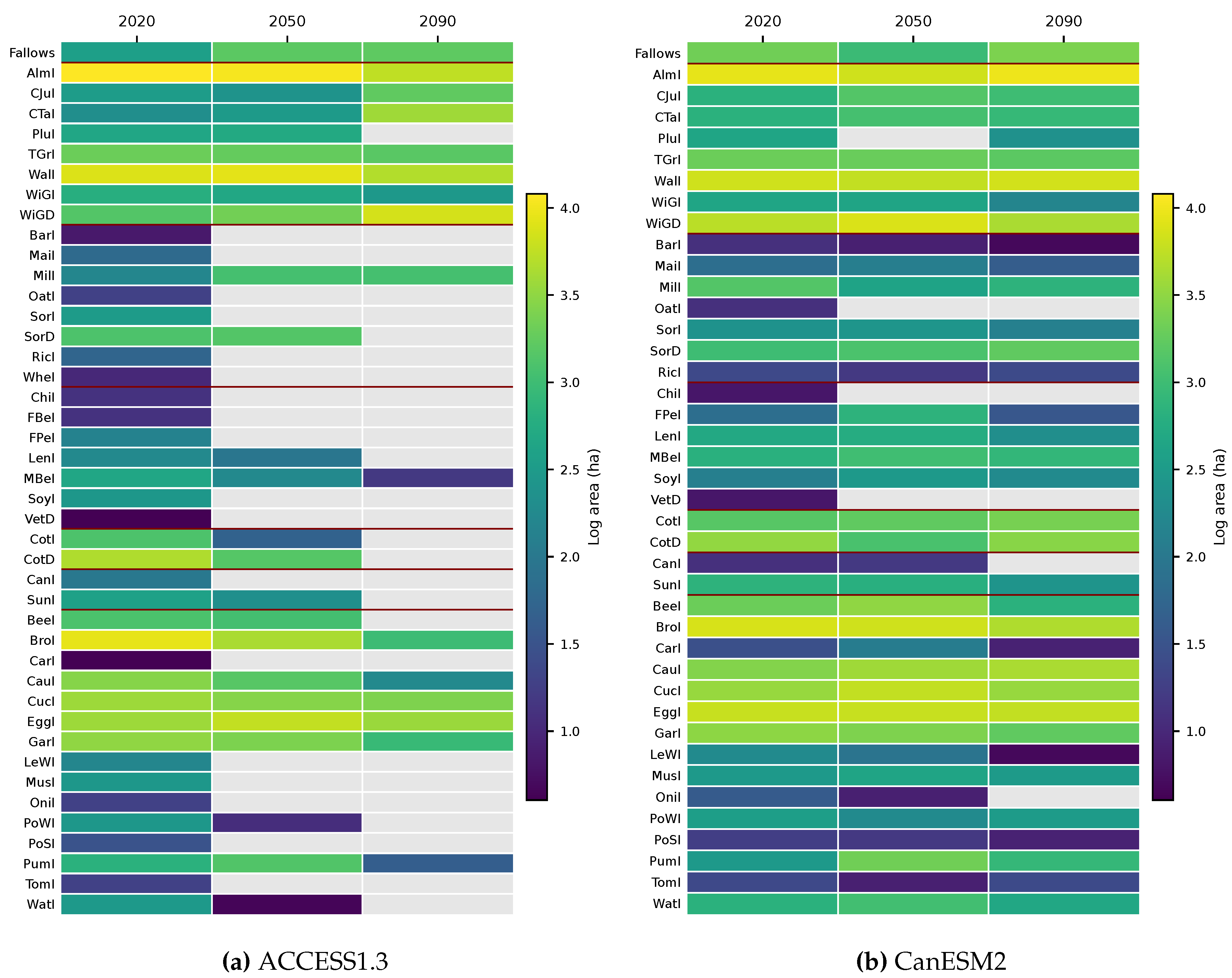
Figure 7.
Temporal heatmap of log-transformed crop area at 50% perennial land use for LMU 1 Self-mulching clay across climate projections. Crops with zero plantings are shown in light grey and represent absence of species selection across solution sets. Species are grouped, separated by dark red horizontal lines. Descending group order is fallows, perennials, then annuals (cereals, pulses, fibre, oil, and horticulture).
Figure 7.
Temporal heatmap of log-transformed crop area at 50% perennial land use for LMU 1 Self-mulching clay across climate projections. Crops with zero plantings are shown in light grey and represent absence of species selection across solution sets. Species are grouped, separated by dark red horizontal lines. Descending group order is fallows, perennials, then annuals (cereals, pulses, fibre, oil, and horticulture).
3.6. The Role of DI and Production System
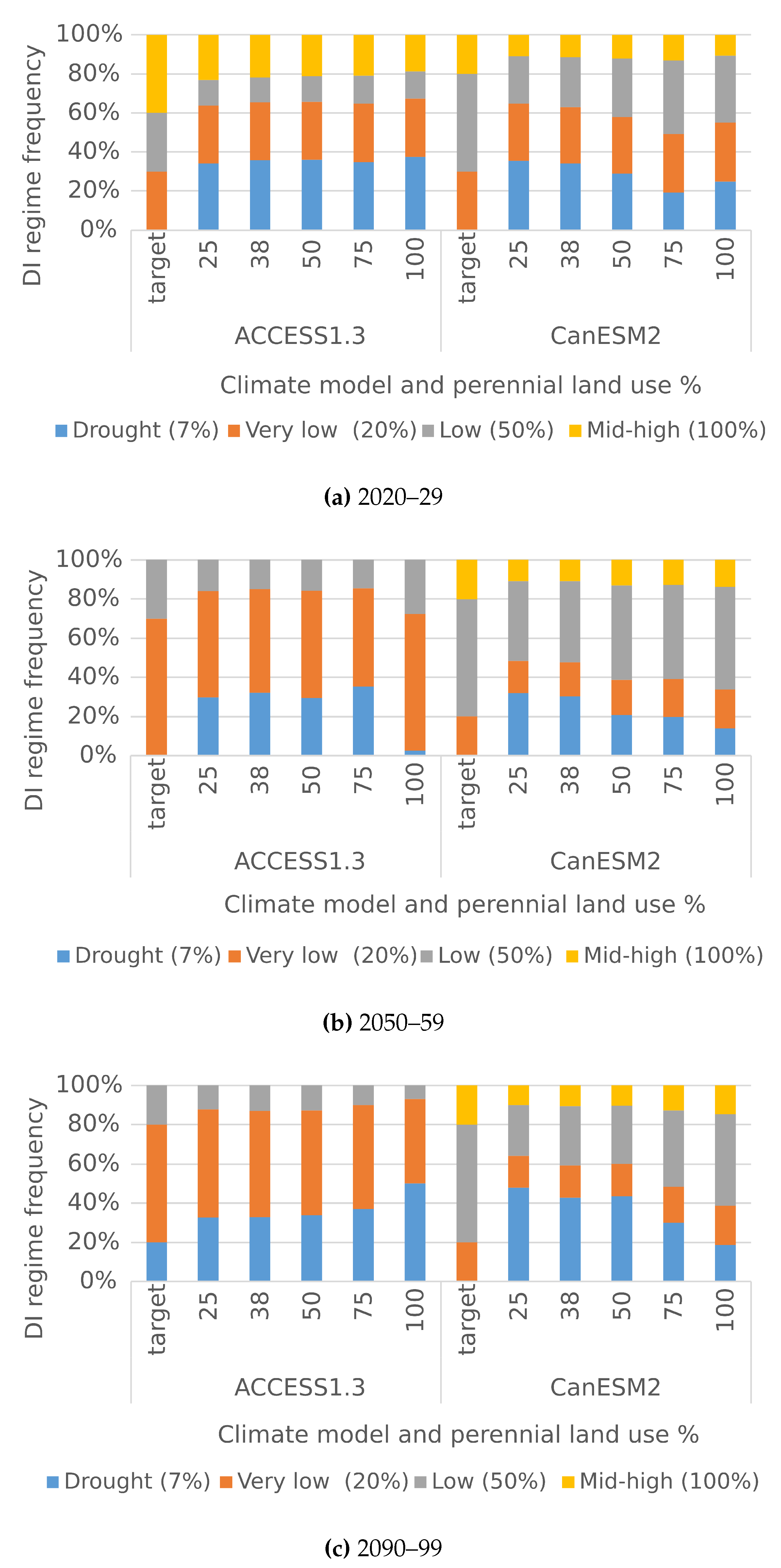
Future years were stratified into five water-availability classes (drought, very low, low, mid-range and high), thereby specifying the associated deficit irrigation (DI) allocation ex ante; the optimisation outputs then reported the realised water applied to each crop. Figure 8 summarises the frequency with which each DI regime was applied across the alternative perennial land use constraints for the two climate projections. DI regimes are defined by the proportion of crop water requirement supplied: drought (7%), very low (20%), low (50%), and mid-high (100%). Under these constraints, fallow remained feasible but was not selected at the LMU level for the present experiments. Instead, water shortfalls primarily affected annual land use because annual crops were parameterised to require full satisfaction of water needs. In contrast, perennials remained feasible through activation of DI regimes, which reduced applied water relative to the full target.
DI activation occurred more frequently under ACCESS1.3 than CanESM2 (Figure 8a), indicating that full irrigation targets for perennials were less often attainable in the hotter, drier projection. Interdecadal differences were evident: CanESM2 more commonly achieved conditions consistent with full satisfaction of crop water requirements, whereas ACCESS1.3 in the 2050s and 2090s was characterised by greater reliance on lower-allocation DI regimes (including very low/low and drought levels), with very low allocations more prevalent in the 2050s and drought allocations more prevalent by the 2090s. Collectively, these patterns indicate that DI materially expanded the feasible solution space for perennial land use—particularly high-value orchards—under the more water-constrained climate projection.
Figure 8.
Comparison of target distribution (watering regime) with (average) observed
To demonstrate the decision support power of the STALS model, a deep dive of data was conducted to compare the most lucrative annual and perennial crops based on economic water productivity. Figure 9 is the median number of times a crop is selected across solutions, and illustrates the effect of climate on species and production system in LMUs for 2020 and 2090. Normalised inclusion frequency represents the area planted within the case study region.
The first notable point in Figure 9 is the productivity of LMU 6 (Deep sandy soils) is marginal for the crops considered. This does not imply that these soils are inherently unproductive; rather, it underscores the importance of aligning crop species with soil attributes. Second, when the proportion of land allocated to perennial crops increases to 37.5%, dryland cotton appears in optimised solutions more frequently than irrigated cotton. Beyond this allocation threshold, irrigated cotton is selected with greater frequency, as it competes with high value perennial almonds for water. Collectively, these results spotlight differences in economic water productivity and show the trade-off between annual and perennial cropping systems.
An additional insight into the role the choice of production system plays in land use is shown in Figure 9a and Figure 9c. For the warmer and wetter climate, the model assesses dryland cotton as a good choice for land use, based on higher gross margins due to the exclusion of irrigation water costs. This proposition is supported by Figure 9b. By 2090 irrigated and dryland cotton may not be feasible depending on which climate future eventuates (see Figure 9c and Figure 9d).
4. Discussion
The development of a perennial crop framework that includes operational tactics such as DI, incorporated into the existing STALS model, has added more realism to the decision support system. The optimised objectives illuminate how the case region may maintain viable agricultural production in a water-constrained future. Using an economic lens of water productivity, this work reveals which crops contribute to a climate-smart landscape for the study region over time. Furthermore, it demonstrates the model’s adaptability to similar food producing regions such as the Central Valley, California, USA, Sub-sahara Africa, and Mediterranean regions such as the Levante region, Spain.
4.1. Economic Water Productivity
Water is the critical input to agricultural production and changes in its availability (timing) and volume have repercussions on food and fibre production. Understanding which climate trajectory is the unfolding reality is important in preparing for the future, and ensuring agricultural economic stability as best as possible.
Assessment of historical droughts for three scenarios: meteorological (precipitation); agricultural (soil moisture) and hydrological (catchment runoff), found increasing trends of agricultural and hydrological droughts for the case study region [103]. Furthermore, hydrological droughts, which affect the volume of irrigation water, are strongly influenced by evapotranspiration [103], which is driven by temperature, a parameter that aligns with a hotter and drier climate (ACCESS1.3). Figure 2 shows the divergence between the two climate models, expressed in the 2050s, and increasing in the 2090s. Climate drives crop water usage, with the difference between the climate models shown in Figure 4b, Figure 4d, and Figure 4f.
Economic water productivity provides an empirical indication of the climatic impact on the agricultural economy of the study area, determined by the water allocation mechanisms and the prevailing water price. The contraction in regional net revenue between climate models and across perennial land use percentages is quantified in Figure 4a, Figure 4c, and Figure 4e, and is attributed to the availability of water, driven by climate. This availability of water, combined with the choice of land use, defines the economic productivity of water, summarised in Figure 5. The projected agricultural economic contribution of the study region is sensitive to the proportion of land allocated to perennial crops.
The prominence of perennial crops in solutions of this research is attributed to the DI mechanism. The positive effect of DI identified by Capra et al. [104] has gained support as a useful tool in water limited production seasons [60], and as such warrants further research into the value of this tactic. However, any expansion of perennial crops should be evaluated against production constraints, both on-farm and regional infrastructure, along with operational realities.
The inclusion of annual crops is justified despite their lower net returns and farm-gate value relative to perennials. Although perennial systems maximise economic water productivity, annuals, such as horticulture, play an essential role in domestic food security, while bulk grains such as cereals and pulses contribute to Australia’s terms of trade [105]. In contrast, perennials such as nuts are predominately export-oriented [106]. Thus, retaining annuals reflects a strategic trade-off between maximising returns and maintaining systems resilience, water use adaptability, and national food supply stability.
The study area encompasses Australia’s principal rice growing region, where industry is actively pursuing a target water productivity of 1.5 tonnes per megalitre [107]. However, as a single crop within a farm business, a more profitable focus could be economic water productivity. Rice is constrained not only by water but also by land suitability. Previous research identified that the long range feasibility of rice in the study region may be compromised [74], an insight that can contribute to industry research and development of strategic plans. Furthermore, government policy that incorporates on-farm economic water productivity and staple food mixes would assist in identifying land use alternatives that support an economically viable agricultural sector in line with food security priorities.
Water trading facilitates improvements in economic water productivity, objective 7 of the proposed new National Water Initiative [108, p.22], by prioritising water to “…its highest value use through trading, to support economic activity and growth…". However, this framing does not account for the role of staple foods such as vegetables, bulk grains, and pulses, annual crops that typically attract lower farm-gate prices than higher-value perennial crops (e.g., nuts), yet remain central to domestic food security and more broadly, national terms of trade.
4.2. Temporal Shifts of Land Use in the Regional Landscape
The combination of perennial and annual species in the production system has been shown to contribute to the maintenance of agricultural economic water productivity in the near future to mid-century for the study region, as seen in Figure 4 and Figure 5. Diversity across agronomically important plant lifecycles, together with intra-lifecycle diversity, can ameliorate climate-related risk to the study region’s economy (Figure 4). In contrast, farm level risk is more difficult to manage, particularly for perennial crops because their land use is comparatively inflexible, unlike the greater plasticity of annual cropping systems [17]. Another consideration is that although fallow can help maintain farm level viability [17], this land use diminishes regional productivity of staple foods such as cereals and pulses (Figure 7).
Although increasing the area allocated to perennial crops looks economically feasible, such a decision should consider the corresponding risks. For example, the potential increased risk of a pest and/or disease outbreak [109], with severe impact on the supply chain due to a concentration of species in a relatively small area, and the inability of managed pollinators, such as bees, to keep pace with demand [110], highlighting the need for diversity in pollinator vectors [111].
The diversity of perennial crops is greater for self-mulching clay, irrespective of the climate model, illustrating the role of LMU on production capacity (see Figure 6). The prioritisation of economic water productivity is clearly seen in Figure 6a. Although table citrus in the 2020s delivers a positive economic benefit, almonds and walnuts outperform alternative land use in a water limited future. The combinatorial effect of LMU and the climate (predicted by CanESM2) is amplified in Figure 6d; despite a wetter environment, the attributes of LMU limit its crop choices to almonds and dryland wine grapes.
At the outset of this study, it was hypothesised that dryland farming systems could represent viable land use alternatives, driven by increased gross margins associated with reduced water costs. However, the results do not support this hypothesis. Across both climate projections, dryland crops of barley, wheat, chickpea and canola, were consistently not selected. This pattern is likely attributable to elevated evapotranspiration rates resulting from rising ambient temperatures, which increase crop water requirements and thereby constrain the feasibility of dryland production systems. In addition, the solver may be too conservative with regard to dryland crop water needs; a feature of this iteration of the model that may benefit from connecting the solver to a bio-simulator, such as APSIM.
In comparison, the projected warmer and wetter climate of CanESM2 can support more dryland production systems (Figure 6c). Although the model identifies dryland viticulture as a feasible option, this result should be interpreted in the context of regional production realities. The study region predominately produces bulk wine, for which commercial viability is typically contingent on high tonnage yields that are unlikely to be achieved under a dryland system. In contrast, dryland wine grape production is more commonly associated with premium-market styles where lower yields and higher sugar concentrations are valued as contributors to perceived quality [112].
Analysis of the climate informed spatio-temporal land use map shown in Figure 7 provides insights that can inform mid- to long-range strategic plans of stakeholders. Notable is the increase in fallow land use in a hotter and drier climate (Figure 7a). Although fallowing land is an industry best practice, the increased area will reduce economic productivity. In contrast, the warmer and wetter (CanESM2) projected climate facilitates an increase in annual crop area (Figure 7b).
All soils in the MIA contribute to the region’s agricultural economic productivity. However, the findings of this research emphasise that optimising productivity requires land use selection to be explicitly aligned to projected production environments. In this context, the strategic allocation of land use is critical to maximising economic returns under varying biophysical and market conditions.
Transitions in land use are not without consequences and typically necessitate associated infrastructure realignment. The case of citrus production illustrates this dynamic. Citrus orchards dedicated to juice production possess a degree of operational flexibility, as they may be temporarily mothballed in response to elevated water prices or adverse market shocks. Nevertheless, such decisions carry implications for long-term industry commitment and capital investment. The results of this study provide a framework to support citrus growers in assessing the availability of sustained participation in the juicing sector, particularly when alternative land uses may offer more favourable economic outcomes. While juicing citrus is identified as feasible for deep sandy soils (Figure 6b, its relative performance is comparatively lower than other potential land use alternatives.
A further consideration in assessing land use transitions is paddock size, which constrains viable production systems. Existing vineyard block sizes of self-mulching clays are also suited to high-value vegetables, whereas nuts and broadacre crops require larger areas to operate efficiently and are therefore less compatible. It is important to note that this analysis does not incorporate the contribution of local value-adding industries or the associated multiplier effects within the regional economy. These factors may play a significant role in determining overall enterprise viability and should be considered in future evaluations.
4.3. Limitations and Uncertainty
This research did not consider other DI techniques, such as partial root zone drying, nor the timing of irrigation (regulated deficit irrigation) [58]; rather, it applied a classic DI regime reducing the volume of water applied throughout the calendar year. This means that the model may be overestimating water consumption due to misalignment with physiological growth requirements. In addition, only yield adjustments for DI were made and none for commodity quality. However, it is noted that under deficit irrigation strategies, almond kernels can be reduced in size compared to full irrigation water application [66].
The list of perennial species only considers those that were planted in the case study area at the time this investigation was conducted. Since the completion of this work, farmers have considered alternative crops such as pistachios, based on their comparable lower water use [113], which warrant their inclusion in future investigations.
The limited research in Australia on perennial crop yield response to DI was accommodated by the use of a discounting approach (Table 2). This element could be improved by using bio-simulator outputs on the effect of DI on yield as inputs to the optimiser. In addition, the flat percentage adjustments for market behaviour and yield are not commodity specific, hence the model net revenue is only indicative.
It is acknowledged that perennial crop metabolic strategies to ameliorate the impact of dry conditions, such as slowing growth to align with water availability [52], should be considered in the model. However, the mathematical representation of such events and impact on the yield of the following season’s crop [66], is outside the scope of this research, as was the inclusion of other water sources, such as groundwater or grey water; this model is based on blue water usage.
Although ecosystem land service is operational in Australia [114], this land use was not included. It is recognised that this is a potentially feasible alternative land use warranting inclusion in future investigations.
5. Future Work
During the course of this study a number of future research directions were identified:
- Incorporation of more complex DI tactics into the model, including application to annual crops.
- While the optimisation approach is not intended to be an agricultural simulator, incorporation of a dynamic chill model would allow the model to assess perennial crops’ long-term suitability.
- Given growing interest in the production of annual crops under perennial systems [115], the inclusion of costs and lead time frames for the adoption of such systems and the change in land use would enhance the utility of the model. Capturing changes of land use in and out of perennial crops may assist industry in assessing the long-range viability of such decisions.
- Refinement of market behaviour to capture commodity specific pricing and forecast resource costs [116], coupled with the simulation of yield potential based on future abiotic metrics, would also refine optimisation outputs.
6. Conclusion
This study presented a framework that incorporates novel perennial crop operational tactics such as DI, and integrated this perennial crop specific framework into the previously tested STALS model. The output quantified the economic water productivity of the case study region, in addition to the qualification of species–LMU combinations, and the potential production area.
Alternative solutions were explored for best-bet feasible land use combinations between annual and perennial crops. The solver outputs sets of solutions representing trade-offs between regional net revenue and diversity of crop production for different predicted climate futures and varying proportions of perennial crop area. These results were examined to assess which land use combinations and crops may be feasible options in the mid- to long-range planning horizon.
In all experimental instances (2020s, 2050s, 2090s), the addition of perennial crop land use to the landscape of the study region improved economic water productivity. The inclusion of the operational tactic of deficit irrigation improved the feasibility of perennial crops, particularly in the hotter and drier climate predicted by ACCESS1.3. This finding emphasises the importance of such operational decisions in maintaining economically viable agricultural production in an increasingly water constrained future.
The findings of this study can provide industry stakeholders and policymakers with insights that can guide strategic plans and visions outlined in the CSIRO Ag2050 report [117], while assisting in preparations for a changing production environment, one that supports a more sustainable and resilient agricultural sector, irrespective of which climate model becomes reality.
Author Contributions
Conceptualization, K.S., J.M., and A.L.; methodology, K.S., J.M., and A.L.; software, J.M. and M.R.; validation, A.L.; investigation, K.S. and J.M.; resources, K.S. and M.R.; data curation, J.M. and K.S.; writing—original draft preparation, KS and J.M.; writing—review and editing, all authors; visualization, K.s and J.M.; supervision, M.R., J.M., and A.L.; project administration, M.R. All authors have read and agreed to the published version of the manuscript.
Funding
This research received no external funding.
Data Availability Statement
The data that supports this research is available at Open Science Framework project https://osf.io/qv9nb/view_only=41a6db78435140978d703a3420edb11a and on request to the corresponding author.
Acknowledgments
The authors wish to thank Peter Jealous, Almond Board of Australia, for his guidance on almond production.
Conflicts of Interest
The authors declare no conflicts of interest
Appendix A. Modelled Crops and Abbreviations Used
Table A1 lists the crops considered in the optimisation model with their abbreviated names used in figures. Irrigated crops are indicated by the suffix I, dryland crops by the suffix D.

Table A1.
Crops considered and the associated abbreviations
| Crop | Abbreviation | Crop | Abbreviation |
| Almonds | AlmI | Lettuce | LetI |
| Barley | BarD | Maize | MaiI |
| Barley | BarI | Millet | MilI |
| Beetroot | BeeI | Mung Bean | MunI |
| Broccoli | BroI | Muskmelon | MusI |
| Canola | CanI | Oats | OatI |
| Canola | CanD | Onion | OniI |
| Carrots | CarI | Plums | PluI |
| Cauliflower | CauI | Potato Summer | PoSI |
| Chickpea | ChicI | Potato Winter | PoWI |
| Chickpea | ChicD | Pumpkin | PumI |
| Citrus - Juicing | CJuI | Rice | RicI |
| Citrus - Table Fruit | CTaI | Sorghum | SorI |
| Cotton | CotI | Sorghum | SorD |
| Cotton | CotD | Soybean | SoyI |
| Cucumber | CucI | Sunflower | SunI |
| Dryland wheat | WheD | Table Grapes | TGrI |
| Dryland Wine Grapes | WiGD | Tomato | TomI |
| Eggplant | EggI | Vetch | VetI |
| Faba bean | FabI | Walnuts | WalI |
| Fallow | Fal | Watermelon | WatI |
| Fallow - Long | FaL | Wheat | WheI |
| Garlic | GarI | Wheat | WheD |
| Lentils | LenI | Wine Grapes | WiGI |
References
- Alston, J.M.; Pardey, P.G. Agriculture in the global economy. J. Econ. Perspect. 2014, 28, 121–146. [Google Scholar] [CrossRef]
- FitzSimmons, M. The social and environmental relations of US agricultural regions. In Technological change and the rural environment; Routledge, 2023; pp. 8–32. [Google Scholar]
- Yaqoob, N.; Ali, S.A.; Kannaiah, D.; Khan, N.; Shabbir, M.S.; Bilal, K.; Tabash, M.I. The effects of agriculture productivity, land intensification, on sustainable economic growth: a panel analysis from Bangladesh, India, and Pakistan Economies. Environ. Sci. Pollut. Res. 2023, 30, 116440–116448. [Google Scholar] [CrossRef]
- Zhang, Q.; Qu, Y.; Zhan, L. Great transition and new pattern: Agriculture and rural area green development and its coordinated relationship with economic growth in China. J. Environ. Manag. 2023, 344, 118563. [Google Scholar] [CrossRef]
- Champness, M.; Vial, L.; Ballester, C.; Hornbuckle, J. Evaluating the performance and opportunity cost of a smart-sensed automated irrigation system for water-saving rice cultivation in temperate Australia. Agriculture 2023, 13, 903. [Google Scholar] [CrossRef]
- Gonçalves, B.; Pinto, T.; Aires, A.; Morais, M.C.; Bacelar, E.; Anjos, R.; Ferreira-Cardoso, J.; Oliveira, I.; Vilela, A.; Cosme, F. Composition of nuts and their potential health benefits—An overview. Foods 2023, 12, 942. [Google Scholar] [CrossRef] [PubMed]
- Alcorta, A.; Porta, A.; Tárrega, A.; Alvarez, M.D.; Vaquero, M.P. Foods for plant-based diets: Challenges and innovations. Foods 2021, 10, 293. [Google Scholar] [CrossRef] [PubMed]
- Li, S.; Kallas, Z. Meta-analysis of consumers’ willingness to pay for sustainable food products. Appetite 2021, 163, 105239. [Google Scholar] [CrossRef]
- Dzemydaitėe, G. Agriculture’s impact for the economy: inter-industry linkages and multiplier effects. In Proceedings of the Rural Development: Proceedings of the International Scientific Conference, 2017, pp.1004–1009.
- Andrade, M.A.; Barbosa, C.H.; Shah, M.A.; Ahmad, N.; Vilarinho, F.; Khwaldia, K.; Silva, A.S.; Ramos, F. Citrus By-Products: Valuable Source of Bioactive Compounds for Food Applications. Antioxidants 2023, 12. [Google Scholar] [CrossRef]
- Kamienik, A.; Wojtyła, P.; Wargala, E.; Walasek-Janusz, M. Grape seed oil (Vitis vinifera seed oil) as a beneficial cosmetic raw material. Wybrane Zagadnienia Z. Zakr. Prod. Surowców żYwności I Kosmet.2023, p. 47.
- Weller, E.; Park, B.J.; Min, S.K. Anthropogenic and natural contributions to the lengthening of the Southern Hemisphere summer season. J. Clim. 2020, 33, 10539–10553. [Google Scholar] [CrossRef]
- Ayele, G.T. Review of Climate Change Impacts on Water Quantity and Quality in the Murray–Darling Basin, Australia. Water 2024, 16, 3506. [Google Scholar] [CrossRef]
- Expósito, A.; Berbel, J. The Economics of Irrigation in Almond Orchards. Application to Southern Spain. Agronomy 2020, 10. [Google Scholar] [CrossRef]
- Dennis, F. Flowering, fruit set and development under warmer conditions. In Temperate fruit crops in warm climates, 1st ed.; Springer Science & Business Media, 2013; pp. 101–135. [Google Scholar]
- Thomas, D. Managing almond production in a variable and changing climate; 2019. [Google Scholar]
- Rodriguez, D.; DeVoil, P.; Power, B.; Cox, H.; Crimp, S.; Meinke, H. The intrinsic plasticity of farm businesses and their resilience to change. An Australian example. Field Crops Res. 2011, 124, 157–170. [Google Scholar] [CrossRef]
- Basu, R.; Gallardo, R.K. Economic Issues Related to Long-Term Investment in Tree Fruits. Choices 2021, 36, 1–7. [Google Scholar]
- Goldschmidt, E.E. The evolution of fruit tree productivity: a review. Econ. Bot. 2013, 67, 51–62. [Google Scholar] [CrossRef]
- Campa, M.; Miranda, S.; Licciardello, C.; Lashbrooke, J.G.; Dalla Costa, L.; Guan, Q.; Spök, A.; Malnoy, M. Application of new breeding techniques in fruit trees. Plant Physiol. 2023, 194, 1304–1322. [Google Scholar] [CrossRef]
- Moldero, D.; Lopez-Bernal, A.; Testi, L.; Lorite, I.J.; Fereres, E.; Orgaz, F. Almond responses to a single season of severe irrigation water restrictions. Irrig. Sci. 2022, 40, 1–11. [Google Scholar] [CrossRef]
- Mashabatu, M.; Motsei, N.; Jovanović, N.; Dube, T.; Mathews, U.; Nqumkana, Y. Assessing the seasonal water requirement of fully mature Japanese plum orchards: A systematic review. Appl. Sci. 2024, 14, 4097. [Google Scholar] [CrossRef]
- Abdelkader, A.; Elshorbagy, A. ACPAR: a framework for linking national water and food security management with global conditions. Adv. Water Resour. 2021, 147, 103809. [Google Scholar] [CrossRef]
- Fulton, J.; Norton, M.; Shilling, F. Water-indexed benefits and impacts of California almonds. Ecol. Indic. 2019, 96, 711–717. [Google Scholar] [CrossRef]
- Leisner, C.P. Climate change impacts on food security-focus on perennial cropping systems and nutritional value. Plant Sci. 2020, 293, 110412. [Google Scholar] [CrossRef]
- Wu, W.; Tao, Z.; Chen, G.; Meng, T.; Li, Y.; Feng, H.; Si, B.; Manevski, K.; Andersen, M.N.; Siddique, K.H. Phenology determines water use strategies of three economic tree species in the semi-arid Loess Plateau of China. Agric. For. Meteorol. 2022, 312, 108716. [Google Scholar] [CrossRef]
- Randall, M.; Montgomery, J.; Lewis, A. An introduction to temporal optimisation using a water management problem. J. Comput. Sci. 2020, 42, 101108. [Google Scholar] [CrossRef]
- West, J. Multi-criteria evolutionary algorithm optimization for horticulture crop management. Agric. Syst. 2019, 173, 469–481. [Google Scholar] [CrossRef]
- Mall, N.K.; Herman, J.D. Water shortage risks from perennial crop expansion in California’s Central Valley. Environ. Res. Lett. 2019, 14, 104014. [Google Scholar] [CrossRef]
- Randall, M.; Schiller, K.; Lewis, A.; Montgomery, J.; Alam, M. A systematic review of crop planning optimisation under climate change. Water Resour. Manag. 2024, 1–15. [Google Scholar] [CrossRef]
- Schwaab, J.; Deb, K.; Goodman, E.; Lautenbach, S.; van Strien, M.J.; Grêt-Regamey, A. Improving the performance of genetic algorithms for land-use allocation problems. Int. J. Geogr. Inf. Sci. 2018, 32, 907–930. [Google Scholar] [CrossRef]
- Ross, C. Coordinated Development of the Australian Tree Nut Industry, 2017.
- Zhao, B.; Wang, J.W. Perenniality: From model plants to applications in agriculture. Mol. Plant 2024, 17, 141–157. [Google Scholar] [CrossRef]
- Fernandez, E.; Mojahid, H.; Fadón, E.; Rodrigo, J.; Ruiz, D.; Egea, J.A.; Ben Mimoun, M.; Kodad, O.; El Yaacoubi, A.; Ghrab, M.; et al. Climate change impacts on winter chill in Mediterranean temperate fruit orchards. Reg. Environ. Change 2023, 23, 7. [Google Scholar] [CrossRef]
- Fernandez, E.; Whitney, C.; Cuneo, I.F.; Luedeling, E. Prospects of decreasing winter chill for deciduous fruit production in Chile throughout the 21st century. Clim. Change 2020, 159, 423–439. [Google Scholar] [CrossRef]
- Luedeling, E.; Brown, P.H. A global analysis of the comparability of winter chill models for fruit and nut trees. Int. J. Biometeorol. 2011, 55, 411–421. [Google Scholar] [CrossRef] [PubMed]
- Speer, M.S.; Leslie, L.; MacNamara, S.; Hartigan, J. From the 1990s climate change has decreased cool season catchment precipitation reducing river heights in Australia’s southern Murray-Darling Basin. Sci. Rep. 2021, 11, 16136. [Google Scholar] [CrossRef]
- Jian, S.; Wang, A.; Su, C.; Wang, K. Prediction of future spatial and temporal evolution trends of reference evapotranspiration in the Yellow River Basin, China. Remote Sens. 2022, 14, 5674. [Google Scholar] [CrossRef]
- Zhang, H.; Chapman, S.; Trancoso, R.; Eccles, R.; Syktus, J.; Toombs, N. Projections of actual and potential evapotranspiration from downscaled high-resolution CMIP6 climate simulations in Australia. EGUsphere 2025, 2025, 1–30. [Google Scholar] [CrossRef]
- Meza, F.; Darbyshire, R.; Farrell, A.; Lakso, A.; Lawson, J.; Meinke, H.; Nelson, G.; Stockle, C. Assessing temperature-based adaptation limits to climate change of temperate perennial fruit crops. Glob. Change Biol. 2023, 29, 2557–2571. [Google Scholar] [CrossRef]
- Pantelidis, G.; Drogoudi, P. Exploitation of genotypic variation in chilling and heat requirements for flowering in Prunus armeniaca and Prunus persica (L.) Batsch cultivars. Sci. Hortic. 2023, 321, 112287. [Google Scholar] [CrossRef]
- McKay, J.M. Australian water law history: the move from introspective state sovereignty to a national interest approach and the influence of international law. Sovereignty Int. Water Law. Hist. Water Ser. III. 2015; p. 2. [Google Scholar]
- Musgrave, W. Historical Development of Water Resources in Australia. In Water Policy in Australia; Crase, L., Ed.; Taylor & Francis, 2012. [Google Scholar]
- NSW Government. Murrumbidgee Act, 1910, 1910.
- COAG. National Water Initiative 2004, 2004.
- Australian Government. Water Act 2007, 2007.
- Australian Government. Basin Plan 2007, 2012.
- NSW Government. Water Management Act, 2000, 2023.
- NSW Government. Water sharing plan for the Murrumbidgee regualted river water source amendment order 2022; New South Wales Government, Water Management Act 2000 2022. [Google Scholar]
- Pollino, C.; Hart, M.; Nolan, M.; Byron, N.; March, R. Rural and regional communities of the Murray-Darling Basin. In Murray-Darling Basin, Australia, 1st ed.; Elsevier, 2021; pp. 21–46. [Google Scholar]
- Yang, Y.; Roderick, M.L.; Guo, H.; Miralles, D.G.; Zhang, L.; Fatichi, S.; Luo, X.; Zhang, Y.; McVicar, T.R.; Tu, Z.; et al. Evapotranspiration on a greening Earth. Nat. Rev. Earth Environ. 2023, 4, 626–641. [Google Scholar] [CrossRef]
- Menezes-Silva, P.E.; Loram-Lourenço, L.; Alves, R.D.F.B.; Sousa, L.F.; Almeida, S.E.d.S.; Farnese, F.S. Different ways to die in a changing world: Consequences of climate change for tree species performance and survival through an ecophysiological perspective. Ecol. Evol. 2019, 9, 11979–11999. [Google Scholar] [CrossRef] [PubMed]
- Goodwin, I.; Boland, A.M. Scheduling deficit irrigation of fruit trees for optimizing water use efficiency. In Deficit irrigation practices. Water reports 22; Food and Agriculture Organisation of the United Nations, 2002. [Google Scholar]
- Vanella, D.; Guarrera, S.; Ferlito, F.; Longo-Minnolo, G.; Milani, M.; Pappalardo, G.; Nicolosi, E.; Giuffrida, A.G.; Torrisi, B.; Las Casas, G.; et al. Effects of organic mulching and regulated deficit irrigation on crop water status, soil and yield features in an orange orchard under Mediterranean climate. Sci. Total Environ. 2025, 958, 177528. [Google Scholar] [CrossRef] [PubMed]
- Ma, X.; Han, F.; Wu, J.; Ma, Y.; Jacoby, P.W. Optimizing crop water productivity and altering root distribution of Chardonnay grapevine (Vitis vinifera L.) in a silt loam soil through direct root-zone deficit irrigation. Agric. Water Manag. 2023, 277, 108072. [Google Scholar] [CrossRef]
- Sharma, V.; Choudhary, U.; Changade, N.M.; Kumar, A.; Singh, M.; Yadav, K.; Lakhawat, S. Growth and yield response of pea (Pisum sativum L.) crop to classical and regulated deficit irrigation along with nitrogen fertilization under drip irrigation. Legume Research–An Int. J. 2024, 1–8. [Google Scholar] [CrossRef]
- López-López, M.; Espadafor, M.; Testi, L.; Lorite, I.J.; Orgaz, F.; Fereres, E. Water requirements of mature almond trees in response to atmospheric demand. Irrig. Sci. 2018, 36, 271–280. [Google Scholar] [CrossRef]
- Kirda, C.; et al. Deficit irrigation scheduling based on plant growth stages showing water stress tolerance. Food and Agricultural Organization of the United Nations, Deficit Irrigation Practices, Water Reports 2002, 22, 3–10. [Google Scholar]
- Chen, Y.; Zhang, J.H.; Chen, M.X.; Zhu, F.Y.; Song, T. Optimizing water conservation and utilization with a regulated deficit irrigation strategy in woody crops: A review. Agric. Water Manag. 2023, 289, 108523. [Google Scholar] [CrossRef]
- Gaydon, D.S.; Meinke, H.; Rodriguez, D. The best farm-level irrigation strategy changes seasonally with fluctuating water availability. Agric. Water Manag. 2012, 103, 33–42. [Google Scholar] [CrossRef]
- Champness, M.; Ballester, C.; Hornbuckle, J. Effect of soil moisture deficit on aerobic rice in temperate Australia. Agronomy 2023, 13, 168. [Google Scholar] [CrossRef]
- Shukr, H.H.; Pembleton, K.G.; Zull, A.F.; Cockfield, G.J. Impacts of effects of deficit irrigation strategy on water use efficiency and yield in cotton under different irrigation systems. Agronomy 2021, 11, 231. [Google Scholar] [CrossRef]
- Zeleke, K.; Nendel, C. Yield response and water productivity of soybean (Glycine max L.) to deficit irrigation and sowing time in south-eastern Australia. Agric. Water Manag. 2024, 296, 108815. [Google Scholar] [CrossRef]
- Zhu, J.; Parker, A.; Gou, F.; Agnew, R.; Yang, L.; Greven, M.; Raw, V.; Neal, S.; Martin, D.; Trought, M.C.; et al. Developing perennial fruit crop models in APSIM Next Generation using grapevine as an example. Silico Plants 2021, 3, diab021. [Google Scholar] [CrossRef]
- Magro, R.B.; Alves, S.A.M.; Gebler, L. Computational models in Precision Fruit Growing: reviewing the impact of temporal variability on perennial crop yield assessment. SN Comput. Sci. 2023, 4, 554. [Google Scholar] [CrossRef]
- Sperling, O.; Gardi, I.; Ben-Gal, A.; Kamai, T. Deficit irrigation limits almond trees’ photosynthetic productivity and compromises yields. Agric. Water Manag. 2023, 289, 108562. [Google Scholar] [CrossRef]
- García-Tejero, I.F.; Lipan, L.; Gutiérrez-Gordillo, S.; Durán Zuazo, V.H.; Jančo, I.; Hernández, F.; Cárceles Rodríguez, B.; Carbonell-Barrachina, Á.A. Deficit irrigation and its implications for HydroSOStainable almond production. Agronomy 2020, 10, 1632. [Google Scholar] [CrossRef]
- Ballester, C.; Filev-Maia, R.; Hornbuckle, J. Optimizing water management in young almond orchards with heavy clay soils in southeastern Australia using proximal and remote sensors. In Proceedings of the II International Symposium on Precision Management of Orchards and Vineyards, 2023; pp. 37–44. [Google Scholar]
- Khurshid, T. Improving citrus quality with regulated deficit irrigation. 2022. [Google Scholar]
- Song, X.; Evans, K.J. Irrigation behaviours of wine grape growers in Australia, 2024.
- Smith, M. CROPWAT: a computer program for irrigation planning and management.
- Rajakal, J.P.; Tan, R.R.; Andiappan, V.; Wan, Y.K.; Pang, M.M. Does age matter? A strategic planning model to optimise perennial crops based on cost and discounted carbon value. J. Clean. Prod. 2021, 318, 128526. [Google Scholar] [CrossRef]
- Abalu, G. Optimal investment decisions in perennial crop production: A dynamic linear programming approach. J. Agric. Econ. 1975, 26, 383–393. [Google Scholar] [CrossRef]
- Schiller, K.; Montgomery, J.; Randall, M.; Lewis, A.; Alam, M.S. Optimising Long-Range Agricultural Land Use Under Climate Uncertainty. Agriculture 2025, 15, 2133. [Google Scholar] [CrossRef]
- Nishant, N.; Evans, J.; Di Virgilio, G.; Downes, S.; Ji, F.; Cheung, K. Introducing NARCliM1.5: Evaluating the performance of regional climate projections for Southeast Australia for 1950–2100. Earth’s Future 2021, 9, e2020EF001833. [Google Scholar] [CrossRef]
- Kingwell, R. Managing complexity in modern farming. Aust. J. Agric. Resour. Econ. 2011, 55, 12–34. [Google Scholar] [CrossRef]
- Li, L.; Cole, S.; Rodriguez-Flores, J.M.; Hestir, E.; Fink, D.; Viers, J.H.; Medellin-Azuara, J.; Conklin, M.; Harmon, T. Synergies Between Agricultural Production and Shorebird Conservation With Climate Change in the Central Valley, California, With Optimized Water Allocation and Multi-Benefit Land Use. Glob. Change Biol. 2025, 31, e70304. [Google Scholar] [CrossRef]
- Rhouma, A.; Seitfudem, G.; El Jeitany, J.; Pacetti, T.; Brouwer, F.; Gil, J.M. Connecting the water footprint with the water-energy-food-ecosystems nexus concept and its added value in the Mediterranean. Environ. Sustain. Indic. 2025, 26, 100640. [Google Scholar] [CrossRef]
- Ingabire, R.; Chen, X.; Hirwa, H.; Shen, Y.J. Quantifying the coordination of the Water-Energy-Food nexus and its drivers in Africa. Energy Nexus 2026, 100714. [Google Scholar] [CrossRef]
- Peel, M.C.; Finlayson, B.L.; McMahon, T.A. Updated world map of the Köppen-Geiger climate classification. Hydrol. Earth Syst. Sci. 2007, 11, 1633–1644. [Google Scholar] [CrossRef]
- Australian Government Bureau of Meterology. Average monthly and annual temperature maps. 2025. [Google Scholar]
- Australian Government Bureau of Meterology. Average annual, seasonal and monthly rainfall maps. 2025. [Google Scholar]
- Australian Government Bureau of Meterology. Average annual, seasonal and monthly rainfall maps. 2025. [Google Scholar]
- Zhou, D.; Khan, S.; Abbas, A.; Rana, T.; Zhang, H.; Chen, Y. Climatic regionalization mapping of the Murrumbidgee Irrigation Area, Australia. Prog. Nat. Sci. 2009, 19, 1773–1779. [Google Scholar] [CrossRef]
- Hornbuckle, J. Murrumbidgee soils, 2016.
- NSW State Archives. The Murrumbidgee Files, 2021.
- Pich, G. Italian land settlement in the Murrumbidgee Irrigation Areas. PhD thesis, The Australian National University, 1975. [Google Scholar]
- The Lucas Group. Almonds in one basket: Griffith grower consolidates crop. 2017. [Google Scholar]
- Murrumbidgee Irrigation. Annual compliance report. 2024.
- Parkes, H.A.; White, N.; Goodwin, L.; Treeby, J.; MurphyWhite, S. Understanding apple and pear production systems in a changing climate. Final Rep. Proj. AP12029 2017. [Google Scholar]
- Baum, S.; Haynes, M.; Van Gellecum, Y.; Han, J.H. Considering regional socio-economic outcomes in non-metropolitan Australia: A typology building approach. Pap. Reg. Sci. 2007, 86, 261–286. [Google Scholar] [CrossRef]
- Allen, R.G.; Pereira, L.S.; Raes, D.; Smith, M.; et al. FAO Irrigation and drainage paper No. 56. Rome Food Agric. Organ. United Nations 1998, 56, e156. [Google Scholar]
- López-Urrea, R.; Oliveira, C.M.; Montoya, F.; Paredes, P.; Pereira, L.S. Single and basal crop coefficients for temperate climate fruit trees, vines and shrubs with consideration of fraction of ground cover, height, and training system. Irrig. Sci. 2024, 42, 1099–1135. [Google Scholar] [CrossRef]
- Rosenzweig, B. Almond production spreadsheet, 2015.
- Kandulu, J.M.; Bryan, B.A.; King, D.; Connor, J.D. Mitigating economic risk from climate variability in rain-fed agriculture through enterprise mix diversification. Ecol. Econ. 2012, 79, 105–112. [Google Scholar] [CrossRef]
- Iheshiulo, E.M.A.; Larney, F.J.; Hernandez-Ramirez, G.; Luce, M.S.; Liu, K.; Chau, H.W. Do diversified crop rotations influence soil physical health? A meta-analysis. Soil Tillage Res. 2023, 233, 105781. [Google Scholar] [CrossRef]
- Lenné, J.; Wood, D. Crop diversity in agroecosystems for pest management and food production. Plants 2024, 13, 1164. [Google Scholar] [CrossRef] [PubMed]
- Dorigo, M.; Gambardella, L. Ant colony system: a cooperative learning approach to the traveling salesman problem. IEEE Trans. Evol. Comput. 1997, 1, 53–66. [Google Scholar] [CrossRef]
- Coello Coello, C.A.; Lamont, G.B.; Veldhuizen, D.A.V. Evolutionary algorithms for solving multi-objective problems; Springer, 2007. [Google Scholar]
- Jackson, J.E. Light regimes in temperate fruit-tree orchards grown at low latitudes. In Temperate fruit crops in warm climates; Erez, A., Ed.; Springer Netherlands: Dordrecht, 2000; pp. 1–15. [Google Scholar]
- Erez, A.; Fishman, S.; Gat, Z.; Couvillon, G. Evaluation of winter climate for breaking bud rest using the dynamic model. Proceedings of the International Workshop on Apple Culture in the Tropics and Subtropics 232, 1987, pp. 76–89. [CrossRef]
- Parkes, H.A.; White, N.; Goodwin, L.; Treeby, J.; MurphyWhite, S. Understanding apple and pear production systems in a changing climate. Final Rep. Proj. AP12029 2017. [Google Scholar]
- Grant, M.O.; Ukkola, A.M.; Vogel, E.; Hobeichi, S.; Pitman, A.J.; Borowiak, A.R.; Fowler, K. Historical trends of seasonal droughts in Australia. Hydrol. Earth Syst. Sci. 2025, 29, 5555–5573. [Google Scholar] [CrossRef]
- Capra, A.; Consoli, S.; Scicolone, B. Deficit irrigation: Theory and practice. Agric. Irrig. Res. Prog. 2008, 4, 53–58. [Google Scholar]
- Australian Government Department of Agriculture; Fisheries and Forestry. Agricultural Commodities Report. March quarter 2026, 2026. [Google Scholar]
- HortInnovation. Aust. Hortic. Stat. Handbook. All. Nuts-Overv. 2024.
- AgriFutures Australia. AgriFutures Rice Program Strategic RD&E Plan 2021–2026, 2021.
- Australian Government Department of Climate Change Energy the Environment and Water. Updated Draft National Water Agreement. 2025. [Google Scholar]
- Lin, B.B. Resilience in agriculture through crop diversification: adaptive management for environmental change. BioScience 2011, 61, 183–193. [Google Scholar] [CrossRef]
- Aizen, M.A.; Aguiar, S.; Biesmeijer, J.C.; Garibaldi, L.A.; Inouye, D.W.; Jung, C.; Martins, D.J.; Medel, R.; Morales, C.L.; Ngo, H.; et al. Global agricultural productivity is threatened by increasing pollinator dependence without a parallel increase in crop diversification. Glob. Change Biol. 2019, 25, 3516–3527. [Google Scholar] [CrossRef]
- Aldercotte, A.H.; Simpson, D.T.; Winfree, R. Crop visitation by wild bees declines over an 8-year time series: A dramatic trend, or just dramatic between-year variation? Insect Conserv. Divers. 2022, 15, 522–533. [Google Scholar] [CrossRef]
- Van Leeuwen, C.; Darriet, P. The impact of climate change on viticulture and wine quality. J. Wine Econ. 2016, 11, 150–167. [Google Scholar] [CrossRef]
- Pitt, T. Almond water strategies. 2025. [Google Scholar]
- Matzek, V.; Wilson, K.A.; Kragt, M. Mainstreaming of ecosystem services as a rationale for ecological restoration in Australia. Ecosyst. Serv. 2019, 35, 79–86. [Google Scholar] [CrossRef]
- Chapman, E.A.; Thomsen, H.C.; Tulloch, S.; Correia, P.M.; Luo, G.; Najafi, J.; DeHaan, L.R.; Crews, T.E.; Olsson, L.; Lundquist, P.O.; et al. Perennials as future grain crops: opportunities and challenges. Front. Plant Sci. 2022, 13, 898769. [Google Scholar] [CrossRef]
- Hughes, N.; Gupta, M.; Whittle, L.; Westwood, T. An Economic Model of Spatial and Temporal Water Trade in the Australian southern Murray-Darling Basin. Water Resour. Res. 2023, 59, e2022WR032559. [Google Scholar] [CrossRef]
- CSIRO. Ag2050 scenarios report; Technical report; CSIRO, 2024. [Google Scholar]
| 1 | P. Jealous, 2025, Personal Communication |
| 2 | P. Jealous, 2025, Personal Communication |
| 3 | P. Jealous, 2025, Personal Communication |
Figure 1.
Study location, MIA footprint and soil distribution. Data source:[85], map created by the authors. Note: Indicative soil distribution
Figure 1.
Study location, MIA footprint and soil distribution. Data source:[85], map created by the authors. Note: Indicative soil distribution
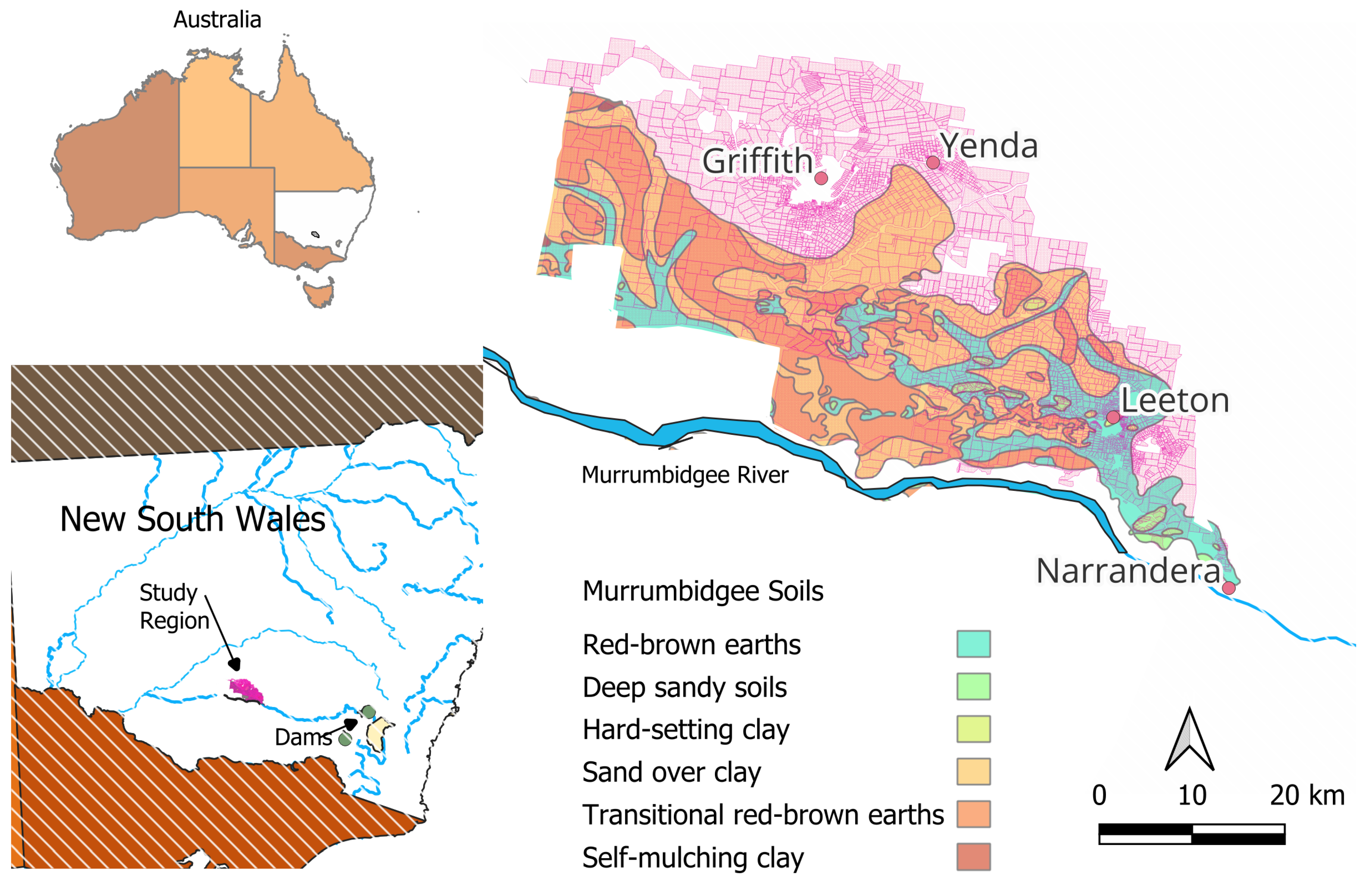
Figure 2.
Key climatic indicators from ACCESS 1.3 and CanESM2 for a reference location within the case study region in NSW, Australia.
Figure 2.
Key climatic indicators from ACCESS 1.3 and CanESM2 for a reference location within the case study region in NSW, Australia.
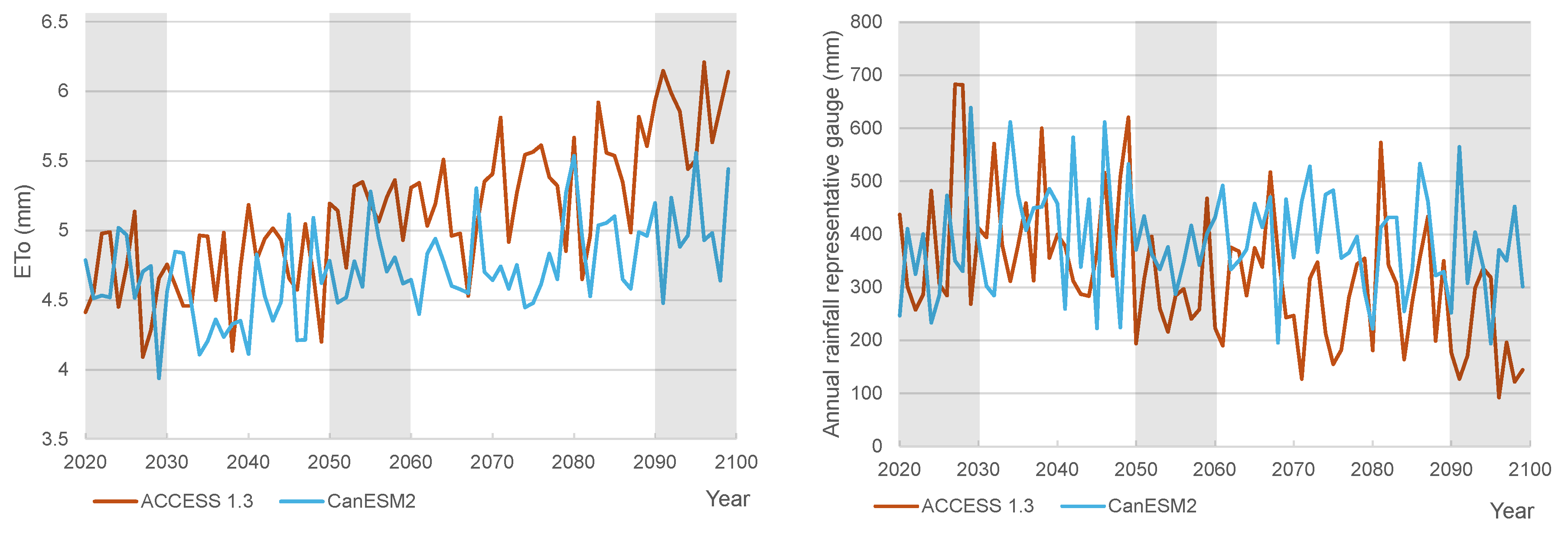
Figure 3.
Water scenarios for the selected decades (within the 2000s) and climate model. Years 2020–2029 are based on the climate model, not observed reality.
Figure 3.
Water scenarios for the selected decades (within the 2000s) and climate model. Years 2020–2029 are based on the climate model, not observed reality.
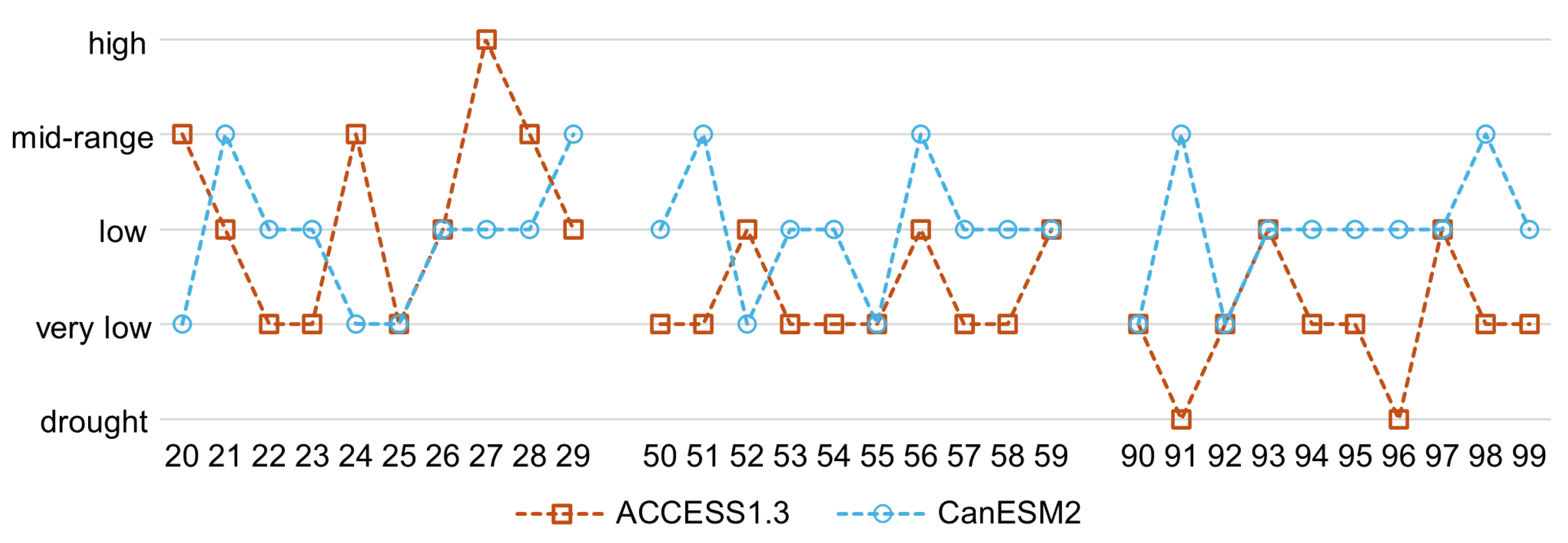
Figure 4.
Objective attainment curves (left column) for three time periods optimised under ACCESS1.3 (hotter, drier) and CanESM2 (warmer, wetter) climate projections, with distribution of irrigation water used across each solution set of differing perennial land use percentage (right column). The total available irrigation water across each 10-year planning period is shown as a long, horizontal line in the plots on the right.
Figure 4.
Objective attainment curves (left column) for three time periods optimised under ACCESS1.3 (hotter, drier) and CanESM2 (warmer, wetter) climate projections, with distribution of irrigation water used across each solution set of differing perennial land use percentage (right column). The total available irrigation water across each 10-year planning period is shown as a long, horizontal line in the plots on the right.
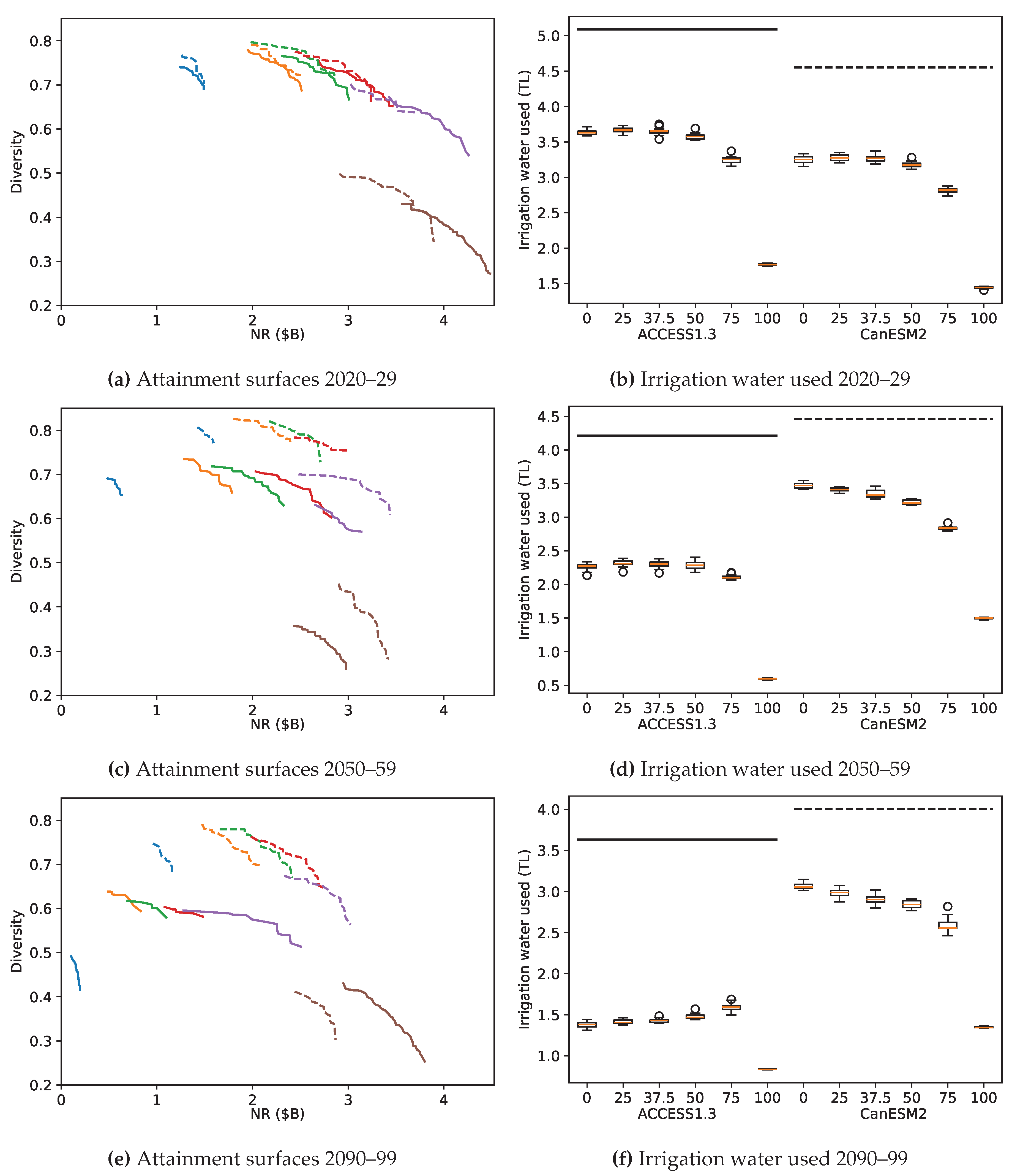
Figure 5.
Regional economic water productivity compared by model through time. Note these values are indicative due to the large array of possible solutions.
Figure 5.
Regional economic water productivity compared by model through time. Note these values are indicative due to the large array of possible solutions.
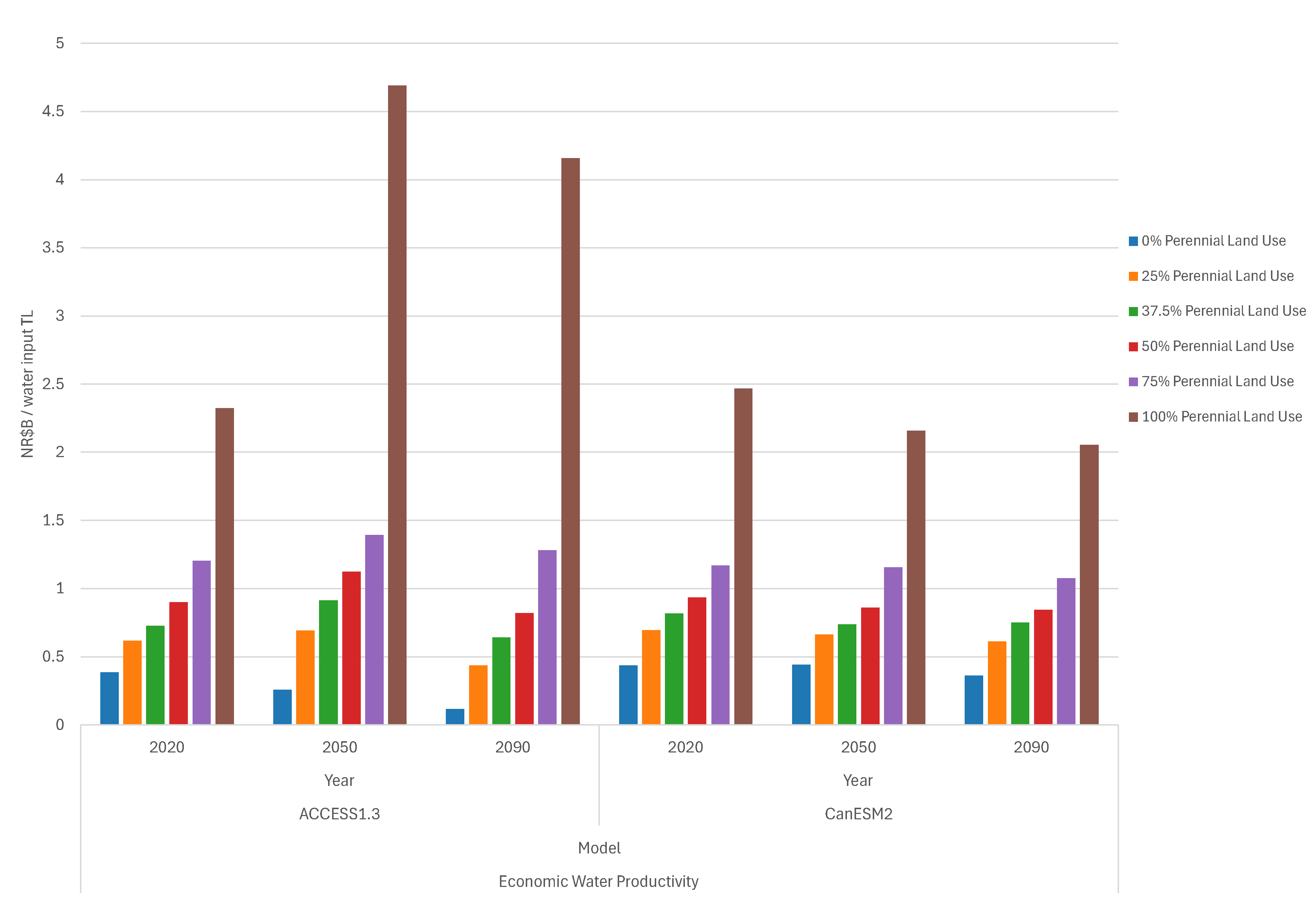
Figure 6.
Median spatio-temporal land use for 100% perennial under the generally warmer and wetter CanESM2 and generally hotter and drier ACCESS1.3 climate models. Crop legend: AlmI - almond irrigated; CJuI - citrus (oranges) juicing irrigated; CTal - citrus (oranges) table fruit; PluI - plums table fruit irrigated; TGrI - table grapes irrigated; WalI - walnuts irrigated; WiGI - wine grapes irrigated; WiGD - wine grape dryland. Note the differences in scale due to the interaction of climate model, crop and soil type. The higher the value, the more feasible the crop.
Figure 6.
Median spatio-temporal land use for 100% perennial under the generally warmer and wetter CanESM2 and generally hotter and drier ACCESS1.3 climate models. Crop legend: AlmI - almond irrigated; CJuI - citrus (oranges) juicing irrigated; CTal - citrus (oranges) table fruit; PluI - plums table fruit irrigated; TGrI - table grapes irrigated; WalI - walnuts irrigated; WiGI - wine grapes irrigated; WiGD - wine grape dryland. Note the differences in scale due to the interaction of climate model, crop and soil type. The higher the value, the more feasible the crop.
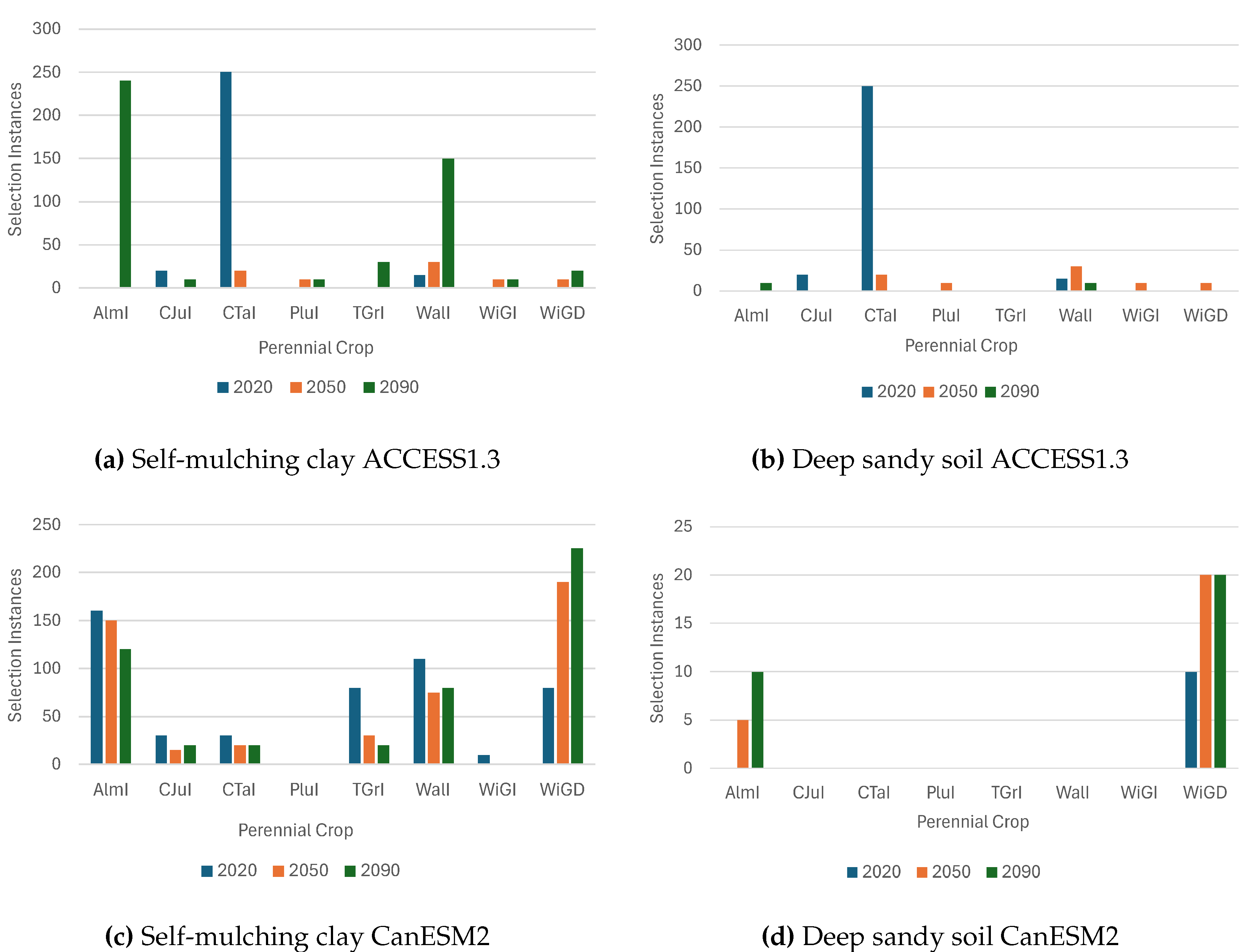
Figure 9.
Spatio-temporal comparison of perennial almonds irrigated (AlmI) and annual cotton with consideration to production system (CotD = cotton dryland, and CotI = cotton irrigated), for each alternative predicted climate (CanESM2 [warmer and wetter] and ACCESS1.3 [hotter and drier]) at differing perennial land use percentages, based on median solution inclusion frequency percentage of LMU parcel.
Figure 9.
Spatio-temporal comparison of perennial almonds irrigated (AlmI) and annual cotton with consideration to production system (CotD = cotton dryland, and CotI = cotton irrigated), for each alternative predicted climate (CanESM2 [warmer and wetter] and ACCESS1.3 [hotter and drier]) at differing perennial land use percentages, based on median solution inclusion frequency percentage of LMU parcel.
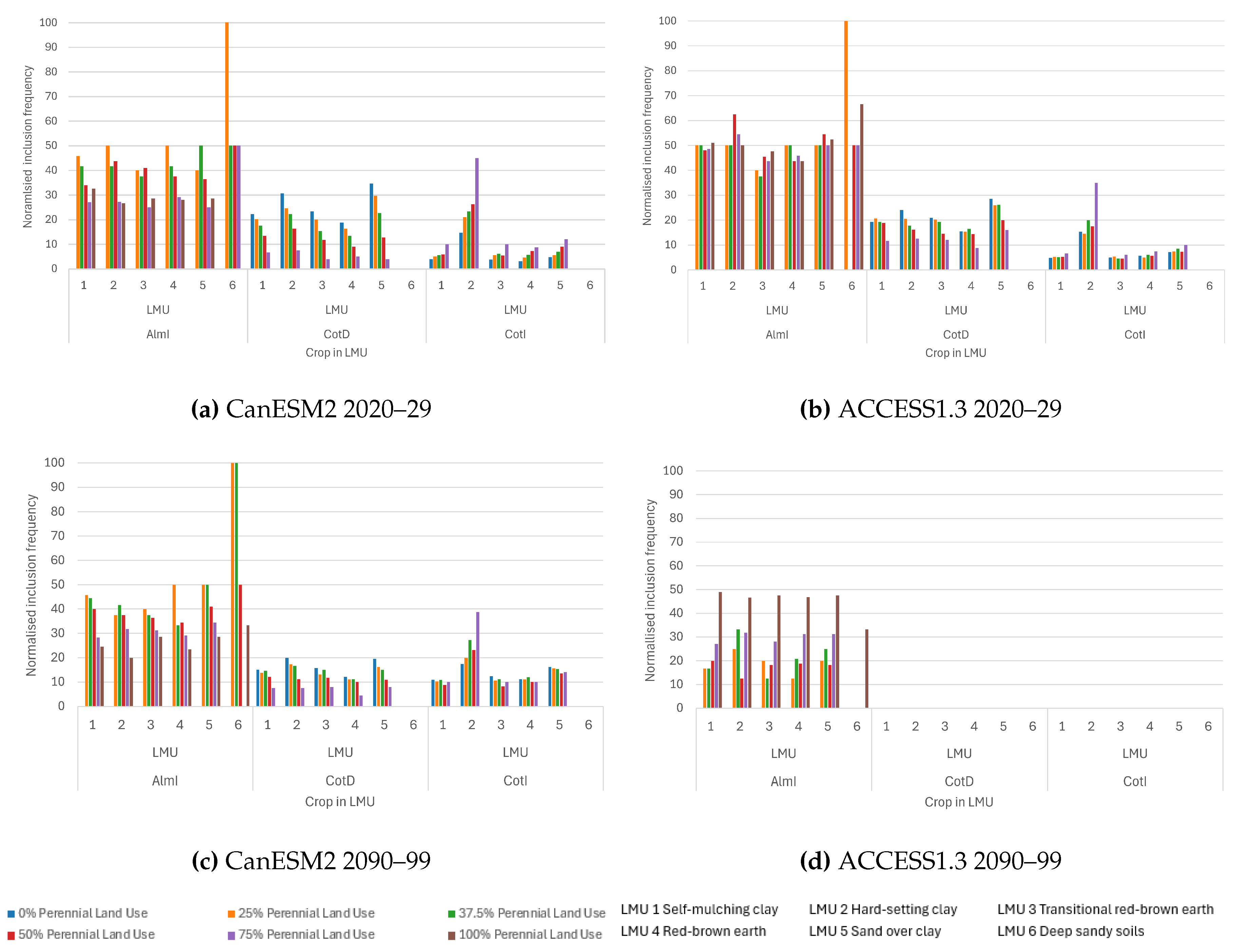
Table 1.
Soil types and area in hectares
| Soil type | Area (ha) |
|---|---|
| Self-mulching clay | 49,000 |
| Hard-setting clay | 15,000 |
| Transitional red-brown earths | 21,000 |
| Red-brown earths | 32,000 |
| Sand-over clay | 21,000 |
| Deep sandy soils | 3,000 |
| Total | 141,000 |
Table 2.
Production area by crop 2023/24 [89]
Table 2.
Production area by crop 2023/24 [89]
| Crop | Area (ha) |
| Vines – Table and wine grapes | 15,421 |
| Citrus | 7,343 |
| Nuts – Almonds and Walnuts | 8,075 |
| Plums | 1,002 |
| Total | 31,841 |
Table 3.
Income coefficients associating annual water allocation and target watering impact on market behaviour and yield potential
Table 3.
Income coefficients associating annual water allocation and target watering impact on market behaviour and yield potential
| Water allocation | Market behaviour | Target watering | Yield potential |
| Drought | 160% | 7% | 20% |
| Very low | 130% | 20% | 50% |
| Low | 110% | 50% | 80% |
| Mid-range | 100% | 100% | 100% |
| High | 80% | 100% | 100% |
Table 4.
Chill portions applied across research horizon derived from Parkes et al. [102].
Table 4.
Chill portions applied across research horizon derived from Parkes et al. [102].
| Year period | Chill Portion |
| 2020–2029 | 84 |
| 2030–2049 | 74 |
| 2050–2099 | 67 |
Disclaimer/Publisher’s Note: The statements, opinions and data contained in all publications are solely those of the individual author(s) and contributor(s) and not of MDPI and/or the editor(s). MDPI and/or the editor(s) disclaim responsibility for any injury to people or property resulting from any ideas, methods, instructions or products referred to in the content. |
© 2026 by the authors. Licensee MDPI, Basel, Switzerland. This article is an open access article distributed under the terms and conditions of the Creative Commons Attribution (CC BY) license (http://creativecommons.org/licenses/by/4.0/).
Copyright: This open access article is published under a Creative Commons CC BY 4.0 license, which permit the free download, distribution, and reuse, provided that the author and preprint are cited in any reuse.


