

Submitted:
02 June 2026
Posted:
03 June 2026
You are already at the latest version
Abstract
Atmospheric pressure non-thermal plasma (APNTP) represents a promising multifunctional technology for mitigating diverse environmental stresses in agriculture and animal health. This review synthesizes current evidence on plasma-mediated stress regulation in plants and animals. For plants, APNTP enhances tolerance to drought, salinity, temperature extremes, heavy metal toxicity, and pathogen infections through activation of antioxidant systems, stress-responsive gene expression, and adaptive signaling pathways. For animals, APNTP promotes wound healing, microbial sterilization, reproductive health, and pollutant degradation via modulation of oxidative balance, inflammatory responses, and cellular repair mechanisms. However, dose-dependent toxicity, lack of protocol standardization, and limited safety data represent critical challenges. Future research priorities include mechanistic studies, parameter optimization, safety assessment, and scalability evaluation. This review provides a comprehensive framework for advancing APNTP applications toward sustainable agriculture and improved animal welfare.
Keywords:
atmospheric pressure non-thermal plasma
; plant
; animal
; stress regulation
; environment
1. Introduction
With global climate change intensifying and environmental pollution increasing, biological systems are facing unprecedented environmental pressures[1]. These pressures significantly affect the stability of agricultural production systems, including animal husbandry and crop cultivation[2]. Crops plants are susceptible to a variety of environmental stresses during their growth and development, and unfavorable environments are the main cause of reduced crop yields[3]. Surveys indicate that a 1% increase in agricultural yield translates to a 0.6–1.2% decrease in the absolute number of poor households worldwide[4]. In addition, animal husbandry has been seriously affected by climate change and environmental degradation in recent years. In industrial feeding environments, exposure to ammonia increases the probability of respiratory disease in animals by 15–20%[5]. Heavy metal contaminants can be enriched through the food chain, ultimately affecting meat safety[6]. The presence of pathogenic microorganisms will also increase the prevalence of animals and affect their growth and reproduction[7]. Heat stress causes dairy cows to experience elevated body temperatures, which can impact their reproductive performance, including hormonal imbalances, reduced oocyte and semen quality, and decreased embryo development and survival[8]. A study on European farms found that heat stress can cause a 2.8% decrease in milk production and a 5.4% loss in monthly income[8]. Meanwhile, the global population is predicted to grow to 9.7 billion by 2050, necessitating an increase of approximately 70% in food production to meet the demands of this population[4]. Reduced production of crops such as wheat, corn and rice and damage to livestock industry could have serious consequences, including exacerbating global food shortages, poverty, and hunger.
Technical innovations are needed to overcome recent crises in agricultural practices. Atmospheric pressure non-thermal plasma (APNTP) technology developed in physics has received attention in recent years as a potential tool for fostering adaptations to changes in climate and agricultural environments. Plasma is an ionized gas, often referred to as the fourth state of matter, alongside solids, liquids and gases[9,10]. In the plasma state, gas molecules are ionized, producing a mixture of positively charged ions and free electrons, along with neutral particles[11]. Plasmas can be divided into various types based on their temperature, density, and specific properties, including thermal, non-thermal or cold, high-density, and low-pressure plasmas[12]. Among these, APNTP is considered the most suitable type for biological applications due to their ability to generate and sustain plasma at atmospheric pressure[13]. The overall gas temperature remains close to ambient temperature, despite the high energy of the electrons in APNTP[14]. Various types of APNTP are being actively researched for their industrial applications (Figure 1).
To date, APNTP has been used in medicine and agriculture. Medical applications include sterilization of medicine materials and human living tissues, assisting blood coagulation, chronic foot, leg ulcers, wound healing and tissue regeneration[22,23,24]. Plasma also shows positive effects on the growth, development and crop yield[25,26,27]. Many plant seeds are subjected to a pre-sowing plasma treatment to increase the likelihood of timely and uniform germination, including radish (Raphanus sativus), carrot (Daucus carota sativus L.), soybean (Glycine max), bean (Phaseolus vulgaris), mung bean (Vigna radiata), black gram (V. mungo), pea (Pisum sativum), lentil (Lens culinaris), peanut (Arachis hypogaea), alfalfa (Medicago sativa), and chickpea (Cicer aruetinum), blue lupine (Lupinus angustifolius), Egyptian clover (Trifolium alexandrinum), fenugreek (Trigonella foenum-graecum), and mimosa (Mimosa pudica, M. caesalpiniafolia)[28,29]. For animal health, plasma treatment can achieve microbial sterilization efficiency of more than 90%[30], and a wound healing rate of more than 60%[31]. In addition, it can also improve the sperm motility of animals and improve reproductive efficiency[32]. Furthermore, due to its ability to effectively inactivate microorganisms and enzymes, APNTP can also be used as a disinfectant in food packaging, thereby preserving the freshness and extending the shelf life of food[33,34,35,36].
Currently, plasma has demonstrated its potential in fostering adaptations in plants and animals to climate and agricultural environmental changes. Although studies have shown that animals and plants treated with APNTP are more resistant to biological and abiotic stresses, the outcomes of these treatments vary depending on the animal and plant species, plasma devices, and environmental stresses, and the underlying regulatory mechanisms are still poorly understood[37]. In this review, we summarize and discuss case studies evaluating the improvement of animal and plant resistance through plasma under different environmental stresses and the relevant regulatory mechanisms to examine whether plasma technology can be a promising tool in solving environmental problems.
2. Plasma-Mediated Responses to Environmental Stress in Plants
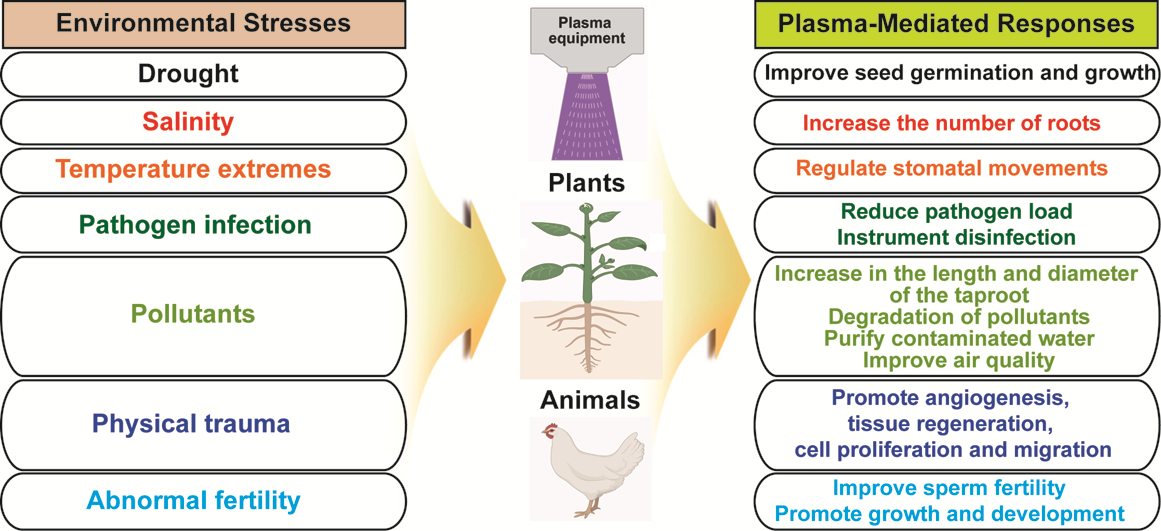
Plasma agriculture is an emerging field in recent years, particularly in improving plant stress resistance[38]. Plant stress regulation involves the mechanisms and responses that plants employ to cope with adverse environmental conditions, ensuring their survival and productivity. Currently, environmental stresses that affect plant growth and development mainly include drought, salinity, extreme temperatures, nutritional deficiencies, metal toxicity, and biotic stresses such as viral, bacterial, and fungal infections (Figure 2). Studies have demonstrated that plasma can enhance the tolerance of plants to various environmental stresses through activating antioxidant systems, promoting expression of defense related genes, regulating plant hormonal and physiological responses, and signal transduction (Table 1).
2.1. Drought
Drought is an environmental stress that can significantly impact the growth and development of crops on farmland. Research has shown that drought can cause various physiological changes in plants, including stomatal closure, impaired photosynthesis, changes in leaf morphology, premature senescence, and changes in the root system due to insufficient water resources[66]. Notably, plasma may mitigate the negative effects of drought on plants by increasing seed germination and seedling growth. Atmospheric dielectric barrier discharge (DBD) plasma treatment was found to promote wheat seed germination and seedling growth under drought stress[40]. Compared with the "drought stress" group, the germination rate of the "plasma + drought stress" group increased by approximately 17.3%. The germination drought resistance index also increased by 15.1%, and the average root and shoot lengths increased by 20.0% and 31.9%, respectively[40]. Similar results also were obtained in wheat seeds treated with High Voltage Electrical Discharge (HVED). HVED pre-treatment can improve germination rate, germination index value, and shoot and root growth under drought conditions[41]. In addition, plasma also exhibited a promoting effect on the seed germination and seedling growth of oil seed rape, barley, alfalfa, and tomato under drought stress. The study found that capacitive coupled plasma (CCP) treatment significantly increased the germination rate of rapeseed to 6.25%, and significantly increased the dry weight, root length and number of lateral roots of rapeseed[39]. Plants grown from barley seeds treated with DBD plasma under drought conditions had stronger and denser root systems than control seeds, with a 20% increase in the number of roots and a 70% and 80% increase in the length and diameter of the taproot, respectively[42]. Phenotypic observations tomato seedlings under drought stress showed that seeds primed with cold plasma had higher drought resistance potential at the seedling stage[67]. alfalfa Seeds treated with 40w cold plasma/low-power CPT had higher germination potential, germination rate, seedling height, root length, and vigor index[68]. The mechanisms of plasma-induced drought resistance can be divided into three categories: 1) Improved germination rate—plasma treatment breaks seed dormancy and enhances water absorption capacity, thereby improving germination rate; 2) Improved root system—enhanced root development helps plants obtain deeper soil moisture and improve drought resistance; and 3) Enhanced physiological response—plasma treatment can induce physiological changes, thereby improving plant water use efficiency and stress response.
2.2. Salinity
Salinization is known to affect plant growth by decreasing soil fertility. Studies have shown that as salinity increases, the germination rate of seeds decreases significantly. Although plasma treatment did not affect plant size and root system under salt stress, plants grown from plasma-treated seeds had higher concentrations of chlorophyll a and b, while the concentration of proline decreased by approximately 50%[42]. In addition, high voltage electrical discharge (HVED) pretreatment can improve wheat drought and salt resistance. Under varying levels of NaCl salt stress, HVED treatment could change the structure of wheat seed surface, making it easier to absorb water, thereby improving germination rate, germination index value, and growth of aerial parts and roots[41]. Plants grown under salt stress accumulate more Na+ and less Ca+, leading to ion imbalance. Notably, APNTP treatment can alleviate this effect by reducing Na+ accumulation and increasing K+ and Ca+ levels in plant cells under salt stress[45]. APNTP also upregulated the activity of enzymes related to secondary metabolic assimilation, the accumulation of reactive oxygen species (ROS), and the content of malondialdehyde (MDA)[45]. In general, APNTP treatment cannot completely offset the effects of salt stress. However, in certain instances, APNTP enhances the germination rate and surface changes of seeds.
2.3. Extreme Temperature
Temperature fluctuations can have a significant impact on seed germination and subsequent plant growth, particularly in crops that are more susceptible to temperature-related stress. Extreme temperature fluctuations have the potential to result in a reduction in crop yield or, in severe cases, complete crop failure[69]. Rice (Oryza sativa L.) seeds showed delayed germination under heat stress, which was associated with the expression levels of abscisic acid (ABA, a germination-inhibiting hormone) and α-amylase (starch-hydrolyzing enzyme). However, seed germination rate was significantly restored after APNTP treatment[51]. Genes involved in ABA biosynthesis (OsNCED2 and OsNCED5) were downregulated, while genes involved in ABA catabolism (OsABA8′OH1 and OsABA8′OH3) and α-amylase genes (OsAmy1A, OsAmy1C, OsAmy3B, and OsAmy3E) were upregulated[51]. Similarly, the germination rate of plasma-treated seeds was higher even at low temperatures[42]. This suggests that plasma appears to improve plant tolerance to extreme temperatures.
2.4. Metal Toxicity
Some contaminated soils contain a variety of toxic heavy metal elements, which can accumulate in plants and eventually cause human poisoning[55]. In addition, these heavy metals can cause plant chlorosis, wilting, leaf curling, and slow plant growth[70]. Research has found that low-pressure dielectric barrier discharge (LPDBD) technology can alleviate the damage and growth retardation of wheat plants under cadmium (Cd) stress[53]. The mitigation effect of plasma on Cd toxicity may originate from the roots and is related to the conduction mechanism of NO[53]. Severe Cd stress leads to reduction in grain yield and monounsaturated fatty acid (MUFA) content in wheat. APNTP alleviates Cd stress by changing the physiological and biochemical characteristics and fatty acid composition of wheat, thereby optimizing wheat growth and yield[57]. In addition, plasma can play an auxiliary role in alleviating heavy metal stress. APNTP combined with foliar-applied selenium nanoparticles can regulate Cd toxicity by changing the essential oil content, chlorophyll a, chlorophyll b and total chlorophyll in sage[71]. Plasma-activated water appears to have a similar effect as shown in soybeans (Glycine max) in which treatment with plasma-activated water resulted in a five-fold reduction in the uptake of heavy metals (Pb)[58]. Maize (Zea mays L.) treated with plasma-activated water responded to arsenic stress by improving its antioxidant capacity, mainly through increasing the contents of antioxidant enzymes (POX, Peroxidases and CAT, Catalase), non-enzyme molecules and carotenoids[54]. However, some studies have shown that the detoxification effect of plasma on heavy metals in plants may be selective. After water spinach seeds or irrigation water were treated with plasma, the bioaccumulation factor (BCF) of Cd was significantly reduced, while the BCF of Pb did not change significantly, indicating that plasma treatment may inhibit the absorption of Cd without affecting the absorption of Pb[56].
2.5. Pathogen Infection
There are many harmful microorganisms in nature that can cause slow plant growth. APNTP treatment reduces the incidence and severity of Fusarium wilt of basil caused by Fusarium oxysporum f. sp. Basilici in sweet basil[63]. Although plasma-activated water did not show direct antimicrobial activity against Xanthomonas vesicatoria, which causes bacterial leaf spot of tomato, it enhanced the defense capacity of tomato plants, increasing the relative protection by 61% in vitro [60]. Low-pressure plasma treatments have demonstrated to be efficacious in the suppression of fungal crop diseases, including boil smut of maize, root rot of lupine and winter wheat[61]. This is due to reduced levels of seed infection, stimulation of germination in the field, early seedling growth, and increased resistance to pathogens during plant growth[61]. Plants treated with plasma also showed delayed disease progression and reduced disease severity. Tomatoes treated with APNTP showed a significant improvement of resistance to bacterial wilt caused by Ralstonia solanacearum [25]. Studies have shown that plasma treatment can lead to a significant reduction in fungal load, with untreated seeds exhibiting a pathogenicity rate of 58%, while the seeds treated with plasma demonstrated pathogenicity rates of 6.7% and 13.3%. Vaccination effects of plasma were also demonstrated against bakanae disease caused by the fungal pathogen Fusarium fujikuroi and bacterial seedling rot caused by Burkholderia glumae [59]. APNTP can also be used as a method of physical disinfection for plant seeds. Microbial contamination can lead to reduced seed viability, low germination rates, and delayed germination. The study found that after two minutes of corona discharge plasma jet treatment, the number of microorganisms on the seeds, primarily aerobic bacteria, molds, yeasts was significantly reduced (up to 99%)[30].
Recent mechanistic studies have elucidated that plasma treatment confers multi-stress tolerance through diverse molecular and biochemical mechanisms. At the epigenetic level, plasma induces DNA demethylation of abscisic acid catabolism genes and α-amylase (starch-hydrolyzing enzyme) genes, thereby reversing heat stress-induced germination inhibition[51]. Under low-temperature stress, plasma activates phosphotransferase activity, modulates phosphorus compound metabolism, and triggers defense responses that maintain cellular homeostasis[52]. Plasma exposure also significantly enhances the activities of catalase (CAT) and ascorbate peroxidase (APX), which scavenge excessive reactive oxygen species and confer drought stress tolerance[43]. Furthermore, non-thermal plasma treatment upregulates CAT and superoxide dismutase (SOD) activities while inducing stress-responsive genes (including chitinase and xylanase inhibitor protein genes), thereby enhancing seed tolerance to salt-alkali stress[46]. Notably, plasma exhibits dual functionality by simultaneously promoting plant stress tolerance and exerting antimicrobial effects. The antimicrobial properties are mediated through plasma-generated reactive oxygen species (ROS) and reactive nitrogen species (RNS), including hydroxyl radicals (•OH), peroxyl radicals (•HO₂), superoxide anions (•O₂⁻), ozone (O₃), and singlet oxygen (¹O₂), nitric oxide (NO), nitrogen dioxide (NO₂), and nitrate (NO₃⁻), which disrupt microbial membrane integrity and cellular functions[65].
3. Plasma-Mediated Responses to Environmental Stresses in Animals
Currently, there are serious challenges to the habitats of animals and humans, such as pathogen infections, physical trauma, organic poisoning and air pollution[72] (Figure 3). These problems not only affect the health and productivity of animals but also threaten the sustainable development of society[73]. Similarly, many studies have found application prospects for plasma technology in animal fields, including sterilization, wound healing, pollutant degradation, animal breeding and air purification (Table 2 and Table 3). To elucidate the effect of plasma on animal resistance to environmental stress, we summarize and discuss the role and mechanisms of plasma technology in addressing the above-mentioned environmental and health challenges (Figure 3 and Figure 4).
3.1. Pathogen Infection
Contamination of frequently touched surfaces and equipment on farms can harm animal health, leading to reduced productivity and economic losses[105]. Microorganisms present in farms can cause mastitis and endometritis in cows, as well as gastrointestinal and respiratory diseases[106]. This also includes a broader range of diseases such as African swine fever, classical swine fever, porcine reproductive and respiratory syndrome, rinderpest, foot-and-mouth disease, and bluetongue disease, among others[107].Therefore, sterilization and disinfection of animal farms facilitate a pathogen-free environment essential for the growth and development of animals[90,108]. APNTP effectively inactivates microbial pathogens including Staphylococcus aureus, E. coli, vancomycin-resistant Enterococci, Acinetobacter baumannii, and herpes simplex virus type 1 (HSV-1)[90,95,109]. In addition, APNTP is an effective, non-toxic, and equipment-safe sterilization method that can sterilize small items such as cages, feeding utensils, and drinking water equipment in animal farms and also effectively disinfects large surfaces such as walls, floors, and fences[93]. Studies have shown that APNTP disinfection has little effect on the quality of metals such as stainless steel, copper, tin-copper, and passive electronic components, and they can all be used normally after this process[93]. Another study demonstrated that after treatment with plasma, the cell walls of Gram-negative bacteria (GNB), including P. aeruginosa, E. coli, and Vibrio parahaemolyticus, exhibited irreversible perforations, leading to the release of intracellular compounds such as proteins and DNA. In contrast, for Gram-positive bacteria (GPB), including Listeria monocytogenes and S. aureus, intracellular components underwent oxidation and release[91]. It has been reported that APNTP disinfection technology has become an ideal choice for animal farms due to its high efficiency, lack of residue, environmental protection, and non-toxicity[92,110]. Plasma has been found to reduce bacterial burden in wounds and promote healing[84]. In conclusion, it can be demonstrated that plasma has the capacity to decontaminate wounds effectively and inactivate various pathogens, including viruses, bacteria, and fungi, thereby promoting wound healing[111,112].
Recent studies have found that plasma can be used to generate vaccine effects, indirectly improving the resistance of animals and humans to the environment[113,114]. Plasma can destroy the proteins and genome of viruses by producing active particles (including ROS, RNS and UV photons), thereby causing them lose their pathogenicity[93,94]. It has been reported that Newcastle disease virus (NDV, LaSota) strains and H9N2 avian influenza virus (AIV, A/Chicken/Hebei/WD/98) can be completely inactivated by APNTP treatment for two minutes, and NDV vaccine can induce high titer NDV-specific antibodies in specific pathogen free (SPF) chickens by APNTP treatment for two minutes[115]. In summary, APNTP, as an emerging inactivating agent, has the advantages of high efficiency, safety, and stability. Vaccines treated with APNTP have obvious advantages in immunogenicity and protective effects and have broad application prospects.
3.2. Physical Trauma
Helium/argon cold atmospheric plasma jet (He/Ar-CAPJ) treatment was found to accelerate wound healing by promoting granulation tissue formation and reducing inflammation in skin tissue in a study on wound healing in rats[77]. In addition, N2-generated non-thermal plasma promotes wound repair by inducing epithelial-mesenchymal transition (EMT) and activating the matrix metalloproteinase-9/urokinase-type plasminogen activator (MMP-9/uPA) system in a scratch wound healing assay[74]. Similar results were obtained when investigating the therapeutic effects of a non-thermal microplasma jet device array on second-degree burns in a rat model, where plasma reduced the trauma area and was able to modulate inflammatory gene expression, again contributing to epithelial tissue regeneration[116]. Studies showed that APNTP promoted neuron regeneration in rats[82]. In the study of the effects of APNTP on functional recovery after sciatic nerve damage (ND), it was found that APNTP treatment could restore the level of the sciatic nerve by 60%[76]. In addition, after seven days following the treatment of Sprague–Dawley (SD) rats with muscle defects using APNTP, a significant increase in the number of satellite cells was observed compared to the untreated group, demonstrating that APNTP also has a beneficial effect on muscle repair after injury[81].
Plasma is also considered a novel approach for fracture treatment. White rabbits showed ideal bone regeneration after 10 minutes of APNTP treatment, and that the volume of new bone in the plasma-treated group was 1.51-fold greater than in the untreated group[81]. Plasma has also been demonstrated to inhibit scar formation following injury. Plasma jet treatment of injured mice demonstrated that the scar area of plasma-treated rats was observably smaller than that of the plasma-untreated group at 21 postoperative days, and the degree of epithelialization of the scars was significantly higher than that of the untreated group[78]. In addition, plasma treatment of rat wounds accelerates wound healing, reduces scar area and inhibits the formation of scar signaling pathways such as TGF-β1, p-Smad2 and p-Smad3[78,80]. Overall, plasma has a beneficial effect on wound healing, tissue regeneration, cell proliferation, cell migration and angiogenesis.
3.3. Insufficient Fertility and Reproduction
APNTP technology can be used as a new technology to help solve some problems in animal fertility. Current studies have shown that APNTP technology can be used to promote the growth of rooster embryos[86]. The sperm quality-promoting effect of plasma treatment was regulated by the significant improvements of adenosine triphosphate production and testosterone level, and by the modulation of reactive oxygen species balance and adenosine monophosphate-activated protein kinase and mammalian target of rapamycin pathway in the spermatozoa[89]. According to previous study, APNTP affects the fertility of animals by mediating ROS balance, energy metabolism and antibacterial effects[87,117]. APNTP can induce intracellular ROS production, and the balance between ROS production and clearance activity is necessary to ensure optimal sperm quality. A certain amount of ROS can stimulate sperm energy acquisition, the acrosome reaction, and chemotactic and oocyte fusion. The effect of plasma may be dose-dependent, and plasma can promote growth and development under appropriate conditions.
3.4. Organic and Inorganic Poisoning (Pesticide Residues, Antibiotics, Mycotoxins)
There is a wide variety of pollutants in the environment, mainly in water, food and soil, including pesticide residues, antibiotics, microplastics and mycotoxins, among others. Most of these pollutants have a variety of toxic effects such as organ toxicity, neurotoxicity, developmental and reproductive toxicity, immunotoxicity, etc., and pose serious threats to animal health. For example, patulin is a neurotoxic secondary metabolite with strong toxicity to animal tissues and cells, and has been reported to cause renal congestion, pulmonary edema, peritoneal and pleural effusion, and tissue necrosis in mice[97]. Chemical residues (e.g., organic dyes, fertilizers, and pesticides) that can be toxic, mutagenic, and carcinogenic to humans, have been linked to a wide range of diseases, such as cancers, hormonal disorders, asthma, allergies, reproductive disorders, neurological disorders, skin disorders, visual disturbances, and immune system-related disorders. APNTP has received much attention in the detoxification and removal of pollutants in water[97,98]. It has been demonstrated that APNTP can effectively degrade pesticide residues such as polycyclic aromatic hydrocarbons (PAHs) and polychlorinated biphenyls (PCBs) by destroying the chemical structure of organic pollutants through the oxidation by ROS and reactive nitrogen species (RNS)[96]. In plasma reactions, introduction of ambient air into an argon-air plasma jet introduces an abundant source of ROS and RNS, such as hydroxyl radicals (OH), monoline oxygen (O2*), nitric oxide (NO), nitrate (NO3), nitrogen trioxide (N2O3), and nitrogen pentoxide (N2O5). Therefore, argon-air plasma injection emerged as a promising solution for 4-NP degradation in wastewater with higher ROS and RNS generation without the need for a catalyst[99]. Low-temperature plasma treatment can significantly reduce pesticide (dichlorvos, malathion and endosulfan) content in water[118]. These degradation reactions are mainly caused by ROS and RNS in the plasma.
3.5. Air Pollution
Currently, with the rapid development of industries, chemical fuels and various air pollutants are being emitted into the air in large quantities, and this has led to an increase in airborne particulate matter. This increase in airborne particulate matter can lead to a range of respiratory diseases in humans and animals, such as asthma, lung cancer, acute respiratory infections, and chronic bronchitis[119]. Many types of particulate matter can be easily inhaled and adhered to the respiratory tract, trachea, bronchus and even alveoli. The products of the reaction of NO and SO2 with the generated aerosol particles of NaClO2, NO2 gas, and aqueous ions such as NO2-, NO3-, HSO3-, and SO42- lead to inflammation, oxidative stress, and fibrosis[120]. Studies have found that plasma technology not only has the potential to improve air quality and reduce air pollution but also has the advantage of being more energy efficient than other technologies[102]. In the food industry, plasma has been reported to improve air quality and eliminate volatile organic compounds. The high-energy electron bombardment in APNTP can change ground-state molecules to their sub-stable or excited states, and the products undergo multi-level physical and chemical reactions to form ions and free radicals, which react with gaseous pollutants and intermediates produced by electron collisions with precursors to ultimately produce harmless products[102]. APNTP can also break down formaldehyde (HCHO), a typical volatile organic compound in indoor air, and convert it to CO2 and H2O[103]. Moreover, APNTP is more energy efficient than other technologies and can remove multiple air pollutants simultaneously[121].
In summary, accumulating evidence demonstrates that plasma accelerates wound healing through coordinated regulation of multiple molecular mediators. Plasma modulates oxidative stress mediators (iNOS and NO), pyroptotic mediators (NOD-like receptor protein 3, Caspase-1, and Interleukin-1β), and angiogenesis mediators (vascular endothelial growth factor and angiopoietin-1)[122]. The wound healing process involves activation of critical signaling pathways, including yes-associated protein/transcriptional coactivator with PDZ-binding motif (YAP/TAZ), β-catenin, and TGF-β[123]. These molecular cascades accelerate lipid metabolism, facilitate fibrin deposition, and enhance granulation tissue formation, neovascularization, and re-epithelialization[124]. Furthermore, plasma exhibits potent antimicrobial properties by significantly reducing wound bacterial burden. This antimicrobial effect is mediated through Rac-GTP-dependent activation of NADPH oxidase 2 (NOX2), which generates superoxide anions that eliminate pathogens[125]. In the context of fertility and reproduction challenges, plasma treatment significantly improves sperm quality through multiple mechanisms. Plasma-treated sperm display increased progressive motility and viability, decreased reactive oxygen species (ROS) levels, and upregulated expression of key proteins including kelch-like ECH-associated protein 1 (KEAP1), nuclear factor erythroid 2-related factor 2 (NRF2), NAD(P)H quinone dehydrogenase 1 (NQO1) and glutathione peroxidase 8 (GPx8)[126]. Mechanistically, DBD plasma modulates sperm ROS homeostasis through miRNA-mediated regulation of the KEAP1/NRF2 signaling pathway[126]. Furthermore, DBD plasma increases exon methylation levels of the AMP-activated protein kinase (AMPK) gene, thereby improving glycolytic flux, mitochondrial function, and antioxidant capacity. Importantly, these beneficial effects are achieved without compromising sperm DNA integrity or acrosome structure, ensuring reproductive viability[117].
Plasma-mediated degradation of organic and inorganic pollutants is primarily based on advanced oxidation processes (AOPs). Plasma-generated reactive oxygen and nitrogen species (RONS) ultimately reach water or gas phases containing antimicrobial agents and organic contaminants. RONS with the highest oxidation potentials preferentially attack pollutants, triggering oxidation, mineralization, and molecular backbone fragmentation or addition-elimination reactions at specific functional groups or atoms[127,128]. Beyond RONS, plasma generates solvated electrons, ultraviolet radiation, thermal energy, and electromagnetic fields. These synergistic factors trigger cascade reactions that continuously degrade organic compounds, ultimately achieving degradation and inactivation of multiple hazardous substances in liquid or solid matrices[128].
4. Regulatory Mechanisms of Plasma-Mediated Promotion of Tolerance to Environmental Stresses
4.1. Plasma Activated Signaling Pathways
The transforming growth factor-β (TGF-β1)/ small mothers against decapentaplegic (Smad)2/3 pathway is one of the important signaling pathways in scar formation. Following plasma treatment, the TGF-β/Smad2/3 pathway upregulates extracellular matrix remodeling genes, including collagen type I (COL1A1), fibronectin, and α-smooth muscle actin (α-SMA), all of which orchestrate tissue regeneration and wound healing processes[78]. Vascular endothelial growth factor A/ vascular endothelial growth factor receptor 2 (VEGFA/VEGFR2) is an angiogenesis-related signaling pathway. Cold atmospheric pressure plasma (CAPP) induces phosphorylation and activation of endothelial NO synthase (eNOS). This activity increases the level of endogenous NO in endothelial cells, which in turn stimulates VEGFA/VEGFR2 signaling to regulate angiogenesis in vitro[80]. Wingless/Int (Wnt) is a family of signaling proteins involved in various developmental functions. Expression levels of Wnt-related genes that promote cell proliferation in the neural tube after NTP treatment were significantly increased, confirming that NTP-treated retinoic acid (RA) differentiated SH-SY5Y (human neuroblastoma cells) cells can stimulate Wnt signaling to promote nerve regeneration[82]. The (phosphatidylinositol 3-Kinase / protein kinase B / mammalian target of rapamycin) PI3K/AKT/mTOR signaling pathway is critical for cell proliferation. Treating HaCaT cells with low doses of NTP was found to promote cell proliferation by activating the PI3K/AKT/mTOR signaling pathway, and the increased expression of signal transducer and activator of transcription 3 (STAT3) and Cyclin D1 was observed[129]. Non-thermal plasma treated solution (NTS) acts on BEAS-2B (human bronchial epithelial cell line cells similar to nasal mucosal epithelium) and is found to stimulate epithelial-mesenchymal transition (EMT) signaling pathways to cell migration to promote skin wound healing[76].
In plants, atmospheric pressure-cold plasma (APCP) treatment of early Arabidopsis seedlings can regulate the expression of adversity-responsive genes through the mitogen-activated protein kinase (MAPK) signal transduction pathway, thereby promoting Arabidopsis seedling growth[62]. Plasma can also downregulate the expression of viral genes angiotensin-converting enzyme 2 (ACE-2), spike (S) gene, and RNA-dependent RNA polymerase (Rd/Rp) helicase gene, as well as the protein expression of interleukin-6 (IL-6), tumor necrosis factor-α (TNF-α), interleukin-1β (IL-1β), interferon-γ (IFN-γ), cyclooxygenase-2 (COX-2), C-X-C motif chemokine ligand 10 (CXCL-10), and C-C motif chemokine ligand 5 (CCL-5) through the NF-κB and MAPK pathways[130]. H₂O₂ and abscisic acid (ABA) are signaling pathways associated with cold stress resistance. The application of cold plasma (CP) as a seed treatment has been demonstrated to induce the upregulation of H2O2 and ABA cascade signaling, which in turn upregulates the cold-acclimated inducer of c-repeat binding factor expression 1(ICE1) and c-repeat binding factor (CBF) genes, thereby enhancing the cold resistance of tomato plants[50]. Elevated levels of H₂O₂ and NO present in cold atmospheric plasma activation have the capacity to induce the MAPK signaling pathway, thereby stimulating the expression of pathogenesis-related (PR) proteins, antioxidant enzyme activity, and defense hormone (salicylic acid and jasmonic acid) pathway enzymes. When Arabidopsis plants infected with cucumber mosaic virus strain yellow (CMV(Y)) were exposed to nitrogen pentoxide (N2O5) generated by plasma treatment, the resistance of Arabidopsis to CMV was enhanced, and N2O5 could enhance Arabidopsis immune function by relying on the ethylene (ET) signaling pathway[64].
4.2. Plasma Activation of Related Genes in Response to Environmental Stress
APNTP can make cells exhibit unusual physiological states by activating important regulatory genes in cells[131]. This characteristic provides a new direction for APNTP-mediated resistance of external environmental stimuli[132]. Low-temperature cold plasma treatment of wounds inhibits generation of proinflammatory factors such as TNF-α (Tumor Necrosis Factor-alpha), IL-6 (Interleukin-6), IL-1β (Interleukin-1 beta), and promotes the expression of VEGF (Vascular Endothelial Growth Factor), bFGF (Basic Fibroblast Growth Factor), and TGF-β (Transforming Growth Factor-beta) in tissue[85]. After fibroblasts are treated with low temperature plasma, P56 can be phosphorylated and the expression of proteins such as P50 can be activated to promote the recovery of fibroblasts at the wound[75]. In animals, APNTP treatment under appropriate conditions can promote the expression of growth-related factors such as thyroid hormones and growth hormones, and promote the growth efficiency of animals[32]. Some products of photosynthesis also play a key role in plant immunomodulation[133]. In terms of genes regarding plant dehydration resistance, it was found that the expression of SnRK2 related genes of ABA (abscisic acid) was upregulated, thereby improving the drought resistance of plants[40].
4.3. Plasma-Enhanced Antioxidant Defense System
Antioxidant enzymes are organic molecules that maintain cellular redox balance in organisms. Treatment of wounds in diabetic patients with APNTP showed a significant decrease in protein expression of superoxide dismutase (SOD), reducing oxidative stress levels[80]. Chicken sperm obtained low levels of ROS and malondialdehyde (MDA) after exposure to APNTP, and the increased activity of SOD, Catalase (CAT), and Glutathione Peroxidase (GPx) enhanced antioxidant defense improving chicken sperm mobility[87]. The same study showed that the concentration of SOD, CAT, and GPx in chicken serum after plasma treatment significantly increased, which promoted the growth and development of chickens[32].
Similar results were obtained in plants after plasma treatment. Signal molecules produced by plasma, especially ozone, nitric oxide and/or ultraviolet radiation, induced an increase in peroxidase and phenylalanine ammonia lyase (PAL) activities[134]. DBD plasma treatment significantly improves the SOD, catalase (POD) and CAT activities of wheat seedlings under drought stress, accelerating the removal of ROS, thereby reducing oxidative damage and helping to maintain normal physiological metabolic activity[40]. Similar studies found that low-temperature plasma treatment enhances the SOD and CAT activities of rapeseed seedlings under drought stress and improves their growth[39].
Ar/Air plasma treatment helped detoxifying cadmium (Cd) in wheat, where plasma alleviated Cd-induced H2O2 rise and oxidative damage in tissues by inducing upregulation of antioxidant enzymes (SOD and CAT) and their corresponding genes (TaSOD and TaCAT)[53]. Cold plasma reduces bacterial blight symptoms caused by R. solanacearum in tomatoes by enhancing the activity of POD, polyphenol oxidase (PPO) and PAL[25]. In summary, plasma treatment can improve wound healing and development in animals by reducing the oxidative stress level and alleviate hindered growth and development in plants caused by oxidative stress.
4.4. Plasma Reduces the Threat of Harmful Microorganisms to Plants and Animals
Studies have shown that plasma therapy can effectively inhibit the activity and pathogenicity of microorganisms. The use of cold atmospheric surface microdischarge plasma devices can effectively inactivate bacteria and yeast pathogens in the air[135]. Various treatments using non-thermal plasma can lead to morphological changes in the mycelium structure of plant pathogenic fungi (F. oxysporum, B. cinerea, and A. alternata) and severely reduce pathogenicity[136]. ROS, RNS and acid produced by plasma can completely react with polysaccharides, lipids, proteins and nucleic acid molecules in biofilms, thereby destroying the cell membrane and inactivating microorganisms[137,138]. Furthermore, studies have shown that UV light in plasma affects the upper layer of the biofilm matrix, allowing ROS and RNS to enter. It can also destroy protein content in the outer membrane by weakening chemical bonds[138]. In a similar manner, hydrogen peroxide, produced in plasma activated water (PAW), can undergo a secondary reaction with iron substances and the downstream products of this reaction cause DNA damage, which in turn can lead to mutations in biofilm-producing cells[139].
In addition, ROS and RNS generated by plasma can directly interact with specific intracellular molecules, thereby participating in a variety of physiological processes. In plant cells, H₂O₂ function as signaling molecules that activate calcium channels in guard cells, triggering stomatal closure under drought stress. This H₂O₂-mediated calcium influx represents a critical early response in ABA-dependent stress signaling pathways[140]. plasma-derived NO acts as a mobile signaling molecule that can diffuse across membranes and modify cysteine residues in target proteins through S-nitrosylation, thereby modulating protein function and stress response pathways[141]. In bacterial cells, ROS and RNS cause oxidative damage to membrane phospholipids through lipid peroxidation, resulting in increased membrane permeability and leakage of intracellular contents. For Gram-negative bacteria, this oxidative attack creates irreversible perforations in the cell wall, leading to release of proteins and DNA, while in Gram-positive bacteria, the reactive species penetrate the thicker peptidoglycan layer to oxidize intracellular components directly[138]. ROS also interact with nucleic acids by inducing strand breaks and base modifications in DNA[142]. In mammalian wound healing, plasma-generated ROS stimulate the phosphorylation of endothelial nitric oxide synthase (eNOS), which increases endogenous NO production. These ROS also enhance the expression of pro-angiogenic factors including platelet-derived growth factor receptor (PDGFR) and cluster of differentiation (CD31). Together, these effects activate the VEGFA/VEGFR2 signaling pathway to promote angiogenesis[143]. The dose-dependent nature of these interactions is critical, as moderate ROS levels activate protective antioxidant enzyme systems (SOD, CAT, POD) and stress-responsive genes, while excessive ROS accumulation leads to cellular damage through protein carbonylation and membrane disruption[144].
5. Limitations, Challenges, and Adverse Effects of Plasma Applications
While APNTP technology shows considerable promise, several limitations and potential adverse effects must be acknowledged. First, excessive ROS and RNS production can lead to oxidative damage, including lipid peroxidation, protein denaturation, and DNA strand breaks, particularly when treatment parameters are not optimized. Studies have reported that prolonged or high-intensity plasma exposure may inhibit seed germination, reduce cell viability, and even induce mutagenic effects in certain plant and animal models[145]. Second, the biological responses to APNTP are highly dose-dependent and species-specific, resulting in significant variability and occasional contradictory findings across experiments[146].
In addition, A critical barrier to widespread adoption and clinical/agricultural translation of APNTP technology is the lack of standardization in treatment protocols, which severely limits reproducibility, comparability, and establishment of universal guidelines[147]. Different plasma generation devices produce dramatically different outputs. Dielectric barrier discharge, plasma jets, corona discharge, and microwave plasma systems generate distinct profiles of reactive species, electron densities, gas temperatures, and spatial distributions[148]. Even when targeting the same biological tissue under seemingly identical conditions, device-specific characteristics can lead to fundamentally different biological outcomes (Table 4). And the choice of working gas fundamentally determines plasma chemistry and biological effects. Inert gases like argon and helium generate high concentrations of metastable excited particles and UV photons, nitrogen-containing gases such as air and N₂ produce abundant reactive nitrogen species (RNS: NO, NO₂, N₂O₅, ONOO⁻)[149,150,151]. Moreover, treatment parameters including voltage, frequency, pulse width, duty cycle, exposure time, target distance, and gas flow rate collectively determine the effective "dose". These dose-response relationships are highly species-specific and context-dependent[150]. Finally, Treatment modality further determines biological outcomes. Direct plasma exposure delivers a complex mixture of reactive species, UV radiation, electric fields, and charged particles in a single step, resulting in rapid and potent biological effects. By contrast, indirect methods using plasma-activated water or treated gases depend on long-lived chemical species (H₂O₂, NO₂⁻, NO₃⁻) that persist in the medium and act over extended timeframes[151]. To advance practical implementation of plasma technology, we advocate for the adoption of unified dosimetry metrics including energy dose per unit area (J/cm⁻²), concentrations of key reactive species (H₂O₂, NO₂⁻, O₃), and UV flux measurements. Systematic dose-response studies should be conducted for each specific application scenario, target organism, and stress type. We also recommend establishing open-access databases documenting plasma treatment parameters alongside biological outcomes. These efforts will facilitate standardization and accelerate the translation of APNTP technology from laboratory to field applications.
6. Conclusions and Future Perspectives
As an emerging technology, APNTP has shown wide application prospects in agriculture and animal health. Research shows that APNTP has a significant promoting effect on plant growth, stress resistance and animal health maintenance, and its action mechanisms show certain commonalities in animals and plants. In the field of agriculture, plasma treatment can significantly increase plant resistance to extreme weather, soil pollution and biological stress. Plasma can promote plant vegetative growth, root development and seed germination by activating specific signaling pathways and gene expression. In addition, plasma-treated plants exhibit stronger antioxidant capacity, primarily by enhancing the expression of antioxidant enzymes. APNTP also shows many advantages in animal health. It can effectively eliminate microorganisms in the animal feeding environment, reduce the use of chemical reagents, remove environmental pollution, promote wound healing and reduce animal deaths caused by accidental trauma. APNTP treatment also reduces the ammonia produced during animal feeding and the risk of respiratory diseases in animals and improve animal welfare. It should also be noted that plasma can increase animal sperm activity, which is of great significance in dealing with the problem of declining animal fertility. As a technology with wide application prospects, APNTP has great potential in fighting environmental stress. This review provides a theoretical basis for the future application of plasma technology in different fields.
Despite these promising results, several critical challenges must be addressed before APNTP can transition from laboratory research to widespread field applications. The foremost challenge is the lack of standardization in treatment parameters across studies. Variations in plasma source types, gas composition, treatment duration, and energy input hinder the establishment of reproducible protocols and complicate cross-study comparisons. In addition, The biological effects of plasma are fundamentally mediated by reactive oxygen and nitrogen species, which operate within a narrow therapeutic window. Excessive RONS production can induce oxidative stress beyond cellular antioxidant capacity, resulting in lipid peroxidation, protein carbonylation, and damage to nucleic acids. Several studies have reported DNA strand breaks and chromosomal aberrations following high-intensity or prolonged plasma exposure, raising concerns about potential mutagenic effects. In agricultural applications, unintended genetic alterations in crop germplasm could compromise breeding programs and food safety. In animal health contexts, germline mutations could have transgenerational consequences. Moreover, the scarcity of cost-benefit analyses in current literature makes it challenging to evaluate the economic competitiveness of plasma technology compared to conventional approaches. Although plasma treatment can reduce pesticide dependence, whether the associated equipment costs and energy consumption outweigh the savings from decreased chemical inputs remains uncertain, especially in small-scale agricultural contexts.
From a mechanistic perspective, future investigations should employ multi-omics approaches integrating transcriptomics, proteomics, and metabolomics to elucidate the complex molecular networks underlying plasma-induced stress tolerance. Such comprehensive analyses will provide deeper insights into the coordinated cellular responses activated by APNTP treatment. Furthermore, integrating APNTP with complementary sustainable technologies, such as precision agriculture, biochar amendments, or beneficial microorganism inoculation, may yield synergistic effects that enhance overall system resilience. Establishing international collaborative networks and open-access databases documenting standardized treatment protocols and outcomes would accelerate knowledge translation and facilitate evidence-based implementation strategies across diverse agricultural and animal production systems.
Contributions: Conceptualization, N-N. Y. and GP.; formal analysis, N-N. Y. and SJ; investigation, W-MS. and WK.; writing—original draft preparation, N-N. Y. WK. and GP.; writing—review and editing, N-N. Y. W-MS. SJ. and GP; supervision, H-NS. and GP; project administration, GP.; funding acquisition, GP.
Funding
This research was funded by the National Research Foundation of Korea (RS-2021-NR060112, 2020R1F1A1070942) and partly by a research grant from Kwangwoon University in 2025.
Acknowledgments
We would like to thank Editage (www.editage.co.kr) for English language editing and acknowledge the support from the Education Department of Heilongjiang Province (LJYXL2024-054) and the Department of Ecology and Environment of Heilongjiang Province (HST2025GF003).
Conflicts of Interest
The authors declare no conflicts of interest.
References
- Lei, W.; Bai-Chao, Z.; Ying, S. H. I.; Zhen-Yu, H. A. N.; Bo, L. U. Interpretation of the IPCC AR6 on the impacts and risks of climate change. Adv. Clim. Change Res. 2022, 18, 389. [Google Scholar] [CrossRef]
- Nardone, A.; Ronchi, B.; Lacetera, N.; Ranieri, M. S.; Bernabucci, U. Effects of climate changes on animal production and sustainability of livestock systems. Livest. Sci. 2010, 130, 57–69. [Google Scholar] [CrossRef]
- Zhang, H.; Zhao, Y.; Zhu, J.-K. Thriving under Stress: How Plants Balance Growth and the Stress Response. Dev. Cell 2020, 55, 529–543. [Google Scholar] [CrossRef]
- Liliane, T. N.; Charles, M. S. Factors affecting yield of crops. Agron.-Clim. Change Food Secur. 2020, 9, 9–24. [Google Scholar] [CrossRef]
- Younis, F.; Salem, E.; Salem, E. Respiratory health disorders associated with occupational exposure to bioaerosols among workers in poultry breeding farms. Environ. Sci. Pollut. Res. 2020, 27, 19869–19876. [Google Scholar] [CrossRef] [PubMed]
- Sarker, A.; Kim, J.-E.; Islam, A. R. M. T.; Bilal, M.; Rakib, M. R. J.; Nandi, R.; Rahman, M. M.; Islam, T. Heavy metals contamination and associated health risks in food webs—a review focuses on food safety and environmental sustainability in Bangladesh. Environ. Sci. Pollut. Res. 2022, 29, 3230–3245. [Google Scholar] [CrossRef]
- Dalanezi, F. M.; Joaquim, S. F.; Guimarães, F. F.; Guerra, S. T.; Lopes, B. C.; Schmidt, E. M. S.; Cerri, R. L. A.; Langoni, H. Influence of pathogens causing clinical mastitis on reproductive variables of dairy cows. J. Dairy Sci. 2020, 103, 3648–3655. [Google Scholar] [CrossRef]
- Fodor, N.; Foskolos, A.; Topp, C. F. E.; Moorby, J. M.; Pásztor, L.; Foyer, C. H. Spatially explicit estimation of heat stress-related impacts of climate change on the milk production of dairy cows in the United Kingdom. PLoS ONE 2018, 13, e0197076. [Google Scholar] [CrossRef]
- Tonks, L.; Langmuir, I. Oscillations in ionized gases. Phys. Rev. 1929, 33, 195. [Google Scholar] [CrossRef]
- Tonks, L. The birth of “plasma”. Am. J. Phys. 1967, 35, 857–858. [Google Scholar] [CrossRef]
- Flannery, M. R. The Plasma State: Physics of Ion-Ion and Electron-Ion Collisions. F. Brouillard and J. W. McGowan, Eds. Plenum, New York, 1983. xii, 538 pp., illus. $69.50. NATO Advanced Study Institutes Series B, vol. 83. From an institute, Baddeck, Nova Scotia, Canada, Sept. 1981. Science 1983, 222, 922–922. [Google Scholar] [CrossRef] [PubMed]
- D’Angola, A.; Colonna, G.; Kustova, E. Editorial: Thermal and Non-Thermal Plasmas at Atmospheric Pressure. Front. Phys. 2022, 10–2022. [Google Scholar] [CrossRef]
- Fridman, A.; Gutsol, A.; Cho, Y. I. Non-thermal atmospheric pressure plasma. Adv. Heat Transf. 2007, 40, 1–142. [Google Scholar] [CrossRef]
- Shao, S.; Ye, Z.; Sun, J.; Liu, C.; Yan, J.; Liu, T.; Li, X.; Zhang, H.; Xiao, R. A review on the application of non-thermal plasma (NTP) in the conversion of biomass: Catalyst preparation, thermal utilization and catalyst regeneration. Fuel 2022, 330, 125420. [Google Scholar] [CrossRef]
- Nwabor, O. F.; Onyeaka, H.; Miri, T.; Obileke, K.; Anumudu, C.; Hart, A. A Cold Plasma Technology for Ensuring the Microbiological Safety and Quality of Foods. Food Eng. Rev. 2022, 14, 535–554. [Google Scholar] [CrossRef]
- Portugal, S.; Choudhury, B.; Cardenas, D. Advances on aerodynamic actuation induced by surface dielectric barrier discharges. Front. Phys. 2022, 10–2022. [Google Scholar] [CrossRef]
- Zargarchi, S.; Hornbacher, J.; Afifi, S. M.; Saremnezhad, S.; Günal-Köroğlu, D.; Capanoglu, E.; Esatbeyoglu, T. Exploring the impact of cold plasma treatment on the antioxidant capacity, ascorbic acid, phenolic profile, and bioaccessibility of fruits and fruit juices. Food Front. 2024, 5, 1108–1125. [Google Scholar] [CrossRef]
- Kaushik, N. K.; Kaushik, N.; Linh, N. N.; Ghimire, B.; Pengkit, A.; Sornsakdanuphap, J.; Lee, S.-J.; Choi, E. H. Plasma and Nanomaterials: Fabrication and Biomedical Applications. In Nanomaterials; Online, 2019. [Google Scholar] [CrossRef]
- Jha, N.; Ryu, J. J.; Choi, E. H.; Kaushik, N. K. Generation and Role of Reactive Oxygen and Nitrogen Species Induced by Plasma, Lasers, Chemical Agents, and Other Systems in Dentistry. Oxidative Med. Cell. Longev. 2017, 2017, 7542540. [Google Scholar] [CrossRef]
- Domonkos, M.; Tichá, P.; Trejbal, J.; Demo, P. Applications of Cold Atmospheric Pressure Plasma Technology in Medicine. In Agriculture and Food Industry Applied Sciences; Online, 2021; p. 4809. [Google Scholar] [CrossRef]
- Laroque, D. A.; Seó, S. T.; Valencia, G. A.; Laurindo, J. B.; Carciofi, B. A. M. Cold plasma in food processing: Design, mechanisms, and application. J. Food Eng. 2022, 312, 110748. [Google Scholar] [CrossRef]
- Setsuhara, Y. Low-temperature atmospheric-pressure plasma sources for plasma medicine. Arch. Biochem. Biophys. 2016, 605, 3–10. [Google Scholar] [CrossRef] [PubMed]
- Tabares, F. L.; Junkar, I. Cold Plasma Systems and Their Application in Surface Treatments for Medicine. Molecules [Online] 2021, 1903. [Google Scholar] [CrossRef]
- Karthik, C.; Sarngadharan, S. C.; Thomas, V. Low-Temperature Plasma Techniques in Biomedical Applications and Therapeutics: An Overview. International J. Mol. Sci. [Online] 2024, 524. [Google Scholar] [CrossRef]
- Jiang, J.; Lu, Y.; Li, J.; Li, L.; He, X.; Shao, H.; Dong, Y. Effect of Seed Treatment by Cold Plasma on the Resistance of Tomato to Ralstonia solanacearum (Bacterial Wilt). PLoS ONE 2014, 9, e97753. [Google Scholar] [CrossRef]
- Adhikari, B.; Adhikari, M.; Ghimire, B.; Adhikari, B. C.; Park, G.; Choi, E. H. Cold plasma seed priming modulates growth, redox homeostasis and stress response by inducing reactive species in tomato (Solanum lycopersicum). Free Radic. Biol. Med. 2020, 156, 57–69. [Google Scholar] [CrossRef]
- Priatama, R. A.; Pervitasari, A. N.; Park, S.; Park, S. J.; Lee, Y. K. Current Advancements in the Molecular Mechanism of Plasma Treatment for Seed Germination and Plant Growth. International J. Mol. Sci. [Online] 2022, 4609. [Google Scholar] [CrossRef] [PubMed]
- Šerá, B.; Scholtz, V.; Jirešová, J.; Khun, J.; Julák, J.; Šerý, M. Effects of Non-Thermal Plasma Treatment on Seed Germination and Early Growth of Leguminous Plants. A Rev. Plants [Online] 2021, 1616. [Google Scholar] [CrossRef]
- Guragain, R. P.; Baniya, H. B.; Shrestha, B.; Guragain, D. P.; Subedi, D. P. Non-Thermal Plasma: A Promising Technology for the Germination Enhancement of Radish (Raphanus sativus) and Carrot (Daucus carota sativus L.). J. Food Qual. 2023, 2023, 4131657. [Google Scholar] [CrossRef]
- Kim, J.-W.; Puligundla, P.; Mok, C. Effect of corona discharge plasma jet on surface-borne microorganisms and sprouting of broccoli seeds. J. Sci. Food Agric. 2017, 97, 128–134. [Google Scholar] [CrossRef] [PubMed]
- Raissi-Dehkordi, N.; Raissi-Dehkordi, N.; Ebrahimibagha, H.; Tayebi, T.; Moeinabadi-Bidgoli, K.; Hassani, M.; Niknejad, H. Advancing chronic and acute wound healing with cold atmospheric plasma: cellular and molecular mechanisms, benefits, risks, and future directions. Front. Med. 2025, 12–2025. [Google Scholar] [CrossRef]
- Zhang, J. J.; Do, H. L.; Chandimali, N.; Lee, S. B.; Mok, Y. S.; Kim, N.; Kim, S. B.; Kwon, T.; Jeong, D. K. Non-thermal plasma treatment improves chicken sperm motility via the regulation of demethylation levels. Sci. Rep. 2018, 8, 7576. [Google Scholar] [CrossRef]
- Pan, Y.; Cheng, J.-H.; Sun, D.-W. Cold Plasma-Mediated Treatments for Shelf Life Extension of Fresh Produce: A Review of Recent Research Developments. Compr. Rev. Food Sci. Food Saf. 2019, 18, 1312–1326. [Google Scholar] [CrossRef] [PubMed]
- Kang, J. H.; Jeon, Y. J.; Min, S. C. Effects of packaging parameters on the microbial decontamination of Korean steamed rice cakes using in-package atmospheric cold plasma treatment. Food Sci. Biotechnol. 2021, 30, 1535–1542. [Google Scholar] [CrossRef]
- Asl, P. J.; Rajulapati, V.; Gavahian, M.; Kapusta, I.; Putnik, P.; Mousavi Khaneghah, A.; Marszałek, K. Non-thermal plasma technique for preservation of fresh foods: A review. Food Control 2022, 134, 108560. [Google Scholar] [CrossRef]
- Umair, M.; Sultana, T.; Xun, S.; Jabbar, S.; Riaz Rajoka, M. S.; Albahi, A.; Abid, M.; Ranjha, M. M. A. N.; El-Seedi, H. R.; Xie, F.; Khan, K. u. R.; Liqing, Z.; Zhendan, H. Advances in the application of functional nanomaterial and cold plasma for the fresh-keeping active packaging of meat. Food Sci. Nutr. 2023, 11, 5753–5772. [Google Scholar] [CrossRef]
- Kumar, S. P.; Chintagunta, A. D.; Lichtfouse, E.; Naik, B.; Kumari, K.; Kumar, S. Non-thermal plasmas for disease control and abiotic stress management in plants. Environ. Chem. Lett. 2022, 20, 2135–2164. [Google Scholar] [CrossRef]
- Song, J.-S.; Kim, S. B.; Ryu, S.; Oh, J.; Kim, D.-S. Emerging Plasma Technology That Alleviates Crop Stress During the Early Growth Stages of Plants: A Review. Front. Plant Sci. 2020, 11–2020. [Google Scholar] [CrossRef]
- Ling, L.; Jiangang, L.; Minchong, S.; Chunlei, Z.; Yuanhua, D. Cold plasma treatment enhances oilseed rape seed germination under drought stress. Sci. Rep. 2015, 5, 13033. [Google Scholar] [CrossRef] [PubMed]
- Guo, Q.; Wang, Y.; Zhang, H.; Qu, G.; Wang, T.; Sun, Q.; Liang, D. Alleviation of adverse effects of drought stress on wheat seed germination using atmospheric dielectric barrier discharge plasma treatment. Sci. Rep. 2017, 7, 16680. [Google Scholar] [CrossRef]
- Marček, T.; Kovač, T.; Jukić, K.; Lončarić, A.; Ižaković, M. Application of High Voltage Electrical Discharge Treatment to Improve Wheat Germination and Early Growth under Drought and Salinity Conditions. Plants [Online] 2021, 2137. [Google Scholar] [CrossRef]
- Perea-Brenes, A.; Garcia, J. L.; Cantos, M.; Cotrino, J.; Gonzalez-Elipe, A. R.; Gomez-Ramirez, A.; Lopez-Santos, C. Germination and First Stages of Growth in Drought, Salinity, and Cold Stress Conditions of Plasma-Treated Barley Seeds. ACS Agric. Sci. Technol. 2023, 3, 760–770. [Google Scholar] [CrossRef]
- Pourbagher, M.; Pourbagher, R.; Abbaspour-Fard, M. H. Reduction of Adverse Effects of Drought Stress on Germination Indices and Antioxidant Enzymes of Licorice Seeds (Glycyrrhiza) Using Cold Plasma. J. Plant Growth Regul. 2025, 44, 1032–1042. [Google Scholar] [CrossRef]
- Iranbakhsh, A.; Ardebili, N. O.; Ardebili, Z. O.; Shafaati, M.; Ghoranneviss, M. Non-thermal Plasma Induced Expression of Heat Shock Factor A4A and Improved Wheat (Triticum aestivum L.) Growth and Resistance Against Salt Stress. Plasma Chem. Plasma Process. 2018, 38, 29–44. [Google Scholar] [CrossRef]
- Sheteiwy, M. S.; An, J.; Yin, M.; Jia, X.; Guan, Y.; He, F.; Hu, J. Cold plasma treatment and exogenous salicylic acid priming enhances salinity tolerance of Oryza sativa seedlings. Protoplasma 2019, 256, 79–99. [Google Scholar] [CrossRef]
- Liu, K.; Feng, Y.-J.; Guo, J.-X.; Wang, G.-L.; Shan, L.-L.; Gao, S.-W.; Liu, Q.; Sun, H.-N.; Li, X.-Y.; Sun, X.-R.; Bian, J.-Y.; Kwon, T. Argon non-thermal plasma treatment promotes the development of rice (Oryza sativa L.) in saline alkali environments. Protoplasma 2024, 261, 927–936. [Google Scholar] [CrossRef]
- Saudy, H. S.; Hamed, M. F.; El-Mageed, T. A. A.; El-Bordeny, N. E.; Madkour, M. A.; Shokry, M. H.; Gouda, G. F.; Jaremko, M.; Emwas, A.-H.; Elgendy, A. T. Utilization of plasma as an ameliorator for forage productivity and in vitro traits of cowpea cultivated in salty soil. Sci. Rep. 2025, 15, 20322. [Google Scholar] [CrossRef]
- Shahabi, Z. M.; Nasibi, F.; Noori, H. Cold plasma technology as a pre-treatment for seed priming enhances germination and reduces salinity stress in Prosopis Koelziana. Sci. Rep. 2025, 15, 26250. [Google Scholar] [CrossRef]
- de Groot, G. J. J. B.; Hundt, A.; Murphy, A. B.; Bange, M. P.; Mai-Prochnow, A. Cold plasma treatment for cotton seed germination improvement. Sci. Rep. 2018, 8, 14372. [Google Scholar] [CrossRef]
- Li, K.; Zhong, C.; Shi, Q.; Bi, H.; Gong, B. Cold plasma seed treatment improves chilling resistance of tomato plants through hydrogen peroxide and abscisic acid signaling pathway. Free Radic. Biol. Med. 2021, 172, 286–297. [Google Scholar] [CrossRef]
- Suriyasak, C.; Hatanaka, K.; Tanaka, H.; Okumura, T.; Yamashita, D.; Attri, P.; Koga, K.; Shiratani, M.; Hamaoka, N.; Ishibashi, Y. Alterations of DNA Methylation Caused by Cold Plasma Treatment Restore Delayed Germination of Heat-Stressed Rice (Oryza sativa L.) Seeds. ACS Agric. Sci. Technol. 2021, 1, 5–10. [Google Scholar] [CrossRef]
- Bian, J.-Y.; Guo, X.-Y.; Lee, D. H.; Sun, X.-R.; Liu, L.-S.; Shao, K.; Liu, K.; Sun, H.-N.; Kwon, T. Non-thermal plasma enhances rice seed germination, seedling development, and root growth under low-temperature stress. Appl. Biol. Chem. 2024, 67, 2. [Google Scholar] [CrossRef]
- Kabir, A. H.; Rahman, M. M.; Das, U.; Sarkar, U.; Roy, N. C.; Reza, M. A.; Talukder, M. R.; Uddin, M. A. Reduction of cadmium toxicity in wheat through plasma technology. PLoS ONE 2019, 14, e0214509. [Google Scholar] [CrossRef]
- Lukacova, Z.; Svubova, R.; Selvekova, P.; Hensel, K. The Effect of Plasma Activated Water on Maize (Zea mays L.) under Arsenic Stress. Plants [Online] 2021, 1899. [Google Scholar] [CrossRef]
- Zhao, L.; Deng, M.; Teng, Y.; Ren, W.; Wang, X.; Ma, W.; Luo, Y.; Christie, P. Enhanced biomass and cadmium accumulation by three cadmium-tolerant plant species following cold plasma seed treatment. J. Environ. Manag. 2021, 296, 113212. [Google Scholar] [CrossRef] [PubMed]
- Hou, C.-Y.; Kong, T.-K.; Lin, C.-M.; Chen, H.-L. The Effects of Plasma-Activated Water on Heavy Metals Accumulation in Water Spinach. Applied Sci. [Online] 2021, 5304. [Google Scholar] [CrossRef]
- Ghasemzadeh, N.; Iranbakhsh, A.; Oraghi-Ardebili, Z.; Saadatmand, S.; Jahanbakhsh-Godehkahriz, S. Cold plasma can alleviate cadmium stress by optimizing growth and yield of wheat (Triticum aestivum L.) through changes in physio-biochemical properties and fatty acid profile. Environ. Sci. Pollut. Res. 2022, 29, 35897–35907. [Google Scholar] [CrossRef] [PubMed]
- Mahanta, S.; Habib, M. R.; Moore, J. M. Effect of High-Voltage Atmospheric Cold Plasma Treatment on Germination and Heavy Metal Uptake by Soybeans (Glycine max). International J. Mol. Sci. [Online] 2022, 1611. [Google Scholar] [CrossRef] [PubMed]
- Ochi, A.; Konishi, H.; Ando, S.; Sato, K.; Yokoyama, K.; Tsushima, S.; Yoshida, S.; Morikawa, T.; Kaneko, T.; Takahashi, H. Management of bakanae and bacterial seedling blight diseases in nurseries by irradiating rice seeds with atmospheric plasma. Plant Pathol. 2017, 66, 67–76. [Google Scholar] [CrossRef]
- Perez, S. M.; Biondi, E.; Laurita, R.; Proto, M.; Sarti, F.; Gherardi, M.; Bertaccini, A.; Colombo, V. Plasma activated water as resistance inducer against bacterial leaf spot of tomato. PLoS ONE 2019, 14, e0217788. [Google Scholar] [CrossRef]
- Filatova, I.; Lyushkevich, V.; Goncharik, S.; Zhukovsky, A.; Krupenko, N.; Kalatskaja, J. The effect of low-pressure plasma treatment of seeds on the plant resistance to pathogens and crop yields. J. Phys. D. Appl. Phys. 2020, 53, 244001. [Google Scholar] [CrossRef]
- Cui, D.; Yin, Y.; Li, H.; Hu, X.; Zhuang, J.; Ma, R.; Jiao, Z. Comparative transcriptome analysis of atmospheric pressure cold plasma enhanced early seedling growth in Arabidopsis thaliana. Plasma Sci. Technol. 2021, 23, 085502. [Google Scholar] [CrossRef]
- Homa, K.; Barney, W. P.; Davis, W. P.; Guerrero, D.; Berger, M. J.; Lopez, J. L.; Wyenandt, C. A.; Simon, J. E. Cold Plasma Treatment Strategies for the Control of Fusarium oxysporum f. sp. basilici in Sweet Basil. HortScience 2021, 56, 42–51. [Google Scholar] [CrossRef]
- Tsukidate, D.; Takashima, K.; Sasaki, S.; Miyashita, S.; Kaneko, T.; Takahashi, H.; Ando, S. Activation of plant immunity by exposure to dinitrogen pentoxide gas generated from air using plasma technology. PLoS ONE 2022, 17, e0269863. [Google Scholar] [CrossRef]
- Orlowski, J.; Motyka-Pomagruk, A.; Dzimitrowicz, A.; Pohl, P.; Terefinko, D.; Lojkowska, E.; Jamroz, P.; Sledz, W. Application of Cold Atmospheric Pressure Plasma Jet Results in Achievement of Universal Antibacterial Properties on Various Plant Seeds. Applied Sci. [Online] 2025, 1255. [Google Scholar] [CrossRef]
- Seleiman, M. F.; Al-Suhaibani, N.; Ali, N.; Akmal, M.; Alotaibi, M.; Refay, Y.; Dindaroglu, T.; Abdul-Wajid, H. H.; Battaglia, M. L. Drought Stress Impacts on Plants and Different Approaches to Alleviate Its Adverse Effects. Plants [Online] 2021, 259. [Google Scholar] [CrossRef]
- Adhikari, B.; Adhikari, M.; Park, G. The Effects of Plasma on Plant Growth, Development, and Sustainability. In Applied Sciences; Online, 2020. [Google Scholar] [CrossRef]
- Feng, J.; Wang, D.; Shao, C.; Zhang, L.; Tang, X. Effects of cold plasma treatment on alfalfa seed growth under simulated drought stress. Plasma Sci. Technol. 2018, 20, 035505. [Google Scholar] [CrossRef]
- Haj Sghaier, A.; Tarnawa, Á.; Khaeim, H.; Kovács, G. P.; Gyuricza, C.; Kende, Z. The Effects of Temperature and Water on the Seed Germination and Seedling Development of Rapeseed (Brassica napus L.). Plants [Online] 2022, 2819. [Google Scholar] [CrossRef]
- Kabir, A. H.; Hossain, M. M.; Khatun, M. A.; Mandal, A.; Haider, S. A. Role of Silicon Counteracting Cadmium Toxicity in Alfalfa (Medicago sativa L.). Front. Plant Sci. 2016, 7–2016. [Google Scholar] [CrossRef]
- Alawamleh, H. S. K.; Jabbari, H.; Moradkhani, S.; Babashpour-Asl, M. Cold Plasma and Foliar-Applied Selenium Nanoparticles Modulated Cadmium Toxicity Through Changes in Physio-biochemical Properties and Essential Oil Profile of Sage (Salvia officinalis L.). J. Soil Sci. Plant Nutr. 2023, 23, 1981–1995. [Google Scholar] [CrossRef]
- Chen, F.; Jiang, F.; Ma, J.; Alghamdi, M. A.; Zhu, Y.; Yong, J. W. H. Intersecting planetary health: Exploring the impacts of environmental stressors on wildlife and human health. Ecotoxicol. Environ. Saf. 2024, 283, 116848. [Google Scholar] [CrossRef] [PubMed]
- Jota Baptista, C.; Seixas, F.; Gonzalo-Orden, J. M.; Oliveira, P. A. Editorial: Wildlife health consequences from environmental pollution. Front. Vet. Sci. 2024, 11–2024. [Google Scholar] [CrossRef]
- Kang, S. U.; Choi, J. W.; Chang, J. W.; Kim, K. i.; Kim, Y. S.; Park, J. K.; Kim, Y. E.; Lee, Y. S.; Yang, S. S.; Kim, C.-H. N2 non-thermal atmospheric pressure plasma promotes wound healing in vitro and in vivo: Potential modulation of adhesion molecules and matrix metalloproteinase-9. Exp. Dermatol. 2017, 26, 163–170. [Google Scholar] [CrossRef]
- Shi, X.-m.; Xu, G.-m.; Zhang, G.-j.; Liu, J.-r.; Wu, Y.-m.; Gao, L.-g.; Yang, Y.; Chang, Z.-s.; Yao, C.-w. Low-temperature Plasma Promotes Fibroblast Proliferation in Wound Healing by ROS-activated NF-κB Signaling Pathway. Curr. Med. Sci. 2018, 38, 107–114. [Google Scholar] [CrossRef]
- Won, H.-R.; Kang, S. U.; Kim, H. J.; Jang, J. Y.; Shin, Y. S.; Kim, C.-H. Non-thermal plasma treated solution with potential as a novel therapeutic agent for nasal mucosa regeneration. Sci. Rep. 2018, 8, 13754. [Google Scholar] [CrossRef] [PubMed]
- Lou, B.-S.; Hsieh, J.-H.; Chen, C.-M.; Hou, C.-W.; Wu, H.-Y.; Chou, P.-Y.; Lai, C.-H.; Lee, J.-W. Helium/Argon-Generated Cold Atmospheric Plasma Facilitates Cutaneous Wound Healing. Front. Bioeng. Biotechnol. 2020, 8–2020. [Google Scholar] [CrossRef] [PubMed]
- Wang, X.-F.; Fang, Q.-Q.; Jia, B.; Hu, Y.-Y.; Wang, Z.-C.; Yan, K.-p.; Yin, S.-Y.; Liu, Z.; Tan, W.-Q. Potential effect of non-thermal plasma for the inhibition of scar formation: a preliminary report. Sci. Rep. 2020, 10, 1064. [Google Scholar] [CrossRef]
- Garner, A. L.; Mehlhorn, T. A. A Review of Cold Atmospheric Pressure Plasmas for Trauma and Acute Care. Front. Phys. 2021, 9. [Google Scholar] [CrossRef]
- Hashemi, S.; Sadeghi, M.; Savardashtaki, A.; Mazandarani, A.; Ghorbani, A. Mechanisms, Challenges, and Translational Perspectives of Cold Atmospheric Plasma in Cancer and Wound Healing. Adv. Redox Res. 2026, 100159. [Google Scholar] [CrossRef]
- Shimatani, A.; Toyoda, H.; Orita, K.; Hirakawa, Y.; Aoki, K.; Oh, J.-S.; Shirafuji, T.; Nakamura, H. In vivo study on the healing of bone defect treated with non-thermal atmospheric pressure gas discharge plasma. PLoS ONE 2021, 16, e0255861. [Google Scholar] [CrossRef]
- Do, C. B.; Jaiswal, M. S.; Jang, Y.-S.; Kim, U.-K.; Kim, G.-C.; Hwang, D.-S. Non-thermal plasma directly accelerates neuronal proliferation by stimulating axon formation. Sci. Rep. 2022, 12, 15868. [Google Scholar] [CrossRef]
- Iswara, A.; Tanaka, K.; Ishijima, T.; Nakajima, Y.; Mukai, K.; Tanaka, Y.; Nakano, Y.; Sugama, J.; Oe, M.; Okuwa, M. Wound healing in db/db mice with type 2 diabetes using non-contact exposure with an argon non-thermal atmospheric pressure plasma jet device. PLoS ONE 2022, 17, e0275602. [Google Scholar] [CrossRef] [PubMed]
- Bolgeo, T.; Maconi, A.; Gardalini, M.; Gatti, D.; Di Matteo, R.; Lapidari, M.; Longhitano, Y.; Savioli, G.; Piccioni, A.; Zanza, C. The Role of Cold Atmospheric Plasma in Wound Healing Processes in Critically Ill Patients. Journal Pers. Med. [Online] 2023, 736. [Google Scholar] [CrossRef] [PubMed]
- Zhou, J.; Sun, Z.; Wang, X.; Wang, S.; Jiang, W.; Tang, D.; Xia, T.; Xiao, F. Low-temperature cold plasma promotes wound healing by inhibiting skin inflammation and improving skin microbiome. Front. Bioeng. Biotechnol. 2025, 13–2025. [Google Scholar] [CrossRef] [PubMed]
- Zhang, J. J.; Jo, J. O.; Huynh, D. L.; Ghosh, M.; Kim, N.; Lee, S. B.; Lee, H. K.; Mok, Y. S.; Kwon, T.; Jeong, D. K. Lethality of inappropriate plasma exposure on chicken embryonic development. Oncotarget 2017, 8, 85642–85654. [Google Scholar] [CrossRef] [PubMed]
- Zhang, J. J.; Wang, X. Z.; Kwon, T.; Huynh, D. L.; Chandimali, N.; Kim, N.; Kang, T. Y.; Ghosh, M.; Gera, M.; Lee, S. B.; Lee, S. J.; Lee, W. S.; Kim, S. B.; Mok, Y. S.; Jeong, D. K. Innovative Approach of Non-Thermal Plasma Application for Improving the Growth Rate in Chickens. International J. Mol. Sci. [Online] 2018, 2301. [Google Scholar] [CrossRef]
- Hanon, M. S.; Mazhir, S. N.; Hussein, E. A. Effect of dielectric barrier discharge on sperm motility and influence on oxidative stress in patient with asthenospermia. AIP Conf. Proc. 2019, 2190, 020091. [Google Scholar] [CrossRef]
- Zhang, J. J.; Chandimali, N.; Kim, N.; Kang, T. Y.; Kim, S. B.; Kim, J. S.; Wang, X. Z.; Kwon, T.; Jeong, D. K. Demethylation and microRNA differential expression regulate plasma-induced improvement of chicken sperm quality. Sci. Rep. 2019, 9, 8865. [Google Scholar] [CrossRef]
- Cahill Orla, J.; Claro, T.; O'Connor, N.; Cafolla Anthony, A.; Stevens Niall, T.; Daniels, S.; Humphreys, H. Cold Air Plasma To Decontaminate Inanimate Surfaces of the Hospital Environment. Appl. Environ. Microbiol. 2014, 80, 2004–2010. [Google Scholar] [CrossRef]
- Olatunde, O. O.; Benjakul, S.; Vongkamjan, K. Dielectric barrier discharge cold atmospheric plasma: Bacterial inactivation mechanism. J. Food Saf. 2019, 39, e12705. [Google Scholar] [CrossRef]
- Schnabel, U.; Handorf, O.; Yarova, K.; Zessin, B.; Zechlin, S.; Sydow, D.; Zellmer, E.; Stachowiak, J.; Andrasch, M.; Below, H.; Ehlbeck, J. Plasma-Treated Air and Water—Assessment of Synergistic Antimicrobial Effects for Sanitation of Food Processing Surfaces and Environment. Foods [Online] 2019, 55. [Google Scholar] [CrossRef]
- Fu, J.; Xu, Y.; Arts, E. J.; Bai, Z.; Chen, Z.; Zheng, Y. Viral disinfection using nonthermal plasma: A critical review and perspectives on the plasma-catalysis system. Chemosphere 2022, 309, 136655. [Google Scholar] [CrossRef]
- Assadi, I.; Guesmi, A.; Baaloudj, O.; Zeghioud, H.; Elfalleh, W.; Benhammadi, N.; Khezami, L.; Assadi, A. A. Review on inactivation of airborne viruses using non-thermal plasma technologies: from MS2 to coronavirus. Environ. Sci. Pollut. Res. 2022, 29, 4880–4892. [Google Scholar] [CrossRef]
- Sutter, J.; Bruggeman, P. J.; Wigdahl, B.; Krebs, F. C.; Miller, V. Manipulation of Oxidative Stress Responses by Non-Thermal Plasma to Treat Herpes Simplex Virus Type 1 Infection and Disease. International J. Mol. Sci. [Online] 2023, 4673. [Google Scholar] [CrossRef]
- Abbas, Y.; Lu, W.; Wang, Q.; Dai, H.; Liu, Y.; Fu, X.; Pan, C.; Ghaedi, H.; Cheng, F.; Wang, H. Remediation of pyrene contaminated soil by double dielectric barrier discharge plasma technology: Performance optimization and evaluation. Environ. Pollut. 2020, 260, 113944. [Google Scholar] [CrossRef] [PubMed]
- Xue, M.; Wang, T.; Sun, Q.; Qu, G.; Jia, H.; Zhu, L. Insights into the highly efficient detoxification of the biotoxin patulin in water by discharge plasma oxidation. Chem. Eng. J. 2021, 411, 128432. [Google Scholar] [CrossRef]
- Acharya, T. R.; Lamichhane, P.; Negi, M.; Amsalu, K.; Dhakal, O. B.; Dahal, R.; Kaushik, N.; Kaushik, N. K.; Choi, E. H. Examining plasma-generated ozone and nitric oxide's role in synthetic textile dye water remediation and ecotoxicological analysis. J. Environ. Manag. 2024, 370, 122554. [Google Scholar] [CrossRef] [PubMed]
- Acharya, T. R.; Lamichhane, P.; Jaiswal, A.; Kaushik, N.; Kaushik, N. K.; Choi, E. H. Evaluation of degradation efficacy and toxicity mitigation for 4-nitrophenol using argon and air-mixed argon plasma jets. Chemosphere 2024, 358, 142211. [Google Scholar] [CrossRef] [PubMed]
- Topolovec, B.; Jovanovic, O.; Puac, N.; Skoro, N.; Lumbaque, E. C.; Petrovic, M. Plasma water treatment for PFAS: Study of degradation of perfluorinated substances and their byproducts by using cold atmospheric pressure plasma jet. J. Environ. Chem. Eng. 2024, 12, 112979. [Google Scholar] [CrossRef]
- Tabatabaei-Moradi, L.; Sharifan, A.; Hajizadeh, K.; Bakhoda, H. In Vitro Bioaccessibility, Cytotoxicity Against Liver Cells and Degradation Modeling Aflatoxin B1 in Bread by Cold Atmospheric Pressure Plasma. Food Bioprocess Technol. 2025, 18, 1405–1416. [Google Scholar] [CrossRef]
- Li, S.; Dang, X.; Yu, X.; Abbas, G.; Zhang, Q.; Cao, L. The application of dielectric barrier discharge non-thermal plasma in VOCs abatement: A review. Chem. Eng. J. 2020, 388, 124275. [Google Scholar] [CrossRef]
- Asilevi, P. J.; Boakye, P.; Oduro-Kwarteng, S.; Fei-Baffoe, B.; Sokama-Neuyam, Y. A. Indoor air quality improvement and purification by atmospheric pressure Non-Thermal Plasma (NTP). Sci. Rep. 2021, 11, 22830. [Google Scholar] [CrossRef]
- Iervolino, G.; Russo, T.; Vaiano, V. Catalytic non-thermal plasma reactor operating at low applied voltage for the removal of toluene in air. Environ. Technol. Innov. 2024, 34, 103550. [Google Scholar] [CrossRef]
- Kwon, T.; Chandimali, N.; Lee, D.-H.; Son, Y.; Yoon, S.-B.; Lee, J.-R.; Lee, S.; Kim, K. J.; Lee, S.-Y.; Kim, S.-Y.; Jo, Y.-J.; Kim, M.; Park, B.-J.; Lee, J.-K.; Jeong, D. K.; Kim, J.-S. Potential Applications of Non-thermal Plasma in Animal Husbandry to Improve Infrastructure. Vivo 2019, 33, 999. [Google Scholar] [CrossRef]
- Rudenko, A.; Glamazdin, I.; Lutsay, V.; Sysoeva, N.; Tresnitskiy, S.; Rudenko, P. Parasitocenoses in cattle and their circulation in small farms. E3S Web Conf. 2022, 363. [Google Scholar] [CrossRef]
- Manessis, G.; Gelasakis, A. I.; Bossis, I. Point-of-Care Diagnostics for Farm Animal Diseases: From Biosensors to Integrated Lab-on-Chip Devices. In Biosensors; Online, 2022. [Google Scholar] [CrossRef]
- Cahill, O. J.; Claro, T.; Cafolla, A. A.; Stevens, N. T.; Daniels, S.; Humphreys, H. Decontamination of Hospital Surfaces With Multijet Cold Plasma: A Method to Enhance Infection Prevention and Control? Infect. Control Hosp. Epidemiol. 2017, 38, 1182–1187. [Google Scholar] [CrossRef] [PubMed]
- Burts, M. L.; Alexeff, I.; Meek, E. T.; McCullers, J. A. Use of atmospheric non-thermal plasma as a disinfectant for objects contaminated with methicillin-resistant Staphylococcus aureus. Am. J. Infect. Control 2009, 37, 729–733. [Google Scholar] [CrossRef]
- Sakudo, A.; Yagyu, Y.; Onodera, T. Disinfection and Sterilization Using Plasma Technology: Fundamentals and Future Perspectives for Biological Applications. International J. Mol. Sci. [Online] 2019, 5216. [Google Scholar] [CrossRef] [PubMed]
- Lunov, O.; Zablotskii, V.; Churpita, O.; Jäger, A.; Polívka, L.; Syková, E.; Dejneka, A.; Kubinová, Š. The interplay between biological and physical scenarios of bacterial death induced by non-thermal plasma. Biomaterials 2016, 82, 71–83. [Google Scholar] [CrossRef]
- Xiong, Q.; Wang, X.; Yin, R.; Xiong, L.; Chen, Q.; Zheng, M.-X.; Xu, L.; Huang, Q.-H.; Hamblin, M. R. Surface treatment with non-thermal humid argon plasma as a treatment for allergic contact dermatitis in a mouse model. Clin. Plasma Med. 2018, 12, 10–16. [Google Scholar] [CrossRef]
- Ghattas, M.; Dwivedi, G.; Lavertu, M.; Alameh, M.-G. Vaccine Technologies and Platforms for Infectious Diseases: Current Progress, Challenges, and Opportunities. Vaccines [Online] 2021, 1490. [Google Scholar] [CrossRef] [PubMed]
- Dürrwald, R.; Kolodziejek, J.; Oh, D.-Y.; Herzog, S.; Liebermann, H.; Osterrieder, N.; Nowotny, N. Vaccination against Borna Disease: Overview. In Vaccine Virus Characterization and Investigation of Live and Inactivated Vaccines Viruses; Online, 2022. [Google Scholar] [CrossRef]
- Wang, G.; Zhu, R.; Yang, L.; Wang, K.; Zhang, Q.; Su, X.; Yang, B.; Zhang, J.; Fang, J. Non-thermal plasma for inactivated-vaccine preparation. Vaccine 2016, 34, 1126–1132. [Google Scholar] [CrossRef]
- Lee, O. J.; Ju, H. W.; Khang, G.; Sun, P. P.; Rivera, J.; Cho, J. H.; Park, S.-J.; Eden, J. G.; Park, C. H. An experimental burn wound-healing study of non-thermal atmospheric pressure microplasma jet arrays. J. Tissue Eng. Regen. Med. 2016, 10, 348–357. [Google Scholar] [CrossRef]
- Li, Y.; Wang, Y.; An, T.; Tang, Y.; Shi, M.; Zhang, W.; Xue, M.; Wang, X.; Zhang, J. Non-thermal plasma promotes boar sperm quality through increasing AMPK methylation. Int. J. Biol. Macromol. 2024, 257, 128768. [Google Scholar] [CrossRef] [PubMed]
- Sarangapani, C.; Misra, N. N.; Milosavljevic, V.; Bourke, P.; O’Regan, F.; Cullen, P. J. Pesticide degradation in water using atmospheric air cold plasma. J. Water Process Eng. 2016, 9, 225–232. [Google Scholar] [CrossRef]
- Li, N.; Hao, M.; Phalen, R. F.; Hinds, W. C.; Nel, A. E. Particulate air pollutants and asthma: A paradigm for the role of oxidative stress in PM-induced adverse health effects. Clin. Immunol. 2003, 109, 250–265. [Google Scholar] [CrossRef]
- Zhang, J.-j.; Li, Y.-q.; Shi, M.; Wang, Y.-s.; Tang, Y.; Wang, X.-z. Cold plasma promotes Sertoli cell proliferation via AMPK–mTOR signaling pathway. J. Integr. Agric. 2022, 21, 2700–2719. [Google Scholar] [CrossRef]
- Van Durme, J.; Dewulf, J.; Sysmans, W.; Leys, C.; Van Langenhove, H. Efficient toluene abatement in indoor air by a plasma catalytic hybrid system. Appl. Catal. B Environ. 2007, 74, 161–169. [Google Scholar] [CrossRef]
- Badr, G.; El-Hossary, F. M.; Lasheen, F. E.-d. M.; Negm, N. Z.; Khalaf, M.; Salah, M.; Sayed, L. H.; Abdel-Maksoud, M. A.; Elminshawy, A. RETRACTED: Cold atmospheric plasma induces the curing mechanism of diabetic wounds by regulating the oxidative stress mediators iNOS and NO, the pyroptotic mediators NLRP-3, Caspase-1 and IL-1β and the angiogenesis mediators VEGF and Ang-1. Biomed. Pharmacother. 2023, 169, 115934. [Google Scholar] [CrossRef] [PubMed]
- Schmidt, A.; von Woedtke, T.; Weltmann, K.-D.; Bekeschus, S. YAP/TAZ, beta-catenin, and TGFb pathway activation in medical plasma-induced wound healing in diabetic mice. J. Adv. Res. 2025, 72, 387–400. [Google Scholar] [CrossRef] [PubMed]
- Hiller, J.; Stratmann, B.; Timm, J.; Costea, T.-C.; Tschoepe, D. Enhanced growth factor expression in chronic diabetic wounds treated by cold atmospheric plasma. Diabet. Med. 2022, 39, e14787. [Google Scholar] [CrossRef]
- Blaise, O.; Duchesne, C.; Capuzzo, E.; Nahori, M.-A.; Fernandes, J.; Connor, M. G.; Hamon, M. A.; Pizarro-Cerda, J.; Lataillade, J.-J.; McGuckin, C.; Rousseau, A.; Banzet, S.; Dussurget, O.; Frescaline, N. Infected wound repair correlates with collagen I induction and NOX2 activation by cold atmospheric plasma. npj Regen. Med. 2024, 9, 28. [Google Scholar] [CrossRef]
- Wei, G.; Tang, Y.; Dai, L.; An, T.; Li, Y.; Wang, Y.; Wang, L.; Wang, X.; Zhang, J. Identification and functional prediction of miRNAs that regulate ROS levels in dielectric barrier discharge plasma-treated boar spermatozoa. Theriogenology 2024, 226, 308–318. [Google Scholar] [CrossRef] [PubMed]
- Wielogorska, E.; Flynn, P. B.; Meneely, J.; Thompson, T. P.; Graham, W. G.; Gilmore, B. F.; Elliott, C. T. Assessment of Cold Atmospheric Pressure Plasma (CAPP) Treatment for Degradation of Antibiotic Residues in Water. Antibiotics [Online] 2023, 1115. [Google Scholar] [CrossRef]
- Cyganowski, P.; Terefinko, D.; Motyka-Pomagruk, A.; Babinska-Wensierska, W.; Khan, M. A.; Klis, T.; Sledz, W.; Lojkowska, E.; Jamroz, P.; Pohl, P.; Caban, M.; Magureanu, M.; Dzimitrowicz, A. The Potential of Cold Atmospheric Pressure Plasmas for the Direct Degradation of Organic Pollutants Derived from the Food Production Industry. Molecules [Online] 2024, 2910. [Google Scholar] [CrossRef]
- Wu, H.; Zhang, Y.; Zhou, Y.; Yan, Z.; Chen, J.; Lu, T.; Song, W. Low-Dose Non-Thermal Atmospheric Plasma Promotes the Proliferation and Migration of Human Normal Skin Cells. Applied Sci. [Online] 2023, 2866. [Google Scholar] [CrossRef]
- Akter, K.; Hong, Y. J.; Han, I.; Choi, E. H. Nonthermal plasma jet mitigates viral replication and inflammation in human coronavirus 229E-infected lung cells by targeting the NF-κB and MAPK pathways. Microb. Pathog. 2025, 206, 107838. [Google Scholar] [CrossRef]
- Liu, J.-R.; Xu, G.-M.; Shi, X.-M.; Zhang, G.-J. Low temperature plasma promoting fibroblast proliferation by activating the NF-κB pathway and increasing cyclinD1 expression. Sci. Rep. 2017, 7, 11698. [Google Scholar] [CrossRef]
- Mohseni, P.; Ghorbani, A.; Fariborzi, N. Exploring the potential of cold plasma therapy in treating bacterial infections in veterinary medicine: opportunities and challenges. Front. Vet. Sci. 2023, 10–2023. [Google Scholar] [CrossRef]
- Jiang, X.; Walker, B. J.; He, S. Y.; Hu, J. The role of photorespiration in plant immunity. Front. Plant Sci. 2023, 14–2023. [Google Scholar] [CrossRef] [PubMed]
- Iranbakhsh, A.; Ghoranneviss, M.; Oraghi Ardebili, Z.; Oraghi Ardebili, N.; Hesami Tackallou, S.; Nikmaram, H. Non-thermal plasma modified growth and physiology in Triticum aestivum via generated signaling molecules and UV radiation. Biol. Plant. 2017, 61, 702–708. [Google Scholar] [CrossRef]
- Klämpfl Tobias, G.; Isbary, G.; Shimizu, T.; Li, Y.-F.; Zimmermann Julia, L.; Stolz, W.; Schlegel, J.; Morfill Gregor, E.; Schmidt, H.-U. Cold Atmospheric Air Plasma Sterilization against Spores and Other Microorganisms of Clinical Interest. Appl. Environ. Microbiol. 2012, 78, 5077–5082. [Google Scholar] [CrossRef]
- Nowinski, D.; Czapka, T.; Maliszewska, I. Effect of multiple nonthermal plasma treatments of filamentous fungi on cellular phenotypic changes and phytopathogenicity. Int. J. Food Microbiol. 2024, 408, 110428. [Google Scholar] [CrossRef]
- Wang, H.; Zhang, L.; Luo, H.; Wang, X.; Tie, J.; Ren, Z. Sterilizing Processes and Mechanisms for Treatment of Escherichia coli with Dielectric-Barrier Discharge Plasma. Appl. Environ. Microbiol. 2019, 86, e01907-19. [Google Scholar] [CrossRef] [PubMed]
- Zhang, H.; Zhang, C.; Han, Q. Mechanisms of bacterial inhibition and tolerance around cold atmospheric plasma. Appl. Microbiol. Biotechnol. 2023, 107, 5301–5316. [Google Scholar] [CrossRef] [PubMed]
- Mai-Prochnow, A.; Zhou, R.; Zhang, T.; Ostrikov, K.; Mugunthan, S.; Rice, S. A.; Cullen, P. J. Interactions of plasma-activated water with biofilms: inactivation, dispersal effects and mechanisms of action. npj Biofilms Microbiomes 2021, 7, 11. [Google Scholar] [CrossRef]
- Shaiek, O.; Yin, H.; Uesako, N.; Islam, M. M.; Rhaman, M. S.; Nakamura, T.; Nakamura, Y.; Munemasa, S.; Mano, J. i.; Murata, Y. GUARD CELL HYDROGEN PEROXIDE-RESISTANT1 functions upstream of reactive carbonyl species production in Arabidopsis guard-cell abscisic acid signaling. Biosci. Biotechnol. Biochem. 2024, 88, 1403–1410. [Google Scholar] [CrossRef]
- Lackmann, J.-W.; Bruno, G.; Jablonowski, H.; Kogelheide, F.; Offerhaus, B.; Held, J.; Schulz-von der Gathen, V.; Stapelmann, K.; von Woedtke, T.; Wende, K. Nitrosylation vs. oxidation – How to modulate cold physical plasmas for biological applications. PLoS ONE 2019, 14, e0216606. [Google Scholar] [CrossRef]
- Bernhardt, J.; Schneider, D.; Rielicke, J.; Sievers, S.; Hahn, V.; Bömeke, M.; Poehlein, A.; Albrecht, D.; Kolb, J. F.; Riedel, K.; Daniel, R.; Zühlke, D. Time-resolved effects of cold atmospheric plasma on <em>E. coli</em> GW-AmxH19 transcriptome and proteome in an emulated wastewater environment. bioRxiv 2025, 2025.05.08.652849. [Google Scholar] [CrossRef]
- Murali, R.; Evangelina, R.; Samuel, J. P.; Singh, P.; Saha, S.; Singhal, M.; Gandhirajan, R. K. Cold atmospheric plasma (CAP) in wound healing: harnessing a dual-edged sword. Redox Exp. Med. 2024, 2024, e230026. [Google Scholar] [CrossRef]
- Fathi, A.; Shiade, S. R. G.; Saleem, A.; Shohani, F.; Fazeli, A.; Riaz, A.; Zulfiqar, U.; Shabaan, M.; Ahmed, I.; Rahimi, M. Reactive Oxygen Species (ROS) and Antioxidant Systems in Enhancing Plant Resilience Against Abiotic Stress. Int. J. Agron. 2025, 2025, 8834883. [Google Scholar] [CrossRef]
- Peťková, M.; Švubová, R.; Kyzek, S.; Medvecká, V.; Slováková, Ľ.; Ševčovičová, A.; Gálová, E. The Effects of Cold Atmospheric Pressure Plasma on Germination Parameters, Enzyme Activities and Induction of DNA Damage in Barley. International J. Mol. Sci. [Online] 2021, 2833. [Google Scholar] [CrossRef]
- Wiegand, C.; Fink, S.; Beier, O.; Horn, K.; Pfuch, A.; Schimanski, A.; Grünler, B.; Hipler, U.-C.; Elsner, P. Dose- and Time-Dependent Cellular Effects of Cold Atmospheric Pressure Plasma Evaluated in 3D Skin Models. Skin. Pharmacol. Physiol. 2016, 29, 257–265. [Google Scholar] [CrossRef]
- Konchekov, E. M.; Gusein-zade, N.; Burmistrov, D. E.; Kolik, L. V.; Dorokhov, A. S.; Izmailov, A. Y.; Shokri, B.; Gudkov, S. V. Advancements in Plasma Agriculture: A Review of Recent Studies. International J. Mol. Sci. [Online] 2023, 15093. [Google Scholar] [CrossRef]
- Harikrishna, S.; Anil, P. P.; Shams, R.; Dash, K. K. Cold plasma as an emerging nonthermal technology for food processing: A comprehensive review. J. Agric. Food Res. 2023, 14, 100747. [Google Scholar] [CrossRef]
- Elaraby, H. E.; Elaragi, G. M.; Abu-zeid, H. M.; Talaat, S. M.; El-hadary, A. M. A.; Madcour, W. E. The Plasma Characterization of Argon and Helium Gases in Inertial Electrostatic Confinement Fusion Plasma Device. J. Sci. Res. Sci. 2020, 37(Part 1 (Basic Sciences)), 165–181. [Google Scholar] [CrossRef]
- Shaban, M.; Merkert, N.; van Duin, A. C. T.; van Duin, D.; Weber, A. P. Advancing DBD Plasma Chemistry: Insights into Reactive Nitrogen Species such as NO2, N2O5, and N2O Optimization and Species Reactivity through Experiments and MD Simulations. Environ. Sci. Technol. 2024, 58, 16087–16099. [Google Scholar] [CrossRef]
- Bakhtiyari-Ramezani, M.; Nasiri, M.; Baniasadi, M. Helium and argon cold plasma effects on the 4T1 cancer cells and a triple negative mouse model of breast cancer. Sci. Rep. 2025, 15, 10569. [Google Scholar] [CrossRef]
Figure 1.
Schematic drawing of diverse atmospheric pressure non-thermal plasma (APNTP) devices: (A) Volume dielectric barrier discharges plasma (VDBD)[15,16,17]; (B) Surface dielectric barrier discharges plasma (SDBD)[18]; (C) Floating-electrode barrier discharges plasma (FE-DBD)[16]; (D) Atmospheric pressure plasma jet[18,19]; (E) Corona discharges plasma[20,21]; (F) Microwave plasma[21].
Figure 1.
Schematic drawing of diverse atmospheric pressure non-thermal plasma (APNTP) devices: (A) Volume dielectric barrier discharges plasma (VDBD)[15,16,17]; (B) Surface dielectric barrier discharges plasma (SDBD)[18]; (C) Floating-electrode barrier discharges plasma (FE-DBD)[16]; (D) Atmospheric pressure plasma jet[18,19]; (E) Corona discharges plasma[20,21]; (F) Microwave plasma[21].
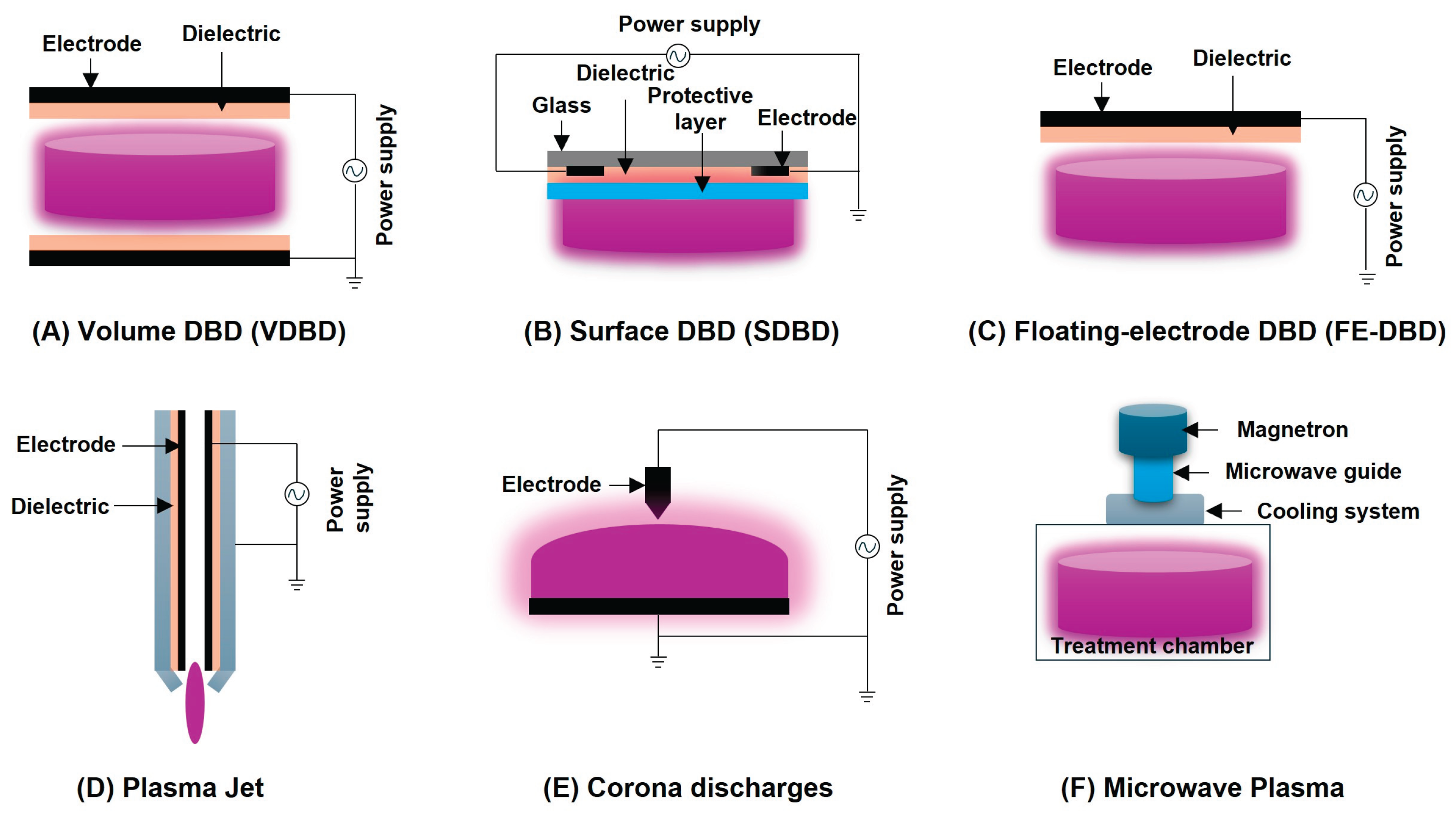
Figure 2.
Summary of the role of plasma in plant resistance to environmental stress.
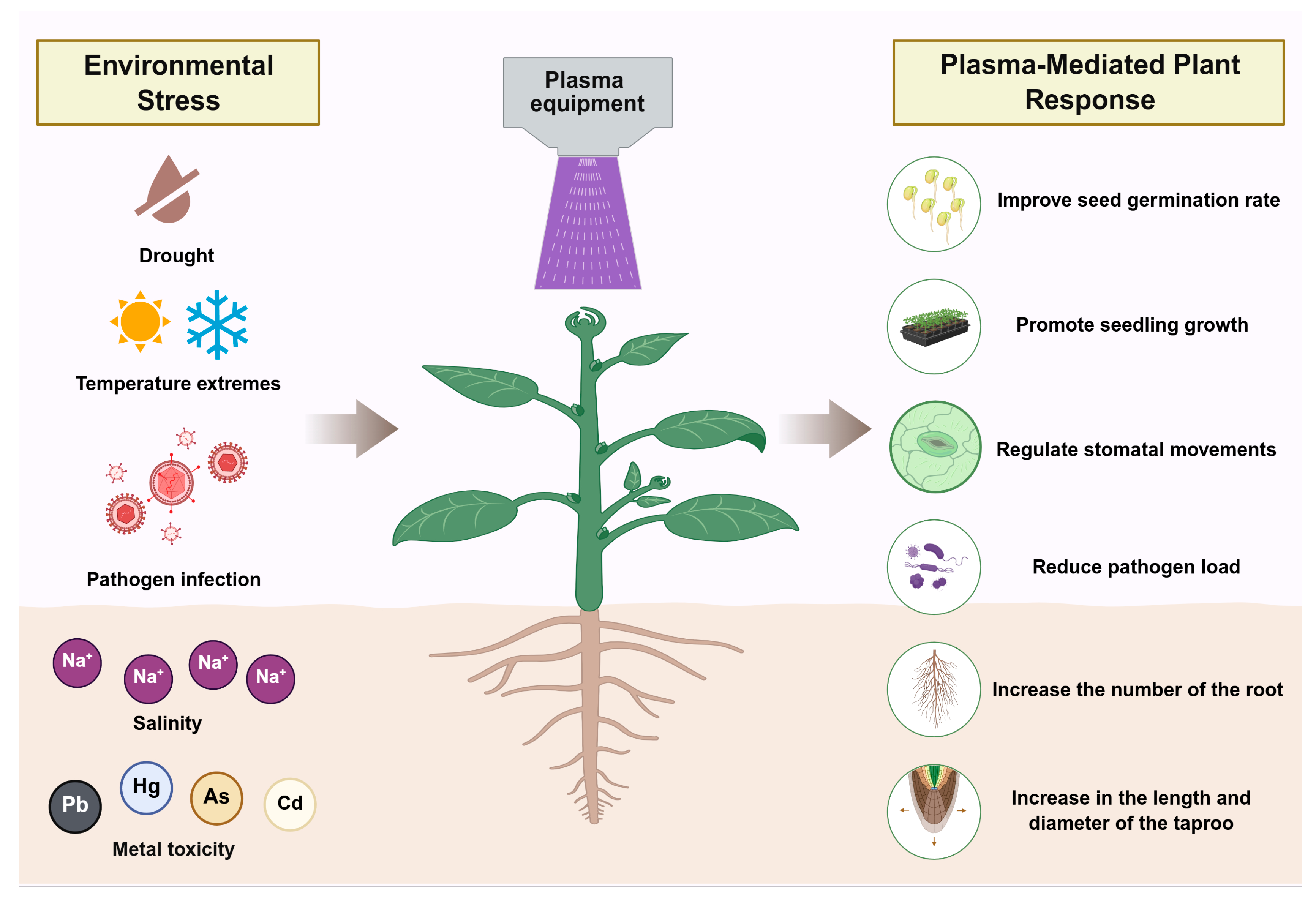
Figure 3.
Summary of the role of plasma in animal resistance to environmental stress.
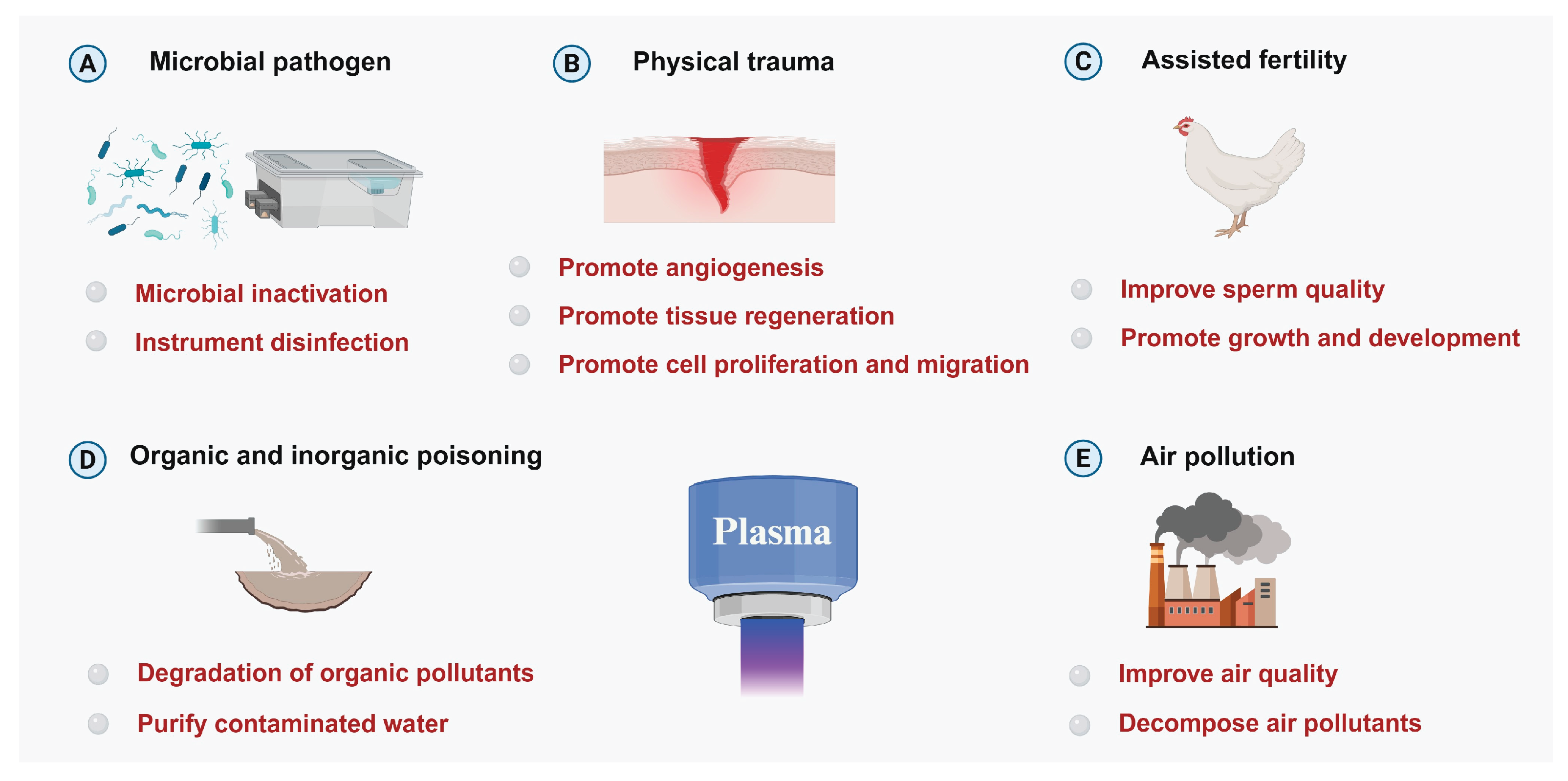
Figure 4.
Schematic illustration of plasma-mediated mechanisms in plants and animals under environmental stress.
Figure 4.
Schematic illustration of plasma-mediated mechanisms in plants and animals under environmental stress.
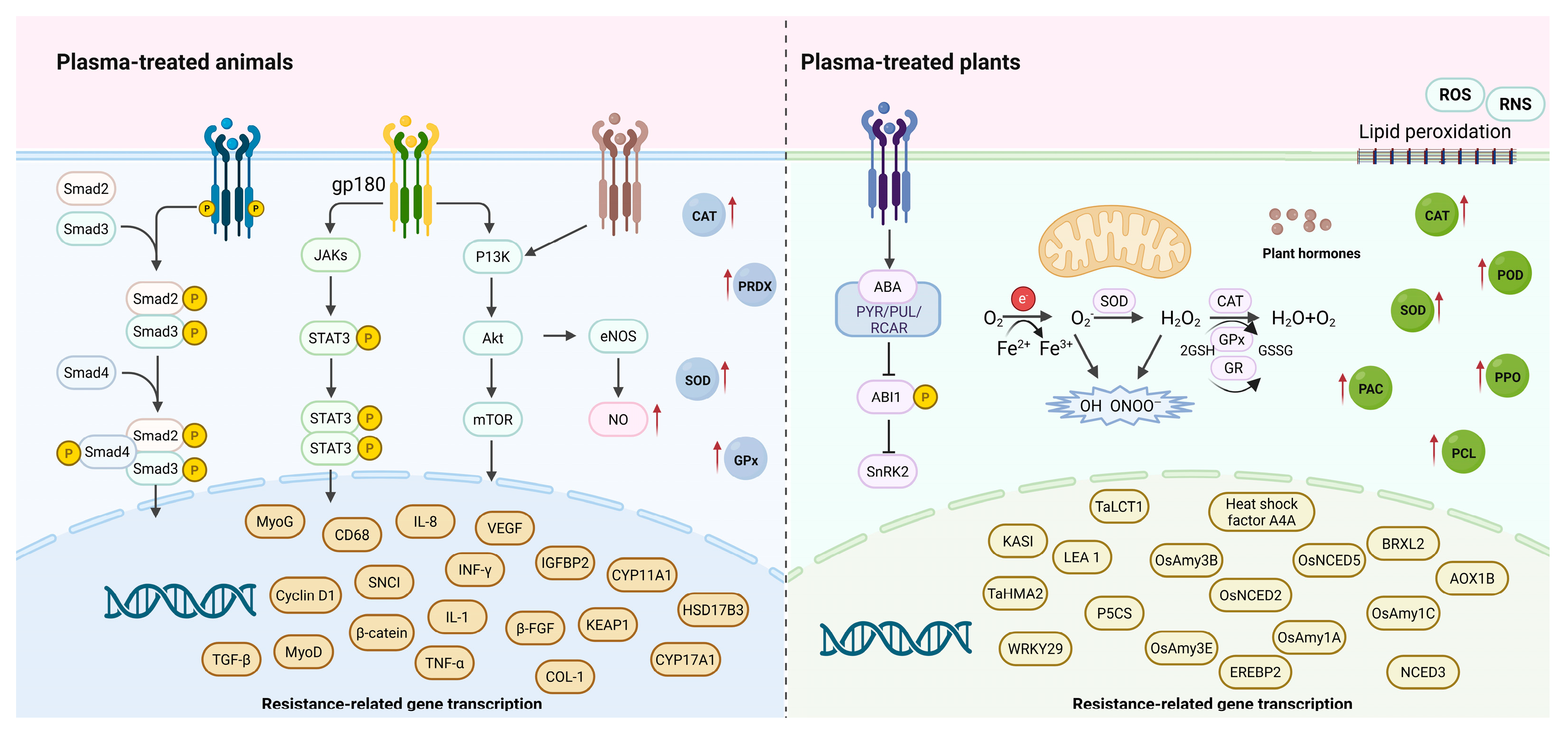

Table 1.
Summary of tolerance to stresses and underlying mechanisms in plants by atmospheric pressure non-thermal plasma.
Table 1.
Summary of tolerance to stresses and underlying mechanisms in plants by atmospheric pressure non-thermal plasma.
| Stress | Plant | Type of plasma (Parameters) |
Effects on plants and Mechanisms (Antioxidant system, Defense genes, Signaling, Physiology and hormones) |
Ref. |
|---|---|---|---|---|
| Drought | Rapeseed (Brassica napus L.) |
Capacitive coupled plasma (CCP, 13.56 MHz, 100 W) |
|
[39] |
| Wheat seeds (Xiaoyan 22) | Atmospheric dielectric barrier discharge plasma (13.0 kV, 50 Hz, Air, 4 min) |
|
[40] | |
| Wheat seeds | High-voltage electrical discharge (HVED, 30 k, 30 Hz, 30s, 2 cm ) |
|
[41] | |
| Barley seeds (Hordeum vulgare L.) | Dielectric barrier discharge plasma (8.6 kV, 1 kHz, 5.3 W, 6.5 mA, Air, 3 min) |
|
[42] | |
| Licorice seeds (Glycyrrhiza) | Surface dielectric barrier discharge (SDBD, 20 kV, 6.2 kHz, Air and argon 4.0 L/min, 5 min) |
|
[43] | |
| Salinity | Wheat (Triticum aestivum L.) |
Non-thermal Plasma |
|
[44] |
| Rice (Oryza sativa L.) |
Cold plasma |
|
[45] | |
| Wheat seeds | High-voltage electrical discharge (HVED, 30 kV, 30 Hz, 30s, 2 cm) |
|
[41] | |
| Rice (Oryza sativa L.) |
Argon non-thermal plasma (15Kv, 120s, Argon,) |
|
[46] | |
| Cowpea seeds | A low-pressure capacitively coupled non-thermal plasma (CCP-NTP, 250 V, 13.56 MHz RF power, Air, 1.0 and 2.0 min) |
|
[47] | |
| Prosopis koelziana | Dielectric Barrier Discharge (DBD, 10 kV, Air, 0-10 min) |
|
[48] | |
| Temperature extremes | Cotton seed | Dielectric-barrier discharge (38 kV, 1 kHz, Air, 3 min; 11 kV, 1 kHz , argon, 27 min) |
|
[49] |
| Tomato seedlings | Cold plasma (CP) |
|
[50] | |
| Rice Seeds (Oryza sativa L.) | Dielectric barrier discharge device |
|
[51] | |
| Barley seeds (Hordeum vulgare L.) | Dielectric barrier discharge plasma (8.6 kV, 1 kHz, 5.3 W, 6.5 mA, Air, 3 min) |
|
[42] | |
| Rice Seeds (Oryza sativa L.) | Dielectric barrier discharge plasma (13.9 kV, 15.0 kV,19.7 kV, Argon, 5 L/min, 30s) |
|
[52] | |
| Metal toxicity | Wheat seeds (Triticum aestivum L.) | Low pressure dielectric barrier discharge (5 kV, 4.5 kHz, 45 W, Ar/ Air gas mixture) |
|
[53] |
| Maize (Zea mays L.) | PAW generated by a transient spark discharge (TS, 11–13 kV, 1.5–3 kHz, 3 A, 20 mL of water was exposed to plasma for 20 min) |
|
[54] | |
| B. pilosa, S. nigrum, and T. repen | Atmospheric glow discharge plasma (100 W,500 W, 60 s) |
|
[55] | |
| Water spinach seeds (Ipomoea aquatica) | Atmospheric pressure plasma jet (3.0 kV, 16 kHz, 60 W, Air 10 L/min) |
|
[56] | |
| Wheat (Triticum aestivum L.) | Cold plasma |
|
[57] | |
| Soybean (Glycine max) | High-voltage atmospheric cold plasma (Plasma-activated water (PAW, 100 mL at 30, 50, and 70 kV for 0, 3, 5, and 7 min) |
|
[58] | |
| Pathogen infection | Tomato seeds (Bacterial wilt) |
Capacitively coupled plasma (CCP, 13.56 MHz, 80 W, 15 s) |
|
[25] |
| Broccoli seed | Corona discharge plasma jet (CDPJ) |
|
[30] | |
| Rice seedling (Bakanae disease) |
Atmospheric plasma 20 kV, 10 kHz, Air 16 L min−1, 10 cm |
|
[59] | |
| Tomato plants (Bacterial leaf spot) |
PAW generated by Cold atmospheric pressure plasma (CAP, 20 kV, 1 kHz, Air, 80 ml of sterile distilled water was treated) |
|
[60] | |
| Maize (Zea mays L.), narrow-leaved lupine (Lupinus angustifolius L.) and winter wheat (Triticum aestivum L.) | Low-pressure plasma |
|
[61] | |
| Arabidopsis thaliana seedlings | Atmospheric pressure cold plasma (APCP) |
|
[62] | |
| Sweet basil | Cold plasma (13 kV, 28.8 kHz, Helium, 5 L/min, 5,10,15 min) |
|
[63] | |
| Arabidopsis thaliana (Cucumber mosaic virus strain yellow (CMV(Y)) | Plasma-treated gas, N2O5 (0 s, 10 s, 20 s, 30 s, 40 s, 60 s, 2 min, or 5 min) |
|
[64] | |
| Cucumis sativus, Pisum sativum, and Vigna radiata | Atmospheric pressure plasma jet (APPJ, 170 Hz, a duty cycle of 25%, Helium 4.5 L/min.) |
|
[65] |
Table 2.
Summary of tolerance to stresses and underlying mechanisms in animals by atmospheric pressure non-thermal plasma.
Table 2.
Summary of tolerance to stresses and underlying mechanisms in animals by atmospheric pressure non-thermal plasma.
| Stress | Animal | Type of plasma | Effects on animals and Mechanisms (Antioxidant system, Defense genes, Signaling) |
Ref. |
|---|---|---|---|---|
| Rat (Scratch wound healing) |
N2-generated non-thermal plasma (NTP) |
|
[74] | |
| BALB/c mice (Skin wounds) |
Low-temperature plasma (LTP) |
|
[75] | |
| Human (Nasal mucosal injury) |
Non-thermal plasma treated solution (NTS, 3~4 kV, 25 kHz, nitrogen (N2) gase, 10, and 30 s, 4 cm) |
|
[76] | |
| Rat (Cutaneous wound) |
Helium/argon cold atmospheric plasma jet (He/Ar-CAPJ, 6.5 kV, He and Ar were 5 and 0.5 L/min, 15 mm) |
|
[77] | |
| Physical trauma | Rat (Cutaneous wound) |
Non-thermal plasma jet (6 kV, 12 kHz, 10 W, Helium gas 8 L/min,1 min, 3–4 cm |
|
[78] |
| Male mice (Diabetic patient's wound) |
Cold atmospheric pressure plasma (CAPP) |
|
[79,80] | |
| New Zealand white rabbits (Bone defect) |
Non-thermal atmospheric pressure plasma (NTAPP, 10 kV, 33 kHz, 0.47 W, Helium gas 1.5 L/min, 10 mm) |
|
[81] | |
| Rat (Nerve damage) |
Non-thermal atmospheric pressure plasma (NTP, 3 kV, Argon, 2.0 L/min, 5 min) |
|
[82] | |
| Mice (Diabetic wounds) |
Non-thermal atmospheric pressure plasma jet (APPJ, 18 kV, 17 kHz, Argon, 0.3 L/min) |
|
[83] | |
| Human (Physical trauma) |
Cold Atmospheric plasma (CAP) |
|
[84] | |
| Mice (Skin wounds) |
Low-temperature cold plasma (LTCP, 0–10 kW) |
|
[85] | |
| Fertility and reproductive health | Chicken sperm | Non-thermal dielectric barrier discharge plasma (27.6kV, 60 Hz, Argon2 L/min, 4 min) |
|
[86] |
| Chicken embryonic | Non-thermal dielectric barrier discharge plasma (DBD, 11.7 kV, 16.4 kV, 22.0 kV, 27.6 kV) |
|
[87] | |
| Human sperm | Dielectric Barrier Discharges (DBD) plasma |
|
[88] | |
| Chicken sperm | Non-thermal dielectric barrier discharge plasma (2.81 W for 2 min) |
|
[89] |
Table 3.
Regulation of harmful microorganisms and pollutants to humans and animals by atmospheric pressure non-thermal plasma.
Table 3.
Regulation of harmful microorganisms and pollutants to humans and animals by atmospheric pressure non-thermal plasma.
| Stress | Stress type | Type of plasma | Effects of plasma | Ref. |
|---|---|---|---|---|
| Harmful microbes | Staphylococcus aureus (MRSA), vancomycin-resistant enterococci (VRE), extended-spectrum-β-lactamase (ESBL)-producing Escherichia coli, and Acinetobacter baumannii | Cold air pressure plasma single jet (2.5 kV, 8 kHz, 12 L/min, 0-90s, 1cm) and multijet cold plasma |
|
[90] |
| Pseudomonas aeruginosa, Escherichia coli, and Vibrio parahaemolyticus, Listeria monocytogenes and Staphylococcus aureus | Dielectric barrier discharge cold atmospheric plasma ( Argon/oxygen mixture gas, 5 min) |
|
[91] | |
| Listeria monocytogenes, Escherichia coli, Pectobacterium carotovorum, sporulated Bacillus atrophaeus | Plasma-processed air (PPA) and plasma-treated water (PTW) (2.45 GHz, 1.1 kW, Air 18 L/min, 0-5 min) |
|
[92] | |
| Airborne viruses: from MS2 to coronavirus | Non-thermal plasmas (NTPs) and Dielectric barrier discharge (DBD) |
|
[93,94] | |
| Herpes simplex virus type 1 (HSV-1) | Non-thermal plasma (NTP) |
|
[95] | |
| Organic and inorganic poisoning | Pyrene contaminated soil | Double dielectric barrier discharge plasma (35.8 kV, 0.85 L/min, Air, Nitrogen and Argon) |
|
[96] |
| Biotoxin patulin | Low-temperature discharge plasma (12 kV, 16 kV, 18 kV, 30 min) |
|
[97] | |
| Synthetic textile dyes | Multi-electrode dielectric barrier discharge (MEDBD) plasma (15% duty cycle, 40 min) |
|
[98] | |
| 4-nitrophenol | Argon and air-mixed argon plasma jets (5.9 kV, 31.3 kHz, 350 sccm, 0.18 W and 0.25 W) |
|
[99] | |
| PFAS (Contaminated water in different matrices) |
Non-thermal plasma at atmospheric pressure (NTP APPJ,10 min) |
|
[100] | |
| Aflatoxin B1 | Cold Atmospheric Pressure Plasma (DBD, 5 kV, 55 kHz, 240 W/Air, nitrogen, argon, and nitrogen + argon 10 L/min, 3 cm) |
|
[101] | |
| Waste gas streams | Nonthermal atmospheric pressure plasmas |
|
[102] | |
| Built environment | Non-thermal plasma (NTP (Air, 0.1-0.6 W, 0.2-2 m3/h, 10 min)) |
|
[103] | |
| Toluene | Catalytic non-thermal plasma (10.67–13.20 kV, 20 kHz, 44 W, 60 min) |
|
[104] |
Table 4.
Comparative efficacy of different plasma types across applications in plants and animals.
| Stress | Type of plasma | Plasma control factor | Outcome | Parameters of control factor | Efficacy | Ref. | |
|---|---|---|---|---|---|---|---|
| Organic and inorganic poisoning | DBD reactor (Air, 10 min) | Power | Removal efficiency of HCHO | 0.1 W | 45% | [103] | |
| 0.2 W | 66% | ||||||
| 0.3 W | 72% | ||||||
| 0.4 W | 88% | ||||||
| 0.5 W | 90% | ||||||
| 0.6 W | 97% | ||||||
| Gas flow rate |
2 m3/h | 28% | |||||
| 1.5 m3/h | 45% | ||||||
| 0.8 m3/h | 64% | ||||||
| 0.6 m3/h | 73.1% | ||||||
| 0.4 m3/h | 81.3% | ||||||
| 0.2 m3/h | 83.7% | ||||||
| DBD configuration reactor (13.20 kV, 20 kHz, 44 W, 60 min) | Gas flow rate |
Removal of HCHO in air | 30 NL/h | 96% | [104] | ||
| 20 NL/h | 97% | ||||||
| 10 NL/h | 97% | ||||||
| Gas composition | Bioaccessibility of Aflatoxin B1 | Air | 5.22% | [101] | |||
| Nitrogen | 38.17% | ||||||
| Argon | 54.38% | ||||||
| Nitrogen + Argon | 21.48% | ||||||
| Fertility and reproductive health | Non-thermal DBD plasma (20s) | Voltage | Sperm viability | 11.7 kV | 85.11% | [32] | |
| 16.4 kV | 77.33% | ||||||
| 22.0 kV | 71.65% | ||||||
| 27.6 kV | 65.84% | ||||||
| Sperm motility | 11.7 kV | 45.42% | |||||
| 16.4 kV | 35.92% | ||||||
| 22.0 kV | 31.55% | ||||||
| 27.6 kV | 24.38% | ||||||
| Non-thermal DBD plasma (11.7 kV) | Treatment time | Sperm viability | 10 s | 85.06% | |||
| 20 s | 85.11% | ||||||
| 40 s | 84.16% | ||||||
| 60 s | 76.26% | ||||||
| 80 s | 66.23% | ||||||
| Sperm motility | 10 s | 42.17% | |||||
| 20 s | 45.42% | ||||||
| 40 s | 42.36% | ||||||
| 60 s | 30.67% | ||||||
| 80 s | 25.58% | ||||||
| Salt stress | DBD instrument (10 V, Air) | Treatment time | 0 mM NaCl |
Increase in seed germination percentage | 6 min | 25% | [48] |
| 8 min | 56% | ||||||
| 10 min | 45% | ||||||
| 100 mM NaCl |
6 min | 23% | |||||
| 8 min | 56% | ||||||
| 10 min | 18% | ||||||
| 200 mM NaCl |
6 min | 14% | |||||
| 8 min | 47% | ||||||
| 10 min | 11% | ||||||
| 100 mM NaCl |
Decreased lipid peroxidation | 6 min | 22% | ||||
| 8 min | 37% | ||||||
| 200 mM NaCl |
6 min | 38% | |||||
| 8 min | 50% | ||||||
| 100 mM NaCl |
Decrease in proline levels | 6 min | 20% | ||||
| 8 min | 40% | ||||||
| 200 mM NaCl |
6 min | 35% | |||||
| 8 min | 50% | ||||||
| Salt stress | CCP-NTP reactor (250 V, 13.56 MHz, Air) | Treatment time | Improvement of acid detergent fiber degradability | 1 min | 65.63% | [47] | |
| 2 min | 60.89% | ||||||
| Physical trauma | Microplasma jet (10 kV, 33 kHz, 0.47 W, Helium gas 1.5 L/min, 10 mm) | Treatment time | Average occupancy of the defect site | 5 min | 67% | [81] | |
| 10 min | 83% | ||||||
| 15 min | 70% | ||||||
| F. oxysporum infection | DBD plasma (5.5 kV, 38 kHz, 9 W, Air) | Number of plasma treatments | Decrease in disease incidence percentage | 5 treatments | 40.0% | [136] | |
| 10 treatments | 33.8% | ||||||
| 15 treatments | 21.0% | ||||||
| B. cinerea infection | 5 treatments | 44.6% | |||||
| 10 treatments | 43.2% | ||||||
| 15 treatments | 25.6% | ||||||
| A. alternata infection | 5 treatments | 44.4% | |||||
| 10 treatments | 33.2% | ||||||
| 15 treatments | 25.6% | ||||||
Disclaimer/Publisher’s Note: The statements, opinions and data contained in all publications are solely those of the individual author(s) and contributor(s) and not of MDPI and/or the editor(s). MDPI and/or the editor(s) disclaim responsibility for any injury to people or property resulting from any ideas, methods, instructions or products referred to in the content. |
© 2026 by the authors. Licensee MDPI, Basel, Switzerland. This article is an open access article distributed under the terms and conditions of the Creative Commons Attribution (CC BY) license (http://creativecommons.org/licenses/by/4.0/).
Copyright: This open access article is published under a Creative Commons CC BY 4.0 license, which permit the free download, distribution, and reuse, provided that the author and preprint are cited in any reuse.


