

Submitted:
01 June 2026
Posted:
02 June 2026
You are already at the latest version
Abstract
The rapid increase in electric vehicle (EV) usage requires scalable and flexible charging solutions that minimize user effort and infrastructure constraints. One such solution is robot-based EV charging, which automates the charging process to increase convenience and ease of use. This work investigates the feasibility of deploying mobile charging robots in selected parking scenarios, with a focus on user acceptance and the economic viability from the perspective of infrastructure operators. The research is guided by three objectives: identifying user requirements; modelling realistic charging behaviour; and evaluating operational strategies for mobile charging fleets, including fleet sizing, impact of nearby charging infrastructure, and pricing approaches. A dedicated user survey and a predictive behavioural model informed the simulation studies used to assess optimal deployment strategies. The results suggest that, while mobile charging robots can enhance the user experience and increase infrastructure flexibility, their effectiveness depends on user behaviour, temporal demand patterns, and well-designed interaction and pricing mechanisms. These findings provide a basis for evaluating the integration of mobile charging robots as a complement to stationary charging infrastructure.
Keywords:
electric vehicles
; mobile charging robot
; user requirements
; charging behaviour modelling
1. Introduction
The continued growth of electromobility requires an increase in charging infrastructure. Although stationary charging stations form the backbone of today’s charging ecosystem, it is not practical or economical to deploy them everywhere. Temporary venues, leased properties, older buildings with limited grid capacity, and sites with highly fluctuating demand often make fixed installations impractical or inefficient. To ensure reliable access to charging in such contexts, flexible and complementary infrastructure solutions are needed.
1.1. Mobile Charging as a Complementary Infrastructure
Mobile charging solutions extend conventional infrastructure by providing energy where and when it is needed, without permanent installation. These solutions range from portable charging units and truck-mounted chargers to vehicle-to-vehicle energy transfer concepts [1]. Among these, mobile charging robots represent the most advanced approach. They autonomously navigate to parked vehicles, establish a conductive connection, and manage the charging process without human intervention. This enables highly flexible deployment, reduces user effort, supports barrier-free access, and provides a viable charging solution for future automated and driverless vehicle environments.
Typical application scenarios for mobile charging robots include temporary high-demand locations, grid- or building-constrained sites, and parking facilities with strongly fluctuating charging demand. At the same time, mobile charging robots introduce new challenges, such as high mechanical complexity, limited on-board energy capacity, and the need for intelligent fleet coordination.
1.2. Existing Approaches and Research
Several mobile charging robot concepts and prototypes have been presented by industry and research, demonstrating technical feasibility and a wide range of design approaches. Examples (cf. Figure 1) include Volkswagen’s autonomous robot that deploys mobile battery units to parked vehicles [2], adapter-based solutions such as Mob-Energy’s “Charles” [3] or EVAR’s “Parky” [4], as well as mobile charging platforms like “Ziggy” [5] and “Autev One” [6]. While these systems differ in autonomy level, integration depth and charging interfaces, most remain at the prototype or pilot stage and are not yet widely deployed. Within the scope of this work, the Gini mobile charging robot was developed and commissioned, providing a basis for the investigations presented in this work [7,8].
In parallel, academic research has explored the operation and optimisation of mobile charging solutions, including robot-like systems in parking facilities [9,10,11,12]. Studies show that mobile charging robots can improve system throughput, reduce waiting times, and increase user convenience, particularly in structured or off-peak scenarios, though performance strongly depends on arrival patterns and coordination strategies. Concepts range from station-bound robots like Parky or Charles to circulating battery trucks providing V2V services [13,14].
1.3. Research Gaps and Contribution
Despite growing interest, research into the operational and economic viability of robot fleets in representative parking scenarios from an operator’s perspective, as well as into EV users’ expectations and willingness to adopt robotised charging, remains scarce. In particular, there is limited understanding of user requirements and acceptance of robot-based charging. Furthermore, there is a lack of understanding EV user’s charging behaviour in realistic parking scenarios, and behavioural models that capture how and whether users decide to charge under varying contextual and economic conditions. Furthermore, few studies explicitly integrate user behaviour into simulations of mobile charging robot fleets.
This paper addresses these gaps by making three main contributions: First, user requirements and acceptance of robot-based charging are derived from a dedicated survey. Second, a data-driven charging behaviour model is developed to mathematically describe user’ charging decisions across different situations. Third, the derived requirements and behavioural model are integrated into a simulation framework to analyse the interaction between mobile charging robots and EVs in representative parking scenarios. The results provide insights into user-centred design requirements and support the evaluation of mobile charging robots as a complement to stationary charging infrastructure.
2. User Requirements for Robot-Based Charging
To address the first research gap, an anonymous online survey was conducted between December 2024 and February 2025. The survey aimed to assess user requirements and gain an understanding of users’ perspectives on robot-based charging. To this end, the questionnaire addressed their attitudes towards electromobility and robotic charging, their preferred usage scenarios and interaction concepts, and their preferred pricing models. Following data cleaning, 209 valid responses were retained, primarily from Germany. The sample covered all adult age groups and exhibited a relatively high level of education and income. However, the sample is not fully representative of the general population, as it is biased towards respondents from Germany with comparatively higher education and income levels. Therefore, the findings should be interpreted as indicative rather than fully generalizable to all user groups. The dataset is published in [15].
2.1. Attitudes towards Electromobility and Robotic Charging
Participants were first asked about their experiences with and attitudes towards electromobility, so that their subsequent assessments of robot-based charging could be categorised meaningfully. Overall, 80 % of respondents reported a positive or very positive attitude towards electromobility, while 14 % were undecided and 6 % were negative. Supporters were almost equally divided between those who regularly drive an electric car and those who do not drive or do not think they need a car, although of the latter, 52 % would consider using an EV if needed. Key concerns among sceptics include high costs, limited charging infrastructure, longer refuelling times, and the sustainability of electricity production and batteries. Respondents who expressed a positive attitude towards electromobility and who use or would use an EV were then asked for their opinion on robot-based charging. As shown in Figure 2, the responses indicate that the participants’ overall attitude towards charging robots is largely positive, with moderate to very high interest reported by the majority. Furthermore, approximately half of the respondents expect robotic charging to be relevant in the future (cf. Figure 3). Key challenges include the risks of misuse, damage and liability, as well as high costs, space requirements, efficiency, and environmental impact. There is also a need for standardised interfaces. Despite these concerns, 80 % of respondents with a positive or neutral view could imagine using a charging robot.
2.2. Preferred Usage Scenarios and Interaction
As shown in Figure 4, robot-based charging is favoured primarily for long parking durations, such as overnight parking, workplace parking, and daily car parking. It is considered less suitable for short-term parking situations. Users clearly prefer highly automated interaction concepts, where charging is initiated by the vehicle itself. If user interaction is required, smartphone applications and in-vehicle infotainment systems are favoured. Information that must be provided to users during charging sessions includes the vehicle’s current State of Charge (SoC), remaining charging time, and status notification messages.
2.3. Pricing and Dynamic Tariffs
Dynamic pricing, similar to petrol and fuel pricing, can help meet the needs of the system by incentivising people to use the system when it is most convenient for them. Therefore, of the 172 users who had previously indicated that they were open to using mobile charging robots, attitudes towards dynamic pricing models for charging robots were surveyed. The results in Figure 5 show that approximately half of potential users are open to dynamic pricing models, while a further quarter is undecided. Acceptance is conditional on transparency, bounded price ranges, and predictable update intervals. Price changes during an active charging session are largely rejected. On average, price fluctuations of up to 0.14 €/kWh are considered acceptable, with adjustments preferably limited to hourly or less frequent intervals.
2.4. Key Implications
The results indicate acceptance potential for robot-based charging, particularly for long-duration parking scenarios. Fully automated interaction, minimal user effort, and transparent, stable pricing emerge as key design requirements. When these conditions are met, robot-based charging is perceived as a promising complement to existing charging infrastructure. However, it should be noted that the results are based on a self-selected online sample with a regional and socio-demographic bias. Consequently, the findings may not fully generalize to broader engaged populations.
3. Data-Driven Modelling of EV Charging Behaviour
In order to realistically model the interaction between EV users and charging robots in a car park, the behaviour of EV users when charging their vehicles must be modelled. Therefore, a data-driven model of user’s charging behaviour has been developed. The aim is to predict whether users will charge their vehicles and how much energy they will require in different contexts, taking into account technical and economic factors. A dedicated user study was conducted to generate empirical data on charging decisions in various scenarios. The resulting model, created from this dataset, is intended for integration into simulation-based evaluations of interactions between EVs and autonomous mobile charging robots.
3.1. Existing Studies on EV Charging Behaviour Modelling
Existing literature on EV charging behaviour studies predominantly relies on survey-based approaches and stated-choice experiments, particularly discrete choice experiments, to analyse user preferences and willingness to pay for different charging options [16,17,18,19,20,21,22,23]. In these studies, participants are typically presented with hypothetical charging scenarios that vary in attributes such as price, charging power, waiting time, and location. While these approaches allow for a systematic evaluation of economic and infrastructural factors, they are often based on simplified and purely textual representations of decision situations. More interactive study designs are only rarely applied.
3.2. User Study for Data Collection
To collect the required data on charging decisions for the user model, an interactive, web-based stated-choice experiment, as illustrated in Figure 6, was designed and conducted between July and October 2025. Participants were repeatedly presented with realistic charging scenarios, in which they were asked to imagine sitting in their EV and having the option to charge their vehicle at a charging station. They were then asked whether they would charge their vehicle and, if so, how much, which could be adjusted using a slider. These scenarios varied systematically in terms of charging price, charging power, available time, charger occupancy, remaining range, energy requirements for subsequent journeys, availability of alternative charging options in the surrounding area, time of day, payment responsibility, availability of home charging, and environmental conditions. Vehicle heterogeneity was modelled using real-world EV specifications, including battery capacity, consumption, and charging curves. After cleaning the data, the final dataset comprised 2,665 valid charging decisions from 224 participants. The dataset is published in [24].
3.3. Analysis of the Dataset
Correlation and regression analyses of the collected data indicate that charging behaviour is primarily influenced by situational and infrastructural factors rather than socio-demographic characteristics. The most influential factors are charging price, available time, charging power, charger occupancy, and the attractiveness of nearby alternative charging stations. The latter has the strongest negative effect on charged energy, particularly in non-targeted parking situations, where users primarily stop to charge and actively compare the available options. Vehicle-related energy needs, such as the required range for the next trip, have a weaker influence on charging decisions. Environmental conditions (e.g. weather) and socio-demographic variables (e.g. gender or income) show comparatively weak effects in the present dataset, though this result may be affected by sample composition and should not be over-interpreted. Higher charging power and longer available time are associated with increased charged energy, while higher prices reduce demand. Around 40 % of all scenarios result in no charging, highlighting the importance of explicitly modelling the decision not to charge.
3.4. Construction of the User Charging Behaviour Model
Having analysed the input dataset, the next step is to develop a predictive user model that will estimate how much energy users will demand in given situations.
3.4.1. Problem Definition and Model Concept
As mentioned, exploratory data analysis reveals that approximately two-fifths of scenarios result in no charging. Furthermore, deterministic regression models would average heterogeneous yet valid user behaviours, resulting in unrealistic mean predictions. In order to explicitly represent behavioural variability and the non-charging case, a probabilistic hurdle model has been adopted [25]. This consists of a binary classifier that estimates the probability of charging, and a probabilistic regressor that predicts the distribution of charged energy given that charging occurs. Together, these two components provide a joint probabilistic representation of user charging behaviour.
3.4.2. Model Selection and Workflow
Due to the small size of the dataset (2,665 observations), the variety of input feature types (numeric attributes such as charging price or available time, binary attributes such as charger occupancy, or categorical attributes with more than two elements such as time of day or weather conditions), and the need for probabilistic outputs that capture the nature of heterogeneous human charging behaviour, ensemble-based tree methods were chosen for both model components. These methods reliably perform with small datasets, handle mixed numerical and categorical inputs, and capture non-linear behavioural patterns. The modelling workflow comprises feature preparation, model training, and evaluation. The dataset is split into training (55 %), test (30 %), and holdout (15 %) sets. Hyperparameters are tuned via cross-validation within the training set. Binary classifiers are optimised for probabilistic accuracy, while conditional energy models are trained exclusively on charging events using distributional loss functions. Outlier removal is deliberately omitted, as extreme charging decisions reflect valid behavioural strategies rather than noise. The following ensemble-based tree models were evaluated: For the classification task, Light Gradient Boosting Machine (LGBM), Random Forest (RF), Categorical Boosting (CatBoost), Extreme Gradient Boosting (XGB), and Gradient Boosting (GB); and for the regression task, quantile-based variants of LGBM (LGBM_Quantile), Random Forest (RF_Distribution), CatBoost (CatBoost_Quantile), and XGBoost (XGB_Quantile).
3.4.3. Results and Evaluation
Among all evaluated model combinations, on the internal test set of the proposed model, a CatBoost classifier combined with a LGBM quantile regressor achieves the best overall performance. The model attains a Mean Absolute Error (MAE) of 14.86 kWh and explains 35.8 % of the variance, while producing well-calibrated 80 % prediction intervals. The binary charging decision is predicted with an accuracy of 76.5 %. Performance on the unseen holdout set is comparable, with a slight improvement, indicating good generalisation and no evidence of over-fitting. However, direct comparison of numerical performance metrics with related work is limited, as differences in dataset composition, feature availability, and modelling objectives substantially influence reported results. The observed level of explanatory power (R2 = 35.8 %) is consistent with the inherent difficulty of modelling human decision-making processes, where unobserved preferences and situational factors introduce irreducible uncertainty [26]. In this context, the MAE of 14.86 kWh and the classification accuracy of 76.5 % indicate a reasonable predictive performance for behaviourally driven energy demand modelling, particularly given the stochastic nature of charging decisions. Overall, the probabilistic evaluation confirms that the model provides realistic uncertainty estimates and robust charging probabilities, making it suitable for downstream simulation and infrastructure planning applications.
4. Interaction of EV Users and Mobile Charging Robots
Building on the user requirement analysis and the charging behaviour model developed in previous chapters, this chapter uses a simulation-based approach to model and analyse the interaction between EV users and mobile charging robots in realistic parking area scenarios. The impact of various system configurations, environmental conditions, and pricing strategies on operator profitability and user satisfaction is systematically evaluated. The overarching objective is to develop robust deployment strategies and guidelines for potential operators, ensuring economic viability while maintaining high service quality and user acceptance.
4.1. Simulation Framework
The basis for the presented analyses is provided by the open-source EV Charging Points Simulator [27,28], a simulator framework that models a parking area environment in which vehicle arrivals and departures, charging robot dispatch and routing, energy flows, and charging processes are modelled in discrete time steps. Empirically derived arrival distributions, vehicle charging power curves, and robot charging characteristics ensure that operational constraints and user behaviour are accurately represented. At each simulation step, the available free charging robots are assigned to waiting vehicles that are willing to charge, with priority given to those with the longest waiting times. Depleted robots are then routed to dedicated charging docks.
4.2. Scenario Design
The user survey on robot-based charging revealed that long-term parking is the preferred option for charging robots. For example, this could be in a car park during the day, overnight, or during working hours. For the following analyses, two corresponding scenarios have therefore been defined.
The first is a City Car Park scenario, characterised by heterogeneous arrival times, short-to-medium and uncertain dwell periods, moderate energy demand, and a high density of competing public charging infrastructure. This setting represents overnight parking and longer stays in city centres, for example for shopping, leisure activities, dining or visiting hotels. In this context, user behaviour is predominantly opportunistic, with drivers frequently comparing multiple charging options based on attributes such as price, distance, expected waiting time, and convenience. Consequently, charging decisions are highly flexible and price-sensitive, and the mobile charging service must compete directly with a dense network of public chargers.
The second scenario is a Workplace Car Park in an industrial environment, characterised by highly synchronised arrivals in the morning, vehicles parked for a full working day, and mostly simultaneous departures in the afternoon. Energy demand per vehicle is comparatively high, as some employees travel longer distances to work. Alternative charging options in the surrounding area are scarce. This scenario reflects targeted charging behaviour, where users deliberately rely on on-site charging to meet predictable daily mobility needs. Here, convenience and reliability dominate the decision-making process, while price sensitivity is reduced – partly due to the widespread presence of employer-paid charging schemes.
To enable systematic comparison, both scenarios are simulated under three demand levels (50, 100, and 200 EVs per day visiting the car park), each based on one representative summer and one representative winter day, with results averaged across both conditions. The charging price will initially be set to 0.50 €/kWh.
4.3. Evaluation Metrics
The system performance is assessed using two Key Performance Indicators (KPIs): The first is the daily profit per visiting EV (), which quantifies the economic viability of the charging service by balancing charging revenues against all deployment-related costs. Revenues are derived from the energy delivered to EVs under the applied tariff, while costs include electricity procurement, as well as investment, depreciation, and maintenance of the charging robots and their recharging stations. Cost assumptions are based on market prices of conventional EVs of comparable size, supplemented by additional surcharges for autonomous driving capabilities, infrastructure requirements, and ongoing operating and maintenance expenses. These cost assumptions represent a baseline scenario for the techno-economic evaluation. Alternative cost scenarios may affect the absolute level of economic performance, however, a detailed sensitivity analysis of cost parameters would be beyond the scope of this study. All capital investments are amortised over an assumed operational lifetime of eight years, allowing for a realistic estimation of long-term economic performance.
The second metric, the user satisfaction S, is modelled as a composite metric that reflects both the perceived quality of charging and economic satisfaction. Users who reject charging under the given conditions are considered dissatisfied and contribute no satisfaction. For users who request charging, satisfaction depends on two factors: the extent to which their energy demand is met, and a price-dependent adjustment that reflects users’ sensitivity to charging costs. Service fulfilment is represented by the fraction of the requested energy that is successfully delivered. Price perception is modelled as a linear adjustment relative to a reference tariff of 0.50 €/kWh, where satisfaction decreases or increases proportionally with deviations from the reference price. This linear formulation provides a tractable first-order approximation of price sensitivity in the absence of more detailed behavioural calibration data. Alternative formulations, such as logarithmic or sigmoid utility functions, can capture diminishing sensitivity or saturation effects but require additional empirical calibration, which is beyond the scope of this study. The resulting overall user satisfaction metric captures both technical service quality and economic acceptance, providing a holistic evaluation of system performance from the user’s perspective.
4.4. Fleet Parameter Analysis
Having established the framework of the simulation environment, the scenarios, and the KPIs, the first analytical step involves investigating how choices regarding fleet design influence system performance. Specifically, the number of charging robots and recharging stations, as well as the battery capacity of each robot, are varied systematically. The concrete values under test for these parameters are summarized in Table 1. The ratio denotes the number of charging stations per robot. The corresponding absolute number of charging stations is computed as . The aim of the analysis is to identify configurations that strike a favourable balance between maximising profit and ensuring adequate user satisfaction for both scenarios.
4.4.1. Results for City Car Park Scenario
The City Car Park scenario represents a compact service area with short driving distances and homogeneous demand throughout the day, characterised by frequent, short-term parking visits and moderate energy requirements per EV. Figure 7 shows profit versus user satisfaction for all fleet parameter combinations, highlighting the knee points for three demand levels (50, 100, 200 EVs/day). Knee points, marked with an “X”, are identified using a weighted score with 80 % weight on profit and 20 % on user satisfaction, reflecting a profit-oriented evaluation perspective while still accounting for user acceptance.
At low demand (50 EVs/day), user satisfaction reaches more than 60 %, while profit drops sharply for larger fleets due to fixed costs. Increasing demand compresses the Pareto frontier: at 200 EVs/day, user satisfaction remains below 40 %, reflecting high utilisation and inevitable service degradation.
Table 2 summarises the fleet parameters corresponding to the identified knee points at each demand level. denotes the total number of EVs entering the parking area, is the number of EVs submitting a charging request above a 1 kWh threshold, and counts the EVs whose charging requests have been confirmed by the robot’s dispatch algorithm. denotes the total profit gained by the robot fleet per day. The results show that the number of robots and stations increases roughly linearly with demand, while the smallest battery size of 35 kWh suffice at all levels. This suggests that fleet size has greater impact on service performance than battery capacity, as more moderately powered robots better handle fluctuating demand. These configurations provide a balanced trade-off between profit and user satisfaction, optimising robot utilisation while maintaining satisfactory service levels, and are therefore adopted as the reference fleet parameters for all subsequent analyses of the City Car Park scenario.
4.4.2. Results for Workplace Scenario
The Workplace scenario features a highly concentrated arrival pattern, with most EVs entering the parking area within a short morning window and remaining parked for several hours. Charging requests must therefore be fulfilled within this fixed time frame, creating distinct operational constraints compared to the City Car Park scenario.
Figure 8 shows profit versus user satisfaction for all fleet parameter combinations, highlighting knee points for three demand levels (50, 100, 200 EVs/day). As in the City Car Park scenario, knee points, marked with an “X”, are identified using the same weighted scoring approach. Compared to the City Car Park scenario, profit remains consistently positive, reflecting a more economically stable regime. However, user satisfaction declines for higher demand levels, as more concentrated demand and larger per-vehicle energy requirements increase fleet load and limit achievable service performance, even for Pareto-efficient configurations.
Table 3 summarises the fleet parameters corresponding to the identified knee points. In general, knee-point configurations show a higher number of robots compared to the City Car Park scenario, reflecting greater per-vehicle energy demand and concentrated morning arrivals. The number of recharging stations remains constant at 5, sufficient to replenish robots over the long parking duration. Battery sizes remain at 35 kWh, indicating that increasing fleet size is more effective than enlarging battery capacity. These configurations balance profit and user satisfaction while ensuring timely service and are adopted as reference fleet parameters for all subsequent Workplace scenario analyses.
4.5. Influence of Competing Charging Infrastructure
Users compare available charging options with nearby alternatives, considering distance, charging power, duration, and charging price. After identifying knee-point fleet configurations, this section assesses their robustness under varying levels of external competition for both City Car Park and Workplace scenarios.
4.5.1. Methodology
Fleet designs are fixed at the knee-point values identified previously. Simulations are repeated three times, varying only the relative attractiveness of surrounding public chargers to assess sensitivity to external competition. The score quantifies how attractive the most appealing nearby charging option is relative to the current station, incorporating distance, charging price, and expected charging duration. A value less than 1 indicates that alternatives are less attractive, a value of 1 indicates parity, and a value greater than 1 indicates more attractive alternatives. The initial values for the two scenarios are chosen to reflect different levels of public charging availability: a lower level with few public chargers () for the Workplace scenario, and a higher level with many surrounding public chargers () for the City Car Park scenario. To assess sensitivity to external competition, three levels of attractiveness are considered for each scenario: a reduced level (), the baseline level, and an increased level ().
4.5.2. Evaluation
Figure 9 summarise profit per EV and user satisfaction under these variations. In the City Car Park scenario, increasing the attractiveness of nearby public chargers results in a modest decline in profit, with little impact on user satisfaction. This reflects the short dwell times, low energy demand, and high price sensitivity that are typical of urban parking environments, where users will readily switch to external chargers if they offer better value for money or convenience.
By contrast, no clear profit trend can be observed in the Workplace scenario as external charging alternatives become more attractive. User satisfaction also remains largely unaffected by external competition. This behaviour can be attributed to the dominance of convenience and fixed schedules: employees prioritise on-site charging to avoid additional travel time, and the fact that a substantial proportion of charging sessions are reimbursed by employers reduces individual price sensitivity.
In summary, sensitivity to external competition depends on parking behaviour and energy demand. Opportunistic, short-term parking (City Car Park) has a modest impact on profit, while targeted, long-duration parking (Workplace) shows no clear trend.
4.6. Pricing Strategy Analysis
Following the evaluation of physical system parameters and environmental influences, the analysis turns to pricing strategies as a purely economic control lever. First, fixed tariffs are examined for both scenarios to identify price levels that optimally balance profitability and user satisfaction. Subsequently, dynamic pricing schemes are evaluated to assess whether temporal price differentiation can further enhance system performance.
4.6.1. Fixed Pricing
To assess the impact of static tariffs, a series of simulations with fixed charging prices was conducted for both scenarios, while keeping fleet configuration, demand, and environmental conditions constant. The resulting effects on profit per EV, user satisfaction, and average energy delivered per EV () are summarised in Figure 10 and Figure 11.
In the City Car Park scenario, profit initially increases with rising tariffs, reaching a maximum at a moderate price level of approximately 0.70 €/kWh. Beyond this point, higher prices lead to a pronounced decline in both user satisfaction and total charged energy, resulting in reduced overall profitability. This behaviour reflects the strong price sensitivity of urban users, who readily substitute the robot-based service with nearby public chargers when prices exceed moderate levels. Consequently, excessive tariffs significantly lower utilisation rates and system revenue.
In contrast, the Workplace scenario exhibits a higher optimal tariff level of approximately 0.75 €/kWh. User satisfaction consistently decreases as charging prices increase. However, the overall charged energy per EV remains relatively high compared to the City Car Park scenario, due to longer and more predictable dwell times and the higher energy demands associated with daily commuting. Long parking durations, predictable schedules, and widespread employer-paid charging schemes reduce users’ price sensitivity, allowing higher tariffs to be applied without substantially affecting utilisation, thereby supporting profit maximisation.
To derive a final tariff recommendation, a weighted performance metric was applied, assigning an 80% weight to profit and a 20% weight to user satisfaction. This reflects the dual objective of economic viability and long-term service acceptance. Based on this criterion, the optimal fixed tariff is determined as 0.70 €/kWh for the City Car Park scenario and 0.75 €/kWh for the Workplace scenario. Overall, the results confirm that workplace environments allow higher price levels due to greater convenience, longer dwell times, and reduced price sensitivity, whereas urban public settings require more moderate tariffs to preserve competitiveness and user acceptance.
4.6.2. Dynamic Pricing
Building on the optimal fixed tariffs identified previously, this subsection evaluates a demand-based dynamic pricing strategy, in which charging prices vary over time according to expected car park utilisation. As revealed by the user survey, user acceptance of charging tariffs is primarily governed by transparency, predictability, and price stability. Users require full disclosure of all price-determining factors and expect tariff structures to be easily understandable and communicated in advance. While dynamic pricing is generally accepted under these conditions, acceptable price variations are limited to an average spread of approximately 0.14 €/kWh, with strict requirements that adjustments must not affect ongoing charging sessions. Moreover, users favour infrequent and clearly announced updates, with hourly adjustments representing the upper tolerance threshold and coarser intervals being preferred.
Figure 12 illustrates representative price profiles for both scenarios. The mean daily price of the dynamic tariff is set equal to the corresponding optimal fixed tariff (0.70 €/kWh for City Car Park, 0.75 €/kWh for Workplace) to isolate the effects of temporal price variation from differences in overall price levels. The performance of the dynamic pricing strategy is evaluated against the fixed-price benchmarks previously identified, for both scenarios and across all considered demand levels. The results are shown in Figure 13.
In the City Car Park scenario, the demand-based dynamic pricing strategy does not substantially increase profits compared to the fixed-price benchmark, while user satisfaction remains similar or slightly lower. This outcome is primarily driven by strong price sensitivity in urban public parking environments. Short-term price increases during peak utilisation reduce charging demand, whereas lower off-peak prices fail to sufficiently compensate through increased usage. Additionally, relatively small price variations of only a few cents limit the overall impact. Consequently, dynamic pricing does not yield a net operational benefit in this scenario.
In contrast, the Workplace scenario exhibits higher profits under dynamic pricing, with only a minor decrease in user satisfaction (approximately 2 – 3 percentage points). This indicates that demand-based pricing is effective in environments with temporally concentrated demand and limited capacity. Dynamic tariffs shift flexible demand away from peak periods, reduce congestion, and increase charger utilisation. Lower price sensitivity further enables moderate price increases without substantially affecting demand, resulting in improved economic performance.
The observed profit increase raises the question of whether it reflects genuine efficiency gains or merely higher effective prices. While the fixed benchmark is based on daily average prices, dynamic pricing results in systematically higher prices during actual charging events. The effective charging price, i. e. the average price that users actually paid for charging, amounts to 0.71 €/kWh (City Car Park) and 0.79 €/kWh (Workplace), compared to daily averages of 0.70 €/kWh and 0.75 €/kWh, respectively. To isolate structural effects, a second benchmark is evaluated using these effective prices as fixed tariffs (cf. Figure 14). The results show that:
- City Car Park Scenario: Again, no significant differences between dynamic and fixed pricing remain, indicating negligible efficiency gains.
- Workplace Scenario: Higher profits persist under dynamic pricing, confirming genuine efficiency improvements through better demand allocation.
Finally, a comparison of the original fixed prices, the effective charging price as a fixed tariff, and the dynamic strategy (Figure 15) further shows no meaningful differences in the City Car Park scenario. In the Workplace scenario, however, dynamic pricing generates additional revenue (approximately 0.30 €/kWh per EV) compared to fixed pricing at the same price level, despite a slight reduction in user satisfaction.
Overall, the effectiveness of dynamic pricing is highly scenario-dependent. It does not provide advantages in the City Car Park scenario due to high price sensitivity and evenly distributed demand. In contrast, it yields benefits in the Workplace scenario, where demand peaks are pronounced. Here, dynamic pricing improves utilisation, reduces congestion, and increases profitability with only minor impacts on user satisfaction. However, successful implementation requires transparent communication, predictable tariff structures, and careful management of user acceptance.
5. Summary and Conclusions
This paper investigated the feasibility and operational potential of mobile charging robots as a flexible and scalable solution for automated EV charging in parking environments with limited fixed infrastructure. The study combined user-centred research, behavioural modelling, and simulation-based analyses to evaluate technical, economic, and acceptance aspects from both user and operator perspectives. Three key research gaps were addressed:
- 1.
- User Requirements and Acceptance: A survey revealed that mobile charging robots are generally well-received, especially among users with strong interest in electromobility. Convenience, automation, and barrier-free operation were major drivers of acceptance, while concerns related to reliability, liability, costs, and potential misuse were noted. Users preferred highly automated interfaces, such as smartphone or in-vehicle apps, and demanded transparent and predictable pricing, including constraints on dynamic tariffs. Situations involving long-term parking were identified as particularly suitable applications.
- 2.
- Modelling EV Charging Behaviour: A scenario-based user study demonstrated that charging decisions are heterogeneous and influenced by temporal constraints, charging power, price, and alternative availability. A two-stage hurdle model was developed to separately predict the decision to charge and the amount of energy delivered, showing robust generalisation for unseen users and scenarios.
- 3.
- Interaction of Mobile Charging Robots with EVs: Simulation studies of city car park and workplace scenarios revealed that fleet design must account for temporal demand patterns. Smaller batteries with larger fleets consistently outperformed larger batteries with fewer robots. Urban users exhibited higher price sensitivity and lower energy demand, while workplace users prioritised convenience and predictable routines. Scenario-specific fixed tariffs maximised combined profit and user satisfaction. Demand-based dynamic pricing offered additional benefits in workplace scenarios by leveraging peak demand, and was less effective in city car parks due to evenly distributed demand and stronger price sensitivity.
In conclusion, mobile charging robots offer potential to increase flexibility and scalability in charging ecosystems, but their successful deployment requires reliable technology, user trust, and transparent operational strategies. While the developed probabilistic user model provides realistic insights for fleet-level simulations, human charging behaviour is highly variable and based on survey data, highlighting the need for larger empirical datasets and hybrid modelling approaches. Simulation results give preliminary guidance for fleet design, yet rely on idealised assumptions and estimated costs, making real-world trials essential to validate performance and user acceptance. Future research should also explore hybrid systems combining stationary chargers with mobile robots to optimise utilisation, reduce wait times, and enhance user experience. Overall, empirical studies, improved modelling, and practical experiments are necessary to translate conceptual findings into effective real-world deployment strategies.
Author Contributions
Conceptualization, P.W.; methodology, P.W.; software, P.W.; validation, P.W.; formal analysis, P.W.; investigation, P.W.; resources, J.A.; data curation, P.W.; writing—original draft preparation, P.W.; writing—review and editing, M.E.; visualization, P.W.; supervision, J.A.; project administration, J.A. and M.E.; funding acquisition, J.A. and M.E. All authors have read and agreed to the published version of the manuscript.
Funding
The research leading to the results received funding from the German Federal Ministry for Economic Affairs and Energy (BMWE; formerly the Federal Ministry for Economic Affairs and Climate Action, BMWK) under Grant Agreement No 01MV21019A within the GINI research project.
Informed Consent Statement
Informed consent was obtained from all subjects involved in the study.
Data Availability Statement
Conflicts of Interest
The authors declare no conflicts of interest.
Abbreviations
The following abbreviations are used in this manuscript:
| CatBoost | Categorical Boosting |
| EV | Electric Vehicle |
| GB | Gradient Boosting |
| KPI | Key Performance Indicator |
| LGBM | Light Gradient Boosting Machine |
| MAE | Mean Absolute Error |
| RF | Random Forest |
| SoC | State of Charge |
| XGB | Extreme Gradient Boosting |
References
- Afshar, S.; Macedo, P.; Mohamed, F.; Disfani, V. Mobile charging stations for electric vehicles — A review. Renewable and Sustainable Energy Reviews 2021, 152, 111654. [CrossRef]
- Volkswagen Group. Initial Contact: The Mobile Charging Robot – Presenting a Vision. https://www.volkswagen-group.com/en/press-releases/initial-contact-the-mobile-charging-robot-presenting-a-vision-16731, 2020. Accessed: 2026-03-28.
- Mercedes-Benz France. Charles, Le Robot Chargeur Autonome Pour Véhicule Électrique. https://media.mercedes-benz.fr/charles-le-robot-chargeur-autonome-pour-vehicule-electrique/, 2022. Accessed: 2026-03-28.
- EVAR Corp.. PARKY Autonomous EV Recharging Robot. https://www.evar.co.kr/parky, 2026. Accessed: 2026-03-28.
- Ulrich, L. This Car Charger Bot Will Also Hold Your Spot - Meet Ziggy, the EV charging robot. https://spectrum.ieee.org/mobile-ev-charging-robot, 2022. Accessed: 2026-03-28.
- AUTEV. Autev, the Future of EV Charging. https://www.prnewswire.com/news-releases/autev-the-future-of-ev-charging-301816271.html, 2023. Accessed: 2026-03-28.
- Chair of Mechatronics in Mobile Propulsion, RWTH Aachen University. GINI - Robot for flexible automatic charging of electric vehicles. https://www.mmp.rwth-aachen.de/cms/Mechatronics/Forschung/Projekte/ svvxf/GINI/lidx/1/?mobile = 1, 2026. Accessed: 2026-03-28.
- Wessel, P.; Faßbender, M.; Gerz, J.; Andert, J. Designing a Prototype of a Mobile Charging Robot for Charging of Electric Vehicles. Technical report, SAE Technical Paper, 2024.
- Hirz, M.; Lippitsch, S. Automated charging of electric cars for improving user experience and charging infrastructure utilization. Usability and User Experience 2023, p. 171.
- Kong, P.Y. Autonomous Robot-Like Mobile Chargers for Electric Vehicles at Public Parking Facilities. IEEE Transactions on Smart Grid 2019, 10, 5952–5963. [CrossRef]
- Santos, G.R.; Romeral, P.A.; Zancul, E.; Gerz, J.; Kehrer, M.; Heimes, H.H.; Kampker, A. Exploring electric vehicle robot charging stations: A simulation-based approach for charging capacity improvement. Research in Transportation Business and Management 2025, 60, 101383. [CrossRef]
- Faßbender, M.; Rößler, N.; Wellmann, C.; Eisenbarth, M.; Andert, J. Model Predictive Control for Charging Management Considering Mobile Charging Robots. Energies 2025, 18. [CrossRef]
- Zhang, Y.; Liu, X.; Wei, W.; Peng, T.; Hong, G.; Meng, C. Mobile charging: A novel charging system for electric vehicles in urban areas. Applied Energy 2020, 278, 115648. [CrossRef]
- Kabir, M.E.; Sorkhoh, I.; Moussa, B.; Assi, C. Joint Routing and Scheduling of Mobile Charging Infrastructure for V2V Energy Transfer. IEEE Transactions on Intelligent Vehicles 2021, 6, 736–746. [CrossRef]
- Wessel, P.; Eisenbarth, M.; Andert, J. User Survey on Robot-Based Charging for Electric Vehicles [Dataset]. 2026. [CrossRef]
- Dorcec, L.; Pevec, D.; Vdović, H.; Babic, J.; Podobnik, V. Exploring Willingness to Pay for Electric Vehicle Charging with Gamified Survey, 2018.
- Dorcec, L.; Pevec, D.; Vdovic, H.; Babic, J.; Podobnik, V. How do people value electric vehicle charging service? A gamified survey approach. Journal of Cleaner Production 2019, 210, 887–897. [CrossRef]
- Plenter, F.; von Hoffen, M.; Benthaus, S.; Chasin, F.; Matzner, M.; Paukstadt, U.; Becker, J. Quantifying Consumers’ Willingness to Pay for Electric Vehicle Charging, 2018. [CrossRef]
- Wolff, S.; Madlener, R. Willing to Pay? Spatial Heterogeneity of e-Vehicle Charging Preferences in Germany. SSRN Electronic Journal 2020. [CrossRef]
- Visaria, A.A.; Jensen, A.F.; Thorhauge, M.; Mabit, S.E. User preferences for EV charging, pricing schemes, and charging infrastructure. Transportation Research Part A: Policy and Practice 2022, 165, 120–143. [CrossRef]
- Anderson, J.; Bergfeld, M.; Nguyen, D.M.; Steck, F. Real-world charging behavior and preferences of electric vehicles users in Germany. International Journal of Sustainable Transportation 2022, 17, 1–15. [CrossRef]
- Globisch, J.; Plötz, P.; Dütschke, E.; Wietschel, M. Consumer preferences for public charging infrastructure for electric vehicles. Transport Policy 2019, 81, 54–63. [CrossRef]
- Sica, L.; Carboni, A.; Deflorio, F.; Botta, C. Electric vehicle recharging options in urban areas: Discrete choice modeling to estimate user preference. Sustainable Cities and Society 2025, 121, 106175. [CrossRef]
- Wessel, P.; Eisenbarth, M.; Andert, J. User Study on the Charging Behaviour of Electric Vehicle Users [Dataset]. 2026. [CrossRef]
- McDowell, A. From the help desk: hurdle models. The Stata Journal 2003, 3, 178–184.
- Ozili, P.K. The acceptable R-square in empirical modelling for social science research. In Social research methodology and publishing results: A guide to non-native English speakers; IGI global, 2023; pp. 134–143.
- Faßbender, M.; Rößler, N.; Eisenbarth, M.; Andert, J. An Electric Vehicle Charging Simulation to Investigate the Potential of Intelligent Charging Strategies. Energies 2025, 18. [CrossRef]
- Chair of Mechatronics in Mobile Propulsion, RWTH Aachen University. EV Charging Points Simulator. https://github.com/mechatronics-RWTH/EV-Charging-Points-Simulator, 2024. Accessed: 2026-03-28.
Figure 1.
Examples for mobile charging robots.
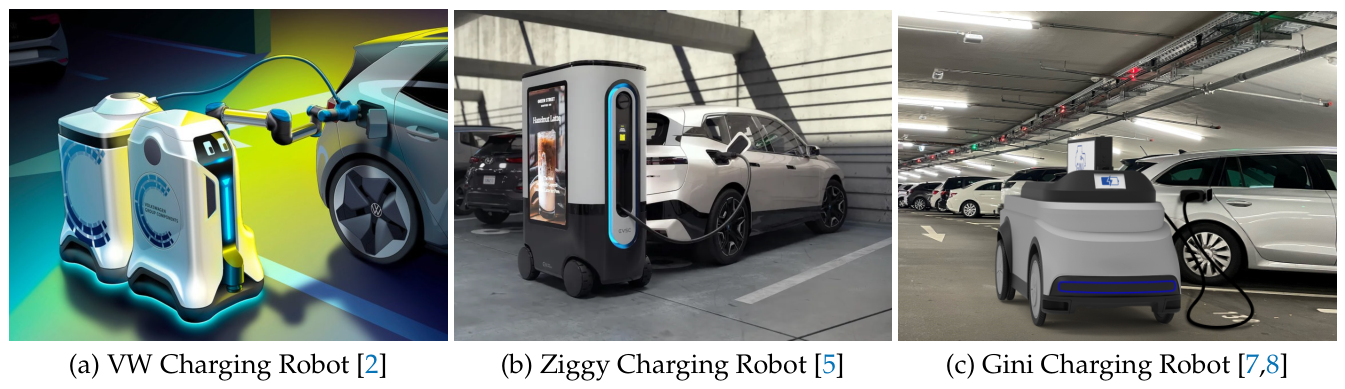
Figure 2.
Personal interest of the participants in the concept of robot-based charging. Most respondents who have a positive view of electromobility and/or are considering using an EV express at least moderate interest in robotic charging, indicating a general openness to the concept.
Figure 2.
Personal interest of the participants in the concept of robot-based charging. Most respondents who have a positive view of electromobility and/or are considering using an EV express at least moderate interest in robotic charging, indicating a general openness to the concept.
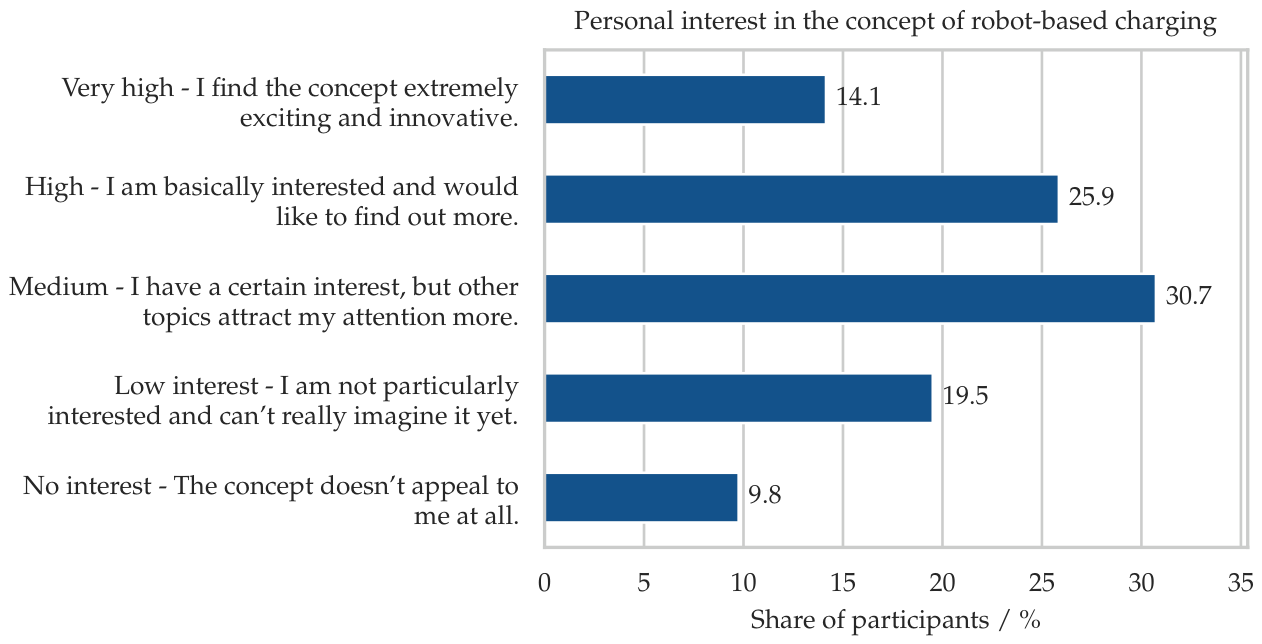
Figure 3.
Participants’ assessment of the future relevance of robot-based charging. Around half of the participants believe that it will be relevant in the future.
Figure 3.
Participants’ assessment of the future relevance of robot-based charging. Around half of the participants believe that it will be relevant in the future.
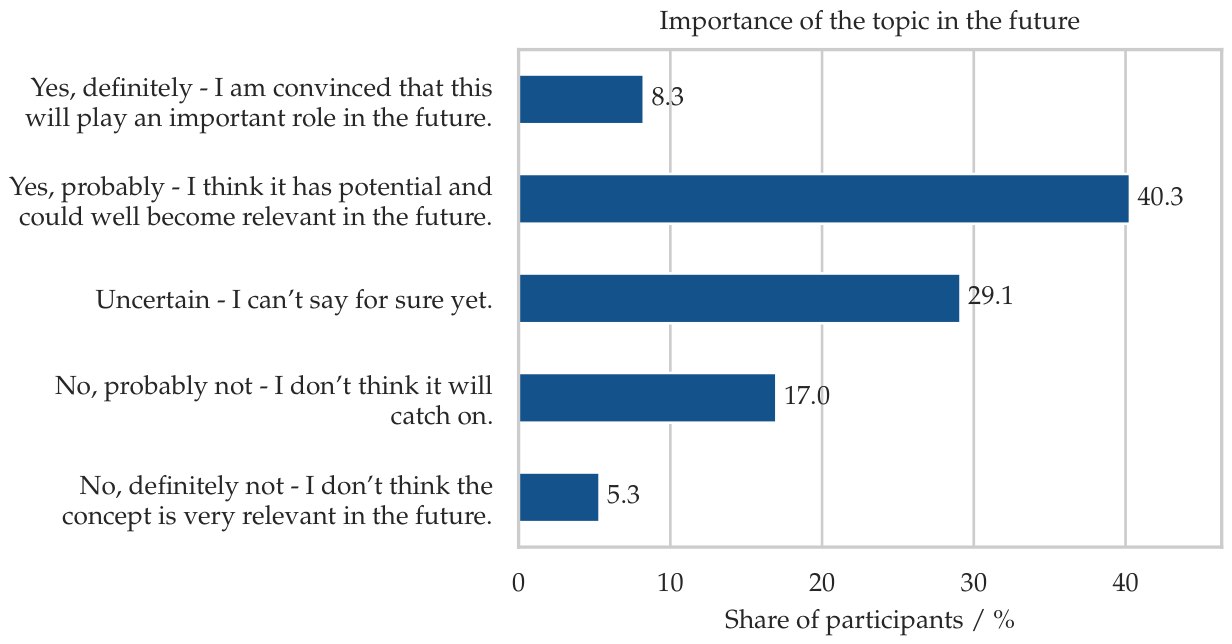
Figure 4.
Potential situations for robot-based charging: Respondents favour robotic charging for long-duration parking, such as for work, overnight, or in public car parks. Short stops, such as for shopping or motorway breaks, are far less attractive.
Figure 4.
Potential situations for robot-based charging: Respondents favour robotic charging for long-duration parking, such as for work, overnight, or in public car parks. Short stops, such as for shopping or motorway breaks, are far less attractive.
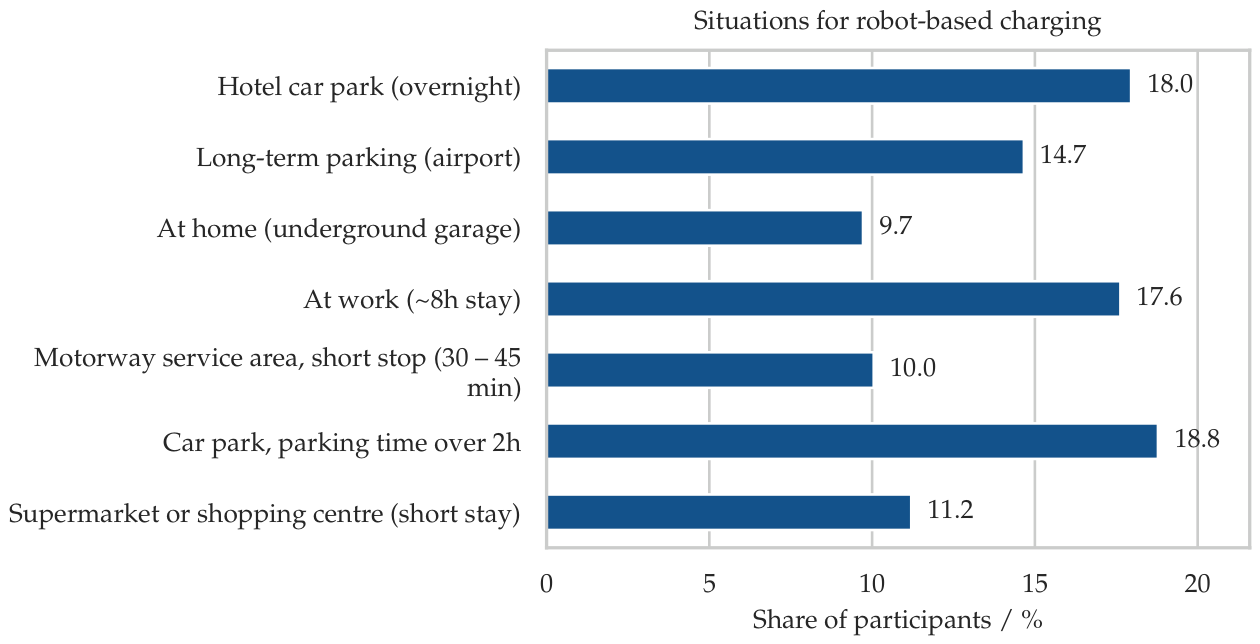
Figure 5.
Attitudes towards dynamic pricing for charging robots: The majority of respondents either support the concept or are undecided, while a smaller proportion reject it due to concerns about unpredictability and transparency.
Figure 5.
Attitudes towards dynamic pricing for charging robots: The majority of respondents either support the concept or are undecided, while a smaller proportion reject it due to concerns about unpredictability and transparency.
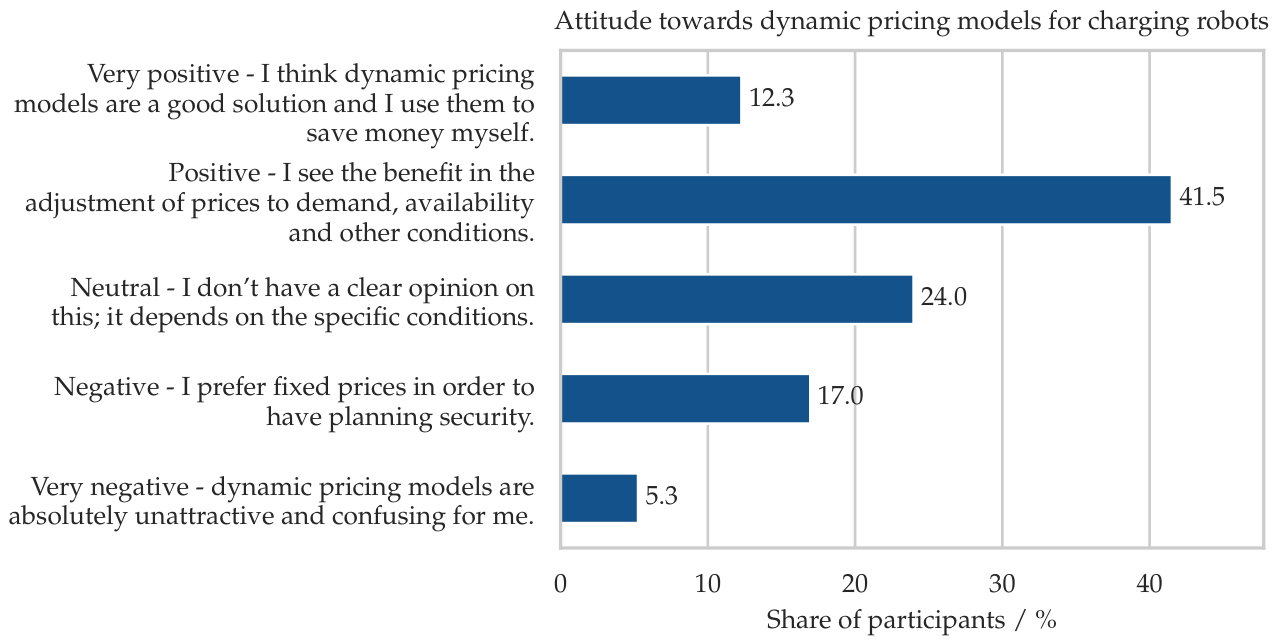
Figure 6.
Design of the user study web application. Participants were presented with various charging situations and asked if and how much they would charge under the given conditions. Additional information, such as estimated charging time or total charging costs, was displayed dynamically.
Figure 6.
Design of the user study web application. Participants were presented with various charging situations and asked if and how much they would charge under the given conditions. Additional information, such as estimated charging time or total charging costs, was displayed dynamically.
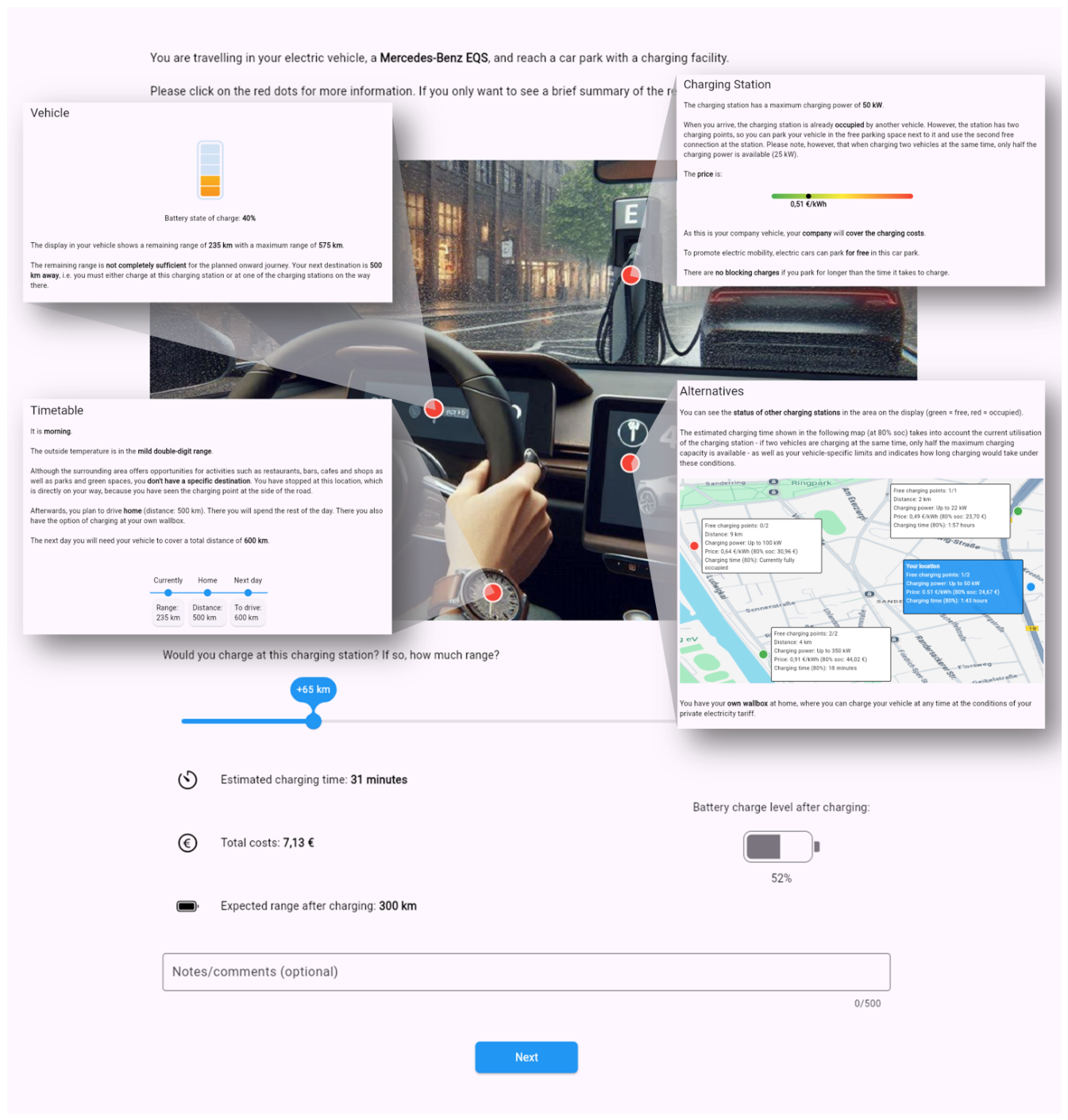
Figure 7.
Pareto frontiers illustrating the trade-off between daily profit per EV () and user satisfaction (S) for the City Car Park scenario. The “knee point” is selected using a weighted score combining normalized profit (80 %) and user satisfaction (20 %), reflecting a profit-oriented perspective of infrastructure operators while still accounting for user acceptance.
Figure 7.
Pareto frontiers illustrating the trade-off between daily profit per EV () and user satisfaction (S) for the City Car Park scenario. The “knee point” is selected using a weighted score combining normalized profit (80 %) and user satisfaction (20 %), reflecting a profit-oriented perspective of infrastructure operators while still accounting for user acceptance.
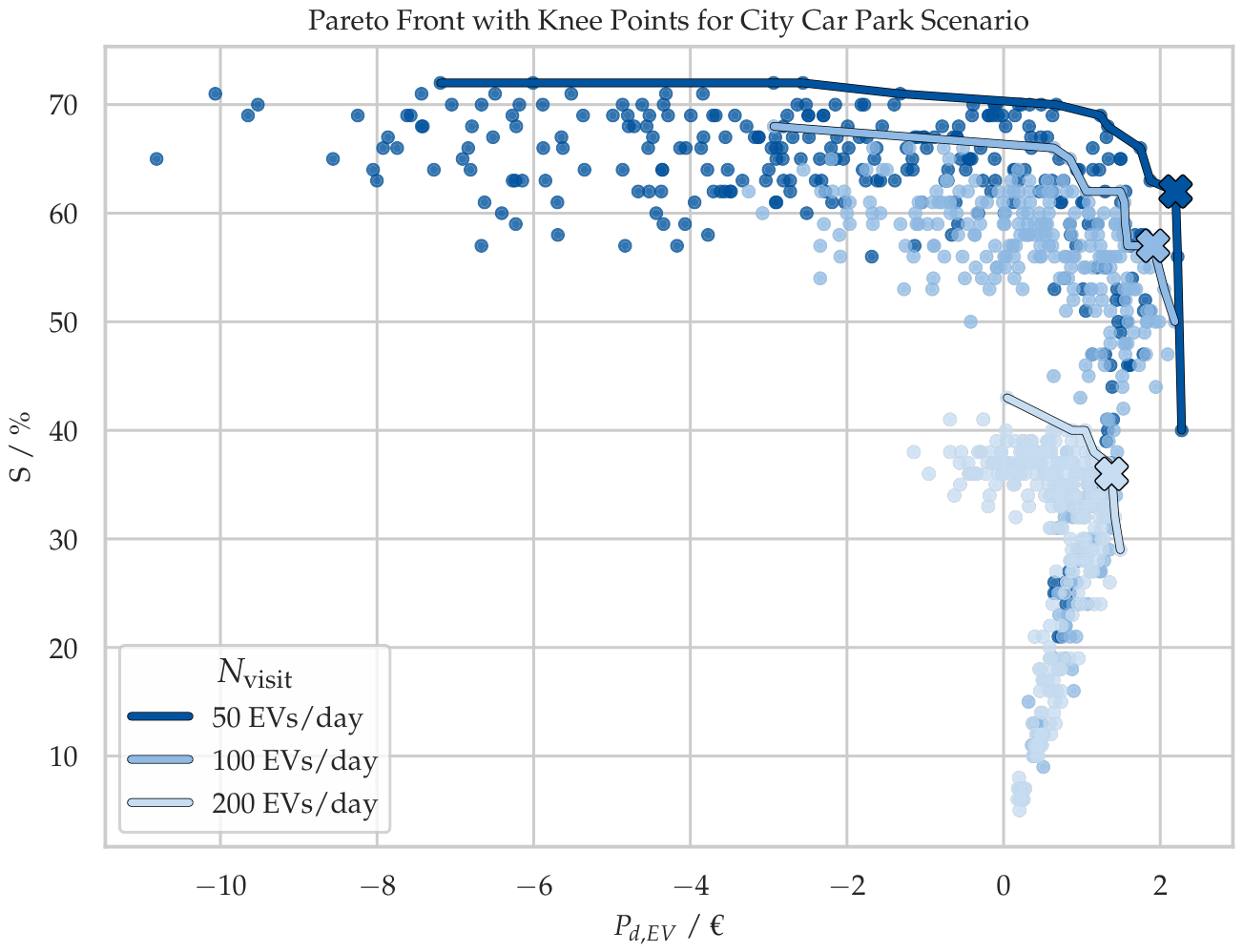
Figure 8.
Pareto frontiers visualizing the trade-off between daily profit per EV () and user satisfaction (S) for the Workplace scenario. The “knee point” is selected using a weighted score combining normalized profit (80 %) and user satisfaction (20 %), reflecting a profit-oriented perspective of infrastructure operators while still accounting for user acceptance.
Figure 8.
Pareto frontiers visualizing the trade-off between daily profit per EV () and user satisfaction (S) for the Workplace scenario. The “knee point” is selected using a weighted score combining normalized profit (80 %) and user satisfaction (20 %), reflecting a profit-oriented perspective of infrastructure operators while still accounting for user acceptance.
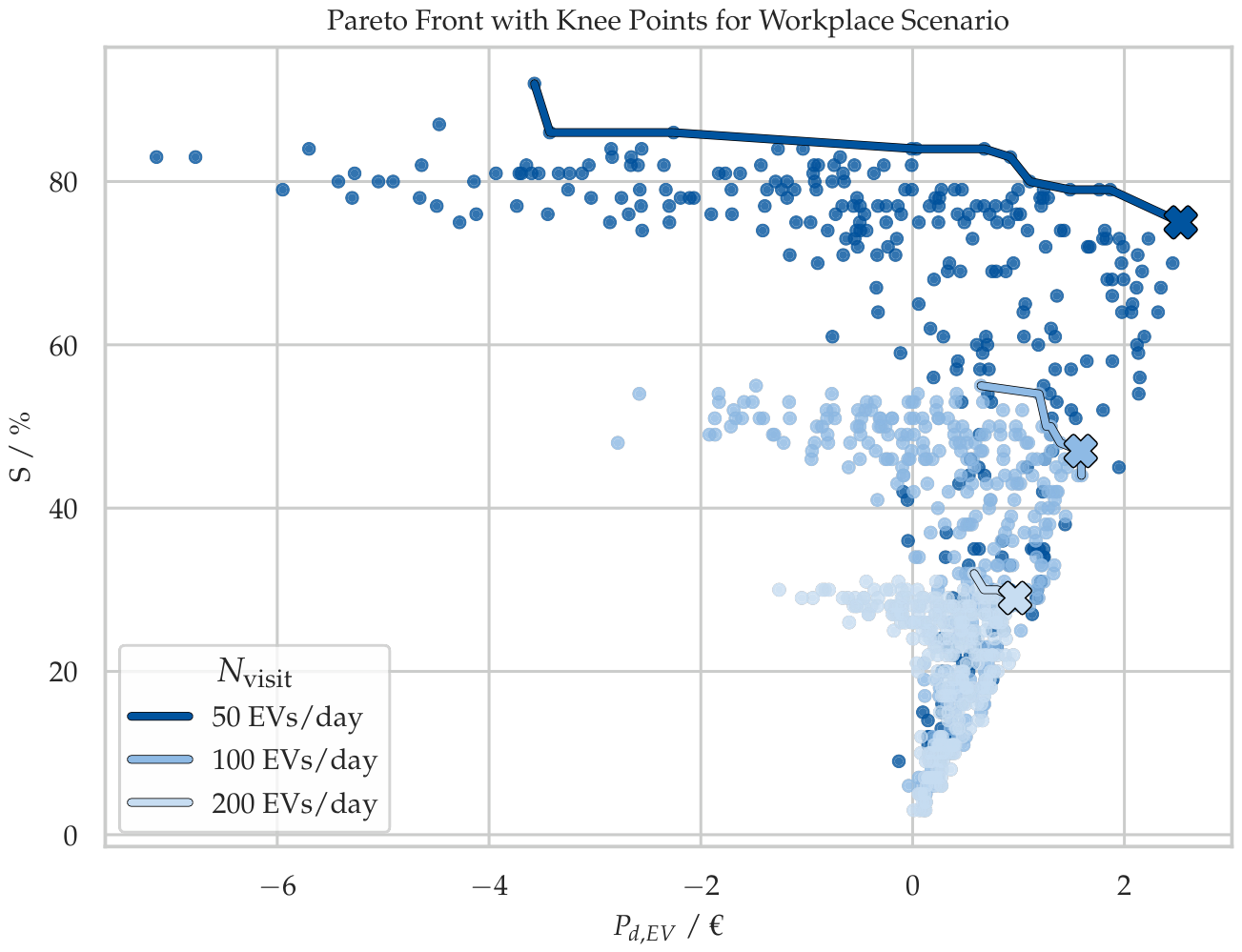
Figure 9.
Impact of competing public charging infrastructure on the KPIs of the robot-based charging concept. For each demand level (50, 100, and 200 EVs/day), the daily profit per EV () and user satisfaction (S) are shown under three attractiveness levels of surrounding public chargers. Higher values indicate stronger external competition.
Figure 9.
Impact of competing public charging infrastructure on the KPIs of the robot-based charging concept. For each demand level (50, 100, and 200 EVs/day), the daily profit per EV () and user satisfaction (S) are shown under three attractiveness levels of surrounding public chargers. Higher values indicate stronger external competition.
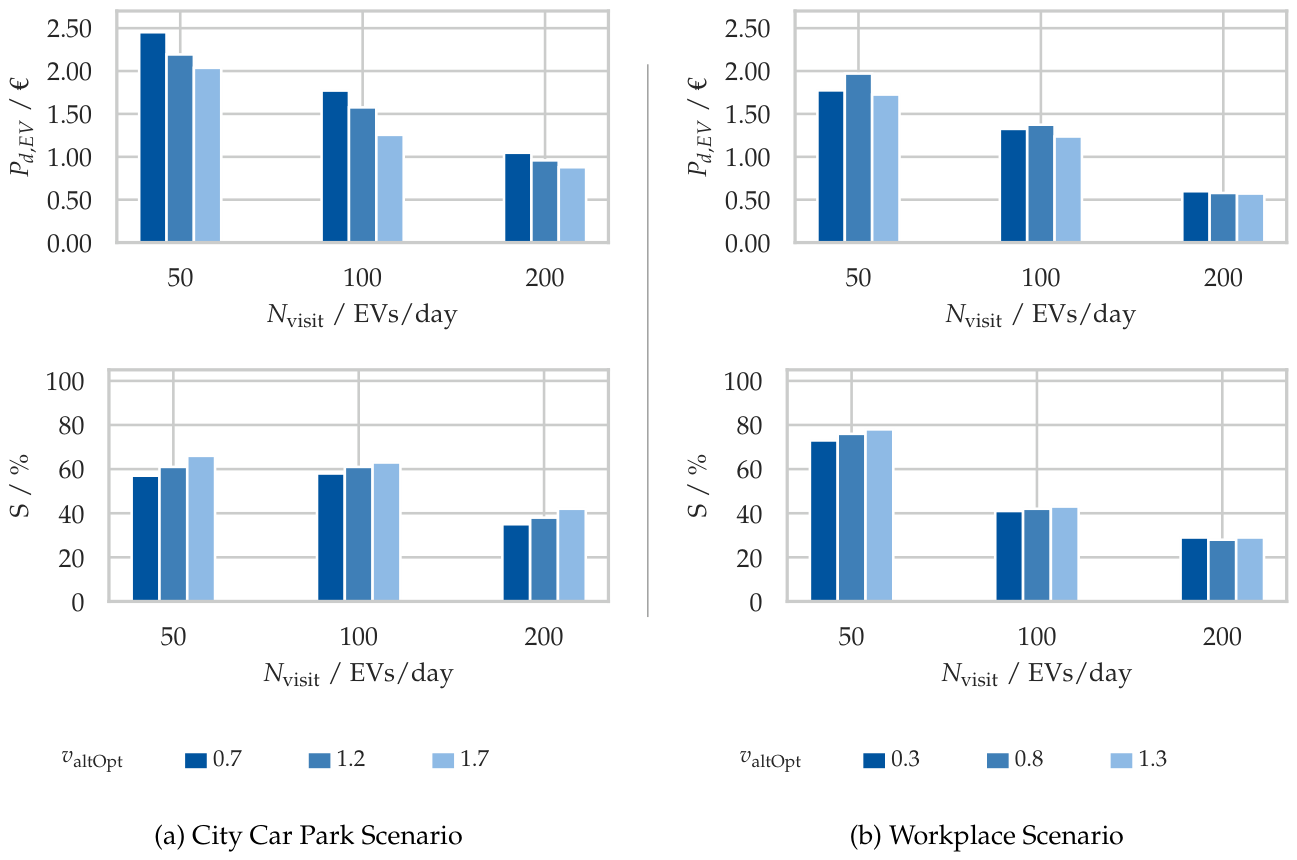
Figure 10.
Impact of fixed charging prices on daily profit per EV (), user satisfaction (S), and average energy delivered per EV () for different demand levels in the City Car Park scenario.
Figure 10.
Impact of fixed charging prices on daily profit per EV (), user satisfaction (S), and average energy delivered per EV () for different demand levels in the City Car Park scenario.
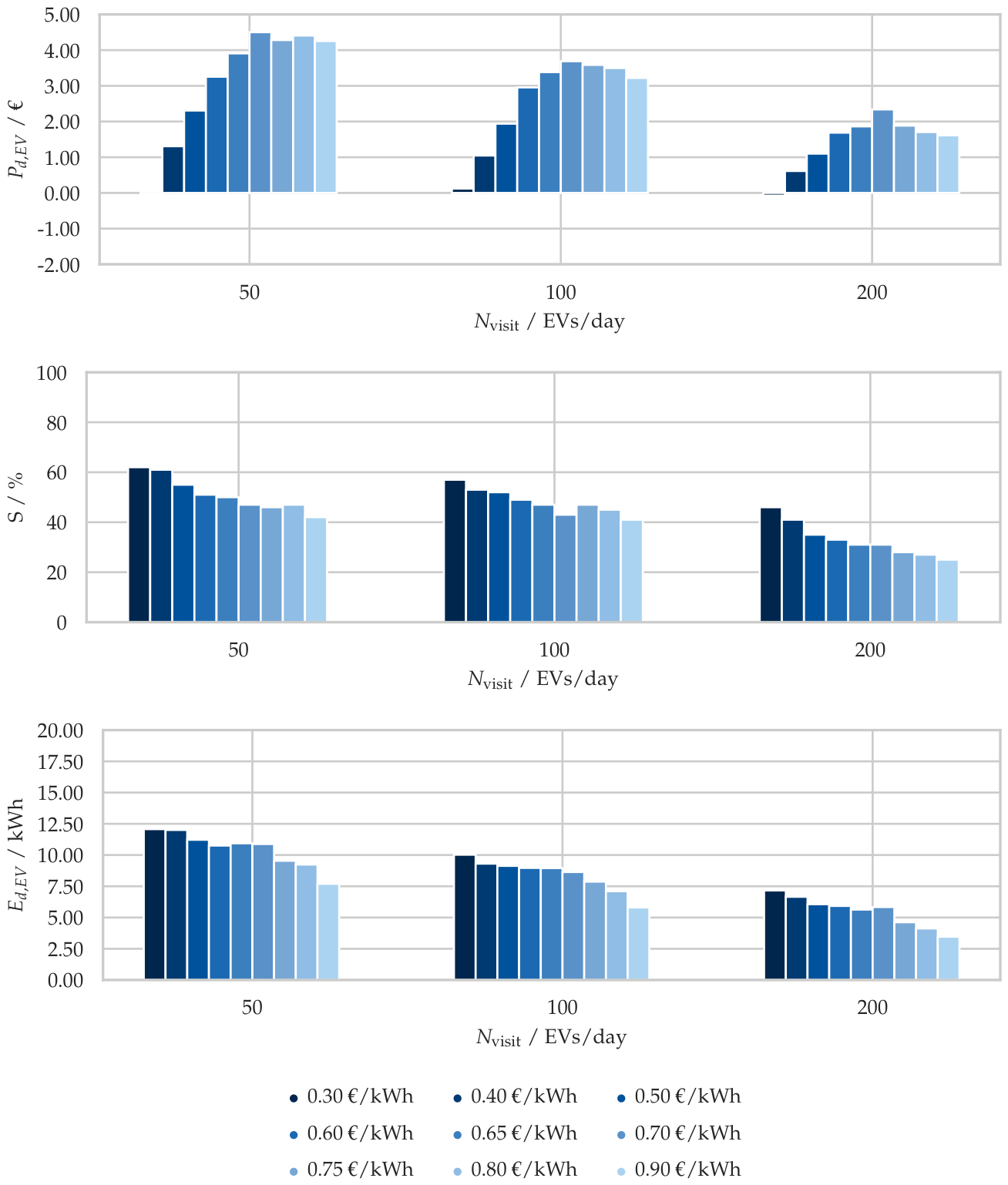
Figure 11.
Impact of fixed charging prices on daily profit per EV (), user satisfaction (S), and average energy delivered per EV () for different demand levels in the Workplace scenario.
Figure 11.
Impact of fixed charging prices on daily profit per EV (), user satisfaction (S), and average energy delivered per EV () for different demand levels in the Workplace scenario.
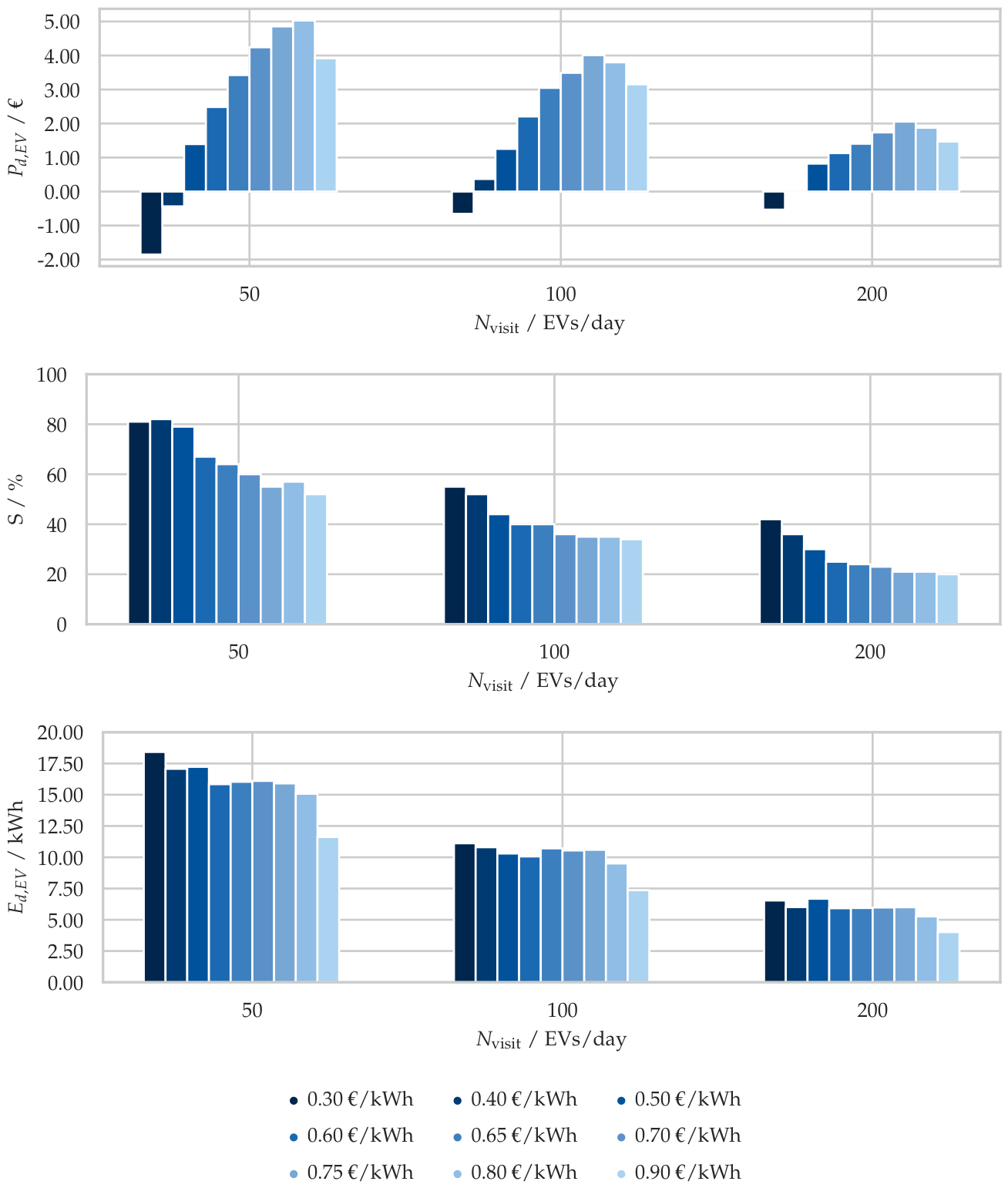
Figure 12.
Price profiles of the two scenarios for the dynamic demand-based pricing strategy, example for the summer season and = 100 EVs/day.
Figure 12.
Price profiles of the two scenarios for the dynamic demand-based pricing strategy, example for the summer season and = 100 EVs/day.
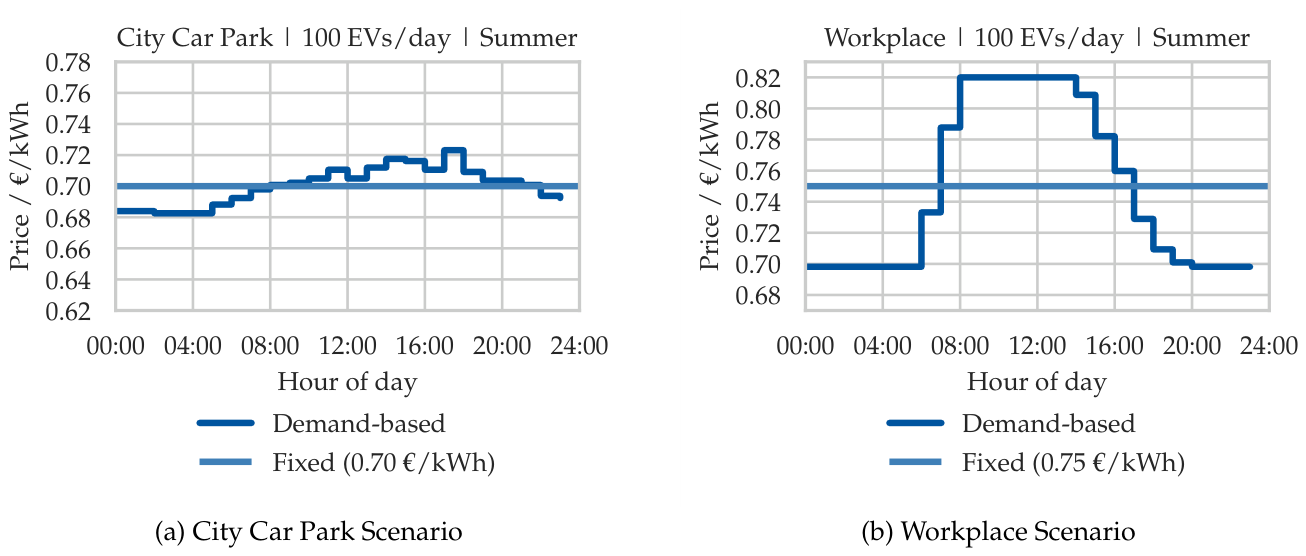
Figure 13.
Comparison of fixed and dynamic (demand-based) pricing strategies for the City Car Park and Workplace scenarios. For each demand level (50, 100, and 200 EVs/day), the resulting daily profit per EV () and user satisfaction (S) are shown.
Figure 13.
Comparison of fixed and dynamic (demand-based) pricing strategies for the City Car Park and Workplace scenarios. For each demand level (50, 100, and 200 EVs/day), the resulting daily profit per EV () and user satisfaction (S) are shown.
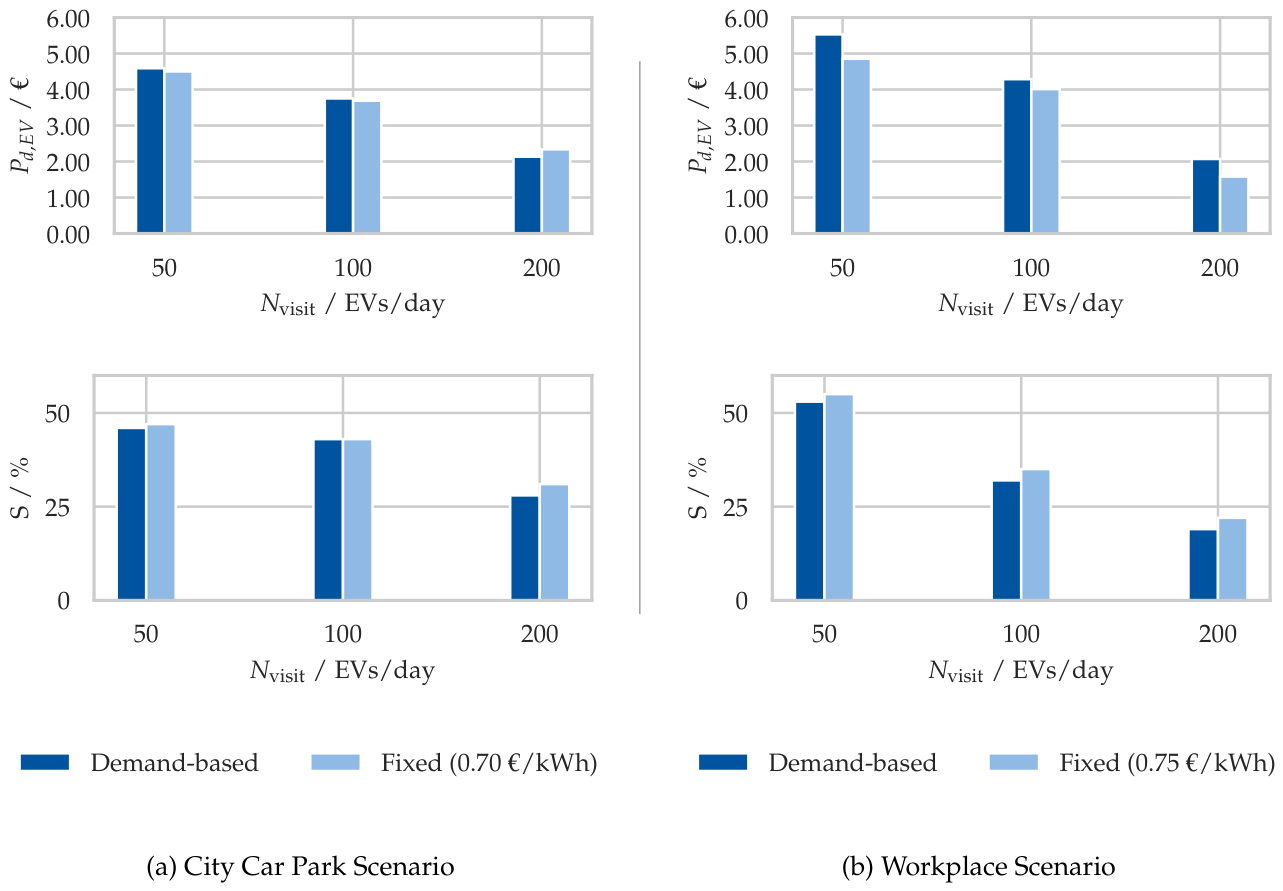
Figure 14.
Comparison of the effective charging price of the demand-based dynamic pricing strategy as fixed price to the dynamic (demand-based) pricing strategy for the City Car Park and Workplace scenarios. For each demand level (50, 100, and 200 EVs/day), the resulting daily profit per EV () and user satisfaction (S) are shown.
Figure 14.
Comparison of the effective charging price of the demand-based dynamic pricing strategy as fixed price to the dynamic (demand-based) pricing strategy for the City Car Park and Workplace scenarios. For each demand level (50, 100, and 200 EVs/day), the resulting daily profit per EV () and user satisfaction (S) are shown.
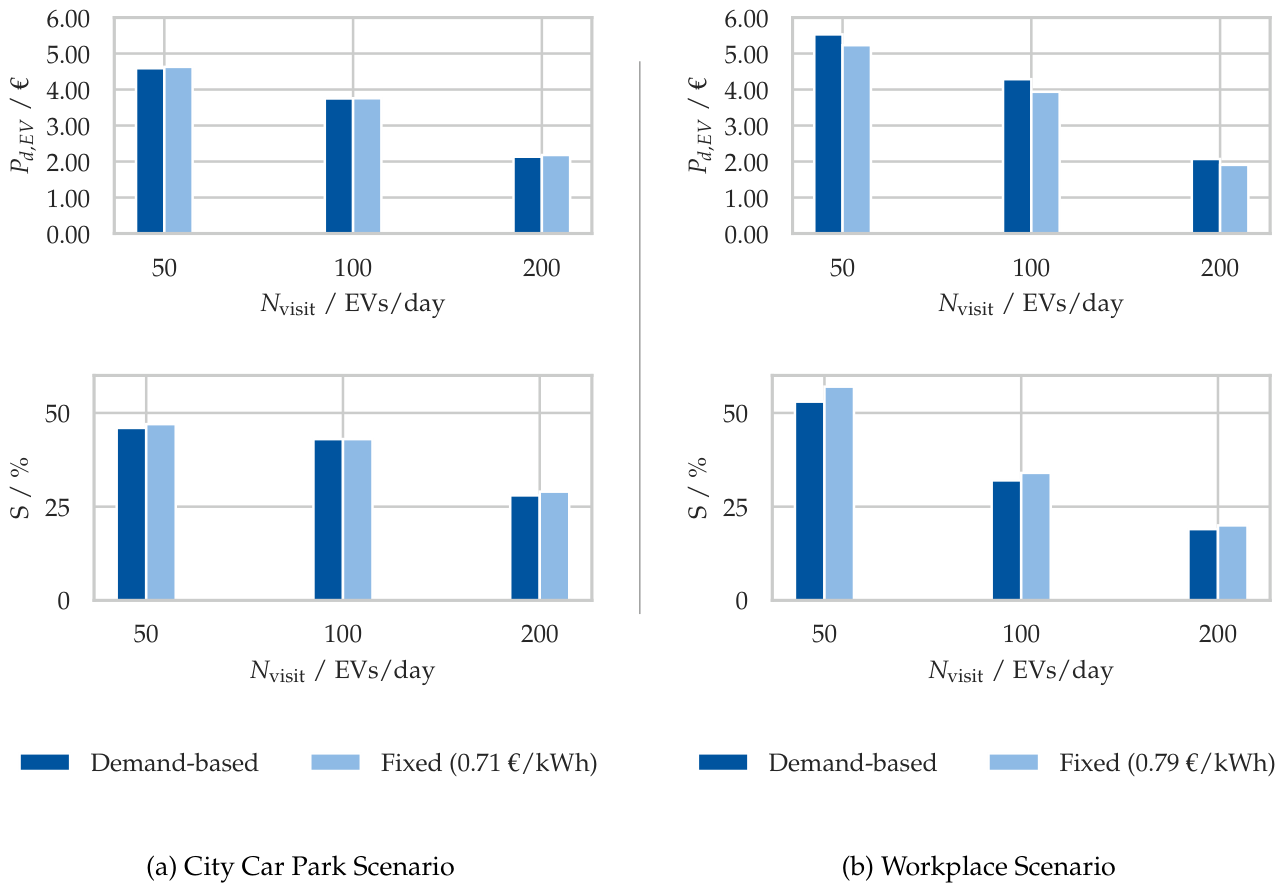
Figure 15.
Comparison of fixed prices, effective charging price, and dynamic price strategy on daily profit per EV () and user satisfaction (S) of both scenarios, averaged over all demand levels.
Figure 15.
Comparison of fixed prices, effective charging price, and dynamic price strategy on daily profit per EV () and user satisfaction (S) of both scenarios, averaged over all demand levels.
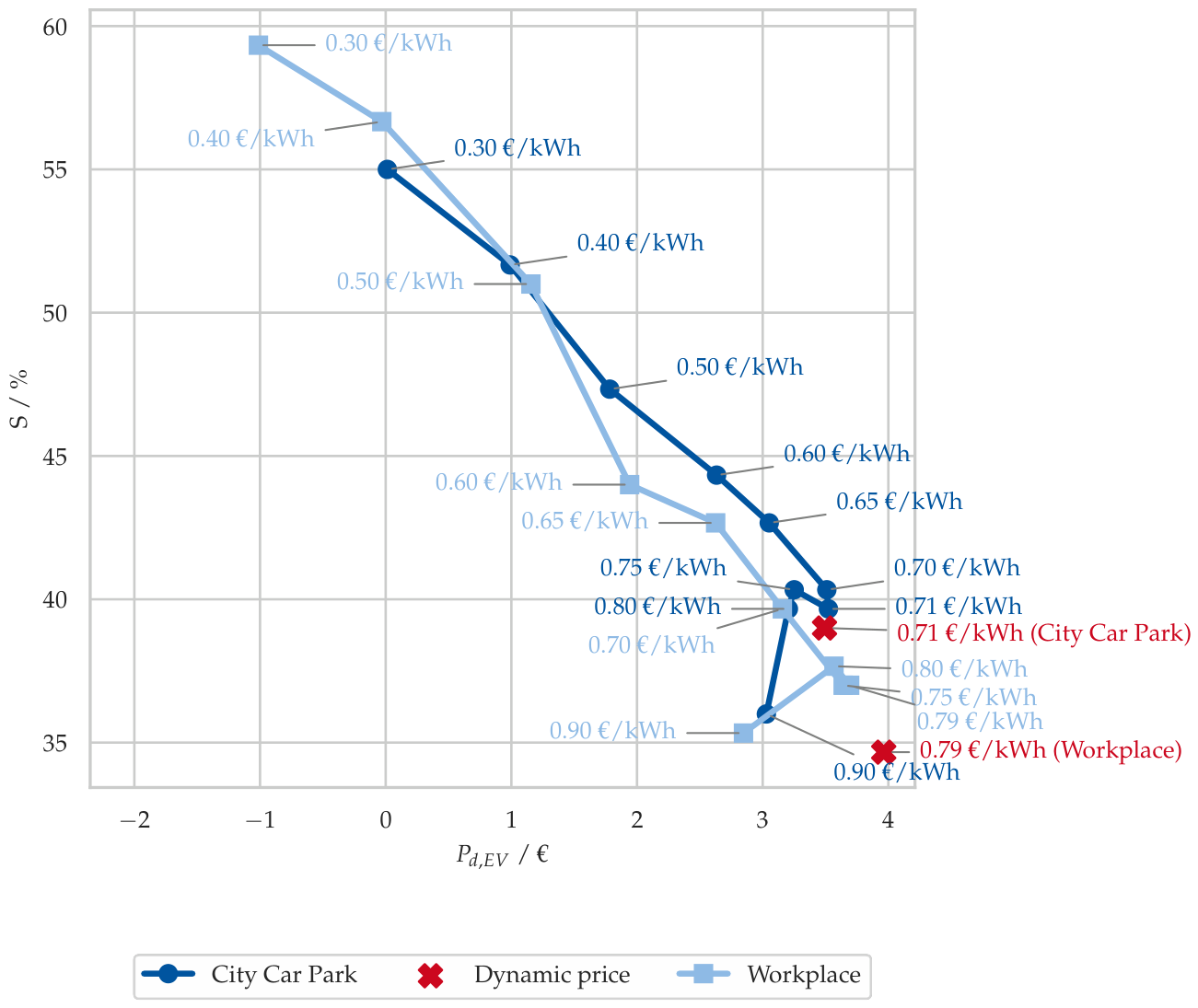

Table 1.
Parameter ranges for variables under test in the fleet parameter analysis.
| Feature | Symbol | Values |
|---|---|---|
| Number of charging robots | ||
| Number of recharging stations per robot (ratio) | , , , , | |
| Robot battery size / kWh | B | |
| Demand / EVs/day |
Table 2.
City Car Park: Knee-point optimal fleet design.
| / EVs/day | / EVs/day | / EVs/day | B / kWh | / € | / € | S / % | ||
|---|---|---|---|---|---|---|---|---|
| 50 | 46 | 46 | 4 | 2 | 35 | 109.78 | 2.20 | 62 |
| 100 | 93 | 93 | 7 | 3 | 35 | 190.76 | 1.91 | 57 |
| 200 | 186 | 186 | 11 | 6 | 35 | 275.86 | 1.38 | 36 |
Table 3.
Workplace: Knee-point optimal fleet design.
| / EVs/day | / EVs/day | / EVs/day | B / kWh | / € | / € | S / % | ||
|---|---|---|---|---|---|---|---|---|
| 50 | 50 | 50 | 10 | 5 | 35 | 126.59 | 2.53 | 75 |
| 100 | 100 | 100 | 10 | 5 | 35 | 158.72 | 1.59 | 47 |
| 200 | 200 | 200 | 16 | 5 | 35 | 193.49 | 0.97 | 29 |
Disclaimer/Publisher’s Note: The statements, opinions and data contained in all publications are solely those of the individual author(s) and contributor(s) and not of MDPI and/or the editor(s). MDPI and/or the editor(s) disclaim responsibility for any injury to people or property resulting from any ideas, methods, instructions or products referred to in the content. |
© 2026 by the authors. Licensee MDPI, Basel, Switzerland. This article is an open access article distributed under the terms and conditions of the Creative Commons Attribution (CC BY) license (http://creativecommons.org/licenses/by/4.0/).
Copyright: This open access article is published under a Creative Commons CC BY 4.0 license, which permit the free download, distribution, and reuse, provided that the author and preprint are cited in any reuse.


