

Submitted:
01 June 2026
Posted:
02 June 2026
You are already at the latest version
Abstract
The standard measurement postulate of quantum mechanics stipulates an instantaneous, non-local update of the global wavefunction upon measurement of an entangled subsystem. This postulate has been a persistent source of foundational tension, both with the locality structure of relativistic physics and with the dynamical character of the decoherence program. We separate the measurement postulate into three logically independent claims: definite outcome realization, Born-rule probability assignment, and instantaneous projection for the global wavefunction. We argue that the third claim can be eliminated at the axiomatic level and propose a modified measurement postulate, Postulate M, that replaces it. Under Postulate M, a single pointer outcome is realized locally when environmental decoherence has einselected a pointer basis at the measurement site; the corresponding selection acts on the global wavefunction as a conditional restriction to a branch rather than as a physical operation on spacelike-separated regions. We show that Postulate M recovers the standard measurement postulate as a limiting idealization for vanishing decoherence time, derives Lüders’ rule for sequential measurements, and yields no-signaling as an automatic structural consequence — not only at the level of measurement statistics but at the level of physical states themselves. Two explicit illustrations in the EPR scenario — with one and with both particles coupled to local spin environments — demonstrate the framework concretely and exhibit its frame-independent, manifestly local character. The framework is built on standard decoherence theory, compatible with multiple candidate mechanisms for single-outcome realization including gravitationally-induced collapse proposals, and naturally situated within a ψ-ontic reading of the quantum state. It represents, we argue, a reformulation of quantum mechanics as a local, state-realist theory — preserving Einstein’s aspiration for an objective physical world in the only form consistent with the empirical content of quantum mechanics, namely realism about the wavefunction rather than about pre-measurement observable values.
Keywords:
quantum measurement
; decoherence
; locality
; realism
; EPR paradox
; wavefunction collapse
; state realism
1. Introduction
Quantum mechanics, after a century of extraordinary success, continues to rest on a measurement axiom that has been a persistent source of foundational difficulty. The standard measurement postulate (the “projection postulate” of von Neumann) stipulates that upon measurement of an observable, the wavefunction of the system undergoes an instantaneous, non-unitary transformation to an eigenstate of the measured operator, with probability given by the Born rule. For composite entangled systems, this transformation acts on the global wavefunction instantaneously — projecting not only the measured subsystem but its entangled partners, regardless of spatial separation. This feature of the axiom, what Einstein famously called “spooky action at a distance,” has long been the focus of foundational debate.
The Einstein-Podolsky-Rosen argument [1] sharpened this tension by showing that, under assumptions of locality and value-definite realism, quantum mechanics appears incomplete. Bell’s theorem [2] subsequently demonstrated that no local hidden-variable theory can reproduce quantum correlations, and experiments [3,4] have confirmed the quantum predictions to high precision. These results rule out value-definite local realism — the view that observables possess predetermined values independent of measurement — but they do not, by themselves, require that quantum mechanics itself be non-local. What they do require is that something in the standard framework give up either locality or value-definite realism. The common reading has been that quantum mechanics gives up locality, through the instantaneous measurement postulate.
The decoherence program, developed over the past five decades by Zeh [5], Zurek [6,7,8], Joos [9], and others, has provided an alternative perspective. Decoherence shows that the appearance of wavefunction collapse emerges naturally from local unitary evolution of a system coupled to its environment: through the system-environment interaction, environmental degrees of freedom rapidly become entangled with the system, and the resulting reduced density matrix of the system becomes diagonal in the einselected pointer basis, with the system evolving into an effective mixture on timescales typically much shorter than those of observation. This process is entirely local and dynamical, with no appeal to instantaneous projection.
However, decoherence does not by itself resolve the measurement problem. The global wavefunction remains pure under unitary evolution; all branches of the einselected superposition persist; and the appearance of a single realized outcome requires an additional step — whether interpreted Everettianly, stochastically, relationally, or otherwise — that decoherence alone does not supply. Different research programs have responded to this gap differently. Zurek’s existential interpretation and Everettian accounts more broadly take no further step: there is no real collapse, only the emergent appearance of definite outcomes for observers situated within branches of the persistent superposition. Spontaneous collapse models such as GRW and CSL take the opposite step, modifying the Schrödinger equation to produce real collapse through stochastic local mechanisms. In both cases, the decoherence community has been careful not to propose a formal replacement for the measurement postulate of standard quantum theory; the standard axiom persists in textbooks alongside the decoherence dynamics, with no clear axiomatic statement of what collapse — if any — physically is.
The present work takes a definite position on this question: the wavefunction does collapse, but the collapse is local. Single outcomes are real physical events, not artifacts of observer-relative description; but the collapse is triggered by local environmental decoherence at the measurement site, with no instantaneous projection across spacelike-separated regions. We propose a modified measurement postulate, Postulate M, that formalizes this position. The single-outcome question — by what physical mechanism the collapse occurs — is left as a primitive, compatible with several candidate resolutions (GRW/CSL, gravitational collapse, others). What Postulate M provides is the locality structure of collapse, separated cleanly from the still-open question of its underlying mechanism.
This position rests on a key observation: the measurement postulate bundles together claims of two distinct kinds. On one hand, it carries the empirical content of measurement: that a single outcome is realized, and that its probability is given by the Born rule. On the other hand, it carries a structural claim about the global wavefunction: that the post-measurement state is obtained by projection acting instantaneously across arbitrary spatial separations. These have been treated as inseparable in textbook presentations, but they need not be: the empirical content can be retained as a primitive while the global-projection claim is eliminated, replaced by the dynamical process of local decoherence together with a local, branch-selective realization of outcomes. Section 2 develops this distinction formally, identifying three logically independent claims (C1)–(C3) within the standard postulate and arguing that (C3), the instantaneous global projection, can be removed without affecting the empirical content of the theory. The novelty of this work lies not in any new dynamics — the Schrödinger equation and decoherence theory remain unchanged — but in isolating the locality-violating content of the measurement postulate and removing it at the axiomatic level, while leaving the empirical and dynamical content of quantum mechanics intact.
More specifically, Postulate M retains the empirical content of the standard measurement postulate (definite outcomes with Born-rule probabilities) while eliminating the non-local content (global projection). Under Postulate M, measurement is a local dynamical process in which environmental decoherence produces pointer-basis diagonalization of the reduced density matrix at the measurement site, and a single pointer outcome is realized locally with Born-rule probability. The selection acts on the global wavefunction as a conditional restriction to the branch consistent with the realized outcome, but this is not a physical operation on distant subsystems — no signal propagates, no state is physically disturbed, only the conditional description of distant correlations is updated. Lorentz invariance is preserved at the axiomatic level; no-signaling holds at both the statistical and the physical level; and the standard measurement postulate emerges as the limiting idealization for vanishing decoherence time.
Several features of the resulting framework merit emphasis. First, Postulate M is naturally and most powerfully stated in a -ontic framework, in which the wavefunction is a real physical entity evolving locally under the Schrödinger equation; the framework’s claim of “locality” is then a claim about physical states, not merely about measurement statistics. Second, Postulate M is compatible with several candidate mechanisms for the single-outcome realization it takes as primitive, including Everettian no-collapse accounts, GRW/CSL stochastic collapse, and gravitationally-induced collapse in the tradition of Penrose and Diósi. The framework separates the locality question from the single-outcome question, addressing the former while leaving the latter open. Third, in explicit illustrations in the EPR scenario — the asymmetric case in which one particle is coupled to a local environment, and the symmetric case in which both particles are coupled to independent local environments — the framework exhibits manifest locality, frame independence, and reproduces the quantum predictions including Bell correlations at the Tsirelson bound.
The paper is structured as follows. Section 2 analyzes the standard measurement postulate, identifying its three logically separable claims and arguing that the non-local claim can be eliminated. Section 3 states Postulate M and its immediate consequences, including the distinction between physical state, reduced density matrix, and operational statistics for distant subsystems. Section 4 demonstrates that Postulate M is consistent with standard quantum mechanics: the standard measurement postulate emerges as the vanishing-decoherence-time limit, Lüders’ rule for sequential measurements follows as a derived consequence, and no-signaling is structural. Section 5 and Section 6 provide two explicit illustrations in the EPR scenario, highlighting respectively the framework’s handling of the asymmetric configuration (drawing on a prior spin-bath analysis by the author [10]) and the symmetric configuration (which makes frame independence manifest). Section 7 situates Postulate M relative to the decoherence program (Zurek, Schlosshauer), relational quantum mechanics (Rovelli), decoherent histories, spontaneous collapse models (GRW/CSL), and gravitationally-induced collapse proposals, identifying the last of these as a particularly promising direction for physical completion of the framework. Section 8 summarizes our conclusions and discusses open questions and directions for future work.
2. The Projection Postulate and Its Locality Problem
The standard formulation of quantum measurement, due to von Neumann [11], postulates that upon measurement of an observable on a system in state , the state undergoes an abrupt, non-unitary transformation
For a composite entangled system , measurement of an observable on subsystem A is represented by projection of the global state:
where acts on . Equation (2) is stipulated to hold instantaneously, regardless of the spatial separation between the supports of A and B.
This postulate bundles three logically separable claims:
(C1) Definite outcome realization. A single eigenvalue is recorded as the outcome of the measurement.
(C2) Born rule. The probability of outcome is , or for mixed states, .
(C3) Instantaneous projection for the global wavefunction. The post-measurement state of the entire composite system is obtained by projection onto the eigenspace corresponding to the realized outcome, with this projection acting instantaneously across arbitrary spatial separations.
Claims (C1) and (C2) address the empirical content of measurement: that outcomes occur and that their frequencies obey the Born rule. Claim (C3) is of a different character: it asserts a physical update of spacelike-separated regions that has been the source of persistent foundational difficulty. The “spooky action at a distance” that Einstein, Podolsky, and Rosen identified [1] arises from (C3), not from (C1) or (C2). The tension between (C3) and special relativity — which has no preferred foliation of spacetime and no mechanism for instantaneous influence — has been analyzed by Aharonov and Albert [12,13], Ghirardi [14], and others, and remains unresolved within the standard axiomatic framework.
We observe that (C3) plays no role in the statistical predictions of quantum mechanics for local measurements. The probability that an observer at location A obtains outcome is determined by the reduced density matrix , which is a function of the global state alone and requires no reference to measurements at B. Correlations between outcomes at A and B are fully encoded in prior to any measurement; they do not require (C3) to be established, only to be compared. This suggests that (C3) may be eliminable: its physical content, if any, is not required to reproduce the empirical predictions of quantum theory.
The decoherence program initiated by Zeh [5], Zurek [6,7,8], and Joos [9] has clarified how the appearance of collapse emerges from local unitary evolution of a system coupled to its environment. When a quantum system interacts with a sufficiently large environment via a Hamiltonian of the appropriate structure, environmental degrees of freedom rapidly become entangled with the system, and the resulting reduced density matrix of the system becomes diagonal in the einselected pointer basis on timescales typically much shorter than those of observation [15,16]. The loss of off-diagonal coherences — decoherence — proceeds dynamically under the Schrödinger equation with no measurement postulate.
However, decoherence does not by itself resolve (C1): the global wavefunction remains pure, and all branches of the einselected superposition persist in the unitary evolution [6,15]. A mechanism — or at least a primitive — selecting a single branch as the realized outcome is required to connect the decohered mixed pointer states to the definite outcomes of experiment. Approaches to this selection vary: Everettian interpretations [17] take all branches as equally real, with the appearance of definite outcomes arising from branch-relative observer states; spontaneous collapse models [18,19,20] introduce stochastic nonlinear modifications of the Schrödinger equation; relational accounts [21] take outcomes as facts relative to observers; and the existential interpretation [7,8] attempts to derive definiteness from einselection itself.
These programs address (C1) in different ways. They leave (C3) — the global projection — largely unexamined as a distinct postulate, typically absorbing it into whatever mechanism resolves (C1).
The central observation of the present work is that (C1) and (C3) are logically independent and should be axiomatized separately. Decoherence, as a local unitary process, eliminates any need for (C3). A modified measurement postulate that retains (C1) and (C2) as primitives, while explicitly excluding (C3), is sufficient to reproduce all statistical predictions of quantum mechanics and is manifestly consistent with the locality of dynamical evolution. The single-outcome problem (C1) is thereby separated from the locality problem (C3), and the latter can be eliminated at the axiomatic level.
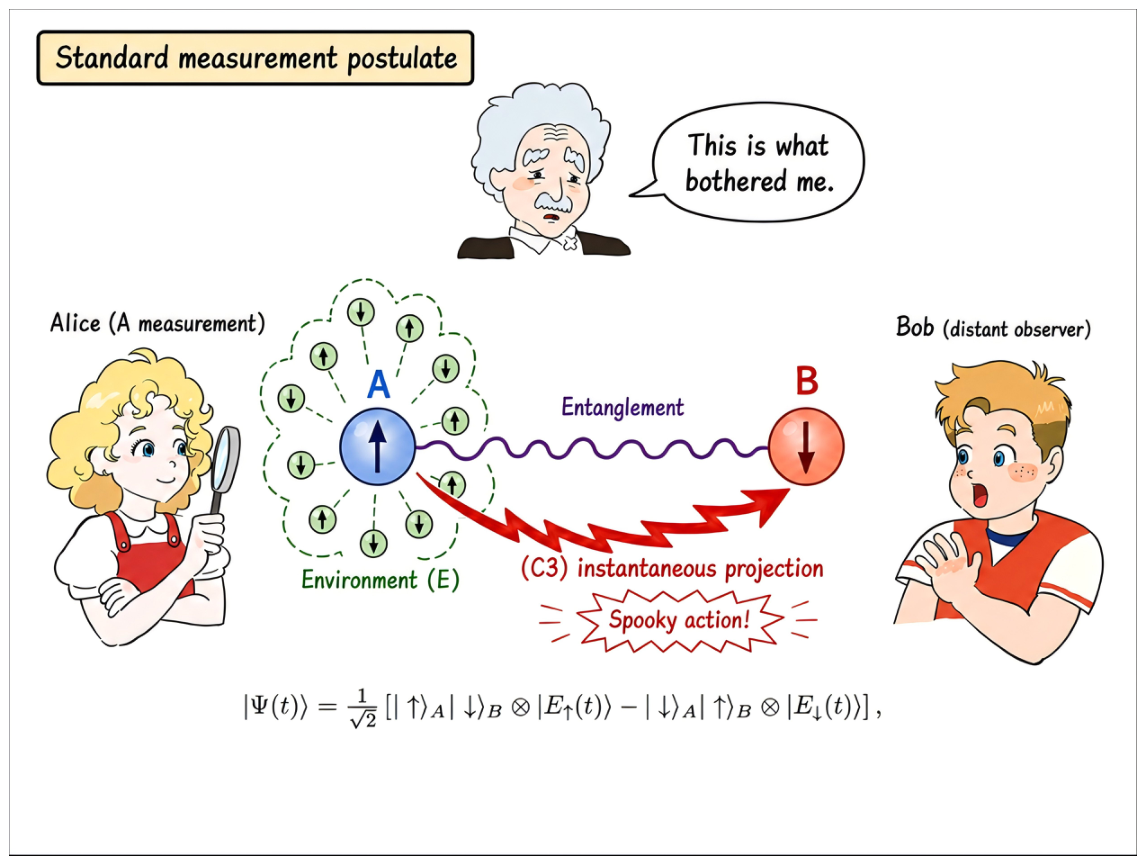
Figure 1.
The standard measurement postulate applied to the EPR scenario. Alice measures particle A, which is locally coupled to a spin environment E; Bob is the distant observer holding the isolated, entangled partner B. Even when the local decoherence dynamics on A’s side are explicitly included, the standard postulate still demands an instantaneous projection of the global wavefunction — depicted by the red zigzag — acting across the spacelike interval between A and B. This non-local update, claim (C3) of the standard postulate, is the source of the long-standing tension with locality identified by Einstein, Podolsky, and Rosen.
Figure 1.
The standard measurement postulate applied to the EPR scenario. Alice measures particle A, which is locally coupled to a spin environment E; Bob is the distant observer holding the isolated, entangled partner B. Even when the local decoherence dynamics on A’s side are explicitly included, the standard postulate still demands an instantaneous projection of the global wavefunction — depicted by the red zigzag — acting across the spacelike interval between A and B. This non-local update, claim (C3) of the standard postulate, is the source of the long-standing tension with locality identified by Einstein, Podolsky, and Rosen.
3. The Modified Measurement Postulate
We retain the standard postulates of quantum mechanics governing state space (Hilbert space), observables (self-adjoint operators), and unitary evolution (Schrödinger equation), and replace the measurement postulate (Eqs. 1–2) with the following:
Postulate M (Local measurement). Let be the global state of a composite system, partitioned as , where S denotes the system of interest — possibly composite, comprising a subsystem A at the spatial region of measurement together with any spacelike-separated entangled partners B, so that — and E denotes all environmental degrees of freedom. Suppose that local apparatus-environment interaction at A has produced decoherence of the reduced density matrix
in a joint pointer basis einselected by the local interaction Hamiltonian. Each is in general a correlated state of A and B whose form is determined by the interaction Hamiltonian and the initial entanglement structure of . Then a single joint pointer outcome is realized with probability
The realization corresponds to a branch selection on the global wavefunction, triggered by the local condition of completed decoherence at A. No projection or physical update is applied to regions spacelike-separated from A; the joint outcome assigns correlated values to A and B as features of the selected branch, reflecting correlations encoded in the global wavefunction prior to t rather than any propagated physical influence.
We make several comments on the structure and scope of Postulate M.
On what is postulated and what is derived. Postulate M replaces (C3) with a locality condition: branch selection is triggered by local decoherence and acts on the global wavefunction without any notion of simultaneous update across spatial regions. Claims (C1) and (C2) are preserved, respectively, in the statement that a single joint outcome is realized (C1) and that its probability is given by the Born rule applied to the system’s reduced density matrix (C2). The decoherence of in the joint pointer basis is not itself postulated; it is a theorem that follows from the Schrödinger equation applied to a system coupled to an environment with appropriate structure [6,16]. The joint pointer basis is determined dynamically by the local interaction Hamiltonian together with the entanglement structure of the system, not chosen by stipulation. For an unentangled system, the joint pointer basis reduces trivially to the local pointer basis on A; for an entangled system such as the EPR singlet with A coupled to a local environment, the joint pointer basis consists of correlated product states such as — a result derived explicitly in Section 5. (Throughout the paper we adopt the standard convention that, in the bipartite Hilbert space , the compact ket denotes , with the first slot referring to particle A and the second to particle B.)
On the single-outcome primitive. Postulate M takes the realization of a single outcome as primitive. No mechanism is specified for how one branch is selected from the decohered mixture. This is the content of the measurement problem, and we do not claim to solve it. Postulate M is compatible with several candidate resolutions: Everettian accounts treat branch selection as observer-relative rather than dynamical, in which case “realization” in Postulate M refers to the branch-relative experience of a given observer; stochastic collapse models (GRW, CSL) provide a dynamical mechanism for local branch selection consistent with the locality structure of Postulate M; relational interpretations treat outcomes as facts relative to a reference system, again compatible with M. What Postulate M does not require — and here it differs from all versions of the standard measurement postulate — is that branch selection act instantaneously across spacelike-separated regions. This is the axiomatic content of eliminating (C3).
On branch selection and pre-existing correlations. A subtlety of Postulate M deserves explicit statement. Because the pointer basis is a basis on the full system Hilbert space , each pointer state specifies correlated values for both A and B simultaneously. The selection of a single pointer outcome therefore fixes a joint outcome for the entangled pair as a single event, not as two independent local events. This structure is essential: if branch selection at A and at a spacelike-separated region B were independent stochastic events, the resulting joint statistics would satisfy Bell inequalities [2] and fail to reproduce quantum predictions. Postulate M avoids this by treating the joint pointer basis as the einselected structure, with a single selection event assigning correlated values to both subsystems. The triggering condition (completed decoherence at A) and the physical effect (a local outcome record at A) are entirely local. The correlation between A’s outcome and B’s state in the selected branch reflects pre-existing entanglement in the global wavefunction, not any propagated influence between the regions. An explicit illustration of this branch structure in the EPR scenario, with the joint pointer basis emerging from local environmental decoherence, is given in [10] and reframed within Postulate M in Section 5.
On joint branch selection versus (C3). An alert reader may object that joint branch selection across spacelike separations is itself a form of non-local action — that fixing a joint outcome at a single event is structurally equivalent to (C3) under different language. We address this objection directly. The physical content of (C3), as formulated in the standard measurement postulate (Eq. 2), is that measurement causes a physical change across spacelike separation: the global wavefunction is projected by an operator that acts non-trivially on both A’s and B’s Hilbert spaces simultaneously, and this projection is stipulated to be a dynamical event acting instantaneously across the spacelike interval. The physical content of joint branch selection under Postulate M is structurally different. Branch selection is not a dynamical process: it does not enter the Hamiltonian, propagate at finite speed, transfer energy or information, or perform any physical operation on B. It is the structural realization of one branch from a pre-existing decohered superposition whose joint structure was already encoded in the global wavefunction through prior unitary evolution. The local component states of B in each branch (as discussed in point (i) below) are unchanged; what the selection event accomplishes is to specify which branch is realized, not to produce any new physical content at B. In short: (C3) asserts a non-local physical operation; joint branch selection asserts a non-dynamical structural realization. Whether one finds this distinction compelling depends on one’s view of the ontological status of branch structure in the global wavefunction. Under a -ontic reading of the kind articulated above, the distinction is substantive: the joint correlations are physical features of the global wavefunction that pre-exist measurement, while (C3) posits a measurement-triggered modification of those features. Postulate M takes the former position; the standard measurement postulate, the latter.
On the state of distant subsystems and no-signaling. A precise statement of what does and does not change at a region B spacelike-separated from A requires distinguishing two things: (i) the physical state of the subsystem at B, which is unchanged by any operation at A, and (ii) the operationally accessible local statistics at B, which are likewise unchanged without communication from A.
- (i)
- Physical state. The physical state of B is unaffected by the application of Postulate M at A. To make this precise, we need to specify what is meant by “the physical state of B” in a -ontic reading where the global wavefunction is the fundamental physical object. Consider an entangled state in product form:
where the component single-particle states are spatially localized at A and at B. The physical state of B in our framework refers to these local component states that appear as factors in the entangled state — not to the reduced density matrix , which is a derived object obtained by tracing out A. The component states on B’s side are localized physical entities at B’s spatial location; they describe what is locally present at B in each branch of the global wavefunction. Operations on A — including the application of Postulate M — cannot change these B-component states, because they live in factorized Hilbert spaces and the global Hamiltonian contains no terms coupling these spacelike-separated regions. What changes when Postulate M is applied at A is which branch is realized, not the local content of either branch.
The relevant decomposition of the global wavefunction into component products is not arbitrary. For a generic entangled state, the Schmidt decomposition provides a canonical product form (unique up to phases). For maximally entangled states such as the singlet, where the Schmidt decomposition is degenerate, the relevant basis is determined dynamically by the local interaction Hamiltonian at A: environmental decoherence at A einselects a pointer basis on A, and the correlated structure of the entangled state then fixes the corresponding component states on B in each branch. The physical state of B is thus dynamically determined by local decoherence at A, not stipulated by choice of basis. (See Section 5 for an explicit illustration in the EPR scenario.)
We call the invariance of these B-component states under operations at A no-signaling at the physical level — a stronger claim than the standard no-signaling theorem (point (ii) below), which constrains only measurement statistics. No signal, influence, or perturbation propagates from A to B; branch selection at A is not a physical disturbance of B. What Einstein took to be a “spooky action at a distance” is, in our framework, a passive change in the appropriate description of B within the selected branch, analogous to the classical updating of probabilities upon learning the outcome of correlated events — no physical operation is performed on B, only the conditional description updates.
- (ii)
- Local statistics. The operationally accessible local statistics at B — what an observer at B can measure without communication from A — are unchanged by the application of M at A. An observer at B samples outcomes according to the marginal distribution over all branches consistent with their local state, which is given by the pre-measurement reduced density matrix regardless of whether and how M has been applied at A. This is the standard no-signaling theorem at the statistical level [22,23], recovered here as an automatic consequence of the locality structure of M and implied by the stronger physical-level statement of point (i). Bell-type correlations are revealed only when outcome records from A and B are subsequently brought together and compared, at which point the joint statistics — encoded in from the outset — become accessible.
Figure 2.
Postulate M applied to the same EPR scenario as Figure 1. The physical layout is identical: Alice measures particle A coupled to a local spin environment, and Bob holds the spacelike-separated isolated partner B. Under Postulate M, however, the measurement at A is entirely local — environmental decoherence followed by branch selection — with no instantaneous non-local update. The description of B updates passively within the selected branch, but no physical operation crosses the spacelike interval. The “spooky action” of Figure 1 is absent.
Figure 2.
Postulate M applied to the same EPR scenario as Figure 1. The physical layout is identical: Alice measures particle A coupled to a local spin environment, and Bob holds the spacelike-separated isolated partner B. Under Postulate M, however, the measurement at A is entirely local — environmental decoherence followed by branch selection — with no instantaneous non-local update. The description of B updates passively within the selected branch, but no physical operation crosses the spacelike interval. The “spooky action” of Figure 1 is absent.

On Lorentz covariance. Because Postulate M does not require simultaneous update across spatial regions, there is no preferred foliation of spacetime on which the postulate depends. Measurements at spacelike-separated events may occur in either temporal order (in different Lorentz frames) without altering the predicted statistics. This addresses, at the level of the measurement axiom itself, the relativistic awkwardness of the standard measurement postulate noted by Aharonov and Albert [12,13]. A fully relativistic formulation in terms of quantum field theory is beyond the scope of the present work, but Postulate M is manifestly compatible with relativistic principles in a way that (C3) is not: its statement requires no preferred frame and its application involves no instantaneous non-local action.
On the scope of the present axiomatization. Postulate M addresses the locality structure of the measurement process. It does not constitute a complete solution of the measurement problem, because it takes (C1) as primitive. It does not address the emergence of classicality in full generality, for which the decoherence program remains the relevant framework. It does not, on its own, formally settle the question of the ontological status of the wavefunction.
However, the framework developed here strongly favors a -ontic reading of the quantum state. Two considerations support this. First, the Pusey–Barrett–Rudolph theorem [24] provides direct theoretical evidence against purely epistemic interpretations of , demonstrating that any -epistemic model satisfying mild auxiliary assumptions cannot reproduce quantum predictions. Second, and more importantly for the present work, the claims of locality and realism in our framework acquire their physical content only under the -ontic reading. The locality of Postulate M is the locality of dynamical evolution of a real physical entity — the wavefunction — under a local Hamiltonian; if the wavefunction were instead a record of an observer’s information, the “locality” of its evolution would amount to the locality of belief-updating, which is a structurally different and weaker claim. Likewise, the realism we recover — Einstein’s “moon is there when nobody looks” applied at the level of the quantum state rather than at the level of measurement values — is meaningful only if the quantum state is a real feature of the world.
The framework is therefore most naturally understood as a local, -ontic account of quantum measurement: the wavefunction is a real physical entity that evolves locally and unitarily; decoherence is a real local dynamical process producing real branch structure; and what remains open is only the mechanism by which a single branch is realized. The realism in question is realism about the state, not about pre-measurement values — the latter being ruled out by Bell’s theorem and contextuality.
4. Consistency with Quantum Mechanics and Recovery of Standard Results
We now show that Postulate M is consistent with the structure of quantum mechanics and that key results ordinarily associated with the standard measurement postulate follow as derived consequences of M. In particular, we demonstrate that the standard projective-measurement rule emerges as an idealization of Postulate M in the limit of instantaneous decoherence, and that Lüders’ rule for sequential measurements is recovered without separate postulation.
4.1. Emergence of Standard Projective Measurement as an Idealization
The standard measurement postulate, as formulated in Eqs. (1) and (2), may be understood as the limiting case of Postulate M in which the decoherence timescale is taken to zero relative to all other relevant timescales. We establish this first for the explicit class of measurements treated in [10] and in Section 5 below, and then comment on its extension to general measurements.
Explicit case: spin measurement along a fixed axis. Consider a spin-1/2 system S in an arbitrary initial state , with , where are eigenstates of . Measurement of is implemented in our framework by coupling S to an environment via
whose pointer basis coincides with the eigenbasis of (Zurek 1982 [8]). The total Hamiltonian is , where is the free Hamiltonian of the environment and describes internal bath interactions; both act only on environment degrees of freedom. Under unitary evolution, the global state evolves as
Decoherence suppresses the off-diagonal coherences of on timescale , yielding, in the decohered limit,
Postulate M then assigns probability to the realization of outcome and to , recovering the Born rule for arbitrary initial superpositions.
In the limit , this process becomes effectively instantaneous on observational timescales. The intermediate superposition (5) is, in this limit, not accessible to observation, and the measurement appears as an abrupt transition from to an eigenstate of with Born-rule probability. This is the content of the standard measurement postulate, Eq. (1), for the case of a measurement.
Extension to composite entangled systems. The analogous argument applies to entangled composites. For two spin-1/2 particles in the singlet state, with A coupled to a local environment via a Hamiltonian of the form (4), the global state evolves into an entangled superposition whose reduced density matrix becomes diagonal in the correlated pointer basis on timescale (explicit calculation in Section 5). Postulate M assigns probability to each outcome. In the limit, this reproduces the prediction of the standard measurement postulate applied to the singlet — with one essential qualification. In the standard postulate, the global projection, Eq. (2), is stipulated to act instantaneously across arbitrary spatial separations. In our framework, the “instantaneous” character of measurement at A is the limit of a local dynamical process at A; it does not involve any physical operation at B. The physical state of B remains unchanged throughout; what updates is only its conditional description within the selected branch — through conditional restriction, imposed by the branch structure of decoherence, of the global state, not through physical propagation (Section 3, point i).
Extension to general measurements. The argument above establishes the emergence of standard projective measurement as an idealization of Postulate M for the specific class of spin measurements with diagonal in the measured observable’s eigenbasis. The extension to measurements of general observables rests on results from the broader decoherence literature. For a system coupled to an environment via an interaction Hamiltonian whose pointer basis coincides with the eigenbasis of a chosen observable , einselection produces a reduced density matrix diagonal in that basis, and Postulate M then yields Born-rule outcomes for [6,16]. The correspondence between chosen measurement and appropriate system-environment coupling is a standard feature of the decoherence program; a physical apparatus designed to measure implements, through its microscopic interaction with S, a coupling of this form. The generality of this correspondence is not established here independently, but relies on the established body of decoherence results. Within that scope, Postulate M reduces to the standard measurement postulate in the limit.
The central formal result of the present reformulation can be summarized as follows: under Postulate M, the standard measurement postulate emerges as an idealization of local decoherence dynamics rather than an independent physical principle. Claim (C3) of Section 2 — the instantaneous non-local projection — arises as an artifact of taking the decoherence timescale to zero and then misreading the resulting simultaneous-update description as a physical operation. When the finite-time, local, and dynamical character of decoherence is restored, the non-local element of the measurement postulate can be removed without altering any empirical prediction.
4.2. Derivation of Lüders’ Rule
Lüders’ rule [25] specifies the post-measurement state used for computing probabilities of sequential measurements. In the standard framework, after a measurement of yields outcome at time , the state for computing probabilities of a subsequent measurement at time is obtained by evolving unitarily under the system Hamiltonian between and .
Within our framework, this rule follows from Postulate M applied sequentially, combined with unitary evolution between measurements. Suppose Postulate M applied at realizes outcome . The global wavefunction is then, for the purposes of predicting subsequent outcomes in the selected branch, the component of consistent with outcome i: system S in state , apparatus and environment in the correlated pointer configuration .
Between and , this branch evolves unitarily under the total Hamiltonian. If, during this interval, S is decoupled from the apparatus and environment (as is typically the case between measurements), the system state evolves as , where is the system’s free unitary propagator. At , Postulate M is applied again — now with respect to the new measurement’s pointer basis , determined by the second measurement’s interaction Hamiltonian. The probability of outcome conditional on earlier outcome is
This is Lüders’ rule. It is not postulated; it is a direct consequence of applying Postulate M at to the branch selected at , which has evolved unitarily in the interim.
For non-selective sequential measurements — in which the outcome of the first measurement is not recorded or conditioned upon — the appropriate description is the mixture over all possible first outcomes, weighted by their probabilities. This mixture is precisely the reduced density matrix produced by decoherence at , evolved unitarily to . The Born rule applied to this evolved mixture reproduces the standard result for non-selective sequential measurements.
4.3. Recovery of No-Signaling
As discussed in Section 3 (points (i) and (ii)), no-signaling holds in our framework at two distinct levels: at the level of physical states (the wavefunction of B is unaffected by operations at A) and at the level of measurement statistics (marginal probabilities at B are unaffected). The first is the stronger claim and is established by direct inspection of the global wavefunction, since the global Hamiltonian contains no terms coupling A and B. For completeness, we state the second — the standard statistical no-signaling theorem — as a formal result.
Let A and B be spacelike-separated subsystems of a global state , with the reduced density matrix at B prior to measurement. Suppose Postulate M is applied at A, producing a probability distribution over joint pointer outcomes with weights . Let denote the reduced state at B within the branch corresponding to outcome i — that is, the B component of in the case of pure-state pointer outcomes. The statistics of any measurement performed locally at B, without access to the outcome at A, are governed by the marginal distribution over the outcomes at A:
where the equality follows from the linearity of the partial trace and the fact that summing over all branches reconstructs the original global state prior to branch selection. Consequently, the local statistics at B are identical whether or not a measurement has been performed at A, and no information can be transmitted from A to B through local measurements alone. This is the standard no-signaling theorem at the statistical level, recovered as a structural consequence of Postulate M rather than as a separately imposed constraint, and implied by the stronger physical-level statement.
4.4. Summary
The standard formulation of quantum measurement comprises three postulates: state space and observables (Postulate 1), unitary evolution (Postulate 2), and projective measurement with Born rule (Postulate 3). Our reformulation replaces Postulate 3 with Postulate M. The changes are:
- The empirical content of measurement — definite outcomes with Born-rule probabilities — is preserved.
- The global projection claim (C3) is eliminated; its appearance is recovered as the idealization of local decoherence dynamics. This has been established explicitly for spin measurements with diagonal in the measured observable’s eigenbasis, and extends to general measurements via standard results in the decoherence literature.
- Lüders’ rule for sequential measurements is derived, not postulated.
- No-signaling is automatic, both at the level of measurement statistics and at the level of physical states.
- The entire measurement process is local and unitary, with the single exception of branch selection, whose mechanism is left open (see Section 3).
Within the scope established above, Postulate M is not in conflict with the standard formalism but rather offers a more fundamental account, from which the standard rules emerge as idealizations. In this sense, standard quantum mechanics is — within this scope — a special case of the decoherence-based framework presented here.
5. Illustration: Asymmetric EPR Decoherence
We now apply Postulate M to the EPR scenario in which one of two entangled particles is coupled to a local environment while the other remains isolated. This configuration was analyzed in Ref. [10] within a decoherence framework; here we reframe the results as an explicit realization of Postulate M and make its locality structure manifest.
5.1. Setup
Consider two spin-1/2 particles A and B prepared in the singlet state and separated by a spacelike interval. Particle A is coupled locally to an environment consisting of N spins via the interaction Hamiltonian
where and are Pauli z-operators of particle A and the kth environment spin, and are coupling strengths. Particle B is isolated: no term in the total Hamiltonian couples B to A, to the environment, or to any spacelike-separated region. The total Hamiltonian is , where is the free Hamiltonian of the environment and describes internal bath interactions. Both and act only on environment degrees of freedom.
The initial state is
5.2. Unitary Evolution
Because is diagonal in , each branch of the singlet generates a conditional environmental evolution determined by the value of in that branch. By linearity of the Schrödinger equation, and by the same argument that yields the conditional environment states in the single-central-spin model of Cucchietti, Paz, and Zurek [26], the exact unitary evolution of the global state is
where and are the environment states conditional on the value of in each branch. No approximation has been made; Eq. (11) is exact.
Two features of Eq. (11) are essential. First, the reduced state of particle B, obtained by tracing out A and the environment, is
independent of t and independent of all details of , , and . Particle B, being decoupled from all dynamical activity on A’s side, undergoes no local evolution. Second, the conditional environment states and become mutually orthogonal on the decoherence timescale :
The decoherence factor is the standard object of the spin-bath analysis [26]; its decay is approximately Gaussian under generic assumptions on the distribution of .
5.3. Application of Postulate M
Tracing over the environment yields the reduced density matrix of the composite :
On timescales , the off-diagonal coherences are suppressed and approaches the diagonal form
The pointer basis einselected by consists of the two correlated product states . Postulate M applies: a single pointer outcome is realized with probability determined by the diagonal entries of . Each of the two outcomes — and — is realized with probability , in agreement with the standard quantum prediction.
5.4. Locality Structure
The locality of the process is manifest in Eq. (11). All dynamical evolution occurs in the A+environment region; particle B undergoes no local interaction and its state is constant in time. The decoherence factor , which governs the transition from superposition to einselected mixture, depends only on the local interaction Hamiltonian , the bath self-dynamics , and the inter-bath coupling — all of which act strictly within the A+environment region.
When Postulate M is applied at the measurement site — once decoherence has produced the diagonal of Eq. (15) — a branch is selected with Born-rule probability. The selection corresponds to a restriction of the global wavefunction to the component consistent with the realized pointer outcome. No physical operation is performed at B; no signal propagates from the measurement site to B’s location. What changes at B is the description — the reduced density matrix within the selected branch is now a pure state (either or ), whereas prior to branch selection was the maximally mixed state of Eq. (12) — but the physical state of B is unchanged, consistent with the analysis of Section 3 (point i).
5.5. Bell Correlations
The robustness of Bell correlations under this decoherence process, demonstrated explicitly in Ref. [10], follows immediately from the structure of Eq. (11). The CHSH quantity evaluated on the global state with measurement operators acting on A and B alone yields the Tsirelson bound [27] for all times, because the environment states carry orthogonal labels that contribute trivially to expectation values of observables. Quantum correlations, as captured by CHSH, are preserved throughout the decoherence process and are independent of both system-bath and inter-bath coupling strengths, which affect only the decoherence rate . Under the framework of Postulate M, the empirical violation of Bell inequalities to the Tsirelson bound is reproduced entirely through local dynamics, with no appeal to instantaneous non-local collapse.
5.6. Summary of the Asymmetric Case
The asymmetric EPR configuration demonstrates all essential features of Postulate M in the simplest nontrivial setting:
- The global evolution is local and unitary.
- The physical state of the isolated particle is invariant (Eq. 11), reflecting no-signaling at the physical level.
- Decoherence of the reduced in the correlated pointer basis proceeds via local A-environment interaction alone (Eqs. 12-13).
- Postulate M, applied once decoherence is complete, realizes a single pointer outcome with Born-rule probability.
- The distant partner B is physically unchanged; its density matrix description updates through conditional restriction, imposed by the branch structure of decoherence, to the selected branch.
- CHSH correlations at the Tsirelson bound are reproduced without non-local collapse.
The analogous result for the symmetric configuration, in which both A and B are coupled to independent local environments, is presented in Section 6.
5.7. Remark on A–B Statistical Symmetry
The singlet’s antisymmetry under particle exchange, combined with the structure of , produces a statistical symmetry worth noting. Consider an alternative configuration in which B rather than A is the particle coupled to the environment, obtained by interchanging A and B in Eq. (9). By the same block-diagonal argument used to derive Eq. (11), this alternative configuration produces conditional bath Hamiltonians that differ from those of Section 5.1 by an overall sign in the bath operator : the branch now evolves the environment under rather than , and analogously for the other branch.
If the coupling distribution is symmetric under — as in the uniform distribution on used in the simulations of Ref. [10], or any Gaussian distribution centered at zero — then the two configurations are statistically identical at the ensemble level. The decoherence factor , the timescale , the pointer basis, and the asymptotic reduced density matrix are the same in both configurations at the level of ensemble averages. No observable distinguishes which particle is “the measured one” at the statistical level, reflecting the fact that the entangled pair has no intrinsically privileged particle.
This is a statement at the level of the statistical ensemble; for any specific realization of , the two configurations correspond to different specific realizations of the distribution, related by the sign-flip . The equivalence is between ensembles, not between individual realizations. Within the framework of Postulate M, this symmetry of ensemble statistics is a natural consequence of the fact that the dynamics are determined by local interactions that do not distinguish which subsystem of the entangled pair is being coupled to the environment.
6. Illustration: Symmetric EPR Decoherence
We now consider the symmetric configuration in which both particles A and B are coupled to independent local environments. This setting is not merely a technical extension of Section 5; it clarifies a conceptual point that is awkward in the standard projective-collapse formulation. Under standard projection, measurements at spacelike-separated sites are sensitive to Lorentz frame: different frames disagree about which measurement “occurred first” and which therefore caused the global state to collapse. The symmetric case in our framework exhibits no such frame-dependence, because decoherence proceeds concurrently and locally on both sides with no privileged “first” measurement.
6.1. Setup
Two entangled spin-1/2 particles A and B are prepared in the singlet state. Each is coupled locally to its own spin environment: particle A to environment consisting of spins, particle B to environment consisting of spins. The environments are independent — no Hamiltonian term couples to or to the other system’s particle. The system-environment coupling Hamiltonians have the same structural form as in Section 5:
The total Hamiltonian is , where collects all terms acting on A and its local environment, and collects the analogous terms on B’s side. The bath self-dynamics terms , , , act only within their respective environments. Crucially, : the Hamiltonians on the two sides act on disjoint Hilbert subspaces and commute. The initial state is
6.2. Unitary Evolution
Because , the total unitary evolution factorizes:
where acts only on and acts only on . Applying the same block-diagonal argument as in Section 5 to each side separately, each system spin’s eigenvalue induces a conditional unitary on its local environment. Defining the conditional environment states
and similarly , the exact evolved state is
No approximation has been made; Eq. (19) follows exactly from the tensor-product structure of and the conditional block-diagonal decomposition on each side.
6.3. Reduced Density Matrix and Faster Decoherence
Tracing over both environments yields the reduced density matrix of :
where the local decoherence factors are
The key observation is that the off-diagonal coherences of are suppressed by the product , not by either factor alone. If each decoherence factor decays approximately as under generic assumptions on the coupling distribution [26], the combined decay is
The combined decoherence rate is the sum of the individual rates. For symmetric environments with , decoherence in the symmetric configuration proceeds at twice the rate of the asymmetric case. In the asymptotic limit :
the same diagonal mixed state reached in the asymmetric case (Eq. 15). The endpoint is identical; only the approach is faster.
6.4. Branch Structure
The global wavefunction (Eq. 19) has two branches throughout its evolution:
- Branch 1:
- Branch 2:
The branches become mutually orthogonal in the full Hilbert space as soon as either or . That is, orthogonality of the global branches is established whenever decoherence on at least one side is complete; complete decoherence on both sides is not required. This is consistent with the intuition that a single sufficiently large environment is enough to effect einselection of the composite system.
6.5. Frame Independence
Consider two Lorentz frames:
- Frame : the measurement event at B precedes that at A.
- Frame : the measurement event at A precedes that at B.
Under the standard measurement postulate, these frames disagree about which measurement causes the global state to collapse. In , B’s measurement projects the state, and A’s subsequent measurement is made on the projected state. In , the reverse. Both frames ultimately predict the same joint statistics, but the intermediate description of the global state is frame-dependent in an uncomfortable way: the “true” state of the system between the two measurement events differs between frames, and the instantaneous collapse has no consistent spacetime description. This tension is a known source of interpretive difficulty with the measurement postulate [12,13].
In our framework, no such frame-dependence arises. The global wavefunction (Eq. 19) is the same in every frame; consequently, the reduced density matrix (Eq. 20) is also the same in every frame at each time t. The branch structure (Section 6.4) is determined by the global wavefunction, not by any frame-specific notion of measurement order. Postulate M applies locally at each measurement site whenever local decoherence is complete; whether B’s local decoherence completes before A’s in a given frame, or vice versa, is a frame-dependent fact without physical consequence for the joint statistics or the global branch structure. This is easy to understand physically: because the local Hamiltonians on the two sides commute (, Section 6.1), the decoherence dynamics on A’s side and on B’s side proceed independently, and Postulate M acts independently at each measurement site. The temporal ordering of the two locally completed decoherence processes is therefore a frame-dependent labeling, not a physical fact about the order of causally connected events.
This is a genuine virtue of the framework developed here: the relativistic awkwardness of the standard measurement postulate is absent at the axiomatic level. No preferred foliation is required to state Postulate M or to apply it; no frame-dependent intermediate states arise. The frame-independence of the physical description is manifest.
6.6. Application of Postulate M and the Single-Outcome Question
When decoherence at both sites is complete, Postulate M applies. A single pointer outcome from is realized, with probability each as given by the diagonal entries of . The realized outcome corresponds to a selection of one of the two global branches (Section 6.4).
A subtle point concerning the symmetric case merits explicit mention. Because the joint pointer basis einselected by the symmetric decoherence consists of correlated product states (cf. Eq. 23), each pointer state specifies values for both A and B simultaneously. The selection of a single joint pointer outcome under Postulate M assigns correlated values to both sides as a single event, not as two independent local events. This is the correct structure for reproducing quantum correlations: if branch selection at A and at B were independent local stochastic events, the resulting joint statistics would satisfy Bell inequalities, contradicting experiment. The joint structure of the pointer basis encodes the entanglement of the original singlet, ensuring that the selection event respects the pre-existing correlations of the global wavefunction.
The single-outcome question — by what mechanism the global wavefunction selects one branch rather than the other — is not addressed by Postulate M, as discussed in Section 3. In the symmetric case this question takes a particularly clean form: the branch selection must be a single global event (or equivalently, a globally correlated pair of local events), not two independent local events, to reproduce the quantum correlations. Whether this global character is interpreted Everettianly (no selection occurs; both branches persist and each observer experiences one relative to their own branch), stochastically (a single global stochastic event selects a branch), or otherwise, is left open by the present framework.
6.7. Summary of the Symmetric Case
The symmetric EPR configuration demonstrates additional features of Postulate M beyond those visible in the asymmetric case:
- The total unitary evolution factorizes as a tensor product of local evolutions on each side (Eq. 18), making the locality of the dynamics algebraically transparent.
- Decoherence is faster than in the asymmetric case (Eq. 22), but reaches the same asymptotic mixed state (Eq. 23).
- The global wavefunction and reduced density matrix are frame-independent; no preferred Lorentz foliation is required to describe the measurement process.
- Branch selection, when it occurs, is necessarily a global event affecting both sides in a correlated way — independent local branch selections would violate Bell correlations.
The symmetric case thus makes manifest what is implicit in the asymmetric case: that the measurement process, as formalized by Postulate M, is local in its dynamics and physical effects, while the correlations between spacelike-separated outcomes are features of the pre-existing global state. No nonlocal physical influence is required, and no frame-dependent intermediate description arises.
7. Relation to Existing Frameworks
Postulate M occupies a specific position in the landscape of foundational approaches to quantum measurement. It draws essential technical machinery from the decoherence program, but differs in its axiomatic commitments; it shares some conceptual features with relational and modal interpretations, but differs in scope; and it is compatible with, though not committed to, several candidate mechanisms for single-outcome selection. This section situates Postulate M among these frameworks.
7.1. Decoherence and Einselection (Zurek, Schlosshauer, Zeh, Joos)
The decoherence program, developed by Zeh [5], Zurek [6,7,8], Joos [9], and others, provides the technical foundation on which Postulate M rests. The explicit pointer-basis diagonalization of through environmental entanglement, the dynamical character of the decoherence process, and the rapid timescales on which it operates are all established results from this literature, which we adopt without modification.
Postulate M differs from the decoherence program, however, at the level of axiomatic commitment rather than at the level of physics. The standard position within decoherence theory — as articulated most clearly by Zurek’s existential interpretation [6] and developed in the quantum Darwinism program — is that environmental einselection accounts for the appearance of definite outcomes through observer-system entanglement, and the question of whether single outcomes are genuinely realized (as opposed to merely appearing definite branch-relative to observers) is left deliberately open. This agnosticism is principled — decoherence theory operates as a dynamical account and does not require taking a position on the realization question.
However, the agnosticism has a structural cost: the locality of measurement cannot be stated as a formal property of the framework, because there is no axiomatized notion of what happens at measurement against which to check locality. The locality claim, in the decoherence tradition, is rather a statement about dynamical evolution alone, which is uncontroversially local under the Schrödinger equation. Whether measurement itself is local is a question that cannot be precisely posed without an explicit measurement axiom.
Postulate M differs in stating an explicit axiom: a single pointer outcome is realized locally with Born-rule probability when local decoherence is complete. This makes the realization question part of the formal framework, and consequently makes the locality of measurement (not just of dynamics) a property that can be stated precisely. The strong no-signaling-at-the-physical-level claim of Section 3 and the frame-independence claim of Section 6 are both consequences that depend on having an explicit measurement axiom against which locality can be evaluated; they cannot be formulated in a framework that leaves measurement implicit.
Crucially, Postulate M does not commit to any particular mechanism for single-outcome realization. Everettian no-collapse accounts (in which “realization” refers to branch-relative observer experience), stochastic-collapse accounts (GRW, CSL), relational accounts (outcomes relative to a reference system), and gravitationally-induced collapse proposals are all compatible with M (Section 3, Section 7.2, Section 7.3, Section 7.4 and Section 7.5). Postulate M is thus the axiomatic frame within which these various mechanisms can be evaluated for their compatibility with locality, rather than itself a competitor to them.
The novelty of the present work, relative to Zurek’s program, is therefore primarily structural. First, we state an explicit measurement axiom — Postulate M — that makes the realization question part of the formal framework, rather than leaving it implicit. Second, this allows the locality structure of measurement to be stated with precision that “appearance of collapse” language cannot achieve. Third, the framework cleanly separates the locality question (which Postulate M addresses by replacing C3 with a local condition) from the single-outcome question (which it leaves as a primitive open to multiple physical mechanisms). This separation makes it possible to evaluate the locality structure of any candidate single-outcome mechanism independently of one’s view about which mechanism is physically correct.
We agree with Zurek that decoherence does all the dynamical work in the transition from quantum to classical. We differ in holding that an explicit measurement axiom is needed to state the locality of measurement formally, and in proposing Postulate M as that axiom while leaving the single-outcome mechanism open.
7.2. Relational Quantum Mechanics (Rovelli)
Rovelli’s relational interpretation [21] takes quantum states to describe relations between systems rather than intrinsic properties of individual systems. In particular, measurement outcomes are facts relative to a reference system (typically the apparatus or observer), not absolute facts about the world. This framework is explicitly local: nothing propagates between spacelike-separated systems upon measurement, because there is no frame-independent notion of “the state of the distant system” to update.
Postulate M shares Rovelli’s conclusion that measurement does not require nonlocal dynamics. However, the two frameworks differ in their treatment of the quantum state. Rovelli’s relational account is comfortable with a -epistemic or quasi-epistemic reading in which “the state” is always relative to an observer. Postulate M, as we have argued in Section 3, is most naturally stated in a -ontic framework in which the global wavefunction is a real physical entity evolving locally. The two frameworks are not necessarily incompatible — a relational reading of -ontic states is conceivable — but they emphasize different features and are grounded in different intuitions.
A more technical difference: Rovelli’s framework treats measurement outcomes as relational facts without postulating a dynamical account of how such facts come about. Postulate M, in contrast, provides an explicit dynamical account of the measurement process through decoherence, with single-outcome realization as a separate primitive. In this sense, Postulate M is more specific than relational QM; it provides more structure at the cost of additional commitment.
7.3. Decoherent Histories (Griffiths, Gell-Mann, Hartle, Omnès)
The consistent-histories or decoherent-histories approach [28,29,30] provides a framework for assigning probabilities to sequences of quantum events without invoking a measurement postulate. Consistency conditions ensure that probabilities of sequences add classically, and decoherence between histories plays a role analogous to einselection in selecting physically meaningful history sets.
Postulate M is broadly compatible with the decoherent-histories framework in the sense that our branch structure (Section 3, Section 6) corresponds to a set of consistent histories induced by the environmental decoherence. However, the emphasis is different. Decoherent histories focuses on probabilities of sequences of events and on the consistency conditions required for classical probability calculus to apply. Postulate M focuses on the dynamical account of individual measurement events and on the locality structure of that dynamics. The two frameworks could be combined — Postulate M could be formulated within a decoherent-histories description — but we have not pursued this synthesis here.
7.4. Spontaneous Collapse Models (GRW, CSL)
Spontaneous collapse models, introduced by Ghirardi, Rimini, and Weber (GRW) [18] and extended in continuous spontaneous localization (CSL) [19,20], modify the Schrödinger equation by adding stochastic nonlinear terms that cause spontaneous localization of the wavefunction. These models are explicitly local — the stochastic events occur at points in spacetime — and provide a concrete dynamical mechanism for single-outcome realization.
A central feature of these models is the amplification mechanism. The per-particle collapse rate is tuned to be vanishingly small (typically s−1 in GRW), so that microscopic systems retain quantum coherence on all observed timescales: a single particle would undergo spontaneous localization roughly once every years. The effective collapse rate, however, scales with the number of correlated particles, becoming effectively instantaneous for macroscopic systems including measurement apparatuses. This naturally reconciles the empirical persistence of microscopic quantum coherence with the rapid emergence of classicality at macroscopic scales — the same pattern seen in everyday quantum experiments and in Bell tests.
Postulate M is compatible with spontaneous collapse models in a particularly natural way that exhibits a clean division of labor between two distinct processes. Decoherence, the local environmental process emphasized throughout this paper, operates on extraordinarily short timescales (e.g., s for a macroscopic object in a thermal environment) and produces the einselected pointer basis and branch structure. Stochastic collapse, operating on the much longer (but still macroscopically fast) timescale set by the amplification mechanism (e.g., s for a 1 g apparatus in GRW), then selects a single branch from the already-decohered superposition. The separation of timescales — typically more than twenty orders of magnitude — ensures that the two processes act sequentially rather than competing, with decoherence consistently establishing branch structure before any single-outcome selection occurs. This complementarity is conceptually clean: decoherence answers “which basis?” and “what are the branches?”, while stochastic collapse answers “which branch is realized?”. Neither process alone resolves both questions; together, they provide a complete dynamical account compatible with the locality structure of Postulate M.
However, Postulate M does not require GRW/CSL. The framework is compatible with Everettian no-collapse accounts (in which both decoherence and the persistence of all branches are accepted, with single-outcome realization understood as observer-relative), with relational accounts in which branch selection is observer-relative in a different sense, and with other mechanisms including the gravitationally-induced collapse proposals discussed in Section 7.5. GRW/CSL is one option distinguished by its explicit dynamical character and by the fact that experimental tests of its parameter regime are actively being pursued in matter-wave interferometry [31] and optomechanical experiments [32].
7.5. Gravitationally Induced Collapse (Penrose, Diósi) and Stochastic Spacetime Decoherence
A particularly interesting class of candidate mechanisms for single-outcome selection arises from gravitational physics. Penrose [33] and Diósi [34] have independently proposed that gravitational effects introduce an intrinsic instability of macroscopic superpositions, with the collapse rate determined by the gravitational self-energy difference between superposed mass distributions. More recent work extends this line of thought in several directions: stochastic extensions of the Madelung quantum hydrodynamic framework [35,36] model the quantum potential as subject to curvature-induced stochastic fluctuations, producing irreversible decay of quantum superpositions; the quantum detailed fluctuation theorem in curved spacetime [37] shows that entropy production and classical emergence acquire an intrinsic, observer-dependent character from spacetime geometry itself.
These gravitational and stochastic-spacetime approaches share three features that make them particularly well-suited to Postulate M:
- 1.
- Locality. The proposed mechanisms are intrinsically local: curvature fluctuations and gravitational self-interactions are field-theoretic and act pointwise in spacetime. A single-outcome selection driven by such mechanisms would occur locally at the measurement site, consistent with the locality structure of Postulate M.
- 2.
- Physical motivation. Unlike GRW/CSL, which introduce stochastic collapse terms without independent physical motivation, gravitational collapse proposals derive from the intersection of quantum theory with general relativity — a regime where modifications to standard quantum mechanics are independently expected. If such modifications are real, they are natural candidates for implementing the single-outcome primitive of Postulate M.
- 3.
- Universality of environment. Standard environmental decoherence requires an a priori partition of the universe into system and environment, which introduces a certain arbitrariness. In the gravitational picture, spacetime geometry itself functions as a universal “environment” whose fluctuations couple to every quantum system. This naturally addresses the challenge of identifying the relevant environment for decoherence in isolated systems or cosmological settings [37].
Within the framework of Postulate M, gravitational decoherence would provide a physical mechanism for the single-outcome selection that M takes as primitive. The resulting combined framework — local unitary evolution + environmental einselection + gravitational single-outcome selection — would be a dynamically complete account of quantum measurement consistent with both relativistic and quantum-mechanical principles. Whether this combination is the correct description of nature is an open question whose resolution awaits further experimental and theoretical development. What can be said is that gravitational decoherence proposals are structurally compatible with Postulate M and represent a promising direction for completing the framework.
One structural remark on the compatibility of Postulate M with relativistic principles is worth noting in this context. The standard measurement postulate’s instantaneous non-local projection (C3) has been a persistent source of tension with relativity: it requires a preferred spacetime foliation to state, and it has no natural place in a theory that treats spacetime dynamically, as general relativity does. Postulate M is structured to avoid this specific obstacle at the axiomatic level. We do not claim that this makes the larger program of unifying quantum theory with general relativity substantially easier — the hard problems of quantum gravity (dynamical Hilbert spaces, the problem of time, observables under general covariance, and so on) are largely independent of the measurement axiom. But we note that if the single-outcome mechanism is indeed gravitational in character, the entire measurement process becomes naturally located within spacetime dynamics rather than standing as a separate, non-relativistic primitive. In that case, Postulate M is not merely structurally compatible with relativistic physics but is physically embedded in it.
7.6. Summary of Relationships
Postulate M is not proposed as a rival to the frameworks surveyed above but as a complementary structural statement. Relative to each:
- Decoherence theory (Zurek, Schlosshauer): We adopt its technical machinery and differ only in stating an explicit axiom and isolating the single-outcome problem as unresolved.
- Relational QM (Rovelli): We share the locality conclusion but commit to a -ontic reading and provide explicit dynamical structure.
- Decoherent histories (Griffiths, Gell-Mann-Hartle): Compatible; could be combined but emphasize different features.
- GRW/CSL: One candidate mechanism for single-outcome realization within Postulate M.
- Gravitational/spacetime-curvature collapse (Penrose, Diósi, and recent extensions): A particularly well-motivated class of candidate mechanisms, compatible with Postulate M’s locality structure and potentially providing its physical completion.
The contribution of the present work, relative to this landscape, is the explicit axiomatization of local measurement — separating the locality question (which Postulate M is intended to address) from the single-outcome question (which it leaves open, compatibly with multiple candidate mechanisms). This separation, we believe, clarifies what decoherence accomplishes and what it does not, and provides a framework within which candidate collapse mechanisms can be evaluated for their compatibility with locality.
8. Conclusions and Outlook
We have proposed a modification of the quantum measurement postulate aimed at addressing the long-standing locality tension associated with the standard measurement postulate. The central move is to recognize that the measurement postulate bundles three logically independent claims: single-outcome realization (C1), Born-rule probability (C2), and instantaneous projection for the global wavefunction (C3). The first two together constitute the empirical content of measurement; the third is a structural claim with locality-violating content. Postulate M, developed in Section 3, retains (C1) and (C2) and removes (C3).
Under Postulate M, measurement is a local dynamical process grounded in environmental decoherence. The reduced density matrix at the measurement site becomes diagonal in the einselected pointer basis on the decoherence timescale , after which a single pointer outcome is realized with Born-rule probability. The corresponding selection acts on the global wavefunction as a conditional restriction to a branch, but does not physically propagate to spacelike-separated regions. Three distinct things must be distinguished at a distant region: the physical state (unchanged by branch selection elsewhere), the reduced density matrix (changes, as a conditional description within the selected branch), and the operationally accessible local statistics (unchanged without communication). This three-way distinction clarifies what “spooky action at a distance” actually refers to and clarifies its apparent non-local character: the description of distant subsystems updates, but no physical operation is performed on them.
We have shown that the framework is consistent with standard quantum mechanics. The standard measurement postulate emerges as the idealization of local decoherence dynamics (Section 4.1). Lüders’ rule for sequential measurements follows as a derived consequence of applying Postulate M sequentially to unitarily-evolved branches (Section 4.2). No-signaling is an automatic structural feature, holding not only at the level of measurement statistics but at the level of physical states themselves (Section 4.3). Two explicit illustrations in the EPR scenario — the asymmetric case with one particle decohering (Section 5) and the symmetric case with both particles decohering independently (Section 6) — demonstrate that the framework reproduces the quantum predictions, including Bell correlations at the Tsirelson bound, with manifest locality and frame independence. A statistical A–B symmetry noted in Section 5.7 further confirms that the framework treats the entangled pair symmetrically at the ensemble level.
The framework is most naturally understood as a -ontic, local, state-realist reformulation of quantum mechanics. The quantum state is a real physical entity evolving locally; decoherence is a real local process producing real branch structure; what remains open is only the mechanism by which a single branch is realized. The “realism” that survives Bell’s theorem and quantum contextuality is realism at the level of the state, not at the level of pre-measurement observable values; the framework respects this distinction and, we argue, is necessary if its locality claim is to have physical content.
Several questions remain open. The single-outcome problem — by what mechanism one branch is selected from the decohered superposition — is not resolved by Postulate M, which takes single-outcome realization as a primitive. The framework is compatible with multiple candidate resolutions: Everettian no-collapse accounts in which all branches persist and observer-relative experience supplies the apparent definiteness; spontaneous collapse models such as GRW and CSL; relational accounts in which outcomes are facts relative to a reference system; and gravitationally-induced collapse proposals in the tradition of Penrose, Diósi, and more recent extensions to stochastic spacetime decoherence. Of these, the gravitational class of proposals is particularly well-suited to Postulate M’s locality structure: it is intrinsically local, physically motivated by the intersection of quantum theory with general relativity, and treats spacetime geometry as a universal source of stochasticity. If the single-outcome mechanism is indeed gravitational in character, the entire measurement process becomes naturally embedded in spacetime dynamics, and the framework developed here acquires a physical completion that is simultaneously a step toward unifying quantum theory with relativistic physics.
Beyond this, several directions merit further investigation. A relativistic quantum-field-theoretic formulation of Postulate M would test its structural compatibility with the full apparatus of modern physics. Experimental tests discriminating between candidate mechanisms for single-outcome realization — though challenging at current technological levels — would narrow the space of viable completions; recent proposals for testing gravitational collapse in matter-wave interferometry are of particular interest. The application of the framework to quantum information protocols, where the precise locality structure of measurement is operationally relevant, is another direction where the axiomatic clarity of Postulate M may prove useful. Finally, the relation of the framework to quantum-measurement implementations in practical technologies — including the quantum coherence dynamics relevant to emerging nano-energy harvesting platforms [38] — represents an applied direction where foundational clarity and technological development may reinforce each other.
The broader picture: quantum mechanics, when its measurement axiom is reformulated along the lines proposed here, admits a description that is consistent with locality and with state realism, while preserving its empirical content. The non-locality that has haunted foundational discussions since EPR is, on this view, an artifact of how the measurement axiom was originally formulated rather than a physical feature of the world. What remains genuinely mysterious is not the apparent “action at a distance” between entangled subsystems, but the emergence of single outcomes from a unitarily evolving global wavefunction. This is the measurement problem properly understood, and it is a problem about the nature of realization rather than about the structure of locality. Our hope is that by making this separation explicit, the present framework contributes to a clearer formulation of what remains to be understood.
Use of Artificial Intelligence
The author used Claude (Anthropic) as a collaborator in drafting, structuring, and critically reviewing the arguments, and in refining the prose presented in this work. All physics content was independently reviewed and verified by the author; the derivations, claims, and conclusions are the author’s responsibility.
Data Availability Statement
All analytical and numerical content relevant to this work is presented within the paper. No additional data were generated.
Acknowledgments
The author sincerely thanks Bohua Sun and Kailiang Ren (Beijing Institute of Nanoenergy and Nanosystems, Chinese Academy of Sciences) for their valuable discussions and encouraging comments. The author also extends his gratitude to Yangshi Shao (Beijing Institute of Nanoenergy and Nanosystems, Chinese Academy of Sciences) and Yi Da from Changsha for their assistance in figure preparation.
Conflicts of Interest
The author declares no conflict of interest.
References
- A. Einstein, B. Podolsky, N. Rosen, “Can quantum-mechanical description of physical reality be considered complete?” Phys. Rev. 47, 777 (1935). [CrossRef]
- J.S. Bell, “On the Einstein-Podolsky-Rosen paradox,” Physics 1, 195 (1964).
- B. Hensen, et al., “Loophole-free Bell inequality violation using electron spins separated by 1.3 kilometres,” Nature 526, 682 (2015). [CrossRef]
- M. Giustina, et al., “Significant-loophole-free test of Bell’s theorem with entangled photons,” Phys. Rev. Lett. 115, 250401 (2015). [CrossRef]
- H.D. Zeh, “On the interpretation of measurement in quantum theory,” Found. Phys. 1, 69 (1970). [CrossRef]
- W.H. Zurek, “Decoherence, einselection, and the quantum origins of the classical,” Rev. Mod. Phys. 75, 715 (2003). [CrossRef]
- W.H. Zurek, “Pointer basis of quantum apparatus: Into what mixture does the wave packet collapse?” Phys. Rev. D 24, 1516 (1981). [CrossRef]
- W.H. Zurek, “Environment-induced superselection rules,” Phys. Rev. D 26, 1862 (1982). [CrossRef]
- E. Joos, H.D. Zeh, “The emergence of classical properties through interaction with the environment,” Z. Phys. B Condens. Matter 59, 223 (1985). [CrossRef]
- E.X. Wang, “Decoherence as a local and realistic account of the EPR paradox,” Nanoenergy Commun. 1(1), 2 (2026). [CrossRef]
- J. von Neumann, Mathematical Foundations of Quantum Mechanics (Princeton University Press, Princeton, 1955); originally published as Mathematische Grundlagen der Quantenmechanik (Springer, Berlin, 1932).
- Y. Aharonov, D.Z. Albert, “Can we make sense out of the measurement process in relativistic quantum mechanics?” Phys. Rev. D 24, 359 (1981). [CrossRef]
- Y. Aharonov, D.Z. Albert, “Is the usual notion of time evolution adequate for quantum-mechanical systems? II. Relativistic considerations,” Phys. Rev. D 29, 228 (1984). [CrossRef]
- G.C. Ghirardi, “Local measurements of nonlocal observables and the relativistic reduction process,” Found. Phys. 30, 1337 (2000). [CrossRef]
- M. Schlosshauer, “Decoherence, the measurement problem, and interpretations of quantum mechanics,” Rev. Mod. Phys. 76, 1267 (2005). [CrossRef]
- M. Schlosshauer, “Quantum decoherence,” Phys. Rep. 831, 1 (2019). [CrossRef]
- H. Everett, “ ‘Relative state’ formulation of quantum mechanics,” Rev. Mod. Phys. 29, 454 (1957). [CrossRef]
- G.C. Ghirardi, A. Rimini, T. Weber, “Unified dynamics for microscopic and macroscopic systems,” Phys. Rev. D 34, 470 (1986). [CrossRef]
- P. Pearle, “Combining stochastic dynamical state-vector reduction with spontaneous localization,” Phys. Rev. A 39, 2277 (1989). [CrossRef]
- G.C. Ghirardi, P. Pearle, A. Rimini, “Markov processes in Hilbert space and continuous spontaneous localization of systems of identical particles,” Phys. Rev. A 42, 78 (1990). [CrossRef]
- C. Rovelli, “Relational quantum mechanics,” Int. J. Theor. Phys. 35, 1637 (1996). [CrossRef]
- G.C. Ghirardi, A. Rimini, T. Weber, “A general argument against superluminal transmission through the quantum mechanical measurement process,” Lett. Nuovo Cim. 27, 293 (1980).
- P.H. Eberhard, “Bell’s theorem without hidden variables,” Nuovo Cim. B 38, 75 (1977). [CrossRef]
- M. Pusey, J. Barrett, T. Rudolph, “On the reality of the quantum state,” Nat. Phys. 8, 475 (2012). [CrossRef]
- G. Lüders, “Über die Zustandsänderung durch den Meßprozeß,” Ann. Phys. (Leipzig) 8, 322 (1951). [CrossRef]
- F.M. Cucchietti, J.P. Paz, W.H. Zurek, “Decoherence from spin environments,” Phys. Rev. A 72, 052113 (2005). [CrossRef]
- B.S. Tsirelson, “Quantum generalizations of Bell’s inequality,” Lett. Math. Phys. 4, 93 (1980). [CrossRef]
- R.B. Griffiths, “Consistent histories and the interpretation of quantum mechanics,” J. Stat. Phys. 36, 219 (1984). [CrossRef]
- M. Gell-Mann, J.B. Hartle, in Complexity, Entropy, and the Physics of Information, edited by W.H. Zurek (Addison-Wesley, Reading, MA, 1990), p. 425.
- R. Omnès, “Consistent interpretations of quantum mechanics,” Rev. Mod. Phys. 64, 339 (1992). [CrossRef]
- M. Toroš, A. Bassi, “Bounds on quantum collapse models from matter-wave interferometry: calculational details,” J. Phys. A: Math. Theor. 51, 115302 (2018). [CrossRef]
- A. Vinante, M. Carlesso, A. Bassi, A. Chiasera, S. Varas, P. Falferi, B. Margesin, R. Mezzena, H. Ulbricht, “Narrowing the parameter space of collapse models with ultracold layered force sensors,” Phys. Rev. Lett. 125, 100404 (2020). [CrossRef]
- R. Penrose, “On the gravitization of quantum mechanics 1: Quantum state reduction,” Found. Phys. 44, 557 (2014). [CrossRef]
- L. Diósi, “The gravity-related decoherence master equation from hybrid dynamics,” J. Phys. Conf. Ser. 306, 012006 (2011). [CrossRef]
- P. Chiarelli, “Quantum-to-classical coexistence: Wavefunction decay kinetics, photon entanglement, and Q-bits,” Symmetry 15, 2210 (2023).
- S. Chiarelli, P. Chiarelli, “Stochastic quantum hydrodynamic model from the dark matter of vacuum fluctuations: The Langevin-Schrödinger equation and the large-scale classical limit,” Open Access Libr. J. 7, e6659 (2020). [CrossRef]
- M.L.W. Basso, J.M. Morgado, L.C. Céleri, “Quantum detailed fluctuation theorem in curved spacetimes: The observer dependent nature of entropy production,” Phys. Rev. Lett. 134, 050406 (2025). [CrossRef]
- Z.L. Wang, “Nanogenerators and piezotronics: From scientific discoveries to technology breakthroughs,” MRS Bull. 48, 1014 (2023). [CrossRef]
Disclaimer/Publisher’s Note: The statements, opinions and data contained in all publications are solely those of the individual author(s) and contributor(s) and not of MDPI and/or the editor(s). MDPI and/or the editor(s) disclaim responsibility for any injury to people or property resulting from any ideas, methods, instructions or products referred to in the content. |
© 2026 by the authors. Licensee MDPI, Basel, Switzerland. This article is an open access article distributed under the terms and conditions of the Creative Commons Attribution (CC BY) license (http://creativecommons.org/licenses/by/4.0/).
Copyright: This open access article is published under a Creative Commons CC BY 4.0 license, which permit the free download, distribution, and reuse, provided that the author and preprint are cited in any reuse.


