

Submitted:
01 June 2026
Posted:
03 June 2026
You are already at the latest version
Abstract
Lactic acid bacteria (LAB) are Gram positive cocci or rods from different genera and species which are dominant in cereal sourdoughs. Although the production and con-sumption of sourdough breads have increased in the last decade there are still few studies about the identity of LAB present in sourdoughs from different countries. Here we identified LAB strains isolated from artisan wheat sourdoughs elaborated in bakeries of North-Western Spain, and in experimental mature sourdoughs elaborated by an expert baker with four different cereals, wheat, rye, spelt and tritordeum. Through a combination of MALDI-TOF and pheS gene sequence analyses we identified Lactiplantibacillus plantarum (formerly Lactobacillus) and Levilactobacillus brevis in all analysed sourdoughs. Lactiplantibacillus paraplantarum, Lacticaseibacillus paracasei, Weisella paramesenteroides, Lactococcus lactis and Pediococcus pentosaceus were also identified in different sourdoughs. These species were also isolated from sourdoughs obtained in other European countries, although we did not isolate strains of the genera Limosilactibacillus, Companilactobacillus, Latilactobacillus or Leuconostoc which were found in some of them. Our results showed the need of identify the LAB species and strains present in sourdoughs of different countries before to design suitable starters to develop inoculated sourdoughs made with different cereal matrices. To our knowledge, this is the first report about the identity of LAB present in tritordeum sourdoughs in Spain.
Keywords:
lactic acid bacteria
; sourdough
; cereals
; MALDI-TOF MS
; pheS gene
; Spain
1. Introduction
The production and consumption of bread elaborated with sourdoughs (called levain in French, sauerteig in German, pasta madre or lievito madre in Italian, and masa madre in Spanish) have increased considerably in the last decade. The sourdoughs can be elaborated with different cereals being wheat and rye the most traditionally used in Europe [1] and more recently with spelt, an ancient variety of wheat [2] and tritordeum, a hybrid of wheat and barley, which was developed in Spain at the end of the past century [3]. Currently, tritordeum is cultivated in near to 600 ha in European countries being the highest producers Spain, Italy and Greece [4] where this cereal is already used to produce bread which is a reliable alternative to wheat in the elaboration of gluten-low breads [5,6,7] improving their digestibility [8].
The sourdoughs are very complex biological systems dominated by lactic acid bacteria (LAB) that synergistically coexist with yeasts well adapted to this acidic environment but present at lower cell concentrations than LAB [9]. LAB isolated from sourdoughs are generally accepted as safe microorganisms that play important roles in food fermentation and preservation and therefore, they could be used to formulate novel starters for the bakery industry [10]. The lactic acid bacteria (LAB) are Gram positive cocci or rods belonging to different families, genera and species included in the order Lactobacillales [11]. They are ubiquitous bacteria living in different ecosystems such as cereals whose flours contain LAB being responsible of fermentation processes during the production of foods [12]. The production and consumption of sourdoughs bread have increased considerably in the last decade as well as the studies carried out about the identity and diversity of LAB in sourdoughs in different countries showing the presence of more than 100 species from more than 25 genera [13].
In several works performed in European countries strains of the genera Lactobacillus, Leuconostoc, Lactococcus, Pediococcus and Weissella have been found in wheat sourdoughs from Italy [14,15,16,17,18] and France [19,20], the genera Lactobacillus, Leuconostoc and Weissella in Turkey [21], the genera Lactobacillus, Pediococcus and Leuconostoc in Belgium [21] and the genera Lactobacillus, Pediococcus, Leuconostoc and Weissella in Austria [23] and Bulgaria [24]. In oat sourdoughs the genera Lactobacillus, Leuconostoc, Pediococcus and Weissella were found in Irland [25] and in rye sourdoughs the genus Lactobacillus was identified in Estonia [26] and Bulgaria [27], the genera Lactobacillus, Leuconostoc and Pediococcus in Lithuania [28] and the genera Leuconostoc and Weissella in Spain [29].
All these studies were performed before the split of genus Lactobacillus into several new genera which was performed in year 2020 by Zheng et al. [30]. After this year several studies have been performed where species from some of these new genera were identified, such as Lactiplantibacillus and Limosilactibacillus in triticale sourdoughs from Belgium [31], Lactiplantibacillus and Levilactobacillus in different cereal sourdoughs from Bulgaria [32], Fructilactobacillus, Lactiplantibacillus, Limosilactobacillus, Companilactobacillus, Lacticaseibacillus in different cereals sourdoughs from Spain [33] and Companilactobacillus, Levilactobacillus, Latilactobacillus and Lactiplantibacillus in traditional sourdoughs in Turkey [34].
Apart of these mentioned studies, it lacks data about the identity and diversity of LAB present in sourdoughs of many European countries and therefore more studies are necessary because the isolation and characterization of LAB from different fermented flours and geographical locations would likely contribute to the discovery of a greater diversity of LAB [35] and will allow to design novel starters for different bread elaboration. Therefore, the aim of this study was the identification of LAB isolated from different cereal sourdoughs elaborated in North-Western Spain through MALDI-TOF MS and pheS gene analyses, which have been combined in previous works to identify LAB [36].
2. Materials and Methods
2.1. Strains Isolation
To isolate the LAB strains, we used on one hand artisan wheat sourdoughs elaborated in different bakeries in three provinces of North-Western Spain, Ávila, Salamanca and Zamora, which were also used to isolate yeasts in a previous study [37]. On the other hand, we isolated LAB strains from experimental firm and liquid sourdoughs elaborated by a baker (E. Mateos) with flours of wheat, spelt, rye and tritordeum (Tables S1 and S2). These experimental sourdoughs, obtained through spontaneous fermentation of cereal flours, were propagated for about one month by daily back-slopping, as described by Chiva et al. [37].
To perform the isolation, we weighed 10 g samples from each sourdough and added them to 90 mL of sterile peptone water (1 g/L peptone, 8.5 g/L NaCl) in 250 mL flasks. We then incubated the mixtures at 28 °C for 1 hour with agitation (200 rpm). Subsequently, 5 mL of each mixture was centrifuged at low speed (3000 x g) to remove the starter culture residues. From the resulting supernatant, we prepared serial dilutions and inoculated them onto MRS agar plates (Man, Rogosa, and Sharpe medium, Sigma Co.). Finally, we incubated the plates at 28 °C for 4 days.
2.2. MALDI-TOF MS Performing and Data Analysis
The sample preparation and the MALDI-TOF MS analysis were carried out as was previously published [38] using a matrix of saturated solution of α-HCCA (Bruker Daltonics, Germany) in 50% acetonitrile and 2.5% trifluoracetic acid. We used amounts of biomass between 5 to 100 mg to obtain the spectra as indicate the manufacturer. The calibration mass were the Bruker Bacterial Test Standards (BTS) which were as follows (masses as averages): RL36, 4365.3 Da; RS22, 5096.8 Da; RL34, 5381.4 Da; RL33meth, 6255.4 Da; RL29, 7274.5 Da; RS19, 10300.1 Da; RNase A, 13683.2 Da and myoglobin, 16952.3 Da.
The score values proposed by the manufacturer are the following: a score value between 2.3 and 3.00 indicates highly probable species identification; a score value between 2.0 and 2.299 indicates secure genus identification and probable species identification, a score value between 1.7 and 1.999 indicates probable genus identification, and a score value <1.7 indicates no reliable identification.
Cluster analysis was performed based on comparison of strain-specific main spectra created as described above. The dendrogram was constructed by the statistical toolbox of Matlab 7.1 (MathWorks Inc., USA) integrated in the MALDI Biotyper 3.0 software. The parameter settings were: ‘Distance Measure=Correlation’ and ‘Linkage=Average’. The linkage function is normalized according to the distance between 0 (perfect match) and 1000 (no match).
2.3. Phylogenetic Analysis of pheS Gene
The amplification and sequencing of pheS genes were carried out as indicated by Doan et al. [39]. The sequences obtained were compared with those from the GenBank using the Blastn program [40]. The obtained sequences and those of related bacteria retrieved from GenBank were aligned using the Clustal W program [41]. The phylogenetic distances were calculated according to Kimura´s two-parameter model [42]. The phylogenetic trees were inferred using the neighbour joining model [43] and MEGA 7.0 [44] was used for all the phylogenetic analyses.
3. Results
3.1. MALDI-TOF MS Analysis
The results of the analysis of LAB strains isolated from artisan wheat sourdoughs elaborated in bakeries from different provinces of North-Western Spain showed that these strains matched with scores higher than 2.0 with respect to Lacticaseibacillus (Lc.) paracasei, Lactiplantibacillus (Lt.) plantarum, Lactiplantibacillus (Lt.) paraplantarum, Levilactobacillus (Lv.) brevis, Lactococcus lactis and Pediococcus pentosaceus (Table 1 and Tables 1 and S3). The most abundant species in the wheat fermented sourdoughs from Ávila bakeries was Lt. plantarum with a 46% of isolated strains, followed by Lc. paracasei with 31%, P. pentosaceus with 13%, Lt. paraplantarum and Lv. brevis with less than 10% each one (Figure 1 and Table 2). In Salamanca bakeries also was Lt. plantarum the most frequently isolated species with 50% of strains followed by L. lactis with 29% of strains and Lv. brevis, P. pentosaceus and Weissella paramesenteroides with less of 10% in each case. In Zamora bakeries also was Lt. plantarum the most frequently isolated species with 43% of strains followed by Lc. paracasei with 35% and Lv. brevis with 22% (Figure 1 and Table 2).
The results of the analysis of LAB strains isolated from liquid and firm sourdoughs elaborated with different cereals matched with scores higher than 2.0 with respect to Lt. plantarum, Lt. paraplantarum and Lv. brevis (Table 1 and Table S3). The most abundant species (more than 50%) in all these sourdoughs was Lt. plantarum, particularly in those elaborated with wheat and rye where more than 85% of the isolated strains belonged to this species. In all sourdoughs, but in less amounts, we found the species Lv. brevis with less than 40% of the isolated strains. In wheat and rye sourdoughs the species Lt. paraplantarum was not found being its proportion low than 25% in the sourdoughs elaborated with spelt and tritordeum (Figure 2 and Table 2). Although some differences were found between firm and liquid sourdoughs from the same cereal, they were only found in the minority of species, such as Lv. brevis in the case of rye and Lt. paraplantarum in the case of tritordeum (Figure 2 and Table 2).
3.2. pheS Gene Analysis
The analysis of partial sequences of pheS gene of strains isolated from different sourdoughs representative of different MALDI-TOF MS groups within each LAB species (Figs. S1 to S7, Table 1). The results of this analysis confirmed the identification obtained after MALDI-TOF MS analysis at genus and species levels for all strains isolated in this study with similarity values of pheS gene sequences ranging from 97.9% to 100% (Figure 3 and Table 2). All strains identified by MALDI-TOF MS as Lt. plantarum, W. paramesenteroides or L. lactis showed 100% similarity with respect to the type strain of this species. In the case of Lv. brevis all strains showed 98.9% with respect to the type strain of this species. In the remaining cases, the strains clustered into two separated groups, one of them showing 100% similarity with respect to the type strain of the species identified through MALDI-TOF MS and another one showing different similarity values with respect to those of the type strains. This was the case of Lt. paraplantarum with 97.8% similarity and P. pentosaceus and Lc. paracasei with 99.7% similarity in both cases (Table 2).
4. Discussion
LAB isolated from sourdoughs are generally accepted as safe microorganisms that play important roles in food fermentation and preservation and could be used to formulate novel starters for the bakery industry [10]. To date more than 100 species from more than 25 genera of LAB have been described [13]. Nevertheless, it lacks studies about the LAB present in some countries and therefore, the identification of LAB isolated from different unstudied fermented matrices elaborated in different geographical locations would likely contribute to increase the knowledge of their diversity [28]. Along the time the identification of LAB has been carried out using different methodologies, but currently MALDI-TOF MS combined with pheS gene analysis has been used to identify LAB in fermented foods [36,38]. In the present study we used this combination to identify LAB present in sourdoughs from 11 bakeries (Table S1) and 10 sourdoughs one month old, experimentally elaborated with 4 different cereals in Spain (Table S2). We found differences between the bakery artisan sourdoughs and experimental wheat ones, since some species found in sourdough from artisan bakeries were not found in experimental ones, as occurs with L. lactis, Lc. paracasei (before Lactobacillus paracasei), P. pentosaceus, W. paramesenteroides and Lt. paraplantarum (before Lactobacillus paraplantarum) (Figure 1 and Figure 2, Table 2). This could be attributed to different practices of backslopping (the use of fermented sourdough from previous batches) in the different Spanish bakeries and to the microorganisms naturally present in each bakery. It has been already observed in some works that the higher number of reinoculation cycles in bakeries facilitates a high level of biodiversity and microbial stability in their sourdoughs than in experimental ones which are started de novo or under restricted conditions that fail to replicate [45,46,47].
The obtained data agree with those of the remaining studies carried out in other European countries. In Italy, France and Austria the species Lt. plantarum (before Lactobacillus plantarum), Lv. brevis (before Lactobacillus brevis), Lc. paracasei and P. pentosaceus were found in wheat and rye sourdoughs [15,16,17,18,19,20,23,28]. These species were also found in wheat sourdoughs in Belgium [22,31]. In Bulgaria Lt. plantarum and P. pentosaceus were the most abundant species in wheat and rye sourdoughs [24] and Lt. paraplantarum and Lv. brevis in wheat and spelt flours [32]. In sourdoughs elaborated with Triticum alone or mixed with rye or spelt in Southwest Spain the species Lt. plantarum and Lc. paracasei were found [33]. The species Lt. plantarum and Lv. brevis were found in Estonia and Turkey [26,34]. All these results contrast with those of Ganchev et al. [27] who did not find these species in rye sourdoughs in Bulgaria.
Concerning the LAB present in tritordeum sourdoughs have been only analysed in Italy to date [48]. In agreement with our results the species Lt. plantarum was identified in Italian tritordeum sourdoughs. However, species of Weissella and Leuconostoc, which were identified in these sourdoughs, were not found in the Spanish tritordeum sourdoughs analysed in this study. In turn, the species Lt. paraplantarum and Lv. brevis, absent in Italian tritordeum sourdoughs, were identified in Spanish ones (Table 1)..
5. Conclusions
In this study we identified through MALDI-TOF MS and pheS gene sequence analyses six genera of LAB, Lactiplantibacillus, Levilactobacillus, and Lacticaseibacillus (before included into the genus Lactobacillus), Lactococcus, Pediococcus and Weissella, in sourdoughs experimentally elaborated with wheat, rye, spelt or tritordeum by the same baker in North-Western Spain (Table S2). The species Lt. plantarum and Lv. brevis were found in all analysed sourdoughs (considering together liquid and firm ones). In sourdoughs elaborated with tritordeum, a cereal developed in Spain and increasingly incorporated into bread production in some countries, such as Spain and Italy, in addition to Lt. plantarum and Lv. brevis, the species Lt. paraplantarum was found. These results agree with those found in other European countries, such as France, Italy and Austria, which are the geographically closest to Spain among those where LAB present in cereal sourdoughs have been analysed to date.
Supplementary Materials
The following supporting information can be downloaded at the website of this paper posted on Preprints.org.
Author Contributions
Conceptualization, M.T, E.V. M.A.S. and R.R.; methodology, M.T, E.V., M.A.S, R.R, R.C., L.C.L and J.A.U.; validation, M.T, E.V., M.A.S, R.R., R.C., L.C.L., and J.A.U.; investigation R.C., L.C.L., J.A.U., and A.J.L.; resources, A.J.L.; writing—original draft preparation, E.V.P. and M.T.; writing-review and editing, M.T., M.A.S, R.R., E.V., L.C.L and R.C.; visualization, M.T, E.V., M.A.S., R.R., R.C. and L.C.L.; supervision, M.T, E.V., and M.A.S.; project administration, M.T.; funding acquisition, M.T., M.A.S. and E.V. All authors have read and agreed to the final version of the manuscript.
Funding
The experimental work was supported in part by Projects Propan (IPT-2012-1321-06000) and InnoStarPan (RTC-2015-4391), funded by the Spanish Ministry of Science and Innovation (MICINN) and FEDER.
Institutional Review Board Statement
Not applicable.
Informed Consent Statement
Not applicable.
Acknowledgments
We thank baker E. Mateos-Horganero for the elaboration of the experimental sourdoughs analysed in this work (Repostería Mateos S.A.-Pan del Duero-Mahorpan, 49721, Zamora, Spain; mahorpan@hotmail.com). We also thank M.A. Carbajo for collecting some bakery sourdoughs from Zamora (Asezpan, Association of Bread Manufacturers, Zamora, Spain); flour factories for providing raw cereal materials and technical information; members of the Propan and Innostarpan R&D Consortia (companies Atrian Bakers, Apliena, Ofice S.L., and Agrasys S.L., at their headquarters in Barcelona, Spain; and AB Mauri Food, S.A., at their headquarters in Córdoba, Spain). This work is also based upon the work from European COST Action 18101, SOURDOMICS-Sourdough biotechnology network towards novel, healthier, and sustainable food, and bioprocesses, supported by COST, where R.C. and M.T were members. R.C. and M.T. acknowledge the support by the Excellence Program of Junta de Castilla y León (Escalera de Excelencia CLU-2017-03 co-financed by the P.O. FEDER de Castilla y León 14-20; IES007P17). M.T. is grateful to Dr. T. Benítez (University of Sevilla, Spain) and Dr. A. Hinnebusch (NICHD, NIH, USA) for their mentoring and continued support.
Conflicts of Interest
The authors declare that there are no conflicts of interest.
Abbreviations
The following abbreviations are used in this manuscript:
MALDI-TOF MS (Matrix Assisted Laser Desorption/Ionization Time-of-Flight), DNA (deoxyribonucleic acid), RNA (ribonucleic acid)
| LAB | Lactic Acid Bacteria |
| MALDI-TOF MS | Matrix Assisted Laser Desorption/Ionization Time-of-Flight |
| DNA | Deoxyribonucleic acid |
| DNA | Ribonucleic acid |
References
- Suchintita Das, R.; K. Tiwari, B.; Garcia-Vaquero, M. The Fundamentals of Bread Making: The Science of Bread. In Traditional European breads: an illustrative compendium of ancestral knowledge and cultural heritage; Garcia-Vaquero, M., Pastor, K., Orhun, G.E., McElhatton, A., Rocha, J.M.F., Eds.; Springer Nature: Cham, Switzerland, 2023; pp. 1–40. [Google Scholar]
- Lechterbeck, J.; Kerig, T. Inventions, innovations and the origins of spelt wheat. Veget. Hist. Archaeobotany 2024, 33, 547–557. [Google Scholar] [CrossRef]
- Martín, A.; Alvarez, J. B.; Martín, L. M.; Barro, F.; Ballesteros, J. The development of tritordeum: A novel cereal for food processing. J. Cereal Sci. 1999, 30, 85–95. [Google Scholar] [CrossRef]
- Sajid Mushtaq, B.; Nikoloudaki, O.; Gobbetti, M.; Di Cagno, R. Exploring alternative cereal flours and their potential for sourdough fermentation: Insights from tritordeum and pseudocereals. Adv. Food Nutr. Res. 2025, 117, 155–192. [Google Scholar]
- Sánchez-León, S.; Haro, C.; Villatoro, M.; Vaquero, L.; Comino, I.; González-Amigo, A.B.; Vivas, S.; Pastor, J.; Sousa, C.; Landa, B.B.; Barro, F. Tritordeum breads are well tolerated with preference over gluten-free breads in non-celiac wheat-sensitive patients and its consumption induce changes in gut bacteria. J. Sci. Food Agric. 2021, 101, 3508–3517. [Google Scholar] [CrossRef]
- Vaquero, L.; Comino, I.; Vivas, S.; Rodríguez-Martín, L.; Giménez, M.J.; Pastor, J.; Sousa, C.; Barro, F. Tritordeum: a novel cereal for food processing with good acceptability and significant reduction in gluten immunogenic peptides in comparison with wheat. J. Sci. Food Agric. 2018, 98, 2201–2209. [Google Scholar] [CrossRef]
- Haro, C.; Guzmán-López, M.H.; Marín-Sanz, M.; Sánchez-León, S.; Vaquero, L.; Pastor, J.; Comino, I.; Sousa, C.; Vivas, S.; Landa, B.B.; Barro, F. Consumption of tritordeum bread reduces immunogenic gluten intake without altering the gut microbiota. Foods 2022, 11, 1439. [Google Scholar] [CrossRef]
- Nitride, C.; D'Auria, G.; Dente, A.; Landolfi, V.; Picariello, G.; Mamone, G.; Blandino, M.; Romano, R.; Ferranti, P. Tritordeum as an Innovative Alternative to Wheat: A Comparative Digestion Study on Bread. Molecules 2022, 27, 1308. [Google Scholar] [CrossRef]
- Lau, S. W.; Chong, A. Q.; Chin, N.L.; Talib, R. A.; Basha, R. K. Sourdough Microbiome Comparison and Benefits. Microorganisms 2021, 9, 1355. [Google Scholar] [CrossRef] [PubMed]
- Boyaci Gunduz, C.P.; Agirman, B.; Gaglio, R.; Franciosi, E.; Francesca, N.; Settanni, L.; Erten, H. Evaluation of the variations inchemical and microbiological properties of the sourdoughs produced with selected lactic acid bacteria strains during fermentation. Food Chem. 2022, 14, 100357. [Google Scholar]
- Ludwig, W.; Schleifer, K. H.; Whitman, W. B. Lactobacillales ord.; John Wiley & Sons, Inc., in association with Bergey's Manual Trust, nov. [CrossRef]
- Ashaolu, T. J.; Reale, A. A holistic review on Euro-Asian lactic acid bacteria fermented cereals and vegetables. Microorganisms 2020, 8, 1176. [Google Scholar] [CrossRef] [PubMed]
- De Vuyst, L.; González-Alonso, V.; Raditya Wardhana, Y.; Pradal, I. Taxonomy and species diversity of sourdough lactic acid bacteria. In Handbook on Sourdough Biotechnology, 2nd ed.; Gobbetti, M., Gänzle, M., Eds.; Springer Nature: Cham, Switzerland, 2023; pp. 97–160. [Google Scholar]
- Corsetti, A.; Lavermicocca, P.; Morea, M.; Baruzzi, F.; Tosti, N.; Gobbetti, M. Phenotypic and molecular identification and clustering of lactic acid bacteria and yeasts from wheat (species Triticum durum and Triticum aestivum) sourdoughs of Southern Italy. Int. J. Food Microbiol. 2001, 64, 95–104. [Google Scholar] [CrossRef]
- Di Cagno, R.; Pontonio, E.; Buchin, S.; De Angelis, M.; Lattanzi, A.; Valerio, F.; Gobbetti, M.; Calasso, M. Diversity of the lactic acid bacterium and yeast microbiota in the switch from firm- to liquid-sourdough fermentation. Appl. Environ. Microbiol. 2014, 80, 3161–3172. [Google Scholar] [CrossRef] [PubMed]
- Manini, F.-; Brasca, M.; Plumed-Ferrer, C.; Morandi, S.; Erba, D.; Casiraghi, M. C. Study of the Chemical Changes and Evolution of Microbiota During Sourdoughlike Fermentation of Wheat Bran. Cereal Chem. 2014, 91, 342–349. [Google Scholar] [CrossRef]
- Manini, F.; Casiraghi, M. C.; Poutanen, K.; Brasca, M.; Erba, D.; Plumed-Ferrer, C. Characterization of lactic acid bacteria isolated from wheat bran sourdough. LWT Food Sci. Technol. 2016, 66, 275–283. [Google Scholar] [CrossRef]
- Reale, A.; Di Renzo, T.; Boscaino, F.; Nazzaro, F.; Fratianni, F.; Aponte, M. Lactic acid bacteria biota and aroma profile of italian traditional sourdoughs from the irpinian area in Italy. Front. Microbiol. 2019, 24, 10:1621. [Google Scholar] [CrossRef] [PubMed]
- Robert, H.; Gabriel, V.; Fontagné-Faucher, C. Biodiversity of lactic acid bacteria in French wheat sourdough as determined by molecular characterization using species-specific PCR. Int. J. Food Microbiol. 2009, 135, 53–59. [Google Scholar] [CrossRef]
- Lhomme, E.; Lattanzi, A.; Dousset, X.; Minervini, F.; De Angelis, M.; Lacaze, G.; Onno, B.; Gobbetti, A. Lactic acid bacterium and yeast microbiotas of sixteen French traditional sourdoughs. Food Microbiol. 2016, 53, 41e50. [Google Scholar] [CrossRef]
- Dertli, E.; Mercan, E.; Arıcı, M.; Yılmaz, M. T.; Sagdıç, O. Characterisation of lactic acid bacteria from Turkish sourdough and determination of their exopolysaccharide (EPS) production characteristics. LWT-Food Sci. Technol. 2016, 71, 116e124. [Google Scholar] [CrossRef]
- Scheirlinck, I.; Van der Meulen, R.; Van Schoor, A.; Vancanneyt, M.; De Vuyst, L.; Vandamme, P.; Huys, G. Influence of geographical origin and flour type on diversity of lactic acid bacteria in traditional Belgian sourdoughs. Appl. Environ. Microbiol. 2007, 73, 6262–6269. [Google Scholar] [CrossRef]
- Fraberger, V.; Unger, C.; Kummer, C.; Domig, K. J. Insights into microbial diversity of traditional Austrian sourdough. Food Sci.Technol. 2020, 127, 109358. [Google Scholar] [CrossRef]
- Petkova, M.; Stefanova, P.; Gotcheva, V.; Angelov, A. Isolation and characterization of lactic acid bacteria and yeasts from typical Bulgarian sourdoughs. Microorganisms 2021, 9, 1346. [Google Scholar] [CrossRef]
- Hüttner, E. K.; Dal Bello, F.; Arendt, E. K. Identifcation of lactic acid bacteria isolated from oat sourdoughs and investigation into their potential for the improvement of oat bread quality. Eur. Food Res. Technol. 2010, 230, 849–857. [Google Scholar] [CrossRef]
- Bessmeltseva, M.; Viiard, E.; Simm, J.; Paalme, T.; Sarand, I. Evolution of bacterial consortia in spontaneously started rye sourdoughs during two months of daily propagation. PLoS ONE 2014, 9, e95449. [Google Scholar] [CrossRef]
- Ganchev, I.; Koleva, Z.; Kizheva, Y.; Moncheva, P.; Hristova, P. Lactic acid bacteria from spontaneosly fermented rye sourdough. Bulg. J. Agric. Sci. 2014, 20 (Supplement 1), 69–73. [Google Scholar]
- Bartkiene, E.; Lele, V.; Ruzauskas, M.; Domig, K.J.; Starkute, V.; Zavistanaviciute, P.; Vadims Bartkevics; Pugajeva, I.; Klupsaite, D.; Juodeikiene, G.; Mickiene, J.; Rocha, J.M. Lactic acid bacteria isolation from spontaneous sourdough and their characterization including antimicrobial and antifungal properties evaluation. Microorganisms 2019, 8, 64. [Google Scholar] [CrossRef]
- Llamas-Arriba, M. G.; Hernández-Alcántara, A. M.; Mohedano, M. L.; Chiva, R.; Celador-Lera, L.; Velázquez, E.; Prieto, A.; Dueñas, M.T.; Tamame, M.; López, P. Lactic acid bacteria isolated from fermented doughs in Spain produce dextrans and riboflavin. Foods 2021, 10. [Google Scholar] [CrossRef]
- Zheng, J.; Wittouck, S.; Salvetti, E.; Franz, C. M. A. P.; Harris, H. M. B.; Mattarelli, P.; O'Toole, P. W.; Pot, B.; Vandamme, P.; Walter, J.; Watanabe, K.; Wuyts, S.; Felis, G. E.; Gänzle, M. G.; Lebeer, S. A taxonomic note on the genus Lactobacillus: Description of 23 novel genera, emended description of the genus Lactobacillus Beijerinck 1901, and union of Lactobacillaceae and Leuconostocaceae. Int. J. Syst. Evol. Microbiol. 2020, 70, 2782–2858. [Google Scholar] [CrossRef]
- González-Alonso, V.; Pradal, I.; Raditya Wardhana, Y.; Cnockaert, M.; Wieme, A. D.; Vandamme, P.; De Vuyst, L. Microbial ecology and metabolite dynamics of backslopped triticale sourdough productions and the impact of scale. Int. J. Food Microbiol. 2024, 408, 110445. [Google Scholar] [CrossRef]
- Urshev, Z.; Doynova, D.; Prasev, I.; Denkova-Kostova, R.; Koleva, A.; Denkova, Z.; Goranov, B.; Kostov, G. Identification of Lactic Acid Bacteria Strains Isolated from Sourdoughs Prepared with Different Flour Types. Appl. Sci. 2024, 14, 2093. [Google Scholar] [CrossRef]
- Sanmartín, G.; Sánchez-Adriá, I.E.; Prieto, J.A.; Estruch, F.; Randez-Gil, F. Bioprospecting of sourdough microbial species from artisan bakeries in the city of Valencia. Food Microbiol. 2024, 120, 104474. [Google Scholar] [CrossRef] [PubMed]
- Aktepe, Y.; Aydın, F.; Bozoğlu, T.; Özer, G.; Çakır, I. Molecular characterization and multifunctional evaluation of lactic acid bacteria isolated from traditional sourdough. Int. J. Food Microbiol. 2024, 423, 110845. [Google Scholar] [CrossRef] [PubMed]
- Bartkiene, E.; Lele, V.; Ruzauskas, M.; Domig, K. J.; Starkute, V.; Zavistanaviciute, P.; Bartkevics, V.; Pugajeva, I.; Klupsaite, D.; Juodeikiene, G.; Mickiene, R.; Rocha, J. M. Lactic acid bacteria isolation from spontaneous sourdough and their characterization including antimicrobial and antifungal properties evaluation. Microorganisms 2019, 8, 64. [Google Scholar] [CrossRef] [PubMed]
- Sánchez-Juanes, F.; Teixeira-Martín, V.; González-Buitrago, J. M.; Velázquez, E.; Flores-Félix, J. D. Identification of species and subspecies of lactic acid bacteria present in Spanish cheeses type “Torta” by MALDI-TOF MS and pheS gene analyses. Microorganisms 2020, 8, 301. [Google Scholar] [CrossRef]
- Chiva, R.; Celador-Lera, L.; Uña, J. A.; Jiménez-López, A.; Espinosa-Alcantud, M.; Mateos-Horganero, E.; Vega, S.; Santos, M. Á.; Velázquez, E.; Tamame, M. Yeast biodiversity in fermented doughs and raw cereal matrices and the study of technological traits of selected strains isolated in Spain. Microorganisms 2021, 9, 47. [Google Scholar] [CrossRef]
- Doan, N.T.; Van Hoorde, K.; Cnockaert, M.; De Brandt, E.; Aerts, M.; Le Thanh, B.; Vandamme, P. Validation of MALDI-TOF MS for rapid classification and identification of lactic acid bacteria, with a focus on isolates from traditional fermented foods in Northern Vietnam. Lett. Appl. Microbiol. 2012, 55, 265–273. [Google Scholar] [CrossRef]
- Ferreira, L.; Sánchez-Juanes, F.; García-Fraile, P.; Rivas, R.; Mateos, P.F.; Martínez-Molina, E.; González-Buitrago, J.M.; Velázquez, E. MALDI-TOF mass spectrometry is a fast and reliable platform for identification and ecological studies of species from family Rhizobiaceae. PLoS ONE 2011, 6, e20223. [Google Scholar] [CrossRef]
- Altschul, S.F.; Gish, W.; Miller, W.; Myers, E.W.; Lipman, D.J. Basic local alignment search tool. J. Mol. Biol. 1990, 215, 403–410. [Google Scholar] [CrossRef]
- Thompson, J.D.; Gibson, T.J.; Plewniak, F.; Jeanmougin, F.; Higgins, D.G. The clustalX windows interface: flexible strategies for multiple sequence alignement aided by quality analysis tools. Nucleic Acids Res. 1997, 24, 4876–4882. [Google Scholar] [CrossRef]
- Kimura, M. A simple method for estimating evolutionary rates of base substitutions through comparative studies of nucleotide sequences. J. Mol. Evol. 1980, 16, 111–120. [Google Scholar] [CrossRef]
- Saitou, N.; Nei, M. A neighbour-joining method: a new method for reconstructing phylogenetics trees. Mol. Biol. Evol. 1987, 44, 406–425. [Google Scholar]
- Kumar, S.; Stecher, G.; Tamura, K. MEGA7: Molecular Evolutionary Genetics Analysis Version 7.0 for Bigger Datasets. Mol. Biol. Evol. 2016, 3, 1870–1874. [Google Scholar] [CrossRef]
- De Vuyst, L.; Vancanneyt, M. Biodiversity and identification of sourdough lactic acid bacteria. Food Microbiol. 2007, 24, 120–127. [Google Scholar] [CrossRef]
- Minervini, F.; Lattanzi, A.; De Angelis, M.; Di Cagno, R.; Gobbetti, M. Influence of artisan bakery- or laboratory-propagated sourdoughs on the diversity of lactic acid bacterium and yeast microbiotas. Appl. Environ. Microbiol. 2012, 78, 5328–5340. [Google Scholar] [CrossRef]
- Minervini, F.; Di Cagno, R.; Lattanzi, A.; De Angelis, M.; Antonielli, L.; Cardinali, G.; Cappelle, S.; Gobbetti, M. Lactic acid bacterium and yeast microbiotas of 19 sourdoughs used for traditional/typical italian breads: interactions between ingredients and microbial species diversity. Appl. Environ. Microbiol. 2012, 78, 1251–1264. [Google Scholar] [CrossRef]
- Arora, K.; Carafa, I.; Fava, F.; Tuohy, K.M.; Nikoloudaki, O.; Gobbetti, M.; Di Cagno, R. Sourdough performances of the golden cereal Tritordeum: Dynamics of microbial ecology, biochemical and nutritional features. Int. J. Food Microbiol. 2022, 374, 109725. [Google Scholar] [CrossRef]
Figure 1.
Pie charts showing the distribution of the different species of LAB strains isolated from artisan wheat sourdoughs elaborated in bakeries from different provinces of North-Western Spain.
Figure 1.
Pie charts showing the distribution of the different species of LAB strains isolated from artisan wheat sourdoughs elaborated in bakeries from different provinces of North-Western Spain.
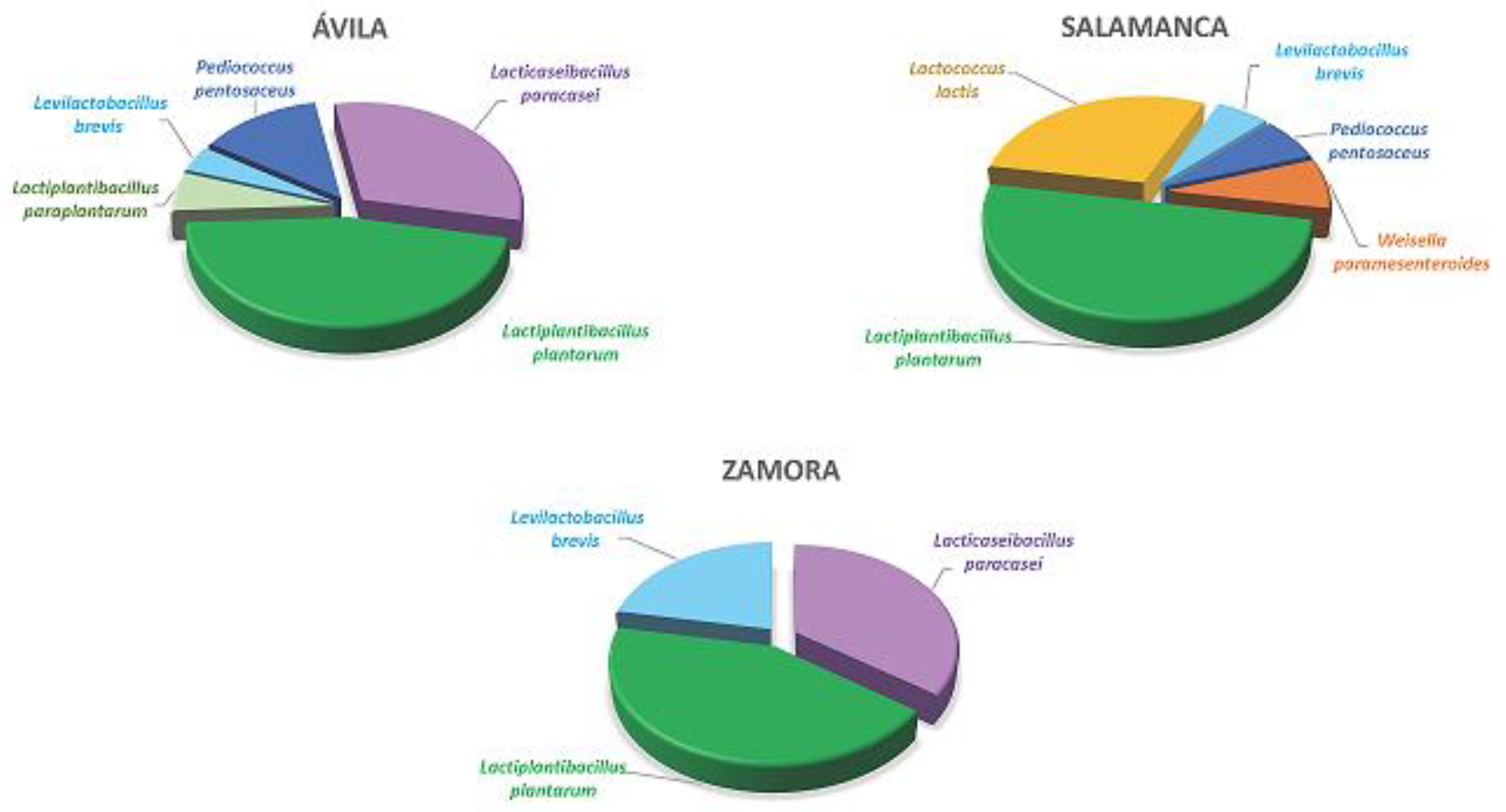
Figure 2.
Pie charts showing the distribution of LAB strains isolated from experimental mature sourdoughs elaborated with different cereals.
Figure 2.
Pie charts showing the distribution of LAB strains isolated from experimental mature sourdoughs elaborated with different cereals.
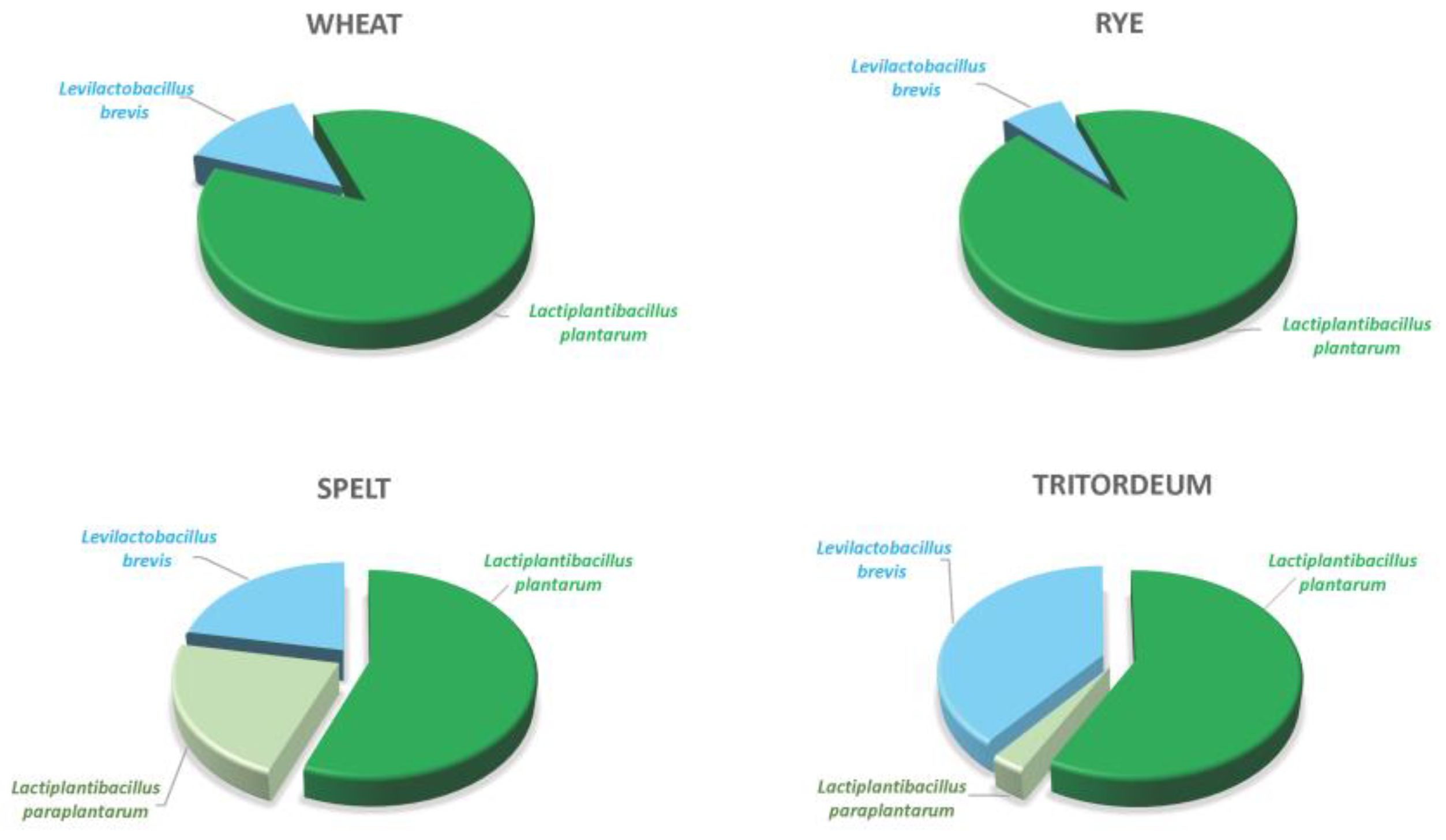
Figure 3.
Neighbour-joining phylogenetic unrooted tree based on pheS gene partial sequences (400 nt) showing the taxonomic location of representative strains from different groups of MALDI-TOF MS found in this study. Bootstrap values calculated for 1000 replications are indicated. Bar, 5 nt substitution per 1000 nt. Accession numbers from Genbank are given in brackets.
Figure 3.
Neighbour-joining phylogenetic unrooted tree based on pheS gene partial sequences (400 nt) showing the taxonomic location of representative strains from different groups of MALDI-TOF MS found in this study. Bootstrap values calculated for 1000 replications are indicated. Bar, 5 nt substitution per 1000 nt. Accession numbers from Genbank are given in brackets.
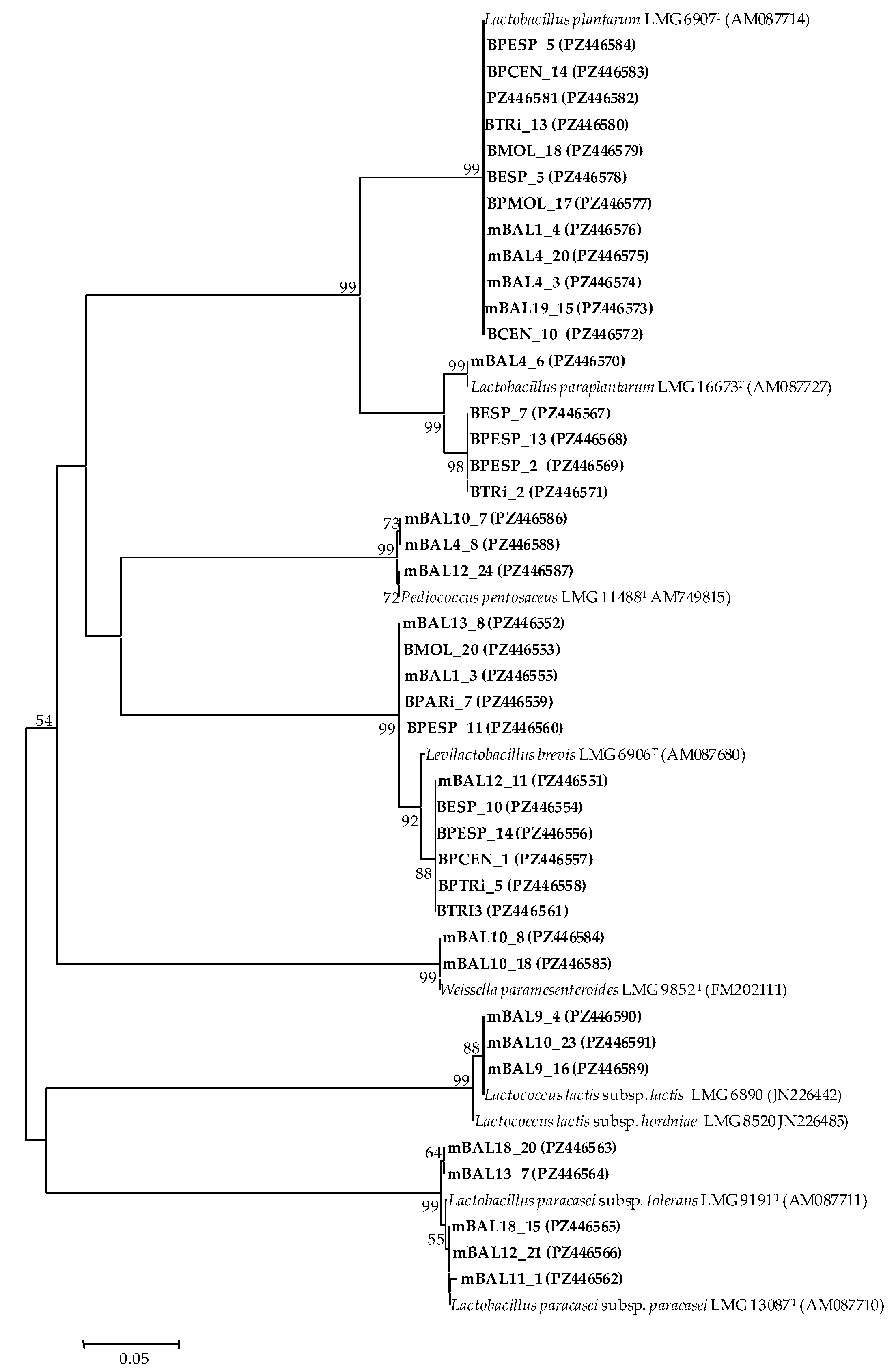

Table 1.
Results of the identification through MALDI-TOF and pheS gene sequence analyses of strains isolated from fermented sourdoughs elaborated with different cereals. *These values were calculated with respect to the type strains of each species which are indicated in Figure 3.
Table 1.
Results of the identification through MALDI-TOF and pheS gene sequence analyses of strains isolated from fermented sourdoughs elaborated with different cereals. *These values were calculated with respect to the type strains of each species which are indicated in Figure 3.
| Sourdoughs codes (number of isolated strains) | Cereal/sourdough type | origin | Identified LAB species through MALDI-TOF | Representative strain/MALDI-TOF group | pheS gene sequence similarity values (%)* |
|---|---|---|---|---|---|
| mBAL5 (1), mBAL11 (5), mBAL12 (9) | wheat/firm | Avila bakeries | Lacticaseibacillus paracasei | mBAL11_1/III mBAL12_21/V |
99.7% 99.7% |
| mBAL13 (7), mBAL17 (1), mBAL18 (20) | wheat/firm | Zamora bakeries | Lacticaseibacillus paracasei | mBAL18_15/I mBAL13_7/II mBAL18_20/IV |
99.7% 99.7% 99.7% |
| mBAL4 (6), mBAL5 (4), mBAL11 (8), mBAL12 (3) | wheat/firm | Avila bakeries | Lactiplantibacillus plantarum | mBAL4_3/VI | 100% |
| mBAL1 (17), mBAL10 (2), mBAL19 (23) | wheat/firm | Salamanca bakeries | Lactiplantibacillus plantarum | mBAL1_4/IX mBAL19_15/IV |
100% |
| mBAL13 (1), mBAL14 (10), mBAL15 (14), mBAL17 (10) | wheat/firm | Zamora bakeries | Lactiplantibacillus plantarum | mBAL4_20/V | 100% |
| BARI (15), BMOL (13) | wheat/firm | experimental | Lactiplantibacillus plantarum | BMOL_18/II | 100% |
| BPARi (14), BPMOL (13) | wheat/liquid | experimental | Lactiplantibacillus plantarum | BPMOL_17/VIII | 100% |
| BCEN (14) | rye/firm | experimental | Lactiplantibacillus plantarum | BCEN_10/VII | 100% |
| BPCEN (13) | rye/liquid | experimental | Lactiplantibacillus plantarum | BPCEN_14/XI | 100% |
| BESP (9) | spelt/firm | experimental | Lactiplantibacillus plantarum | BESP_5/III | 100% |
| BPESP (12) | spelt/liquid | experimental | Lactiplantibacillus plantarum | BPESP_5/X | 100% |
| BTRi (9) | tritordeum/firm | experimental | Lactiplantibacillus plantarum | BTRi_13/I | 100% |
| BPTRi (12) | tritordeum/liquid | experimental | Lactiplantibacillus plantarum | BPTRi_13/XII | 100% |
| mBAL4 (3) | wheat/firm | Avila bakery | Lactiplantibacillus paraplantarum | mBAL4_6/II | 100% |
| BESP (4) | spelt/firm | experimental | Lactiplantibacillus paraplantarum | BESP_7/IV | 97.9% |
| BPESP (4) | spelt/liquid | experimental | Lactiplantibacillus paraplantarum | BPESP_2/III BPESP_13/V |
97.9% 97.9% |
| BTRi (1) | tritordeum/firm | experimental | Lactiplantibacillus paraplantarum | BTRi_2/I | 97.9% |
| mBAL1 (5) | wheat/firm | Salamanca bakery | Levilactobacillus brevis | mBAL1_3/IV | 98.7% |
| mBAL12 (2) | wheat/firm | Avila bakery | Levilactobacillus brevis | mBAL12_11/IX | 99.2% |
| mBAL13 (16), mBAL17 (2) | wheat/firm | Zamora bakeries | Levilactobacillus brevis | mBAL13_8/VI | 98.7% |
| BMOL (3) | wheat/firm | experimental | Levilactobacillus brevis | BMOL_20/I | 98.7% |
| BPARi (2), BPMOL (4) | wheat/liquid | experimental | Levilactobacillus brevis | BPARi_7/XI | 98.7% |
| BPCEN (2) | rye/liquid | experimental | Levilactobacillus brevis | BPCEN_1/X | 99.2% |
| BESP (5) | spelt/firm | experimental | Levilactobacillus brevis | BESP_10/VII BPESP_11/III |
99.2% 98.7% |
| BPESP (3) | spelt/liquid | experimental | Levilactobacillus brevis | BPESP_14/V | 99.2% |
| BTRi (10) | tritordeum/firm | experimental | Levilactobacillus brevis | BTRi_3/VIII | 99.2% |
| BPTRi (4) | tritordeum/liquid | experimental | Levilactobacillus brevis | BPTRi_5/II | 99.2% |
| mBAL4 (1), mBAL12 (5) | wheat/firm | Avila bakeries | Pediococcus pentosaceus | mBAL4_8/III mBAL12_24/II | 99.7% 100% |
| mBAL9 (1), mBAL10 (5) | wheat/firm | Salamanca bakeries | Pediococcus pentosaceus | mBAL10_7/I | 99.7% |
| mBAL9 (22), mBAL10 (2) | wheat/firm | Salamanca bakeries | Lactococcus lactis | mBAL9_4/I mBAL9_16/III mBAL10_23/II |
100% 100% 100% |
| mBAL10 (7) | wheat/firm | Salamanca bakery | Weissella paramesenteroides | mBAL10_8/II mBAL10_18/I | 100% 100% |
Table 2.
Percentages of the LAB species isolated in this study. 1: Lacticaseibacillus paracasei, 2: Lactiplantibacillus plantarum, 3: Lactiplantibacillus paraplantarum, 4: Lactococcus lactis, 5: Levilactobacillus brevis, 6: Pediococcus pentosaceus, 7: Weissella paramesenteroides.
Table 2.
Percentages of the LAB species isolated in this study. 1: Lacticaseibacillus paracasei, 2: Lactiplantibacillus plantarum, 3: Lactiplantibacillus paraplantarum, 4: Lactococcus lactis, 5: Levilactobacillus brevis, 6: Pediococcus pentosaceus, 7: Weissella paramesenteroides.
| Sourdoughs | 1 | 2 | 3 | 4 | 5 | 6 | 7 |
|---|---|---|---|---|---|---|---|
| Fermented wheat sourdoughs elaborated in bakeries of different provinces | |||||||
| Ávila province | |||||||
| mBAL4, mBAL5, mBAL11, mBAL12 | 31% | 46% | 6% | 4% | 13% | ||
| Salamanca province | |||||||
| mBAL1, mBAL9, mBAL10 | 50% | 29% | 6% | 7% | 8% | ||
| Zamora province | |||||||
| mBAL13, mBAL14, mBAL15, mBAL17, mBAL18 | 35% | 43% | 22% | ||||
| Firm and liquid sourdoughs elaborated with different cereals | |||||||
| Wheat | 86% | 14% | |||||
| Rye | 93% | 7% | |||||
| Spelt | 56% | 22% | 22% | ||||
| Tritordeum | 58% | 3% | 39% | ||||
Disclaimer/Publisher’s Note: The statements, opinions and data contained in all publications are solely those of the individual author(s) and contributor(s) and not of MDPI and/or the editor(s). MDPI and/or the editor(s) disclaim responsibility for any injury to people or property resulting from any ideas, methods, instructions or products referred to in the content. |
© 2026 by the authors. Licensee MDPI, Basel, Switzerland. This article is an open access article distributed under the terms and conditions of the Creative Commons Attribution (CC BY) license (http://creativecommons.org/licenses/by/4.0/).
Copyright: This open access article is published under a Creative Commons CC BY 4.0 license, which permit the free download, distribution, and reuse, provided that the author and preprint are cited in any reuse.


