

Submitted:
31 May 2026
Posted:
02 June 2026
You are already at the latest version
Abstract
DNA sequence context plays a critical role in modulating the mutational effects of DNA damage. Here, we investigated how base identity influences the replication bypass and mutagenicity of a site-specific dG-AAF (2-acetylaminofluorene) bulky adduct in the well-defined AG*N and TG*N sequence contexts. By selecting A (purine) and T (pyrimidine) as representative 5’-flanking bases and systematically varying the 3’-base, we established a controlled system to examine sequence-dependent lesion replication. We found that the 5’-flanking base strongly affects the bypass profile, with AG*N sequences exhibiting uniformly low bypass (≤ 9.7%) and TG*N sequences showing markedly elevated bypass (23.6 – 50.4%) with strong sequence dependence. These differences may arise from the structure of the dG-AAF, whose conformation heterogeneities are sensitive to the flanking sequence context. In contrast, mutagenicity remains consistently low across all sequences examined, with a low frequency of point mutations and no detectable frameshift events. These results reveal a clear decoupling between lesion bypass efficiency and replication fidelity, where sequence context strongly controls lesion tolerance but has limited impact on mutagenicity. In total, our findings demonstrate that DNA sequence affects lesion processing, providing insights into how local sequence context shapes genome stability and mutational processes.
Keywords:
DNA damage
; bulky adducts
; conformational change
; DNA replication
; mutagenesis
1. Introduction
Genome damage leads to diverse biological outcomes and contributes to the development of disease, particularly cancer.[1,2,3,4] The sequence context surrounding a DNA lesion plays a critical role in determining its biological consequences.[5,6,7,8] It is well established that local sequence can influence the structural and conformational properties of bulky DNA lesions,[9,10,11,12,13] which in turn affect how they are recognized and processed by cellular machinery. Variations in neighboring bases can alter base stacking, flexibility, and local geometry, thereby modulating the lesion's conformational heterogeneity and, in turn, its accessibility to replication and repair enzymes.[14] As a result, the same chemical lesion can exhibit markedly different levels of replication bypass efficiency and mutagenicity depending on its sequence environment.[15,16,17] These observations underscore that DNA sequence is not simply a passive background but an active player shaping the structural and functional consequences of DNA damage. Such sequence effects may also contribute to the formation of mutation hotspots and the emergence of characteristic mutational signatures observed in cancer genomes.
Bulky DNA adducts formed from arylamine and nitroarene metabolites have long been studied for their roles in chemical carcinogenesis.[18,19] 2-Nitrofluorene is designated as a Group 2B carcinogen by the IARC.[20] Upon metabolic activation, 2-nitrofluorene is converted into a highly reactive nitrenium ion that covalently modifies DNA, predominantly forming C8-guanine adducts such as dG-AAF (N-(deoxyguanosin-8-yl)-2-acetylaminofluorene) and the deacetylated dG-AF (N-(deoxyguanosin-8-yl)-2-aminofluorene) lesions (Figure 1).[21,22,23,24,25] dG-AAF and dG-AF are associated with an increased risk of bladder and liver cancers.[18,19] These bulky adducts are known to adopt sequence-dependent conformational ensembles, which influence their interactions with replication and repair machinery.[14,26] Functionally, dG-AF is largely non-mutagenic, whereas dG-AAF strongly impedes DNA polymerases and can induce both point mutations and frameshift events.[24,25,27,28] As a result, the dG-AAF lesion provides a powerful system for probing how structurally complex DNA damage is processed and how such processing contributes to mutagenesis and carcinogenesis.
In our previous studies, we systematically examined the replication bypass and mutagenicity of bulky arylamine adducts, focusing on the effects of cytosine methylation (m5C) on both bulky dG-AAF and dG-AF in the CG*N and m5CG*N sequence contexts.[11,12] The studies revealed that dG-AAF generally exhibits low bypass efficiency (<10%) but is highly sensitive to local sequence features. Notably, cytosine methylation introduced a striking context-dependent effect: m5C decreases bypass in 3’-pyrimidine contexts but increases it in 3’-purine contexts, compared to non-methylated cytosine sequences. In addition, dG-AAF was found to be frameshift-prone, with significant −G deletion mutations arising in specific sequence environments, highlighting a tight coupling between sequence context and mutagenic consequence. These findings established that even within a narrowly defined sequence context, local DNA sequence can strongly modulate both lesion tolerance and mutagenesis for bulky adducts.
While these epigenetics-related studies highlight the significant impact of m5C on lesion replication, an important question remains: what are the sequence effects in non-epigenetic sequences? To address this, we turned to sequence contexts defined solely by natural bases, focusing on AG*N (purine) and TG*N (pyrimidine) sequence contexts. In this study, we site-specifically modified eight 16-mer oligonucleotide sequences (d [5’-CTTCTXG*NCCTCATTC-3’], where X is either A or T, G* is either dG (control) or dG-AAF, and the 3’-flanking base (N) is A, T, C, or G). We then systematically conducted lesion bypass (Competitive Replication of Adduct Bypass, CRAB) and mutagenicity (Restriction Endonuclease And Post-labeling, REAP) experiments in a site-specific manner.[29,30,31]
We found that DNA sequence context exerts strong control over lesion bypass, with the identity of the 5’-flanking base shifting the replication between low- and high-bypass groups (AG*N vs TG*N). Within the TG*N group, the 3′-base further modulates the extent of bypass, revealing a hierarchical dependence on sequence. In contrast, mutagenicity remains consistently low across all contexts, indicating a clear distinction between replication efficiency (bypass) and fidelity (mutagenicity). These results show that local DNA sequences control lesion tolerance, even without relying on epigenetic changes. The systematic approach reveals the mechanism behind how sequence context shapes DNA damage processing, which likely influences where mutations occur across the genome.
2. Results
We measured both replication bypass efficiency and mutagenicity of the bulky dG-AAF using a site-specific approach, introducing a single dG-AAF adduct at a defined position: XG*N (X is either A or T, G* is either dG (control) or dG-AAF, and N is A, T, C, or G. Figure 1). The bypass assay quantified the ability of the replication system to traverse the lesion, whereas the mutagenicity assay assessed replication fidelity. These complementary measurements distinguished whether sequence context primarily affects bypass efficiency, mutagenicity, or both, providing insight into how local DNA sequence controls the biological outcomes of DNA damage.
Selection of a single-stranded M13 vector and an AlkB-negative Escherichia coli (E. coli) cell. To study the replication efficiency and mutagenic property of the dG-AAF adduct, we used the CRAB and REAP assays with a single-stranded (ss) M13 vector.[29] This system minimizes interference from nucleotide excision repair (NER), since dG-AAF is repaired in double-stranded DNA. Using ss-DNA allows the cellular responses to demonstrate the intrinsic properties of the dG-AAF adduct without complications from nucleotide excision repair. In this study, we used 1,N6-ethenoadenine (εA) as a control for the bypass and mutagenicity measurements. To minimize potential repair of εA by AlkB, we used an AlkB-negative E. coli strain (HK82).
2.1. Bypass of dG-AAF in the AG*N Sequences
In the AG*N sequence series, lesion bypass exhibited only a modest dependence on the identity of the 3′ flanking base. Bypass efficiencies clustered within a relatively narrow range, from ~6.4% to ~9.7% (Figure 2). Specifically, AG*C (6.5%) and AG*T (6.4%) showed nearly identical, lower bypass levels, whereas AG*A (8.2%) and AG*G (9.7%) exhibited slightly higher bypass efficiencies. This yields a sequence-dependent bypass efficiency of AG*G > AG*A > AG*C ≈ AG*T, with moderate variations.
2.2. Bypass of dG-AAF in the TG*N Sequences
In the TG*N sequence series, lesion bypass exhibited a pronounced dependence on the identity of the 3′ flanking base. Bypass efficiencies varied over a broad range, from ~23.6% to ~50.4%. Among the four sequences, TG*C showed the highest bypass (~50.4%), followed by TG*G (~35.8%), whereas TG*T (~24.8%) and TG*A (~23.6%) displayed substantially lower and nearly identical bypass levels. This establishes a sequence-dependent order of TG*C > TG*G > TG*T ≈ TG*A. Notably, the difference between TG*C and TG*A exceeds twofold, indicating a strong influence of the 3′ base on replication efficiency in the TG*N context. These results demonstrate that, when the lesion is preceded by T, the 3′ flanking nucleotide becomes a greater determining factor of bypass efficiency than A.
2.3. Comparison of Bypass Between AG*N and TG*N Sequences
Overall, the AG*N and TG*N series exhibit strikingly different bypass behaviors. The AG*N sequences show low and relatively uniform bypass efficiencies (average ~7.7%), with modest variation across the four 3’-flanking bases. In contrast, the TG*N sequences display substantially higher bypass (average ~33.7%, ~4.4-fold greater than AG*N) with a stronger dependence on 3′ base identity. These results show that the 5’-flanking base strongly modulates the extent of dG-AAF lesion bypass.
2.4. Comparison of Bypass Between AG*N/TG*N to CG*N/m5CG*N
The bypass patterns of dG-AAG observed in the AG*N and TG*N series differ substantially from those previously reported for the CG*N/m5CG*N sequence contexts. In the CG*N/m5CG*N study,[12] bypass efficiencies were uniformly low (<10%) and exhibited a clear sequence-dependent inversion upon cytosine methylation, with m5C decreasing bypass in C#GC and C#GT but increasing bypass in C#GA and C#GG (C# = either C or m5C). A similar low-bypass group is observed in the AG*N series, where bypass remains uniformly low (maximum ~9.7%) and varies modestly across the four 3′ flanking bases. In contrast, the TG*N series shows a dramatically elevated bypass rate, ranging from 23.6% to 50.4%, representing a substantial increase over both the AG*N and CG*N/m5CG*N contexts. Moreover, TG*N exhibits a strong dependence on the identity of the 3′ base, whereas AG*N and CG*N/m5CG*N remain confined to a narrowly ranged, low-bypass group. The data indicate that substitution of the 5′ base with T shifts the system into a high-bypass, sequence-sensitive situation, highlighting the central role of the 5′ flanking base in controlling both the magnitude and variability of lesion bypass.
2.5. Mutagenicity of dG-AAF in AG*N and TG*N Sequences
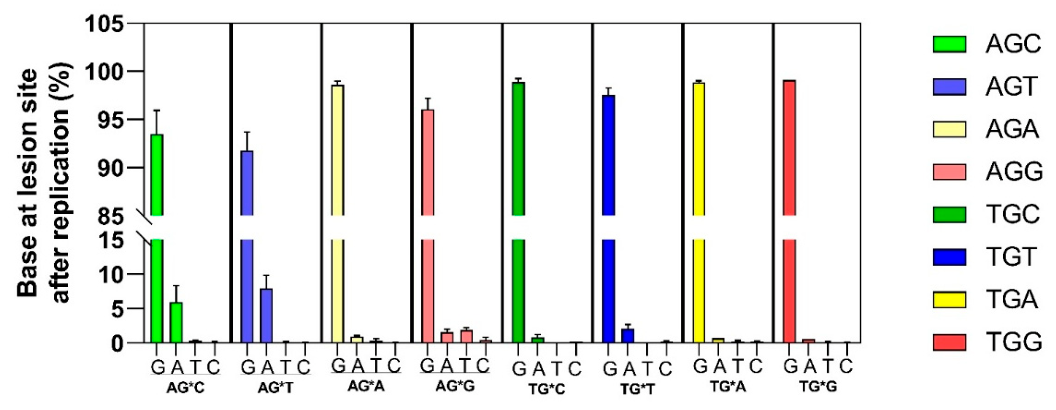
The mutagenicity of dG-AAF in the AG*N and TG*N sequence contexts was relatively low and exhibited limited overall sequence dependence (Figure 3). Across all sequences, correct G incorporation predominated, ranging from 91.8% (AG*T) to 99.1% (TG*G), indicating largely error-free replication. Consistent with this, most point mutations occurred at very low frequencies, with G→C mutations ≤0.5% and G→T mutations ≤1.9% across all sequence contexts. However, G→A mutations displayed a clear sequence-dependent bias in the AG*N series, being elevated in 3′ pyrimidine contexts (6.0% for AG*C and 7.9% for AG*T) but remaining low in 3′ purine contexts (0.9% for AG*A and 1.6% for AG*G). Importantly, no −G deletion mutations were detected in any AG*N or TG*N sequence, contrary to our previous observations of the -G deletion in the CG*N/m5CG*N sequences.[12] Overall, these results indicate that, despite substantial sequence-dependent differences in bypass efficiency, mutagenicity remains low. However, specific substitution patterns, such as G→A, retain a measurable sequence dependence modulated by local base identity.
2.6. Comparison of Mutagenicity of dG-AAF in AG*N/TG*N Versus CG*N/m5CG*N Sequence Contexts
In contrast to our previous findings in the CG*N/m5CG*N sequence contexts,[12] where dG-AAF induced substantial −G deletion mutations and pronounced sequence-dependent mutational profiles, the AG*N and TG*N series exhibited markedly different behavior. In the CG*N/m5CG*N study,[12] frameshift mutations were a dominant result, particularly in specific sequence contexts (C#GA/C#GG, C# = either C or m5C), highlighting a strong coupling between local sequence and mutagenic processing. However, in the present study, no −G deletion mutations were detected in any AG*N or TG*N sequence, and overall mutagenicity remained low across all contexts. While minor sequence-dependent variations in point mutations were observed−most notably a modest increase in G→A substitutions in AG*C and AG*T−these effects were limited in magnitude. They did not approach the mutational impact seen in CG*N/m5CG*N (the highest −G deletion is 45.9%). Thus, whereas CG*N and m5CG*N contexts induce frameshift-prone, sequence-sensitive mutagenesis, the AG*N and TG*N contexts yield largely error-free replication despite substantial differences in bypass efficiency. These results demonstrate that sequence context not only modulates bypass efficiency but can fundamentally shift the mutational outcome from mutagenicity-prone to high-fidelity replication.
2.7. Overall Comparison of dG-AAF in AG*N and TG*N Sequence Contexts
The AG*N and TG*N sequence series exhibit both similarities and key differences in lesion processing. In both contexts, mutagenicity remains uniformly low, with correct G incorporation predominating (> 90–99%), minimal point mutations (G→C ≤0.5%, G→T ≤1.9%), and no −G deletion observed, indicating largely error-free replication. In contrast, their bypass behaviors diverge substantially. The AG*N series displays a low-bypass group (maximum ~9.7%) with modest variation across the four 3′ bases, whereas the TG*N series shows markedly elevated bypass (23.6–50.4%) with strong sequence dependence, spanning more than a two-fold range. Thus, while both contexts support high-fidelity replication, they differ markedly in bypass efficiency. These findings reveal a clear decoupling between bypass and mutagenicity, in which sequence context strongly affects lesion-bypass efficiency but has minimal impact on replication fidelity in AG*N and TG*N sequences.
3. Conclusions
In this study, we systematically investigated how local DNA sequence context influences the replication efficiency and mutagenicity of a site-specific dG-AAF lesion. The results reveal a clear functional separation between lesion bypass and mutagenesis. These findings demonstrate sequence-dependent lesion replication in which local DNA sequence (AG*N vs TG*N) determines both the magnitude and sensitivity of lesion traverse. The identity of the 5’-flanking base defines the bypass group, shifting the system between low- and high-tolerance states, while the 3’-flanking base modulates variation within that group. Notably, sequence context strongly influences replication efficiency without substantially altering fidelity, demonstrating a clear functional separation between lesion tolerance and mutagenesis. Compared with our previous CG*N/m5CG*N study,[12] where epigenetic modification drives context-dependent replication, the present work shows that natural base identity (purine vs pyrimidine) alone can exert equally powerful control. Notably, this effect can switch the system from a constrained, low-bypass state to a highly permissive one. The dG-AAF results suggest that local DNA sequence inherently influences how DNA damage is processed during replication. Also local sequences may shape how lesions are tolerated, propagated, and distributed throughout the genome. While we did not directly probe lesion conformation in this study, our results are consistent with prior structural studies that have shown sequence-dependent conformational heterogeneity of AAF adducts.[11,12,26]
Collectively, our recent work[11,12] establishes an integrated system in which local DNA sequence context affects the processing of bulky DNA lesions at multiple levels and demonstrates how epigenetic modification (m5C) modulates lesion bypass and mutagenicity in a sequence-dependent manner. In the present paper, we show that natural base alone can exert strong control as well, with the 5′ flanking base defining the global bypass regime and the 3′ base tuning local variation, while mutagenicity remains largely uncoupled. These findings provide a model system for understanding how sequence context shapes genome stability and mutation patterns.
This work opens several possibilities for future investigation. Extending these studies to human cells with diverse repair pathways will be important to evaluate the interplay between sequence effects and cellular repair/replication mechanisms. In addition, expanding the sequence beyond 5’ and 3’ neighboring bases and lesion types may help define general rules controlling sequence-dependent lesion processing across different DNA damages. Finally, integrating these insights with genomic and cancer datasets could reveal how sequence-related lesion tolerance contributes to mutation hotspots and mutational signatures, linking molecular mechanisms to genome-wide patterns of mutagenesis.
4. Experimental Procedures
Synthesis of oligonucleotides and construction of lesion containing vectors.[11,29] Eight 16mer oligonucleotides (5′-CTTCTXG*NCCTCATTC-3′, X=A/T, N=A/G/C/T) carrying a dG-AAF adduct were synthesized. The reactive N-acetoxy-N-(trifluoroacetyl)-2-acetylaminofluorene was prepared from 2-nitrofluorene via biomimetic activation and coupled to each oligonucleotide in sodium citrate buffer (pH 6.0, 37 °C, 24 h).[32] After HPLC purification (>98% purity), the adducted strands were verified by LC-ESI-TOF-MS, and lesion location was confirmed by enzymatic digestion followed by MALDI-TOF/MS (Figures S1–S16 and Tables S1 and S2).[11,12]
Lesion-containing 16mers, unmodified 16mer controls, and 19mer competitor strands were phosphorylated, annealed with scaffolds and ligated into 58/61mer strands, which were inserted into the M13mp7(L2) ssDNA vector and verified by PCR (Figures S17–S20 and Table S3).[11]
Vector replication bypass (CRAB) and mutanenicity (REAP) assays.[11,29] For replication bypass (CRAB) and mutagenicity (REAP) assays, lesion-bearing ssDNA was mixed with a lesion-free competitor genome (50:1 ratio) and electroporated into E. coli HK82 (AlkB⁻).[30] After phage amplification, DNA was isolated (QIAprep M13), PCR-amplified, double-digested with XhoI/SphI, and the resulting 20(CT)/28(AG)-mer (lesion) and 23-mer (competitor) fragments were analyzed by HPLC-ESI-TOF-MS in negative ion mode using a C18 column and an HFIP/methanol gradient. The competitor served as an internal reference for 100% bypass and zero induced mutation. Bypass efficiency was calculated as the lesion/competitor fragment intensity ratio normalized to the unmodified control (100%) (Figure 2, Table S4). Mutation frequencies were determined from the signal of each mutated sequence divided by total signals (Figure 3, Table S5).[11,12] Data represent means ± SD (n = 3).
Supplementary Materials
The following supporting information can be downloaded at the website of this paper posted on Preprints.org.
Funding
National Institutes of Health [R01CA098296 and R21ES028384, in part, to B.P.C.; R01ES028865 and R01GM145790, in part, to D.L.]. This research project was supported by using equipment from the Rhode Island Institutional Development Award (IDeA) Network of Biomedical Research Excellence from the National Institute of General Medical Sciences of the National Institutes of Health (grant number P20GM103430) through the Centralized Research Core facility.
Acknowledgments
The authors would like to acknowledge Janet Atoyan and Ang Cai from RI-INBRE for their great support.
Conflicts of Interest
None declared.
References
- Basu, A. K.; Essigmann, J. M. Establishing Linkages Among DNA Damage, Mutagenesis, and Genetic Diseases. Chem. Res. Toxicol. 2022, 35, 1655–1675. [Google Scholar] [CrossRef]
- Delaney, J. C.; Essigmann, J. M. Biological properties of single chemical-DNA adducts: a twenty year perspective. Chem. Res. Toxicol. 2008, 21, 232–252. [Google Scholar] [CrossRef]
- Shrivastav, N.; Li, D.; Essigmann, J. M. Chemical biology of mutagenesis and DNA repair: cellular responses to DNA alkylation. Carcinogenesis 2010, 31, 59–70. [Google Scholar] [CrossRef]
- Fu, D.; Calvo, J. A.; Samson, L. D. Balancing repair and tolerance of DNA damage caused by alkylating agents. Nat. Rev. Cancer 2012, 12, 104–120. [Google Scholar] [CrossRef]
- Phillips, D. H. Mutational spectra and mutational signatures: Insights into cancer aetiology and mechanisms of DNA damage and repair. DNA Repair 2018, 71, 6–11. [Google Scholar] [CrossRef]
- Fedeles, B. I.; Essigmann, J. M. Impact of DNA lesion repair, replication and formation on the mutational spectra of environmental carcinogens: Aflatoxin B1 as a case study. DNA Repair 2018, 71, 12–22. [Google Scholar] [CrossRef] [PubMed]
- Alexandrov, L. B.; Stratton, M. R. Mutational signatures: the patterns of somatic mutations hidden in cancer genomes. Curr. Opin. Genet. Dev. 2014, 24, 52–60. [Google Scholar] [CrossRef]
- Stratton, M. R. Exploring the genomes of cancer cells: progress and promise. Science 2011, 331, 1553–1558. [Google Scholar] [CrossRef] [PubMed]
- Cai, A.; Wilson, K. A.; Patnaik, S.; Wetmore, S. D.; Cho, B. P. DNA base sequence effects on bulky lesion-induced conformational heterogeneity during DNA replication. Nucleic Acids Res. 2018, 46, 6356–6370. [Google Scholar] [CrossRef] [PubMed]
- Cai, A.; et al. Probing the Effect of Bulky Lesion-Induced Replication Fork Conformational Heterogeneity Using 4-Aminobiphenyl-Modified DNA. Mol. Basel Switz. 2019, 24, 1566. [Google Scholar] [CrossRef]
- Crisalli, A. M.; Chen, Y.-T.; Cai, A.; Li, D.; Cho, B. P. Conformation-dependent lesion bypass of bulky arylamine-dG adducts generated from 2-nitrofluorene in epigenetic sequence contexts. Nucleic Acids Res. 2023, 51, 12043–12053. [Google Scholar] [CrossRef]
- Chen, Y.-T.; Qi, R.; Cai, A.; Cho, B. P.; Li, D. Conformation-Dependent Lesion Bypass and Mutagenicity of Bulky 2-Acetylaminofluorene-Guanine DNA Adduct in Epigenetically Relevant Sequence Contexts. Chem. Res. Toxicol. 2025, 38, 1336–1343. [Google Scholar] [CrossRef]
- Liang, F.; Cho, B. P. Probing the thermodynamics of aminofluorene-induced translesion DNA synthesis by differential scanning calorimetry. J. Am. Chem. Soc. 2007, 129, 12108–12109. [Google Scholar] [CrossRef]
- Hilton, B.; et al. Dissociation Dynamics of XPC-RAD23B from Damaged DNA Is a Determining Factor of NER Efficiency. PLoS ONE 2016, 11, e0157784. [Google Scholar] [CrossRef] [PubMed]
- Delaney, J. C.; Essigmann, J. M. Effect of sequence context on O(6)-methylguanine repair and replication in vivo. Biochemistry 2001, 40, 14968–14975. [Google Scholar] [CrossRef]
- Bian, K.; Delaney, J. C.; Zhou, X.; Li, D. Biological Evaluation of DNA Biomarkers in a Chemically Defined and Site-Specific Manner. Toxics 2019, 7, 36. [Google Scholar] [CrossRef]
- You, C.; Wang, Y. Mass Spectrometry-Based Quantitative Strategies for Assessing the Biological Consequences and Repair of DNA Adducts. Acc. Chem. Res. 2016, 49, 205–213. [Google Scholar] [CrossRef]
- Skipper, P. L.; Tannenbaum, S. R.; Ross, R. K.; Yu, M. C. Nonsmoking-related arylamine exposure and bladder cancer risk. Cancer Epidemiol. Biomark. Prev. Publ. Am. Assoc. Cancer Res. Cosponsored Am. Soc. Prev. Oncol. 2003, 12, 503–507. [Google Scholar]
- Chung, K.-T. Occurrence uses and carcinogenicity of arylamines. Front. Biosci. 2015, 7, 367–393. [Google Scholar] [CrossRef]
- Hasanin, A. H.; Habib, E. K.; El Gayar, N.; Matboli, M. Promotive action of 2-acetylaminofluorene on hepatic precancerous lesions initiated by diethylnitrosamine in rats: Molecular study. World J. Hepatol. 2021, 13, 328–342. [Google Scholar] [CrossRef] [PubMed]
- Mu, H.; et al. Nucleotide excision repair of 2-acetylaminofluorene- and 2-aminofluorene-(C8)-guanine adducts: molecular dynamics simulations elucidate how lesion structure and base sequence context impact repair efficiencies. Nucleic Acids Res. 2012, 40, 9675–9690. [Google Scholar] [CrossRef]
- Vooradi, V.; Romano, L. J. Effect of N -2-Acetylaminofluorene and 2-Aminofluorene Adducts on DNA Binding and Synthesis by Yeast DNA Polymerase η. Biochemistry 2009, 48, 4209–4216. [Google Scholar] [CrossRef] [PubMed]
- Dutta, S.; et al. Crystal structures of 2-acetylaminofluorene and 2-aminofluorene in complex with T7 DNA polymerase reveal mechanisms of mutagenesis. Proc. Natl. Acad. Sci. 2004, 101, 16186–16191. [Google Scholar] [CrossRef]
- Shibutani, S.; Suzuki, N.; Tan, X.; Johnson, F.; Grollman, A. P. Influence of Flanking Sequence Context on the Mutagenicity of Acetylaminofluorene-Derived DNA Adducts in Mammalian Cells, Biochemistry 2001, 40, 3717–3722. [Google Scholar] [CrossRef]
- Heflich, R. H.; Neft, R. E. Genetic toxicity of 2-acetylaminofluorene, 2-aminofluorene and some of their metabolites and model metabolites. Mutat. Res. 1994, 318, 73–114. [Google Scholar] [CrossRef]
- Jain, V.; et al. Conformational and thermodynamic properties modulate the nucleotide excision repair of 2-aminofluorene and 2-acetylaminofluorene dG adducts in the NarI sequence. Nucleic Acids Res. 2012, 40, 3939–3951. [Google Scholar] [CrossRef]
- Broschard, T. H.; Koffel-Schwartz, N.; Fuchs, R. P. P. Sequence-dependent modulation of frameshift mutagenesis at NarI-derived mutation hot spots. J. Mol. Biol. 1999, 288, 191–199. [Google Scholar] [CrossRef] [PubMed]
- Fuchs, R. P.; Fujii, S. Translesion synthesis in Escherichia coli: lessons from the NarI mutation hot spot. DNA Repair 2007, 6, 1032–1041. [Google Scholar] [CrossRef] [PubMed]
- Delaney, J. C.; Essigmann, J. M. Assays for determining lesion bypass efficiency and mutagenicity of site-specific DNA lesions in vivo. Methods Enzymol. 2006, 408, 1–15. [Google Scholar]
- Delaney, J. C.; Essigmann, J. M. Mutagenesis, genotoxicity, and repair of 1-methyladenine, 3-alkylcytosines, 1-methylguanine, and 3-methylthymine in alkB Escherichia coli. Proc. Natl. Acad. Sci. U. S. A. 2004, 101, 14051–14056. [Google Scholar] [CrossRef]
- Delaney, J. C.; et al. AlkB reverses etheno DNA lesions caused by lipid oxidation in vitro and in vivo. Nat. Struct. Mol. Biol. 2005, 12, 855–860. [Google Scholar] [CrossRef]
- Xu, L.; Cho, B. P. Conformational Insights into the Mechanism of Acetylaminofluorene-dG-Induced Frameshift Mutations in the NarI Mutational Hotspot. Chem. Res. Toxicol. 2016, 29, 213–226. [Google Scholar] [CrossRef]
Figure 1.
Chemical structures of dG-AAF adduct and its biological effects in the AG*N and TG*N sequences (G* = dG-AAF).
Figure 1.
Chemical structures of dG-AAF adduct and its biological effects in the AG*N and TG*N sequences (G* = dG-AAF).
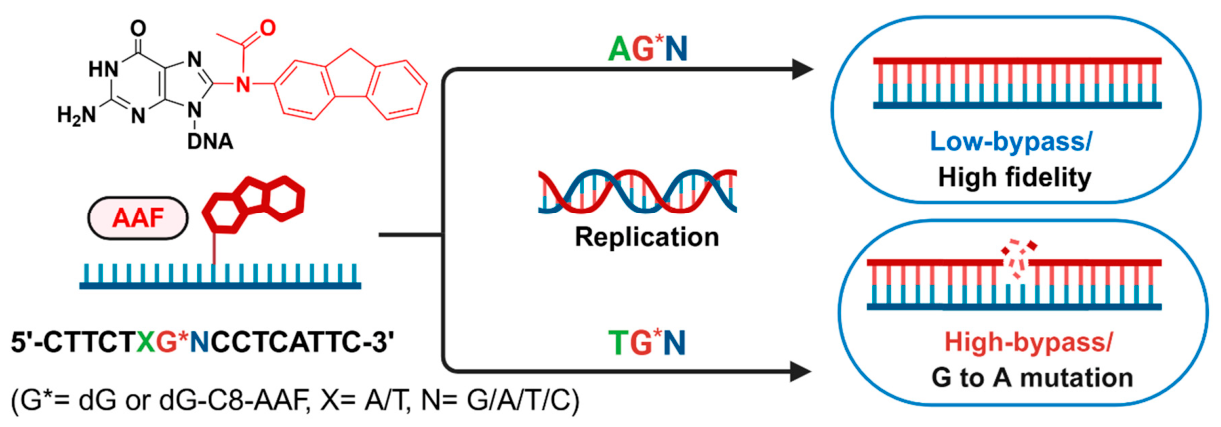
Figure 2.
Bypass efficiencies of dG-AAF under the AG*N (left) and TG*N (right) sequence contexts.
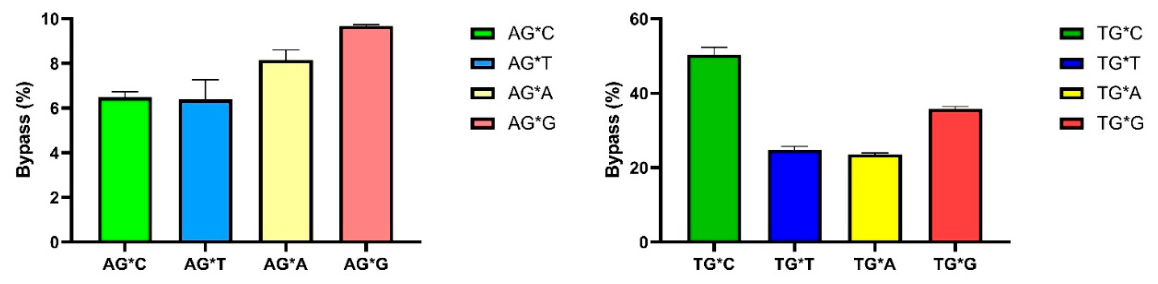
Figure 3.
Mutagenicity of dG-AAF adduct in the AlkB- E. coli cell (HK82). The central G base denoted the dG-AAF adduct. Data indicate no mutation (G) and point mutations (G to A/T/C). Data presented as the mean (n=3) ± standard deviation.
Figure 3.
Mutagenicity of dG-AAF adduct in the AlkB- E. coli cell (HK82). The central G base denoted the dG-AAF adduct. Data indicate no mutation (G) and point mutations (G to A/T/C). Data presented as the mean (n=3) ± standard deviation.
Disclaimer/Publisher’s Note: The statements, opinions and data contained in all publications are solely those of the individual author(s) and contributor(s) and not of MDPI and/or the editor(s). MDPI and/or the editor(s) disclaim responsibility for any injury to people or property resulting from any ideas, methods, instructions or products referred to in the content. |
© 2026 by the authors. Licensee MDPI, Basel, Switzerland. This article is an open access article distributed under the terms and conditions of the Creative Commons Attribution (CC BY) license (http://creativecommons.org/licenses/by/4.0/).
Copyright: This open access article is published under a Creative Commons CC BY 4.0 license, which permit the free download, distribution, and reuse, provided that the author and preprint are cited in any reuse.


