
Submitted:
29 May 2026
Posted:
01 June 2026
You are already at the latest version
Abstract
This report examined changes in academic help-seeking networks among undergraduate students who participated in repeated rotating small-group discussions in a teacher education course. The participants were 129 undergraduate students from two course cohorts at a university in northern Taiwan. Social network data were collected at early- and mid-semester time points, and network visualizations and indicators were used to describe changes in peer recognition for academic help-seeking. The findings showed that the two cohorts displayed different whole-network patterns. Cohort 1 showed increased density and a larger number of observed nomination ties from early to mid-semester, suggesting a more densely connected academic help-seeking network. In contrast, Cohort 2 showed decreased whole-network density at mid-semester. However, this pattern required cautious interpretation because the number of effective respondents declined substantially while the network boundary remained constant. Importantly, respondent-level nomination breadth increased in both cohorts, indicating that students who completed the survey identified more classmates as potential sources of academic help over time. These findings suggest that rotating small-group discussions may broaden students’ recognition of classmates as learning resources, even when whole-network indicators show different patterns. The report highlights the importance of interpreting classroom network change through both whole-network and respondent-level indicators.
Keywords:
academic help-seeking network
; rotating small-group discussions
; classroom social network analysis
1. Introduction
As higher education has increasingly emphasized learning outcomes, educational quality, and student success, creating learning environments that foster student engagement has become a central concern (Kuh, 2009). Peer relationships are an important part of learning environments that foster student engagement. As MacGregor (2000) noted, students increasingly value opportunities to engage with their peers in meaningful academic activities, and these opportunities can help them become more connected to university life. Similarly, Wentzel and Watkins (2002) argued that peer relationships can serve as important academic resources by helping students access information, clarify misunderstandings, receive encouragement, and participate in cooperative learning. These forms of peer support can shape students’ motivation and engagement by influencing how they experience the classroom as a learning environment. From this perspective, students’ engagement in learning is not determined solely by individual motivation; it is also shaped by the social context of the classroom, which can either facilitate or hinder their engagement (Lujan & DiCarlo, 2017).
Classrooms can thus be viewed as relational learning environments in which students’ engagement and access to academic support are shaped by the peer connections available to them (Cappella et al., 2013). Social network research further suggests that educational contexts shape the structure of students’ peer relationships, including the formation of friendship and support networks (Moody, 2001). When these relationships are weak, fragmented, or difficult to access, students may have fewer relational pathways for seeking clarification, exchanging academic information, or participating fully in learning activities (Oumelaid et al., 2026). In this sense, peer interaction is a central component of an effective learning environment because it helps make academic support visible, accessible, and relationally embedded within the classroom.
Recent studies have used social network analysis (SNA) to examine students’ peer relationships, classroom interactions, belonging, and engagement across educational settings (Freire et al., 2024; Williams et al., 2019). The value of SNA lies in its ability to show how students are positioned within classroom networks and how access to learning resources and social capital is distributed among them (Zwolak et al., 2017). This network perspective is especially useful for studying academic help-seeking, because students need not only to complete formal academic requirements but also to know whom they can approach for clarification, guidance, and support (Lujan & DiCarlo, 2017).
SNA has increasingly been used in educational research to examine patterns of student interaction and peer relationships. By representing students as nodes and their social, academic, or collaborative relationships as edges, SNA makes it possible to analyze classroom cohesion, peer clustering, central students, and bridging roles (Oumelaid et al., 2026). These insights can support more evidence-informed decisions about how to design and facilitate learning activities.
Despite the importance of peer interaction, students’ classroom relationships in higher education are not always naturally formed or sustained. MacGregor (2000) noted that college classrooms can provide limited opportunities for meaningful connection: students may attend class together but interact only briefly. As a result, students may share the same physical learning space without developing strong academic relationships with their classmates. This issue is also relevant in Taiwanese higher education contexts, where students may enroll in the same course but still have limited opportunities for interaction beyond short classroom encounters. For this reason, instructors need to intentionally design learning activities that create opportunities for meaningful peer connection and collaborative learning. When such opportunities are structured into the course, students may be more likely to experience the classroom as a supportive academic community rather than as a collection of isolated individuals.
Prior research on collaborative and small-group learning suggests that well-designed group tasks can promote meaningful peer interaction, engagement, and collaborative knowledge construction (Davidson & Major, 2014; Scager et al., 2016). Small-group discussion may therefore provide a practical context for fostering peer relationships and broadening students’ academic help-seeking networks in higher education classrooms. Through discussion, students can exchange ideas, clarify course content, observe classmates’ thinking, and recognize peers as potential sources of academic support (Parmar et al., 2025; Wentzel & Watkins, 2002). However, it remains unclear whether such discussion opportunities are reflected in students’ academic help-seeking networks over time. Using nomination data from two course cohorts, the present study compares students’ academic help-seeking networks from early to mid-semester. During the period, students participated in four small-group discussions in which group membership was intentionally varied across sessions. Two research questions guided the study: (1) How did students’ respondent-level nomination breadth change across time points? and (2) How did whole-network indicators, including density and average degree, differ across cohorts and time points? By addressing these questions, this study examines whether repeated rotating small-group discussions may help students recognize a broader range of classmates as academic help-seeking resources.
2. Materials and Methods
2.1 Participants & Measures
The participants were 129 undergraduate students enrolled in a teacher education course at a university in northern Taiwan. Students ranged from first-year to fourth-year undergraduates. The course was taught by the same instructor across two academic years, and both course cohorts used a similar instructional design in which students participated in four small-group discussions related to course content and learning tasks. Across the four discussions, students were assigned to groups using different grouping methods and worked with different group members.
Cohort 1 consisted of 52 students listed in the course roster. Both the early-semester and mid-semester nomination surveys were organized as 52 × 52 directed nomination matrices, with each student represented as a node and each nomination represented as a directed tie.
Cohort 2 consisted of a larger class. At the early-semester survey, the course roster included 77 students. One additional student joined the course after the early-semester survey; therefore, the mid-semester roster included 78 students. To maintain a consistent network boundary for longitudinal comparison, the main analysis of Cohort 2 was based on the stable cohort of 77 students who were present at both time points. The additional student who joined after the early-semester survey was not included in the main longitudinal comparison.
Across the two cohorts, the analytic sample for the main longitudinal comparison included 129 students: 52 students in Cohort 1 and 77 students in Cohort 2. Because the study focused on classroom academic help-seeking networks, students were asked to nominate classmates whom they would actively consult when they had learning-related questions or needed clarification of course content. These nominations were used to construct directed academic help-seeking networks for each cohort at early (week 2) and mid-semester (week 9) time points.
2.2 Data Analysis
Data analysis proceeded in several steps.
First, each nomination matrix was checked for consistency. The matrices were inspected for row-column alignment, missing values, non-binary values, and self-loops. Non-binary values, if present in preliminary files, were recorded into binary values because the nomination question asked whether students would consult particular classmates. Self-loops were removed before calculating network indicators.
Second, each matrix was converted into a directed edge table and node table. The node table included each student’s code and available attributes, such as cohort, time point, Out-Degree and In-Degree where applicable. The edge table included Source, Target, Type, and Weight. Because the analysis focused on binary nominations, all observed nomination ties were assigned a weight of 1.
Third, whole-network indicators were calculated for each cohort and time point. These included number of nodes, number of edges, density, average degree, average path length, modularity, connected components, and reciprocity. Network visualizations were produced using Gephi. Directed networks were visualized using ForceAtlas2 layout. Node color was used to represent modularity class depending on the analytic focus, and node size was used to represent In-Degree or Betweenness Centrality.
Fourth, respondent-adjusted indicators were calculated to compare nomination breadth across cohorts and time points. These included average nominations per effective respondent and median Out-Degree among effective respondents. These indicators were used because whole-network density can be affected by differences in class size, roster boundaries, and response rates.
3. Results
3.1. Academic Help-Seeking Network Visualizations Across Cohorts and Time Points
Figure 1 present the academic help-seeking networks for Cohort 1 and Cohort 2 at the early- and mid-semester time points. Across the four visualizations, students were represented as nodes and nomination ties as directed edges. Node size reflected In-Degree, indicating how frequently a student was nominated as a potential source of academic help, and node color represented modularity class.
The visualizations suggested different patterns across the two cohorts. In Cohort 1, the early-semester network included a loosely connected peripheral cluster that extended away from the main network, suggesting the presence of a localized academic help-seeking subgroup with relatively limited connections to the rest of the class. In the mid-semester network, this peripheral pattern was less pronounced, and the network appeared more densely connected than the early-semester network. Compared with the early-semester visualization, the mid-semester network showed a larger number of visible ties and a more integrated overall structure, suggesting that academic help-seeking nominations appeared to be more widely distributed across the class.
In Cohort 2, the visual pattern was more complex. The early-semester network showed several relatively compact and visually distinguishable communities. By mid-semester, community structures were still detectable, but the boundaries between communities appeared less visually distinct. Several nodes were positioned closer to other communities or embedded near the interface between groups, suggesting a more overlapping or reorganized community structure.
Taken together, the four visualizations indicate that the two cohorts followed different visual trajectories from early to mid-semester. Cohort 1 showed a clearer movement toward network integration, whereas Cohort 2 showed a more mixed pattern in which community structures remained visible but appeared more overlapping and less compact. Because visual layouts are descriptive rather than inferential, these patterns were interpreted alongside the quantitative indicators reported below, including respondent-level nomination breadth, density, average degree, and path-based measures.
3.2. Overview of Network Construction Across Two Cohorts
Academic help-seeking nomination networks were constructed for two course cohorts at two time points: early semester and mid-semester. Each directed tie represented one student’s nomination of another student as a classmate whom they would consult when encountering learning-related questions or seeking clarification of course content.
Cohort 1 consisted of 52 students at both time points. After removing self-loops, the early-semester network contained 440 directed nomination ties, and the mid-semester network contained 543 directed nomination ties. Cohort 2 included a larger class. The early-semester network contained 77 students and 893 directed nomination ties. The mid-semester network contained 77 students and 629 directed nomination ties when the full mid-semester roster was retained.
Table 1 summarizes the main network indicators across cohorts and time points.
3.3. Respondent-Level Nomination Breadth Increased Across Cohorts
The most consistent respondent-level pattern across the two cohorts was an increase in nomination breadth from early to mid-semester. In Cohort 1, the average number of nominations per effective respondent increased from 10.23 to 13.24. In Cohort 2, the corresponding value increased from 13.13 to 14.63. This indicates that, among students who completed the nomination survey, students identified more classmates as potential sources of academic help at mid-semester than at the beginning of the semester.
The median Out-Degree among effective respondents provided additional support for this interpretation. In Cohort 1, the median Out-Degree remained stable at 9 from early to mid-semester. In Cohort 2, the median Out-Degree increased from 8 to 10. These findings suggest that the increase in average nomination breadth was not solely driven by a small number of highly active nominators. Rather, the respondent-level results indicate that students who completed the mid-semester survey tended to identify a broader range of peers whom they would consult for learning-related questions.
This pattern is notable because it appeared in both cohorts despite differences in class size and response patterns. Taken together, the respondent-level findings suggest that repeated rotating small-group discussions may have broadened students’ recognition of classmates as academic help-seeking resources, particularly among those who participated in the nomination surveys at both time points.
4. Discussion
4.1. Repeated Rotating Small-Group Discussions May Broaden Peer Relationship
The findings suggest that repeated rotating small-group discussions may have broadened students’ recognition of classmates as potential academic help-seeking resources. After the instructor implemented four rotating small-group discussions in the course, the network visualizations showed that subgroup boundaries appeared less distinct, particularly by the mid-semester time point. In addition, respondent-level nomination breadth increased in both cohorts. These patterns suggest that students who completed the nomination survey came to identify a wider range of classmates whom they could consult for assignments, course concepts, or learning-related questions.
This finding is consistent with prior work emphasizing the educational importance of peer relationships in classroom learning. Wentzel and Watkins (2002) argued that peer relationships provide students with opportunities to exchange academic information, clarify misunderstandings, receive encouragement, and participate in collaborative learning. From this perspective, the expansion of academic help-seeking nominations in the present report may reflect an increased awareness of classmates as accessible learning resources. Rotating small-group discussions may have strengthened students’ sense of classroom relatedness by creating repeated opportunities to interact with different classmates rather than remaining within familiar peer circles. MacGregor (2000) also suggests that students often value meaningful academic engagement with peers as part of their participation in university learning. The present findings extend this line of work by showing, through classroom network indicators, how repeated small-group interaction may make peer learning resources more visible.
One possible explanation is that repeated discussions with different group members created opportunities for students to observe the academic strengths and interaction styles of classmates beyond their usual peer circles. Through these encounters, students may have learned who was good at organizing concepts, who could discuss assignments, and who was approachable when they had questions. In this sense, rotating small-group discussions may have functioned not only as a classroom learning activity but also as a mechanism for making peer learning resources more visible.
This finding is important because the development of an academic help-seeking network does not necessarily require all students to become equally connected to everyone in the class. Rather, it may begin when students are structurally exposed to different classmates through repeated rotating group arrangements. By working with different peers across discussions, students may gradually expand their awareness of classmates’ academic strengths, interaction styles, and willingness to provide help. The increase in respondent-level nomination breadth therefore suggests that repeated rotating small-group discussions may support the formation of a broader peer-recognition structure for academic help-seeking.
4.2. Response Patterns May influence Whole-Network Density
The Cohort 2 findings highlight the importance of interpreting whole-network density in relation to response patterns and network boundaries. In Cohort 2, whole-network density decreased from 0.1526 at the early-semester time point to 0.1075 at the mid-semester time point. At first glance, this decrease might appear to suggest that the academic help-seeking network became less connected over time. However, such an interpretation requires caution because the number of effective respondents declined substantially from 68 to 43, while the network boundary was still maintained at 77 students.
This distinction is important because density is calculated based on the number of observed ties relative to the number of possible ties in the whole network. In the Cohort 2 mid-semester network, the denominator still reflected all possible directed ties among 77 students, whereas only 43 students provided outgoing nominations. As Kossinets (2006) showed that missing data can affect the observed structural properties of social networks, indicating that network-level indicators should be interpreted with attention to patterns of missingness. Similarly, Borgatti et al. (2006) noted that network measures may be sensitive to imperfect or incomplete data, although the degree of sensitivity varies across measures and network conditions.
The Cohort 2 results therefore show that whole-network indicators and respondent-adjusted indicators may capture different levels of network change. At the whole-network level, lower density indicates that, within the full classroom boundary, the observed network became more sparse. However, at the respondent level, the average number of nominations per effective respondent increased from 13.13 to 14.63. This suggests that students who completed the mid-semester survey actually nominated more classmates on average, even though the overall network appeared less dense when all 77 students were retained as nodes.
This distinction has methodological implications for classroom network research. In bounded classroom networks, density is sensitive not only to social connectedness but also to response rate, class size, and the treatment of nonrespondents. If density were interpreted alone, Cohort 2 might be mistakenly read as evidence of declining peer academic support. However, when density is considered alongside respondent-level nomination breadth, a more nuanced interpretation emerges: the mid-semester network was less dense at the whole-class level, but participating students appeared to recognize a broader range of classmates as potential academic help-seeking resources. Thus, the Cohort 2 findings suggest that whole-network density should be interpreted together with response patterns and respondent-adjusted indicators, especially when response rates vary across time points.
4.3. Educational Implications
The findings of this report offer several educational implications for instructors who use small-group discussions in university classrooms. First, repeated rotating small-group discussions may serve a broader function than supporting immediate task completion. For instructors, the value of rotating small-group discussions may lie not only in immediate task performance but also in helping students discover who in the classroom can become a meaningful learning resource. By interacting with different classmates accross repeated discussions, students may gradually become more aware of peers who can help clarify course concepts, discuss assignments, or provide learning-related support.
Second, if instructors aim to foster an academic help-seeking network within the classroom, group composition should be treated as an important pedagogical design. Fixed groups may support continuity and familiarity, but they may also limit students’ exposure to classmates outside their usual peer circles. In contrast, carefully designed rotating groups can create structured opportunities for students to encounter different peers, observe their academic strengths, and recognize a wider range of potential learning partners. Thus, rotating group arrangements may be especially useful when the instructional goal is not only collaboration within a single group but also the development of broader peer recognition across the class.
Third, instructors should encourage students to complete the mid-semester nomination survey to improve the quality of network data. At the same time, the evaluation of small-group discussions should not rely solely on whole-network density or visual impressions of network cohesion. As shown in the present report, whole-network indicators may be influenced by response rates, class size, and network boundary decisions. Therefore, instructors and researchers may benefit from using respondent-level indicators alongside whole-network measures. Indicators such as average nominations per effective respondent, median Out-Degree among respondents, and nomination coverage can provide additional information about whether participating students are recognizing a broader range of classmates as academic help-seeking resources. This combined approach offers a more nuanced way to understand how classroom interaction designs may shape peer learning networks.
4.4. Limitations and Future Directions
Several limitations could be noted. First, response rate differences may have influenced the interpretation of whole-network indicators. In particular, the number of effective respondents in Cohort 2 decreased at mid-semester, suggesting that density and other whole-network measures should be interpreted with caution. Second, this report provides a descriptive analysis of classroom network change and should not be interpreted as evidence of causal effects. Because the study did not include a control group or random assignment, the observed changes cannot be attributed solely to the rotating small-group discussions. Third, the network ties represented perceived academic help-seeking resources rather than actual help-seeking behavior. Students’ nominations indicate whom they believed they could consult for course-related questions, but they do not necessarily show whether help-seeking interactions actually occurred.
Future research could combine network analysis with interviews, records of actual peer interaction, or additional time points to better understand why students identify particular classmates as academic help-seeking resources.
References
- Borgatti, S. P.; Carley, K. M.; Krackhardt, D. On the robustness of centrality measures under conditions of imperfect data. Soc. Netw. 2006, 28(2), 124–136. [Google Scholar] [CrossRef]
- Cappella, E.; Kim, H. Y.; Neal, J. W.; Jackson, D. R. Classroom peer relationships and behavioral engagement in elementary school: The role of social network equity. Am. J. Community Psychol. 2013, 52(3–4), 367–379. [Google Scholar] [CrossRef] [PubMed]
- Davidson, N.; Major, C. H. Boundary crossings: Cooperative learning, collaborative learning, and problem-based learning. J. Excell. Coll. Teach. 2014, 25(3–4), 7–55. [Google Scholar]
- Freire, S.; Roçadas, C.; Pipa, J.; Aguiar, C. Classroom social networks, students’ peer-related social experiences and sense of belonging: The specific case of students with SEN. Br. Educ. Res. J. 2024, 50(4), 1617–1635. [Google Scholar] [CrossRef]
- Kossinets, G. Effects of missing data in social networks. Soc. Netw. 2006, 28(3), 247–268. [Google Scholar] [CrossRef]
- Kuh, G. D. What student affairs professionals need to know about student engagement. J. Coll. Stud. Dev. 2009, 50(6), 683–706. [Google Scholar] [CrossRef]
- Lujan, H. L.; DiCarlo, S. E. A personal connection: Promoting positive attitudes towards teaching and learning. Anat. Sci. Educ. 2017, 10(5), 503–507. [Google Scholar] [CrossRef] [PubMed]
- MacGregor, J. Restructuring large classes to create communities of learners. New Dir. Teach. Learn. 81 2000, 47–54. [Google Scholar] [CrossRef]
- Moody, J. Race, school integration, and friendship segregation in America. Am. J. Sociol. 2001, 107(3), 679–716. [Google Scholar] [CrossRef] [PubMed]
- Oumelaid, N.; El Boukari, B.; El Ghordaf, J. Graph-theoretical framework for analyzing student interaction networks: A formalized approach to classroom collaboration. Discov. Educ. 5 2026, 60. [Google Scholar] [CrossRef]
- Parmar, J. S.; Mistry, S. K.; Micheal, S.; Dune, T.; Lim, D.; Alford, S.; Arora, A. Peer support for improving student engagement and learning outcomes in postgraduate public health and health sciences: A qualitative study. Educ. Sci. 2025, 15(5), 602. [Google Scholar] [CrossRef]
- Scager, K.; Boonstra, J.; Peeters, T.; Vulperhorst, J.; Wiegant, F. Collaborative learning in higher education: Evoking positive interdependence. CBE—Life Sci. Educ. 2016, 15(4), ar69. [Google Scholar] [CrossRef] [PubMed]
- Wentzel, K. R.; Watkins, D. E. Peer relationships and collaborative learning as contexts for academic enablers. Sch. Psychol. Rev. 2002, 31(3), 366–377. [Google Scholar] [CrossRef]
- Williams, E. A.; Zwolak, J. P.; Dou, R.; Brewe, E. Linking engagement and performance: The social network analysis perspective. Phys. Rev. Phys. Educ. Res. 2019, 15(2), 020150. [Google Scholar] [CrossRef]
- Zwolak, J. P.; Dou, R.; Williams, E. A.; Brewe, E. Students’ network integration as a predictor of persistence in introductory physics courses. Phys. Rev. Phys. Educ. Res. 2017, 13(1), 010113. [Google Scholar] [CrossRef]
Figure 1.
Academic help-seeking networks across two cohorts and two time points. (a) Cohort 1 early-semester network; (b) Cohort 1 mid-semester network; (c) Cohort 2 early-semester network; (d) Cohort 2 mid-semester network. Nodes represent students, and directed edges represent academic help-seeking nominations. Node size indicates In-Degree, and node color indicates modularity class.
Figure 1.
Academic help-seeking networks across two cohorts and two time points. (a) Cohort 1 early-semester network; (b) Cohort 1 mid-semester network; (c) Cohort 2 early-semester network; (d) Cohort 2 mid-semester network. Nodes represent students, and directed edges represent academic help-seeking nominations. Node size indicates In-Degree, and node color indicates modularity class.
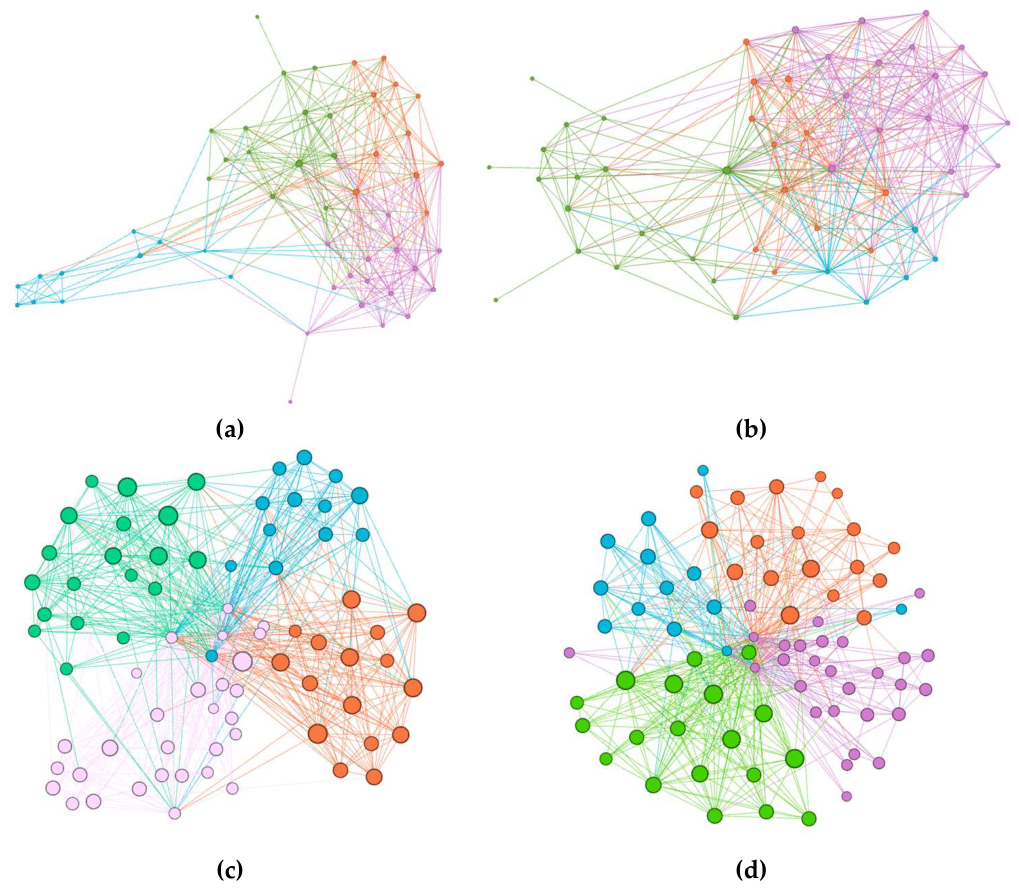

Table 1.
Network indicators across two cohorts and two time points
| Indicator | Cohort 1 Early | Cohort 1 Mid |
Cohort 2 Early | Cohort 2 Mid |
|---|---|---|---|---|
| Nodes | 52 | 52 | 77 | 77 |
| Effective respondents | 43 | 41 | 68 | 43 |
| Directed edges | 440 | 543 | 893 | 629 |
| Density | 0.1659 | 0.2048 | 0.1526 | 0.1075 |
| Average nominations per effective respondent | 10.23 | 13.24 | 13.13 | 14.63 |
| Median Out-Degree among respondents | 9 | 9 | 8 | 10 |
| Nomination coverage | 98.08% | 98.08% | 100.00% | 100.00% |
Note. Effective respondents were defined as students with at least one outgoing nomination. Self-loops were excluded from the calculation of network indicators. Cohort 2 mid-semester values are based on the full mid-semester roster; if the main analysis is restricted to the stable 77-student cohort, corresponding values should be reported separately.
Disclaimer/Publisher’s Note: The statements, opinions and data contained in all publications are solely those of the individual author(s) and contributor(s) and not of MDPI and/or the editor(s). MDPI and/or the editor(s) disclaim responsibility for any injury to people or property resulting from any ideas, methods, instructions or products referred to in the content. |
© 2026 by the authors. Licensee MDPI, Basel, Switzerland. This article is an open access article distributed under the terms and conditions of the Creative Commons Attribution (CC BY) license (http://creativecommons.org/licenses/by/4.0/).
Copyright: This open access article is published under a Creative Commons CC BY 4.0 license, which permit the free download, distribution, and reuse, provided that the author and preprint are cited in any reuse.


