Preprint
Article

This version is not peer-reviewed.

Effect of Drought Types on Evapotranspiration and Canopy Conductance in a Pinus sylvestris var. mongolica Plantation in Northeast China

Submitted:

01 June 2026

Posted:

02 June 2026

You are already at the latest version

Abstract

The effects of soil drought on evapotranspiration (ET) and canopy conductance (Gc) are extensively investigated in forests, but the responses of ET and Gc to atmospheric drought and compound drought still remain unclear in the plantations. Environmental factors and ET were continuously measured in a Pinus sylvestris var. mongolica plantation located in the semi-arid areas of Northeast China during the growing seasons (May–September) in 2020–2024. Compared with non-drought, ET increased by 34.96% under atmospheric drought, and decreased by 23.58% and 28.86% under soil drought and combined drought, respectively. Compared with non-drought, Gc decreased by 29.27%, 15.19%, and 68.74% under atmospheric drought, soil drought, and combined drought, respectively. Under non-drought, atmospheric drought, and soil drought, ET was mainly controlled by net radiation (Rn) with a relative contribution of 41.78%, 44.67%, and 30.88%, respectively. Under combined drought, the dominant factor influencing ET was relative extractable water (REW) with a relative contribution of 47.97%. Under non-drought, the dominant controlling factor of Gc was vapor pressure deficit (VPD), followed by Rn. Under atmospheric drought and soil drought, the sensitivity of Gc to VPD was much higher than other environmental factors. Under combined drought, the most important controlling factor of Gc was REW, followed by VPD. This study proved that different drought types have different effects on ET and Gc. Under warmer and drier climates, the management practices should be used to cope with the increasing water stress to ensure the sustainable development of the Pinus sylvestris var. mongolica plantation in semi-arid areas of Northeast China.

Keywords: 
;  ;  ;  

1. Introduction

“Three-North Shelter Forest Program” covers an area of 4.07×10⁶ km2, which is the largest artificial forest ecological protection project in China [1]. The cumulative preserved afforestation area amounts to 3.01×10⁷ ha in this program, which is of great significance for ensuring China’s ecological security [2]. This program is mainly located in the arid and semi-arid areas for the purpose of wind prevention, sand fixation, and soil and water conservation [3,4]. Drought event is the most important threat to the healthy growth of plantations, and some plantations have begun to emerge dieback and mortality due to hydraulic failure in some areas in northern China [4]. The magnitude, frequency, duration and areal extent of drought events all will increase in the arid and semi-arid areas of China in the context of global warming [5,6]. Therefore, thoroughly investigating the relationship between the water consumption of vegetation and drought is an urgent need for the sustainable development of plantations in the water limited areas in China [7].
In terrestrial ecosystems, about 60% of precipitation is consumed by evapotranspiration (ET) [8], which is equivalent to the latent heat flux (LE) in the energy cycle, thus ET links energy exchange and hydrological processes at the ecosystem scale [9,10]. Gross primary productivity is usually coupled with ET in ecosystem level, because both transpiration and photosynthesis take place through leaf stomata [3,11]. Canopy conductance (Gc) is an important index reflecting the weighted integration of the stomatal aperture of individual leaves, hence it is closely related to ET and gross primary productivity [3,12]. Exploring the roles of ET and Gc in the complex feedback between plantations and climate change is crucial for predicting potential changes in carbon budget, hydrological processes, and energy cycle in the reforestation areas under future biological and physical disturbances [3,13,14]. Though lots of ecologists have studied the effects of drought on temporal variations in ET and Gc in the forest ecosystems [9,11,15], little studies focus on the plantations in the arid and semi-arid areas of China.
According to soil and atmospheric moisture conditions, drought can be categorized into soil drought (linked to low soil water content), atmospheric drought (associated with high atmospheric evaporative demand), and compound drought (soil drought accompanied with atmospheric drought) [7,15,16]. Many previous studies proved that soil water deficit has a negative effect on ET and Gc in various plantations [9,11,17]. For instance, ET and Gc generally decrease with soil water content decreasing in a Pinus tabuliformis plantation [3]. Vapor pressure deficit (VPD) is the most common indicator representing atmospheric evaporative demand [15,16]. The relationship between VPD and Gc usually is a logarithmic curve, and Gc generally decrease with VPD increasing [16,18,19]. There are two opposing effects of VPD on ET, one side is VPD increasing ET by improving atmospheric evaporative power, the other is VPD decreasing ET by closing leaf stomata, but the former usually is dominant according to Shuttleworth–Wallace model [20]. Furthermore, the results of some studies showed that the synergistic effect of compound drought on water consumption is weaker than those of soil drought and atmospheric drought [7,16]. For example, the inhibitory effect of soil drought on ET is stronger than that of compound drought in a boreal larch forest [15]. However, the negative effect of compound drought on Gc is usually stronger than that of either atmospheric drought or soil drought in a Mongolian pine plantation [7,16]. Generally, little studies focus on the effects of drought types on ET and Gc in the plantations in the semi-arid areas of China, and the mechanisms of ET and Gc response to different drought types is needed to elucidate in the context of global warming.
Pinus sylvestris var. mongolica is naturally distributed in the northern Da Hinggan Mountains and the Hulunbeier sandy land of China [4]. Due to its physiological characteristics of cold-resistant, drought-resistant, and leanness-resistant, Pinus sylvestris var. mongolica is widely used in “Three-North Shelter Forest Program” for windbreak and sand fixation, and has become the most important tree species for the reforestation in the semi-arid areas of Northeast China [1,4]. In this study, the long-term measurements of ET and environmental factors were conducted using the eddy covariance (EC) system and environmental variable sensors during the growing seasons (May–September) in 2020–2024 in a Pinus sylvestris var. mongolica plantation in Northeast China. Our objectives were to: (1) quantify the differences in ET and Gc under different drought types, and (2) determine the effects of environmental factors on ET and Gc under different drought types.

2. Materials and Methods

2.1. Study Area

The study was conducted at the State-owned Jianping County Heishui Mechanized Forest Farm (41°58′33″ N, 119°25′32″ E, 550 m a.s.l.), Chaoyang City, Liaoning Province, Northeast China. The climate is a semiarid temperate continental monsoon climate with mean annual temperature of 5.76 ℃ and mean annual precipitation of 440 mm (data in 1958–2024 from Jianpingzhen weather station). The Pinus sylvestris var. mongolica plantation is 39 years old, with a stand density of 1044 trees ha−1, a mean tree height of 10.00 m, and a mean diameter at breast height of 14.26 cm. The study area is flat and uniform, and the soil texture is gray-brown with a field capacity of 28%. The understory is dominated by Cleistogenes squarrosa, and the coverage (10%–70%) changes with soil moisture changing [21].

2.2. Measurements

The EC system and environmental variable sensors were housed on an 18 m flux tower, and more details were shown in Table 1. All data used in this study were collected by a data logger (CR1000, Campbell Scientific Inc., Logan, UT, USA). The distance from the flux tower to the nearest plantation boundary was approximately 300 m, which ensures that the measurement information originated from our plantation [21].

2.3. Data Processing

The 30 min flux data were processed from the 10 Hz raw data using the EddyPro software (version 7.07, Li-COR Inc., Lincoln, NE, USA). Because of quality control and instrument failure, 15 % of LE data were rejected during the growing seasons in 2020–2024. The data gaps of LE were filled using the “REddyProc” R package, and energy budget components were forced to close using the Bowen ratio closure method [22].
The ET was calculated as follow [9]:
E T = L E λ
where λ is the latent heat of water vaporization (2.45 kJ g−1).
The Gc was calculated as follows [23]:
G a = U U * 2   +   6.2 U * 2 3 1
G c = γ · L E · G a R n G + ρ a · c p · V P D · G a L E ( + γ )
Where Ga is the aerodynamic conductance (m s−1), U is the wind speed (m s−1), and U* is the friction velocity (m s−1), γ is the psychrometric constant (kPa °C−1), Δ is the slope of the water vapor pressure curve (kPa °C−1), Rn is the net radiation (W m–2), G is soil heat flux (W m–2), ρa is the air density, and cp is the specific heat of the dry air.
The VPD was calculated as follow [24]:
V P D = 0.611 e x p ( 17.27 T a T a + 237.3 ) × ( 1 R H 100 )
Where Ta is the air temperature (°C) and RH is the air relative humidity (%).
The relative extractable water (REW) was calculated as follow [25]:
R E W = S W C S W C m i n S W C m a x S W C m i n
Where SWC is the soil water content at a depth of 10 cm (cm3 cm−3), SWCmin and SWCmax are the minimum and maximum SWC in our observation period, respectively. Many previous studies proved that SWC is a valid indicator of the soil water status of this plantation, and topsoil moisture has also been used to identify drought events in various plantations [3,21,24,26].

2.4. Definition of Drought Types

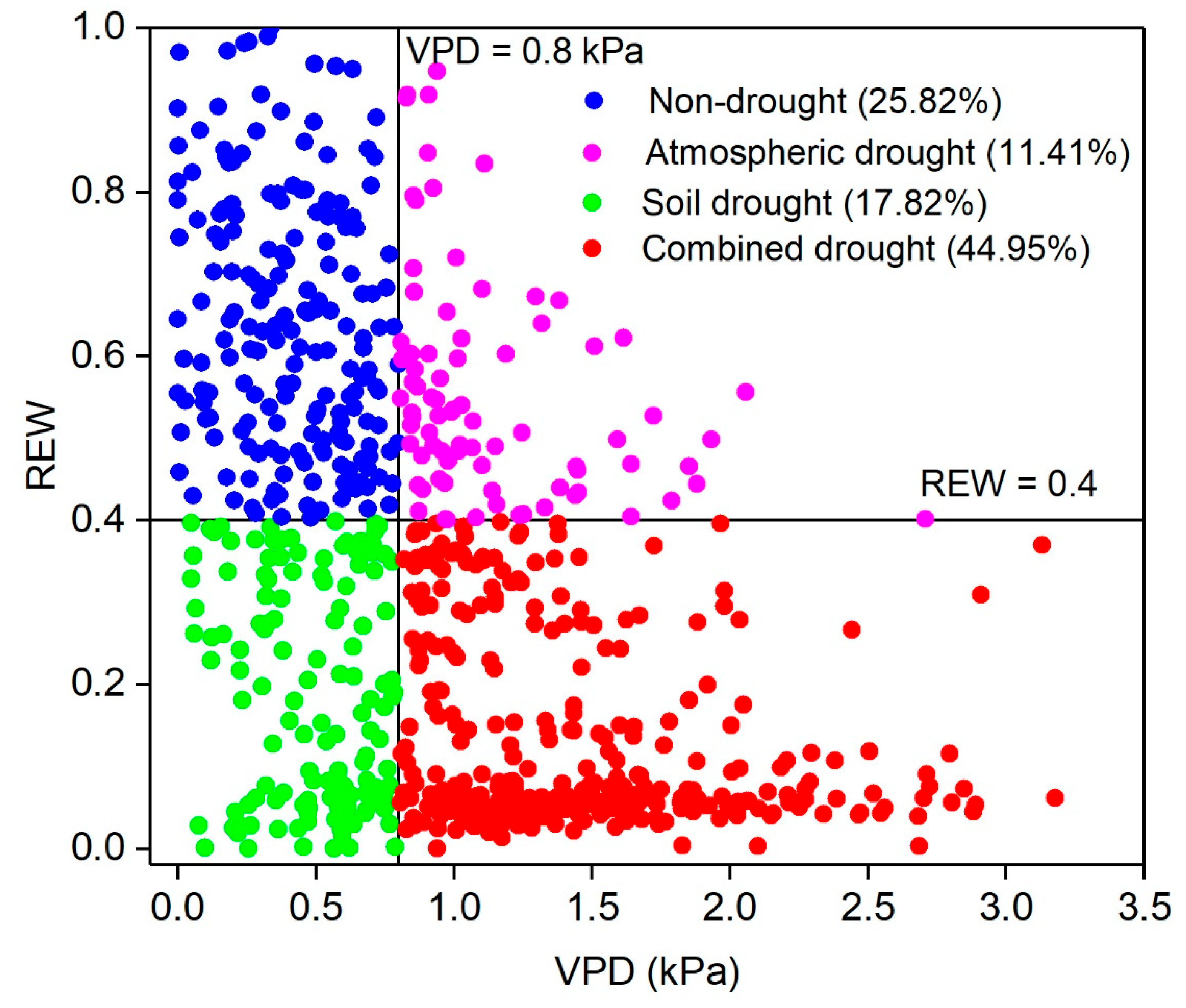
According to previous studies [7,15,16], the following steps were used to define drought types. Firstly, ET was bin-averaged into 0.05 REW (Figure 1a) and 0.15 kPa VPD (Figure 1b) increments, respectively. Secondly, the inflection points of REW (0.4) and VPD (0.8 kPa) on ET were determined by the general trends of ET changing with REW and VPD. Finally, based on the inflection points, non-drought, atmospheric drought, soil drought, and combined drought were classified in study (Figure 2). The occurrence frequency of non-drought, atmospheric drought, soil drought, and combined drought were 25.82%, 11.41%, 17.82%, and 44.95%, respectively.

2.5. Statistical Analysis

Repeated-measures ANOVA was used to examine differences in environmental factors, ET, and Gc under different drought types. The “relaimpo” package with “lmg” function in R software was used to assess the relative importance of each environmental factors to ET. The “pls” R package was used to determine the sensitivity of Gc to each environmental factors.

3. Results

3.1. Environmental Factors

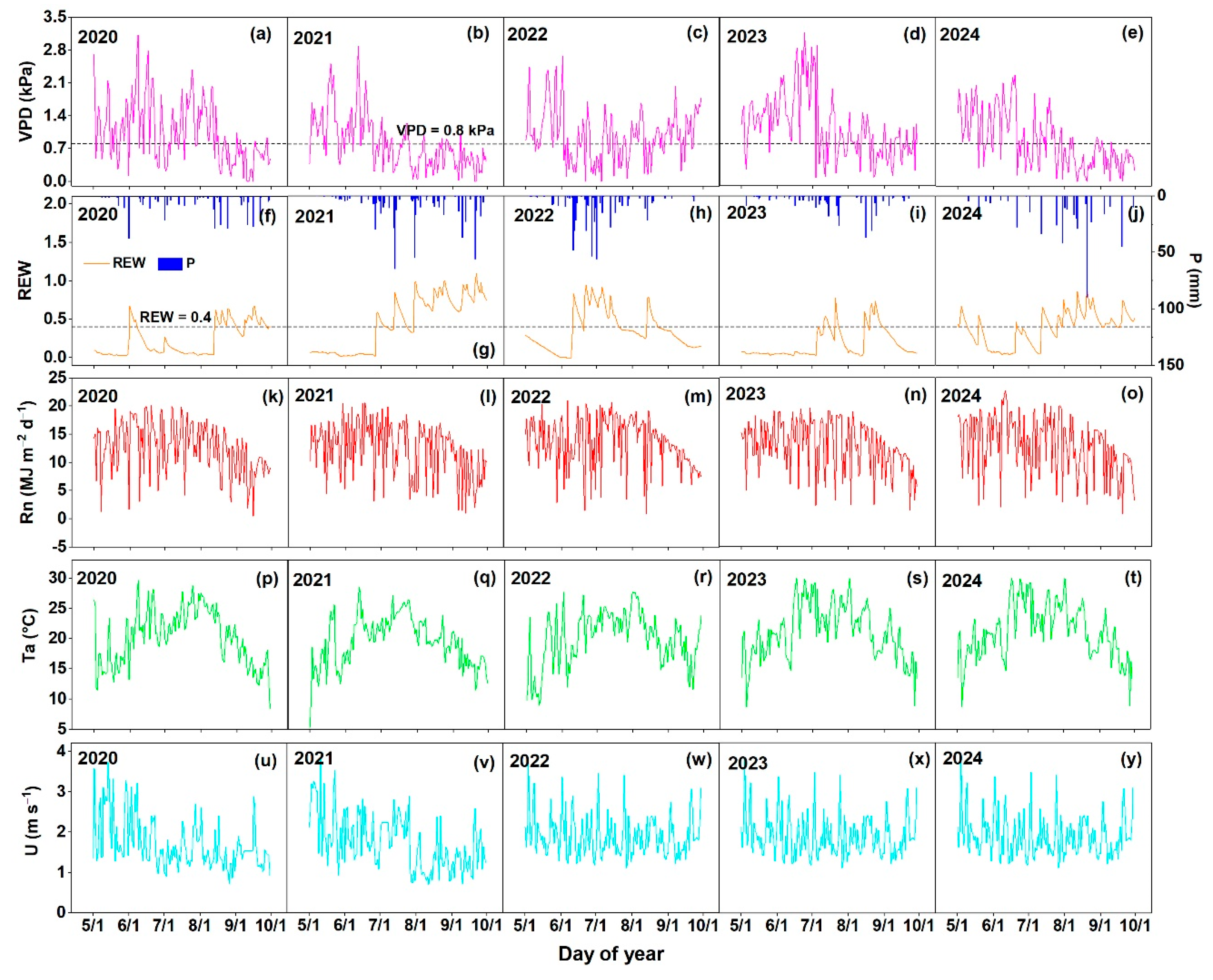
Seasonal variations in environmental factors during the growing seasons in 2020–2024 are shown in Figure 3, and the average values of VPD, REW, Rn, Ta, and U are shown in Table 2. The VPD was usually higher in May and June (Figure 3a–e), and the average values of VPD ranged from 0.82 kPa to 1.17 kPa during the growing seasons in 2020–2024 (Table 2). Cumulative precipitation (P) during the growing season was 359.10 mm, 562.20 mm, 477.10 mm, 273.20 mm, and 468.80 mm in 2020–2024, respectively (Table 2). The seasonal pattern of REW was mainly dominated by P events (Figure 3f–j), and the maximum and minimum values of average REW during the growing season were 0.19 and 0.45 in 2023 and 2021, respectively (Table 2). Overall, the seasonal patterns of Rn and Ta were unimodal curves (Figure 3k–t), with average values of 12.32–13.11 MJ m–2 d–1 and 19.61–21.27 °C, respectively, during the growing seasons in 2020–2024 (Table 2). The U fluctuated above 1.00 m s−1 (Figure 3u–y), and the average values of U during the growing season ranged from 1.71 m s−1 to 1.91 m s−1 over the five years (Table 2).
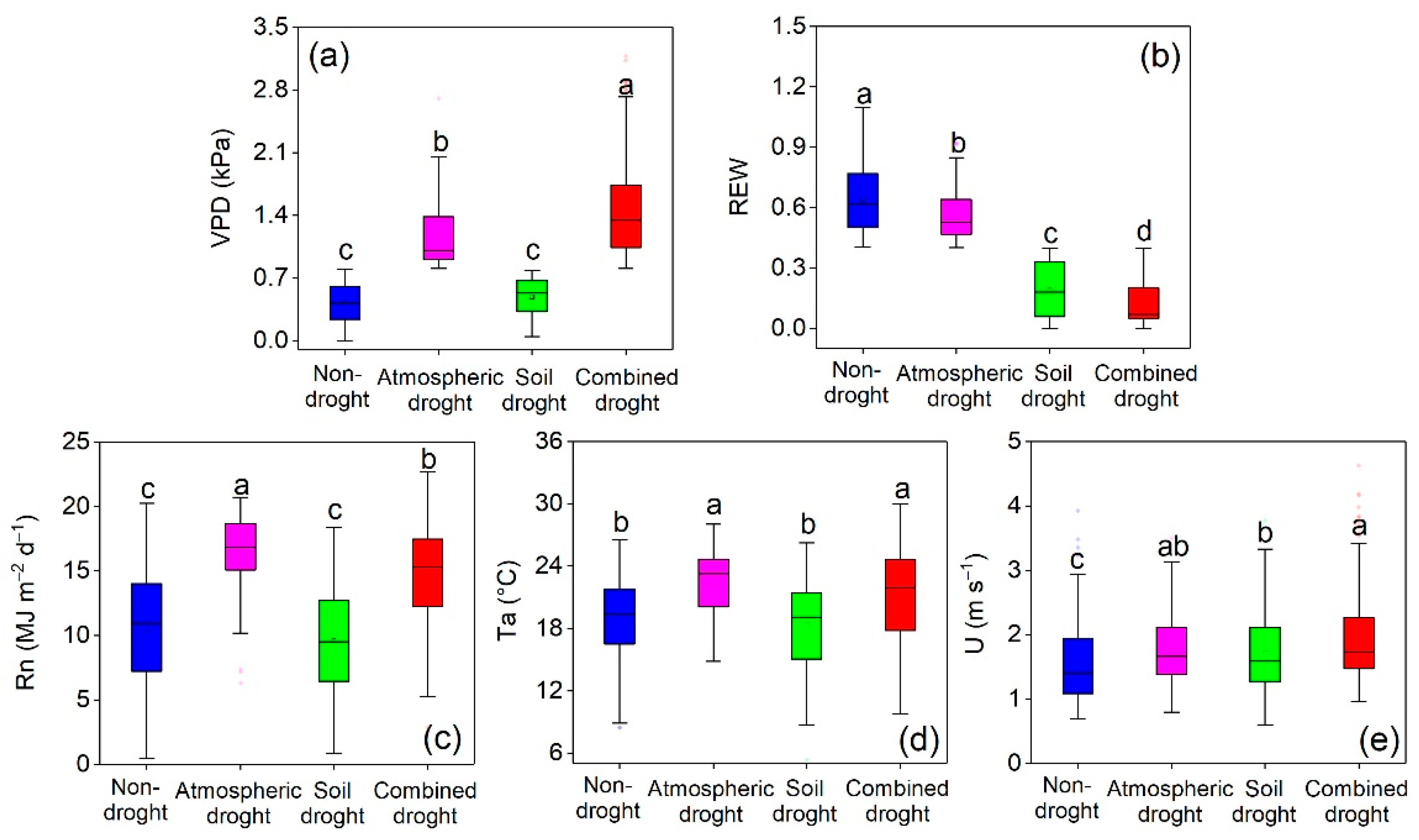
In our study period, VPD, Rn, and Ta under non-drought were similar to under soil drought, and were significantly lower than under atmospheric drought and combined drought. The VPD was greatest under combined drought (Figure 4a), and Rn and Ta were greatest under atmospheric drought (Figure 4c,d). The REW was greatest and lowest under non-drought and combined drought, respectively. The REW varied significantly among four water conditions (Figure 4b). The U was lowest and greatest under non-drought and combined drought, respectively. The U under non-drought and combined drought were significantly different from under soil drought and atmospheric drought (Figure 4e).

3.2. ET and Gc

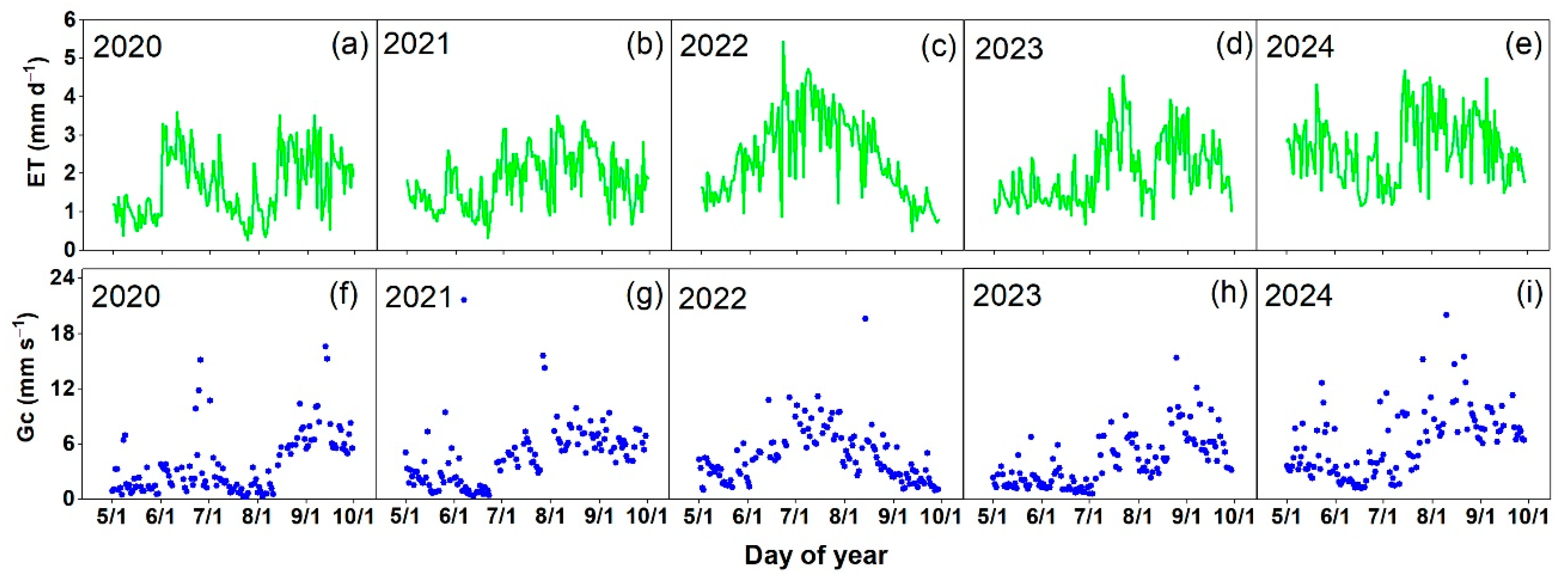
Seasonal variations in ET and Gc during the growing seasons in 2020–2024 are presented in Figure 5. The ET of our Pinus sylvestris var. mongolica plantation varied greatly, and cumulative ET during the growing season was 261.21 mm, 280.02 mm, 370.68 mm, 311.45 mm, and 407.26 mm in 2020–2024, respectively (Table 2). The Gc was relatively high in July 2022, and in other years it was relatively high in August and September (Figure 5f–i). The average value of Gc during the growing season was 3.70 mm s−1, 4.56 mm s−1, 4.81 mm s−1, 4.05 mm s−1, and 6.08 mm s−1 in 2020–2024, respectively (Table 2).
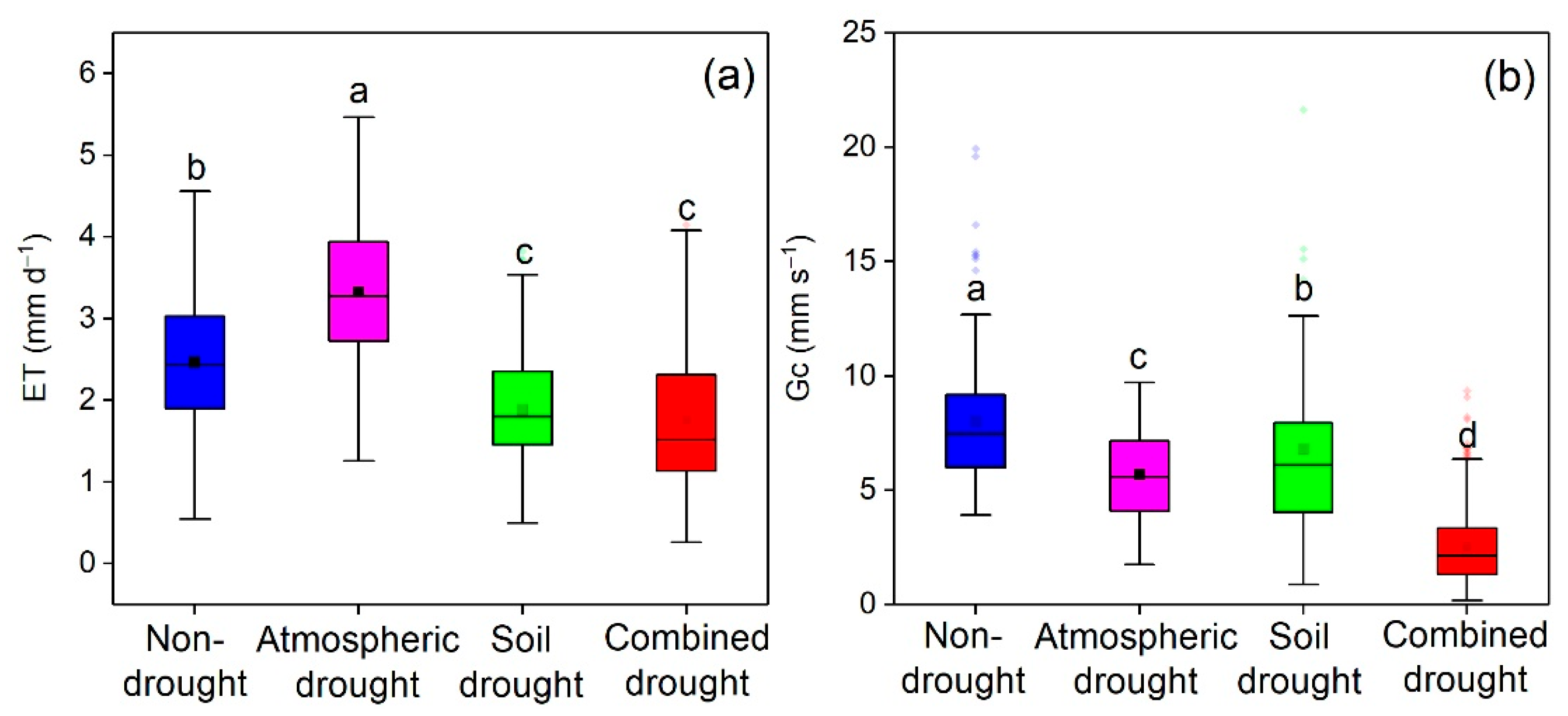
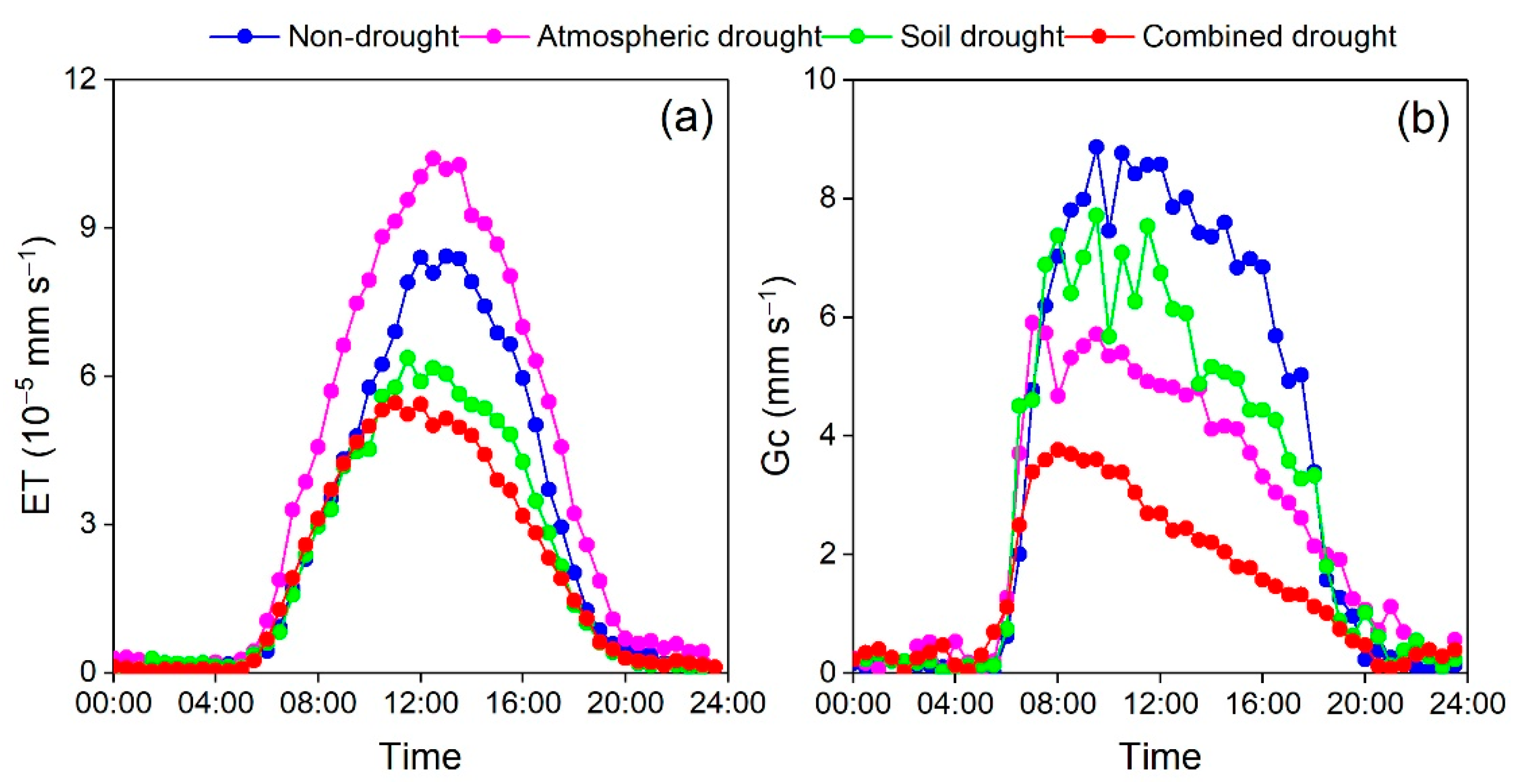
The mean diurnal courses of ET were similar and revealed bell-shaped curves under four water conditions (Figure 6a). The mean diurnal courses of Gc increased sharply after sunrise, and peaked in the morning, thereafter decreased till sunset under four drought types (Figure 6b). Average ET was 2.46 mm d−1, 3.32 mm d−1, 1.88 mm d−1, and 1.75 mm d−1 under non-drought, atmospheric drought, soil drought, and combined drought, respectively. The ET under atmospheric drought was significantly higher than under other drought types. The ET under soil drought was not significantly different from under combined drought, but was significantly lower than under non-drought (Figure 7a). Average Gc was 8.03 mm s−1, 5.68 mm s−1, 6.81 mm s−1, and 2.51 mm s−1 under non-drought, atmospheric drought, soil drought, and combined drought, respectively. The Gc varied significantly among four water conditions (Figure 7b).

3.3. Effects of Environmental Factors on ET and Gc

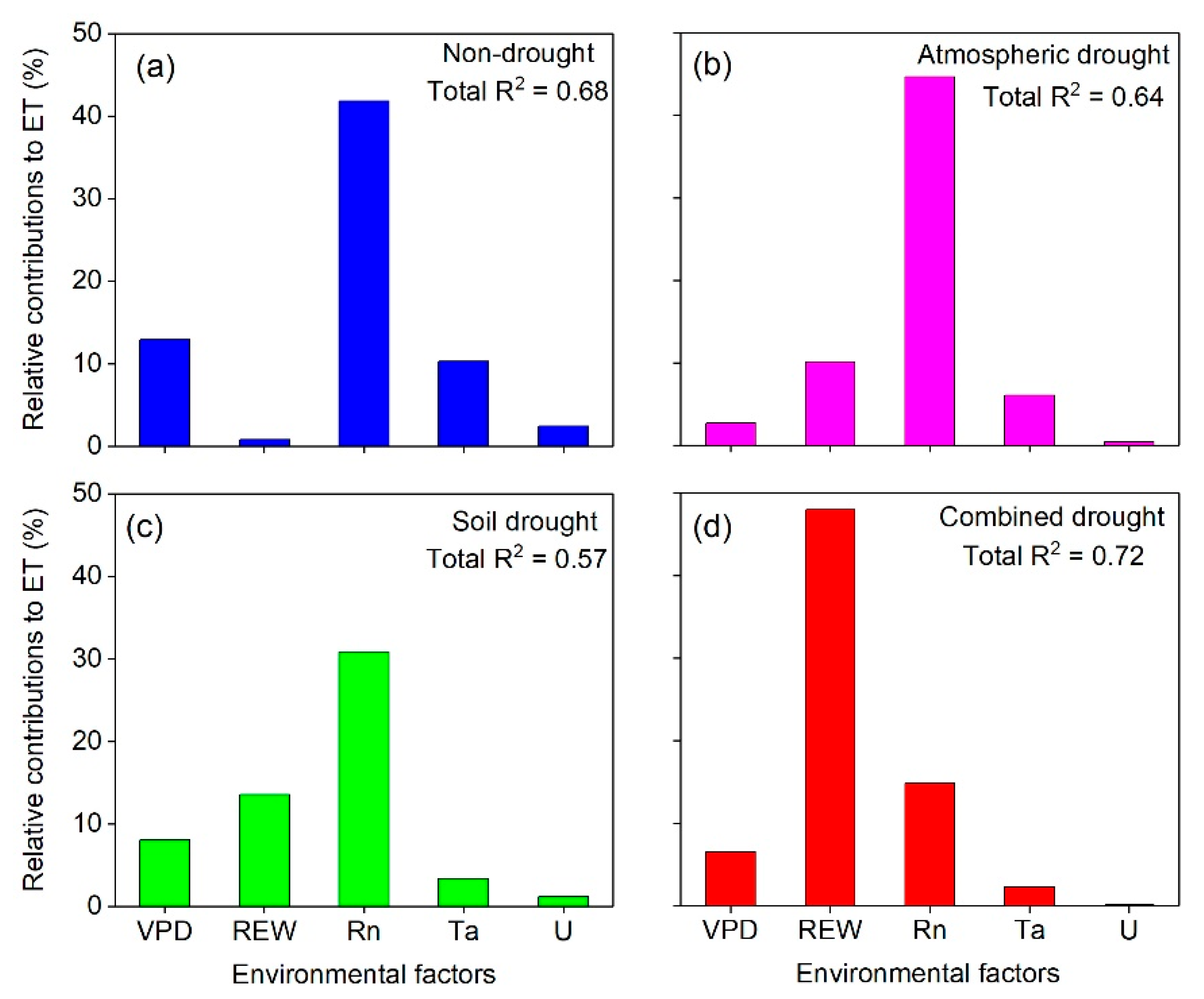
The responses of ET to environmental factors were different under different drought types (Figure 8). Under four water conditions, the effects of U and Ta on ET were relatively weak with a relative contribution of 0.13%–2.41% and 2.31%–10.31%, respectively (Figure 8). Under non-drought, ET was mainly controlled by Rn with a relative contribution of 41.78%, followed by VPD with a relative contribution of 12.92% (Figure 8a). Under atmospheric drought and soil drought, Rn was still the most important factor influencing ET with a relative contribution of 44.67% and 30.88%, respectively, and the following factor was VPD and REW contributing 10.15 % and 13.53 % to ET, respectively (Figure 8b,c). Under combined drought, the top two factors influencing ET were REW and Rn with a relative contribution of 47.97% and 14.87%, respectively (Figure 8d).
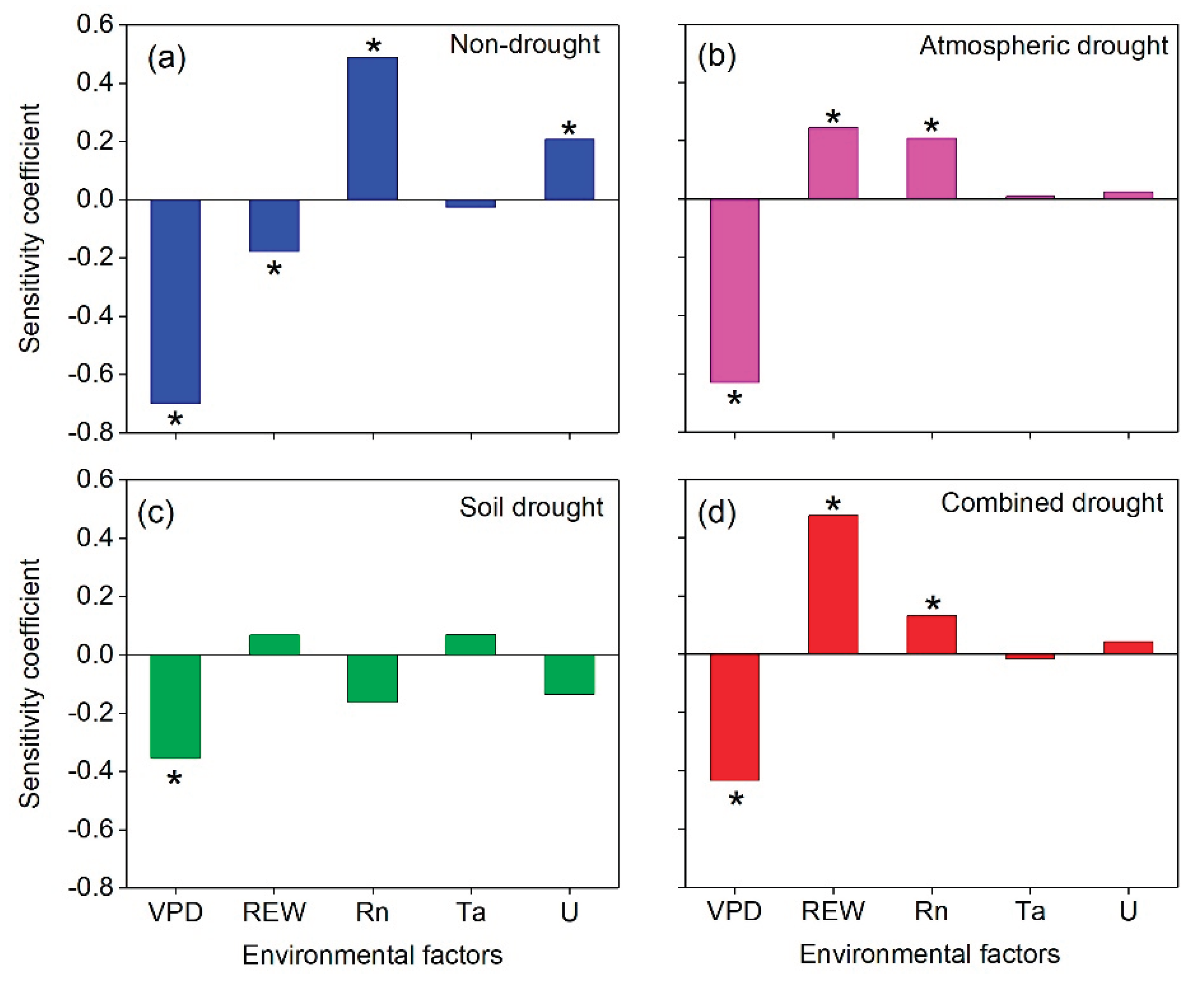
Under four water conditions, Ta had no significant effect on Gc (Figure 9). The U only had a significant effect on Gc under non-drought (Figure 9a). For all drought types, daily VPD all had significant negative effects on Gc, and the sensitivity of Gc to VPD was higher under non-drought and atmospheric drought compared to other two drought types (Figure 9). The Rn had significant positive effects on Gc under non-drought, atmospheric drought, and combined drought with a sensitivity coefficient of 0.49, 0.21, and 0.13, respectively (Figure 9a,b,d). Under non-drought, REW had a significant negative effect on Gc, but under atmospheric drought and combined drought, it had significant positive effects (Figure 9a,b,d).

4. Discussion

4.1. Variations in ET and Gc

Consistent with many previous studies [13,18,21], seasonal variations in ET were similar to those of Gc in the Pinus sylvestris var. mongolica plantation. During the five growing seasons, although VPD and Rn were relatively high in May and June (Figure 3a–e,k–o), ET and Gc were relatively low in this period (Figure 5), which was mainly due to the shortage of soil water. Conversely, ET and Gc were relatively high in the rainy season, when VPD and Rn were relatively low in this study (Figure 3a–e,k–o). In the same study area, the effect of top soil water content on ET is much greater than that of VPD and Rn in a Pinus tabuliformis plantation [9]. Therefore, we believe soil water supply is more important for water consumption than atmospheric evaporative demand and energy supply in the plantations of the semi-arid areas. Moreover, the effects of drought on ET and Gc also occur during the subsequent period following the drought [3,17]. This phenomenon is mainly due to the fact that the drought at the early growing season is unfavorable for vegetation establishment and even affect the stability of plantations [12,25,27]. The seasonal legacy effect of drought should be partly responsible for the result that ET were still relatively lower during the periods of REW>0.4 in 2020 and 2021 compared to other three years (Figure 5a–e).
Previous studies indicated that cumulative ET is positively correlated with cumulative P during the growing season in the plantations [28,29,30]. However, cumulative ET did not increase with cumulative P increasing during the five growing seasons in this study (Table 2). We believe that two factors resulted in this phenomenon. Firstly, the plantation might use the soil water accumulated in the previous year [9,31,32], which causes that cumulative P was lower than cumulative ET during the growing season in 2023 (Table 2), and the carryover effect of soil water is very important for the plantations to go through the drought period before the rainy season in the semi-arid areas [33]. Secondly, the interannual legacy effect of drought on water consumption could lags by 3–4 years in forest ecosystems [34], which should be a reason for the result that cumulative ET was much lower than cumulative P during the growing seasons in 2020 and 2021(Table 2), as annual P in 2019 (327.4 mm) was much lower than the mean annual P (440 mm) in the study area. In short, the carryover effect of soil water and the legacy effect of drought caused the complex relationship between cumulative ET and cumulative P during the growing season in this study. Average Gc generally increased with cumulative ET during the growing seasons in 2020 and 2022–2024 (Table 2). Average Gc was relatively higher with lower cumulative ET during the growing season in 2021, which was mainly due to relatively lower average VPD compared to other four years.

4.2. Effects of Drought Types on ET and Gc

According to the result shown in Figure 2, the frequency of drought period in the growing season was 74.18%, indicating that the Pinus sylvestris var. mongolica plantation is usually affected by drought in the semi-arid areas of Northeast China. Low P and high free water surface evaporation cause the plantations to be vulnerable to water shortage during the growing season in the semi-arid areas. In addition, a previous study pointed out that mean annual Ta and annual P have an increasing and decreasing trend, respectively, in our study area [9]. This climate changing trend may increase the magnitude, frequency, and duration of drought, and water shortage will be more serious in the Pinus sylvestris var. mongolica plantation in the future.
Similar to previous studies [7,15,16], ET under atmosphere drought was higher than under non-drought in this study (Figure 6a). As shown in Figure 4, VPD, Rn, Ta under atmosphere drought were significantly higher than those under non-drought, while REW was at a relatively high level. In evidence, higher atmospheric evaporative demand and energy supply combined with sufficient soil water will inevitably result in ET increasing [35]. Consistent with previous studies [9,36], ET under soil drought was lower than under non-drought in this study (Figure 6a). Under soil drought, REW was significantly lower than under non-drought, but VPD, Rn, and Ta were similar under the two conditions. Soil water shortage has a negative effect on soil evaporation and canopy transpiration, ultimately lead to ET decreasing [20]. In this study, ET under combined drought was nearly equal to under soil drought. The reason is that compared with soil drought, the negative effect of lower REW on ET counteracted the positive effects of higher VPD, Rn, and Ta under combined drought. Overall, soil water shortage was the main reason for ET decreasing in the drought periods in the Pinus sylvestris var. mongolica plantation.
The effect of drought types on Gc was different from that of ET in this study (Figure 6), which is consistent with the results in the previous studies [7,16]. The reason is that the important controlling factors of Gc were different from those of ET under different drought types. In this study, Gc under non-drought was higher than under drought stress (Figure 6b). Evidence has proved that higher VPD and/or lower REW can cause canopy stoma closing, ultimately resulting in decreased Gc [9,18]. Therefore, Gc under combined drought was lowest in our plantation, which is to be expected. Similar to the results in a Platycladus orientalis plantation [16], Gc under soil drought was higher than under atmosphere drought in the Pinus sylvestris var. mongolica plantation. We believe the reason for this phenomenon is that the sensitivity of high VPD to Gc was stronger than that of low REW in this study (Figure 9).

4.3. Environmental Controls on ET and Gc Under Different Drought Types

In this study, the relative contributions of Ta and U to ET were relatively lower under different drought types (Figure 8). The possible reason is that Ta and U were relatively higher during the growing season, and the two environmental variables were not the limiting factors for the water consumption of the Pinus sylvestris var. mongolica plantation. Many studies proved that the effects of solar energy supply, atmospheric evaporative demand, and soil water availability on ET are different under different atmospheric and soil water conditions [7,15]. Under non-drought, soil water availability was relatively higher, and Rn and VPD dominated water consumption in this study (Figure 8a), which is similar to the results in other studies [15,35]. Under atmospheric drought, atmospheric evaporative demand was relatively higher, ET was mainly controlled by Rn and REW in the Pinus sylvestris var. mongolica plantation. The water consumption of two coniferous forests in the Loess Plateau is also mainly controlled by solar energy supply and soil water availability under atmospheric drought [16]. Under soil drought, REW and Rn were the dominant controlling factors in this study, and many ET models proved that when soil water availability is lower than the inflection point, it will become an important controlling factor of ET in various ecosystems [20,37]. Significantly, the relative contribution of Rn to ET was much higher than that of other environmental factors under non-drought, atmospheric drought, and soil drought (Figure 8a–c), which indicates that solar energy supply is still the most important driver of water consumption under the three water conditions in the plantations of semiarid areas. Under combined drought, REW and Rn were the main environmental factors controlling ET, but the relative contribution of REW was the highest in this study, and similar result was found in a Mongolian pine plantation [7]. The possible explanation should be that most of the days during the compound drought period were sunny, and solar energy supply and atmospheric evaporative demand were relatively sufficient, which highlighted the controlling effect of soil water availability on ET in this study.
The effects of environmental factors on Gc were different from that of ET under different water conditions in the Pinus sylvestris var. mongolica plantation. According to many Gc models [38], U is not a key driver of Gc, but U had a significant effect on Gc under non-drought in this study (Figure 9a). The possible reason is that U was relatively lower under non-drought, which might influence the turbulent exchange over the canopy and further Gc. Under different drought types, Ta was not an important controlling factor of Gc in this study, which might be because Ta was relatively high and close to the optimal temperature of the Pinus sylvestris var. mongolica. The sensitivity of Gc to VPD were the highest under non-drought, atmospheric drought, and soil drought, and only slightly lower than REW under combined drought, which indicates that Gc was mainly controlled by VPD during the growing season in this study. Previous studies had proved that Gc decreases logarithmically with VPD increasing in various ecosystems [16,18,19]. The significant positive effect of REW on Gc was found under atmospheric drought and combined drought, which is consistent with the result in a Mongolian pine plantation [7]. However, Gc was negatively correlated with REW at the significance level of p < 0.05 under non-drought. The possible explanation is that higher REW usually accompanied by lower Rn and VPD, which had significant positive and negative effects on Gc, respectively, under non-drought. In many Gc models [38], Gc increases with solar radiation increasing, which agrees with our result that Rn had a significant effect on Gc with positive sensitivity coefficient under non-drought, atmospheric drought, and combined drought in the Pinus sylvestris var. mongolica plantation.
The effect of atmospheric drought on water consumption should receive more attention in the plantations. Under atmospheric drought, ET was the highest in this study, which resulted in soil water consumption rapidly, and atmospheric drought might convert to combined drought. Soil water availability under combined drought was significantly lower than under soil drought, but ET was similar under those two water conditions. The phenomenon is more likely to cause that the Pinus sylvestris var. mongolica plantation emerges dieback and even mortality under combined drought. The frequency, magnitude, and duration of combined drought will increase under warmer and drier climates in our study area [6]. Management practices, such as pruning and thinning, can be used to ensure the health and sustainable development of the Pinus sylvestris var. mongolica plantation. In addition, the general trends of ET with REW and VPD increasing were used to determine the inflection points of REW and VPD, which might not be extremely accurate, but this would not affect the results and conclusions in this study [7]. Besides, the effects of drought types on carbon sequestration should be determined in the future, which is beneficial to ascertain the mechanism of the tradeoff between carbon sequestration and ET during the periods of the Pinus sylvestris var. mongolica plantation coping with drought.

5. Conclusions

According to the response of ET to REW and VPD during the growing seasons in 2020–2024, drought types were classified in a Pinus sylvestris var. mongolica plantation in Northeast China. Compared with non-drought, ET increased under atmospheric drought, and decreased by the similar degree under soil drought and combined drought. Compared with non-drought, Gc decreased under soil drought, atmospheric drought, and combined drought, with the decreasing degree increasing successively. Under non-drought, atmospheric drought, and combined drought, Rn was the most important controlling factor of ET. Under combined drought, the relative contribution of REW to ET was much higher than that of other environmental factors. Under non-drought, the most important controlling factor of Gc was VPD, followed by Rn. Under atmospheric drought and soil drought, the effect of VPD on Gc was much higher than that of other environmental factors. Under combined drought, the dominant controlling factor of Gc was REW, followed by VPD. Under warmer and drier climates, the impact of water stress can be reduced through pruning and thinning to ensure the health and sustainable development of the Pinus sylvestris var. mongolica plantation in Northeast China.

Author Contributions

Conceptualization, X.G. and J.Z.; methodology, H.H.; software, S.S.; validation, X.G., J.C. and J.Z.; formal analysis, X.G.; investigation, Z.L.; resources, S.P.; data curation, X.G.; writing—original draft preparation, X.G.; writing—review and editing, J.Z.; visualization, X.X.; supervision, J.Z.; project administration, J.Z.; funding acquisition, X.G. All authors have read and agreed to the published version of the manuscript.

Funding

This research was funded by the National Natural Science Foundation of China (32301662).

Data Availability Statement

Data will be made available on request.

Acknowledgments

Henan Xiaolangdi Forest Ecosystem National Observation and Research Station provided the environmental sensors and eddy covariance system.

Conflicts of Interest

The authors declare no conflicts of interest.

References

  1. Gao, X.; Zhou, Y.; Meng, P.; Pei, S.; Zhang, J.S. Net ecosystem exchange of Pinus sylvestris var. mongolica plantation in the western Liaoning Province, China. Chin. J. Appl. Ecol. 2022, 33, 1183–1190. [CrossRef]
  2. Kang, M.; Zhang, Z.; Noormets, A.; Fang, X.; Zha, T.; Zhou, J.; Sun, G.; McNulty, S.G.; Chen, J. Energy partitioning and surface resistance of a poplar plantation in northern China. Biogeosciences 2015, 12, 4245–4259. [CrossRef]
  3. Gao, X.; Sun, S.G.; Meng, P.; Cai, J.F.; Pei, S.Y.; Huang, H.; Zhang, J.S. Carbon fluxes and water-use efficiency in a Pinus tabuliformis plantation in Northeast China and their relationship to drought. Sci. Total Environ. 2024, 946, 174258. [CrossRef]
  4. Song, L.N.; Zhu, J.J.; Li, M.C.; Zhang, J.X.; Zheng, X.; Wang, K. Canopy transpiration of Pinus sylvestris var. mongolica in a sparse wood grassland in the semiarid sandy region of Northeast China. Agr. For. Meteorol. 2018, 250–251, 192–201. [CrossRef]
  5. Chen, L.; Brun, P.; Buri, P.; Fatichi, S.; Mccarthy, M.J.; Pellicciotti, F.; Stocker, B.; Karger, D.N. Global increase in the occurrence and impact of multiyear droughts. Science 2025, 387, 278–284. [CrossRef]
  6. Gebrechorkos, S.H.; Sheffield, J.; Vicente-Serrano, S.M.; Funk, C.; Miralles, D.G.; Peng, J.; Dyer, E.; Talib, J.; Beck, H.E.; Singer M.B. Warming accelerates global drought severity. Nature 2025, 642, 628–635. [CrossRef]
  7. Chen, S.; Zhang, Z.; Chen, Z.; Xu, H.; Li, J. Responses of canopy transpiration and conductance to different drought levels in Mongolian pine plantations in a semiarid urban environment of China. Agr. Forest Meteorol. 2024, 347, 109897. [CrossRef]
  8. Odongo, V.O.; Christiaan, V.D.T.; Becht, R.; Hoedjes, J.C.B.; Ghimire, C.P.; Su, Z.B. Energy partitioning and its controls over a heterogeneous semiarid shrubland ecosystem in the Lake Naivasha Basin, Kenya. Ecohydrology 2016, 9, 1358–1375. [CrossRef]
  9. Gao, X.; Zhang, J.S.; Cai, J.F.; Pei, S.Y.; Liu, L.Q.; Meng, P.; Huang, H. Surface energy partitioning and evapotranspiration in a Pinus tabuliformis plantation in Northeast China. Front. Plant Sci. 2023, 14, 1048828. [CrossRef]
  10. Nicholls, E.M.; Carey, S.K. Evapotranspiration and energy partitioning across a forest-shrub vegetation gradient in a subarctic, alpine catchment. J. Hydrol. 2021, 602, 126790. [CrossRef]
  11. Niu, X.D.; Chen, Z.C.; Pang, Y.; Liu, X.J.; Liu, S.R. Soil moisture shapes the environmental control mechanism on canopy conductance in a natural oak forest. Sci. Total Environ .2023, 857, 159363. [CrossRef]
  12. Xie, J.; Zha, T.; Zhou, C.; Jia, X.; Yu, H.; Yang, B.; Chen, J.; Zhang, F.; Wang, B.; Bourque, C.P.A.; et al. Seasonal variation in ecosystem water use efficiency in an urban-forest reserve affected by periodic drought. Agr. Forest Meteorol. 2016, 221, 142–151. [CrossRef]
  13. Han, Y.N.; Jin, S.H.; Chen, W.J.; Zhan, M.S.; Yuan, Z.; Wang, X.; Bai, S.B. Biophysical controls on energy exchange and water use efficiency over a poplar plantation in Northern Hilly China. Agr. Water Manage. 2022, 273, 107920. [CrossRef]
  14. Li, S.G.; Eugster, W.; Asanuma, J.; Kotani, A.; Davaa, G.; Oyunbaatar, D.; Sugita, M. Energy partitioning and its biophysical controls above a grazing steppe in central Mongolia. Agr. Forest Meteorol. 2006, 137, 89–106. [CrossRef]
  15. Xu, Z.P.; Man, X.L.; Hou, Y.P.; Cai, T.J.; Duan, L.L. Interannual variations of evapotranspiration and its response to different drought types in a boreal larch forest in China. Ecol. Indic. 2025, 176, 113609. [CrossRef]
  16. Chen, S.; Wei, W.; Tong, B.; Chen, L. Effects of soil moisture and vapor pressure deficit on canopy transpiration for two coniferous forests in the Loess Plateau of China. Agr. Forest Meteorol. 2023, 339, 109581. [CrossRef]
  17. Li, X.H.; Zha, T.S.; Black, T.A.; Jia, X.; Jassal, R.S.; Liu, P.; Tian, Y.; Jin, C.; Yang, R.Z.; Zhang, F. et al. Stronger control of surface conductance by soil water content than vapor pressure deficit regulates evapotranspiration in an urban forest in Beijing, 2012–2022. Agr. Forest Meteorol. 2024, 344, 109815. [CrossRef]
  18. Jia, X.; Zha, T.S.; Gong, J.N.; Wu, B.; Zhang, Y.Q.; Qin, S.G.; Chen, G.P.; Feng. W.; Kellomäki, S.; Peltola, H. Energy partitioning over a semi-arid shrubland in northern China. Hydrol. Process. 2016, 30, 972–985. [CrossRef]
  19. Zhu, G.F.; Lu, L.; Su, Y.H.; Wang, X.F.; Cui, X.; Ma, J.Z.; He, J.H.; Zhang, K.; Li, C.B. Energy flux partitioning and evapotranspiration in a sub-alpine spruce forest ecosystem. Hydrol. Process. 2013, 28, 5093–5104. [CrossRef]
  20. Gong, X.; Liu, H.; Sun, J.; Gao, Y.; Zhang, H. Comparison of Shuttleworth–Wallace model and dual crop coefficient method for estimating evapotranspiration of tomato cultivated in a solar greenhouse. Agr. Water Manage. 2019, 217, 141–153. [CrossRef]
  21. Gao, X.; Cai, J.F.; Pei, S.Y.; Huang, H.; Zhang, J.S. Effects of environmental factors on evapotranspiration in a Pinus sylvestris var. mongolica plantation. J. Forest Environ. 2025, 45, 607–617. [CrossRef]
  22. Twine, T.E.; Kustas, W.P.; Norman, J.M.; Cook, D.R.; Houser, P.R.; Meyers, T.P.; Prueger, J.H.; Starks, P.J.; Wesely, M.L. Correcting eddy-covariance flux underestimates over a grassland. Agr. Forest Meteorol. 2000, 103, 279−300. [CrossRef]
  23. Liu, B.; Cui, Y.L.; Luo, Y.F.; Shi, Y.Z.; Liu, M.; Liu, F.P. Energy partitioning and evapotranspiration over a rotated paddy field in Southern China. Agr. Forest Meteorol. 2019, 276–277, 107626. [CrossRef]
  24. Jin, C.; Zha, T.S.; Bourque, C.P.A.; Liu, P.; Jia, X.; Zhang, F.; Yu, H.Q.; Tian, Y.; Li, X.H.; Kang, X.Y.; et al. Multi-year trends and interannual variation in ecosystem resource use efficiencies in a young mixedwood plantation in northern China. Agr. Forest Meteorol 2023, 330, 109318. [CrossRef]
  25. Ma, J.Y.; Jia, X.; Zha, T.S.; Bourque, C.P.A.; Tian, Y.; Bai, Y.J.; Liu, P.; Yang, R.Z.; Li, C.; Li, C.Y.; et al. Ecosystem water use efficiency in a young plantation in Northern China and its relationship to drought. Agr. Forest Meteorol. 2019, 275, 1−10. [CrossRef]
  26. Liu, P.; Zha, T.S.; Zhang, F.; Jia, X.; Bourque, C.P.A.; Tian, Y.; Bai, Y.J.; Yang, R.Z.; Li, X.H.; Yu, H.Q.; et al. Environmental controls on carbon fluxes in an urban forest in the Megalopolis of Beijing, 2012-2020. Agr. Forest Meteorol. 2023, 333, 109412. [CrossRef]
  27. Dong, G.; Guo, J.; Chen, J.; Sun, G.; Gao, S.; Hu, L.; Wang, Y. Effects of spring drought on carbon sequestration, evapotranspiration and water use efficiency in the Songnen Meadow Steppe in Northeast China. Ecohydrology 2011, 4, 211–224. [CrossRef]
  28. Brown, S.M.; Petrone, R.M.; Chasmer, L.; Mendoza, C.; Lazerjan, M.S.; Landhaeusser, S.; Silins, U.; Leach J.; Devito K.J. Atmospheric and soil moisture controls on evapotranspiration from above and within a Western Boreal Plain aspen forest. Hydrol. Process. 2014, 28, 4449–4462. [CrossRef]
  29. Wang, T.; Zhang, H.; Zhao, J.; Guo, X.; Xiong, T.; Wu, R. Shifting contribution of climatic constraints on evapotranspiration in the boreal forest. Earth’s Future 2021, 9, e2021EF002104. [CrossRef]
  30. Xiao, J.F.; Sun, G.; Chen, J.Q.; Chen, H.; Chen, S.P.; Dong, G.; Gao, S.H.; Guo, H.Q.; Guo, J.X.; Han, S.J.; et al. Carbon fluxes, evapotranspiration, and water use efficiency of terrestrial ecosystems in China. Agr. Forest Meteorol. 2013, 182–183, 76–90. [CrossRef]
  31. Sun, J.; Yu, X.; Wang, H.; Jia, G.; Zhao, Y.; Tu, Z.; Deng, W.; Jia, J.; Chen, J. Effects of forest structure on hydrological processes in China. J. Hydrol. 2018, 561, 187–199. [CrossRef]
  32. Liu, J.; Cheng, F.; Munger, W.; Jiang, P.; Whitby, T.; Chen, S.; Ji, W.; Man, X. Precipitation extremes influence patterns and partitioning of evapotranspiration and transpiration in a deciduous boreal larch forest. Agr. Forest Meteorol. 2020, 287, 107936. [CrossRef]
  33. Ma, J.; Zha, T.; Jia, X.; Tian, Y.; Bourque, C.P.A.; Liu, P.; Bai, Y., Wu, Y.; Ren, C.; Yu, H. Energy and water vapor exchange over a young plantation in northern China. Agr. For. Meteorol. 2018, 263, 334–345. [CrossRef]
  34. Ciais, P.; Reichstein, M.; Viovy, N.; Granier, A.; Oge’e, J.; Allard, V.; Aubinet, M.; Buchmann, N.; Bernhofer, C.; Carrara, A.; et al. Europe-wide reduction in primary productivity caused by the heat and drought in 2003. Nature 2005, 437, 529–533. [CrossRef]
  35. Domec, J.C.; Meinzer, F.C.; Gartner, B.L.; Woodruff, D. Transpiration-induced axial and radial tension gradients in trunks of Douglas-fir trees. Tree Physiol. 2006, 26, 275–284. [CrossRef]
  36. Zhang, Y.Q.; Cui, Z.; Bai, Y.H.; Zhang, H.T.; Tang, Z.Y. Trees suppress growth but sustain water consumption in response to flash drought in a subtropical forest. Agr. Forest Meteorol. 2025, 372, 110727. [CrossRef]
  37. Zhang, B.Z.; Kang, S.Z.; Li, F.S.; Zhang, L. Comparison of three evapotranspiration models to Bowen ratio-energy balance method for a vineyard in an arid desert region of northwest China. Agr. Forest Meteorol. 2008, 148, 1629–1640. [CrossRef]
  38. Li, S.E.; Zhang, L.; Kang, S.Z.; Tong, L.; Du, T.S.; Hao, X.M.; Zhao, P. Comparison of several surface resistance models for estimating crop evapotranspiration over the entire growing season in arid regions. Agr. Forest Meteorol. 2015, 208, 1–15. [CrossRef]
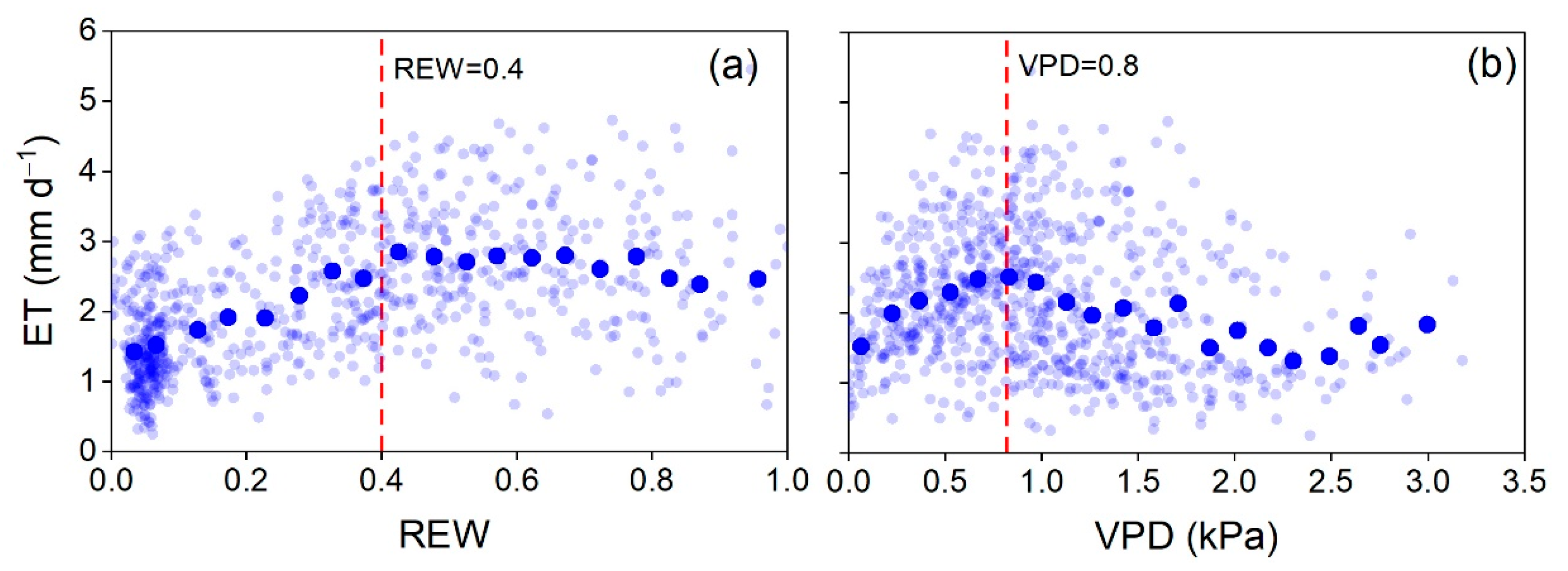
Figure 1. Identifying the turning points of (a) relative extractable water (REW) and (b) Vvapor pressure deficit (VPD) controlling evapotranspiration (ET) in the Pinus sylvestris var. mongolica plantation. Dark blue points are ET bin-averaged into 0.05 REW and 0.15 kPa VPD increments, respectively.
Preprints 216347 g001
Figure 2. The occurrence frequency of non-drought, atmospheric drought, soil drought, and combined drought during the growing seasons in 2020–2024.
Preprints 216347 g002
Figure 3. Seasonal variations in (a–e) VPD, (f–j) REW, precipitation (P), (k–o) net radiation (Rn), (p–t) air temperature (Ta), and (u–y) wind speed (U) during the growing seasons in 2020–2024.
Preprints 216347 g003
Figure 4. Differences in VPD (a), REW (b), Rn (c), Ta (d), and U (e) among non-drought, atmospheric drought, soil drought, and combined drought. Identical lowercase letters represent non-significant differences (p > 0.05), while the opposite indicates significant differences (p < 0.05).
Preprints 216347 g004
Figure 5. Seasonal variations in ET (a–e) and Gc (f–j) during the growing seasons in 2020–2024.
Preprints 216347 g005
Figure 6. Mean diurnal variation of ET (a) and Gc (b) under non-drought, atmospheric drought, soil drought, and combined drought.
Preprints 216347 g006
Figure 7. Differences in ET (a) and Gc (b) among non-drought, atmospheric drought, soil drought, and combined drought.
Preprints 216347 g007
Figure 8. Relative importance of VPD, REW, Rn, Ta, and U to ET under non-drought, atmospheric drought, soil drought, and combined drought.
Preprints 216347 g008
Figure 9. Sensitivity of Gc to VPD, REW, Rn, Ta, and U to ET under non-drought, atmospheric drought, soil drought, and combined drought. Stars above or below each bar indicate statistically significant (p < 0.05).
Preprints 216347 g009
Table 1. Details of the eddy covariance system and environmental variable sensors in the Pinus sylvestris var. mongolica plantation.
Observations Height/depth (m) Model Manufacturer
Latent heat flux (LE),fraction velocity ( U*), wind speed (U), air density (ρa), the specific heat of the dry air (cp) 15 m CSAT3B1 Li-COR Inc., Lincoln, NE, USA
LI-75001 Campbell Scientific Inc., Logan, UT, USA
Air temperature (Ta) and relative humidity (RH) 15 m HMP45C Vaisala Co., Ltd., Helsinki, Finland
Net radiation (Rn) 16 m CNR4 Kipp&Zonen B.V., Delft, Netherlands
Soil water content (SWC)2 0.1 m3 HydraProbe Stevens Inc. Portland, OR, USA
Soil heat flux (G)2 0.05 m HFP01SC Hukseflux B.V., Delft, Netherlands
1 eddy covariance system consisting of a 3D sonic anemometer (CSAT3B) and an infrared H2O/CO2 gas analyzer (LI-7500). 2 three repetitions. 3 according to a previous study [1].
Table 2. Summary of environmental factors, evapotranspiration (ET), and canopy conductance (Gc) during the growing seasons in 2020–2024. VPD, vapor pressure deficit; REW, relative extractable water; Rn, net radiation; Ta, air temperature; U, wind speed.
Variable Year (May to September)
2020 2021 2022 2023 2024
VPD (kPa) 1.05 0.82 0.98 1.17 0.86
REW 0.23 0.45 0.36 0.19 0.39
P (mm) 359.10 562.20 477.10 273.20 468.80
Rn (MJ m−2 d−1) 12.55 12.32 13.52 12.99 13.11
Ta (°C) 20.32 19.61 20.07 21.27 20.32
U (m s−1) 1.71 1.75 1.91 1.75 1.79
ET (mm) 261.21 280.02 370.68 311.45 407.26
Gc (mm s−1) 3.70 4.56 4.81 4.05 6.08
Disclaimer/Publisher’s Note: The statements, opinions and data contained in all publications are solely those of the individual author(s) and contributor(s) and not of MDPI and/or the editor(s). MDPI and/or the editor(s) disclaim responsibility for any injury to people or property resulting from any ideas, methods, instructions or products referred to in the content.
Copyright: This open access article is published under a Creative Commons CC BY 4.0 license, which permit the free download, distribution, and reuse, provided that the author and preprint are cited in any reuse.
Prerpints.org logo

Preprints.org is a free preprint server supported by MDPI in Basel, Switzerland.

Subscribe

Disclaimer

Terms of Use

Privacy Policy

Privacy Settings

© 2026 MDPI (Basel, Switzerland) unless otherwise stated