

Submitted:
30 May 2026
Posted:
01 June 2026
You are already at the latest version
Abstract
Livestock production, encompassing both meat and dairy industries, constitutes a sector of significant global economic value, providing livelihoods for numerous families and communities worldwide. While regenerative livestock farming is gaining ground as a sustainable alternative, a significant research gap persists regarding the systematic identification of emerging technologies and the lack of specific frameworks for their technical implementation in tropical regions. This article addresses this gap by mapping the strategic frontiers of regenerative technologies using a mixed-methods approach, employing text mining software (Vantage Point V15.1) and advanced searches in specialized databases. Fifty-six high-impact publications in Scopus and ScienceDirect were analyzed, and the results identified 14 key regenerative activities, highlighting silvopastoral systems, integrated pasture management, and crop-livestock integration as the most prominent solutions. An additional analysis was applied, identifying 10 variables in regenerative livestock farming as well as their alignment with seminal authors on regenerativity issues. A crucial finding is the existing disconnect between the theoretical benefits of regeneration and its practical application in diverse geographical contexts. To mitigate this gap, the study proposes technical implementation models and a step-by-step procedural sequence specifically designed for the Colombian context, although these can be replicated in other regions, particularly in tropical zones. By synthesizing technical limitations and local adaptability, this research provides a strategic roadmap for the transition to sustainable livestock systems, offering valuable insights for researchers, practitioners, and policymakers committed to regenerative innovation.
Keywords:
regenerative livestock
; silvopastoral systems
; implementation frameworks
; sustainability
; tropical agriculture
1. Introduction
The confluence of global challenges, including climate change and the imperative for sustained food production, has necessitated a critical re-evaluation and restructuring of traditionally conducted activities. Globally, cattle raising represents an activity with substantial economic repercussions, significantly influencing interconnected social, economic, and environmental systems. Furthermore, it exerts a considerable influence on global food chains, serving as a primary source of sustenance for a large proportion of the world’s population. In the Colombian context, cattle raising constitutes a pivotal agricultural sector, characterized by its adaptability to diverse soil conditions and climates, and deeply rooted in the country’s traditions [1].
In Colombia, the number of families engaged in this agricultural activity exceeds 500,000, positioning the country as the 11th leading producer of meat and the 12th leading producer of milk on a global scale. However, as [2] points out, a significant portion of the territory designated for livestock production in Colombia is not conducive to this purpose. The nation’s regulatory framework pertaining to land use for livestock purposes imposes certain limitations on the development of this industry. For instance, the cultivation of livestock is prohibited in areas characterized by particularly precipitous topography. The steeper the slope, the more intensive grazing becomes. Consequently, in Colombia, the total area suitable for livestock production is estimated at 15,192 ha. A total of 738 hectares are designated for livestock husbandry, encompassing silvopastoral lands. However, according to the findings of the nationwide agricultural and livestock census, 34,898,456 hectares are currently utilized for livestock purposes. According to [3], the area utilized for livestock exceeds twice the amount deemed adequate for agricultural purposes.
This uncontrolled expansion together with its traditional production techniques and models resulting in poor management has caused several negative environmental impacts such as deforestation of native forests, erosion and loss of soil fertility, contamination of natural water sources, and air pollution “The expansion of the plantations has caused a significant reduction of the soil’s fertility and the loss of biodiversity” [3], therefore, it is important to seek and implement new production techniques to reduce and repair these negative impacts.
Implementing livestock farming in an environmentally conscious manner is a great option for the different entities that develop this activity. For this reason, we seek to identify the different possibilities of developing this activity in the Colombian environment, looking for the best strategies, technologies, and models, defining the pros and cons of each one of them and the environmental and social impacts generated by them, and in this way be able to establish specific application models for Colombia, This will allow the recovery of soil fertility, the reduction of erosion, reintegration of trees and native flora to the productive system, recovery of water sources, among others, and thus be able to migrate from livestock farming that generates negative impacts on the environment to one that is environmentally friendly, thus transforming traditional livestock farming into a more sustainable one, improving social, economic and environmental aspects.
This research seeks to develop a data-driven strategy that aligns environmental restoration with regional social needs. Consequently, this article aims to bridge the gap between theoretical regenerative principles and their practical implementation in specific geographic contexts. To achieve this, the research addresses three guiding questions: 1. Identify the most prominent global regenerative techniques; 2. Evaluate their adaptability within Colombian territory; and 3. Outline the procedural sequence necessary for their local integration. Furthermore, a central research question guides this investigation: What are the most prominent emerging regenerative technologies in global livestock systems, and how can a structured technical procedural sequence be formulated to ensure their successful adaptability and implementation within the Colombian livestock sector
This study is developed in 4 phases. The first part considers the theoretical framework, which includes some of the main concepts about regenerative livestock farming, its practice, and its context in some countries. The second part explains the methodology applied in 3 stages, highlighting the construction of search equations in Scopus, the use of the Vantage Point V15.1 text mining software through natural language processing (NLP), cluster analysis, word cloud, and co-occurrence matrices. The third stage presents the results, detailing countries, the relationship between country and keywords, authors and keywords, main organizations, and a summary of the technologies or activities related to regenerative livestock farming. Finally, the discussion, main conclusions, recommendations, limitations and references of the study are presented.
2. Theoretical Framework
2.1. The Livestock Sector and Its Context
Nationally and internationally, livestock farming, a sector of great importance for various communities, is going through a crisis due to the many challenges and challenges generated by bad practices. This crisis can be noted in the environmental, economic, food, and energy, among others; thus, affecting or generating an impact on the food and health of the population [4]. These crises are causing producers to begin to reflect and rethink livestock practices in the sociocultural, environmental, and political context; leading to the search for different alternatives to continue livestock production while reducing the impact on the environment, and one of these alternatives is regenerative livestock farming, which is a production system that is articulated with nature and helps to increase productivity while reducing costs [1]
Worldwide, a technique that has shown better yields, for example, based on the product/economic input ratio (O/I EmV), the yield of the Sistani breed (Bos indicus) in the semi-intensive system as a regenerative technique was 62% higher than that of the breed in the open system and 84% higher than that of the exotic breeds in the intensive system. The semi-intensive production system as a regenerative technique for Sistani cattle could be carried out by making several changes to the open (extensive) production system of these animals, the changes included the construction of shelters to protect the cattle from heat, wind and drought conditions of the environment, the provision of part of the cattle feed outside the natural pastures and wetland systems to protect the areas of influence mainly of the wetlands, which allow a good form of irrigation in times of drought, native plants were implemented that are edible for cattle and also help protect the soil from erosion [5] In addition to these benefits, the semi-intensive, adaptive, or rotational system shows other advantages as a regenerative system; this grazing system improved vegetation biomass and plant dominance diversity, improved water infiltration rates and soil carbon levels, and higher stocking rates [6].
In recent years, Latin America has shown great demographic growth, which brings with it an increase in the demand for food, requiring greater technological adoption and production in the primary sector. Traditional extensive livestock farming has negative effects on the soil and generates environmental deterioration, increasing the emission of greenhouse gases. According to the above a system that can help counteract these effects is the silvopastoral system, which allows the integration of trees, shrubs, and livestock breeds adapted to the environment and thus mitigates the environmental impact of traditional livestock farming [7]. In addition to improving soil and environmental conditions, this system can provide feed for livestock generating economic viability in its implementation, although economic indicators are negatively affected in the early years then these results will be positive, and apart from this a silvopastoral system can provide up to 70% of feed for livestock mainly in the dry season positioning this system as an economically viable option [8].
If we examine the ongoing transformation of livestock farming, we can see how droughts and climate change together with corporate fences and land conversion to tree plantations have been affecting regional production in Brazil, in response to which many producers have migrated to a more intense form of livestock farming combined with forestry, thus generating an agroforestry system with a more socio-ecological approach that obtains good yields and protects the environment [8]. This livestock system can also be implemented together with a cropping system, in this way with moderate animal grazing, root development, and soil structure can be stimulated, soil compaction by animal trampling is restricted to the topsoil, and the soil is helped to regenerate after an annual crop cycle in integrated crop-livestock systems [9].
In Brazil, methods have also been sought to increase productivity and food supply, however, some of these, such as monoculture and traditional livestock farming, as elsewhere, have brought saturation in negative environmental impacts, which is why the system of integration of crops and livestock has been taken as an alternative, to offer greater productivity and greater environmental sustainability, presenting an evaluation of economic viability and financial risk focused on beef production, showing as a result that the investment is economically viable, with a higher rate of return than the traditional system, also showing that the integration system presents lower market risk compared to the traditional system [10].
Uruguay is another Latin American country where the environmental and productive advantages of the regenerative livestock system have been studied. In this case, the implementation of a eucalyptus forest in what was previously only pasture was studied to determine various factors and environmental behavior, such as the microclimate that is formed, forage production, and the capture of CO2 from the air, comparing some variables such as temperature, relative humidity, wind speed, photosynthetic active radiation flow, and total radiation, obtaining as a result that the areas where the eucalyptus forest was established presented a greater CO2 capture and greater thermal comfort for the cattle during heat waves. [11].
In Colombia, a project sought to contribute to the natural regeneration of soils used in livestock farming, and thus improve the competitiveness and sustainability of the agricultural sector, through training and socialization of experiences to achieve a correct application of this type of management in livestock soils. Through holistic management, a planning and decision-making system, and the elimination of the use of chemical fertilizers and herbicides, it was possible to maintain the carrying capacity per hectare of the livestock enterprises throughout the year, increase the biological activity of the soil, improve the incorporation of manure and increase the diversity of forage plants, which was identified through ecological monitoring carried out in the field [12].
2.2. Some Concepts on Regenerative Livestock Farming
Regenerative livestock production can be described as a production based on the use of different ecosystem services and natural processes, helping to optimize renewable resources and creating advantages such as an increase in the carrying capacity of the unit, higher productivity reflected in the economic aspect; besides showing positive factors such as cleaner meat production without damaging the environment [13]. Regenerative livestock farming allows the articulation of three fundamental pillars of sustainability, which are economic, social, and environmental. From an economic point of view, we are always looking for higher production and profitability. From the environmental point of view, it seeks to reduce air and water pollution, decrease soil erosion, and conserve forests and biodiversity, and on the social side, it seeks to improve access to social services and organizational capacity, since in this way the commercialization of the products generated can be made much more efficient [14].
According to [15], regenerative livestock farming involves grazing management and practices that seek to restore soil health and ecosystem services, increasing infiltration, carbon accumulation, and biodiversity. [16] mention regenerative livestock farming within the framework of regenerative agriculture, explaining that the latter is an approach that uses soil conservation as input to regenerate multiple ecosystem services; a framework applicable to integrated livestock systems. On the other hand, [17] conduct a critical analysis, explaining that regenerative livestock farming is a rebranding that naturalizes livestock farming using arguments of carbon sequestration and soil health. They argue that the term ‘regenerative’ functions as a narrative to legitimize production models.
Ref. [18] refer to regenerative livestock farming as a set of practices (silvopastoralism, manure management, crop rotation) aimed at closing nutrient cycles and improving ecosystem services in livestock systems. For [19], regenerative livestock farming refers to a set of practices and objectives to improve soil, biodiversity, resilience, and profitability in livestock production.
While [20] describe regenerative livestock farming as a set of practices such as adaptive grazing and agro-silvo-pastoral integration, they also analyze the concept as an approach that combines ecological restoration and sustainable production. Meanwhile, [21] analyze regenerative livestock farming, emphasizing animal welfare, biodiversity, and rural development.
Regenerative livestock farming presents great opportunities for progress in terms of sustainability, it has been shown that with the implementation of these practices, livestock production maintains its productive yields and in turn protects the environment because they do not use polluting practices or resources [10], on the other hand, the good incorporation of plant species that function as feed for cattle and tree species is another opportunity to improve biodiversity and become another source of income for producers [8].
Regenerative livestock farming is presented as a comprehensive response to the crisis of the traditional livestock model, as it proposes a transformation that not only improves productivity but also restores ecosystems and strengthens long-term sustainability. Based on the evidence presented, it is observed that systems such as silvopastoral practices and crop–livestock integration manage to balance economic profitability with environmental conservation, increasing biodiversity, carbon sequestration, and resilience to climate change. However, its implementation involves initial challenges, such as higher investments and the need for technical training, which may limit its adoption in the short term. Additionally, the conceptual debate on whether “regenerative livestock farming” represents a true innovation or a discursive reconfiguration of the production model highlights the importance of critically analyzing its scope. In this sense, its success will depend not only on its technical and ecological benefits, but also on public policies, institutional support, and adoption by producers [14].
3. Materials and Methods
In order to obtain good results and to create a good methodology for the project that would allow a step-by-step approach to be followed, previous works were taken into account, such as that of [22] about university technology transfer, [23] on electrodynamic drying in agribusiness, [24] on the screening of cereals, or that of [25] on the infrared drying of fruits, works in which this methodology has been used and has generated good results, taking into account the above, the work was divided into 4 stages as follows:
Stage 1. This stage is one of the most important of the project since it is where the research topic is analyzed and defined. After the analysis, the topic of regenerative livestock was chosen as an alternative to traditional production systems that due to bad practices have caused environmental deterioration, with the analysis of this topic Keywords were chosen in the English language such as cattle raising, sustainable, silvopastoral, agroforestry and regenerative livestock. The bibliographic search was carried out working with the keywords “livestock, sustaina-ble breeding, silvopastoral, agroforestry and regenerative livestock”, words that are related to the topic, then in the databases different equations were executed using these keywords and some Boolean operators.
Stage 2. After running different search equations, 5 were selected that offered the most articles after applying the filter where all articles mentioned the keywords. which are:
- -
- TITLE-ABS-KEY (“cattle raising”) AND sustainable
- -
- TITLE-ABS-KEY (“cattle raising”) AND silvopastoral
- -
- TITLE-ABS-KEY (“cattle raising”) AND agroforestry
- -
- TITLE-ABS-KEY (“regenerative livestock farming” OR “regenerative livestock “) AND barrier*and
- -
- Title, abstract, keywords: regenerative livestock
These equations were implemented in databases such as SCOPUS, SCIENCE DIRECT, Databases of broad scientific interest, and as a support method a search was performed in Google scholar.
Stage 3. After reading and analyzing the documents, articles that were not relevant (articles that did not present adequate information for the study) and those that were repeated in the different searches were discarded, leaving a total of 56 articles, after which the collected information was graphed in the Vantage Point V15.1 text mining software with tech-niques such as cluster analysis, word cloud analysis and co-occurrence matrices. The 3 stages of the methodology are shown in Figure 1.
4. Results
After having all the information collected, graphs and figures were obtained that show the main results and important data for the research, these results can be seen in Figure 2, Figure 3, Figure 4, Figure 5, Figure 6 and Figure 7 below.
This Figure 2 shows the main countries in which the development of the different papers took place and is represented in the number of times it is found in the different papers, thus the countries with the highest number of repetitions or the most important ones are shown with a larger size than those with a lower number of repetitions, in this way, the most repeated or most important countries are United States, India and United Kingdom. This information is relevant because it allows us to see where the greatest number of re-search projects are conducted and also enables a more in-depth analysis of the studies carried out in Latin American countries. It also allows us to implement these techniques in Colombia, which has a climate very similar to other countries in the region.
Figure 3 shows the relationship between some of the most mentioned countries and some of the keywords, being the countries with the yellow dots and the keywords with the blue dots, generating lines between them, showing that some of these keywords are repeatedly integrated into the papers of the different countries, some of these words are regenerative agriculture, holistic grazing, climate change and biodiversity; in this way it can be seen which are the main topics worked on in the different countries.
This Figure 4 shows the group of keywords most used in the different papers, as we can see, the authors present more studies on the topics of Regenerative agriculture and Holistic grazing. Keywords are an important part of the articles since they can provide us with information on the topics they deal with and allow us to find the articles of interest in the databases in a more efficient way by means of search equations. The analysis of keyword clusters constitutes a fundamental tool for identifying the main thematic areas, as well as the relationships among the different topics addressed. It also enables the recognition of research patterns, prevailing trends, and potential emerging or underexplored areas.
Figure 5 shows the co-occurrence of keywords among different authors in their research lines, suggesting the existence of shared thematic clusters and potential areas of scientific convergence. The most frequently occurring keyword is regenerative agriculture, appearing in 10 authors. Additionally, other relevant keywords such as ecosystem services and biodiversity also exhibit high recurrence across the analyzed publications. Overall, these patterns reflect established trends within the field and help identify priority research axes, as well as potential opportunities for interdisciplinary collaboration.
The previous figure (6) presents the authors with the highest number of studies or those who participate in the greatest number of investigations. An author cloud is displayed in which font size proportionally represents the level of participation or scientific productivity, such that larger fonts correspond to authors with a higher number of contributions. In this context, [26] stands out as the author with the highest number of participations across different studies, followed by other authors such as [27] among others who continue the list. This type of representation enables the visual identification of the most influential actors within the field of study, as well as the recognition of collaboration patterns and the concentration of scientific output among specific researchers.
The figure above shows the different organizations that participated in the research. The University of California is the institution with the highest level of participation in the various projects analyzed, followed by the Chinese Academy of Sciences, Texas A&M University, the University of Oxford, and China Agricultural University, among others. This distribution pattern highlights a concentration of scientific output within highly research-intensive academic institutions, suggesting their leading role in the development of the field of study. Likewise, the presence of organizations from different geographic regions reflects the international and collaborative nature of the reviewed research, contributing to the diversity of approaches and strengthening global research networks.
Table 1 shows the list of technologies or regenerative practices on which the consulted research is based. In this regard, it is identified that the silvopastoral system is the most recurrent topic, with 22 occurrences, followed by pasture rotation with 11 occurrences and crop–livestock integration with 6 occurrences. Meanwhile, the replacement of agrochemicals and the evaluation of the benefits of regenerative systems each present 3 occurrences. Ecological livestock and adaptive grazing register 2 occurrences, while other practices such as growth-promoting fungi, microbial enhancement, conservation of natural pastures, mutagenesis, mob grazing, leguminous pastures, and ammonia absorbers appear only once each.
These results show a clear predominance of approaches focused on optimizing soil management, improving production efficiency, and reducing the environmental impact associated with conventional livestock systems. In particular, the high frequency of the silvopastoral system suggests its consolidation as one of the most widely studied strategies within regenerative livestock farming, due to its benefits in terms of carbon sequestration, biodiversity, and ecosystem resilience.
Overall, the identified regenerative livestock systems are mainly conceptual and experimental in nature, developed from on-farm trials that demonstrated positive outcomes. These advances have facilitated their adaptation and scaling into more technical, systematized, and potentially reproducible frameworks, applicable both in research contexts and real production systems by different researchers and producers.
5. Discussion
5.1. Main Advances in Regenerative Technologies or Activities in Livestock Farming
Since regenerative livestock farming is the central theme of this research, it is very important to identify the different regenerative livestock farming activities on which the research consulted is based. This section of Table 2 identifies each author consulted, the country of origin, the year of the research, and the regenerative activity or technology investigated.
The table above shows the different technologies or regenerative activities that were worked on in the research consulted, the main technology or regenerative activity investigated is silvopastoral and/or agroforestry systems, although there are many other activities on the rise such as the integration of crops and livestock, implementation of pasture rotation systems, implementation of pasture systems including leguminous plants, establishment of live fences, among others. It can also be seen that the research was carried out in different parts of the planet because it includes both tropical and seasonal countries and there are also representations of the different continents.
From the table it is possible to determine that in the decade between 2000 and 2010 silvopastoral systems were seen as a way to improve livestock herds, where works such as those of [44] showed that despite having an initial investment that negatively affected economic indicators, silvopastoral systems achieved savings of up to 30% in long-term inputs and were able to provide up to 70% of animal feed, [42] showed in his work different ways to implement a live fence and ratified that this is a way to reduce maintenance costs and reforest the farms, Another way in which advances in livestock farming have been demonstrated is by improving cattle management techniques, as stated in the work of [41] where techniques such as increasing the number of paddocks in the same area of land are highlighted, It was also shown that through various techniques, cattle raising can contribute positively to biodiversity as presented in the work of [40].
In the decade spanning the years from 2011 to 2020 there is also much mention of silvopastoral systems and their economic and environmental advantages as mentioned by authors [69]; related to this, other authors such as [71] demonstrate the differences between forest patches and scattered trees, defining that the latter improve the microclimate and reduce soil compaction, in this same way there is also talk of live fences as traditional silvopastoral systems as shown in the work of [39] where it is mentioned that these traditional systems should gradually change to intensive silvopastoral systems, supporting this [70] express in their work that to be considered a form of sustainable development, traditional silvopastoral systems must move to intensive silvopastoral systems as mentioned above making calls for commitments and co-responsibility to all social actors involved, where it can be seen as an alternative to organic livestock described by [36] where the use of pesticides, pesticides and chemical synthesis fertilizers is eliminated to avoid contamination by these products.
On the other hand [30] also shows strategies for sustainable livestock farming using plant extracts for tick control in cattle, or also the low impact livestock systems explained by [35] maintaining and including forested areas in the livestock system, another way to reach sustainable development is described in the work of [7] in which strategies such as implementation of silvopastoral systems with local trees and shrubs and the use of local zoo-genetic resources are shown, in the same way systems where crops and livestock are integrated, either simultaneously or rotationally as shown by [9] and [10] in their works, or also the integration of livestock with agroforestry systems as described in the work of [37[, being these systems capable of reducing CO2 emissions compared to traditional systems, in addition to having the ability to capture this same gas as demonstrated by [37,43] respectively.
In the period from 2021 to the present (2024), silvopastoral systems continue to be discussed, as in the work of [60,63] have also mentioned the possible improvements in soil quality as shown by [31] stating that trees dispersed in relatively low densities are capable of increasing the infiltration capacity of the soil in flooded areas, as well as the economic advantages of having trees in pastures, taking advantage of timber, fruit, forage or medicinal resources as indicated by [8].
In the same way in which silvopastoral systems have been discussed, crop-livestock integration systems have been discussed as shown in the work of [70] where these systems are used and the potential to reduce the demand for fresh water for cattle is presented, as well as in the work of [30] where it is shown that the use of solid by-products derived from palm oil can be optimized for cattle feeding, in these systems it is possible to combine different types of crops with livestock productions, being the case of obtaining wood with eucalyptus crops or oil palm derivatives with this crop as presented in the works of [29,72] respectively, the integration of crops with livestock can bring other advantages such as regenerating soil organic carbon described by [49] or integration of livestock grazing and forest regeneration as shown [56].
Rotational grazing is another of the techniques that has endured due to the different advantages it presents, as can be seen in the works of [73,74], this technique has also had improvements such as the implementation of legumes in pastures as taught by [74], this grazing technique has advanced to others, for example adaptive grazing described in the work of [6,59], mass grazing shown by [75] or even the Science of rangeland management which consists of native grassland restoration, improved rangeland management, integrated crop-livestock systems and regenerative agricultural practices aimed at preserving soil and rangelands and is described by [76], these techniques have shown different utilities and benefits such as improving feed disposal explained by [77], increasing the disposal of organic carbon in the soil shown in the work of [50], the scrub clearing that explains it [48] or the control of external parasites such as ticks as presented in the work of [32].
In order to bring livestock to a sustainable production, several technologies have been developed, starting from the evaluation of impacts such as CO2 capture and mitigation of climate change caused by these systems as mentioned by [33,64]; [4], another of the principles or techniques that promote these technologies is the use of resources or organisms found in the same productions to eliminate or reduce the use of polluting agrochemicals as mentioned by [34,78] in their works, following this line it has been evidenced how the implementation and conservation of dung beetles can improve soil conditions or also how the use of filamentous fungi can promote pasture growth as explained by [79,80] respectively, in addition to this it has been shown how the use of plant extracts can function as acaricides for tick control described by [30] or also the use of nature-based solutions for land restoration mentioned in the work of [81].
In order to validate whether the technologies or activities are related or have been studied at an investigative and practical level, three institutions were chosen to carry out this analysis [82,83,84,85,86,87], the results are shown in Table 3.
Table 3 identifies the relationship between the main regenerative livestock technologies and activities and three of the most influential international institutions in this field: Wageningen University & Research, Rodale Institute and Savory Institute The results show that practices such as silvopastoral systems, rotational grazing, crop–livestock integration, and adaptive grazing present a strong institutional convergence, demonstrating that these technologies currently represent the technical core of the transition toward regenerative livestock systems. In particular, Wageningen has developed research on circular livestock systems and integrated soil–pasture management; Rodale Institute has focused on regenerative agriculture and livestock systems centered on soil health and agrochemical reduction; while Savory Institute has promoted holistic management and regenerative grazing approaches aimed at ecological restoration [84,85,86,87]. This convergence supports the argument that an emerging international consensus exists regarding technologies with the greatest potential to regenerate livestock ecosystems while simultaneously improving productivity and climate resilience.
5.2. Identification of the Main Regenerative Technologies and Their Implementation Model
5.2.1. Paddock Rotation
As a result of overgrazing, which occurs when cattle spend more time than indicated in a pasture, problems arise such as the slow recovery of pastures because cattle exceed the minimum height of the grasses, eating the areas where they accumulate their reserve nutrients, causing the pastures to degrade slowly and favoring the proliferation of weeds, and in dry seasons overgrazing can cause the soil to be exposed without plant material to protect it so that the arrival of rains can cause erosion in these areas [88].
Therefore, paddock rotation represents a solution to these problems and consists of alternating the use of pastures and dividing them into two periods, an occupation period and a rest period, for which the grazing area is divided into different paddocks where one will be in the occupation period and the others will be in rest periods. During the period of occupation, the animals enter to feed in a paddock from which they must be removed at a certain time to ensure that the grasses in this paddock maintain the nutrient reserve zones that are usually near the roots and also maintain sufficient leaves to accumulate solar energy and be able to develop their metabolic processes to achieve faster recovery, In the rest period, pastures should be left alone for a certain period that depends on the species of grasses, soil conditions, and climatic conditions, where a very short time can lead to overgrazing by not allowing the pastures to recover adequately or where a very long time can cause a loss in the quality of the pastures since they become lignified and lose nutrients, lowering their palatability [89].
Among the main benefits of pasture rotation systems are the rapid recovery of pastures as mentioned above, as well as a better use of pastures since they are consumed by the animals at their optimum maturity time, improving their nutritional quality. Another advantage is that seed production and natural reseeding of pastures are promoted, In the same way in which the pastures have a better recovery and a natural reseeding, weeds are hindered in their growth and dispersion, which facilitates their control. By constantly changing pastures, the cycles of external parasites are cut, hindering their proliferation, which is reflected in the reduction of agrochemicals and costs in the control of these parasites [90].
For a pasture rotation system to be successful, the following steps are necessary:
Stage 1. Define the species of grasses that will be used for grazing and their optimal resting times.
Stage 2. Calculate how many paddocks will be needed and how long they will be occupied to ensure that the rest period is met and to avoid overgrazing.
Stage 3. Physically divide the paddocks and ensure that each has access to clean water and sufficient shade to ensure the welfare of the animals.
Stage 4. Calculate the animal load that can be kept in the system, to ensure the best use of the pasture and again to avoid overgrazing, for this it is necessary to take into account factors such as the capacity of the pasture, i.e., the amount of food the pasture is capable of producing and also take into account the live weight of the animals, since it is based on this the amount of grass required by each individual.
5.2.2. Silvopastoral Systems and Implementation Models
Silvopastoral systems are a combination of trees, shrubs, and pasture with livestock. These resources must be managed in such a way that they are stable over time, and that they are capable of providing both food for livestock and vegetative cover for the soil, making it more fertile in the medium and long term [91].
Another way to define silvopastoral systems is that they are a livestock production option where trees and shrubs are combined in an integrated manner with the traditional components, i.e. pasture and animals, which brings with it different advantages such as increasing the benefits and resources extracted from the soil, Another advantage of these systems is that trees can capture carbon dioxide, regulate temperatures and reduce the risk of erosion, which can be implemented as a measure of adaptation and mitigation of climate change [92].
The attractiveness of these systems is that they have a wide variety of advantages such as increased animal comfort by increasing the surplus and variety of food, improved soil quality due to increased soil capacity to retain water by infiltration in addition to reducing the risk of erosion which reduces the effects of drought, due to the large presence of trees also increases the biodiversity of these ecosystems apart from the ability to capture carbon dioxide and can diversify the income of production as they can extract fruit or timber resources which also has economic advantages [93].
In a silvopastoral system, the ideal is that the different components of the system share the same space simultaneously, i.e., for example, in a system there are simultaneously animals, pastures, and trees or shrubs, where the animals defoliate the trees and shrubs directly to obtain a source of food, however, However, this is not the only way in which a silvopastoral system is perceived, since the components can be separated by physical barriers and not simultaneously share a space where the trees or bushes are separated from the animals, and from these their forage or fruits are harvested to be later taken to the animals that can be grazing or stabled [92].
As there are different ways of integrating trees and shrubs into traditional livestock systems, there are also different forms of silvopastoral systems, one of these forms is to implement trees in porches where the importance of these is highlighted as they provide shade to the animals, which is important because it helps to increase productivity, especially in areas with high temperatures, in addition to providing branches with nutritious forage for the animals themselves, One of the most used silvopastoral strategies is to plant tree branches that can sprout roots and thus form new trees, where they provide support for the wires instead of using stakes or posts, which reduces the cost of fence maintenance, provides shade, creates a barrier against the wind and can increase the value of the land. Another modality for this type of system is to implement scattered trees in the paddocks where trees are pruned by cutting the lower branches and leaving the higher ones to achieve partial shade and allow light to pass to the pasture. In addition, using leguminous plants, preferably legumes can provide more stable and productive pastures in the dry season due to their capacity to fix nitrogen in the soil. A final way to implement trees is the establishment of wooded areas on land where areas are left for the growth of trees in can density for example the banks of rivers or streams fulfilling an extra function to provide support to these lands avoiding landslides, besides being a livelihood that helps to increase the biodiversity of the area [94].
Another type of silvopastoral system is the protein bank this is separated a part of the land to which animals do not have access where plants with a high protein value and high digestibility are planted, for these systems a cut or harvest of the plants is scheduled to be later carried and suitable to finally be given as food to the animals. The three-level silvopastoral system consists of implementing simultaneously in the pastures grass, shrubs, and trees that provide fodder and, as its name indicates, the animals have three levels by height to feed themselves, the lowest being the grass or grasses on the ground, the middle level would be the shrubs, which must be palatable and provide nutrients for the animals and the highest level would be the trees that would provide food through their fruits, seeds or leaves [95].
A last type of silvopastoral system is the integration of cattle-crop, this system can be divided in two, one would be the integration of fruit trees and cattle, and the other the integration of timber and cattle, in both cases the objective is to plant trees with distances that allow the sun to enter and therefore the growth of grasses in the soil, This system has advantages such as the reduction of maintenance, since the cattle can help with this, and the fruit that falls to the ground can be used as food for the animals and thus avoid the proliferation of pests that can be generated by the decomposition of these [96].
Silvopastoral systems as well as having many advantages also have some disadvantages that hinder their implementation, one of these is the belief that grass is scarce under the trees although this may be true to some extent depending entirely on the characteristics of the trees found in the pastures (size, cover and dullness of the leaves) but this can be avoided by properly choosing both tree and herbaceous species, Another disadvantage of these systems is the waiting time and the cost of investment needed for the trees to reach a height and robustness necessary for the animals not to cause significant damage [94].
Therefore, to best implement silvopastoral systems in Colombia requires several steps to develop it in the best way and avoid economic and time losses, in the Figure 8 shows the necessary steps
According to the previous figure, the 8 required to better implement silvopastoral systems are:
Stage 1. The first thing to do is to do some research on how these systems work elsewhere and see which methods give the best results.
Stage 2. Following this, the main weaknesses of these systems should be studied in order to analyze them and provide the best possible solutions, being clear about the main strengths and weaknesses of these systems and how to address the weaknesses.
Stage 3. The next step will be the socialization of these systems so that local producers are aware of this knowledge, dispel doubts, and find these systems attractive.
Stage 4. After this, it would be necessary to characterize the areas where these systems will be implemented, since, as we know, Colombia is a very diverse country and therefore it would be incorrect to implement the same system in all regions.
Stage 5. The next step after the characterization of the area would be to choose the type of silvopastoral system to be implemented, and then analyze and choose the herbaceous, shrub, and tree species that are best suited to these systems.
Stage 6. Once this has been defined, the type of arrangement to be used will be defined, that is, the density of trees per hectare and how they will be distributed.
Stage 7. After this, the maturity of the trees and shrubs must be awaited and it is necessary to define whether to create systems in which the forage is harvested or associated with crops, to take advantage of the space during this time.
Stage 8. Implement the silvopastoral system.
5.3. Regenerative Livestock as a Process of Socio-Ecological and Political Transformation
The transition toward regenerative livestock systems transcends mere technical adoption; it represents a profound socio-ecological and political transformation. Our analysis identifies 14 key variables of regenerative innovation, which align with recent frameworks proposing that sustainability in animal agriculture must be understood through a lens of multifunctionality. As argued by [96], regenerative innovation intentionally weaves together technological, ecological, and social dimensions to restore soil health and biodiversity while strengthening regional supply chains. This integrative approach suggests that the success of regenerative models depends on “place-making” processes where communities define desired outcomes based on their specific social and ecological contexts.
Furthermore, the discussion must address the discursive tensions between transition and transformation. [97] highlights the contested frames in the sustainable protein debate, specifically the dichotomy between “no cow” (alternative proteins) and “clean cow” (regenerative ranching) futures. For the livestock sector, the “clean cow” frame is not merely about carbon sequestration but about reconfiguring the interdependence between producer autonomy and public policy. The implementation of technologies such as silvopastoral systems (SPS) and integrated pasture management acts as a catalyst for shifting social norms and power dynamics within the value chain, moving from extractive practices toward a model rooted in ecological resilience and socio-political agency.
Regenerative Livestock is analyzed as a socio-ecological and political transformation process. [96] link it with social, ecological, and technological innovation, soil health, biodiversity, multifunctional productivity, input costs, regional place-making, social norms, public policies, and supply chains. [97] complements this approach by examining discursive frameworks (“no cow” vs. “clean cow”), actor dynamics, the distinction between transition and transformation, and tensions between individual freedoms and autonomy understood as interdependence.
5.4. Variables on Regenerative Livestock
An additional analysis was performed using a very specific equation focused on possible variables under the barriers approach, the first is the study by [96], which examines livestock systems that must be transformed to meet food production demand while simultaneously enhancing soil health, reducing flooding, retaining nutrients, improving biodiversity, and supporting community development. The authors argue that emerging agroecological innovation systems for livestock must be designed and managed to ensure responsible and diverse outcomes that are compatible with the social and ecological contexts in which they operate, as well as with management approaches and technologies aligned with the values and objectives of local communities.
In a second study, [97] investigates sustainable protein sourcing within regenerative livestock systems. This research draws on data collected from fifty-eight participants in California and Colorado, revealing a wide range of perspectives associated with regenerative protein production, including both livestock-based and non-livestock-based viewpoints.
Table 5 analyzes the regenerative innovation variables identified in Table 4 of the study and relates them to three seminal authors in regeneration and systems thinking: Daniel Christian Wahl [98], Bill Reed [99], and Medard Gabel [100].
| Variables | Wahl (2016) | Bill Reed (2007) | Gabel (1985) | Justification |
| Soil health | ✓ | ✓ | ✓ | Central in regenerative development and living systems approaches. |
| Biodiversity | ✓ | ✓ | ✓ | All three authors integrate ecological regeneration and biodiversity restoration. |
| Multifunctionality | ✓ | ✓ | ✓ | Strong alignment with systemic and multifunctional regenerative systems. |
| Creation of a regional place | ✓ | ✓ | ✓ | Wahl and Gabel emphasize bioregional and place-based regeneration. |
| Policies (meta context) | ✓ | ✓ | ✓ | Wahl and Gabel discuss governance and systemic policy transformation. |
| Supply chains | ✓ | ✓ | Wahl and Gabel address resilient and regenerative economic systems. | |
| Frames (‘no cow’ vs ‘clean cow’) | Limited explicit treatment in these authors compared with political ecology scholars. | |||
| Actors (upstream vs downstream) | ✓ | ✓ | Wahl and Gabel emphasize stakeholder/system actor integration. | |
| Non-normative positions | ✓ | Wahl addresses social inclusion and cultural diversity more explicitly. | ||
| Definition of change (transition vs transformation) | ✓ | ✓ | ✓ | All three authors frame regeneration as systemic transformation rather than incremental transition. |
| ✓ = Concept strongly addressed or developed by the author | ||||
Source: The autors.
The results indicate that variables such as soil health, biodiversity, multifunctionality, place-making, and systemic transformation are broadly addressed by these authors from complementary perspectives. [98] argues that regeneration should be understood as a co-evolutionary process between ecological, social, and economic systems; [99] emphasizes regenerative design as a transition from sustainable models toward systems capable of restoring living capacities; while [100] incorporates systems thinking and integral planning approaches to address complex global challenges. Together, the table demonstrates that regenerative livestock farming should not be interpreted merely as a set of productive techniques, but rather as a socio-ecological and territorial transformation process grounded in systemic, regenerative, and multidimensional approaches.
5.5. Addressing the Research Gap: From Global Frontiers to Tropical Implementation
A critical contribution of this research is the identification of the implementation gap between theoretical regenerative principles and their practical execution in specific geographical contexts. While our mapping reveals a robust global frontier of emerging technologies, a significant disconnect persists when translating these innovations to the biophysical and socioeconomic realities of the tropics, particularly in countries like Colombia.
Recent evidence from the Colombian Amazon suggests that despite the high potential for climate-smart livestock, adoption rates of sustainable practices like paddock division and silvopastoral systems remain low due to structural barriers, including technical capacity and gender-based disparities in decision-making [101] . This study addresses this specific gap by proposing a systematic technical roadmap and a procedural sequence for implementation. Our results suggest that the research void is not defined by a lack of technology per se, but by the absence of localized governance frameworks that facilitate the transition. By aligning the 14 identified regenerative activities with the Colombian context, this paper provides a bridge between global innovation trends and the on-the-ground technical requirements necessary for scalable transformation in tropical landscapes.
Principio del formulario
Final del formulario
6. Conclusions
There is a wide variety of methods, technologies, and practices that are part of regenerative livestock farming, which provide not only environmental benefits but also economic and socio-cultural benefits, so a correct method of information and dissemination must be carried out to reduce as much as possible the abstention or resistance to change due to factors such as generational shock and thus lead this productive sector to a sustainable development.
There are countries where livestock farming and agriculture play a fundamental role in the economy, highlighting the importance of this sector for economic growth. Regenerative livestock farming, along with practices such as silvopastoral systems, integrated crop-livestock systems, and agroforestry systems, offers an alternative for achieving economic growth in this sector by increasing productivity, reducing costs, and improving ecosystem services.
Livestock farming is a fundamental pillar of the economy in several countries and regions, and sustainability is an aspect that must be considered today to reduce pollution and negative environmental impacts. This research demonstrates that it is possible to achieve sustainable livestock production that also continues to contribute to the economy. Various techniques can be used to achieve this, such as silvopastoral systems and crop-livestock intercropping.
Silvopastoral systems are consolidating as one of the most promising techniques for sustainable livestock farming. This technique creates an association between livestock and forestry systems; on the one hand, livestock farming provides a more constant cash flow for the producer’s economy, while the forestry system provides protection to water sources and increases the biodiversity of the areas.
The analysis of the relationship between regenerative technologies and leading international research institutions reveals the emergence of a global technological convergence around silvopastoral systems, adaptive grazing, crop–livestock integration, and integrated pasture management. The alignment identified between institutions such as Wageningen University & Research, Rodale Institute, and Savory Institute demonstrates that regenerative livestock systems are evolving from isolated experimental practices toward internationally validated technological frameworks with growing scientific legitimacy. This convergence suggests that regenerative livestock farming is no longer limited to localized ecological initiatives, but is progressively consolidating as a globally coordinated sustainability transition model capable of simultaneously addressing soil degradation, climate resilience, biodiversity restoration, and productive efficiency. Consequently, the study contributes a strategic perspective by positioning regenerative livestock technologies as part of an emerging international innovation ecosystem with strong potential for replication in tropical regions such as Colombia.
The articulation between regenerative livestock variables and seminal regenerative thinkers such as Daniel Christian Wahl, Bill Reed, and Medard Gabel demonstrates that regenerative livestock farming should not be interpreted solely as a productive or environmental improvement strategy, but rather as a systemic transformation paradigm grounded in living systems thinking, multifunctionality, and socio-ecological regeneration. Variables such as soil health, biodiversity, regional place-making, governance, and transformational change exhibit strong conceptual coherence with regenerative development theory, reinforcing the idea that livestock sustainability requires structural changes in production logic, institutional arrangements, and territorial governance. This theoretical alignment provides a novel contribution to the literature by connecting operational livestock practices with broader regenerative transition frameworks, thereby strengthening the conceptual maturity of regenerative livestock studies and expanding their relevance within sustainability science.
7. Recomendations
Based on the findings of this study, several strategic recommendations can be proposed to strengthen the adoption and scalability of regenerative livestock systems, particularly in tropical regions such as Colombia.
First, it is recommended that public institutions, universities, and agricultural extension agencies promote technical training programs focused on regenerative livestock practices. The successful implementation of silvopastoral systems, adaptive grazing, and crop–livestock integration requires specialized knowledge in pasture management, soil restoration, biodiversity conservation, and ecosystem-based production strategies. Capacity-building initiatives should therefore prioritize practical field-based learning adapted to regional environmental conditions.
Second, policymakers should design incentive mechanisms that facilitate the transition from conventional to regenerative livestock systems. Although regenerative practices generate long-term environmental and economic benefits, their initial implementation often involves high investment costs and delayed financial returns. Consequently, access to low-interest credit, subsidies for ecological restoration, and payment schemes for ecosystem services could significantly enhance producer adoption.
Third, future research should focus on the development of localized implementation frameworks for tropical livestock systems. While regenerative livestock farming has demonstrated positive outcomes in multiple international contexts, this study identified a persistent gap between theoretical models and practical adaptation in specific geographical regions. Therefore, additional studies are needed to evaluate the performance of regenerative technologies under diverse climatic, social, and productive conditions within Colombia and other tropical countries.
Furthermore, greater interdisciplinary collaboration between researchers, producers, environmental organizations, and governmental institutions is strongly recommended. Regenerative livestock farming should not be understood solely as a technical innovation, but rather as a socio-ecological transformation process that integrates environmental sustainability, economic resilience, and rural development. Strengthening collaborative networks may accelerate knowledge transfer and improve the scalability of successful regenerative practices.
It is also recommended to expand research on emerging regenerative technologies that remain underexplored in the scientific literature, including the use of fungi as pasture growth promoters, ammonia-absorbing systems, biological pest control through plant extracts, and soil restoration through macroorganisms. These technologies may provide complementary solutions for reducing agrochemical dependency and improving ecosystem functionality.
Additionally, monitoring and evaluation systems should be incorporated into regenerative livestock projects to quantify long-term impacts on soil health, carbon sequestration, biodiversity, water conservation, and animal welfare. The generation of reliable environmental indicators would contribute to evidence-based decision-making and strengthen public confidence in regenerative production models.
Finally, this study recommends promoting regenerative livestock farming as part of broader national sustainability and climate adaptation strategies. Given its potential to restore degraded ecosystems, reduce greenhouse gas emissions, and improve the resilience of rural communities, regenerative livestock farming represents a viable pathway toward sustainable agricultural development in tropical regions.
8. Limitations
While the research identified and classified the main regenerative livestock technologies, the study did not include direct field experimentation or longitudinal validation under real-world production conditions. Therefore, the proposed implementation frameworks and procedural sequences remain conceptual and require empirical testing in different agroecological contexts to confirm their technical and economic feasibility.
Another limitation relates to the geographical variability of regenerative livestock systems. The effectiveness of practices such as silvopastoral systems, adaptive grazing, and crop-livestock integration depends heavily on climatic conditions, soil characteristics, water availability, socioeconomic factors, and local management capacities. Consequently, the transferability of some findings to other tropical or non-tropical regions may require contextual adaptation.
Furthermore, this study focused primarily on environmental, technical, and productive dimensions, while the social, cultural, and political factors influencing adoption were only partially addressed. Variables such as land tenure, producers’ perceptions, institutional support, gender dynamics, and market access can significantly affect the implementation of regenerative livestock systems and warrant further exploration in future studies.
Finally, while the study proposes implementation pathways for the Colombian context, the diversity of ecosystems and production systems within the country presents a challenge to standardizing regenerative models. Therefore, regional pilot projects and adaptive management strategies will be necessary to ensure successful implementation on a larger scale.
Supplementary Materials
Not applicable
Author Contributions
For research articles with several authors, a short paragraph specifying their individual contributions must be provided. The following statements should be used “Conceptualization, N.S.S; E.J.T.B. an L-H.B.M.; methodology, J.W.Z.S. and L.H.B.M.; software, N.S.S; E.J.T.B.; validation, J.W.Z.S.; formal analysis, N.S.S; E.J.T.B.; investigation, N.S.S; E.J.T.B. and L.H.B.M.; resources, G.L.O.M; J.C.P.P.; data curation, G.L.O.M; J.C.P.P.; writing—original draft preparation, N.S.S; E.J.T.B.; writing—review and editing, J.W.Z.S.; visualization, G.L.O.M; J.C.P.P.; supervision, J.W.Z.S.; project administration, J.W.Z.S.; funding acquisition, J.W.Z.S. All authors have read and agreed to the published version of the manuscript.”
Funding
This research received no external funding
Institutional Review Board Statement
Not applicable
Informed Consent Statement
Not applicable
Data Availability Statement
We encourage all authors of articles published in MDPI journals to share their research data. In this section, please provide details regarding where data supporting reported results can be found, including links to publicly archived datasets analyzed or generated during the study. Where no new data were created, or where data is unavailable due to privacy or ethical restrictions, a statement is still required. Suggested Data Availability Statements are available in section “MDPI Research Data Policies” at https://www.mdpi.com/ethics.
Acknowledgments
In this section, you can acknowledge any support given which is not covered by the author contribution or funding sections. This may include administrative and technical support, or donations in kind (e.g., materials used for experiments). Where GenAI has been used for purposes such as generating text, data, or graphics, or for study design, data collection, analysis, or interpretation of data, please add “During the preparation of this manuscript/study, the author(s) used [tool name, version information] for the purposes of [description of use]. The authors have reviewed and edited the output and take full responsibility for the content of this publication.”
Conflicts of Interest
Declare conflicts of interest or state “The authors declare no conflicts of interest.” Authors must identify and declare any personal circumstances or interest that may be perceived as inappropriately influencing the representation or interpretation of reported research results. Any role of the funders in the design of the study; in the collection, analyses or interpretation of data; in the writing of the manuscript; or in the decision to publish the results must be declared in this section. If there is no role, please state “The funders had no role in the design of the study; in the collection, analyses, or interpretation of data; in the writing of the manuscript; or in the decision to publish the results”.
References
- Diaz, A.; Chiquito, S.; Rúa, M.; Jiménez, R. Ganadería Regenerativa; Moreno, L. A., Andrade, G. I., Didier, G., Hernández-Manrique, O. L., Eds.; 2021. [Google Scholar]
- Bravo, A. M. Cadenas sostenibles ante un clima cambiante, la ganadería en Colombia. 2020. [Google Scholar]
- Delgado, M. Uso potencial y efectivo de la tierra agrícola en Colombia: resultados del censo nacional agropecuario; Fedesarrollo, 2019. [Google Scholar]
- Del Ángel, G.; Escalona, M.; del Moral, J.; Cuevas, V. Agroecological principles and practices for the transition to sustainable cattle farming. Rev. Rev. Mex. De Cienc. Pecu. 2023, 14, 696–724. [Google Scholar]
- Amiri, Z.; Maghsoudi, A.; Asgharipour, M.R.; Nejati-Javaremi, A.; Campbell, D.E. The semi-intensive production model: A strategy based on emergy and economic analyses to realize sustainability in the ecosystem of Sistani beef cattle raising in Iran. J. Clean. Prod. 2022, 362. [Google Scholar] [CrossRef]
- Apfelbaum, S.I.; Thompson, R.; Wang, F.; Mosier, S.; Teague, R.; Byck, P. Vegetation, water infiltration, and soil carbon response to Adaptive Multi-Paddock and Conventional grazing in Southeastern USA ranches. J. Environ. Manag. 2022, 308, 114576. [Google Scholar] [CrossRef] [PubMed]
- Parra, R.; Magaña, M.; Piñeiro, A. Sustainable intensification of tropical cattle raising based on local resources: environmental mitigation alternative for Latin America. Review | Intensificación sostenible de la ganadería bovina tropical basada en recursos locales: Alternativa de mitigac. ITEA Inf. Tec. Econ. Agrar. 2019, 115, 342–359. [Google Scholar]
- Lima, I.L.P.; Alexiades, M.N.; Scariot, A. Livestock Management Within a Traditional Agrosilvopastoral System in Northern Minas Gerais, Brazil: A Model for Reconciling Livelihoods and Conservation at a Time of Environmental Change. Hum. Ecol. 2021, 50, 183–193. [Google Scholar] [CrossRef]
- Ambus, J.V.; Reichert, J.M.; Gubiani, P.I.; de Faccio Carvalho, P.C. Changes in composition and functional soil properties in long-term no-till integrated crop-livestock system. Geoderma 2018, 330, 232–243. [Google Scholar] [CrossRef]
- Oliveira, P.; Pedroso, A.; Vinholis, M.; Filho, H.; Shimata, I. Economic viability of a crop-livestock integration system | Viabilidade econômica de um sistema de integração lavoura-pecuária. Cienc. Rural 2020, 51, 1–13. [Google Scholar]
- Schinato, F.; Munka, M.; Olmos, V.; Bussoni, A. Microclimate, forage production and carbon storage in a eucalypt-based silvopastoral system. Agric. Ecosyst. Environ. 2022, 344. [Google Scholar] [CrossRef]
- Arroyo, A.; Martelo, N. Conservación de suelos y regeneración natural de áreas de pastoreo utilizando Holistic Management como estrategia para desarrollar ganadería regenerativa; Investigación Aplicada e Innovación SENA Regional Sucre: Las Carolinas, Colombia, 2016. [Google Scholar]
- Silva Téllez, J. Evaluación de la sostenibilidad en la Hacienda ganadera Verona localizada en el Municipio de Zambrano – Bolívar; Universidad de Ciencias Ambientales y Aplicadas. Área de Ciencias Agropecuarias. Programa Medicina Veterinarian y Zootecnia.: Bogotá D.C., Colombia, 2024. [Google Scholar]
- Torres Jará de Garcia, G. Sustainability of livestock farms: The case of the district of Moyobamba, Peru; Heliyon, 2023; Volume 9, Issue 2. [Google Scholar]
- Teague, R.; Kreuter, U. Managing Grazing to Restore Soil Health, Ecosystem Function, and Ecosystem Services. Front. Sustain. Food Syst. 2020, 4. [Google Scholar] [CrossRef]
- Green, A.; Nemecek, T.; Chaudhary, A.; Mathys, A. Assessing nutritional, health, and environmental sustainability dimensions of agri-food production. Glob. Food Secur. 2020, 26. [Google Scholar] [CrossRef]
- Cusworth, G.; Lorimer, J.; Brice, J.; Garnett, T. Green rebranding: Regenerative agriculture, future-pasts, and the naturalisation of livestock. Trans. Inst. Br. Geogr. 2022, 47, 1009–1027. [Google Scholar] [CrossRef]
- Celaya, R.; Ferreira, L.M.M.; Lorenzo, J.M.; Echegaray, N.; Crecente, S.; Serrano, E.; Busqué, J. Livestock Management for the Delivery of Ecosystem Services in Fire-Prone Shrublands of Atlantic Iberia. Sustainability 2022, 14, 2775. [Google Scholar] [CrossRef]
- INIA. Regenerative livestock farming: proposal and background (INIA technical report); INIA Uruguay, 2023. [Google Scholar]
- Voisin, R.; Horwitz, P.; Godrich, S.; Sambell, R.; Cullerton, K.; Devine, A. What goes in and what comes out: a scoping review of regenerative agricultural practices. Agroecol. Sustain. Food Syst. 2023, 48, 124–158. [Google Scholar] [CrossRef]
- Abramovay, R.; Matte, A.; Sanseverino, E.C.; Ritt, A.L.; Galiano, M.W. Regenerative cattle farming in Latin America and the Caribbean, far beyond the oxymoron. Rev. De Econ. E Sociol. Rural. 2025, 63, e289950. [Google Scholar] [CrossRef]
- Bejarano, J.B.P.; Sossa, J.W.Z.; Ocampo-López, C.; Ramírez-Carmona, M. University Technology Transfer from a Knowledge-Flow Approach—Systematic Literature Review. Sustainability 2023, 15, 6550. [Google Scholar] [CrossRef]
- Foronda, K.D.C.; Garcés, D.C.G.; Rendón, L.R.; Alvites, Y.Y.M.; Sagra, J.P.R.; Mendoza, G.L.O.; Sossa, J.W.Z. Electrohydrodynamic Drying in Agribusiness: Literature Review. Front. Sustain. Food Syst. 2022, 5. [Google Scholar] [CrossRef]
- Sanchez-Suarez, N.; Orozco-Mendoza, G.L.; Zartha-Sossa, J.W.; Gafaro-Garcés, D.C.; Melchor-Cahuana, L.G.; Gonzalez-Tovar, C. Trends in Sieving and Its Applications in Cereals. A Literature Review. Front. Sustain. Food Syst. 2022, 6. [Google Scholar] [CrossRef]
- Sossa, J.W.Z.; Orozco, G.L.; Murillo, L.M.G.; Osorio, M.P.; Suarez, N.S. Infrared Drying Trends Applied to Fruit. Front. Sustain. Food Syst. 2021, 5. [Google Scholar] [CrossRef]
- Yadav, V.; Yadav, N. Beyond Sustainability, Toward Resilience, and Regeneration: An Integrative Framework for Archetypes of Regenerative Innovation. Glob. J. Flex. Syst. Manag. 2024, 25, 849–879. [Google Scholar] [CrossRef]
- Werner, J.P.S.; Belgiu, M.; Bueno, I.T.; Dos Reis, A.A.; Toro, A.P.S.G.D.; Antunes, J.F.G.; Stein, A.; Lamparelli, R.A.C.; Magalhães, P.S.G.; Coutinho, A.C.; et al. Mapping Integrated Crop–Livestock Systems Using Fused Sentinel-2 and PlanetScope Time Series and Deep Learning. Remote. Sens. 2024, 16, 1421. [Google Scholar] [CrossRef]
- Utomo, B.; Widjaja, E.; Erlambang, Y.P. Integrated Palm Oil and Livestock Farming Enhances Productivity in Central Kalimantan. BIO Web Conf. 2023, 69, 04022. [Google Scholar] [CrossRef]
- Boscana, M.; Bussoni, A.; Bentancur, O. Wood production and financial return in two silvopastoral systems. Agrociencia Urug. 2023, 27, e793–e793. [Google Scholar] [CrossRef]
- Saporiti, T.; Cabrera, M.; Bentancur, J.; Ferrari, M.E.; Cabrera, N.; Pérez-Montfort, R.; Aguirre-Crespo, F.J.; Gil, J.; Cuore, U.; Matiadis, D.; et al. Phenotypic and Target-Directed Screening Yields New Acaricidal Alternatives for the Control of Ticks. Molecules 2022, 27, 8863. [Google Scholar] [CrossRef]
- Cruz, V.; Musálem, K.; Mongil, J.; Insfrán, A.; Rey, J. Enhanced infiltration by trees in floodable cattle ranches in Paraguay. Agrofor. Syst. 2022, 96, 843–855. [Google Scholar] [CrossRef]
- Hüe, T.; Wang, H.-H.; E Grant, W.; Teel, P.D.; León, A.A.P.d. Implementation Research for Integrated Tick Control of Rhipicephalus australis (Acari: Ixodidae) Through the Pasture and Cattle Management Method in New Caledonia. J. Integr. Pest Manag. 2022, 13. [Google Scholar] [CrossRef]
- Maia, A.G.; Eusebio, G.d.S.; Fasiaben, M.D.C.R.; Moraes, A.S.; Assad, E.D.; Pugliero, V.S. The economic impacts of the diffusion of agroforestry in Brazil. Land Use Policy 2021, 108. [Google Scholar] [CrossRef]
- De Souza, A.; De Araújo, A. Alternative agro-ecological stock-raising in the Pantanal wetlands of western Brazil; BELGEO, 2021. [Google Scholar]
- Carvalho, R.; de Aguiar, A.P.D.; Amaral, S. Diversity of cattle raising systems and its effects over forest regrowth in a core region of cattle production in the Brazilian Amazon. Reg. Environ. Chang. 2020, 20, 1–15. [Google Scholar] [CrossRef]
- Nahed, J.; Grande, D.; Aguilar, J.; Sánchez, B.; González-Redondo, P. Possibilities for converting conventional cattle production to the organic model in the Grijalva River Basin, Mexico. Cogent Food Agric. 2016, 2. [Google Scholar] [CrossRef]
- Palermo, G.C.; D׳Avignon, A.L.d.A.; Freitas, M.A.V. Reduction of emissions from Brazilian cattle raising and the generation of energy: Intensification and confinement potentials. Energy Policy 2014, 68, 28–38. [Google Scholar] [CrossRef]
- Kunst, C.; Ledesma, R.; Castañares, M.; Cornacchione, M.; van Meer, H.; Godoy, J. Yield and growth features of Panicum maximum (Jacq.) var Trichoglume cv Petrie (Green Panic) under woody cover, Chaco region, Argentina. Agrofor. Syst. 2013, 88, 157–171. [Google Scholar] [CrossRef]
- Nahed, J.; Valdivieso, A.; Aguilar, R.; Cámara, J.; Grande, D. Silvopastoral systems with traditional management in southeastern Mexico: A prototype of livestock agroforestry for cleaner production. J. Clean. Prod. 2013, 57, 266–279. [Google Scholar] [CrossRef]
- Develey, P.; Setubal, R.; Dias, R.; Bencke, G. Grassland’s bird and biodiversity conservation aligned with livestock production | Conservação das aves y da biodiversidade no bioma pampa aliada a sistemas de produção animal. Rev. Bras. De Ornitol. 2008, 16, 308–315. [Google Scholar]
- Giorgetti, H.D.; Busso, C.A.; Montenegro, O.A.; Rodríguez, G.D.; Kugler, N.M. Cattle Raising in Central, Semiarid Rangelands of Argentina. Rangelands 2006, 28, 32–36. [Google Scholar] [CrossRef]
- Carvajal, J. Establishment of stakes of Chacah (Bursera simaruba, L Sarg.) as a live fence | Establecimiento de postes de Chacah (Bursera simaruba, L. Sarg.) como cerco vivo. Livest. Res. Rural Dev. 2005, 17. [Google Scholar]
- Lok, S.; Fraga, S.; Noda, A.; García, M. Soil carbon storage in three tropical bovine cattle systems under exploitation. Cuba. J. Agric. Sci. 2013, 47, 75–82. [Google Scholar]
- Cino, D.; Jordán, H.; Ruiz, T.; Traba, J.; Rodríguez, J. Silvopasturing: Economic alternative due to the contribution of leucaena biomass to milk production. Cuba. J. Agric. Sci. 2003, 37, 231–235. [Google Scholar]
- Murphy, T.R.; Hanley, M.E.; Ellis, J.S.; Lunt, P.H. Soil saturation limits early oak establishment in upland pastures for restoration of Atlantic oak woodlands. For. Ecol. Manag. 2024, 561. [Google Scholar] [CrossRef]
- Assem, S.K.; Basry, M.A.; Taha, T.A.; El-Aziz, M.H.A.; Alwa, T.; Fouad, W.M. Development of an in vitro regeneration system from immature inflorescences and CRISPR/Cas9-mediated gene editing in sudangrass. J. Genet. Eng. Biotechnol. 2023, 21, 58–11. [Google Scholar] [CrossRef]
- Quintero-Angel, M.; Cerón-Hernández, V.A.; Ospina-Salazar, D.I. Applications and perspectives for land restoration through nature-based solutions. Curr. Opin. Environ. Sci. Heal. 2023, 36. [Google Scholar] [CrossRef]
- Lasanta, T.; Cortijos-López, M.; Errea, M.P.; Llena, M.; Sánchez-Navarrete, P.; Zabalza, J.; Nadal-Romero, E. Shrub clearing and extensive livestock as a strategy for enhancing ecosystem services in degraded Mediterranean mid-mountain areas. Sci. Total. Environ. 2023, 906, 167668. [Google Scholar] [CrossRef]
- Santos, R.; Zhang, Y.; Cotrufo, M.; Hong, M.; Oliveira, D.; Damian, J.; Cerri, C. Simulating soil C dynamics under intensive agricultural systems and climate change scenarios in the Matopiba region, Brazil. J. Environ. Manag. 2023, 347, 119149. [Google Scholar] [CrossRef]
- Schlüter, S.; Lucas, M.; Phalempin, M.; Knecht, L.; Langehenke, F.; Deubel, A.; Reddersen, B.; Rusch, C.; Rücknagel, J. Organic farming systems affect carbon stocks but not soil structure and associated physical properties in a long-term farming trial on Chernozem. Geoderma 2023, 438. [Google Scholar] [CrossRef]
- de Lima, V.V.F.; Scariot, A.; Sevilha, A.C. Livestock and agriculture affect recruitment and the structure of a key palm for people and an endangered bird in semi-arid lands. J. Arid. Environ. 2023, 217. [Google Scholar] [CrossRef]
- Tohiran, K.A.; Nobilly, F.; Zulkifli, R.; Yahya, M.S.; Norhisham, A.R.; Rasyidi, Z.; Azhar, B. Multi-species rotational grazing of small ruminants regenerates undergrowth vegetation while controlling weeds in the oil palm silvopastoral system. Agric. Syst. 2023, 210. [Google Scholar] [CrossRef]
- Augustine, D.J.; Kearney, S.P.; Raynor, E.J.; Porensky, L.M.; Derner, J.D. Adaptive, multi-paddock, rotational grazing management alters foraging behavior and spatial grazing distribution of free-ranging cattle. Agric. Ecosyst. Environ. 2023, 352. [Google Scholar] [CrossRef]
- Wagner, M.; Waterton, C.; Norton, L.R. Mob grazing: A nature-based solution for British farms producing pasture-fed livestock. Nat.-Based Solut. 2023, 3. [Google Scholar] [CrossRef]
- Rhodes, E.C.; Perotto-Baldivieso, H.L.; Tanner, E.P.; Angerer, J.P.; Fox, W.E. The Declining Ogallala Aquifer and the Future Role of Rangeland Science on the North American High Plains. Rangel. Ecol. Manag. 2023, 87, 83–96. [Google Scholar] [CrossRef]
- Zerbe, S.; Storz, S.T.; Leitinger, G.; Joelson, N.Z.; Bava, J.; Heinrichs, S.; Leuschner, C.; Loguercio, G.; Simon, A.; Urretavizcaya, M.F.; et al. Regeneration of Nothofagus dombeyi (Mirb.) Ørst. in little to moderately disturbed southern beech forests in the Andes of Patagonia (Argentina). For. Ecosyst. 2023, 10. [Google Scholar] [CrossRef]
- Monjardino, M.; Loi, A.; Thomas, D.T.; Revell, C.K.; Flohr, B.M.; Llewellyn, R.S.; Norman, H.C. Improved legume pastures increase economic value, resilience and sustainability of crop-livestock systems. Agric. Syst. 2022, 203, 103519–103519. [Google Scholar] [CrossRef]
- Zhang, Y.; Peng, Z.; Chang, S.; Wang, Z.; Li, D.; An, Y.; Hou, F.; Ren, J. Growing season grazing promotes the shallow stratification of soil nutrients while non-growing season grazing sequesters the deep soil nutrients in a typical alpine meadow. Geoderma 2022, 426. [Google Scholar] [CrossRef]
- Khatri-Chhetri, U.; Thompson, K.A.; Quideau, S.A.; Boyce, M.S.; Chang, S.X.; Kaliaskar, D.; Bork, E.W.; Carlyle, C.N. Adaptive multi-paddock grazing increases soil nutrient availability and bacteria to fungi ratio in grassland soils. Appl. Soil Ecol. 2022, 179. [Google Scholar] [CrossRef]
- Arpigiani, D.; Chillo, V.; Soler, R.; Amoroso, M. Differential response of natural regeneration to silvopastoral use intensity in mixed forests of northern Patagonia, Argentina. For. Ecol. Manag. 2022, 520. [Google Scholar] [CrossRef]
- Jordon, M.W.; Willis, K.J.; Bürkner, P.-C.; Petrokofsky, G. Rotational grazing and multispecies herbal leys increase productivity in temperate pastoral systems – A meta-analysis. Agric. Ecosyst. Environ. 2022, 337. [Google Scholar] [CrossRef]
- Minami, K.; Takahashi, A.; Sakurai, K.; Mikasa, H.; Takasaki, M.; Doshu, N.; Aoyama, K.; Nakamura, T.; Iwai, R.; Kawamoto, T. Apparatus for ammonia removal in livestock farms based on copper hexacyanoferrate granules. Biosyst. Eng. 2022, 216, 98–107. [Google Scholar] [CrossRef]
- Mechergui, T.; Pardos.
- Scialabba, N.E.-H. Managing Healthy Livestock Production and Consumption; Elsevier: Amsterdam, NX, Netherlands; ISBN, 2022. [Google Scholar]
- Porensky, L.M.; Augustine, D.J.; Derner, J.D.; Wilmer, H.; Lipke, M.N.; Fernández-Giménez, M.E.; Briske, D.D. Collaborative Adaptive Rangeland Management, Multipaddock Rotational Grazing, and the Story of the Regrazed Grass Plant. Rangel. Ecol. Manag. 2021, 78, 127–141. [Google Scholar] [CrossRef]
- Mauricio, R.M.; Ribeiro, R.S.; Paciullo, D.S.C.; Cangussú, M.A.; Murgueitio, E.; Chará, J.; Estrada. [CrossRef]
- López-Sánchez, A.; Perea, R.; Dirzo, R.; Roig, S. Livestock vs. wild ungulate management in the conservation of Mediterranean dehesas: Implications for oak regeneration. For. Ecol. Manag. 2016, 362, 99–106. [Google Scholar] [CrossRef]
- Valipour, A.; Plieninger, T.; Shakeri, Z.; Ghazanfari, H.; Namiranian, M.; Lexer, M.J. Traditional silvopastoral management and its effects on forest stand structure in northern Zagros, Iran. For. Ecol. Manag. 2014, 327, 221–230. [Google Scholar] [CrossRef]
- Nahed-Toral, J.; Valdivieso-Pérez, A.; Aguilar-Jiménez, R.; Cámara-Cordova, J.; Grande-Cano, D. Silvopastoral systems with traditional management in southeastern Mexico: a prototype of livestock agroforestry for cleaner production. J. Clean. Prod. 2013, 57, 266–279. [Google Scholar] [CrossRef]
- Barsotti, M.P.; de Almeida, R.G.; Macedo, M.C.; Laura, V.A.; Alves, F.V.; Werner, J.; Dickhoefer, U. Assessing the freshwater fluxes related to beef cattle production: A comparison of integrated crop-livestock systems and a conventional grazing system. Agric. Water Manag. 2022, 269. [Google Scholar] [CrossRef]
- Freire, F.; Voellger, L.; Queiroz, R.; Matilla, V.; Van den Berg, E. How scattered trees matter for biodiversity conservation in active pastures. In Agriculture, Ecosystems & Environment; 2017; Volume 250, pp. 12–19. [Google Scholar]
- Tohiran, K.A.; Nobilly, F.; Zulkifli, R.; Yahya, M.S.; Norhisham, A.R.; Rasyidi, Z.; Azhar, B. Multi-species rotational grazing of small ruminants regenerates undergrowth vegetation while controlling weeds in the oil palm silvopastoral system. Agric. Syst. 2023, 210. [Google Scholar] [CrossRef]
- Jordon, M.W.; Willis, K.J.; Bürkner, P.-C.; Petrokofsky, G. Rotational grazing and multispecies herbal leys increase productivity in temperate pastoral systems – A meta-analysis. Agric. Ecosyst. Environ. 2022, 337. [Google Scholar] [CrossRef]
- Porensky, L.M.; Augustine, D.J.; Derner, J.D.; Wilmer, H.; Lipke, M.N.; Fernández-Giménez, M.E.; Briske, D.D. Collaborative Adaptive Rangeland Management, Multipaddock Rotational Grazing, and the Story of the Regrazed Grass Plant. Rangel. Ecol. Manag. 2021, 78, 127–141. [Google Scholar] [CrossRef]
- Wagner, M.; Waterton, C.; Norton, L.R. Mob grazing: A nature-based solution for British farms producing pasture-fed livestock. Nat.-Based Solut. 2023, 3. [Google Scholar] [CrossRef]
- Rhodes, E.C.; Perotto-Baldivieso, H.L.; Tanner, E.P.; Angerer, J.P.; Fox, W.E. The Declining Ogallala Aquifer and the Future Role of Rangeland Science on the North American High Plains. Rangel. Ecol. Manag. 2023, 87, 83–96. [Google Scholar] [CrossRef]
- Augustine, D.J.; Kearney, S.P.; Raynor, E.J.; Porensky, L.M.; Derner, J.D. Adaptive, multi-paddock, rotational grazing management alters foraging behavior and spatial grazing distribution of free-ranging cattle. Agric. Ecosyst. Environ. 2023, 352. [Google Scholar] [CrossRef]
- De Alba, S.; García, C.; Coronado, M.; Alpírez, G.; Montes, D. Extraction Methods and Applications of Bioactive Compounds from Neem (Azadirachta indica): A Mini-Review. Mini-Rev. Org. Chem. 2023, 20, 644–654. [Google Scholar] [CrossRef]
- Alonso, C.B.G.; Zurita, G.A.; Bellocq, M.I. Response of dung beetle taxonomic and functional diversity to livestock grazing in an arid ecosystem. Ecol. Èntomol. 2020, 46, 582–591. [Google Scholar] [CrossRef]
- Argumedo, R.; Gómez, M.J.; Mora, J. Plant Growth Promoting Filamentous Fungi and Their Application in the Fertilization of Pastures for Animal Consumption. Agronomy 2022, 12(12), 3033. [Google Scholar] [CrossRef]
- Quintero, M.; Cerón, V.; Ospina, D. Applications and perspectives for land restoration through nature-based solutions. In Current Opinion in Environmental Science & Health; 2023; Volume 36. [Google Scholar]
- Wageningen University; Research. Wageningen University & Research. 2025. Available online: https://www.wur.nl/en.htm.
- Wageningen University; Research. Wageningen Livestock Research publications. 2025. Available online: https://research.wur.nl/en/organisations/wageningen-livestock-research/publications/.
- Rodale Institute. About Rodale Institute. 2025. Available online: https://rodaleinstitute.org/about/.
- Rodale Institute. Regenerative organic agriculture. 2025. Available online: https://rodaleinstitute.org/why-organic/organic-basics/regenerative-organic-agriculture/.
- Savory Institute. What is the Savory Institute? 2022. Available online: https://help.savory.global/hc/en-us/articles/4542272886932-What-is-the-Savory-Institute.
- Savory Institute. The basics of holistic management. 2022. Available online: https://help.savory.global/hc/en-us/articles/4542312695444-The-basics-of-Holistic-Management.
- Mesa, J.; Zuleta, P. Método integral para la gestión de la producción de lechería especializada, en el trópico alto cundinamarqués, Sena centro de biotecnología agropecuaria de Mosquera. Modelo de rotación de potreros. Rev. Clepsidra 2016, 11. [Google Scholar]
- Argüello, J.; Mahecha, L.; Angulo, J. Arbustivas forrajeras: importancia en las ganaderías de trópico bajo colom-biano. Agron. Mesoam. 2019, 30, 899–915. [Google Scholar] [CrossRef]
- Avellaneda Bustos, D.; Barrera González, A.; Calderón Cárdenas, L. Analizar mediante una revisión sistemática las alternativas de control integrado de origen biológico, frente a la resistencia a acaricidas, de garrapatas de la familia Ixodidae (Rhipicephalus Sanguineus y Rhipicephalus (Boophilus) Microplus); Universidad Colegio Mayor de Cundi-namarca, 2020. [Google Scholar]
- Gonzáles, J. Costos y beneficios de un sistema silvopastoril intensivo (sspi), con base en Leucaena leucocephala (Estudio de caso en el municipio de Tepalcatepec, Michoacán, México). Av. En. Investig. Agropecu. 2013, 17, 35–50. [Google Scholar]
- Pezo, D.; Ibrahim, M. Sistemas silvopastoriles; CATIE, 1999. [Google Scholar]
- Milera, M. Contribución de los sistemas silvopastoriles en la producción y el medio ambiente. In Universidad de Colima; 2013. [Google Scholar]
- USDA; MEPYD; IICA. Establecimiento y uso de sistemas silvopastoriles en República Dominicana. In Programa de apoyo al mejoramiento de la productividad y competitividad del sector agropecuario; 2016. [Google Scholar]
- Mahecha, L. Importancia de los sistemas silvopastoriles y principales limitantes para su implementación en la ganadería colombiana. Rev. Colomb. De Cienc. Pecu. 2003, 16, 11–18. [Google Scholar] [CrossRef]
- Gratton, C.; Strauser, J.; Jordan, N.; Jackson, R.D. Agroecological innovation to scale livestock agriculture for positive economic, environmental, and social outcomes. Environ. Res. Food Syst. 2024, 1, 013001. [Google Scholar] [CrossRef]
- Carolan, M. Sustainable Protein Transitions or Transformations: Contested Agrifood Frames Across “No Cow” and “Clean Cow” Futures. Sustainability 2025, 17, 2637. [Google Scholar] [CrossRef]
- Wahl, D. C. Designing regenerative cultures; Triarchy Press, 2016. [Google Scholar]
- Reed, B. Shifting from ‘sustainability’to regeneration. Build. Res. Inf. 2007, 35(6), 674–680. [Google Scholar] [CrossRef]
- Gabel, M. Regenerating America: Meeting the Challenge of Building Local Economies; 1985. [Google Scholar]
- Castro-Nunez, A.; Buritica, A.; Holmann, F.; Ngaiwi, M.; Quintero, M.; Solarte, A.; Gonzalez, C. Unlocking sustainable livestock production potential in the Colombian Amazon through paddock division and gender inclusivity. Sci. Rep. 2024, 14, 1–15. [Google Scholar] [CrossRef]
Figure 1.
Stages of paper creation. Source: the authors (2026).
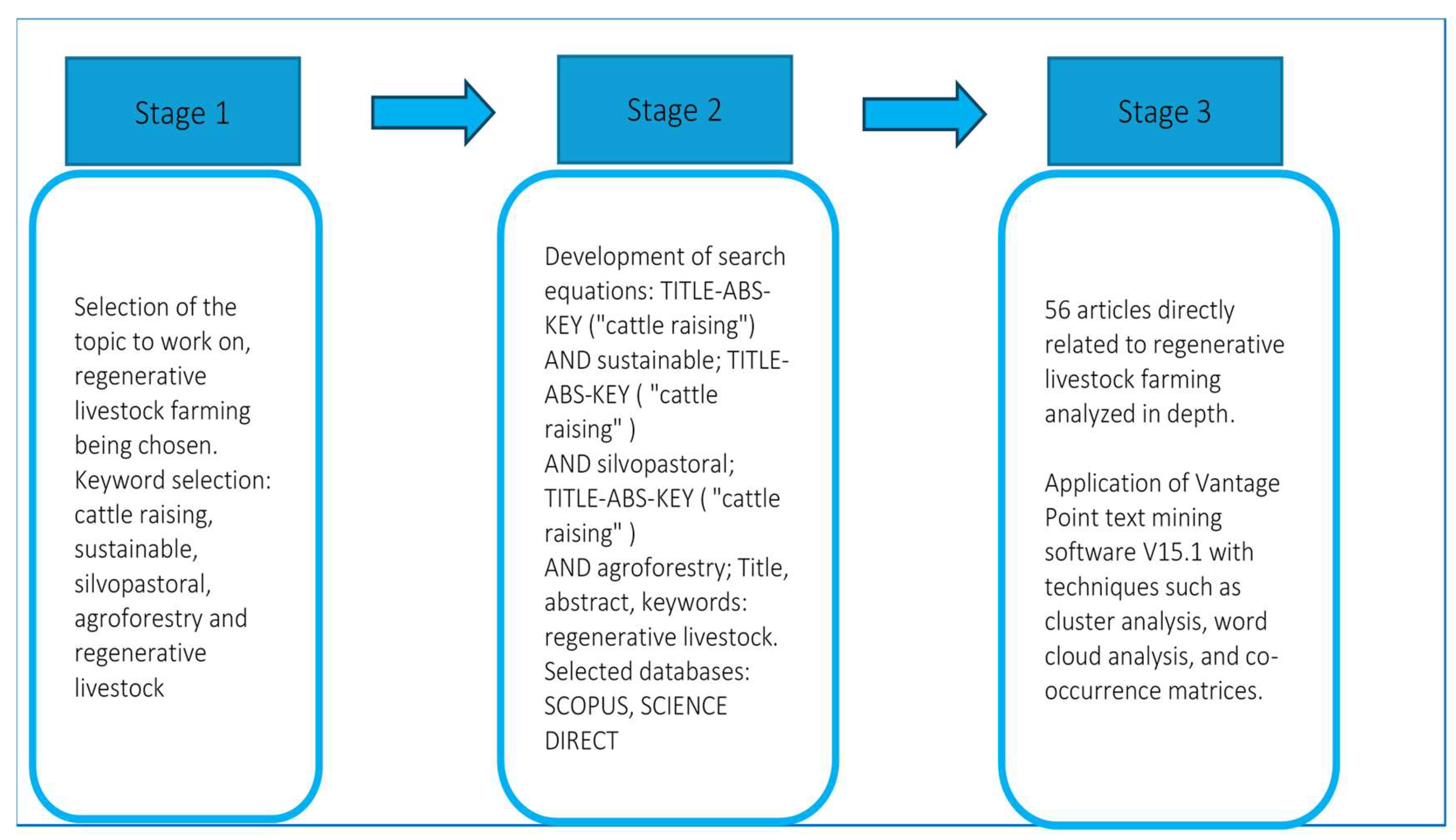
Figure 2.
Countries of origin of the investigations. Source: authors, based on VANTAGE POINT software (2026).
Figure 2.
Countries of origin of the investigations. Source: authors, based on VANTAGE POINT software (2026).

Figure 3.
Matrix of countries and keywords. Source: authors, based on VANTAGE POINT software (2026).
Figure 3.
Matrix of countries and keywords. Source: authors, based on VANTAGE POINT software (2026).
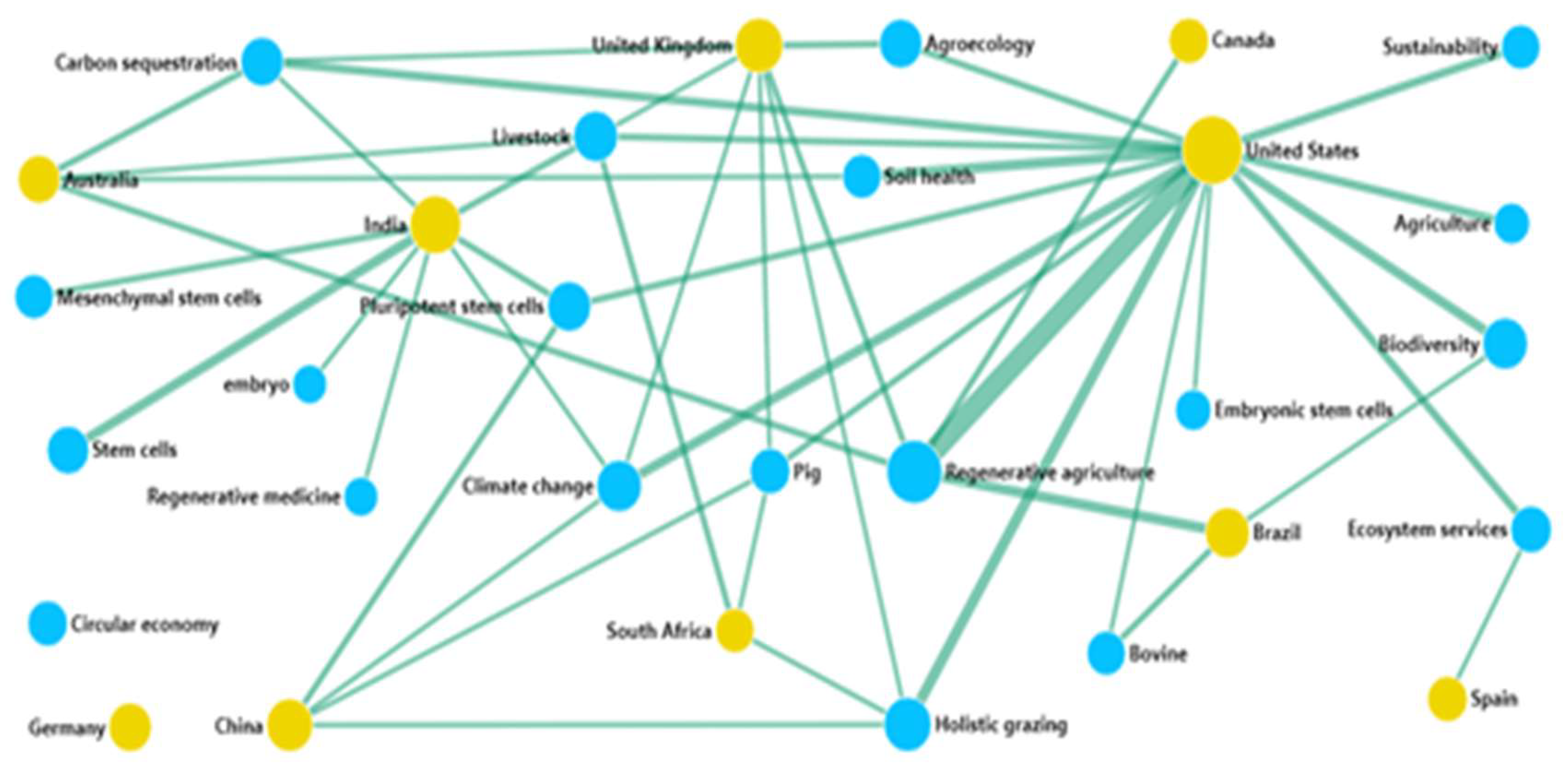
Figure 4.
Cluster of Keywords. Source: authors, based on VANTAGE POINT software) (2026).
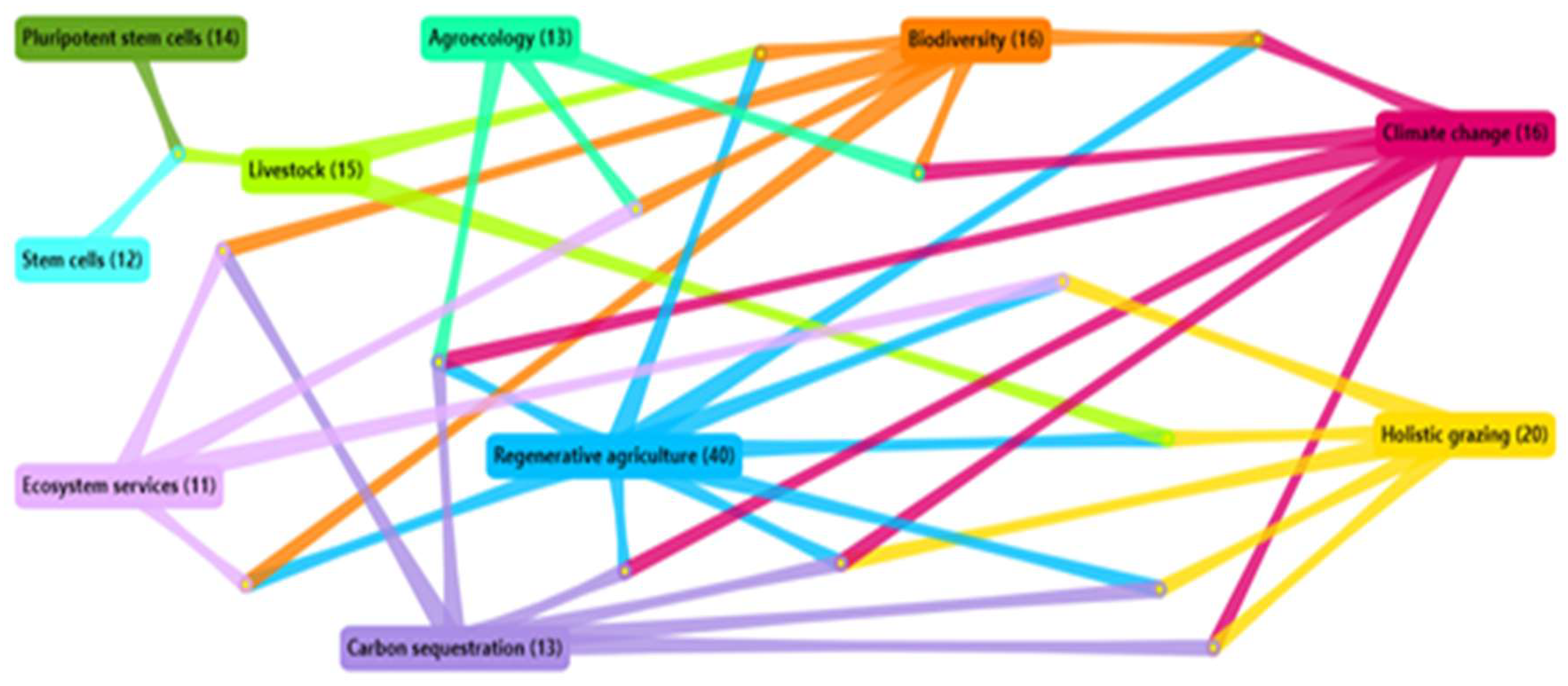
Figure 5.
Matrix of authors and keywords. Source: authors, based on VANTAGE POINT software (2026).
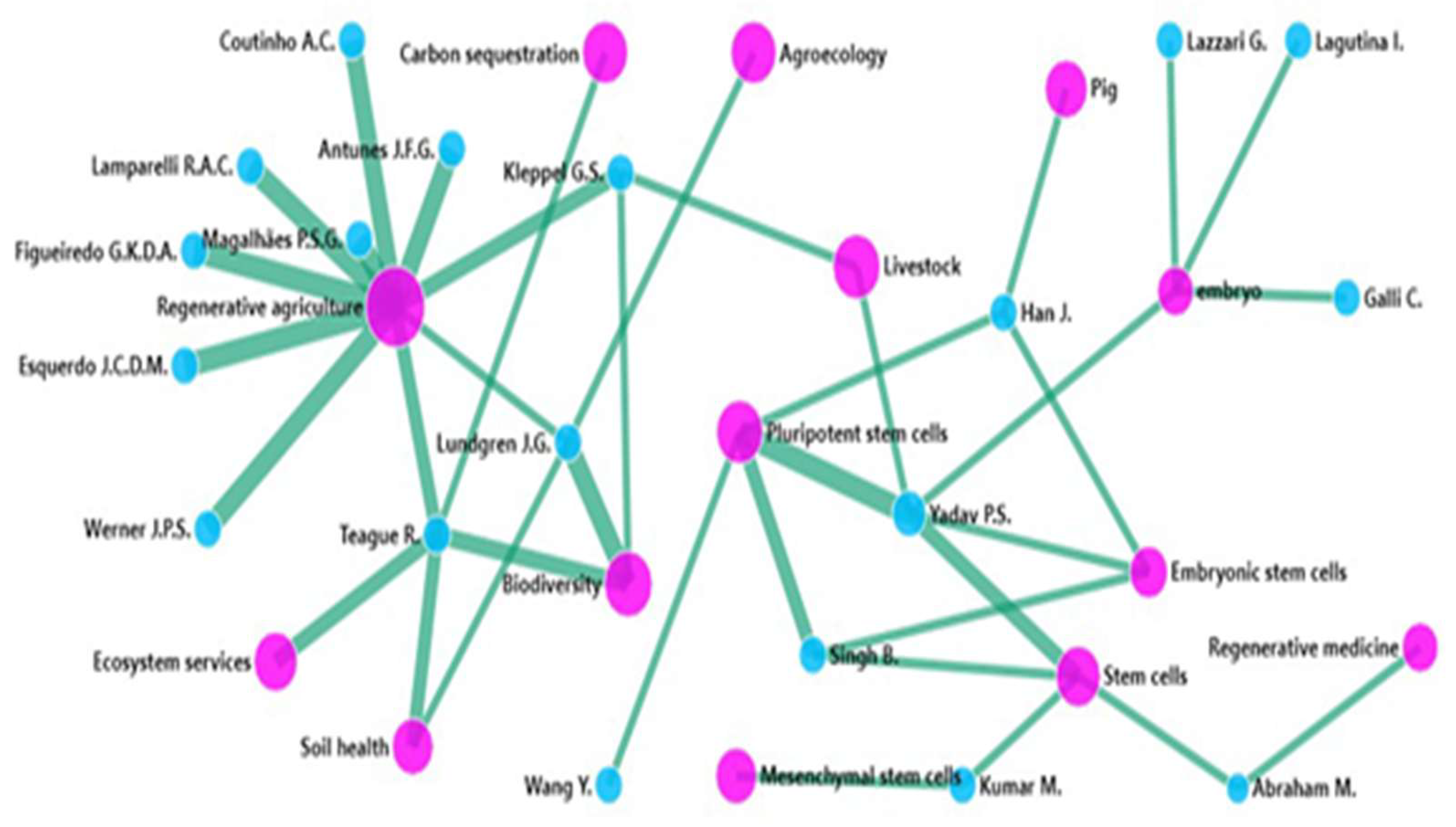
Figure 6.
Cloud of authors. Source: authors, based on VANTAGE POINT software (2026).
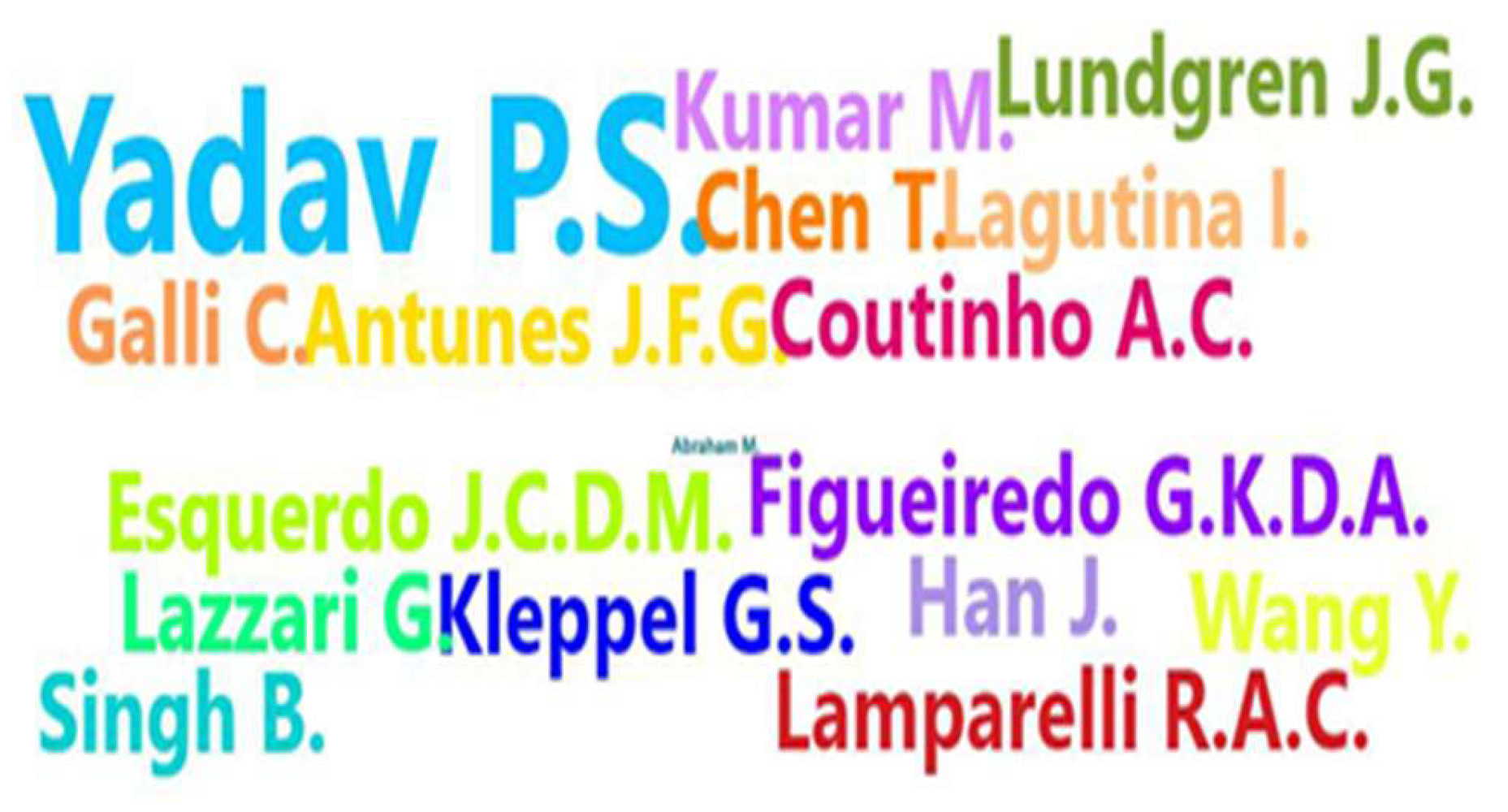
Figure 7.
Organizations participating in the investigations. Source: authors, based on VANTAGE POINT software (2026).
Figure 7.
Organizations participating in the investigations. Source: authors, based on VANTAGE POINT software (2026).
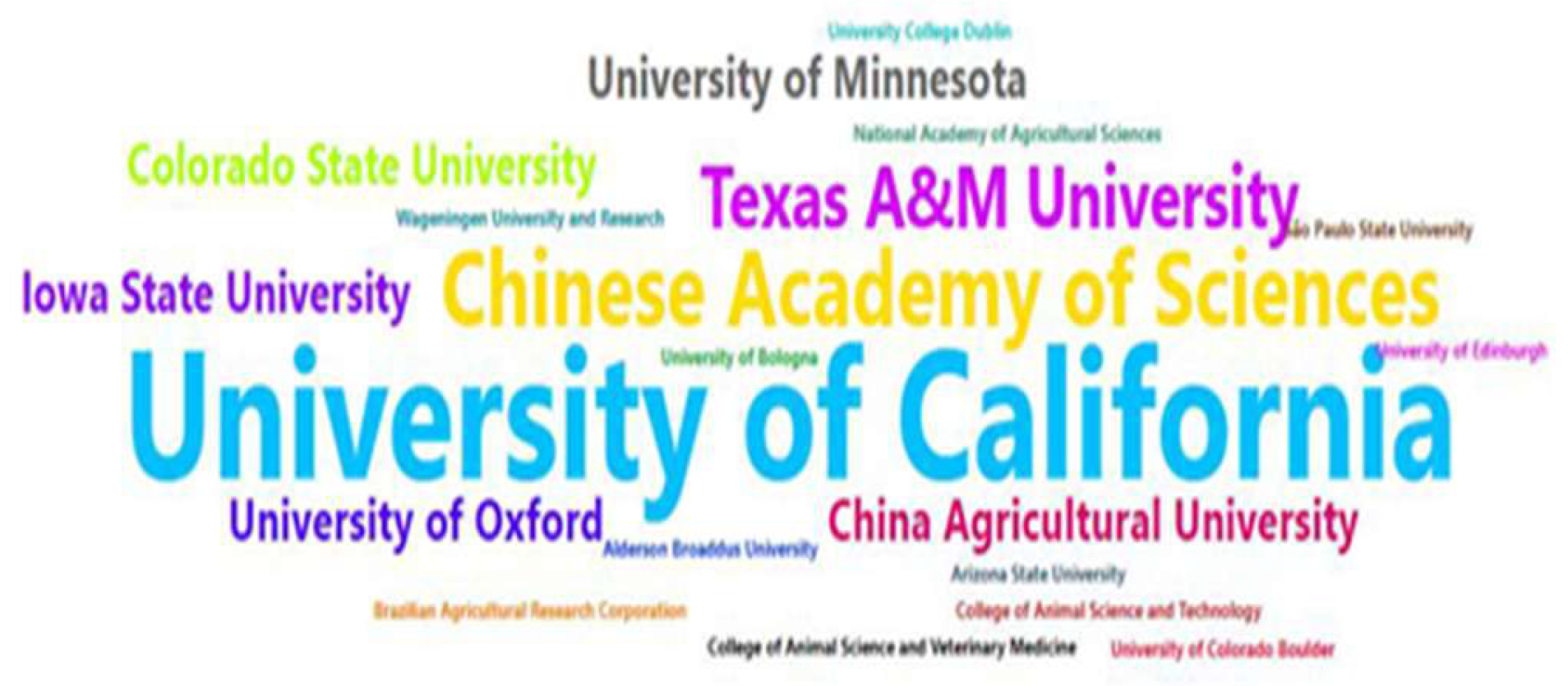
Figure 8.
Step-by-step for the implementation of a silvopastoral system. Source: the authors (2026).
Figure 8.
Step-by-step for the implementation of a silvopastoral system. Source: the authors (2026).
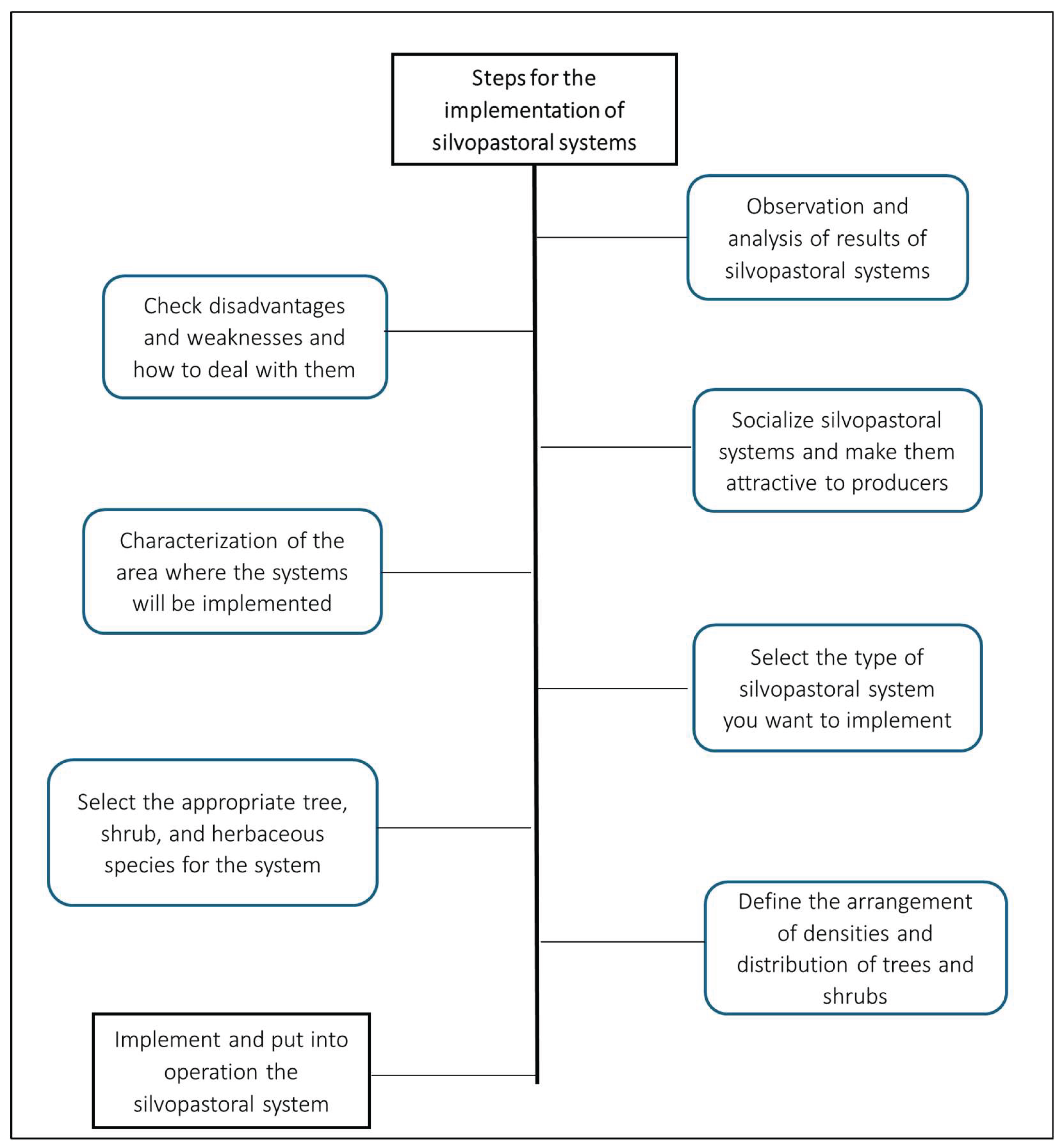

Table 1.
Regenerative technologies or activities.
| Regenerative technology or activity | N° Relevant articles |
| The silvopastoral system | 22 |
| Rotation and integrated pasture management | 11 |
| Livestock-crop integration | 6 |
| Replacement of agrochemicals with organic products | 3 |
| Evaluation of the advantages of regenerative systems | 3 |
| Organic Livestock | 2 |
| Adaptive Grazing | 2 |
| Fungi as growth promoters | 1 |
| Improvement of conditions by macroorganisms | 1 |
| Conservation of natural grasslands | 1 |
| Mutagenesis | 1 |
| Mass grazing | 1 |
| Leguminous grasses | 1 |
| Ammonia absorbent | 1 |
Source: the authors (2026).
Table 2.
Technologies or regenerative activities associated with animal husbandry.
| Country | Year | Authors | Regenerative technology or activity |
| Indonesia | 2023 | Utomo, B.N., Widjaja, E., Erlambang, Y.P. | Implementation of oil palm crops with livestock farming [28] |
| México | 2023 | [4] |
Analyze agroecological principles and practices that promote sustainable livestock production. |
| Uruguay | 2023 |
Boscana, M; Bussoni, A; Bentancur, O. |
Silvopastoral system for eucalyptus wood production and livestock production. [29] |
| México | 2022 | Saporiti, T; Cabrera, M; Bentancur, J; Sagnou, M; Alvarez, G. | Implementation of plant extracts to create acaricides for tick control in cattle. [30] |
| Paraguay | 2022 | Cruz, V; Mussallem, K; Mongil, J; Insfrán, A; Rey, J.M. | Improved soil conditions through the implementation of trees in pastures. [31] |
| Brazil | 2022 |
Lima, I.L.P; Alexiades, M.N; Scariot, A. |
Implementation of silvopastoral systems as a form of community resilience to the conversion of pastures for charcoal planting by industrial companies in common areas. [8] |
| New Caledonia | 2022 | Hüe, T; Wang, H.-H; Grant, W.E; Teel, P.D; Pérez, A.A. | Implementation of integrated livestock grazing management to control ticks. [32] |
| Brazil | 2021 | Gori Maia, A; Eusebio, G.D.S; Fasiaben, M.D.C.R; Assad, E.D; Pugliero, V.S. | Evaluation of impacts of agroforestry systems dissemination on livestock. [33] |
| Brazil | 2021 | De Souza, A.M; De Araújo, A.P.C. | Organic beef production system, as an alternative to pastures that take up to 6 months under water. [34] |
| Brazil | 2020 |
Carvalho, R; De Aguiar, A.P.D; Amaral, S. |
Low-impact livestock systems [35] |
| Brazil | 2020 | Oliveira, P.P.A; Pedroso, A.F; Vinholis, M.M.B; Filho, H.M.S; Shimata, I. | Crop-livestock integration system [10] |
| Mexico | 2016 | Nahed, J; Grande, D; Aguilar, J.R; Sánchez, B. | Conversion from traditional livestock farming to organic livestock farming [36] |
| Brazil | 2014 | Palermo, G.C; d’Avignon, A.L.D.A; Freitas, M.A.V. | Scenarios for CO2 eq reduction in livestock farming [37] |
| Argentina | 2014 | Kunst, C; Ledesma, R; Castañares, M; Van Meer, H; Godoy, J. | Grassland growth rate and harvest interval [38] |
| México | 2013 | Nahed, J; Valdivieso, A; Aguilar, R; Cámara, J; Grande, D. | Implementation of live fences and scattered trees as a traditional silvopastoral system. [39] |
| Brazil | 2008 | Develey, P.F; Setubal, R.B; Dias, R.A; Bencke, G.A. | Improvement of rangeland ecosystems through sustainable use of grasslands [40] |
| Argentina | 2006 | Giorgetti, H.D; Busso, C.A; Montenegro, O.A; Rodríguez, G.D; Kugler, N.M. | Improved livestock management [41] |
| Mexico | 2005 |
Carvajal Azcorra, J.J. |
Establishment of live fences [42] |
| Cuba | 2013 | Lok, S; Fraga, S; Noda, A; García, M. | Carbon sequestration livestock systems [43] |
| Cuba | 2003 | Cino, D.M; Jordán, H; Ruiz, T.E; Traba, J; Rodríguez, J. | Implementation of silvopastoral system [44] |
| United Kingdom | 2024 | Thomas R. Murphy, Mick E. Hanley, Jon S. Ellis, Paul H. Lunt | Natural forest expansion [45] |
| Egypt | 2023 | Shireen K. Assem, Mahmoud A. Basry, Taha A. Taha, M.H. Abd El-Aziz, Taher Alwa, Walid M. Fouad | Regeneration of sudangrass by mutagenesis [46] |
| Colombia | 2023 | Mauricio Quintero-Angel, Víctor A. Cerón-Hernández, Daniel I. Ospina Salazar | Applications of nature-based solutions for land restoration [47] |
| Spain | 2023 | (Teodoro Lasanta, Melani Cortijos López, Paz Errea, Manel Lena, Pedro Sánchez Navarrete, Javier Zabalza, Estela Nadal Romero; 2023) | Brush Clearing Plan (BCP) combined with extensive livestock grazing. [48] |
| Brazil | 2023 | (RS Santos, Y. Zhang, MF Cotrufo, M. Hong, DMS Oliveira, JM Damián, CEP Cerri; 2023) | Integrated crop and livestock systems [49] |
| Germany | 2023 | Steffen Schlüter, Maik Lucas, Maxime Phalempin, Lorena Knecht, Felix Lange Henke, Annette Deubel, Björn Reddersen, Constanze Rusch, Jan Rücknagel | Crop and livestock rotation to increase the availability of organic carbon in the soil [50] |
| Brazil | 2023 | Victor Vinicius F. de Lima, Aldicir Scariot, Anderson Cássio Sevilha | Analysis of environmental and anthropogenic factors affecting the natural regeneration and population structure of the S. Coronata palm. [51] |
| Malaysia | 2023 | Kamil Azmi Tohiran, Frisco Nobilly, Raja Zulkifli, Muhammad Syafiq Yahya, Ahmad Razi Norhisham, Md Zainal Rasyidi, Badrul Azhar | Silvopastoral agroforestry systems [52] |
| United States | 2023 | David J. Augustine, Sean P. Kearney, Edward J. Raynor, Lauren M. Porensky, Justin D. Derner | Rotational grazing for improved feed availability [53] |
| UNITED KINGDOM | 2023 | Markus Wagner, Claire Waterton, Lisa R. Norton, | Mass grazing [54] |
| United States | 2023 | Edward C. Rhodes, Humberto L. Perotto-Baldivieso, Evan P. Tanner, Jay P. Angerer, William E. Fox, | Rangeland management science [55] |
| Argentina | 2023 | Stefan Zerbe, Stefanie T. Storz, Georg Leitinger, Natalia Zoe Joelson, José Bava, Steffi Heinrichs, Christoph Leuschner, Gabriel Loguercio, Alois Simon, María F. Urretavizcaya, Helge Walentowski, | Silvopastoral agroforestry systems [56] |
| Australia | 2022 | Marta Monjardino, Angelo Loi, Dean T. Thomas, Clinton K. Revell, Bonnie M. Flohr, Rick S. Llewellyn, Hayley C. Norman, | Leguminous grasses [57] |
| China | 2022 | Yuwen Zhang, Zechen Peng, Shenghua Chang, Zhaofeng Wang, Duocai Li, Yufeng An, Fujiang Hou, Jizhou Ren, | Grazing management [58] |
| Canada | 2022 | Upama Khatri-Chhetri, Karen A. Thompson, Sylvie A. Quideau, Mark S. Boyce, Scott X. Chang, Dauren Kaliaskar, Edward W. Bork, Cameron N. Carlyle, | Adaptive grazing [59] |
| Argentina | 2022 | D. Arpigiani, V. Chillo, R. Soler, M.M. Amoroso, | Silvopastoral systems [60] |
| UNITED KINGDOM—Germany | 2022 | Matthew W. Jordon, Kathy J. Willis, Paul-Christian Bürkner, Gillian Petrokofsky, | A systematic review of rotational grazing and herbaceous grasslands. [61] |
| Japan | 2022 | Kimitaka Minami, Akira Takahashi, Koji Sakurai, Hiroaki Mikasa, Mikihiro Takasaki, Naoaki Doshu, Katsuya Aoyama, Tohru Nakamura, Ryota Iwai, Tohru Kawamoto, | High-capacity ammonia adsorbent [62] |
| United States | 2022 | [6] | Adaptive grazing |
| Spain—Tunisia | 2022 | Taher Mechergui, Marta Pardos, | Silvopastoral systems [63] |
| United States | 2022 | Nadia El-Hage Scialabba, | Livestock and its role in land regeneration [64] |
| United States | 2022 | Lauren M. Porensky, David J. Augustine, Justin D. Derner, Hailey Wilmer, Megan N. Lipke, Maria E. Fernández-Giménez, David D. Briske, | Rotary shepherd [65] |
| Brazil—Colombia—Mexico | 2019 | Rogerio Martins Mauricio, Rafael Sandin Ribeiro, Domingos Sávio Campos Paciullo, Mauroni Alves Cangussú, Enrique Murgueitio, Julian Chará, Martha Xochitl Flores Estrada, | Silvopastoral systems [66] |
| Brazil | 2018 | Jordano Vaz Ambus, José Miguel Reichert, Paulo Ivonir Gubiani, Paulo César de Faccio Carvalho, | Integrated crop and livestock systems [9] |
| Spain- United States | 2016 | Aida López-Sánchez, Ramón Perea, Rodolfo Dirzo, Sonia Roig, | Silvopastoral systems [67] |
| Iran—Dinamarca—Austria | 2014 | Ahmad Valipour, Tobias Plieninger, Zahed Shakeri, Hedayat Ghazanfari, Manouchehr Namiranian, Manfred J. Lexer, | Silvopastoral systems [68] |
| Mexico | 2014 | J. Nahed-Toral, A. Valdivieso-Pérez, R. Aguilar-Jiménez, J. Cámara-Cordova, D. Grande-Cano, | Silvopastoral systems [69] |
| Germany—Brazil | 2022 | Mariana Pereira Barsotti, Roberto Giolo de Almeida, Manuel C.M. Macedo, Valdemir A. Laura, Fabiana V. Alves, Jessica Werner, Uta Dickhoefer, | Integrated crop and livestock systems [70] |
Source: the authors (2026).
Table 3.
Relationship between livestock technologies and activities and three international institutions.
Table 3.
Relationship between livestock technologies and activities and three international institutions.
| Regenerative technology/activity | Wageningen University & Research | Rodale Institute | Savory Institute | Observations |
| Silvopastoral systems | ✓ | ✓ | ✓ | Strong agroforestry and livestock systems research |
| Rotation and integrated pasture management | ✓ | ✓ | ✓ | Pasture rotation and grazing systems research |
| Livestock-crop integration | ✓ | ✓ | Integrated crop-livestock systems | |
| Replacement of agrochemicals with organic products | ✓ | ✓ | Reduction of synthetic inputs | |
| Evaluation of advantages of regenerative systems | ✓ | ✓ | ✓ | Assessment of regenerative impacts |
| Organic livestock | ✓ | ✓ | Organic and regenerative livestock systems | |
| Adaptive grazing | ✓ | ✓ | ✓ | Holistic/adaptive grazing |
| Fungi as growth promoters | Limited direct evidence | |||
| Improvement of conditions by macroorganisms | Limited direct evidence | |||
| Conservation of natural grasslands | ✓ | ✓ | Grassland and rangeland conservation | |
| Mutagenesis | No major evidence identified | |||
| Mass grazing | ✓ | Mob/holistic grazing approaches | ||
| Leguminous grasses | ✓ | ✓ | Legume-based pasture systems | |
| Ammonia absorbent | No major evidence identified | |||
| ✓ = Institution has worked on/researched the topic | ||||
Source: the authors (2026).
Table 4.
Identification of variables on.
| Equation: (“regenerative livestock farming” OR “regenerative livestock “ ) AND barrier* | |
| Gratton et al, (2024) | = Soil health = Biodiversity
|
| Carolan (2025) |
|
| Total variables identified: 10 variables | |
Disclaimer/Publisher’s Note: The statements, opinions and data contained in all publications are solely those of the individual author(s) and contributor(s) and not of MDPI and/or the editor(s). MDPI and/or the editor(s) disclaim responsibility for any injury to people or property resulting from any ideas, methods, instructions or products referred to in the content. |
© 2026 by the authors. Licensee MDPI, Basel, Switzerland. This article is an open access article distributed under the terms and conditions of the Creative Commons Attribution (CC BY) license.
Copyright: This open access article is published under a Creative Commons CC BY 4.0 license, which permit the free download, distribution, and reuse, provided that the author and preprint are cited in any reuse.


