

Submitted:
29 May 2026
Posted:
01 June 2026
You are already at the latest version
Abstract
Myelodysplastic syndromes are clonal hematopoietic neoplasms in which ineffective hematopoiesis arises within the context of chronic inflammation and immune dysregulation. Growing evidence indicates that aging-associated inflammaging and inflammation-driven remodeling of the bone marrow microenvironment are not secondary phenomena, but active forces that shape clonal selection, lineage commitment, and disease evolution. This narrative review integrates recent insights from translational immunology, stem cell biology, multi-omics analyses, and clinical studies to examine the reciprocal interplay between inflammation and myelodysplastic syndromes pathogenesis. Chronic inflammatory stress imposes selective pressure on hematopoietic stem, favoring the expansion of mutation-bearing clones characteristic of clonal hematopoiesis and overt disease. As inflammation persists, immune dysfunction, together with stromal alterations, progressively reinforce ineffective hematopoiesis and clonal dominance. Genetic lesions, including TP53 and spliceosome mutations, further amplify inflammatory signaling and reshape the marrow niche, conferring clonal fitness and genomic instability. Clinically, readily accessible peripheral blood inflammatory indices reflect these biological processes and correlate with prognosis and therapeutic response. Collectively, these observations position inflammation as a unifying determinant of myelodysplastic syndromes initiation, progression, and treatment sensitivity. Integrating inflammatory signatures with genomic profiling may refine risk stratification and support the development of therapeutic strategies aimed at restoring marrow homeostasis and limiting inflammation-driven clonal evolution.
Keywords:
myelodysplastic syndromes
; inflammation
; inflammaging
; clonal hematopoiesis
; bone marrow microenvironment
; innate immunity
; NLRP3 inflammasome
; IRAK4–NFκB signaling
; spliceosome mutations
; TP53 mutations
1. Introduction
Myelodysplastic syndromes (MDS) are a heterogeneous group of clonal hematopoietic disorders characterized by ineffective hematopoiesis, cytopenias, dysplasia of one or more myeloid lineages, and an increased risk of transformation to acute myeloid leukemia (AML) [1]. Traditionally conceptualized as diseases driven primarily by acquired genetic and epigenetic lesions, MDS are now recognized as conditions in which both somatic alterations and germline predisposition contribute to disease development, with inherited mutations representing a significant subset of adult-onset cases [2] In fact, in addition to acquired somatic alterations, germline predisposition has emerged as an important contributor to MDS pathogenesis, particularly in adult-onset disease. Among these, mutations in DDX41 represent one of the most frequent inherited lesions associated with myeloid neoplasms [3,4]. Beyond their role in genetic susceptibility, DDX41 alterations are mechanistically linked to innate immune dysregulation, as loss of DDX41 function promotes accumulation of nucleic acid structures and activation of the cGAS–STING inflammatory pathway, leading to enhanced production and expansion of hematopoietic stem and progenitor cells [5]. These findings support a direct biological connection between germline predisposition and inflammation-driven clonal hematopoiesis.
Over the last decade, the integration of genomic, immunological, and microenvironmental studies has substantially reshaped the understanding of MDS pathophysiology, revealing that inflammatory signals are not merely epiphenomena but active forces shaping clonal selection and disease evolution [6].
Aging represents the strongest epidemiological determinant of MDS incidence. Age-associated alterations in the hematopoietic stem cell (HSC) compartment—collectively referred to as immunosenescence—include reduced self-renewal capacity, skewing toward myeloid-biased differentiation, accumulation of somatic mutations, and impaired immune surveillance. These changes are closely linked to inflammaging, a state of chronic, low-grade, sterile inflammation driven by cytokines such as IL-1β, IL-6, TNF-α, and IFN-γ [7]. In this inflammatory milieu, normal hematopoiesis is progressively disadvantaged, while mutated HSC clones—particularly those harboring lesions that confer resistance to inflammatory stress (e.g., TP53, TET2, ASXL1)—acquire a selective fitness advantage [2,6]. Experimental and clinical evidence demonstrates that inflammatory cytokines exert differential effects on normal versus mutated hematopoietic stem cells (HSCs), creating a Darwinian selection pressure that favors clonal expansion [8].
This inflammatory framework is tightly intertwined with clonal hematopoiesis of indeterminate potential (CHIP), a prevalent age-related condition detectable in up to 10–20% of individuals over 70 years of age. CHIP is sustained by a bidirectional relationship with systemic inflammation: chronic inflammatory signaling promotes clonal expansion, while mutant clones—particularly those carrying TET2 or DNMT3A mutations—actively reinforce inflammatory circuits within the hematopoietic and immune compartments. This self-perpetuating loop increases the likelihood of progression from CHIP to overt myelodysplastic syndromes [9].
Beyond HSC-intrinsic mechanisms, the bone marrow microenvironment plays a decisive role in shaping MDS biology. Aging and chronic inflammation remodel key niche components, including mesenchymal stromal cells, endothelial cells, macrophages, osteolineage cells, and adipocytes. Stromal elements from MDS patients display increased NF-κB activation, impaired hematopoietic support, and enhanced production of inflammatory mediators, collectively contributing to ineffective hematopoiesis and niche dysfunction [10]. In parallel, dysplastic clones actively reshape the immune landscape through immune evasion and immunosuppressive mechanisms, further reinforcing clonal dominance [11].
From a clinical standpoint, inflammation correlates closely with disease severity and prognosis. Distinct inflammatory profiles differentiate lower- and higher-risk MDS and circulating inflammatory markers have been repeatedly associated with survival, transfusion dependence, leukemic progression, and response to hypomethylating agents [12]. These observations underscore the clinical relevance of inflammatory processes beyond their mechanistic role.
Importantly, rather than considering these processes as independent layers of disease biology, we propose that they should be interpreted within a unified framework in which inflammation represents the central organizing force linking genetic alterations, immune dysregulation, and microenvironmental remodeling. In this perspective, MDS evolution reflects a dynamic and self-reinforcing system in which inflammatory signaling, clonal selection, and niche adaptation continuously interact and reshape each other.
Building on these concepts, this review summarizes current evidence supporting inflammation as a central organizing principle in MDS pathogenesis. The following sections examine how aging-related inflammatory changes promote clonal selection, how innate and adaptive immune dysfunction and niche alterations reinforce ineffective hematopoiesis, and how specific genetic lesions intersect with inflammatory signaling to shape disease heterogeneity. Finally, the review discusses the prognostic and therapeutic implications of inflammatory signatures, highlighting emerging strategies aimed at modulating inflammation to improve risk stratification and treatment outcomes [13].
During the preparation of this manuscript, Microsoft 365 Copilot (GPT-5 chat model) was used solely as an auxiliary tool for language refinement, figure conceptualization, and organizational support. The authors have reviewed and edited the output and take full responsibility for the content of this publication.
1.1. A Unifying Inflammation-Centered Model of MDS Evolution
Rather than representing parallel and partially independent pathogenic processes, inflammation, clonal hematopoiesis, immune dysregulation, and microenvironmental remodeling can be interpreted as components of a tightly interconnected and dynamic system that drives MDS evolution. We propose a unifying conceptual framework in which inflammatory signaling acts as the primary organizing force that integrates these domains across temporal and biological scales.
Within this model, inflammaging establishes the initial permissive landscape, characterized by chronic cytokine exposure, oxidative stress, and impaired resolution pathways. This environment exerts a selective pressure on HSCs, favoring the emergence and expansion of clones harboring mutations that confer resistance to inflammatory stress. The transition from physiological aging to clonal hematopoiesis of CHIP and subsequently to clonal cytopenia (CCUS) reflects not merely genetic accumulation, but progressive adaptation to an inflammatory ecosystem.
As clonal hematopoiesis emerges, the relationship with inflammation becomes bidirectional. Mutated clones—particularly those carrying lesions in epigenetic regulators, spliceosome components, or TP53—actively amplify inflammatory circuits through altered transcriptional programs, aberrant RNA species, and enhanced innate immune signaling. This establishes a self-reinforcing feedback loop in which inflammation promotes clonal expansion, and mutant clones further sustain inflammation.
Concurrently, the bone marrow microenvironment undergoes inflammation-driven remodeling, transitioning from a homeostatic niche to a dysfunctional and permissive ecosystem. Stromal cells, endothelial elements, and immune populations respond to chronic inflammatory stimuli by adopting pro-inflammatory and immunosuppressive phenotypes, thereby reinforcing clonal dominance and suppressing normal hematopoiesis. This process of “niche reprogramming” represents a central amplifier of disease progression.
Importantly, this framework also accommodates the stage-dependent evolution of immune responses, with early pro-inflammatory and immune-activated states progressively shifting toward immune exhaustion and tolerance in advanced disease. These transitions contribute to both phenotypic heterogeneity and therapeutic response variability.
From a translational perspective, this integrated model suggests that MDS should be viewed not only as a genetically defined malignancy, but as a system-level disorder of dysregulated inflammatory signaling and ecosystem imbalance. Consequently, inflammatory signatures—when integrated with genomic and clinical data—may provide a biologically grounded approach to risk stratification and therapeutic targeting.
Together, this inflammation-centered framework provides a coherent interpretation of MDS pathogenesis, bridging molecular lesions, immune dysfunction, and microenvironmental remodeling into a unified model of disease initiation, progression, and treatment response.
2. From Physiological Aging to Pathological Clonal Expansion: The Inflammaging Connection
Inflammaging, a defining feature of biological aging, reflects a persistent low-grade inflammatory state that emerges from cumulative cellular senescence, mitochondrial dysfunction, genomic instability, and impaired resolution of inflammatory responses [14].
Senescent cells accumulate with age and adopt a senescence-associated secretory phenotype (SASP) releasing IL-6, IL-8, IL-1β, and TNF-α. These mediators reshape the bone marrow milieu by activating NF-κB, p38 MAPK, and JAK/STAT pathways in HSCs, driving myeloid-biased differentiation, loss of quiescence, and diminished long-term reconstitution capacity—changes that phenocopy early MDS features. In parallel, aging-associated mitochondrial dysfunction increases reactive oxygen species (ROS), which promote DNA damage and activate inflammasomes such as NLRP3, perpetuating inflammatory cycling.
In addition to mitochondrial dysfunction, aging-associated inflammation exerts direct effects on hematopoietic stem cells through cytokine-mediated signaling, including IL-1, TNF-α, and interferons, which drive loss of quiescence, increased proliferative stress, and skewed differentiation. These processes create a selective environment favoring clones harboring mutations that confer resistance to inflammatory stress.
Chronic inflammatory signaling also promotes replication stress and DNA damage accumulation in HSCs, while simultaneously reshaping the bone marrow niche toward a pro-inflammatory and less supportive state. Together, these mechanisms favor the emergence and expansion of mutated clones, linking physiological aging to clonal hematopoiesis and ultimately to MDS [7,15,16,17].
Metabolic reprogramming toward glycolysis further limits regenerative fitness of aged HSCs. Moreover, inflammaging is characterized by impaired production of specialized pro-resolving mediators (SPMs), such as resolvins and lipoxins, which are normally required to terminate inflammatory responses. Failure of resolution mechanisms promotes persistence of inflammatory stress, a key permissive step for the evolution from age-related hematopoietic dysfunction toward clonal expansion and eventual MDS [18,19,20]. These observations support the concept that inflammaging is not merely a background condition, but acts as a selective ecological pressure that actively shapes hematopoietic fitness and initiates the continuum from physiological aging to clonal hematopoiesis and overt malignancy.
3. Inflammation-Driven Clonal Hematopoiesis as a Precursor to Myelodysplastic Syndromes
While inflammaging establishes a permissive biological background, clonal hematopoiesis (CH)—particularly CHIP—emerges as the first measurable inflection point linking aging, inflammation, and the development of myelodysplastic syndromes.
CHIP arises when HSCs acquire mutations—most commonly in DNMT3A, TET2, ASXL1, TP53, PPM1D, or JAK2—that confer a competitive advantage without causing overt cytopenias. Its prevalence exceeds 10% in older individuals [21,22].
Chronic inflammation functions as a key driver of clonal selection, whereas mutated clones display enhanced inflammatory fitness. For example, TET2-mutant HSCs show attenuated STAT3 signaling in response to IL-6, DNMT3A-mutant cells resist IFN-γ–induced exhaustion, and ASXL1 mutations upregulate inflammatory transcriptional programs that support clonal persistence. This clone-driven inflammatory amplification contributes to the systemic manifestations observed in CHIP carriers, including elevated cardiovascular risk and autoimmune phenomena [23,24,25].
Persistent inflammatory stress accelerates progression from CHIP to CCUS and ultimately MDS. Chronic cytokine exposure induces replication stress, mitochondrial damage, and impaired DNA repair, promoting acquisition of secondary mutations. Moreover, preexisting age-related niche alterations—reduced osteoblastic support, dysfunctional MSC immunoregulation, and increased adipogenesis—provide a selective advantage for mutated clones in the inflamed marrow environment [26,27,28]. Furthermore, Pattern recognition receptors (PRRs) represent a fundamental interface between inflammatory signals and clonal hematopoiesis, as they detect pathogen-associated and damage-associated molecular patterns, including nucleic acids derived from endogenous retroelements. Their activation—through sensors such as Toll-like receptors, RIG-I–like receptors, and the cGAS–STING pathway—triggers downstream inflammatory programs, including NF-κB and interferon signaling, thereby promoting hematopoietic stem cell stress, clonal selection, and progression along the CHIP–CCUS–MDS continuum.
Finally, CHIP-associated mutations disrupt innate immune sensing pathways driving sustained interferon signaling, HSC exhaustion, and clonal skewing, fostering progression toward overt MDS [29,30] (Figure 1).
Together, these mechanisms illustrate how inflammation functions simultaneously as a trigger, amplifier, and accelerator of clonal evolution. Targeting inflammatory circuits or senescent-cell programs represents a promising therapeutic avenue to interrupt the continuum from CHIP to MDS (Figure 2).
While inflammation has long been recognized as a key driver of clonal hematopoiesis, emerging evidence indicates that this relationship is bidirectional. Mutant hematopoietic clones associated with CH not only expand under inflammatory pressure but can also actively reshape the inflammatory milieu. Indeed, clones harboring mutations in genes such as TET2 or DNMT3A have been shown to promote exaggerated production of pro-inflammatory cytokines, thereby amplifying innate immune activation and establishing a self-reinforcing inflammatory loop.
In parallel, early alterations in adaptive immunity contribute to this process. T-cell compartments in the context of CH may exhibit functional dysregulation, including skewing toward exhausted or regulatory phenotypes, reduced cytotoxic activity, and impaired immune surveillance. These changes may facilitate the persistence and expansion of mutant clones. Moreover, the inflammatory environment associated with CH impacts the bone marrow stromal niche. Mesenchymal stromal cells and other niche components respond to chronic inflammatory signaling by altering their transcriptional programs and cytokine production, leading to a microenvironment that favors clonal dominance while impairing normal hematopoiesis. Together, these mechanisms support a model in which CH, immune dysregulation, and microenvironmental remodeling are tightly interconnected processes that precede and predispose to MDS development [31].
4. Innate Immune Circuits Driving Myelodysplastic Syndromes
Innate immune circuits refer to interconnected signaling pathways that regulate the recognition of danger signals and the initiation of inflammatory responses through pattern-recognition receptors, cytokine networks, and downstream transcriptional programs such as NF-κB activation. Under physiological conditions, these circuits preserve tissue homeostasis, regulate hematopoietic stem cell function, and coordinate effective immune responses to stress and infection. In myelodysplastic syndromes, however, these pathways become chronically activated and dysregulated, contributing to ineffective hematopoiesis and clonal selection [32].
4.1. Physiological Role of Innate Immune Circuits
Under physiological conditions, innate immune circuits regulate the recognition of danger-associated and pathogen-associated signals through pattern-recognition receptors such as Toll-like receptors and inflammasome components. These pathways coordinate rapid inflammatory responses via cytokine production and activation of transcriptional programs including NF-κB signaling. In the bone marrow, innate immune signaling plays a critical role in maintaining hematopoietic homeostasis by regulating hematopoietic stem cell quiescence, proliferation, and differentiation in response to stress and infection. Tight regulation of these pathways is essential to prevent excessive inflammation and preserve effective hematopoiesis.
4.2. Innate Immune Dysregulation in MDS
Innate immunity is profoundly dysregulated in MDS, and abnormalities in pattern-recognition pathways, cytokine production, and monocyte/macrophage function contribute to both ineffective hematopoiesis and clonal advantage. Among all immune compartments, the innate arm exerts the earliest and most persistent influence on HSC behavior and marrow homeostasis in MDS [32].
Among innate immune alterations, aberrant activation of Toll-like receptor signaling—particularly the MyD88–IRAK4 axis—represents one of the earliest and most influential pathogenic drivers in MDS.
In fact, a central pathogenic role is attributed to Toll-like receptor (TLR) signaling, especially TLR2, TLR4, and TLR9, which are frequently overexpressed in MDS progenitors. Activation of these receptors engages the MyD88 adaptor, leading to downstream phosphorylation of IRAK1 and IRAK4. This culminates in NF-κB nuclear translocation and transcription of inflammatory mediators. In many MDS subtypes, particularly those with SRSF2 or U2AF1 mutations, aberrant splicing produces constitutively active IRAK4 isoforms, which sustain NF-κB activity independently of ligand stimulation. This results in chronic production of IL-8, IL-6, TNF-α, and GM-CSF, fostering a microenvironment hostile to normal hematopoiesis yet permissive for dysplastic progenitors. Preclinical studies demonstrate that inhibiting IRAK4 in splicing-mutated MDS restores normal erythroid differentiation and reduces inflammatory gene expression, highlighting a mechanistic convergence between innate immunity and mutational landscapes [33,34,35].
Monocytes and macrophages in MDS show a dysregulated and plastic polarization state rather than a fixed M1 phenotype. Although inflammatory activation may characterize early disease, multiple studies have demonstrated a reduced M1/M2 ratio and expansion of M2-like macrophages in higher-risk MDS, accompanied by diminished pro-inflammatory function and enhanced support of clonal hematopoiesis. These findings indicate that macrophage polarization in MDS is dynamic, stage-dependent, and contributes to disease progression through immunosuppressive and tumor-supportive mechanisms [36,37].
Dysregulation of natural killer (NK) cells and dendritic cells (DCs) also characterizes innate immune dysfunction in MDS. NK cells display reduced expression of cytotoxic mediators (perforin, granzyme B), decreased IFNγ output, and impaired recognition of dysplastic clones. Dendritic cells show functional immaturity, altered antigen presentation, and TLR hyporesponsiveness. Importantly, beyond these functional abnormalities, dendritic cells in MDS may derive from the malignant hematopoietic clone and harbor the same genetic alterations observed in MDS blasts, indicating that their dysfunction is at least partially driven by cell-intrinsic genetic defects in addition to microenvironmental influences [38,39,40].
Innate immune dysregulation also shapes the stromal niche. Mesenchymal stromal cells activated via TLR2/TLR4 pathways shift toward production of IL-6, TGF-β, and prostaglandin E2, which inhibit erythropoiesis and promote fibrosis. Endothelial cells exposed to chronic inflammatory stimuli upregulate adhesion molecules (VCAM-1, ICAM-1), enhancing retention of inflammatory myeloid cells. Adipocytes release fatty acids that induce oxidative stress and inflammasome activation in adjacent progenitors [34,41,42,43,44].
4.3. Clinical Implications: Outcomes and Therapeutic Response
Finally, innate immune activation contributes to response heterogeneity to hypomethylating agents (HMAs). Elevated levels of IL-8 or NF-κB activity predict poorer response to azacitidine, whereas patients with low baseline inflammatory gene expression experience more durable hematologic improvement. These insights underscore the profound prognostic significance of innate immunity in MDS and point toward therapeutic targets—such as IRAK4 inhibitors, NLRP3 inflammasome blockers, or IL-1β antagonists—that are currently under active clinical development [33,45,46,47,48].
In parallel, inflammasome activation constitutes a second core driver of innate immune dysregulation, linking inflammatory signaling to intramedullary cell death and ineffective hematopoiesis.
Dysplastic hematopoietic progenitors exhibit increased activation of the caspase-1 inflammasome complex, leading to overproduction of IL-18. This cytokine has multiple pathogenic effects: they promote pyroptotic cell death, amplify inflammatory signaling via autocrine and paracrine loops, and impair erythroid maturation [49,50]. Pyroptosis, characterized by gasdermin D–mediated membrane pore formation, contributes to the excessive intramedullary apoptosis that typifies lower-risk MDS. The resulting release of DAMPs, including ATP, HMGB1, and mitochondrial DNA, serves as a secondary stimulus that further activates innate immune pathways and perpetuates marrow injury [51].
Acting primarily as an inflammatory amplifier rather than an initiating event, the S100A8/A9 alarmin axis sustains innate immune activation once dysregulation is established, reinforcing inflammatory stress and suppressing normal hematopoiesis. These calcium-binding proteins, produced by myeloid-derived cells, bind TLR4 and CD33, driving a self-perpetuating inflammatory cycle. In del(5q) MDS, S100A8/A9 expression is markedly increased, contributing to erythroid apoptosis, mitochondrial dysfunction, and enhanced oxidative stress. These factors suppress normal hematopoiesis while conferring a survival advantage to dysplastic clones [52,53,54].
Innate immune dysfunction extends to dendritic cells, which are both quantitatively and functionally abnormal in MDS. Dendritic cells show diminished antigen-presentation ability, downregulated costimulatory molecules, and impaired capacity to activate naive T cells. These abnormalities contribute to both chronic inflammation and defective immune surveillance [40,55].
Sustained activation of innate immune pathways translates into functional impairment and exhaustion of innate immune effector cells, including neutrophils. Neutrophils in MDS display impaired chemotaxis, defective phagocytosis, and increased formation of neutrophil extracellular traps (NETs). NETs contain oxidized DNA and proteases that further activate innate immune receptors and stimulate inflammasome signaling in the marrow [57,58]. These functional abnormalities are driven by multiple intersecting pathogenic mechanisms. Chronic inflammatory signaling and persistent exposure to cytokines such as IL6 and TNFα promote neutrophil activation but also induce functional exhaustion. Increased oxidative stress and mitochondrial dysfunction enhance ROS production, which is a key trigger of NET formation. In parallel, activation of innate immune pathways—including TLR signaling and inflammasome priming—further amplifies NETosis through NFκB-driven transcriptional programs. Moreover, dysplastic hematopoiesis and clonal alterations contribute to aberrant neutrophil differentiation, resulting in the expansion of dysfunctional neutrophil subsets characterized by impaired antimicrobial activity but enhanced pro-inflammatory output. Collectively, these mechanisms link neutrophil dysfunction and excessive NET formation to the chronic inflammatory microenvironment that sustains MDS progression [57,58].
Innate immune abnormalities also correlate with clinical outcomes. Elevated IL-8 levels predict poor response to hypomethylating agents, while high NF-κB activity in progenitors correlates with progression to AML. Altogether, innate immunity in MDS is characterized by persistent, maladaptive activation of inflammatory pathways that contribute to ineffective hematopoiesis, clonal dominance, and disease progression [45] (Figure 3, Table 1).
5. Adaptive Immunity at the Crossroads of Clonal Evolution in MDS
Adaptive immunity refers to antigen-specific immune responses mediated by T and B lymphocytes, characterized by immunological memory and precise recognition of non-self antigens. Under physiological conditions, adaptive immune responses ensure effective elimination of pathogens and malignant cells, while maintaining immune tolerance and preventing autoimmunity. In the bone marrow, adaptive immunity contributes to immune surveillance and regulation of hematopoiesis through coordinated interactions between T-cell subsets, B cells, and antigen-presenting cells [59].
Adaptive immune dysfunction in MDS follows a dynamic trajectory that evolves over the course of disease. Early stages are often characterized by immune activation and autoimmune phenomena, whereas disease progression is associated with progressive immune exhaustion and suppression. This temporal shift profoundly influences clonal selection, disease phenotype, and therapeutic responsiveness.
Adaptive immunity in MDS is profoundly remodeled and contributes both to early disease phenotypes (autoimmune manifestations, cytopenias from immune-mediated destruction) and to later disease progression (immune exhaustion and immune evasion). The adaptive immune system shapes the clonal architecture of MDS and affects therapeutic response [11,60].
A hallmark of adaptive immune dysfunction in MDS is T cell exhaustion. CD8⁺ cytotoxic T lymphocytes show persistent overexpression of inhibitory receptors—including PD-1, TIM-3, LAG-3, and TIGIT—and diminished production of IFN-γ and TNF-α. This results in impaired cytotoxicity and ineffective clearance of malignant or pre-malignant clones. Persistent antigen exposure from dysplastic cells and DAMP-induced signaling drives the expansion of exhausted T cell subsets. The degree of T cell exhaustion correlates with higher blast percentages and worse overall survival [11,47,61].
At the molecular level, this exhausted phenotype is driven in part by direct interactions between immune checkpoint ligands expressed on MDS blasts and inhibitory receptors on T cells. In particular, programmed death-ligand 1 and 2 (PD-L1/PD-L2) expressed on dysplastic progenitors engage PD-1 on CD8⁺ T cells, leading to inhibition of T-cell receptor signaling, reduced cytokine production, and impaired cytotoxic function. Similarly, Galectin-9 expressed by MDS cells binds to T-cell immunoglobulin and mucin-domain containing-3 (TIM-3), further promoting T-cell exhaustion and apoptosis. These checkpoint interactions establish a profoundly immunosuppressive microenvironment, enabling malignant clones to evade immune surveillance and progressively expand [11,47,61].
Simultaneously, many MDS patients exhibit increased regulatory T cells (Tregs). These Tregs overexpress FOXP3, CTLA-4, and ICOS, enhancing their suppressive activity. By inhibiting cytotoxic T cell and NK cell responses, Tregs create an immunosuppressive niche that favors malignant clone survival. Elevated Treg numbers are especially prominent in high-risk MDS and are linked to mutations in genes such as ASXL1 and TP53, which may further skew immune tolerance [62,63].
Helper T cell subsets are also altered. In certain lower-risk MDS patients, Th17 cells and IL-17 levels are elevated, promoting inflammatory apoptosis and contributing to marrow failure. In contrast, higher-risk cases often exhibit a shift toward Th2 polarization and reduced Th1 cytotoxic responses, paralleling the transition from autoimmunity toward immunosuppression [59].
B-cell immunity is impaired as well. B-cell lymphopenia is common and reflects diminished lymphoid output from the HSC pool. Clonal restriction of the B-cell receptor repertoire, reduced somatic hypermutation, and impaired class-switch recombination compromise humoral immunity and increase infection susceptibility. These abnormalities also reduce anti-leukemic antibody responses [59].
Natural killer cells, bridging innate and adaptive immunity, display reduced cytotoxicity, decreased expression of activating receptors, and increased inhibitory signaling. NK cell dysfunction contributes significantly to immune escape by dysplastic clones [38,64].
Adaptive immune alterations contribute to clinical heterogeneity. Early MDS frequently presents with autoimmune phenomena—arthritis, cutaneous vasculitis, autoimmune cytopenias—reflecting hyperactive yet dysregulated adaptive immunity. Advanced MDS presents instead with dominant immune exhaustion, aiding in disease progression [65].
Adaptive immunity also modulates response to therapy. Patients with lower exhaustion markers respond better to hypomethylating agents, while highly exhausted T cell profiles predict poor outcomes. Emerging therapies such as checkpoint inhibitors, anti-CD47 antibodies, and T cell–based immunomodulators are being investigated to restore adaptive immune function [66].
Thus, adaptive immunity in MDS evolves from early hyperactivation to late-stage exhaustion, shaping disease phenotype, clonal architecture, and therapeutic responses.
6. The Inflamed Niche: How Bone Marrow Ecosystems Drive MDS Evolution
Under physiological conditions, the bone marrow microenvironment is a highly organized and dynamic niche composed of mesenchymal stromal cells, endothelial cells, osteolineage cells, and immune populations that collectively regulate hematopoietic stem cell quiescence, self-renewal, and differentiation. These interactions ensure balanced hematopoiesis and immune homeostasis [67,68].
With aging, this tightly regulated system undergoes progressive alterations driven by chronic low-grade inflammation (inflammaging). Mesenchymal stromal cells acquire a senescent phenotype characterized by reduced proliferative capacity, mitochondrial dysfunction, genomic instability, and activation of NFκB. These senescent MSCs develop a senescence-associated secretory phenotype (SASP), releasing inflammatory mediators such as TGFβ, CXCL12, and CCL2, which disrupt normal hematopoietic support, impair erythroid and megakaryocytic differentiation, and promote myeloid skewing [69,70].
In parallel, chronic inflammatory signaling progressively destabilizes the bone marrow niche, creating a permissive environment for clonal selection. Within this context, mutated hematopoietic clones actively remodel the microenvironment in a process known as niche hijacking. Mutant progenitors release cytokines, exosomes, and mitochondrial components that reprogram stromal cells toward pro-inflammatory phenotypes. For example, SF3B1-mutant clones alter mitochondrial metabolism and impair osteoblast differentiation, while TP53-mutant clones induce DNA damage responses and inflammatory gene expression in stromal elements [71,72].
These combined effects of aging, inflammation, and clonal hematopoiesis progressively alter the structural and functional components of the bone marrow niche. The vascular compartment is disrupted, as endothelial cells exposed to chronic inflammatory stimuli upregulate adhesion molecules such as E-selectin, VCAM1, and ICAM1, promoting abnormal retention of inflammatory cells and enhancing angiogenesis. Persistent oxidative stress further impairs vascular integrity and destabilizes HSC quiescence [73,74,75,76].
Another hallmark feature is the expansion of bone marrow adiposity. Adipocytes accumulate with aging and release inflammatory mediators, including IL6, leptin, and fatty acids, which suppress erythropoiesis, increase reactive oxygen species (ROS), and impair HSC function. These adipocyte-rich niches further contribute to inflammasome activation and reinforce the inflammatory microenvironment [77,78,79,80].
In addition, chronic exposure to TGFβ and inflammatory cytokines promotes fibroblast activation and extracellular matrix deposition, leading to bone marrow fibrosis. This structural remodeling disrupts normal stromal–hematopoietic interactions, alters oxygen and nutrient gradients, and displaces HSCs from their physiological niches, favoring proliferation over quiescence. Clinically, fibrosis correlates with adverse prognosis and increased transfusion requirements [781,83].
Collectively, these processes transform the bone marrow from a homeostatic regulatory environment into a chronically inflamed and functionally impaired niche. This remodeled microenvironment supports clonal expansion, suppresses normal hematopoiesis, and accelerates disease progression in myelodysplastic syndromes (Figure 4). (Figure 3).
7. Inflammatory Selection and Genomic Destabilization in TP53-Mutant MDS
Among the various genetic lesions implicated in MDS, TP53 mutations represent the most clinically ominous subset. TP53-mutant MDS is strongly associated with complex karyotypes, chromosomal instability, resistance to hypomethylating agents, rapid progression to AML, and extremely poor survival [84]. Recent high-resolution studies have revealed an underappreciated dimension of TP53 biology: an intimate and bidirectional interaction between inflammatory signaling and clonal evolution, whereby chronic inflammation not only selects for TP53-mutant HSCs but also amplifies their genomic instability and leukemogenic potential [85].
7.1. Inflammation as a Selective Driver of TP53-Mutant Fitness
Under physiological conditions, HSCs rely on p53 to maintain genomic integrity, promote DNA repair, and preserve quiescence [86]. However, in inflammatory microenvironments rich in IL-1β, TNF-α, and IFN-γ, wild-type HSCs experience oxidative stress, replication stress, and mitochondrial dysfunction, leading to apoptosis or senescence. In contrast, TP53-mutant HSCs become inappropriately resistant to these stresses. Murine chimera experiments demonstrate that chronic administration of poly(I:C) or lipopolysaccharide (LPS) — mimicking viral and bacterial inflammation — selectively expands TP53-mutant HSCs at the expense of normal ones. After repeated inflammatory hits, mutant clones occupy an increasing fraction of the HSC pool, reflecting a profound fitness advantage in inflammatory settings [87].
Chronic inflammation promotes oxidative and replicative stress, leading to accumulation of DNA damage and defective checkpoint activation. In TP53-mutant cells, impaired cell cycle arrest and DNA repair responses allow survival and expansion despite genotoxic stress, conferring a strong selective advantage within an inflammatory microenvironment.
It was demonstrated that inflammation accelerates genomic instability in TP53-mutant clones. As reported, whereas wild-type p53 enables cells to halt proliferation and repair damage, TP53-mutant cells fail to mount appropriate responses to genotoxic and oxidative stress. Under repeated inflammatory stimulation, these mutant HSCs accumulate large numbers of chromosomal aberrations, copy-number alterations, and driver mutations. Single-cell multiomic studies reveal that TP53-mutant clones show pre-activation of inflammatory gene programs (e.g., TNFA signaling, IFN pathways, NF-κB targets) even before clinical transformation. This indicates that inflammation is not only permissive but actively contributes to the acquisition of additional leukemogenic events [88].
In addition, mutant p53 actively shapes the inflammatory microenvironment by promoting NF-κB signaling and pro-inflammatory cytokine production, thereby reinforcing a self-sustaining loop between clonal expansion and inflammation [85].
Longitudinal studies of TP53-mutated patients show distinct patterns of clonal evolution:
- bi-allelic TP53 inactivation,
- hemizygous mutations with progressive allelic imbalance,
- parallel evolution among multiple TP53-hit subclones,
- and TP53-driven divergence from JAK2-mutant MPN clones (in secondary AML) [83].
Remarkably, inflammatory stimulation preferentially promotes bi-allelic TP53 disruption, the genomic configuration most strongly associated with leukemic transformation. TNF-α and IL-1β impair DNA double-strand break repair through p53-dependent and independent pathways, accelerating the transition from monoallelic to multi-hit TP53 states [89,90].
Moreover, TP53-mutant HSCs reshape the niche by secreting inflammatory mediators and mitochondrial DNA fragments, which activate stromal NF-κB signaling. This stromal activation further increases IL-6, S100A8/A9, and TGF-β, creating a feedback loop that selectively supports TP53-mutant progenitors. Macrophages in TP53-mutated disease exhibit impaired efferocytosis, promoting accumulation of necrotic debris and inflammasome activation [87,90].Finally, as will be addressed more comprehensively later in this review, the interplay between TP53 mutations and inflammation suggests potential therapeutic strategies currently under clinical investigation: :
- targeting IL-1β / TNF-α to reduce inflammatory selection pressure;
- IRAK4 inhibition, relevant in spliceosome co-mutated TP53 cases;
- anti-CD47 therapy to restore macrophage-mediated clearance;
- p53-reactivating molecules for specific missense variants;
- targeting S100A8/A9–TLR4 pathways, which are especially active in TP53-high clones (Figure 5).
Early-phase clinical studies targeting IRAK4 signaling, CD47 blockade, and inflammatory pathways have shown promising but still preliminary results, highlighting the need for further validation in larger trials [91].
Understanding inflammation-driven TP53 clonal expansion provides a conceptual framework to design therapies that reduce inflammatory “fuel” sustaining these lethal clones [92].
8. Spliceosomal Dysfunction as a Driver of Inflammatory Signaling and Clonal Fitness in Myelodysplastic Syndromes
Spliceosome mutations—most notably involving SF3B1, SRSF2, U2AF1, and ZRSR2—represent one of the defining molecular hallmarks of MDS, collectively affecting more than half of all patients. These lesions alter pre-mRNA splicing fidelity, generating aberrant transcripts that disrupt gene regulation, cellular metabolism, and immune homeostasis. Increasing evidence shows that spliceosome-mutated MDS displays distinct inflammatory phenotypes, highlighting a mechanistic link between splicing dysregulation and inflammation-driven clonal evolution [93,94,95]. Notably, the inflammatory and transcriptional consequences of SRSF2 mutations may differ depending on specific co-mutation patterns. In the presence of SRSF2 and EZH2 co-mutation alone, loss of PRC2 function leads to partial derepression of inflammatory and myeloid differentiation programs, resulting in moderate cytokine upregulation and myeloid skewing [49]. In contrast, the additional co-mutation of BCOR, a component of the PRC1.1 complex, results in combined disruption of PRC1 and PRC2-mediated repression. This dual epigenetic impairment amplifies transcriptional deregulation and enhances expression of inflammatory mediators such as CCL3, TNFα, and S100A8/A9, thereby reinforcing a stronger inflammatory phenotype and increased clonal fitness [49].
Aberrant splicing resulting from mutations in SF3B1 and U2AF1 leads to the accumulation of diverse categories of misprocessed RNA species, including nonsense-mediated decay substrates, circular RNAs, defective mitochondrial transcripts, and endogenous retroelement-derived RNAs. These nucleic acid species function as aberrant danger signals that engage cytosolic pattern-recognition receptors such as MDA5, RIG-I, and the cGAS–STING axis. Their activation leads to robust type I and type II interferon responses, promoting a sustained inflammatory milieu. The resulting cytokine signaling not only amplifies systemic inflammation but also suppresses erythropoiesis, contributing to the anemia that characterizes several spliceosome-mutated MDS subtypes [26,95,96,97].
A major conceptual advance has been the discovery that U2AF1 mutations drive an alternative splicing event that favors expression of the hyperactive IRAK4-Long isoform. This aberrant form of IRAK4 strongly activates the MyD88–NF-κB pathway, creating a state of constitutive innate immune activation. In addition to IRAK4–NFκB–mediated signaling, U2AF1 mutations have been linked to alternative inflammatory mechanisms involving transcriptional and metabolic reprogramming. In particular, U2AF1-mutant cells exhibit activation of the transcription factor FOXO3a, which promotes autophagy-related programs and contributes to disease progression. This pathway is mechanistically coupled with activation of the NLRP3 inflammasome, leading to increased production of inflammatory mediators and induction of pyroptotic cell death. These findings further highlight how spliceosome mutations integrate with innate immune signaling pathways to amplify inflammation-driven clonal evolution in MDS [98].
Patients harboring IRAK4-Long–driven disease exhibit elevated levels of IL-8, IL-6, and TNF-α, and as reported above, preclinical models indicate that IRAK4 inhibition can restore more physiological hematopoiesis, underscoring the translational relevance of this pathway [99,100].
In SF3B1-mutant MDS, inflammation intersects mitochondrial dysfunction. Mis-splicing of genes required for mitochondrial heme metabolism results in ineffective erythropoiesis and accumulation of ring sideroblasts. Mitochondrial stress increases production of ROS, which in turn activates inflammasome complexes and enhances secretion of IL-1β and IL-18. Multi-omics factor analysis has linked these inflammatory signatures to broader aging-related pathways, suggesting that SF3B1 mutations propagate a combined mitochondrial–inflammatory program [101,102].
Mutations in SRSF2 further illustrate how spliceosome dysfunction promotes inflammatory myelopoiesis. Mis-splicing of key regulators of hematopoietic differentiation—such as EZH2 and BCOR—drives a myeloid-skewed phenotype accompanied by high expression of CCL3, TNF-α, and S100A8/A9 in granulocyte–macrophage progenitors. These inflammatory mediators create a self-reinforcing loop that restricts lymphoid output, enhances myeloid bias, and contributes to clinical severity [49,103].
Beyond cell-intrinsic mechanisms, spliceosome-mutated clones influence the bone marrow microenvironment. Misprocessed RNAs are released via exosomes and internalized by stromal cells, where they trigger NF-κB activation and promote differentiation of stromal elements into a pro-inflammatory state. This remodeled niche preferentially supports mutated HSCs while suppressing normal hematopoiesis, thereby amplifying clonal dominance and contributing to disease heterogeneity [6] (Figure 6).
9. Autoimmune and Inflammatory Comorbidities in MDS: Clinical Significance and Distinct Phenotypic Patterns
Systemic inflammatory and autoimmune diseases (SIADs) represent a clinically relevant extra-hematologic manifestation in patients with MDS, with a reported prevalence of 20–30%. The clinical spectrum is broad and heterogeneous, reflecting the complex immune perturbations that accompany clonal myeloid disorders. Frequently observed SIADs include small- and medium-vessel vasculitis, seronegative polyarthritis, Behçet-like mucocutaneous involvement, neutrophilic dermatoses such as Sweet syndrome, autoimmune cytopenias, and various forms of thyroid autoimmunity. These disorders can be presented as isolated organ-specific inflammatory reactions or as systemic syndromes marked by fever, cutaneous eruptions, and elevated inflammatory markers.
Among recently recognized entities, VEXAS (vacuoles, E1 enzyme, X-linked, autoinflammatory, somatic) syndrome represents a paradigmatic example of the intersection between somatic mutations and systemic inflammation. This syndrome is caused by acquired mutations in the UBA1 gene in hematopoietic progenitor cells and is characterized by severe autoinflammatory manifestations, including fever, vasculitis, dermatologic involvement, and pulmonary inflammation. Importantly, a significant proportion of patients with VEXAS syndrome develop or fulfill diagnostic criteria for myelodysplastic syndromes or other clonal hematologic disorders.
From a pathogenic standpoint, VEXAS highlights how somatic mutations in hematopoietic stem cells can directly drive systemic immune dysregulation, supporting the concept that inflammatory and autoimmune manifestations in MDS may, at least in part, reflect the intrinsic biology of the malignant clone rather than secondary immune phenomena alone [104].
Notably, SIADs may arise before, at the time of, or after the diagnosis of MDS, underscoring the bidirectional relationship between immune dysregulation and clonal hematopoiesis [105,106,107,108].
The temporal dissociation between the onset of SIADs and the identification of dysplasia has led to particular interest in the role of immune activation as a sentinel of evolving marrow pathology. In a subset of patients, autoimmune manifestations precede the hematologic diagnosis by months or years, raising the possibility that abnormalities in immune regulation may serve as an early indicator of subclinical clonal expansion. Conversely, in patients with established MDS, SIADs often correlate with episodes of increased inflammatory drive rather than with overt disease progression, supporting the concept that they arise from qualitative immune dysfunction rather than quantitative bone marrow failure [109].
Management of SIADs in the context of MDS typically involves immunomodulatory therapy—most commonly corticosteroids, methotrexate, or other conventional immunosuppressive agents—which often result in rapid symptomatic improvement. However, their influence on the hematologic course of MDS is variable. Disease-modifying treatments such as azacitidine have shown the capacity to ameliorate both SIAD manifestations and MDS-related cytopenias in a subset of patients, through suppression of aberrant cytokine production and restoration of more balanced immune signaling. Nonetheless, autoimmune manifestations may remain refractory despite hematologic responses, highlighting the complexity of the underlying immune pathology [110].
Overall, SIADs in MDS should be interpreted as clinical expressions of the broader immune and inflammatory imbalance intrinsic to clonal myeloid disease, rather than as independent prognostic determinants.
In this context, the systemic inflammatory and immune dysregulation underlying SIADs is not confined to clinically overt manifestations but is also reflected in subtle and quantifiable alterations detectable in peripheral blood. Indeed, routine hematologic parameters may provide an accessible window into the same pathogenic processes that drive autoimmune phenomena, capturing the balance between inflammatory activation, immune exhaustion, and clonal hematopoiesis. Therefore, peripheral blood–derived inflammatory indices can be viewed as complementary tools that extend the clinical and biological insights derived from SIADs, offering a continuous and measurable representation of immune dysfunction in patients with MDS.
Peripheral blood–derived inflammatory indices provide a simple and clinically accessible surrogate of the immune and inflammatory landscape shaping myelodysplastic syndromes (MDS), capturing key aspects of innate and adaptive dysfunction, clonal dynamics, and marrow niche activity [111,112].
Among single parameters, the absolute monocyte count (AMC) is particularly informative, as reduced levels reflect impaired innate immunity and defective efferocytosis, highlighting profound immune dysregulation beyond its prognostic value [113,114]. Similarly, the absolute lymphocyte count (ALC) serves as a marker of immune competence; lymphocytopenia (ALC < 1.2 × 10⁹/L) correlates with increased infection risk, diminished T-cell diversity, and impaired NK cell function. Importantly, the reduction in ALC in MDS is multifactorial and reflects both bone marrow failure and immune dysregulation. On one hand, ineffective hematopoiesis limits lymphoid output from hematopoietic stem cells, contributing to quantitative lymphopenia. On the other, chronic antigenic stimulation and persistent inflammatory signaling drive immune exhaustion, particularly within T-cell compartments. [115,116,117]. within T-cell compartments.
More specifically, CD8⁺ T cells frequently exhibit an exhausted phenotype characterized by reduced cytokine production and impaired cytotoxic function, while CD4⁺ T cells show altered helper responses and skewing toward regulatory or dysfunctional subsets. In parallel, B-cell lymphopenia and reduced receptor diversity further compromise humoral immunity. Together, these quantitative and qualitative alterations explain the decline in ALC and its association with increased susceptibility to infections, reduced immune surveillance, and poorer clinical outcomes in MDS.
Composite indices further refine this assessment. The neutrophil-to-lymphocyte ratio (NLR) integrates inflammatory myelopoiesis and lymphocyte suppression, with elevated values (>4–5) associated with adverse outcomes, including higher blast burden, increased IL-8 levels, and reduced response to hypomethylating agents. The platelet-to-lymphocyte ratio (PLR) reflects thrombopoietic stress and systemic inflammation and has been consistently linked to inferior event-free survival [12,111,118,119]. The monocyte-to-lymphocyte ratio (MLR), often increased in advanced disease, correlates with myeloid expansion and disease progression, capturing early shifts toward inflammatory clonal evolution even in lower-risk MDS [120,121].
Collectively, these indices provide an integrated and dynamic snapshot of systemic inflammation and immune competence. While individually modest, their combined interpretation complements genetic and cytogenetic data and supports their incorporation into refined prognostic models and therapeutic decision-making frameworks (Table 2).
10. Inflammation-Targeted Therapy in Myelodysplastic Syndromes: A Conceptual and Therapeutic Shift
Targeting inflammation has emerged as one of the most promising and conceptually transformative directions in the management of MDS. As understanding of MDS pathobiology has evolved, it has become increasingly evident that inflammatory signaling is not simply an epiphenomenon of marrow dysfunction, but a central driver of key disease features—including ineffective hematopoiesis, clonal selection, bone marrow microenvironment remodeling, and immune dysregulation. Therapeutic strategies aimed at modulating these inflammatory circuits therefore represent a rational and biologically grounded complement to cytotoxic and epigenetic therapies, with the potential to alter both symptom burden and disease trajectory (13].
10.1. Therapeutic Strategies in Early-Stage MDS
In early-stage MDS, the immune microenvironment is predominantly characterized by heightened inflammatory signaling and immune activation. In this context, excessive innate immune activation contributes to ineffective hematopoiesis and increased apoptosis. Therefore, therapeutic strategies aimed at reducing inflammation and restoring hematopoietic function may be beneficial.
Approaches under investigation include inhibition of innate immune pathways, such as targeting NLRP3 inflammasome activation, IL-1 signaling, and TLR pathways, as well as the use of hypomethylating agents that can modulate inflammatory signaling. Additionally, therapies aimed at restoring immune balance without excessive immunosuppression are of particular interest in this disease stage.
Among the most extensively investigated inflammatory pathways is the IL-1β axis, which orchestrates pyroptotic cell death and early hematopoietic failure in MDS. Excessive IL-1β signaling promotes inflammasome activation and skews hematopoietic progenitors toward apoptosis, particularly within the erythroid compartment. Pharmacologic inhibition of IL-1β or its receptor—via agents such as canakinumab and anakinra—or upstream suppression of NLRP3 inflammasome activity might attenuate inflammatory apoptosis and restore erythropoietic output. These observations support ongoing efforts to evaluate IL-1β blockade in MDS patients with prominent inflammatory signatures [31,49].
Clinical evidence further supports the relevance of IL-1β signaling in MDS. A phase II clinical trial investigating the IL-1β inhibitor canakinumab in patients with previously treated lower-risk MDS demonstrated the feasibility of targeting this pathway, with evidence of biological and clinical activity in a subset of patients. In addition, elevated IL-1β levels and associated alterations in regulatory T-cell subsets have been correlated with disease progression, further supporting the pathogenic role of this pathway [122,123].
Another major inflammatory pathway relevant to MDS pathogenesis involves TGF-β, a cytokine that enforces erythroid maturation arrest, promotes stromal fibrosis, and contributes to immunosuppressive niche formation.
Luspatercept, a ligand trap for TGF-β superfamily members, improves erythropoiesis and reduces transfusion burden in lower-risk MDS, particularly in SF3B1-mutant disease. Similarly, sotatercept acts through modulation of TGF-β signaling to restore late-stage erythroid maturation. In addition, galunisertib (LY2157299), a TGF-β receptor I kinase inhibitor, represents a promising investigational strategy aimed at disrupting this pathway at the signaling level. These approaches highlight the central role of TGF-β signaling in MDS and its therapeutic exploitation [124,125].
Modulation of TGF-β superfamily signaling through agents such as luspatercept has already transformed treatment for SF3B1-mutant and ring sideroblast–associated MDS, where restoration of erythroid maturation has yielded clinically meaningful reductions in transfusion burden. Efforts are underway to expand TGF-β–directed therapies to broader MDS subsets, given the pervasive role of this pathway in hematopoietic regulation and fibrosis [32,82,126,127].
Inflammatory pathways linked to innate immune sensors also present actionable therapeutic vulnerabilities. IRAK4, a key kinase downstream of Toll-like receptors and MyD88, is aberrantly activated in certain spliceosome-mutant MDS, particularly those harboring U2AF1 mutations that generate the hyperactive IRAK4-Long isoform. Inhibitors of IRAK4, such as emavusertib, have demonstrated potent suppression of NF-κB–driven inflammatory transcriptional programs and have shown encouraging preclinical activity, especially in combination with hypomethylating agents [13,99,100,128].
Targeting damage-associated inflammatory signals have similarly gained traction. The alarmins S100A8 and S100A9—potent activators of TLR4 and NLRP3 inflammasomes—are enriched in high-risk MDS, del(5q) disease, and TP53-mutated clones. Neutralizing antibodies and small-molecule inhibitors directed against S100A8/A9 aim to interrupt this pathological loop of innate immune priming, inflammatory cell death, and erythroid suppression [13,129].
10.2. Therapeutic Strategies in Advanced-Stage MDS
In contrast, advanced-stage MDS is characterized by an immunosuppressive microenvironment, with increased expression of immune checkpoint molecules, expansion of regulatory cell populations, and impaired anti-tumor immunity. In this setting, therapeutic strategies are primarily aimed at restoring immune surveillance and counteracting immune escape mechanisms.
Immune checkpoint inhibitors targeting PD-1/PD-L1 and TIM-3 pathways represent a key area of investigation, often in combination with hypomethylating agents. Additional approaches include CD47 blockade to enhance macrophage-mediated phagocytosis, as well as strategies targeting the tumor-supportive microenvironment. These therapeutic paradigms reflect the shift from a pro-inflammatory to an immune-evasive disease state during MDS progression.
Although traditionally viewed as epigenetic therapies, hypomethylating agents (HMAs) such as azacitidine and decitabine possess substantial immunomodulatory properties. They reduce pro-inflammatory cytokines, enhance antigen presentation, reprogram exhausted T cells, and promote regulatory T cell expansion. Clinical response to HMAs often correlates with a decline in inflammatory gene expression, underscoring the interplay between epigenetic and immunologic mechanisms [130,131,132].
Another emerging class of therapies includes agents that interfere with the “don’t-eat-me” signal mediated by CD47-SIRPα, a pathway exploited by dysplastic clones to evade macrophage-mediated phagocytosis. Anti-CD47 therapies restore innate immune clearance and may synergize with anti-inflammatory agents by simultaneously reducing clonal fitness and dampening inflammatory feedback loops [133,134].
Finally, senolytic therapies—designed to eliminate senescent stromal and immune cells—represent an innovative approach to dismantling the chronically inflamed marrow niche characteristic of MDS. By selectively targeting these senescent cellular populations, senolytics aim to reverse maladaptive microenvironmental remodeling and restore a more permissive environment for normal hematopoiesis [135,136].
Given the multifaceted ways in which inflammation shapes disease biology, future treatment paradigms will involve strategic combinations of anti-inflammatory agents, hypomethylating therapies, metabolic modulators, immune checkpoint inhibitors, and targeted anti-clonal drugs. Such integrated approaches aim not only to mitigate inflammatory selection pressures but also to enhance immune surveillance, reduce clonal advantage, and reestablish bone marrow homeostasis [13,137] (Table 3).
11.0. Conclusion
Myelodysplastic syndromes emerge at the crossroads of genetic mutations, chronic inflammation, and bone marrow niche dysfunction. Inflammaging shapes HSC vulnerability; innate and adaptive immune dysregulation perpetuate malignant selection; and the marrow microenvironment becomes progressively reprogrammed to favor clonal expansion. Mutations in TP53, splicing factors, and epigenetic regulators interact dynamically with cytokine networks, creating disease-specific inflammatory phenotypes.
Clinically, inflammatory biomarkers provide accessible tools for risk refinement, while SIADs highlight shared pathogenic pathways. Therapeutically, the recognition of MDS as an inflammatory disease has opened new avenues through IL-1β, IRAK4, TGF-β, and S100A8/A9 targeting strategies. The future of MDS therapy lies in precision modulation of inflammation, integrated with genomic and microenvironmental profiling.
Supplementary Materials
Not applicable.
Author Contributions
Conceptualization, A.A.; methodology, A.B,, and M.E.N.; formal analysis, G.M., and M.F..; data curation, A.B., M.E.N., G.M., and M.F.; writing—original draft preparation, A.A.; writing—review and editing, A.A.; supervision, A.A.; All authors have read and agreed to the published version of the manuscript.
Funding
This research received no external funding.
Institutional Review Board Statement
Not applicable.
Informed Consent Statement
Not applicable.
Data Availability Statement
Not applicable.
Acknowledgments
During the preparation of this manuscript, Microsoft 365 Copilot (GPT-5 chat model) was used solely as an auxiliary tool for language refinement, figure conceptualization, and organizational support. The authors have reviewed and edited the output and take full responsibility for the content of this publication.
Conflicts of Interest
The authors declare no conflicts of interest.
Abbreviations
The following abbreviations are used in this manuscript:
| Abbreviation | Full Term |
| ALC | Absolute Lymphocyte Count |
| AML | Acute Myeloid Leukemia |
| AMC | Absolute Monocyte Count |
| BME | Bone Marrow Microenvironment |
| CCUS | Clonal Cytopenia of Undetermined Significance |
| cGAS | Cyclic GMP–AMP Synthase |
| CHIP | Clonal Hematopoiesis of Indeterminate Potential |
| CRP | C-Reactive Protein |
| DAMPs | Damage-Associated Molecular Patterns |
| DCs | Dendritic Cells |
| ECM | Extracellular Matrix |
| ERVs | Endogenous Retroviruses |
| GM-CSF | Granulocyte–Macrophage Colony-Stimulating Factor |
| HMAs | Hypomethylating Agents |
| HSCs | Hematopoietic Stem Cells |
| IFN | Interferon |
| IPSS | International Prognostic Scoring System |
| IRAK | Interleukin-1 Receptor–Associated Kinase |
| LOH | Loss of Heterozygosity |
| MAPK | Mitogen-Activated Protein Kinase |
| MDA5 | Melanoma Differentiation-Associated Protein 5 |
| MDS | Myelodysplastic Syndromes |
| MLR | Monocyte-to-Lymphocyte Ratio |
| MSCs | Mesenchymal Stromal Cells |
| MyD88 | Myeloid Differentiation Primary Response 88 |
| NF-κB | Nuclear Factor Kappa-Light-Chain-Enhancer of Activated B Cells |
| NLRP3 | NACHT, LRR, and PYD Domains-Containing Protein 3 |
| NK | Natural Killer |
| NLR | Neutrophil-to-Lymphocyte Ratio |
| PLR | Platelet-to-Lymphocyte Ratio |
| PRR | Pattern Recognition Receptor |
| ROS | Reactive Oxygen Species |
| RIG-I | Retinoic Acid-Inducible Gene I |
| SASP | Senescence-Associated Secretory Phenotype |
| SIADs | Systemic Inflammatory and Autoimmune Diseases |
| STING | Stimulator of Interferon Genes |
| TGF-β | Transforming Growth Factor Beta |
| TLR | Toll-Like Receptor |
| TNF-α | Tumor Necrosis Factor Alpha |
| Tregs | Regulatory T Cells |
References
- Hasserjian, R.P.; Germing, U.; Malcovati, L. Diagnosis and classification of myelodysplastic syndromes. Blood 2023, 142(26), 2247–2257. [Google Scholar] [CrossRef] [PubMed]
- Vallelonga, V.; Gandolfi, F.; Ficara, F.; Della Porta, M.G.; Ghisletti, S. Emerging Insights into Molecular Mechanisms of Inflammation in Myelodysplastic Syndromes. Biomedicines 2023, 11(10), 2613. [Google Scholar] [CrossRef]
- Maierhofer, A.; Mehta, N.; Chisholm, R.A.; Hutter, S.; Baer, C.; Nadarajah, N.; Pohlkamp, C.; Thompson, E.R.; James, P.A.; Kern, W.; Haferlach, C.; Meggendorfer, M.; Haferlach, T.; Blombery, P. The clinical and genomic landscape of patients with DDX41 variants identified during diagnostic sequencing. Blood Adv. 2023, 7(23), 7346–7357. [Google Scholar] [CrossRef]
- Wan, Z.; Han, B. Clinical features of DDX41 mutation-related diseases: a systematic review with individual patient data. Ther. Adv. Hematol. 2021, 12, 20406207211032433. [Google Scholar] [CrossRef] [PubMed]
- Weinreb, J.T.; Ghazale, N.; Pradhan, K.; Gupta, V.; Potts, K.S.; Tricomi, B.; Daniels, N.J.; Padgett, R.A.; De Oliveira, S.; Verma, A.; Bowman, T.V. Excessive R-loops trigger an inflammatory cascade leading to increased HSPC production. Dev. Cell. 2021, 56(5), 627–640.e5. [Google Scholar] [CrossRef] [PubMed] [PubMed Central]
- Chen, L.; Bian, Y.; Pronk, E.; van Dijk, C.; V D van Tienhoven, T.; Hoogenboezem, R.M.; Bindels, E.M.; Bosch, D.; Fazeli, S.; de Graaf, A.O.; et al. An inflammatory T-cell-stromal axis contributes to hematopoietic stem/progenitor cell failure and clonal evolution in human myelodysplastic syndrome. Nat. Commun. 2025, 16(1), 10041. [Google Scholar] [CrossRef] [PubMed] [PubMed Central]
- Caiado, F.; Manz, M.G. IL-1 in aging and pathologies of hematopoietic stem cells. Blood 2024, 144(4), 368–377. [Google Scholar] [CrossRef] [PubMed]
- Hajishengallis, G.; Chavakis, T. Inflammageing and clonal haematopoiesis interplay and their impact on human disease. Nat. Rev. Mol. Cell Biol. 2026. [Google Scholar] [CrossRef] [PubMed] [PubMed Central]
- Avagyan, S.; Zon, L.I. Clonal hematopoiesis and inflammation - the perpetual cycle. Trends Cell Biol. 2023, 33(8), 695–707. [Google Scholar] [CrossRef] [PubMed] [PubMed Central]
- Ceneri, E.; De Stefano, A.; Casalin, I.; Finelli, C.; Curti, A.; Paolini, S.; Parisi, S.; Ardizzoia, F.; Cristiano, G.; Boultwood, J.; McCubrey, J.A.; Suh, P.G.; Ramazzotti, G.; Fiume, R.; Ratti, S.; Manzoli, L.; Cocco, L.; Follo, M.Y. Signaling pathways and bone marrow microenvironment in myelodysplastic neoplasms. Adv. Biol. Regul. 2025, 95, 101071. [Google Scholar] [CrossRef] [PubMed]
- Rodriguez-Sevilla, J.J.; Colla, S. T-cell dysfunctions in myelodysplastic syndromes. Blood 2024, 143(14), 1329–1343. [Google Scholar] [CrossRef] [PubMed]
- Cai, H.K.; Jiang, L.; Gong, J.B.; Luo, W.D.; Zhu, X.Y. Association between lymphocyte-associated ratios, C-reactive protein and prognostic value in myelodysplastic syndromes. Hematology 2025, 30(1), 2538950. [Google Scholar] [CrossRef] [PubMed]
- Sallman, D.A.; List, A. The central role of inflammatory signaling in the pathogenesis of myelodysplastic syndromes. Blood 2019, 133(10), 1039–1048. [Google Scholar] [CrossRef] [PubMed] [PubMed Central]
- De Luca, F.; Camporeale, V.; Leccese, G.; Cuttano, R.; Troise, D.; Infante, B.; Stallone, G.; Netti, G.S.; Ranieri, E. From Senescent Cells to Systemic Inflammation: The Role of Inflammaging in Age-Related Diseases and Kidney Dysfunction. Cells 2025, 14(22), 1831. [Google Scholar] [CrossRef] [PubMed] [PubMed Central]
- Avagyan, S.; Zon, L.I. Clonal hematopoiesis and inflammation - the perpetual cycle. Trends Cell Biol. 2023. [Google Scholar] [CrossRef] [PubMed]
- Villaume, M.T.; Savona, M.R. Pathogenesis and inflammaging in myelodysplastic syndrome. Haematologica 2025. [Google Scholar] [CrossRef] [PubMed]
- Franceschi, C.; Garagnani, P.; Vitale, G.; Capri, M.; Salvioli, S. Inflammaging and ‘Garb-aging’. Trends Endocrinol. Metab. 2017, 28(3), 199–212. [Google Scholar] [CrossRef] [PubMed]
- Hu, D.; Yuan, S.; Zhong, J.; Liu, Z.; Wang, Y.; Liu, L.; Li, J.; Wen, F.; Liu, J.; Zhang, J. Cellular senescence and hematological malignancies: From pathogenesis to therapeutics. Pharmacol. Ther. 2021, 223, 107817. [Google Scholar] [CrossRef] [PubMed]
- Xu, X.; Pang, Y.; Fan, X. Mitochondria in oxidative stress, inflammation and aging: from mechanisms to therapeutic advances. Signal Transduct. Target Ther. 2025, 10(1), 190. [Google Scholar] [CrossRef] [PubMed] [PubMed Central]
- Luo, H.; Mu, W.C.; Karki, R.; Chiang, H.H.; Mohrin, M.; Shin, J.J.; Ohkubo, R.; Ito, K.; Kanneganti, T.D.; Chen, D. Mitochondrial Stress-Initiated Aberrant Activation of the NLRP3 Inflammasome Regulates the Functional Deterioration of Hematopoietic Stem Cell Aging. Cell Rep. 2019, 26(4), 945–954.e4. [Google Scholar] [CrossRef]
- Jalal, A.; Jhaveri, K.D.; Chowdhury, R.B. Clonal hematopoiesis of indeterminate potential: a review of its cardiorenal implications and aging. Nephrol. Dial. Transplant. 2025, 40(11), 2038–2045. [Google Scholar] [CrossRef] [PubMed]
- Yu, Z.; Vromman, A.; Nguyen, N.Q.H.; Schuermans, A.; Li, L.; Rentz, T.; Nakao, T.; Vellarikkal, S.K.; Uddin, M.M.; Niroula, A.; et al. Human plasma proteomic profile of clonal hematopoiesis. Nat. Commun. 2025, 16(1), 11688. [Google Scholar] [CrossRef] [PubMed] [PubMed Central]
- Schuermans, A.; Honigberg, M.C. Clonal haematopoiesis in cardiovascular disease: prognostic role and novel therapeutic target. Nat. Rev. Cardiol. 2025, 22(11), 845–856. [Google Scholar] [CrossRef] [PubMed] [PubMed Central]
- Cai, Z.; Kotzin, J.J.; Ramdas, B.; Chen, S.; Nelanuthala, S.; Palam, L.R.; Pandey, R.; Mali, R.S.; Liu, Y.; Kelley, M.R.; Sandusky, G.; Mohseni, M.; Williams, A.; Henao-Mejia, J.; Kapur, R. Inhibition of Inflammatory Signaling in Tet2 Mutant Preleukemic Cells Mitigates Stress-Induced Abnormalities and Clonal Hematopoiesis. Cell Stem Cell. 2018, 23(6), 833–849.e5. [Google Scholar] [CrossRef] [PubMed] [PubMed Central]
- Li, C.; Zhang, C.; Li, X. Clonal hematopoiesis of indeterminate potential: contribution to disease and promising interventions. Mol. Cell Biochem. 2025, 480(7), 4091–4106. [Google Scholar] [CrossRef]
- Villaume, M.T.; Savona, M.R. Pathogenesis and inflammaging in myelodysplastic syndrome. Haematologica 2025, 110(2), 283–299. [Google Scholar] [CrossRef] [PubMed] [PubMed Central]
- Prummel, K.D.; Woods, K.; Kholmatov, M.; Schmitt, E.C.; Vlachou, E.P.; Labyadh, M.; Wehner, R.; Poschmann, G.; Stühler, K.; Winter, S.; et al. Inflammatory stromal and T cells mediate human bone marrow niche remodeling in clonal hematopoiesis and myelodysplasia. Nat. Commun. 2025, 16(1), 10042. [Google Scholar] [CrossRef] [PubMed] [PubMed Central]
- Liu, W.; Yalcinkaya, M.; Maestre, I.F.; Olszewska, M.; Ampomah, P.B.; Heimlich, J.B.; Wang, R.; Vela, P.S.; Xiao, T.; Bick, A.G.; Levine, R.; Papapetrou, E.P.; Libby, P.; Tabas, I.; Wang, N.; Tall, A.R. Blockade of IL-6 signaling alleviates atherosclerosis in Tet2-deficient clonal hematopoiesis. Nat. Cardiovasc Res. 2023, 2(6), 572–586. [Google Scholar] [CrossRef] [PubMed] [PubMed Central]
- Zhang, Z.; Zhang, C. Regulation of cGAS-STING signalling and its diversity of cellular outcomes. Nat. Rev. Immunol. 2025, 25(6), 425–444. [Google Scholar] [CrossRef] [PubMed]
- Di Giorgio, E.; Xodo, L.E. Endogenous Retroviruses (ERVs): Does RLR (RIG-I-Like Receptors)-MAVS Pathway Directly Control Senescence and Aging as a Consequence of ERV De-Repression? Front Immunol. 2022, 13, 917998. [Google Scholar] [CrossRef] [PubMed] [PubMed Central]
- Sampaio, L.R.; Dias, R.D.B.; Goes, J.V.C.; de Melo, R.P.M.; de Paula Borges, D.; de Lima Melo, M.M.; de Oliveira, R.T.G.; Ribeiro-Júnior, H.L.; Magalhães, S.M.M.; et al. Role of the STING pathway in myeloid neoplasms: a prospero-registered systematic review of principal hurdles of STING on the road to the clinical practice. Med. Oncol. 2024, 41(6), 128. [Google Scholar] [CrossRef] [PubMed]
- Vegivinti, C.T.R.; Keesari, P.R.; Veeraballi, S.; Martins Maia, C.M.P.; Mehta, A.K.; Lavu, R.R.; Thakur, R.K.; Tella, S.H.; Patel, R.; Kakumani, V.K.; Pulakurthi, Y.S.; Aluri, S.; Aggarwal, R.K.; Ramachandra, N.; Zhao, R.; Sahu, S.; Shastri, A.; Verma, A. Role of innate immunological/inflammatory pathways in myelodysplastic syndromes and AML: a narrative review. Exp. Hematol. Oncol. 2023, 12(1), 60. [Google Scholar] [CrossRef] [PubMed] [PubMed Central]
- Wei, Y.; Dimicoli, S.; Bueso-Ramos, C.; Chen, R.; Yang, H.; Neuberg, D.; Pierce, S.; Jia, Y.; Zheng, H.; Wang, H.; et al. Toll-like receptor alterations in myelodysplastic syndrome. Leukemia 2013, 27(9), 1832–40. [Google Scholar] [CrossRef] [PubMed] [PubMed Central]
- Bennett, J.; Ishikawa, C.; Agarwal, P.; Yeung, J.; Sampson, A.; Uible, E.; Vick, E.; Bolanos, L.C.; Hueneman, K.; Wunderlich, M.; et al. Paralog-specific signaling by IRAK1/4 maintains MyD88-independent functions in MDS/AML. Blood 2023, 142(11), 989–1007. [Google Scholar] [CrossRef] [PubMed] [PubMed Central]
- Paracatu, L.C.; Schuettpelz, L.G. Contribution of Aberrant Toll Like Receptor Signaling to the Pathogenesis of Myelodysplastic Syndromes. Front Immunol. 2020, 11, 1236. [Google Scholar] [CrossRef] [PubMed] [PubMed Central]
- Xing, T.; Yao, W.L.; Zhao, H.Y.; Wang, J.; Zhang, Y.Y.; Lv, M.; Xu, L.P.; Zhang, X.H.; Huang, X.J.; Kong, Y. Bone marrow macrophages are involved in the ineffective hematopoiesis of myelodysplastic syndromes. J. Cell Physiol. 2024, 239(2), e31129. [Google Scholar] [CrossRef] [PubMed]
- Yang, F.; Wu, Z.; Yang, D.; Zhang, X.; Zhang, X.; Xu, Y. Characteristics of macrophages from myelodysplastic syndrome microenvironment. Exp. Cell Res. 2021, 408(1), 112837. [Google Scholar] [CrossRef] [PubMed]
- Rodriguez-Sevilla, J.J.; Ganan-Gomez, I.; Kumar, B.; Thongon, N.; Ma, F.; Chien, K.S.; Kim, Y.J.; Yang, H.; Loghavi, S.; Tan, R.; et al. Natural killer cells’ functional impairment drives the immune escape of pre-malignant clones in early-stage myelodysplastic syndromes. Nat. Commun. 2025, 16(1), 3450. [Google Scholar] [CrossRef] [PubMed] [PubMed Central]
- Arellano-Ballestero, H.; Sabry, M.; Lowdell, M.W. A Killer Disarmed: Natural Killer Cell Impairment in Myelodysplastic Syndrome. Cells 2023, 12(4), 633. [Google Scholar] [CrossRef] [PubMed] [PubMed Central]
- Van Leeuwen-Kerkhoff, N.; Westers, T.M.; Poddighe, P.J.; Povoleri, G.A.M.; Timms, J.A.; Kordasti, S.; De Gruijl, T.D.; Van de Loosdrecht, A.A. Reduced frequencies and functional impairment of dendritic cell subsets and non-classical monocytes in myelodysplastic syndromes. Haematologica 2022, 107(3), 655–667. [Google Scholar] [CrossRef] [PubMed] [PubMed Central]
- Abdi, J.; Rashedi, I.; Keating, A. Concise Review: TLR Pathway-miRNA Interplay in Mesenchymal Stromal Cells: Regulatory Roles and Therapeutic Directions. Stem Cells 2018, 36(11), 1655–1662. [Google Scholar] [CrossRef] [PubMed]
- Dri, E.; Lampas, E.; Lazaros, G.; Lazarou, E.; Theofilis, P.; Tsioufis, C.; Tousoulis, D. Inflammatory Mediators of Endothelial Dysfunction. Life 2023, 13(6), 1420. [Google Scholar] [CrossRef] [PubMed] [PubMed Central]
- van Kesteren, S.; Smeehuijzen, L.; Stevenson, R.; Kroon, J. Endothelial cells modulate immune cell responses during atherosclerosis. Trends Immunol. 2026 26, S1471-4906 00041-4. [Google Scholar] [CrossRef] [PubMed]
- Kawano, Y.; Kawano, H.; Ghoneim, D.; Fountaine, T.J.; Byun, D.K.; LaMere, M.W.; Mendler, J.H.; Ho, T.C.; Salama, N.A.; Myers, J.R.; et al. Myelodysplastic syndromes disable human CD271+VCAM1+CD146+ niches supporting normal hematopoietic stem/progenitor cells. bioRxiv [Preprint] 2023, 2023.04.09.536176. [Google Scholar] [CrossRef] [PubMed] [PubMed Central]
- de Matos, A.G.; Ribeiro Junior, H.L.; de Paula Borges, D.; Okubo, B.M.; de Sousa, J.C.; Barbosa, M.C.; de Castro, M.F.; Gonçalves, R.P.; Pinheiro, R.F.; Magalhães, S.M.M. Interleukin-8 and nuclear factor kappa B are increased and positively correlated in myelodysplastic syndrome. Med. Oncol. 2017, 34(10), 168. [Google Scholar] [CrossRef] [PubMed]
- Kim, K.; Park, S.; Choi, H.; Kim, H.J.; Kwon, Y.R.; Ryu, D.; Kim, M.; Kim, T.M.; Kim, Y.J. Gene expression signatures associated with sensitivity to azacitidine in myelodysplastic syndromes. Sci. Rep. 2020, 10(1), 19555. [Google Scholar] [CrossRef] [PubMed] [PubMed Central]
- Sundaram, B.; Tweedell, R.E.; Prasanth Kumar, S.; Kanneganti, T.D. The NLR family of innate immune and cell death sensors. Immunity 2024, 57(4), 674–699. [Google Scholar] [CrossRef] [PubMed] [PubMed Central]
- Xu, Z.; Kombe Kombe, A.J.; Deng, S.; Zhang, H.; Wu, S.; Ruan, J.; Zhou, Y.; Jin, T. NLRP inflammasomes in health and disease. Mol. Biomed. 2024, 5(1), 14. [Google Scholar] [CrossRef] [PubMed] [PubMed Central]
- Basiorka, A.A.; McGraw, K.L.; Eksioglu, E.A.; Chen, X.; Johnson, J.; Zhang, L.; Zhang, Q.; Irvine, B.A.; Cluzeau, T.; Sallman, D.A.; et al. The NLRP3 inflammasome functions as a driver of the myelodysplastic syndrome phenotype. Blood 2016, 128(25), 2960–2975. [Google Scholar] [CrossRef] [PubMed] [PubMed Central]
- Shi, X.; Sun, Q.; Hou, Y.; Zeng, H.; Cao, Y.; Dong, M.; Ding, J.; Shao, F. Recognition and maturation of IL-18 by caspase-4 noncanonical inflammasome. Nature 2023, 624(7991), 442–450. [Google Scholar] [CrossRef] [PubMed]
- You, H.M.; Wang, L.; Meng, H.W.; Huang, C.; Fang, G.Y.; Li, J. Pyroptosis: shedding light on the mechanisms and links with cancers. Front Immunol. 2023, 14, 1290885. [Google Scholar] [CrossRef] [PubMed] [PubMed Central]
- Wang, Y.H.; Lin, C.C.; Yao, C.Y.; Amaral, F.M.R.; Yu, S.C.; Kao, C.J.; Shih, P.T.; Hou, H.A.; Chou, W.C.; Tien, H.F. High BM plasma S100A8/A9 is associated with a perturbed microenvironmentand poor prognosis in myelodysplastic syndromes. Blood Adv. 2023, 7(11), 2528–2533. [Google Scholar] [CrossRef] [PubMed] [PubMed Central]
- Schneider, R.K.; Schenone, M.; Ferreira, M.V.; Kramann, R.; Joyce, C.E.; Hartigan, C.; Beier, F.; Brümmendorf, T.H.; Germing, U.; Platzbecker, U.; et al. Rps14 haploinsufficiency causes a block in erythroid differentiation mediated by S100A8 and S100A9. Nat. Med. 2016, 22(3), 288–97. [Google Scholar] [CrossRef]
- Zambetti, N.A.; Ping, Z.; Chen, S.; Kenswil, K.J.G.; Mylona, M.A.; Sanders, M.A.; Hoogenboezem, R.M.; Bindels, E.M.J.; Adisty, M.N.; Van Strien, P.M.H.; et al. Mesenchymal Inflammation Drives Genotoxic Stress in Hematopoietic Stem Cells and Predicts Disease Evolution in Human Pre-leukemia. Cell Stem Cell. 2016, 19(5), 613–627. [Google Scholar] [CrossRef] [PubMed]
- Bento, L.C.; Bacal, N.S.; Rocha, F.A.; Severino, P.; Marti, L.C. Bone Marrow Monocytes and Derived Dendritic Cells from Myelodysplastic Patients Have Functional Abnormalities Associated with Defective Response to Bacterial Infection. J. Immunol. 2020, 204(8), 2098–2109. [Google Scholar] [CrossRef] [PubMed]
- p. 50.
- Xie, X.; Liu, Y.; Yang, L.; Zhang, Z.; Li, H.; Zhang, W.; Liu, H.; Wang, H.; Shao, Z. Impaired LTB4-induced neutrophil chemotactic directionality in myelodysplastic neoplasms patients. Hematology 2025, 30(1), 2483551. [Google Scholar] [CrossRef] [PubMed]
- Brings, C.; Fröbel, J.; Cadeddu, P.; Germing, U.; Haas, R.; Gattermann, N. Impaired formation of neutrophil extracellular traps in patients with MDS. Blood Adv. 2022, 6(1), 129–137. [Google Scholar] [CrossRef] [PubMed] [PubMed Central]
- Kordasti, S.Y.; Afzali, B.; Lim, Z.; Ingram, W.; Hayden, J.; Barber, L.; Matthews, K.; Chelliah, R.; Guinn, B.; Lombardi, G.; Farzaneh, F.; Mufti, G.J. IL-17-producing CD4(+) T cells, pro-inflammatory cytokines and apoptosis are increased in low risk myelodysplastic syndrome. Br. J. Haematol. 2009, 145(1), 64–72. [Google Scholar] [CrossRef] [PubMed]
- Jachiet, V.; Ricard, L.; Hirsch, P.; Malard, F.; Pascal, L.; Beyne-Rauzy, O.; Peterlin, P.; Maria, A.T.J.; Vey, N.; D’Aveni, M.; et al. MINHEMON: French Network of dysimmune disorders associated with hemopathies. Reduced peripheral blood dendritic cell and monocyte subsets in MDS patients with systemic inflammatory or dysimmune diseases. Clin. Exp. Med. 2023, 23(3), 803–813. [Google Scholar] [CrossRef] [PubMed]
- Hofmann, M.; Thimme, R.; Schamel, W.W. PD-1 and LAG-3: synergistic fostering of T cell exhaustion. Signal Transduct. Target Ther. 2024, 9(1), 291. [Google Scholar] [CrossRef] [PubMed] [PubMed Central]
- Kordasti, S.Y.; Ingram, W.; Hayden, J.; Darling, D.; Barber, L.; Afzali, B.; Lombardi, G.; Wlodarski, M.W.; Maciejewski, J.P.; Farzaneh, F.; Mufti, G.J. CD4+CD25high Foxp3+ regulatory T cells in myelodysplastic syndrome (MDS). Blood 2007, 110(3), 847–50. [Google Scholar] [CrossRef] [PubMed]
- Sato, Y.; Osada, E.; Manome, Y. Full-Length Transcriptome Sequencing Reveals Treg-Specific Isoform Expression upon Activation. Int. J. Mol. Sci. 2025, 26(13), 6302. [Google Scholar] [CrossRef] [PubMed] [PubMed Central]
- Epling-Burnette, P.K.; Bai, F.; Painter, J.S.; Rollison, D.E.; Salih, H.R.; Krusch, M.; Zou, J.; Ku, E.; Zhong, B.; Boulware, D.; Moscinski, L.; Wei, S.; Djeu, J.Y.; List, A.F.; et al. Reduced natural killer (NK) function associated with high-risk myelodysplastic syndrome (MDS) and reduced expression of activating NK receptors. Blood 2007, 109(11), 4816–24. [Google Scholar] [CrossRef] [PubMed] [PubMed Central]
- Komrokji, R.S.; Kulasekararaj, A.; Al Ali, N.H.; Kordasti, S.; Bart-Smith, E.; Craig, B.M.; Padron, E.; Zhang, L.; Lancet, J.E.; Pinilla-Ibarz, J.; et al. Autoimmune diseases and myelodysplastic syndromes. Am. J. Hematol. 2016, 91(5), E280-3. [Google Scholar] [CrossRef] [PubMed]
- Georgantzinos, E.; Karantanos, T. Molecular and Clinical Insights into TP53-Mutated MDS and AML. Int. J. Mol. Sci. 2025, 26(22), 10818. [Google Scholar] [CrossRef] [PubMed] [PubMed Central]
- Kouroukli, O.; Symeonidis, A.; Foukas, P.; Maragkou, M.K.; Kourea, E.P. Bone Marrow Immune Microenvironment in Myelodysplastic Syndromes. Cancers 2022, 14(22), 5656. [Google Scholar] [CrossRef] [PubMed] [PubMed Central]
- Bahmani, F.; Shayanmanesh, M.; Safari, M.; Alaei, A.; Pouriafar, Yasaman; Rasti, Z.; Zaker, F.; Rostami, S.; Damerchiloo, F.; Safa, M. Bone marrow microenvironment in myelodysplastic neoplasms: insights into pathogenesis, biomarkers, and therapeutic targets. Cancer Cell Int. 2025, 25(1), 175. [Google Scholar] [CrossRef] [PubMed] [PubMed Central]
- Eroz, I.; Kakkar, P.K.; Lazar, R.A.; El-Jawhari, J. Mesenchymal Stem Cells in Myelodysplastic Syndromes and Leukaemia. Biomedicines 2024, 12(8), 1677. [Google Scholar] [CrossRef] [PubMed] [PubMed Central]
- Giallongo, C.; Dulcamare, I.; Giallongo, S.; Duminuco, A.; Pieragostino, D.; Cufaro, M.C.; Amorini, A.M.; Lazzarino, G.; Romano, A.; Parrinello, N.; et al. MacroH2A1.1 as a crossroad between epigenetics, inflammation and metabolism of mesenchymal stromal cells in myelodysplastic syndromes. Cell Death Dis. 2023, 14(10), 686. [Google Scholar] [CrossRef] [PubMed] [PubMed Central]
- Pronk, E.; Raaijmakers, M.H.G.P. The mesenchymal niche in MDS. Blood 2019, 133(10), 1031–1038. [Google Scholar] [CrossRef] [PubMed]
- Meunier, M.; Laurin, D.; Park, S. Extracellular Vesicles and MicroRNA in Myelodysplastic Syndromes. Cells 2023, 12, 658. [Google Scholar] [CrossRef]
- Südhoff, T.; Germing, U.; Aul, C. Levels of circulating endothelial adhesion molecules in patients with myelodysplastic syndromes. Int. J. Oncol. 2002, 20(1), 167–72. [Google Scholar] [CrossRef] [PubMed]
- Xing, T.; Lyu, Z.S.; Duan, C.W.; Zhao, H.Y.; Tang, S.Q.; Wen, Q.; Zhang, Y.Y.; Lv, M.; Wang, Y.; Xu, L.P.; et al. Dysfunctional bone marrow endothelial progenitor cells are involved in patients with myelodysplastic syndromes. J. Transl. Med. 2022, 20(1), 144. [Google Scholar] [CrossRef] [PubMed] [PubMed Central]
- Mosteo, L.; Storer, J.; Batta, K.; Searle, E.J.; Duarte, D.; Wiseman, D.H. The Dynamic Interface Between the Bone Marrow Vascular Niche and Hematopoietic Stem Cells in Myeloid Malignancy. Front Cell Dev. Biol. 2021, 9, 635189. [Google Scholar] [CrossRef] [PubMed] [PubMed Central]
- Teofili, L.; Martini, M.; Nuzzolo, E.R.; Capodimonti, S.; Iachininoto, M.G.; Cocomazzi, A.; Fabiani, E.; Voso, M.T.; Larocca, L.M. Endothelial progenitor cell dysfunction in myelodysplastic syndromes: possible contribution of a defective vascular niche to myelodysplasia. Neoplasia 2015, 17(5), 401–9. [Google Scholar] [CrossRef] [PubMed] [PubMed Central]
- Fan, Y.; Elkhalek, M.; Zhang, Y.; Liu, L.; Tian, Q.; Chueakula, N.; Ramasamy, S.K.; Dalan, R.; Habib, S.J.; Kusumbe, A.P. Bone marrow adipocytes: key players in vascular niches, aging, and disease. Front Cell Dev. Biol. 2025, 13, 1633801. [Google Scholar] [CrossRef] [PubMed] [PubMed Central]
- Li, Z.; Rosen, C.J. The Multifaceted Roles of Bone Marrow Adipocytes in Bone and Hematopoietic Homeostasis. J. Clin. Endocrinol. Metab. 2023, 108(12), e1465–e1472. [Google Scholar] [CrossRef] [PubMed] [PubMed Central]
- Paik, S.; Kim, J.K.; Shin, H.J.; Park, E.J.; Kim, I.S.; Jo, E.K. Updated insights into the molecular networks for NLRP3 inflammasome activation. Cell Mol. Immunol. 2025, 22(6), 563–596. [Google Scholar] [CrossRef] [PubMed Central]
- Aguiar, A.P.N.; Mendonça, P.D.S.; Lima Junior, R.C.P.; Mota, A.G.M.; Wong, D.V.T.; Oliveira, R.T.G.; Ribeiro-Júnior, H.L.; Pinheiro, R.F.; Magalhães, S.M.M. The role of adiposity, adipokines and polymorphisms of leptin and adiponectin in myelodysplastic syndromes. Br. J. Nutr. 2024, 131(5), 737–748. [Google Scholar] [CrossRef] [PubMed]
- Jain, A.G.; Zhang, L.; Bennett, J.M.; Komrokji, R. Myelodysplastic Syndromes with Bone Marrow Fibrosis: An Update. Ann. Lab Med. 2022, 42(3), 299–305. [Google Scholar] [CrossRef] [PubMed] [PubMed Central]
- Bewersdorf, J.P.; Zeidan, A.M. Transforming growth factor (TGF)-β pathway as a therapeutic target in lower risk myelodysplastic syndromes. Leukemia 2019, 33(6), 1303–1312. [Google Scholar] [CrossRef] [PubMed]
- Fu, B.; Jaso, J.M.; Sargent, R.L.; Goswami, M.; Verstovsek, S.; Medeiros, L.J.; Wang, S.A. Bone marrow fibrosis in patients with primary myelodysplastic syndromes has prognostic value using current therapies and new risk stratification systems. Mod. Pathol. 2014, 27(5), 681–9. [Google Scholar] [CrossRef] [PubMed]
- Deshpande, S.; Li, W.F.; Song, J.; Forsberg, M.; Cerchione, C.; Martinelli, G.; Konopleva, M. TP53-mutated myelodysplastic syndromes and acute myeloid leukemia: a comprehensive overview of targeted approaches. Front Oncol. 2026, 16, 1735418. [Google Scholar] [CrossRef]
- Chen, S.; Barajas, S.; Vemula, S.; Yang, Y.; Simpson, E.; Gao, H.; Li, R.; Behzadnia, F.; Nabinger, S.C.; Schmitz, D.A.; et al. Mutant p53 promotes clonal hematopoiesis by generating a chronic inflammatory microenvironment. J. Clin. Invest. 2025, 136(3), e184285. [Google Scholar] [CrossRef] [PubMed] [PubMed Central]
- Liu, Y.; Elf, S.E.; Miyata, Y.; Sashida, G.; Liu, Y.; Huang, G.; Di Giandomenico, S.; Lee, J.M.; Deblasio, A.; Menendez, S.; Antipin, J.; Reva, B.; Koff, A.; Nimer, S.D. p53 regulates hematopoietic stem cell quiescence. Cell Stem Cell. 2009, 4(1), 37–48. [Google Scholar] [CrossRef] [PubMed] [PubMed Central]
- Barajas, S.; Vemula, S.; Chen, S.; Chen, H.; Cai, W.; Xiao, S.; Halene, S.; Habdel-Wahab; Mayo, L.; Savage, S. A.; Liu, Y. Chronic Inflammation Drives p53 Mutant Clonal Hematopoiesis Via Activating the NLRP1 Inflammasome. Blood (2022) 140 (Supplement 1), 5743–5744. [CrossRef]
- Pan, Y.; Zuo, H.; Wen, F.; Huang, F.; Zhu, Y.; Cao, L.; Sha, Q.Q.; Li, Y.; Zhang, H.; Shi, M.; et al. HMCES safeguards genome integrity and long-term self-renewal of hematopoietic stem cells during stress responses. Leukemia 2022, 36(4), 1123–1131. [Google Scholar] [CrossRef] [PubMed]
- Bernard, E.; Nannya, Y.; Hasserjian, R.P.; Devlin, S.M.; Tuechler, H.; Medina-Martinez, J.S.; Yoshizato, T.; Shiozawa, Y.; Saiki, R.; Malcovati, L.; et al. Implications of TP53 allelic state for genome stability, clinical presentation and outcomes in myelodysplastic syndromes. Nat. Med. 2020, 26(10), 1549–1556. [Google Scholar] [CrossRef]
- Rodriguez-Meira, A.; Norfo, R.; Wen, S.; Chédeville, A.L.; Rahman, H.; O’Sullivan, J.; Wang, G.; Louka, E.; Kretzschmar, W.W.; Paterson, A.; et al. Single-cell multi-omics identifies chronic inflammation as a driver of TP53-mutant leukemic evolution. Nat. Genet. 2023, 55(9), 1531–1541. [Google Scholar] [CrossRef] [PubMed] [PubMed Central]
- Haddad, F.; Daver, N. Targeting CD47/SIRPα in Acute Myeloid Leukemia and Myelodysplastic Syndrome: Preclinical and Clinical Developments of Magrolimab. J. Immunother. Precis Oncol. 2021, 4(2), 67–71. [Google Scholar] [CrossRef] [PubMed] [PubMed Central]
- Albakri, M.M. TP53-mutated MDS and AML: immune dysregulation, tumor microenvironment, and emerging therapeutic strategies. Front Oncol. 2025, 15, 1655486. [Google Scholar] [CrossRef] [PubMed] [PubMed Central]
- Papaemmanuil, E.; Cazzola, M.; Boultwood, J.; Malcovati, L.; Vyas, P.; Bowen, D.; Pellagatti, A.; Wainscoat, J.S.; Hellstrom-Lindberg, E.; Gambacorti-Passerini, C.; et al. Chronic Myeloid Disorders Working Group of the International Cancer Genome Consortium. Somatic SF3B1 mutation in myelodysplasia with ring sideroblasts. N Engl. J. Med. 2011, 365(15), 1384–95. [Google Scholar] [CrossRef] [PubMed] [PubMed Central]
- Haferlach, T.; Nagata, Y.; Grossmann, V.; Okuno, Y.; Bacher, U.; Nagae, G.; Schnittger, S.; Sanada, M.; Kon, A.; Alpermann, T.; et al. Landscape of genetic lesions in 944 patients with myelodysplastic syndromes. Leukemia 2014, 28(2), 241–7. [Google Scholar] [CrossRef] [PubMed] [PubMed Central]
- Pellagatti, A.; Armstrong, R.N.; Steeples, V.; Sharma, E.; Repapi, E.; Singh, S.; Sanchi, A.; Radujkovic, A.; Horn, P.; Dolatshad, H.; et al. Impact of spliceosome mutations on RNA splicing in myelodysplasia: dysregulated genes/pathways and clinical associations. Blood 2018, 132(12), 1225–1240. [Google Scholar] [CrossRef] [PubMed] [PubMed Central]
- Zhang, Q.; Ai, Y.; Abdel-Wahab, O. Molecular impact of mutations in RNA splicing factors in cancer. Mol. Cell. 2024, 84(19), 3667–3680. [Google Scholar] [CrossRef] [PubMed] [PubMed Central]
- Obeng, E.A.; Chappell, R.J.; Seiler, M.; Chen, M.C.; Campagna, D.R.; Schmidt, P.J.; Schneider, R.K.; Lord, A.M.; Wang, L.; Gambe, R.G.; et al. Physiologic Expression of Sf3b1(K700E) Causes Impaired Erythropoiesis, Aberrant Splicing, and Sensitivity to Therapeutic Spliceosome Modulation. Cancer Cell. 2016, 30(3), 404–417. [Google Scholar] [CrossRef] [PubMed] [PubMed Central]
- Zhu, Y.; Song, D.; Guo, J.; Jin, J.; Tao, Y.; Zhang, Z.; Xu, F.; He, Q.; Li, X.; Chang, C.; Wu, L. U2AF1 mutation promotes tumorigenicity through facilitating autophagy flux mediated by FOXO3a activation in myelodysplastic syndromes. Cell Death Dis. 2021, 12(7), 655. [Google Scholar] [CrossRef] [PubMed] [PubMed Central]
- Smith, M.A.; Choudhary, G.S.; Pellagatti, A.; Choi, K.; Bolanos, L.C.; Bhagat, T.D.; Gordon-Mitchell, S.; Von Ahrens, D.; Pradhan, K.; Steeples, V.; et al. U2AF1 mutations induce oncogenic IRAK4 isoforms and activate innate immune pathways in myeloid malignancies. Nat. Cell Biol. 2019, 21(5), 640–650. [Google Scholar] [CrossRef] [PubMed] [PubMed Central]
- Rhyasen, G.W.; Bolanos, L.; Fang, J.; Jerez, A.; Wunderlich, M.; Rigolino, C.; Mathews, L.; Ferrer, M.; Southall, N.; Guha, R. Targeting IRAK1 as a therapeutic approach for myelodysplastic syndrome. Cancer Cell. 2013, 24(1), 90–104. [Google Scholar] [CrossRef] [PubMed] [PubMed Central]
- Ochi, T.; Fujiwara, T.; Ono, K.; Suzuki, C.; Nikaido, M.; Inoue, D.; Kato, H.; Onodera, K.; Ichikawa, S.; Fukuhara, N.; et al. Exploring the mechanistic link between SF3B1 mutation and ring sideroblast formation in myelodysplastic syndrome. Sci. Rep. 2022, 12(1), 14562. [Google Scholar] [CrossRef] [PubMed] [PubMed Central]
- Malcovati, L.; Stevenson, K.; Papaemmanuil, E.; et al. SF3B1-mutant MDS as a distinct disease subtype: a proposal from the International Working Group for the Prognosis of MDS. Blood 2021, 137(21), 3003. [Google Scholar] [CrossRef]
- Kim, E.; Ilagan, J.O.; Liang, Y.; Daubner, G.M.; Lee, S.C.; Ramakrishnan, A.; Li, Y.; Chung, Y.R.; Micol, J.B.; Murphy, M.E.; et al. SRSF2 Mutations Contribute to Myelodysplasia by Mutant-Specific Effects on Exon Recognition. Cancer Cell. 2015, 27(5), 617–30. [Google Scholar] [CrossRef] [PubMed] [PubMed Central]
- Beck, D.B.; Ferrada, M.A.; Sikora, K.A.; Ombrello, A.K.; Collins, J.C.; Pei, W.; Balanda, N.; Ross, D.L.; Ospina Cardona, D.; Wu, Z.; et al. Somatic Mutations in UBA1 and Severe Adult-Onset Autoinflammatory Disease. N Engl. J. Med. 2020, 383(27), 2628–2638. [Google Scholar] [CrossRef] [PubMed] [PubMed Central]
- Mekinian, A.; Grignano, E.; Braun, T.; Decaux, O.; Liozon, E.; Costedoat-Chalumeau, N.; Kahn, J.E.; Hamidou, M.; Park, S.; Puéchal, X.; et al. Systemic inflammatory and autoimmune manifestations associated with myelodysplastic syndromes and chronic myelomonocytic leukaemia: a French multicentre retrospective study. Rheumatology 2016, 55(2), 291–300. [Google Scholar] [CrossRef]
- Grignano, E.; Jachiet, V.; Fenaux, P.; Ades, L.; Fain, O.; Mekinian, A. Autoimmune manifestations associated with myelodysplastic syndromes. Ann. Hematol. 2018, 97(11), 2015–2023. [Google Scholar] [CrossRef] [PubMed]
- Hochman, M.J.; DeZern, A.E. Myelodysplastic syndrome and autoimmune disorders: two sides of the same coin? Lancet Haematol. 2022, 9(7), e523–e534. [Google Scholar] [CrossRef] [PubMed]
- Saif, M.W.; Hopkins, J.L.; Gore, S.D. Autoimmune phenomena in patients with myelodysplastic syndromes and chronic myelomonocytic leukemia. Leuk. Lymphoma 2002, 43(11), 2083–92. [Google Scholar] [CrossRef] [PubMed]
- Enright, H.; Miller, W. Autoimmune phenomena in patients with myelodysplastic syndromes. Leuk. Lymphoma 1997, 24(5-6), 483–9. [Google Scholar] [CrossRef] [PubMed]
- Castro, M.; Conn, D.L.; Su, W.P.; Garton, J.P. Rheumatic manifestations in myelodysplastic syndromes. J. Rheumatol. 1991, 18(5), 721–7. [Google Scholar] [PubMed]
- Shi, C.; Gong, S.; Niu, T.; Li, T.; Wu, A.; Zheng, X.; Yang, S.; Ouyang, G.; Mu, Q. The Prognostic Value of Pretherapy Peripheral Blood Inflammatory Indices in Myelodysplastic Syndromes. Front Oncol. 2022, 12, 877981. [Google Scholar] [CrossRef] [PubMed] [PubMed Central]
- Akinci, S.; Silay, K.; Ulas, A.; Guney, T.; Hacibekiroglu, T.; Basturk, A.; Akinci, M.B.; Alkan, A.; Dilek, I. Neutrophil to lymphocyte ratio--not an independent prognostic factor in patients with the myelodysplastic syndrome. Asian Pac. J. Cancer Prev. 2014, 15(24), 10883–5. [Google Scholar] [CrossRef] [PubMed]
- Arandjelovic, S.; Ravichandran, K.S. Phagocytosis of apoptotic cells in homeostasis. Nat. Immunol. 2015, 16(9), 907–17. [Google Scholar] [CrossRef] [PubMed] [PubMed Central]
- Ward, G.A.; McGraw, K.L.; Abbas-Aghababazadeh, F.; Meyer, B.S.; McLemore, A.F.; Vincelette, N.D.; Lam, N.B.; Aldrich, A.L.; Al Ali, N.H.; Padron, E.; et al. Oxidized mitochondrial DNA released after inflammasome activation is a disease biomarker for myelodysplastic syndromes. Blood Adv. 2021, 5(8), 2216–2228. [Google Scholar] [CrossRef] [PubMed] [PubMed Central]
- Fandrei, D.; Huynh, T.; Sébert, M.; Aguinaga, L.; Bisio, V.; Kim, R.; Clappier, E.; Espéli, M.; Balabanian, K.; Moins-Teisserenc, H.; Toubert, A.; Dulphy, N.; Fenaux, P.; Adès, L.; Zhao, L.P. Lymphopenia confers poorer prognosis in Myelodysplastic Syndromes with very low and low IPSS-M. Blood Cancer J. 2023, 13(1), 193. [Google Scholar] [CrossRef] [PubMed] [PubMed Central]
- Virijevic, M.; Jakovic, L.; Trajkovic, L.; Cvetkovic, M.; Pravdic, Z.; Mitrovic, M.; Suvajdzic-Vukovic, N.; Bogdanovic, A. Improving MDS Risk Assessment: The Role of Monocytopenia and Lymphocytopenia Beyond IPSS-R. Medicina 2025, 61(9), 1689. [Google Scholar] [CrossRef] [PubMed] [PubMed Central]
- Elçioğlu, Z.C.; Errington, L.; Metes, B.; Sendama, W.; Powell, J.; Simpson, A.J.; Rostron, A.J.; Hellyer, T.P. Pooled prevalence of lymphopenia in all-cause hospitalisations and association with infection: a systematic review and meta-analysis. BMC Infect. Dis. 2023, 23(1), 848. [Google Scholar] [CrossRef] [PubMed] [PubMed Central]
- Shi, C.; Gong, S.; Niu, T.; Li, T.; Wu, A.; Zheng, X.; Yang, S.; Ouyang, G.; Mu, Q. The Prognostic Value of Pretherapy Peripheral Blood Inflammatory Indices in Myelodysplastic Syndromes. Front Oncol. 2022, 12, 877981. [Google Scholar] [CrossRef] [PubMed] [PubMed Central]
- Qu, H.; Chu, J.; Wang, L.; Zhang, J.; Han, J.; Li, Z.; Hou, H.; Wang, Y.; Liu, Y.; Wu, H. Platelet-to-lymphocyte ratio and absolute monocyte count have prognostic potential in primary myelodysplastic neoplasms. Int. J. Lab Hematol. 2024, 46(2), 275–285. [Google Scholar] [CrossRef] [PubMed]
- Saeed, L.; Patnaik, M.M.; Begna, K.H.; Al-Kali, A.; Litzow, M.R.; Hanson, C.A.; Ketterling, R.P.; Porrata, L.F.; Pardanani, A.; Gangat, N.; Tefferi, A. Prognostic relevance of lymphocytopenia, monocytopenia and lymphocyte-to-monocyte ratio in primary myelodysplastic syndromes: a single center experience in 889 patients. Blood Cancer J. 2017, 7(3), e550. [Google Scholar] [CrossRef] [PubMed] [PubMed Central]
- Becher, B.; Tugues, S.; Greter, M. GM-CSF: From Growth Factor to Central Mediator of Tissue Inflammation. Immunity 2016, 45(5), 963–973. [Google Scholar] [CrossRef] [PubMed]
- Rodriguez-Sevilla, J.J.; Adema, V.; Chien, K.S.; Loghavi, S.; Ma, F.; Yang, H.; Montalban-Bravo, G.; Huang, X.; Calvo, X.; Joseph, J.; Bodden, K.; Garcia-Manero, G.; Colla, S. The IL-1β inhibitor canakinumab in previously treated lower-risk myelodysplastic syndromes: a phase 2 clinical trial. Nat. Commun. 2024, 15(1), 9840. [Google Scholar] [CrossRef] [PubMed] [PubMed Central]
- Zhang, X.; Yang, X.; Wang, C.; Huang, L.; Zhang, Y.; Wei, J. High Expression of Plasma IL-1β Levels and Transition of Regulatory T-Cell Subsets Correlate with Disease Progression in Myelodysplastic Syndrome. Blood (2022) 140 (Supplement 1), 9761–9762. [CrossRef]
- Li, R.; Wei, F.; Yang, M. TGF-β in hematologic malignancies: molecular functions and clinical applications. Front Immunol. 2026, 17, 1728730. [Google Scholar] [CrossRef] [PubMed] [PubMed Central]
- Herbertz, S.; Sawyer, J.S.; Stauber, A.J.; Gueorguieva, I.; Driscoll, K.E.; Estrem, S.T.; Cleverly, A.L.; Desaiah, D.; Guba, S.C.; Benhadji, K.A.; et al. Sotatercept with long-term extension for the treatment of anaemia in patients with lower-risk myelodysplastic syndromes: a phase 2, dose-ranging trial. Lancet Haematol. 2018, 5(2), e63–e72. [Google Scholar] [CrossRef] [PubMed]
- Ghosh, K.; Shome, D.K.; Kulkarni, B.; Ghosh, M.K.; Ghosh, K. Fibrosis and bone marrow: understanding causation and pathobiology. J. Transl. Med. 2023, 21(1), 703. [Google Scholar] [CrossRef] [PubMed] [PubMed Central]
- Kubasch, A.S.; Fenaux, P.; Platzbecker, U. Development of luspatercept to treat ineffective erythropoiesis. Blood Adv. 2021, 5(5), 1565–1575. [Google Scholar] [CrossRef] [PubMed] [PubMed Central]
- Parrondo, R.D.; Iqbal, M.; Von Roemeling, R.; Von Roemeling, C.; Tun, H.W. IRAK-4 inhibition: emavusertib for the treatment of lymphoid and myeloid malignancies. Front Immunol. 2023, 14, 1239082. [Google Scholar] [CrossRef] [PubMed] [PubMed Central]
- Platzbecker, U.; Kordasti, S. Natural born survivors: the inglorious TP53. Blood 2020, 136(24), 2727–2728. [Google Scholar] [CrossRef] [PubMed]
- Chiappinelli, K.B.; Strissel, P.L.; Desrichard, A.; Li, H.; Henke, C.; Akman, B.; Hein, A.; Rote, N.S.; Cope, L.M.; Snyder, A. Inhibiting DNA Methylation Causes an Interferon Response in Cancer via dsRNA Including Endogenous Retroviruses. Cell. 2015, 162(5), 974–86. [Google Scholar] [CrossRef]
- Goodyear, O.; Agathanggelou, A.; Novitzky-Basso, I.; Siddique, S.; McSkeane, T.; Ryan, G.; Vyas, P.; Cavenagh, J.; Stankovic, T.; Moss, P.; et al. Induction of a CD8+ T-cell response to the MAGE cancer testis antigen by combined treatment with azacitidine and sodium valproate in patients with acute myeloid leukemia and myelodysplasia. Blood 2010, 116(11), 1908–18. [Google Scholar] [CrossRef]
- Wrangle, J.; Wang, W.; Koch, A.; Easwaran, H.; Mohammad, H.P.; Vendetti, F.; Vancriekinge, W.; Demeyer, T.; Du, Z.; Parsana, P.; et al. Alterations of immune response of Non-Small Cell Lung Cancer with Azacytidine. Oncotarget 2013, 4(11), 2067–79. [Google Scholar] [CrossRef] [PubMed] [PubMed Central]
- Takimoto, C.H.; Chao, M.P.; Gibbs, C.; McCamish, M.A.; Liu, J.; Chen, J.Y.; Majeti, R.; Weissman, I.L. The Macrophage ‘Do not eat me’ signal, CD47, is a clinically validated cancer immunotherapy target. Ann. Oncol. 2019, 30(3), 486–489. [Google Scholar] [CrossRef] [PubMed]
- Wilde, L.; Kasner, M. Targeting CD47: many misses; hopeful for a hit. Blood. 2025, 145(5), 460–462. [Google Scholar] [CrossRef] [PubMed]
- Chaib, S.; Tchkonia, T.; Kirkland, J.L. Cellular senescence and senolytics: the path to the clinic. Nat. Med. 2022, 28, 1556–1568. [Google Scholar] [CrossRef] [PubMed]
- Suda, M.; Tchkonia, T.; Kirkland, J.L.; Minamino, T. Targeting senescent cells for the treatment of age-associated diseases. J. Biochem. 2025, 177(3), 177–187. [Google Scholar] [CrossRef] [PubMed]
- Caiado, F.; Pietras, E.M.; Manz, M.G. Inflammation as a regulator of hematopoietic stem cell function in disease, aging, and clonal selection. J. Exp. Med. 2021, 218(7), e20201541. [Google Scholar] [CrossRef] [PubMed]
Figure 1.
Chronic inflammatory cytokines and activation of pattern-recognition receptors (PRRs), triggered in part by retroelement-derived nucleic acids, promote the selective expansion of mutated hematopoietic clones (CHIP), facilitating progression to clonal cytopenia of undetermined significance (CCUS) and ultimately myelodysplastic syndromes (MDS).
Figure 1.
Chronic inflammatory cytokines and activation of pattern-recognition receptors (PRRs), triggered in part by retroelement-derived nucleic acids, promote the selective expansion of mutated hematopoietic clones (CHIP), facilitating progression to clonal cytopenia of undetermined significance (CCUS) and ultimately myelodysplastic syndromes (MDS).
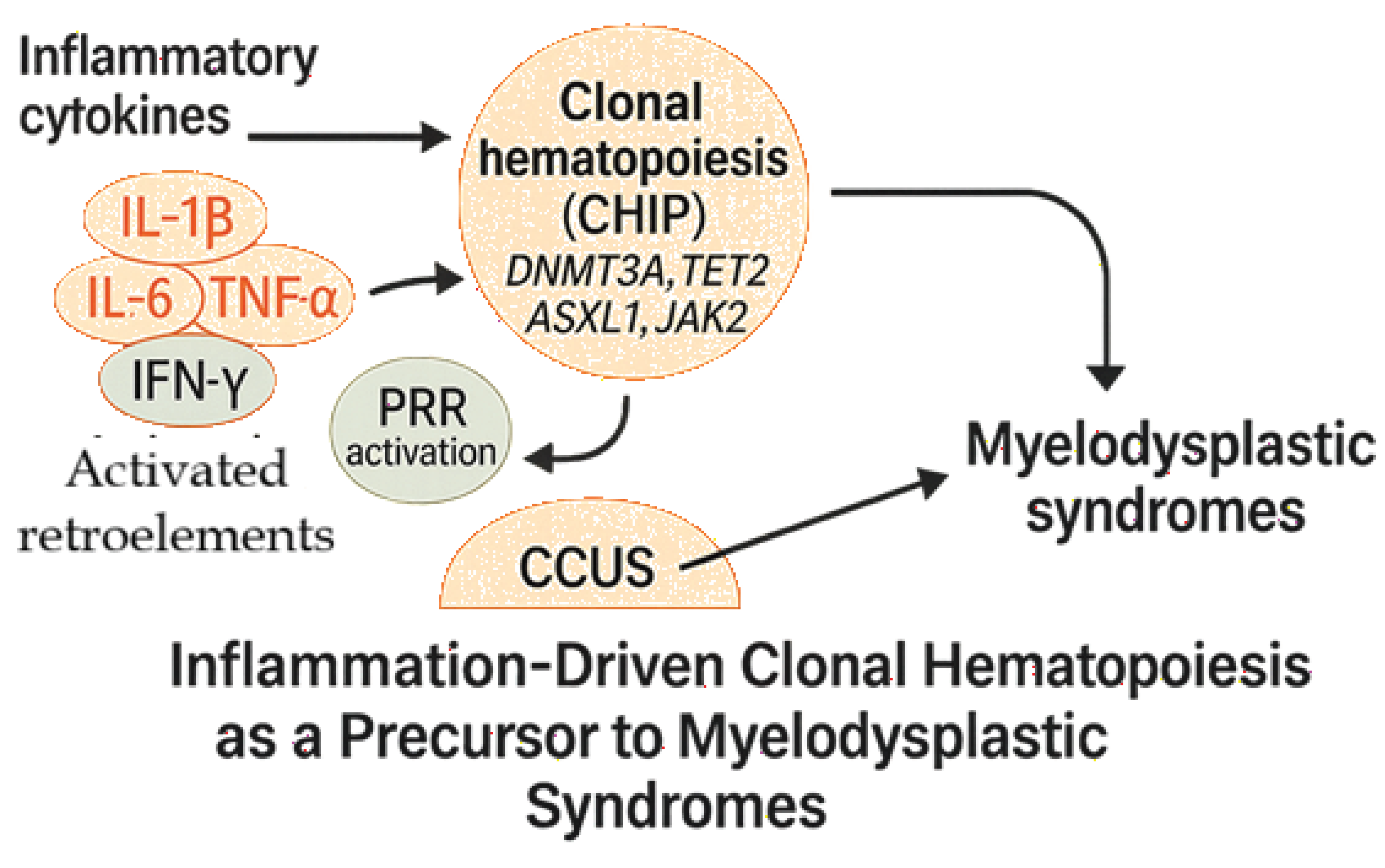
Figure 2.
Inflammation-driven clonal evolution and stromal remodeling in myelodysplastic syndromes. Chronic inflammatory stress promotes hematopoietic stem cell dysfunction and the emergence of clonal hematopoiesis (CHIP), which expands through self-reinforcing inflammatory feedback and evolves toward low- or high-risk MDS. In parallel, persistent inflammation remodels the bone marrow microenvironment through activation of mesenchymal stromal cells, endothelial dysfunction, and adipocyte-mediated signaling, ultimately leading to TGF-β–driven fibrosis. These interconnected processes establish a bidirectional loop that sustains disease progression.
Figure 2.
Inflammation-driven clonal evolution and stromal remodeling in myelodysplastic syndromes. Chronic inflammatory stress promotes hematopoietic stem cell dysfunction and the emergence of clonal hematopoiesis (CHIP), which expands through self-reinforcing inflammatory feedback and evolves toward low- or high-risk MDS. In parallel, persistent inflammation remodels the bone marrow microenvironment through activation of mesenchymal stromal cells, endothelial dysfunction, and adipocyte-mediated signaling, ultimately leading to TGF-β–driven fibrosis. These interconnected processes establish a bidirectional loop that sustains disease progression.
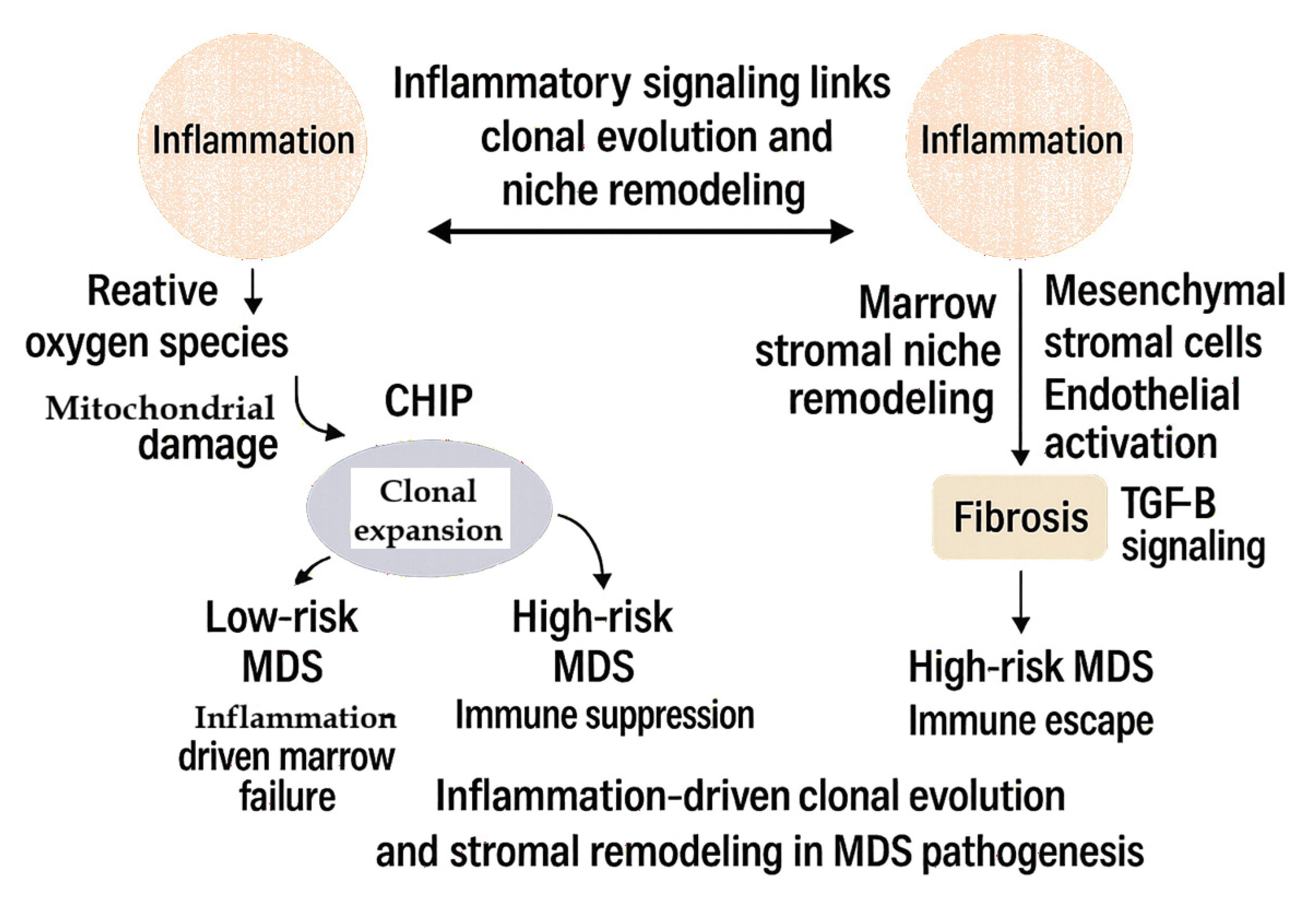
Figure 3.
Activation of TLR–MyD88–IRAK1 signaling and the NLRP3 inflammasome leads to caspase-1–mediated maturation of IL-1β and increased secretion of pro-inflammatory cytokines (IL-6, IL-8, TNF-α). These pathways induce oxidative stress, impair myeloid and erythroid differentiation, and suppress macrophage and NK cell functions, collectively contributing to ineffective hematopoiesis and MDS development. Abbreviations: TLR: Toll-like receptor; MyD88: Myeloid differentiation primary response 88; IRAK1: Interleukin-1 receptor–associated kinase 1; NLRP3: NACHT, LRR, and PYD domains–containing protein 3; HSC: Hematopoietic stem cell.
Figure 3.
Activation of TLR–MyD88–IRAK1 signaling and the NLRP3 inflammasome leads to caspase-1–mediated maturation of IL-1β and increased secretion of pro-inflammatory cytokines (IL-6, IL-8, TNF-α). These pathways induce oxidative stress, impair myeloid and erythroid differentiation, and suppress macrophage and NK cell functions, collectively contributing to ineffective hematopoiesis and MDS development. Abbreviations: TLR: Toll-like receptor; MyD88: Myeloid differentiation primary response 88; IRAK1: Interleukin-1 receptor–associated kinase 1; NLRP3: NACHT, LRR, and PYD domains–containing protein 3; HSC: Hematopoietic stem cell.
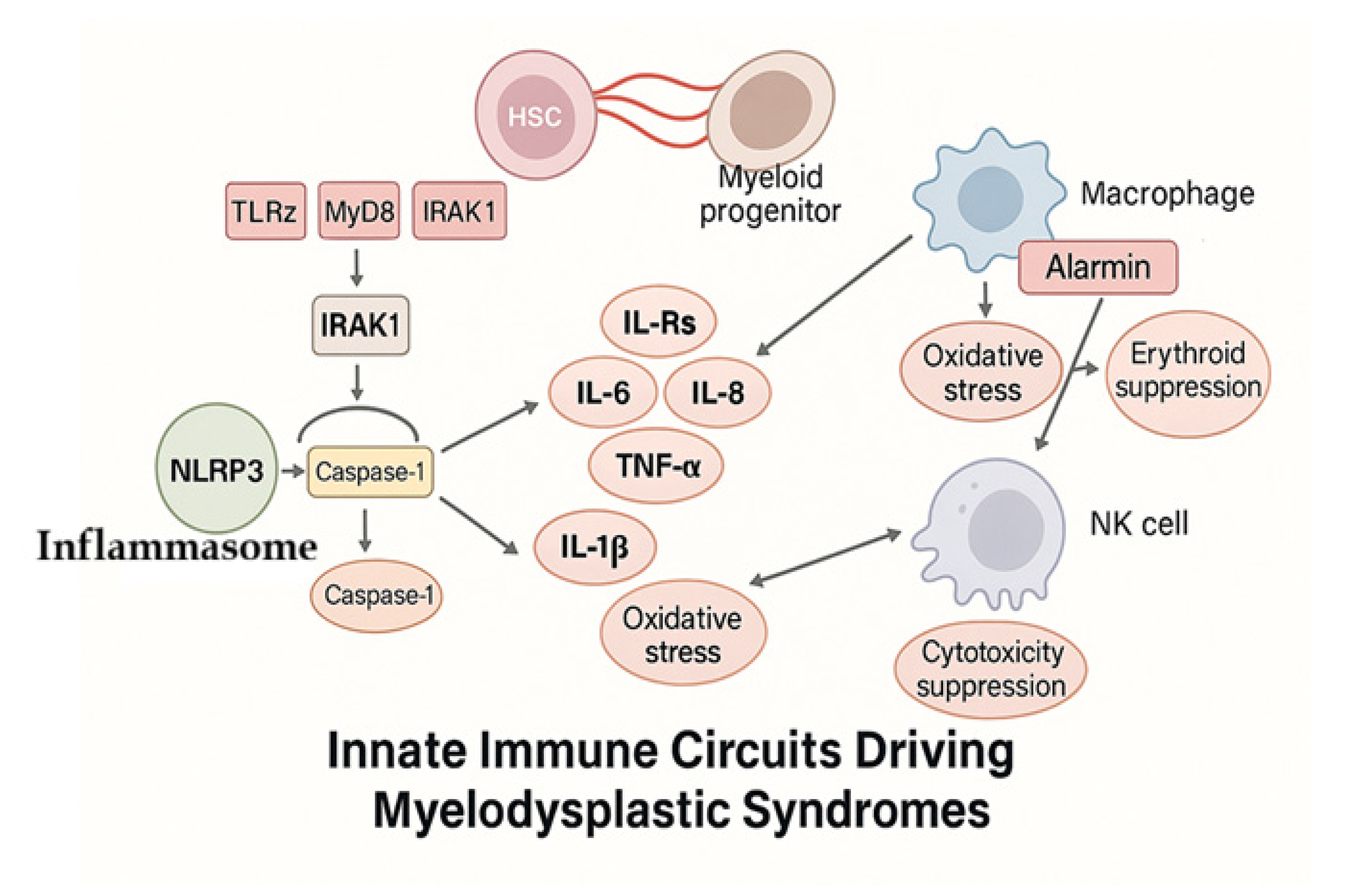
Figure 4.
Senescent mesenchymal stromal cells, dysfunctional endothelial cells, adipocytes, fibroblasts, and mutated hematopoietic clones contribute to an inflamed and structurally altered bone marrow microenvironment. Through secretion of inflammatory mediators (TGF-β, CXCL12, CCL2), expression of adhesion molecules, release of adipocyte-derived inflammatory factors, and stromal remodeling leading to fibrosis, the niche becomes supportive of clonal expansion and accelerates progression toward myelodysplastic syndrome.
Figure 4.
Senescent mesenchymal stromal cells, dysfunctional endothelial cells, adipocytes, fibroblasts, and mutated hematopoietic clones contribute to an inflamed and structurally altered bone marrow microenvironment. Through secretion of inflammatory mediators (TGF-β, CXCL12, CCL2), expression of adhesion molecules, release of adipocyte-derived inflammatory factors, and stromal remodeling leading to fibrosis, the niche becomes supportive of clonal expansion and accelerates progression toward myelodysplastic syndrome.
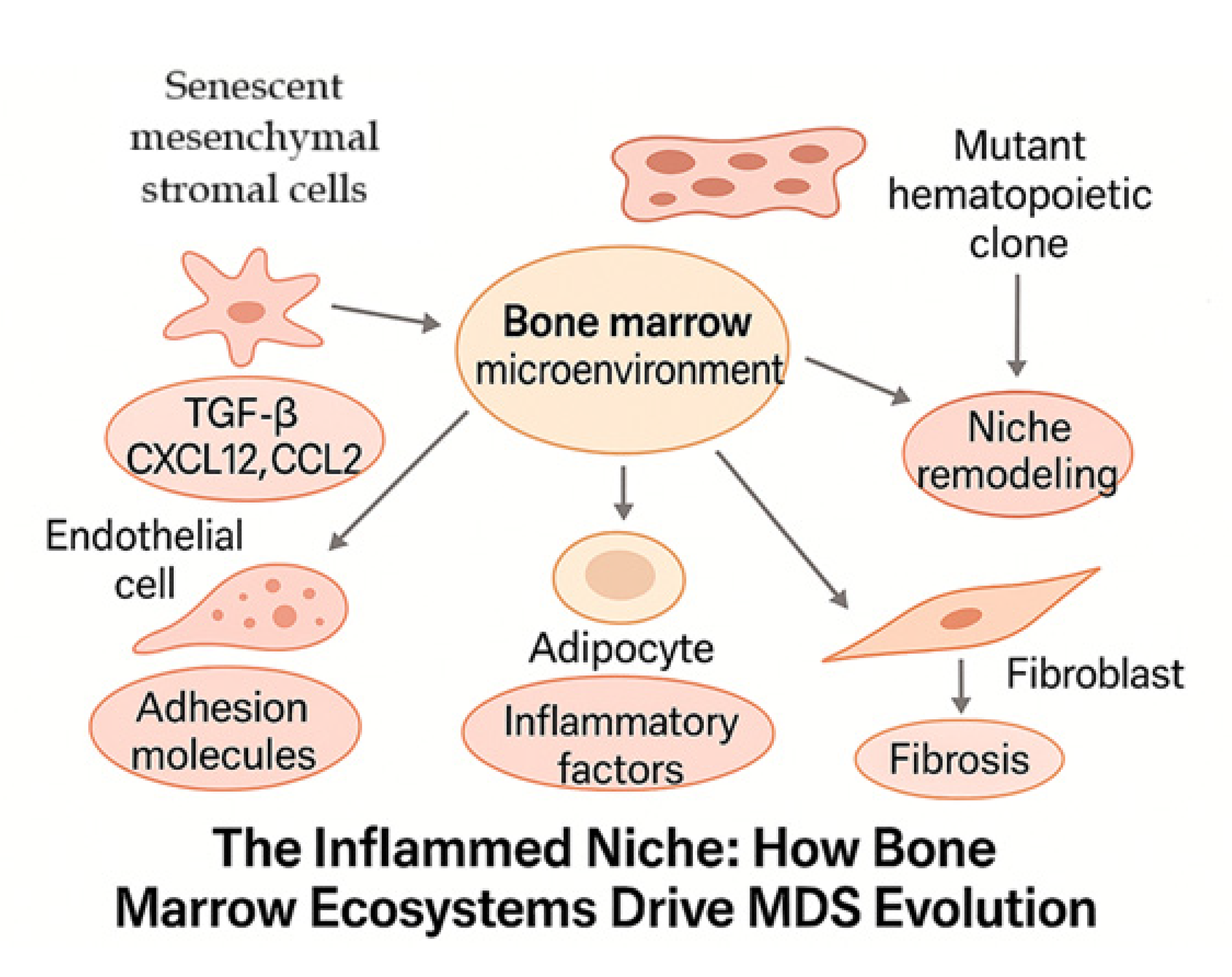
Figure 5.
Inflammation-driven TP53-mutant evolution in MDS. (A) Fitness advantage: Pro-inflammatory cytokines impose oxidative and replicative stress on hematopoietic stem cells (HSCs), selectively favoring the survival and expansion of monoallelic TP53-mutant clones. (B) Genomic instability: Chronic inflammatory signaling increases oxidative stress and impairs DNA damage responses, leading to accumulation of chromosomal aberrations and secondary mutations. (C) Biallelic evolution: Repeated inflammatory stress accelerates the transition to biallelic TP53 inactivation through loss of heterozygosity, secondary mutations, or chromosomal deletions, conferring maximal leukemogenic potential. (D) Therapeutic implications: Targeting inflammatory selection pressures and inflammation-associated pathways represents a strategy to limit TP53-mutant clonal fitness.
Figure 5.
Inflammation-driven TP53-mutant evolution in MDS. (A) Fitness advantage: Pro-inflammatory cytokines impose oxidative and replicative stress on hematopoietic stem cells (HSCs), selectively favoring the survival and expansion of monoallelic TP53-mutant clones. (B) Genomic instability: Chronic inflammatory signaling increases oxidative stress and impairs DNA damage responses, leading to accumulation of chromosomal aberrations and secondary mutations. (C) Biallelic evolution: Repeated inflammatory stress accelerates the transition to biallelic TP53 inactivation through loss of heterozygosity, secondary mutations, or chromosomal deletions, conferring maximal leukemogenic potential. (D) Therapeutic implications: Targeting inflammatory selection pressures and inflammation-associated pathways represents a strategy to limit TP53-mutant clonal fitness.
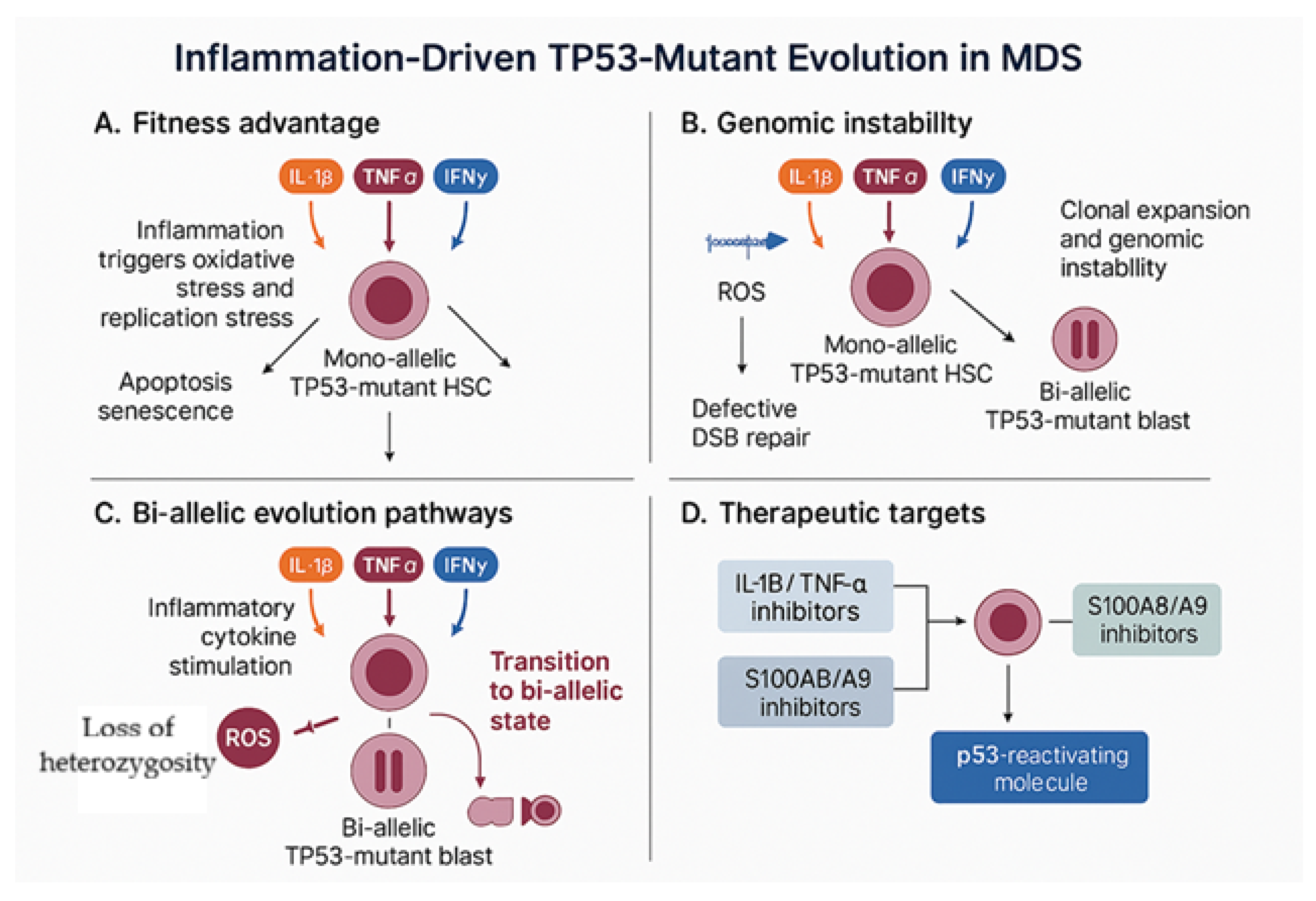
Figure 6.
Spliceosome mutations generate aberrant RNA species that activate innate immune sensors, drive cytokine and inflammasome signaling, reshape the marrow niche, and promote clonal dominance of spliceosome-mutant HSCs. In SRSF2-mutant contexts, co-mutation patterns modulate the magnitude of inflammatory signaling: SRSF2–EZH2 co-mutation primarily reflects PRC2 loss–driven myeloid skewing, whereas additional BCOR alterations further disrupt PRC1-mediated repression, amplifying inflammatory gene expression and clonal fitness.
Figure 6.
Spliceosome mutations generate aberrant RNA species that activate innate immune sensors, drive cytokine and inflammasome signaling, reshape the marrow niche, and promote clonal dominance of spliceosome-mutant HSCs. In SRSF2-mutant contexts, co-mutation patterns modulate the magnitude of inflammatory signaling: SRSF2–EZH2 co-mutation primarily reflects PRC2 loss–driven myeloid skewing, whereas additional BCOR alterations further disrupt PRC1-mediated repression, amplifying inflammatory gene expression and clonal fitness.
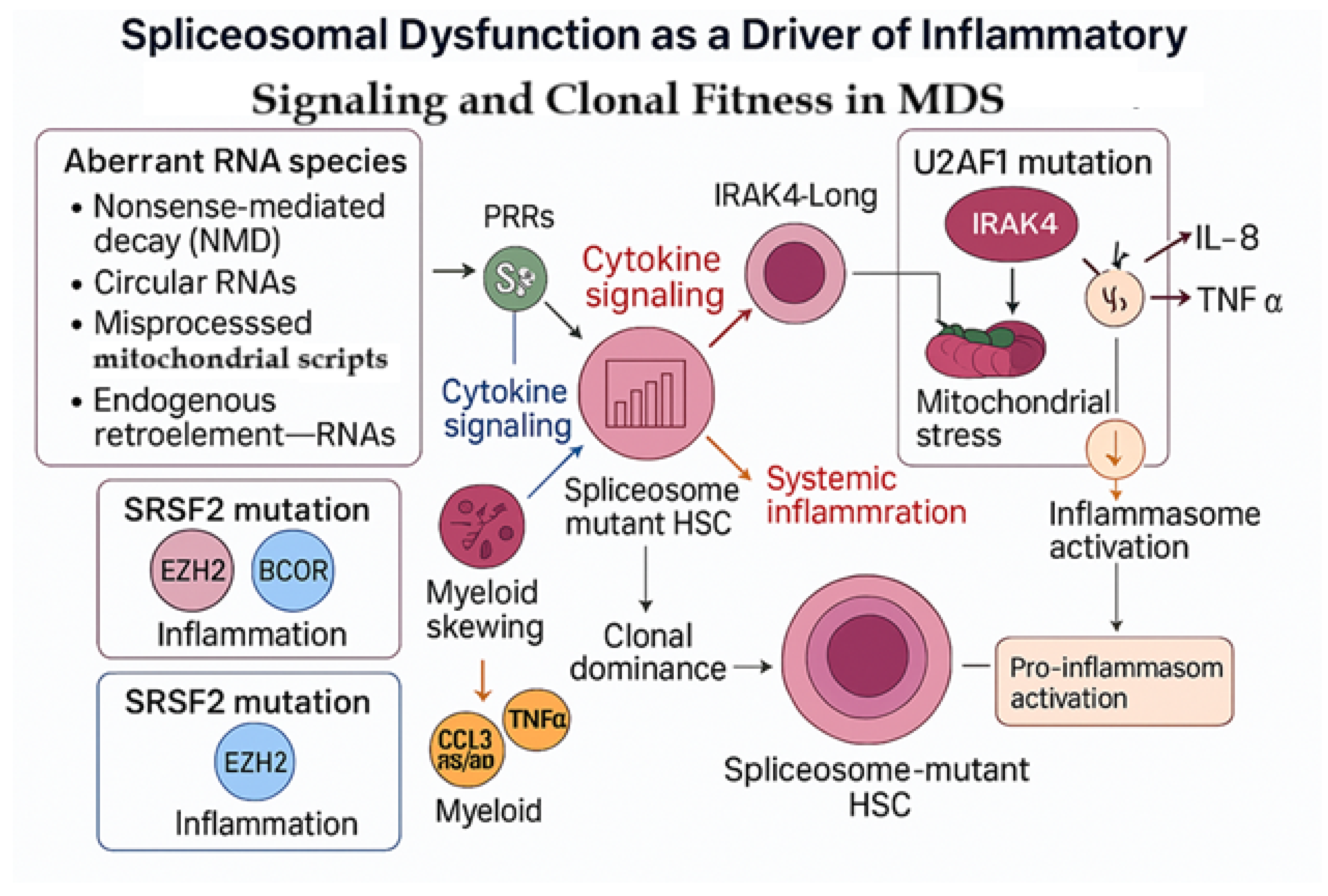

Table 1.
Principal inflammatory pathways contributing to MDS initiation and progression, integrating innate immune activation, cytokine-driven signaling, inflammasome activity, and stromal inflammatory remodeling.
Table 1.
Principal inflammatory pathways contributing to MDS initiation and progression, integrating innate immune activation, cytokine-driven signaling, inflammasome activity, and stromal inflammatory remodeling.
| Pathway / Component | Mechanistic Role in MDS | Downstream Effects | Representative Mutations / Contexts |
| TLR–MyD88–IRAK4 axis | Chronic activation of innate immune receptors; sustained inflammatory cytokine production | NF-κB activation; IL6/IL8/TNFα overexpression; impaired hematopoiesis | SRSF2, U2AF1 (IRAK4-Long isoform) |
| NLRP3 inflammasome | Caspase-1 activation and IL1β/IL18 maturation | Pyroptosis; intramedullary apoptosis; ROS accumulation | Lower-risk MDS |
| S100A8/A9–TLR4 signaling | DAMP-mediated chronic inflammation | Oxidative stress; erythroid suppression; inflammasome priming | del(5q) MDS; TP53-mutant MDS |
| TNFα / IL1β cytokine stress | Suppression of normal HSC quiescence; inflammatory selection pressure | Myeloid skewing; HSC exhaustion; survival of resistant clones | TET2, ASXL1, TP53 |
| Interferon (IFN-I/II) signaling | Activation by mis-spliced RNA or retroelements | Adaptive immune exhaustion; impaired erythropoiesis | SF3B1, U2AF1 |
| NF-κB hyperactivation | Persistent transcription of inflammatory programs | IL6/IL8 overexpression; stromal activation; erythroid suppression | U2AF1 (IRAK4-Long) |
| TGF-β signaling | Suppression of erythroid maturation | Ineffective erythropoiesis; niche fibrosis | SF3B1-mutant disease |
| SASP phenotype | Release of IL6, IL8, IL1β from senescent cells | Myeloid skewing; metabolic dysfunction; inflammaging | Aging-associated MDS; CHIP carriers |
Table 2.
Key inflammatory and immune-derived hematologic parameters associated with MDS pathobiology and prognosis.
Table 2.
Key inflammatory and immune-derived hematologic parameters associated with MDS pathobiology and prognosis.
| Biomarker | Pathophysiologic Interpretation | Associated Clinical Outcomes | Ref. | ||
| Absolute Monocyte Count (AMC) | Expansion of pro-inflammatory monocytes | Worse survival; higher risk of AML progression | 113, 114 | ||
| Absolute Lymphocyte Count (ALC) | Lymphopenia reflecting immune exhaustion | Poorer survival; inferior response to HMAs | 115, 116, 117 | ||
| Neutrophil-to-Lymphocyte Ratio (NLR) | Indicator of systemic inflammation | Predictor of adverse prognosis | 12, 111, 118,119 | ||
| Platelet-to-Lymphocyte Ratio (PLR) | Platelet-mediated inflammatory activity | Associated with transfusion dependence | 12,111, 118, 119 | ||
| Monocyte-to-Lymphocyte Ratio (MLR) | Balance between inflammatory and regulatory compartments | Correlates with high-risk MDS states | 120, 121 | ||
| Cytokine levels (IL6, TNFα, IL1β) | Drivers of apoptosis and ineffective hematopoiesis | Correlate with disease severity and therapy response | 87, 90 | ||
| S100A8/A9 | DAMP signaling and inflammasome activation | Elevated in del(5q) and TP53-mutant MDS | 52, 53, 54 | ||
| CRP / inflammatory indices | Reflect systemic inflammatory status | Predict poorer HMA response | 12 |
Table 3.
Immunomodulatory therapeutic strategies in MDS according to disease stage.
| Target/Pathway | Drug/Strategy | Mechanism of Action | Disease Stage | Development Stage |
| NLRP3 inflammasome | NLRP3 inhibitors | Inhibition of inflammasome activation | Early-stage MDS | Preclinical |
| IL-1 signaling | Anakinra | IL-1 receptor blockade | Early-stage MDS | Clinical (early-phase) |
| TLR signaling | IRAK4 inhibitors | Block innate immune activation | Early-stage MDS | Clinical |
| DNA methylation | Azacitidine / Decitabine | Epigenetic and immune modulation | Both | Approved |
| PD-1 / PD-L1 | Nivolumab, Pembrolizumab | Restore T-cell activity | Advanced-stage MDS | Clinical trials |
| TIM-3 | Sabatolimab | Reverse T-cell exhaustion | Advanced-stage MDS | Clinical trials |
| CD47 | Magrolimab | Enhance macrophage phagocytosis | Advanced-stage MDS | Clinical trials |
| Treg / microenvironment | Experimental agents | Modulate immunosuppressive niche | Advanced-stage MDS | Preclinical/Clinical |
Disclaimer/Publisher’s Note: The statements, opinions and data contained in all publications are solely those of the individual author(s) and contributor(s) and not of MDPI and/or the editor(s). MDPI and/or the editor(s) disclaim responsibility for any injury to people or property resulting from any ideas, methods, instructions or products referred to in the content. |
© 2026 by the authors. Licensee MDPI, Basel, Switzerland. This article is an open access article distributed under the terms and conditions of the Creative Commons Attribution (CC BY) license.
Copyright: This open access article is published under a Creative Commons CC BY 4.0 license, which permit the free download, distribution, and reuse, provided that the author and preprint are cited in any reuse.


