
Submitted:
28 May 2026
Posted:
01 June 2026
You are already at the latest version
Abstract
Hydrogen energy is considered to be an ideal energy source for the 21st century due to its clean and renewable nature. However, the large-scale application of hydrogen has been hindered by challenges in storage and transportation. Therefore, the development of safe and cost-effective hydrogen storage materials remains a key focus of current research. Metal-organic frameworks (MOFs) are a novel class of porous materials that can be customized to have different pore sizes. They also feature an ultrahigh surface area, impressive porosity, and excellent thermal and chemical stability. Because of these qualities, MOFs show great promise for hydrogen storage applications. This article provides a comprehensive review of the advancements in hydrogen storage research within MOFs, and examines the factors governing hydrogen storage performance, with particular attention to factors such as metal ion selection, pore architecture, ligand functionalization, and temperature effects. In addition, the article points out the main challenges faced by MOFs in hydrogen storage applications, including high synthesis costs, challenges in large-scale production, and limited structural stability. Finally, it looks ahead to the prospects of MOFs as hydrogen storage materials under mild conditions.
Keywords:
metal-organic frameworks
; hydrogen storage
; porous materials
; hydrogen storage mechanism
1. Introduction
Hydrogen gas can be used as a clean energy source due to its relatively high energy density. The combustion calorific value of hydrogen gas is 142.35 kJ/g, which is approximately 2.7 times that of gasoline and 4 times that of coal. Hydrogen combustion only produces water, enabling the design of environmentally friendly processes that avoid the emission of pollutants such as carbon dioxide, nitrogen oxides, or sulfides [1]. Furthermore, hydrogen energy is renewable and can be produced via water splitting through the decomposition of water using natural resources such as wind and solar power [2,3]. Therefore, hydrogen shows excellent promise for applications in various sectors, including energy, transportation, industry, and construction [4]. However, despite the numerous advantages of hydrogen energy, the storage and transportation of hydrogen are still highly challenging, which has limited its commercialization [5,6].
Since 2005, the U.S. Department of Energy (DOE) has released hydrogen storage targets every five years [7], with the goals for 2025 including a total hydrogen storage capacity of 5.5 wt% and hydrogen binding energies between 0.2 and 0.7 eV[8]. While materials capable of reversibly storing hydrogen under mild conditions would be highly desirable, developing such materials remains a major challenge for researchers[9].
Currently, the primary hydrogen storage and transportation methods include high-pressure gaseous storage at ambient temperature, low-temperature liquid hydrogen storage, Low-temperature high-pressure hydrogen storage, compound storage, and physical adsorption-based storage. High-pressure gaseous storage is a relatively mature and cost-effective technique. Nevertheless, this storage approach necessitates the use of containers capable of withstanding high pressure and suffers from low storage density, thereby constraining its suitability for large-scale or long-duration applications[10]. Cryogenic liquid hydrogen storage has a high volumetric hydrogen storage density and low storage pressure, but the energy consumption for hydrogen liquefaction is high, accounting for more than 30% of the hydrogen’s calorific value. The low storage temperature of liquid hydrogen imposes stringent insulation performance requirements on storage containers. Additionally, hydrogen liquefaction and storage equipment are complex, require a large initial investment, have high maintenance and support demands, and poor operational flexibility[11]. Low-temperature high-pressure hydrogen storage combines two densification techniques: increasing pressure and lowering temperature. The hydrogen storage density can reach that of liquid hydrogen. The storage temperature is higher (in the 80-120 K range) and does not require ortho-para hydrogen conversion[12]. Its intrinsic energy consumption is significantly lower than hydrogen liquefaction, eliminating the need for refrigeration and storage equipment at the 20 K temperature range. This results in lower safety requirements and better equipment investment and operational economics[13]. Low-temperature high-pressure hydrogen storage still requires relatively high pressure to achieve higher hydrogen storage density, posing severe challenges to the preparation system and hydrogen storage containers. Compound hydrogen storage involves chemically reacting hydrogen gas to form stable hydrogen-containing compounds with materials in atomic or ionic form, achieving high-density and safe storage. However, these materials require relatively stringent temperature and pressure conditions for hydrogen absorption and release, restricting their application. Physical adsorption storage methods employ porous or layered materials such as carbon, metals, or organic networks. These materials possess large specific surface areas and high porosities, enabling the effective physical adsorption of hydrogen molecules[11,14]. Physical adsorption hydrogen storage has the advantages of fast hydrogen adsorption and desorption rates, good cyclic reversibility, and mild operating conditions. However, it also has the drawback of relatively low hydrogen storage capacity due to the weak interaction between hydrogen molecules and the material framework under mild conditions[15]. A variety of porous materials, such as metal-organic frameworks (MOFs), covalent organic frameworks (COFs), activated carbon (AC), and zeolites, have attracted a lot of interest due to their potential for effective hydrogen storage. MOFs, characterized by their exceptionally high specific surface areas and precisely tunable pore architectures, have emerged as the most promising materials for physical adsorption-based hydrogen storage applications[15,16,17] (Figure 1.).
MOFs represent an innovative category of porous solid materials synthesized through the self-assembly of metal ions or clusters coordinated with organic ligands. These materials exhibit crystalline architectures characterized by exceptionally high surface areas and significant porosity. They also have customizable pore sizes and abundant pore space for hydrogen adsorption. Because the crystal structures of MOFs are particularly well-suited for accommodating guest molecules and can effectively adsorb hydrogen through physical interactions, MOFs have become a focal point in hydrogen storage research and development[18,19,20,21,22]. The hydrogen storage capabilities of MOFs are fundamentally influenced by the interactions between hydrogen molecules and the material’s surface. MOFs exhibit adsorption mechanisms analogous to those observed in most porous materials, primarily involving the hydrogen spillover effect and Kubas interaction. The hydrogen spillover effect describes the process whereby catalyst nanoparticles facilitate the chemisorption and dissociation of molecular hydrogen, enabling the subsequent diffusion of atomic hydrogen onto the support surface. In this context, Kang et al. achieved a significant improvement in mild temperature hydrogen storage performance by functionalizing the MOF surface and optimizing the platinum doping procedure to effectively harness the hydrogen spillover phenomenon[23].The Kubas interaction represents a distinctive form of weak intermolecular bonding characterized by the elongation of the H–H bond without its cleavage. This bond elongation results from two cooperative mechanisms: the σ bonding orbital of the hydrogen molecule donates electron density to the vacant d orbital of the metal center (σ donation), while concurrently, the empty σ* antibonding orbital of H₂ accepts π back-donation from an occupied d orbital of the metal. The incorporation of unsaturated metal sites has been shown to enhance the Kubas interaction, thereby increasing the adsorption enthalpy in MOFs. For instance, a manganese-based MOF coordinated with BTT3- ligands demonstrates a hydrogen storage capacity of 6.9 wt% at 90 bar and 77 K, and 0.95 wt% at ambient temperature, with an adsorption enthalpy reaching up to 10.1 kJ/mol[24]. Due to the weak interaction between hydrogen and MOFs, most studies have evaluated hydrogen storage performance at low temperatures (77 K).
This paper provides a comprehensive review of recent progress in hydrogen storage research, with particular emphasis on the distinct hydrogen storage mechanisms exhibited by various metal-based MOFs. It further examines the regulatory influence of critical parameters, including metal ions, pore architecture, and ligand functionalization, on the hydrogen storage capabilities of these materials. Moreover, the article identifies key challenges confronting MOFs in hydrogen storage applications, such as elevated synthesis costs, challenges associated with large-scale fabrication, and limited structural stability, and suggests prospective avenues for future investigation.
2. Metal-Organic Frameworks
2.1. Research Progress in the Utilization of MOFs as Hydrogen Storage Materials
2.1.1. Zn-Based MOFs
Zn-based MOFs prepared by combining a transition metal Zn precursor with organic ligands have been extensively studied for hydrogen storage applications. MOF-5, which is prepared using Zn2+ ions and phthalic acid ligands, is a typical representative example of Zn-based MOFs. In 2003, Yaghi et al. first reported that MOF-5 could be used for hydrogen storage , it was demonstrated that the material can adsorb approximately 4.5 wt% hydrogen at 78 K and 1 bar[25]. Besides, at mild temperature and 20 bar, 1.0 wt% hydrogen could still be adsorbed. This work triggered a wave of subsequent studies on the use of MOFs as hydrogen storage materials.
Numerous investigations have been dedicated to enhancing the hydrogen storage capabilities of MOF-5. Kaye et al.[26] refined the synthesis protocol of MOF-5 by limiting its exposure to moisture and atmospheric air, as well as reducing crystal defects, thereby producing a material exhibiting an increased specific surface area. They evaluated the impact of air exposure on the material’s performance by using hydrogen adsorption isotherms. The optimized MOF-5 demonstrated an excess hydrogen storage capacity of 7.1 wt% at 77 K and 40 bar (Figure 2.a). These findings substantiate that the actual hydrogen storage capacity of MOF-5 is much higher than early reports indicated, with the key being strict synthesis and activation under anhydrous and oxygen-free conditions. Lee et al.[27] incorporated platinum (Pt) and activated carbon (AC) into MOF-5 frameworks to synthesize MOF-5-based composites. They have determined that the hydrogen storage capacity of platinum-activated activated carbon at 298 K and 100 bar is approximately double that of unmodified activated carbon. Furthermore, under identical conditions, the hydrogen storage capacity of the platinum-activated activated carbon-MOF-5 composite attained 2.3 wt%, which is roughly three times greater than that of the platinum-activated activated carbon alone. Nevertheless, the high cost of Pt presents a significant barrier to its widespread application. Yang et al.[28] achieved a significant improvement in the low-temperature, low-pressure hydrogen storage performance of MOF-5 through structural regulation. Among them, the interpenetrated structure I-MOF reached a gravimetric hydrogen storage capacity of 1.7 wt% at 77 K and 1 bar, while the MWCNTs composite interpenetrated structure N-MOF achieved 2.0 wt% under the same conditions, representing an increase of approximately 67% compared to the original MOF-5. This confirms that interpenetration combined with carbon composites can simultaneously enhance thermal stability, providing important experimental evidence for the design of high-performance MOFs. Aljundi et al.[29] studied the incorporation of divalent metal ions into MOF-5 by using a post-synthesis exchange (PSE) method to prepare the mixed metal-organic framework M-MOF-5 (where M = Ni2+, Co2+, or Fe2+). The hydrogen adsorption capacities of Ni-MOF-5, Co-MOF-5, and Fe-MOF-5 at 77 K and 1 bar were 1.53 wt%, 1.53 wt%, and 0.99 wt%, respectively, while that of the original MOF-5 was 1.46 wt%. The incorporation of transition metal ions can strengthen the interaction with hydrogen molecules through modulation of the metal-organic framework structure.
In addition to MOF-5, researchers have also developed other Zn-based MOFs by combining the Zn4O(CO2)6 cluster with different organic ligands. For example, MOF-177 is synthesized using 1,3,5-tris(4-carboxyphenyl)benzene (H3BTB) as the ligand. Yaghi et al. reported that MOF-177 is capable of attaining a hydrogen storage capacity of 7.5 wt% at a temperature of 77 K and pressures ranging from 70 to 80 bar[30,31] (Figure 2.b). At 298 K and 100 bar, this MOF had a hydrogen adsorption capacity of 0.62 wt%. Also, researchers improved MOF-177 by adding a catalyst that helps break hydrogen molecules apart and creating carbon links to promote hydrogen spillover. These tweaks boosted its ability to store hydrogen by roughly two and a half times, reaching about 1.5 wt%. These results indicate that MOF-177 is one of the most promising porous materials for high-capacity hydrogen storage at ambient temperatures. Furukawa et al.[32] further expanded this approach by synthesizing four additional Zn-based MOFs: MOF-180, MOF-200, MOF-205, and MOF-210. Among these, MOF-210, which was prepared using 1,3,5-tris(4-carboxyphenylacetylene)benzene and biphenyl dicarboxylic acid as ligands, possessed the highest specific surface area. At 77 K and 60 bar, MOF-210 demonstrated a total hydrogen capacity of 17.6 wt%. Han et al.[33] were the first to explicitly elucidate the fundamental discrepancy between total hydrogen storage capacity and the practically deliverable hydrogen amount. While the total hydrogen storage capacity of alkali metal-doped zeolitic imidazolate frameworks (ZIFs) increases in accordance with the ion binding energy sequence (Li⁺ > Na⁺ > K⁺), the practical deliverable hydrogen storage capacity exhibits an inverse trend (Na⁺ > K⁺ > Li⁺). Panchariya et al.[34] demonstrated that employing a core-shell zeolitic imidazolate framework (ZIF) architecture constitutes an effective approach to improve the hydrogen storage capacity of ZIF materials under low-temperature and ambient-pressure conditions. Specifically, the ZIF-8@ZIF-67 composite exhibited a hydrogen storage capacity of 2.03 wt% at 77 K and 1 bar, representing a 41% enhancement relative to the original ZIF-8 material. Table 1 shows some examples of the hydrogen storage performance of various Zn-based MOFs under different temperatures and pressures.
2.1.2. Cu-Based MOFs
Cu-based MOF materials are a class of materials characterized by the incorporation of copper ions as the central metal nodes. A prototypical example of such materials is HKUST-1 (Cu-BTC, where BTC denotes benzene-1,3,5-tricarboxylate), which consists of paddlewheel copper dimer secondary building units coordinated with trimesic acid ligands. The HKUST-1 sample synthesized by Panella et al.[35] exhibits a specific surface area of 1154 m²/g and demonstrates a hydrogen storage capacity of 3.6 wt% at 77 K and 80 bar. Furthermore, Li et al.[36] developed a Pd@HKUST-1 composite by encapsulating palladium nanocrystals within the HKUST-1 framework. The synergistic interaction between Pd and Cu sites in this composite resulted in a 74% enhancement in hydrogen storage capacity. This improvement is attributed to a combined mechanism involving Pd-catalyzed hydrogen spillover and Kubas-type interactions at the copper sites. Konni et al.[37] introduced an innovative composite nanomaterial integrating Cu-BTC with metal-functionalized multi-walled carbon nanotubes (Ni@f-MWCNTs or Pd@f-MWCNTs). Under experimental conditions of 77 K and 70 bar, the Cu-BTC/Ni@f-MWCNTs and Cu-BTC/Pd@f-MWCNTs composites demonstrated hydrogen storage capacities of 4.68 wt% and 5.31 wt%, respectively. At 298 K and 70 bar, their adsorption capacities were measured at 1.29 wt% and 1.67 wt%, respectively (Figure 3. a, b). The superior performance of this composite material is attributed to the high electrical conductivity of the MWCNTs, which promotes efficient charge transfer, coupled with the presence of metal nanoparticles that serve as active adsorption sites.
Varghese et al.[38] developed an in-situ grown hybrid material consisting of Cu-BTC and an ultra-low 1 wt% content of graphene oxide (GO). In this Cu-BTC/GO structure, GO was employed as a structural guiding unit, forming new micropores on the Cu-BTC surface and enhancing the total pore volume and specific surface area. At 298 K, Cu-BTC/GO achieved hydrogen storage capacities of 0.46 wt% at 1 bar and 0.49 wt% at 3 bar, while those of pure Cu-BTC were 0.29 wt% and 0.35 wt%, respectively. Notably, the hydrogen adsorption capacity of Cu-BTC/GO rapidly increased at pressures below 1 bar. After adsorption-desorption experiments at 298 K and 1 bar involving six PSA cycles, both the Cu-BTC/GO and Cu-BTC adsorbents almost completely retained their initial hydrogen storage capacities.
Madden et al.[39] used GCMC simulations to investigate the hydrogen adsorption performance of four Cu-MOFs (MOF-199, MOF-399, PCN-20, and PCN-6’) with identical secondary building units (SBUs) under varying temperatures and pressures. PCN-6’ exhibited superior hydrogen adsorption capacities of 8.3 wt% at 77 K and 1.03 wt% at 298 K, and they concluded that MOF materials with smaller pore diameters and larger specific surface areas generally demonstrate enhanced hydrogen adsorption performance (Figure 3.c).
Various other Cu-based MOFs have also been reported. For instance, Krawiec et al.[40] introduced a pressure-free synthesis method to prepare the porous material Cu3(BTC)2. This material exhibited an exceptionally high micropore volume of up to 0.62 cm3/g and achieved a hydrogen storage capacity of 2.18 wt% under low-temperature conditions. Yan et al.[41] used interphenyl dicarboxylate linkers and Cu(II) units to prepare a series of MOFs featuring a tetracarboxylate framework and open Cu(II) sites that strongly interacted with hydrogen gas. Among these MOFs, NOTT-103 demonstrated the highest hydrogen storage capacity of 7.78 wt% at 77 K and 60 bar. Sengupt et al.[42] proposed a novel synthetic approach for preparing NU-2100, an air-stable Cu(I)-based MOF material. NU-2100 was created using a mixture of copper and zinc precursors, with zinc acting as a catalyst to convert the intermediate MOF material into NU-2100. Notably, this material exhibited a hydrogen storage capacity of 4.28 wt% within the temperature and pressure range of 233–296 K and 5–100 bar, and excellent stability in air was also achieved. Chai et al.[43] constructed Cu&Li-based MOFs through structural optimization and Li+ modification. GCMC simulations demonstrated that the incorporation of Li+ ions induces substantial modifications in both the hydrogen adsorption capacity and adsorption characteristics across varying pressures and temperatures. Specifically, at 218 K and 1000 Pa, the presence of Li+ resulted in increases in adsorption capacity of 56.52% and 47.59%, respectively, with significant enhancements also detected at ambient temperature. These findings showed that adding Li+ caused noticeable changes in how much hydrogen could be adsorbed and how the adsorption behaved at different pressures and temperatures. Table 2 shows some examples of the hydrogen storage performance of various Cu-based MOFs under different temperatures and pressures.
2.1.3. Zr-Based MOFs
Cavka et al.[44] pioneered the synthesis of Zr-based MOFs in their report introducing the UiO-66 framework. Using ZrCl4 as the metal precursor, benzoic acid (BDC) as the organic ligand, and dimethylformamide (DMF) as the solvent, MOFs with a high surface area and exceptional stability were successfully synthesized. Building on this work, Zhao et al.[45] synthesized UiO-66 at a low temperature of 323 K. They reported that pure-phase UiO-66 was only able to be synthesized in DMF, and this UiO-66 sample had a specific surface area of 1358 m2/g. Moreover, when comparing the hydrogen storage capacity of this UiO-66 material, it performed notably better under high-pressure and medium-pressure conditions, especially at 77 K and 18 bar, where it achieved an adsorption capacity of 3.35 wt%. Bambalaza et al.[46] enhanced the volumetric hydrogen storage capacity of UiO-66 by compressing its powder form. The densified UiO-66 retained 98% of its original surface area and porosity after compression at 7000 bar, achieving a total hydrogen storage capacity of 5.1 wt% at 100 bar and 77 K. Chen et al.[47] examined the effects of different reaction conditions on the structure and hydrogen storage performance of UiO-66(H2ADC). UiO-66(H2ADC)-SS was synthesized via a simple solution method, while UiO-66(H2ADC)-S was prepared using a solvothermal reaction method. Notably, the solvothermal synthesis method resulted in a larger specific surface area and a smaller average pore diameter of 2.73 nm. At 298 K and 50 bar, UiO-66(H2ADC)-SS and UiO-66(H2ADC)-S exhibited hydrogen adsorption capacities of 1.09 wt% and 2.99 wt%, respectively.
Kang et al.[48] synthesized UiO-66 and amino-functionalized UiO-66 (UiO-66-NH2) MOFs, then doped platinum (Pt) nanoparticles (NPs) onto the sample surfaces to obtain Pt/UiO, Pt/aUiO-Ac, and Pt/aUiO-Cl. The Pt/aUiO-Ac and Pt/aUiO-Cl materials achieved significantly enhanced hydrogen adsorption capacities of 0.38 wt% and 0.71 wt% at 34 bar and 33 bar, respectively (Figure 4.). The Pt NPs provided more H2 adsorption sites and catalyzed the dissociation of H2.
Vaddanam et al.[49] synthesized three UiO-66-MOFs. UiO-66-AO@Si had a high specific surface area and pore volume. At 2.1 bar and 77 K, the hydrogen adsorption capacity of this MOF material (0.35 wt%) was higher than that of UiO-66-SO3H@Si (0.12 wt%) and UiO-66-PDCA (0.25 wt%). Liu et al.[50] introduced low-cost transition metal (Cu, Ni, and Cu-Ni alloy) nanoparticles into UiO-66 to improve its mild-temperature hydrogen storage performance. At 298 K and 60 bar, the maximum hydrogen storage capacity of the original UiO-66 was 0.20 wt%. In contrast, under the same conditions, the metal-doped Cu@UiO-66, Ni@UiO-66, and CuNi@UiO-66 MOFs had hydrogen storage capacities of 0.26 wt%, 0.45 wt%, and 0.74 wt%, respectively.
Various other Zr-based MOFs have also been evaluated for hydrogen storage applications. Naeem et al.[51] synthesized three highly porous Zr(IV)-based MOFs, UBMOF-8, UBMOF-9, and UBMOF-31, using 2,20-diaminodiphenylmethane dicarboxylic acid, 4,40-diphenylmethane dicarboxylic acid, and their combinations as ligands. The mixed-linker UBMOF-31 sample exhibited an excellent hydrogen storage capacity of 4.9 wt% at 77 K and 46 bar. Larasati et al.[52] investigated prepared Pd-modified Zr-based MOFs (Pd@ZrBTC) using phenyl tricarboxylic acid as the organic ligand. They found that embedding Pd modified the morphology and crystallinity of the MOF material structure, leading to a smaller specific surface area and pore volume. Unmodified ZrBTC showed the mild-temperature hydrogen storage capacity of 0.018 wt% at 298 K and 1.5 bar. At 373 K and 1.5 bar, the hydrogen storage capacity increased with increasing Pd loading, and 10% Pd@ZrBTC achieved the highest hydrogen storage capacity of 0.56 wt%. Xu et al.[53] synthesized Zr(IV)-based MOFs (MOFs-808) using highly electron-deficient and polar 4,40-diphenylmethane dicarboxylic acid molecules as the organic ligand. The synthesis conditions (molar ratio of reactants, amount of solvent, reaction temperature, and reaction time) were optimized to obtain a MOFs-808 sample with high crystallinity and specific surface area, which provided a hydrogen storage capacity of 7.31 wt% at 44 K and 70 bar. Xu et al.[54] also prepared Pd-doped MOFs-808 (Pd@MOF-808) samples, which incorporated Pd to influence the specific surface area, enhance the micropore volume, and widen the pore diameter. The influence of the Pd nanoparticle doping amount on the structure and performance of these Pd@MOF-808 materials was then evaluated. At 40 bar and temperatures of 300 K, 195 K, and 77 K, 10wt% Pd@MOF-808-b exhibited hydrogen storage capacities of 2.61 wt%, 5.04 wt%, and 8.20 wt%, respectively (Figure 5.). Table 3 shows some examples of the hydrogen storage performance of various Zr-based MOFs under different temperatures and pressures.
2.1.4. Other Metal-Based MOFs
Many other metal-based MOFs, such as Cr and Fe-based MOFs, have been evaluated for hydrogen storage applications and other fields. For instance, MIL-101(Cr) is a very stable MOF material[55] that exhibits a good hydrogen storage capacity. Molefe et al.[56] embedded MIL-101(Cr) crystals in a PIM-1 matrix to obtain MOF/polymer composite materials. The PIM-1/MIL-101(Cr) composites had enhanced specific surface areas and improved hydrogen adsorption capacities. The composite with the highest MOF material loading of 80 wt% showed the best performance, achieving a hydrogen absorption of 1.73 wt% (7.5% higher than the estimated value of 1.61 wt%). Yu et al.[57] introduced AC into MIL-101 to prepare an AC-MIL-101(Cr) composite material, which exhibited excellent hydrogen storage performance. At 77 K and 100 bar, the excess hydrogen adsorption capacity of AC-MIL-101(Cr) reached 67.4 mol/kg (13.5 wt%), which was much higher than that of the original MIL-101(Cr) (8.2 wt%). AC-MIL-101(Cr) exhibits superior hydrogen storage capabilities compared to MIL-100(Cr), which can be attributed to its greater specific surface area.[58] Fe-BTT is synthesized through a high-throughput approach and is characterized by a high density of unsaturated Fe2+ sites. The material exhibits a hydrogen storage capacity of 4.1 wt% at 77 K and 95 bar, as well as 1.1 wt% at ambient temperature and 100 bar. The elevated adsorption enthalpy of 11.9 kJ/mol, coupled with the minimal metal–hydrogen interaction distance, indicates that the presence of open metal sites substantially improves the hydrogen storage performance of the MOF material under ambient conditions[59]. Liu et al.[60] introduced a synergistic modification approach involving lithium ion doping combined with graphene oxide (GO) composite integration, which effectively enhanced the mild-temperature hydrogen storage capacity of MIL-100 (Fe) from 0.3 wt% to 2.02 wt% under conditions of 298 K and 50 bar. This improvement represents a significant advancement in the performance of iron-based MOFs for hydrogen storage at ambient temperature during the corresponding timeframe. Kapelewski et al.[61] studied the hydrogen storage performance of various MOFs (including M2(m-dobdc) (M=Co, Ni), M2(dobdc) (M=Co, Ni), and MOF-5) within the near-ambient temperature range (198–373 K) at different pressures (0–100 bar). The Ni(m-dobdc) had a stronger binding energy for hydrogen gas and showed better hydrogen storage performance than the other hydrogen storage materials. Therefore, at 298 K and 100 bar, this MOF material had a hydrogen adsorption capacity of 2.75 wt%. MOF-76 exhibits remarkable thermal stability; however, its capacity for hydrogen storage is notably limited. At a temperature of 77 K and a pressure of 20 bar, the hydrogen adsorption capacity is observed to be below 1 wt%. This limitation is attributed to the inherent properties of lanthanide-based metal-organic frameworks, which are prone to undergoing structural transformations in their crystal lattice when subjected to thermal or cryogenic conditions.[62] Table 4 shows some examples of the hydrogen storage performance of various MOFs under different temperatures and pressures.
2.2. Factors Affecting Hydrogen Storage Performance of MOFs
2.2.1. Specific Surface Area, Pore Volume, and Pore Size
At low pressures, H2 adsorption is affected by the pore diameter, but at low temperature and high pressures, the H2 adsorption capacity depends on the specific surface area[63]. Yang et al. established the relationship between the hydrogen storage capacity of mechanochemically synthesized Cu3(BTC)2 and BET specific surface area, Langmuir specific surface area, and effective pore volume[64]. Figure 6 illustrates the relationship among pore size, porosity, surface area, and hydrogen adsorption capacities of MOFs at 1 and 35 bar[65]. A larger specific surface area and pore volume can provide more hydrogen adsorption sites, leading to a larger hydrogen storage capacity[36]. It is well known that adsorbent surfaces typically have relatively low interaction energies with hydrogen[66]. However, if the pores of the adsorbent are small enough such that the potential fields from opposite walls overlap, the interaction potential can be enhanced. Therefore, adsorbents with pore diameters close to the molecular diameter of H2 can exhibit enhanced interactions with hydrogen[67]. Besides, having the right pore size helps hydrogen molecules enter and stick to the surface more effectively[68,69,70]. When the pore diameter matches the dynamic diameter of hydrogen molecules, the pore channels can be more effectively filled with hydrogen, improving the hydrogen storage density. Excessively large pore diameters lead to weak interactions between hydrogen molecules and the pore walls, but if the pore diameters are too small, hydrogen molecules cannot easily enter the pore channels.
2.2.2. Metal Ions Doping
Different metal ions have different electronic structures and chemical properties, which will affect the interaction strength between MOFs and hydrogen molecules[71]. Theoretical analyses have further substantiated that lithium doping markedly improves the hydrogen storage capabilities of aluminum-based MOF-519. At a temperature of 77 K and a pressure of 1 bar, the hydrogen storage capacity of Li-doped MOF-519 reaches 2.132 wt%, representing an enhancement of 6.24% relative to the undoped MOF-519[72]. Chen et al.[73] prepared MFU-4l-Li via post-synthetic metal exchange (Li+ doping), which exhibited a hydrogen storage capacity of 9.9 wt% at 77 K and 100 bar, demonstrating excellent hydrogen storage performance. Yao et al.[74] employed a divalent metal doping strategy, incorporating ions such as Mg2+ and Cu2+, to functionalize the highly stable MOF-808 framework. Notably, the Mg-doped MOF-808@Mg demonstrated a hydrogen adsorption capacity of 1.3 wt% at 77 K and 1 bar, corresponding to a 33% enhancement relative to the pristine MOF-808. Similarly, the Cu-doped MOF-808@Cu exhibited a hydrogen uptake of 0.916 wt% under identical conditions, reflecting an approximate 12% improvement over the undoped material. This metal doping approach preserves the inherent stability of Zr-based MOFs while introducing effective open metal sites, thereby offering a viable strategy for the development of MOFs that synergistically combine robust stability with enhanced hydrogen storage capabilities. The above research results indicate that doping with metal ions can effectively enhance the hydrogen storage capacity of MOFs.
2.2.3. Ligands
The architecture of MOFs is fundamentally influenced by the geometry and connectivity of their constituent ligands[75]. A diverse array of organic ligands is commonly employed in MOFs synthesis, encompassing dicarboxylates such as malonate, oxalate, succinate, glutarate, and terephthalate; tricarboxylates including trimesate and citrate; as well as azole-based ligands like pyrazole and 1,2,3-triazole. The functionalization of these organic ligands represents a strategic approach to improve hydrogen storage capabilities within MOFs, achieved through the incorporation of various functional groups such as amino (-NH2), hydroxyl (-OH), methyl (-CH3), and pyridyl moieties. For instance, Han et al.[76] functionalized UiO-66 by introducing dihydroxy, dimethoxy, and diethoxy groups, producing modified materials UiO-66-(OH)₂, UiO-66-(OCH₃)₂, and UiO-66-(OCH₂CH₃)₂. The introduction of these functional groups altered the electronic density distribution of the ligands, optimized the pore structure of the MOFs, and enhanced the materials’ affinity for hydrogen adsorption. The diethoxy-modified UiO-66-(OCH₂CH₃)₂ achieved the best performance among the four materials, reaching 4.56 wt% hydrogen uptake at 77 K and 40 bar. Similarly, Prasetyo et al.[77] confirmed through DFT that fluorine substitution of hydroxyl groups can significantly enhance the adsorption of H2 by MOF-801. After fluorination, the theoretical gravimetric hydrogen storage capacity of MOF-801 can reach 1.1–1.4 wt%, which is higher than that of the unmodified sample. The enhancement mechanism originates from the polarization effect caused by the high electronegativity of the F atoms, making the Zr–F sites efficient centers for H₂ adsorption. Overall, rational ligand functionalization is therefore an effective strategy to develop high-performance hydrogen storage MOFs.
2.3. Challenges for MOFs in Hydrogen Storage
2.3.1. Synthetic Costs and Scale Production
MOFs are novel porous materials with promising applications, but their high cost and the selection of the most cost-effective manufacturing approach for commercialization still pose significant challenges that require further study[78]. The synthesis of MOFs often relies on expensive organic ligands and metal precursors, which significantly increases the cost of material preparation. The synthesis of these organic ligands usually requires multiple complex reactions and a cumbersome purification process, and their high price is one of the key factors contributing to the high cost of MOFs synthesis. Meanwhile, the cost of metal precursors, especially those of some rare metal salts, is also relatively high.
An additional challenge in MOFs synthesis is that many reaction conditions must be precisely controlled, including the temperature, pressure, type and dosage of solvents, reaction time, and pH value. Even a slight change in these conditions can have a significant impact on the structure, purity, and performance of the final product, meaning that MOFs synthesis procedures often exhibit poor reproducibility and stability. For example, in the synthesis of some MOFs, fluctuations in temperature may lead to uneven crystal growth rates, resulting in the formation of defects or impurity phases. This significantly affects the final product quality.
Currently, most existing MOFs synthesis methods are suitable for small-scale laboratory production and cannot be easily scaled up into large-scale industrial production processes[79]. Attempts at scaling up these processes lead to various difficulties[80] (e.g., ensuring the uniformity of the reaction system, mitigating reductions in heat and material transfer efficiency), which can result in lower product quality, lower yields, and a sharp increase in costs. For example, large-scale reactors typically have lower mixing efficiencies compared to small-scale laboratory reactions, resulting in local concentration inhomogeneities that affect the MOFs crystal growth process.
Developing low-cost, efficient, and easily scalable synthesis routes has become an important challenge that must be urgently addressed to ensure the wider industrial utilization of MOFs. Therefore, mild, simple, and precisely controllable synthesis methods should be explored and combined with engineering strategies to achieve the large-scale, low-cost synthesis of MOFs.
2.3.2. Stability
The structural stability of MOFs is often not satisfactory[81]. Currently, no MOFs satisfying the requirements of stability, reusability, low cost, and high efficiency for ambient hydrogen storage have been successfully developed. As such, the commercialization of MOFs-based hydrogen storage technologies cannot be expected until further laboratory studies yield substantial improvements[82].
MOFs are difficult to utilize in powder form, and after forming, MOFs may undergo pulverization under certain specific conditions (e.g, low temperature, high pressure, or during rapid hydrogen gas charging/discharging). Under low-temperature and high-pressure conditions, the crystal structure of MOFs may be subjected to large stress, which can distort or break the coordination bonds between the metal ions/clusters and organic ligands of the MOFs structure. This can destroy the integrity of the MOFs crystal structure, inducing gradual pulverization. During rapid hydrogen gas charging and discharging, the adsorption and desorption of hydrogen will cause volume changes in MOFs, and repeated volume expansion and contraction will induce stress. When this stress exceeds the bearing limit of the MOFs, pulverization will occur. Therefore, MOFs with improved mechanical strength and stability that exhibit strong interactions with hydrogen gas and good anti-pulverization performance must be developed for their utilization in hydrogen storage applications.
2.3.3. Computational Simulation Studies on MOFs Hydrogen Storage
Research on hydrogen storage within MOFs, via computational simulations and machine learning techniques, has progressed from isolated adsorption modeling to a comprehensive methodological framework[83,84]. This framework integrates high-throughput screening, mechanistic analysis, and rational material design. Such an approach has become a critical strategy for addressing performance constraints in hydrogen storage systems while simultaneously minimizing experimental expenditures.
Grand Canonical Monte Carlo (GCMC) simulation is widely recognized as the standard quantitative approach for evaluating hydrogen storage capacity, adsorption sites, and thermodynamic properties of MOFs[85]. This method enables precise prediction of gravimetric and volumetric hydrogen storage capacities, usable storage amounts, and adsorption isotherms across varying temperature and pressure conditions. In a study by Granja-DelRío et al.[86], the GCMC technique was employed to investigate the Zn(II)/Cd(II)-based MRT series of MOFs, revealing that MRT2 and MRT4 surpass the hydrogen storage performance targets set by the U.S. Department of Energy (DOE) at 77 K and approximately 50 bar. Furthermore, their findings indicated notable competitiveness at ambient temperature, achieving onboard driving ranges comparable to those of high-pressure hydrogen storage systems but operating at reduced pressures. Additionally, Zhang et al.[69] integrated GCMC simulations with high-throughput screening of 7,622 MOFs to identify structural parameters conducive to efficient room-temperature hydrogen storage, thereby offering direct structural guidelines to inform experimental synthesis efforts.
Density Functional Theory (DFT) focuses on adsorption energy, interaction mechanisms, and electronic interactions, revealing the microscopic binding rules between MOFs and hydrogen. Zhao et al.[87] compared the hydrogen adsorption energies of MOF-808 and Ce-MOF-808 through DFT calculations, confirming that Ce doping enhances the adsorption strength, providing an energetic basis for composite material design. Yu et al.[88] conducted a combined DFT and GCMC study on MOF-650, achieving a quantitative analysis correlating pore structure, metal sites, and hydrogen storage performance.
With the continuous accumulation of MOF structures and the improvement of computational methods, the scale of computational research has been further expanded from single-material simulation to large-scale database-oriented high-throughput screening and data-driven material discovery. The four types of data that a database can be composed of are structured, unstructured, semi-structured, and metadata (Figure 7.)[89]. In response to the exponential expansion of the MOFs structural database, high-throughput computational screening has emerged as a pivotal approach for the rapid identification of high-performance hydrogen storage materials[90]. Ahmed et al.[91] performed GCMC high-throughput screening on nearly 500,000 MOFs, identifying materials such as PCN-610/NU-100 that exhibited a usable hydrogen storage capacity of 13.9 wt% under temperature and pressure swing conditions of 77 K at 100 bar and 160 K at 5 bar. Similarly, Chen et al.[92] conducted extensive simulations on 98,695 MOFs derived from the HyMARC database, thereby generating high-quality labeled datasets to support the development of machine learning models.
Conventional machine learning approaches have demonstrated high predictive accuracy; however, they often lack adherence to physical principles, frequently yielding outputs that contravene established adsorption laws. To address this limitation, Chen et al.[93] developed a physics-informed neural network (PINN) model that integrates monotonic relationships among crystal density, specific surface area, pore volume, and hydrogen storage capacity directly into the loss function. This approach facilitated the rapid screening of 820,000 MOFs under variable pressure conditions at 77 K and pressures ranging from 5 to 100 bar. Building upon this, Zhang et al.[65] applied a gradient boosting regression (GBR) algorithm to extrapolate low-temperature, high-pressure hydrogen storage capacities from room-temperature, low-pressure data, thereby expanding the database from 418 to 8,024 MOFs types.
In summary, computational simulations and machine learning have significantly advanced the rational design and high-throughput screening of MOFs for hydrogen storage, enabling efficient prediction of adsorption behavior, structure–performance relationships, and material discovery at reduced experimental cost[94]. Nevertheless, critical challenges remain to be addressed for more reliable and practical predictions. Future research should emphasize the integration of structural defects, thermal effects, and realistic synthesis conditions into computational models. Meanwhile, the combination of physics-constrained machine learning, multiscale simulation, and closed-loop validation between theory and experiment is highly desirable to bridge the gap between theoretically promising structures and practically applicable hydrogen storage MOFs.
3. Prospects and Suggestions
MOFs for hydrogen storage is evolving from fundamental investigation toward practical implementation. It is important to highlight that MOFs demonstrate superior hydrogen storage capabilities under conditions of low temperature and high pressure (77 K, 10–100 bar), attributable to strengthened van der Waals interactions and the dense packing of hydrogen molecules within their porous structures. In contrast, hydrogen storage technologies at relatively mild temperatures are more in line with practical application needs and are also the current research focus in this field. This approach faces significant challenges, including inherently weak interactions between hydrogen molecules and the framework, as well as relatively low adsorption enthalpy, which collectively constrain its effectiveness.
Future advancements are anticipated to concentrate on three primary objectives: achieving efficient hydrogen storage under relatively mild temperature, enabling cost-effective large-scale synthesis, and employing intelligent design strategies integrated with multi-disciplinary coupling. Meanwhile, enhancing the structural stability of MOFs is also crucial. Strategies such as incorporating rigid building units to reinforce framework stability and applying protective surface coatings via post-modification can effectively improve the mechanical strength and anti-pulverization performance of MOFs under practical working conditions. Present technological efforts emphasize modifications of metal sites, enhancement of hydrogen spillover phenomena, regulation of pore structures, and the application of machine learning-assisted high-throughput screening techniques. These methodologies have the potential to substantially enhance hydrogen storage capacity and cycling stability at mild temperature, while concurrently reducing the duration of the material development process.
With the deepening of interdisciplinary integration and continuous optimization of processes, metal-modified MOFs are expected to become core materials for onboard and distributed hydrogen storage, providing key support for the large-scale application of hydrogen energy and accelerating the achievement of carbon neutrality goals.
Supplementary Materials
The following supporting information can be downloaded at the website of this paper posted on Preprints.org.
Author Contributions
Literature search, writing, and creation of figures and tables, Y.-T. Liu; review, editing, and supervision, S.-Y. Chen., D. L., T. Z. and Y.-B. Wang. All authors have read and agreed to the published version of the manuscript.
Funding
This research was funded by the National Natural Science Foundation of China, Grant No. 22205019.
Conflicts of Interest
The authors declare no conflicts of interest.
References
- Langmi, H.W.; Ren, J.; North, B.; Mathe, M.; Bessarabov, D. Hydrogen Storage in Metal-Organic Frameworks: A Review. Electrochim. Acta 2014, 128, 368–392. [Google Scholar] [CrossRef]
- Alabdulhadi, R.A.; Khan, S.; Khan, A.; Alfuhaid, L.T.; Khan, M.Y.; Usman, M.; Maity, N.; Helal, A. Potential Use of Reticular Materials (Mofs, Zifs, and Cofs) for Hydrogen Storage. ACS Appl. Energy Mater. 2025. [Google Scholar] [CrossRef]
- Gangu, K.K.; Maddila, S.; Mukkamala, S.B.; Jonnalagadda, S.B. Characteristics of Mof, Mwcnt and Graphene Containing Materials for Hydrogen Storage: A Review. J. Energy Chem. 2019, 30, 132–144. [Google Scholar] [CrossRef]
- Wong, C.Y.; Wong, W.Y.; Sudarsono, W.; Loh, K.S.; Lim, K.L.; Bo, W. Tuning the Functionality of Metal–Organic Frameworks (Mofs) for Fuel Cells and Hydrogen Storage Applications. J. Mater. Sci. 2023, 58, 8637–8677. [Google Scholar] [CrossRef]
- Zhou, P. The Design of Metal-Organic Frameworks (Mofs) in Hydrogen Storage Applications. Appl. Comput. Eng. 2023, 7, 196–201. [Google Scholar] [CrossRef]
- Tarkowski, R.; Uliasz-Misiak, B.; Tarkowski, P. Storage of Hydrogen, Natural Gas, and Carbon Dioxide—Geological and Legal Conditions. Int. J. Hydrogen Energy 2021, 46, 20010–20022. [Google Scholar] [CrossRef]
- Durbin, D.J.; Malardier-Jugroot, C. Review of Hydrogen Storage Techniques for on Board Vehicle Applications. Int. J. Hydrogen Energy 2013, 38, 14595–14617. [Google Scholar] [CrossRef]
- Beniwal, P.; Kumar, T.J.D. Hydrogen Storage in a Ti-Functionalized Metal Carbyne Framework: Insights from a First-Principles Study. ACS Appl. Energy Mater. 2023, 6, 6251–6261. [Google Scholar] [CrossRef]
- Qiao, L.; Lu, C.B.; Fan, W.D.; Xue, Z.Z.; Wang, X.K.; Kang, Z.X.; Sun, D.F. Metal-Organic Framework for Hydrogen Storage: Advances and Challenges Brought by the New Technologies. Int. J. Hydrogen Energy 2024, 93, 805–821. [Google Scholar] [CrossRef]
- Panigrahi, P.K.; Chandu, B.; Motapothula, M.R.; Puvvada, N. Potential Benefits, Challenges and Perspectives of Various Methods and Materials Used for Hydrogen Storage. ENERG. FUEL 2024, 38, 2630–2653. [Google Scholar] [CrossRef]
- Niaz, S.; Manzoor, T.; Pandith, A.H. Hydrogen Storage: Materials, Methods and Perspectives. RENEW. SUST. ENERG. REV 2015, 50, 457–469. [Google Scholar] [CrossRef]
- Zhuzhgov, A.V.; Krivoruchko, O.P.; Isupova, L.A.; Mart’yanov, O.N.; Parmon, V.N. Low-Temperature Conversion of Ortho -Hydrogen into Liquid Para -Hydrogen: Process and Catalysts. Review. Catalysis in Industry, 2018. [Google Scholar]
- Fang, L.; Dong, X.Q.; Wang, H.C.; Wang, X.; Zhang, T.; Gong, M.Q. Economic Analysis and Comparison of Three Large-Scale Physical Hydrogen Storage and Transportation Methods for Refuelling Stations. Iop Conf. Ser.-Mat. Sci. 2025, 1327. [CrossRef]
- Fang, L.; Dong, X.; Wang, H.; Gong, M. Economic Analysis of Compressed Gaseous Hydrogen, Liquid Hydrogen, and Cryo-Compressed Hydrogen Storage Methods for Large-Scale Storage and Transportation. Int. J. Hydrogen Energy, 2025. [Google Scholar]
- Chen, Z.; Kirlikovali, K.O.; Idrees, K.B.; Wasson, M.C.; Farha, O.K. Porous Materials for Hydrogen Storage. Chem 2022, 8, 693–716. [Google Scholar] [CrossRef]
- Sutton, A.L.; Mardel, J.I.; Hill, M.R. Metal-Organic Frameworks (Mofs) as Hydrogen Storage Materials at near-Ambient Temperature. Chem. Eur. J. 2024, 30. [Google Scholar] [CrossRef]
- Shet, S.P.; Priya, S.S.; Sudhakar, K.; Tahir, M. A Review on Current Trends in Potential Use of Metal-Organic Framework for Hydrogen Storage. Int. J. Hydrogen Energy 2021, 46, 11782–11803. [Google Scholar] [CrossRef]
- Anastasopoulou, A.; Furukawa, H.; Barnett, B.R.; Jiang, H.Z.H.; Long, J.R.; Breunig, H.M. Technoeconomic Analysis of Metal–Organic Frameworks for Bulk Hydrogen Transportation. Energy Environ. Sci. 2021, 14, 1083–1094. [Google Scholar] [CrossRef]
- Ryu, U.; Jee, S.; Rao, P.C.; Shin, J.; Ko, C.; Yoon, M.; Park, K.S.; Choi, K.M. Recent Advances in Process Engineering and Upcoming Applications of Metal–Organic Frameworks. Coord. Chem. Rev. 2021, 426. [Google Scholar] [CrossRef] [PubMed]
- Bao, W.Z.; Yu, J.W.; Chen, F.F.; Du, H.K.; Zhang, W.Q.; Yan, S.H.; Lin, T.H.; Li, J.L.; Zhao, X.; Zhu, B. Controllability Construction and Structural Regulation of Metal-Organic Frameworks for Hydrogen Storage at Ambient Condition: A Review. Int. J. Hydrogen Energy 2023, 48, 36010–36034. [Google Scholar] [CrossRef]
- Luo, C. The Role of Metal-Organic Framework Architecture in Hydrogen Storage. HSET 2023, 58, 320–325. [Google Scholar] [CrossRef]
- Yuvaraj, A.R.; Jayarama, A.; Sharma, D.; Nagarkar, S.S.; Duttagupta, S.P.; Pinto, R. Role of Metal-Organic Framework in Hydrogen Gas Storage: A Critical Review. Int. J. Hydrogen Energy 2024, 59, 1434–1458. [Google Scholar] [CrossRef]
- Kang, P.-C.; Ou, Y.-S.; Li, G.-L.; Chang, J.-K.; Wang, C.-Y. Room-Temperature Hydrogen Adsorption Via Spillover in Pt Nanoparticle-Decorated Uio-66 Nanoparticles: Implications for Hydrogen Storage. ACS Appl. Nano Mater. 2021, 4, 11269–11280. [Google Scholar] [CrossRef]
- Hoang, T.K.A.; Antonelli, D.M. Exploiting the Kubas Interaction in the Design of Hydrogen Storage Materials. Adv. Mater. 2009, 21, 1787–1800. [Google Scholar] [CrossRef]
- Rosi, N.L.; Eckert, J.; Eddaoudi, M.; Vodak, D.T.; Kim, J.; O’Keeffe, M.; Yaghi, O.M. Hydrogen Storage in Microporous Metal-Organic Frameworks. Sci. 2003, 300, 1127–1129. [Google Scholar] [CrossRef] [PubMed]
- Kaye, S.S.; Dailly, A.; Yaghi, O.M.; Long, J.R. Impact of Preparation and Handling on the Hydrogen Storage Properties of Zn4o(1,4-Benzenedicarboxylate)3(Mof-5). J. Am. Chem. Soc. 2007, 129, 14176–+. [Google Scholar] [CrossRef]
- Lee, S.Y.; Park, S.J. Effect of Platinum Doping of Activated Carbon on Hydrogen Storage Behaviors of Metal-Organic Frameworks-5. Int. J. Hydrogen Energy 2011, 36, 8381–8387. [Google Scholar] [CrossRef]
- Yang, S.J.; Jung, H.; Kim, T.; Im, J.H.; Park, C.R. Effects of Structural Modifications on the Hydrogen Storage Capacity of Mof-5. Int. J. Hydrogen Energy 2012, 37, 5777–5783. [Google Scholar] [CrossRef]
- Peedikakkal, A.M.P.; Aljundi, I.H. Upgrading the Hydrogen Storage of Mof-5 by Post-Synthetic Exchange with Divalent Metal Ions. Appl. Sci.-Basel 2021, 11. [Google Scholar] [CrossRef]
- Li, Y.; Yang, R.T. Gas Adsorption and Storage in Metal-Organic Framework Mof-177. Langmuir 2007, 23, 12937–12944. [Google Scholar] [CrossRef]
- Wong-Foy, A.G.; Matzger, A.J.; Yaghi, O.M. Exceptional H2 Saturation Uptake in Microporous Metal−Organic Frameworks. J. Am. Chem. Soc. 2006, 128, 3494–3495. [Google Scholar] [CrossRef]
- Furukawa, H.; Ko, N.; Go, Y.B.; Aratani, N.; Choi, S.B.; Choi, E.; Yazaydin, A.Ö.; Snurr, R.Q.; O’Keeffe, M.; Kim, J.; Yaghi, O.M. Ultrahigh Porosity in Metal-Organic Frameworks. Sci. 2010, 329, 424–428. [Google Scholar] [CrossRef]
- Han, S.S.; Choi, S.-H.; Goddard, W.A. Improved H2 Storage in Zeolitic Imidazolate Frameworks Using Li+, Na+, and K+ Dopants, with an Emphasis on Delivery H2 Uptake. J. Phys. Chem. C 2011, 115, 3507–3512. [Google Scholar] [CrossRef]
- Panchariya, D.K.; Rai, R.K.; Anil Kumar, E.; Singh, S.K. Core–Shell Zeolitic Imidazolate Frameworks for Enhanced Hydrogen Storage. ACS Omega 2018, 3, 167–175. [Google Scholar] [CrossRef] [PubMed]
- Panella, B.; Hirscher, M.; Pütter, H.; Müller, U. Hydrogen Adsorption in Metal–Organic Frameworks: Cu-Mofs and Zn-Mofs Compared. Adv. Funct. Mater. 2006, 16, 520–524. [Google Scholar] [CrossRef]
- Li, G.; Kobayashi, H.; Taylor, J.M.; Ikeda, R.; Kubota, Y.; Kato, K.; Takata, M.; Yamamoto, T.; Toh, S.; Matsumura, S.; Kitagawa, H. Hydrogen Storage in Pd Nanocrystals Covered with a Metal–Organic Framework. Nat. Mater. 2014, 13, 802–806. [Google Scholar] [CrossRef]
- Konni, M.; Dadhich, A.S.; Mukkamala, S.B. Hydrogen Uptake Performance of Nanocomposites Derived from Metal-Organic Framework (Cu-Btc) and Metal Decorated Multi-Walled Carbon Nanotubes (Ni@F-Mwcnts or Pd@F-Mwcnts). Surf. Interf. 2020, 21. [Google Scholar] [CrossRef]
- Varghese, A.M.; Reddy, K.S.K.; Karanikolos, G.N. An in-Situ-Grown Cu-Btc Metal–Organic Framework / Graphene Oxide Hybrid Adsorbent for Selective Hydrogen Storage at Ambient Temperature. IND ENG CHEM. RES 2022, 61, 6200–6213. [Google Scholar] [CrossRef]
- Madden, D.G.; O’Nolan, D.; Rampal, N.; Babu, R.; Camur, C.; Al Shakhs, A.N.; Zhang, S.Y.; Rance, G.A.; Perez, J.; Casati, N.P.M.; Cuadrado-Collados, C.; O’Sullivan, D.; Rice, N.P.; Gennett, T.; Parilla, P.; Shulda, S.; Hurst, K.E.; Stavila, V.; Allendorf, M.D.; Silvestre-Albero, J.; Forse, A.C.; Champness, N.R.; Chapman, K.W.; Fairen-Jimenez, D. Densified Hkust-1 Monoliths as a Route to High Volumetric and Gravimetric Hydrogen Storage Capacity. J. Am. Chem. Soc. 2022, 144, 13729–13739. [Google Scholar] [CrossRef] [PubMed]
- Krawiec, P.; Kramer, M.; Sabo, M.; Kunschke, R.; Fröde, H.; Kaskel, S. Improved Hydrogen Storage in the Metal-Organic Framework Cu3(Btc)2. Adv. Eng. Mater. 2006, 8, 293–296. [Google Scholar] [CrossRef]
- Yan, Y.; Yang, S.; Blake, A.J.; Schröder, M. Studies on Metal–Organic Frameworks of Cu(Ii) with Isophthalate Linkers for Hydrogen Storage. Acc. Chem. Res. 2013, 47, 296–307. [Google Scholar] [CrossRef]
- Sengupta, D.; Melix, P.; Bose, S.; Duncan, J.; Wang, X.; Mian, M.R.; Kirlikovali, K.O.; Joodaki, F.; Islamoglu, T.; Yildirim, T.; Snurr, R.Q.; Farha, O.K. Air-Stable Cu(I) Metal–Organic Framework for Hydrogen Storage. J. Am. Chem. Soc. 2023, 145, 20492–20502. [Google Scholar] [CrossRef]
- Chai, H.; Chen, J.; Yu, Y.; Zhao, C. Grand Canonical Monte Carlo Simulations of Cu&Li-Based Metal Organic Framework for Desirable Hydrogen Storage. Int. J. Hydrogen Energy 2024, 61, 424–431. [Google Scholar]
- Cavka, J.H.; Jakobsen, S.; Olsbye, U.; Guillou, N.; Lamberti, C.; Bordiga, S.; Lillerud, K.P. A New Zirconium Inorganic Building Brick Forming Metal Organic Frameworks with Exceptional Stability. J. Am. Chem. Soc. 2008, 130, 13850–13851. [Google Scholar] [CrossRef] [PubMed]
- Zhao, Q.; Yuan, W.; Liang, J.; Li, J. Synthesis and Hydrogen Storage Studies of Metal−Organic Framework Uio-66. Int. J. Hydrogen Energy 2013, 38, 13104–13109. [Google Scholar] [CrossRef]
- Bambalaza, S.E.; Langmi, H.W.; Mokaya, R.; Musyoka, N.M.; Ren, J.; Khotseng, L.E. Compaction of a Zirconium Metal–Organic Framework (Uio-66) for High Density Hydrogen Storage Applications. J. Mater. Chem. A 2018, 6, 23569–23577. [Google Scholar] [CrossRef]
- Chen, S.; Xiao, S.; Liu, J.; Li, Z. Synthesis and Hydrogen Storage Properties of Zirconium Metal-Organic Frameworks Uio-66(H2adc) with 9,10-Anthracenedicarboxylic Acid as Ligand. J. Porous Mater. 2018, 25, 1783–1788. [Google Scholar] [CrossRef]
- Kang, P.C.; Ou, Y.S.; Li, G.L.; Chang, J.K.; Wang, C.Y. Room-Temperature Hydrogen Adsorption Via Spillover in Pt Nanoparticle-Decorated Uio-66 Nanoparticles: Implications for Hydrogen Storage. ACS Appl. Nano Mater. 2021, 4, 11269–11280. [Google Scholar] [CrossRef]
- Vaddanam, V.S.; Bootharajan, M.; Sengupta, S.; Balija, S.; Rao, C.V.S.B.; Suresh, A. Hydrogen Adsorption Behavior of Highly Stable Assorted Functionalized Uio-66-Mofs at Low Pressures: A Combined Experimental and Dft Study. J. Phys. Chem. C 2023, 127, 17663–17676. [Google Scholar] [CrossRef]
- Liu, P.X.; Jia, Y.; Ning, Y.; Zhang, X.C.; Tian, S.H.; Yang, F.; Song, W.Y.; Zhang, Y. Enhanced Room-Temperature Hydrogen Storage by Cuni Nanoparticles Decorated in Metal-Organic Framework Uio-66(Zr). Int. J. Hydrogen Energy 2024, 56, 315–322. [Google Scholar] [CrossRef]
- Naeem, A.; Ting, V.P.; Hintermair, U.; Tian, M.; Telford, R.; Halim, S.; Nowell, H.; Holynska, M.; Teat, S.J.; Scowen, I.J.; Nayak, S. Mixed-Linker Approach in Designing Porous Zirconium-Based Metal-Organic Frameworks with High Hydrogen Storage Capacity. Chem. Commun. 2016, 52, 7826–7829. [Google Scholar] [CrossRef]
- Lestari, W.W.; Larasati; Suwarno, H.; Arrozi, U.S.F. Spillover Effect on Pd-Embedded Metal-Organic Frameworks Based on Zirconium(Iv) and Benzene 1,3,5-Tricarboxylate as Hydrogen Storage Materials. Mater. Res. Express 2019, 6. [Google Scholar] [CrossRef]
- Xu, J.; Liu, J.; Li, Z.; Wang, X.B.; Xu, Y.F.; Chen, S.S.; Wang, Z. Optimized Synthesis of Zr(Iv) Metal Organic Frameworks (Mofs-808) for Efficient Hydrogen Storage. New J. Chem. 2019, 43, 4092–4099. [Google Scholar] [CrossRef]
- Xu, J.; Liu, J.; Li, Z.; Wang, X.B.; Wang, Z. Synthesis, Structure and Properties of Pd@Mof-808. J. Mater. Sci. 2019, 54, 12911–12924. [Google Scholar] [CrossRef]
- Férey, G.; Mellot-Draznieks, C.; Serre, C.; Millange, F.; Dutour, J.; Surblé, S.; Margiolaki, I. A Chromium Terephthalate-Based Solid with Unusually Large Pore Volumes and Surface Area. Sci. 2005, 309, 2040–2042. [Google Scholar] [CrossRef]
- Molefe, L.Y.; Musyoka, N.M.; Ren, J.; Langmi, H.W.; Ndungu, P.G.; Dawson, R.; Mathe, M. Synthesis of Porous Polymer-Based Metal–Organic Frameworks Monolithic Hybrid Composite for Hydrogen Storage Application. J. Mater. Sci. 2019, 54, 7078–7086. [Google Scholar] [CrossRef]
- Yu, Z.W.; Deschamps, J.; Hamon, L.; Prabhakaran, P.K.; Pré, P. Hydrogen Adsorption and Kinetics in Mil-101(Cr) and Hybrid Activated Carbon-Mil-101(Cr) Materials. Int. J. Hydrogen Energy 2017, 42, 8021–8031. [Google Scholar] [CrossRef]
- Latroche, M.; Surblé, S.; Serre, C.; Mellot-Draznieks, C.; Llewellyn, P.L.; Lee, J.H.; Chang, J.S.; Jhung, S.H.; Férey, G. Hydrogen Storage in the Giant-Pore Metal-Organic Frameworks Mil-100 and Mil-101. Angew. Chem. Int. Ed. 2006, 45, 8227–8231. [Google Scholar] [CrossRef]
- Sumida, K.; Horike, S.; Kaye, S.S.; Herm, Z.R.; Queen, W.L.; Brown, C.M.; Grandjean, F.; Long, G.J.; Dailly, A.; Long, J.R. Hydrogen Storage and Carbon Dioxide Capture in an Iron-Based Sodalite-Type Metal–Organic Framework (Fe-Btt) Discovered Via High-Throughput Methods. Chem. Sci. 2010, 1. [Google Scholar] [CrossRef]
- Liu, C.; Shen, D.; Tu, Z.; Li, S. Improved Room-Temperature Hydrogen Storage Performance of Lithium-Doped Mil-100(Fe)/Graphene Oxide (Go) Composite. Int. J. Hydrogen Energy 2022, 47, 5393–5402. [Google Scholar] [CrossRef]
- Kapelewski, M.T.; Runcevski, T.; Tarver, J.D.; Jiang, H.Z.H.; Hurst, K.E.; Parilla, P.A.; Ayala, A.; Gennett, T.; FitzGerald, S.A.; Brown, C.M.; Long, J.R. Record High Hydrogen Storage Capacity in the Metal-Organic Framework Ni2(M-Dobdc) at near-Ambient Temperatures. Chem. Mater. 2018, 30, 8179–8189. [Google Scholar] [CrossRef]
- Garg, A.; Almáši, M.; Rattan Paul, D.; Poonia, E.; Luthra, J.R.; Sharma, A. Metal-Organic Framework Mof-76(Nd): Synthesis, Characterization, and Study of Hydrogen Storage and Humidity Sensing. Front. Energy Res. 2021, 8. [Google Scholar] [CrossRef]
- Hu, Y.H.; Zhang, L. Hydrogen Storage in Metal–Organic Frameworks. Adv. Mater. 2010, 22. [Google Scholar] [CrossRef]
- Yang, H.; Orefuwa, S.; Goudy, A. Study of Mechanochemical Synthesis in the Formation of the Metal–Organic Framework Cu3(Btc)2 for Hydrogen Storage. Microporous Mesoporous Mater. 2011, 143, 37–45. [Google Scholar] [CrossRef]
- Zhang, X.; Zheng, Q.R.; He, H.Z. Machine-Learning-Based Prediction of Hydrogen Adsorption Capacity at Varied Temperatures and Pressures for Mofs Adsorbents. J. TAIWAN INST. CHEM. E 2022, 138. [Google Scholar] [CrossRef]
- Zhao, X.B.; Xiao, B.; Fletcher, A.J.; Thomas, K.M.; Bradshaw, D.; Rosseinsky, M.J. Hysteretic Adsorption and Desorption of Hydrogen by Nanoporous Metal-Organic Frameworks. Sci. 2004, 306, 1012–1015. [Google Scholar] [CrossRef] [PubMed]
- Perles, J.; Iglesias, M.; Martín-Luengo, M.-Á.; Monge, M.Á.; Ruiz-Valero, C.; Snejko, N. Metal−Organic Scandium Framework: Useful Material for Hydrogen Storage and Catalysis. Chem. Mater. 2005, 17, 5837–5842. [Google Scholar] [CrossRef]
- Letwaba, J.; Uyor, U.O.; Mavhungu, M.L.; Achuka, N.O.; Popoola, P.A. A Review on Mofs Synthesis and Effect of Their Structural Characteristics for Hydrogen Adsorption. RSC Adv. 2024, 14, 14233–14253. [Google Scholar] [CrossRef]
- Zhang, X.; Zheng, Q.-r.; He, H.-z. Synergistic Effect of Hydrogen Spillover and Nano-Confined Alh3 on Room Temperature Hydrogen Storage in Mofs: By Gcmc, Dft and Experiments. Int. J. Hydrogen Energy 2024, 72, 1224–1235. [Google Scholar] [CrossRef]
- Alabdulhadi, R.A.; Khan, S.; Khan, A.; Alfuhaid, L.T.; Khan, M.Y.; Usman, M.; Maity, N.; Helal, A. Potential Use of Reticular Materials (Mofs, Zifs, and Cofs) for Hydrogen Storage. ACS Appl. Energy Mater. 2025, 8, 1397–1413. [Google Scholar] [CrossRef]
- Hao, P.; Shi, Y.; Li, S.; Zhu, X.; Cai, N. Adsorbent Characteristic Regulation and Performance Optimization for Pressure Swing Adsorption Via Temperature Elevation. ENERG. FUEL 2018, 33, 1767–1773. [Google Scholar] [CrossRef]
- Xia, L.Z.; Bo, Z.Y.; Liu, Q.; Zhang, X.; Pei, Y.Q. Li-Doped and Functionalized Metal-Organic Framework-519 for Enhancing Hydrogen Storage: A Computational Study. Comput. Mater. Sci. 2019, 166, 179–186. [Google Scholar] [CrossRef]
- Chen, Z.; Mian, M.R.; Lee, S.-J.; Chen, H.; Zhang, X.; Kirlikovali, K.O.; Shulda, S.; Melix, P.; Rosen, A.S.; Parilla, P.A.; Gennett, T.; Snurr, R.Q.; Islamoglu, T.; Yildirim, T.; Farha, O.K. Fine-Tuning a Robust Metal–Organic Framework toward Enhanced Clean Energy Gas Storage. J. Am. Chem. Soc. 2021, 143, 18838–18843. [Google Scholar] [CrossRef] [PubMed]
- Yao, X.; Li, S.; Tang, M.J.; Al Khunaizi, H.; Qi, L.; Wood, B.C.; Liu, Y. Enhancing Dihydrogen Interaction of a Zirconium Metal–Organic Framework by Metal Doping. ENERG. FUEL 2025, 39, 18177–18188. [Google Scholar] [CrossRef]
- Su, Y.; Shi, W.; Ding, W.; Wang, H.; Meng, H.; Zhang, Y.; Su, Y.; Gao, H. Enhancing Hydrogen Storage in Uio-Series Metal–Organic Frameworks Via Ligand Functionalization and Metal Substitution Engineering. ENERG. FUEL 2025, 39, 22691–22702. [Google Scholar] [CrossRef]
- Han, X.; Yang, X.; Yu, C.; Lu, S.; Pouya, E.S.; Bai, P.; Lyu, J.; Guo, X. Fine-Tuning the Pore Structure of Metal–Organic Frameworks by Linker Substitution for Enhanced Hydrogen Storage and Gas Separation. CrystEngComm 2021, 23, 3026–3032. [Google Scholar] [CrossRef]
- Prasetyo, N.; Pambudi, F.I. Toward Hydrogen Storage Material in Fluorinated Zirconium Metal-Organic Framework (Mof-801): A Periodic Density Functional Theory (Dft) Study of Fluorination and Adsorption. Int. J. Hydrogen Energy 2021, 46, 4222–4228. [Google Scholar] [CrossRef]
- Yousef, S. Techno-Economic Assessment of Scale-up of Metal-Organic Framework Production. J. Indian Chem. Soc. 2025, 102. [Google Scholar] [CrossRef]
- Paul, T.; Juma, A.; Alqerem, R.; Karanikolos, G.; Arafat, H.A.; Dumée, L.F. Scale-up of Metal-Organic Frameworks Production: Engineering Strategies and Prospects Towards Sustainable Manufacturing. Environ. Chem. Eng. 2023, 11. [Google Scholar] [CrossRef]
- Singh, P.; Panwar, S.; Dave, P.N. Advancing Environmental Remediation with Metal–Organic Frameworks: Perspectives on Green Synthesis, Scale-up Strategies, Techno-Economic Analysis, and Life Cycle Assessment. Adv. Mater. Technol. 2025, 11. [Google Scholar] [CrossRef]
- Abdulkadir, B.A.; Setiabudi, H.D. Bibliometric Insights into Metal-Organic Frameworks Modified with Metal-Based Materials for Hydrogen Storage: Prospects, Opportunities and Challenges. J. TAIWAN INST. CHEM. E 2025, 167. [Google Scholar] [CrossRef]
- Qureshi, F.; Yusuf, M.; Ahmed, S.; Haq, M.; Alraih, A.M.; Hidouri, T.; Kamyab, H.; Vo, D.V.N.; Ibrahim, H. Advancements in Sorption-Based Materials for Hydrogen Storage and Utilization: A Comprehensive Review. Energy 2024, 309. [Google Scholar] [CrossRef]
- Daglar, H.; Gulbalkan, H.C.; Avci, G.; Aksu, G.O.; Altundal, O.F.; Altintas, C.; Erucar, I.; Keskin, S. Effect of Metal-Organic Framework (Mof) Database Selection on the Assessment of Gas Storage and Separation Potentials of Mofs. Angew. Chem. Int. Ed. Engl. 2021, 60, 7828–7837. [Google Scholar] [CrossRef] [PubMed]
- Ahmed, A.; Liu, Y.Y.; Purewal, J.; Tran, L.D.; Wong-Foy, A.G.; Veenstra, M.; Matzger, A.J.; Siegel, D.J. Balancing Gravimetric and Volumetric Hydrogen Density in Mofs. Energy Environ. Sci. 2017, 10, 2459–2471. [Google Scholar] [CrossRef]
- Wang, H.; Qu, Z.; Yin, Y.; Zhang, J.; Ming, P. Thermal Management for Hydrogen Charging and Discharging in a Screened Metal-Organic Framework Particle Tank. ACS Appl. Mater. Interfaces 2021, 13, 61838–61848. [Google Scholar] [CrossRef]
- Granja-DelRio, A.; Salces, A.; Cabria, I. Hydrogen Storage in Novel Zn(Ii) and Cd(Ii) Mrt Mofs: A Study Using Grand Canonical Monte Carlo Simulations. J. Chem. Phys. 2025, 163. [Google Scholar] [CrossRef]
- Zhao, H.Q.; Zhang, H.M.; Wang, J.S.; Li, B.; Zhu, Y.C.; Liu, H.B. Theoretical Calculation and Tests of Hydrogen Storage Properties of Nano Mos2 Doped Ce-Mof-808. J. Energy Storage 2024, 88. [Google Scholar] [CrossRef]
- Yu, S.Y.; Jing, G.L.; Li, S.N.; Li, Z.F.; Ju, X. Tuning the Hydrogen Storage Properties of Mof-650: A Combined Dft and Gcmc Simulations Study. Int. J. Hydrogen Energy 2020, 45, 6757–6764. [Google Scholar] [CrossRef]
- Han, Z.; Yang, Y.; Rushlow, J.; Huo, J.; Liu, Z.; Hsu, Y.-C.; Yin, R.; Wang, M.; Liang, R.; Wang, K.-Y.; Zhou, H.-C. Development of the Design and Synthesis of Metal–Organic Frameworks (Mofs)—from Large Scale Attempts, Functional Oriented Modifications, to Artificial Intelligence (Ai) Predictions. Chem. Soc. Rev. 2025, 54, 367–395. [Google Scholar] [CrossRef]
- Liu, K.; Chen, H.; Islamoglu, T.; Rosen, A.S.; Wang, X.; Farha, O.K.; Snurr, R.Q. Computational Investigation of the Impact of Metal–Organic Framework Topology on Hydrogen Storage Capacity. Mol. Syst. Des. Eng. 2025, 10, 817–835. [Google Scholar] [CrossRef]
- Ahmed, A.; Seth, S.; Purewal, J.; Wong-Foy, A.G.; Veenstra, M.; Matzger, A.J.; Siegel, D.J. Exceptional Hydrogen Storage Achieved by Screening Nearly Half a Million Metal-Organic Frameworks. Nat. Commun. 2019, 10, 1568. [Google Scholar] [CrossRef]
- Chen, S.; Shi, Y.; Gu, B. Simulation on Hydrogen Storage Properties of Metal-Organic Frameworks Cu-Btc at 77–298 K. AlChE J. 2017, 64, 1383–1388. [Google Scholar] [CrossRef]
- Chen, X.; Pan, C.; Ren, S. Physics-Informed Machine Learning for Fast Screening High Hydrogen Storage Mofs with Monotonicity Constraints. J. Chem. Theory Comput 2025, 21, 5254–5266. [Google Scholar] [CrossRef] [PubMed]
- He, Q. Metal-Organic Frameworks (Mofs) on Hydrogen Storage and Purification. HSET 2023, 58, 332–337. [Google Scholar] [CrossRef]
Figure 1.
The application prospects of MOFs in the field of hydrogen storage.
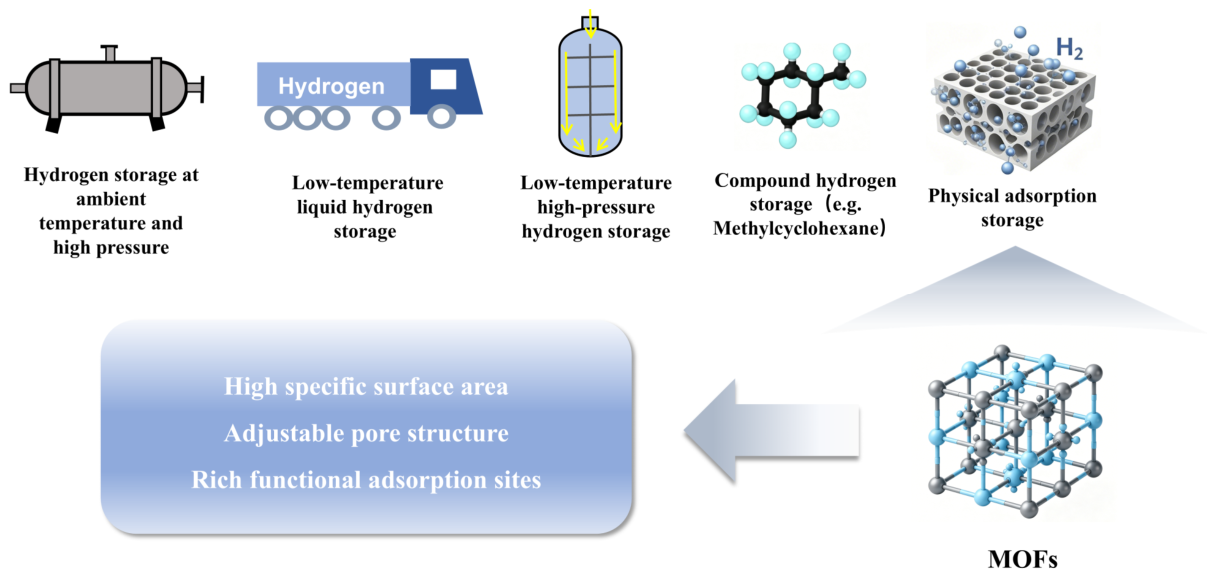
Figure 2.
(a) Hydrogen adsorption isotherms measured at 77 K (blue) and 298 K (red), excess hydrogen storage volumes (squares), and total absorption volumes (circles) of optimized MOF-5.[26] (b) High-pressure H2 isotherms for activated materials at 77 K in gravimetric units (mg/g) representing surface excess adsorption.[31].
Figure 2.
(a) Hydrogen adsorption isotherms measured at 77 K (blue) and 298 K (red), excess hydrogen storage volumes (squares), and total absorption volumes (circles) of optimized MOF-5.[26] (b) High-pressure H2 isotherms for activated materials at 77 K in gravimetric units (mg/g) representing surface excess adsorption.[31].
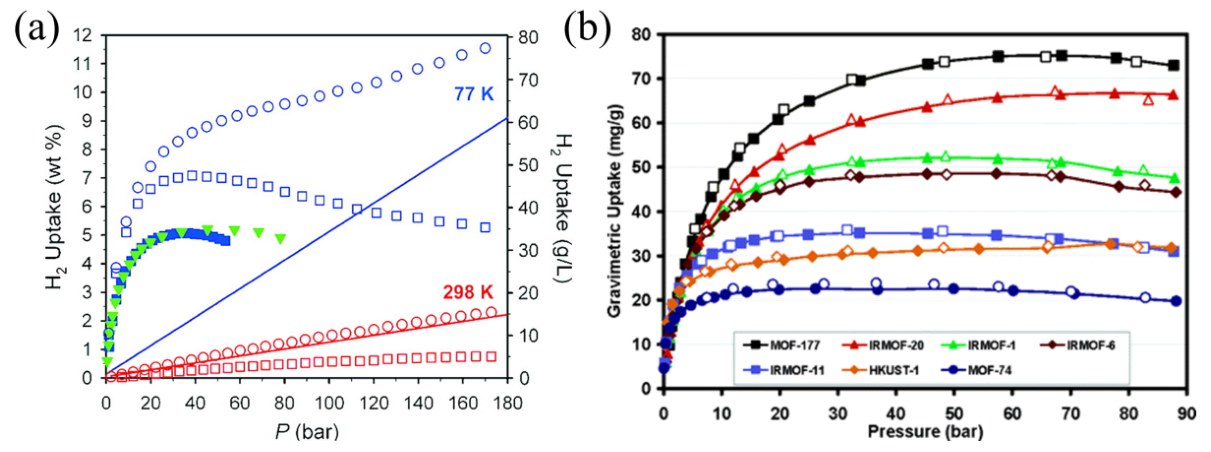
Figure 3.
(a) Schematic illustration of the preparation of Cu-BTC/Ni@f-MWCNTs and Cu-BTC/Pd@f-MWCNTs.[37] (b) Hydrogen uptake capacities of Ⅰ p-MWCNTs, Ⅱ f-MWCNTs, Ⅲ Ni@f-MWCNTs, Ⅳ Pd@f-MWCNTs, Ⅴ Cu-BTC, Ⅵ Cu-BTC/Ni@f-MWCNTs, and Ⅶ Cu-BTC/Pd@f-MWCNTs at 77 K.[37] (c) Cryogenic H2 gas delivery for the temperature–pressure swing (100 bar/77 K → 5 bar/160 K) storage system.[39].
Figure 3.
(a) Schematic illustration of the preparation of Cu-BTC/Ni@f-MWCNTs and Cu-BTC/Pd@f-MWCNTs.[37] (b) Hydrogen uptake capacities of Ⅰ p-MWCNTs, Ⅱ f-MWCNTs, Ⅲ Ni@f-MWCNTs, Ⅳ Pd@f-MWCNTs, Ⅴ Cu-BTC, Ⅵ Cu-BTC/Ni@f-MWCNTs, and Ⅶ Cu-BTC/Pd@f-MWCNTs at 77 K.[37] (c) Cryogenic H2 gas delivery for the temperature–pressure swing (100 bar/77 K → 5 bar/160 K) storage system.[39].
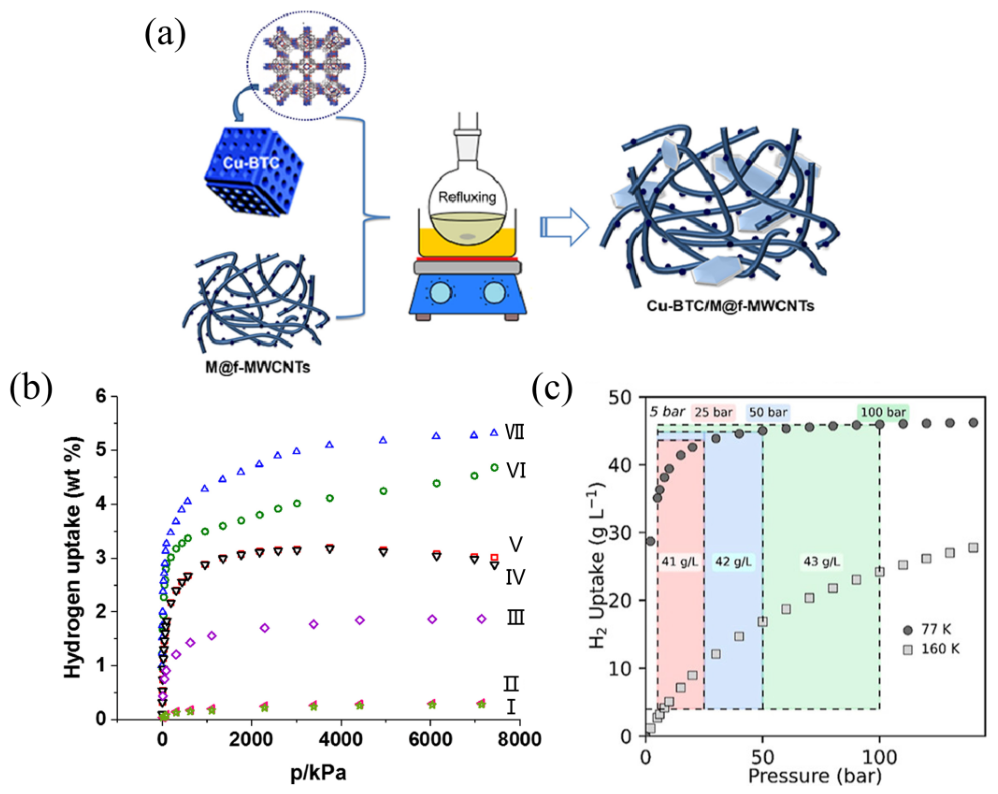
Figure 4.
(a) Schematic representation of Pt/aUiO synthesis employing amino decoration to anchor platinum. (b) Hydrogen adsorption isotherms of pure MOFs (UiO, aUiO-Ac, and aUiO-Cl).[48].
Figure 4.
(a) Schematic representation of Pt/aUiO synthesis employing amino decoration to anchor platinum. (b) Hydrogen adsorption isotherms of pure MOFs (UiO, aUiO-Ac, and aUiO-Cl).[48].
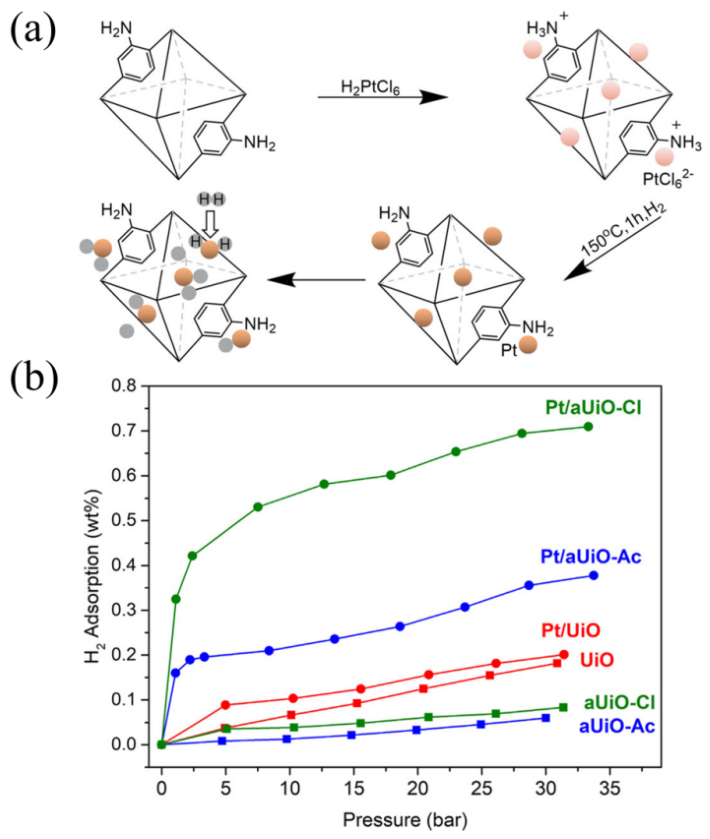
Figure 5.
Hydrogen adsorption isotherms at different temperatures (300 K, 195 K and 77 K) for the Pd@MOF-808 series materials.[54].
Figure 5.
Hydrogen adsorption isotherms at different temperatures (300 K, 195 K and 77 K) for the Pd@MOF-808 series materials.[54].
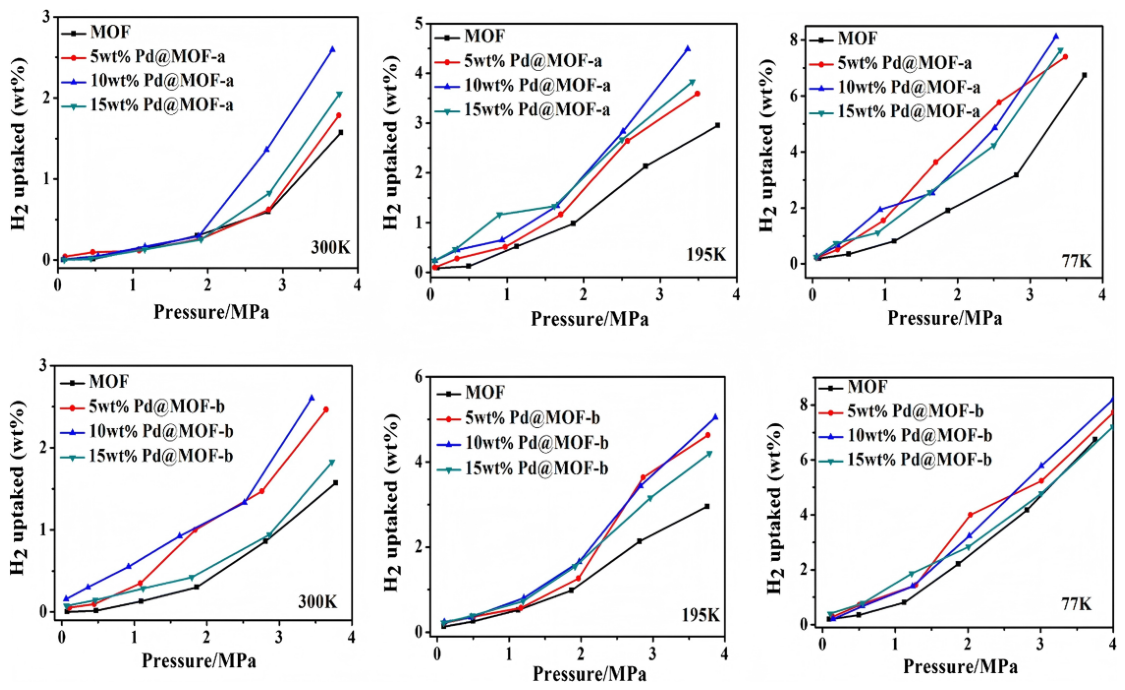
Figure 6.
Relationship among pore size, porosity (a–d), surface area (e, f), and hydrogen adsorption capacities of MOFs at 1 and 35 bar.[65].
Figure 6.
Relationship among pore size, porosity (a–d), surface area (e, f), and hydrogen adsorption capacities of MOFs at 1 and 35 bar.[65].
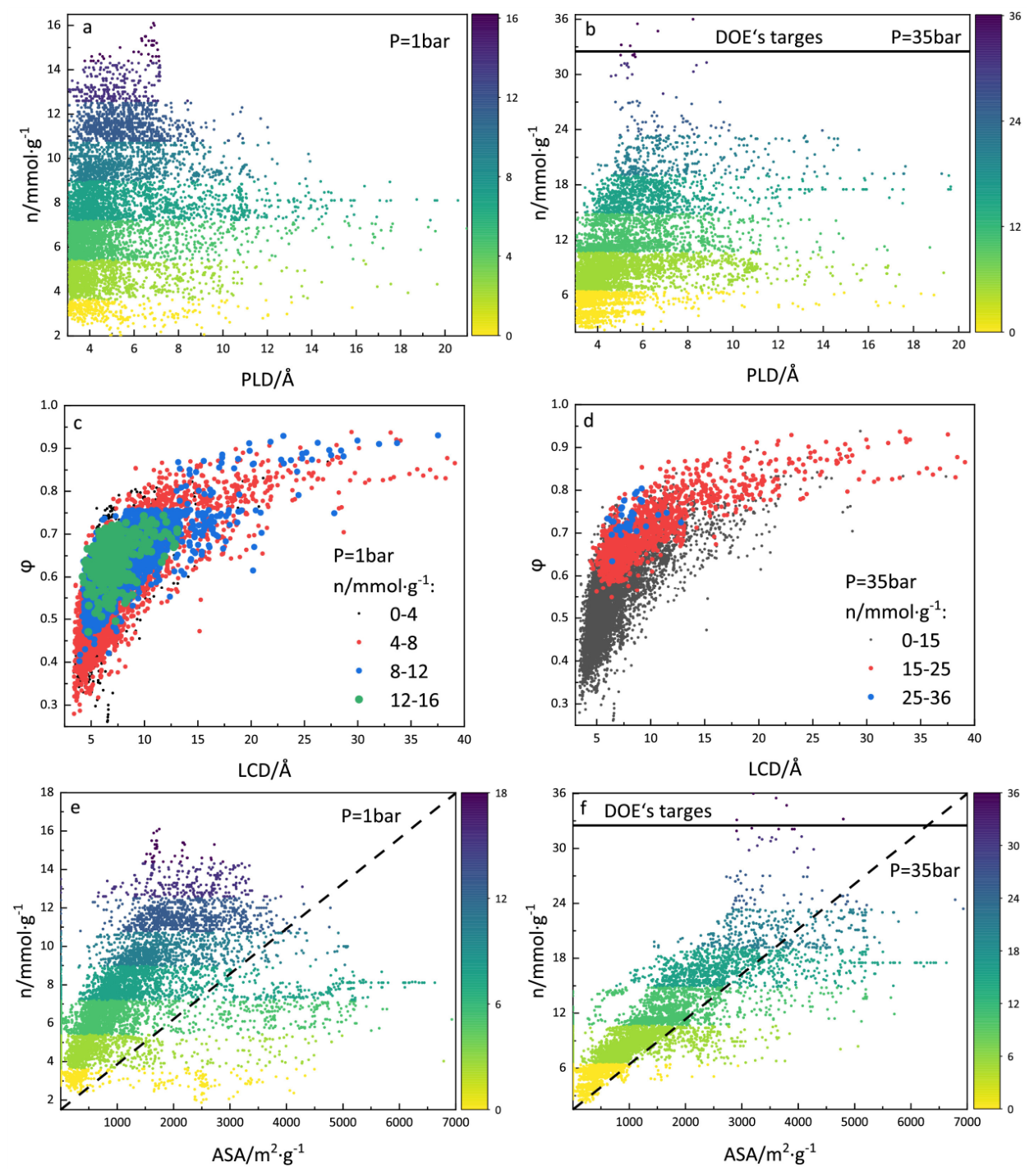
Figure 7.
Four types of data for machine learning.[89].
Figure 7.
Four types of data for machine learning.[89].
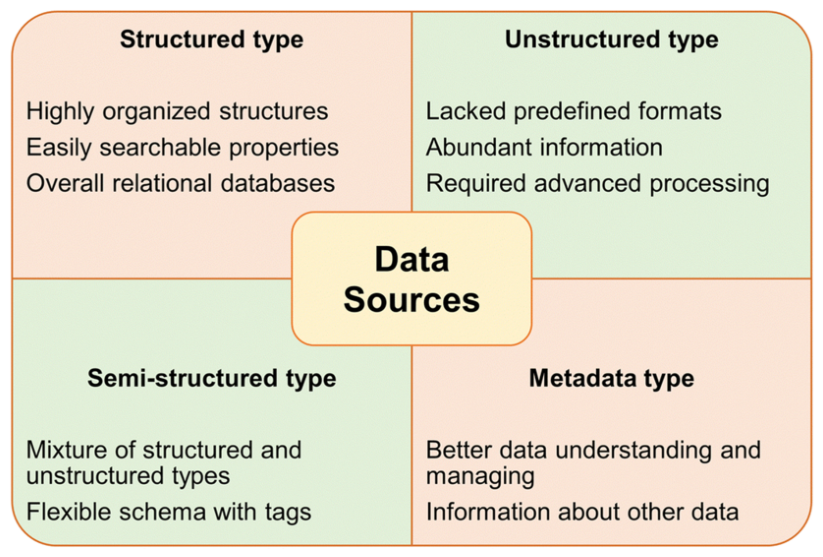

Table 1.
Hydrogen storage performance of various Zn-based MOFs.
| MOFs | Metal ion | Ligand | Temperature (K) | Pressure (bar) | Gravimetric H2 uptake (wt%) | Reference |
|---|---|---|---|---|---|---|
| MOF-5 | Zn2+ | 1,4-benzenedicarboxylate | 78 | 20 | 4.50 | [25] |
| Pt-ACs-MOF-5 | Zn2+ | 1,4-benzenedicarboxylate | 298 | 100 | 2.30 | [27] |
| P-MOF | Zn2+ | 1,4-benzenedicarboxylate | 77 | 1 | 1.20 | [28] |
| N-MOF | Zn2+ | 1,4-benzenedicarboxylate | 77 | 1 | 2.00 | [28] |
| Ni-MOF-5 | Zn2+ | 1,4-benzenedicarboxylate | 77 | 1 | 1.53 | [29] |
| Co-MOF-5 | Zn2+ | 1,4-benzenedicarboxylate | 77 | 1 | 1.53 | [29] |
| Fe-MOF-5 | Zn2+ | 1,4-benzenedicarboxylate | 77 | 1 | 0.99 | [29] |
| MOF-177 | Zn2+ | 1,3,5-benzenetribenzoate | 77 | 70 | 7.50 | [30] |
| 298 | 100 | 0.62 | ||||
| MOF-210 | Zn2+ | 4,4’,4’’-[benzene-1,3,5-triyl-tris(benzene-4,1-diyl)]tribenzoate | 77 | 60 | 17.60 | [32] |
| Li-ZIF-70 | Zn2+ | imidazolate (Im⁻); 2-nitroimidazolate (nIm⁻) | 298 | 100 | 3.08 | [33] |
| Na-ZIF-70 | Zn2+ | imidazolate (Im⁻); 2-nitroimidazolate (nIm⁻) | 298 | 100 | 2.19 | [33] |
| ZIF-8@ZIF-67 | Zn2+ | 2-methylimidazolate (mIm⁻); 2-methylimidazolate (mIm⁻) | 77 | 1 | 2.03 | [34] |
| ZIF-67@ZIF-8 | Zn2+ | 2-methylimidazolate (mIm⁻); 2-methylimidazolate (mIm⁻) | 77 | 1 | 1.69 | [34] |
Table 2.
Hydrogen storage performance of various Cu-based MOFs.
| MOFs | Metal ion | Ligand | Temperature (K) | Pressure (bar) | Gravimetric H2 uptake (wt%) | Reference |
|---|---|---|---|---|---|---|
| HKUST-1 | Cu2+ | 1,3,5-benzenetricarboxylate | 77 | 80 | 3.60 | [35] |
| Cu-BTC/Ni@f-MWCNTs | Cu2+ | 1,3,5-benzenetricarboxylate | 298 | 70 | 4.68 | [37] |
| Cu-BTC/Pd@f-MWCNTs | Cu2+ | 1,3,5-benzenetricarboxylate | 298 | 70 | 5.31 | [37] |
| Cu-BTC/GO | Cu2+ | 1,3,5-benzenetricarboxylate | 298 | 1 | 0.46 | [38] |
| 298 | 3 | 0.49 | ||||
| PCN -6’ | Cu2+ | 1,3,5-tris(3,5-dicarboxyphenyl)benzene | 77 | 30 | 7.00 | [39] |
| 298 | 100 | 1.30 | ||||
| Cu3(BTC)2 | Cu2+ | 1,3,5-benzenetricarboxylate | 77 | 1 | 2.18 | [40] |
| NOTT-103 | Cu2+ | 3,3’,5,5’-tetracarboxybiphenyl | 77 | 60 | 7.78 | [41] |
| NU-2100 | Cu+ | 1,5-dihydrobenzo[1,2-d:4,5-d’]bis([1,2,3]triazole) | 233-296 | 5-100 | 4.28 | [42] |
Table 3.
Hydrogen storage performance of various Zr-based MOFs.
| MOFs | Metal ion | Ligand | Temperature (K) | Pressure (bar) | Gravimetric H2 uptake (wt%) | Reference |
|---|---|---|---|---|---|---|
| UiO-66 | Zr4+ | 1,4-benzenedicarboxylate | 77 | 18 | 3.35 | [45] |
| UiO-66(H2ADC)-SS | Zr4+ | Alkyldicarboxylate | 298 | 50 | 1.09 | [47] |
| UiO-66(H2ADC)-S | Zr4+ | Alkyldicarboxylate | 298 | 50 | 2.99 | [47] |
| Pt/aUiO-Ac | Zr4+ | 1,4-benzenedicarboxylate | 303 | 30 | 0.38 | [48] |
| Pt/aUiO-Cl | Zr4+ | 1,4-benzenedicarboxylate | 303 | 30 | 0.71 | [48] |
| UiO-66-AO@Si | Zr4+ | 1,4-benzenedicarboxylate | 77 | 2.1 | 0.35 | [49] |
| UiO-66-SO3H@Si | Zr4+ | 1,4-benzenedicarboxylate | 77 | 2.1 | 0.12 | [49] |
| UiO-66-PDCA | Zr4+ | 1,4-benzenedicarboxylate | 77 | 2.1 | 0.25 | [49] |
| Cu@UiO-66 | Zr4+ | 1,4-benzenedicarboxylate | 298 | 60 | 0.26 | [50] |
| Ni@UiO-66 | Zr4+ | 1,4-benzenedicarboxylate | 298 | 60 | 0.45 | [50] |
| CuNi@UiO-66 | Zr4+ | 1,4-benzenedicarboxylate | 298 | 60 | 0.74 | [50] |
| UBMOF -31 | Zr4+ | 1,4-benzenedicarboxylate | 77 | 46 | 4.90 | [51] |
| MOFs-808 | Zr4+ | 1,3,5-benzenetricarboxylate | 44 | 70 | 7.31 | [53] |
| Pd@MOF-808 | Zr4+ | 1,3,5-benzenetricarboxylate | 300 | 40 | 2.61 | [54] |
| 195 | 40 | 5.04 | ||||
| 77 | 40 | 8.20 |
Table 4.
Hydrogen storage performance of various MOFs.
| MOFs | Metal ion | Ligand | Temperature (K) | Pressure (bar) | Gravimetric H2 uptake (wt%) | Reference |
|---|---|---|---|---|---|---|
| MIL-101(Cr) | Cr3+ | 1,4-benzenedicarboxylate | 77 | 80 | 6.10 | [55] |
| AC-MIL-101(Cr) | Cr3+ | 1,4-benzenedicarboxylate | 77 | 100 | 13.50 | [57] |
| MIL-100(Cr) | Cr3+ | 1,4-benzenedicarboxylate | 298 | 50 | 2.20 | [58] |
| Fe-BTT | Fe2+/Fe3+ | 1,3,5-benzenetristetrazolate | 77 | 95 | 4.10 | [59] |
| MIL-100(Fe)/GO | Fe3+ | 1,3,5-benzenetricarboxylate | 298 | 50 | 2.02 | [60] |
| Ni(m-dobdc) | Ni2+ | 4,6-dioxido-1,3-benzenedicarboxylate | 298 | 100 | 2.75 | [61] |
| MOF-76 | Al3+ | 1,4-benzenedicarboxylate | 77 | 20 | 1.00 | [62] |
Disclaimer/Publisher’s Note: The statements, opinions and data contained in all publications are solely those of the individual author(s) and contributor(s) and not of MDPI and/or the editor(s). MDPI and/or the editor(s) disclaim responsibility for any injury to people or property resulting from any ideas, methods, instructions or products referred to in the content. |
© 2026 by the authors. Licensee MDPI, Basel, Switzerland. This article is an open access article distributed under the terms and conditions of the Creative Commons Attribution (CC BY) license (http://creativecommons.org/licenses/by/4.0/).
Copyright: This open access article is published under a Creative Commons CC BY 4.0 license, which permit the free download, distribution, and reuse, provided that the author and preprint are cited in any reuse.


