

Submitted:
28 May 2026
Posted:
29 May 2026
You are already at the latest version
Abstract
Three designs for broadband sound absorption by thin hard backed layers, respectively, combine synthetic porous materials and resonant cavities, embed opposed arrays of horizontal plates in a porous layer and mount multiple parallel microperforated plates in a conical shell. The measured and predicted normal incidence absorption spectra from these designs are compared with predictions for hard backed porous layers of the same thickness that either have a small number of embedded vertical and horizontal solid partitions or consist of materials derived from natural sources. The comparisons suggest that broadband sound absorption spectra comparable with those of the more complicated designs can be obtained in ways that are simpler and potentially more sustainable for manufacture and disposal.
Keywords:
sound absorbers
; metamaterials
; partitions
; porous materials
; sustainability
1. Introduction
Ideally, sound absorbing treatments for use in aircraft and vehicle structures, white goods and prefabricated building constructions, should provide broadband absorption over the audio-frequency range, while adding as little volume and weight as possible. Typical sound absorption coefficient spectra provided by thin hard-backed layers of synthetic porous materials such as glass wool or polymer foams are poor at low frequencies unless the layer thickness is increased or the layer is mounted on an air gap thereby adding volume. Many designs suitable for Additive Manufacture offer useful subwavelength absorption from thin layers.
An example of such a design is shown in Figure 1(a) [1]. A 10 mm thick, melamine foam layer covers an array of eighteen rectangular cavities. These include eight single cavities (numbered 1 – 8 in Figure 1(a)) and eight double cavities i.e., two connected single cavities (numbered 9 – 16 in Figure 1(a)). Sound enters the cavities through small holes of various widths (1.7 mm, 2.2 mm and 4 mm), so they act as Helmholtz resonators. The double cavities are folded beneath the single cavities to reduce the total height (31 mm) of the structure. Cavities 17 and 18 in Figure 1(a), which are 25 mm long and 10 mm wide, contain 20 mm and 12 mm thick layers of a different porous foam, henceforth called ‘cavity’ foam [1].
Also shown in Figure 1(b) are the frequency ranges encompassing the main contributions to the overall absorption coefficient spectrum from the cavity resonators (HR), cavities with porous infill and the thin, porous covering. Impedance tube measurements were made between 600 Hz and 1600 Hz on a 3D printed replica of the Figure 1(a) structure and analytical and numerical predictions were found to agree with the data from these measurements [1].
A second metamaterial design for broadband sound absorption is shown in Figure 2(a) [2]. Unit cells are filled with a porous material containing left- and right-hand series of regularly spaced embedded horizontal plates with lengths that increase with depth. Figure 2(b) shows a measured normal incidence absorption coefficient spectrum together with a corresponding numerical prediction (labelled simulation).
The acoustical properties of the melamine foam layer, the porous material infill used in the Figure 1(a) design [1] and the foam ‘sponge’ used in the Figure 2(a) design [2] are calculated using the Johnson-Champoux-Allard (JCA) model for a rigid-framed porous material. Corresponding expressions for the bulk complex density and compressibility are [3]
where the time convention is understood, (rad s-1) is the angular frequency, (Hz) is the frequency, (s) is time, is tortuosity, is porosity, is flow resistivity with units of Pa s m-2, is the density of air (kg m-3). In equations (1c) and (1d), and , where is a characteristic viscous length and is a characteristic thermal length. and are the Prandtl number and dynamic viscosity coefficient for air respectively.
The characteristic impedance, , and the propagation constant, , are calculated, respectively, from and using
The specific surface impedance, , of a hard-backed porous layer of thickness d is given by equation (10)
The plane wave reflection coefficient, R(d), and normal incidence absorption coefficient, (d), for a hard-backed porous layer of thickness d are given by equations (8) and (9), respectively.
The JCA parameter values used to calculate the acoustical properties of the three porous materials used in the first two structures [1,2] are listed in Table 1.
Figure 3(a) shows a third example of a broadband sound absorbing design based on the sonic black hole concept. It consists of parallel microperforated plates inside a conical shell [4]. Figure 3(b) shows the numerically predicted absorption coefficient spectrum for an arrangement of five MPP equally spaced at 12 mm inside a conical tube with a radius that decreases linearly from 30 mm to 1 mm at the back wall.
This paper investigates the extent to which sound absorption coefficient spectra comparable with or superior to those obtained with the designs in Figure 1(a), 2(a) and 3(a) could be achieved in simpler ways either by embedding a few thin solid vertical and horizontal partitions in hard-backed layers of the porous materials used in the Figure 1(a) and 2(a) designs, or by choosing porous materials with higher tortuosity.
Section 2 outlines theory for the acoustical properties of partitioned structures. Section 3 compares corresponding predictions of normal incidence sound absorption coefficient with data and predictions for the structures shown in Figure 1(a), 2(a) and 3(a). Section 4 contains predictions based on the use of alternative (unpartitioned) porous materials with higher tortuosity and Section 5 offers concluding remarks.
2. Theory for Partitioned Porous Layers
Hard backed layers of porous material containing adjacent unit cells containing partitions of types 1 and 2 are shown in Figure 4.
A third type of partition and the dimensions associated with all three types of partition are shown in Figure 5.
Using an effective medium approach, the overall impedance of unit cell type 1 (Figure 5(a)) is calculated by considering the two sub-cells shown in Figure 6 [4].
The left-hand sub cell of width , where W is the total width of the unit cell and t is the thickness of the partition, has the characteristic impedance given by [4]
where is given by equation (8).
The approximate impedance, , of the right-hand sub cell of width and length , is given by [4]
where = 1.9, m is the acoustic mass of the gap and is the width of the gap. The gap is considered to form the neck of a resonator filled with porous material [4]. The approximation (in equation (11)) relies on the gap being sufficiently small that differences from standard radiation conditions are not important.
The specific surface impedance, , of a unit cell with a type 1 partition is given by [4]
The reflection and absorption coefficients are obtained by replacing by in equations (8) and (9) respectively.
Figure 6 shows the sub cells for type 2 partitions [4,5]. The left-hand part of the sub-cell is connected to the resonant absorbing volume of length and width in the right-hand half of the unit cell by the gap of width at the bottom of the vertical partition.
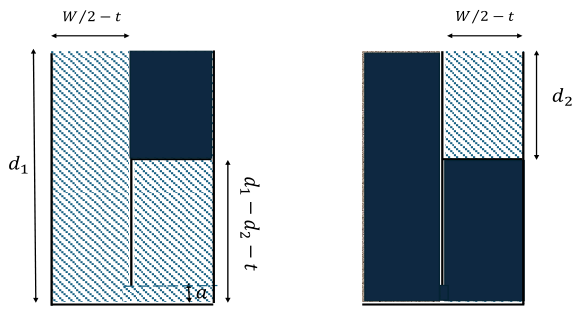
If, as for the type 1 arrangement, the gap is treated as the neck of a Helmholtz resonator, the specific surface impedance, , for this sub-cell is given by equation (15)
The specific surface impedance, , of the right-hand sub-cell is given by
Hence, the specific surface impedance of a unit cell with type 2 partitions is given by
The specific surface impedance of cell type 3 is the sum of the admittances of a sub cell of type 2 and that of sub cell of a hard backed porous layer of length corresponding the left-hand sub cell in Figure 6 after allowing that each sub cell has a narrower width ().
in equation (19) is calculated from equations (15) to (18) after replacing by and by .
3. Predictions and Comparisons with Data
3.1. Predictions for Three Partition Types
To represent the acoustical properties of a porous foam, Yang et al. [5] use the Johnson-Champoux-Allard model with porosity 0.95, tortuosity 1.42, viscous characte5istic length 180 μm, thermal characteristic length 360 μm and flow resistivity 8.9 kPa s m-2. Figure 8 shows normal incidence absorption coefficient spectra predicted for this foam containing each of the three types of partitions with mm, mm, mm and mm. Also shown is the prediction for the foam layer without partitions.
Type 1 partitions are predicted to result in the highest absorption below 1 kHz but otherwise the resulting absorption spectrum is highly oscillatory. Although predictions for type 2 and 3 partitions do not show as much absorption as type 1 partitions below 1 kHz, they indicate higher absorption between 500 Hz and 5 kHz than predicted for the foam layer without partitions.
3.2. Figure 1(a) Design Comparisons
Figure 10(a) and 10(b) show data from measurements of normal incidence absorption spectra made by Liu et al. [1] for the structure in Figure 1(a) over the frequency range from 600 Hz to 1600 Hz. These data are compared with predictions for type 2 partitions in each of the foams modelled with the parameters in Table 1 and with predictions for 31 mm thick foam layers without partitions.
The absorption predicted for a 31 mm thick layer of the ‘cavity’ foam is lower than the same thickness of melamine foam since it has a lower flow resistivity. But, with type 2 partitions, the ‘cavity’ foam is predicted to yield an absorption spectrum comparable to that measured for the Figure 1(a) structure between 700 Hz and 1200 Hz. The insertion of partitions in the ‘cavity’ foam is predicted to improve absorption spectra more than predicted if used in the melamine foam.
Figure 11 compares predictions of absorption coefficient spectra up to 10 kHz for the three types of partitions in the ‘cavity’ foam ( mm, mm, mm and mm), the same thickness of ‘cavity’ foam without partitions and the numerical prediction for the structure in Figure 1(a) [1].
A type 1 partition in the ‘cavity’ foam [1] is predicted to give higher absorption than predicted for the Figure 1(a) structure below 500 Hz but less at higher frequencies. However, Type 2 partitions in the ‘cavity’ foam are predicted to match the numerical prediction of absorption for the Figure 1(a) structure below 700 Hz, give less absorption than the numerical predictions between 1 and 2 kHz, but indicate higher absorption above 3 kHz. The predicted absorption coefficient spectrum for Type 3 partitioning is less than the numerical prediction for the Figure 1(a) structure between 500 Hz and 1.5 kHz but consistently higher thereafter. Moreover, the prediction for type 3 partitions is higher than predicted for the ‘cavity’ foam without partitions between 3 and 6 kHz. Overall, the predicted broadband absorption spectra with type 2 and type 3 partitions in the ‘cavity’ foam are higher than predicted for the design in Figure 1(a).
3.2. Figure 2(a) Design Comparisons
The Figure 2(a) design [2] represents an extension of that proposed by Yang et al. [6] who consider only the ‘right-hand’ arrays of the horizontal partitions shown in Figure 2(a). Figure 12 compares the measured normal incidence absorption coefficient spectrum for the Figure 2(a) design [2] with predictions for 50 mm thick ‘sponge’ and melamine foam and for the ‘sponge’ material containing the three types of partition (Figure 4).
The porous foam ‘sponge’ used in the Figure 2(a) design [2] has relatively low flow resistivity (see Table 1) and a 50 mm hard backed layer of this material offers a relatively low absorption spectrum (solid red line in Figure 12). Nevertheless, insertion of type 3 partitions in the ‘sponge’ is predicted to give a comparable absorption spectrum to that achieved with the multiple horizontal embedded plate Figure 2(a) design. Moreover, if 50 mm thick hard backed (unpartitioned) melamine foam, with the JCA parameter values listed in Table 1, were to be used, the corresponding predicted normal incidence absorption spectrum (broken brown line in Figure 12) would more than match that measured for the design in Figure 2(a) with ‘sponge’ infill.
3.2. Figure 3(a) Design Comparisons
Figure 13 compares the absorption spectrum predicted for the 60 mm thick Figure 3(a) design with that predicted for the same thickness ‘cavity’ foam used in the Figure 1(a) design with type 3 partitions ( mm). The use of type 3 partitions in the ‘cavity’ foam layer is predicted to offer a comparable absorption spectrum to that predicted for the microperforated plate array.
4. Predictions for Naturally Sourced Materials
The low frequency absorption of a thin hard backed layer of a rigid porous material is improved by increasing the tortuosity of the material [7,8,9]. Naturally sourced porous materials tend to have higher tortuosity values than conventional synthetic materials [10] as well as having less environmental impact with respect to manufacture and disposal. Impedance tube measurements have been made on various naturally sourced samples and values of the JCA model parameters, other than flow resistivity and porosity which were measured independently, have been obtained by fitting the impedance tube data. Parameters for 30 mm and 50 mm thick samples made from sugarcane bagasse and Typha fiber (with bulk density 200 kg m-3) are listed in Table 2 [10,11].
The JCA fitted tortuosity values for these materials, between 1.5 and 2.8, are higher than those for the porous foams used in the Figure (1a) design for which the highest fitted tortuosity value is 1.07 (see Table 1). Figure 14 compares normal incidence absorption coefficient data [10] for 30 mm thick layers made from sugar cane bagasse and Typha fiber with the numerical prediction for the 31 mm thick structure shown in Figure 1(a). Below 1.5 kHz the Typha sample offers superior absorption to the Figure 1(a) design. Above 1.5 kHz, the spectra for both Typha fiber and sugarcane bagasse are comparable.
Figure 15 compares normal incidence absorption coefficient data [11] for 50 mm thick layers made from Typha fiber with the numerical prediction for the 50 mm thick structure shown in Figure 2(a). The measured absorption coefficient values of the Typha fiber samples above 1 kHz are between 0.8 and 0.85, slightly lower than the measured absorption spectrum of the Figure 2(a) design. However the measured absorption coefficient values for the 7.5% binder Typha fiber samples are higher than those measured for the Figure 2(a) design below 1 kHz.
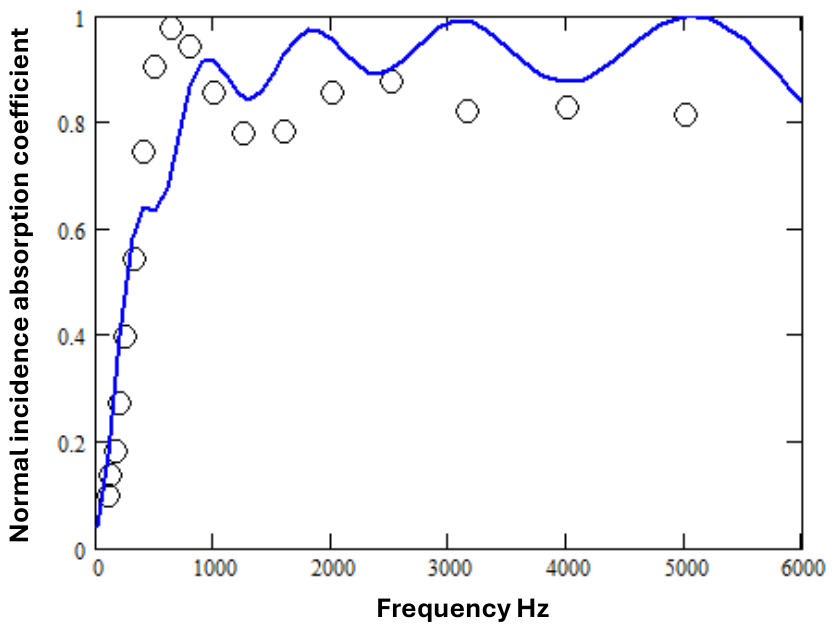
Figure 16 compares the normal incidence absorption coefficient spectrum predicted for the 60 mm thick Figure 3(a) design with absorption coefficient data for a 60 mm thick sample of Typha fiber [12].
The absorption coefficient data for the 60 mm thick Typha fiber sample above 1 kHz, with an average absorption coefficient value near 0.8, does not match the values predicted for the Figure 3(a) design. However, the absorption of the Typha fiber sample is higher between 500 Hz and 1 kHz.
5. Conclusion
Similar or higher broadband sound absorption spectra than measured and predicted for three relatively complex designs, based on resonant cavities, synthetic polymer foams, embedded arrays of horizontal plates in a porous layer and parallel microperforated plates, can be achieved with relatively simple partition arrangements in a porous layer or by using porous materials made from natural sources with higher tortuosity values than found for typical synthetic foams. Naturally sourced materials have higher bulk densities than typical synthetic foams, which would mean significant additional structural loading if 60 mm thick layers were to be used. However, it should be possible to reduce such additional weight by using thinner layers with airgaps behind them.
Funding
This research received no external funding.
Institutional Review Board Statement
Not applicable.
Data Availability Statement
No new data were created or analyzed in this study. Data sharing is not applicable to this article.
Acknowledgments
During the preparation of this study, the author used ChatGPT to obtain excel spreadsheets corresponding to data and predictions in references [1,2,4]. The author has reviewed and edited the output and takes full responsibility for the content of this publication. The author thanks Mohammad SheikhMozafari for supplying data on naturally sourced materials.
Conflicts of Interest
The author declares no conflicts of interest.
References
- Liu, C.; Xie, Z.; Liu, X. An Ultra-Thin Composite Metasurface with Hybrid-Damping Modes for Broadband Sound Absorption. Appl. Sci. 2024, 14, 9290. [Google Scholar] [CrossRef]
- Gao, N.; Wu, J.; Lu, K.; Zhong, H. Hybrid composite meta-porous structure for improving and broadening sound absorption. Mech. Syst. Signal Process. 2021, 154 107504. [Google Scholar] [CrossRef]
- Allard, J. -F.; Atalla, N. Propagation of Sound in Porous Media. Modelling Sound Absorbing Materials, 2nd ed.; John Wiley & Sons: Chichester, West Sussex, UK, 2009. [Google Scholar]
- Ortiz, S.; Cuesta, M.; Cobo, P. Sound absorption of materials at low frequencies based on microperforated panels. Acoustics.
- Yang, J.; Lee, J. S.; Kim, Y.Y. Metaporous layer to overcome the thickness constraint for broadband sound absorption. J. Appl. Phys. 2015, 117, 174903. [Google Scholar] [CrossRef]
- Yang, J.; Lee, J. S.; Kim, Y. Y. Multiple slow waves in metaporous layers for broadband sound absorption. J. Phys. D. Appl. Phys. 2017, 50, 015301. [Google Scholar] [CrossRef]
- Groby, J. -P.; Dazel, O.; Duclos, A.; Boeckx, L.; Kelders, L. Enhancing the absorption coefficient of a backed rigid frame porous layer by embedding circular periodic inclusions. J. Acoust. Soc. Am. 2011, 130 3771–3780. [Google Scholar] [CrossRef] [PubMed]
- Attenborough, K. Microstructures for lowering the quarter wavelength resonance frequency of a hard-backed rigid-porous layer. Appl. Acoust. 2018, 130 188–194. [Google Scholar] [CrossRef]
- Zielinski, T.G.; Opiela, K. C.; Dauchez, N.; Boutin, T.; Galland, M.-A.; Attenborough, K. Extremely tortuous sound absorbers with labyrinthine channels in non-porous and microporous solid skeletons. Appl. Acoust. 2014, 217 109816. [Google Scholar] [CrossRef]
- SheikhMozafari, M.J.; Taban, E.; Attenborough, K. Porous sound absorbing materials from natural sources: data and modelling. Appl. Acoust. 2026, 243, 111162. [Google Scholar] [CrossRef]
- Khosro, S. K.; Soltani, P.; SheikhMozafari, M. J.; Piegay, C.; Amininasab, S.; Faridan, M.; Taban, E.; Esmaeelpour, M. R. M. Acoustical, thermal, and mechanical performance of Typha Latifolia fiber panels: Experimental evaluation and modeling for sustainable building applications. J. Build. Eng. 2025, 99 111579. [Google Scholar] [CrossRef]
- SheikhMozafari, M.J. 2025 private communication.
Figure 1.
(a) A sound absorbing structure in which mm, mm, mm, mm. A 10 mm thick melamine foam layer covers eighteen coupled resonator cavities with mm, mm, mm, mm. (b) predicted normal incidence absorption spectrum for the array (solid red line), with shaded areas indicating contributions from different parts of the structure. Also shown in Figure 1(b) is a prediction for a 31 mm thick hard-backed melamine foam layer (broken green line). [Adapted from Figure 1 of Liu et al. [1] under the creative commons attribution license version CC by 4.0 https://creativecommons.org/licenses/by/4.0/].
Figure 1.
(a) A sound absorbing structure in which mm, mm, mm, mm. A 10 mm thick melamine foam layer covers eighteen coupled resonator cavities with mm, mm, mm, mm. (b) predicted normal incidence absorption spectrum for the array (solid red line), with shaded areas indicating contributions from different parts of the structure. Also shown in Figure 1(b) is a prediction for a 31 mm thick hard-backed melamine foam layer (broken green line). [Adapted from Figure 1 of Liu et al. [1] under the creative commons attribution license version CC by 4.0 https://creativecommons.org/licenses/by/4.0/].
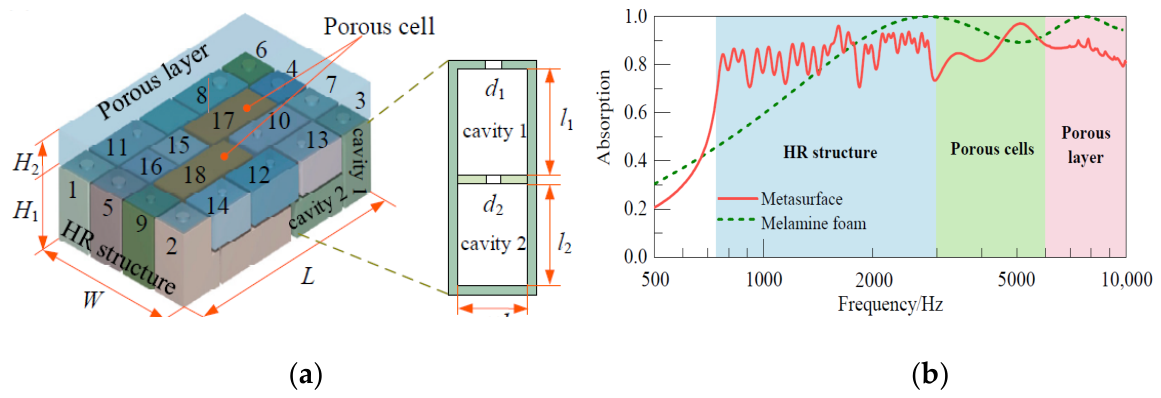
Figure 2.
(a) An array of unit cells each of which contain two arrays of nine embedded plates of lengths that increase with depth within a 50 mm thick layer of porous material (b) measured and predicted absorption coefficient spectra [adapted from Figure 1(h) and 2(a) in Gao et al. [2] under the creative commons attribution license version CC by 4.0 https://creativecommons.org/licenses/by/4.0/].
Figure 2.
(a) An array of unit cells each of which contain two arrays of nine embedded plates of lengths that increase with depth within a 50 mm thick layer of porous material (b) measured and predicted absorption coefficient spectra [adapted from Figure 1(h) and 2(a) in Gao et al. [2] under the creative commons attribution license version CC by 4.0 https://creativecommons.org/licenses/by/4.0/].
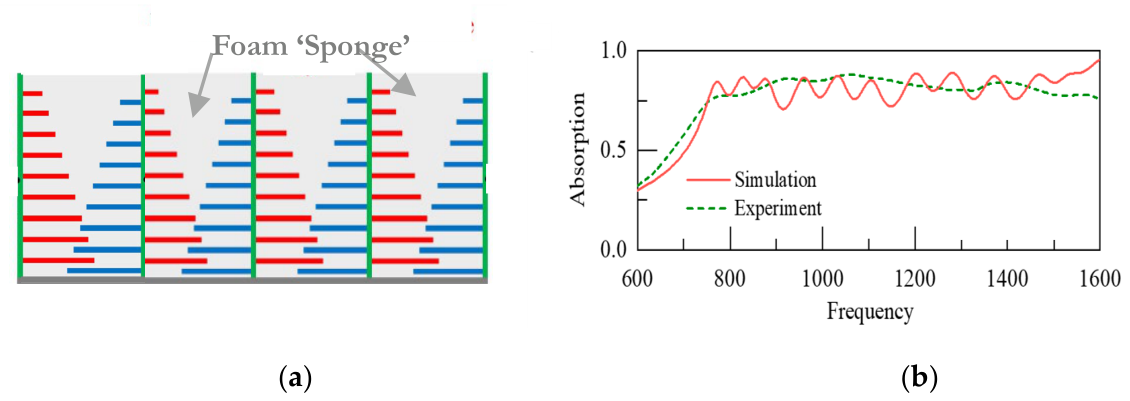
Figure 3.
(a) A generalized schematic of an array of five microperforated plates (MPP) in a conical shell (b) the absorption coefficient spectrum predicted for five MPP containing holes with diameter 0.2 mm and depth 0.2 mm, perforation ratio 4%, equally spaced at 12 mm inside a conical tube with a radius that decreases linearly from 30 mm to 1 mm at the back wall [adapted from Figure 7 and Figure 8 in Ortiz et al. [4]].
Figure 3.
(a) A generalized schematic of an array of five microperforated plates (MPP) in a conical shell (b) the absorption coefficient spectrum predicted for five MPP containing holes with diameter 0.2 mm and depth 0.2 mm, perforation ratio 4%, equally spaced at 12 mm inside a conical tube with a radius that decreases linearly from 30 mm to 1 mm at the back wall [adapted from Figure 7 and Figure 8 in Ortiz et al. [4]].
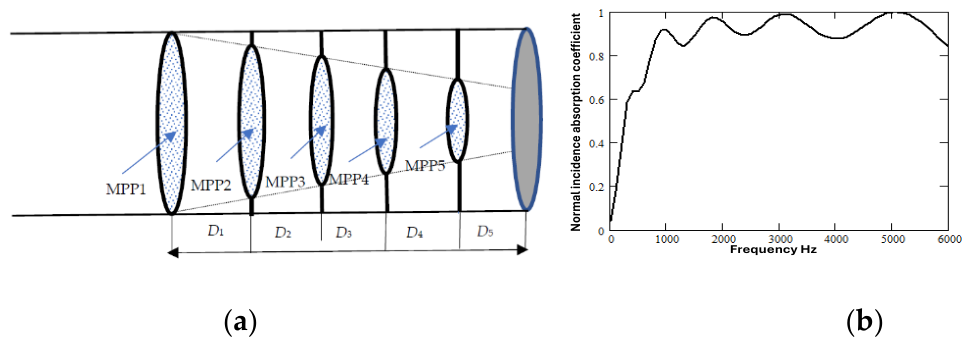
Figure 4.
Arrays of adjacent unit cells containing (a) type 1 and (b) type 2 partitions in a porous material. Each cell contains a vertical and a horizontal solid partition creating regions connected by the gap below the vertical partition.
Figure 4.
Arrays of adjacent unit cells containing (a) type 1 and (b) type 2 partitions in a porous material. Each cell contains a vertical and a horizontal solid partition creating regions connected by the gap below the vertical partition.
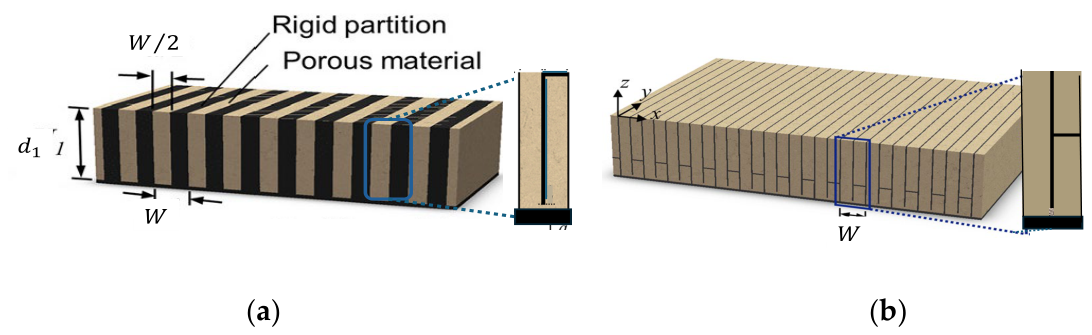
Figure 5.
Dimensions of unit cells of types (a) 1, (b) 2 and (c) 3.
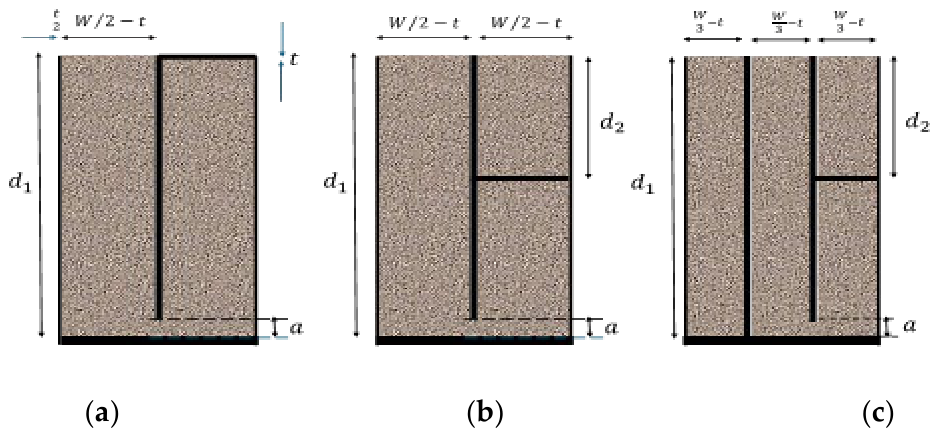
Figure 6.
Sub cells of unit cell type 1 [4].
Figure 6.
Sub cells of unit cell type 1 [4].
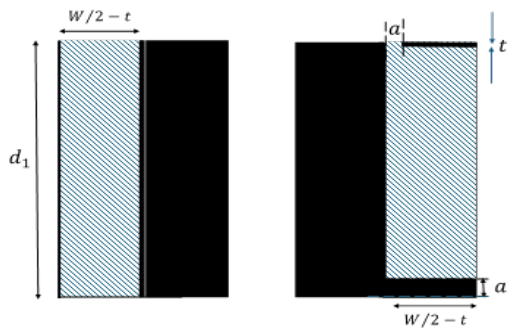
Figure 8.
Normal incidence absorption coefficient spectra predicted for three types of partition and for the unpartitioned porous material (porosity 0.95, tortuosity 1.42, viscous characteristic length 180 μm, thermal characteristic length 360 μm and flow resistivity 8.9 kPa s m-2) with mm, mm, mm and mm.
Figure 8.
Normal incidence absorption coefficient spectra predicted for three types of partition and for the unpartitioned porous material (porosity 0.95, tortuosity 1.42, viscous characteristic length 180 μm, thermal characteristic length 360 μm and flow resistivity 8.9 kPa s m-2) with mm, mm, mm and mm.
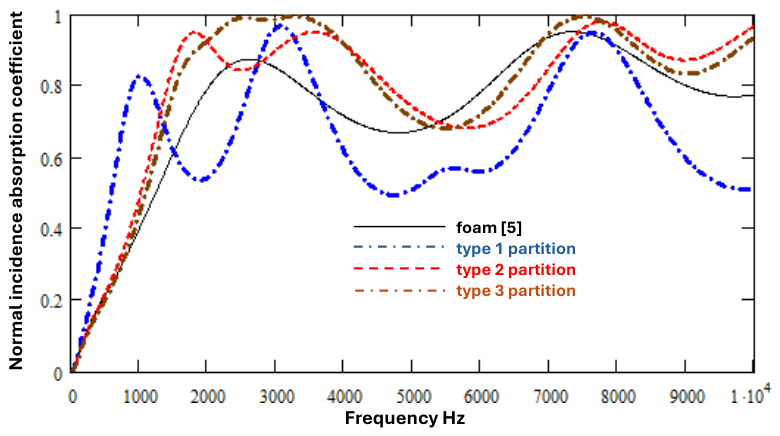
Figure 9.
Predicted influence of d2 on normal incidence sound absorption coefficient spectra for (a) Type 2 and (b) type 3 partitions in foam characterised by the JCA model ((porosity 0.95, tortuosity 1.42, viscous characteristic length 180 μm, thermal characteristic length 360 μm and flow resistivity 8.9 kPa s m-2).
Figure 9.
Predicted influence of d2 on normal incidence sound absorption coefficient spectra for (a) Type 2 and (b) type 3 partitions in foam characterised by the JCA model ((porosity 0.95, tortuosity 1.42, viscous characteristic length 180 μm, thermal characteristic length 360 μm and flow resistivity 8.9 kPa s m-2).
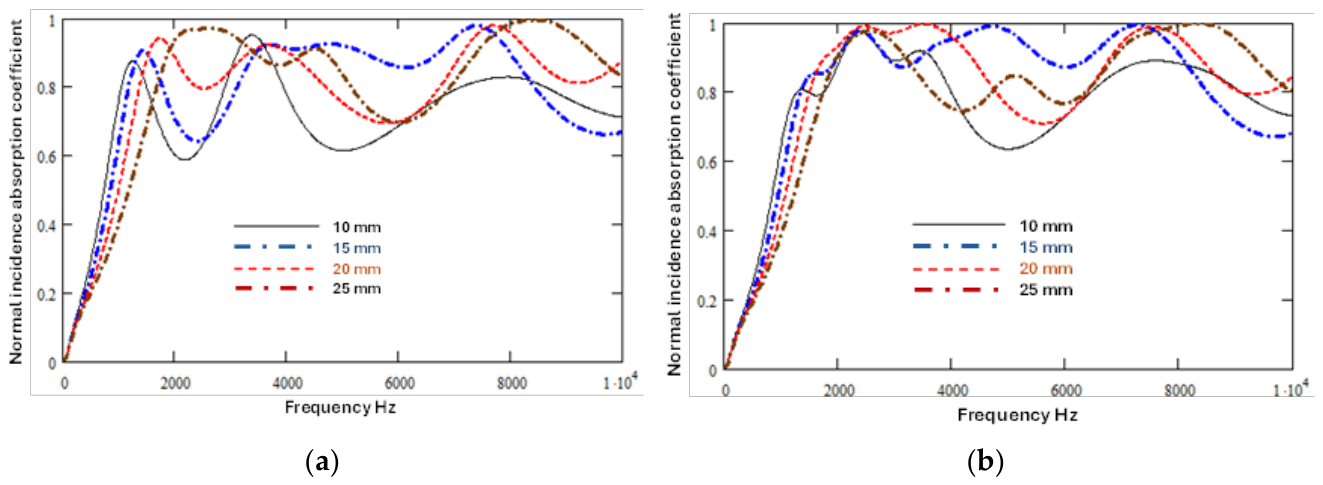
Figure 10.
Normal incidence absorption coefficient data (open circles) for the design in Figure 1(a) [1] compared with predictions for type 1 partition structure (solid red lines) with mm mm and mm, type 2 partition (blue dotted lines; mm) and type 3 partition structure (brown dash-dot lines; mm) in (a) melamine foam and (b) ‘cavity’ foam (see Table 1). Also shown (broken black lines) are predictions for the foams without partitions.
Figure 10.
Normal incidence absorption coefficient data (open circles) for the design in Figure 1(a) [1] compared with predictions for type 1 partition structure (solid red lines) with mm mm and mm, type 2 partition (blue dotted lines; mm) and type 3 partition structure (brown dash-dot lines; mm) in (a) melamine foam and (b) ‘cavity’ foam (see Table 1). Also shown (broken black lines) are predictions for the foams without partitions.
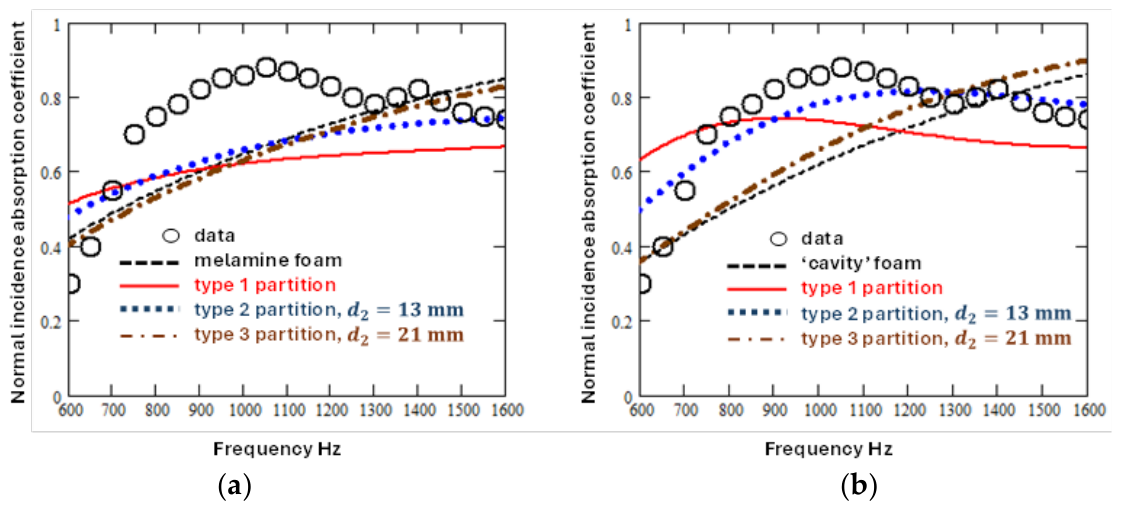
Figure 11.
Normal incidence absorption coefficient spectra predicted for three types of partitions (type 1 - solid red line; type 2 - broken blue line and type 3 - dash dot brown line, mm, mm, mm and mm) in the ‘cavity’ foam [1] (see Table 1) compared with numerical predictions (dash dot black line) for the design shown in Figure 1(a) [1].
Figure 11.
Normal incidence absorption coefficient spectra predicted for three types of partitions (type 1 - solid red line; type 2 - broken blue line and type 3 - dash dot brown line, mm, mm, mm and mm) in the ‘cavity’ foam [1] (see Table 1) compared with numerical predictions (dash dot black line) for the design shown in Figure 1(a) [1].
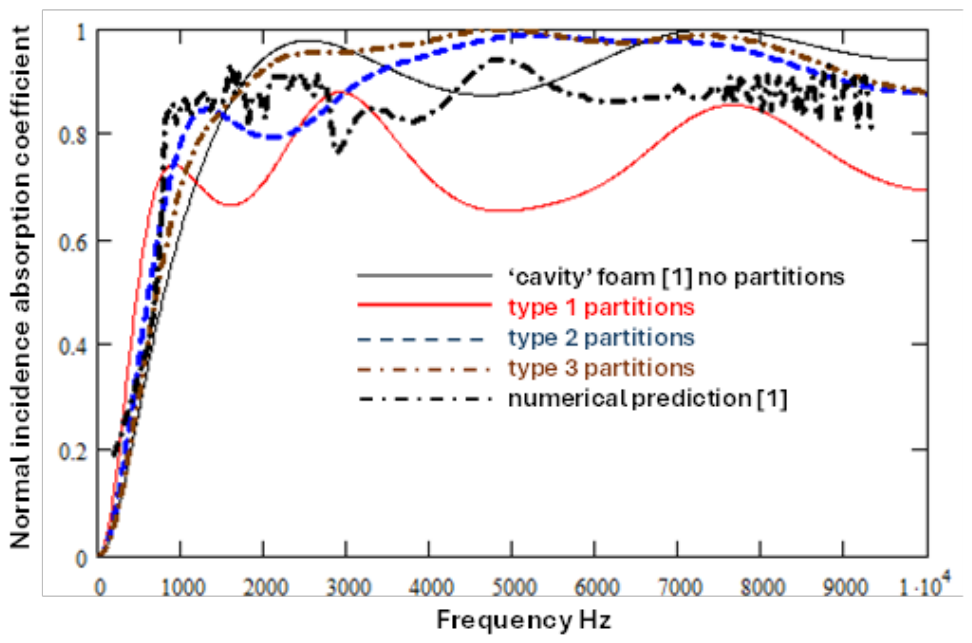
Figure 12.
Normal incidence absorption coefficient data for the Figure 2(a) design [2] and predictions for 50 mm thick ‘sponge’, melamine foam and for sponge containing each of three types of partition ( mm, mm, mm, mm (type 2) and 21 mm (type 3)). JCA parameters for the materials are listed in Table 1.
Figure 12.
Normal incidence absorption coefficient data for the Figure 2(a) design [2] and predictions for 50 mm thick ‘sponge’, melamine foam and for sponge containing each of three types of partition ( mm, mm, mm, mm (type 2) and 21 mm (type 3)). JCA parameters for the materials are listed in Table 1.
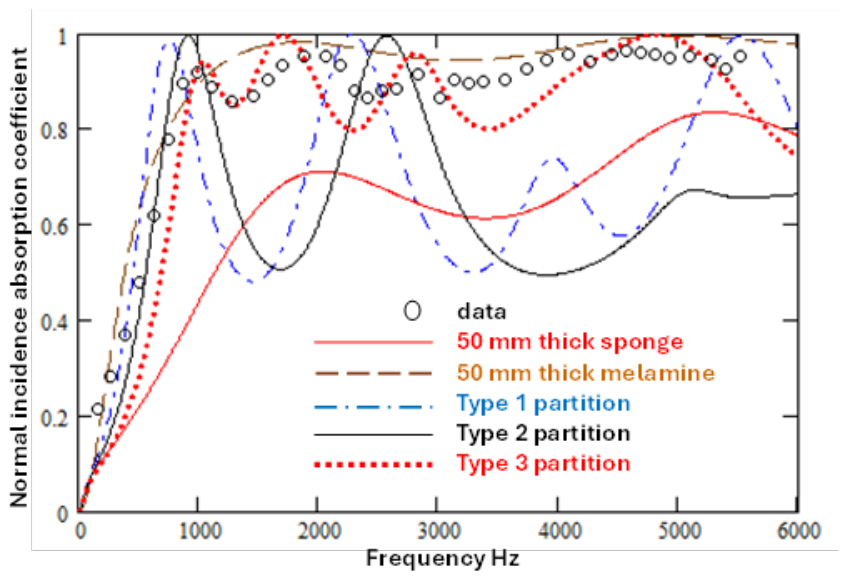
Figure 13.
Comparison of the normal incidence absorption coefficient spectrum predicted for the 60 mm thick Figure 3(a) design (solid black line) with that predicted for the same thickness of ‘cavity foam (see Table 1) containing type 3 partitions (broken red line, mm).
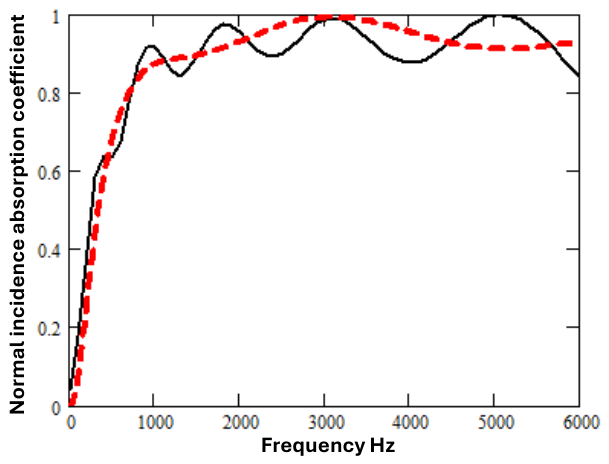
Figure 14.
Normal incidence absorption coefficient data for a 30 mm thick layers made from sugar cane bagasse ( ) and Typha fiber (O) compared with the numerical prediction (dash dot black line) for the design shown in Figure 1(a) [1]).
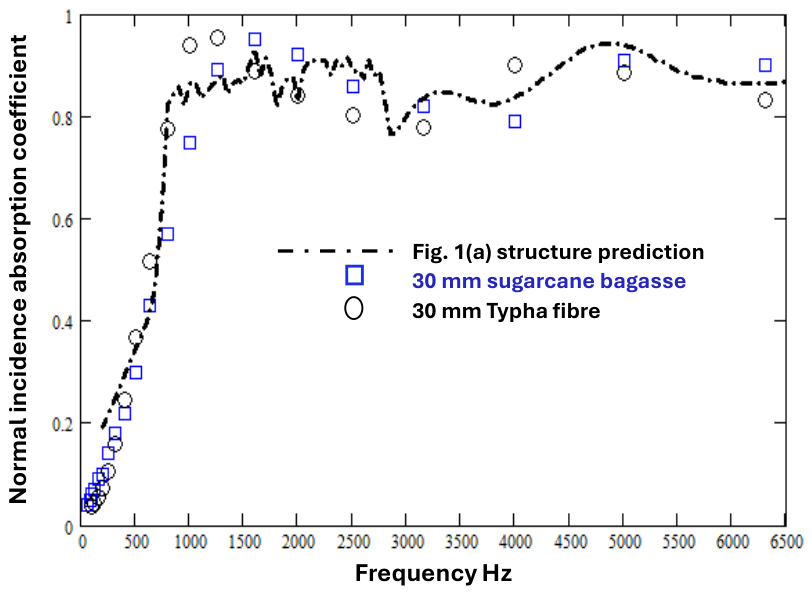
Figure 15.
Measured normal incidence absorption coefficient spectrum for the Figure 2(a) structure (O) and for 50 mm thick hard-backed Typha fiber samples with the properties listed in Table 2 and in the Key.
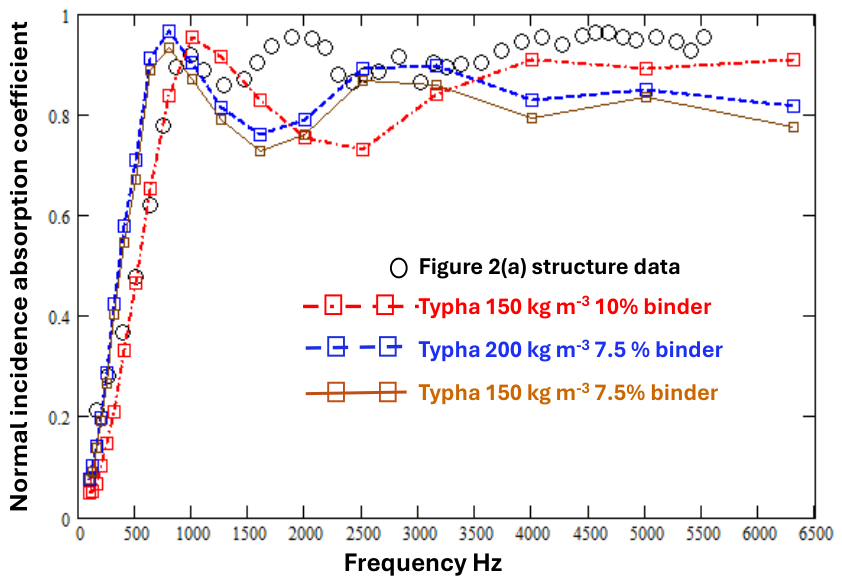
Figure 16.
Predicted normal incidence absorption coefficient spectrum for the Figure 2(a) structure (solid blue line) and data (O) for 50 mm thick hard-backed Typha fiber samples with the properties listed in Table 2 [12].

| Material | Porosity | Flow resistivity (kPa s m-2) |
Tortuosity |
Viscous characteristic length (m) | Thermal characteristic length (m) |
|---|---|---|---|---|---|
| melamine [1] | 0.97 | 19.78 | 1.02 | 90.3 | 178.5 |
| cavity [1] | 0.95 | 11.66 | 1.07 | 78.2 | 155.3 |
| sponge [2] | 0.96 | 2.843 | 1.07 | 273 | 672 |
| Material | Porosity | Flow resistivity (kPa s m-2) |
Tortuosity |
Viscous characteristic length (m) | Thermal characteristic length ( |
|---|---|---|---|---|---|
| Sugar cane bagasse (200 kg m-3,30 mm) | 0.836 | 6.120 | 1.7 | 54 | 211 |
| Typha fiber (200 kg m-3,30 mm) |
0.857 | 23.972 | 2.5 | 90 | 120 |
| Typha fiber (150 kg m-3, 50 mm) |
0.899 | 15.78 | 2.8 | 85 | 150 |
| Typha fiber (150 kg m-3, 50 mm) |
0.899 | 15.26 | 1.5 | 70 | 380 |
| Typha fiber (200 kg m-3, 50 mm) |
0.863 | 19.48 | 2.8 | 120 | 180 |
Disclaimer/Publisher’s Note: The statements, opinions and data contained in all publications are solely those of the individual author(s) and contributor(s) and not of MDPI and/or the editor(s). MDPI and/or the editor(s) disclaim responsibility for any injury to people or property resulting from any ideas, methods, instructions or products referred to in the content. |
© 2026 by the authors. Licensee MDPI, Basel, Switzerland. This article is an open access article distributed under the terms and conditions of the Creative Commons Attribution (CC BY) license (http://creativecommons.org/licenses/by/4.0/).
Copyright: This open access article is published under a Creative Commons CC BY 4.0 license, which permit the free download, distribution, and reuse, provided that the author and preprint are cited in any reuse.


