

Submitted:
28 May 2026
Posted:
29 May 2026
You are already at the latest version
Abstract
Electromagnetic interference (EMI) has become a serious challenge for signal integrity (SI) in modern high-speed digital systems. With the technology scaling down into nanometric CMOS technologies and lowering supply voltage, EMI induced signal integrity effects are becoming more significant compared to voltage margins. This work presents experimental results of controlled RF interference affecting the eye diagrams of the CMOS inverter. The test circuits were fabricated in 65 nm, 130 nm, and 180 nm CMOS technologies. A dedicated measurement methodology has been developed to inject RF to the supply node and to capture both time domain and eye diagram signals to visualize EMI effects. Unlike previous works that analyzed effects of channel-induced impairments or presented simulation results on EMI effects, we present an experimental evaluation of the impact of EMI on circuit functionality. Experimental results reveal that EMI tends to modulate the logic-high level amplitude, causing progressive eye closure. Consistent with these results, the eye height is found to decrease monotonically with increasing RF power for all technology nodes, while the logic-low level is found to be less affected. Asymmetric CMOS inverter susceptibility is thus found to be technology independent and sensitive only to the conduction state of the inverter. To illustrate the degradation caused by EMI, a compact, analytical expression for the reduction of the eye height is derived. The reduction is given as a function of the RF interference amplitude and expressed through a technology-dependent scaling parameter. Good agreement is observed between simulated results and experiments for varying interference amplitudes and different technology generations. Results are presented to demonstrate eye height as a sensitive and reliable metric of EMI susceptibility. Additionally, a practical framework for rapid estimation of signal degradation is presented for high-speed digital systems operating in complex electromagnetic environments.
Keywords:
electromagnetic interference (EMI)
; eye diagram
; signal integrity
; CMOS technology
; eye height
; RF injection
; predictive modeling
; noise analysis
1. Introduction
Electromagnetic interference (EMI) has become a critical limitation in modern high-speed digital systems, particularly as CMOS technologies continue to scale toward nanoscale dimensions. The reduction in supply voltage, combined with increased circuit density and reduced noise margins, has significantly increased susceptibility to external disturbances. Under such conditions, even low-power RF interference can induce measurable perturbations in signal amplitude and degrade system performance.
Eye diagrams are widely used as a compact and intuitive tool for evaluating signal integrity in digital systems. By superimposing multiple bit periods, eye diagrams provide direct insight into noise amplitude, timing jitter, and inter-symbol interference, enabling rapid assessment of signal quality [1]. Early efforts to extract quantitative information from eye diagrams included image-based and statistical processing approaches [2]. In addition, circuit-level studies have examined the effect of deterministic noise sources on jitter behavior in CMOS inverters, highlighting the sensitivity of digital waveforms to externally induced disturbances [3]. Fast computational approaches for eye diagram analysis in CMOS circuits have also been reported for high-speed applications [4]. More general discussions of eye diagram interpretation have further established the eye diagram as a standard diagnostic tool in high-speed electronics [5].
Analytical and statistical techniques for eye diagram evaluation have been widely studied in optical and electrical signaling systems. Accurate calculation of eye diagrams and bit error rates has been reported using linearization-based methods [6], while experimental eye diagram and bit error rate (BER) measurement techniques based on asynchronous sampling have also been demonstrated [7]. More recently, transmitter and dispersion eye closure metrics have been investigated in PAM4 waveform analysis [8], and robust algorithmic approaches for eye diagram analysis have been developed for measurement applications [9]. Polynomial-based estimation techniques have also been proposed to predict eye diagram behavior for pseudo-random bit sequence (PRBS)- based bit streams in high-speed signaling environments [10]. In parallel, phase-noise and timing-fluctuation modeling studies have provided a broader foundation for understanding waveform uncertainty in electronic circuits [11].
Despite these advances, most existing studies are either simulation-driven or focused on channel-induced impairments rather than experimentally controlled EMI coupling at the circuit level. In practical systems, EMI coupling through the power distribution network represents a major pathway for signal degradation, where RF disturbances injected at the supply node can propagate through the circuit and directly influence output signal amplitude, particularly in CMOS logic stages. However, there is a lack of systematic experimental characterization on how controlled levels of RF injection affect the signal quality as measured by eye diagrams. The mechanism by which EMI coupling closes the eye diagram remains unclear, with debate over whether amplitude variation or time jitter is the dominant effect, and existing literature does not provide a clear answer.
Our previous work has investigated EMI effects in electronic systems from both system-level [12] and device-level [13] perspectives. These studies demonstrate the strong coupling between externally injected RF interference and circuit behavior, motivating the need for a direct investigation of EMI-induced signal degradation at the waveform level using eye diagram analysis.
Motivated by these considerations, this work focuses on experimentally characterizing the impact of RF interference on digital signal integrity using eye diagram analysis. CMOS inverter-chain test structures fabricated in 65 nm, 130 nm, and 180 nm technologies are employed to provide a controlled platform for studying EMI-induced degradation. RF interference is injected at the supply node, and the resulting signal behavior is analyzed using time-domain measurements and corresponding eye diagrams. The primary objective is to identify the dominant degradation mechanism and establish a quantitative relationship between interference amplitude and signal-integrity metrics.
The main contributions of this work are summarized as follows:
- A systematic experimental characterization of EMI-induced signal degradation under controlled RF injection at the circuit level
- Identification of amplitude modulation in the logic-high state as the dominant mechanism responsible for eye diagram degradation
- Development of a compact analytical model relating eye height reduction to the amplitude of injected RF interference
- Experimental validation of the proposed model across multiple CMOS technology nodes (65 nm, 130 nm, and 180 nm).
This framework provides a practical basis for predicting EMI susceptibility and guiding the design of robust high-speed digital systems.
2. Experimental Setup and Results
The experimental investigation was conducted using CMOS inverter-chain test structures fabricated in TSMC 65 nm, 130 nm, and 180 nm technology nodes. A cascade of ten inverters (10×INV) was used as the device under test (DUT), providing sufficient signal propagation depth to amplify the impact of small perturbations. This structure was selected due to its fundamental role in digital systems and its sensitivity to supply-induced disturbances, making it well suited for evaluating EMI-induced signal degradation.
The measurement setup is illustrated in Figure 1. A pseudo-random bit sequence (PRBS) was generated using an arbitrary waveform generator and applied to the input of the inverter chain as a non-return-to-zero (NRZ) signal. The bit rate was set to 4 Mbps to ensure stable time-domain observation while maintaining sufficient temporal resolution for eye diagram formation. The signal amplitude was matched to the nominal supply voltage of each technology node.
Controlled RF interference was injected at the node using an RF signal generator. A bias-tee was employed to combine the RF signal with the DC supply voltage provided by a source meter, ensuring simultaneous biasing and perturbation of the DUT. The injected RF signal had a carrier frequency of approximately 10 MHz, selected to ensure asynchronous interaction with the digital signal transitions. The RF injection power () was varied systematically over a wide range to evaluate its effect on signal integrity. The output waveform was captured using a high-impedance oscilloscope with sufficient bandwidth to preserve waveform fidelity.
A baseline measurement was first obtained without RF injection to establish a reference eye diagram for each technology node. Under these conditions, the eye diagrams exhibited wide openings with clearly separated logic levels, indicating minimal amplitude noise and negligible distortion. As RF injection was introduced, progressive degradation in the eye diagram was observed.
Figure 2 shows representative eye diagrams for increasing levels of RF injection power. At low injection levels (e.g., dBm), small amplitude fluctuations begin to appear in the logic-high region. As the injection power increases, these fluctuations become more pronounced, leading to a widening of the distribution associated with the logical ‘1’ level. At higher injection levels (e.g., dBm), the spread becomes sufficiently large that the eye opening is significantly reduced, indicating degraded signal integrity.
A key observation is that the degradation is strongly asymmetric. The logic-high level exhibits significant amplitude variation, whereas the logic-low level remains relatively stable. This behavior can be explained by considering the operating states of the CMOS inverter. During the logic-high output state, the PMOS transistor actively drives the output node, making it susceptible to perturbations coupled through the supply voltage. In contrast, during the logic-low state, the NMOS transistor provides a low-impedance path to ground, effectively suppressing the influence of RF disturbances. As a result, EMI-induced degradation primarily manifests as amplitude modulation in the logic-high state.
This effect is further illustrated in the time-domain waveforms shown in Figure 3. With increasing RF injection power, the output signal exhibits clear amplitude modulation, resulting in a broadening of the voltage distribution corresponding to the logic-high level. The modulation is not synchronized with the input data pattern, leading to an apparent randomization of the waveform amplitude when observed over multiple bit periods. This behavior explains the observed widening of the eye diagram.
To quantify the degradation, the eye height was extracted from the measured eye diagrams for each RF injection level. The eye height was defined as the vertical separation between the mean logic-high and logic-low levels, accounting for the spread of the voltage distribution. Figure 4 shows the measured eye height as a function of RF injection power for the three technology nodes. A monotonic decrease in eye height is observed as the injection power increases, indicating progressive loss of signal margin.
Among the tested devices, the 180 nm technology exhibits the most pronounced degradation, followed by the 130 nm and 65 nm nodes. This trend suggests that larger-geometry technologies are more susceptible to externally injected disturbances, likely due to increased parasitic capacitances and reduced effectiveness of intrinsic noise suppression mechanisms. Although this explanation is qualitative, it is consistent with the observed experimental behavior.
In addition to eye height, the signal-to-noise ratio (SNR) was evaluated as a complementary metric. Figure 5 shows the measured SNR as a function of RF injection power. A consistent reduction in SNR is observed with increasing interference level, confirming that the injected RF signal introduces significant amplitude noise into the system. The relationship between signal degradation and SNR is consistent with established signal-quality metrics commonly used in communication-system analysis [14]. The trends observed in SNR closely follow those of the eye height, reinforcing the interpretation that amplitude fluctuations are the dominant degradation mechanism.
These results demonstrate that EMI-induced signal degradation in CMOS inverter chains is primarily governed by amplitude modulation of the logic-high level. The monotonic reduction in both eye height and SNR with increasing RF injection power provides a clear and consistent characterization of this behavior across multiple technology nodes. These observations form the basis for the analytical model developed in the following section and are consistent with established signal-integrity behavior in high-speed digital systems [15].
3. Predictive Model for Eye Diagram Under EMI and Model Validation
To complement the experimental observations, a compact analytical model is developed to predict eye diagram degradation in the presence of EMI. While prior studies have investigated eye diagram behavior using analytical, statistical, and computational approaches [6,8,9,10,16], these efforts are primarily focused on channel-induced impairments or simulation-based frameworks. In contrast, the present work aims to establish a direct relationship between externally injected RF interference and measurable signal degradation at the circuit level.
The injected EMI is modeled as a sinusoidal perturbation superimposed on the nominal digital signal. This representation reflects a practical scenario in which the RF interference is not synchronized with the digital switching activity. The injected signal can therefore be expressed as
where is the amplitude of the injected RF signal and f is its frequency.
Since the RF perturbation is asynchronous with respect to the digital signal, its instantaneous effect varies across different bit periods. When observed over many cycles, this deterministic sinusoidal disturbance manifests as an effective amplitude fluctuation in the logic-high level. This behavior justifies a statistical characterization of the voltage variation associated with the logical ‘1’ state.
The CMOS inverter is primarily sensitive to supply-induced perturbations during the logic-high output state, where the PMOS device actively drives the output node. Therefore, the analysis is restricted to the voltage distribution corresponding to the logic-high level. The effective amplitude variation introduced by the RF signal can be approximated by an equivalent peak-to-peak perturbation , which accounts for the coupling of the injected RF signal into the output waveform.
Assuming a sinusoidal perturbation, the standard deviation of the induced amplitude variation can be approximated as
where represents the effective standard deviation of the logic-high voltage distribution.
The effective perturbation is related to the injected RF signal through a technology-dependent scaling factor n, such that
where is the peak-to-peak amplitude of the injected RF signal. The parameter n captures the effective coupling between the supply-injected RF disturbance and the output node of the CMOS inverter. This parameter implicitly accounts for device characteristics, parasitic effects, and technology-dependent sensitivity to external perturbations.
Substituting into the expression for , the standard deviation can be written as
The eye height h is defined as the vertical separation between the logical ‘1’ and ‘0’ levels, accounting for voltage variations. Since the logic-low level is largely unaffected by RF injection (i.e., ), the eye height can be expressed as
where and represent the nominal logic-high and logic-low voltages, respectively. Substituting the expression for , the final form of the predictive model is obtained as
This expression establishes a direct relationship between eye height degradation and the amplitude of the injected RF interference. It indicates that signal degradation is primarily governed by the increase in amplitude fluctuations in the logic-high state, which reduces the effective noise margin of the digital signal.
The extracted values of the scaling parameter n and the corresponding voltage levels for each technology node are summarized in Table 1. The parameter n reflects the sensitivity of each technology to supply-coupled EMI. Although the 180 nm technology exhibits a lower value of n, it shows greater overall degradation due to its larger nominal voltage swing and increased susceptibility to amplitude perturbations, highlighting the combined influence of device characteristics and signal levels.
The predicted eye height as a function of RF injection power is evaluated and compared with experimental measurements in Figure 6. The model captures the observed monotonic reduction in eye height with increasing RF power and shows strong agreement with measured data across all technology nodes. Both the trend and magnitude of degradation are accurately reproduced, validating the underlying assumption that EMI-induced signal degradation is dominated by amplitude modulation of the logic-high level.
Overall, the proposed model provides a simple yet physically meaningful framework for predicting eye diagram degradation under EMI conditions. It enables rapid estimation of signal integrity degradation based on measurable RF interference parameters, without requiring extensive numerical simulations or complex statistical analysis. This capability is particularly useful for evaluating EMI susceptibility and guiding the design of robust high-speed digital systems.
4. Conclusions
This study presents an experimental and analytical investigation of electromagnetic interference (EMI) effects on eye diagram characteristics in CMOS inverter-based digital systems. Controlled RF injection at the supply node enabled systematic characterization of signal degradation across 65 nm, 130 nm, and 180 nm technology nodes.
Experimental results indicate that EMI-induced degradation is primarily governed by amplitude modulation of the logic-high level, whereas the logic-low level remains largely unaffected. This asymmetric behavior leads to a progressive reduction in eye height and signal-to-noise ratio (SNR) as RF injection power increases. Among the evaluated devices, larger-geometry technologies exhibit greater susceptibility to EMI, underscoring the influence of device characteristics on signal integrity.
A compact analytical model was developed to describe the relationship between eye height degradation and the amplitude of the injected RF interference. The model incorporates a technology-dependent scaling parameter that captures the effective coupling of EMI into the circuit. Comparison with experimental results showed strong agreement in both trend and magnitude, confirming that the dominant degradation mechanism is accurately represented.
The proposed framework provides a practical approach for estimating EMI-induced signal degradation based on measurable interference parameters, without requiring complex simulations. These results establish eye height as a sensitive and reliable metric for evaluating EMI susceptibility in high-speed digital systems.
Future work will extend this approach to higher-frequency interference scenarios, more complex logic structures, and system-level environments to further improve predictive capability and applicability to real-world electronic systems.
Author Contributions
Conceptualization, M.A. and Z.A.; developing the model, M.A. and Z.A.; collecting and analyzing measured data,M.A. and Z.A.; writing—original draft preparation, M.A.; writing—review and editing, Z.A., S.H., E.S. and P.Z.-H.; supervision, S.H., E.S. and P.Z.-H. All authors have read and agreed to the published version of the manuscript.
Funding
This work was partly supported by Los Alamos National Laboratory Subcontract C3682.
Data Availability Statement
The datasets generated and analyzed during this study are available from the corresponding author on reasonable request. Some data are not publicly available due to proprietary fabrication processes and institutional research restrictions.
Conflicts of Interest
Author Zahra Abedi was employed by the company Intel Corporation. The remaining authors declare that the research was conducted in the absence of any commercial or financial relationships that could be construed as a potential conflict of interest.
References
- Jeeva, M.; Boddu, S. Eye diagram as a diagnostic tool for BER analysis in high-speed serial links—A review. Int. J. Adv. Eng. Technol. 2014, 7, 627–634. Available online: https://www.ijaet.org/volume-7-issue-2.html.
- Ahamed, S.V.; Lawrence, V.B. An image processing system for eye statistics from eye diagrams. In Proceedings of the IAPR Workshop on Computer Vision—Special Hardware and Industrial Applications, Tokyo, Japan, 12–14 October 1988. [Google Scholar]
- Illikkal, M.S.; Tripathi, J.N.; Shrimali, H. Analysing the impact of various deterministic noise sources on jitter in a CMOS inverter. In Proceedings of the 6th International Conference on Signal Processing and Integrated Networks (SPIN), Noida, India, 2019; pp. 208–211. [Google Scholar]
- Ahmadyan, S.N.; Gu, C.; Natarajan, S.; Chiprout, E.; Vasudevan, S. Fast eye diagram analysis for high-speed CMOS circuits. In Proceedings of the Design, Automation and Test in Europe Conference and Exhibition (DATE), Grenoble, France, 9–13 March 2015; pp. 1377–1382. [Google Scholar]
- Breed, G. Analyzing signals using the eye diagram. In High Freq. Electron.; November 2005. [Google Scholar]
- Holzlöhner, R.; Grigoryan, V.S.; Menyuk, C.R.; Kath, W.L. Accurate calculation of eye diagrams and bit error rates in optical transmission systems using linearization. J. Light. Technol. 2002, 20, 389–400. [Google Scholar]
- Shake, I.; Takara, H.; Kawanishi, S. Simple measurement of eye diagram and BER using high-speed asynchronous sampling. J. Light. Technol. 2004, 22, 1296–1302. [Google Scholar] [CrossRef]
- Echeverri-Chacón, S.; Mohr, J.J.; Vegas Olmos, J.; Dawe, P.; Pedersen, B.V.; Franck, T.; Christensen, S.B. Transmitter and dispersion eye closure quaternary (TDECQ) and its sensitivity to impairments in PAM4 waveforms. J. Light. Technol. 2019, 37, 852–860. [Google Scholar] [CrossRef]
- Jargon, J.A.; Wang, C.M.J.; Hale, P.D. A robust algorithm for eye-diagram analysis. J. Light. Technol. 2008, 26, 3592–3600. [Google Scholar] [CrossRef]
- Park, J.; Kim, J.; Park, S.; Kim, Y.; Park, G.; Park, H.; Lho, D.; Cho, K.; Lee, S.; Kim, D.-H. Polynomial model-based eye diagram estimation methods for LFSR-based bit streams in PRBS test and scrambling. IEEE Trans. Electromagn. Compat. 2019, 61, 1867–1875. [Google Scholar] [CrossRef]
- Demir, A.; Mehrotra, A.; Roychowdhury, J. Phase noise in oscillators: A unifying theory and numerical methods for characterization. IEEE Trans. Circuits Syst. I 2000, 47, 655–674. [Google Scholar] [CrossRef]
- Abedi, M.; Noakoasteen, O.; Hemmady, S.; Christodoulou, C.; Schamiloglu, E. Application of time reversal techniques for identifying shielding effectiveness in complex electronic systems. In Proceedings of the IEEE International Symposium on Electromagnetic Compatibility, Signal and Power Integrity (EMC+SIPI), 2025; pp. 529–532. [Google Scholar] [CrossRef]
- Abedi, M.; Abedi, Z.; Zarkesh-Ha, P.; Hemmady, S.; Schamiloglu, E. Impact of Low-Frequency RF Injection on Leakage Behavior in Nanoscale NMOS Devices. Electronics 2026, 15, 1244. [Google Scholar] [CrossRef]
- Shafik, R.A.; Rahman, M.S.; Islam, A.R. On the extended relationships among EVM, BER and SNR as performance metrics. In Proceedings of the International Conference on Electrical and Computer Engineering (ICECE), Dhaka, Bangladesh, 20–22 December 2006; pp. 408–411. [Google Scholar] [CrossRef]
- Hall, S.H.; Heck, H.L. Advanced Signal Integrity for High-Speed Digital Designs; Wiley: Hoboken, NJ, USA, 2009. [Google Scholar]
- Shi, R.; Yu, W.; Zhu, Y.; Cheng, C.-K.; Kuh, E.S. Efficient and accurate eye diagram prediction for high-speed signaling. In Proceedings of the IEEE/ACM International Conference on Computer-Aided Design (ICCAD), San Jose, CA, USA, 2008; pp. 655–661. [Google Scholar]
Figure 1.
Experimental setup for EMI injection and eye diagram measurement. A PRBS signal generated by an arbitrary waveform generator is applied to a 10× CMOS inverter chain. RF interference from an MXG signal generator is injected at the node through a bias-tee, while DC biasing is provided by a source meter. The output waveform is captured using a high-bandwidth oscilloscope. This configuration enables controlled evaluation of supply-coupled EMI effects on digital signal integrity.
Figure 1.
Experimental setup for EMI injection and eye diagram measurement. A PRBS signal generated by an arbitrary waveform generator is applied to a 10× CMOS inverter chain. RF interference from an MXG signal generator is injected at the node through a bias-tee, while DC biasing is provided by a source meter. The output waveform is captured using a high-bandwidth oscilloscope. This configuration enables controlled evaluation of supply-coupled EMI effects on digital signal integrity.
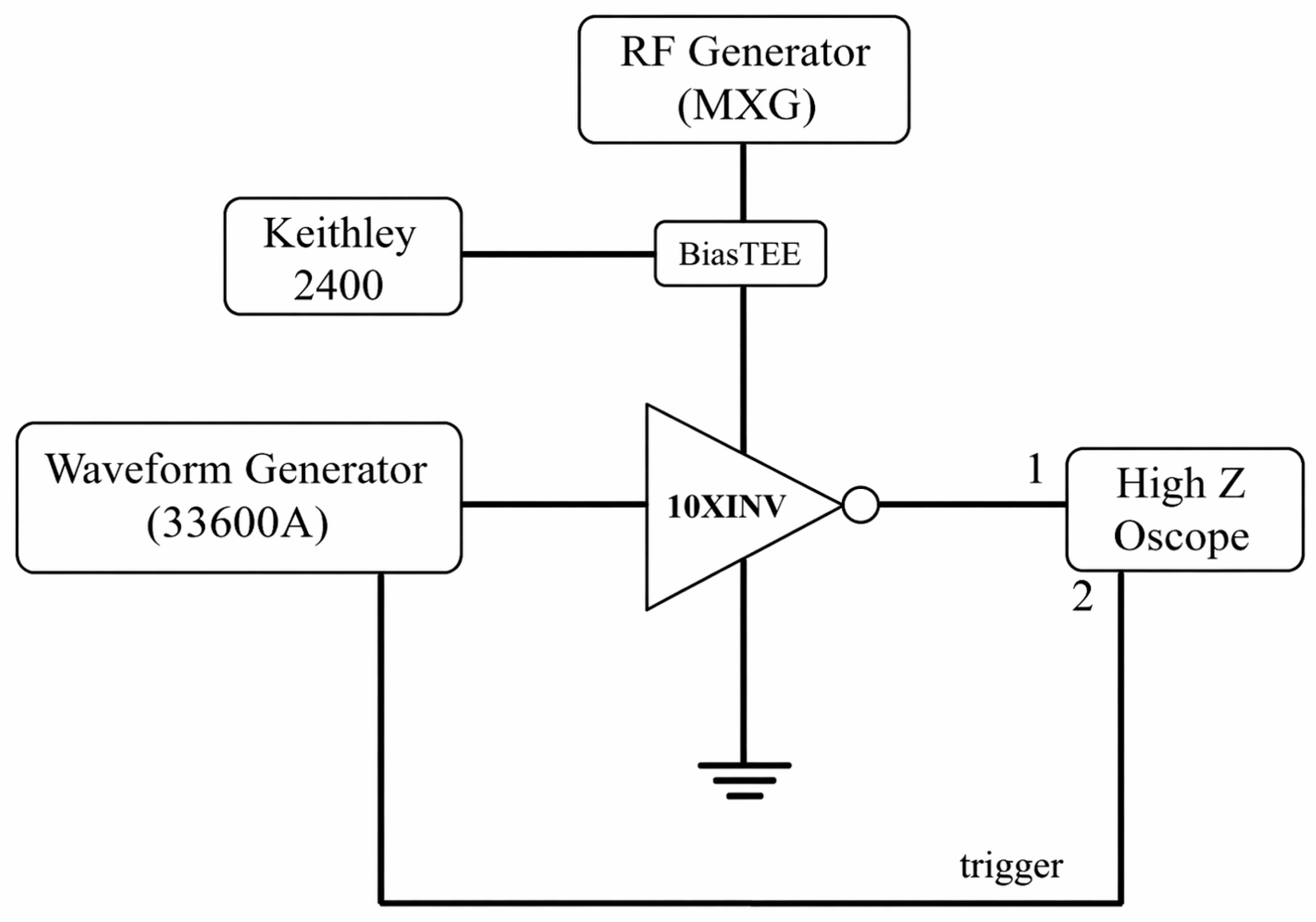
Figure 2.
Measured eye diagrams of the CMOS inverter output under increasing RF injection power: (a) no injection, showing a wide and open eye; (b) dBm, where initial amplitude fluctuations appear; (c) dBm, showing increased spreading of the logic-high level; (d) dBm, where significant eye closure occurs. The results demonstrate that EMI-induced degradation is dominated by amplitude variation in the logic-high state, while the logic-low level remains relatively stable.
Figure 2.
Measured eye diagrams of the CMOS inverter output under increasing RF injection power: (a) no injection, showing a wide and open eye; (b) dBm, where initial amplitude fluctuations appear; (c) dBm, showing increased spreading of the logic-high level; (d) dBm, where significant eye closure occurs. The results demonstrate that EMI-induced degradation is dominated by amplitude variation in the logic-high state, while the logic-low level remains relatively stable.
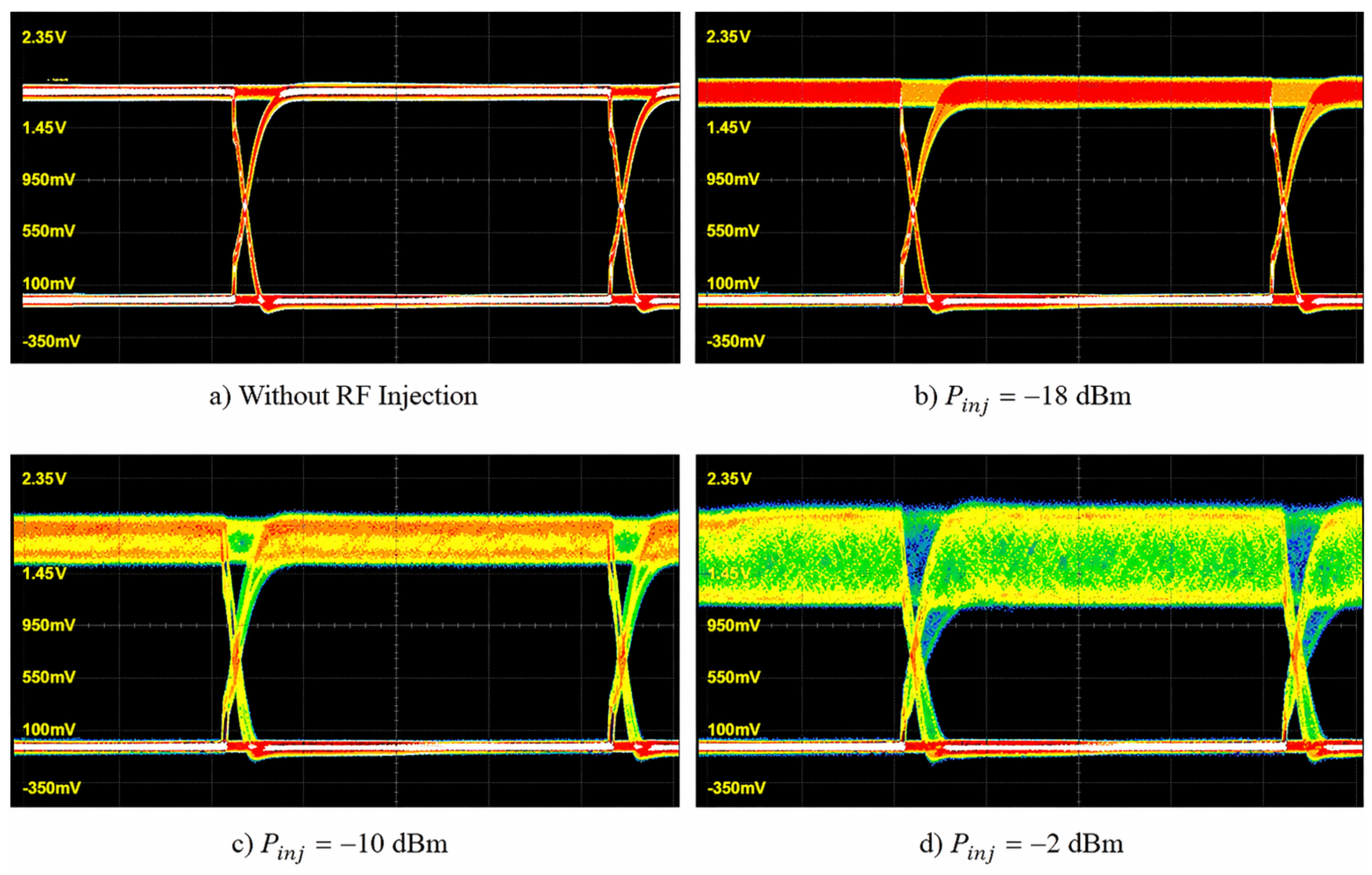
Figure 3.
Time-domain output waveforms of the CMOS inverter under different RF injection levels: (a) no injection, (b) dBm, (c) dBm, and (d) dBm. Increasing RF power introduces visible amplitude modulation in the output signal, particularly during the logic-high state. The asynchronous nature of the RF interference results in a broadening of the voltage distribution, which manifests as eye diagram closure.
Figure 3.
Time-domain output waveforms of the CMOS inverter under different RF injection levels: (a) no injection, (b) dBm, (c) dBm, and (d) dBm. Increasing RF power introduces visible amplitude modulation in the output signal, particularly during the logic-high state. The asynchronous nature of the RF interference results in a broadening of the voltage distribution, which manifests as eye diagram closure.
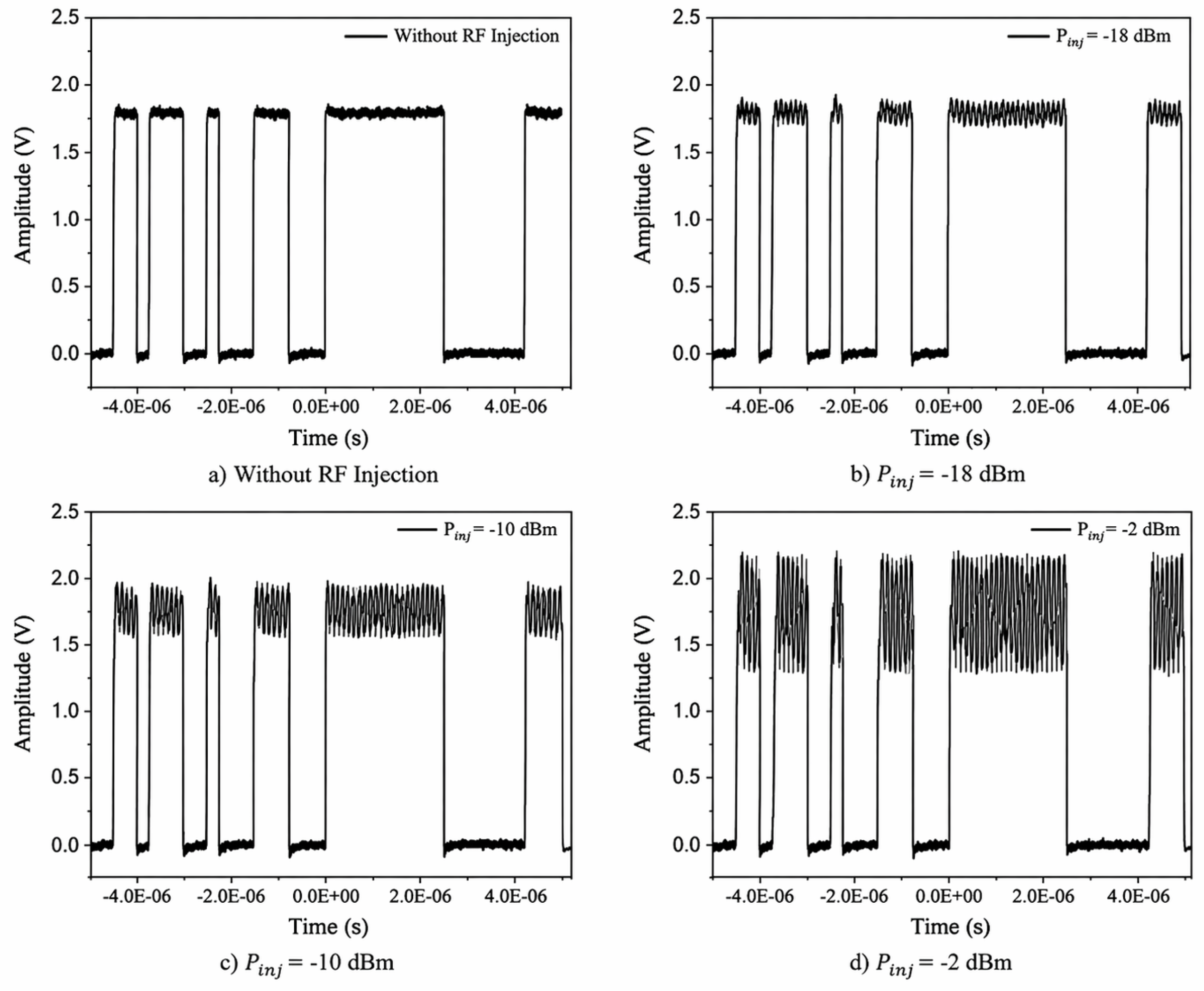
Figure 4.
Measured eye height as a function of RF injection power for 65 nm, 130 nm, and 180 nm CMOS technologies. A monotonic decrease in eye height is observed with increasing RF power, indicating progressive degradation in signal integrity. The 180 nm technology exhibits the highest sensitivity to EMI, suggesting stronger coupling of supply-induced disturbances.
Figure 4.
Measured eye height as a function of RF injection power for 65 nm, 130 nm, and 180 nm CMOS technologies. A monotonic decrease in eye height is observed with increasing RF power, indicating progressive degradation in signal integrity. The 180 nm technology exhibits the highest sensitivity to EMI, suggesting stronger coupling of supply-induced disturbances.
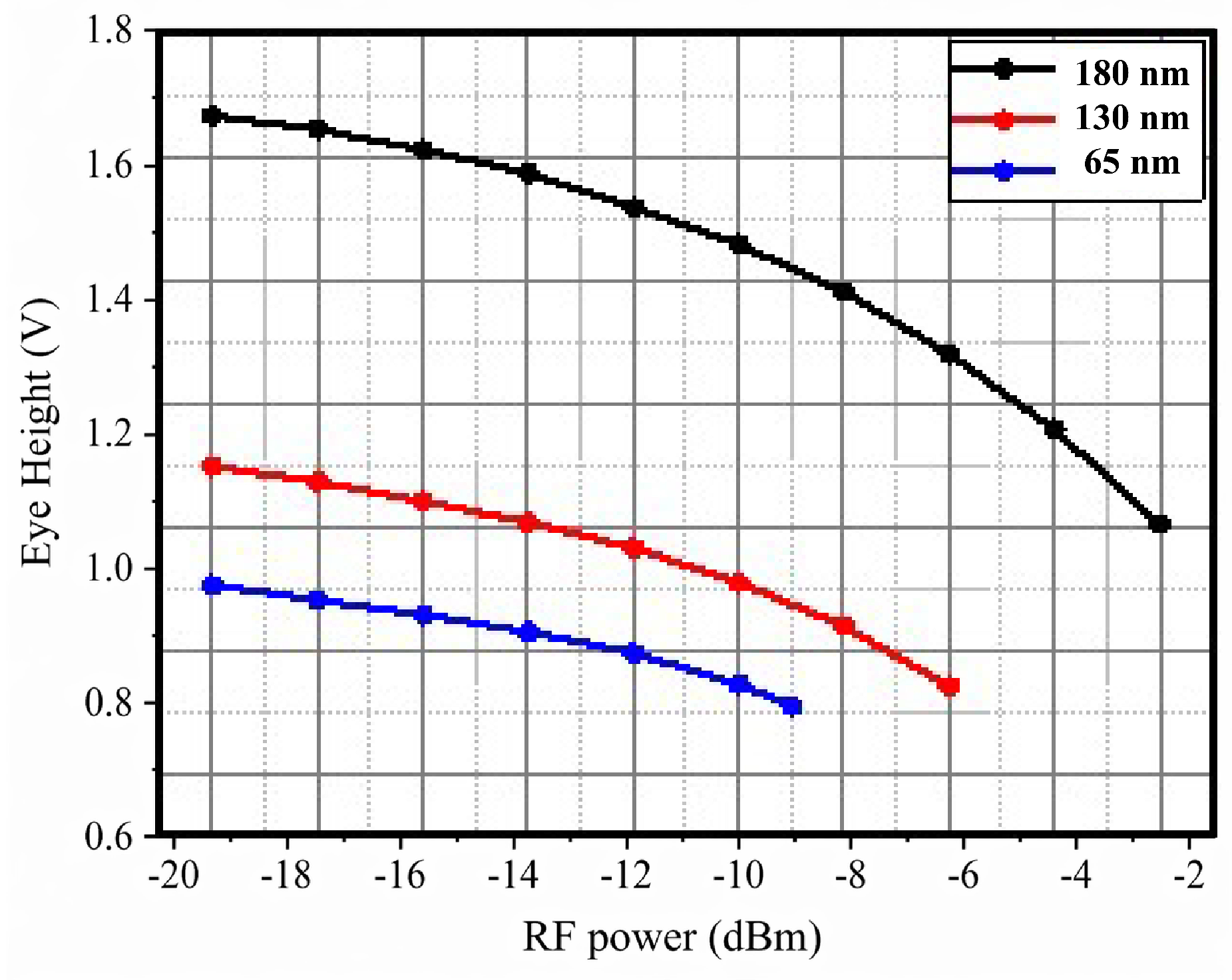
Figure 5.
Measured signal-to-noise ratio (SNR) as a function of RF injection power for 65 nm, 130 nm, and 180 nm CMOS technologies. A consistent reduction in SNR is observed with increasing RF power, confirming that EMI introduces significant amplitude noise. The trend closely follows the behavior of eye height degradation, reinforcing that amplitude fluctuations are the dominant mechanism.
Figure 5.
Measured signal-to-noise ratio (SNR) as a function of RF injection power for 65 nm, 130 nm, and 180 nm CMOS technologies. A consistent reduction in SNR is observed with increasing RF power, confirming that EMI introduces significant amplitude noise. The trend closely follows the behavior of eye height degradation, reinforcing that amplitude fluctuations are the dominant mechanism.
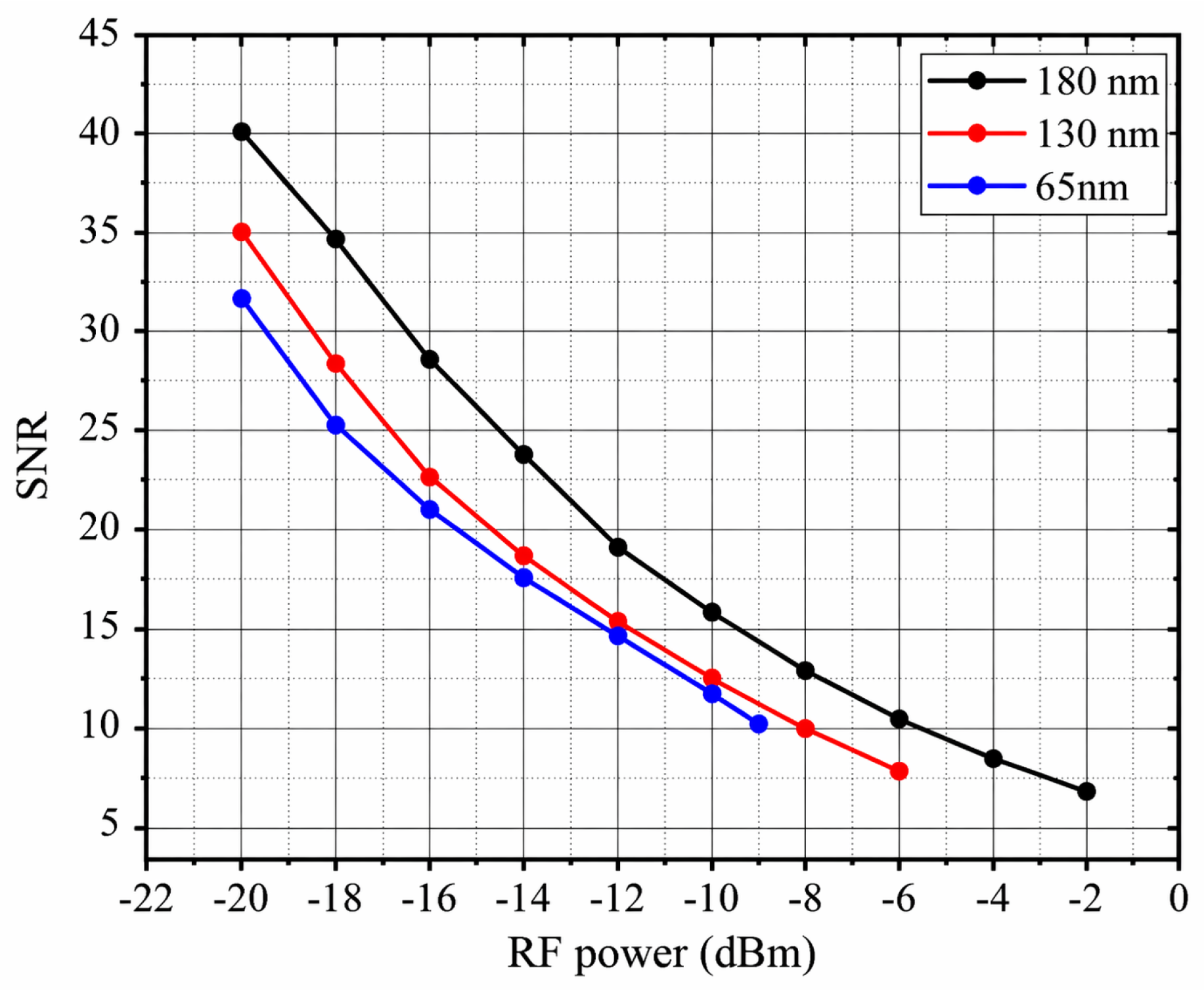
Figure 6.
Comparison between analytically predicted and experimentally measured eye height as a function of RF injection power for different CMOS technology nodes. The model accurately captures both the trend and magnitude of degradation, validating the assumption that EMI-induced signal degradation is primarily governed by amplitude modulation of the logic-high level.
Figure 6.
Comparison between analytically predicted and experimentally measured eye height as a function of RF injection power for different CMOS technology nodes. The model accurately captures both the trend and magnitude of degradation, validating the assumption that EMI-induced signal degradation is primarily governed by amplitude modulation of the logic-high level.
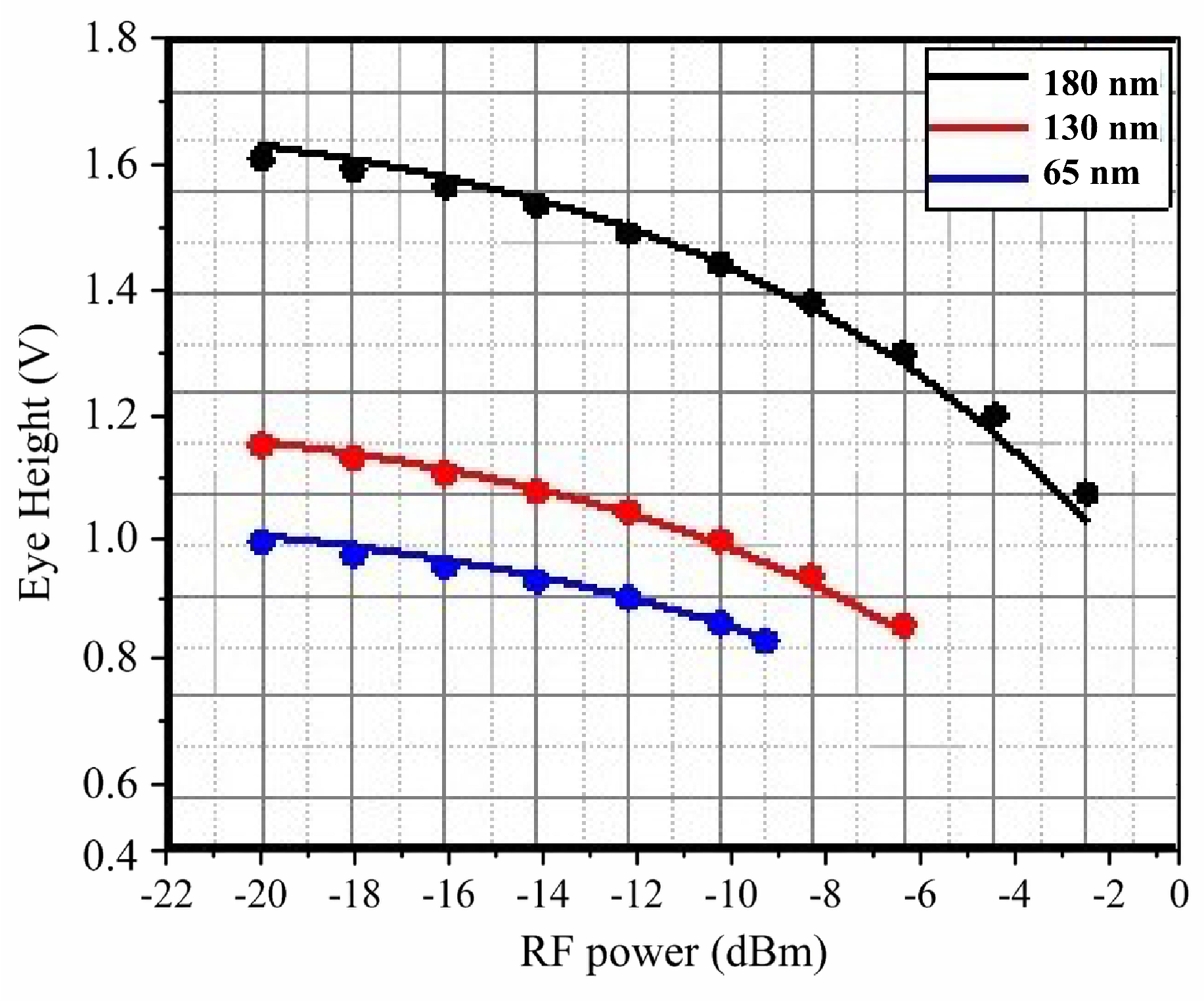

Table 1.
Transistor parameters n and voltage difference for different technology nodes.
| Technology Node | (V) | n |
|---|---|---|
| 65 nm | 1.0 | 1.6 |
| 130 nm | 1.2 | 1.4 |
| 180 nm | 1.8 | 1.2 |
Disclaimer/Publisher’s Note: The statements, opinions and data contained in all publications are solely those of the individual author(s) and contributor(s) and not of MDPI and/or the editor(s). MDPI and/or the editor(s) disclaim responsibility for any injury to people or property resulting from any ideas, methods, instructions or products referred to in the content. |
© 2026 by the authors. Licensee MDPI, Basel, Switzerland. This article is an open access article distributed under the terms and conditions of the Creative Commons Attribution (CC BY) license (http://creativecommons.org/licenses/by/4.0/).
Copyright: This open access article is published under a Creative Commons CC BY 4.0 license, which permit the free download, distribution, and reuse, provided that the author and preprint are cited in any reuse.


