

Submitted:
27 May 2026
Posted:
29 May 2026
You are already at the latest version
Abstract
Three biodiversity knowledge gaps, known as the Linnaean, Wallacean, and Darwinian shortfalls, limit our ability to model biodiversity, assess extinction risk, and understand evolutionary patterns. These shortfalls are particularly severe for insects, which remain comparatively overlooked in science and conservation relative to plants and vertebrates. Here, we investigated the patterns of these knowledge gaps for 3,567 Brazilian butterfly species. Our models suggest that Brazilian butterfly diversity may reach approximately 4,200 species, indicating that more than 600 species likely remain undescribed and that, at current description rates, documenting this diversity could take several decades. Spatial analyses showed high bias in occurrence records, with large portions of the country lacking occurrence records and most sampled communities with low sampling completeness. Model predictions revealed high estimated richness in the south-eastern Atlantic Forest, western Amazon Rainforest, and parts of the Cerrado. In addition, more than half of all species lack publicly available genetic data, potentially limiting their inclusion in phylogenetic studies. Our results reveal that substantial knowledge gaps persist even for one of the most intensively studied insect groups and highlight key priorities for future taxonomic, sampling, and molecular efforts aimed at improving our understanding and conservation of Brazilian butterfly diversity.
Keywords:
Brazil
; Darwinian shortfall
; knowledge gaps
; Lepidoptera
; Linnean shortfall
; Wallacean shortfall
1. Introduction
Biodiversity is being lost at rates 100–1000× greater than background extinction rates, as estimated from the fossil record [1,2]. Severe population declines and extinctions are mostly concentrated in tropical regions [3,4,5,6], which harbour numerous biodiversity hotspots [7]. To halt the current biodiversity crisis, detailed species-level information on distribution, functional traits, and evolution is fundamental to the implementation of effective conservation actions, as it underpins risk assessments, the identification of conservation priorities, and the design of protected areas [8,9,10]. Nevertheless, the accumulation of biological knowledge is subject to geographical and socioeconomic biases, with predominance of data from temperate and wealthier regions [11,12,13]. Furthermore, research and conservation initiatives are often focused on a select group of organisms considered to be more charismatic, such as birds and mammals [14,15]. These biases risk neglecting species that are equally important to the dynamics of natural ecosystems, especially in areas with high biodiversity and limited conservation funding.
Invertebrates dominate Earth’s ecosystems [16,17] and, among them, insects represent the most diverse group with approximately one million catalogued species [16] and millions more ‘awaiting’ description [18,19]. Despite their ecological and socioeconomic importance through the provision of several ecosystem services, such as pollination, biological control, and nutrient recycling [5,20,21], insects remain relatively understudied and are often neglected in conservation programs compared to plants and vertebrates [11,14,22,23]. Therefore, knowledge gaps are even more pronounced for this group, encompassing molecular, taxonomic, and functional information, and thus limiting our understanding of their roles in ecosystems [24]. These shortfalls also impair our ability to assess their responses to global change and the potential impacts of species extirpations, especially in a megadiverse region like the tropics [25].
Conservation science is currently cruising the era of big data, where the quality and scope of the underlying biodiversity information collected require constant evaluation [26]. For instance, several biodiversity knowledge shortfalls have been identified [27]. Among these, the Linnean shortfall [the discrepancy between described and undescribed species, as well as our limited knowledge of species taxonomy, [28]] is considered the most important one, as the reduction of the other shortfalls often depends on it [27,29]. Other significant shortfalls include our lack of knowledge of species distributions [the Wallacean shortfall, [30]] as well as uncertainties about phylogenetic relationships among species [the Darwinian shortfall, [31]]. These shortfalls and their interplay hinder the implementation of effective conservation actions [27,29,32], which relies on accurate taxonomic lists and distributional data [33,34,35]. Likewise, they limit the use of phylogenetic diversity metrics in conservation planning [36,37], which is important for achieving Sustainable Development Goals that guarantee the maintenance of genetic diversity, crucial for adapting to climate change and preventing extinctions [38,39].
In this study, we sought to quantify the magnitude of the Linnean, Wallacean and Darwinian shortfalls for Brazilian butterflies. This taxonomic group comprises over 3,500 species in the country, and it often garners high interest due to its charisma [40], unique ecological features [41], and economic and cultural significance [42]. Butterflies are also frequently used as model organisms in diverse biodiversity studies [43,44], thereby increasing the body of knowledge about them. By identifying and quantifying what we do not know of biodiversity [“known unknowns”, [45]], we can establish a research agenda that will better direct sampling and research efforts. This, in turn, will optimize financial resources and efficiently fill the existing knowledge gaps. This issue is of particular concern given the alarming declines in insect populations worldwide, particularly in the tropics [46,47,48,49,50].
2. Materials and Methods
1.1. Taxonomic Data
We used as our focal taxa 3,567 butterfly species listed in the Taxonomic Catalogue of the Fauna of Brazil (TCFB) ver. 1.23 [51], which also includes non-native species occurring in the country, such as Hypolimnas misippus from the Paleotropics, which naturally colonized the Caribbean region and now has established populations in northern Brazil (https://www.nic.funet.fi/index/Tree_of_life/insecta/lepidoptera/ditrysia/papilionoidea/nymphalidae/nymphalinae/hypolimnas/). The dynamic nature of taxonomic studies leads to changes in species names over time, e.g., [52,53]. To account for such changes when computing some proxies for the three shortfalls analysed here (see below), we compiled unique names and subspecies associated with each butterfly species, using data from the TCFB and the Catalogue of Life (CoL) Checklist ver. 2024.11. Unique names correspond to a single valid species, whereas ambiguous names are linked to multiple valid species.
To describe temporal patterns in species descriptions, we fitted several models (linear, generalized additive model [GAM], second-order [quadratic] and third-order [cubic] polynomial regressions, and piecewise regression) to the annual number of species described as a function of year of description. We selected the best-fitting model using the Akaike Information Criterion corrected for small sample sizes [AICc; [54]] and used it to visualize and describe the data. In addition, we calculated mean annual species description rates for the entire study period and for each decade.
1.2. Linnean Shortfall
To comprehend the magnitude of the Linnean shortfall, we estimated the number of undescribed butterfly species in Brazil using non-linear models based on species discovery curves derived from description dates (obtained from authority information available in the TCFB). These models consider taxonomic effort by incorporating the number of taxonomists involved in species description per time interval. The basic negative exponential model (ΔSt = k (Stot − St)) assumes three distinct parameters: ΔSt is the number of species described per time interval, Stot is the total number of species (described + undescribed), St is the cumulative number of species descriptions, and k represents a description efficiency parameter. When k is given as a function of time (k = Tt (a + bt)), where a and b are regression coefficients and T is the number of taxonomists who described species of the group per time interval, we have Joppa et al.’ model [55]. However, if k is given as a function of the number of species described per time interval (k = Tt (a + bΔSt)), we have Lu and He’s model [56]. Additionally, we fitted the logistic model using the gnls function from the nlme R package [57]. The residual variance was fitted as a power function of residual mean to account for over- or underdispersion. Models were ranked by Akaike Information Criterion (AICc), with the relative adequacy of each one evaluated by AICc weights (wAICc). Our analyses were conducted with data lumped in 5-year time intervals as proposed in the original code of Lu and He (2017) [56].
To estimate the spatial distribution of butterfly species richness in Brazil, we used geostatistical interpolation methods [58,59,60], which take advantage of the spatial autocorrelation in geographical data, including species richness and its association with environmental variables [61]. Specifically, we used a regression-kriging (R-K) model to create continuous maps of species richness, which requires a subsample of data that are spatially autocorrelated and covary with other factors (e.g., environmental variables) throughout a target region [62]. For constructing this model, we first created a grid system over Brazil using a grid size of 1° resolution (≈ 110 × 110 km), which is considered adequate for macroecological analysis [63].
To run the R-K model, we first selected the well-sampled cells to compute the semi-variogram (see treatment of occurrence data in section 2.3). For such, we used a species accumulation curve fitted with a Clench function to describe the association between species richness and sampling effort (i.e., the number of occurrences) for each cell [64], where each occurrence record was considered as an independent sample [65]. From this procedure, we selected the well-sampled cells as those with completeness >70% (i.e., the percentage of species richness estimated by the empirical function of species accumulation) and a minimum number of 50 records [66]. We ran these analyses with the R package KnowBR [64].
Several studies have demonstrated the important role of topography and climatic factors on the structure of butterfly communities, e.g., [67,68,69]. We used the 19 bioclimatic variables and elevation data available in WorldClim 2.0 database [[70]; downloaded at a 10 arc-minutes resolution] to characterize the environmental conditions of Brazil. These variables were downloaded in a worldwide extension and then clipped to the limit of the study area. Subsequently, we use the extract function from the terra R package [71] to obtain average environmental values per grid. After keeping only well-sampled grids (n = 28), we checked for multicollinearity among predictor variables and retained only those variables that had a Variation Inflation Value < 5 [72]. We then used a model-selection approach to identify the subset of variables that best explained butterfly species richness in better-known cells. For such, we fitted two generalized linear models: one with a Gaussian error distribution and another with a Negative Binomial error distribution. We selected the model with the best fit based on the Akaike Information Criterion corrected for small sample sizes [54]. Finally, we performed R-K to recover the geographical gradient of butterfly species richness. We performed this analysis in the R environment [73] using the packages automap [74] and gstat [75].
It is important to emphasize that estimates of total species richness are dependent on the methods used for inference, which can produce highly variable results [see [76]]. In particular, estimates based on temporal trends in species descriptions are often associated with substantial uncertainty, especially for poorly studied taxonomic groups [77]. Some authors even argue that the many uncertainties surrounding the species discovery process make the extrapolation of species accumulation curves inherently unreliable for estimating total species richness [78,79]. Nevertheless, establishing a baseline estimate remains valuable for communicating biodiversity challenges to the general public and policymakers, as well as for illustrating the scale of the taxonomic work still ahead. Regardless of these uncertainties, one conclusion remains clear: if we aim to uncover Earth’s hidden diversity—and its potential ecological, evolutionary, and societal value—before it is lost through ignorance, we will still need substantially greater investment in taxonomic research and field exploration, or, in Edward O. Wilson’s words, “more boots on the ground” [80].
1.3. Wallacean Shortfall
To estimate the lack of information on Brazilian butterflies’ geographic distribution, we downloaded on December 09, 2025 all available lepidopteran occurrence records from Brazil on both GBIF (98,015 records; https://doi.org/10.15468/dl.jdu6xr) and speciesLink (69,607 records) databases. We then retained only those with geographic coordinates and no suspicious flags (i.e., potentially erroneous records) and removed data for human observations (e.g., iNaturalist data). Additionally, we applied data cleaning procedures, such as removing duplicates (i.e., same specimen and locality for a given species) and records on country centroids using the CoordinateCleaner R package [81], yielding a total of 64,307 cleaned records in GBIF and 38,577 in speciesLink. We then combined this data and, after removing duplicates and records without species-level identification (e.g., Cissia sp.), we had a total of 93,017 records of Brazilian butterflies. We used this data to obtain summary statistics per taxa as well as sampling completeness (coverage) metrics [82] for each spatial unit, defined as grid cells of 1° resolution.
1.4. Darwinian Shortfall
Information on genetic diversity is fundamental for adequate evaluation of global diversity patterns [83] and, nowadays, molecular data have central roles in the reconstruction of phylogenetic relationships between species [84]. As a proxy of the absence of knowledge on the evolutionary relationship between species, we evaluated the availability of publicly accessible gene sequences from the Barcode of Life Data System (BOLD) and GenBank (NCBI) for each Brazilian butterfly species. Searches were performed between 27 November and 03 December 2025, using the current accepted species names plus all their unique synonyms and subspecies. To retrieve the number of DNA sequences available for each name (regardless of the genes available or sequence size), we used the entrez_search function from the rentrez package [85] and the bold_seq function from the bold package [86]. This data was then summarized per taxa and explored graphically using the ggplot2 package [87]. Note that we assumed that any species with available genetic data can be placed in the tree of life, regardless of the number of sequences or the loci sampled. We recognize that this assumption may introduce some bias, since not all DNA sequences are typically used for phylogenetic inference. However, even species with few available sequences are usually those for which genetic data were generated for barcoding or to establish their phylogenetic position. In contrast, species that have non-phylogenetic sequence data may also have sequences from loci commonly used in phylogenetic studies. All analyses were performed using R version 4.5.1 [73]. See the Data Availability section for raw data and R-code.
3. Results
Most of the 3,567 butterfly species currently recognized in the Taxonomic Catalogue of the Fauna of Brazil belong to the family Hesperiidae (n = 1,243; 34.8%), followed by Nymphalidae (n = 874; 24.5%), Riodinidae (n = 862; 24.2%), Lycaenidae (n = 426; 11.9%), Pieridae (n = 72; 2.4%), Papilionidae (n = 67; 1.8%), and Hedylidae (n = 23; 0.6%). The annual number of species descriptions shows a non-linear temporal pattern (Figure 1; GAM: F = 4.8, p < 0.001). Following an initial peak associated with the establishment of formal taxonomy in 1758, the rate of species descriptions declined, then increased rapidly from approximately 1825 to 1870. The highest number of valid species descriptions occurred in 1867, with 197 species still considered valid today. After this peak, description rates declined and stabilized from the early 1900s onward (Figure 1).
Across the period from 1758 to 2023, the mean description rate was 13.4 species per year. However, decadal rates varied widely, ranging from 2 species per year in the 1760s to 64.8 species per year in the 1860s (median = 10.7; mean = 13.4; s.d. = 13.1), with a gradual decline evident since the 1870s (Supplementary Figure S1). The cumulative number of species descriptions suggests that the curve is approaching an asymptote (Figure 2), and about half of the species currently known were described before the beginning of the 20th century. Among the models evaluated, Lu and He’s model [56] provided the best fit to the cumulative species description curve (Figure 2; Table 1). This model estimates a total of 4,196 butterfly species in Brazil (95% confidence interval: 3,773–4,619), indicating that roughly 630 species remain undescribed (range: 206–1,052) (Table 1). Considering an average annual description rate of ~11 species per year (Figure 1 and Supplementary Figure S1), it would take nearly six decades to describe the remaining Brazilian butterfly species if the rate of new species descriptions remains relatively constant.
We compiled 74,080 unique butterfly occurrence records for Brazil. Substantial knowledge gaps in species richness (Linnean) and distribution (Wallacean) data were evident across the country (Figure 3). A large proportion of grid cells (426 out of 807; 52.8%) lacked any records (Figure 3a), and among cells with records, data availability was highly uneven (range: 1–12,458 records; mean = 194; median = 12). Species richness was also highly variable across communities (range: 1–1,333; mean = 43.5; median = 7). Moreover, only 28 grid cells met the criteria for adequate inventory efficiency, defined as sampling completeness above 70% and at least 50 records (Figure 3b). Likewise, most taxa with available distribution data had records from less than seven unique localities (range: 1–232; mean = 8.1; median = 2; Supplementary Figure S2).
After assessing multicollinearity among the 20 environmental variables, six were retained for subsequent kriging analyses: mean diurnal range, mean temperature of the wettest quarter, annual precipitation, precipitation seasonality, precipitation of the warmest quarter, and elevation. The generalised linear model that best explained variation in species richness across grids were the Negative Binomial model, which selected three variables for subsequent kriging regression, namely mean diurnal range, mean temperature of the wettest quarter, and precipitation of the warmest quarter. The variogram that best described the spatial pattern of species richness among better-sampled cells was a Gaussian model without a nugget effect, with a partial sill (psill) of 33,710 and a range of 374,020. Regression kriging of butterfly species richness revealed a clear spatial gradient, with higher estimated diversity along the coastal Atlantic Forest, particularly in south-eastern Brazil and parts of the southern and north-eastern region, and in the western Amazon rainforest. The lowest richness was predicted for drier regions associated with the Diagonal of Open Formations, encompassing most of the Cerrado and Caatinga biomes, except for some parts of the Cerrado (Figure 3c–d).
Across all butterfly species occurring in Brazil, 1,534 species (43.0%) have at least one DNA sequence available in GenBank, whereas only 61 species (1.7%) are represented in the BOLD database. When both databases are considered jointly, a total of 1,544 species (43.3%) have at least one sequence available in either GenBank or BOLD. Sequence availability varies markedly among families and genera (Figure 4; Supplementary Figure S3). Nymphalidae comprises the largest number of species with available sequences (n = 628; 71.9%), followed by Papilionidae (n = 40; 59.7%), Pieridae (n = 38; 52.8%), Hesperiidae (n = 475; 38.2%), Hedylidae (n = 8; 34.8%), Lycaenidae (n = 134; 31.5%), and Riodinidae (n = 221; 21.6%). As expected, species richness correlates positively with the total number of available sequences across taxa (Figure 4; Supplementary Figure S3). The average number of sequences per species showed significant positive correlations with species richness only for the GenBank data at the family level (Figure 4), but not across genera (Supplementary Figure S3).
4. Discussion
With more than 3,500 catalogued butterfly species, Brazil stands out as one of the richest countries in the world in butterfly diversity [88]. Yet, our results show that even for this relatively charismatic insect group, e.g., [89], significant shortfalls remain in our understanding of their taxonomy, distribution, and evolution. Our models estimate that more than 600 species remain to be described and that, at the current rate of species descriptions, documenting this diversity would require roughly six decades of sustained taxonomic effort. In addition, many areas of the country lack butterfly occurrence records, and most sampled communities exhibit low sampling completeness [66]. Finally, over half of all Brazilian butterfly species lack any genetic information in publicly, e.g., available repositories, which may hinder their inclusion in phylogenetic reconstructions.
Most Brazilian butterfly species were described in the mid-1800s, with the rate of descriptions declining and stabilizing from the early 1900s onward (Figure 1). It is worth noting, however, that the date of description of many species published before the 1900s remains uncertain—e.g., Nyctelius nyctelius (Latreille, [1824]), Anteos clorinde (Godart, [1824]), Phoebis neocypris (Hübner, [1823]). In several cases, species descriptions were later compiled into tomes, e.g., [90,91], even though the original descriptions had appeared earlier in separate instalments. As a result, the final publication date of the volume does not necessarily correspond to the actual year in which the species was described, making it difficult and labour-intensive to determine the precise date, e.g., [92,93]. Nevertheless, the broad macroecological patterns reported here are likely robust despite these uncertainties. While some dates may be approximate, the inferred year of description is unlikely to differ substantially from the actual year, thus not affecting the overall temporal trends we identify.
Current annual description rates, coupled with our projection of ~4,200 butterfly species in Brazil, suggest that the discovery of new butterfly species in the country may be approaching a plateau, or at least a slower accumulation rate. This pattern contrasts with that of other invertebrate groups. For instance, a similar number of spider species are currently known from Brazil, yet projections of their total species richness are much higher [~19,000 species, [94]]. Such differences may reflect the greater societal and scientific interest in butterflies compared with other invertebrates [12,89,95,96]. Indeed, butterflies are among the most intensively and systematically studied insect groups across diverse fields, including biodiversity monitoring, phylogenetics, climate change research, and conservation, e.g., [97,98,99,100,101], although coverage remains uneven across regions and taxa, e.g., [102]. As a result, the number of researchers working on butterflies may be relatively higher than for many other invertebrate groups, including taxonomists. This potentially improves the overall state of alpha taxonomy for the group. Yet, taxonomic effort and expertise are declining for most taxa [103,104,105], so this possibility still requires further investigation.
Our spatial predictions of butterfly species richness revealed higher estimated diversity along the south-eastern coastal Atlantic Forest, in the western Amazon Rainforest, and in parts of the Cerrado (Figure 3). Interestingly, the observed patterns closely resemble those reported in macroecological analyses with specific butterfly clades or those derived from faunistic inventories across the country, e.g., [106,107,108,109,110]. This correspondence suggests that, despite the limitations inherent to interpolation methods [62], such as their sensitivity to the spatial distribution of samples and the adequacy of sampling effort [60], these approaches can still provide valuable insights for addressing knowledge gaps about species distributions and large-scale biodiversity gradients [60,111,112]. Such information is particularly important because understanding the spatial distribution and composition of biological communities is fundamental for designing effective conservation strategies [113,114]. Finally, most records are concentrated in southern and south-eastern Brazil, highlighting how logistics and accessibility shape the distribution of sampling effort [66,115]. Addressing these geographic biases will require substantial fieldwork, particularly in under sampled regions that may harbour high species diversity.
During the last decades, phylogenetics has advanced considerably, including the development of methods that allow the sequencing of even old museum specimens [116,117]. However, more than half of all Brazilian butterflies still lack genetic information, and this proportion may be even higher if only phylogenetically informative sequence data are considered, as reported for other animals and plants [118,119]. Ideally, future sequencing efforts should prioritize neglected taxa such as Riodinidae, Lycaenidae, Hedylidae, and Hesperiidae, all of which have genetic sequences available for fewer than 50% of their species. In contrast, Nymphalidae—the world’s most species-rich butterfly family [120]—has genetic data available for more than 70% of its Brazilian species (Supplementary Figure S4). Members of this family, such as those in the genus Heliconius, are also among the most widely used insect model systems worldwide [121,122]. In the current scientific landscape, molecular data play a central role in the inference and reconstruction of phylogenies [84]. Consequently, the lack of genetic data may limit the inclusion of many species in these analyses, hindering a more comprehensive understanding of their evolutionary history. This is particularly important because evolutionary processes shape biodiversity patterns across multiple spatial and temporal scales, making comparative approaches essential for detecting evolutionary signals underlying these patterns [123,124]. Moreover, conservation planning now increasingly incorporates evolutionary information [36], meaning that incomplete phylogenies may also constrain the development of more robust and informed conservation strategies.
5. Conclusions
Our results provide a comprehensive overview of the current state of knowledge concerning Brazilian butterflies. These animals remain among the best-studied insect groups, as reflected by the slower accumulation of new species descriptions in recent years. However, we still identified substantial gaps in sampling coverage, genetic data availability, and regional inventories, highlighting persistent shortfalls in taxonomy, distribution, and evolutionary data. Addressing these gaps will require extensive fieldwork in undersampled regions, as well as targeted molecular studies aimed at improving the taxonomic and evolutionary knowledge of neglected taxa. The Linnean shortfall is widely regarded as the most critical biodiversity shortfall because unknown taxa and taxonomic uncertainties directly affect our ability to overcome other knowledge gaps and better understand biodiversity patterns [27,125]. However, insufficient sampling coverage and a shortage of basic genetic information continue to delay progress in reducing this shortfall, even for comparatively well-studied organisms such as butterflies.
Finally, we emphasize the importance of initiatives aimed at improving the mobilization and accessibility of biodiversity data [126], particularly those derived from scientific collections [127]. Despite important advances in data mobilization, platforms such as GBIF and other biodiversity repositories still suffer from taxonomic, geographic, and sampling biases, which can influence biodiversity analyses and ecological models [128,129]. Expanding the availability, digitization, and quality of biodiversity data will therefore be essential for refining biodiversity assessments, improving the accuracy of ecological inferences, and more effectively directing future research and conservation efforts toward priority regions. By identifying where knowledge remains limited or incipient, our study provides a framework to guide future research priorities and support more informed strategies for understanding and conserving Brazil’s remarkable butterfly diversity.
Supplementary Materials
The following supporting information can be downloaded at the website of this paper posted on Preprints.org.
Author Contributions
Conceptualization, J.J.M.G., J.P.S., and A.V.L.V.; methodology, J.J.M.G.; formal analysis, J.J.M.G.; data curation, J.J.M.G.; writing—original draft preparation, J.J.M.G.; writing—review and editing, J.J.M.G., J.P.S., and A.V.L.V.; supervision, A.V.L.V. All authors have read and agreed to the published version of the manuscript.
Funding
This study was financed, in part, by the São Paulo Research Foundation (FAPESP), Brazil (proc. 2024/18469-0), as a post-doctoral scholarship provided to JJMG. JPS thanks the Conselho Nacional de Desenvolvimento Científico e Tecnológico (CNPq, proc. 153821/2025-6). AVLF thanks the CNPq (grants 304291/2020-0 and 408764/2024-4) and FAPESP (grants 2021/03868-8 and 2023/04393-9).
Data Availability Statement
The raw data and R codes used in this study will be made freely available after potential acceptance of this work. Meanwhile, reviewers can download all files at the following link: https://figshare.com/s/3cd657a62b65d26f5908.
Acknowledgments
This study was financed, in part, by the São Paulo Research Foundation (FAPESP), Brazil (proc. 2024/18469-0), as a post-doctoral scholarship provided to JJMG. JPS thanks the Conselho Nacional de Desenvolvimento Científico e Tecnológico (CNPq, proc. 153821/2025-6). AVLF thanks the CNPq (grants 304291/2020-0 and 408764/2024-4) and FAPESP (grants 2021/03868-8 and 2023/04393-9).
Conflicts of Interest
The authors declare no conflicts of interest.
References
- Pimm, S.L.; Jenkins, C.N.; Abell, R.; Brooks, T.M.; Gittleman, J.L.; Joppa, L.N.; Raven, P.H.; Roberts, C.M.; Sexton, J.O. The Biodiversity of Species and Their Rates of Extinction, Distribution, and Protection. Science (80-. ) . 2014, 344. [Google Scholar] [CrossRef]
- Lamkin, M.; Miller, A.I. On the Challenge of Comparing Contemporary and Deep-Time Biological-Extinction Rates. Bioscience 2016, 66, 785–789. [Google Scholar] [CrossRef]
- Pimm, S.L.; Raven, P. Extinction by Numbers. Nature 2000, 403, 843–845. [Google Scholar] [CrossRef] [PubMed]
- Ricketts, T.H.; Dinerstein, E.; Boucher, T.; Brooks, T.M.; Butchart, S.H.M.; Hoffmann, M.; Lamoreux, J.F.; Morrison, J.; Parr, M.; Pilgrim, J.D.; et al. Pinpointing and Preventing Imminent Extinctions. Proc. Natl. Acad. Sci. 2005, 102, 18497–18501. [Google Scholar] [CrossRef]
- Goulson, D. The Insect Apocalypse, and Why It Matters. Curr. Biol. 2019, 29, R942–R995. [Google Scholar] [CrossRef]
- Finn, C.; Grattarola, F.; Pincheira-Donoso, D. More Losers than Winners: Investigating Anthropocene Defaunation through the Diversity of Population Trends. Biol. Rev. 2023, 98, 1732–1748. [Google Scholar] [CrossRef]
- Myers, N.; Mittermeier, R.A.; Mittermeier, C.G.; Fonseca, G.A.B.; Kent, J. Biodiversity Hotspots for Conservation Priorities. Nature 2000, 403, 853–858. [Google Scholar] [CrossRef]
- Miatta, M.; Bates, A.E.; Snelgrove, P.V.R. Incorporating Biological Traits into Conservation Strategies. Ann. Rev. Mar. Sci. 2021, 13, 421–443. [Google Scholar] [CrossRef]
- Gallagher, R. V.; Butt, N.; Carthey, A.J.R.; Tulloch, A.; Bland, L.; Clulow, S.; Newsome, T.; Dudaniec, R.Y.; Adams, V.M. A Guide to Using Species Trait Data in Conservation. One Earth 2021, 4, 927–936. [Google Scholar] [CrossRef]
- Chichorro, F.; Urbano, F.; Teixeira, D.; Väre, H.; Pinto, T.; Brummitt, N.; He, X.; Hochkirch, A.; Hyvönen, J.; Kaila, L.; et al. Trait-Based Prediction of Extinction Risk across Terrestrial Taxa. Biol. Conserv. 2022, 274, 109738. [Google Scholar] [CrossRef]
- Titley, M.A.; Snaddon, J.L.; Turner, E.C. Scientific Research on Animal Biodiversity Is Systematically Biased towards Vertebrates and Temperate Regions. PLoS ONE 2017, 12, 1–14. [Google Scholar] [CrossRef] [PubMed]
- Troudet, J.; Grandcolas, P.; Blin, A.; Vignes-Lebbe, R.; Legendre, F. Taxonomic Bias in Biodiversity Data and Societal Preferences. Sci. Rep. 2017, 7, 1–14. [Google Scholar] [CrossRef]
- Hughes, A.C.; Orr, M.C.; Ma, K.; Costello, M.J.; Waller, J.; Provoost, P.; Yang, Q.; Zhu, C.; Qiao, H. Sampling Biases Shape Our View of the Natural World. Ecography (Cop.) . 2021, 44, 1259–1269. [Google Scholar] [CrossRef]
- Guénard, B.; Hughes, A.C.; Lainé, C.; Cannicci, S.; Russell, B.D.; Williams, G.A. Limited and Biased Global Conservation Funding Means Most Threatened Species Remain Unsupported. Proc. Natl. Acad. Sci. 2025, 122, e2412479122. [Google Scholar] [CrossRef]
- Seddon, P.J.; Soorae, P.S.; Launay, F. Taxonomic Bias in Reintroduction Projects. Anim. Conserv. 2005, 8, 51–58. [Google Scholar] [CrossRef]
- Bánki, O.; Roskov, Y.; Döring, M.; Ower, G.; Hernández Robles, D.R.; Plata Corredor, C.A.; Stjernegaard Jeppesen, T.; Örn, A.; Vandepitte, L.; Hobern, D.; et al. Catalogue of Life Checklist. 2024. [Google Scholar]
- Bar-On, Y.M.; Phillips, R.; Milo, R. The Biomass Distribution on Earth. Proc. Natl. Acad. Sci. 2018, 115, 6506–6511. [Google Scholar] [CrossRef]
- Li, X.; Wiens, J.J. Estimating Global Biodiversity: The Role of Cryptic Insect Species. Syst. Biol. 2023, 72, 391–403. [Google Scholar] [CrossRef]
- Stork, N.E. How Many Species of Insects and Other Terrestrial Arthropods Are There on Earth? Annu. Rev. Entomol. 2018, 63, 31–45. [Google Scholar] [CrossRef]
- Reckhaus, H.-D. Insects as Beneficials. In Why Every Fly Counts; Springer: Cham, 2019; pp. 1–51. [Google Scholar]
- Wu, D.; Du, E.; Eisenhauer, N.; Mathieu, J.; Chu, C. Global Engineering Effects of Soil Invertebrates on Ecosystem Functions. Nature 2025, 640, 120–129. [Google Scholar] [CrossRef] [PubMed]
- Mammola, S.; Adamo, M.; Antić, D.; Calevo, J.; Cancellario, T.; Cardoso, P.; Chamberlain, D.; Chialva, M.; Durucan, F.; Fontaneto, D.; et al. Drivers of Species Knowledge across the Tree of Life. Elife 2023, 12, RP88251. [Google Scholar] [CrossRef] [PubMed]
- Donaldson, M.R.; Burnett, N.J.; Braun, D.C.; Suski, C.D.; Hinch, S.G.; Cooke, S.J.; Kerr, J.T. Taxonomic Bias and International Biodiversity Conservation Research. FACETS 2017, 1, 105–113. [Google Scholar] [CrossRef]
- Duffus, N.E.; Echeverri, A.; Dempewolf, L.; Noriega, J.A.; Furumo, P.R.; Morimoto, J. The Present and Future of Insect Biodiversity Conservation in the Neotropics: Policy Gaps and Recommendations. Neotrop. Entomol. 2023, 52, 407–421. [Google Scholar] [CrossRef]
- Tilman, D.; Isbell, F.; Cowles, J.M. Biodiversity and Ecosystem Functioning. Annu. Rev. Ecol. Evol. Syst. 2014, 45, 471–493. [Google Scholar] [CrossRef]
- Runting, R.K.; Phinn, S.; Xie, Z.; Venter, O.; Watson, J.E.M. Opportunities for Big Data in Conservation and Sustainability. Nat. Commun. 2020, 11, 2003. [Google Scholar] [CrossRef]
- Hortal, J.; de Bello, F.; Diniz-Filho, J.A.F.; Lewinsohn, T.M.; Lobo, J.M.; Ladle, R.J. Seven Shortfalls That Beset Large-Scale Knowledge of Biodiversity. Annu. Rev. Ecol. Evol. Syst. 2015, 46, 523–549. [Google Scholar] [CrossRef]
- Brown, J.H.; Lomolino, M.V. Biogeography, 2nd ed.; Sinauer Press: Sunderland, MA, 1998. [Google Scholar]
- Diniz Filho, J.A.F.; Jardim, L.; Guedes, J.J.M.; Meyer, L.; Stropp, J.; Frateles, L.E.F.; Pinto, R.B.; Lohmann, L.G.; Tessarolo, G.; De Carvalho, C.J.B.; et al. Macroecological Links between the Linnean, Wallacean, and Darwinian Shortfalls. Front. Biogeogr. 2023, 15, 1–11. [Google Scholar] [CrossRef]
- Lomolino, M. V Conservation Biogeography. In Frontiers of Biogeography: New Directions in the Geography of Nature; Lomolino, M., Heaney, L., Eds.; Sinauer: Sunderland, MA, 2004; pp. 293–96. [Google Scholar]
- Diniz-Filho, J.A.F.; Loyola, R.D.; Raia, P.; Mooers, A.O.; Bini, L.M. Darwinian Shortfalls in Biodiversity Conservation. Trends Ecol. Evol. 2013, 28, 689–695. [Google Scholar] [CrossRef]
- Baranzelli, M.C.; Villalobos, F.; Cordier, J.M.; Nori, J. Knowledge Shortfalls’ Interactions Shadow Our Perception of Species’ Exposure to Human Threats. Biol. Conserv. 2023, 282, 110069. [Google Scholar] [CrossRef]
- Rondinini, C.; Wilson, K.A.; Boitani, L.; Grantham, H.; Possingham, H.P. Tradeoffs of Different Types of Species Occurrence Data for Use in Systematic Conservation Planning. Ecol. Lett. 2006, 9, 1136–1145. [Google Scholar] [CrossRef]
- Mace, G.M. The Role of Taxonomy in Species Conservation. Philos. Trans. R. Soc. Lond. B. Biol. Sci. 2004, 359, 711–719. [Google Scholar] [CrossRef]
- Vogel Ely, C.; Bordignon, S.A. de L.; Trevisan, R.; Boldrini, I.I. Implications of Poor Taxonomy in Conservation. J. Nat. Conserv. 2017, 36, 10–13. [Google Scholar] [CrossRef]
- Gumbs, R.; Gray, C.L.; Böhm, M.; Burfield, I.J.; Couchman, O.R.; Faith, D.P.; Forest, F.; Hoffmann, M.; Isaac, N.J.B.; Jetz, W.; et al. The EDGE2 Protocol: Advancing the Prioritisation of Evolutionarily Distinct and Globally Endangered Species for Practical Conservation Action. PLoS Biol. 2023, 21, e3001991. [Google Scholar] [CrossRef]
- Winter, M.; Devictor, V.; Schweiger, O. Phylogenetic Diversity and Nature Conservation: Where Are We? Trends Ecol. Evol. 2013, 28, 199–204. [Google Scholar] [CrossRef] [PubMed]
- Razgour, O.; Forester, B.; Taggart, J.B.; Bekaert, M.; Juste, J.; Ibáñez, C.; Puechmaille, S.J.; Novella-Fernandez, R.; Alberdi, A.; Manel, S. Considering Adaptive Genetic Variation in Climate Change Vulnerability Assessment Reduces Species Range Loss Projections. Proc. Natl. Acad. Sci. 2019, 116, 10418–10423. [Google Scholar] [CrossRef] [PubMed]
- Carlson, S.M.; Cunningham, C.J.; Westley, P.A.H. Evolutionary Rescue in a Changing World. Trends Ecol. Evol. 2014, 29, 521–530. [Google Scholar] [CrossRef]
- Wang, Z.; Zeng, J.; Meng, W.; Lohman, D.J.; Pierce, N.E. Out of Sight, out of Mind: Public and Research Interest in Insects Is Negatively Correlated with Their Conservation Status. Insect Conserv. Divers. 2021, 14, 700–708. [Google Scholar] [CrossRef]
- Chowdhury, S.; Zalucki, M.P.; Amano, T.; Poch, T.J.; Lin, M.; Ohwaki, A.; Lin, D.; Yang, L.; Choi, S.; Jennions, M.D.; et al. Trends and Progress in Studying Butterfly Migration. Integr. Conserv. 2022, 1, 8–24. [Google Scholar] [CrossRef]
- Ashraf, H.; Qamar, A. Silkworm Bombyx Mori as a Model Organism: A Review. Physiol. Entomol. 2023, 48, 107–121. [Google Scholar] [CrossRef]
- Shirey, V.; Larsen, E.; Doherty, A.; Kim, C.A.; Al-Sulaiman, F.T.; Hinolan, J.D.; Itliong, M.G.A.; Naive, M.A.K.; Ku, M.; Belitz, M.; et al. LepTraits 1.0 A Globally Comprehensive Dataset of Butterfly Traits. Sci. Data 2022, 9, 382. [Google Scholar] [CrossRef]
- Silva-Brandão, K.L.; Freitas, A.V.L. Interações Entre Borboletas e Plantas. In Ecologia das Interações Plantas-Animais: Uma abordagem ecológico-evolutiva; Del-Claro, K., Torezan-Silingardi, H.M., Eds.; Technical Books Editora: Rio de Janeiro, 2012; pp. 171–180. [Google Scholar]
- Jackson, S.T. Representation of Flora and Vegetation in Quaternary Fossil Assemblages: Known and Unknown Knowns and Unknowns. Quat. Sci. Rev. 2012, 49, 1–15. [Google Scholar] [CrossRef]
- Freitas, A.V.L.; Gueratto, P.E.; Carreira, J.Y.O.; Lourenço, G.M.; Shirai, L.T.; Santos, J.P.; Rosa, A.H.B.; Evora, G.B.; Ramos, R.R.; Marín, M.A. Fruit-Feeding Butterfly Assemblages: Trends, Changes, and the Importance of Monitoring Schemes in Neotropical Environments. In Insect Decline and Conservation in the Neotropics; León-Cortés, J.L., Córdoba-Aguilar, A., Eds.; Springer: Cham, 2024; pp. 205–233. [Google Scholar]
- Lewinsohn, T.M.; Agostini, K.; Freitas, A.V.L.; Melo, A.S. Insect Decline in Brazil: An Appraisal of Current Evidence. Biol. Lett. 2022, 18. [Google Scholar] [CrossRef]
- Sánchez-Bayo, F.; Wyckhuys, K.A.G. Worldwide Decline of the Entomofauna: A Review of Its Drivers. Biol. Conserv. 2019, 232, 8–27. [Google Scholar] [CrossRef]
- Thomas, J.A.; Telfer, M.G.; Roy, D.B.; Preston, C.D.; Greenwood, J.J.D.; Asher, J.; Fox, R.; Clarke, R.T.; Lawton, J.H. Comparative Losses of British Butterflies, Birds, and Plants and the Global Extinction Crisis. Science (80-. ) . 2004, 303, 1879–1881. [Google Scholar] [CrossRef]
- Wagner, D.L.; Grames, E.M.; Forister, M.L.; Berenbaum, M.R.; Stopak, D. Insect Decline in the Anthropocene: Death by a Thousand Cuts. Proc. Natl. Acad. Sci. 2021, 118. [Google Scholar] [CrossRef]
- Brazilian Zoology Group Catálogo Taxonômico Da Fauna Do Brasil. 2023; v1.2.
- Alroy, J. How Many Named Species Are Valid? Proc. Natl. Acad. Sci. U. S. A. 2002, 99, 3706–3711. [Google Scholar] [CrossRef]
- Guedes, J.J.M.; Moura, M.R.; Jardim, L.; Diniz-Filho, J.A.F. Global Patterns of Taxonomic Uncertainty and Its Impacts on Biodiversity Research. Syst. Biol. 2025, syaf010. [Google Scholar] [CrossRef]
- Burnham, K.P.; Anderson, D.A. Model Selection and Multimodel Inference: A Practical Information-Theoretic Approach, 2nd ed.; Burnham, K.P., Anderson, D.A., Eds.; Springer: Fort Collins, CO, 2002; ISBN 0387953647. [Google Scholar]
- Joppa, L.N.; Roberts, D.L.; Pimm, S.L. How Many Species of Flowering Plants Are There? Proc. R. Soc. B Biol. Sci. 2011, 278, 554–559. [Google Scholar] [CrossRef] [PubMed]
- Lu, M.; He, F. Estimating Regional Species Richness: The Case of China’s Vascular Plant Species. Glob. Ecol. Biogeogr. 2017, 26, 835–845. [Google Scholar] [CrossRef]
- Pinheiro, J.; Bates, D. R Core Team Nlme: Linear and Nonlinear Mixed Effects Models. In CRAN Contrib. Packag.; 2025. [Google Scholar]
- Carter, A.L.; Kearney, M.R.; Hartley, S.; Porter, W.P.; Nelson, N.J. Geostatistical Interpolation Can Reliably Extend Coverage of a Very High-resolution Model of Temperature-dependent Sex Determination. J. Biogeogr. 2018, 45, 652–663. [Google Scholar] [CrossRef]
- Kreft, H.; Jetz, W. Global Patterns and Determinants of Vascular Plant Diversity. Proc. Natl. Acad. Sci. 2007, 104, 5925–5930. [Google Scholar] [CrossRef]
- Alves, D.M.C.C.; Eduardo, A.A.; da Silva Oliveira, E.V.; Villalobos, F.; Dobrovolski, R.; Pereira, T.C.; de Souza Ribeiro, A.; Stropp, J.; Rodrigues, J.F.M.; Diniz-Filho, J.A.F.; et al. Unveiling Geographical Gradients of Species Richness from Scant Occurrence Data. Glob. Ecol. Biogeogr. 2020, 29, 748–759. [Google Scholar] [CrossRef]
- Diniz-Filho, J.A.F.; Bini, L.M.; Hawkins, B.A. Spatial Autocorrelation and Red Herrings in Geographical Ecology. Glob. Ecol. Biogeogr. 2003, 12, 53–64. [Google Scholar] [CrossRef]
- Hengl, T.; Heuvelink, G.B.M.; Rossiter, D.G. About Regression-Kriging: From Equations to Case Studies. Comput. Geosci. 2007, 33, 1301–1315. [Google Scholar] [CrossRef]
- Hurlbert, A.H.; Jetz, W. Species Richness, Hotspots, and the Scale Dependence of Range Maps in Ecology and Conservation. Proc. Natl. Acad. Sci. U. S. A. 2007, 104, 13384–13389. [Google Scholar] [CrossRef]
- Lobo, J.M.; Hortal, J.; Yela, J.L.; Millán, A.; Sánchez-Fernández, D.; García-Roselló, E.; González-Dacosta, J.; Heine, J.; González-Vilas, L.; Guisande, C. KnowBR: An Application to Map the Geographical Variation of Survey Effort and Identify Well-Surveyed Areas from Biodiversity Databases. Ecol. Indic. 2018, 91, 241–248. [Google Scholar] [CrossRef]
- Hortal, J.; Lobo, J.M. An ED-Based Protocol for Optimal Sampling of Biodiversity. Biodivers. Conserv. 2005, 14, 2913–2947. [Google Scholar] [CrossRef]
- Sobral-Souza, T.; Stropp, J.; Santos, J.P.; Prasniewski, V.M.; Szinwelski, N.; Vilela, B.; Freitas, A.V.L.; Ribeiro, M.C.; Hortal, J. Knowledge Gaps Hamper Understanding the Relationship between Fragmentation and Biodiversity Loss: The Case of Atlantic Forest Fruit-Feeding Butterflies. PeerJ 2021, 9, e11673. [Google Scholar] [CrossRef]
- Beirão, M. V.; Neves, F.S.; Fernandes, G.W. Climate and Plant Structure Determine the Spatiotemporal Butterfly Distribution on a Tropical Mountain. Biotropica 2021, 53, 191–200. [Google Scholar] [CrossRef]
- Cómbita, J.L.; Giraldo, C.E.; Escobar, F. Environmental Variation Associated with Topography Explains Butterfly Diversity along a Tropical Elevation Gradient. Biotropica 2022, 54, 146–156. [Google Scholar] [CrossRef]
- Zellweger, F.; Roth, T.; Bugmann, H.; Bollmann, K. Beta Diversity of Plants, Birds and Butterflies Is Closely Associated with Climate and Habitat Structure. Glob. Ecol. Biogeogr. 2017, 26, 898–906. [Google Scholar] [CrossRef]
- Fick, S.E.; Hijmans, R.J. WorldClim 2: New 1-Km Spatial Resolution Climate Surfaces for Global Land Areas. Int. J. Climatol. 2017, 37, 4302–4315. [Google Scholar] [CrossRef]
- Hijmans, R.J. Terra: Spatial Data Analysis. In CRAN Contrib. Packag.; 2020. [Google Scholar]
- Kutner, M.H.; Nachtsheim, C.J.; Neter, J.; Li, W. Applied Linear Statistical Models, 5th ed.; McGraw-Hill Irwin: New York, 2005; ISBN 0-07-238688-6. [Google Scholar]
- R Core Team R: A Language and Environment for Statistical Computing. R Found. Stat. Comput. 2025.
- Hiemstra, P.H.; Pebesma, E.J.; Twenhöfel, C.J.W.; Heuvelink, G.B.M. Real-Time Automatic Interpolation of Ambient Gamma Dose Rates from the Dutch Radioactivity Monitoring Network. Comput. Geosci. 2009, 35, 1711–1721. [Google Scholar] [CrossRef]
- Pebesma, E.J. Multivariable Geostatistics in S: The Gstat Package. Comput. Geosci. 2004, 30, 683–691. [Google Scholar] [CrossRef]
- May, R.M. Tropical Arthropod Species, More or Less? Science (80-. ) . 2010, 329, 41–42. [Google Scholar] [CrossRef] [PubMed]
- Bebber, D.P.; Marriott, F.H.; Gaston, K.J.; Harris, S.A.; Scotland, R.W. Predicting Unknown Species Numbers Using Discovery Curves. Proc. R. Soc. B Biol. Sci. 2007, 274, 1651–1658. [Google Scholar] [CrossRef]
- Wilkinson, B.H.; Ivany, L.C.; Drummond, C.N. Estimating Vertebrate Biodiversity Using the Tempo of Taxonomy - A View from Hubbert’s Peak. Biol. J. Linn. Soc. 2021, 134, 402–422. [Google Scholar] [CrossRef]
- Faurby, S.; Farooq, H. Global Patterns in Species Description Year Cannot Reliably Estimate Undescribed Diversity. Front. Biogeogr. 2026, 19, e171197. [Google Scholar] [CrossRef]
- Wilson, E.O. Biodiversity Research Requires More Boots on the Ground. Nat. Ecol. Evol. 2017, 1, 1590–1591. [Google Scholar] [CrossRef]
- Zizka, A.; Silvestro, D.; Andermann, T.; Azevedo, J.; Ritter, C.D.; Edler, D.; Farooq, H.; Ariza, M.; Scharn, R.; Svantesson, S.; et al. Coordinate Cleaner: Standardized Cleaning of Occurrence Records from Biological Collection Databases. Methods Ecol. Evol. 2019, 19, 744–751. [Google Scholar] [CrossRef]
- Hsieh, T.C.; Ma, K.H.; Chao, A. INEXT: An R Package for Rarefaction and Extrapolation of Species Diversity (Hill Numbers). Methods Ecol. Evol. 2016, 7, 1451–1456. [Google Scholar] [CrossRef]
- Miraldo, A.; Li, S.; Borregaard, M.K.; Flórez-Rodríguez, A.; Gopalakrishnan, S.; Rizvanovic, M.; Wang, Z.; Rahbek, C.; Marske, K.A.; Nogués-Bravo, D. An Anthropocene Map of Genetic Diversity. Science (80-. ) . 2016, 353, 1532–1535. [Google Scholar] [CrossRef]
- Scornavacca, C.; Delsuc, F.; Galtier, N. Phylogenetics in the Genomic Era; No commercial publisher | Authors open access book; 2020; ISBN 978-2-9575069-0-3. [Google Scholar]
- Winter, D.J. Rentrez: An R Package for the NCBI EUtils API. R J. 2017, 9, 520–526. [Google Scholar] [CrossRef]
- Dubois, S.; Chamberlain, S. Bold: Interface to Bold Systems API. R Package Version 1.3.0 2025.
- Wickham, H. Ggplot2: Elegant Graphics for Data Analysis; Springer-Verlag New York, 2016; ISBN 978-3-319-24277-4. [Google Scholar]
- Pinkert, S.; Barve, V.; Guralnick, R.; Jetz, W. Global Geographical and Latitudinal Variation in Butterfly Species Richness Captured through a Comprehensive Country-level Occurrence Database. Glob. Ecol. Biogeogr. 2022, 31, 830–839. [Google Scholar] [CrossRef]
- Barua, M.; Gurdak, D.J.; Ahmed, R.A.; Tamuly, J. Selecting Flagships for Invertebrate Conservation. Biodivers. Conserv. 2012, 21, 1457–1476. [Google Scholar] [CrossRef]
- Guérin-Méneville, F.É. Dixième Ordre.- Les Lépidoptères, Pp. 466-530. Iconographie Du Règne Animal de G. Cuvier Ou Representation d’après Nature de l’une Des Espèces Les plus Rémarquables et Souvent Non Encore Figures de Chaque Genre d’animaux. Avec Un Texte Descriptif Mis 1844. [Google Scholar]
- Hewitson, W.C. Illustrations of New Species of Exotic Butterflies, Selected Chiefly from the Collections of W. Wilson Saunders and William C. Hewitson. London, John Van Voorst. 1(1): [19-20], [67-68], [77-78], Pls. [10], [34], [39]; 1852. [Google Scholar]
- Griffin, F.J. An Attempt to Determine the True Dates of Publication of Hewitson (W. C.), Illustr. New Spec. Exot. Butterflies, 5 Vols. [1852-] (1856-) 1876. Novit. Zool. 1932, 37, 189–206. [Google Scholar]
- Hemming, F., VII. On the Dates of Publication of Hewitson (WC),‘Illustr. Diurn. Lep. Lycœnidœ,’2 Vols., 1863–1878. Ann. Mag. Nat. Hist. 1935, 15, 117–120. [Google Scholar] [CrossRef]
- Oliveira, U.; Brescovit, A.D.; Santos, A.J. Sampling Effort and Species Richness Assessment: A Case Study on Brazilian Spiders. Biodivers. Conserv. 2017, 26, 1481–1493. [Google Scholar] [CrossRef]
- Preston, S.D.; Liao, J.D.; Toombs, T.P.; Romero-Canyas, R.; Speiser, J.; Seifert, C.M. A Case Study of a Conservation Flagship Species: The Monarch Butterfly. Biodivers. Conserv. 2021, 30, 2057–2077. [Google Scholar] [CrossRef]
- Guedes, J.J.M.; Santos, J.P.; Freitas, A.V.L. Unveiling the Patterns and Drivers of Scientific and Societal Interest in Brazilian Lepidopterans. R. Soc. Open Sci. 2026, 13, 251797. [Google Scholar] [CrossRef]
- Theng, M.; Jusoh, W.F.A.; Jain, A.; Huertas, B.; Tan, D.J.X.; Tan, H.Z.; Kristensen, N.P.; Meier, R.; Chisholm, R.A. A Comprehensive Assessment of Diversity Loss in a Well-Documented Tropical Insect Fauna: Almost Half of Singapore’s Butterfly Species Extirpated in 160 Years. Biol. Conserv. 2020, 242, 108401. [Google Scholar] [CrossRef]
- Kawahara, A.Y.; Storer, C.; Carvalho, A.P.S.; Plotkin, D.M.; Condamine, F.L.; Braga, M.P.; Ellis, E.A.; St Laurent, R.A.; Li, X.; Barve, V.; et al. A Global Phylogeny of Butterflies Reveals Their Evolutionary History, Ancestral Hosts and Biogeographic Origins. Nat. Ecol. Evol. 2023, 7, 903–913. [Google Scholar] [CrossRef]
- Shirey, V.; Belitz, M.W.; Barve, V.; Guralnick, R. A Complete Inventory of North American Butterfly Occurrence Data: Narrowing Data Gaps, but Increasing Bias. Ecography (Cop.) . 2021, 44, 537–547. [Google Scholar] [CrossRef]
- Thomas, J. Monitoring Change in the Abundance and Distribution of Insects Using Butterflies and Other Indicator Groups. Philos. Trans. R. Soc. B Biol. Sci. 2005, 360, 339–357. [Google Scholar] [CrossRef]
- Ashe-Jepson, E.; Bru, E.; Connell, E.; Dixit, M.K.; Hargrave, J.; Lavitt, T.; Lam, M.; Prosser, R.; Roberts, B.J.; Thompson, B.; et al. Hot Topics in Butterfly Research: Current Knowledge and Gaps in Understanding of the Impacts of Temperature on Butterflies. Insect Conserv. Divers. 2024, 17, 1–15. [Google Scholar] [CrossRef]
- Girardello, M.; Chapman, A.; Dennis, R.; Kaila, L.; Borges, P.A.V.; Santangeli, A. Gaps in Butterfly Inventory Data: A Global Analysis. Biol. Conserv. 2019, 236, 289–295. [Google Scholar] [CrossRef]
- Sangster, G.; Luksenburg, J.A. Declining Rates of Species Described per Taxonomist: Slowdown of Progress or a Side-Effect of Improved Quality in Taxonomy? Syst. Biol. 2015, 64, 144–151. [Google Scholar] [CrossRef]
- Rafael, J.A.; Aguiar, A.P.; Amorim, D. de S. Knowledge of Insect Diversity in Brazil: Challenges and Advances. Neotrop. Entomol. 2009, 38, 565–570. [Google Scholar] [CrossRef]
- Wägele, H.; Klussmann-Klob, A.; Kuhlmann, M.; Haszprunar, G.; Lindberg, D.; Koch, A.; Wägele, J.W.W.; Klussmann-Kolb, A.; Kuhlmann, M.; Haszprunar, G.; et al. The Taxonomist - an Endangered Race. A Practical Proposal for Its Survival. Front. Zool. 2011, 8, 1–7. [Google Scholar] [CrossRef]
- Chazot, N.; Willmott, K.R.; Freitas, A.V.L.; de Silva, D.L.; Pellens, R.; Elias, M. Patterns of Species, Phylogenetic and Mimicry Diversity of Clearwing Butterflies in the Neotropics. In Biodiversity Conservation and Phylogenetic Systematics: Preserving our evolutionary heritage in an extinction crisis; Pellens, R., Grandcolas, P., Eds.; Springer, 2016; pp. 333–354. [Google Scholar]
- Santos, J.P.; Sobral-Souza, T.; Brown, K.S.; Vancine, M.H.; Ribeiro, M.C.; Freitas, A.V.L. Effects of Landscape Modification on Species Richness Patterns of Fruit-feeding Butterflies in Brazilian Atlantic Forest. Divers. Distrib. 2019, 26, 196–208. [Google Scholar] [CrossRef]
- Mota, L.L.; Boddington, S.J.; Brown, K.S., Jr.; Callaghan, C.J.; Carter, G.; Carter, W.; Dantas, S.M.; Dolibaina, D.R.; Garwood, K.; Hoyer, R.C.; et al. The Butterflies of Cristalino Lodge, in the Brazilian Southern Amazonia: An Updated Species List with a Significant Contribution from Citizen Science. Biota Neotrop. 2022, 22. [Google Scholar] [CrossRef]
- Carreira, J.Y.O.; Brown, K.S., Jr.; Freitas, A.V.L. Species List and Temporal Trends of a Butterfly Community in an Urban Remnant in the Atlantic Forest. Diversity 2025, 17, 604. [Google Scholar] [CrossRef]
- Martins, L.P.; Araujo Junior, E. da C.; Martins, A.R.P.; Colins, M.S.; Almeida, G.C.F.; Azevedo, G.G. Butterflies of Amazon and Cerrado Remnants of Maranhão, Northeast Brazil. Biota Neotrop. 2017, 17. [Google Scholar] [CrossRef]
- Hernández-Stefanoni, J.L.; Alberto Gallardo-Cruz, J.; Meave, J.A.; Dupuy, J.M. Combining Geostatistical Models and Remotely Sensed Data to Improve Tropical Tree Richness Mapping. Ecol. Indic. 2011, 11, 1046–1056. [Google Scholar] [CrossRef]
- Hengl, T.; Sierdsema, H.; Radović, A.; Dilo, A. Spatial Prediction of Species’ Distributions from Occurrence-Only Records: Combining Point Pattern Analysis, ENFA and Regression-Kriging. Ecol. Modell. 2009, 220, 3499–3511. [Google Scholar] [CrossRef]
- Gaston, K.J.; Rodrigues, A.S.L. Reserve Selection in Regions with Poor Biological Data. Conserv. Biol. 2003, 17, 188–195. [Google Scholar] [CrossRef]
- Rodríguez, J.P.; Brotons, L.; Bustamante, J.; Seoane, J. The Application of Predictive Modelling of Species Distribution to Biodiversity Conservation. Divers. Distrib. 2007, 13, 243–251. [Google Scholar] [CrossRef]
- Shirai, L.T.; Machado, P.A.; Mota, L.L.; Rosa, A.H.B.; Freitas, A.V.L. DnB, the Database of Nymphalids in Brazil, with a Checklist for Standardized Species Lists. J. Lepid. Soc. 2019, 73, 93. [Google Scholar] [CrossRef]
- Saarinen, E. V.; Daniels, J.C. Using Museum Specimens to Assess Historical Distribution and Genetic Diversity in an Endangered Butterfly. Anim. Biol. 2012, 62, 337–350. [Google Scholar] [CrossRef]
- Grewe, F.; Kronforst, M.R.; Pierce, N.E.; Moreau, C.S. Museum Genomics Reveals the Xerces Blue Butterfly ( Glaucopsyche Xerces ) Was a Distinct Species Driven to Extinction. Biol. Lett. 2021, 17, 20210123. [Google Scholar] [CrossRef] [PubMed]
- Guedes, J.J.M.; Diniz-Filho, J.A.F.; Moura, M.R. Macroecological Correlates of Darwinian Shortfalls across Terrestrial Vertebrates [Dataset]. In Dryad; 2024. [Google Scholar]
- Rudbeck, A. V.; Sun, M.; Tietje, M.; Gallagher, R. V.; Govaerts, R.; Smith, S.A.; Svenning, J.; Eiserhardt, W.L. The Darwinian Shortfall in Plants: Phylogenetic Knowledge Is Driven by Range Size. Ecography (Cop.) . 2022, 2022, e06142. [Google Scholar] [CrossRef]
- Chazot, N.; Condamine, F.L.; Dudas, G.; Peña, C.; Kodandaramaiah, U.; Matos-Maraví, P.; Aduse-Poku, K.; Elias, M.; Warren, A.D.; Lohman, D.J.; et al. Conserved Ancestral Tropical Niche but Different Continental Histories Explain the Latitudinal Diversity Gradient in Brush-Footed Butterflies. Nat. Commun. 2021, 12, 5717. [Google Scholar] [CrossRef]
- Wahlberg, N.; Leneveu, J.; Kodandaramaiah, U.; Peña, C.; Nylin, S.; Freitas, A.V.L.; Brower, A.V.Z. Nymphalid Butterflies Diversify Following near Demise at the Cretaceous/Tertiary Boundary. Proc. R. Soc. B Biol. Sci. 2009, 276, 4295–4302. [Google Scholar] [CrossRef]
- Van Belleghem, S.M.; Lewis, J.J.; Rivera, E.S.; Papa, R. Heliconius Butterflies: A Window into the Evolution and Development of Diversity. Curr. Opin. Genet. Dev. 2021, 69, 72–81. [Google Scholar] [CrossRef]
- Nürk, N.M.; Linder, H.P.; Onstein, R.E.; Larcombe, M.J.; Hughes, C.E.; Piñeiro Fernández, L.; Schlüter, P.M.; Valente, L.; Beierkuhnlein, C.; Cutts, V.; et al. Diversification in Evolutionary Arenas—Assessment and Synthesis. Ecol. Evol. 2020, 10, 6163–6182. [Google Scholar] [CrossRef]
- Harvey, P.H.; Pagel, M.D. The Comparative Method in Evolutionary Biology; Oxford university press.: Oxford, 1991. [Google Scholar]
- Meyer, L.; Ladle, R.J.; Trad, R.J.; Frazão, A.; Frateles, L.; Lessa, T.; Pinto, R.B.; Freitas, T.M.S.; Tessarolo, G.; Guedes, J.J.M.; et al. Taxonomic Uncertainty: Causes, Consequences, and Metrics. Trends Ecol. Evol. 2026, 41, 299–308. [Google Scholar] [CrossRef] [PubMed]
- Cardoso, P.; Baker, N.J.; Boieiro, M.; Bonte, D.; Borges, P.A. V.; Braby, M.F.; Branco, V.; Chobanov, D.; Correia, L.; Dalton, D.T.; et al. Toward a Global Repository of Insect Traits (GRIT). Insect Conserv. Divers. 2025, 19, 253–267. [Google Scholar] [CrossRef]
- Johnson, K.R.; Owens, I.F.P. the Global Collection Group A Global Approach for Natural History Museum Collections. Science (80-. ) . 2023, 379, 1192–1194. [Google Scholar] [CrossRef] [PubMed]
- Soberón, J.; Peterson, A.T. Biodiversity Informatics: Managing and Applying Primary Biodiversity Data. Philos. Trans. R. Soc. B Biol. Sci. 2004, 359, 689–698. [Google Scholar] [CrossRef] [PubMed]
- Garcia-Rosello, E.; Gonzalez-Dacosta, J.; Guisande, C.; Lobo, J.M. GBIF Falls Short of Providing a Representative Picture of the Global Distribution of Insects. Syst. Entomol. 2023, 1–9. [Google Scholar] [CrossRef]
Figure 1.
The annual number of descriptions of butterfly species in Brazil from 1758 to 2023. Regression line fitting the number of new described species over the years are shown for a GAM non-linear model. EDF refers to the effective degrees of freedom.
Figure 1.
The annual number of descriptions of butterfly species in Brazil from 1758 to 2023. Regression line fitting the number of new described species over the years are shown for a GAM non-linear model. EDF refers to the effective degrees of freedom.
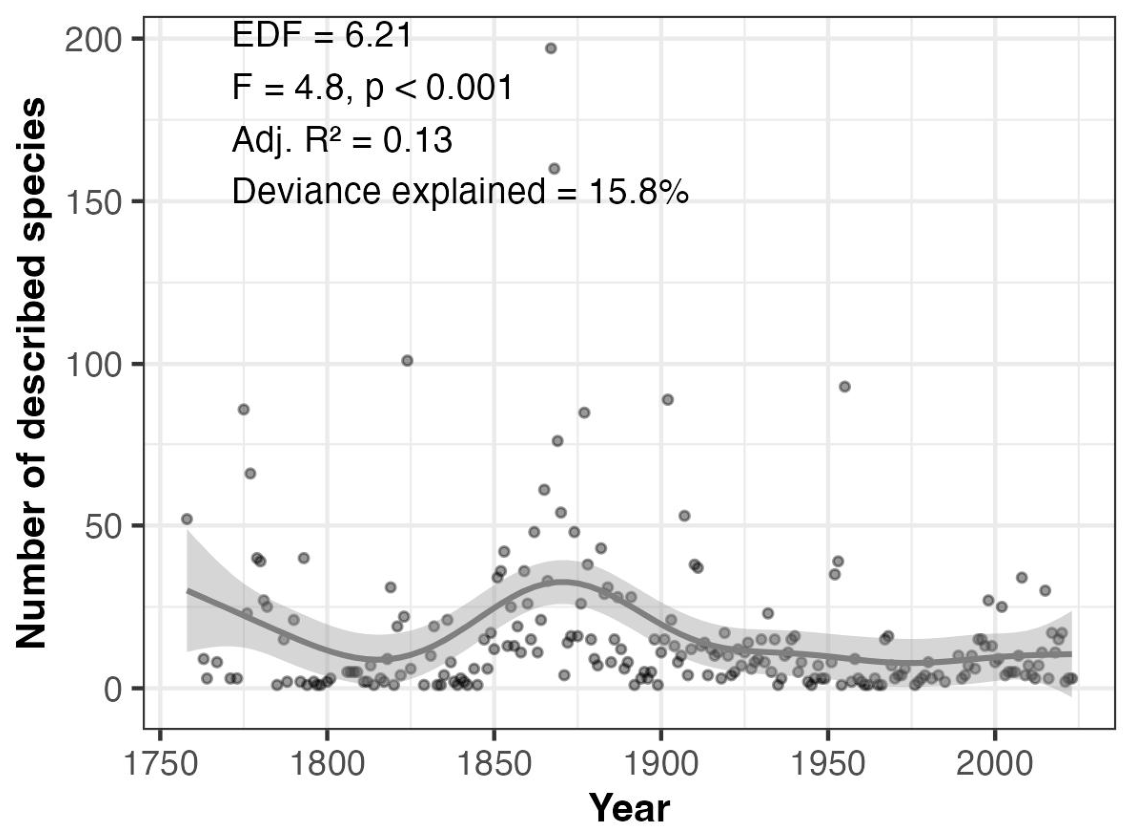
Figure 2.
Observed and predicted cumulative number of species descriptions for butterflies in Brazil over time. Lines show curves based on different predictive models.
Figure 2.
Observed and predicted cumulative number of species descriptions for butterflies in Brazil over time. Lines show curves based on different predictive models.
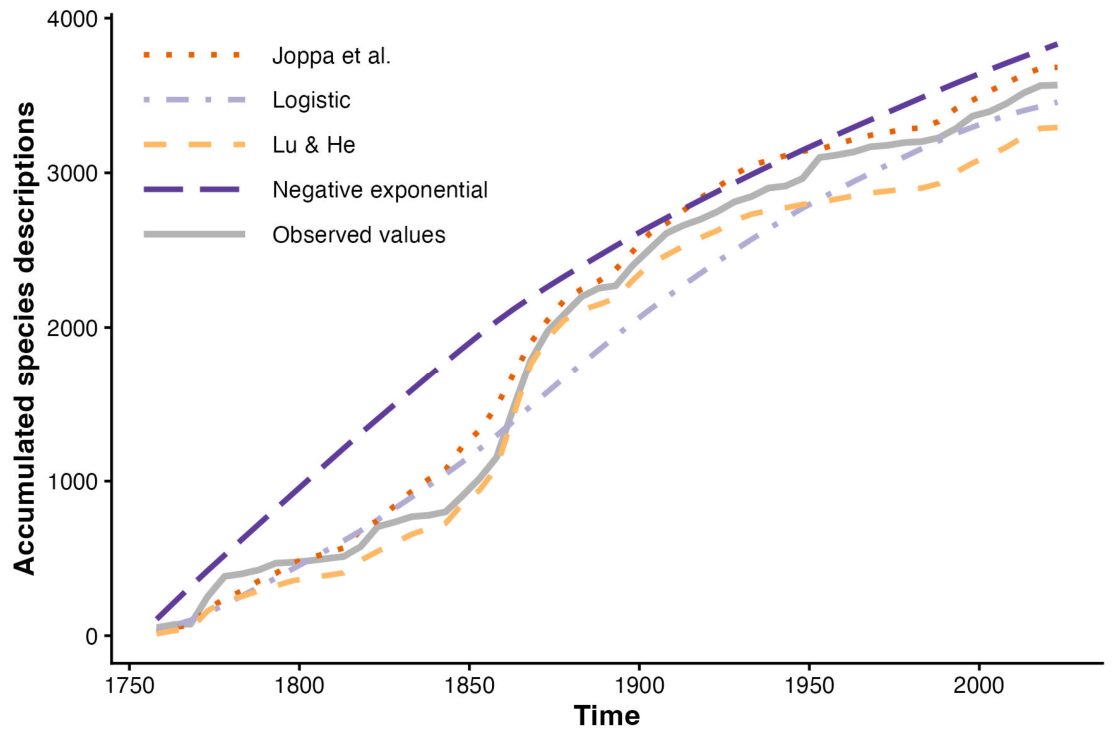
Figure 3.
Spatial data and results of regression-kriging (R-K) applied to butterfly species occurring in Brazil, including the (a) number of records, (b) well-sampled grids, (c) observed species richness, and (d) estimated species richness. Maps are in the Albers equal-area projection.
Figure 3.
Spatial data and results of regression-kriging (R-K) applied to butterfly species occurring in Brazil, including the (a) number of records, (b) well-sampled grids, (c) observed species richness, and (d) estimated species richness. Maps are in the Albers equal-area projection.
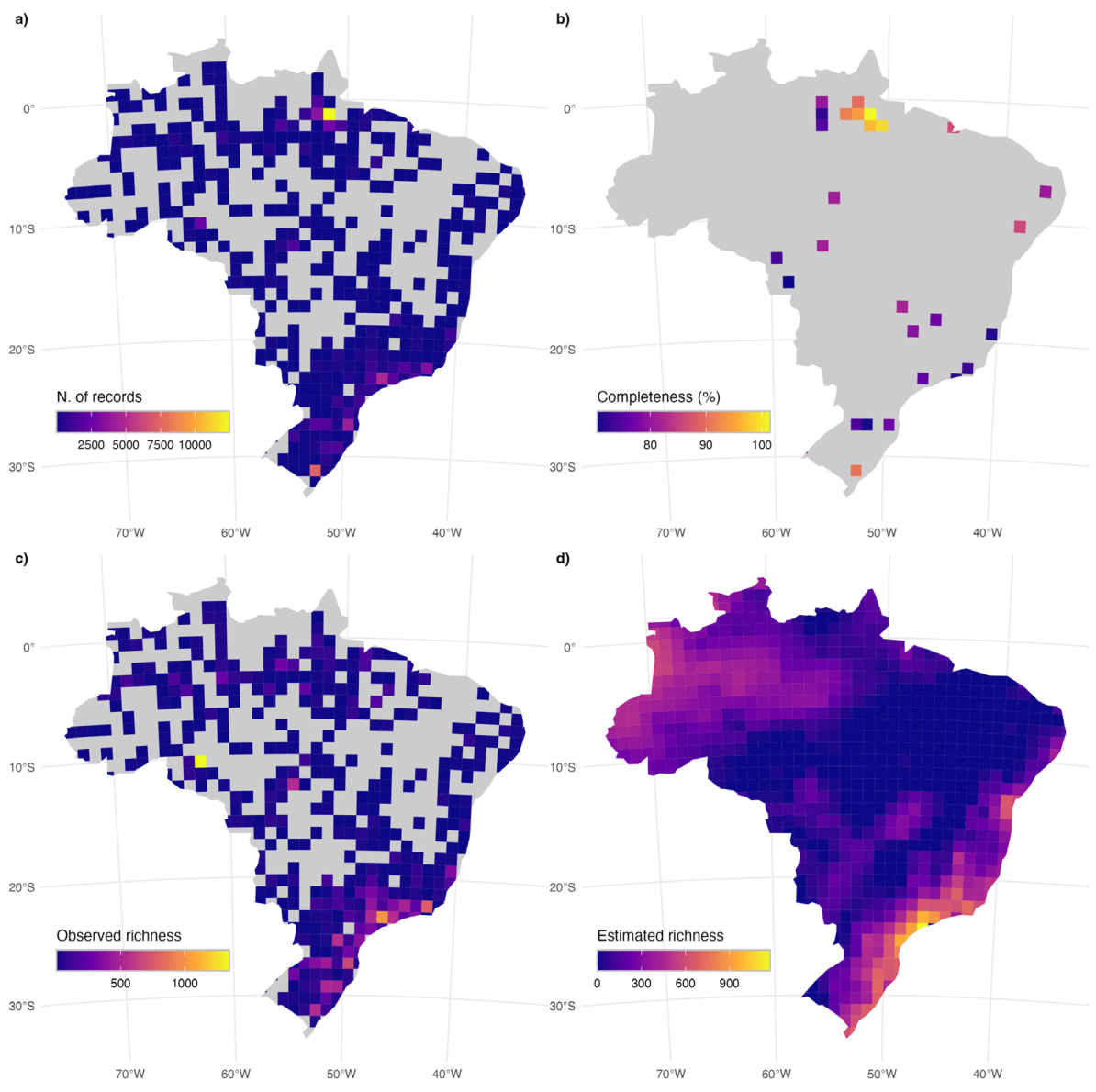
Figure 4.
Availability of publicly accessible gene sequences for butterfly species occurring in Brazil. (a) Distribution of genetic sequences across taxonomic families in the BOLD and GenBank databases. Numbers after family names represent the proportion of species with at least one available sequence. (b–c) Relationship between per-family species richness with both the total number of gene sequences and the average number of sequences per species within each family. Inset values show spearman coefficient correlation and associated p-values.
Figure 4.
Availability of publicly accessible gene sequences for butterfly species occurring in Brazil. (a) Distribution of genetic sequences across taxonomic families in the BOLD and GenBank databases. Numbers after family names represent the proportion of species with at least one available sequence. (b–c) Relationship between per-family species richness with both the total number of gene sequences and the average number of sequences per species within each family. Inset values show spearman coefficient correlation and associated p-values.
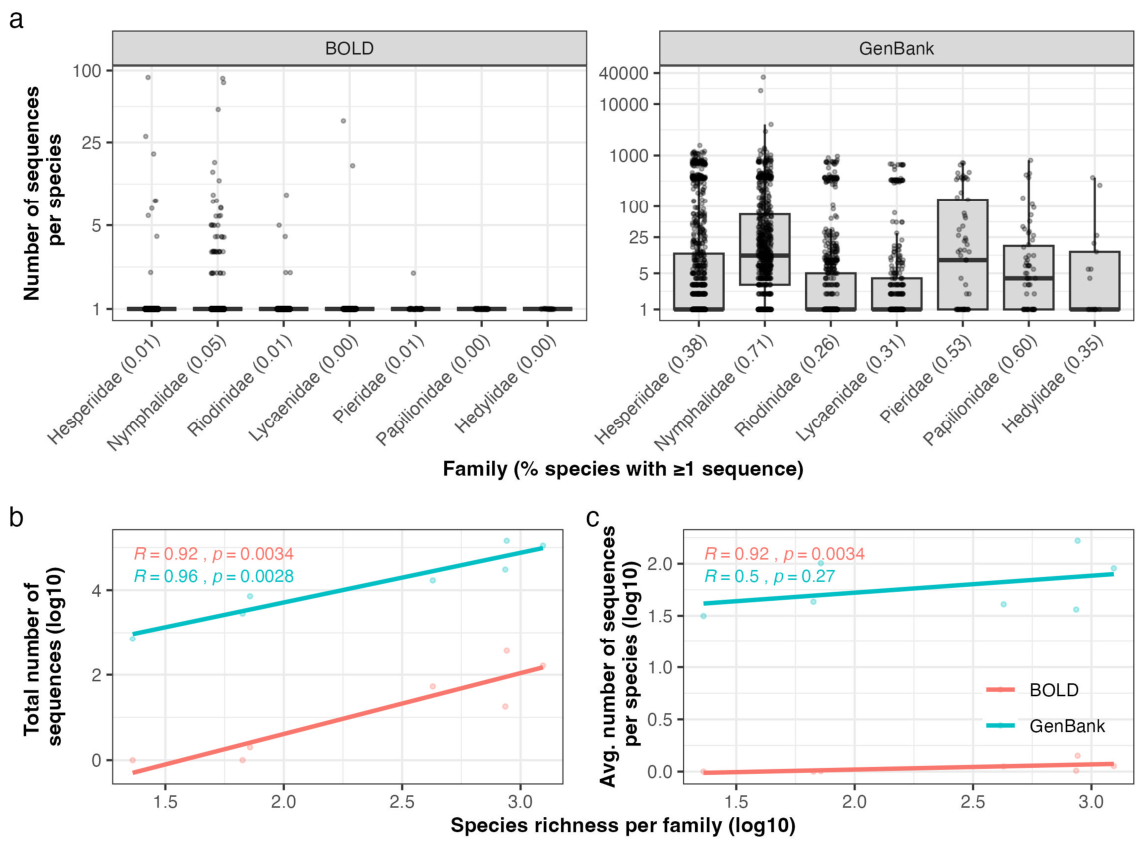

Table 1.
Descriptive statistics of predictive species discovery models for butterfly species in Brazil described from 1758 to 2023. Abbreviations: Stot = estimated total species richness, 95% CI = 95% confidence interval, a and b = estimated model parameters, ΔAIC = Akaike Criterion Information, WAIC = AIC weights.
Table 1.
Descriptive statistics of predictive species discovery models for butterfly species in Brazil described from 1758 to 2023. Abbreviations: Stot = estimated total species richness, 95% CI = 95% confidence interval, a and b = estimated model parameters, ΔAIC = Akaike Criterion Information, WAIC = AIC weights.
| Model | Stot | Lower 95% CI | Upper 95% CI | a | b | ΔAICc | wAICc |
|---|---|---|---|---|---|---|---|
| Lu & He | 4,196 | 3,773 | 4,619 | 2.11×10⁻³ | 1.64×10⁻⁵ | 0 | 1 |
| Joppa | 3,793 | 3,377 | 4,208 | -6.22×10⁻³ | 6.21×10⁻⁶ | 42.1 | <0.001 |
| Logistic | 3,896 | 3,466 | 4,326 | 7.33×10⁻³ | 2.12×10⁻⁵ | 69.3 | <0.001 |
| Negative exponential |
5,743 | 3,056 | 8,430 | 1.86×10⁻² | 79.9 | <0.001 |
Disclaimer/Publisher’s Note: The statements, opinions and data contained in all publications are solely those of the individual author(s) and contributor(s) and not of MDPI and/or the editor(s). MDPI and/or the editor(s) disclaim responsibility for any injury to people or property resulting from any ideas, methods, instructions or products referred to in the content. |
© 2026 by the authors. Licensee MDPI, Basel, Switzerland. This article is an open access article distributed under the terms and conditions of the Creative Commons Attribution (CC BY) license (http://creativecommons.org/licenses/by/4.0/).
Copyright: This open access article is published under a Creative Commons CC BY 4.0 license, which permit the free download, distribution, and reuse, provided that the author and preprint are cited in any reuse.


