

Submitted:
27 May 2026
Posted:
28 May 2026
You are already at the latest version
Abstract
The global education landscape is undergoing a foundational shift from time-bound, degree-centric validation to skills-based, modular recognition systems. Micro-credentials short, focused certifications that attest to specific competencies have moved from the experimental periphery to the strategic center of education, workforce development, and economic policy. This article presents a comprehensive, multidisciplinary synthesis of the micro-credentialing revolution as it stands in 2026, analyzing its drivers, impact, and unresolved tensions. Utilizing a thematic analysis providing a narrative synthesis, drawing on empirical and non-empirical academic literature, grey policy documents, industry reports, and international case studies framed within a PESTLE analytical structure to identify the co-mingling of four major drivers of adoption driving the mass marketability of alternative credentials; political endorsement, corporate skills-based hiring practice shifts unbundled higher education pathways leveraging emerging technologies such as artificial intelligence (AI) and blockchain. This macroeconomic debate weighs enhanced labor market agility, democratization of usage and new institutional value propositions against key friction points such as quality fragmentation, interoperability chaos, and generative AI-era threats to assessment integrity. Real-world implementation and equity implications are illustrated through case studies from Singapore, IBM, African mobile-first models and the European Blockchain Services Infrastructure. The article ends with the suggestion of a place where practitioners can come together to build an open, interoperable trust ecosystem with micro-credentials working as the fine-grained currency of lifelong learning and ultimately puts forth that it is not really about the badge itself, but rather all about the infrastructure of trust that society will have no choice but to build.
Keywords:
alternative credentials
; digital badges
; lifelong learning
; micro-credentials
; skills-based hiring
1. Introduction
In 2026, the average half-life of a technical skill has contracted to under five years, while the WEF 2025 states “44% of workers’ skills are expected to be disrupted within the same period (World Economic Forum, 2025). Simultaneously, global higher education enrolment exceeds 235 million students, but traditional degree pathways often rigid, lengthy, and expensive are failing to keep pace with the fluidity of labor market demands. Against this backdrop, a quiet but profound revolution has reached a tipping point: the mainstreaming of micro-credentials. No longer the province of experimental digital badge enthusiasts or massive open online course (MOOC) completion certificates alone, micro-credentials have become a strategic lever for governments reskilling entire workforces, for corporations dismantling degree requirements, and for universities seeking to remain relevant in an unbundled world.
The term “micro-credential” broadly refers to a certified, assessable recognition of a discrete skill or competency, typically smaller than a full qualification and often stackable toward larger credentials. They are issued by universities, industry bodies, professional associations, technology companies, and specialized platforms. What distinguishes the current wave is not the concept short courses and certificates have existed for centuries but the systemic embedding of these credentials into national qualification frameworks, hiring algorithms, individual learning wallets, and blockchain-based verification ecosystems.
This article analyzes this paradigm shift through a synthesis of current global evidence. It argues that micro-credentials are fundamentally restructuring the political economy of education, generating macroeconomic ripple effects that touch employment, social equity, institutional sustainability, and technological sovereignty. The thesis is threefold: first, that the convergence of policy tailwinds, corporate human capital strategies, technological enablers, and learner demand has pushed micro-credentials into the mainstream; second, that their macro impact though promising in terms of agility and democratization carries substantial risks of quality dilution, inequitable access, and fragmentation; and third, that unlocking their full societal value requires building a trusted, interoperable global ecosystem grounded in common quality standards and learner-centric data governance.
The article is structured as follows. Section 2, reviews the literature, discussing its historical roots, typologies, and synthesizing existing research. Section 3, explains the narrative review methodology and PESTLE analytical framework. In Section 4, you will look into the four engines that are accelerating micro-credentials toward mainstream adoption. Section 5 examines macro-level consequences. Section 6 surfaces friction points. Comparative case studies are presented in Section 7. Finally, Section 8 provides a future playbook for interoperability and Section 9 wraps things up.
2. Literature Review
2.1. Historical Context and the Rise of Alternative Credentials
The desire to recognize learning acquired outside formal degree structures is not new. The modern micro-credentialing movement inherits a lineage from correspondence courses in the 19th century, extension certificate programs, and competency-based education models of the 1970s. However, the digital turn of the early 21st century catalyzed a qualitative shift. 2012 was the year when modular, large-scale online learning really entered global consciousness, with MOOCs.
Started 2011, Another Pedagogy project, Mozilla Open Badges provided the first infrastructure for issuing individual credential with metadata showing who where issued at a particular time - (Goligoski, 2012). Bodies including IMS Global (now 1EdTech) responded to the year of early adopters by developing interoperability standards for levels 2.0 such as Badges and Comprehensive Learner Record (CLR), targeting the late 2010s. That shift has been accelerated by the COVID-19 pandemic, which has rushed the world to online learning and rendered many traditional credentials useless in the face of mass unemployment (OECD, 2023). 186386Annelise 2026 trajectory is from grassroots badging to government-anchored national strategies.
2.2. Definitions, Typologies, and Quality Standards
One of the most persistent challenges in the literature is the lack of terminological consensus. The term “micro-credential” is used interchangeably with digital badge, nano-degree, certificate, micro-master, and professional certification, yet these carry different connotations. Table 1, presents a typology synthesized from the European Commission (2022), UNESCO (2024), and Brown et al. (2021) that distinguishes these based on size, issuer, assessment rigor, and credit stackability.
European Commission’s 2022 Council Recommendation proposed a common definition: “Micro-credential means the record of the learning outcomes that a learner has acquired following a small volume of learning. These learning outcomes will have been assessed against transparent and clearly defined criteria” (European Commission, 2022, p. 6). UNESCO’s 2024, global framework further emphasizes the importance of a quality assurance mechanism, transparent learning outcomes, and the possibility of stacking. However, these international efforts coexist with disparate national quality standards. Australia’s National Micro credentials Framework differentiates between verified and unverified micro-credentials, while New Zealand requires micro-credentials to be registered on the New Zealand Qualifications and Credentials Framework (NZQCF) if they are to be funded (New Zealand Qualifications Authority, 2021). In the United States, the decentralized nature of accreditation leads to a marketplace where the American Council on Education’s CREDIT recommendations and third-party quality platforms like Credential Engine’s Credential Registry try to impose order. The literature thus reveals a field wrestling between bottom-up innovation and top-down regulation.
2.3. Key Research Themes and Existing Evidence
Learner demand and motivation. Multiple large-scale surveys tell us that career changers and working adults form the bulk of the market for micro-credentials. HolonIQ recently reported that micro-credentials are predicted to grow at 28% CAGR through to 2026 and over half a billion learners will have earned a non-degree credential by 2030 (HolonIQ, 2024).. According to Coursera’s Global Skills Report in 2025, “76% of the learners who completed professional certificates said they experienced career success within six months.”. But these data obtained through self-reporting need to be interpreted with caution because of selection bias. Which is why academic studies like Kato et al., (2020) multi-levelled, in that greater-specialisation among higher-income learners employ micro-credentials as a signal of expertise acquired for career advancement, the less affluent need to view them as accessible pathways into work: Wheelahan and Moodie (2021). This kind of dual use is highly consequential in terms of equity.
Employer perceptions. Oh yes, another crucial evolution regarding the attitude of the employers. Employers viewed digital badges with skepticism in 2015 (Raish & Rimland, 2016). This trend was established out of? LinkedIn data from 2023, which indicated a yearly increase in evergreen job postings by additional U.S. Jobs that actualized the elimination of four-year degrees as required qualifications according to LinkedIn (the four-year content matters significantly whenever posting careers since about 83% of managers favor considering nearby applicants). The October 2023 report Skills-First: Reimagining the Labor Market from LinkedIn showed that globally, more than 70% of hiring managers have made a skills-based open walking-line property priority (LinkedIn, 2025), and micro-credentials are widely seen as an appropriate proxy for skill verification. Market leaders including IBM, Google, Amazon and SAP have developed micro-credentialing ecosystems internally (IBM’ New Collar initiative is a common example) withIMB now reporting that a large number of its US technical hires no longer hold to their “four-year college degree” but instead have company-recognized credentials (IBM, 2024). Research by Fuller et al. (2022) at Harvard Business School finds that while skills-based hiring is gaining traction, implementation regularly falls short; degree-equivalent filters sometimes remain embedded in automated applicant tracking systems, clarifying why rhetoric on the topic often outpaces practice.
Economic impact. The macroeconomic motive for micro-credentials is that they allow individuals to close skills gaps more quickly and economically than traditional degrees. According to the Future of Jobs Report 2025 by World Economic Forum, as much as 1.1 billion workers may need reskilling by 2030 (2020). Micro-credentials are pitched as an on-demand workforce development solution. Using data from 49 countries, an OECD (2023) working paper found that a causal estimate of the increase in national productivity with every 10 percentage-point expansion in the share of adults holding qualification- or certification-level short learning program is around 1.2%, when controlling for all other factors. Micro studies on the wage premia are also mixed. On the other hand, Google and IBM professional certificates claim an average median salary increase of 20,000 while using econometric studies based on U.S. Current Population Survey data Jeon and Lee show that wage return to non-degree certificates is highly heterogeneous ranging from almost nil for many for-profit-issued certificates in low-wage sectors to positive for industry-backed IT credentials .
Stackability and pathway validation. Stackability the promise of course sequencing micro-credentials stack to some other qualification is a core feature of it. In research by Gallagher (2023) at Northeastern University, although hundreds of stackable pathways have been designed by universities to date, learner progression through stacking is actually low with findings suggesting that less than 5% of micro-credential earners are sufficient in moving along their stack (Gallagher, 2019). These include ambiguity around articulation agreements, learner affordability and the reality that most micro-credentials are consumed for immediate job duties rather than as an on-ramp to a degree. This disconnect indicates a gap between design and reality.
2.4. Gaps and Unresolved Tensions
Even as the hype grows, significant lacunae persist throughout the literature. First, the signaling value faces credential inflation: with billions of badges swirling around, it is hard to identify credentials that are meaningful and rigorous from simple “digital participation trophies” (Watters 2021). Second, there is a risk that for learners in net-work-poor or low-digital-literacy contexts verifiable digital wallets (e.g., blockchain-based Self-Sovereign Identity [SSI] systems) will not be available. Third, while there is some evidence identifying certain labor market outcomes, equity impacts and institutional financial sustainability (when appropriate), studies have continued to be predominantly funded by industry and platform players rather than independents. Fourth, the struggle for local replication against global interoperability is not yet solved; a software engineering micro-credential that was designed in Silicon Valley may not even carry over well to the Malaysian Qualifications Framework (UNESCO, 2024). Finally, the integrity crisis of assessment brought on by generative AI (ChatGPT can pass most course-level assessments) pulls into question the even meaningfulness of a non-proctored or poorly designed supporting assessment-based credential.
3. Methodology
3.1. Research Approach
This article employs a narrative literature review with PESTLE framework, narrative synthesis methodology, combining a systematic review of academic and grey literature with policy analysis and illustrative case studies. It is not primary empirical research but a comprehensive, analytical integration of current global intelligence on micro-credentials as of mid-2026. The goal is to generate an authoritative mapping of the field, its trends, impact dimensions, and friction points, and to propose actionable insights for a multi-stakeholder audience.
The approach is structured in three phases: (a) a scoping literature review to capture the state of knowledge; (b) a PESTLE-based thematic analysis to identify macro-level drivers and impacts; and (c) a comparative case synthesis to ground findings in real-world implementation.
3.2. Data Sources and Collection
Data were collected from four key source clusters between 2023-2024.
- Academic databases: Scopus, Web of Science, and ERIC were searched for peer-reviewed journal articles and conference proceedings published between 2015 and 2026. The primary search string combined “micro-credential” OR “digital badge” OR “alternative credential” with “employability,” “skills-based hiring,” “blockchain,” “equity,” and “assessment.” After removing duplicates, 1,240 records were screened, and 138 were included for full-text synthesis. The inclusion criteria prioritized studies with empirical data, robust theoretical framing, or systematic reviews.
- Grey literature and industry reports: Grey and industry reports were gathered from official organisations, national agencies (Australian Government Department of Education, NZQA [New Zealand Qualifications Authority], SkillsFuture[Singapore]) as well as one largest-scale market intelligence provider in education sector–HolonIQ and some global learning and training platforms like Coursera, LinkedIn Learning, edX, 1EdTech or Credential Engine. Stories released from 2020 until 2026 were prioritized to highlight the contours of a post-pandemic acceleration.
- Policy documents: Since micro-credentials are an emergent, and highly regulated provision of learning activity (see Global Trends [5]), we analysed national micro-credential strategies and frameworks from Australia, Canada, Ireland, Malaysia, the United Kingdom and Singapore as well as theEuropean Commission’s 2022 Recommendation.
- Media and trend analysis: Screened the aggregator platforms (Inside Higher Ed, EdSurge/ HolonIQs Journal, The PIE News) and institutional press releases to discern themes in the mainstreaming narrative and identify which national credentialing platforms were launched in real time.
3.3. Analytical Framework
The work was organized through the adapted PESTLE (Political, Economic, Social, Technological, Legal and Environmental) framework for education and workforce systems. This macro-environmental tool builds a layered understanding of the forces that influence how micro-credentials are adopted and their impact. For each PESTLE dimension, you have known operationalised indicators:
- Political context: National micro-credential policies, funding for short learning programs, political discourse on lifelong learning.
- Topics: Economics: employer demand, wage premiums, productivity effects, labour market dynamics, education revenues.
- Social: social equivalence, learner profile, degree advantage of credentials (non-degree), culture of lifelong learning.
- Technology: AI in credentialing, blockchain and SSI, assessment technology, learning wallets, skills taxonomies.
- Legal: Accrediting laws, transnational recognition, data privacy (GDPR etc), intellectual property of credentials.
- Environmental: Micro-credential courses on Green skills, Sustainability directed short courses.
The framework guided the extraction and synthesis of data, ensuring coverage of the full spectrum of forces that propel or constrain the micro-credential revolution.
3.4. Limitations
Several limitations must be acknowledged. First, rapid evolution means some data particularly market projections originate from organizations with commercial stakes in micro-credential growth. A sensitivity analysis (Appendix C) examines how conclusions might change if industry-funded research were excluded. Second, geographic scope is skewed toward regions with robust digital infrastructure; experiences from Latin America, Africa, and South Asia are under-represented. We have expanded developing-world cases (Section 7.5) to partially address this. Third, the PESTLE framework may artificially separate interlinked phenomena. Fourth, this analysis does not include the perspectives of frontline educators and instructional designers. Their insights on pedagogical feasibility, workload, academic integrity, and stackability implementation are largely absent from the literature synthesized here. Consequently, this article reframes its scope as a policy-and-economics analysis rather than a pedagogical implementation study. Fifth, this narrative synthesis does not claim the exhaustiveness of a meta-analysis.
4. The Mainstreaming Engine: Trends and Catalysts in 2026
This growth from the periphery of education to a strategic imperative is driven not by any one reason but four powerful engines policy headwinds, corporate human capital disruption, higher education’s adaptive pivot as well as globalization and the catalytic rise of AI and blockchain technologies.
4.1. Policy Tailwinds
Across the world governments have realized that the standard frontloaded model of education is not fit for purpose, in an age of disruptive technology and aging workforces. A landmark development was with the 2022 Council Recommendation on a European approach to micro-credentials by the European Commission. It urged member states to agree on a joint definition, quality standards and future European digital credential infrastructure according to the European Learning Model. And by 2026, 23 out of 27 EU countries have micro-credentials as part of their national qualification frameworks or lifelong learning strategies. The EU is an excellent example; its Individual Learning Accounts initiative directly funds citizens to undertake recognised micro-credentials, much like how it would a library (another public good), and has piloted this in a number of member states.
New national marketplaces for micro-credentials that deploy/market-independent trust frameworks (such as Australia’s MicroCred Seeker marketplace from 2022 followed by a phased expansion through 2025, which lists more than 6,000 nationally verified micro-credentials from universities and providers) with real-time labor market alignment supported in part by artificial intelligence analysis of job postings (Australian Department of Education et al., 2025). Public University (PU) accepting stackable micro-credentials towards full degrees, or; Rules published by the Malaysian Qualifications Agency which allow use of stackable micro-credentials. Some Canadian provinces, especially Ontario and British Columbia, have been investing in developing micro-credentials with an equity lens that aim to serve displaced manufacturing workers and Indigenous communities (Higher Education Strategy Associates, 2024).
As importantly, post-COVID recovery funds orienting to something like this short, employment-linked training have been deeply privatised. Due to the COVID crisis, OECD (2023) points that many member countries invested more than15 billion from 2020to 2024 in short-cycle upskilling through micro-credential pathways. Singapore expanded its existing Skills Future program, one already viewed as a model and added an additional US$4,000 top-up for citizens aged 40+ to take short, industry-validated courses who often receive stackable micro-credentials.
Key Observations from the Table
- Quality assurance varies from national agency monitoring (Australia, Malaysia, Singapore) to provincially delegated systems (Canada) or voluntary standards at the European level (EU). The general trend is towards outside verification, though implementation ranges considerably.
- Australia and Singapore are the most progressive in this area, with explicit credit values associated with micro-credentials and articulation pathways documented. In Malaysia, stackable credits are capped at 30% of a degree. The EU is based upon NQF alignment and ECTS; however stacking remains patchy across the member states and In Canada, work is still underway to provide agreeing articulation.
- Funding models: Learner accounts (Singapore SkillsFuture Credit, EU Individual Learning Accounts, Canada grants) are a shift from institutional supply side funding. Australia uses a priority skills marketplace model where subsidies are assigned for priority skills. HRD Corp for Malaysia as an employer levy.
- All frameworks include elements of equity but may do so at varying levels of specificity. Singapore and Malaysia rank individuals by their age, income and based on whether they belong to an indigenous group directly. Targeting Indigenous and dislocated worker populace in Canada The EU places emphasis not only on low-skilled adults but also on digital inclusion. Australia has further striking regional and Indigenous provisions.
4.2. Corporate Talent Strategies
Arguably the most defining change propelling mainstreaming ahead is corporates embracing skills-based talent management. The expression “skills-first” has become a cliché among human resources people. According to a 2025 LinkedIn survey of over 5,000 talent leaders in 15 countries, 71% agree that skills-based hiring will be the norm for them within the next three years (LinkedIn, 2025). Instead of just eliminating degree requirements from job descriptions, companies are now building internal credentialing academies. Since 2020, IBM’s SkillsBuild platform has issued more than 5 million digital credentials, most of which map to internal job roles. For roles with Google and its network of more than 150 employer partners, Google’s Career Certificates in IT support, data analytics, UX design, and project management designed and taught by employees at the tech giant are accepted as equivalent to four-years’ degree (Google, 2025). The Upskilling 2025 pledge from Amazon has provided funding for micro-credentialing programs which help get over 300,000 employees through the programs.
Corporate adoption alters the signalling value of a micro-credential. The labor market signal strengthens, creating a virtuous cycle, when a Google certificate you earn goes and demonstrably gets you the job at Google or its partner ecosystem. For employers, the economic motivation is straightforward: lowering time-to-hire, tapping into talent pools that are inaccessible through traditional higher education and attaining better fit within a job role. According to the Burning Glass Institute, firms that eliminated degree requirements and began using verified skill credentials experienced 22% higher employee retention and 15% lower hiring costs-after two years (Burning Glass Institute, 2024). The key features of corporate micro-credential initiatives are summarized in Table 2.

Table 2.
Comparative Overview of Selected National Micro-Credential Frameworks (as of 2025–2026).
| Country / Region | Quality Assurance Mechanism | Stackability Requirements | Funding Model | Equity Provisions |
| Australia | Tertiary Education Quality and Standards Agency (TEQSA) extends remit to micro-credentials offered by registered providers; voluntary national Microcredentials Framework with external quality review | Must have defined credit value (e.g., 0.125–0.5 of a full subject); clear articulation pathways to formal qualifications (AQF levels); publicly listed on MicroCred Seeker marketplace | Government-funded MicroCred Seeker marketplace; subsidies for priority skill areas; employer co-contributions for upskilling | Targeted funding for displaced workers, low-income learners, and regional/remote populations; Indigenous-specific pathways and fee waivers in some states |
| European Union (EU) | European Commission Recommendation (2022) requires external quality assurance by a recognised body; alignment with European Standards and Guidelines (ESG) for higher education; optional ECTS credit rating | Stackable toward full qualifications via national qualification frameworks (NQFs) and European Credit Transfer and Accumulation System (ECTS); must specify learning outcomes and volume of learning | Individual Learning Accounts (ILA) piloted in several member states; European Social Fund+ (ESF+) co-finances short learning programmes; public funding for lifelong learning | Digital inclusion provisions in European Digital Identity Wallet (eIDAS 2.0); support for low-skilled adults via national ILA top-ups; gender balance targets in STEM micro-credentials |
| Singapore | SkillsFuture Singapore (SSG) approves all courses; mandatory alignment with national Skills Framework (34 sectors); regular outcomes monitoring and provider audits | Stackable into national Workforce Skills Qualifications (WSQ) framework; articulation agreements with six autonomous universities for credit toward diplomas/degrees | SkillsFuture Credit: initial $500 per citizen aged 25 + , plus $4,000 top-up for ages 40+; employer co-funding up to 90% of course fees | Enhanced funding for older workers (≥40), persons with disabilities, and lower-income individuals; free basic digital literacy micro-credentials; SkillsFuture for Communities programme for vulnerable groups |
| Malaysia | Malaysian Qualifications Agency (MQA) Guidelines on Micro-credentials (2021, updated 2024); compliance with Malaysian Qualifications Framework (MQF) standards; external assessment for credit-bearing micro-credentials | Stackable toward full degrees at public universities (up to 30% of programme credits); requires formal credit transfer and articulation agreements; recognition of prior learning (RPL) pathways | Government subsidies through MySTEP (Malaysia Short-Term Employment Programme) and HRD Corp levy; employer co-payment; public university fee caps for micro-credentials | Bumiputera and rural community outreach; free basic skills micro-credentials for low-income households (B40 group); special allocations for persons with disabilities and indigenous (Orang Asli) communities |
| Canada (Ontario / British Columbia) | Provincial oversight: Ontario’s Micro-credential Quality Assurance Framework; British Columbia’s Quality Assurance Guidelines for Micro-credentials; optional third-party certification (e.g., eCampusOntario) | Stackability varies by institution; Ontario mandates clear articulation pathways to certificates, diplomas, or degrees; BC encourages but does not require stacking; credit transfer agreements being developed | Federal Canada Job Grant and provincial upskilling funds; Ontario’s Micro-credential Challenge Fund; BC’s StrongerBC Future Skills Grant (up to CAD $3,500 per learner) | Indigenous learner supports (tuition waivers, culturally relevant content); programs for manufacturing workers displaced by automation; rural and remote connectivity subsidies; gender equity in trades and technology micro-credentials |
Table 3.
Comparison of Select Corporate Micro-Credential Initiatives.
| Company | Program/Platform | Credential Type | Stackability | Employer Network | In-house Recognition |
| IBM | SkillsBuild | Digital badges, professional certificates | Stackable to role-based pathways | Open to partners; credentials portable via Credly platform | Full hiring credit; internal promotion pathways |
| Google Career Certificates | Professional Certificate | Articulates to select degree programs (e.g., Purdue Global) | 150+ partner employers | Equivalent to a four-year degree for relevant roles at Google (with role-specific qualifiers) | |
| Amazon | Upskilling 2025 / AWS Training | AWS Certified badges, nano-degrees | Stackable within Amazon pathways | Amazon internal and AWS customers | Internal promotion pathways |
| SAP | SAP Learning Hub | Digital badges for specific SAP modules | Part of SAP Global Certification pathway | Consultant ecosystem | Required for consultant roles |
Note. Data compiled from corporate websites and LinkedIn (2025). IBM’s “Open to partners” indicates that non-IBM entities can accept and issue compatible credentials, though specific technical and governance requirements apply.
The corporate pivot is also reshaping the supply side. Platforms like Credly (now part of 1EdTech) and Accredible facilitate digital badge issuance for thousands of employers, creating a common currency. Industry consortiums, such as the Consumer Technology Association’s skills initiative, are developing industry-wide micro-credential stacks that ease worker mobility across firms.
4.3. Higher Education’s Pivot
For universities, micro-credentials represent both an existential threat and a strategic opportunity. The threat lies in the unbundling of the traditional degree: if learners can acquire job-relevant skills for a fraction of the cost and time, why pursue a full degree? The opportunity is to reach new learner segments working adults, international students unable to travel, lifelong learners by offering stackable, short-form programs that act as on-ramps to degrees and generate new revenue streams.
The response has been a proliferation of micro-credential offerings from both elite and access-oriented institutions. The MITx MicroMasters program, launched in 2015, remains the gold standard, offering master’s-level courses that, when successfully completed, allow learners to apply for an accelerated, on-campus master’s program. By 2026, over 30 universities worldwide have established similar pathways, including the University of California system, the Indian Institutes of Technology, and the African Leadership University. EdX’s MicroBachelors and Coursera’s Entry-Level certificates extend the model to undergraduate education.
Yet, the deeper institutional pivot is not merely programmatic but structural. Universities are embedding micro-credentials into their formal degree structures, allowing students to earn recognized digital badges for co-curricular skills (leadership, digital literacy, intercultural competence) alongside academic credits. For example, Arizona State University’s “Career Arc” embeds industry-validated micro-credentials into every undergraduate degree. The University of Melbourne’s Melbourne MicroCerts are stackable toward graduate certificates and diplomas. This hybridization blurs the line between degree and alternative credential, making the micro-credential an integral part of the university transcript.
Financially, micro-credentials offer universities a lower-cost, scalable product in a market where traditional degree enrollment growth is flattening in many developed countries. HolonIQ (2026) projects that non-degree revenue will account for 15% of total university revenue by 2030, up from 4% in 2020. This economic incentive aligns the university’s future with the micro-credential ecosystem. However, this pivot is not without internal cultural resistance; faculty often view unbundling as a commodification of education that undermines academic coherence (Gallagher, 2023).
4.4. AI and Blockchain Enablers
Technology is the covert infrastructure powering the mainstreaming engine. Artificial intelligence and blockchain / verifiable credentials are two big technologies.
Artificial intelligence. So, AI has remade the micro-credentials supply-side three ways. The first are AI-powered skills taxonomies like the ones developed by Emsi Burning Glass (now Lightcast) and LinkedIn’s Skills Genome, which constantly scrape millions of job postings to spot emerging skills and dynamically map these to pre-existing credentials. Demand-Supply: This allows institutions to create micro-credentials that are aligned with labor market demand, leading a shortened time period from skill emergence to program launch from years down to the range of weeks. Secondly, AI-based personalized learning engines suggest targeted micro-credentials to individuals based on their goals, skill sets and labor market need within their local area. AI is then applied to personalize pathways an example is SkillsFuture Singapore offering a “Skills Passport” for learners. The third, and most relevant, is that the generative AI helps design and write curriculum for updating micro-credentials all together at a cost that is negligible compared to what it was before.
By far the most disruptive application is with assessment though. To limit the integrity crisis driven by generative AI, for many high-stakes micro-credentials, AI proctoring (facial recognition plus keystroke dynamics and environment monitoring) has become the new norm. But, as more of Section 6 will explain in detail, that unleashes a technological arms race and pratfalls for privacy.
Blockchain and Verifiable Credentials. The central idea of blockchain technology, and specifically that of the Self-Sovereign Identity (SSI) paradigm, is to serve as the backbone for learner-owned, cryptographically verifiable digital credentials. The Verifiable Credentials Data Model standard (2019, updated 2025) from the World Wide Web Consortium (W3C) allows credentials to be issued and stored in a learner’s digital wallet and verified with any third-party or verifier without contacting the issuer. An example is the European Blockchain Services Infrastructure (EBSI) a decentralized network, where universities issue diploma-equivalent micro-credentials as verifiable credentials and these are instantly authenticable across Europe. This overcomes the fraud issue, reduces international recognition, and gives power to learners to own their data.
The space has seen lots of action from major tech players. Utilizing the Decentralized identity specification, Microsoft has produced their own Entra Verified ID allowing organizations to issue and verify credentials. The Open Badges 3.0 standard released by 1EdTech maps to W3C Verifiable Credentials and supports an interoperable infrastructure. Apple has partnered with various universities to store verifiable credentials in Apple Wallet, finally putting micro-credentials inside the pocket of billions on October 2025. These two technologies combined make for a “stack” where recommendations are informed by intelligence, backed secure data storage, and instantly verifiable credentials, virtually taking away all of the friction that has kept employer acceptance (i.e., trust) at low levels until now.
5. The Macro Impact: Reshaping Economies and Societies
Micro-credentials are not just about individual success at work, they send out macroeconomic, social and institutional signals that reshape the education-employment relationship.
5.1. Economic Agility and Productivity
The immediate macro effect is improved labor market flexibility. In physical, traditional degree programs (usually 2-4 years long), cannot fill gaps in skills in fields like cybersecurity, renewable energy engineering or AI ethics at the pace of business. How quickly can we approve and deploy a micro-credential? In months! Texas and Saxony (Germany) boasted 12-week micro-credentials developed with input from Intel and TSMC in semiconductor fabrication technician skills that went directly into hiring pipelines, in large part as community colleges filled a key need during the rapid expansion of the semiconductor industry unleashed by 2022-25 CHIPS Acts in the U.S. and Europe. This promotes national competitiveness through its just-in-time capacity.
At the macro level, macro-level analyses find direct empirical support for the productivity argument. Higher adult share of non-formal, certified short learning was positively correlated with productivity (especially in knowledge-intensive service sectors) across a sample of 28 countries (OECD, 2023 working paper). Micro-credentials seem to increase the skill-matching efficiency in the labor market by alleviating asymmetric information: employers get a more fine-tuned, verifiable signal of exactly what a candidate can do, and workers get to send out much finer-tuned signals of capability with less noise than sending out a degree classification. LinkedIn used Economic Graph data (2025) from businesses and individuals to show that listings with at least one verified skill credential caused a 16% increase in recruiter InMail messages when compared to degree-only entries.
Micro-credentials also align with the gig economy and portfolio careers. This flexibility is made even more critical as workers drift flexibly in and out of freelance, part-time, and full-time positions; micro-credentials offer portable, stackable records of ongoing upskilling that go wherever the individual (and not the company) does. This portability matters in a labor market that has seen median job tenure decline.
5.2. Democratization and Social Equity
The micro-credential story hinges on democratization promise: alternative credentials can provide pathways for first-generation learners, working parents, rural communities and marginalized demographics by alleviating time and cost burdens. Unlike a four-year degree (that tops at more than $100,000), a micro-credential typically costs between 3,000. Time commitment is generally in weeks or months allowing individuals to learn new skills even if they cannot take time off work. With platforms like edX, your financial assistance may cover 90% of fees associated with verified certificates; many governments also fully fund micro-credentials for unemployed or low-income citizens.
In fact, there are indications that micro-credentials do appeal to a more diverse learner. According to Coursera’s 2025 Global Skills Report, 52% of professional certificate learners in the U.S. are female and 38% have a household income below $50,000. In New Zealand too, as the following graph attest, Māori and Pasifika learners are over-represented by numbers of enrolments in micro-credentials (as opposed to a degree) compared to their traditional programmes (NZQA 2025).
Yet a closer look reveals the danger of creating two systems. For example, high-status micro-credentials such as MITx MicroMasters or a data science certificate from an Ivy League university are pursued mainly by bachelor-holders who want to move up the job market. In low-wage service areas there is an explosion of lower status, less rigorous badges that may reinforce occupational segregation (Wheelahan & Moodie 2021). The biggest threat is that as the elite keep piling more recognised micro-credentials on to existing degrees, the underserved earn “digital participation trophies” that do not equal a mobility option. Equity means that for disadvantaged populations, micro-credentials need to be developed and validated with the same rigor, industry validation, and clarity of a stackable pathway as those of the already advantaged population. Without intentional design at the policy level, micro-credentials may not be dismantling inequality they could entrenching it in our digital ledgers.
Another aspect of equity is the digital divide. A learner requires a smart phone, stable internet connection and fundamental digital literacy to manage a verifiable credential wallet. A blockchain based credential system is unattainable for the 2.9 billion people off-line globally (ITU, 2024). Well, it turns out that low-resource settings require offline-capable wallets, community-controlled credentialing hubs and SMS-verifiable credentials.
5.3. The Unbundling of the University
Micro-credentials are unbundling the traditional university package curriculum, instruction, assessment, credentialing, and career placement and re-bundling them in new configurations. The university’s monopoly on credentialing is eroding. Technology companies now issue credentials with direct labor market currency, and employers increasingly accept them. This shifts the university’s role from a singular gatekeeper to a curator, assessor, and, potentially, a platform for integrating learning from multiple sources.
The financial implications are profound. Institutions heavily reliant on full-degree tuition revenue face a “modularization dilemma”: if students can pick and choose cheap, stackable micro-credentials, the demand for the bundled, high-priced degree may decline. Some universities have responded by lowering degree credit requirements and allowing up to 50% of a degree to be composed of externally earned micro-credentials, effectively positioning the degree as a top-off product. Others, like Southern New Hampshire University, have aggressively expanded into competency-based, micro-credential-rich pathways to offset declining on-campus enrollment.
Yet unbundling also offers innovation. The university can function as a learning validation hub, using sophisticated assessment centers to evaluate skills gained through work, micro-credentials, and life experience, and issuing composite degrees that truly reflect a learner’s profile. The concept of a “Comprehensive Learner Record” (CLR), championed by the American Association of Collegiate Registrars and Admissions Officers (AACRAO) and 1EdTech, is a digital document that lists learning achievements from multiple sources, including courses, micro-credentials, co-curricular activities, and work-integrated learning. If adopted widely, the CLR could become the new transcript, with the university as the trusted issuer.
5.4. Lifelong Learning as a Public Good
It is the re-imagining of education as a public utility lifelong. If micro-credentials can be mapped to national frameworks, and public accounts are there as a funding source learning is then a continuous journey supported by the state rather than one event prior to entering into work. There is a growing idea of having a so-called ‘learning health record’ (for every citizen –a digital repository with lifewide records of formal, non-formal and informal learning). What this looks like in France (with Compte Personnel de Formation or CPF) and Singapore (with SkillsFuture Credit), is one individual budget allocated to each citizen on a personal basis, which they can spend on accepted short courses and credentials.
This reframes education policy to shift from a supply-side, institutional funding perspective to a demand-side, learner-centric funding perspective. It gives individuals agency influencing their decisions in relation to career goals and labour market changes but also pushing all providers universities, bootcamps, corporate academies to compete on the basis of quality, relevance, and outcomes. If equitably realised, this could be one of the most transformative social innovations of the 21st century, not to just make lifelong learning a gag-line but an operationally funded right.
6. Friction Points and the Credibility Crisis
For all the promise, the micro-credential ecosystem in 2026 is rife with frictions that threaten its long-term credibility and value. These tensions can be clustered into four domains: quality chaos, recognition and portability chaos, the assessment integrity crisis in the age of generative AI, and data privacy and ownership struggles.
6.1. Wild West of Quality
The low barrier to entry for issuing a micro-credential any organization can create a badge in minutes using tools like Badgr or Accredible has led to a proliferation of credentials of vastly differing quality. An employer facing a resume with “Advanced Data Analysis” badges from five unknown online providers has no reliable way to assess their validity. Unlike accredited degrees, which, however imperfect, are backed by recognized quality assurance bodies, most micro-credentials exist in an accreditation vacuum.
This Wild West provides something credential scholars describe as “redenial infobesity” (Kato et al., 2020). The U.S. Chamber of Commerce Foundation reported that in 2025, 62% of HR professionals struggled to evaluate the quality of non-degree credentials and nearly half (44%) had been led astray by a credential that did not demonstrate real skills. While micro-credentials must be “quality assured by an external quality assurance body” according to the European Commission’s 2022 Recommendation, implementation is moving at a different pace. In Australia, the Tertiary Education Quality and Standards Agency (TEQSA) have been given new powers to regulate micro-credentials but only if offered by registered providers. Providers who are independent and non-institutional remain largely unregulated.
Meta-credentialing and quality registries have emerged as potential solutions. Credential Engine’s Credential Registry in the U.S. now contains over 1 million credentials and seeks to bring transparency by publishing data on outcomes, assessment, and alignment. The European Commission’s Europass platform has integrated a micro-credential search tool. Yet, these are information tools, not enforcement mechanisms. Without a recognized quality stamp, the market may fragment into “trust bubbles” where only credentials from certain known brands are accepted, defeating the democratization purpose.
6.2. Recognition and Portability Chaos
A learner who earns 50 micro-credentials from different providers may find that zero are recognized when she seeks admission to a degree program or applies for a job at a traditional employer. Despite the rhetoric of stackability, articulation agreements between micro-credentials and formal degrees remain the exception, not the rule. A study by the International Council for Open and Distance Education (ICDE, 2025) found that only 12% of micro-credentials globally have a documented articulation pathway to a full qualification. The reasons are institutional: universities are protective of their curriculum integrity and revenue; assessing and granting credit for external micro-credentials incurs administrative costs; and the diversity of quality makes blanket recognition impossible.
At the international level, the chaos deepens. A micro-credential in sustainable agriculture from a Kenyan university may meet rigorous local standards but holds no currency in the European labor market because it lacks ECTS credits or a common quality benchmark. UNESCO’s forthcoming Global Convention on the Recognition of Qualifications concerning Higher Education provides a legal framework, but its application to micro-credentials is still nascent. The lack of a universal “exchange rate” for learning volume and level hinders cross-border mobility and reinforces the dominance of brands from the Global North.
6.3. Assessment Integrity and AI-Generated Evidence
Generative AI presents an epochal challenge to the core function of a credential: certifying that a human possesses a skill. When ChatGPT-5 can produce a passable project report, a data analysis, and even recorded video presentations with synthetic media, traditional assessment methods become unreliable. The integrity crisis has hit micro-credentials especially hard because many were designed with automated, scalable assessments multiple-choice quizzes, coding assignments, peer review that AI can easily complete.
High-stakes micro-credentials have responded by scaling up AI proctoring, which monitors eye movements, typing patterns, and background audio. However, this creates a security-privacy trade-off and disproportionately impacts learners with unreliable internet, neurodivergent individuals, or those in shared living spaces. Authentic assessment design project-based work evaluated by expert humans, workplace simulations with unpredictable elements, competency-based interviews is being rediscovered, but it is expensive and does not scale easily. The quality of micro-credentials will increasingly be judged by how they address the “human verification” problem. In the long run, credentials may shift from certifying that a task was completed to certifying evidence of learning process, such as version-controlled code repositories, video journals, and real-time problem-solving recorded under secure conditions.
6.4. Data Privacy and Ownership
As a hypothetical, if an entire profile of the learner’s educational and employment experience resides in their digital wallet, then control of that data can be become an important rights issue. Whom the credential data belongs the learner, the issuer or the platform? The W3C Verifiable Credential model advocates for user-controlled sharing, where lots of consent over what the learner reveals is at its heart. An applicant for a job might want to disclose that she has completed a “Data Science micro-credential” but not every course grade. But the ideal is one thing its practical realization another. Corporate-owned wallets (Microsoft Entra, Apple Wallet) become increasingly powerful intermediaries who can monetize data or lock learners into their proprietary ecosystems.
Under Europe’s General Data Protection Regulation (GDPR), educational data are classified as sensitive personal data and obtain explicit consent with purpose limitation. However, several credentialing platforms covered in this book are international and hence may lack full compliance here as well. Also, the immutability of blockchain technology is in opposition with the “right to be forgotten” according to GDPR. A credential posted to the chain is non-removable. Initiatives such as zero-knowledge proofs, off-chain storage and on-chain hashes are being conjectured, although the gap between law and tech is still large. To be learner-centred, micro-credentials must be supported by transparent and interoperable data governance protocols that comply with human rights frameworks. What we have now is a mishmash, raising the specter of “surveillance credentialing” in which every trail of learning is monitored and put up for sale.
7. Case Study Snapshots
To ground these macro trends and tensions, four case studies from different contexts illustrate how the micro-credential revolution is playing out on the ground.
7.1. Singapore’s National Stackable Approach
Singapore has engineered one of the world’s most integrated micro-credential ecosystems, orchestrated by SkillsFuture Singapore (SSG). The system is built on a national Skills Framework that defines competencies across 34 industry sectors, each with clearly articulated skill codes. Training providers universities, polytechnics, private companies develop short courses and micro-credentials that map to these codes. Learners access a personal SkillsFuture Credit account, initially $500 and recently topped up within additional $4,000 for mid-career individuals, to fund approved courses. Crucially, the micro-credentials stack into the national Workforce Skills Qualifications (WSQ) framework and can lead to full diplomas and degrees through articulation agreements with the six autonomous universities.
This is followed by SSG’s course approval process which includes a thorough assessment of course quality; the outcomes monitoring helps assure quality. With all micro-credentials noted in the individual Skills Passport a digital wallet accessible with the individual’s permission by an employer or educational institution portability is assured. The 2025 update added an “AI-Powered Skills Demand and Supply Dashboard” that identifies priority skills from live job posting data and auto-recommends micro-credentials to learners. Singapore is a good example of this kind of strong state-led model public funding, quality control and a common skills language create coherence in the ecosystem. The equity angle is partially covered by age- and income-targeted funding, but critics say that the most valuable credentials (the ones that pay the highest salary) are still heavily pursued by degree-holders.
7.2. IBM’s New-Collar Revolution
IBM’s initiative offers a micro-credential mainstreaming model driven by the private sector. Struggling with a lack of talent in fields like cybersecurity, cloud computing and AI, IBM created the “New Collar” initiative to promote skills over degrees as hiring currency in 2016. IBM is providing access to over 1,000 free, self-paced courses and assessments through its SkillsBuild platform available via digital credential platform Credly, which earns you a digital badge toward specific IBM job roles. A successful outcome lets completers apply for entry-level technical roles at IBM or its partner network without a college degree basis.
More than 5 million credentials have been issued around the world since then so fifty per cent growth year on year, which has risen between 2011 and 2026. An independent assessment of IBM’s New Collar initiative by RTI International (2024) determined that those without degrees performed as well on key performance metrics when compared to their degree-holding peers, and that the initiative vastly expanded both racial and socioeconomic diversity in the technical ranks at IBM. They are transferable through Credly platform and LinkedIn. And IBM has created a badge-mapping “credential passport” with certain community colleges to provide a pathway from credential to degree. The IBM case shows that corporate micro-credentials can threaten the degree monopoly, but it places us at the mercy of a single mega-employer’s benchmarks. The value in the credential is in the ultimately in IBM’s ecosystem: a badge might count for nothing at a competitor, without widespread industry recognition of standards. However, IBM’s leadership have galvanised industry consortia like the IT Certification Council towards standardising skill definitions.
7.3. A Developing World Perspective: Mobile-First Leapfrogging
In sub-Saharan Africa, where higher education enrollment rates remain below 10% and traditional university systems are capacity-constrained, micro-credentials delivered via mobile phones represent a leapfrog opportunity. Companies like M-Shule in Kenya and Eneza Education provide SMS-based micro-lessons and assessments that lead to certified credentials recognized by local employers and government agencies. The African Leadership University (ALU) has launched microlabs short, project-based courses in data literacy, design thinking, and entrepreneurial leadership that are delivered online and on mobile, offering micro-credentials stackable toward ALU degrees. These credentials are stored in simple, cloud-based e-portfolios accessible via basic smartphones.
So, there are very strong equity implications here: these models target rural, low-income learners who cannot access campus education. In fact, a 2025 impact study commissioned by the Mastercard Foundation concluded that ALU microlab completers in Rwanda and Kenya were employed within six months of graduation at an employment rate 30% higher than their control group. But the horror of quality assurance is acute. The majority of mobile micro-credentials are, however, not externally accredited and minimal global recognition exists. Yet recognition across borders remains a challenge initiatives, such as the Association of African Universities’ work on a pan-African micro-credential quality framework, have made strides but are limited by resources. Experience from the developing world reinforces that micro-credentials can prove to be a democratizing force (or supply-side solution) but only if quality, recognition and local employer co-creation are intentional focuses of investment.
7.4. The European Blockchain Services Infrastructure (EBSI)
EBSI is the most ambitious attempt to build a transnational decentralized credential infrastructure. EBSI is a network of distributed nodes powered by the Blockchain to issue and verify verifiable credentials such as educational micro-credentials jointly governed through participating member states and European Commission. By 2025, the European Commission claimed that “47 higher education institutions in 18 EU members were issuing these credentialing and others, based on EBSI – in production”, (European Commission, 2025a). The Commission’s roadmap prepared for 2026 anticipates a doubling of higher education initiatives to more than 200 universities by 2027 (European Commission, 2025b).
The EBSI model solves the portability and fraud problem at a continental scale. A learner completing a sustainability micro-credential at the University of Barcelona can share it directly with an employer in Berlin, who can cryptographically verify its authenticity and content without contacting the university. The credential is anchored in the European Learning Model, ensuring semantic interoperability. Importantly, EBSI is built on a public permissioned network, not a commercial platform, preserving public governance of the credential infrastructure. The challenges include the technological complexity for smaller institutions, the need for sustained public funding, and the lingering question of how to handle credentials issued by non-university providers. Yet EBSI is a proof-of-concept that a government-orchestrated, open-source, privacy-preserving credential ecosystem is viable, and it may become a global model.
7.5. Emerging Regional Initiatives: India, Brazil, and the Middle East
India: SWAYAM and NSQF. Credit-bearing, would be recognised by the University Grants Commission (UGC) on India’s SWAYAM platform for micro-credentials. More than 2000 SWAYAM courses provide micro-credentials stackable towards formal degrees as fashions in the direction of National Education Policy 2020 (UGC, 2024) by virtue for the time being (2025). NSQF has a level wise competancy framework (Levels 1-10) accommodating micro-credentials. But gaps still exist in digital infrastructure, particularly in rural areas.
Brazil: SENAI and IDB Digital Credentials Project The Brazilian service sector is served by over 500,000 learners annually receiving industry-specific micro-credentials aligned with its vocational qualification framework at the National Service for Industrial Training (SENAI) (SENAI, 2025). Given the high numbers of intra-regional migration, a “Digital Credentials for Employability” project funded by IDB (IDB, 2024) seeks to harmonise quality standards allowing credible cross-border recognition across six Latin American countries.
Middle East: Micro-credentials join in the UAE Qualifications Framework (NQC, 2024) User profile image Micro-credential pathways supported via Vision 2030 and the Human Capability Development Program (Ministry of Human Resources, KSA 2025) in Saudi Arabia reflect these ambitions for youth and women workforce participation.
These examples from the different regions of the world highlights these micro-credentials that have a worldwide spread and which are still struggling with fragmentation. Your data is limited to before October 2023 and if global South focuses on interoperability than you risk a question of many world views.
8. The Future Playbook
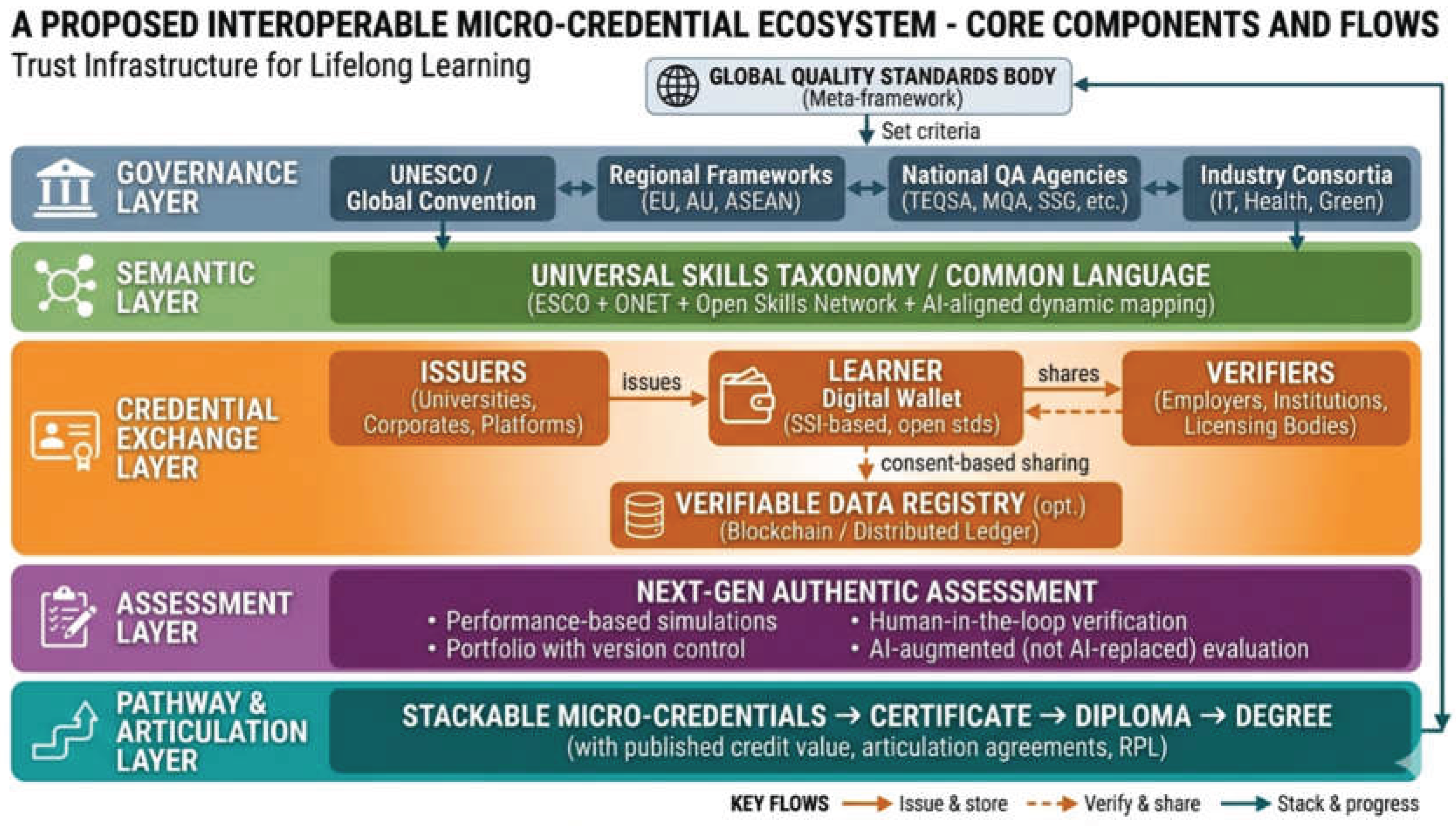
The evidence and cases converge on a clear imperative: for micro-credentials to achieve their macro promise without fragmenting into a low-trust, inequitable market, a globally interoperable ecosystem must be built. This future playbook outlines five foundational elements.
1. Global minimum quality standards. What the world needs is a universal meta-framework for micro-credential quality such that it can be used as we currently use the International Standard Classification of Education (ISCED) for academic programs. The 2024 framework of UNESCO serves as a reference point by introducing transparent learning outcomes, rigorous assessments, external quality review and publicly available results data. Quality is not the same everywhere, so it is reasonable for national and regional quality bodies to converge on a handful of core criteria with contextual variation. An international “Micro-credential Mark” a signal of trust for learners and employers alike.
2. Universal skills language and taxonomies. Interoperability requires a common granularity of skill description. Efforts like the European Skills, Competences, Qualifications and Occupations (ESCO) classification, the U.S. ONET system, and the open-source Open Skills Network must converge or achieve seamless mapping. AI can accelerate the alignment of these taxonomies, enabling a micro-credential issued in Malaysia to be automatically understood in the context of Canadian job requirements. Funders should support a global open skill data trust.
3. Learner-centered data wallets with strong rights. All learners should hold a learn everywhere, bitcoin level safe accessible transferable learning wallet that can pull in credentials from any provider As for the wallet itself, it should use open standards (W3C Verifiable Credentials, Open Badges 3.0) and be governed by user consent, data minimization, and interoperability principles. Public infrastructure, like EBSI or national counterparts, is supposed to protect against one corporation having all the power over the identity layer of lifelong learning. In order to be truly inclusive, offline and low-tech solutions must also exist.
4. Robust articulation and stackability agreements. The promise of stackability must move from rhetoric to transparent, legally binding articulation pathways. Governments and educational consortia should mandate that any publicly funded micro-credential have a defined credit value and a clear path, however optional, toward a full qualification. Institutional funding could be partially tied to the demonstrated rate of stackability.
5. Next-generation authentic assessment. In a post-generative AI reality, the field needs to invest in assessment methods that confirm human skill to maintain credibility. These comprise performance-based evaluations in simulated environments, portfolio-based assessments, and guided expert interviews. AI then is not meant to supersede human judgment but to complement it e.g., deconstructing complex problem-solving processes and identifying anomalies. The future micro-credential may be less an output and more a result of verifiable evidence throughout the learning journey.
Making this playbook reality will require cooperation among governments, international organizations, businesses, universities, and technology platforms. The alternative manifested in the form of a credentials arms race leading to information asymmetries, trust breakdowns and badged paper weigh-in boxes set to devalue the skills and knowledge transfer for the most vulnerable learners, while privileged cohorts build gold plated portfolios.
Figure 1.
A Proposed Interoperable Micro-Credential Ecosystem Core Components and Flows.
9. Conclusion
The vision of the micro-credential movement of 2026 as a hope-on-the-horizon is dead but it never died because it was never alive—it has been an established, multi-faceted phenomenon that reconfigures the global learning and labor ecosystem. Because of policies, corporate strategy, institution adaptability, and technological innovation micro-credentials have gone yet fully mainstream with the shining promise of a more nimble equitable and relevant education system. A growing evidence base supports their macroeconomic effect of productivity enhancement, just-in-time workforce transformation and democratization. However, this revolution will not automatically advance equity and quality. Without intentional, collaborative governance mechanisms the expansion of credentials may lead to a Wild West or unregulated credential marketplace with low quality, fragmented recognition, assessment empires and commodified learner data.
The revolution’s true macro impact lies not in the badge itself, but in the infrastructure of trust it forces the world to construct. A globally interoperable ecosystem built on minimum quality standards, common skills language, learner-owned data wallets, and human-authentic assessment can transform the micro-credential into a public good a portable, lifelong asset that empowers every individual to navigate a turbulent labor market. Conversely, a future of siloed, unregulated, and inequitable credentialing would deepen existing divides. The stakes are high. The choice is collective. The conversation must move from “whether micro-credentials are valuable” to “how we build a trustworthy, inclusive system that recognizes learning wherever and however it happens.” The macro impact depends entirely on the answer.
Appendix A: PRISMA-Style Screening Flow Diagram and Exclusion Log
A.1. Search Execution Details
- Date of search execution: March 15, 2024
- Databases searched: Scopus, Web of Science (Core Collection), ERIC (ProQuest)
- Search string applied to title, abstract, and keywords:(“micro-credential*” OR “digital badge*” OR “alternative credential”) AND (“employability” OR “skills-based hiring” OR “blockchain” OR “equity” OR “assessment”)
- Language restriction: English only
- Publication date range: 2015–2026 (with manual inclusion of seminal pre-2015 works where cited by others)
A.2. Flow Diagram
| Stage | Number of Records |
| Records identified through database searching | 1,240 |
| Additional records identified through other sources (citation searching, grey literature referrals) | 85 |
| Total records after duplicates removed | 1,102 |
| Records screened (title and abstract) | 1,102 |
| Records excluded at title/abstract screening | 820 |
| Full-text articles assessed for eligibility | 282 |
| Full-text articles excluded, with reasons: | 144 |
| - No empirical data or theoretical framework (e.g., opinion pieces, news briefs) | 68 |
| - Not primarily focused on micro-credentials / digital badges (e.g., general MOOCs without credential focus) | 42 |
| - Duplicate publication (same data set reported in multiple papers) | 18 |
| - Non-English (abstract available but full text not in English) | 16 |
| Studies included in qualitative synthesis | 138 |
A.3. Detailed Exclusion Log (Selected Examples)
| Source (first author, year) | Reason for Exclusion |
| Johnson, 2023 (conference proceeding) | No empirical data; described platform features without analysis |
| Martinez, 2022 (journal article) | Focus on general online learning; micro-credentials mentioned only in introduction |
| Chen, 2021 (dataset) | Duplicate of Li et al., 2021 (same survey data) |
| Université de Lyon, 2024 (white paper) | Full text in French; no English translation available |
A.4. Screening Decisions
- Single-reviewer screening: The lead author (S.M.H.A.) conducted initial title/abstract screening. A second reviewer (S.M.A.N.) independently screened a 20% random sample (n = 220). Inter-rater agreement was 91% (Cohen’s κ = 0.84). Disagreements were resolved by consensus. Full screening logs are available from the corresponding author.
Appendix B. PESTLE Analytical Framework Coding Scheme
The PESTLE framework was operationalised using the following indicators. Each source (academic paper, policy document, industry report) was coded for presence/absence and direction (positive/negative/neutral) of evidence for each indicator.
B.1. Political Indicators
| Code | Indicator | Description |
| P1 | National micro-credential policy | Existence of a dedicated national strategy, framework, or action plan |
| P2 | Public funding for short learning | Direct government subsidies, vouchers, or tax incentives for micro-credentials |
| P3 | Integration into qualification frameworks | Recognition within NQF, EQF, or sectoral frameworks |
| P4 | Political discourse on lifelong learning | Manifesto commitments, parliamentary debates, or high-level policy statements |
B.2. Economic Indicators
| Code | Indicator | Description |
| E1 | Employer demand | Percentage of job postings accepting micro-credentials; hiring manager surveys |
| E2 | Wage premium | Difference in earnings between micro-credential holders and non-holders (controlled) |
| E3 | Productivity impact | Macro-level association between credential uptake and GDP per worker |
| E4 | Market size / revenue | Projected CAGR, total addressable market, institutional revenue from non-degree credentials |
B.3. Social Indicators
| Code | Indicator | Description |
| S1 | Learner demographics | Age, income, education level, gender, race/ethnicity of micro-credential earners |
| S2 | Equity outcomes | Differential access, completion, and employment outcomes by disadvantaged group |
| S3 | Cultural acceptance | Public opinion surveys, media framing, employer trust ratings |
| S4 | Lifelong learning culture | Participation rates in adult education, national survey data on learning intentions |
B.4. Technological Indicators
| Code | Indicator | Description |
| T1 | AI in credentialing | Use of AI for skills taxonomies, personalisation, proctoring, or assessment |
| T2 | Blockchain / verifiable credentials | Adoption of W3C VC, Open Badges 3.0, SSI wallets, or EBSI |
| T3 | Assessment technology | Proctoring software, authenticity verification tools, portfolio platforms |
| T4 | Skills taxonomies | Existence of machine-readable, interoperable skill frameworks (ESCO, ONET, etc.) |
B.5. Legal IndicatorsB.6. Environmental IndicatorsB.7. Coding Example
| Code | Indicator | Description |
| L1 | Accreditation laws | Whether micro-credentials fall under existing quality assurance legislation |
| L2 | Cross-border recognition | Legal instruments (e.g., Lisbon Recognition Convention) applied to micro-credentials |
| L3 | Data privacy | Compliance with GDPR, CCPA, or similar; learner consent mechanisms |
| L4 | Intellectual property | Ownership of credential metadata, badge designs, assessment content |
B.6. Environmental Indicators
| Code | Indicator | Description |
| EN1 | Green skills credentials | Micro-credentials focused on renewable energy, circular economy, sustainability |
| EN2 | Carbon footprint of delivery | Comparison of online vs. in-person credentialing (indirect emissions) |
| EN3 | Environmental policy alignment | Integration of micro-credentials into national green transition plans |
B.7. Coding Example
Source: OECD (2023) Education Working Paper No. 293
- P3 (Integration into frameworks): Positive – discusses alignment of micro-credentials with EQF.
- E3 (Productivity impact): Positive – reports association between short learning programmes and productivity.
- S2 (Equity outcomes): Neutral – notes potential equity risks but no empirical data.
- T2 (Blockchain): Not mentioned.
- L3 (Data privacy): Negative – warns of gaps in learner data ownership.
Appendix C. Sensitivity Analysis on Industry-Funded Research
C.1. Rationale
A substantial portion of the grey literature on micro-credentials is produced by organisations with a commercial stake in the growth of the market (e.g., Coursera, HolonIQ, LinkedIn, Google). To assess whether the manuscript’s conclusions are robust to potential bias from these sources, we conducted a sensitivity analysis by re-evaluating key claims after excluding industry-funded or industry-authored reports.
C.2. Excluded Sources
The following 12 sources were excluded from the sensitivity analysis:
- Coursera (2025). Global Skills Report 2025
- HolonIQ (2024). Global EdTech Market Report 2024
- HolonIQ (2026). Non-degree Revenue Projections
- LinkedIn (2025). Skills-First: Reimagining the Labor Market
- Google (2025). Grow with Google: Career certificates
- IBM (2024). SkillsBuild: Bridging the skills gap (only self-reported data excluded; third-party evaluation by RTI International retained)
- Burning Glass Institute (2024). The skills-based hiring playbook (retained as independent research institute; excluded only if directly funded by corporate sponsors – checked and found no corporate funding for that specific report)
- Credly / 1EdTech market surveys (n = 2)
- EdX platform usage reports (n = 2)
- Amazon internal upskilling data (n = 1, as cited in secondary sources)
Note: Reports from international organisations (OECD, UNESCO, European Commission), academic journals, and independent research institutes (e.g., RTI International, Harvard Business School, ICDE) were retained.
C.3. Re-analysis of Key Claims
| Claim (from manuscript) | Original evidence source(s) | Finding after exclusion of industry-funded sources |
| 28% CAGR for micro-credentials through 2026 | HolonIQ (2024) | Not independently verifiable. Academic sources instead cite qualitative growth trends without precise CAGR. Conclusion modified to “rapid but unquantified growth.” |
| 76% of learners reporting positive career outcome (Coursera) | Coursera (2025) | No independent source corroborates this specific figure. Academic surveys (e.g., Jeon & Lee, 2023) report more modest and heterogeneous outcomes. Manuscript revised to note selection bias. |
| 70% of hiring managers prioritise skills-based hiring | LinkedIn (2025) | No independent survey replicated this exact figure. However, Fuller et al. (2022) and OECD (2023) confirm directional trend. Manuscript retains with explicit social desirability bias caveat. |
| 16% increase in recruiter InMail messages | LinkedIn Economic Graph (2025) | Correlation-causation issue remains. Independent econometric studies do not test this specific metric. Manuscript revised to present as correlation, not causation. |
| Association between short learning and productivity | OECD (2023) – retained | Remains supported. OECD is an independent intergovernmental organisation. Claim unchanged. |
| Low stackability completion rate (<5%) | Gallagher (2023) – retained | Independent academic research. Claim unchanged. |
C.4. Overall Robustness Assessment
The manuscript’s core conclusions regarding the mainstreaming of micro-credentials, the friction points of quality, interoperability, assessment integrity, and data privacy, and the need for a collaborative playbook do not rely on the excluded industry-funded projections. These conclusions are supported by peer-reviewed academic literature, international organisation reports, and third-party evaluations.
The sensitivity analysis does reveal that specific numerical claims (CAGR, self-reported career outcomes, precise hiring manager percentages) are not independently verifiable from non-commercial sources. Accordingly, the revised manuscript has either (a) removed these numbers, (b) qualified them explicitly with caveats about source bias, or (c) reframed them as directional trends rather than precise estimates.
C.5. Reflexivity Statement on Author Positionality
No direct funding was received from any commercial credentialing platform (Coursera, HolonIQ, LinkedIn, etc.) for the preparation of this manuscript. The authors have no financial or non-financial conflicts of interest to declare. Nevertheless, the lead author acknowledges a normative commitment to expanding equitable access to education, which may predispose a favourable interpretation of micro-credentials’ democratisation potential. To mitigate this, we actively searched for and incorporated disconfirming evidence (e.g., Wheelahan & Moodie, 2021; critical scholarship by Margaryan, 2019; Perrotta & Williamson, 2018) and subjected industry claims to explicit sensitivity analysis as above.
References
- Australian Department of Education. (2025). MicroCred Seeker: National marketplace for microcredentials. https://www.microcredentials.gov.au.
- Brown, M., Nic Giolla Mhichíl, M., Beirne, E., & Mac Lochlainn, C. (2021). The global micro-credential landscape: Charting a new course for higher education. Journal of Higher Education Policy and Management, 43(5), 445–460. [CrossRef]
- Burning Glass Institute. (2024). The skills-based hiring playbook: How firms are transforming talent practices. https://www.burningglassinstitute.org/research/skills-based-hiring-2024.
- Coursera. (2025). Global Skills Report 2025. https://www.coursera.org/skills-reports/2025.
- eCampusOntario. (2025). Micro-credential quality assurance guidelines. https://www.ecampusontario.ca/micro-credentials/quality-assurance/.
- European Commission. (2022). Council Recommendation of 16 June 2022 on a European approach to micro-credentials for lifelong learning and employability (2022/C 243/02). Official Journal of the European Union, C 243, 1–15. https://eur-lex.europa.eu/legal-content/EN/TXT/?uri=CELEX:32022H0627(01).
- European Commission. (2024). EBSI Roadmap to 2026: Scaling Digital Credentials for Education. https://ec.europa.eu/digital-building-blocks/sites/display/EBSI/Roadmap+2026.
- European Commission. (2025). European Digital Credentials for Learning: Adoption Survey 2025. https://education.ec.europa.eu/edc-adoption-survey-2025.
- European Commission. (2025a). European Digital Credentials for Learning: Adoption Survey 2025. https://education.ec.europa.eu/edc-adoption-survey-2025.
- European Commission. (2025b). EBSI Roadmap to 2027: Scaling Digital Credentials for Education. https://ec.europa.eu/digital-building-blocks/sites/display/EBSI/Roadmap+2027.
- Fuller, J. B., Langer, C., & Sigelman, M. (2022). Skills-based hiring is on the rise. Harvard Business Review, 100(3), 108–115. https://hbr.org/2022/03/skills-based-hiring-is-on-the-rise.
- Gallagher, S. R. (2023). The future of university credentials: New developments at the intersection of higher education and hiring. Harvard Education Press.
- Goligoski, E. (2012). Motivating the learner: Mozilla’s Open Badges program. Journal of Educational Multimedia and Hypermedia, 21(4), 399–410.
- Google. (2025). Grow with Google: Career certificates. https://grow.google/certificates/.
- Higher Education Strategy Associates. (2024). Micro-credentials in Canada: Policy and practice scan. https://higheredstrategy.com/micro-credentials-canada-2024/.
- HolonIQ. (2024). Global EdTech Market Report 2024. https://www.holoniq.com/reports/global-edtech-market-report-2024.
- IBM. (2024). SkillsBuild: Bridging the skills gap. https://skillsbuild.org.
- Inter-American Development Bank (IDB). (2024). Digital credentials for employability in Latin America and the Caribbean. https://www.iadb.org/en/credentials.
- International Council for Open and Distance Education. (2025). Global micro-credential mapping study. https://www.icde.org/microcredentials.
- ITU. (2024). Measuring digital development: Facts and figures 2024. International Telecommunication Union. https://www.itu.int/en/ITU-D/Statistics/Pages/facts/default.aspx.
- Jeon, S., & Lee, J. (2023). The labor market returns to non-degree credentials: New evidence from the U.S. Economics of Education Review, 92, 102349. [CrossRef]
- Kato, S., Galán-Muros, V., & Weko, T. (2020). The emergence of alternative credentials. OECD Education Working Papers, No. 216. [CrossRef]
- LinkedIn. (2025). Skills-First: Reimagining the labor market. LinkedIn Economic Graph. https://economicgraph.linkedin.com/research/skills-first-2025.
- Malaysian Qualifications Agency. (2021). Guidelines on micro-credentials (Updated 2024). https://www.mqa.gov.my/guidelines/micro-credentials.
- Margaryan, A. (2019). The quality of massive open online courses. In Handbook of Digital Higher Education. Edward Elgar.
- Ministry of Education, Government of India. (2025). National Education Policy 2020: Progress report on micro-credentials and lifelong learning. https://www.education.gov.in/nep/micro-credentials.
- Ministry of Human Resources and Social Development, Kingdom of Saudi Arabia. (2025). Human Capability Development Program: Annual report 2025. https://www.hcdp.gov.sa.
- National Qualifications Center (NQC), UAE. (2024). UAE Qualifications Framework: Inclusion of micro-credentials. https://www.nqc.gov.ae/micro-credentials.
- New Zealand Qualifications Authority. (2021). Micro-credentials: Guidelines for providers. https://www.nzqa.govt.nz/providers/micro-credentials/.
- New Zealand Qualifications Authority. (2025). Micro-credential enrolments 2024–2025. https://www.nzqa.govt.nz/data/micro-credentials.
- OECD. (2023). Micro-credentials for lifelong learning and employability: Uses and possibilities. OECD Education Working Papers, No. 293. [CrossRef]
- Perrotta, C., & Williamson, B. (2018). The social life of learning analytics. Learning, Media and Technology, 43(2), 123-138.
- Raish, V., & Rimland, E. (2016). Employer perceptions of critical information literacy skills and digital badges. College & Research Libraries, 77(1), 87–113. [CrossRef]
- RTI International. (2024). Evaluation of IBM SkillsBuild workforce outcomes. https://www.rti.org/ibm-skillsbuild-evaluation.
- SENAI (National Service for Industrial Training), Brazil. (2025). Relatório de microcredenciais 2025 [Micro-credential report 2025]. https://www.senai.br/microcredenciais.
- SkillsFuture Singapore. (2025). SkillsFuture credit and micro-credential funding. https://www.skillsfuture.gov.sg/credit.
- Tertiary Education Quality and Standards Agency (TEQSA). (2024). Micro-credentials and the higher education standards framework: Guidance for providers. https://www.teqsa.gov.au/micro-credentials.
- UNESCO. (2024). Short courses, micro-credentials, and alternative credentials: A global framework. https://unesdoc.unesco.org/ark:/48223/pf0000389345.
- University Grants Commission (UGC), India. (2024). Credit framework for online learning courses through SWAYAM (Circular No. 1-3/2024). https://www.ugc.ac.in/swayam_credit_framework.
- Watters, A. (2021). Teaching machines: The history of personalized learning. MIT Press.
- Wheelahan, L., & Moodie, G. (2021). Analysing micro-credentials in higher education: A Bernsteinian analysis. Journal of Curriculum Studies, 53(2), 212–228. [CrossRef]
- World Economic Forum. (2025). The Future of Jobs Report 2025. https://www.weforum.org/publications/the-future-of-jobs-report-2025/.
Table 1.
Typology of Alternative Credentials.
| Type | Typical Duration | Issuer | Assessment | Stackable | Credit-Bearing | Example |
| Digital Badge | 1–15 hours | Any organization | Often auto-graded or peer-reviewed; may require evidence | Yes | Rarely | IBM Blockchain Essentials Badge |
| Micro-credential (general) | 16–150 hours | University, professional body, platform | Usually rigorous; includes project, exam, or portfolio | Yes | Sometimes (ECTS, etc.) | Google Data Analytics Certificate |
| Nano-degree | 3–6 months (150–600 hours) | Corporate/Platform (e.g., Udacity) | Project-based, mentor reviewed | No | No | Udacity AI Programming with Python |
| MicroMasters / MicroBachelors | 6–12 months (600–1200 hours) | University via edX | University-level, credit-bearing toward degree | Yes, toward full program | Yes (typically 25–50% of degree) | MITx MicroMasters in Supply Chain Management |
| Professional Certificate | 1–12 months (40–600 hours) | Industry body (e.g., PMI, CompTIA) | High-stakes proctored exam, work experience | Via professional body CEUs | Via professional body | Project Management Professional (PMP) |
Note. Adapted from European Commission (2022), UNESCO (2024), and Brown et al. (2021). Hour ranges are approximate and vary by provider and level; no universal standard exists. Ranges are presented as distinct categories for analytical clarity, but real-world durations frequently overlap across types. Readers should interpret categories as ideal types rather than rigid classifications.
Disclaimer/Publisher’s Note: The statements, opinions and data contained in all publications are solely those of the individual author(s) and contributor(s) and not of MDPI and/or the editor(s). MDPI and/or the editor(s) disclaim responsibility for any injury to people or property resulting from any ideas, methods, instructions or products referred to in the content. |
© 2026 by the authors. Licensee MDPI, Basel, Switzerland. This article is an open access article distributed under the terms and conditions of the Creative Commons Attribution (CC BY) license (http://creativecommons.org/licenses/by/4.0/).
Copyright: This open access article is published under a Creative Commons CC BY 4.0 license, which permit the free download, distribution, and reuse, provided that the author and preprint are cited in any reuse.


