

Submitted:
27 May 2026
Posted:
28 May 2026
You are already at the latest version
Abstract
Intracellular dielectric parameters are promising biomarkers, especially for specific cancerous subpopulations such as cancer stem cells. While valuable, these parameters remain challenging to extract, typically remaining complex microfluidic setups combined with inverse fitting computations. This paper introduces a simplified methodology based on a dual-mode dielectrophoretic measurement approach, integrated with a machine learning-based predictive pipeline, to extract intracellular dielectric parameters of cancerous cells cultured under standard versus stemness-promoting conditions. These parameters are then used to compute the Clausius-Mossotti factor in the ultra-high frequency range, enabling a comparative analysis of the dielectric responses between the two cellular phenotypes.
Keywords:
dielectrophoresis
; cancer stem cells
; Clausius-Mossotti factor
; intracellular dielectric parameters
; machine learning
; predictive pipeline
1. Introduction
Over the past decades, numerous studies have demonstrated the relationship between cellular morphology, physiology, or functionality and dielectric properties, such as permittivity and conductivity [1]. These dielectric parameters are influenced by key biological factors, including membrane and mitochondrial potentials, ionic pump activity, and the nucleus-to-cytoplasm ratio. All of these factors undergo significant alterations during oncogenesis, leading to modified the dielectric properties of cancerous cells [2]. However, cancerous tissues are highly heterogeneous, composed of multiple subpopulations that play distinct roles in tumor growth and proliferation, each potentially exhibiting distinct dielectric signature. Among these, cancer stem cells (CSCs), a rare subset constituting less than 10% of the tumor, are critical drivers of tumor resistance and cancer relapse [3,4]. A major challenge in studying CSCs is the lack of specific biomarkers, as current routine diagnostic approaches rely on time-consuming functional assays. In this context, recent studies have identified Ultra-High Frequency (UHF) signatures of CSCs as potential biomarkers. This frequency window ranging from 20 MHz to 3 GHz reflects the intracellular content and highlight its dielectric parameters as promising biomarkers, particularly for rapid and non-invasive identification of CSCs [5,6]. Thus, assessing the dielectric properties of cells presents a promising way for developing non-invasive diagnostic tools, enabling both the characterization of cancerous cells and, more specifically, the identification of CSCs.
According to the literature, intracellular dielectric parameters reflect distinct cellular functionality and intracellular structure of CSCs [7]. When combined with recent advances in label-free cell dielectric measurements technologies, such as electrical impedance spectroscopy (EIS) [8,9], microwave spectroscopy (MWS) [10], and electrokinetic methods including dielectrophoresis (DEP) [11,12] and electrorotation (ROT) [13,14,15,16,17], these developments open new opportunities for identifying innovative biomarkers based on physical properties.
Although highly promising, the experimental assessment of intracellular dielectric properties remains challenging.
Both spectroscopic and electrokinetic methods share a common methodological approach. They monitor either the cell-induced perturbation of the electromagnetic field (as in EIS and MWS) or cellular movement (as observed in ROT and DEP) across a frequency range. By operating within the UHF range when compatible with such experimental assessments, these methods specifically probe interactions between the electric field and intracellular components, thus enabling the characterization of the intracellular compartment.
Among electrokinetic approaches, multifrequency dielectrophoresis stands out as one of the few non-invasive techniques capable of probing both membrane and intracellular properties at the single-cell level. The DEP response of a cell is governed by the Clausius–Mossotti (CM) factor, a complex, frequency-dependent function that describes the contrast between the dielectric properties of the cell and those of its surrounding medium, and by characteristic transition frequencies, including one mainly dominated by the membrane, , and the other UHF-based, , by the intracellular properties. Changes in membrane and intracellular polarization across frequencies give rise to these characteristic transition frequencies, which together form a unique dielectric fingerprint for each cell type.
This dual signature enables the fine discrimination of distinct cell populations, including rare subpopulations, based solely on their dielectric profile.
In this context, the present study introduces a novel approach that combines multifrequency dual-mode DEP measurements with machine learning (ML) algorithms. This method enables the assessment of intracellular dielectric properties and the estimation of cell dielectric behavior across the UHF frequency range, specifically allowing the reconstruction of the CM factor profile as a function of frequency. By relying on only two experimentally measured DEP characteristic frequencies, and , combined with a predictive algorithm pipeline, this approach provides a time-efficient and easily implementable methodology for extracting the UHF CM factor and probing intracellular dielectric properties.
2. Material and Method
2.1. Characteristic Frequencies in Electrokinetic Methods
Electrokinetic effects are based on cellular motion resulting from non-uniform electric fields, either via phase-dependent mechanisms, such as rotation fields for ROT, or amplitude-dependent ones, as observed in spatially inhomogeneous electric fields in DEP. Both mechanisms are fundamentally governed by the heterogenous dielectric parameter, called CM factor (, meaning that the cellular dielectric properties play a key role in the cell motion across the frequency spectrum when subjected to such external fields, as expressed in Equation (1).
where and are complex permittivities of the cell and the surrounding medium, respectively, and are their respective permittivities, and represent their conductivity (in S.m-1), and the angular frequency (in rad.s-1). The CM factor is consequently dependent on the frequency of the applied external field, as illustrated Figure 1, which describes the typical frequency-dependent behavior of the complex CM factor.
The real and imaginary components of fCM are plotted over a broad frequency range. The curve labeled “Re(fCM)” corresponds to the real part of the CM factor expression, while the dashed curve “Im(fCM)” represents the imaginary part. The characteristic frequencies , , and , indicate, respectively, the zero crossings of the real component and extrema of the imaginary component, which are commonly used to identify transitions in the polarization regime. This complex CM factor encompasses both the dielectrophoretic and electrorotational response of cells. Its real part is associated with the DEP force, , as expressed (2),
where is the radius of the cell and the gradient of the squared root-mean-square (RMS) electric field; it represents the spatial non-uniformity of the applied electric field that generates the DEP effect. The imaginary part is related to the rotation velocity associated with ROT, equation (3),
where is the viscosity of the surrounding medium.
It is well established that both ROT and DEP responses can be classified into two mains domains: one dominated by cell size and membrane properties, the other by intracellular properties [7]. At lower frequencies (typically under 350 kHz), the plasma membrane acts as a capacitive barrier insulating the intracellular content and membrane dielectric properties mainly govern the interaction. In contrast, at UHF, typically frequencies above several tens of MHz, the membrane becomes increasingly permeable to the electric field, allowing it to interact directly with the intracellular components. At these high frequencies, the membrane’s charging time is much longer than the period of the applied field, so the membrane cannot fully isolate the electric field. As a result, the field penetrates the cell and directly interacts with the intracellular components. This allows the applied field to probe the dielectric properties of the cytoplasm and organelles, making UHF frequencies particularly useful for studying intracellular structures. Based on these spectral properties, this UHF frequency band has progressively emerged as a valuable tool for cell analysis.
Considering the ROT spectrum, which results from the rotational velocity of a cell subjected to the applied electric field, the cellular rotation speed increases to a maximum at the characteristic frequency , whereas the maximum rotation speed, occurring in the UHF range, corresponds to (Figure 1).
The DEP spectrum arises from the translational movement of a cell subjected to the applied electric field, reflecting the frequency-dependent polarizability of the cell relative to its surrounding medium. This movement is characterized by a change in the direction and magnitude of the DEP force as the frequency changes, corresponding to positive DEP (pDEP) and the negative DEP (nDEP). During the nDEP regime, cells are repelled toward low intensity field regions, while in the pDEP regime, cells are attracted toward high intensity field region. The change of regime happens at two characteristics frequencies known as crossover frequencies and (Figure 1).
Each characteristic frequency is specific to either the membrane-dominated domain (kHz range) or intracellular-dominated domain MHz range).
As shown in [6], these characteristic frequencies can be linked to the physiological state of the cell, particularly within intracellular-dominated frequency ranges. DEP-based frequency analysis has revealed significant differences in the measured values between differentiated and CSCs subpopulations of U87 glioblastoma cell lines. These findings highlight the potential of DEP and ROT technics to track physiological changes of cells by probing their intracellular dielectric properties.
However, the direct assessment of intracellular dielectric parameters such as cytoplasmic conductivity and permittivity using DEP and ROT remains challenging. Using DEP typically requires more complex experimental setups and time-consuming measurements, limiting its routine application for high-throughput cellular analysis. Under these conditions, monitoring the real part of the CM factor is intrinsically difficult, as it cannot be measured continuously across the frequency spectrum. In practice, the dielectrophoretic motion of cells is only observable near the characteristic frequencies and , leading to sparse measurable data points. To address this limitation, several complementary strategies have been proposed. For example, one approach uses Stokes drag to balance the dielectrophoretic force, combined with capture voltage monitoring, to extract discrete values of [18]. Lo et al. [19] also employed contactless DEP to monitor radial cell displacement, enabling the acquisition of additional data points across the frequency spectrum. More recent tools took a different approach by reconstructing the Clausius-Mossotti factor spectrum from population-level DEP force measurements across a range of frequencies [20,21].
Yet, despite the development of new experimental protocols in recent years, one common feature remains constant: the iterative optimization of mathematical cell models by fitting theoretical curves to the discrete experimental measurement of the curve.
On the other hand, although it also requires reverse fitting to experimental data, accurately tracking the rotational movement of the cell is somewhat easier — and is the most common electrokinetic method for extracting cellular dielectric properties — provided that a high-resolution image analysis algorithm is used [22]. However, this is true only for part of the frequency spectrum, since ROT measurements face an intrinsic challenge: maintaining a constant phase gradient as frequency increases in the UHF domain. As the frequency rises, signal propagation issues, parasitic effects, and thermal drift become more significant, which limits the experimental measurement window [23,24,25].
2.2. Methods for Intra Cellular Dielectric Properties Extraction
U87 glioblastoma cell line samples were cultured under two distinct conditions: one in a standard medium (U87 NM) and the other in a cancer stem cell-enriching medium (U87 DM). To assess the intracellular dielectric properties of these cell populations, experimental data from a previous study [5] were investigated, in which the DEP characteristic frequencies ( and ) were measured on the same cells. These measurements were performed on both U87 NM and DM samples.
The principal steps of the developed methodology to assess intracellular dielectric parameters and plot the CM factor vs frequency are detailed in the following sections.
The first step involves introducing an analytical expression for , which is typically reported in the literature as a function of intracellular dielectric properties [26] as illustrated by equation (4).
At the lowest frequencies of the UHF spectrum (typically a few MHz), the influence of the membrane properties is minimal. To account for them, the cell is modeled as a cytoplasmic core surrounded by a thin membrane, in accordance with the Single-Shell model. The membrane dielectric properties are incorporated through the product of the membrane capacitance (F.m-2) and the cellular radius r. Hence, will be analytically modelized as a function of both intracellular and membrane dielectric parameters ().
However, to calculate all parameters this step by itself cannot provide the mathematical ground to achieve so. To circumvent the issue, we will combine our analytical approach with ML algorithms to predict both and .
Once all those parameters computed, will be calculated as analytical solution to ). Figure 2 summarizes the different steps of the workflow of the hybrid pipeline developed in the framework of our study.
2.3. Predictive Algorithms
First, to predict the values of intracellular dielectric parameters, the mathematical relationships between the UHF dielectrophoretic crossover frequency and these parameters were investigated. Additionally, the relationships between membrane dielectric parameters and their corresponding characteristic frequencies were also analyzed. The objective of this study is to establish quantitative models that can be integrated into predictive algorithms to minimize the estimation error of dielectric parameters based on experimentally measurable data.
We generated 50 000 combinations of and within their respective ranges, while the cell radius r was sampled in a range of 5 to 10 .The characteristic frequencies were then computed using a custom algorithm that simultaneously identities the two frequency points at which the real part of the CM factor is zero to establish a database of 50 000 The most evident relationships highlighted by the study are as illustrated by Figure 3. The interdependence of and in the membrane domain and (log scale) and in the UHF or intracellular domain. To summarize the methodology, the pipeline is composed of two different regression algorithms and one MATLAB® code. The parameter is first predicted from using an XGBoost-based algorithm [27], while is predicted from a another XGBoost-based algorithm using .
3. Results
3.1. Analytical Derivation of the Proposed Expression for
The analytical determination of was initiated through the application of the Single-Shell model of the cell. In this framework, [28], introduced the expression for the complex cellular permittivity, as given in equation (5).
where is the complex permittivity of the cytoplasm, is the complex membrane capacitance, which are given by Equations (6) and (7), respectively.
where is the permittivity of the cytoplasm and represents its conductivity. and are the membrane capacitance (F.m-2) and conductance (S.m-2), respectively.
Equation (5) is then substituted in (1). Afterward, the real part of the CM factor is extracted. This expression can be used to solve equation (8).
The resulting expression, corresponding to (9), can be formulated as a polynomial depending on the angular frequency ω of the applied electric field. Its coefficients are denoted as , and .
Thus, (9) expresses the real part of CM factor as a fourth-degree polynomial. Solving this polynomial yield four roots. After the two imaginary and negative roots are discarded, the remaining two roots correspond to and .
We therefore retain the expression of interest, given by (10), expressed as a function of the coefficients , and
The coefficients , and can be expressed as combinations of various terms that depend on the cellular dielectric parameters and the surrounding environment. The general expression for can be simplified by neglecting some terms in the polynomial coefficients.
To achieve this simplification, a numerical study was carried out using a customer-developed MATLAB® code. The study consists of an iteratively assessment of the statistical significance of each term in the coefficients , and All possible combinations of the dielectric parameters were considered within the variation ranges reported for cancerous cells in Table 1, based on values reported in the literature.
As the result, a simplified analytical expression for was obtained as shown in Equation (11).
The distribution of the relative error percentage between the simplified expression (11) and the general expression (10) of was plotted over the variation ranges of dielectric parameters for cancerous cells specified in Table I. As illustrated on Figure 4, the relative error percentage remains below 2% for all combinations of parameters.
3.2. Performance Assessment of the Predictive Algorithm
Performance metrics for the different computations, including the Mean Absolute Percentage Error (MAPE) and the Median Absolute Percentage Error (MdAPE), are summarized in Table 2.
The final step of the presented methodology to calculate intracellular dielectric parameters involves using the previously computed parameters along with the analytical expression of within a MATLAB® script. For each combination of , and the corresponding is then numerically solved thanks to Equation (11).
Relative error percentage distributions for each step of the pipeline over a validation dataset of 50 000 data points are displayed in Figure 5. The x-axis represents intervals of relative error (%) (i.e., 0-5%, 5-10%,10-15%, etc.), while the y-axis indicates the percentage of predictions that fall within each interval.
Analyzing the histogram, we observe that for the error distribution, more than 75% of the predictions have an error ≤5%, indicating a very high success rate for predicting . On the other hand, the error distribution for shows lower accuracy but remains within reasonable limits, with about 50% of the predictions within a 15% error range. Finally, when considering the cumulative error of both and used to calculate , 60% of the resulting values have an error within the 15% range.
3.3. Experimental Uncertainty
In this section, the potential impacts of experimental uncertainty on the accuracy of the pipeline’s predictions are studied. The measurements of and are assumed to have uncertainties of ±1 kHz and ±1 MHz, respectively. The effect of these uncertainties on the extracted parameters is analyzed at each stage of the process, first individually, and then cumulatively, using the synthetic sample of 50000 configurations described previously.
We first consider the uncertainty in the measurement of for the prediction of . Figure 6(a) shows a histogram of the resulting error for the three configurations: , and .
Figure 6(a) shows that the error distributions for predictions using the configurations, and are largely similar, with at most a 3% difference per error category. In contrast, the configuration exhibits a slightly larger shift in the error distribution. Nonetheless, 52.5% of predictions still have an error ≤ 5%, and 43% fall between 5 and 10%. The MAPE for , and are summarized in Table 3.
We conclude that the configurations and yield nearly identical results; therefore, only the configurations and will be considered in the following analysis.
The second step involves predicting from . This prediction is compared with the possible error configurations where is shifted by ± 1 MHz. Figure 6(b) shows the corresponding percentage error histograms, which reveal differences of less than 1% across all three configurations. Therefore, the measurement uncertainty has a negligible impact on the prediction of .
The final step of the hybrid pipeline workflow is the calculation of using the analytical expression of , with the predicted values of and as inputs. To evaluate the impact of measurement uncertainties on the extraction of it is necessary at this stage to consider the cumulative errors associated with , and .
Finally, is predicted from , while is predicted considering an experimental uncertainty of. Figure 7 compares the resulting percentage error distributions for , and demonstrates that the considered uncertainties have a negligible impact on its prediction.
In conclusion, the analysis of measurement uncertainty propagation for and through the stages of the hybrid pipeline, along with the evaluation of cumulative errors in the prediction of , indicates that their impact is negligible. Comparison of algorithm performance before and after introducing these uncertainties confirms that experimental errors in the dielectrophoretic crossover frequencies only marginally affect the extraction of cellular dielectric parameters within the considered ranges.
3.4. Experimental Measurements
Following the evaluation of the predictive algorithm metrics, the algorithm was applied to experimental measurements to demonstrate its practical applicability. Figure 8 presents the intracellular dielectric parameters derived from the processing of experimental data from [5] via the developed pipeline and the subsequent resolution of Equation (11).
Median values of the cell radius measured via a Coulter Counter and dielectric parameters ( for both samples U87 NM and DM are summarized in Table 4. We successfully assess three dielectric parameters of the single shell model within a reasonable error margin.
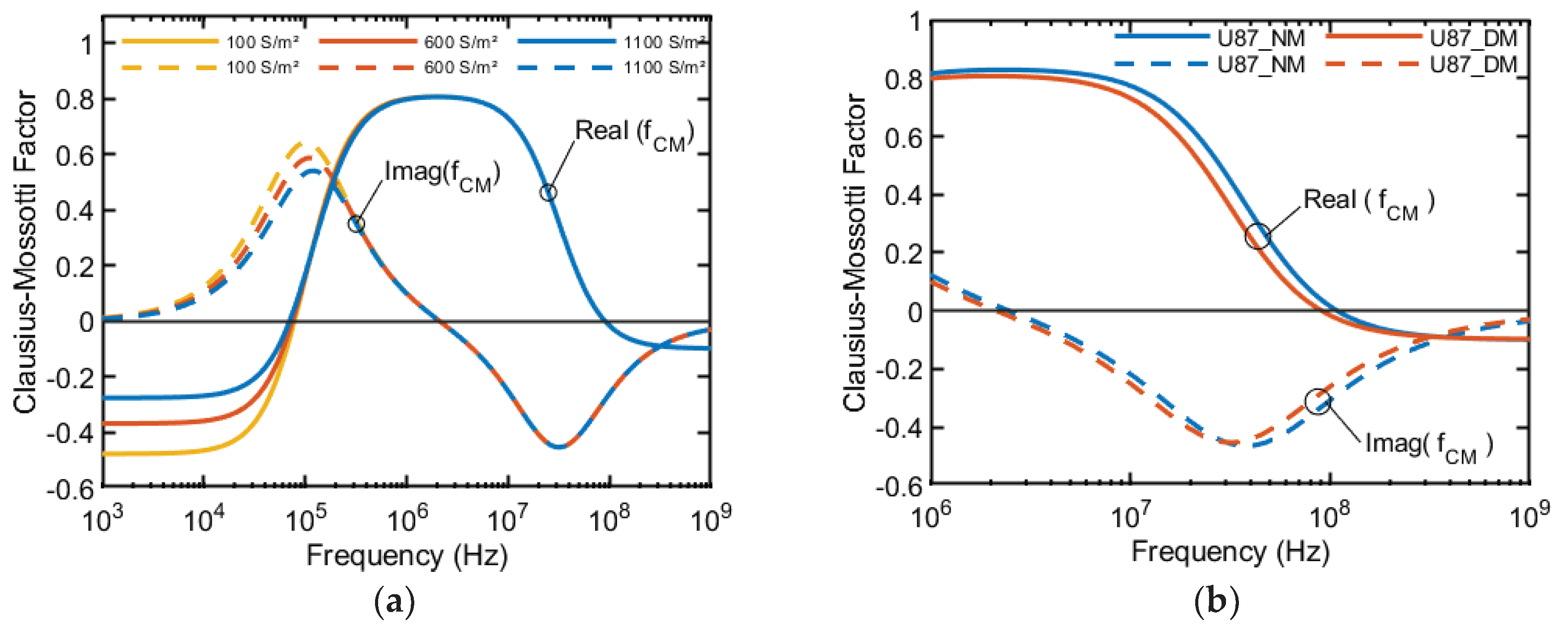
Based on these results, we proceeded to extract the CM factor to further analyze the dielectric properties of the cells under investigation. An initial analysis of Equations (5) and (7) indicates that extracting the CM factor requires prior knowledge of the membrane conductance . However, in the UHF range, the contribution of the cell membrane to the overall dielectric response becomes negligible. Hence, to evaluate the extent to which variations in influence the CM factor, we performed simulations using the MyDEP® software. The real and imaginary parts of the CM factor for the U87 DM sample based on the parameters listed in Table 4 were computed, assigning to its minimum, mean, and maximum values (i.e., 100 S.m-2, 600 S.m-2, and 1100 S.m-2, respectively).
The results presented in Figure 9 indicate that although modulates the lower frequency domain (i.e., the membrane-dominated regime), its effect is negligible in the UHF range (i.e., intracellular-dominated regime)
Therefore, a specific value of is not required to plot the UHF region of both real and imaginary parts of the CM factor. However, to maintain consistency with the experimental data, was fixed at the value corresponding to the median of each sample namely, 800 S.m-2 and 600 S.m-2 determined by iteratively scanning their respective ranges.
4. Discussion
The results presented in Figure 8 reveal a consistent reduction in the intracellular dielectric parameters of U87 CSCs, represented by the U87_DM population, compared to the non-stem control group (U87_NM cells). Statistical analysis via boxplots highlights a significant difference in cytoplasmic conductivity () between the two cells groups. Especially, U87_NM cells exhibit a higher median conductivity and greater phenotypic variability, evidenced by a broader interquartile range and extended whiskers. In contrast, U87_DM cells, are characterized by lower and more constrained conductivity values. These results suggest that the non-stem conditions (U87_NM cells ) are associated with an elevated ionic content or a specific intracellular reorganization, potentially reflecting specialized metabolic activity or distinct membrane transport mechanisms inherent to the differentiated state.
To the contrary, cytoplasmic permittivity () exhibits minimal fluctuation for both populations (U87_NM and DM). While a marginal increase in the median is noted for the U87_DM cells population, the difference is negligible, with nearly identical median values and comparable levels of dispersion. The lack of pronounced variation may suggest that the dielectric polarization properties of the cytoplasm, and by extension, the overall water content and dipolar structure, remain essentially unchanged.
Overall, these results demonstrate that the primary biophysical distinction between U87_NM and U87_DM cells lies in cytoplasmic conductivity rather than permittivity. Beyond technical validation, this approach allows for the quantification of numerical distributions, suggesting that these intrinsic biophysical properties can effectively identify CSC-enriched populations without the need for invasive labeling.
The Clausius-Mossotti spectral analysis presented in Figure 9(b) further supports the existence of distinct intracellular dielectric signatures associated with the physiological state of U87 cells. As illustrated in Figure 9(b), in the UHF range, the real part of the CM factor for the U87_DM population exhibits a distinct displacement toward lower frequencies compared to the U87_NM control group, corresponding to a lower second crossover frequency () for the DM cells. According to DEP theory, is mainly sensitive to the intracellular properties, especially cytoplasmic conductivity (). The observed reduction in in U87 cancer stem cells (U87_DM cells) therefore explains the shift of and suggests a substantial reorganization of the intracellular ionic environment. Such changes may also reflect variations in the volume fraction of intracellular organelles.
Integrating these experimental findings into our ML pipeline demonstrates that monitoring only two frequencies ( and ) is sufficient to reconstruct the UHF dielectric profile. This represents a major advance, as it avoids the need for exhaustive frequency sweeps nor the best-fitting of dielectric parameters. The ability to discriminate between U87_NM and U87_DM cells based solely on their biophysical signature highlights the potential of this data-driven strategy to replace more invasive and time-consuming biological assays.
Although the current predictive performance remains limited by features experimentally available, the consistency of the observed trends across cell populations highlights the robustness of the methodology. These result pave the way for the development of a rapid, label-free diagnostic platform capable of identifying malignant cell subpopulations in biomedical applications.
5. Conclusions
This study establishes a robust methodology for the label-free biophysical characterization of cellular dielectric properties, effectively integrating theoretical analytical models within the context of the inherent constraints of experimental workflows. By combining ML regression algorithms with a dual-frequency dielectrophoretic methodology, we successfully bypassing the inherent limitations of conventional computational burden and iterative fitting procedures typically associated with cellular electrokinetic.
The proposed method represents a novel alternative from conventional curve-fitting techniques. While standard protocols for extracting intracellular permittivity () and conductivity () required exhaustive frequency sweeps and computationally intensive numerical retrofitting, our approach optimize this process significantly.
In this study, an analytical method based on dual dielectrophoretic measurements that avoids the need for costly and time-consuming biological experiments were proposed. To assess intracellular dielectric properties and generate the CM factor in the UHF range, the method combines the experimentally measured DEP crossover frequencies and and ML regression algorithms. Our results show a significant reduction in the intracellular dielectric parameters of U87 cancer stem cells compared to non-stem populations. Moreover, this method enables a precise estimation of their numerical distribution, providing a robust label-free biophysical signature for the identification and quantification of malignant cell subpopulations within heterogeneous samples.
We validate that while the current performance of the proposed algorithms has reached saturation, primarily constrained by the limitation of the experimentally assessed features during the training step, the theoretical ceiling for this methodology remains significant. The potential to further refine these models lies in the integration of multi-modal UHF measurements to enrich the training feature space. In a broader context, this work paves the way for the development of real-time, high-throughput platforms for cell sorting and characterization. By providing a high-speed, data-driven alternative to classical modeling, this methodology facilitates the deployment of DEP-based diagnostics in clinical settings where both temporal efficiency and biophysical precision are crucial.
Abbreviations
The following abbreviations are used in this manuscript:
| CSC | Cancer Stem Cell |
| EIS | Electrical Impedance Spectroscopy |
| MWS | Microwave Spectroscopy |
| DEP | Dielectrophoresis |
| ROT | Electrorotation |
| UHF | Ultra-High Frequency |
| CM | Clausius–Mossotti |
| CM factor | |
| RMS | Root-mean-square |
| pDEP | Positive Dielectrophoresis |
| nDEP | Negative Dielectrophoresis |
| U87 NM | U87 glioblastoma cell line, in a standard medium |
| U87 DM | U87 glioblastoma cell line, in a cancer stem cell-enriching medium |
| MAPE | Mean Absolute Percentage Error |
| MdAPE | Median Absolute Percentage Error |
| ML | Machine Learning |
References
- Gabriel, C.; Gabriel, S.; Corthout, E. The Dielectric Properties of Biological Tissues: I. Literature Survey. Phys. Med. Biol. 1996, 41(no. 11), 2231. [Google Scholar] [CrossRef]
- Di Gregorio, Elisabetta; Israel, Simone; Staelens, Michael; Tankel, Gabriella; Shankar, Karthik; Tuszyński, Jack A. The Distinguishing Electrical Properties of Cancer Cells. Phys. Life Rev. 2022, 43, 139–88. [Google Scholar] [CrossRef]
- Heppner, Gloria H.; Miller, Bonnie E. Tumor Heterogeneity: Biological Implications and Therapeutic Consequences. Cancer Metastasis Rev. 1983, 2(no. 1), 5–23. [Google Scholar] [CrossRef]
- van der Heijden, Maartje; Vermeulen, Louis. A Cancer Stem Cell Perspective on Minimal Residual Disease in Solid Malignancies. In Cancer Stem Cell Resistance to Targeted Therapy; Maccalli, Cristina, Todaro, Matilde, Ferrone, Soldano, Eds.; Springer International Publishing: Cham, 2019; pp. 31–49. [Google Scholar]
- Lambert, Elisa; Manczak, Rémi; Barthout, Elodie; Saada, Sofiane; Porcù, Elena; Maule, Francesca; Bessette, Barbara; Viola, Giampietro; Persano, Luca; Dalmay, Claire; Lalloué, Fabrice; Pothier, Arnaud. Microfluidic Lab-on-a-Chip Based on Uhf-Dielectrophoresis for Stemness Phenotype Characterization and Discrimination among Glioblastoma Cells. Biosensors 2021, 11(no. 10), 388. [Google Scholar] [CrossRef]
- Manczak, R.; Saada, S.; Provent, T.; Dalmay, C.; Bessette, B.; Bégaud, G.; Battu, S.; Blondy, P.; Jauberteau, M. O.; Baristiran Kaynak, C.; Kaynak, M.; Palego, C.; Lalloué, F.; Pothier, A. Uhf-Dielectrophoresis Crossover Frequency as a New Marker for Discrimination of Glioblastoma Undifferentiated Cells. IEEE J. Electromagn. RF Microwaves Med. Biol. 2019, 3(no. 3), 191–98. [Google Scholar] [CrossRef]
- Pethig, Ronald; Menachery, Anoop; Pells, Steve; De Sousa, Paul. Dielectrophoresis: A Review of Applications for Stem Cell Research. BioMed Res. Int. 2010, no. 1, 182581. [Google Scholar] [CrossRef] [PubMed]
- Cheung, K.; Gawad, S.; Renaud, P. Impedance Spectroscopy Flow Cytometry: On-Chip Label-Free Cell Differentiation. Cytom. A 2005, 65(no. 2), 124–32. [Google Scholar] [CrossRef]
- Sabuncu, A. C.; Stacey, M.; Craviso, G. L.; Semenova, N.; Vernier, P. T.; Leblanc, N.; Chatterjee, I.; Zaklit, J. Dielectric Properties of Isolated Adrenal Chromaffin Cells Determined by Microfluidic Impedance Spectroscopy. Bioelectrochemistry 2018, 119, 84–91. [Google Scholar] [CrossRef] [PubMed]
- Nerguizian, Vahé; Alazzam, Anas; Stiharu, Ion; Burnier, Miguel. Characterization of Several Cancer Cell Lines at Microwave Frequencies. Measurement 2017, 109, 354–58. [Google Scholar] [CrossRef]
- Zhang, Zhizhong; Zheng, Tianyang; Zhu, Rong. Characterization of Single-Cell Biophysical Properties and Cell Type Classification Using Dielectrophoresis Model Reduction Method. Sens. Actuators B Chem. 2020, 304, 127326. [Google Scholar] [CrossRef]
- Sanchis, A.; Brown, A. P.; Sancho, M.; Martínez, G.; Sebastián, J. L.; Muñoz, S.; Miranda, J. M. Dielectric Characterization of Bacterial Cells Using Dielectrophoresis. Bioelectromagnetics 2007, 28(no. 5), 393–401. [Google Scholar] [CrossRef]
- Bahrieh, Garsha; Erdem, Murat; Özgür, Ebru; Gündüz, Ufuk; Külah, Haluk. Assessment of Effects of Multi Drug Resistance on Dielectric Properties of K562 Leukemic Cells Using Electrorotation. RSC Adv. 2014, 4(no. 85), 44879–87. [Google Scholar] [CrossRef]
- Huang, Liang; Zhao, Peng; Wang, Wenhui. 3d Cell Electrorotation and Imaging for Measuring Multiple Cellular Biophysical Properties. Lab A Chip 2018, 18(no. 16), 2359–68. [Google Scholar] [CrossRef]
- Becker, F. F.; Wang, X. B.; Huang, Y.; Pethig, R.; Vykoukal, J.; Gascoyne, P. R. Separation of Human Breast Cancer Cells from Blood by Differential Dielectric Affinity. Proc. Natl. Acad. Sci. 1995, 92(no. 3), 860–64. [Google Scholar] [CrossRef]
- Han, Song- I.; Joo, Young-Don; Han, Ki-Ho. An Electrorotation Technique for Measuring the Dielectric Properties of Cells with Simultaneous Use of Negative Quadrupolar Dielectrophoresis and Electrorotation. Analyst 2013, 138(no. 5), 1529–37. [Google Scholar] [CrossRef]
- Lannin, Timothy; Su, Wey-Wey; Gruber, Conor; Cardle, Ian; Huang, Chao; Thege, Fredrik; Kirby, Brian. Automated Electrorotation Shows Electrokinetic Separation of Pancreatic Cancer Cells Is Robust to Acquired Chemotherapy Resistance, Serum Starvation, and Emt. Biomicrofluidics 2016, 10(no. 6). [Google Scholar] [CrossRef] [PubMed]
- Wu, Liqun; Yung, Lin-Yue Lanry; Lim, Kian-Meng. Dielectrophoretic Capture Voltage Spectrum for Measurement of Dielectric Properties and Separation of Cancer Cells. Biomicrofluidics 2012, 6(no. 1). [Google Scholar] [CrossRef]
- Lo, Y. J.; Lei, U.; Chen, K. Y.; Lin, Y. Y.; Huang, C. C.; Wu, M. S.; Yang, P. C. Derivation of the Cell Dielectric Properties Based on Clausius-Mossotti Factor. Appl. Phys. Lett. 2014, 104(no. 11). [Google Scholar] [CrossRef]
- Hoettges, Kai F.; Henslee, Erin A.; Serrano, Ruth M. Torcal; Jabr, Rita I.; Abdallat, Rula G.; Beale, Andrew D.; Waheed, Abdul; Camelliti, Patrizia; Fry, Christopher H.; van der Veen, Daan R.; Labeed, Fatima H.; Hughes, Michael P. Ten–Second Electrophysiology: Evaluation of the 3dep Platform for High-Speed, High-Accuracy Cell Analysis. Sci. Rep. 2019, 9(no. 1), 19153. [Google Scholar] [CrossRef]
- Tivig, Ioan; Moisescu, Mihaela Georgeta; Savopol, Tudor. Opendep: An Open-Source Platform for Dielectrophoresis Spectra Acquisition and Analysis. ACS Omega 2023, 8(no. 41), 38715–22. [Google Scholar] [CrossRef] [PubMed]
- De, Giovanni; Gasperis; XiaoBo, Wang; Jun, Yang; Frederick, F. Becker; Peter, R. C. Gascoyne. Automated Electrorotation: Dielectric Characterization of Living Cells by Real-Time Motion Estimation. Meas. Sci. Technol. 1998, 9(no. 3), 518. [Google Scholar] [CrossRef]
- Gimsa, J.; Müller, T.; Schnelle, T.; Fuhr, G. Dielectric Spectroscopy of Single Human Erythrocytes at Physiological Ionic Strength: Dispersion of the Cytoplasm. Biophys. J. 1996, 71(no. 1), 495–506. [Google Scholar] [CrossRef]
- Scandura, Grazia; Moscato, Samuele; Dulcamare, Ilaria; La Spina, Enrico; Dieni, Caterina; Di Raimondo, Francesco; Bucolo, Maide; Camarda, Massimo; Romano, Alessandra. Electrorotation as a Tool for the Dielectric Characterization of Tumor Plasma Cells in Multiple Myeloma. Scientific Reports, 2026. [Google Scholar]
- Moscato, S.; Ballo, A.; Memmolo, P.; Bonacci, P.; Musso, N.; Bucolo, M.; Camarda, M. Automated Electrorotation System for High-Throughput Dielectric Cell Characterization. IEEE Trans. BioMed Eng. 2026, 73(no. 5), 1890–99. [Google Scholar] [CrossRef] [PubMed]
- Gimsa, J.; Marszalek, P.; Loewe, U.; Tsong, T. Y. Dielectrophoresis and Electrorotation of Neurospora Slime and Murine Myeloma Cells. Biophys. J. 1991, 60(no. 4), 749–60. [Google Scholar] [CrossRef]
- Chen, Tianqi; Guestrin, Carlos. Xgboost: A Scalable Tree Boosting System. In Proceedings of the 22nd ACM SIGKDD International Conference on Knowledge Discovery and Data Mining, San Francisco, California, USA, 2016; Association for Computing Machinery; pp. 785–94. [Google Scholar]
- Gascoyne, P. R. C.; Becker, F. F.; Wang, X. B. Numerical Analysis of the Influence of Experimental Conditions on the Accuracy of Dielectric Parameters Derived from Electrorotation Measurements. Bioelectrochemistry Bioenerg. 1995, 36(no. 2), 115–25. [Google Scholar] [CrossRef]
- Keim, K.; Rashed, M. Z.; Kilchenmann, S. C.; Delattre, A.; Gonçalves, A. F.; Éry, P.; Guiducci, C. On-Chip Technology for Single-Cell Arraying, Electrorotation-Based Analysis and Selective Release. Electrophoresis 2019, 40(no. 14), 1830–38. [Google Scholar] [CrossRef]
- Trainito; Irene, Claudia; Français, Olivier; Le Pioufle, Bruno. Monitoring the Permeabilization of a Single Cell in a Microfluidic Device, through the Estimation of Its Dielectric Properties Based on Combined Dielectrophoresis and Electrorotation in Situ Experiments. Electrophoresis 2015, 36(no. 9-10), 1115–22. [Google Scholar] [CrossRef] [PubMed]
- Gascoyne, P. R.; Shim, S.; Noshari, J.; Becker, F. F.; Stemke-Hale, K. Correlations between the Dielectric Properties and Exterior Morphology of Cells Revealed by Dielectrophoretic Field-Flow Fractionation. Electrophoresis 2013, 34(no. 7), 1042–50. [Google Scholar] [CrossRef] [PubMed]
- Liang, Wenfeng; Zhao, Yuliang; Liu, Lianqing; Wang, Yuechao; Li, Wen Jung; Lee, Gwo-Bin. Determination of Cell Membrane Capacitance and Conductance Via Optically Induced Electrokinetics. Biophys. J. 2017, 113(no. 7), 1531–39. [Google Scholar] [CrossRef]
- Huang, Ying; Wang, Xiao-Bo; Becker, Frederick F.; Gascoyne, Peter R. C. Membrane Changes Associated with the Temperature-Sensitive P85gag-Mos-Dependent Transformation of Rat Kidney Cells as Determined by Dielectrophoresis and Electrorotation. Biochim. Et. Biophys. Acta (BBA) -Biomembr. 1996, 1282(no. 1), 76–84. [Google Scholar] [CrossRef]
Figure 1.
Real and imaginary parts of the Clausius-Mossotti factor plotted for a spherical particle immersed in a low conductivity medium (0.02 S.m-1).
Figure 1.
Real and imaginary parts of the Clausius-Mossotti factor plotted for a spherical particle immersed in a low conductivity medium (0.02 S.m-1).
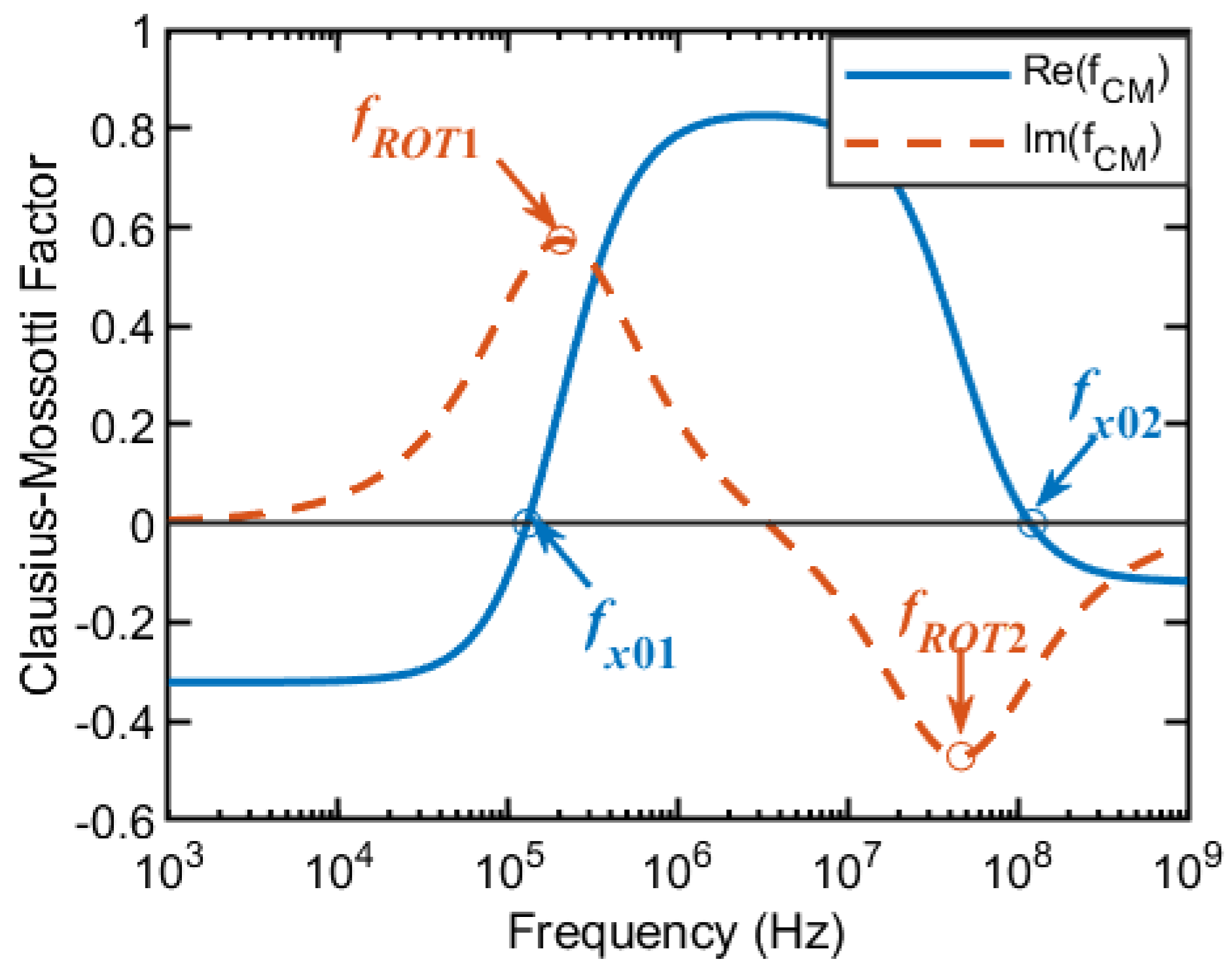
Figure 2.
Illustration of the pipeline workflow.
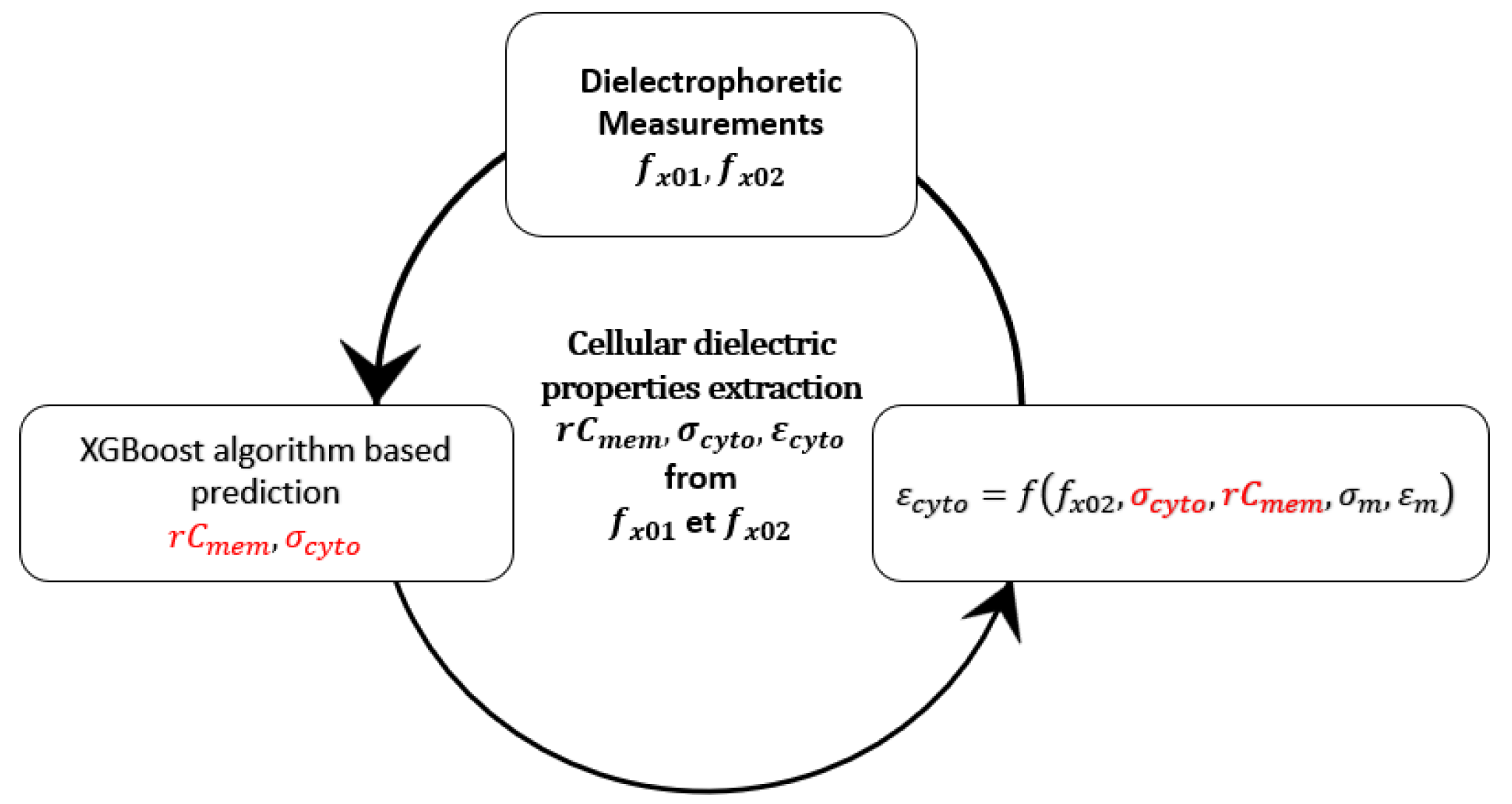
Figure 3.
Scatter plot illustrating the relationship: (a) between and , and (b) between and .(log scale).Once both and are computed, the last step is calculating from (13) where using our custom MATLAB code.
Figure 3.
Scatter plot illustrating the relationship: (a) between and , and (b) between and .(log scale).Once both and are computed, the last step is calculating from (13) where using our custom MATLAB code.
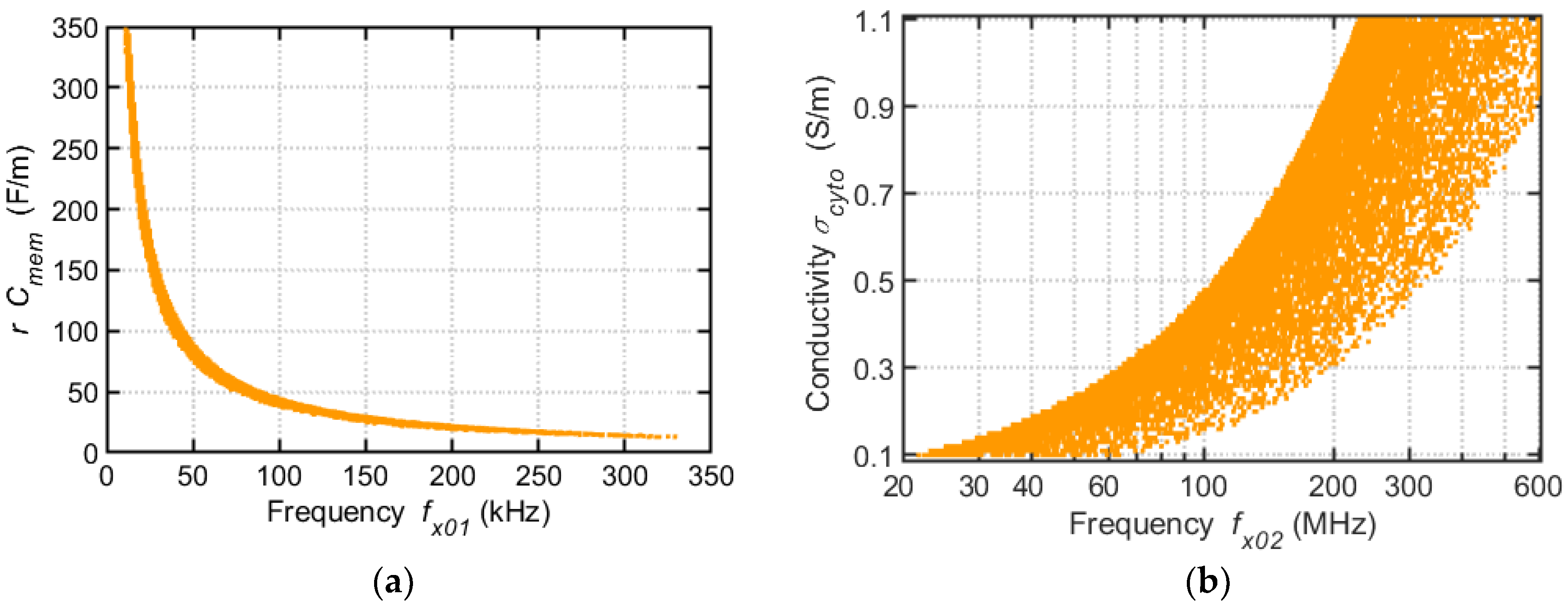
Figure 4.
Distribution of the relative error (%) between the simplified expression (11) and the general expression (10) of across the variation ranges of and .
Figure 4.
Distribution of the relative error (%) between the simplified expression (11) and the general expression (10) of across the variation ranges of and .
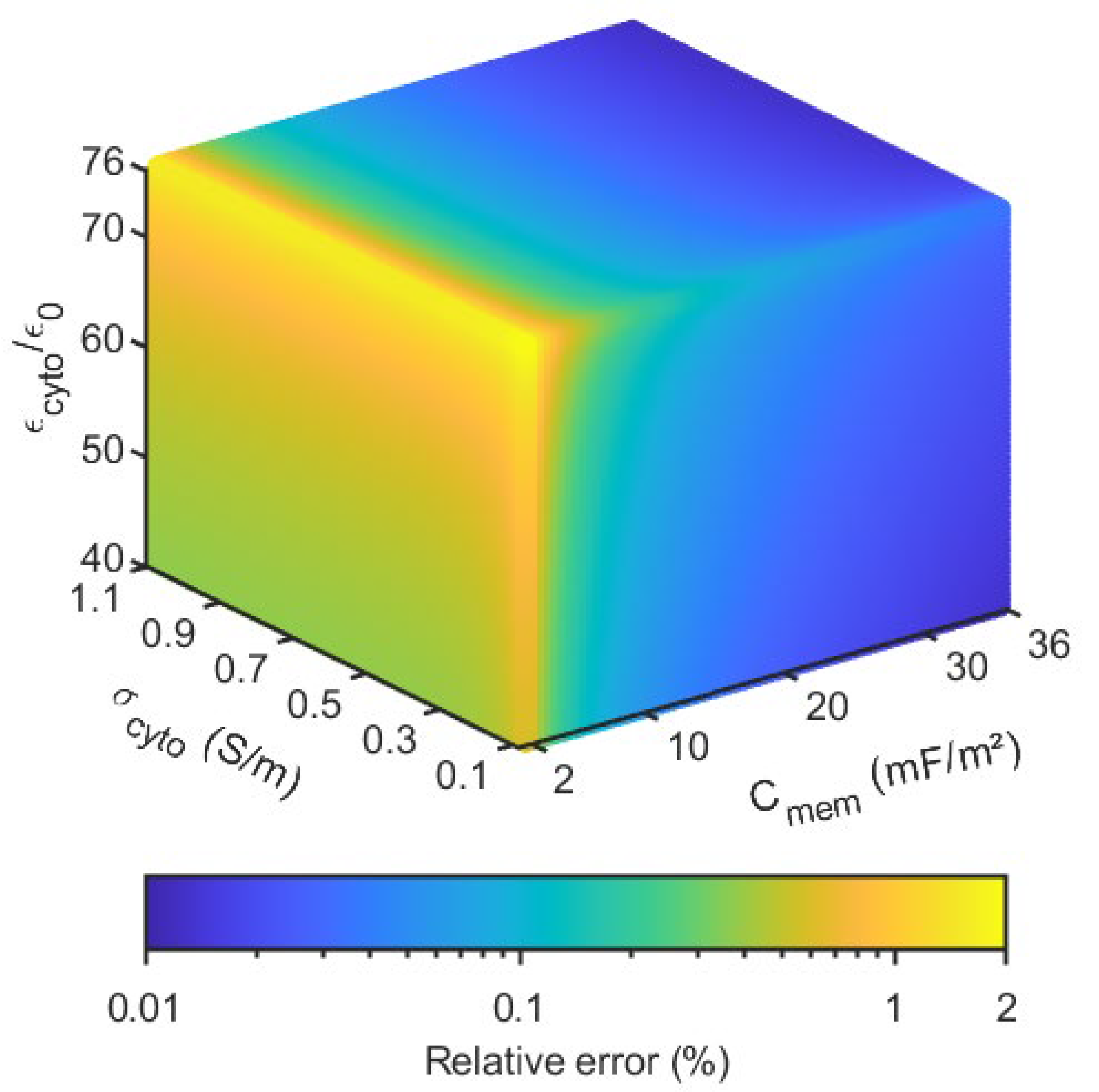
Figure 5.
Relative error distribution (%)for (blue), (red) and (orange).
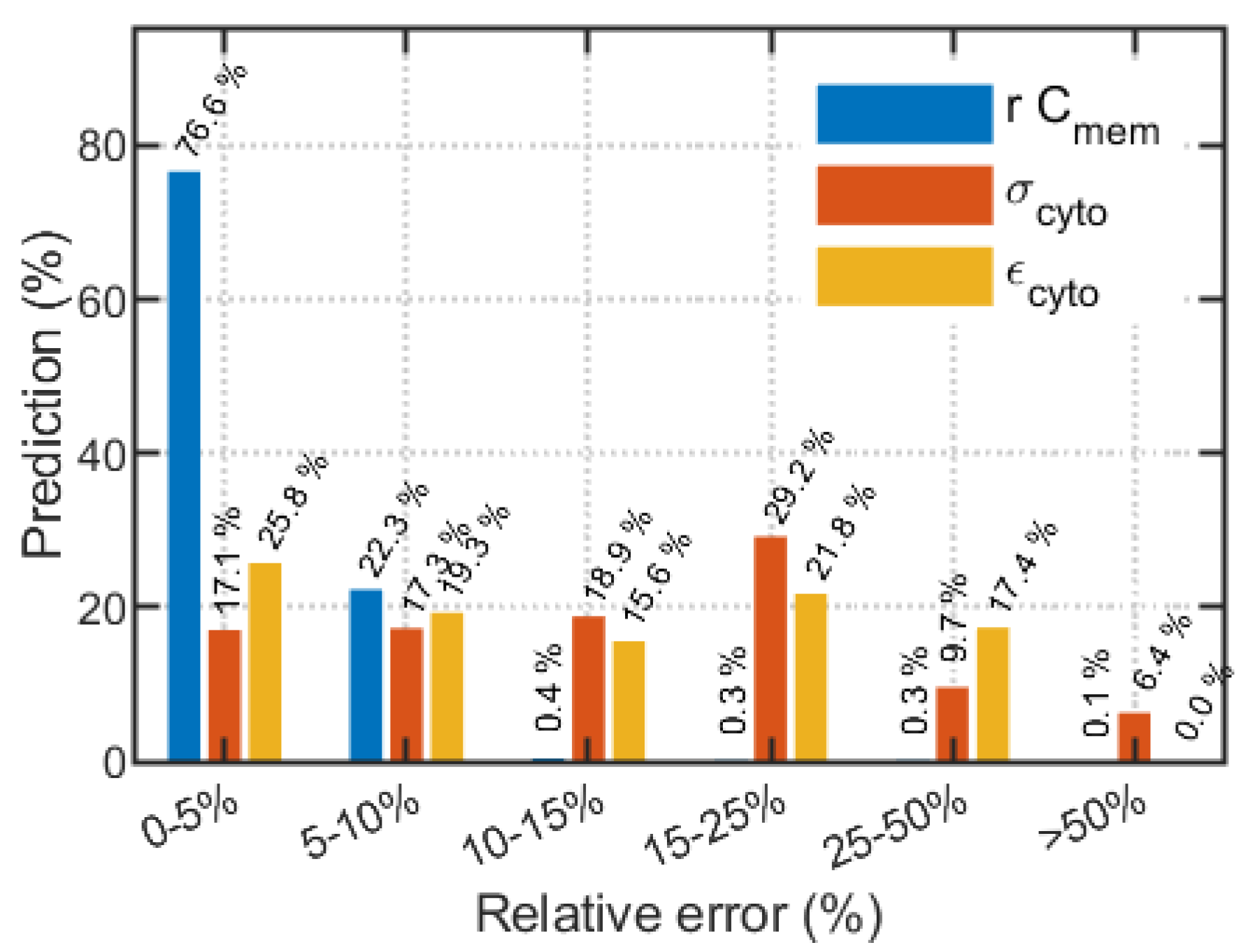
Figure 6.
Distribution of the percentage error on the prediction of: (a) , from (blue), (red), and (orange), (b) from (blue), exact (red), and (orange).
Figure 6.
Distribution of the percentage error on the prediction of: (a) , from (blue), (red), and (orange), (b) from (blue), exact (red), and (orange).
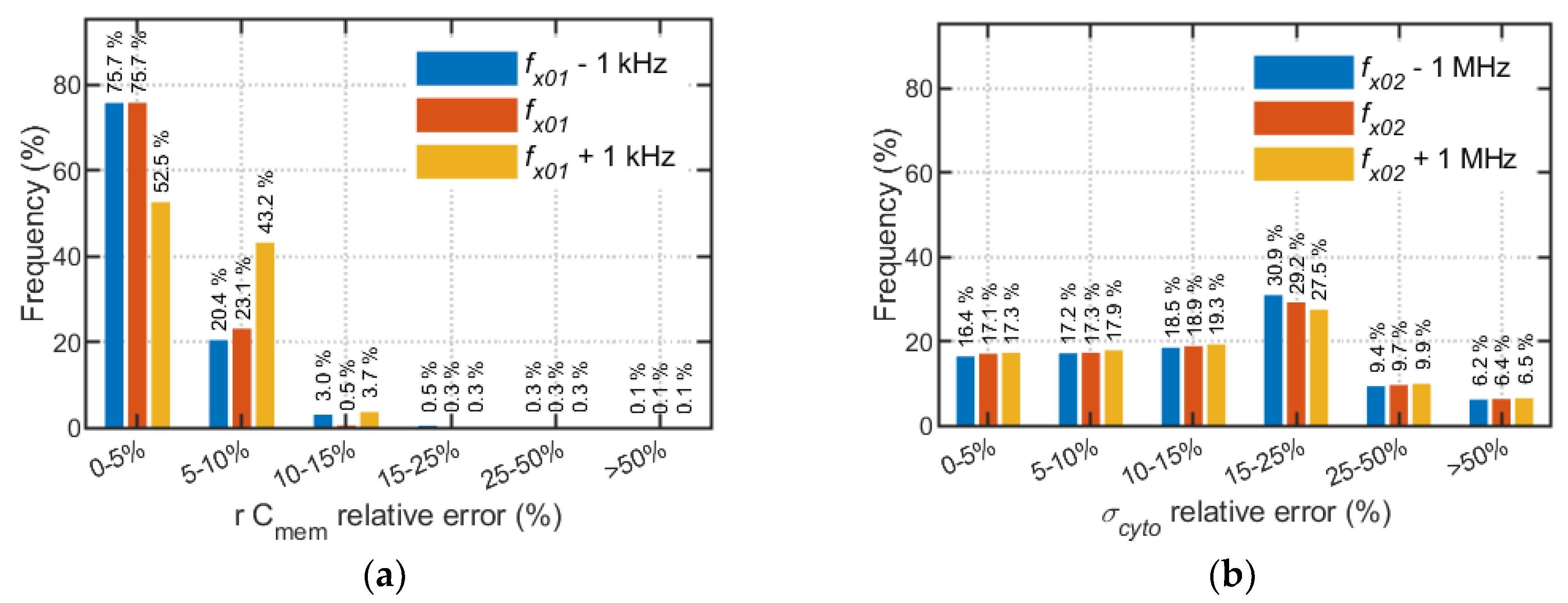
Figure 7.
Distribution of the percentage error in the prediction of from (blue) exact (red) and (orange) with predicted from .
Figure 7.
Distribution of the percentage error in the prediction of from (blue) exact (red) and (orange) with predicted from .
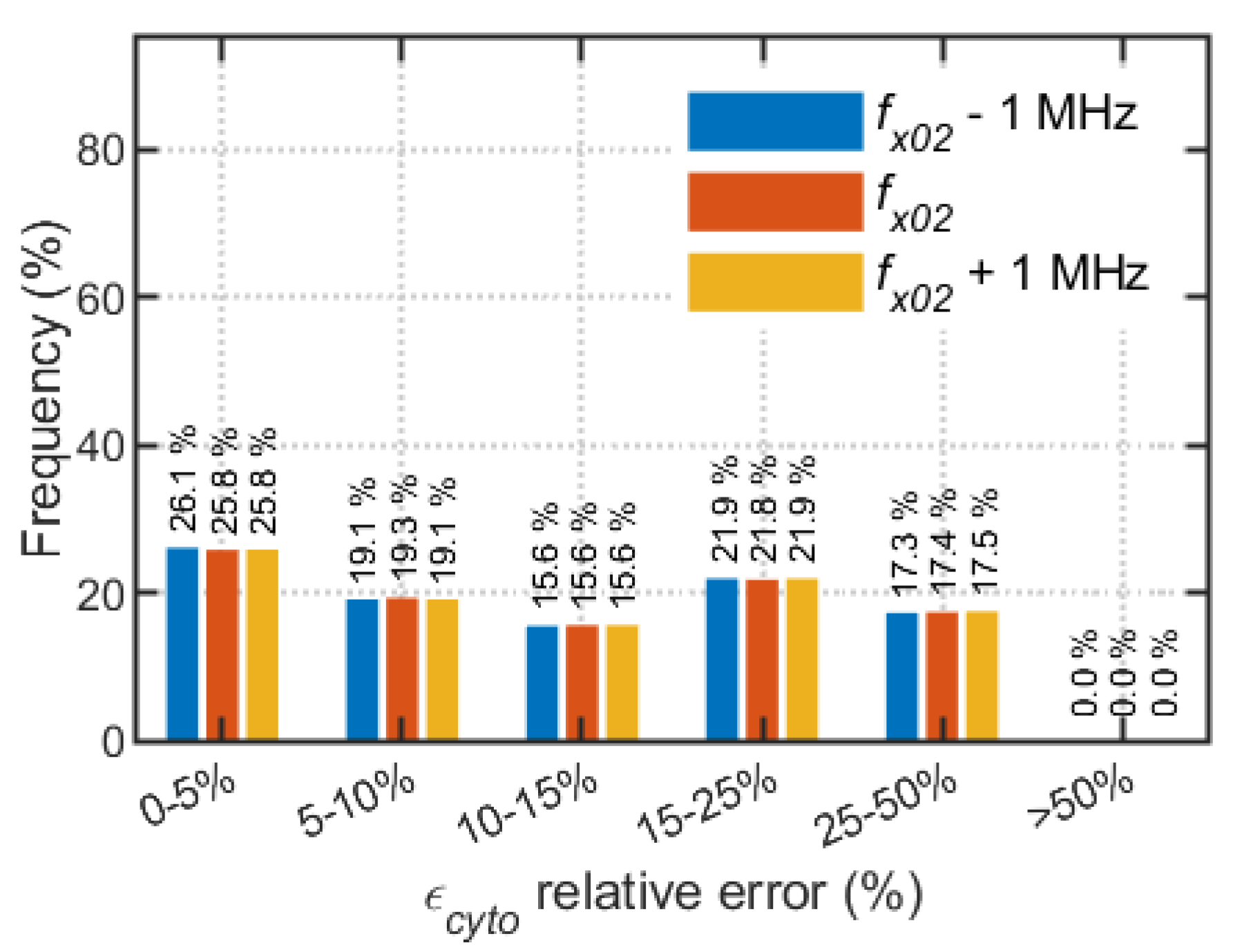
Figure 8.
Boxplots of (a) cytoplasm conductivity of U87 NM and U87 DM samples and (b) cytoplasm permittivity of U87 NM and U87 DM samples.
Figure 8.
Boxplots of (a) cytoplasm conductivity of U87 NM and U87 DM samples and (b) cytoplasm permittivity of U87 NM and U87 DM samples.
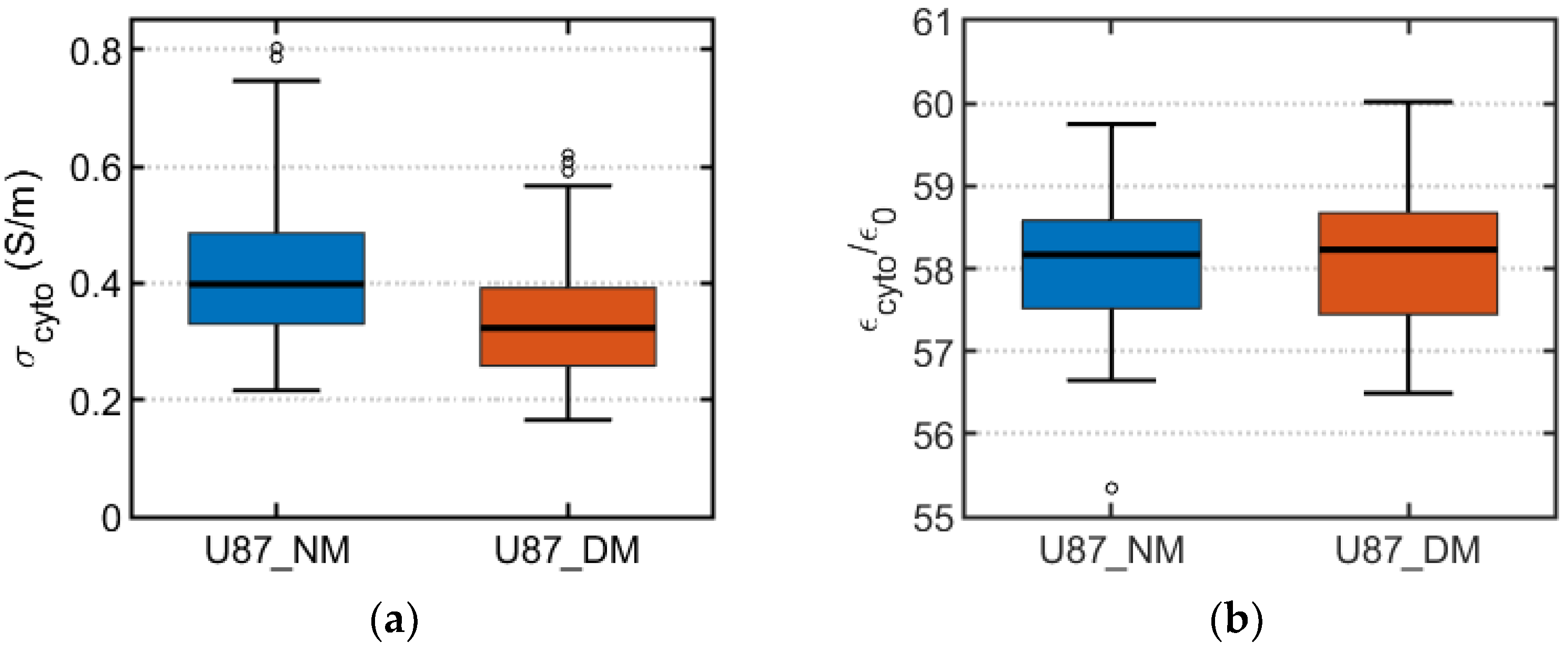
Figure 9.
Real and imaginary parts of the CM factor for: (a) the U87 DM sample computed with varying membrane conductance (100, 600 and 1100 S.m-2) based on parameters from Table 4., and (b) UHF part of the Clausius Mossotti for both NM and DM samples.
Figure 9.
Real and imaginary parts of the CM factor for: (a) the U87 DM sample computed with varying membrane conductance (100, 600 and 1100 S.m-2) based on parameters from Table 4., and (b) UHF part of the Clausius Mossotti for both NM and DM samples.
| Cellular parameters | U87 NM | U87 DM |
| 7.8 | 6.47 | |
| (mF.m-2) | 6.36 | 8.46 |
| (S.m-1) | 0.4 | 0.33 |
| 58.16 | 58.22 |

Table 1.
Ranges of single-shell model dielectric parameters.
| Dielectric parameters | range | References |
| 40-75 | [12,29,30] | |
| (S.m-1) | 0.1-1.1 | [10,12,13,14,15,16] |
| (mF.m-2) | 2-35 | [10,12,31] |
| (S.m-2) | 100-1100 | [32,33] |
Table 2.
Performance metrics of prediction and calculation of cellular dielectric parameters.
| Predicted parameters | Algorithm | MAPE (%) | MdAPE (%) |
| XGBoost | 3.53 | 3.07 | |
| XGBoost | 19. 20 | 14.15 | |
| MATLAB code | 14.12 | 11.48 |
Table 3.
Ranges of single-shell model dielectric parameters.
| Measurement uncertainty | MAPE (%) |
| 3.64 | |
| 3.53 | |
| 5.01 |
Table 4.
Ranges of single-shell model dielectric parameters.
| Cellular parameters | U87 NM | U87 DM |
| 7.8 | 6.47 | |
| (mF.m-2) | 6.36 | 8.46 |
| (S.m-1) | 0.4 | 0.33 |
| 58.16 | 58.22 |
Disclaimer/Publisher’s Note: The statements, opinions and data contained in all publications are solely those of the individual author(s) and contributor(s) and not of MDPI and/or the editor(s). MDPI and/or the editor(s) disclaim responsibility for any injury to people or property resulting from any ideas, methods, instructions or products referred to in the content. |
© 2026 by the authors. Licensee MDPI, Basel, Switzerland. This article is an open access article distributed under the terms and conditions of the Creative Commons Attribution (CC BY) license.
Copyright: This open access article is published under a Creative Commons CC BY 4.0 license, which permit the free download, distribution, and reuse, provided that the author and preprint are cited in any reuse.


