

Submitted:
27 May 2026
Posted:
28 May 2026
You are already at the latest version
Abstract
(1) Background: Nile tilapia is a cornerstone of global aquaculture, yet hypoxia remains a critical constraint. This study investigates the hypoxia response mechanisms in the gill tissue of a selectively bred Egyptian strain to elucidate the metabolic pathways and genetic regulators governing its tolerance. (2) Methods: We evaluated antioxidant and metabolic enzyme activities alongside gill histology after hypoxia exposure. Furthermore, transcriptome profiling was conducted to identify enriched pathways, with expression patterns validated via qPCR to distinguish between acute and long-term adaptive responses. (3) Results: Hypoxia significantly altered enzyme activities and caused time-dependent gill damage, ranging from mild swelling to severe rupture. Transcriptomics highlighted starch/sucrose metabolism and PPAR signaling. qPCR confirmed that specific genes peak at 6 h for acute responses, while others gradually increase for long-term adaptation. (4) Conclusions: These findings link energy metabolism with immune regulation, revealing the molecular mechanisms underlying hypoxia tolerance. The identified genes offer valuable insights and genetic resources for breeding resilient Nile tilapia.
Keywords:
Oreochromis niloticus
; tilapia
; hypoxia tolerance
; gill
; transcriptome
; metabolic pathway
1. Introduction
Dissolved oxygen (DO) is a key limiting factor for the aerobic metabolism of aquatic animals [1,2], and it profoundly influences their behavioral performance [1], growth, development [3,4,5], metabolism [5,6], antioxidant capacity [3,4,6] and other physiological life activities [7,8,9,10]. Excessive generation of reactive oxygen species (ROS) in fish exposed to hypoxic conditions can induce oxidative injury and exacerbate hypoxic stress damage [11,12,13]. Fish have evolved unique adaptive strategies to adapt to aquatic environments with varying dissolved oxygen levels during long-term evolution [14]. Numerous studies have demonstrated that hypoxia exerts significant effects on a wide range of aquatic animals. For instance, hypoxic stress has been shown to alter metabolism, swimming performance, growth, and tissue integrity in species such as Atlantic salmon (Salmo salar) [9], Pacific abalone (Haliotis discus hannai) [15], southern catfish (Silurus meridionalis) [16], sea cucumber (Apostichopus japonicus) [17], and genetically improved farmed tilapia (GIFT, Oreochromis niloticus) [18], among others. Multiple signaling pathways have been implicated in the cellular response to hypoxia. Among them, hypoxia-inducible factor 1 (HIF-1) serves as a master regulator of O2 homeostasis in animal cells and at the systemic level [19]. HIF-1 is a heterodimeric transcription factor composed of an oxygen-regulated α subunit (HIF-1α) and a constitutively expressed β subunit (HIF-1β, also known as ARNT) [20]. Under normoxic conditions, HIF-1α is rapidly hydroxylated by prolyl hydroxylase domain (PHD) enzymes and subsequently targeted for proteasomal degradation via the von Hippel–Lindau (VHL) ubiquitin ligase complex. Under hypoxic conditions, the hydroxylation is inhibited, leading to stabilization and nuclear accumulation of the α subunit, which then dimerizes with HIF-1β to activate the transcription of downstream target genes [21]. The Nrf2-Keap1/ARE pathway has become one of the key pathways in fish hypoxic antioxidant research, with studies shifting from simple description to nutritional intervention (e.g., functional additives like vitamin C and astaxanthin exerting protection via this pathway) [22,23] and crosstalk with other pathways [24]. Nrf2 (nuclear factor erythroid 2-related factor 2) is the core transcription factor for cellular antioxidant defense [25]. Hypoxia-induced reactive oxygen species (ROS) accumulation activates Nrf2, which dissociates from Keap1, translocates into the nucleus, and initiates the expression of downstream antioxidant response element (ARE)-driven protective genes [26].
Tilapia is one of the most globally important aquaculture species, valued for its rapid growth, strong disease resistance, tolerance to a wide range of environmental conditions, high feed utilization efficiency, ease of reproduction, absence of intermuscular bones, and excellent suitability for commercial processing [27]. Recognized as a cornerstone species for food security in developing nations, tilapia has been actively recommended by the Food and Agriculture Organization (FAO) of the United Nations for worldwide cultivation, and is now farmed in over 100 countries and territories across tropical, subtropical, and temperate regions [27,28]. Global farmed tilapia production has experienced remarkable expansion over the past two decades. Among cultivated tilapia species, Nile tilapia (Oreochromis niloticus) dominates global output and is recognized as the third most important fish species in world aquaculture [28,29]. The journey of Nile tilapia from its native range began during the second half of the 20th century, when it was introduced extensively into Southeast Asia and the Americas, primarily for aquaculture and fisheries enhancement. Most of these introductions became well established, and as a result, tilapia aquaculture has been steadily expanding across multiple continents [30]. Nile tilapia is native to Africa, where it is widely distributed in freshwater rivers and lakes across the continent, including countries such as Senegal, Gambia, Niger, and Chad [28,30]. Africa holds the wealth of its natural genetic resources; however, aquaculture production is currently dominated by Asian countries, particularly China, Indonesia, and others in Southeast Asia such as Malaysia, Vietnam, and Thailand, where large-scale farming operations achieve consistently high yields [30,31]. In Kenya alone, for example, O. niloticus accounts for approximately 62% of total national aquaculture production (15,000 tonnes annually), underscoring its socio-economic significance in regional livelihoods [31]. The species plays a vital role in improving food security, creating employment, and driving economic growth across both producing and importing nations, with its processed products—particularly frozen fillets—enjoying strong consumer demand in European and American markets [27,30]. Indeed, tilapia has emerged as one of the top internationally traded aquaculture commodities, following salmon and shrimp in global trade volume [29].
The Egyptian strain of Nile tilapia (Oreochromis niloticus) used in this study is a unique germplasm resource with a well-documented breeding history spanning approximately 48 years. Originally introduced from Egypt in 1978 by the Freshwater Fisheries Research Center (FFRC), this strain has undergone successive generations of artificial selection, resulting in stable genetic characters and well-defined epigenetic traits [32]. Currently, the strain is primarily utilized as a maternal line for cross-breeding with blue tilapia (O. aureus) to produce commercially valuable all-male hybrid fry [32]. Notably, this strain exhibits strong tolerance to low dissolved oxygen (DO) levels during aquaculture production, a trait of considerable interest given that hypoxia stress is one of the most prevalent environmental challenges in intensive fish farming, severely constraining growth, survival, and overall productivity [7,33]. Despite its demonstrated hypoxia tolerance, the underlying molecular mechanisms governing this adaptive capacity remain insufficiently characterized. Elucidating the hypoxia-responsive signaling pathways and candidate genes in this strain is of critical importance, not only for understanding its own physiological resilience but also for informing genetic improvement programs aimed at enhancing hypoxia tolerance in other commercially important aquaculture species with comparatively weaker adaptive capabilities [32,34]. Exposure to hypoxia is known to induce both acute and chronic stress responses that profoundly affect growth, reproduction, immunity, and other energy-demanding physiological processes in cultured fish [33,34].
In this study, we conducted a preliminary investigation of hypoxia effects on the gill tissue of this Egyptian strain by subjecting fish to a dissolved oxygen concentration of 1 mg/L over different exposure durations. Gill responses were assessed through histological observations and measurements of antioxidant enzyme activities. Furthermore, transcriptome profiling analysis was performed on gill tissues under the same hypoxic conditions to identify differentially expressed genes and enriched signaling pathways associated with the hypoxia response [32,35]. The gill was selected as the target organ given its direct interface with the aquatic environment and its established roles in gas exchange, ion regulation, and early molecular responses to hypoxic stress [33,35]. This study provides valuable molecular evidence for understanding the mechanisms of hypoxia adaptation in Nile tilapia and lays a foundation for marker-assisted selection of hypoxia-tolerant traits in aquaculture breeding programs.
2. Materials and Methods
Hypoxia Treatment and sample collection: A total of 180 healthy individuals of the Egyptian-selected strain of Nile tilapia were obtained from the Tilapia Genetic Breeding Center affiliated with the Ministry of Agriculture and Rural Affairs, located in Wuxi, China. The body weight of the tilapia ranged from 120.6 g to 164.5 g, with an average value of 141.4±9.9 g. All experimental fish were randomly allocated into three separate water tanks and acclimated in aerated freshwater for a two-week period, under the following water quality conditions: dissolved oxygen (DO) at 7.0±0.2 mg/L, pH ranging from 7.0 to 7.2, and water temperature maintained at 26±0.5℃ [36]. During the acclimation phase, the fish were fed twice daily with a standard commercial feed (supplied by Fuzhou Haima Feed Co., Ltd., Fuzhou, China) at a feeding rate of 5% of their body weight. Feeding was halted one day prior to the initiation of the formal experiment. Subsequently, nitrogen gas was introduced into the water to reduce the dissolved oxygen concentration, and the experiment was initiated once the DO level dropped to 1 mg/L (monitored using a YSI 550 dissolved oxygen meter, YSI Inc., USA). Gill tissue samples were collected at three time points after the onset of hypoxic treatment (1 mg/L DO): 0 hours (serving as the control group), 6 hours, and 72 hours. These samples were used for enzyme activity determination, histological observation, transcriptome profiling, and quantitative real-time PCR (qPCR) analysis. For each time point, six fish were randomly selected to collect gill tissues, which constituted one biological replicate; three biological replicates were set up for all experimental detections.
Sample Processing and Homogenization: Gill tissue samples were immediately transferred into 5 mL cryopreservation tubes, snap-frozen in liquid nitrogen, and subsequently stored at -80 °C until further analysis. Prior to processing, samples were thawed on ice and rinsed thoroughly with ice-cold physiological saline (0.86%, w/v) to remove residual blood. Excess moisture was blotted using filter paper, and the tissues were minced into small pieces. Precisely 0.1 g of each sample was weighed using an electronic balance (Shanghai Hochoice Electric Appliance Co., Ltd., HC ABS) and transferred to centrifuge tubes. For homogenization, 900 µL of ice-cold physiological saline and three zirconia beads were added to each tube. The mixture was pre-chilled on ice for 10 minutes, followed by mechanical disruption using a High-Throughput Tissue Homogenizer (Ningbo Scientz Biotechnology Co., Ltd., Scientz-48) at a vibration frequency of 10 minutes. The homogenates were then centrifuged at 4,000 rpm for 15 min at 4 °C using a centrifuge (ThermoFisher Scientific Inc., Fresco 17) to collect the supernatant.
Biochemical Assays: The resulting supernatants were utilized to determine various biochemical indices. Total protein (TP) content was measured to normalize enzyme activity data (statistical analysis of TP values was not performed). Antioxidant and metabolic parameters were quantified using commercial assay kits (Nanjing Jiancheng Bioengineering Institute) according to the manufacturer’s instructions. The specific indices measured included: (1) Antioxidant Status: Total Superoxide Dismutase (T-SOD), Glutathione Peroxidase (GSH-PX), Reduced Glutathione (GSH), Malondialdehyde (MDA), and Total Antioxidant Capacity (T-AOC). (2) Enzyme Activities: Catalase (CAT), Acid Phosphatase (ACP), Alkaline Phosphatase (ALP), Lactate Dehydrogenase (LDH), Aspartate Aminotransferase (AST), Na+-K+-ATPase and Ca2+-Mg2+-ATPase. All spectrophotometric measurements were performed using a microplate reader (Bio-rad iMark) and a UV-Vis spectrophotometer (Unico WFZ UV-3802H).
Histological Preparation and HE Staining: Gill tissue samples were collected at 0 h, 6 h, and 72 h post-hypoxia exposure to evaluate morphological alterations. All tissues were immediately fixed in Bouin’s solution for a minimum of 24 hours. Following fixation, specimens were rinsed under running tap water for 16 hours to remove residual fixative. The tissues were then dehydrated through a graded ethanol series (70% for 45 min; 80%, 85%, and 90% for 50 min each; 95% for 60 min; and 100% ethanol twice for 45 min each). Subsequently, the samples were cleared in xylene three times for 30 min each and infiltrated with molten paraffin at 60 °C three times for 60 min each. Finally, the tissues were embedded in paraffin blocks using an embedding system (KD-BM, BL; KEDI Instrumental Equipment Co., Ltd., Jinhua, China). Serial sections of 6 μm thickness were prepared using a rotary microtome (KD-2258; KEDI) and mounted onto glass slides using a tissue flotation bath (KD-THII; KEDI).
Histological examination: The paraffin sections were stained with hematoxylin and eosin (H&E) (Shanghai Yuanye Bio-Technology Co., Ltd., Shanghai, China). The slides were deparaffinized in xylene (10 min and 2 min) and a xylene/ethanol mixture (1:1, 2 min), followed by rehydration through a descending graded ethanol series (95%, 85%, 75%, and 50% for 2 min each) and a final rinse in distilled water for 2 min. The sections were stained with hematoxylin for 15 min, rinsed with distilled water, and differentiated in 1% acid alcohol (hydrochloric acid in anhydrous ethanol, 1:99 v/v) for 30 s. After rinsing under running tap water for 15 min and distilled water for 2 min, the slides were counterstained with eosin for 3 min. The sections were then dehydrated through a graded ethanol series (75%, 85%, 95%, and 100% for 2 min each), cleared in xylene twice for 6 min each, and sealed with neutral resin. The morphological changes in gill tissues were observed and documented using a Leica optical microscope (LMD6000; Leica Microsystems Co., Ltd., Wetzlar, Germany).
Transcriptomic profiling analysis: Total RNA was extracted from samples frozen in liquid nitrogen using TRIzol reagent (Thermo Scientific Inc., MA, USA) according to the manufacturer’s instructions. RNA purity and concentration were assessed using the NanoDrop 2000 spectrophotometer (Thermo Scientific Inc., MA, USA), while RNA integrity (RIN > 7.0) was verified using the Agilent 2100 Bioanalyzer (Agilent Technologies Inc., Santa Clara, USA). Subsequently, cDNA libraries were constructed using the TruSeq Stranded mRNA LT Sample Prep Kit (Illumina Inc., San Diego, USA) following the manufacturer’s protocol. Transcriptome sequencing was performed on the Hiseq-2500 platform by OE Biotech Co., Ltd. (Shanghai, China). Raw sequencing data were processed using Fastp software to remove low-quality reads. High-quality clean reads were then aligned to the O. niloticus reference genome (GenBank accession: GCA_922035795.1) using HISAT2 [37]. Functional annotations of the assembled transcripts were conducted against the Gene Ontology (GO) [38], Clusters of Orthologous Groups (COG) [39], and Kyoto Encyclopedia of Genes and Genomes (KEGG) [40] databases using Blast2GO and BLAST (E-value cutoff: 10−5) [41]. Differentially expressed genes (DEGs) were identified using the EB-seq algorithm with a false discovery rate (FDR) threshold of < 0.05 [42].
quantitative Real-Time PCR (qPCR) validation: Quantitative real-time PCR (qPCR) was performed to validate the accuracy of the RNA-seq data by measuring the relative mRNA expression levels of key differentially expressed genes (DEGs) in Nile tilapia gills under hypoxia at various time points. The cDNA templates were synthesized from total RNA using the PrimeScript™ RT reagent Kit with gDNA Eraser (Perfect Real Time) (TaKaRa Bio-engineering (Dalian) Co., Ltd., Dalian, China). The SYBR Green-based qPCR assays were carried out on an ABI 7900 Real-Time PCR System (Applied Biosystems Inc., Foster City, USA) using the ChamQ Universal SYBR qPCR Master Mix (Nanjing Vazyme Biotechnology Co., Ltd., Nanjing, China) according to the manufacturer’s instructions. The 20 µL PCR amplification system was run under the following program: initial denaturation at 95℃ for 30 sec, followed by 40 cycles of 95℃ for 30 sec, 60℃ for 30 sec, and 72℃ for 20 sec. The 12 pairs of gene-specific primers (listed in Table 1) were designed using Primer Premier 5 software (Premier Biosoft International, USA) for the qPCR verification of important DEGs. The β-actin gene was used as the internal reference, with the forward primer (5’-3’): CCACACAGTGCCCATCTACGA and the reverse primer (5’-3’): CCACGCTCTGTCAGGATCTTCA. Each time point included three biological replicates, and all samples were analyzed in triplicate for each DEG.
Statistical Analysis: All statistical analyses were conducted using SPSS Statistics 23.0 (IBM Corp., Armonk, NY, USA). Data are presented as mean ± standard deviation (SD). Differences among groups were evaluated using one-way analysis of variance (ANOVA), followed by Least Significant Difference (LSD) and Duncan’s multiple range tests for post hoc comparisons. A P-value of less than 0.05 was considered statistically significant.
3. Results
3.1. Enzyme Activity Assay in Gill Tissue
The activities of antioxidant and metabolic enzymes in gill tissues were measured under hypoxic conditions (dissolved oxygen: 1 mg/L) at 0, 6, and 72 h (Figure 1). The measured biomarkers exhibited distinct temporal response patterns that could be categorized into four groups.
3.1.1. Progressively Increasing Enzymes
The activities of total antioxidant capacity (T-AOC) and alanine aminotransferase (ALT) increased gradually with prolonged hypoxia exposure, with significant differences detected between each successive time point (P < 0.05).
3.1.2. Progressively Decreasing Enzymes
The activities of acid phosphatase (ACP), reduced glutathione (GSH), and lactate dehydrogenase (LDH) declined progressively over the course of hypoxic treatment, with significant differences observed among all time points (P < 0.05).
3.1.3. Biphasic Response Enzymes
Aspartate aminotransferase (AST) activity and malondialdehyde (MDA) content initially decreased at 6 h and subsequently increased at 72 h, with extremely significant differences between time points (P < 0.0001).
3.1.4. Early-Peak Enzymes
The activities of glutathione peroxidase (GSH-Px), superoxide dismutase (SOD), Ca2+-Mg2+-ATPase, and catalase (CAT) all reached peak values at 6 h (P < 0.05), followed by divergent trajectories during prolonged exposure. Specifically, GSH-Px, Ca2+-Mg2+-ATPase, and CAT showed extremely significant differences between 0 h and 72 h (P < 0.01), while SOD activity at 72 h did not differ significantly from the baseline at 0 h (P > 0.05). Additionally, Ca2+-Mg2+-ATPase activity showed no significant change between 6 h and 72 h (P > 0.05).
3.1.5. Ion transport enzyme
Na+-K+-ATPase activity differed significantly between 0 h and 6 h (P < 0.05), but no significant differences were detected between 6 h and 72 h or between 0 h and 72 h (P > 0.05).
3.2. Histological Observations in Gill Tissue
Under hypoxic stress (DO = 1 mg/L), the gill tissues underwent time-dependent progressive pathological changes (Figure 2). In the control group, gill lamellae were neatly arranged with uniform lengths and broad interlamellar spaces, presenting symmetric and even distribution on both sides of gill filaments. Mitochondria-rich cells (MRCs) were oval in shape and localized at the lamellar base adjacent to filament junctions. Pavement cells showed regular arrangement, and blood cells were uniformly distributed within filament sinusoids. Collectively, gill filaments maintained intact normal physiological morphology. After 6 hours of hypoxic exposure, gill lamellae still retained relatively regular arrangement, with lamellar length and interlamellar spacing comparable to those in the control group. Nevertheless, partial lamellar edema occurred, accompanied by increased infiltration of internal blood cells. Upon 72 hours of continuous hypoxia, the proportion of edematous lamellae rose markedly, along with severe hemocyte congestion. Compared with the control group, obvious thickening of lamellar basal tissues and dramatic narrowing of interlamellar spaces were detected, and local lamellar rupture was also observed. Additionally, pavement cells on the surface of swollen lamellae lost their distinct morphological characteristics, representing severe deviation from the normal physiological structure. These findings demonstrate that hypoxic stress induces obvious structural damage to the gill tissues of Oreochromis niloticus.
3.3. Transcriptome Analysis
A total of 61.27 GBs of clean data were generated in this transcriptome. These unigenes were annotated, based on the Oreochromis niloticus genome, and a total of 16, 926 unigenes matched known sequences in the genome. In addition, a total of 9, 847 novel isoforms were predicted in this transcriptome analysis.
Differentially expressed genes (DEGs) were identified, using the criterion of > 2.0 as up-regulatory genes and < 0.5 as down-regulatory genes, and with a P value < 0.05. A total of 4,677 DEGs were identified between 6 h and 0 h, including 2,656 up-regulated genes and 2,021 down-regulated genes. A total of 3,547 DEGs were identified between 72 h and 0 h, including 2,082 up-regulated genes and 1,465 down-regulated genes. A total of 1,293 DEGs were found between 72 h and 6 h, including 532 up-regulatory genes and 761 down-regulatory genes. GO (Gene Ontology) functional groups analysis revealed that endoplasmic reticulum membrane, mitochondrion and mitochondrial inner membrane were the main enriched functional groups (Figure 3). KEGG (Kyoto Encyclopedia of Genes and Genomes) analysis revealed that starch and sucrose metabolism, glycine, serine and threonine metabolism, glycolysis/gluconeogenesis, steroid biosynthesis and PPAR signaling pathway were the main enriched metabolic pathways in all of these three comparisons (Figure 4).
A total of 16 DEGs associated with specific metabolic pathways were selected for further analysis, as listed in Table 2. In the starch and sucrose metabolism pathway, the genes LOC100709923, gygl, pygl, and mgam were identified. The glycine, serine, and threonine metabolism pathway included pgam2, agxta, agxtb, and grhpr. Furthermore, hik and enol were found to be differentially expressed in the glycolysis/gluconeogenesis pathway, while msmol and sqle were associated with steroid biosynthesis. Finally, the PPAR signaling pathway comprised the genes cyp8b1, fabp6, apoa1, and pparαb.
3.4. qPCR Verification of DEGs
qPCR analysis was used to verify the expressions of important DEGs in the gills after the hypoxia treatment of 0 h, 6 h and 72 h (Figure 5). Ten DEGs were selected to verify the accuracy of RNA-seq. The expression of 9 genes increased rapidly at 6h and decreased at 72 h (P<0.05), and the expressions of these 9 genes on 72 h were higher than 0 h (P<0.05), including LOC100709923, gygl, grhpr, hik, enol, msmol, sqle, cyp8b1 and pparαb. The expressions of the gene pgam2 showed a trend of increasing with time. The expression trends of these genes were consistent with the results of RNA-Seq.
4. Discussion
Adequate oxygen supply serves as a key factor for the survival and reproduction of fish in aquatic habitats [43]. Fish gills serve as the primary site for gas exchange between the organism and the aquatic environment, functioning as the first organ to detect fluctuations in ambient dissolved oxygen levels. The gill epithelium, with its vast surface area composed of thin lamellae and countercurrent blood flow arrangement, is optimized for efficient oxygen uptake according to Fick’s law of diffusion [44]. When exposed to hypoxic conditions, gill tissues undergo a coordinated series of morphological and molecular adaptations to maintain oxygen homeostasis. These responses include increases in lamellar surface area, reductions in water-to-blood diffusion distance, apoptosis of interlamellar cell mass, and activation of oxygen-sensing pathways such as HIF-1 signaling [45,46,47]. Understanding these adaptive mechanisms is of particular importance given the increasing prevalence of aquatic hypoxia in both natural ecosystems and intensive aquaculture systems [48]. The experimental species employed in this study exhibits remarkable tolerance to extremely low dissolved oxygen concentrations (DO = 1.0 mg/L) and is capable of sustained survival under such severe hypoxic stress [49], making it an excellent model for elucidating the gill-level physiological and molecular mechanisms underlying hypoxia adaptation in fish.
The results of this study demonstrate that the gill tissue of Nile tilapia exhibits a complex yet orchestrated pattern of antioxidant enzyme activity changes under hypoxic stress. The progressive elevation of T-AOC and ALT activities reflects the cumulative intensification of oxidative stress in gill tissue during prolonged hypoxia exposure. As a comprehensive indicator of overall antioxidant capacity, the sustained increase in T-AOC suggests that the organism has initiated multi-level compensatory defense mechanisms to counteract continuous ROS accumulation [33,50]. Furthermore, the upregulation of ALT activity is typically associated with tissue cellular damage and amino acid metabolic reprogramming, implying that gill tissue may accelerate amino acid catabolism to supplement energy supply under hypoxic condition [51]. The “early activation” pattern, characterized by peak activities of SOD, CAT, and GSH-Px at 6 h, reflects a rapid defensive response of the gill tissue to acute hypoxia. In this classical enzymatic antioxidant defense system, SOD catalyzes the dismutation of superoxide anions (O2−) into hydrogen peroxide (H2O2), which is subsequently decomposed into harmless products by CAT and GSH-Px, demonstrating a synergistic protective mechanism [33,52]. A similar early activation of SOD and CAT has also been reported in the gill tissues of crucian carp under hypoxic stress [33]. However, the subsequent decline in these enzyme activities after 72 h (with SOD returning to baseline levels) suggests that prolonged hypoxia may lead to the exhaustion of the enzymatic system or trigger negative feedback regulation. This indicates that the enzymatic antioxidant capacity may gradually become insufficient to completely scavenge excessive ROS under sustained stress. The continuous decline in GSH further corroborates this inference. As the most critical non-enzymatic antioxidant within cells, GSH is heavily consumed to scavenge free radicals and maintain cellular redox homeostasis [33,53]. The progressive depletion of GSH reserves implies that the risk of oxidative damage in gill tissue escalates with the prolongation of hypoxic stress. This perspective is further substantiated by the significant rebound in MDA levels at 72 h. As a terminal product of lipid peroxidation, elevated MDA serves as a direct hallmark of severe oxidative damage to cell membranes. This indicates that under prolonged hypoxia, the gill tissue has transitioned from a phase of “effective defense” to a stage of “accumulated damage” [54,55]. The continuous decline in LDH activity is particularly noteworthy. As a key enzyme in anaerobic glycolysis, LDH typically exhibits increased activity in other fish species under hypoxia to enhance anaerobic energy production [33]. The decreasing trend of LDH activity observed in this study may be associated with a unique metabolic strategy in the gill tissue of this Egyptian strain of Nile tilapia. Specifically, rather than relying heavily on anaerobic glycolysis, this strain may preferentially utilize alternative metabolic pathways, such as amino acid metabolism, to sustain energy supply. This hypothesis aligns well with the subsequent transcriptomic analysis, which revealed significant enrichment in both carbohydrate and amino acid metabolic pathways [32,51]. The distinct response patterns of the two ion-transporting enzymes reveal the differential impacts of hypoxia on the ionoregulatory functions of the gill. Ca2+-Mg2+-ATPase peaked at 6 h and subsequently maintained a relatively stable state, whereas Na+-K+-ATPase exhibited only a transient fluctuation at 6 h before returning to baseline. As the core enzyme responsible for maintaining transmembrane ion gradients, Na+-K+-ATPase drives nearly all secondary active transport processes in ionocytes. Although hypoxia has been shown to impair ion transport capacity in fish gills [56], the transient fluctuation and rapid recovery of Na+-K+-ATPase activity observed in this study suggest that this tilapia strain possesses a robust capacity to maintain ion homeostasis under hypoxic conditions—a critical factor for preserving essential gill physiological functions [57,58]. Furthermore, the early activation of Ca2+-Mg2+-ATPase may be linked to hypoxia-induced regulation of intracellular calcium signaling, as Ca2+ plays a pivotal role in activating various hypoxia-responsive signaling pathways [50].
Histological observations revealed time-dependent, progressive pathological alterations in the gill tissue of Nile tilapia under hypoxic stress. The mild lamellar edema and increased blood cell infiltration observed at 6 h represent early adaptive changes to acute hypoxia, likely serving as compensatory mechanisms to enhance oxygen uptake efficiency by increasing blood perfusion within the lamellae [47]. However, after 72 h of sustained hypoxia, severe injuries—including extensive lamellar swelling, hyperemia, thickening of the basal tissue, and localized lamellar rupture—indicated that the structural integrity of the gill tissue was significantly compromised.
The sharp narrowing of the interlamellar space and the loss of normal pavement cell morphology directly impair gas exchange efficiency. According to Fick’s law of diffusion, gas exchange efficiency is governed by the respiratory surface area and the water-blood diffusion distance [44]. The thickening of the basal tissue increases the diffusion barrier, while lamellar edema and narrowed spacing reduce the effective area for water flow; together, these factors severely weaken the respiratory function of the gills. Such morphological damage may trigger a maladaptive cycle, where structural deterioration leads to reduced gas exchange, further exacerbating tissue hypoxia. Similar patterns of hypoxia-induced gill damage have been reported in silver carp [47] and GIFT tilapia [59], suggesting this is a common pathological feature among teleosts facing severe hypoxia.
Notably, while the morphology of mitochondrion-rich cells (MRCs) remained normal at 6 h, pavement cells exhibited disordered morphology by 72 h. MRCs serve as the functional units for ion transport in the gills. The structural damage surrounding these cells may correlate with the transient fluctuation in Na+-K+-ATPase activity mentioned earlier, implying an intrinsic link between morphological injury and functional alteration.
Transcriptomic analysis provides a comprehensive perspective for understanding the molecular mechanisms underlying hypoxia adaptation in gill tissue. The 4,677 DEGs identified in the 6 h vs 0 h comparison far exceeded the 3,547 found in the 72 h vs 0 h comparison and the 1,293 in the 72 h vs 6 h comparison. This transcriptional pattern of “intense early response followed by stabilization” aligns closely with previous transcriptomic studies on Nile tilapia gills under acute hypoxia [35], reflecting the rapid initiation of gene expression regulation during the acute hypoxic response. A similar dynamic transcriptional response has also been observed in GIFT tilapia gill tissue under hypoxic stress [59]. The significant enrichment of cellular components such as the endoplasmic reticulum membrane, mitochondria, and mitochondrial inner membrane in the GO enrichment analysis reveals subcellular reprogramming in gill cells under hypoxic stress. As the cellular “powerhouse” and the primary site of ROS generation, mitochondria are critical for maintaining cell survival through functional regulation and structural remodeling under hypoxic conditions [60,61]. The extensive differential expression of mitochondria-related genes indicates that gill cells are actively modulating mitochondrial metabolic functions to adapt to the oxygen-deprived environment. The significant enrichment of starch and sucrose metabolism and glycolysis/gluconeogenesis pathways in the KEGG analysis reflects the classic metabolic shift from aerobic oxidation to anaerobic glycolysis in gill tissue under hypoxic conditions [32,50]. The marked upregulation of gyg1 (a glycogen synthesis-related gene) at 6 h (fold change = 10.34) indicates the rapid activation of glycogen metabolism to mobilize energy reserves. Furthermore, hk1 (hexokinase) and eno1 (enolase), as key rate-limiting enzymes in the glycolytic pathway, were significantly upregulated, directly accelerating the rate of glucose catabolism for energy production. This pattern of metabolic reprogramming has also been reported in the hypoxia studies of tilapia heart [62] and liver tissues [51], suggesting that enhanced glycolysis is a systemic adaptive strategy employed by Nile tilapia to cope with hypoxia. The enrichment of the glycine, serine, and threonine metabolism pathway, coupled with the sustained upregulation of pgam2 (fold change = 3.02 at 6 h and 6.10 at 72 h), suggests that amino acid catabolism may play a more critical role in long-term hypoxia than in short-term hypoxia. pgam2 encodes phosphoglycerate mutase, an enzyme that bridges glycolysis and the serine biosynthesis pathway. Its sustained high expression implies that during prolonged hypoxia, gill tissue may channel amino acid metabolic intermediates into energy-producing pathways, serving as a supplementary energy source to glycolysis [51]. This finding provides mutual corroboration between the transcriptomic and protein levels, aligning perfectly with the aforementioned enzymatic evidence of sustained ALT elevation. The significant upregulation of msmo1 and sqle indicates that gill cells enhance steroid and cholesterol biosynthesis under hypoxic conditions. As a critical structural component of cell membranes, the increased synthesis of cholesterol likely represents a compensatory response to hypoxia-induced lipid peroxidation damage (as evidenced by elevated MDA levels) [63]. By incorporating newly synthesized cholesterol molecules, cells can effectively maintain membrane integrity and fluidity. A similar significant enrichment of the steroid biosynthesis pathway has also been observed in the hypoxic gill transcriptomes of rainbow trout [63], suggesting that this may be a conserved repair strategy employed by fish gill tissue to mitigate oxidative damage caused by hypoxia. The enrichment of the PPAR signaling pathway, coupled with the significant differential expression of pparαb, fabp6, cyp8b1 and apoa1, reveals a profound remodeling of lipid metabolism in gill tissue under hypoxic conditions. As the core transcription factor regulating fatty acid β-oxidation [62], the upregulation of PPARα during hypoxia likely promotes fatty acid oxidation to supplement ATP production. fabp6 and apoa1 are involved in intracellular fatty acid transport and reverse cholesterol transport, respectively. Their sharp upregulation at 6 h, alongside the dramatic increase in cyp8b1 (fold change = 140.27), indicates that the gill tissue initiates a large-scale reorganization of lipid metabolism during the acute hypoxic phase. While the PPAR pathway has also been identified as a key responsive pathway in hypoxic liver studies of GIFT tilapia [51], this study provides the first evidence of its significant activation in gill tissue, highlighting the critical role of lipid metabolic regulation in the hypoxic adaptation of the gills.
The qPCR results for 10 representative DEGs showed consistent trends with the RNA-seq data, validating the reliability of the transcriptomic analysis. Nine of these genes exhibited an expression pattern characterized by a sharp increase at 6 h followed by a decline at 72 h, though remaining above baseline levels. This pattern aligns closely with the temporal dynamics of the “early activation” enzymes mentioned earlier, further corroborating at the molecular level the phased regulatory strategy of gill tissue: initiating a robust transcriptional response during acute hypoxia and transitioning to a relatively stable adaptive state under prolonged hypoxia [35,59]. As the sole exception, the sustained upregulation of pgam2 is consistent with the continuous demand for amino acid metabolism in energy supply, further supporting the critical role of amino acid metabolism as a supplementary energy pathway during long-term hypoxia.
5. Conclusions
By integrating results from enzyme activities, tissue morphology, and transcriptomics, this study reveals the multi-level, time-dependent adaptive mechanisms of the gill tissue in an Egyptian strain of Nile tilapia under hypoxic stress. During the acute hypoxic phase (0–6 h), the gill tissue responds to the sudden drop in oxygen supply by rapidly activating the enzymatic antioxidant defense system (SOD, CAT, GSH-Px) and initiating large-scale transcriptional reprogramming, while tissue morphology exhibits only mild compensatory changes. During the sustained hypoxic phase (6–72 h), as antioxidant reserves are gradually depleted and oxidative damage accumulates, the gill tissue shifts towards a long-term adaptive strategy centered on metabolic pathway remodeling. This involves enhancing glycolysis, activating amino acid metabolism and fatty acid oxidation to maintain energy supply through multiple pathways, while simultaneously boosting steroid biosynthesis to repair damaged cell membrane structures. However, despite these multi-level molecular adaptive mechanisms, 72 h of continuous hypoxia still resulted in non-negligible tissue structural damage. This indicates that although this strain can survive in extremely low dissolved oxygen environments (1.0 mg/L), its gill tissue still endures significant pathological stress [32,64]. These findings provide a comprehensive understanding of gill adaptation mechanisms in hypoxia-tolerant fish, spanning from the molecular to the tissue level, and offer an important theoretical basis for preventing hypoxic stress and breeding hypoxia-tolerant varieties in aquaculture.
Author Contributions
Project administration, Conceptualization, Methodology, Writing (original draft), D.L.; Funding acquisition, Investigation, Y.T.; Data curation, Formal analysis, Investigation, B.C.; Resources, Z.Z. and C.W.; Formal analysis, Software, Investigation, W.X., J.Z. and J.Y.; Supervision, Conceptualization, Writing (review and editing), H.Y. and J.Z. All authors have read and agreed to the published version of the manuscript.
Funding
This research was funded by China Agriculture Research System (grant number CARS-46) and Central Public-Interest Scientific Institution Basal Research Fund, CAFS (grant number 2023TD40).
Institutional Review Board Statement
The animal study protocol was approved by the Ethics Committee of Freshwater Fisheries Research Center, ensuring full compliance with the ARRIVE (Animal Research: Reporting of In Vivo Experiments) guidelines.
Informed Consent Statement
Not applicable.
Data Availability Statement
Data will be made available on request.
Conflicts of Interest
The authors declare no conflict of interest.
Abbreviations
The following abbreviations are used in this manuscript:
| DO | Dissolved oxygen |
| ROS | Reactive oxygen species |
| GIFT | Genetically improved farmed tilapia, Oreochromis niloticus |
| ARE | Antioxidant response element |
| FAO | Food and agriculture organization |
| FFRC | Freshwater Fisheries Research Center |
| TP | Total protein |
| T-SOD | Total Superoxide Dismutase |
| GSH-PX | Glutathione Peroxidase |
| GSH | Reduced Glutathione |
| MDA | Malondialdehyde |
| T-AOC | Total Antioxidant Capacity |
| CAT | Catalase |
| ACP | Acid Phosphatase |
| ALP | Alkaline Phosphatase |
| LDH | Lactate Dehydrogenase |
| AST | Aspartate Aminotransferase |
References
- Ali, B.; Anushka; Mishra, A. Effects of dissolved oxygen concentration on freshwater fish: A review. Inter J. Fish. Aqua Stu 2022, 4, 113–127. [Google Scholar] [CrossRef]
- Amna, M.; Mustafa, C. A. M.; Saima, N.; Farhan, K. M.; Warda, S.; Iqra, A. Effect of Temperature, pH, Salinity and Dissolved Oxygen on Fishes. J. Zool. Syst. 2023, 2, 1–12. [Google Scholar] [CrossRef]
- Li, J.; Huang, K.; Huang, L.; Hua, Y.; Yu, K.; Liu, T. Effects of dissolved oxygen on the growth performance, haematological parameters, antioxidant responses and apoptosis of juvenile GIFT (Oreochromis niloticus). Aquac. Res. 2020, 0, 1–12. [Google Scholar] [CrossRef]
- Qiang, J.; Zhong, C. Y.; Bao, J. W.; Liang, M.; Liang, C.; Li, H. X.; He, J.; Xu, P. The effects of temperature and dissolved oxygen on the growth, survival and oxidative capacity of newly hatched hybrid yellow catfish larvae (Tachysurus fulvidraco♀ × Pseudobagrus vachellii♂). J. Therm. Biol. 2019, 86, 102436. [Google Scholar] [CrossRef] [PubMed]
- Jiang, X.; Dong, S.; Liu, R.; Huang, M.; Dong, K.; Ge, J.; Gao, Q.; Zhou, Y. Effects of temperature, dissolved oxygen, and their interaction on the growth performance and condition of rainbow trout (Oncorhynchus mykiss). J. Therm. Biol. 2021, 98, 102928. [Google Scholar] [CrossRef]
- Huo, D.; Su, F.; Zhang, L.; Yang, H.; Sun, L. Temperature and dissolved oxygen influence the immunity, digestion, and antioxidant level in sea cucumber Apostichopus japonicus. Front Mar. Sci. 2022, 9, 1094814. [Google Scholar] [CrossRef]
- Mohsen, A. T.; Mohamed, N. M.; Seyed, H. H.; Faggio, C. Fish response to hypoxia stress: growth, physiological, and immunological biomarkers. Fish. Physiol. Biochem 2019, 45, 997–1013. [Google Scholar] [CrossRef]
- Ngoepe, T. K.; Qiang, J.; Chen, D.; Tao, Y.; Bao, J.; Mamuru, G. L. S.; Zhu, H.; Tadese, D. A.; Xu, P. The effects of dissolved oxygen and dietary protein levels on growth performance, physiological parameters and the immune response of the genetically improved farmed tilapia (GIFT). Aquac. Res. 2020, 52, 547–558. [Google Scholar] [CrossRef]
- Samaras, A.; Tsoukali, P.; Katsika, L.; Pavlidis, M.; Papadakis, I. E. Chronic impact of exposure to low dissolved oxygen on the physiology of Dicentrarchus labrax and Sparus aurata and its effects on the acute stress response. Aquaculture 2023, 562, 78830. [Google Scholar] [CrossRef]
- Kumar, S.; Paul, T.; Sarkar, P.; Kumar, K. Environmental Factors Affecting Aquatic Animal Health. In Management of Fish Diseases; Mallik, S. K., Shahi, N., Pandey, P. K., Eds.; Springer, 2025. [Google Scholar] [CrossRef]
- Richards, J. G. 10 Metabolic and molecular responses of fish to hypoxia. In Fish physiology; Academic Press, 2009. [Google Scholar] [CrossRef]
- Luo, S.; Liu, C.; Ding, J.; Gao, X.; Wang, J.; Zhang, Y.; Du, C.; Hou, C.; Zhu, J.; Lou, B.; Wu, X.; Shen, W. Scavenging reactive oxygen species is a potential strategy to protect Larimichthys crocea against environmental hypoxia by mitigating oxidative stress. Zool. Res. 2021, 42, 592–605. [Google Scholar] [CrossRef] [PubMed]
- Lushchak, V. L. Environmentally induced oxidative stress in aquatic animals. Aquat. Toxicol. 2011, 101, 13–30. [Google Scholar] [CrossRef]
- Susana, B. M.; Vera, M. F. A. V. Ecological adaptations of Amazonian fishes acquired during evolution under environmental variations in dissolved oxygen: A review of responses to hypoxia in fishes, featuring the hypoxia-tolerant Astronotus spp. JEZ.-A Ecol. Intergrative Physiol. 2021, 335, 771–786. [Google Scholar] [CrossRef]
- Kim, C. H.; Park, C. J.; Kim, E. J.; Nam, Y. K. Transcriptional modulation patterns of abalone Haliotis discus hannai hypoxia inducible factor-1α (HIF-1α) in interdependent crosstalk between hypoxia, infection, and environmental stresses. Aquac. Rep. 2021, 19, 100566. [Google Scholar] [CrossRef]
- Yang, H.; Cao, Z. D.; Fu, S. J. The effects of diel-cycling hypoxia acclimation on the hypoxia tolerance, swimming capacity and growth performance of southern catfish (Silurus meridionalis). Comp. Bioch Physi Part A 2013, 165, 131–138. [Google Scholar] [CrossRef]
- Huo, D.; Su, F.; Zhang, L.; Yang, H.; Sun, L. Temperature and dissolved oxygen influence the immunity, digestion, and antioxidant level in sea cucumber Apostichopus japonicus. Front Mar. Sci. 2022, 9, 1–6. [Google Scholar] [CrossRef]
- Li, J. H.; Huang, K.; Huang, L. D.; Hua, Y. Y.; Yu, K.; Liu, T. Effects of dissolved oxygen on the growth performance, haematological parameters, antioxidant responses and apoptosis of juvenile GIFT (Oreochromis niloticus). Aquac. Res. 2020, 51, 3079–3090. [Google Scholar] [CrossRef]
- Semenza, G. L. Hypoxia-inducible factor 1: master regulator of O2 homeostasis. Curr. Opin. Genet Dev. 1998, 8, 588–594. Available online: https://pubmed.ncbi.nlm.nih.gov/9794818/. [CrossRef]
- Semenza, G. L. Regulation of Oxygen Homeostasis by Hypoxia-Inducible Factor 1. Physiology 2009, 24, 97–106. [Google Scholar] [CrossRef]
- Kaelin, W. G., Jr. Von Hippel-Lindau disease insights into oxygen sensing, protein degradation, and cancer. J. Clin. Invest 2022, 132, e162480. [Google Scholar] [CrossRef] [PubMed]
- Wu, L. Y.; Xu, W. J.; Li, H. Y.; Dong, B.; Geng, H. C.; Jin, J. Y.; Han, D.; Liu, H. K.; Zhu, X. M.; Yang, Y. X.; Xie, S. Q. Vitamin C Attenuates Oxidative Stress, Inflammation, and Apoptosis Induced by Acute Hypoxia through the Nrf2/Keap1 Signaling Pathway in Gibel Carp (Carassius gibelio). Antioxidants 2022, 11, 935. [Google Scholar] [CrossRef] [PubMed]
- Xie, J. J.; Fang, H. H.; He, X. S.; Liao, S. Y.; Liu, Y. J.; Tian, L. X.; Niu, J. Study on mechanism of synthetic astaxanthin and Haematococcus pluvialis improving the growth performance and antioxidant capacity under acute hypoxia stress of golden pompano (Trachinotus ovatus) and enhancing anti-inflammatory by activating Nrf2-ARE pathway to antagonize the NF-κB pathway. Aquaculture 2019, 518, 734657. [Google Scholar] [CrossRef]
- Xin, Y.; Yang, Z.; Zhu, Y.; Li, Y.; Yu, J.; Zhong, W.; Chen, Y.; Lv, X.; Hu, J.; Lin, J.; Miao, Y.; Wang, L. Hypoxia Induces Oxidative Injury and Apoptosis via Mediating the Nrf-2/Hippo Pathway in Blood Cells of Largemouth Bass (Micropterus salmoides). Front Ecol. Evol. 2022, 10, 841318. [Google Scholar] [CrossRef]
- Wang, J.; Wang, L.; Liu, Y.; Hou, C.; Xie, Q.; Tang, D.; Liu, F.; Lou, B.; Zhu, J. The Keap1-Nrf2/ARE signaling pathway regulates redox balance and apoptosis in the small yellow croaker (Larimichthys polyactis) under hypoxic stress. Sci. Total Environ. 2024, 957, 177396. [Google Scholar] [CrossRef]
- Yang, Z. F.; Xu, G. C.; Ge, X. P.; Liu, B.; Xu, P.; Song, C. Y.; Zhou, Q. L.; Zhang, H. M.; Zhang, W. X.; Shan, F.; Sun, C. X. The effects of crowding stress on the growth, physiological response, and gene expression of the Nrf2-Keap1 signaling pathway in blunt snout bream (Megalobrama amblycephala) reared under in-pond raceway conditions. Comp Bioch & Phys Part a: Mol & Integ Phys 2019, 231, 19–29. [Google Scholar] [CrossRef]
- Prabu, E.; Rajagopalsamy, C. B. T.; Ahilan, B.; Jeevagan, I. J. M. A.; Renuhadevi, M. Tilapia – An Excellent Candidate Species for World Aquaculture: A Review. Annu Res. Rev. Bio 2019, 31, 1–14. [Google Scholar] [CrossRef]
- Geletu, T. T.; Zhao, J. Genetic resources of Nile tilapia (Oreochromis niloticus Linnaeus, 1758) in its native range and aquaculture. Hydrobiologia 2022, 850, 2425–2445. [Google Scholar] [CrossRef]
- Miao, W.; Wang, W. Trends of Aquaculture Production and Trade: Carp, Tilapia, and Shrimp. In Understanding Antimicrobial Resistance in Aquaculture. Asian Fisheries Society; 2020. [Google Scholar] [CrossRef]
- El-Sayed, A. F. M.; Fitzsimmons, K. From Africa to the world—The journey of Nile tilapia. Rev. Aquac. 2023, 15, 6–21. [Google Scholar] [CrossRef]
- Munguti, J. M.; Nairuti, R.; Iteba, J. O.; Obiero, K. O.; Kyule, D.; Opiyo, M. A.; Abwao, J.; Kirimi, J. G.; Outa, N.; Muthoka, M.; Githukia, C. M.; Ogello, E. O. Nile tilapia (Oreochromis niloticus Linnaeus, 1758) culture in Kenya: Emerging production technologies and socio-economic impacts on local livelihoods. Aquac. Fish. Fish. 2022, 2, 265–276. [Google Scholar] [CrossRef]
- Li, D.; Yu, J.; Zhu, J.; Xiao, W.; Zou, Z.; Chen, B.; Wei, C.; Zhu, J.; Yang, H. Identification of the effects of hypoxia on the liver tissues of Nile tilapia Oreochromis Niloticus. BMC Genom. 2024, 25, 946. [Google Scholar] [CrossRef]
- Xing, M.; Rong, Z.; Zhao, X.; Gao, X.; Hou, Z.; Zhang, L.; Khor, W.; Xu, Y.; Chen, L.; Wu, C. Transcriptome analysis reveals hypoxic response key genes and modules as well as adaptive mechanism of crucian carp (Carassius auratus) gill under hypoxic stress. Front Immunol. 2025, 16, 1543605. [Google Scholar] [CrossRef]
- Li, H. L.; Gu, X. H.; Li, B. J.; Chen, C. H.; Lin, H. R.; Xia, J. H. Genome-Wide QTL Analysis Identified Significant Associations Between Hypoxia Tolerance and Mutations in the GPR132 and ABCG4 Genes in Nile Tilapia. Mar. Biotechnol. (NY) 2017, 19, 441–453. [Google Scholar] [CrossRef]
- Li, H. L.; Lin, H. R.; Xia, J. H. Differential Gene Expression Profiles and Alternative Isoform Regulations in Gill of Nile Tilapia in Response to Acute Hypoxia. Mar. Biotechnol. (NY) 2017, 19, 551–562. [Google Scholar] [CrossRef] [PubMed]
- Mishrigi, S. Y.; Kubo, T. The energy metabolism in Tilapia nilotica. II: active metabolism at 10 °C and 26 °C. Bull. Faculty Fish. Hokkaido Univ. 1978, 29, 313–321. Available online: http://hdl.handle.net/2115/23659.
- Kim, D.; Paggi, J. M.; Park, C.; Bennett, C.; Salzberg, S. L. Graph-based genome alignment and genotypingwith HISAT2 and HISAT-genotype. Nat. Biotechnol. 2019, 37, 907–915. [Google Scholar] [CrossRef]
- Ashburner, M.; Ball, C. A.; Blake, J. A.; Botstein, D.; Butler, H.; Cherry, J. M.; Davis, A. P.; Dolinski, K.; Dwight, S. S.; Eppig, J. T.; Harris, M. A.; Hill, D. P.; Issel-Tarver, L.; Lewis, A. K. S.; Matese, J. C.; Richardson, J. E.; Ringwald, M.; Rubin, G. M.; Sherlock, G. Gene Ontology: tool for the unification of biology. Nat. Genet 2000, 25, 25–29. [Google Scholar] [CrossRef]
- Tatusov, R. L.; Fedorova, N. D.; Jackson, J. D.; Jacobs, A. R.; Kiryutin, B.; Koonin, E. V.; Krylov, D. M.; Mazumder, R.; Mekhedov, S. L.; Nikolskaya, A. N.; Rao, B. S.; Smirnov, S.; Sverdlov, A. V.; Vasudevan, S.; Wolf, Y. I.; Yin, J. J.; Natale, D. A. The COG database: an updated version includes eukaryotes. BMC Bioinform. 2003, 4, 41. [Google Scholar] [CrossRef]
- Kanehisa, M.; Araki, M.; Goto, S.; Hirakawa, M.; Itoh, M.; Katayama, T.; Kawashima, S.; Okuda, S.; Tokimatsu, T.; Yamanishi, Y. KEGG for linking genomes to life and the environment. Nucleic Acids Res. 2008, 36, D480–D484. [Google Scholar] [CrossRef]
- Jin, S.; Fu, H.; Zhou, Q.; Sun, S.; Jiang, S.; Xiong, Y.; Gong, Y.; Qiao, H.; Zhang, W. Transcriptome Analysis of Androgenic Gland for Discovery of Novel Genes from the Oriental River Prawn, Macrobrachium nipponense, Using Illumina Hiseq 2000. PLoS ONE 2013, 8, e76840. [Google Scholar] [CrossRef]
- Benjamini, Y.; Drai, D.; Elmer, G.; Kafkafi, N.; Golani, I. Controlling the false discovery rate in behavior genetics research. Behav. Brain Res. 2001, 125, 279–284. [Google Scholar] [CrossRef]
- Sheng, Y.; Hua, Z. Y.; Yang, Z.; Wei, X. L.; Sheng, Y. J.; Le Jia, H.; Jun, Q. Effects of acute hypoxic stress on biochemical parameters, immune regulation and metabolic capacity of the blood in genetically improved farmed tilapia (GIFT, Oreochromis niloticus). J. Appl. Ichthyol. 2019, 00, 1–9. [Google Scholar] [CrossRef]
- Fick, A. Ueber Diffusion. Ann. Phys. 1855, 170, 59–86. [Google Scholar] [CrossRef]
- Xu, X. N.; Chen, S. L.; Jiang, Z. X.; Nissa, M. U.; Zou, S. M. Gill remodeling increases the respiratory surface area of grass carp (Ctenopharyngodon idella) under hypoxic stress. Comparative Biochemistry and Physiology Part a: Mole & Integ Phys 2022, 272, 111278. [Google Scholar] [CrossRef]
- Chen, F. J.; Ling, X. D.; Zhao, Y. T.; Fu, S. Y. Hypoxia-inducedoxidative stress and apoptosisin gills of scaleless carp (Gymnocypris przewalskii). Fish. Physiol. Biochem 2022, 48, 911–924. [Google Scholar] [CrossRef]
- Li, X.; Ling, C.; Wang, Q.; Feng, C.; Luo, X.; Sha, H.; He, G.; Zou, G.; Liang, H. Hypoxia Stress Induces Tissue Damage, Immune Defense, and Oxygen Transport Change in Gill of Silver Carp (Hypophthalmichthys molitrix): Evaluation on Hypoxia by Using Transcriptomics. Front Mar. Sci. 2022, 9, 900200. [Google Scholar] [CrossRef]
- Boggs, T. E.; Gross, J. B. Gill morphology adapted to oxygen-limited caves in Astyanax mexicanus. J. Exper Zoo Part A Ecol Integ Phys 2024, 341, 832–959. [Google Scholar] [CrossRef] [PubMed]
- Tao, Y.; Hua, J.; Lu, S.; Wang, Q.; Li, Y.; Jiang, B.; Dong, Y.; Qiang, J.; Xu, P. Ultrastructural, Antioxidant, and Metabolic Responses of Male Genetically Improved Farmed Tilapia (GIFT, Oreochromis niloticus) to Acute Hypoxia Stress. Antioxidants 2024, 13, 89. [Google Scholar] [CrossRef] [PubMed]
- Lee, P.; Chandel, N. S.; Simon, M. C. Cellular adaptation to hypoxia through hypoxia inducible factors and beyond. Nat. Rev. Mol. Cell Biol. 2020, 21, 268–283. [Google Scholar] [CrossRef]
- Ma, J.; Qiang, J.; Tao, Y. F.; Bao, J. W.; Zhu, H. J.; Li, L. G.; Xu, P. Multi-omics analysis reveals the glycolipid metabolism response mechanism in the liver of genetically improved farmed Tilapia (GIFT, Oreochromis niloticus) under hypoxia stress. BMC Genom. 2021, 22, 105. [Google Scholar] [CrossRef] [PubMed]
- Wischhusen, P.; Larroquet, L.; Durand, T.; Oger, C.; Galano, J.; Rocher, A.; Vigor, C.; Prabhu, P. A. J.; Véron, V.; Briens, M.; Roy, J.; Kaushik, S. J.; Fauconneau, B.; Stéphanie, F. Oxidative stress and antioxidant response in rainbow trout fry exposed to acute hypoxia is affected by selenium nutrition of parents and during first exogenous feeding. Free Radic. Biol. Med. 2020, 155, 99–113. [Google Scholar] [CrossRef]
- Loscalzo, J. Adaptions to Hypoxia and Redox Stress: Essential Concepts Confounded by Misleading Terminology. Circ. Res. 2016, 119, 511–513. [Google Scholar] [CrossRef]
- Wang, M.; Wu, F.; Xie, S.; Zhang, L. Acute hypoxia and reoxygenation: Effect on oxidative stress and hypoxia signal transduction in the juvenile yellow catfish (Pelteobagrus fulvidraco). Aquaculture 2021, 531, 735903. [Google Scholar] [CrossRef]
- Esam, F.; Khalafalla, M. M.; Gewaily, M. S.; Abdo, S.; Hassan, A. M.; Dawood, M. A. O. Acute ammonia exposure combined with heat stress impaired the histological features of gills and liver tissues and the expression responses of immune and antioxidative related genes in Nile tilapia. Ecotoxicol. Environ. Saf. 2022, 231, 113187. [Google Scholar] [CrossRef] [PubMed]
- Lucu, Č. Hypoxia attenuate ionic transport in the isolated gill epithelium of Carcinus maenas. J. Comp. Physi B 2020, 190, 391–401. [Google Scholar] [CrossRef] [PubMed]
- Zhou, Y.; Zhang, Y.; Wei, S.; Li, W.; Li, W.; Wu, Z.; Jiang, S.; Lu, Y.; Xu, Q.; Chen, L. Reduced Hypoxia Tolerance and Altered Gill Morphology at Elevated Temperatures May Limit the Survival of Tilapia (GIFT, Oreochromis niloticus) under Global Warming. Fishes 2022, 7, 216. [Google Scholar] [CrossRef]
- Yang, S.; Yan, T.; Zhao, L.; Wu, H.; Du, Z.; Yan, T.; Xiao, Q. Effects of temperature on activities of antioxidant enzymes and Na+/K+-ATPase, and hormone levels in Schizothorax prenanti. J. Therm. Biol. 2018, 72, 155–160. [Google Scholar] [CrossRef]
- Ma, J. L.; Xu, D. P.; Tao, Y. F.; Zheng, T.; Xu, P.; Qiang, J. Integrated transcriptome and miRNA sequencing analyses reveal that hypoxia stress induces immune and metabolic disorders in gill of genetically improved farmed tilapia (GIFT, Oreochromis niloticus). Fish. Shellfish Immunol. 2023, 139, 108909. [Google Scholar] [CrossRef]
- Sokolova, I. Mitochondrial Adaptations to Variable Environments and Their Role in Animals’ Stress Tolerance. Integr. Comp. Biol. 2018, 58, 519–531. [Google Scholar] [CrossRef]
- Lukyanova, L.; Germanova, E.; Khmil, N.; Pavlik, L.; Mikheeva, I.; Shigaeva, M.; Mironova, G. Signaling Role of Mitochondrial Enzymes and Ultrastructure in the Formation of Molecular Mechanisms of Adaptation to Hypoxia. Inter J. Mol. Sci. 2021, 22, 8636. [Google Scholar] [CrossRef]
- Xia, J. H.; Li, H. L.; Li, B. J.; Gu, X. H.; Lin, H. R. Acute hypoxia stress induced abundant differential expression genes and alternative splicing events in heart of tilapia. Gene 2018, 639, 52–61. [Google Scholar] [CrossRef]
- Zhao, Z.; Liu, M.; Wang, Q.; Wen, H.; Qi, X. Transcriptomic and physiological responses of rainbow trout (Oncorhynchus mykiss) gill tissues to hypoxic stress. Com. Bio Phy Part D. Geno Pro 2026, 57, 101672. [Google Scholar] [CrossRef] [PubMed]
- Refaey, M. M.; Zghebr, F. E.; Mansour, A. T.; Mehrim, A. I. systems on chronic hypoxia tolerance in Nile tilapia, Oreochromis niloticus: growth rate, physiological responses, oxidative stress biomarkers, and flesh quality. Aquac. Int. 2025, 33, 130. [Google Scholar] [CrossRef]
Figure 1.
Changes in enzyme activities in the gill tissue of Nile tilapia under hypoxia stress. “ns” indicated P >0.05, “⁎” indicated P < 0.05, “⁎⁎” indicated P < 0.01, “⁎⁎⁎” indicated P < 0.001, “⁎⁎⁎⁎” indicated P < 0.0001.
Figure 1.
Changes in enzyme activities in the gill tissue of Nile tilapia under hypoxia stress. “ns” indicated P >0.05, “⁎” indicated P < 0.05, “⁎⁎” indicated P < 0.01, “⁎⁎⁎” indicated P < 0.001, “⁎⁎⁎⁎” indicated P < 0.0001.
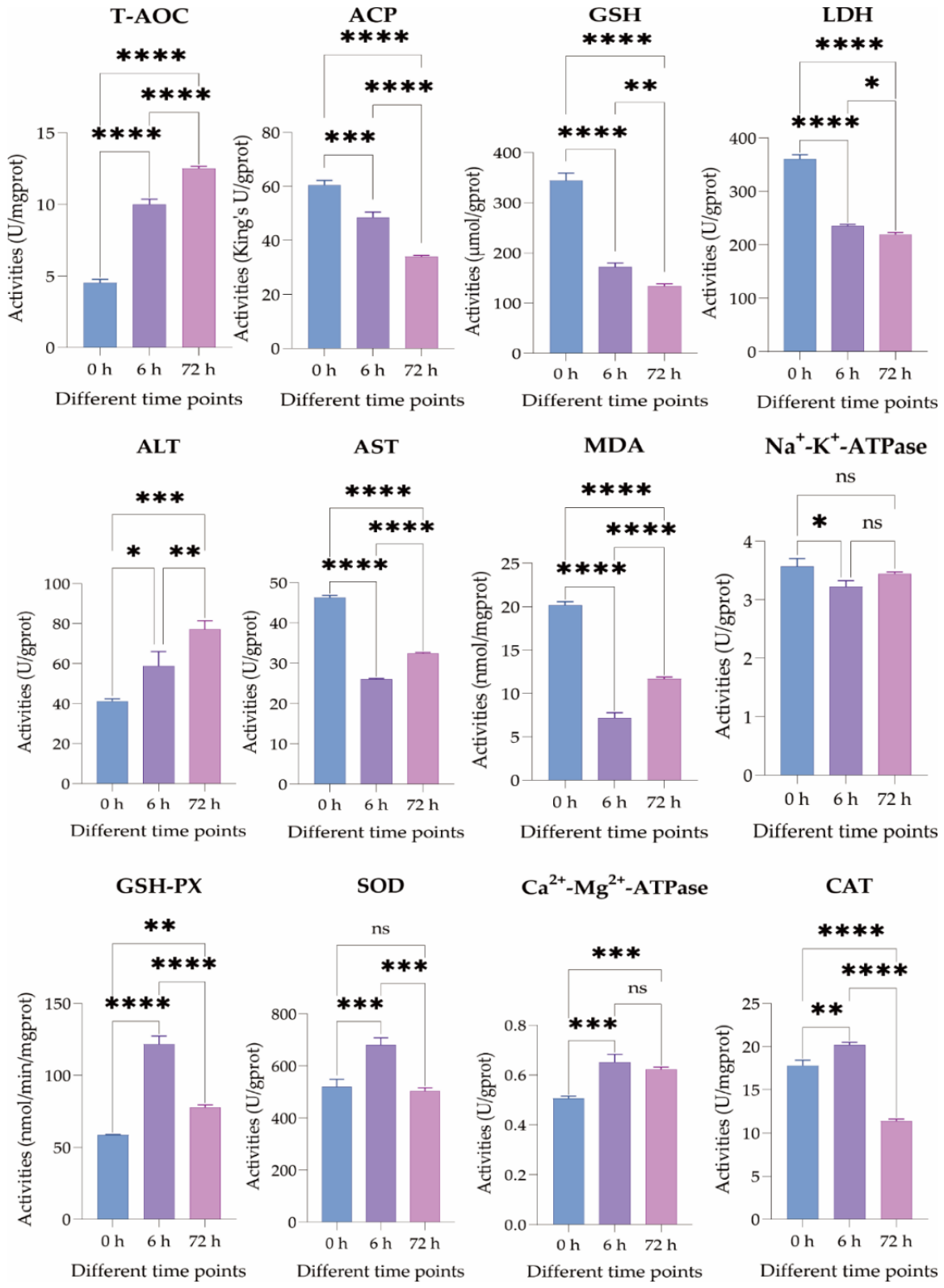
Figure 2.
Histological changes in gill tissue of Nile tilapia under hypoxia stress. 0 h: Control group; 6 h: 6 h hypoxia stress; 72 h: 72 h hypoxia stress; BC: Blood corpuscle; PVC: Pavement cell; MRC: Mitochondria-rich cell; NL: Normal lamella; S: Swollen lamella; R: Ruptured lamella; Magnification: 200×.
Figure 2.
Histological changes in gill tissue of Nile tilapia under hypoxia stress. 0 h: Control group; 6 h: 6 h hypoxia stress; 72 h: 72 h hypoxia stress; BC: Blood corpuscle; PVC: Pavement cell; MRC: Mitochondria-rich cell; NL: Normal lamella; S: Swollen lamella; R: Ruptured lamella; Magnification: 200×.
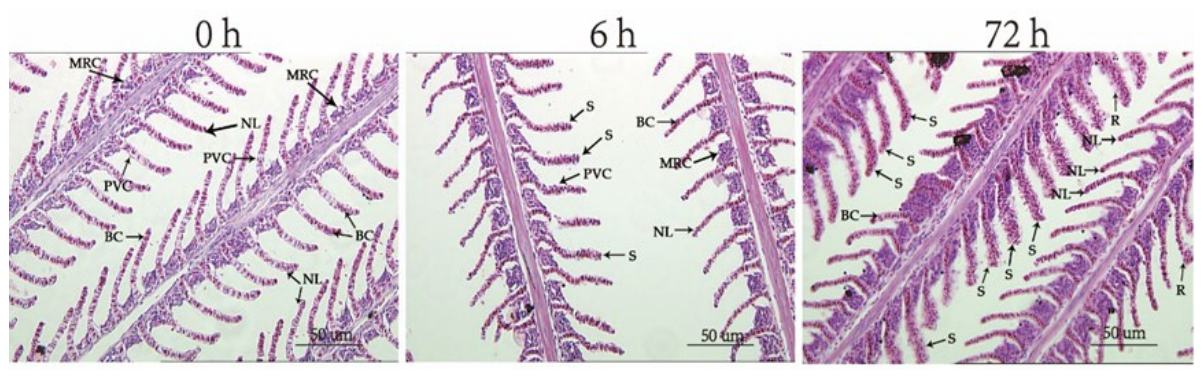
Figure 3.
The main enriched functional groups of GO analysis in gill tissue of Nile tilapia under hypoxia stress.
Figure 3.
The main enriched functional groups of GO analysis in gill tissue of Nile tilapia under hypoxia stress.
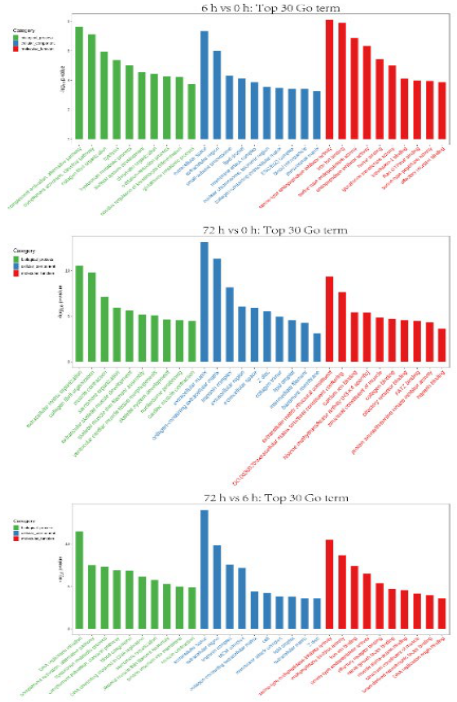
Figure 4.
The main enriched metabolic pathways of KEGG analysis in gill tissue of Nile tilapia under hypoxia stress.
Figure 4.
The main enriched metabolic pathways of KEGG analysis in gill tissue of Nile tilapia under hypoxia stress.
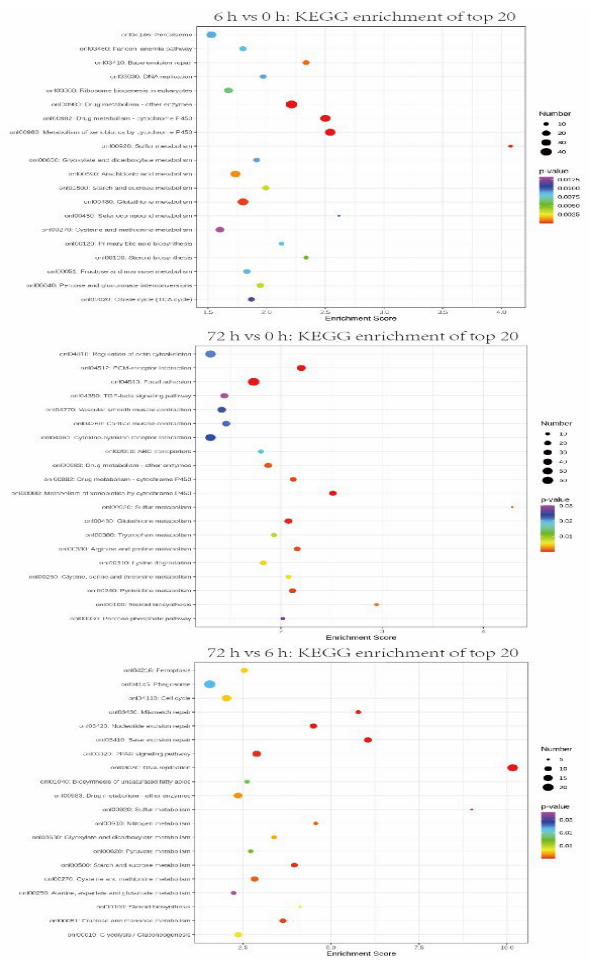
Figure 5.
The relative mRNA expression at different timepoints in gill tissue of Nile tilapia under hypoxia stress. “⁎⁎⁎⁎” indicated P < 0.0001.
Figure 5.
The relative mRNA expression at different timepoints in gill tissue of Nile tilapia under hypoxia stress. “⁎⁎⁎⁎” indicated P < 0.0001.
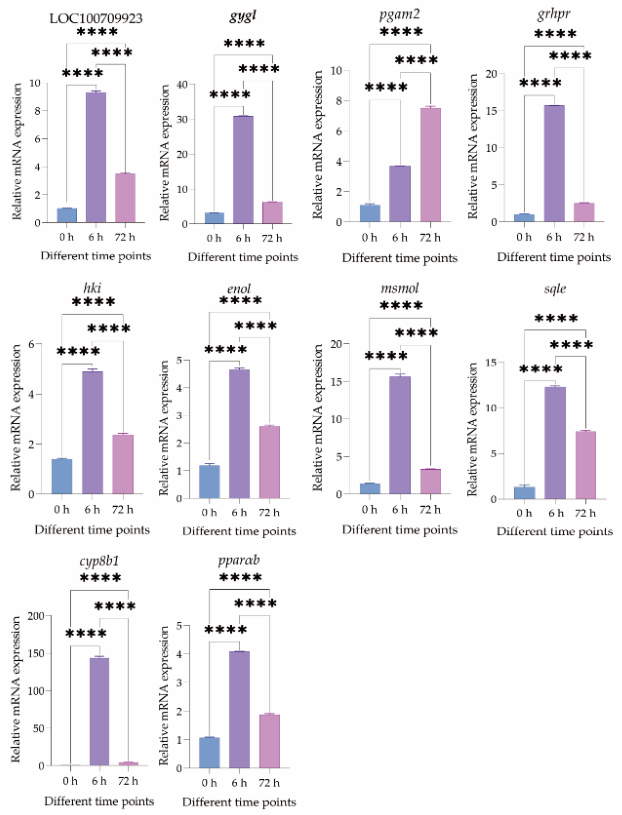

Table 1.
Primer sequences used for qPCR validation.
| Primer | Sequence (5’-3’) |
|---|---|
| LOC100709923-F: | CCTGTGGTGAGGTGGTTGAA |
| LOC100709923-R: | CAGGTTGAAGCATCCGAGGT |
| gyg1-F: | TGCAGAACCTTGCAGAGATGT |
| gyg1-R: | ACACTTGCTGTACTGCGTGA |
| pgam2-F: | CTCGGCGTTACAAAGGCTTG |
| pgam2-R: | GCTGCATCAGACATACCCTCT |
| grhpr-F: | CGTCGGCTCCAGAAGATCG |
| grhpr-R: | CTGGGCACCGGTATGTCATC |
| hki-F: | ATTCTCTTTCCCGTGTGCCC |
| hki-R: | GTCTGCTTGATAGTCCCCTCG |
| eno1-F: | GCCTCCACAGGCATCTATGAG |
| eno1-R: | CCAGAACGTTCACATCCTGGTTA |
| msmo1-F: | CTTGGGGCTGGCTTCTTCAT |
| msmo1-R: | GAATGTCGTAACCGCTGTGGA |
| sqle-F: | ATCGCCTATTTTCACGGCCA |
| sqle-R: | CTTGTTCTCCGGCCCTTTTTG |
| cyp8b1-F: | CGTCAGTCGATACGGTTTTGG |
| cyp8b1-R: | ACATGTGTTCCCATGCTTCATTT |
| pparαb-F: | GCGCTGTCTGCTTTTGATGAG |
| pparαb-R: | TCATCAGCACACAGGGGACT |
Table 2.
Important differentially expressed genes (DEGs) found from transcriptome analysis in gill tissue of Nile tilapia under hypoxia stress.
Table 2.
Important differentially expressed genes (DEGs) found from transcriptome analysis in gill tissue of Nile tilapia under hypoxia stress.
| Name | Accession number | q-value | Fold change | Metabolic pathways | ||
|---|---|---|---|---|---|---|
| G6 versus G0 | G72 versus G0 | G72 versus G6 | ||||
| LOC100709923 | XM_013266403 | 2.58E-11 | 8.89 | 3.35 | 0.37 | Starch and sucrose metabolism |
| gyg1 | XM_003443006 | 3.30E-182 | 10.34 | 1.96 | 0.19 | Starch and sucrose metabolism |
| pygl | XM_031736958 | 1.21E-33 | 2.83 | - | 0.49 | Starch and sucrose metabolism |
| mgam | XM_019361017 | 2.58E-02 | 43.09 | - | 0.02 | Starch and sucrose metabolism |
| pgam2 | XM_003444358 | 1.30E-59 | 3.02 | 6.10 | 2.00 | Glycine, serine and threonine metabolism |
| agxta | XM_013270735 | 1.27E-02 | 86.57 | - | 0.01 | Glycine, serine and threonine metabolism |
| agxtb | XM_003438144 | 5.88E-03 | 111.08 | - | 0.02 | Glycine, serine and threonine metabolism |
| grhpr | XM_003452203 | 1.19E-09 | 47.91 | 2.30 | 0.02 | Glycine, serine and threonine metabolism |
| hki | XM_019360229 | 7.78E-46 | 3.56 | 1.71 | 0.48 | Glycolysis/Gluconeogenesis |
| eno1 | XM_005478184 | 8.06E-50 | 2.98 | 1.74 | 0.46 | Glycolysis/Gluconeogenesis |
| msmo1 | XM_031757305 | 2.23E-11 | 15.53 | 2.27 | 0.14 | Steroid biosynthesis |
| sqle | XM_003453510 | 1.31E-07 | 52.68 | 6.23 | 0.12 | Steroid biosynthesis |
| cyp8b1 | XM_003438089 | 7.02E-11 | 140.27 | 4.45 | 0.01 | PPAR signaling pathway |
| fabp6 | XM_003455174 | 1.25E-31 | 3.45 | - | 0.43 | PPAR signaling pathway |
| apoa1 | XM_003449328 | 1.21E-02 | 59.31 | - | 0.02 | PPAR signaling pathway |
| pparαb | XM_013270548 | 1.66E-27 | 3.47 | 1.69 | 0.48 | PPAR signaling pathway |
Disclaimer/Publisher’s Note: The statements, opinions and data contained in all publications are solely those of the individual author(s) and contributor(s) and not of MDPI and/or the editor(s). MDPI and/or the editor(s) disclaim responsibility for any injury to people or property resulting from any ideas, methods, instructions or products referred to in the content. |
© 2026 by the authors. Licensee MDPI, Basel, Switzerland. This article is an open access article distributed under the terms and conditions of the Creative Commons Attribution (CC BY) license (http://creativecommons.org/licenses/by/4.0/).
Copyright: This open access article is published under a Creative Commons CC BY 4.0 license, which permit the free download, distribution, and reuse, provided that the author and preprint are cited in any reuse.


