

Submitted:
27 May 2026
Posted:
28 May 2026
You are already at the latest version
Abstract
Communal rangelands are increasingly threatened by degradation due to overgrazing which result in persistent feed shortages for livestock. Fodder production has been widely promoted as a sustainable strategy to alleviate grazing pressure; however, its adoption among livestock farmers remains low and poorly understood. This study employed a cross-sectional survey using semi-structured questionnaire to collect data from 120 crop-livestock farmers, examining the socioeconomic factors associated with adoption, determinants and perceived constraints to adopt fodder production. The Pearson Chi-square test revealed that education level, household income and land ownership significantly influence the farmer’s adoption decisions (p < 0.05). The Probit regression model results indicated that years of farming experience, knowledge of fodder production, salary and farm generated income, herd size, farmer group membership and access to extension services significantly increased the likelihood of adoption. The Principal Component Analysis showed that farmers perceived constraints as low institutional support, lack of resources, lack of knowledge, shortage of water and farmer intensions. Dialogue between stakeholders responsible for developing policies and programs which foster enabling environments should target improving extension services, capacity building, financial support and land tenure security as interventions aimed at increasing adoption of fodder production within the communal and smallholder systems.
Keywords:
Fodder production technologies
; adoption
; communal and smallholder farmers
; crop-livestock systems
; semi-arid regions
1. Introduction
Livestock production plays a critical role in sustaining livelihoods of farming communities in both developing and developed countries and has a potential to help achieve several Sustainable Development Goals (SDG’s) related to food security, nutrition and health (zero hunger), income and employment generation (no poverty) [1,2,3]. Livestock based livelihoods in South Africa’s semi arid regions rely heavily on communal rangelands as a key feed resource, particularly in Limpopo, where crop-livestock systems form the backbone of rural economies [4]. However, increasing grazing pressure driven by rising livestock numbers, unsustainable management practices and climate variability continue to expose rangelands to persistent degradation, reduced productivity and declining ecological resilience [5,6,7]. Rangeland degradation modifies species composition, reduces plant diversity and abundance, while simultaneously decreasing vegetation cover, soil fertility and grazing capacity, ultimately constraining feed availability for livestock [8,9,10].
Another further constraint in rangeland-based livestock systems is the decline in the nutritive value of natural grasses during the dry season [11]. As grasses mature, their crude protein levels decline while fibre and lignin concentrations increase, reducing digestibility and feed efficiency [2,12]. This reduction in forage quality creates seasonal feed deficit that restrict animal growth, body condition and reproductive performance especially in systems with limited access to supplementary feeding [13,14,15]. According to [11], the majority of livestock feeding systems in semi-arid regions of Sub-Saharan Africa (SSA) experience a seasonal feed deficiency of 40%. Consequently, these dual limitations of reduced forage availably due to overgrazing and declining quality of forage from rangelands, provides a strong basis for why dry-season feed shortage is widely perceived by farmers as one of the most fundamental constraints to animal productivity in semi-arid regions of Sub-Saharan Africa [16,17,18,19].
Alternatively, crop residues are an important strategic livestock feed resource for smallholder farmers [20,21]. However, their contribution is limited by low nutritive value, multiple competing uses, seasonal availability and quantities which have decreased due to the abandonment of cropping by most communal farmers [22,23,24,25]. It is evident that the reliance on rangelands and crop residues in semi-arid environments is becoming progressively insufficient to sustain livestock productivity growth required to meet food security targets of United Nations Sustainable Development Goal 2 (Zero hunger) by 2030, thereby emphasizing the need for adoption of fodder production technologies by livestock farming communities.
Feed shortages are partly attributed to the slow adoption of forage production technologies into existing farming systems, resulting in the continued heavy reliance feed resources, that often fail to supply sufficient feed throughout the year [26,27,28,29,30]. In South Africa, empirical research explicitly examining the adoption of fodder production technologies remains scares. Much of existing studies addressing technology adoption in smallholder livestock systems are imbedded within the broader research domains such as livestock management, agroforestry practices and climate-smart agriculture, with limited focus on fodder production technologies. Consequently, this study draws on methodological approaches, analytical frameworks and theoretical discussions from these related adoption studies as well as adoption of improved forage technology studies from Sub-Saharan Africa to analyse fodder production technology adoption within communal and smallholder livestock systems in Limpopo Province, South Africa.
Feder et al. [31] described adoption as the process through which farmers incorporate an innovation into their routine farming practices over time, while [32] define adoption as the farmers decision to make full use of an innovation as the best course of action available. In general literature on fodder production, such innovations/technologies include the set of biological, agronomic and management practices used to produce, conserve and efficiently utilize forage resources for livestock feeding. These innovations aim at improving the quantity, quality and year-round availability of livestock feed [2,33,34,35]. The biological innovations is an initial and fundamental component of fodder production which involves the selection of improved forage genetic resources or biological material that have higher biomass yield, better nutritive value and tolerant to prevailing environmental conditions, to enhance feed availability and quality [36,37]. These forage genetic resources include improved tropical grasses, forage legumes and non-leguminous forage forbs (brassicas), dual-purpose herbaceous and legumes crops, fodder trees and shrubs [36,38,39,40]. The second component of fodder production technologies involves the field-level production practices used to establish and manage forage crops to maximize biomass yield, nutritive value and the sustainability of the system. These technologies include suitable cropping systems, planting methods, seeding rates, good soil fertility management, water use efficient irrigation technologies [1,29,41]. The third component of fodder production technologies which involves management technologies used to conserve forages to ensure year-round feed availability and such technologies include hay making, silage and foggage production [42]. Guided by the innovation adoption framework of Diffusion of Innovations, this study specifically examines farmer’s adoption decisions regrading biological innovations for fodder production, defined as farmer’s deliberate decision to select and cultivate any forage crop as a complementary active component of their farming activities to enhance feed availability.
Evidence from several countries in SSA shows that well integrated fodder production into rangeland-based and crop-livestock systems produce a wide range of socioeconomic and ecological benefits, including, enhancing year-round feed availability, reduce ecological footprint of livestock through overgrazing and greenhouse gas (GHG) emissions and strengthening the resilience of livestock farming [26,37,41,43]. Studies in East Africa have demonstrated that adopting improved forage grasses and legumes in mixed farming systems can increase animal weight gain, milk production and household income while improving food security [20,44,46].
Despite heavy sensitization about fodder production technologies which is supported by the benefits in livestock production, the adoption of fodder production technologies among communal and smallholder famers remains highly diverse across Sub-Saharan African regions. Studies in East Africa reported that only about 10% of smallholder farmers adopted improved forage technologies, despite extensive promotion efforts [45,47,48]. Development programs promoting fodder shrubs in Malawi have resulted in a widespread dissemination; however, adoption remained limited relative to the total population of livestock farmers [49]. Other dairy development programs in Southern Africa, Zimbabwe, adoption has reached moderate levels, with approximately 47% of cattle-keeping households integrated fodder production [50]. Adoption and extend of the use of fodder technologies in Zimbabwe remain low and insignificant, even though concerted efforts have been made to introduce numerous improved fodder technologies [51].
Existing studies on adoption of innovation in agriculture have identified a complex combination of socioeconomic, institutional and biophysical factors [40]. Previous research on broad adoption studies has shown that farmers with greater experience, diversified income, exposure to extension services and knowledge of the technology increases the likelihood of adoption [52,53,54,55]. The adoption of biological technology for fodder production was positively associated with access to resources, age, head size, perceived benefits of the technology, access to extension services and participation in farmer groups [44,51,56,57].
Farmer’s perceptions of the benefits of improved forage grasses such as increased milk production, higher nutritive value and drought tolerance paly a critical role in encouraging adoption [35,48,58]. However, despite these enabling factors, several constraints continue to limits the adoption of improved forage technologies. Research on improved forage technology adoption in different SSA regions found that lack of knowledge about the technology, limited access to production inputs, cost and benefits of the technology, unfavourable land tenure, inadequate extension support, weak institutional frameworks, adverse market conditions and broader farming system significantly restricted the adoption of improved forage technology among smallholder dairy farmers [40,46,50,59]. There is paucity of knowledge on the determinants and constraints to adoption of improved forage technology in South Africa.
Against this background, this study explores the pathways to adoption of fodder production technologies in communal and smallholder crop-livestock systems by examining the socioeconomic differences between adopters and non-adopters, identify the determinates influencing farmer’s adoption decisions and analysing the key constraints limiting adoption. By providing the empirical insights into these pathways, the study contributes to ongoing efforts aimed at improving fodder production to enhance feed security, improve livestock productivity and strengthening the resilience of communal and smallholder farming systems in the semi-arid environments.
2. Materials and Methods
2.1. Description of the Study Area
The study was conducted in the Limpopo Province, the northernmost South African province, bounded by Zimbabwe to the north; Mozambique to the east; the provinces of Mpumalanga, Gauteng, and North West to the south; and Botswana to the west and northwest. The province covers an area of 125,755 km2 of which approximately 81% is used for livestock grazing. Three agro-ecological zones namely warm arid, warm semi-arid and cool semi-arid zones which represent the dominant climatic conditions of the province were purposively selected (Figure 1).
2.2. Sampling and Data Collection
This study applied non-probability sampling techniques. Purposive sampling was employed to select crop-livestock farmers who have sheep as part of their livestock systems. A partial database containing few crop-livestock with sheep farmers from one district municipality was obtained from the Limpopo Department of Agriculture and Rural Development (LDARD), which led to the study not having a predetermined sample size. The snowball sampling technique was used to identify and recruit farmers in selected agro-ecological zones of the province [60]. Communal and smallholder crop-livestock farmers who have sheep as part of their livestock system, were targeted for the study. Farmers who had a sheep flock of more than five (5) heads were enrolled depending on their willingness to participate.
The questionnaire was subdivided into sections based on the objectives of the study aimed at understanding farmers’ socioeconomic characteristics, farm characteristics, knowledge of forage production and perception on the adoption of forage production. To measure knowledge, firstly farmers were asked to give the name of the forages they know (number of forage crops given). Secondly, to measure the level of knowledge of the technical/ production practices, five questions were asked to each farmer to determine knowledge of forage production practices. The questions covered different aspects of production practices including establishment, fertilization, irrigation, utilization and conservation methods. Each production practice was assigned by ‘2’ marks and the marks range varied from 0 to 10. If any farmer failed to describe all of the above-mentioned production aspects correctly, ‘0’ mark was obtained, which meant no knowledge, described 2 production practices – ‘4’ marks which meant poor knowledge, 3 described practices – ‘6’ marks which meant fair knowledge, 4 described practices – ‘8’ marks which meant good knowledge and 5 correctly described practices – ‘10’ marks which meant excellent knowledge. To use in the probit model, points 0 and 4 meant no knowledge (0) and 6-10 meant to know (1).
The questionnaire was administered to 120 crop-livestock with sheep farmers, 92 communal farmers and 28 smallholder. A single-visit multiple-subject formal survey technique was used for data collection via a pretested, semi-structured questionnaire. The questionnaire was tested in a pilot study with 15 crop-livestock with sheep farmers. The pre-test pilot results were utilized to adjust and correct the questions, questionnaire's, length and feasibility and identify confusing or misleading questions. The interviews were conducted individually at the farmer’s house/farm. The extension officer and the community member helped with directions, the introduction of the researcher and the interviews. Ethical approval was obtained for the study from the University of Limpopo Ethical Clearance Committee (TREC/350/2019:PG). Respondents were informed of the study's content and aim, were assured that participation was voluntary and that their personal information would be kept confidential. Each respondent signed a consent form before the interview was conducted. The questionnaire was originally formulated in English, and the questions were asked in Sepedi by a community member and the researcher. The responses were subsequently translated to English for reporting purposes.
2.3. Data Analysis
Statistical Package for Social Sciences (IBM SPSS Statistics 27) and Microsoft Excel were used to analyse data. Descriptive and inferential statistics were used to analyse data collected from the sampled communal and smallholder crop-livestock farmers, having sheep as part of their livestock production. Descriptive statistics, such as frequencies and chi-square tests were used to summarize and compare data based on the adoption of fodder production in their farming systems. Probit regression model was used to analyse the factors that facilitate the adoption of forage production by communal and smallholder sheep farmers into their crop-livestock systems to bridge the winter feed gap. The Principal Component Analysis (PCA) method was used to analyse the perceived factors that impede the adoption of forage production. These different analytical techniques are explained in detail in the following subsections.
2.4. Econometric Framework
2.4.1. Probit Regression Model
This study adopted the Probit regression model to determine factors that can facilitate the adoption of forage production into crop-livestock farming systems. This model is based on a binary regression analyses that seeks to explain the probability of adoption versus non- adoption rather than the extent and intensity of adoption therefore. The Probit regression model was selected because the dependent variable (adoption of forage production technology) is binary and takes a value of 0 or 1, meaning that it takes 1 if the farmer adopts forage production and 0 if the farmer did not adopt. Adopters are farmers who have planted forage crops on their farms, plots, or backyard with the intention to feed livestock and non-adopters are farmers who have not planted forage crops during the survey year (2021/2022 production year). The conceptual analysis of the model used in this study is similar to the model adopted by [61].
Thus, the Probit regression model used is described as follows:
Where D_i^* represents the binary variable estimating the probability that a farmer adopted forage production or not. Thus, D_i^*=1 means the farmer has adopted and produced the forages on their farm to supplement feed in the dry season, while otherwise implies no adoption by the farmer. Z_i are a set of independent or explanatory variables influencing the decision to integrate. α represents the Probit index for a one-unit change in the predictor while the error term which assumes normal distribution is represented by V_i.
Existing adoption literature contains several factors that are known to potentially facilitate agricultural technology adoption into already existing farming systems. Farmers' decisions to adopt the agricultural technologies are thought to be facilitated by the dynamic interaction between factors that can be categorized under the farmer's demographic and socioeconomic realities, characteristics of physical environments in which the farmer operates as well as the attributes of the technology itself [43,52,61,62,63]. In this study, the choice of the variables that were hypothesized to potentially facilitate the adoption of forage production was based on the regularity with which a variable was cited in literature. Using this criterion, the following variables described in Table 1 were included in the Probit regression model.
2.4.2. The Principal Component Analysis (PCA) Method
The PCA was conducted to examine factors explaining farmers’ perceived constraining factors to forage production technology adoption into already existing crop-livestock systems. The decision of farmers to adopt a technology may be influenced by the perception of the characteristics of the proposed technology. Communal and smallholder crop-livestock with sheep farmers were asked to scale the significance of the constraints to adoption the forage production using the Likert scale (1-5 points) from least important to highly important.
Bartlett's test of sphericity was used to confirm that the variables were sufficiently correlated to justify the use of PCA. A statistically significant value (p < 0.10) indicates sufficient correlation and appropriate data for PCA. Moreover, the Kaiser Mayer Olkin (KMO) measure of sampling adequacy was also applied, with a value > 0.5 implying PCA could be performed. Components with eigen values of at least one (> 1) were retained based on the Kaiser criterion [64]. The retention of statements with factor loadings above 0.5 for use in composing perception indices was a threshold adopted in this study [63,65].
3. Results
3.1. Socioeconomic Characteristics of the Farmers
The socioeconomic characteristics of adopters and non-adopters are summarized in Table 2. Chi-square tests of independence were conducted to assess whether categorical socioeconomic characteristics differed significantly between adopters and non-adopters.
The results in Table 2 indicate that gender and age did not significantly differ between the two groups (p > 0.05). However, adopters were predominantly male (76.9%) and largely above 40 years of age (53.9%), with the largest proportion (46.2%) being over 61 years. Similarly, non-adopters were also predominantly male (77.6%) and largely older than 50 years. Although younger farmers were proportionally more represented among adopters, this pattern was not statistically significant.
Education level significantly differentiated adopters from non-adopters (χ² = 7.07, p < 0.01). A substantial majority of adopters (76.9%) had a higher education, compared to only 38.3% of non-adopters. Conversely, a greater proportion of non-adopters had lower education (61.7%) suggesting that educational attainment may enhance farmers’ capacity to understand, evaluate and adopt forage production. Household income was significantly associated with adoption status. (χ² = 6.03, p < 0.05). A larger proportion of adopters were in the middle-income category (61.5%) and none of them were in the high-income category, whereas non-adopters were predominantly within the low-income category (56.1%). This indicates that moderate financial capacity may facilitate technology adoption.
Land ownership showed significant differences between adopters and non-adopters (χ² = 7.04, p < 0.05). Approximately 30.8% of adopters owned land compared to only 7.5% of non-adopters, however a majority of both adopters (61.5%) and non-adopters (79.4%) were largely communal land users, suggesting that land tenure security may influence adoption decisions. No statistically significant differences were observed for occupation, income sources, herd size, farming experience and group membership (p > 0.05), suggesting that these factors did not distinguish adopters from non-adopters and do not meaningfully associate with adoption in this study. Overall, the findings suggest that while demographic and production characteristics are broadly similar across groups, differences are evident in education, income and land tenure status.
3.2. Factors That Facilitate the Adoption of Forage Production to Bridge the Winter Feed Gap
Farmers' decision to adopt a specific technology or a practice might be influenced by various factors. The study revealed that out of the 120 surveyed farmers, only 13 farmers (10.8%) had adopted fodder production, while 107 farmers (89.2%) were non-adopters, indicating a relatively low level of adoption among the sampled farmers. Farmers adopted forage production by planting 0.5 to 1 ha of forage alongside agronomic and horticultural crops. The commonly grown forage crops were lucerne (Medicago sativa) and perennial white clover (Trifolium repens) under irrigation and tropical perennial grasses such as Anthephora pubescens and Cenchrus ciliaris under dryland conditions.
The results of estimated probit model on the factors facilitating the adoption of forage production by communal and smallholder crop-livestock with sheep farmers are presented in Table 3. The model was statistically significant based on the Pearson goodness-of-fit test (χ² = 330.471, df = 105, p < 0.001), indicating that the explanatory variables jointly contribute to explaining variation in adoption decisions.
The Probit regression model results in Table 3 revealed several significant determinants of forage production adoption. Years of farming experience, knowledge of forage production, salary income, farm generated income, herd size, farmer group membership and access to extension services significantly increased the likelihood of adoption. In contrast, gender, formal education, household income land ownership were not statistically significant in explaining adoption of forage production by communal and smallholder crop-livestock farmers. The results indicated that farming experience had a positive and statistically significant effect on forage adoption (p < 0.05), implying that an additional year of experience in farming positively increases the probability of adopting forage production and that more experienced farmers are more likely to integrate, possibly due to accumulated knowledge and better risk management capacity.
Knowledge of forage production strongly and positively increased the likelihood of adoption of forage production (p < 0.01). This suggests technical awareness and familiarity with forage systems are critical drivers of adoption. Having a salary and farm income as sources of income also had a positive and significant effect (p < 0.01 and p < 0.05 respectively) on adoption of forage production among farmers. Having a salary and farm generated income may indicate improved liquidity and reduces financial risk, which increases the probability of adoption of forage production. Furthermore, the results of the study revealed a positive highly significant relationship between herd size and adoption of forage production (p < 0.001). This suggests that having more animals increases the probability of adoption, likely due to greater feed demand and economies of scale. Farmer group association was found to positively and significantly increasing the likelihood of adoption of forage production (p < 0.01), highlighting the importance of social capital and information exchange. Access to extension had a statistically positive relationship with the adoption of forage production (p < 0.05), indicating that institutional support plays a meaningful role in promoting forage production adoption. These findings suggest that practical experience, technical knowledge, institutional support and production scale are more important that general socioeconomic status in shaping adoption decisions.
3.3. Perceptions the Constraints to Adoption of Forage Production Technology
The farmer’s perceptions of the constraints to adopt forage production are presented in Table 4. The Kaizer criterion was used for selecting the number of essential principal components explaining the data. All components with Eigen values of less than one were left out, following the rule of thumb when conducting Principal Component Analysis (PCA) using a correlation matrix [63]. Subsequently, the factor loadings for the reduced components as suggested by the criterion of Eigen values were retained for further analysis.
Five principal components with the eigen values of greater that 1 were extracted, collectively explaining 70% of the total variance compared against the original 11 perceived impediments. These components represent major constraint dimensions including farmer’s decision regarding fodder adoption. Due to the cross factor loading of lack of equipment in principal components 1 and 2, it was decided to assign it to component 2 for its positive correlation. These components are as follows as shown in Table 4.
Principle component 1: Low institutional support, accounts for 17.7% of the variance. A total of three impediments loaded heavily into this component, low government support (0.778) and shortage of land (0,664), with a moderate negative loading for lack of financial resources. This component reflects institutional and structural barriers, suggesting that limited government support mechanism and land availability are key constraint.
Principle component 2: Lack of resources and labour constraints accounts for 16.59% of the variance and is dominated by lack of equipment (0.601) and labour intensive (0.577). This component highlights operational constraints, indicating that farmers perceived fodder production as labour demanding and requiring equipment that may not be readily available in communal and smallholder production systems.
Principle component 3: Lack of knowledge and financial constraint accounts for 14.45% of the variance with strong ladings for lack of awareness and knowledge (0.799) and cost of production (0.722) which reflected a positive correlation. These variables suggest that limited awareness of forage production practices and perceived production costs significantly constraint fodder technology adoption.
Principle component 4: Shortage of water accounts for 10.82% of the variance and is strongly associated with shortage of irrigation water (-0.788). This dimension reflects environmental related limitation, indicating that water scarcity is a critical constraint in semi-arid production systems.
Principle component 5: Objectives of the farmer account for 9.91% of the variance and is strongly associated with given less priority (0.720). This component suggest that fodder adoption may not be prioritised by the farmers relative to other agricultural activities, possible due to competing production demands or limited perceived benefits.
4. Discussion
This study sought to analyse the association between socioeconomic characteristics and forage production adoption status, identify the determinants influencing adoption decisions and examine farmer’s perceived constraints to adoption. The findings provide empirical evidence that while demographic characteristics such as gender, age and occupation of the farmers do not significantly differ between adopters and non-adopters and did not significantly influence adoption [43]. However, variations exist in selected socioeconomic factors, particularly education level, household income and land ownership. The significant association between education and adoption of fodder production observed in this study, echoes with broader findings from SSA, where education attainment were positively associated with the adoption of technology and good management practices because it boosts farmers' understanding of new technology and their long-term benefits [46,55]. Education most likely increases farmers' ability to obtain, analyse, and apply agronomic and sustainability knowledge, allowing for more informed decision-making in resource-constrained crop-livestock systems [43,66].
Household income and off-farm earnings also matter and this positive relationship to adoption suggest that financial capacity facilitates uptake of technology. This is consistent with few fodder-specific studies that directly evaluated income effects, demonstrating that wealthier farmers (owning larger herds and assets) clearly have more capacity to invest in forage production [44,45,54]. A possible clarification for the positive effect of cash income on forage adoption is that access to income enable farmers to cover the cost of different production inputs required for fodder production [41,67]. The significant effect of land ownership reflects tenure security’s role in positively influencing adoption because farmers with secure rights are more willing to invest in long term production enterprises. These findings align with [20], who noted that farm size and landownership are key determinants of adopting improved forages. Farmers with limited access to land and insecure tenure had a higher probability of not adopting forage production in Burkina Faso [68]. The results suggest that structural and human capital factors outweigh basic demographic in this study, a pattern also noted in broader adoption studies [43,69]. Overall, the literature and the results of this study indicate that enhancing farmers education, income opportunities and tenure security can significantly boost sustainable adoption of fodder production in communal and smallholder crop-livestock systems [40,69].
Complementing these bivariate findings of Chi-square, the Probit regression model identified the important multivariate factors of fodder adoption. Farming experience and knowledge of fodder production positively influenced the likelihood of adoption, demonstrating that farming experience and awareness are critical for adoption. These results resonates with [1], who found that farming experience lead to increased awareness and access to information, enhancing the farmer’s ability to evaluate and adopt fodder production. Limited farming experience particularly with forage production and unfamiliarity with improved management techniques as a key adoption barrier in Uganda [46]. Adoption is possibly low because farmers also lack training or information on fodder benefits [68]. These imply that previous experience and accumulated knowledge about fodder production positively relate to the adoption of fodder technologies [26].
Income sources including salary income and farm-generated, play a significant role in facilitating the adoption of fodder production. Farmers with access to income sources often have greater financial capacity to invest in the production inputs required by some agricultural innovations, such as improved forage seeds and equipment [54]. More broadly, diversifies income sources reduce financial risk and increase farmer’s willingness to adopt innovations including fodder technologies [40]. Farm and institutional characteristics such as larger herd size and farmer group membership greatly increased the chance of adoption. This is because, under the current situation, where overgrazing, invasive species and land transformation continue to reduce the rangelands, communal grazing systems are now supporting low quantity and poor quality fodder, farmers with larger herds are more likely to enhance feed availability by integrating fodder production into their farming systems [43]. Furthermore, [44] in Kenya similarly found that farmers with larger herds and improved breeds (proxies for greater wealth) were significantly more likely to adopt Brachiaria fodder production systems. Group membership is also important, [46] reported that the lack of participation in producer organisations hinder adoption of innovations.
The principal component analysis revealed that the constraints to forage adoption are multidimensional, encompassing institutional, resource, knowledge, environmental and behavioural constraints. Five principal components explained 70% of the total variance highlighting that the adoption of fodder production technologies in the semi-arid crop livestock systems is influenced by a combination of structural and farmer level factors. Institutional and structural constraints emerged as a key dimension influencing adoption. The strong loading of low government support and shortage of land suggest that institutional backing plays a critical role in facilitating technology adoption by providing training, access to extension services and inputs. Evidence from East African dairy systems indicated low government support through limited policy emphasis on fodder development and weak extension services reduced the capacity of many communal and smallholder farmers to establish improved fodder production effectively [48].
Land scarcity also remains a major determinant of fodder adoption. In many communal and smallholder farming systems, land allocation decisions of farmers are influenced by immediate food crop needs, which often limits the area available for fodder production. For instance, research by [26] in Tanzania’s dairy systems has shown that farmers often prioritise stable crops over fodder cultivation due to land scarcity and policy environment that insufficiently support fodder development initiatives. Furthermore, research on improved forage technologies in smallholder systems similarly reports that limited land allocations for forage production significantly constraint adoption particularly in densely populated farming regions [40]. Resource and labour constraints also emerged as a significant factor influencing farmers adoption decisions. The high loadings of lack of equipment and the perception that fodder production is labour intensive indicate that operational challenges remain a critical barrier. This is because communal and smallholder farmers often face limited access to mechanisation and farm equipment, which increase the labour burden associated with establishing and managing fodder crops. Previous studies have reported similar challenges noting that labour requirements and lack of appropriate equipment discourage farmers from adopting fodder crops into existing production systems, particularly in resource constraint environments [48].
Knowledge and financial barriers were another important dimension affecting adoption. The strong association of lack of awareness and knowledge with the cost of production highlights the role of information and economic perceptions in shaping farmers decisions. Present discoveries resonate with the findings of [62], indicating that knowledge plays an essential role in technology adoption because the adoption of a particular technology can only be improved if the farmers are aware of such technology. Empirical evidence from agroforestry based fodder technologies indicated that smallholder systems have consistently demonstrated that limited knowledge and inadequate training reduces farmer’s willingness to adopt improved fodder production technologies [59,66]. Similarly, reviews of improved forage adoption highlight that farmers lack information on forage establishment, forage management practices, seed production, utilization practices and potential benefits discourage them from allocating land and resources to fodder cultivation [34,40]. Furthermore, lack of adequate financial resources among farmers may limit the farmers capacity to invest in fodder production technologies, as the initial establishment costs are often perceived as a costly and risky investment, thereby reducing their likelihood to adopt [66].
Environmental constraint in a form of shortage of water featured prominently in the results. The strong loading of shortage of irrigation water reflects the biophysical challenges faced by farmers operating in semi-arid environments. Water scarcity is widely recognised as a major constrain affecting crop and fodder production in drylands farming, where rainfall variability and limited irrigation infrastructure restricts the cultivation of forage crops. The results of the study agree with the findings of [52], who indicated that rainfall, dams/rivers, communal taps, wells, and boreholes are the primary water sources in most rural areas; however, due to varying rainfall amounts, some water sources are seasonal, making it difficult for rural farmers to have reliable water for irrigation of their produce. Studies examining fodder production adoption in African communal and smallholder systems have similarly reported that limited availability of water and irrigation infrastructure constraint the establishment and scaling up of improved fodder production technologies.
The results highlighted behavioural and prioritisation factors as an additional constraints to fodder adoption. The strong loading associated with the perception that fodder production is given less priority suggest that farmers may not view forage cultivation and a core component of their production systems. A similar finding was reported by [2] that fodder production intensification may not be the top priority for farmers who keep livestock primarily to provide drought power, as an asset for cultural reasons hence the adoption of forage production technology will not be their priority. In crop-dominated farming systems, livestock rely heavily on natural grazing and crop residues, reducing the necessity for cultivated fodder [34]. Previous research indicate that farmers tend to adopt cultivated forage systems only when feed shortages become severe or when livestock production becomes more commercialized [48]. Consequently, increasing awareness of the productivity and resilience benefits associated with fodder adoption may be essential to encourage greater prioritisation of fodder production among farmers.
Collectively the findings demonstrate that the constraints to fodder production adoption extend beyond individual farmer characteristic to include broader institutional, environmental and structural factors. Addressing these constraints will require a coordinated interventions that strengthen extension services, improve access to inputs and financial resources and promoting policy environments that support forage development within communal and smallholder farming contexts. Such concerted efforts are particularly important in the semi-arid regions where improving feed availability is essential for enhancing livestock productivity and strengthening the resilience of the smallholder farming systems.
5. Conclusions
The sustainable adoption of forage production technology has a critical potential role in reducing grazing pressure, alleviating feed gaps, promote maintainable fodder flows and fodder bank development. The results determined that factors such as farming experience, knowledge of forage legume production, source of income, membership in farmer associations, access to extension services and herd size have a potential to promote adoption of forage production technology in crop-livestock farming systems. Additionally, the perceived constraints to adoption of fodder production identified by this study were low institutional support, lack of resources, lack of knowledge, shortage of water and objectives of the farmer. Dialogue between stakeholders focusing on planning and developing enabling environments, vital policies, strategic programs and much-needed investments should be guided by the identified determinants and constraints to the adoption of forage production technologies. There are many forage species with improved cultivars such as tropical grasses and dual purpose crops which can be integrated into crop-livestock systems to create mixed crop-livestock systems. Further research is needed both on-farm and on-station to evaluate their forage agronomic yield variability, unravelling interactions between species, on-farm environmental conditions and management practices for informed adoption to create sustainable mixed crop livestock systems.
6. Limitations of the Study and Research Recommendations
The low proportion of adopters in the sample shows that forage adoption remains limited in the study area and emphasizes the need for targeted intervention strategies. Future research should use larger samples or longitudinal approaches to properly capture the underlying forces of fodder adoption over time. Additionally intervention-based studies may also provide deeper insights into the dynamics of forage adoption in crop-livestock systems. Such approaches would help to move beyond association-based findings and discover causative processes that can inform targeted policy.
Author Contributions
For research articles with several authors, a short paragraph specifying their individual contributions must be provided. The following statements should be used “Conceptualization, L.M.M., K.K.A., S.N, and J.I.; methodology, L.M.M., K.K.A., S.N, and J.I.; software, L.M.M.; validation, , L.M.M., and K.K.A.; formal analysis, L.M.M., and K.K.A.; investigation, L.M.M.; resources, , L.M.M., K.K.A., and J.I.; data curation, L.M.M., K.K.A., and S.N.; writing—original draft preparation, L.M.M.; writing—review and editing, K.K.A., S.N, and J.I.; visualization, L.M.M.; supervision, K.K.A., S.N, and J.I.; project administration, L.M.M., and K.K.A.; funding acquisition, L.M.M., K.K.A., and J.I. All authors have read and agreed to the published version of the manuscript.
Funding
The research was funded by Thuthuka award from National Research Foundation grant number 128381, Department of Science and Innovation through Risk and Vulnerability Science Centre (RVSC) of the University of Limpopo and the South African Limpopo Landscape Network (SALLnet), a joint project with the University of Limpopo, sponsored by the German Ministry of Education (BMBF).
Data Availability Statement
All data and materials used in the write up of the manuscript were acquired through existing facilities at the Centre for Global Change, University of Limpopo. The data used in this study are available at the Centre for Global Change and can be accessed through the corresponding author.
Acknowledgments
We would like to thank the Limpopo Department of Agriculture and Rural Development particularly Animal Production Advisors in Waterberg, Capricorn, Sekhukhune and Mopani Districts, Bapedi sheep farmers and livestock-crop farmers who took part in the study as respondents. The authors have reviewed and edited the output and take full responsibility for the content of this publication.
Conflicts of Interest
The authors declare no conflicts of interest. The funders had no role in the design of the study; in the collection, analyses, or interpretation of data; in the writing of the manuscript; or in the decision to publish the results.
Abbreviations
The following abbreviations are used in this manuscript:
| SDG’s | Sustainable Development Goals |
| PCA | Principal Component Analysis |
| SSA | Sub-Saharan Africa |
| KMO | Kaiser-Meyer-Olkin |
References
- Martínez-García, C.G.; Dorward, P.; Rehman, T. Factors influencing adoption of crop and forage related and animal husbandry technologies by small-scale dairy farmers in central Mexico. Exp. Agric. 2016, 52, 87–109. [Google Scholar] [CrossRef]
- Paul, B.K.; Groot, J.C.J.; Maass, B.L.; Notenbaert, A.M.O.; Herrero, M.; Tittonell, P.A. Improved feeding and forages at a crossroads: farming systems approaches for sustainable livestock development in East Africa. Outlook Agric. 2020, 4, 13–20. [Google Scholar] [CrossRef]
- Tufail, M.S.; Krebs, G.L.; Quddus, M.S.; Southwell, A.; Piltz, J.W.; Norton, M.R.; Wynn, P.C. Empowering smallholder farmers by integrating participatory research and establishing village-based forage seed enterprises to enhance on-farm productivity and local seed supply. Seeds 2025, 4, 40. [Google Scholar] [CrossRef]
- Slayi, M.; Jaja, I.F. Integrating mixed livestock systems to optimize forage utilization and modify woody species composition in semi-arid communal rangelands. Land 2024, 13, 1945. [Google Scholar] [CrossRef]
- Bodiba, K.C.; Letsoalo, N.L.; Teele, T.; Legodu, G.L. Rangeland management practices and perceptions of communal livestock farmers' towards rangeland degradation in the North West Province of South Africa. S. Afr. j. agric. ext. 2024, 52, 66–82. [Google Scholar] [CrossRef]
- Godde, C.; Dizyee, K.; Ash, A.; Thornton, P.; Sloat, L.; Roura, E.; Henderson, B.; Herrero, M. Climate change and variability impacts on grazing herds: Insights from a system dynamics approach for semi-arid Australian rangelands. Glob. Change Biol. 2019, 25, 3091–3109. [Google Scholar] [CrossRef]
- Balehegn, M.; Kebreab, E.; Tolera, A.; Hunt, S.; Erickson, P.; Crane, T.A.; Adesogan, A.T. Livestock sustainability research in Africa with a focus on the environment. Anim. Front. 2021, 11, 47–56. [Google Scholar] [CrossRef] [PubMed]
- Legese, B.; Balew, A. Land-use and land-cover change in the lowlands of Bale Zone, Ethiopia: its driving factors and impacts of rangeland dynamics in livestock mobility. Environ. Monit. Assess. 2021, 193, 453. [Google Scholar] [CrossRef]
- van der Westhuizen, H.C.; du Preez, C.C.; Snyman, H.A. Rangeland degradation impacts on vegetation cover, soil properties and ecosystem functioning in an arid and semi-arid climate, South Africa. GEP 2022, 10, 10–32. [Google Scholar] [CrossRef]
- Letsoalo, N.L.; Samuels, I.M.; Tjelele, J.T.; Pule, H.T.; Cupido, C.F.; Engelbrecht, A. Rangeland conditions and grazing capacities on livestock farms during and after drought in three biomes in South Africa. Land 2025, 14, 1836. [Google Scholar] [CrossRef]
- Ayele, J.; Tolemariam, T.; Beyene, A.; Tadese, D.A.; Tamiru, M. Assessment of livestock feed supply and demand concerning livestock productivity in Lalo Kile district of Kellem Wollega Zone, Western Ethiopia. Heliyon 2021, 7, e08177. [Google Scholar] [CrossRef]
- Katoch, R. Forage nutritional quality management. In Techniques in forage quality analysis; Springer: Singapore, 2023; pp. 317–336. [Google Scholar] [CrossRef]
- Duguma, B.; Janssens, G.P.J. Assessment of livestock feed resources and coping strategies with dry season feed scarcity in mixed crop–livestock farming systems around the Gilgel Gibe catchment, Southwest Ethiopia. Sustainability 2021, 13, 10713. [Google Scholar] [CrossRef]
- Lamega, S.A.; Komainda, M.; Hoffmann, M.P.; Ayisi, K.K.; Odhiambo, J.J.O.; Isselstein, J. It depends on the rain: Smallholder farmers’ perceptions on the seasonality of feed gaps and how it affects livestock in semi-arid and arid regions in Southern Africa. Clim. Risk Manag. 2021, 34, 1–27. [Google Scholar] [CrossRef]
- Geißler, K.; Blaum, N.; von Maltitz, G.P.; Smith, T.; Bookhagen, B. Biodiversity and ecosystem functions in Southern African savanna sangelands: threats, impacts and solutions. In Sustainability of Southern African ecosystems under global change; Ecological Studies; von Maltitz, G.P., Midgley, G.F., Veitch, J., Brümmer, C., Rötter, R.P., Viehberg, F.A., Veste, M., Eds.; Springer: Cham, Switzerland, 2024; Volume 248, pp. 411–433. [Google Scholar] [CrossRef]
- Motshekga, L.; Ayisi, K.; Isselstein, J.; Ndleve, S. Insights on the socioeconomic characteristics, production systems and constraints confronted by communal and smallholder sheep farmers in Limpopo Province, South Africa. Cogent Food Agric. 2025, 11, 2505749. [Google Scholar] [CrossRef]
- Amole, T.; Augustine, A.; Balehegn, M.; Adesogoan, A.T. Livestock feed resources in the West African Sahel. Agron. J. 2022, 114, 26–45. [Google Scholar] [CrossRef]
- Paul, B.K.; Koge, J.; Maass, B.L.; Notenbaert, A.M.O.; Peters, M.; Groot, J.C.J.; Tittonell, P.A. Tropical forage technologies can deliver multiple benefits in Sub-Saharan Africa. A meta-analysis. Agron. Sustain. Dev. 2020, 40, 22. [Google Scholar] [CrossRef]
- Cooke, A.S.; Machekano, H.; Gwiriri, L.C.; Tinsley, J.H.I.; Silva, G.M.; Nyamukondiwa, C.; Safalaoh, A.; et al. The nutritional feed gap: Seasonal variations in ruminant nutrition and knowledge gaps in relation to food security in Southern Africa. Food Secur. 2025, 17, 73–100. [Google Scholar] [CrossRef] [PubMed]
- Lukuyu, B.; Ngunga, D.; Bekunda, M. Use of crop residue as feed for ruminant livestock: A guide for smallholder farmers; ILRI: Nairobi, Kenya, 2021; https://hdl.handle.net/10568/113101.
- Alimi, N.; Assani, A.S.; Sanni Worogo, H.; Baco, N.M.; Traoré, I.A. Livestock feed resources used as alternatives during feed shortages and their impact on the environment and ruminant performance in West Africa: a systematic review. Front. Vet. Sci. 2024, 11, 1352235. [Google Scholar] [CrossRef] [PubMed]
- Duncan, A.J.; Bachewe, F.; Mekonnen, K.; Valbuena, D.; Rachier, G.; Lule, D.; Bahta, M.; Erenstein, O. Crop residue allocation to livestock feed, soil improvement and other uses along a productivity gradient in Eastern Africa. Agric. Ecosyst. Environ. 2016, 228, 101–110. [Google Scholar] [CrossRef]
- Zantsi, S.; Bester, B. Farming households` livelihoods strategies in Ndabakazi villages, Eastern Cape: What are the implications to extension services? S. Afr. j. agric. ext. 2019, 47, 120–134. [Google Scholar] [CrossRef]
- Mutwedu, V.B.; Bacigale, S.B.; Mugumaarhahama, Y.; Muhimuzi, F.L.; Munganga, B.; Ayagirwe, R.B.; Nguezet, P.M.; Manyawu, G. Smallholder farmers’ perception and challenges toward the use of crop residues and agro-industrial byproducts in livestock feeding systems in Eastern DR Congo. Sci. Afr. 2022, 16, e01239. [Google Scholar] [CrossRef]
- Desta, A.G. Nutritional content analysis of crop residues in three agroecologies in east Gojjam zone. Sci. World J. 2023, 1, 1974081. [Google Scholar] [CrossRef] [PubMed]
- Ndah, H.T.; Schuler, J.; Nkwain, V.N.; Nzogela, B.; Mangesho, W.; Mollel, R.; Loina, R.; Paul, B.K. Factors affecting the adoption of forage technologies in smallholder dairy production systems in Lushoto, Tanzania; CIAT Working Paper; International Center for Tropical Agriculture (CIAT): Cali, Colombia; Müncheberg, Germany; Leibniz Centre for Agricultural Landscape Research (ZALF), 2017. [Google Scholar]
- Makkar, H.P.S. Review: Feed demand landscape and implications of food-not feed strategy for food security and climate change. Animal 2018, 12, 1744–1754. [Google Scholar] [CrossRef]
- Burkart, S.; Mwendia, S. Forage seed systems to close the ruminant feed deficit in Eastern Africa. Grasses 2024, 3, 333–354. [Google Scholar] [CrossRef]
- Joseph, J.; Tramberend, S.; Kabi, F.; Fischer, G.; Kahil, T. Sustainable intensification of fodder crop production can mitigate feed shortage and seasonality in East Africa. Environ. Dev. 2025, 54, 101158. [Google Scholar] [CrossRef]
- Njuguna-Mungai, E.; Galiè, A.; Terfa, Z.; Lukuyu, B.; Duncan, A.J.; Jones, C. Integrating gender considerations in feed and forages research. Dev. Pract. 2026, 36, 416–432. [Google Scholar] [CrossRef]
- Feder, G.; Just, R.E.; Zilberman, D. Adoption of agricultural innovations in Developing countries: a survey. Econ. Dev. Cult. Change 1985, 33, 255–298. http://www.jstor.org/stable/1153228. [CrossRef]
- Rogers, E.M. Diffusion of Innovations, 5th ed.; Free Press: New York,NY, USA, 2003; pp. 1–551. [Google Scholar]
- International Livestock Research Institute (ILRI). Feeding livestock in smallholder crop-livestock systems of Africa; ILRI: Nairobi, Kenya, 2013. [Google Scholar]
- Boote, K.J.; Adesogan, A.T.; Balehegn, M.; Duncan, A.; Muir, J.P.; Dubeux, J.C.B.; Rios, E.F. Fodder development in sub-Saharan Africa: An Introduction. Agron. J. 2022, 114, 1–7. [Google Scholar] [CrossRef]
- Notenbaert, A.M.O.; Douxchamps, S.; Villegas, D.M.; Arango, J.; Paul, B.K.; Burkart, S.; Rao, I.; Kettle, C.J.; Rudel, T.; Vázquez, E.; Teutscherova, N.; Chirinda, N.; Groot, J.C.J.; Wironen, M.; Pulleman, M.; Louhaichi, M.; Hassan, S.; Oberson, A.; Nyawira, S.S.; Pinares-Patino, C.S.; Peters, M. Tapping into the environmental co-benefits of improved tropical forages for an agroecological transformation of livestock production systems. Front. Sustain. Food Syst. 2021, 5, 742842. [Google Scholar] [CrossRef]
- Food and Agriculture Organization (FAO). Improving feed management in livestock production systems; FAO: Rome, Italy, 2018. [Google Scholar]
- Feyissa, F.; Kebede, G.; Geleti, D.; Assefa, G.; Mengistu, A. Improved forage crops research and development in Ethiopia: major achievements, challenges and the way forward. Omo Int. J. Sci. 2022, 5, 36–69. [Google Scholar] [CrossRef]
- Muir, J.P.; Pitman, W.D.; Dubeux, J.C.; Foster, J.L. The future of warm-season, tropical and subtropical forage legumes in sustainable pastures and rangelands. Afr. J. Range Forage Sci. 2014, 31, 187–198. [Google Scholar] [CrossRef]
- Mthembu, B.E.; Everson, T.M.; Everson, C.S. Intercropping maize (Zea mays L.) with lablab (Lablab purpureus L.) for sustainable fodder production and quality in smallholder rural farming systems in South Africa. Agroecol. Sustain. Food Syst. 2018, 42, 362–382. [Google Scholar] [CrossRef]
- Tesfaye, M.; Tessema, L. An overview of the status, productivity and determinants of improved forage technology adoption in Ethiopia: a review. CABI Agric. Biosci. 2023, 4, 47. [Google Scholar] [CrossRef]
- Ayuko, M.S.; Hauser, M.; Lagat, J. K.; Ouko, K.O.; Midamba, D.C. Effects of fodder production on smallholder farmers’ household income in Homa Bay County, Kenya: An application of propensity score matching. Cogent Food Agric. 2024, 10, 2292868. [Google Scholar] [CrossRef]
- Thomas, C.L.; Thomas, U.C. Innovative techniques in fodder production-a review. Forage Res. 2019, 44, 217–223. [Google Scholar]
- Omollo, E.O.; Wasonga, O.V.; Elhadi, M.Y.; Mnene, W.N. Determinants of pastoral and agro-pastoral households’ participation in fodder production in Makueni and Kajiado Counties, Kenya. Past. res. Policy pract. 2018, 8, 9. [Google Scholar] [CrossRef]
- Maina, K.W.; Ritho, C.N.; Lukuyu, B.A.; Rao, E.J.O. Opportunity cost of adopting improved planted forage: Evidence from the adoption of Brachiaria grass among smallholder dairy farmers in Kenya. Afr. J. Agric. Resour. Econ. 2022, 17, 48–63. [Google Scholar] [CrossRef]
- Morrison, R.; Teufel, N.; Duncan, A.; Barnes, A. An innovation systems approach to understanding forage adoption intensity in the dairy systems of Kenya and Ethiopia. Outlook Agric. 2023, 52, 371–381. [Google Scholar] [CrossRef]
- Herforth, N.; Tirivanhu, P.; Ewell, H.; Miethbauer, T.; Nawrotzki, R. Appetite for forages? The adoption and multidimensional impacts of improved forage grasses in Uganda. Front. Sustain. Food Syst. 2025, 9, 1585410. [Google Scholar] [CrossRef]
- Franzel, S.; Wambugu, C. The uptake of fodder shrubs among smallholders in East Africa: Key elements that facilitate widespread adoption. In Forages: A Pathway to Prosperity for Smallholder Farmers; Hare, M.D., Wongpichet, K., Eds.; Ubon Ratchathani University: Ubon Ratchathani, Thailand, 2007; pp. 203–222. https://www.academia.edu/download/118804496/Thailand_20paper_20formatted.pdf.
- Ndah, H.T.; Schuler, J.; Nkwain, V.N.; Nzogela, B.; Mangesho, W.; Mollel, R.; Loina, R.; Zander, P.; Paul, B.K. Determinants for Smallholder Farmers’ Adoption of Improved Forages in Dairy Production Systems: The Case of Tanga Region, Tanzania. Agronomy 2022, 12, 305. [Google Scholar] [CrossRef]
- Hughes, K.; Kulomo, K.; Nyoka, B. Mind the adoption gap: Findings from a field experiment designed to scale up the availability of fodder shrub seedlings in Malawi. Exp. Agric. 2022, 58, 1–13. [Google Scholar] [CrossRef]
- Mapiye, C.; Foti, R.; Chikumba, N.; Poshiwa, X.; Mwale, M.; Chivuraise, C.; Mupangwa, J.F. Constraints to adoption of forage and browse legumes by smallholder dairy farmers in Zimbabwe. Livest. Res. Rural Dev. 2006, 18, 175. http://www.lrrd.org/lrrd18/12/mapi18175.htm.
- Nhundu, T.; Mutandwa, E.; Stark, J.; Chamboko, T.; Vambe, A.T. Determinants of smallholder livestock farmers’ adoption decisions of improved fodder technologies in Insiza District, African. Livest. Res. Rural Dev. 2023, 15, 805–816. [Google Scholar] [CrossRef]
- Serote, B.; Mokgehle, S.; Du Plooy, C.; Mpandeli, S.; Nhamo, L.; Senyolo, G. Factors influencing the adoption of climate-smart irrigation technologies for sustainable crop productivity by smallholder farmers in arid areas of South Africa. Agriculture 2021, 11, 1222. [Google Scholar] [CrossRef]
- Spanaki, K.; Sivarajah, U.; Fakhimi, M.; Despoudi, S.; Irani, Z. Disruptive technologies in agricultural operations: A systematic review of AI-driven AgriTech research. Ann. Oper. Res. 2022, 308, 491–524. [Google Scholar] [CrossRef]
- Lassina, S.; Delma, J.; Barry, F.; Diawara, S.; Thiombiano, N.; Yamkoulga, M.; Koala, J. Factors influencing agropastoralists’ adoption of fodder banks in the Central West Region of Burkina Faso, West Africa. Ethnobot. Res. Appl. 2024, 29, 1–14. https://ethnobotanyjournal.org/index.php/era/article/view/5934. [CrossRef]
- Sithole, A.; Olorunfemi, O.D. Sustainable agricultural practices in Sub-Saharan Africa: a review of adoption trends, impacts, and challenges among smallholder farmers. Sustainability 2024, 16, 9766. [Google Scholar] [CrossRef]
- Bashe, A.; Bassa, Z.; Tyohannis, S. The determinants of probability in improved forage technology adoption in Wolaita zone: the case of Sodo Zuria district, Southern Nations and Nationalities peoples state of Ethiopia. Open Access J. Sci. 2018, 2, 228–31. [Google Scholar] [CrossRef]
- Slayi, M.; Zhou, L.; Jaja, I.F. Smallholder farmers’ adoption and perception of communally established cattle feedlots for climate change resilience in the Eastern Cape, South Africa. Front. sustain. Food syst. 2023, 7, 1239766. [Google Scholar] [CrossRef]
- Oulu, M. Adoption of improved forage grasses in Western Kenya; Working paper; International Center for Tropical Agriculture (CIAT): Nairobi, Kenya, 2020. [Google Scholar]
- Toth, G.G.; Nair, P.K.R.; Duffy, C.P.; Franzel, S.C. Constraints to the adoption of fodder tree technology in Malawi. Sustain. Sci. 2017, 12, 641–656. [Google Scholar] [CrossRef]
- Sotelo, F.; Molina, A.; Rojas, K. Application of the snowball sample in the diagnostic based on factors that affect the productivity of Cherimoya production in MSEs: A case of study of Callahuanca and San Mateo de Otao, Peru. Adv. Soc. Sci. Res. J. 2018, 5, 54–71. [Google Scholar] [CrossRef]
- Tarekegn, K.; Ayele, A. Impact of improved beehives technology adoption on honey production efficiency: empirical evidence from Southern Ethiopia. Agric. Food Secur. 2020, 9, 7. [Google Scholar] [CrossRef]
- Ng’ang’a, S.K.; Jalang’o, D.A.; Girvetz, E.H. Adoption of technologies that enhance soil carbon sequestration in East Africa. What influence farmers’ decision? Int. Soil. Water Conserv. Res. 2020, 8, 90–101. [Google Scholar] [CrossRef]
- Senyolo, M.P.; Long, T.B.; Blok, V.; Omta, O.; van der Velde, G. Smallholder adoption of technology: Evidence from the context of climate smart agriculture in South Africa. J. Dev. Agric. Econ. 2021, 13, 156–173. [Google Scholar] [CrossRef]
- Montgomery, D.C.; Peck, E.A.; Vining, G.G. Introduction to Linear Regression Analysis, 5th ed.; John Wiley and Sons: Hoboken, NJ, USA, 2012. [Google Scholar]
- Domingues, C.H.D.F.; Borges, J.A. R.; Ruviaro, C.F.; Gomes Freire Guidolin, D.; Carrijo, J. Understanding the factors influencing consumer willingness to accept the use of insects to feed poultry, cattle, pigs and fish in Brazil. PLoS ONE 2020, 15, e0224059t. [Google Scholar] [CrossRef]
- Zaca, F.N.; Ngidi, M.S.C.; Chipfupa, U.; Ojo, T.O.; Managa, L.R. Factors influencing the uptake of agroforestry practices among rural households: Empirical evidence from the KwaZulu-Natal Province, South Africa. Forests 2023, 14, 2056. [Google Scholar] [CrossRef]
- Tesfaye, M.; Melaku, T. Determinants of adoption of improved highland forage type: evidence from Dendi District, West Shoa Zone, Ethiopia. J. Exp. Agric. Int. 2017, 15, 1–8. [Google Scholar] [CrossRef]
- Fayama, T.; Poda, L.J.; Traore, I.; Ouedraogo, S.; Ouattara, B. Determinants of the adoption of forage crops in the rural municipality of Koumbia in Burkina Faso. Int. J. Agric. Econ. 2022, 7, 140–145. [Google Scholar] [CrossRef]
- Thobane, J.; Ndoro, J.; Molepo, S.; Serote, B.; Hlophe-Ginindza, S.; Mpandeli, S.; Nhamo, L.; Mokgehle, S. A review on the adoption of sustainable agricultural practices in Southern Africa: Focus on smallholder farmers. Agriculture 2025, 15, 2125. [Google Scholar] [CrossRef]
Figure 1.
Map of Limpopo Province (Source: Produced by University of Limpopo, Risk and Vulnerability Science Centre).
Figure 1.
Map of Limpopo Province (Source: Produced by University of Limpopo, Risk and Vulnerability Science Centre).
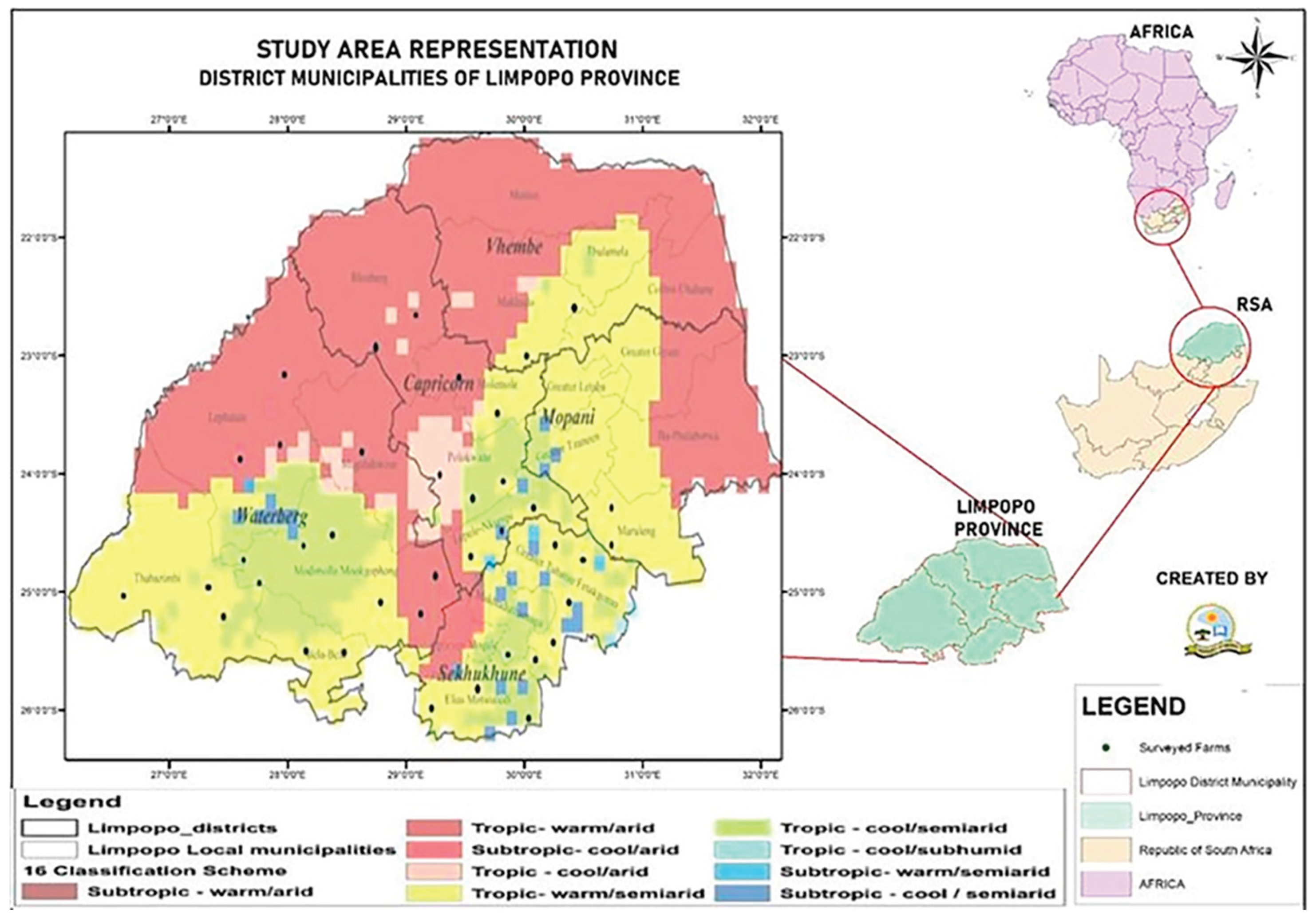

Table 1.
Description of variables hypothesized to influence the adoption (Probit logistic regression model).
Table 1.
Description of variables hypothesized to influence the adoption (Probit logistic regression model).
| Variable | Description | Expected Signs |
| Dependent variable | ||
| Famer adoption of forage production | 1 if the farmer adopted forage production and 0 otherwise | |
| Independent/ explanatory variables | ||
| Gender | 1 = male, 0 otherwise | ± |
| Formal education | 1 = literate, 0 otherwise | ± |
| Farming experience | Years of farming experience | ± |
| Knowledge of forage production | 1 = have the knowledge, 0 otherwise | + |
| Household income | Monthly Rands | ± |
| Sources of income | Earning salary (yes = 1), Receiving grants (yes = 1), Have farm generated income (yes = 1), Have off farm business (yes = 1), 0 otherwise | + |
| Flock size | Number of sheep owned (head counts) | + |
| Land ownership | 1 = yes, 0 otherwise | + |
| Farmer group association | 1 = yes, 0 otherwise | + |
| Access to extension services | 1 = yes, 0 otherwise | ± |
Table 2.
Socioeconomic characteristics of the adopters and non-adopters of fodder production.
| Variable | Category |
Adapters (n = 13) n (%) |
Non-adopters (n = 107) n (%) |
Pearson Chi Sq (χ²) |
p-value |
| Gender | Male Female |
10 (76.9) 3 (23.1) |
83 (77.6) 24 (22.4) |
0.003 | 0.958 |
| Age | <30 31-40 41-50 51-60 >61 |
2 (15.4) 2 (15.4) 2 (15.4) 1 (7.7) 6 (46.2) |
8 (7.5) 12 (11.2) 12 (11.2) 24 (22.4) 51 (47.7) |
2.229 | 0.657 |
| Education level | Lower education Higher education |
3 (23.1) 10 (76.9) |
66 (61.7) 41 (38.3) |
7.07 | 0.008*** |
| Occupation | Full-time farmer Non–full-time farmer |
10 (76.9) 3 (23.1) |
79 (73.8) 28 (26.2) |
0.048 | 0.828 |
| Sources of income | Salary & grants Farm generated income Off farm income |
7 (53.8) 5 (38.5) 1 (7.7) |
67 (62.6) 22 (20.6) 18 (16.8) |
2.41 | 0.300 |
| Household income | Low income <5000 Middle income High income |
5 (38.5) 8 (61.5) 0 (0.0) |
60 (56.1) 38 (35.5) 9 (8.4) |
6.03 | 0.049** |
| Herd-size | Small herds <20 Medium herds 21–40 Large herds > 50 |
5 (38.5) 4 (30.8) 4 (30.8) |
51(47.7) 24 (22.4) 32 (29.9) |
0.559 | 0.756 |
| Land ownership | Own land Leased land Communal land |
4 (30.8) 1 (7.7) 8 (61.5) |
8 (7.5) 14 (13.1) 85 (79.4) |
7.038 | 0.030** |
| Farming experience (years) | Low experience (< 10 years) Medium experience (10-20 years) High experience (> 20 years) |
5 (38.5) 4 (30.8) 4 (30.8) |
64 (59.8) 21 (19.6) 22 (20.6) |
2.17 | 0.338 |
| Group Membership | Yes (Member) No (Non-member) |
5 (38.5) 8 (61.5) |
58 (54.2) 49 (45.8) |
0.607 | 0.436 |
|
Significant p-values are denoted as: p < 0.01⁎⁎⁎. p < 0.05 ⁎⁎ p < 0.1* |
|||||
Table 3.
Factors that facilitate the adoption of fodder production.
| Parameter | Coefficient | Std. Error | Z | P-value |
| Farmer characteristics | ||||
| Gender (Male = 1) | -0.157 | 0.089 | -1.773 | 0.076 |
| Formal education (yes = 1) | 0.149 | 0.186 | 0.802 | 0.423 |
| Farming experience (years) | 0.074 | 0.027 | 2.742 | 0.006** |
| Knowledge of forage production (yes = 1) | 0.454 | 0.159 | 2.851 | 0.004*** |
| Household income (Monthly Rands) | -0.046 | 0.045 | -1.022 | 0.307 |
| Sources of income | ||||
| Salary (yes = 1) | 0.349 | 0.115 | 3.022 | 0.003*** |
| Grants (yes = 1) | 0.081 | 0.096 | 0.844 | 0.399 |
| Farm generated income (yes = 1) | 0.247 | 0.120 | 2.063 | 0.039** |
| Off farm business (yes = 1) | -0.130 | 0.192 | -0.676 | 0.499 |
| Farm characteristics | ||||
| Herd size | 0.006 | 0.002 | 3.459 | <0,001*** |
| Land ownership (yes = 1) | 0.189 | 0.139 | 1.359 | 0.174 |
| Institutional factors | ||||
| Farmer group membership (yes = 1) | 0.256 | .086 | 2.973 | 0.003*** |
| Access to extension services (yes = 1) | 0.203** | .103 | 1.983 | 0.047 |
| Pearson Goodness-of-Fit Test | Chi-Square | dfa | Sig. | |
| 330.471*** | 105 | <,001 | ||
Significant p-values are denoted as: *** p < 0.01, ** p < 0.05 and * p < 0.1.
Table 4.
Perceptions of the constraints to adoption of fodder production.
| Constraints to adoption | Average* (n = 120) |
Principal Components | ||||
| 1 Low institutional support |
2 Lack of resources |
3 Lack of knowledge |
4 Shortage of water |
5 Objectives of the farmer |
||
| Lack of awareness and knowledge | 4.74 | - 0.310 | -0.260 | 0.799 | -0.137 | 0.142 |
| Cost of production | 3.76 | 0.081 | 0.291 | 0.722 | -0.280 | -0.291 |
| Lack of financial resources | 5.69 | -0.602 | -0.172 | 0.318 | 0.098 | 0.018 |
| Lack of equipment | 4.13 | -0.571 | 0.601 | -0.009 | 0.241 | -0.057 |
| Labour intensive | 4.04 | -0.151 | 0.577 | -0.335 | -0.175 | 0.087 |
| Shortage of land | 5.11 | 0.664 | 0.352 | -0.296 | 0.067 | -0.190 |
| Low government support | 7.11 | 0.778 | -0.181 | -0.058 | 0.092 | -0.081 |
| Shortage of irrigation water | 8.03 | -0.007 | -0.436 | 0.103 | -0.788 | 0.299 |
| Lack of production inputs | 7.52 | -0.072 | -0.573 | -0.006 | 0.497 | 0.361 |
| Lack of seeds in the nearby market | 5.68 | 0.045 | -0.582 | 0.270 | 0.288 | -0.440 |
| Given less priority | 10.44 | 0.289 | 0.357 | 0.206 | 0.179 | 0.720 |
| Eigenvalues | 1.951 | 1.825 | 1.590 | 1.191 | 1.090 | |
| Total Variance explained (%) | 17.74 | 16.59 | 14.45 | 10.82 | 9.91 | |
| Barlett’s test of sphericity chi-square | 344.995*** | |||||
| Kaiser-Meyer-Olkin Measure of sampling adequacy (KMO) | 0.637 | |||||
Note: Component loadings greater than 0.50 appear in bold in Table 4.
Disclaimer/Publisher’s Note: The statements, opinions and data contained in all publications are solely those of the individual author(s) and contributor(s) and not of MDPI and/or the editor(s). MDPI and/or the editor(s) disclaim responsibility for any injury to people or property resulting from any ideas, methods, instructions or products referred to in the content. |
© 2026 by the authors. Licensee MDPI, Basel, Switzerland. This article is an open access article distributed under the terms and conditions of the Creative Commons Attribution (CC BY) license (http://creativecommons.org/licenses/by/4.0/).
Copyright: This open access article is published under a Creative Commons CC BY 4.0 license, which permit the free download, distribution, and reuse, provided that the author and preprint are cited in any reuse.


