
Submitted:
26 May 2026
Posted:
28 May 2026
You are already at the latest version
Preprints on COVID-19 and SARS-CoV-2
Abstract
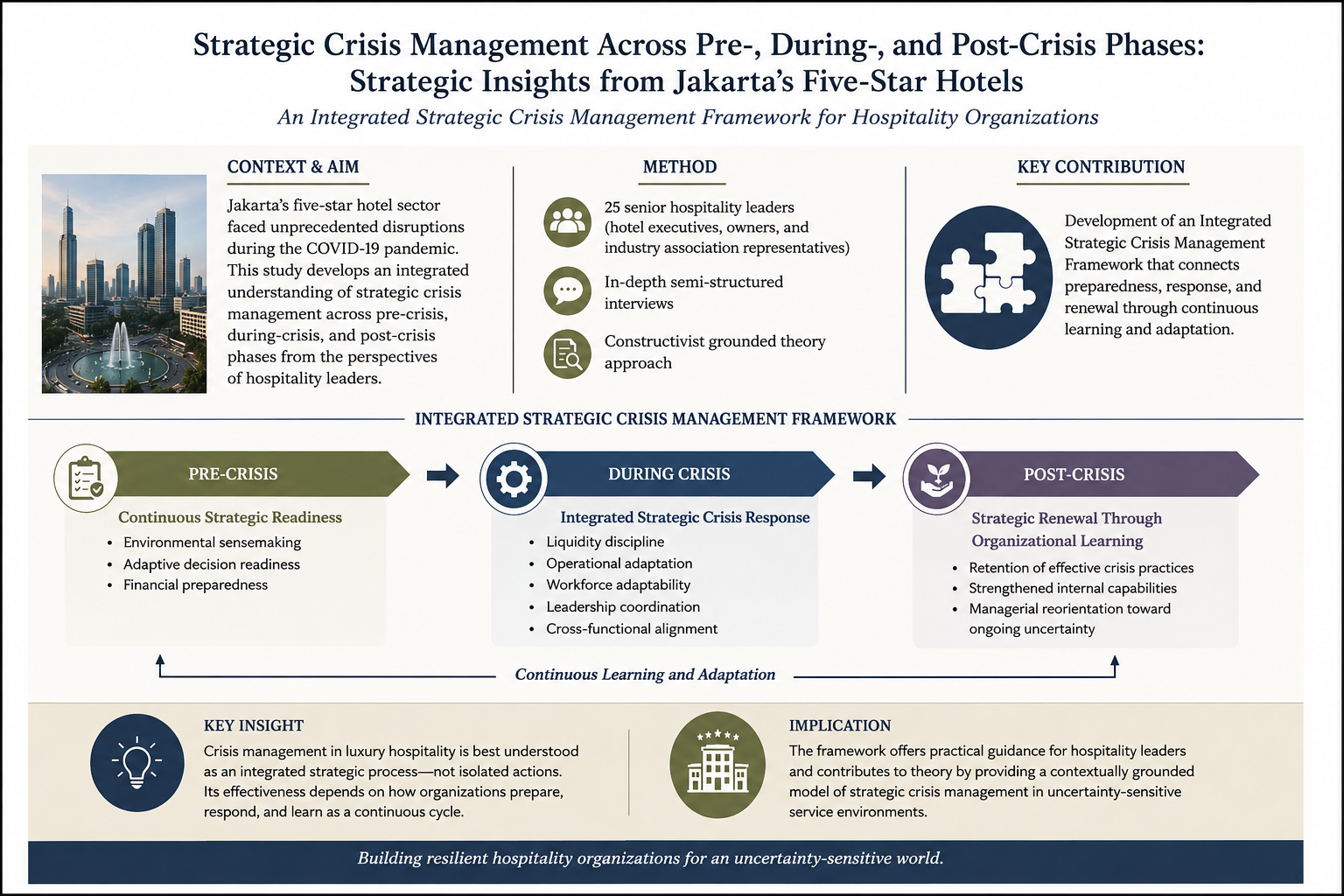
Crisis management has become a critical strategic concern in hospitality, particularly following the COVID-19 pandemic, which exposed vulnerabilities in conventional preparedness and response approaches. This study examines strategic crisis management in Jakarta’s five-star hotel sector, with the aim of developing an integrated understanding of crisis management across pre-crisis, during-crisis, and post-crisis phases. A constructivist grounded theory approach was employed, based on in-depth semi-structured interviews with 25 senior hospitality leaders, including hotel executives, owners, and industry association representatives. The findings suggest that crisis management is best understood as an integrated strategic organizational process rather than a series of isolated emergency responses. Pre-crisis preparedness emerged as continuous strategic readiness characterized by environmental sensemaking, adaptive decision readiness, and financial preparedness. During crisis, effective management depended on integrated strategic response through liquidity discipline, operational adaptation, workforce adaptability, leadership coordination, and cross-functional alignment. Post-crisis management extended beyond operational recovery toward strategic renewal through organizational learning, including the retention of effective crisis practices, strengthened internal capabilities, and managerial reorientation toward ongoing uncertainty. This study contributes to hospitality crisis management scholarship by proposing an Integrated Strategic Crisis Management Framework for Hospitality Organizations, offering a contextually grounded interpretive model that may inform both future research and strategic practice in uncertainty-sensitive service environments.
Keywords:
crisis management
; hospitality management
; luxury hotels
; constructivist grounded theory
; strategic preparedness
; organizational learning
; leadership coordination
; COVID-19
; hotel resilience
; tourism crisis management
1. Introduction
The hospitality industry is widely recognized as one of the sectors most vulnerable to external disruption due to its dependence on discretionary consumer spending, domestic and international mobility, labor-intensive service delivery, and substantial fixed operating costs (Gössling et al., 2020; Sigala, 2020; Jiang & Wen, 2020). Unlike industries that can temporarily scale down operations with relatively limited structural consequences, hotels must continue managing infrastructure maintenance, workforce coordination, service delivery expectations, and financial commitments even during severe market contraction (Hao et al., 2020; Baum & Hai, 2020). This structural exposure makes hospitality organizations particularly susceptible to crisis events, including public health emergencies, economic shocks, geopolitical instability, workforce disruption, and shifting consumer behavior (Carnevale & Hatak, 2020; Williams et al., 2021; Farmaki, 2022).
The COVID-19 pandemic represented one of the most severe disruptions in the history of modern hospitality, exposing vulnerabilities in conventional hotel operating models while accelerating scholarly interest in organizational resilience, adaptive leadership, crisis response, and strategic transformation (Gössling et al., 2020; Sigala, 2020; Sharma et al., 2021). Hospitality firms faced unprecedented challenges, including abrupt travel restrictions, occupancy collapse, labor displacement, liquidity pressures, operational shutdowns, and rapidly evolving health and safety expectations (Baum et al., 2020; Hao et al., 2020; Jiang & Wen, 2020). In response, hospitality scholars increasingly examined organizational adaptation, business continuity, service innovation, workforce resilience, crisis communication, and recovery strategies (Dirani et al., 2020; Rivera, 2020; Wut et al., 2021).
Although this expanding body of literature has generated important insights, hospitality crisis research remains conceptually fragmented. Existing studies often examine crisis-related phenomena through distinct but disconnected perspectives, including resilience, operational adaptation, crisis communication, disaster response, or post-crisis recovery (Prayag, 2018; Sharma et al., 2021; Hall et al., 2022). While resilience research emphasizes adaptive capability and organizational flexibility under disruption (Prayag, 2018), crisis response studies frequently focus on immediate operational or managerial actions during acute uncertainty (Hao et al., 2020; Jiang & Wen, 2020). Recovery-oriented studies, meanwhile, tend to emphasize organizational restoration, business continuity, or market recovery following disruption (Sigala, 2020; Sharma et al., 2021). This conceptual separation risks producing an incomplete understanding of crisis management, where preparedness, response, adaptation, and organizational learning are often deeply interconnected rather than sequentially isolated.
This fragmentation is increasingly problematic because crises are no longer viewed as rare exceptional events but as recurring features of contemporary business environments. Organizational scholarship increasingly suggests that disruption, turbulence, and uncertainty have become enduring managerial realities rather than episodic anomalies (Bapuji et al., 2020; Williams et al., 2021). In hospitality, this reality extends beyond pandemic-related disruption to include workforce shortages, supply chain instability, inflationary pressures, digital transformation, geopolitical uncertainty, and evolving customer expectations (Baum et al., 2020; Farmaki, 2022). Under such conditions, crisis management should not be understood merely as reactive emergency response, but as an ongoing strategic organizational capability encompassing anticipation, coordinated action, adaptation, and institutional learning.
The strategic complexity of crisis management becomes particularly evident in hotel operations. Hotels operate as highly integrated service systems in which workforce management, customer experience, supply continuity, operational reliability, and financial performance are closely interdependent (Köseoglu et al., 2020). Disruption affecting one operational area may rapidly generate cascading consequences across multiple functions, intensifying managerial complexity during crisis periods. This challenge is especially pronounced in luxury hospitality, where organizations operate under premium service expectations, significant capital commitments, high labor dependency, and strong reputational sensitivity (Farmaki, 2022). Unlike lower-service accommodation models that may rely more heavily on standardization or operational simplification, five-star hotels are expected to maintain personalized service quality, brand consistency, and stakeholder confidence even during prolonged uncertainty. Crisis management in this context therefore extends beyond operational continuity to become a strategic leadership challenge involving workforce coordination, financial governance, service resilience, stakeholder trust, and long-term organizational positioning.
Despite growing scholarly attention, several important gaps remain within hospitality crisis management research. First, the literature has predominantly emphasized specific dimensions of crisis-related organizational behavior rather than developing an integrated understanding of crisis management across pre-crisis, during-crisis, and post-crisis phases (Leta & Chan, 2021; Wut et al., 2021). These limits understanding of how managerial priorities evolve throughout the broader crisis lifecycle and how organizational actions in one phase shape capabilities in subsequent phases. A fragmented conceptual approach may overlook how preparedness influences response effectiveness, or how crisis experiences generate post-crisis organizational learning.
Second, hospitality crisis scholarship has largely focused on broad tourism systems or developed-market institutional contexts, while emerging-market hospitality environments remain comparatively underexplored (Farmaki, 2022). This imbalance matters because crisis experiences, managerial constraints, institutional responses, and organizational adaptation may vary substantially across economic, regulatory, and cultural contexts. Emerging markets often face distinct structural vulnerabilities, including regulatory uncertainty, uneven crisis preparedness, labor market instability, and infrastructure constraints, all of which may shape crisis management practices differently from those documented in Western settings.
Third, although quantitative research examining crisis performance, resilience indicators, or operational outcomes has expanded significantly, fewer studies have adopted interpretive qualitative approaches capable of capturing how hospitality leaders make sense of crisis experiences and translate them into strategic managerial understanding (Nunkoo et al., 2021). Crisis management is not solely an operational or procedural phenomenon; it is also socially constructed through leadership interpretation, organizational meaning-making, stakeholder interaction, and adaptive decision-making. Understanding these dimensions requires methodological approaches capable of examining managerial sensemaking rather than merely measuring observable outcomes.
These gaps are particularly relevant in Indonesia’s hospitality sector. As one of Southeast Asia’s major tourism and hospitality markets, Indonesia presents an important context for examining crisis management under conditions of economic volatility and competitive service environments. Jakarta, as the country’s primary commercial, economic, and governmental center, provides a particularly relevant empirical setting due to its concentration of internationally branded and domestically operated luxury hotels competing within a high-pressure business environment. Five-star hotels in Jakarta combine substantial fixed asset exposure, service-intensive operating models, complex workforce structures, and dependence on both domestic and international business activity, making them especially vulnerable to prolonged disruption while simultaneously requiring sophisticated strategic management capabilities.
This study addresses these gaps by examining strategic crisis management across pre-crisis, during-crisis, and post-crisis phases within Jakarta’s five-star hotel sector. Rather than conceptualizing crisis management as a discrete emergency response function, this study approaches it as an evolving strategic organizational process shaped by leadership interpretation, organizational adaptation, and institutional learning.
A constructivist grounded theory approach was adopted because crisis management in hospitality is not merely a technical or procedural phenomenon, but also an interpretive organizational process through which actors construct meaning from uncertainty, lived experience, and organizational action. Constructivist grounded theory is particularly appropriate where theoretical understanding remains underdeveloped and where insight must emerge inductively from participant interpretation rather than prior theoretical imposition. By engaging senior hotel leaders and relevant industry stakeholders, this study seeks to generate contextually grounded strategic insight into how crisis management is understood, navigated, and institutionalized within luxury hospitality practice.
This study contributes to hospitality scholarship in three important ways. First, it develops a more integrated strategic understanding of crisis management by linking preparedness, active crisis response, and post-crisis adaptation within a unified interpretive framework. Second, it extends hospitality crisis scholarship within an emerging-market luxury hotel context that remains underrepresented in existing research. Third, it offers practically relevant managerial insight for hospitality leaders operating in environments characterized by recurrent uncertainty rather than isolated crisis events. The findings suggest that effective crisis management in luxury hospitality depends not only on operational responsiveness, but also on sustained strategic capability encompassing preparedness, adaptive leadership, organizational coordination, and post-crisis learning.
Accordingly, this study addresses the following research question: What strategic insights for crisis management emerge across pre-crisis, during-crisis, and post-crisis phases in Jakarta’s five-star hotel sector?
2. Materials and Methods
2.1. Research Design
This study adopted a constructivist grounded theory methodology to explore strategic insights for crisis management across the pre-crisis, during-crisis, and post-crisis phases within Jakarta’s five-star hotel sector. Constructivist grounded theory is particularly appropriate for investigating complex organizational phenomena in which meanings, interpretations, and strategic responses emerge through participants lived experiences rather than existing as fixed objective realities (Charmaz, 2006; Charmaz & Bryant, 2008; Charmaz & Thornberg, 2021). Crisis management in hospitality represents a dynamic organizational process shaped by uncertainty, managerial judgment, institutional constraints, and evolving environmental conditions, making an interpretive qualitative approach especially suitable. Unlike positivist approaches that seek predetermined causal explanation, constructivist grounded theory recognizes knowledge as co-constructed between researcher and participants through interaction, interpretation, and contextual engagement (Charmaz, 2006; Charmaz & Thornberg, 2021).
This methodological orientation enabled the study to move beyond descriptive accounts of crisis response toward a deeper interpretive understanding of how hospitality leaders make sense of crisis experiences and translate those experiences into strategic managerial insights. The empirical setting was Jakarta’s five-star hotel sector. This context was selected because luxury hotels operate as highly complex service organizations characterized by substantial capital intensity, continuous operational demands, labor-dependent service delivery, and heightened sensitivity to external disruption. As Indonesia’s primary economic, commercial, and governmental center, Jakarta provides a strategically relevant environment for examining crisis management within a competitive and uncertainty-sensitive hospitality market. Ethical approval for this study was obtained from the Research Ethics Committee of the Faculty of Economics and Business, Universitas Pelita Harapan (Approval No. 336/REC-FEB/2024). All participants provided informed consent prior to participation, and confidentiality was maintained throughout the study.
2.2. Participants and Sampling
Participant selection followed purposive and theoretical sampling strategies, consistent with constructivist grounded theory methodology (Charmaz, 2006; Charmaz & Thornberg, 2021). Initial purposive sampling was used to identify individuals with direct strategic or operational involvement in crisis-related decision-making within Jakarta’s hospitality sector. Inclusion criteria required participants to hold leadership, executive, ownership, or industry governance roles relevant to crisis preparedness, crisis response, organizational adaptation, or post-crisis recovery within five-star hotel operations or related hospitality governance structures. As data analysis progressed, theoretical sampling was employed to refine emerging conceptual categories and deepen understanding of evolving themes. This iterative approach allowed participant selection to remain analytically responsive, enabling subsequent recruitment decisions to be guided by conceptual development rather than predetermined sampling closure. A total of 25 participants were included in the study. Participants represented multiple organizational and governance perspectives, including shareholders, chief operating officers, vice presidents, corporate general managers, hotel general managers, directors, senior departmental leaders, and representatives from the Indonesian Hotel and Restaurant Association (PHRI). This diversity enabled exploration of crisis management across ownership, executive leadership, operational management, and broader industry governance perspectives. Data collection continued until theoretical saturation was achieved, at which point additional interviews no longer generated substantively new conceptual insights relevant to the emerging interpretive framework (Charmaz, 2006).
2.3. Data Collection
Primary data were collected through 25 semi-structured face-to-face interviews conducted between January and December 2025. Semi-structured interviewing was selected because it provided sufficient consistency across participants while allowing flexibility to explore individual experiences, interpretations, and emergent strategic insights in depth (Charmaz, 2006). An interview protocol was developed to examine participants’ experiences across multiple crisis phases, including pre-crisis preparedness assumptions, strategic decision-making during disruption, financial and operational responses, workforce management, organizational coordination, stakeholder communication, and post-crisis learning. This temporal structure supported exploration of crisis management as an interconnected strategic process rather than a single disruptive event. Each interview lasted approximately 60 minutes. Interviews were audio-recorded with participant consent and transcribed verbatim. Participants were interviewed in either English or Indonesian, depending on individual preference, to facilitate natural communication and richer contextual expression. Interviews conducted in Indonesian were translated into English by the researcher, who is proficient in both languages, with careful attention to preserving conceptual meaning and contextual nuance. Consistent with constructivist grounded theory, data collection and analysis occurred iteratively rather than sequentially (Charmaz, 2006; Charmaz & Thornberg, 2021). Insights emerging from earlier interviews informed refinement of subsequent questioning and theoretical sampling decisions as conceptual understanding evolved. To enhance interpretive sensitivity, interview data were supplemented by reflexive field notes, observational insights, and ongoing memo-writing throughout the research process.
2.4. Data Analysis
Data analysis followed the iterative principles of constructivist grounded theory, with coding conducted concurrently alongside data collection (Charmaz, 2006; Charmaz & Thornberg, 2021). This concurrent analytical process allowed emerging insights to shape subsequent interviews, theoretical sampling decisions, and conceptual refinement. The analysis proceeded through three coding stages. First, initial coding involved line-by-line examination of interview transcripts to identify actions, meanings, interpretations, and strategic responses expressed by participants. This stage remained closely grounded in participants’ language and experiences, allowing conceptual sensitivity to emerge inductively without imposing predefined categories. Second, focused coding was undertaken to synthesize recurring patterns and analytically significant concepts into higher-order categories. This phase facilitated movement from fragmented observations toward more coherent conceptual organization. Third, theoretical coding was used to examine relationships among focused categories and develop an integrated interpretive understanding of strategic crisis management across crisis phases. This stage supported conceptual linkage between preparedness, coordinated crisis response, and post-crisis organizational learning. Throughout the analytical process, the constant comparative method was applied to examine similarities and differences across participant accounts, organizational roles, and crisis experiences (Charmaz, 2006). Analytical memo-writing was maintained throughout data analysis to document conceptual development, challenge interpretive assumptions, and support theoretical refinement. Data coding and analysis were conducted manually by the researcher to enable close engagement with the interpretive development of emerging concepts.
2.5. Research Rigour and Trustworthiness
To strengthen methodological rigor, this study applied the qualitative trustworthiness criteria of credibility, dependability, confirmability, and transferability (Lincoln & Guba, 1985). Credibility was enhanced through prolonged engagement with the dataset, iterative comparison across interviews, theoretical sampling, and triangulation across interview transcripts, field notes, observational insights, and analytical memos. The inclusion of participants from multiple organizational levels and governance perspectives further strengthened interpretive depth through cross-perspective comparison. Dependability was supported through systematic documentation of methodological decisions, interview procedures, coding development, sampling evolution, and analytical progression, thereby enhancing procedural transparency. Confirmability was addressed through ongoing reflexive practice, whereby the researcher continuously examined interpretive assumptions, analytical positioning, and potential sources of bias throughout the research process. Transferability was supported through rich contextual description of the research setting, participant roles, and organizational environment, enabling readers to assess the applicability of findings to comparable hospitality or service-sector contexts. Together, these procedures enhanced the methodological rigor and interpretive trustworthiness of the study.
3. Results
The results revealed three interrelated temporal dimensions of strategic crisis management within Jakarta’s five-star hotel sector: pre-crisis strategic preparedness, during-crisis coordinated strategic response, and post-crisis strategic renewal through organizational learning. Participants consistently described crisis management not as a discrete emergency function, but as an evolving strategic organizational process shaped by prior assumptions, adaptive responses, and subsequent organizational learning. These dimensions emerged through participants’ reflections on how crisis experiences reshaped strategic thinking before, during, and after prolonged disruption.
3.1. Pre-Crisis Strategic Insights: Strengthening Strategic Preparedness
3.1.1. From Static Preparedness to Adaptive Readiness
Participants consistently indicated that some form of crisis preparedness existed prior to the COVID-19 pandemic; however, these arrangements were generally designed for familiar operational disruptions rather than prolonged systemic crises. Existing contingency measures were commonly oriented toward localized emergencies, short-term occupancy decline, operational incidents, or episodic business interruption. Although such arrangements created a perception of preparedness, participants described them as insufficient for a crisis of the scale and duration experienced during the pandemic. One participant explained:
“Before COVID, we thought we were prepared because we already had procedures for emergencies, operational disruptions, or temporary market downturns. But COVID was different. It was not something that lasted for a few days or weeks—it completely changed the business environment.” (N11, Hotel Manager)
Participants frequently described pre-pandemic planning as being shaped by prior experience rather than anticipation of unfamiliar disruption. As one participant reflected:
“Most companies prepare based on what they already know. If you have experienced a crisis before, you prepare for something similar. But when something entirely different happens, you realize those plans are no longer enough.” (N25, Corporate General Manager)
Across participant accounts, preparedness prior to the pandemic was described as relatively narrow in scope, with greater emphasis on familiar operational contingencies than broader strategic uncertainty.
3.1.2. Environmental Sensemaking as Strategic Preparedness
A prominent pre-crisis insight concerned the importance of stronger environmental awareness and earlier recognition of emerging disruption. Participants described preparedness not simply as maintaining contingency procedures, but as developing organizational sensitivity to external signals such as regulatory changes, economic shifts, public health developments, geopolitical uncertainty, and market disruption. A chief operating officer described this perspective:
“The approach begins with heightened awareness of situational changes, focusing on what is essential, making data-driven decisions, maintaining sufficient cash reserves, and continuously evaluating whether strategies need to be adjusted.” (N4, Chief Operating Officer)
Participants increasingly framed preparedness as an active strategic process rather than reliance on static crisis plans. A senior executive emphasized the importance of broader external awareness:
“Management cannot only focus internally. You need to monitor what is happening outside the business—regulations, economic conditions, travel restrictions, even things happening globally—because those can affect hotel operations very quickly.” (N10, Vice President)
These accounts reflected a shift toward viewing preparedness as continuous environmental observation, particularly in an industry strongly influenced by external conditions beyond managerial control.
3.1.3. Crisis Preparedness as a Continuous Strategic Capability
Beyond stronger environmental awareness, participants described a broader shift in how preparedness itself was understood. Rather than treating crisis planning as an occasional exercise activated only when disruption occurs, participants increasingly framed preparedness as an ongoing strategic capability embedded within leadership practice and organizational decision-making. One executive stated:
“What COVID taught us is that crisis management cannot be something you only discuss when a crisis happens. It has to become part of how management thinks continuously because disruption can happen at any time.” (N9, Chief Operating Officer)
Several participants also emphasized adaptability as a defining characteristic of preparedness. One participant explained:
“Preparedness means being ready to adapt, not just having a written plan.” (N16, Director of Rooms)
Decision readiness emerged as another recurring concern. Participants reflected that delayed responses during the pandemic were sometimes linked to uncertainty regarding decision authority, escalation pathways, or strategic prioritization. As one participant noted:
“During a crisis, you cannot spend too much time debating what to do. Organizations need clearer structures for faster decisions before disruption happens.” (N25, Corporate General Manager)
Financial readiness was similarly described as an important preparedness consideration. Participants repeatedly referred to liquidity as a necessary condition for organizational endurance under uncertainty:
“After the pandemic we always think about liquidity. If something unexpected happens again, we must have reserves that allow us to survive.” (N13, Director of Human Resources)
Participants consistently described preparedness as extending beyond formal crisis documentation toward a broader strategic orientation characterized by adaptability, environmental awareness, decision readiness, and financial preparedness.
3.2. During-Crisis Strategic Insights: Coordinated Strategic Response
While pre-crisis insights emphasized anticipatory preparedness, participants described crisis-period management as requiring coordinated strategic responses under acute uncertainty. During the pandemic, leadership teams were required to respond rapidly to severe revenue disruption, evolving operational constraints, workforce pressures, and changing guest expectations. Participants consistently described crisis response not as isolated emergency action, but as an integrated process requiring alignment across financial, operational, and human dimensions.
3.2.1. Liquidity Discipline and Financial Survival
Participants consistently identified financial management as one of the most critical priorities during the acute crisis period. The abrupt collapse in occupancy, business travel, meetings, and events created immediate revenue shocks, while many fixed obligations remained unchanged. Participants emphasized that hotel organizations are structurally exposed during severe disruption because asset-intensive operations continue to generate maintenance, infrastructure, and financing obligations even when demand declines sharply. One participant explained:
“People often forget that hotels are essentially property businesses. Operational margins are relatively small compared to the value of the asset. Revenue must be sufficient to support maintenance, financing costs, and other obligations.” (N9, Chief Operating Officer)
This structural exposure became particularly visible during prolonged disruption. Participants noted that even when demand collapsed, maintaining limited operations was sometimes strategically preferable to full closure because prolonged inactivity could create additional operational and asset deterioration costs. An industry association leader explained:
“When COVID-19 hit, everyone was affected. An empty hotel is actually riskier from a maintenance perspective. A large building that is not occupied deteriorates more quickly. Water systems, electricity, and central air conditioning still require maintenance. If they are shut down for too long, the cost of revitalizing them later becomes much higher.” (N1, Chairman, Indonesian Hotel and Restaurant Association)
Participants described immediate financial responses including expenditure reduction, delayed capital spending, supplier renegotiation, intensified cash flow monitoring, and more cautious investment decisions. Liquidity was repeatedly described as a determining factor influencing organizational endurance and strategic flexibility during uncertainty. A participant reflected:
“After the pandemic we always think about liquidity. If something unexpected happens again, we must have reserves that allow us to survive.” (N13, Director of Human Resources)
Participants consistently framed financial response not merely as cost reduction, but as strategic efforts to preserve organizational continuity under prolonged uncertainty.
3.2.2. Operational Adaptation and Service Continuity
Participants also emphasized the importance of rapid operational adaptation in response to changing regulations, fluctuating demand, and evolving guest expectations. Crisis response required continuous adjustment rather than one-time operational intervention. Participants described modifications across multiple service areas, including staffing arrangements, food and beverage operations, hygiene protocols, guest interaction procedures, and service workflows. A hotel manager explained:
“At the beginning, everything changed very quickly. Regulations changed, guest expectations changed, operational rules changed. Management had to keep adjusting because what worked one month might no longer work the next.” (N11, Hotel Manager)
Maintaining guest confidence emerged as an important operational priority. Participants emphasized that visible health and safety practices were necessary not only for compliance, but also for preserving trust and encouraging continued patronage. One participant stated:
“Guests needed to feel safe. It was not enough to say that the hotel was operating safely—we had to demonstrate it through actual operational practices that people could see and experience.” (N16, Director of Rooms)
Operational efficiency also became more closely scrutinized during crisis conditions. Participants described intensified attention to purchasing discipline, staffing allocation, energy use, and workflow efficiency, reflecting the close relationship between operational decisions and financial survival. A participant explained:
“The crisis forced us to become much more disciplined operationally. We reviewed everything—staff scheduling, purchasing, utilities, service workflows—because every operational decision had financial consequences.” (N24, Senior Food & Beverage Manager)
Participants consistently described operational adaptation as a continuous balancing process between service continuity, regulatory responsiveness, guest confidence, and financial constraints.
3.2.3. Workforce Adaptability and Leadership Coordination
A third strategic dimension concerned workforce adaptability and leadership coordination. Participants consistently emphasized that hospitality operations remain fundamentally dependent on people, making workforce flexibility, communication, and leadership responsiveness central to organizational continuity. One participant explained:
“Hotels operate around the clock and rely heavily on people. Technology can support operations, but it cannot replace the human element in hotel.” (N6, Executive Assistant Manager)
Participants described multiple workforce-related responses, including role flexibility, cross-functional task redistribution, adjusted staffing models, communication initiatives, and efforts to sustain morale under uncertainty. Cross-functional adaptability emerged as particularly important when organizations were required to continue operating with reduced resources. A participant reflected:
“People had to become much more flexible. During the crisis, employees often handled responsibilities outside their normal roles because operations had to continue with fewer resources.” (N22, Human Resources Director)
Leadership communication was also described as essential. Participants emphasized that uncertainty increased the importance of visible, transparent communication to reduce anxiety and maintain organizational alignment. One participant noted:
“When people are uncertain, silence creates fear. Leadership had to communicate clearly, even when we did not have all the answers.” (N8, Director of Human Resources)
Participants also described workforce well-being as closely linked to service continuity and business recovery. A shareholder summarized this relationship:
“Leaders take care of employees, employees take care of guests, and guests take care of business.” (N19, Shareholder)
These accounts reflected the central role of human adaptability and leadership coordination in sustaining service operations under crisis conditions.
3.2.4. Cross-Functional Strategic Alignment
Beyond individual response measures, participants consistently emphasized that effective crisis response required coordinated alignment across organizational functions rather than fragmented departmental action. Financial decisions affected operational continuity, workforce management influenced service delivery, and leadership communication shaped organizational responsiveness. One participant explained:
“Crisis management cannot be handled by one department. Finance, operations, HR, leadership—everything has to move together, otherwise the response becomes fragmented.” (N25, Corporate General Manager)
Another participant emphasized the importance of shared organizational priorities:
“The biggest challenge was not just making decisions, but making sure everyone understood the priorities and moved in the same direction.” (N10, Vice President)
Participants consistently described crisis response as requiring synchronized organizational action rather than isolated functional intervention. Cross-functional alignment was associated with faster response, clearer prioritization, and stronger organizational adaptability during rapidly evolving uncertainty.
3.3. Post-Crisis Strategic Insights: Strategic Renewal Through Organizational Learning
Participants consistently indicated that the conclusion of the acute crisis period did not result in a simple return to pre-pandemic operating practices. Instead, post-crisis reflections revealed a broader process of strategic reassessment, in which organizations evaluated which crisis-era practices should be retained, strengthened internal capabilities, and reoriented managerial thinking toward future uncertainty. Participants described post-crisis management not merely as operational recovery, but as a process of organizational learning and strategic renewal.
3.3.1. Retention of Effective Crisis Practices
Participants consistently reported that not all crisis-period practices were viewed as temporary emergency responses. Several described selectively retaining practices that had improved operational discipline, decision-making responsiveness, or financial awareness during the pandemic. One participant explained:
“Not everything we did during the crisis should disappear afterward. Some of the practices actually made us stronger and more disciplined, so those should remain.” (N11, Hotel Manager)
Financial discipline emerged as one of the most frequently retained practices. Participants described a lasting shift in attitudes toward expenditure management, liquidity awareness, and financial risk sensitivity. A participant reflected:
“Before COVID, we might have been more comfortable taking financial risks because business conditions felt stable. After the crisis, financial discipline became a much stronger management priority.” (N25, Corporate General Manager)
Participants also described maintaining more disciplined evaluation of investments, expenditures, and resource allocation decisions. As one executive noted:
“The crisis forced management to question spending decisions much more carefully. That discipline should not disappear simply because conditions improve.” (N10, Vice President)
These reflections suggested that some crisis-period responses became integrated into routine managerial practice rather than being abandoned once operating conditions improved.
3.3.2. Strengthening Internal Organizational Capability
Participants also described efforts to strengthen internal organizational capabilities following the crisis. The pandemic exposed limitations in preparedness, communication, decision-making responsiveness, and operational flexibility, prompting organizations to refine internal systems for future uncertainty. One participant explained:
“COVID exposed many organizational blind spots. Afterward, management became much more focused on building stronger systems so we would not be caught unprepared in the same way again.” (N25, Corporate General Manager)
Participants described increased attention to clearer escalation processes, faster decision pathways, stronger communication practices, and more structured approaches to uncertainty management. A hotel manager stated:
“Previously, some decisions were made reactively because no one expected something of that scale. Afterward, there was more emphasis on having clearer frameworks for escalation, faster approvals, and stronger coordination.” (N11, Hotel Manager)
Workforce capability also emerged as an area of post-crisis strengthening. Participants reflected that staffing challenges during the pandemic highlighted the importance of broader employee flexibility and cross-functional capability. One participant explained:
“The crisis showed us that rigid role boundaries can become a problem. Teams need broader capability so the organization can remain flexible when conditions change.” (N22, Human Resources Director)
Communication capability was similarly emphasized. Participants described clearer internal communication and stronger leadership visibility as important lessons carried forward from the crisis experience. A participant noted:
“One lesson was communication discipline. During uncertainty, employees need clarity, even when the future is uncertain. Better communication structures became a priority afterward.” (N8, Director of Human Resources)
Participants consistently described post-crisis adjustments as efforts to strengthen organizational capability rather than merely restore pre-crisis operating routines.
3.3.3. Strategic Reorientation Toward Future Uncertainty
A final post-crisis insight concerned a broader reorientation in how participants understood uncertainty itself. Participants repeatedly indicated that the pandemic fundamentally altered managerial assumptions about business stability, disruption, and preparedness. Rather than viewing crises as exceptional interruptions, participants increasingly described uncertainty as an ongoing strategic condition requiring continuous readiness. One participant explained:
“COVID changed management thinking completely. Before, crises felt like unusual disruptions. Now, uncertainty feels like something that can happen anytime, from different directions.” (N16, Director of Rooms)
This shift influenced future planning priorities. Participants emphasized that preparedness should no longer be treated as an isolated exercise, but as an ongoing management concern embedded within strategic thinking. A participant stated:
“The lesson is not just how to survive one crisis. The bigger lesson is that organizations need to stay strategically prepared because future disruption may come in very different forms.” (N10, Vice President)
Adaptability was repeatedly described as an enduring strategic requirement rather than a temporary crisis response capability. As one participant reflected:
“Preparedness is not only about having a crisis manual. It is about whether the organization can adapt quickly when something unexpected happens.” (N16, Director of Rooms)
Participants also emphasized that future threats may emerge in forms very different from the pandemic, reinforcing the importance of broader strategic flexibility. A chief operating officer explained:
“The next disruption may not be health-related. It could be political, economic, regulatory, or something completely different. Management needs to be prepared for uncertainty, not just one type of crisis.” (N9, Chief Operating Officer)
Across participant accounts, post-crisis learning extended beyond operational recovery toward a broader reorientation of strategic thinking, in which continuous preparedness, adaptability, and organizational learning became central to future crisis readiness.
The coding process followed the constructivist grounded theory approach outlined in the Methods section, progressing iteratively from initial line-by-line coding of participant narratives to focused conceptual categorization and higher-level theoretical abstraction. Through constant comparison and ongoing memo-writing, participant-derived insights were progressively synthesized into broader strategic interpretations of crisis management across pre-crisis, during-crisis, and post-crisis phases. The analytical progression is summarized in Table 1.
As shown in Table 1, the coding process revealed an integrated strategic understanding of crisis management, in which participant experiences evolved from operational observations into broader conceptual interpretations of preparedness, coordinated crisis response, and post-crisis organizational learning. This analytical progression informed the structure of the discussion presented in the following sections.
4. Discussion
4.1. Reframing Crisis Preparedness as Continuous Strategic Readiness
This study suggests that crisis preparedness in Jakarta’s five-star hotel sector should be understood not as a static contingency planning exercise, but as a continuous strategic capability shaped by uncertainty, environmental awareness, and adaptive decision readiness. Participants consistently described pre-pandemic preparedness mechanisms as largely oriented toward familiar operational disruptions, such as temporary downturns, localized emergencies, or short-term interruptions, rather than prolonged systemic crises. This finding aligns with hospitality scholarship showing that many organizations entered the COVID-19 pandemic with preparedness systems that were operationally functional but strategically insufficient for sustained disruption (Sigala, 2020; Hao et al., 2020; Sharma et al., 2021). Earlier hospitality crisis research similarly noted that preparedness in hotel and tourism organizations often emphasized immediate operational continuity rather than broader strategic anticipation (Israeli & Reichel, 2003; Ritchie, 2004).
However, the present findings extend this literature by suggesting that the limitation was not merely insufficient planning, but a broader managerial tendency to conceptualize crises as temporary operational disturbances rather than structurally disruptive events. This observation aligns with organizational crisis scholarship suggesting that crisis preparedness often fails when organizations rely excessively on assumptions derived from familiar disruptions rather than preparing for uncertainty characterized by ambiguity, novelty, and systemic complexity (Pearson & Clair, 1998; Bundy et al., 2017).
A particularly important insight concerns environmental sensemaking. Participants emphasized monitoring external developments, including regulatory shifts, market conditions, travel restrictions, and broader uncertainty signals, as essential elements of preparedness. This aligns with scholarship suggesting that crisis preparedness increasingly depends on early signal detection, environmental scanning, and anticipatory awareness rather than reliance on static plans (Paraskevas & Altinay, 2013; Williams et al., 2021). In hospitality, where organizational performance is highly exposed to external economic, institutional, and mobility-related conditions, preparedness appears to depend as much on strategic interpretation of environmental signals as on formal procedural readiness.
The findings also suggest that preparedness extends beyond situational awareness into decision readiness. Participants described delayed responses during the pandemic as being partly linked to uncertainty regarding escalation pathways, leadership authority, and response prioritization. This extends hospitality crisis literature, which has often focused on contingency planning and operational continuity mechanisms (Sharma et al., 2021; Wut et al., 2021), by highlighting the importance of organizational responsiveness and timely strategic decision-making under uncertainty.
Financial preparedness also emerged as a critical pre-crisis capability. Participants consistently described liquidity not merely as a survival resource during disruption, but as a condition enabling strategic flexibility when uncertainty intensifies. This is particularly relevant in luxury hospitality, where fixed asset exposure, infrastructure maintenance requirements, and service continuity expectations create structural financial vulnerability during demand collapse (Hao et al., 2020). The findings therefore suggest that financial preparedness should be understood not only as a defensive mechanism, but as a strategic enabler of adaptive action.
From a constructivist grounded theory perspective, these findings reflect how participants redefined preparedness through retrospective interpretation of crisis experience. Preparedness was no longer understood as the existence of crisis procedures alone, but as an ongoing strategic orientation characterized by adaptability, environmental awareness, decision readiness, and financial preparedness.
4.2. Coordinated Strategic Response in Asset-Intensive Luxury Hospitality
The findings suggest that effective crisis management during acute disruption depended not on isolated emergency interventions, but on coordinated strategic responses across financial, operational, and human dimensions. Participants consistently described crisis response as a multidimensional organizational challenge in which financial endurance, operational continuity, workforce adaptability, and leadership coordination were deeply interconnected. This supports the view that crisis management in hospitality should be understood less as reactive operational adjustment and more as integrated strategic coordination under severe constraint.
A central finding concerns liquidity discipline and financial survival. Participants emphasized that luxury hotels face distinctive structural vulnerability due to capital-intensive operating models, substantial fixed costs, and ongoing infrastructure obligations even during revenue collapse. This aligns with hospitality scholarship documenting disproportionate financial pressure experienced by hotel organizations during the pandemic (Hao et al., 2020; Wut et al., 2021; Ivanov & Webster, 2020). However, the present findings extend this literature by showing that participants interpreted financial response not simply as cost reduction, but as a strategic mechanism for preserving continuity, flexibility, and future responsiveness.
Operational adaptation also emerged as a critical component of crisis response. Participants described repeated recalibration in response to evolving regulations, shifting guest expectations, health protocols, and fluctuating demand conditions. This aligns with hospitality literature emphasizing adaptive flexibility under crisis conditions (Sigala, 2020; Jiang & Wen, 2020; Farmaki, 2022). However, the findings suggest that operational adaptation in luxury hospitality also carries symbolic significance. Visible hygiene measures, service modifications, and operational responsiveness functioned not only as technical adjustments, but also as signals of competence, professionalism, and safety reassurance. In hospitality contexts where guest confidence is closely linked to perceived service quality and trust, operational adaptation appears to serve both functional and reputational purposes.
Human adaptability and leadership coordination emerged as equally important strategic dimensions. Participants consistently emphasized that hotel operations remain fundamentally dependent on human capability despite operational restructuring or technological support. Workforce flexibility, transparent communication, leadership visibility, and employee support were described as essential to sustaining service continuity. This aligns with crisis leadership scholarship emphasizing adaptive leadership, employee well-being, and organizational communication under uncertainty (Dirani et al., 2020; Carnevale & Hatak, 2020). The findings also align with broader organizational resilience scholarship emphasizing adaptive capability as a core organizational competence under disruption (Lengnick-Hall et al., 2011; Duchek, 2020). In luxury hospitality, workforce adaptability appears not merely operationally useful, but strategically indispensable.
Cross-functional alignment represents another important contribution. Participants repeatedly described crisis response as requiring coordinated action across finance, operations, human resources, and leadership functions. Decisions in one area produced cascading implications elsewhere, reinforcing the interconnected nature of crisis management in complex service organizations. This aligns with broader organizational crisis scholarship emphasizing integrated leadership and systems coordination (Bundy et al., 2017; Williams et al., 2021), while extending this perspective into luxury hospitality, where fragmented responses may carry amplified financial, operational, and reputational consequences.
From a constructivist grounded theory perspective, participants interpreted crisis response not as isolated problem-solving, but as coordinated organizational alignment under constraint. This suggests that during-crisis management in luxury hospitality is best understood as an integrated strategic response requiring synchronized adaptation across interconnected organizational systems.
4.3. Strategic Renewal Through Organizational Learning
The findings suggest that post-crisis management extended beyond operational recovery toward strategic renewal through organizational learning. Participants did not describe the post-pandemic period as a simple return to pre-crisis routines. Instead, they framed it as a period of reflection, reassessment, and selective organizational adjustment, in which crisis experiences informed enduring changes in managerial thinking and operational practice.
This aligns with broader organizational scholarship suggesting that crises may catalyze capability development, organizational learning, and strategic reassessment rather than temporary adaptation alone (Bapuji et al., 2020; Williams et al., 2021; Herbane, 2013). Hospitality scholarship has similarly noted post-pandemic reassessment of service delivery, workforce practices, and operating assumptions (Sigala, 2020; Farmaki, 2022). The present study extends this literature by showing how senior hospitality leaders interpreted crisis experience as a source of strategic organizational learning rather than merely a disruptive episode requiring recovery.
A particularly important finding concerns the selective retention of effective crisis practices. Participants described intentionally maintaining certain crisis-induced behaviors, including stronger financial discipline, faster decision-making, operational efficiency, and workforce flexibility. This challenges assumptions that crisis adaptation necessarily concludes once acute disruption subsides (Sharma et al., 2021; Wut et al., 2021). Instead, the findings suggest that practices developed under constraint may become strategically embedded when participants perceive them as organizationally beneficial.
Participants also described strengthening internal organizational capability following crisis experience. Improvements in communication practices, escalation clarity, workforce flexibility, and decision responsiveness reflected efforts to address vulnerabilities exposed during the pandemic. This aligns with resilience scholarship suggesting that organizational adaptation involves not merely recovery, but capability strengthening and preparedness enhancement (Duchek, 2020; Lengnick-Hall et al., 2011). Rather than restoring previous routines, participants described post-crisis adjustment as organizational strengthening oriented toward future uncertainty.
Another significant finding concerns managerial reorientation toward uncertainty itself. Participants increasingly viewed disruption not as a rare anomaly, but as an enduring condition of business reality. This aligns with scholarship suggesting that contemporary organizations increasingly operate within persistent uncertainty rather than episodic disruption (Doern et al., 2019; Bapuji et al., 2020). In hospitality, where performance remains highly sensitive to mobility, market confidence, and external disruption, this shift in managerial mindset appears particularly significant.
From a constructivist grounded theory perspective, these findings reflect participants’ retrospective reinterpretation of crisis experience through managerial sensemaking. Post-crisis management was therefore understood not simply as recovery, but as strategic renewal through selective retention, capability strengthening, and reoriented preparedness for future uncertainty.
4.4. Theoretical Contributions
This study contributes to hospitality crisis management scholarship by proposing an Integrated Strategic Crisis Management Framework for Hospitality Organizations, derived from participants lived experiences and interpretive reflections across pre-crisis, during-crisis, and post-crisis phases. While prior hospitality crisis research has generated valuable insights into preparedness, resilience, operational adaptation, and recovery, these domains have frequently been examined as conceptually distinct areas rather than as interconnected dimensions of an evolving strategic process (Prayag, 2018; Sharma et al., 2021; Wut et al., 2021). Consistent with the conceptual framing introduced at the outset of this study, the present findings suggest that crisis management in luxury hospitality is more appropriately understood as an integrated strategic capability rather than a fragmented sequence of isolated interventions. This can be seen in Figure 1 below:
The proposed framework extends prior hospitality scholarship in several ways. First, it reconceptualizes pre-crisis preparedness as continuous strategic readiness, shifting the emphasis away from static contingency planning toward adaptive organizational readiness characterized by environmental sensemaking, decision responsiveness, and financial preparedness. Earlier hospitality crisis studies have emphasized preparedness primarily in terms of planning, contingency arrangements, or continuity mechanisms (Israeli & Reichel, 2003; Ritchie, 2004). The present findings suggest that such approaches may be insufficient in contexts characterized by prolonged uncertainty, systemic disruption, and rapidly evolving external conditions. By positioning preparedness as an ongoing strategic orientation rather than a periodic operational exercise, this study extends hospitality crisis preparedness scholarship toward a more adaptive strategic interpretation.
Second, the framework advances understanding of during-crisis management by conceptualizing crisis response as integrated strategic crisis response, rather than reactive operational adjustment. Existing hospitality literature has extensively documented financial survival measures, operational adaptation, and workforce disruption during crisis periods (Hao et al., 2020; Jiang & Wen, 2020; Sigala, 2020). However, the present findings suggest that these dimensions should not be treated as isolated managerial responses. Instead, participants described crisis response as an interconnected organizational process requiring synchronized adaptation across liquidity discipline, operational continuity, workforce adaptability, leadership coordination, and cross-functional alignment. This extends broader organizational crisis scholarship emphasizing systemic coordination under uncertainty (Bundy et al., 2017; Williams et al., 2021) by demonstrating how such integration operates within service-intensive luxury hospitality environments.
Third, the framework extends post-crisis hospitality scholarship by conceptualizing recovery as strategic renewal through organizational learning rather than operational restoration alone. Prior studies have emphasized resilience, recovery, and adaptive capability following disruption (Sharma et al., 2021; Farmaki, 2022). The present findings suggest that post-crisis management may involve a deeper process of organizational reinterpretation, in which effective crisis practices are selectively retained, internal capabilities are strengthened, and managerial assumptions regarding uncertainty are fundamentally reoriented. This perspective aligns with broader organizational learning and resilience scholarship (Duchek, 2020; Williams et al., 2021), while extending hospitality research by positioning post-crisis recovery as a strategic developmental process rather than a return to equilibrium.
Taken together, the framework suggests that strategic crisis management in hospitality operates through a dynamic progression linking continuous strategic readiness, integrated crisis response, and strategic renewal through organizational learning. Although derived from Jakarta’s five-star hotel sector, the conceptual logic may hold broader relevance for other service-intensive sectors characterized by operational interdependence, high customer trust dependence, and exposure to external uncertainty. This broader applicability strengthens the theoretical contribution beyond the immediate empirical setting. From a constructivist grounded theory perspective, the framework does not claim universal causal generalizability, but rather offers a contextually grounded interpretive model derived from participants’ managerial sensemaking and lived crisis experience. As such, it provides a theoretically informed basis for future empirical refinement and comparative testing across hospitality contexts.
Future research may extend this framework by examining its applicability across different hospitality segments, including midscale, budget, independent, or resort-based operations, where resource structures and crisis exposure may differ substantially. Comparative cross-country research may also deepen understanding of how institutional and cultural conditions shape strategic crisis management practices. In addition, quantitative studies may test the broader applicability of the strategic dimensions identified here across larger hospitality populations or alternative disruption contexts beyond pandemic-related crises.
5. Conclusions
This study examined strategic crisis management across pre-crisis, during-crisis, and post-crisis phases within Jakarta’s five-star hotel sector using a constructivist grounded theory approach. The findings suggest that crisis management in luxury hospitality is best understood not as a series of isolated emergency responses, but as an integrated strategic organizational process shaped by continuous preparedness, coordinated response, and post-crisis organizational learning.
The study demonstrates that pre-crisis preparedness extends beyond static contingency planning toward continuous strategic readiness characterized by environmental sensemaking, adaptive decision readiness, and financial preparedness. During acute disruption, effective crisis management depends on integrated strategic response across liquidity discipline, operational adaptation, workforce adaptability, leadership coordination, and cross-functional alignment. Post-crisis management extends beyond operational recovery toward strategic renewal, in which organizations selectively retain effective crisis practices, strengthen internal capabilities, and reorient managerial thinking toward ongoing uncertainty.
Theoretically, this study contributes to hospitality crisis management scholarship by proposing an Integrated Strategic Crisis Management Framework for Hospitality Organizations, offering a more holistic interpretation of crisis management across interconnected crisis phases. By adopting a constructivist grounded theory perspective, the study also contributes an interpretive understanding of how senior hospitality leaders construct strategic meaning from crisis experience. Practically, the findings suggest that hospitality organizations should treat crisis management as a continuous strategic capability rather than a reactive operational function. Strengthening adaptive preparedness, integrated organizational coordination, and post-crisis learning may improve organizational responsiveness in increasingly uncertain business environments.
Although grounded in Jakarta’s five-star hotel context, the broader conceptual insights may be relevant to other hospitality and service-intensive sectors facing persistent uncertainty and external disruption. Future research may further examine the applicability of the proposed framework across different hospitality segments, institutional contexts, and crisis types.
Author Contributions
M.P. conceptualized the study, conducted the investigation, collected and analyzed the data, developed the methodology, and prepared the original manuscript draft. D.M.L. contributed to the conceptual development of the study, provided academic supervision, and critically reviewed and revised the manuscript. J.D.T. contributed to the research design, methodological refinement, interpretation of findings, and critical manuscript review. All authors read and approved the final version of the manuscript.
Funding
This research received no external funding.
Institutional Review Board Statement
The study received ethical approval from the Research Ethics Committee of the Faculty of Economics and Business, Universitas Pelita Harapan (Approval No. 336/REC-FEB/2024; approved on 1 November 2024).
Informed Consent Statement
Informed consent was obtained from all subjects involved in the study.
Data Availability Statement
Due to the qualitative nature of this study and the confidentiality commitments made to participants, the interview data are not publicly available. Anonymized data may be made available by the corresponding author upon reasonable request, subject to ethical approval and participant confidentiality considerations.
Conflicts of Interest
The authors declare no conflicts of interest.
References
- Bapuji, H., Patel, C., Ertug, G., & Allen, D. G. (2020). Corona crisis and inequality: Why management research needs a societal turn. Journal of Management, 46(7), 1205–1222. [CrossRef]
- Baum, T., & Hai, N. T. T. (2020). Hospitality, tourism, human rights and the impact of COVID-19. International Journal of Contemporary Hospitality Management, 32(7), 2397–2407. [CrossRef]
- Baum, T., Mooney, S. K. K., Robinson, R. N. S., & Solnet, D. (2020). COVID-19’s impact on the hospitality workforce—New crisis or amplification of the norm? International Journal of Contemporary Hospitality Management, 32(9), 2813–2829. [CrossRef]
- Bundy, J., Pfarrer, M. D., Short, C. E., & Coombs, W. T. (2017). Crises and crisis management: Integration, interpretation, and research development. Journal of Management, 43(6), 1661–1692. [CrossRef]
- Carnevale, J. B., & Hatak, I. (2020). Employee adjustment and well-being in the era of COVID-19: Implications for human resource management. Journal of Business Research, 116, 183–187. [CrossRef]
- Charmaz, K. (2006). Constructing grounded theory: A practical guide through qualitative analysis. Sage Publications.
- Charmaz, K., & Bryant, A. (2008). Grounded theory. In L. M. Given (Ed.), The SAGE encyclopedia of qualitative research methods (pp. 375–378). Sage Publications.
- Charmaz, K., & Thornberg, R. (2021). The pursuit of quality in grounded theory. Qualitative Research in Psychology, 18(3), 305–327. [CrossRef]
- Dirani, K. M., Abadi, M., Alizadeh, A., Barhate, B., Garza, R. C., Gunasekara, N., Ibrahim, G., & Majzun, Z. (2020). Leadership competencies and the essential role of human resource development in times of crisis: A response to COVID-19 pandemic. Human Resource Development International, 23(4), 380–394. [CrossRef]
- Doern, R., Williams, N., & Vorley, T. (2019). Special issue on entrepreneurship and crises: Business as usual? An introduction and review of the literature. Entrepreneurship & Regional Development, 31(5–6), 400–412. Duchek, S. (2020). Organizational resilience: A capability-based conceptualization. Business Research, 13(1), 215–246. https://doi.org/10.1007/s40685-019-0085-7. [CrossRef]
- Farmaki, A. (2022). Memory and forgetfulness in tourism crisis research. Tourism Management, 93, 104581. [CrossRef]
- Gössling, S., Scott, D., & Hall, C. M. (2020). Pandemics, tourism and global change: A rapid assessment of COVID-19. Journal of Sustainable Tourism, 29(1), 1–20. [CrossRef]
- Hall, C. M., Scott, D., & Gössling, S. (2022). Pandemics, transformations and tourism: Be careful what you wish for. Tourism Geographies, 24(2–3), 577–598. [CrossRef]
- Hao, F., Xiao, Q., & Chon, K. (2020). COVID-19 and China’s hotel industry: Impacts, a disaster management framework, and post-pandemic agenda. International Journal of Hospitality Management, 90, 102636. [CrossRef]
- Herbane, B. (2013). Exploring crisis management in UK small- and medium-sized enterprises. Journal of Contingencies and Crisis Management, 21(2), 82–95. Israeli, A. A., & Reichel, A. (2003). Hospitality crisis management practices: The Israeli case. International Journal of Hospitality Management, 22(4), 353–372. https://doi.org/10.1016/S0278-4319(03)00048-0. [CrossRef]
- Ivanov, S. H., & Webster, C. (2020). Impacts of COVID-19 on air transport and tourism. International Journal of Tourism Research, 22(6), 831–835. [CrossRef]
- Jiang, Y., & Wen, J. (2020). Effects of COVID-19 on hotel marketing and management: A perspective article. International Journal of Contemporary Hospitality Management, 32(8), 2563–2573. [CrossRef]
- Köseoglu, M. A., Altin, M., Chan, E., & Aladag, O. F. (2020). What are the key success factors for strategy formulation and implementation? Perspectives of managers in the hotel industry. International Journal of Hospitality Management, 89, 102574. [CrossRef]
- Lengnick-Hall, C. A., Beck, T. E., & Lengnick-Hall, M. L. (2011). Developing a capacity for organizational resilience through strategic human resource management. Human Resource Management Review, 21(3), 243–255. [CrossRef]
- Leta, S. D., & Chan, I. C. C. (2021). Learn from the past and prepare for the future: A critical assessment of crisis management research in hospitality. International Journal of Hospitality Management, 95, 102915. [CrossRef]
- Lincoln, Y. S., & Guba, E. G. (1985). Naturalistic inquiry. Sage Publications.
- Nunkoo, R., Thelwall, M., Ladsawut, J., & Goolaup, S. (2021). Tourism and hospitality research involving qualitative data analysis: A bibliometric review. International Journal of Hospitality Management, 98, 103023. [CrossRef]
- Paraskevas, A., & Altinay, L. (2013). Signal detection as the first line of defence in tourism crisis management. Tourism Management, 34, 158–171. [CrossRef]
- Paraskevas, A., Altinay, L., McLean, J., & Cooper, C. (2013). Crisis knowledge in tourism: Types, flows, and governance. Annals of Tourism Research, 41, 130–152. Pearson, C. M., & Clair, J. A. (1998). Reframing crisis management. Academy of Management Review, 23(1), 59–76. https://doi.org/10.2307/259099. [CrossRef]
- Prayag, G. (2018). Symbiotic relationship or not? Understanding resilience and crisis management in tourism. Tourism Management Perspectives, 25, 133–135. [CrossRef]
- Ritchie, B. W. (2004). Chaos, crises and disasters: A strategic approach to crisis management in the tourism industry. Tourism Management, 25(6), 669–683. [CrossRef]
- Rivera, M. A. (2020). Hitting the reset button for hospitality research in times of crisis: COVID-19 and beyond. International Journal of Hospitality Management, 87, 102528. [CrossRef]
- Sharma, G. D., Thomas, A., & Paul, J. (2021). Reviving tourism industry post-COVID-19: A resilience-based framework. Tourism Management Perspectives, 37, 100786. [CrossRef]
- Sigala, M. (2020). Tourism and COVID-19: Impacts and implications for advancing and resetting industry and research. Journal of Business Research, 117, 312–321. [CrossRef]
- Williams, T. A., Gruber, D. A., Sutcliffe, K. M., Shepherd, D. A., & Zhao, E. Y. (2021). Organizational response to adversity: Fusing crisis management and resilience research streams. Academy of Management Annals, 15(2), 779–823. [CrossRef]
- Wut, T. M., Xu, J. B., & Wong, S. M. (2021). Crisis management research (1985–2020) in the hospitality and tourism industry: A review and research agenda. Tourism Management, 85, 104307. [CrossRef]
Figure 1.
Integrated Strategic Crisis Management Framework for Hospitality Organizations.
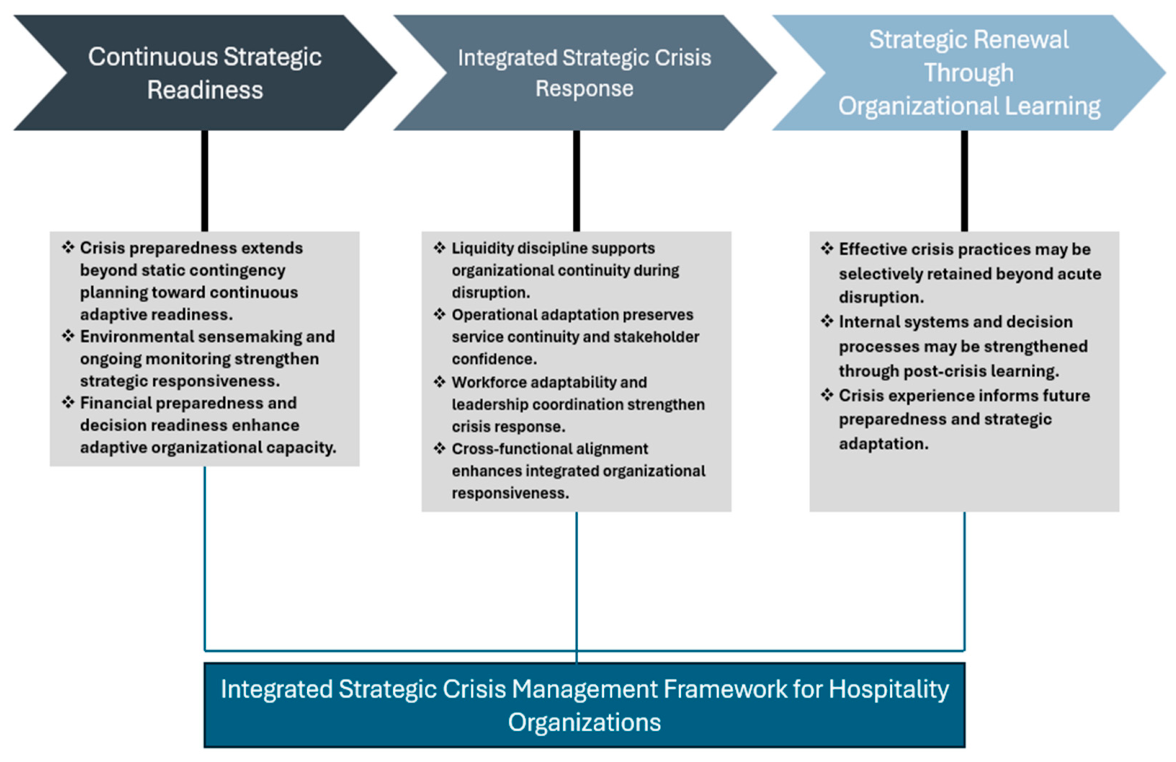

Table 1.
Constructivist grounded theory coding progression of strategic crisis management insights in Jakarta’s five-star hotel sector.
Table 1.
Constructivist grounded theory coding progression of strategic crisis management insights in Jakarta’s five-star hotel sector.
|
Step 1: Initial Coding (Participant-Derived) |
Step 2: Focused Conceptual Categories |
Step 3: Focused Coding |
Step 4: Theoretical Coding |
| Prepared for short-term emergencies; existing SOPs for familiar disruptions; assumptions of business continuity; crisis planning based on prior experience; unprepared for prolonged systemic disruption | From Static Preparedness to Adaptive Readiness |
Pre-Crisis Strategic Insights |
Continuous Strategic Preparedness |
| Heightened awareness of situational changes; monitoring regulations and market developments; responding to external uncertainty; data-driven awareness; anticipating environmental shifts | Environmental Sensemaking as Strategic Preparedness |
Pre-Crisis Strategic Insights |
Continuous Strategic Preparedness |
| Crisis management as continuous strategic thinking; rapid decision readiness; preparedness requiring adaptation; liquidity preparedness; ongoing monitoring and reassessment | Crisis Preparedness as a Continuous Strategic Capability |
Pre-Crisis Strategic Insights |
Continuous Strategic Preparedness |
| Cost control; liquidity preservation; maintaining cash reserves; protecting hotel assets; cautious investment decisions; financial survival planning; managing fixed obligations | Liquidity Discipline and Financial Survival |
During-Crisis Strategic Insights | Integrated Strategic Crisis Response |
| Continuous operational adjustment; changing service delivery models; hygiene protocol implementation; operational restructuring; maintaining guest confidence; resource efficiency | Operational Adaptation and Service Continuity |
During-Crisis Strategic Insights | Integrated Strategic Crisis Response |
| Workforce flexibility; multitasking roles; employee communication; leadership visibility; employee support; morale maintenance; leadership responsiveness | Workforce Adaptability and Leadership Coordination | During-Crisis Strategic Insights | Integrated Strategic Crisis Response |
| Finance–operations alignment; cross-department coordination; shared organizational priorities; integrated crisis decision-making; coordinated leadership response | Cross-Functional Strategic Alignment | During-Crisis Strategic Insights | Integrated Strategic Crisis Response |
| Retaining useful crisis practices; maintaining financial discipline; preserving faster decision-making; continuing adaptive routines; sustaining operational efficiency | Retention of Effective Crisis Practices | Post-Crisis Strategic Insights | Strategic Renewal Through Organizational Learning |
| Strengthening internal systems; stronger communication practices; clearer escalation pathways; stronger workforce capability; structured organizational learning | Strengthening Internal Organizational Capability | Post-Crisis Strategic Insights | Strategic Renewal Through Organizational Learning |
| Future crises may differ; uncertainty as an ongoing business condition; preparedness beyond crisis manuals; strategic adaptability; continuous readiness mindsets | Strategic Reorientation Toward Future Uncertainty | Post-Crisis Strategic Insights | Strategic Renewal Through Organizational Learning |
Disclaimer/Publisher’s Note: The statements, opinions and data contained in all publications are solely those of the individual author(s) and contributor(s) and not of MDPI and/or the editor(s). MDPI and/or the editor(s) disclaim responsibility for any injury to people or property resulting from any ideas, methods, instructions or products referred to in the content. |
© 2026 by the authors. Licensee MDPI, Basel, Switzerland. This article is an open access article distributed under the terms and conditions of the Creative Commons Attribution (CC BY) license (http://creativecommons.org/licenses/by/4.0/).
Copyright: This open access article is published under a Creative Commons CC BY 4.0 license, which permit the free download, distribution, and reuse, provided that the author and preprint are cited in any reuse.


