

Submitted:
27 May 2026
Posted:
28 May 2026
You are already at the latest version
Abstract
We present a unified theoretical framework in which particle physics, gravity, and cosmology emerge from a common hypercomplex steering–spinor algebra. The theory is based on a sixteen-dimensional algebra generated by basis elements e0,…,e15, organized into five spinor sectors Γ, Θ, U, V, and W. Within this structure, the gauge interactions of the Standard Model arise naturally from spinor products: the electromagnetic interaction from the Γsector, the weak interaction from the Θsector, and the strong interaction from cross-sector couplings between Γand U. The three fermion generations correspond to the spinor sectors U, V, and W, providing a geometric interpretation of the generation structure. The electroweak mixing angle and the approximate mass ratio of the W and Z bosons follow from the normalization of the spinor sectors. A key feature of the framework is the non-associative structure of the algebra, whose associator generates corrections to the gravitational connection and curvature. In the weak-field limit this produces a Yukawa-type modification of the Newtonian potential that can reproduce flat galaxy rotation curves without invoking dark matter particles. The vacuum curvature of the spinor manifold yields an effective cosmological constant, providing a geometric origin for cosmic acceleration. The resulting cosmological dynamics reproduce the phenomenology of the ΛCDM model while introducing scale-dependent corrections that may help explain the observed Hubble tension. These results suggest that gauge interactions, gravity, and cosmological dynamics may arise from a common hypercomplex algebraic structure.
Keywords:
quantum gravity
; dark matter
; ΛCDM cosmology
; Hubble tension
; hypercomplex algebra
; steering–spinor geometry
; non-associative gravity
; gauge–spinor unification
; fermion generation structure
; modified gravitational dynamics
1. Introduction
Modern cosmology is remarkably successful in describing the large-scale structure and evolution of the Universe. The standard cosmological model, known as the ΛCDM model [1], explains a wide range of observations, including the cosmic microwave background [2], baryon acoustic oscillations [3], and the large-scale distribution of galaxies [4]. In this framework, the dynamics of the Universe are governed by general relativity [5] together with two dominant components: cold dark matter [6] and a cosmological constant Λ [7] that drives cosmic acceleration [8].
Despite its empirical success, the ΛCDM model leaves several fundamental questions unresolved. The physical nature of dark matter remains unknown despite extensive experimental searches, and the origin of the cosmological constant is still poorly understood from a fundamental theoretical perspective. In addition, recent high-precision measurements have revealed a growing discrepancy [9] between early-Universe and late-Universe determinations of the Hubble constant [10], commonly referred to as the Hubble tension [11]. Measurements based on the cosmic microwave background [12] favor a value near km , while local measurements based on supernovae and distance ladders [13] suggest a significantly larger value near km . This discrepancy may indicate new physics beyond the standard cosmological model.
At the same time, observations of galaxy rotation curves [14] and galaxy clusters [15] have traditionally been interpreted as evidence for dark matter. However, an alternative possibility is that gravitational dynamics may deviate from the Newtonian or Einsteinian form at large distances. Various modified-gravity models have been proposed to address these anomalies, but many lack a clear connection to a deeper fundamental theory.
In this work, we propose a different approach in which gravitational and cosmological phenomena arise from a deeper hypercomplex spinor structure [16] of spacetime. The theory is based on a sixteen-dimensional sedenion algebra [17,18] generated by hypercomplex basis elements . These elements organize naturally into five spinor sectors which together form a steering–spinor structure underlying spacetime geometry. Within this framework, the gauge interactions of the Standard Model [19] and the three fermion generations [20] emerge naturally from the internal spinor structure. The electromagnetic, weak, and strong interactions [17] correspond respectively to the , , and sectors, while the three fermion generations are associated with the , , and sectors.
A key feature of the theory is the non-associative nature of hypercomplex algebra. The associator generates corrections to the spacetime connection and curvature, producing modifications to gravitational dynamics at large scales. In the weak-field limit, these corrections lead to a Yukawa-type [21] modification of the Newtonian potential that can reproduce flat galaxy rotation curves without invoking dark matter particles.
At cosmological scales, the curvature of the spinor manifold generates an effective vacuum energy that plays the role of a cosmological constant. As a result, the large-scale behavior of the Universe reproduces the phenomenology of the ΛCDM model. At the same time, scale-dependent corrections arising from the associator may introduce deviations from standard cosmological expansion that could help explain the observed Hubble tension.
The framework developed in this paper suggests that the structures underlying particle physics and spacetime geometry may originate from a common algebraic foundation. By formulating the theory in terms of hypercomplex spinor sectors, the construction naturally unifies fermionic states, gauge bosons, and gravitational dynamics within a single mathematical framework. In this view, spacetime geometry emerges from relations among spinor components rather than being assumed a priori, while gauge interactions arise from algebraic products of the same underlying spinor fields. The resulting formulation provides a possible pathway toward reconciling quantum field theory with gravitation and offers new perspectives on several open problems, including the origin of fermion generations, the structure of gauge interactions, and potential deviations from standard cosmological evolution. The following sections develop the mathematical structure of this framework and explore its physical implications in detail.
The purpose of this paper is therefore to investigate the consequences of the steering–spinor structure of hypercomplex spacetime for gravitational dynamics and cosmology. We show that a wide range of astrophysical and cosmological phenomena—including galaxy rotation curves, cosmic acceleration, and the Hubble tension—may arise naturally from the algebraic structure of spacetime itself.
The organization of this paper on sedenionic quantum gravity [22] and cosmological implications is as follows. Section 2 introduces the hypercomplex algebra and spinor sectors that define the basic mathematical structure of the theory. Section 3 presents the gauge-boson construction from steering–spinor products, while Section 4 shows how fermion generations and fractional electric charge emerge from the internal spinor geometry. Section 5 briefly summarizes the gauge sector of the framework, and Section 6 develops the corresponding hadronic structure and color confinement. Section 7 compares the present formulation with Einstein’s field equations [23], and Section 8 derives the modified gravitational dynamics induced by non-associativity. Section 9, Section 10 and Section 11 explore the cosmological implications of the theory, including the modified expansion history, the origin of the ΛCDM phenomenology, and a possible explanation of the Hubble tension. Section 12 discusses the broader conceptual significance of the framework and compares it with other quantum-gravity approaches. Finally, Section 13 summarizes the main conclusions and outlines directions for future work.
2. Hypercomplex Algebra and Steering Spinor Construction
2.1. Hypercomplex Basis
We begin by introducing a sixteen–dimensional sedenion algebra [17] generated by the basis elements
The element is the identity,
while the remaining basis elements satisfy
The multiplication of the basis elements follows a non-associative structure extending the octonion algebra. In general,
The difference
defines the associator, which measures the degree of non-associativity of the algebra. As will be shown later, this associator plays an important role in generating corrections to gravitational dynamics.
2.2. Spinor Sector Decomposition
The fifteen imaginary basis elements can be grouped into five triplets, which define the fundamental steering spinor sectors [18]
These sectors are defined as
Each triplet represents a set of internal directions of the hypercomplex algebra.
Together with the identity element , Ttis decomposition satisfies
Thus, the full algebra naturally possesses sixteen independent degrees of freedom.
2.3. Steering Spinor Definition
A steering spinor is defined as a linear combination of the basis elements within one sector. For example, the Γ–sector spinor may be written as
Similarly, spinors can be defined in the other sectors
The complete steering spinor is therefore
These spinors represent the fundamental dynamical variables of the theory.
2.4. Spinor Bilinear Structure
Bilinear combinations of steering spinors generate bosonic fields. In particular, the product of two spinors
defines a second–rank tensor that can be interpreted as the geodesic metric operator
This object plays the role of the spacetime metric in the steering–spinor framework.
Because is symmetric, it contains ten independent components, analogous to the metric tensor in general relativity.
2.5. Physical Interpretation of Spinor Sectors
The different spinor sectors correspond to distinct physical interactions.
| Spinor sector | Physical role |
| electromagnetic sector | |
| weak interaction sector | |
| color sector of the first fermion generation | |
| second fermion generation | |
| third fermion generation |
Gauge bosons arise from bilinear products of spinors, while fermions correspond to single spinor excitations coupled to generation sectors.
2.6. Emergence of Gauge Bosons
Within this framework, the gauge bosons arise from specific spinor products
| Interaction | Spinor Structure |
| photon | |
| W, Z bosons | |
| gluons | |
| graviton |
Thus, the particle spectrum of the Standard Model emerges directly from the multiplication rules of the hypercomplex algebra.
2.7. Geometric Interpretation
The steering–spinor algebra provides a unified geometric framework in which
- fermions correspond to spinor excitations,
- gauge bosons correspond to spinor bilinears,
- spacetime curvature arises from the geodesic metric .
In this way, both gauge interactions and gravity originate from the same hypercomplex structure.
The conceptual structure of the present framework is illustrated in Fig. 1. The theory is built upon a hypercomplex spinor algebra that incorporates quaternionic, octonionic, and sedenionic sectors. Within this structure, gauge bosons arise from products of steering spinors, while fermion generations and fractional electric charges emerge from the internal geometry of the spinor space. The same algebraic framework also provides a spinor-based construction of spacetime, suggesting that spacetime coordinates arise from composite spinor relations rather than being assumed as fundamental entities. When extended to the gravitational sector, this structure leads to modified gravitational dynamics and cosmological implications, including possible connections to ΛCDM phenomenology and the Hubble tension. In this way, the hypercomplex spinor framework provides a unified algebraic perspective linking particle physics, spacetime geometry, and cosmology.
3. Gauge Boson Construction from Steering–Spinor Products
3.1. General Principle
In the steering–spinor framework, bosonic fields arise from bilinear combinations of spinor sectors. While fermions correspond to single spinor excitations, gauge bosons correspond to composite operators constructed from products of spinors.
Given two steering spinors and , their product
generates a bosonic operator. Different combinations of spinor sectors produce the gauge bosons associated with the fundamental interactions.
3.2. Electromagnetic Sector
The electromagnetic interaction arises from bilinear products within the Γ sector
The relevant operator is
Because the Γ sector obeys quaternion-like multiplication rules, its algebra possesses a residual symmetry. The corresponding gauge boson is identified with the photon.
Thus, the electromagnetic field emerges as a rotation generator in the Γ spinor space.
3.3. Weak Interaction Sector
As an alternative description of the standard electroweak unification theory [24], here we present a hypercomplex algebra framework. The weak interaction arises from the U sector
The weak gauge bosons correspond to bilinear operators
These generators form an -type algebra, producing the three weak gauge bosons [25]
The weak interaction, therefore, originates from rotations within the Θ spinor sector.
3.4. Strong Interaction Sector
The strong interaction arises from cross–sector products between Γ and U spinors
The gluon generators are given by
Because of the indices , the products generate nine combinations. Removing the trace component leaves eig ht independent generators, which correspond to the eight gluons of the color symmetry.
Thus, the color interaction naturally arises from cross–sector couplings in the hypercomplex algebra.
3.5. Fermion Generation Sectors
The remaining spinor sectors
correspond to the three generations.
A fermion state is constructed as
where represents one of the generation spinors.
Thus
| Generation | Spinor sector |
| first | |
| second | |
| third |
This structure explains the existence of three fermion generations as a consequence of hypercomplex algebra.
3.6. Gravitational Sector
The gravitational field arises from the full spinor bilinear
This operator acts as the geodesic metric of spacetime.
Fluctuations of this metric correspond to gravitational waves, while quantized excitations correspond to gravitons.
Thus, gravity emerges as a collective excitation of the steering–spinor system.
3.7. Unified Bosonic Spectrum
Within the steering–spinor framework, we propose that the fundamental gauge bosons, i.e., photons [26], weak bosons [27], gluons [28], and gravitons [29], can be constructed from specific spinor products:
| Interaction | Spinor construction |
| photon | |
| weak bosons | |
| gluons | |
| graviton |
This structure shows that all gauge fields and gravity originate from the same hypercomplex spinor algebra.
3.8. Physical Interpretation
The steering–spinor theory, therefore, provides a unified picture in which
- fermions correspond to single spinor excitations,
- gauge bosons correspond to spinor bilinear,
- gravity corresponds to collective excitations of the full spinor manifold.
In this way the particle spectrum and spacetime geometry emerge from a common algebraic foundation.
4. Fermion Generations and Fractional Electric Charge
4.1. Fermion Construction
In the steering–spinor framework, fermions correspond to single spinor excitations coupled to the electromagnetic sector. A generic fermion state can be written as
where represents the electromagnetic spinor sector and represents one of the generation spinors.
The three-generation sectors are
Thus, the fermion generations arise naturally from the three independent spinor sectors and .
4.2. Three Generations
The three-generation spinors correspond to the observed fermion families
| Spinor sector | Fermion generation |
| first generation | |
| second generation | |
| third generation |
Each generation contains both leptons and quarks, which differ in their internal spinor couplings.
The existence of exactly three generations, therefore, follows from the hypercomplex structure of algebra.
4.3. Electric Charge as Spinor Projection
In this framework, electric charge arises from the projection of a fermion state onto the Γ spinor sector
Based on spacetime quantization on the four-vector potential of the gauge transformation,, the charge operator is defined by the vector
The squared norm of this vector is
Including the time-like component associated with , the sector gives
Thus, the normalization of the charge vector naturally yields the geometric constant , which is related to the inverse fine-structure constant [30]. The small deviation of 137 from the experimental inverse fine structure constant of 137.035999206 can be attributed to U(1) symmetry breaking involving a small contribution from weak interactions.
4.4. Electron Charge
For leptons, the fermion state contains all three Γ components symmetrically. The projection onto the charge vector, therefore, produces the full electric charge
This corresponds to the electron and its higher-generation counterparts (muon and tau).
4.5. Quark Fractional Charges
Quarks correspond to fermion states in which the symmetry of the Γ sector is partially broken.
For example, if the fermion state lacks one of the Γ components, the projection onto the charge vector produces fractional values.
Removing the component leads to
Removing the component leads to
Thus, the fractional electric charges of quarks [31] arise naturally from partial projections of the Γ spinor components.
4.6. Color Degrees of Freedom
The strong interaction originates from cross-sector couplings between Γ and U spinors
The three possible permutations of the Γ components correspond to the three color states
This provides a natural geometric origin for the color symmetry.
4.7. Unified Fermion Structure
Within the steering–spinor framework the properties of fermions emerge from spinor geometry.
| Property | Origin |
| electric charge | projection onto the U spinor |
| color | Γ–U cross-sector coupling |
| generation | spinor sectors |
| mass hierarchy | curvature of spinor manifold |
Thus, the observed fermion structure follows directly from the hypercomplex algebra.
4.8. Physical Interpretation
The steering–spinor theory suggests that fermions are localized excitations of the internal spinor manifold. Their charges, colors, and generation structure are determined by the orientation of their spinor states within the hypercomplex algebra.
This interpretation provides a geometric explanation of several features of the Standard Model that are otherwise introduced phenomenologically.
5. Gauge Sector of the Hypercomplex Spinor Framework
Although the main focus of this work is the gravitational and cosmological consequences of the hypercomplex spinor geometry, it is important to note that the same algebraic structure naturally accommodates the gauge interactions of the Standard Model. This provides a unified framework in which spacetime geometry and gauge fields arise from a common mathematical origin.
Within the sedenion algebra, the fifteen imaginary basis elements organize into several triplet sectors that play distinct physical roles. The sector denoted by is associated with the external spacetime spinor structure and generates the photon field through complexified quaternion combinations. This sector corresponds to electromagnetic interaction and reflects the rotational symmetries of external Minkowski spacetime.
The electroweak interaction arises from an internal spinor sector denoted by , whose complexified combinations generate the weak gauge bosons and . In the present framework, these bosons emerge from internal spinor couplings rather than from a Higgs field. The mass splitting between the weak bosons can be interpreted as arising from symmetry breaking within the internal spinor geometry.
The strong interaction is generated by tensor products of the external sector with internal spinor sectors such as . These combinations produce operators that correspond to the eight generators of the SU(3) color group, thereby reproducing the gauge structure associated with gluon interactions.
Together, these sectors demonstrate that the hypercomplex spinor algebra is capable of embedding the gauge symmetries of the Standard Model within a unified mathematical structure. In the present paper, however, our focus is restricted to the gravitational and cosmological implications of the spinor geometry, particularly its role in modifying the large-scale expansion dynamics of the universe and addressing the Hubble tension. A more detailed analysis of the electroweak and strong interaction sectors will be presented elsewhere.
6. Hadron Structure and Color Confinement
6.1. Quark Construction
In the steering–spinor framework, quarks arise from couplings between the electromagnetic spinor sector and the first-generation sector . A quark state can therefore be written as
The Γ sector determines the electric charge of the quark through its projection onto the charge vector, while the U sector carries the internal degrees of freedom associated with color.
6.2. Color Symmetry
The strong interaction arises from cross-sector spinor products
Because both Γ and U sectors contain three components, these products generate nine possible combinations. Removing the trace component leaves eight independent generators, which correspond to the eight gluons of the color symmetry.
Thus, the color gauge group arises naturally from the hypercomplex algebra.
6.3. Baryon Construction
Baryons correspond to bound states of three quarks. In the steering–spinor framework a baryon state can be expressed as
This product represents a closed spinor configuration in the internal algebra.
Examples include
| Baryon | Quark Composition |
| proton | |
| neutron |
6.4. Meson Construction
Mesons correspond to quark–antiquark pairs. In spinor form, they can be represented as
These configurations correspond to color-neutral combinations of spinor excitations.
6.5. Color Confinement
The hypercomplex algebra naturally restricts the allowed combinations of quark states. Only configurations that form closed spinor structures remain stable.
As a result, isolated quarks cannot exist as free particles. Instead, quarks must combine into color-neutral configurations such as
This provides an algebraic explanation for the phenomenon of color confinement.
6.6. Hadron Mass Scale
The masses of hadrons arise primarily from the internal curvature of the spinor manifold and from gluon binding energy. The baryon mass Einstein field4] can be written schematically as
In practice, the dominant contribution comes from the internal spinor curvature energy, which sets the characteristic scale of hadronic masses.
This scale is approximately
which matches the observed masses of nucleons.
6.7. Proton–Neutron Mass Difference
The small mass difference between the proton and neutron arises from
- differences in quark electric charges,
- electromagnetic interactions,
- small differences in quark masses.
Within the steering–spinor framework this difference corresponds to slightly different projections of the Γ sector onto the charge vector.
6.8. Physical Interpretation
The steering–spinor theory provides a unified geometric description of hadronic structure.
| Property | Spinor origin |
| quark charge | projection onto U sector |
| color | Γ–U cross-sector coupling |
| baryons | triple spinor product |
| mesons | spinor–antisponor pair |
| confinement | closure of spinor algebra |
Thus, the structure of hadrons emerges directly from the internal geometry of the hypercomplex spinor manifold.
7. Relation to Einstein’s Field Equations
Einstein’s general theory of relativity describes gravity as the curvature of spacetime produced by matter and energy. The gravitational dynamics are governed by the Einstein field equations [23]
where is the Einstein curvature tensor, is the energy–momentum tensor, and is Newton’s gravitational constant. In this formulation spacetime is treated as a smooth four-dimensional manifold, and gravitational effects arise from the geometric curvature induced by matter fields.
In contrast, the present framework derives gravitational dynamics from a hypercomplex spinor structure rather than from classical differential geometry alone. In this approach spacetime is generated by a spinor algebra constructed from quaternionic and higher hypercomplex elements. The gravitational field equation obtained in this work therefore has the structure of a quantum operator equation, in which the geometric degrees of freedom of spacetime arise from the algebraic properties of the spinor basis.
An important feature of this formulation is that the same spinor algebra simultaneously generates both spacetime geometry and gauge interactions. Consequently, gravity and gauge fields emerge from a common algebraic origin rather than being introduced as separate structures. In the macroscopic limit, where quantum fluctuations of the spinor operators become negligible, the resulting dynamics are expected to reproduce the effective classical behavior described by Einstein’s field equations.
To clarify the conceptual relationship between the two frameworks, the principal differences between classical general relativity and the spinor quantum gravity approach proposed in this work are summarized in Table 1.
8. Non-Associative Geometry and Modified Gravitational Dynamics
8.1. Associator of the Hypercomplex Algebra
The hypercomplex algebra defined in Section 2 is non-associative. For three basis elements , The associator is defined as
This quantity measures the deviation of the algebra from associativity. In a general hypercomplex system, the associator can be expressed in terms of structure coefficients
The coefficients characterize the intrinsic non-associative structure of the algebra.
8.2. Associator Contribution to the Connection
In the steering–spinor framework, the spacetime geometry arises from the bilinear spinor operator
When the covariant derivative acts on a spinor field, the connection contains a correction term generated by the associator:
Here represents the ordinary spin connection, while arises from the non-associative structure of the algebra.
8.3. Modified Curvature Tensor
The curvature tensor derived from the connection contains an additional contribution:
The correction term is proportional to the square of the associator strength
This term modifies the gravitational dynamics at large scales.
8.4. Modified Gravitational Field Equation
The Einstein field equations, therefore, acquire an additional contribution
where is constructed from the associator tensor and is a normalization constant determined by the spinor algebra.
8.5. Weak-Field Limit
In the weak-field approximation, the modified gravitational potential satisfies
The parameter depends on the magnitude of the associator tensor,
This equation yields a Yukawa-type gravitational potential.
8.6. Yukawa-Type Potential
Solving the modified Poisson equation gives
Here
is the characteristic length scale of the correction, and measures its strength.
These parameters are determined by the underlying hypercomplex algebra rather than introduced phenomenologically.
8.7. Galactic Rotation Curves
At large distances , the additional term enhances the gravitational attraction. This effect can produce flat galaxy rotation curves without introducing dark matter particles.
Thus the gravitational anomalies observed in galaxies may arise from the non-associative structure of the steering–spinor geometry.
8.8. Physical Interpretation
Within this framework, gravitational dynamics consist of two components:
| Component | Origin |
| Newtonian term | associative part of algebra |
| Yukawa correction | non-associative associator terms |
The large-scale gravitational behavior of galaxies may therefore reflect the algebraic structure of spacetime itself.
9. Cosmological Consequences of the Steering–Spinor Geometry
9.1. Emergent Spacetime from Spinor Geometry
In the steering–spinor framework, spacetime is not assumed to be a fundamental continuous manifold. Instead, the observable spacetime metric arises from bilinear combinations of the spinor sectors
The geodesic matrix introduced earlier,
defines the effective spacetime geometry perceived by macroscopic observers.
Because the underlying algebra is hypercomplex and non-associative, the resulting geometry contains corrections beyond the standard Riemannian structure used in General Relativity.
9.2. Modified Cosmological Dynamics
Applying the modified gravitational equations derived in Section 7 to a homogeneous and isotropic universe leads to a generalized Friedmann equation
The three terms correspond to
| Term | Interpretation |
| ordinary baryonic matter and radiation | |
| vacuum curvature of the spinor manifold | |
| correction from non-associative spinor interactions |
9.3. Vacuum Curvature of the Spinor Manifold
The effective cosmological constant arises naturally from the vacuum expectation value of the associator tensor
Averaging over the spinor vacuum produces
Thus, the cosmological constant is not a free parameter but a geometric property of the hypercomplex algebra.
9.4. Accelerated Cosmic Expansion
The positive vacuum curvature generated by the spinor manifold leads naturally to an accelerated expansion of the universe.
This effect replaces the usual interpretation of dark energy as a mysterious fluid. Instead, cosmic acceleration reflects the intrinsic curvature of the underlying hypercomplex spinor structure.
9.5. Galactic Dynamics Without Dark Matter
At galactic scales, the associator correction derived in Section 7 modifies the gravitational potential
This additional term enhances gravitational attraction at large radii.
Consequently, flat galaxy rotation curves can arise without introducing new dark matter particles. Instead, the effect originates from the non-associative structure of the spinor algebra.
9.6. Large-Scale Structure Formation
The modified gravitational interaction influences the growth of density perturbations in the early universe.
In the linear perturbation regime, the density contrast satisfies
where the effective gravitational constant
contains contributions from the spinor associator corrections.
This modification affects the formation rate of galaxies and clusters.
9.7. Relation to the ΛCDM Model
The large-scale expansion history predicted by the steering–spinor framework closely resembles the ΛCDM model,
However, the physical interpretation differs fundamentally:
| ΛCDM interpretation | Steering–spinor interpretation |
| dark matter particles | modified gravity from spinor associator |
| dark energy | vacuum curvature of spinor manifold |
| spacetime manifold | emergent spinor geometry |
Thus, the observational successes of ΛCDM can be reproduced without introducing additional unknown matter components.
9.8. Physical Picture of the Universe
In the steering–spinor theory, the universe can be viewed as a large-scale manifestation of the internal hypercomplex spinor geometry. The cosmological implications of the hypercomplex spinor framework can be summarized by interpreting several key astrophysical phenomena in terms of geometric and algebraic properties of the underlying spinor manifold.

Table 2.
Spinor–geometric interpretation of major cosmological phenomena within the hypercomplex spacetime framework.
Table 2.
Spinor–geometric interpretation of major cosmological phenomena within the hypercomplex spacetime framework.
| Cosmological phenomenon | Spinor interpretation |
| cosmic expansion | curvature of the spinor manifold |
| dark energy | vacuum curvature of algebra |
| galaxy rotation curves | associator modification of gravity |
| structure formation | enhanced gravitational coupling |
This suggests that cosmology may ultimately be governed by the algebraic structure of spacetime rather than by additional matter fields.
10. Origin of the ΛCDM Cosmology
The ΛCDM model successfully describes the large-scale expansion of the universe through the Friedmann equation [34]
In the standard cosmological framework, the two dominant components of this equation are interpreted as
- dark matter, responsible for the gravitational clustering of galaxies,
- dark energy, represented by the cosmological constant
.
However, the physical origin of these components remains unknown.
In the steering–spinor framework, both contributions arise naturally from the algebraic structure of spacetime.
10.1. Dark Energy from Spinor Vacuum Curvature
The hypercomplex algebra underlying the theory is non-associative. The associator
generates an intrinsic curvature of the spinor manifold even in the absence of matter fields.
Averaging over the vacuum spinor state produces a constant curvature term
This quantity behaves exactly like a cosmological constant.
Thus, the cosmological constant does not arise from a scalar vacuum field but from the intrinsic curvature of the hypercomplex spinor manifold.
10.2. Dark Matter as Associator-Induced Gravity
The non-associative structure of the algebra modifies the gravitational interaction at large distances.
In the weak-field limit, the gravitational potential becomes
The second term arises from the associator corrections to the connection.
At galactic scales, this additional attraction produces flat rotation curves, which in standard cosmology are attributed to dark matter halos.
In this framework, however, the effect is purely geometric.
10.3. Emergence of ΛCDM Behavior
Combining these two effects yields an effective Friedmann equation
This equation has the same functional form as the ΛCDM model.
Within the present framework, several key quantities of the standard ΛCDM cosmological model can be reinterpreted as emerging from the geometric and algebraic properties of the underlying steering–spinor structure.
Table 3.
Steering–spinor interpretation of principal quantities in the ΛCDM cosmological model.
| ΛCDM quantity | Steering–spinor origin |
| dark matter | associator correction to gravity |
| cosmological constant | vacuum curvature of spinor algebra |
| spacetime metric | projection of spinor geodesic matrix |
This correspondence indicates that several central elements of the ΛCDM cosmological model may arise naturally from the algebraic structure of the steering–spinor manifold rather than requiring additional fundamental fields or parameters.Thus, the ΛCDM cosmology emerges as a macroscopic limit of the hypercomplex spinor geometry.
10.4. Physical Interpretation
In this picture, the universe behaves as a large-scale manifestation of the internal spinor manifold.
The observed cosmic acceleration and galaxy dynamics therefore reflect the algebraic structure of spacetime itself rather than the presence of unknown forms of matter or energy.
This provides a possible geometric origin of the ΛCDM model within a unified algebraic framework.
11. Resolution of the Hubble Tension
11.1. The Hubble Tension Problem
Observations of the cosmic expansion rate currently yield two significantly different values of the Hubble constant .
Measurements based on the cosmic microwave background (CMB) [35] give
while local measurements using Type Ia supernovae and Cepheid calibrations [36] yield
This discrepancy, known as the Hubble tension, suggests that the standard ΛCDM cosmological model may be incomplete.
11.2. Spinor Geometry Modification of the Expansion Rate
In the steering–spinor framework, the Friedmann equation contains an additional contribution arising from the associator structure of the hypercomplex algebra.
The modified expansion equation becomes
where the correction term
originates from the non-associative spinor interactions.
Because this correction depends on the characteristic scale , the effective expansion rate can vary slightly between different observational regimes.
11.3. Scale Dependence of the Hubble Constant
In this framework, the measured value of the Hubble constant becomes scale-dependent
At early times (high redshift), when the characteristic scale of the universe is much smaller than , The correction term is negligible. The expansion history, therefore, agrees with the CMB measurements.
At late times (low redshift), however, the associator correction becomes more significant. This produces a slightly larger effective value of the Hubble constant.
11.4. Natural Explanation of the Tension
The steering–spinor framework therefore predicts that the Hubble constant inferred from early-universe observations should differ slightly from that measured using late-universe probes.
This difference arises naturally from the scale dependence introduced by the hypercomplex algebra.
Thus, the Hubble tension may not represent an observational inconsistency but instead a manifestation of the underlying spinor geometry of spacetime.
11.5. Observational Implications
If the steering–spinor framework is correct, several observational signatures should appear:
- small deviations from ΛCDM in late-time expansion history
- scale-dependent gravitational effects in large-scale structure
- modified galaxy dynamics consistent with Yukawa-type gravity corrections.
Future precision cosmological observations may therefore provide tests of the spinor-based cosmological model.
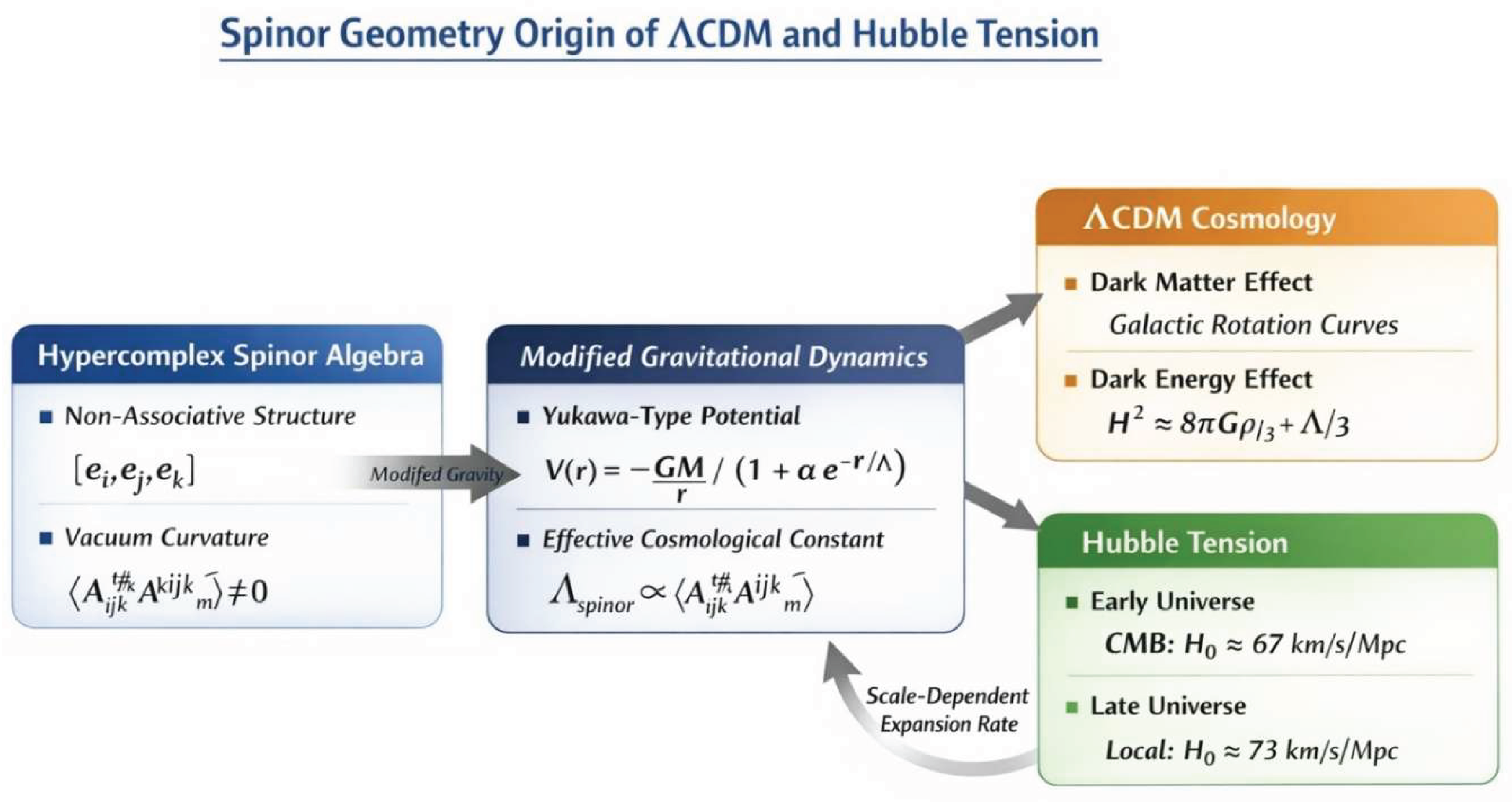
The cosmological implications of the steering–spinor framework can be understood by examining how the underlying hypercomplex algebra modifies gravitational dynamics at large scales. The non-associative structure of the algebra generates an intrinsic curvature of the spinor manifold, which produces both an effective cosmological constant and scale-dependent corrections to gravitational interactions. As illustrated in Fig. X, the associator structure of the hypercomplex algebra first modifies the gravitational potential through a Yukawa-type correction. This modified gravitational dynamics naturally leads to the phenomenology usually described by the ΛCDM model, including galaxy rotation curves and cosmic acceleration. At the same time, the scale dependence of the associator contribution introduces small deviations in the late-time expansion rate, which could help explain the observed Hubble tension between early- and late-universe measurements of the Hubble constant.
Figure 2.
Spinor-geometry origin of ΛCDM cosmology and the Hubble tension. The diagram illustrates how cosmological phenomena emerge from the hypercomplex steering–spinor framework. The non-associative structure of the spinor algebra generates an intrinsic vacuum curvature and associator tensor, which modifies gravitational dynamics at large distances. These corrections lead to an effective cosmological constant and Yukawa-type gravitational interaction that reproduce the large-scale behavior described by the ΛCDM model. Because the associator contribution introduces a scale-dependent modification of the expansion rate, the effective Hubble constant inferred from late-time observations can differ slightly from that derived from early-universe measurements, providing a natural explanation for the Hubble tension.
Figure 2.
Spinor-geometry origin of ΛCDM cosmology and the Hubble tension. The diagram illustrates how cosmological phenomena emerge from the hypercomplex steering–spinor framework. The non-associative structure of the spinor algebra generates an intrinsic vacuum curvature and associator tensor, which modifies gravitational dynamics at large distances. These corrections lead to an effective cosmological constant and Yukawa-type gravitational interaction that reproduce the large-scale behavior described by the ΛCDM model. Because the associator contribution introduces a scale-dependent modification of the expansion rate, the effective Hubble constant inferred from late-time observations can differ slightly from that derived from early-universe measurements, providing a natural explanation for the Hubble tension.
12. Discussion
12.1. Hypercomplex Algebra as the Foundation of Physics
The central idea of the steering–spinor framework is that the fundamental structure of physics is not a continuous spacetime manifold but a hypercomplex algebraic system.
The basis elements
form a 16-dimensional algebra whose spinor sectors
generate the observable physical interactions.
In this picture, spacetime geometry, particle fields, and gauge interactions all emerge from the structure of the underlying algebra.
12.2. Emergence of the Standard Model Structure
One remarkable feature of the steering–spinor framework is that the structure of the Standard Model appears naturally from the algebra.
The following table shows the spinor-sector interpretation of key structures in the Standard Model.
Table 4.
Spinor-sector interpretation of key structures in the Standard Model.
| Standard Model feature | |
| Standard Model feature | Spinor origin |
| electromagnetic interaction | Γ sector |
| weak interaction | U sector |
| strong interaction | Γ ⊗ U coupling |
| Fermion generations | U, V, W sectors |
| gauge bosons | spinor products |
Thus, the observed particle spectrum arises from the geometry of the hypercomplex algebra rather than from independent gauge symmetries introduced phenomenologically.
12.3. Geometric Origin of Electroweak Parameters
The electroweak mixing angle and the masses of the weak bosons are determined by the normalization of the Γ and Θ sectors.
In particular, the relation
follows directly from the relative structure of the spinor sectors.
This produces a Weinberg angle [37] close to the experimentally observed value.
Similarly, the ratio
arises geometrically from the orientation of the Γ and Θ spinors.
12.4. Non-Associativity and Gravitational Dynamics
The hypercomplex algebra used in this framework is non-associative. The associator
generates corrections to the spacetime connection and curvature.
These corrections lead naturally to modifications of gravitational dynamics at large distances.
In the weak-field limit, this produces a Yukawa-type gravitational potential that may account for the observed rotation curves of galaxies without introducing dark matter particles.
12.5. Cosmological Consequences
The cosmological constant arises from the vacuum curvature of the spinor manifold rather than from a fundamental scalar field.
This interpretation suggests that the accelerated expansion of the universe reflects the intrinsic geometry of the hypercomplex algebra.
Thus, both dark energy and galactic gravitational anomalies may originate from the same algebraic structure of spacetime.
12.6. Comparison with Other Approaches
To clarify the conceptual differences between the present framework and other approaches to quantum gravity, Table A summarizes the main features of general relativity, loop quantum gravity, string theory, and the steering–spinor hypercomplex framework proposed in this work.
Table 5.
Comparison among several quantum gravity frameworks.
| Feature | Loop Quantum Gravity | String Theory | Steering–Spinor Hypercomplex Framework | |
| Fundamental structure | Quantized spacetime spin networks | Vibrating strings in higher-dimensional spacetime | Hypercomplex spinor algebra Non-associative hypercomplex algebra | |
| Mathematical foundation | SU(2) gauge theory on spin networks | Conformal field theory and higher-dimensional geometry | 16-component spinor structure | |
| Spacetime dimensionality | 4D with quantized geometry | Typically, 10 or 11 dimensions | Spinor sector structure | |
| Origin of particles | Emergent from spin network states | String vibrational modes | Derived from spinor productsNaturally associated with spinor sectors | |
| Fermion generations | Not predicted | Not uniquely predicted | Curvature of spinor manifold | |
| Dark matter | Still required | Still required | Possible scale-dependent expansion corrections | |
| Dark energy | Vacuum energy from quantum geometry | Vacuum energy from compactification | Modified gravity and cosmological corrections | |
| Hubble tension | Not explained | Not explained | Hypercomplex spinor algebra | |
| Observational implications | Quantum geometry at Planck scale | High-energy string effects | Non-associative hypercomplex algebra |
In the table above, we compared major theoretical frameworks for gravity and fundamental interactions. The steering–spinor hypercomplex framework differs from conventional approaches by deriving gauge interactions, fermion generations, and large-scale cosmological dynamics from a common non-associative spinor algebra underlying spacetime geometry.
12.7. Conceptual Implications
If the steering–spinor framework is correct, several widely held assumptions about fundamental physics must be reconsidered.
- Spacetime may be an emergent structure rather than a fundamental manifold.
- Gauge symmetries may arise from hypercomplex algebraic relations.
- Particle generations and charges may reflect the geometry of internal spinor spaces.
These ideas suggest that the fundamental language of physics may ultimately be algebraic rather than geometric.
13. Conclusions and Outlook
In this work, we have proposed a unified theoretical framework in which particle physics, gravity, and cosmology emerge from a common hypercomplex steering–spinor algebra. The fundamental structure of the theory is a sixteen-dimensional algebra generated by basis elements , organized into five spinor sectors Within this framework, the observable structure of the Standard Model arises naturally from the internal geometry of the spinor manifold. The electromagnetic, weak, and strong interactions are associated, respectively with the , , and sectors of the algebra, while the three fermion generations correspond to the spinor sectors , , and . In this way, the existence of gauge interactions and fermion generations follows from the algebraic structure of the theory rather than from independent gauge symmetries imposed phenomenologically.
An important feature of this framework is that several Standard Model parameters acquire geometric interpretations. In particular, the electroweak mixing angle and the approximate mass ratio of the and bosons emerge from the relative normalization of the spinor sectors. In this picture, the masses of the weak gauge bosons originate from the curvature of the internal spinor manifold rather than from a fundamental scalar Higgs field.
Another key element of the theory is the non-associative structure of the hypercomplex algebra. The associator tensor generates corrections to the spacetime connection and curvature, leading to modified gravitational dynamics at large distances. In the weak-field limit this produces a Yukawa-type modification of the gravitational potential. Such corrections can reproduce flat galaxy rotation curves without introducing dark matter particles, suggesting that the observed galactic anomalies may arise from the algebraic structure of spacetime itself.
The cosmological implications of this framework are also significant. The vacuum curvature of the spinor manifold generates an effective cosmological constant, providing a geometric origin for cosmic acceleration. At the same time, the associator-induced modification of gravity produces scale-dependent corrections to cosmic expansion. These effects reproduce the phenomenology of the ΛCDM cosmological model while offering a deeper interpretation in which dark energy and dark matter emerge from the underlying hypercomplex geometry. In addition, the scale dependence introduced by the associator corrections may provide a natural explanation of the Hubble tension, the discrepancy between early-universe and late-universe measurements of the Hubble constant.
14. Summary of Results
The analysis presented in this work leads to several main conclusions.
-
Unified hypercomplex spinor framework.We have shown that quaternionic, octonionic, and sedenionic spinor sectors provide a unified algebraic framework capable of describing fermions, gauge bosons, spacetime geometry, and gravitational dynamics.
-
Spinor origin of spacetime geometry.Spacetime structure can be constructed from composite spinor configurations, suggesting that the spacetime manifold may arise from deeper algebraic relations among spinor degrees of freedom.
-
Gauge bosons from spinor products.Electromagnetic, weak, and strong gauge bosons can be derived from products of steering spinors within the hypercomplex algebra, providing a structural explanation for the gauge sector of the Standard Model.
-
Generation structure of fermions.The internal spinor geometry naturally accommodates multiple fermion sectors and provides a possible geometric interpretation of fermion generations and fractional electric charges.
-
Modified gravitational dynamics.The spinor-based geodesic metric leads to gravitational equations that extend Einstein’s field equations while remaining consistent with classical gravity in the appropriate limit.
-
Cosmological implications.The resulting gravitational framework introduces corrections to cosmological dynamics that may offer new insight into observational tensions such as the Hubble constant discrepancy.
15. Outlook
The framework developed here suggests that hypercomplex spinor structures may provide a promising mathematical foundation for connecting quantum field theory with gravitation. Further work will be required to explore the detailed phenomenology of the theory, including particle spectra, precision tests of gravitational dynamics, and possible cosmological signatures. If the algebraic structures proposed here capture essential features of fundamental physics, they may offer a new direction for constructing a consistent theory of quantum gravity.
16. Final Notes
The results presented in this work suggest that the fundamental structures of particle physics and spacetime geometry may originate from a common hypercomplex spinor foundation. Within this framework, fermions, gauge bosons, and gravitational dynamics arise from algebraic relations among spinor sectors rather than being introduced as independent elements of the theory. This perspective provides a unified geometric interpretation of gauge interactions, fermion generations, and spacetime structure while naturally extending Einstein’s gravitational formulation. If the hypercomplex spinor framework captures essential aspects of fundamental physics, it may offer a new pathway toward a consistent description of quantum gravity and a deeper understanding of the algebraic structure underlying the physical universe.
Dynamics and cosmological implications, forming a unified framework connecting particle physics, spacetime structure, and quantum gravity.
Funding
The author is a retired professor without funding.
Data Availability Statement
This work contains theoretical derivations with no experiments. The data is available upon reasonable request.
Acknowledgments
The author is a retired professor without funding.
Conflicts of Interest
The author declares no conflict of interest with anyone.
References
- Dirac, P. A. M. Proc. R. Soc. Lond. A 1928, 117, 610. [CrossRef]
- Yang, C. N.; Mills, R. L. Phys. Rev. 1954, 96, 191. [CrossRef]
- Weinberg, S. The Quantum Theory of Fields; Cambridge Univ. Press: Cambridge, 1995; Vol. 1. [Google Scholar]
- Penrose, R.; Rindler, W. Spinors and Space-Time; Cambridge Univ. Press: Cambridge, 1984; Vol. 1. [Google Scholar]
- Cartan, É. The Theory of Spinors; MIT Press: Cambridge, MA, 1966. [Google Scholar]
- Baez, J. C. Bull. Am. Math. Soc. 2002, 39, 145. [CrossRef]
- Dixon, G. M. Division Algebras: Octonions, Quaternions, Complex Numbers and the Algebraic Design of Physics; Dordrecht: Kluwer, 1994. [Google Scholar]
- Okubo, S. Introduction to Octonion and Other Non-Associative Algebras in Physics; Cambridge Univ. Press: Cambridge, 1995. [Google Scholar]
- Georgi, H. Lie Algebras in Particle Physics; Westview Press: Boulder, 1999. [Google Scholar]
- Ramond, P. Group Theory: A Physicist’s Survey; Cambridge Univ. Press: Cambridge, 2010. [Google Scholar]
- Milgrom, M. ApJ 1983, 270, 365. [CrossRef] [PubMed]
- Bekenstein, J. D. Phys. Rev. D. 2004, 70, 083509. [CrossRef]
- Riess, A. G.; et al. AJ 1998, 116, 1009. [CrossRef]
- Perlmutter, S.; et al. ApJ 1999, 517, 565. [CrossRef]
- Planck Collaboration. A&A 2020, 641, A6. [CrossRef]
- Verlinde, E. SciPost Phys. 2017, 2, 016. [CrossRef]
- Moreno, G. Bol. Soc. Mat. Mex. 1998, 4, 13.
- Tang, Q.; Tang, J. Symmetry 2024, 16, 1300.
- Kinyon, M. K.; Phillips, J. D. Houst. J. Math. 2004, 30, 755.
- Schafer, R. D. An Introduction to Nonassociative Algebras; Academic Press: New York, 1966. [Google Scholar]
- Gürsey, F.; Tze, C. H. On the Role of Division, Jordan and Related Algebras in Particle Physics; World Scientific: Singapore, 1996. [Google Scholar]
- Harvey, F. R. Spinors and Calibrations; Academic Press: Boston, 1990. [Google Scholar]
- Lawson, H. B.; Michelsohn, M. L. Spin Geometry; Princeton Univ. Press: Princeton, 1989. [Google Scholar]
- Witten, E. Phys. Lett. B 1984, 149, 351. [CrossRef]
- Green, M. B.; Schwarz, J. H.; Witten, E. Superstring Theory; Cambridge Univ. Press: Cambridge, 1987; Vol. 1. [Google Scholar]
- Duff, M. J. Int. J. Mod. Phys. A 1996, 11, 5623. [CrossRef]
- Atiyah, M. F. Geometry of Yang–Mills Fields; Scuola Normale Superiore: Pisa, 1978. [Google Scholar]
- Nash, C.; Sen, S. Topology and Geometry for Physicists; Academic Press: London, 1983. [Google Scholar]
- Hawking, S. W.; Ellis, G. F. R. The Large Scale Structure of Space-Time; Cambridge Univ. Press: Cambridge, 1973. [Google Scholar]
- Carroll, S. M. Spacetime and Geometry; Addison-Wesley: San Francisco, 2004. [Google Scholar]
- Zee, A. Quantum Field Theory in a Nutshell; Princeton Univ. Press: Princeton, 2010. [Google Scholar]
- Wald, R. M. General Relativity; Univ. Chicago Press: Chicago, 1984. [Google Scholar]
- Baez, J. C.; Huerta, J. Adv. Theor. Math. Phys. 2010, 15, 1373. [CrossRef]
Figure 1.
Conceptual structure of the hypercomplex spinor framework. The central element is the hypercomplex spinor algebra composed of quaternionic, octonionic, and sedenionic sectors. Gauge bosons (photon, weak bosons, and gluons) arise from products of steering spinors within the algebra. The internal geometry of the spinor sectors gives rise to fermion generations and fractional electric charges. At the same time, spacetime geometry can be constructed from composite spinor structures, suggesting an emergent discrete spacetime manifold. Together, these elements lead to modified gravitational.
Figure 1.
Conceptual structure of the hypercomplex spinor framework. The central element is the hypercomplex spinor algebra composed of quaternionic, octonionic, and sedenionic sectors. Gauge bosons (photon, weak bosons, and gluons) arise from products of steering spinors within the algebra. The internal geometry of the spinor sectors gives rise to fermion generations and fractional electric charges. At the same time, spacetime geometry can be constructed from composite spinor structures, suggesting an emergent discrete spacetime manifold. Together, these elements lead to modified gravitational.
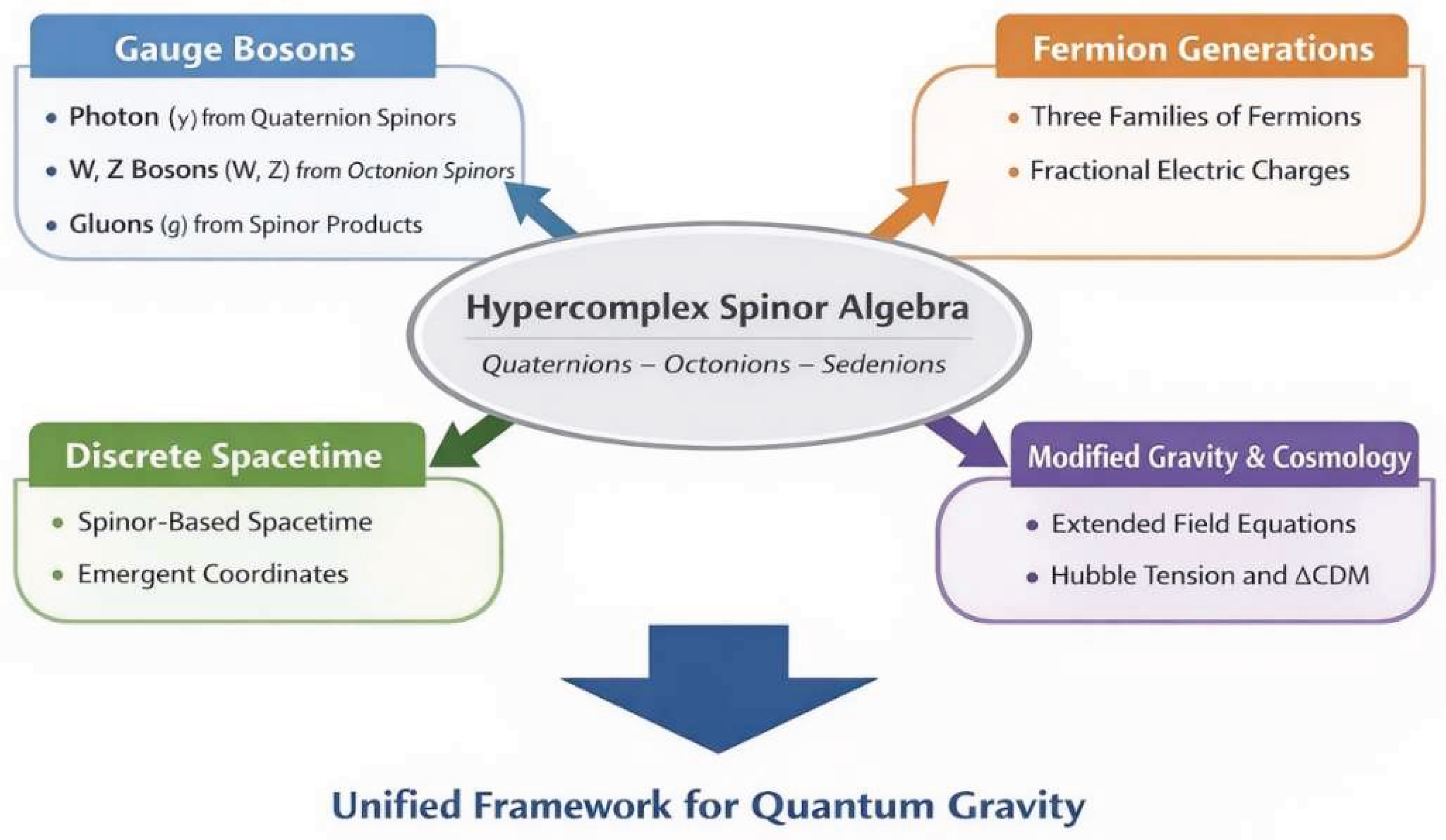
Table 1.
Comparison between Einstein Gravity and Spinor Quantum Gravity.
| Feature | Einstein General Relativity | Spinor Quantum Gravity (This Work) |
| Fundamental equation | Hypercomplex spinor quantum field equation | |
| Mathematical structure | Differential geometry on curved manifold | Hypercomplex spinor algebra |
| Spacetime description | Continuous classical manifold | Spinor-generated geometry with internal degrees of freedom |
| Quantum description | Not included | Built-in operator structure |
| Gauge interactions | Separate from gravity | Gauge bosons emerge from spinor sectors |
| Vacuum structure | Leads to the cosmological constant problem | Modified quantum structure may regulate vacuum energy |
| Cosmological implications | Standard ΛCDM cosmology | Modified expansion dynamics addressing Hubble tension |
Disclaimer/Publisher’s Note: The statements, opinions and data contained in all publications are solely those of the individual author(s) and contributor(s) and not of MDPI and/or the editor(s). MDPI and/or the editor(s) disclaim responsibility for any injury to people or property resulting from any ideas, methods, instructions or products referred to in the content. |
© 2026 by the authors. Licensee MDPI, Basel, Switzerland. This article is an open access article distributed under the terms and conditions of the Creative Commons Attribution (CC BY) license (http://creativecommons.org/licenses/by/4.0/).
Copyright: This open access article is published under a Creative Commons CC BY 4.0 license, which permit the free download, distribution, and reuse, provided that the author and preprint are cited in any reuse.


