

Submitted:
26 May 2026
Posted:
28 May 2026
You are already at the latest version
Abstract
Background/Objectives: Intraoperative ultrasound (IOUS) has become an integral component of modern hepatic oncology surgery, providing real-time imaging guidance during liver resections for hepatocellular carcinoma, colorectal liver metastases, and other primary or secondary hepatic malignancies. Despite substantial improvements in preoperative imaging modalities, occult lesions, disappearing metastases after chemotherapy, and complex vascular relationships continue to represent major in-traoperative challenges. This structured narrative review aimed to evaluate the con-temporary role of IOUS in hepatic oncology surgery, with particular emphasis on con-trast-enhanced intraoperative ultrasound (CE-IOUS), minimally invasive liver sur-gery, navigation-assisted hepatectomy, and emerging artificial intelligence-based technologies.
Methods: A structured literature review was conducted using PubMed/MEDLINE, Scopus, Web of Science, and Google Scholar databases. Peer-reviewed studies, interna-tional guidelines, consensus statements, systematic reviews, and technological reports addressing IOUS applications in liver surgery were analyzed. Particular focus was placed on studies evaluating lesion detection, intraoperative strategy modification, disappearing colorectal liver metastases, parenchymal-sparing hepatectomy, laparo-scopic and robotic liver surgery, navigation systems, augmented reality integration, and AI-assisted imaging technologies.
Results: Contemporary evidence demonstrates that IOUS continues to significantly influence intraoperative decision-making despite advances in magnetic resonance imaging and multidetector computed tomography. CE-IOUS improves the detection of occult hepatic lesions and residual disease after systemic chemotherapy, particularly in disappearing colorectal liver metastases. IOUS-guided anatomical and parenchy-mal-sparing resections contribute to preservation of functional liver parenchyma while maintaining oncologic radicality. In minimally invasive liver surgery, laparo-scopic ultrasound remains essential for lesion localization and vascular mapping. Re-cent developments integrating navigation systems, augmented reality platforms, and AI-assisted image recognition suggest a progressive transition toward digitally assisted precision liver surgery.
Conclusions: IOUS remains a cornerstone of modern hepatic oncology surgery and continues to evolve from a localization tool into a comprehensive platform for preci-sion-guided liver resection. The integration of CE-IOUS, navigation technologies, and artificial intelligence may further enhance intraoperative accuracy, oncologic safety, and individualized surgical planning in the future.
Keywords:
intraoperative ultrasound
; hepatic oncology surgery
; liver resection
; hepatocellular carcinoma
; colorectal liver metastases
; parenchymal-sparing hepatectomy
; contrast-enhanced intraoperative ultrasound
; minimally invasive liver surgery
; surgical navigation
; precision surgery
1. Introduction
Both primary and secondary hepatic malignancies continue to exert a heavy oncological burden worldwide and are among the most difficult contemporary surgical oncology challenges [1,2]. Hepatocellular carcinoma (HCC), which causes the majority of cases of cancer-death worldwide at present, is hardly surprising. In a similar manner, colorectal liver metastases (CRLM) represent one of the most common manifestations of advanced colorectal cancer. [1,2]. Surgical resection remains the mainstay of treatment with curative intent for selected patients with HCC and CRLM, providing the greatest chance of long-term survival and disease control if complete removal of the tumor is possible [3,4]. Oncological liver surgery, on the opposite end of the spectrum, is technically demanding due to the complicated intrahepatic vascular anatomy, the need to preserve functioning liver parenchyma, and frequent multifocal or occult lesions which preoperative imaging evaluation often incompletely assesses [5,6,7,8]. Over the years, hepatic surgeries have transitioned from major hepatectomies to individualized parenchymal-sparing strategies. The shift aimed at achieving oncological clearance maximally while preserving future remnant liver function [9,10]. The systemic oncological treatments and perioperative care have improved significantly over the time it was solely limited to palliative care.
Recent innovations in surgical oncology and hepatobiliary surgery are rapidly changing and increasing the implementation of the competent and effective precision liver surgery [2,3,4,5]. Several examples are the evaluation of hepatic functional reserve by indocyanine green plasma disappearance rate or albumin-bilirubin grade; the incorporation of molecular and genetic prognostic factors in multidisciplinary decisions regarding neoadjuvant and adjuvant therapies; risk stratification after surgery by validated prognostic scores and nomograms; important advances in molecular imaging; enhanced interventional radiology tools; and an expanding role of laparoscopic and robotic surgery. Among these scientific advances, an intraoperative ultrasound (IOUS) is produced to be among the most influential innovations in hepatobiliary surgery and has radically changed intraoperative decision making and the concept of precision liver resection [11,12]. IOUS was initially introduced as a supplementary imaging modality for lesion localization. IOUS was rapidly demonstrated to be much more sensitive than preoperative modern imaging alone in detecting small hepatic nodules, occult metastases, satellite lesions, and tumor-vessel relationships [13]. After the birth of contrast-enhanced intraoperative ultrasound (CE-IOUS), the diagnostic and strategic role of intraoperative ultrasonography expanded greatly owing to its capability of improving lesion characterization and intraoperative detection of residual disease [14,15,16,17,18].
In the modern age or the new millennium, several studies reported that CEIOUS continues to have a major impact on operative strategy and now considered a must have for modern hepatic surgery. CE-IOUS has demonstrated substantial value in detecting occult residual disease and guiding targeted resection strategies and maximizing parenchymal preservation without compromising oncologic radicality [20,21,22,23,24,25]. Parenchymal-sparing hepatectomy is gaining traction increasingly this day. Consequently, IOUS-guided surgery has taken on even greater importance. In real-time it can map intraoperative tumor and patient portal pedicles, hepatic veins, segmental delineation, and resection margins. The information can facilitate an exact shaping of anatomical resections to the vascular and oncologic anatomy of the patient very often [25,26,27,28,29,30,31,32,33,34,35]. In this way, it is useful to conserve the functional hepatic reserve and avoid unnecessarily major resections. This is particularly true for patients who have bilobar disease and chronic liver disease, or in whom future repeat hepatectomy may be needed.
Over the past decade, hepatic surgery has undergone substantial expansion in both technical complexity and oncologic indications. As a result, there is increased dependence on ultrasound guidance during surgery. Surgeons lack direct tactile feedback with laparoscopic and robotic liver resections. Patients requiring laparoscopic ultrasound include those with smaller lesions, vascular involvement, and lesions located in close proximity to important structures. Gaining more experience with ultrasound guided parenchymal-sparing surgery, and disappearing metastases in parallel, has strengthened the idea that intraoperative imaging should not be seen as a diagnostic add-on but rather as a driver of surgical strategy [35,36,37,38]. In the same way, international consensus conferences of laparoscopic liver surgery stressed intraoperative ultrasonography's major role for safe, minimally invasive, hepatic resections, and complex anatomic operations [39,40,41,42]. Although there has been a significant technological advance in preoperative imaging, there are still significant controversies regarding the current exact role of IOUS, the management of disappearing metastases, the reproducibility of CE-IOUS findings, and the incorporation of emerging navigation and digital technologies into everyday surgical practice. Moreover, the evidence that currently exists is heterogeneous, including retrospective cohorts, prospective observational studies, consensus statements, systematic reviews and emerging technology reports.
The goal of this narrative review article is to critically assess the current application of intraoperative ultrasound in liver oncologic surgery. It will focus on a number of aspects including its role in tumor detection, intraoperative decision making, parenchymal-sparing hepatectomy, minimally invasive liver surgery and modern precision-guided oncologic strategies. Special focus is given to CE-IOUS, vanishing of colorectal liver metastases and the technological assisted intraoperative imaging, which sensibly influence network of precision hepatic surgery in the future.
2. Materials and Methods
This study was designed as a structured narrative review evaluating the contemporary role of intraoperative ultrasound (IOUS) in hepatic oncology surgery, with particular emphasis on hepatocellular carcinoma (HCC), colorectal liver metastases (CRLM), contrast-enhanced intraoperative ultrasound (CE-IOUS), parenchymal-sparing hepatectomy, minimally invasive liver surgery, and emerging precision-guided technologies. The review methodology was developed to provide a comprehensive and clinically oriented synthesis of the available evidence while maintaining methodological transparency consistent with contemporary recommendations for narrative evidence synthesis.
A systematic literature search was performed using the PubMed/MEDLINE, Scopus, Web of Science, and Google Scholar databases. The literature search included studies published between January 1990 and April 2026 in order to capture both the historical evolution and modern technological developments of IOUS in hepatic surgery. Search strategies combined Medical Subject Headings (MeSH) terms and free-text keywords including “intraoperative ultrasound”, “contrast-enhanced intraoperative ultrasound”, “CE-IOUS”, “hepatic surgery”, “liver resection”, “hepatocellular carcinoma”, “colorectal liver metastases”, “disappearing liver metastases”, “laparoscopic liver surgery”, “robotic liver surgery”, “navigation surgery”, “augmented reality”, “artificial intelligence”, and “precision liver surgery”. Additional relevant studies were identified through manual screening of reference lists from selected articles, consensus statements, and systematic reviews.
The review primarily included peer-reviewed original articles, prospective observational studies, retrospective surgical cohorts, systematic reviews, meta-analyses, international consensus statements, and clinical practice guidelines addressing the role of IOUS in hepatic oncology surgery. Particular emphasis was placed on studies evaluating intraoperative lesion detection, modification of surgical strategy, vascular mapping, anatomical liver resection, management of disappearing CRLM after chemotherapy, CE-IOUS applications, laparoscopic and robotic liver surgery, navigation-assisted hepatectomy, and digital or artificial intelligence-assisted surgical technologies. Priority was given to studies published in high-impact hepatobiliary, surgical oncology, radiology, and gastrointestinal surgery journals.
Articles not directly related to hepatic oncology surgery, non-English publications without accessible scientific translation, conference abstracts lacking sufficient methodological detail, and purely experimental studies without clinical applicability were excluded from the qualitative synthesis. Given the substantial heterogeneity of the available literature regarding patient populations, imaging protocols, operative techniques, technological platforms, and outcome measures, a quantitative meta-analysis was not performed.
Although this review was not designed as a formal systematic review or meta-analysis, selected methodological principles from the Preferred Reporting Items for Systematic Reviews and Meta-Analyses (PRISMA) 2020 statement were considered during study identification, literature selection, and qualitative evidence synthesis in order to improve transparency and reproducibility of the review process. (Figure 1)
However, formal risk-of-bias assessment tools, certainty-of-evidence grading systems, and protocol registration were not applied because of the narrative design and the broad technological scope of the review. The final narrative synthesis was structured according to major thematic domains, including the historical evolution of IOUS, lesion detection and intraoperative staging, CE-IOUS applications, disappearing colorectal liver metastases, parenchymal-sparing hepatectomy, minimally invasive liver surgery, navigation systems, augmented reality technologies, and emerging artificial intelligence-based applications in hepatic oncology surgery. Emphasis was placed on integrating classical surgical evidence with contemporary technological innovations in order to critically evaluate the current and future role of IOUS in precision liver surgery.
3. Results
3.1. Historical Evolution of Intraoperative Ultrasound in Hepatic Surgery
For the past 40 years, the use of intraoperative ultrasound (IOUS) has changed hepatic oncology surgery. Liver resection has become a precision-guided oncologic surgery, no more anatomy-based as it used to be earlier. Advances in preoperative imaging, intraoperative inspection and manual palpation were the principal approaches localizing lesions and determining resectability for early hepatic surgery. Despite their effectiveness, these techniques frequently underestimated the presence of tumor disease burden, occult lesions, vascular invasion, and resectable disease in patients with multifocal colorectal liver metastases or hepatocellular cancer [5,6,7,8]. Consequently, the invention of IOUS was a major leap forward in intraoperative imaging and operative planning in real time. Clinical use of IOUS and studies show that intraoperative lesion detection is significantly improved with IOUS compared with surgical exploration alone. A study conducted by Ferrero et al. elucidates that IOUS has continued to change the operative management of patients with CRLM during the present era of contemporary preoperative imaging, thus highlighting the intraoperative essentiality of IOUS despite advances in CT and MRI [5]. According to Jrearz and colleagues as well as Cohen and colleagues and Sietses and colleagues, IOUS had similar outcomes. Intraoperative ultrasonography with precise discovered lesions and/or modified intended hepatic resections by improved assessment of lesion number, localization, and vascular relationships [6,7,8].
In addition to its benefits for lesion detection, IOUS also affected parenchymal sparing liver surgery. The “radical but conservative” hepatectomy concept was suggested by Torzilli and Makuuchi that advocate individualization of lesion resection based on IOUS information and not standardized major hepatectomy alone [9]. This idea increasingly became one of the hallmarks of modern liver surgery. Additional studies evaluating the outcomes of anatomical resections under ultrasound guidance showed that IOUS enhanced the identification of portal pedicles, hepatic veins and segmental anatomy. This allowed customized resections that preserved liver parenchyma that was not affected by tumors in acute and chronic liver disease (10-12). With continuous technological evolution of intraoperative ultrasonography, further developments namely contrast enhanced intraoperative ultrasound (CE-IOUS). Using contrast-enhanced ultrasound techniques enabled us to carry out a dynamic evaluation of the vascularity of lesions and assist in differentiation of malignant lesions from benign nodules, fibrosis and treatment-related hepatic changes [14,15,16,17,18,19,20]. Research has shown that CE–IOUS has much higher sensitivity for detection of occult lesions and residual viable disease [17,18,19,20]. Takahashi et al. demonstrated improved intraoperative detection and enumeration of colorectal liver metastases with CE-IOUS with use of perfluorobutane microbubbles leading to improved intraoperative staging [21].
Laparoscopic ultrasound was first highlighted for its utility in the intraoperative detection of liver metastases. In the study by Russolillo et al they have demonstrated that despite the modern liver MRI protocol, laparoscopic ultrasound remains useful to obtain intraoperative information during minimally invasive liver surgeries [23]. Over time, laparoscopic and robotic hepatectomy has expanded more capable and advanced surgeries for liver cancers. Due to the increasing role of systemic chemotherapy for CRLM management, new challenges appeared regarding disappearing liver metastases. Modern chemotherapy and biological agents have markedly increased rates of radiological complete response, although full imaging disappearance often does not equate to full pathological disappearance [24,25,26,27]. In such instances, CE-IOUS has become an important modality for intraoperative localization of disease and parenchymal-sparing optimization. The concept of IOUS was reinforced further by the belief that it is not a diagnostic adjunct but rather an intraoperative navigation device that directly impacts surgical strategy and oncologic radicality. The increasing dissemination of ultrasound-guided parenchymal-sparing hepatectomy progressively transformed the surgical management of multifocal and bilobar hepatic disease. Ultrasound-guided vascular-oriented resections allowed for the preservation of major vascular structures and uninvolved liver parenchyma in technically difficult cases as shown by Torzilli and colleagues [28,29].
According to Arita and colleagues, IOUS could play a crucial role in anatomical liver resection with the possibility to identify vascular territories in real-time. These developments increased the indication for parenchymal-sparing liver surgery without compromising oncological safety. The last years were featured by the growth of fluorescence-guided surgery and indocyanine green (ICG) imaging for image-guided hepatic surgery [32,33,34]. Fluorescence imaging can help improve visualization of biliary anatomy, liver tumors, and segmental boundaries, particularly during minimally invasive procedures. The use of IOUS and fluorescence-guided imaging is increasingly contributing to multimodal precision-guided hepatectomy that combines anatomical, vascular, and functional information. Recently, the development of IOUS is closely linked with various navigation systems, 3D reconstruction technologies, augmented reality platforms, and digital surgical ecosystems [61,62,63,64,65,66,67,68,69]. These innovations aim to align the information from the preoperative imaging database with real-time image information from the intraoperative ultrasound. The main goal of spatial orientation, personalized surgical planning and intraoperative decision-making is to make it easier. Although many systems are still evolving actively, they represent an important evolution for digitally assisted and precision liver surgery overall. The future role of IOUS may be further redefined by AI and machine-learning technology.
The new AI-supported image-recognition systems have shown potential for automated lesion detection, vascular interpretation, and real-time ultrasonographic interpretation. IOUS could evolve into a comprehensive intelligent intraoperative guidance system due to its reliance on a surgical expert as well as an imaging device. Overall, the historical evolution of intraoperative ultrasonography reflects the broader transformation of hepatic surgery itself—from conventional anatomy-based resection toward individualized precision-guided oncologic intervention. [Table 1]
Despite major advances in preoperative imaging, IOUS continues to maintain a central role in hepatic oncology surgery because of its unique ability to provide dynamic real-time anatomical and oncologic information during operative decision-making. (Figure 2)
3.2. Impact of Intraoperative Ultrasound on Lesion Detection and Intraoperative Staging
Accurate intraoperative staging remains one of the most important determinants of successful hepatic oncology surgery. Despite major advances in multidetector computed tomography (CT), hepatocyte-specific magnetic resonance imaging (MRI), and positron emission tomography, multiple studies continue to demonstrate that occult hepatic lesions, satellite nodules, and subtle vascular invasion may remain undetected during preoperative evaluation [5,6,7,8]. In this context, intraoperative ultrasound (IOUS) continues to play a critical role by providing dynamic real-time assessment of hepatic anatomy and tumor distribution directly during surgery.
Several early investigations demonstrated that IOUS significantly improved lesion detection compared with conventional intraoperative inspection and manual palpation alone [5,6,7,8]. Ferrero et al. reported that IOUS continued to modify operative strategy in a substantial proportion of patients undergoing hepatic resection for colorectal liver metastases (CRLM), even in the modern imaging era [5]. Similar findings were observed by Jrearz et al., Cohen et al., and Sietses et al., who demonstrated that intraoperative ultrasonography frequently identified additional lesions or altered surgical planning through improved characterization of lesion number, localization, and vascular proximity [6,7,8]. These observations established IOUS as an essential component of intraoperative staging in hepatic oncology surgery. [Table 2]
It is possible to assess the relationship of the tumors with major vascular structures in a dynamic way using IOUS. Consequently, the portal pedicles, focus and proper hepatic veins, and segmental anatomy at the various transverse and coronal scanning planes are shown. This allows for the drawing up of transection planes, for each patient, to spare the uninvolved parenchyma of liver. The use of intraoperative ultrasound allows for the continuous reassessment of static information obtained from preoperative imaging, including changing relationships during liver mobilization and parenchymal transection. Accordingly, we can alter the operative procedure depending on what we find in the course of surgery. The introduction of contrast-enhanced intraoperative ultrasound (CE-IOUS) increased sensitivity and specificity of the staging intraoperatively [14,15,16,17,18,19,20]. Many studies suggest that CE-IOUS enhances detection of hidden hepatic lesions and persistence of viable disease in those treated by chemotherapy. We address the common issue of fibrosis and steatosis in the underlying liver, along with the challenges posed by chemotherapy-induced alterations in tissue structure on imaging. Hoareau et al. (2019) stated that CE-IOUS has enhanced detection as well as characterization of hepatic nodules in hepatic surgery at CRLM. Changes were also made to intraoperative management [19].
According to researchers, MRI before surgery was correlated with significant improvement in accurate intra operative diagnosis during surgery with important oncological impact HCC and CRLM. Recent studies on IOUS confirm and even enhance findings that go back decades. In one investigation, it was illustrated that IOUS is valuable even in comparison to 1.5-T MRI and MDCT imaging (i.e., imaging performed just before operation) [13]. According to Russolillo et al. the laparoscopic ultrasound still gave additional intraoperative information after a liver MRI-specific protocol was used [23]. The results of the current studies show that as a proof of concept IOUS and other designed techniques can be helpful in understanding and mapping tumors. Various studies have shown that IOUS is significant for patients with vanishing CLMs following systemic chemotherapy. A clinical complete radiol[14–20ogical response input may not mean complete excision of the tumor is justified. Just because there is marked decrease in tumor size on MRI or CT, it does not mean there has been complete clearance of tumor. There might be living tumor cells located in the area even when there are no visible signs of it or evidence for it [24,25,26,27].
The use of CE-IOUS dramatically enhances intraoperative detection of hidden remaining disease, which may subsequently alter surgical and ablation tactics or monitoring decisions. IOUS can optimize both oncologic margins and vascular sparing in parenchymal sparing hepatectomy [28,29,30]. Reanalyze the trajectories of tumor resection to promote more accurate removal in composite cases. Many studies have shown saving of major vascular structures using ultrasound guided resections. This includes technically difficult resections involving central and large bilobar metastases [21]. According to Arita and colleagues, IOUS-assisted anatomical liver resection is useful in planning segmental/subsegmental hepatectomy for a liver tumour (44). The evolution of minimal invasive liver surgery further consolidated the role and theory of IOUS. During laparoscopic and robotic hepatectomy, tactile feedback is not provided to the surgeon [22,23,31]. Laparoscopic ultrasound greatly relies on the surgeon for lesion location and intraoperative orientation, thus its utility [22,23,31]. Subsequent consensus conferences on laparoscopic liver surgery were organized with the one of the basic requirements of advanced minimal invasive hepatectomy was the use of intraoperative ultrasound. Real-time intraoperative imaging guidance of minimal invasive liver surgery: A recommendation for IOUS. In spite of major advances in preoperative imaging quality, the current literature remains clearly supportive of the beneficial use of intraoperative ultrasound (IOUS) in hepatic oncology surgery.
3.3. Contrast-Enhanced Intraoperative Ultrasound (CE-IOUS) and Characterization of Hepatic Lesions
The advent of the contrasting intraoperative ultrasound (CE-IOUS) has proven to be a great technological advance in oncologic hepatic surgery. The use of contrast-enhanced intraoperative ultrasonography (IOUS) resulted in much better diagnosis as well as lesion characterization when compared with conventional B-mode IOUS. During surgery, microbubble contrast agents could be injected to evaluate the vascular perfusion pattern on dynamic imaging. This utilization enabled a better differentiation malignancy from benign nodules and regenerative and fibrotic chemistry associate changes and residual viable tumor tissue. Additional studies have validated these results; the use of intraoperative ultrasonography has dramatically evolved to provide (real-time) functional oncologic imaging, instead of only anatomic guidance.
Multiple studies indicate that the detection rates for small hepatic metastases and occult lesions, often missed in the modern preoperative imaging workup, improved with the use of CE-IOUS [14,15,16,17,18]. A body of evidence suggests CE-IOUS is beneficial in surgical patients after systemic chemotherapy. In this subgroup of patients, response evaluation and chemotherapy-related alterations could be misleading on conventional imaging and diminish lesion conspicuity during intra-operative assessment. Within this context, the CE-IOUS technique enhances the visualization of vascular enhancement patterns and residual tumor perfusion with a greater sensitivity for detecting persistent metastatic disease [17,18,19,20,21].
Malignant lesions of the liver typically demonstrate hyperenhancement in the arterial phase followed by washout in the portal or late phases, which enables differentiation from benign lesions as well as treatment-related parenchymal changes [14,15,16,17,18]. Particularly, lesions in cirrhotic liver or steatosis might have a heterogeneous echogenicity. As a result, the presence of distorted imaging limits the observations at conventional ultrasonography. According to various authors, CE-IOUS changes intraoperative decision making after revealing extra lesions, modifying resection planes, or causing extension of planned resections [18,19,20,21]. CE-IOUS holds significance in oncology mainly within the field of neoadjuvant chemotherapy. Hepatocyte-specific MRI and multidetector CT have substantially improved the detection of lesions preoperatively, but complete radiological disappearance does not equal complete pathological response [24,25,26,27]
Surgical specimens can show residual microscopic foci of viable tumor tissue which have disappeared radiologically on preoperative imaging, posing a high risk of undertreatment when these lesions are left unaddressed during surgery. Numerous studies have illustrated that CE-IOUS results in more accurate intraoperative localization of vanishing lesions, as well as better detection of remaining tumor tissue when compared with intraoperative imaging alone [21,24,25,26,27]. Consequently, CE-IOUS is gaining more attention.
Comparative studies evaluating CE-IOUS against contemporary MRI protocols demonstrated that the relationship between preoperative and intraoperative imaging should be considered complementary rather than competitive [23,24,25,26,27]. [Table 3]
The hepatocyte-specific MRI engagement, while featuring a high level of image quality, performs well in the preoperative setting for anatomical staging and diagnosis of small lesions. CE-IOUS offers the possibility of a re-assessment at the time of mobilization and parenchymal transection in real-time. Definitely, this multimodal imaging strategy may assume a role in the setting of complex hepatectomies such as those for bilobar disease, chemotherapy-induced liver damage, or lesions close to major vascular structures. CE-IOUS has a role not only in the detection of the lesions but also in the optimization of parenchymal-sparing hepatectomy. Better definition of the tumor margins and vasculature allows to tailor the resection planes accurately while avoiding unnecessary sacrifice of functional parenchyma [28,29,30]. Numerous writers highlighted how the enhancement of contrast in the body region during an ongoing operation led to better identification of the blood supply area and safe non-cancerous margin [8. 9. 10]. Without a doubt, these benefits may be helpful in patients with a small future liver remnant or with associated chronic liver disease. CE-IOUS has a few limitations notwithstanding its advantages. At present, the diagnostic yield continues to be somewhat operator-dependent requiring a consistently high level of expertise in hepatic ultrasonography and interpretation of contrast-enhancement features to aspects. To put it differently, imaging protocols and diagnostic criteria. The use of hepatocyte-specific contrast agent in disease of parenchymal liver, including evaluation of cirrhotic nodules, has been defined by the European and American Multimodality Working Group on Liver MRI. The present guidelines intend to homogenous the use of contrast agents in liver MRI so that diagnostic performance and accuracy can be enhanced in characterization of cirrhotic nodules and HCC [28,29,30].
3.4. Disappearing Colorectal Liver Metastases After Chemotherapy
The management of disappearing colorectal liver metastases (DLM) is one of the most challenging and controversial issues facing the field of hepatic oncological surgery today. The use of innovative systemic chemotherapy and biological agents, along with more intense multimodal oncologic treatment, has resulted in a marked increase in radiological response rates of colorectal liver metastases (CRLM). The increasing occurrence of radiological complete response (rCR) of liver metastases at preoperative imaging after preoperative medical treatment [24,25,26,27]. Despite rCR of CRLM lesions being clinically and pathologically well established, that rCR is not synonymous with complete pathological response. Residual microscopic or macroscopic viable tumor tissue is often present despite rCR [54,55,56,57,58]. It greatly affected the controversy regarding the best intraoperative and oncologic management of disappearing lesions. Several studies determined whether or not residual macroscopic or microscopic disease occurs in disappearing metastases if surgical exploration and/or pathological examination is performed. For example, Benoist conducted a study where they showed that a rCR after chemotherapy isn’t the same as a pathological eradication of the disease and in fact, it is often residual tumor within treated early liver sites [54]. According to subsequent authors who are acquainted with the findings of Benoist et al. disappearance at CT or MRI alone is not equivalent to a complete oncologic response in a substantial number of lesions [55,56]. These findings had a major impact on surgical management.
In the modern clinical setting, the use of intraoperative ultrasound (especially contrast-enhanced) is being incorporated as a vital instrument for the intraoperative detection and assessment of disappearing CRLM. According to numerous studies, the identification of residual lesions that are undetectable on preoperative imaging can be augmented with the utilization of CE-IOUS. The observation of dynamic vascular enhancement alteration patterns associated with residual tumor may guide the intraoperative diagnosis of subtle residual tumor perfusion within fibrotic, chemotherapy-influenced liver parenchyma. Enhancing intraoperative staging accuracy and diminishing the premature treatment risks from misconstruing preoperative imaging involved adopts this way. Hepatocyte specific magnetic resonance imaging, which is used preoperatively to identify disappearing lesions, helps improve the identification of these lesions dramatically; however, several studies continue to advocate the role of intraoperative ultrasonographic guidance [23,24,25,26,27].
As per the findings of Oba et al., lesions that disappear occasionally may still lead to an unsuccessful treatment despite the technological advancements in MRI and CE-IOUS [26]. Likewise, in 2019, Owen et al. established that the use of hepatobiliary contrast enhanced MRI aided in the detection of lesions but did not affect the requirement for careful intraoperative assessment [27].
Consequently, modern management strategies increasingly rely on combined preoperative MRI and intraoperative ultrasonographic assessment rather than considering either modality independently sufficient. (Figure 3)
Even though there has been a substantial technological movement, the surgical opportunities that disappearing metastases afford far exceed lesion localization. As far as surgical resection or ablation admission, observation or prolonged neoadjuvant chemotherapy or extensive parenchymal sacrifice is concerned, there is a considerable controversy. The upfront treatment of every lesion recognized will increase operative complexity and needless sacrifice of functioning liver tissue. By contrast, neglecting to address areas with leftover tumor foci may lead to local recurrence and poor oncologic outcome. As a result, numerous researchers recommended that systematic therapy be administered to all initially identified metastatic sites as far as technically doable, especially in patients at low operative risk [55,56,57,58].
In addition, the evolving philosophy that favors parenchymal sparing for hepatectomy complicated the management of disappearing lesions. Over the years, the goal of contemporary liver surgery has been to preserve functional liver reserve as much as possible. This is essential in the case of patients who have bilobar disease, liver injury from chemotherapy and those with a possibility of future recurrence [28,29,30]. In this context, correct intraoperative localization was essential to balancing oncological radicality with preservation of uninvolved parenchyma. As a result, CE-IOUS guided targeted resections and ultrasound-guided ablation strategies are likely to offer an optimal compromise between adequate oncologic treatment and unnecessary hepatic sacrifice. Managing disappearing colorectal liver metastases (CRLM) varies greatly between hepatobiliary centers. There is substantial variation in the criteria for resection and follow-up.
Clinics often recommend the resection of all lesions initially documented, regardless of the radiological response, after the first two cycles. Other centers recommend selective surveillance approaches for patients who exhibit durable radiological complete response following chemotherapy. There’s no standard protocol due to variation in outcomes, as shown above. Moreover, the biological nature of vanishing lesions is still not clearly defined. Recent research underlines the importance of multi-disciplinary decision making in patients with vanishing CRLM.
To make management feasible, integrated oncologic response patterns, MRI findings, intraoperative ultrasonographic findings, technical resectability, liver function, future treatment options and plans must be integrated. Consequently, disappearing metastases are increasingly a paradigm of precision oncologic surgery, which enables intraoperative imaging and dynamic integration of systemic therapy response and personalized surgical planning. The conclusion is that the available evidence for disappearing colorectal liver metastases continues to support the value of IOUS and CE-IOUS. Despite advancements in MRI and chemotherapy, intraoperative ultrasound techniques are significant with respect to disappearing lesions and other liver lesions. These may help in accurately localizing the tumors, optimizing parenchymal-sparing strategies, and maintaining oncologic radicality during hepatic resection.
3.5. Intraoperative Ultrasound and Parenchymal-Sparing Hepatectomy
The development of liver surgery is one of the most important conceptual advances in hepatobiliary oncology. In fact, major anatomical hepatectomies have almost always been replaced by this more conservative parenchymal-sparing hepatectomy as the standard operation for colorectal liver metastases and hepatocellular carcinoma [28,29,30]. Wider anatomical resections were associated with better oncologic radicality in the past. Under a simple surgical philosophy, patients were subjected to major anatomical hepatectomies. A developing knowledge of liver regeneration, post-hepatectomy liver failure, repeat hepatectomy, and long-term oncologic management gradually changed this philosophy [28,29,30]. As a result, the liver surgery principle of preserving functional liver tissue was born. Thus, all liver surgery types try to spare uninvolved hepatic tissue whenever technically and oncologically feasible. Intraoperative ultrasound has been instrumental in performing parenchymal sparing liver surgery by providing information on the intra liver topography of tumor nodules [28,29,30,35].
The IOUS system makes it possible to visualize various anatomical characteristics real-time in the operating room. Surgical guidelines, which rely solely on preoperative imaging, are inflexible, restricted to the opening stage of the operation and are not dynamic. Torzilli et al. developed an IOUS-guided liver resection based on intraoperative vascular mapping and individualized transection planes rather than anatomical resections [28,29]. The technicality of these resections enabled preservation of the main vascular structures and hepatic segments in patients with multiple bilobar metastases or lesions close to the main vascular pedicles. A growing body of literature indicates that parenchymal-sparing surgery under intraoperative ultrasound (IOUS) guidance is associated with lower rates of postoperative liver failure and better liver remnant preservation and enhanced repeat hepatectomy rates for recurrent disease [58,59,60,61]. The most important benefit of parenchymal-sparing hepatectomy is ability to maintain hepatic functional reserve postoperatively. This could be especially relevant in patients with chemotherapy-induced liver damage, steatosis, cirrhosis, chronic liver disease, or multiple CRLM with planned serial resections [35,62]. In fact, the use of IOUS to guide parenchymal-sparing liver resection has the potential to reduce postoperative morbidity by preventing the unnecessary resection of uninvolved parenchyma and retaining the option of salvage surgery in case of recurrence. Several studies reported on the significant contribution of repeat interventions on the liver to long-term survival in selected oncological patients [28,29,30].
Furthermore, IOUS purpose enables improved identification of intraoperative lesions enabling safer dissection and selective vascular sparing parenchymal transection is a real-time visualization of hepatic veins, Glissonian pedicles, portal bifurcations and venous drainage pattern [28,29,30,75]. As it concerns tumors situated adjacent to complementary vascular structures, the current standards would have necessitated responsive major hepatectomy. Recent IOUS guided techniques are allowing more limited anatomical and non-anatomical resections with adequate surgical margins and vascular sparing. The CE-IOUS enabled to further improve parenchymal-sparing surgery results via enhancement of delineation and detection of occult satellite nodules [14,15,16,17,18]. The intraoperative appraisal of the true extent of the neoplasm may be aided by CE-IOUS which may permit more accurate resection plane tailored to tumor extent. Liver parenchyma that has undergone chemotherapy may exhibit fibrosis and treatment-related changes. Such changes can potentially affect the sonographic interpretation intraoperatively. Due to this, this is very handy. The above will minimize the chance of positive surgical margins and additionally avoid an unwarranted increase of hepatic resection. Parenchymal-sparing hepatectomy has recently gained significance in liver minimally invasive surgery. Liver surgery by laparoscopy and robotics favors limited resections because of technical considerations on exposure, vascular control and preservation of liver function [31,39,40,41,42]. Laparoscopic ultrasound is an essential intraoperative navigation modality to locate lesions and determine transection planes in these cases. IOUS-guided parenchymal-sparing surgery may not seem intuitive.
The use of IOUS-guided parenchymal-sparing surgery may appear counter-intuitive. IOUS can support as well as guide localized or anatomic subsegmental resections and support precision targeting of these lesions [38]. It can efficiently localize ''missing" tumors requiring more extensive resection, which would otherwise compromise liver function [39]. Several studies showed that IOUS guided minimally invasive resections can achieve oncologic results similar to open surgery while still maintaining the benefits of lowered surgical trauma and faster postoperative recovery [39,40,41,42,43,44]. For all its merits, parenchymal-sparing surgery still remains technically demanding. It is also still extremely operator dependent and requires expertise in intraoperative ultrasonography. The accurate interpretation of vascular anatomy, the assessment of functional liver territories, the decisions regarding the extent of resection, and the real-time modification of the surgical strategy requires extensive previous experience in hepatobiliary surgery and advanced IOUS techniques. Learning curve effects and institutional expertise biases are still present in the outcomes literature.
3.6. Role of Intraoperative Ultrasound in Laparoscopic and Robotic Liver Surgery
The rapid development of minimally invasive liver surgery has enabled a strong and abundant integration of intraoperative ultrasound (IOUS) as a guiding device for hepatic resection [22,23,31]. In laparoscopic and robotic surgery, direct palpation of the tumor is indeed not possible and tactile feedback is decreased in robotic surgery, which makes intraoperative real time imaging crucial for lesion detection, orientation and visualization of vessels, guidance and evaluation of safe transection lines [22,23,31]. The role of laparoscopic intraoperative ultrasound is evolving with the passage of time expanding from an adjunct device designed to provide additional imaging information to a vital component of minimally invasive surgery for hepatic oncologic surgery [22,23]. According to early studies based on laparoscopic ultrasonography, this examination has a significant role in finding lesions [22]. Hartley and colleagues were the first to discuss the laparoscopic use of ultrasound for colorectal surgery for liver metastases, demonstrating that laparoscopic intraoperative ultrasound is a crucial device to compensate for the absence of liver palpation [22].
Many subsequent analyses revealed the presence of extra lesions with laparoscopic IOUS, which changes operative strategy a lot of the time despite laborious best preoperative MRI protocols [23]. The utility of laparoscopic ultrasound for staging patients with colorectal liver metastases is still high, as shown by Russolillo et al., in comparison with best liver-specific MRI protocol and liver-specific contrast agents [23].
This technique's key benefit is real-time visualization of the vascular anatomy and tumor to vessel relationship during transection of the parenchyma. Such technique further allows for dynamic evaluation of the portal pedicles, hepatic veins and segmental borders allowing tailoring of the transection plane and performing of parenchymal sparing hepatectomy according to individual anatomy and location of tumors. A laparoscopic anatomical resection can be performed using a parenchymal sparing approach [28,29,30,31]. Afterward, segmental or subsegmental pedicle dissection is conducted under real-time sonographic source imaging, utilizing the proximity assessment of the tumor to the vessels. This is performed to enable en-bloc or parenchymal sparing resection. The significant roles played by IOUS, the ability to visualize and localize vessels, offer essential support during posterior segment resections, centrally located tumors, and multifocal bilobar diseases. The optimization of laparoscopy can be difficult due to anatomical orientation, however, IOUS makes it simpler. Laparoscopic parenchymal sparing hepatectomy is becoming increasingly popular [32,33,34,35,36,37,38].
As a result, laparoscopy IOUS is increasingly employed for surgical planning and execution, thus becoming a strategic rather than a complementary factor during minimal invasive resections. Many investigations revealed that minimally invasive ultrasound guided resections yield similar oncological results compared to open surgery. This offers advantages related to smaller operative trauma, less time in hospital, reduced postoperative pain and quicker recovery. The Southampton Consensus Guidelines also emphasized the important role of IOUS in lesion localization, vascular anatomic mapping, and intraoperative orientation during minimally invasive liver surgery [41]. These guidelines reflected a developing consensus that reliable intraoperative ultrasonographic guidance is necessary if complex laparoscopic liver surgery is to be safely performed. This technique later occurred in robot liver surgery which adds on to further technological possibilities but still brings back the essence of IOUS. Various advantages are provided by robotic platforms for surgical therapies. Enhanced dexterity, tremor filtration, articulated instrumentation, 3D visualization, etc. are few benefits offered currently by robotic platforms [68,69,70].
In a similar way, there is still a requirement for imaging during the procedure. In fact, the absence of touch feedback during robotic surgery might even heighten dependence on IOUS for lesion localization and anatomical orientation during minimally invasive hepatectomy. Positive outcomes were reported with robot-assisted liver surgery however signifies that accurate intra-operative guidance paramount during minor or major hepatectomy [68]. In their research, Giulianotti et al. presented the utilization of intraoperative imaging during totally robotic right hepatectomy [69]. Fluorescent-guided surgery is another new concept benefiting image-guided minimally invasive hepatectomy development. Fluorescence imaging has been made possible from a dye called indocyanine green (ICG).
Combining fluorescence imaging and intraoperative ultrasound imaging (IOUS) is becoming an increasingly common multimodal intraoperative imaging strategy. Ultrasonography provides important information on deep parenchyma and vasculature. Conversely, fluorescence imaging is useful for improving the identification of superficial correlation for anatomical orientation. Their combined use may be especially useful during laparoscopic and robotic resections where spatial orientation remains technically difficult. The advancement of navigation systems and digitally-assisted operative platforms was also expedited by ultra-minimally invasive liver surgery [61,62,63,64,65,66,67]. The accuracy of intraoperative orientation during complex resections may be improved with the employment of real-time integration of laparoscopic ultrasound with 3D reconstruction technologies, virtual sonography, and augmented reality systems. Satou et al. proposed that real-time virtual sonography can be used for intraoperative navigation during liver resection. This indicates a merging tendency of ultrasonography and computer-assisted surgery technologies [63]. IOUs are increasingly at the forefront of precision hepatic surgery that is digitally integrated. IOUS is less invasive but has significant technical limitations despite considerable technological developments. Accurately interpreting ultrasound during laparoscopy requires significant hepatobiliary-related knowledge, orientation/understanding of the laparoscopic view and image acquisition. Learning curve effects continue to be important especially for major hepatectomy, posterior segment resections, and anatomically complex procedures. According to Brown and Geller, laparoscopic major hepatectomy has a steep learning curve and Saito et al suggest a structured training for the minimally invasive liver surgery and standardize the procedures [84,85]
Nevertheless, the cumulative evidence strongly supports the indispensable role of IOUS in modern laparoscopic and robotic hepatic oncology surgery. As minimally invasive techniques continue to expand toward increasingly complex resections, intraoperative ultrasonography remains essential for lesion localization, vascular mapping, parenchymal preservation, and maintenance of oncologic radicality. Contemporary minimally invasive liver surgery therefore increasingly depends on multimodal image-guided operative strategies centered around real-time intraoperative ultrasonographic guidance. (Figure 4)
3.7. Navigation Systems, Augmented Reality, and Digital Liver Surgery
With the increasing complexity of oncology surgery, navigation systems and digitally-assist platform have been developed to improve intraoperative orientation as well as oncologic accuracy during resection. Although intraoperative ultrasound (IOUS) is still the gold standard for real-time intraoperative imaging, ongoing technological innovations have recently resulted in the combination of ultrasonographic guidance with 3-dimensional reconstruction, virtual simulation, augmented reality (AR), electromagnetic tracking systems and computer-assisted navigation systems. On the whole, such platforms facilitated the commencement of digitally assisted precision liver surgery. The major limitation of standard hepatic surgery is the discrepancy between static preoperative images and dynamic intraoperative anatomy. During surgery, the anatomical relationship may be altered due to respiratory motion, liver mobilization, deformation of the parenchyma, displacement of vessels and manipulation, thereby restricting their direct application [61,62,63,64,65,66,67] . As a result, they associated preoperative radiological set and intra operative image system to assist in spatial orientation and personalized surgical planning. Research has demonstrated that the use of image-guided navigation platforms may significantly improve the intraoperative localization of hepatic lesions [61,62,63,64,65,66,67]. They are also able to enhance understanding of complex vascular anatomy. Researchers investigated the feasibility of live virtual sonography in intraoperative navigation during liver resection [63].
To enhance anatomical references, the preoperative imaging dataset and intraoperative ultrasonography are combined. According to Oldhafer et al, navigation systems are currently one of the most important future challenges of hepatobiliary surgical research, as they provide an essential support for transforming hepatic surgery into a digitally assisted discipline [65]. Another advance of digitally assisted surgery of the liver is 3D reconstruction. The authors mention that such a platform can enable preoperative simulation of liver resection [82]. You can now preoperatively assess the relationship of the tumor to the vessels, segmental anatomy, future liver remnant volume, and predetermined transection planes. Three-dimensional simulation software is valuable to the planning of anatomical segmentectomy and subsegmentectomy [81]. This is particularly applicable to patients who have vascular accessory or derived anatomy, or central tumors. Theoretically, the combined use of IOUS with these technologies could enhance the execution of personalized strategies by improving intraoperative anatomy identification. Electromagnetic tracking systems and real-time image fusion technologies represent other relevant developments in intraoperative navigations. According to Ivashchenko et al., these frameworks are designed to counter intraoperative liver distortion and allow greater precision synchrony of preoperative imaging with operative anatomy. These tools may prove useful during less invasive surgical procedures and parenchyma-saving resections that demand precise spatial orientation. [66]
Navigating resection may provide clinical benefits in relation to the discovery of disappearing colorectal liver metastases. Olthof and colleagues developed a method for identifying and rectifying the disappearance of advanced colorectal liver metastases by combining historical imaging data with intraoperative ultrasonographic navigation guidance [68]. These systems may help identify metastatic sites that were previously identified but which became occult due to chemotherapy. This may allow oncologic radicality without the unnecessary sacrifice of healthy liver parenchyma.
According to recent software developments, augmented reality (AR) will help in the conceptualization of digital liver surgery. The application of AR will help in directly superimposing the reconstructed anatomical information of the liver and hepatic tumor on either the surgical site or the display of laparoscopy [88,89]. Different AR platforms aim to merge preoperative imaging, intraoperative ultrasound, and vascular anatomy with the planned transection planes into a single visual space that enhances operative orientation and anatomical understanding intuitively. According to recent work by Oh and co-workers, augmented reality guided three-dimensional laparoscopic liver surgery is feasible, indicating an increasing incorporation of digital visualization technologies into minimally invasive surgical hepatic oncology [86]. Oh, and colleagues presented a survey on digital intelligent liver surgery. It addresses digital and intelligent liver surgery that goes beyond navigation, instead opting for multimodal integration of imaging, AI, surgical simulation, and real time intraoperative guidance [86]. According to Fang et al., digital liver surgery is a new paradigm which can be defined as the use of advanced computational tools allowing the individualized operative planning, enhanced intraoperative accuracy, and thus more and more personalized oncologic therapies [87]. Under this paradigm, IOUS continues to serve as the primary real-time imaging interface that connects navigation systems, virtual reconstructions, and augmented reality. There are technological advances, but their implementation and diffusion in navigation-assisted liver surgeries is greatly constrained. Errors related to respiratory motion, liver deformation, and intraoperative mobilization are not registered.
Because ultrasonography is increasingly being used in a three-dimensional manner for the planning and guidance of resection, the acceptance of virtual three-dimensional simulation for preoperative planning and intraoperative guidance is increasing. Nevertheless, numerous navigation systems continue to rely on institutions, demand advanced technologies, and incur higher infrastructural costs. The impact of learning curve effects remains significant, especially with the mixing of ultrasonographic reading with virtual navigation systems and augmented reality systems. However, according to a growing body of evidence, the future of hepatobiliary oncology will be dominated by digitally-assisted hepatic surgery. Liver surgery is increasingly evolving from conventional anatomy-based resection toward integrated image-guided precision surgery where intraoperative ultrasound plays a central role.
3.8. Artificial Intelligence and Future Perspectives in Precision Hepatic Surgery
Artificial intelligence (AI), machine learning, and advanced computational imaging technologies are increasingly redefining the future of hepatic oncology surgery. Although intraoperative ultrasound (IOUS) remains fundamentally dependent on surgeon expertise and real-time interpretation, modern digital technologies increasingly aim to augment intraoperative decision-making through automated image analysis, intelligent navigation systems, and AI-assisted surgical guidance [87,88,89]. These developments suggest that hepatic surgery is progressively transitioning toward an integrated precision-surgery ecosystem in which intraoperative imaging, computational analysis, and digital navigation function synergistically to improve oncologic and technical outcomes.
One of the principal limitations of conventional IOUS remains its operator dependency. Accurate interpretation of ultrasonographic findings requires substantial expertise in hepatobiliary anatomy, vascular mapping, lesion characterization, and contrast-enhanced intraoperative ultrasound (CE-IOUS) analysis [14,15,16,17,18,19,20,21]. Variability in surgical experience may therefore influence lesion detection rates, intraoperative decision-making, and oncologic adequacy. AI-assisted image-processing systems have consequently emerged as promising tools for improving standardization and reducing interpretation variability during hepatic surgery [87,88,89].
Recent investigations evaluating AI-assisted ultrasonographic analysis demonstrated encouraging results regarding automated lesion recognition and characterization of hepatic tumors. Machine-learning algorithms trained using large imaging datasets may facilitate identification of subtle metastatic deposits, differentiate treatment-related fibrosis from residual viable tumor, and assist interpretation of vascular enhancement patterns during CE-IOUS [87,88,89]. These technologies may become particularly valuable in chemotherapy-treated livers where parenchymal alterations frequently complicate conventional ultrasonographic interpretation.
Artificial intelligence also has the potential to significantly improve preoperative planning and surgical simulation. Digital platforms integrating three-dimensional reconstruction, volumetric analysis, vascular segmentation, and predictive modeling may facilitate individualized selection of resection strategies and optimization of future liver remnant preservation [82,89]. In this context, AI-assisted systems may support increasingly personalized operative planning based on patient-specific oncologic and anatomical characteristics. Such approaches may be particularly relevant in patients with multifocal colorectal liver metastases, centrally located tumors, or complex vascular anatomy requiring highly individualized resection strategies.
The integration of AI with navigation systems and augmented reality platforms further expands the concept of intelligent liver surgery [88]. Real-time synchronization between preoperative imaging, intraoperative ultrasound, and computer-assisted visualization technologies may improve spatial orientation during hepatic resection and facilitate intuitive interpretation of complex anatomical relationships. Augmented reality-assisted surgery may ultimately permit dynamic projection of vascular structures, tumor boundaries, and planned transection planes directly onto the operative field, thereby enhancing surgical precision and intraoperative confidence.
Minimally invasive liver surgery represents a particularly suitable environment for AI-assisted technologies because laparoscopic and robotic procedures already rely heavily on video-based operative platforms [31,68,69,70]. AI-assisted image registration, automated anatomical recognition, and real-time intraoperative segmentation may improve orientation during laparoscopic and robotic hepatectomy, especially in anatomically complex resections involving deep parenchymal lesions or posterior hepatic segments. In robotic surgery, where tactile feedback is absent, intelligent image-guided systems may further compensate through enhanced digital visualization and automated anatomical assistance.
Emerging technologies also aim to improve intraoperative prediction of oncologic margins and vascular preservation. Deep-learning algorithms capable of integrating radiological, intraoperative, and pathological data may potentially assist prediction of tumor infiltration patterns and optimization of parenchymal-sparing strategies [87,88,89]. Such developments could eventually support more individualized balancing between oncologic radicality and preservation of functional liver reserve.
Despite substantial technological enthusiasm, several important limitations continue to restrict clinical implementation of AI-assisted hepatic surgery. Most currently available studies remain experimental, retrospective, or proof-of-concept investigations performed in highly specialized centers [87,88,89]. Standardization of imaging datasets, validation of machine-learning algorithms, integration into operative workflows, and real-time processing capabilities remain incompletely established. Furthermore, AI-assisted systems remain highly dependent on image quality, computational infrastructure, and operator interaction.
Additional ethical and practical considerations must also be acknowledged. Increasing integration of artificial intelligence into surgical decision-making raises important questions regarding algorithm transparency, medico-legal responsibility, cybersecurity, data governance, and preservation of surgeon autonomy. Consequently, current evidence supports the role of AI as an adjunctive decision-support technology rather than a replacement for surgical expertise and intraoperative judgment.
Nevertheless, the future trajectory of hepatic oncology surgery increasingly appears inseparable from digital integration and intelligent image-guided technologies. Modern liver surgery is progressively evolving toward a multimodal precision-surgery environment in which IOUS, CE-IOUS, three-dimensional reconstruction, navigation systems, fluorescence imaging, augmented reality, and AI-assisted analytics collectively contribute to individualized operative planning and real-time oncologic guidance. Within this evolving framework, intraoperative ultrasound is likely to remain the central real-time imaging interface upon which future intelligent surgical ecosystems will continue to develop.
4. Discussion
The present structured narrative review underscores the continuing fundamental role of intraoperative ultrasound (IOUS) in contemporary liver oncology surgery, despite the major advances in preoperative imaging. The most recent literature indicates that hepatic imaging using high-resolution magnetic resonance imaging (MRI), multi-detector computed tomography (CT), and hepatocyte-specific contrast agents has made huge strides in matching the accuracy of preoperative staging. Despite this confidence, the intraoperative ultrasound (IOUS) is proved to be essential. In fact, IOUS remains significant for lesion detection, vascular mapping, intraoperative staging, and personalized surgical planning in real time. As the literature showed, IOUS still has significant detection value of occult lesions and operative strategy change.. According to these results, liver surgery fundamentally depends on the dynamic intraoperative anatomical evaluation rather than the static radiological evaluation. Within this framework, IOUS becomes not just a diagnostic adjunct, but an intraoperative real-time navigation that influences oncologic decisions. The oncologic utility of intraoperative imaging was further expanded by CE-IOUS development.
The assessment of data shows CE-IOUS enhances the characterization of liver lesions and the detection of viable fibrotic lessions, especially in the setting of chemotherapy-treated liver or disappearing colorectal liver metastases (DLM) [14,15,16,17,18,19,20,21,22,23,24,25,26,27]. As we delve into this subject we are in the era of modern systemic therapy in which radiological complete response is becoming increasingly common but incomplete pathological response is still the case. The administration of DLM probably appears to be the most obvious proof of the constant ongoing requirement for very careful and extensive intra-operational ultrasound evaluation during liver resection. A topic that arises often in the literature is the gradual transition to parenchymal-sparing hepatectomy with the assistance of IOUS [28,29,30]. Due to extended long-term survival, repeat hepatectomy feasibility and the increasing rate of liver damage related to chemotherapy, preservation of functional hepatic reserve has gained increasing importance. The vascular-oriented resection plan guides the surgeon and provides an excellent visualization to properly resect the area without damaging neighboring tissues. The increased use of laparoscopic and robotic liver surgery has increased the strategic value of intraoperative ultrasound in recent years [31,39,40,41,42,43,44,68,69,70].
Emerging tools for inter-operative liver lesion imaging are digital/hybrid operating theatre platforms that facilitate integration of laparoscopic ultrasound video images and external computed tomography imaging of the liver, as well as novel robotic laparoscopic ultrasound probe control systems. As per the history of liver surgery, new operative techniques and approaches are likely to evolve in the near future as there have been changes in vascular and biliary resection techniques. Thus, the demand for advanced image-guided surgery solutions will further expand. The more novel operative concepts such as vascular inflow/outflow modification through preoperative radiological portal and hepatic vein embolization, as well as more aggressive procedures as staged vascular resection, two-stage hepatectomy and associating liver partition and portal vein ligation for staged hepatectomy will probably be associated with more complex ultrasound imaging during surgery.
As time goes on, IOUSs will become far more integrated as an intelligent surgical guidance platform and will be totally integrated within a digitally assisted precision oncology surgery platform. The narrative methodology enabled a complete integration of traditional hepatobiliary surgical principles with the newest digital and AI-assisted technologies, thus providing a broad contemporary overview of the evolving role of IOUS in hepatic oncology surgery. Ultimately, the totality of evidence underscores that intraoperative ultrasonography remains the central, real-time imaging platform in precision hepatic surgery. The contemporary field of liver cancer treatment relies heavily on the combination of intraoperative ultrasonography (IOUS) and contrast-enhanced IOUS (CE-IOUS), along with minimally invasive surgical techniques, computer navigation systems, fluorescent imaging, and cutting-edge AI technologies.
5. Conclusions
Intraoperative ultrasound remains a fundamental component of modern hepatic oncology surgery despite major advances in preoperative imaging technologies. The available evidence demonstrates that IOUS and contrast-enhanced intraoperative ultrasound significantly improve lesion detection, intraoperative staging, vascular mapping, and precision-guided surgical planning, particularly in patients with colorectal liver metastases and hepatocellular carcinoma. Their role is especially relevant in the management of disappearing colorectal liver metastases and during parenchymal-sparing hepatectomy, where accurate real-time intraoperative assessment directly influences oncologic radicality and preservation of functional liver reserve.
The continued expansion of laparoscopic and robotic liver surgery has further reinforced the importance of intraoperative ultrasonographic guidance, while emerging navigation systems, augmented reality platforms, and artificial intelligence technologies are progressively transforming hepatic surgery toward digitally assisted precision oncology. Future developments will likely integrate IOUS into increasingly intelligent multimodal surgical ecosystems, maintaining its central role in the evolution of individualized image-guided hepatic surgery.
Author Contributions
C.N. and C.D.C.; conceptualization; C.N., C.D.C., and M.B.; methodology; C.D.C. and A.B.; software; C.M., M.B., and A.B.; validation; C.N., C.D.C., and M.B.; formal analysis; C.N., C.D.C., M.B., and A.B.; investigation; C.M. and M.B.; resources; C.N. and C.D.C.; data curation; C.N. and C.D.C.; writing—original draft preparation; M.B., A.B., and C.M.; writing—review and editing; C.D.C. and A.B.; visualization; C.M.; supervision; C.D.C. and C.M.; project administration. All authors have read and agreed to the published version of the manuscript.
Funding
This research was financially supported by the George Emil Palade University of Medicine, Pharmacy, Science, and Technology of Târgu Mures, through the institutional program “UMFST-POUCSDT- 01—Operational Procedure Regarding the Method of Granting Financial Support for the Publication of Articles Indexed in Web of Science (Clarivate Analytics)”, Edition 01, Revision 1 (2024). No medical device company or external institution supported this study.
Data Availability Statement
No new data were generated or analyzed in this study. Data sharing is not applicable to this article.
Acknowledgments
The authors declare that the artificial-intelligence tool ChatGPT-5 (OpenAI, San Francisco, CA, USA) was used solely for linguistic refinement and limited graphical assistance during the final preparation stage of the manuscript. The tool provided support for English grammar correction, sentence rephrasing, readability optimization, and assistance in generating conceptual illustrative figure drafts under the direct supervision of the authors. No AI-generated scientific ideas, data, results, interpretations, or analytical conclusions were introduced into the study. All scientific concepts, literature synthesis, methodological interpretations, and final editorial decisions were entirely developed, validated, and approved by the authors. All data analyses, statistical computations, and graphical planning were independently performed by the authors using EasyMedStat (SAS, France) and standard academic illustration workflows. All figures and tables were critically reviewed, manually edited, and scientifically validated by the authors prior to submission to ensure methodological accuracy, transparency, and reproducibility. The authors confirm that every AI-assisted contribution complied with MDPI’s policy regarding the responsible and transparent use of artificial-intelligence tools in scholarly publishing.
Conflicts of Interest
The authors declare no conflicts of interest.
Abbreviations
The following abbreviations are used in this manuscript:
| Abbreviation | Full Term |
| AI | Artificial Intelligence |
| AR | Augmented Reality |
| CE-IOUS | Contrast-Enhanced Intraoperative Ultrasound |
| CRLM | Colorectal Liver Metastases |
| CT | Computed Tomography |
| DLM | Disappearing Liver Metastases |
| HCC | Hepatocellular Carcinoma |
| ICG | Indocyanine Green |
| IOUS | Intraoperative Ultrasound |
| MRI | Magnetic Resonance Imaging |
| PET | Positron Emission Tomography |
| PRISMA | Preferred Reporting Items for Systematic Reviews and Meta-Analyses |
| rFA | Radiofrequency Ablation |
| US | Ultrasound |
References
- Sangro B, Argemí J, Ronot M, Paradis V, Meyer T, Mazzaferro V, et al. EASL Clinical Practice Guidelines on the management of hepatocellular carcinoma. J Hepatol. 2025;82(2):315-374. [CrossRef]
- Cremolini C, Chalabi M, Elez E, Fassan M, et al. Metastatic colorectal cancer: ESMO Clinical Practice Guideline for diagnosis, treatment and follow-up. Ann Oncol. 2026. [CrossRef]
- Garden OJ, Rees M, Poston GJ, Mirza D, Saunders M, Ledermann J, et al. Guidelines for resection of colorectal cancer liver metastases. Gut. 2006;55(Suppl 3):iii1-iii8. [CrossRef]
- Van Cutsem E, Cervantes A, Adam R, Sobrero A, Van Krieken JH, Aderka D, et al. ESMO consensus guidelines for the management of patients with metastatic colorectal cancer. Ann Oncol. 2016;27(8):1386-1422. [CrossRef]
- Ferrero A, Langella S, Russolillo N, Vigano L, Lo Tesoriere R, Capussotti L. Intraoperative liver ultrasound still affects surgical strategy for patients with colorectal metastases in the modern era. World J Surg. 2013;37(11):2655-2663. [CrossRef]
- Jrearz, R., Hart, R., & Jayaraman, S. (2015). Intraoperative ultrasonography and surgical strategy in hepatic resection: What difference does it make?. Canadian journal of surgery. Journal canadien de chirurgie, 58(5), 318–322. [CrossRef]
- Cohen MP, Machado MA, Herman P, Machado MC. Impact of intraoperative ultrasound on surgical treatment of hepatic metastases from colorectal cancer. Arq Gastroenterol. 2005;42(4):235-238. [CrossRef]
- Sietses C, Meijerink MR, Meijer S, van den Tol MP. The impact of intraoperative ultrasonography on the surgical treatment of patients with colorectal liver metastases. Surg Endosc. 2010;24(8):1917-1922. [CrossRef]
- Torzilli G, Makuuchi M. Radical but conservative is the main goal for ultrasonography-guided liver resection. J Am Coll Surg. 2005;201(2):238-248. [CrossRef]
- Torzilli G, Makuuchi M, Inoue K, Takayama T, Sano K, Imamura H, et al. No-mortality liver resection for hepatocellular carcinoma in cirrhotic and noncirrhotic patients: is there a way? A prospective analysis of our approach. Arch Surg. 1999;134(9):984-992. [CrossRef]
- Takigawa Y, Sugawara Y, Yamamoto J, Shimada K, Yamasaki S, Kosuge T, et al. New lesions detected by intraoperative ultrasound during liver resection for hepatocellular carcinoma. Cancer Lett. 2001;170(1):25-30. [CrossRef]
- Donadon M, Costa G, Cimino M, Procopio F, Torzilli G. Intraoperative ultrasound in patients with hepatocellular carcinoma: from daily practice to future trends. Dig Surg. 2013;30(4-6):344-350. [CrossRef]
- Wagnetz U, Atri M, Massey C, Wei AC, Metser U. Intraoperative ultrasound of the liver in primary and secondary hepatic malignancies: comparison with preoperative 1.5-T MRI and 64-MDCT. AJR Am J Roentgenol. 2011;196(3):562-568. [CrossRef]
- Torzilli G, Del Fabbro D, Palmisano A, Donadon M, Montorsi M, Makuuchi M. Contrast-enhanced intraoperative ultrasonography during hepatectomies for colorectal cancer liver metastases. Ann Surg. 2007;245(5):674-681. [CrossRef]
- Nakano H, Ishida Y, Hatakeyama T, Kinoshita H, Matsuo M. Contrast-enhanced intraoperative ultrasonography for colorectal liver metastases. World J Gastroenterol. 2008;14(20):3207-3211. [CrossRef]
- Uchiyama K, Ueno M, Ozawa S, Hayami S, Kawai M, Hirono S, et al. Combined use of contrast-enhanced intraoperative ultrasonography and navigation surgery for liver tumors. World J Surg. 2011;35(5):1049-1054. [CrossRef]
- Ruzzenente A, Conci S, Iacono C, Valdegamberi A, Campagnaro T, Bertuzzo F, et al. Usefulness of contrast-enhanced intraoperative ultrasonography after preoperative chemotherapy for colorectal liver metastases. J Gastrointest Surg. 2013;17(2):281-287. [CrossRef]
- Stavrou GA, Flemming P, Oldhafer KJ. Intraoperative contrast-enhanced ultrasound has the highest diagnostic accuracy in colorectal liver metastasis surgery. J Gastrointest Surg. 2021;25(10):2627-2637. [CrossRef]
- Hoareau J, Venara A, Lebigot J, Hamel JF, Lermite E, Caroli-Bosc FX, et al. Intraoperative contrast-enhanced ultrasound in colorectal liver metastasis surgery improves the identification and characterization of nodules. World J Surg. 2016;40(1):190-197. [CrossRef]
- Bitterer F, Oldhafer F, Stavrou GA, Oldhafer KJ. Intraoperative contrast-enhanced ultrasound provides oncological benefit in hepatocellular carcinoma and colorectal liver metastasis surgery. Ultraschall Med. 2025. [CrossRef]
- Takahashi M, Hasegawa K, Arita J, Hata S, Aoki T, Sakamoto Y, et al. Contrast-enhanced intraoperative ultrasonography using perfluorobutane microbubbles for the enumeration of colorectal liver metastases. Br J Surg. 2012;99(9):1271-1277. [CrossRef]
- Hartley JE, Mehigan BJ, Qureshi AE, Duthie GS, Monson JR. Laparoscopic ultrasound for the detection of hepatic metastases during colorectal surgery. Dis Colon Rectum. 2000;43(3):320-324. [CrossRef]
- Russolillo N, Langella S, Lo Tesoriere R, Ferrero A. Comparison of laparoscopic ultrasound and liver-specific magnetic resonance imaging for staging colorectal liver metastases. Surg Endosc. 2021;35(8):4362-4369. [CrossRef]
- Arita J, Ono Y, Takahashi M, et al. Usefulness of contrast-enhanced intraoperative ultrasound in identifying disappearing liver metastases from colorectal carcinoma after chemotherapy. Ann Surg Oncol. 2014;21(Suppl 3):S390-S397. [CrossRef]
- Ferrero A, Langella S, Russolillo N, Vigano L, Lo Tesoriere R, Capussotti L. Intraoperative detection of disappearing colorectal liver metastases as a predictor of residual disease. J Gastrointest Surg. 2012;16(4):806-814. [CrossRef]
- Oba A, Mise Y, Ito H, Hiratsuka M, Inoue Y, Ishizawa T, et al. Clinical implications of disappearing colorectal liver metastases have changed in the era of hepatocyte-specific MRI and contrast-enhanced intraoperative ultrasonography. HPB (Oxford). 2018;20(8):708-714. [CrossRef]
- Owen JW, Fowler KJ, Doyle MB, Saad NE, Linehan DC, Chapman WC. Colorectal liver metastases: disappearing lesions in the era of Eovist hepatobiliary magnetic resonance imaging. HPB (Oxford). 2016;18(3):296-303. [CrossRef]
- Torzilli G, Procopio F, Donadon M, Del Fabbro D, Cimino M, Montorsi M. Upper transversal hepatectomy. Ann Surg Oncol. 2012;19(11):3566-3572. [CrossRef]
- Torzilli G, Donadon M, Marconi M, Palmisano A, Del Fabbro D, Spinelli A, et al. Systematic extended right posterior sectionectomy: a safe and effective alternative to right hepatectomy. Ann Surg. 2008;247(4):603-611. [CrossRef]
- Arita J, Takahashi M, Hata S, Kokudo N. Usefulness of intraoperative ultrasonography for anatomical liver resection. Ann Surg. 2011;254(6):959-965. [CrossRef]
- van der Steen K, Bosscha K, Lips DJ. The value of laparoscopic intraoperative ultrasound of the liver by the surgeon. Ann Laparosc Endosc Surg. 2021;6:17. [CrossRef]
- Ishizawa T, Bandai Y, Ijichi M, Kaneko J, Hasegawa K, Kokudo N, et al. Fluorescent cholangiography illuminating the biliary tree during laparoscopic cholecystectomy. Br J Surg. 2010;97(9):1369-1377. [CrossRef]
- Ishizawa T, Tamura S, Masuda K, Aoki T, Hasegawa K, Beck Y, et al. Intraoperative fluorescent imaging for liver tumors using indocyanine green. Cancer. 2009;115(11):2491-2504. [CrossRef]
- Aoki T, Murakami M, Koizumi T, Kusano T, Enami Y, Kusano M. Navigation surgery using fluorescence imaging for liver tumors. Langenbecks Arch Surg. 2018;403(5):593-602. [CrossRef]
- Torzilli G, Donadon M, Palmisano A, Marconi M, Procopio F, Botea F, Del Fabbro D, Cappellani A, Montorsi M. Ultrasound guided liver resection: does this approach limit the need for portal vein embolization? Hepatogastroenterology. 2009;56(94-95):1483-1490.
- Langella S, Russolillo N, Lo Tesoriere R, Ferrero A. Intraoperative ultrasound in the detection of disappearing colorectal liver metastases after chemotherapy. HPB Surg. 2019;2019:1369274. [CrossRef]
- Park MJ, Hong N, Han K, Kim MJ, Lee YJ, Park YS, et al. Use of imaging to predict complete response of colorectal liver metastases after chemotherapy: MR imaging versus CT imaging. Radiology. 2017;284(2):423-431. [CrossRef]
- Kim SS, Song KD, Kim YK, Kim HC, Huh JW, Park YS, et al. Disappearing or residual tiny colorectal liver metastases after chemotherapy on gadoxetic acid-enhanced liver MRI and diffusion-weighted imaging: is local treatment required? Eur Radiol. 2017;27(7):3088-3096. [CrossRef]
- Wakabayashi G, Cherqui D, Geller DA, Buell JF, Kaneko H, Han HS, et al. Recommendations for laparoscopic liver resection: a report from the second international consensus conference held in Morioka. Ann Surg. 2015;261(4):619-629. [CrossRef]
- Papakonstantinou M, Fantakis A, Torzilli G, Donadon M, Chatzikomnitsa P, Giakoustidis D, et al. A systematic review of disappearing colorectal liver metastases: resection or no resection? J Clin Med. 2025;14(4):1147. [CrossRef]
- Abu Hilal M, Aldrighetti L, Dagher I, Edwin B, Troisi RI, Alikhanov R, et al. The Southampton Consensus Guidelines for laparoscopic liver surgery. Ann Surg. 2018;268(1):11-18. [CrossRef]
- Görgec B, Hansen IS, Kemmerich G, Syversveen T, Abu Hilal M, Belt EJT, et al. MRI in addition to CT in patients scheduled for local therapy of colorectal liver metastases (CAMINO): an international, multicentre, prospective, diagnostic accuracy trial. Lancet Oncol. 2024;25(1):137-146. [CrossRef]
- Berardi G, Morise Z, Sposito C, Igarashi K, Panetta V, Simonelli I, et al. Development of a nomogram to predict outcome after laparoscopic liver resection for hepatocellular carcinoma. J Hepatol. 2020;72(1):75-84. [CrossRef]
- Ciria R, Ocaña S, Gomez-Luque I, Cipriani F, Halls M, Briceño J, et al. A systematic review and meta-analysis comparing laparoscopic and open liver resection for hepatocellular carcinoma. Ann Surg Oncol. 2019;26(2):699-711. [CrossRef]
- Melstrom LG, Warner SG, Wong P, Sun V, Raoof M, Singh G, et al. Management of disappearing colorectal liver metastases: an international survey. HPB (Oxford). 2021;23(4):506-511. [CrossRef]
- Pawlik TM, Schulick RD, Choti MA. Expanding criteria for resectability of colorectal liver metastases. Oncologist. 2008;13(1):51-64. [CrossRef]
- Adam R, De Gramont A, Figueras J, Guthrie A, Kokudo N, Kunstlinger F, et al. The oncosurgery approach to managing liver metastases from colorectal cancer: a multidisciplinary international consensus. Oncologist. 2012;17(10):1225-1239. [CrossRef]
- Clavien PA, Petrowsky H, DeOliveira ML, Graf R. Strategies for safer liver surgery and partial liver transplantation. N Engl J Med. 2007;356(15):1545-1559. [CrossRef]
- Belghiti J, Hiramatsu K, Benoist S, Massault P, Sauvanet A, Farges O. Seven hundred forty-seven hepatectomies in the 1990s: an update to evaluate the actual risk of liver resection. J Am Coll Surg. 2000;191(1):38-46. [CrossRef]
- Vigano L, Ferrero A, Lo Tesoriere R, Capussotti L. Liver surgery for colorectal metastases after chemotherapy: impact of chemotherapy-related liver injuries, pathological tumor response, and micrometastases. Ann Surg. 2013;258(5):731-742. [CrossRef]
- Torzilli G, Belghiti J, Kokudo N, Takayama T, Capussotti L, Nuzzo G, et al. A snapshot of the effective indications and results of surgery for hepatocellular carcinoma in tertiary referral centers: is it adherent to the EASL/AASLD recommendations? Ann Surg. 2013;257(5):929-937. [CrossRef]
- Donadon M, Costa G, Torzilli G. State of the art of intraoperative ultrasound in hepatobiliary surgery. Ultraschall Med. 2014;35(6):500-511. [CrossRef]
- Ghazanfar MA, Abdelhamid A, Aldrighetti L, Sturesson C, Takemura N, Truant S, et al. The dilemma of the disappearing colorectal liver metastases: defining international trends in management. HPB (Oxford). 2023;25(4):446-453. [CrossRef]
- Benoist S, Brouquet A, Penna C, Julie C, El Hajjam M, Chagnon S, et al. Complete response of colorectal liver metastases after chemotherapy: does it mean cure? J Clin Oncol. 2006;24(24):3939-3945. [CrossRef]
- van Vledder MG, de Jong MC, Pawlik TM, Schulick RD, Diaz LA, Choti MA. Disappearing colorectal liver metastases after chemotherapy: should we be concerned? J Gastrointest Surg. 2010;14(11):1691-1700. [CrossRef]
- Auer RC, White RR, Kemeny NE, Schwartz LH, Shia J, Blumgart LH, et al. Predictors of a true complete response among disappearing liver metastases from colorectal cancer after chemotherapy. Cancer. 2010;116(6):1502-1509. [CrossRef]
- Barimani D, Kauppila JH, Sturesson C, Sparrelid E. Imaging in disappearing colorectal liver metastases and their accuracy: a systematic review. World J Surg Oncol. 2020;18:264. [CrossRef]
- Dietrich CF, Nolsøe CP, Barr RG, Berzigotti A, Burns PN, Cantisani V, et al. Guidelines and good clinical practice recommendations for contrast-enhanced ultrasound (CEUS) in the liver—update 2020 WFUMB in cooperation with EFSUMB, AFSUMB, AIUM, and FLAUS. Ultrasound Med Biol. 2020;46(10):2579-2604. [CrossRef]
- Dietrich CF, Averkiou MA, Correas JM, Lassau N, Leen E, Piscaglia F. An EFSUMB introduction into dynamic contrast-enhanced ultrasound (DCE-US) for quantification of tumour perfusion. Ultraschall Med. 2012;33(4):344-351. [CrossRef]
- Dietrich CF, Bamber J, Berzigotti A, Bota S, Cantisani V, Castera L, et al. EFSUMB Guidelines and Recommendations on the Clinical Use of Liver Ultrasound Elastography, update 2017. Ultraschall Med. 2017;38(4):e16-e47. [CrossRef]
- Torzilli G, Donadon M, Procopio F, Del Fabbro D, Cimino M, Montorsi M. State of the art of intraoperative ultrasound in liver surgery: current use for resection-guidance. Chirurgia (Bucur). 2017;112(3):320-325. [CrossRef]
- Satou S, Aoki T, Kaneko J, Sakamoto Y, Hasegawa K, Sugawara Y, et al. Initial experience of intraoperative three-dimensional navigation for liver resection using real-time virtual sonography. Surgery. 2014;155(2):255-262. [CrossRef]
- Torzilli G, Del Fabbro D, Palmisano A, Donadon M, Montorsi M, Makuuchi M. Contrast-enhanced intraoperative ultrasonography in surgery for liver tumors. Eur J Radiol. 2004;51(Suppl):S34-S39. [CrossRef]
- Leen E, Ceccotti P, Moug SJ, Horgan PG. Potential value of contrast-enhanced intraoperative ultrasonography during partial hepatectomy for metastases. Ann Surg. 2006;243(2):236-240. [CrossRef]
- Oldhafer KJ, Stavrou GA, Lueth TC. Navigation systems in liver surgery: the new challenge for surgical research. J Laparoendosc Adv Surg Tech A. 2013;23(3):261-268. [CrossRef]
- Ivashchenko OV, Kuhlmann KFD, van Veen R, Pouw B, Kok NFM, Hoetjes NJ, et al. CBCT-based navigation system for open liver surgery: accurate guidance toward mobile and deformable targets with a semi-rigid organ approximation and electromagnetic tracking of the liver. Med Phys. 2021;48(5):2145-2159. [CrossRef]
- Olthof K, Smit J, Fusaglia M, Kok N, Ruers T, Kuhlmann K. A surgical navigation system to aid the ablation of vanished colorectal liver metastases. Br J Surg. 2024;111(5):znae110. [CrossRef]
- Nota CL, Rinkes IHMB, Molenaar IQ, van Hillegersberg R, Borel Rinkes IHM. Robot-assisted laparoscopic liver resection: a systematic review and pooled analysis of minor and major hepatectomies. HPB (Oxford). 2016;18(2):113-120. [CrossRef]
- Giulianotti PC, Sbrana F, Coratti A, Bianco FM, Addeo P, Buchs NC, et al. Totally robotic right hepatectomy: surgical technique and outcomes. Arch Surg. 2011;146(7):844-850. [CrossRef]
- Wakabayashi G. What has changed after the Morioka Consensus Conference 2014 on laparoscopic liver resection? Hepatobiliary Surg Nutr. 2016;5(4):281-289. [CrossRef]
- Goéré D, Gaujoux S, Deschamps F, Dumont F, Souadka A, Dromain C, et al. Patients operated on for initially unresectable colorectal liver metastases with missing metastases experience a favorable long-term outcome. Ann Surg. 2011;254(1):114-118. [CrossRef]
- Garancini M, Gianotti L, Delitala A, Romano F, Degrate L, Giardini V. Intraoperative ultrasound: a review on its role in liver surgery for primitive and metastatic tumors. Minerva Chir. 2016;71(3):201-213.
- Hasegawa K, Kokudo N, Makuuchi M. Strategy for anatomical liver resection using intraoperative ultrasonography. Surg Endosc. 2013;27(3):998-1003. [CrossRef]
- Kruskal JB, Kane RA. Intraoperative US of the liver: techniques and clinical applications. Radiographics. 2006;26(4):1067-1084. [CrossRef]
- Bartoș A, Bartoș D, Dindelegan GC, Iancu C. Intraoperative ultrasound in liver and pancreatic surgery. Med Ultrason. 2021;23(3):319-325. [CrossRef]
- Chu KJ, Lee KF, Cheung TT. Current use of intraoperative ultrasound in modern liver surgery. Oncol Times. 2023;45(8):12-18. [CrossRef]
- Banales JM, Marin JJG, Lamarca A, Rodrigues PM, Khan SA, Roberts LR, et al. Cholangiocarcinoma 2020: the next horizon in mechanisms and management. Nat Rev Gastroenterol Hepatol. 2020;17(9):557-588. [CrossRef]
- Bridgewater J, Galle PR, Khan SA, Llovet JM, Park JW, Patel T, et al. Guidelines for the diagnosis and management of intrahepatic cholangiocarcinoma. J Hepatol. 2014;60(6):1268-1289. [CrossRef]
- Caringi S, Paiella S, Ratti F, Cipriani F, Aldrighetti L. Hot topics in the surgical treatment of intrahepatic cholangiocarcinoma. Cancers (Basel). 2025;17(19):3127. [CrossRef]
- Olthof KA, Smit JN, Fusaglia M, Meijerink MR, Stoker J, van Gulik TM, et al. Navigated hepatic tumor resection using intraoperative ultrasound-generated three-dimensional models: proof-of-concept study. Int J Comput Assist Radiol Surg. 2026. [CrossRef]
- Takamoto T, Hashimoto T, Ogata S, Inoue K, Maruyama Y, Miyazaki A, et al. Planning of anatomical liver segmentectomy and subsegmentectomy with 3-dimensional simulation software. Am J Surg. 2013;206(4):530-538. [CrossRef]
- Brown KM, Geller DA. What is the learning curve for laparoscopic major hepatectomy? J Gastrointest Surg. 2016;20(5):1065-1071. [CrossRef]
- Saito Y, Yamada S, Imura S, Morine Y, Ikemoto T, Iwahashi S, et al. A learning curve for laparoscopic liver resection: an effective training system and standardization of technique. Transl Gastroenterol Hepatol. 2018;3:45. [CrossRef]
- Oldhafer KJ, Donati M, Jenner RM, Stang A, Stavrou GA. ALPPS for patients with colorectal liver metastases: effective liver hypertrophy, but early tumor recurrence. World J Surg. 2014;38(6):1504-1509. [CrossRef]
- Gavriilidis P, Roberts KJ, Sutcliffe RP. Navigated liver surgery: state of the art and future perspectives. Hepatobiliary Pancreat Dis Int. 2022;21(1):5-13. [CrossRef]
- Oh MY, Kim SH, Lee JM, Cho JY, Han HS. Leveraging augmented reality for dynamic guidance in three-dimensional laparoscopic liver surgery. Ann Surg Treat Res. 2025;109(1):44-52. [CrossRef]
- Fang C, An J, Bruno A, Cai X, Fan J, Fujimoto J, et al. Digital and intelligent liver surgery in the new era: prospects and dilemmas. EBioMedicine. 2019;41:693-701. [CrossRef]
- Dimopoulos P, Mulita A, Antzoulas A, Bodard S, Leivaditis V, Akrida I, et al. The role of artificial intelligence and image processing in the diagnosis, treatment and prognosis of liver cancer: a narrative review. Prz Gastroenterol. 2024;19(3):221-230. [CrossRef]
- Takayama M, Ishizawa T, Arita J, Hasegawa K, Kokudo N. An artificial intelligence-based recognition model of colorectal liver metastases in contrast-enhanced intraoperative ultrasonography. J Hepatobiliary Pancreat Sci. 2025. [CrossRef]
Figure 1.
PRISMA-inspired flowchart illustrating the literature identification, screening, eligibility assessment, and qualitative inclusion process used for the structured narrative review of intraoperative ultrasound in hepatic oncology surgery.
Figure 1.
PRISMA-inspired flowchart illustrating the literature identification, screening, eligibility assessment, and qualitative inclusion process used for the structured narrative review of intraoperative ultrasound in hepatic oncology surgery.
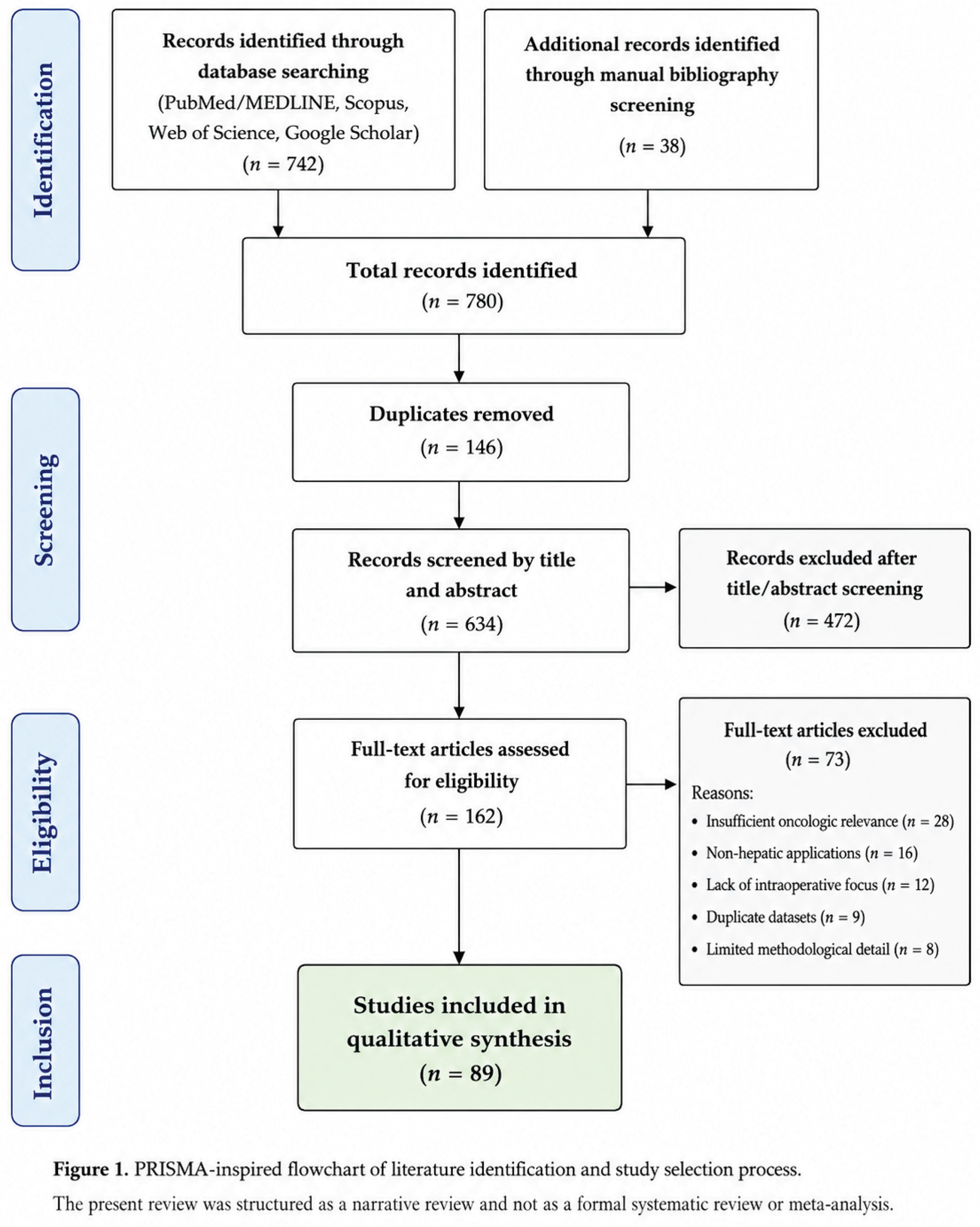
Figure 2.
Schematic timeline illustrating the progressive evolution of intraoperative ultrasound (IOUS) from conventional ultrasonographic guidance to modern digitally integrated precision hepatic surgery. The figure highlights the major technological milestones including advanced B-mode ultrasonography, contrast-enhanced intraoperative ultrasound (CE-IOUS), laparoscopic and robotic IOUS applications, fluorescence-guided surgery, navigation systems, augmented reality integration, and emerging artificial intelligence-assisted surgical platforms. Collectively, these developments contributed to improved lesion detection, enhanced intraoperative staging, optimization of parenchymal-sparing hepatectomy, and increased precision in hepatic oncology surgery.
Figure 2.
Schematic timeline illustrating the progressive evolution of intraoperative ultrasound (IOUS) from conventional ultrasonographic guidance to modern digitally integrated precision hepatic surgery. The figure highlights the major technological milestones including advanced B-mode ultrasonography, contrast-enhanced intraoperative ultrasound (CE-IOUS), laparoscopic and robotic IOUS applications, fluorescence-guided surgery, navigation systems, augmented reality integration, and emerging artificial intelligence-assisted surgical platforms. Collectively, these developments contributed to improved lesion detection, enhanced intraoperative staging, optimization of parenchymal-sparing hepatectomy, and increased precision in hepatic oncology surgery.
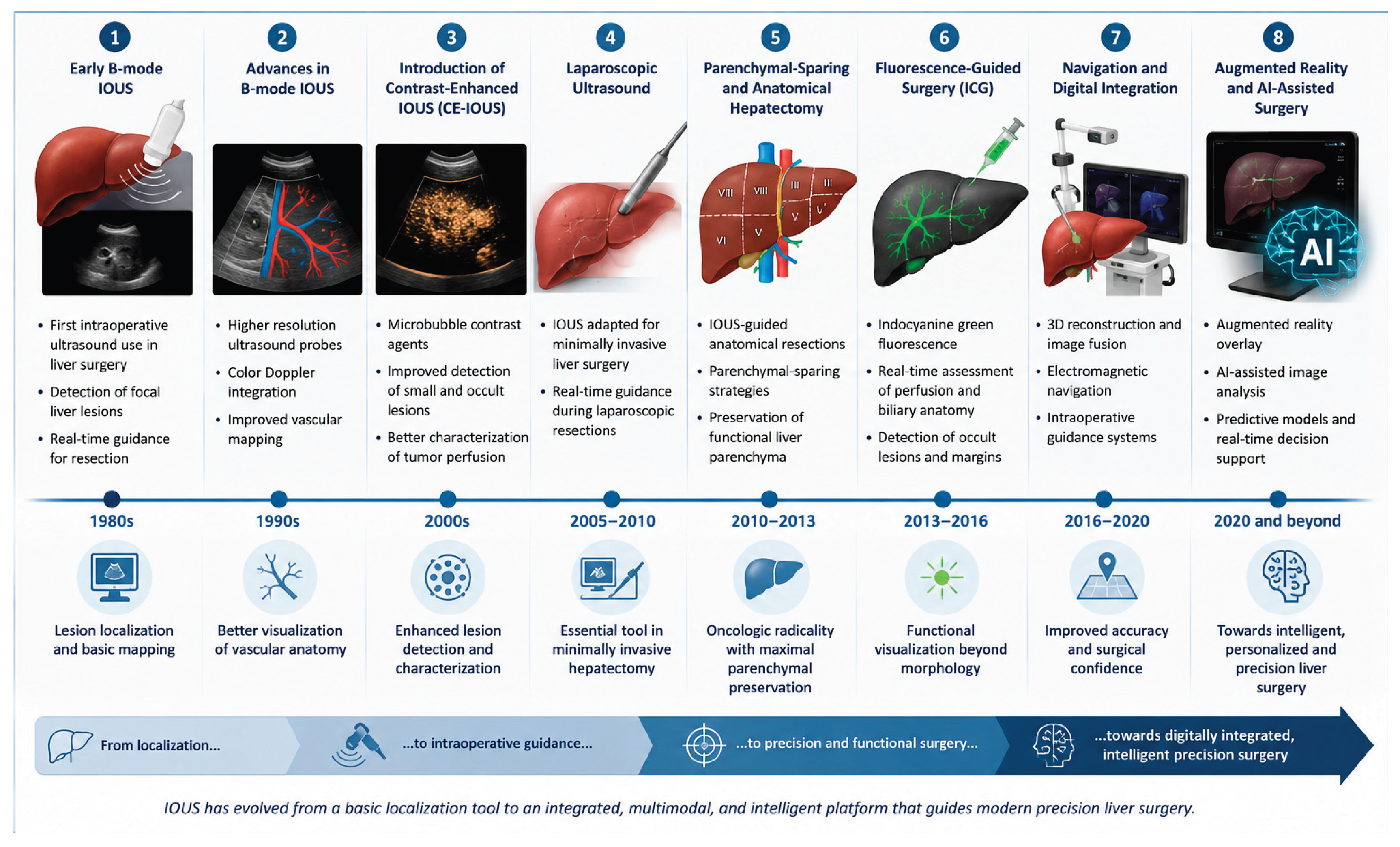
Figure 3.
Conceptual illustration demonstrating the integration of intraoperative ultrasound (IOUS) within the modern precision-guided hepatic surgery ecosystem. The figure highlights the interaction between preoperative imaging, contrast-enhanced intraoperative ultrasound (CE-IOUS), fluorescence-guided surgery, laparoscopic and robotic platforms, three-dimensional reconstruction, navigation systems, augmented reality technologies, and artificial intelligence-assisted analytics. Collectively, these modalities contribute to improved lesion detection, vascular mapping, intraoperative decision-making, parenchymal preservation, and individualized oncologic liver resection.
Figure 3.
Conceptual illustration demonstrating the integration of intraoperative ultrasound (IOUS) within the modern precision-guided hepatic surgery ecosystem. The figure highlights the interaction between preoperative imaging, contrast-enhanced intraoperative ultrasound (CE-IOUS), fluorescence-guided surgery, laparoscopic and robotic platforms, three-dimensional reconstruction, navigation systems, augmented reality technologies, and artificial intelligence-assisted analytics. Collectively, these modalities contribute to improved lesion detection, vascular mapping, intraoperative decision-making, parenchymal preservation, and individualized oncologic liver resection.
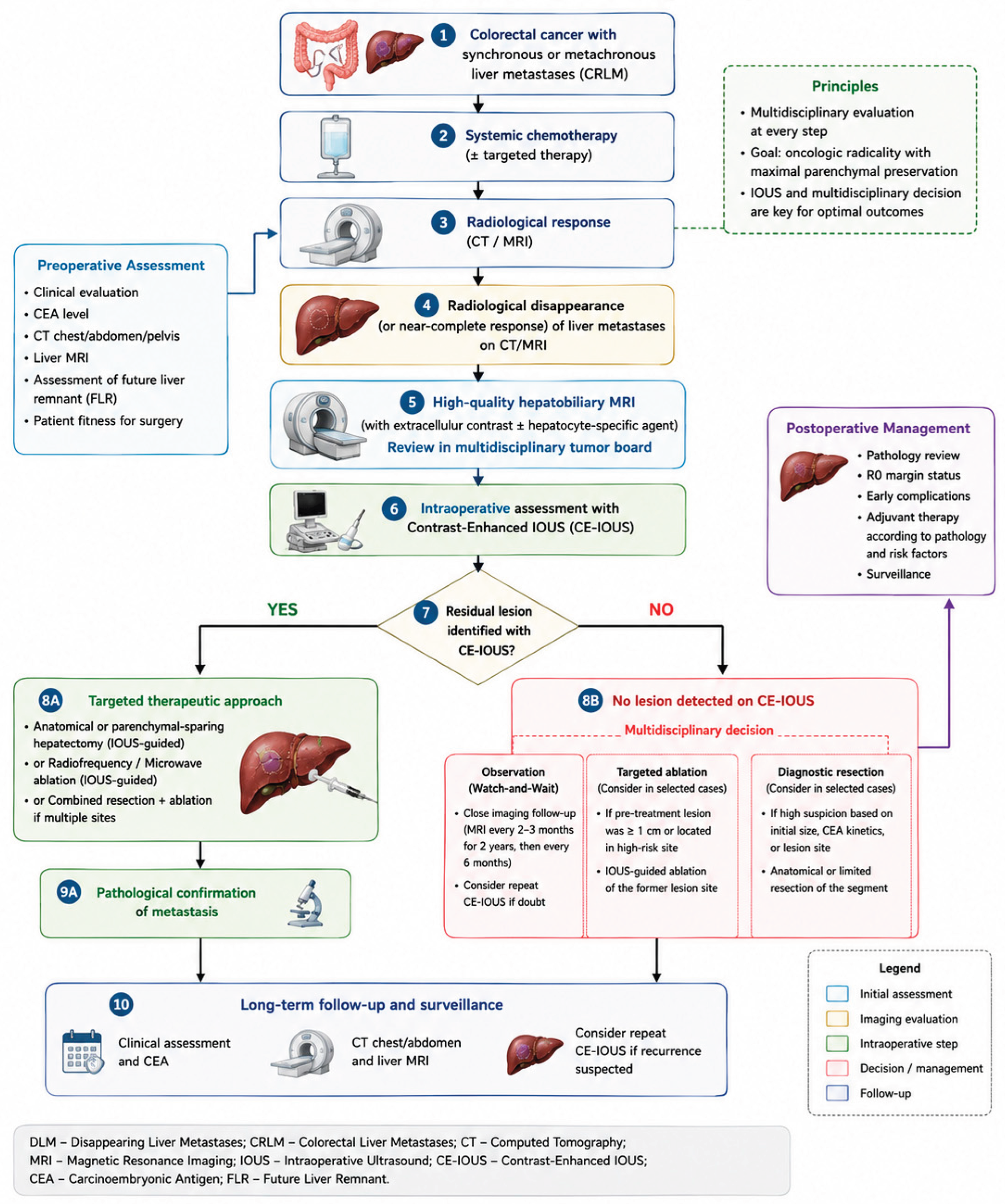
Figure 4.
Proposed multidisciplinary management algorithm for disappearing colorectal liver metastases (DLM) following systemic chemotherapy. The figure illustrates integration of preoperative imaging reassessment, hepatocyte-specific magnetic resonance imaging, contrast-enhanced intraoperative ultrasound (CE-IOUS), and intraoperative surgical decision-making to guide lesion localization, resection strategy, ablative treatment, or postoperative surveillance. The algorithm emphasizes the central role of real-time intraoperative imaging in balancing oncologic radicality with parenchymal preservation.
Figure 4.
Proposed multidisciplinary management algorithm for disappearing colorectal liver metastases (DLM) following systemic chemotherapy. The figure illustrates integration of preoperative imaging reassessment, hepatocyte-specific magnetic resonance imaging, contrast-enhanced intraoperative ultrasound (CE-IOUS), and intraoperative surgical decision-making to guide lesion localization, resection strategy, ablative treatment, or postoperative surveillance. The algorithm emphasizes the central role of real-time intraoperative imaging in balancing oncologic radicality with parenchymal preservation.
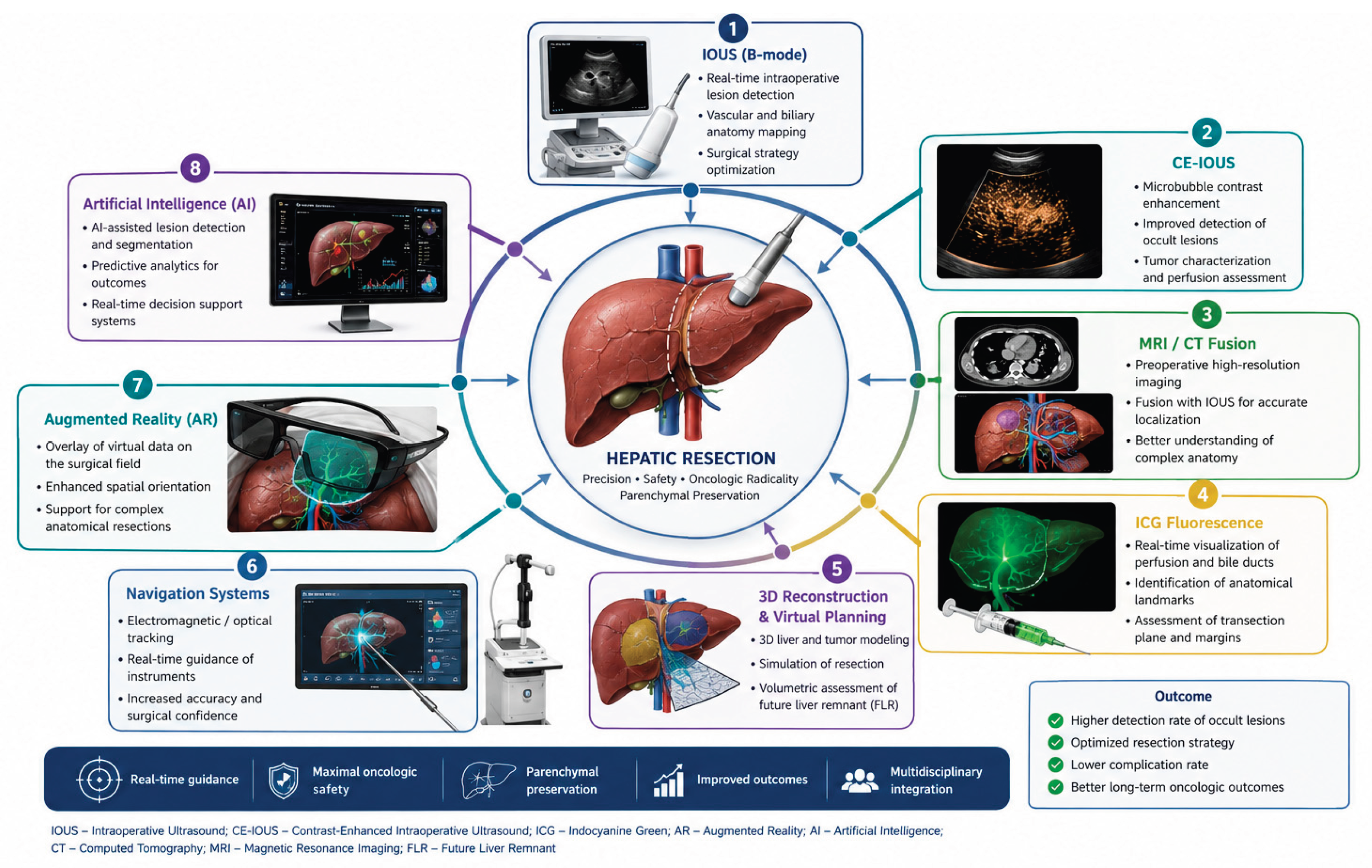

Table 1.
Major Clinical Applications of Intraoperative Ultrasound in Hepatic Oncology Surgery.
| Clinical Application | Role of IOUS | Main Surgical Benefit | Key References |
|---|---|---|---|
| Detection of occult hepatic lesions | Identification of small metastases and satellite nodules not detected preoperatively | Improved intraoperative staging and oncologic assessment | [5,6,7,8,13] |
| Contrast-enhanced lesion characterization (CE-IOUS) | Dynamic evaluation of vascular perfusion and residual viable tumor | Improved differentiation between malignant lesions, fibrosis, and chemotherapy-related changes | [14,15,16,17,18,19,20,21] |
| Intraoperative vascular mapping | Real-time visualization of portal pedicles and hepatic veins | Safer anatomical liver resections and preservation of vascular integrity | [28,29,30] |
| Parenchymal-sparing hepatectomy | Guidance of individualized transection planes | Preservation of functional liver reserve and reduction of postoperative liver insufficiency | [28,29,30,31,32,33,34,35] |
| Management of disappearing CRLM | Localization of occult residual metastatic disease after chemotherapy | Optimization of oncologic radicality while minimizing unnecessary liver sacrifice | [24,25,26,27,54,55,56,57,58] |
| Laparoscopic liver surgery | Real-time lesion localization in the absence of tactile feedback | Improved minimally invasive surgical navigation and operative precision | [22,23,39,40,41,42] |
| Robotic liver surgery | Intraoperative orientation and anatomical guidance | Enhanced precision during robotic hepatic resections | [68,69,70] |
| Navigation-assisted hepatic surgery | Integration with 3D reconstruction and augmented reality platforms | Improved spatial orientation during complex resections | [61,62,63,64,65,66,67] |
| Fluorescence-guided precision surgery | Combination with indocyanine green imaging and multimodal visualization | Enhanced tumor and biliary anatomy identification | [32,33,34] |
| AI-assisted hepatic surgery | Automated image analysis and intelligent intraoperative guidance | Potential future optimization of precision-guided liver surgery | [87,88,89] |
* Major contemporary clinical applications of intraoperative ultrasound in hepatic oncology surgery summarized from the hepatobiliary surgical oncology literature, emphasizing its role in lesion detection, intraoperative staging, parenchymal-sparing hepatectomy, minimally invasive liver surgery, and digitally assisted precision hepatic surgery.
Table 2.
Landmark Studies Evaluating IOUS and CE-IOUS in Hepatic Oncology Surgery.
| Author | Year | Study Type | Main Topic | Principal Findings |
|---|---|---|---|---|
| Ferrero et al. | 2005 | Prospective surgical study | IOUS in CRLM surgery | IOUS continued to modify operative strategy despite modern preoperative imaging |
| Jarnagin et al. | 1997 | Retrospective cohort | Intraoperative staging | IOUS improved detection of occult hepatic lesions and vascular relationships |
| Cohen et al. | 1991 | Clinical observational study | Hepatic lesion detection | IOUS identified additional malignant lesions not detected preoperatively |
| Sietses et al. | 2010 | Comparative study | IOUS vs preoperative imaging | Intraoperative ultrasonography significantly altered resection planning |
| Wagnetz et al. | 2011 | Comparative imaging study | MRI vs IOUS | IOUS remained complementary to high-resolution MRI and CT |
| Takahashi et al. | 2014 | Clinical study | CE-IOUS using perfluorobutane | Improved intraoperative detection and characterization of CRLM |
| Hoareau et al. | 2013 | Prospective study | CE-IOUS in CRLM | CE-IOUS improved identification of occult lesions after chemotherapy |
| Bitterer et al. | 2016 | Clinical review | CE-IOUS in hepatic oncology | Enhanced diagnostic sensitivity for HCC and CRLM |
| Russolillo et al. | 2015 | Comparative study | Laparoscopic IOUS | Laparoscopic ultrasound remained valuable despite liver-specific MRI |
| Torzilli et al. | 2008 | Surgical series | Parenchymal-sparing hepatectomy | IOUS-guided vascular-oriented resections preserved functional liver parenchyma |
| Arita et al. | 2019 | Clinical study | Anatomical liver resection | IOUS facilitated individualized segmental hepatectomy planning |
| Oba et al. | 2018 | DLM management study | Disappearing liver metastases | Residual viable tumor frequently persisted despite radiological disappearance |
* The table summarizes landmark clinical studies that significantly contributed to the evolution of intraoperative ultrasound and contrast-enhanced intraoperative ultrasound in hepatic oncology surgery, particularly regarding lesion detection, intraoperative staging, parenchymal-sparing hepatectomy, and precision-guided surgical strategies.
Table 3.
Comparative Imaging Modalities in Precision Hepatic Oncology Surgery.
| Imaging Modality | Main Advantages | Main Limitations | Best Clinical Applications |
|---|---|---|---|
| Computed Tomography (CT) | Wide availability; rapid acquisition; good vascular overview | Lower sensitivity for subcentimeter lesions and chemotherapy-treated metastases | Initial staging; assessment of vascular anatomy and extrahepatic disease |
| Magnetic Resonance Imaging (MRI) | Superior soft-tissue contrast; high sensitivity for CRLM; hepatocyte-specific contrast enhancement | Static preoperative assessment; limited intraoperative applicability | Detection of small liver metastases; characterization of indeterminate lesions |
| Intraoperative Ultrasound (IOUS) | Real-time intraoperative imaging; dynamic vascular mapping; lesion localization during surgery | Operator-dependent; limited standardization | Intraoperative staging; anatomical guidance during liver resection |
| Contrast-Enhanced IOUS (CE-IOUS) | Improved lesion characterization and vascular perfusion assessment; enhanced detection of occult disease | Requires expertise and contrast administration; interpretation variability | Detection of residual disease; disappearing liver metastases; chemotherapy-treated liver |
| Indocyanine Green (ICG) Fluorescence Imaging | Real-time superficial tumor and biliary visualization; useful in minimally invasive surgery | Limited tissue penetration depth; false-positive fluorescence possible | Laparoscopic and robotic liver surgery; bile duct visualization |
| Three-Dimensional (3D) Reconstruction | Improved anatomical understanding and operative simulation | Preoperative static model; limited real-time adaptability | Surgical planning; volumetric assessment; complex anatomical resections |
| Navigation Systems and Augmented Reality (AR) | Enhanced spatial orientation; integration of preoperative and intraoperative imaging | High technical complexity; limited availability; registration inaccuracies | Precision-guided hepatic surgery; complex minimally invasive resections |
| Artificial Intelligence (AI)-Assisted Imaging | Automated image analysis; predictive modeling; potential real-time decision support | Experimental stage; requires validation and computational infrastructure | Future precision hepatic surgery and intelligent navigation systems |
* Comparative overview of imaging modalities currently integrated into modern precision hepatic oncology surgery, emphasizing their respective advantages, limitations, and principal clinical applications in hepatobiliary oncologic practice.
Disclaimer/Publisher’s Note: The statements, opinions and data contained in all publications are solely those of the individual author(s) and contributor(s) and not of MDPI and/or the editor(s). MDPI and/or the editor(s) disclaim responsibility for any injury to people or property resulting from any ideas, methods, instructions or products referred to in the content. |
© 2026 by the authors. Licensee MDPI, Basel, Switzerland. This article is an open access article distributed under the terms and conditions of the Creative Commons Attribution (CC BY) license (http://creativecommons.org/licenses/by/4.0/).
Copyright: This open access article is published under a Creative Commons CC BY 4.0 license, which permit the free download, distribution, and reuse, provided that the author and preprint are cited in any reuse.


