

Submitted:
27 May 2026
Posted:
27 May 2026
You are already at the latest version
Abstract
We develop a non-associative hypercomplex spinor framework in which spacetime geometry, gauge interactions, and gravitational dynamics emerge from a unified E₆-related algebraic structure. The theory is constructed from a sixteen-dimensional steering–spinor geometry based on quaternionic, octonionic, and sedenionic sectors generated through the Cayley–Dickson hierarchy. Electromagnetic, weak, and strong interactions arise naturally from distinct spinor sectors and their tensor couplings, while spacetime curvature emerges from generalized steering operators and associator-induced geometric corrections. The resulting commutator and associator structures generate Yang–Mills-like gauge curvature and Einstein-like gravitational dynamics within a common algebraic framework. In the weak-field limit, the theory reproduces Newtonian gravity and admits Schwarzschild-like solutions. The framework further provides geometric interpretations of fermion generations and mass hierarchy, suggesting a possible pathway toward quantum gravity and unified fundamental interactions grounded in hypercomplex spinor geometry.
Keywords:
quantum gravity
; E6 symmetry
; hypercomplex algebra
; sedenions
; spinor structure
; Yang–Mills model
; Standard Model
; non-associative geometry
; curved spacetime structure
; gauge field theory
1. Introduction
The unification of gravity with the gauge interactions of the Standard Model [1] remains one of the central unresolved problems in theoretical physics. General relativity [2] successfully describes gravitational phenomena across astrophysical and cosmological scales through the geometric structure of spacetime. At the same time, quantum field theory [3] provides an accurate description of electromagnetic, weak, and strong interactions through gauge symmetries based on the groups U(1) [4], SU(2) [5], and SU(3) [6]. Despite their empirical successes, these two frameworks are formulated on fundamentally different mathematical principles. General relativity treats spacetime as a classical dynamical geometry, whereas quantum field theory assumes a fixed spacetime background and describes interactions through quantum gauge fields, such as proposed in the Yang-Mills theory [7] for later electroweak unification [8]. Constructing a unified framework that incorporates both gravity and gauge interactions within a common mathematical structure remains an outstanding challenge.
In conventional grand unified theories (GUTs) [8,9], the gauge interactions are embedded into larger symmetry groups such as SU(5) [10], SO(10) [11], and E6 [12]. Among these, the exceptional Lie group E6 possesses particularly rich mathematical structure and naturally accommodates fermion multiplets, internal gauge symmetries, and higher-dimensional representations. However, most GUT approaches treat gravity separately and do not explain the geometric origin of spacetime itself. Furthermore, the Standard Model still leaves several fundamental questions unanswered, including the origin of fermion generations [13], the hierarchy of particle masses [14], the nature of dark matter [15] and dark energy [16], and the mechanism by which gravity emerges at macroscopic scales.
These difficulties suggest that spacetime geometry and gauge structure may arise from a deeper algebraic foundation. Hypercomplex algebras [17] generated through the Cayley–Dickson doubling scheme [18] provide a natural framework for exploring such possibilities. Beginning from the real and complex numbers and extending through the quaternions [19], octonions [20], and sedenions [21], these algebras introduce progressively richer structures including non-commutativity and non-associativity. Hamilton’s 4D quaternionic algebra has long been associated with Minkowski spacetime [22], Lorentz transformations [23], and Maxwell’s equations [24], while 8D octonions have been connected to exceptional symmetries [25], SU(3) gauge structure [26], and non-Abelian interactions [27]. Sedenions, as 116D non-associative hypercomplex algebras, provide an enlarged internal structure capable of accommodating fermion generations and generalized geometric degrees of freedom [28].
A particularly important feature of sedenion algebra is the presence of nontrivial associators. For three algebra elements A, B, and C, the associator is defined by
Unlike associative algebras, where this quantity vanishes identically, the sedenion associator introduces additional geometric structure beyond ordinary commutator-based gauge theory. In the present work, we propose that commutators generate Yang–Mills gauge curvature [7], while associators generate gravitational curvature corrections associated with emergent spacetime geometry. In this picture, gravity is not introduced as a separate fundamental interaction but instead emerges from the deeper non-associative structure of hypercomplex spinor geometry.
The framework developed here is based on a sixteen-dimensional steering–spinor structure organized into five spinor sectors denoted by Γ, Θ, U, V, and W, as defined in our previous work on relations between sedenion algebra and SU(5) [29]. The external Γ-sector corresponds to spacetime degrees of freedom and generates the associative structure underlying electromagnetism. The Θ-sector introduces internal temporal directions associated with weak interactions and symmetry breaking. The remaining sectors U, V, and W encode internal spinor degrees of freedom associated with the three fermion generations. Together, these sectors form a hypercomplex geometric structure that naturally organizes gauge bosons, fermions, and gravitational degrees of freedom within a common algebraic framework.
Within this formulation, gauge fields emerge from generalized steering operators acting on the spinor sectors. Electromagnetic interactions arise from the associative quaternionic structure and preserve exact U(1) symmetry. Weak interactions emerge from non-associative octonionic directions, generating anisotropic internal couplings and massive gauge bosons. Strong interactions arise from tensor products between external and internal spinor sectors, leading to an SU(3)-like structure associated with gluon fields. The resulting gauge curvature is generated through commutators of generalized steering operators in direct analogy with Yang–Mills theory.
The gravitational sector emerges at a deeper level through associator-induced geometry. Metric-like quantities are constructed from bilinear combinations of hypercomplex spinor fields, while generalized curvature operators arise from both commutators and associators of steering derivatives. In the weak-field limit, the resulting equations reproduce Newtonian gravity and admit Einstein-like gravitational dynamics. Schwarzschild-like solutions [30] emerge naturally at leading order, indicating consistency with classical gravitational phenomenology. Unlike conventional approaches, however, spacetime geometry here is not assumed a priori but arises from algebraic relations among spinor components.
The present work, therefore, proposes a unified framework in which gauge structure and spacetime curvature emerge simultaneously from a common non-associative hypercomplex spinor geometry related to E6 symmetry. Rather than treating gravity and gauge interactions as fundamentally separate entities, the theory interprets both as manifestations of underlying algebraic curvature associated with steering–spinor dynamics. In this sense, the framework represents an emergent Einstein–Yang–Mills structure grounded in hypercomplex geometry.
The paper is organized as follows. Section 2 introduces the hypercomplex algebraic hierarchy and the E6-related steering–spinor structure. Section 3 develops the generalized spinor fields and algebraic action principle. Section 4 derives the emergent gauge structure and Yang–Mills-like curvature. Section 5 develops the associator-induced gravitational geometry and emergent Einstein-like equations. Section 6 examines the weak-field and classical limits of the theory. Section 7 discusses fermion generations and mass hierarchy from internal spinor geometry. Section 8 explores implications for quantum gravity and cosmology. Finally, Section 9 and Section 10 present the discussion, conclusions, and outlook toward a deeper algebraic formulation of quantum gravity.
2. Hypercomplex Algebra and E6 Spinor Geometry
2.1. Cayley–Dickson Algebraic Hierarchy
The mathematical foundation of the present framework is based on the Cayley–Dickson construction [18], which generates progressively richer hypercomplex algebras through repeated doubling of lower-dimensional number systems. Beginning from the real numbers ℝ, one obtains the sequence
where , , , and denote the complex numbers, quaternions, octonions, and sedenions, respectively. At each stage, the dimensionality doubles:
The algebraic properties also evolve systematically. Complex numbers remain commutative and associative. Quaternions lose commutativity but preserve associativity. Octonions are non-commutative and non-associative but remain alternative. Sedenions lose even alternativity and possess nontrivial associators and zero divisors.
The progressive algebraic evolution underlying the Cayley–Dickson hierarchy is summarized in Table 1. As the dimensionality increases from the real numbers to the sedenions, the algebra undergoes successive symmetry reductions, first losing commutativity and later associativity. In the present framework, these algebraic transitions are interpreted physically as the emergence of increasingly rich geometric and interaction structures. Associative quaternionic geometry is associated with spacetime and rotational symmetry, octonionic non-associativity introduces non-Abelian gauge structure, and the sedenion sector provides the additional internal and associator degrees of freedom required for emergent gravitational curvature and fermion-generation structure.
This progressive loss of algebraic symmetry introduces additional geometric and dynamical degrees of freedom. In the present work, these algebraic transitions are interpreted physically as the origin of increasingly rich interaction structures.
This progressive loss of algebraic symmetry introduces additional geometric and dynamical degrees of freedom. In the present work, these algebraic transitions are interpreted physically as the origin of increasingly rich interaction structures. Associative quaternionic geometry corresponds to spacetime and electromagnetism, octonionic non-associativity generates non-Abelian gauge structure, and sedenionic geometry introduces the additional internal directions required for fermion generations and emergent gravitational curvature.
Figure 1 illustrates the Cayley–Dickson algebraic hierarchy underlying the present hypercomplex steering–spinor framework. Beginning from the real numbers and progressing through complex numbers, quaternions, octonions, and sedenions, each algebraic doubling introduces additional geometric and algebraic structure. The hierarchy reflects a progressive transition from fully commutative and associative systems toward noncommutative and non-associative hypercomplex geometry. In the present framework, this algebraic evolution is interpreted physically as the origin of increasingly rich interaction structures, culminating in emergent gauge curvature and associator-induced gravitational geometry within the sedenion sector.
The hypercomplex hierarchy therefore provides not merely a mathematical extension of number systems but an algebraic ladder underlying the emergence of spacetime geometry and gauge interactions.
2.2. Sedenion Basis Structure
We consider a sixteen-dimensional sedenion algebra [21] generated by the basis elements
where is the identity element and the remaining fifteen basis elements satisfy
A general sedenion element may be written as
where are real coefficients.
Unlike quaternionic algebra, multiplication of sedenion basis elements is generally non-associative:
The deviation from associativity is quantified by the associator
This associator plays a central role in the present framework. In ordinary Yang–Mills theory, gauge curvature arises from commutators of covariant derivatives. Here, the associator introduces an additional geometric structure beyond ordinary gauge curvature. We interpret this associator-induced structure as the algebraic origin of emergent gravitational curvature.
The sedenion algebra therefore contains two fundamentally different geometric operations:
- commutators associated with gauge curvature,
- associators associated with emergent gravitational curvature.
This distinction forms one of the central conceptual foundations of the present theory.
2.3. Steering–Spinor Sector Decomposition
The fifteen imaginary basis elements are organized into five triplet sectors [29]:
Together with the identity element , these sectors account for all sixteen algebraic degrees of freedom:
Each sector possesses a distinct physical interpretation.
The Γ-sector corresponds to external spacetime geometry and generates the associative quaternionic structure associated with electromagnetism and Lorentz-like spacetime symmetry.
The Θ-sector introduces internal temporal directions associated with symmetry breaking and weak interactions.
The U, V, and W sectors define internal spinor structures associated with the three fermion generations.
A generalized steering–spinor field is constructed as
These spinor sectors form the fundamental dynamical variables of the theory.
The decomposition also introduces a natural separation between external spacetime geometry and internal interaction geometry. In this picture, spacetime and gauge structure are unified through the organization of the hypercomplex spinor sectors rather than through independently imposed symmetry groups.
2.4. Emergent E6 Organization
Exceptional Lie groups possess deep connections with hypercomplex algebras, particularly octonions and higher Cayley–Dickson structures. Among these exceptional groups, E6 is especially significant because it naturally accommodates gauge symmetries, fermionic representations, and higher-dimensional algebraic structure within a unified framework.
In the present approach, E6 symmetry is not introduced as an external gauge group imposed a priori. Instead, it emerges as an organizational structure associated with the steering–spinor geometry of the hypercomplex algebra.
The Γ-sector generates the external spacetime structure associated with Lorentz-like geometry and U(1) electromagnetism. The Θ-sector introduces non-associative internal directions associated with SU(2)-like weak interactions. Tensor products between Γ and the internal spinor sectors generate SU(3)-like color structure. The U, V, and W sectors naturally accommodate the three fermion generations.
The combined spinor structure, therefore, organizes the algebraic degrees of freedom in a manner consistent with the decomposition
However, unlike conventional grand unified theories, the present framework interprets this structure geometrically rather than purely group-theoretically. The exceptional structure arises from relations among hypercomplex spinor sectors and their generalized curvature operators.
In this sense, E6 acts not merely as a gauge embedding symmetry but as an emergent algebraic geometry unifying:
- spacetime structure,
- gauge curvature,
- fermion generations,
- and associator-induced gravitational dynamics.
The resulting framework suggests that both Yang–Mills interactions and Einstein-like gravitational geometry arise from a common hypercomplex spinor foundation.
The following paragraph may be inserted near the end of Section 2.4, immediately before the figure.
The physical interpretation of the Cayley–Dickson hierarchy within the present framework is illustrated schematically in Figure 2. As the algebraic structure progresses from complex numbers to quaternions, octonions, and sedenions, progressively richer geometric and physical structures emerge. Complex numbers generate Abelian U(1) phase symmetry associated with electromagnetism, while quaternions naturally encode spacetime and spin geometry. Octonions introduce non-Abelian gauge structure related to weak and strong interactions, and the non-associative sedenion sector gives rise to associator-induced gravitational curvature and fermion-generation structure. The hierarchy therefore provides a unified algebraic pathway connecting gauge interactions and emergent spacetime geometry.
3. Steering–Spinor Fields and Algebraic Action Principle
3.1. Fundamental Steering–Spinor Field
The fundamental dynamical object of the present framework is a generalized steering–spinor field defined on the sixteen-dimensional hypercomplex algebra introduced in the previous section. We denote this field by
where are the sedenion basis elements and are spacetime-dependent coefficient functions.
The spinor field naturally decomposes into the five steering sectors:
with
The Γ-sector describes external spacetime geometry, while the remaining sectors encode internal spinor structure associated with gauge interactions and fermion generations.
In contrast to conventional quantum field theory, where spacetime is assumed a priori, the present framework treats the spinor field as fundamental and interprets spacetime geometry as an emergent collective structure generated by spinor bilinears.
3.2. Bilinear Construction of Geometry
To construct spacetime geometry from the underlying steering–spinor field, we introduce generalized bilinear combinations of the form [32]
where are generalized steering operators acting on the hypercomplex spinor space.
This bilinear object plays the role of an emergent metric tensor. The symmetric part,
defines the effective spacetime geometry, while the antisymmetric part,
encodes additional non-associative geometric structure associated with internal spinor couplings.
In this formulation, spacetime geometry is not fundamental but emerges from algebraic correlations among spinor components. The effective four-dimensional structure arises from projections of the Γ-sector onto observable spacetime directions.
The bilinear construction also provides a natural bridge between gauge structure and geometry, since both arise from the same underlying spinor algebra.
3.3. Generalized Steering Operator
To describe dynamics, we introduce a generalized steering derivative operator
where is a hypercomplex connection operator constructed from the steering–spinor sectors.
The connection decomposes naturally into several components:
Here:
- corresponds to the electromagnetic U(1)-like sector,
- corresponds to weak SU(2)-like structure,
- corresponds to strong SU(3)-like interactions,
- represents associator-induced gravitational contributions.
The curvature associated with the generalized steering derivative is generated through the commutator [33]
This object generalizes ordinary Yang–Mills field strength tensors and incorporates the various gauge sectors within a unified algebraic structure.
However, because the underlying hypercomplex algebra is non-associative, an additional geometric quantity also appears:
where
This associator-induced curvature has no analogue in conventional gauge theory and forms the basis of the emergent gravitational sector.
3.4. Hypercomplex Action Principle
We now introduce an effective algebraic action governing the dynamics of the steering–spinor fields and generalized curvature operators [34]:
The spinor kinetic term [35] is written as
The generalized Yang–Mills sector is constructed from commutator curvature [36]:
The associator contribution is introduced through
where determines the strength of non-associative geometric corrections.
Unlike conventional Einstein gravity, where curvature is postulated geometrically from the outset, the present framework derives curvature dynamically from algebraic properties of steering operators. Commutators generate gauge curvature, while associators generate emergent gravitational geometry.
Variation of the action with respect to the generalized spinor field yields coupled Einstein–Yang–Mills-like equations governing both gauge interactions and emergent spacetime curvature.
In this picture, gravity and gauge interactions are interpreted as different manifestations of the same underlying hypercomplex algebraic dynamics.
3.5. Physical Interpretation
The algebraic action introduced above provides a unified dynamical framework in which:
- gauge interactions arise from associative and partially non-associative commutator structure,
- gravity emerges from deeper associator-induced curvature,
- spacetime geometry is generated from spinor bilinears,
- and fermion generations correspond to internal hypercomplex spinor sectors.
The distinction between gauge curvature and gravitational curvature is therefore algebraic rather than fundamentally geometric. Yang–Mills dynamics originate from commutators of steering derivatives, whereas Einstein-like curvature emerges from non-associative associator structure.
This provides a new interpretation of quantum gravity in which spacetime itself is an emergent manifestation of deeper hypercomplex spinor geometry.
4. Emergent Gauge Structure
4.1. Electromagnetic Sector from Quaternionic Geometry
The simplest interaction sector of the present framework arises from the associative quaternionic Γ-sector generated by the basis elements
This sector corresponds to the external spacetime geometry and preserves associativity, making it the natural origin of the electromagnetic interaction.
We introduce the complexified quaternionic field
where and denote generalized electric and magnetic fields [37] embedded in the Γ-sector.
The generalized steering derivative restricted to the associative sector becomes
where is the electromagnetic gauge potential.
The corresponding field strength tensor is generated through the commutator
This reproduces the standard Abelian U(1) gauge curvature [38].
The associativity of the quaternionic sector ensures isotropic internal coupling and exact phase symmetry. Consequently, the photon remains massless, corresponding to the fully symmetric configuration of the associative Γ-sector.
In the present framework, electromagnetism therefore emerges naturally as the lowest-level associative structure within the hypercomplex algebraic hierarchy.
4.2. Weak Interaction from Octonionic Structure
The weak interaction emerges when the associative quaternionic structure is extended into the non-associative octonionic sector through the internal temporal spinor structure
A crucial transition occurs when the ordinary complex unit is replaced by an octonionic internal direction:
This replacement introduces intrinsic non-associativity and internal anisotropy into the interaction structure.
The generalized weak field is therefore written as
Unlike the electromagnetic case, the octonionic basis element does not associate trivially with other internal directions. This breaks the perfect symmetry of the associative sector and generates internal coupling anisotropy.
The weak gauge operators are constructed as
where belong to the internal spinor sector.
The generalized weak curvature tensor becomes
The resulting algebra closes approximately into an SU(2)-like structure:
The non-associative internal anisotropy lifts degeneracies among composite spinor states and generates massive vector bosons.
In this framework, weak-boson masses emerge geometrically from non-associative internal coupling rather than from a fundamental Higgs scalar field [39].
4.3. Strong Interaction from Tensor Spinor Products
The strong interaction emerges from tensor products between external and internal spinor sectors. We construct composite operators of the form
where
These tensor products generate a combined external–internal spinor space containing non-Abelian color structure.
Generalized gluon operators are defined as
where are structure coefficients are determined by the hypercomplex algebra.
The generalized strong-sector curvature tensor is generated by
Restricting to traceless combinations produces eight independent generators satisfying an SU(3)-like algebra [40]:
In contrast to the weak sector, the strong interaction does not involve the bridge element . Consequently, the internal coupling remains effectively symmetric within the tensor product space.
This preserves degeneracy among gluon modes and explains the massless nature of gluons.
Within the present framework, color interactions are therefore interpreted as composite excitations arising from coupled external and internal spinor geometry.
4.4. Unified Yang–Mills Curvature
The electromagnetic, weak, and strong sectors may now be combined into a unified generalized steering connection:
The full Yang–Mills-like curvature tensor [7] is then generated through the commutator
This expression unifies Abelian and non-Abelian gauge curvature within a common hypercomplex algebraic structure.
The commutator curvature contains:
- associative contributions from the Γ-sector,
- partially non-associative contributions from the Θ-sector,
- tensor-spinor contributions from Γ ⊗ U structure.
The gauge interactions of the Standard Model therefore emerge naturally from the organization of steering–spinor sectors rather than from externally imposed gauge groups.
Importantly, the present framework interprets Yang–Mills curvature as arising from algebraic commutator structure, while gravitational curvature arises from deeper associator structure discussed in the following section.
This distinction forms the central geometric principle of the theory:
4.5. Physical Interpretation
The emergent gauge structure developed above suggests that gauge interactions are manifestations of progressively richer hypercomplex geometry.
- Electromagnetism corresponds to associative quaternionic geometry.
- Weak interactions arise from octonionic anisotropy and partial non-associativity.
- Strong interactions emerge from tensor couplings between external and internal spinor sectors.
The Standard Model gauge structure therefore appears not as a fundamental input but as an emergent consequence of hypercomplex spinor organization.
This viewpoint shifts the interpretation of gauge symmetry from an externally imposed principle to an intrinsic property of the underlying steering–spinor algebra.
While the generalized commutator structure successfully reproduces Yang–Mills-like gauge dynamics, it does not yet generate dynamical spacetime curvature. The deeper geometric sector of the theory emerges only when the non-associative structure of the hypercomplex algebra is fully incorporated through associator geometry. We now show that these associator contributions naturally generate emergent Einstein-like gravitational dynamics.
5. Associator-Induced Gravitational Geometry
5.1. Associator as Geometric Curvature
In conventional Yang–Mills theory, curvature arises from the non-commutativity of covariant derivatives. The corresponding field strength tensor is generated through the commutator
This structure describes gauge interactions successfully within associative algebraic frameworks. However, ordinary commutator geometry is insufficient to generate spacetime curvature dynamically, since it does not incorporate the deeper non-associative structure present in higher hypercomplex algebras.
Within the present framework, gravity emerges from the associator structure of the sedenion algebra. For three generalized operators , , and , the associator is defined as
Unlike commutators, associators measure the failure of associativity itself. In associative algebras, such as complex numbers and quaternions, the associator vanishes identically. In octonionic and sedenionic geometry, however, nontrivial associators appear naturally and introduce additional geometric degrees of freedom.
We therefore interpret the associator as the algebraic origin of gravitational curvature.
This interpretation introduces a fundamental distinction between gauge interactions and gravity:
In this picture, spacetime curvature emerges from the non-associative structure of hypercomplex geometry rather than from an independently postulated metric manifold.
5.2. Emergent Metric and Connection
To construct gravitational geometry, we begin from the bilinear spinor metric introduced previously:
The metric tensor is therefore not fundamental but emerges dynamically from steering–spinor correlations.
The generalized steering derivative takes the form
where:
- contains the Yang–Mills gauge structure,
- denotes associator-induced geometric contributions.
The connection arises from internal hypercomplex spinor couplings involving non-associative sectors of the algebra.
Unlike ordinary gauge connections, the associator connection modifies not only internal gauge transport but also the effective spacetime geometry itself.
The emergent affine structure is therefore generated algebraically through steering–spinor interactions rather than assumed geometrically from the outset.
5.3. Curvature from Generalized Operators
The generalized curvature structure contains two distinct contributions.
The first is the ordinary commutator curvature:
This generates the Yang–Mills gauge sector discussed previously.
The second is the associator curvature:
Explicitly,
This quantity vanishes in associative gauge theory but survives in the non-associative hypercomplex framework.
The associator curvature introduces corrections to ordinary geometric transport and modifies the effective spacetime connection.
We therefore define a generalized gravitational curvature tensor schematically as
where controls the strength of non-associative geometric contributions.
This expression shows that ordinary Yang–Mills curvature and associator-induced gravitational corrections arise naturally within the same algebraic structure.
The geometry of spacetime therefore emerges from generalized steering-operator algebra rather than from an independently prescribed manifold.
5.4. Emergent Einstein-like Field Equations
To derive gravitational dynamics, we consider the variation of the hypercomplex action introduced previously:
Variation with respect to the emergent metric yields effective field equations of the form
Here:
The additional associator term acts as an effective geometric stress-energy contribution generated entirely from non-associative spinor geometry.
This structure differs fundamentally from ordinary Einstein gravity because the curvature itself contains algebraically induced corrections associated with internal hypercomplex geometry.
At leading order, however, the equations reduce approximately to Einstein-like gravitational dynamics, ensuring consistency with classical gravitational phenomenology.
5.5. Associator-Induced Gravitational Corrections
The associator sector naturally generates finite-range gravitational corrections in the weak-field regime.
Linearization of the generalized field equations leads schematically to
where is an effective associator scale determined by the hypercomplex geometry.
The resulting solution takes the Yukawa-type form [45]
Such corrections arise naturally from the associator structure without introducing additional dark matter particles.
This mechanism provides a direct connection between non-associative hypercomplex geometry and modified large-scale gravitational dynamics.
In this picture:
- ordinary Einstein gravity corresponds to the associative limit,
- deviations from classical gravity arise from associator-induced curvature corrections.
5.6. Physical Interpretation
The present framework suggests a fundamentally new interpretation of gravity.
Rather than treating spacetime curvature as primary, the theory interprets gravity as an emergent manifestation of non-associative hypercomplex spinor geometry.
Yang–Mills interactions arise from commutator structure, while gravitational curvature emerges from associator structure. Both sectors therefore originate from a common algebraic foundation.
This viewpoint naturally unifies:
- gauge interactions,
- emergent spacetime geometry,
- fermion structure,
- and gravitational dynamics
within a single hypercomplex steering–spinor framework related to E6 geometry.
The resulting structure provides a possible algebraic pathway toward quantum gravity in which spacetime itself is not fundamental but emerges dynamically from deeper spinor correlations and non-associative geometric relations.
6. Weak-Field and Classical Limits
6.1. Linearized Geometry
To establish consistency with classical gravitational physics, we examine the weak-field limit of the associator-induced gravitational equations derived in the previous section.
We consider small perturbations about an approximately flat background geometry:
where is the Minkowski metric and denotes small geometric perturbations generated by steering–spinor interactions.
The generalized curvature tensor then decomposes into a leading Einstein-like contribution and higher-order associator corrections [46]:
Here:
- corresponds to ordinary linearized gravitational curvature,
- contains corrections generated by non-associative hypercomplex geometry.
At sufficiently large scales or weak associator coupling, the correction terms become small, and the theory approaches classical Einstein gravity.
The linearized limit therefore provides a consistency condition connecting the emergent hypercomplex geometry with observed macroscopic gravitational phenomena.
6.2. Newtonian Limit
In the nonrelativistic regime, the dominant metric component is
where is the effective gravitational potential.
Substituting the weak-field expansion into the generalized Einstein-like equations yields the modified Poisson equation
where:
- is the mass density,
- is an effective associator scale generated by non-associative geometry.
The corresponding solution becomes
In the limit
the standard Newtonian potential is recovered:
The Newtonian limit therefore emerges naturally as the associative approximation of the underlying hypercomplex geometry.
This result establishes that classical gravitational dynamics are reproduced at ordinary astrophysical scales while permitting small associator-induced deviations at large distances.
6.3. Schwarzschild-like Solutions
We next consider static, spherically symmetric configurations.
The generalized emergent metric is written as
The generalized field equations yield an effective metric function of the form
where contains higher-order associator contributions.
The theory, therefore, reproduces standard black-hole geometry at leading order while predicting possible corrections near strong-curvature regimes.
These corrections arise entirely from the non-associative structure of the underlying spinor geometry and not from additional exotic matter sources.
6.4. Effective Horizon Structure
The presence of associator-induced corrections modifies the near-horizon structure of compact objects.
The effective horizon radius is determined by
Because the associator corrections become increasingly important in strong-curvature regimes, the horizon structure may deviate slightly from the classical Schwarzschild prediction.
At sufficiently high curvature, the associator sector contributes an effective geometric pressure that can soften singular behavior near the origin.
This suggests that non-associative hypercomplex geometry may provide a natural mechanism for regulating curvature singularities without requiring ad hoc quantum corrections.
The resulting compact-object geometry therefore interpolates between:
- classical Einstein gravity at macroscopic scales,
- and associator-dominated quantum geometry at very small scales.
6.5. Classical Einstein Limit
An essential consistency requirement of any emergent quantum-gravity framework is the recovery of classical Einstein gravity in the appropriate limit.
Within the present theory, this limit corresponds to suppression of non-associative effects:
Under this condition:
- associator curvature vanishes,
- generalized steering geometry reduces to ordinary commutator geometry,
- and the emergent field equations reduce approximately to Einstein’s field equation [48]
Thus, Einstein gravity appears as the associative low-energy limit of the deeper hypercomplex steering–spinor geometry.
This provides a natural algebraic interpretation of classical spacetime:ordinary Riemannian geometry corresponds to the regime in which associator effects become negligible.
6.6. Physical Interpretation
The weak-field analysis demonstrates that the present framework reproduces the major phenomenological features of classical gravity while introducing controlled deviations associated with non-associative geometry.
Several important features emerge naturally:
- Newtonian gravity appears as the associative limit of hypercomplex geometry.
- Schwarzschild-like solutions arise from generalized steering curvature.
- Associator-induced corrections generate finite-range modifications of gravity.
- Strong-curvature regions receive natural geometric corrections without introducing additional exotic matter fields.
- Classical Einstein gravity emerges as an effective macroscopic approximation of deeper non-associative spinor geometry.
The theory therefore provides a continuous bridge between:
- ordinary classical gravity,
- Yang–Mills gauge structure,
- and emergent quantum gravitational geometry.
This unified interpretation represents one of the central conceptual outcomes of the present E6 hypercomplex steering–spinor framework.
7. Fermion Generations and Mass Hierarchy
Having established the emergent gauge and gravitational structure of the theory, we next examine how the internal steering–spinor sectors naturally generate fermion generations and hierarchical mass structure.
7.1. Internal Spinor Directions and Generation Structure
One of the longstanding unresolved problems of the Standard Model is the existence of three generations and the origin of their hierarchical mass structure. In conventional gauge theory, the three generations are introduced phenomenologically without a deeper geometric explanation. In the present framework, however, the generation structure emerges naturally from the internal organization of the hypercomplex steering–spinor sectors.
The sixteen-dimensional sedenion algebra contains three internal spatial spinor sectors:
These sectors possess identical dimensionality but occupy progressively deeper layers of the hypercomplex algebraic hierarchy.
We interpret:
- the -sector as the first fermion generation,
- the -sector as the second generation,
- the -sector as the third generation.
The generation structure, therefore, arises geometrically from internal spinor directions rather than being imposed externally.
In this picture, elementary fermions correspond to localized steering–spinor excitations embedded within distinct internal hypercomplex sectors.
7.2. External–Internal Spinor Coupling
Fermionic states are constructed through couplings between the external spacetime sector Γ and the internal generation sectors , , and .
We define generalized fermionic spinors schematically as
where
The external Γ-sector determines ordinary spacetime properties such as Lorentz structure and electromagnetic coupling, while the internal sectors determine generation-dependent properties.
The three generations, therefore, correspond to distinct internal spinor embeddings:
This construction naturally explains why all fermion generations possess identical gauge quantum numbers while differing primarily in mass scale.
Their gauge structure originates from the common Γ-sector, whereas their masses depend on internal hypercomplex geometry.
7.3. Geometric Origin of Mass Hierarchy
Within the present framework, particle masses do not arise from Yukawa couplings to a fundamental Higgs scalar field. Instead, masses emerge from internal anisotropic couplings associated with non-associative steering–spinor geometry.
The effective fermion mass is assumed to depend on the magnitude of internal hypercomplex coupling:
where denotes an effective internal steering Hamiltonian generated by non-associative interactions.
Because the , , and sectors occupy progressively deeper hypercomplex levels, the effective internal coupling strength increases with algebraic depth.
This naturally generates hierarchical mass scales:
The first generation, therefore, corresponds to the most symmetric and weakly coupled internal configuration, while higher generations correspond to progressively more anisotropic internal spinor structures.
Mass hierarchy is thus interpreted geometrically rather than phenomenologically.
7.4. Associator Contributions and Generation Splitting
The non-associative structure of the sedenion algebra also contributes directly to generation splitting.
For internal spinor sectors , associator terms of the form
introduce generation-dependent corrections to effective mass operators.
Because the associator vanishes in associative sectors but survives in deeper hypercomplex geometry, higher-generation fermions experience larger internal geometric corrections.
This provides a natural explanation for:
- increasing fermion masses,
- stronger instability of higher generations,
- and enhanced coupling to non-associative internal geometry.
The present framework therefore links fermion hierarchy directly to the degree of non-associativity of the underlying spinor structure.
7.5. Flavor Mixing and Internal Rotations
The internal steering–spinor sectors also provide a geometric interpretation of flavor mixing.
Mixing between generations is described through internal rotations among the , , and sectors:
where denotes generalized hypercomplex rotation operators.
These internal rotations generate off-diagonal couplings between generation sectors and lead naturally to mixing matrices analogous to:
Flavor oscillations are therefore interpreted geometrically as rotations within internal hypercomplex spinor space.
This interpretation provides a unified algebraic picture of:
- fermion generations,
- mass hierarchy,
- and flavor mixing.
7.6. Fractional Charge and Internal Projection Structure
The hypercomplex spinor framework also suggests a geometric interpretation of fractional electric charge.
Electromagnetic charge is associated primarily with the associative Γ-sector. However, internal spinor projections onto the non-associative sectors modify the effective coupling strength observed externally.
Different projection structures, therefore, produce effective fractional charges.
Schematically,
where is an internal projection factor determined by the steering–spinor geometry.
This provides a possible geometric origin for the appearance of:
- integer lepton charges,
- and fractional quark charges.
Charge quantization, therefore, emerges from internal hypercomplex projection structure rather than being imposed externally.
7.7. Physical Interpretation
The steering–spinor framework developed above suggests that fermion properties originate from internal hypercomplex geometry.
Several important features emerge naturally:
- Three fermion generations correspond to distinct internal spinor sectors.
- Mass hierarchy arises from increasing non-associative internal coupling.
- Flavor mixing corresponds to internal hypercomplex rotations.
- Fractional electric charge emerges from projection geometry.
- Gauge quantum numbers remain universal because all generations share the same external Γ-sector.
The Standard Model fermion structure therefore appears as an emergent manifestation of deeper steering–spinor geometry associated with the E6-related hypercomplex algebra.
In this picture, fermions are not elementary point particles placed into arbitrary generations, but rather distinct geometric excitations embedded within different layers of non-associative spinor space.
8. Quantum Gravity Implications
8.1. Emergent Spacetime from Spinor Geometry
A central feature of the present framework is the interpretation of spacetime geometry as an emergent phenomenon arising from underlying hypercomplex steering–spinor structure. Unlike conventional approaches, where spacetime is assumed as a preexisting differentiable manifold, the present theory treats the spinor field as fundamental and derives geometry from algebraic correlations among spinor components.
The effective metric tensor is constructed from generalized bilinear spinor projections:
In this picture, spacetime geometry represents a collective macroscopic manifestation of deeper algebraic relations within the hypercomplex spinor space.
The external Γ-sector generates the approximately associative geometry associated with observable four-dimensional spacetime, while the internal sectors encode additional nonlocal and non-associative structure.
Classical spacetime, therefore, emerges as an effective low-energy approximation of a deeper hypercomplex quantum geometry.
8.2. Non-Associative Quantum Structure
Ordinary quantum field theory is fundamentally based on associative operator algebra. The present framework extends this structure by incorporating non-associative operator geometry through the sedenion associator.
The associator
introduces additional geometric degrees of freedom beyond ordinary commutator structure.
At sufficiently small scales or high curvature, associator effects become increasingly important and modify the effective structure of spacetime geometry.
This suggests that the classical notion of sharply defined spacetime points may break down near the Planck scale, where non-associative steering geometry dominates.
The resulting quantum geometry possesses several distinctive features:
- generalized nonlocal correlations,
- associator-induced curvature fluctuations,
- internal hypercomplex coupling structure,
- and dynamically emergent geometry.
In this framework, quantum gravity arises not through direct quantization of classical spacetime but through emergence of spacetime from deeper algebraic spinor dynamics.
8.3. Emergent Einstein–Yang–Mills Unification
The present theory provides a unified algebraic interpretation of both gauge interactions and gravity.
The generalized steering derivative contains both gauge and gravitational structure:
Here:
- generates Yang–Mills gauge curvature through commutators,
- generates gravitational curvature through associators.
The two sectors, therefore, emerge from different algebraic aspects of the same hypercomplex spinor geometry.
This leads naturally to an emergent Einstein–Yang–Mills structure:
The distinction between gravity and gauge interactions is therefore algebraic rather than fundamentally dynamical.
This provides a unified geometric interpretation of:
- gauge bosons,
- spacetime curvature,
- and fermionic matter fields
within a common E6-related hypercomplex structure.
8.4. Vacuum Geometry and Cosmological Implications
The associator structure also contributes naturally to vacuum geometry.
Even in the absence of ordinary matter fields, residual internal steering–spinor fluctuations generate nonvanishing associator curvature:
These vacuum contributions act effectively as a geometric cosmological term.
The generalized Einstein-like equations, therefore, contain an emergent vacuum curvature contribution of the form
This provides a possible geometric interpretation of dark energy without introducing an independent cosmological constant by hand.
At larger scales, small residual associator corrections may also generate:
- scale-dependent cosmic expansion,
- modified luminosity-distance relations,
- and effective deviations from standard ΛCDM cosmology [51].
The framework, therefore, naturally connects:
- emergent quantum gravity,
- vacuum geometry,
- and cosmological dynamics.
8.5. Nonlocal Structure and Early-Universe Coherence
Because the steering–spinor geometry is intrinsically algebraic rather than purely local, the framework naturally permits nonlocal correlations among distant regions of spacetime.
At early cosmological epochs, the internal hypercomplex spinor sectors may have formed coherent large-scale configurations before effective classical spacetime fully emerged.
Such global spinor coherence could provide an alternative explanation for:
- large-scale homogeneity,
- isotropy,
- and long-range cosmological correlations
without requiring conventional inflationary scalar fields.
In this picture, the early universe is interpreted as a highly coherent hypercomplex spinor state whose gradual decoherence generated emergent classical spacetime geometry.
8.6. Relation to Other Quantum Gravity Approaches
The present framework differs fundamentally from several major quantum gravity programs.
In string theory [52], fundamental objects are extended strings embedded in higher-dimensional spacetime. In the present approach, geometry itself emerges from hypercomplex spinor algebra, and spacetime is not fundamental.
Loop quantum gravity [53] quantizes spacetime geometry directly through spin-network structures. By contrast, the present framework derives geometry from steering–spinor correlations before geometric quantization.
Noncommutative geometry [54] introduces generalized coordinate algebra but typically preserves associativity. The present framework extends this idea further by incorporating genuinely non-associative structure.
Exceptional group approaches [55] frequently utilize octonions and exceptional symmetries. However, the present theory specifically identifies:
- gauge curvature with commutators,
- and gravitational curvature with associators,
providing a direct physical interpretation of non-associativity itself.
The framework, therefore, represents a distinct algebraic approach to quantum gravity grounded in emergent hypercomplex spinor geometry.
8.7. Physical Interpretation
The quantum gravity picture developed here suggests a radical reinterpretation of spacetime and interactions.
The central ideas may be summarized as follows:
- Spacetime is emergent rather than fundamental.
- Gauge interactions arise from commutator geometry.
- Gravity arises from associator geometry.
- Fermion generations correspond to internal spinor sectors.
- Vacuum curvature emerges from residual associator fluctuations.
- Classical Einstein gravity represents the associative low-energy limit of deeper hypercomplex quantum geometry.
The resulting E6 hypercomplex steering–spinor framework therefore provides a unified algebraic pathway toward emergent quantum gravity and Einstein–Yang–Mills unification.
9. Discussion
9.1. Conceptual Significance of the Framework
The framework developed in this work proposes a fundamentally different perspective on the relationship between spacetime geometry, gauge interactions, and quantum structure. Rather than beginning with a classical spacetime manifold supplemented by independently imposed gauge symmetries, the present theory derives both geometry and interactions from a common hypercomplex steering–spinor algebra.
A central conceptual result is the distinction between commutator and associator geometry. In conventional Yang–Mills theory, curvature is generated through commutators of covariant derivatives. In the present framework, gravity emerges from the deeper non-associative associator structure of the hypercomplex algebra. Gauge and gravitational interactions are therefore interpreted as two manifestations of a common algebraic foundation.
This viewpoint leads naturally to an emergent Einstein–Yang–Mills structure in which:
- electromagnetism arises from associative quaternionic geometry,
- weak interactions arise from partially non-associative octonionic structure,
- strong interactions emerge from tensor spinor couplings,
- and gravitational curvature originates from associator-induced geometry.
The resulting theory provides a unified interpretation of spacetime and interactions grounded in hypercomplex spinor organization.
9.2. Emergent Geometry and Quantum Gravity
One of the most important features of the present framework is the reinterpretation of spacetime itself as an emergent collective structure.
The effective metric tensor is generated dynamically through steering–spinor bilinears:
Classical geometry, therefore, represents an effective macroscopic approximation of deeper algebraic spinor correlations.
This picture differs substantially from conventional quantum gravity approaches in which classical geometry is quantized directly. Instead, the present framework suggests that:
- hypercomplex spinor geometry is primary,
- while classical spacetime emerges dynamically at large scales.
In this interpretation, ordinary Einstein gravity appears as the associative low-energy limit of a deeper non-associative geometric structure.
The theory therefore provides a possible conceptual bridge between quantum structure and emergent classical spacetime.
9.3. Role of E6 Hypercomplex Structure
Exceptional symmetry plays an organizing rather than merely phenomenological role in the present theory.
Unlike conventional grand unified theories, where E6 is introduced as an external gauge symmetry, the present framework interprets E6-related structure as emerging naturally from the organization of the steering–spinor sectors.
The decomposition
generates:
- external spacetime geometry,
- internal gauge structure,
- fermion generations,
- and generalized curvature operators
within a single algebraic framework.
The exceptional structure therefore reflects intrinsic properties of hypercomplex spinor geometry rather than arbitrary symmetry embedding.
This viewpoint suggests that exceptional symmetry may arise fundamentally from algebraic geometry itself.
9.4. Fermion Generations and Internal Geometry
The theory also offers a geometric interpretation of several unresolved features of the Standard Model.
The three fermion generations emerge naturally from the three internal spinor sectors:
Mass hierarchy arises from progressively deeper non-associative internal coupling structure, while flavor mixing corresponds to internal hypercomplex rotations.
The framework therefore replaces phenomenological generation assignment with geometric organization of internal spinor space.
Similarly, fractional electric charge emerges from internal projection structure within the steering–spinor geometry.
These results suggest that several seemingly arbitrary features of particle physics may originate from deeper algebraic structure.
9.5. Associator Geometry and Modified Gravity
The associator sector introduces naturally occurring gravitational corrections beyond ordinary Einstein gravity.
The generalized curvature tensor contains both commutator and associator contributions:
At large scales, associator-induced corrections generate finite-range modifications to gravitational dynamics.
These corrections may contribute to:
- galaxy rotation curves,
- cluster dynamics,
- vacuum curvature,
- and modified cosmological expansion.
Importantly, these effects arise geometrically from non-associative structure rather than from additional dark-sector particles.
The framework therefore provides a unified geometric interpretation of both gravity and large-scale cosmological structure.
9.6. Advantages of the Present Framework
These features suggest that non-associative hypercomplex spinor geometry may provide a promising foundation for unification. Several distinctive features distinguish the present approach from conventional theories:
- Gauge interactions and gravity arise from the same algebraic foundation.
- Spacetime geometry is emergent rather than fundamental.
- The theory naturally incorporates fermion generations.
- Mass hierarchy originates geometrically from internal coupling structure.
- Gravity emerges from non-associative associator geometry.
- Classical Einstein gravity is recovered in the associative limit.
- The framework connects exceptional symmetry with hypercomplex geometry.
These features suggest that non-associative hypercomplex spinor geometry may provide a promising foundation for unification.
To clarify the conceptual position of the present framework within the broader landscape of modern theoretical physics, Table 2 compares its principal assumptions and structural features with several major approaches to quantum gravity and unification. While string theory, loop quantum gravity, and noncommutative geometry each provide important insights into the relationship between spacetime and quantum structure, the present framework differs in its identification of gauge curvature with commutator geometry and gravitational curvature with associator geometry. The theory further interprets spacetime itself as an emergent manifestation of non-associative hypercomplex steering–spinor structure associated with the Cayley–Dickson hierarchy and E6-related geometry.
9.7. Open Problems and Future Directions
Despite the conceptual advantages of the present framework, several important questions remain open.
A complete quantization of the steering–spinor dynamics has not yet been developed. In particular:
- the operator structure of non-associative quantum geometry,
- renormalization properties,
- and the role of zero divisors in sedenion algebra
require further investigation.
The precise relationship between the emergent E6 structure and conventional exceptional Lie algebra representations also remains to be clarified in greater mathematical detail.
Additional work is also needed to derive:
- precise particle mass spectra,
- coupling constants,
- and experimentally testable deviations from Einstein gravity and Standard Model phenomenology.
Furthermore, the role of associator geometry in:
- black-hole structure,
- early-universe cosmology,
- and quantum coherence
deserves deeper exploration.
The present work should therefore be viewed as a foundational algebraic framework rather than a fully completed physical theory.
9.8. Overall Physical Picture
The central physical picture emerging from this work may be summarized schematically as:
In this view:
- spacetime is emergent,
- gauge interactions reflect commutator structure,
- gravity reflects associator structure,
- and fermionic matter corresponds to internal spinor geometry.
The resulting framework provides a unified algebraic interpretation of spacetime, matter, and interactions within an E6-related hypercomplex steering–spinor geometry.
10. Conclusions and Outlook
In this work, we have developed a hypercomplex steering–spinor framework in which gauge interactions, spacetime geometry, and gravitational dynamics emerge from a common non-associative algebraic structure related to E6 symmetry. The theory is constructed from the Cayley–Dickson hierarchy of hypercomplex algebras, progressing from associative quaternionic geometry to non-associative octonionic and sedenionic structure. Within this framework, both Yang–Mills gauge curvature and Einstein-like gravitational geometry arise naturally from generalized steering operators acting on hypercomplex spinor fields.
A central result of the present theory is the distinction between commutator curvature and associator curvature. Electromagnetic, weak, and strong interactions emerge from generalized commutator structure associated with the steering derivatives, while gravity emerges from the deeper non-associative associator structure of the sedenion algebra. In this picture, spacetime curvature is not postulated geometrically from the outset but instead arises dynamically from hypercomplex spinor correlations.
The theory introduces five steering–spinor sectors, which organizes the external spacetime geometry, internal gauge structure, and fermion generations within a unified algebraic framework. The associative Γ-sector generates the electromagnetic interaction and effective spacetime geometry, while the Θ-sector and tensor spinor couplings generate weak and strong gauge structure. The internal sectors , , and naturally accommodate the three fermion generations and provide a geometric interpretation of mass hierarchy and flavor structure.
An important consequence of the framework is the emergence of Einstein-like gravitational equations from generalized associator curvature. In the weak-field limit, the theory reproduces Newtonian gravity and admits Schwarzschild-like solutions, ensuring consistency with classical gravitational phenomenology. At the same time, the associator structure introduces finite-range gravitational corrections that may contribute to large-scale astrophysical and cosmological phenomena.
The present formulation suggests a fundamentally different perspective on quantum gravity. Rather than quantizing classical spacetime directly, the theory interprets spacetime itself as an emergent collective manifestation of deeper hypercomplex spinor geometry. Classical Einstein gravity therefore appears as the associative low-energy limit of a more fundamental non-associative algebraic structure.
The framework also provides a possible conceptual bridge between exceptional symmetry and emergent geometry. In contrast to conventional grand unified theories, E6 symmetry is not introduced as an external gauge embedding but instead emerges naturally from the organization of the steering–spinor sectors and their generalized curvature operators. Gauge interactions, fermion generations, and spacetime geometry therefore arise from a common hypercomplex algebraic foundation.
Several important open problems remain for future investigation. A complete quantum formulation of the steering–spinor dynamics has not yet been developed, and further work is required to establish the renormalization structure and operator algebra of the non-associative geometry. The precise connection between the present framework and conventional exceptional Lie algebra representations also requires deeper mathematical development. Additional studies will be needed to derive precise particle spectra, coupling constants, and observational predictions.
Future directions may also include:
- associator-induced black-hole geometry,
- emergent cosmological dynamics,
- vacuum curvature and dark energy,
- early-universe coherence,
- and quantum information structure in non-associative spacetime.
Despite these open questions, the present work demonstrates that hypercomplex steering–spinor geometry provides a coherent algebraic pathway toward emergent Einstein–Yang–Mills unification and quantum gravity. The theory suggests that gauge interactions, fermion structure, and spacetime curvature may all originate from the same underlying non-associative hypercomplex geometry associated with E6-related spinor structure.
Funding
The author is a retired professor without funding.
Data Availability Statement
This work contains theoretical derivations with no experiments. The data is available upon reasonable request.
Conflicts of Interest
The author declares no conflict of interest with anyone.
Appendix A. Sedenion Basis and Multiplication Structure
The hypercomplex framework developed in this work is based on the sixteen-dimensional sedenion algebra obtained through the Cayley–Dickson construction. This appendix summarizes the basis structure, multiplication properties, and steering–spinor sector decomposition used throughout the paper.
Appendix A.1. Sedenion Basis Elements
The sedenion algebra is generated by sixteen basis elements
where
is the identity element and the remaining fifteen basis elements are imaginary directions satisfying
A general sedenion element may therefore be written as
where are real coefficients.
Unlike complex numbers and quaternions, sedenion multiplication is neither commutative nor associative.
Appendix A.2. Cayley–Dickson Construction
The sedenion algebra is generated recursively through the Cayley–Dickson doubling procedure:
The dimensionality doubles at each stage:
The algebraic properties evolve as follows:
| Algebra | Dimension | Commutative | Associative |
| Real numbers R | 1 | Yes | Yes |
| Complex numbers C | 2 | Yes | Yes |
| Quaternions H | 4 | No | Yes |
| Octonions O | 8 | No | No |
| Sedenions S | 16 | No | No |
Sedenions additionally contain zero divisors and nontrivial associators.
Appendix A.3. Steering–Spinor Sector Decomposition
The fifteen imaginary basis elements are grouped into five steering–spinor sectors:
Together with the identity element , these sectors satisfy
The physical interpretation adopted in this work is:
| Sector | Physical Interpretation |
| Γ | External spacetime and electromagnetic sector |
| Θ | Internal temporal sector and weak interaction |
| U | First fermion generation |
| V | Second fermion generation |
| W | Third fermion generation |
This decomposition forms the algebraic foundation of the emergent Einstein–Yang–Mills structure developed in the main text.
Appendix A.4. Non-Commutative Multiplication
The imaginary basis elements satisfy anti-commutation relations of the form
Products between basis elements generate higher-dimensional hypercomplex directions according to the Cayley–Dickson multiplication rules.
For example, within the quaternionic Γ-sector,
The multiplication rules become progressively more complicated in the octonion and sedenion sectors because associativity is lost.
Appendix A.5. Associator Structure
A defining feature of the sedenion algebra is the existence of nontrivial associators:
For quaternionic algebra,
For octonions and sedenions,
The associator measures the degree of non-associativity of the hypercomplex geometry.
In the present framework, the associator plays a central physical role:
- commutators generate Yang–Mills gauge curvature,
- associators generate emergent gravitational curvature.
This distinction forms the mathematical basis of the emergent Einstein–Yang–Mills dynamics discussed throughout the paper.
Appendix A.6. Hypercomplex Geometric Interpretation
The hypercomplex steering–spinor geometry may be interpreted schematically as a layered structure:
The associative quaternionic sector generates ordinary spacetime structure, while progressively deeper non-associative sectors introduce internal gauge interactions and associator-induced curvature corrections.
The full sixteen-dimensional steering–spinor structure therefore provides the algebraic foundation for the emergent E6 hypercomplex geometry developed in this work.
Appendix B. Associator Identities and Generalized Curvature Relations
This appendix summarizes the principal associator identities and generalized curvature relations used in the emergent Einstein–Yang–Mills framework developed in the main text. Particular emphasis is placed on the distinction between commutator-induced gauge curvature and associator-induced gravitational curvature.
Appendix B.1. Commutators and Associators
For two algebra elements and , the commutator is defined by
The commutator measures the degree of non-commutativity of the algebra and forms the basis of ordinary Yang–Mills gauge curvature.
For three algebra elements , , and , the associator is defined as
The associator measures the failure of associativity.
For associative algebras,
For octonionic and sedenionic algebras,
The present framework interprets:
- commutators as generators of gauge curvature,
- associators as generators of gravitational curvature.
Appendix B.2. Basic Associator Properties
The associator satisfies several important algebraic identities.
Antisymmetry
Interchange of two arguments changes the sign:
Similarly,
Thus, the associator behaves as an antisymmetric geometric object.
Vanishing Associator in Quaternionic Geometry
For quaternionic algebra,
so that
This explains why the quaternionic Γ-sector produces ordinary associative gauge geometry without emergent gravitational corrections.
Nonvanishing Associator in Sedenion Geometry
For sedenion basis elements,
Hence
These nonvanishing associators generate additional geometric structure beyond ordinary Yang–Mills curvature.
Appendix B.3. Generalized Steering Derivative
The generalized steering derivative introduced in the main text is
where:
- represents gauge-sector connections,
- denotes associator-induced geometric contributions.
The derivative acts on generalized steering–spinor fields:
Because the underlying algebra is non-associative, operator ordering becomes geometrically significant.
Appendix B.4. Commutator Curvature
The generalized Yang–Mills curvature tensor is generated through the commutator:
Expanding explicitly,
This expression reproduces the ordinary structure of Yang–Mills gauge theory.
The curvature contains:
- U(1)-like contributions from the associative Γ-sector,
- SU(2)-like contributions from the Θ-sector,
- SU(3)-like contributions from tensor spinor sectors.
Thus ordinary gauge interactions emerge from commutator geometry.
Appendix B.5. Associator Curvature
The gravitational sector arises from the generalized associator curvature:
Explicitly,
Unlike ordinary gauge curvature, this quantity vanishes in associative geometry and survives only in non-associative sectors.
The associator curvature therefore represents a fundamentally new geometric structure absent from conventional gauge theory.
Appendix B.6. Generalized Curvature Tensor
The total emergent curvature is constructed schematically as
where:
- is commutator curvature,
- is associator curvature,
- controls non-associative geometric strength.
The first term generates Yang–Mills dynamics, while the second generates emergent gravitational corrections.
This unified curvature structure forms the central mathematical principle of the present framework.
Appendix B.7. Associator-Induced Einstein-like Structure
Variation of the generalized hypercomplex action yields effective field equations of the form
The associator contribution
acts as an effective geometric stress-energy source.
This structure explains how gravitational curvature emerges dynamically from non-associative geometry.
Appendix B.8. Associative Limit
When associator contributions become negligible,
the generalized curvature reduces to ordinary commutator geometry:
The field equations then reduce approximately to ordinary Einstein–Yang–Mills structure.
Classical Einstein gravity, therefore, appears as the associative low-energy limit of the deeper hypercomplex steering–spinor geometry.
Appendix B.9. Physical Interpretation
The algebraic relations summarized above establish the central geometric principle of the present framework:
The commutator measures non-commutativity and generates Yang–Mills curvature, while the associator measures non-associativity and generates emergent spacetime curvature.
This distinction provides the algebraic foundation for the emergent Einstein–Yang–Mills dynamics developed throughout the paper.
Appendix C. Derivation of Generalized Curvature Operators
This appendix presents the derivation of the generalized curvature operators used in the emergent Einstein–Yang–Mills framework. The construction extends ordinary gauge curvature by incorporating non-associative steering–spinor geometry. The resulting formalism unifies Yang–Mills curvature and associator-induced gravitational curvature within a common hypercomplex algebraic structure.
Appendix C.1. Generalized Steering–Spinor Space
We begin from the generalized steering–spinor field
where:
- are sedenion basis elements,
- are coordinate-dependent spinor coefficients.
The spinor field is decomposed into steering sectors:
The external Γ-sector generates associative spacetime structure, while the remaining sectors introduce internal gauge and non-associative geometric structure.
Appendix C.2. Generalized Steering Derivative
The generalized steering derivative is defined as
where:
- is the ordinary spacetime derivative,
- is the gauge-sector connection,
- denotes associator-induced geometric contributions.
The generalized derivative acts on steering–spinor fields according to
Because the underlying algebra is non-associative, the ordering of operator products becomes physically significant.
Appendix C.3. Derivation of Yang–Mills Curvature
The ordinary gauge curvature is generated through the commutator of steering derivatives:
Applying the derivative operators explicitly yields
Substituting the generalized derivative gives
The leading terms reproduce ordinary Yang–Mills structure.
The correction term
contains contributions generated by non-associative coupling between gauge and steering sectors.
In the associative limit, these additional contributions vanish.
Appendix C.4. Associator Curvature Operator
The gravitational sector arises from the associator of generalized steering derivatives:
Explicitly,
Expanding the derivatives produces several classes of terms:
Here:
- contains purely differential contributions,
- arises from gauge-sector couplings,
- arises from internal steering–spinor structure,
- contains interaction terms between external and internal sectors.
The associator curvature therefore contains significantly richer structure than ordinary Yang–Mills curvature.
Appendix C.5. Emergent Geometric Interpretation
The generalized associator curvature modifies effective spacetime transport relations.
In ordinary Riemannian geometry, parallel transport depends only on commutator curvature. In the present framework, transport also depends on associator structure:
The associator contribution modifies the effective affine structure of spacetime and generates additional curvature corrections beyond ordinary gauge geometry.
The emergent metric is constructed from generalized bilinears:
Because the spinor fields themselves obey non-associative steering geometry, the resulting spacetime curvature inherits associator-induced corrections.
Appendix C.6. Generalized Ricci-like Tensor
We define a generalized Ricci-like curvature tensor schematically as
where:
- generates Yang–Mills curvature,
- generates associator curvature,
- controls the strength of non-associative geometry.
The scalar curvature is correspondingly generalized:
These objects replace the ordinary Ricci tensor and scalar curvature of classical Riemannian geometry.
Appendix C.7. Emergent Einstein–Yang–Mills Equations
Variation of the generalized hypercomplex action yields field equations of the form
The effective geometric correction term is generated by associator curvature:
The field equations, therefore, unify:
- Yang–Mills gauge dynamics,
- emergent gravitational curvature,
- and steering–spinor geometry
within a common algebraic framework.
Appendix C.8. Associative Limit and Classical Geometry
When non-associative effects become small,
the generalized curvature reduces to ordinary commutator curvature:
The generalized Einstein–Yang–Mills equations then reduce approximately to their classical associative form.
Ordinary Riemannian spacetime therefore emerges as the low-energy associative limit of deeper hypercomplex steering–spinor geometry.
Appendix C.9. Summary
The generalized curvature operators derived in this appendix establish the mathematical foundation of the emergent Einstein–Yang–Mills framework.
The principal geometric structure may be summarized schematically as
The resulting theory interprets gauge and gravitational interactions as complementary manifestations of a common non-associative hypercomplex steering–spinor structure associated with emergent E6 geometry.
Appendix D. Weak-Field Expansion and Emergent Newtonian Limit
This appendix presents the weak-field expansion of the generalized Einstein–Yang–Mills equations derived from the hypercomplex steering–spinor framework. We show explicitly how Newtonian gravity and Schwarzschild-like geometry emerge as the associative low-energy limit of the non-associative curvature structure.
Appendix D.1. Weak-Field Metric Expansion
To investigate the classical limit of the theory, we consider small perturbations about flat Minkowski spacetime:
where:
- is the Minkowski metric,
- represents small steering–spinor-induced geometric perturbations.
The inverse metric becomes
To leading order, indices are raised and lowered using the Minkowski metric.
Appendix D.2. Linearized Connection Structure
The generalized affine connection derived from the emergent metric is
Substituting the weak-field expansion yields
The generalized connection also contains associator-induced corrections:
where
These corrections vanish in the associative limit.
Appendix D.3. Linearized Curvature Tensor
The generalized Ricci-like curvature tensor is
Separating the curvature into ordinary and associator sectors gives
Here:
- corresponds to ordinary linearized Einstein curvature,
- contains non-associative geometric corrections.
The generalized scalar curvature becomes
Appendix D.4. Linearized Field Equations
The generalized Einstein–Yang–Mills equations reduce in the weak-field regime to
To leading order, the associator correction may be approximated schematically by
When associator effects are small, the equations approach ordinary linearized Einstein gravity.
Appendix D.5. Newtonian Limit
In the nonrelativistic regime, the dominant metric component is
where is the effective gravitational potential.
The generalized field equations then reduce approximately to
where:
- is the matter density,
- is an effective associator scale.
This equation differs from the ordinary Poisson equation by the presence of the associator-induced mass term.
The corresponding solution is
This Yukawa-type correction arises naturally from non-associative geometry.
Appendix D.6. Associative Limit
In the associative limit,
the generalized equation reduces to the ordinary Poisson equation:
The standard Newtonian potential is then recovered:
Thus, ordinary Newtonian gravity appears as the associative low-energy limit of the hypercomplex steering–spinor geometry.
Appendix D.7. Schwarzschild-like Geometry
For static spherically symmetric configurations, we consider the generalized metric ansatz
The generalized field equations yield
where:
- the exponential term arises from associator-induced curvature,
- contains higher-order non-associative corrections.
In the associative limit,
the ordinary Schwarzschild metric is recovered:
The present framework, therefore, reproduces classical black-hole geometry at leading order.
Appendix D.8. Horizon Corrections
The generalized horizon radius satisfies
Associator corrections modify the near-horizon geometry and become increasingly important in strong-curvature regimes.
At small distances, associator-induced geometric pressure may soften curvature growth and reduce singular behavior near the origin.
This suggests that non-associative steering geometry may provide a natural mechanism for regulating spacetime singularities.
Appendix D.9. Emergent Classical Limit
The weak-field analysis demonstrates that classical Einstein gravity emerges dynamically from the deeper hypercomplex steering–spinor framework.
The sequence may be summarized schematically as
Ordinary classical spacetime, therefore, represents an effective macroscopic approximation of a deeper non-associative quantum geometry.
Appendix D.10. Physical Interpretation
The weak-field expansion establishes several important consistency results:
- Newtonian gravity emerges naturally from generalized curvature.
- Einstein gravity is recovered in the associative limit.
- Associator-induced corrections generate finite-range gravitational modifications.
- Schwarzschild-like solutions arise from steering–spinor geometry.
- Strong-curvature regimes receive natural non-associative geometric corrections.
These results support the interpretation of classical gravity as an emergent low-energy limit of deeper hypercomplex spinor dynamics associated with E6 steering geometry.
Appendix E. E6 Generator Structure and Steering–Spinor Correspondence
This appendix summarizes the correspondence between the steering–spinor sectors of the hypercomplex algebra and the emergent E6-related generator structure used throughout the paper. The purpose is not to construct a complete conventional Lie-algebra representation of E6, but rather to demonstrate how the principal physical sectors of the theory arise naturally from the organization of the hypercomplex steering geometry.
Appendix E.1. Exceptional Symmetry and Hypercomplex Geometry
Exceptional Lie groups possess deep mathematical connections with hypercomplex algebras, particularly octonions and higher Cayley–Dickson structures. Among these groups, E6 is especially important because it accommodates:
- gauge symmetries,
- fermionic multiplets,
- and higher-dimensional algebraic structure
within a unified exceptional framework.
In conventional grand unified theories, E6 is introduced as an external gauge symmetry acting on particle multiplets. In the present framework, however, the exceptional structure emerges geometrically from the steering–spinor organization of the hypercomplex algebra.
The steering sectors
provide the algebraic building blocks for the emergent gauge and gravitational structure.
Appendix E.2. Steering–Spinor Sector Structure
The sixteen-dimensional steering–spinor decomposition is
with
The physical interpretation is summarized below.
| Sector | Algebraic Role | Physical Interpretation |
| e_0 | Identity element | Scalar vacuum structure |
| Γ | Associative quaternionic sector | Spacetime and electromagnetism |
| Θ | Internal temporal sector | Weak interaction |
| U | Internal spinor sector | First fermion generation |
| V | Internal spinor sector | Second fermion generation |
| W | Internal spinor sector | Third fermion generation |
This decomposition forms the basis of the emergent E6-related organization.
Appendix E.3. Emergent Electromagnetic Generator
The associative Γ-sector generates the U(1)-like electromagnetic structure.
The corresponding generator is constructed schematically as
Because the Γ-sector preserves associativity, the resulting gauge structure remains Abelian:
This sector therefore generates:
- electromagnetic phase symmetry,
- Lorentz-like spacetime structure,
- and massless photon dynamics.
The associative nature of the Γ-sector explains the stability and exact gauge symmetry of electromagnetism.
Appendix E.4. Weak-Interaction Generator Structure
The weak sector emerges from coupling between the associative Γ-sector and the internal temporal Θ-sector.
Weak generators are constructed schematically as
Because the Θ-sector is non-associative, the generators satisfy nontrivial commutation relations:
This generates an SU(2)-like algebra associated with weak interactions.
The non-associative internal structure also produces anisotropic coupling and naturally generates massive weak bosons.
Appendix E.5. Strong-Interaction Generator Structure
The strong interaction emerges from tensor products between external and internal spinor sectors:
Generalized gluon generators are constructed schematically as
where are hypercomplex structure coefficients.
The traceless combinations generate eight independent directions satisfying an SU(3)-like algebra:
The resulting structure corresponds to emergent color gauge symmetry.
Unlike the weak sector, the strong sector remains approximately internally symmetric and therefore preserves massless gluon behavior.
Appendix E.6. Fermion Generation Structure
The three internal spinor sectors
naturally generate the three fermion generations.
Generalized fermionic states are constructed as
The common Γ-sector preserves universal gauge structure, while the internal sectors generate distinct mass scales and flavor structure.
This provides a geometric interpretation of:
- generation multiplicity,
- mass hierarchy,
- and flavor mixing.
Appendix E.7. Associator Geometry and Gravitational Structure
The gravitational sector arises from higher-order associator structure involving multiple steering sectors:
and related combinations.
These associators generate generalized curvature contributions absent from ordinary associative gauge theory.
The resulting associator curvature contributes to the emergent gravitational sector through
Thus, gravity emerges not from an independent gauge generator but from deeper non-associative hypercomplex structure.
Appendix E.8. Emergent E6 Interpretation
The steering–spinor organization developed above leads naturally to an E6-related geometric interpretation:
However, unlike conventional GUT constructions, the present framework interprets this embedding geometrically rather than purely group-theoretically.
The exceptional structure arises from:
- hypercomplex spinor organization,
- generalized curvature operators,
- and associator geometry.
The E6-related structure, therefore, acts as an emergent algebraic geometry unifying:
- gauge interactions,
- spacetime curvature,
- fermion generations,
- and non-associative gravitational dynamics.
Appendix E.9. Summary
The steering–spinor correspondence developed in this appendix establishes the algebraic organization underlying the emergent Einstein–Yang–Mills framework.
The principal correspondences may be summarized schematically as
The resulting structure provides a unified hypercomplex geometric interpretation of gauge interactions, fermion structure, and emergent spacetime curvature within an E6-related steering–spinor framework.
References
- S. Weinberg, “A Model of Leptons,” Physical Review Letters 19, 1264–1266 (1967). [CrossRef]
- A. Einstein, “Die Grundlage der allgemeinen Relativitätstheorie,” Annalen der Physik 49, 769–822 (1916). [CrossRef]
- R. P. Feynman, “Space-Time Approach to Quantum Electrodynamics,” Physical Review 76, 769–789 (1949). [CrossRef]
- H. Weyl, “Elektron und Gravitation,” Zeitschrift für Physik 56, 330–352 (1929). [CrossRef]
- C. N. Yang and R. L. Mills, “Conservation of Isotopic Spin and Isotopic Gauge Invariance,” Physical Review 96, 191–195 (1954). [CrossRef]
- M. Gell-Mann, “A Schematic Model of Baryons and Mesons,” Physics Letters 8, 214–215 (1964). [CrossRef]
- R. Utiyama, “Invariant Theoretical Interpretation of Interaction,” Physical Review 101, 1597–1607 (1956). [CrossRef]
- S. L. Glashow, “Partial-Symmetries of Weak Interactions,” Nuclear Physics 22, 579–588 (1961). [CrossRef]
- H. Georgi and S. L. Glashow, “Unity of All Elementary-Particle Forces,” Physical Review Letters 32, 438–441 (1974). [CrossRef]
- H. Georgi, H. R. Quinn, and S. Weinberg, “Hierarchy of Interactions in Unified Gauge Theories,” Physical Review Letters 33, 451–454 (1974). [CrossRef]
- H. Fritzsch and P. Minkowski, “Unified Interactions of Leptons and Hadrons,” Annals of Physics 93, 193–266 (1975). [CrossRef]
- F. Gürsey, P. Ramond, and P. Sikivie, “A Universal Gauge Theory Model Based on E6,” Physics Letters B 60, 177–180 (1976). [CrossRef]
- H. Harari, “A Schematic Model of Quarks and Leptons,” Physics Reports 104, 159–192 (1984). [CrossRef]
- Q. Tang and J. Tang, “Mass Law of Leptons and Quarks based on Hypercomplex Algebra: Topological Scaling and Generation Geometry,” Symmetry 16, 2024.
- G. Bertone, D. Hooper, and J. Silk, “Particle Dark Matter: Evidence, Candidates and Constraints,” Physics Reports 405, 279–390 (2005). [CrossRef]
- S. Perlmutter et al., “Measurements of Ω and Λ from 42 High-Redshift Supernovae,” Astrophysical Journal 517, 565–586 (1999). [CrossRef]
- J. C. Baez, “The Octonions,” Bulletin of the American Mathematical Society 39, 145–205 (2002). [CrossRef]
- A. Cayley, “On Jacobi’s Elliptic Functions, in Reply to the Rev. B. Bronwin; and on Quaternions,” Philosophical Magazine 26, 208–211 (1845).
- W. R. Hamilton, “On Quaternions; or on a New System of Imaginaries in Algebra,” Philosophical Magazine 25, 489–495 (1844).
- J. Tits, “Algèbres Alternatives, Algèbres de Jordan et Algèbres de Lie Exceptionnelles,” Indagationes Mathematicae 28, 223–237 (1966). [CrossRef]
- R. Guillermo Moreno, “The Zero Divisors of the Cayley–Dickson Algebras over the Real Numbers,” Boletín de la Sociedad Matemática Mexicana 4, 13–28 (1998).
- L. Silberstein, “Quaternionic Form of Relativity,” Philosophical Magazine 23, 790–809 (1912). [CrossRef]
- W. Pauli, Theory of Relativity, Pergamon Press, Oxford (1958).
- P. G. Tait, An Elementary Treatise on Quaternions, Cambridge University Press, Cambridge (1867).
- J. C. Baez and J. Huerta, “The Algebra of Grand Unified Theories,” Bulletin of the American Mathematical Society 47, 483–552 (2010). [CrossRef]
- G. M. Dixon, Division Algebras: Octonions, Quaternions, Complex Numbers and the Algebraic Design of Physics, Kluwer Academic Publishers, Dordrecht (1994).
- T. Dray and C. A. Manogue, “The Octonionic Eigenvalue Problem,” Advances in Applied Clifford Algebras 8, 341–364 (1998). [CrossRef]
- Q. Tang and J. Tang, “Sedenion Algebra, SU(5) Symmetry and Quantized Spacetime Structure,” Symmetry 16, 2024.
- Q. Tang and J. Tang, “Sedenion algebra and its connection to SU(5) grand unified theory”. Symmetry, 16, 626 (2024).
- K. Schwarzschild, “Über das Gravitationsfeld eines Massenpunktes nach der Einsteinschen Theorie,” Sitzungsberichte der Königlich Preussischen Akademie der Wissenschaften 7, 189–196 (1916).
- P. A. M. Dirac, The Principles of Quantum Mechanics, 4th ed., Oxford University Press, Oxford (1958).
- R. Penrose and W. Rindler, Spinors and Space-Time, Vol. 1: Two-Spinor Calculus and Relativistic Fields, Cambridge University Press, Cambridge (1984).
- T. T. Wu and C. N. Yang, “Concept of Nonintegrable Phase Factors and Global Formulation of Gauge Fields,” Physical Review D 12, 3845–3857 (1975). [CrossRef]
- D. Hilbert, “Die Grundlagen der Physik,” Nachrichten von der Gesellschaft der Wissenschaften zu Göttingen, 395–407 (1915).
- P. A. M. Dirac, “The Quantum Theory of the Electron,” Proceedings of the Royal Society A 117, 610–624 (1928). [CrossRef]
- S. Coleman and J. Mandula, “All Possible Symmetries of the S Matrix,” Physical Review 159, 1251–1256 (1967). [CrossRef]
- J. D. Jackson, Classical Electrodynamics, 3rd ed., Wiley, New York (1998).
- H. Weyl, “Gravitation and Electricity,” Sitzungsberichte der Königlich Preussischen Akademie der Wissenschaften zu Berlin, 465–480 (1918).
- P. W. Higgs, “Broken Symmetries and the Masses of Gauge Bosons,” Physical Review Letters 13, 508–509 (1964). [CrossRef]
- M. Gell-Mann and Y. Ne’eman, The Eightfold Way, W. A. Benjamin, New York (1964).
- S. Kobayashi and K. Nomizu, Foundations of Differential Geometry, Vol. 1, Wiley, New York (1963).
- G. Ricci-Curbastro and T. Levi-Civita, “Méthodes de calcul différentiel absolu et leurs applications,” Mathematische Annalen 54, 125–201 (1900). [CrossRef]
- B. Riemann, “Über die Hypothesen welche der Geometrie zu Grunde liegen,” Abhandlungen der Königlichen Gesellschaft der Wissenschaften zu Göttingen 13, 1–20 (1868).
- L. D. Landau and E. M. Lifshitz, The Classical Theory of Fields, 4th ed., Pergamon Press, Oxford (1975).
- H. Yukawa, “On the Interaction of Elementary Particles,” Proceedings of the Physico-Mathematical Society of Japan 17, 48–57 (1935).
- S. Weinberg, Gravitation and Cosmology: Principles and Applications of the General Theory of Relativity, Wiley, New York (1972).
- S. Chandrasekhar, The Mathematical Theory of Black Holes, Oxford University Press, Oxford (1983).
- A. Einstein, “Die Feldgleichungen der Gravitation,” Sitzungsberichte der Königlich Preussischen Akademie der Wissenschaften, 844–847 (1915).
- N. Cabibbo, “Unitary Symmetry and Leptonic Decays,” Physical Review Letters 10, 531–533 (1963). [CrossRef]
- B. Pontecorvo, “Mesonium and Antimesonium,” Soviet Physics JETP 6, 429–431 (1957).
- A. G. Riess et al., “Observational Evidence from Supernovae for an Accelerating Universe and a Cosmological Constant,” Astronomical Journal 116, 1009–1038 (1998). [CrossRef]
- M. B. Green, J. H. Schwarz, and E. Witten, Superstring Theory, Cambridge University Press, Cambridge (1987).
- C. Rovelli, Quantum Gravity, Cambridge University Press, Cambridge (2004).
- A. Connes, Noncommutative Geometry, Academic Press, San Diego (1994).
- P. Ramond, Introduction to Exceptional Lie Groups and Algebras, California Institute of Technology Lecture Notes, Pasadena (1976).
Figure 1.
Cayley–Dickson Algebraic Hierarchy. Schematic representation of the Cayley–Dickson algebraic hierarchy from the real numbers to the sedenions . Each doubling step increases the dimensionality of the algebra from 1D to 16D while introducing progressively richer geometric structure. Quaternions generate associative spacetime-like geometry, octonions introduce noncommutative internal gauge structure, and sedenions provide the non-associative steering–spinor framework associated with emergent Einstein–Yang–Mills dynamics and generalized gravitational curvature.
Figure 1.
Cayley–Dickson Algebraic Hierarchy. Schematic representation of the Cayley–Dickson algebraic hierarchy from the real numbers to the sedenions . Each doubling step increases the dimensionality of the algebra from 1D to 16D while introducing progressively richer geometric structure. Quaternions generate associative spacetime-like geometry, octonions introduce noncommutative internal gauge structure, and sedenions provide the non-associative steering–spinor framework associated with emergent Einstein–Yang–Mills dynamics and generalized gravitational curvature.
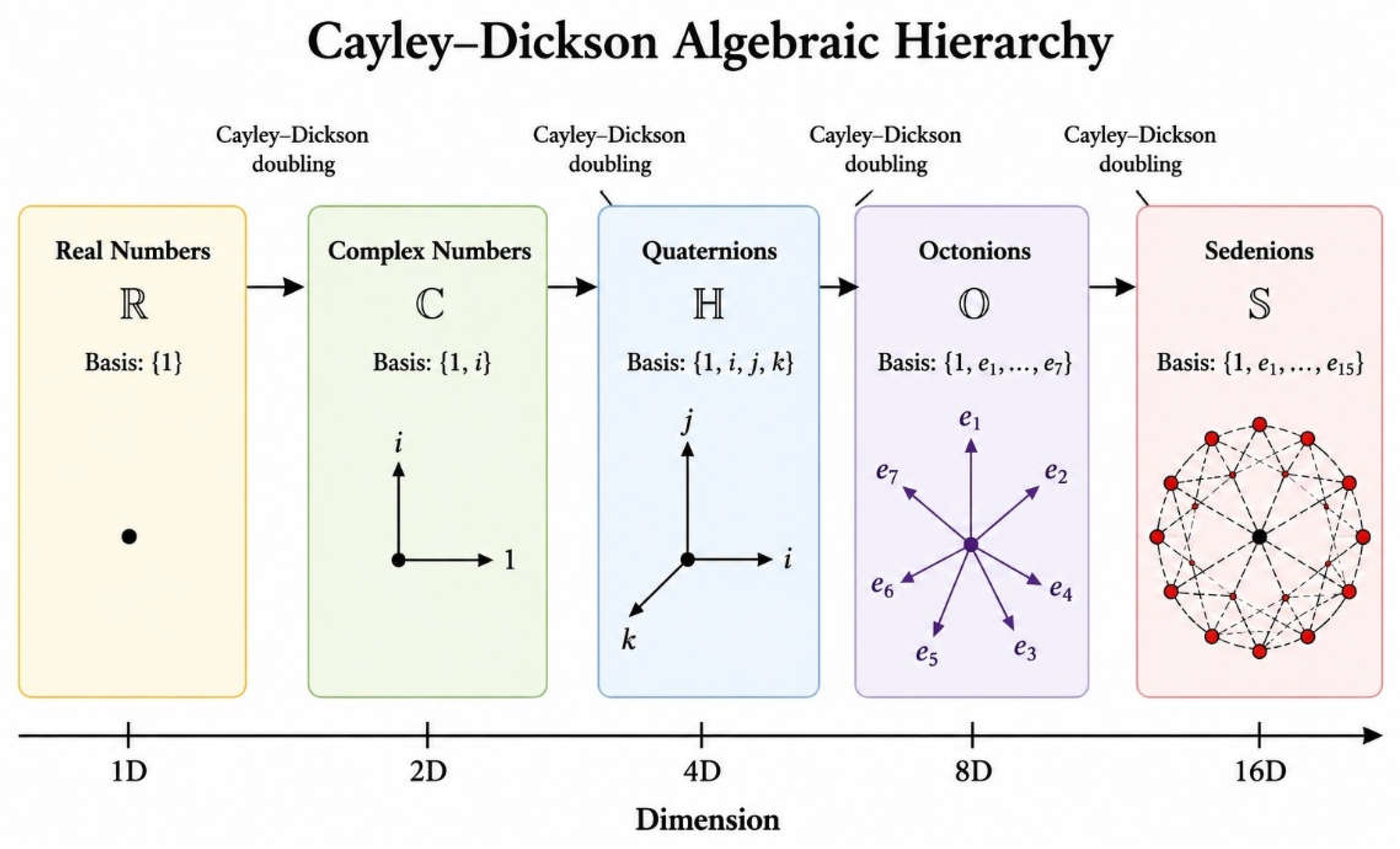
Figure 2.
Emergent Physical Interpretation of the Cayley–Dickson Hierarchy. Schematic illustration of the physical interpretation associated with successive levels of the Cayley–Dickson algebraic hierarchy. Complex numbers generate U(1) phase symmetry and electromagnetism, quaternions encode spacetime and spin geometry, octonions produce non-Abelian SU(2) and SU(3) gauge structure, and sedenions introduce non-associative associator geometry associated with fermion generations and emergent Einstein–Yang–Mills gravitational dynamics. The hierarchy illustrates the progressive emergence of increasingly rich physical structure from higher-dimensional hypercomplex geometry.
Figure 2.
Emergent Physical Interpretation of the Cayley–Dickson Hierarchy. Schematic illustration of the physical interpretation associated with successive levels of the Cayley–Dickson algebraic hierarchy. Complex numbers generate U(1) phase symmetry and electromagnetism, quaternions encode spacetime and spin geometry, octonions produce non-Abelian SU(2) and SU(3) gauge structure, and sedenions introduce non-associative associator geometry associated with fermion generations and emergent Einstein–Yang–Mills gravitational dynamics. The hierarchy illustrates the progressive emergence of increasingly rich physical structure from higher-dimensional hypercomplex geometry.
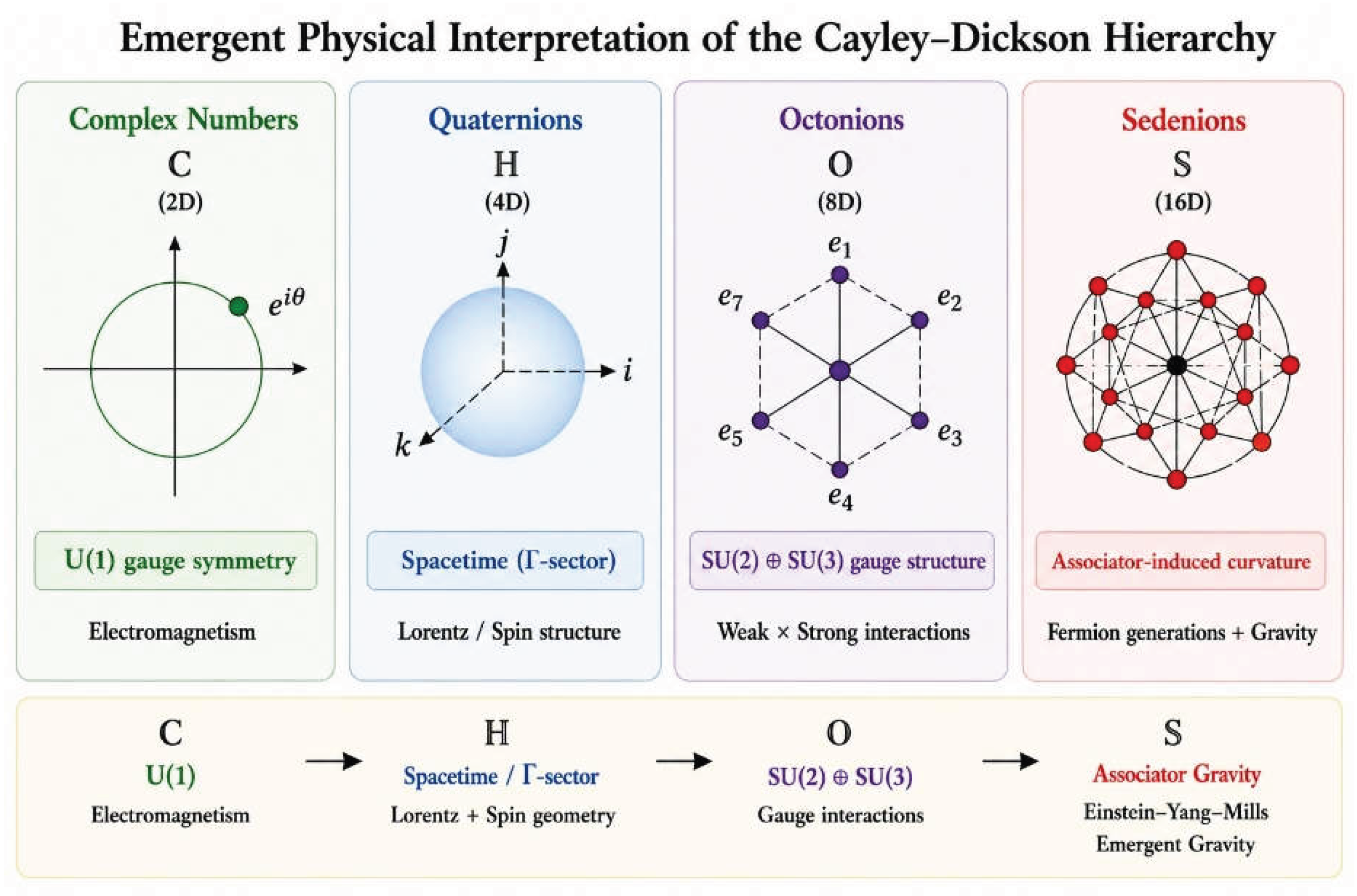

Table 1.
Algebraic Properties of the Cayley–Dickson Hierarchy.
| Algebra | Symbol | Dimension | Commutative | Associative | Key Feature |
|---|---|---|---|---|---|
| Real Numbers | ℝ | 1 | Yes | Yes | Ordinary scalar algebra |
| Complex Numbers | ℂ | 2 | Yes | Yes | Complex phase structure |
| Quaternions | ℍ | 4 | No | Yes | Spacetime and rotational structure |
| Octonions | 𝕆 | 8 | No | No | Non-Abelian gauge geometry |
| Sedenions | 𝕊 | 16 | No | No | Associator-induced gravitational geometry |
Table 2.
Comparison of the Present Framework with Major Quantum Gravity Approaches.
| Feature | String Theory | Loop Quantum Gravity | Noncommutative Geometry | Present E6 Hypercomplex Spinor Geometry |
|---|---|---|---|---|
| Fundamental entity | Strings or branes | Quantized spin networks | Noncommutative coordinate algebra | Hypercomplex steering–spinor fields |
| Status of spacetime | Higher-dimensional or partially emergent | Quantized geometry | Generalized operator geometry | Emergent from spinor bilinears |
| Main algebraic structure | Supersymmetry and dualities | SU(2) spin connections | Associative operator algebra | Non-associative Cayley–Dickson hierarchy |
| Origin of gravity | Closed-string dynamics | Quantized Einstein geometry | Spectral geometry | Associator-induced curvature |
| Gauge interactions | Compactification and branes | Secondary role | Spectral action | Generated from commutator curvature |
| Fermion generations | Compactification-dependent | Not naturally derived | Model-dependent | Internal U,V,Wspinor sectors |
| Mass hierarchy | Yukawa structure | Not the primary focus | Model-dependent | Emergent internal geometric coupling |
| Spacetime emergence | Partial | Limited | Geometric reformulation | Central principle |
| Key novelty | Higher-dimensional unification | Background independence | Algebraic geometry of spacetime | Separation of commutator and associator curvature |
| Main limitation | Landscape problem | Difficult Standard Model embedding | Limited gravitational unification | Full quantization remains future work |
Disclaimer/Publisher’s Note: The statements, opinions and data contained in all publications are solely those of the individual author(s) and contributor(s) and not of MDPI and/or the editor(s). MDPI and/or the editor(s) disclaim responsibility for any injury to people or property resulting from any ideas, methods, instructions or products referred to in the content. |
© 2026 by the authors. Licensee MDPI, Basel, Switzerland. This article is an open access article distributed under the terms and conditions of the Creative Commons Attribution (CC BY) license (http://creativecommons.org/licenses/by/4.0/).
Copyright: This open access article is published under a Creative Commons CC BY 4.0 license, which permit the free download, distribution, and reuse, provided that the author and preprint are cited in any reuse.


