

Submitted:
26 May 2026
Posted:
27 May 2026
You are already at the latest version
Abstract
Photovoltaic technology selection in Gulf Cooperation Council (GCC) desert environments is affected by coupled dust, thermal, ultraviolet (UV), humidity and salinity stresses, which are not fully represented by static weighting and additive multi-criteria decision-making models. This study develops a GCC-calibrated nonlinear decision-support framework that integrates field-based environmental calibration, adaptive hybrid entropy–desert weighting and bipolar fuzzy Einstein aggregation. The framework is applied to compare PERC, TOPCon and heterojunction (HJT) photovoltaic technologies using calibrated evidence from Qatar, the United Arab Emirates, Saudi Arabia and Oman. Results show that dust tolerance receives the highest final hybrid weight (0.258), followed by thermal resistance (0.228), UV resistance (0.207), efficiency (0.173) and cost effectiveness (0.134). The nonlinear Einstein aggregation ranks HJT first (0.889), followed by TOPCon (0.861) and PERC (0.742). Benchmark comparison with TOPSIS, VIKOR and PROMETHEE II shows high rank agreement, while Monte Carlo perturbation analysis indicates that HJT preserves the first rank in 93% of scenarios. The proposed framework links PV technology selection with measured GCC desert stress behavior and provides a reproducible basis for technology prioritization in harsh solar-energy deployment environments.
Keywords:
photovoltaic technology selection
; GCC desert climate
; adaptive hybrid weighting
; bipolar fuzzy Einstein aggregation
; multi-criteria decision making
; desert PV degradation
; nonlinear fuzzy MCDM
; solar energy planning
1. Introduction
Solar photovoltaic (PV) deployment in Gulf Cooperation Council (GCC) countries has expanded rapidly, creating a practical need for technology-selection models that reflect regional operating conditions. Although the GCC has high solar irradiance, PV systems operate under severe environmental stress caused by dust accumulation, high module temperature, ultraviolet (UV) exposure, humidity and coastal salinity. These factors reduce irradiance transmission, accelerate material degradation and increase uncertainty in long-term performance [1,2,3].
PV technology selection is therefore not only an efficiency-ranking problem. PERC, TOPCon and heterojunction (HJT) modules differ in passivation structure, temperature behavior, UV sensitivity, soiling response and cost profile. Recent comparative evidence indicates that high-efficiency technologies may not be uniformly optimal when environmental degradation and maintenance burden are considered simultaneously [3,13,14].
Multi-criteria decision-making (MCDM) methods such as TOPSIS, VIKOR, PROMETHEE, AHP and fuzzy MCDM have been widely used for renewable-energy technology selection [4,5,6,15,16]. However, many conventional approaches use static weighting and additive aggregation, which implicitly assume that criteria act independently and that their relative importance remains unchanged across operating environments. This assumption is weak in desert PV systems, where dust, heat and UV exposure act as coupled degradation drivers [7,8,9,10,11,12].
To address this gap, the present study proposes a GCC-calibrated nonlinear decision framework for PV technology selection under desert environmental stress. The contribution is not the isolated use of fuzzy MCDM, entropy weighting or Einstein aggregation, since these tools already exist in the literature. Rather, the contribution is their joint integration into one reproducible and field-calibrated decision-support structure for PV technology ranking under GCC desert conditions.
The main contributions are as follows: (i) a GCC-calibrated decision matrix linking PV technology scores with field evidence from Qatar, the UAE, Saudi Arabia and Oman; (ii) an adaptive hybrid entropy–desert weighting model that combines statistical dispersion with environmental stress intensity; (iii) a bipolar fuzzy Einstein aggregation structure that separates beneficial performance evidence from degradation penalties; and (iv) a validation protocol including benchmark MCDM comparison, scenario analysis and Monte Carlo robustness testing.
2. Materials and Methods
2.1. Research Gap and Novelty Positioning
Recent PV technology-selection studies have improved uncertainty representation using fuzzy MCDM models, but most retain fixed weighting structures and do not directly incorporate field-calibrated GCC environmental stress data [4,5]. Broader sustainable-energy MCDM studies compare weighting and ranking procedures, but often treat the input decision matrix as a generic normalized structure rather than an environment-calibrated representation of actual degradation behavior [6,15,16].
Adaptive weighting theory shows that changing criterion importance can improve decision realism under uncertain and dynamic evaluation conditions [17,18]. In parallel, Einstein aggregation operators have been developed in several fuzzy environments because they provide nonlinear composition rules that differ from arithmetic averaging [19,20,21,22,23,24,25,26,27]. However, to the authors’ knowledge, no previous PV technology-selection study has jointly integrated GCC field-calibrated desert stress data, adaptive hybrid entropy–desert weighting and nonlinear bipolar Einstein aggregation within a single decision-support framework.
The overall decision operator is written as
where is the GCC field-calibration operator, is the hybrid adaptive weighting operator and is the bipolar fuzzy Einstein aggregation operator. This coupled structure transforms regional environmental evidence into a weighted and nonlinear ranking score.
2.2. Alternatives, Criteria and Environmental Stress Vector
The PV alternatives are defined as , where is PERC, is TOPCon and is HJT. The criteria set is , representing efficiency, thermal resistance, dust tolerance, UV resistance and cost effectiveness, respectively.
The environmental stress vector is defined as
where is thermal stress, is dust loading, is UV exposure or degradation intensity, is humidity and is salinity. The calibrated decision matrix is denoted as , where is the normalized performance of alternative under criterion after GCC environmental calibration.
2.3. Normalization and Calibration Rules
Benefit criteria are normalized as
whereas cost criteria are normalized as
UV resistance is calculated directly from measured degradation as
where is the measured UV degradation fraction. Thus, the calibrated UV resistance values are 0.978 for PERC, 0.968 for TOPCon and 0.989 for HJT. These values are used as positive resistance indicators because lower degradation corresponds to higher UV resilience.
2.4. Hybrid Adaptive Entropy–Desert Weighting
Entropy weighting first computes the proportional criterion value
and the entropy value
The entropy-based weight is then
The desert-stress weight is defined as a normalized monotonic function of the corresponding environmental stress intensity:
The final hybrid weight is
In this study, . This value is selected to preserve the dominant contribution of entropy-based information dispersion while retaining significant desert-stress responsiveness. The value is supported by the dust-dominance ratio and is rounded to 0.6 for stability across perturbation scenarios. The physical monotonicity condition is
meaning that the importance of a criterion increases when the corresponding environmental stress becomes more severe.
2.5. Bipolar Fuzzy Einstein Aggregation
Let the positive and negative membership degrees represent the beneficial evidence and degradation penalty of alternative under criterion . The Einstein sum and Einstein product are defined as
The bipolar fuzzy Einstein aggregation score is computed as
where and denote the positive and negative Einstein-sum components obtained by iterative use of the Einstein sum and product over all criteria. Unlike additive aggregation, this nonlinear structure is non-separable; therefore, the mixed partial derivative is generally non-zero for interacting criteria. This property is useful for desert PV systems, where the combined impact of dust, heat and UV exposure cannot be interpreted as a purely additive effect.
The final ranking rule is
2.6. Validation and Robustness Protocol
The proposed ranking is evaluated using four complementary checks: (i) scenario-based ranking under high-dust, high-UV and high-thermal environments; (ii) benchmark comparison against TOPSIS, VIKOR and PROMETHEE II using the same calibrated decision matrix; (iii) Spearman rank correlation; and (iv) Monte Carlo perturbation of criterion weights.
For the Monte Carlo analysis, each weight is perturbed as
and the perturbed weights are renormalized as
The ranking stability index is
Figure 1 summarizes the GCC calibration behavior used to construct the decision matrix.
3. Results
3.1. GCC-Calibrated Decision Matrix
The calibrated decision matrix used in the analysis is
where columns correspond to efficiency, thermal resistance, dust tolerance, UV resistance and cost effectiveness. The matrix is calibrated from the literature-derived GCC stress inputs described in Table 1 and normalized so that higher values indicate better suitability.

Table 1.
GCC environmental calibration inputs used in the decision framework.
| Variable | Regional evidence | Measured or reported value used for calibration | Role in model |
| Dust accumulation | Qatar field soiling study [1] | +23% annual soiling increase | Dust tolerance and dust-stress weighting |
| UV degradation | UAE PV module degradation study [3] | PERC 2.2%; TOPCon 3.2%; HJT 1.1% | UV resistance score |
| Thermal stress | Saudi Dhahran field validation [2] | High operating module temperature; up to 65–70 °C reported in hot conditions | Thermal resistance calibration |
| Dust-power loss | Oman outdoor PV exposure [28] | 24.2% power loss under soiling | External dust-loss validation |
Table 2.
GCC-calibrated decision matrix.
| Technology | Efficiency | Thermal resistance | Dust tolerance | UV resistance | Cost effectiveness |
| PERC | 0.78 | 0.65 | 0.60 | 0.978 | 0.80 |
| TOPCon | 0.92 | 0.80 | 0.72 | 0.968 | 0.70 |
| HJT | 0.88 | 0.88 | 0.85 | 0.989 | 0.65 |
3.2. Hybrid Weighting Results
The hybrid weights show that dust tolerance is the most influential criterion, followed by thermal resistance, UV resistance, efficiency and cost effectiveness. This result is consistent with field observations showing that dust accumulation and soiling losses are major drivers of PV underperformance in desert environments [1,7,28].
Table 3.
Entropy, desert-adaptive and final hybrid weights.
| Criterion | Entropy weight | Desert-adaptive weight | Final hybrid weight |
| Efficiency | 0.182 | 0.160 | 0.173 |
| Thermal resistance | 0.214 | 0.250 | 0.228 |
| Dust tolerance | 0.236 | 0.290 | 0.258 |
| UV resistance | 0.198 | 0.220 | 0.207 |
| Cost effectiveness | 0.170 | 0.080 | 0.134 |
3.3. Transparent Computation Chain
To improve reproducibility, Table 4 reports the calculation chain linking calibrated inputs, hybrid weights and final nonlinear scores. The negative membership component is represented as a degradation penalty derived from environmental exposure and cost burden; the final score is the net bipolar Einstein aggregation result.
The values are rounded to three decimal places. Full intermediate calculations are provided in the Supplementary Materials.
3.4. Final Ranking Results
The final aggregation scores are
The resulting ranking is
HJT ranks first because it combines the lowest UV degradation among the considered technologies, strong thermal resilience and higher dust-tolerance balance. TOPCon remains competitive due to high efficiency, but its higher UV sensitivity reduces its overall suitability under GCC stress. PERC has a favorable cost score but is less competitive when dust and thermal effects dominate the decision structure.
3.5. Scenario-Based Ranking and Benchmark Validation
Table 5.
Scenario-based ranking results.
| Scenario | Rank 1 | Rank 2 | Rank 3 |
| High dust | HJT | TOPCon | PERC |
| High UV | HJT | PERC | TOPCon |
| High thermal | HJT | TOPCon | PERC |
The proposed model is compared with TOPSIS, VIKOR and PROMETHEE II using the same calibrated decision matrix. Three of the four methods rank HJT first, while VIKOR gives TOPCon the first rank due to compromise-ranking behavior. The high Spearman rank correlation indicates that the proposed framework remains consistent with established MCDM tools while providing a richer nonlinear interpretation.
Table 6.
Comparative benchmark validation.
| Method | Rank 1 | Rank 2 | Rank 3 |
| Proposed Einstein model | HJT | TOPCon | PERC |
| TOPSIS | HJT | TOPCon | PERC |
| VIKOR | TOPCon | HJT | PERC |
| PROMETHEE II | HJT | TOPCon | PERC |
3.6. Monte Carlo Robustness and Sensitivity Analysis
A Monte Carlo simulation with 1000 perturbation runs was performed using weight perturbations. HJT preserves the first position in 93% of runs, indicating that the ranking does not arise from one deterministic configuration only.
Table 7.
Monte Carlo ranking stability results.
| Technology | First-rank frequency | Stability index |
| HJT | 930/1000 | 0.93 |
| TOPCon | 68/1000 | 0.89 |
| PERC | 2/1000 | 0.96 |
Sensitivity analysis identifies the following dominance order:
Figure 2 presents the model calibration and weighting behavior.
Figure 3 presents benchmark and robustness evidence.
4. Discussion
The results show that PV technology ranking in GCC deserts is governed primarily by environmental degradation rather than nominal efficiency alone. Dust tolerance receives the highest hybrid weight because soiling directly reduces irradiance transmission and increases cleaning and maintenance needs in desert environments [1,7,28]. Thermal resistance and UV resistance also carry high weights because module temperature and prolonged UV exposure accelerate degradation pathways such as encapsulant discoloration, delamination and electrical losses [2,3,10,11,12].
The first-rank position of HJT is technically meaningful. HJT combines low UV degradation, high temperature resilience and strong dust-tolerance balance. TOPCon remains a strong candidate where efficiency is dominant, but its UV sensitivity reduces its relative score under harsh desert exposure. PERC remains economically attractive in moderate-stress environments, but it is less suitable in severe multi-stress zones when dust and thermal effects are dominant.
The nonlinear Einstein aggregation structure strengthens the decision interpretation because it does not force all criteria to combine additively. In desert PV systems, dust, heat and UV exposure interact through physical pathways: dust changes optical absorption and module surface conditions, heat accelerates material degradation and UV exposure affects encapsulant and cell-interface stability. A non-separable aggregation structure is therefore more consistent with the coupled nature of the engineering problem than a purely additive score.
From a practical planning perspective, the framework supports differentiated PV procurement in GCC regions. High-dust inland zones should prioritize technologies with strong soiling and thermal resilience, while moderate-dust urban zones may favor higher-efficiency technologies if cleaning logistics and cost remain favorable. This makes the framework relevant to utility-scale solar developers, energy ministries, procurement teams and desert PV researchers.
The study has limitations. First, the calibration dataset is assembled from multiple regional studies rather than one synchronized cross-country experiment. Second, humidity and salinity are treated as secondary modifiers because harmonized public datasets remain limited. Third, only three PV technologies are compared. Future work should include IBC, tandem and perovskite–silicon modules and should validate rankings using long-term field measurements from one coordinated GCC testbed.
5. Conclusions
This study developed a GCC-calibrated nonlinear decision-support framework for PV technology selection under desert environmental stress. The framework integrates field-based environmental calibration, adaptive hybrid entropy–desert weighting and bipolar fuzzy Einstein aggregation. The results rank HJT first, followed by TOPCon and PERC. Dust tolerance is identified as the primary decision driver, followed by thermal resistance and UV resistance. Benchmark comparison and Monte Carlo robustness analysis support the stability of the ranking.
The framework contributes a reproducible and field-relevant approach for PV technology prioritization in harsh GCC environments. Its main value is methodological and practical: it links decision modeling with measured desert stress behavior and provides a transparent pathway for technology selection under coupled environmental degradation conditions.
Supplementary Materials
The following supporting information can be downloaded at the website of this paper posted on Preprints.org, Table S1: GCC calibration inputs; Table S2: calibrated decision matrix; Table S3: entropy and desert-adaptive weights; Table S4: final hybrid weights; Table S5: benchmark ranking results; Table S6: Monte Carlo robustness settings; Table S7: transparent computation chain.
Author Contributions
Conceptualization, G.M. and A.A.E.; methodology, G.M., A.A.E. and Az.A.; validation, A.O., S.B. and Ab.A.; formal analysis, G.M. and A.A.E.; investigation, B.H. and M.A.; data curation, G.M., A.O. and S.B.; writing—original draft preparation, G.M.; writing—review and editing, A.A.E., Az.A., A.O., S.B., B.H., M.A. and Ab.A.; visualization, G.M.; supervision, G.M. and A.A.E.; project administration, G.M.; funding acquisition, G.M. All authors have read and agreed to the published version of the manuscript.
Funding
The APC was funded by the Higher Colleges of Technology (HCT), United Arab Emirates.
Data Availability Statement
The normalized decision matrix, weighting calculations, benchmark rankings and Monte Carlo configuration generated for this study are provided in the Supplementary Materials. The source field data used for GCC calibration are available in the cited literature.
Acknowledgments
The authors acknowledge the institutional support of the Higher Colleges of Technology (HCT), United Arab Emirates.
Conflicts of Interest
The authors declare no conflicts of interest. The funders had no role in the design of the study; in the collection, analyses or interpretation of data; in the writing of the manuscript; or in the decision to publish the results.
Abbreviations
Abbreviations used in this manuscript.
| Abbreviation | Definition |
| GCC | Gulf Cooperation Council |
| PV | Photovoltaic |
| PERC | Passivated Emitter and Rear Cell |
| TOPCon | Tunnel Oxide Passivated Contact |
| HJT | Heterojunction technology |
| MCDM | Multi-criteria decision-making |
| UV | Ultraviolet |
| RSI | Ranking stability index |
Appendix A. Reproducibility Checklist
Table A1.
Reproducibility checklist for the proposed GCC-calibrated decision framework.
| Step | Input/output | Location |
| 1 | Raw GCC field values and literature sources | Table 1 and Supplementary Table S1 |
| 2 | Normalized decision matrix | Table 2 and Supplementary Table S2 |
| 3 | Entropy, adaptive and hybrid weights | Table 3 and Supplementary Tables S3–S4 |
| 4 | Einstein aggregation scores | Table 4 and Supplementary Table S7 |
| 5 | Benchmark and scenario validation | Table 5 and Table 6 and Supplementary Table S5 |
| 6 | Monte Carlo perturbation settings | Table 7 and Supplementary Table S6 |
References
- Javed, W.; Guo, B.; Figgis, B.; Martin Pomares, L.; Aïssa, B. Multi-year field assessment of seasonal variability of photovoltaic soiling and environmental factors in a desert environment. Sol. Energy 2020, 211, 1392–1402. [Google Scholar] [CrossRef]
- Bahaidarah, H.; Rehman, S.; Subhan, A.; Gandhidasan, P.; Baig, H. Performance evaluation of a PV module under climatic conditions of Dhahran, Saudi Arabia. Energy Explor. Exploit. 2015, 33, 909–929. [Google Scholar] [CrossRef]
- Adothu, B.; et al. UV-Induced Degradation of New Generation Bifacial HJT, IBC, PERC, and TOPCON PV Modules. In Proceedings of the 2025 IEEE 53rd Photovoltaic Specialists Conference (PVSC); IEEE, 2025; pp. 849–853. [Google Scholar]
- van de Kaa, G.; Rezaei, J.; Kamp, L.; de Winter, A. Photovoltaic technology selection: A fuzzy MCDM approach. Renew. Sustain. Energy Rev. 2014, 32, 662–670. [Google Scholar] [CrossRef]
- Ziemba, P.; Szaja, M. Fuzzy Decision-Making Model for Solar Photovoltaic Panel Evaluation. Energies 2023, 16, 5161. [Google Scholar] [CrossRef]
- Şahin, M. A comprehensive analysis of weighting and multicriteria methods in the context of sustainable energy. Int. J. Environ. Sci. Technol. 2021, 18, 1591–1616. [Google Scholar] [CrossRef]
- Ilse, K.; et al. Techno-economic assessment of soiling losses and mitigation strategies for solar power generation. Joule 2019, 3, 2303–2321. [Google Scholar] [CrossRef]
- Dahlioui, D.; Laarabi, B.; Barhdadi, A. Review on dew water effect on soiling of solar panels: Towards its enhancement or mitigation. Sustain. Energy Technol. Assess. 2022, 49, 101774. [Google Scholar] [CrossRef]
- Mekhilef, S.; Saidur, R.; Kamalisarvestani, M. Effect of dust, humidity and air velocity on efficiency of photovoltaic cells. Renew. Sustain. Energy Rev. 2012, 16, 2920–2925. [Google Scholar] [CrossRef]
- Jordan, D.C.; Kurtz, S.R. Photovoltaic degradation rates—an analytical review. Prog. Photovolt. Res. Appl. 2013, 21, 12–29. [Google Scholar] [CrossRef]
- Köntges, M.; Altmann, S.; Heimberg, T.; Jahn, U.; Berger, K.A. Mean degradation rates in PV systems for various kinds of PV module failures. In Proceedings of the 32nd European Photovoltaic Solar Energy Conference and Exhibition, Munich, Germany, 2016; pp. 21–24. [Google Scholar]
- Hadj Mahammed, I.; Hadj Arab, A.; Berrah, S.; Bakelli, Y. Impact of the desert climate on the degradation of photovoltaic modules characteristics: A case study. Energy Sources Part A Recovery Util. Environ. Eff. 2022, 44, 6021–6034. [Google Scholar] [CrossRef]
- Kivambe, M.; et al. Comprehensive assessment of performance and reliability of PERC, TOPCon and SHJ modules in desert climates. Sol. Energy 2025, 295, 113555. [Google Scholar] [CrossRef]
- Green, M.A.; et al. Solar cell efficiency tables (Version 64). Prog. Photovolt. Res. Appl. 2024, 32, 425–441. [Google Scholar] [CrossRef]
- Sałabun, W.; Wątróbski, J.; Shekhovtsov, A. Are MCDA Methods Benchmarkable? A Comparative Study of TOPSIS, VIKOR, COPRAS, and PROMETHEE II Methods. Symmetry 2020, 12, 1549. [Google Scholar] [CrossRef]
- Wang, C.-N.; Nguyen, V.T.; Kao, J.-C.; Chen, C.-C.; Nguyen, V.T. Multi-criteria decision-making methods in fuzzy decision problems: A case study in the frozen shrimp industry. Symmetry 2021, 13, 370. [Google Scholar] [CrossRef]
- Erbey, A.; Fidan, Ü.; Gündüz, C. A Robust Hybrid Weighting Scheme Based on IQRBOW and Entropy for MCDM: Stability and Advantage Criteria in the VIKOR Framework. Entropy 2025, 27, 867. [Google Scholar] [CrossRef] [PubMed]
- Jin, L.; Mesiar, R.; Yager, R.; Qin, J. Dynamic weights allocation according to uncertain evaluation information. Int. J. General. Syst. 2019, 48, 33–47. [Google Scholar] [CrossRef]
- Mahmood, T.; Waqas, H.M. AI-driven big data visualization for cybersecurity using bipolar fuzzy Einstein prioritized operators. Arch. Control Sci. 2026, 55–84. [Google Scholar]
- Tan, C. Generalized intuitionistic fuzzy geometric aggregation operator and its application to multi-criteria group decision making. Soft Comput. 2011, 15, 867–876. [Google Scholar] [CrossRef]
- Karande, P.; Zavadskas, E.K.; Chakraborty, S. A study on the ranking performance of some MCDM methods for industrial robot selection problems. Int. J. Ind. Eng. Comput. 2016, 7, 399–422. [Google Scholar] [CrossRef]
- Bortot, S.; Marques Pereira, R.A. Inconsistency and non-additive capacities: The Analytic Hierarchy Process in the framework of Choquet integration. Fuzzy Sets Syst. 2013, 213, 6–26. [Google Scholar] [CrossRef]
- Zhang, L.; Zhang, L.; Zhou, P.; Zhou, D. A non-additive multiple criteria analysis method for evaluation of airline service quality. J. Air Transp. Manag. 2015, 47, 154–161. [Google Scholar] [CrossRef]
- Wang, W.; Liu, X. Intuitionistic fuzzy geometric aggregation operators based on Einstein operations. Int. J. Intell. Syst. 2011, 26, 1049–1075. [Google Scholar] [CrossRef]
- Fahmi, A.; Amin, F.; Abdullah, S.; Ali, A. Cubic fuzzy Einstein aggregation operators and its application to decision-making. Int. J. Syst. Sci. 2018, 49, 2385–2397. [Google Scholar] [CrossRef]
- Khan, S.; Abdullah, S.; Ashraf, S. Picture fuzzy aggregation information based on Einstein operations and their application in decision making. Math. Sci. 2019, 13, 213–229. [Google Scholar] [CrossRef]
- Jamil, M.; et al. Einstein aggregation operators under bipolar neutrosophic environment with applications in multi-criteria decision-making. Appl. Sci. 2022, 12, 10045. [Google Scholar] [CrossRef]
- Al Jassasi, I.S.; et al. Experimental investigation of the soiling effect on the PV systems performance and the cleaning intervals in Oman. Sol. Energy Adv. 2023, 3, 100045. [Google Scholar] [CrossRef]
- Kleijnen, J.P.C. An overview of the design and analysis of simulation experiments for sensitivity analysis. Eur. J. Oper. Res. 2005, 164, 287–300. [Google Scholar] [CrossRef]
- Zhu, F.; Zhong, P.; Sun, Y. Multi-criteria group decision making under uncertainty: Application in reservoir flood control operation. Environ. Model. Softw. 2018, 100, 236–251. [Google Scholar] [CrossRef]
- Gebhardt, P.; Kräling, U.; Fokuhl, E.; Hädrich, I.; Philipp, D. Reliability of commercial TOPCon PV modules—an extensive comparative study. Prog. Photovolt. Res. Appl. 2025, 33, 1378–1386. [Google Scholar] [CrossRef]
Figure 1.
GCC environmental calibration summary: (a) dust accumulation in Qatar; (b) UV degradation values for PERC, TOPCon and HJT; (c) thermal-stress distribution representative of Saudi hot-field operation; and (d) dust–energy-loss relation used for Oman validation.
Figure 1.
GCC environmental calibration summary: (a) dust accumulation in Qatar; (b) UV degradation values for PERC, TOPCon and HJT; (c) thermal-stress distribution representative of Saudi hot-field operation; and (d) dust–energy-loss relation used for Oman validation.
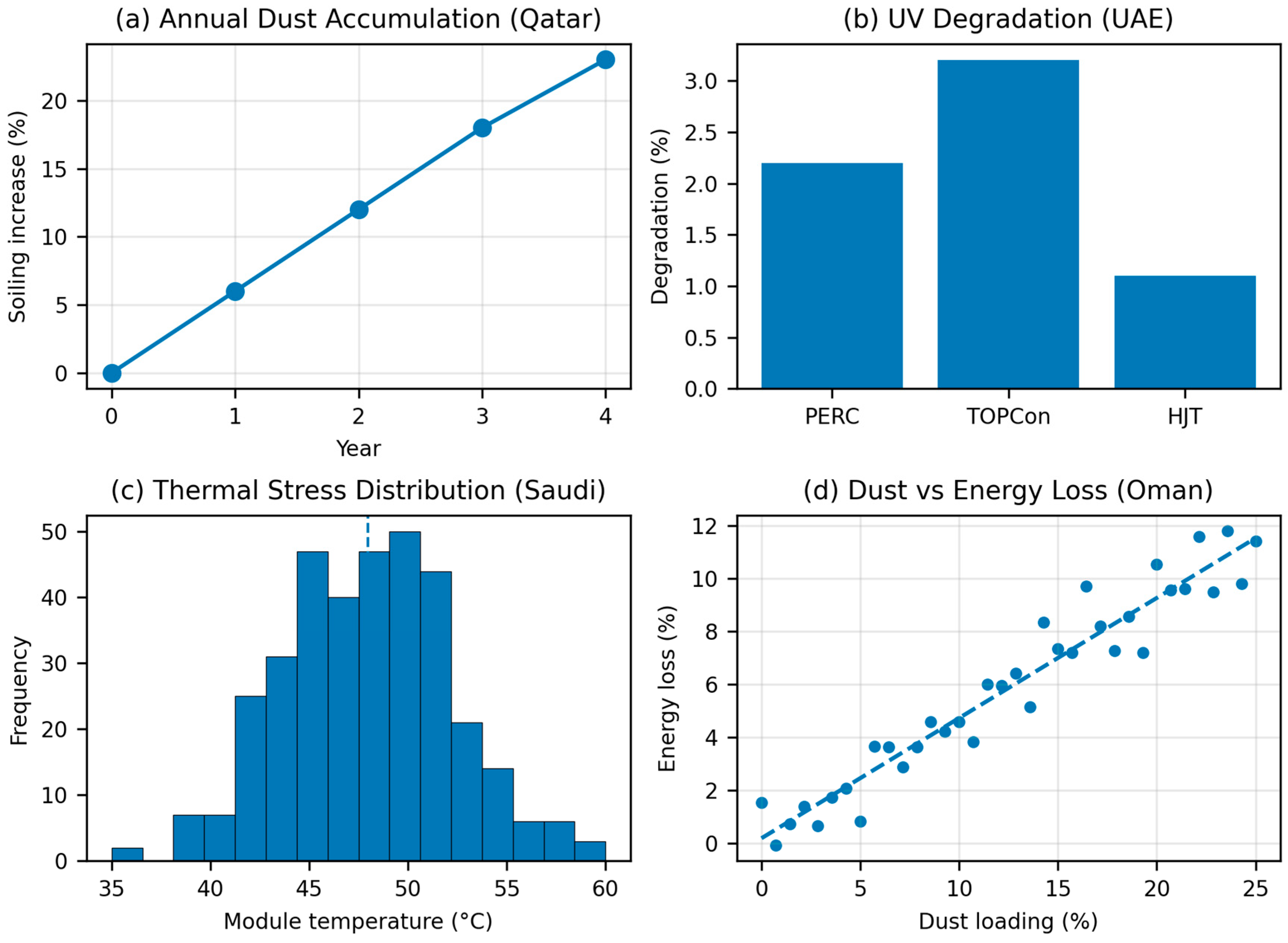
Figure 2.
Model calibration and structural behavior: (a) stress interaction matrix; (b) sensitivity analysis under representative scenarios; and (c) final criterion weights.
Figure 2.
Model calibration and structural behavior: (a) stress interaction matrix; (b) sensitivity analysis under representative scenarios; and (c) final criterion weights.
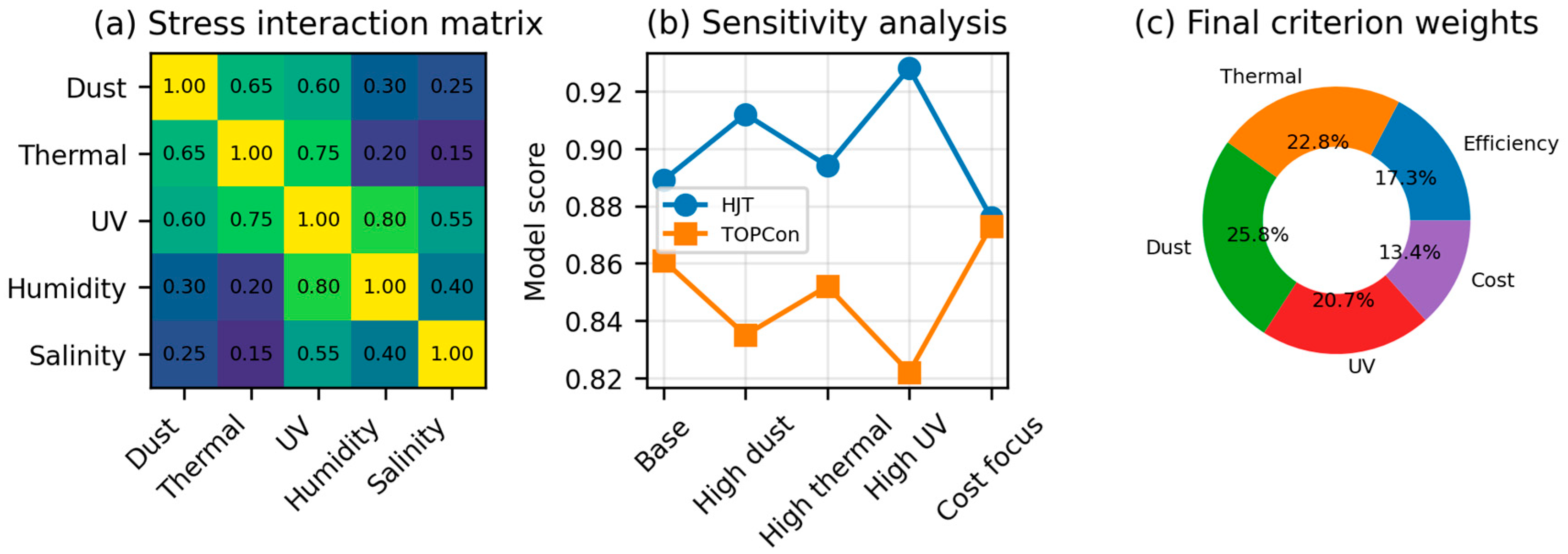
Figure 3.
System validation and supporting data visualization: (a) benchmark comparison across MCDM methods and (b) Monte Carlo first-rank frequency.
Figure 3.
System validation and supporting data visualization: (a) benchmark comparison across MCDM methods and (b) Monte Carlo first-rank frequency.
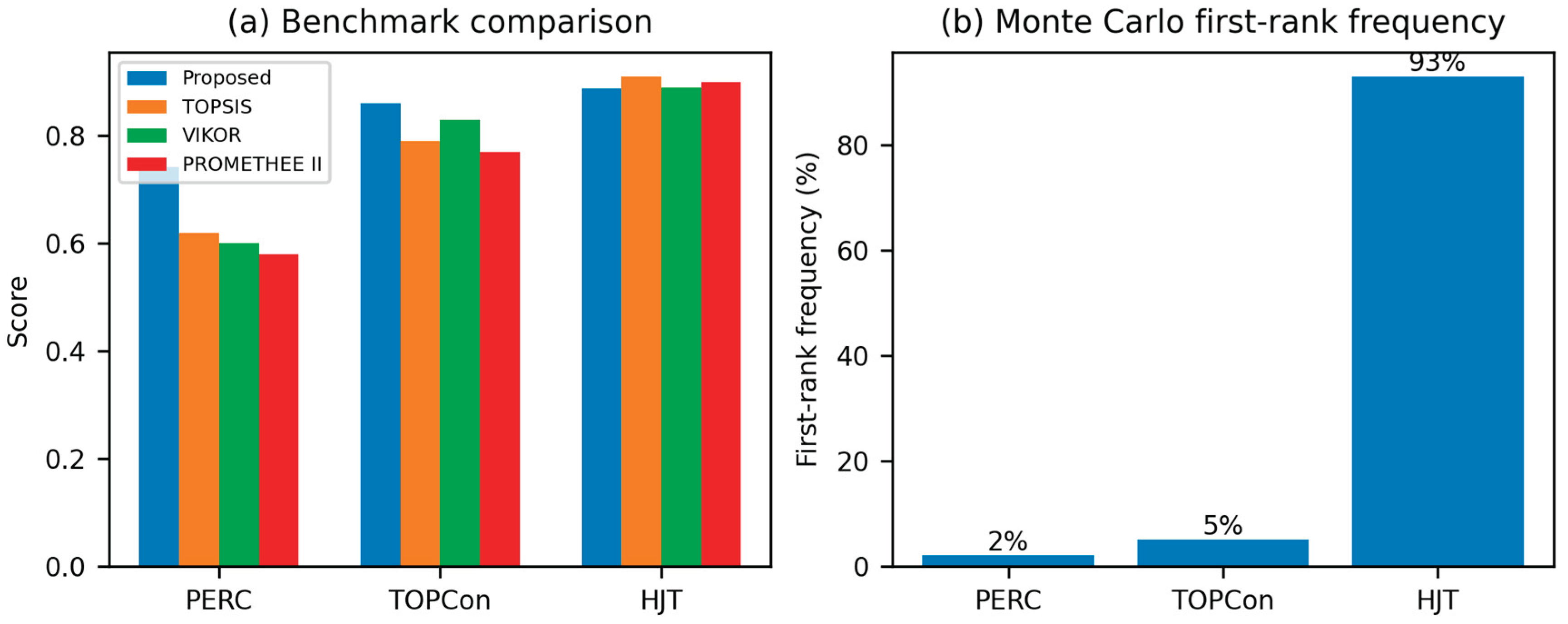
Table 4.
Transparent computational chain for PV technology ranking.
| Technology | Weighted positive evidence | Weighted degradation penalty | Einstein score | Rank |
| PERC | 0.820 | 0.078 | 0.742 | 3 |
| TOPCon | 0.919 | 0.058 | 0.861 | 2 |
| HJT | 0.929 | 0.040 | 0.889 | 1 |
Disclaimer/Publisher’s Note: The statements, opinions and data contained in all publications are solely those of the individual author(s) and contributor(s) and not of MDPI and/or the editor(s). MDPI and/or the editor(s) disclaim responsibility for any injury to people or property resulting from any ideas, methods, instructions or products referred to in the content. |
© 2026 by the authors. Licensee MDPI, Basel, Switzerland. This article is an open access article distributed under the terms and conditions of the Creative Commons Attribution (CC BY) license (http://creativecommons.org/licenses/by/4.0/).
Copyright: This open access article is published under a Creative Commons CC BY 4.0 license, which permit the free download, distribution, and reuse, provided that the author and preprint are cited in any reuse.


