
Submitted:
26 May 2026
Posted:
27 May 2026
You are already at the latest version
Abstract
Agri-food byproducts are increasingly recognized as sustainable feedstocks for high-value bioactive compounds, but their practical valorization requires integrated evidence on recovery conditions, chemical composition, bioactivity, and application readiness. This review critically examines green recovery strategies and chemical profiling platforms for bioactive compounds recovered from peels, pomace, seed residues, hulls, vegetation waters, and pruning waste. Emphasis is placed on how extraction variables shape chemical profiles, extract quality, and reported biological activities. Ultrasound- and microwave-assisted extraction, enzyme- and fermentation-assisted recovery, supercritical fluid extraction, pressurized liquid extraction, pulsed electric field-assisted pretreatment, and green solvent-based extraction are discussed in terms of target-compound selectivity, solvent and energy demand, process safety, scalability, and sustainability-related evidence. Chromatographic, mass-spectrometric, spectroscopic, and metabolomics-based profiling approaches are evaluated for identification, annotation, quantification, fingerprinting, quality-marker selection, and standardization, with confidence levels distinguished according to authentic-standard matching, tandem mass spectrometry evidence, spectral libraries, or fingerprint-level evidence. Circular valorization pathways in food, nutraceutical, cosmetic, pharmaceutical-oriented, and biopesticide-related applications are further considered with attention to feedstock heterogeneity, process standardization, stability, safety, regulatory feasibility, scalability, and techno-economic feasibility. Overall, this review provides a linkage-oriented framework for developing standardized, application-readiness-oriented bioactive candidates from agri-food byproducts.
Keywords:
agri-food byproducts
; bioactive compounds
; circular economy
; green recovery
; chemical profiling
; metabolomics
; bioactivity evaluation
; quality markers
; standardization
; application readiness
1. Introduction
Agri-food systems generate substantial residual biomass and liquid or semi-liquid byproduct streams during harvesting, postharvest handling and storage, primary processing, and industrial transformation. These streams—including peels, pomace, seed residues, hulls and bran fractions, stems, leaves, pruning waste, pressing residues, and vegetation waters—are often discarded, underused, or directed to low-value applications despite their potential as chemically rich sources of recoverable bioactive compounds [1,2,3]. Within circular economy and biorefinery frameworks, these byproduct streams are increasingly being reconsidered as renewable matrices for recovering high-value bioactive compounds [2,4,5]. These compounds include phenolics, flavonoids, carotenoids, tocopherols, terpenoids, peptides, polysaccharides, dietary fibers, fatty acids, and other functional constituents, although their distribution and recoverability depend on matrix type and processing history [2,3,5]. Accordingly, this review frames agri-food byproduct valorization as a shift from waste management toward chemically guided resource recovery, where biomass composition, extraction selectivity, analytical characterization, and application requirements jointly determine valorization potential.
The valorization potential of agri-food byproducts arises from matrix-dependent chemical profiles rather than from chemical richness alone [1,2]. Botanical origin, tissue type, maturity, processing history, and storage conditions can influence the abundance, accessibility, and stability of recoverable functional fractions, including polyphenols (phenolic acids, flavonoids, tannins, anthocyanins, and stilbenes), lipophilic constituents (carotenoids, tocopherols, and fatty acids), volatile and semi-volatile terpenoids, essential-oil constituents, and macromolecular or structurally associated fractions such as dietary fibers, peptides, and polysaccharides [1,2,3]. Because these fractions differ in polarity, molecular size, volatility, matrix binding, and degradation behavior, valorization requires profile-guided recovery and chemical characterization rather than a simple inventory of bioactive constituents [2,4,6]. Reported antioxidant, antimicrobial, anti-inflammatory, cytoprotective, photoprotective, and enzyme-modulatory activities have supported interest in food, nutraceutical, cosmetic, and pharmaceutical-oriented applications [2,3,7]. Plant-protective activities further support biopesticide-related and agricultural applications [8]. However, such functional potential becomes application-relevant only when the recovered extract has a defined chemical identity, reproducible quality attributes, demonstrated stability, an acceptable safety profile, formulation compatibility, scalability, regulatory feasibility, and sustainability performance [2,9,10,11].
Green recovery strategies are central to agri-food byproduct valorization because the recovery step determines not only extraction efficiency but also compound selectivity, chemical integrity, co-extracted matrix components, and downstream compatibility [2,12]. Ultrasound- assisted, microwave-assisted, enzyme-assisted, supercritical fluid, pressurized liquid, and pulsed electric field-assisted extraction have been explored to recover chemically diverse bioactives while reducing solvent use, processing time, energy demand, and environmental burden [2,3,9]. Fermentation-assisted recovery and green solvent- or DES/NADES-based extraction further expand this toolbox by enabling biologically mediated release, biotransformation, and solvent-system design for matrix- and compound-specific recovery [13,14]. However, these methods are matrix- and compound-class-specific rather than universally interchangeable: solvent polarity, mass-transfer mechanism, temperature or pressure regime, and process intensity influence whether a process preferentially recovers polar phenolics, lipophilic carotenoids, tocopherols, fatty acids, volatile terpenoids, or other target fractions [2,3,4,9]. Enzymatic and fermentation-assisted strategies add a further layer of specificity because they can release, hydrolyze, or transform glycosylated, polymerized, protein-associated, or cell-wall-bound metabolites [13,15,16]. Therefore, green recovery should be evaluated through an integrated set of chemical and translational criteria—including selectivity, chemical stability, extract identity, solvent and process safety, regulatory acceptability, scalability, and application-specific compatibility—rather than by extraction yield alone [2,9,10,11].
Chemical profiling provides the evidence needed to define heterogeneous byproduct- derived extracts as chemically interpretable materials that can be compared, standardized, and evaluated for application-specific use [2,6]. Chromatographic, mass-spectrometric, spectroscopic, and metabolomics-based workflows provide complementary layers of evidence for compound identification, relative or absolute quantification, fingerprint comparison, quality-marker selection, and batch-level standardization [2,4,6]. This step is particularly important for agri-food byproduct extracts, which may contain structurally related metabolites, co-extracted matrix components, degradation products, and constituents that interact synergistically or antagonistically [2,4,17]. Thus, in this review, profiling is treated not as a post- extraction description but as an interpretive layer that links recovery conditions to extract identity, reproducibility, and bioactivity interpretation. Without sufficient characterization, reported biological responses remain difficult to compare across studies, reproduce across batches, or translate into sector-specific applications [2,6].
Recent reviews have provided valuable overviews of agri-food waste streams, major bioactive compound classes, green recovery technologies, analytical characterization methods, and application routes within circular bioeconomy frameworks [1,2,4]. Collectively, these reviews establish agri-food byproducts as important reservoirs of functional molecules; however, their primary organizing focus is not always the mechanistic and translational linkage among recovery conditions, chemical profiles, extract quality, bioactivity interpretation, and application readiness. In particular, extraction variables are often evaluated through yield, total phenolic content, total flavonoid content, or preliminary bioactivity metrics without being consistently traced to compound-level identity, marker reproducibility, chemical stability, co- extracted constituents, and sector-specific performance requirements [2,6,18]. This gap limits cross-study comparability and may obscure whether a chemically active extract is also standardized, safe, scalable, and suitable for a defined circular valorization pathway. A more chemistry-centered synthesis is therefore needed to connect matrix selection and green recovery with analytical profiling, bioactivity evidence, and application-specific readiness criteria.
To address this need, this review critically examines plant-derived agri-food byproducts as chemically heterogeneous and sustainable feedstocks for high-value bioactive compounds. Building on the recent reviews discussed above, it adopts a linkage-oriented framework that traces how matrix properties and green recovery conditions shape chemical profiles, extract quality, bioactivity interpretation, and application readiness. By integrating recovery selectivity, fit-for-purpose chemical profiling, marker-based standardization, stability and safety considerations, and sector-specific translational bottlenecks, this review aims to provide a chemistry-centered basis for converting agri-food byproducts into standardized, application- readiness-oriented bioactive extracts and fractions within circular valorization pathways.
2. Review Scope and Literature Collection Strategy
2.1. Review Design and Conceptual Scope
This article was designed as a critical narrative review rather than a systematic review, scoping review, quantitative meta-analysis, or bibliometric study. The literature collection strategy was used to make source identification and selection transparent, but the primary purpose of the review was interpretive rather than enumerative. Accordingly, formal PRISMA-style record enumeration, flow-diagram reporting, study-level risk-of-bias scoring, bibliometric mapping, and quantitative synthesis were not applied. Instead, evidence was prioritized according to its relevance to the matrix–recovery–profile–bioactivity–application-readiness linkage framework. Specifically, this review synthesizes how matrix characteristics, green recovery conditions, chemical profiles, bioactivity evidence, and application-readiness criteria are connected. Therefore, studies were selected not merely to catalogue all publications in the field, but to clarify how agri-food byproducts can be transformed into chemically defined, standardized, and application-specific bioactive extracts and fractions.
The conceptual scope primarily covers plant-derived agri-food byproduct streams, including both solid residues and liquid or semi-liquid processing streams, generated during harvesting, postharvest handling, food processing, and industrial transformation. Representative matrices include peels, pomace, seed residues, hulls, shells, bran fractions, pressing residues, vegetation waters, leaves, stems, and pruning waste. The review emphasizes bioactive compounds and functional fractions commonly recovered from these matrices, including polyphenols such as phenolic acids, flavonoids, tannins, anthocyanins, and stilbenes; lipophilic constituents such as carotenoids, tocopherols, and fatty acids; volatile or semi-volatile constituents such as terpenoids and essential-oil constituents; and macromolecular or structurally associated fractions such as dietary fibers, peptides, and polysaccharides. Particular attention is given to studies that explicitly link byproduct matrices and recovery conditions with chemical profiling, bioactivity interpretation, extract quality, and sector-specific valorization in food, nutraceutical, cosmetic, pharmaceutical-oriented, biopesticide-related, and agricultural contexts.
2.2. Literature Sources and Search Strategy
As this was a critical narrative review, literature was identified through iterative and targeted keyword searches in Scopus, Web of Science, and PubMed, complemented by Google Scholar and backward and forward citation chasing. The strategy was intended to support transparent source selection rather than exhaustive systematic retrieval or quantitative screening. Scopus, Web of Science, and PubMed were used as the primary databases, whereas Google Scholar was used as a supplementary tool for citation chasing, identifying additional highly relevant records, and cross-checking references cited in key review papers. The search prioritized peer-reviewed original articles and review papers published in indexed journals, with emphasis on recent studies and highly relevant foundational papers related to green recovery, chemical profiling, bioactivity interpretation, safety, sustainability assessment, and circular valorization. No strict publication-year restriction was imposed; however, priority was given to recent literature, particularly studies published from 2021 through May 2026, together with foundational methodological papers where relevant. Search strings were adapted to each database and combined keywords using Boolean operators and truncation where supported. The final literature search update was conducted in May 2026 before manuscript submission.
The search strategy was organized around six conceptual blocks: byproduct matrices, target compound classes, green recovery technologies, analytical profiling platforms, biological activities, and valorization or application-readiness criteria. Representative matrix-related terms included “agri-food byproducts”, “agri-food waste”, “agro-industrial byproducts”, “food processing byproducts”, “peels”, “pomace”, “seed residues”, “hulls”, “shells”, “bran”, “pressing residues”, “vegetation waters”, “olive mill wastewater”, “aqueous effluents”, “leaves”, “stems”, and “pruning waste”. Target-compound terms included “bioactive compounds”, “phenolic compounds”, “polyphenols”, “flavonoids”, “anthocyanins”, “tannins”, “stilbenes”, “carotenoids”, “tocopherols”, “fatty acids”, “phytosterols”, “terpenoids”, “essential oils”, “secoiridoids”, “limonoids”, “peptides”, “polysaccharides”, “pectin”, “dietary fiber”, and “bound phenolics”. Recovery-related terms included “green extraction”, “green recovery”, “ultrasound-assisted extraction”, “microwave-assisted extraction”, “enzyme-assisted extraction”, “fermentation-assisted recovery”, “supercritical fluid extraction”, “supercritical CO2”, “pressurized liquid extraction”, “pressurized hot-water extraction”, “subcritical water extraction”, “pulsed electric field-assisted extraction”, “hydrodistillation”, “steam distillation”, “solvent-free microwave extraction”, “deep eutectic solvents”, “natural deep eutectic solvents”, “food-grade solvents”, “GRAS solvents”, and “bio-based solvents”. Analytical and interpretation terms included “chemical profiling”, “phytochemical profiling”, “HPLC”, “HPLC-DAD”, “UHPLC”, “UHPLC-DAD”, “LC-MS”, “LC-MS/MS”, “LC-HRMS”, “GC-MS”, “GC-FID”, “NMR”, “FTIR”, “NIR”, “Raman”, “metabolomics”, “fingerprinting”, “chemometrics”, “quality markers”, “standardization”, “annotation confidence”, “retention index”, “negative markers”, “contaminants”, and “residual solvents”. Additional combinations included “bioactivity”, “antioxidant”, “antimicrobial”, “antifungal”, “anti-inflammatory”, “cytoprotective”, “photoprotective”, “enzyme-modulatory”, “plant-protective”, “circular economy”, “circular valorization”, “biorefinery”, “functional food”, “nutraceuticals”, “supplements”, “cosmetics”, “pharmaceutical-oriented discovery”, “biopesticides”, “sustainable agriculture”, “bioaccessibility”, “bioavailability”, “stability”, “safety”, “formulation compatibility”, “scale-up”, “regulatory feasibility”, “techno-economic analysis”, and “life cycle assessment”.
2.3. Relevance Criteria and Scope Boundaries
Studies were considered within the core scope when they addressed at least one major component of the review framework and provided sufficient methodological, chemical, biological, or translational information relevant to agri-food byproduct-derived bioactive compounds. Core studies included those that investigated the recovery of bioactive compounds from defined plant-derived agri-food byproduct matrices or streams; compared conventional and green recovery approaches; characterized byproduct-derived extracts using chromatographic, mass-spectrometric, spectroscopic, fingerprinting, or metabolomics-based platforms; linked extraction or pretreatment variables to chemical composition, extract quality, or marker profiles; evaluated biological activities in relation to food, nutraceutical, cosmetic, pharmaceutical-oriented, biopesticide-related, or agricultural applications; or discussed standardization, safety, regulatory feasibility, scale-up, techno-economic feasibility, sustainability assessment, or circular valorization of byproduct-derived bioactive resources.
Studies were considered outside the main scope when they focused exclusively on energy production, composting, anaerobic digestion, animal feed, waste disposal, municipal solid waste, mixed household food waste, or animal-derived byproducts without a clearly defined connection to plant-derived agri-food byproduct matrices or streams and recoverable bioactive compounds. Studies on treatment, detoxification, or reuse of byproduct streams were retained only when they were explicitly linked to recoverable bioactive compounds, chemical profiling, safety, application readiness, or circular valorization. Publications reporting only extraction yield, total phenolic content, total flavonoid content, or single bulk antioxidant-capacity measurements without sufficient information on the byproduct source, recovery conditions, analytical characterization, or chemical composition were not used as core evidence. Such studies were considered only when they provided useful contextual information for methodological comparison, historical background, or application-oriented discussion.
2.4. Critical Synthesis Framework
The literature considered in this review was synthesized narratively using a linkage-oriented framework organized around five analytical dimensions: (i) byproduct matrix and target chemistry, (ii) green recovery design, (iii) chemical profiling and standardization, (iv) profile-linked bioactivity interpretation, and (v) application readiness and translational constraints. No quantitative meta-analysis, study-level risk-of-bias assessment, or bibliometric mapping was performed. Byproduct matrices were first grouped according to botanical or processing origin, tissue structure, physical state, and dominant compound classes. Green recovery strategies were then compared in terms of extraction mechanism, selectivity, process efficiency, solvent compatibility, energy demand, compound stability, and scale-up potential. Chemical profiling platforms were evaluated for their ability to support compound identification or annotation, quantification, fingerprinting, quality-marker selection, and extract standardization. Bioactivity data were interpreted in relation to recovery conditions, chemical profiles, and assay contexts rather than as isolated activity endpoints. Finally, application pathways were qualitatively appraised according to extract identity, safety, stability, formulation compatibility, regulatory feasibility, reported scalability, and sustainability-related evidence.
This framework was used to identify where evidence connections are strong and where gaps remain from feedstock selection to application-oriented valorization. In particular, the synthesis examined whether reported recovery methods generated chemically defined or transparently annotated extracts, whether profiling data supported reproducible marker selection, whether bioactivity claims were linked to compound-level or fingerprint-level evidence, and whether proposed applications were supported by readiness criteria relevant to the intended sector. By emphasizing these connections, this review seeks to move beyond a descriptive summary of byproduct sources and applications and to provide a basis for identifying promising matrix–recovery–profiling–valorization combinations, as well as bottlenecks that limit practical translation. The overall framework is summarized in Figure 1.
2.5. Use of Generative AI in Manuscript Preparation
During manuscript preparation, ChatGPT (OpenAI; GPT-5.5, accessed via the ChatGPT web interface in May 2026) was used only for language polishing, translation assistance, and non-substantive refinement of figure layout and caption clarity. The tool was not used for literature searching, article selection, evidence extraction, evidence weighting, interpretation, route-class definition, comparative descriptor assignment, substantive figure-content generation, data analysis, or conclusion generation. All cited literature, comparative interpretations, route-class assignments, comparative descriptors, figures, and statements were checked, revised, and approved by the authors, who take full responsibility for the content of this publication.
The framework links byproduct matrix and target chemistry, green recovery design, chemical profiling and standardization, profile-linked bioactivity interpretation, and application-readiness assessment. Main arrows show the evidence flow from feedstock selection to application-oriented valorization, whereas the upper feedback-loop panel highlights iterative refinement of recovery conditions, marker prioritization, and evidence needs. Cross-cutting bottlenecks include feedstock heterogeneity, co-extractives, marker reproducibility, annotation-confidence limitations, stability loss, safety/contaminant issues, residual solvents, scale-up constraints, regulatory feasibility, and LCA/TEA limitations. The target outcome is evidence-supported, standardized, and application-readiness-oriented bioactive candidates. Abbreviations: DES, deep eutectic solvents; EAE, enzyme-assisted extraction; FTIR, Fourier-transform infrared spectroscopy; GC-MS, gas chromatography–mass spectrometry; HPLC-DAD, high-performance liquid chromatography with diode array detection; LCA, life cycle assessment; LC-MS/MS, liquid chromatography–tandem mass spectrometry; MAE, microwave-assisted extraction; NADES, natural deep eutectic solvents; NMR, nuclear magnetic resonance; PEF, pulsed electric field; PHWE, pressurized hot-water extraction; PLE, pressurized liquid extraction; SFE, supercritical fluid extraction; TEA, techno-economic analysis; UAE, ultrasound-assisted extraction.
3. Agri-Food Byproduct Matrices and Major Classes of Bioactive Compounds
A matrix-oriented perspective is essential for circular valorization because agri-food byproducts are not chemically uniform residue categories [1,2,3]. Their botanical origin, tissue architecture, moisture status, lignocellulosic organization, processing history, and storage conditions can shape the localization, abundance, accessibility, and stability of target bioactive compounds [2,3]. These matrix features influence solvent penetration, mass transfer, release of free or bound metabolites, co-extraction of interfering constituents, chemical stability during recovery, and the analytical requirements needed to define extract identity [2,4]. Accordingly, this review assesses valorization potential through matrix–compound matching rather than by the presence of bioactive compounds alone, using matrix characteristics to guide target- compound prioritization, recovery design, fit-for-purpose chemical profiling, and the intended circular valorization pathway.
Agri-food byproducts can be organized according to both residue type and matrix chemistry: solid matrices include fruit and vegetable peels, pomace and pressing residues, seed residues, hulls, shells, bran fractions, leaves, stems, and pruning waste, whereas liquid or semi- liquid streams include vegetation waters, olive mill wastewater, and related aqueous processing residues; across these groups, the recoverable chemical space broadly includes polyphenolic fractions, lipophilic constituents, volatile or essential-oil constituents, and macromolecular or structurally associated fractions such as pectin, dietary fibers, polysaccharides, proteins, and peptides [2,3]. Their distribution is matrix-dependent rather than uniform: peels, pomace, seed coats, and pruning residues are frequently prioritized for phenolic-rich fractions; pigment- or lipid-containing residues are more relevant for carotenoids, tocopherols, fatty acids, and related lipophilic markers; aromatic peels, leaves, and herbaceous residues require attention to volatile terpenoids and essential-oil constituents; and seed residues, oilseed meals, hulls, shells, bran fractions, and other fibrous residues often require strategies for bound phenolics, dietary fiber, protein- or peptide-rich fractions, or polysaccharide-rich fractions [2,3,4]. These matrix– compound relationships provide an initial decision layer for recovery priorities, profiling needs, potential valorization routes, and key limitations, as summarized in Table 1.
3.1. Fruit and Vegetable Peels
Fruit and vegetable peels should be treated as chemically heterogeneous external tissues rather than as a single byproduct category. As external tissues, peels are commonly associated with protective metabolites and structural components, including polyphenolic fractions, flavonoids, terpenoids, pigments, cuticular waxes, dietary fibers, and pectic polysaccharides [2,3,19]. Citrus peels exemplify volatile- and pectin-rich matrices, with flavanones, polymethoxylated flavones, limonoids, essential-oil constituents, and pectin frequently targeted [20,21]. Apple, mango, pomegranate, onion, and tomato peels are more commonly investigated for phenolics, flavonoids, pigments, carotenoids, and antioxidant-related markers [2,3,19]. This matrix-specific chemistry means that peel valorization should be guided by the dominant target fraction and by the co-extractives that may affect extract identity, stability, sensory quality, safety, and downstream compatibility, as summarized in Table 1.
Peel-derived extracts can support food preservation, functional-food, nutraceutical, cosmetic, and biopesticide-related pathways [3,8,19,21]. However, their application readiness cannot be inferred from total phenolic content or antioxidant capacity alone, because such bulk indices do not define extract identity, marker reproducibility, safety, stability, or sector-specific performance requirements [2,18,32]. Pigments, waxes, sugars, organic acids, bitter compounds, pesticide residues, and odor-active volatiles may enhance functionality in some contexts while limiting sensory, formulation, safety, or regulatory suitability in others [10,21]. Accordingly, recovery should be fraction-specific: hydroethanolic extraction, ultrasound-assisted extraction, microwave-assisted extraction, or pressurized liquid extraction are appropriate starting points for phenolic-rich fractions; hydrodistillation, solvent-free microwave extraction, or supercritical fluid extraction are more suited to volatile or essential-oil-rich peels; and acid-, enzyme-assisted, or green solvent-based extraction can be prioritized when pectin or cell-wall polysaccharides are the target [19,21,33]. For peel matrices, the key decision is therefore not simply how much material is extracted, but whether the selected process enriches the intended fraction while controlling co-extractives, residues, stability, and application-specific quality attributes, as summarized in Table 1.
3.2. Pomace and Pressing Residues
Pomace and pressing residues are composite byproduct matrices generated during juice production, winemaking, oil extraction, puree production, and related industrial operations [22,23,29]. Unlike single-tissue residues, they typically contain variable proportions of skins, pulp, seeds, stems, fibrous material, residual sugars, organic acids, proteins, and lipophilic fractions, depending on crop type and processing sequence [22,23]. Grape pomace illustrates a phenolic- and fiber-rich matrix in which phenolic acids, flavan-3-ols, anthocyanins, proanthocyanidins, stilbenes, dietary fiber, and seed-derived lipid or protein fractions may coexist [22]. Apple, tomato, and other fruit-processing pomaces are commonly prioritized for pectin- and fiber-rich fractions, carotenoids, phenolics, fatty acids, residual oils, or other matrix-specific functional constituents [2,23], whereas olive pomace and olive-oil processing residues require additional attention to oil-sector phenolics, residual oils, fatty acids, and integrated resource-recovery pathways [29]. Thus, pomace valorization should begin with identifying the dominant anatomical fractions and target chemistry rather than treating pomace as a uniform residue category, as summarized in Table 1.
In contrast to more anatomically defined peel residues, many pomace matrices are analytically challenging because bioactive compounds are spatially and chemically partitioned across skins, seeds, pulp, stems, and fibrous fractions in free, conjugated, polymerized, or matrix-bound forms [4,22]. This partitioning affects solvent penetration, mass transfer, selective release, co-extraction of sugars, acids, proteins, pigments, lipids, or fibers, and the chemical stability of recovered compounds [2,4,22]. Accordingly, pomace valorization should be guided by fraction-specific chemical profiling rather than by extraction yield, total phenolic content, or antioxidant capacity alone [2,18,32]. Chromatographic, mass-spectrometric, and complementary fingerprinting approaches are needed to define whether a recovered material is phenolic-rich, pigment-rich, pectin- or fiber-rich, lipid-rich, or mixed; to compare recovery methods; to monitor marker reproducibility; and to assess whether the resulting extract meets application-specific requirements for identity, stability, sensory or formulation compatibility, and safety [2,4,24].
3.3. Seed Residues, Hulls, Shells, and Bran Fractions
Seed residues, hulls, shells, and bran fractions should be considered structurally protected matrices rather than simple extractable residues. They are generated during fruit processing, cereal milling, oilseed processing, nut processing, and legume processing, and their chemical value depends on the dominant anatomical fraction: seed coats, hulls, shells, and bran layers are often enriched in lignocellulosic materials, dietary fiber, tannins, and bound phenolics, whereas kernels, germs, defatted meals, and oilseed residues may provide tocopherols, phytosterols, unsaturated fatty acids, proteins, peptides, polysaccharides, and lipid-associated bioactives [2,3]. In these matrices, target compounds may be physically entrapped or chemically associated with cell-wall polymers, protein networks, or lipid-rich compartments, limiting their accessibility under mild solvent extraction conditions [2,15,25]. Cereal bran illustrates this constraint particularly well because hydroxycinnamic acids, especially ferulic acid, are frequently present in bound forms associated with arabinoxylan- and lignocellulose- rich structures and may require enzymatic, alkaline, fermentation-assisted, or other process- intensified pretreatments for efficient release [15,16,25]. Thus, valorization of seed-, hull-, shell-, and bran-derived materials should begin by distinguishing free, lipid-soluble, protein- associated, and cell-wall-bound fractions before selecting a recovery strategy, as summarized in Table 1.
For these matrices, pretreatment is often not an auxiliary step but a determinant of extract chemistry [2,15,25]. Milling, particle-size reduction, defatting, enzymatic hydrolysis, ultrasound-assisted pretreatment, microwave treatment, fermentation, and solvent engineering can improve matrix disruption, mass transfer, and release of target compounds, but they can also alter the recovered profile by increasing the co-extraction of proteins, lipids, sugars, antinutritional factors, or degradation products [2,15,25]. Process intensity should therefore be controlled to avoid oxidation of unsaturated lipids and tocopherols, excessive hydrolysis of proteins or polysaccharides, loss of thermolabile constituents, or formation of poorly characterized mixtures [2,15]. Phenolic-rich fractions require profiling strategies that distinguish free, released, and bound phenolics; lipid-rich fractions require recovery and quality control focused on tocopherols, phytosterols, fatty acids, and oxidation indicators; and protein—or peptide-rich fractions require attention to degree of hydrolysis, molecular-weight distribution, digestibility, bitterness, potential allergenicity where relevant, sensory acceptability, and safety [2,10,25,26]. For seed residues, hulls, shells, and bran fractions, successful valorization therefore depends less on maximum extraction yield than on whether pretreatment and recovery selectively enrich the intended fraction while preserving chemical integrity, limiting undesirable co-extractives, and supporting application-specific quality control.
3.4. Pruning Waste, Leaves, Stems, and Vegetation Waters
Pruning waste, leaves, stems, and vegetation waters represent non-conventional byproduct streams whose valorization requires different logic from that applied to facility-generated solid processing residues. Field-origin materials such as orchard, vineyard, and olive-grove pruning residues are shaped by cultivar, season, agronomic practice, environmental exposure, tissue age, and post-collection handling [27,28,29]. In contrast, liquid or semi-liquid streams such as vegetation waters and olive mill wastewater are shaped by processing conditions, water content, organic load, microbial susceptibility, colloidal complexity, and soluble compound distribution [29,30,31]. Leaves, stems, and pruning residues may accumulate defense-related phenolics, flavonoids, secoiridoids, terpenoids, triterpenes, lignans, alkaloids, and other specialized metabolites, whereas vegetation waters and related liquid residues are more relevant for soluble phenolics, organic acids, soluble or colloidal process-derived constituents, and occasional dispersed lipophilic constituents when supported by profiling [27,29,30]. Thus, these matrices should not be treated as a residual extension of fruit- or pomace-based valorization, but as distinct feedstocks requiring matrix-specific stabilization, recovery, concentration, and chemical profiling strategies.
Olive-sector byproducts illustrate this distinction particularly well. Olive leaves and pruning residues are tissue-based matrices in which secoiridoids and related phenolics, especially oleuropein and hydroxytyrosol derivatives, may coexist with triterpenes, flavonoids, lignocellulosic materials, and other structural or lipophilic fractions [27,29]. In contrast, olive mill wastewater and vegetation waters are aqueous effluents enriched in soluble phenolics and organic acids but complicated by high water content, organic load, colloidal complexity, microbial instability, and potential environmental toxicity [29,30,31]. These materials may support food, nutraceutical, cosmetic, pharmaceutical-oriented, plant-protective, biopesticide- related, or agricultural valorization routes, depending on matrix type and evidence level; however, their translation requires more than demonstrating phenolic richness or antioxidant activity [2,18,32]. Solid field residues require drying or stabilization, particle-size control, and fraction-specific extraction, whereas liquid streams often require clarification, adsorption, membrane-based separation, resin-based concentration, solvent-assisted recovery, or integrated treatment–biorefinery approaches to couple phenolic recovery with detoxification, concentration, and safe conversion into application-ready fractions [27,30,31]. For pruning residues, leaves, stems, and vegetation waters, the key valorization challenge is therefore to match the physical state and chemical distribution of the matrix with a recovery strategy that preserves target compounds while controlling variability, organic load, contaminants, and downstream processing constraints, as summarized in Table 1.
3.5. Matrix–Compound Class Relationships and Implications for Valorization
The matrix–compound class relationship should be interpreted as a practical decision layer for agri-food byproduct valorization rather than as a simple classification scheme. Across the matrices discussed above, peels are often prioritized for phenolic-, flavonoid-, volatile-, pigment-, wax-, and pectin-rich fractions; pomace and pressing residues for polyphenolic, pigment-associated, lipid-associated, pectin- or fiber-rich, and residual seed- or pulp-derived fractions; seed residues, hulls, shells, and bran fractions for bound phenolics, tocopherols, phytosterols, oils, proteins, peptides, polysaccharides, and dietary fiber; pruning waste, leaves, and stems for defense-related phenolics, terpenoids, secoiridoids, lignans, and other specialized metabolites; and vegetation waters or related liquid residues for soluble phenolics, organic acids, aqueous-phase metabolites, and process-derived constituents [2,3]. These associations are best regarded as matrix-specific tendencies or recovery hypotheses rather than fixed rules, because cultivar, tissue maturity, processing sequence, storage conditions, pretreatment, and extraction parameters can substantially reshape the final chemical profile [2,4].
In this review, byproduct matrices are treated as decision points that guide target- compound prioritization, recovery design, analytical platform selection, quality-marker definition, safety assessment, and application-route selection. Establishing matrix–compound– recovery relationships can help identify whether a given residue is more suitable for polar phenolic recovery, volatile or essential-oil-oriented valorization, lipophilic compound recovery, polysaccharide- or peptide-rich fractionation, aqueous-phase phenolic recovery, or release of structurally bound metabolites. However, these initial assignments should be refined through fit-for-purpose chemical profiling, because extract identity, marker reproducibility, co- extracted constituents, stability, and application-specific requirements ultimately determine valorization potential. The matrix–compound relationships that guide initial recovery and profiling priorities are summarized in Figure 2.
Representative byproduct matrices are linked to likely dominant recoverable fractions and initial recovery and profiling priorities. The horizontal alignment is intended to illustrate common decision paths and should not be interpreted as an exclusive one-to-one assignment between a matrix and a fraction class. Phenolic-rich fractions are commonly approached using polar or hydroethanolic systems and LC-DAD or LC-MS profiling; volatile and essential-oil-rich fractions require volatile-preserving recovery and GC-MS or GC-FID characterization; lipophilic fractions require recovery and profiling strategies suitable for carotenoids, tocopherols, fatty acids, phytosterols, and oxidation markers; polysaccharide-, fiber-, and peptide-rich fractions require aqueous or fractionation-oriented recovery with FTIR, molecular-weight, or peptide-oriented profiling; and structurally bound metabolites may require pretreatment-assisted release before targeted or fingerprint-based profiling. Liquid or semi-liquid residues, such as vegetation waters, require aqueous-effluent-oriented recovery, soluble-marker profiling, residual organic-load monitoring, and safety or reuse assessment. Final recovery and profiling priorities should be refined according to matrix origin, cultivar or species, tissue maturity, processing and storage history, pretreatment, target fraction, extract quality, and intended application.
4. Green Recovery Strategies: Selectivity, Efficiency, and Sustainability
Green recovery strategies are central to circular valorization because the recovery step defines not only the amount of material extracted but also the selectivity, chemical integrity, co-extracted matrix components, and downstream usability of the recovered fraction [2,12]. In this review, green recovery is used as a broader concept than green extraction: it includes matrix pretreatment, solvent-system design, process intensification, extraction, concentration or purification where relevant, and post-extraction considerations that influence the selective, safe, and sustainable recovery of bioactive compounds from agri-food byproducts. Accordingly, recovery performance should be assessed through an integrated set of chemical, process, and translational criteria—including target-compound selectivity, compound stability, solvent and process safety, energy and solvent demand, scalability, regulatory acceptability, and application readiness—rather than by extraction yield alone [2,9,34].
The matrix–compound relationships discussed in Section 3 provide the starting point for selecting an appropriate recovery strategy. Polar phenolic-rich fractions from peels, pomace, pruning residues, or bran may be approached using hydroethanolic solvent systems, ultrasound-assisted extraction, microwave-assisted extraction, pressurized liquid extraction, or enzyme- or fermentation-assisted release, depending on whether the target compounds are free, conjugated, polymerized, or structurally bound [2,9,15,25]. In contrast, lipophilic carotenoids, tocopherols, fatty acids, phytosterols, and volatile or essential-oil constituents require recovery designs that account for low polarity, oxygen and light sensitivity, volatility, thermal stability, and solvent-removal constraints; supercritical fluid extraction, non-polar or bio-based solvent systems, solvent-free microwave extraction, or volatile-preserving approaches may therefore be more appropriate depending on the target fraction [2,33,35]. Structurally protected matrices such as seed residues, hulls, shells, bran fractions, and fibrous residues may require milling, defatting, enzymatic hydrolysis, alkaline treatment, fermentation-assisted recovery, pulsed electric field treatment, or other process-intensified pretreatments to improve accessibility before extraction [9,15,16,25]. Thus, green recovery should be viewed as a matrix- and compound-class-specific design decision that shapes extract identity, profiling requirements, bioactivity interpretation, and application-readiness outcomes, as summarized in Table 2. A comparative overview of major green recovery strategies, suitable targets, advantages, limitations, and scale-up considerations is provided in Table 2.
4.1. Conventional Solvent Extraction as a Reference Baseline
Conventional solvent extraction, including maceration, solid–liquid extraction, reflux extraction, and Soxhlet extraction, remains useful as a reference baseline for evaluating the recovery of bioactive compounds from agri-food byproducts. These methods are operationally simple, broadly accessible, and useful for benchmarking emerging green recovery technologies, particularly when extraction behavior, solvent effects, or matrix–compound accessibility need to be compared under well-established conditions [2,4,36]. However, their practical use is often constrained by prolonged extraction times, high solvent-to-solid ratios, repeated extraction cycles, elevated thermal input, and energy- or solvent-intensive operation, which can reduce their sustainability and limit their suitability for application-oriented valorization [2,3].
The main limitation of conventional solvent extraction is not only its environmental burden but also its limited control over extract chemistry [2,4]. Long residence times, elevated temperatures, oxygen or light exposure, and solvent systems that are poorly matched to the target fraction can promote oxidation, hydrolysis, isomerization, volatilization, or degradation of sensitive constituents such as anthocyanins, carotenoids, tocopherols, volatile terpenoids, and other thermolabile or oxidation-sensitive compounds [2,3,41]. Conventional extraction may also increase the co-extraction of sugars, organic acids, proteins, waxes, pigments, lipids, and other matrix components that influence extract identity, sensory quality, stability, formulation behavior, and downstream compatibility [2,4]. Therefore, conventional extraction should be retained as a useful comparative baseline or as a selected recovery option when justified by target chemistry and solvent safety, but it should not be treated as the default strategy for sustainable valorization. Its results are most informative when solvent composition, extraction time, temperature, solid-to-liquid ratio, pretreatment, yield basis, solvent recovery, and chemical profiling data are reported sufficiently to allow comparison with greener and more selective recovery approaches, as summarized in Table 2.
4.2. Ultrasound- and Microwave-Assisted Extraction
Ultrasound-assisted extraction (UAE) and microwave-assisted extraction (MAE) are widely used process-intensified strategies for recovering bioactive compounds from agri-food byproducts, but they should be regarded as distinct recovery designs rather than interchangeable alternatives to conventional extraction [2,9,42]. UAE enhances solvent penetration, matrix disruption, and mass transfer mainly through acoustic cavitation, whereas MAE accelerates compound release through dielectric heating, rapid solvent–matrix interactions, and internal pressure development in microwave-responsive systems [2,42]. Both approaches can reduce extraction time and solvent demand and have been applied to phenolic-, flavonoid-, anthocyanin-, pigment-, pectin-rich, and selected volatile-associated or carotenoid- containing fractions, provided that solvent composition, water content, particle size, energy input, temperature, and extraction time are matched to the target chemistry and matrix structure [2,3,9]. However, process intensification can also reshape extract quality: excessive acoustic power, prolonged sonication, high microwave power, non-uniform heating, or insufficient temperature control may increase oxidation, local thermal stress, isomerization, volatilization, or degradation of thermolabile and oxidation-sensitive constituents [2,42]. Therefore, UAE and MAE should be optimized not only for extraction yield or total phenolic content, but also for target-compound selectivity, preservation of chemical markers, control of co-extracted matrix components, solvent and process safety, scalability, and downstream compatibility, as summarized in Table 2.
4.3. Enzyme-Assisted and Fermentation-Assisted Recovery
Enzyme-assisted extraction (EAE) and fermentation-assisted recovery are particularly relevant for structurally protected agri-food byproduct matrices in which target compounds are physically entrapped, cell-wall-associated, protein-bound, glycosylated, polymerized, or linked to lignocellulosic networks [13,15,16]. Rather than functioning only as mild extraction aids, these approaches can modify matrix architecture and, in some cases, transform the chemical forms of recoverable compounds [13,16]. Cellulases, hemicellulases, pectinases, proteases, tannases, β-glucosidases, and esterases can weaken polysaccharide-, pectin-, protein-, glycosidic-, or ester-linked barriers, thereby improving the release of bound phenolics, peptides, polysaccharides, oligosaccharides, and related bioactive fractions under relatively mild conditions [2,9,16]. Fermentation-assisted recovery can further enhance valorization by combining matrix disruption with microbial biotransformation, including the release of bound phenolics, conversion of glycosylated or polymerized metabolites, generation of new bioactive or sensory-active compounds, improvement of protein digestibility, and reduction of selected antinutritional factors [13,15,16].
These advantages, however, depend strongly on biological and process control. Enzyme specificity, dosage, reaction time, pH, temperature, substrate moisture, microbial strain, inoculum conditions, contamination control, and downstream stabilization can determine whether the process selectively enriches the intended fraction or generates poorly characterized mixtures, degradation products, off-flavors, residual enzyme activity, or safety concerns [13,15,16]. Because enzymatic and fermentation-assisted processes can substantially reshape extract composition, they should be coupled with targeted and untargeted chemical profiling to distinguish release from transformation, monitor marker reproducibility, detect undesirable co- products, and interpret bioactivity in relation to the recovered chemical profile [2,6,15]. For these biologically mediated recovery strategies, application readiness therefore depends not only on improved extraction efficiency, but also on controlled biotransformation, compositional traceability, safety, scalability, and compatibility with the intended valorization pathway, as summarized in Table 2.
4.4. Supercritical Fluids, Pressurized Liquids, Pulsed Electric Fields, and Green Solvents
Supercritical fluid extraction (SFE), pressurized liquid extraction (PLE), pressurized hot- water or subcritical-water extraction, pulsed electric field (PEF)-assisted pretreatment, and DES/NADES-based green solvent systems expand the recovery toolbox for agri-food byproducts whose target compounds differ widely in polarity, volatility, thermal sensitivity, matrix location, and solvent compatibility. These approaches should not be viewed as interchangeable “green” alternatives, but as matrix- and compound-class-specific strategies that modify mass transfer, solvent selectivity, compound stability, and downstream processing requirements [2,9]. Supercritical CO2 is particularly suited to lipophilic and volatile fractions, including carotenoids, tocopherols, fatty acids, phytosterols, terpenoids, and essential-oil constituents, while the use of polar co-solvents can extend its applicability toward moderately polar compounds; however, high-pressure operation, co-solvent selection, equipment cost, solvent recycling, and scale-up feasibility must be considered when SFE is proposed for application-oriented valorization [2,35,43].
PLE and pressurized hot-water or subcritical-water extraction can improve solvent penetration, diffusion, and recovery efficiency by operating at elevated temperature and pressure, but these same conditions may promote hydrolysis, oxidation, isomerization, Maillard-type changes, or thermal degradation when thermolabile phenolics, anthocyanins, carotenoids, tocopherols, or volatile constituents are targeted [2,37,38]. PEF-assisted extraction is more appropriately understood as a non-thermal or mild pretreatment that enhances cell permeabilization and mass transfer before subsequent extraction, particularly in wet, pigment—rich, aromatic, or oil-bearing plant matrices; its effectiveness depends on electric field strength, pulse number, specific energy input, tissue conductivity, moisture content, and integration with a compatible solvent system [2,39]. Deep eutectic solvents (DESs) and natural deep eutectic solvents (NADESs) offer tunable polarity, hydrogen-bonding capacity, and solvent–solute interactions for recovering phenolics, flavonoids, anthocyanins, pectins, polysaccharides, and other polar or semi-polar bioactive fractions from food and agro-industrial residues [14,34]. Nevertheless, DES/NADES-based recovery should be evaluated beyond extraction efficiency because viscosity, dilution effects, solvent recovery, residual solvent control, toxicological or ecotoxicological uncertainty, safety assessment, regulatory acceptance, and downstream purification remain decisive constraints for application-ready valorization [14,34]. Thus, these advanced recovery systems are most valuable when selected according to target chemistry, matrix state, process intensity, solvent-removal feasibility, profiling requirements, and the intended application pathway rather than as universally superior alternatives to conventional extraction, as summarized in Table 2.
4.5. Recovery Strategy Selection According to Compound Class and Application Readiness
The selection of a green recovery strategy should begin with the intended chemical fraction and application context rather than with the extraction technology itself, as summarized in Table 2. Matrix type, target compound class, molecular form, extraction mechanism, solvent compatibility, process intensity, chemical stability, and downstream requirements jointly determine whether a recovery method can generate an extract of practical value [2,9,11]. In this context, extraction yield alone is an insufficient indicator of valorization success. A high-yield extract may be less valuable if it contains labile compounds, undesirable co-extractives, safety-relevant constituents, residual solvents, excessive pigments, off-flavor precursors, poorly annotated features, or components that compromise sensory quality, formulation behavior, safety, or regulatory suitability [2,4,10,11]. Conversely, a lower-yield fraction may be more suitable for circular valorization when it has a defined chemical identity, reproducible marker profile, demonstrated stability, an acceptable solvent and safety profile, and compatibility with the intended application [2,6,11].
Compound-class matching can provide an initial guide, but it should be treated as a decision framework rather than a fixed hierarchy of extraction methods. Polar phenolic-rich matrices, including peels, pomace, pruning residues, and bran fractions, may be approached using hydroethanolic systems, UAE, MAE, PLE, EAE, or fermentation-assisted recovery depending on whether the target phenolics are free, conjugated, polymerized, or cell-wall- bound [2,9,15,16,25]. Lipophilic or volatile-rich residues require recovery designs that account for low polarity, oxygen and light sensitivity, volatility, thermal stability, and solvent-removal constraints; SFE, non-polar food-grade or bio-based solvent systems, solvent-free microwave extraction, or volatile-preserving approaches may therefore be preferred depending on the target fraction [2,33,35]. Polysaccharide-, fiber-, protein-, or peptide-rich byproducts may require aqueous extraction, enzymatic hydrolysis, fermentation-assisted recovery, or fractionated recovery strategies to balance release efficiency with molecular integrity and sensory or safety considerations [2,15,25,26]. These initial assignments should be verified by fit-for-purpose chemical profiling because recovery conditions reshape marker composition, co-extracted constituents, stability, and bioactivity interpretation [2,6,44]. Overall, green recovery should be viewed as an upstream design gate that links matrix chemistry to extract identity, application readiness, and circular valorization potential rather than as a yield- maximization step, as summarized across Table 2 and Table 5 and Table 6.
5. Chemical Profiling Platforms and Quality Markers
Chemical profiling provides the evidence needed to define heterogeneous agri-food byproduct-derived extracts as chemically interpretable, comparable, and standardizable materials [2,4]. This role is particularly important because green recovery conditions can reshape compound selectivity, marker composition, degradation products, co-extracted matrix components, and downstream usability [2,6,38]. Bulk indicators such as extraction yield, total phenolic content, total flavonoid content, or antioxidant capacity are useful for preliminary screening, but they cannot establish extract identity, annotation confidence, marker reproducibility, contaminant-related risks, or profile–bioactivity relationships [10,18,32,45,46]. Therefore, compound-level quantification, class-specific profiling, untargeted fingerprinting, and marker-based quality control should be integrated into the recovery–valorization workflow rather than added after extraction as a generic descriptive step [2,4,6,44].
The selection of a profiling platform should be guided by target chemistry, matrix complexity, recovery strategy, and intended valorization pathway, as summarized in Table 3. Phenolic- and pigment-rich extracts generally require chromatographic and mass-spectrometric workflows capable of resolving structurally related metabolites, conjugated derivatives, polymeric forms, isomers, and degradation products [2,4,24,44]. Volatile or essential-oil-rich fractions require GC-based profiling supported by retention-index and spectral evidence [47,48,49], whereas lipid-rich fractions require methods suitable for carotenoids, tocopherols, fatty acids, phytosterols, and oxidation-related markers [2,6,41]. Polysaccharide-, fiber-, protein-, or peptide-rich fractions may require complementary spectroscopic, chromatographic, molecular- weight, monosaccharide-composition, or sequence-oriented approaches [2,25,26]. In parallel, NMR, FTIR, NIR, Raman, and other spectroscopic fingerprinting methods, particularly when combined with chemometrics, can support extract comparison, batch classification, and quality-marker selection when compound-level identification is incomplete or not required for the intended application [6,50,51]. Thus, chemical profiling should be designed as a fit-for- purpose analytical strategy that combines targeted markers, fingerprint-level evidence, positive quality markers, and risk-related negative markers to support extract identity, comparison, standardization, and application-readiness assessment, as summarized in Table 3. The main profiling platforms relevant to agri-food byproduct-derived bioactive extracts are compared in Table 3.
HPLC-DAD and UHPLC-DAD remain practical first-line platforms for routine profiling and quantification of UV–Vis-absorbing metabolites in agri-food byproduct-derived extracts [2,4,24]. They are particularly useful for phenolic- and pigment-rich fractions from peels, pomace, seed residues, bran fractions, and pruning residues, where known or expected markers can be monitored across matrices, recovery conditions, and batches [2,4,24]. When authentic standards and validated calibration procedures are available, these platforms provide retention- time matching, UV–Vis spectral information, peak-area-based quantification, peak-pattern comparison, and routine quality control for compounds such as phenolic acids, flavonols, flavan-3-ols, anthocyanins, stilbenes, selected tannin-related markers, secoiridoids, selected carotenoids, and other pigment-related constituents. However, DAD-based evidence should be interpreted primarily as marker-level or class-supporting information in complex extracts, because co-eluting compounds, isomeric structures, polymeric tannins, glycosylated or acylated derivatives, degradation products, and unavailable standards can limit confident structural assignment [2,4,44].
The main value of chromatographic profiling is that it moves extract evaluation beyond bulk indices such as total phenolic content, total flavonoid content, or antioxidant capacity [2,18,32,46]. Phenolic acids, flavonols, flavan-3-ols, anthocyanins, stilbenes, tannin-related markers, secoiridoids, and carotenoid pigments differ in polarity, spectral behavior, stability, sensory contribution, and application suitability, even when they contribute to the same broad “phenolic” or “pigment” category [2,4,41]. Therefore, HPLC-DAD/UHPLC-DAD is well suited for comparing extraction methods, following marker reproducibility, detecting major profile shifts, and monitoring degradation or stability-related changes in known compounds, as summarized in Table 3. Nevertheless, identification based only on retention time and UV–Vis spectra is insufficient when structurally similar metabolites co-elute, when unknown peaks dominate the profile, or when marker compounds must support biological interpretation or application-oriented standardization [44,52]. In such cases, HPLC-DAD/UHPLC-DAD should be complemented with LC-MS/MS, LC-HRMS, authentic standards, or orthogonal fingerprinting approaches to strengthen structural confirmation, annotation confidence, and extract standardization [2,44,52].
5.2. Mass Spectrometry-Based Identification and Metabolite Annotation
LC-MS/MS and LC-HRMS can provide more structurally informative evidence than chromatographic retention and UV–Vis spectra alone, making them central to the characterization of chemically complex agri-food byproduct-derived extracts [2,44,52]. Accurate mass, isotope distribution, adduct patterns, precursor/product ion relationships, neutral losses, and fragmentation behavior can support the annotation of phenolics, flavonoid glycosides, selected tannin-related features, secoiridoids, carotenoid derivatives, lipid- associated metabolites, and other specialized compounds that are difficult to resolve or assign confidently using DAD-based methods alone [2,4,44,52]. Targeted LC-MS/MS is particularly useful for marker-based quantification and batch-level standardization when reference compounds, calibration strategies, internal standards, and validation parameters are available [2,24,44]. Untargeted LC-HRMS and metabolomics workflows can reveal chemical differences among byproduct matrices, cultivars, pretreatments, recovery methods, storage conditions, and degradation states, thereby supporting discovery-oriented profiling and candidate-marker prioritization [6,44,52,53].
Annotation confidence should be treated as a central quality criterion in LC-MS-based profiling rather than as a secondary reporting detail [44,52,56]. Confirmed identifications based on authentic standards and matched retention time, accurate mass, and MS/MS spectra should be clearly distinguished from putative annotations based on accurate mass, fragmentation behavior, retention behavior, spectral-library matching, database searching, or in silico evidence [44,52,56]. This distinction is particularly important for byproduct-derived extracts, where isomers, glycosylated or acylated derivatives, polymeric phenolics, in-source fragments, adducts, degradation products, and co-eluting matrix components may lead to over-assignment of tentative features as confirmed compounds [44,52,53]. Overstating annotation confidence can weaken profile–bioactivity interpretation, marker selection, batch comparison, and reproducibility [44,52]. Therefore, LC-MS data used for extract standardization or bioactivity interpretation should report sample preparation, clean-up, ionization mode, mass accuracy, MS/MS acquisition conditions, calibration and quantification strategy, internal standards, quality-control samples, blanks, matrix effects, ion suppression, and method validation where relevant [44,56]. In this context, LC-MS-based profiling is most valuable when it links chemical features to transparent confidence levels, reproducible markers, and application—relevant quality control rather than merely expanding the number of annotated peaks, as summarized in Table 3.
5.3. GC-MS Profiling of Volatile and Derivatizable Lipophilic Constituents
GC-MS, often complemented by GC-FID for quantitative or semi-quantitative purposes, is most suitable for volatile, semi-volatile, and derivatizable low-molecular-weight constituents in agri-food byproduct-derived extracts [47,48,49]. It is particularly relevant for essential-oil constituents, aroma-active compounds, monoterpenes, sesquiterpenes, aldehydes, alcohols, esters, derivatized organic acids, fatty acid methyl esters, and selected low-molecular-weight lipophilic metabolites from aromatic peels, leaves, pruning residues, seeds, and other plant- derived byproducts [27,47]. In food, cosmetic, and biopesticide-related valorization, GC-MS- based volatile profiles can provide chemical context for aroma and sensory acceptability, antimicrobial or antifungal potential, plant-protective relevance, formulation behavior, volatility-related stability, and odor-related limitations [8,47]. Thus, volatile profiling should be interpreted not simply as a list of detected compounds, but as a chemical fingerprint that can inform both functional potential and application constraints, as summarized in Table 3.
The reliability of GC-MS profiling depends on how compounds are isolated, separated, annotated, and reported [48,49]. Chromatographic resolution, mass spectral quality, retention—index confirmation, calibration strategy, and comparison with authentic standards all influence whether a volatile or semi-volatile feature can be treated as a reliable marker [48,49]. Sample preparation, headspace or distillation conditions, and derivatization where relevant should also be reported because they can reshape volatile fingerprints and derivatizable low-molecular- weight profiles. Mass spectral library matching is useful for preliminary assignment, but it should not be treated as definitive identification without supporting evidence from experimentally determined retention indices, authentic standards, or complementary analytical information [48,49]. This caution is especially important for essential-oil and aroma-rich byproduct extracts, where isomeric terpenoids, co-eluting compounds, thermally labile constituents, oxidation products, and matrix-derived artifacts can lead to over-assignment or misinterpretation [48,49]. For less volatile or thermally sensitive lipophilic compounds, including carotenoids, tocopherols, phytosterols, and some intact lipids, HPLC-DAD, LC-MS, or dedicated lipid-profiling approaches are generally more appropriate than GC-MS unless suitable derivatization or targeted GC methods are validated [2]. Therefore, GC-MS data should be integrated with retention-index-supported annotation, stability assessment, sensory relevance, formulation behavior, safety considerations, and application-readiness criteria rather than interpreted as standalone compositional evidence, as summarized in Table 3, Table 4 and Table 5.

Table 5.
Cross-sector and sector-specific application-readiness criteria for agri-food byproduct-derived bioactive extracts.
Table 5.
Cross-sector and sector-specific application-readiness criteria for agri-food byproduct-derived bioactive extracts.
| Readiness gate and decision question | Extract-level evidence package | Sector or implementation evidence package | Claim-limiting gaps to avoid |
Representative references |
|
Cross-sector extract identity and standardization gate (all pathways) Is the fraction chemically defined, traceable, and reproducible? |
Identity or annotation level; marker/fingerprint specifications; batch reproducibility; concentration/reporting basis; positive quality markers. | Fit-for-purpose QC; marker ranges; documented feedstock, recovery, profiling, and storage; analytical-confidence reporting; batch-variability criteria. | Yield/TPC/TFC-only claims; unclear marker identity; weak annotation confidence; batch variability; missing concentration basis, storage, or fingerprint criteria. | [2,6,73] |
|
Cross-sector stability, safety, and negative-marker gate (all pathways) Is the extract stable and safe under intended handling, formulation, and exposure? |
Stability and degradation indicators; residual-solvent control; contaminant screening; negative markers for pesticides, metals, mycotoxins, microbes, allergens, or undesirable co-extractives. | Storage/formulation stability; exposure-context safety documentation; hazard prioritization; negative-marker thresholds where relevant. | Marker loss/degradation; contaminant concentration during recovery; residual solvents; unstable pigments/volatiles; missing toxicological, microbiological, allergenicity, or degradation-product data. | [10,45,112] |
|
Cross-sector implementation, scale-up, and sustainability-evidence gate (all pathways) Can it be formulated, scaled, regulated, and implemented under plausible constraints? |
Solvent-system compatibility; process robustness; residual moisture; stabilization needs; carrier/formulation aids; solvent, water, and energy demand. | Formulation compatibility; solvent recovery; material/energy balances; pilot or integration logic; cost and TEA plausibility; regulatory pathway; LCA evidence when circularity is claimed. | Laboratory-only claims; difficult solvent recovery; high drying/energy burden; low throughput; unstable formulations; unclear regulatory category; unsupported sustainability claims. | [11,80,111] |
|
Food and functional food applications Does it perform a defined function in a specific food matrix? |
Food-compatible recovery; marker profile; residual-solvent/contaminant control; sensory-active co-extractives; pigment, redox, microbial, and chemical safety indicators. | In-matrix antioxidant, color-stability, or antimicrobial performance; shelf-life or oxidation/color models; challenge tests; sensory evaluation; matrix interactions; digestion/bioaccessibility. | Off-flavor, bitterness, turbidity, astringency, color shift, pigment instability, macromolecule interactions, altered bioaccessibility, and food-safety constraints. | [10,71,72] |
|
Nutraceutical and supplement applications Is it standardized and exposure-relevant for the intended health positioning? |
Marker-defined specifications; batch reproducibility; positive/negative markers; digestive stability where relevant; bioaccessibility/bioavailability; safety profile; dose/intake basis. | Dosage-form or formulation stability; storage stability; exposure-relevant performance; claim-relevant biological evidence; safety assessment; regulatory categorization. | Original profile may differ after digestion or microbiota metabolism; weak dose justification; insufficient marker specification, exposure, bioavailability, safety, or interaction evidence. | [73,74,75] |
|
Cosmetic and dermocosmetic applications Can it function in a topical formulation while meeting skin-safety and stability expectations? |
Skin-relevant markers; pigment/odor-active constituents; photostability; oxidation/degradation markers; residual-solvent and contaminant profile; irritation/sensitization indicators. | Formulation compatibility; pH, viscosity, color, odor, emulsion/gel stability; preservative compatibility; storage/photostability; cytotoxicity, irritation, sensitization, or phototoxicity tests. | Color/odor drift; precipitation; emulsion instability; low solubility; photodegradation; irritation/sensitization risk; unsupported upcycled claims; unclear preservative compatibility. | [7,76,77] |
|
Pharmaceutical-oriented discovery or standardized-extract development Is evidence appropriate for discovery, mechanism validation, or standardized-extract development? |
Confirmed or transparently annotated identity; active-fraction/marker evidence; purity or fractionation status; dose basis; positive/negative markers; safety-relevant impurities or degradation products. | Mechanism-oriented validation; dose-response; orthogonal bioassays; cytotoxicity and broader safety assessment; target/pathway relevance; stage-appropriate pharmacology/toxicology. | Overclaiming crude in vitro activity; tentative annotations treated as confirmed identities; missing dose-response/mechanism data; insufficient safety, toxicity, pharmacokinetic, or exposure evidence. | [65,94,99] |
|
Biopesticide and sustainable agriculture applications Does it provide target-relevant efficacy while meeting crop-safety, environmental, formulation, and field-use requirements? |
Active marker/fingerprint evidence; batch reproducibility; volatile or degradation markers; phytotoxicity-relevant constituents; residual-solvent and contaminant profile; storage/application stability. | Target specificity; dose-response; mode-of-action where possible; crop selectivity; non-target assessment; environmental fate; formulation durability; greenhouse/field evaluation; IPM compatibility. | Laboratory inhibition without field relevance; phytotoxicity; non-target effects; environmental persistence; activity loss by volatilization, photodegradation, rainfall, pH, or microbes; formulation failure. | [8,78,79] |
Note: Application-readiness criteria are presented as evidence gates rather than final claims. Criteria indicate typical evidence needs rather than fixed requirements; final thresholds depend on matrix type, extract profile, intended use, exposure context, jurisdiction, and risk context. The rightmost column lists representative references only. Abbreviations: IPM, integrated pest management; LCA, life cycle assessment; QC, quality control; TEA, techno-economic analysis; TFC, total flavonoid content; TPC, total phenolic content.
5.4. Spectroscopic Fingerprinting, Chemometrics, and Quality Markers
Spectroscopic fingerprinting and chemometric analysis provide complementary tools for quality control when exhaustive compound-level identification is unnecessary, impractical, or insufficient for routine comparison of complex byproduct-derived extracts [6,50,51]. NMR, FTIR, NIR, Raman, and related spectroscopic approaches can capture global or class-level chemical signatures associated with dominant metabolite groups, functional groups, matrix—derived components, degradation products, or processing-related changes [6,50,54,55]. When combined with chemometric methods such as principal component analysis, hierarchical clustering, partial least-squares-based models, orthogonal projections, or regression approaches, these fingerprints can support batch comparison, sample classification, origin or processing discrimination, stability monitoring, and prioritization of discriminant features [6,50,51]. However, spectroscopic fingerprints should be interpreted as comparative or quality—control evidence rather than direct structural confirmation unless supported by chromatographic, mass-spectrometric, or reference-standard-based data [50,51,55]. Chemometric models should also be transparently reported and appropriately validated, because poorly controlled preprocessing, overfitting, or insufficient batch representation can convert analytical noise into apparent markers [6,44,51].
Quality markers should be selected according to the intended valorization pathway and the attribute that must be controlled, rather than analytical convenience alone, as reflected in Table 3, Table 5 and Table 6. A marker may be a specific bioactive compound, a representative compound class, a diagnostic chromatographic or spectroscopic fingerprint, a compound ratio, a degradation product, or a risk-related indicator that reflects extract identity, functional relevance, stability, reproducibility, or safety-relevant attributes [2,6,45,51]. Marker selection should therefore be matrix- and application-specific, as summarized in Table 3: phenolic-rich extracts may require markers for phenolic acids, flavonoids, anthocyanins, stilbenes, secoiridoids, or their degradation products; volatile fractions may require retention-index- supported terpenoid profiles or odor-active fingerprints; lipid-rich fractions may require carotenoids, tocopherols, fatty acids, phytosterols, or oxidation indicators; and peptide-, polysaccharide-, or fiber-rich fractions may require molecular-weight distribution, monosaccharide composition, peptide profiles, amino acid composition, or degree-of- hydrolysis indicators [2,6]. Because crude byproduct-derived extracts may contain desirable bioactives together with residual solvents, pesticide residues, heavy metals, microbial contaminants, mycotoxins, antinutritional factors, unstable constituents, or degradation products, quality control should include both positive markers associated with desired composition or activity and negative markers associated with contamination, degradation, instability, or process-related risks [2,10,45]. A fit-for-purpose marker panel therefore links extract identity, reproducible quality, functional relevance, stability, and safety, rather than relying on a single convenient compound or a single total-index measurement, as summarized across Table 3 and Table 5 and Table 6.
Table 6.
Cross-cutting translational bottlenecks and readiness criteria for circular valorization of agri-food byproduct-derived bioactive extracts.
Table 6.
Cross-cutting translational bottlenecks and readiness criteria for circular valorization of agri-food byproduct-derived bioactive extracts.
| Translational evidence gate and bottleneck | Why it constrains translation | Minimum evidence package to report | Readiness indicators and checkpoints | Claim-limiting gaps to avoid |
Representative references |
| Feedstock heterogeneity and source-to-extract traceability | Source variation changes moisture, marker levels, contaminant likelihood, extractability, and assay response. | Botanical/crop identity; tissue or residue type; processing, drying, and storage history; moisture or dry-matter basis; batch size and pooling logic. | Batch fingerprints; marker ranges; dry-matter-normalized yield and markers; degradation indicators; traceable source records. | Single-batch claims; vague residue source; no dry-matter basis; unreported storage; pooling without traceability. | [113,114,115] |
| Recovery-process and reporting standardization | Solvent, temperature, time, pH, S:L ratio, particle size, equipment, and post-extraction handling can make results non-comparable. | Solvent grade/composition; time, temperature, pH, S:L ratio, particle size, equipment/energy/pressure; pretreatment; post-extraction steps; statistics. | Extract dry matter or solid content; target-fraction definition; unit consistency; solvent/water use; reproducibility; marker acceptance criteria. | Yield-only or TPC/TFC-only comparisons; missing variables; inconsistent units; no extract specifications or marker ranges. | [2,36,44] |
| Chemical identity, annotation confidence, and quality-marker definition | Poorly characterized extracts cannot be compared, standardized, or interpreted biologically. | Fit-for-purpose profiling; confirmed IDs where possible; transparent annotation levels; targeted markers; diagnostic fingerprints; positive and negative quality markers. | Method details; standards/calibration where available; QC samples and blanks; matrix-effect checks; batch classification; marker-panel rationale. | Overstated identities; no annotation level; convenience-only markers; no batch fingerprint; no degradation, contaminant, or risk-related markers. | [6,44,45] |
| Bioactivity interpretation and assay relevance | Activity may reflect assay format, matrix effects, concentration basis, solubility, turbidity, color, pH, redox interference, or residual solvent. | Profile-linked endpoints; assay context; positive/negative/blank/solvent controls; concentration range; dose-response behavior; normalization; orthogonal assays. | Activity normalized to dry extract, feedstock, or marker content; matrix-compatible controls; replicate structure; statistics; profile linkage; intended-use relevance. | Single in vitro response as proof; TPC/antioxidant-only claims; missing controls or dose-response; no profile link or application-relevant assay. | [61,62,65] |
| Scale-up feasibility and process integration | Laboratory recovery can fail because of throughput, energy distribution, heat/mass transfer, equipment cost, solvent recovery, purification load, waste, or safety. | Material and energy balances; solvent recovery; throughput; process robustness; equipment needs; feedstock logistics; process-integration points; drying/stabilization demand. | S:L ratio; batch size or throughput; extraction time; power/pressure input; extract concentration; purification load; waste streams; CAPEX/OPEX proxies. | Laboratory-only industrial claims; no mass balance, solvent recovery, throughput, feedstock-logistics, or process-integration logic. | [80,111,118] |
| Stability and chemical-profile preservation | Oxygen, light, heat, pH, enzymes, microbes, solvents, and co-extracted matrix components can degrade or transform target markers. | Stability plan under storage, processing, formulation, and intended-use conditions; marker retention; degradation products; physical stability; defined time/temperature/light/oxygen/moisture. | Marker retention; fingerprint stability; color, odor, or rheology where relevant; degradation markers; water activity or residual moisture; shelf-life logic. | Total activity only; no marker-level stability; no degradation monitoring; unstated storage; one-time composition treated as shelf-life composition. | [2,41,124] |
| Stabilization and formulation compatibility | Encapsulation, drying, nanoemulsions, carriers, or release systems can improve delivery but alter release, safety, cost, scalability, sensory quality, and acceptability. | Carrier identity; loading efficiency; encapsulation yield; release behavior; residual moisture; matrix compatibility; storage stability; carrier safety or regulatory rationale. | Particle/droplet size; encapsulation efficiency; release kinetics; dispersibility; formulation stability; sensory/appearance effects; processing compatibility; scale-up logic. | Carriers without safety or regulatory rationale; no release or formulation-stability data; no cost/scale-up discussion; unrealistic protection conditions. | [125,126,127] |
| Safety assessment and contaminant control | Valorization can concentrate desirable bioactives together with pesticide residues, heavy metals, mycotoxins, microbes, allergens, antinutritional factors, solvents, or natural toxicants. | Risk-based source and extract assessment; feedstock- and process-specific hazards; contaminant and residual-solvent screening; exposure route; concentration-factor logic. | Pesticides; heavy metals; mycotoxins; microbial load; allergens; antinutritional factors; natural toxicants; residual solvents; process-derived residues. | Safety assumed from natural origin; raw material tested but final extract ignored; no concentration-factor logic; no route-specific exposure assessment. | [10,129,132] |
| Regulatory feasibility and intended-use fit | Food, supplement, cosmetic, pharmaceutical-oriented, and biopesticide/agriculture routes require different solvent, carrier, safety, exposure, efficacy, and residue evidence. | Defined application route; jurisdiction-aware evidence package; compliant solvent/carrier/excipient choices; use-specific safety and residue data; evidence-aligned claim level. | Residual-solvent and contaminant limits; formulation and exposure route; sector-specific endpoints; non-target or ecotoxicity evidence for biopesticides. | Generic bioactivity claims; direct sector transfer; non-food-grade solvent residues; sector claims without safety, exposure, field, or route-specific evidence. | [8,11,108] |
| Sustainability, LCA/TEA, and circularity plausibility | Waste-derived feedstocks and green extraction labels do not guarantee environmental or economic benefit. | Life-cycle boundary or sustainability rationale; cost/TEA indicators; solvent/water/energy demand; transport and preprocessing; solvent recovery; waste management; baseline comparator. | Energy and water use; solvent production/recovery; drying or concentration burden; GHG or endpoint impacts; CAPEX/OPEX proxies; feedstock logistics and yield losses. | Unsupported circularity claims; ignoring electricity, freeze-drying, or solvent hotspots; no TEA/LCA boundary; no baseline comparison; no scale-relevant inventory. | [111,121,123] |
Note: Bottlenecks are organized as interconnected cross-cutting evidence gates that complement the sector-specific application-readiness criteria summarized in Table 5. Criteria indicate typical evidence needs rather than fixed requirements; final thresholds should be refined according to matrix origin, recovery route, extract profile, intended use, exposure context, regulatory jurisdiction, and the level of circularity or sustainability claimed. The rightmost column lists representative references only. Abbreviations: CAPEX, capital expenditure; GHG, greenhouse gas; LCA, life cycle assessment; OPEX, operating expenditure; QC, quality control; S:L, solid-to-liquid ratio; TEA, techno-economic analysis; TFC, total flavonoid content; TPC, total phenolic content.
6. Linking Extraction Variables to Chemical Profiles and Bioactivity Interpretation
The preceding sections establish that agri-food byproduct valorization depends on matrix- specific recovery strategies and fit-for-purpose chemical profiling. The critical next step is to interpret extraction variables, chemical profiles, and bioactivity data as connected evidence rather than as independent endpoints, as summarized in Table 4. In much of the agri-food byproduct literature, extraction performance is still evaluated through yield, total phenolic content, total flavonoid content, or single antioxidant responses, which can obscure whether a given recovery condition actually enriches relevant markers, preserves labile compounds, limits undesirable co-extractives, or generates a reproducible and application-suitable extract [2,18,32,46]. In practice, solvent system, water content, pH, temperature, extraction time, particle size, solid-to-liquid ratio, pretreatment, oxygen and light exposure, and assisted extraction technology shape compound release, transformation, degradation, and co-extraction; the resulting chemical profile then provides the context for interpreting biological responses [2,6,38]. Therefore, extraction conditions should be treated as determinants of chemical identity and functional evidence rather than as neutral technical parameters.
A linkage-oriented interpretation is particularly important for agri-food byproduct extracts because these materials are chemically heterogeneous and may contain structurally related metabolites, bound or polymerized compounds, degradation products, and matrix-derived co- extractives [2,4,44]. Two extracts with similar yield, total phenolic content, or apparent antioxidant capacity may differ markedly in phenolic subclass distribution, marker reproducibility, lipophilic or volatile constituents, degradation products, residual matrix components, and assay-interfering substances [2,6,18,32]. Bioactivity data should therefore be interpreted together with compound-level or fingerprint-level information, assay context, and extract-quality attributes rather than treated as isolated assay results [2,6]. This approach enables more cautious evidence weighting: profile-supported activity can guide marker selection, fraction prioritization, and application-route decisions, whereas activity reported without adequate chemical characterization should be treated as preliminary screening evidence rather than proof of valorization potential [44,57], as summarized in Table 4.
6.1. Extraction Variables as Determinants of Chemical Profiles
Extraction variables should be treated as determinants of extract chemistry rather than as operational settings used only to maximize yield, as summarized in Table 4. Solvent polarity, water content, hydrogen-bonding capacity, viscosity, temperature, extraction time, pH, oxygen and light exposure, particle size, solid-to-liquid ratio, and pretreatment collectively influence compound release, solubilization, diffusion, transformation, degradation, and co-extraction [2,34,38]. Hydroethanolic systems are commonly suited to phenolic acids, flavonoids, anthocyanins, and other moderately polar constituents because they balance polarity, hydrogen- bonding interactions, and matrix penetration; however, their selectivity depends strongly on water content, pH, extraction time, and temperature [2,4,38]. In contrast, supercritical CO2 and co-solvent-assisted systems are more appropriate for lipophilic or volatile fractions, including carotenoids, tocopherols, fatty acids, phytosterols, and terpenoids, when solvent density, pressure, temperature, and co-solvent composition are matched to the target fraction [2,35,43]. Water-rich or pressurized hot-water systems may favor polar phenolics, polysaccharides, peptides, protein-derived fractions, and other hydrophilic constituents, but they may also increase the co-extraction of sugars, organic acids, proteins, salts, and other matrix-derived components that affect extract identity, stability, and downstream compatibility [2,37,38].
Temperature, pretreatment, and process intensity can improve mass transfer, disrupt cell- wall structures, and release bound or polymerized compounds, but the same variables can also reshape the recovered profile if they are not controlled. Excessive heat, prolonged extraction, oxygen or light exposure, extreme pH, aggressive mechanical disruption, or highly reactive solvent systems may promote oxidation, hydrolysis, isomerization, polymerization, volatilization, or degradation of sensitive constituents such as anthocyanins, carotenoids, tocopherols, volatile terpenoids, and selected phenolics [2,38,41,58]. Therefore, extraction variables should be optimized through a profile-guided approach that considers target- compound enrichment, preservation of labile markers, reduction of undesirable co-extractives, solvent and process safety, and compatibility with subsequent profiling, bioactivity testing, and application requirements. In this sense, the most informative extraction condition is not necessarily the one that gives the highest yield, but the one that generates a chemically defined, reproducible, and application-suitable extract, as summarized in Table 2 and Table 4.
6.2. Chemical Profiles as Interpreters of Bioactivity
Chemical profiles provide the interpretive bridge between extraction-induced compositional changes and reported bioactivities, as summarized in Table 4. Without compound-level or fingerprint-level characterization, bioactivity data may indicate that an extract is active, but they cannot clarify whether the response is associated with enriched target markers, specific compound subclasses, degradation products, mixture-level effects, or assay- interfering co-extractives [2,4,6]. Bulk indicators such as total phenolic content, total flavonoid content, and antioxidant capacity are useful for preliminary screening and method comparison, but they are method-dependent and cannot sufficiently define extract identity, marker distribution, reproducibility, or functional relevance [18,32,46,59]. Therefore, these indices should be interpreted together with chromatographic, mass-spectrometric, or fingerprint-level evidence rather than used as standalone proxies for valorization potential.
Profile-based interpretation is particularly important because extracts with similar total phenolic content or comparable antioxidant responses may differ markedly in phenolic subclass distribution, glycosylation or acylation patterns, polymerized or bound forms, degradation products, lipophilic or volatile co-constituents, and residual matrix components [2,6,18,32]. Such differences can alter antioxidant, antimicrobial, anti-inflammatory, cytoprotective, or plant-protective behavior, as well as stability, sensory properties, formulation compatibility, and application suitability [2,8,24,60]. Chemical profiling should therefore be used to weight bioactivity claims, identify reproducible markers or discriminant fingerprints, prioritize active fractions, and determine whether the observed activity is relevant to the intended application [6,57]. In this context, an extract should not be considered application-ready merely because it shows high total phenolic content or strong in vitro antioxidant activity; it becomes more convincing when the reported activity is supported by a defined chemical profile, reproducible marker evidence, appropriate assay context, and application-specific quality criteria, as summarized in Table 4 and Table 5.
6.3. Assay-Dependent Limitations and Reporting Challenges
Bioactivity interpretation should account for assay dependence, matrix effects, and application context rather than treating assay responses as universal indicators of functional value, as summarized in Table 4. Antioxidant assays such as DPPH, ABTS, FRAP, ORAC, and lipid oxidation models measure different endpoints, including radical scavenging, reducing capacity, peroxyl radical quenching, reaction kinetics, or protection against oxidation in model systems; therefore, their results should not be interpreted as interchangeable evidence of application-relevant antioxidant functionality [32,61]. Antimicrobial assays are similarly sensitive to methodological context, because solubility or dispersion, diffusion behavior, volatility, turbidity, pH, residual solvents or emulsifiers, inoculum size, microbial strain, growth medium, incubation conditions, and endpoint measurement can strongly influence inhibition zones, MIC values, or growth-based readouts [62,63]. In cell-based assays, crude byproduct-derived extracts may confound viability, cytotoxicity, anti-inflammatory, or protective-effect measurements through precipitation, intrinsic color or absorbance, fluorescence quenching, redox activity, interaction with culture media, or direct interference with tetrazolium-based and other viability or metabolic readouts [64,65].
Bioactivity studies should therefore report the extraction conditions, extract concentration basis, chemical profile or fingerprint, assay format, assay medium or matrix, positive and negative controls, solvent or vehicle controls, blank correction, concentration range, dose– response behavior, normalization basis, replicate structure, and statistical treatment [32,62,63,65]. When possible, complementary assays with orthogonal endpoints should be used to distinguish general redox activity, antimicrobial inhibition, cytotoxicity, metabolic modulation, and application-relevant functionality [32,61,65]. Biological endpoints are most informative when they are linked to compound-level markers, fingerprint-level evidence, extract-quality attributes, and the intended application context rather than reported as isolated assay outcomes [2,6,65]. For this reason, strong in vitro responses should be treated as screening evidence unless they are supported by adequate chemical characterization, appropriate controls, dose-dependent behavior, assay relevance, and application-specific validation, as summarized in Table 4 and Table 6.
6.4. Integrating Targeted and Untargeted Profiling with Bioactivity Data
Targeted and untargeted profiling should be used as complementary evidence layers rather than as competing analytical options [66]. Targeted profiling is most appropriate when marker compounds or marker classes are known, expected from matrix chemistry, or required for standardization. Examples include flavanones in citrus peels, stilbenes and flavan-3-ols in grape pomace, hydroxytyrosol and secoiridoid derivatives in olive byproducts, anthocyanins in berry residues, carotenoids in tomato or other pigment-rich byproducts, and volatile terpenoids in aromatic or herbaceous residues [2,24,29,67,68]. In such cases, targeted methods can support marker quantification, batch comparison, recovery optimization, and application—oriented quality control, as summarized in Table 4. By contrast, untargeted LC-HRMS, GC- MS, NMR, FTIR/NIR/Raman, and metabolomics-based workflows are more useful when active constituents are unknown, when extract composition is strongly shaped by matrix or process variability, or when discriminatory fingerprints are needed to compare byproduct sources, pretreatments, recovery methods, storage conditions, or bioactivity patterns [6,50,53,54,55,66]. Thus, targeted profiling provides confidence around predefined markers, whereas untargeted profiling expands the chemical search space and can reveal unexpected markers, co-extracted constituents, degradation products, or discriminant features that targeted assays may miss, as summarized in Table 4.
Integrating chemical profiles with bioactivity data is valuable primarily as a hypothesis—generating and evidence-prioritization strategy, not as direct proof of causality. When LC-MS features, volatile fingerprints, NMR or FTIR/NIR/Raman spectral variables, or specific compound subclasses consistently covary with antioxidant, antimicrobial, cell-based, plant- protective, or other bioactivity endpoints, they can be prioritized as candidate markers or active fractions for further testing [24,57,69,70]. However, profile–bioactivity correlation should not be interpreted as mechanistic proof, because apparent associations may arise from co-elution, covariance among chemically related metabolites, matrix effects, assay interference, concentration differences, batch structure, or chemometric overfitting [6,55,57]. Candidate markers identified through chemometric, metabolomics, or multivariate feature-prioritization workflows should therefore be validated using authentic standards, targeted quantification, fractionation, purified compounds, spiking or depletion experiments, orthogonal bioassays, and dose–response testing when mechanistic or application-level claims are intended [44,57,70]. In this review, profile–bioactivity integration is therefore treated as a structured interpretation framework that links extraction variables, chemical profile changes, assay outcomes, and validation requirements rather than as a direct route from statistical correlation to confirmed bioactive compounds. This framework is summarized in Table 4.
6.5. Toward Profile-Guided Circular Valorization
Profile-guided circular valorization uses chemical profiles, quality markers, and bioactivity evidence to define the feasible application route of a byproduct-derived extract rather than assuming that activity observed in a generic assay can be transferred directly across sectors, as summarized in Table 4. In this approach, the extract profile functions as an application-decision layer: marker composition, fingerprint reproducibility, co-extracted constituents, degradation products, residual solvent status, stability, and safety-related indicators collectively determine whether a recovered fraction is suitable for food, nutraceutical, cosmetic, pharmaceutical-oriented, biopesticide-related, or agricultural use [2,6,10,11,45]. Sector-specific requirements differ substantially. Food applications emphasize food-grade recovery, sensory acceptability, color or oxidative stability, food-matrix interactions, and shelf- life performance [10,71,72]. Nutraceutical and supplement pathways require marker-based standardization, defined chemical identity, documented stability, plausible intake or dose basis, and, where relevant, bioaccessibility or bioavailability evidence [73,74,75]. Cosmetic applications require skin-relevant functionality, photostability, color and odor compatibility, irritation or sensitization-relevant evidence, and formulation behavior [7,11,76,77]. Biopesticide-oriented and agricultural applications require target specificity, phytotoxicity assessment, non-target effects, environmental persistence or degradation behavior, formulation durability, and greenhouse or field relevance [8,78,79].
Accordingly, extraction variables should be interpreted as upstream determinants of chemical profiles, while chemical profiles should serve as the basis for weighting bioactivity evidence and selecting application routes, as summarized in Table 4 and Figure 3. A phenolic-rich extract, for example, may be promising for food preservation, nutraceutical standardization, cosmetic antioxidant formulations, or plant-protective applications, but the appropriate pathway depends on whether its marker profile, solvent system, stability, sensory or formulation behavior, safety profile, and validation evidence match the intended use. Similarly, pigment-rich, volatile-rich, lipid-rich, polysaccharide-rich, or peptide-rich fractions require different evidence thresholds before they can be considered application-ready, as reflected in Table 5 and Table 6. Profile-guided validation can therefore reduce overinterpretation of crude bioactivity assays by linking observed activity to extract identity, reproducible markers, assay context, and sector-specific readiness criteria. The extraction-variable-to-bioactivity interpretation framework for profile-guided circular valorization is summarized in Figure 3.
The framework illustrates how extraction variables, including solvent composition and water content, temperature and extraction time, pH, particle size, pretreatment, oxygen or light exposure, and assisted extraction technology, shape byproduct-derived extract profiles through compound release, transformation, degradation, co-extraction, marker preservation, and fingerprint shifts. These chemical profile changes provide the context for interpreting selected bioactivity outcomes, including antioxidant, antimicrobial, anti-inflammatory, cytoprotective, and plant-protective responses. Profile-guided validation evaluates marker–activity links, assay context, matrix effects, candidate validation, and dose–response behavior before prioritizing sector-specific application routes, including food, nutraceutical, cosmetic, pharmaceutical-oriented discovery, and biopesticide or agricultural use. The evidence-level bar emphasizes that crude bioactivity should be treated as screening-level evidence until supported by chemical profiling, appropriate controls, dose–response behavior, and application-relevant validation.
7. Circular Valorization Pathways and Application Readiness
Circular valorization should be evaluated not only by the recovery of chemically active fractions, but also by whether those fractions can meet application-specific evidence requirements, as summarized in Table 5. A byproduct-derived extract becomes translationally meaningful when its chemical identity, marker reproducibility, stability, safety profile, solvent and formulation compatibility, scalability, regulatory feasibility, and economic and sustainability-related evidence are aligned with a defined use context [2,11,80]. Accordingly, application-route selection should begin at the recovery and profiling stages: the intended sector determines which compounds or fingerprints should be enriched, which co-extractives or contaminants must be controlled, which stability constraints must be addressed, and which performance evidence is required for practical use [4,6,11].
This application-readiness perspective is particularly important because byproduct- derived extracts are chemically complex and compositionally variable. Phenolic-rich extracts, essential-oil-rich fractions, carotenoid-containing extracts, polysaccharide-rich fractions, and peptide-rich hydrolysates may each require different recovery designs, profiling platforms, stabilization approaches, safety evaluations, and formulation strategies before they can be considered suitable for food, nutraceutical, cosmetic, pharmaceutical-oriented, or biopesticide- related applications [2,81,82], as summarized across Table 2, Table 3 and Table 5. Thus, application readiness should be treated as an integrated outcome of matrix selection, green recovery, chemical profiling, profile-linked bioactivity interpretation, safety assessment, and intended- sector constraints, rather than as a conclusion inferred from compound presence, extraction yield, or preliminary in vitro activity alone, as summarized in Table 4 and Table 5.
7.1. Food and Functional Food Applications
Food and functional food applications represent one of the most direct circular valorization pathways for agri-food byproduct-derived extracts and fractions, but food use should be defined by performance in a specific food matrix rather than by the general presence of bioactive compounds, as summarized in Table 5. Fruit- and vegetable-derived byproducts, including peels, seeds, pomace, and leaves, have also been reviewed as sources of polyphenols, carotenoids, dietary fibers, glucosinolates, phytosterols, and essential-oil constituents with potential food and nutraceutical uses, although standardization, safety assessment, and regulatory approval remain important constraints [83]. Materials recovered from peels, pomace, seeds, bran fractions, and other processing residues may contribute to oxidative stability, color protection, microbial control, flavor or aroma modulation, dietary-fiber enrichment, texture modification, or functional fortification, depending on their dominant chemical fraction and co-extracted components [72,82,84]. In dairy matrices, including cheese and related products, agri-food byproducts have also been examined as functional ingredients, although matrix- specific effects on sensory and technological quality require careful evaluation [85]. Phenolic- rich extracts may be relevant when their marker profile and redox behavior translate into delayed lipid oxidation or microbial inhibition in the target food system, whereas pigment-rich fractions require evaluation of color stability under relevant pH, light, thermal, and storage conditions [41,86,87]. Fiber- or polysaccharide-rich fractions may support water-binding, viscosity, texture, or, in selected matrices, prebiotic-oriented functionality, but these effects depend on molecular structure, purity, dose, and food-matrix interactions [88,89]. Thus, food- oriented valorization requires in-matrix performance evidence rather than extrapolation from crude antioxidant, antimicrobial, or total phenolic assays alone.
Food-grade recovery and formulation compatibility are decisive for translating a chemically active extract into a usable food ingredient. Solvent systems, extraction aids, carriers, stabilizers, encapsulation or drying processes, and residual-solvent profiles should be compatible with food use and with the intended product matrix; water, ethanol, and hydroethanolic mixtures are generally more defensible for food-directed recovery than non- food-grade or analytically convenient organic solvents that are difficult to justify in the final food matrix [10,11,72]. Even when an extract shows strong chemical or biological activity, food incorporation may be limited by non-compliant residual solvents, pesticide residues, microbial or chemical contaminants, excessive pigments, bitter or astringent compounds, odor- active volatiles, turbidity, unstable color, or interactions with proteins, lipids, polysaccharides, minerals, and other food-matrix components [10,71,90]. Candidate extracts should therefore be evaluated under realistic processing, formulation, and storage conditions using product- relevant shelf-life studies, lipid-oxidation or color-stability models, microbial challenge tests when appropriate, sensory evaluation, and assessment of food-matrix interactions or bioaccessibility [71,72,90,91]. For food and functional food applications, the key question is not whether a byproduct-derived extract is active in vitro, but whether its chemical identity, safety profile, sensory and technological behavior, and stability support a defined function in a specific food system, as summarized in Table 5.
7.2. Nutraceutical, Supplement, and Pharmaceutical-Oriented Applications
Nutraceutical, supplement, and pharmaceutical-oriented applications should be treated as high-value but evidence-intensive valorization routes rather than direct extensions of preliminary food-application screening, as summarized in Table 5. Agri-food byproduct- derived extracts may contain health-relevant polyphenolic, carotenoid-, tocopherol-, peptide-, polysaccharide-, fatty acid-, terpenoid-, and other specialized metabolite-rich fractions [81,92,93]. However, chemical richness or promising in vitro activity alone does not justify nutraceutical or pharmaceutical-oriented translation unless extract identity, exposure relevance, safety, and claim-relevant evidence are established. For these pathways, candidate extracts require defined chemical identity, marker-based standardization, batch-to-batch reproducibility, documented stability, an acceptable safety profile, and biological evidence that is relevant to the intended claim or development stage [73,74,94]. Accordingly, byproduct-derived materials should be framed as standardized extracts, bioactivity-guided fractions, or early-stage discovery candidates, with their target markers, negative quality indicators, residual-solvent status, contaminant profile, and intended biological endpoint clearly defined before stronger application claims are made, as summarized in Table 5.
For nutraceutical and supplement use, reproducible marker content and exposure-relevant performance are particularly important. Extracts should have marker-defined specifications, validated or fit-for-purpose analytical methods, documented stability under storage and formulation conditions, and, when relevant, bioaccessibility or bioavailability data [73,74,75]. Phenolic-rich extracts may undergo digestive transformation and gut microbiota-mediated metabolism, meaning that the compounds detected in the original extract may differ from the species reaching intestinal compartments or contributing to downstream biological effects [75,95]. Carotenoids and tocopherols require appropriate lipid, emulsion, or micellar environments for intestinal uptake, whereas peptide-rich hydrolysates may be further hydrolyzed or structurally modified by gastrointestinal enzymes, affecting both activity and reproducibility [96,97,98]. Pharmaceutical-oriented applications require a still higher evidence tier, including mechanism-oriented validation, dose–response assessment, target or pathway relevance, cytotoxicity and broader safety evaluation, pharmacological and toxicological assessment, and in vivo or clinical evidence where relevant [65,94,99]. Thus, these pathways are most realistic when positioned as standardized extract development, bioactivity-guided fractionation, or early-stage natural-product discovery rather than as direct pharmaceutical translation from crude byproduct extracts [92,94,99].
7.3. Cosmetic and Dermatological Applications
Cosmetic and dermocosmetic applications are attractive but evidence-sensitive valorization routes because byproduct-derived extracts must function within topical formulations and at the skin interface, as summarized in Table 5. Plant-derived residues can provide polyphenolic, flavonoid-, carotenoid-, tocopherol-, terpenoid-, essential-oil-, polysaccharide-, lipid-, and peptide-rich fractions with potential relevance to antioxidant protection, oxidative-stress modulation, photoprotective support, antimicrobial preservation support, pigmentation-related functions, barrier support, moisturization, and anti-aging- oriented claims [7,100,101]. However, these functions should be interpreted through the extract’s chemical profile, intended formulation role, cutaneous exposure, and safety requirements rather than treated as generic skin benefits. The same byproduct-derived fraction may act as an active ingredient, preservative-system-supporting component, fragrance or sensory modifier, structuring material, moisturizer, or upcycled sustainability-oriented ingredient, and each role requires different markers, performance tests, formulation constraints, and safety evidence.
Cosmetic readiness therefore depends not only on antioxidant, antimicrobial, or photoprotective activity, but also on formulation compatibility, color, odor, solubility, pH, viscosity, emulsion or gel stability, photostability, preservative-system compatibility, skin exposure, and local safety assessment [7,76,77]. Phenolic-rich extracts may show strong antioxidant activity but may still alter formulation color, odor, pH, rheology, precipitation behavior, or emulsion stability, particularly when incorporated at high concentrations [76,101]. Pigment- or carotenoid-rich fractions require attention to light, oxygen, pH, and thermal stability, as well as possible staining or color-shift effects [41]. Essential-oil-rich fractions may contribute antimicrobial or aromatic functionality, but they also require control of volatility, odor persistence, oxidation, irritation, sensitization, and potential phototoxicity [102,103,104]. Accordingly, cosmetic-oriented valorization should define the intended function, identify positive and negative quality markers, evaluate formulation behavior and storage stability, and assess cytotoxicity, irritation potential, sensitization risk, phototoxicity where relevant, and preservative-system compatibility under intended-use conditions [7,77,104]. A byproduct- derived extract becomes cosmetic-ready only when its chemical identity, marker reproducibility, formulation performance, skin-safety profile, and sustainability claim are supported by application-relevant evidence, as summarized in Table 5.
7.4. Biopesticide and Sustainable Agriculture Applications
Biopesticide and sustainable agriculture applications represent an important but evidence- sensitive pathway for circular valorization [8,105,106]. Extracts or fractions from peels, leaves, pruning waste, pomace, and seed residues may contain defense-related phenolic and flavonoid fractions, terpenoids, essential-oil constituents, alkaloids, glucosinolates, fatty acids, and other specialized metabolites associated with plant defense or stress responses [2,8,105]. Liquid residues such as vegetation waters should be interpreted using aqueous-stream logic, because they are more commonly associated with soluble phenolics, organic acids, process-derived constituents, and residual-load indicators unless additional lipophilic or volatile constituents are supported by profiling. These chemical classes may support antifungal, antibacterial, insecticidal, repellent, nematicidal, herbicidal, elicitor-like, or plant-protective activities, making agri-food byproducts relevant to sustainable crop-protection strategies [8,105,107]. However, biopesticide potential should not be inferred from compound presence or single in vitro inhibition assays alone; activity should be interpreted in relation to target organism, dose– response behavior, extract composition, active markers or fingerprints, assay context, and the intended agricultural use, as summarized in Table 4 and Table 5.
Biopesticide-oriented valorization should therefore be guided by an integrated efficacy– risk–formulation–field relevance framework. Natural origin does not guarantee target selectivity, environmental safety, toxicological acceptability, or stable field performance, particularly when non-target effects, phytotoxicity, environmental persistence, and degradation under realistic conditions are insufficiently evaluated [8,78,79,108]. A crude extract may inhibit a pathogen, insect, nematode, or weed under laboratory conditions but still fail as an agricultural input if it damages the crop, affects beneficial insects or soil biota, loses activity through volatilization, photodegradation, oxidation, rainfall, pH changes, or microbial degradation, or cannot be formulated into a stable and deliverable product [78,79,109]. Candidate extracts should be evaluated for target specificity, crop selectivity, dose–response behavior, mode of action where possible, phytotoxicity, non-target effects, environmental persistence, residue or degradation behavior, formulation stability, delivery performance, and compatibility with integrated pest management and agricultural practices [8,78,79,106]. Chemical profiling can help identify active compounds, marker classes, degradation products, and batch-level fingerprints, but stronger claims require bioassay-guided fractionation, targeted validation, reproducible marker monitoring, formulation testing, greenhouse or field-oriented evaluation, and ecotoxicological assessment when relevant [8,78,110]. For biopesticide—related valorization, the critical question is therefore not only whether a byproduct-derived extract suppresses a target organism, but whether its chemical identity, efficacy, selectivity, formulation behavior, environmental fate, and safety profile support realistic agricultural use, as summarized in Table 5.
7.5. Cross-Sector Application Readiness Criteria
Although food, nutraceutical, cosmetic, pharmaceutical-oriented, and biopesticide-related pathways differ in evidence thresholds, application readiness can be treated as a cross-sector evidence gate rather than a fixed checklist. At the extract level, core readiness criteria include defined chemical identity, marker- or fingerprint-based standardization, batch reproducibility, documented stability, positive and negative quality markers, contaminant and residual-solvent control, and an acceptable safety profile [2,6,10,45,73]. At the implementation level, readiness also requires solvent and formulation compatibility, process robustness, scale-up feasibility, solvent recovery, cost and techno-economic plausibility, regulatory acceptability, and sustainability or LCA-related evidence [11,80,111]. Without these connected criteria, circular valorization claims may remain limited to proof-of-concept demonstrations of extractability, chemical richness, or preliminary bioactivity rather than evidence of sector-specific usability, as reflected in Table 4 and Table 5.
In this review, application readiness is operationally defined as the extent to which a byproduct-derived extract or fraction can be reproducibly generated, chemically characterized, standardized, stabilized, safely used under the intended exposure context, formulated, and implemented for a defined sector with application-relevant functional evidence. This definition emphasizes that readiness is not a single endpoint but an integrated outcome of matrix selection, green recovery, chemical profiling, profile-linked bioactivity interpretation, quality control, safety assessment, formulation performance, scale-up feasibility, regulatory fit, and sustainability evaluation, as further complemented by the cross-cutting bottlenecks in Table 6. Cross-sector and sector-specific application-readiness criteria are summarized in Table 5.
8. Bottlenecks to Translation: Heterogeneity, Standardization, Scale-Up, Stability, Safety, and Sustainability Assessment
Despite the rapid expansion of studies describing agri-food byproducts as reservoirs of high-value bioactive compounds, translation remains constrained by evidence gaps that emerge across the valorization chain, from feedstock selection and recovery to profiling, validation, scale-up, and sustainability assessment. These bottlenecks are not isolated technical problems but connected limitations across the valorization chain: heterogeneous feedstocks can generate inconsistent extract profiles; non-standardized recovery, reporting, and analytical workflows limit cross-study comparability; insufficient chemical identity, annotation-confidence, stability, and safety evidence weakens application claims; and limited formulation, scale-up, techno- economic, regulatory, and sustainability evaluation prevents proof-of-concept studies from becoming feasible circular valorization pathways [2,10,80,111]. Although many studies successfully recover phenolic-, pigment-, lipid-, volatile-, polysaccharide-, or peptide-rich fractions from peels, pomace, seed residues, pruning waste, vegetation waters, and related matrices, the synthesis in this review highlights that fewer studies provide integrated evidence that the recovered materials are reproducible, chemically standardized, stable, safe, scalable, economically plausible, environmentally justified, and suitable for a defined application route. Thus, the translational question is no longer simply whether agri-food residues can yield bioactive extracts, but whether a given matrix–recovery–profile–application combination can satisfy the readiness criteria required for practical circular valorization, as summarized in Table 6.
The following subsections discuss these bottlenecks as interconnected translational gates: feedstock heterogeneity and source-to-extract traceability; recovery-process reporting and chemical-profiling standardization; chemical identity, annotation confidence, and quality- marker definition; bioactivity interpretation and assay relevance; scale-up feasibility and process integration; stability and formulation compatibility; safety and contaminant control; regulatory feasibility; and LCA/TEA-based sustainability assessment. This structure is intended to identify where evidence commonly breaks down and which criteria are needed to move byproduct-derived extracts from laboratory screening toward standardization- and application-readiness-oriented bioactive candidates.
8.1. Feedstock Heterogeneity and Batch Variability
Feedstock heterogeneity is one of the most persistent translational bottlenecks because it enters the valorization chain before recovery, profiling, or bioactivity testing begins, as summarized in Table 6. Unlike purified or specification-controlled raw materials, plant-derived agri-food residues are biologically and industrially variable feedstocks generated from different crop types, plant tissues, maturity stages, production environments, and processing streams [113,114]. Their composition may vary according to botanical species, cultivar, tissue type, harvest season, geographic origin, agronomic practice, environmental exposure, and pre- harvest stress conditions, while postharvest handling, industrial processing, drying method, storage duration, and pretreatment can further modify moisture status, dry-matter composition, phytochemical abundance, degradation state, extractability, and bioactivity-related properties [2,113,114,115]. Processing-stream examples, such as olive pomace and olive mill wastewater, further illustrate how residue type and process history can shape phenolic recovery and valorization logic [116]. This variability propagates through the entire recovery–profiling– valorization workflow by affecting extraction yield, solvent demand, compound selectivity, marker content, co-extracted matrix components, contaminant risk, stability, and assay responses [2,10,115]. Therefore, feedstock heterogeneity should be treated as an upstream determinant of extract identity and batch quality rather than as background variation.
Managing this variability requires source-to-extract traceability. Studies should document botanical species or crop type, cultivar when available, tissue or residue type, harvest period, geographic or production context, processing route, drying and storage conditions, moisture or dry-matter basis, pretreatment, batch number, batch size, pooling logic, and the basis used for reporting extraction yield and marker content [55,113,114]. Chemical profiling should then be used to establish batch-level fingerprints, marker ranges, acceptance windows, and positive or negative quality indicators related to target composition, degradation, contaminants, or undesirable co-extractives [2,6,45,55]. Importantly, variability should not be interpreted only as a barrier. When properly characterized, it can support feedstock triage by identifying streams that are more suitable for phenolic-rich extracts, lipid-rich fractions, volatile-rich fractions, polysaccharide-rich materials, peptide-rich hydrolysates, or plant-protective and biopesticide- oriented profiles [2,8,81], as reflected in Table 1. In this way, batch variability becomes a decision variable for matrix selection, recovery design, quality-marker definition, and application-route allocation.
8.2. Standardization of Recovery and Chemical Profiling
Standardization of recovery and chemical profiling is essential for converting byproduct- derived extracts from isolated experimental outputs into comparable and reproducible materials. Cross-study comparison remains difficult when recovery conditions, reporting bases, extract specifications, analytical workflows, and bioactivity endpoints are described inconsistently. In extraction studies, variables such as solvent type and concentration, temperature, extraction time, pH, solid-to-liquid ratio, particle size, feedstock moisture, pretreatment, equipment configuration, energy input, pressure, and post-extraction processing can all influence the final profile, but they are not always reported with sufficient detail [2,9,36,38]. Reporting bases also require harmonization because extraction yield, marker content, and bioactivity may be expressed on fresh-weight, dry-weight, extract-dry-weight, solvent-volume, or original- feedstock bases, as summarized in Table 6. Similarly, bulk chemical and bioactivity metrics, including total phenolic content, total flavonoid content, antioxidant capacity, inhibition percentage, IC50, EC50, zones of inhibition, and MIC, are useful only when assay conditions, calibration standards, concentration basis, controls, and statistical treatment are clearly specified [18,32,46,62]. Without this level of reporting, differences in yield, chemical composition, or bioactivity may reflect methodological variation rather than true differences in matrix quality or recovery performance, as reflected in Table 4 and Table 6.
A practical standardization framework should include four linked components. First, recovery standardization should document the feedstock basis and process descriptors, including residue type, moisture or dry-matter basis, solvent composition and grade, extraction time, temperature, pH, S:L ratio, particle size, pretreatment, equipment type, energy, pressure, power, or field strength where relevant, and post-extraction concentration, drying, purification, stabilization, or storage conditions [2,9,36]. Second, extract specifications should define solid content or dry matter, residual moisture, extraction yield basis, target compounds or compound classes, major positive markers, diagnostic fingerprints, fingerprint similarity, and acceptable marker ranges [2,6,51,73]. Third, risk-related specifications should include residual solvents, degradation indicators, undesirable co-extractives, pesticide residues, heavy metals, microbial contaminants, mycotoxins, antinutritional factors, allergens, or other negative markers when relevant to the feedstock and intended application [10,11,45,112]. Fourth, analytical standardization should address annotation confidence, matrix effects, calibration strategy, internal standards, quality-control samples, blank correction, method validation or fit-for- purpose validation, data normalization, and reporting of targeted and untargeted features [44,55,117]. Standardization should therefore be viewed not as a formatting exercise, but as the evidence structure that links recovery conditions, extract identity, marker reproducibility, safety-relevant attributes, and application-readiness assessment, as summarized across Table 3, Table 4, Table 5 and Table 6.
8.3. Scale-Up Feasibility and Process Integration
Scale-up feasibility should be evaluated as a process-design and evidence-integration problem rather than as a simple extension of laboratory-scale extraction efficiency, as summarized in Table 6. A recovery method that performs well at small scale may become impractical at pilot or industrial scale when solvent throughput, extraction time, energy distribution, heat and mass transfer, pressure requirements, equipment cost, solvent recovery, extract concentration, downstream purification, waste streams, operator safety, and process throughput are considered [9,80,111,118]. Food waste biorefinery literature has repeatedly shown that many valorization pathways remain at laboratory scale, whereas industrial feasibility, feedstock security, techno-economic performance, and environmental assessment are less consistently addressed [80,111,118]. Therefore, scale-up claims should be supported not only by extraction yield or bioactive recovery efficiency, but also by process metrics that indicate whether the recovery route can be operated reproducibly, safely, economically, and with defensible environmental performance.
Operational robustness differs across green recovery technologies. UAE scale-up requires control of acoustic energy distribution, reactor geometry, mixing, cooling, cavitation intensity, and mass-transfer uniformity; MAE requires uniform heating, pressure control, solvent compatibility, and avoidance of local overheating; SFE requires high-pressure equipment, CO2 and co-solvent handling, compression energy, separator design, and reliable solvent recycling; and PLE or subcritical-water processes require stable temperature–pressure control while limiting hydrolysis or thermal degradation of sensitive compounds [2,9,119], as summarized in Table 2. Biological and solvent-engineered processes introduce additional constraints: enzyme- and fermentation-assisted recovery require control of residence time, pH, temperature, substrate moisture, microbial or enzymatic activity, contamination risk, deactivation or stabilization, and downstream purification, whereas DES/NADES-based processes require evaluation of viscosity, dilution effects, mass-transfer limitations, solvent recovery or recyclability, residual solvent control, toxicological uncertainty, safety, and regulatory acceptability [13,15,34,120]. These constraints show that a green technology is not automatically scalable simply because it reduces solvent use or extraction time at laboratory scale.
Process integration with existing food-processing, agricultural, or biorefinery infrastructure is therefore a key determinant of translation. Recovery routes should be assessed according to feedstock logistics, seasonal availability, preprocessing requirements, compatibility with existing unit operations, solvent and water loops, energy sources, waste or effluent management, extract stabilization, and opportunities for cascade or whole-biomass utilization [80,111,118]. Studies claiming industrial relevance should report, where appropriate, material balance, solvent-to-solid ratio, solvent recovery rate, extraction time, energy demand, pressure or power input, throughput, extract concentration, purification load, stabilization or drying requirements, waste-stream generation, and potential integration points, as summarized in Table 6. Life-cycle or techno-economic indicators should also be included when scale-up or sustainability claims are made, because environmental hotspots may arise from electricity use, drying, chemical treatment, solvent production, transport, or downstream concentration rather than from the extraction step alone [111,121,122,123]. In this context, the most scalable recovery strategy is not necessarily the one with the highest laboratory yield, but the one that balances target-compound selectivity, operational robustness, solvent and energy efficiency, downstream simplicity, safety, cost, and environmental performance, as summarized in Table 6.
8.4. Stability, Safety Assessment, Regulatory Feasibility, and Sustainability Assessment
Stability, safety, regulatory feasibility, and sustainability assessment should be incorporated early in the valorization workflow because they determine whether a chemically active extract can become an application-ready material, as summarized in Table 6. Stability should be viewed as preservation of the intended chemical profile rather than as a generic storage attribute. Many byproduct-derived bioactives are sensitive to oxygen, light, heat, pH, enzymes, microbial activity, solvent environment, and interactions with co-extracted matrix components [2,41,124]. Phenolic-rich extracts may undergo oxidation, polymerization, or loss of redox-active markers; anthocyanins and other pigments may show pH-, light-, oxygen-, or temperature-dependent color and structural changes; carotenoids and tocopherols may isomerize or oxidatively degrade; essential-oil constituents may volatilize or form oxidation products; and peptide-rich fractions may be hydrolyzed or structurally modified during processing, digestion, storage, or formulation [41,97,98,124,125]. Stabilization strategies such as encapsulation, drying, carrier selection, nanoemulsions, microcapsules, and controlled—release systems can improve protection, dispersibility, release behavior, or delivery, but they also introduce additional variables related to carrier identity, loading efficiency, release kinetics, matrix compatibility, cost, scalability, safety assessment, and regulatory acceptability [125,126,127]. Therefore, stability assessment should monitor not only retention of total activity, but also marker preservation, degradation products, physical stability, formulation behavior, and performance under intended-use conditions.
Safety assessment should cover both the source material and the final recovered extract because valorization may concentrate desirable bioactives together with undesirable constituents, contaminants, or process-derived hazards [10,128,129]. Potential hazards include pesticide residues, heavy metals, mycotoxins, microbial contaminants, biogenic amines, antinutritional factors, allergens, residual solvents, natural toxicants, degradation products, and formulation- or processing-derived residues [10,130,131]. Risk profiles should be evaluated according to feedstock origin, agronomic and processing history, storage conditions, recovery method, concentration factor, intended route of use, and exposure scenario. For example, food- processing residues, pruning waste, field residues, liquid effluents, seed residues, and essential- oil-rich fractions may require different safety and regulatory evaluations because they differ in contaminant likelihood, microbial susceptibility, natural toxicants, volatility, solvent compatibility, and end-use exposure [10,129,132]. Regulatory feasibility should therefore be considered as an intended-use-specific evidence requirement, not as a final administrative step, as summarized in Table 6.
Circularity and sustainability claims also require evidence beyond the use of waste- derived feedstock or the label of a green extraction method. Energy demand, solvent production and recovery, water use, drying, transport, preprocessing, concentration or purification, waste- stream management, process integration, life cycle assessment, and techno-economic feasibility should be considered when industrial relevance or environmental benefit is claimed [111,121,122,123]. In some cases, environmental hotspots may arise from electricity consumption, freeze-drying, solvent manufacture, low solvent recovery, chemical pretreatment, or downstream concentration rather than from the extraction step itself [122,123]. Thus, a valorization route should be regarded as circular only when target-compound recovery, extract quality, safety, process feasibility, and environmental performance are jointly supported, as summarized in Table 6. The major translational bottlenecks and corresponding readiness criteria are summarized in Table 6.
8.5. Toward a Translation-Oriented Valorization Framework
The bottlenecks discussed above indicate that agri-food byproduct valorization should be structured as a translation-oriented evidence chain rather than as a sequence of isolated demonstrations, as summarized in Table 6. In this framework, feedstock classification and source-to-extract traceability establish the starting point; matrix-specific green recovery defines target-compound enrichment, co-extractive control, and process feasibility; fit-for- purpose chemical profiling defines extract identity, marker reproducibility, fingerprint comparability, and positive or negative quality markers; profile-linked bioactivity interpretation provides evidence-weighted functional interpretation; and stability, safety, formulation behavior, regulatory feasibility, scale-up potential, techno-economic performance, and sustainability assessment determine whether the recovered material can progress toward sector-specific application readiness [2,6,80,111], as summarized in Table 5 and Table 6.
Each stage should function as a readiness gate that tests whether the evidence generated at one step is sufficient to support the next decision, as illustrated in Figure 4. Feedstock metadata should justify matrix selection and recovery design; recovery conditions should be selected according to target chemistry, selectivity, and downstream compatibility; profiling should define positive and negative quality markers; bioactivity data should be interpreted with chemical profiles, assay context, dose–response behavior, and reproducibility; and implementation claims should be supported by stability, safety, formulation, regulatory, scale- up, techno-economic, and life-cycle evidence [10,111,121], as summarized across Table 4, Table 5 and Table 6. This gate-based logic is especially important for heterogeneous byproduct extracts because chemical activity alone does not ensure reproducibility, safety, formulation compatibility, regulatory acceptability, or sustainability.
Overall, a major barrier to circular valorization is not simply the lack of promising matrices or bioactive compounds, but the incomplete linkage among the evidence types required for translation. Addressing this barrier requires integrated workflows that convert matrix variability into feedstock selection criteria, extraction variables into profile-controlled recovery conditions, chemical profiles into marker specifications, bioactivity results into validated functional evidence, and circularity claims into life-cycle- and techno-economic- supported implementation pathways, as summarized in Figure 4 and Table 4, Table 5 and Table 6. The proposed application-readiness and translational gate model is summarized in Figure 4.
The model organizes translation from screening-level promise, including extractability, chemical richness, and preliminary bioactivity, toward sector-specific application-readiness pathways. Evidence-generation gates include feedstock definition, matrix-specific recovery, chemical profiling and marker specification, and profile-linked bioactivity interpretation. Translational-readiness gates include stability and formulation, safety and regulation, scale-up integration, and sustainability-related evidence, including LCA/TEA and circularity evidence. Sector-specific thresholds differ across food, nutraceutical/supplement, cosmetic/dermocosmetic, pharmaceutical-oriented discovery, and biopesticide/agriculture pathways. Feedback loops indicate that insufficient evidence at later gates may require revision of feedstock selection, recovery conditions, marker panels, validation strategy, or application route. The model is intended as an evidence-level and claim-calibration guide rather than a fixed checklist. Abbreviations: LCA, life cycle assessment; TEA, techno-economic analysis.
9. Discussion
The central contribution of this review is to reposition agri-food byproduct valorization from a resource-discovery narrative to a translation-oriented evidence-chain problem. The field has clearly demonstrated that residual biomass and liquid or semi-liquid byproduct streams can contain valuable phenolic, lipophilic, volatile, polysaccharide-rich, peptide-rich, and other functional fractions. This progress is important because it has expanded the view of agri-food residues from waste or low-value materials to chemically and functionally relevant feedstocks. However, the practical value of these fractions depends less on chemical richness alone than on whether matrix selection, recovery conditions, chemical profiling, bioactivity interpretation, and application-readiness criteria are connected. In this sense, extractability, total yield, total phenolic content, total flavonoid content, or preliminary antioxidant activity should be interpreted as screening-level promise rather than as evidence of circular valorization success unless extract identity, marker reproducibility, stability, safety, formulation compatibility, scale-up feasibility, and sustainability performance are also addressed [1,2,4,118].
The linkage-oriented framework developed in this review addresses this gap by treating valorization as a connected evidence chain rather than as a linear sequence from residue to extract to application. In this chain, the byproduct matrix defines the starting chemical space, accessibility constraints, and source-related risks; the recovery strategy determines target- compound selectivity, chemical integrity, and co-extracted constituents; chemical profiling establishes extract identity, marker reproducibility, annotation confidence, and standardization potential; bioactivity data become interpretable only when linked to chemical profiles and assay context; and application readiness determines whether the recovered material is suitable for a defined sector-specific pathway. This perspective shifts the central question from whether an agri-food residue contains bioactive compounds to whether a defined matrix–compound– recovery–profile combination can generate a chemically characterized, reproducible, stable, safe, scalable, and application-compatible extract or fraction. The proposed gate-based logic is summarized in Figure 4 and is supported by the evidence-weighting principles outlined in Table 4, Table 5 and Table 6.
A key implication of this framework is that common screening indices should be used for ranking and early comparison, but not for final valorization claims. Extraction yield, total phenolic content, total flavonoid content, antioxidant indices, inhibition percentage, IC50, EC50, zones of inhibition, and MIC values can be informative during early screening, yet they do not define chemical identity, annotation confidence, marker distribution, reproducibility, mechanism, safety, or application relevance. A high-yield extract may contain undesirable co- extractives, residual solvents, unstable compounds, degradation products, excessive pigments, off-flavor precursors, or poorly annotated features, all of which can limit standardization and application readiness, as reflected in Table 5 and Table 6. Conversely, a lower-yield fraction may be more valuable when it has a defined chemical profile, reproducible markers, documented stability, and compatibility with the intended application. Similarly, antioxidant, antimicrobial, anti-inflammatory, photoprotective, enzyme-modulatory, cell-based, and plant-protective responses should be treated as application-relevant evidence only when they are interpreted with chemical-profile information, assay conditions, controls, dose–response behavior, safety considerations, and realistic use scenarios. This distinction is consistent with the interpretation framework in Table 4, where profile–bioactivity integration is treated as hypothesis generation and evidence prioritization rather than direct proof of causality [2,18,32,46].
Chemical profiling therefore acts as the boundary between exploratory screening and credible standardization. HPLC-DAD, LC-MS/MS, LC-HRMS, GC-MS/GC-FID, NMR, FTIR/NIR/Raman, and chemometric or metabolomics-based workflows provide complementary evidence for compound identification, metabolite annotation, marker quantification, fingerprint comparison, batch classification, and profile–bioactivity interpretation, as summarized in Table 3. However, the value of these platforms depends not only on analytical resolution but also on interpretation quality. Tentative metabolite annotations should not be treated as confirmed compound identities unless supported by authentic standards, matched retention behavior, MS/MS evidence, or other sufficient structural evidence. Likewise, fingerprint-based discrimination should not be overinterpreted without appropriate validation, batch structure, preprocessing transparency, and model checking. For application-oriented valorization, profiling should also move beyond positive markers associated with desirable bioactives and include negative markers associated with contaminants, degradation products, residual solvents, unstable constituents, allergenicity- or toxicity-relevant features, and other process-related risks. This dual use of positive and negative markers is essential for transforming chemically complex extracts into materials that can be compared, standardized, and evaluated for readiness [6,44,45,52].
Application readiness provides a second interpretive filter by distinguishing promising extracts from merely active extracts. Food, nutraceutical/supplement, cosmetic/dermocosmetic, pharmaceutical-oriented discovery, and biopesticide/agriculture pathways differ in evidence thresholds, formulation constraints, regulatory expectations, exposure scenarios, and performance requirements. A phenolic-rich extract with antioxidant activity may be relevant for food preservation, but it may be insufficient for nutraceutical standardization without reproducible marker content, stability, exposure-relevant evidence, and safety documentation. A pigment-rich fraction may be attractive as a natural colorant but fail because of pH-, light-, oxygen-, or heat-dependent instability. An essential-oil-rich fraction may provide antimicrobial or aromatic functionality but raise concerns related to volatility, oxidation, irritation, sensitization, odor persistence, or formulation compatibility. A crude extract with in vitro biopesticidal activity may fail under greenhouse or field conditions because of phytotoxicity, non-target effects, environmental persistence, photodegradation, rainfall sensitivity, microbial degradation, or delivery limitations. Therefore, application-route selection should be guided by chemical profile, marker reproducibility, stability, safety profile, formulation behavior, scale- up feasibility, regulatory feasibility, and sustainability assessment rather than inferred from preliminary bioactivity alone, as summarized in Table 5 [2,8,10,11].
The framework also clarifies why translation remains difficult despite the abundance of promising matrices and bioactive compounds. A major barrier is not simply the lack of extractable phytochemicals, but the incomplete linkage among the evidence types required for translation. Feedstock heterogeneity must be converted into source-to-extract traceability; extraction variables must be converted into profile-controlled recovery conditions; chemical profiles must be converted into marker specifications and quality-control criteria; bioactivity results must be converted into validated functional evidence; and circularity claims must be supported by scale-up, techno-economic, and life-cycle evidence. This is particularly important for agri-food byproducts because cultivar, tissue type, maturity, storage, processing history, pretreatment, and residual matrix composition can reshape extractability, marker abundance, degradation status, contaminant likelihood, assay response, and downstream compatibility. In this sense, the most promising agri-food byproduct resources are not necessarily those with the highest extraction yield or strongest preliminary activity, but those for which chemical identity, reproducible quality, demonstrated stability, safety, process feasibility, and application-specific functionality can be supported by connected evidence, as summarized in Table 6 [10,80,111,121].
This review should also be interpreted within the limits of its design. Because it was developed as a critical narrative review rather than a systematic review, quantitative meta- analysis, or bibliometric study, the proposed framework should not be read as a numerical ranking of byproduct matrices, recovery technologies, profiling platforms, or application sectors. Instead, it is intended as an evidence-organization and claim-calibration tool. The framework does not imply that every exploratory study must satisfy all translational gates. Early-stage studies may appropriately provide screening-level evidence, especially when their purpose is to identify promising matrices, recovery windows, candidate markers, or preliminary bioactivities. However, stronger claims—such as standardized extract development, application readiness, circular implementation, or sector-specific usability— require progressively stronger evidence. Aligning claim strength with evidence level is therefore essential for avoiding overextension from chemical richness or crude activity to unsupported application or circularity claims.
Future studies would be more informative if they adopted this evidence-chain logic at the design stage. Depending on the intended claim strength, studies should define feedstock source and processing history, select recovery methods according to target chemistry and intended use, report recovery and profiling conditions transparently, distinguish confirmed identifications from tentative annotations, link bioactivity data to chemical markers or fingerprints, evaluate stability and safety under intended-use conditions, and assess formulation, scale-up, regulatory, techno-economic, and environmental constraints when application or sustainability claims are made. Such reporting would make it possible to distinguish screening-level evidence from profile-supported evidence, candidate-validated evidence, application-oriented evidence, and translation-oriented evidence, including scale-up, regulatory, techno-economic, and life-cycle support. This evidence-aware reporting would improve comparability across matrices, technologies, and sectors while helping identify genuinely translatable valorization strategies rather than proof-of-concept demonstrations.
Overall, the proposed framework supports a more cautious and operational interpretation of circular valorization. Agri-food byproducts should not be valued solely because they contain bioactive compounds, nor should green recovery technologies be considered successful solely because they increase extraction yield or reduce solvent use. Practical circular valorization requires that matrix variability, recovery selectivity, chemical profiling, bioactivity interpretation, application readiness, and sustainability evidence be linked. By converting matrix variability into feedstock selection criteria, extraction variables into profile-controlled recovery conditions, chemical profiles into marker specifications, bioactivity results into validated functional evidence, and circularity claims into life-cycle- and techno-economic- supported implementation pathways, the field can move toward standardized, application—readiness-oriented bioactive candidates from agri-food byproducts.
10. Conclusions
Agri-food byproducts are chemically heterogeneous, matrix-dependent feedstocks for recovering high-value bioactive compounds and functional fractions, but their practical value is not determined by chemical richness alone. Peels, pomace, seed residues, hulls, shells, bran fractions, leaves, pruning waste, vegetation waters, and related processing streams can provide phenolic, lipophilic, volatile, polysaccharide-rich, peptide-rich, and other bioactive fractions for food, nutraceutical/supplement, cosmetic/dermocosmetic, pharmaceutical-oriented discovery, and biopesticide/agriculture pathways. However, the presence of bioactive compounds, high extraction yield, total phenolic or flavonoid indices, or preliminary in vitro activity should be regarded as screening-level promise rather than sufficient evidence of application-ready circular valorization. The central message of this review is therefore that practical valorization requires a connected evidence chain linking feedstock properties, matrix-specific green recovery, chemical profiling, profile-linked bioactivity interpretation, and application readiness.
Matrix selection and recovery design should be treated as upstream decisions that determine extract identity and evidence quality. Botanical origin, tissue architecture, moisture status, processing history, storage conditions, contaminant likelihood, and compound localization influence compound accessibility, extraction selectivity, co-extraction, stability, profiling requirements, and downstream compatibility. Green recovery strategies should therefore be selected according to target chemistry, molecular form, solvent and process safety, marker preservation, scalability, and intended application rather than by yield maximization alone. A recovery route becomes practically meaningful when it generates a chemically defined, reproducible, stable, safe, and application-compatible extract or fraction with transparent recovery conditions, reporting bases, and quality-control criteria.
Chemical profiling provides the analytical bridge between recovery and credible bioactivity interpretation. Chromatographic, mass-spectrometric, spectroscopic, macromolecular, and metabolomics- or chemometrics-based workflows should be selected according to target chemistry, matrix complexity, recovery strategy, available standards, annotation confidence, and intended use. These platforms support compound identification or annotation, marker quantification, fingerprint comparison, batch classification, quality-marker selection, and profile–bioactivity interpretation. Bulk indices remain useful for preliminary ranking, but stronger claims require compound-level or fingerprint-level evidence, transparent annotation confidence, appropriate controls, and fit-for-purpose marker panels. For application-oriented valorization, quality control should include both positive markers linked to desired composition or activity and negative markers linked to contaminants, residual solvents, degradation products, unstable constituents, or other process-related risks.
Application readiness should be treated as a sector-specific evidence gate rather than a final assumption. Food, nutraceutical/supplement, cosmetic/dermocosmetic, pharmaceutical-oriented discovery or standardized-extract development, and biopesticide/sustainable agriculture pathways differ in formulation constraints, exposure scenarios, safety expectations, regulatory context, performance requirements, and sustainability claims. Therefore, the same chemically active extract may require different evidence depending on whether it is positioned as a food ingredient, standardized supplement, topical cosmetic ingredient, discovery-oriented fraction, or agricultural input. Stability under intended-use conditions, formulation compatibility, route-appropriate safety assessment, scale-up feasibility, techno-economic plausibility, and life-cycle or sustainability evidence should be considered early when application or circularity claims are made.
Overall, this review supports a shift from descriptive valorization toward application-readiness-driven circular valorization. The most promising agri-food byproduct resources are not necessarily those with the highest yield, richest total phenolic content, or strongest preliminary assay response, but those for which matrix variability, recovery selectivity, chemical identity, marker reproducibility, bioactivity interpretation, stability, safety, process feasibility, and sector-specific functionality can be connected. The proposed framework should be used as a claim-calibration tool rather than a fixed checklist: exploratory studies may provide screening-level or profile-supported evidence, whereas standardized extract development, application readiness, and circular implementation require progressively stronger validation. By linking matrix selection, green recovery, chemical profiling, bioactivity evidence, and translational readiness, future studies can develop standardized, evidence-supported, and application-readiness-oriented bioactive candidates from agri-food byproducts.
Author Contributions
Investigation, literature search and source organization, data curation, formal analysis, visualization, and writing—original draft preparation, H.J.W.; conceptualization, methodology, supervision, funding acquisition, and writing—review and editing, A.-J.C.
Funding
This research was funded by the Research Program for Agriculture Science and Technology Development, Rural Development Administration (RDA), Republic of Korea, grant number PJ01733201, and by the 2024–2026 RDA Postdoctoral Fellowship Program of the National Institute of Crop and Food Science (NICS), RDA.
Institutional Review Board Statement
Not applicable.
Informed Consent Statement
Not applicable.
Data Availability Statement
This review synthesizes findings from existing literature, with all sources referenced within the article. No new data were generated or analyzed in this study.
Acknowledgments
The authors would like to express their sincere appreciation to the members of the Food Tech Resources Research Division for their valuable technical support and insightful discussions throughout the study. During the preparation of this manuscript, ChatGPT (OpenAI; GPT-5.5, accessed via the ChatGPT web interface in May 2026) was used as described in Section 2.5. The authors reviewed and edited all outputs and take full responsibility for the content of this publication.
Conflicts of Interest
The authors declare no conflicts of interest. The funders had no role in the design of the review; in the literature search, analysis, or interpretation; in the writing of the manuscript; or in the decision to publish the results.
References
- Shawky, E.; Gibbons, S.; Selim, D.A. Bio-Sourcing from Byproducts: A Comprehensive Review of Bioactive Molecules in Agri-Food Waste (AFW) Streams for Valorization and Sustainable Applications. Bioresour. Technol. 2025, 431, 132640. [CrossRef]
- Vicente-Zurdo, D.; Gómez-Mejía, E.; Morante-Zarcero, S.; Rosales-Conrado, N.; Sierra, I. Analytical Strategies for Green Extraction, Characterization, and Bioactive Evaluation of Polyphenols, Tocopherols, Carotenoids, and Fatty Acids in Agri-Food Bio-Residues. Molecules 2025, 30, 1326. [CrossRef]
- Yadav, S.; Malik, K.; Moore, J.M.; Kamboj, B.R.; Malik, S.; Malik, V.K.; Arya, S.; Singh, K.; Mahanta, S.; Bishnoi, D.K. Valorisation of Agri-Food Waste for Bioactive Compounds: Recent Trends and Future Sustainable Challenges. Molecules 2024, 29, 2055. [CrossRef]
- Mir-Cerdà, A.; Núñez, O.; Granados, M.; Sentellas, S.; Saurina, J. An Overview of the Extraction and Characterization of Bioactive Phenolic Compounds from Agri-Food Waste within the Framework of Circular Bioeconomy. TrAC Trends Anal. Chem. 2023, 161, 116994. [CrossRef]
- Danciu, C.-A.; Mag, A.-G.; Stanciu, C.; Vidu, L.; Stanciu, M. Valorization of Plant-Based Food By-Products Through Green Extraction of Bioactive Compounds for Functional Food. Molecules 2026, 31, 646. [CrossRef]
- García-Pérez, P.; Becchi, P.P.; Zhang, L.; Rocchetti, G.; Lucini, L. Metabolomics and Chemometrics: The Next-Generation Analytical Toolkit for the Evaluation of Food Quality and Authenticity. Trends Food Sci. Technol. 2024, 147, 104481. [CrossRef]
- Panza, S.; Pellegrini, B.; Fiore, D.; Tarsitano, M.; Mancuso, A.; Cristiano, M.C.; Paolino, D. Botanical and Upcycled Bioactives for Advanced Topical Formulations: Mechanistic Pathways, Cutaneous Delivery, and Sustainability-by-Design. Pharmaceutics 2026, 18, 375. [CrossRef]
- Soares, T.F.; Alves, R.C.; Oliveira, M.B.P.P. Agri-Food Biowaste Bioactives for Biopesticides: A Circular Economy Solution with Industry 4.0? Molecules 2026, 31, 996. [CrossRef]
- Díaz-de-Cerio, E.; Trigueros, E. Evaluating the Sustainability of Emerging Extraction Technologies for Valorization of Food Waste: Microwave, Ultrasound, Enzyme-Assisted, and Supercritical Fluid Extraction. Agriculture 2025, 15, 2100. [CrossRef]
- Socas-Rodríguez, B.; Álvarez-Rivera, G.; Valdés, A.; Ibáñez, E.; Cifuentes, A. Food By- Products and Food Wastes: Are They Safe Enough for Their Valorization? Trends Food Sci. Technol. 2021, 114, 133–147. [CrossRef]
- Queffelec, J.; Beraud, W.; Torres, M.D.; Domínguez, H. Advances in Obtaining Ready to Use Extracts with Natural Solvents. Sustain. Chem. Pharm. 2024, 38, 101478. [CrossRef]
- Roselli, V.; Pugliese, G.; Leuci, R.; Brunetti, L.; Gambacorta, L.; Tufarelli, V.; Piemontese, L. Green Methods to Recover Bioactive Compounds from Food Industry Waste: A Sustainable Practice from the Perspective of the Circular Economy. Molecules 2024, 29, 2682. [CrossRef]
- Lemes, A.C.; Egea, M.B.; Oliveira Filho, J.G.; Gautério, G.V.; Ribeiro, B.D.; Coelho, M.A.Z. Biological Approaches for Extraction of Bioactive Compounds from Agroindustrial By-Products: A Review. Front. Bioeng. Biotechnol. 2022, 9, 802543. [CrossRef]
- Mavai, S.; Bains, A.; Sridhar, K.; Chawla, P.; Sharma, M. Emerging Deep Eutectic Solvents for Food Waste Valorization to Achieve Sustainable Development Goals: Bioactive Extractions and Food Applications. Food Chem. 2025, 462, 141000. [CrossRef]
- Adil, M.Z.; Oztekin, S.; Aziz, A.; Gunal-Koroglu, D.; Capanoglu, E.; Moreno, A.; Khalid, W.; Esatbeyoglu, T. Fermentation-Based Valorization of Agro-Industrial Cereal Wastes and By- Products. Trends Food Sci. Technol. 2026, 168, 105464. [CrossRef]
- Vilas-Franquesa, A.; Casertano, M.; Tresserra-Rimbau, A.; Vallverdú-Queralt, A.; Torres- León, C. Recent Advances in Bio-Based Extraction Processes for the Recovery of Bound Phenolics from Agro-Industrial By-Products and Their Biological Activity. Crit. Rev. Food Sci. Nutr. 2024, 64, 10643–10667. [CrossRef]
- Caesar, L.K.; Cech, N.B. Synergy and Antagonism in Natural Product Extracts: When 1 + 1 Does Not Equal 2. Nat. Prod. Rep. 2019, 36, 869–888. [CrossRef]
- Raposo, F.; Borja, R.; Gutiérrez-González, J.A. A Comprehensive and Critical Review of the Unstandardized Folin-Ciocalteu Assay to Determine the Total Content of Polyphenols: The Conundrum of the Experimental Factors and Method Validation. Talanta 2024, 272, 125771. [CrossRef]
- Khan, R.; Anwar, F.; Ghazali, F.M.; Mahyudin, N.A. Valorization of waste: Innovative techniques for extracting bioactive compounds from fruit and vegetable peels—A comprehensive review. Innov. Food Sci. Emerg. Technol. 2024, 97, 103828. [CrossRef]
- Munir, H.; Yaqoob, S.; Awan, K.A.; Imtiaz, A.; Naveed, H.; Ahmad, N.; Naeem, M.; Sultan, W.; Ma, Y. Unveiling the chemistry of citrus peel: Insights into nutraceutical potential and therapeutic applications. Foods 2024, 13, 1681. [CrossRef]
- Sanli, I.; Ozkan, G.; Şahin-Yeşilçubuk, N. Green extractions of bioactive compounds from citrus peels and their applications in the food industry. Food Res. Int. 2025, 212, 116352. [CrossRef]
- Lopes, J.d.C.; Madureira, J.; Margaça, F.M.A.; Cabo Verde, S. Grape Pomace: A Review of Its Bioactive Phenolic Compounds, Health Benefits, and Applications. Molecules 2025, 30, 362. [CrossRef]
- Kumar, H.; Guleria, S.; Kimta, N.; Nepovimova, E.; Dhalaria, R.; Dhanjal, D.S.; Sethi, N.; Alomar, S.Y.; Kuca, K. Selected fruit pomaces: Nutritional profile, health benefits, and applications in functional foods and feeds. Curr. Res. Food Sci. 2024, 9, 100791. [CrossRef]
- Ueda, J.M.; Griebler, K.R.; Finimundy, T.C.; Rodrigues, D.B.; Veríssimo, L.; Pires, T.C.S.P.; Gonçalves, J.; Fernandes, I.P.; Pereira, E.; Barros, L.; Heleno, S.A.; Calhelha, R.C. Polyphenol Composition by HPLC-DAD-(ESI-)MS/MS and Bioactivities of Extracts from Grape Agri- Food Wastes. Molecules 2023, 28, 7368. [CrossRef]
- Zhao, G.; Zhang, R.; Dong, L.; Deng, M.; Chen, Y.; Zhang, M. The Effects of Different Enzymes on the Liberation of Bound Phenolics from Rice Bran Dietary Fibre and Their Antioxidant Activities. Food Biosci. 2023, 56, 103449. [CrossRef]
- Mirzapour-Kouhdasht, A.; McClements, D.J.; Taghizadeh, M.S.; Niazi, A.; Garcia-Vaquero, M. Strategies for Oral Delivery of Bioactive Peptides with Focus on Debittering and Masking. NPJ Sci. Food 2023, 7, 22. [CrossRef]
- Mushtaq, H.; Piccolella, S.; Mendiola, J.A.; Montero, L.; Ibáñez, E.; Pacifico, S. Recovery of Bioactive Constituents from Olive Leaf Pruning Waste of Five Different Cultivars: A Comparison of Green Extraction Techniques to Maximize Health Benefits. Foods 2025, 14, 297. [CrossRef]
- Rodríguez-Pérez, M.; García-Béjar, B.; Burgos-Ramos, E.; Silva, P. Valorization of Olive Oil and Wine Industry Byproducts: Challenges and Opportunities in Sustainable Food Applications. Foods 2025, 14, 2475. [CrossRef]
- Sun, Q.; Huang, M.; Zeng, J.; Ma, M.; Li, J.; Le, T. Beyond Waste to Bioactive Potential: Advances in Olive By-Product Valorization and Resource Recovery. Food Chem. 2025, 496, 146727. [CrossRef]
- Fernandes, M.J.; Gomes, J.; Carvalho, P.; Martins, R.C.; Domingues, E. Phenolic compounds recovery to treat and valorize olive mill wastewater: Technologies overview. Chem. Eng. Sci. 2025, 305, 121145. [CrossRef]
- Vaz, T.; Quina, M.M.J.; Martins, R.C.; Gomes, J. Olive mill wastewater treatment strategies to obtain quality water for irrigation: A review. Sci. Total Environ. 2024, 931, 172676. [CrossRef]
- Sadowska-Bartosz, I.; Bartosz, G. Evaluation of The Antioxidant Capacity of Food Products: Methods, Applications and Limitations. Processes 2022, 10, 2031. [CrossRef]
- Maqbool, Z.; Khalid, W.; Atiq, H.T.; Koraqi, H.; Javaid, Z.; Alhag, S.K.; Al-Shuraym, L.A.; Bader, D.M.D.; Almarzuq, M.; Afifi, M.; et al. Citrus Waste as Source of Bioactive Compounds: Extraction and Utilization in Health and Food Industry. Molecules 2023, 28, 1636. [CrossRef]
- Şahin, S.; Kurtulbaş, E.; Toprakçı, İ.; Anwar, F.; Khan, R.; Ciğeroğlu, Z.; İnce Yardımcı, A.; Torun, M.; Balcı Torun, F.; Falsafi, S.R. Deep Eutectic Solvents for Sustainable Extraction of Bioactive Compounds from Biomass: Mechanistic Insights and Scale-Up Challenges. Molecules 2026, 31, 880. [CrossRef]
- Tuhanioglu, A.; Ubeyitogullari, A. Recent Advances in Eco-Friendly Supercritical Carbon Dioxide Fractionation Techniques for Food Applications. Compr. Rev. Food Sci. Food Saf. 2025, 24, e70240. [CrossRef]
- López-Salas, L.; Expósito-Almellón, X.; Borrás-Linares, I.; Lozano-Sánchez, J.; Segura- Carretero, A. Design of Experiments for Green and GRAS Solvent Extraction of Phenolic Compounds from Food Industry By-Products—A Systematic Review. TrAC Trends Anal. Chem. 2024, 171, 117536. [CrossRef]
- Plaza, M.; Marina, M.L. Pressurized Hot Water Extraction of Bioactives. TrAC Trends Anal. Chem. 2023, 166, 117201. [CrossRef]
- Gil-Martín, E.; Forbes-Hernández, T.; Romero, A.; Cianciosi, D.; Giampieri, F.; Battino, M. Influence of the Extraction Method on the Recovery of Bioactive Phenolic Compounds from Food Industry By-Products. Food Chem. 2022, 378, 131918. [CrossRef]
- Ferraz, L.P.; Silva, E.K. Pulsed Electric Field-Assisted Extraction Techniques for Obtaining Vegetable Oils and Essential Oils: Recent Progress and Opportunities for the Food Industry. Sep. Purif. Technol. 2025, 354, 128833. [CrossRef]
- Panić, M.; Damjanović, A.; Radošević, K.; Cvjetko Bubalo, M.; Dujmić, F.; Škegro, M.; Radojčić Redovniković, I.; Brnčić, M. Enhanced Preparative-Scale Extraction from Graševina Grape Pomace Using Ultrasound-Assisted Extraction and Natural Deep Eutectic Solvents. Applied Sciences 2024, 14, 6185. [CrossRef]
- Wijesekara, T.; Xu, B. A Critical Review on the Stability of Natural Food Pigments and Stabilization Techniques. Food Res. Int. 2024, 179, 114011. [CrossRef]
- Nayak, A.; Shah, A.; Bhatt, S.; Bhushan, B.; Kumar, A.; Gaur, R.; Tyagi, I. Ultrasound and Microwave Assisted Extraction of Bioactives from Food Wastes: An Overview on Their Comparative Analysis towards Commercialization. Ultrason. Sonochem. 2026, 124, 107712. [CrossRef]
- Zhang, J.; Wu, H. Valorization of Bioactive Compounds from Food By-Products Using Supercritical Fluid Extraction: A Technological and Industrial Perspective. Food Chem. 2025, 484, 144277. [CrossRef]
- Alseekh, S.; Aharoni, A.; Brotman, Y.; Contrepois, K.; D’Auria, J.; Ewald, J.; Ewald, J.C.; Fraser, P.D.; Giavalisco, P.; Hall, R.D.; Heinemann, M.; Link, H.; Luo, J.; Neumann, S.; Nielsen, J.; Perez de Souza, L.; Saito, K.; Sauer, U.; Schroeder, F.C.; Schuster, S.; Siuzdak, G.; Skirycz, A.; Sumner, L.W.; Snyder, M.P.; Tang, H.; Tohge, T.; Wang, Y.; Wen, W.; Wu, S.; Xu, G.; Zamboni, N.; Fernie, A.R. Mass spectrometry-based metabolomics: A guide for annotation, quantification and best reporting practices. Nat. Methods 2021, 18, 747–756. [CrossRef]
- Duan, K.; Pang, G.; Duan, Y.; Onyeaka, H.; Krebs, J. Current Research Development on Food Contaminants, Future Risks, Regulatory Regime and Detection Technologies: A Systematic Literature Review. J. Environ. Manag. 2025, 381, 125246. [CrossRef]
- Nicolescu, A.; Bunea, C.I.; Mocan, A. Total Flavonoid Content Revised: An Overview of Past, Present, and Future Determinations in Phytochemical Analysis. Anal. Biochem. 2025, 700, 115794. [CrossRef]
- Aborah, M.; Scarano, F.; Neto, C. Gas Chromatography/Mass Spectrometry Chemical Profiling of Volatile Compounds from Cranberry Plant Byproducts as Potential Antibacterials, Antifungals, and Antioxidants. Molecules 2025, 30, 2047. [CrossRef]
- Bizzo, H.R.; Brilhante, N.S.; Nolvachai, Y.; Marriott, P.J. Use and abuse of retention indices in gas chromatography. J. Chromatogr. A 2023, 1708, 464376. [CrossRef]
- Degnan, D.J.; Bramer, L.M.; Flores, J.E.; Paurus, V.L.; Eberlim de Corilo, Y.; Clendinen, C.S. Evaluating retention index score assumptions to refine GC-MS metabolite identification. Anal. Chem. 2023, 95, 7536–7544. [CrossRef]
- Cebi, N.; Bekiroglu, H.; Erarslan, A. Nondestructive Metabolomic Fingerprinting: FTIR, NIR and Raman Spectroscopy in Food Screening. Molecules 2023, 28, 7933. [CrossRef]
- Noviana, E.; Indrayanto, G.; Rohman, A. Advances in Fingerprint Analysis for Standardization and Quality Control of Herbal Medicines. Front. Pharmacol. 2022, 13, 853023. [CrossRef]
- Schymanski, E.L.; Jeon, J.; Gulde, R.; Fenner, K.; Ruff, M.; Singer, H.P.; Hollender, J. Identifying small molecules via high resolution mass spectrometry: Communicating confidence. Environ. Sci. Technol. 2014, 48, 2097–2098. [CrossRef]
- Cajka, T. Liquid Chromatography–Mass Spectrometry-Based Metabolomics Approaches for Foodomics Research. Curr. Opin. Food Sci. 2024, 58, 101201. [CrossRef]
- Mialon, N.; Roig, B.; Capodanno, E.; Cadiere, A. Untargeted Metabolomic Approaches in Food Authenticity: A Review That Showcases Biomarkers. Food Chem. 2023, 398, 133856. [CrossRef]
- Çiçek, S.S.; Mangoni, A.; Hanschen, F.S.; Agerbirk, N.; Zidorn, C. Essentials in the Acquisition, Interpretation, and Reporting of Plant Metabolite Profiles. Phytochemistry 2024, 220, 114004. [CrossRef]
- Sumner, L.W.; Amberg, A.; Barrett, D.; Beale, M.H.; Beger, R.; Daykin, C.A.; Fan, T.W.- M.; Fiehn, O.; Goodacre, R.; Griffin, J.L.; Hankemeier, T.; Hardy, N.; Harnly, J.; Higashi, R.; Kopka, J.; Lane, A.N.; Lindon, J.C.; Marriott, P.; Nicholls, A.W.; Reily, M.D.; Thaden, J.J.; Viant, M.R. Proposed minimum reporting standards for chemical analysis. Metabolomics 2007, 3, 211–221. [CrossRef]
- Vitale, G.A.; Geibel, C.; Minda, V.; Wang, M.; Aron, A.T.; Petras, D. Connecting Metabolome and Phenotype: Recent Advances in Functional Metabolomics Tools for the Identification of Bioactive Natural Products. Nat. Prod. Rep. 2024, 41, 885–904. [CrossRef]
- Palos-Hernández, A.; González-Paramás, A.M.; Santos-Buelga, C. Latest Advances in Green Extraction of Polyphenols from Plants, Foods and Food By-Products. Molecules 2025, 30, 55. [CrossRef]
- Vargas-Ramella, M.; Ely, J.; Favaro-Trindade, C.S.; dos Santos, B.A.; Campagnol, P.C.B.; Lorenzo, J.M. Analytical Characterization and Quantification of Plant-Derived Antioxidants Focusing on Methods, Limitations, and Data Comparability. Food Anal. Methods 2026, 19, 162. [CrossRef]
- Terenzi, C.; Bermudez, G.; Medri, F.; Davani, L.; Tumiatti, V.; Andrisano, V.; Montanari, S.; De Simone, A. Phenolic and Antioxidant Characterization of Fruit By-Products for Their Nutraceuticals and Dietary Supplements Valorization under a Circular Bio-Economy Approach. Antioxidants 2024, 13, 604. [CrossRef]
- Gülçin, İ. Antioxidants: A Comprehensive Review. Arch. Toxicol. 2025, 99, 1893–1997. [CrossRef]
- Gonzalez-Pastor, R.; Carrera-Pacheco, S.E.; Zúñiga-Miranda, J.; Rodríguez-Pólit, C.; Mayorga-Ramos, A.; Guamán, L.P.; Barba-Ostria, C. Current Landscape of Methods to Evaluate Antimicrobial Activity of Natural Extracts. Molecules 2023, 28, 1068. [CrossRef]
- Hulankova, R. Methods for Determination of Antimicrobial Activity of Essential Oils In Vitro—A Review. Plants 2024, 13, 2784. [CrossRef]
- Ghasemi, M.; Turnbull, T.; Sebastian, S.; Kempson, I. The MTT Assay: Utility, Limitations, Pitfalls, and Interpretation in Bulk and Single-Cell Analysis. Int. J. Mol. Sci. 2021, 22, 12827. [CrossRef]
- Sabotič, J.; Bayram, E.; Ezra, D.; Gaudêncio, S.P.; Haznedaroğlu, B.Z.; Janež, N.; Ktari, L.; Luganini, A.; Mandalakis, M.; Safarik, I.; et al. A Guide to the Use of Bioassays in Exploration of Natural Resources. Biotechnol. Adv. 2024, 71, 108307. [CrossRef]
- Amer, B.; Deshpande, R.R.; Bird, S.S. Simultaneous Quantitation and Discovery (SQUAD) Analysis: Combining the Best of Targeted and Untargeted Mass Spectrometry-Based Metabolomics. Metabolites 2023, 13, 648. [CrossRef]
- Pedisić, S.; Zorić, Z.; Repajić, M.; Levaj, B.; Dobrinčić, A.; Balbino, S.; Čošić, Z.; Dragović-Uzelac, V.; Elez Garofulić, I. Valorization of Berry Fruit By-Products: Bioactive Compounds, Extraction, Health Benefits, Encapsulation and Food Applications. Foods 2025, 14, 1354. [CrossRef]
- Ren, C.-J.; Cheng, Z.; Zou, Q.-L.; Feng, X.-S.; Wang, X. Terpenes in Food and Plant Samples: Updates on Sampling, Pretreatment and Analysis Techniques. Arab. J. Chem. 2025, 18, 1–13. [CrossRef]
- Lin, F.; Long, C. GC-TOF-MS-Based Metabolomics Correlated with Bioactivity Assays Unveiled Seasonal Variations in Leaf Essential Oils of Two Species in Garcinia L. Ind. Crops Prod. 2023, 194, 116356. [CrossRef]
- Abraham, E.J.; Custer, K.; Jordan, R.T.; Kellogg, J.J. Bioactive Compound Identification without Fractionation: An Ocimum spp. Case Study. Metabolomics 2025, 21, 166. [CrossRef]
- Melios, S.; Johnson, H.; Grasso, S. Sensory Quality and Regulatory Aspects of Upcycled Foods: Challenges and Opportunities. Food Res. Int. 2025, 199, 115360. [CrossRef]
- Maddaloni, L.; Gobbi, L.; Vinci, G.; Prencipe, S.A. Natural Compounds from Food By- Products in Preservation Processes: An Overview. Processes 2025, 13, 93. [CrossRef]
- Kaggwa, B.; Anywar, G.; Munanura, E.I.; Wangalwa, R.; Kyeyune, H.; Okella, H.; Kamba, F.P.; et al. Application of the Herbal Chemical Marker Ranking System (Herb MaRS) to the Standardization of Herbal Raw Materials: A Case Study. BMC Complement. Med. Ther. 2023, 23, 348. [CrossRef]
- Fatima, G.; Khan, S.; Shukla, V.; Awaida, W.; Li, D.; Gushchina, Y.S. Nutraceutical Formulations and Natural Compounds for the Management of Chronic Diseases. Front. Nutr. 2025, 12, 1682590. [CrossRef]
- Rasera, G.B.; de Camargo, A.C.; de Castro, R.J.S. Bioaccessibility of Phenolic Compounds Using the Standardized INFOGEST Protocol: A Narrative Review. Compr. Rev. Food Sci. Food Saf. 2023, 22, 260–286. [CrossRef]
- Serra, M.; Botelho, C.; Almeida, H.; Casas, A.; Teixeira, J.A.; Barros, A.N. Stable and Functional Cosmetic Creams Enriched with Grape Stem Extract: A Sustainable Skincare Strategy. Antioxidants 2025, 14, 784. [CrossRef]
- Smeriglio, A.; Mangano, M.; Ingegneri, M.; La Neve, A.; Brenna, C.; Mastracci, L.; Merlino, F.; Tonon, G.; Bosco, D.; Trombetta, D. Harnessing Red Grape Pomace Extract for Sustainable Broad-Spectrum Photoprotection in a Reconstructed Human Epidermis Model. Front. Pharmacol. 2026, 16, 1744377. [CrossRef]
- Lisi, F.; Siscaro, G.; Biondi, A.; Zappalà, L.; Ricupero, M. Non-Target Effects of Bioinsecticides on Natural Enemies of Arthropod Pests. Curr. Opin. Environ. Sci. Health 2025, 45, 100624. [CrossRef]
- Pereira, V.; Castilho, P.C.; Pereira, J.A.M. Analysis of the Environmental Impact of Botanical Pesticides in Soil. Agriculture 2025, 15, 1053. [CrossRef]
- Arvelli, S.; Jia, L.; Zhang, M.; Zhao, J. Review of Advanced Technologies and Circular Pathways for Food Waste Valorization. J. Agric. Food Chem. 2025, 73, 16085–16108. [CrossRef]
- Saini, R.K.; Khan, M.I.; Kumar, V.; Shang, X.; Lee, J.-H.; Ko, E.-Y. Bioactive Compounds of Agro-Industrial By-Products: Current Trends, Recovery, and Possible Utilization. Antioxidants 2025, 14, 650. [CrossRef]
- Ahmad, T.; Esposito, F.; Cirillo, T. Valorization of Agro-Food By-Products: Advancing Sustainability and Sustainable Development Goals 2030 through Functional Compounds Recovery. Food Biosci. 2024, 62, 105194. [CrossRef]
- Carvalho, F.; Aitfella Lahlou, R.; Silva, L.R. Exploring Bioactive Compounds from Fruit and Vegetable By-Products with Potential for Food and Nutraceutical Applications. Foods 2025, 14, 3884. [CrossRef]
- Rațu, R.N.; Veleșcu, I.D.; Stoica, F.; Usturoi, A.; Arsenoaia, V.N.; Crivei, I.C.; Postolache, A.N.; Lipșa, F.D.; Filipov, F.; Florea, A.M.; et al. Application of Agri-Food By-Products in the Food Industry. Agriculture 2023, 13, 1559. [CrossRef]
- Tarchi, I.; Boudalia, S.; Ozogul, F.; Câmara, J.S.; Bhat, Z.F.; Hassoun, A.; Perestrelo, R.; Bouaziz, M.; Nurmilah, S.; Cahyana, Y.; et al. Valorization of Agri-Food Waste and By- Products in Cheese and Other Dairy Foods: An Updated Review. Food Biosci. 2024, 58, 103751. [CrossRef]
- de Oliveira, I.; Santos-Buelga, C.; Aquino, Y.; Barros, L.; Heleno, S.A. New Frontiers in the Exploration of Phenolic Compounds and Other Bioactives as Natural Preservatives. Food Biosci. 2025, 68, 106571. [CrossRef]
- Magalhães, D.; Gonçalves, R.; Rodrigues, C.V.; Rocha, H.R.; Pintado, M.; Coelho, M.C. Natural Pigments Recovery from Food By-Products: Health Benefits towards the Food Industry. Foods 2024, 13, 2276. [CrossRef]
- Dharmaprema, G.A.D.B.S.; Senevirathne, K.M.D.A.; Jayasundara, Y.; Bandara, M.D.; Rathnayake, H.A. Fruit and Vegetable By-Products as a Source of Dietary Fiber: Applications, Physico-Chemical Impact and Functional Attributes. Food Bioprocess Technol. 2025, 18, 9302–9350. [CrossRef]
- de Oliveira, F.L.; Arruda, T.Y.P.; Morzelle, M.C.; Pereira, A.P.A.; Casarotti, S.N. Fruit By- Products as Potential Prebiotics and Promising Functional Ingredients to Produce Fermented Milk. Food Res. Int. 2022, 161, 111841. [CrossRef]
- Qazi, H.J.; Ye, A.; Acevedo-Fani, A.; Singh, H. Delivery of Encapsulated Bioactive Compounds within Food Matrices to the Digestive Tract: Recent Trends and Future Perspectives. Crit. Rev. Food Sci. Nutr. 2025, 65, 2921–2942. [CrossRef]
- Dong, H.; Xu, Y.; Zhang, Q.; Li, H.; Chen, L. Activity and Safety Evaluation of Natural Preservatives. Food Res. Int. 2024, 190, 114548. [CrossRef]
- Radha, A.; Ahluwalia, V.; Rai, A.K.; Varjani, S.; Awasthi, M.K.; Sindhu, R.; Binod, P.; Saran, S.; Kumar, V. The Way Forward to Produce Nutraceuticals from Agri-Food Processing Residues: Obstacle, Solution, and Possibility. J. Food Sci. Technol. 2024, 61, 429–443. [CrossRef]
- Ingallina, C.; Spano, M.; Prencipe, S.A.; Vinci, G.; Di Sotto, A.; Ambroselli, D.; Vergine, V.; Crestoni, M.E.; Di Meo, C.; Zoratto, N.; et al. Enhancing Human Health Through Nutrient and Bioactive Compound Recovery from Agri-Food By-Products: A Decade of Progress. Nutrients 2025, 17, 2528. [CrossRef]
- Wang, Y.; Wang, F.; Liu, W.; Geng, Y.; Shi, Y.; Tian, Y.; Zhang, B.; Luo, Y.; Sun, X. New Drug Discovery and Development from Natural Products: Advances and Strategies. Pharmacol. Ther. 2024, 264, 108752. [CrossRef]
- Li, Z.; Kanwal, R.; Yue, X.; Li, M.; Xie, A. Polyphenols and Intestinal Microorganisms: A Review of Their Interactions and Effects on Human Health. Food Biosci. 2024, 62, 105220. [CrossRef]
- Yan, X.; Huang, J.; Huang, L.; Luo, C.; Li, Z.; Xu, P.; Tan, K.; Cheong, K.-L.; Tan, K. Effects of Dietary Lipids on Bioaccessibility and Bioavailability of Natural Carotenoids. LWT 2024, 200, 116171. [CrossRef]
- Fernandes, J.M.; Araújo, J.F.; Gonçalves, R.F.S.; Vicente, A.A.; Pinheiro, A.C. Emulsions vs Excipient Emulsions as α-Tocopherol Delivery Systems: Formulation Optimization and Behaviour under In Vitro Digestion. Food Res. Int. 2024, 192, 114743. [CrossRef]
- Wang, X.; Yang, Z.; Zhang, W.; Xing, L.; Luo, R.; Cao, S. Obstacles, Research Progress, and Prospects of Oral Delivery of Bioactive Peptides: A Comprehensive Review. Front. Nutr. 2024, 11, 1496706. [CrossRef]
- Gaudêncio, S.P.; Bayram, E.; Lukić Bilela, L.; Cueto, M.; Díaz-Marrero, A.R.; Haznedaroğlu, B.Z.; Jimenez, C.; Mandalakis, M.; Pereira, F.; Reyes, F.; et al. Advanced Methods for Natural Products Discovery: Bioactivity Screening, Dereplication, Metabolomics Profiling, Genomic Sequencing, Databases and Informatic Tools, and Structure Elucidation. Mar. Drugs 2023, 21, 308. [CrossRef]
- Machado, M.; Silva, S.; Costa, E.M. Byproducts as a Sustainable Source of Cosmetic Ingredients. Appl. Sci. 2024, 14, 10241. [CrossRef]
- Gomez-Molina, M.; Albaladejo-Marico, L.; Yepes-Molina, L.; Nicolas-Espinosa, J.; Navarro-León, E.; Garcia-Ibañez, P.; Carvajal, M. Exploring Phenolic Compounds in Crop By- Products for Cosmetic Efficacy. Int. J. Mol. Sci. 2024, 25, 5884. [CrossRef]
- Wang, Y.; Dou, J.; Wang, Y.; Mu, G.; Zhang, X. Advances in Plant Essential Oils and Drug Delivery Systems for Skincare. Front. Pharmacol. 2025, 16, 1578280. [CrossRef]
- Rana, P.; Pathania, D.; Gaur, P.; Patel, S.K.; Bajpai, M.; Singh, N.T.; Pandey, R.; Shukla, S.V.; Pant, A.B.; Ray, R.S.; Dwivedi, A. Regulatory Frameworks for Fragrance Safety in Cosmetics: A Global Overview. Toxicol. Res. 2025, 41, 199–220. [CrossRef]
- Sangthong, S.; Chaiwut, P.; Pintathong, P.; Suwannawong, B.; Srisayam, M.; Theansungnoen, T.; Chandarajoti, K.; Arabnozari, H.; Sarker, S.D.; Nahar, L. In Vitro Bioactivities and Formulation Stability of Houttuynia cordata Essential Oil for Cosmetic Applications. Sci. Rep. 2025, 15, 37263. [CrossRef]
- Greco, M.; Caminada, G.; Coculo, D.; Lionetti, V. From Waste to Defense: Agro-Industrial Byproducts as Sources of Biopesticides and Bioelicitors for Crop Protection. J. Agric. Food Chem. 2026, 74, 10624–10644. [CrossRef]
- Fenibo, E.O.; Matambo, T. Biopesticides for Sustainable Agriculture: Feasible Options for Adopting Cost-Effective Strategies. Front. Sustain. Food Syst. 2025, 9, 1657000. [CrossRef]
- Sánchez-Gómez, T.; Santamaría, Ó.; Martín-García, J.; Poveda, J. Seed Extracts as an Effective Strategy in the Control of Plant Pathogens: Scalable Industry Bioactive Compounds for Sustainable Agriculture. Biocatal. Agric. Biotechnol. 2024, 60, 103332. [CrossRef]
- Petrović, S.; Leskovac, A. Biopesticides and Human Health Risks: A Critical Review. Toxics 2026, 14, 246. [CrossRef]
- Dunan, L.; Malanga, T.; Benhamou, S.; Papaiconomou, N.; Desneux, N.; Lavoir, A.-V.; Michel, T. Effects of Essential Oil-Based Formulation on Biopesticide Activity. Ind. Crops Prod. 2023, 202, 117006. [CrossRef]
- Hernández-Álvarez, E.; Rodríguez-Sabina, S.; González-Delgado, G.; Reyes, C.P.; Giménez, C.; Llaría-López, M.Á.; Cabrera, R.; Bazzocchi, I.L.; Jiménez, I.A. Bioassay-Guided Fractionation Networking for Discovery of Biofungicides from Cultivated Salvia canariensis. Int. J. Mol. Sci. 2024, 25, 13323. [CrossRef]
- Caldeira, C.; Vlysidis, A.; Fiore, G.; De Laurentiis, V.; Vignali, G.; Sala, S. Sustainability of Food Waste Biorefinery: A Review on Valorisation Pathways, Techno-Economic Constraints, and Environmental Assessment. Bioresour. Technol. 2020, 312, 123575. [CrossRef]
- Wang, H.; Chen, Y.; Wang, L.; Liu, Q.; Yang, S.; Wang, C. Advancing Herbal Medicine: Enhancing Product Quality and Safety through Robust Quality Control Practices. Front. Pharmacol. 2023, 14, 1265178. [CrossRef]
- Kagueyam, S.S.; dos Santos Filho, J.R.; Contato, A.G.; de Souza, C.G.M.; Castoldi, R.; Corrêa, R.C.G.; Conte Junior, C.A.; Yamaguchi, N.U.; Bracht, A.; Peralta, R.M. Green Extraction of Bioactive Compounds from Plant-Based Agri-Food Residues: Advances Toward Sustainable Valorization. Plants 2025, 14, 3597. [CrossRef]
- Strieder, M.M.; de Oliveira, I.L.; Bragagnolo, F.S.; Sanches, V.L.; Pizani, R.S.; Mesquita, L.M.S.; Rostagno, M.A. Consistency of Phenolic Compounds in Plant Residues Parts: A Review of Primary Sources, Key Compounds, and Extraction Trends. J. Agric. Food Chem. 2025, 73, 11515–11534. [CrossRef]
- Jia, H.; Ren, F.; Liu, H. Effects and Improvements of Storage Conditions and Processing on the Bioaccessibility and Bioavailability of Phytochemicals in Fruits and Vegetables. Int. J. Food Sci. Technol. 2025, 60, vvae040. [CrossRef]
- Miklavčič Višnjevec, A.; Baker, P.; Charlton, A.; Preskett, D.; Peeters, K.; Tavzes, Č.; Kramberger, K.; Schwarzkopf, M. Developing an Olive Biorefinery in Slovenia: Analysis of Phenolic Compounds Found in Olive Mill Pomace and Wastewater. Molecules 2021, 26, 7. [CrossRef]
- Beger, R.D.; Goodacre, R.; Jones, C.M.; Lippa, K.A.; Mayboroda, O.A.; O’Neill, D.; Najdekr, L.; Ntai, I.; Wilson, I.D.; Dunn, W.B. Analysis Types and Quantification Methods Applied in UHPLC-MS Metabolomics Research: A Tutorial. Metabolomics 2024, 20, 95. [CrossRef]
- Oliveira, M.R.; Cantorani, J.R.H.; Pilatti, L.A. Sustainable Extraction of Bioactive Compounds from Food Processing By-Products: Strategies and Circular Economy Insights. Processes 2025, 13, 3611. [CrossRef]
- Cauduro, V.H.; Gohlke, G.; da Silva, N.W.; Cruz, A.G.; Flores, E.M.M. A Review on Scale-Up Approaches for Ultrasound-Assisted Extraction of Natural Products. Curr. Opin. Chem. Eng. 2025, 48, 101120. [CrossRef]
- Ristivojević, P.; Krstić Ristivojević, M.; Stanković, D.; Cvijetić, I. Advances in Extracting Bioactive Compounds from Food and Agricultural Waste and By-Products Using Natural Deep Eutectic Solvents: A Circular Economy Perspective. Molecules 2024, 29, 4717. [CrossRef]
- Carpentieri, S.; Ghanem, A.; Khwaldia, K.; Silva, A.S.; Ferrari, G. Life Cycle Assessment of Agro-Industrial Residues Valorization Processes to Obtain Phenolic-Rich Extracts. Front. Sustain. Food Syst. 2025, 9, 1693181. [CrossRef]
- Wang, X.; Wei, Y.; Fan, Z.; Chen, Y.; Cui, Z. Life Cycle Assessment for Evaluation of Novel Solvents and Technologies: A Case Study of Flavonoids Extraction from Ginkgo biloba Leaves. Sci. Total Environ. 2024, 922, 171319. [CrossRef]
- Lian, J.Z.; Liu, T.; Yang, J.; Zhu, H.; Chalermchotiwong, N.; Grain, Y.; Yue, L.; Luo, X.; Cucurachi, S.; Li, J.; Meng, F.; Dong, B. Sustainable Extraction of Bioactive Compounds: A Life Cycle Perspective on Technologies, Solvents, and Process Scale-Up. RSC Sustain. 2026, 4, 1180–1202. [CrossRef]
- Pasquet, P.L.; Julien-David, D.; Zhao, M.; Villain-Gambier, M.; Trébouet, D. Stability and Preservation of Phenolic Compounds and Related Antioxidant Capacity from Agro-Food Matrix: Effect of pH and Atmosphere. Food Biosci. 2024, 57, 103586. [CrossRef]
- Bo, Y.; Zhao, Q.; Shi, Z.; Zhang, G.; Zhang, L.; Wang, J.; Guo, L.; Gao, W. Breakthroughs in Extraction and Encapsulation of Volatile Oil and Essential Oil for Superior Functionalities. Mater. Today 2025, 89, 477–501. [CrossRef]
- Zabot, G.L.; Schaefer Rodrigues, F.; Polano Ody, L.; Vinícius Tres, M.; Herrera, E.; Palacin, H.; Córdova-Ramos, J.S.; Best, I.; Olivera-Montenegro, L. Encapsulation of Bioactive Compounds for Food and Agricultural Applications. Polymers 2022, 14, 4194. [CrossRef]
- Rezagholizade-Shirvan, A.; Soltani, M.; Shokri, S.; Radfar, R.; Arab, M.; Shamloo, E. Bioactive Compound Encapsulation: Characteristics, Applications in Food Systems, and Implications for Human Health. Food Chem. X 2024, 24, 101953. [CrossRef]
- Vilas-Boas, A.A.; Pintado, M.; Oliveira, A.L.S. Natural Bioactive Compounds from Food Waste: Toxicity and Safety Concerns. Foods 2021, 10, 1564. [CrossRef]
- van der Fels-Klerx, H.J.; van Asselt, E.D.; Berendsen, B.; et al. Framework for Evaluation of Food Safety in the Circular Food System. npj Sci. Food 2024, 8, 36. [CrossRef]
- van Asselt, E.D.; Arrizabalaga-Larrañaga, A.; Focker, M.; Berendsen, B.J.A.; van de Schans, M.G.M.; van der Fels-Klerx, H.J. Chemical Food Safety Hazards in Circular Food Systems: A Review. Crit. Rev. Food Sci. Nutr. 2023, 63, 10319–10331. [CrossRef]
- Tsegay, Z.T.; Smaoui, S.; Varzakas, T. Toxicological Qualities and Detoxification Trends of Fruit By-Products for Valorization: A Review. Open Life Sci. 2025, 20, 20251105. [CrossRef]
- Focker, M.; van Asselt, E.D.; Berendsen, B.J.A.; van de Schans, M.G.M.; van Leeuwen, S.P.J.; Visser, S.M.; van der Fels-Klerx, H.J. Review of Food Safety Hazards in Circular Food Systems in Europe. Food Res. Int. 2022, 158, 111505. [CrossRef]
Figure 1.
Linkage-oriented framework for circular valorization of agri-food byproduct-derived bioactive compounds.
Figure 1.
Linkage-oriented framework for circular valorization of agri-food byproduct-derived bioactive compounds.
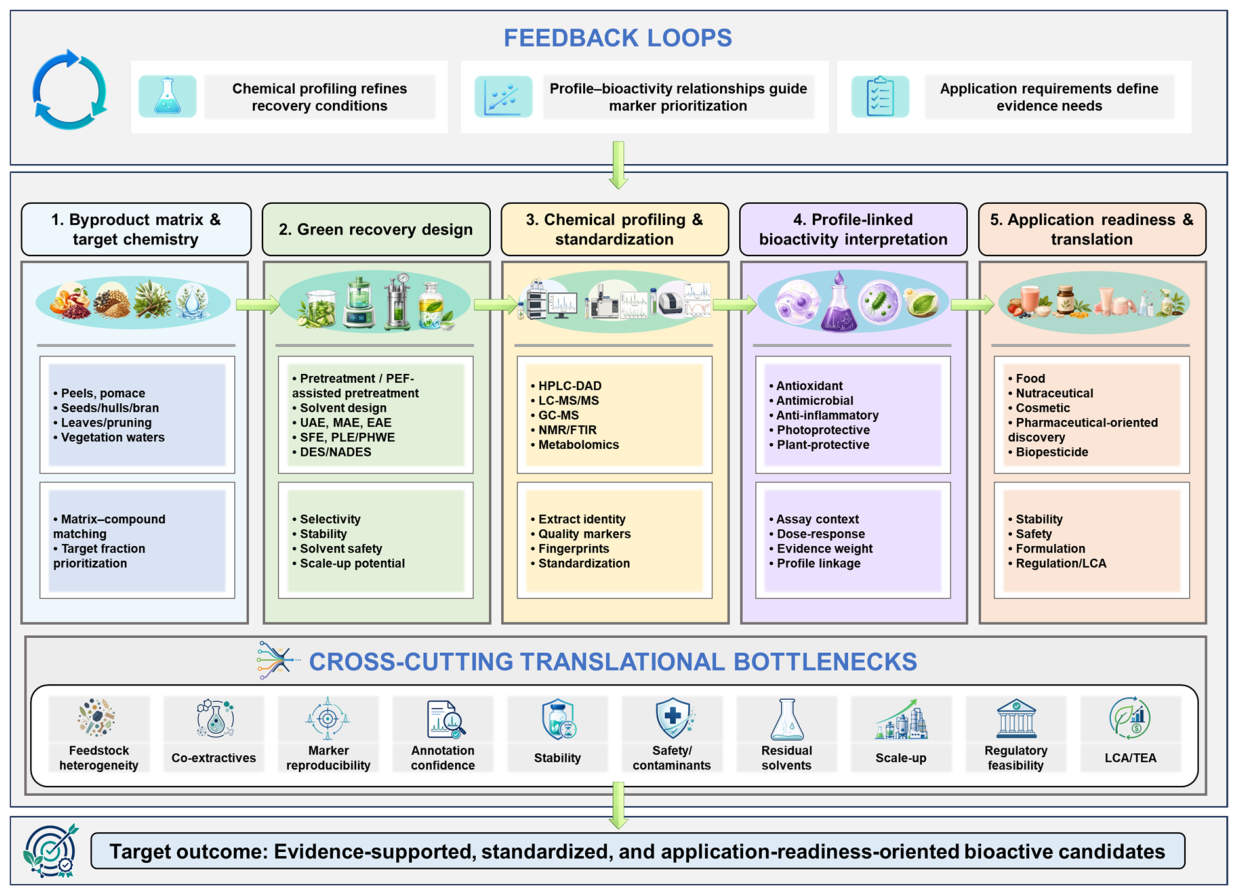
Figure 2.
Matrix–fraction decision map for selecting initial recovery and profiling priorities in agri-food byproduct valorization.
Figure 2.
Matrix–fraction decision map for selecting initial recovery and profiling priorities in agri-food byproduct valorization.
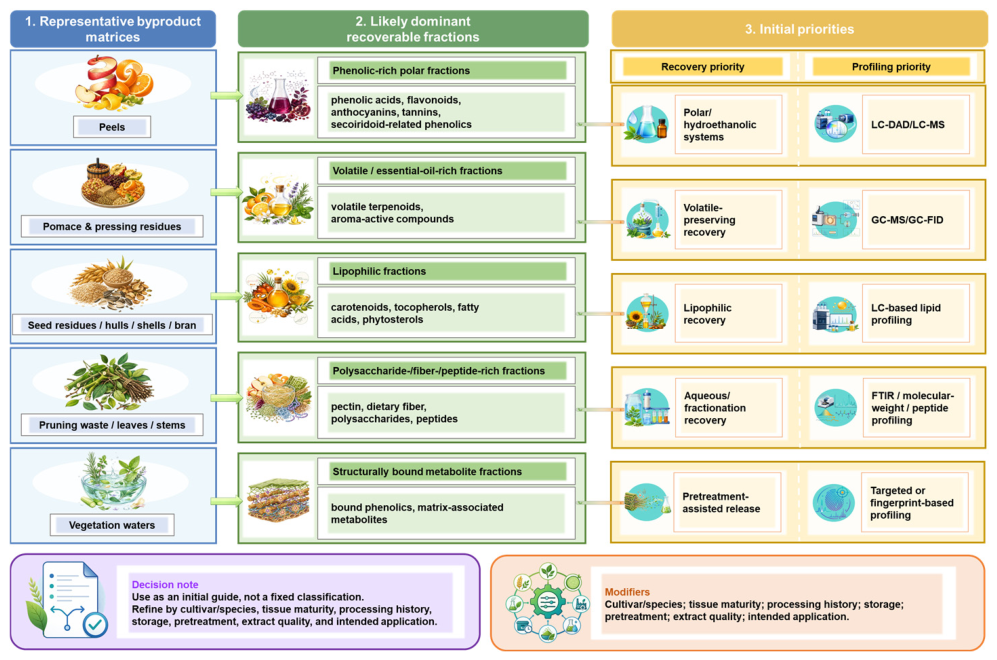
Figure 3.
Profile-guided interpretation framework linking extraction variables, chemical profile changes, bioactivity outcomes, and application-route prioritization.
Figure 3.
Profile-guided interpretation framework linking extraction variables, chemical profile changes, bioactivity outcomes, and application-route prioritization.
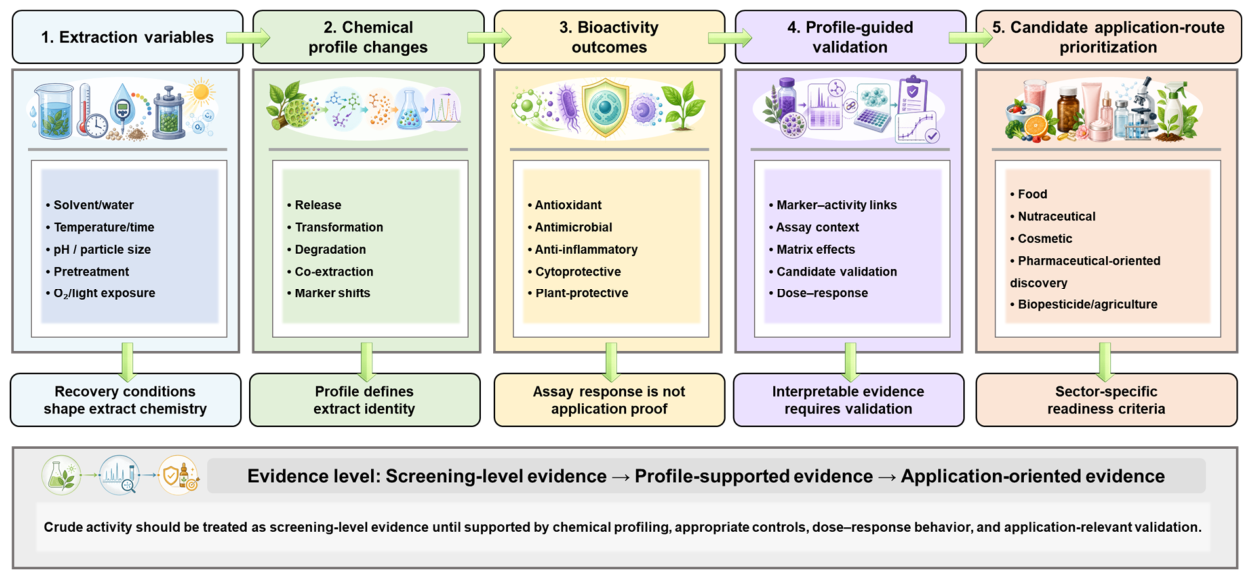
Figure 4.
Application-readiness and translational gate model for circular valorization of agri-food byproduct-derived bioactive extracts and fractions.
Figure 4.
Application-readiness and translational gate model for circular valorization of agri-food byproduct-derived bioactive extracts and fractions.
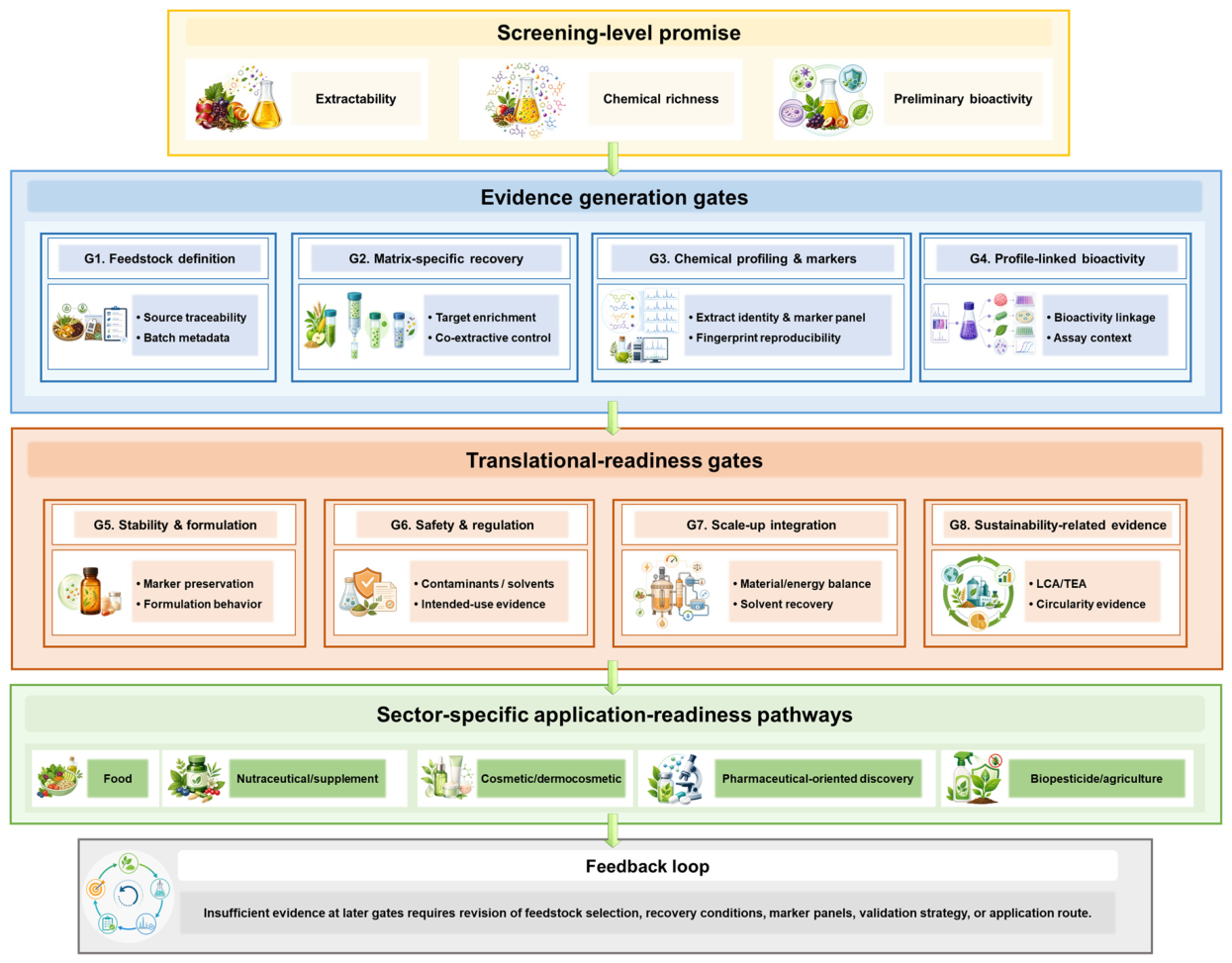
Table 1.
Representative agri-food byproduct matrices, major bioactive compound classes, and valorization considerations.
Table 1.
Representative agri-food byproduct matrices, major bioactive compound classes, and valorization considerations.
| Byproduct matrix or source stream | Dominant recoverable fractions | Recovery and profiling priorities | Potential valorization pathways | Application-readiness considerations |
Representative references |
|
Fruit and vegetable peels (citrus; apple; mango; pomegranate; onion; tomato) |
Phenolics/flavonoids; citrus PMFs/limonoids; carotenoids/pigments; volatile terpenoids/essential oils; pectin/fiber/waxes. | Phenolics: hydroethanolic extraction, UAE/MAE/PLE. Volatiles: hydrodistillation, solvent-free MAE, or SFE. Pectin/fiber: acid, EAE, or green solvents. Profiling: LC-DAD/LC-MS; GC-MS/GC-FID. | Food preservation/color; pectin/fiber ingredients; functional food/nutraceutical; cosmetics; aroma/essential-oil fractions; plant-protective or biopesticide-oriented profiles. | Pesticide residues, waxes, sugars/acids, bitterness/astringency, odor-active volatiles, pigment instability; sensory quality, safety, marker reproducibility, and standardization. | [2,3,19,20,21] |
|
Pomace and pressing residues (grape; apple; tomato; olive; juice, puree, wine, or oil residues) |
Mixed skins/pulp/seeds/stems/fibers; phenolic acids, flavan-3-ols, anthocyanins, proanthocyanidins, stilbenes; carotenoids/pigments; pectin/fiber; residual oils/fatty acids. | Define anatomical fraction first. Match polar, pigment, lipid, pectin/fiber, or mixed-profile recovery to target. Profiling: LC-MS, LC-DAD, fingerprints; add lipid/fatty-acid profiling when seeds are relevant. Report dry-matter, yield, and concentration bases. | Functional-food ingredients; antioxidant/colorant candidates; nutraceutical/cosmetic candidates; circular biorefinery fractions; profile-guided discovery materials. | Heterogeneity and tissue partitioning; free/conjugated/polymerized/bound forms; co-extracted sugars, acids, proteins, pigments, lipids, fibers; turbidity, storage, microbial, sensory/formulation issues. | [2,4,22,23,24] |
|
Seed residues, hulls, shells, and bran fractions (cereal/rice bran; oilseed meals; nut shells; legume and fruit seed residues) |
Fibrous tissues: bound hydroxycinnamates, ferulic acid, tannins, lignans, fiber, polysaccharides, lignocellulose. Kernels/meals: oils, fatty acids, tocopherols, phytosterols, proteins/peptides. | Separate lipid-rich and fibrous fractions. Use milling, defatting, alkaline treatment, EAE, fermentation, UAE/MAE, PEF, or solvent engineering. Monitor free/released/bound phenolics, lipid oxidation, tocopherols, hydrolysis degree, MW/peptide quality. | Phenolic antioxidant fractions; lipid-oriented fractions; peptide hydrolysates; fiber/polysaccharides; nutraceutical/supplement candidates; plant-protective fractions. | Limited accessibility; oxidation; antinutritional or undesirable co-extractives; excessive hydrolysis; bitterness, allergenicity, sensory constraints; unit basis and marker preservation. | [2,3,25,26] |
|
Pruning waste, leaves, and stems (orchards, vineyards, olive groves, and herbaceous systems) |
Defense phenolics/flavonoids; olive-sector secoiridoids, including oleuropein- and hydroxytyrosol-related compounds; terpenoids/triterpenes; lignans/alkaloids; selected volatiles; lignocellulose. | Maintain source-to-extract traceability. Control cultivar/season/agronomy, tissue age, handling, drying, and particle size. Select polar, terpenoid, or secoiridoid-oriented recovery. Profiling: LC-MS/LC-DAD, GC-MS, or fingerprints. | Food, cosmetic, and nutraceutical candidates; plant-protective or biopesticide-oriented profiles; agricultural valorization; phenolic-, terpenoid-, or secoiridoid-enriched fractions. | Field variability; cultivar/season effects; contaminants; post-collection instability; drying/storage losses; lignocellulosic barriers; variable marker preservation; dispersed-biomass scale-up. | [2,27,28,29] |
|
Vegetation waters and liquid or semi-liquid residues (olive mill wastewater; vegetation waters; aqueous effluents) |
Soluble aqueous phenolics, especially hydroxytyrosol-, tyrosol-, and secoiridoid-derived compounds; organic acids; colloidal/process-derived constituents; microbial and organic-load indicators. | Use aqueous-effluent logic. Clarify, centrifuge/filter, use membranes, resin adsorption/concentration, liquid-liquid or solid-liquid extraction, and treatment/biorefinery integration. Profiling should track phenolics, detoxification, residual load, and microbial risk. | Phenolic recovery; water-treatment-linked valorization; food/cosmetic/pharmaceutical-oriented fractions only after safety/stability evidence; agricultural reuse after detoxification and regulatory alignment; integrated biorefinery streams. | High water content and COD/BOD; microbial risk; colloids; storage instability; concentration/solvent-recovery burden; environmental toxicity; detoxification and safe reuse/disposal needs. | [2,29,30,31] |
Note: Matrix–compound assignments indicate common tendencies and recovery hypotheses rather than fixed classifications; final priorities depend on matrix origin, cultivar or species, processing and storage history, pretreatment, target fraction, extract identity and quality attributes, and intended application. The rightmost column lists representative references only. Abbreviations: BOD, biochemical oxygen demand; COD, chemical oxygen demand; DAD, diode array detection; EAE, enzyme-assisted extraction; GC-FID, gas chromatography–flame ionization detection; GC-MS, gas chromatography–mass spectrometry; LC-DAD, liquid chromatography with diode array detection; LC-MS, liquid chromatography–mass spectrometry; MAE, microwave-assisted extraction; MW, molecular weight; PEF, pulsed electric field; PLE, pressurized liquid extraction; PMFs, polymethoxylated flavones; SFE, supercritical fluid extraction; UAE, ultrasound-assisted extraction.
Table 2.
Green recovery strategies for bioactive compounds from agri-food byproducts: mechanisms, suitable targets, advantages, limitations, and scale-up considerations.
Table 2.
Green recovery strategies for bioactive compounds from agri-food byproducts: mechanisms, suitable targets, advantages, limitations, and scale-up considerations.
| Recovery strategy | Mechanistic and process basis | Suitable target fractions and matrices | Main advantages |
Main limitations and quality risks |
Scale-up and application-readiness considerations |
Representative references |
|
|
Conventional and food-grade solvent extraction (reference baseline) |
Solvent diffusion/partitioning with water, ethanol, hydroethanolic, or GRAS-compatible solvents; maceration, SLE, reflux, Soxhlet, hydrodistillation. | Reference baseline for phenolics, pigments, pectin/fiber, and semi-polar fractions from peels, pomace, bran, pruning residues; essential oils via distillation. | Simple; accessible; useful comparator for solvent effects, matrix accessibility, kinetics, and emerging technologies. | High solvent/time/energy demand; heat/oxygen/light damage; co-extraction; volatile loss; residual-solvent concerns. | Report solvent grade/composition, S:L ratio, time/temp., pretreatment, yield basis, solvent recovery, and profiling data. | [2,4,36] | |
|
Ultrasound-assisted extraction (UAE) |
Acoustic cavitation and microstreaming disrupt matrices and improve solvent penetration and mass transfer. | Phenolics, flavonoids, anthocyanins, pigments, pectins, and selected volatile-associated fractions from peels, pomace, leaves, pruning residues, bran-like matrices. | Shorter time; lower solvent demand; compatible with hydroethanolic or food-grade solvents; mild/moderate-temperature recovery. | Excess power/time or poor cooling can cause heating, oxidation/radicals, emulsification, difficult clarification, or marker degradation. | Control energy density, reactor geometry, mixing, cooling, particle size, solvent system, and temp. profile; report marker preservation. | [2,3,22] | |
|
Microwave-assisted extraction (MAE) |
Dielectric heating of polar solvents and matrix moisture accelerates cell rupture, internal pressure, and compound release. | Phenolics, flavonoids, anthocyanins, pigments, pectin-rich fractions, microwave-responsive matrices, and selected volatiles under controlled conditions. | Rapid; solvent-saving; efficient when polarity and water content match the matrix; useful for sequential or fraction-specific recovery. | Non-uniform heating, pressure, excess power, or poor cooling may degrade thermolabile markers, promote isomerization, or lose volatiles. | Control penetration depth, field distribution, pressure, temp. history, solvent compatibility, loading, and heat removal; report power/time/temp. | [2,3,22] | |
|
Enzyme-assisted extraction (EAE) |
Enzymes weaken cell-wall, pectin, protein, glycosidic, or ester-linked barriers under mild conditions. | Bound phenolics, released phenolic acids, peptides, oligosaccharides, pectin, polysaccharides, and fiber-associated fractions from bran, hulls, peels, pomace, seeds. | Mild; selective for protected compounds; compatible with aqueous or food-grade processing. | Specificity, cost, dose, pH, temp., time, residual activity, and matrix variability can shift profiles or generate mixed products. | Standardize enzyme type/dose, moisture, time, pH/temp., inactivation, clarification, and marker monitoring; distinguish release vs transformation. | [2,9,16] | |
| Fermentation-assisted recovery | Microbial enzymes disrupt matrices and biotransform glycosylated, polymerized, protein-bound, or cell-wall-associated metabolites. | Bound phenolics, peptides, oligosaccharides, polysaccharide-derived fractions, and transformed metabolites from bran, pomace, seed meals, peels, protected residues. | Releases bound compounds; generates metabolites; may reduce antinutritional factors; improves digestibility and functional/sensory profiles. | Strain variability, contamination, off-flavors, uncontrolled biotransformation, residual activity, and complex mixtures complicate standardization. | Define strain/inoculum; control pH, moisture, temp., and time; verify reproducibility, microbial safety, stabilization, and targeted/untargeted profiling. | [13,15,16] | |
|
Supercritical fluid extraction (SFE) |
Supercritical CO2 provides tunable low-polarity solvent density; pressure/temp. and co-solvents extend recovery to moderately polar compounds. | Carotenoids, tocopherols, fatty acids, phytosterols, waxes, terpenoids, and essential-oil constituents from seeds, pomace, peels, leaves, aromatic residues. | Low residual-solvent burden; selective lipophilic/volatile recovery; useful for oxygen-sensitive targets; CO2 recyclable. | Limited polarity without co-solvent; high-pressure equipment, compression energy, co-solvent handling/removal, and high cost. | Assess pressure, temp., CO2 flow, co-solvent %, separator design, recycling, energy, throughput, fractionation, marker stability, and LCA/TEA evidence. | [2,22,35] | |
|
Pressurized liquid / pressurized hot-water extraction (PLE/PHWE) |
Elevated temp./pressure keep solvents liquid and increase penetration, diffusivity, solubility, and desorption; PHWE tunes water polarity. | Phenolics, flavonoids, anthocyanins, pectin-associated fractions, polysaccharides, peptides, organic acids, and bound fractions from peels, pomace, bran, winery residues, coffee waste, aqueous matrices. | Efficient mass transfer; shorter processing; water/ethanol compatible; tunable solvent properties; rapid or automated operation. | High temp./time may cause hydrolysis, oxidation, isomerization, Maillard-type changes, thermolabile loss, or co-extraction burdens. | Control temp.-pressure profile, residence time, solvent recycling, corrosion, concentration, energy/water demand, throughput, degradation markers, and purification/drying. | [2,37,38] | |
|
Pulsed electric field-assisted pretreatment (PEF) |
Short electric pulses induce electroporation and cell permeabilization, improving mass transfer before or during extraction. | Wet, pigment-rich, aromatic, or oil-bearing matrices; peels, pomace, leaves, and liquid/semi-liquid streams before extraction, pressing, or diffusion-based recovery. | Non-thermal/mild pretreatment; may reduce time, solvent demand, or temperature when integrated with compatible extraction. | Depends on conductivity, moisture, field strength, pulse number, energy input, electrode design, and temperature rise; dry matrices need conditioning. | Optimize chamber/electrodes, field strength, pulses, energy, conductivity, temp., safety, cleaning, and downstream integration; report PEF as pretreatment where appropriate. | [2,9,39] | |
|
Deep eutectic and natural deep eutectic solvent extraction (DES/NADES) |
Hydrogen-bond donor/acceptor networks tune polarity, viscosity, H-bonding, and solvent-solute interactions. | Phenolics, flavonoids, anthocyanins, pectins, polysaccharides, and polar/semi-polar bioactives from food/agro-industrial residues; often paired with UAE or MAE. | Low volatility; tunable solubility/stability; compatible with green extraction or direct-use concepts when acceptable for the intended application. | High viscosity/dilution, slow mass transfer, difficult recovery, residual-solvent control, toxicological/ecotoxicological and regulatory uncertainty, analytical matrix effects. | Assess preparation, water content, recyclability, purification/direct use, viscosity, component safety, residual limits, regulatory acceptance, and marker-quantification compatibility. | [14,34,40] | |
|
Volatile-preserving and solvent-free recovery (hydrodistillation, steam distillation, solvent-free MAE) |
Volatilization, vapor transfer, condensation, or microwave-driven release of essential oils and aroma-active fractions with little/no organic solvent. | Essential oils, volatile terpenoids, aroma-active aldehydes, alcohols, esters, and semi-volatiles from citrus peels, aromatic leaves, pruning residues, herbs, aroma-rich byproducts. | Avoids/reduces organic solvents; generates food-, cosmetic-, antimicrobial-, or plant-protective volatile fractions when thermal exposure is controlled. | Thermal exposure, hydrolysis, oxidation, isomerization, emulsions, volatile loss, water/energy demand, and aroma artifacts can alter identity and sensory quality. | Report distillation/microwave conditions, oxygen/light, water/energy use, yield basis, storage, and GC-MS/GC-FID with retention indices; check irritation, sensitization, or phototoxicity when relevant. | [2,22,33] | |
Note: Conventional and food-grade solvent extraction is included as a reference baseline. Recovery-strategy assignments indicate typical starting points rather than fixed prescriptions; final selection should be refined according to matrix structure, target chemistry, extract identity and quality attributes, safety, downstream compatibility, intended application, scale-up feasibility, and sustainability-related evidence. The rightmost column lists representative references only. Abbreviations: DES, deep eutectic solvents; EAE, enzyme-assisted extraction; GC-FID, gas chromatography–flame ionization detection; GC-MS, gas chromatography–mass spectrometry; GRAS, generally recognized as safe; LCA, life cycle assessment; MAE, microwave-assisted extraction; NADES, natural deep eutectic solvents; PEF, pulsed electric field; PHWE, pressurized hot-water extraction; PLE, pressurized liquid extraction; SFE, supercritical fluid extraction; S:L, solid-to-liquid ratio; SLE, solid–liquid extraction; TEA, techno-economic analysis; UAE, ultrasound-assisted extraction.
Table 3.
Chemical profiling platforms for agri-food byproduct-derived bioactive compounds: analytical outputs, suitable targets, strengths, limitations, and standardization value.
Table 3.
Chemical profiling platforms for agri-food byproduct-derived bioactive compounds: analytical outputs, suitable targets, strengths, limitations, and standardization value.
| Profiling platform or analytical approach | Analytical outputs and suitable targets | Key strengths | Main limitations and quality risks | Standardization and application-readiness value |
Representative references |
| HPLC-DAD / UHPLC-DAD | Known UV-Vis-absorbing markers; retention time, UV-Vis spectra, peak areas, targeted/semi-targeted quantification, and chromatographic fingerprints. Targets: phenolic acids, flavonoids, anthocyanins, stilbenes, tannins, secoiridoids, carotenoids, and degradation markers. |
Accessible first-line platform for routine recovery-method comparison, batch monitoring, and stability tracking when standards are available. | Limited structural confirmation; co-elution, isomers, glycosylated/acylated derivatives, polymeric tannins, degradation products, and unavailable standards can lower confidence. | Known-marker quantification and QC; peak-pattern comparison; batch reproducibility checks; preliminary degradation monitoring. | [2,4,24] |
| Targeted LC-MS/MS (MRM/PRM) | Predefined marker control; precursor/product ion transitions, MS/MS evidence, low-level detection, and calibration/internal-standard-supported quantification. Targets: phenolic, flavonoid, secoiridoid, carotenoid-derivative, lipid-associated, degradation, or negative markers. |
High sensitivity and selectivity for predefined markers; useful for validated ranges, acceptance windows, and batch-level standardization. | Requires reference compounds or well-defined transitions; matrix effects, ion suppression, clean-up, calibration design, and validation determine reliability. | Quantitative marker specifications; targeted positive/negative markers; selected degradation markers; standardized release criteria. | [2,24,44] |
| LC-HRMS and untargeted metabolomics | Broad feature discovery; accurate mass, isotope patterns, adducts, neutral losses, MS/MS spectra, feature tables, tentative annotations, and discriminant features. Targets: complex phenolics, glycosides, tannins, secoiridoids, lipophilic/degradation-related metabolites, and unknown markers. |
Broad chemical coverage; useful for discovery, cultivar/process comparison, marker prioritization, and profile-bioactivity hypothesis generation. | Annotations may remain tentative; adducts, in-source fragments, isomers, co-elution, matrix effects, batch effects, and overfitting can weaken interpretation. | Annotation-confidence reporting; discriminant fingerprinting; candidate-marker selection; batch classification; validation planning. | [44,52,53] |
| GC-MS / GC-FID | Volatile/semi-volatile profiling; mass spectra, retention indices, volatile fingerprints, relative abundance profiles, and GC-FID-supported quantification. Targets: essential-oil constituents, aroma-active compounds, terpenoids, aldehydes, alcohols, esters, FAMEs, and derivatized small metabolites. |
Well suited to volatile and aroma-rich fractions; links volatile fingerprints to sensory, antimicrobial, antifungal, or plant-protective relevance. | Library matching alone is insufficient; co-elution, isomeric terpenoids, thermal artifacts, oxidation products, derivatization bias, and RI misuse can cause over-assignment. | RI-supported volatile fingerprints; odor/stability markers; QC for essential-oil-rich or volatile-preserving recovery routes. | [47,48,49] |
| LC-DAD / LC-MS lipid-oriented profiling | Lipophilic-marker profiling; UV-Vis spectra, retention behavior, targeted LC/MS evidence, lipid-class patterns, and oxidation-related markers. Targets: carotenoids, tocopherols, phytosterols, fatty acids, wax-related constituents, lipophilic pigments, and oxidation-sensitive markers. |
More appropriate than routine GC-MS for less volatile or thermally sensitive lipophiles unless validated derivatization is used; supports stability tracking. | Light, oxygen, and heat sensitivity; isomerization, oxidation, low solubility, and lipid co-extractives can affect recovery and quantification. | Lipophilic marker specifications; stability tracking; oxidation-marker monitoring; assessment of SFE or lipophilic-solvent recovery outputs. | [2,6,41] |
| NMR spectroscopy | Global spectral fingerprints; structural-class evidence; relative/absolute quantification in selected workflows; mixture-level metabolite patterns. Targets: major metabolites and class-level signatures in complex extracts, including sugars, organic acids, phenolics, lipids, and purified/semi-purified fractions. |
Highly reproducible and non-destructive; minimal sample preparation; useful for holistic comparison, authenticity/origin discrimination, and batch-level fingerprinting. | Lower sensitivity than MS; peak overlap and complex matrices can limit minor-compound detection and confident assignment without complementary data. | Orthogonal profile comparison; batch classification; stability assessment; confirmation of major compositional shifts. | [6,54,55] |
| FTIR / NIR / Raman fingerprinting | Rapid vibrational fingerprints; functional-group spectra, class-level chemical signatures, and multivariate spectral variables. Targets: polysaccharide-, fiber-, protein-, lipid-, or phenolic-rich extracts, powders, and fractions requiring rapid screening or batch comparison. |
Fast, low-solvent or non-destructive screening; suitable for routine QC, classification, and monitoring of processing or stability-related changes. | Limited compound-level identification; preprocessing choices, spectral overlap, water content, and model overfitting can distort interpretation. | Fingerprint similarity; batch classification; process monitoring; quality-marker selection when coupled with validated chemometrics. | [6,50,51] |
| Macromolecular and sequence-oriented profiling | Polymer/sequence-level attributes; molecular-weight distribution, SEC/GPC profiles, monosaccharide composition, degree of hydrolysis, and amino acid or peptide profiles. Targets: pectin, dietary fiber, polysaccharides, proteins, peptide hydrolysates, and cell-wall-associated fractions from bran, peels, pomace, hulls, or seed residues. |
Captures attributes not visible in small-molecule profiling, including polymer size, hydrolysis state, peptide distribution, and structural/fraction quality. | Requires complementary methods; purification, incomplete hydrolysis, matrix salts, protein/lipid co-extractives, and method-dependent calibration can affect results. | Macromolecular specifications; hydrolysis indicators; peptide/fiber markers; functional attributes relevant to digestion, texture, or formulation. | [2,25,26] |
| Chemometrics and multi-platform marker panels | Integrated profile interpretation; PCA, HCA, PLS/OPLS, regression/classification outputs, targeted markers, fingerprints, and positive/negative marker panels. Targets: complex extracts requiring batch classification, origin/process discrimination, profile-bioactivity linkage, candidate marker prioritization, or readiness QC. |
Integrates targeted and untargeted evidence; helps convert chemical profiles into marker panels, acceptance windows, and evidence-weighted interpretation. | Model validity depends on sample size, preprocessing, batch design, validation, and confirmation; overfitting can create non-biological conclusions. | Extract identity; marker reproducibility; positive/negative QC markers; contamination/degradation indicators; application-readiness assessment. | [6,45,51] |
| Negative-marker and safety-oriented profiling | Risk-marker control; targeted contaminant assays, residual-solvent checks, pesticide, mycotoxin, heavy-metal, allergen/antinutritional-factor, degradation-marker, and microbial-risk indicators. Targets: application-directed extracts requiring safety, contaminant control, degradation-state, or residual-process-risk documentation. |
Complements desirable-bioactive profiling; supports risk-based QC, contaminant control, and sector-specific readiness claims. | Hazard selection must be matrix- and use-specific; absence of screening for relevant risks can create false confidence. | Negative quality markers; contaminant limits; degradation thresholds; residual-risk documentation; evidence for application-oriented valorization. | [10,44,45] |
Note: Profiling-platform assignments indicate fit-for-purpose starting points rather than fixed analytical prescriptions; final selection should be refined according to target chemistry, matrix complexity, recovery strategy, available standards, annotation confidence, intended application, and required positive or negative quality markers. The rightmost column lists representative references only. Abbreviations: DAD, diode array detection; FAMEs, fatty acid methyl esters; FID, flame ionization detection; FTIR, Fourier-transform infrared spectroscopy; GC, gas chromatography; GC-FID, gas chromatography–flame ionization detection; GC-MS, gas chromatography–mass spectrometry; GPC, gel permeation chromatography; HCA, hierarchical cluster analysis; HPLC, high-performance liquid chromatography; HPLC-DAD, high-performance liquid chromatography with diode array detection; HRMS, high-resolution mass spectrometry; LC, liquid chromatography; LC-DAD, liquid chromatography with diode array detection; LC-HRMS, liquid chromatography–high-resolution mass spectrometry; LC-MS, liquid chromatography–mass spectrometry; LC-MS/MS, liquid chromatography–tandem mass spectrometry; MRM, multiple reaction monitoring; MS, mass spectrometry; MS/MS, tandem mass spectrometry; NIR, near-infrared spectroscopy; NMR, nuclear magnetic resonance; OPLS, orthogonal projections to latent structures; PCA, principal component analysis; PLS, partial least squares; PRM, parallel reaction monitoring; QC, quality control; RI, retention index; SEC, size-exclusion chromatography; SFE, supercritical fluid extraction; UHPLC, ultra-high-performance liquid chromatography; UHPLC-DAD, ultra-high-performance liquid chromatography with diode array detection; UV–Vis, ultraviolet–visible spectroscopy.5.1. Chromatographic Profiling for Phenolics, Flavonoids, and Pigments.
Table 4.
Linkage framework for interpreting extraction variables, chemical profiles, and bioactivity outcomes in agri-food byproduct valorization.
Table 4.
Linkage framework for interpreting extraction variables, chemical profiles, and bioactivity outcomes in agri-food byproduct valorization.
| Evidence layer and decision question | Chemical-profile evidence to examine | Bioactivity interpretation and risk control | Minimum validation and reporting requirements |
Representative references |
|
Extraction-variable to profile layer Which variables reshape the recovered profile? |
Targeted markers; class-specific profiles; fingerprints; co-extractives; degradation products; marker preservation; yield, dry-weight, and concentration basis. | Compare activity only relative to extract identity, marker content, dose/concentration basis, and profile quality. Avoid yield-only or TPC-only claims. | Report solvent system, pH, time, temperature, S:L ratio, particle size, pretreatment, oxygen/light exposure, assisted technology, feedstock basis, yield basis, concentration basis, and chemical-profile data. | [2,6,38] |
|
Bulk-index and preliminary activity screening Are yield/TPC/TFC, IC50, EC50, inhibition %, zones, or MIC only screening evidence? |
Total-index or assay-response data, supported where possible by chromatographic, MS, spectroscopic, or fingerprint-level evidence. | Bulk indices can rank early extracts but cannot define identity, marker distribution, reproducibility, mechanism, or application relevance. Method and matrix effects can distort comparisons. | Specify calibration standards, assay conditions, concentration basis, blanks, solvent/vehicle controls, normalization, replicate structure, statistics, and complementary profiling evidence. | [18,32,46] |
|
Targeted profiling of expected markers Are expected markers enriched, preserved, and reproducible? |
Reference-standard-supported quantification of predefined compounds/classes, e.g., flavanones, stilbenes, anthocyanins, hydroxytyrosol derivatives, carotenoids, terpenoids, or degradation markers. | Supports optimization, batch comparison, marker specifications, and QC; narrow panels may miss unexpected actives, co-extractives, or mixture effects. | Use calibrated methods, authentic standards where available, internal standards, defined marker ranges, positive and negative quality markers, and a clear quantification basis. | [2,24,29] |
|
Untargeted fingerprinting and discovery profiling Which unexpected features or fingerprints distinguish matrices, processes, storage states, or activity groups? |
LC-HRMS, GC-MS, NMR, FTIR/NIR/Raman fingerprints; feature tables; spectral variables; discriminant features; chemometric patterns; annotation-confidence levels. | Expands chemical search space and generates candidate-marker hypotheses; tentative annotations, batch effects, and overfitted models can weaken interpretation. | Include QC samples, blanks, preprocessing details, annotation-confidence reporting, replication and batch structure, model validation, transparent statistics, and validation planning. | [6,53,66] |
|
Assay-context and matrix-effect layer Could assay conditions or matrix interference distort apparent activity? |
Solvent/vehicle residues; turbidity; intrinsic color, absorbance, or fluorescence; redox-active co-extractives; pH; precipitation; volatile loss; medium or reagent interference. | Different antioxidant, antimicrobial, cell-based, lipid-oxidation, and plant-protective assays measure different endpoints. Matrix effects can mimic, mask, or exaggerate responses. | Use positive/negative controls, solvent/vehicle controls, blanks, blank correction, concentration ranges, dose-response behavior, assay-medium details, and orthogonal endpoint assays. | [62,63,64] |
|
Profile-bioactivity association / biochemometric layer Which features, fingerprints, or fractions covary with activity? |
Marker abundance; LC-MS or GC-MS features; volatile fingerprints; NMR/FTIR variables; multivariate loadings; active fractions; replicate and batch structure. | Associations prioritize hypotheses but are not causality. Co-elution, covariance, matrix effects, assay interference, concentration effects, batch structure, or overfitting can create false markers. | Validate across batches, matrices, or independent datasets where possible. Use cross-validation, permutation/model checks, transparent statistics, and cautious candidate-marker language. | [57,69,70] |
|
Candidate marker or active fraction validation Does the candidate marker, class, or fraction contribute to activity? |
Confirmed identity or transparent annotation level; targeted quantification; purified compounds; active fractions; spiking/depletion evidence; degradation controls. | Validation strengthens functional interpretation, but single-compound testing may not capture synergy, antagonism, or matrix-dependent effects. | Use authentic standards, targeted quantification, fractionation, purified compounds, spiking/depletion experiments, orthogonal bioassays, dose-response testing, and mechanism-oriented experiments where needed. | [44,57,70] |
|
Application-route evidence weighting Is the observed activity relevant to the intended sector and use scenario? |
Positive and negative quality markers; marker reproducibility; stability/degradation profile; residual solvent or contaminant indicators; formulation or food-matrix compatibility; sector-specific fingerprints. | Weigh activity against extract identity, stability, safety, formulation behavior, exposure/use scenario, and sector-specific performance. Do not transfer activity automatically across sectors. | Define the intended use and evidence level. Report stability, safety, formulation compatibility, application-relevant assay performance, and whether evidence is screening-level, profile-supported, candidate-validated, or application-oriented. Avoid using application-ready unless sector-specific evidence is sufficient. | [2,8,11] |
Note: Profile–bioactivity integration is presented as a hypothesis-generating and evidence-prioritization framework rather than as direct proof of causality. Evidence layers indicate decision-support checkpoints rather than fixed requirements; they should be refined according to matrix type, recovery conditions, assay context, annotation confidence, validation goal, and intended application. The rightmost column lists representative references only. Abbreviations: EC50, half-maximal effective concentration; FTIR, Fourier-transform infrared spectroscopy; GC-MS, gas chromatography–mass spectrometry; IC50, half-maximal inhibitory concentration; LC-HRMS, liquid chromatography–high-resolution mass spectrometry; LC-MS, liquid chromatography–mass spectrometry; MIC, minimum inhibitory concentration; MS, mass spectrometry; NIR, near-infrared spectroscopy; NMR, nuclear magnetic resonance; QC, quality control; S:L, solid-to-liquid ratio; TFC, total flavonoid content; TPC, total phenolic content.
Disclaimer/Publisher’s Note: The statements, opinions and data contained in all publications are solely those of the individual author(s) and contributor(s) and not of MDPI and/or the editor(s). MDPI and/or the editor(s) disclaim responsibility for any injury to people or property resulting from any ideas, methods, instructions or products referred to in the content. |
© 2026 by the authors. Licensee MDPI, Basel, Switzerland. This article is an open access article distributed under the terms and conditions of the Creative Commons Attribution (CC BY) license (http://creativecommons.org/licenses/by/4.0/).
Copyright: This open access article is published under a Creative Commons CC BY 4.0 license, which permit the free download, distribution, and reuse, provided that the author and preprint are cited in any reuse.


