
Submitted:
25 May 2026
Posted:
26 May 2026
You are already at the latest version
Abstract
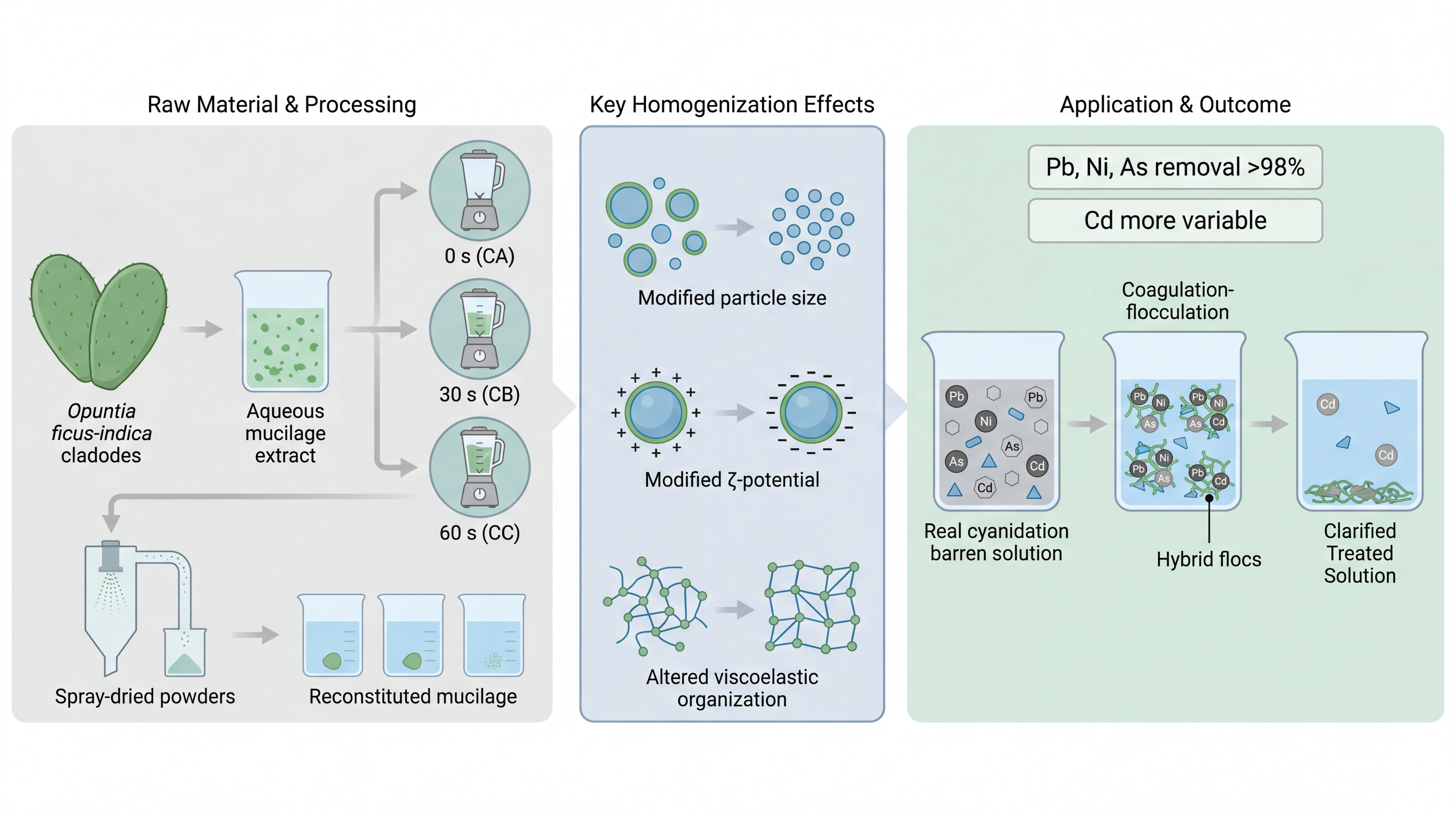
This study evaluated the effect of mechanical homogenization on the structure and performance of nopal mucilage in a real cyanidation barren solution. The aqueous ex-tract obtained from Opuntia ficus-indica cladodes was processed with a household blender for 0, 30, and 60 s before spray drying, yielding powders designated as CA, CB, and CC, respectively. These powders were characterized by physicochemical, thermal, microstructural, and FTIR analyses, and were reconstituted in water to evaluate hy-drodynamic size, ζ potential, rheology, and coagulant flocculant capacity. Homogeni-zation reduced water activity, decreased the hydrodynamic size of reconstituted mu-cilage from 1.8 to 1.3 μm, and significantly modified the ζ potential. Rheological anal-ysis showed a frequency dependent viscoelastic response, consistent with changes in chain association and hydrocolloid network continuity. The reconstituted mucilages removed more than 98% of Pb, Ni, and As at all evaluated concentrations, including 200 mg·L⁻¹, whereas Cd showed more variable removal. FTIR analysis of recovered flocs revealed a hybrid matrix with a signal near 2104 cm⁻¹ compatible with C≡N groups, suggesting retention of cyanide related species. Overall, these findings show that reconstituted nopal mucilage can act as a sustainable hydrocolloid coagulant for real, chemically complex cyanidation effluents, while mechanical homogenization primarily modified its structural, colloidal, and rheological features.
Keywords:
Opuntia ficus-indica mucilage
; mechanical homogenization
; barren solution treatment
Copyright: This open access article is published under a Creative Commons CC BY 4.0 license, which permit the free download, distribution, and reuse, provided that the author and preprint are cited in any reuse.


