

Submitted:
25 May 2026
Posted:
27 May 2026
You are already at the latest version
Abstract
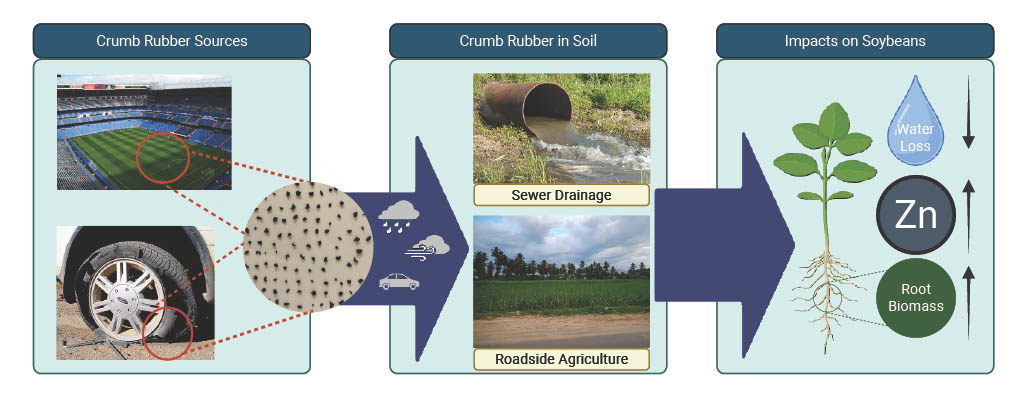
Crumb rubber, a recycled tire product used in artificial turf fields, alters soil physical properties and releases chemical contaminants, but few studies have examined its effects on plant physiology and resource allocation. We conducted a greenhouse experiment to evaluate the responses of soybeans (Glycine max) grown in soils containing increasing proportions of crumb rubber (0%, 16.6%, 33.3%, and 50% by weight). Germination, plant growth, chlorophyll content, soil respiration, biomass production, water loss, root allocation, and elemental composition of soils and plant tissues were measured over a 21-day period. Most indicators of plant performance (germination, plant height, chlorophyll content, soil respiration, and total biomass) were not significantly affected by crumb rubber additions. However, crumb rubber significantly reduced cumulative water loss and increased both root biomass and root-to-shoot ratios at moderate and high concentrations. Soil and plant tissue analyses revealed substantial increases in zinc concentrations across the crumb rubber gradient, with leaf zinc concentrations exceeding sufficiency ranges at higher treatments. These results demonstrate that crumb rubber contamination can alter soil water dynamics, plant resource allocation, and trace metal accumulation even when aboveground growth responses remain limited.
Keywords:
artificial turf
; soil contamination
; root allocation
; trace metals
; soil hydraulic properties
; microplastic-soil interactions
1. Introduction
Globally, tires generate one of the largest sources of microplastic pollution in the environment (Kole et al., 2017; Mayer et al., 2024; Sieber et al., 2020; Surendran et al., 2025). Tire wear particles and recycled tire materials are widely dispersed across urban and natural landscapes, and their environmental release continues to grow as global tire production increases (Mayer et al., 2024; Tian et al., 2024; Wang et al., 2024). In 2023 alone, approximately 2.5 billion tires were produced worldwide (Mayer et al., 2024), generating an expanding stream of waste tires that must be managed or recycled.
One of the most common tire recycling pathways is the production of crumb rubber, a granular material derived from shredded tires that is widely used as infill in artificial turf athletic fields and other recreational surfaces (Brandsma et al., 2019; Murphy and Warner, 2022; Watterson, 2017). Because crumb rubber particles are typically less than 5 mm in diameter, they are classified as microplastics (Dabic-Miletic et al., 2021; Mayer et al., 2024; Thompson et al., 2024). A single professional-sized artificial turf field may contain crumb rubber derived from 20,000-40,000 tires at installation (Brandsma et al., 2019; Murphy and Warner, 2022). Although transport and concentrations of crumb rubber particles in surrounding soils have not been well quantified due to difficulty in extracting microplastics, difficulty in identifying plastic particles, and variation in plastic density (Ganie and Shriwastav, 2026; Yu and Flury, 2021), artificial turf fields require regular replenishment of crumb rubber infill as particles migrate during use (Brandsma et al., 2019; Murphy and Warner, 2022). Despite the widespread installation of artificial turf fields, concentrations of crumb rubber particles in adjacent soils have not yet been systematically quantified. Yearly after installation, industry estimates that users add approximately 18 metric tons of crumb rubber per 0.64-cm layer for replenishment (Safe Healthy Playing Fields, 2024). It is likely that environmentally relevant quantities of crumb rubber migrate into soils and stormwater systems that are adjacent to artificial turf fields.
Crumb rubber is a particularly concerning form of microplastic because it consists of fragmented tire material, which is produced from complex mixtures of natural and synthetic rubber polymers combined with reinforcing agents, aromatic extender oils, plasticizers, vulcanization additives, antioxidants, and processing aids (Mayer et al., 2024; Murphy and Warner, 2022). As a result, crumb rubber contains numerous volatile and semi-volatile organic compounds, PAHs, PFAS, heavy metals, phthalates, vulcanization agents, and antioxidants (Armada et al., 2023, 2022; Celeiro et al., 2021; Duque-Villaverde et al., 2024; Gomes et al., 2021; Moreno et al., 2023; Murphy and Warner, 2022). Many of these compounds have been identified as carcinogens, neurotoxicants, or endocrine-disrupting chemicals (Dabic-Miletic et al., 2021; Gomes et al., 2021; Marsili et al., 2015; Massey et al., 2020; Mayer et al., 2024; Murphy and Warner, 2022; Perkins et al., 2019; Schneider et al., 2020; Selonen et al., 2021; Sheng et al., 2021). Although these compounds may interact in ways that increase toxicity (Gao et al., 2023), crumb rubber is rarely evaluated as a complex chemical mixture in ecotoxicological studies (Mayer et al., 2024).
While the amount of crumb rubber in soil ecosystems is not well quantified (Ganie and Shriwastav, 2026; Yu and Flury, 2021), once released, these particles may alter soil physical and chemical properties (Ghelli et al., 2025; Kang et al., 2025; Karatela et al., 2025; Murphy and Warner, 2022; Yu et al., 2024). Microplastics can alter soil bulk density, porosity, water retention capacity, and carbon:nitrogen ratios (Huang et al., 2022; Medina Faull et al., 2025; Yu et al., 2024). Because these structural changes can influence soil hydraulic properties, microplastic contamination may also alter plant water use and soil moisture dynamics. They can improve soil’s water-holding capacity and increase the amount of water available to plants (Sadeghizadeh and Jalali, 2017). Crumb rubber additions can also increase zinc concentrations (Fořt et al., 2022; Pochron et al., 2018, 2017; Rhodes et al., 2012), alter soil pH and increase soil bulk density (Zhao et al., 2011). More concerningly, a suite of contaminants have been measured in crumb-rubber leachate (Celeiro et al., 2021; Fořt et al., 2022; Halsband et al., 2020; Lu et al., 2021), suggesting that these compounds may accumulate in surrounding soils.
Soil microbes and invertebrates respond to these changes. Crumb rubber additions can stimulate prophage activation and promote the spread of extracellular antibiotic resistance genes through microbial communities (Yaghoubi Khanghahi et al., 2026; Zhang et al., 2025). Additions can also alter soil microbial community structure and influence microbial carbon use and degradation processes (Aralappanavar et al., 2024; Xu et al., 2024; Yaghoubi Khanghahi et al., 2026; Yu et al., 2024). Crumb rubber incorporation into turfgrass soils has been reported to alter nematode community structure and trophic composition (Zhao et al., 2011), and exposure to crumb rubber negatively impacted earthworm health (Pochron et al., 2018, 2017), and drove high mortality rates in earthworms (Fořt et al., 2022).
A recent review of plant responses to general microplastics, which are less toxic than tire-based particles, indicates that microplastics in soils can influence plant growth, physiology, and plant–soil interactions (Wong and Taylor, 2025). Recent work has also demonstrated that microplastics can impair plant nutrient uptake by disrupting root physiology and soil microbial processes. For example, exposure to polypropylene and tire-derived particles reduced nitrogen uptake in peanut plants by damaging root cell structure and altering rhizosphere microbial communities and nitrogen cycling pathways (Liu et al., 2023). In many cases, exposure to microplastics reduces plant biomass, nutrient uptake, or photosynthetic performance, although responses vary widely depending on polymer type, particle size, and soil context (de Souza Machado et al., 2019; Lozano et al., 2021; Wong and Taylor, 2025). Several studies report shifts in root development or root allocation even when aboveground growth responses are limited, suggesting that plants may alter resource allocation in response to changes in soil structure, chemistry, or the microbial activity associated with microplastic contamination (Boots et al., 2019; Qi et al., 2018; Wong and Taylor, 2025).
The limited literature focused specifically on crumb rubber and plants suggests that plant responses depend on plant species, soil conditions, and crumb rubber concentrations. Experiments incorporating crumb rubber into turfgrass growth media have reported mixed outcomes. For example, crumb rubber amendments altered shoot growth and biomass production, while some concentrations improved physiological parameters such as chlorophyll content and photosynthetic rates (Zhao et al., 2009). Other studies report that trees grown in substrates amended with crumb rubber show elevated concentrations of zinc in leaf tissue, occasionally accompanied by chlorosis (Bush et al., 2003). More recent work suggests that crumb rubber additions exert severe phytotoxic effects in the peanut plant, reduce the microbial abundance in the soil, and increase soil microbial diversity (Yu et al., 2024). Together, these studies indicate that crumb rubber contamination has the potential to influence plant–soil systems through multiple pathways, including changes in soil physical structure, chemistry, and microbial activity (Fořt et al., 2022; Mayer et al., 2024; Tunali and Nowack, 2025).
Despite growing evidence that crumb rubber alters soil structure, chemistry, and microbial communities, its effects on plant water use, physiology, and biomass allocation remain poorly understood. In particular, relatively few studies have examined how crumb rubber contamination influences plant resource allocation and nutrient dynamics in soil–plant systems. To address this gap, we conducted a controlled greenhouse experiment exposing soybean (Glycine max) plants to soils containing increasing proportions of crumb rubber. Soybeans were selected as a model system because they can be readily grown under laboratory conditions and, as a legume, their growth and nutrient dynamics are closely linked to soil chemistry and microbial processes. Plants were grown across a gradient of crumb rubber contamination, and we quantified germination, plant height, biomass production, chlorophyll content, soil respiration, and root-to-shoot allocation. Because plant responses to soil contaminants are not always reflected in simple growth metrics, we also examined shifts in biomass allocation, soil water dynamics, and elemental composition of soils and plant tissues. We hypothesized that crumb rubber contamination would alter soil chemistry and plant physiology, leading to increased trace metal accumulation and shifts in biomass allocation even when overall plant growth responses appear modest.
2. Materials and Methods
2.1. Experimental Overview
Four treatment groups with 20 replicates each were established with soils containing 0%, 16.6%, 33.35%, and 50% crumb rubber by weight. Twice weekly throughout the experiment, we measured germination and plant height. When the plants reached the first trifoliate stage (Day 21), we also measured chlorophyll content and soil respiration. We then harvested and measured wet plant biomass, dry plant biomass, dry root mass and dry shoot mass. Finally, we calculated root-to-shoot ratios. Soil and leaf tissue samples were sent to an outside lab (AgroLabs) to determine soil biogeochemistry, heavy metal concentrations, and leaf tissue elemental content.
2.2. Crumb Rubber
Crumb rubber infill was obtained as 10-mesh recycled tire granulate (supplier: Amazon Marketplace; manufacturer Liberty Tire). According to the manufacturer, the material consisted of mechanically shredded end-of-life tire particles intended for artificial turf infill applications. No additional cleaning or chemical treatment was performed prior to use.
To characterize particle size, a representative subsample of crumb rubber particles was photographed for image analysis. Particles were manually dispersed on a white background to avoid overlap, and a metric ruler was placed in the field of view to provide scale calibration (Supplementary Figure S1). The image was captured using a digital camera held vertically above the sample surface (iPhone 12 mini).
Particle size measurements were performed using ImageJ software (version 1.54p; National Institutes of Health, USA). Images were first calibrated using a ruler to convert pixel measurements to millimeters. Images were then thresholded to distinguish crumb rubber particles from the background, and particles were identified as discrete objects using the “Analyze Particles” function. For each particle, projected area (mm²) and Feret diameter (maximum caliper diameter) were calculated automatically. A total of 178 individual crumb rubber particles were measured to characterize particle size distribution.
2.3. Soil Preparation
Four treatment conditions were established with different levels of crumb rubber contamination. Prior to treatment preparation, OMRI-certified Black Gold Garden Compost Blend soil was homogenized in a clean cement mixer for 10 minutes to ensure uniform soil composition across all experimental units.
For each treatment, the appropriate masses of soil and crumb rubber were weighed using a laboratory scale and added to cleaned 0.47 L glass jars. The soil-crumb rubber mixtures were prepared as follows: Control (0% crumb rubber; 150 g soil and 0 g crumb rubber), Low (16.6% crumb rubber; 125 g soil and 25 g crumb rubber), Medium (33.3% crumb rubber; 100 g soil and 50 g crumb rubber), and High (50% crumb rubber; 75 g soil and 75 g crumb rubber). After the materials were added, each jar was sealed and hand-shaken for one minute to homogenize the soil–crumb rubber mixture prior to planting.
Because environmental concentrations of crumb rubber in soils surrounding artificial turf fields remain poorly quantified, the treatment levels used in this study were designed to represent a controlled contamination gradient rather than specific field concentrations. This approach allows mechanistic responses of plant-soil systems to increasing crumb rubber exposure to be evaluated.
2.4. Plant Material and Growth Conditions
Heirloom soybean seeds (Glycine max, variety KS 5120N) were obtained from Outsidepride.com. One soybean seed was planted in each jar at a depth of 3.8 cm below the soil surface. Jars were maintained in a controlled growth chamber at 22 °C under a 12 h light:12 h dark photoperiod with fluorescent lighting and a light intensity of approximately 400 µmol m⁻² s⁻¹ measured at canopy height.
To standardize soil moisture across replicates, a test jar containing the experimental soil mixture was watered with tap water to determine the appropriate moisture level, which corresponded to an increase of approximately 20% in the combined mass of the jar and soil relative to the pre-watering weight. After planting, each replicate jar was watered to this level, and the resulting mass was recorded as the target weight for that jar. At each watering event, the volume of water required to return each jar to its predetermined target weight was recorded. These values were summed across watering events to calculate cumulative water loss for each experimental unit over the 21-day experiment. Maintaining jars at their predetermined target weights ensured consistent soil moisture conditions across treatments despite potential differences in water retention associated with crumb rubber additions.
Plants were maintained for 21 days, during which jars were weighed and watered twice weekly (six watering events spaced approximately 3–4 days apart) to restore each jar to its predetermined target weight. Germination and plant height were recorded at each watering event (see measurement procedures below). Jars were left uncovered to allow plant growth and gas exchange and placed randomly positioned within the growth chamber. Plants were harvested when they reached the first trifoliate developmental stage, 21 days after initiation.
2.5. Plant Health Metrics
2.5.1. Germination and Plant Height
Germination and plant height were recorded at each watering event throughout the experiment and on the final day. Germination was defined as the visible emergence of the seedling above the soil surface. At each observation time point, plant height was measured using a metric ruler placed at the soil surface and recorded as the distance from the soil surface to the highest point of the plant. If a plant was bent or leaning, it was gently straightened prior to measurement. Seeds that had not yet emerged were recorded as having a height of 0 mm.
These repeated measurements allowed germination timing and early plant growth to be tracked across the duration of the experiment. For statistical analysis, germination was treated as a binary outcome variable (emerged vs. not emerged) derived from the height measurements.
2.5.2. Chlorophyll
On the final day of the experiment and before harvest, leaf chlorophyll content was measured using an Apogee Instruments MC-100 Chlorophyll Concentration Meter. Measurements were taken on the uppermost fully developed leaf of each soybean plant whenever possible. When the uppermost leaf was too small or otherwise unsuitable for measurement, the next highest fully developed leaf was used.
2.5.3. Mesocosm Respiration
On the final day of the experiment and before harvest, combined respiration of the plant and soil was measured using a PP Systems EGM-5 Portable CO₂ Gas Analyzer. Custom PVC fittings were attached to the soil respiration chamber to ensure a secure seal over the tops of the jars during measurement.
2.5.4. Plant Wet and Dry Biomass
After harvest, soil was gently removed from the roots, and the wet biomass (g) of each plant was measured using a laboratory balance. Following wet biomass measurements, plants were dried to determine dry biomass. Each plant was individually wrapped in labeled paper towels and placed in a chamber at 22 °C for one week.
After drying, each plant was separated into root and shoot components, which were weighed individually to determine dry root biomass (g) and dry shoot biomass (g). Total dry plant biomass (g) was calculated as the sum of the dry root and dry shoot masses.
2.5.5. Root-to-Shoot Ratio
Root-to-shoot ratios were calculated after plants had been harvested and dried. Following drying, each plant was separated at the root-shoot junction and the dry root biomass (g) and dry shoot biomass (g) were measured individually. The root-to-shoot ratio for each plant was calculated as the dry root biomass divided by the dry shoot biomass.
2.6. Soil and Plant Tissue Chemical Analyses
2.6.1. Soil Sample Collection
On the day of harvest, three jars from each treatment were selected using stratified random sampling. Soil from the selected jars was removed and combined within treatment groups. For each treatment, the three soil samples were pooled in a stainless-steel bowl and homogenized by hand using nitrile gloves. Composite soil samples were transferred to sealed polyethylene bags and shipped to AgroLab Inc. (Harrington, DE, USA) for analysis. Soil samples were submitted field-moist and were not dried prior to shipment.
2.6.2. Plant Tissue Sample Collection
Following harvest and drying, soybean shoots from each treatment group were pooled to create composite plant tissue samples. The pooled tissue samples were placed in sealed polyethylene bags and shipped to AgroLab Inc. (Harrington, DE, USA) for elemental analysis.
2.6.3. Soil and Plant Tissue Analyses
Soil samples were analyzed by AgroLab Inc. for heavy metal concentrations using EPA Methods 3050B/6010C and 7473. Additional soil nutrient and soil chemistry measurements were conducted using the laboratory’s standard soil analysis procedures.
Plant tissue samples were analyzed using AgroLab Inc.’s P1 Plant Tissue Analysis package, which quantifies macro- and micronutrients including N, P, K, Ca, Mg, S, Zn, Fe, Mn, Cu, B, Mo, and Na.
2.7. Data Analysis
For each response variable (germination, final plant height, wet biomass, dry biomass, dry root biomass, dry shoot biomass, root-to-shoot ratio, chlorophyll content, and soil respiration), normality and homogeneity of variance were evaluated using the Shapiro–Wilk and Levene’s tests, respectively. When model assumptions were met, treatment effects were analyzed using one-way analysis of variance (ANOVA) followed by Tukey’s honestly significant difference (HSD) post hoc tests. When assumptions were not met, treatment effects were analyzed using the Kruskal–Wallis test, followed by pairwise Wilcoxon rank-sum tests with Bonferroni correction. Germination outcomes (germinated vs. not germinated) were analyzed using a binomial generalized linear model to test for treatment effects. Changes in plant height over time were analyzed using analysis of covariance (ANCOVA) with day of measurement as a continuous covariate and treatment as a categorical factor. The interaction between day and treatment was tested to evaluate whether growth rates differed among treatments. Root-to-shoot ratios were calculated for each plant as the ratio of dry root biomass to dry shoot biomass and analyzed as an independent response variable. Violin plots were used to visualize treatment distributions, with points indicating treatment means. Particle size measurements of crumb rubber were summarized using descriptive statistics (mean ± standard deviation). All statistical analyses were conducted in R Studio version 4.4.1 (R Core Team), and statistical significance was assessed at α = 0.05.
3. Results
3.1. Crumb Rubber Particle Size
Image analysis of 178 crumb rubber particles indicated that the material consisted of irregularly shaped fragments typical of mechanically shredded tire granulate (Supplementary Figure S1). Particle projected area averaged 4.00 ± 1.65 mm² (mean ± SD), with a median of 3.88 mm² (interquartile range: 2.64–5.22 mm²). Feret diameters averaged 3.01 ± 0.704 mm, with a median of 3.00 mm (IQR: 2.48–3.55 mm). These measurements confirm that the particles fall within the expected size range for 10-mesh crumb rubber used in artificial turf infill.
3.2. Germination
Germination was analyzed using a binomial generalized linear model, which showed no significant effect of crumb rubber treatment on germination (χ²(3, N = 80) = 3.02, p = 0.39). Germination rates remained high across all treatments. Mean germination proportions were 0.80 ± 0.41 in the control (0% crumb rubber), 0.70 ± 0.47 in the low treatment (16.6% crumb rubber), 0.55 ± 0.51 in the medium treatment (33.3% crumb rubber), and 0.65 ± 0.49 in the high treatment (50% crumb rubber). Post hoc comparisons using estimated marginal means indicated no significant differences among treatments.
3.3. Plant Height over Time
Seedling growth rates were similar across all crumb rubber treatments. Final plant height increased significantly over time (ANCOVA; F₁,₂₃₁ = 260, p < 0.01), reflecting normal plant development during the experiment. However, crumb rubber treatment had no significant effect on plant height (F₃,₂₃₁ = 0.25, p = 0.86), and there was no interaction between treatment and day (F₃,₂₃₁ = 0.22, p = 0.88), indicating that growth trajectories did not differ among treatments. Linear regressions fitted separately for each treatment showed comparable growth rates, with slopes ranging from 8.06 to 9.10 mm day⁻¹ and coefficients of determination (r²) between 0.38 and 0.75.
3.4. Chlorophyll
On the final day of the experiment, chlorophyll content did not differ significantly among crumb rubber treatments (Kruskal–Wallis test: χ² = 6.46, df = 3, p = 0.091). Pairwise comparisons using Wilcoxon rank-sum tests with Bonferroni correction detected no significant differences between treatments.
3.5. Soil Respiration
Soil respiration measured on the final day of the experiment did not differ significantly among crumb rubber treatments (Kruskal–Wallis test: χ² = 0.60, df = 3, p = 0.897). Pairwise Wilcoxon rank-sum tests with Bonferroni correction likewise showed no significant differences between treatment pairs.
3.6. Final Plant Height
Final plant height was measured on the last day of the experiment. A one-way ANOVA indicated no significant differences in final plant height among crumb rubber treatments (F₃,₄₆ = 2.35, p = 0.084). Mean final heights were 148.7 ± 35.1 mm in the control (0% crumb rubber), 127.4 ± 35.4 mm in the low treatment (16.6% crumb rubber), 129.8 ± 23.5 mm in the medium treatment (33.3% crumb rubber), and 117.5 ± 25.7 mm in the high treatment (50% crumb rubber). Pairwise comparisons using Tukey’s HSD indicated no significant differences among treatments.
3.7. Wet Biomass
Wet biomass did not differ significantly among crumb rubber treatments (Kruskal–Wallis test: χ² = 4.03, df = 3, p = 0.259). Pairwise comparisons using Wilcoxon rank-sum tests likewise detected no significant differences among treatments.
3.8. Dry Biomass
Dry biomass did not differ significantly among treatments (one-way ANOVA: F₃,₄₉ = 1.40, p = 0.255). Tukey’s HSD post hoc comparisons indicated no significant differences between treatment pairs.
3.9. Water Loss
Total water loss (g) differed significantly among crumb rubber treatments (one-way ANOVA: F₃,₇₄ = 88, p < 0.001; Figure 1). Jars containing crumb rubber lost substantially less water over the course of the experiment than control soils. Mean cumulative water loss was 178.8 ± 14.2 g in the control treatment, 134.8 ± 19.1 g in the low crumb rubber treatment (16.6%), 128.1 ± 16.1 g in the medium treatment (33.3%), and 99.9 ± 10.8 g in the high treatment (50%).
Tukey’s HSD post hoc comparisons showed that all crumb rubber treatments lost significantly less water than the control (p < 0.01). Water loss did not differ between the low and medium treatments (p = 0.53), but the high treatment lost significantly less water than both the low and medium treatments (p < 0.01).
3.10. Root-to-Shoot Ratio
Root-to-shoot ratios differed significantly among crumb rubber treatments (Kruskal–Wallis test: χ² = 12.92, df = 3, p = 0.0048; Figure 2). Pairwise Wilcoxon rank-sum tests with Bonferroni correction showed that plants in the medium treatment (mean ± SD = 1.45 ± 0.92) had significantly higher root-to-shoot ratios than plants in the control (0.65 ± 0.36; p = 0.0069). Root-to-shoot ratios in the high treatment (1.12 ± 0.38) were also significantly greater than in the control (p = 0.0376). No other pairwise comparisons were significant.
3.11. Dry Root Biomass
Dry root biomass differed significantly among treatments (one-way ANOVA: F₃,₄₅ = 3.22, p = 0.0316; Figure 3). Tukey’s HSD comparisons showed that plants in the medium crumb rubber treatment had significantly greater dry root biomass (0.323 ± 0.111 g) than plants in the control treatment (0.163 ± 0.111 g; p = 0.0177). No other pairwise differences were significant.
3.12. Dry Shoot Biomass
Dry shoot biomass did not differ significantly among crumb rubber treatments (one-way ANOVA: F₃,₄₅ = 0.39, p = 0.763). Tukey’s HSD post hoc comparisons detected no significant differences among treatments.
3.13. Soil and Plant Tissue Chemical Analyses
Soil elemental concentrations, particularly zinc, varied substantially across crumb rubber treatments (Table 1). Zinc concentrations increased from 119.8 mg kg⁻¹ in the control treatment to 19,623 mg kg⁻¹ in the highest crumb rubber treatment, representing an increase of more than two orders of magnitude. Copper concentrations also increased with increasing crumb rubber additions, rising from 53.3 mg kg⁻¹ in the control treatment to 115.46 mg kg⁻¹ in the highest treatment. In contrast, arsenic concentrations decreased as crumb rubber proportions increased. Zinc and copper concentrations in soils containing crumb rubber exceeded the suggested maximum trace element concentrations for garden soils in the Northeastern United States (Cornell Soil Health Laboratory). The complete dataset for additional elemental concentrations and soil chemistry parameters is provided in the Supplementary Information (Table S1).
Plant tissue elemental analyses likewise showed increasing zinc concentrations with increasing crumb rubber treatments, and while copper concentrations increased across soil gradients, that trend was not reflected in leaf tissue. (Table 2). Zinc concentrations in soybean tissue from the highest crumb rubber treatment were approximately 230% higher than those measured in plants grown in control soil. Zinc concentrations in plant tissue from the medium and high crumb rubber treatments exceeded published sufficiency ranges for soybean plants (Mueller, 2020).
4. Discussion
This study examined how crumb rubber contamination influences plant growth, biomass allocation, soil water dynamics, and soil chemistry using soybean as a model plant-soil system. Across a gradient of crumb rubber concentrations, most traditional indicators of plant performance (e.g., germination, plant height, chlorophyll content, soil respiration, and total biomass) were not significantly affected. However, subtle physiological and allocation responses can precede measurable changes in growth and may indicate early shifts in plant-soil interactions under environmental stress. Several consistent patterns emerged. Crumb rubber additions were associated with reduced cumulative water loss, increased root biomass and root-to-shoot ratios at moderate and high concentrations, and large increases in zinc concentrations in both soils and plant tissues. Together, these findings suggest that crumb rubber contamination can alter plant-soil interactions and resource allocation even when aboveground growth responses appear minimal.
Despite increasingly high concentrations of crumb rubber, most plant growth metrics remained stable. Germination rates and early plant growth trajectories were similar across treatments, and neither plant height nor total biomass differed significantly among treatments. These findings align with previous studies reporting variable or limited aboveground responses of plants to microplastic contamination (de Souza Machado et al., 2019; Lozano et al., 2021; Wong and Taylor, 2025). The absence of strong growth suppression in this experiment suggests that plants may tolerate the physical and chemical conditions associated with crumb rubber additions during early developmental stages (Zhang et al., 2020), or that soil processes may partially buffer plants from chemical stress (Jia et al., 2023).
Microplastics can influence plant performance through changes in soil structure, water availability, and microbial activity. In soils, plastic particles may alter pore structure, porosity, and water retention, thereby modifying soil hydraulic properties (Aminzadeh et al., 2025; Huang et al., 2022; Sadeghizadeh and Jalali, 2017). The reduced cumulative water loss observed in crumb rubber treatments in this experiment suggests that tire-derived particles likely altered soil water dynamics, potentially reflecting changes in soil water retention, evaporation, or plant transpiration rates. Because cumulative water loss integrates both soil evaporation and plant transpiration, the observed reductions likely reflect combined effects of altered soil hydraulic properties and plant physiological responses. Although overall plant growth remained stable, plants responded to these altered soil conditions by shifting biomass allocation belowground. Root-to-shoot ratios and dry root biomass increased in the medium and high crumb rubber treatments, indicating greater investment in root growth. Such shifts in allocation are commonly observed when plants experience changes in soil resource availability or soil physical conditions (Qi et al., 2019; Robinson, 2023). Together, these patterns are consistent with the interpretation that crumb rubber altered the soil physical environment in ways that influenced plant resource allocation, even in the absence of strong aboveground growth responses.
The most pronounced chemical response observed in this study was the large increase in zinc concentrations across the crumb rubber gradient. Zinc concentrations in soil increased by more than two orders of magnitude between the control and highest crumb rubber treatment, and zinc concentrations in plant tissue increased by approximately 230%. These findings are consistent with previous work demonstrating that tire-derived particles can release zinc and other metals into soils and surrounding environments (Fořt et al., 2022; Pochron et al., 2018, 2017; Rhodes et al., 2012).
In this experiment, soil zinc concentrations in crumb rubber treatments exceeded recommended maximum concentrations for garden soils in the Northeastern United States (Cornell University, 2025). Elevated zinc concentrations were also reflected in soybean leaf tissue, where concentrations in the medium and high treatments exceeded published sufficiency ranges (Mueller, 2020). These results demonstrate that metals associated with tire particles can become bioavailable in soil-plant systems and can be incorporated into plant tissues. Although elevated zinc concentrations did not suppress plant growth during the duration of this experiment, such concentrations may influence plant physiology, microbial processes, or nutrient cycling over longer time scales. Because zinc is an essential micronutrient that becomes toxic at high concentrations (Balafrej et al., 2020), sustained exposure to crumb rubber contamination could have cumulative ecological effects (Goyal et al., 2020; Rani et al., 2025).
While these patterns suggest that both altered soil physical properties and elevated zinc availability may contribute to the observed plant responses, the present study does not explicitly partition these mechanisms. Cumulative water loss integrates both soil evaporation and plant transpiration, and these components were not independently quantified. As a result, it remains unclear whether reduced water loss primarily reflects changes in soil hydraulic properties, plant physiological responses, or both. Similarly, although zinc concentrations increased substantially in both soils and plant tissues, this study did not include treatments isolating zinc addition independent of crumb rubber. Therefore, observed shifts in plant allocation and water dynamics cannot be directly attributed to zinc exposure alone. Future studies that independently manipulate soil zinc concentrations and partition evapotranspiration into its component processes would help clarify the relative contributions of chemical and physical drivers in crumb rubber–contaminated systems.
When comparing ecosystem responses, microplastics and tire wear particles often appear to exert weaker or more variable toxic effects in soil ecosystems than in aquatic environments on a per-volume basis. In aquatic systems, tire wear particles can rapidly release contaminants and interact directly with organisms, frequently producing strong toxic responses (Mayer et al., 2024; Tunali and Nowack, 2025). In contrast, soils may buffer chemical exposures through adsorption processes, microbial transformation, and physical heterogeneity (Wang et al., 2026). The results of this study are consistent with this emerging pattern: although crumb rubber substantially altered soil chemistry and water dynamics, most plant growth metrics remained relatively stable over the short duration of the experiment. Nevertheless, measurable changes in root allocation, soil water loss, and trace metal accumulation indicate that crumb rubber contamination can influence plant-soil interactions in ways that may not be immediately apparent from conventional growth measurements.
Understanding how microplastics and tire wear particles affect terrestrial ecosystems is important for integrating these pollutants into environmental risk assessments and life-cycle assessment frameworks. Recent work has emphasized the need for effect factors describing the ecological impacts of microplastics, which can be combined with fate and exposure factors to generate characterization factors used in life-cycle assessment models (Tunali and Nowack, 2025). The experimental results presented here contribute to this effort by providing empirical evidence of how crumb rubber influences soil chemistry, water dynamics, and plant responses in a controlled terrestrial system, while also highlighting key uncertainties that remain in attributing mechanisms.
A major limitation in evaluating the ecological risk of crumb rubber contamination is the lack of field measurements of crumb rubber concentrations in soils surrounding artificial turf fields (Ganie and Shriwastav, 2026). Although artificial turf fields require regular replenishment of crumb rubber infill, the environmental concentrations of these particles in adjacent soils remain poorly quantified. As a result, the experimental gradient used in this study was designed to represent a controlled contamination range rather than specific field conditions.
Future work should focus on quantifying crumb rubber accumulation in soils adjacent to artificial turf installations, examining longer-term plant responses to crumb rubber contamination, and evaluating how crumb rubber particles interact with soil microbial communities and nutrient cycling processes. Because plants respond strongly to changes in soil physical and chemical composition, crumb rubber contamination may influence soil ecosystem functioning in ways that extend beyond short-term plant growth responses.
Supplementary Materials
The following supporting information can be downloaded at the website of this paper posted on Preprints.org.
Author Contributions
Naomi Burson: Conceptualization, Methodology, Formal Analysis, Data Curation, Writing - Original Draft, Visualization. Jonathan Gordon: Methodology, Investigation. Myia Gifford: Investigation. Marjana Marjana: Investigation. Kang H. Nguyen: Investigation. Aalia Aslam: Investigation. Haowen Gao: Investigation. Sharon T. Pochron: Conceptualization, Methodology, Validation, Resources, Writing – review and editing, Visualization, Supervision, Project Administration, Funding Acquisition.
Funding
Financial support for this study was provided by the National Science Foundation (#2235984).
Data Availability Statement
Data will be available on Mendelay.
Acknowledgments
Financial support for this study was provided by the National Science Foundation (#2235984). We wish to thank Sean Halliwell, curator of the greenhouse in which most of the research took place. We also wish to thank the Director of the Sustainability Studies Program, Dr. David Taylor, and the Dean of the School of Marine and Atmospheric Sciences, Dr. Paul Shepson; both have continually supported the role CUREs in education.
Use of Artificial Intelligence
During the preparation of this work the author(s) used ChatGPT to assist with text editing, improving clarity and flow, and summarizing results for the abstract. After using this tool/service, the author(s) reviewed and edited the content many times and take(s) full responsibility for the content of the published article.
Conflicts of Interest
The authors declare that they have no known competing financial interests or personal relationships that could have appeared to influence the work reported in this paper.
References
- Aminzadeh, M., Kokate, T., Chaudhry, A.U., Rabbani, H., Bijeljic, B., Blunt, M.J., Shokri, N., 2025. Microplastic-induced alterations in water flow and solute transport dynamics in soil. Sci. Rep. 15, 42941. [CrossRef]
- Aralappanavar, V.K., Mukhopadhyay, R., Yu, Y., Liu, J., Bhatnagar, A., Praveena, S.M., Li, Y., Paller, M., Adyel, T.M., Rinklebe, J., Bolan, N.S., Sarkar, B., 2024. Effects of microplastics on soil microorganisms and microbial functions in nutrients and carbon cycling - A review. Sci. Total Environ. 924, 171435. [CrossRef]
- Armada, D., Llompart, M., Celeiro, M., Garcia-Castro, P., Ratola, N., Dagnac, T., de Boer, J., 2022. Global evaluation of the chemical hazard of recycled tire crumb rubber employed on worldwide synthetic turf football pitches. Sci. Total Environ. 812, 152542. [CrossRef]
- Armada, D., Martinez-Fernandez, A., Celeiro, M., Dagnac, T., Llompart, M., 2023. Assessment of the bioaccessibility of PAHs and other hazardous compounds present in recycled tire rubber employed in synthetic football fields. Sci. Total Environ. 857, 159485. [CrossRef]
- Balafrej, H., Bogusz, D., Triqui, Z.-E.A., Guedira, A., Bendaou, N., Smouni, A., Fahr, M., 2020. Zinc hyperaccumulation in plants: A review. Plants 9, 562. [CrossRef]
- Boots, B., Russell, C.W., Green, D.S., 2019. Effects of microplastics in soil ecosystems: Above and below ground. Environ. Sci. Technol. 53, 11496–11506. [CrossRef]
- Brandsma, S.H., Brits, M., Groenewoud, Q.R., van Velzen, M.J.M., Leonards, P.E.G., de Boer, J., 2019. Chlorinated paraffins in car tires recycled to rubber granulates and playground tiles. Environ. Sci. Technol. 53, 7595–7603. [CrossRef]
- Bush, E., Owings, A., Leader, K., 2003. Foliar accumulation of zinc in tree species grown in hardwood bark media amended with crumb rubber. J. Plant Nutr. 26, 1413–1425. [CrossRef]
- Celeiro, M., Armada, D., Ratola, N., Dagnac, T., de Boer, J., Llompart, M., 2021. Evaluation of chemicals of environmental concern in crumb rubber and water leachates from several types of synthetic turf football pitches. Chemosphere 270, 128610. [CrossRef]
- Cornell University, 2025. Comprehensive Assessment of Soil Health – the Cornell Framework Manual (3rd ed.) [WWW Document]. URL http://soilhealthlab.cals.cornell.edu/testing-services/soil-heavy-metal-testing/ (accessed 3.17.26).
- Dabic-Miletic, S., Simic, V., Karagoz, S., 2021. End-of-life tire management: a critical review. Environ. Sci. Pollut. Res. Int. 28, 68053–68070. [CrossRef]
- de Souza Machado, A.A., Lau, C.W., Kloas, W., Bergmann, J., Bachelier, J.B., Faltin, E., Becker, R., Görlich, A.S., Rillig, M.C., 2019. Microplastics can change soil properties and affect plant performance. Environ. Sci. Technol. 53, 6044–6052. [CrossRef]
- Duque-Villaverde, A., Armada, D., Dagnac, T., Llompart, M., 2024. Recycled tire rubber materials in the spotlight. Determination of hazardous and lethal substances. Sci. Total Environ. 929, 172674. [CrossRef]
- Fořt, J., Kobetičová, K., Böhm, M., Podlesný, J., Jelínková, V., Vachtlová, M., Bureš, F., Černý, R., 2022. Environmental consequences of rubber crumb application: Soil and water pollution. Polymers (Basel) 14, 1416. [CrossRef]
- Ganie, Z.A., Shriwastav, A., 2026. Tire crumb in the environment: a review on occurrence, fate and recent advances in detection and analysis. Soft Matter 22, 13–43. [CrossRef]
- Gao, Z., Cizdziel, J.V., Wontor, K., Olubusoye, B.S., 2023. Adsorption/desorption of mercury (II) by artificially weathered microplastics: Kinetics, isotherms, and influencing factors. Environ. Pollut. 337, 122621. [CrossRef]
- Ghelli, F., El Sherbiny, S., Squillacioti, G., Colombi, N., Bellisario, V., Bono, R., 2025. The potential release of chemicals from crumb rubber infill material-A literature review. J. Xenobiot. 15, 159. [CrossRef]
- Gomes, F.O., Rocha, M.R., Alves, A., Ratola, N., 2021. A review of potentially harmful chemicals in crumb rubber used in synthetic football pitches. J. Hazard. Mater. 409, 124998. [CrossRef]
- Goyal, D., Yadav, A., Prasad, M., Singh, T.B., Shrivastav, P., Ali, A., Dantu, P.K., Mishra, S., 2020. Effect of heavy metals on plant growth: An overview, in: Contaminants in Agriculture. Springer International Publishing, Cham, pp. 79–101. [CrossRef]
- Halsband, C., Sørensen, L., Booth, A.M., Herzke, D., 2020. Car tire crumb rubber: Does leaching produce a toxic chemical cocktail in coastal marine systems? Front. Environ. Sci. 8. [CrossRef]
- Huang, D., Wang, X., Yin, L., Chen, S., Tao, J., Zhou, W., Chen, H., Zhang, G., Xiao, R., 2022. Research progress of microplastics in soil-plant system: Ecological effects and potential risks. Sci. Total Environ. 812, 151487. [CrossRef]
- Jia, L., Liu, L., Zhang, Y., Fu, W., Liu, X., Wang, Q., Tanveer, M., Huang, L., 2023. Microplastic stress in plants: effects on plant growth and their remediations. Front. Plant Sci. 14, 1226484. [CrossRef]
- Kang, J., Liu, X., Dai, B., Liu, T., Haider, F.U., Zhang, P., Habiba, Cai, J., 2025. Tyre wear particles in the environment: Sources, toxicity, and remediation approaches. Sustainability 17, 5433. [CrossRef]
- Karatela, S., Popovic, I., Sobhani, Z., Kumar, S.B., Palanisami, T., Lin, L.-Z., Paul, G., 2025. Rubber crumb infill in synthetic turf and health outcomes: A review of the literature on polycyclic aromatic hydrocarbons and metalloids. Epidemiologia. (Basel) 6. [CrossRef]
- Kole, P.J., Löhr, A.J., Van Belleghem, F.G.A.J., Ragas, A.M.J., 2017. Wear and tear of Tyres: A stealthy source of microplastics in the environment. Int. J. Environ. Res. Public Health 14. [CrossRef]
- Liu, Y., Xu, F., Ding, L., Zhang, G., Bai, B., Han, Y., Xiao, L., Song, Y., Li, Y., Wan, S., Li, G., 2023. Microplastics reduce nitrogen uptake in peanut plants by damaging root cells and impairing soil nitrogen cycling. J. Hazard. Mater. 443, 130384. [CrossRef]
- Lozano, Y.M., Aguilar-Trigueros, C.A., Onandia, G., Maaß, S., Zhao, T., Rillig, M.C., 2021. Effects of microplastics and drought on soil ecosystem functions and multifunctionality. J. Appl. Ecol. 58, 988–996. [CrossRef]
- Lu, F., Su, Y., Ji, Y., Ji, R., 2021. Release of zinc and polycyclic aromatic hydrocarbons from tire crumb rubber and toxicity of leachate to Daphnia magna: Effects of tire source and photoaging. Bull. Environ. Contam. Toxicol. 107, 651–656. [CrossRef]
- Marsili, L., Coppola, D., Bianchi, N., Maltese, S., Bianchi, M., Fossi, M.C., 2015. Release of polycyclic aromatic hydrocarbons and heavy metals from rubber crumb in synthetic turf fields: preliminary hazard assessment for athletes. J. Environ. Anal. Toxicol. 5, 1.
- Massey, R., Pollard, L., Jacobs, M., Onasch, J., Harari, H., 2020. Artificial turf infill: A comparative assessment of chemical contents. New Solut. 30, 10–26. [CrossRef]
- Mayer, P.M., Moran, K.D., Miller, E.L., Brander, S.M., Harper, S., Garcia-Jaramillo, M., Carrasco-Navarro, V., Ho, K.T., Burgess, R.M., Thornton Hampton, L.M., Granek, E.F., McCauley, M., McIntyre, J.K., Kolodziej, E.P., Hu, X., Williams, A.J., Beckingham, B.A., Jackson, M.E., Sanders-Smith, R.D., Fender, C.L., King, G.A., Bollman, M., Kaushal, S.S., Cunningham, B.E., Hutton, S.J., Lang, J., Goss, H.V., Siddiqui, S., Sutton, R., Lin, D., Mendez, M., 2024. Where the rubber meets the road: Emerging environmental impacts of tire wear particles and their chemical cocktails. Sci. Total Environ. 927, 171153. [CrossRef]
- Medina Faull, L.E., Taylor, G.T., Beaupré, S.R., 2025. Microplastic contaminants potentially distort our understanding of the ocean’s carbon cycle. PLoS One 20, e0334546. [CrossRef]
- Moreno, T., Balasch, A., Bartrolí, R., Eljarrat, E., 2023. A new look at rubber recycling and recreational surfaces: The inorganic and OPE chemistry of vulcanised elastomers used in playgrounds and sports facilities. Sci. Total Environ. 868, 161648. [CrossRef]
- Mueller, N., 2020. Plant nutrient analysis: Do your soybeans have the right stuff [WWW Document]. South Dakota State University Extension. URL https://extension.sdstate.edu/plant-nutrient-analysis-do-your-soybeans-have-right-stuff (accessed 3.17.26).
- Murphy, M., Warner, G.R., 2022. Health impacts of artificial turf: Toxicity studies, challenges, and future directions. Environ. Pollut. 310, 119841. [CrossRef]
- Perkins, A.N., Inayat-Hussain, S.H., Deziel, N.C., Johnson, C.H., Ferguson, S.S., Garcia-Milian, R., Thompson, D.C., Vasiliou, V., 2019. Evaluation of potential carcinogenicity of organic chemicals in synthetic turf crumb rubber. Environ. Res. 169, 163–172. [CrossRef]
- Pochron, S., Nikakis, J., Illuzzi, K., Baatz, A., Demirciyan, L., Dhillon, A., Gaylor, T., Manganaro, A., Maritato, N., Moawad, M., Singh, R., Tucker, C., Vaughan, D., 2018. Exposure to aged crumb rubber reduces survival time during a stress test in earthworms (Eisenia fetida). Environ. Sci. Pollut. Res. Int. 25, 11376–11383. [CrossRef]
- Pochron, S.T., Fiorenza, A., Sperl, C., Ledda, B., Lawrence Patterson, C., Tucker, C.C., Tucker, W., Ho, Y.L., Panico, N., 2017. The response of earthworms (Eisenia fetida) and soil microbes to the crumb rubber material used in artificial turf fields. Chemosphere 173, 557–562. [CrossRef]
- Qi, Y., Wei, W., Chen, C., Chen, L., 2019. Plant root-shoot biomass allocation over diverse biomes: A global synthesis. Glob. Ecol. Conserv. 18, e00606. [CrossRef]
- Qi, Y., Yang, X., Pelaez, A.M., Huerta Lwanga, E., Beriot, N., Gertsen, H., Garbeva, P., Geissen, V., 2018. Macro- and micro- plastics in soil-plant system: Effects of plastic mulch film residues on wheat (Triticum aestivum) growth. Sci. Total Environ. 645, 1048–1056. [CrossRef]
- Rani, N., Chauhan, A., Sagar, N.A., Kumar, V., 2025. Microbe-mediated regulation in zinc-contaminated soils: the synergistic role of hyperaccumulator plants and zinc-tolerant rhizobacteria. Front. Agron. 7. [CrossRef]
- Rhodes, E.P., Ren, Z., Mays, D.C., 2012. Zinc leaching from tire crumb rubber. Environ. Sci. Technol. 46, 12856–12863. [CrossRef]
- Robinson, D., 2023. OPT-ing out: Root− shoot dynamics are caused by local resource capture and biomass allocation, not optimal partitioning. Plant, Cell & Environment 46, 3023–3039.
- Sadeghizadeh, V., Jalali, V., 2017. Improving chemical and hydro-physical properties of semi-arid soils using different magnitudes of crumb rubber. Int. J. Recycl. Org. Waste Agric. 6, 265–274. [CrossRef]
- Safe Healthy Playing Fields, 2024. Maintenance: Grass vs. Synthetic Turf [WWW Document]. www.safehealthyplayingfields.org. URL (accessed 3.13.26).
- Schneider, K., de Hoogd, M., Madsen, M.P., Haxaire, P., Bierwisch, A., Kaiser, E., 2020. ERASSTRI - European Risk Assessment Study on Synthetic Turf Rubber Infill - Part 1: Analysis of infill samples. Sci. Total Environ. 718, 137174. [CrossRef]
- Selonen, S., Dolar, A., Jemec Kokalj, A., Sackey, L.N.A., Skalar, T., Cruz Fernandes, V., Rede, D., Delerue-Matos, C., Hurley, R., Nizzetto, L., van Gestel, C.A.M., 2021. Exploring the impacts of microplastics and associated chemicals in the terrestrial environment - Exposure of soil invertebrates to tire particles. Environ. Res. 201, 111495. [CrossRef]
- Sheng, Y., Liu, Y., Wang, K., Cizdziel, J.V., Wu, Y., Zhou, Y., 2021. Ecotoxicological effects of micronized car tire wear particles and their heavy metals on the earthworm (Eisenia fetida) in soil. Sci. Total Environ. 793, 148613. [CrossRef]
- Sieber, R., Kawecki, D., Nowack, B., 2020. Dynamic probabilistic material flow analysis of rubber release from tires into the environment. Environ. Pollut. 258, 113573. [CrossRef]
- Surendran, D., Sakai, H., Takagi, S., Dimapilis, D.A., 2025. Tire-based microplastics: Composition, detection, and impacts of advanced oxidation processes in drinking water treatment. Sci. Total Environ. 972, 179114. [CrossRef]
- Thompson, R.C., Courtene-Jones, W., Boucher, J., Pahl, S., Raubenheimer, K., Koelmans, A.A., 2024. Twenty years of microplastic pollution research-what have we learned? Science 386, eadl2746. [CrossRef]
- Tian, L., Zhao, S., Zhang, R., Lv, S., Chen, D., Li, J., Jones, K.C., Sweetman, A.J., Peng, P., Zhang, G., 2024. Tire wear chemicals in the urban atmosphere: Significant contributions of tire wear particles to PM2.5. Environ. Sci. Technol. [CrossRef]
- Tunali, M., Nowack, B., 2025. Towards including soil ecotoxicity of microplastics and tire wear particles into life cycle assessment. Ecotoxicol. Environ. Saf. 303, 118856. [CrossRef]
- Wang, J., Luo, N., Ji, B., 2026. Advances in Phytoremediation-Based Strategies for Co-Contaminated Riparian Soils: A Review. Water.
- Wang, Y., Li, Xinao, Yang, H., Wu, Y., Pu, Q., He, W., Li, Xixi, 2024. A review of tire wear particles: Occurrence, adverse effects, and control strategies. Ecotoxicol. Environ. Saf. 283, 116782. [CrossRef]
- Watterson, A., 2017. Artificial turf: Contested terrains for precautionary public health with particular reference to Europe? Int. J. Environ. Res. Public Health 14. [CrossRef]
- Wong, A.E., Taylor, G., 2025. Plants and microplastics: Growing impacts in the terrestrial environment. Front. Plant Sci. 16, 1666047. [CrossRef]
- Xu, Q., Wu, Z., Xu, Z., Li, G., 2024. Soil moisture-dependent tire wear particles aging processes shift soil microbial communities and elevated nitrous oxide emission on drylands. Sci. Total Environ. 952, 175948. [CrossRef]
- Yaghoubi Khanghahi, M., Crecchio, C., Sofo, A., Addesso, R., 2026. The role of soil microorganisms in microplastic biodegradation: Mechanisms, carbon preferences, and ecological impacts. Environ. Microbiol. Rep. 18, e70270. [CrossRef]
- Yu, H., Pu, Z., Wang, S., Chen, Y., Wang, C., Wan, Y., Dong, Y., Wang, J., Wan, S., Wang, D., Xie, Z., 2024. Mitigating microplastic stress on peanuts: The role of biochar-based synthetic community in the preservation of soil physicochemical properties and microbial diversity. Sci. Total Environ. 932, 172927. [CrossRef]
- Yu, Y., Flury, M., 2021. How to take representative samples to quantify microplastic particles in soil? Sci. Total Environ. 784, 147166. [CrossRef]
- Zhang, H., Zhao, Y., Zhu, J.-K., 2020. Thriving under stress: How plants balance growth and the stress response. Dev. Cell 55, 529–543. [CrossRef]
- Zhang, Q., Jiang, P., Tan, C., Yu, J., Wang, W., Xiao, X., 2025. Similar prophage induction but divergent antibiotic resistance gene occurrence: Leachates and free radicals drive differential activation mechanisms in aged tire crumb rubber. Environ. Sci. Technol. 59, 11974–11984. [CrossRef]
- Zhao, S., He, T., Duo, L., 2011. Effects of crumb rubber waste as a soil conditioner on the nematode assemblage in a turfgrass soil. Appl. Soil Ecol. 49, 94–98. [CrossRef]
- Zhao, S.L., Wang, L.L., Duo, L., 2009. Effects of Waste Crumb Rubber on Medium Characters and Growth of Lolium Perenne L. Pak. J. Bot. 41, 2893–2900.
Figure 1.
Cumulative water loss from experimental units containing increasing proportions of crumb rubber (Control = 0%, Low = 16.6%, Medium = 33.3%, High = 50%) over the 21-day experiment. Water loss was calculated as the total mass of deionized water required to return each jar to its predetermined target weight at each watering event. Violin plots show the distribution of values within each treatment, and black points indicate treatment means. Different letters above treatments indicate statistically significant differences based on Tukey’s HSD post hoc comparisons following one-way ANOVA (α = 0.05). Treatments sharing a letter are not significantly different.
Figure 1.
Cumulative water loss from experimental units containing increasing proportions of crumb rubber (Control = 0%, Low = 16.6%, Medium = 33.3%, High = 50%) over the 21-day experiment. Water loss was calculated as the total mass of deionized water required to return each jar to its predetermined target weight at each watering event. Violin plots show the distribution of values within each treatment, and black points indicate treatment means. Different letters above treatments indicate statistically significant differences based on Tukey’s HSD post hoc comparisons following one-way ANOVA (α = 0.05). Treatments sharing a letter are not significantly different.
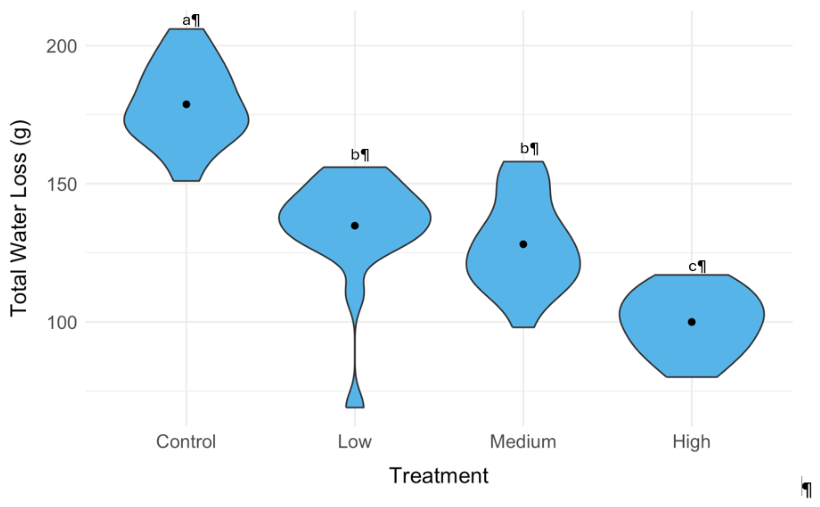
Figure 2.
Distribution of root-to-shoot ratios of soybean plants grown in soils containing increasing proportions of crumb rubber (Control = 0%, Low = 16.6%, Medium = 33.3%, High = 50%). Violin plots show the distribution of values within each treatment; black points indicate treatment means. Letters above treatments denote statistically distinct groups based on pairwise Wilcoxon rank-sum tests with Bonferroni correction (α = 0.05). Treatments sharing a letter are not significantly different.
Figure 2.
Distribution of root-to-shoot ratios of soybean plants grown in soils containing increasing proportions of crumb rubber (Control = 0%, Low = 16.6%, Medium = 33.3%, High = 50%). Violin plots show the distribution of values within each treatment; black points indicate treatment means. Letters above treatments denote statistically distinct groups based on pairwise Wilcoxon rank-sum tests with Bonferroni correction (α = 0.05). Treatments sharing a letter are not significantly different.
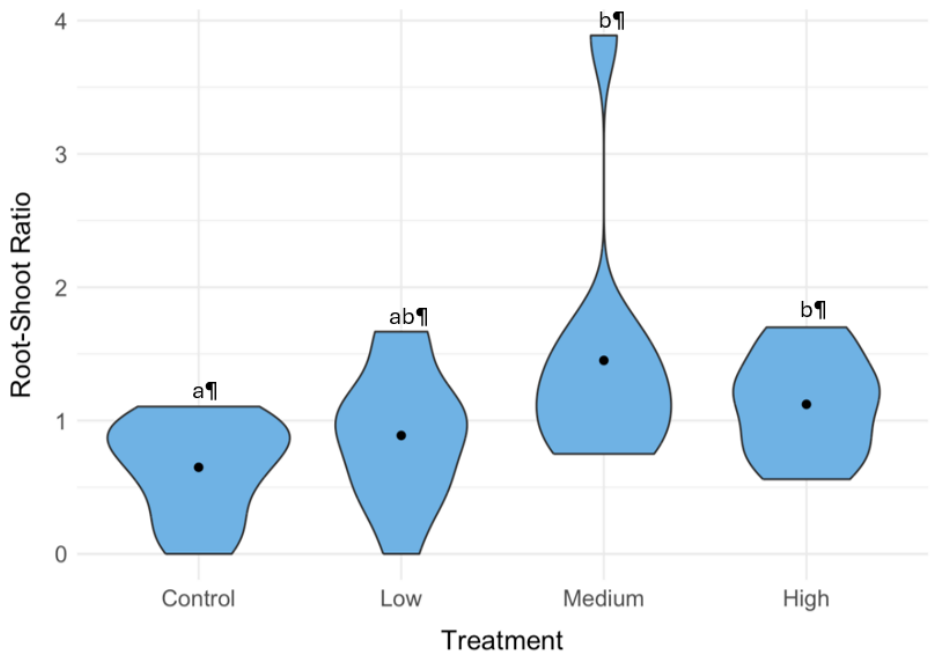
Figure 3.
Distribution of dry root biomass of soybean plants grown in soils containing increasing proportions of crumb rubber (Control = 0%, Low = 16.6%, Medium = 33.3%, High = 50%). Violin plots show the distribution of root dry mass within each treatment; black points indicate treatment means. Letters above treatments denote statistically distinct groups based on Tukey’s HSD post hoc comparisons following one-way ANOVA (α = 0.05). Treatments sharing a letter are not significantly different.
Figure 3.
Distribution of dry root biomass of soybean plants grown in soils containing increasing proportions of crumb rubber (Control = 0%, Low = 16.6%, Medium = 33.3%, High = 50%). Violin plots show the distribution of root dry mass within each treatment; black points indicate treatment means. Letters above treatments denote statistically distinct groups based on Tukey’s HSD post hoc comparisons following one-way ANOVA (α = 0.05). Treatments sharing a letter are not significantly different.
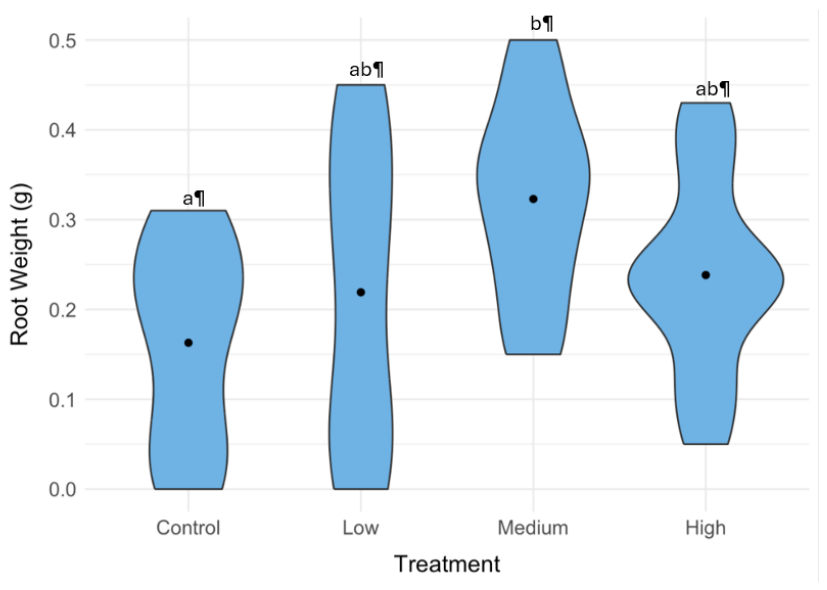

Table 1.
Soil trace element concentrations (ppm) measured in soils containing increasing proportions of crumb rubber (Control = 0%, Low = 16.6%, Medium = 33.3%, High = 50%). Soil samples were analyzed by AgroLab Inc. (Harrington, DE, USA). The bottom rom indicates the maximum recommended soil trace element concentrations for garden soils in the Northeastern United States (Cornell University, 2025).
Table 1.
Soil trace element concentrations (ppm) measured in soils containing increasing proportions of crumb rubber (Control = 0%, Low = 16.6%, Medium = 33.3%, High = 50%). Soil samples were analyzed by AgroLab Inc. (Harrington, DE, USA). The bottom rom indicates the maximum recommended soil trace element concentrations for garden soils in the Northeastern United States (Cornell University, 2025).
| As | Cd | Cu | Mo | Ni | Pb | Se | Zn | Hg | |
|---|---|---|---|---|---|---|---|---|---|
| Control | 4.32 | 0.56 | 53.3 | 0.77 | 13.8 | 33.94 | 0.47 | 119.8 | 0.005 |
| Low | 3.26 | 0.02 | 97.7 | 0.34 | 8.66 | 24.59 | 4.25 | 14,101.3 | 0.005 |
| Medium | 1.63 | 0.30 | 99.5 | 0.75 | 7.23 | 26.80 | 3.69 | 17,013.3 | 0.015 |
| High | 0.63 | 0.15 | 115.5 | 0.48 | 5.85 | 19.39 | 0.74 | 19,623.0 | 0.013 |
| Highest Acceptable | 16 | 2.5 | 75 | - | 40 | 200 | - | 150 | - |
Table 2.
Elemental concentrations (ppm) measured in soybean leaf tissue from plants grown in soils containing increasing proportions of crumb rubber (Control = 0%, Low = 16.6%, Medium = 33.3%, High = 50%). Tissue samples were analyzed by AgroLab Inc. (Harrington, DE, USA). The bottom two rows provide sufficiency ranges for soybean leaf tissue nutrients (Mueller, 2020). Zinc concentrations increased across the crumb rubber gradient, with values in the medium and high treatments exceeding the reported sufficiency range for soybean plants.
Table 2.
Elemental concentrations (ppm) measured in soybean leaf tissue from plants grown in soils containing increasing proportions of crumb rubber (Control = 0%, Low = 16.6%, Medium = 33.3%, High = 50%). Tissue samples were analyzed by AgroLab Inc. (Harrington, DE, USA). The bottom two rows provide sufficiency ranges for soybean leaf tissue nutrients (Mueller, 2020). Zinc concentrations increased across the crumb rubber gradient, with values in the medium and high treatments exceeding the reported sufficiency range for soybean plants.
| N | P | K | Ca | Mg | S | Zn | Fe | Mn | Cu | B | Mo | Na | |
|---|---|---|---|---|---|---|---|---|---|---|---|---|---|
| Control | 30,800 | 3,400 | 30,400 | 5510 | 2400 | 1900 | 41 | 213 | 32 | 7.5 | 35 | 2.83 | 200 |
| Low | 30,000 | 3,700 | 31,500 | 5310 | 2640 | 2200 | 75 | 115 | 35 | 7.5 | 39 | 2.33 | 200 |
| Medium | 26,600 | 3,100 | 29,600 | 5820 | 2690 | 2100 | 121 | 145 | 40 | 7.4 | 45 | 2.83 | 100 |
| High | 31,900 | 3,600 | 28,500 | 6050 | 2820 | 2500 | 135 | 84 | 36 | 8.3 | 44 | 4.47 | 200 |
| Lowest Acceptable | 45,000 | 3,500 | 20,000 | 6000 | 3,000 | 2,500 | 30 | 55 | 30 | 6 | 2 | 1 | - |
| Highest Acceptable | 60,000 | 5,500 | 30,000 | 15,000 | 7,000 | 5,000 | 100 | 300 | 100 | 20 | 60 | 5 | - |
Disclaimer/Publisher’s Note: The statements, opinions and data contained in all publications are solely those of the individual author(s) and contributor(s) and not of MDPI and/or the editor(s). MDPI and/or the editor(s) disclaim responsibility for any injury to people or property resulting from any ideas, methods, instructions or products referred to in the content. |
© 2026 by the authors. Licensee MDPI, Basel, Switzerland. This article is an open access article distributed under the terms and conditions of the Creative Commons Attribution (CC BY) license (http://creativecommons.org/licenses/by/4.0/).
Copyright: This open access article is published under a Creative Commons CC BY 4.0 license, which permit the free download, distribution, and reuse, provided that the author and preprint are cited in any reuse.


