

Submitted:
25 May 2026
Posted:
26 May 2026
You are already at the latest version
Abstract
Personality research has traditionally focused on stable trait differences, but emerging perspectives suggest that personality coherence, as the degree of integration versus heterogeneity across trait dimensions, may represent a critical aspect of self-functioning, with implications for behavioral regulation. The present study examined whether intraindividual variability in Big Five traits, operationalized as the within-person standard deviation across trait scores (iSD), is associated with problematic digital engagement in young adults. A sample of 316 completed the Big Five Inventory and selected subscales of the Behavioral Addiction Questionnaire assessing smartphone and internet use. Pearson correlations and independent samples t-tests were conducted to evaluate associations between personality structure and digital behaviors. Results showed that higher iSD, reflecting lower personality coherence, was significantly associated with greater problematic smartphone (r = .335, p = .021) and internet use (r = .383, p = .006). Participants in the problematic smartphone use group exhibited significantly higher iSD than those in the moderate-risk group. Accordingly, a less coherent personality structure may reflect increased internal instability, leading individuals to rely more on digitally mediated environments such as external regulatory systems providing predictability and reinforcement. Overall, the study highlights the importance of considering intraindividual personality configuration as a complementary dimension to traditional trait-based approaches.
Keywords:
personality traits
; coherence in personality
; behavioral addictions
; maladaptive behaviors
1. Introduction
Personality has traditionally been conceptualized in terms of stable individual differences captured by broad trait dimensions, such as those defined within the operationalization of the Big Five framework (Costa & McCrae, 1992). This approach helps in describing how individuals differ along core dispositional axes, despite the apparent difficulty in identifying all the features that characterize human beings’ dispositions toward the environment (Epstein, 1994). Also, a critical aspect of personality organization remains comparatively underexplored: the internal configuration of traits within the individual, and the extent to which these traits form a coherent versus heterogeneous profile.
Previous studies focused on trait differences with growing evidence about the limits in understood individuals without considering intraindividual structure (Cervone, 2022). According to the Big Five Model, it appears clear that individuals do not simply possess levels of Extraversion, Agreeableness, Conscientiousness, Neuroticism, and Openness; rather, these traits coexist within a dynamic configuration that may be differently integrated, affecting emotions, cognition, and behavioral outcomes (McAdams, 1992). Accordingly, two individuals with similar average expression of the Big Five domains may differ substantially in how they interact with each other, suggesting differences in the coherence of the self (Cervone, 2005). From this perspective, the variability across trait dimensions within the individual can be conceptualized as an index of structural self-coherence reflecting the extent to which self-representations are clearly defined, internally consistent, and stable over time (Campbell et al., 1996). A more homogeneous trait profile may reflect a relatively integrated and stable self-representation, whereas a more heterogeneous configuration may signal fragmentation or differentiation within the personality system. This distinction resonates with broader theoretical traditions emphasizing the importance of coherence in the organization of the self, ranging from classic perspectives on identity integration to contemporary models of self-regulation involving and integrating affective and cognitive processes, despite the functional implications of such structural differences remaining insufficiently understood (Syed & McLean, 2016; Inzlicht et al., 2021).
One key question concern whether a less coherent personality structure, operationalized as greater intraindividual variability across traits, may be associated with differences in how individuals engage with their environment, particularly in domains involving behavioral regulation and reward sensitivity. Recent theoretical developments provide a useful lens for addressing this issue. Within predictive processing accounts of the self, internal models are conceived as hierarchically organized systems that generate predictions about both internal states and external inputs (Woźniak, 2024). A coherent self may correspond to a more stable and precise internal model, whereas a less coherent configuration may reflect increased uncertainty or “noise” in self-representations (Reggev & Mokady, 2022; Tolchinsky et al., 2025) possibly affecting behavioral outcomes.
Interestingly, behaviors involving digitally mediated environments such as smartphone and internet use, which provide continuous accessibility, rapid feedback, immediate reinforcement, and highly structured interaction patterns may represent a relevant ground on which this hypothesis would be tested. Compared to other potentially problematic behaviors, internet- and smartphone-related activities are deeply embedded in everyday self-regulatory processes and represent pervasive external systems for mood regulation, predictability, and behavioral organization, particularly during young adulthood. Digital environments are characterized by high accessibility, rapid feedback, and structured contingencies, making them well-suited to provide externally regulated input. As such, they may be particularly appealing to individuals whose internal self-structure is less integrated, potentially serving a compensatory regulatory function by temporarily reducing uncertainty, enhancing predictability, or providing reward and behavioral organization (Dong & Potenza, 2014; Meng et al., 2014). This interpretation is consistent with the Interaction of Person-Affect-Cognition-Execution (I-PACE) model (Brand et al., 2016, 2019), which conceptualizes problematic internet-related behaviors as the outcome of interactions between predisposing personal characteristics, affective and cognitive responses, and executive control processes. In this sense, repeated reliance on digitally mediated environments for self-regulation may increase the risk of excessive or problematic engagement (Laier et al., 2018).
However, despite these theoretical advances, empirical work linking intraindividual personality structure to behavioral engagement remains scarce. Research has focused mainly on single-trait dimensions, but personality traits do not operate in isolation within the individual but as organized constellations whose combined expression may be more informative (Fleeson, 2001). For example, person-oriented approaches have emphasized that individuals with different configurations of Big Five traits may display distinct patterns of attitudes and behavior even when mean trait levels appear similar (Bergman & Magnusson, 1997; Asendorpf & Van Aken, 2003; Mõttus et al., 2017). Cluster-based studies have shown that profiles characterized by more adaptive combinations of traits differ meaningfully in behavioral tendencies compared with profiles marked by less functional configurations (Poskus & Zukauskien, 2017). Likewise, research on higher-order Big Five metatraits suggests that shared variance across domains captures broader dispositions toward behavioral engagement (Plasticity) and self-regulatory restraint (Stability), indicating that personality structure above the single-trait level may better explain real-world behavior (Hirsh et al., 2009). These findings collectively suggest that examining the internal organization of trait expression may provide a more ecologically valid account of behavioral involvement than considering isolated trait scores alone.
Accordingly, the present study aimed to examine whether intraindividual variability in Big Five traits, operationalized as the within-person standard deviation across trait scores, is associated with problematic engagement in digitally mediated behaviors among young adults. It was hypothesized that greater intraindividual variability across Big Five traits, reflecting a less coherent personality configuration, would be positively associated with higher levels of problematic digital engagement. Consistent with prior literature, we also expected an association between maladaptive trait-level patterns, particularly higher neuroticism and lower conscientiousness, and problematic smartphone and internet use.
2. Materials and Methods
Participants and Procedure
A sample of 316 young adults (mean age of 22.62 years; SD = 1.79; range = 19–29), of which 224 (70.9%) were women and 87 (27.5%) were men, participated to the study. Participants were recruited through an online survey platform for a cross-sectional study examining the relationship between personality structure and behavioral engagement across multiple domains. Exclusion criteria include diagnoses of psychiatric, neurological or neurodevelopmental disorders. All participants provided informed consent prior to participation, and the study was conducted in accordance with the Declaration of Helsinki and institutional ethical standards. Only participants with complete data on all variables of interest were included in the analyses.
Measures
Personality traits
Personality traits were assessed using the Big Five Inventory (BFI; John et al., 1991; Italian translation: Fossati et al., 2011), a widely validated self-report instrument measuring five higher-order personality dimensions: Extraversion, Agreeableness, Conscientiousness, Neuroticism, and Openness to Experience. Trait scores were computed following standard scoring procedures, yielding continuous indices for each domain. For this study, the structural coherence of personality at the individual level was computed as an index of intraindividual variability across the five BFI trait scores. Specifically, for each participant, the standard deviation of the five trait scores was calculated:
where X_i represents each trait score, X ˉis the individual’s mean trait level (profile elevation), and N =5. This metric captures the dispersion of personality traits within an individual profile, independent of overall trait elevation. Higher iSD values indicate greater heterogeneity across traits, reflecting a less integrated personality configuration, whereas lower values indicate greater internal consistency. In line with prior work on personality profile structure (Fajkowska, 2022, 2025), this index can be interpreted as a structural proxy for self-coherence at the trait level, capturing the degree to which personality characteristics converge or diverge within the individual.
Behavioral Domains
The Behavioral Addiction Questionnaire (BAQ; Mastropietro et al., 2022) is a self-report instrument designed to provide a dimensional and quantitative assessment of nine potentially addictive behaviors. It allows each behavior to be screened along a continuum, capturing both adaptive and maladaptive characteristics, and can also yield an overall index of behavioral addiction severity. In the present study, we focused specifically on digital-related behaviors, administering the subscales assessing internet use, smartphone use, and video gaming, in line with the study’s focus on digital-mediated engagement. Each BAQ subscale consists of 6 items rated on a 6-point Likert scale ranging from 0 (absolutely false) to 5 (absolutely true), yelding subscale scores ranging from 0 to 30, with higher scores indicating more problematic engagement in the target behavior.
Data preparation and data analyses
Data were screened for completeness and distributional properties. Pearson’s correlation coefficients were computed to examine the associations between intraindividual personality variability and each behavioral domain. This approach allows for the identification of linear relationships between structural personality dispersion and behavioral engagement patterns. By focusing on intraindividual variability, the analysis wants to capture an aspect of personality organization that is not accessible through traditional variable-centered approaches. In this framework, iSD is interpreted as an index of structural differentiation versus integration of personality traits, providing a quantitative proxy for the coherence of the self at the dispositional level. To investigate group differences in personality coherence, a series of independent samples t-tests (Student’s t-tests) were conducted, with behavioral group (moderate-risk vs. problematic) as the independent variable and iSD score as the dependent variable. Multiple linear regression analyses were conducted to examine whether personality dimensions and structural personality coherence predicted behavioral addiction scores. For each outcome, predictors were entered simultaneously using the enter method and included Extraversion, Agreeableness, Conscientiousness, Neuroticism, and the intraindividual standard deviation of BFI traits (iSD_BFI), used as an index of structural personality coherence. Separate regression models were estimated for each outcome variable using the enter method. Statistical significance was evaluated using a threshold of p < .05 (two-tailed). Effect sizes were interpreted according to conventional benchmarks, with r ≈ .10 indicating small effects, r ≈ .30 moderate effects, and r ≥ .50 large effects.
Etichs and AI adoption
The University Ethics Committee (CERT of “Sapienza” University of Rome) has approved the project (approval date: May 5, 2025; ID: CERT_196c5274271).
Generative artificial intelligence (GenAI) has been used to support text editing (formatting, English editing, and reference organization).
3. Results
3.1. Association Between Personality and Behavioral Addiction
Descriptive statistics for the main study variables are reported in Table 1.
| Variable | Mean (SD) |
| Age | 22.62 (1.79) |
| Extraversion | 25.51 (5.30) |
| Agreeableness | 32.82 (5.22) |
| Conscientiousness | 32.29 (6.47) |
| Neuroticism | 26.30 (6.11) |
| Openness | 36.21 (6.79) |
| Total BFI score | 21.72 (14.89) |
| iSD_BFI | 5.60 (2.12) |
| Smartphone use | 6.74 (4.39) |
| Internet use | 9.02 (4.99) |
Pearson’s correlation analyses were conducted to examine the associations between personality traits, personality configuration (iSD_BFI), and digital behavioral measures (see Table 2). At the level of basic personality traits, results showed a coherent pattern consistent with the literature. Conscientiousness was positively associated with both extraversion (r = .224, p < .001) and agreeableness (r = .329, p < .001), and negatively associated with neuroticism (r = −.158, p = .005). Similarly, openness was positively related to all other traits, particularly extraversion (r = .367, p < .001), confirming the internal consistency of the personality structure. The composite personality coherence score (iSD) showed a pattern indicative of adaptive functioning, being negatively associated with conscientiousness (r = −.297, p < .001) and agreeableness (r = −.241, p < .001), and positively associated with neuroticism (r = .226, p < .001). With respect to digital behaviors, problematic smartphone use was negatively associated with extraversion (r = −.155, p = .007), agreeableness (r = −.148, p = .009), and conscientiousness (r = −.226, p < .001), and positively associated with neuroticism (r = .377, p < .001). A similar pattern emerged for internet use, which was negatively related to agreeableness (r = −.119, p = .034) and conscientiousness (r = −.179, p = .001), and positively associated with neuroticism (r = .273, p < .001). Importantly, personality configuration coherence (iSD_BFI) was significantly and positively associated with both smartphone use (r = .335, p = .021) and internet use (r = .383, p = .006), indicating that greater heterogeneity across personality traits—reflecting lower internal coherence—was linked to higher levels of problematic digital engagement. Finally, smartphone use and internet use were strongly correlated (r = .750, p < .001), suggesting a substantial overlap between these two dimensions of digital behavior. Overall, this pattern of findings suggests that both trait-level vulnerabilities (e.g., neuroticism, low conscientiousness) and higher-order personality disorganization (iSD_BFI) contribute to individual differences in problematic digital behaviors.
Consistent with the correlational findings, the multiple regression model predicting problematic smartphone use was significant (F(5, 41) = 5.19, p < .001) and explained 38.7% of the variance (R = .622, R² = .387, adjusted R² = .313, RMSE = 3.23). Within the model, higher neuroticism (β = .394, t = 3.15, p = .003) and lower extraversion (β = −.312, t = −2.50, p = .017) was significantly associated with higher smartphone-related problematic behavior. Importantly, iSD_BFI also remained a significant positive predictor (β = .294, t = 2.03, p = .049), suggesting that greater intraindividual variability in personality traits contributed to smartphone addiction scores beyond the contribution of individual personality dimensions. Agreeableness and conscientiousness did not significantly predict smartphone use scores (p > .10).
A multiple linear regression was conducted to examine whether Big Five personality traits and the intraindividual personality dispersion index (iSD_BFI) predicted Internet use scores. The overall model was not statistically significant (F(5, 44) = 2.19, p = .072) although it explained 19.9% of the variance (R² = .199; adjusted R² = .108). Among the predictors, only iSD_BFI showed a trend-level positive association (β = .289, p = .072). No significant effects emerged for Extraversion, Agreeableness, Conscientiousness, or Neuroticism.
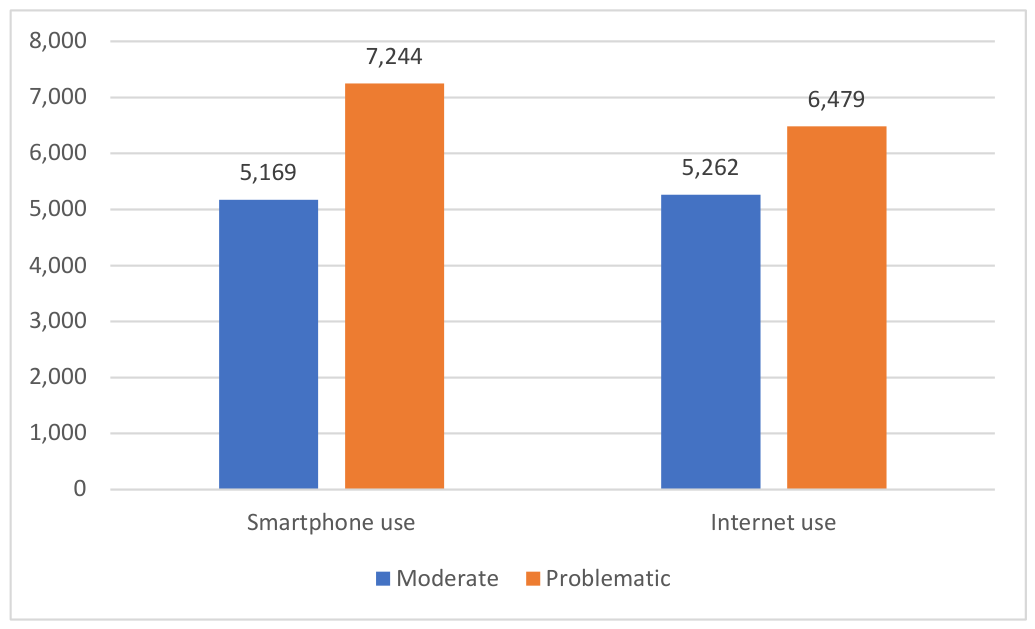
Considering BAQ cut-off scores indicating different degrees of behavioral risk, t-Test analyses were conducted entering group as the independent variable (moderate risk behavior; problematic behavior) and iSD_BFI as the dependent variable, showing a significant difference between groups in smartphone use (t = -2.32; p = 0.03; Cohen’s d = -0.97; see Figure 1), highlighting higher heterogeneity in personality configuration in the problematic behavior group. Conversely no significant difference was found between the problematic behavior group compared to the moderate risk group in internet use (t = -1.10; p = 0.28; Cohen’s d = -0.52).
4. Discussion
One of the main contributions of this study was to propose a strategy for operationalizing and quantitatively evaluating an index of coherence based on personality structure, in which not only mean trait levels but also the internal configuration of traits is considered informative. By focusing on intraindividual variability, the analysis captures an aspect of personality organization that is not accessible through traditional variable-centered approaches. In this framework, iSD is interpreted as an index of structural differentiation versus integration of personality traits, providing a quantitative proxy for the coherence of the self at the dispositional level. Findings suggest that problematic digital engagement is associated not only with specific personality traits but also with the overall organization of personality, as captured by an index reflecting the degree of heterogeneity across personality traits. In line with previous literature, higher levels of neuroticism and lower levels of conscientiousness were associated with increased problematic smartphone and internet use, supporting the role of trait-level vulnerabilities in digital dysregulation (Marciano et al., 2022; Marciano et al., 2020; Hidalgo-Fuentes & Fernández-Castilla, 2024; Eichenberg et al., 2021; Mülleret al., 2021; Forte et al., 2023). However, beyond these effects, the results indicate that greater trait variability, reflecting a less integrated personality configuration, is systematically associated with higher levels of digital engagement. This finding, from one side supports the perspective considering the balance of personality traits as an expression of self-coherence; from the other side, it is consistent with a view of personality as a coordinated system, in which the relative alignment among traits contributes to the stability and predictability of behavior (Mischel & Shoda, 1995). A more coherent personality configuration may facilitate consistent goal-directed action, clearer prioritization, and more efficient self-regulation. In contrast, greater heterogeneity may reflect a configuration in which behavioral tendencies are less aligned, potentially resulting in increased variability and reduced regulatory stability (Campbell, 2003).
In this sense, iSD_BFI can be interpreted as an index of intra-individual organization, complementing traditional trait-based approaches. From a self-regulation perspective, individuals with less integrated personality profiles may be more likely to rely on external structures to support regulation, particularly in contexts characterized by high demands on attention or affective control (Carver & Scheier, 2012). Digital environments, such as smartphones and internet-based platforms, provide continuous access to structured, responsive, and highly reinforcing stimuli (Billieux et al., 2015). These features may make them particularly suitable as external support for regulating attention and emotional states, especially when internal regulatory processes are less stable (Brand et al., 2014). The association between iSD_BFI and digital behaviors can also be interpreted within broader models of predictive and regulatory functioning, in which the self is conceptualized as a system that generates and updates internal models to guide behavior. A more coherent configuration may correspond to more stable and consistent internal models, whereas increased heterogeneity may reflect greater variability or reduced precision in these models, potentially leading to greater reliance on environments that provide immediate and structured feedback. In this context, digital platforms may serve as environments that reduce uncertainty by offering rapid, contingent responses, thereby supporting short-term regulation. Due to these characteristics, engagement in digitally mediated activities, which at the beginning is experienced as inherently pleasurable and rewarding, could transition to problematic usage if the media consumption behavior starts to act as an important or exclusive mechanism to relieve stress, loneliness, depression, or anxiety, providing a means of escape, or as a way to develop a feeling of mastery (Tokunaga, 2015). In fact, individuals who frequently use maladaptive regulatory strategies, such as avoidance and rumination, are more prone to use internet activities to cope with negative affect, potentially leading to the development of internet addiction (Yan et al., 2022).
The developmental characteristics of the sample are also relevant for interpreting these findings. The participants were predominantly young adults, a phase often associated with ongoing processes of identity consolidation and self-organization (Arnett, 2000). During this period, variability across traits may reflect not only stable individual differences but also transitional configurations, in which different aspects of the self are still being integrated. In such a context, digital environments may serve as both spaces for exploration and as sources of external structure, potentially interacting with individual differences in personality coherence (Peter & Valkenburg, 2006). The strong association between smartphone and internet use suggests that these behaviors are closely related and may reflect a shared underlying dimension of digital engagement rather than entirely distinct behaviors. This supports a more integrated conceptualization of digital use, in which different platforms contribute to a broader pattern of interaction with technology. Despite the new perspective suggested by the study, some limitations should be noted. As first, the cross-sectional design does not allow for causal conclusions, and it remains unclear whether lower personality coherence contributes to increased digital engagement or whether sustained patterns of digital use may influence the organization of personality over time. Additionally, the age range limits the generalizability of the findings to other populations. Future research could extend these findings by adopting longitudinal designs to examine how personality coherence and digital behaviors co-develop over time. Moreover, integrating additional measures of self-organization, such as indices of identity coherence, intra-individual variability, interoceptive processes, or indices of autonomic dynamics (i.e., heart rate variability) (Troisi et al., 2026), may help clarify the mechanisms underlying these associations.
In summary, the present study highlights the relevance of considering personality configuration, in addition to individual traits, in understanding problematic digital behaviors. A less integrated personality profile appears to be associated with higher levels of digital engagement, suggesting that the organization of the self may represent an important dimension in the study of technology-related behaviors.
Author Contributions
Conceptualization, F.G., F.F; methodology, F.G., C.M., validation, C.E., A.M., C.I.; formal analysis, F.G, C.E., F.F., investigation, C.E., M.A., C.I; resources, T.R.; data curation, F.G., F.F.; writing—original draft preparation, F.G., F.F., C.E., A.M.; writing—review and editing, F.F., F.G., C.M., T.R.; supervision, F.F., F.G., C.M., T.R.; project administration, F.G., F.F..; funding acquisition, T.R. All authors have read and agreed to the published version of the manuscript.
Funding
This manuscript was supported by the Grant of Ateneo (“Sapienza” University of Rome; COD: RG124190E373B709).
Institutional Review Board Statement
The study was conducted in accordance with the Declaration of Helsinki, and approved by the Institutional Review Board of Sapienza University of Rome (CERT of “Sapienza” University of Rome; approval date: May 5, 2025; ID: CERT_196c5274271).
Informed Consent Statement
Informed consent was obtained from all subjects involved in the study.
Data Availability Statement
Raw datasets are available on reasonable request to the corresponding authors.
Acknowledgments
During the preparation of this manuscript, the author(s) used ChatGPT for the purposes of to support text editing (formatting, English editing, and reference organization). The authors have reviewed and edited the output and take full responsibility for the content of this publication.
Conflicts of Interest
The authors declare no conflicts of interest.
References
- Arnett, J. J. Emerging adulthood: A theory of development from the late teens through the twenties. Am. Psychol. 2000, 55(5), 469–480. [Google Scholar] [CrossRef]
- Asendorpf, J. B.; Van Aken, M. A. G. Personality Development: Continuity and Change in Human Development. Annu. Rev. Psychol. 2003, 54, 453–484. [Google Scholar] [CrossRef]
- Bergman, L. R.; Magnusson, D. A Person-Oriented Approach in Research on Developmental Psychology. Dev. Psychopathol. 1997, 9(2), 291–319. [Google Scholar] [CrossRef]
- Billieux, J.; Maurage, P.; Lopez-Fernandez, O.; Kuss, D. J.; Griffiths, M. D. Can Disordered Mobile Phone Use Be Considered a Behavioral Addiction? An Update on Current Evidence and A Comprehensive Model. Curr. Addctn. Rep. 2015, 2(2), 156–162. [Google Scholar] [CrossRef]
- Brand, M.; Laier, C.; Young, K. S. Internet Addiction: Coping Styles, Expectancies, and Treatment Implications. Front. Psychol. 2014, 5, 1256. [Google Scholar] [CrossRef]
- Campbell, J. D.; Assanand, S.; Di Paula, A. The Structure of the Self: Multiple Components, Multiple Processes. In Personality Psychology: Recent Trends and Emerging Directions; 2003. [Google Scholar] [CrossRef]
- Campbell, J. D.; Trapnell, P. D.; Heine, S. J.; Katz, I. M.; Lavallee, L. F.; Lehman, D. R. Self-concept clarity: Measurement, personality correlates, and cultural boundaries. J. Personal. Soc. Psychol. 1996, 70(1), 141. [Google Scholar] [CrossRef]
- Carver, C. S.; Scheier, M. F. Attention and self-regulation: A control-theory approach to human behavior; Springer Science & Business Media, 2012. [Google Scholar]
- Cervone, D. Personality architecture: Within-person structures and processes. Annu. Rev. Psychol. 2005, 56(1), 423–452. [Google Scholar] [CrossRef] [PubMed]
- Cervone, D. Five paths to personality coherence: Integrative implications of the Knowledge-and-Appraisal Personality Architecture. Eur. J. Personal. 2022, 36(3), 319–346. [Google Scholar] [CrossRef]
- Costa, P. T., Jr.; McCrae, R. R. Revised NEO personality inventory (NEOPI-R) and NEO Five-Factor Inventory (NEO-FFI) manual; Psychological Assessment Resources: Odessa, FL, 1992. [Google Scholar]
- Dong, G.; Potenza, M. N. A cognitive-behavioral model of Internet gaming disorder: Theoretical underpinnings and clinical implications. J. Psychiatr. Res. 2014, 58, 7–11. [Google Scholar] [CrossRef] [PubMed]
- Eichenberg, C.; Schott, M.; Schroiff, A. Problematic smartphone use—comparison of students with and without problematic smartphone use in light of personality. Front. Psychiatry 2021, 11, 599241. [Google Scholar] [CrossRef]
- Epstein, S. Trait Theory as Personality Theory: Can a Part Be as Great as the Whole? Psychol. Inq. 1994, 5(2), 120–122. [Google Scholar] [CrossRef] [PubMed]
- Fajkowska, M. Personality coherence: A personality dynamics-related concept. J. Personal. 2022, 90(6), 1073–1087. [Google Scholar] [CrossRef] [PubMed]
- Fajkowska, M. Personality (in)coherence: Protective and vulnerability factors in personality functioning. J. Res. Personal. 115 2025, 104590. [Google Scholar] [CrossRef]
- Fleeson, W. Toward a Structure- and Process-Integrated View of Personality: Traits as Density Distributions of States. J. Personal. Soc. Psychol. 2001, 80(6), 1011–1027. [Google Scholar] [CrossRef]
- Fossati, A.; Borroni, S.; Marchione, D.; Maffei, C. The big five inventory (BFI). Eur. J. Psychol. Assess. 2011. [Google Scholar] [CrossRef]
- Forte, G.; Favieri, F.; Casagrande, M.; Tambelli, R. Personality and behavioral inhibition/activation systems in behavioral addiction: Analysis of binge-watching. Int. J. Environ. Res. Public Health 2023, 20(2), 1622. [Google Scholar] [CrossRef]
- Hidalgo-Fuentes, S.; Fernández-Castilla, B. Problematic internet use and the big five personality model: an updated three-level meta-analysis. Behav. Inf. Technol. 2024, 43(14), 3537–3560. [Google Scholar] [CrossRef]
- Hirsh, J. B.; DeYoung, C. G.; Peterson, J. B. Metatraits of the Big Five differentially predict engagement and restraint of behavior. J. Personal. 2009, 77(4), 1085–1102. [Google Scholar] [CrossRef]
- Inzlicht, M.; Werner, K. M.; Briskin, J. L.; Roberts, B. W. Integrating models of self-regulation. Annu. Rev. Psychol. 2021, 72(1), 319–345. [Google Scholar] [CrossRef]
- John, O. P.; Donahue, E. M.; Kentle, R. L. Big five inventory. In Journal of personality and social psychology; 1991; Available online: https://psycnet.apa.org/doi/10.1037/t07550-000.
- Laier, C.; Wegmann, E.; Brand, M. Personality and cognition in gamers: Avoidance expectancies mediate the relationship between maladaptive personality traits and symptoms of Internet-gaming disorder. Front. Psychiatry 2018, 9, 304. [Google Scholar] [CrossRef]
- Marciano, L.; Camerini, A. L.; Schulz, P. J. Neuroticism in the digital age: A meta-analysis. Comput. Hum. Behav. Rep. 2020, 2, 100026. [Google Scholar] [CrossRef]
- Marciano, L.; Camerini, A. L.; Schulz, P. J. Neuroticism and internet addiction: What is next? A systematic conceptual review. Personal. Individ. Differ. 2022, 185, 111260. [Google Scholar] [CrossRef]
- Mastropietro, S.; Favieri, F.; Forte, G.; et al. Behavioral Addictions Questionnaire (BAQ): Validation of a New Tool for the Screening of Multiple Addictive Behaviors in the Italian Population. Int. J. Ment. Health Addctn. 2022, 22, 965–978. [Google Scholar] [CrossRef]
- McAdams, D. P. The five-factor model in personality: A critical appraisal. J. Personal. 1992, 60(2), 329–361. [Google Scholar] [CrossRef]
- Meng, Y.; Deng, W.; Wang, H.; Guo, W.; Li, T. The prefrontal dysfunction in individuals with Internet gaming disorder: a meta-analysis of functional magnetic resonance imaging studies. Addctn. Biol. 2015, 20(4), 799–808. [Google Scholar] [CrossRef] [PubMed]
- Mischel, W.; Shoda, Y. A cognitive-affective system theory of personality: Reconceptualizing situations, dispositions, dynamics, and invariance in personality structure. Psychol. Rev. 1995, 102(2), 246–268. [Google Scholar] [CrossRef]
- Mokady, A.; Reggev, N. The role of predictions, their confirmation, and reward in maintaining the self-concept. Front. Hum. Neurosci. 2022, 16, 824085. [Google Scholar] [CrossRef] [PubMed]
- Mõttus, R.; Kandler, C.; Bleidorn, W.; Riemann, R.; McCrae, R. R.; Johnson, W. The Personality Puzzle Revisited: A Consensus on the Evidence Base for Model of Personality Traits. Eur. J. Personal. 2017, 31(3), 222–230. [Google Scholar] [CrossRef]
- Müller, M.; Sindermann, C.; Rozgonjuk, D.; Montag, C. Mind-wandering mediates the associations between neuroticism and conscientiousness, and tendencies towards smartphone use disorder. Front. Psychol. 2021, 12, 661541. [Google Scholar] [CrossRef]
- Peter, J.; Valkenburg, P. M. Adolescents’ Internet Use: Testing the ‘Digital Natives’ Hypothesis. J. Broadcast. Electron. Media 2006, 50(2), 336–355. [Google Scholar] [CrossRef]
- Poškus, M. S.; Žukauskienė, R. Predicting adolescents’ recycling behavior among different big five personality types. J. Environ. Psychol. 2017, 54, 57–64. [Google Scholar] [CrossRef]
- Syed, M.; McLean, K. C. Understanding identity integration: Theoretical, methodological, and applied issues. J. Adolesc. 2016, 47, 109–118. [Google Scholar] [CrossRef] [PubMed]
- Tokunaga, R. S. Perspectives on Internet addiction, problematic Internet use, and deficient self-regulation: Contributions of communication research. Ann. Int. Commun. Assoc. 2015, 39(1), 131–161. [Google Scholar] [CrossRef]
- Tolchinsky, A.; Levin, M.; Fields, C.; Da Costa, L.; Murphy, R.; Friedman, D.; Pincus, D. Temporal depth in a coherent self and in depersonalization: theoretical model. Front. Psychol. 2025, 16, 1585315. [Google Scholar] [CrossRef] [PubMed]
- Troisi, G.; Corbo, I.; Forte, G.; Favieri, F.; Lupiánez, J.; Marotta, A.; Casagrande, M. Tracing the path from OCEAN to autonomic balance: The mediating role of cognitive reserve. Personal. Individ. Differ. 2026, 249, 113493. [Google Scholar] [CrossRef]
- Woźniak, M. How to grow a self: Development of self-representation in the Bayesian brain. Front. Hum. Neurosci. 2024, 18, 1441931. [Google Scholar] [CrossRef]
- Yan, X.; Gao, W.; Yang, J.; Yuan, J. Emotion regulation choice in internet addiction: less reappraisal, lower frontal alpha asymmetry. Clin. EEG Neurosci. 2022, 53(4), 278–286. [Google Scholar] [CrossRef]
Figure 1.
T-Tests type of behavior (moderate risk; problematic) on iSD_BFI score.
Disclaimer/Publisher’s Note: The statements, opinions and data contained in all publications are solely those of the individual author(s) and contributor(s) and not of MDPI and/or the editor(s). MDPI and/or the editor(s) disclaim responsibility for any injury to people or property resulting from any ideas, methods, instructions or products referred to in the content. |
© 2026 by the authors. Licensee MDPI, Basel, Switzerland. This article is an open access article distributed under the terms and conditions of the Creative Commons Attribution (CC BY) license.
Copyright: This open access article is published under a Creative Commons CC BY 4.0 license, which permit the free download, distribution, and reuse, provided that the author and preprint are cited in any reuse.


