

Submitted:
23 May 2026
Posted:
26 May 2026
You are already at the latest version
Abstract
Environmental RNA (eRNA) is rapidly emerging as a non-invasive tool for assessing biodiversity and biological function in natural systems. However, its full potential remains constrained by low RNA yields, mixed biological sources, and the compositional dominance of abundant RNA classes (especially rRNA) within complex intra- and extra-organismal RNA pools. In this article, a conceptual framework is proposed for integrating ribonuclease (RNase)-guided depletion and enrichment strategies into eRNA workflows. By selectively targeting specific RNA types through stepwise RNase application, and pairing these treatments with minimal-input-compatible enrichment techniques, the specificity and interpretability of eRNA data can be significantly enhanced. Particular attention is given to underexplored RNA molecules such as circular RNAs, tRNA fragments, and regulatory small RNAs, whose environmental signatures may be masked by more abundant counterparts. The feasibility of using RNases as both molecular filters and structure-informed functional probes is examined across a variety of RNA classes and environmental conditions. Rather than offering definitive protocols, this conceptual roadmap aims to stimulate cross-disciplinary dialogue between molecular biologists, ecologists, and environmental scientists, and to inspire future investigations into targeted eRNA profiling. In doing so, the overlooked utility of RNases is reframed not as a threat to RNA integrity, but as a powerful ally in deciphering the complexity of environmental transcriptomes.
Keywords:
environmental sciences
; environmental RNA
; ribonuclease
; RNases
; enzyme engineering
; metatranscriptomics
; extracellular RNA
; circular RNA
; small RNA
; rRNA depletion
; RNA stability
1. Introduction
Environmental RNA (eRNA) has garnered increasing attention as a molecular window into biological activity across ecosystems, offering non-invasive insight into both taxonomic presence and functional gene expression [1,2,3,4,5]. Historically, most applications of eRNA have centered around broad-scale detection—whether through metabarcoding approaches aimed at species identification or metatranscriptomics used to infer community gene-expression patterns from mixed samples [1,2,3,4,6]. These efforts have yielded valuable information, particularly in aquatic systems where filtration-based sampling is often more tractable than in inhibitor-rich matrices (e.g., soils and sediments) and where community composition can shift rapidly over time [2,4,6,7]. However, despite growing enthusiasm for eRNA-based biomonitoring, the field remains limited in its ability to distinguish between RNA types, sources, and cellular states, often treating eRNA as a homogeneous signal rather than a composite of highly variable molecular species [1,6].
A major limitation arises from the intrinsic complexity of environmental RNA pools [1,2,6]. In contrast to controlled laboratory settings, RNA recovered from environmental matrices such as water, sediment, or soil is typically low in quantity, fragmented, and derived from a wide array of organisms—ranging from microbes to macrofauna [1,2,7]. Moreover, extracellular RNA may originate from active cellular processes, passive shedding, or post-mortem decay, making it difficult to attribute observed transcripts to meaningful biological events [2,4,8,9]. Under such conditions, conventional sequencing-based approaches, while informative, tend to conflate signal and noise, and often disproportionately capture highly abundant RNA species such as ribosomal RNAs (rRNAs), masking more informative but lower-abundance molecules [5,6,9].
These constraints have underscored a need to move beyond simple detection and toward a more nuanced, discriminative approach to eRNA analysis [1,4,5]. This shift requires tools capable of selectively targeting specific RNA types, either to enrich desired molecules or to deplete confounding ones [1,6]. To date, most enrichment/depletion steps adopted from transcriptomics, including poly(A)-based selection (which biases toward eukaryotic mRNA), hybridization/probe-based rRNA depletion, and size-based fractionation, can be difficult to optimize for degraded, low-input, and taxonomically diverse environmental samples [5,6,10,11]. In contrast, the biochemical specificity of ribonucleases (RNases) has been largely overlooked as a potential advantage in this context [10,12,13].
RNases span enzymes with different sequence, structure, and end-dependence (e.g., single- vs double-stranded preference; base-specific cleavage; exonuclease requirements for accessible termini), and these properties—together with RNA accessibility (including protein association)—can be leveraged to bias complex mixtures toward or away from particular RNA classes [10,12,13]. In other fields, these enzymes have long been used as tools for mapping RNA structure, validating transcript boundaries/isoforms, and removing unwanted RNA species from complex mixtures [10,12,14,15]. Within the realm of eRNA research, however, RNases have traditionally been viewed primarily as threats to RNA integrity—agents of degradation rather than discrimination [1,2,7].
This article does not report experimental data; rather, it proposes a conceptual framework grounded in established RNase biochemistry and existing transcriptomic literature. Critically, validated RNase-guided workflows have not yet been tested in environmental RNA contexts — this absence from the literature is not an oversight but reflects the fact that the field has not yet systematically attempted this approach. Establishing such protocols is one of the primary research directions this framework aims to motivate. The goal is to make explicit a set of mechanistic principles that are individually well-supported but have not been systematically connected to eRNA workflows, and to identify the experimental benchmarking needed to validate them. By recontextualizing RNases as allies in the molecular toolkit of environmental scientists, their ability to enrich or deplete specific RNA populations can be harnessed to improve sensitivity, resolution, and interpretability in low-yield, high-noise environmental samples [1,5,10]. The sections that follow explore how such applications might be tailored to different RNA classes and ecological questions, laying the groundwork for a more targeted and functionally informative eRNA research paradigm [1,4,12] (Figure 1).
2. Strategic Potential of RNases in Discriminating RNA Types in Environmental Samples
The molecular diversity within environmental RNA presents both an opportunity and a challenge [1]. While the breadth of RNA classes offers insight into the structure and function of ecosystems, the indiscriminate recovery of all RNA species during extraction can obscure signals of ecological relevance [1]. A promising, yet underutilized approach to refine RNA detection lies in the selective application of RNases with well-characterized substrate specificities [13]. These enzymes, historically employed in structural probing and molecular diagnostics, may be repurposed as targeted tools for manipulating complex eRNA mixtures at low input, often without relying on taxon-specific capture probes (depending on the RNase strategy used) [13,16].
Each RNase exhibits distinct cleavage preferences—some preferentially cleave single-stranded RNA (e.g., RNase A, with strong preference for cleavage after pyrimidines), others cleave at specific residues in single-stranded regions (e.g., RNase T1 after guanosine), and several preferentially cleave helical/stacked RNA (e.g., cobra venom RNase V1) [17,18,19,20]. Importantly, exonucleases such as RNase R can be exploited to selectively degrade many linear RNAs while sparing circular RNAs, allowing for the relative enrichment of non-linear transcripts [21,22]. Because RNase R requires an accessible 3′ end and can incompletely digest structured linear RNAs, “RNase R resistance” is best interpreted as an enrichment signal rather than a definitive proof of circularity without junction-level validation [22,23,24]. These biochemical distinctions provide a toolkit for functional separation of RNA classes, including structure- and end-dependence-based partitioning that can remain broadly applicable in taxonomically diverse environmental mixtures [13,24] (Table 1).
By sequentially or combinatorially applying specific RNases, unwanted RNA classes may be depleted while preserving (or enriching) the molecules of interest [13]. For example, RNase H paired with complementary antisense DNA oligonucleotides enables programmable depletion of abundant targets (most commonly rRNA) by creating RNA:DNA hybrids that are selectively cleaved; this principle is widely used in transcriptomic sample preparation and is compatible with fragmented RNA [10,25,26,27]. Downstream of such depletion, RNase R treatment can enrich circRNAs (and related non-linear species) relative to remaining linear RNAs, although residual structured linear transcripts may persist unless RNase R conditions are optimized [21,22]. In parallel, double-stranded-RNA–specific RNase III family enzymes provide an orthogonal handle on dsRNA-rich material (e.g., replicative viral dsRNA intermediates or structured dsRNA regions), allowing selective digestion of duplex RNA, where that is analytically useful [16]. These strategies can increase the effective signal-to-noise ratio for downstream analyses and reduce sequencing spent on high-abundance, low-informative RNA classes (especially rRNA), improving the interpretability of low-yield environmental libraries [1,10,25] (Table 2).
Although the use of RNases in environmental studies has been limited primarily to quality control or unintended degradation, evidence from other disciplines demonstrates the feasibility of highly controlled RNase workflows [10,28]. In these systems, RNase protection assays have been used to map transcript boundaries and quantify specific RNAs via selective digestion of single-stranded regions in probe–target hybrids [28]. Likewise, structure-sensitive nuclease digestion has been scaled to transcriptome-wide readouts (e.g., RNase V1- and S1-based structure profiling in PARS), demonstrating that RNase selectivity can be harnessed reproducibly and interpreted quantitatively when digestion conditions are calibrated [14,15].
In this light, RNases can be reconceptualized not only as biochemical tools but as filters of ecological information, enabling researchers to ask more targeted questions about functional RNA persistence, stress responses, and regulatory networks in environmental matrices [1,13]. The key lies in designing RNase strategies based on mechanistic RNA biology—matching enzymatic specificity with target RNA features while acknowledging context-specific confounders (e.g., end accessibility, folding, and protein shielding) [13,22,24]. Future work will be needed to validate these workflows across sample types, from water columns to sediment and soil, and to benchmark their compatibility with low-input extraction and library-prep methods. Nonetheless, the conceptual groundwork suggests that RNases may serve as both scalpels and sieves in the molecular dissection of complex environmental transcriptomes.
3. Integration of RNase-Guided Workflows with Low-Input, Field-Compatible Techniques
A foundational assumption that must be addressed explicitly is that RNase-guided strategies operate on RNA already shaped by extraction. Bias is introduced before extraction begins; filtration pore size and membrane material jointly determine which particle-size fractions reach the column [126], and at the extraction stage, silica-column chemistries favor longer RNAs and poorly recover species below ~200 nt, while miRNA-optimized kits use modified binding and elution conditions to retain short species [128]. This differential recovery is documented even in co-extraction workflows: at low biomass, RNA column binding efficiency drops significantly, meaning that RNA class composition is shaped at the extraction stage before any downstream processing begins [129]. The RNase strategies described here should therefore be understood as operating within — not upstream of — extraction-imposed constraints. Where the goal is to study a specific RNA class, an extraction kit optimized for that class remains the rational first choice; RNase-guided steps add most value as secondary enrichment or depletion layers within an already-biased pool, or in contexts where a single extract must be interrogated for multiple RNA classes simultaneously (Figure 1).
The reality constrains where RNase-guided steps are feasible: they are most defensible when a pre-concentration or yield-enhancement step is applied first – for example, larger filtration volumes, optimized membrane materials enabling higher throughput [126,131], or precipitation-based concentration prior to column cleanup – and when the RNase step eliminates a dominant interfering species such as rRNA whose removal provides a net gain in informative signal. At the lowest yield range, RNase steps may not be feasible at all without upstream yield improvements, and this should be acknowledged as a current practical boundary of the framework.
One of the most persistent technical bottlenecks in environmental RNA research is the inherently low quantity and degraded quality of RNA recovered from field samples [1,8,29,30,31]. Standard filtration of aquarium water — among the most biomass-rich and controlled of field-adjacent conditions — typically yields only 150–1500 pg of total RNA using silica-column extraction, and samples from natural water bodies routinely yield substantially less [131]. Yields are further constrained by the fact that eRNA degrades in the water column at rates consistently faster than eDNA, with degradation strongly modulated by site-specific pH [132]; this uncontrolled environmental process is mechanistically distinct from the defined, quenchable enzymatic digestion described in this framework, but it means that yield losses begin before filtration and compound those introduced at the extraction stage. Co-extracted inhibitors are common, and RNA is chemically fragile, which constrains downstream library preparation and amplifies loss during cleanup steps [1,8,29,30,31]. These constraints mean that approaches optimised for abundant, high-integrity RNA — such as hybridization-heavy depletion workflows and many long-read strategies — are hard to implement routinely for environmental mixtures without careful adaptation [11,32]. RNase-guided steps are not proposed as a solution to the yield problem; they are selectivity tools for samples where sufficient yield has been achieved. Within those samples, enzymatic steps can be executed in small volumes and can bias mixtures using biochemical properties — end-availability, duplex content, or circularity — sometimes without requiring prior sequence knowledge [13,16,33].
The utility of RNases in low-input workflows lies in their efficiency and specificity under minimal reaction volumes [13,16,33]. For example, RNase R-based treatments have been widely used to enrich circular and some lariat RNAs by degrading many linear RNAs, enabling circRNA-focused sequencing even when starting material is limited—while also requiring the caveat that highly structured linear RNAs can survive and that junction-level validation remains necessary [22,34]. It is important to note that validated reaction parameters for RNase-guided steps have not been established specifically for eRNA inputs. Developing and validating such protocols – including determination of minimum input requirements, inhibitor effects on enzymatic efficiency, and acceptable loss thresholds – represents one of the most immediate experimental priorities arising from this framework. Likewise, RNase H is best leveraged in low-input settings as a programmable depletion tool (most commonly for rRNA) using antisense DNA oligonucleotides that form RNA:DNA hybrids, which are then selectively cleaved—rather than as a general “cleanup” for environmental nucleic-acid contamination [13,16,26,27].
These methods can be further combined with solid-phase purification steps that minimize loss—such as magnetic-bead cleanups and cartridge-based nucleic-acid isolation—many of which have been adapted to compact or field-portable workflows [35,36,37,38]. For instance, portable and microfluidic “sample-to-answer” platforms commonly integrate bead-based extraction and microvolume reactions, illustrating that enzymatic processing and purification can be engineered for low-infrastructure settings (even if most examples to date are from infectious-disease or wastewater surveillance rather than eRNA ecology) [35,36,37,38,39]. After RNase-based depletion/enrichment, small-RNA–oriented workflows (size-focused adapters, bead-based cleanup, and low-input library designs) are typically required to avoid losing 18–35 nt species and to reduce adapter-dimer artefacts that dominate at low mass [11,32,40].
A closely related (and often rate-limiting) component of “field-compatibility” is preservation: keeping RNA intact long enough that RNase-guided selectivity remains interpretable [29,30,31]. Field studies have shown that filter-based capture paired with stabilization strategies (e.g., RNAlater-like preservatives and controlled cold storage) can preserve RNA signal over practical handling windows, improving the feasibility of low-input downstream processing [29,30,41,42].
Importantly, the use of RNase-guided steps does not necessitate extensive instrumentation [35,36,37,38,39]. Lyophilized reagent formats and room-temperature-stable workflows are already used in point-of-care nucleic-acid testing and can be repurposed conceptually for targeted environmental assays [43,44,45]. In eRNA contexts, these “portable chemistries” are most realistic for targeted readouts (e.g., RT-qPCR or isothermal amplification of sentinel transcripts or pathogen RNA) rather than unbiased transcriptome-wide profiling [39,44,46].
In sum, RNase-based workflows offer a realistic bridge between molecular specificity and field applicability, particularly in systems where sample quantity, processing time, and infrastructure are limiting. The portability, efficiency, and specificity of RNase treatments position them as potential enablers in expanding eRNA toward more practical ecological and bioassessment applications, especially when paired with preservation-aware sampling and low-input library preparation choices.
4. Contextualizing RNase Selectivity: RNA Structure, Modification, and Protein Association
A central premise of RNase-guided profiling is that structural and biochemical characteristics of RNA molecules can be exploited to selectively isolate or eliminate them [13,14]. While environmental RNA studies often emphasize nucleotide sequence, the conformation and biochemical state of an RNA molecule frequently influence its persistence and function [1,8,47]. RNases, in turn, interact with RNA not solely on the basis of sequence but through a combination of secondary-structure recognition, modification sensitivity, and substrate accessibility; this provides a practical interface for separating functionally distinct RNA classes within heterogeneous samples [13,14,19].
For example, RNase V1 preferentially cleaves double-stranded or base-paired regions; in contrast, RNase A acts mainly on single-stranded RNA, with strong preference for cleavage after pyrimidines [17,19,20]. Such structural preferences are most robustly exploited through differential digestion (rather than absolute “purification”), where controlled RNase exposures bias recoverable material toward RNAs dominated by helical structure versus RNAs dominated by accessible single-stranded regions [14,15,19]. CircRNAs, which are covalently closed, are comparatively resistant to many exonucleases and are routinely enriched by RNase R treatment relative to linear RNAs [21,22,24]. Meanwhile, some tRNA-derived fragments can be unusually stable due to terminal/chemical modifications, residual structure, and association with RNA-binding proteins—so persistence of tRFs is not solely attributable to stem–loop folding [48,49,50]. These distinctions become useful when profiling environmental samples where the functional RNAs of interest may represent a minority fraction embedded in background RNA or degradation noise [1,8,47].
Beyond structure, post-transcriptional modifications can affect RNase susceptibility [51,52]. Methylation, pseudouridylation, or 2’-O-methyl modifications may inhibit enzymatic access or alter local structure, shifting cleavage efficiency in structure- or base-sensitive RNase assays [51,52,53]. This is especially relevant for small regulatory RNAs: in plants and many animals, the 3′ ends of miRNAs/siRNAs and piRNAs are often 2′-O-methylated, a modification that increases stability and resistance to exonucleolytic decay pathways [53,54,55]. Selective resistance to RNase activity in such cases may itself act as an informative feature—particularly when interpreted alongside size profiles and carrier context (e.g., vesicle- versus protein-associated RNA) [52,56].
Another axis of selectivity arises from RNA–protein interactions [56,57]. Regulatory RNAs are frequently bound by proteins that shield them from enzymatic degradation; miRNAs and siRNAs, for example, are protected within Argonaute complexes, while piRNAs associate with PIWI proteins [57]. These ribonucleoprotein complexes can reduce RNase access by masking susceptible regions; accordingly, protein-associated small RNAs can show strong resistance to extracellular RNases and can persist in biofluids and other extracellular milieus more than naked RNA of similar length [56,58,59]. Treatments that combine mild protease digestion with RNase application can therefore help operationally distinguish protein-shielded RNA from unprotected RNA, complementing physical fractionation approaches [56,58,60].
Finally, environmental context can modulate RNase accessibility independent of intrinsic RNA chemistry: adsorption to particles and incorporation into biofilms or extracellular polymeric substances can protect nucleic acids from nucleases (well established for eDNA and increasingly supported for extracellular RNA, though less comprehensively quantified for eRNA) [47,61,62,63]. Accounting for these extrinsic shields is important when interpreting RNase-responsiveness as a proxy for structure, modification, or carrier state [8,47,62].
By incorporating these layers of biological context—structure, modification, protein association, and environmental shielding—into RNase-based strategies, the resulting eRNA profiles can more closely reflect functionally informative RNA landscapes rather than compositional averages [1,8,13,56]. This refinement holds value for environmental monitoring, especially where the detection of responsive or stress-associated RNAs provides a more meaningful signal than abundance alone [1,8,47,56]. With continued optimization, these targeted workflows may enable researchers to infer molecular function or regulatory state without relying exclusively on taxon-specific probes or high-input sequencing strategies [8,13,14].
5. Discriminating Intra- and Extra-Organismal RNA Through RNase-Responsive Signatures
One of the major interpretive challenges in eRNA research is distinguishing RNA molecules that originate from intact organisms versus those that exist extracellularly [1,2,8,64]. This distinction is crucial for understanding whether observed transcripts reflect ongoing metabolic activity, passive shedding, or post-mortem degradation; it also informs the temporal and spatial resolution of eRNA data [1,2,8]. Because “extra-organismal” eRNA can include multiple carrier states (free RNA, protein-bound RNA, vesicle-associated RNA, particle-adsorbed RNA, or virion-protected RNA), the same sequence signal can map to very different persistence mechanisms [1,8]. While physical separation techniques—such as filtration, size fractionation, or centrifugation—have been used to partition intact cells/large particles from smaller extracellular material, these approaches can be inconsistent across matrices and do not reliably separate cell debris, extracellular vesicles, and non-vesicular ribonucleoprotein complexes [64,65].
Here, RNases provide a complementary approach (Figure 2). Because many RNases do not efficiently penetrate intact lipid bilayers, controlled RNase pre-treatments applied before lysis can operationally reduce unprotected extracellular RNA while largely preserving RNA that is membrane-enclosed (cells, vesicles) or capsid-protected (virions) [60,66,67]. When implemented alongside untreated controls and (where relevant) detergent-disrupted controls, RNase responsiveness can be interpreted as a proxy for protection state rather than simply presence/absence [59,60,66]. Importantly, RNase resistance does not uniquely imply intracellular origin: extracellular RNA can also be RNase-resistant when it is protein-bound or embedded in protective matrices (e.g., biofilms) [58,63,68,69] (Table 3).
Combining RNase digestion with protease treatment adds a further discrimination layer: protein-associated RNAs resist RNase unless the protective protein is degraded, whereas vesicle-enclosed RNA requires membrane disruption (e.g., detergent) before RNase access. Applying RNase alone, protease + RNase, and detergent + RNase in parallel partitions RNA pools into unprotected, protein-shielded and membrane/capsid-protected fractions [59,60,66,70] (Figure 2). This logic is well established in extracellular RNA and extracellular-vesicle research and can be adapted to environmental samples as a functional “protection assay” layered onto standard filtration-based fractionation [60,64,66].
Such discrimination can be especially valuable in studies where biological interpretation hinges on whether signals are actively maintained versus residually persistent—such as ecosystem stress monitoring, infection surveillance, or contamination impact assessment [1,8]. However, protein-protected RNA outside cells should not be over-interpreted as active secretion: a substantial fraction of extracellular miRNA are non-vesicular and protein-associated, arising from multiple processes including cell death and turnover [58,59,70]. Accordingly, RNase-response signatures are strongest when interpreted together with time series, particle-size information, and complementary evidence (e.g., cell counts, vesicle markers, viral infectivity/capsid assays, or chemical stress indicators) [64,66,67,71]. Empirical evidence from freshwater mesocosms confirms that a substantial fraction of persisting eRNA occupies particle-adsorbed or otherwise protected states whose decay dynamics differ markedly from those of free RNA [130,133], providing direct biological support for the carrier-state discrimination assays described in this section.
Two concrete precedents illustrate this logic. First, in virology and wastewater surveillance, RNase-based “integrity/protection” logic is routinely applied to distinguish rapidly decaying naked viral RNA from RNA protected inside intact particles; capsids can increase persistence of viral genomes in wastewater relative to free RNA by orders of magnitude [71]. This same principle can be leveraged in eRNA-enabled pathogen monitoring in natural waters, where RNase pretreatments (with appropriate controls) help separate extracellular “signal debris” from particle-associated viral genomes [71].
Second, extracellular RNA stabilized in biofilms/particles provides a related case. Recent work shows that extracellular RNA can become a structural component of biofilm matrices through association with extracellular DNA networks, and that nuclease treatments can disrupt these networks—highlighting that extracellular RNA may persist in RNase-shielded states that are neither intracellular nor vesicular [63]. This reinforces the need to interpret RNase resistance as carrier-state information rather than a binary indicator of inside vs outside [63].
Critically, this strategy requires no sequence-specific design and can be applied across taxa, but it does require careful standardization of enzyme dose, incubation conditions, and quenching to keep comparisons interpretable across samples [60,66]. In this way, RNase responsiveness becomes not merely a nuisance variable to control for, but a measurable parameter that can help decode how environmental RNA persists, adding mechanistic context to what is detected [1,8,66].
6. Pairing RNase Strategies with Non-Sequence-Based Enrichment Techniques
The application of RNases alone can reduce background RNA and enrich target classes; however, their utility is significantly enhanced when combined with non-sequence-based enrichment methods [1,33]. These techniques—ranging from size-based fractionation to structure/duplex affinity and end-chemistry handling—do not depend on prior sequence knowledge, making them well suited to environmental samples with unknown or shifting taxonomic composition [1,33].
Size-based selection is one of the most adaptable options for low-input workflows [1]. After RNase-guided depletion steps that reduce dominant long RNAs (most commonly via rRNA depletion strategies) or enrich end-defined classes (e.g., RNase R enrichment of non-linear RNAs), remaining material can be fractionated using PAGE, bead-based size selection, or microfluidic size separation [1,33,72]. For instance, small-RNA library workflows routinely use gel or SPRI-bead size selection to isolate ~18–35 nt RNAs while removing longer species and adapter dimers—an approach that is typically more reliable than attempting to “digest away” long RNAs with broadly acting RNases (which would also destroy many small RNAs) [72,73,74,75,76]. Accordingly, enrichment of miRNAs/siRNAs/tRFs is best conceptualized as “small-RNA–optimized extraction + size selection,” optionally preceded by targeted depletion of abundant long RNAs, rather than RNase A/E digestion of total RNA [72,73,74,75,76]. Likewise, circRNAs—often hundreds of nucleotides or longer—can be relatively enriched by RNase R and then carried forward with cleanup methods that minimize loss, with the caveat that structured linear RNAs can persist and that back-splice junction detection is still required for confirmation [22,34].
Duplex- and structure-affinity enrichment provides an orthogonal, genuinely non-sequence-based axis—especially relevant to environmental virology. Double-stranded RNA (dsRNA), a hallmark of many RNA virus replication cycles, can be enriched using CF-11 cellulose chromatography, a classic method originally developed for isolating dsRNA from virus-infected plant and fungal tissue [77]. Because dsRNA enrichment can be followed by RNase treatments that remove residual ssRNA, this pairing offers a practical route to increase sensitivity for dsRNA-rich viral material in complex environmental extracts without designing probes [77,78]. In parallel, dsRNA-specific monoclonal antibodies (including the widely used J2 antibody family) enable immunocapture or detection of dsRNA from crude extracts, providing another non-sequence-based handle on dsRNA-bearing material [79,80].
Electrostatic/solid-phase methods can also complement RNase workflows, but their selectivity should be described precisely. Silica columns and PEG/SPRI bead systems do not separate RNAs based on phosphate exposure; rather, they exploit salt/PEG/ethanol-dependent binding/precipitation where fragment length strongly influences recovery, enabling tunable cleanup and size selection [72,76]. RNase-based steps can “shape” the input distribution (e.g., enriching non-linear RNAs or generating defined fragment pools), after which bead/column conditions can be tuned to retain or exclude particular size ranges with minimal handling loss—an advantage for low-input eRNA [72,76].
Finally, because many enrichment workflows for short RNAs ultimately depend on ligation, the chemistry of RNA ends becomes a practical, non-sequence-based filter [73,74,75]. RNase digestion often generates heterogeneous 5′/3′ ends (e.g., 5′-OH, 2′,3′-cyclic phosphate, or 3′-phosphate), and enzymatic end-repair (e.g., phosphorylation and/or dephosphorylation steps) is commonly required to make fragments competent for adapter ligation—so end-chemistry handling should be treated as part of the enrichment design, not a minor cleanup detail [73,74,75]. This is particularly important because ligation-based small-RNA sequencing is known to be strongly biased by ligase preferences and RNA/adaptor structure, which can distort apparent abundance if not controlled or mitigated [73,74,75]. Additional non-sequence-based example (modification-aware selection): chemical-affinity/oxidation workflows (e.g., periodate-based strategies combined with boronate gels) can selectively enrich 2′-O-methylated small RNAs in plants/animals—useful when RNase-guided steps are coupled to modification-focused questions [81].
Together, these physical, affinity-based, and end-chemistry approaches are strong adjuncts to RNase-guided profiling: they isolate RNAs that are rare, structurally distinct, or analytically informative without requiring taxon-specific capture probes, and they remain compatible with microvolume library preparation when loss-minimization is prioritized.
7. Exploring the Regulatory and Ecological Roles of RNase-Enriched RNA Classes
The capacity to isolate specific RNA types from environmental samples is not only a technical achievement but also a conceptual bridge to understanding molecular dynamics in natural systems [1,33]. While most eRNA studies have emphasized community composition or broad transcriptional activity, the targeted enrichment of RNA subtypes offers a path toward identifying transcripts with regulatory or ecological significance (e.g., small regulatory RNAs, circular RNAs, and structured regulatory elements) [1,33]. In practice, “RNase-enriched” signals are best interpreted as RNase-biased fractions whose ecological meaning depends on the molecule’s carrier state (free vs protein/vesicle/particle-associated), structure, and stability—not as definitive proof of a single RNA identity without orthogonal validation [1,33,57].
Small RNAs—particularly miRNAs, siRNAs, and piRNAs—are central mediators of small-RNA-guided gene regulation, with well-established roles in post-transcriptional silencing, genome defense, and antiviral immunity [57]. tRNA-derived fragments (tRFs) are likewise increasingly recognized as regulatory RNAs that respond to cellular stress and can influence translation and gene expression programs [48,49]. Rather than stating that environmental small RNAs “correlate” directly with stressors across ecosystems, it is more accurate to note that small-RNA expression is widely stress-responsive within organisms, and that some of these small RNAs can appear extracellularly in biofluids or surrounding water where they become accessible to eRNA workflows [82,83,84]. For example, small RNA sequencing has demonstrated that miRNAs can be recovered from fish epidermal mucus and even from the surrounding ambient water, with measurable shifts following acute stress [82]. This provides a concrete precedent that stress-responsive small RNAs can enter environmental matrices and, with appropriate low-input handling, be profiled as non-lethal indicators—while also underscoring that external miRNA profiles may not mirror internal (e.g., plasma) changes one-to-one [82]. More broadly, reviews across environmental health and ecotoxicology document that diverse environmental hazards (including pollutants) can modulate cellular and circulating miRNA profiles, supporting their plausibility as exposure- and response-linked biomarkers (while not yet guaranteeing robust field interpretability in complex eRNA mixtures) [83,84].
Microbial small RNAs represent an additional, directly ecological layer: metatranscriptomic work in marine systems revealed that a substantial fraction of environmental transcript reads can correspond to known and previously unrecognized microbial small RNAs, with inferred links to environmentally relevant processes such as nutrient acquisition and carbon metabolism [85]. This indicates that targeted access to microbial sRNAs—enabled by rRNA depletion and/or RNase-informed fractionation—could complement conventional metatranscriptomics by highlighting regulatory dynamics that are otherwise masked by abundant structural RNAs [33,85]. In plants and insects, antiviral RNAi similarly generates virus-derived small RNAs (vsiRNAs) that can be exploited for virus discovery via small-RNA sequencing [90,91,92], providing another precedent for RNase- and size-guided enrichment as an infection surveillance tool.
Similarly, circular RNAs (circRNAs) are increasingly recognized as stable RNA molecules produced by backsplicing, with regulatory potential across many eukaryotes [21,86]. Their covalently closed structure renders them comparatively resistant to many exonucleases, and RNase R-based workflows are widely used to enrich circRNAs relative to linear RNAs [21,22,86]. However, because structured linear RNAs can also survive RNase R, circRNA “enrichment” should be framed as a probabilistic filter that still requires back-splice junction detection (and ideally junction-specific validation) to confirm circularity in environmental datasets [22]. With that caveat, circRNAs remain compelling candidates for eRNA research because their intrinsic stability can increase the window for detection in low-yield, degradation-prone samples, potentially enabling longer-lived signatures of organismal state than many linear mRNAs [21,33,86].
The enrichment of other regulatory RNA classes, including riboswitches and RNA thermometers, also presents opportunities to connect eRNA with environmental sensing and adaptation [87,88,89]. Riboswitches are structured cis-regulatory RNA domains widespread in bacteria (and present in some other lineages) that couple ligand binding to changes in gene expression [87]. RNA thermometers are temperature-responsive RNA structures that regulate translation or RNA behavior as temperature shifts [88,89]. In environmental samples, these elements are most realistically interrogated through microbial/community RNA fractions (e.g., metatranscriptomes) rather than as taxon-resolved markers in macroeukaryote-derived eRNA, and any RNase-based “structural retention” strategy would need to be benchmarked carefully to avoid conflating structured decay fragments with bona fide regulatory elements [33,85,87,88,89].
By integrating RNase-biased RNA fractions with ecological metadata—such as physicochemical parameters, land use, seasonality, and disturbance regimes—researchers can begin linking specific RNA classes to environmental conditions in a more functionally meaningful way [1,33]. The strongest near-term use cases are likely those where (i) target RNAs have known regulatory or diagnostic value (e.g., stress-responsive miRNAs, microbial sRNAs, circRNAs, or vsiRNA footprints), and (ii) enrichment strategies are paired with validation layers (size profiles, junction calls, and appropriate controls) that keep RNase-enriched from becoming RNase-assumed [22,33,82,85,90].
8. RNase-Assisted Strategies for Detecting and Enriching Post-Transcriptionally Modified eRNAs
Post-transcriptional modifications play a critical role in shaping the function, stability, and fate of RNA molecules [51,52]. In environmental contexts, these modifications represent a potentially informative layer beyond primary sequence, but linking specific modification patterns to ecosystem stress or adaptation generally requires careful organismal attribution and orthogonal validation [33,51,52]. Despite their relevance, such modifications have remained largely inaccessible in environmental RNA (eRNA) studies due to technical constraints, especially the low abundance and degraded nature of field-extracted RNA [33]. However, some RNase-assisted approaches — including modification-sensitive endoribonucleases and differential-digestion strategies — offer a realistic entry point for probing “epitranscriptomic” variation in low-input environmental mixtures [52,93,94].
Only a limited set of RNases/endoribonucleases show direct and practically useful sensitivity to specific RNA modifications, whereas many commonly used RNases are better viewed as structure/accessibility probes whose cleavage patterns can be modulated indirectly by modifications [52]. For instance, methylated nucleotides can inhibit cleavage by some nucleobase-specific RNases; in tRNAs, N7-methylguanosine (m⁷G) can block RNase T1 cleavage at otherwise cleavable guanosines, a property that has been exploited in modification mapping workflows [95]. Accordingly, differential digestion patterns can support modification hypotheses, but RNase “resistance” alone is rarely sufficient to localize a modification site in complex environmental samples without an orthogonal mapping method [93,96].
A clear, high-specificity example of RNase-assisted modification mapping is m⁶A detection using the bacterial endoribonuclease MazF, whose cleavage at ACA motifs is inhibited when the first A is methylated (m⁶A) [93,94]. This principle underlies antibody-independent, single-base strategies such as m⁶A-REF-seq and MAZTER-seq, which infer site-level m⁶A at a defined motif space and are well suited as validation/enrichment layers when input is limited [93,94]. In environmental applications, these approaches are most straightforward when the target organism(s) or transcripts are known (or when working within a constrained metatranscriptomic subset), because motif restriction and mixed-community RNA complicate de novo interpretation [33,93,94].
RNA editing—especially adenosine-to-inosine (A-to-I)—is more directly addressable with inosine-directed nucleases than with base-specific RNases such as RNase T1 [96,97]. Endonuclease V (EndoV) functions as an inosine-specific ribonuclease (cleaving near inosines under appropriate conditions), and it has been repurposed for enrichment and improved detection of edited transcripts (e.g., EndoVIPER and EndoVIPER-seq) [97,98,99]. Because standard short-read RNA-seq typically reads inosine as guanosine, EndoV-based enrichment can increase the informational density for A-to-I sites in low-complexity or low-input settings, but it still benefits from careful controls for off-target binding/cleavage and from computational filtering [96,97,98,99,100].
Alternative splicing, while not a chemical modification per se, produces structural and compositional heterogeneity in transcript populations. RNase H can be directed to specific RNA sites by hybridizing antisense DNA oligonucleotides, enabling sequence-dependent cleavage/depletion of targeted transcript regions; in principle, junction-unique sequences can allow isoform-selective depletion, but this is a hypothesis-driven strategy that requires prior sequence knowledge and is not a generic solution for unknown environmental mixtures [101,102,103].
In the case of polyadenylation and RNA tailing, RNase PARN serves as a natural deadenylase, selectively trimming poly(A) tails from mRNAs and many lncRNAs [104,105,106]. Application of PARN does not “remove bulk mRNA” by itself; rather, it shortens/removes poly(A) tails while typically leaving the mRNA body intact, which can be used to (i) eliminate poly(A)-tail information experimentally, (ii) reduce dependence on oligo(dT)-based capture, or (iii) standardize downstream handling when poly(A) capture would otherwise bias results [104,105,106]. Because deadenylation is a major early step in cellular mRNA decay, poly(A) tail state is mechanistically linked to RNA turnover, but whether poly(A) length distributions can be interpreted as “RNA age” in environmental matrices remains an empirical question that will require controlled decay-series benchmarking in realistic field conditions [33,104,105].
For RNA pseudouridylation, the altered bonding and stacking of pseudouridine (Ψ) can influence local RNA structure and reverse-transcription behavior [51,52]. Rather than relying on RNase V1 as a primary Ψ detector, the most established transcriptome-wide Ψ mapping strategies use selective chemical derivatization (classically CMC/CMCT-based) coupled to sequencing (e.g., Pseudo-seq, Ψ-seq/related methods), which can be paired with nuclease/structure probing as an orthogonal context layer [107,108]. In environmental RNA settings, Ψ-focused work will likely be most tractable first in targeted assays (sentinel taxa, dominant microbial members, or controlled mesocosms), where input constraints and mixed-community ambiguity are reduced [33,96,107].
Although direct detection of RNA modifications remains challenging in degraded, mixed-origin eRNA, RNase-assisted workflows provide a practical starting point for enrichment and hypothesis testing [33,52]. The most defensible uses are those where RNase sensitivity is tightly coupled to a known modification mechanism (e.g., MazF for m⁶A at ACA motifs; EndoV for inosine-containing RNAs) and where results are supported by orthogonal confirmation (e.g., chemical mapping, mass spectrometry, or direct RNA sequencing when feasible) [52,93,94,97,98,99,107,108].
9. Experimental Design Considerations and Limitations in RNase-Guided eRNA Profiling
While RNase-assisted strategies offer promising advantages for environmental RNA (eRNA) profiling, several experimental variables must be considered to ensure specificity, reproducibility, and ecological relevance [1,7]. The successful application of these approaches depends on more than enzyme selection; it also requires deliberate control of reaction conditions, sample preparation protocols, and post-treatment workflows [1,7,109] (Table 4) (Figure 2).
First, the activity of RNases is influenced by a range of factors including buffer composition, pH, temperature, ionic strength, and the presence of cofactors or inhibitors [7,109,110]. Because environmental extracts often co-purify inhibitory compounds (notably humic/fulvic substances and other organics), enzymatic steps—including RNase reactions and downstream reverse transcription—can be variably suppressed unless inhibitor removal and reaction calibration are explicitly addressed [7,110,111]. This is especially relevant in environmental samples where background contaminants, humic substances, or trace metals may interfere with enzyme function [7,110,111]. Pilot digestions should therefore be benchmarked using spike-in RNAs and/or mock communities (in parallel with “no-enzyme” and “over-digestion” controls) to quantify digestion efficiency, off-target loss, and between-replicate variability before applying the workflow to scarce field-derived RNA [109,112,113].
Second, RNA integrity and fragmentation status will influence the outcomes of RNase treatment [1,109,114]. Environmental RNAs are often partially degraded prior to extraction due to temperature variation, UV exposure, and microbial activity [1,29,114]. Under these conditions, some RNAs may already lack the structural features required for selective RNase recognition, and the intended “selectivity” may collapse into nonspecific loss [1,109,114]. Accordingly, preservation during sampling should be treated as part of the RNase strategy: rapid stabilization (e.g., immediate lysis/chaotropic buffers or RNAlater-like reagents for filters) and cold-chain discipline help preserve the biochemical distinctions (ends, folding, carrier state) that RNase-guided profiling relies on [29]. In addition, rRNA-based integrity metrics (e.g., RIN) do not necessarily track mRNA integrity in inhibitor-rich environmental RNA; pairing rRNA integrity with mRNA-oriented metrics (e.g., differential-amplicon/Ramp approaches) can better anticipate how degradation will bias transcript profiles after RNase steps [114].
The third consideration involves downstream compatibility and bias. RNase-treated samples may be more difficult to amplify or sequence depending on the resulting fragment size distribution and RNA end chemistry [40]. Small RNAs enriched by size selection or carrier-state assays can fall below detection thresholds for common quantification tools and require dedicated low-input library preparation to avoid adapter-dimer domination [40,73,74]. In addition, enzymatic treatments and depletion steps can introduce biases into sequence data by changing coverage non-uniformly or preferentially preserving certain molecules [26,40,109]. For small-RNA readouts in particular, ligation bias is a well-established distortion source; therefore, RNase-enriched small RNA profiles should be interpreted through the lens of library-prep bias (and ideally mitigated via randomized adapters/UMIs and consistent protocols across samples) [73,74,115]. Similarly, rRNA depletion choices (probe capture vs RNase H-based depletion; probe design; digestion time/temperature) can shift representation of non-rRNA transcripts, so depletion performance should be reported quantitatively (e.g., % rRNA remaining; mapping rates) and validated for the study’s community context [11,26,109,116]. Finally, inhibitor removal and nucleic-acid cleanup can be a major hidden variable: replicate-to-replicate variability in enzymatic DNA removal and inhibition control has been documented for environmental co-extraction workflows, reinforcing the need for replicate extractions and transparent reporting of cleanup steps [109].
Lastly, biological interpretation of RNase-enriched RNA pools remains an open question. It cannot always be assumed that enriched RNAs reflect real-time transcription or organismal activity; some may represent stable decay products, carrier-protected extracellular RNAs, or long-lived transcripts [1,6,8,9]. Controlled decay-series or mesocosm benchmarking (tracking RNase responsiveness alongside time and environmental conditions) is therefore essential before interpreting RNase resistance/enrichment as evidence of activity, recency, or viability in field datasets [6,8,9,117]. Complementary data from DNA, proteins, metabolites, or physicochemical parameters can help anchor these interpretations and guard against overreliance on RNA signal alone [1,9]. A practical reporting recommendation is to treat RNase-guided eRNA profiling as a “multi-factor assay” and report it accordingly: enzyme identity/source, unit definitions, reaction composition, incubation conditions, quench/removal, inhibitor-removal steps, rRNA depletion performance, spike-ins used, and the full control matrix (untreated, RNase-only, protease/detergent controls where relevant) [11,109,112,113,118].
Despite these limitations, the inclusion of RNase steps in eRNA protocols represents a manageable and cost-effective way to enhance interpretability and analytical depth [1,26]. As protocols mature and benchmarking studies accumulate, many of these caveats are likely to become addressable through standardization and empirical refinement [1,26]. For now, transparency in experimental design, calibration with controls, and conservative interpretation remain key to the responsible use of these methods in environmental studies [1,8,109].
10. Future Directions and Opportunities for Cross-Disciplinary Collaboration
The conceptual framework presented here positions RNases as precision tools for enhancing the resolution, specificity, and functional depth of environmental RNA studies [1,33,119,120]. However, the broader implications of this approach extend beyond methodological innovation: integrating RNase-based selectivity into eRNA workflows reshapes how molecular tools can be mapped onto ecological questions and management needs [33,120].
The most immediate experimental priority arising from this framework is the development and validation of RNase-guided protocols specifically for eRNA inputs. No such validated workflows currently exist in the literature — not because the biochemical principles are in doubt, but because the field has not yet systematically attempted to adapt RNase-based selectivity to the low-yield, inhibitor-rich RNA pools characteristic of field-derived environmental samples. This gap is itself an argument for the framework: a conceptual roadmap is a necessary precursor to protocol development because it identifies which enzymatic strategies are mechanistically justified and what controls and benchmarks are required to interpret their outputs. Priority experimental directions include determining minimum input thresholds for RNase R and RNase H steps under realistic eRNA inhibitor loads, benchmarking enzymatic performance against spike-in controls across a range of environmental matrices (water, sediment, soil), and establishing whether RNase-response signatures remain interpretable after the preservation and extraction steps documented in recent eRNA methodology studies [126,131,132]. Answering these questions would transform the conceptual strategies outlined here into field-deployable protocols, completing the translation from mechanistic principle to ecological practice. One immediate avenue for development lies in designing modular workflows where RNase steps function as “plug-in” units tailored to the target signal. In practice, the most scalable programmable RNase module currently available is RNase H–based depletion directed by antisense oligonucleotides (most commonly for rRNA), which can be adapted across taxa by redesigning oligo sets and can substantially increase usable sequencing depth for informative transcripts [26,27]. In parallel, enrichment modules such as RNase R–based circRNA enrichment can bias libraries toward non-linear RNAs, but require benchmarking and junction-level validation because structured linear RNAs may persist [22]. A complementary non-enzymatic direction is nanopore adaptive sampling (read-until), which can enrich or deplete specified transcripts during sequencing without biochemical manipulation; in the future, adaptive sampling could be layered with RNase-guided wet-lab fractionation for multi-stage selectivity [121,122].
Another opportunity is habitat- and organism-contextual optimization. Comparative studies across ecosystems, taxa, and seasons can reveal repeatable patterns in RNA persistence, carrier-state protection, or modification-linked stability that improve interpretation [1,33,120]. Critically, progress here will depend on controlled benchmarking (e.g., mesocosm time series and decay-series designs) that connect RNase-response signatures to known stressors and exposure histories, rather than inferring “activity” or “recency” from enrichment alone [117]. At the applied interface, studies demonstrating eRNA-linked physiological readouts in realistic settings (e.g., reproductive events) provide concrete testbeds for turning conceptual selectivity into field-relevant indicators [123].
Cross-disciplinary collaboration is essential to realize the potential of these approaches. RNA enzymology expertise can guide digestion design, reveal failure modes (inhibitors, carrier effects, adsorption), and establish control matrices; bioinformatics is needed to interpret sequence data in light of RNase treatment history (treating RNase steps as informative covariates rather than invisible preprocessing); and ecology is required to connect molecular signatures to drivers and outcomes [33,117,120]. Long-read and direct RNA sequencing are also becoming increasingly relevant, because they can improve isoform resolution and enable modification-aware analyses in specific contexts; consequently, extraction choices and computational pipelines for long-read metatranscriptomics should be developed alongside RNase-guided profiling rather than treated as separate tracks [121,124].
Standardization and transparent reporting are major near-term opportunities. Because RNase-guided workflows intentionally bias what is recovered, cross-study comparability requires explicit reporting of enzyme identity/source, unit definitions, reaction conditions, quenching/cleanup, and the full control matrix [26,27]. Recent proposals such as eRNA-Min provide a dedicated minimum-information framework for environmental RNA reporting that can make enrichment/depletion histories traceable and biomarker-style claims more comparable [118]. In parallel, broader community reporting standards for environmental nucleic acids (including eDNA/eRNA metabarcoding) reinforce that consistent metadata and controls are prerequisites for synthesis and uptake into decision-making [125].
In summary, RNase-guided eRNA profiling represents both a technical and conceptual advance that invites dialogue across disciplines and supports the effort to link molecular signals with ecological function [1,33,119,120]. In parallel, developing field-ready eRNA panels—curated sets of transcripts paired with process controls and transparent scoring rules—offers a pragmatic pathway for translating eRNA signals into decision-grade field deployment [134]. Priority directions include (i) benchmarking RNase-response signatures across matrices and stressors, (ii) integrating RNase modules with preservation-aware sampling and, where appropriate, real-time sequencing, and (iii) adopting shared reporting standards so that RNase-guided results remain reproducible, comparable, and decision-relevant [117,118,125].
Box 1. Key concepts.
Environmental RNA (eRNA): RNA molecules extracted from environmental samples such as water, soil, or air; used to study biological activity and community composition without direct organismal sampling.
RNase (Ribonuclease): Enzymes that cleave RNA at specific sites based on structure or sequence; can be used to selectively degrade or enrich RNA types in complex mixtures.
RNase-guided profiling: Analytical workflows that incorporate targeted RNase treatments to refine RNA detection and improve signal specificity in eRNA analyses.
RNA degradation bias: Skewing of RNA profiles due to preferential decay of certain RNA types; RNases can either amplify or mitigate these biases depending on application.
Structured RNA: RNA molecules with significant secondary structure (e.g., hairpins, stems); often resistant to exonucleases and selectively retained during RNase treatment.
Circular RNA (circRNA): Covalently closed RNA molecules lacking free ends; resistant to many RNases and enriched after digestion of linear RNAs.
RNA modifications: Post-transcriptional changes (e.g., methylation, pseudouridylation) that alter RNA structure or enzyme susceptibility; can serve as markers of regulation or stress.
RNA editing: Enzymatic alteration of RNA sequence (e.g., A-to-I); affects base-pairing and can modify RNase sensitivity or cleavage patterns.
Polyadenylation: Addition of a poly(A) tail to the 3′ end of RNA; influences stability and RNase susceptibility, and allows for poly(A)-based enrichment methods.
RNA tailing: Extension of RNA 3′ ends with non-templated nucleotides; may be regulatory or signal RNA turnover and affects enzyme accessibility.
Small RNAs (sRNAs): Short regulatory RNAs (e.g., miRNAs, siRNAs, piRNAs); often protected within protein complexes and recoverable after targeted RNase digestion.
tRNA fragments (tRFs): Cleaved products of tRNAs; implicated in stress responses and often enriched in environmental RNA despite low size and abundance.
RNA thermosensors: RNAs whose structure changes with temperature, altering gene regulation; can be retained under RNase treatment due to structural features.
Alternative splicing: Production of multiple RNA isoforms from a single gene; results in structural heterogeneity exploitable via RNase H and other enzymes.
RNA-protein complexes (RNPs): RNAs bound to protective proteins; shielded from RNases and persist longer in extracellular environments.
Extra-organismal RNA: RNA present outside intact cells or organisms; more vulnerable to enzymatic digestion and often indicative of passive shedding or decay.
Intra-organismal RNA: RNA retained within intact cells or vesicles; more protected, often reflecting active metabolism and regulated expression.
Non-sequence-based enrichment: Methods like size selection or structure retention used to isolate RNA without relying on sequence capture; compatible with RNase workflows.
Low-input RNA profiling: RNA analysis from samples with very limited RNA quantity; requires minimal-loss protocols and often benefits from selective RNase application.
Targeted depletion: Selective removal of abundant or unwanted RNAs (e.g., rRNA) using RNases or probes; improves detection of low-abundance, informative transcripts.
References
- Yates, M.C.; Derry, A.M.; Cristescu, M.E. Environmental RNA: A Revolution in Ecological Resolution? Trends Ecol. Evol. 2021, 36, 601–609. [Google Scholar] [CrossRef]
- Littlefair, J.E.; Rennie, M.D.; Cristescu, M.E. Environmental nucleic acids: A field-based comparison for monitoring freshwater habitats using eDNA and eRNA. Mol. Ecol. Resour. 2022, 22, 2928. [Google Scholar] [CrossRef]
- Macher, T.H.; Arle, J.; Beermann, A.J.; Frank, L.; Hupało, K.; Koschorreck, J.; Schütz, R.; Leese, F. Is it worth the extra mile? Comparing environmental DNA and RNA metabarcoding for vertebrate and invertebrate biodiversity surveys in a lowland stream. PeerJ 2024, 12, e18016. [Google Scholar] [CrossRef]
- Hechler, R.M.; Yates, M.C.; Chain, F.J.J.; Cristescu, M.E. Environmental transcriptomics under heat stress: Can environmental RNA reveal changes in gene expression of aquatic organisms? Mol. Ecol. 2023, 00, 1–15. [Google Scholar] [CrossRef]
- Hiki, K.; Yamagishi, T.; Yamamoto, H. Environmental RNA as a Noninvasive Tool for Assessing Toxic Effects in Fish: A Proof-of-concept Study Using Japanese Medaka Exposed to Pyrene, Environ. Sci. Technol. 2023, 57, 12654–12662. [Google Scholar] [CrossRef]
- Shakya, M.; Lo, C.C.; Chain, P.S.G. Advances and challenges in metatranscriptomic analysis. Front. Genet. 2019, 10, 472554. [Google Scholar] [CrossRef]
- Wang, Y.; Hayatsu, M.; Fujii, T. Extraction of bacterial RNA from soil: challenges and solutions. Microbes Environ. 2012, 27, 111–121. [Google Scholar] [CrossRef] [PubMed]
- Wood, S.A.; Biessy, L.; Latchford, J.L.; Zaiko, A.; von Ammon, U.; Audrezet, F.; Cristescu, M.E.; Pochon, X. Release and degradation of environmental DNA and RNA in a marine system. Sci. Total Environ. 2020, 704, 135314. [Google Scholar] [CrossRef] [PubMed]
- Marshall, N.T.; Vanderploeg, H.A.; Chaganti, S.R. Environmental (e)RNA advances the reliability of eDNA by predicting its age. Sci. Rep. 2021, 2021 111 11, 1–11. [Google Scholar] [CrossRef]
- Huang, Y.; Sheth, R.U.; Kaufman, A.; Wang, H.H. Scalable and cost-effective ribonuclease-based rRNA depletion for transcriptomics. Nucleic Acids Res. 2020, 48, e20–e20. [Google Scholar] [CrossRef] [PubMed]
- Wahl, A.; Huptas, C.; Neuhaus, K. Comparison of rRNA depletion methods for efficient bacterial mRNA sequencing. Sci. Rep. 2022, 2022 121 12, 5765. [Google Scholar] [CrossRef]
- Yang, X.; Yang, M.; Deng, H.; Ding, Y. New era of studying RNA secondary structure and its influence on gene regulation in plants. Front. Plant Sci. 2018, 9, 368037. [Google Scholar] [CrossRef]
- Bechhofer, D.H.; Deutscher, M.P. Bacterial ribonucleases and their roles in RNA metabolism. Crit. Rev. Biochem. Mol. Biol. 2019, 54, 242–300. [Google Scholar] [CrossRef] [PubMed]
- Kertesz, M.; Wan, Y.; Mazor, E.; Rinn, J.L.; Nutter, R.C.; Chang, H.Y.; Segal, E. Genome-wide measurement of RNA secondary structure in yeast. Nat. 2010, 2010 4677311 467, 103–107. [Google Scholar] [CrossRef]
- Wan, Y.; Qu, K.; Ouyang, Z.; Chang, H.Y. Genome-wide mapping of RNA structure using nuclease digestion and high-throughput sequencing. Nat. Protoc. 2013, 2013 85 8, 849–869. [Google Scholar] [CrossRef] [PubMed]
- Nicholson, A.W. Ribonuclease III mechanisms of double-stranded RNA cleavage. Wiley Interdiscip. Rev. RNA 2014, 5, 31–48. [Google Scholar] [CrossRef]
- Kelemen, B.R.; Schultz, L.W.; Sweeney, R.Y.; Raines, R.T. Excavating an Active Site: The Nucleobase Specificity of Ribonuclease A†. Biochemistry 2000, 39, 14487–14494. [Google Scholar] [CrossRef]
- Greiner-Stoffele, T.; Foerster, H.H.; Hahn, U. Ribonuclease T1 Cleaves RNA After Guanosines Within Single-Stranded Gaps of Any Length, Nucleosides. Nucleotides Nucleic Acids 2000, 19, 1101–1109. [Google Scholar] [CrossRef] [PubMed]
- Lockard, R.E.; Kumar, A. Mapping tRNA structure in solution using double-strand-specific ribonuclease V 1 from cobra venom. Nucleic Acids Res. 1981, 9, 5125–5140. [Google Scholar] [CrossRef]
- Lowman, H.B.; Draper, D.E. On the recognition of helical RNA by cobra venom V1 nuclease. J. Biol. Chem. 1986, 261, 5396–5403. [Google Scholar] [CrossRef]
- Jeck, W.R.; Sorrentino, J.A.; Wang, K.; Slevin, M.K.; Burd, C.E.; Liu, J.; Marzluff, W.F.; Sharpless, N.E. Circular RNAs are abundant, conserved, and associated with ALU repeats. RNA 2013, 19, 141–157. [Google Scholar] [CrossRef] [PubMed]
- Xiao, M.S.; Wilusz, J.E. An improved method for circular RNA purification using RNase R that efficiently removes linear RNAs containing G-quadruplexes or structured 3′ ends. Nucleic Acids Res. 2019, 47, 8755–8769. [Google Scholar] [CrossRef]
- Vincent, H.A.; Deutscher, M.P. Insights into How RNase R Degrades Structured RNA: Analysis of the Nuclease Domain. J. Mol. Biol. 2009, 387, 570–583. [Google Scholar] [CrossRef] [PubMed]
- Memczak, S.; Jens, M.; Elefsinioti, A.; Torti, F.; Krueger, J.; Rybak, A.; Maier, L.; Mackowiak, S.D.; Gregersen, L.H.; Munschauer, M.; Loewer, A.; Ziebold, U.; Landthaler, M.; Kocks, C.; Le Noble, F.; Rajewsky, N. Circular RNAs are a large class of animal RNAs with regulatory potency. Nat. 2013, 2013 4957441 495, 333–338. [Google Scholar] [CrossRef]
- Morlan, J.D.; Qu, K.; Sinicropi, D. V. Selective Depletion of rRNA Enables Whole Transcriptome Profiling of Archival Fixed Tissue. PLoS ONE 2012, 7, e42882. [Google Scholar] [CrossRef]
- Phelps, W.A.; Carlson, A.E.; Lee, M.T. Optimized design of antisense oligomers for targeted rRNA depletion. Nucleic Acids Res. 2021, 49, e5–e5. [Google Scholar] [CrossRef] [PubMed]
- Duan, Y.; Sun, Y.; Ambros, V. RNA-seq with RNase H-based ribosomal RNA depletion specifically designed for C. elegans. MicroPublication Biol. 2020. [Google Scholar] [CrossRef]
- Simpson, C.G.; Brown, J.W.S. RNase A/T1 Protection Assay. Plant Gene Transf. Expr. Protoc. 1995, 239–247. [Google Scholar] [CrossRef]
- Jo, T.S. Methodological considerations for aqueous environmental RNA collection, preservation, and extraction. Anal. Sci. 2023, 39, 1711–1718. [Google Scholar] [CrossRef]
- Baricevic, A.; Chardon, C.; Kahlert, M.; Karjalainen, S.M.; Pfannkuchen, D.M.; Pfannkuchen, M.; Rimet, F.; Tankovic, M.S.; Trobajo, R.; Vasselon, V.; Zimmermann, J.; Bouchez, A. Recommendations for the preservation of environmental samples in diatom metabarcoding studies. Metabarcoding Metagenomics 2022, 6, 349–365. [Google Scholar] [CrossRef]
- Trivedi, C.B.; Keuschnig, C.; Larose, C.; Rissi, D.V.; Mourot, R.; Bradley, J.A.; Winkel, M.; Benning, L.G. DNA/RNA Preservation in Glacial Snow and Ice Samples. Front. Microbiol. 2022, 13. [Google Scholar] [CrossRef]
- Ura, H.; Niida, Y. Comparison of RNA-Sequencing Methods for Degraded RNA. Int. J. Mol. Sci. 2024, Vol. 25, 6143 25 6143. [Google Scholar] [CrossRef] [PubMed]
- Ahi, E.P.; Schenekar, T. The Promise of Environmental RNA Research Beyond mRNA. Mol. Ecol. 2025, 34, e17787. [Google Scholar] [CrossRef]
- Suzuki, H.; Zuo, Y.; Wang, J.; Zhang, M.Q.; Malhotra, A.; Mayeda, A. Characterization of RNase R-digested cellular RNA source that consists of lariat and circular RNAs from pre-mRNA splicing. Nucleic Acids Res. 2006, 34, e63–e63. [Google Scholar] [CrossRef]
- Liu, C.W.; Tsutsui, H. Sample–to-answer sensing technologies for nucleic acid preparation and detection in the field. SLAS Technol. 2023, 28, 302–323. [Google Scholar] [CrossRef] [PubMed]
- Obino, D.; Vassalli, M.; Franceschi, A.; Alessandrini, A.; Facci, P.; Viti, F. An overview on microfluidic systems for nucleic acids extraction from human raw samples. Sensors 2021, 21, 3058. [Google Scholar] [CrossRef]
- Sun, A.; Vopařilová, P.; Liu, X.; Kou, B.; Řezníček, T.; Lednický, T.; Ni, S.; Kudr, J.; Zítka, O.; Fohlerová, Z.; Pajer, P.; Zhang, H.; Neužil, P. An integrated microfluidic platform for nucleic acid testing. Microsyst. Nanoeng. 2024, 101 10, 66. [Google Scholar] [CrossRef] [PubMed]
- Politza, A.J.; Liu, T.; Kshirsagar, A.; Dong, M.; Ahamed, M.A.; Guan, W. Development and validation of a portable device for lab-free versatile nucleic acid extraction. Biotechniques 2024, 76, 505–515. [Google Scholar] [CrossRef]
- Boza, J.M.; Amirali, A.; Williams, S.L.; Currall, B.B.; Grills, G.S.; Mason, C.E.; Solo-Gabriele, H.M.; Erickson, D.C. Evaluation of a field deployable, high-throughput RT-LAMP device as an early warning system for COVID-19 through SARS-CoV-2 measurements in wastewater. Sci. Total Environ. 2024, 944, 173744. [Google Scholar] [CrossRef]
- Baran-Gale, J.; Kurtz, C. Lisa; Erdos, M.R.; Sison, C.; Young, A.; Fannin, E.E.; Chines, P.S.; Sethupathy, P. Addressing bias in small RNA library preparation for sequencing: A new protocol recovers microRNAs that evade capture by current methods. Front. Genet. 2015, 6, 174833. [Google Scholar] [CrossRef]
- McCarthy, A.; Chiang, E.; Schmidt, M.L.; Denef, V.J. RNA Preservation Agents and Nucleic Acid Extraction Method Bias Perceived Bacterial Community Composition. PLoS ONE 2015, 10, e0121659. [Google Scholar] [CrossRef]
- Spens, J.; Evans, A.R.; Halfmaerten, D.; Knudsen, S.W.; Sengupta, M.E.; Mak, S.S.T.; Sigsgaard, E.E.; Hellström, M. Comparison of capture and storage methods for aqueous macrobial eDNA using an optimized extraction protocol: advantage of enclosed filter. Methods Ecol. Evol. 2017, 8, 635–645. [Google Scholar] [CrossRef]
- Howson, E.L.A.; Armson, B.; Madi, M.; Kasanga, C.J.; Kandusi, S.; Sallu, R.; Chepkwony, E.; Siddle, A.; Martin, P.; Wood, J.; Mioulet, V.; King, D.P.; Lembo, T.; Cleaveland, S.; Fowler, V.L. Evaluation of Two Lyophilized Molecular Assays to Rapidly Detect Foot-and-Mouth Disease Virus Directly from Clinical Samples in Field Settings, Transbound. Emerg. Dis. 2017, 64, 861–871. [Google Scholar] [CrossRef]
- Matl, M.; Kellner, M.J.; Ansah, F.; Grishkovskaya, I.; Handler, D.; Heinen, R.; Bauer, B.; Menéndez-Arias, L.; Auer, T.O.; Prieto-Godino, L.L.; Penninger, J.M.; Awandare, G.A.; Brennecke, J.; Pauli, A. A lyophilized open-source RT-LAMP assay for molecular diagnostics in resource-limited settings. Life Sci. Alliance 2025, 8. [Google Scholar] [CrossRef]
- Papadakis, G.; Pantazis, A.K.; Fikas, N.; Chatziioannidou, S.; Tsiakalou, V.; Michaelidou, K.; Pogka, V.; Megariti, M.; Vardaki, M.; Giarentis, K.; Heaney, J.; Nastouli, E.; Karamitros, T.; Mentis, A.; Zafiropoulos, A.; Sourvinos, G.; Agelaki, S.; Gizeli, E. Portable real-time colorimetric LAMP-device for rapid quantitative detection of nucleic acids in crude samples. Sci. Rep. 2022, 2022 121 12, 3775. [Google Scholar] [CrossRef]
- Hayes, E.K.; Gouthro, M.T.; Gagnon, G.A. Isothermal amplification as a water safety tool: rapid detection of viruses in surface water and wastewater. Environ. Sci. Water Res. Technol. 2025, 11, 2141–2151. [Google Scholar] [CrossRef]
- Barnes, M.A.; Turner, C.R. The ecology of environmental DNA and implications for conservation genetics. Conserv. Genet. 2015, 2015 171 17, 1–17. [Google Scholar] [CrossRef]
- Anderson, P.; Ivanov, P. tRNA fragments in human health and disease. FEBS Lett. 2014, 588, 4297–4304. [Google Scholar] [CrossRef] [PubMed]
- Keam, S.P.; Hutvagner, G.; Ribas De Pouplana, L.; Torres, A.G. tRNA-Derived Fragments (tRFs): Emerging New Roles for an Ancient RNA in the Regulation of Gene Expression. Life 2015, Vol. 5, Pages 1638-1651 5 1638–1651. [Google Scholar] [CrossRef] [PubMed]
- Krishna, S.; Yim, D.G.; Lakshmanan, V.; Tirumalai, V.; Koh, J.L.; Park, J.E.; Cheong, J.K.; Low, J.L.; Lim, M.J.; Sze, S.K.; Shivaprasad, P.; Gulyani, A.; Raghavan, S.; Palakodeti, D.; DasGupta, R. Dynamic expression of tRNA-derived small RNAs define cellular states. EMBO Rep. 2019, 20, EMBR201947789-. [Google Scholar] [CrossRef]
- Roundtree, I.A.; Evans, M.E.; Pan, T.; He, C. Dynamic RNA Modifications in Gene Expression Regulation; Cell: ASSETS/GR4.JPG, 2017; Volume 169, pp. 1187–1200. [Google Scholar] [CrossRef]
- M. Helm, Y. Motorin, Detecting RNA modifications in the epitranscriptome: predict and validate. Nat. Rev. Genet. 2017, 2017 185 18, 275–291. [Google Scholar] [CrossRef]
- Yu, B.; Yang, Z.; Li, J.; Minakhina, S.; Yang, M.; Padgett, R.W.; Steward, R.; Chen, X. Methylation as a crucial step in plant microRNA biogenesis. Science (80-. ) . 2005, 307, 932–935. [Google Scholar] [CrossRef]
- Horwich, M.D.; Li, C.; Matranga, C.; Vagin, V.; Farley, G.; Wang, P.; Zamore, P.D. The Drosophila RNA Methyltransferase, DmHen1, Modifies Germline piRNAs and Single-Stranded siRNAs in RISC. Curr. Biol. 2007, 17, 1265–1272. [Google Scholar] [CrossRef]
- Kirino, Y.; Mourelatos, Z. Mouse Piwi-interacting RNAs are 2′-O-methylated at their 3′ termini. Nat. Struct. Mol. Biol. 2007, 2007 144 14, 347–348. [Google Scholar] [CrossRef]
- O’Brien, K.; Breyne, K.; Ughetto, S.; Laurent, L.C.; Breakefield, X.O. RNA delivery by extracellular vesicles in mammalian cells and its applications. Nat. Rev. Mol. Cell Biol. 2020, 2020 2110 21, 585–606. [Google Scholar] [CrossRef]
- Meister, G. Argonaute proteins: functional insights and emerging roles. Nat. Rev. Genet. 2013, 2013 147 14, 447–459. [Google Scholar] [CrossRef]
- Arroyo, J.D.; Chevillet, J.R.; Kroh, E.M.; Ruf, I.K.; Pritchard, C.C.; Gibson, D.F.; Mitchell, P.S.; Bennett, C.F.; Pogosova-Agadjanyan, E.L.; Stirewalt, D.L.; Tait, J.F.; Tewari, M. Argonaute2 complexes carry a population of circulating microRNAs independent of vesicles in human plasma. Proc. Natl. Acad. Sci. U. S. A. 2011, 108, 5003–5008. [Google Scholar] [CrossRef]
- Turchinovich, A.; Weiz, L.; Langheinz, A.; Burwinkel, B. Characterization of extracellular circulating microRNA. Nucleic Acids Res. 2011, 39, 7223–7233. [Google Scholar] [CrossRef] [PubMed]
- Enderle, D.; Spiel, A.; Coticchia, C.M.; Berghoff, E.; Mueller, R.; Schlumpberger, M.; Sprenger-Haussels, M.; Shaffer, J.M.; Lader, E.; Skog, J.; Noerholm, M. Characterization of RNA from Exosomes and Other Extracellular Vesicles Isolated by a Novel Spin Column-Based Method. PLoS ONE 2015, 10, e0136133. [Google Scholar] [CrossRef] [PubMed]
- Pietramellara, G.; Ascher, J.; Borgogni, F.; Ceccherini, M.T.; Guerri, G.; Nannipieri, P. Extracellular DNA in soil and sediment: Fate and ecological relevance. Biol. Fertil. Soils 2009, 45, 219–235. [Google Scholar] [CrossRef]
- Torti, A.; Lever, M.A.; Jørgensen, B.B. Origin, dynamics, and implications of extracellular DNA pools in marine sediments, Mar. Genomics 2015, 24, 185–196. [Google Scholar] [CrossRef]
- Mugunthan, S.; Wong, L.L.; Winnerdy, F.R.; Summers, S.; Bin Ismail, M.H.; Foo, Y.H.; Jaggi, T.K.; Meldrum, O.W.; Tiew, P.Y.; Chotirmall, S.H.; Rice, S.A.; Phan, A.T.; Kjelleberg, S.; Seviour, T. RNA is a key component of extracellular DNA networks in Pseudomonas aeruginosa biofilms. Nat. Commun. 2023, 14, 7772. [Google Scholar] [CrossRef] [PubMed]
- Jo, T.S. Larger particle size distribution of environmental RNA compared to environmental DNA: a case study targeting the mitochondrial cytochrome b gene in zebrafish (Danio rerio) using experimental aquariums. Sci. Nat. 2024, 111, 18. [Google Scholar] [CrossRef]
- Hiki, K.; Jo, T.S. Comprehensive Sequencing of Environmental RNA From Japanese Medaka at Various Size Fractions and Comparison With Skin Swab RNA. Environ. DNA 2025, 7, e70137. [Google Scholar] [CrossRef]
- Hill, A.F.; Pegtel, D.M.; Lambertz, U.; Leonardi, T.; O’Driscoll, L.; Pluchino, S.; Ter-Ovanesyan, D.; N.-‘t Hoen, E.N.M. ISEV position paper: extracellular vesicle RNA analysis and bioinformatics. J. Extracell. Vesicles 2013, 2, 22859. [Google Scholar] [CrossRef] [PubMed]
- Kosaka, N.; Iguchi, H.; Yoshioka, Y.; Takeshita, F.; Matsuki, Y.; Ochiya, T. Secretory Mechanisms and Intercellular Transfer of MicroRNAs in Living Cells. J. Biol. Chem. 2010, 285, 17442–17452. [Google Scholar] [CrossRef]
- Nechooshtan, G.; Yunusov, D.; Chang, K.; Gingeras, T.R. Processing by RNase 1 forms tRNA halves and distinct Y RNA fragments in the extracellular environment. Nucleic Acids Res. 2020, 48, 8035–8049. [Google Scholar] [CrossRef] [PubMed]
- Li, L.; Zhu, D.; Huang, L.; Zhang, J.; Bian, Z.; Chen, X.; Liu, Y.; Zhang, C.Y.; Zen, K. Argonaute 2 Complexes Selectively Protect the Circulating MicroRNAs in Cell-Secreted Microvesicles. PLoS ONE 2012, 7, e46957. [Google Scholar] [CrossRef]
- Ramirez, M.I.; Amorim, M.G.; Gadelha, C.; Milic, I.; Welsh, J.A.; Freitas, V.M.; Nawaz, M.; Akbar, N.; Couch, Y.; Makin, L.; Cooke, F.; Vettore, A.L.; Batista, P.X.; Freezor, R.; Pezuk, J.A.; Rosa-Fernandes, L.; Carreira, A.C.O.; Devitt, A.; Jacobs, L.; Silva, I.T.; Coakley, G.; Nunes, D.N.; Carter, D.; Palmisano, G.; Dias-Neto, E. Technical challenges of working with extracellular vesicles. Nanoscale 2018, 10, 881–906. [Google Scholar] [CrossRef]
- Harrison, K.R.; Snead, D.; Kilts, A.; Ammerman, M.L.; Wigginton, K.R. The Protective Effect of Virus Capsids on RNA and DNA Virus Genomes in Wastewater. Environ. Sci. Technol. 2023, 57, 13757–13766. [Google Scholar] [CrossRef]
- Fishman, A.; Light, D.; Lamm, A.T. QsRNA-seq: A method for high-throughput profiling and quantifying small RNAs. Genome Biol. 2018, 19, 113. [Google Scholar] [CrossRef]
- Jayaprakash, A.D.; Jabado, O.; Brown, B.D.; Sachidanandam, R. Identification and remediation of biases in the activity of RNA ligases in small-RNA deep sequencing. Nucleic Acids Res. 2011, 39, e141–e141. [Google Scholar] [CrossRef]
- Hafner, M.; Renwick, N.; Brown, M.; Mihailović, A.; Holoch, D.; Lin, C.; Pena, J.T.G.; Nusbaum, J.D.; Morozov, P.; Ludwig, J.; Ojo, T.; Luo, S.; Schroth, G.; Tuschl, T. RNA-ligase-dependent biases in miRNA representation in deep-sequenced small RNA cDNA libraries. RNA 2011, 17, 1697–1712. [Google Scholar] [CrossRef] [PubMed]
- Fuchs, R.T.; Sun, Z.; Zhuang, F.; Robb, G.B. Bias in Ligation-Based Small RNA Sequencing Library Construction Is Determined by Adaptor and RNA Structure. PLoS ONE 2015, 10, e0126049. [Google Scholar] [CrossRef]
- Liu, D.; Li, Q.; Luo, J.; Huang, Q.; Zhang, Y. An SPRI beads-based DNA purification strategy for flexibility and cost-effectiveness. BMC Genom. 2023, 24, 125. [Google Scholar] [CrossRef]
- Rott, M.E.; Ghoshal, K.; Lerat, S.; Brosseau, C.; Clément, G.; Phelan, J.; Poojari, S.; Gaafar, Y.; Vemulapati, B.M.; Scheer, H.; Ritzenthaler, C.; Fall, M.L.; Moffett, P. Improving grapevine virus diagnostics: Comparative analysis of three dsRNA enrichment methods for high-throughput sequencing. J. Virol. Methods 2024, 329, 114997. [Google Scholar] [CrossRef]
- Bhat, A.I.; Rao, G.P. Isolation of Double-Stranded (ds) RNA from Virus-Infected Plants; 2020; pp. 299–302. [Google Scholar] [CrossRef]
- Schonborn, J.; Oberstraß, J.; Breyel, E.; Tittgen, J.; Schumacher, J.; Lukacs, N. Monoclonal antibodies to double-stranded RNA as probes of RNA structure in crude nucleic acid extracts. Nucleic Acids Res. 1991, 19, 2993–3000. [Google Scholar] [CrossRef]
- Muellera, S.; Gausson, V.; Vodovar, N.; Deddouchea, S.; Troxler, L.; Perot, J.; Pfeffer, S.; Hoffmann, J.A.; Saleh, M.C.; Imler, J.L. RNAi-mediated immunity provides strong protection against the negative-strand RNA vesicular stomatitis virus in drosophila. Proc. Natl. Acad. Sci. U. S. A. 2010, 107, 19390–19395. [Google Scholar] [CrossRef] [PubMed]
- Chen, S.; Cai, Y.; Yang, H.; Zhang, B.; Li, N.; Ren, G. PBOX-sRNA-seq uncovers novel features of miRNA modification and identifies selected 5’-tRNA fragments bearing 2’-O-modification. Nucleic Acids Res. 2024, 52. [Google Scholar] [CrossRef] [PubMed]
- Ikert, H.; Lynch, M.D.J.; Doxey, A.C.; Giesy, J.P.; Servos, M.R.; Katzenback, B.A.; Craig, P.M. High Throughput Sequencing of MicroRNA in Rainbow Trout Plasma, Mucus, and Surrounding Water Following Acute Stress. Front. Physiol. 2021, 11, 588313. [Google Scholar] [CrossRef]
- Chaiwangyen, W.; Khantamat, O.; Kangwan, N.; Tipsuwan, W.; de Sousa, F.L.P. MicroRNA expression in response to environmental hazards: Implications for health. Ecotoxicol. Environ. Saf. 2025, 300, 118420. [Google Scholar] [CrossRef]
- Raza, S.H.A.; Abdelnour, S.A.; Alotaibi, M.A.; AlGabbani, Q.; Naiel, M.A.E.; Shokrollahi, B.; Noreldin, A.E.; Jahejo, A.R.; Zhang, H.; Alagawany, M.; Zan, L. MicroRNAs mediated environmental stress responses and toxicity signs in teleost fish species. Aquaculture 2022, 546, 737310. [Google Scholar] [CrossRef]
- Shi, Y.; Tyson, G.W.; Delong, E.F. Metatranscriptomics reveals unique microbial small RNAs in the ocean’s water column. Nat. 2009, 2009 4597244 459, 266–269. [Google Scholar] [CrossRef]
- Barrett, S.P.; Salzman, J. Circular RNAs: analysis, expression and potential functions. Development 2016, 143, 1838–1847. [Google Scholar] [CrossRef]
- Kavita, K.; Breaker, R.R. Discovering riboswitches: the past and the future. Trends Biochem. Sci. 2023, 48, 119–141. [Google Scholar] [CrossRef] [PubMed]
- Narberhaus, F.; Waldminghaus, T.; Chowdhury, S. RNA thermometers. FEMS Microbiol. Rev. 2006, 30, 3–16. [Google Scholar] [CrossRef] [PubMed]
- Thomas, S.E.; Balcerowicz, M.; Chung, B.Y.W. RNA structure mediated thermoregulation: What can we learn from plants? Front. Plant Sci. 2022, 13, 938570. [Google Scholar] [CrossRef]
- Aguiar, E.R.G.R.; Olmo, R.P.; Paro, S.; Ferreira, F.V.; De Faria, I.J.D.S.; Todjro, Y.M.H.; Lobo, F.P.; Kroon, E.G.; Meignin, C.; Gatherer, D.; Imler, J.L.; Marques, J.T. Sequence-independent characterization of viruses based on the pattern of viral small RNAs produced by the host. Nucleic Acids Res. 2015, 43, 6191–6206. [Google Scholar] [CrossRef] [PubMed]
- Molnár, A.; Csorba, T.; Lakatos, L.; Várallyay, É.; Lacomme, C.; Burgyán, J. Plant Virus-Derived Small Interfering RNAs Originate Predominantly from Highly Structured Single-Stranded Viral RNAs. J. Virol. 2005, 79, 7812–7818. [Google Scholar] [CrossRef]
- Golyaev, V.; Candresse, T.; Rabenstein, F.; Pooggin, M.M. Plant virome reconstruction and antiviral RNAi characterization by deep sequencing of small RNAs from dried leaves. Sci. Rep. 2019, 2019 91 9, 19268. [Google Scholar] [CrossRef]
- Zhang, Z.; Chen, L.Q.; Zhao, Y.L.; Yang, C.G.; Roundtree, I.A.; Zhang, Z.; Ren, J.; Xie, W.; He, C.; Luo, G.Z. Single-base mapping of m6A by an antibody-independent method. Sci. Adv. 2019, 5, 250–253. [Google Scholar] [CrossRef] [PubMed]
- Garcia-Campos, M.A.; Edelheit, S.; Toth, U.; Safra, M.; Shachar, R.; Viukov, S.; Winkler, R.; Nir, R.; Lasman, L.; Brandis, A.; Hanna, J.H.; Rossmanith, W.; Schwartz, S. Deciphering the “m6A Code” via Antibody-Independent Quantitative Profiling. Cell 2019, 178, 731–747.e16. [Google Scholar] [CrossRef]
- Tomikawa, C. 7-Methylguanosine Modifications in Transfer RNA (tRNA). Int. J. Mol. Sci. 2018, Vol. 19, 4080 19 4080. [Google Scholar] [CrossRef]
- Ron, K.; Kahn, J.; Malka-Tunitsky, N.; Sas-Chen, A. High-throughput detection of RNA modifications at single base resolution. FEBS Lett. 2025, 599, 19–32. [Google Scholar] [CrossRef]
- Morita, Y.; Shibutani, T.; Nakanishi, N.; Nishikura, K.; Iwai, S.; Kuraoka, I. Human endonuclease V is a ribonuclease specific for inosine-containing RNA. Nat. Commun. 2013, 2013 41 4, 2273. [Google Scholar] [CrossRef]
- Knutson, S.D.; Arthur, R.A.; Johnston, H.R.; Heemstra, J.M. Selective Enrichment of A-to-I Edited Transcripts from Cellular RNA Using Endonuclease V. J. Am. Chem. Soc. 2020, 142, 5241–5251. [Google Scholar] [CrossRef] [PubMed]
- Knutson, S.D.; Heemstra, J.M. EndoVIPER-seq for Improved Detection of A-to-I Editing Sites in Cellular RNA. Curr. Protoc. Chem. Biol. 2020, 12, e82. [Google Scholar] [CrossRef]
- Yang, Y.; Sakurai, M. Advances in Detection Methods for A-to-I RNA Editing. Wiley Interdiscip. Rev. RNA 2025, 16, e70014. [Google Scholar] [CrossRef] [PubMed]
- Donis-Keller, H. Site specific enzymatic cleavage of RNA. Nucleic Acids Res. 1979, 7, 179–192. [Google Scholar] [CrossRef]
- Lai, F.; Damle, S.S.; Ling, K.K.; Rigo, F. Directed RNase H Cleavage of Nascent Transcripts Causes Transcription Termination. Mol. Cell 2020, 77, 1032–1043.e4. [Google Scholar] [CrossRef] [PubMed]
- Liang, X.H.; Sun, H.; Nichols, J.G.; Crooke, S.T. RNase H1-Dependent Antisense Oligonucleotides Are Robustly Active in Directing RNA Cleavage in Both the Cytoplasm and the Nucleus. Mol. Ther. 2017, 25, 2075–2092. [Google Scholar] [CrossRef]
- Aström, J.; Aström, A.; Virtanen, A. In vitro deadenylation of mammalian mRNA by a HeLa cell 3′ exonuclease. EMBO J. 1991, 10, 3067–3071. [Google Scholar] [CrossRef]
- Körner, C.G.; Wahle, E. Poly(A) tail shortening by a mammalian poly(A)-specific 3’- exoribonuclease. J. Biol. Chem. 1997, 272, 10448–10456. [Google Scholar] [CrossRef]
- Virtanen, A.; Henriksson, N.; Nilsson, P.; Nissbeck, M. Poly(A)-specific ribonuclease (PARN): An allosterically regulated, processive and mRNA cap-interacting deadenylase. Crit. Rev. Biochem. Mol. Biol. 2013, 48, 192–209. [Google Scholar] [CrossRef]
- Carlile, T.M.; Rojas-Duran, M.F.; Zinshteyn, B.; Shin, H.; Bartoli, K.M.; Gilbert, W. V. Pseudouridine profiling reveals regulated mRNA pseudouridylation in yeast and human cells. Nat. 2014, 2014 5157525 515, 143–146. [Google Scholar] [CrossRef] [PubMed]
- Schwartz, S.; Bernstein, D.A.; Mumbach, M.R.; Jovanovic, M.; Herbst, R.H.; León-Ricardo, B.X.; Engreitz, J.M.; Guttman, M.; Satija, R.; Lander, E.S.; Fink, G.; Regev, A. Transcriptome-wide mapping reveals widespread dynamic-regulated pseudouridylation of ncRNA and mRNA. Cell 2014, 159, 148–162. [Google Scholar] [CrossRef]
- Lim, N.Y.N.; Roco, C.A.; Frostegård, Å. Transparent DNA/RNA co-extraction workflow protocol suitable for inhibitor-rich environmental samples that focuses on complete DNA removal for transcriptomic analyses. Front. Microbiol. 2016, 7, 213819. [Google Scholar] [CrossRef]
- Hata, A.; Katayama, H.; Furumai, H. Organic substances interfere with reverse transcription-quantitative PCR-based virus detection in water samples. In Appl. Environ. Microbiol.; JPEG, 2015; Volume 81, pp. 1585–1593. [Google Scholar] [CrossRef]
- Gentry-Shields, J.; Wang, A.; Cory, R.M.; Stewart, J.R. Determination of specific types and relative levels of QPCR inhibitors in environmental water samples using excitation–emission matrix spectroscopy and PARAFAC. Water Res. 2013, 47, 3467–3476. [Google Scholar] [CrossRef] [PubMed]
- Pine, P.S.; Munro, S.A.; Parsons, J.R.; McDaniel, J.; Lucas, A.B.; Lozach, J.; Myers, T.G.; Su, Q.; Jacobs-Helber, S.M.; Salit, M. Evaluation of the External RNA Controls Consortium (ERCC) reference material using a modified Latin square design. BMC Biotechnol. 2016, 16, 54. [Google Scholar] [CrossRef] [PubMed]
- Hardwick, S.A.; Chen, W.Y.; Wong, T.; Deveson, I.W.; Blackburn, J.; Andersen, S.B.; Nielsen, L.K.; Mattick, J.S.; Mercer, T.R. Spliced synthetic genes as internal controls in RNA sequencing experiments. Nat. Methods 2016, 2016 139 13, 792–798. [Google Scholar] [CrossRef]
- Cholet, F.; Ijaz, U.Z.; Smith, C.J. Differential ratio amplicons (Ramp) for the evaluation of RNA integrity extracted from complex environmental samples. Environ. Microbiol. 2019, 21, 827–844. [Google Scholar] [CrossRef]
- Androvic, P.; Benesova, S.; Rohlova, E.; Kubista, M.; Valihrach, L. Small RNA-Sequencing for Analysis of Circulating miRNAs: Benchmark Study. J. Mol. Diagn. 2022, 24, 386–394. [Google Scholar] [CrossRef] [PubMed]
- Tan, A.; Murugapiran, S.; Mikalauskas, A.; Koble, J.; Kennedy, D.; Hyde, F.; Ruotti, V.; Law, E.; Jensen, J.; Schroth, G.P.; Macklaim, J.M.; Kuersten, S.; LeFrançois, B.; Gohl, D.M. Rational probe design for efficient rRNA depletion and improved metatranscriptomic analysis of human microbiomes. BMC Microbiol. 2023, 23, 299. [Google Scholar] [CrossRef] [PubMed]
- He, X.; Maruki, T.; Morgado-Gamero, W.B.; Barrett, R.D.H.; Fugère, V.; Fussmann, G.F.; Gonzalez, A.; Shapiro, B.J.; Cristescu, M.E. Environmental RNA-Based Metatranscriptomics as a Novel Biomonitoring Tool: A Case Study of Glyphosate-Based Herbicide Effects on Freshwater Eukaryotic Communities. In Mol. Ecol.; SUBPAGE: STRING:FULL, 2025; Volume 34, p. e70164. [Google Scholar] [CrossRef]
- Ahi, E.P. eRNA-Min: Minimum Information Standard for Environmental RNA Reporting. 2025. [Google Scholar] [CrossRef]
- Zou, N.; Wang, S.; Qiu, W.; Kong, W.; Wang, G.; Wang, S. Environmental RNA as a transformative tool for aquatic ecosystem health assessment: progress and challenges. Ecol. Indic. 2025, 180, 114328. [Google Scholar] [CrossRef]
- Pochon, X.; Bowers, H.A.; Zaiko, A.; Wood, S.A. Advancing the environmental DNA and RNA toolkit for aquatic ecosystem monitoring and management. PeerJ 2025, 13, e19119. [Google Scholar] [CrossRef]
- Wang, J.; Yang, L.; Cheng, A.; Tham, C.Y.; Tan, W.; Darmawan, J.; de Sessions, P.F.; Wan, Y. Direct RNA sequencing coupled with adaptive sampling enriches RNAs of interest in the transcriptome. Nat. Commun. 2024, 15, 481. [Google Scholar] [CrossRef]
- Loose, M.; Malla, S.; Stout, M. Real-time selective sequencing using nanopore technology. Nat. Methods 2016, 2016 139 13, 751–754. [Google Scholar] [CrossRef]
- Aminaka, Y.; Wong, M.K.S.; Yada, T.; Hyodo, S. The use of environmental RNA for inferring fish spawning behavior. Sci. Rep. 2025, 2025 151 15, 37559. [Google Scholar] [CrossRef]
- Barber, D.G.; Davies, C.A.; Hartley, I.P.; Tennant, R.K. Evaluation of commercial RNA extraction kits for long-read metatranscriptomics in soil. Microb. Genom. 2024, 10, 001298. [Google Scholar] [CrossRef]
- Klymus, K.E.; Baker, J.D.; Abbott, C.L.; Brown, R.J.; Craine, J.M.; Gold, Z.; Hunter, M.E.; Johnson, M.D.; Jones, D.N.; Jungbluth, M.J.; Jungbluth, S.P.; Lor, Y.; Maloy, A.P.; Merkes, C.M.; Noble, R.; Patin, N. V.; Sepulveda, A.J.; Spear, S.F.; Steele, J.A.; Takahashi, M.; Watts, A.W.; Theroux, S. The MIEM guidelines: Minimum information for reporting of environmental metabarcoding data. Metabarcoding Metagenomics 2024, 8, 489–518. [Google Scholar] [CrossRef]
- Zaiko, A.; von Ammon, U.; Stuart, J.; Smith, K. F.; Yao, R.; Welsh, M.; Pochon, X.; Bowers, H. A. N Assessing the performance and efficiency of environmental DNA/RNA capture methodologies under controlled experimental conditions. Methods Ecol. Evol. 2022, 13, 1581–1594. [Google Scholar] [CrossRef]
- Bunholi, I. V.; Foster, N. R.; Casey, J. M. Environmental DNA and RNA in aquatic community ecology: Toward methodological standardization. Environ. DNA 2023, 5, 1133–1147. [Google Scholar] [CrossRef]
- Browne, D. J.; Miller, C. M.; O’Hara, E. P.; Courtney, R.; Seymour, J.; Doolan, D. L.; Orr, R. Optimization and application of bacterial environmental DNA and RNA isolation for qualitative and quantitative studies. Environ. DNA 2024, 6, e589. [Google Scholar] [CrossRef]
- Okazaki, Yusuke; Nguyen, Tuyen Thi; Nishihara, Arisa; Endo, Hisashi; Ogata, Hiroyuki; Nakano, Shin-ichi; Tamaki, Hideyuki. A Fast and Easy Method to Co-extract DNA and RNA from an Environmental Microbial Sample, Microbes and Environments, 2023. In Issue 1, Released on J-STAGE March 15, 2023; Volume 38, ISSN 1347-4405, Print ISSN 1342-6311. [CrossRef]
- Morgado-Gamero, W.B.; Tournayre, O.; Cristescu, M.E. Comparative Decay Dynamics and Detectability of eDNA and eRNA in Connected and Isolated Freshwater Mesocosms Using Digital PCR. Mol. Ecol. Resour. 2025, 25, e70028. [Google Scholar] [CrossRef]
- Jo, T.S. Methodological considerations for aqueous environmental RNA collection, preservation, and extraction. Anal. Sci. 2023, 39(10), 1711–1718. [Google Scholar] [CrossRef] [PubMed]
- Kagzi, K.; Hechler, R. M.; Fussmann, G. F.; Cristescu, M. E. Environmental RNA degrades more rapidly than environmental DNA across a broad range of pH conditions. Mol. Ecol. Resour. 2022, 22(7), 2640–2650. [Google Scholar] [CrossRef]
- Scriver, M.; von Ammon, U.; Pochon, X.; Arranz, V.; Stanton, J.-A.; Gemmell, N. J.; Zaiko, A. Environmental DNA–RNA dynamics provide insights for effective monitoring of marine invasive species. Environ. DNA 2024, 6, e531. [Google Scholar] [CrossRef]
- Khorshid, M.; Khatibani, Z. A.; Ahi, E. P. Building Field-Ready Environmental RNA Panels. 2026. [Google Scholar] [CrossRef]
Figure 1.
Conceptual framework for targeted environmental RNA profiling using RNase-guided depletion and enrichment. Environmental samples contain low-input, heterogeneous RNA from multiple organisms and carrier states, with abundant background molecules, especially rRNA, often dominating recovered libraries. In the proposed workflow, mixed eRNA is progressively refined through modular RNase-guided steps tailored to the study goal, including programmable depletion of abundant targets (for example, RNase H with antisense oligonucleotides), enrichment of non-linear RNAs (RNase R), duplex-focused processing of dsRNA-rich material, and structure- or modification-informed digestion coupled to low-loss cleanup, size selection, and end-repair steps. The resulting targeted fractions support downstream analyses such as mRNA/lncRNA profiling, small-RNA and tRF discovery, circRNA analysis, dsRNA/viral signal enrichment, protection-state assays, and modification-aware investigations. The schematic is intended as a modular conceptual roadmap rather than a fixed protocol.
Figure 1.
Conceptual framework for targeted environmental RNA profiling using RNase-guided depletion and enrichment. Environmental samples contain low-input, heterogeneous RNA from multiple organisms and carrier states, with abundant background molecules, especially rRNA, often dominating recovered libraries. In the proposed workflow, mixed eRNA is progressively refined through modular RNase-guided steps tailored to the study goal, including programmable depletion of abundant targets (for example, RNase H with antisense oligonucleotides), enrichment of non-linear RNAs (RNase R), duplex-focused processing of dsRNA-rich material, and structure- or modification-informed digestion coupled to low-loss cleanup, size selection, and end-repair steps. The resulting targeted fractions support downstream analyses such as mRNA/lncRNA profiling, small-RNA and tRF discovery, circRNA analysis, dsRNA/viral signal enrichment, protection-state assays, and modification-aware investigations. The schematic is intended as a modular conceptual roadmap rather than a fixed protocol.
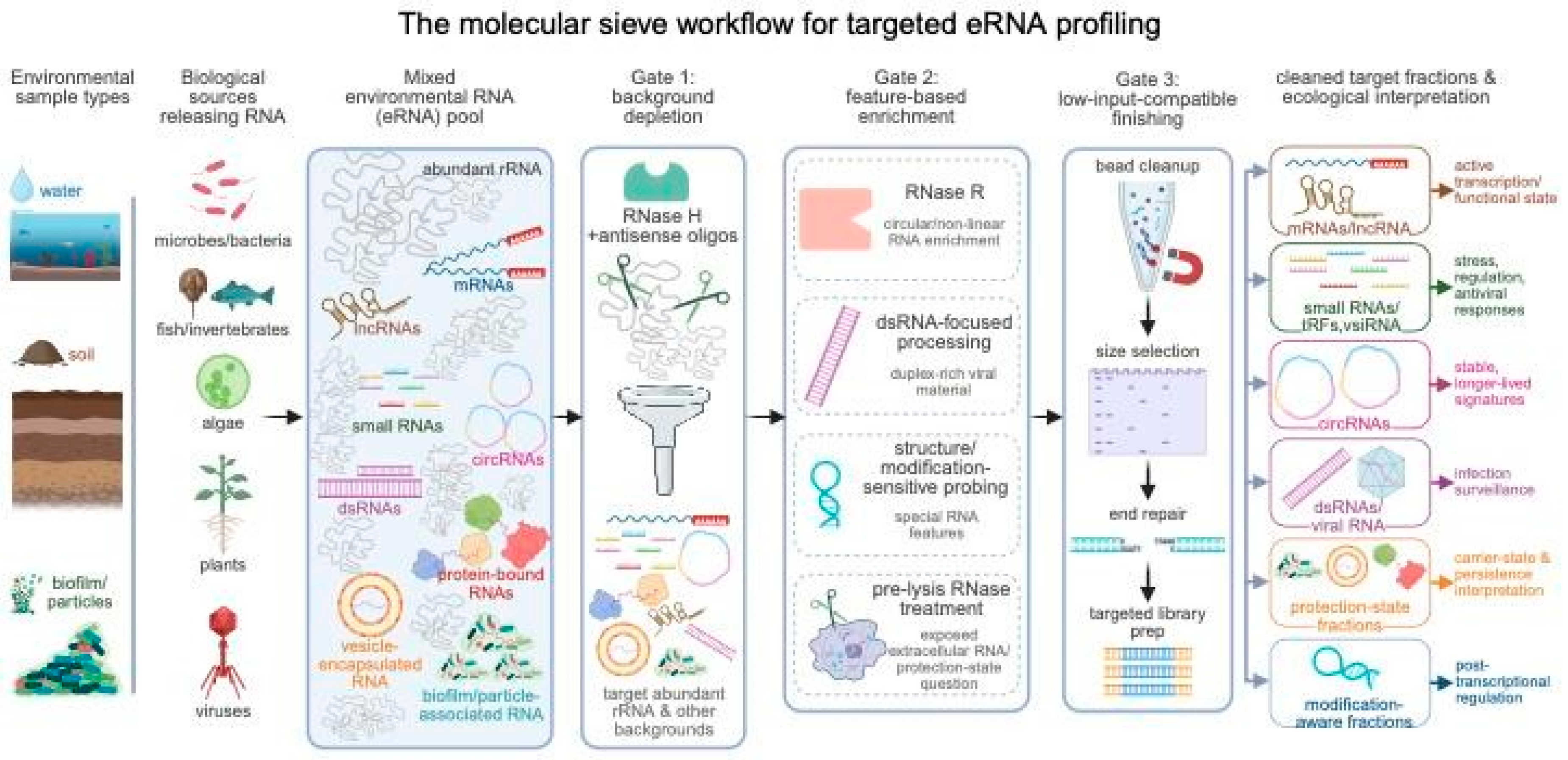
Figure 2.
Interpreting RNase-response signatures to infer operational protection states of environmental RNA. Similar RNA sequences in environmental samples can occur in multiple carrier states, including unprotected extracellular RNA, protein-shielded ribonucleoprotein complexes, membrane-enclosed material such as cells or extracellular vesicles, capsid-protected viral genomes, and particle- or extracellular-polymeric-substance-associated RNA. Parallel pre-lysis treatments, including untreated control, RNase alone, protease plus RNase, detergent plus RNase, and detergent plus protease plus RNase, generate distinct retention or loss patterns that can be used as protection-state signatures. RNA lost after RNase alone is consistent with exposed extracellular RNA; RNA lost only after protease plus RNase indicates protein-dependent protection; RNA lost only after detergent-containing treatment indicates membrane-dependent protection; and RNA that persists after the strongest treatment is most consistent with capsid protection or strong particle/EPS shielding. These signatures are operational rather than absolute and should be interpreted together with matched controls, standardized dosing, and complementary evidence such as size fractionation, time-series behavior, vesicle markers, or viral integrity assays.
Figure 2.
Interpreting RNase-response signatures to infer operational protection states of environmental RNA. Similar RNA sequences in environmental samples can occur in multiple carrier states, including unprotected extracellular RNA, protein-shielded ribonucleoprotein complexes, membrane-enclosed material such as cells or extracellular vesicles, capsid-protected viral genomes, and particle- or extracellular-polymeric-substance-associated RNA. Parallel pre-lysis treatments, including untreated control, RNase alone, protease plus RNase, detergent plus RNase, and detergent plus protease plus RNase, generate distinct retention or loss patterns that can be used as protection-state signatures. RNA lost after RNase alone is consistent with exposed extracellular RNA; RNA lost only after protease plus RNase indicates protein-dependent protection; RNA lost only after detergent-containing treatment indicates membrane-dependent protection; and RNA that persists after the strongest treatment is most consistent with capsid protection or strong particle/EPS shielding. These signatures are operational rather than absolute and should be interpreted together with matched controls, standardized dosing, and complementary evidence such as size fractionation, time-series behavior, vesicle markers, or viral integrity assays.
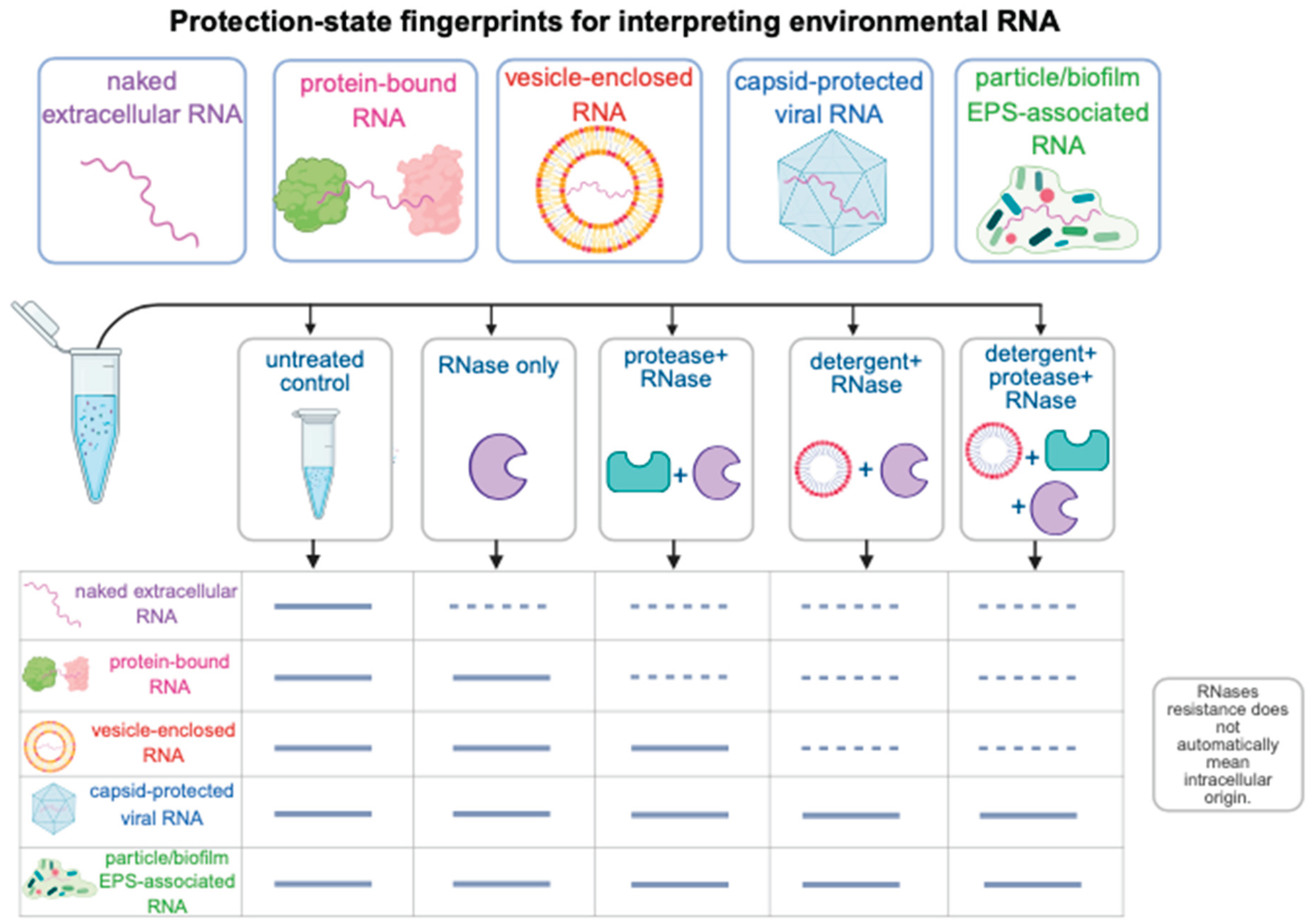

Table 1.
Strategies for RNase-guided enrichment of RNA classes in environmental samples. Each RNA type is paired with a set of RNases used to remove interfering RNA classes, a corresponding preservation mechanism, and an enrichment approach compatible with low-input workflows. These also show size ranges and potential ecological or regulatory insights gained through selective profiling, illustrating how RNases can be applied with precision in eRNA research.
Table 1.
Strategies for RNase-guided enrichment of RNA classes in environmental samples. Each RNA type is paired with a set of RNases used to remove interfering RNA classes, a corresponding preservation mechanism, and an enrichment approach compatible with low-input workflows. These also show size ranges and potential ecological or regulatory insights gained through selective profiling, illustrating how RNases can be applied with precision in eRNA research.
| RNA type | RNases to deplete interfering RNAs | Target RNA preserved by | Enrichment Strategy | Size range (nt) | Functional insight from enrichment | Key refs |
| mRNA | RNase T1, RNase R, RNase H | Poly(A) tail | Oligo(dT) capture | >200 | Gene expression, transcriptional activity | Shakya et al., 2019; Huang et al., 2020; Phelps et al., 2021; Giannoukos et al., 2012; McClure et al., 2013; Wangsanuwat et al., 2020 |
| rRNA | RNase E, RNase H | rRNA-specific probes | Hybrid capture (low input) | 100–2000 | Ribosomal turnover, taxonomic resolution | Wang et al., 2012; Wahl et al., 2022; Tan et al., 2023; Phelps et al., 2021; Huang et al., 2020 |
| tRNA | RNase E, RNase R | Structural resistance | Size selection (~70–90 nt) | 70–95 | Nutrient status, stress adaptation | Helm and Motorin, 2017; Tomikawa, 2018; Keam et al., 2015; Anderson and Ivanov, 2014 |
| Ribozymes / Catalytic RNA | RNase T1, RNase V1 | Tertiary structure | Structural retention | Variable | Self-cleaving RNAs, regulatory switching | Kavita and Breaker, 2023; Wan et al., 2013; Kertesz et al., 2010 |
| circRNA | RNase R, RNase H | Circular structure | Backsplice validation, exonuclease resistance | >200 | Long-lived regulation, cell-type markers | Jeck et al., 2013; Memczak et al., 2013; Xiao and Wilusz, 2019; Suzuki et al., 2006 |
| siRNA / miRNA | RNase A, RNase PARN | Argonaute protection | Size selection (15–30 nt), AGO-IP | 18–24 | Silencing, defense, inter-organismal signaling | Meister, 2013; Hafner et al., 2011; Jayaprakash et al., 2011; Androvic et al., 2022; Arroyo et al., 2011; Turchinovich et al., 2011; Yu et al., 2005 |
| lncRNA | RNase T1, RNase V1, RNase H | Poly(A)+, structure | Poly(A) enrichment, rRNA depletion | >200 | Epigenetic regulation, stress-related expression | Shakya et al., 2019; Yates et al., 2021; Huang et al., 2020 |
| tRNA fragments (tRFs) | RNase R, RNase E | Short fragments | Size selection (18–35 nt) | 18–35 | Stress responses, transposon control | Anderson and Ivanov, 2014; Keam et al., 2015; Krishna et al., 2019; Nechooshtan et al., 2020; Hafner et al., 2011; Jayaprakash et al., 2011 |
| piRNA | RNase A, RNase T1 | PIWI protein association | PIWI-IP, size selection | 24–31 | Germline protection, viral defense | Kirino and Mourelatos, 2007; Horwich et al., 2007; Meister, 2013 |
| Viral siRNAs | RNase III, RNase A | Dicer products | Small RNA PAGE, viral mapping | 21–24 | Infection surveillance, host-pathogen dynamics | Aguiar et al., 2015; Molnár et al., 2005; Golyaev et al., 2019 |
| RNA with modification | RNase-sensitive comparison pairs (T1, A, V1) | Chemical protection (Ψ, m6A) | Differential digestion, structure assays | Variable | Regulation, adaptation, post-transcriptional control | Helm and Motorin, 2017; Zhang et al., 2019; Garcia-Campos et al., 2019; Morita et al., 2013; Knutson et al., 2020; Knutson and Heemstra, 2020; Chen et al., 2024; Ron et al., 2025; Carlile et al., 2014; Schwartz et al., 2014 |
Table 2.
RNase modules for selective eRNA processing. Core RNase-based modules that can be combined to deplete abundant background RNA, enrich specific features (e.g., circularity), or probe structure/modification. Columns summarize substrate bias, typical end chemistry, and the main downstream library implications for low-input eRNA.
Table 2.
RNase modules for selective eRNA processing. Core RNase-based modules that can be combined to deplete abundant background RNA, enrich specific features (e.g., circularity), or probe structure/modification. Columns summarize substrate bias, typical end chemistry, and the main downstream library implications for low-input eRNA.
| Module (RNase) | Main specificity | Key requirement | Typical ends generated | Primary use in eRNA | Library note | Key refs |
| RNase H (+ antisense DNA) | RNA:DNA hybrids | Oligo hybridization | 5′-P / 3′-OH | Programmable depletion (esp. rRNA) | Works with fragmented RNA; report % rRNA remaining | Huang et al., 2020; Phelps et al., 2021; Duan et al., 2020 |
| RNase R | Linear RNA exonuclease | Accessible 3′ end | Exonucleolytic trimming | Enrich circRNA (relative) | Confirm by backsplice junctions | Vincent and Deutscher, 2009; Xiao and Wilusz, 2019; Jeck et al., 2013; Memczak et al., 2013 |
| RNase A | ssRNA (after pyrimidines) | Accessible ss regions | 5′-OH / 2′,3′-cP→3′-P | Remove exposed ssRNA; structure/accessibility assay | Often needs end-repair for ligation libraries | Kelemen et al., 2000; Wan et al., 2013 |
| RNase T1 | ssRNA (after G) | Accessible ss G | 5′-OH / 3′-P | Complementary structure probing/fragmentation | Strong G-site bias; end-repair often needed | Greiner-Stoffele et al., 2000; Wan et al., 2013 |
| RNase V1 | ds/stacked RNA | Base-paired regions | 5′-OH / 3′-P | Structure profiling (paired regions) | Use with ss nuclease; titrate carefully | Lockard and Kumar, 1981; Kertesz et al., 2010 |
| RNase III family | dsRNA | Duplex RNA | 5′-P / 3′-OH (typical) | Duplex-focused processing (dsRNA-rich inputs) | Size-select to match target library | Nicholson, 2014 |
| MazF | ACA motifs (m⁶A blocks) | Motif present | Endonucleolytic fragments | m⁶A inference (motif-limited) | Mixed communities complicate calls | Zhang et al., 2019; Garcia-Campos et al., 2019 |
| EndoV | Inosine-containing RNA | Inosine present | Cleavage near inosines | Enrich A-to-I edited RNA | Needs stringent controls/filters | Morita et al., 2013; Knutson et al., 2020 |
| PARN | Poly(A) tail trimming | 3′ poly(A) access | Tail shortening | Standardize/remove poly(A) signal | Not a bulk mRNA-depletion tool | Aström et al., 1991; Virtanen et al., 2013 |
Table 3.
RNase protection-assay readout guide. Parallel pre-lysis treatments and the operational interpretation of RNase sensitivity as a proxy for carrier state; unprotected vs protein-shielded vs membrane/capsid-protected vs particle/EPS-shielded. Intended as an interpretive guide; requires matched controls and standardized dosing.
Table 3.
RNase protection-assay readout guide. Parallel pre-lysis treatments and the operational interpretation of RNase sensitivity as a proxy for carrier state; unprotected vs protein-shielded vs membrane/capsid-protected vs particle/EPS-shielded. Intended as an interpretive guide; requires matched controls and standardized dosing.
| Treatment (pre-lysis) | RNA preferentially removed | RNA preferentially retained | Operational inference | Key refs |
| None | None | Total RNA | Baseline | Hill et al., 2013; Jo, 2024 |
| RNase | Unprotected extracellular RNA | Membrane/capsid-protected RNA | Protected vs unprotected | Hill et al., 2013; Enderle et al., 2015 |
| Protease + RNase | Protein-shielded + unprotected RNA | Vesicle/capsid-protected RNA | Protein-dependent protection | Arroyo et al., 2011; Turchinovich et al., 2011 |
| Detergent + RNase | Vesicle-enclosed + unprotected RNA | Protein-shielded, capsid-protected | Membrane-dependent protection | Enderle et al., 2015; Ramirez et al., 2018 |
| Detergent + protease + RNase | Vesicle + protein-shielded + unprotected RNA | Capsid-protected; strong particle/EPS shielding | Capsid/particle shielding signal | Harrison et al., 2023; Mugunthan et al., 2023 |
| RNase (matrix-aware) | Accessible extracellular RNA | Particle/EPS-adsorbed RNA | Particle/EPS shielding contribution | Barnes and Turner, 2015; Pietramellara et al., 2009 |
Table 4.
RNase-guided eRNA workflow essentials. Minimal reporting, controls, and quantitative QC outputs needed to make RNase-guided eRNA results interpretable and comparable across studies, spanning sampling through sequencing and ecological interpretation.
Table 4.
RNase-guided eRNA workflow essentials. Minimal reporting, controls, and quantitative QC outputs needed to make RNase-guided eRNA results interpretable and comparable across studies, spanning sampling through sequencing and ecological interpretation.
| Workflow stage | Must report | Minimum controls | Key quantitative QC | Key refs |
| Sampling & preservation | Matrix, capture method, time-to-stabilization, storage | Field/extraction blanks | Handling time/temp; volume/biomass proxies | Jo, 2023; Spens et al., 2017; Wood et al., 2020 |
| Extraction & inhibitors | Cleanup strategy; DNA removal plan | Inhibition check + spike-in | Yield; inhibition metric; fragment profile | Wang et al., 2012; Lim et al., 2016; Hata et al., 2015 |
| RNase step calibration | Enzyme source/units; buffer; time/temp; quench | No-enzyme + over-digest | Spike-in recovery; replicate CV | Pine et al., 2016; Hardwick et al., 2016 |
| Enrichment/size handling | Method + bead ratios/gel window | Process spike-in | Recovery by size; adapter-dimer fraction | Fishman et al., 2018; Ura and Niida, 2024 |
| Library prep & sequencing | Library type; UMI/randomized adapters; PCR cycles | Library blank; tech replicate subset | Mapping rate; duplicates; insert sizes | Hafner et al., 2011; Jayaprakash et al., 2011; Androvic et al., 2022 |
| Depletion performance | Depletion method + parameters | Pre/post subset | % rRNA remaining; usable reads | Wahl et al., 2022; Tan et al., 2023; Phelps et al., 2021 |
| Interpretation | Evidence tier used (suggestive/strong) | Time/decay-series subset | RNase-response curves; persistence estimates | Wood et al., 2020; Marshall et al., 2021 |
| Standards | Metadata checklist used | Checklist compliance | Completeness score | Ahi, 2025; Klymus et al., 2024 |
Disclaimer/Publisher’s Note: The statements, opinions and data contained in all publications are solely those of the individual author(s) and contributor(s) and not of MDPI and/or the editor(s). MDPI and/or the editor(s) disclaim responsibility for any injury to people or property resulting from any ideas, methods, instructions or products referred to in the content. |
© 2026 by the authors. Licensee MDPI, Basel, Switzerland. This article is an open access article distributed under the terms and conditions of the Creative Commons Attribution (CC BY) license (http://creativecommons.org/licenses/by/4.0/).
Copyright: This open access article is published under a Creative Commons CC BY 4.0 license, which permit the free download, distribution, and reuse, provided that the author and preprint are cited in any reuse.


