

Submitted:
25 May 2026
Posted:
26 May 2026
You are already at the latest version
Abstract
Digitalization of fitting processes represents an important direction of production development in mechanical engineering in the context of Industry 4.0, smart manufacturing, and human-centered manufacturing. In manual assembly operations, the quality of the result is significantly affected by the comprehensibility of work instructions, capability of the user to interpret technical documentation and degree of prior experience. The present paper deals with an experimental comparison of traditional paper documentation with a digital workflow created in the technology of Vuforia Capture. The aim was to verify whether digital work instructions can contribute to reduction of assembly time, reduction in error rates, and reduction in the need for additional assistance with installing an unfamiliar mechanism. The experiment was conducted on a group of employees who had not been familiar with the mechanism to be assembled and did not have practical experience with the same prior to testing. The assembly task was performed in two versions: using paper documentation vs. following a supporting digital procedure in Vuforia Capture. Total assembly time, the number and type of errors, the need for assistance, the comprehensibility of the procedure, and the applicability of the technology to the conditions of engineering practice were evaluated. The results showed that in the case of paper documentation, the average assembly time was 1084.8 s, while in the case of the digital procedure, the average time was 599.4 s. The total number of errors recorded decreased from 56 to 9, and the number of assistance interventions from 29 to 1. Findings suggest that Vuforia Capture can foster a more effective understanding of assembly procedures, stabilize workflow, and accelerate training of inexperienced users.
Keywords:
Vuforia Capture
; augmented reality
; mixed reality
; digital work instructions
; assembly process
; mechanical engineering industry
; assembly rate of error
1. Introduction
In the mechanical engineering industry, assembly processes belong to activities whose final quality is significantly influenced by accuracy of work instructions, experience of the worker, and his ability to correctly interpret technical documentation. This influence is of special significance in conditions of a single-piece, small serial, or variant production, where assembly tasks consist of a high degree of manual labor, variability of operations and where they place requirements for increased spatial imagination of the user.
Traditional assembly procedures in industrial practice are based especially on technical drawings, bills of material, instructional texts, and verbal instruction. Advantage of paper documentation are its easy availability, low technical requirements, and longstanding use in industrial environment.
However, in the training of new workers or inexperienced users, its utilization might pose a problem, as it requires independent interpretation of 2D technical documentation, correct parts identification, and understanding of their spatial orientation. In the case of an unfamiliar mechanism, this manner of work may prolong assembly time, lead to occurrence of errors, and to increased need for assistance [3,4].
Another limitation of paper documentation is its static nature. The user is forced to repeatedly switch attention between a drawing, a written instruction, physical components and the assembly itself, which may increase cognitive load. Increased cognitive load may manifest in slower or less fluent execution of the assembly procedure [5,6].
Figure 1 is a diagram showing a difference between traditional work with paper documentation and the assembly supported by technologies of mixed reality. Display of work information directly in the assembly space may reduce the need for switching attention and contribute to better orientation of the user.
In the context of developing concepts of Industry 4.0, smart manufacturing and human-centered manufacturing, digital work instructions are the object of ever-increasing interest as a support tool of manual activities. Digital procedures enable presenting work information in the form of a text, an image, a video, sound or 3D models and provide the user with continuous guidance throughout the task execution [7,8]. Their benefit lies especially in their ability to guide the user step by step and to provide visual or checking support directly in the course of assembly. Thus, it may contribute to standardization of work procedures in intelligent production and a more efficient knowledge transfer between the more and the less experienced workers [9,10,11].
Augmented and mixed reality technologies represent a significant approach to implementing digital work instructions directly in the environment of real assembly. Assembly information may be displayed in the context of a workstation, thus reducing the need for interpretation of abstract technical documentation and, at the same time, improving orientation of the user.
In industrial practice, these technologies are applied especially in assembly, maintenance and servicing, as well as in training of workers and in expert know-how transfer. Their utilization makes it possible to link digital content and real work environment, thus creating a prerequisite for more effective execution of manual operations.
Research into digital, augmented, and mixed work instructions conducted so far has focused especially on their effect on the efficiency of manual assembly processes. Attention is focused especially on indicators such as assembly time, rate of error, cognitive load, usability of technology and the degree of user independence. Several studies point to the significance of supporting the user by guiding him through work sequence and spatial orientation in the course of assembly [1,2]. Other works emphasize the benefit of digital and AR instructions in terms of error rate reduction and increased work efficiency, especially involving less experienced users [3,4,5,6]. At the same time, research results suggest that the efficacy of digital work instructions is significantly influenced by the manner of their implementation and quality of user interface.
A significant portion of research focuses on the use of digital and AR technologies in the area of workers training and practical skills transfer. These solutions enable a more effective conveyance of assembly and maintenance procedures while supporting adoption through visual and interactive user guidance. Studies point to the fact that the AR training systems may improve adoption of practical skills and increase independence of users in executing their work tasks [7,8,9,10]. At the same time, importance of user interface design and the manner of information presentation is emphasized, as they directly affect the adoption efficiency and the quality of executed work [11].
An important area of research is creation and management of digital and AR work instructions. Research focuses on how to effectively capture expert know-how and transform it into structured, user-friendly work procedures. Approaches based on „programming-by-demonstration“ enable creation of instructions directly from execution of work tasks, thus reducing requirements for manual creation of documentation [12,13]. At the same time, it appears that efficiency of AR instructions depends on particular functions of the system, such as visual augmentation of steps, guidance of the user or checking of correct execution of operations [14,15,16]. Significant role is also played by visual elements optimization and the amount of information presented, since too much information may expose the user to cognitive load [17,18,19].
Systematic and overview studies point to the fact that efficiency of AR, VR, and MR work instructions depends on several factors, especially on the nature of the task, on the type of the imaging device, and on the characteristics of the user group [20,21,22]. Results of those studies hint at the fact that benefit stemming from digital instructing systems cannot be deemed to be universal. Rather, it needs to be assessed in the context of a particular application. For this reason, experimental verification of individual solutions under real conditions is crucial for assessing their practical utilization.
Direct comparison of paper and digital or AR work instructions point to the fact that digital support may result in reduced assembly time and error rate, especially when involving lesser-known, spatially demanding, or sequence-sensitive tasks. Several studies’ results suggest that visual and interactive user guidance enables closer adherence to assembly sequence and reduces the risk of incorrect interpretation of work steps [23,24,25]. This effect is especially pronounced in users lacking prior experience with the task at hand.
At the same time, experimental studies emphasize the significance of correct components identification, parts orientation, and adherence to assembly sequence, which have a crucial impact on the success of assembly operations. Digital and AR work instructions may provide effective support in this respect through visual guidance and contextual display of information, thus promoting error reduction and improving workflow [26,27,28,29].
Other research covers digital work instructions assessment in various spheres of application, including time-critical assignments, training scenarios, and specific industrial conditions. Results of these studies speak of the importance of the context of use and, at the same time, confirm that digital instructions may improve user orientation, the course of work, and reliability of executed operations [30,31,32,33,34,35].
It follows from available research that digital and AR work instructions have the potential of improving efficiency of assembly processes, especially in terms of assembly time, error rate, and user support. However, this benefit cannot be deemed universal, as the end result depends on the context of a particular application and the nature of the assembly task.
That is why it is important to verify specific technological solutions experimentally in conditions corresponding to real deployment in the settings of mechanical engineering. In this context, it is relevant to examine the use of the tool Vuforia Capture, which enables the creation of digital work procedures directly from real execution of assembly operations.
The aim of the paper is to compare the traditional paper documentation with digital work procedure created with the use of Vuforia Capture. Focus is directed at key indicators of assembly significance, namely the assembly time, the number of errors, the need for additional assistance and the usability of the technology for the training of its users.
Based on the aim above, the following research questions have been postulated:
- RQ1: Does the use of digital work instructions created in Vuforia Capture result in reduced assembly time compared to paper documentation?
- RQ2: Is there a smaller number of assembly errors using Vuforia Capture involving users lacking prior experience?
- RQ3: Does digital work procedure reduce the need for additional assistance in the course of assembly?
- RQ4: Is the technology of Vuforia Capture a suitable training support tool in practical conditions of mechanical engineering?
2. Materials and Methods
Experimental verification focused on comparing two approaches to supporting the assembly process – the traditional paper documentation and the digital work procedure created in Vuforia Capture. The aim of the experiment was to analyze the influence of the form of the work instructions on the course of assembly, especially in terms of assembly time, error rate, and the need for additional assistance in executing assembly operations.
2.1. Experimental Workplace, Object of Assembly, and Technology Used
Experimental verification was conducted at the workplace set up for assembling a mechanical engineering subassembly of “Transmission board“, which constitutes a structurally significant mechanical unit of a servo drive. The choice of the subassembly was intentional, as it consists of several assembly steps necessitating correct parts identification, adherence to assembly sequence, and precise components orientation.
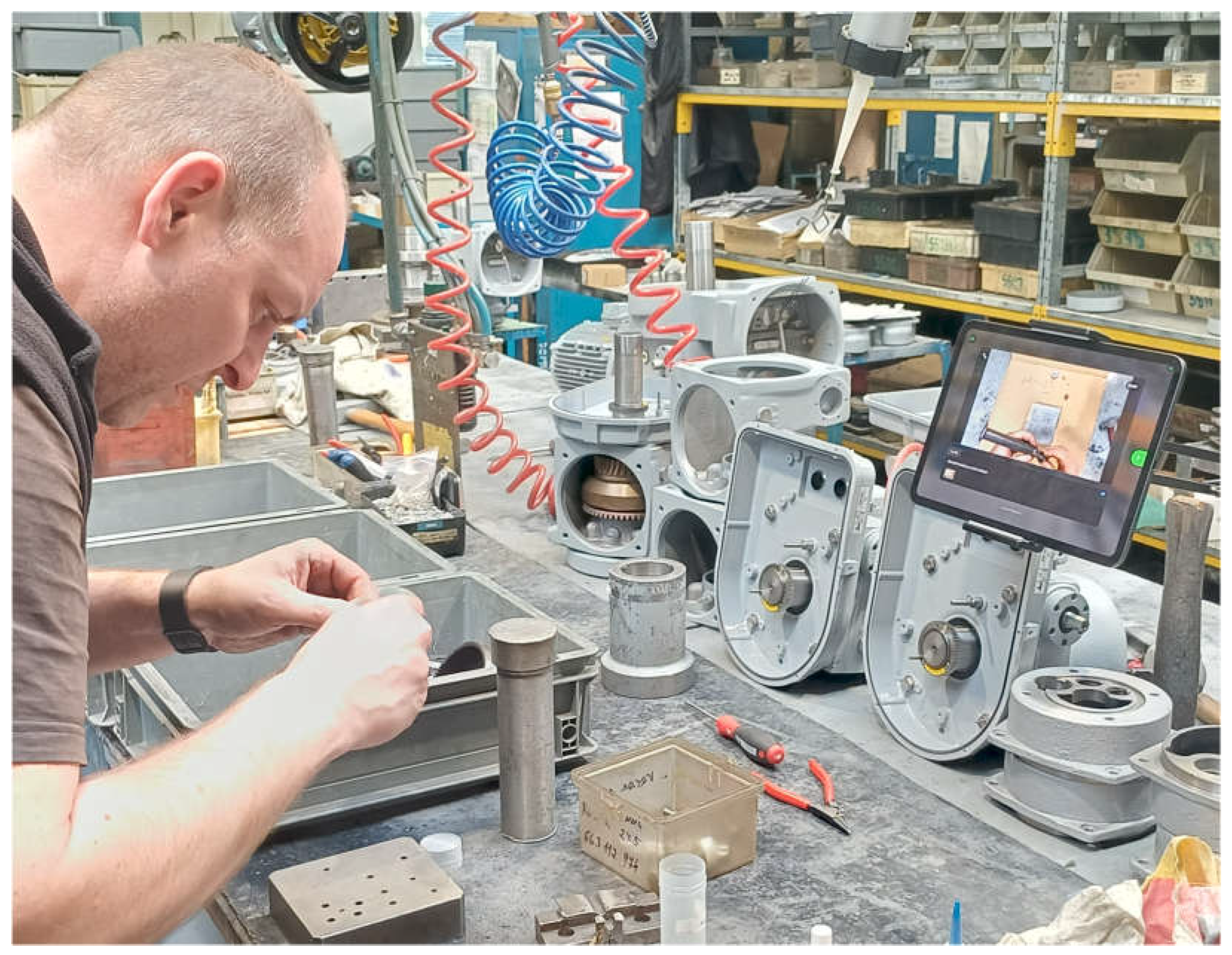
The workplace consisted of an assembly desk, a set of requisite components, tools, paper technical documentation and a tablet with digital work procedure. Apple iPad Pro tablet with a LiDAR sensor was used in the digital version of the experiment, displaying sequential work procedure (Figure 2).
Vuforia Capture is a part of Vuforia Expert Capture platform designated for recording, processing, and distributing work procedures. It enables capturing real work procedure, complement it with an expert commentary, and transform it into sequential digital instructions. In the experiment, the assembly procedure was recorded with tablet featuring a LiDAR sensor and then processed in Vuforia Editor (Figure 3). Individual steps were ordered into a logical sequence and completed with textual, image, and checking elements.
Digital work procedure contained text with instructions, reference images, video recordings, and graphic augmentation of critical spots, complete with checking steps to verify correctness of individual components’ assembly. Procedure created in this way enables transforming expert know-how into a repeatedly usable digital form, which may serve for training the users, supporting less-experienced workers, and standardizing assembly operations.
2.2. Research Sample and Experimental Versions
Research sample comprised participants lacking prior practical experience with the mechanism to be assembled. This selection was intentional, since the goal of the experiment was to verify the ability of individual forms of work instructions to support the user in his first contact with unfamiliar assembly procedure.
Experimental data was obtained from ten assembly cycles, where five cycles were executed using paper documentation and five cycles were supported with digital work procedure in Vuforia Capture. Each cycle consisted of ten assembly steps, enabling assessment of a total of 100 assembly operations. Due to limited scope of the sample investigated, results need to be interpreted as an indication of potential benefit of technology and not as generally valid conclusions.
The experiment was designed as a comparison of two approaches to guiding assembly. The first version represented an assembly following paper documentation, where the participant had to interpret the technical drawing and identify individual steps on his own. The second version represented an assembly supported with digital work procedure in Vuforia Capture, which provided sequential guidance step by step, with visual and checking support.
Figure 4.
Assembly supported with digital work procedure.
2.3. Investigated Indicators
Both quantitative and qualitative indicators were monitored during the experiment, focusing on assessment of the course of assembly. The main parameters under assessment were the total assembly time, individual step time, number and type of errors, the need for additional assistance, and the clarity of work procedure. Overview of the investigated indicators and the manner of their assessment is given in Table 1.
A standardized code list was used for consistent error typization, listed in Table 2.
Assembly time was tracked from the first assembly step to completion of the last step. In addition to total time, individual step times were taken, too. The error count, error types, and the need for assistance were recorded from direct monitoring of the course of assembly. Error occurrence, error type, or eventual need for assistance by the monitoring personnel was recorded at each step.
In digital version, the obtained data was completed with data from Vuforia Insights, which enables recording of the execution of the work procedure in its course, including the time data, and individual steps completion.
Manually obtained data was used as a primary source of assessment, with data from Vuforia Insights serving for checking the consistency of measurements.
The combination of manual measuring and digital record increased the reliability of experimental data. Manual monitoring enabled capturing qualitative aspects of the course of assembly, while digital record provided precise time data on the course of the work procedure.
In the case of paper documentation, data was obtained solely through direct measuring and monitoring, as no automated digital record was available.
2.4. Methods of Data Assessment
The obtained data was assessed with the use of descriptive statistics. Average values, minimums, maximums, and a standard deviation were established for the assembly time.
As for the error rate, the total error count, the average number of errors per participant, and the percentual reduction in error rate between the versions compared was assessed. Percentual reduction in assembly time was calculated from the equation below:
where represents the average assembly time with paper documentation and the average time using digital work procedure.
By analogy, percentual reduction in error rate was calculated as follows:
where represents the total error count with paper documentation and the total error count following Vuforia.
Reduction in the need for assistance was expressed through comparison of the number of assembly steps necessitating intervention by the monitoring personnel.
Due to limited sample size of the experiment the results are interpreted cautiously, and they serve as an empirical indication of potential contribution of the technology, not as generally valid conclusions. At the same time, in view of the nature of the experiment, no inferential statistical methods were applied, which represents methodological limitation of the study. The mentioned limitations, however, do not impair the ability of the experiment to identify elemental differences between the approaches compared.
3. Results
Experimental comparison enabled identification of differences between assembly following paper documentation and assembly supported by digital work procedure in Vuforia Capture. The assessment focused on indicators related to the efficiency and reliability of the assembly, in particular the assembly time, the error rate, and the need for additional assistance.
3.1. Assembly Time
Measurement results point to a significant difference between the two assembly versions. Using paper documentation, the average assembly time was 1084.8 s (≈18 min 5 s), whereas using digital work procedure in Vuforia Capture, the average time was 599.4 s (≈9 min 59 s).
The inter-version difference equaled 485.4 s, which accounts for assembly time reduction by 44.75 % in favor of digital procedure.
Measurement results point to a significant difference between the two assembly versions, as listed in Table 3.
The use of paper documentation also correlated with greater assembly time variance (762–1430 s), whereas under digital procedure, the values were significantly more concentrated (543–688 s). This result hints at a more stable course of assembly when following digital instructions. Variance in assembly time of individual participants is shown in Figure 5.
3.2. Comparison with Standardized Time
A standardized time of 12 minutes, which is 720 s, was set for the assembly task. In the case of paper documentation, all but one participant exceeded that time. In the case of Vuforia Capture / MR all participants completed assembly below the standardized time limit. Comparison of average and standardized time is shown in Table 4.
It follows from the results that paper documentation failed to provide the majority of inexperienced participants with support that would be sufficient to complete the established standardized time limit. Conversely, proceeding digitally allowed assembly completion in time shorter than the standard, which points at its training support potential and acceleration of assembly procedure.
3.3. Assembly Error Rate
56 errors were recorded in assembly following paper documentation, while only 9 errors were recorded following digital work procedure. Thus, the average number of errors per participant dropped from 11.2 to 1.8.
Percentual reduction in error rate was calculated as follows:
Thus, in the monitored sample, Vuforia Capture resulted in overall error reduction by approximately 83.93 %. Comparison of experimental inter-version error rate is shown in Table 5.
With paper documentation, the most frequently occurring were errors related to incorrect mounting of parts, use of incorrect component and failure to follow assembly sequence. With digital procedure, errors were less numerous and were mostly of the nature of handling inaccuracy. This result suggests that visual guidance, image references, and checking mechanisms could help participants better understand the correct order and manner of execution of assembly steps. Figure 6 shows comparison of total error count plotted in graphs.
3.4. Need for Additional Assistance
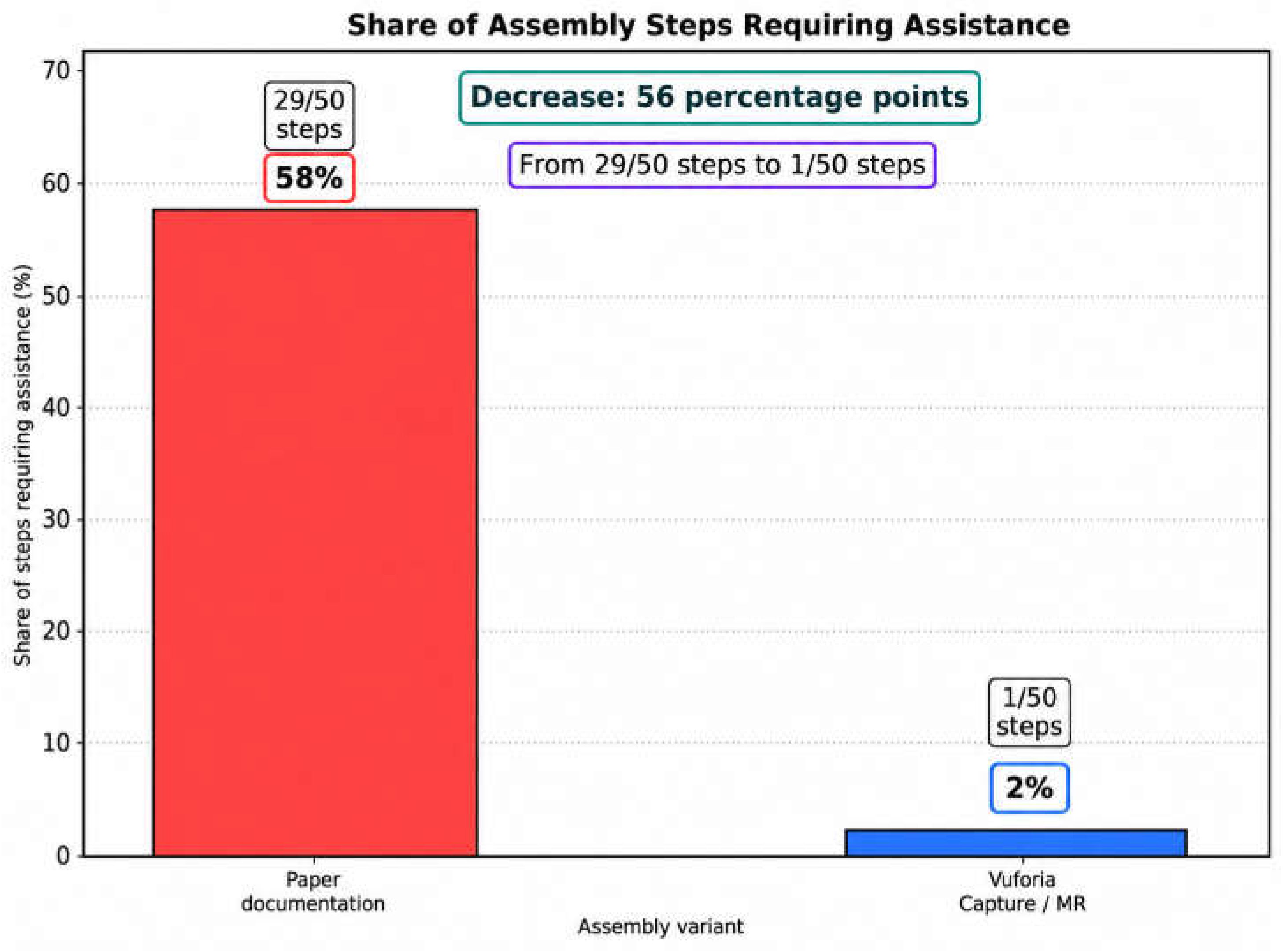
Significant difference was also found in assessing the need for external assistance. With paper documentation, assistance was needed in 29 out of 50 monitored assembly steps, which accounts for 58 % of the steps. Digital work procedure significantly reduced the need for assistance (58 % vs. 2 %), as documented in Table 6.
This result points to a significantly higher degree of participants‘ independence when following digital work procedure. While with paper documentation the participants often needed help with interpreting the procedure, identifying the parts, or deciding on the correct order of steps, following digital instructions, they were able to proceed mostly independently.
Figure 7.
Share of assembly steps requiring assistance.
3.5. Results Summary
Summary comparison of experimental versions is shown in Table 7. The results unequivocally confirm positive impact of digital work procedure on all investigated indicators, with the most pronounced effect recorded in terms of error reduction and reduction in the need for assistance.
4. Discussion
Experiment results point to significant improvement in efficiency and reliability of the assembly when digital work procedure created in Vuforia Capture is followed. The most pronounced effect was recorded in the area of error reduction and reduction in the need for additional assistance, which suggests that sequential digital guidance efficiently supports orientation of the user in the course of assembly of an unfamiliar mechanism.
Reduction in assembly time (RQ1) may be explained especially by elimination of independent search for and interpretation of information in technical documentation. Digital work procedure guides the user step by step, thus reducing the time needed for decision making and orientation in the process of assembly. A significant finding is also lower inter-participant assembly time variance. This result suggests a higher degree of work procedure standardization and more stable work performance. In terms of industrial practice, this aspect is important, as performance repeatability and foreseeability are crucial for managing manufacturing processes.
In relation to the second research question, RQ2, significant reduction in error occurrence has been confirmed. Digital work instructions ensure correct understanding of assembly sequence and reduce the risk of incorrect parts identification or order of operations. Display of visual and contextual information helps users to execute assembly more precisely and with smaller number of errors.
The most pronounced difference was recorded in the need for additional assistance (RQ3). Digital work procedure resulted in greater degree of user independence, which has significant practical implications, especially in the training of new workers. Reduced need for intervention by experienced personnel may contribute to more effective use of human resources in industrial practice.
In relation to research question RQ4, it may be stated that Vuforia Capture technology is a suitable training support tool. Digital work procedures enable quicker adoption of assembly operations, reduce cognitive load of the user and support expert know-how transfer into digital form.
The established results correspond with published studies, which point to positive impact of digital and AR work instructions on efficiency of manual assembly tasks [23,24,25,26,27,28]. Prior research identified similar reduction of assembly time and error rate, especially with tasks requiring correct parts orientation and adherence to assembly sequence. In the present experiment the difference was more pronounced especially due to the fact that the participants worked with an unfamiliar mechanism, lacking prior practical experience with it.
Yet the obtained results cannot be interpreted as universally valid. Efficiency of digital work instructions depends on the nature of the assembly task, the user group, and the manner of the system implementation, which has been confirmed by several studies as well [14,18,22]. Where simple or well-known operations are involved, difference between paper and digital form may be less pronounced, while with more complicated or lesser-known tasks, the benefit of digital support can be more significant.
The main limitation of the study is a small experimental size and involvement of users without direct experience from industrial production. In addition, the experiment was conducted under control conditions of a single particular assembly task, which may affect transferability of results to real operation. In industrial environment, results may be impacted also by other factors, such as time pressure, working conditions, components availability or workplace ergonomics.
Despite the said limitations, results suggest that Vuforia Capture technology may represent an effective tool supporting assembly processes, especially in the area of workers training, procedures standardization, and error rate reduction.
Future research should focus on verification of the results on a larger participants sample, in real industrial operation conditions, and on different types of assembly tasks. In addition, it would be appropriate to complete the assessment with inferential statistical methods, cognitive load analysis, and user experience evaluation.
5. Economic Analysis of Vuforia Capture Implementation
Economic evaluation was done as a ballpark cost and potential benefit analysis of digital work instructions implementation into the assembly process. The goal is to evaluate economic viability of implementing Vuforia Capture technology in the conditions of mechanical engineering production based on experimentally established differences between the traditional and the digital approach.
5.1. Starting Points of Economic Analysis
Economic analysis draws on the experimentally established reduction in assembly time, error rate and the need for additional assistance. Time savings per assembly corresponded to 485.4 s (0.1348 h). In addition, error count and assistance interventions dropped significantly, which may have economic impact on production effectivity.
5.2. Investment and Operating Costs
Economic analysis included basic cost items necessary for implementation of digital work instructions per assembly workstation. The main input costs include especially Vuforia Capture software license fee, the respective hardware, protective auxiliaries and mounting of the imaging device.
Since Vuforia Capture license fee is not publicly standardized, the economic model worked with an annual estimate of 2 000 €/year. This value serves as a model input for framework economic analysis and may differ in practice depending on license conditions and the scope of deployment.
iPad Pro was used as the imaging device, proving itself suitable in the course of the experiment in terms of stability of displaying and practical usability. The approximate purchase price of such a device ranges from 1 100 to 1 500 €.
Costs of mounting fixtures and auxiliaries depend on a particular solution and the level of mechanical resilience. A simple solution starts at about 50 €, while more robust industrial configurations may result in higher investment costs.
These values represent a ballpark model scenario and may differ depending on specific implementation conditions.

Table 8.
Cost items of technology implementation.
| Cost item | Ballpark value | Cost type |
|---|---|---|
| Vuforia Capture License | ~2 000 €/year | recurring |
| Tablet (iPad Pro) | 1 100 – 1 500 € | one-off |
| Holder / mounting system | 50 – 100 € | one-off |
| Protective auxiliaries | ~80 € | one-off |
| Creation of work procedure | varied | one-off / update-dependent |
| Users training | varied | one-off / recurring |
Note: Values represent approximate estimates and may vary depending on specific implementation conditions.
The basic scenario may start with the minimal configuration consisting of Vuforia Capture license, an iPad Pro tablet, a protective guard and a holder. If deployed to meet the basic needs of a single workplace, the initial costs may be estimated to range between 3 200 € and 3 700 €. Model costs calculation is given in Table 9.
The greatest share of overall costs falls on the license fee. If a higher price-range tablet or a more mechanically resilient industrial holder were used, the initial investment could hike up to 3 600 € to 3 900 €.
5.3. Economic Benefits of Implementation
Economic benefits were evaluated in terms of three main areas: assembly time reduction, error rate reduction, and reduction in the need for additional assistance.
Economic benefit from assembly time reduction may be calculated from the equation below:
where:
is annual benefit from time reduction,
is the number of assembly cycles per year,
is the time savings per assembly in hours,
is hourly worker’s wage.
The experiment showed the time savings of:
With a model hourly wage rate of a worker being 15 €/h, the savings per assembly are:
Financial savings depend on the worker’s hourly wage rate as shown in Table 10.
Economic benefit from time reduction is relatively low compared to savings resulting from error rate reduction. Reduction of assembly time itself may be economically significant especially in the case involving greater number or assembly cycles or higher hourly wage rate of workers.
In addition to time savings, economic benefit arising directly from error rate reduction needs to be accounted for. Assembly errors may result in additional costs of repair, rework, quality control, extension of continuous production time or, in more serious cases, component damage.
In the experiment, the error count dropped from the average value of 11.2 errors per assembly with paper documentation to 1.8 error per assembly following digital procedure. The average reduction amounted to 9.4 errors per assembly cycle.
Economic benefit of reduced error rate may be expressed by the following equation:
where:
is annual benefit from error rate reduction;
is the number of assembly cycles per year;
is the average error count reduction per cycle;
is the average cost of a single error removal.
Since particular errors were not represented in financial terms in the experiment, it is appropriate to work with a calculation scenario.
Economic benefit from error rate reduction was analyzed using a scenario approach as shown in Table 11.
The results show that economic benefit from error rate reduction may significantly outweigh savings resulting from reduced assembly time. However, not every error recorded in the experiment would correspond to the same financial cost in real production. Some errors could have been of handling inaccuracy in nature, repairable immediately, while others could have resulted in real rework or inspection costs.
Another significant benefit of digital work procedure is reduced need for external assistance. With paper documentation, assistance was needed in 29 out of 50 monitored steps, while following digital procedure, it was needed in only 1 of 50 steps. The average reduction corresponds to 5.6 assistance intervention per assembly cycle.
If one assistance intervention is assumed to last 1 minute on average and it is performed by a qualified worker whose hourly rate is 20 €/h, savings per assembly are:
Economic benefit from reduced need for assistance was analyzed based on different intervention length scenarios and hourly rate, as shown in Table 12.
Benefit from reduced need for assistance is lower than that involving error rate, yet it has an important organizational impact. An experienced worker or a foreman does not need to be repeatedly disturbed while training less experienced workers, which may influence production flow and qualified personnel availability in a positive way.
5.4. Return of Investment Model
Overall economic benefit per assembly may be expressed as a sum of financial savings from reduced assembly time, financial savings from reduced error rate and financial savings from reduced need for assistance:
where:
is the overall benefit from one assembly;
is the benefit from reduced assembly time;
is the benefit from reduced error rate;
is the benefit from reduced need for assistance.
A conservative scenario may involve:
- hourly worker’s wage: 15 €/h;
- time savings per assembly: 2.02 €;
- cost per error: 1 €,
- reduced error rate savings: 9.40 €,
- savings on assistance: 1.40 €.
Total benefit per assembly:
With the costs of the first year standing at 3 330 € the ballpark payback point is:
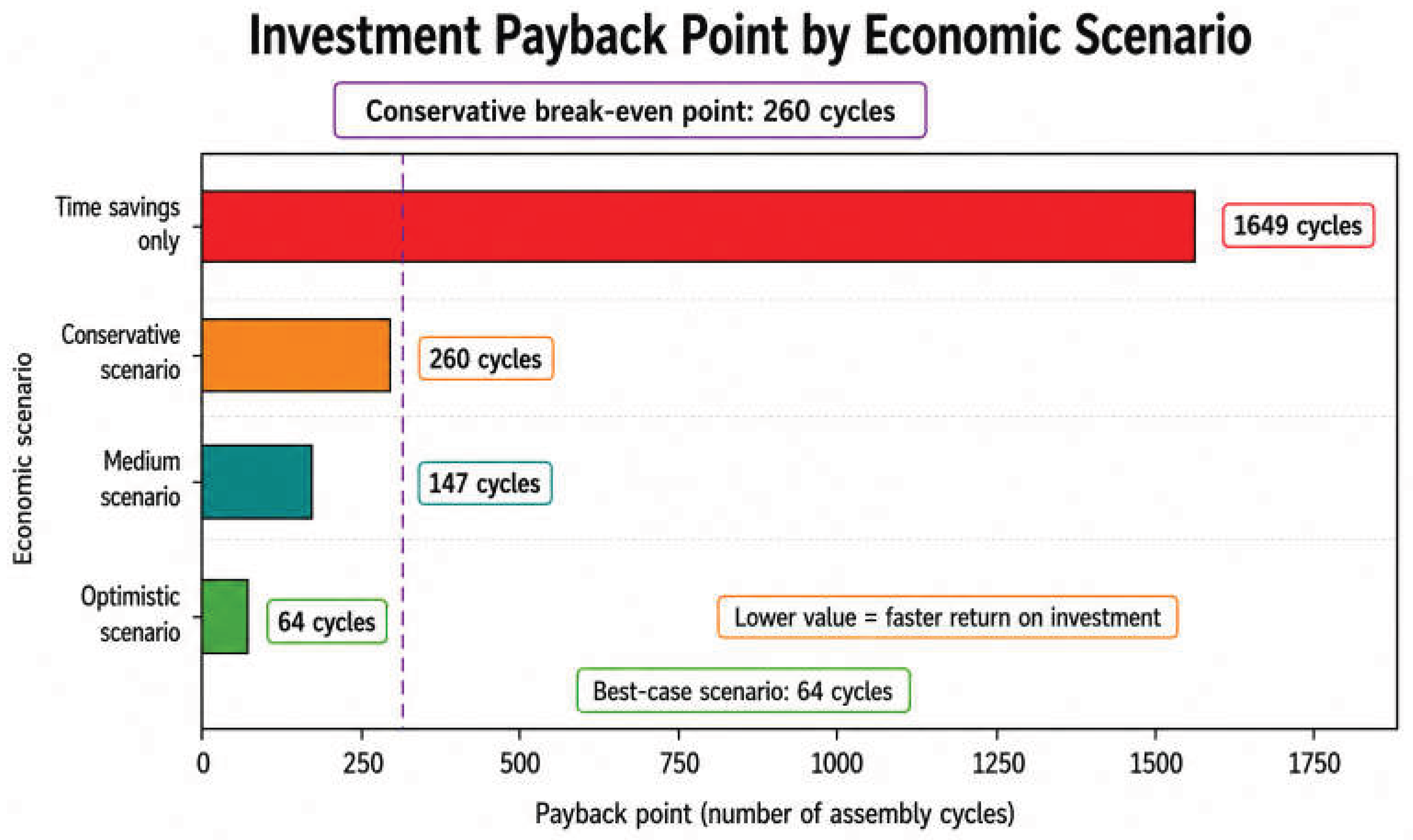
If this conservative scenario played out, investment could return after about 260 assembly cycles. The return of investment model was analyzed through scenario approach as shown in Table 13.
The results point to significant impact of error rate on economic return, where the return happens significantly faster when error costs are higher. Scenarios evaluation shows that the return of investment strongly depends on the economic value of the errors removed and that of reduced need for assistance. If only time savings were evaluated, the return would be rather long. However, when the evaluation also accounts for errors and assistance, the return radically shortens.
Figure 8.
Payback point of investment per economic scenario.
5.5. Yearly Appreciation with Different Number of Assembly Cycles
For the sake of practical evaluation, conservative scenario with the savings of 12.82 € per assembly cycle was used. Yearly economic appreciation depending on the number of assembly cycles is shown in Table 14.
The results suggest that economic return is attained at about 250 to 300 assembly cycles a year. With low number of cycles, the return is limited, while with greater utilization, the economic effect substantially grows.
In the subsequent years, where repeated hardware acquisition is not needed, the cost continues to be dominated by license fee. At the cost of 2 000 €/year, the payback point in the conservative scenario would correspond to:
This means that after the first year, the system could be economically beneficial at about 156 assembly cycles per year.
It follows from the results mentioned that economic efficiency of implementation is significantly affected by the degree of utilization of the digital work procedure.
5.6. Interpretation of Economic Appreciation
Economic appreciation points to the fact that implementation of Vuforia Capture is economically justifiable especially in the case of assembly processes with high frequency of repetition, higher costs of error removals or with demanding workers training.
If solely time savings were assessed, the return of investment would be longer. However, in industrial practice, economic benefit results primarily from reduced error rate and the need for assistance, which affect production quality, costs of repairs and effectivity of training.
In assembling more difficult or costlier sets, even relatively small reduction in error rates may have a significant economic impact. In such cases, the return of technology may be substantially faster than with simpler tasks the errors in which are low cost.
It is also necessary to account for the costs of digital work procedure creation, which include the time of an expert, processing of the recording and preparation of visual elements. However, with repeatable use, these costs are gradually split among a greater number of assembly cycles, thereby reducing unit costs. It follows from the mentioned results that economic effectiveness of implementation is significantly subject to the degree of digital work procedure utilization.
6. Conclusions
The aim of the paper was to analyze Vuforia Capture technology as a tool supporting assembly procedures and to compare its efficiency with traditional paper documentation. Experimental verification was conducted on a group of users without prior experience with the mechanism to be assembled.
The results suggest that digital work procedure created in Vuforia Capture may significantly contribute to increased effectiveness and reliability of the assembly process. Positively affected were mainly the reduced assembly time, reduced error count, and significant reduction in the need for additional assistance.
In practical terms, Vuforia Capture may be considered a prospective assembly supporting tool, especially in training less experienced workers, standardizing work procedures, and transfer of expert know-how in the conditions of modern production.
Economic appreciation suggests that implementation of this technology is justified especially in repeated assembly processes and tasks susceptible to greater error rate. Significant portion of the economic benefit stems from reduced error count and need for assistance, rather than from the time reduction itself.
The results need to be interpreted with the view of limited sample size and experimental conditions investigated. At the same time, it is appropriate to complete the assessment with statistical methods and expand the analysis by the aspects of user experience and cognitive load.
Author Contributions
Conceptualization, J.I. and P.B.; methodology, J.I. and P.B.; software, J.M.; validation, J.M., J.I. and P.B.; formal analysis, J.I. and J.M.; investigation, J.I.; resources, J.I.; data curation, P.B. and J.M.; writing—original draft preparation, J.I. and P.B.; writing—review and editing, J.I. and P.B.; visualization, J.I.; supervision, J.M.; project administration, P.B.; funding acquisition, P.B. All authors have read and agreed to the published version of the manuscript.
Funding
The article was prepared thanks to the support of The Ministry of Education, Research, Development and Youth of the Slovak Republic through the grants KEGA number 009TUKE-4/2024. The article processing charge was funded by KEGA number 009TUKE-4/2024.
Conflicts of Interest
The authors declare no conflicts of interest.
References
- Wang, X.; Ong, S.K.; Nee, A.Y.C. A comprehensive survey of augmented reality assembly research. Adv. Manuf. 2016, 4, 1–22. [Google Scholar] [CrossRef]
- Wang, Z.B.; Ong, S.K.; Nee, A.Y.C. Augmented reality aided interactive manual assembly design. Int. J. Adv. Manuf. Technol. 2013, 69, 1311–1321. [Google Scholar] [CrossRef]
- Vanneste, P.; Huang, Y.; Park, J.Y.; Cornillie, F.; Decloedt, B.; Van den Noortgate, W. Cognitive support for assembly operations by means of augmented reality: An exploratory study. Int. J. Hum.-Comput. Stud. 2020, 143, 102480. [Google Scholar] [CrossRef]
- Rodriguez, F.S.; Saleem, K.; Spilski, J.; Lachmann, T. Performance differences between instructions on paper vs. digital glasses for a simple assembly task. Appl. Ergon. 2021, 94, 103423. [Google Scholar] [CrossRef]
- Drouot, M.; Cormier, G.; Point, M.; et al. Augmented reality on industrial assembly line: Impact on effectiveness and mental workload. Appl. Ergon. 2022, 103, 103793. [Google Scholar] [CrossRef] [PubMed]
- Alessa, F.M.; et al. A neurophysiological evaluation of cognitive load during augmented reality interactions in various industrial maintenance and assembly tasks. Sensors 2023, 23, 7698. [Google Scholar] [CrossRef] [PubMed]
- Webel, S.; Bockholt, U.; Engelke, T.; Gavish, N.; Olbrich, M.; Preusche, C. An augmented reality training platform for assembly and maintenance skills. Robot. Auton. Syst. 2013, 61, 398–403. [Google Scholar] [CrossRef]
- Büttner, S.; Prilla, M.; Röcker, C. Augmented Reality Training for Industrial Assembly Work—Are Projection-Based AR Assistive Systems an Appropriate Tool for Assembly Training? In Proceedings of the CHI Conference on Human Factors in Computing Systems, Honolulu, HI, USA, 25–30 April 2020. [Google Scholar] [CrossRef]
- Gonzalez-Franco, M.; et al. Immersive mixed reality for manufacturing training. Front. Robot. AI 2017, 4, 3. [Google Scholar] [CrossRef]
- Lai, Z.-H.; Tao, W.; Leu, M.C.; Yin, Z. Smart augmented reality instructional system for mechanical assembly towards worker-centered intelligent manufacturing. J. Manuf. Syst. 2020, 55, 69–81. [Google Scholar] [CrossRef]
- Qiu, C.; Zhou, S.; Liu, Z.; Gao, Q.; Tan, J. Digital assembly technology based on augmented reality and digital twins: A review. Virtual Real. Intell. Hardw. 2019, 1, 597–610. [Google Scholar] [CrossRef]
- Kosch, T.; Knierim, P.; Kritzler, M.; Beicht, D.; Michahelles, F. Lenssembly: Authoring Assembly Instructions in Augmented Reality Using Programming-by-Demonstration. In Human-Technology Interaction; Springer: Cham, Switzerland, 2023; pp. 199–222. [Google Scholar] [CrossRef]
- Palmarini, R.; Fernández del Amo, I.; Ariansyah, D.; Khan, S.; Erkoyuncu, J.A.; Roy, R. Fast Augmented Reality Authoring: Fast Creation of AR Step-by-Step Procedures for Maintenance Operations. IEEE Access 2023, 11, 8407–8421. [Google Scholar] [CrossRef]
- Chu, C.-H.; Cheng, C.-Y.; Wu, C.-W. Comparing augmented reality-assisted assembly functions—A case study on Dougong structure. Appl. Sci. 2020, 10, 3383. [Google Scholar] [CrossRef]
- Dorloh, H.; Li, K.-W.; Chen, Y.-J.; Chen, C.-J.; Chen, S.-L. Presenting Job Instructions Using an Augmented Reality Device, a Printed Manual, and a Video Display for Assembly and Disassembly Tasks: What Are the Differences? Appl. Sci. 2023, 13, 2186. [Google Scholar] [CrossRef]
- Ojer, M.; Alvarez, H.; Serrano, I.; Saiz, F.A.; Barandiaran, I.; Aguinaga, D.; Querejeta, L.; Alejandro, D. Projection-based augmented reality assistance for manual electronic component assembly processes. Appl. Sci. 2020, 10, 796. [Google Scholar] [CrossRef]
- Neb, A.; Strieg, F. Generation of AR-enhanced assembly instructions based on assembly features. Procedia CIRP 2018, 72, 1118–1123. [Google Scholar] [CrossRef]
- Laviola, E.; Gattullo, M.; Manghisi, V.M.; Fiorentino, M.; Uva, A.E. Minimal AR: Visual asset optimization for the authoring of augmented reality work instructions in manufacturing. Int. J. Adv. Manuf. Technol. 2022, 119, 1769–1784. [Google Scholar] [CrossRef]
- Eswaran, M.; Varupala, P.S.S.V.; Hymavathi, M. Augmented reality guided autonomous assembly system: A novel framework for assembly sequence input validations and creation of virtual content for AR instructions development. J. Manuf. Syst. 2024, 72, 104–121. [Google Scholar] [CrossRef]
- Daling, L.M.; Schlittmeier, S.J. Effects of augmented reality-, virtual reality-, and mixed reality-based training on objective performance measures and subjective evaluations in manual assembly tasks: A scoping review. Hum. Factors 2024, 66, 589–626. [Google Scholar] [CrossRef]
- Peixe, L.C.; Agati, S.; Hounsell, M.S. Manual Assembly Augmented Reality Systems Implementation: A Systematic Literature Mapping. In Proceedings of the Symposium on Virtual and Augmented Reality, 2023; ACM: New York, NY, USA, 2024. [Google Scholar] [CrossRef]
- Wang, Z.; Bai, X.; Zhang, S.; Billinghurst, M.; He, W.; Wang, P.; Lan, W.; Min, H.; Chen, Y. A comprehensive review of augmented reality-based instruction in manual assembly, training and repair. Robot. Comput.-Integr. Manuf. 2022, 78, 102407. [Google Scholar] [CrossRef]
- Osman, S.; Eh Phon, D.N.; Omar, N.A.; Mohd Rameli, M.R.; Ahmad Alhassora, N.S.; Gusman, T. Using augmented reality application to reduce time completion and error rate in PC assembly. JOIV Int. J. Inform. Vis. 2020, 4, 166–171. [Google Scholar] [CrossRef]
- Kolla, S.S.V.K.; Sanchez, A.; Plapper, P. Comparing effectiveness of paper based and augmented reality instructions for manual assembly and training tasks. In Proceedings of the Conference on Learning Factories 2021, 2021. [Google Scholar] [CrossRef]
- Eversberg, L.; Lambrecht, J. Evaluating digital work instructions with augmented reality versus paper-based documents for manual, object-specific repair tasks in a case study with experienced workers. Int. J. Adv. Manuf. Technol. 2023, 126, 1543–1559. [Google Scholar] [CrossRef]
- Uva, A.E.; Gattullo, M.; Manghisi, V.M.; Spagnulo, D.; Cascella, G.L.; Fiorentino, M. Evaluating the effectiveness of spatial augmented reality in smart manufacturing: A solution for manual working stations. Int. J. Adv. Manuf. Technol. 2018, 94, 509–521. [Google Scholar] [CrossRef]
- Tang, A.; Owen, C.; Biocca, F.; Mou, W. Comparative effectiveness of augmented reality in object assembly. In Proceedings of the CHI Conference on Human Factors in Computing Systems, Ft. Lauderdale, FL, USA, 5–10 April 2003; ACM: New York, NY, USA, 2003; pp. 73–80. [Google Scholar]
- Blattgerste, J.; Strenge, B.; Renner, P.; Pfeiffer, T.; Essig, K. Comparing conventional and augmented reality instructions for manual assembly tasks. In Proceedings of the PETRA Conference, Island of Rhodes, Greece, 21–23 June 2017; ACM: New York, NY, USA, 2017; pp. 75–82. [Google Scholar] [CrossRef]
- Hoover, M.; Miller, J.; Gilbert, S.; Winer, E. Measuring the performance impact of using the Microsoft HoloLens 1 to provide guided assembly work instructions. J. Comput. Inf. Sci. Eng. 2020, 20, 061001. [Google Scholar] [CrossRef]
- Illing, J.; Klinke, P.; Grünefeld, U.; Pfingsthorn, M.; Heuten, W. Time is money! Evaluating augmented reality instructions for time-critical assembly tasks. In Proceedings of the International Conference on Mobile and Ubiquitous Multimedia, Essen, Germany, 22–25 November 2020; ACM: New York, NY, USA, 2020; pp. 277–287. [Google Scholar] [CrossRef]
- Daling, L.M.; Tenbrock, M.; Isenhardt, I.; Schlittmeier, S.J. Assemble it like this!—Is AR- or VR-based training an effective alternative to video-based training in manual assembly? Appl. Ergon. 2023, 110, 104021. [Google Scholar] [CrossRef] [PubMed]
- Peltokorpi, J.; Hoedt, S.; Colman, T.; Rutten, K.; Aghezzaf, E.-H.; Cottyn, J. Manual assembly learning, disability, and instructions: An industrial experiment. Int. J. Prod. Res. 2023, 61, 7903–7921. [Google Scholar] [CrossRef]
- Chu, C.-H.; Ko, C.-H. An experimental study on augmented reality assisted manual assembly with occluded components. J. Manuf. Syst. 2021, 61, 685–695. [Google Scholar] [CrossRef]
- Platter, L.; Bernsteiner, R.; Kohlegger, M.; Ploder, C. Using augmented reality for work instructions: The impact on throughput time, error rate and cognitive load. In Proceedings of the KMO Conference, 2025; Springer: Cham, Switzerland, 2025; pp. 120–129. [Google Scholar] [CrossRef]
- Stanescu, A.; Mohr, P.; Thaler, F.; Kozinski, M.; Skreinig, L.R.; Schmalstieg, D.; Kalkofen, D. Error Management for Augmented Reality Assembly Instructions. In Proceedings of the 2024 IEEE International Symposium on Mixed and Augmented Reality, Seattle, WA, USA, 21 October 2024; IEEE: Piscataway, NJ, USA, 2024; pp. 690–699. [Google Scholar] [CrossRef]
Figure 1.
Description of attention split in working with paper documentation and mixed reality.
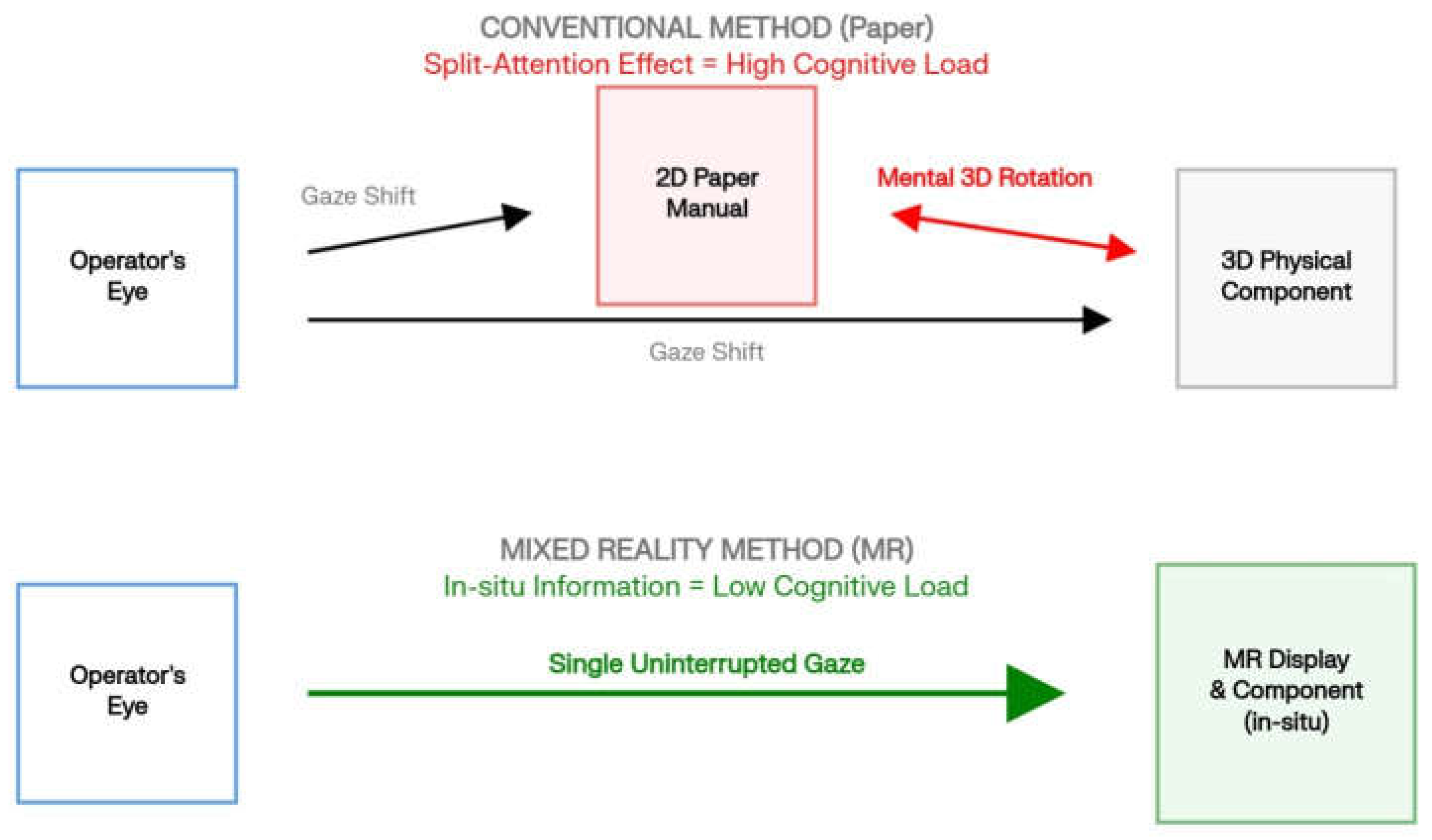
Figure 2.
Experimental workplace ready for assembling the subassembly.
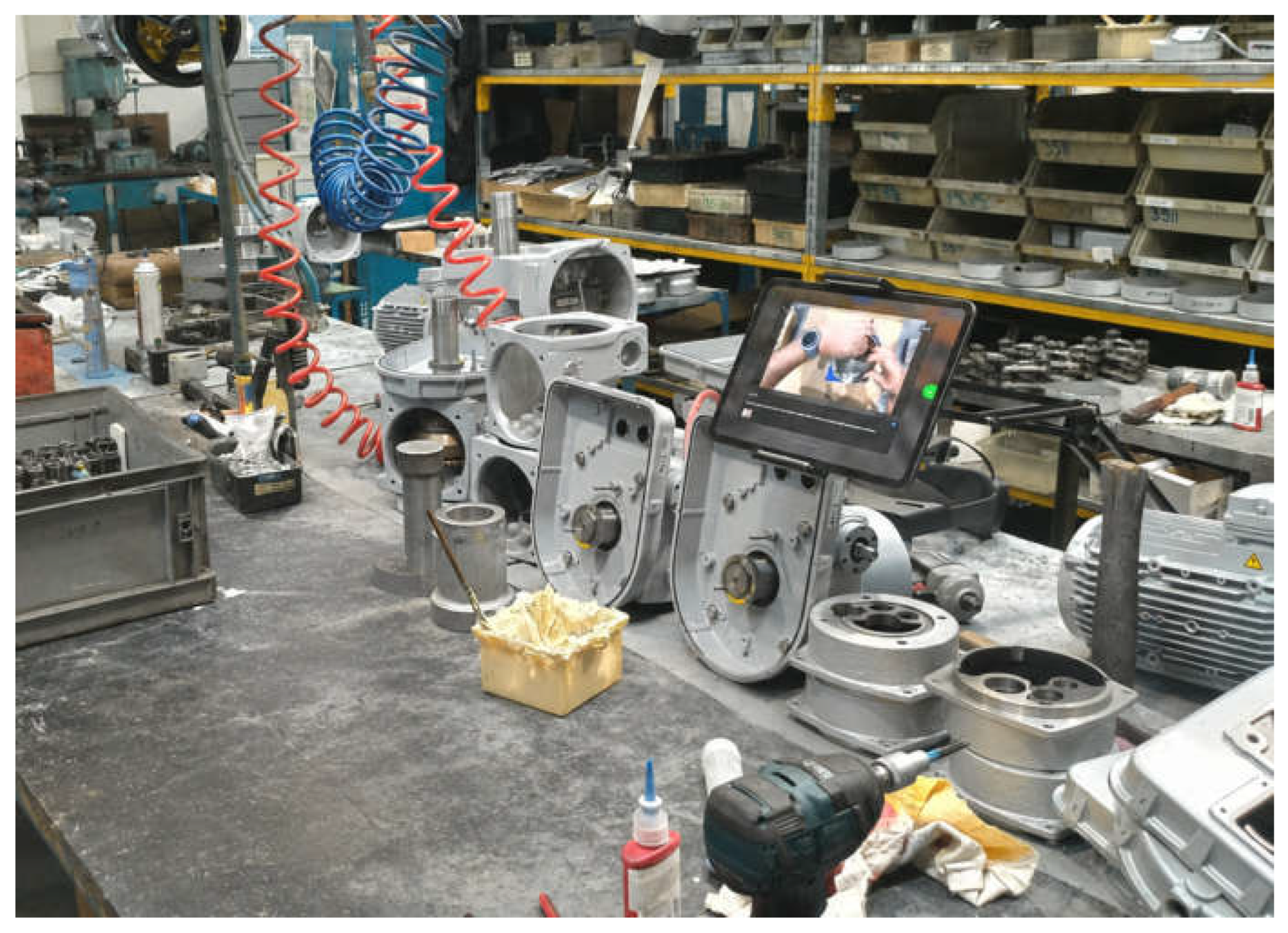
Figure 3.
Demonstration of digital work procedure in Vuforia Editor.
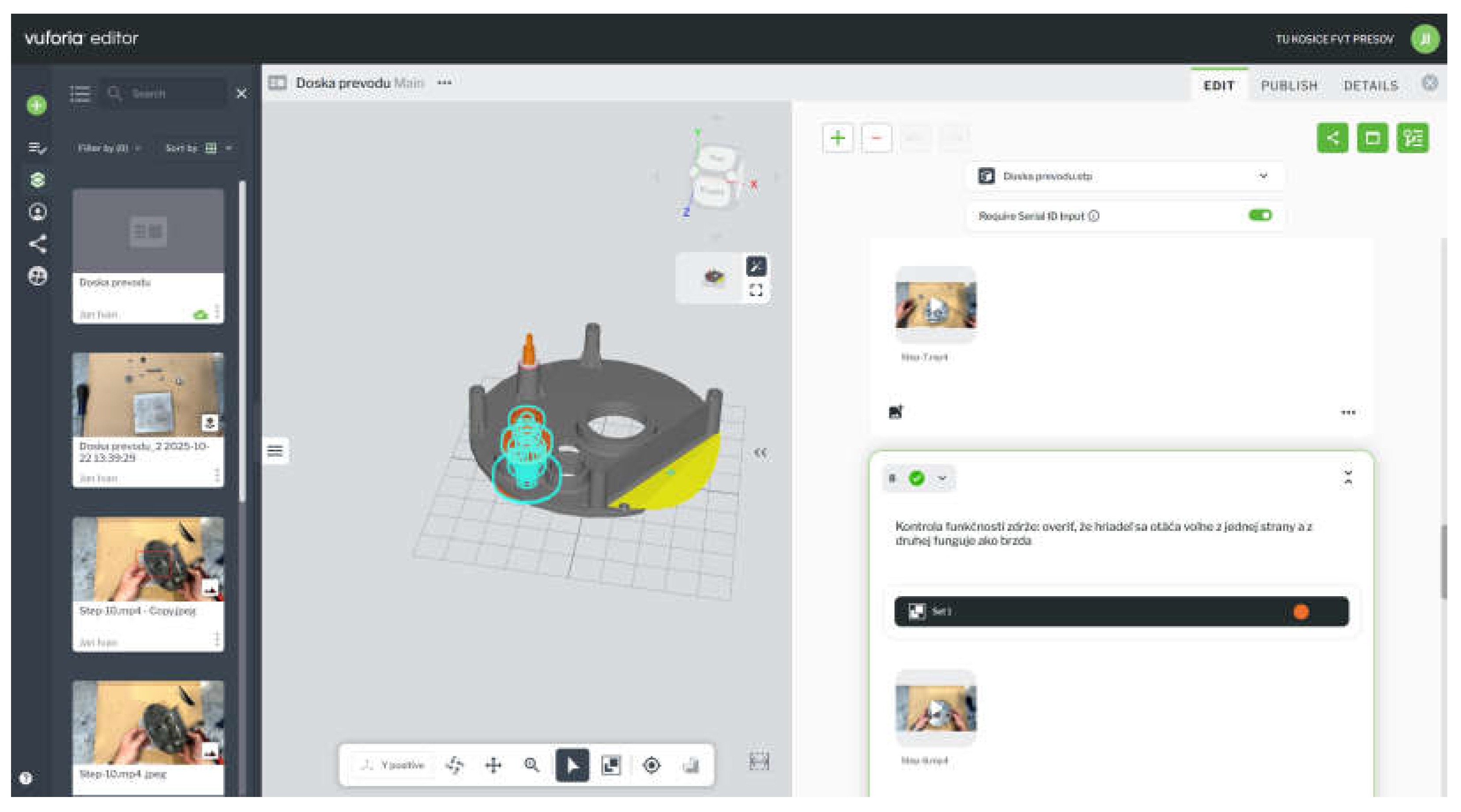
Figure 5.
Comparison of assembly times of individual participants.
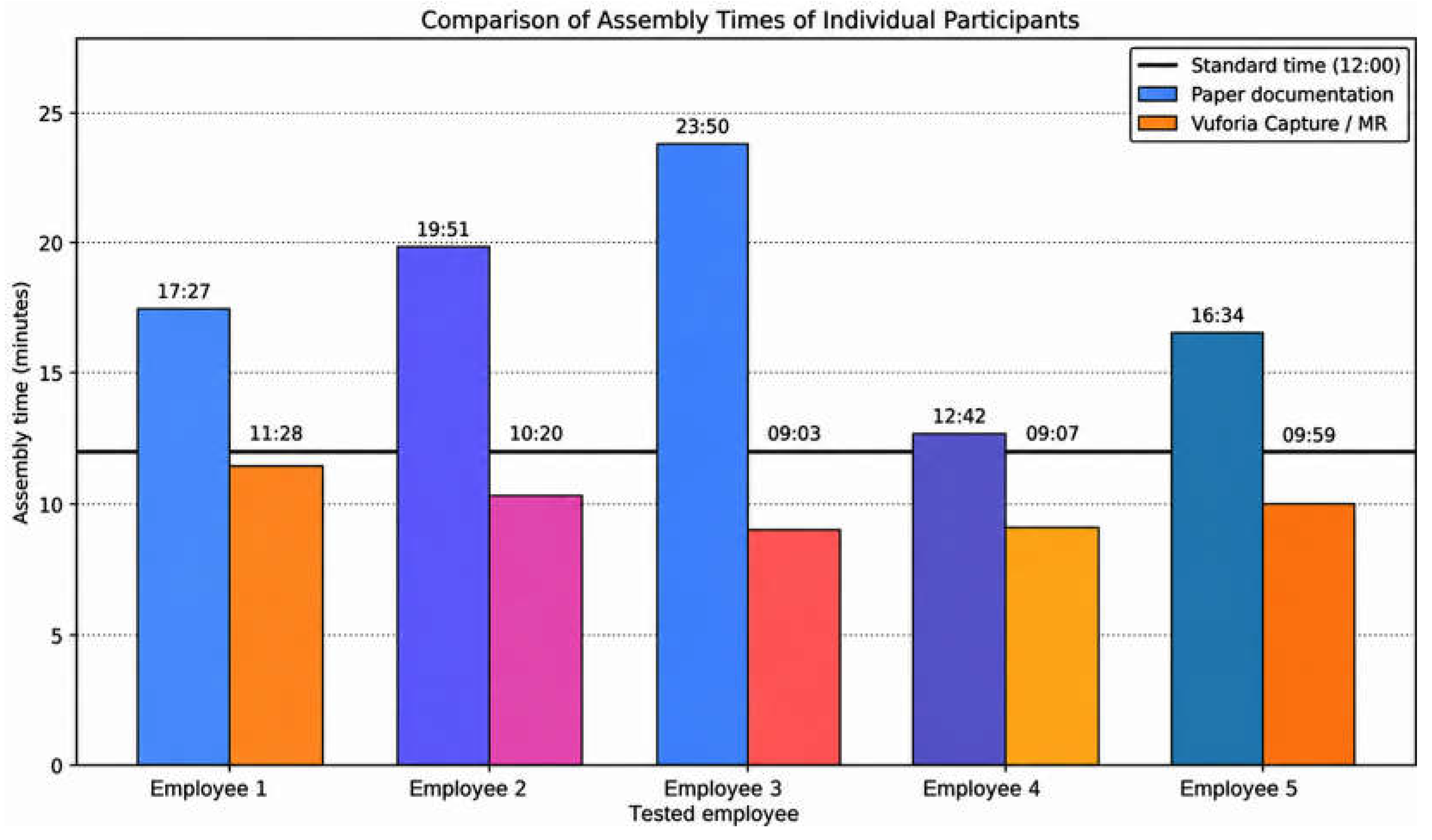
Figure 6.
Assembly inter-version error count compared.
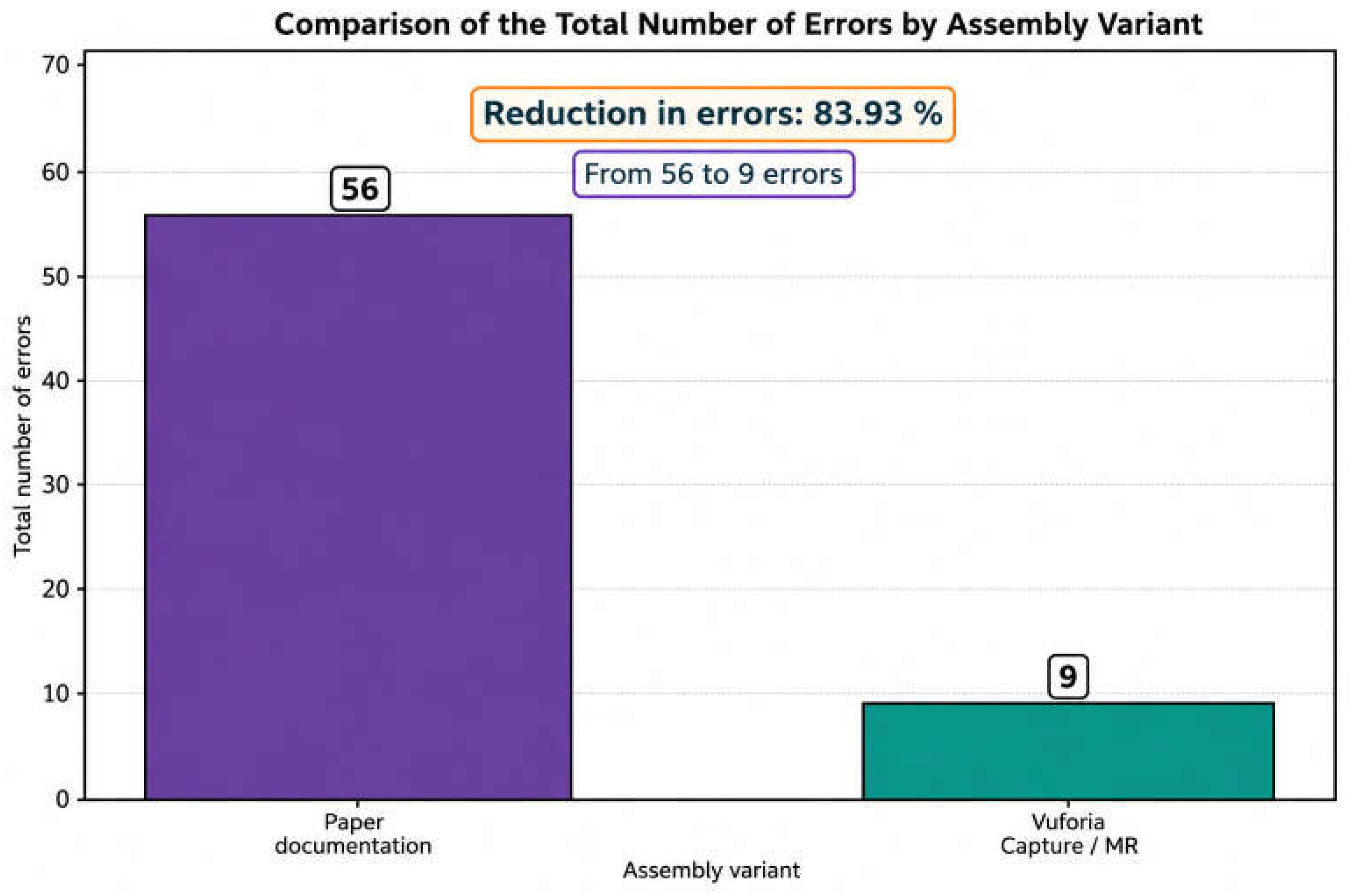
Table 1.
Investigated experiment indicators.
| Indicator | Manner of assessment |
|---|---|
| Total assembly time | Time from beginning to completion of assembly procedure(s) |
| Individual steps time | Measuring time of each assembly step |
| Error count | Number of errors recorded in course of assembly |
| Error type | Typization according to a standardized code list |
| Needs assistance | Monitoring personnel‘s intervention (yes/no) |
| Procedure clarity | Workflow & error number assessment |
| Technical & operational digital procedure assessment | System stability, readability & usability |
Table 2.
Assembly errors code list.
| Error code | Error type | Error description |
|---|---|---|
| A | Wrong mounting | Incorrect part position or orientation |
| B | Wrong part | Incorrect component used |
| C | Component fell out | Part gets loose or falls out of assembly set |
| D | Forgotten step | Skipped assembly operation |
| E | Wrong order | Failure to follow prescribed sequence |
| F | Other | Other errors recorded by the monitoring personnel |
Table 3.
Assembly time comparison by assembly version.
| Assembly version | E1 | E2 | E3 | E4 | E5 | Average [s] | Min [s] | Max [s] | SD [s] |
|---|---|---|---|---|---|---|---|---|---|
| Paper documentation | 1047 | 1191 | 1430 | 762 | 994 | 1084.8 | 762 | 1430 | 247.1 |
| Vuforia Capture | 688 | 620 | 543 | 547 | 599 | 599.4 | 543 | 688 | 59.6 |
Note: Values represent total assembly time per participant in seconds, E1–E5 denote individual employees.
Table 4.
Comparison of average and standardized time.
| Assembly version | Average time [s] | Standardized time [s] | Difference [s] | Interpretation |
|---|---|---|---|---|
| Paper documentation | 1084.8 | 720 | +364.8 | Limit exceeded |
| Vuforia Capture | 599.4 | 720 | −120.6 | Limit completed |
| Inter-version difference | −485.4 | — | — | Reduction by 44.75 % |
Table 5.
Comparison of assembly error rate.
| Assembly version | Total error count | Average per participant | Variation [%] |
|---|---|---|---|
| Paper documentation | 56 | 11.2 | |
| Vuforia Capture | 9 | 1.8 | - 83.93 % |
Table 6.
Assembly version-dependent need for additional assistance.
| Assembly version | Assisted steps | Proportion [%] |
|---|---|---|
| Paper documentation | 29 | 58 |
| Vuforia Capture | 1 | 2 |
Note: Percentage represents the proportion of steps requiring assistance.
Table 7.
Summary comparison of experimental versions.
| Indicator | Paper documentation | Vuforia Capture | Change [%] |
|---|---|---|---|
| Average time [s] | 1084.8 | 599.4 | - 44.75 |
| Error count | 56 | 9 | - 83.93 |
| Share of assistance [%] | 58 | 2 | - 56 |
Note: Percentage change is calculated relative to the paper-based version.
Table 9.
Model costs calculation.
| Item | Value [€] |
|---|---|
| (Annual) license fee | 2 000 |
| (iPad Pro) tablet | 1 200 |
| Holder / mounting system | 50 |
| Protective auxiliaries | 80 |
| Total costs – 1st year | 3 330 |
| Annual costs (hardware not included) | 2 000 |
Note: Values represent a simplified model scenario based on experimental assumptions.
Table 10.
Financial savings per assembly based on hourly labor cost.
| Hourly rate [€/h] | Saving per assembly [€] |
|---|---|
| 10 | 1.35 |
| 15 | 2.02 |
| 20 | 2.70 |
| 25 | 3.37 |
Note: Calculated based on a time savings of 0.1348 hours per assembly.
Table 11.
Estimated financial savings based on reduction in assembly errors.
| Cost per error [€] | Saving per assembly [€] |
|---|---|
| 1 | 9.40 |
| 2 | 18.80 |
| 5 | 47.00 |
| 10 | 94.00 |
Note: Calculated assuming an average reduction of 9.4 errors per assembly cycle.
Table 12.
Estimated financial savings from reduced need for assistance.
| Intervention duration [min] | Hourly rate [€/h] | Savings per assembly [€] |
|---|---|---|
| 1 | 15 | 1.40 |
| 1 | 20 | 1.87 |
| 2 | 20 | 3.73 |
| 3 | 20 | 5.60 |
Note: Calculated based on a reduction of 5.6 assistance interventions per assembly.
Table 13.
Return on investment (ROI) scenarios based on different levels of economic impact.
| Scenario | Savings per assembly [€] | Break-even point [cycles] |
|---|---|---|
| Time savings only | 2.02 | 1 649 |
| Conservative scenario | 12.82 | 260 |
| Medium scenario | 22.69 € | 147 |
| Optimistic scenario | 52.75 € | 64 |
Note: ROI is calculated based on initial investment of 3 330 €.
Table 14.
Yearly economic appreciation depending on the number of assembly cycles.
| Cycle count/year | Yearly appreciation [€] | Net result [€] |
|---|---|---|
| 100 | 1 282 | −2 048 |
| 250 | 3 205 | −125 |
| 300 | 3 846 | +516 |
| 500 | 6 410 | +3 080 |
| 1 000 | 12 820 | +9 490 |
Note: Calculated based on a conservative scenario with annual cost of 3 330 €.
Disclaimer/Publisher’s Note: The statements, opinions and data contained in all publications are solely those of the individual author(s) and contributor(s) and not of MDPI and/or the editor(s). MDPI and/or the editor(s) disclaim responsibility for any injury to people or property resulting from any ideas, methods, instructions or products referred to in the content. |
© 2026 by the authors. Licensee MDPI, Basel, Switzerland. This article is an open access article distributed under the terms and conditions of the Creative Commons Attribution (CC BY) license (http://creativecommons.org/licenses/by/4.0/).
Copyright: This open access article is published under a Creative Commons CC BY 4.0 license, which permit the free download, distribution, and reuse, provided that the author and preprint are cited in any reuse.


