

Submitted:
25 May 2026
Posted:
26 May 2026
You are already at the latest version
Abstract
Digital twin enabled predictive maintenance has emerged as a major research direction for improving reliability, reducing unplanned downtime, strengthening resilience, and supporting condition-aware decision-making across a wide range of engineered systems. The compiled studies show that this field now spans multiple domains, including civil and structural infrastructure, buildings and facility management, industrial and manufacturing systems, energy and power applications, transportation systems, and broader smart and networked operations. This extent reflects the growing role of digital twins not only in monitoring component health, but also in supporting calibration, synchronization, diagnosis, prognosis, planning, and system-level management. This systematic review synthesizes the compiled literature through a comparative framework designed to clarify how digital twins are developed and applied for predictive maintenance across different operational contexts. The comparison is organized around three principal dimensions: application domain, modeling strategy, and maintenance objective. Across the reviewed studies, the dominant modeling approaches include physics-based simulation and calibration, data-driven and artificial intelligence based prediction, hybrid approaches that combine physical knowledge with learning and probabilistic updating, and platform-oriented frameworks that integrate semantic, service, and decision-support layers. The maintenance objectives addressed by these studies range from state estimation, synchronization, and geometry updating to fault detection, diagnostics, prognostics, remaining useful life estimation, maintenance planning, resilience enhancement, and operational optimization. Overall, the comparative analysis indicates that hybrid and service-integrated digital twin approaches often provide the strongest balance between physical interpretability, predictive performance, and practical operational value. At the same time, the literature consistently reveals common challenges, including heavy dependence on sensor quality and historical data, synchronization difficulty between physical and virtual systems, high computational burden, limited interoperability, metadata and ontology complexity, cybersecurity and privacy concerns, insufficient large-scale real-world validation, and integration challenges with legacy infrastructures. These recurring limitations suggest that future progress in digital twin enabled predictive maintenance will depend on standardized architectures, scalable hybrid modeling frameworks, stronger deployment-oriented validation, and more robust strategies for multi-source data integration across heterogeneous systems.
Keywords:
digital twin
; predictive maintenance
; prognosis
; fault diagnosis
; hybrid modeling
; systematic review
; condition monitoring
; Industry 4.0
1. Introduction
Predictive maintenance has become increasingly important because conventional reactive and time-based maintenance strategies often lead either to unexpected failures or to premature replacement of components that still retain useful service life. Across the full body of reviewed studies, predictive maintenance is consistently framed as a means to reduce unplanned downtime, improve reliability, extend asset life, increase safety, and support more efficient allocation of maintenance resources. This motivation appears not only in industrial equipment studies such as [1,2,3,4], but also in infrastructure and facility applications such as tunnels, bridges, roads, buildings, and rail systems, where maintenance is closely tied to structural safety, service continuity, and long-term resilience, as seen in [5,6,7,8,9,10,11,12,13,14]. It also extends to energy and power systems, where maintenance supports not only reliability but also operational stability and risk mitigation, as reflected in [15,16,17,18,19,20,21]. More broadly, the literature shows that predictive maintenance is no longer confined to component failure prediction alone, but increasingly supports sustainability, resilience, compliance, and system-level operational governance, as seen in [22,23,24,25,26,27,28,29].
Digital twins are increasingly used for maintenance because they provide a synchronized virtual representation of a physical asset or system that can integrate real-time data, perform simulation, estimate hidden states, support diagnostics and prognostics, and feed insights back into operations. This role is synthesized most clearly in the review papers [30,31]. Reference [30] frames predictive maintenance automation through seven core modules, including data acquisition, data manipulation, state detection, health assessment, prognostics assessment, advisory generation, and human interface, while also emphasizing theory awareness, synchronization, and system automation. Reference [31] similarly explains that digital twins improve maintenance by combining real-time data synchronization with high-fidelity simulation and by linking application frameworks, modeling methods, and bidirectional physical-virtual interaction. Together, these studies show that digital twins are attractive for maintenance not simply because they mirror assets, but because they connect sensing, modeling, prognosis, and decision-making within a continuously updated operational framework.
The broader corpus reinforces this interpretation across many application domains. In civil and structural systems, digital twins are used for online calibration, structural response prediction, fatigue assessment, and geometry updating, as in tunnel-soil interaction modeling [5], bridge traffic loading and regional bridge response prediction [6,11], TBM cutting performance prediction [8], composite degradation monitoring [32], road geometric twin upkeep [12], rail transit platforms [13], and tunnel facility maintenance systems [14]. In buildings and facilities, they support BIM-linked monitoring, thermal comfort soft sensing, HVAC fault detection, O&M information requirement definition, energy prediction, and ontology-enabled building management, as shown in [7,9,28,33,34]. In industrial and manufacturing systems, digital twins are used for surrogate-based calibration, sustainability-aware maintenance, robotic control, relay anomaly detection, bearing fault diagnosis, CNC machine state prediction, remanufacturing support, cognitive maintenance, and factory-level scheduling, as reflected in [1,2,3,23,27,35,36,37,38]. In energy and power systems, they enable thermomechanical lifetime prediction, decentralized wind-farm monitoring, fuel-cell degradation assessment, reactor synchronization, photovoltaic performance modeling, district energy optimization, and post-disaster power-system resilience, as seen in [15,16,17,18,19,20,21]. In transportation, urban, and networked operations, digital twins support supply-chain resilience, railway traceability, smart waste coordination, and smart-city planning, as seen in [10,22,24,25]. Service-oriented and semantic extensions in [26], ontology-enabled intelligent twins in [28], visual maintenance platforms in [39], and Maintenance 4.0 roadmaps in [29] further show that the concept now spans multiple scales, sectors, and maintenance functions.
Considering the full set of references, a consistent pattern emerges: digital twins are increasingly valued because they transform maintenance from a periodic or reactive practice into a synchronized, knowledge-rich, and continuously adaptive process. Across the corpus, the digital twin functions as a bridge between physical behavior and virtual intelligence. In some studies, that bridge is dominated by physics-based simulation and online calibration, as in [5,8,15,17]. In others, it is driven by AI and data-centric prediction, as in [1,6,14,16,34]. In many of the most practically promising studies, it is hybrid, combining physical knowledge with machine learning, probabilistic updating, optimization, or semantic reasoning, as seen in [2,3,18,20,26,28,35,38]. This breadth confirms that digital twins are no longer a niche modeling concept. Within the reviewed literature, they have become a unifying paradigm for maintenance, diagnosis, prognosis, planning, resilience, and operational management across diverse engineered systems.
Although the literature on digital twin enabled predictive maintenance has expanded rapidly, it remains highly fragmented in scope, terminology, architecture, and evaluation focus. This fragmentation is identified most explicitly by the review studies [30,31]. Reference [30] stresses the lack of a unified definition and the need for a standardized roadmap that connects informational requirements, functional requirements, synchronization, and system automation. Reference [31] similarly points to the absence of standardized communication protocols and data schemas, the challenge of managing massive synchronized data streams, and the high cost of developing high-fidelity replicas. These concerns are not isolated observations. Across the broader corpus, similar limitations reappear in different forms, including data heterogeneity, interoperability barriers, synchronization complexity, computational burden, high deployment cost, and the need for specialized expertise. Service-oriented and semantic studies such as [26,28,40,41] further show that even when digital twin architectures become more modular or intelligent, the field still struggles with reusable integration, metadata alignment, ontology maintenance, and cross-platform compatibility. Maintenance-oriented roadmap and implementation studies such as [27,29,42] reinforce the same point by showing that digital twin adoption is often constrained not only by modeling difficulty, but also by organizational maturity, infrastructure readiness, and system-level coordination challenges.
This fragmentation is amplified by the fact that the reviewed studies span many different application domains, each with distinct technical priorities and data conditions. In civil and infrastructure systems, studies such as [5,6,8,11,12,13,14,32,43] emphasize structural response prediction, geometry updating, traffic loading, fatigue tracking, and regional infrastructure coordination, but they also reveal strong dependence on sensing quality, calibration assumptions, and computationally expensive simulation or graph-based learning. In building and facility management, studies such as [7,9,28,33,34,41] focus on BIM integration, soft sensing, energy prediction, operation and maintenance information requirements, and ontology-enabled intelligent management, yet they remain highly sensitive to BAS and IoT data quality, metadata completeness, and interoperability between BIM, BMS, CMMS, and AI layers. In industrial and manufacturing environments, studies such as [1,2,3,4,23,27,29,35,36,37,38,40,42] range from surrogate-based calibration and sustainability-aware maintenance to anomaly detection, hybrid prognostics, cognitive diagnosis, closed-loop scheduling, and Maintenance 4.0 roadmaps. However, these studies also vary widely in data availability, synchronization strategy, legacy system compatibility, and real-time computational feasibility. In energy, power, and utility systems, studies such as [15,16,17,18,19,20,21,44] stress real-time prediction, uncertainty management, distributed coordination, and resilience under dynamic operating conditions, but they also reveal persistent challenges in model fidelity, offline training burden, communication latency, and robustness under rare or extreme events. Transportation, railway, smart-city, and essential-service studies such as [10,22,24,25,39,45] extend the field even further toward resilience, traceability, safety, and system-wide governance, bringing additional concerns related to privacy, cybersecurity, regulatory compliance, and long-term multi-stakeholder data integration.
Because of this breadth, the phrase digital twin for predictive maintenance is used across the reviewed literature to describe fundamentally different kinds of systems. Some studies are primarily physics-based calibration and synchronization environments, such as [5,8,15,19,35]. Others are predominantly data-driven diagnostic or prediction systems, such as [1,6,14,43]. Many of the most ambitious studies are hybrid platforms that combine physical knowledge with machine learning, probabilistic updating, optimization, or uncertainty quantification, as seen in [2,3,17,18,20,44]. Another important subset consists of service-oriented, semantic, or cognitively enhanced architectures that emphasize data integration, explainability, reasoning, and interoperability, as in [26,28,38,40,41]. At the same time, the maintenance objective itself varies considerably across the corpus. Some papers focus on state estimation, model updating, and synchronization, such as [5,7,18,32,35]. Others prioritize fault detection and diagnostics, such as [1,2,3,9,28,38]. Still others emphasize prognosis, remaining useful life estimation, resilience enhancement, maintenance scheduling, sustainability assessment, and platform-level decision support, as reflected in [10,21,23,24,25,27,29,31,42]. As a result, the field cannot be adequately understood through isolated paper summaries or domain-specific discussions alone. A comparative systematic review is needed to organize the literature across application domains, dominant modeling strategies, maintenance functions, strengths, and limitations so that recurring patterns and unresolved research gaps can be identified more clearly.
Motivated by this fragmentation, the present article undertakes a comparative systematic review based solely on the compiled paper summaries. Following the project guidelines, the review does not introduce information beyond the uploaded summary and maintains the reference numbering throughout the discussion. The purpose is to synthesize how digital twins are being used for predictive maintenance across multiple domains and to clarify where the main commonalities, differences, strengths, and unresolved limitations lie.
Specifically, this review compares the studies using predefined criteria that emerge consistently across the compiled summaries: application domain, dominant modeling strategy, maintenance function, reported strengths, and technical limitations. Through this structure, the review links high-level roadmap studies such as [30,31] with domain-specific implementations in infrastructure [5,6,8], buildings and facilities [7,9], industrial maintenance [1,3], transport systems [10], and smart urban systems [25]. In doing so, the article aims to provide a clearer taxonomy of the literature, identify recurring technical barriers such as data quality dependence, synchronization difficulty, computational cost, interoperability, and deployment complexity, and establish a stronger foundation for future research on scalable and standardized digital-twin-enabled predictive maintenance.
The review article is structured to guide the reader from the review design to the synthesis of findings and future direction. Section 2 presents the review methodology, explaining how the systematic review was framed and conducted. Section 3 provides a descriptive overview of the literature to establish the overall context of the reviewed studies. The main analytical body of the article is then organized into three comparative sections: Section 4 compares the literature by application domain, Section 5 compares it by modeling strategy, and Section 6 compares it by maintenance function. After these comparative analyses, Section 7 synthesizes the cross-cutting advantages reported across the literature, while Section 8 discusses the major technical limitations that appear repeatedly among the reviewed studies. Building on these findings, Section 9 identifies the key research gaps and future research directions. Section 10 then presents the broader future research agenda, and Section 11 concludes the review by summarizing the overall insights and implications of the study.
2. Review Methodology
Digital twin-enabled predictive maintenance has emerged as a multidisciplinary research area that integrates physical modeling, data-driven analytics, real-time monitoring, cyber-physical synchronization, and decision-support systems. The reviewed literature shows that digital twins are no longer restricted to a single sector or technical approach; rather, they are increasingly applied across civil infrastructure, buildings and facility management, industrial and manufacturing systems, energy and power systems, transportation networks, and broader smart and networked operational environments. To support a systematic understanding of this rapidly expanding field, this review examines the selected articles using a common comparative framework. The analysis focuses on seven major dimensions: application domain, dominant modeling strategy, maintenance objective, data dependency, synchronization or update mechanism, major advantages, and technical limitations. This section describes the review scope, article selection logic, comparative criteria, and review workflow used to organize the selected literature into a coherent systematic review.
2.1. Review Scope and Source Base
This article is organized as a systematic review of selected studies on digital twin-enabled predictive maintenance. The review was designed to synthesize a broad and diverse body of literature rather than focus on a single sector, asset type, or modeling philosophy. The reviewed literature includes studies on digital twin technologies applied to infrastructure monitoring, building operation, manufacturing systems, energy assets, transportation networks, and smart operational systems. This broad scope allows the review to capture both methodological diversity and domain-specific implementation differences.
The selected articles include review and roadmap studies, domain-specific predictive maintenance applications, and framework-oriented contributions. The reviewed studies address topics such as tunnel calibration, smart waste systems, predictive maintenance roadmaps, fleet-level structural prognosis, industrial flowsheet maintenance, sustainability-oriented maintenance, bridge traffic classification, BIM-enabled building operations, automotive supply-chain resilience, tunnel boring machine performance prediction, power-module degradation, wind turbine monitoring, HVAC diagnostics, robotic control, relay prognosis, service-oriented digital twin architectures, ontology-enabled digital twins, visual operation and maintenance platforms, and Maintenance 4.0 implementation roadmaps.
The methodology was developed to ensure that the review remains systematic, comparative, reference-numbered, and grounded in the selected articles. Each study was treated as an individual analytical unit and examined using a common structure. This approach enabled systematic comparison across application domain, modeling strategy, maintenance objective, data dependency, synchronization mechanism, major advantage, and technical limitation. The following subsections describe the article-selection logic, PRISMA-style screening process, comparative classification framework, and review workflow adopted in this study.
2.2. Article Selection and Inclusion Logic
This review focuses on studies that examine digital twin technologies in relation to predictive maintenance, condition monitoring, fault diagnosis, prognostics, degradation assessment, synchronization, asset management, or maintenance decision support. The inclusion logic was defined at the review-design stage and applied consistently across the full set of selected articles. Each article was treated as one review unit. Accordingly, the analysis did not rely on a selectively sampled subset; instead, it covered the complete set of articles included in the review, beginning with earlier studies such as [5,22,30,35,46], and extending to later studies such as [21,26,27,28,29,39].
The selected articles represent multiple sectors and technical perspectives. Review and roadmap studies include [29,30,31,40,42,45,47,48,49]. Civil and infrastructure studies include [5,6,8,10,11,12,13,14,26,32,43,46,50,51,52,53,54,55,56,57,58,59]. Building and facility management studies include [7,9,28,33,34,41,60,61,62,63,64]. Industrial and manufacturing studies include [1,2,3,4,23,27,35,36,37,38,42,48,65,66,67,68,69,70,71,72,73,74,75,76]. Energy and power system studies include [15,16,17,18,19,20,21,44,77,78,79]. Transportation, urban, and networked operational studies include [10,13,22,24,25,39,45,80,81,82,83,84,85,86,87,88].
The inclusion logic was narrow at the source-selection stage but broad at the analytical stage. The review did not extend beyond the selected article set; however, it examined the complete selected literature as one coherent body of evidence. This made it possible to compare the included studies systematically across application domain, modeling strategy, maintenance objective, data dependency, synchronization mechanism, major strength, and technical limitation while remaining consistent with the defined scope of the review.
2.3. PRISMA-Based Screening and Selection Process
To improve methodological transparency, the study-selection process was organized using a PRISMA-style structure. The PRISMA process was used to document how records were identified, screened, assessed for eligibility, and included in the final qualitative synthesis. Records were first identified through database searches, manual searches, and reference tracking. Duplicate records were then removed. The remaining records were screened based on title, abstract, keywords, and relevance to digital twin-enabled predictive maintenance. Studies that did not address digital twin technologies, predictive maintenance, condition monitoring, fault diagnosis, prognostics, asset health management, or maintenance decision support were excluded at this stage. Figure 1 shows the PRISMA-based selection process.
The remaining studies were assessed for eligibility based on their methodological relevance, technical contribution, and alignment with the review scope. Studies were retained if they provided sufficient information regarding digital twin architecture, modeling strategy, data source, synchronization method, maintenance function, implementation domain, or decision-support capability. Articles were excluded if they lacked a clear connection to digital twin-enabled maintenance, did not provide sufficient methodological detail, focused only on general digitalization without a maintenance objective, or were outside the selected application domains.
2.4. Comparative Criteria
To support a systematic comparative analysis of the selected articles, the reviewed studies were classified using a shared set of criteria derived from recurring features in the article descriptions. This classification framework was applied across the complete review set, from review and roadmap studies such as [30,31] to service-oriented, ontology-enabled, and implementation-focused studies such as [21,26,27,28,29,39]. This approach ensures that the article remains comparative, systematic, and reference-numbered throughout.
The first criterion was application domain. This criterion identifies the sector or operational setting addressed by each article. The selected articles span a wide range of domains rather than a single maintenance environment. Review and roadmap studies include [4,29,30,31,40,42,45,47,48,49]. Civil and structural infrastructure studies include [5,6,8,10,11,12,13,14,26,32,43,46,50,51,52,53,54,55,56,57,58,59]. Building and facility management studies include [7,9,28,33,34,41,60,61,62,63,64]. Industrial and manufacturing studies include [1,2,3,4,23,27,35,36,37,38,42,48,65,66,67,68,69,70,71,72,73,74,75,76]. Energy and power studies include [15,16,17,18,19,20,21,44,77,78,79]. Transportation, urban, and networked systems include [10,13,22,24,25,39,45,80,81,82,83,84,85,86,87,88]. This criterion was necessary because the meaning and implementation of digital twin-enabled predictive maintenance differ significantly across these settings.
The second criterion was dominant modeling strategy. This criterion identifies the principal technical logic used in each article. Physics-based or high-fidelity simulation-driven studies include [5,8,15,19,32,48,50,51,52,53,55,56,58,67,78,87]. Data-driven and AI-centered studies include [1,6,7,14,16,22,25,28,34,43,62,63,64,69,71,81,82,83,85,86]. Hybrid approaches that combine physical knowledge with learning, probabilistic updating, uncertainty quantification, or optimization include [2,3,11,17,18,20,21,23,27,35,36,37,44,46,54,65,66,68,70,73,74,75,76,77,79,89]. Framework-oriented, semantic, service-oriented, and architecture-led studies include [4,9,10,13,24,26,29,30,31,33,38,39,40,41,42,45,47,49,60,61,72]. This criterion was essential because the reviewed literature reflects multiple methodological traditions rather than one common technical approach.
The third criterion was maintenance objective. This criterion identifies the main operational purpose emphasized by each article. Calibration, synchronization, and model updating are central in [5,7,8,12,18,19,32,35,41,48,75]. Fault detection, diagnostics, and anomaly recognition are emphasized in [1,2,3,6,9,14,28,38,39,57,62,63,64,69,71,81,83,85,86]. Prognostics, degradation tracking, and remaining useful life estimation are central in [2,4,11,15,16,17,19,21,23,32,43,44,46,50,51,53,54,56,58,66,67,70,76,77,78,79,89]. Maintenance planning, resilience management, scheduling, traceability, and decision support are emphasized in [10,13,20,22,24,25,26,27,29,30,31,40,42,45,47,49,73,74,84,88]. This criterion shows that the selected articles cover a wide operational range extending from state estimation and diagnosis to system-level decision support and organizational maintenance planning.
The fourth criterion was data dependency. This criterion captures the extent to which each article depends on sparse measured data, large historical datasets, streaming IoT signals, maintenance records, metrology inputs, simulation-generated samples, or ontology-linked metadata. Strong dependence on sparse or uncertain measured data is explicitly visible in [2,5,11,18,44]. Heavy reliance on rich historical or run-to-failure datasets appears in [1,3,4,7,23,27,34,62,63,78]. Multi-source fusion and metadata-rich integration are emphasized in [3,9,13,24,26,28,33,38,40,41,60]. Synthetic, simulation-based, or physics-generated data play a major role in [2,8,17,46,48,56,76]. This criterion was included because data quality, data availability, and metadata consistency repeatedly appear in the selected articles as both enabling strengths and practical constraints.
The fifth criterion was synchronization or update mechanism. This criterion addresses how the virtual model is kept aligned with the physical system. Sequential or recursive data assimilation is central in [5]. Continuous BAS, BIM, or IoT-driven updating appears in [7,9,10,13,26,33,41]. Bayesian or probabilistic updating is used in [2,17,56,79]. Federated or distributed synchronization is emphasized in [16], while control-aware synchronization is explicit in [18,27,36]. Change retrieval and geometric updating are central in [12]. Agent-driven or ontology-mediated information access and reasoning appear in [28,38,40]. This criterion was necessary because synchronization is one of the defining features that separates a live digital twin from a static digital model, and the selected articles show that this synchronization can be achieved through several different computational mechanisms.
Finally, each article was also assessed using major advantages and technical limitations as explicit comparative criteria. Recurring advantages across the selected articles include improved physical fidelity in [5,8,15,48], improved operational visibility in [7,9,13,41], strong anomaly detection and diagnostic capability in [1,2,3,28,38], enhanced prognostic performance in [17,44,46,78,79], and stronger resilience, decision support, or maintenance scheduling capability in [21,22,24,25,27,29,88]. Recurring limitations include computational burden in [2,5,8,13,15,17,18,27,36,78], strong dependence on data quality in [1,3,4,7,9,23,43,63], interoperability and legacy-integration challenges in [10,13,24,26,28,31,40,41], metadata and ontology complexity in [26,28,38,40], and privacy, security, or deployment-scale concerns in [10,16,21,25,88]. These two criteria were retained because the article descriptions consistently report both the main contribution and the primary technical drawback, making balanced comparison possible across the entire review set.
Taken together, these comparative criteria, application domain, dominant modeling strategy, maintenance objective, data dependency, synchronization or update mechanism, major advantage, and technical limitation, provide a coherent framework for evaluating the selected articles as one systematic-review body of literature. They also ensure that the article remains comparative, reference-numbered, and fully grounded in the selected review set.
2.5. Review Workflow
The review workflow followed four main steps and was applied to the full set of selected articles. First, the review boundary was defined according to the review objective and inclusion logic. This means the article was developed as a systematic, comparative, reference-numbered review restricted to the selected articles.
Second, each selected article was read and treated as an individual analytical unit. The workflow therefore covered the complete reference range from [5] through [29], including review and roadmap studies such as [29,30,31,40,42,45,47,48,49]; civil and infrastructure studies such as [5,6,8,10,11,12,13,14,26,32,43,50,51,52,53,54,55,56,57,58,59]; building and facility studies such as [7,9,28,33,34,41,60,61,62,63,64]; industrial and manufacturing studies such as [1,2,3,4,23,27,35,36,37,38,42,48,65,66,67,68,69,70,71,72,73,74,75,76]; energy and power studies such as [15,16,17,18,19,20,21,44,77,78,79]; and transportation, urban, and networked operational studies such as [10,13,22,24,25,39,45,80,81,82,83,84,85,86,87,88].
Third, every selected article was classified using the predefined comparative criteria established for this review: application domain, dominant modeling strategy, maintenance objective, data dependency, synchronization or update mechanism, major advantage, and technical limitation. Because the selected articles repeatedly describe each study in terms of problem context, methodology, strength, and disadvantage, the full literature set could be organized on a shared comparative basis even though the studies vary widely in scope, from physics-based calibration and structural monitoring to AI-driven diagnosis, hybrid prognostics, ontology-enabled reasoning, resilience planning, and system-level maintenance scheduling.
Fourth, the classified studies were compared across these shared dimensions to identify recurring patterns, cross-domain differences, common strengths, and unresolved research gaps. This comparative step made it possible to examine how digital twin-enabled predictive maintenance has developed across physics-based, data-driven, hybrid, service-oriented, semantic, control-aware approaches, and across multiple operational scales ranging from component-level diagnosis to fleet-level coordination, infrastructure management, smart-city services, and Maintenance 4.0 decision support. In this way, the review workflow supports the systematic character of the article while remaining faithful to the selected articles and to the broader purpose of organizing the literature into one coherent comparative structure rather than presenting the references as isolated summaries.
2.6. Methodological Limitations
Although the review was designed to be systematic and comparative, several methodological limitations should be acknowledged. First, the review was restricted to the selected article set and therefore does not claim to include every publication on digital twin-enabled predictive maintenance. Second, the analysis was based on the information available from the selected articles and their structured descriptions. As a result, the depth of comparison depends on the level of methodological detail reported in each study. Third, because the reviewed literature spans multiple domains, the meaning of predictive maintenance, digital twin synchronization, and decision support varies across applications. For example, synchronization in structural infrastructure may involve calibration or data assimilation, whereas synchronization in smart buildings or industrial systems may rely on IoT, BIM, BAS, semantic models, or control-aware updating.
Despite these limitations, the adopted methodology provides a consistent basis for comparing a diverse and multidisciplinary body of literature. By applying the same analytical criteria across all selected studies, the review identifies not only the dominant trends in digital twin-enabled predictive maintenance but also the recurring technical challenges that remain unresolved, including data quality, computational complexity, interoperability, model updating, uncertainty management, scalability, and deployment readiness.
3. Descriptive Overview of the Literature
Based on the selected articles, the literature is more accurately distributed into six broad application domains rather than the narrower preliminary grouping. This broader classification better reflects the actual scope of the corpus and is more consistent with a full comparative systematic review.
- Cross-domain reviews, roadmaps, and enabling frameworks:
[4,29,30,31,40,42,45,47,48,49]This group includes studies that synthesize the field, propose methodological roadmaps, define enabling architectures, or provide implementation guidance across sectors rather than focusing on one asset class.
- 2.
- Civil, structural, and public infrastructure systems:[5,6,8,11,12,13,14,22,26,32,43,50,51,52,53,54,55,56,57,58,59]This domain covers tunnels, bridges, tunnel boring systems, composites, roads, rail transit infrastructure, cultural heritage assets, pavements, and service-oriented infrastructure maintenance platforms.
- 3.
- 4.
- Industrial equipment, manufacturing, and process systems:[1,2,3,23,27,35,36,37,38,65,66,67,68,69,70,71,72,73,74,75,76,89]This group includes refinery flowsheets, pumps, robots, relays, bearings, CNC systems, remanufacturing, welding, metrology-integrated twins, factory-level scheduling, and broader smart manufacturing maintenance applications.
- 5.
- 6.
- Transportation, mobility, supply-chain, and networked operational systems:[10,24,25,39,44,46,80,81,82,83,84,85,86,87,88]This category includes fleet-level structural prognosis, automotive supply-chain resilience, railway compliance and traceability, smart-city coordination, brake-pad monitoring, pipeline erosion, decentralized delivery safety, and visual maintenance platforms for complex operational systems.
Overall, the full corpus shows that digital twin enabled predictive maintenance is not concentrated in one industry. Instead, it spans from review and framework studies to infrastructure, buildings, manufacturing, energy, and networked operational ecosystems, which is why the later comparative sections need to analyze the literature across both domain-specific and cross-domain dimensions
4. Comparative Analysis by Application Domain
This section compares the reviewed literature according to the application domains in which digital twin technologies have been developed and applied. The studies show that digital twin based maintenance and monitoring approaches are no longer limited to a single industrial setting, but instead extend across infrastructure, buildings, manufacturing, energy systems, transportation, and other networked operational environments. Examining the literature by domain is important because each application area introduces different asset characteristics, operational constraints, data structures, and maintenance objectives. At the same time, this domain based organization makes it possible to identify both recurring patterns and domain specific differences in how digital twins are constructed, synchronized, and used for decision support. Some studies emphasize structural health monitoring and condition assessment, while others focus more strongly on fault diagnosis, performance optimization, resilience, or predictive maintenance planning. By comparing the literature in this way, the review clarifies how the purpose, benefits, and technical challenges of digital twin implementation vary across major fields of application.
4.1. Civil Infrastructure and Structural Systems
The civil infrastructure and structural systems literature is broader than the initial grouping of [5,6,8,11,12,32]. When all selected references considered, this domain also includes infrastructure-oriented studies such as reference [13,14,26,43,50,51,52,53,54,55,56,57,58,59]. Across this enlarged corpus, the digital twin is consistently treated as a high-value maintenance instrument for large, safety-critical, and long-life assets rather than as a simple visualization model. The dominant concerns are structural response prediction, degradation tracking, calibration, geometry updating, scenario simulation, information continuity, and maintenance decision support under uncertainty. In this domain, the virtual model is expected to remain tightly aligned with the physical asset so that maintenance decisions can reflect the actual service condition of tunnels, bridges, dams, roads, rail systems, heritage structures, and other public infrastructure assets.
The first major subgroup is strongly physics-based and calibration-driven. Reference [5] uses recursive Bayesian data assimilation with a finite element model to allow a tunnel twin to co-evolve with its physical counterpart. Reference [8] adopts a multiscale framework for Tunnel Boring Machine maintenance, linking calibrated micro-parameters to cutter-head performance prediction. Reference [50] develops a living digital twin for dam safety management by combining FEM with Bayesian updating to track settlement and uncertainty in earth and rockfill dams. Reference [51] couples wind tunnel data and CFD to improve vibration prediction for a bridge deck, while reference [53] integrates hydraulic, geotechnical, and structural analysis to detect scour in a bridge foundation. Reference [55] extends the bridge literature toward lifecycle sustainability and what-if scenario simulation, and reference [32] shows how stiffness updating and indirect sensing can be used to infer progressive fatigue damage in composite structures. Together, these studies show that civil-infrastructure twins remain deeply rooted in structural mechanics, multi-physics simulation, and continual model updating.
A second subgroup places greater emphasis on traffic loading, deterioration forecasting, geometry upkeep, and maintenance optimization, while still remaining structurally grounded. Reference [6] uses BiLSTM-based vehicle classification from bridge strain data so that realistic traffic effects can be incorporated into fatigue-aware maintenance. Reference [11] predicts the responses of less-instrumented bridges by transferring information from monitored source bridges, showing how regional bridge groups can be managed more efficiently. Reference [12] focuses on road-digital-twin maintenance through point-cloud change retrieval, highlighting the importance of geometric maintenance in addition to material degradation. Reference [54] uses a digital-twins-boosted intelligent maintenance framework for ageing bridge hangers exposed to coupled corrosion-fatigue deterioration, linking physical deterioration models with a POMDP-based maintenance strategy. Reference [43] addresses heterogeneous pavement data through a spatial-temporal graph attention model for condition prediction and preventive maintenance, while reference [56] focuses on highway-asset information management and demonstrates that maintenance effectiveness also depends on connected data ecosystems rather than only on local structural models. These studies show that, even when AI and graph-based learning are introduced, the dominant engineering logic remains tied to load-path interpretation, deterioration progression, and maintenance timing.
A third subgroup extends infrastructure twins toward platform integration, service delivery, and long-horizon asset stewardship. Reference [13] integrates BIM, GIS, and IoT to support rail-transit infrastructure operation and maintenance at network scale. Reference [26] advances this direction further through a service-oriented digital twin for infrastructure O&M, emphasizing multi-domain data integration, semantic interoperability, anomaly detection, predictive maintenance, and automated reporting. Reference [59] applies IoT-enabled digital twinning to cultural heritage maintenance, showing that infrastructure-oriented twins are also being used in preservation contexts where non-invasive monitoring and gradual damage interception are essential. The broader infrastructure corpus, including references such as reference [14,52,57,58], reinforces this shift from isolated component health monitoring toward richer information management and operational coordination across the asset lifecycle. In other words, civil-infrastructure digital twins increasingly support not only prediction and diagnosis, but also reporting, service delivery, and stakeholder-facing maintenance workflows.
Taken together, the civil infrastructure and structural systems literature show a strong and recurring pattern: high physics-awareness, strong dependence on sensing and inspection quality, and substantial computational and integration burden. Physics-awareness is especially visible in reference [5,8,32,50,51,53,55], where finite element analysis, multiscale simulation, stiffness updating, or coupled physical modeling are central. Dependence on sensing quality appears across nearly the whole group, whether in tunnel calibration in reference [5], bridge traffic classification in reference [6], regional bridge transfer in reference [11], road point-cloud updating in reference [12], scour detection in reference [53], bridge-hanger maintenance in reference [54], heritage monitoring in reference [59], or pavement forecasting in reference [43]. The major strength of this domain is that its digital twins remain closely connected to the physical realities of infrastructure deterioration and public-safety risk. The major limitation is that this fidelity requires heavy calibration effort, dense and reliable data streams, semantic and platform integration, and significant computational resources, which continue to constrain large-scale deployment across diverse infrastructure portfolios.
4.2. Buildings and Facility Maintenance
Among the selected articles building-oriented studies have been found multiple times, the building and facility maintenance domain appeared in references [7,9,28,33,34,41,60,61,62,63,64]. Taken together, these papers show that digital twins in building applications are primarily developed to improve operational visibility, support maintenance decision-making, connect building semantics with live system behavior, and bridge the long-standing gap between design-phase information and operation-phase needs. Compared with civil infrastructure studies, the dominant concern here is less about structural degradation mechanics and more about HVAC health, indoor climate, energy performance, metadata quality, interoperability, and lifecycle facility management.
The first major subgroup centers on BIM-linked operational monitoring and predictive facility maintenance. Reference [7] develops Virtual In-Situ Modeling to bridge static BIM and dynamic building behavior through continuous BAS-driven data assimilation and ANN-based soft sensing for thermal comfort. Reference [9] focuses on air handling units and integrates BIM, IoT, and APAR rule-based diagnostics to create an explainable predictive maintenance environment for HVAC assets. Reference [60] extends this logic to Net Zero Energy Buildings by combining BIM and IoT in a four-stage digital twin workflow for energy-aware operation and maintenance. Reference [61] develops a BIM-based digital twin for central air-conditioning systems using OPC/UA and Unity to support real-time monitoring, information sharing, fault detection, and optimized control. Reference [63] pushes the facility domain further toward proactive maintenance by combining BIM, real-time sensing, occupant feedback, Bayesian networks, and XGBoost to evaluate comfort, detect HVAC malfunctions, and estimate remaining useful life. Reference [64] demonstrates real-world BIM-based prototypes for predictive HVAC maintenance in an existing university building, highlighting practical implementation and improved situational awareness for facility managers. Across these studies, the digital twin is consistently used as an operational layer where building geometry, equipment state, environmental sensing, and maintenance logic are brought together into one synchronized environment.
A second subgroup focuses on requirements definition, architecture design, and interoperability for facility-scale twins. Reference [33] addresses the upstream information problem by defining operation and maintenance management requirements for building digital twins through a Kano-QFD method and the DT-GPT virtual assistant, emphasizing that a useful building twin must be designed with O&M data requirements in mind rather than treated as a geometric afterthought. Reference [34] proposes a six-layer AI-driven architecture for building energy prediction using an open-source stack, showing how data collection, communication, storage, AI, and control logic can be structured into a deployable digital twin pipeline. Reference [41] addresses interoperability in facility management robotics by using IFC-based RoboAvatar models to integrate robot digital twins with BIM environments, thereby extending building twins beyond fixed equipment into mobile service agents. These studies show that facility twins are increasingly shaped not only by sensing and prediction, but also by information requirements, software architecture, and cross-platform compatibility.
A third subgroup expands the domain toward intelligent, conversational, and health-centered facility twins. Reference [62] shifts predictive maintenance from equipment failure alone to indoor climate quality by treating unhealthy air conditions as a form of operational failure; its parallel LSTM-autoencoder framework combines RUL-style prediction with anomaly detection so that ventilation and filtration actions can be taken before indoor conditions deteriorate. Reference [28] further advances building twins by integrating AI agents, GPT-4o, LangGraph, and a Brick-based ontology so that the digital twin can autonomously retrieve data, reason about equipment behavior, and issue maintenance recommendations in natural language. In this sense, the building domain shows one of the clearest transitions from passive visualization toward intelligent assistance, where the twin increasingly acts as a reasoning and decision-support partner for facility managers rather than only a monitoring dashboard.
Taken together, these building and facility studies reveal several recurring themes. First, BIM integration remains foundational across references [7,9,41,60,61,63,64], because spatial and semantic building information is needed to localize faults, contextualize asset behavior, and support facility workflows. Second, soft sensing and predictive analytics are especially prominent, whether for thermal comfort in Reference [7], energy forecasting in Reference [34], HVAC malfunction and RUL estimation in Reference [63], or indoor climate failure prediction in Reference [62]. Third, explainability and semantic intelligence are also important, appearing in APAR rule-based diagnostics in Reference [9], requirement-generation support in Reference [33], IFC-based interoperability in Reference [41], and ontology-grounded AI agents in Reference [28]. Overall, building-domain digital twins are less focused on structural mechanics and more focused on operational intelligence, data fusion, lifecycle information continuity, and actionable facility management.
At the same time, the limitations reported across the corpus are highly consistent. The effectiveness of building digital twins depends heavily on high-quality BAS and IoT data, as shown in [7,34,60,62,64]. It also depends on difficult mapping and interoperability work between BIM, BMS, CMMS, sensor platforms, and other data layers, as seen in references [9,41,63]. More advanced frameworks introduce further dependence on metadata quality, ontology quality, and careful human validation, especially in reference [28,33]. In addition, several studies note computational complexity, technical expertise requirements, and scalability challenges when models must be trained across many zones, synchronized continuously, or maintained across large building portfolios, as in reference [7,34,61,63,64].
Therefore, the major strength of this domain lies in making building performance visible, measurable, predictable, and in some cases explainable in real time. Its major weakness is that this capability remains tightly constrained by fragmented data ecosystems, labor-intensive integration, metadata inconsistency, and the ongoing difficulty of maintaining a robust live connection between physical buildings and their digital counterparts.
4.3. Manufacturing and Industrial Assets
When all references are considered, the manufacturing-oriented literature presents a broad and multifaceted view of digital twin applications. This body of work includes process-model calibration and sustainable maintenance studies such as reference [23,35], control- and robotics-oriented studies in as reference [36,37,65], holistic factory maintenance and reusable IT-architecture studies such as reference [4,40,42], component-level prognostic and quality-control studies such as reference [48,66,67,75,89], hybrid industrial maintenance frameworks such as reference [70,73,74], and system-level smart-manufacturing scheduling studies such as reference [27]. Collectively, these references demonstrate that manufacturing digital twins are strongly connected to classical predictive maintenance, while also extending the scope of the field toward sustainability, quality assurance, process optimization, human-centered decision support, and factory-wide maintenance orchestration.
A first subgroup emphasizes equipment health monitoring, fault diagnosis, and RUL estimation at the machine or component level. Reference [1] uses ensemble machine learning and autoencoders for anomaly detection and failure prediction in industrial relays. Reference [2] combines bearing dynamics with Bayesian updating to estimate internal defect sizes under sparse measured data. Reference [3] applies a hybrid physics-based and DBN-driven framework to CNC machine tools for fault diagnosis and state prediction. Reference [66] extends this component-level logic to sheet-metal bending by virtualizing invisible wear-related stressors and estimating tool RUL, while [67] predicts progressive fatigue damage in operating pressure vessels under actual service loads. Reference [48] uses advanced physics-based modeling for industrial robots to estimate deviations and RUL, and reference [89] uses a dynamic reliability digital twin as a synthetic-data generator so that AI-based maintenance can still function when real failure data are scarce. Across these studies, the digital twin is not merely descriptive. It becomes a live maintenance instrument that tracks degradation, estimates hidden damage, and turns equipment health into actionable intervention timing.
A second subgroup focuses on process calibration, optimization, and sustainability-aware industrial operation. Reference [35] maintains refinery flowsheet accuracy through surrogate-based calibration, showing that digital twins can preserve model validity under concept drift such as fouling or catalyst deactivation. Reference [23] integrates economic, environmental, and social indicators into pump maintenance, showing that industrial maintenance is being reframed through a sustainability lens rather than only uptime and cost. Reference [68] uses a digital twin to optimize the start-up of a food sterilization process, reducing energy consumption while preserving safety constraints. Reference [73] employs machine-learning-enhanced surrogate twins for battery-pack assembly to predict throughput bottlenecks and support proactive scheduling. Reference [74] integrates ODE-based process models with machine learning in a detergent plant to support waste reduction and Industry 5.0 style decision-making. These studies show that manufacturing twins increasingly operate not only as failure-prediction tools, but also as optimization layers for production efficiency, sustainability, and process quality.
A third subgroup emphasizes robotics, remanufacturing, and control-aware twins. Reference [36] combines neural networks, model predictive control, and real-time state synchronization to improve trajectory tracking in a robotic arm, showing how a twin can support predictive control as well as maintenance-oriented precision. Reference [37] explores remanufacturing through a DT-driven material-handling system, where the twin is used to test whether simulated outcomes reliably predict real object-transfer success under uncertainty. Reference [65] applies predictive compensation control to welding in large cruise-ship steel-sheet production, using the twin to anticipate seam deviations before defects occur. Together, these studies show that in manufacturing environments the digital twin often supports maintenance indirectly by preserving process precision, reducing rework, and preventing degradation of production quality before explicit component failure appears.
A fourth subgroup moves toward cognitive, architecture-level, and factory-scale maintenance intelligence. Reference [38] introduces a Cognitive Digital Twin in which ontologies and context-aware reasoning enable more explainable fault detection and diagnosis. Reference [42] uses a virtual factory environment to improve machine-specific RUL estimation beyond conventional time-based maintenance. Reference [40] shows that flexible service-oriented IT architectures can make predictive-maintenance twins more reusable across assets such as 3D printers and CNC machines. Reference [72] further broadens this perspective by proposing an affordable and secure Maintenance 4.0 framework for SMEs using low-cost sensors, cloud services, and blockchain-backed traceability. Reference [27] scales the problem up to the smart-factory level through a matheuristics-based multi-level maintenance framework that links component health with resource-constrained scheduling in a closed loop. In this part of the literature, the emphasis shifts from single-machine monitoring to semantic interoperability, architectural reuse, affordability, and coordinated maintenance planning across larger production systems.
A fifth subgroup highlights manufacturing quality control and anomaly resilience through richer data integration. Reference [69] augments the standard digital twin with a synthetic data layer in a Cognitive Super Digital Twin to improve anomaly prediction and real-time physical problem detection in IoT-rich environments. Reference [70] develops a hybrid maintenance framework for the steel industry that distinguishes real degradation from sensor noise under harsh industrial conditions. Reference [75] integrates high-precision metrology, including CMM and FARO measurements, into the digital twin to detect microscopic geometric deviations that conventional operational sensors might miss. These studies show that industrial twins increasingly depend on richer, higher-resolution, and more diverse information sources, especially when the goal is to detect subtle faults, rare anomalies, or quality deviations before they propagate into costly failures or defective products.
Taken together, the manufacturing and industrial asset literature reveals several recurring patterns. First, this is the domain most directly aligned with classical predictive maintenance, because many studies are centered on anomaly detection, diagnostics, RUL, and maintenance scheduling, as in reference [1,2,3,4,27,48,66,67,89]. Second, hybrid modeling is especially prominent, because industrial applications frequently need both physical interpretability and data-driven adaptability, as seen in reference [2,3,48,70,74]. Third, the domain increasingly extends beyond health prediction into quality control, sustainability, reusable IT architecture, and semantic decision support, as shown in reference [23,35,38,40,72,73,75]. In other words, manufacturing twins are evolving from machine-level prognostic tools into broader operational intelligence systems for production environments.
At the same time, the limitations reported across the industrial corpus are highly consistent. Many studies depend heavily on high-quality historical or synthetic training data, including [1,3,4,23,73,89]. Many also report difficult real-time synchronization and computational burden, as in reference [2,3,27,35,36,48,65,70,75]. Others emphasize legacy-system integration, interoperability, semantic-modeling effort, or workforce capability constraints, as seen in reference [3,38,40,72]. Several application-specific studies also reveal sim-to-real gaps and scale-up barriers, especially in remanufacturing and flexible automation contexts such as reference [37]. Therefore, the major strength of this domain lies in its direct operational relevance: these twins are tightly connected to equipment health, production continuity, and maintenance action. Its major weakness is that scalable deployment still depends on substantial data infrastructure, computational resources, synchronization fidelity, and organizational maturity.
4.4. Energy and Power Systems
When all relevant energy- and power-related studies are considered, the literature presents a broader and more diverse view of digital twin applications in energy systems. This body of work includes studies on energy and power applications in reference [15,16,17,18,19], as well as renewable-district optimization in reference [20], secure and scalable smart nano-grid management in reference [77], disaster-resilient power digital twins in reference [21], combined-cycle power plant forecasting in reference [78], and probabilistic maintenance optimization for offshore wind turbines in reference [79]. Collectively, these studies demonstrate that digital twins in energy systems are developed not only for component-level degradation monitoring, but also for distributed coordination, uncertainty-aware forecasting, control-oriented optimization, cyber-resilient operation, and post-disaster decision support. Compared with infrastructure and building applications, the energy literature is more strongly shaped by fast system dynamics, continuous operational balancing, and the need to preserve model fidelity under changing thermal, electrical, and environmental conditions.
A first subgroup emphasizes high-fidelity degradation modeling and reliability prediction for energy assets. Reference [15] develops an electro-thermo-mechanical twin for GaN HEMT power modules, using power-cycling experiments, temperature-sensitive electrical parameters, Rainflow counting, and the Coffin-Manson model to estimate solder damage accumulation and remaining useful life. Reference [17] extends this high-fidelity logic to solid oxide fuel cell stacks by combining multi-physics finite element models, AI surrogates, and Bayesian uncertainty quantification for real-time thermo-mechanical degradation monitoring. Reference [79] applies a probabilistic digital twin to offshore wind turbines, integrating automated data collection, SVM-based reliability analysis, and augmented oversampling to estimate failure probabilities and RUL under uncertain environmental loading. Across these studies, the digital twin is used as a reliability engine that translates hard-to-measure internal degradation into actionable maintenance intelligence. Their shared strength is the ability to move from static design assumptions toward as-operated, risk-aware asset evaluation. Their shared limitation is the heavy dependence on accurate physics, sensor quality, and computationally intensive uncertainty handling.
A second subgroup focuses on distributed renewable-energy monitoring, forecasting, and decentralized optimization. Reference [16] develops a federated-learning wind-turbine twin that uses virtual containers at the edge and an Age of Twin metric to preserve data freshness while reducing latency and protecting privacy across wind farms. Reference [19] provides a modeling foundation for solar digital twins by comparing bifacial PV simulation models and identifying the Five-Parameter Model as the most accurate core for future synchronized twins. Reference [20] moves from forecasting to control by integrating GRU-based prediction, model predictive control, and augmented reality for battery and storage optimization in renewable prosumer districts. Reference [77] further expands this direction through a federated deep MPC-enabled digital twin and multiagent learning framework for smart nano grids, combining real-time virtualization, decentralized decision-making, cybersecurity, and dynamic stochastic optimization. In this subgroup, the digital twin is no longer only a maintenance monitor. It becomes a distributed operational coordinator for intermittent renewables, storage systems, and grid-edge devices.
A third subgroup emphasizes control-aware twins and power-system resilience under dynamic or extreme conditions. Reference [18] develops a twin for small modular reactor dynamics that combines LSTM-HDC modeling with PSO-optimized model predictive control to maintain state synchronization under sparse-data conditions. Reference [78] uses a digital twin-based Neural ODE approach to forecast combined-cycle power plant output, showing how continuous-time learning can improve power prediction and support more informed operational decisions. Reference [21] addresses the resilience of power digital twins under extreme disasters by optimizing the maintenance of critical monitoring equipment so that both the physical grid and its surveillance capability can recover after catastrophic events. These studies show that energy digital twins increasingly support not just maintenance timing, but also safe control, restoration planning, and continuity of situational awareness. Taken together, the energy and power literature reveals several recurring patterns. First, the domain places particularly strong emphasis on real-time prediction, whether for thermal fatigue in power modules [15], performance prediction in wind farms [16], thermo-mechanical degradation in fuel cells [17], reactor dynamics [18], photovoltaic output [19], renewable-district operation [20], nano grid coordination [77], power-system resilience [21], combined-cycle plant forecasting [78], or offshore wind reliability [79]. Second, uncertainty management and control integration are more prominent here than in many other domains, appearing in Bayesian uncertainty quantification in [17], MPC-enabled optimization in [18,20,77], probabilistic maintenance planning in [79], and disaster-aware restoration logic in [21]. Third, this domain shows a particularly strong need for distributed and communication-aware digital twins, especially in [16,20,21,77], where synchronization quality depends on edge computing, communication reliability, or cyber-secure coordination.
At the same time, the limitations across the corpus are highly consistent. Most studies report high computational burden, whether due to coupled electro-thermo-mechanical simulation in [15], offline multi-physics training in [17], PSO-optimized MPC in [18], simultaneous GRU and MPC execution in [20], multiagent federated optimization in [77], Neural ODE training in [78], or continuous probabilistic reliability assessment in [79]. Many also depend strongly on high-quality synchronized data, as seen in [15,16,17,19,20,78]. In distributed settings, communication robustness, cybersecurity, and synchronization latency emerge as major barriers, particularly in [16,21,77]. As a result, the major strength of this domain lies in connecting high-fidelity modeling with live operational decisions in thermally sensitive, safety-critical, and geographically distributed systems. Its major weakness is that achieving this fidelity often requires extensive computation, reliable sensor and communication infrastructures, and carefully validated physical assumptions, which continue to limit large-scale deployment and real-time scalability.
4.5. Smart Systems, Transportation, and Networked Operations
When all relevant studies are considered, this domain extends well beyond the initial cluster of references [10,13,22,24,25]. The broader literature includes digital twin applications for fusion-reactor inspection UAVs [80], submarine suspended pipelines [81], 6G communication networks [82], automotive brake pads [83], essential services and crisis preparedness [45], syngas pipeline elbows [44], blockchain-enabled vehicle maintenance in the Internet of Vehicles [84], urban air-quality monitoring [85], aero-engine performance monitoring [86], autonomous surface vessels [87], decentralized safe-delivery systems [88], and visual operation and maintenance platforms for accelerator neutron sources [39]. Collectively, these studies demonstrate a clear expansion of digital-twin-enabled maintenance from single-asset health monitoring toward system-wide operational management. In this broader context, resilience, traceability, secure coordination, platform integration, and remote situational awareness become as critical as fault prediction itself.
A first subgroup emphasizes urban-scale coordination and smart-system governance. Reference [22] develops a smart-waste ecosystem that combines edge AI, graph-theoretic routing, circularity logic, and digital-twin simulation to improve resilience under surge and outage scenarios. Reference [25] moves this logic to the city scale through the Smart City Brain concept, where AIoT and cyber-physical systems of systems are used to synchronize urban sensing with strategic planning. Reference [85] adds an urban environmental-monitoring perspective by using a digital twin to forecast air-quality conditions and provide real-time visual situational awareness. Reference [45] broadens this subgroup further by framing digital twins as enabling technologies for essential services such as transportation, energy, and healthcare under crisis conditions. Across these studies, the digital twin functions less as a component-level failure detector and more as an operational coordination layer for complex, interconnected public systems.
A second subgroup is centered on traceability, compliance, and multi-stakeholder information continuity. Reference [24] develops a 7D automotive framework for predictive quality assurance and supply-chain resilience, explicitly linking real-time IoT data with historical performance information and existing IATF standards. Reference [10] applies digital twins to railway maintenance digitization by creating digital birth certificates and operational histories for rolling stock in compliance with EU 779/2019. Reference [13] reinforces this system-level perspective through a WebGIS-based rail-transit platform that integrates BIM, GIS, and IoT into one multi-scale operational interface. Reference [84] extends secure traceability to intelligent transportation systems by coupling digital twins, blockchain, and machine learning for proactive vehicle maintenance and tamper-proof record sharing. Reference [88] applies a similar logic to decentralized crowdsourced delivery by combining blockchain, IoT-based digital twins, and machine learning to verify package condition and participant trustworthiness. In all of these studies, maintenance is inseparable from documentation, accountability, interoperability, and coordinated decision-making across multiple actors rather than only within one machine boundary.
A third subgroup focuses on mobility assets, transport platforms, and long linear systems, where digital twins are used to predict degradation, maintain service continuity, and improve remote safety. Reference [83] uses a digital twin to monitor automotive brake-pad wear in real time and shift maintenance from scheduled replacement toward condition-based action. Reference [86] applies a spatio-temporal decoupled digital twin to aero-engines for high-accuracy prediction of exhaust gas temperature and thrust, supporting engine-health management and proactive scheduling. Reference [87] develops predictive digital twins for autonomous surface vessels by combining state estimation and forecasting for fault-aware vessel operation. Reference [81] addresses subsea energy infrastructure by using deep-learning-assisted digital twins for predictive diagnosis of suspended pipelines under complex hydrodynamic loading, while reference [44] applies a hybrid machine-learning and physics-based digital twin to syngas pipeline elbow erosion for real-time risk assessment and remaining useful life estimation. These studies show that, in transportation and mobility contexts, digital twins often serve as health-aware companions for geographically distributed, safety-critical systems operating under uncertain environments and communication constraints.
A fourth subgroup extends the discussion toward hazardous, remote, and high-consequence operational environments. Reference [80] develops a digital twin system for inspection UAVs in fusion reactors, where the synchronized virtual environment supports remote inspection and safer operation in extreme conditions. Reference [82] treats a 6G communication network itself as an object of predictive maintenance, using a digital twin as a sandbox for testing loads, disturbances, and proactive maintenance strategies in always-on network infrastructure. Reference [39] develops a visual operation and maintenance platform for an accelerator neutron source, where high-fidelity 3D models and real-time data mapping enable remote virtual inspections and safer fault diagnosis in radiation-intensive settings. These studies show that digital twins increasingly support not only maintenance efficiency, but also human safety, remote accessibility, and operational continuity in environments where direct intervention is difficult, dangerous, or impossible.
Taken together, the smart-systems, transportation, and networked-operations literature reveals a common pattern: digital twins in this domain are designed to extend maintenance beyond component health into distributed service management, traceability, resilience, and ecosystem-level coordination. Their major strength lies in enabling coordinated, data-rich, and often secure oversight across multi-asset and multi-stakeholder systems, whether the context is urban governance, rail compliance, vehicle maintenance, delivery networks, remote vessels, or hazardous scientific facilities. Their major limitation is that this broader scope introduces equally broad challenges, including interoperability across heterogeneous platforms, cybersecurity and privacy risks, blockchain or communication overhead, dependence on continuous high-quality data streams, and substantial computational and organizational complexity. Compared with more traditional predictive maintenance studies, this group is therefore defined less by narrow fault diagnosis alone and more by the ambition to make maintenance an integrated function of large-scale operational governance and resilient system management.
5. Comparative Analysis by Modeling Strategy
When all selected article summaries are examined collectively, the methodological landscape appears far broader and more layered than a simple division based on a few representative studies. Across the full corpus, four major modeling strategies emerge repeatedly: physics-based digital twins, data-driven and AI-driven models, hybrid models, and framework, semantic, and cognitive architectures. This section compares those four strategies across the full reference set.
5.1. Physics-Based Digital Twins
The physics-based strategy is represented most clearly by studies such as in reference [5,8,15,32,19,50,51,52,67,53,55,56,48,87,78]. In these papers, the digital twin is built primarily on explicit physical laws, finite element models, multiscale simulation, analytical performance equations, or mechanistic structural and dynamic models. Reference [5] uses recursive Bayesian assimilation with finite element modeling for tunnel-soil interaction, reference [8] uses a 4D lattice spring model for TBM rock cutting, reference [15] combines electro-thermo-mechanical simulation with fatigue laws for power-module degradation, and reference [32] updates a composite-structure stiffness matrix through Lamb-wave-based soft sensing. Later studies extend the same logic to dam settlement prediction in reference [50], bridge aerodynamics and scour monitoring [51,53], industrial robot degradation and RUL estimation [48], and power-plant or vessel-state prediction through physically grounded continuous-time models in reference [87,78].
The major strength of this strategy is physical interpretability and engineering realism. Because the virtual model is tied directly to material properties, geometry, loads, and governing dynamics, the twin can provide explanations that remain meaningful to domain engineers. This is especially valuable in safety-critical infrastructure and energy applications, where maintenance decisions must be justified by physically plausible degradation mechanisms rather than by pattern recognition alone. Physics-based models also support scenario analysis and extrapolation under operating conditions that may not yet exist in historical data, which is a critical advantage in dams, tunnels, power modules, and reactor systems.
At the same time, the full corpus shows a recurring limitation: high computational cost and strong parameter sensitivity. Reference [5] requires repeated forward finite element evaluations, reference [8] is burdened by high-particle multiscale simulation, reference [15] depends on iterative electro-thermo-mechanical coupling, [50] requires repeated FEM-based updating, and reference [48] notes that real-time synchronization of high-fidelity models remains difficult. These models are also sensitive to assumptions about material laws, geometry, sensor placement, and environmental conditions. As a result, physics-based twins are often strongest in interpretability and fidelity, but weakest in scalability, deployment simplicity, and low-latency synchronization.
5.2. Data-Driven and AI-Driven Models
The data-driven and AI-driven strategy is represented by studies such as in reference [1,6,7,11,14,16,22,25,34,43,62,63,64,69,71,73,81,82,83,85,86]. In these papers, the digital twin relies primarily on machine learning, deep learning, graph learning, neural forecasting, classification, anomaly detection, or surrogate inference from data streams. Reference [6] uses BiLSTM for bridge traffic classification, reference [7] uses an ANN for building soft sensing, reference [16] uses federated learning for wind-turbine performance prediction, and reference [1] applies ensembles, LSTM, and autoencoders to relay prognosis. Similar logic appears in smart-tunnel analytics [14], AI-driven building energy prediction [34], indoor-environment prediction and HVAC RUL estimation [62,63], graph attention for pavement deterioration [43], and spatiotemporal aero-engine forecasting [86].
The major strength of this strategy is strong predictive or classification performance under complex, nonlinear, and high-volume data conditions. These models are especially effective when the operational system generates rich sensor streams and when the maintenance task is dominated by pattern recognition, anomaly discrimination, or short-term forecasting rather than direct physical interpretability. In the reviewed corpus, AI-based twins support early anomaly detection in relays, traffic-load classification in bridges, tunnel and building forecasting, urban air-quality prediction, wind-farm performance estimation, and production-throughput prediction in battery assembly. They often reduce the need for exhaustive manual rule specification and can uncover subtle degradation signatures that threshold-based methods would miss.
However, the corpus also shows a very consistent weakness: heavy dependence on data quality, labeling, and generalizability. Reference [6] depends on high-quality labeled bridge data, [7] depends on reliable BAS streams, reference [16] is sensitive to data heterogeneity across turbines, reference [1] requires exhaustive run-to-failure datasets, and reference [43] is highly sensitive to gaps in historical road records. Many AI-based twins also face retraining burden, transferability limitations, and vulnerability to data drift when operating conditions change. Thus, while data-driven twins are powerful in prediction and detection, their effectiveness often declines when data are sparse, noisy, weakly labeled, or non-representative of future operating regimes.
5.3. Hybrid Models
Hybrid modeling is one of the strongest and most recurring themes across the full corpus. This strategy is represented by studies such as in reference [2,3,17,18,20,21,23,27,35,36,37,44,46,54,65,66,68,70,74,75,76,77,79,89]. These studies explicitly combine physical knowledge with machine learning, probabilistic updating, optimization, metrology, uncertainty quantification, or decision logic. Reference [2] combines bearing dynamics with Bayesian updating, [3] combines a physics-based CNC model with a DBN, reference [17] combines multi-physics fuel-cell simulation with DNN surrogates and Bayesian uncertainty quantification, and reference [18] combines LSTM-HDC reactor modeling with MPC. Later studies extend the same strategy to battery assembly surrogates [73], Industry 5.0 process twins [74], syngas erosion prediction [44], power-system resilience [21], offshore wind maintenance optimization [79], and synthetic-data-enabled industrial reliability assessment [89].
The major strength of hybrid modeling is that it offers the best balance between physical consistency and predictive flexibility. Physics helps preserve interpretability, causal structure, and engineering plausibility, while data-driven or probabilistic layers compensate for missing physics, uncertain parameters, sparse sensing, or real-time computational constraints. In the reviewed literature, this allows hybrid twins to remain useful even when measured data are limited, as in [2], or when full multi-physics simulation would otherwise be too slow, as in reference [17]. It also makes hybrid models particularly attractive for predictive maintenance, because maintenance decisions often require both trustworthy physical reasoning and adaptive behavior under uncertain operating conditions.
Their main weakness is integration complexity. Hybrid twins require careful calibration of both physical and data-driven layers, reliable synchronization logic, and often significant domain expertise to manage interactions among models, optimizers, control loops, and uncertainty modules. Reference [3] highlights synchronization difficulty in CNC systems, reference [17] requires expensive offline multi-physics training, reference [18] faces high computational demand from PSO-optimized MPC, and reference [74] stresses the challenge of managing heterogeneous industrial data with human-in-the-loop interpretation. As a result, hybrid modeling is often the most capable strategy in principle, but also one of the most demanding in terms of implementation, validation, and sustained lifecycle maintenance.
5.4. Framework, Semantic, and Cognitive Architectures
A fourth major strategy in the corpus is represented by framework-oriented, semantic, service-oriented, and cognitive studies such as reference [4,9,10,13,24,26,28,29,30,31,33,38,39,40,41,42,45,47,49,60,61,72]. These papers do not always introduce a new predictive algorithm. Instead, they focus on system architecture, data integration, semantic interoperability, explainability, standardization, maintenance planning, and deployment methodology. Reference [30] provides a requirement-based roadmap for standardized predictive maintenance automation, reference [31] classifies the field into application frameworks, modeling methods, and bidirectional interaction, reference [10] emphasizes railway traceability and compliance, and reference [38] introduces a cognitive digital twin with ontological reasoning for explainable FDD. Later studies extend this direction through operation-and-maintenance requirement generation [33], BIM-IoT lifecycle workflows [60], service-oriented infrastructure twins [26], ontology-grounded building agents [28], visual O&M platforms [39], and Maintenance 4.0 implementation guidance [29].
The major strength of this strategy is standardization, explainability, and interoperability. These papers are especially valuable because they address the practical reality that predictive maintenance does not depend on modeling alone. It also depends on whether data can be shared across systems, whether semantics are aligned, whether maintenance actions are traceable, and whether the digital twin can support decision-making in a way that human operators trust. Framework and semantic studies therefore contribute strongly to the organizational and deployment side of digital twins, often revealing why technically capable models still fail to scale in practice.
Their main limitation is that many remain high-level, labor-intensive, or deployment-challenged. Reference [30] is roadmap-oriented rather than empirically validated, [31] identifies unresolved protocol and data-schema problems, reference [38] notes the burden of ontology creation and maintenance, and reference [26] highlights the labor-intensive nature of semantic alignment across multi-domain datasets. Even when such architectures are conceptually strong, they often depend on substantial metadata engineering, institutional coordination, and long-term governance that many real environments do not yet support. Thus, this strategy is essential for maturity and scalability, but often less immediately deployable than narrowly scoped predictive models.
Overall, the full corpus shows that no single modeling strategy dominates all contexts. Physics-based twins are strongest in interpretability and engineering realism, data-driven twins are strongest in pattern recognition and prediction, hybrid twins often provide the best balance between fidelity and adaptability, and framework-semantic architectures are critical for explainability, standardization, and deployment. This comparative pattern helps explain why hybrid and service-integrated digital twins repeatedly emerge in the literature as the most promising direction for scalable predictive maintenance across diverse domains.
6. Comparative Analysis by Maintenance Function
When all selected article’s summaries are considered, the literature is more meaningfully compared by maintenance function than by application domain alone. Across the 89 references, digital twins are used for at least four major maintenance functions: fault detection and diagnosis, prognostics and remaining useful life prediction, state synchronization, calibration, and model updating, and maintenance planning, resilience, and decision support. Importantly, many studies contribute to more than one function at the same time. For example, some papers combine synchronization with diagnostics, while others connect prognosis directly to scheduling or resilience planning. This overlap shows that digital twin enabled maintenance is not a single task, but a layered operational process that moves from sensing and interpretation to prediction and action.
6.1. Fault Detection and Diagnosis
A large portion of the corpus is centered on identifying abnormal conditions, isolating faults, and explaining failure causes. This function is especially explicit in the references [1,2,3,9,38], but the full set is much broader and also includes in reference [6,14,28,39,57,62,63,64,69,71,75,81,83,85,86]. In these studies, the digital twin acts as a continuously updated diagnostic environment in which sensor data, virtual models, and contextual information are fused to distinguish normal operation from degradation or fault states. Some papers emphasize explainable rule-based or ontology-supported diagnosis, such as reference [9,28,38], while others emphasize data-driven anomaly recognition, as in reference [1,14,62,86]. Hybrid diagnostic formulations also appear prominently, especially in reference [2,3,75,81], where physics-based interpretation is combined with learning-based inference to improve robustness under complex operating conditions.
The main strength of this maintenance function is its direct operational relevance. Studies in this group reduce the delay between degradation onset and maintenance awareness by making hidden faults visible in real time or near real time. However, the full corpus also shows recurring limitations. Diagnostic accuracy often depends strongly on data quality, sensor placement, training labels, ontology quality, or synchronization fidelity, as seen across reference [1,2,3,6,9,28,38,39,62,63]. Therefore, while fault detection and diagnosis is one of the most mature functions in the literature, it also remains highly sensitive to the quality of the underlying information infrastructure.
6.2. Prognostics and Remaining Useful Life Prediction
A second major maintenance function is prognostics, including degradation forecasting, defect growth estimation, failure probability assessment, and remaining useful life prediction. This function is strongly represented by reference [2,4,11,15,16,17,19,21,23,27,32,42,43,44,46,48,50,51,53,54,56,58,66,67,70,76,77,78,79,89]. In these studies, the digital twin is not only used to describe current condition, but to project deterioration trajectories forward in time so that maintenance can be timed before failure occurs. Some papers emphasize physical degradation laws and reliability modeling, such as reference [15,32,50,53,67,79]. Others rely more heavily on machine learning or statistical estimation for RUL forecasting, as appear in reference [4,16,23,42,43,78]. A large and particularly strong group consists of hybrid prognostic models such as reference [2,17,44,48,54,89], where physical consistency is combined with predictive flexibility to improve long-horizon maintenance reasoning.
The comparative pattern across the full corpus shows that prognostics is one of the most ambitious and valuable maintenance functions because it directly supports optimized intervention timing, cost reduction, and safety management. At the same time, prognostic digital twins often inherit the heaviest modeling burden in the literature. Their performance is repeatedly limited by computational cost, uncertain degradation laws, sparse failure data, prediction drift, or dependence on accurate environmental and operational inputs, as seen in reference [2,4,15,17,23,27,44,50,54,78,79]. Thus, prognostics is central to the promise of predictive maintenance, but it is also the function most constrained by uncertainty accumulation and long-horizon model validity.
6.3. State Synchronization, Calibration, and Model Updating
A third foundational function is state synchronization, calibration, and model updating, which underpins the accuracy of all higher-level maintenance functions. This role is explicit in reference [5,7,8,12,18,19,26,32,35,36,37,41,48,75], and it is implicitly embedded in many other studies as well. These papers focus on keeping the virtual model aligned with the physical system through recursive data assimilation, surrogate-based recalibration, continuous BAS or IoT updates, online control-aware synchronization, point-cloud change retrieval, or metadata-driven interoperability. In reference [5], the twin co-evolves with the physical tunnel through recursive Bayesian updating. In reference [35], calibration factors are continuously adapted to concept drift in refinery flowsheets. In reference [7], building behavior is updated through continuous data assimilation. In reference [18], reactor states are synchronized under sparse data through a hybrid learning-control framework. In reference [12], road digital twins are updated through change-aware geometric retrieval rather than through internal degradation sensing alone. Taken together, these studies show that synchronization is not a narrow technical detail, but a core maintenance function in its own right.
The major contribution of this function is that it preserves twin credibility. Without successful updating between physical and virtual entities, diagnosis becomes unreliable, prognosis becomes misleading, and decision support loses practical value. However, the literature also shows that synchronization is often computationally intensive, sensitive to sensor error, vulnerable to latency, and difficult to sustain across heterogeneous software and data environments, as illustrated in reference [5,7,12,18,26,35,36,41,48]. For this reason, state synchronization and calibration should be understood as the technical foundation on which all other digital-twin-enabled maintenance functions depend.
6.4. Maintenance Planning, Resilience, and Decision Support
The fourth major function extends beyond condition estimation into maintenance planning, resilience management, and decision support. This function includes papers such as reference [10,13,20,21,22,24,25,26,27,29,30,31,40,42,45,47,49,72,73,74,84,88]. In this group, the digital twin is used not simply to identify what is wrong or what may fail next, but to decide what should be done, when it should be done, who should do it, and how the broader operational system should respond. Reference [30] provides a roadmap for standardized predictive maintenance automation. Reference [31] frames the general field in terms of application architectures and maintenance improvement pathways. Reference [10,84,88] emphasize traceability, compliance, and secure multi-stakeholder coordination. Reference [21,22,25,45] treat resilience as a maintenance objective at urban, infrastructure, or disaster-response scale. References [27,73,74] move further toward operational optimization, scheduling, and closed-loop planning in industrial environments. In this function, maintenance becomes a decision system rather than only a prediction system.
The comparative significance of this group is that it reveals the broadest evolution of the field. Digital twins are increasingly being used to support resource allocation, maintenance grouping, sustainability trade-offs, regulatory documentation, crisis preparedness, and system-level governance. The main strength of this function is its strategic value: it connects health information to action. The main weakness is that it introduces equally broad challenges, including interoperability barriers, organizational coordination demands, security and privacy concerns, metadata complexity, and large-scale computational burden, as repeatedly noted in reference [10,13,21,24,25,26,29,30,31,45,72]. Therefore, this function marks the transition from predictive maintenance as a machine-level analytics task to predictive maintenance as an integrated operational-management capability.
Overall, the full corpus shows that these four maintenance functions are deeply interconnected. Fault detection and diagnosis provide awareness, prognostics provides foresight, synchronization provides model credibility, and planning-oriented twins convert insight into operational action. This layered structure offers a clearer way to interpret the 89-reference corpus than any single application-domain view alone, because it shows how digital twin research progresses from observing current condition to governing future intervention across diverse engineered systems.
7. Cross-Cutting Advantages Across the Literature
When all the selected articles are considered together, several advantages recur across the literature regardless of application domain, modeling strategy, or maintenance function. Although the reviewed studies differ substantially in technical implementation, they repeatedly show that digital twins improve the visibility of asset condition, enable more proactive and adaptive maintenance action, strengthen synchronization between physical and virtual systems, support the integration of heterogeneous data sources, and expand maintenance toward resilience and sustainability objectives. These advantages appear across roadmap and review studies such as reference [30,31], industrial and sustainability-oriented studies such as reference [23], building and facility studies such as reference [7,9,28,33], hybrid industrial systems such as reference [3], infrastructure service platforms such as reference [26], factory-scale maintenance scheduling such as reference [27], urban and smart-system studies such as reference [25], power-system resilience studies such as reference [21], and broader implementation perspectives such as reference [29].
7.1. Improved Visibility into Asset Condition
One of the clearest advantages across the corpus is improved visibility into the condition of physical assets and operating environments. In the review study [31], digital twins are explicitly described as enabling more granular health assessment and better maintenance accuracy through real-time synchronization and high-fidelity virtual representation. This same advantage appears in machine-level studies such as reference [1], where the digital twin provides real-time visibility into relay condition and enables subtle anomaly detection beyond traditional threshold monitoring. It is also visible in infrastructure and structural studies such as reference [32], where in-situ soft sensing improves visibility into internal composite damage that would otherwise remain hidden, and in rail maintenance digitization such as reference [10], where digital birth certificates and operating histories improve visibility into asset integrity across the maintenance lifecycle. In buildings and facilities, reference [33] shows that a useful digital twin improves the quality and availability of operation and maintenance information, while reference [28] extends visibility further by enabling AI agents to retrieve asset data and analyze equipment behavior conversationally. In complex scientific facilities, reference [39] shows that digital twins can even provide safe virtual inspection capability when direct physical access is limited. Taken together, the literature repeatedly shows that digital twins make hidden, distributed, or difficult-to-measure asset states more observable and more usable for maintenance action.
7.2. Proactive Maintenance Scheduling
A second major advantage is the shift from reactive or fixed-interval maintenance toward proactive and dynamically scheduled intervention. The review paper [31] highlights the value of digital twins in optimizing maintenance schedules based on actual degradation rather than calendar rules. This advantage becomes highly explicit in system-level scheduling studies such as reference [27], where the digital twin continuously updates component health and supports real-time rescheduling through a closed-loop optimization framework. Similar benefits appear in resilience and planning-oriented studies such as reference [25], where the digital twin supports proactive urban governance rather than delayed corrective action, and in power-system resilience work such as reference [21], where maintenance decisions are optimized to preserve monitoring capability and system recoverability under extreme disaster conditions. The broader roadmap perspective in [29] reinforces the same theme by arguing that real-time data and predictive analytics increase resilience precisely because failures can be anticipated and addressed before they propagate. Across the full corpus, this advantage is one of the strongest recurring justifications for digital twin enabled predictive maintenance: the twin supports earlier intervention, lower downtime, and more adaptive use of maintenance resources.
7.3. Better Synchronization Between Physical and Virtual Systems
A third recurring advantage is the strengthening of synchronization between the physical system and its virtual counterpart. This benefit appears at the conceptual level in [31], where real-time synchronization is treated as a core mechanism by which digital twins improve predictive maintenance. It also appears concretely in studies where the twin is designed to co-evolve with changing physical conditions. For example, reference [32] updates the virtual stiffness representation of composite structures using in-situ measurements, while reference [10] synchronizes IoT, cloud, and software platforms to maintain digitally traceable railway asset histories. In energy optimization and district-scale operation, reference [20] uses real-time data from renewable sources and storage systems to keep the virtual district aligned with actual energy flows, while in remanufacturing [37] the twin is explicitly evaluated through sim-to-real predictive capability. In infrastructure services, [26] shows that service-oriented twins gain value precisely because they maintain a living connection among geometric models, sensor streams, and maintenance records. In accelerator-facility operation, reference [39] similarly links real-time data mapping to safe remote maintenance awareness. Across the literature, better synchronization is advantageous because it improves model credibility, shortens the gap between physical degradation and virtual awareness, and enables maintenance decisions to be based on current rather than stale system information.
7.4. Integration of Multi-Source Data
The literature also shows a strong advantage in the ability of digital twins to integrate multiple data types into one operational framework. In many studies, this integration is what transforms a digital model into a genuinely useful maintenance system. For example, reference [33] addresses the information gap between design and operation by organizing model, function, and non-geometric data requirements for operation and maintenance. Reference [26] goes further by integrating geometric models, sensor streams, and maintenance logs within a service-oriented infrastructure twin, enabling anomaly detection, predictive maintenance, and automated reporting. In building operations, reference [28] uses a Brick ontology to standardize fragmented building metadata so that AI agents can reason across the twin’s data space, while reference [20] combines renewable-generation data, storage-state data, forecasting models, optimization logic, and augmented reality into one energy-management environment. At the city level, reference [25] explicitly frames the digital twin as a system that turns diverse urban sensor streams into actionable intelligence across energy, waste, and transport. Across the broader corpus, this multi-source integration is repeatedly advantageous because maintenance rarely depends on one signal alone. Instead, useful maintenance intelligence emerges when geometry, sensors, logs, operational history, and semantic context are fused into one coordinated digital environment.
7.5. Support for Resilience and Sustainability
A fifth cross-cutting advantage is the extension of maintenance toward resilience and sustainability. This appears very explicitly in reference [25], where the smart-city digital twin is used to support long-term urban sustainability, environmental resilience, and proactive governance. It also appears in energy studies such as reference [20], where predictive control improves energy self-sufficiency and cost reduction in renewable districts, and in disaster-oriented infrastructure work such as reference [21], where maintenance is optimized to preserve the resilience of the power digital twin system itself under extreme events. Reference [29] makes this advantage especially explicit by linking Maintenance 4.0, digital twins, and circular-economy thinking, arguing that predictive maintenance increases both plant resilience and sustainability by extending equipment lifespan and reducing waste. Even outside energy and urban systems, this theme is present in the service-oriented and scheduling literature, where operational efficiency and longer asset life are treated as maintenance gains in their own right. Across the full corpus, digital twins therefore do more than improve failure prediction. They increasingly support broader goals such as environmental performance, resource efficiency, operational continuity, and system recovery under stress.
Overall, the literature performs well when digital twins are used to make asset conditions more visible, maintenance action more proactive, physical-virtual synchronization more reliable, data ecosystems more integrated, and maintenance decisions more aligned with resilience and sustainability goals. These advantages help explain why digital twin enabled predictive maintenance has expanded across infrastructure, buildings, manufacturing, energy, transportation, and smart operational systems, even though the specific modeling strategies and deployment environments differ substantially across the reviewed studies.
8. Cross-Cutting Technical Limitations
After considering the recent developments in multiple sectors together, the literature reveals a consistent set of technical limitations that recur across application domains, modeling strategies, and maintenance functions. Although the reviewed studies demonstrate strong potential for predictive maintenance, their practical deployment is repeatedly constrained by six broad barriers: high computational cost, dependence on high-quality sensor or historical data, interoperability and standardization problems, limited scalability and generalizability, difficulty integrating with legacy systems, and the high level of expertise required for implementation and sustained operation. These issues are visible not only in the commonly cited studies [3,5,7,9,10,13,18,24,30,31,38], but also across later infrastructure, energy, manufacturing, building, and service-platform studies throughout the 89-reference corpus.
8.1. High Computational Cost
A dominant limitation across the literature is the heavy computational burden required to maintain high-fidelity, continuously synchronized digital twins. This challenge appears in early physics-based and hybrid studies such as tunnel data assimilation in [5], multiscale TBM simulation in reference [8], electro-thermo-mechanical fatigue prediction in reference [15], Bayesian-updated bearing diagnosis in reference [2], and PSO-optimized reactor synchronization in reference [18], all of which require repeated simulation, optimization, or probabilistic updating under real-time constraints. Similar burdens appear in district-scale energy optimization in reference [20], web-based rail-transit visualization in reference [13], graph-based pavement prediction in reference [43], large-scale service-oriented infrastructure twins in reference [26], 6G network twins in reference [82], and metrology-rich structural monitoring in reference [75]. Across the full corpus, this means that the very fidelity that makes digital twins attractive also makes them expensive to train, update, render, or synchronize in operational settings.
8.2. Dependence on High-Quality Sensors or Historical Data
A second pervasive limitation is strong dependence on data quality, coverage, and continuity. Many studies report that predictive performance deteriorates when sensor streams are noisy, sparse, miscalibrated, weakly labeled, or historically incomplete. This issue is explicit in the roadmap synthesis of reference [30], which identifies data quality as a field-wide hurdle, and it reappears in BAS-dependent building twins such as reference [7], rule-based HVAC diagnostics in reference [9], relay prognosis in reference [1], sustainable pump maintenance in reference [23], CNC maintenance in reference [3], and building comfort and HVAC RUL estimation in reference [63]. It is also visible in traffic classification in reference [6], wind-farm federated learning in reference [16], and hybrid erosion prediction in reference [44], where model accuracy depends directly on the quality of real-time measurements and the representativeness of prior data. Across the 89-reference corpus, digital twins rarely fail because the idea is unsound; they often fail because the underlying sensor and data ecosystem is incomplete, heterogeneous, or unreliable.
8.3. Interoperability and Standardization Barriers
Interoperability and the lack of standardization are among the most persistent barriers to broader adoption. Reference [30] explicitly notes unresolved interoperability issues, and reference [31] identifies the absence of standardized communication protocols and data schemas as a major obstacle to seamless integration. This same limitation is echoed in automotive supply-chain frameworks such as reference [24], railway digitization in reference [10], BIM-GIS-IoT rail platforms in reference [13], cognitive industrial twins in reference [38], robot-BIM interoperability work in reference [41], and service-oriented infrastructure twins in reference [26]. In several cases, the technical twin itself is not the main problem; rather, the challenge lies in connecting heterogeneous sensors, maintenance records, cloud platforms, BIM models, GIS layers, ontologies, and enterprise systems into a stable and reusable operational stack. The full corpus therefore shows that digital twin maturity depends as much on standards and integration frameworks as on predictive algorithms.
8.4. Limited Scalability and Generalizability
A fourth recurring limitation is limited scalability and incomplete generalizability beyond the specific case studies used for validation. Many papers achieve promising results on one asset type, one structure, one building, or one localized operational scenario, but openly acknowledge uncertainty about transferability to larger portfolios, more diverse environments, or different operating conditions. This concern appears in synthetic urban-network validation in reference [22], zone-specific BAS modeling in reference [7], relay-specific learning in reference [1], machine-level RUL strategies in reference [4], source-target bridge response transfer in reference [11], location-specific PV modeling in reference [19], prompt- and region-sensitive DT-GPT requirements in reference [33], indoor-climate prediction across building types in reference [62], and highway-network graph models that remain sensitive to incomplete records in reference [43]. Even when a method performs well locally, scaling it across multiple assets, districts, or organizations often introduces new difficulties in data heterogeneity, retraining burden, communication load, and model drift.
8.5. Difficulty Integrating with Legacy Systems
A fifth limitation is the difficulty of embedding digital twins into existing operational environments that were not originally designed for real-time data synchronization or semantic interoperability. This challenge is directly stated in building and facility studies such as reference [9], where BIM-to-IoT mapping is difficult in legacy automation settings, and in CNC maintenance in reference [3], where integration into existing machine tools is hindered by latency and interoperability issues. Similar concerns appear in tunnel maintenance platforms such as reference [14], which note unresolved challenges in scaling to older tunnel assets, and in facility-management interoperability work such as reference [41,63], where fragmented BIM, BMS, CMMS, and robot-description ecosystems must be reconciled before predictive maintenance can operate smoothly. The broader implication across the corpus is that many digital twin proposals are technically persuasive in isolation but face major implementation challenge when introduced into already deployed infrastructure, plants, or buildings with mixed-age equipment and incompatible data architectures.
8.6. High Expertise Requirement for Deployment
Finally, the literature repeatedly shows that digital twin deployment demands substantial technical expertise. This requirement appears in reference [30], where the review identifies high skill sets as a field-wide barrier, and in domain-specific studies such as reference [7], where ANN-based virtual in-situ modeling requires careful feature selection and model tuning, reference [24], where supply-chain deployment depends on digital maturity and specialized workforce capability, and reference [36], where multi-loop NN-MPC control requires expert parameter tuning. The same issue appears in ontology-rich systems such as reference [38], AI-generated requirement frameworks such as reference [33], affordable SME frameworks such as reference [72], and graph-based pavement modeling in reference [43], all of which note that even when hardware or software costs can be reduced, successful use still depends on specialized knowledge in modeling, integration, validation, and ongoing system maintenance. In practice, this means that digital twins often impose organizational and human-capital requirements that are as significant as their algorithmic requirements.
Overall, the cross-cutting limitations in the literature are not isolated technical inconveniences. They are structural constraints that shape whether digital twin enabled predictive maintenance can move from promising prototypes to scalable operational systems. Across the full set of summaries, the same pattern recurs high fidelity increases computational burden, richer analytics increase dependence on high-quality data, broader deployment raises interoperability and legacy-integration problems, and more advanced architectures require more specialized expertise. These recurring barriers explain why many studies remain at the case-study or pilot stage and why future progress will depend not only on better predictive models, but also on stronger standards, more interoperable data infrastructures, scalable computing strategies, and deployment methods that reduce technical complexity for end users.
9. Research Gaps and Future Research Directions
The comparative analysis of the recently reported research shows that the field has advanced substantially in scope, sophistication, and application breadth, yet several research gaps remain persistent across infrastructure, buildings, manufacturing, energy, transportation, and smart-system operations. These gaps do not appear only in abstract review discussions. They recur in both roadmap papers and application-specific studies, which suggests that they are structural limitations of the present research landscape rather than isolated weaknesses of individual methods. Across the literature, the most important unresolved issues concern standardization, operational validation, transferability, data robustness, computational scalability, degradation modeling completeness, and deployability in real maintenance environments.
9.1. Lack of Standardization and Unified Schemas
A first major gap is the continuing lack of standardized digital twin definitions, communication structures, semantic schemas, and lifecycle integration rules. Reference [30] is especially important because it explicitly states that the field remains fragmented and lacks a unified definition, even while proposing a requirement-based roadmap for standardizing predictive maintenance automation. The same fragmentation appears later in service-oriented and semantic integration studies. For example, [26] shows that infrastructure digital twins still struggle with heterogeneous geometric, sensor, and maintenance datasets, and that semantic alignment across these domains is labor-intensive. Likewise, [28] shows that even advanced AI-agent-driven digital twins remain dependent on the accuracy and completeness of an underlying ontology. Together, these studies indicate that the field still lacks a sufficiently mature common backbone for data exchange, metadata alignment, and reusable system integration.
This gap has a direct implication for future research. The next stage of work should move beyond isolated digital twin architectures toward more reusable cross-domain schemas, interoperable service layers, standardized asset descriptors, and ontology strategies that reduce case-by-case integration effort. In practice, this means that future research should prioritize data models and service interfaces that can work across BIM, GIS, IoT, maintenance logs, cloud platforms, and AI reasoning layers rather than treating each integration problem as a bespoke engineering exercise.
9.2. Insufficient Validation in Real Operational Environments
A second major gap is insufficient validation under real operational conditions. Several reviewed studies provide strong conceptual, simulated, or small-scale demonstrations, but their effectiveness in large, messy, long-duration industrial or infrastructure environments remains only partially verified. Reference [30] makes this point directly by noting that its roadmap remains theoretical until implemented in operational industrial contexts. Reference [22] similarly shows that a smart-waste ecosystem can perform well in a synthetic ten-node urban network, but also acknowledges that this does not capture the full complexity of real metropolitan systems. Reference [4] offers a holistic predictive maintenance architecture but notes that companies may lack the historical data and synchronization maturity required for reliable deployment. In buildings, [34] demonstrates a modular open-source twin for energy forecasting, yet still notes that additional operational variables such as comfort and air quality remain to be integrated.
This gap suggests that future research should devote much more attention to longitudinal pilot studies, multi-site validation, and benchmarking under real maintenance constraints. It is no longer enough to show that a digital twin can predict or diagnose well in one controlled setting. Future studies should demonstrate sustained performance across multiple sites, over long-time horizons, under sensor outages, staffing variability, evolving maintenance policies, and changing operating regimes. Such validation would make the literature more credible for industrial and public-sector adoption.
9.3. Poor Transferability Across Assets, Fleets, and Domains
A third recurring gap is poor transferability across assets, fleets, and operational contexts. Many methods in the corpus work well for one machine family, one infrastructure case, or one building configuration, yet their behavior under other conditions remains uncertain. Reference [46] is especially revealing because its fleet-level aircraft framework depends on a similarity threshold; when structures are not sufficiently similar, collaborative updating is disabled and the benefit of fleet-level learning is lost. Reference [43] likewise shows that highway prediction depends strongly on the quality and consistency of historical records, which limits reliable transfer across broader road networks. Reference [28] shows a related problem from a semantic perspective: if the metadata schema is incomplete or incorrectly mapped, even a powerful AI-driven twin cannot reason reliably about the system. These studies collectively show that transferability is still fragile, whether the limiting factor is physical similarity, data structure, or metadata quality.
The future research implication is that digital twins need more robust strategies for transfer learning, modular adaptation, and fleet or portfolio reasoning. Rather than building each twin as an isolated case study, future work should explore how to transfer knowledge between similar assets, how to define similarity more robustly, and how to maintain performance when the operating environment changes. Research on generalized twin templates, domain adaptation, and reusable hybrid model blocks would help move the field beyond narrowly tuned demonstrations.
9.4. Difficulty Handling Sparse, Noisy, Incomplete, or Heterogeneous Data
A fourth major gap is the difficulty of handling imperfect data, which remains one of the most common obstacles across the full corpus. Reference [30] explicitly identifies data quality as a continuing hurdle for predictive-maintenance digital twins. This same issue appears in infrastructure, buildings, manufacturing, and service platforms. In structural monitoring, [32] depends on extensive experimental calibration and remains sensitive to environmental effects such as temperature that were not fully integrated into the predictive model. In railway maintenance, [10] depends on continuous data streams and long-term management of massive datasets. In highways, [43] reports high sensitivity to inaccuracies or gaps in historical records. In service-oriented infrastructure twins, [26] shows that heterogeneous multi-domain datasets remain difficult to align semantically and process in real time. In building intelligence, [28] shows that poor metadata mapping can undermine the reliability of AI-agent reasoning.
This suggests a clear future research direction: digital twins need stronger methods for missing-data handling, uncertainty-aware inference, weak supervision, noise-robust learning, metadata repair, and semantic reconciliation. More specifically, future work should emphasize algorithms that degrade gracefully when sensors fail, when logs are incomplete, when metadata are inconsistent, or when data arrive at different rates and in different formats. A digital twin that only works under ideal sensing conditions will remain difficult to deploy in real maintenance environments.
9.5. High Cost of Maintaining Real-Time, High-Fidelity Twins
A fifth major gap is the high computational and infrastructural cost of maintaining real-time, high-fidelity digital twins. This limitation appears repeatedly across the corpus. In infrastructure, reference [5,50] rely on iterative FEM-based updating and Bayesian synchronization, which makes real-time deployment difficult. In energy systems, [15,17] depend on computationally demanding multi-physics reasoning, while reference [18] shows that advanced synchronization and predictive control can threaten real-time responsiveness under sparse-data conditions. In manufacturing, reference [27] demonstrates that even when matheuristics accelerate system-level maintenance scheduling, maintaining real-time performance across large machine swarms still requires significant processing power. In metrology-rich industrial twins, reference [75] further shows that high-resolution point-cloud processing imposes both hardware and computational burdens.
This gap points toward an important future direction: twin architectures must become more computationally adaptive. Promising directions include surrogate modeling, model-order reduction, event-triggered synchronization, tiered-fidelity twins, edge-cloud partitioning, and resource-aware update policies. The long-term goal should be to preserve physical credibility and maintenance usefulness without requiring every twin to run at maximum fidelity all the time. In other words, the future is likely to depend not only on more accurate twins, but on more economical twins.
9.6. Limited Integration of Multiple Degradation Mechanisms Within One Twin
A sixth gap concerns the incomplete representation of coupled degradation mechanisms. Many current twins still focus on one dominant damage mode, one operational variable, or one type of failure pathway. Reference [17] explicitly notes that its predictive capability depends on the completeness of the underlying physical degradation laws and that electrochemical aging factors are not yet fully integrated into the thermo-mechanical framework. Reference [32] likewise notes that environmental effects such as temperature fluctuations were not fully integrated into the current fatigue-prediction model. Reference [50] acknowledges that a dam-safety twin focused mainly on settlement still requires expansion to seepage and slope stability for truly holistic management. Reference [34] notes that its building twin primarily addresses energy consumption and still needs to incorporate occupant comfort and indoor air quality into optimization loops. These examples show that many digital twins remain narrower than the real multi-mechanism deterioration processes they aim to represent.
Future research should therefore place more emphasis on multi-mechanism and multi-scale deterioration modeling. This includes better integration of thermal, mechanical, chemical, environmental, and control-induced degradation within a single framework, as well as more explicit treatment of how these mechanisms interact over time. This is especially important for long-life assets and safety-critical systems, where simplified failure assumptions may lead to incorrect maintenance timing or incomplete risk awareness.
9.7. Weak Integration Between Predictive Intelligence and Deployable Maintenance Workflows
A seventh gap, visible across the later references in particular, is the incomplete connection between predictive analytics and practical maintenance workflows. Some papers already move toward reporting, scheduling, certification, or recommendation generation, as seen in railway digitization [10], service-oriented infrastructure twins [26], factory-scale predictive maintenance scheduling [27], ontology-enabled building O&M [28], and resilience-oriented power-system decisions [21]. However, the corpus still suggests that many digital twins remain stronger in sensing and prediction than in embedding those insights into day-to-day maintenance execution. Even when a study can estimate condition or RUL accurately, the question of how technicians, managers, regulators, or operators will actually use that output in a live workflow is often less fully developed.
This means future research should move more decisively toward action-oriented digital twins. That includes better support for maintenance prioritization, work-order generation, technician guidance, spare-parts planning, regulatory reporting, and human-in-the-loop decision interfaces. The literature already points in this direction, but a stronger workflow orientation would make digital twins more operationally persuasive and less dependent on expert manual interpretation after the model has produced its output.
9.8. High Expertise Requirement and Organizational Readiness Barriers
An eighth gap is the high expertise requirement for deployment and long-term maintenance of the twin itself. Reference [30] identifies high skill requirements as a persistent barrier. Reference [10] highlights the need for strong interdisciplinary coordination among maintenance, IoT, and software specialists. Reference [34] notes that open-source modular architectures reduce vendor lock-in but still require significant technical expertise to integrate and maintain. Reference [75] shows that even powerful metrology-enabled twins depend on specialized hardware and expert operators. This means that many current systems are not yet easy to adopt for organizations with limited digital maturity, limited staffing, or limited integration capability.
Future research should therefore address deployability as a core design objective rather than as an afterthought. This includes lower-code integration pipelines, explainable interfaces for non-specialists, more automated metadata generation, reusable middleware, and deployment patterns that reduce the burden on organizations that lack large in-house digital engineering teams. Without progress on this front, many digital twin solutions will remain concentrated in highly resourced research or industrial settings.
10. Future Research Agenda
Taken together, the selected references corpus suggests that the next phase of research should move toward standardized, validated, transferable, data-robust, computationally efficient, workflow-aware, and multi-mechanism digital twins. The reviewed literature already contains many of the core ingredients required for that transition, but they remain dispersed across different domains and modeling traditions rather than converging into mature, deployable ecosystems. Roadmap and review studies such as reference [29,30,31,45,47,49] clarify the architectural, organizational, and strategic foundations of digital-twin-enabled predictive maintenance. Infrastructure and calibration-oriented studies such as reference [5,12,26,35,50] show how synchronization, updating, and service integration can keep the virtual system aligned with the physical asset. Fleet and portfolio perspectives such as reference [11,27,46] demonstrate how maintenance intelligence can scale from single components to coordinated groups of assets. Intelligent reasoning and semantic integration studies such as reference [28,38,40,41] show how digital twins can evolve from passive models into explainable, queryable, and decision-support capable systems. What is still missing is a stronger convergence of these capabilities into operational frameworks that are not only technically sophisticated, but also maintainable, interoperable, and scalable in real environments.
A key priority for future research is the development of shared standards and reusable digital twin infrastructures. The literature repeatedly shows that fragmentation in metadata schemas, communication protocols, ontologies, and platform integration remains a major obstacle to scale-up. This is visible not only in review studies such as reference [30,31], but also in applied work on railway traceability [10], BIM-GIS-IoT integration [13], service-oriented infrastructure twins [26], ontology-enabled building twins [28], and broader implementation perspectives such as [29]. Future work should therefore focus on interoperable schemas, modular service layers, and standardized interfaces that allow twins to exchange information across sensors, cloud platforms, maintenance systems, BIM and GIS environments, and AI reasoning tools without requiring case-by-case redesign.
A second priority is stronger real-world validation across longer time horizons and more diverse operational settings. Many papers show excellent case-study performance, but the literature still contains a large gap between prototype-level success and dependable field deployment. This concern can be seen in synthetic or limited-scope studies such as reference [22], asset-specific predictive models such as reference [1], single-task remanufacturing validation in [37], building-energy-focused systems such as [34], and case-specific industrial frameworks such as [73,74]. Future research should therefore emphasize multi-site pilots, longitudinal validation, robustness under sensor faults and missing data, and benchmarking under realistic staffing, maintenance, and regulatory conditions. The field will mature more rapidly when evaluation moves from isolated technical accuracy toward operational durability and lifecycle usefulness.
A third future direction is the design of more transferable and adaptive twins that can generalize across asset families, operating conditions, and sectors. Current studies often remain closely tied to one relay family [1], one fleet-similarity threshold [46], one environmental regime, one building type, or one production process. Even high-performing models such as bridge-transfer frameworks [11], graph-based pavement systems [43], and ontology-grounded building agents [28] still depend on the quality of similarity assumptions, historical records, or metadata mappings. Future research should therefore explore transfer learning, domain adaptation, modular twin templates, and fleet- or portfolio-aware modeling so that digital twins can remain useful when assets vary in age, design, environment, or operational profile.
A fourth priority is the creation of data-robust twins that remain effective under sparse, noisy, incomplete, or heterogeneous information conditions. The literature repeatedly shows that many current systems depend heavily on rich BAS streams [7], accurate BIM-IoT mappings [9], exhaustive run-to-failure datasets [1], clean multi-source sensor records [3], reliable operational histories [10], or well-structured semantic metadata [26,28]. Future research should focus more explicitly on uncertainty-aware learning, weak supervision, synthetic-data support such as in [89], noise-tolerant estimation, missing-data handling, metadata repair, and semantic reconciliation across fragmented operational datasets. A digital twin that only performs well under ideal information conditions will remain difficult to deploy widely.
A fifth future direction is computationally adaptive fidelity. The full corpus shows that many of the most convincing twins are also the most computationally demanding, including tunnel assimilation [5], multiscale TBM modeling [8], electro-thermo-mechanical degradation prediction [15], fuel-cell uncertainty quantification [17], predictive reactor synchronization [18], large-scale manufacturing scheduling [27], and high-resolution metrology or visualization platforms such as reference [39,75]. Future research should therefore prioritize surrogate models, reduced-order representations, event-triggered updates, edge-cloud co-design, and tiered-fidelity architectures that preserve maintenance usefulness without forcing the system to operate at maximum computational intensity at all times. This is especially important for networked, distributed, or edge-deployed twins in energy, transport, and industrial systems.
A sixth major agenda item is the development of multi-mechanism and multi-scale degradation modeling. Many twins still capture only one dominant failure pathway, one material phenomenon, or one operational variable. The limitations noted in studies such as reference [2,3,17,32,34,50] show that real systems often experience coupled deterioration processes that are not yet fully integrated within one twin. Future research should move toward frameworks that combine structural, thermal, mechanical, environmental, control-induced, and usage-driven degradation in a unified maintenance representation. This will be particularly important for long-life infrastructure, power systems, advanced manufacturing assets, and built environments where simplified failure assumptions may produce misleading maintenance decisions.
A seventh future direction is workflow-aware digital twins that connect predictive intelligence to actual maintenance execution. Several later studies already point in this direction, including railway compliance and traceability in reference [10], service-oriented reporting in reference [26], building-maintenance recommendations through AI agents in reference [28], dynamic factory rescheduling in reference [27], resilience-oriented power-system maintenance in reference [21], and operational implementation thinking in [29]. Even so, much of the literature remains stronger in condition estimation, diagnosis, or forecasting than in converting those outputs into work orders, technician guidance, spare-parts planning, regulatory reporting, and human-in-the-loop decision support. Future research should therefore treat deployable maintenance workflows as a core design objective rather than as a downstream integration problem.
Overall, the central future direction is not a single algorithmic breakthrough. It is the development of digital twin ecosystems that combine reliable standards, robust multi-source data handling, adaptive fidelity, richer degradation modeling, intelligent reasoning, and human-usable maintenance workflows. The literature already contains roadmap logic in [30], architectural classification in [31], fleet intelligence in [46], calibration depth in [5,35,50], service integration in reference [26], intelligent reasoning in reference [28], and closed-loop scheduling in reference [27]. The next step is to bring these pieces together into deployable systems that can operate dependably across domains rather than only within strong individual case studies. If that convergence can be achieved, the reviewed literature suggests that digital-twin-enabled predictive maintenance can move from promising case-based research toward robust, cross-domain operational practice.
11. Conclusion
Taken together, the literature shows that digital twin enabled predictive maintenance has evolved from isolated asset-monitoring concepts into a broad, multi-domain paradigm that supports fault detection, prognostics, synchronization, maintenance planning, resilience, and operational decision-making across infrastructure, buildings, manufacturing, energy systems, transportation, and smart-networked environments. Across the 89 reviewed references, the strongest collective message is that digital twins add value when they turn heterogeneous operational data into timely, context-aware maintenance intelligence rather than static digital representations. The literature also shows that predictive maintenance is no longer limited to detecting degradation at the component level. It increasingly includes lifecycle traceability, service coordination, sustainability assessment, and system-level operational management.
Among the modeling strategies reviewed, hybrid digital twins appear the most promising overall because they combine the physical interpretability of physics-based models with the adaptive predictive power of data-driven and AI-based methods. The review literature explicitly identifies physics-based, data-driven, and hybrid approaches as the central modeling categories, and many application studies show that hybrid formulations improve diagnostic accuracy, robustness under sparse data, and practical maintenance relevance. At the same time, framework-oriented, semantic, and reference-architecture studies remain essential because they address standardization, interoperability, explainability, and deployment structure, which pure predictive models alone cannot solve. For this reason, the most promising direction is not a single algorithmic family in isolation, but a combination of hybrid modeling and architecture-level integration.
The main barriers that still prevent wide deployment are also clear and recurring across the corpus: high computational cost for real-time high-fidelity synchronization, strong dependence on sensor quality and historical data, lack of standardized schemas and interoperable platforms, difficulty integrating with legacy systems, limited transferability across assets and operating contexts, and the substantial expertise required to design, calibrate, and maintain these systems in practice. Review and architecture papers repeatedly emphasize fragmentation, data-quality problems, interoperability gaps, and high skill requirements, while many application papers confirm the same issues in specific domains such as tunnels, buildings, supply chains, CNC systems, railway services, reactors, and web-based infrastructure platforms.
For these reasons, the next major direction in the field is likely to be the development of hybrid, standardized, and scalable digital twin frameworks. Hybrid approaches are needed because they best reconcile physical consistency with predictive flexibility. Standardized frameworks are needed because the literature repeatedly shows that fragmentation and incompatible data structures limit reuse and deployment. Scalable architectures are needed because many existing twins remain too costly, too case-specific, or too complex to sustain across large asset portfolios and real operating environments. In that sense, the future of digital twin enabled predictive maintenance depends less on adding isolated new models and more on integrating accurate hybrid intelligence with reusable architectures, interoperable data ecosystems, and deployment-ready maintenance workflows.
Abbreviations
The following abbreviations are used in this manuscript:
| 3D | Three-Dimensional |
| 4D | Four-Dimensional |
| 6G | Sixth Generation wireless communication |
| 7D | Seven-Dimensional |
| AI | Artificial Intelligence |
| AIoT | Artificial Intelligence of Things |
| ANN | Artificial Neural Network |
| APAR | Automated Performance Analysis and Reporting |
| BAS | Building Automation System |
| BiLSTM | Bidirectional Long Short-Term Memory |
| BIM | Building Information Modeling |
| BMS | Building Management System |
| Brick | Brick (building metadata schema/ontology) |
| CFD | Computational Fluid Dynamics |
| CMM | Coordinate Measuring Machine |
| CMMS | Computerized Maintenance Management System |
| CNC | Computer Numerical Control |
| Coffin-Manson | Coffin-Manson fatigue model |
| CPS | Cyber-Physical System |
| DBN | Dynamic Bayesian Network |
| DBN-driven | Dynamic Bayesian Network-driven |
| DNN | Deep Neural Network |
| DT | Digital Twin |
| DT-GPT | Digital Twin – Generative Pre-trained Transformer |
| EU | European Union |
| FARO | FARO (brand/trade name) |
| FDD | Fault Detection and Diagnosis |
| FEM | Finite Element Method / Finite Element Model |
| FEM-based | Finite Element Method-based |
| GaN HEMT | Gallium Nitride High Electron Mobility Transistor |
| GIS | Geographic Information System |
| GPT-4o | Generative Pre-trained Transformer 4o |
| GRU | Gated Recurrent Unit |
| HVAC | Heating, Ventilation, and Air Conditioning |
| IATF | International Automotive Task Force |
| IFC | Industry Foundation Classes |
| IoT | Internet of Things |
| IoV | Internet of Vehicles |
| IT | Information Technology |
| Kano-QFD | Kano model – Quality Function Deployment |
| LangGraph | LangGraph (LLM agent workflow framework) |
| LLM | Large Language Model |
| LSTM | Long Short-Term Memory |
| LSTM-autoencoder | Long Short-Term Memory autoencoder |
| LSTM-HDC | Long Short-Term Memory – Hyperdimensional Computing |
| Maintenance 4.0 | Maintenance in the context of Industry 4.0 |
| MPC | Model Predictive Control |
| Neural ODE | Neural Ordinary Differential Equation |
| NN-MPC | Neural Network – Model Predictive Control |
| O&M | Operations and Maintenance |
| ODE | Ordinary Differential Equation |
| OPC/UA | Open Platform Communications Unified Architecture |
| POMDP | Partially Observable Markov Decision Process |
| PSO | Particle Swarm Optimization |
| PV | Photovoltaic |
| Rainflow | Rainflow counting algorithm |
| RUL | Remaining Useful Life |
| SME | Small and Medium-sized Enterprise |
| SVM | Support Vector Machine |
| TBM | Tunnel Boring Machine |
| UAV | Unmanned Aerial Vehicle |
| WebGIS | Web-based Geographic Information System |
| XGBoost | Extreme Gradient Boosting |
References
- Bhaskarkumar, M.S.; Sivakumar, B.P. Advanced Predictive Maintenance of Phoenix Contact Relays: A Digital Twin and Machine Learning Approach. Procedia Comput. Sci. 2025, 260, 576–584. [Google Scholar] [CrossRef]
- Shi, H.; Yang, T.; Song, Z.; Bai, X.; Li, T.; Gao, T.; Ma, H. A Hybrid Digital Twin Model for Quantitative Prediction of Defect Sizes and Acceleration Responses of Rolling Bearings with Sparse Measured Data. Measurement 2026, 257, 118753. [Google Scholar] [CrossRef]
- Luo, W.; Hu, T.; Ye, Y.; Zhang, C.; Wei, Y. A Hybrid Predictive Maintenance Approach for CNC Machine Tool Driven by Digital Twin. Robot. Comput. Integr. Manuf. 2020, 65, 101974. [Google Scholar] [CrossRef]
- Werner, A.; Zimmermann, N.; Lentes, J. Approach for a Holistic Predictive Maintenance Strategy by Incorporating a Digital Twin. Procedia Manuf. 2019, 39, 1743–1751. [Google Scholar] [CrossRef]
- Li, X.; Ye, L.; Bian, X. Sequential Data Assimilation for Digital Twin Modeling of Shield Tunnel Structure-Soil Interaction Systems. Tunn. Undergr. Space Technol. 2026, 168, 107168. [Google Scholar] [CrossRef]
- Weiser, R.; Begemann, F.; Unglaub, J.; Thiele, K. Vehicle Classification Using BiLSTM for Predictive Maintenance and Digital Twins. Procedia Struct. Integr. 2024, 64, 492–499. [Google Scholar] [CrossRef]
- Lee, J.W.; Choi, E.J.; Jeong, M.J.; Moragriega, R.C.; Zaragoza, P.G.; Kim, S.W. Virtual In-Situ Modeling between Digital Twin and BIM for Advanced Building Operations and Maintenance. Autom. Constr. 2024, 168, 105823. [Google Scholar] [CrossRef]
- Gong, Q.; Liu, Q.; Zhang, Q. A Digital Twin-Based Multiscale Framework for Predicting Full-Scale TBM Rock Cutting Performance from Miniature Point Load Tests. Smart Undergr. Eng. 2025, 1, 51–63. [Google Scholar] [CrossRef]
- Hosamo, H.H.; Svennevig, P.R.; Svidt, K.; Han, D.; Nielsen, H.K. A Digital Twin Predictive Maintenance Framework of Air Handling Units Based on Automatic Fault Detection and Diagnostics. Energy Build. 2022, 261, 111988. [Google Scholar] [CrossRef]
- Abbate, R.; Caterino, M.; Fera, M.; Caputo, F. Application of Digital Twin Technology for the Digitization of Railway Maintenance Services in Compliance with European Regulation EU 779/2019. IFAC-PapersOnLine 2024, 58, 1–6. [Google Scholar] [CrossRef]
- Zhao, W.; Wan, C.; Zhang, X.; Zhang, G.; Ding, Y.; Xie, L.; Peng, H.; Xue, S. Automatic Response Prediction in a Digital Twin Framework for Regional Bridges Group. Structures 2025, 76, 109052. [Google Scholar] [CrossRef]
- Davletshina, D.; Reja, V.K.; Brilakis, I. Automating Maintenance of Road Geometric Digital Twins through Single Scan Instance Aware Point Cloud Change Retrieval. Adv. Eng. Inform. 2025, 67, 103476. [Google Scholar] [CrossRef]
- Xu, Y.; Huang, W.; Xiao, J.; Shan, J.; Liu, M.; Guo, W.; Zhu, Y.; Zhang, J.; Yan, Y. A WebGIS-Based Digital Twin Platform for Intelligent Operation and Maintenance of Rail Transit Infrastructure. Expert Syst. Appl. 2026, 296, 129180. [Google Scholar] [CrossRef]
- Khan, M.S. Data-Driven Digital Twin-Based Smart Tunnel Maintenance System. Intell. Geoengin. 2025, 2, 165–183. [Google Scholar] [CrossRef]
- Sun, Z.; Guo, W.; Takahashi, M.; Pena Quintal, A.; Agyakwa, P.; Evans, P.; Li, K.; Munk-Nielsen, S.; Jørgensen, A.B. A Digital Twin for Predicting the Solder Degradation Lifetime of a GaN EHEMT Integrated Power Module under Power Cycling Conditions. Power Electron. Devices Compon. 2025, 12, 100123. [Google Scholar] [CrossRef]
- Erturk, M.A.; Al-Dubai, A.; Gursu, K.; Canberk, B. A Digital Twin Model for Predicting Wind Turbine Performance Using Federated Learning. Energy 2025, 337, 138644. [Google Scholar] [CrossRef]
- Christopher, G.G.; Olalekan, O.R.; Huguette Maeva, M.N.; Hassan, B.; Sayed, H.A.A. AI-Augmented Digital Twin Framework for Predictive Thermo-Mechanical Degradation Monitoring in Solid Oxide Fuel Cell Stacks: Integration of Multi-Physics Models and Uncertainty Quantification. Ceram. Int. 2026, 52, 10–22. [Google Scholar] [CrossRef]
- Xue, Y.; Zhang, B.; Su, K.; Li, Y.; Zhu, H.; Pan, H. A Preliminary Study of Digital Twin for Nuclear Reactor Dynamics: A Synergy of Machine Learning and Model Predictive Control. Eng. Appl. Artif. Intell. 2025, 153, 110940. [Google Scholar] [CrossRef]
- Halwani, S.; Hamid, A.K.; Ahmad, F.F.; Hussein, M. Comparative Analysis of Experimental and Modelling of Bifacial PV Panel: A Step towards Digital Twin. Int. J. Thermofluids 2025, 29, 101377. [Google Scholar] [CrossRef]
- Khan, B.; Ali, S.M.; Ullah, Z. Deep Learning Based Digital Twins Augmented Reality: Model Predictive Control for Battery and Storage Optimization in Renewable Energy Prosumers Districts. J. Energy Storage 2025, 131, 117565. [Google Scholar] [CrossRef]
- Gao, S.; Wang, W.; Chen, J.; Wu, X.; Shao, J. Optimal Decision-Making Method for Equipment Maintenance to Enhance the Resilience of Power Digital Twin System under Extreme Disaster. Glob. Energy Interconnect. 2024, 7, 336–346. [Google Scholar] [CrossRef]
- Anitha, R.; Parthiban, A. Smart Waste Ecosystems under Industry 5.0: A Framework Integrating Digital Twins, Edge-AI, Graph Theory, and 9R Circularity. Results Eng. 2025, 28, 107988. [Google Scholar] [CrossRef]
- Elia, V.; Gnoni, M.G.; Tornese, F.; Andriulo, S. Sustainable Maintenance and Digital Twin Technology: A Test Case for Evaluating Integration Potentialities. Procedia Comput. Sci. 2025, 253, 1840–1847. [Google Scholar] [CrossRef]
- Amer, Y.; Soufali, A.; Zaghwan, A. A Digital Twin-Based Framework for Predictive Quality Assurance and Supply Chain Resilience in the Automotive Industry. Adv. Eng. Inform. 2026, 69, 103969. [Google Scholar] [CrossRef]
- Abu-Rayash, A.; Dincer, I. Artificial Intelligence of Things for Sustainable Smart City Brain and Digital Twin Systems: Pioneering Environmental Synergies between Real-Time Management and Predictive Planning. Environ. Sci. Ecotechnology 2025, 26, 100591. [Google Scholar] [CrossRef]
- Liu, L.; Zeng, N.; Liu, Y.; Han, D.; König, M. Multi-Domain Data Integration and Management for Enhancing Service-Oriented Digital Twin for Infrastructure Operation and Maintenance. Dev. Built Environ. 2024, 18, 100475. [Google Scholar] [CrossRef]
- Feng, Q.; Zhang, Y.; Sun, B.; Guo, X.; Fan, D.; Ren, Y.; Song, Y.; Wang, Z. Multi-Level Predictive Maintenance of Smart Manufacturing Systems Driven by Digital Twin: A Matheuristics Approach. J. Manuf. Syst. 2023, 68, 443–454. [Google Scholar] [CrossRef]
- Yoon, S.; Song, J.; Li, J. Ontology-Enabled AI Agent-Driven Intelligent Digital Twins for Building Operations and Maintenance. J. Build. Eng. 2025, 108, 112802. [Google Scholar] [CrossRef]
- Briatore, F.; Braggio, M. Resilience and Sustainability Plants Improvement through Maintenance 4.0: IoT, Digital Twin and CPS Framework and Implementation Roadmap. IFAC-PapersOnLine 2024, 58, 365–370. [Google Scholar] [CrossRef]
- Ma, S.; Flanigan, K.A.; Bergés, M. State-of-the-Art Review and Synthesis: A Requirement-Based Roadmap for Standardized Predictive Maintenance Automation Using Digital Twin Technologies. Adv. Eng. Inform. 2024, 62, 102800. [Google Scholar] [CrossRef]
- You, Y.; Chen, C.; Hu, F.; Liu, Y.; Ji, Z. Advances of Digital Twins for Predictive Maintenance. Procedia Comput. Sci. 2022, 200, 1471–1480. [Google Scholar] [CrossRef]
- Li, Q.; Zhao, G.; Li, J.; Li, S.; Yan, W.; Tian, X.; Ai, S. An In-Situ Predictive Method for Modulus Degradation in Composite Structures with Fatigue Damage: Applications in Digital Twin Technology. Mech. Syst. Signal Process. 2025, 237, 113090. [Google Scholar] [CrossRef]
- Bao, S.; Bu, H. Defining and Generating Operation and Maintenance Management Requirements in Digital Twin Applications Using the DT-GPT Framework. J. Build. Eng. 2025, 104, 112356. [Google Scholar] [CrossRef]
- de las Morenas, J.; Belmonte, L.M.; Morales, R. Designing an AI-Driven Digital Twin Architecture for Building Energy Prediction. J. Build. Eng. 2025, 113, 113966. [Google Scholar] [CrossRef]
- Palotai, B.; Kis, G.; Abonyi, J.; Bárkányi, Á. Surrogate-Based Flowsheet Model Maintenance for Digital Twins. Digit. Chem. Eng. 2025, 15, 100228. [Google Scholar] [CrossRef]
- Chen, J.; Al-Nussairi, A.K.J.; Chyad, M.H.; Azarinfar, H.; Khosravi, M.; Jin, K.; Zhang, J. Advanced Multi-Loop Control for 4DOF Robotic Arms: Integrating Digital Twins, Neural Networks, and Model Predictive Control. Energy Rep. 2025, 13, 4261–4279. [Google Scholar] [CrossRef]
- Klein, J.F.; Furmans, K. A Study on the Predictive Capabilities of Digital Twins for Object Transfers in a Remanufacturing Demonstration Environment. Robot. Comput. Integr. Manuf. 2026, 97, 103063. [Google Scholar] [CrossRef]
- Zappa, S.; Franciosi, C.; Polenghi, A.; Voisin, A. Cognitive Digital Twin for Industrial Maintenance: Operational Framework for Fault Detection and Diagnosis. J. Ind. Inf. Integr. 2025, 48, 100974. [Google Scholar] [CrossRef]
- Liu, S.; Liang, L.; Hu, C.; Qian, Y.; Meng, X.; Hong, B.; Yang, S. Research on Visual Operation and Maintenance Platform of Accelerator Neutron Source Driven by Digital Twins. Expert Syst. Appl. 2025, 284, 127866. [Google Scholar] [CrossRef]
- Mrzyk, P.; Kubacki, J.; Luttmer, J.; Pluhnau, R.; Nagarajah, A. Digital Twins for Predictive Maintenance: A Case Study for a Flexible IT-Architecture. Procedia CIRP 2023, 119, 152–157. [Google Scholar] [CrossRef]
- Chen, J.; Lu, W.; Ji, X.; Fu, Y. Improving Interoperability in Robot Digital Twinning for Facility Management: An Industry Foundation Class-Represented RoboAvatar Approach. Comput. Ind. 2025, 173, 104384. [Google Scholar] [CrossRef]
- Harries, T.; Hartnoll, M.; Hafezianrazavi, M.; Meek, H.; Nassehi, A. Digital Twins for Predictive Maintenance. Procedia CIRP 2023, 118, 306–311. [Google Scholar] [CrossRef]
- Lu, L.; d’Avigneau, A.M.; Pan, Y.; Sun, Z.; Luo, P.; Brilakis, I. Modeling Heterogeneous Spatiotemporal Pavement Data for Condition Prediction and Preventive Maintenance in Digital Twin-Enabled Highway Management. Autom. Constr. 2025, 174, 106134. [Google Scholar] [CrossRef]
- Bao, Y.; Shi, Z.; Li, X.; An, Y.; Song, W.; Li, Y.; Wu, W.; Wei, L.; Yan, Y.; Li, D. Intelligent Prognostics of Syngas Pipeline Elbow Erosion via a Hybrid Machine Learning–Digital Twin Framework. J. Ind. Inf. Integr. 2025, 48, 101006. [Google Scholar] [CrossRef]
- Bucaioni, A.; Axelsson, J.; Behnam, M.; Ferko, E. Digital Twins for Essential Services. Future Gener. Comput. Syst. 2026, 176, 108147. [Google Scholar] [CrossRef]
- Xu, J.; Dai, D.; Zhou, X.; Giglio, M.; Sbarufatti, C.; Dong, L. Structural Damage Diagnosis and Prognosis with Fleet Digital Twin Considering Similarity of Individual Structural Features. Aerosp. Sci. Technol. 2026, 168, 110983. [Google Scholar] [CrossRef]
- Dwight, R.; Li, W.; van Rooij, F.; Scarf, P. Maintenance Planning Using a Digital Twin: Principles and Case Studies. Reliab. Eng. Syst. Saf. 2026, 265, 111496. [Google Scholar] [CrossRef]
- Aivaliotis, P.; Georgoulias, K.; Arkouli, Z.; Makris, S. Methodology for Enabling Digital Twin Using Advanced Physics-Based Modelling in Predictive Maintenance. Procedia CIRP 2019, 81, 417–422. [Google Scholar] [CrossRef]
- van Dinter, R.; Tekinerdogan, B.; Catal, C. Reference Architecture for Digital Twin-Based Predictive Maintenance Systems. Comput. Ind. Eng. 2023, 177, 109099. [Google Scholar] [CrossRef]
- Ding, S.L.; Pan, J.J.; Wang, Y.; Xu, H.; Li, D.Q.; Liu, X. Developing a Digital Twin for Dam Safety Management. Comput. Geotech. 2025, 180, 107120. [Google Scholar] [CrossRef]
- Li, H.Y.; Xu, Y.L.; Cheng, B.M.; Jiang, S.J. Digital Twin-Based Prediction of Vortex-Induced Vibration of a Twin-Box Bridge Deck within the Lock-in Region. J. Wind Eng. Ind. Aerodyn. 2025, 267, 106242. [Google Scholar] [CrossRef]
- Li, H.; Zhang, R.; Zheng, S.; Shen, Y.; Fu, C.; Zhao, H. Digital Twin-Driven Intelligent Operation and Maintenance Platform for Large-Scale Hydro-Steel Structures. Adv. Eng. Inform. 2024, 62, 102661. [Google Scholar] [CrossRef]
- Sánchez-Haro, J.; García, M.; Capellán, G.; da Costa, A.; Perez, P.; Añó, J. Digital Twin for Predictive Maintenance on the Espartxo Bridge. Application to Early Detection of under-Foundation Scour. Structures 2025, 71, 107916. [Google Scholar] [CrossRef]
- Heng, J.; Dong, Y.; Lai, L.; Zhou, Z.; Frangopol, D.M. Digital Twins-Boosted Intelligent Maintenance of Ageing Bridge Hangers Exposed to Coupled Corrosion–Fatigue Deterioration. Autom. Constr. 2024, 167, 105697. [Google Scholar] [CrossRef]
- Franciosi, M.; Kasser, M.; Viviani, M. Digital Twins in Bridge Engineering for Streamlined Maintenance and Enhanced Sustainability. Autom. Constr. 2024, 168, 105834. [Google Scholar] [CrossRef]
- Yin, M.; Reja, V.K.; Wei, R.; Brilakis, I.; Sheil, B.; Perrotta, F.; Marie d’Avigneau, A.; Lu, L. Exploring the Value of Digital Twins for Information Management in Highway Asset Maintenance. Dev. Built Environ. 2025, 21, 100614. [Google Scholar] [CrossRef]
- Álvaro, M.D.; Novak, R.; Barbosa, P.R.F.; Capelo, I.C.; Gallego, M.; Rodriguez-Sanchez, M.C. GUIDE2FR: A Smart Monitoring Platform with a Digital Twin of a Firefighter Training Tower for Emergency Scenarios. Internet Things 2025, 34, 101768. [Google Scholar] [CrossRef]
- Li, H.; Zheng, S.; Shen, Y.; Han, M.; Zhang, R.; Zhao, H. Hydro-Steel Structure Digital Twins: Application in Structural Health Monitoring and Maintenance of Large-Scale Reservoir. Adv. Eng. Inform. 2024, 62, 102922. [Google Scholar] [CrossRef]
- Cecere, L.; Colace, F.; Lorusso, A.; Messina, B.; Tucker, A.; Santaniello, D. IoT and Digital Twin: A New Perspective for Cultural Heritage Predictive Maintenance. Procedia Struct. Integr. 2024, 64, 2181–2188. [Google Scholar] [CrossRef]
- Liu, Z.; Li, M.; Ji, W. Development and Application of a Digital Twin Model for Net Zero Energy Building Operation and Maintenance Utilizing BIM-IoT Integration. Energy Build. 2025, 328, 115170. [Google Scholar] [CrossRef]
- Ma, N.; Li, W.; Jiang, C.; Sun, X.; Zhang, J. Development of Digital Twin System for Central Air-Conditioning Based on BIM. J. Build. Eng. 2025, 111, 113171. [Google Scholar] [CrossRef]
- Hu, W.; Wang, X.; Tan, K.; Cai, Y. Digital Twin-Enhanced Predictive Maintenance for Indoor Climate: A Parallel LSTM-Autoencoder Failure Prediction Approach. Energy Build. 2023, 301, 113738. [Google Scholar] [CrossRef]
- Hosamo, H.H.; Nielsen, H.K.; Kraniotis, D.; Svennevig, P.R.; Svidt, K. Improving Building Occupant Comfort through a Digital Twin Approach: A Bayesian Network Model and Predictive Maintenance Method. Energy Build. 2023, 288, 112992. [Google Scholar] [CrossRef]
- Asare, K.A.B.; Liu, R.; Anumba, C.J.; Issa, R.R.A. Real-World Prototyping and Evaluation of Digital Twins for Predictive Facility Maintenance. J. Build. Eng. 2024, 97, 110890. [Google Scholar] [CrossRef]
- Shang, G.; Xu, L.; Li, Z.; Zhou, Z.; Xu, Z. Digital-Twin-Based Predictive Compensation Control Strategy for Seam Tracking in Steel Sheets Welding of Large Cruise Ships. Robot. Comput. Integr. Manuf. 2024, 88, 102725. [Google Scholar] [CrossRef]
- Mayr, S.; Gross, T.; Krenn, S.; Kunze, W.; Zehetner, C. Digital Twin-Based Predictive Maintenance for Sheet Metal Bending. Procedia Comput. Sci. 2024, 232, 504–512. [Google Scholar] [CrossRef]
- Khaled, I.; Vasiukov, D.; Shakoor, M.; Bennebach, M.; Chaki, S. Digital Twin for Predicting Progressive Damage in Operating Pressure Vessels. Procedia Struct. Integr. 2024, 57, 280–289. [Google Scholar] [CrossRef]
- Bozzini, M.M.; Menegon, M.; di Loreto, A.; Lunari, G.; Mariani, S.S.; Vallerio, M.; Piazza, L.; Manenti, F. Energy-Efficient Start-up Optimization via Digital Twin for a Vegetable Broth Sterilization Process. J. Food Eng. 2026, 406, 112822. [Google Scholar] [CrossRef]
- Smati, M.; Laval, J.; Danjou, C.; Cheutet, V. Enhancing Data Anomaly Prediction and Real-Time Physical Problem Detection with Digital Twins and Cognitive Super Digital Twins. Comput. Ind. Eng. 2026, 211, 111616. [Google Scholar] [CrossRef]
- Panagou, S.; Fruggiero, F.; del Vecchio, C.; Sarda, K.; Menchetti, F.; Piedimonte, L.; Natale, O.R.; Passariello, S. Explorative Hybrid Digital Twin Framework for Predictive Maintenance in Steel Industry. IFAC-PapersOnLine 2022, 55, 289–294. [Google Scholar] [CrossRef]
- Panagou, S.; Fruggiero, F.; Lerra, M.; Del Vecchio, C.; Menchetti, F.; Piedimonte, L.; Natale, O.R.; Passariello, S. Feature Investigation with Digital Twin for Predictive Maintenance Following a Machine Learning Approach. IFAC-PapersOnLine 2022, 55, 132–137. [Google Scholar] [CrossRef]
- Nasirinejad, M.; Afshari, H.; Sampalli, S. Implementing Digital Twin for Maintenance 4.0 in SMEs: A Framework for Affordable and Secure Solutions. IFAC-PapersOnLine 2025, 59, 130–135. [Google Scholar] [CrossRef]
- Waseem, M.; Tan, C.; Oh, S.C.; Arinez, J.; Chang, Q. Machine Learning-Enhanced Digital Twins for Predictive Analytics in Battery Pack Assembly. J. Manuf. Syst. 2025, 80, 344–355. [Google Scholar] [CrossRef]
- Santos, C.J. de M.; Barbosa, A.S.; Sant’Anna, A.M.O. Machine Learning-Integrated Digital Twins for Process Optimization in Industry 5.0. J. Ind. Inf. Integr. 2025, 47, 100920. [Google Scholar] [CrossRef]
- Samadi, H.; Ahsan, M.M.; Raman, S. Metrology and Manufacturing-Integrated Digital Twin (MM-DT) for Advanced Manufacturing: Insights from Coordinate Measuring Machine (CMM) and FARO Arm Measurements. Next Res. 2025, 2, 100299. [Google Scholar] [CrossRef]
- Zhou, T.; Zhang, M.; Hu, T.; Meng, L.; Yi, M.; Zhang, J.; Xu, C. Research on the Online Monitoring Method of Cutting Tool Wear Based on the Mechanism-Data Fusion Concept of Digital Twin. J. Manuf. Process. 2025, 148, 386–407. [Google Scholar] [CrossRef]
- Sinneh, I.S.; Yanxia, S. Federated Deep MPC-Enabled Digital Twin and Multiagent Learning Framework for Secure and Scalable Smart Nano Grid Energy Management. Renew. Energy Focus 2026, 56, 100762. [Google Scholar] [CrossRef]
- Wan, A.; Chenyu, D.U.; Peng, C.; AL-Bukhaiti, K. Predictive Modeling of Combined Cycle Power Plant Performance Using a Digital Twin-Based Neural ODE Approach. J. Build. Eng. 2024, 96, 110390. [Google Scholar] [CrossRef]
- Zhang, X.; Tao, J.; Noshadravan, A. Probabilistic Digital Twin for Reliability-Based Maintenance Optimization of Offshore Wind Turbines. Renew. Energy 2026, 256, 123777. [Google Scholar] [CrossRef]
- Xu, Y.; Sun, Y.; Shen, H.; Liu, X.; Pan, H.; Cheng, Y.; Liu, S.; Qin, G.; Ji, A. Development of a Digital Twin System for Inspection UAV in Fusion Reactors. Nucl. Eng. Technol. 2025, 57, 103826. [Google Scholar] [CrossRef]
- Chen, F.; Wei, H.; Tang, J.; Sun, W.; Zhao, X.; Li, Y.; Dong, S.; Zhang, H.; Liu, G. Digital Twin Based Predictive Diagnosis Approach for Submarine Suspended Pipelines. Int. J. Press. Vessel. Pip. 2025, 214, 105451. [Google Scholar] [CrossRef]
- Muteba, F. Digital Twin (DT)-Based Predictive Maintenance of a 6G Communication Network. Procedia Comput. Sci. 2024, 238, 544–549. [Google Scholar] [CrossRef]
- Rajesh, P.K.; Manikandan, N.; Ramshankar, C.S.; Vishwanathan, T.; Sathishkumar, C. Digital Twin of an Automotive Brake Pad for Predictive Maintenance. Procedia Comput. Sci. 2019, 165, 18–24. [Google Scholar] [CrossRef]
- Iqbal, M.; Suhail, S.; Matulevičius, R.; Shah, F.A.; Malik, S.U.R.; McLaughlin, K. IoV-TwinChain: Predictive Maintenance of Vehicles in Internet of Vehicles through Digital Twin and Blockchain. Internet Things 2025, 30, 101514. [Google Scholar] [CrossRef]
- Naveed, K.; Umer, T.; Asghar, A.B.; Aslam, M.; Ejsmont, K.; Mohammed Metwally, A.S.; Thanh, K.N. Machine Learning Assisted Predictive Urban Digital Twin for Intelligent Monitoring of Air Quality Index for Smart City Environment. Environ. Model. Softw. 2025, 192, 106559. [Google Scholar] [CrossRef]
- Xiao, D.; Song, S.; Xiao, H.; Wang, Z. Predicting the Performance Status of Aero-Engines Using a Spatio-Temporal Decoupled Digital Twin Modeling Method. Adv. Eng. Inform. 2025, 65, 103218. [Google Scholar] [CrossRef]
- Hasan, A.; Widyotriatmo, A.; Fagerhaug, E.; Osen, O. Predictive Digital Twins for Autonomous Surface Vessels. Ocean Eng. 2023, 288, 116046. [Google Scholar] [CrossRef]
- Elmay, F.; Kadadha, M.; Mizouni, R.; Singh, S.; Mourad, A.; Otrok, H. Predictive Safe Delivery with Machine Learning and Digital Twins Collaboration for Decentralized Crowdsourced Systems. J. Netw. Comput. Appl. 2025, 240, 104196. [Google Scholar] [CrossRef]
- D’Urso, D.; Chiacchio, F.; Cavalieri, S.; Gambadoro, S.; Khodayee, S.M. Predictive Maintenance of Standalone Steel Industrial Components Powered by a Dynamic Reliability Digital Twin Model with Artificial Intelligence. Reliab. Eng. Syst. Saf. 2024, 243, 109859. [Google Scholar] [CrossRef]
Figure 1.
PRISMA-style flow diagram showing the identification, screening, eligibility assessment, and final inclusion of studies reviewed in this systematic analysis of digital twin-enabled predictive maintenance.
Figure 1.
PRISMA-style flow diagram showing the identification, screening, eligibility assessment, and final inclusion of studies reviewed in this systematic analysis of digital twin-enabled predictive maintenance.
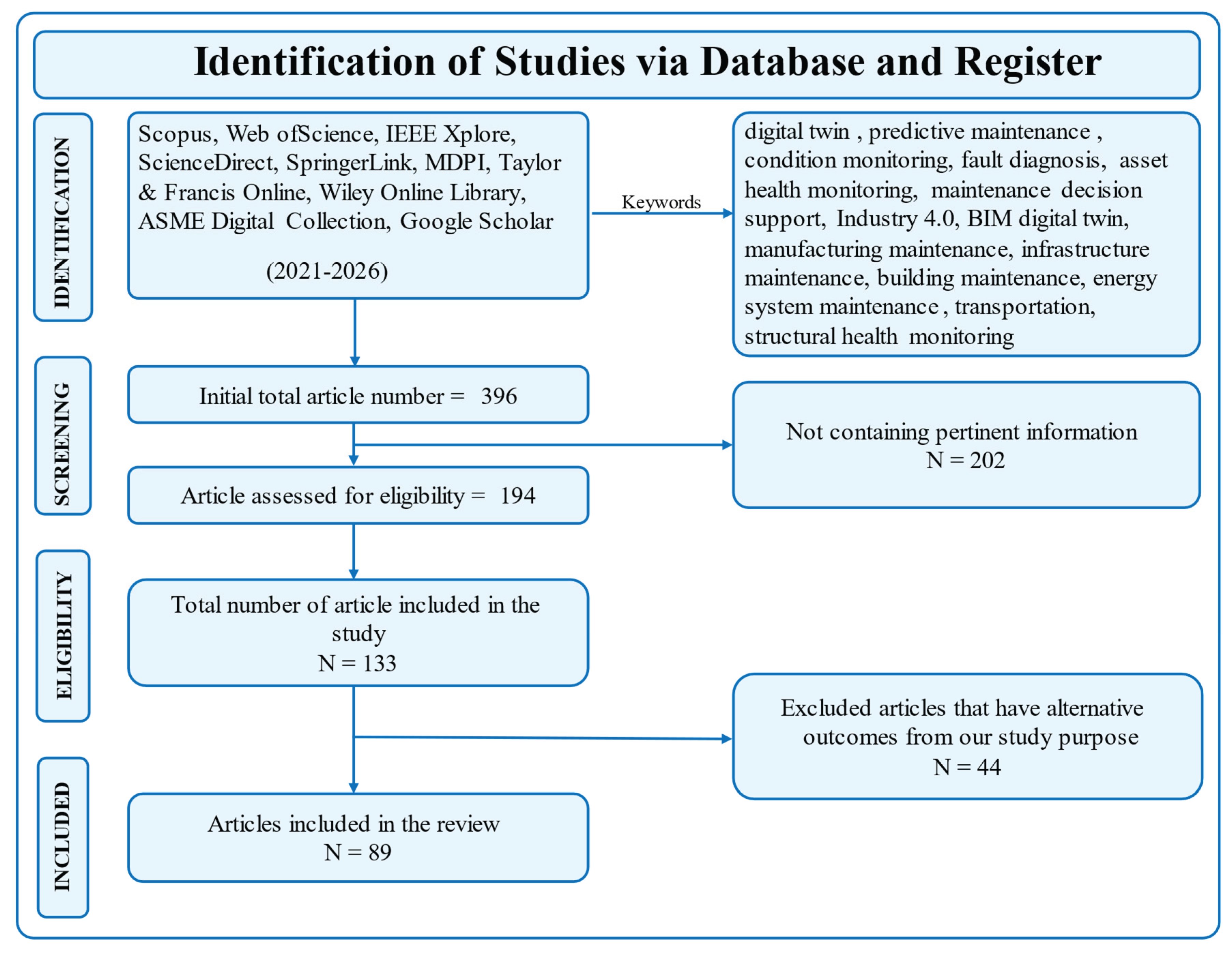
Disclaimer/Publisher’s Note: The statements, opinions and data contained in all publications are solely those of the individual author(s) and contributor(s) and not of MDPI and/or the editor(s). MDPI and/or the editor(s) disclaim responsibility for any injury to people or property resulting from any ideas, methods, instructions or products referred to in the content. |
© 2026 by the authors. Licensee MDPI, Basel, Switzerland. This article is an open access article distributed under the terms and conditions of the Creative Commons Attribution (CC BY) license (http://creativecommons.org/licenses/by/4.0/).
Copyright: This open access article is published under a Creative Commons CC BY 4.0 license, which permit the free download, distribution, and reuse, provided that the author and preprint are cited in any reuse.


