
Submitted:
25 May 2026
Posted:
25 May 2026
You are already at the latest version
Abstract
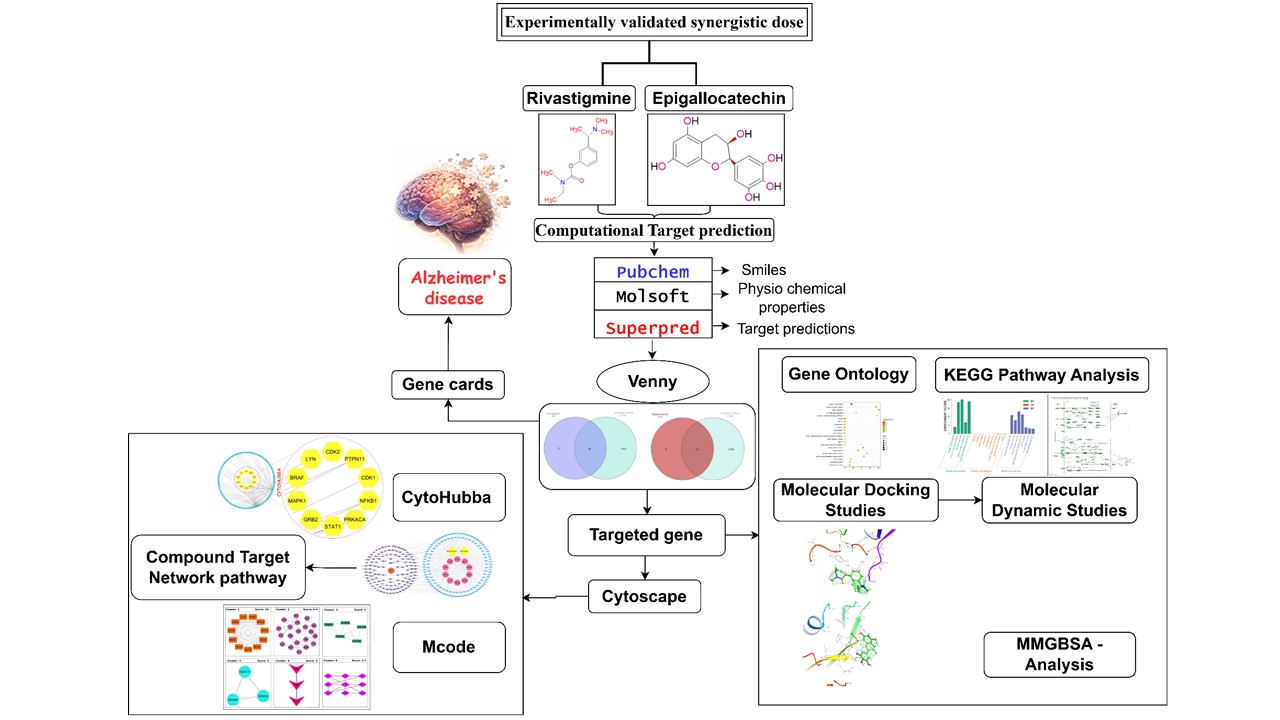
This study investigates the synergistic therapeutic potential of Rivastigmine (RVG) and Epigallocatechin (EGC) in Alzheimer’s disease (AD), a multifactorial neurodegenerative disorder characterized by neuroinflammation, oxidative stress, and dysregulated signaling pathways. Conventional therapies primarily provide symptomatic relief and target limited pathways, highlighting the need for multi-target strategies with improved efficacy and safety. An integrated in-silico approach combining pharmacokinetic evaluation, network pharmacology, molecular docking, and molecular dynamics simulations is used to determine the synergistic potential of RVG and EGC. Pharmacokinetic analysis indicates favorable drug-likeness and acceptable ADME/Tox profiles for both compounds. Network pharmacology identified 146 overlapping targets associated with AD, highlighting key hub genes including NFKB1, MAPK1, STAT1, PRKACA, GRB2, LYN, and PTPN11 are involved in neuroinflammation, synaptic signaling, and neuronal survival. Functional enrichment analysis indicated significant involvement of MAPK/ERK signaling and immune-regulatory pathways. Importantly, the PD-1/PD-L1 signaling pathway is identified as a novel mechanistic connecting neuroimmune modulation with intracellular kinase-driven neurodegeneration. Molecular docking studies showed strong binding affinities of RVG and EGC toward key AD-related targets, particularly MAPK1, supported by stable hydrogen bonding and interaction profiles. Molecular dynamics simulations confirmed stable protein-ligand interactions, with EGC contributing structural stability and RVG exhibiting adaptive flexibility within the binding pocket. These results suggest that the RVG-EGC combination exhibits synergistic potential by simultaneously modulating neuroinflammatory, oxidative stress, and kinase-mediated signaling pathways. The integration of PD-1/PD-L1 and MAPK/ERK signaling provides a novel mechanistic pathway for multi-target therapeutic intervention in AD.
Keywords:
rivastigmine
; epigallocatechin
; MAPK/ERK signaling
; PD-1/PD-L1
; synergistic therapy
; neuroinflammation
Copyright: This open access article is published under a Creative Commons CC BY 4.0 license, which permit the free download, distribution, and reuse, provided that the author and preprint are cited in any reuse.


