

Submitted:
22 May 2026
Posted:
25 May 2026
You are already at the latest version
Abstract
Processing crabs for meat generates large quantities of waste (secondary raw materials). Internal organs are typically discarded, which causes environmental problems and highlights the needs for the integrated use of marine bioresources. The red king crab hepatopancreas is an excellent source of various proteins, including enzymes with different substrate specificities. In this study, an improved method for producing a complex enzyme preparation from the hepatopancreas of red king crab harvested in the Barents Sea was developed. Physicochemical analysis revealed high protein (16%) and lipid (10%) contents in the hepatopancreas. The developed method involves centrifugation to rapidly separate the fat fraction from the aqueous protein fraction and acetone washing to remove residual lipids. The use of low temperatures (0 to 5 °C) for autolysis is justified to prevent a decrease in enzymatic activity of the final preparation. Obtained enzyme preparations were analyzed for protease, collagenase, endo- and exochitinase activity. They exhibited high proteolytic (Aprot = 252 μmol Tyrg1min1), exochitinolytic (Aexo = 0.94 μmol GlcNAcg1min1), and collagenolytic (Acol = 210 mIU·mg1) activities. It has been shown that enzymatic activities depend on seasonality (winter, summer) of crab catch, which is due to differences in the physiological processes of crabs during seasonal cyclical temperature changes in their natural habitat. The developed process flowsheet for producing an enzyme preparation from the red king crab hepatopancreas can be used as the basis for industrial technology by enterprises engaged in the comprehensive processing of marine bioresources.
Keywords:
enzyme preparation
; hepatopancreas
; red king crab
; enzymatic activity
; autolysis
; proteins
; lipids
1. Introduction
Enzyme-based biochemical catalysis is used in various industries to produce fine organics, biodegradable substances, biofuels, pharmaceuticals, and food products [1]. In recent years, biocatalysis has become a well-established industrial technology. A key driver in its development is the production of new enzymes with the required substrate specificity, catalytic activity, and stability [2].
One promising approach for producing effective enzymes is the use of marine invertebrate proteinases [3,4], particularly from commercially available species such as crustaceans and molluscs. Developing technologies to extract proteolytic enzymes from crustacean internal organs enables the rational use of harvested biological resources and the production of enzyme preparations for medicine, microbiology, and the food industry [5].
Over the past two decades, the red king crab (or Kamchatka crab) has been commercially harvested in the North Atlantic and the Barents Sea [6,7]. Processing crabs for meat generates large quantities of solid and liquid waste (secondary raw materials), including shells and internal organs. To reduce environmental impact and ensure comprehensive bioresource utilisation, this underutilised but economically promising waste, which contains numerous valuable biologically active compounds, must be processed [8]. While chitin and chitosan are traditionally produced from shells [9], the internal organs remain largely unused.
The hepatopancreas, which combines liver and pancreatic functions, is the primary source of enzyme preparations among king crab internal organs. The hepatopancreas contains various biologically active proteins, including enzymes with different substrate specificities [10]. The hepatopancreas accounts for approximately 8% of the animal’s mass in secondary resources generated during crab meat processing [11,12].
The Kamchatka crab hepatopancreas contains chitinolytic [13,14] and lipolytic [15] enzymes, hyaluronidase [16], elastase [17], collagenase [18], and other hydrolytic enzymes. Complex enzyme preparations with collagenolytic activity are commonly obtained from the hepatopancreas [19,20], and studies show these preparations comprise multiple enzymes with distinct substrate specificities [10].
Extracting enzyme preparations from the Kamchatka crab hepatopancreas presents several challenges, including lipid removal (extraction), extraction of water-soluble proteins (enzymes), and purification of enzymes from inactive ballast proteins. The latter can be addressed using ultrafiltration, DEAE-Sepharose CL-6B chromatography [21], fractional precipitation with ammonium sulfate [22], affinity chromatography [23], ion-exchange chromatography [24], or gel-filtration chromatography [25]. All extraction and fractionation steps must be performed at low temperatures (−20 to −10 °C in acetone and approximately 0 °C in aqueous solutions) to prevent enzyme inactivation [26].
Based on these considerations, enzyme preparation methods can be divided into two groups [18]. The first involves lipid extraction with organic solvents (acetone and butanol) at subzero temperatures (down to −20 °C). The second group includes hepatopancreas homogenisation in cold water or buffer, followed by separation of the aqueous enzyme solution via centrifugation or fractionation into lipid, aqueous, and solid phases (insoluble precipitate). This process may involve raw material autolysis to enhance lipid and water-soluble proteins yields, as well as phase separation using organic solvents.
Autolysis is frequently employed in enzyme isolation to increase lipid yield through enzymatic hydrolysis of lipoproteins and other lipid–protein complexes. Autolysis also boosts water-soluble protein yields by degrading high-molecular-weight proteins and releasing low-molecular-weight enzymes from the insoluble precipitate [27]. Temperature is a critical factor for autolysis: at low temperatures, enzyme activity decreases, slowing or halting the process. Unfortunately, the literature lacks clear data on how autolysis affects the activity of hepatopancreatic enzymes.
The study aimed to develop an improved method for producing a complex enzyme preparation from red king crab hepatopancreas. Our focus was on selecting a validated defatting method (lipid removal), examining the influence of autolysis temperature, and assessing the impact of harvest season on enzymatic activity. We sought to design a process flow diagram that could serve as the foundation for industrial-scale technology.
2. Materials and Methods
2.1. Hepatopancreas of the Red King Crab
The hepatopancreas of the red king crab (Paralithodes camtschaticus) was sourced from crabs harvested by the Antey-Sever LLC (Murmansk, Russia) and the Polar Branch of Russian Federal Research Institute of Fisheries and Oceanography during scientific cruises. Crabs were caught in three distinct periods: August–September, October–November, and January–February during 2024–2025. Following harvest, the hepatopancreas samples were frozen and stored at −20 °C.
Reagents used: casein sodium salt from bovine milk (Sigma-Aldrich C8654, Germany); bovine collagen type I from bovine Achilles tendon, (Sigma-Aldrich C9879, Germany); and 4-dimethylaminobenzaldehyde.
2.2. Enzyme Preparation
Enzyme preparations were obtained from the hepatopancreas using the known method including an acetone-based washing step [28]. Hepatopancreas samples were thawed, crushed, and homogenised using a laboratory homogeniser (model 1094, Tecator, Sweden) at 3–5 °C. For the autolysis study, the homogenate was stirred in a thermostatted vessel for 30 min. The homogenate was centrifuged using an Avanti J-25 centrifuge (Beckman Coulter, USA) in 400 cm3 polypropylene tubes at 8000 rpm (7500 × g), and the supernatant was collected. The aqueous enzyme preparation, containing a protein mixture, was lyophilised using a Heto FD 8 freeze dryer (Heto-Holten A/S, Denmark). The lyophilised enzyme preparation was purified from lipids using acetone by mixing the preparation in acetone at 3 °C for 2 to 3 min. The undissolved solid phase, containing the enzyme, was washed three times with acetone, separated by centrifugation at 5000 rpm for 10 min, and dried in an SH-VDO-45 vacuum drying oven (SH Scientific, South Korea) at 15 ± 5 °C for 3 h.
2.3. Chemical Composition of the Hepatopancreas
The mass fractions of water, protein, lipids, and residue after ignition (mineral substances) were determined using standard methods [29]. Total nitrogen was determined by the Kjeldahl method; lipid by the Soxhlet method; moisture by the gravimetric method; and mineral substances by the combustion method.
2.4. Enzyme Activities: Protease, Collagenase, Endo- and Exochitinase
Enzyme preparations obtained from the hepatopancreas of the red king crab were analysed for protease, collagenase, and endo- and exochitinase activities to determine proteolytic, collagenolytic, and chitinolytic activity, respectively. Spectrophotometric analysis was used; solution optical density and absorption spectra were recorded using a Shimadzu UV-3101PC spectrophotometer (Shimadzu, Japan).
2.4.1. Proteolytic Activity
Proteolytic activity (Aprot, μmol Tyr⋅g−1⋅min−1) was determined using a modified Anson method [30,31]. The absorption of soluble peptides formed from sodium caseinate during a 10 min proteolytic enzyme reaction at 37 °C was measured spectrophotometrically at 280 nm. One unit of proteolytic activity was defined as the amount (in μmol) of tyrosine (Tyr) released per gram of enzyme per minute.
2.4.2. Collagenolytic Activity
Collagenolytic activity (Acol, mIU⋅mg−1) was determined spectrophotometrically by measuring hydroxyproline absorbance at 280 nm. Hydroxyproline was formed from collagen hydrolysis by collagenolytic enzymes for 30 min at 37 °C, followed by complete acid hydrolysis and subsequent 4-dimethylaminobenzaldehyde colourmetric detection [31]. One unit of collagenolytic activity was defined as the amount (in μmol) of hydroxyproline (Hyp) released per milligram of enzyme (mIU/mg).
2.4.3. Chitinolytic Activity
Endochitinolytic activity (Aendo, %) was measured as the percentage decrease in optical density at 700 nm of a colloidal chitin suspension (pH 7) after 30 min incubation with the enzyme preparation at 37 °C [32]. Exochitinolytic activity (Aexo, μmol GlcNAc⋅g−1⋅min−1) was determined by the reaction of the N-acetyl-D-glucosamine hydrolysis product with 4-dimethylaminobenzaldehyde to form a coloured complex [33]. One unit of exochitinase activity was defined as the amount (in μmol) of N-acetyl-D-glucosamine (GlcNAc) released per gram of enzyme per minute during the reaction with colloidal chitin. Colloidal chitin was prepared from shrimp chitin (Sigma-Aldrich C7170, USA) using a method involving chitin reprecipitation in concentrated hydrochloric acid [32].
2.5. Statistical Analysis
Results were presented as mean ± standard deviation, with each experiment conducted in triplicate (n = 3) to ensure reproducibility. Experimental data was processed using Microsoft Excel LTSC Pro 2021with all standard deviations smaller than 10%. Data were subjected to one-way analysis of variance (ANOVA), and means were compared using Fisher’s least significant difference (LSD) test (p < 0.05, 95% confidence). For enzyme activity analyses, optical absorption spectra were processed using MagicPlot (ver. 3.0.1, MagicPlot Systems, LLC). Statistical analysis was performed using the Statistical Package for Social Science (SPSS) for Windows version 16.0 (SPSS Inc., Chicago, IL, USA).
3. Results
3.1. Chemical Composition of the Hepatopancreas
The chemical composition of the red king crab (Paralithodes camtschaticus) hepatopancreas used for enzyme preparation is shown in Table 1.
The raw material was characterised by high protein content (approximately 16%) and significant lipid content (approximately 10%). The latter required removal during enzymatic isolation.
3.2. Effect of Different Lipid Removal Methods on Enzymatic Activity
Lipid removal is a critical and costly step in obtaining enzyme preparations from red king crab hepatopancreas. A common method for lipid removal involves sequential extraction with organic solvents, such as acetone and n-butanol, at −20 °C to produce ‘acetone powder’ [25].
Another common approach is the adsorption or coprecipitation of lipids from an aqueous hepatopancreas suspension using coagulants such as chitosan [34]. However, this method may not achieve complete lipid extraction and risks contaminating the enzyme preparation with the reagents used (adsorbents and/or coagulants).
Mechanical separation of the hepatopancreas into lipid and aqueous phases represents the most advanced technological approach. However, this method does not achieve complete lipid extraction from aqueous fractions, requiring subsequent defatting with organic solvents. Significantly, this approach reduces organic solvent requirements several-fold compared with the sequential extraction method that is used until complete defatting is achieved.
In our study, we evaluated sequential lipid extraction using acetone and n-butanol at –20 °C to produce an acetone powder. We also investigated centrifugation for rapid fractionation, separating the lipid fraction from the aqueous hepatopancreas suspension at a separation factor achievable with industrial equipment (7500 x g). The moisture and lipid contents of the aqueous fraction and centrifuge sediment are shown in Table 2.
The results in Table 2 show that approximately 90% of the starting hepatopancreas mass was transferred to the separated lipid fraction, with 8% precipitating and 1.4% remaining in the aqueous enzyme preparation. These values demonstrate incomplete lipid removal during the fractionation step.
Additional post-centrifugation lipid extraction from the water protein fraction is required. We compared two methods for complete lipid extraction during enzyme preparation. The first method involved lyophilising the aqueous solution and subsequently washing the resulting dried preparation with acetone. The second method used acetone-induced precipitation of water-soluble proteins [35], followed by acetone washing to produce a defatted acetone powder primarily containing enzymes. While the second method required more acetone, it produced an enzyme preparation with significantly higher activity (Table 3).
No lipids were detected in enzyme preparations obtained by complete acetone and n-butanol extraction at 20 °C (acetone powder), nor in those produced via the first and second methods (lipid mass fraction was below detection limits). Enzyme preparation yields ranged from 10 to 12%. The resulting enzyme preparations were assessed by proteolytic activity (Aprot) and exochitinolytic activity (Aexo), with values for each defatting method presented in Table 3.
Table 3 data demonstrate that acetone precipitation (second method) significantly enriches the resulting enzyme preparation in proteolytic and chitinolytic activities. However, the acetone method requirement is substantial. The method combining freeze-drying with acetone washing of the dried product (first method) appears most suitable for industrial development, as it can be integrated into a single process chain following hepatopancreas separation and lipid-insoluble substance removal.
Based on our findings, we proposed the following process flowsheet for producing a complex enzyme preparation from red king crab (Paralithodes camtschaticus) hepatopancreas (Figure 1). The production process comprises seven steps:
1) Thawing of −20 °C red king crab hepatopancreas at 0 °C, followed by 1 min homogenisation (Tecator 1094, Tecator, Sweden) maintained below 0 °C;
2) Mixing the resulting 0 °C suspension with cooled (3–5 °C) distilled water and stirring for 30 min (autolysis time and temperature varied from 3 to 37 °C during process development; see Section 3.4);
3) Centrifugation of the suspension at 10,000 rpm and 4 °C for 60 min (Avanti J-25 centrifuge, Beckman Coulter, USA);
4) Collection and cheesecloth filter of the middle protein-rich fraction (protein solution) to remove residual fat;
5) Lyophilisation of the aqueous protein solution (Heto FD 8, Heto-Holten A/S, Denmark);
6) Washing the dried enzyme preparation with acetone (3–4 times) to remove residual lipids;
7) Final drying of the acetone-washed powder in a ShVS-45 vacuum drying oven (Russia) at room temperature (residual pressure < 0.1 atm).
3.3. Influence of Harvest Time on Enzyme Preparation Activity
Proteolytic enzyme activity in the hepatopancreas varies by season, with minimum values in summer (July–August) and maximum values in winter (January–February) [10,36]. Proteolytic enzyme activity in January–February is on average 2.2–2.7 times higher than in August–September.
In our study, the proteolytic activity of the enzyme preparation from hepatopancreas collected in August–September was 91 μmol Tyr⋅g−1⋅min−1, while proteolytic activity from winter-caught crabs reached 252 μmol Tyr⋅g−1⋅min−1 (Figure 2).
The proteolytic activity of enzyme preparations from winter-caught crabs was 2.77 times higher than in the summer, consistent with previous reports on Kamchatka crab [10]. Conversely, collagenolytic activity was lower in February (45 mIU⋅mg−1) compared with August (210 mIU⋅mg−1). These seasonal enzymatic variations reflect changing metabolic requirements, with proteolytic activity supporting digestion during winter food shortages and collagenolytic activity supporting growth and moulting in summer. Such seasonal differences in enzyme activity align with the crab’s response adaptation to cyclic environmental changes in temperature and food availability [6,7].
3.4. Influence of Autolysis Temperature on Enzymatic Activity
We studied the dependence of enzymatic activities of the resulting preparation on the autolysis temperature, which occurs during raw material homogenisation before centrifugation for 30 minutes (see Section 3.2, Figure 1). Autolysis of red king crab hepatopancreas involves enzymatic breakdown of raw components, forming peptides, amino acids, and fatty acids. Precise control of autolysis conditions (temperature, pH, time) enables production of products with desired properties for food, medical, and other applications.
Our study investigated autolysis temperature effects on enzyme preparation properties from hepatopancreas samples, showing significant decreases in proteolytic and chitinolytic activities as temperatures rose from 3 to 37 °C. Proteolytic activity decreased 7.5-fold and exochitinolytic activity 1.6-fold (Figure 3); collagenolytic activity decreased the least (1.1-fold). These findings question the feasibility of patented enzyme productions using high-temperature hepatopancreas autolysis to enhance lipid yields [37,38,39].
These results suggest that to preserve hepatopancreas enzyme activity, aqueous dispersion processing, including autolysis, should be conducted at temperatures near 0 °C (not exceeding 5 °C). Autolysis requires monitoring as it can reduce isolated enzyme activities. Given the time required for thawing, homogenisation, and separation, minor autolysis is unavoidable; therefore, all enzyme isolation operations should proceed at low temperatures.
4. Conclusions
This study aimed to develop an improved process flowsheet for producing a complex enzyme preparation from the red king crab hepatopancreas as a basis for industrial technology. The resulting enzyme preparation obtained was analysed for protease, collagenase, endo-, and exochitinase activities. Lipid removal presented a key challenge; we proposed centrifugation to rapidly separate the fat fraction from the aqueous protein solution, followed by lyophilisation and acetone washing to remove residual lipids. The final preparation exhibited high proteolytic (Aprot = 252 ± 8 μmol Tyr⋅g−1⋅min−1) and exochitinolytic (Aexo = 0.94 ± 0.05 μmol GlcNAc⋅g−1⋅min−1) activities.
Results demonstrate that maintaining autolysis temperatures between 0 and 5 °C during homogenisation and aqueous dispersion fractionation preserves enzymatic activity. Seasonality significantly affects raw material properties: January–February hepatopancreas extracts showed nearly threefold higher activity than August–September extracts.
This work provides valuable insights into enzyme preparation from crustacean processing waste and underscores the importance of integrated marine bioresource processing. The findings offer crab processing companies a pathway to achieve zero-waste utilisation while producing high-demand biotechnology products with specific substrate affinities.
Author Contributions
Conceptualization, V.Yu.N. and K.S.R.; Methodology, V.Yu.N.; Software, S.R.D.; Validation, V.Yu.N., K.S.R. and S.R.D.; Formal Analysis, V.Yu.N., I.A.B. and S.R.D.; Investigation, V.Yu.N., I.A.B. and S.R.D.; Resources, K.S.R.; Data Curation, V.Yu.N.; Writing – Original Draft Preparation, S.R.D.; Writing – Review & Editing, S.R.D.; Visualization, V.Yu.N. and S.R.D.; Supervision, V.Yu.N.; Project Administration, S.R.D.; Funding Acquisition, S.R.D.
Funding
This research was funded by the Russian Science Foundation, project No. 25-16-00064.
Institutional Review Board Statement
Not applicable.
Informed Consent Statement
Not applicable.
Data Availability Statement
Data are contained within the article.
Acknowledgments
The authors are grateful to the staff of the Chemistry Department and Laboratory of Chemistry and Technology of Marine Bioresources (established with the financial support of the Russian Ministry of Science and Higher Education, Agreement № 075-03-2024-024/1) of the Murmansk Arctic University for the technical support.
Conflicts of Interest
The authors declare no conflicts of interest.
References
- Wu, S.; Snajdrova, R.; Moore, J.C.; Baldenius, K.; Bornscheuer, U.T. Biocatalysis: Enzymatic synthesis for industrial applications. Angew. Chem. Int. Ed. 2021, 60, 88–119. [CrossRef]
- Yi, D.; Bayer, T.; Badenhorst, C.P.S.; Wu, S.; Doerr, M.; Höhne, M.; Bornscheuer, U.T. Recent trends in biocatalysis. Chem. Soc. Rev. 2021, 50, 8003–8049. [CrossRef]
- Ghattavi, S,; Homaei, A. Marine enzymes – Production, scale-up, and applications. In Marine Biotechnology for Healthcare. Advances and Biomedical Applications, 1st ed.; Sarma, H., Joshi, S., Kumar, M.S., Daverey, A., Joshi, S., Buttar, H.S., Vaksmaa, A., Eds.; Academic Press, 2025; pp. 143-171. [CrossRef]
- Ghattavi, S., Homaei, A. Marine enzymes: Classification and application in various industries. Int. J. Biol. Macromol. 2023, 230 123136. [CrossRef]
- Pandey, D., Khanal, P., Atanassova, M. Marine enzymes for food and animal feed: a systematic review of current applications and future perspectives. Future Foods. 2026, 13, 100988. [CrossRef]
- Dvoretsky, A.G., Dvoretsky, V.G., Red king crab (Paralithodes camtschaticus) fisheries in Russian waters: Historical review and present status. Rev. Fish Biol. Fish. 2018, 28, 331–353. [CrossRef]
- Dvoretsky, A.G., Dvoretsky, V.G. Renewal of the recreational red king crab fishery in Russian waters of the Barents Sea: Potential benefits and costs. Mar. Policy. 2022, 136, 104916. [CrossRef]
- Nanda, P.K., Das, A.K. Dandapat, P., Dhar, P., Bandyopadhyay, S., Dib, A.L., Lorenzo, J.M., Gagaoua, M. Nutritional aspects, flavour profile and health benefits of crab meat based novel food products and valorisation of processing waste to wealth: A review. Trends Food Sci. Technol. 2021, 112, 252–267. [CrossRef]
- Hasan S., Boddu V.M., Viswanath D.S., Ghosh T.K. Chitin and Chitosan. Science and Engineering. Springer Nature Switzerland AG: Cham, Switzerland, 2022, 429 p.
- Ponomareva T., Timchenko M., Filippov M., Lapaev S., Sogorin E. Prospects of red king crab hepatopancreas processing: fundamental and applied biochemistry. Recycling. 2021, 6(1), 3. [CrossRef]
- Lorentzen, G., Samuelsen, T.A., Hustad, A., Thesslund, T., Lian, F., Rotabakk, B.T., Skipnes, D., Siikavuopio, S.I. Morphology, processing attributes, fatty acid, and amino acid composition in cooked leg meat and raw hepatopancreas of juvenile male red king crab (Paralithodes camtschaticus) after 12 months of live holding. J. Food Compos. Anal. 2024, 132, 106310. [CrossRef]
- Dvoretsky, A.G., Bichkaeva, F.A., Baranova, N.F., Dvoretsky, V.G. Fatty acid composition of the Barents Sea red king crab (Paralithodes camtschaticus) leg meat. J. Food Compos. Anal. 2021, 98, 103826. [CrossRef]
- Novikov, V.Yu., Mukhin, V.A., Rysakova, K.S. Properties of chitinolytic enzymes from the hepatopancreas of the Red King Crab (Paralithodes camtschaticus). Appl. Biochem. Microbiol. 2007, 43(2), 159-163. [CrossRef]
- Rysakova, K.S., Novikov, V.Yu., Mukhin, V.A., Serafimchik, E.M. Glycolytic activity of enzyme preparation from the Red King crab (Paralithodes camtschaticus) hepatopancreas. Appl. Biochem. Microbiol. 2008, 44(3), 251-255. [CrossRef]
- Timchenko, M., Molchanov, V., Molchanov, M., Timchenko, A., Sogorin, E. Investigation of lipolytic activity of the red king crab hepatopancreas homogenate by NMR spectroscopy. Peer J. 2022, 10, e12742. [CrossRef]
- Sliadovskii, D., Ponomareva, T., Molchanov, M., Pozdnyakova-Filatova, I., Timchenko, M., Marchenkov, V., Gusev, O., Sogorin, E. β-elimination of hyaluronate by red king crab hyaluronidase. Sci. Rep. 2021, 11, 22600. [CrossRef]
- Sakharov, I. Yu., Dzunkovskaya, A. V., Artyukov, A. A., Zakharova, N. N. Purification and some properties of elastase from hepatopancreas of king crab Paralithodes camtschatica. Comp. Biochem. Physiol. B: Comp. Biochem. 1993, 106(3), 681-684. [CrossRef]
- Barzkar, N., Babich, O., Sukhikh, S., Maran, B.A.V., Jahromi, S.T., Luwor, R.B., Sorsa, T., Das, R. Exploring the sources and potential applications of marine collagenases. Biocatal. Agricul. Biotech. 2024, 58, 103150. [CrossRef]
- Sakharov, I.Yu., Litvin, F.E., Mitkevitch, O.V., Samokhin, G.P., Bespalova, Z.D. Substrate specificity of collagenolytic proteases from the king crab Paralithodes camtschatica. Comp. Biochem. Physiol. B: Comp. Biochem. 1994, 10711(3), 411-417.
- Klimova, O.A., Borukhov, S.I., Solovyeva, N.I., Balaevskaya, T.O., Strongin, A.Ya. The isolation and properties of collagenolytic proteases from crab hepatopancreas. Biochem. Biophys. Res. Comm. 1990, 166(3), 1411-1420. [CrossRef]
- Iida, Y., Nakagawa, T., Nagayama, F. Properties of collagenolytic proteinase in Japanese spiny lobster and horsehair crab hepatopancreas. Comp. Biochem. Physiol. B: Comp. Biochem. 1991, 98, 403–410. [CrossRef]
- Wu, Y., Wang, P., Li, L., Yang, X., Diao, S. Purification and characteristics of serine protease from the head of pacific white shrimp. Food Sci. Biotechnol. 2012, 21, 1129–1134. [CrossRef]
- Mohammadi, S., Azadi, M. A., Hemmati, R., Homaei, A. Extraction, purification and characterization of a thermally stable aspartic protease from freshwater shrimp Gammarus sp. with a high catalytic efficiency. Biocatal. Agricul. Biotechnol. 2021, 38, 102224. [CrossRef]
- Roy, P., Colas, B., Durand, P. Purification, kinetical and molecular characterizations of a serine collagenolytic protease from greenshore crab (Carcinus maenas) digestive gland. Comp. Biochem. Physiol., B: Biochem. Mol. Biol. 1996, 115, 87–95. [CrossRef]
- Sivakumar, P., Sampath, P., Chandrakasan, G. Collagenolytic metalloprotease (gelatinase) from the hepatopancreas of the marine crab, Scylla serrata. Comp. Biochem. Physiol. B: Biochem. Mol. Biol. 1999, 123, 273–279. [CrossRef]
- Kolahdoozan, S., Sepanlou, S.G., Sharafkhah, M., Shaker, E., Shayanrad, A., Malekzadeh, R., Merat, S., Poustchi, H. Effect of storage temperature and time on stability of liver enzymes in blood serum. Arch. Iran. Med. 2020, 23(5), 296-301. [CrossRef]
- Huang, X., Wang, H., Tu, Z. A comprehensive review of the control and utilization of aquatic animal products by autolysis-based processes: Mechanism, process, factors, and application. Food Res. Int. 2023, 164, 112325. [CrossRef]
- Grant, G.A., Eisen, A.Z., Bradshaw, R.A. [53] Collagenolytic protease from fiddler crab (Uca pugilator). In Methods in Enzymology. Proteolytic Enzymes; Lorand, L., Kaplan, N.P., Colowick, N.P., Eds.; Academic Press: London, New York, 1981; Volume 80, pp. 722-734. [CrossRef]
- Latimer, G.W.; AOAC International (Eds.) Official Methods of Analysis of AOAC International, 20th ed.; AOAC International: Rockville, MD, USA, 2016.
- Lanoe, J., Dunnigan, J. Improvements of the Anson assay for measuring proteolytic activities in acidic pH range. Anal. Biochem. 1978, 89(2), 461-471. [CrossRef]
- Qiu, B., Wei, F., Sun, X., Wang, X., Duan, B., Shi, C., Zhang, J., Zhang, J., Qiu, W., Mu, W. Measurement of hydroxyproline in collagen with three different methods. Mol. Med. Rep. 2014, 10(2), 1157-1163. [CrossRef]
- Decleire, M., De Cat, W., Tang, V.H., Maraite, H., Minier, M., Goffic, F. Le., Gullino, M.L., Huynh, N.Van. Determination of endo- and exochitinase activities of Serratia marcescens in relation to the culture media composition and comparison of their antifungal properties. In Chitin Enzymology; Muzzarelli, R.A.A., Ed.; Atec Edizioni: Grottammare, Italy, 1996; Volume 2, pp. 165-169.
- Reissig, J.L., Storminger, J.L., Leloir, L.F. A Modified Colorimetric Method for the Estimation of N-Acetylamino Sugars. J. Biol. Chem. 1955, 217(2), 959–966. [CrossRef]
- Novikov, V. Yu., Mukhin, V. A. Defatting and clarification of protein hydrolysates by using chitosan solutions. Appl. Biochem. Microbiol. 2001, 37(6), 629-634. [CrossRef]
- Ojima, T., Rahman, M. N., Kumagai, Y., Nishiyama, R., Narsico, J., Inoue, A. Chapter Fifteen - Polysaccharide-degrading enzymes from marine gastropods. Methods Enzymol. 2018, 605, 457-497. [CrossRef]
- Novikov, V.Yu., Shumskaya, N.V., Mukhin, V.A., Zolotarev, K.V., Mikhailov, A.N., Nakhod, V.I., Mikhailova, M.V. Chemical characterization of Atlantic cod (gadus morhua) collagen hydrolyzed using enzyme preparation derived from red king crab (paralithodes camtschaticus) and its potential as a core component of bacterial culture medium. Mar. Drugs. 2021, 19(8), 472. [CrossRef]
- Mikhnov, I.Kh., Tovmash, A.V. Method for producing collagenase from the hepatopancreas of Opilio snow crab: Patent RU 2840531 C1, applicant and patent holder: LLC “Antey”. 2025, IPC C11B 1/00, A23L 29/281, C12N 9/64. Application No. 2024119855, filed 15.07.2024, published 26.05.2025. 6 p. (Rus.).
- Kireev, V.V., Titov, O.V., Sheveleva, O.A. Method for producing an enzyme preparation from crab hepatopancreas: Patent RU 2285041 C1, applicant and patent holder: FSUE Polar Research Institute of Marine Fisheries and Oceanography named after N. M. Knipovich. 2005, IPC C12N 9/00, C12N 9/50, C12N 9/64. Application No. 2005111043/13, filed 14 04 2005, published 10 10 2006. 5 p. (Rus.).
- Artyukov, A.A., Menzorova, N.I., Kozlovskaya, E.P., Kofanova, N.N., Kozlovsky, A.S., Rasskazov, V.A. Enzyme preparation from the hepatopancreas of commercial crab species and method for its preparation: Patent No. RU 2280076 C1, applicant, patent holder: Pacific Institute of Bioorganic Chemistry, Far Eastern Branch of the Russian Academy of Sciences. 2006, IPC C12N 9/48, C12N 9/64. Application No. 2004135771/13, filed 06.12.2004, published 20.07.2006. 6 p. (Rus.).
Figure 1.
This is a figure. Schemes follow another format. If there are multiple panels, they should be listed as: (a) Description of what is contained in the first panel; (b) Description of what is contained in the second panel. Figures should be placed in the main text near to the first time they are cited.
Figure 1.
This is a figure. Schemes follow another format. If there are multiple panels, they should be listed as: (a) Description of what is contained in the first panel; (b) Description of what is contained in the second panel. Figures should be placed in the main text near to the first time they are cited.
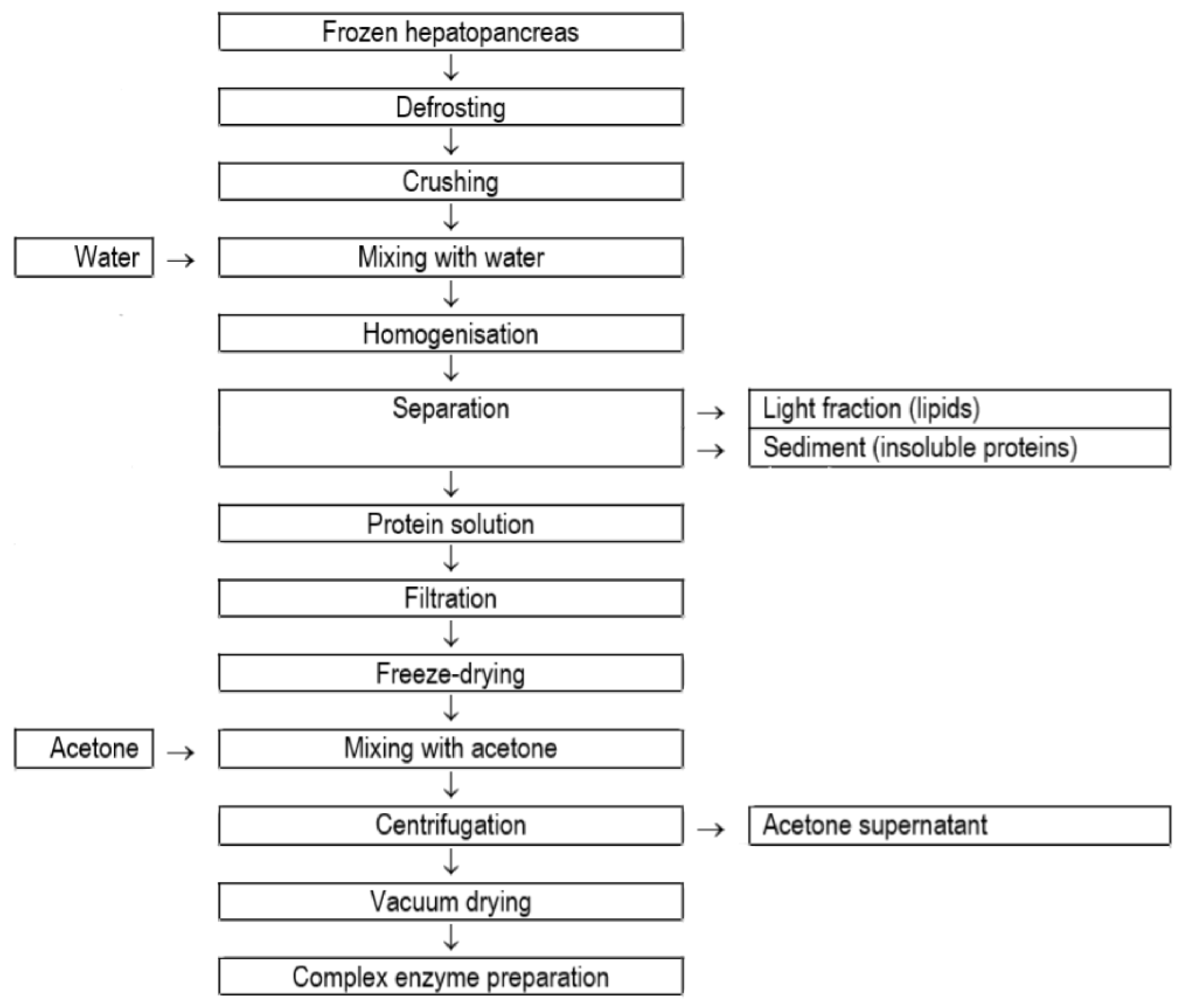
Figure 2.
Enzymatic activities in the complex preparation from red king crab hepatopancreas collected at different times of year: (a) proteolytic activity, Aprot; (b) collagenolytic activity, Acol; (c) exochitinolytic activity, Aexo; (d) endochitinolytic activity, Aendo.
Figure 2.
Enzymatic activities in the complex preparation from red king crab hepatopancreas collected at different times of year: (a) proteolytic activity, Aprot; (b) collagenolytic activity, Acol; (c) exochitinolytic activity, Aexo; (d) endochitinolytic activity, Aendo.
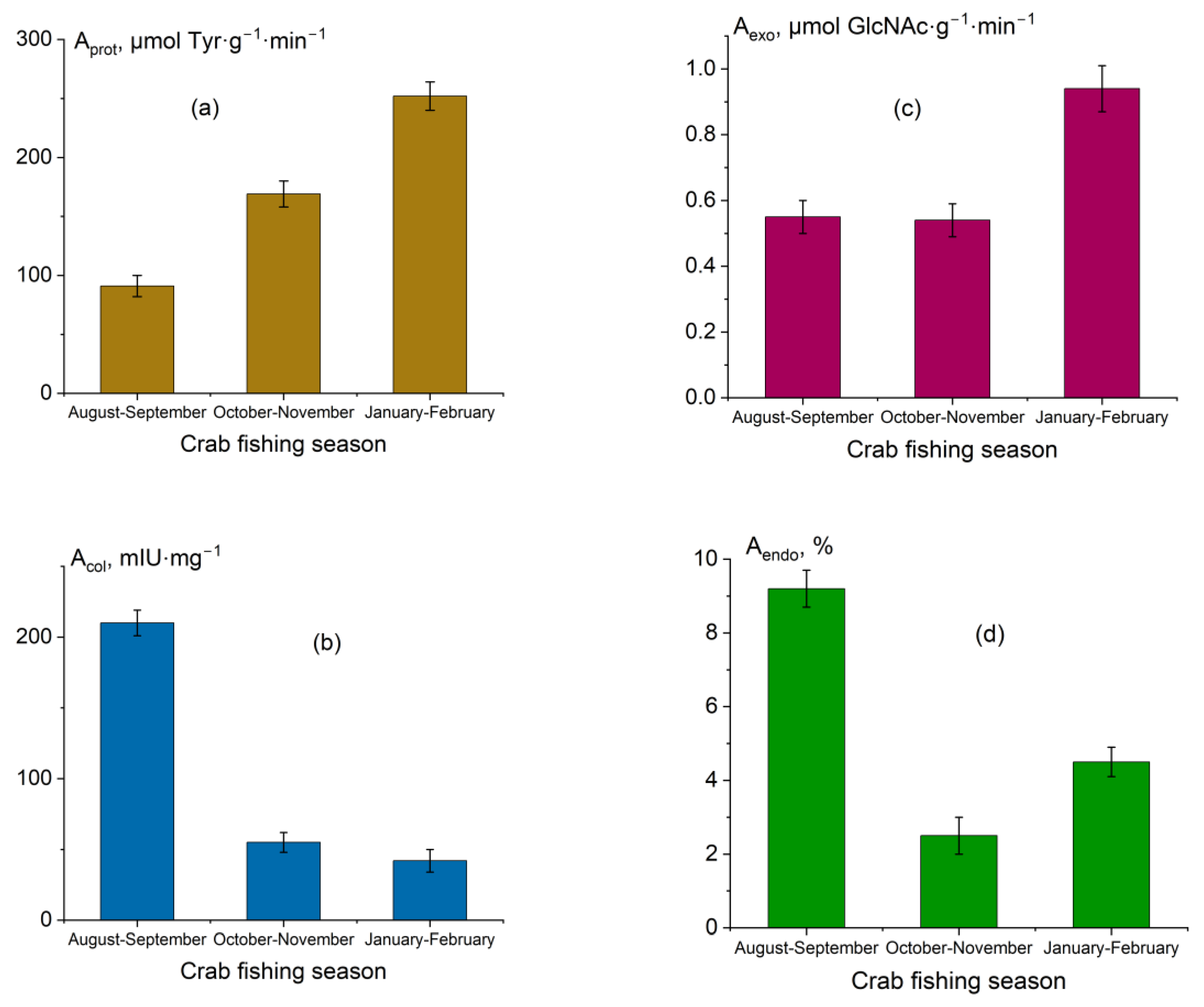
Figure 3.
Enzyme activities from hepatopancreas samples as a function of autolysis temperature (30 min): (a) proteolytic, Aprot, (1) and collagenolytic, Acol, (2); (b) exochitinolytic, Aexo, (1) and endochitinolytic, Aendo, (2).
Figure 3.
Enzyme activities from hepatopancreas samples as a function of autolysis temperature (30 min): (a) proteolytic, Aprot, (1) and collagenolytic, Acol, (2); (b) exochitinolytic, Aexo, (1) and endochitinolytic, Aendo, (2).
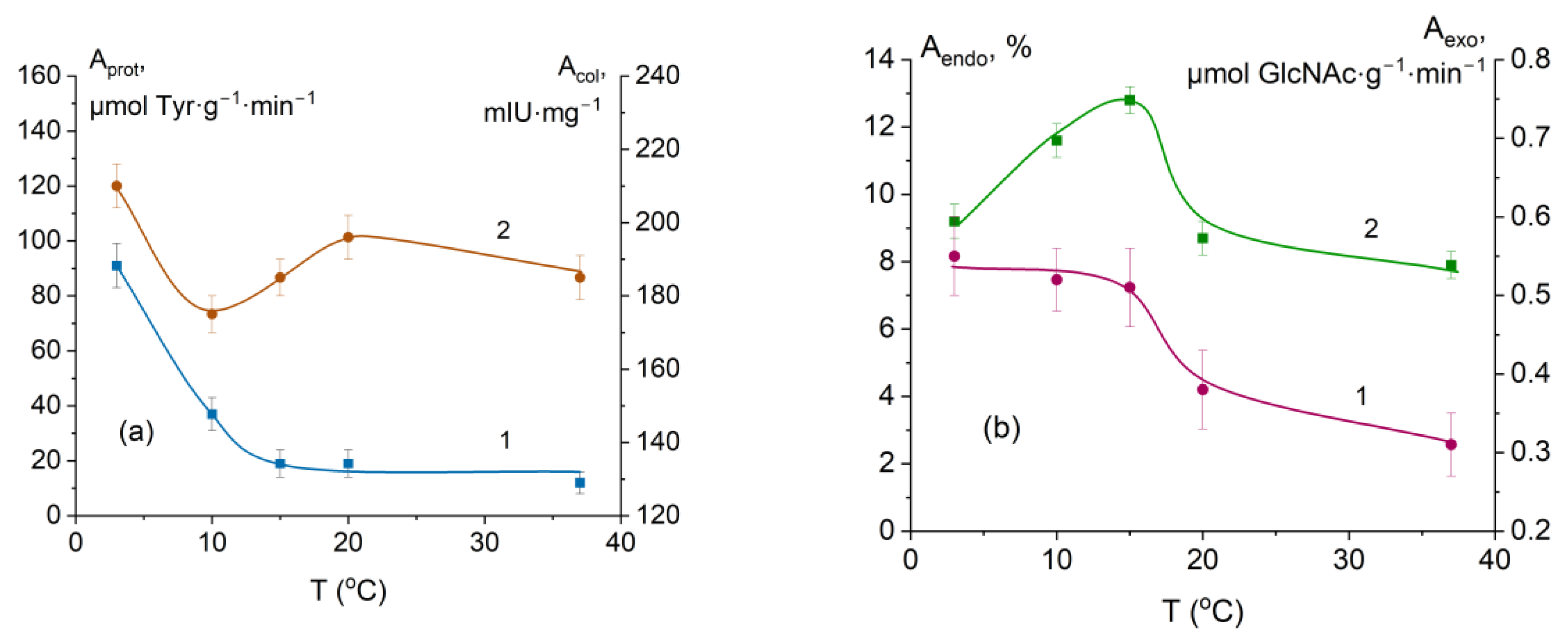

Table 1.
Chemical composition of hepatopancreas from the red king crab (caught in January–February).
Table 1.
Chemical composition of hepatopancreas from the red king crab (caught in January–February).
| Components | Content, % |
|---|---|
| Moisture | 72.3 ± 2.0 |
| Protein | 15.9 ± 0.3 |
| Lipids | 10.2 ± 0.4 |
| Mineral Substances | 1.6 ± 0.1 |
Means ± standard deviation (n = 3).
Table 2.
Moisture and lipid content of the lipid fraction, dried enzyme preparation from the aqueous fraction, and dried sediment after hepatopancreas dispersion fractionation. Initial wet hepatopancreas mass: 200 g.
Table 2.
Moisture and lipid content of the lipid fraction, dried enzyme preparation from the aqueous fraction, and dried sediment after hepatopancreas dispersion fractionation. Initial wet hepatopancreas mass: 200 g.
| Fraction type | Mass of fraction, g | Moisture, % | Lipids, % | Proportion of fat from the total fat content of raw material, % |
|---|---|---|---|---|
| Lipid fraction | 33.7 ± 0.8 a | < 0.5 a | 98.0 ± 0.5 a | 90.1 ± 1.2 a |
| Enzyme preparation (dried) obtained from the aqueous fraction | 17.9 ± 0.5 b | 8.8 ± 0.2 b | 1.6 ± 0.2 b | 1.4 ± 0.6 b |
| Insoluble precipitate (dried) | 5.6 ± 0.2 c | 6.1 ± 0.3 c | 29.6 ± 0.5 c | 8.4 ± 0.9 c |
a, b, c: significant differences (p < 0.05). Means ± standard deviation (n = 3).
Table 3.
Proteolytic (Aprot) and exochitinolytic (Aexo) activity of enzyme preparation obtained via different lipid removal methods from January–February red king crab hepatopancreas.
Table 3.
Proteolytic (Aprot) and exochitinolytic (Aexo) activity of enzyme preparation obtained via different lipid removal methods from January–February red king crab hepatopancreas.
| Method used to obtain the enzyme preparation | Aprot, μmol Tyr⋅g−1⋅min−1 |
Aexo, μmol GlcNAc⋅g−1⋅min−1 |
|---|---|---|
| Lipid extraction with solvents (acetone powder) | 144 ± 5 а | 0.05 ± 0.01 a |
| Lyophilisation of an aqueous solution (first method) | 252 ± 8 b | 0.94 ± 0.05 b |
| Precipitation with acetone from an aqueous solution (second method) | 883 ± 9 c | 2.74 ± 0.07 c |
a, b, c: significant differences (p < 0.05). Means ± standard deviation (n = 3).
Disclaimer/Publisher’s Note: The statements, opinions and data contained in all publications are solely those of the individual author(s) and contributor(s) and not of MDPI and/or the editor(s). MDPI and/or the editor(s) disclaim responsibility for any injury to people or property resulting from any ideas, methods, instructions or products referred to in the content. |
© 2026 by the authors. Licensee MDPI, Basel, Switzerland. This article is an open access article distributed under the terms and conditions of the Creative Commons Attribution (CC BY) license (http://creativecommons.org/licenses/by/4.0/).
Copyright: This open access article is published under a Creative Commons CC BY 4.0 license, which permit the free download, distribution, and reuse, provided that the author and preprint are cited in any reuse.


