

Submitted:
23 May 2026
Posted:
25 May 2026
You are already at the latest version
Abstract
Quantum mechanics and general relativity have been very successful in their respective domains for understanding and predicting physical phenomena. The two theories differ in their perspectives on time, with relativistic time flowing at different rates for different observers but time in a quantum system flowing in a fixed spacetime. Experiments on the nature of time to probe this difference have shown there is a flow of time in a quantum system that is not detectable by a classical clock outside the quantum system. Accordingly, we generalize the concept of time to include the flow of time in both classical and quantum systems, and investigate whether the concept of “generalized time” has any explanatory or predictive value. We find that generalized time provides an explanation for quantum entanglement that is causal without violating the speed of light, provides insight regarding collapse of the wave function in a quantum system, provides a simple intuitive perspective to understand time dilation and length contraction in special relativity, resolves the black hole information paradox, and enables a physical model that explains cosmic inflation. CPT symmetry coupled with generalized time explains why time goes backwards for antiparticles in Feynman diagrams and why there is more matter than antimatter in the Universe, leads to a model of the Big Bang that explains some observed anisotropies in the Universe, and potentially explains CP violations observed in kaons and other particles. Models based on generalized time make testable predictions for laboratory and cosmological measurements.
Keywords:
quantum mechanics
; entanglement
; relativity
; cosmology
; antimatter
; black hole information paradox
; cosmic inflation
; CP violation
1. Introduction
Time is a challenging subject to explore. We have an intuitive understanding of time from personal experience, which differs from the experimentally verified perspectives on time from general relativity and quantum mechanics. It is also physically different than other quantities we measure. All physical measurements can be expressed in units that are some combination of length, time, mass, and charge. For an object, we can measure its size, weight, and charge, but we do not measure its time, highlighting that time is different than other physical properties. Time in physics usually refers to the flow of time (elapsed time between events).
Quantum mechanics treats time as a parameter for the wave equations that describe reality. In those equations, time is a universal variable for all parts of the system and has an absolute reference.
In special relativity, time appears to run more slowly for an object moving with respect to the observer, notably so as the object’s speed approaches the speed of light. With time appearing to flow more slowly for the moving object, it takes longer (when viewed by the observer) for a clock moving with the object to tick off a certain amount of time. The time dilation factor is given by the Lorentz factor, γ = (1 – v2/c2)-½. Quantum field theory (QFT) incorporates the Lorentz equations and is compatible with both quantum mechanics and special relativity. QFT provides the theoretical basis for the standard model of particle physics, which has been tested to a high degree of precision.
In general relativity, time and space are linked as a single 4-dimensional spacetime, which has a flat geometry in the absence of any significant mass. John Wheeler summarized general relativity as “Matter tells spacetime how to curve, and curved spacetime tells matter how to move” [1]. Here time flows more slowly near massive objects and spacetime is warped, the classic analogy of this being a heavy object deforming a rubber sheet. In general relativity, the flow of time varies with the locale and is not universal. In the case of a black hole, the flow of time stops inside the black hole. The perspective on time from general relativity is not compatible with that of quantum mechanics.
Quantizing the equations of general relativity results in a static (timeless) universe [2,3,4]. Reconciling this with the flow of time in quantum mechanics is a matter of ongoing research and is known as “the problem of time” [4]. A solution to this problem proposed by Page and Wootters [5,6] is that time is an emergent property within the system (the universe here), but does not exist outside the system, and is due to entanglement between the system and a clock within the system. Moreva et al. experimentally showed this in 2013 [7]. Specifically, they used an entangled state of the polarization of two photons, with one photon being the test photon and the other the clock. Measurements correlated with the clock photon show the other system (the test photon) evolving with time, whereas an “external” observer measuring the global properties of the two photons only sees a static system. Subsequent work reported in 2017 [8] has resolved some of the theoretical concerns and also demonstrated the same results in a single-photon system. From the abstract of [8]: “The internal observer that measures the position [of the photon] can track the flow of time, while the external observer sees a delocalized photon that has no time evolution in the experiment time-scale.”
The results of the theoretical and experimental work show that the quantum-mechanical model for time as emerging from entanglement within a quantum system is potentially a significant advance for “the problem of time.” The conclusion from the experimental results that is relevant here is that there is a flow of time within a quantum system that is not detectable by a (classical) clock outside the system.
There is precedent for considering time to be able to flow in more than one direction. “Imaginary time” has been used in quantum mechanics, relativity, and cosmology [9]. Mathematically, the idea is to “rotate” time into the imaginary direction to simplify calculations of physical quantities. Time is still considered to be real-valued, but treating it as an imaginary number is a mathematical convenience. Physically, this is equivalent to treating time as being able to flow in a direction perpendicular to the normal (classical) flow of time. For example, time and space are warped in the vicinity of a black hole. Since that warping is in a direction perpendicular to the normal flow of time, to distinguish that direction from a spatial dimension time is treated as rotating into the imaginary direction (e.g., [10]). Stephen Hawking [11] and others have noted the utility of rotating time into the imaginary dimension for certain calculations, which suggests that imaginary time is a model for the behavior of time under certain conditions. Roger Penrose has commented [12] about the need to have a description of the transition from situations where time appears as an imaginary number to those more familiar conditions where time is a real number.
Here we introduce the concept of “generalized time,” in response to the experimental observations and the need for a physical basis in the description of time to accompany the mathematical use of imaginary time. Generalized time includes time flow in both classical and quantum systems, and includes the orthogonal physical properties of imaginary time, without treating time as a complex number per se. Section 2 provides a description of generalized time and physical analogies to aid in understanding generalized time. The subsequent sections show that generalized time has explanatory and/or predictive value in quantum mechanics, Feynman diagrams, special relativity, general relativity, and cosmology. Its possible relevance to CP violations is discussed in Section 9. We conclude in Section19 with observations on the potential relevance of generalized time to “the problem of time,” and comments on how to further test the concept.
2. Generalized Time
In this section we present a description of generalized time. Applications of generalized time in multiple fields of physics follow and illustrate how the properties of generalized time facilitate physical understanding, and may serve to resolve long-standing questions in those fields.
Generalized time (G-time hereafter) can be summarized as the flow of time which follows a one-dimensional geodesic path through a two-directional temporal space and has constant amplitude in that two-directional space, i.e., the flow rate is constant. The two possible directions of the flow of time are in the normal/classical direction, and in the quantum/relativistic direction. For matter, the flow direction is always in the positive direction of both the normal/classical flow direction and the quantum flow direction. For antimatter, Section 4 shows that G-time flows in the negative quantum/relativistic time direction and the positive classical/normal time direction due to CPT symmetry.
Mathematically, G-time can be represented as:
where tG is the vector representation for the flow of G-time, tN is the component in the “normal” direction (the flow of time in classical mechanics) with n̂ the unit vector in that direction in the temporal plane, and tQR is the component in the quantum/relativistic direction q̂ in the temporal plane. The temporal plane is analogous to the complex plane, and is the abstract space the flow of time can traverse. Since the flow rate of time is a constant in the temporal plane,
tG = tNn̂ + tQRq̂ ,
(tN2 + tQR2) ½ = constant.
The QR portion of G-time is distinct from the imaginary portion of the wave function of propagating light, which has recently been measured [13].
Hereafter, when we refer to tG, tN, or tQR, we are referring to the flow of time rather than any specific moment of time.
While it might seem obvious to think of G-time as a two-dimensional quantity, there are two reasons to treat time as existing in a single dimension, but able to flow in a mix of two (or more) orthogonal directions. First, it has been shown that if time could flow in two or more dimensions, then the equations we use to describe nature would lose their predictive ability [14]. Since we observe that those equations do have predictive ability, we conclude that time is one-dimensional. This makes sense intuitively as two-dimensional time would make it possible to construct a chain of three or more linked events where causality is not clear since it would not be possible to establish any definite time ordering of the events. Measurements of gravity waves confirm there are 3 + 1 spacetime dimensions [15]. Second, in a companion paper [16] we show that a variety of features of the universe have a simple physical explanation if time is assumed to have three dimensions in congruence with the three spatial dimensions (the temporal geometry precludes the causality concerns raised by Tegmark [14]). This makes time analogous to the spin of a particle, which has a discrete value, but may be pointing in an arbitrary direction. Spin is not conidered to be a multi-dimensional property of the particle.
There is an interpretative subtlety here. We have described time as flowing in the normal direction for classical interactions, and in the quantum direction for quantum interactions. That implies the physical universe somehow “knows” whether classical physics applies to the relevant interactions or not. Quantum mechanics underlies classical mechanics, so it is more appropriate to describe the situation as:
When the quantum interactions are such that the resulting system behavior is described by classical physics, time flows in the normal direction. When the resulting system behavior is describable only by quantum mechanics, time flows in the quantum direction. In mixed systems or when transitioning from one to the other, time flows in a mix of both directions.
Section 6 shows that the conditions where special relativity applies result in a mixed flow of time between the normal and quantum/relativistic directions.
For this initial paper, we assume that the rate of flow of time is constant and can only flow in some combination of the normal and quantum/relativistic (QR) directions. That is to say, when the flow of time has a component in the quantum direction, the rate of flow of time in the normal direction is reduced by an amount that can be calculated from Equation (2). Mathematically, this is the same as saying the vector representing the flow of time has a constant length in the temporal plane. However, theories of the Big Bang and a more detailed development of this theory may show there are conditions under which the flow rate of time (the length of the vector) can change, and that there may be additional directions of time flow associated separately with quantum events, relativistic motion, time in the proximity of a black hole, and/or events in the realm which originated the Big Bang. The Page-Wootters model [5] shows no flow of time outside our universe, but those calculations only showed there was no flow of normal time outside our universe. Experiments showing a time flow in a quantum system that is not detectable outside the system imply there could be a time flow outside our universe that is not detectable within our universe. Since time in our universe is often regarded as starting at the Big Bang, that raises the question of how could there have been a flow of time that resulted in the Big Bang occurring? Generalized time allows for a flow of time outside of our universe and orthogonal to our own flow of time, which resolves that question.
The Page-Wootters [5] model for time is that time arises from quantum entanglement within the universe. In that model, time is an inherent quantum phenomena inside the universe. An analogy would be a spin-zero system where a quantum fluctuation generates two particles with opposite spin. The system as a whole still has spin zero, but the components of the system can have non-zero spin. In quantum mechanics, the spin is quantized. In Section 4 and the companion paper on G-time in cosmology [16], the universe and the flow of time is seen as arising from a quantum fluctuation, and by analogy to spin the flow of time is quantized, with matter initially having a time flow in the positive QR direction and antimatter in the negative QR direction. This would give a fixed flow rate for the flow of time and resolve the long-standing questions about “the arrow of time,” whereby time has a definite direction of flow despite the mathematics of classical mechanics, relativity, and quantum mechanics allowing otherwise.
Physically, one can think of G-time as a one-dimensional quantity that flows through a reality space that has (at least) two directions of flow in a positive (for matter) direction. This would be analogous to an unbranching tunnel through a mountain, that twists and winds around through the mountain, but there is only a single path through the tunnel. This is the temporal equivalent to the general relativistic perspective of motion in space near a gravitational body as being in a straight line through a curved spacetime, i.e., a geodesic
3. Generalized Time in Quantum Mechanics
The Page and Wooters model generates the flow of time as a result of entanglement in the universe. It follows that G-time might have a role to play in understanding causality in quantum entanglement.
G-time also helps understand the physics of collapse of the wave function and that understanding resolves some of the physics concerns about historical interpretations of that collapse.
3.1. Entanglement and Causality
An example of entanglement is a pair of particles generated so they have opposite spins when created, and the system is constructed in such a way as to not alter either spin until each has been measured. When one spin is measured, the other spin will have the opposite value when later measured. Quantum mechanics and the results from Bell Inequality measurements [17,18,19], show that the spin of either particle does not have a definite value until one is measured, at which time both spins have a definite value, regardless of how far apart the two particles are at the time of measurement. This seems to violate special relativity since the information of one measurement (which collapses the wave function of that particle) apparently has to travel faster than the speed of light to the other particle to ensure the measurement there shows the opposite. This is what Einstein called “spooky action at a distance” [20], and appears to violate causality, which says there can be no interactions where information travels faster than the speed of light.
G-time provides a resolution to this puzzle. Creating the conditions under which entanglement is measured requires careful experimental set up to ensure there is no interference with the quantum states of each particle until both measurements are complete. This means that from the time of pair creation to the time of measurement the system is in a quantum state. By the definition of G-time, time is flowing primarily in the quantum direction for this system and there is negligible time flow in the normal direction. That means there is no violation of causality since there has been sufficient time flow in the quantum direction for the measurement of one spin to be conveyed to the other particle without exceeding the speed of light.
Bell’s Inequality [21] ruled out a hidden variables explanation for entanglement. The argument here is not that there is a hidden variable (the quantum direction of the flow of time), but rather that we have been using too limited a definition of causality by restricting temporal measurements to only the normal direction of the flow of time. As noted in Section 1, the flow of time inside a quantum system has been measured and shown to be distinct from the flow of time in the normal direction outside the quantum system. Rather than missing a hidden variable, we have simply not fully measured the flow of time.
Conceptually, this can be tested by measuring the flow of time within an entangled system, such as a pair of entangled photons. The amount of time flow in the quantum direction should vary with the distance between the two detectors. By varying the distance between those two detectors, one can vary the amount of quantum time flow in the system, which can be measured using the experimental techniques of [7] and [8]. Advances in measurements at the attosecond level offer the capability to probe entanglement with increasing precision [22,23].
3.2. Adiabatic Collapse of the Wave Function
“Collapse of the wave function” refers to the transition of a wave function for a system being in a superposition of states (allowing for multiple possible outcomes) to there being a definite outcome, hence definite state, when some property of the system is measured. The wave function can be used to calculate the relative probability of a given state being the one detected in the measurement of the system. The Schrödinger’s cat thought experiment is the common example of a system in a superposition of states, where the cat is both alive and dead at the same time until the box is opened and its fate determined. There is currently no widely accepted physical explanation for how collapse of the wave function occurs, other than to say it is a result of the quantum system interacting with its environment via the measurement. The term collapse has been used because it appears as if the state of the quantum system transitions from its initial superposition of states into a single state at the moment of measurement. The deep problem with this interpretation is that the Schrödinger equation, which is fundamental to quantum mechanics, describes a system wave function as varying smoothly with time. There is no simple means to have that wave function “collapse” upon measurement.
Resolving the discrepancy between measurement, with a necessary collapse of the wave function, and the Schrödinger equation has been a matter of theoretical investigation since the earliest days of quantum theory. Reviewing this history and current status is beyond the scope of this paper, but the topic is covered in descriptions of quantum mechanics [24,25,26] and review articles [27,28,29]. There are a variety of theories with several general themes. One set of theories assumes that interactions between the system and the environment (e.g., the measuring apparatus) cause the wave function of the quantum system to become decoherent. In the many-worlds theory, each of the possible outcomes is realized and branches off into its own reality, thus resolving why only one state is observed in our reality. This violates conservation of energy. Another set of theories assume there is a set of non-local hidden variables which determine the outcome of measurements. An example of that is de Broglie-Bohm theory [30,31] (also known as pilot wave theory), where all particles have definite positions and velocities as in classical mechanics; that there is a wave function as a separate entity which can exert a force on those particles; and that there is an overall “guiding function” which determines how each particle moves based on the entire configuration of particles and the wave function force. Since the guiding function operates based on the state of the entire system at any given time, it violates causality as being constrained by the speed of light and also implicitly contains the “spooky action at a distance” of quantum entanglement, so is swapping a puzzling feature of quantum mechanics for an equally puzzling feature in pilot theory. A third theme of collapse theories are those where a statistical argument (e.g., some form of the second law of thermodynamics) is invoked with a mechanism that uses the differing initial and final conditions to break the time-symmetry of the Schrödinger equation [32,33]. These theories are not readily compatible with relativity, and have other theoretical problems [34]. None of those theories have displaced the historical interpretation of a measurement as collapsing the overall wave function, with the specific measured outcome having a probability given by the square of the amplitude of the part of wave function associated with that specific outcome [35].
G-time provides a perspective that resolves this disconnect between measurement and expectations from the Schrödinger equation. The apparently sudden transition from a quantum wave function, where multiple states exist simultaneously with some probability of each being measured, into the single state that is measured can be seen as a time-dependent process induced by the interaction of the classical (non-quantum) measuring apparatus with the quantum system. Specifically, the non-quantum interactions induce state selection while time is flowing in the quantum direction, eventually causing time to flow in the normal direction, at which point we consider the measurement to have been made. Figure 1 illustrates this and also illustrates how G-time resolves the causal concerns in entangled systems, since the time flow in the quantum direction in the middle of the figure allows information to travel between parts of the system in a negligible amount of time flow in the normal direction.
One can regard collapse of the wave function as a loss of information. The wave function contains the information on the probability that the system will end up in one of multiple possible final states. When a measurement is made, that information is lost, at least in the conventional interpretation of the collapse of the wave function. From the perspective of G-time, we see that the state is slowly evolving in quantum time, and that the information about the system is continuously available in quantum time. The interpretation from the perspective of G-time is that no information is lost; it is simply inaccessible to us since no data were collected during the flow of quantum time. From the perspective of G-time, there is no abrupt collapse of the wave function and no loss of information.
The many-worlds interpretation of quantum mechanics assumes there is a hard collapse of the wave function, splitting into different worlds for each possible final state, with each world preserving some of the information originally in the superposition of states. The disconnect between the apparent collapse of the wave function and the Schrödinger equation was a significant motivation for developing the theory. The perspective from G-time shows that there is no hard collapse of the wave function and information is not lost, it is simply not accessible to measurements made solely in the normal direction of time flow. This perspective may help resolve discussions about the utility and validity of the many worlds interpretation of quantum mechanics. Regarding other theories of the collapse of the wave function, the generalized idea of time here allows for causality and locality to be maintained, and does not violate conservation of energy. While the G-time explanation for collapse of the wave function might seem like a hidden variables theory, the flow of time in the QR direction is not hidden, we simply have not been measuring it. Measurements [7,8] show that it is possible to measure the flow of time in the QR direction, so experiments should be able to probe the validity of the G-time model for collapse of the wave function. Decoherence experiments offer a way to controllably initiate wave function collapse, so would be a natural setting to controllably vary the flow of quantum time, which could then be measured in variants of the experiments in [7] and [8].
The opposite effect, the transition from a classical state to a coherent quantum state, has been measured in detail [36]. The result is that there is an initial transition rate that depends on the initial state of the system, but that once a particular intermediate state is reached, the transition to a coherent state has a fixed rate determined only by the quantum of velocity circulation associated with a quantum vortex for that system. From the perspective of G-time, this means that there is a maximum rate for the rotation of time flow from the QR direction to the normal direction, and that rate depends on the quantum vortex (also a rotation) of the system, which is in turn determined by the mass of the system and Planck’s constant. Later sections show further examples where the rotation of time flow translates to physical rotation of the system.
4. Generalized Time and Antimatter: A Feature of Feynman Diagrams Explained
Consider what happens when a virtual pair is created from a quantum fluctuation. The creation of the pair is an inherently quantum event and thus has an initial time flow wholly in the quantum direction. Following CPT (charge, parity, time) invariance, the antiparticle will have time flowing in the anti-time direction, and the rotation of time flow from the quantum direction to the normal direction will have the opposite chirality from that for the matter particle, as shown in Figure 2. We now have the interesting result that, despite initially flowing in opposite directions, the time flows for both the matter and antimatter particles eventually proceed synchronously in the positive normal direction.
The idea that time flows backwards for antimatter is not new [37,38], and is routinely used in Feynman diagrams [39] and other quantum calculations. The conventional physical interpretation is that a positron can be considered as an electron moving backward in time [39], and is shown as such in Feynmann diagrams. The negative time flow is interpreted as an artifact of the mathematics due to the negative energy state of the positron corresponding to negative time flow since time and energy are conjugate variables.
Generalized time provides a physical explanation for the counterintuitive mathematical result of time “going backward” for antimatter while actually observing antimatter going forward in time along with the (classical) system the antimatter is part of. Here, because of CPT invariance, the time flows for matter and antimatter are in opposite directions, so one can say that antimatter is going backwards in generalized time. However, while those opposite time flows flow initially in opposite directions in quantum time, because of CPT invariance, they both eventually flow in the same direction along the positive normal time direction.
G-time resolves the apparent paradox of antimatter going backwards in time mathematically, but going forward in time in the physical world. The paradox can be seen as a consequence of the differing paths of the flow of time for antimatter versus matter in the temporal plane of G-time. The utility of Feynman diagrams in quantum field theory and other realms despite this paradox speaks to the validity of the G-time model for the flow of time.
5. The Preponderance of Matter over Antimatter in the Universe
Perhaps the most notable violation of CPT symmetry is the excess of matter over antimatter in our universe. The expected symmetry of the Big Bang should have led to equal amounts of matter and antimatter being created, but we know from observation (the lack of gamma rays from antimatter annihilation) that there is a negligible amount of antimatter in our universe. This puzzle is a matter of ongoing theoretical investigation [40]. Sakharov proposed [41] that there was an antimatter universe that existed before (e.g., with t < 0) the Big Bang (t = 0) that was symmetric with our universe after (t > 0) the Big Bang. With an opposite arrow of time, this antimatter universe would have an excess of antimatter before the Big Bang, and the CPT violation before the Big Bang would cancel out the CPT violation after the Big Bang, resulting in CPT symmetry for the overall universe when viewed from the totality of time before and after the Big Bang. This general model is an active area of research, requiring CPT symmetry violation in each universe, and an accompanying asymmetry in the physics of matter versus antimatter (e.g., [42]). G-time enables a model where CPT symmetry holds at all times, and there is no asymmetry between the physics of matter and antimatter.
Figure 2 shows that G-time achieves the same result without having to invoke events before the Big Bang, as measured in normal time. (From the G-time perspective, there is no sense in which you can talk about events before the Big Bang, just as there is nothing more north than the North Pole, since G-time itself started at the Big Bang and includes both directions of the flow of time.) At the time of the Big Bang, matter and antimatter had time flows in opposite directions, creating separate matter and antimatter universes. There is a distinction here between this situation and the pair production in Figure 2 and Feynman diagrams. For pair production, that occurs within the context of the overall time flow of the matter universe with time flowing primarily in the normal direction. The small amount of time flow in the ±tQR direction until the particles interact with the classical surroundings represents an excursion in the flow of normal time, as shown in Figure 1. For the Big Bang, there is no pre-existing time flow, so matter and antimatter set up their own separate time flows as in Figure 2. Matter particles have the +tQR time direction as an inherent quantum property, so they “proceed” in that temporal direction, and similarly antimatter particles proceed in the ˗tQR direction. The companion paper with a more detailed model of the Big Bang [16] provides a detailed description of the particle physics involved in the separation of matter and antimatter.
6. Special Relativity: Time Dilation and Length Contraction as a Geometric Consequence of Generalized Time
Time dilation in special relativity provides the formula for converting the flow rate of time in a one reference frame to that of an observer in another reference frame, where the reference frames are moving at constant velocity with respect to each other. Einstein’s 1905 paper [43] on special relativity established the method for deriving the equations for time dilation and length contraction and is terse and very mathematical. More recent derivations follow the same physical logic, and are more mathematically accessible (e.g., [44]). Einstein’s later explanation is very conceptual with minimal mathematics [45]. G-time provides a simple physical model for the “geometry” of time flows that results in the equations of special relativity using only the Pythagorean theorem.
6.1. Conventional Derivation of Time Dilation and Length Contraction
The standard formalism for deriving time dilation and length contraction assumes that the speed of light is the same for all observers, that there is no preferred reference frame, and that two observers in different inertial reference frames need some way to synchronize and compare clocks between the two reference frames. Using those assumptions, one derives the equations to translate between the spatial coordinates and clock time in the observer’s frame (x, y, z, t) and the moving frame (x’, y’, z’, t’). Those equations are known as the Lorentz transformations with the Lorentz factor γ including the relative velocity v and c for the speed of light. The Lorentz factor is given by.
which is always greater than or equal to 1, since v can never exceed c. The Lorentz equations are then, assuming relative motion in the x direction with velocity v and that both origins overlap at t = t’ = 0:
γ = 1 / (1 – v2/c2)½ ,
x’ = γ (x – vt ) ,
y’ = y ,
z’ = z ,
ct’ = γ (ct – (v/c) x ) .
The equations to translate from the moving coordinates (primed values) to the stationary system are the same, with the sign of v reversed (since the motion is now in the opposite direction) and the primed and unprimed quantities switched.
We now consider what an observer in the moving frame would see when looking at a rod of length one in the stationary frame. For simplicity we assume that the ends of the rod are at x = 0 and x = X. At time t’ = 0, and x = 0, we get x’ = 0 by the definition of the coordinate systems. Since the length of the rod needs to be measured at one instant, we need to know the value of x’ for the other end of the rod when t’ = 0. From Equation (7), t’ = 0 when t = (v/c2) x. Using that value of t and x = X in Equation (4), we get
which is the length contraction formula and shows that the rod length when moving relative to the observer is shortened by a factor of 1/γ.
x’ = γ X (1 – (v/c)2 ) = X /γ ,
For time dilation, we need to compare clocks at some later time t = T. The question is then, what time t’ will be showing on the moving clock? We know that the x coordinate of the moving clock is x = vT from the motion of the two reference frames. Equation (7) then gives us
ct’ = γ (cT – (v/c) vT ) = cT /γ .
We see that t’ < T, which means the moving clock appears to run slower than the stationary clock. This is called time dilation because it takes longer for the moving clock to read the same elapsed time as the stationary clock.
In special relativity, an increment of spatial distance (Equation (8)) and an increment of time (Equation (9)) both appear smaller in the moving system when viewed from the reference system. This is a necessary consequence of assuming the speed of light is the same for all reference frames.
6.2. Generalized Time Derivation of Time Dilation and Length Contraction
G-time provides a physically intuitive means to obtain the same results with basic geometry.
Since a photon is both a quantum entity and relativistic, we assume that tQR in Equation (1) applies for both quantum and relativistic systems. It is possible that there are separate time flow directions for quantum and relativistic systems, but the assumption of the amplitude of the generalized flow of time being constant means that Equation (2) will apply to the flow of normal time in either case. The possibility of there being separate time flows for relativistic and quantum systems can be probed by experiments on experiments with a quantum system using non-relativistic particles instead of the photons used in [7,8].
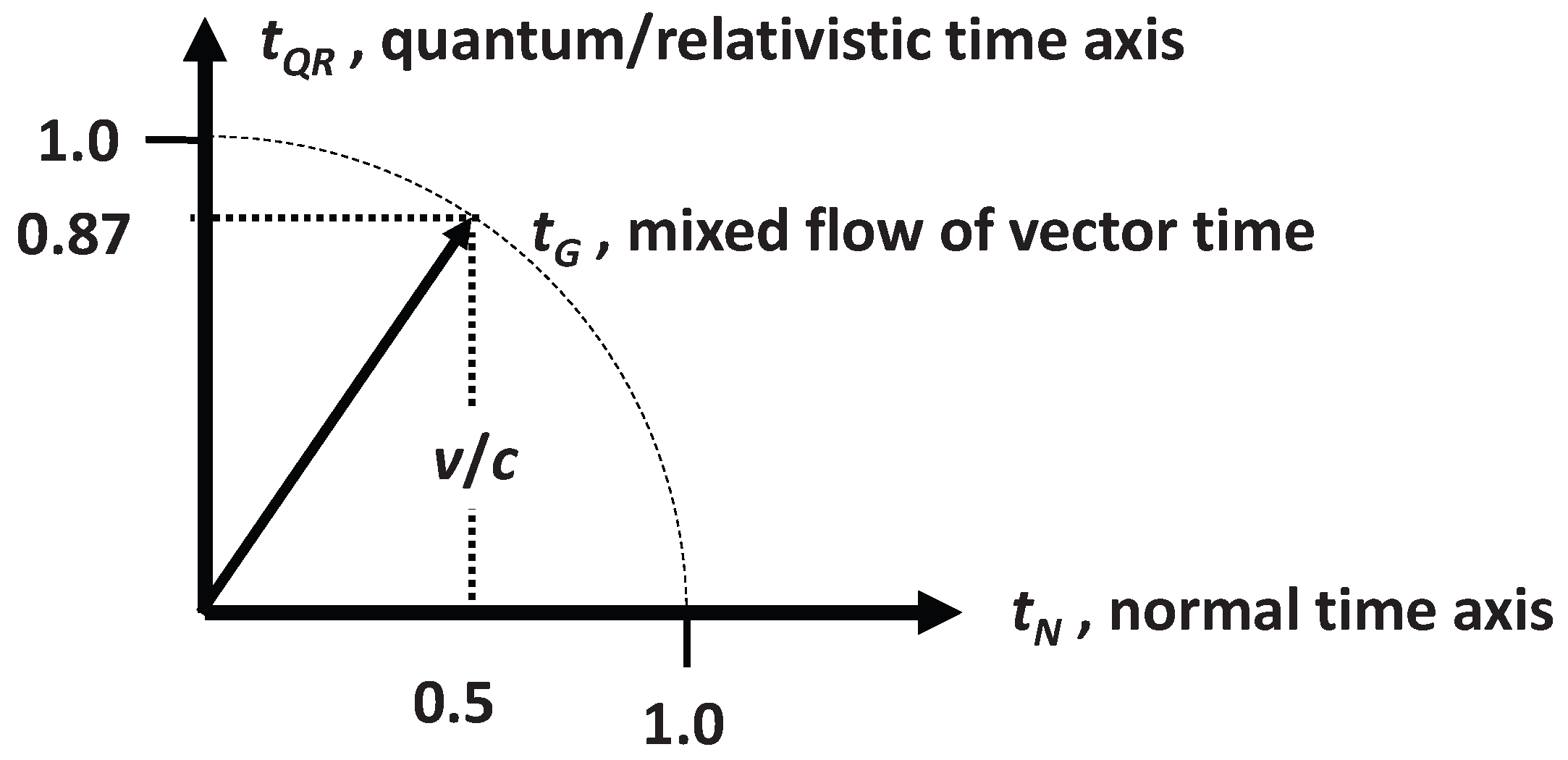
G-time provides a simple geometric derivation for the formula for time dilation. From Equation (1), as a system becomes more relativistic, the flow of time (nominally at a constant rate) will shift from being primarily in the normal direction to having a QR component, thus reducing the flow rate of time in the normal direction. For a velocity of 0, the QR part of the flow of time is also 0, and at c, the flow of time will be wholly in the QR direction. We make the simplest assumption that tQR/tG = |v|/c, consistent with both of those constraints. Figure 3 shows this as a rotation of the flow of time in the temporal plane. For the specific example in Figure 3, the stationary observer sees the flow of time in the normal direction for the moving system reduced to half its nominal value. In the general case, the flow rate of time in the normal direction for the moving system, as seen by the stationary observer, will be
by the Pythagorean Theorem. As seen by a stationary observer, with time flowing at a smaller rate in the measurable direction of normal time, it will take longer for a classical event to occur. In the conventional example of a moving (classical) clock, it will take longer for one tick of a moving clock than for a stationary clock because of the reduced rate of flow of time in the normal direction. That rate is the rate at which normal time can “fill up” one tick of the clock. The stationary observer has tN = tG since v = 0, so by Equation (10), the stationary observer will see the moving clock have
which is identical to the Equation (9) and the standard definition of time dilation.
tN/tG = (1 – v2/c2)1/2
t’ = t (1 – v2/c2)1/2 = t/γ
Assuming the speed of light is constant in all frames, length contraction falls trivially out of Equation (11). From the perspective of the stationary observer, the flow rate of normal time, hence an interval of normal time, is reduced in the moving frame, so for c to be constant in that frame, the differential of length must also be reduced by the same factor.
In special relativity, one obtains the result that two observers moving relative to each other see the other clock as moving more slowly than their own. Observer A sees observer B’s clock running more slowly, and would naively conclude that B should see A’s clock running faster than B’s clock, contradicting the actual result. The fact that both observers see the other’s clock as running slowly is a counterintuitive result of special relativity. A spatial analog of G-time provides an example to understand this. Consider two observers looking at different sides of a block. Both will see their side foreshortened as the block is rotated. The flow of time rotating from the normal to the QR direction intuitively explains how both observers can see the flow of normal time in the other’s clock as slowing down as a higher relative velocity increases the amount of rotation in the temporal plane.
7. General Relativity: Black Holes and Frame Dragging
7.1. Time and Information near a Black Hole
In general relativity, time and space are linked as a single 4-dimensional spacetime, which gets warped in the presence of mass. The gravitational field of a massive body also causes time dilation. For a black hole, that time dilation becomes so extreme that time stops flowing once the event horizon (the Schwarzschild radius) of the black hole is crossed. The amount of time dilation near a gravitational object is given by the same formula as that of time dilation in special relativity [46], with the velocity used in the formula now the escape velocity from that location around the massive object. It is conceptually difficult to see how an object can complete falling into a black hole if time stops flowing as the object approaches the event horizon. Also, if time is stopped within the event horizon, there is no mechanism for any dynamics to occur within the black hole, which is problematic itself and for conservation of information. G-time resolves both of these conceptual difficulties. As one approaches the black hole, time rotates into the QR direction, allowing dynamics to proceed that would not be detectable in normal time. Further, the flow of QR time inside the black hole allows quantum and relativistic physical processes to proceed, allowing dynamics of the black hole, such as due to infalling material.
In both classical (Newtonian) and quantum physics, one can take a final state and reverse the physics in time to obtain the initial state of the system. However, modeling of a black hole with general relativity shows that only a few properties of a black hole are recoverable. Stephen Hawking showed that a black hole can evaporate (now known as Hawking evaporation) and the only properties of the black hole that can be recovered are its mass, charge, and angular momentum. Since there are many ways to form a black hole with those properties, the information about the black hole’s initial state is lost. This is known as the black hole information paradox. While the major opinion is that information is preserved in a black hole [47], there are several theories about a mechanism for that information preservation, including some models in string theory [48], quantum loop gravity [49], and fuzzball black hole geometry [50]. With quantum time not included in the solutions to the equations of general relativity, G-time offers the potential to put one or more of these theories on a more physical basis. The flow of time inside the black hole is entirely in the QR direction. Hawking evaporation is due to quantum fluctuations near the black hole event horizon, and so will have time proceeding entirely in the quantum direction, which means quantum time offers a mechanism for information inside the black hole to be coupled to the outgoing particles due to entanglement between the infalling and outgoing particles of the quantum fluctuation. One can think of the quantum state inside the black hole interacting with the infalling particle to constrain its wave function, and thereby influencing the wave function of the outgoing particle through entanglement. The flow of time in the QR dimension allows the consideration of a wider variety of physical processes than currently allowed by those equations, and offers a simple mechanism for information preservation with only the assumption of a quantum flow of time. Expanding the mathematics of black hole physics is beyond the scope of this initial paper on G-time.
7.2. Frame-Dragging and the Coupling of Time and Space Rotations
Rotational frame-dragging is an effect predicted by general relativity whereby a clock revolving around a rotating massive object will be seen to have time flowing faster than a clock revolving in the opposite direction of the object’s rotation, as seen by a distant observer. The effect is due to coupling between space and time in the tensor representing spacetime in Einstein’s field equations, and has been experimentally verified [51]. The result is that physical rotation of a massive object causes time dilation, which was seen in Section 6 to be a result of time rotating between the tN and tQR directions as the relative velocity between two objects changes.
The rotation of the flow of time that results in the separation of matter and antimatter in our universe (see Section 5), and the coupling of time and space through the spacetime tensor in general relativity means that this model predicts the rotation of time from tQR to tN should result in physical rotation in space. This has been observed in the rotation asymmetry of early galaxies, where JWST observations showed the number of galaxies rotating clockwise was about 50% higher than the number rotating counterclockwise [52]. Since most models of the Big Bang model the universe to be isotropic, this feature of G-time enables a model of the Big Bang [16] that predicts that rotational asymmetry. Laboratory measurements of the transition to a coherent quantum state (tN rotating into tQR) show the rate of transition to a coherent state eventually depends solely on a rotational property of the system (the size of a quantum vortex) [36], and consequently shows the fundamental connection between the rotation of time flow and the rotational properties of the system.
8. Cosmic Inflation
The cosmic microwave background (CMB) is conventionally the farthest back in time we can readily observe, about 380,000 years after the Big Bang. Cosmic inflation occurred before protons formed at ~ 1 us after the Big Bang. During inflation, the universe expanded in size from ~10-26 m to ~1 m in 10-35 sec [53]. That requires an average velocity of 1035 m/s, or ~3x1026 c. If this tremendous superluminal expansion rate were the only problem with inflation, G-time offers a simple explanation – since inflation occurred when the universe was a hot plasma of relativistic quantum particles, time would have been flowing entirely in the QR direction. There would have been no time flow in the normal direction, so the predicted interval of normal time of 10-35 sec can be seen as a consequence of time flowing almost entirely in the QR direction. If the universe were to have expanded with an average speed of only 0.01 c, inflation would have ended at ~0.3 us of QR time, just before protons formed and nascent classical interactions would have caused time to start to flow in the normal direction. (The period of radiation-dominated expansion after inflation is characterized by highly relativistic particles [54], so the assumed expansion rate of 0.01 c here gives an upper estimate of how long inflation took in QR time.)
The theory of cosmic inflation was developed to explain three observed features of the universe: the homogeneity and isotropy of the observable universe, the flatness of spacetime, and the lack of observed magnetic monopoles. Without inflation, expansion under the forces of radiation pressure and gravity occurs too quickly for remote regions of the universe to equilibrate with each other, which would have resulted in a universe far less homogeneous and isotropic that what we observe. Inflation solves this by allowing the pre-inflation universe to have been small enough for those causal interactions to occur. With G-time, we see that those interactions would have occurred without inflation because those interactions would have been occurring with time flowing in the QR direction. Additionally, being in a quantum state, there would have been one wave function for the entire universe, which would have been essentially in a superfluid state, hence homogeneous and isotropic within the limits of quantum fluctuations, which correspond to the small fluctuations seen in the CMB. Superconducting wires show that a quantum state can exist for lengths much greater than the ~1m size of the universe at the end of inflation.
Inflation is used to explain the flatness of spacetime. Any initial curvature, would have been stretched by inflation to a level of flatness consistent with what is observed. Without inflation, a very highly tuned model of the early universe is needed to end up with the observed flatness. However, there are other theories that result in a flat spacetime without inflation, e.g., [55].
There are theoretical reasons to believe magnetic monopoles should exist [56,57]. Measurements failing to find a magnetic monopole have motivated modifications of models for cosmic inflation to accommodate those observations [58]. Inflation addresses the magnetic monopole problem by positing that space expanded so rapidly that there was not enough time to create a detectable number of monopoles before expansion of the universe cooled below the temperature needed to create them and subsequent expansion diluted the density of any that might have been made. A companion paper further exploring the implications of G-time for cosmology [16] explains the lack of observed magnetic monopoles as either being due to them not becoming entrained in the +tG time flow, or the energetics of when the flow of time split between matter and antimatter being unfavorable to magnetic monopole formation.
While inflation theory explains many aspects of the universe, it has several significant problems. Five major concerns are: (1) there is no accepted mechanism for inflation itself (nor has the underlying inflaton been detected), (2) inflation involves expansion velocities many times the speed of light, (3) it is not clear why inflation would turn on when it did, (4) there is no accepted mechanism for why inflation should turn off or turn off when it did, and (5) experiments have failed to detect the primordial gravity waves or polarized CMB predicted by inflation. A model of the Big Bang based on G-time and spacetime duality resolves these concerns. That model and a more complete treatment of cosmic inflation is provided in the companion paper focused on cosmology [16].
9. G-Time Relevance to CP Violations
Charge, parity, and time (CPT) symmetry is a fundamental property of the laws of physics [59,60]. The CPT Theorem says that antimatter (C, charge conjugation), when mirrored spatially (P, parity/chirality reversal) and with time reversed (T, time reversal), should behave the same as its matter counterpart. Under CPT symmetry, a violation of time symmetry would necessarily also appear as a violation of CP symmetry. Section 4 and Figure 2 show that time symmetry for antimatter can appear to be broken when one only considers time to flow in the normal direction. If an interaction starts with time flowing in the negative QR direction for antimatter, classical interactions rotate that time flow into the positive direction of the normal direction of time flow. Interactions where this takes place would appear to violate time symmetry and would be considered CP violations.
CP violation has been observed in kaons [61,62], B mesons [63,64], and other particles [65,66]. Explanation for these experimental results is an area of ongoing theoretical work. If the underlying mechanism for CP violations is the difference in the temporal behavior predicted here, measurements of CP violation should focus on the temporal aspects of decays. Recent measurements of the antiproton magnetic moment [67] show no asymmetry and represent a significant improvement in measurement capability, but would not be expected to show any difference since the measurement time (~50 s) is long compared to the “missed” time in tN (<< 1 us using the Big Bang as a guide). Measurement of top quarks are potentially a useful means to probe the expected coupling between spin and time flow in the QR direction. The top quark decays before it can hadronize, so its properties, such as spin, can be measured from its decay products. Top/anti-top quark decays are highly entangled and have been observed at the Large Hadron Collider (LHC) [68]. By observing the timing and spin of the decay products for the top and anti-top quarks, chirality imposed by the opposite rotation of tN into tQR might be observed.
Experiments at the Relativistic Heavy Ion Collider (RHIC) and the Japanese Proton Accelerator Research Complex (J-PARC) suggest the system spin induced by the rotation of time between the QR and normal directions may be responsible for at least some of those CP violations. Section 7.2 showed that the rotation of time between the QR and normal directions can impart spin on a system. RHIC showed that quarks only contribute a fraction of the protons spin, and while gluons contribute another fraction, there is still a non-negligible amount of the protons spin to be accounted for [69,70]. Since those measurements occur in normal time and the quark gluon plasma is both quantum and relativistic, the system will be in a mixed state where time is rotating between the normal and QR directions, with subsequent angular momentum (spin) impacts to the system. RHIC also observed that “bubbles” within their quark gluon plasma disobeyed certain symmetries that normally apply to the interactions of quarks and gluons [69], again pointing to symmetry breaking when there is a mixed flow of time between the normal and QR directions. The KOTO experiment at J-PARC was designed to look at the kaon decay KL → π0 νn̅ as a probe of CP violation. They found an excess of those kaon decays by about a factor of 40 [71]. One mechanism proposed is due to isospin violation. While isospin is a quantum property of quarks analogous to spin, it does not reflect angular momentum, per se. It is however treated in quantum mechanics similar to spin (hence the name), and so time flow rotation might have a similar impact on isospin as on spin. In any case, G-time is plausible candidate for the new physics required to explain the KOTO results. While beyond the scope here, including G-time in the calculations of the branching ratios leading to the KL → π0 νn̅ decay would be another test of the validity of G-time.
10. Concluding Remarks
The scope of this paper is to introduce the concept of generalized time to account for experimental and theoretical results suggesting that there is more to the flow of time than is measured by a classical clock. We find that the concept of G-time has explanatory power in quantum mechanics, particle physics, relativity, and cosmology, suggesting that the concept warrants further theoretical and experimental consideration. We have noted where current experiments can be extended to test predictions from the G-time perspective. The companion paper on the cosmological implications of G-time and space-time duality [16] provides further support for the value of the concept, quantitatively explaining a time-dependent dark energy density and age-bias observed in type Ia supernovae, qualitatively explaining a number of otherwise puzzling features of the cosmos, and making testable predictions.
While the results here are largely conceptual, so are the questions they answer. The G-time perspective in quantum mechanics provides an explanation for entanglement without violating causality since information can travel at less than the speed of light when the flow of time in the QR direction is considered. Entanglement measurements can quantitatively probe the validity of G-time. The “collapse” of the wave function is seen to be artifact of ignoring time flow in the QR direction, and hence proceeds in a manner which allows preservation of the information in the wave function before collapse. The black hole information paradox is also seen as an artifact of not accounting for time flow in the QR direction. The asymmetry in the rotation direction of early galaxies is predicted by this model and a significant challenge for other models of the early universe. At the opposite physical scale, laboratory measurements also show the direct connection between the rotation of time flow during the transition to a coherent quantum state and the rotation properties of a system.
CPT invariance applied to antimatter shows that antimatter has a time flow in G-time in the opposite direction of that for matter, but that parity symmetry means that the G-time flows for both matter and antimatter end up in the positive normal direction when classical interactions rotate the time flow from the QR direction to the normal direction. This explains why antimatter moving in the negative time direction in particle physics calculations and Feynman diagrams is consistent with the observation that antimatter is moving forward in the normal time direction. G-time explains that antimatter was created at the Big Bang, but it exists in a time flow distinct from that of our world of matter. Antimatter in particle physics is measured in an environment of classical interactions and an ongoing flow of normal time, so there is no time split for antimatter as there was at the Big Bang when time started and matter and antimatter were swept out in time flows in opposite directions.
Generalized time provides a simple geometric interpretation of the equations for time dilation and length contraction in special relativity. The standard derivation, going back to Einstein, involves the human endeavor of using a clock to measure the flow of time as determined by observers in two different reference frames. The explanation using G-time comes from the basic nature of time itself. Generalized time provides one way to resolve the black hole information paradox and provides a way for dynamics to happen inside a black hole despite normal time being “frozen” once the Schwarzschild radius is crossed.
Generalized time provides a physical basis for the concept of cosmic inflation, explaining the same resolution of cosmological features without having to invoke superluminal motion, a mechanism to turn inflation on, or a mechanism to turn inflation off.
The companion paper on the cosmological implications of the combined concepts of spacetime duality and G-time predicts many of the observed features of the universe that are otherwise puzzling. Many of the properties of dark matter are explained: e.g., why there is five times as much dark matter as matter, and why there is both compact dark matter and dark matter halos in galaxies. The model there predicts the amount of dark matter in halos should be 50% greater than the compact amount in galaxy centers. The many chiral features of the cosmos are explained, such as the asymmetry in the rotation direction of galaxies, and why that asymmetry is decreasing over time.
Funding
This research received no external funding.
Data Availability Statement
This research is a theoretical study of the applicability of a new model for time to conceptual problems in a variety of fields. No new data were created or analyzed in this study. Data sharing is not applicable to this article.
Acknowledgments
The author would like to thank Jim Conger for review of the concepts here and suggestions as to areas of potential relevance.
Conflicts of Interest
The author declares no conflicts of interest.
References
- Ford, K.W.; Wheeler, J.A. Geons, Black Holes and Quantum Foam: A Life in Physics; Norton and Company: New York, New York, USA, 2000. [Google Scholar]
- DeWitt, B.S. Quantum Theory of Gravity. I. The Canonical Theory. Phys. Rev. 1967, 160, 1113–1148. [Google Scholar] [CrossRef]
- Hartle, J.B.; Hawking, S.W. Wave function of the Universe. Phys. Rev. D 1983, 28, 2960–2975. [Google Scholar] [CrossRef]
- Anderson, E. Problem of time in quantum gravity. Ann. Der Phys. 2012, 524, 757–786. [Google Scholar] [CrossRef]
- Page, D.N.; Wootters, W.K. Evolution without evolution: Dynamics described by stationary observables. Phys. Rev. D 1983, 27, 2885–2892. [Google Scholar] [CrossRef]
- Wootters, W.K. “Time” replaced by quantum correlations. Int. J. Theor. Phys. 1984, 23, 701. [Google Scholar] [CrossRef]
- Moreva, E.; et al. Time from quantum entanglement: an experimental illustration. Phys. Rev. A 2014, 89, 052122. [Google Scholar] [CrossRef]
- Moreva, E.; et al. Quantum Time: experimental multi-time correlations. Phys. Rev. D 2017, 96, 102005. [Google Scholar] [CrossRef]
- Hartman, T. Lectures on quantum gravity and black holes, Course notes for Cornell Physics 7661, Spring 2015. Available online: http://www.hartmanhep.net/topics2015/gravity-lectures.pdf.
- Hertog, T. On the Origin of Time: Stephen Hawking’s Final Theory; Bantam Books (Penguin Random House): New York, New York, USA, 2023; e.g., Figure 23b. [Google Scholar]
- Hawking, S.W. The Universe in a Nutshell; Bantam Books (Penguin Random House): New York, New York, USA, 2001. [Google Scholar]
- Penrose, R. The Road to Reality; Jonathan Cape (Penguin Random House UK): London, UK, 2004. [Google Scholar]
- Giovannelli, I.L.; Anlage, S.M. Physical Interpretation of Imaginary Time Delay. Phys. Rev. Lett. 2025, 135, 043801. [Google Scholar] [CrossRef]
- Tegmark, M. On the dimensionality of spacetime. Class. Quantum Gravity 1997, 14, L69–L75. [Google Scholar] [CrossRef]
- Pardo, K.; et al. Limits on the number of spacetime dimensions from GW170817. JCAP 2018, 2018, 048. [Google Scholar] [CrossRef]
- Henderson, J. The Nature of Dark Matter and Cosmological Structure Derived from Generalized Time and Spacetime Duality. Symmetry, 2026; submitted. [Google Scholar] [CrossRef]
- Freedman, S. J.; Clauser, J. F. Experimental test of local hidden-variable theories”. Phys. Rev. Lett. 1972, 28, 938–941. [Google Scholar] [CrossRef]
- Giustina, M.; et al. Significant-Loophole-Free Test of Bell’s Theorem with Entangled Photons. Phys. Rev. Lett. 2015, 115, 250401. [Google Scholar] [CrossRef] [PubMed]
- Aspect, A. Closing the Door on Einstein and Bohr’s Quantum Debate. Physics 2015, 8, 123. [Google Scholar] [CrossRef]
- Born, M. (Ed.) The Born-Einstein Letters; MacMillan: London, UK, 1971; p. 158. [Google Scholar]
- Bell, J.S. On the Einstein Podolsky Rosen Paradox. Phys. Phys. Физика 1964, 1, 195–200. [Google Scholar] [CrossRef]
- Cruz-Rodriques, L.; et al. Quantum phenomena in attosecond science. Nat. Rev. Phys. 2024, 6, 691–704. [Google Scholar] [CrossRef]
- Jiang, W.-C.; et al. Time Delays as Attosecond Probe of Interelectronic Coherence and Entanglement. Phys. Rev. Lett. 2024, 133, 163201. [Google Scholar] [CrossRef]
- Griffiths, D.J.; Schroeter, D.F. Introduction to quantum mechanics, 3rd ed.; Cambridge University Press: Cambridge, UK, 2018. [Google Scholar]
- Messiah, A. Quantum Mechanics; North Holland: New York, New York, USA, 1966. [Google Scholar]
- Susskind, L.; Friedman, A. Quantum mechanics: the theoretical minimum; [what you need to know to start doing physics]; Basic Books: New York, New York, USA, 2014. [Google Scholar]
- Schlosshauer, M. Decoherence, the measurement problem, and interpretations of quantum mechanics. Rev. Mod. Phys. 2005, 76, 1267–1305. [Google Scholar] [CrossRef]
- Zurek, W.H. Decoherence, einselection, and the quantum origins of the classical. Rev. Mod. Phys. 2003, 75, 715–775. [Google Scholar] [CrossRef]
- Fuchs, C.A.; Peres, A. Quantum Theory Needs No ‘Interpretation’. Phys. Today 2000, 53, 70–71. [Google Scholar] [CrossRef]
- Bohm, D. A Suggested Interpretation of the Quantum Theory in Terms of ‘Hidden Variables’ I. Phys. Rev. 1952, 85, 166. [Google Scholar] [CrossRef]
- Bohm, D. A Suggested Interpretation of the Quantum Theory in Terms of ‘Hidden Variables’ II. Phys. Rev. 1952, 85, 180. [Google Scholar] [CrossRef]
- Bedingham, D.J.; Maroney, O.J.E. Time reversal symmetry and collapse models. Found. Phys. 2017, 47, 670–696. [Google Scholar] [CrossRef]
- Bedingham, D.J.; Maroney, O.J.E. Time symmetry in wave-function collapse. Phys. Rev. A 2017, 95, 042103. [Google Scholar] [CrossRef]
- Bassi, A.; Lochan, K.; Satin, S.; Singh, T.P.; Ulbricht, H. Models of wave-function collapse, underlying theories, and experimental tests. Rev. Mod. Phys. 2013, 85, 471–527. [Google Scholar] [CrossRef]
- Stamatescu, I.O. Wave Function Collapse. In Compendium of Quantum Physics; Greenberger, D., Hentschel, K., Weinert, F., Eds.; Springer: Berlin, Heidelberg, Germany, 2009; pp. 813–822. [Google Scholar] [CrossRef]
- Martirosyan, G.; et al. A universal speed limit for spreading of coherence. Nature 2025, 647, 608–612. [Google Scholar] [CrossRef]
- Stueckelberg, E.C.G. La signification du temps propre en méchanique ondulatoire (Significance of proper time in wave mechanics). Helv. Phys. Acta 1941, 14, 322. [Google Scholar]
- Stueckelberg, E.C.G. Remarque à propos de la création de paires de particules en théorie de relativité (Remarks on the creation of pairs of particles in the theory of relativity). Helv. Phys. Acta 1941, 14, 588. [Google Scholar]
- Feynman, R.P. The Theory of Positrons. Phys. Rev. 1949, 76, 749. [Google Scholar] [CrossRef]
- Canetti, L.; et al. Matter and antimatter in the universe. New J. Phys. 2012, 14, 095012. [Google Scholar] [CrossRef]
- Sakharov, A. D. Collected Scientific Works; Marcel Dekker: New York, New York, USA, 1982. [Google Scholar]
- Chaichian, M.M.; Gogberashvili, M.; Mnatsakanova, M.N.; et al. CPT violation, mirror world and implications for baryon asymmetry. Eur. Phys. J. C 2026, 86, 425. [Google Scholar] [CrossRef]
- Einstein, A. Zur Elektrodynamik bewegter Körper. Annalen der Physik 1905, 17, 891. (English translation: Einstein, A. On the Electrodynamics of Moving Bodies. In The Principle of Relativity; Einstein, A., et al., authors; Perrett, W.; Jeffery, G.B., Translators; Methuen and Company, Ltd., London, UK, 1923. [Google Scholar]
- Susskind, L.; Friedman, A. Special Relativity and Classical Field Theory; Basic Books: New York, New York, USA, 2017. [Google Scholar]
- Einstein, A. Relativity: The Special and the General Theory; Fingerprint Classics: New Delhi, India, 2024; Originally published in German in 1916, and published in English in 1920. [Google Scholar]
- Schwartz, H.M., Einstein’s comprehensive 1907 essay on relativity, part I. American Journal of Physics 1977, 45, 512–517. Part II in American Journal of Physics 1977, 45, 811–817. Part III in American Journal of Physics 1977, 45, 899–902.
- Afshordi, N.; et al. Big Mysteries Survey: Physicists’ Views on Cosmology, Black Holes, Quantum Mechanics, and Quantum Gravity. Physics Magazine, 2026; pre-print. Available online: https://arxiv.org/pdf/2605.11058.
- Almheiri, A.; Hartman, T.; Maldacena, J.; Shaghoulian, E.; Tajdini, A. Replica Wormholes and the Entropy of Hawking Radiation. J. High Energy Phys. 2020, 2020, 13. [Google Scholar] [CrossRef]
- Alejandro, P. Black holes in loop quantum gravity. Rep. Prog. Phys. 2017, 80, 126901. [Google Scholar] [CrossRef] [PubMed]
- Mathur, S.D. The information paradox: a pedagogical introduction. Class. Quantum Gravity 2009, 26, 224001. [Google Scholar] [CrossRef]
- Everitt, C.W.F.; et al. Gravity Probe B: Final Results of a Space Experiment to Test General Relativity. Phys. Rev. Lett. 2011, 106, 221101. [Google Scholar] [CrossRef]
- Shamir, L. The distribution of galaxy rotation in JWST Advanced Deep Extragalactic Survey. MNRAS 2025, 538, 76–91. [Google Scholar] [CrossRef]
- Guth, A.H.; Kaiser, D.I. Inflationary Cosmology: Exploring the Universe from the Smallest to the Largest Scales. Science 2005, 307, 884–890. [Google Scholar] [CrossRef]
- de Salas, P.F.; et al. Bounds on very low reheating scenarios after Planck. Phys. Rev. D 2015, 92, 123534. [Google Scholar] [CrossRef]
- Henderson, J. Scale Corrections to the LCDM Model to Explain a Time-Dependent Dark Energy Density, and the Hubble and S8 Tensions. Appl. Phys. Res. 2026, submitted. [Google Scholar] [CrossRef]
- Wen, X.-G.; Witten, E. Electric and magnetic charges in superstring models. Nucl. Phys. B 1985, 261, 651–677. [Google Scholar] [CrossRef]
- Coleman, S. The Magnetic Monopole 50 years Later. Aspects of Symmetry: Selected Erice Lectures; Coleman, S., Ed.; Cambridge University Press: Cambridge, UK, 1988. [Google Scholar]
- Preskill, J. Magnetic Monopoles. Annu. Rev. Nucl. Part. Sci. 1984, 34, 461–530. [Google Scholar] [CrossRef]
- Lüders, G. On the Equivalence of Invariance under Time Reversal and under Particle-Antiparticle Conjugation for Relativistic Field Theories. K. Dan. Vidensk. Selsk. Mat.-Fys. Meddelelser 1954, 28, 1–17. [Google Scholar]
- Pauli, W. Niels Bohr and the Development of Physics; McGraw-Hill: New York, New York, USA, 1955. [Google Scholar]
- Alavi-Harati, A.; et al. (KTeV Collaboration). Observation of Direct CP Violation in KS,L→ππ Decays. Phys. Rev. Lett. 1999, 83, 22–27. [Google Scholar] [CrossRef]
- Fanti, V.; et al. (NA48 Collaboration). A new measurement of direct CP violation in two pion decays of the neutral kaon. Phys. Lett. B. 1999, 465, 335–348. [Google Scholar] [CrossRef]
- Aubert, B.; et al. Measurement of CP-Violating Asymmetries in B0 Decays to CP Eigenstates. Phys. Rev. Lett. 2001, 86, 2515–22. [Google Scholar] [CrossRef]
- Abe, K.; et al. “Observation of Large CP Violation in the Neutral B Meson System”. Phys. Rev. Lett. 2001, 87, 091802. [Google Scholar] [CrossRef]
- Aaij, R.; et al. (LHCb Collaboration). Measurement of CP asymmetry in D0→K+K− and D0→π+π− decays. J. High Energ. Phys. 2014, 2014, 41. [Google Scholar] [CrossRef]
- Abe, K.; Akutsu, R.; et al. (T2K Collaboration). Constraint on the matter-antimatter symmetry-violating phase in neutrino oscillations. Nature 2020, 580, 339–344. [Google Scholar] [CrossRef]
- Latacz, B.M.; et al. Coherent spectroscopy with a single antiproton spin. Nature 2025, 644, 64–68. [Google Scholar] [CrossRef]
- White, C.D.; White, M.J. Magic states of top quarks. Phys. Rev. D 2024, 110, 116016. [Google Scholar] [CrossRef]
- Exploring Matter at the Dawn of Time. Brookhaven National Laboratory online publication. Available online: https://www.bnl.gov/newsroom/factsheets/files/pdf/rhic-exploring-matter-at-the-dawn-of-time.pdf (accessed on 12 May 2026).
- Relativistic Heavy Ion Collider – RHIC Science. Available online: https://www.bnl.gov/rhic/new-physics.php (accessed on 12 May 2026).
- Kitihara, T.; et al. New Physics Implications of Recent Search for KL → π0νν¯ at KOTO. Phys. Rev. Lett. 2020, 124, 071801. [Google Scholar] [CrossRef] [PubMed]
Figure 1.
During preparation of the quantum system (left horizontal line) time flows in the normal direction while the non-quantum preparation occurs. Once the quantum system is set in motion, time flows in the quantum direction (vertical bar in middle) with little or no flow of time in the normal direction. When a measurement is made on the system (upper inflection point), the system ceases to have a quantum nature and time again flows in the normal direction (upper horizontal line). The same process occurs for measurements on an entangled system. In both cases there is a significant flow of time in the quantum direction. In a measurement, this means the “collapse” of the wave function is not a sudden event, and in entanglement this means there is sufficient time to transmit information from the location of the initial measurement to the other half of the quantum system without exceeding the speed of light for the information transfer.
Figure 1.
During preparation of the quantum system (left horizontal line) time flows in the normal direction while the non-quantum preparation occurs. Once the quantum system is set in motion, time flows in the quantum direction (vertical bar in middle) with little or no flow of time in the normal direction. When a measurement is made on the system (upper inflection point), the system ceases to have a quantum nature and time again flows in the normal direction (upper horizontal line). The same process occurs for measurements on an entangled system. In both cases there is a significant flow of time in the quantum direction. In a measurement, this means the “collapse” of the wave function is not a sudden event, and in entanglement this means there is sufficient time to transmit information from the location of the initial measurement to the other half of the quantum system without exceeding the speed of light for the information transfer.
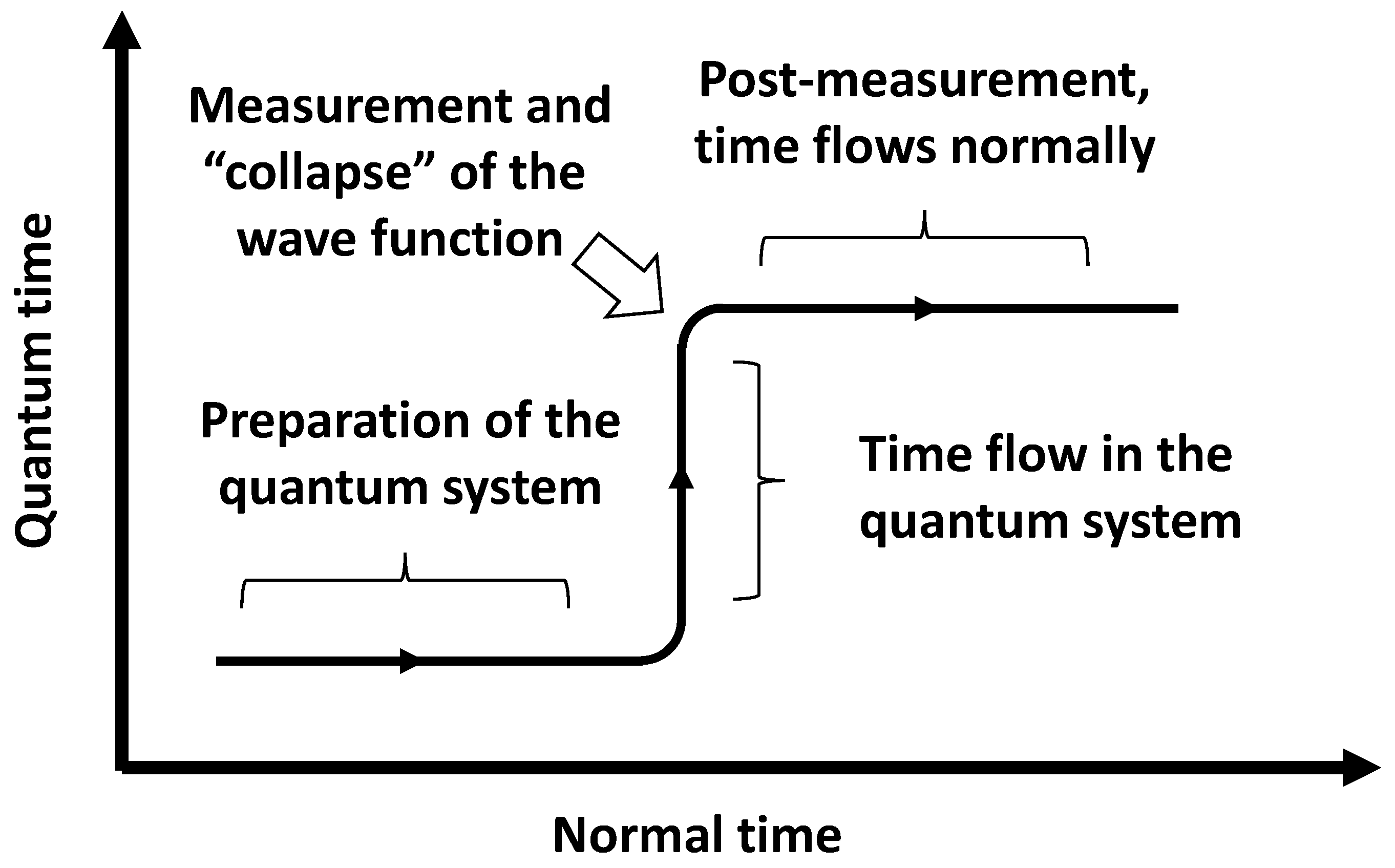
Figure 2.
The path in G-time for the time flow of the matter (upper path) and antimatter (lower path) particles created from a quantum fluctuation. Initially, the interactions are totally quantum and both time flows proceed in opposite directions in the quantum direction (vertical axis), the time flow for the antimatter particle being in the negative quantum direction because of CPT symmetry. As the system interacts with the classical world, the flow of time becomes classical and rotates into the normal direction. Assuming the antiparticle obeys CPT symmetry, its flow of time will rotate in the opposite direction of the matter particle, as shown in the lower time flow curve. This results in both the particle and the antiparticle eventually having a time flow in the positive normal direction, despite the fact that the flow of time for the antiparticle is initially in the opposite direction of the matter particle.
Figure 2.
The path in G-time for the time flow of the matter (upper path) and antimatter (lower path) particles created from a quantum fluctuation. Initially, the interactions are totally quantum and both time flows proceed in opposite directions in the quantum direction (vertical axis), the time flow for the antimatter particle being in the negative quantum direction because of CPT symmetry. As the system interacts with the classical world, the flow of time becomes classical and rotates into the normal direction. Assuming the antiparticle obeys CPT symmetry, its flow of time will rotate in the opposite direction of the matter particle, as shown in the lower time flow curve. This results in both the particle and the antiparticle eventually having a time flow in the positive normal direction, despite the fact that the flow of time for the antiparticle is initially in the opposite direction of the matter particle.
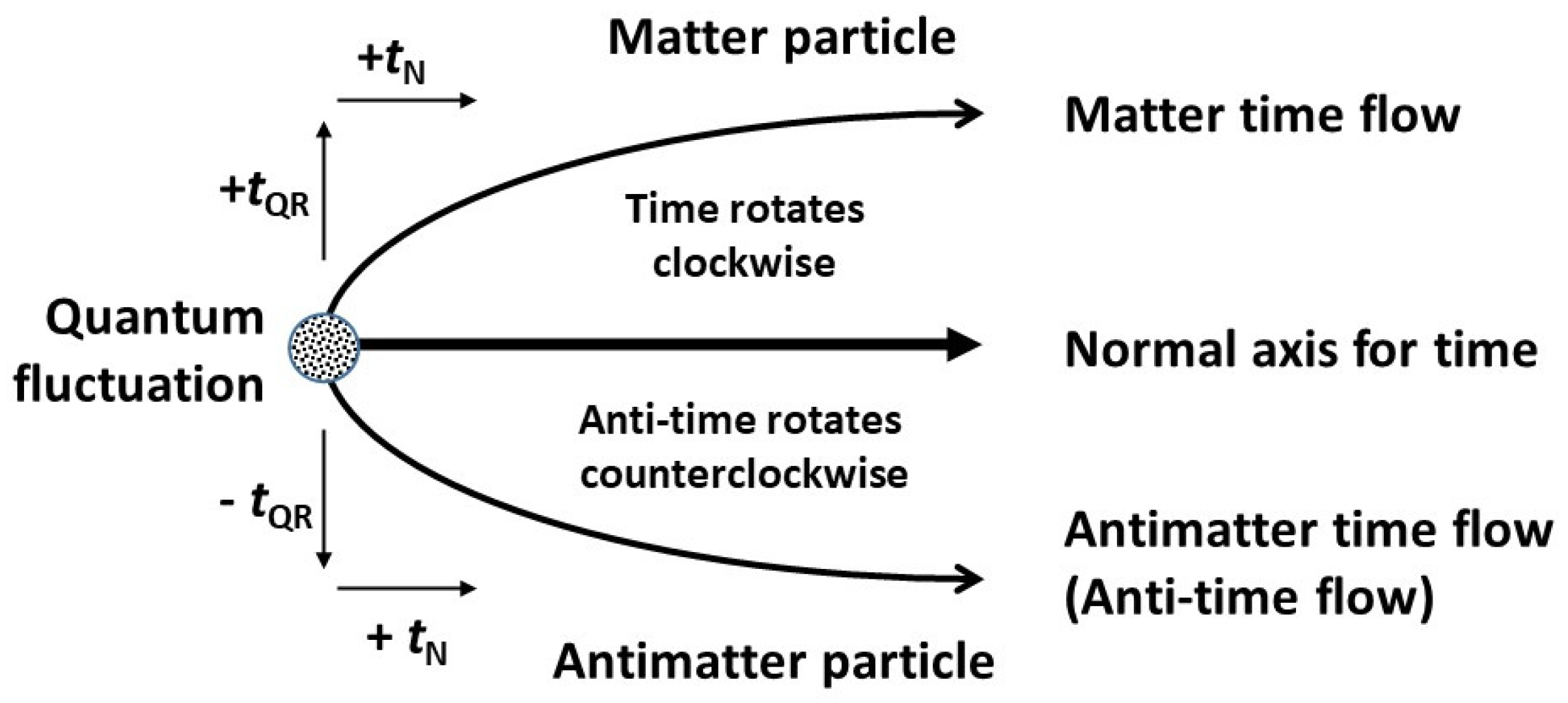
Figure 3.
Time flow diagram for a system moving at relativistic speed relative to a stationary observer. The flow of time is shown in the temporal plane, with the QR part of the flow of time proportional to the moving system velocity v, divided by the speed of light c. As v increases, the direction of the flow of time rotates towards the QR direction. The rate of flow of time in the normal direction decreases by a factor of (1 – v2/c2)1/2 compared to flowing entirely in the normal direction.
Figure 3.
Time flow diagram for a system moving at relativistic speed relative to a stationary observer. The flow of time is shown in the temporal plane, with the QR part of the flow of time proportional to the moving system velocity v, divided by the speed of light c. As v increases, the direction of the flow of time rotates towards the QR direction. The rate of flow of time in the normal direction decreases by a factor of (1 – v2/c2)1/2 compared to flowing entirely in the normal direction.
Disclaimer/Publisher’s Note: The statements, opinions and data contained in all publications are solely those of the individual author(s) and contributor(s) and not of MDPI and/or the editor(s). MDPI and/or the editor(s) disclaim responsibility for any injury to people or property resulting from any ideas, methods, instructions or products referred to in the content. |
© 2026 by the authors. Licensee MDPI, Basel, Switzerland. This article is an open access article distributed under the terms and conditions of the Creative Commons Attribution (CC BY) license (http://creativecommons.org/licenses/by/4.0/).
Copyright: This open access article is published under a Creative Commons CC BY 4.0 license, which permit the free download, distribution, and reuse, provided that the author and preprint are cited in any reuse.


