

Submitted:
24 May 2026
Posted:
25 May 2026
You are already at the latest version
Abstract
Background: Prostaglandin E2 (PGE2) is a key lipid mediator involved in inflammation and bone homeostasis. Its systemic production is reliably reflected by 24-hour urinary excretion of PGE2 (U-PGE2) and its major metabolite (U-PGEM). However, the physiological association between systemic PGE2 production, calcium-phosphorus homeostasis and bone turnover markers remains unclear. This study aims to elucidate these relationships in a healthy adult population. Methods: In this multicenter, cross-sectional study, 737 healthy adults underwent standardized 24-hour urine collection. Multivariable linear regression was used to assess independent associations with bone metabolism markers. Restricted cubic spline models were further employed to examine nonlinear relationships. Results: The median 24-hour U-PGE2 and U-PGEM excretion levels were 133.87 and 246.76 pg/mmol creatinine, respectively, with no significant sex differences (both P>0.05). Multivariable regression analyses revealed that both 24-hour U-PGE2 and U-PGEM were independently and positively associated with advancing age. Notably, both 24-hour U-PGE2 and U-PGEM maintained a significant inverse association with serum calcium (Overall P<0.05). Restricted cubic spline analyses further demonstrated a significant non-linear association between both 24-hour U-PGE2 and U-PGEM and total procollagen type 1 N-propeptide (P1NP; both Overall P<0.05). This relationship was characterized by a steep decline in U-PGE2 and U-PGEM excretion at lower P1NP concentrations (≤57ng/mL), which subsequently plateaued at higher concentrations (Overall P<0.05). Additionally, U-PGEM exhibited a significant inverse linear association with intact parathyroid hormone (PTH; Overall P<0.05). Conclusions: This study provided valuable insights for clinical determinants of 24-hour U-PGE2 and U-PGEM in healthy adults and their independent associations with calcium-phosphorus homeostasis and bone turnover markers.
Keywords:
24-hour urinary prostaglandin E2 excretion
; 24-hour urinary PGE metabolite excretion
; clinical determinants
; bone metabolism markers
; multicenter cross-sectional study
1. Introduction
Prostaglandin E2 (PGE2), a potent lipid mediator derived from arachidonic acid, plays multifaceted roles in human physiology including the regulation of inflammation, angiogenesis, tissue repair, immune surveillance and bone homeostasis, through G protein-coupled receptor subtypes (EP1-EP4) [1,2,3]. The biological effects of PGE2 are largely determined by receptor types on target cells and the local PGE2 concentration [4,5]. For instance, binding to the EP1 receptor, PGE2 mediates pain perception and smooth muscle contraction, while binding to the EP3 receptor, it plays important role in fever and vasoconstriction [6,7,8]. The PGE2-EP2 axis is involved in age-related inflammation and cognitive decline, while the PGE2-EP4 axis regulates bone formation and promotes muscle stem cells repair [3,9,10]. Moreover, PGE2 exhibits concentration-dependent characteristics, ranging from homeostatic maintenance at low levels, to immunomodulation at moderate levels, and eventually to tissue repair or pathological promotion at high levels [11,12,13].
In addition to physiological roles, abnormally elevated PGE2 levels are closely associated with various diseases including osteoarthritis, tumors, atherosclerosis, inflammatory bowel disease, and autoimmune disorders. In ankle osteoarthritis, aberrant release of PGE2 disrupts the bone-brain signal balance, driving disordered subchondral bone remodeling and enhancing pain perception [14,15]. In tumor, high levels of intratumoral PGE2 suppress antitumor immunity and contribute to tumor progression [16]. In cardiovascular diseases, abnormal increases in PGE2 are strongly associated with the exacerbation of hypertension, atherosclerosis, and heart disease [17,18]. Besides above common diseases, elevated PGE2 levels can also lead to rare diseases. Our previous studies on primary hypertrophic osteoarthropathy (PHO) revealed that loss-of-function mutations in SLCO2A1 or HPGD genes impair PGE2 transport or degradation, leading to systemic PGE2 accumulation and manifestations such as digital clubbing, joint swelling, and accelerated bone turnover [19,20,21,22]. Targeting the elevated PGE2 with cyclooxygenase-2 (COX-2) inhibitors is effective in PHO [21,22,23]. Given its pathological significance, PGE2 is a promising biomarker for monitoring disease activity and treatment response. For instance, analyzing the degree of PGE2 elevation can assist in assessing both the disease burden of PHO and the efficacy of COX-2 inhibitor therapy [21,22,23]. Additionally, since other commonly used non-steroidal anti-inflammatory drugs (NSAIDs) exert analgesic effects by inhibiting PGE2 synthesis, tracking PGE2 levels can help optimize their dosing and confirm efficacy.
Direct measurement of blood PGE2 is challenging due to its short plasma half-life [24]. Instead, PGE2 and its metabolite (PGE metabolite, PGEM) are rapidly excreted in urine, making 24-hour urinary PGE2 (U-PGE2) and PGEM (U-PGEM) stable, non-invasive markers of systemic PGE2 production [25]. Most existing studies have used spot urine samples and focused on patient cohorts (e.g., cancer, renal diseases), while large-scale data on the clinical determinants of 24-hour U-PGE2 and U-PGEM in healthy adults are lacking [26,27]. Furthermore, despite the well-recognized role of PGE2 in bone metabolism, the relationships between 24-hour U-PGE2, U-PGEM and key bone metabolism markers, including serum calcium, phosphorus, urinary calcium excretion, parathyroid hormone (PTH), 25-hydroxyvitamin D [25(OH)D], and bone turnover markers (BTMs), remain unexplored in the general population.
Therefore, this multicenter cross-sectional study was designed to identify the clinical determinants (e.g., age, sex, BMI, lifestyle factor) of 24-hour U-PGE2 and U-PGEM in healthy adults, and to investigate their independent associations with calcium-phosphorus homeostasis and bone turnover markers.
2. Materials and Methods
2.1. Study Population
This multi-center, cross-sectional study was registered with CHICTR.ORG.CN (ChiCTR2200056577), approved by the Ethics Committee of the Shanghai Sixth People’s Hospital (approval number: 2021-233) and conducted in accordance with the Declaration of Helsinki. Written informed was obtained from all participants prior to enrollment. All participants (aged > 18 years ) were recruited from 9 tertiary care hospitals in China during March 2022 to March 2023. Subjects with the following conditions were excluded: (1) serious diseases affecting the pulmonary, cardiovascular, gastrointestinal, hematopoietic, renal or nervous systems; (2) conditions known to affect bone metabolism, such as osteogenesis imperfecta, Paget’s disease of bone, diabetes mellitus, primary hyperparathyroidism, rheumatoid arthritis or malignant tumors; (3) concurrent use of medications known to influence urinary PGE2 levels or bone metabolism (e.g., cyclooxygenase inhibitors, diuretics, synthetic steroid hormones, epinephrine or anticonvulsants); or (4) pregnancy or lactation.
2.2. Clinical Data and Sample Collections
Detailed clinical information of all participants was collected and documented, including demographic characteristics (gender, age, ethnicity), anthropometric parameters (height, weight), and medical history (past disease history, medication use history). Blood samples were collected from all participants fasted for 8 to 12 hours in the morning from 7:00 a.m. to 10:00 a.m., and the separated serum aliquots were stored at −80°C until being assayed. 24-hour urine samples were collected strictly following the instructions: the initial urination at 8:00 a.m. was discarded, marking the start of the 24-hour collection period, and then all urine thereafter was collected into a 5-L clean medical container until 8:00 a.m. the next day. The collected urine was stored in a cool place or refrigerated at 2–8°C to avoid direct sunlight, with preservative (3–5 g of benzoic acid) added if necessary. After collection, the urine sample was thoroughly mixed using the stirring bar, aliquoted into the 10-mL storage tubes with the dropper, and brought to the clinic and stored at −80°C until being assayed. Seasonality of urine sample collection was defined as spring (March to May), summer (June to August), autumn (September to November) and winter (December to February). Urine collection was postponed if participants had fever, urinary tract infection or menstruation.
2.3. Laboratory Assays
All blood specimens were sent to the central laboratory for biochemical evaluation. Routine liver and renal function, including alkaline phosphatase (ALP), alanine aminotransferase (ALT), creatinine (Cr), uric acid (UA), and urea nitrogen (BUN), electrolyte levels including serum calcium and phosphorus, and urinary calcium (UCaE) were measured by spectrophotometry and ion selective electrode method, respectively (Roche Diagnostics, Basel, Switzerland). BTMs including β-isomerized C-terminal telopeptide of type I collagen (β-CTX-I) and total procollagen type 1 N-propeptide (P1NP), and intact parathyroid hormone (PTH), 25-hydroxyvitamin D [25(OH)D] were tested using electrochemiluminescence immunoassay (Roche Diagnostics, Basel, Switzerland). The 24-hour U-PGE2 and U-PGEM levels were detected using competitive enzyme-linked immunosorbent assays (ELISA; Cayman Chemical, Ann Arbor, MI, USA) following protocols described in our previous study (26). The intra-assay coefficients of variation (CVs) for U-PGE2 and U-PGEM were 4.6% and 5.9%, respectively, while the inter-assay CVs for U-PGE2 and U-PGEM were 4.7% and 8.3%, respectively. To account for variations in urine concentration, U-PGE2 and U-PGEM levels were normalized to 24-hour urinary creatinine (U-Cr) concentrations, which were quantified using the creatinine oxidase method (Roche Diagnostics, Basel, Switzerland).
2.4. Dietary Intake
Dietary calcium intake was assessed using a 1-week food frequency questionnaire [28]. Participants were required to complete a comprehensive dietary questionnaire, detailing their food intake, portion sizes, and frequency of consumption on both a daily and weekly basis. To minimize significant fluctuations in 24-hour UCaE due to dietary changes, participants were instructed to maintain detailed dietary logs on the day of baseline urine collection and adhere to their baseline diet as closely as possible during subsequent urine collection periods. The daily calcium intake per person was calculated with reference to the Chinese Food Composition Table [28].
2.5. Statistical Analysis
Normality was tested using the Kolmogorov-Smirnov test. Normally distributed variables were expressed as the mean±SD, while the skewed distributed variables were expressed as median (25th and 75th percentiles). Violin plots were generated to visualize the distribution of 24-hour U-PGE2 and U-PGEM across different age groups. The Kruskal-Wallis H test was employed to compare these distributions, followed by post hoc pairwise comparisons using Bonferroni correction to account for multiple testing. Given their skewed distributions, 24-hour U-PGE2 and U-PGEM concentrations were log10-transformed prior to regression analyses. Multivariable linear regression was used to reveal the relationships between covariates and 24-hour U-PGE2 and U-PGEM. The analysis was conducted using an unadjusted model and a model that adjusted with age, sex, BMI, smoking, alcohol consumption, diet calcium, diabetes, hypertension, season, calcium and vitamin D supplementation. The dose-response relationship of serum calcium, serum phosphorus, UCaE, β-CTX-I, P1NP, 25(OH)D, PTH with 24-hour U-PGE2 and U-PGEM were analyzed using restrictive cubic splines (RCS) fitting multiple linear regression model. All analyses were conducted using R version 4.3.0 and IBM SPSS Statistics version 26.0, with a two-tailed P-value < 0.05 considered statistically significant.
3. Results
3.1. General Characteristics of the Study Population
The baseline characteristics of the total 737 participants were summarized in Table 1. All the participants (men: 304; women: 433) had a median age of 48.0 years (IQR: 30.0–63.0 years) and a median BMI of 22.92 kg/m2 (IQR: 20.43–25.43 kg/m2 ). The median 24-hour U-PGE2 and U-PGEM in the total population were 133.87 and 246.76 pg/mmol creatinine, respectively, and they were moderate correlated (r=0.43, P<0.001) (Figure 1). Specially, the median 24-hour U-PGE2 were 133.62 pg/mmol creatinine in men and 134.33 pg/mmol creatinine in women, while the median 24-hour U-PGEM were 249.00 pg/mmol creatinine in men and 242.01 pg/mmol creatinine in women. There were no significant difference between men and women in 24-hour U-PGE2 (P=0.511) and U-PGEM (P=0.528).
3.2. Age-Dependent Trends in 24-Hour U-PGE2 and U-PGEM Excretion
Both biomarkers exhibited a significant age-dependent increase (Figure 2). Specifically, median U-PGE2 levels rose from 113.88 pg/mmol creatinine in the 18–30 age group to 191.28 pg/mmol creatinine in the ≥61 age group. A more pronounced trend was observed for U-PGEM, with median values increasing from 167.60 pg/mmol creatinine to 299.47 pg/mmol creatinine across the same age strata.
3.3. Factors Associated with 24-Hour U-PGE2 and U-PGEM
We conducted multi-variable regression analyses to evaluate potential determinants of 24-hour U-PGE2 and U-PGEM excretion. The models comprehensively explored clinical and demographic covariates, lifestyle factors, comorbidities, season, dietary and supplementary intakes, as well as biochemical markers. The results of multi-variable regression analysis were presented in Table 2. In model 2, we observed that 24-hour U-PGE2 was positively associated with age (β=0.005, P<0.001) and summer/autumn seasons (β=0.269, P<0.001), but negatively associated with BMI (β=-0.008, P=0.020) , serum ALT (β=-0.002, P=0.041) and serum calcium (β=-0.129, P=0.006). Furthermore, the similar results were observed for 24-hour U-PGEM. U-PGEM remained positively associated with age (β=0.005, P<0.001) and the summer/autumn seasons (β=0.159, P<0.001), and negatively associated with serum calcium (β=-0.144, P=0.008) in Model 2. However, unlike the association with U-PGE2, BMI and ALT were not significantly associated with U-PGEM in the adjusted model.
To explore potential non-linear relationships, RCS were employed to model the associations of serum calcium, phosphorus, U-CaE levels with 24-hour U-PGE2 and U-PGEM (Figure 3). The results revealed a significant inverse linear association between serum calcium levels and both 24-hour U-PGE2 (Overall P = 0.010; Figure 3A) and U-PGEM (Overall P = 0.004; Figure 3B). Furthermore, the tests for non-linearity were not statistically significant (Nonlinear P = 0.168 and P = 0.791, respectively), confirming that these dose-response relationships are predominantly linear. However, neither 24-hour U-PGE2 nor U-PGEM exhibited any statistically significant linear or non-linear associations with serum phosphorus or U-CaE levels (all Overall P>0.05; Figure 3C-F).
3.4. Relationships of 24-Hour U-PGE2 and U-PGEM with Bone Metabolism Markers
To further investigate the interplay between systemic PGE2 production and bone metabolism, RCS were utilized to model the associations of 24-hour U-PGE2 and U-PGEM with bone turnover markers (Figure 4). The analyses revealed a significant non-linear association between P1NP and both 24-hour U-PGE2 (Overall P = 0.021, Nonlinear P = 0.006; Figure 4C) and U-PGEM (Overall P = 0.017, Nonlinear P = 0.024; Figure 4D). The splines demonstrated a distinct threshold effect: as P1NP increases within the lower range (≤57ng/mL), both U-PGE2 and U-PGEM excretion levels exhibit a steep decline, which subsequently plateaus at higher P1NP concentrations. 24-hour U-PGEM demonstrated a significant inverse linear association with PTH levels (Overall P = 0.024, Nonlinear P = 0.413; Figure 4F), whereas the association for U-PGE2 was not statistically significant (Overall P = 0.404; Figure 4E). Furthermore, neither 24-hour U-PGE2 nor U-PGEM exhibited any statistical significant linear or non-linear associations with the β-CTX-I (Figure 4A, 4B) or 25(OH)D levels (all Overall P > 0.05; Figure 4G, 4H).
4. Discussion
In this multicenter study of 737 healthy adults, 24-hour urinary PGE2 and PGEM increased with age and summer/autumn, and were inversely linearly associated with serum calcium. BMI and ALT were negatively associated only with U-PGE2. Both biomarkers showed a non-linear threshold relationship with P1NP (steep decline then plateau). U-PGEM, but not U-PGE2, was inversely associated with intact PTH. No associations were found with serum phosphorus, U-CaE, β-CTX-I, or 25(OH)D. These findings offer a normative baseline essential for interpreting PGE2 status, and reveal physiological links between systemic PGE2 production and bone metabolism.
In this study, median 24-hour U-PGE2 and U-PGEM were 133.87 and 246.76 pg/mmol creatinine, respectively, with no sex difference. Existing data on urinary PGE2 and PGEM are limited, mostly from spot urine or patient cohorts [21,25,29]. Given the clear circadian variation with a 30% decrease at night, 24-hour urine better reflects daily average than spot samples [30]. The pronounced, positive associations between age and both 24-hour U-PGE2 and U-PGEM were revealed, which aligns with the concept of “inflammaging”, a state of chronic, low-grade inflammation developed with aging. Similar findings were reported by Geurts et al. and Wen et al. in population-based cohorts [25,31]. Although circulating and excreted PGE2 and PGEM levels increase with age, tissue-specific levels exhibit considerable heterogeneity. In ageing mice, elevated COX-2 expression and PGE2 production were higher in macrophages, lung tissue, and kidneys, and activation of the PGE2-EP2 axis in myeloid cell were shown to impair cognition [9,32,33]. Conversely, in aged muscle and cartilage, elevated 15-hydroxyprostaglandin dehydrogenase (15-PGDH) reduced PGE2 signaling, and its inhibition rejuvenate muscle mass and promote cartilage regeneration [34,35]. These divergent observations underscore the complex, context-dependent nature of PGE2 signaling in the aging process. Interestingly, we also found higher excretion levels in summer and autumn. Seasonal variations in PGE2 have been previously reported in the context of allergic rhinitis, but our observation in healthy adults suggests that environmental factors such as temperature, sunlight exposure, or dietary changes may influence systemic PGE2 production [36].
Our study identified a significant negative correlation between urinary PGE2 and PGEM excretion and serum calcium, but no association with urinary calcium excretion. This dissociation may reflect the interplay of direct physiological actions and homeostatic compensation. On one hand, elevated PGE2 can promote renal calcium excretion by inhibiting the Na+-K+-2Cl− cotransporter and reduce intestinal calcium absorption via suppressing 1,α hydroxylase activity [37,38]. On the other hand, lower serum calcium may stimulate PGE2 production as a compensatory mechanism to mobilize calcium stores [39]. These bidirectional pathways could collectively underlie the observed negative correlation. The absence of an association with urinary calcium might be explained by the kidney's powerful homeostatic capacity. In healthy individuals, other compensatory mechanisms, such as PTH regulating tubular reabsorption, may buffer any direct renal effect of PGE2. Moreover, within the narrow physiological range, the impact of PGE2 on urinary calcium is likely overshadowed by dominant confounding factors such as dietary calcium and sodium intake.
Regarding bone metabolism, PGE2 is known to exert dual effects in promoting both bone formation and bone loss to maintain the balance. However, the exact relationships between 24-hour urinary PGE2 and PGEM excretion with bone metabolism markers were not clear. In this study, a novel threshold-type non-linear association was observed between P1NP and both U-PGE2 and U-PGEM. At low P1NP levels (≤57 ng/mL), increasing bone formation was accompanied by a steep decline in PGE2 excretion, while above this threshold, the relationship plateaued. This suggests a compensatory elevation of PGE2 when bone formation is low, as low-dose PGE2 is known to promote osteoblast activity through neural modulation, mechanosensitive mechanisms, and interactions with other cellular molecules [3,40,41]. Once bone formation reaches a certain level, further PGE2 suppression may be saturated. U-PGEM, but not U-PGE2, was inversely and linearly associated with PTH. Although PTH stimulates PGE2 production in bone and kidney, the inverse association may be explained by a negative feedback loop that PTH raises serum calcium, which in turn suppresses PGE2 synthesis [42,43]. The lack of significance for U-PGE2 may reflect better systemic representation of U-PGEM. Neither biomarker was associated with β-CTX-I, 25(OH)D, or urinary calcium excretion, indicating that systemic PGE2 production is more closely linked to bone formation and its regulators than to resorption or vitamin D status.
Some limitations should be noticed. First, the cross-sectional design precludes causal inference. Second, the study population was exclusively Chinese adults, which may limit generalizability to other ethnic groups without external validation. Third, despite being a multicenter study, the sample size remains relatively modest, potentially reducing statistical power. Fourth, we lacked data on other prostaglandin metabolites or cytokines, which would provide a more comprehensive view of the inflammatory network. Consequently, further studies with larger sample sizes, broader age ranges, and more related measurements are still needed.
5. Conclusions
In this large, multicenter study of healthy adults, age, season, and serum calcium were independent determinants of 24-hour U-PGE2 and U-PGEM. Both biomarkers showed a non-linear threshold relationship with P1NP and an inverse linear relationship with serum calcium, and U-PGEM was also inversely associated with PTH. These findings highlight complex interactions between systemic PGE2 production, calcium homeostasis, and bone formation in healthy individuals.
Author Contributions
Conceptualization, Z.Z. and Y.X.; methodology, L.S.; validation, Y.X., L.S. and Z.Z.; formal analysis, Q.L.; investigation, Q.L.; data curation, Q.L.; writing—original draft preparation, Y.X. and Q.L.; writing—review and editing, Y.X. and L.S.; project administration, Q.L.; funding acquisition, Y.X. and Z.Z. All authors have read and agreed to the published version of the manuscript.
Funding
This study was supported by the National Science and Technology Major Project (2024ZD0532200), the National Natural Science Foundation of China (No.82300985), and the Science Foundation of Shanghai Sixth People’s Hospital (No. ynts202407) and the Clinical Retrospective Research Project of Shanghai Sixth People's Hospital (Project No. ynhg202515).
Institutional Review Board Statement
The study was conducted in accordance with the Declaration of Helsinki, and approved by the Ethics Committee of the Shanghai Sixth People’s Hospital (approval number: 2021-233, approval date: 10/28/2021).
Informed Consent Statement
Informed consent was obtained from all subjects involved in the study. Written informed consent has been obtained from the patient(s) to publish this paper.
Data Availability Statement
The raw data supporting the conclusions of this article will be made available by the authors, without undue reservation, to any qualified researcher.
Acknowledgments
We are deeply grateful to all the study participants and staff for their participation and contributions.
Conflicts of Interest
The authors declare no conflicts of interest.
Abbreviations
The following abbreviations are used in this manuscript:
| PGE2 | Prostaglandin E2 |
| PHO | Primary hypertrophic osteoarthropathy |
| COX-2 | Cyclooxygenase-2 |
| NSAIDs | Non-steroidal anti-inflammatory drugs |
| PGEM | PGE metabolite |
| U-PGE2 | 24-hour urinary PGE2 |
| U-PGEM | 24-hour urinary PGEM |
| PTH | Parathyroid hormone |
| 25(OH)D | 25-hydroxyvitamin D |
| BTMs | Bone turnover markers |
| BMI | Body mass index |
| ALP | Alkaline phosphatase |
| ALT | Alanine aminotransferase |
| Cr | Creatinine |
| UA | Uric acid |
| BUN | Urea nitrogen |
| UCaE | urinary calcium |
| β-CTX-I | β-isomerized C-terminal telopeptide of type I collagen |
| P1NP | Procollagen type 1 N-propeptide |
| ELISA | Enzyme-linked immunosorbent assays |
| CVs | Coefficients of variation |
| U-Cr | 24-hour urinary creatinine |
| RCS | Restrictive cubic splines |
| 15-PGDH | 15-hydroxyprostaglandin dehydrogenase |
References
- Nakanishi, M.; Rosenberg, D.W. Multifaceted roles of PGE2 in inflammation and cancer. Semin Immunopathol. 2013, 35, 123–137. [Google Scholar] [CrossRef]
- Cheng, H.; Huang, H.; Guo, Z.; Chang, Y.; Li, Z. Role of prostaglandin E2 in tissue repair and regeneration. Theranostics 2021, 11, 8836–8854. [Google Scholar] [CrossRef]
- Chen, H.; Hu, B.; Lv, X.; Zhu, S.; Zhen, G.; Wan, M.; Jain, A.; Gao, B.; Chai, Y.; Yang, M.; et al. Prostaglandin E2 mediates sensory nerve regulation of bone homeostasis. Nat. Commun. 2019, 10, 181. [Google Scholar] [CrossRef] [PubMed]
- Tai, H.H.; Ensor, C.M.; Tong, M.; Zhou, H.; Yan, F. Prostaglandin catabolizing enzymes. Prostaglandins Other Lipid Mediat 2002, 68-69, 483–493. [Google Scholar] [CrossRef] [PubMed]
- Kochel, T.J.; Fulton, A.M. Multiple drug resistance-associated protein 4 (MRP4), prostaglandin transporter (PGT), and 15-hydroxyprostaglandin dehydrogenase (15-PGDH) as determinants of PGE2 levels in cancer. Prostaglandins Other Lipid Mediat 2015, 116-117, 99–103. [Google Scholar] [CrossRef]
- Meng, X.; Li, Y.; Xu, J.; Wu, K.; Hu, W.; Wu, C.; Xu, H. E.; Xu, Y. Structural insights into the activation of the human prostaglandin E2 receptor EP1 subtype by prostaglandin E2. Proc. Natl. Acad. Sci. U S A 2025, 122, e2423840122. [Google Scholar] [CrossRef] [PubMed]
- Ivanov, A.I.; Romanovsky, A.A. Prostaglandin E2 as a mediator of fever: synthesis and catabolism. Front Biosci. 2004, 9, 1977–1993. [Google Scholar] [CrossRef]
- Norel, X.; Sugimoto, Y.; Ozen, G.; Abdelazeem, H.; Amgoud, Y.; Bouhadoun, A.; Bassiouni, W.; Goepp, M.; Mani, S.; Manikpurage, H.D.; et al. International Union of Basic and Clinical Pharmacology. CIX. Differences and Similarities between Human and Rodent Prostaglandin E2 Receptors (EP1-4) and Prostacyclin Receptor (IP): Specific Roles in Pathophysiologic Conditions. Pharmacol. Rev. 2020, 72, 910–968. [Google Scholar] [CrossRef] [PubMed]
- Minhas, P.S.; Latif-Hernandez, A.; McReynolds, M.R.; Durairaj, A.S.; Wang, Q.; Rubin, A.; Joshi, A. U.; He, J. Q.; Gauba, E.; Liu, L.; et al. Restoring metabolism of myeloid cells reverses cognitive decline in ageing. Nature 2021, 590, 122–128. [Google Scholar] [CrossRef]
- Wang, Y.X.; Palla, A.R.; Ho, A.T.V.; Robinson, D.C.L.; Ravichandran, M.; Markov, G.J.; Mai, T.; Still, C., 2nd; Balsubramani, A.; Nair, S.; et al. Multiomic profiling reveals that prostaglandin E2 reverses aged muscle stem cell dysfunction, leading to increased regeneration and strength. Cell Stem Cell 2025, 32, 1154–1169. [Google Scholar] [CrossRef]
- Wei, S.; Li, M.; Song, W.; Liu, J.; Yu, S.; Wang, Y.; Zhang, M.; Du, H.; Liu, Y.; Liu, H.; et al. The cyclooxygenase-expressing mesenchyme resists intestinal epithelial injury by paracrine signaling. Cell Regen. 2023, 12, 30. [Google Scholar] [CrossRef]
- Seo, Y.; Ahn, J.S.; Lee, H.; Kim, Y.H.; Kim, H.S. Melatonin synergizes with prostaglandin E2 to enhance YAP-mediated regenerative epithelial cell emergence during intestinal repair. Signal Transduct. Target Ther. 2025, 10, 163. [Google Scholar] [CrossRef]
- Cilenti, F.; Barbiera, G.; Caronni, N.; Iodice, D.; Montaldo, E.; Barresi, S.; Lusito, E.; Cuzzola, V.; Vittoria, F.M.; Mezzanzanica, L.; et al. A PGE2-MEF2A axis enables context-dependent control of inflammatory gene expression. Immunity 2021, 54, 1665–1682. [Google Scholar] [CrossRef] [PubMed]
- Gao, F.; Hu, Q.; Chen, W.; Li, J.; Qi, C.; Yan, Y.; Qian, C.; Wan, M.; Ficke, J.; Zheng, J.; Cao, X. Brain regulates weight bearing bone through PGE2 skeletal interoception: implication of ankle osteoarthritis and pain. Bone Res. 2024, 12, 16. [Google Scholar] [CrossRef] [PubMed]
- Bai, Y.; Li, X.; Wu, K.; Heng, B.C.; Zhang, X.; Deng, X. Biophysical stimuli for promoting bone repair and regeneration. Med. Rev. (2021) 2024, 5, 1–22. [Google Scholar] [CrossRef]
- Santiso, A.; Heinemann, A.; Kargl, J. Prostaglandin E2 in the tumor microenvironment, a convoluted affair mediated by EP receptors 2 and 4. Pharmacol. Rev. 2024, 76, 388–413. [Google Scholar] [CrossRef]
- Nasrallah, R.; Hassouneh, R.; Hébert, R.L. PGE2, kidney disease, and cardiovascular risk: beyond hypertension and diabetes. J. Am. Soc. Nephrol. 2016, 27, 666–676. [Google Scholar] [CrossRef]
- Wang, P.; Zhang, N.; Wu, B.; Wu, S.; Zhang, Y.; Sun, Y. The role of mitochondria in vascular calcification. J. Transl. Int. Med. 2020, 8, 80–90. [Google Scholar] [CrossRef]
- Zhang, Z.; Xia, W.; He, J.; Zhang, Z.; Ke, Y.; Yue, H.; Wang, C.; Zhang, H.; Gu, J.; Hu, W.; et al. Exome sequencing identifies SLCO2A1 mutations as a cause of primary hypertrophic osteoarthropathy. Am J. Hum. Genet 2012, 90, 125–132. [Google Scholar] [CrossRef]
- Lu, Q.; Xu, Y.; Li, S.; Zhang, Z.; Sheng, J.; Zhang, Z. Clinical and biochemical characteristics of 12 Chinese primary hypertrophic osteoarthropathy patients with HPGD mutations. Int. J. Biol. Sci. 2022, 18, 3908–3917. [Google Scholar] [CrossRef] [PubMed]
- Li, S.S.; He, J.W.; Fu, W.Z.; Liu, Y.J.; Hu, Y.Q.; Zhang, Z.L. Clinical, biochemical, and genetic features of 41 Han Chinese families with primary hypertrophic osteoarthropathy, and their therapeutic response to etoricoxib: results from a six-month prospective clinical intervention. J. Bone Min. Res. 2017, 32, 1659–1666. [Google Scholar] [CrossRef] [PubMed]
- Xu, Y.; Zhang, Z.; Yue, H.; Li, S.; Zhang, Z. Monoallelic mutations in SLCO2A1 cause autosomal dominant primary hypertrophic osteoarthropathy. J. Bone Min. Res. 2021, 36, 1459–1468. [Google Scholar] [CrossRef]
- Yuan, L.; Liao, R.X.; Lin, Y.Y.; Jiang, Y.; Wang, O.; Li, M.; Xing, X.P.; Pang, Q.Q.; Hsieh, E.; Xia, W.B. Safety and efficacy of cyclooxygenase-2 inhibition for treatment of primary hypertrophic osteoarthropathy: a single-arm intervention trial. J. Orthop Transl.> 2018, 18, 109–118. [Google Scholar] [CrossRef]
- Hamberg, M.; Samuelsson, B. On the metabolism of prostaglandins E 1 and E 2 in man. J. Biol. Chem. 1971, 246, 6713–6721. [Google Scholar] [CrossRef]
- Geurts, F.; Chaker, L.; van der Burgh, A.C.; Cronin-Fenton, D.; Fenton, R.A.; Hoorn, E.J. Urinary prostaglandin E2 excretion and the risk of cardiovascular and kidney disease. J. Am. Heart Assoc. 2024, 13, e032835. [Google Scholar] [CrossRef]
- Barnard, M.E.; Beeghly-Fadiel, A.; Milne, G.L.; Akam, E.Y.; Chan, A.T.; Eliassen, A.H.; Rosner, B.A.; Shu, X.O.; Terry, K. L.; Xiang, Y.B.; et al. Urinary PGE-M levels and risk of ovarian cancer. Cancer Epidemiol. Biomark. Prev. 2019, 28, 1845–1852. [Google Scholar] [CrossRef]
- Cui, Y.; Shu, X.O.; Li, H.L.; Yang, G.; Wen, W.; Gao, Y.T.; Cai, Q.; Rothman, N.; Yin, H.Y.; Lan, Q.; et al. Prospective study of urinary prostaglandin E2 metabolite and pancreatic cancer risk. Int. J. Cancer 2017, 141, 2423–2429. [Google Scholar] [CrossRef] [PubMed]
- Shahar, D.; Shai, I.; Vardi, H.; Brener-Azrad, A.; Fraser, D. Development of a semi-quantitative food frequency questionnaire (FFQ) to assess dietary intake of multiethnic populations. Eur. J. Epidemiol. 2003, 18, 855–861. [Google Scholar] [CrossRef]
- Geurts, F.; Xue, L.; Kramers, B.J.; Zietse, R.; Gansevoort, R.T.; Fenton, R.A.; Meijer, E.; Salih, M.; Hoorn, E.J.; DIPAK Consortium. Prostaglandin E2, osmoregulation, and disease progression in autosomal dominant polycystic kidney disease. Clin. J. Am. Soc. Nephrol. 2023, 18, 1426–1434. [Google Scholar] [CrossRef]
- Kamperis, K.; Hansen, M.N.; Hagstroem, S.; Hvistendahl, G.; Djurhuus, J.C.; Rittig, S. The circadian rhythm of urine production, and urinary vasopressin and prostaglandin E2 excretion in healthy children. J. Urol. 2004, 171, 2571–2575. [Google Scholar] [CrossRef] [PubMed]
- Wen, W.; Yang, G.; Cai, Q.; Shu, X.O.; Zheng, W. Association of urinary prostaglandin E2 metabolite and mortality among adults. Sci. Rep. 2022, 12, 18905. [Google Scholar] [CrossRef] [PubMed]
- Wu, D.; Meydani, S.N. Age-associated changes in immune and inflammatory responses: impact of vitamin E intervention. J. Leukoc. Biol. 2008, 84, 900–914. [Google Scholar] [CrossRef]
- Beharka, A.A.; Wu, D.; Serafini, M.; Meydani, S.N. Mechanism of vitamin E inhibition of cyclooxygenase activity in macrophages from old mice: role of peroxynitrite. Free Radic. Biol. Med. 2002, 32, 503–511. [Google Scholar] [CrossRef]
- Palla, A.R.; Ravichandran, M.; Wang, Y.X.; Alexandrova, L.; Yang, A.V.; Kraft, P.; Holbrook, C.A.; Schürch, C.M.; Ho, A.T.V.; Blau, H.M. Inhibition of prostaglandin-degrading enzyme 15-PGDH rejuvenates aged muscle mass and strength. Science 2021, 371, eabc8059. [Google Scholar] [CrossRef]
- Singla, M.; Wang, Y.X.; Monti, E.; Bedi, Y.; Agarwal, P.; Su, S.; Ancel, S.; Hermsmeier, M.; Devisetti, N.; Pandey, A.; et al. Inhibition of 15-hydroxy prostaglandin dehydrogenase promotes cartilage regeneration. Science 2025, 391, 1053–1062. [Google Scholar] [CrossRef] [PubMed]
- Ciebiada, M.; Górski, P.; Antczak, A. Evaluation of eicosanoids in nasal lavage as biomarkers of inflammation in patients with allergic rhinitis. Arch. Med. Sci. 2014, 10, 1123–1128. [Google Scholar] [CrossRef] [PubMed]
- Baggio, B.; Gambaro, G.; Marchini, F.; Vincenti, M.; Ceolotto, G.; Pessina, A.C.; Semplicini, A. Abnormal erythrocyte and renal frusemide-sensitive sodium transport in idiopathic calcium nephrolithiasis. Clin. Sci. (Lond) 1994, 86, 239–243. [Google Scholar] [CrossRef]
- Kurokawa, K. Calcium-regulating hormones and the kidney. Kidney Int. 1987, 32, 760–771. [Google Scholar] [CrossRef]
- Herrera, J.A.; Arevalo-Herrera, M.; Herrera, S. Prevention of preeclampsia by linoleic acid and calcium supplementation: a randomized controlled trial. Obstet. Gynecol. 1998, 91, 585–590. [Google Scholar] [CrossRef]
- Ravid, A.; Shenker, O.; Buchner-Maman, E.; Rotem, C.; Koren, R. Vitamin D induces cyclooxygenase 2 dependent prostaglandin E2 synthesis in HaCaT keratinocytes. J. Cell Physiol. 2016, 231, 837–843. [Google Scholar] [CrossRef]
- Wang, L.; You, X.; Zhang, L.; Zhang, C.; Zou, W. Mechanical regulation of bone remodeling. Bone Res. 2022, 10, 16. [Google Scholar] [CrossRef] [PubMed]
- Lisowska, B.; Kosson, D.; Domaracka, K. Lights and shadows of NSAIDs in bone healing: the role of prostaglandins in bone metabolism. Drug Des. Devel Ther. 2018, 12, 1753–1758. [Google Scholar] [CrossRef] [PubMed]
- Yuan, W.; Song, C. Crosstalk between bone and other organs. Med. Rev. (2021) 2022, 2, 331–348. [Google Scholar] [CrossRef] [PubMed]
Figure 1.
Correlation between 24-hour urinary PGE2 and PGEM levels in the total population.
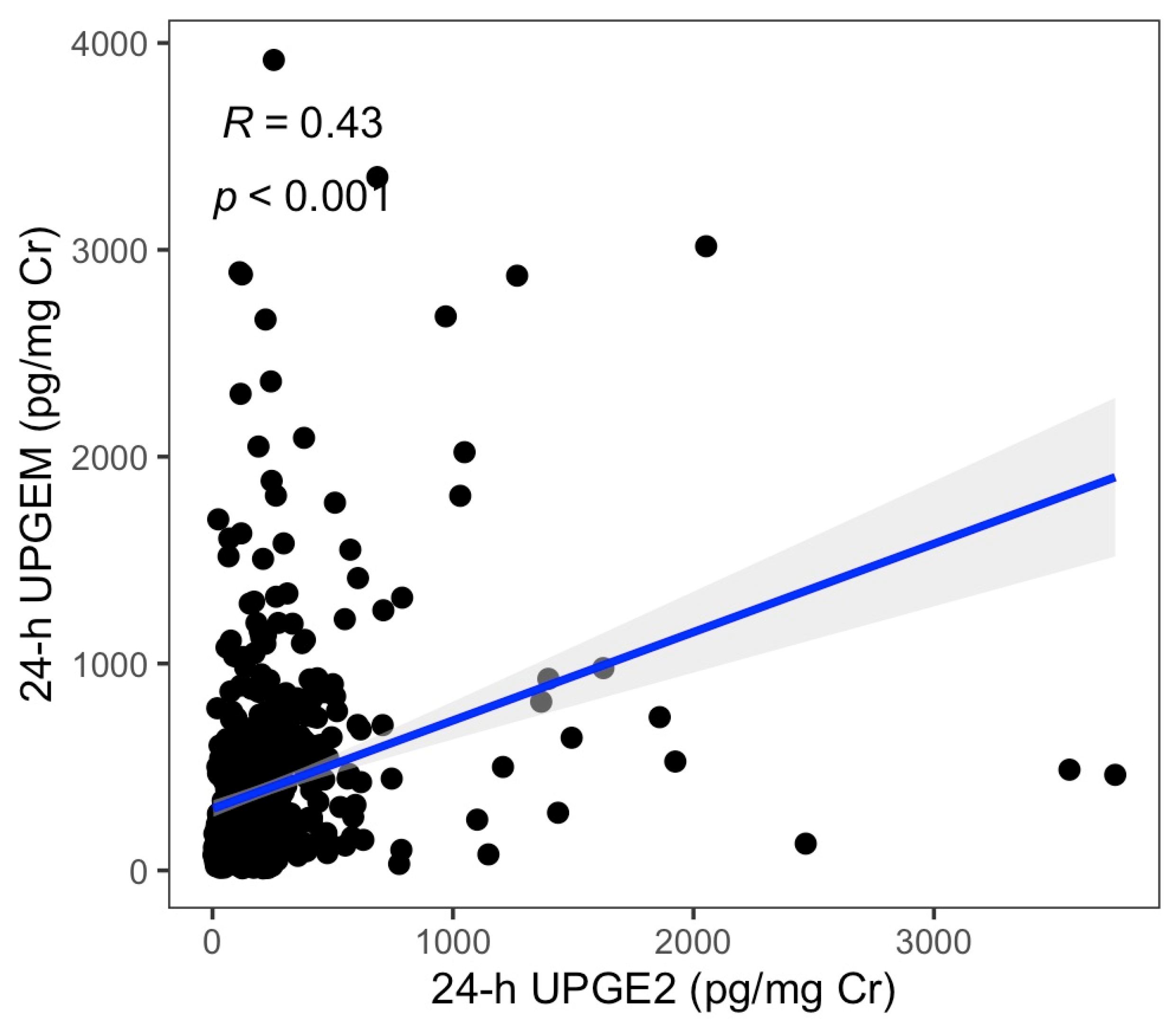
Figure 2.
Distribution of 24-hour U-PGE2 and U-PGEM by age. (a) 24-hour U-PGE2; (b) 24-hour U-PGEM. U-PGE2, urinary prostaglandin E2; U-PGEM, urinary prostaglandin E metabolite.
Figure 2.
Distribution of 24-hour U-PGE2 and U-PGEM by age. (a) 24-hour U-PGE2; (b) 24-hour U-PGEM. U-PGE2, urinary prostaglandin E2; U-PGEM, urinary prostaglandin E metabolite.
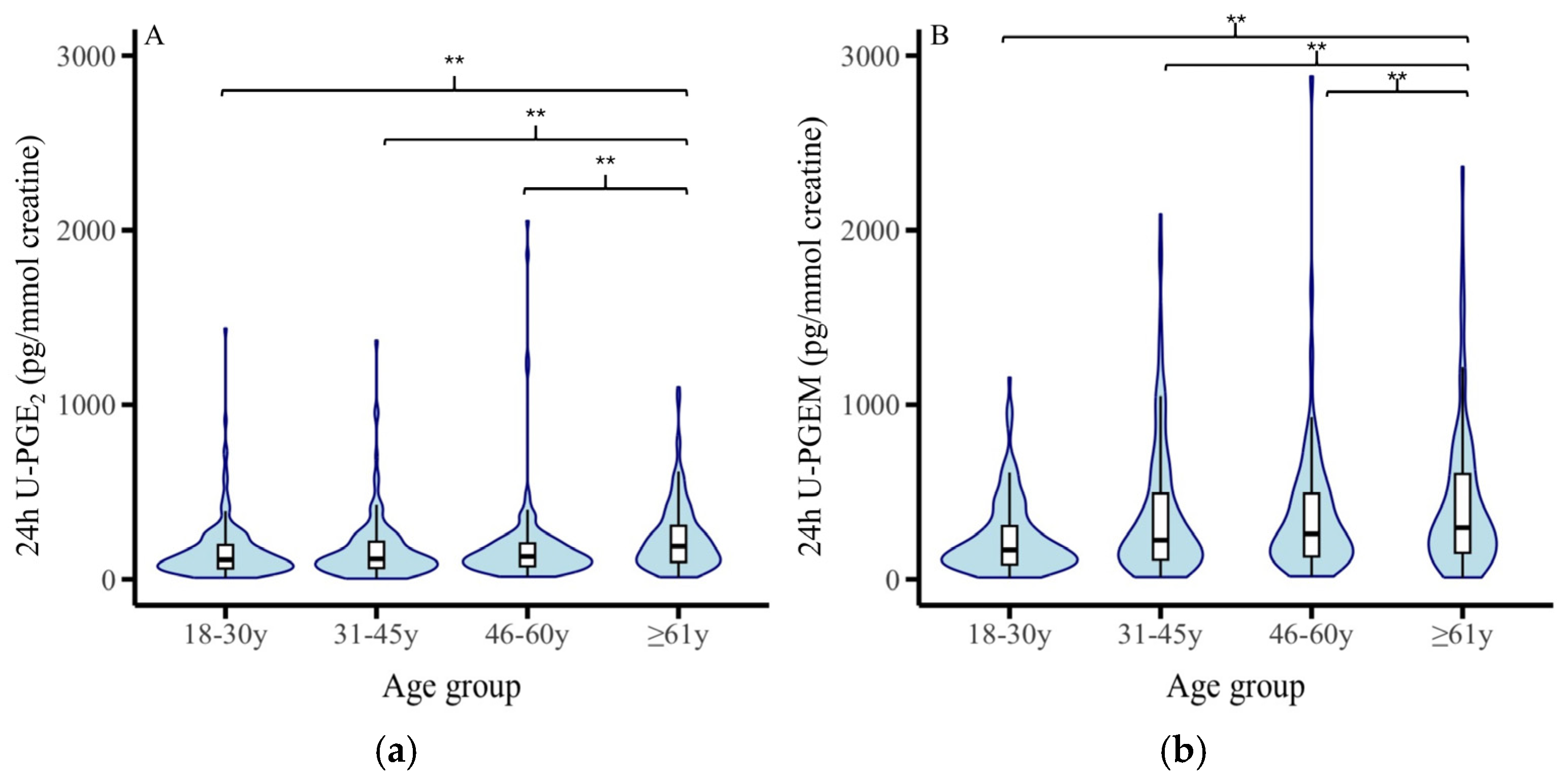
Figure 3.
Relationship of 24-hour U-PGE2 and U-PGEM with serum calcium, phosphorus and U-CaE. Restricted cubic splines were utilized to flexibly model the association between 24-hour U-PGE2 with (a) serum calcium, (c) phosphorus, (e) U-CaE, and the association between 24-hour U-PGEM with (b) serum calcium, (d) phosphorus, (f) U-CaE, adjusted for age, sex, BMI, smoking, alcohol consumption, diet calcium, diabetes, hypertension, season, calcium and vitamin D supplementation. U-PGE2, urinary prostaglandin E2; U-PGEM, urinary prostaglandin E metabolite; U-CaE, urinary calcium excretion.
Figure 3.
Relationship of 24-hour U-PGE2 and U-PGEM with serum calcium, phosphorus and U-CaE. Restricted cubic splines were utilized to flexibly model the association between 24-hour U-PGE2 with (a) serum calcium, (c) phosphorus, (e) U-CaE, and the association between 24-hour U-PGEM with (b) serum calcium, (d) phosphorus, (f) U-CaE, adjusted for age, sex, BMI, smoking, alcohol consumption, diet calcium, diabetes, hypertension, season, calcium and vitamin D supplementation. U-PGE2, urinary prostaglandin E2; U-PGEM, urinary prostaglandin E metabolite; U-CaE, urinary calcium excretion.
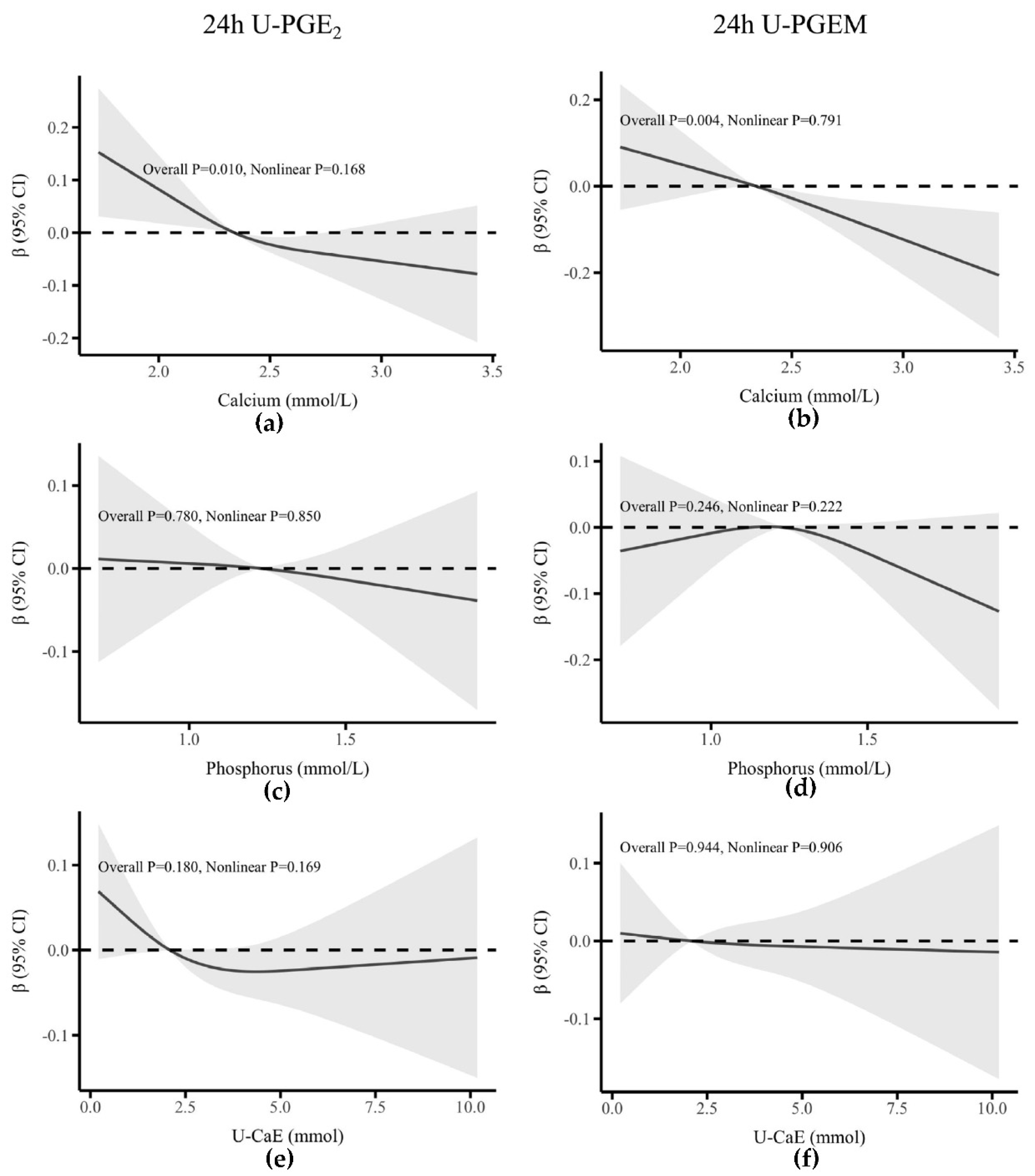
Figure 4.
Relationship of 24-hour U-PGE2 and U-PGEM with β-CTX-I, P1NP, 25(OH)D and PTH. Restricted cubic splines were utilized to flexibly model the association between 24-hour U-PGE2 with (a) β-CTX-I, (c) P1NP, (e) PTH and (g) 25(OH)D, and the association between 24-hour U-PGEM and U-PGEM with (b) β-CTX-I, (d) P1NP, (f) PTH and (h) 25(OH)D. U-PGE2, urinary prostaglandin E2; U-PGEM, urinary prostaglandin E metabolite; β-CTX-I, β-isomerized C-terminal telopeptide of type I collagen; P1NP, total procollagen type 1 N-propeptide; PTH, intact parathyroid hormone; 25(OH)D, 25-hydroxyvitamin D.
Figure 4.
Relationship of 24-hour U-PGE2 and U-PGEM with β-CTX-I, P1NP, 25(OH)D and PTH. Restricted cubic splines were utilized to flexibly model the association between 24-hour U-PGE2 with (a) β-CTX-I, (c) P1NP, (e) PTH and (g) 25(OH)D, and the association between 24-hour U-PGEM and U-PGEM with (b) β-CTX-I, (d) P1NP, (f) PTH and (h) 25(OH)D. U-PGE2, urinary prostaglandin E2; U-PGEM, urinary prostaglandin E metabolite; β-CTX-I, β-isomerized C-terminal telopeptide of type I collagen; P1NP, total procollagen type 1 N-propeptide; PTH, intact parathyroid hormone; 25(OH)D, 25-hydroxyvitamin D.
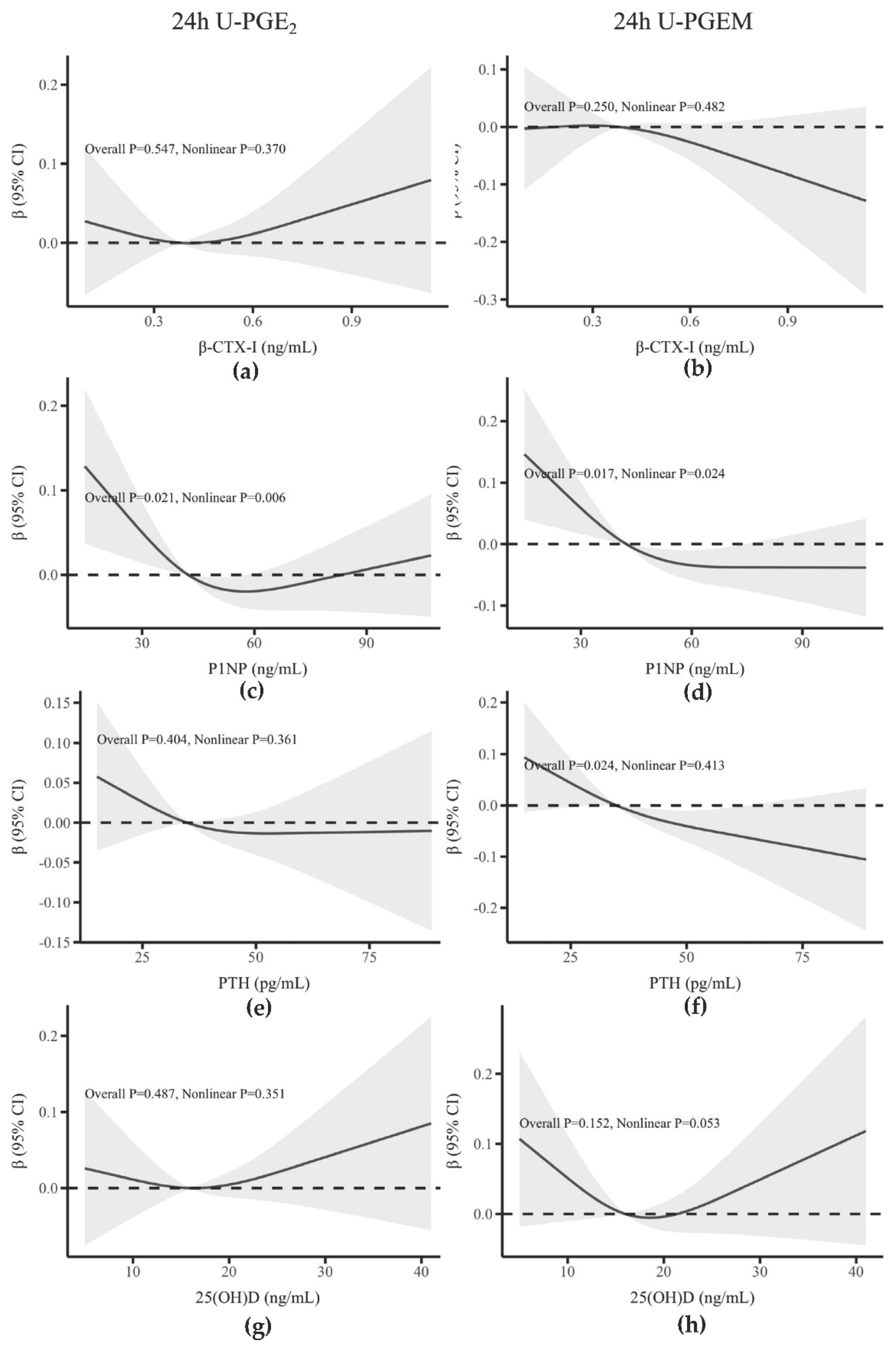

Table 1.
General characteristics of the study population.
| Characteristics | Total sample (N=737) | Men (n=304) | Women (n=433) | P value |
|---|---|---|---|---|
| Age (years) | 48.00 ± 17.80 | 48.90 ± 17.65 | 47.38 ± 17.90 | 0.168 |
| Height (cm) | 163.98 ± 8.36 | 170.38 ± 7.02 | 159.56 ± 6.03 | <0.001 |
| Weight (kg) | 62.79 ± 13.06 | 70.00 ± 12.78 | 57.80 ± 10.72 | <0.001 |
| BMI (kg/m²) | 23.29 ± 4.23 | 24.09 ± 4.20 | 22.73 ± 4.16 | <0.001 |
| Current smokers (n,%) | 68 (9.2) | 62 (20.4) | 6 (1.4) | <0.001 |
| Alcohol consumption (n,%) | 65 (8.8) | 49 (16.1) | 16 (3.7) | <0.001 |
| Diabetes (n,%) | 43 (5.8) | 21 (6.9) | 22 (5.1) | 0.378 |
| Hypertension (n,%) | 118 (16.0) | 48 (15.8) | 70 (16.2) | 0.972 |
| Diet calcium (mg) | 232.73 (77.50,485.89) | 231.60 (65.10,487.90) | 236.60 (81.32,485.89) | 0.999 |
| Calcium supplementation (n,%) | 97 (13.2) | 37 (12.2) | 60 (13.9) | 0.578 |
| Vitamin D supplementation (n,%) | 74 (10.0) | 30 (9.9) | 44 (10.2) | 0.995 |
| Season (n,%) | 0.809 | |||
| Spring + Winter | 158 (21.4) | 67 (22.0) | 91 (21.0) | |
| Summer + Autumn | 579 (78.6) | 237 (78.0) | 342 (79.0) | |
| ALP (U/L) | 71.0 (55.0, 86.5) | 74.5 (61.0, 89.0) | 66.0 (53.0, 83.0) | <0.001 |
| ALT (U/L) | 12.0 (9.0, 19.0) | 16.0 (10.0, 25.0) | 11.0 (8.0, 15.0) | <0.001 |
| BUN (mmol/L) | 4.6 (3.8, 5.5) | 4.9 (4.1, 5.8) | 4.4 (3.7, 5.2) | <0.001 |
| UA (μmol/L) | 295.0(242.0, 367.0) | 355.0(291.0, 418.0) | 271.0(224.0, 316.5) | <0.001 |
| Cr (μmol/L) | 66.0 (58.0, 80.0) | 80.0 (67.0, 91.0) | 60.0 (54.0, 68.0) | <0.001 |
| Calcium (mmol/L) | 2.34 (2.23, 2.46) | 2.33 (2.24, 2.45) | 2.35 (2.23, 2.46) | 0.603 |
| Phosphorus (mmol/L) | 1.23 (1.07, 1.38) | 1.15 (1.01, 1.33) | 1.28 (1.13, 1.40) | <0.001 |
| U-CaE (mmol) | 2.09 (1.20,3.42) | 2.26 (1.26,4.18) | 1.98 (1.19,3.14) | 0.017 |
| β-CTX-I (ng/mL) | 0.38 (0.26, 0.56) | 0.41 (0.28, 0.58) | 0.36 (0.25, 0.53) | 0.009 |
| P1NP (ng/mL) | 42.6 (32.0, 56.5) | 42.4 (31.7, 56.6) | 42.6 (33.1, 55.8) | 0.655 |
| 25(OH)D (ng/mL) | 16.0 (12.0, 21.0) | 18.0 (13.0, 24.0) | 14.0 (11.0, 19.0) | <0.001 |
| PTH (pg/mL) | 34.95 (26.90, 44.40) | 35.5 (26.9, 45.3) | 34.5 (27.0, 44.1) | 0.608 |
| U-PGE2 (pg/mmol creatinine) | 133.87 (73.75, 239.23) | 133.62 (75.34, 253.65) | 134.33 (70.61, 230.72) | 0.511 |
| U-PGEM (pg/mmol creatinine) | 246.76 (119.32, 475.44) | 249.00 (115.28, 475.07) | 242.01 (120.77, 480.32) | 0.528 |
BMI, body mass index; ALP, alkaline phosphatase; ALT, alanine aminotransferase; BUN, urea nitrogen; UA, uric acid; Cr, creatinine; U-CaE, urinary calcium excretion; β-CTX-I, β-isomerized C-terminal telopeptide of type I collagen; P1NP, total procollagen type 1 N-propeptide; 25(OH)D, 25-hydroxyvitamin D; PTH, intact parathyroid hormone; U-PGE2, urinary prostaglandin E2; U-PGEM, urinary prostaglandin E metabolite. Significant values (P < 0.05) are presented in bold.
Table 2.
Factors associated with 24h U-PGE2 and U-PGEM.
| 24h U-PGE2 | 24h U-PGEM | |||||||
|---|---|---|---|---|---|---|---|---|
| Model 1 | Model 2 | Model 1 | Model 2 | |||||
| β(95% CI ) | P Value | β(95% CI ) | P Value | β(95% CI ) | P Value | β(95% CI ) | P Value | |
| Sex (Women) | -0.034 (-0.095,0.027) |
0.279 | -0.045 (-0.107,0.017) | 0.155 | -0.019 (-0.089,0.050) |
0.580 | -0.016 (-0.089,0.057) | 0.664 |
| Age (years) | 0.005 (0.003,0.006) |
<0.001 | 0.005 (0.003,0.007) |
<0.001 | 0.005 (0.003,0.007) |
<0.001 | 0.005 (0.003,0.007) | <0.001 |
| BMI (kg/m²) | -0.005 (-0.012,0.002) |
0.149 | -0.008 (-0.016,-0.001) | 0.020 | 0.001 (-0.007,0.009) |
0.844 | -0.003 (-0.011,0.005) | 0.464 |
| Smoking | -0.003 (-0.107,0.100) | 0.949 | -0.017 (-0.131,0.096) |
0.765 | 0.064 (-0.052,0.180) | 0.276 | 0.042 (-0.090,0.173) | 0.535 |
| Drinking | -0.029 (-0.135,0.076) | 0.585 | -0.011 (-0.123,0.100) |
0.842 | -0.014 (-0.133,0.104) | 0.812 | -0.024 (-0.153,0.105) | 0.715 |
| Diet calcium (per 100 mg) | -0.013 (-0.020,-0.005) | 0.002 | -0.005 (-0.013,0.002) |
0.162 | -0.008 (-0.017,0.001) | 0.062 | -0.002 (-0.011,0.007) | 0.614 |
| Diabetes | 0.070 (-0.059,0.198) | 0.287 | -0.052 (-0.187,0.083) |
0.452 | 0.108 (-0.033,0.249) | 0.132 | -0.052 (-0.207,0.103) | 0.512 |
| Hypertension | 0.152 (0.071,0.233) | <0.001 | 0.082 (-0.014,0.177) |
0.094 | 0.187 (0.095,0.278) | <0.001 | 0.102 (-0.011,0.215) | 0.076 |
| Season(Summer + Autumn) | 0.266 (0.195,0.336) | <0.001 | 0.269 (0.198,0.340) |
<0.001 | 0.147 (0.066,0.228) | <0.001 | 0.159 (0.076,0.241) | <0.001 |
| Calcium supplementation | 0.076 (-0.012,0.165) | 0.091 | -0.071 (-0.189,0.047) |
0.238 | 0.099 (-0.001,0.199) | 0.052 | -0.059 (-0.197,0.079) | 0.400 |
| Vitamin D supplementation | 0.121 (0.021,0.220) | 0.018 | 0.075 (-0.059,0.208) |
0.274 | 0.144 (0.033,0.255) | 0.011 | 0.065 (-0.089,0.219) | 0.411 |
| ALP (U/L) | 0.000 (-0.001,0.001) |
0.444 | -0.001 (-0.002,0.001) |
0.346 | 0.000 (-0.001,0.002) |
0.562 | -0.001 (-0.002,0.001) | 0.232 |
| ALT (U/L) | -0.001 (-0.003,0.001) |
0.306 | -0.002 (-0.004,0.001) |
0.041 | 0.001 (-0.002,0.003) |
0.550 | 0.001 (-0.002,0.002) | 0.983 |
| BUN (mmol/L) | 0.005 (-0.011,0.021) |
0.520 | -0.012 (-0.029,0.005) |
0.159 | 0.002 (-0.016,0.02) |
0.841 | -0.022 (-0.042,-0.002) | 0.034 |
| UA (μmol/L) | 0.001 (0.001,0.001) |
0.642 | 0.001 (-0.001,0.001) |
0.392 | 0.001 (0.001,0.001) |
0.696 | 0.001 (-0.001,0.001) | 0.210 |
| Calcium (mmol/L) | -0.154 (-0.246,-0.063) |
0.001 | -0.129 (-0.220,-0.038) | 0.006 | -0.220 (-0.323,-0.117) |
<0.001 | -0.144 (-0.251,-0.038) | 0.008 |
| Phosphorus (mmol/L) | -0.104 (-0.223,0.015) |
0.087 | 0.013 (-0.105,0.130) |
0.834 | -0.145 (-0.280,-0.010) |
0.036 | -0.049 (-0.187,0.090) | 0.490 |
| U-CaE (mmol) | -0.014 (-0.028,-0.001) |
0.039 | -0.011 (-0.024,0.003) |
0.117 | -0.008 (-0.023,0.007) |
0.304 | -0.003 (-0.019,0.012) | 0.669 |
Results are based on multivariable linear regression. Model 1 is unadjusted. Model 2 is adjusted for age, sex, BMI, smoking, alcohol consumption, diet calcium, diabetes, hypertension, season, calcium and vitamin D supplementation. Significant values (P < 0.05) are presented in bold. U-PGE2, urinary prostaglandin E2; U-PGEM, urinary prostaglandin E metabolite; BMI, body mass index; ALP, alkaline phosphatase; ALT, alanine aminotransferase; BUN, urea nitrogen; UA, uric acid; Cr, creatinine; U-CaE, urinary calcium excretion.
Disclaimer/Publisher’s Note: The statements, opinions and data contained in all publications are solely those of the individual author(s) and contributor(s) and not of MDPI and/or the editor(s). MDPI and/or the editor(s) disclaim responsibility for any injury to people or property resulting from any ideas, methods, instructions or products referred to in the content. |
© 2026 by the authors. Licensee MDPI, Basel, Switzerland. This article is an open access article distributed under the terms and conditions of the Creative Commons Attribution (CC BY) license (http://creativecommons.org/licenses/by/4.0/).
Copyright: This open access article is published under a Creative Commons CC BY 4.0 license, which permit the free download, distribution, and reuse, provided that the author and preprint are cited in any reuse.


