

Submitted:
22 May 2026
Posted:
25 May 2026
You are already at the latest version
Abstract
"Immature" or "late maturing" neurons exist in layer II of the cerebral cortex (cortical immature neurons; cINs) and within the amygdaloid complex (subcortical immature neurons; scINs). These cells remain in a prolonged state of arrested development yet retain the ability to resume maturation and to functionally integrate into neural circuits. Both cINs and scINs are very abundant in large-brained mammals with respect to small-brained, lissencephalic rodents. In previous reports, using a comparable method for quantification in diverse mammals, including mice, chimpanzees, and other species, we showed positive correlation of immature neuron cell density with brain size and gyrencephaly. Here, we quantified the cINs and scINs in the cerebral cortex and amygdala of young adult rhesus macaques to determine how they compare to phylogenetic variation. Our results further demonstrate the existence of covariance between cIN density and both increasing brain size and neocortical expansion. These findings support the emerging view that immature neurons may represent a reservoir of undifferentiated (stem cell-independent) neuronal cells for the widely expanded cortices and amygdala of mammals endowed with high-order cognitive functions and complex sociality. The detailed mapping of cortical and subcortical immature neurons in a primate often used in translational research can be the basis for deeper, functional studies aimed at understanding human brain plasticity.
Keywords:
brain plasticity
; cerebral cortex
; doublecortin
; arrested maturation
; evolutionary trade-off
; primates
1. Introduction
Recently, a neuronal population referred to as “immature” “late-maturing” or dormant” neurons have become increasingly recognized as an important contributor to brain structural plasticity (hereafter referred to as immature neurons, INs) [1,2,3,4,5,6,7,8,9]. INs are prenatally generated cells blocked in arrested maturation, thus expressing typical markers of immaturity (e.g., the cytoskeletal protein doublecortin - DCX [10], and the polysialylated form of the neural cell adhesion molecule - PSA-NCAM [9]) during variable periods of the lifespan, depending on the animal species. They were first described in the piriform cortex of rats (cortical immature neurons, cINs; history summarized in [9]) and very similar cells were found in the amygdala (subcortical immature neurons, scINs [11,12,13,14]). In previous reports, we examined brains of diverse mammals (Figure 1A) to show that both cINs and scINs display marked interspecies variation, resulting in far more abundance in large-brained, gyrencephalic species in comparison to laboratory rodents [13,15,16,17]; Figure 1B). Accordingly, we proposed that a trade-off between different types of neurogenic plasticity has occurred during evolution (stem cell-driven neurogenesis versus maintenance of immature neurons), leading rodents to mostly rely on hippocampal and olfactory bulb adult neurogenesis while large-brained species invest more in late-maturing neurons in cortex and amygdala [18,19,20]. The occurrence of undifferentiated neurons in high-order cognitive regions devoid of stem cell-driven neurogenesis might be of utmost importance for future translational outcomes in humans, considering brain development and “sculpting”, aging and disease [20,21,22,23].
Although the existence of INs has been confirmed in humans, both in cerebral cortex [24,25] and amygdala [14], no systematic quantitative analyses are available. Using an approach previously established for obtaining “comparable” quantitative results through widely different brains [26], new mammal species can be added in the context of the phylogenetic variation that has already been established (see for example [16]). Among the species analyzed and fully quantified previously (10 for the cortex, 8 for the amygdala, including small, lissencephalic and large, gyrencephalic mammals), two different primates have been studied (Figure 1B): common marmosets (Callithrix jacchus) and chimpanzees (Pan troglodytes). Here, the cINs and scINs were quantified in the brain of young adult rhesus macaque monkeys (Macaca mulatta) by using the very same approach, allowing us to place them in the range of interspecies variation and to establish a comparison with other primates. Concerning brain size, gyrification, and lifespan, macaques occupy an intermediate position between marmosets and chimpanzees (the two primate species for which we know the immature neuron density in both cortex and amygdala [15,17]; Figure 1C).
Despite most biomedical research utilizes rodent models, nonhuman primates are important because of their similarity to humans in physiology, neuroanatomy, reproduction, development, cognition, and social complexity [28,29,30,31]. Here we focused on the number and distribution of cINs and scINs in the brains of rhesus macaques, to provide information for future studies going more deeply and functionally into investigations of primate INs.
2. Materials and Methods
2.1. Brain Sample
Rhesus macaque monkey brains used in this study were collected from three sources: JBSA Fort Sam Houston, Emory National Primate Research Center, and Oregon National Primate Center. All necessary authorizations were provided, and all experiments were conducted in accordance with current US laws.
Young adult macaques (4 males; age: 7 – 10 years; Table 1) were euthanized. Brains were extracted with a post-mortem interval (PMI) of less than 1 hour and fixed by immersion in 10% buffered formalin and kept in fixative solution for at least one week. Then, brains were stored in PBS containing 0.1% sodium azide at 4 °C until use.
2.2. Tissue Processing for Histology and Immunohistochemistry
The left hemisphere for each animal was dissected coronally in slabs (1–1.5 cm thick) and placed in sucrose solutions of gradually increasing concentration up to 30% in 0.1 M phosphate buffered saline solution (PBS) pH 7.4 at 4 °C for dehydration and cryoprotection. Then, tissues were frozen by immersion in dry ice, sectioned at the microtome in coronal sections (40 µm thick) and stored as free-floating sections in an anti-freezing solution at – 20 °C until use (Figure 2A).
Sections were used both for histological staining procedures (Nissl staining; aimed at defining the overall neuroanatomy to identify the corresponding brain structures; Figure 2), and for immunocytochemical detection of the immaturity marker doublecortin (DCX).
For 3,3'-diaminobenzidine (DAB) immunohistochemistry (peroxidase technique), free-floating sections were rinsed in PBS 0.01 M, pH 7.4. Antigen retrieval was performed using citric acid, pH 6.0, at 90 °C for 30 min. After further washing in PBS 0.01 M, the sections were immersed in appropriate blocking solution (3% Bovine Serum Albumin, 5% Normal Goat Serum, 1% Triton X-100 in 0.01 M PBS) for 90 min at room temperature (RT). Then, sections were incubated with primary antibodies for 48 h at 4 °C. After washing in PBS 0.01 M, sections were incubated for 2 h at RT with biotinylated secondary antibody (anti-rabbit made in goat, 1:250, Vector Laboratories), followed by other three washing in PBS 0.01 M, and incubated in avidin–biotin–peroxidase complex (Vectastain ABC kit; Vector Laboratories, Burlingame, PK-4000) for 1 h at RT. The reaction was detected with DAB as chromogen in TRIS- HCl 50 mM, containing 0.025% hydrogen peroxide for few minutes and then washed in PBS 0.01 M. Sections were counterstained with Nissl staining, mounted with Permount Mounting Medium (Fisher Chemical, SP15-500) and coverslipped.
2.3. Brain Neuroanatomy
Working atlases for each brain in the study were constructed using Nissl-stained serial coronal sections (Figure 2A) to identify the main neuroanatomical regions. These specimens were compared with existing macaque brain atlases [32,33,34,35,36,37], which constituted valuable references.
Both the entire cortex (divided into piriform cortex and neocortex; Figure 2B) and amygdala (Figure 2B) were investigated by using the same protocol employed in our previous studies (a summary is given below; for more details see [15,16,17,26]).
For the analysis of IN in the cortex, four anterior-to-posterior coronal brain levels (referred to as L1 - L4; Figure 3B) were established based on corresponding neuroanatomical structures: L1, starting from the beginning of the lateral ventricle; L2, starting from the internal capsule; L3, starting from the beginning of the amygdala; L4, extending from the closure of the lateral ventricle to a thickness equivalent to that of L2, corresponding to the same number of serial sections (section thickness = 40 µm) [15,16,26]. These neuroanatomical references allowed comparisons among cerebral cortices of brains across a range of sizes and gyrencephaly. For technical reasons, partly related to interindividual differences, a few sections at the most anterior part of the frontal pole and at the most posterior part of the occipital pole were excluded during sectioning. The same serial section number was considered for all animals, using the specimen with the lowest number of sections as a reference to standardize the total number of sections across specimens [15].
For the analysis of INs in the amygdala, serial sections of the entire subcortical region (spaced apart from each other by 480µm) was used (Figure 3C). After having established the topology and orientation of the amygdaloid complex along its full anterior-posterior axis, including its anatomical relationships with surrounding structures (Figure 3D), amygdala was also divided into its subnuclei, identified by comparing Nissl-stained serial coronal sections with existing neuroanatomical atlases and comparative studies from the literature [32,33,34,35,36,37]. Subnuclei were grouped into three major divisions: the basolateral complex (comprising the lateral, basal, and accessory basal nuclei), the centro-medial complex (including the central and medial nuclei), and the cortical nucleus.
2.4. Image Acquisition and Processing
Images were collected using an Axioplan 2 imaging microscope. For Nissl-stained sections of the mini-atlases, an Epson Perfection V600 Photo scanner was used. All images were processed by using ImageJ (Rasband, W.S., ImageJ, U. S. National Institutes of Health, Bethesda, Maryland, USA) and Photoshop CS4 (Adobe Systems, San Jose, CA). Only general adjustments to color, contrast, and brightness were made.
2.5. Quantitative Analysis
Analyses of cINs were conducted within cortical layer II by considering four anterior-posterior brain levels (L1-L4; Figure 3B), established using correspondent neuroanatomical structures to obtain comparable results, as previously reported [15,16,26] (Figure 2). The DCX+ cell counting was performed on the entire cerebral cortex layer II perimeter (3 coronal sections/level; considering both the piriform cortex and the neocortex, while excluding the archicortex) by marking separately type 1 and 2 cells (Figure 3B). Analyses of scINs were performed on the entire extent of the amygdala, as previously [17] (Figure 3C). A fixed number of serial coronal sections of the amygdala was considered. In particular, the total number of sections was compared across specimens, and the sample with the lowest section number was used as a reference. Accordingly, sections at the beginning and at the end of the amygdala were excluded to match this number across all specimens, as was performed previously [17].
Quantification was conducted on sections stained for DCX with the DAB technique and quantified by using direct cell counting using Neurolucida software (MBF Bioscience, Colchester, VT), to be consistent with our previous analysis aimed at obtaining fully comparable results [26]. The perimeters of the cortex (piriform cortex + neocortex) and amygdala were traced at low magnification (4x) by using the “Contour” tool of Neurolucida, and all DCX+ cells were counted (direct cell counting) with markers using a 20x magnification objective lens [26]. In the cortex, results were expressed as linear density (number of DCX+ cells/mm of layer II perimeter), while the entire amygdala area was considered in subcortical analyses (number of DCX+ cells/mm2 amygdala area). Cells cut on the superior surface were excluded to avoid overcounting. Cell soma sizes were obtained by evaluating the cell soma width (diameter orthogonal to main axis), measured in about 100 cells/region in each sample by using the Neurolucida ‘measure line’ tool.
2.6. Statistical and Phylogenetic Analysis
All graphs and statistical analysis were performed in GraphPad Prism Software (San Diego, California, USA). Data distribution within each group was assessed using the Shapiro–Wilk normality test. Since our data were not normally distributed, we used nonparametric tests: Kruskal-Wallis test with Dunn’s multiple comparison post-hoc test, and Mann-Whitney test. Medians were used as data central measure as previously done [15,16,17,26]. A mixed-effects analysis followed by Tukey’s multiple comparisons test was also performed on the linear density values obtained from each section. p < 0.05 was considered statistically significant.
Species median DCX+ cell densities were used to perform ancestral character state reconstructions of trait evolution mapped onto the phylogeny. First, a phylogenetic tree of the investigated species (macaques analyzed in this project and data from other species reported in [15,16,17] was downloaded from the TimeTree database [38] and ancestral character state reconstruction was implemented in Mesquite software (version 3.81), using a parsimony model.
The association between DCX+ cell density and brain size and neocortical surface was investigated. All data were log-transformed to fit power functions for least squares regression, in accordance with standard procedures in comparative neuroanatomy studies. Although we also performed phylogenetic generalized least squares (PGLS) regression to control for potential phylogenetic non-independence, Pagel’s λ was estimated at zero, suggesting the absence of a detectable phylogenetic signal in the dataset. Therefore, ordinary least squares regression was used, and these analyses were performed on Statistics Kingdom website (statisticskingdom.org).
3. Results
3.1. Neuroanatomical Settings, Features of Immature Neurons and Comparison With Previous Reports
To obtain quantitative results that are comparable with previous analyses, the same experimental procedures were adopted and coronal sections for cell counting were chosen at the same corresponding neuroanatomical levels (method explained in detail in [26]). As set in previous reports [15,16,17], in each hemisphere 12 coronal sections from 4 anterior-posterior levels (3 sections/level) were used for quantification in the macaque cerebral cortex, while 11 coronal sections spaced 480 µm from each other were used for the amygdala (Figure 3). This setting allowed us to perform DCX+ cell counting in the same conditions and at homologous brain levels used for other smaller and larger mammal species.
After immunocytochemistry, typical DCX+ cells were found at their specific locations, namely the cerebral cortex layer II (including both paleocortex, namely the piriform cortex, and neocortex, as expected in a gyrencephalic species [15,16]) and in the basolateral amygdala [17]. The main features of INs, as a population of undifferentiated DCX+ cells well conserved across widely different mammals, are now well defined both at cortical and subcortical locations [4,6,13,15,16,17,39,40]). They consistently occur in two main morphologies (Figure 3B,C): small, unipolar/bipolar cells (type 1 cells) and large, highly ramified cells (type 2 cells) corresponding to the principal neuronal type of the cortical layer II (cINs, both in piriform cortex and neocortex of gyrencephalic species) and of the basolateral amygdala (scINs). Previous studies carried out on at least 8 diverse mammals reported an average cell soma diameter ranging between 3 and 9 µm for type 1 and between 7 and 20 µm for type 2 cells in the cerebral cortex, and between 3 and 9 µm for type 1 and between 9 and 19 µm for type 2 cells in the amygdala (for measures referring to each animal species see Table S1 [15,16,17]).
Multiple reports dealing with non-rodent mammal species consistently found DCX+ cells displaying the above-mentioned characteristics [13,14,15,16,17,39] and the same features were detectable in the macaques analyzed here (Figure 4; see below). In the cortex they were present in the layer II of the piriform cortex and along the entire neocortical perimeter (Figure 4B), while in the amygdala they were observed in the basolateral complex (Figure 4B). Thus, the immature cells were systematically quantified both in cerebral cortex and amygdala of macaques.
3.2. Quantification and Phylogenetic Analyses of Immature Neurons in Cerebral Cortex Layer II
Counting of DCX+ cINs in the cerebral cortex of macaques was performed on a total of 48 brain coronal sections (149 cm of layer II perimeter in each hemisphere, for a total of 596 cm in four animals) by considering separately piriform cortex and neocortex (Dataset S1), and results are reported in Figure 5A. The cIN linear density in the whole cerebral cortex was close to that previously reported for chimpanzees (Figure 5B; see Discussion), and a similar result was obtained by considering only the neocortex (Figure S1). A higher cell density was observed in the piriform cortex (Figure 5A). A direct comparison between macaques and laboratory mice (data from [15]) was performed using a Mann–Whitney U test, revealing statistically significant differences in both the total cortex (p = 0.0286) and the neocortex (p = 0.0286) (Figure 5B’). The measure of average cell soma diameters was 3-8 µm for type 1 cells and 8-13 for type 2 cells. Differential counting of the two cell types revealed a vast majority of type 1 cells, with type 2 (complex) cells being around 2% (pie chart in Figure 5A). The DCX+ cells were detectable in the entire extension of the cerebral cortex considered in the four ante rior-to-posterior brain levels, thus confirming previous findings of a consistent cIN presence throughout the neocortex of gyrencephalic species and other primates [15,16,24]. A heatmap analysis of the linear densities across anterior-to-posterior brain levels (L1-L4) revealed a widespread presence of cINs in all levels, with a higher density in level 2 and lower density in level 4 (Figure 5F). The statistical analysis between the four brain levels confirmed a significant difference between L4 and all other levels (mixed-effects analysis with Tukey’s multiple comparisons; p<0.05; lower cell density in L4: L1 vs. L4: p=0.0002; L2 vs. L4: p=0.0004; L3 vs. L4: p=0.0427). Estimation of the total number of cINs in a whole macaque cerebral cortex (one hemisphere; obtained by multiplying the median density x the total number of coronal sections cut in each animal) reached around 1 million (1,060,500 for cerebral cortex; 1,036,000 for neocortex).
Linear densities obtained from systematic quantification of the DCX+ cells were used to perform phylogenetic and linear regression analyses (Figure 5C-E). Ancestral character state reconstructions of trait evolution for DCX+ cell density mapped onto the phylogeny was performed in whole cerebral cortex (Figure S2) and neocortex (Figure 5C). Among the examined gyrencephalic brains, the clade Laurasiatheria (Carnivora, Artiodactyla, and Perissodactyla) exhibits the highest cIN density. Within the clade Euarchontoglires (Rodents and Primates), rodents show the lowest cIN density, with their divergence from primates occurring approximately 90 million years ago. The presence of high cIN density in both Laurasiatheria and Primates may reflect either independent evolutionary increases or, alternatively, a more ancient origin with subsequent reduction or loss in the rodent lineage.
To explore the scaling relationship between DCX+ cell densities with brain size (cIN densities against brain weight; Figure 5D), least squares regression analyses were conducted by using the data obtained here for macaques, compared with datasets previously reported for other young-adult mammals [15,16]. The results indicated a highly significant positive association for the neocortex (R2 = 0.75; Figure 5D), and a significant positive association for the whole cerebral cortex (R2 = 0.57; Figure S3).
The same regression analysis was performed for DCX+ cell densities with neocortical surface (cIN densities against neocortical extension, calculated by using layer II perimeters), also in this case confirming the existence of significant positive covariance (R2 = 0.73; Figure 5E).
3.3. Quantification and Phylogenetic Analyses of Immature Neurons in The Amygdala
A total of 11 coronal sections spaced 480 μm apart were analyzed in each macaque brain (see [17]; Figure 3C). Results are reported in Figure 6A. When compared with the other 8 species previously studied with the very same approach (Figure 6B), all primates displayed a significantly greater density of amygdala INs with a one order of magnitude difference in comparison to rodents. The macaques had a cell density slightly lower than marmosets and chimpanzees (tabulated data can be found in Dataset S1). Similar to the cortex, in amygdala the percentage of type 2 cells was very low, with the vast majority being represented by type 1 cells (pie chart in Figure 6A). The measure of average cell soma diameters was 4-8 µm for type 1 cells and 8-17 µm for type 2 cells. The estimation of the total number of scINs in the whole macaque amygdala was around 250,000.
As to the topographical distribution of the scINs in the amygdala, the anterior-posterior arrangement is indicated in the line plot of Figure 7A and in the histogram of Figure 7B. The arrangement in the coronal plane is shown in Figure 7C, with most DCX+ cells being grouped within the basolateral amygdala with a marked concentration in the paralaminar nucleus.
Linear densities obtained from systematic quantification of the DCX+ cells were used to perform phylogenetic and linear regression analyses (Figure 6C,D). Ancestral character state reconstructions of trait evolution for DCX+ cell density mapped onto the phylogeny was performed in the amygdala (Figure 6C). Among the examined brains, the Euarchontoglires clade showed a strong distinction between the two orders of which it is formed, Primates (marmoset, macaque, chimpanzee) and Rodents, with the former exhibiting the highest cIN density, while the latter the lowest cIN density. The Laurasiatheria clade (Carnivora, Artiodactyla, and Perissodactyla), meanwhile, occupies an intermediate position.
To explore the scaling relationship between DCX+ cell densities with brain size (scIN densities against brain weight; Figure 6D), least squares regression analysis was conducted by using the data obtained here for macaques compared with dataset previously reported for other young-adult mammals [17]). The results indicated a significant positive association for the amygdala (R2 = 0.51; Figure 6D).
4. Discussion
Recent research in comparative neuroplasticity has brought attention to a population of undifferentiated cells in arrested maturation – known as immature neurons (INs) - that are particularly abundant in the cerebral cortex and amygdala of gyrencephalic species, thus suggesting that an evolutionary trade-off has occurred between different types of plasticity across widely different mammals [18,19,20]. To better define the phylogenetic variation of this novel cell population, our research extends the number of mammal species that are systematically quantified for INs, with a particular focus on primates. Furthermore, another urgent need is to characterize non-rodent animal models to allow in-depth and functional investigation of these cells, including in the neocortex, given that INs are restricted to the piriform cortex in laboratory rodents. Macaques, as relatively large-brained, gyrencephalic primates, represent an excellent model that is commonly used in biomedical research [41,42]. Here we measured IN densities in the piriform cortex, neocortex, and amygdala of young adult rhesus macaques using a previously established method for comparing quantitative results among diverse mammals [15,16,17,26]. Our findings in macaques confirmed a series of morphological, cellular, and topographical features that have been consistently found to be shared by cortical and amygdala INs in a dozen mammal species, including mice and primates (including humans) [5,8,13,14,15,16,17,24,25,40,43,44,45,46]. We discuss our results in a comparative and evolutionary perspective.
4.1. Macaque Cins and Scins in Mammal Phylogenetic Variation
The class of mammals, including nearly 6,000 species, displays remarkable diversity in size, morphology, habitat, and behaviour, with their brains reflecting this variability: from 0.6 grams in mice to 5–10 kilograms in some large baleen whales [47,48,49]. Recent research in comparative neuroplasticity has revealed that widely different mammals are endowed with distinctive potential in structural plasticity, in terms of their types, amount, and anatomical location [20,50,51,52]. Particularly for neurogenic processes, it has been hypothesized that a trade-off has occurred during evolution between stem cell-driven adult neurogenesis, which is more active and extended in time in small-brained, lissencephalic rodents, and non-dividing, late-maturing INs, which is far more abundant in large-brained, gyrencephalic species, including primates [19,53]. Hence, INs appear to be an important form of structural plasticity markedly varying in mammal brain evolution and increasing in the primate lineage that includes humans [20], thus raising interest in a translational perspective.
Among primates, previous reports showed that the small-brained, lissencephalic marmosets have low numbers of cINs while these cells are extremely abundant in the large-brained, gyrencephalic chimpanzees [15]. Here, we found that macaques, placed in the middle between marmosets and chimpanzees based on gyrification index and brain size (but closer to the latter; Figure 1C), have high numbers of cINs, very close to chimpanzees (Figure 5B), thus confirming a relationship between the size of this cell population and the expansion of neocortical structures through phylogeny [15,19]. Concerning the amygdala, previous reports described a prevalence of scINs in the primates examined to date (marmoset and chimpanzee) and here we show the same trend for macaques (Figure 6B). In brief, small brained, lissencephalic species characterized by relatively small cortical mantles (including marmoset) have lower numbers of cINs, while all primates have large numbers of INs in amygdala (summarized in Figure 8).
4.2. Evolutionary and Translational Considerations
A pattern is emerging concerning a trade-off between stem cell-driven neurogenesis and non-dividing immature neurons across diverse mammals characterized by different scaling of neuroanatomical structures and different ecological niche-related functions [18,19,20]. It is worth noting that the two types of structural (neurogenic) plasticity occur in different brain regions: olfactory bulb and hippocampus for stem cell-driven plasticity and cerebral cortex and amygdala for immature neurons [19,20,52]. This regional specialization has been suggested to be linked to neural functions induced by selective pressures of different ecological niches: rodents have very large olfactory bulbs and rely more on olfaction and navigation for their survival, while primates are characterized by expansion of neocortex and basolateral amygdala and rely more on high-order cognitive functions and emotional regulation to mediate social interactions [19,54,55,56,57] (see below).
The findings of the present study show that macaques fit with the phylogenetic variation of both cINs and scINs, mostly sharing patterns with chimpanzees, has important translational value. Notwithstanding ethical issues, primate models are essential for advancing fundamental knowledge in biomedical research [29]. Nonhuman primates have frequently been used in medical and scientific research due to their similarity with humans regarding physiology, neuroanatomy, reproduction, development, cognition, social complexity, genetic, aging, and disease [29,30,31,58,59,60]. Apart from the general positioning of macaques among the large-brained, gyrencephalic mammals displaying high densities of INs, the distribution and features of these cell populations share similarities with the currently available data in humans. First, it is confirmed that in gyrencephalic species the cINs occur within the layer II of the entire cortical mantle (although with some regional differences). Second, the topographical location of the INs in the basolateral amygdala (per se coherent with a subregional distribution shared among mammals [17]) appeared more concentrated in the paralaminar nucleus than previously found in other gyrencephalic species [17], thus very similar to that described in humans [14]. Overall, data from the present study appoints the macaque as an ideal primate model for studying INs in view of human translation [41,42].
4.3. A Reservoir of Immature Neurons in High-Order Brain Regions of Primates
The present study on macaque brains confirms that primates endowed with relatively large brain size and gyrencephaly possess remarkable reservoirs of INs both in the amygdala and in the cerebral cortex layer II, the latter extended to the entire neocortical mantle. In comparison, rodents have only a few immature cells in the amygdala, and the cINs are restricted to paleocortex (piriform cortex). This research being still relatively novel in the neurosciences, in the absence of further knowledge on the physiological/functional role of INs it is difficult to derive functional interpretations with certainty. Nevertheless, at least four points can be considered: i) the INs, as populations of non-dividing neuronal precursors in arrested maturation, have undergone an evolutionary trade-off with stem cell-driven neurogenesis (active in the neurogenic niches of the lateral ventricle and hippocampus) [19]; ii) such recruitment has occurred in high-order brain regions, such as the cerebral cortex and the amygdala, thus going beyond olfactory bulb and hippocampus and related functions [19,54]; iii) in the amygdala the INs are located in the basolateral complex, namely its subdivision with strong cortical connections that has increased in size in primates [61,62,63]; iv) in the cerebral cortex the INs are present in the entire perimeter of the layer II, namely a cortico-cortical association layer that has increased in thickness in gyrencephalic species [64], likely representing a cross-cutting feature not linked to specific functions or areas. Thus, it is reasonable to hypothesize that a reservoir of undifferentiated neurons is maintained in high-order, highly interconnected regions of the primate brain that play a crucial role in the sophisticated cognitive functions and complex sociality of these mammal species [55,56,57,65,66,67,68].
Although the field is still at its beginnings, the information coming from the study of primate brain INs might open a wide range of possibilities, including roles in postnatal brain development and sculpting, in neurodevelopmental or psychiatric disorders, in aging and potentially granting a source of young, undifferentiated cells in disease and neurodegeneration.
Supplementary Materials
The following supporting information can be downloaded at the website of this paper posted on Preprints.org. Figure S1: Positioning of macaque in the phylogenetic variation of cIN density in the neocortex of mammals. Figure S2: Ancestral character state reconstructions of trait evolution for DCX+ cell density mapped onto the phylogeny, in cerebral cortex. Figure S3 - Least squares regression of DCX+ cell density in whole cerebral cortex against brain size (brain weight). Table S1 – Cell soma diameter range of type 1 and type 2 cells in the cerebral cortex and amygdala of different mammals, including previously published data and results of the present study on macaques. Dataset S1: Tabulated data (cell counting).
Author Contributions
AP: Conceptualization, Data curation, Formal analysis, Investigation, Methodology, Visualization, Writing – original draft, Writing – review & editing. MG: Methodology, Writing – review & editing. MB: Investigation. CCS: Conceptualization, Data curation, Resources, Formal analysis, Funding acquisition, Methodology, Writing – original draft, Writing – review & editing. LB: Conceptualization, Methodology, Funding acquisition, Visualization, Resources, Writing – original draft, Writing – review & editing. All authors have read and agreed to the published version of the manuscript.
Funding
This research was supported by National Science Foundation (grants EF-2021785, DRL-2219759) and National Institutes of Health (grants AG067419, HG011641) to CCS; PRIN2022 (grant 2022LB4 × 3N), and University of Turin (Local Research, grant BONLU_GFI2_25_01_F) to LB.
Data Availability Statement
The raw data supporting the conclusions of this article will be made available by the authors, without undue reservation.
Ethics Statement
Rhesus macaque (Macaca mulatta) brains used in this study were collected from three sources: JBSA Fort Sam Houston, Emory National Primate Research Center, and Oregon National Primate Center. All necessary authorizations were provided, and all experiments were conducted in accordance with current US laws.
Acknowledgments
We thank Ugo Ala for precious advice in statistical analyses, and Madison Hillegas for technical help in some experimental procedures.
Conflicts of Interest
The authors declare that the research was conducted in the absence of any commercial or financial relationships that could be construed as a potential conflict of interest.
Generative AI statement
References
- Gómez-Climent, M.A.; Castillo-Gómez, E.; Varea, E.; Guirado, R.; Blasco-Ibáñez, J.M.; Crespo, C.; Martínez-Guijarro, F.J.; Nácher, J. A Population of Prenatally Generated Cells in the Rat Paleocortex Maintains an Immature Neuronal Phenotype into Adulthood. Cereb. Cortex 2008, 18, 2229–2240. [Google Scholar] [CrossRef] [PubMed]
- Bonfanti, L.; Nacher, J. New Scenarios for Neuronal Structural Plasticity in Non-neurogenic Brain Parenchyma: The Case of Cortical Layer II Immature Neurons. Prog. Neurobiol. 2012, 98, 1–15. [Google Scholar] [CrossRef]
- König, R.; Benedetti, B.; Rotheneichner, P.; O′Sullivan, A.; Kreutzer, C.; Belles, M.; Nacher, J.; Weiger, T.M.; Aigner, L.; Couillard-Després, S. Distribution and Fate of DCX/PSA-NCAM Expressing Cells in the Adult Mammalian Cortex: A Local Reservoir for Adult Cortical Neuroplasticity? Front. Biol. 2016, 11, 193–213. [Google Scholar] [CrossRef]
- Rotheneichner, P.; Belles, M.; Benedetti, B.; König, R.; Dannehl, D.; Kreutzer, C.; Zaunmair, P.; Engelhardt, M.; Aigner, L.; Nacher, J.; et al. Cellular Plasticity in the Adult Murine Piriform Cortex: Continuous Maturation of Dormant Precursors into Excitatory Neurons. Cereb. Cortex 2018, 28, 2610–2621. [Google Scholar] [CrossRef]
- La Rosa, C.; Parolisi, R.; Bonfanti, L. Brain Structural Plasticity: From Adult Neurogenesis to Immature Neurons. Front. Neurosci. 2020a, 14, 75. [Google Scholar] [CrossRef]
- Benedetti, B.; Dannehl, D.; König, R.; Coviello, S.; Kreutzer, C.; Zaunmair, P.; Jakubecova, D.; Weiger, T.M.; Aigner, L.; Nacher, J.; et al. Functional Integration of Neuronal Precursors in the Adult Murine Piriform Cortex. Cereb. Cortex 2020, 30(3), 1499–1515. [Google Scholar] [CrossRef]
- Benedetti, B.; Reisinger, M.; Hochwartner, M.; Gabriele, G.; Jakubecova, D.; Benedetti, A.; Bonfanti, L.; Couillard-Despres, S. The Awakening of Dormant Neuronal Precursors in the Adult and Aged Brain. Aging Cell 2023, 22, e13974. [Google Scholar] [CrossRef]
- Benedetti, B.; Couillard-Després, S. Why Would the Brain Need Dormant Neuronal Precursors? Front. Neurosci. 2022, 16, 877167. [Google Scholar]
- Bonfanti, L.; Seki, T. The PSA-NCAM-positive “Immature” Neurons: An Old Discovery Providing New Vistas on Brain Structural Plasticity. Cells 2021, 10, 2542. [Google Scholar] [CrossRef] [PubMed]
- Gleeson, J.G.; Lin, P. T.; Flanagan, L. A.; Walsh, C.A. Doublecortin is a Microtubule-Associated Protein and is Expressed Widely by Migrating Neurons. Neuron 1999, 23, 257–271. [Google Scholar] [CrossRef] [PubMed]
- Fudge, J.; Decampo, D.; Becoat, K. Revisiting the Hippocampal-Amygdala Pathway in Primates: Association with Immature-appearing Neurons. Neuroscience 2012, 212, 104–19. [Google Scholar] [CrossRef]
- de Campo, D.M.; Cameron, J.L.; Miano, J.M.; Lewis, D.A.; Mirnics, K.; Fudge, J.L. Maternal Deprivation Alters Expression of Neural Maturation Gene tbr1 in the Amygdala Paralaminar Nucleus in Infant Female Macaques. Dev. Psychobiol. 2017, 59, 235–249. [Google Scholar] [CrossRef]
- Piumatti, M.; Palazzo, O.; La Rosa, C.; Crociara, P.; Parolisi, R.; Luzzati, F.; Lévy, F.; Bonfanti, L. Non-newly Generated, "Immature" Neurons in the Sheep Brain Are Not Restricted to Cerebral Cortex. J. Neurosci. 2018, 38, 826–842. [Google Scholar] [CrossRef] [PubMed]
- Sorrells, S.F.; Paredes, M.F.; Velmeshev, D.; Herranz-Pérez, V.; Sandoval, K.; Mayer, S.; Chang, E.F.; Insausti, R.; Kriegstein, A.R.; Rubenstein, J.L.; et al. Immature Excitatory Neurons Develop During Adolescence in the Human Amygdala. Nat. Commun. 2019, 10(1), 2748. [Google Scholar] [CrossRef] [PubMed]
- La Rosa, C.; Cavallo, F.; Pecora, A.; Chincarini, M.; Ala, U.; Faulkes, C.G.; Nacher, J.; Cozzi, B.; Sherwood, C.C.; Amrein, I.; et al. Phylogenetic Variation in Cortical Layer II Immature Neuron Reservoir of Mammals. eLife 2020b, 9, e55456. [Google Scholar] [CrossRef]
- Pattaro, A.; Ghibaudi, M.; Corrente, C.; Telitsyn, N.; Graic, J.-M.; Aresu, L.; Sherwood, C.C.; Bonfanti, L. Phylogenetic Variation of Layer II Cortical Immature Neurons in Dog and Horse Confirms Covariance with Brain Size and Neocortical Surface. Brain Struct. Funct. 2025, 230(6), 115. [Google Scholar] [CrossRef]
- Ghibaudi, M.; La Rosa, C.; Telitsyn, N.; Graїc, J.-M.; Faulkes, C.G.; Sherwood, C.C.; Bonfanti, L. Multispecies Characterization of Immature Neurons in the Mammalian Amygdala Reveals their Expansion in Primates. PLoS Biol. 2025b, 23(8), e3003322. [Google Scholar] [CrossRef]
- Palazzo, O.; La Rosa, C.; Piumatti, M.; Bonfanti, L. Do Large Brains of Long-living Mammals Prefer Non-newly Generated, Immature Neurons? Neural Regen. Res. 2018, 13, 633–634. [Google Scholar] [PubMed]
- Bonfanti, L.; La Rosa, C.; Ghibaudi, M.; Sherwood, C.C. Adult Neurogenesis and “Immature” Neurons in Mammals: An Evolutionary Trade-off in Plasticity? Brain Struct. Funct. 2024, 229(8), 1775–1793. [Google Scholar] [CrossRef]
- Ghibaudi, M.; Zanone, A.; Bonfanti, L. Brain Structural Plasticity in Large-brained Mammals: Not Only Narrowing Roads. Neural Reg. Res. 2026, 21(5), 1669–1680. [Google Scholar] [CrossRef]
- La Rosa, C.; Ghibaudi, M.; Bonfanti, L. Newly Generated and Non-Newly Generated "Immature" Neurons in the Mammalian Brain: A Possible Reservoir of Young Cells to Prevent Brain Aging and Disease? J. Clin. Med. 2019, 8(5), 685. [Google Scholar] [CrossRef] [PubMed]
- Cushman, J.D.; Drew, M.R.; Krasne, F.B. The Environmental Sculpting Hypothesis of Juvenile and Adult Hippocampal Neurogenesis. Prog. Neurobiol. 2021, 199, 101961. [Google Scholar] [CrossRef]
- Page, C.E.; Biagiotti, S.W.; Alderman, P.J.; Sorrells, S.F. Immature Excitatory Neurons in the Amygdala Come of Age During Puberty. Dev. Cogn. Neurosci. 2022, 56, 101133. [Google Scholar] [CrossRef]
- Li, Y.-N.; Hu, D.-D.; Cai, X.-L.; Wang, Y.; Yang, C.; Jiang, J.; Zhang, Q.-L.; Tu, T.; Wang, X.-S.; Wang, H.; et al. Doublecortin Expressing Neurons in Human Cerebral Cortex Layer II and Amygdala from Infancy to 100 Year-old. Mol. Neurobiol. 2023, 60(6), 3464–3485. [Google Scholar] [CrossRef]
- Coviello, S.; Gramuntell, Y.; Klimczak, P.; Varea, E.; Blasco-Ibañez, J.M.; Crespo, C.; Gutierrez, A.; Nacher, J. Phenotype and Distribution of Immature Neurons in the Human Cerebral Cortex Layer II. Front. Neuroanat. 2022, 16, 851432. [Google Scholar] [CrossRef]
- Pattaro, A.; Zanone, A.; Sherwood, C.C.; Bonfanti, L.; Ghibaudi, M. Comparative Approach for Quantitative Cell Counting Studies in Widely Different Mammalian Brains. J. Vis. Exp. 2026, (227), e69446. [Google Scholar] [CrossRef]
- Wilson, D.E.; Reeder, D.M. Mammal Species of the World: A Taxonomic and Geographic Reference, 3rd ed.; Johns Hopkins Uni versity Press: Baltimore, Maryland, 2005; p. 2142. [Google Scholar]
- Capitanio, J.P.; Emborg, M.E. Contributions of Non-human Primates to Neuroscience Research. Lancet 2008, 371, 1126–1135. [Google Scholar] [CrossRef]
- Phillips, K.A.; Bales, K.L.; Capitanio, J.P.; Conley, A.; Czoty, P.W.; t Hart, B.A.; Hopkins, W.D.; Hu, S.L.; Miller, L.A.; Nader, M.A.; et al. Why Primate Models Matter. Am. J. Primatol. 2014, 76, 801–827. [Google Scholar] [CrossRef] [PubMed]
- Simmons, H.A. Age-associated Pathology in Rhesus Macaques (Macaca mulatta). Vet. Pathol. 2016, 53(2), 399–416. [Google Scholar] [CrossRef] [PubMed]
- Harding, J.D. Nonhuman Primates and Translational Research: Progress, Opportunities, and Challenges. ILAR J. 2017, 1;58(2), 141–150. [Google Scholar] [CrossRef]
- Saleem, K.S.; Logothetis, N.K. A Combined MRI and Histology Atlas of the Rhesus Monkey Brain in Stereotaxic Coordinates, 2nd ed.; Academic Press, 2012; pp. 1–336. [Google Scholar]
- Paxinos, G.; Petrides, M.; Huang, X.; Toga, A.W. The Rhesus Monkey Brain in Stereotaxic Coordinates, 2nd ed.; Elsevier, 2008; pp. 1–416. [Google Scholar]
- Mikula, S.; Trotts, I.; Stone, J.M.; Jones, E.G. Internet-enabled high-resolution brain mapping and virtual microscopy. Neuroimage 2007, 35(1), 9–15. [Google Scholar] [CrossRef]
- Bakker, R.; Tiesinga, P.; Kötter, R. The Scalable Brain Atlas: instant web-based access to public brain atlases and related content. Neuroinform 2015, 13, 353–366. [Google Scholar] [CrossRef]
- Dubach, M.F.; Bowden, D.M. BrainInfo Online 3D Macaque Brain Atlas: A Database in the Shape of a Brain. Society for Neuroscience Annual Meeting, Chicago, IL, 2009. Abstract No. 199.5. [Google Scholar]
- Rohlfing, T.; Kroenke, C.D.; Sullivan, E.V.; Dubach, M.F.; Bowden, D.M.; Grant, K.A.; Pfefferbaum, A. The INIA19 Template and NeuroMaps Atlas for Primate Brain Image Parcellation and Spatial Normalization. Front. Neuroinformatics 2012, 6, 27. [Google Scholar] [CrossRef]
- Kumar, S.; Stecher, G.; Suleski, M.; Hedges, S.B. TimeTree: A Resource for Timelines, Timetrees, and Divergence Times. Mol. Biol. Evol. 2017, 34, 1812–1819. [Google Scholar] [CrossRef]
- Luzzati, F.; Bonfanti, L.; Fasolo, A.; Peretto, P. DCX and PSA-NCAM Expression Identifies a Population of Neurons Preferentially Distributed in Associative Areas of Different Pallial Derivatives and Vertebrate Species. Cereb. Cortex 2009, 19, 1028–1041. [Google Scholar] [CrossRef]
- Alderman, P.J.; Saxon, D.; Torrijos-Saiz, L.I.; Sharief, M.; Page, C.E.; Baroudi, J.K.; Biagiotti, S.W.; Butyrkin, V.A.; Melamed, A.; Kuo, C.T.; et al. Delayed Maturation and Migration of Excitatory Neurons in the Juvenile Mouse Paralaminar Amygdala. Neuron 2024, 112, 574–592. [Google Scholar] [CrossRef]
- Prescott, M.J. Ethics of Primate Use. Adv. Sci. Res. 2010, 5(1), 11–22. [Google Scholar] [CrossRef] [PubMed]
- Aguilera, B.; Perez Gomez, J.; DeGrazia, D. Should Biomedical Research with Great Apes be Restricted? A Systematic Review of Reasons. BMC Med. Ethics 2021, 22:15. [Google Scholar] [CrossRef] [PubMed]
- Ghibaudi, M.; Marchetti, N.; Vergnano, E.; La Rosa, C.; Benedetti, B.; Couillard-Despres, S.; Farioli-Vecchioli, S.; Bonfanti, L. Age-related Changes in Layer II Immature Neurons of the Murine Piriform Cortex. Front. Cell. Neurosci. 2023, 17, 1205173. [Google Scholar] [CrossRef] [PubMed]
- Freixes, J.; Abdel-Rahman, F.E.S.; Nebbia, R.; Medina, L.; Desfilis, E. Postnatal Plasticity in the Olfactory System of the Juvenile Swine Brain. Brain Struct. Funct. 2025, 230, 152. [Google Scholar] [CrossRef]
- Freixes, J.; Desfilis, E.; Medina, L. Postnatal Plasticity in the Paralaminar Nucleus of the Pallial Amygdala in Juvenile Swine Brain. Brain Struct. Funct. 2026, 231, 51. [Google Scholar] [CrossRef]
- Torrijos-Saiz, L.I.; Ghibaudi, M.; Sharief, M.; Ljungqvist Brinson, L.; Alvarez-Buylla, A.; Garcìa-Verdugo, J.M.; Herranz-Pérez, V.; Sorrells, S.F. Immature Excitatory Neurons in the Postnatal Ferret Paralaminar Nuclei and Their Relationship to the Amygdala Across Species. J. Comp. Neurol. 2026, 534(4), e70155. [Google Scholar] [CrossRef]
- DeFelipe, J. The Evolution of the Brain, the Human Nature of Cortical Circuits, and Intellectual Creativity. Front. Neuroanat. Erratum in Front. Neuroanat. 2013, 7, 10.. 2011, 5, 29. [Google Scholar] [CrossRef]
- Zilles, K.; Palomero-Gallagher, N.; Amunts, K. Development of Cortical Folding During Evolution and Ontogeny. Trends Neurosci. 2013, 36, 275–284. [Google Scholar] [CrossRef]
- Brecht, M. Large Brains: Big Unknowns in Cellular Neuroscience. Curr. Op. Neurobiol. 2025, 91, 102981. [Google Scholar] [CrossRef]
- Paredes, M.F.; Sorrells, S.F.; Garcia-Verdugo, J.M.; Alvarez-Buylla, A. Brain Size and Limits to Adult Neurogenesis. J. Comp. Neurol. 2016, 524, 646–664. [Google Scholar] [CrossRef]
- Parolisi, R.; Cozzi, B.; Bonfanti, L. Humans and Dolphins: Decline and Fall of Adult Neurogenesis. Front. Neurosci. 2018, 12, 497. [Google Scholar] [CrossRef]
- Pattaro, A.; Ghibaudi, M.; Zanone, A.; Cerrato, V.; Sherwood, C.C.; Bonfanti, L. Mixed Signals and Interspecies Variation in the Plasticity of Adult Mammal Brains. Cells 2026, 15(6), 520. [Google Scholar] [CrossRef] [PubMed]
- Morizet, D.; Bally-Cuif, L. Reduced Adult Neurogenesis in Humans Results From a Tradeoff Rather Than Direct Negative Selection. BioEssays 2025, 47, e70041. [Google Scholar] [CrossRef] [PubMed]
- Aboitiz, F.; Montiel, J.F. Olfaction, Navigation, and the Origin of Isocortex. Front. Neurosci. 2015, 9, 402. [Google Scholar] [CrossRef] [PubMed]
- Roberts, A.I.; Roberts, S.G.B. Communicative Roots of Complex Sociality and Cognition. Biol. Rev. 2020, 95, 51–73. [Google Scholar] [CrossRef] [PubMed]
- Melchionna, M.; Castiglione, S.; Girardi, G.; Profico, A.; Mondanaro, A.; Sansalone, G.; Chatar, N.; Ramos, A.P.; Fernández-Monescillo, M.; Serio, C.; et al. Cortical Areas Associated to Higher Cognition Drove Primate Brain Evolution. Comm. Biol. 2025, 8, 80. [Google Scholar] [CrossRef]
- Magrou, L.; Joyce, M.K.P.; Froudist-Walsh, S.; Datta, D.; Wang, X.-J.; Martinez-Trujillo, J.; Arnsten, A.F.T. The Meso-connectomes of Mouse, Marmoset, and Macaque: Network Organization and the Emergence of Higher Cognition. Cereb. Cortex 2024, 34, bhae174. [Google Scholar] [CrossRef]
- Stonebarger, G.A.; Bimonte-Nelson, H.A.; Urbanski, H.F. The Rhesus Macaque as a Translational Model for Neurodegeneration and Alzheimer’s Disease. Front. Aging Neurosci. 2021, 3, 13:734173. [Google Scholar] [CrossRef]
- Shively, C.A.; Clarkson, T.B. The Unique Value of Primate Models in Translational Research. Am. J. Primatol. 2009, 71, 715–721. [Google Scholar] [CrossRef] [PubMed]
- Chiou, K.L.; Montague, M.J.; Goldman, E.A.; Watowich, M.M.; Sams, S.N.; Song, J.; Horvath, J. E.; Sterner, K.N.; Ruiz-Lambides, A.V.; Martínez, M.I.; et al. Rhesus Macaques as a Tractable Physiological Model of Human Ageing. Philos. Trans. R. Soc. Lond. B Biol. Sci. 2020, 375(1811), 20190612. [Google Scholar] [CrossRef] [PubMed]
- Barton, R.A.; Aggleton, J.P.; Grenyer, R. Evolutionary Coherence of the Mammalian Amygdala. Proc. Biol. Sci. 2003, 270(1514), 539–543. [Google Scholar] [CrossRef]
- Chareyron, L.J.; Banta Lavenex, P.; Amaral, D.G.; Lavenex, P. Stereological Analysis of the Rat and Monkey Amygdala. J. Comp. Neurol. 2011, 519(16), 3218–3239. [Google Scholar] [CrossRef]
- Chin, R.; Chang, S.W.C.; Holmes, A.J. Beyond Cortex: The Evolution of the Human Brain. Psychol. Rev. 2023, 130, 285–307. [Google Scholar] [CrossRef]
- de Sousa, A.A.; Rigby Dames, B.A.; Graff, E.C.; Mohamedelhassan, R.; Vassilopoulos, T.; Charvet, C.J. Going Beyond Established Model Systems of Alzheimer’s Disease: Companion Animals Provide Novel Insights into the Neurobiology of Aging. Commun. Biol. 2023, 6, 655. [Google Scholar] [CrossRef]
- Krubitzer, L. In Search of a Unifying Theory of Complex Brain Evolution. Ann. N.Y. Acad. Sci. 2009, 1156, 44–67. [Google Scholar] [CrossRef] [PubMed]
- Sherwood, C.C.; Gómez-Robles, A. Brain Plasticity and Human Evolution. Annu. Rev. Anthropol. 2017, 46, 399–419. [Google Scholar] [CrossRef]
- Putnam, P.T.; Chang, S.W.C. Social Processing by the Primate Medial Frontal Cortex. Int. Rev. Neurobiol. 2021, 158, 213–248. [Google Scholar]
- Preuss, T.M.; Wise, S.P. Evolution of Prefrontal Cortex. Neuropsychopharmacology 2022, 47(1), 3–19. [Google Scholar] [CrossRef] [PubMed]
Figure 1.
Phylogenetic variation of cortical and subcortical immature neurons as previously reported. (A) Animal species previously used to study the interspecies variation of cortical INs (cINs [15,16]) and amygdala INs (subcortical immature neurons, scINs [17]). Icons of the species included correspond to those quantified in young adult stages in the two regions, and thus fully comparable, apart from marmosets used for cortex analysis, which were referred to as adults). Both cINs and scINs are quite rare in small-brained, lissencephalic species (e.g., rodents), while very abundant in gyrencephalic mammals within the neocortex, and in primates within the amygdala. Pie chart: distribution of extant and recently extinct mammal species across orders, based on [27]; numbers indicate the position of the different orders. Animal species are arranged from left to right according to increasing brain size (in A) and to increasing IN density (in B). (C) Among primates, the brains of macaques occupy an intermediate position between common marmosets and chimpanzees regarding brain size, gyrification, and lifespan, thus representing a valuable translational model for humans. Animal icons in A and B were reproduced with permission from [15]; this article is distributed under the terms of the Creative Commons Attribution License, which permits unrestricted use and redistribution provided that the original author and source are credited), except for macaque icon generated with I.A. Icons in C created with BioRender.com.
Figure 1.
Phylogenetic variation of cortical and subcortical immature neurons as previously reported. (A) Animal species previously used to study the interspecies variation of cortical INs (cINs [15,16]) and amygdala INs (subcortical immature neurons, scINs [17]). Icons of the species included correspond to those quantified in young adult stages in the two regions, and thus fully comparable, apart from marmosets used for cortex analysis, which were referred to as adults). Both cINs and scINs are quite rare in small-brained, lissencephalic species (e.g., rodents), while very abundant in gyrencephalic mammals within the neocortex, and in primates within the amygdala. Pie chart: distribution of extant and recently extinct mammal species across orders, based on [27]; numbers indicate the position of the different orders. Animal species are arranged from left to right according to increasing brain size (in A) and to increasing IN density (in B). (C) Among primates, the brains of macaques occupy an intermediate position between common marmosets and chimpanzees regarding brain size, gyrification, and lifespan, thus representing a valuable translational model for humans. Animal icons in A and B were reproduced with permission from [15]; this article is distributed under the terms of the Creative Commons Attribution License, which permits unrestricted use and redistribution provided that the original author and source are credited), except for macaque icon generated with I.A. Icons in C created with BioRender.com.
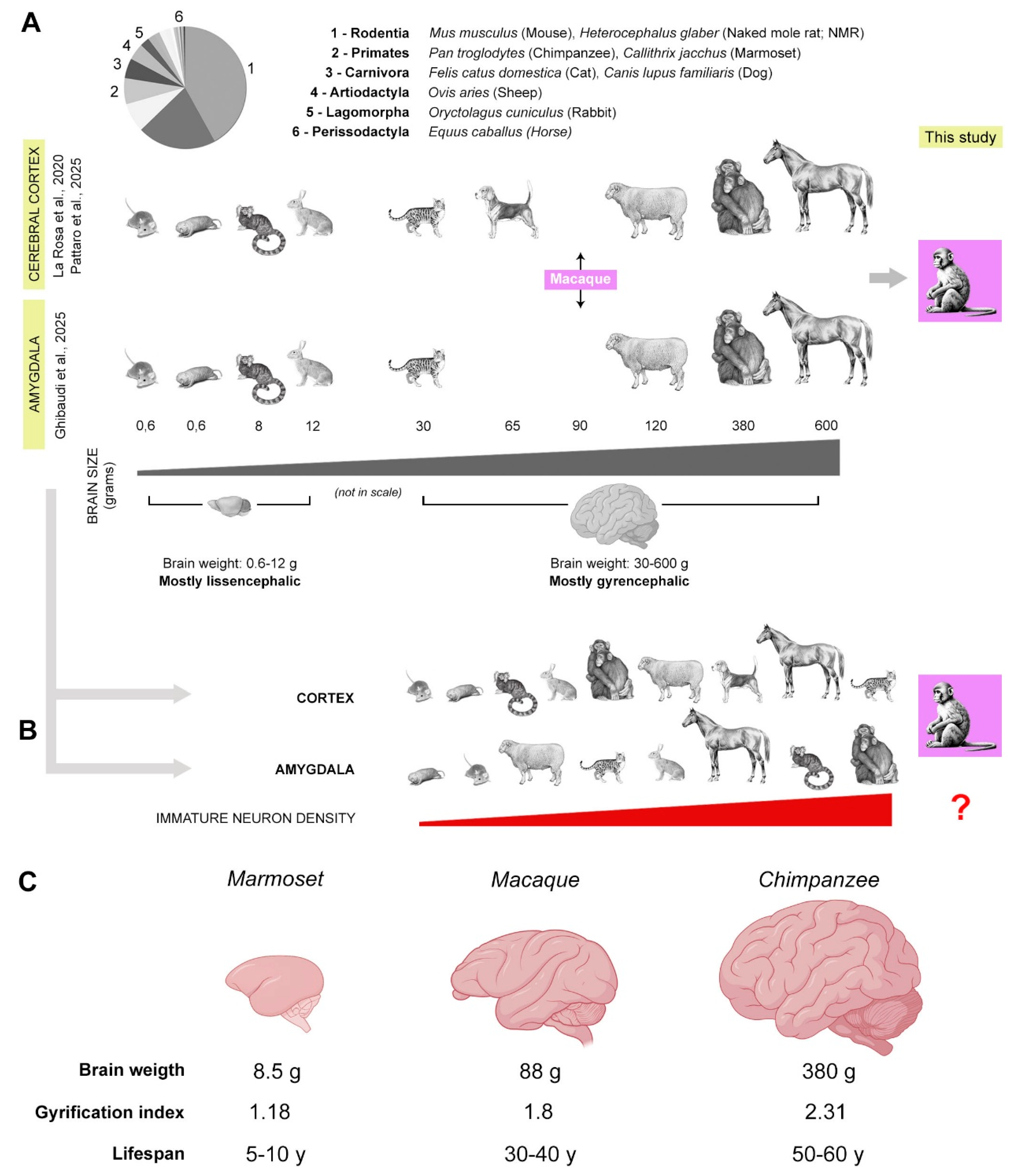
Figure 2.
Neuroanatomical references of the macaque brains used in this study. (A) Subsequent steps from brain extraction to cell quantification, including fixation, cutting serial coronal sections of the same thickness in the whole hemisphere, immunocytochemical procedures, layer II length (or amygdala area) measuring and cell counting at the Neurolucida. (B) mini-atlas of the main neuroanatomical structures, based on coronal sections stained for Nissl (a-e). The macaque atlases by [32,33,34,35,36,37] were used for comparison. Abbreviations: capital letters, grey matter main structures; lowercase letters, white matter tracts; italics, main cavities; bold, regions considered in this study for the analysis of immature neurons (NC, neocortex; PC, piriform cortex; LV, lateral ventricle; cc, corpus callosum; cr, corona radiata; ic, internal capsule; ec, external capsule; ex, extreme capsule; ot, optic tract; HY, hypothalamus; TH, thalamus; CN, caudate nucleus; PU, putamen; AM, amygdala; CL, claustrum; HP, hippocampus). The transition between three-layered allocortex (piriform cortex) and six-layered isocortex (neocortex) is marked with arrowheads. Macaque icon generated with A.I. (C) Schematic representation of the cortical (b) and subcortical (c) regions investigated for the DCX+ immature neurons. Scale bar: 2000 µm. Brain icons created with BioRender.com.
Figure 2.
Neuroanatomical references of the macaque brains used in this study. (A) Subsequent steps from brain extraction to cell quantification, including fixation, cutting serial coronal sections of the same thickness in the whole hemisphere, immunocytochemical procedures, layer II length (or amygdala area) measuring and cell counting at the Neurolucida. (B) mini-atlas of the main neuroanatomical structures, based on coronal sections stained for Nissl (a-e). The macaque atlases by [32,33,34,35,36,37] were used for comparison. Abbreviations: capital letters, grey matter main structures; lowercase letters, white matter tracts; italics, main cavities; bold, regions considered in this study for the analysis of immature neurons (NC, neocortex; PC, piriform cortex; LV, lateral ventricle; cc, corpus callosum; cr, corona radiata; ic, internal capsule; ec, external capsule; ex, extreme capsule; ot, optic tract; HY, hypothalamus; TH, thalamus; CN, caudate nucleus; PU, putamen; AM, amygdala; CL, claustrum; HP, hippocampus). The transition between three-layered allocortex (piriform cortex) and six-layered isocortex (neocortex) is marked with arrowheads. Macaque icon generated with A.I. (C) Schematic representation of the cortical (b) and subcortical (c) regions investigated for the DCX+ immature neurons. Scale bar: 2000 µm. Brain icons created with BioRender.com.
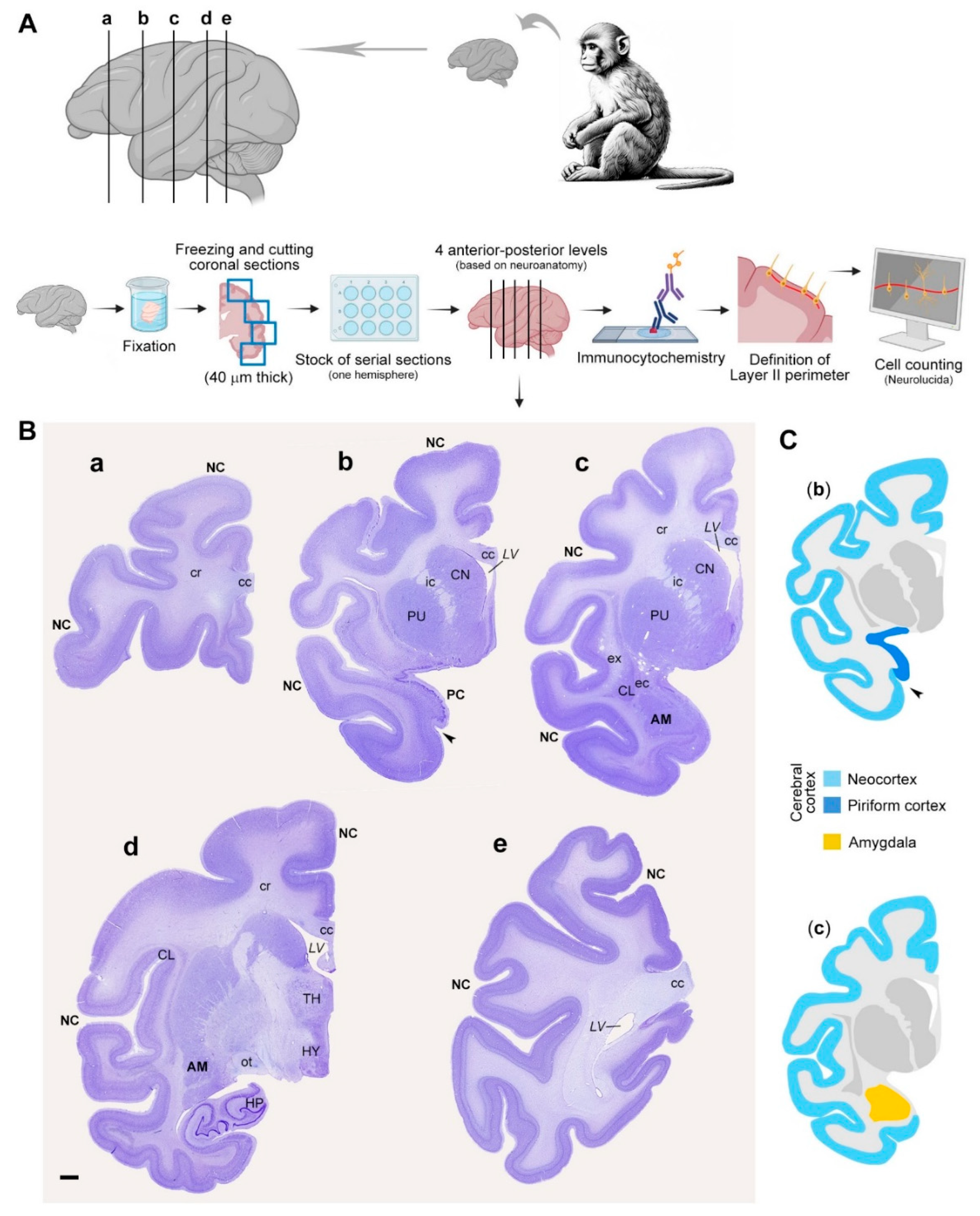
Figure 3.
Methodological approach for processing different brains to obtain comparable results in the cerebral cortex and amygdala (see [26] for more details). (A) Method adapted for IN quantification in the cerebral cortex layer II [15]; twelve coronal sections obtained from 4 correspondent brain levels are considered. (B) Method adapted for IN quantification in the amygdala [17]; serial coronal sections spaced 480 µm (one out of twelve) are considered in the total length of the amygdala (11 sections in a macaque hemisphere). In both regions, type 1 and 2 cells corresponding to different maturational stages can be identified and counted. Scale bars: 30 µm. (B’) Topological location of the macaque amygdala and its subdivision in subnuclei. Brain icon in A created with BioRender.com.
Figure 3.
Methodological approach for processing different brains to obtain comparable results in the cerebral cortex and amygdala (see [26] for more details). (A) Method adapted for IN quantification in the cerebral cortex layer II [15]; twelve coronal sections obtained from 4 correspondent brain levels are considered. (B) Method adapted for IN quantification in the amygdala [17]; serial coronal sections spaced 480 µm (one out of twelve) are considered in the total length of the amygdala (11 sections in a macaque hemisphere). In both regions, type 1 and 2 cells corresponding to different maturational stages can be identified and counted. Scale bars: 30 µm. (B’) Topological location of the macaque amygdala and its subdivision in subnuclei. Brain icon in A created with BioRender.com.
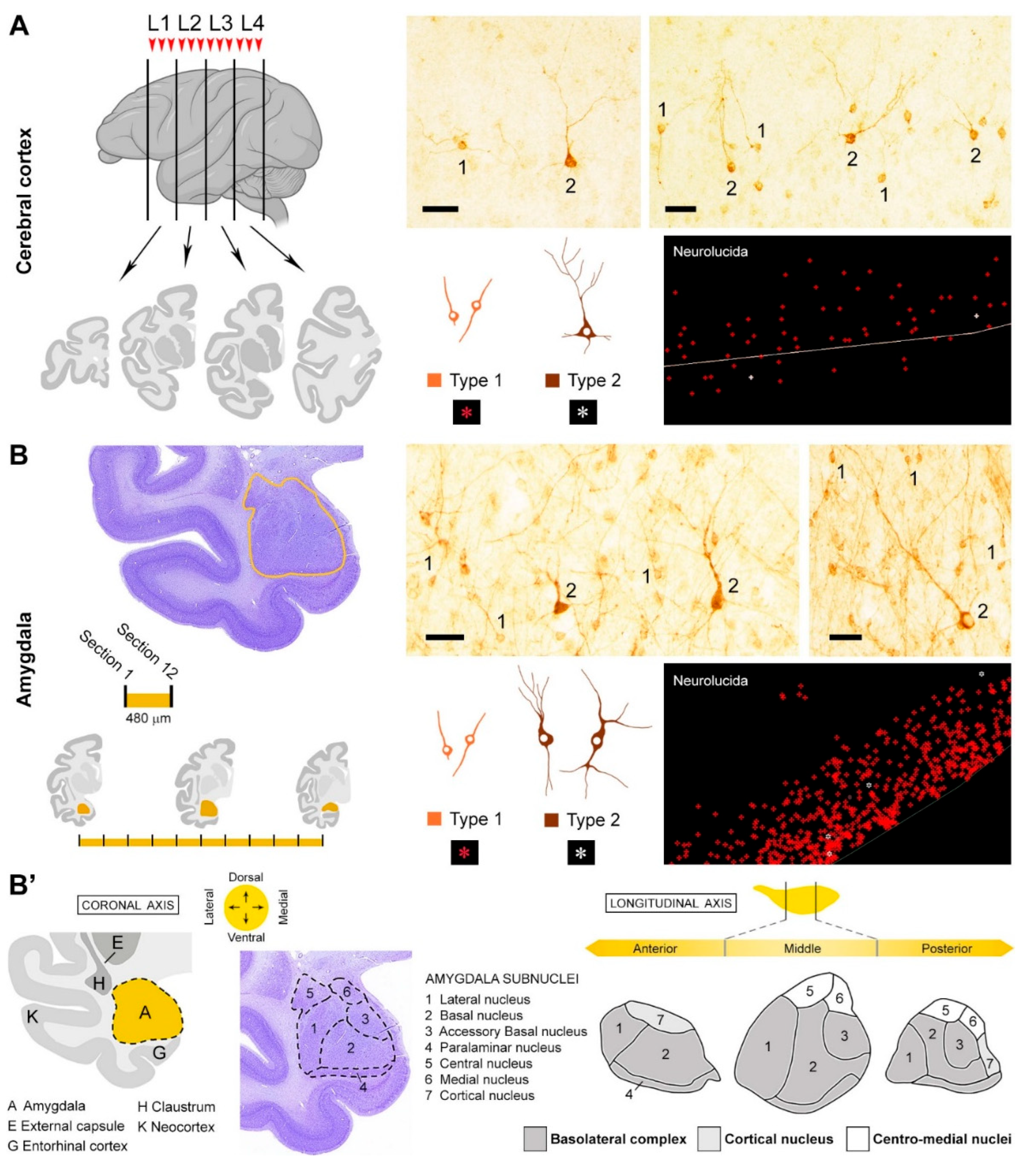
Figure 4.
Once defined the regions of interest through histological analysis (A; see Figure 2 and Figure 3; a, neocortex; b, piriform cortex; c, amygdala), the immunostaining for DCX in the cerebral cortex (piriform cortex and neocortex) and amygdala reveals typical populations of immature neurons (B). Photographs refer to layer II in the cortex and to the basolateral complex in the amygdala (blA). EC, external capsule. Scale bars: A, 200 µm; B, 30 µm. Brain icon created with BioRender.com.
Figure 4.
Once defined the regions of interest through histological analysis (A; see Figure 2 and Figure 3; a, neocortex; b, piriform cortex; c, amygdala), the immunostaining for DCX in the cerebral cortex (piriform cortex and neocortex) and amygdala reveals typical populations of immature neurons (B). Photographs refer to layer II in the cortex and to the basolateral complex in the amygdala (blA). EC, external capsule. Scale bars: A, 200 µm; B, 30 µm. Brain icon created with BioRender.com.
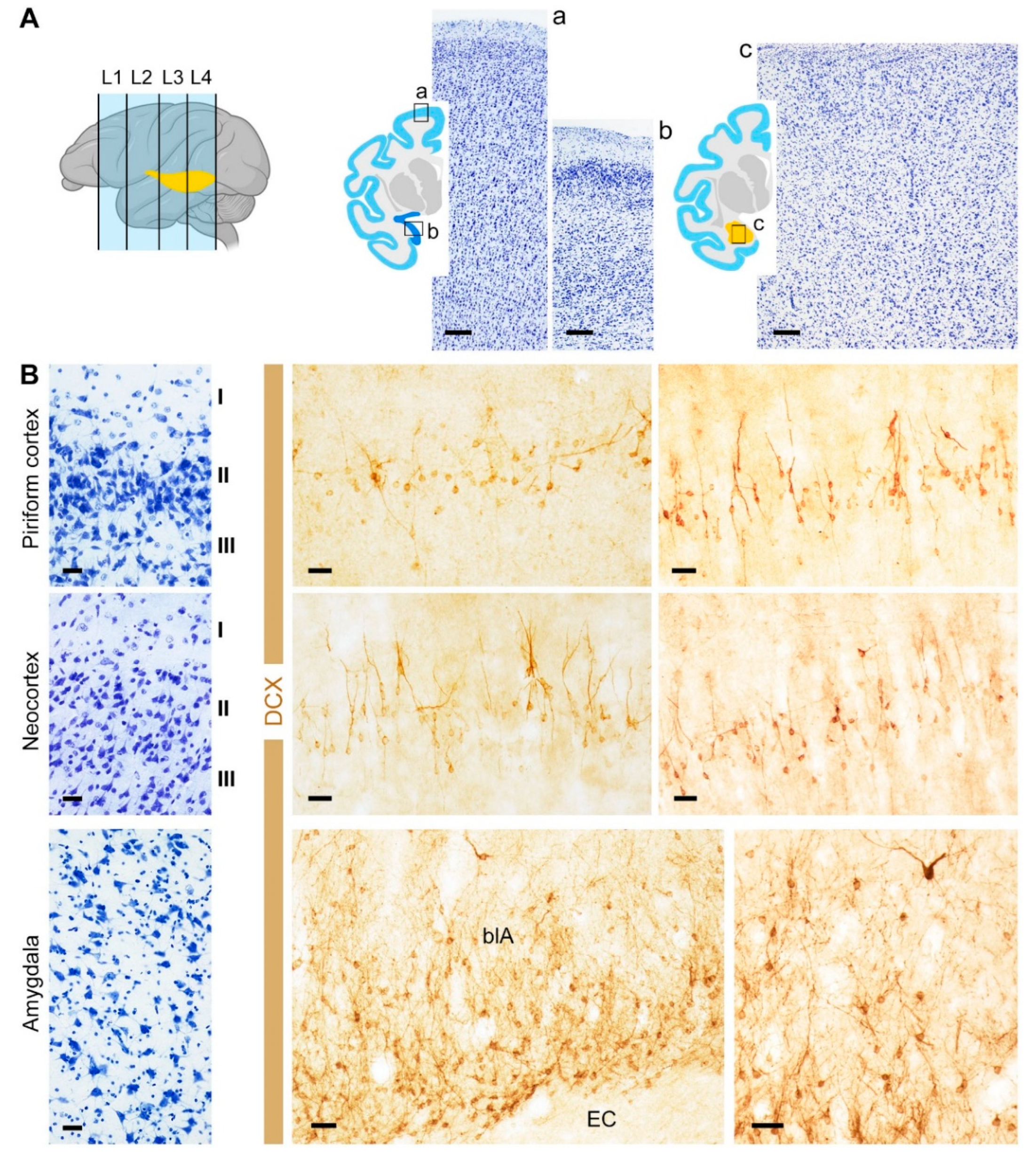
Figure 5.
Cell densities and phylogenetic analysis of DCX+ immature neurons in the macaque cortex. (A) DCX+ cell densities in the piriform cortex (PC), neocortex (NC) and whole cerebral cortex (PC+NC, intended as piriform cortex+neocortex) of young adult macaques; top right, percentages of type 1 and type 2 cells in cortical layer II. (B) Positioning of macaque in the phylogenetic variation of cIN density in the cerebral cortex of mammals; data obtained in the present study (in red) are compared with data previously reported (in black [15,16], all referring to young adults, except for adult marmosets, §). Macaques have among the highest density scores, and a significant difference is found between rodents and gyrencephalic species (see direct comparison between mouse and macaque in B’; top, whole cerebral cortex; bottom, neocortex). NMR, naked mole rat. (C) Ancestral character state reconstructions of trait evolution for DCX+ cell density in neocortex mapped onto the phylogeny. (D) Least squares regression of DCX+ cell density in neocortex against brain size (brain weight). (E) Least squares regression of DCX+ cell density in neocortex against neocortical surface (calculated using the layer II perimeter). All regression plots are on a log scale and show the 95% prediction intervals. (F) Heatmaps of the distribution of DCX+ cell linear density in different brain levels (L1-L4; neocortex).
Figure 5.
Cell densities and phylogenetic analysis of DCX+ immature neurons in the macaque cortex. (A) DCX+ cell densities in the piriform cortex (PC), neocortex (NC) and whole cerebral cortex (PC+NC, intended as piriform cortex+neocortex) of young adult macaques; top right, percentages of type 1 and type 2 cells in cortical layer II. (B) Positioning of macaque in the phylogenetic variation of cIN density in the cerebral cortex of mammals; data obtained in the present study (in red) are compared with data previously reported (in black [15,16], all referring to young adults, except for adult marmosets, §). Macaques have among the highest density scores, and a significant difference is found between rodents and gyrencephalic species (see direct comparison between mouse and macaque in B’; top, whole cerebral cortex; bottom, neocortex). NMR, naked mole rat. (C) Ancestral character state reconstructions of trait evolution for DCX+ cell density in neocortex mapped onto the phylogeny. (D) Least squares regression of DCX+ cell density in neocortex against brain size (brain weight). (E) Least squares regression of DCX+ cell density in neocortex against neocortical surface (calculated using the layer II perimeter). All regression plots are on a log scale and show the 95% prediction intervals. (F) Heatmaps of the distribution of DCX+ cell linear density in different brain levels (L1-L4; neocortex).
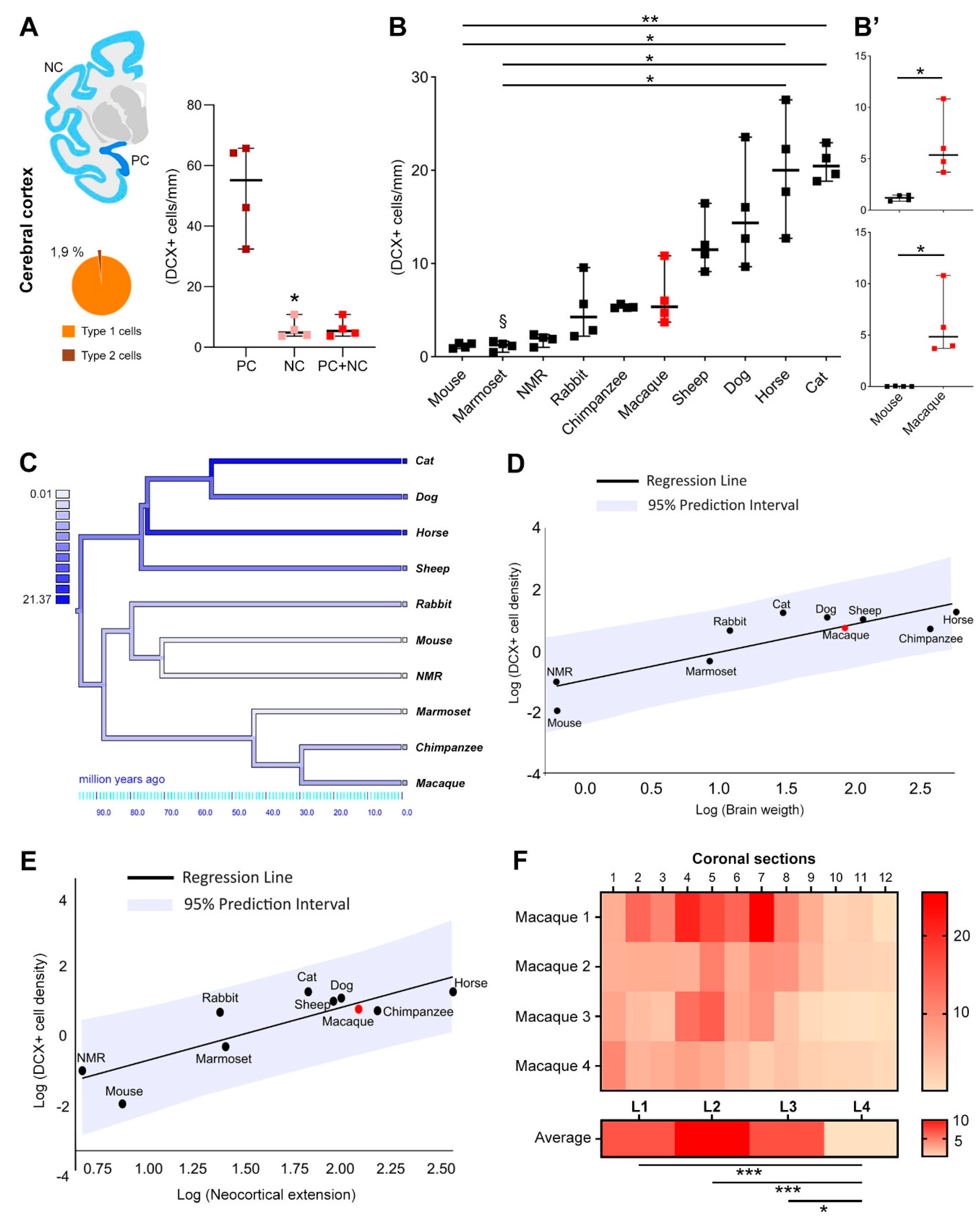
Figure 6.
Cell densities and phylogenetic analysis of DCX+ immature neurons in the macaque amygdala. (A) DCX+ cell densities in the amygdala (AM) of young adult macaques; top right, percentages of type 1 and type 2 cells. (B) Positioning of macaque in the phylogenetic variation of cIN density in the amygdala of mammals; data obtained in the present study (in red) are compared with data previously reported [17]; in black). Macaques are placed among the highest density scores along with other primates, while a significant difference is maintained with other species, especially rodents. NMR, naked mole rat. (C) Ancestral character state reconstructions of trait evolution for DCX+ cell density mapped onto the phylogeny, in the amygdala. (D) Least squares regression of DCX+ cell density in amygdala against brain size (brain weight). The regression plot is on a log scale and shows the 95% prediction intervals.
Figure 6.
Cell densities and phylogenetic analysis of DCX+ immature neurons in the macaque amygdala. (A) DCX+ cell densities in the amygdala (AM) of young adult macaques; top right, percentages of type 1 and type 2 cells. (B) Positioning of macaque in the phylogenetic variation of cIN density in the amygdala of mammals; data obtained in the present study (in red) are compared with data previously reported [17]; in black). Macaques are placed among the highest density scores along with other primates, while a significant difference is maintained with other species, especially rodents. NMR, naked mole rat. (C) Ancestral character state reconstructions of trait evolution for DCX+ cell density mapped onto the phylogeny, in the amygdala. (D) Least squares regression of DCX+ cell density in amygdala against brain size (brain weight). The regression plot is on a log scale and shows the 95% prediction intervals.
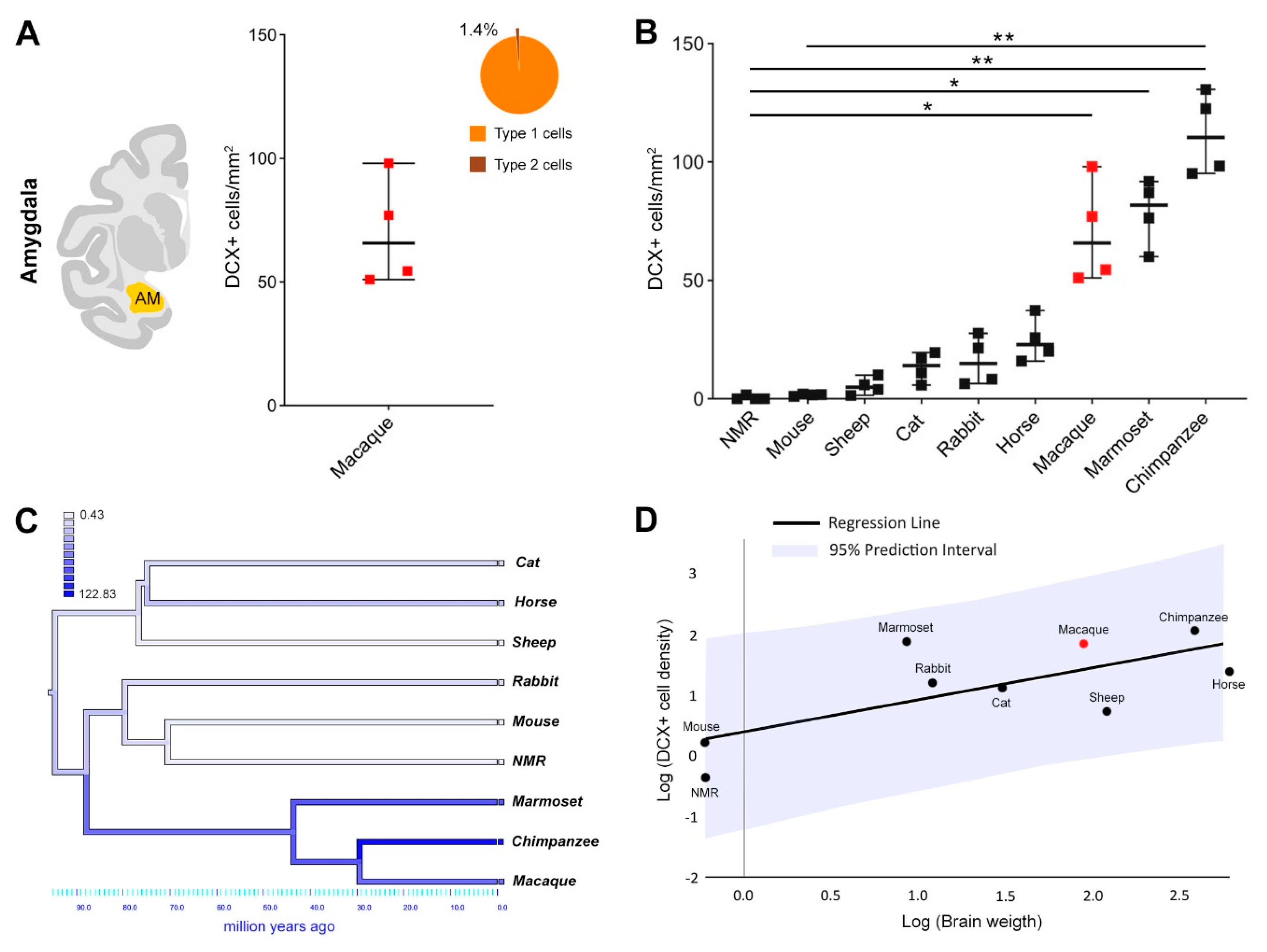
Figure 7.
Spatial distribution of cINs in the macaque amygdala. (A) Anterior-posterior distribution of in the entire length of the amygdala; the line plot indicates the mean total number of DCX+ cells counted in each brain coronal section of macaques (red; histogram in B), in comparison with other mammals (black; the number of coronal sections considered varies depending on the amygdala length and brain size; raw data in [17]). A’, Enlargement of the line plot for rodents shows that they have just a few DCX+ cells in the amygdala. (C) Topographical distribution of DCX+ cells within the macaque amygdala obtained on Neurolucida from placing markers on cells in brain coronal sections used for cell counting (red dots: DCX+ cells; green line: amygdala perimeter). Most immature neurons are concentrated within the basolateral amygdala, particularly in the paralaminar nucleus.
Figure 7.
Spatial distribution of cINs in the macaque amygdala. (A) Anterior-posterior distribution of in the entire length of the amygdala; the line plot indicates the mean total number of DCX+ cells counted in each brain coronal section of macaques (red; histogram in B), in comparison with other mammals (black; the number of coronal sections considered varies depending on the amygdala length and brain size; raw data in [17]). A’, Enlargement of the line plot for rodents shows that they have just a few DCX+ cells in the amygdala. (C) Topographical distribution of DCX+ cells within the macaque amygdala obtained on Neurolucida from placing markers on cells in brain coronal sections used for cell counting (red dots: DCX+ cells; green line: amygdala perimeter). Most immature neurons are concentrated within the basolateral amygdala, particularly in the paralaminar nucleus.
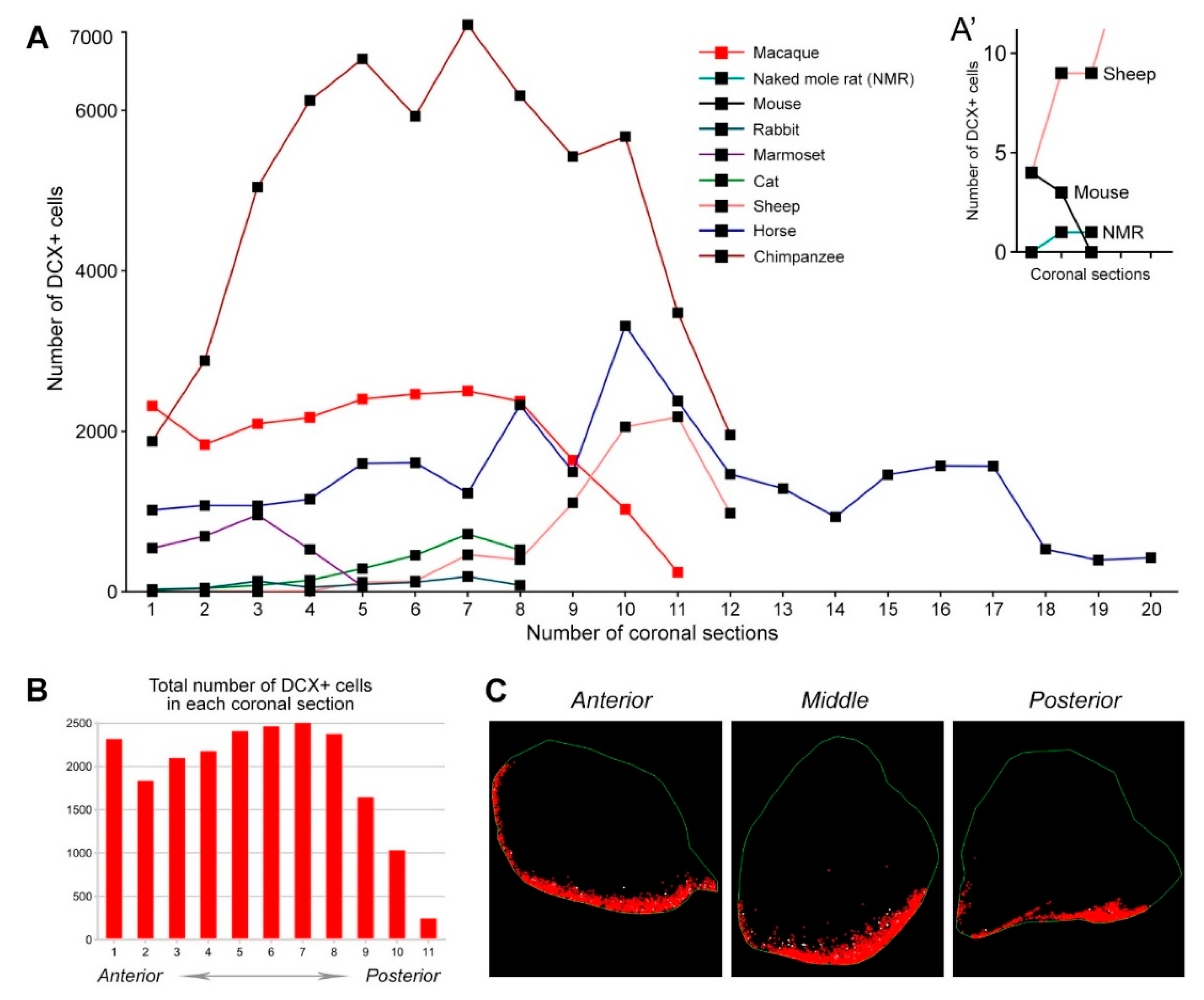
Figure 8.
Schematic summary illustrating the amount of cortical immature neurons (blue) and amygdala immature neurons (yellow) in three primate species and the difference with rodents. “Low” and “high” are referring to the DCX+ cell densities, while numbers indicate the estimated total DCX+ cells/hemisphere. Small brained, lissencephalic species characterized by poorly extended cortical mantles (including marmoset) have lower numbers of cINs. By contrast, all primates have large numbers of INs in amygdala. Among primates, macaques are closer to chimpanzees than marmosets. Animal icons were reproduced with permission from [15]; this article is distributed under the terms of the Creative Commons Attribution License, which permits unrestricted use and redistribution provided that the original author and source are credited. Brain icons were created with BioRender.com.
Figure 8.
Schematic summary illustrating the amount of cortical immature neurons (blue) and amygdala immature neurons (yellow) in three primate species and the difference with rodents. “Low” and “high” are referring to the DCX+ cell densities, while numbers indicate the estimated total DCX+ cells/hemisphere. Small brained, lissencephalic species characterized by poorly extended cortical mantles (including marmoset) have lower numbers of cINs. By contrast, all primates have large numbers of INs in amygdala. Among primates, macaques are closer to chimpanzees than marmosets. Animal icons were reproduced with permission from [15]; this article is distributed under the terms of the Creative Commons Attribution License, which permits unrestricted use and redistribution provided that the original author and source are credited. Brain icons were created with BioRender.com.
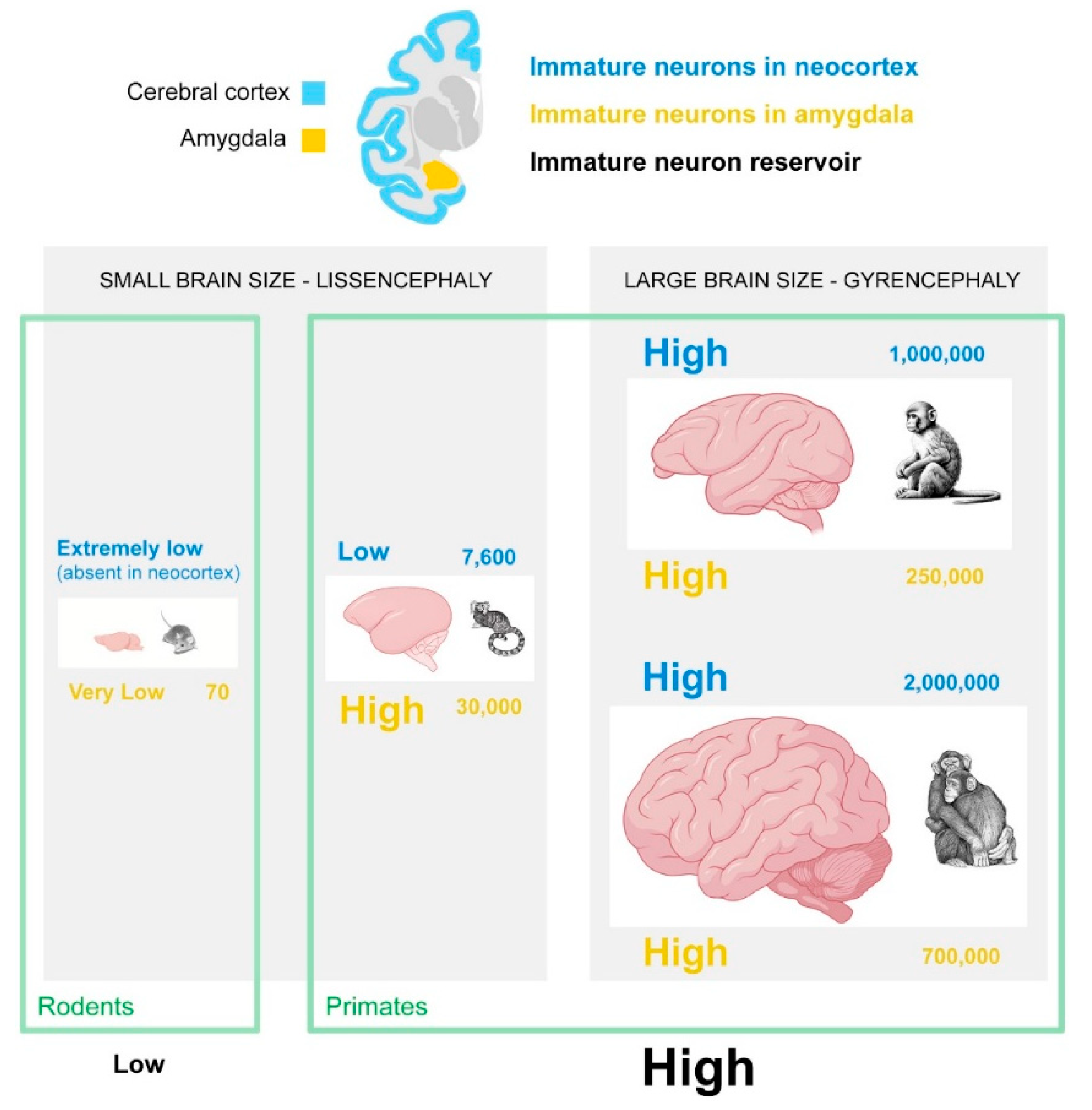

Table 1.
Brain samples of male young adult rhesus macaques used in this study.
| Species | Source | Specimens | Age (years) | Fixation | Fixative | PMI |
|---|---|---|---|---|---|---|
| Macaca mulatta | JBSA Fort Sam Houston | 4 | 7.4 | Immersion | 10% buffered formalin | <1 hour |
| JBSA Fort Sam Houston | 7.6 | |||||
| Emory National Primate Research Center | 8.0 | |||||
| Oregon National Primate Center | 10.2 |
Disclaimer/Publisher’s Note: The statements, opinions and data contained in all publications are solely those of the individual author(s) and contributor(s) and not of MDPI and/or the editor(s). MDPI and/or the editor(s) disclaim responsibility for any injury to people or property resulting from any ideas, methods, instructions or products referred to in the content. |
© 2026 by the authors. Licensee MDPI, Basel, Switzerland. This article is an open access article distributed under the terms and conditions of the Creative Commons Attribution (CC BY) license.
Copyright: This open access article is published under a Creative Commons CC BY 4.0 license, which permit the free download, distribution, and reuse, provided that the author and preprint are cited in any reuse.


