

Submitted:
22 May 2026
Posted:
22 May 2026
You are already at the latest version
Abstract
As sessile organisms, plants have developed intricate strategies to interact with their environment, including a variety of plant-plant interactions that range from mutualistic to antagonistic. Among these interactions, plant grafting stands out as a significant horticultural technique for enhancing productivity, disease resistance, and stress tolerance. Despite its widespread application, the mechanisms underlying graft compatibility remain poorly understood. This review explores the diverse field of plant-plant interactions, focusing on parallel mechanisms from other systems that may explain how “non-self” is determined during graft incompatibility. We first discuss the role of inter-plant signaling and the possibility of exudate-regulated compatibility. Next, we identify similarities between the parasitic plant haustoria and graft junctions, offering valuable insights into overcoming immunologic and physiologic barriers during vascular reconnection. We then delve into the potential roles of wound signaling and damage-associated molecular patterns (DAMPs) in grafting. Lastly, we provide an overview of pollen self-incompatibility as a case study for the detection of non-self throughout the plant kingdom. Overall, this review underscores the need for interdisciplinary approaches to unravel the complexities of graft compatibility, suggesting that future research should integrate knowledge from various fields of plant-plant interactions to improve the utilization of grafting and expand graft compatibility.
Keywords:
grafting
; graft compatibility
; plant-plant interactions
; parasitic plants
Introduction
Plants must employ a wide range of strategies to respond to their constantly changing environment. Much like animal systems, plants encounter a diverse array of friends and foes, and it is critical that complex surveillance systems are in place to identify foreign organisms as “non-self” (Janeway, 1992). Furthermore, it is key that appropriate responses are elicited to defend against or promote these interactions.
One of the most well-studied areas of plant biology revolves around the response of plants to pathogens. Significant progress has been made in understanding the plant immune system, whether bacteria-, fungi-, or insect-mediated. Overlapping with research on insect pathogens, the field of plant wound response has also shed significant light on the role of cellular damage as a mobile signal. In addition to pathogens, plants respond to other plants during plant-plant interactions. During infestation by parasitic plants that leach water and nutrients from their hosts, hosts must fend off enemies within the same kingdom, thereby allowing the evolution of plant-inclusive immune surveillance machinery. In addition to plant parasitism, plants interact with one another for various reasons, such as protecting against self-pollination, allocating resources, and signaling.
One additional type of plant-plant interaction is plant grafting. The origins of plant grafting are ancient, thought to have originated in oak (Quercus spp.), where pressure over time can force two neighboring branches together (Mudge et al., 2009). Similarly, natural grafting of tree roots occurs in oak and yellow birch (Betula alleghaniensis), where density forces nearby roots to press against one another, exposing their vascular tissues to one another (Mudge et al., 2009). While both instances are natural, evolved processes driven by the necessity of wound healing, humans have co-opted these processes to generate grafted plants for commercial use. The apical portion of a graft is referred to as the scion, and the root system as the rootstock. Grafting is an effective strategy used across a wide range of species, including trees and herbaceous crops, to enhance productivity and resilience (Goldschmidt, 2014). Grafting can be used for various purposes, such as inducing dwarfism to improve planting and harvest practices. For example, the “M9” rootstock is one of the most commonly used dwarfing varieties in apple (Malus domestica), where auxin signaling underlies the reduced stature of the grafted scion (Li et al., 2024). Grafting can be a strategy to improve fruit production, such as through graft-induced vigor. In Arabidopsis thaliana and Tomato (Solanum lycopersicum), msh1 mutant rootstocks have been shown to induce vigor via root-to-shoot-mobile siRNA, which regulates methylation of phytohormone genes in the scion and subsequent progeny (Kundariya et al., 2020). Grafting is also used to improve disease resistance. Among many examples, the well-known use of the North American grape (Vitis labrusca) rootstocks prevented the complete destruction of European wine cultivars (Vitis vinifera) by the invasive phylloxera insect pathogen (Mudge et al., 2009). Lastly, grafting is a key technique to promote abiotic stress tolerance. Interspecies grafting of S. peruvianum or S. habrochaites rootstocks with S. lycopersicum scions can be used to promote temperature-related stress tolerance (Venema et al., 2008, Lee et al., 2024). While grafting requires combining genetically distinct plants to achieve these processes, the mechanism that enables the joining of plant varieties, species, and sometimes even families remains poorly understood.
For two plants to be successfully grafted, substantial vascular connections must form between the scion and the rootstock (Thomas et al., 2022). These successful grafts are known as compatible. In contrast, incompatible grafts may fail to regenerate or regenerate only non-vascular tissue (Thomas et al., 2023). Historically, understanding graft incompatibility was limited by the lack of an herbaceous model system. Recent work in Arabidopsis has identified many novel genes involved in grafting (Melnyk et al., 2018), and the development of tomato and pepper as a model for graft incompatibility has dramatically expanded the field (Thomas et al., 2022; Thomas et al., 2023). Despite this, much remains unknown about how plants detect graft partners and determine compatibility status.
Drawing from various fields of plant-plant studies, new information has recently been uncovered that may be relevant for a better understanding of plant grafting. This review aims to describe the phenomenon involved in plant-plant interactions, the processes that mediate “non-self” determination, and reveal parallel mechanisms that may regulate graft healing and compatibility.
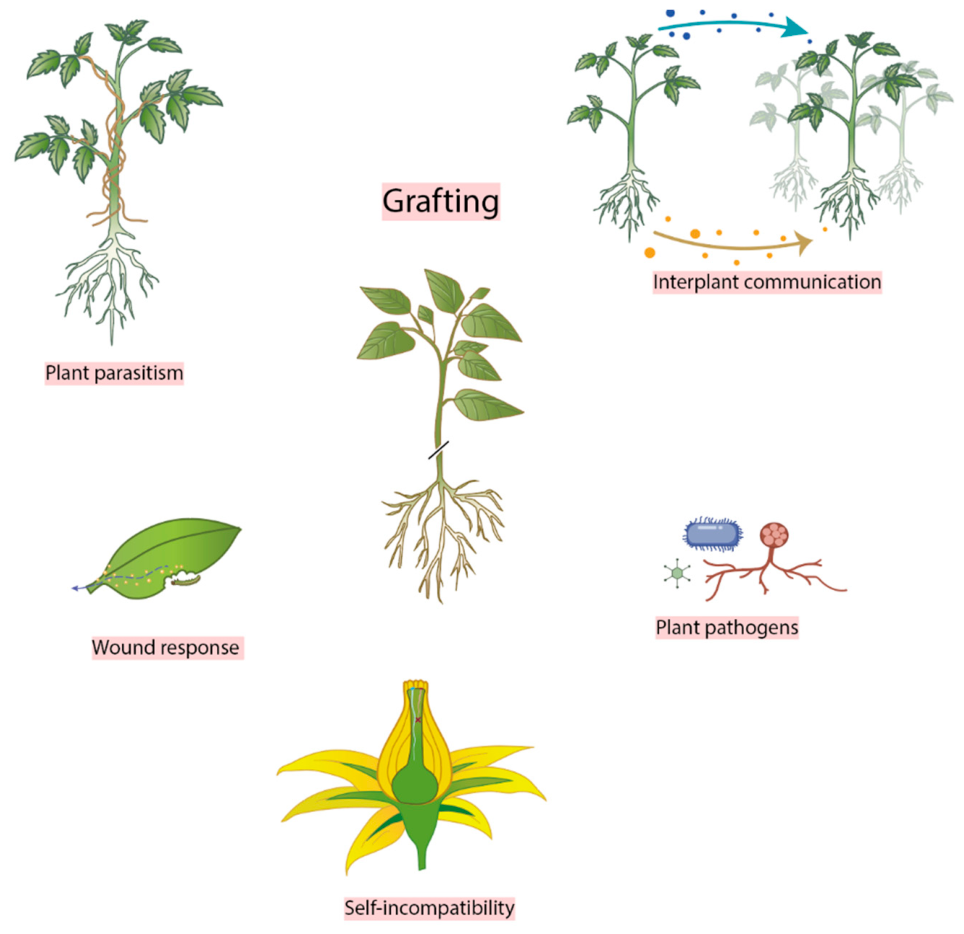
Plant-plant interactions allow plants to perceive non-self counterparts and initiate appropriate responses. A notable instance of such interactions is grafting, where distinct plant varieties are cut and joined, then allowed to heal. However, not all combinations succeed, a phenomenon referred to as graft compatibility. The criteria for determining compatibility remain elusive; nonetheless, plant-plant interactions may elucidate the mechanisms underlying non-self detection and response during grafting. Communication between plants can involve root exudates or airborne signals. Similar to plant-pathogen interactions and responses to injury, plants have developed sophisticated surveillance and signaling systems to defend against threats. Parasitic plants represent one of the most obvious cases of negative plant-plant interactions, whereby hosts attempt to elicit immune responses to repel parasites, while parasites endeavor to circumvent these defenses and establish vascular connections. In this capacity, parasitic plants demonstrate a high degree of compatibility, forming vascular connections with diverse host species. Furthermore, different plant species employ varied mechanisms to recognize self-pollen through self-incompatibility. These examples collectively illustrate the myriad ways in which plants can detect non-self entities, suggesting that analogous mechanisms may underpin the determination of graft compatibility.
Figure 1.
Diverse plant-plant interactions highlight mechanisms of non-self detection in the Plant Kingdom.
Figure 1.
Diverse plant-plant interactions highlight mechanisms of non-self detection in the Plant Kingdom.
Inter-Plant Communication
The Rhizosphere and Root Exudates
Plants interact with other plants through a wide array of secreted compounds. Some of these exudates are released from the roots and have been shown to regulate the rhizosphere by affecting the chemical ecology of the surrounding soil. For example, well-studied beneficial microbial associations, such as those involving rhizobia, are promoted by plant-secreted flavonoids (Peters et al., 1986). Plants can also secrete compounds, such as coumarins (Steinauer et al., 2016), that promote beneficial microbes while inhibiting pathogens (Huang et al., 2019, Hu et al., 2018, Stringlis et al., 2018). The rhizome can also protect aerial plant parts from disease, a process known as induced systemic resistance (ISR) (Pieterse et al., 2014). The presence of certain root-associated mutualists, such as Trichoderma spp., can prime the plant immune system for subsequent pathogen infection, further underscoring the important role of the root system in plant health and protection (Walters et al., 2013).
Root exudates can also directly affect neighboring plants (Sorty et al., 2025). Beneficial associations include intercropping-induced mutualistic resource allocation (Si et al., 2025) or floral timing cues from neighboring plants (Stirnemann & Sasse, 2025). However, root exudates can also act as plant inhibitors by repressing seed germination or root growth (Sorty et al., 2025). Chemically mediated negative plant-plant interactions are known as allelopathy. These instances of inhibition can prevent parasitic plant invasion (Cimmino et al., 2015), protect limited soil resources (Gattullo et al., 2018), or help a plant to dominate the canopy for light (Kegge et al., 2015). For example, benzoxazinoids are secreted by many grasses to inhibit the growth of neighboring plant species (Schandry & Becker, 2020). Two such compounds are 4-dihydroxy-2H-1,4-benzoxazin-3(4H)-one (DIBOA) and 4-dihydroxy-7-methoxy-2H-1,4-benzoxazin-3(4H)-one (DIMBOA). Analysis of various wheat grasses (Triticeae spp.) found that exudates from T. durum resulted in a 60.3% inhibition of Sinapis alba root growth, with 69.4% of that effect estimated to be due to DIBOA and DIMBOA, validating the strong phytotoxic effect of root exudates (Belz & Hurle, 2005).
While root systems regulate the rhizosphere of ungrafted plants, the same principle applies to grafted plants, where beneficial phenotypes arise from root-specific interactions with microorganisms. In grafted plants, interactions between the rootstock and the scion can be seen as an intimate form of plant-plant interaction. For example, the rootstock's ability to regulate the root microbiome is hypothesized to contribute to graft-induced vigor of the scion (Williams et al., 2021). Indeed, during tomato grafting, the use of the F1 hybrid “Maxifort” (S. lycopersicum × S. habrochaites) rootstock was found to increase rhizosphere microbial biodiversity compared with self-grafted or ungrafted tomato (S. lycopersicum). Similarly, in grafted grape and apple, different rootstocks were found to affect soil microbial communities. In apple, vigorous rootstocks were found to promote a more diverse bacterial microbiome than the dwarfing M9 (Liu et al., 2018), while grape rootstocks contained bacteria associated with growth-promoting traits (Marasco et al., 2018). This phenomenon has been hypothesized to result from the evolution of holobionts, in which rootstock and microbes may have co-evolved. Through grafting, these beneficial relationships can regulate the scion of other varieties and cultivars. In contrast, grafted partners may utilize exudates to repress healing. The presence of graft-limiting metabolites has been hypothesized for decades (Mudge et al., 2009), yet only a single instance of metabolic graft incompatibility has been clearly studied: quince-pear grafts. Quince (Cydonia oblonga) is commonly used as a dwarfing rootstock to pear (Pyrus communis) (Browning & Watkins, 1991); however, several economically valuable pear varieties, such as “Williams”, are graft-incompatible with quince (Tomaz et al., 2009; Herrero, 1951). This was attributed to high levels of the cyanogenic glucoside prunasin in quince rootstocks (Sánchez-Pérez et al., 2012). Because prunasin is phloem-mobile, it accumulates at the pear graft interface, where it is degraded by β-glucosidase, prunasin hydrolase, leaving behind the toxic byproduct, hydrogen cyanide (HCN) (Sánchez-Pérez et al., 2012), which leads to cell death and vascular degradation at the graft junction. Quince-pear incompatibility was successfully overcome using interstock grafting with the pear variety, “Old Home”, which contains the enzyme inhibitor capable of halting prunasin breakdown (Hudina et al., 2014).
Much like the ability of certain rootstocks to positively regulate scion growth through graft-induced vigor, it is possible that chemical exudates, metabolites, or other effects by the rootstock can dysregulate the scion either through response to a secreted compound, such as allelopathy, or by altering the rhizosphere such that necessary nutrients or microbe-interactions are limited. The communication between rootstock and scion has not been well studied and may be involved in compatibility determination. Furthermore, it is well established that root exudates can inhibit the growth of neighboring plants, suggesting that other root- or scion-derived compounds might also impair graft healing. In the study of allelopathy, root exudates from plant cultures are screened for phytotoxic effects (Bais et al., 2006). When exudates containing putative allelopathic compounds are identified, the components of the exudate mixtures are analytically separated, and the inhibitory effect is individually validated. Perhaps a similar protocol could be used to screen incompatible graft combinations for toxic metabolites. An attempt to profile metabolic inhibition of callus formation in tomato and pepper was conducted using culture media contaminated with cross-species exudates, but no effect was observed (Thomas et al., 2024). However, the role of exudates on graft healing remains poorly explored.
Volatile Organic Compounds
Plants also release volatile organic compounds (VOCs), which allow inter-plant communication. One of the most well-studied VOCs is methyl jasmonate, a volatile gaseous derivative of jasmonic acid (JA). Jasmonates are released by shoots and roots (Kulkarni et al., 2024), especially after wounding, and are key regulators of defense against herbivory (Howe & Jander, 2008; Glauser et al., 2008). JA has been shown to be present in wheat root exudate and sensed by up to 100 plant species, making it a broadly applicable plant-plant communication signal (Kong et al., 2018). Jasmonates also move within tissues from shoot to root along the vasculature and cell-to-cell in nonvascular tissue, sending distal wound signals that induce de novo biosynthesis in unwounded tissue (Gasperini et al., 2015).
Additionally, jasmonates are involved in localized tissue healing. In Arabidopsis, partial wounding to the floral hypocotyl led to high auxin/low JA above the wound, and low auxin/high JA below (Asahina et al., 2011). Low auxin and high JA induced the expression of Related to APETALA2.6-like (RAP2.6L), which is necessary for wound-induced cell proliferation (Matsuoka et al., 2018). While JA is critical for healing and is indeed upregulated during grafting in Arabidopsis, the JA-biosynthesis mutant, allene oxide synthase (aos), was still capable of grafting, suggesting the exact role of JA during graft healing is more complex than wounding alone (Matsuoka et al., 2018, Kong et al., 2018). Regardless, it has been shown that JA is graft-mobile (Kong et al., 2018) and present in the cambium (Sehr et al., 2010), making it a potential plant-plant communication signal relevant to graft compatibility. And indeed, during Solanaceous grafting, incompatible tomato-pepper (Capsicum annuum) grafts had an upregulated JA response, including the production of JA-dependent defensive metabolites, steroidal glycoalkaloids (SGA) in the scion (Bai et al., 2025, Thomas et al., 2024).
Figure 2.
Plants promote and inhibit neighboring plants through various signals.
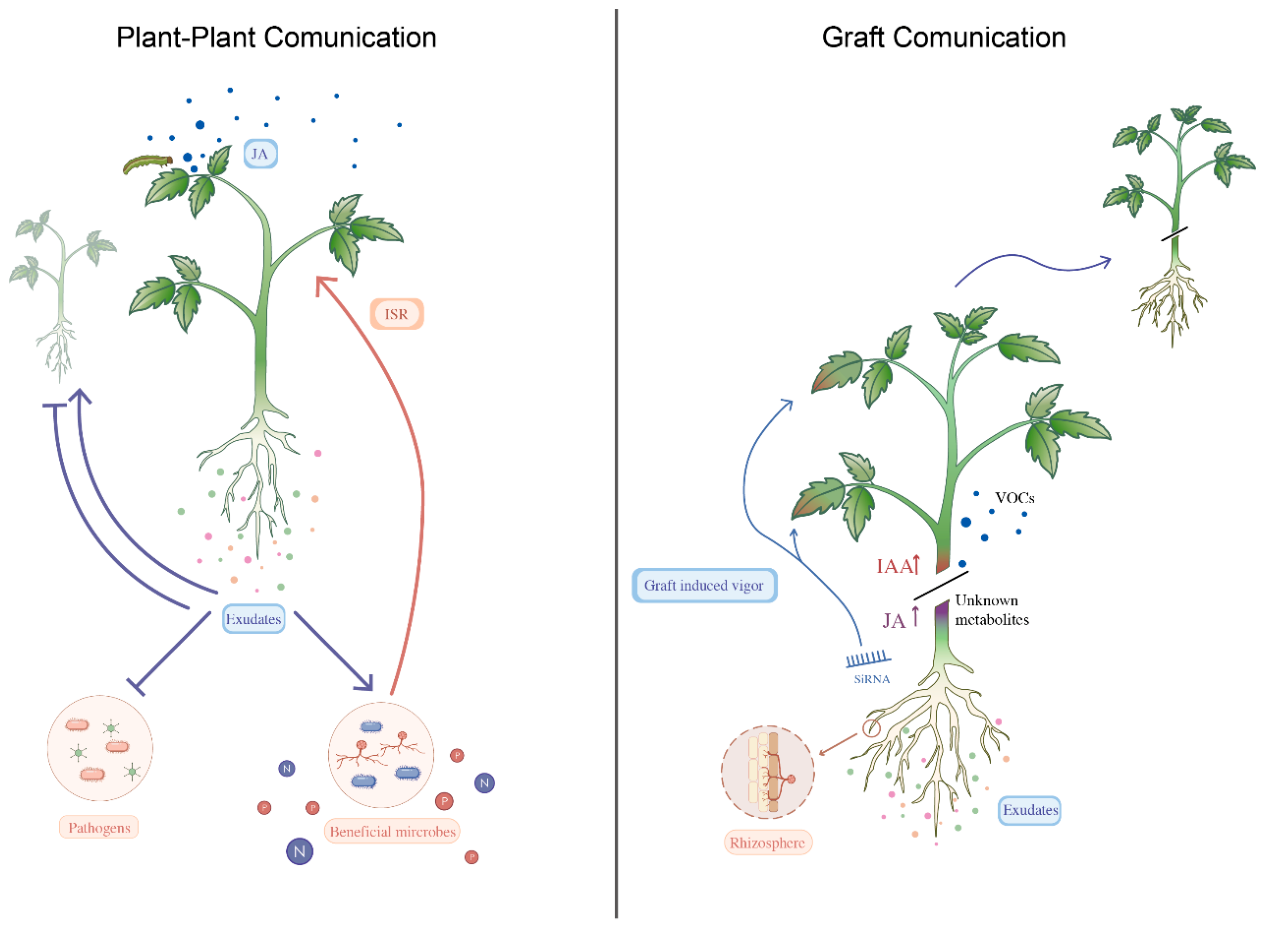
Plants communicate with adjacent plants through numerous compounds (left). Root systems may secrete substances that promote beneficial microbes while inhibiting pathogens. These beneficial microbes not only supply nutrients to plants but can also prime the aerial shoot via induced systemic resistance (ISR). These exudates can further promote or inhibit the germination or growth of neighboring plants. Wounds, such as those caused by insect herbivory, produce mobile signals such as jasmonic acid (JA), which can travel through vascular tissue, cell-to-cell, as soil exudates, or even through the air. Furthermore, grafted rootstocks interact with their scions in similar manners (right). Rootstocks can modulate the rhizosphere and enhance growth by improving nutrient uptake. Rootstocks also send graft mobile signals, such as siRNA, into the scion, where gene regulation influences growth and development. The accumulation of hormones during grafting regulates the healing process, while unidentified metabolites may suppress regeneration. As grafting is a wound-healing process, volatile organic compounds (VOCs) such as jasmonic acid (JA) might also regulate nearby plants.
The Immune System and Graft Compatibility
Drawing on hundreds of years of plant-pathogen interactions, recent findings have identified novel instances of plant-plant immune response. A fundamental aspect of this response is the ability of plants to distinguish 'self' from 'non-self' (Sanabria et al., 2010). In animals, a complex immune system identifies foreign organisms through mobile, rapidly responding innate and adaptive immune cells (McComb et al., 2026). Adaptive immune cells exhibit a delayed response and immunological memory from prior encounters with specific antigens, enabling extreme precision in response (McComb et al., 2026). Whereas plants employ a more ancestral immune system based fully on innate immunity. This system relies largely on broad, non-specific responses, which have helped plants to adapt to biotic stressors, such as bacteria, fungi, insects, and herbivores (Miller et al., 2017, Abdul Malik et al., 2020). In plants, non-self recognition is mediated by two systems: pathogen-associated molecular pattern-triggered immunity (PTI) and effector-triggered immunity (ETI).
The first layer of defense is PTI, which comprises extracellular receptors known as pattern recognition receptors (PRRs) that detect microbe- or pathogen-associated molecular patterns (MAMPs or PAMPs), herbivore-associated molecular patterns (HAMPs), and damage-associated molecular patterns (DAMPs). When these molecules are bound by PRRs, a cascade of processes is activated, such as reactive oxygen species (ROS) burst, Ca2+ influx, the activation of mitogen-activated protein kinases (MAPK) cascades, and callose induction, to name a few (Bigeard et al., 2015, Yu et al., 2024). Plant PRRs are molecule-specific, cell surface-localized receptor kinases that often co-bind with more broadly employed receptors, such as BRI1-ASSOCIATED RECEPTOR KINASE 1 (BAK1) (DeFalco & Zipfel, 2021).
The second layer of defense is ETI. ETI is an intracellular response in which pathogenic proteins, known as effectors, are sensed by intracellular nucleotide-binding and leucine-rich repeat receptors (NLRs), sometimes known as R genes. Effectors aim to evade the plant immune system and instead deactivate certain components of the immune response, making the plant susceptible to infection. Each R gene has evolved to bind to one or a few corresponding effectors, leading to a stressor-specific response (Dodds & Rathjen, 2010, Sanabria et al., 2010). Once perceived, effectors can activate hypersensitive response (HR)-related programmed cell death (PCD) in local tissue or trigger systemic acquired resistance (SAR)-mediated salicylic acid (SA) production systemically to prevent infection throughout the plant (Sanabria et al., 2010).
Pathogens
During PTI, PAMPs signal the plant immune system of potential infection. Several PAMPs have been extensively studied, such as bacterial flagellin (flg22) (Felix et al., 1999), lipopolysaccharides (LPS) (Newman et al., 1995), peptidoglycan (PGN) (Gust et al., 2007), exopolysaccharide (EPS), and elongation factor Tu (EF-Tu) (Kunze et al., 2004) as well as fungal chitin (Felix et al., 1993) and β-glucan (Umemoto et al., 1997). Each PAMP has a main PRR that triggers downstream processes, such as flg22-FLAGELLIN SENSING2 (FLS2) (Chinchilla et al., 2006) or chitin-CHITIN ELICITOR RECEPTOR KINASE 1 (CERK1) (Miya et al., 2007). PTI manifests as an activated immune system. For example, pretreatment with flg22 in Arabidopsis leads to an increased resistance to Pseudomonas syringae pv. tomato DC3000 (Pst) due to the defensive production of extracellular ROS, and activated defense genes (Zeidler et al., 2010, Wang et al., 2023), such as WRKYs (Logemann et al., 2013), and JA/SA biosynthesis (Zhang et al., 2010, Feys et al., 1994). A mutation in any of these PRRs leaves plants susceptible to infection by disrupting their ability to mount a rapid immune response.
Most work on PTI is based on local signaling, but recent studies have shown that chitin perception in soil induces PTI in leaves, such as Ca2+ influx and ROS induction (Makechemu et al., 2025), highlighting a long-distance component. Although the systemic signal was not identified, they showed that this effect was graft-mobile in Arabidopsis, suggesting that inducing PTI in rootstocks may be a novel strategy for protecting susceptible scions.
While PTI tends to elicit local responses, ETI is known to elicit greater-intensity, larger-scale, long-lasting responses. When NLRs bind to pathogenic effectors, they form large protein complexes known as resistosomes (Makechemu et al., 2025). These complexes then form and activate diverse processes, but most utilize an influx of intracellular Ca2+ to trigger transcriptional changes or even HR. One of the critical outputs of ETI is SAR, in which the perception of a pathogen in one location confers disease resistance in distant, non-infected tissues. SA is a key component of this response. In 1985, experiments with grafted cucumbers (Cucumis sativus) showed that infection of rootstock leaves with the fungus Colletotrichum lagenarium could confer anthracnose resistance in the scion via a mobile signaling element (Dean & Kuc, 1986). Since then, the mode of transport for this signal has been mostly clarified to be the phloem (Kiefer & Slusarenko, 2003), with several signals posited as the mobile element. Originally thought to be SA itself (Malamy et al., 1990, Metraux et al., 1990), it is now suggested that N-hydroxy-pipecolic acid may be the true cue, due to its necessity in SAR (Chen et al., 2018) and presence in the phloem (Schnake et al., 2020). Throughout this research timeline, grafting has played an integral part in our understanding of SAR. Indeed, graft experimenters were able to not only show that SAR moves from the site of infection to the distal leaves (Guedes et al., 1980), that the original infected leaf is the source of the mobile signal (Metraux et al., 1990), but that SA was not the mobile signal due to the ability of SA-deficient nahG tobacco (Nicotiana tabacum) rootstocks to still confer SAR in grafted scions (Dean & Kuc, 1986). Despite its early involvement in the field of SAR, only a few studies (Makechemu et al., 2025, Jensen et al., 2012) have investigated how graft mobile immune signaling might be used to confer graft-induced disease resistance. While grafting remains a key technique for conferring localized disease resistance in the soil (Louws et al., 2010), the presence of non-autonomous graft-mobile immune signals is a poorly investigated area with potential for future advancements.
Parasitic Plants
Recently, progress in the study of how plants detect and defend against parasitic plants has highlighted that immune processes originally identified in disease also operate during plant parasitism. Parasitic plants have evolved a structure known as a haustorium, capable of penetrating into the plant vascular system and extracting not only water and nutrients, but also transferring signaling molecules between the parasite and host through the haustoria (Kim & Westwood, 2015, Shen et al., 2023). Parasitic plants, including the well-studied Striga spp., Orobanche spp., and Cuscuta spp., are considered serious threats to crops. Most host plants fail to detect these invading parasites, making numerous crops susceptible to infestation. Because parasitic plants can impact yield, research has focused on identifying R genes in resistant species.
Cuscuta spp. are incredibly destructive plants that draw water and nutrients from their host’s stem. Unlike most hosts, domesticated tomato is resistant to Cuscuta reflexa (Kaiser et al., 2015). During infestation, tomato elicits an immune response that induces the production of SA and JA (Runyon et al., 2010) and triggers HR in the cells where haustoria have penetrated (Albert et al., 2004, Ihl. et al., 1988). It was later found that extracts from C. reflexa contained a glycine-rich cell wall peptide, coined Crip21 (Hegenauer et al., 2020), which could trigger typical PTI responses, such as a ROS burst, via a cell surface PRR, CUSCUTA RECEPTOR 1 (CuRe1) and the co-receptor SlSOBIR1 (Hegenauer et al., 2016).
In the Orobanche cumana-Helianthus annuus (sunflower) interaction, in which O. cumana penetrates the sunflower root to enter the vascular system, recent work has shown that resistance to O. cumana can be conferred by a member of the sunflower Or gene family, HaOr7 (Duriez et al., 2019). Similar to PRRs, which perceive pathogens, HaOr7 is a LEUCINE-RICH REPEAT RECEPTOR-LIKE KINASE (LRR-RLK) and a predicted homolog of Xa21 in rice (Song et al., 1995). In rice, Xa21 is key for resistance to Xanthomonas oryzae pv. Oryzae (Xoo) by recognizing the bacterial peptide, Ax21 (Park & Ronald, 2012). Due to the sequence homology, HaOr7 is predicted to act as a PRR by binding to a hypothetical O. cumana peptide deemed Avr (Avirulence)-Or7.
These two examples demonstrated the presence of plant PAMPs, suggesting that plants have likely evolved the ability to detect non-self plant interactions through cell-surface receptors, much as they detect microbes and insects. Similarly, in the same way that pathogens deliver pathogenic effector proteins capable of disarming the plant immune system, a process that plants counteract through the evolution of NLRs, parasitic plants also behave in a similar way.
Evidence for parasitic plant effectors was first identified in Striga, an aggressive root parasite of the forage crop cowpea (Vigna unguiculata L. Walp.), where the resistant cultivar B301 (Timko. et al., 2007) suddenly became susceptible to Striga gesnerioides race 4 (SG4) (Huang et al., 2012). This phenomenon exemplified the gene-for-gene model underlying R gene evolution (Flor, 1971). Furthermore, it was later shown that B301 resistance to S. gesnerioides race 3 (SG3) was conferred by the NLR RSG3-301, although the effector remains unidentified (Li & Timko, 2009). Similarly, an SG4 effector protein, Suppressor of Host Resistance 4z (SG4z), was identified as highly expressed in the haustorium and capable of attenuating the HR required for resistance (Su et al., 2020). Here, the effector was found to bind the cowpea ubiquitin E3 ligase POB1, VuPOB1, a regulator of HR (Su et al., 2020).
In contrast to pathogen-derived molecules, it has also been shown that parasitic plants can perceive host-derived molecular patterns. The quinone, 2,6-dimethoxy-1,4-benzoquinone (DMBQ), is perceived by the LRR-RLK CANNOT RESPOND TO DMBQ 1 (CARD1) (Laohavisit et al., 2020). Unlike PTI, which induces anti-pathogenic processes, DMBQ perception by CARD1 in Phtheirospermum japonicum induced Ca2+-mediated haustorium induction. Interestingly, in non-parasitic Arabidopsis, DMBQ could also be perceived, leading to Ca2+ influx and MAPK induction, but not ROS, suggesting that quinone sensing is also involved in plant immunity, but does not overlap with PTI. Previous work identified quinones as stomatal regulators (Toh et al., 2018), and indeed, card1 mutants were perturbed in stomatal immunity and more susceptible to Pseudomonas syringae pv. tomato DC3000 infection than WT (Laohavisit et al., 2020).
While PTI and ETI were originally considered pathogen-specific processes, it is now clear that plant PAMPs and effectors also exist. This opens the intriguing possibility that graft compatibility has an immunity-controlled basis. Further supporting this, incompatible tomato-pepper grafts exhibit graft-localized cell death and upregulation of hundreds of rootstock NLRs, suggesting that this pairing reflects genetic incompatibility that induces NLR-mediated cell death (Thomas et al., 2024). The signal that induces this process remains unknown, but species-specific proteins may trigger immune responses leading to immunologically mediated cell death.
An alternative hypothesis for tomato-pepper incompatibility focuses on the significant similarities between this genetic graft incompatibility and hybrid necrosis (Hollingshead, 1930), which occurs when hybridized species have incompatible immune components, usually involving at least one NLR (Bomblies et al., 2007). Although observed in many plants, including Crepis spp. (Hollingshead, 1930), rice (Oryza sativa) (Yamamoto et al., 2010), Nicotiana (Yamada & Marubashi, 2003), wheat (Triticum aestivum L.) (Chu et al., 2006), and Capsella spp. (Sicard et al., 2015), hybrid necrosis was most clearly described in Arabidopsis, where crosses between Cdm-0 and other accessions, such as TueScha-9, led to severe necrosis in the cotyledon stage (Barragan et al., 2021). This instance of hybrid necrosis was found to be due to the presence of a truncated singleton NLR, DANGEROUS MIX 10 (DM10), in Cdm-0, which, when crossed with accessions containing DM11, triggered SA and JA production, upregulated hundreds of NLRs, and eventually led to cell death (Barragan et al., 2021). Interestingly, tomato-pepper incompatible grafts were also found to have upregulated SA and JA signaling, upregulated NLRs, and graft junction-specific cell death (Thomas et al., 2024). During grafting, tissues from two individuals are in such close proximity that there is a high chance of genetic exchange at the graft interface, and indeed, RNA (Thieme et al., 2015), DNA (Stegemann & Bock, 2009), extracellular circular DNA (Zhang et al., 2024), organelles (Hertle et al., 2021), and even entire nuclear genomes (Fuentes et al., 2014) can be horizontally transferred between cells at the graft interface. Therefore, similar mechanisms that control hybrid necrosis may also influence interspecies graft compatibility, in which components of separate immune systems, when mixed within a single cell, lead to cell death.
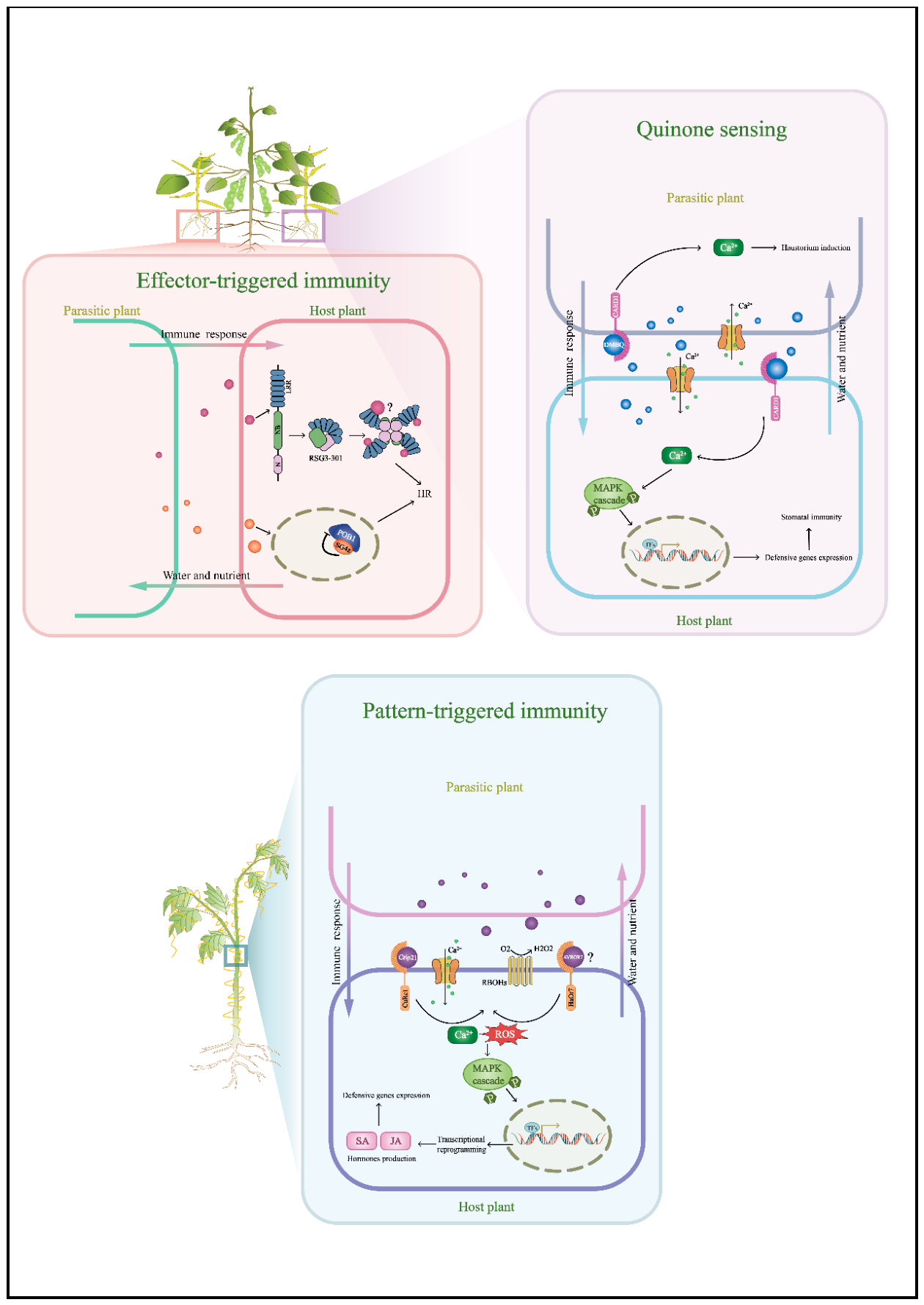
Figure 3.
The plant immune system can detect non-self plants during parasitism(Top left) Detection of non-self plants can occur through effector-triggered immunity (ETI). The Striga plants parasitize the roots of cowpea. S. gesnerioides race 4 evades the plant immune system by secreting an effector protein, SG4z, in the haustorium that targets the host gene, POB1, which is required for hypersensitive response (HR). In contrast, resistance to S. gesnerioides race 3 is attributed to a host NLR, RSG3-301, which induces HR to prevent parasitic colonization; however, the specific effector protein of Striga remains unidentified. (Bottom) Additionally, detection of non-self plants also involves PAMP-triggered immunity (PTI). PAMPs from parasitic plants, such as Crip21 from C. reflexa, are recognized through tomato PRR, CUSCUTA RECEPTOR 1 (CuRe1). Similarly, an unknown PAMP from O. cumana, designated AvrOr7, activates PTI via the sunflower receptor HaOr7. The induction of PTI encompasses Ca2+ influx, apoplastic reactive oxygen species (ROS) production, MAP kinase (MAPK) activation, and transcriptional regulation including the synthesis of defensive hormones. (To right) Furthermore, plants also perceive non-self stimuli through quinone sensing. 2,6-dimethoxy-1,4-benzoquinone (DMBQ) is detected by the host LRR-RLK CANNOT RESPOND TO DMBQ 1 (CARD1), which initiates Ca2+ influx and MAPK activation. Transcriptional responses to DMBQ result in stomatal closure, thereby safeguarding Arabidopsis against bacterial invasion. Conversely, host-derived DMBQ also functions as a cue for haustorium induction in P. japonicum.
Figure 3.
The plant immune system can detect non-self plants during parasitism(Top left) Detection of non-self plants can occur through effector-triggered immunity (ETI). The Striga plants parasitize the roots of cowpea. S. gesnerioides race 4 evades the plant immune system by secreting an effector protein, SG4z, in the haustorium that targets the host gene, POB1, which is required for hypersensitive response (HR). In contrast, resistance to S. gesnerioides race 3 is attributed to a host NLR, RSG3-301, which induces HR to prevent parasitic colonization; however, the specific effector protein of Striga remains unidentified. (Bottom) Additionally, detection of non-self plants also involves PAMP-triggered immunity (PTI). PAMPs from parasitic plants, such as Crip21 from C. reflexa, are recognized through tomato PRR, CUSCUTA RECEPTOR 1 (CuRe1). Similarly, an unknown PAMP from O. cumana, designated AvrOr7, activates PTI via the sunflower receptor HaOr7. The induction of PTI encompasses Ca2+ influx, apoplastic reactive oxygen species (ROS) production, MAP kinase (MAPK) activation, and transcriptional regulation including the synthesis of defensive hormones. (To right) Furthermore, plants also perceive non-self stimuli through quinone sensing. 2,6-dimethoxy-1,4-benzoquinone (DMBQ) is detected by the host LRR-RLK CANNOT RESPOND TO DMBQ 1 (CARD1), which initiates Ca2+ influx and MAPK activation. Transcriptional responses to DMBQ result in stomatal closure, thereby safeguarding Arabidopsis against bacterial invasion. Conversely, host-derived DMBQ also functions as a cue for haustorium induction in P. japonicum.
Small RNAs, Gene Silencing, and Graft Mobile Technology
Although distinct from PTI/ETI, another mechanism that parasitic plants and pathogens use to evade detection involves small RNAs (sRNAs). sRNAs regulate gene silencing by targeting mRNA for cleavage or epigenetic regulation. It was shown in tomato and Arabidopsis that infection with the fungus Botrytis cinerea led to the production of pathogenic sRNAs that could “hijack” the host AGONAUT1 (AGO1) protein and degrade host immune genes via RNA-interference (RNAi) (Weiberg et al., 2013). Similarly, Cuscuta campestris was found to produce 22 nt microRNAs capable of targeting Arabidopsis mRNA, resulting in mRNA cleavage of genes involved in growth and defense, such as BOTRYTIS-INDUCED KINASE 1 (BIK1) (Lu et al., 2010). In contrast, host-induced gene silencing (HIGS) occurs when transgenic small interfering RNA (siRNA) is introduced into the host, targeting and degrading pathogen mRNA (Baulcombe, 2015). All these examples suggest that sRNAs are excellent targets for plant-plant genetic interactions. This is bolstered by the knowledge that numerous sRNAs are graft mobile (Li et al., 2021, Palauqui et al., 1997). In fact, grafting was key to demonstrating that 24 nt sRNA moved through the vasculature to mediate epigenetic silencing (Molnar et al., 2010). Thus, it also stands to reason that sRNA movement, either locally at the graft junction or systemically via vascular transport, may affect graft healing, compatibility, or trait inheritance.
Furthermore, efforts have been made to use grafting to introduce siRNA from the rootstock into the floral meristem (Zhang et al., 2014). This technique allows grafting to serve as a molecular “vaccine,” delivering siRNA to existing plants via the phloem at the graft junction (Zhang et al., 2014). This same concept has been famously utilized in 2023 to generate heritable transgene-free CRISPR Cas9-edited offspring via a graft-mobile editing system in Arabidopsis and Brassica rapa (Yang et al., 2023).
Plant Regeneration: Grafting Versus Haustorium
One of the most critical facets of plant-plant interactions is the ability of distinct plants to physically interact and form chimeric tissues. Parasitic plants use a haustorium, an invasive organ, to attach to and penetrate the host stem, forming vascular connections between the parasite and its host (Kaiser et al., 2015, Kirschner et al., 2023, Shen et al., 2023). The establishment of vascular connections universally occurs during stem wounding, parasitic plant infection, and grafting (Nishitani et al., 2002, Melnyk, 2017, Jhu & Sinha, 2022, Thomas et al., 2022). A more complete understanding of how plants heal in these parallel processes will further elucidate the mechanisms underlying graft incompatibility.
Auxin
The vascular system transports water, nutrients, and signaling molecules throughout the plant. Wound healing, parasitism and grafting all require the induction of wound sealing, cell differentiation, and vascular reconstructions (Nishitani et al., 2002, Kirschner et al., 2023, Thomas et al., 2024). One of the most important regulators of plant regeneration is auxin (Asahina et al., 2011, Wang et al., 2014). Blocking auxin signaling using the bdl (Atiaa12) mutant significantly reduced graft success in Arabidopsis (Serivichyaswat et al., 2024, Melnyk et al., 2015, Matsuoka et al., 2016). Numerous studies have shown that removal of polar auxin transport is sufficient to interrupt both wound healing and graft reconnection (Asahina et al., 2011, Feng et al., 2024, Serivichyaswat et al., 2024). For example, apical auxin is required for the induction of DNA BINDING WITH ONE FINGER (DOF) transcription factors HIGH CAMBIAL ACTIVITY2 (HCA2), TARGET OF MONOPTEROS6 (TMO6), DNA BINDING WITH ONE FINGER(DOF2.1), and DOF6 (Melnyk et al., 2018). DOFs are highly induced during Arabidopsis wounding and grafting and are required for vascular and non-vascular healing. It was shown that DOF induction required auxin and cell wall damage, adding a second layer of input to the necessary expression (Melnyk et al., 2018, Zhang et al., 2022). The authors went on to show that TMO6 could induce CELLULASE3 (CEL3)/GLYCOSYL HYDROLASE9B3 (GH9B3), a β-1,4-glucanases shown to be key in interfamily graft compatibility (Notaguchi et al., 2020). Similarly, parasitic plants require auxin to induce haustorium formation. In P. japonicum, the perception of haustorium-inducing factors in the soil (such as plant exudates) leads to the induction of the auxin biosynthesis gene, YUCCA3 (YUC3) (Ishida et al., 2016), a process that could be blocked in Triphysaria versicolor using the auxin transport inhibitor, triiodobenzoic acid (TIBA) (Tomilov et al., 2005).
Cell Wall Remodeling
Many of the first genes identified as critical for regeneration in wounded inflorescence hypocotyls of Arabidopsis were involved in non-vascular healing and cell wall remodeling. For example, wounded hypocotyls exhibited a unique spatial segregation, with ANAC071/096 highly expressed above the wound and RAP2.6L below (Asahina et al., 2011, Matsuoka et al., 2021). This was later found to be due to spatial accumulation of phytohormones, in which high auxin and ethylene promote ANAC071, and low auxin and high JA induce RAP2.6L. While RAP2.6L and JA were induced during grafting, they were later shown not to be required for healing (Matsuoka et al., 2018). In contrast, ANAC071/096 were found to play a critical role not only in wound healing but also in grafting. Here, the authors showed that auxin-induced ANAC071 and ANAC096 positively regulated vascular proliferation during grafting, and that anac071anac096 double mutants healed poorly after grafting (Matsuoka et al., 2016, Zhang et al., 2022, Matsuoka et al., 2021). ANAC071 was also shown to regulate the expression of ENDOTRANSGLUCOSYLASE/HYDROLASE(XTH19) and XTH20, required for non-vascular cell differentiation in wounded stems (Pitaksaringkarn et al., 2014). The XTH gene family has been validated as broadly upregulated during melon (Cucumis melo) grafting, especially during compatible grafting; A CmXTH9 knockdown and an Arabidopsis xth4xth7 double mutant both showed reduced graft healing and decreased callus proliferation (Xiong et al., 2026). In tomato, gene regulatory networks based on the first week of compatible healing identified several XTH genes downstream of central hubs. XTH16 was predicted to be regulated by TOMATO HOMEOBOX GENE 1 (THOM1), and SlXTH6 was predicted to be co-regulated by JASMONATE-RESPONSIVE ERF 4 (JRE4) and ETHYLENE RESPONSE FACTOR (ERF4) (Thomas et al., 2022). In pepper grafts, the hub genes LATERAL ORGAN BOUNDARIES DOMAIN 4 (LBD4),MYB86, NGATHALIKE 1 (NGAL1-like), and two ERFs were all predicted to co-regulate XTH22 and XTH38. XTHs have also been implicated in Cuscuta infection, with CrXTH1 and CrXTH2 upregulated in the developing haustoria (Olsen et al., 2016, Johnsen et al., 2015, Hozumi et al., 2017). Haustorium penetration is often associated with cell wall-related genes, so the involvement of XTHs is logical (Ranjan et al., 2014, Yang et al., 2015, Johnsen et al., 2015, Hozumi et al., 2017). Whether CrXTH1 and CrXTH2 are more critical for remodeling of the host or parasite cell wall remains unclear.
Cell wall remodeling has been shown to be key not just to graft healing but also for compatibility. Interfamily grafting was demonstrated in tobacco (Notaguchi et al., 2020) and petunia (Petunia hybrida; Kurotani et al., 2022) due to the highly secreted β-1,4-glucanase, GH9B3, which is thought to degrade cellulose in the apoplast. Similarly, in P. japonicum, PjGH9B3 was highly expressed during infection of Arabidopsis and during P. japonicum-Arabidopsis interspecies grafting (Kurotani et al., 2020). RNAi of PjGH9B3 significantly reduced haustoria penetration, demonstrating that cell wall remodeling is critical for distant plant-plant regeneration. Since adhesion is the initial step in regeneration, it stands to reason that genes that optimize early graft healing are key targets for plant breeding to expand graft compatibility.
LBD25 was also identified as highly expressed in C. campestris haustorium (Jhu et al., 2021). In Arabidopsis, LBD25 functions in auxin signaling during lateral root formation (Mangeon et al., 2011). Using HIGS in tomato, they showed that CcLBD25 is critical for haustorium initiation, potentially through modification of the host cell wall (Jhu et al., 2021). In alignment with this, LBD25 was among the most highly upregulated genes in the Thesium chinense haustorium, suggesting that this gene is activated in diverse species during infection (Ichihashi et al., 2018). The role of LBD25 in reconnection is further supported by the identification of SlLBD25 as a predicted hub gene during early tomato graft formation (Thomas et al., 2022).
In addition to auxin, ethylene has been linked to tissue regeneration. Ethylene is induced and required for wound response (Li et al., 2018), but ethylene mutants in Arabidopsis (ethylene insensitive 2; ein2, ethylene response 1; etr1) appear to graft normally (Melnyk et al., 2015). This is contradicted in tobacco, where the application of an ethylene precursor (ACC) could enhance graft formation, whereas the ethylene biosynthesis inhibitor (AVG) delayed healing (Zhai et al., 2021). However, in Arabidopsis, the ctr1 mutant, which over-accumulates ethylene, showed reduced phloem connectivity (Melnyk et al., 2015). Unlike the somewhat ambiguous effect of ethylene on graft healing, ethylene appears to positively regulate haustorium formation. In P. japonicum infection, mutations to EIN2 and ETR1, as well as the ethylene signaling inhibitor, AgNO3, all resulted in severely compromised infection rates (Cui et al., 2020).
Vascular Regulators
In addition to nonvascular healing and cell wall remodeling, wound response requires a competent cambium to induce de novo differentiation of vascular tissues, such as xylem and phloem. The need for cambial contact has long been noted in horticultural handbooks (Hartmann et al., 2002), but until recently, the genetic regulators of cambial differentiation during grafting were ambiguous. Cambial genes such as PHLOEM INTERCALATED WITH XYLEM(PXY), ARABIDOPSIS THALIANA HOMEOBOX FACTOR8(ATHB8), SUPPRESSOR OF MAX2 1-LIKE PROTEIN 5(SMXL5), and WUSCHEL RELATED HOMEOBOX4(WOX4) have been identified as key for graft healing in Arabidopsis and tomato (Thomas et al., 2022, Serivichyaswat et al., 2024). This is a process shared between grafted and parasitized plants. By inducing haustorium production in C. campestris, transcriptional regulators of xylem formation in the haustorium were identified using RNA-seq (Kaga et al., 2020). Similar to grafting, the cambium was necessary for the formation of a vascular bridge between the two joined plants, with genes such as CcWOX4, CcPXY-like, CcMP, and CcTMO5 induced during the transition of search hyphae into xylem hyphae. WOX4 expression was also observed in P. japonicum haustorium using fluorescent markers (Wakatake et al., 2018).
During grafting, phloem reconnection occurs before the xylem (Melnyk et al., 2015, Melnyk et al., 2018). In Arabidopsis, ABERRANT LATERAL ROOT FORMATION 4 (ALF4), AUXIN RESISTANT 1 (AXR1), and HCA2 were first identified as key phloem regulators in the stock (Melnyk et al., 2015, Melnyk et al., 2018). However, Arabidopsis lines lacking auxin signaling in the promoter region of ALTERED PHLOEM DEVELOPMENT(APL), a phloem companion cell marker, showed a reduced, but non-significant reduction in phloem connectivity (Serivichyaswat et al., 2024). While not all parasitic plants form both xylem and phloem connections, Orobanche and Cuscuta spp. can (Dorr & Kollmann, 1995, Haupt et al., 2001, Aly et al., 2011). C. japonica expressed CjAPL and CjSEOR1, a sieve element marker gene, in the haustorium during infection, showing that similar genetic regulators control the haustorium phloem development (Shimizu et al., 2018). Despite this, the genetic regulation of phloem formation, grafting, and parasitism remains less well understood than other processes, such as xylem formation.
In contrast to phloem, the VASCULAR-RELATED NAC-DOMAIN (VND) family of proteins is a key regulator of xylem formation. As xylem connections formed between the C. campestris haustorium and the Arabidopsis host, the key xylem differentiation factor VND7 (Kubo et al., 2005), along with known downstream genes MYB46, MYB86, IRREGULAR XYLEM (IRX3), and IRX5 were upregulated (Kaga et al., 2020). PjIRX3 was visualized in the haustorium using fluorescent markers, clearly building strong genetic parallels between the two parasitic plants (Wakatake et al., 2018). While VNDs are integral for xylem formation, single mutants fail to show phenotypes due to redundancy in the family (Gushino et al., 2024, Tan et al., 2018). Similarly, in tobacco, Nbvnd7 mutants showed no effect on grafting, whereas inducible overexpression lines increased xylem formation in Arabidopsis-tobacco interspecies grafts (Huang et al., 2025).
An interesting finding in the C. japonica haustorium was the expression of the Tracheary element differentiation inhibitory factor (TDIF), CLAVATA3/EMBRYO SURROUNDING REGIONRELATED 41 (CLE41), GLYCOGEN SYNTHASE KINASE(GSK3) and BRI1-EMS-SUPPRESSOR (BES1) (Shimizu et al., 2018). In Arabidopsis, CLE41 and CLE44-derived CLE41/44 peptides are expressed in the phloem and transported to the procambium, where they bind PXY, activating cambium maintenance via WOX4 and repressing xylem formation via GSK3/BES1 (Hunziker & Greb, 2024). Identification of this cambium-xylem pathway in the haustorium suggests that all vascular formations may share a core set of genetic regulators involved in vascular regeneration, including mobile CLE peptides.
In 1969, Dean & Kuijt referred to the haustorium as a “perfect graft” (Dean & Kuijt, 1969). Indeed, there are significant parallels between grafting and plant parasitism, including the need for cell wall remodeling, the importance of auxin, and vascular regeneration. It is worth noting that while grafts face compatibility limitations, parasitic plants are largely capable of infecting and thus fusing their vascular systems, with almost all species. In this way, most parasitic plants can be considered not just perfect grafts but examples of ultra-compatibility. Understanding how parasitic plants evade the host immune system, overcome physiological barriers, and coordinate the molecular signaling required for healing may hold the key to overcoming graft incompatibility.
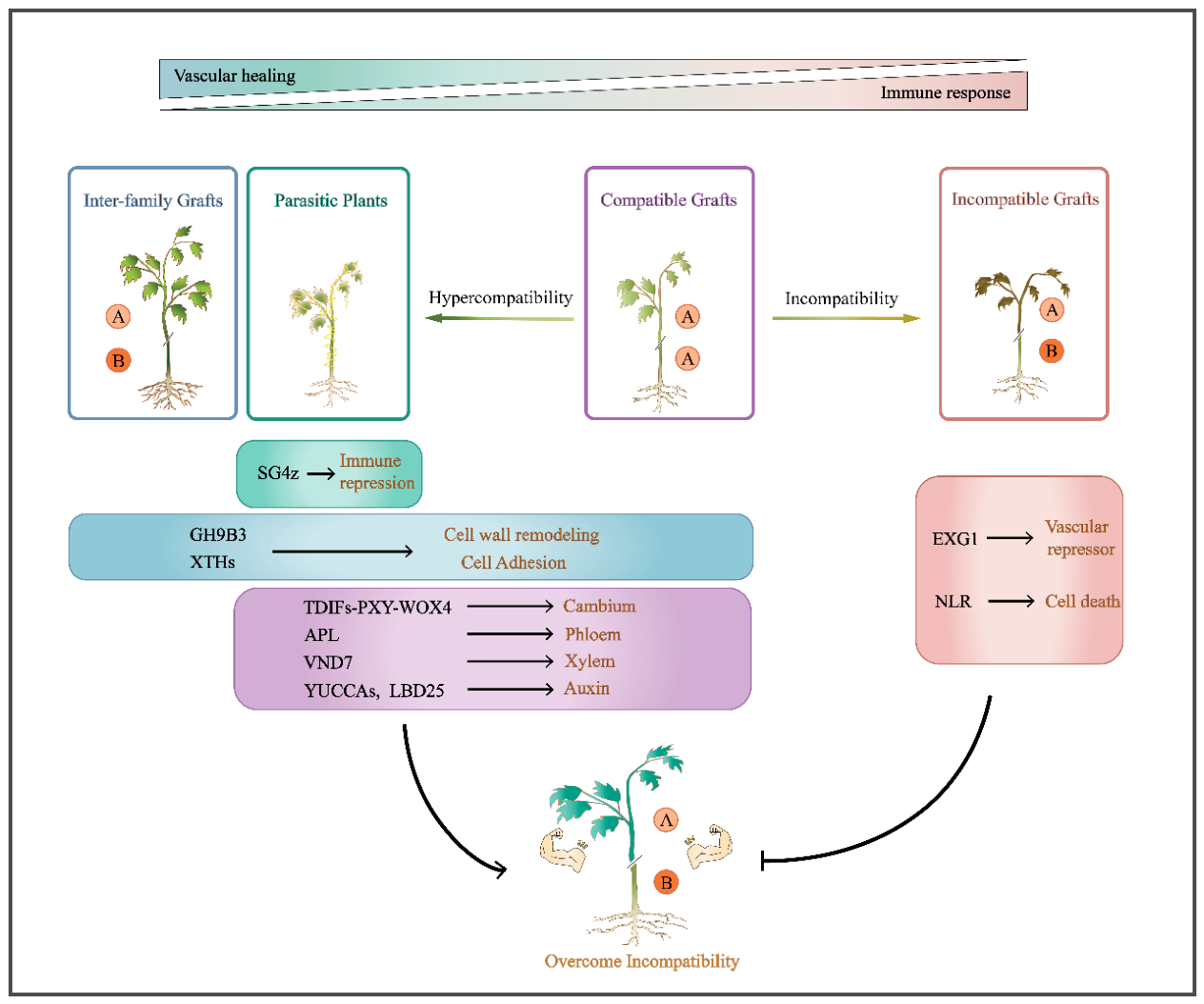
Overlap between various genes has identified potential regulators of graft compatibility. Hypercompatibility can be seen in inter-family grafts as well as parasitic plants. These traits have been linked to enhanced cell wall remodeling and adhesion via GLYCOSYL HYDROLASE9B3 (GH9B3) and ENDOTRANSGLUCOSYLASE/HYDROLASE (XTH). Furthermore, repression of the host immune system can be accomplished via parasitic plant effectors such as SH4z. Both parasitic plants and compatible grafts require auxin signaling (YUCCAs (YUCs) and LATERAL ORGAN BOUNDARIES DOMAIN 4 (LBD4)), cambium maintenance (TRACHEARY ELEMENT DIFFERENTIATION INHIBITORY FACTORS (TDIF)-PHLOEM INTERCALATED WITH XYLEM (PXY)-WUSCHEL RELATED HOMEOBOX4 (WOX4)), phloem (ALTERED PHLOEM DEVELOPMENT (APL)), and xylem (VASCULAR-RELATED NAC-DOMAIN 7 (VND7)). Graft incompatibility has been associated with vascular repression (ENHANCED XYLEM AND GRAFTING 1 (EXG1)) and the upregulation of NLRs associated with immune-mediated cell death. By targeting these known processes, it may be possible to genetically overcome graft incompatibility.
Figure 4.
Grafted and parasitic plants span a continuum of compatibility.
Wound Signals
Several genes have been proposed as damage- or wound-activated during grafting in recent years. ENHANCED XYLEM AND GRAFTING1 (EXG1), a negative regulator of vascular tissue regeneration, is rapidly upregulated after nematode infection, grafting, and infection with Agrobacterium (Mazumdar et al., 2025). Although the authors did not identify the elicitors for this, they hypothesized that hormones, ROS, changes to the cell wall, or turgor pressure may activate this gene. Similarly, ERF114 and ERF115 have been shown to be induced during both wounding and graft healing of Arabidopsis, spruce, tomato, and pepper (Feng et al., 2024, Thomas et al., 2024, Zhang et al., 2022, Canher et al., 2022). Treating Arabidopsis with cell wall-modifying enzymes, such as cellulase and pectinase, was sufficient to activate ERF115 expression in the stem, but, when combined with auxin, the effect was amplified (Zhang et al., 2022). Similarly, treatment with macerozyme, a pectinase, induced ERF114 in the root (Canher et al., 2022). DNA damage to the root tip in the JA mutant, coronatine insensitive1 (coi1), was able to show that wound-mediated ERF115 expression did not require JA signaling, and while auxin was not required for ERF115 induction following wounding, it was necessary for wound recovery (Canher et al., 2020). The authors then suggested ERF114 and 115 could be induced by mechanical stress. Using the mechanosensory mutant, feronia (fer), which showed increased mechanical strain, in cooperation with auxin, was likely responsible for the induction of ERF114 and 115 (Canher et al., 2022).
Plants release a plethora of wound signals, and while none have been clearly linked to graft incompatibility, they all have potential activity. Because grafting is, at its core, an instance of wounding, signals involved in the wound response are worth exploring. To be considered potential regulators of compatibility, the signal must be released during grafting, be mobile over short or long distances, and induce incompatibility-associated symptoms, such as cell death.
Constitutive DAMPs
Damage-associated molecular patterns (DAMPs) are molecules that are either induced during wounding or constitutively present in cells but released into the apoplast during damage (Tanaka & Heil, 2021). Like PAMPs, these signals are perceived by receptors and trigger additional immune responses. DAMPs are extremely diverse, spanning sugars, nucleotides, peptides, and more, many of which have unknown receptors.
Most carbohydrates that act as DAMPs are components of the plant cell wall. These molecules are released into the apoplast during cellular degradation by pathogenic enzymes. Perhaps more relevant to grafting is the breakdown of homogalacturonan pectin into oligogalacturonides (OGs) by endogenous polygalacturonases, which occurs following wounding, as demonstrated in tomato leaves (Orozco-Cardenas & Ryan, 1999). OGs are one of the most extensively studied cell wall DAMPs (Bishop et al., 1981, Davidsson et al., 2017). Treatment with OGs activates PTI processes such as MAPK activation, ROS burst, and resistance against Botrytis infection (Denoux et al., 2008, Galletti et al., 2011, Galletti et al., 2008, Kohorn et al., 2009). Evidence first identified WALL-ASSOCIATED KINASE 1 and 2 (WAK1 and 2) as the proposed receptors due to their ability to bind OGs and trigger downstream responses (Brutus et al., 2010, Decreux et al., 2006, Kohorn et al., 2009), but recent work involving an Arabidopsis mutant lacking all five WAK genes was found to still execute immune responses when treated with exogenous OGs (Herold et al., 2024), demonstrating WAKs are not required for OG-induced PTI. Furthermore, studies have shown that WAKs function in coordination with other receptors, such as FERONIA (FER) (Dünser et al., 2019), which act as mechanical sensors of cell wall strain to elicit defense responses during wounding. Currently, the main OG receptor remains unclear.
During cell rupture, cytoplasmic contents spill into the extracellular matrix, where they can act as DAMPs, triggering PTI responses. Extracellular ATP (eATP) is present at high concentrations within the cell, making it an excellent marker of compromised cellular integrity. Unlike OGs, which lack a clear functional receptor, P2 Receptor Kinase 1 and 2 (P2K1 and 2) have been validated as active receptors that trigger immune processes in response to high eATP (Choi et al., 2014, Pham et al., 2020, Tanaka et al., 2014, Jeter et al., 2004). Other cellular components, such as the amino acid glutamate, are released during wounding (Bellandi et al., 2022). Glutamate (glu) moves throughout the xylem and extracellular space, where it binds to and triggers the GLUTAMATE-LIKE RECEPTORS 3.3 (GLR) and GLR3.5 in Arabidopsis, which induce the intracellular influx of calcium (Toyota et al., 2018, Mousavi et al., 2013). The movement of glu in the plant was shown to trigger both the propagation of electrical signals via calcium and ROS waves. While Arabidopsis and tomato mutant rootstocks lacking long-distance electrical (Atglr3.3glr3.6 or Slglr3.3glr3.5) and ROS (Atrbohdrhohf or Slrbho1) signals could still be successfully grafted onto WT scions (Zhan et al., 2025, Wang et al., 2019), it is interesting to consider the role that these long-distance immune-mediating signals might play prior to or during compatibility determination.
Another nucleotide-based DAMP is extracellular DNA (eDNA), which can occur in the apoplast during necrotrophic infection and wounding. In pea (Pisum sativum), Fusarium solani produces a secreted DNase, which degrades host DNA (Klosterman et al., 2001). Fragmented DNA (less than 700 bp) can trigger PTI responses, including Ca2+ influx, ROS, MAPK activation, and resistance to Pseudomonas syringae (Duran-Flores & Heil, 2018, Barbero et al., 2016). Interestingly, while all fragmented host DNA could elicit host immune responses, treatment with fragmented DNA from other species elicited a significantly attenuated response, suggesting that, however eDNA is surveilled, plants are capable of distinguishing self from non-self. Interestingly, the symptoms associated with DAMP-induced PTI align with many of the graft incompatibility symptoms described in the tomato-pepper grafts. It is worth noting that in a related process, BREAST CANCER SUSCEPTIBILITY GENE 1 (BRCA1) and BRCA1 ASSOCIATED RING DOMAIN PROTEIN 1 (BARD1) homologs were identified as upregulated in incompatibly grafted tomato (Thomas et al., 2024). These genes are involved in DNA repair after genotoxic damage, suggesting that incompatibility may trigger DNA breakdown in tomato. It is possible that a molecular signal released by the opposite species or propagated by the host during failed healing (cell wall components or fragmented DNA) triggers many of the symptoms observed in graft incompatibility (Thomas et al., 2023). To date, no published work has explored the role of OGs, eATP, glutamate or other DAMPs during grafting, making this an important area for future studies.
DAMP Peptides
Plants also secrete peptides during wound response. Peptide-DAMPs that have identified receptors include RALFs, which bind to FER (Stegmann et al., 2017, Pearce et al., 2001); PLANT ELICITOR PEPTIDES (PEPs), which bind to PLANT ELICITOR PEPTIDE RECEPTOR 1 (PEPR1) and PEPR2 (Huffaker et al., 2006, Yamaguchi et al., 2010, Yamaguchi et al., 2006); PLASMA MEMBRANE INTRINSIC PROTEINS1/2 (PIP1/2), which binds to RECEPTOR-LIKE KINASES 7 (RLK7) (Hou et al., 2014); Systemin, which binds to SYSTEMIN RECEPTOR 1 (SYR1/2) (Pearce et al., 1991, Wang et al., 2018); SERINE-RICH ENDOGENOUS PEPTIDE 12 (SCOOP12), which binds to MALE DISCOVERER 1-INTERACTING RECEPTOR-LIKE KINASE 2 (MIK2) (Gully et al., 2019, Rhodes et al., 2021); and phytosulfokines (PSKs) that bind to PHYTOSULFOKINE RECEPTOR 1/2 (PSKR1/2) (Matsubayashi & Sakagami, 1996). Aside from species-specific DAMPs, most of these peptides are presumed to be secreted during grafting.
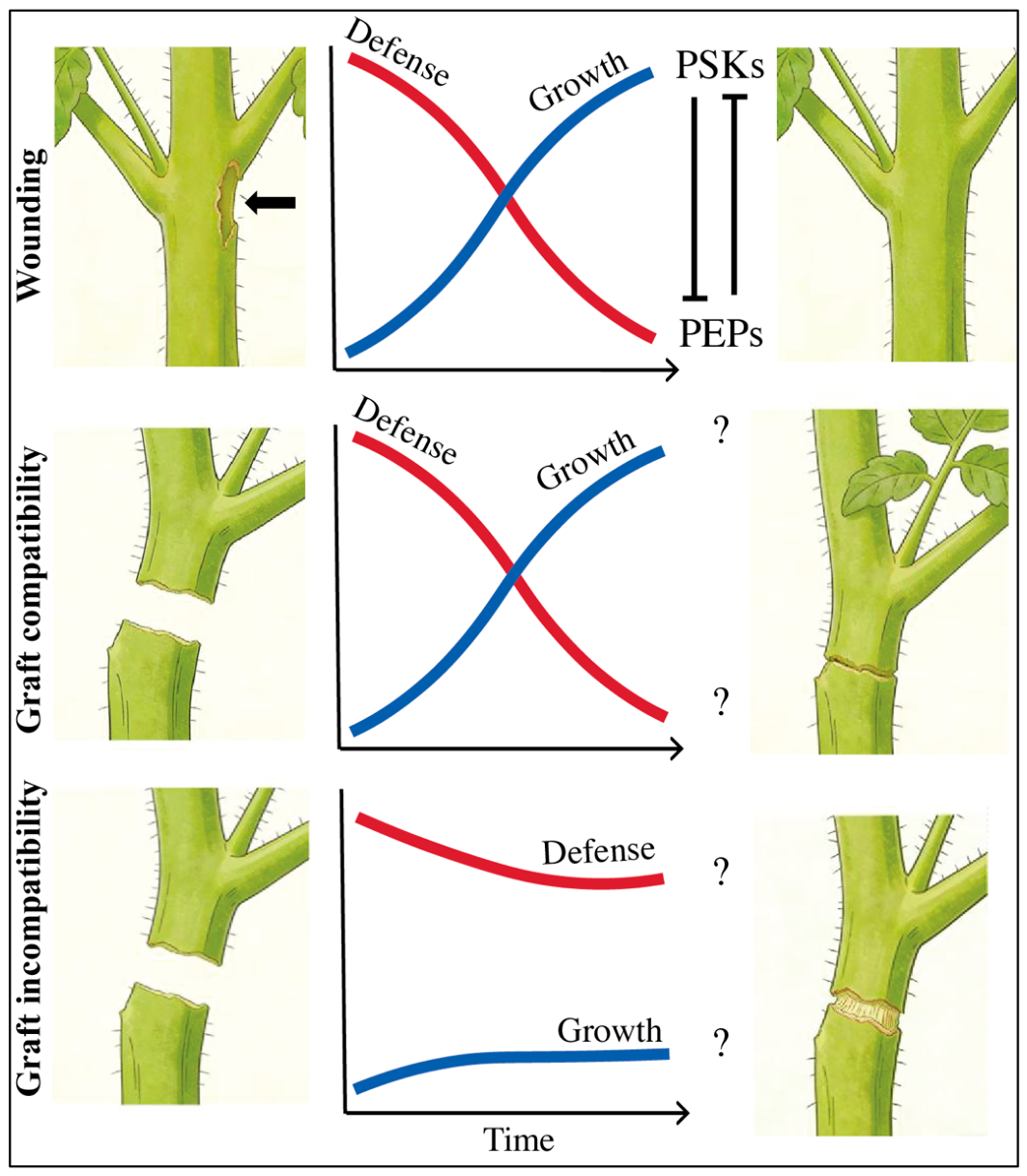
Recent work has suggested that PEPs and PSKs could be important to graft compatibility (Lori et al., 2015). PEPs are conserved species-specific DAMPs (Lori et al., 2015) that elicit PTI responses (Bartels et al., 2013). In contrast, PSKs, while first identified as wound-inducible, have since been shown to regulate growth and cell division (Kutschmar et al., 2009, Yang et al., 2000). It had previously been shown in tomato that PSK-regulated immunity to Botrytis was dependent on auxin signaling, further supporting PSK in the growth-defense nexus (Zhang et al., 2018). In rice, wounding triggers expression of the OsPep3 precursor within 15 minutes. Wounding and Pep3 treatment induced rapid changes, including MAPK activation, JA signaling and defense genes such as WRKY TFs, as well as delayed expression of PSK precursors, especially OsPSK3 (Harshith et al., 2024). They then showed that the receptor, OsPSKR, associates with SOMATIC EMBRYOGENESIS RECEPTOR-LIKE KINASE 1 (SERK1), a homolog of A. thaliana. BRI1-ASSOCIATED RECEPTOR KINASE 1 (AtBAK1). OsPSKR-overexpression (OE) lines exhibited reduced wound response, whereas the pskr mutants displayed exaggerated and prolonged cell death, indicating that PSKR represses the late immune response to PEPs. The “constitutive cell death” phenotype seen in pskr is reminiscent of Atbak1 mutants, in which loss of repression of immune processes led to autoimmune-induced cell death and hyperactivation of NLRs (Wu et al., 2020). Due to the striking similarity with tomato-pepper genetic incompatibility (Thomas et al., 2024), it is critical that peptide DAMPs be carefully assayed for their role in compatibility.
The DAMP peptides, PLANT ELICITOR PEPTIDES (PEP) and PHYTOSULFOKINE (PSK), antagonistically balance early defense responses and the transition into growth and healing. PEPs are secreted within minutes of wounding, whereas PSKs are expressed hours later. It is possible that a similar mechanism is activated during compatible grafting, downregulating the wound response to allow the graft junction to heal. Failure to repress defense may lead to a non-self-induced immune response and a cell-death phenotype. Adapted from Harshith et al., 2024.
Figure 5.
Graft compatibility may be regulated by DAMPs.
Incompatibility: From Pollen to Grafting
A remarkable adaptation observed in plants that facilitates outcrossing is self-incompatibility (SI), which allows plants to reject genetically similar pollen, preventing excessive inbreeding. SI has evolved independently in up to 40% of angiosperms, resulting in distinct types of SI (Igic et al., 2008, Charlesworth, 2010, Allen. & Hiscock., 2008). Because the process of SI is so diverse, we aim only to draw parallels between graft compatibility and SI. For a more in-depth study, see (Takayama & Isogai, 2005).
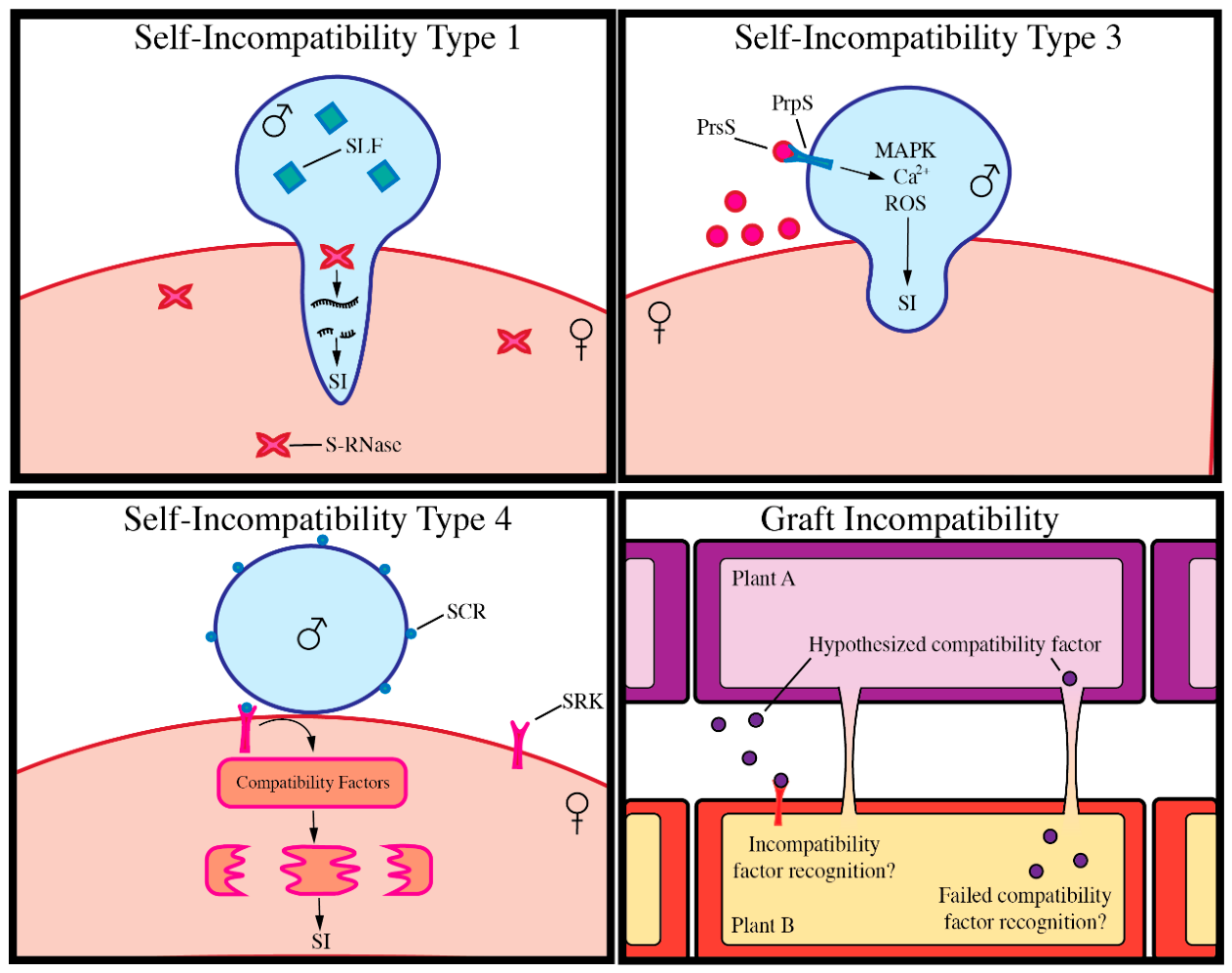
SI is largely controlled by one polymorphic locus called the S-locus. Through distinct molecular mechanisms, the S gene encodes alleles that regulate compatibility determination during pollen-pistil interaction. For example, Type I (Solanaceae) SI is controlled by a single pistil-expressed S-RNase and multiple pollen-expressed cytosolic S-loci F boxes (SLFs) (Liu et al., 2014, Luu et al., 2000). S-RNAses are taken up into the pollen tube, where they bind to SLFs (Anderson et al., 1986). Non-self-recognition leads to the ubiquitination and degradation of the RNases, allowing pollen tube growth, whereas SI leads to RNA degradation of the pollen tube via the pistil RNase (Entani et al., 2014). Other types of SI involve ligand-receptor pairings that trigger molecular cascades that lead to pollen death, such as Type 3 SI (Papaveraceae), where self-recognition involves the pollen S-gene (P. rhoeas pollen S : PrpS), which encodes a transmembrane receptor, and the stigma S-gene (P. rhoeas stigma S : PrsS), which encodes a secreted protein. When SI occurs, it triggers Ca2+ influx and a cascade of responses, including increased ROS, MAPK9 activation, ATP depletion, and caspase-3-like activity, resulting in PCD (Wheeler et al., 2009, Bosch & Franklin-Tong, 2008, Wheeler et al., 2010, Franklin-Tong et al., 2002, Chai et al., 2017, Wang et al., 2022). During Type 4 SI (Brassica), the stigma S-locus receptor kinase (SRK) binds the pollen S-locus cysteine-rich protein (SCR) (Takayama et al., 2000, Takasaki et al., 2000). SI leads to the breakdown of fertilization-required compatibility factors (exocyst complex subunit, EXO70A1; glyoxalase 1, GLO1; and phospholipase D alpha 1, PLDα1) and ROS production (Samuel et al., 2009, Sankaranarayanan et al., 2015, Scandola & Samuel, 2019). In Arabidopsis, this leads to autophagy of the pollen tube cell (Macgregor et al., 2022).
Parallels between pollen SI and the plant immune system have been previously drawn (Allen & Hiscock, 2008), as many SI systems are based on ligand-receptor pairings reminiscent of PAMP-PRRs. Furthermore, SRKs are receptor-like kinases that belong to the same protein family as PRRs (Lee et al., 2021). Additionally, similarities exist among PrsS/SCRs and plant defensins, which are antimicrobial proteins identified in numerous plant species, as all are cysteine-rich secreted proteins with significant structural similarities (Thomma et al., 2002). While it is unlikely that grafting, a process largely propagated by humankind, has led to the evolution of an unknown ligand-receptor pairing, it is possible that wound responses have utilized existing signaling components to protect against non-self interactions. In this way, it is curious to consider whether graft incompatibility relies on the detection of non-self, as in Type I SI, or on the detection of self, as in Type 3/4 SI. It seems most likely that a mechanism similar to Type I may exist in which non-self is detected rather than self. Regardless, it remains key to carefully explore secreted peptides, highly expressed receptors, DNases, and RNases at graft interfaces to determine whether similar mechanisms regulate non-self detection during grafting as they do during pollination.
Figure 6.
Plants utilize diverse mechanisms to detect and avoid self-interactions during pollinationDuring pollination, detection of self-pollen triggers pollen tube degradation through a process known as self-incompatibility (SI). Various mechanisms facilitate SI depending on the plant family. In Type I SI, failure for pollen SLFs to bind to stigma S-RNases leads to active RNA breakdown in the pollen tube. During Type 3 SI, secreted PrsS from the stigma will bind to the PrpS receptor on self-pollen, leading to pollen death. During Type 4 SI, SCR peptides coating the pollen bind to stigma SRK self-receptors, thereby facilitating the breakdown of required compatibility factors. At the interface of a graft junction, two distinct plant varieties touch. The mechanism for the detection of non-self remains unknown. It is possible that, like with SI, vegetative tissue contains compatibility factors that are either required for compatibility or trigger incompatibility. These may be intracellularly transmitted via plasmodesmata or secreted and bound by unknown receptors.
Figure 6.
Plants utilize diverse mechanisms to detect and avoid self-interactions during pollinationDuring pollination, detection of self-pollen triggers pollen tube degradation through a process known as self-incompatibility (SI). Various mechanisms facilitate SI depending on the plant family. In Type I SI, failure for pollen SLFs to bind to stigma S-RNases leads to active RNA breakdown in the pollen tube. During Type 3 SI, secreted PrsS from the stigma will bind to the PrpS receptor on self-pollen, leading to pollen death. During Type 4 SI, SCR peptides coating the pollen bind to stigma SRK self-receptors, thereby facilitating the breakdown of required compatibility factors. At the interface of a graft junction, two distinct plant varieties touch. The mechanism for the detection of non-self remains unknown. It is possible that, like with SI, vegetative tissue contains compatibility factors that are either required for compatibility or trigger incompatibility. These may be intracellularly transmitted via plasmodesmata or secreted and bound by unknown receptors.
Conclusion
Plant-plant interactions encompass a diverse range of processes, including secreted substances, airborne signals, and physical contact. Many of the fields studying these interactions have remained separate and are seldom considered when discussing the role of grafting. From the existing literature, it is evident that plants possess numerous mechanisms to promote and prevent contact with other plants. Furthermore, plants have evolved complex signaling pathways to alert the immune system to pathogens and wounding. Despite a limited understanding of how plants distinguish compatible and incompatible graft partners, substantial knowledge exists regarding how plants monitor non-self. Interdisciplinary collaboration is crucial to unlocking the secrets of graft compatibility, emphasizing the need to integrate expertise across fields to address this challenge. Future research should carefully consider existing data to inform hypotheses regarding the underlying mechanisms of graft incompatibility.
Author Contributions
Kaili Mao: Conceptualization, Visualization, Writing – original draft, Writing – review & editing. Ruiduo Han: Visualization, Writing – review & editing. Zefeng Chen: Visualization, Writing – review & editing. Yanhong Zhou: Conceptualization, Writing – review & editing. Hannah Rae Thomas: Conceptualization, Supervision, Writing – review & editing.
Funding
This work was financially supported by the Natural Science Foundation of Zhejiang Province (Grant No. LZYQ25C150001) and the 111 Project (B17039).
References
- Abdul Malik, N. A.; Kumar, I. S.; Nadarajah, K. Elicitor and receptor molecules: Orchestrators of plant defense and immunity. Int J Mol Sci 2020, 21. [Google Scholar] [CrossRef]
- Albert, M.; Werner, M.; Proksch, P.; Fry, S. C.; Kaldenhoff, R. The cell wall-modifying xyloglucan endotransglycosylase/hydrolase LeXTH1 is expressed during the defence reaction of tomato against the plant parasite Cuscuta reflexa. Plant Biol 2004, 6, 402–407. [Google Scholar] [CrossRef]
- Allen, A. M.; Hiscock, S. J. Evolution and phylogeny of self-incompatibility systems in angiosperms; Springer Berlin / Heidelberg: Berlin, Heidelberg, GERMANY, 2008. [Google Scholar]
- Aly, R.; Hamamouch, N.; Abu-Nassar, J.; Wolf, S.; Joel, D. M.; Eizenberg, H.; et al. Movement of protein and macromolecules between host plants and the parasitic weed Phelipanche aegyptiaca Pers. Plant Cell Rep 2011, 30, 2233–2241. [Google Scholar] [CrossRef] [PubMed]
- Anderson, M. A.; Cornish, E. C.; Mau, S. L.; Williams, E. G.; Hoggart, R.; Atkinson, A.; et al. Cloning of cDNA for a stylar glycoproteinassociated with expression of self-incompatibility in Nicotiana alata. Nature 1986, 321, 38–44. [Google Scholar] [CrossRef]
- Asahina, M.; Azuma, K.; Pitaksaringkarn, W.; Yamazaki, T.; Mitsuda, N.; Ohme-Takagi, M.; et al. Spatially selective hormonal control of RAP2.6L and ANAC071 transcription factors involved in tissue reunion in Arabidopsis. Proc Natl Acad Sci U S A 2011, 108, 16128–16132. [Google Scholar] [CrossRef]
- Bai, F.; Wu, M.; Huang, W.; Xu, W.; Wang, Y.; Zhang, Y.; et al. Removal of toxic steroidal glycoalkaloids and bitterness in tomato is controlled by a complex epigenetic and genetic network. Sci Adv 2025, 11, eads9601. [Google Scholar] [CrossRef]
- Bais, H. P.; Weir, T. L.; Perry, L. G.; Gilroy, S.; Vivanco, J. M. The role of root exudates in rhizosphere interactions with plants and other organisms. Annual Review of Plant Biology 2006, 57, 233–266. [Google Scholar] [CrossRef]
- Barbero, F.; Guglielmotto, M.; Capuzzo, A.; Maffei, M. E. Extracellular Self-DNA (esDNA), but not heterologous plant or insect DNA (etDNA), induces plasma membrane depolarization and calcium signaling in Lima Bean (Phaseolus lunatus) and Maize (Zea mays). Int J Mol Sci 2016, 17, 1659. [Google Scholar] [CrossRef]
- Barragan, A. C.; Collenberg, M.; Wang, J.; Lee, R. R. Q.; Cher, W. Y.; Rabanal, F. A.; et al. A truncated singleton NLR causes hybrid necrosis in Arabidopsis thaliana. Mol Biol Evol 2021, 38, 557–574. [Google Scholar] [CrossRef] [PubMed]
- Bartels, S.; Lori, M.; Mbengue, M.; van Verk, M.; Klauser, D.; Hander, T.; et al. The family of Peps and their precursors in Arabidopsis: differential expression and localization but similar induction of pattern-triggered immune responses. J Exp Bot 2013, 64, 5309–5321. [Google Scholar] [CrossRef] [PubMed]
- Baulcombe, D. C. VIGS, HIGS and FIGS: small RNA silencing in the interactions of viruses or filamentous organisms with their plant hosts. Curr Opin Plant Biol 2015, 26, 141–146. [Google Scholar] [CrossRef]
- Bellandi, A.; Papp, D.; Breakspear, A.; Joyce, J.; Johnston, M. G.; de Keijzer, J.; et al. Diffusion and bulk flow of amino acids mediate calcium waves in plants. Sci Adv 2022, 8, eabo6693. [Google Scholar] [CrossRef]
- Belz, R. G.; Hurle, K. Differential exudation of two benzoxazinoids - One of the determining factors for seedling allelopathy of triticeae species. J Agric Food Chem 2005, 53, 250–261. [Google Scholar] [CrossRef]
- Bigeard, J.; Colcombet, J.; Hirt, H. Signaling mechanisms in pattern-triggered immunity (PTI). Mol Plant 2015, 8, 521–539. [Google Scholar] [CrossRef]
- Bishop, P. D.; Makus, D. J.; Pearce, G.; Ryan, C. A. Proteinase inhibitor-inducing factor activity in tomato leaves resides in oligosaccharides enzymically released from cell walls. Proc Natl Acad Sci U S A 1981, 78, 3536–3540. [Google Scholar] [CrossRef] [PubMed]
- Bomblies, K.; Lempe, J.; Epple, P.; Warthmann, N.; Lanz, C.; Dangl, J. L.; et al. Autoimmune response as a mechanism for a dobzhansky-uuller-type incompatibility syndrome in plants. PLOS Biol 2007, 5, 1962–1972. [Google Scholar] [CrossRef]
- Bosch, M.; Franklin-Tong, V. E. Self-incompatibility in Papaver: signalling to trigger PCD in incompatible pollen. J Exp Bot 2008, 59, 481–490. [Google Scholar] [CrossRef]
- Browning, G.; Watkins, R. Preliminary evaluation of new quince (Cydonia oblonga Miller) hybrid rootstocks for pears. J Hortic Sci 1991, 66, 35–42. [Google Scholar] [CrossRef]
- Brutus, A.; Sicilia, F.; Macone, A.; Cervone, F.; De Lorenzo, G. A domain swap approach reveals a role of the plant wall-associated kinase 1 (WAK1) as a receptor of oligogalacturonides. Proc Natl Acad Sci U S A 2010, 107, 9452–9457. [Google Scholar] [CrossRef] [PubMed]
- Canher, B.; Heyman, J.; Savina, M.; Devendran, A.; Eekhout, T.; Vercauteren, I.; et al. Rocks in the auxin stream: Wound-induced auxin accumulation and ERF115 expression synergistically drive stem cell regeneration. Proc Natl Acad Sci U S A 2020, 117, 16667–16677. [Google Scholar] [CrossRef]
- Canher, B.; Lanssens, F.; Zhang, A.; Bisht, A.; Mazumdar, S.; Heyman, J.; et al. The regeneration factors ERF114 and ERF115 regulate auxin-mediated lateral root development in response to mechanical cues. Mol Plant 2022, 15, 1543–1557. [Google Scholar] [CrossRef] [PubMed]
- Chai, L.; Tudor, R. L.; Poulter, N. S.; Wilkins, K. A.; Eaves, D. J.; Franklin, F. C. H.; et al. MAP Kinase PrMPK9-1 contributes to the self-incompatibility response. Plant Physiol 2017, 174, 1226–1237. [Google Scholar] [CrossRef]
- Charlesworth, D. Self-incompatibility. F1000 Biol Rep 2010, 8, 68. [Google Scholar] [CrossRef]
- Chen, Y. C.; Holmes, E. C.; Rajniak, J.; Kim, J. G.; Tang, S.; Fischer, C. R.; et al. N-hydroxy-pipecolic acid is a mobile metabolite that induces systemic disease resistance in Arabidopsis. Proc Natl Acad Sci U S A 2018, 115, E4920–E4929. [Google Scholar] [CrossRef] [PubMed]
- Chinchilla, D.; Bauer, Z.; Regenass, M.; Boller, T.; Felix, G. The Arabidopsis receptor kinase FLS2 binds flg22 and determines the specificity of flagellin perception. Plant Cell 2006, 18, 465–476. [Google Scholar] [CrossRef]
- Choi, J.; Tanaka, K.; Cao, Y.; Qi, Y.; Qiu, J.; Liang, Y.; et al. Identification of a plant receptor for extracellular ATP. Science 2014, 343, 290–294. [Google Scholar] [CrossRef]
- Chu, C. G.; Faris, J. D.; Friesen, T. L.; Xu, S. S. Molecular mapping of hybrid necrosis genes Ne1 and Ne2 in hexaploid wheat using microsatellite markers. Theor Appl Genet 2006, 112, 1374–1381. [Google Scholar] [CrossRef]
- Cimmino, A.; Fernández-Aparicio, M.; Avolio, F.; Yoneyama, K.; Rubiales, D.; Evidente, A. Ryecyanatines A and B and ryecarbonitrilines A and B, substituted cyanatophenol, cyanatobenzo[1,3]dioxole, and benzo[1,3]dioxolecarbonitriles from rye (Secale cereale L.) root exudates: Novel metabolites with allelopathic activity on Orobanche seed germination and radicle growth. Phytochemistry 2015, 109, 57–65. [Google Scholar]
- Cui, S.; Kubota, T.; Nishiyama, T.; Ishida, J. K.; Shigenobu, S.; Shibata, T. F.; et al. Ethylene signaling mediates host invasion by parasitic plants. Sci Adv 2020, 6, eabc2385. [Google Scholar] [CrossRef]
- Davidsson, P.; Broberg, M.; Kariola, T.; Sipari, N.; Pirhonen, M.; Palva, E. T. Short oligogalacturonides induce pathogen resistance-associated gene expression in Arabidopsis thaliana. BMC Plant Biol 2017, 17, 19. [Google Scholar] [CrossRef] [PubMed]
- Dean, H. L.; Kuijt, J. The Biology of Parasitic Flowering Plants. In Bio Science; 1969. [Google Scholar]
- Dean, R. A.; Kuc, J. Induced systemic protection in cucumbers - the source of the signal. Physiol Mol Plant Pathol 1986, 28, 227–233. [Google Scholar] [CrossRef]
- Decreux, A.; Thomas, A.; Spies, B.; Brasseur, R.; Van Cutsem, P.; Messiaen, J. In vitro characterization of the homogalacturonan-binding domain of the wall-associated kinase WAK1 using site-directed mutagenesis. Phytochemistry 2006, 67, 1068–1079. [Google Scholar] [CrossRef]
- DeFalco, T. A.; Zipfel, C. Molecular mechanisms of early plant pattern-triggered immune signaling. Mol Cell 2021, 81, 3449–3467. [Google Scholar] [CrossRef]
- Denoux, C.; Galletti, R.; Mammarella, N.; Gopalan, S.; Werck, D.; De Lorenzo, G.; et al. Activation of defense response pathways by OGs and Flg22 elicitors in Arabidopsis seedlings. Mol Plant 2008, 1, 423–445. [Google Scholar] [CrossRef]
- Dodds, P. N.; Rathjen, J. P. Plant immunity: towards an integrated view of plant-pathogen interactions. Nat Rev Genet 2010, 11, 539–548. [Google Scholar] [CrossRef]
- Dorr, I.; Kollmann, R. Symplasmic sieve element continuity between Orobanche and its host. Bot Acta 1995, 108, 47–55. [Google Scholar] [CrossRef]
- Duran-Flores, D.; Heil, M. Extracellular self-DNA as a damage-associated molecular pattern (DAMP) that triggers self-specific immunity induction in plants. Brain Behav Immun 2018, 72, 78–88. [Google Scholar] [CrossRef] [PubMed]
- Duriez, P.; Vautrin, S.; Auriac, M. C.; Bazerque, J.; Boniface, M. C.; Callot, C.; et al. A receptor-like kinase enhances sunflower resistance to Orobanche cumana. Nat Plants 2019, 5, 1211–1215. [Google Scholar] [CrossRef] [PubMed]
- Entani, T.; Kubo, K.; Isogai, S.; Fukao, Y.; Shirakawa, M.; Isogai, A.; et al. Ubiquitin-proteasome-mediated degradation of S-RNase in a solanaceous cross-compatibility reaction. Plant Journal 2014, 78, 1014–1021. [Google Scholar] [CrossRef]
- Felix, G.; Duran, J. D.; Volko, S.; Boller, T. Plants have a sensitive perception system for the most conserved domain of bacterial flagellin. Plant J 1999, 18, 265–276. [Google Scholar] [CrossRef]
- Felix, G.; Regenass, M.; Boller, T. Specific perception of subnanomolar concentrations of chitin fragments by tomato cells - induction of extracellular alkalinization, changes in protein-phosphorylation, and establishment of a refractory state. Plant J 1993, 4, 307–316. [Google Scholar] [CrossRef]
- Feng, M.; Zhang, A.; Nguyen, V.; Bisht, A.; Almqvist, C.; De Veylder, L.; et al. A conserved graft formation process in Norway spruce and Arabidopsis identifies the PAT gene family as central regulators of wound healing. Nat Plants 2024, 10, 53–65. [Google Scholar] [CrossRef]
- Feys, B. J. F.; Benedetti, C. E.; Penfold, C. N.; Turner, J. G. Arabidopsis mutants selected for resistance to the phytotoxin coronatine are male-sterile, insensitive to methyl jasmonate, and resistant to a bacterial pathogen. Plant Cell 1994, 6, 751–759. [Google Scholar] [CrossRef] [PubMed]
- Flor, H.H. Current status of gene-for-gene concept. Annu. Rev. Phytopathol 1971, 9, 275–296. [Google Scholar] [CrossRef]
- Franklin-Tong, V. E.; Holdaway-Clarke, T. L.; Straatman, K. R.; Kunkel, J. G.; Hepler, P. K. Involvement of extracellular calcium influx in the self-incompatibility response of Papaver rhoeas. Plant J 2002, 29, 333–345. [Google Scholar] [CrossRef]
- Fuentes, I.; Stegemann, S.; Golczyk, H.; Karcher, D.; Bock, R. Horizontal genome transfer as an asexual path to the formation of new species. Nature 2014, 511, 232–235. [Google Scholar] [CrossRef]
- Galletti, R.; Denoux, C.; Gambetta, S.; Dewdney, J.; Ausubel, F. M.; De Lorenzo, G.; et al. The AtrbohD-mediated oxidative burst elicited by oligogalacturonides in Arabidopsis is dispensable for the activation of defense responses effective against Botrytis cinerea. Plant Physiol 2008, 148, 1695–1706. [Google Scholar] [CrossRef] [PubMed]
- Galletti, R.; Ferrari, S.; De Lorenzo, G. Arabidopsis MPK3 and MPK6 play different roles in basal and oligogalacturonide- or flagellin-induced resistance against Botrytis cinerea. Plant Physiol 2011, 157, 804–814. [Google Scholar] [CrossRef]
- Gasperini, D.; Chauvin, A.; Acosta, I. F.; Kurenda, A.; Stolz, S.; Chételat, A.; et al. Axial and radial oxylipin transport. Plant Physiol 2015, 169, 2244–2254. [Google Scholar] [CrossRef]
- Gattullo, C. E.; Pii, Y.; Allegretta, I.; Medici, L.; Cesco, S.; Mimmo, T.; et al. Iron mobilization and mineralogical alterations induced by iron-deficient cucumber Plants (Cucumis sativus L.) in a calcareous soil. Pedosphere 2018, 28, 59–69. [Google Scholar] [CrossRef]
- Glauser, G.; Grata, E.; Dubugnon, L.; Rudaz, S.; Farmer, E.; Wolfender, J. Spatial and temporal dynamics of jasmonate synthesis and accumulation in Arabidopsis in response to wounding. J Biol Chem 2008, 283, 16400–16407. [Google Scholar] [CrossRef]
- Goldschmidt, E. E. Plant grafting: new mechanisms, evolutionary implications. Front Plant Sci 2014, 5, 727. [Google Scholar] [CrossRef]
- Guedes, M. E. M.; Richmond, S.; Kuc, J. Induced systemic resistance to anthracnose in cucumber as influenced by the location of the inducer inoculation with colletotrichum-lagenarium and the onset of flowering and fruiting. Physiol Mol Plant Pathol 1980, 17, 229–233. [Google Scholar] [CrossRef]
- Gully, K.; Pelletier, S.; Guillou, M. C.; Ferrand, M.; Aligon, S.; Pokotylo, I.; et al. The SCOOP12 peptide regulates defense response and root elongation in Arabidopsis thaliana. J Exp Bot 2019, 70, 1349–1365. [Google Scholar] [CrossRef] [PubMed]
- Gushino, S.; Tsai, A. Y.; Otani, M.; Demura, T.; Sawa, S. VND genes redundantly regulate cell wall thickening during parasitic nematode infection. Plant Cell Physiol 2024, 65, 1224–1230. [Google Scholar] [CrossRef]
- Gust, A. A.; Biswas, R.; Lenz, H. D.; Rauhut, T.; Ranf, S.; Kemmerling, B.; et al. Bacteria-derived peptidoglycans constitute pathogen-associated molecular patterns triggering innate immunity in Arabidopsis. J Biol Chem 2007, 282, 32338–32348. [Google Scholar] [CrossRef]
- Harshith, C. Y.; Pal, A.; Chakraborty, M.; Nair, A.; Raju, S.; Shivaprasad, P. V. Wound-induced small-peptide-mediated signaling cascade, regulated by OsPSKR, dictates balance between growth and defense in rice. Cell Rep 2024, 43, 114515. [Google Scholar] [CrossRef] [PubMed]
- Hartmann, H. T.; Kester, D. E.; Davies, F. T.; Geneve, R. L. Plant Propagation: Principles and Practices; Prentice Hall: Upper Saddle River, 2002. [Google Scholar]
- Haupt, S.; Oparka, K. J.; Sauer, N.; Neumann, S. Macromolecular trafficking between Nicotiana tabacum and the holoparasite Cuscuta reflexa. J Exp Bot 2001, 52, 173–177. [Google Scholar] [CrossRef] [PubMed]
- Hegenauer, V.; Fürst, U.; Kaiser, B.; Smoker, M.; Zipfel, C.; Felix, G.; et al. Detection of the plant parasite Cuscuta reflexa by a tomato cell surface receptor. Science 2016, 353, 478–481. [Google Scholar] [CrossRef]
- Hegenauer, V.; Slaby, P.; Körner, M.; Bruckmüller, J. A.; Burggraf, R.; Albert, I.; et al. The tomato receptor CuRe1 senses a cell wall protein to identify Cuscuta as a pathogen. Nat Commun 2020, 11, 5299. [Google Scholar] [CrossRef]
- Herold, L.; Ordon, J.; Hua, C.; Kohorn, B. D.; Nürnberger, T.; DeFalco, T. A.; et al. Arabidopsis WALL-ASSOCIATED KINASES are not required for oligogalacturonide-induced signaling and immunity. Plant Cell 2024, 37, koae317. [Google Scholar] [CrossRef]
- Herrero, J. Studies of compatible and incompatible graft combinations with special reference to hardy fruit trees. J Hortic Sci 1951, 26, 186–237. [Google Scholar] [CrossRef]
- Hertle, A. P.; Haberl, B.; Bock, R. Horizontal genome transfer by cell-to-cell travel of whole organelles. Sci Adv 2021, 7, eabd8215. [Google Scholar] [CrossRef] [PubMed]
- Hollingshead, L. A lethal factor in crepis effective only in an interspecific hybrid. Genetics 1930, 15, 114–140. [Google Scholar] [CrossRef]
- Hou, S.; Wang, X.; Chen, D.; Yang, X.; Wang, M.; Turrà, D.; et al. The secreted peptide PIP1 amplifies immunity through receptor-like kinase 7. PLoS Pathog 2014, 10, e1004331. [Google Scholar] [CrossRef]
- Howe, G. A.; Jander, G. Plant immunity to insect herbivores. Annu Rev Plant Biol 2008, 59, 41–66. [Google Scholar] [CrossRef]
- Hozumi, A.; Bera, S.; Fujiwara, D.; Obayashi, T.; Yokoyama, R.; Nishitani, K.; et al. Arabinogalactan proteins accumulate in the cell walls of searching hyphae of the stem parasitic plants, Cuscuta campestris and Cuscuta japonica. Plant Cell Physiol 2017, 58, 1868–1877. [Google Scholar] [CrossRef]
- Hu, L. F.; Robert, C. A. M.; Cadot, S.; Zhang, X.; Ye, M.; Li, B. B.; et al. Root exudate metabolites drive plant-soil feedbacks on growth and defense by shaping the rhizosphere microbiota. Nat Commun 2018, 9, 2738. [Google Scholar] [CrossRef]
- Huang, A. C. C.; Jiang, T.; Liu, Y. X.; Bai, Y. C.; Reed, J.; Qu, B. Y.; et al. A specialized metabolic network selectively modulates Arabidopsis root microbiota. Science 2019, 364, eaau6389. [Google Scholar] [CrossRef]
- Huang, C.; Toyokura, K.; Murakami, E. I.; Ishiwata, A.; Kurotani, K. I.; Notaguchi, M. Nicotiana benthamiana VASCULAR-RELATED NAC-DOMAIN7-2 (NbVND7-2) has a role in xylem formation during interfamily grafting. J Exp Bot 2025, 76, 2207–2221. [Google Scholar] [CrossRef] [PubMed]
- Huang, K.; Mellor, K. E.; Paul, S. N.; Lawson, M. J.; Mackey, A. J.; Timko, M. P. Global changes in gene expression during compatible and incompatible interactions of cowpea (Vigna unguiculata L.) with the root parasitic angiosperm Striga gesnerioides. BMC Genomics 2012, 17, 402. [Google Scholar] [CrossRef]
- Hudina, M.; Orazem, P.; Jakopic, J.; Stampar, F. The phenolic content and its involvement in the graft incompatibility process of various pear rootstocks (Pyrus communis L.). J Exp Bot 2014, 171, 76–84. [Google Scholar] [CrossRef]
- Huffaker, A.; Pearce, G.; Ryan, C. A. An endogenous peptide signal in Arabidopsis activates components of the innate immune response. Proc Natl Acad Sci U S A 2006, 103, 10098–10103. [Google Scholar] [CrossRef] [PubMed]
- Hunziker, P.; Greb, T. Stem cells and differentiation in vascular tissues. Annu Rev Plant Biol 2024, 75, 399–425. [Google Scholar] [CrossRef]
- Ichihashi, Y.; Kusano, M.; Kobayashi, M.; Suetsugu, K.; Yoshida, S.; Wakatake, T.; et al. Transcriptomic and metabolomic reprogramming from roots to haustoria in the parasitic plant, Thesium chinense. Plant Cell Physiol 2018, 59, 724–733. [Google Scholar] [CrossRef] [PubMed]
- Igic, B.; Lande, R.; Kohn, J. Loss of self-incompatibility and its evolutionary consequences. International Journal of Plant Sciences 2008, 169, 93–104. [Google Scholar] [CrossRef]
- Ihl., B.; Tutakhil., N.; Hagen., A.; Jacob, F. Studien an Cuscuta reflexa Roxb: VII. Zum Abwehrmechanismus von Lycopersicon esculentum Mill. Flora 1988, 181, 383–393. [Google Scholar] [CrossRef]
- Ishida, J. K.; Wakatake, T.; Yoshida, S.; Takebayashi, Y.; Kasahara, H.; Wafula, E.; et al. Local auxin biosynthesis mediated by a YUCCA flavin monooxygenase regulates haustorium development in the parasitic plant Phtheirospermum japonicum. Plant Cell 2016, 28, 1795–1814. [Google Scholar] [CrossRef]
- Janeway, C. A., Jr. The immune system evolved to discriminate infectious nonself from noninfectious self. Immunol Today 1992, 13, 11–16. [Google Scholar] [CrossRef]
- Jensen, P. J.; Halbrendt, N.; Fazio, G.; Makalowska, I.; Altman, N.; Praul, C.; et al. Rootstock-regulated gene expression patterns associated with fire blight resistance in apple. BMC Genomics 2012, 13. [Google Scholar] [CrossRef]
- Jeter, C. R.; Tang, W.; Henaff, E.; Butterfield, T.; Roux, S. J. Evidence of a novel cell signaling role for extracellular adenosine triphosphates and diphosphates in Arabidopsis. Plant Cell 2004, 16, 2652–2664. [Google Scholar] [CrossRef]
- Jhu, M. Y.; Ichihashi, Y.; Farhi, M.; Wong, C.; Sinha, N. R. LATERAL ORGAN BOUNDARIES DOMAIN 25 functions as a key regulator of haustorium development in dodders. Plant Physiol 2021, 186, 2093–2110. [Google Scholar] [CrossRef] [PubMed]
- Jhu, M. Y.; Sinha, N. R. Parasitic plants: An overview of mechanisms by which plants perceive and respond to parasites. Annu Rev Plant Biol 2022, 73, 433–455. [Google Scholar] [CrossRef]
- Johnsen, H. R.; Striberny, B.; Olsen, S.; Vidal-Melgosa, S.; Fangel, J. U.; Willats, W. G.; et al. Cell wall composition profiling of parasitic giant dodder (Cuscuta reflexa) and its hosts: a priori differences and induced changes. New Phytol 2015, 207, 805–816. [Google Scholar] [CrossRef]
- Kaga, Y.; Yokoyama, R.; Sano, R.; Ohtani, M.; Demura, T.; Kuroha, T.; et al. Interspecific signaling between the parasitic plant and the host plants regulate xylem vessel cell differentiation in haustoria of Cuscuta campestris. Front Plant Sci 2020, 11, 193. [Google Scholar] [CrossRef]
- Kaiser, B.; Vogg, G.; Fürst, U. B.; Albert, M. Parasitic plants of the genus Cuscuta and their interaction with susceptible and resistant host plants. Front Plant Sci 2015, 6. [Google Scholar] [CrossRef]
- Kegge, W.; Ninkovic, V.; Glinwood, R.; Welschen, R. A. M.; Voesenek, L.; Pierik, R. Red: far-red light conditions affect the emission of volatile organic compounds from barley (Hordeum vulgare), leading to altered biomass allocation in neighbouring plants. Ann Bot 2015, 115, 961–970. [Google Scholar] [CrossRef]
- Kiefer, I. W.; Slusarenko, A. J. The pattern of systemic acquired resistance induction within the Arabidopsis rosette in relation to the pattern of translocation. Plant Physiol 2003, 132, 840–847. [Google Scholar] [CrossRef]
- Kim, G.; Westwood, J. H. Macromolecule exchange in Cuscuta–host plant interactions. Curr Opin Plant Biol 2015, 26, 20–25. [Google Scholar] [CrossRef] [PubMed]
- Kirschner, G. K.; Xiao, T. T.; Jamil, M.; Al-Babili, S.; Lube, V.; Blilou, I.; et al. A roadmap of haustorium morphogenesis in parasitic plants. J Exp Bot 2023, 74, 7034–7044. [Google Scholar] [CrossRef] [PubMed]
- Klosterman, S. J.; Chen, J.; Choi, J. J.; Chinn, E. E.; Hadwiger, L. A. Characterization of a 20 kDa DNase elicitor from Fusarium solani f. sp. phaseoli and its expression at the onset of induced resistance in Pisum sativum. Mol Plant Pathol 2001, 2, 147–158. [Google Scholar] [CrossRef] [PubMed]
- Kohorn, B. D.; Johansen, S.; Shishido, A.; Todorova, T.; Martinez, R.; Defeo, E.; et al. Pectin activation of MAP kinase and gene expression is WAK2 dependent. Plant J 2009, 60, 974–982. [Google Scholar] [CrossRef]
- Kong, C. H.; Zhang, S. Z.; Li, Y. H.; Xia, Z. C.; Yang, X. F.; Meiners, S. J.; et al. Plant neighbor detection and allelochemical response are driven by root-secreted signaling chemicals. Nat Commun 2018, 9, 3867. [Google Scholar] [CrossRef]
- Kubo, M.; Udagawa, M.; Nishikubo, N.; Horiguchi, G.; Yamaguchi, M.; Ito, J.; et al. Transcription switches for protoxylem and metaxylem vessel formation. Genes Dev 2005, 19, 1855–1860. [Google Scholar] [CrossRef]
- Kulkarni, O. S.; Mazumder, M.; Kini, S.; Hill, E. D.; Aow, J. S. B.; Phua, S. M. L.; et al. Volatile methyl jasmonate from roots triggers host-beneficial soil microbiome biofilms. Nat Chem Biol 2024, 20, 473–483. [Google Scholar] [CrossRef] [PubMed]
- Kundariya, H.; Yang, X.; Morton, K.; Sanchez, R.; Axtell, M. J.; Hutton, S. F.; et al. MSH1-induced heritable enhanced growth vigor through grafting is associated with the RdDM pathway in plants. Nat Commun 2020, 11, 5343. [Google Scholar] [CrossRef]
- Kunze, G.; Zipfel, C.; Robatzek, S.; Niehaus, K.; Boller, T.; Felix, G. The N terminus of bacterial elongation factor Tu elicits innate immunity in Arabidopsis plants. Plant Cell 2004, 16, 3496–3507. [Google Scholar] [CrossRef] [PubMed]
- Kurotani, K.; Huang, C.; Okayasu, K.; Suzuki, T.; Ichihashi, Y.; Shirasu, K.; et al. Discovery of the interfamily grafting capacity of Petunia, a floricultural species. Hortic Res 2022, 9, uhab056. [Google Scholar] [CrossRef]
- Kurotani, K. I.; Wakatake, T.; Ichihashi, Y.; Okayasu, K.; Sawai, Y.; Ogawa, S.; et al. Host-parasite tissue adhesion by a secreted type of β-1,4-glucanase in the parasitic plant Phtheirospermum japonicum. Commun Biol 2020, 3, 407. [Google Scholar] [CrossRef]
- Kutschmar, A.; Rzewuski, G.; Stührwohldt, N.; Beemster, G. T. S.; Inzé, D.; Sauter, M. PSK-α promotes root growth in Arabidopsis. New Phytol 2009, 181, 820–831. [Google Scholar] [CrossRef]
- Laohavisit, A.; Wakatake, T.; Ishihama, N.; Mulvey, H.; Takizawa, K.; Suzuki, T.; et al. Quinone perception in plants via leucine-rich-repeat receptor-like kinases. Nature 2020, 587, 92–93. [Google Scholar] [CrossRef]
- Lee, C.; Harvey, J. T.; Qin, K.; Joshi, V.; Leskovar, D. I. Exploring the potential of Solanum pennellii and Solanum peruvianum as rootstocks for enhancing thermotolerance of tomato plants. Environ Exp Bot 2024, 221, 105741. [Google Scholar] [CrossRef]
- Lee, D. H.; Lee, H. S.; Belkhadir, Y. Coding of plant immune signals by surface receptors. Curr Opin Plant Biol 2021, 62, 102044. [Google Scholar] [CrossRef] [PubMed]
- Li, J. X.; Timko, M. P. Gene-for-gene resistance in Striga-cowpea associations. Science 2009, 325, 1094–1094. [Google Scholar] [CrossRef] [PubMed]
- Li, S.; Han, X.; Yang, L.; Deng, X.; Wu, H.; Zhang, M.; et al. Mitogen-activated protein kinases and calcium-dependent protein kinases are involved in wounding-induced ethylene biosynthesis in Arabidopsis thaliana. Plant Cell Environ 2018, 41, 134–147. [Google Scholar] [CrossRef]
- Li, S.; Wang, X. T.; Xu, W. Y.; Liu, T.; Cai, C. M.; Chen, L. Y.; et al. Unidirectional movement of small RNAs from shoots to roots in interspecific heterografts. Nat Plants 2021, 7, 50–59. [Google Scholar] [CrossRef]
- Li, W.; Chu, C.; Li, H.; Zhang, H.; Sun, H.; Wang, S.; et al. Near-gapless and haplotype-resolved apple genomes provide insights into the genetic basis of rootstock-induced dwarfing. Nat Genet 2024, 56, 505–516. [Google Scholar] [CrossRef] [PubMed]
- Liu, W.; Fan, J.; Li, J.; Song, Y.; Li, Q.; Zhang, Y.; et al. SCF(SLF)-mediated cytosolic degradation of S-RNase is required for cross-pollen compatibility in S-RNase-based self-incompatibility in Petunia hybrida. Front Genet 2014, 5, 228. [Google Scholar] [CrossRef]
- Logemann, E.; Birkenbihl, R. P.; Rawat, V.; Schneeberger, K.; Schmelzer, E.; Somssich, I. E. Functional dissection of the PROPEP2 and PROPEP3 promoters reveals the importance of WRKY factors in mediating microbe-associated molecular pattern-induced expression. New Phytol 2013, 198, 1165–1177. [Google Scholar] [CrossRef]
- Lori, M.; van Verk, M. C.; Hander, T.; Schatowitz, H.; Klauser, D.; Flury, P.; et al. Evolutionary divergence of the plant elicitor peptides (Peps) and their receptors: interfamily incompatibility of perception but compatibility of downstream signalling. J Exp Bot 2015, 66, 5315–5325. [Google Scholar] [CrossRef]
- Louws, F. J.; Rivard, C. L.; Kubota, C. Grafting fruiting vegetables to manage soilborne pathogens, foliar pathogens, arthropods and weeds. Sci Hortic 2010, 127, 127–146. [Google Scholar] [CrossRef]
- Lu, D. P.; Wu, S. J.; Gao, X. Q.; Zhang, Y. L.; Shan, L. B.; He, P. A receptor-like cytoplasmic kinase, BIK1, associates with a flagellin receptor complex to initiate plant innate immunity. Proc Natl Acad Sci U S A 2010, 107, 496–501. [Google Scholar] [CrossRef]
- Luu, D. T.; Qin, X.; Morse, D.; Cappadocia, M. S-RNase uptake by compatible pollen tubes in gametophytic self-incompatibility. Nature 2000, 407, 649–651. [Google Scholar] [CrossRef]
- Macgregor, S. R.; Lee, H. K.; Nelles, H.; Johnson, D. C.; Zhang, T.; Ma, C.; et al. Autophagy is required for self-incompatible pollen rejection in two transgenic Arabidopsis thaliana accessions. Plant Physiol 2022, 188, 2073–2084. [Google Scholar] [CrossRef]
- Makechemu, M.; Goto, Y.; Schmid, M. W.; Zbinden, H.; Widrig, V.; Kaufmann, M.; et al. Chitin soil amendment triggers systemic plant disease resistance through enhanced pattern-triggered immunity. Plant Biotechnol J 2025, 23, 5032–5044. [Google Scholar] [CrossRef]
- Malamy, J.; Carr, J. P.; Klessig, D. F.; Raskin, I. Salicylic acid: a likely endogenous signal in the resistance response of tobacco to viral infection. Science 1990, 250, 1002–1004. [Google Scholar] [CrossRef]
- Mangeon, A.; Bell, E. M.; Lin, W. C.; Jablonska, B.; Springer, P. S. Misregulation of the LOB domain gene DDA1 suggests possible functions in auxin signalling and photomorphogenesis. J Exp Bot 2011, 62, 221–233. [Google Scholar] [CrossRef]
- Matsubayashi, Y.; Sakagami, Y. Phytosulfokine, sulfated peptides that induce the proliferation of single mesophyll cells of Asparagus officinalis L. Proc Natl Acad Sci U S A 1996, 93, 7623–7627. [Google Scholar] [CrossRef] [PubMed]
- Matsuoka, K.; Sato, R.; Matsukura, Y.; Kawajiri, Y.; Iino, H.; Nozawa, N.; et al. Wound-inducible ANAC071 and ANAC096 transcription factors promote cambial cell formation in incised Arabidopsis flowering stems. Commun Biol 2021, 4, 369. [Google Scholar] [CrossRef] [PubMed]
- Matsuoka, K.; Sugawara, E.; Aoki, R.; Takuma, K.; Terao-Morita, M.; Satoh, S.; et al. Differential cellular control by cotyledon-derived phytohormones involved in graft reunion of Arabidopsis hypocotyls. Plant Cell Physiol 2016, 57, 2620–2631. [Google Scholar] [CrossRef] [PubMed]
- Matsuoka, K.; Yanagi, R.; Yumoto, E.; Yokota, T.; Yamane, H.; Satoh, S.; et al. RAP2.6L and jasmonic acid-responsive genes are expressed upon Arabidopsis hypocotyl grafting but are not needed for cell proliferation related to healing. Plant Mol Biol 2018, 96, 531–542. [Google Scholar] [CrossRef]
- Mazumdar, S.; Augstein, F.; Zhang, A.; Musseau, C.; Anjam, M. S.; Marhavy, P.; et al. Damage activates EXG1 and RLP44 to suppress vascular differentiation during regeneration in Arabidopsis. Plant Commun 2025, 6, 101256. [Google Scholar] [CrossRef] [PubMed]
- McComb, S.; Thiriot, A.; Akache, B.; Krishnan, L.; Stark, F. C. Introduction to the immune system. Methods Mol Biol 2026, 2980, 1–31. [Google Scholar] [PubMed]
- Melnyk, C. W. Connecting the plant vasculature to friend or foe. New Phytol 2017, 213, 1611–1617. [Google Scholar] [CrossRef]
- Melnyk, C. W.; Gabel, A.; Hardcastle, T. J.; Robinson, S.; Miyashima, S.; Grosse, I.; et al. Transcriptome dynamics at Arabidopsis graft junctions reveal an intertissue recognition mechanism that activates vascular regeneration. Proc Natl Acad Sci U S A 2018, 115, E2447–e2456. [Google Scholar] [CrossRef]
- Melnyk, C. W.; Schuster, C.; Leyser, O.; Meyerowitz, E. M. A developmental framework for graft formation and vascular reconnection in Arabidopsis thaliana. Curr Biol 2015, 25, 1306–1318. [Google Scholar] [CrossRef]
- Metraux, J. P.; Signer, H.; Ryals, J.; Ward, E.; Wyssbenz, M.; Gaudin, J.; et al. Increase in salicylic acid at the onset of systemic acquired resistance in cucumber. Science 1990, 250, 1004–1006. [Google Scholar] [CrossRef]
- Miller, R. N.; Costa Alves, G. S.; Van Sluys, M. A. Plant immunity: unravelling the complexity of plant responses to biotic stresses. Ann Bot 2017, 119, 681–687. [Google Scholar] [CrossRef] [PubMed]
- Miya, A.; Albert, P.; Shinya, T.; Desaki, Y.; Ichimura, K.; Shirasu, K.; et al. CERK1, a LysM receptor kinase, is essential for chitin elicitor signaling in Arabidopsis. Proc Natl Acad Sci U S A 2007, 104, 19613–19618. [Google Scholar] [CrossRef]
- Molnar, A.; Melnyk, C. W.; Bassett, A.; Hardcastle, T. J.; Dunn, R.; Baulcombe, D. C. Small silencing RNAs in plants are mobile and direct epigenetic modification in recipient cells. Science 2010, 328, 872–875. [Google Scholar] [CrossRef]
- Mousavi, S. A.; Chauvin, A.; Pascaud, F.; Kellenberger, S.; Farmer, E. E. GLUTAMATE RECEPTOR-LIKE genes mediate leaf-to-leaf wound signalling. Nature 2013, 500, 422–426. [Google Scholar] [CrossRef]
- Mudge, K.; Janick, J.; Scofield, S.; Goldschmidt, E. E. A history of grafting. Hortic Rev. 2009, 437–493. [Google Scholar]
- Newman, M. A.; Daniels, M. J.; Dow, J. M. Lipopolysaccharide from Xanthomonas campestris induces defense-related gene expression in Brassica campestris. Mol Plant Microbe Interact 1995, 8, 778–780. [Google Scholar] [CrossRef]
- Nishitani, C.; Demura, T.; Fukuda, H. Analysis of early processes in wound-induced vascular regeneration using TED3 and ZeHB3 as molecular markers. Plant Cell Physiol 2002, 43, 79–90. [Google Scholar] [CrossRef]
- Notaguchi, M.; Kurotani, K. I.; Sato, Y.; Tabata, R.; Kawakatsu, Y.; Okayasu, K.; et al. Cell-cell adhesion in plant grafting is facilitated by β-1,4-glucanases. Science 2020, 369, 698–702. [Google Scholar] [CrossRef] [PubMed]
- Olsen, S.; Striberny, B.; Hollmann, J.; Schwacke, R.; Popper, Z.; Krause, K. Getting ready for host invasion: elevated expression and action of xyloglucan endotransglucosylases/hydrolases in developing haustoria of the holoparasitic angiosperm Cuscuta. J Exp Bot 2016, 67, 695–708. [Google Scholar] [CrossRef]
- Orozco-Cardenas, M.; Ryan, C. A. Hydrogen peroxide is generated systemically in plant leaves by wounding and systemin via the octadecanoid pathway. Proc Natl Acad Sci U S A 1999, 96, 6553–6557. [Google Scholar] [CrossRef] [PubMed]
- Palauqui, J. C.; Elmayan, T.; Pollien, J. M.; Vaucheret, H. Systemic acquired silencing: transgene-specific post-transcriptional silencing is transmitted by grafting from silenced stocks to non-silenced scions. Embo j 1997, 16, 4738–4745. [Google Scholar] [CrossRef]
- Park, C. J.; Ronald, P. C. Cleavage and nuclear localization of the rice XA21 immune receptor. Nat Commun 2012, 3, 920. [Google Scholar] [CrossRef]
- Pearce, G.; Moura, D. S.; Stratmann, J.; Ryan, C. A., Jr. RALF, a 5-kDa ubiquitous polypeptide in plants, arrests root growth and development. Proc Natl Acad Sci U S A 2001, 98, 12843–12847. [Google Scholar] [CrossRef]
- Pearce, G.; Strydom, D.; Johnson, S.; Ryan, C. A. A polypeptide from tomato leaves induces wound-inducible proteinase inhibitor proteins. Science 1991, 253, 895–897. [Google Scholar] [CrossRef]
- Peters, N. K.; Frost, J. W.; Long, S. R. A plant flavone, luteolin, induces expression of rhizobium meliloti nodulation genes. Science 1986, 233, 977–980. [Google Scholar] [CrossRef] [PubMed]
- Pham, A. Q.; Cho, S. H.; Nguyen, C. T.; Stacey, G. Arabidopsis lectin receptor kinase P2K2 is a second plant receptor for extracellular ATP and contributes to innate immunity. Plant Physiol 2020, 183, 1364–1375. [Google Scholar] [CrossRef] [PubMed]
- Pieterse, C. M. J.; Zamioudis, C.; Berendsen, R. L.; Weller, D. M.; Van Wees, S. C. M.; Bakker, P. Induced systemic resistance by beneficial microbes. Annu Rev Phytopathol 2014, 52, 347–375. [Google Scholar] [CrossRef]
- Pitaksaringkarn, W.; Matsuoka, K.; Asahina, M.; Miura, K.; Sage-Ono, K.; Ono, M.; et al. XTH20 and XTH19 regulated by ANAC071 under auxin flow are involved in cell proliferation in incised Arabidopsis inflorescence stems. Plant J 2014, 80, 604–614. [Google Scholar] [CrossRef]
- Ranjan, A.; Ichihashi, Y.; Farhi, M.; Zumstein, K.; Townsley, B.; David-Schwartz, R.; et al. De novo assembly and characterization of the transcriptome of the parasitic weed dodder identifies genes associated with plant parasitism. Plant Physiol 2014, 166, 1186–1199. [Google Scholar] [CrossRef] [PubMed]
- Rhodes, J.; Yang, H.; Moussu, S.; Boutrot, F.; Santiago, J.; Zipfel, C. Perception of a divergent family of phytocytokines by the Arabidopsis receptor kinase MIK2. Nat Commun 2021, 12, 705. [Google Scholar] [CrossRef]
- Runyon, J. B.; Mescher, M. C.; Felton, G. W.; De Moraes, C. M. Parasitism by Cuscuta pentagona sequentially induces JA and SA defence pathways in tomato. Plant Cell Environ 2010, 33, 290–303. [Google Scholar] [CrossRef]
- Samuel, M. A.; Chong, Y. T.; Haasen, K. E.; Aldea-Brydges, M. G.; Stone, S. L.; Goring, D. R. Cellular pathways regulating responses to compatible and self-incompatible pollen in Brassica and Arabidopsis stigmas intersect at Exo70A1, a putative component of the exocyst complex. Plant Cell 2009, 21, 2655–2671. [Google Scholar] [CrossRef]
- Sanabria, N. M.; Huang, J. C.; Dubery, I. A. Self/nonself perception in plants in innate immunity and defense. Self Nonself 2010, 1, 40–54. [Google Scholar] [CrossRef]
- Sánchez-Pérez, R.; Belmonte, F. S.; Borch, J.; Dicenta, F.; Moller, B. L.; Jorgensen, K. Prunasin hydrolases during fruit development in sweet and bitter almonds. Plant Physiol 2012, 158, 1916–1932. [Google Scholar] [CrossRef]
- Sankaranarayanan, S.; Jamshed, M.; Samuel, M. Degradation of glyoxalase I in Brassica napus stigma leads to self-incompatibility response. Nature Plants 2015, 1. [Google Scholar] [CrossRef] [PubMed]
- Scandola, S.; Samuel, M. A. A Flower-Specific Phospholipase D Is a Stigmatic Compatibility Factor Targeted by the Self-Incompatibility Response in Brassica napus. Current Biology 2019, 29, 506–512.e504. [Google Scholar] [CrossRef]
- Schandry, N.; Becker, C. Allelopathic plants: Models for studying plant–interkingdom interactions. Trends Plant Sci 2020, 25, 176–185. [Google Scholar] [CrossRef]
- Schnake, A.; Hartmann, M.; Schreiber, S.; Malik, J.; Brahmann, L.; Yildiz, I.; et al. Inducible biosynthesis and immune function of the systemic acquired resistance inducer N-hydroxypipecolic acid in monocotyledonous and dicotyledonous plants. J Exp Bot 2020, 71, 6444–6459. [Google Scholar] [CrossRef]
- Sehr, E. M.; Agusti, J.; Lehner, R.; Farmer, E. E.; Schwarz, M.; Greb, T. Analysis of secondary growth in the Arabidopsis shoot reveals a positive role of jasmonate signalling in cambium formation. Plant J 2010, 63, 811–822. [Google Scholar] [CrossRef]
- Serivichyaswat, P. T.; Kareem, A.; Feng, M.; Melnyk, C. W. Auxin signaling in the cambium promotes tissue adhesion and vascular formation during Arabidopsis graft healing. Plant Physiol 2024, 196, 754–762. [Google Scholar] [CrossRef]
- Shen, G.; Zhang, J.; Lei, Y.; Xu, Y.; Wu, J. Between-plant signaling. Annu Rev Plant Biol 2023, 74, 367–386. [Google Scholar] [CrossRef] [PubMed]
- Shimizu, K.; Hozumi, A.; Aoki, K. Organization of vascular cells in the haustorium of the parasitic flowering plant Cuscuta japonica. Plant Cell Physiol 2018, 59, 715–723. [Google Scholar] [CrossRef] [PubMed]
- Si, T.; Yang, L.; Lu, J.; Lin, Y.; Yu, X.; Zhang, X.; et al. Application of root exudates derived from peanut/maize intercropping system promotes peanut growth and yield via modulating nitrogen turnover processes. BMC Plant Biol 2025, 25, 977. [Google Scholar] [CrossRef]
- Sicard, A.; Kappel, C.; Josephs, E. B.; Lee, Y. W.; Marona, C.; Stinchcombe, J. R.; et al. Divergent sorting of a balanced ancestral polymorphism underlies the establishment of gene-flow barriers in Capsella. Nat Commun 2015, 6. [Google Scholar] [CrossRef]
- Song, W. Y.; Wang, G. L.; Chen, L. L.; Kim, H. S.; Pi, L. Y.; Holsten, T.; et al. A receptor kinase-like protein encoded by the rice disease resistance gene, Xa21. Science 1995, 270, 1804–1806. [Google Scholar] [CrossRef]
- Sorty, A. M.; Kudjordjie, E. N.; Meena, K. K.; Nicolaisen, M.; Stougaard, P. Plant root exudates: Advances in belowground signaling networks, resilience, and ecosystem functioning for sustainable agriculture. Plant Stress 2025, 17. [Google Scholar] [CrossRef]
- Stegemann, S.; Bock, R. Exchange of genetic material between cells in plant tissue grafts. Science 2009, 324, 649–651. [Google Scholar] [CrossRef]
- Stegmann, M.; Monaghan, J.; Smakowska-Luzan, E.; Rovenich, H.; Lehner, A.; Holton, N.; et al. The receptor kinase FER is a RALF-regulated scaffold controlling plant immune signaling. Science 2017, 355, 287–289. [Google Scholar] [CrossRef]
- Steinauer, K.; Chatzinotas, A.; Eisenhauer, N. Root exudate cocktails: the link between plant diversity and soil microorganisms? Ecol Evol 2016, 6, 7387–7396. [Google Scholar] [CrossRef] [PubMed]
- Stirnemann, E. M.; Sasse, J. How to harness the effects of exudates and microbes that support beneficial plant-plant interactions for sustainable agriculture. PLOS Biol 2025, 23. [Google Scholar] [CrossRef]
- Stringlis, I. A.; Yu, K.; Feussner, K.; de Jonge, R.; van Bentum, S.; Van Verk, M. C.; et al. MYB72-dependent coumarin exudation shapes root microbiome assembly to promote plant health. Proc Natl Acad Sci U S A 2018, 115, E5213–E5222. [Google Scholar] [CrossRef]
- Su, C.; Liu, H.; Wafula, E. K.; Honaas, L.; de Pamphilis, C. W.; Timko, M. P. SHR4z, a novel decoy effector from the haustorium of the parasitic weed Striga gesnerioides, suppresses host plant immunity. New Phytol 2020, 226, 891–908. [Google Scholar] [CrossRef]
- Takasaki, T.; Hatakeyama, K.; Suzuki, G.; Watanabe, M.; Isogai, A.; Hinata, K. The S receptor kinase determines self-incompatibility in Brassica stigma. Nature 2000, 403, 913–916. [Google Scholar] [CrossRef] [PubMed]
- Takayama, S.; Isogai, A. SELF-INCOMPATIBILITY IN PLANTS. Annual Review of Plant Biology 2005, 56, 467–489. [Google Scholar] [CrossRef]
- Takayama, S.; Shiba, H.; Iwano, M.; Shimosato, H.; Che, F. S.; Kai, N.; et al. The pollen determinant of self-incompatibility in Brassica campestris. Proc Natl Acad Sci U S A 2000, 97, 1920–1925. [Google Scholar] [CrossRef]
- Tan, T. T.; Endo, H.; Sano, R.; Kurata, T.; Yamaguchi, M.; Ohtani, M.; et al. Transcription factors VND1-VND3 contribute to cotyledon xylem vessel formation. Plant Physiol 2018, 176, 773–789. [Google Scholar] [CrossRef]
- Tanaka, K.; Choi, J.; Cao, Y.; Stacey, G. Extracellular ATP acts as a damage-associated molecular pattern (DAMP) signal in plants. Front Plant Sci 2014, 5, 446. [Google Scholar] [CrossRef]
- Tanaka, K.; Heil, M. Damage-associated molecular patterns (DAMPs) in plant innate immunity: Applying the danger model and evolutionary perspectives. Annu Rev Phytopathol 2021, 59, 53–75. [Google Scholar] [CrossRef] [PubMed]
- Thieme, C. J.; Rojas-Triana, M.; Stecyk, E.; Schudoma, C.; Zhang, W. N.; Yang, L.; et al. Endogenous Arabidopsis messenger RNAs transported to distant tissues. Nat Plants 2015, 1. [Google Scholar] [CrossRef] [PubMed]
- Thomas, H. R.; Gevorgyan, A.; Frank, M. H. Anatomical and biophysical basis for graft incompatibility within the Solanaceae. J Exp Bot 2023, 74, 4461–4470. [Google Scholar] [CrossRef]
- Thomas, H. R.; Gevorgyan, A.; Hermanson, A.; Yanders, S.; Erndwein, L.; Norman-Ariztía, M.; et al. Graft incompatibility between pepper and tomato elicits an immune response and triggers localized cell death. Hortic Res 2024, 11, uhae255. [Google Scholar] [CrossRef]
- Thomas, H. R.; Van den Broeck, L.; Spurney, R.; Sozzani, R.; Frank, M. Gene regulatory networks for compatible versus incompatible grafts identify a role for SlWOX4 during junction formation. Plant Cell 2022, 34, 535–556. [Google Scholar] [CrossRef] [PubMed]
- Thomma, B. P.; Cammue, B. P.; Thevissen, K. Plant defensins. Planta 2002, 216, 193–202. [Google Scholar] [CrossRef]
- Timko., M. P.; Gowda., B. S.; Ouedraogo., J.; Ousmane, B. Integrating new technologies for Striga control; World Scientific: Singapore, 2007. [Google Scholar]
- Toh, S.; Inoue, S.; Toda, Y.; Yuki, T.; Suzuki, K.; Hamamoto, S.; et al. Identification and characterization of compounds that affect stomatal movements. Plant Cell Physiol 2018, 59, 1568–1580. [Google Scholar] [CrossRef]
- Tomaz, Z. F. P.; Rodrigues, A. C.; Veríssimo, V.; Marafon, A. C.; Herter, F. G.; Rufato, A. D. Compatibilidade de enxertia de cultivares de marmeleiros compereiras. Rev Bras Frutic 2009, 31, 1211–1217. [Google Scholar] [CrossRef]
- Tomilov, A. A.; Tomilova, N. B.; Abdallah, I.; Yoder, J. I. Localized hormone fluxes and early haustorium development in the hemiparasitic plant Triphysaria versicolor. Plant Physiol 2005, 138, 1469–1480. [Google Scholar] [CrossRef]
- Toyota, M.; Spencer, D.; Sawai-Toyota, S.; Jiaqi, W.; Zhang, T.; Koo, A. J.; et al. Glutamate triggers long-distance, calcium-based plant defense signaling. Science 2018, 361, 1112–1115. [Google Scholar] [CrossRef] [PubMed]
- Umemoto, N.; Kakitani, M.; Iwamatsu, A.; Yoshikawa, M.; Yamaoka, N.; Ishida, I. The structure and function of a soybean beta-glucan-elicitor-binding protein. Proc Natl Acad Sci U S A 1997, 94, 1029–1034. [Google Scholar] [CrossRef]
- Venema, J. H.; Dijk, B. E.; Bax, J. M.; van Hasselt, P. R.; Elzenga, J. T. M. Grafting tomato (Solanum lycopersicum) onto the rootstock of a high-altitude accession of Solanum habrochaites improves suboptimal-temperature tolerance. Environ Exp Bot 2008, 63, 359–367. [Google Scholar] [CrossRef]
- Wakatake, T.; Yoshida, S.; Shirasu, K. Induced cell fate transitions at multiple cell layers configure haustorium development in parasitic plants. Development 2018, 145. [Google Scholar] [CrossRef]
- Walters, D. R.; Ratsep, J.; Havis, N. D. Controlling crop diseases using induced resistance: challenges for the future. J Exp Bot 2013, 64, 1263–1280. [Google Scholar] [CrossRef] [PubMed]
- Wang, D.; Wei, L.; Liu, T.; Ma, J.; Huang, K.; Guo, H.; et al. Suppression of ETI by PTI priming to balance plant growth and defense through an MPK3/MPK6-WRKYs-PP2Cs module. Mol Plant 2023, 16, 903–918. [Google Scholar] [CrossRef]
- Wang, G.; Hu, C.; Zhou, J.; Liu, Y.; Cai, J.; Pan, C.; et al. Systemic root-shoot signaling drives Jasmonate-based root defense against Nematodes. Curr Biol 2019, 29, 3430–3438.e3434. [Google Scholar] [CrossRef]
- Wang, J.; Jin, Z.; Yin, H.; Yan, B.; Ren, Z.; Xu, J.; et al. Auxin redistribution and shifts in PIN gene expression during Arabidopsis grafting. Russ J Plant Physiol 2014, 61, 688–696. [Google Scholar] [CrossRef]
- Wang, L.; Einig, E.; Almeida-Trapp, M.; Albert, M.; Fliegmann, J.; Mithöfer, A.; et al. The systemin receptor SYR1 enhances resistance of tomato against herbivorous insects. Nat Plants 2018, 4, 152–156. [Google Scholar] [CrossRef]
- Wang, L.; Lin, Z.; Carli, J.; Gladala-Kostarz, A.; Davies, J.; Franklin-Tong, V.; et al. ATP depletion plays a pivotal role in self-incompatibility, revealing a link between cellular energy status, cytosolic acidification and actin remodelling in pollen tubes. New Phytologist 2022, 236, 1691–1707. [Google Scholar] [CrossRef]
- Weiberg, A.; Wang, M.; Lin, F. M.; Zhao, H. W.; Zhang, Z. H.; Kaloshian, I.; et al. Fungal small RNAs suppress plant immunity by hijacking host RNA interference pathways. Science 2013, 342, 118–123. [Google Scholar] [CrossRef] [PubMed]
- Wheeler, M. J.; de Graaf, B. H.; Hadjiosif, N.; Perry, R. M.; Poulter, N. S.; Osman, K.; et al. Identification of the pollen self-incompatibility determinant in Papaver rhoeas. Nature 2009, 459, 992–995. [Google Scholar] [CrossRef]
- Wheeler, M. J.; Vatovec, S.; Franklin-Tong, V. E. The pollen S-determinant in Papaver: comparisons with known plant receptors and protein ligand partners. J Exp Bot 2010, 61, 2015–2025. [Google Scholar] [CrossRef]
- Williams, B.; Ahsan, M. U.; Frank, M. H. Getting to the root of grafting-induced traits. Curr Opin Plant Biol 2021, 59. [Google Scholar] [CrossRef]
- Wu, Y.; Gao, Y.; Zhan, Y.; Kui, H.; Liu, H.; Yan, L.; et al. Loss of the common immune coreceptor BAK1 leads to NLR-dependent cell death. Proc Natl Acad Sci U S A 2020, 117, 27044–27053. [Google Scholar] [CrossRef]
- Xiong, M.; Zhang, T.; Qian, X.; Kadeer, A.; Kurotani, K. I.; Li, L.; et al. Xyloglucan endotransglucosylase/hydrolase family genes are required for the plant graft union formation through callus proliferation. Plant Physiol. 2026. [Google Scholar] [CrossRef] [PubMed]
- Yamada, T.; Marubashi, W. Overproduced ethylene causes programmed cell death leading to temperature-sensitive lethality in hybrid seedlings from the cross Nicotiana suaveolens x N-tabacum. Planta 2003, 217, 690–698. [Google Scholar] [CrossRef]
- Yamaguchi, Y.; Huffaker, A.; Bryan, A. C.; Tax, F. E.; Ryan, C. A. PEPR2 is a second receptor for the Pep1 and Pep2 peptides and contributes to defense responses in Arabidopsis. Plant Cell 2010, 22, 508–522. [Google Scholar] [CrossRef]
- Yamaguchi, Y.; Pearce, G.; Ryan, C. A. The cell surface leucine-rich repeat receptor for AtPep1, an endogenous peptide elicitor in Arabidopsis, is functional in transgenic tobacco cells. Proc Natl Acad Sci U S A 2006, 103, 10104–10109. [Google Scholar] [CrossRef] [PubMed]
- Yamamoto, E.; Takashi, T.; Morinaka, Y.; Lin, S. Y.; Wu, J. Z.; Matsumoto, T.; et al. Gain of deleterious function causes an autoimmune response and Bateson-Dobzhansky-Muller incompatibility in rice. Mol Genet Genomics 2010, 283, 305–315. [Google Scholar] [CrossRef]
- Yang, H.; Matsubayashi, Y.; Hanai, H.; Sakagami, Y. Phytosulfokine-alpha, a peptide growth factor found in higher plants: its structure, functions, precursor and receptors. Plant Cell Physiol 2000, 41, 825–830. [Google Scholar] [CrossRef] [PubMed]
- Yang, L.; Machin, F.; Wang, S. F.; Saplaoura, E.; Kragler, F. Heritable transgene-free genome editing in plants by grafting of wild-type shoots to transgenic donor rootstocks. Nat Biotechnol 2023, 41, 958–967. [Google Scholar] [CrossRef]
- Yang, Z.; Wafula, E. K.; Honaas, L. A.; Zhang, H.; Das, M.; Fernandez-Aparicio, M.; et al. Comparative transcriptome analyses reveal core parasitism genes and suggest gene duplication and repurposing as sources of structural novelty. Mol Biol Evol 2015, 32, 767–790. [Google Scholar] [CrossRef]
- Yu, X. Q.; Niu, H. Q.; Liu, C.; Wang, H. L.; Yin, W.; Xia, X. PTI-ETI synergistic signal mechanisms in plant immunity. Plant Biotechnol J 2024, 22, 2113–2128. [Google Scholar] [CrossRef]
- Zeidler, D.; Dubery, I. A.; Schmitt-Kopplin, P.; Von Rad, U.; Durner, J. Lipopolysaccharide mobility in leaf tissue of Arabidopsis thaliana. Mol Plant Pathol 2010, 11, 747–755. [Google Scholar] [CrossRef]
- Zhai, L.; Wang, X.; Tang, D.; Qi, Q.; Yer, H.; Jiang, X.; et al. Molecular and physiological characterization of the effects of auxin-enriched rootstock on grafting. Hortic Res 2021, 8, 74. [Google Scholar] [CrossRef] [PubMed]
- Zhan, C.; Xue, N.; Su, Z.; Zheng, T.; Wu, J. RBOHD, GLR3.3, and GLR3.6 cooperatively control wounding hypocotyl-induced systemic Ca2+ signals, jasmonic acid, and glucosinolates in Arabidopsis leaves. Plant Divers 2025, 47, 690–701. [Google Scholar] [CrossRef]
- Zhang, A.; Matsuoka, K.; Kareem, A.; Robert, M.; Roszak, P.; Blob, B.; et al. Cell-wall damage activates DOF transcription factors to promote wound healing and tissue regeneration in Arabidopsis thaliana. Curr Biol 2022, 32, 1883–1894.e1887. [Google Scholar] [CrossRef] [PubMed]
- Zhang, A. J.; Wang, T. J.; Yuan, L.; Shen, Y. X.; Liu, K.; Liu, B.; et al. Horizontal transfer of plasmid-like extrachromosomal circular DNAs across graft junctions in Solanaceae. Mol Genet Genomics 2024, 4. [Google Scholar] [CrossRef]
- Zhang, H.; Hu, Z.; Lei, C.; Zheng, C.; Wang, J.; Shao, S.; et al. A plant phytosulfokine peptide initiates auxin-dependent immunity through cytosolic Ca2+ signaling in tomato. Plant Cell 2018, 30, 652–667. [Google Scholar] [CrossRef] [PubMed]
- Zhang, W. N.; Kollwig, G.; Stecyk, E.; Apelt, F.; Dirks, R.; Kragler, F. Graft-transmissible movement of inverted-repeat-induced siRNA signals into flowers. Plant J 2014, 80, 106–121. [Google Scholar] [CrossRef]
- Zhang, Y. X.; Xu, S. H.; Ding, P. T.; Wang, D. M.; Cheng, Y. T.; He, J.; et al. Control of salicylic acid synthesis and systemic acquired resistance by two members of a plant-specific family of transcription factors. Proc Natl Acad Sci U S A 2010, 107, 18220–18225. [Google Scholar] [CrossRef] [PubMed]
Disclaimer/Publisher’s Note: The statements, opinions and data contained in all publications are solely those of the individual author(s) and contributor(s) and not of MDPI and/or the editor(s). MDPI and/or the editor(s) disclaim responsibility for any injury to people or property resulting from any ideas, methods, instructions or products referred to in the content. |
© 2026 by the authors. Licensee MDPI, Basel, Switzerland. This article is an open access article distributed under the terms and conditions of the Creative Commons Attribution (CC BY) license (http://creativecommons.org/licenses/by/4.0/).
Copyright: This open access article is published under a Creative Commons CC BY 4.0 license, which permit the free download, distribution, and reuse, provided that the author and preprint are cited in any reuse.


