

Submitted:
21 May 2026
Posted:
22 May 2026
You are already at the latest version
Abstract
Background/Objectives: Branched-chain amino acids (BCAAs) may play a protective role in the progression of heart failure; however, controversial results also exist. This study investigates the association between fasting serum BCAA levels and plasma NT-proBNP concentrations in individuals with fragmented QRS (fQRS) on ECGs within the HO-ZUGAWA health-checkup cohort in Japan, offering insights into cardiac health.
Methods: This analysis included 252 participants who attended health check-ups. Fasting blood samples were analyzed using a standardized laboratory test. Internal-standard–normalized relative peak-area ratios of BCAAs and selected amino-acid–related organic acids were measured and log-transformed for analysis.
Results: NT-proBNP levels did not differ significantly between individuals with and without fQRS. Among those with fQRS, higher levels of BCAAs and 2-hydroxybutyric acid (2-HB) were associated with lower NT-proBNP levels: leucine (r = -0.38, p = 0.0001), while valine (r = -0.28, p = 0.0053) and isoleucine (r =-0.21, p = 0.041); 2-HB (r = -0.21, p = 0.039). After adjustment for age, sex, BMI, and estimated glomerular filtration rate (eGFR)(n=252), leucine remained inversely associated with NT-proBNP in individuals with fQRS (r = -0.28, p = 0.00072) and positively associated in those without fQRS (r = 0.23, p = 0.0048). fQRS showed an interaction with leucine levels regarding NT-proBNP levels.
Conclusions: Fasting serum leucine is an important marker of cardiac health. Leucine demonstrates an inverse correlation with NT-proBNP levels in individuals with fQRS, suggesting that lower BCAA levels may serve as potential indicators of heart failure progression and that BCAA supplementation may play a preventive role, particularly in individuals with cardiac fibrosis. Further research is warranted to explore therapeutic implications.
Keywords:
BCAA
; leucine
; electrocardiography
; fragmented QRS
; cardiac fibrosis
; NT-proBNP
; heart failure
; HFpEF
1. Introduction
In recent decades, the widespread adoption of Westernized diets and accelerated population aging have contributed to increased rates of diastolic dysfunction and heart failure with preserved ejection fraction (HFpEF) [1,2], a major subtype of congestive heart failure (CHF). Early identification of individuals at high risk is essential, as timely intervention may help reduce the growing burden of CHF.
Fragmented QRS (fQRS) on electrocardiography (ECG) serves as a noninvasive marker of myocardial fibrosis and structural damage and is associated with adverse cardiovascular outcomes [3]. Among patients with diabetes mellitus (DM), fQRS is also linked to diastolic dysfunction [4], indicating its potential as an early indicator of subclinical myocardial injury. Because fQRS assessment does not require imaging modalities, it offers a practical tool for identifying individuals at increased risk of CHF.
In addition to electrocardiographic markers, metabolic alterations have been identified as significant contributors to the progression from myocardial fibrosis to HFpEF. Amino acids are critical for maintaining muscle mass and function, with branched-chain amino acids (BCAAs; leucine, isoleucine, and valine) serving as key regulators of metabolic signaling pathways. In a study involving 10 patients with coronary artery disease, intravenous BCAA administration combined with tracer dilution methodology enabled simultaneous measurement of myocardial protein synthesis and breakdown [5]. Under fasting conditions, the myocardium exhibited a net catabolic state, and following BCAA infusion, protein synthesis increased to match breakdown, and the myocardial phenylalanine balance shifted from negative to neutral. Insulin levels, coronary blood flow, and myocardial oxygen consumption remained unchanged, supporting a direct anabolic effect of BCAAs on the myocardium. Tanada et al. demonstrated that oral BCAA supplementation in a Dahl salt-sensitive rat CHF model preserved cardiac function, prolonged survival, and maintained skeletal muscle mass, supporting a protective role of BCAAs in CHF–associated cachexia [6].
In contrast, Wang et al. reported that BCAA supplementation in a post–myocardial infarction mouse model exacerbated cardiac dysfunction by overactivating the mechanistic target of rapamycin (mTOR) pathway, an effect that was mitigated by coadministration of rapamycin [7]. Expanding on these findings, Uddin et al. demonstrated that BCAA accumulation in left ventricular biopsy samples from patients with dilated cardiomyopathy was associated with impaired insulin signaling, indicating that excessive BCAAs may be detrimental. Pharmacological enhancement of BCAA oxidation using BT2 significantly improved cardiac function in a mouse CHF model, increasing ejection fraction from 22% to 57%, suggesting that activation of BCAA catabolic pathways confers cardioprotective effects [8]. Additionally, Jiang et al. found that high-dose BCAA administration (2% solution for 12 weeks) induced severe myocardial fibrosis and increased reactive oxygen species production in mice [9]. Collectively, these findings are consistent with a recent review that summarized the dual role of BCAAs in promoting anabolic signaling via mTOR while potentially inducing maladaptive remodeling when present in excess [10].
These findings indicate that BCAAs may exert both protective and detrimental effects on cardiac structure and function, depending on specific conditions. Despite growing interest in systemic metabolism, elucidating the role of BCAAs in early cardiac dysfunction, particularly diastolic dysfunction and HFpEF, remains essential for understanding and addressing CHF progression.
To address this knowledge gap, the HOZUGAWA study, a Japanese health-checkup cohort characterized by standardized fasting blood sampling and comprehensive phenotyping, offers a unique opportunity [11,12,13]. Utilizing a unified gas chromatography–mass spectrometry (GC/MS) platform, this cohort enables consistent profiling of amino acids and related metabolites. This resource supports the investigation of metabolic signatures associated with early cardiac dysfunction in a community-based population.
A hypothesis-driven analysis was conducted to determine whether fasting BCAAs and selected BCAA-adjacent or amino acid–related metabolites are associated with plasma NT-proBNP levels. The analysis also assessed whether fQRS influences these associations in individuals without overt cardiovascular disease. This methodology aims to clarify the contribution of BCAAs and related metabolic pathways to subclinical myocardial injury in the early stages of CHF.
2. Materials and Methods
2.1. Study Design and Ethics
We conducted a cross-sectional analysis within the HOZUGAWA health checkup cohort at Kameoka Municipal Hospital in Kyoto, Japan. Throughout the study period, we enrolled all consecutive adult participants who underwent routine health checkups and satisfied the eligibility criteria. Standardized procedures comprised overnight fasting, venipuncture, and anthropometric measurements. The study protocol received approval from the Ethics Committee of Kyoto Prefectural University of Medicine (approval No. ERBC1503) and adhered to the Declaration of Helsinki as revised in 2013. Written informed consent was obtained from all participants.
2.2. Participants
The enrollment period extended from July 7, 2020, to February 27, 2024. Eligibility criteria were as follows: (i) availability of an overnight fasting serum sample processed for metabolomics and NT-proBNP; (ii) documentation of core covariates, including age, sex, BMI, and eGFR; and (iii) ECG recordings without evidence of arterial fibrillation. To maintain analytic consistency and ensure reliable classification, participants were excluded from the analysis using complete-case analysis if fasting serum samples were missing.
2.3. Plasma NT-proBNP Measurement and Thresholds
2.4. ECG Recording and fQRS Criteria
A resting 12-lead ECG was recorded on admission in the supine position using an FCP-7431 ECG machine (Fukuda Denshi Co., Ltd., Tokyo, Japan) with standard settings: filter range 0.16–100 Hz, AC filter 60 Hz, paper speed 25 mm/s, and calibration 10 mm/mV. Each ECG was analyzed by one cardiologist and confirmed by another, both blinded to clinical and laboratory data. The concordance rate for detecting fQRS was 97%, consistent with previous studies [16,17]. fQRS was defined as described by Das et al. [18]. In patients without bundle branch block, fQRS was identified as RSR′ patterns, including an additional R wave (R′), notching of the R or S wave, or more than one R′ in at least two contiguous leads corresponding to a major coronary artery territory or left ventricular segment. In patients with bundle branch block (QRS duration ≥120 ms by standard ECG criteria), fQRS was defined as RSR′ patterns with or without a Q wave, including more than two R waves (R′), more than two notches in the R wave, or more than two notches in the upstroke or downstroke of the S wave in at least two contiguous leads corresponding to a major coronary artery territory [3]. fQRS was considered present when these findings were observed in two or more contiguous anterior, lateral, or inferior leads.
2.5. Serum Metabolomics (GC/MS with Solid-Phase Dehydration Derivatization)
Fasting serum organic acids and amino acids were profiled by GC/MS after solid-phase dehydration derivatization using an inline platform (SPL M100; AiSTI SCIENCE, Wakayama, Japan). This workflow is based on solid-phase analytical derivatization approaches developed for GC/MS metabolomics and supports harmonized measurement of chemically diverse metabolites on a unified analytical system [11]. All serum samples were collected under standardized overnight-fasting conditions and stored until analysis; despite the multi-year enrollment window, metabolomics measurements for this study were performed in a consolidated analytical campaign using identical SOPs and instrument configuration. The analytical workflow and internal-standard normalization strategy have been described previously and applied in HOZUGAWA studies [11,12,13].
Briefly, extracted aliquots (50 µL) were loaded onto a stacked ion-exchange FlashSPE ACXs cartridge, washed (acetonitrile:water = 1:1), dehydrated with acetonitrile, and nitrogen-dried on the cartridge. For organic acids and amino acids, on-cartridge methoximation (methoxyamine·HCl/pyridine) was followed by trimethylsilylation (MSTFA/hexane). Derivatized metabolites were eluted in hexane and injected via a programmable-temperature large-volume injector (LVIS250; AiSTI SCIENCE) onto a VF-5ms capillary column (30 m × 0.25 mm i.d., 0.25 µm film; Agilent Technologies, Santa Clara, CA). Data were acquired in scan mode (m/z 70–600).
Metabolite identification was performed using MS-DIAL (v4.9) [19] against an in-house library that incorporates retention indices and electron ionization (EI) mass spectra. Quantification was based on internal-standard–normalized relative peak-area ratios (analyte/IS) rather than on absolute concentrations (with internal standards selected by metabolite class, e.g., L-norleucine for amino acids/organic acids). For this hypothesis-driven secondary analysis, leucine (Leucine_2TMS), Isoleucine (Isoleucine_2TMS), Valine (Valine_2TMS), 2-hydroxybutyrate (2-Hydroxybutyric acid_2TMS), Alanine (Alanine _2TMS), and glycine (Glycine_3TMS) were selected a priori as primary exposures (Appendix A).
Total BCAAs were calculated as the sum of the internal-standard–normalized relative peak-area ratios for leucine, isoleucine, and valine before natural-log transformation.
2.6. Statistical Analysis
All statistical tests were two-sided, and p-values <0.05 were considered statistically significant. Analyses were performed using R version 4.3.0 with RStudio version 2024.09.1+394 (R Foundation for Statistical Computing, Vienna, Austria) and JMP Student Edition version 18.2.0 (SAS Institute Inc., Cary, NC, USA). Analyses were performed on a Macintosh computer. ChatGPT was used to check statistical code; all code and outputs were independently reviewed and verified by the authors.
Categorical variables were compared using Pearson’s χ² test; Fisher’s exact test was used for 2×2 tables when expected cell counts were <5. Continuous variables were summarized as median [interquartile range]. Group comparisons used Welch’s t-test for approximately normally distributed variables and the Wilcoxon rank-sum test otherwise. Missing data were handled using listwise deletion, and no multiplicity adjustment was applied because the analysis focused on BCAAs and a priori selected metabolites related to BCAA or amino acid metabolism, including 2-HB, alanine, and glycine.
To evaluate associations between fasting serum metabolites and plasma NT-proBNP levels, we fit multivariable-adjusted correlation analyses with NT-proBNP levels as the dependent variable. BCAAs and selected BCAA-adjacent or amino-acid–related metabolites values were natural-log transformed to reduce right-skewness and improve model stability. When zero values were present, a small offset (one-half of the minimum positive value for the variable) was added prior to log transformation. Primary models were adjusted for age (years), sex (male), eGFR (mL/min/1.73m²), and body mass index (BMI; kg/m²). Covariate selection for the primary models was informed a priori. Age, sex, eGFR, and BMI constituted the core (minimal) adjustment set for the primary association models.
3. Results
Figure 1 presents the participant flow and sample sizes included in the analysis. A total of 252 participants with complete data on leucine, isoleucine, valine, 2-HB, alanine, and glycine were included in the primary regression analyses.
Study population flow diagram. Among 289 enrolled subjects, 252 were included in the final analysis after exclusion of participants with atrial fibrillation (n = 3), missing NT-proBNP data (n = 32), and missing BCAA measurements (n = 2).
Table 1 summarizes the basic characteristics stratified by fQRS. Subsequent sections detail group comparisons and correlation findings. Comparison between fQRS groups indicated that participants with fQRS were more likely to be male than those without fQRS. No significant differences in plasma NT-proBNP levels and serum BCAAs and selected BCAA-adjacent or amino-acid–related metabolites were observed between the fQRS groups.
When stratified by fQRS status, distinct patterns emerged. Among participants with fQRS, BCAA relative serum levels differed significantly between those with NT-proBNP levels greater than 55 pg/mL and those with levels at or below 55 pg/mL (Supplementary Figure S1). Among participants with fQRS, ln-transformed BCAA and 2-HB relative serum levels significantly inversely correlated with ln-transformed NT-proBNP levels (Figure 2, Table 2); leucine (r = -0.38, p = 0.0001), valine (r = -0.28, p = 0.0053), isoleucine (r = -0.21, p = 0.041), and 2-HB (r = -0.21, p = 0.039). In contrast, these associations were not observed in participants without fQRS.
Comparisons of relative serum levels of BCAAs (leucine, isoleucine, valine, and total BCAAs) and 2-HB between participants with NT-proBNP > 55 pg/mL and those with NT-proBNP ≤ 55 pg/mL. Statistical significance was assessed using appropriate group comparison tests.
Scatter plots showing the associations between relative serum levels of (a) leucine, (b) total BCAAs, (c) valine, (d) 2-hydroxybutyrate (2-HB), and (e) isoleucine and plasma NT-proBNP levels among participants with fragmented QRS (fQRS). Linear regression analyses demonstrated significant correlations for all variables (R² = 0.043–0.14, p < 0.05).
In correlational analyses, age, sex, eGFR, and BMI were significantly associated with NT-proBNP levels (Figure 3). After adjustment for age, sex, eGFR, and BMI (n = 252), partial correlation analyses revealed a significant negative association between ln-transformed leucine and NT-proBNP levels among participants with fQRS (r = -0.28, p = 0.0072), indicating that higher leucine levels were associated with lower NT-proBNP concentrations (Table 3). Conversely, among participants without fQRS, a positive association was observed (r = 0.23, p = 0.0048). Furthermore, a multiple linear regression model was constructed with Ln(NT-proBNP) as the dependent variable and fQRS and Ln(Leucine) as independent variables (Table 4). The interaction term [fQRS(+)]×[Ln(Leucine)+1.35147] reached statistical significance (p = 0.0007), indicating a significant interaction between fQRS and Ln(Leucine) in relation to Ln(NT-proBNP).
4. Discussion
Authors should discuss the results and how they can be interpreted from the perspective of previous studies and of the working hypotheses. The findings and their implications should be discussed in the broadest context possible. Future research directions may also be highlighted.
This secondary analysis of the Japanese HOZUGAWA health-checkup cohort identified an inverse association between fasting serum leucine levels and NT-proBNP levels in individuals with fQRS. The association persisted after adjustments for age, sex, BMI, and eGFR. Individuals with fQRS showed an interaction between leucine levels and NT-proBNP.
Altered amino acid metabolism may contribute to heart failure vulnerability in those with cardiac fibrosis. These results suggest that circulating BCAAs, especially leucine, play a potential role in cardiac health and may inform clinical assessment by prompting closer monitoring of biomarkers and encouraging future exploration of therapies targeting BCAA metabolism.
First, the results indicate that BCAA accumulation does not adversely affect cardiac health at the serum levels measured in this study. Previous reports of BCAA toxicity most likely pertain to cases involving substantially higher exposures [9,10]. The observed discrepancies are attributable to variations in exposure range and clinical context rather than genuine contradictions.
Next, elevated BCAAs, particularly leucine, may be associated with a reduced risk of CHF in participants with fQRS. Among individuals with fQRS and increased NT-proBNP, CHF risk is higher. Fasting serum leucine levels were inversely correlated with NT-proBNP levels, suggesting that metabolic factors, such as circulating BCAAs, may interact with cardiac alterations to influence the association between subclinical myocardial injury and hormonal markers. Previous studies have reported that low BCAA levels are linked to cardiac dysfunction or muscle loss, particularly in ischemic or fibrotic myocardium. These findings should be interpreted with caution due to the study's cross-sectional and exploratory nature.
Third, the results indicate that leucine levels among BCAAs serve as a key indicator of cardiac function under specific conditions. Leucine promotes myocardial protein synthesis, distinguishing it from isoleucine and valine. In rat heart models, leucine at 1 mM increased protein synthesis by approximately 25% and reduced degradation by 14–29%, thereby improving nitrogen balance [20]. In neonatal pig models, individual BCAAs activated translation initiation factors eIF4E-BP1 and eIF4G exclusively in the left ventricular wall, resulting in increased protein synthesis rates. Isoleucine and valine did not demonstrate similar effects [21]. These findings highlight leucine's specificity among BCAAs and are consistent with the present results. Leucine also suppresses myocardial protein degradation. In isolated rat left atrial preparations, leucine at five times its physiological plasma concentration reduced protein degradation by 15–21%. Although this effect is less pronounced than that of insulin, it supports a leucine-specific role in protein turnover [22]. The present findings suggest that lower serum leucine levels may be associated with diminished suppression of myocardial protein degradation, potentially affecting cardiac function. Although this interpretation remains speculative, the evidence supports a significant role for leucine in cardiac protein metabolism.
Among individuals without fQRS, leucine levels correlate positively with NT-proBNP concentrations. BCAAs are recognized for their ability to activate mTOR pathway. Davoodi and Hutson demonstrated that increased leucine concentrations in BCATm-knockout mice induce cardiac hypertrophy through mTOR activation [23]. Similarly, Latimer et al. found that BCAA-enriched meals provided at the end of the active phase increase both cardiac mass and cardiomyocyte size via mTOR signaling [24]. Furthermore, Shende et al. observed that pressure overload-induced hypertrophy elevates atrial and brain natriuretic peptide levels, implicating mTOR signaling in this response [25]. Collectively, these studies suggest that leucine supplementation may promote natriuretic peptide production by activating mTOR in the myocardium without fibrosis.
Finally, leucine supplementation may protect or enhance cardiac function, as supported by several preclinical studies. Morio et al. reported that supplementation with 160 µM leucine increased cell survival in a rat heart model from 38.5% to 64.5%. This effect may be mediated by the mTOR–Opa-1 pathway and enhanced mitochondrial fusion [26]. In a mouse myocardial infarction model, leucine reduced cardiac injury from 43.1% to 34.8%, even in the context of high-fat diet–induced cardiac dysfunction [27]. Witham et al. demonstrated that a high-leucine diet (5%) in mice promoted cardiac growth, reduced fibrosis and apoptosis, and improved cardiac function and survival [28]. Schauer et al. found that administering 3% leucine for 12 weeks to rats with heart failure improved diastolic function (as indicated by a 20% reduction in E/e′), decreased stiffness and fibrosis, and enhanced mitochondrial function [29]. While these findings provide valuable insights, their applicability to humans and to physiological blood leucine concentrations requires further investigation.
Implications and Future Directions
These findings support the potential relevance of cardiac function–related metabolite signatures for community-based screenings in Japan and suggest several avenues for future research. Longitudinal analyses are necessary to determine whether fasting leucine independently predicts progression to CHF beyond established risk factors. Studies employing quantitative assessments of cardiac function using imaging and biomarker techniques may clarify whether these metabolites reflect trajectories of myocardial dysfunction. Furthermore, emerging interventional studies suggest that dietary BCAA intake may influence heart failure progression. The relevance of BCAA restriction and supplementation, including leucine-focused strategies, should be established in rigorously controlled clinical settings.
Strengths and Limitations
This study demonstrates several strengths. The HOZUGAWA cohort is community-based and uses standardized overnight fasting sampling, thereby enhancing internal validity and supporting its applicability to real-world screening. Metabolite profiling was conducted using a unified GC/MS platform with solid-phase dehydration derivatization, thereby reducing analytical heterogeneity and enabling consistent comparisons across metabolite classes [11,30]. Metabolite identification employed MS-DIAL workflows for standardized deconvolution and annotation [19]. A hypothesis-driven analysis was performed, focusing on BCAAs, fQRS on ECG, and NT-proBNP levels, which reduced the multiplicity burden associated with untargeted screening.
Several limitations warrant consideration. The cross-sectional design precludes causal inference and does not establish temporality; reverse causation remains possible, including potential effects from treatment or dietary modification following diagnosis. BCAAs and selected BCAA-adjacent or amino-acid–related metabolites values were reported as internal-standard–normalized relative peak-area ratios rather than absolute concentrations, which may limit comparability and clinical interpretability. Residual confounding cannot be excluded (for example, protein intake and physical activity), although associations remained robust in sensitivity analyses adjusted for age, sex, BMI, and kidney function. The modest number of cases resulted in wide confidence intervals, particularly in mutually adjusted models. Complete-case sensitivity analyses further reduced the sample size and may have introduced selection bias.
5. Conclusions
In a Japanese health-checkup cohort utilizing fasting serum GC/MS metabolomics, lower leucine levels were associated with elevated NTproBNP in individuals with fQRS. Leucine remained independently associated in joint models. These findings underscore established metabolite signatures indicative of heart failure risk in Japanese health check settings.
Supplementary Materials
The following supporting information can be downloaded at the website of this paper posted on Preprints.Org, Figure S1 and S2.
Author Contributions
Conceptualization, K.Y., H.Oka. (Hiroshi Okada) and M.H.; Methodology, M.H.; Formal Analysis, K.Y. and H.Ori. (Hideki Origasa); Investigation, K.Y., H.Oka. and M.H.; Resources, K.Y.; Data Curation, H.Oka., N.K. and Y.H.; Writing—Original Draft Preparation, K.Y.; Writing—Review and Editing, H.Oka., M.H., and H.Ori.; Supervision, M.F.; Project Administration, M.H.; Funding Acquisition, K.Y. All authors have read and approved the final version of the manuscript.
Funding
This study was partially supported by JSPS KAKENHI [Grant Numbers JP24K02714] (Kunimasa Yagi).
Institutional Review Board Statement
This study was a prospective observational cohort conducted among persons who received health check-ups at Kameoka Municipal Hospital, as part of the HOZUGAWA study (initial approval number: ERB-C-1503 / 2019-07-18).
Informed Consent Statement
Written informed consent was obtained from all subjects involved in the study.
Data Availability Statement
Deidentified individual participant data reported in this article will be shared upon reasonable request. Data will be available beginning three months after publication and for up to five years. Researchers with a methodologically sound proposal supporting an approved study may request access by contacting the corresponding author. Data will be provided upon approval of the proposal and completion of a data use agreement.
Acknowledgments
The authors express their gratitude to Dr. Konno T, former research director of the Department of Cardiology, Kanazawa University, for inspiring the fQRS analysis.
Use of AI-assisted tools for language preparation
During the preparation of this manuscript, the authors used a generative AI tool for language editing and readability improvement. The initial draft was checked in English using Grammarly Pro (1.164.0.0, WebUl 2.14.7)(Grammarly Inc.; accessed May 10th, 2026). ChatGPT 5.5 (OpenAI; accessed May 10th, 2026) was used to assist with English-language editing to improve clarity and coherence, and to check statistical code. These tools were not used for data analysis, result interpretation, or the generation of scientific conclusions. All outputs were reviewed and revised by the authors, who take full responsibility for the final content.
Conflicts of Interest
Kunimasa Yagi, Hiroshi Okada, Noriyuki Kitagawa, Yoshitaka Hashimoto, and Hideki Origasa declare no conflicts of interest. Masahide Hamaguchi received grants from Kowa Pharma Co. Ltd, Ono Pharma Co. Ltd, and Astra- Zeneca K.K. However, these funding sources had no involvement in the design, conduct, or analysis of this study. Michiaki Fukui received grants from Ono Pharma Co. Ltd, Oishi Kenko Inc., Yamada Bee Farm, Nippon Boehringer Ingelheim Co. Ltd, Kissei Pharma Co. Ltd, Mitsubishi Tanabe Pharma Corp., Daiichi Sankyo Co. Ltd, Sanofi K.K., Takeda Pharma Co. Ltd, Astellas Pharma Inc., MSD K.K., Kyowa Kirin Co. Ltd, Sumitomo Dainippon Pharma Co. Ltd, Kowa Pharma Co. Ltd, Novo Nordisk Pharma Ltd, Sanwa Kagaku Kenkyusho Co. Ltd, Eli Lilly Japan K.K., Taisho Pharma Co. Ltd, Terumo Corp., Teijin Pharma Ltd, Nippon Chemiphar Co. Ltd, Abbott Japan Co. Ltd, and Johnson & Johnson K.K. Medical Co. The funding sources had no involvement in the design, conduct, or analysis of this study.
Abbreviations
The following abbreviations are used in this manuscript:
| BCAAs | Branched-chain amino acids |
| fQRS | fragmented QRS |
| BMI | body mass index |
| eGFR | estimated glomerular filtration rate |
| 2-HB | 2-hydroxybutyric acid |
| CHF | congestive heart failure |
| HFpEF | heart failure with preserved ejection fraction |
| ECG | electrocardiography |
| DM | diabetes mellitus |
| mTOR | mechanistic target of rapamycin |
| GC/MS | gas chromatography–mass spectrometry |
Appendix A
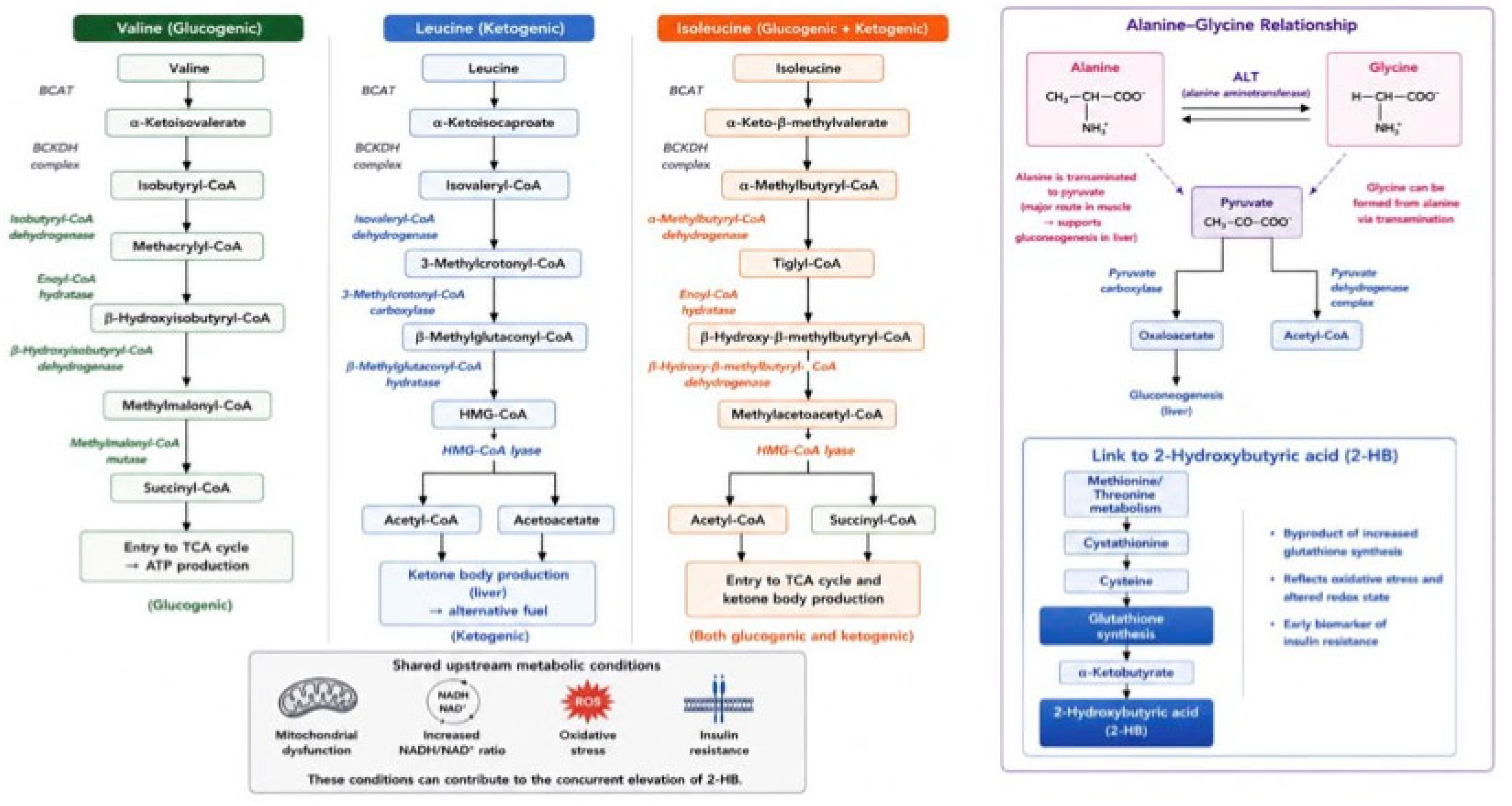
Metabolic connections between BCAAs (leucine, isoleucine, and valine) and selected amino acid–related metabolites (2-hydroxybutyrate [2-HB]) and related amino acids (alanine and glycine).
Valine is exclusively glucogenic and associated with fatty acid uptake and insulin resistance. Leucine is strictly ketogenic, yielding acetyl-CoA and acetoacetate for ketone body production. Isoleucine is both glucogenic and ketogenic, producing acetyl-CoA and succinyl-CoA. The amino groups from BCAA transamination are transferred to alanine, which mediates nitrogen transport from muscle to liver via the alanine (Cahill) cycle. In parallel, 2-HB is produced from a-ketobutyrate derived from methionine and threonine metabolism, particularly under conditions of increased glutathione synthesis. Although 2-HB arises from distinct pathways, these pathways share upstream metabolic stressors, including mitochondrial dysfunction, an increased NADH/NAD* ratio, oxidative stress, and insulin resistance, which can lead to the simultaneous elevation of the metabolite. 2-HB, 2-Hydroxybutyric acid; ALT: Alanine aminotransferase; BCAA, Branched-chain amino acids; BCAT, Branched-chain aminotransferase; BCKA, Branched-chain α-keto acid; BCKDH, Branched-chain α-keto acid dehydrogenase; CoA, Coenzyme A; HMG-CoA, 3-Hydroxy-3-methylglutaryl-CoA; TCA cycle, Tricarboxylic acid cycle.
References
- Tsao, C.W.; Lyass, A.; Enserro, D.; Larson, M.G.; Ho, J.E.; Kizer, J.R.; Gottdiener, J.S.; Psaty, B.M.; Vasan, R.S. Temporal Trends in the Incidence of and Mortality Associated With Heart Failure With Preserved and Reduced Ejection Fraction. JACC Heart Fail. 2018, 6, 678–685. [Google Scholar] [CrossRef] [PubMed]
- Roger, V.L. Epidemiology of Heart Failure: A Contemporary Perspective. Circ. Res. 2021, 128, 1421–1434. [Google Scholar] [CrossRef]
- Das, M.K.; Suradi, H.; Maskoun, W.; Michael, M.A.; Shen, C.; Peng, J.; Dandamudi, G.; Mahenthiran, J. Fragmented wide QRS on a 12-lead ECG: a sign of myocardial scar and poor prognosis. Circ. Arrhythmia Electrophysiol. 2008, 1, 258–268. [Google Scholar] [CrossRef]
- Yagi, K.; Imamura, T.; Tada, H.; Liu, J.; Miyamoto, Y.; Ohbatake, A.; Ito, N.; Shikata, M.; Enkaku, A.; Takikawa, A.; et al. Fragmented QRS on electrocardiography as a predictor for diastolic cardiac dysfunction in type 2 diabetes. J. Diabetes Investig. 2022, 13, 1052–1061. [Google Scholar] [CrossRef]
- Young, L.H.; McNulty, P.H.; Morgan, C.; Deckelbaum, L.I.; Zaret, B.L.; Barrett, E.J. Myocardial protein turnover in patients with coronary artery disease. Effect of branched chain amino acid infusion. J. Clin. Invest. 1991, 87, 554–560. [Google Scholar] [CrossRef] [PubMed]
- Tanada, Y.; Shioi, T.; Kato, T.; Kawamoto, A.; Okuda, J.; Kimura, T. Branched-chain amino acids ameliorate heart failure with cardiac cachexia in rats. Life Sci. 2015, 137, 20–27. [Google Scholar] [CrossRef]
- Wang, W.; Zhang, F.; Xia, Y.; Zhao, S.; Yan, W.; Wang, H.; Lee, Y.; Li, C.; Zhang, L.; Lian, K.; et al. Defective branched chain amino acid catabolism contributes to cardiac dysfunction and remodeling following myocardial infarction. Am. J. Physiol. Heart Circ. Physiol. 2016, 311, H1160–H1169. [Google Scholar] [CrossRef] [PubMed]
- Uddin, G.M.; Zhang, L.; Shah, S.; Fukushima, A.; Wagg, C.S.; Gopal, K.; Al Batran, R.; Pherwani, S.; Ho, K.L.; Boisvenue, J.; et al. Impaired branched chain amino acid oxidation contributes to cardiac insulin resistance in heart failure. Cardiovasc Diabetol. 2019, 18, 86. [Google Scholar] [CrossRef]
- Jiang, Y.J.; Sun, S.J.; Cao, W.X.; Lan, X.T.; Ni, M.; Fu, H.; Li, D.J.; Wang, P.; Shen, F.M. Excessive ROS production and enhanced autophagy contribute to myocardial injury induced by branched-chain amino acids: Roles for the AMPK-ULK1 signaling pathway and alpha7nAChR. Biochim Biophys. Acta Mol. Basis Dis. 2021, 1867, 165980. [Google Scholar] [CrossRef]
- Karwi, Q.G.; Lopaschuk, G.D. Branched-Chain Amino Acid Metabolism in the Failing Heart. Cardiovasc Drugs Ther. 2023, 37, 413–420. [Google Scholar] [CrossRef]
- Takeo, E.; Sasano, R.; Shimma, S.; Bamba, T.; Fukusaki, E. Solid-phase analytical derivatization for gas-chromatography-mass-spectrometry-based metabolomics. J. Biosci. Bioeng. 2017, 124, 700–706. [Google Scholar] [CrossRef] [PubMed]
- Imai, D.; Nakanishi, N.; Shinagawa, N.; Yamamoto, S.; Ichikawa, T.; Sumi, M.; Matsui, T.; Hosomi, Y.; Hasegawa, Y.; Munekawa, C.; et al. Association of Elevated Serum Branched-chain Amino Acid Levels With Longitudinal Skeletal Muscle Loss. J. Endocr. Soc. 2024, 8, bvad178. [Google Scholar] [CrossRef]
- Kawai, S.; Okada, H.; Okamoto, H.; Yashiki, R.; Minamida, M.; Shinagawa, N.; Ichikawa, T.; Yamamoto, S.; Kitagawa, N.; Hashimoto, Y.; et al. Dihomo-gamma-Linolenic Acid Elevation with Desaturase Imbalance in Metabolic Dysfunction-Associated Steatotic Liver Disease in a Japanese Health Checkups Cohort: HOZUGAWA Study, a Multi-Omic, Diet Adjusted Analysis. Nutrients 2025, 18. [Google Scholar] [CrossRef]
- Bayes-Genis, A.; Docherty, K.F.; Petrie, M.C.; Januzzi, J.L.; Mueller, C.; Anderson, L.; Bozkurt, B.; Butler, J.; Chioncel, O.; Cleland, J.G.F.; et al. Practical algorithms for early diagnosis of heart failure and heart stress using NT-proBNP: A clinical consensus statement from the Heart Failure Association of the ESC. Eur. J. Heart Fail. 2023, 25, 1891–1898. [Google Scholar] [CrossRef]
- Miyazaki, S.; Inaba, S.; Higashi, H.; Tamaki, S.; Nishimura, K.; Maruyama, K.; Ikeda, S.; Takata, Y.; Inoue, K.; Osawa, H.; et al. Validation of N-Terminal Pro B-Type Natriuretic Peptide Threshold for Early Detection of Pre-Heart Failure in a General Japanese Population - Toon Health Study. Circ. J. 2025, 89, 966–972. [Google Scholar] [CrossRef]
- Yagi, K.; Nagata, Y.; Yamagami, T.; Chujo, D.; Kamigishi, M.; Yokoyama-Nakagawa, M.; Shikata, M.; Enkaku, A.; Takikawa-Nishida, A.; Honoki, H.; et al. High prevalence of fragmented QRS on electrocardiography in Japanese patients with diabetes irrespective of metabolic syndrome. J. Diabetes Investig. 2021, 12, 1680–1688. [Google Scholar] [CrossRef] [PubMed]
- Konno, T.; Hayashi, K.; Fujino, N.; Oka, R.; Nomura, A.; Nagata, Y.; Hodatsu, A.; Sakata, K.; Furusho, H.; Takamura, M.; et al. Electrocardiographic QRS Fragmentation as a Marker for Myocardial Fibrosis in Hypertrophic Cardiomyopathy. J. Cardiovasc Electrophysiol. 2015, 26, 1081–1087. [Google Scholar] [CrossRef]
- Das, M.K.; Khan, B.; Jacob, S.; Kumar, A.; Mahenthiran, J. Significance of a fragmented QRS complex versus a Q wave in patients with coronary artery disease. Circulation 2006, 113, 2495–2501. [Google Scholar] [CrossRef] [PubMed]
- Tsugawa, H.; Cajka, T.; Kind, T.; Ma, Y.; Higgins, B.; Ikeda, K.; Kanazawa, M.; VanderGheynst, J.; Fiehn, O.; Arita, M. MS-DIAL: data-independent MS/MS deconvolution for comprehensive metabolome analysis. Nat. Methods 2015, 12, 523–526. [Google Scholar] [CrossRef]
- Chua, B.H.; Siehl, D.L.; Morgan, H.E. A role for leucine in regulation of protein turnover in working rat hearts. Am. J. Physiol. 1980, 239, E510–514. [Google Scholar] [CrossRef]
- Escobar, J.; Frank, J.W.; Suryawan, A.; Nguyen, H.V.; Kimball, S.R.; Jefferson, L.S.; Davis, T.A. Regulation of cardiac and skeletal muscle protein synthesis by individual branched-chain amino acids in neonatal pigs. Am. J. Physiol. Endocrinol. Metab. 2006, 290, E612–621. [Google Scholar] [CrossRef]
- Curfman, G.D.; O'Hara, D.S.; Hopkins, B.E.; Smith, T.W. Suppression of myocardial protein degradation in the rat during fasting. Effects of insulin, glucose, and leucine. Circ. Res. 1980, 46, 581–589. [Google Scholar] [CrossRef]
- Davoodi, J.; Hutson, S. Constitutive activation of mTOR pathway by leucine causes heart hypertrophy which can be blocked by rapamycin. FASEB J. 2012, 26. [Google Scholar] [CrossRef]
- Latimer, M.N.; Sonkar, R.; Mia, S.; Frayne, I.R.; Carter, K.J.; Johnson, C.A.; Rana, S.; Xie, M.; Rowe, G.C.; Wende, A.R.; et al. Branched chain amino acids selectively promote cardiac growth at the end of the awake period. J. Mol. Cell Cardiol. 2021, 157, 31–44. [Google Scholar] [CrossRef]
- Shende, P.; Plaisance, I.; Morandi, C.; Pellieux, C.; Berthonneche, C.; Zorzato, F.; Krishnan, J.; Lerch, R.; Hall, M.N.; Ruegg, M.A.; et al. Cardiac raptor ablation impairs adaptive hypertrophy, alters metabolic gene expression, and causes heart failure in mice. Circulation 2011, 123, 1073–1082. [Google Scholar] [CrossRef]
- Morio, A.; Tsutsumi, R.; Satomi, S.; Kondo, T.; Miyoshi, H.; Kato, T.; Kuroda, M.; Kitamura, T.; Hara, K.; Saeki, N.; et al. Leucine imparts cardioprotective effects by enhancing mTOR activity and mitochondrial fusion in a myocardial ischemia/reperfusion injury murine model. Diabetol. Metab. Syndr. 2021, 13, 139. [Google Scholar] [CrossRef]
- Morio, A.; Tsutsumi, R.; Kondo, T.; Miyoshi, H.; Kato, T.; Narasaki, S.; Satomi, S.; Nakaya, E.; Kuroda, M.; Sakaue, H.; et al. Leucine induces cardioprotection in vitro by promoting mitochondrial function via mTOR and Opa-1 signaling. Nutr. Metab. Cardiovasc Dis. 2021, 31, 2979–2986. [Google Scholar] [CrossRef]
- Witham, W.G.; Yester, K.A.; McGaffin, K.R. A high leucine diet mitigates cardiac injury and improves survival after acute myocardial infarction. Metabolism 2013, 62, 290–302. [Google Scholar] [CrossRef]
- Schauer, A.; Nascimento Alves, P.K.; Augstein, A.; Prieto Jarabo, M.E.; Moriscot, A.S.; Linke, A.; Adams, V. Abstract 18258: Leucine Supplementation Improves Myocardial Function in a HFpEF Rat Model. Circulation 2023, 148. [Google Scholar] [CrossRef]
- Kvitvang, H.F.; Andreassen, T.; Adam, T.; Villas-Boas, S.G.; Bruheim, P. Highly sensitive GC/MS/MS method for quantitation of amino and nonamino organic acids. Anal. Chem. 2011, 83, 2705–2711. [Google Scholar] [CrossRef] [PubMed]
Figure 1.
Study workflow.
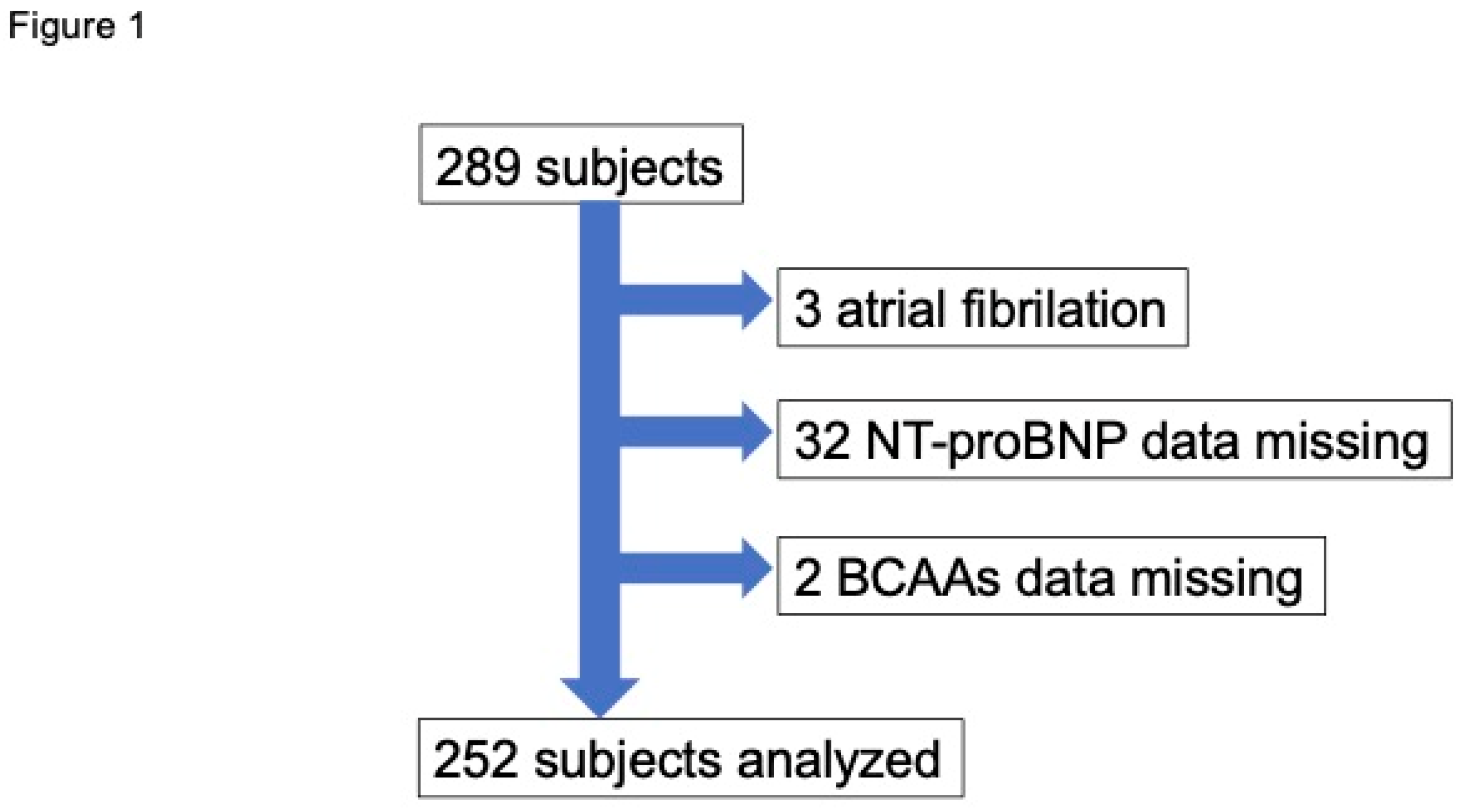
Figure 2.
Relationship between relative serum levels of branched-chain amino acids (BCAAs) and selected amino-acid–related metabolites and plasma NT-proBNP levels in participants with fQRS.
Figure 2.
Relationship between relative serum levels of branched-chain amino acids (BCAAs) and selected amino-acid–related metabolites and plasma NT-proBNP levels in participants with fQRS.
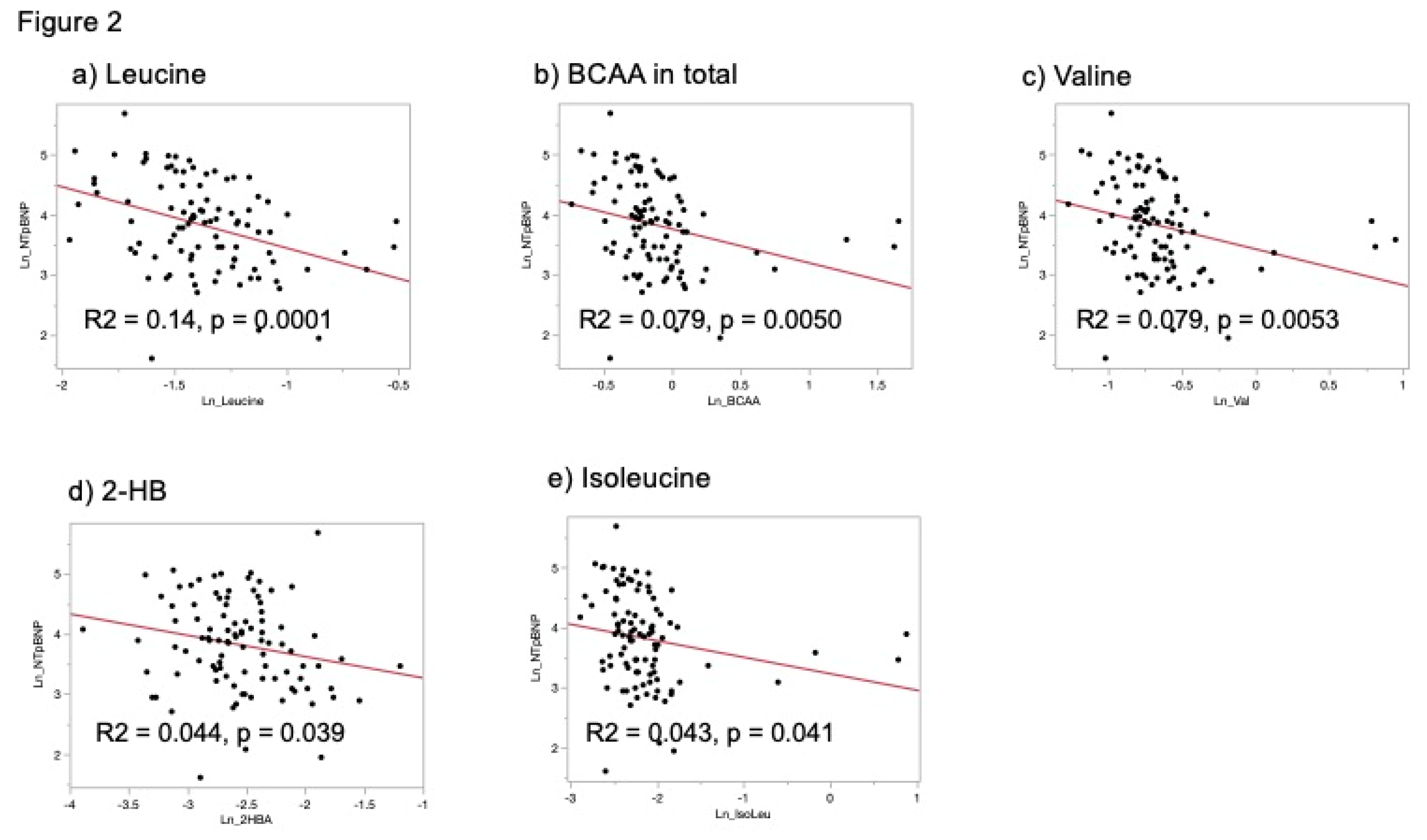
Figure 3.
Factors significantly associated with ln NT-proBNP. Scheme plots illustrating the relationships between ln-transformed NT-proBNP levels and (a) age, (b) estimated glomerular filtration rate (eGFR), (c) sex, and (d) body mass index (BMI). Linear regression analyses showed that age, eGFR, sex, and BMI were significantly associated with ln NT-proBNP (R² = 0.016–0.21, all p < 0.05).
Figure 3.
Factors significantly associated with ln NT-proBNP. Scheme plots illustrating the relationships between ln-transformed NT-proBNP levels and (a) age, (b) estimated glomerular filtration rate (eGFR), (c) sex, and (d) body mass index (BMI). Linear regression analyses showed that age, eGFR, sex, and BMI were significantly associated with ln NT-proBNP (R² = 0.016–0.21, all p < 0.05).
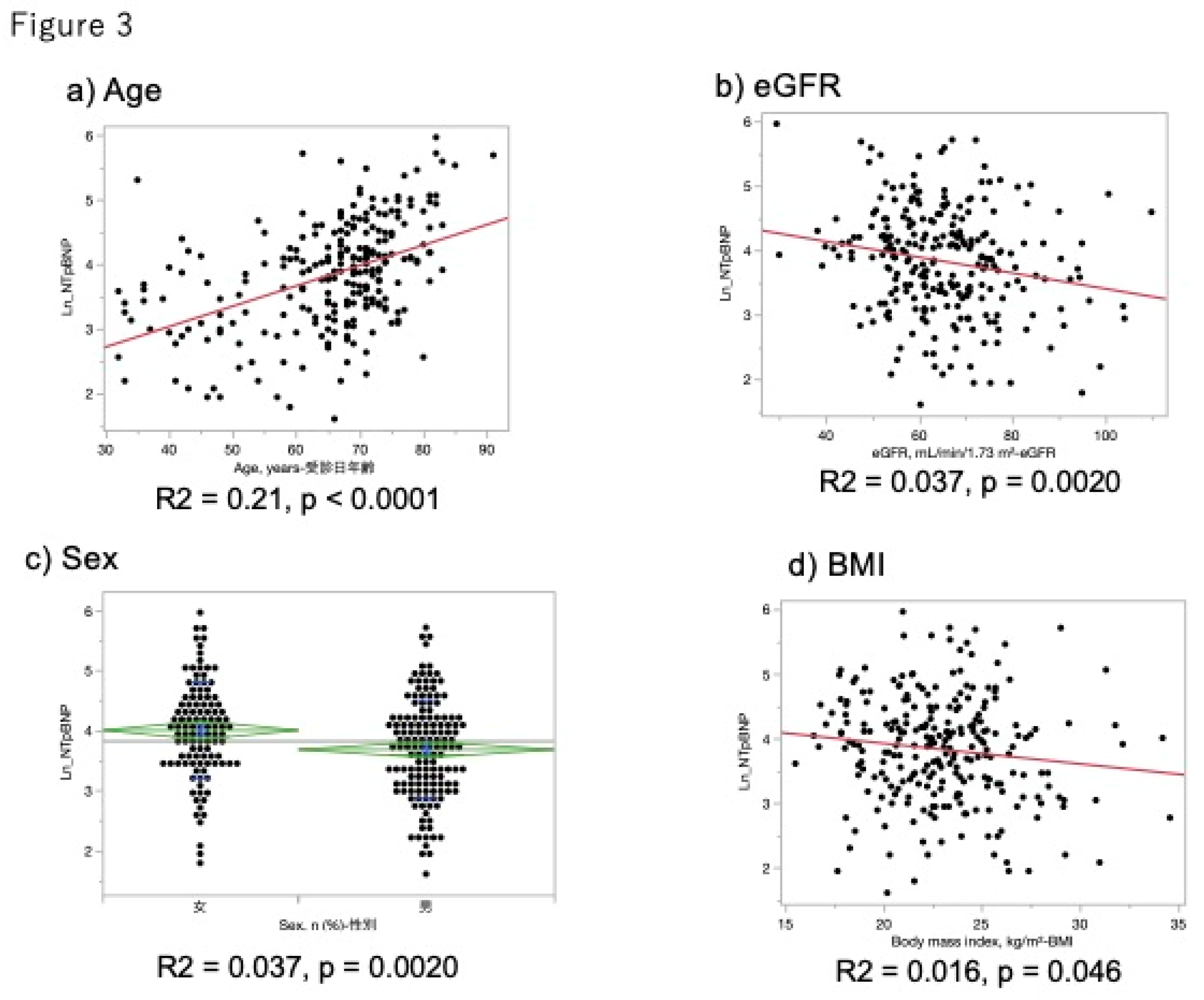

Table 1.
Clinical Characteristics of the Study Population.
| fQRS (+) | fQRS (-) | P value | |
| N | 97 | 155 | |
| Age, years | 66.9 ± 1.2 | 64.2 ± 1.0 | 0.072 |
| Male sex, n (%) | 65 (67%) | 78 (50%) | 0.0093 |
| Systolic BP, mmHg | 134.9 ± 1.7 | 134.9 ± 1.4 | 0.99 |
| Diastolic BP, mmHg | 80.9 ± 1.3 | 81.3 ± 0.9 | 0.83 |
| Heart rate, /min | 61.6 ± 1.0 | 62.7 ± 0.8 | 0.39 |
| BMI, kg/m2 | 22.8 ± 0.3 | 23.0 ± 0.3 | 0.53 |
| eGFR, mL/min | 64.4 ± 1.3 | 65.8 ± 1.0 | 0.43 |
| AST, U/L | 24.3 ± 1.7 | 23.2 ± 0.6 | 0.47 |
| ALT, U/L | 23.9 ± 2.0 | 21.3 ± 0.8 | 0.17 |
| LDL-C, mg/dL | 125.9 ± 2.9 | 123.7 ± 2.2 | 0.55 |
| TG, mg/dL | 110.8 ± 6.9 | 105.1 ± 4.4 | 0.46 |
| HbA1c, % | 5.93 ± 0.07 | 5.98 ± 0.06 | 0.57 |
| NT-proBNP | 59.6 ± 4.7 | 66.9 ± 5.2 | 0.34 |
| NT-proBNP >55 pg/mL | 38 (39%) | 72 (46%) | 0.26 |
| NT-proBNP ≥125 pg/mL | 9 (9%) | 17 (11%) | 0.67 |
| Leuvine | 0.27 ± 0.01 | 0.31 ± 0.04 | 0.32 |
| Isoleucine | 0.17 ± 0.03 | 0.19 ± 0.06 | 0.80 |
| Valine | 0.56 ± 0.04 | 0.74 ± 0.17 | 0.41 |
| Alanine | 0.66 ± 0.06 | 0.89 ± 0.21 | 0.39 |
| Glycine | 0.48 ± 0.02 | 0.54 ± 0.03 | 0.14 |
| 2-HB | 0.086 ± 0.076 | 0.088 ± 0.080 | 0.71 |
| ECG findings | |||
| Blocks | |||
| 1′ AVB | 3 (3.1%) | 6 (3.9%) | 0.75 |
| RBBB & ICRBBB | 15 (15.5%) | 3 (1.9%) | <0.0001 |
| LBBB & LAD | 4 (4.1%) | 6 (3.9%) | 0.92 |
| fQRS | |||
| fQRS region | |||
| Inferior leads | 67 (69.1%) | N/A | N/A |
| Anterior leads | 42 (43.3%) | N/A | N/A |
| Lateral leads | 5 (5.2%) | N/A | N/A |
| Multiple regions | 15 (15.5%) | N/A | N/A |
| fQRS morphologies | |||
| Fragmented QRS | 2 (2.1%) | N/A | N/A |
| rSr′ | 6 (6.2%) | N/A | N/A |
| Notched S | 68 (70.1%) | N/A | N/A |
| RSR′ | 3 (3.1%) | N/A | N/A |
| Notched R | 84 (86.6%) | N/A | N/A |
| Continuous variables are presented as the mean ± standard error, and categorical variables as number (percentage). Comparisons were made between participants with and without fragmented QRS (fQRS). ALT, alanine aminotransferase; AST, aspartate aminotransferase; AVB, atrioventricular block; BMI, body mass index; BP, blood pressure; ECG, electrocardiography; eGFR, estimated glomerular filtration rate; fQRS, fragmented QRS; HbA1c, hemoglobin A1c; ICRBBB, incomplete right bundle branch block; LAD, left anterior fascicular block; LBBB, left bundle branch block; LDL-C, low-density lipoprotein cholesterol; NT-proBNP, N-terminal pro–B-type natriuretic peptide; RBBB, right bundle branch block; TG, triglycerides; 2-HB, 2-hydroxybutyrate. | |||
Table 2.
Correlation between ln NT-proBNP and ln-transformed BCAAs and related metabolic factors.
| Group | BCAA | n | r | p value |
| All | ln(Leucine) | 252 | -0.021 | 0.74 |
| All | ln(Isoleucine) | 252 | -0.0027 | 0.97 |
| All | ln(Valine) | 252 | -0.0040 | 0.95 |
| All | ln(BCAA in total) | 252 | -0.0082 | 0.90 |
| All | ln(Alanine) | 252 | 0.058 | 0.36 |
| All | ln(Glycine) | 252 | 0.052 | 0.41 |
| All | ln(2-HB) | 252 | -0.11 | 0.072 |
| fQRS (+) | ln(Leucine) | 93 | -0.38 | 0.0001 |
| fQRS (+) | ln(Isoleucine) | 93 | -0.21 | 0.041 |
| fQRS (+) | ln(Valine) | 93 | -0.28 | 0.0053 |
| fQRS (+) | ln(BCAA in total) | 93 | -0.28 | 0.005 |
| fQRS (+) | ln(Alanine) | 93 | -0.051 | 0.62 |
| fQRS (+) | ln(Glycine) | 93 | -0.098 | 0.34 |
| fQRS (+) | ln(2-HB) | 93 | -0.21 | 0.039 |
| fQRS (−) | ln(Leucine) | 159 | 0.11 | 0.18 |
| fQRS (−) | ln(Isoleucine) | 159 | 0.11 | 0.16 |
| fQRS (−) | ln(Valine) | 159 | 0.11 | 0.19 |
| fQRS (−) | ln(BCAA in total) | 159 | 0.11 | 0.17 |
| fQRS (−) | ln(Alanine) | 159 | 0.10 | 0.20 |
| fQRS (−) | ln(Glycine) | 159 | 0.11 | 0.17 |
| fQRS (−) | ln(2-HB) | 159 | -0.066 | 0.41 |
| Correlation analyses between ln-transformed NT-proBNP (dependent variable) and ln-transformed branched-chain amino acids (BCAAs) and related metabolic factors (independent variables) in the overall population and stratified by fragmented QRS (fQRS) status. Correlation coefficients (r) and corresponding p values are shown. BCAAs include leucine, isoleucine, valine, and total BCAAs. Related metabolic factors include alanine, glycine, 2-hydroxybutyrate (2-HB), and 3-hydroxybutyrate (3-HB). NT-proBNP, N-terminal pro–B-type natriuretic peptide; BCAAs, branched-chain amino acids; fQRS, fragmented QRS; ln, natural logarithm; 2-HB, 2-hydroxybutyrate. | ||||
Table 3.
Adjusted correlations between ln NT-proBNP and ln-transformed BCAAs.
| Group | BCAA | n | r | 95% CI | p value | ||
| All | ln(Leucine) | 252 | 0.13 | 0.062 | - | 0.19 | 0.049 |
| All | ln(Isoleucine) | 252 | 0.066 | 0.0026 | - | 0.13 | 0.30 |
| All | ln(Valine) | 252 | 0.086 | 0.023 | - | 0.15 | 0.18 |
| All | ln(BCAA in total) | 252 | 0.091 | 0.028 | - | 0.15 | 0.15 |
| fQRS (+) | ln(Leucine) | 93 | -0.28 | -0.39 | - | -0.18 | 0.0072 |
| fQRS (+) | ln(Isoleucine) | 93 | -0.15 | -0.25 | - | -0.040 | 0.15 |
| fQRS (+) | ln(Valine) | 93 | -0.19 | -0.30 | - | -0.083 | 0.072 |
| fQRS (+) | ln(BCAA in total) | 93 | -0.19 | -0.30 | - | -0.088 | 0.065 |
| fQRS (−) | ln(Leucine) | 159 | 0.23 | 0.15 | - | 0.31 | 0.0048 |
| fQRS (−) | ln(Isoleucine) | 159 | 0.16 | 0.084 | - | 0.24 | 0.045 |
| fQRS (−) | ln(Valine) | 159 | 0.17 | 0.086 | - | 0.25 | 0.043 |
| fQRS (−) | ln(BCAA in total) | 159 | 0.18 | 0.10 | - | 0.26 | 0.025 |
|
Multivariable-adjusted 95. confidence intervals (CI), and corresponding p values are shown. BCAAs include leucine, isoleucine, valine, and total BCAAs. BCAAs, branched-chain amino acids; BMI, body mass index; CI, confidence interval; eGFR, estimated glomerular filtration rate; fQRS, fragmented QRS; ln, natural logarithm; NT-proBNP, N-terminal pro–B-type natriuretic peptide; SE, standard error. | |||||||
Table 4.
Interaction between fQRS and Ln(Leucine) for Ln(NT-proBNP).
| factors | estimate | SE | 95%CI | p-value | ||
| Age | 0.031 | 0.0042 | 0.023 | - | 0.039 | <0.0001 |
| Sex | 0.18 | 0.048 | 0.084 | - | 0.28 | 0.0003 |
| [ fQRS (+) ] * [ Ln(Leucine) + 1.35147 ] | -0.51 | 0.15 | -0.81 | - | -0.22 | 0.0007 |
| eGFR | -0.0037 | 0.0038 | -0.011 | - | 0.0039 | 0.34 |
| BMI | -0.012 | 0.015 | -0.041 | - | 0.017 | 0.42 |
| fQRS (+) | -0.027 | 0.046 | -0.12 | - | 0.065 | 0.56 |
| Ln(Leucine) | -0.070 | 0.16 | -0.39 | - | 0.25 | 0.66 |
| A multiple linear regression model was developed with Ln(NT-proBNP) as the dependent variable and fQRS and Ln(Leucine) as independent variables. BMI, body mass index; CI, confidence interval; eGFR, estimated glomerular filtration rate; fQRS, fragmented QRS; ln, natural logarithm; NT-proBNP, N-terminal pro–B-type natriuretic peptide; SE, standard error. | ||||||
Disclaimer/Publisher’s Note: The statements, opinions and data contained in all publications are solely those of the individual author(s) and contributor(s) and not of MDPI and/or the editor(s). MDPI and/or the editor(s) disclaim responsibility for any injury to people or property resulting from any ideas, methods, instructions or products referred to in the content. |
© 2026 by the authors. Licensee MDPI, Basel, Switzerland. This article is an open access article distributed under the terms and conditions of the Creative Commons Attribution (CC BY) license (http://creativecommons.org/licenses/by/4.0/).
Copyright: This open access article is published under a Creative Commons CC BY 4.0 license, which permit the free download, distribution, and reuse, provided that the author and preprint are cited in any reuse.


