

Submitted:
20 May 2026
Posted:
22 May 2026
You are already at the latest version
Abstract
Background/Objectives: Postural control in elite athletes is shaped by the interaction of lower-limb and trunk-related neuromuscular subsystems, yet conventional Centre of Pressure (CoP) metrics provides limited information about subsystem-specific control strategies. This cross-sectional study examined whether elite athletes from sports with distinct movement demands show sport-specific profiles in spatial CoP behaviour and frequency-domain power spectral density (PSD) parameters. Methods: A total of 116 asymptomatic elite athletes from volleyball, football, short track, ice hockey and field hockey were assessed during single-leg stance. CoP path length, the mediolateral/anteroposterior movement index and PSD outcomes were analysed. PSD values were summarised into a trunk-related low-frequency window (0.02-0.6 Hz), a lower-limb frequency window (1-5 Hz) and a PSD quotient defined as PSD core / PSD lower limbs. Results: The combined spatial and frequency-domain approach revealed sport- and side-specific postural-control profiles that were not fully captured by CoP path length alone. Frequency-domain parameters helped distinguish control strategies with relatively greater trunk-related contribution from those dominated by lower-limb stabilisation. Conclusions: Integrating CoP path metrics with PSD-derived parameters may improve the biomechanical interpretation of postural control in elite sport and may support more discipline-specific monitoring, training and injury-prevention strategies.
Keywords:
postural control
; centre of pressure
; elite athletes
; trunk stability
; balance
; power spectral density
; single-leg stance
; biomechanics
; sports performance
1. Introduction
Postural control is a central construct in kinesiology, sports biomechanics and athlete monitoring. It depends on the integration of musculoskeletal and neural mechanisms with visual, vestibular and somatosensory information [1,2]. Its quality is influenced by anthropometric and functional body composition and depends particularly on the performance capacity of the lower limbs and trunk musculature [3,4,5]. For elite athletes, this interaction is not merely a generic balance function but a sport-specific regulatory process that has to satisfy the postural constraints created by each discipline.
Different sports impose highly specific constraints on support surface, limb dominance, acceleration, rotation and trunk-lower-limb coupling. Repeated exposure to these constraints may be reflected in discipline-specific postural profiles, although cross-sectional data cannot establish causal training effects [6]. These neuromuscular adaptations are considered relevant for sport-specific performance [6], and athletes frequently show better postural control than non-athletes [14]. At the same time, strategies for maintaining postural stability may vary according to sport, sex, limb function and individual characteristics [4,6,15,16].
Athlete-focused studies indicate that impaired postural control may increase the risk of lower-limb injury [7,8]. Hallen et al. [9] identified thigh muscle injuries as the most common injury type in a large prospective observational study of European elite women’s football, whereas anterior cruciate ligament ruptures produced the greatest injury burden. Sex-specific risk profiles are also relevant because neuromuscular control may be modulated by anatomical, hormonal and functional factors. In combination with the review findings of Hamed-Hamed et al. [10] and further recent work on cycle-dependent variation in neuromuscular control [11,12], these findings underline the importance of interpreting postural control within a sport- and athlete-specific framework.
One widely used approach for quantifying postural control is Centre of Pressure (CoP) analysis during quiet standing [4,6]. CoP path length reflects the spatial expression of neuromuscular regulation, whereas decomposition into anteroposterior and mediolateral components can provide more direction-specific insight [17,18]. Because postural control is governed by interacting subsystems rather than by one isolated mechanism [16], frequency-domain analysis may add important physiological information. Power spectral density (PSD) analysis differentiates characteristic frequency bands and has been used to infer subsystem-specific contributions to postural regulation [20,21,22]. Koltermann et al. [22] showed that different frequency bands correspond to distinct functional domains, and Matsuda et al. [6] demonstrated sport-related differences in high-frequency power during single-leg stance. However, the relationship between total CoP path length, directional sway and frequency-specific power across different elite sports remains insufficiently understood. We therefore examined whether elite athletes from different sports exhibit distinct postural-control profiles when conventional CoP parameters are combined with PSD-derived trunk and lower-limb indicators.
2. Materials and Methods
The investigation was conducted as a cross-sectional observational study within the framework of performance-diagnostic squad testing. Data were collected in 2024 during the competitive season as part of aptitude and performance diagnostics for national-team athletes at an institution certified by the German Olympic Sports Confederation. A favourable ethics vote was obtained from the responsible ethics committee (approval number: BO-EK-74022021_1). Before testing, all athletes were informed about the purpose and procedures of the investigation and provided written consent for participation and for the scientific analysis of anonymised data.
Asymptomatic elite athletes from volleyball, football, short track, ice hockey and field hockey were included. The final analytical sample comprised 116 athletes, including 49 women and 67 men. The sport-specific groups were as follows: volleyball women, n = 34; football men, n = 19; short track men, n = 11; ice hockey men, n = 14; field hockey women, n = 15; and field hockey men, n = 23. Inclusion required an average training volume of at least 15 h per week. Exclusion criteria were acute lower-limb injuries, relevant previous surgery, and acute or chronic low back pain during the three months preceding the assessment. Back pain was recorded using the Chronic Pain Grade Questionnaire according to von Korff, where the German version has been validated [24].
Postural control was assessed using the centre of pressure (CoP) during quiet standing. Each condition was measured once for 60 s, with a 10 s pause between measurements. Athletes performed the tests barefoot, with eyes open and hands placed on the hips. They fixated a visual target positioned at a height of 1.7 m and a distance of 4 m. Foot position was standardised using visual markings; during single-leg stance, the contralateral leg was not permitted to touch the stance leg. The sequence of left and right single-leg stance was randomized. Participants were instructed to maintain an upright and stable trunk posture throughout the measurement.
CoP data were acquired using modified Wii Balance Boards that had been validated for CoP measurements. Recording was performed at a sampling frequency of 1 kHz and with 14-bit resolution. Raw data were acquired and stored using software developed in LabVIEW 2020. According to the data collection record, there were no missing or technically unusable measurements.
The CoP time series were preprocessed and subsequently used to calculate the outcome parameters. CoP path length in centimeters served as the primary spatial parameter. Technical plausibility checks were performed for highly implausible values; values above 10^6 or pronounced deviations from the respective measurement variable were considered conspicuous. As no missing or unusable measurements were documented, these checks did not reduce the analytical sample. Filtering was performed using a second-order Butterworth low-pass filter. The cut-off frequency was derived according to the PSD-based determination of relevant frequency components described by Koltermann et al.; for the present dataset, the calculated cut-off was 14.8 Hz, and a fixed cut-off frequency of 15 Hz was therefore used for subsequent analyses [19].
For direction-specific description of CoP movement, a ML/AP index was used. This index describes the ratio of mediolateral (ML) to anteroposterior (AP) directional movement, or of the corresponding directional path lengths, and was taken from the ratio variables available for left and right single-leg stance in the analysis file. Higher values indicate stronger dominance of Side-direction sway components. In addition, the power spectral density (PSD) of the CoP time series was calculated by software. PSD outcomes were summarized into two functional frequency ranges: 0.02-0.6 Hz as a low-frequency, trunk-related component and 1-5 Hz as a higher-frequency component associated with the lower limbs. The PSD quotient (PSD quotient) was explicitly defined as PSD core / PSD lower limbs; higher values therefore indicate a relatively greater trunk-related PSD contribution compared with the lower-limb PSD contribution. The specific spectral-estimation routine implemented in the LabVIEW analysis, for example FFT or Welch estimation, was not separately documented in the available R scripts and was therefore not specified beyond the documented PSD output.
Statistical analysis was performed descriptively and inferentially. Continuous variables were reported as mean and standard deviation. For group models across sides, left and right values were combined into subject-level means. Because most sports were represented predominantly by one sex and a full sport-by-sex model was therefore not of full rank, the observed sport-sex groups were modelled as a grouping factor. For CoP mean, PSD 0.02-0.6 Hz, PSD 1-5 Hz and PSD quotient, linear models of the form outcome ~ sport-sex group were calculated and evaluated using ANOVA; partial eta-squared was reported as the effect size. Sensitivity models added one anthropometric covariate at a time (age, height, body mass or BMI). Left-right differences were examined using paired t-tests. Associations between outcome parameters and anthropometry were described using Pearson correlations. For the field hockey cohort, in which both sexes were represented, supplementary Welch t-tests were calculated for sex comparisons. The significance level was set at alpha = 0.05. Analyses were conducted in R 4.5.2; the principal packages used were dplyr 1.2.0, tidyr 1.3.2, tibble 3.3.1, ggplot2 4.0.2, scales 1.4.0 and grid 4.5.2.
3. Results
3.1. Cohort Analysis
A total of 116 asymptomatic athletes (42.2% female) participated in this cross-sectional study. The mean age was 20.4 ± 4.2 years, mean height was 180.4 ± 7.9 cm, mean body mass was 74.1 ± 10.2 kg, and mean BMI was 22.7 ± 2.1 kg/m² (Table 1). Only asymptomatic athletes with an average annual training volume of ≥ 15 h/week were included in the diagnostic assessment.
3.2. CoP Path Length During Single-Leg Stance
With regard to the CoP trajectory, the findings demonstrate sport-specific profiles. Significant differences were observed both between sports and, within individual disciplines, between the two sides. In the side comparison, standing stability, except in the female volleyball and female field hockey cohorts, was more pronounced on the right limb.
The statistical results of the study are summarised in the following table. Table 2 presents means and standard deviations of CoP path length during single-leg stance, stratified by sport.
3.3. Movement Index of Direction (ML/AP) of the CoP
The movement index of direction is presented in Table 3 and shows the calculated means and standard deviations of the ML/AP ratio during left and right single-leg stance, categorised by sport. Clear differences in the ML/AP ratio were evident both between disciplines and within individual sports. The female volleyball cohort was particularly noteworthy: despite non-significant differences in CoP track, this group showed significant differences in ML/AP values. Football showed the opposite pattern, with significant CoP values but no significant differences in ML/AP expression. Ice hockey presented a particularly interesting situation, as shifts in CoP and in the ML/AP ratio behaved in opposite directions.
3.4. Relationship Between the ML/AP Movement Index and the CoP
In the overall side comparison, a stronger mediolateral sway behaviour relative to anteroposterior excursion was dominant particularly on the left side, resulting in a higher ML/AP index. The female volleyball athletes represented a significant exception. In this cohort, there was a marked discrepancy between CoP path length and the ML/AP ratio: despite the lowest CoP values in the sport comparison, they showed disproportionately high ML/AP indices (Table 4 and Figure 1).
Table 4 shows the means and standard deviations of CoP path length and the ML/AP ratio during single-leg stance on the left and right leg, stratified by sport.
3.5. CoP Path and PSD Windows
An increasing power output within the PSD windows was generally associated with an increase in CoP path length. This relationship, shown in detail in Table 5, indicates that greater sway activity is directly linked to increased energetic demand in postural control.
3.6. Trunk-Specific Power Analysis Using the PSD Window
The analysis of trunk-specific power outputs showed, across sports in single-leg stance, substantially higher percentage power shares for the left limb than for the contralateral side. In conjunction with the likewise increased CoP values on the left side, the elevated power outputs suggest less efficient trunk control during the modelling of postural control on the left limb (Table 6).
Table 6 shows the means and standard deviations of trunk-specific PSD values in the frequency range from 0.02 to 0.6 Hz during left and right single-leg stance, categorized by sport.
3.7. Lower-Limb Power Analysis Using the PSD Window
For the spectral power density of the lower limbs (frequency range 1-5 Hz), the bilateral differences were substantially smaller than the deviations observed in the low-frequency range of trunk motor control (0.02-0.6 Hz). A sport-specific feature was seen in the female volleyball athletes, in whom the power shares of the lower limbs on the right side even exceeded those on the left. This suggests that postural control of the right limb is dominated primarily by distal adaptation strategies of the lower limbs. By contrast, stability on the left side is generated predominantly through proximal compensatory trunk movements (Table 7).
Table 7 shows the means and standard deviations of lower-limb PSD values in the frequency range from 1 to 5 Hz during left and right single-leg stance, categorised by sport.
3.8. Relationship Between CoP and the PSD Quotient
Across sports, higher CoP values tended to coincide with altered PSD-derived contributions, but the relative balance between trunk-related and lower-limb frequency components differed by discipline. The PSD quotient shows that similar spatial sway can be accompanied by different frequency-domain control strategies (Table 8 and Figure 2).
Table 8 presents the PSD power distribution between the core and lower limbs in different sports, together with CoP path length. Values represent means and standard deviations for lower-limb PSD values (1-5 Hz), trunk-specific PSD values (0.02-0.6 Hz) and the PSD quotient.
4. Discussion
The present study examined sport-specific postural-control strategies in elite athletes by combining conventional CoP path metrics with frequency-domain PSD parameters. This integrated approach is well aligned with the scope of functional morphology and kinesiology because it links observable balance behaviour to subsystem-specific neuromuscular contributions. The principal finding is that sport- and side-specific profiles became clearer when CoP path length was interpreted together with ML/AP directionality and PSD-derived trunk and lower-limb indicators, rather than as an isolated spatial outcome.
The observed sport-specific differences support the concept that postural control is shaped by the functional demands of each discipline. This interpretation is consistent with Paillard [30], who concluded that CoP plasticity adapts to both training-specific and competition-specific demand profiles. The present findings therefore extend previous work by showing that frequency-domain measures can add physiologically meaningful information to conventional CoP analysis. In particular, the PSD quotient presented in Table 8 provides an interpretable index of the relative trunk-related contribution compared with lower-limb stabilisation.
The divergent CoP findings in the female volleyball and female field hockey cohorts can be interpreted in light of sport-specific movement demands. Although volleyball contains pronounced upper-body asymmetry during unilateral hitting actions, leg work and repeated bilateral jumping require marked lower-limb symmetry. This interpretation is supported by Fuchs et al. [31], who showed that professional female volleyball players were able to further reduce their already small side differences in postural control through sport-specific jump training. Field hockey, by contrast, imposes frequent low-position accelerations and asymmetric stick-handling constraints, which may contribute to a distinct lateralised control profile.
Sex- and dominance-related interpretations should nevertheless be treated cautiously. Mocanu et al. [32] and Feliciano et al. [33] reported sex-related differences in functional leg dominance, suggesting that sport-specific loading may interact with biological and functional characteristics. In the present field hockey cohort, this may help explain why female and male athletes showed different postural-control expressions, but the cross-sectional design does not permit causal attribution to training exposure alone.
The ML/AP findings indicate that CoP path length alone captures only part of the neuromuscular control strategy. In the female volleyball cohort, relatively low CoP values were accompanied by pronounced side differences in directional sway. Similar observations were reported by Borzucka et al. [34], who interpreted variable ML/AP patterns in female volleyball players as a shift in sensory resources towards mediolateral stabilisation. Based on current explanatory models, including that of Morasso [35], elevated ML/AP values may reflect greater reliance on hip-related strategies during mediolateral control, whereas lower ML/AP values may be more compatible with an ankle-dominant strategy.
Football players showed limb-specific differences in CoP path length without equivalent directional asymmetries in ML/AP displacement, suggesting a difference in overall stability demand rather than in directional control preference. This is compatible with the heterogeneous literature on kicking-leg and stance-leg behaviour. Fletcher and Long [36] reported larger CoP excursion on the preferred kicking leg, whereas Barone et al. [37] found no significant dominance-related differences during simple static standing. The present results therefore support the view that test context is critical when interpreting sport-specific balance profiles.
The short track and ice hockey cohorts were characterised by patterns that are plausible from a sport-biomechanical perspective. Walsh et al. [38] showed that low skate-blade friction and a narrow base of support can increase mediolateral path length while anteroposterior displacement remains relatively constrained. Such mechanical constraints may explain why skating sports can show distinctive ML/AP and CoP profiles even under barefoot static test conditions, reflecting persistent motor-control adaptations or discipline-specific neuromuscular preferences.
The frequency-domain results add a further layer of interpretation. Higher PSD values in the 1-5 Hz range indicate a stronger lower-limb contribution, whereas higher values in the 0.02-0.6 Hz range suggest greater trunk-related involvement. The PSD quotient therefore helps identify whether increased CoP path length is accompanied by relatively greater trunk-related control or by a lower-limb-dominant stabilisation strategy. This distinction is relevant for athlete monitoring because two athletes with similar CoP path lengths may rely on different neuromuscular control solutions.
From an applied perspective, the combined use of CoP, ML/AP and PSD outcomes may support more precise training recommendations. Athletes with high CoP path length and a high PSD quotient may benefit from interventions that target trunk-lower-limb coupling and proximal control, whereas athletes with high CoP path length but lower trunk-related PSD contribution may require training that emphasises ankle strategy, lower-limb stiffness regulation or sport-specific single-leg stabilisation. Such interpretation should be validated prospectively before clinical or performance thresholds are derived.
Compared with conventional balance outcomes, PSD analysis provides an important advantage because it can quantify the relative contribution of functional frequency domains to postural regulation. This is particularly relevant in elite sport, where subtle asymmetries and compensatory strategies may remain hidden when only total CoP path length is considered. The present findings are consistent with Trajkovic et al. [39], who identified sport-specific postural strategies in trained adolescents and young adults using CoP velocity, amplitude and frequency variables.
Several limitations should be considered. First, the cross-sectional design precludes conclusions about causal training effects. Second, trunk-muscle activation was not verified by electromyography; therefore, the interpretation of low-frequency PSD as trunk-related should be understood as a frequency-domain inference based on the applied analytical model rather than as a direct measurement of muscle activity. Third, menstrual-cycle phase was not recorded, although current evidence indicates that hormonal fluctuations may influence joint stabilisation and neuromuscular control [10,11,12]. Finally, all tests were performed during static single-leg stance. Future studies should include dynamic tasks, prospective seasonal monitoring and EMG-based validation to determine whether the identified postural-control profiles translate to sport-specific movement contexts and injury-risk prediction.
5. Conclusions
Elite athletes from different sports showed sport- and side-specific postural-control profiles when CoP path length was analysed together with ML/AP directionality and PSD-derived frequency-domain parameters. The PSD quotient, defined as PSD core / PSD lower limbs, complemented conventional CoP metrics by indicating whether postural control was characterised by relatively greater trunk-related or lower-limb contribution. These findings support the use of combined spatial and frequency-domain analyses for biomechanical athlete monitoring and for the development of discipline-specific balance and trunk-control interventions. Longitudinal and EMG-supported studies are required to confirm causal training adaptations and to evaluate the practical value of these measures for performance and injury prevention.
Author Contributions
Please confirm the final CRediT author roles before submission. Suggested draft: Conceptualization, P.F. and J.J.K.; methodology, P.F. and J.J.K.; software, J.J.K.; formal analysis, J.J.K.; investigation, P.F., F.C.W. and A.C.D.; resources, A.C.D.; data curation, P.F. and J.J.K.; writing-original draft preparation, P.F. and J.J.K.; writing-review and editing, F.C.W., J.-J. F., C.F. and A.C.D.; supervision, A.C.D.; project administration, P.F. All authors have read and agreed to the published version of the manuscript.
Funding
Please insert funding information or state: This research received no external funding.
Institutional Review Board Statement
The study was conducted in accordance with the Declaration of Helsinki and approved by the responsible Ethics Committee (approval number: xx-x-x). Please add the full name of the approving institution before submission.
Informed Consent Statement
Written informed consent was obtained from all athletes involved in the study.
Data Availability Statement
Please confirm the final data-sharing wording. Suggested draft: The datasets analysed during the current study are available from the corresponding author upon reasonable request.
Acknowledgments
Please insert acknowledgments if applicable.
Conflicts of Interest
The authors declare no conflicts of interest. Please confirm before submission.
References
- Fransson, P.A.; Kristinsdottir, E.K.; Hafstrom, A.; Magnusson, M.; Johansson, R. Balance control and adaptation during vibratory perturbations in middle-aged and elderly humans. Eur. J. Appl. Physiol. 2004, 91, 595–603. [Google Scholar] [CrossRef]
- Vuillerme, N.; Pinsault, N.; Vaillant, J. Postural control during quiet standing following cervical muscular fatigue: Effects of changes in sensory inputs. Neurosci. Lett. 2005, 378, 135–139. [Google Scholar] [CrossRef] [PubMed]
- Anderson, K.; Behm, D.G. Trunk muscle activity increases with unstable squat movements. Can. J. Appl. Physiol. 2005, 30, 33–45. [Google Scholar] [CrossRef] [PubMed]
- Harringe, M.L.; Halvorsen, K.; Renstrom, P.; Werner, S. Postural control measured as the center of pressure excursion in young female gymnasts with low back pain or lower extremity injury. Gait Posture 2008, 28, 38–45. [Google Scholar] [CrossRef]
- Szafraniec, R.; Baranska, J.; Kuczynski, M. Acute effects of core stability exercises on balance control. Acta Bioeng. Biomech. 2018, 20, 145–151. [Google Scholar] [CrossRef]
- Matsuda, S.; Demura, S.; Uchiyama, M. Centre of pressure sway characteristics during static one-legged stance of athletes from different sports. J. Sports Sci. 2008, 26, 775–779. [Google Scholar] [CrossRef]
- Emery, C.A.; Cassidy, J.D.; Klassen, T.P.; Rosychuk, R.J.; Rowe, B.H. Effectiveness of a home-based balance-training program in reducing sports-related injuries among healthy adolescents: A cluster randomized controlled trial. CMAJ 2005, 172, 749–754. [Google Scholar] [CrossRef]
- McGuine, T.A.; Keene, J.S. The effect of a balance training program on the risk of ankle sprains in high school athletes. Am. J. Sports Med. 2006, 34, 1103–1111. [Google Scholar] [CrossRef]
- Hallen, A.; Tomas, R.; Ekstrand, J.; Bengtsson, H.; Van den Steen, E.; Hagglund, M.; Walden, M. UEFA Women’s Elite Club Injury Study: A prospective study on 1527 injuries over four consecutive seasons 2018/2019 to 2021/2022 reveals thigh muscle injuries to be most common and ACL injuries most burdensome. Br. J. Sports Med. 2024, 58, 128–135. [Google Scholar] [CrossRef] [PubMed]
- Hamed-Hamed, D.; Gonzalez-Munoz, A.; Cuevas-Cervera, M.; Perez-Montilla, J.J.; Aguilar-Nunez, D.; Aguilar-Garcia, M.; Pruimboom, L.; Navarro-Ledesma, S. Effects of the menstrual cycle on the performance of female football players: A systematic review. Front. Physiol. 2024, 15, 1359953. [Google Scholar] [CrossRef]
- Pohle, C.; Becker, L.; Baumeister, J. Alterations of postural control across the menstrual cycle: A systematic review. Gait Posture 2024, 107, 72–82. [Google Scholar] [CrossRef]
- Romero-Moraleda, B.; Morencos-Martinez, E.; Varon, P.; Lara, B.; Jimenez-Ormeno, E.; Peinado, A.B.; Gonzalez-Garcia, J. The influence of menstrual cycle phase on neuromuscular performance and subjective perception of effort in elite football players. Biol. Sport 2025, 42, 89–98. [Google Scholar] [CrossRef]
- Zech, A.; Hubscher, M.; Vogt, L.; Banzer, W.; Hansel, F.; Pfeifer, K. Balance training for neuromuscular control and performance enhancement: A systematic review. J. Athl. Train. 2010, 45, 392–403. [Google Scholar] [CrossRef]
- Davlin, C.D. Dynamic balance in high level athletes. Percept. Mot. Ski. 2004, 98, 1171–1176. [Google Scholar] [CrossRef]
- Mok, N.W.; Brauer, S.G.; Hodges, P.W. Hip strategy for balance control in quiet standing is reduced in people with low back pain. Spine 2004, 29, E107–E112. [Google Scholar] [CrossRef] [PubMed]
- Picot, B.; Remy-Neris, O.; Forestier, N. Proprioceptive postural control strategies differ among non-injured athletes. Neurosci. Lett. 2022, 769, 136366. [Google Scholar] [CrossRef]
- Adlerton, A.K.; Moritz, U.; Moe-Nilssen, R. Forceplate and accelerometer measures for evaluating the effect of muscle fatigue on postural control during one-legged stance. Physiother. Res. Int. 2003, 8, 187–199. [Google Scholar] [CrossRef] [PubMed]
- Kidgell, D.J.; Horvath, D.M.; Jackson, B.M.; Seymour, P.J. Effect of six weeks of dura disc and mini-trampoline balance training on postural sway in athletes with functional ankle instability. J. Strength Cond. Res. 2007, 21, 466–469. [Google Scholar] [CrossRef] [PubMed]
- Koltermann, J.J.; Gerber, M.; Beck, H.; Beck, M. Validation of different filters for center of pressure measurements by a cross-section study. Technologies 2019, 7, 68. [Google Scholar] [CrossRef]
- Cholewicki, J.; Silfies, S.P.; Shah, R.A.; Greene, H.S.; Reeves, N.P.; Alvi, K.; Goldberg, B. Delayed trunk muscle reflex responses increase the risk of low back injuries. Spine 2005, 30, 2614–2620. [Google Scholar] [CrossRef]
- Kitabayashi, T.; Demura, S.; Noda, M. Examination of the factor structure of center of foot pressure movement and cross-validity. J. Physiol. Anthropol. Appl. Hum. Sci. 2003, 22, 265–272. [Google Scholar] [CrossRef] [PubMed]
- Koltermann, J.J.; Floessel, P.; Hammerschmidt, F.; Disch, A.C. A statistical and AI analysis of the frequency spectrum in the measurement of the center of pressure track in the seated position in healthy subjects and subjects with low back pain. Sensors 2024, 24, 3011. [Google Scholar] [CrossRef] [PubMed]
- Clark, D.R.; Lambert, M.I.; Hunter, A.M. Contemporary perspectives of core stability training for dynamic athletic performance: A survey of athletes, coaches, sports science and sports medicine practitioners. Sports Med. Open 2018, 4, 32. [Google Scholar] [CrossRef]
- Klasen, B.W.; Hallner, D.; Schaub, C.; Willburger, R.; Hasenbring, M. Validation and reliability of the German version of the Chronic Pain Grade questionnaire in primary care back pain patients. Psychosoc. Med. 2004, 1, Doc07. [Google Scholar]
- Koltermann, J.J.; Beck, H.; Beck, M. Investigation of the correlation between factors influencing the spectrum of center of pressure measurements using dynamic controlled models of the upright stand and subject measurements. Appl. Sci. 2020, 10, 3741. [Google Scholar] [CrossRef]
- Kikumoto, T.; Suzuki, S.; Takabayashi, T.; Kubo, M. Center of pressure deviation during posture transition in athletes with chronic ankle instability. Int. J. Environ. Res. Public Health 2023, 20, 5506. [Google Scholar] [CrossRef]
- Glass, S.M.; Ross, S.E. Direction-specific signatures of sport participation in center of pressure profiles of Division I athletes. Int. J. Sports Phys. Ther. 2021, 16, 1260–1272. [Google Scholar] [CrossRef]
- Zemkova, E.; Kovacikova, Z. Sport-specific training induced adaptations in postural control and their relationship with athletic performance. Front. Hum. Neurosci. 2023, 16, 1007804. [Google Scholar] [CrossRef]
- Zemkova, E.; Zapletalova, L. The role of neuromuscular control of postural and core stability in functional movement and athlete performance. Front. Physiol. 2022, 13, 796097. [Google Scholar] [CrossRef]
- Paillard, T. Relationship between sport expertise and postural skills. Front. Psychol. 2019, 10, 1428. [Google Scholar] [CrossRef] [PubMed]
- Fuchs, P.X.; Fusco, A.; Cortis, C.; Wagner, H. Effects of differential jump training on balance performance in female volleyball players. Appl. Sci. 2020, 10, 5921. [Google Scholar] [CrossRef]
- Mocanu, G.D.; Murariu, G.; Onu, I.; Badicu, G. The influence of gender and the specificity of sports activities on the performance of body balance for students of the Faculty of Physical Education and Sports. Int. J. Environ. Res. Public Health 2022, 19, 7672. [Google Scholar] [CrossRef]
- Feliciano, J.; McNally, M.P.; Busch, A.M. Performance differences in Division III female field hockey athletes with prior lower extremity injuries over a competitive season. Sport J. 2020. [Google Scholar]
- Borzucka, D.; Krecisz, K.; Rektor, Z.; Kuczynski, M. Postural control in top-level female volleyball players. BMC Sports Sci. Med. Rehabil. 2020, 12, 65. [Google Scholar] [CrossRef] [PubMed]
- Morasso, P. Integrating ankle and hip strategies for the stabilization of upright standing: An intermittent control model. Front. Comput. Neurosci. 2022, 16, 956932. [Google Scholar] [CrossRef] [PubMed]
- Fletcher, I.M.; Long, C.S. The effects of kicking leg preference on balance ability in elite soccer players. J. Athl. Enhanc. 2013, 2, 3. [Google Scholar] [CrossRef]
- Barone, R.; Macaluso, F.; Traina, M.; Leonardi, V.; Farina, F.; Di Felice, V. Soccer players have a better standing balance in nondominant one-legged stance. Open Access J. Sports Med. 2011, 2, 1–6. [Google Scholar] [CrossRef]
- Walsh, M.; Slattery, E.; McMath, A.; Cox, R.; Haworth, J. Training history constrains postural sway dynamics: A study of balance in collegiate ice hockey players. Gait Posture 2018, 66, 278–282. [Google Scholar] [CrossRef]
- Trajkovic, N.; Smajla, D.; Kozinc, Z.; Sarabon, N. Postural stability in single-leg quiet stance in highly trained athletes: Sex and sport differences. J. Clin. Med. 2022, 11, 1009. [Google Scholar] [CrossRef]
- Kiyota, T.; Fujiwara, K. Dominant side in single-leg stance stability during floor oscillations at various frequencies. J. Physiol. Anthropol. 2014, 33, 25. [Google Scholar] [CrossRef]
- Lin, W.H.; Liu, Y.F.; Hsieh, C.C.; Lee, A.J.Y. Ankle eversion to inversion strength ratio and static balance control in the dominant and non-dominant limbs of young adults. J. Sci. Med. Sport 2009, 12, 42–49. [Google Scholar] [CrossRef]
Figure 1.
Comparison of sports during left and right single-leg stance for CoP and ML/AP, shown as mean with standard deviation.
Figure 1.
Comparison of sports during left and right single-leg stance for CoP and ML/AP, shown as mean with standard deviation.
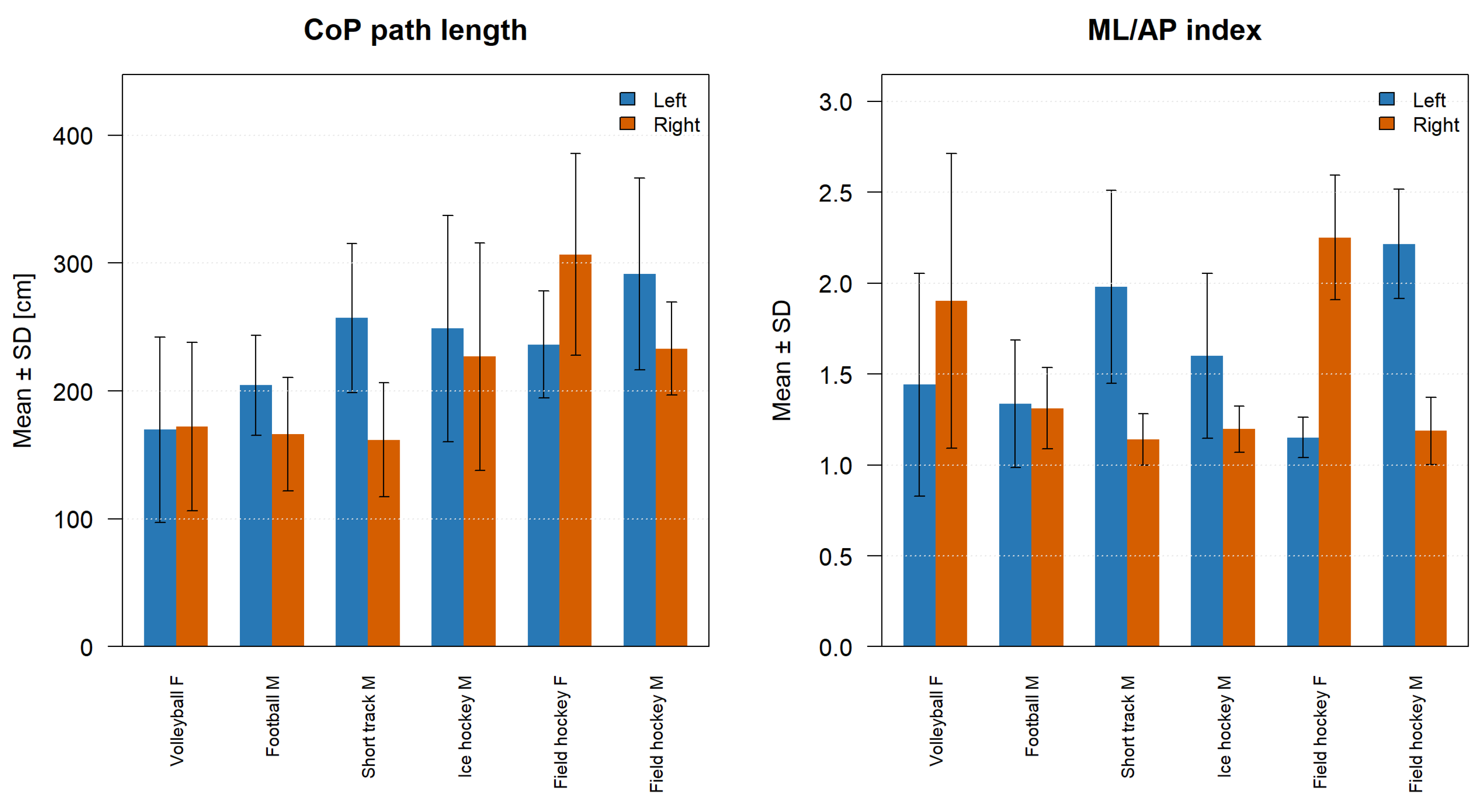
Figure 2.
Left-right averaged CoP and PSD parameters by sport.
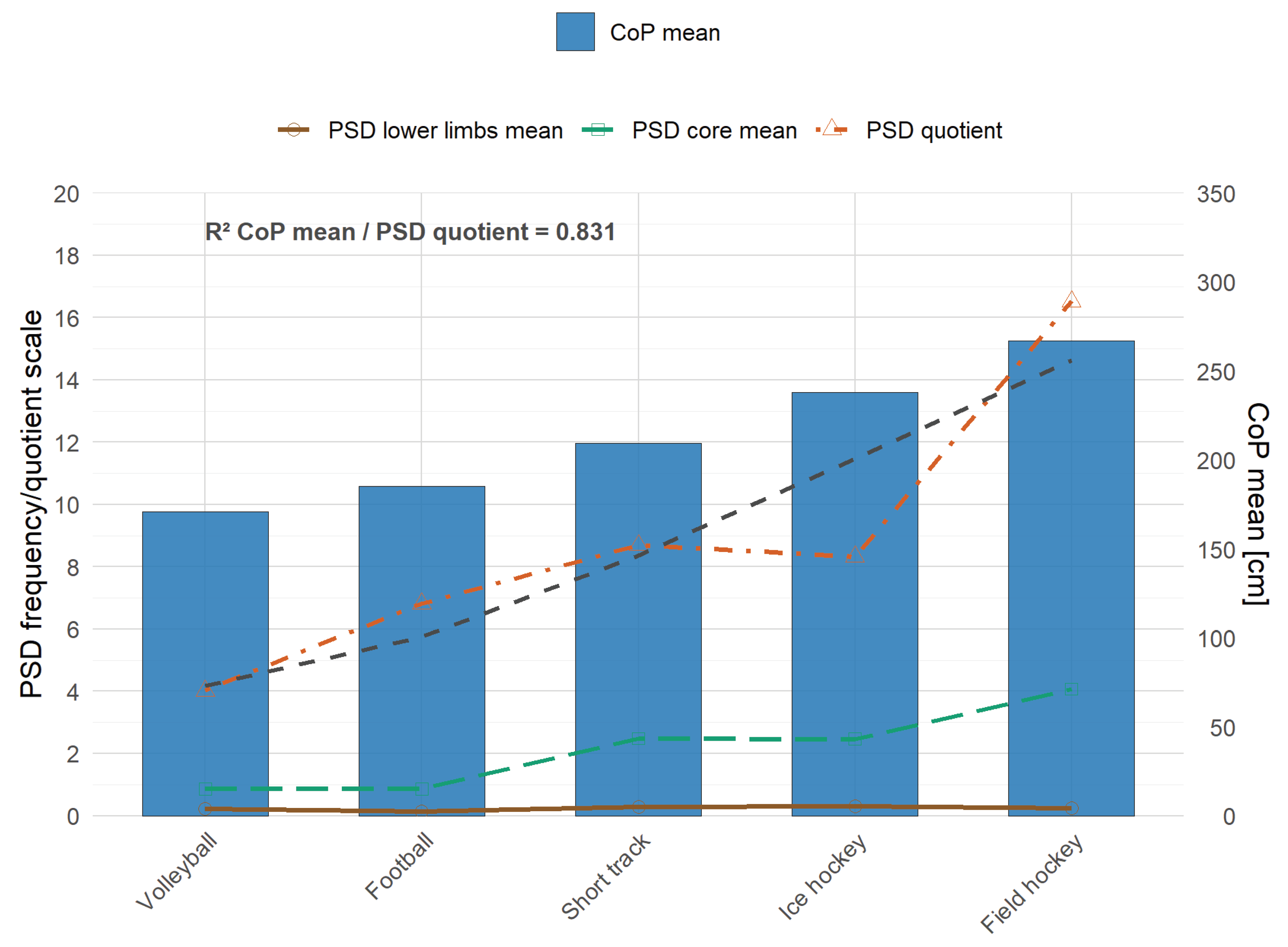

Table 1.
Anthropometric characteristics by sex and sport.
| Sex | Sport | n | Age [years] | Height [cm] | Body mass [kg] | BMI [kg/m²] |
|---|---|---|---|---|---|---|
| Women | Volleyball | 34 | 17.22 ± 1.29 | 183.88 ± 7.45 | 72.16 ± 9.67 | 21.26 ± 1.87 |
| Women | Field hockey | 15 | 21.27 ± 3.77 | 170.47 ± 5.45 | 63.40 ± 7.07 | 21.76 ± 1.51 |
| Men | Football | 19 | 23.56 ± 4.08 | 182.58 ± 6.90 | 78.73 ± 7.58 | 23.56 ± 0.95 |
| Men | Short track | 11 | 17.65 ± 0.49 | 174.73 ± 6.51 | 67.47 ± 4.29 | 22.12 ± 1.30 |
| Men | Ice hockey | 14 | 23.59 ± 3.91 | 181.43 ± 4.47 | 84.79 ± 5.95 | 25.75 ± 1.30 |
| Men | Field hockey | 23 | 21.39 ± 4.52 | 182.00 ± 6.98 | 76.74 ± 9.60 | 23.07 ± 1.69 |
Table 2.
CoP path during left and right single-leg stance.
| Sport | CoP left [cm] | CoP right [cm] |
|---|---|---|
| Volleyball women | 169.65 ± 72.46 | 172.10 ± 65.99 |
| Football men | 204.54 ± 39.07 | 166.22 ± 44.24 |
| Short track men | 256.95 ± 58.14 | 161.79 ± 44.64 |
| Ice hockey men | 248.74 ± 88.35 | 226.94 ± 88.94 |
| Field hockey women | 236.36 ± 41.62 | 306.70 ± 79.00 |
| Field hockey men | 291.39 ± 74.95 | 233.14 ± 36.49 |
Table 3.
ML/AP ratio during left and right single-leg stance.
| Sport | ML/AP left | ML/AP right |
|---|---|---|
| Volleyball women | 1.44 ± 0.61 | 1.90 ± 0.81 |
| Football men | 1.34 ± 0.35 | 1.31 ± 0.22 |
| Short track men | 1.98 ± 0.53 | 1.14 ± 0.14 |
| Ice hockey men | 1.60 ± 0.45 | 1.20 ± 0.13 |
| Field hockey women | 1.15 ± 0.11 | 2.25 ± 0.34 |
| Field hockey men | 2.22 ± 0.30 | 1.19 ± 0.19 |
Table 4.
CoP path length and ML/AP ratio in the side comparison.
| Sport | CoP left [cm] | ML/AP left | CoP right [cm] | ML/AP right |
|---|---|---|---|---|
| Volleyball women | 169.65 ± 72.46 | 1.44 ± 0.61 | 172.10 ± 65.99 | 1.90 ± 0.81 |
| Football men | 204.54 ± 39.07 | 1.34 ± 0.35 | 166.22 ± 44.24 | 1.31 ± 0.22 |
| Short track men | 256.95 ± 58.14 | 1.98 ± 0.53 | 161.79 ± 44.64 | 1.14 ± 0.14 |
| Ice hockey men | 248.74 ± 88.35 | 1.60 ± 0.45 | 226.94 ± 88.94 | 1.20 ± 0.13 |
| Field hockey women | 236.36 ± 41.62 | 1.15 ± 0.11 | 306.70 ± 79.00 | 2.25 ± 0.34 |
| Field hockey men | 291.39 ± 74.95 | 2.22 ± 0.30 | 233.14 ± 36.49 | 1.19 ± 0.19 |
Table 5.
Total CoP path, PSD power shares and PSD quotient.
| Sport | Total CoP [cm] | PSD core [%] | PSD lower limbs [%] | PSD quotient |
|---|---|---|---|---|
| Field hockey | 277.98 | 77.34 | 27.21 | 2.84 |
| Ice hockey | 337.09 | 59.44 | 36.19 | 1.64 |
| Short track | 315.10 | 86.05 | 21.31 | 4.04 |
| Football | 243.61 | 70.84 | 28.01 | 2.53 |
| Volleyball | 242.11 | 67.53 | 34.30 | 1.97 |
Table 6.
Trunk-specific PSD values in the frequency range 0.02-0.6 Hz.
| Sport | PSD 0.02-0.6 Hz left | PSD 0.02-0.6 Hz right |
|---|---|---|
| Volleyball women | 0.98 ± 1.15 | 0.74 ± 0.89 |
| Football men | 1.02 ± 0.61 | 0.71 ± 0.26 |
| Short track men | 4.44 ± 2.24 | 0.52 ± 0.22 |
| Ice hockey men | 3.23 ± 3.37 | 1.71 ± 2.17 |
| Field hockey women | 4.19 ± 2.21 | 3.78 ± 2.30 |
| Field hockey men | 3.98 ± 2.16 | 4.34 ± 2.33 |
Table 7.
Lower-limb PSD values in the frequency range 1-5 Hz.
| Sport | PSD 1-5 Hz left | PSD 1-5 Hz right |
|---|---|---|
| Volleyball women | 0.12 ± 0.24 | 0.30 ± 0.21 |
| Football men | 0.16 ± 0.07 | 0.10 ± 0.07 |
| Short track men | 0.35 ± 0.19 | 0.22 ± 0.20 |
| Ice hockey men | 0.34 ± 0.34 | 0.26 ± 0.27 |
| Field hockey women | 0.22 ± 0.14 | 0.27 ± 0.22 |
| Field hockey men | 0.28 ± 0.22 | 0.22 ± 0.13 |
Table 8.
PSD power distribution between core and lower limbs.
| Sport | CoP left | PSD 0.02-0.6 Hz left [%] | PSD 1-5 Hz left [%] | PSD quotient left | CoP right | PSD 0.02-0.6 Hz right [%] | PSD 1-5 Hz right [%] | PSD quotient right |
|---|---|---|---|---|---|---|---|---|
| Volleyball | 166.88 | 67.53 | 34.30 | 0.508 | 167.24 | 71.58 | 30.21 | 0.422 |
| Football | 204.55 | 70.84 | 28.01 | 0.395 | 166.22 | 56.72 | 35.18 | 0.620 |
| Short track | 260.48 | 86.05 | 21.31 | 0.248 | 158.10 | 78.98 | 23.19 | 0.294 |
| Ice hockey | 268.58 | 59.44 | 36.19 | 0.609 | 211.15 | 73.00 | 29.29 | 0.401 |
| Field hockey | 360.37 | 77.40 | 27.21 | 0.352 | 224.97 | 71.01 | 28.18 | 0.397 |
Disclaimer/Publisher’s Note: The statements, opinions and data contained in all publications are solely those of the individual author(s) and contributor(s) and not of MDPI and/or the editor(s). MDPI and/or the editor(s) disclaim responsibility for any injury to people or property resulting from any ideas, methods, instructions or products referred to in the content. |
© 2026 by the authors. Licensee MDPI, Basel, Switzerland. This article is an open access article distributed under the terms and conditions of the Creative Commons Attribution (CC BY) license (http://creativecommons.org/licenses/by/4.0/).
Copyright: This open access article is published under a Creative Commons CC BY 4.0 license, which permit the free download, distribution, and reuse, provided that the author and preprint are cited in any reuse.


