
Submitted:
21 May 2026
Posted:
21 May 2026
You are already at the latest version
Abstract
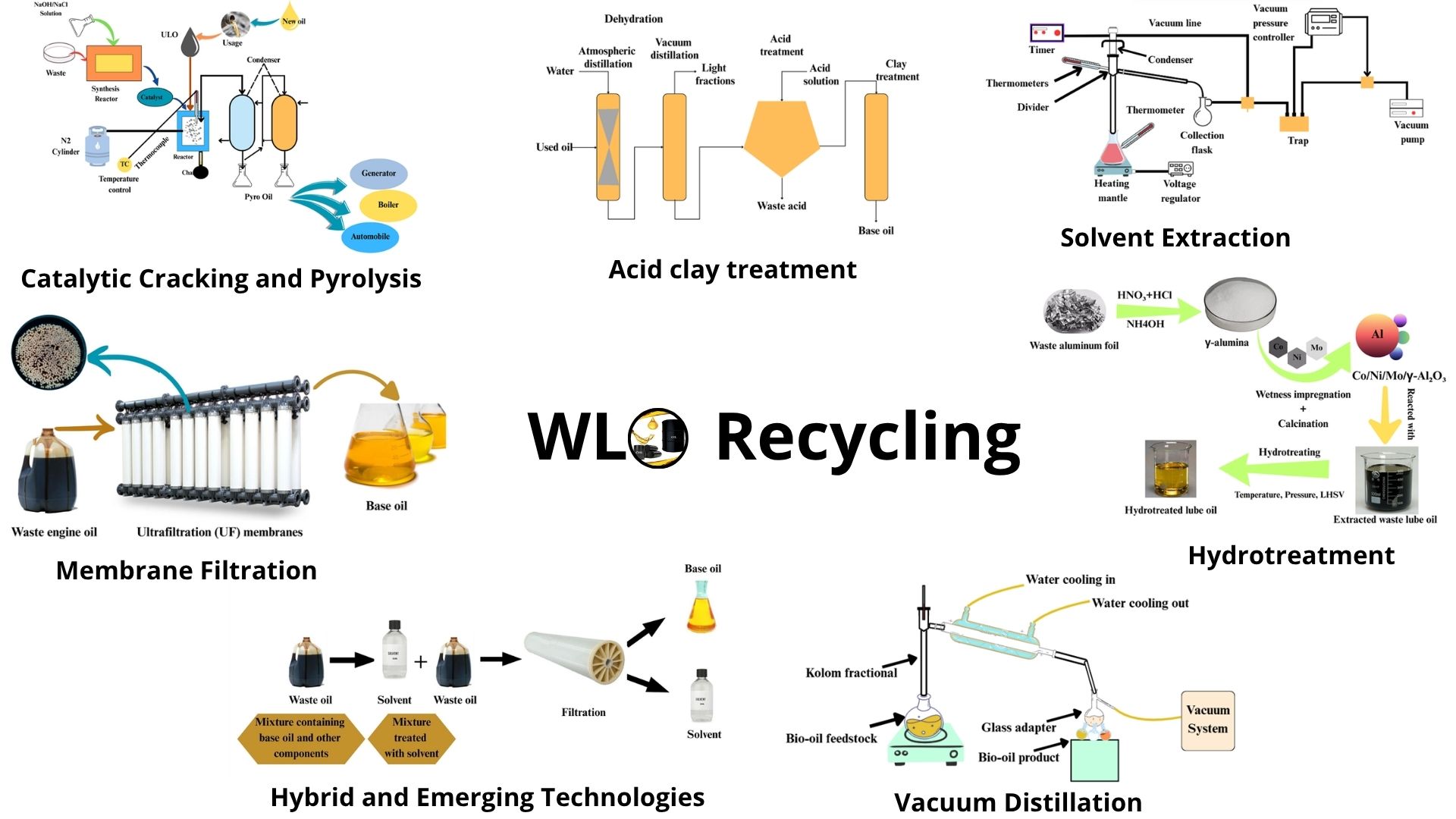
Waste lubricating oils (WLOs) represent a major stream of hazardous petroleum-based residues, with global generation exceeding 24 million tons annually. Improper disposal of WLOs poses risks to soil, water, and air quality, while their chemical composition makes them a potential secondary resource within circular economy frameworks. This review summarizes conventional, advanced, and emerging technologies reported for the recycling and valorization of WLOs into high-value petrochemicals and carbon-based materials. Established processes such as acid–clay treatment, solvent extraction, and vacuum distillation are discussed together with more recent approaches, including catalytic upgrading, hydrotreatment, membrane separation, and thermochemical conversion methods such as pyrolysis and catalytic cracking. Reported data on process performance, environmental considerations, and economic aspects are comparatively analyzed to outline current trends and technical challenges in WLO recycling. Particular attention is given to thermochemical pathways capable of generating carbonaceous materials, including carbon black, porous carbons, and functional carbon nanostructures with potential applications in adsorption, catalysis, electrochemical systems, and tribological formulations. Hybrid and integrated process configurations described in the literature are highlighted for their potential to improve recovery efficiency, enhance product quality, and reduce environmental burdens. In addition, recent life cycle assessment (LCA) and techno-economic analysis (TEA) studies are reviewed to provide insight into the environmental and economic implications of advanced re-refining systems. Overall, the reviewed literature indicates that WLO recycling represents not only an important element of sustainable lubricant management, but also a promising waste-to-carbon strategy for the production of value-added carbon-based materials and petrochemical products.
Keywords:
waste lubricating oils
; recycling
; base oils
; carbon‐based materials
; porous carbon
; carbon black
; pyrolysis
; fuel fractions
; circular economy
; sustainable development
Copyright: This open access article is published under a Creative Commons CC BY 4.0 license, which permit the free download, distribution, and reuse, provided that the author and preprint are cited in any reuse.


