
Submitted:
21 May 2026
Posted:
21 May 2026
You are already at the latest version
Abstract
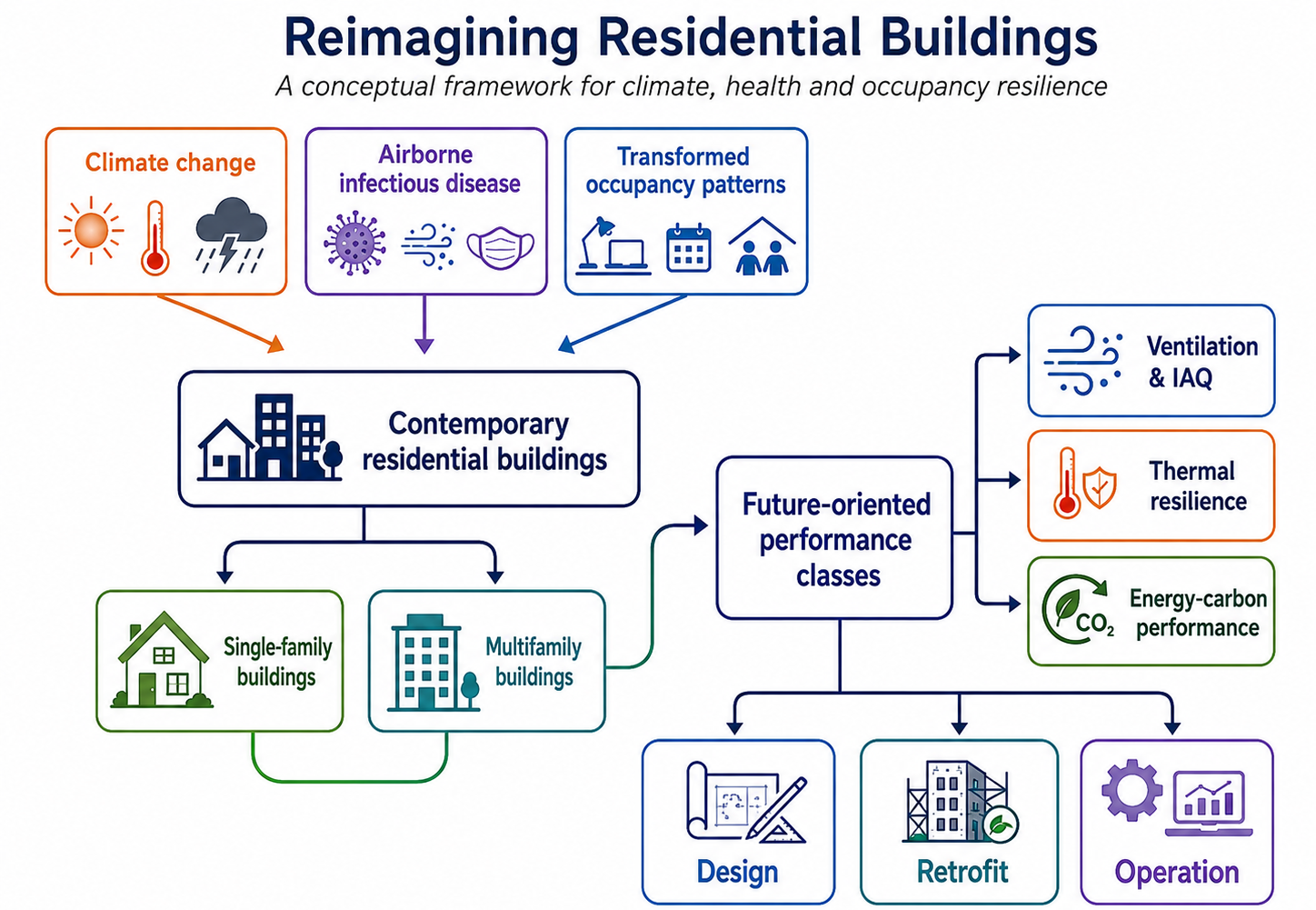
Residential buildings must now be designed and retrofitted as adaptive climate-health-work systems rather than as static housing units. This structured literature review synthesises peer-reviewed journal and conference evidence on residential taxonomy, ventilation, indoor environmental quality, overheating, airborne infection resilience, post-pandemic occupancy changes and future performance benchmarks. The review shows that single-family and multifamily buildings remain the most practical first-order categories because they differ in envelope exposure, ventilation pathways, system ownership, governance, retrofit feasibility and occupant control. Single-family dwellings generally provide greater household autonomy, roof-based renewable potential and room-level intervention flexibility, but can also carry higher envelope losses, lower density and stronger dependence on occupant operation. Multifamily buildings benefit from compactness and shared infrastructure, yet face additional risks from common services, vertical shafts, stack effects, corridor pressurisation, inter-zonal airflow and collective maintenance. Ventilation evidence indicates that natural, exhaust-only, supply, balanced heat-recovery, hybrid, demand-controlled and filtration-based strategies cannot be ranked universally; their effectiveness depends on climate, airtightness, pollutant source, occupancy, maintenance and governance. The review further shows that overheating, cooling-demand growth, airborne infection preparedness and remote work are shifting residential performance from winter-centric energy efficiency toward year-round thermal resilience, clean-air delivery and prolonged-occupancy functionality. A future taxonomy is therefore proposed around adaptive performance attributes, including thermal resilience, clean-air capacity, ventilation controllability, energy flexibility, remote-work readiness, vulnerability and retrofit potential. The core contribution is an implementation-oriented framework for aligning residential design, retrofit and policy with health, indoor environmental quality, energy efficiency and carbon performance.
Keywords:
residential buildings
; ventilation
; indoor environmental quality
; overheating
; climate change adaptation
; airborne infection
; remote work
; building taxonomy
1. Introduction
Climate change, infectious-disease risk and remote or hybrid work are redefining the technical role of residential buildings. Dwellings are long-life socio-technical systems that mediate outdoor climate, indoor exposure, energy demand and everyday activity, but their traditional design logic has often treated them primarily as private, evening- and night-occupied environments. That assumption is now incomplete. Climate change is increasing heatwave exposure and shifting thermal risk in heating-dominated climates, where energy policy and design have historically prioritised insulation, airtightness and winter heat conservation [1,2,3,4]. The COVID-19 pandemic also demonstrated that respiratory infection risk is shaped by indoor airflow patterns, ventilation effectiveness, exposure duration and room occupancy, making clean-air provision a residential health function rather than a commercial-building concern only [5,6,7,8]. In parallel, hybrid and home-based work have increased daytime residential occupancy, altered internal gains and electricity demand profiles, and extended exposure to domestic indoor environmental quality (IEQ) during productive work [9,10,11,12].
These pressures challenge the conventional view of residential buildings as environments occupied mainly during mornings, evenings and nights. Pre-pandemic residential occupancy research relied on typical occupancy schedules, whereas COVID-19 substantially altered occupancy duration, activity patterns and work-related use of homes [13,14]. During pandemic lockdowns, homes were transformed into workplaces, classrooms, caregiving contexts and self-isolation spaces, as work, study and daily-life activities migrated into dwellings [13,14,15,16,17,18]. This functional intensification exposed design weaknesses in acoustic privacy, daylight access, ergonomic provision, cooling capacity, contaminant control and ventilation controllability. Home-working studies further indicate that personal workspace, noise, acoustics, daylighting, spatial layout, thermal comfort and IEQ influence perceived productivity, satisfaction and wellbeing [12,16,19,20,21]. Similarly, home-office studies identify limitations in visual comfort and ergonomic provision, including inadequate furniture, reliance on laptops and increased discomfort during prolonged telework [15,16,22]. Increased residential occupancy also affected thermal-energy demand and indoor temperature control, with studies reporting increased heating and cooling demand during lockdown and narrower indoor temperature ranges after the pandemic, indicating greater energy use to maintain comfort [23,24]. In the post-pandemic period, hybrid work appears to be persistent rather than temporary, with labour-market evidence showing that work-from-home job postings increased after pandemic restrictions were lifted [25,26]. Residential buildings must therefore be evaluated as environments of prolonged exposure, cognitive performance and productivity, not only as places of rest and restoration [11,12].
Climate change intensifies the same problem from the thermal and energy side. Energy policy and residential design have often prioritised envelope insulation, airtightness and heat recovery to reduce winter heating demand. While these measures remain essential for decarbonisation, they can become vulnerable to summertime overheating when solar gains, internal loads, ventilation opportunity and shading are poorly controlled [4,27,28]. Overheating research has therefore challenged winter-centric design assumptions in temperate and heating-dominated climates by showing that future residential performance must consider annual heating-cooling balance, heatwave resilience, passive cooling, low-carbon active cooling and vulnerable occupants [3,28,29]. The future design problem is therefore no longer one-dimensional energy reduction [30]; it is the simultaneous provision of low-carbon thermal resilience, health-protective and functional living-working space.
The ventilation challenge is equally multi-objective. Ventilation is needed for pollutant dilution, moisture control, odour removal, thermal comfort support and airborne-infection risk reduction, yet higher outdoor-air rates can increase heating or cooling loads if they are not integrated with heat recovery, demand control, filtration, passive cooling and appropriate controls [31,32]. Natural ventilation, mechanical exhaust, supply systems, balanced heat-recovery ventilation, hybrid ventilation, demand-controlled ventilation and filtration-based strategies each produce different trade-offs across energy use, contaminant removal, comfort, acoustics, maintenance and user control [31,32,33]. These trade-offs differ by residential form. In single-family dwellings, household-level control may support room-level ventilation upgrades, filters, heat-recovery systems and window operation; in multifamily buildings, shared shafts, corridors, pressure differences, stack effects and centralised maintenance can create inter-zonal contaminant transfer and governance challenges [34,35,36,37].
Despite substantial evidence on residential energy modelling, overheating, ventilation, indoor environmental quality (IEQ) and airborne transmission, these domains are often reviewed separately. Building-stock studies commonly classify dwellings by age, archetype, envelope and energy system to estimate demand or retrofit pathways [38,39,40]. Ventilation studies often focus on indoor air quality (IAQ), energy penalties, moisture or infection mechanisms [5,31,32]. Overheating research has developed strong evidence on monitoring, simulation and adaptation measures [3,27], and remote-working studies have demonstrated the importance of residential built environment conditions for satisfaction and productivity [11,12]. The remaining gap is the absence of an up-to-date integrated residential taxonomy that connects building type, ventilation pathway, climate adaptation, health, governance and changed occupancy in one decision framework.
This review addresses that gap by using single-family and multifamily buildings as the first order organising categories for an integrated synthesis. This distinction is practical because the two categories differ in envelope exposure, density, roof and renewable-energy potential, service-system architecture, airflow interaction, occupant control, ownership structure, maintenance responsibility and retrofit feasibility [41,42,43,44]. However, the review does not treat typology as a fixed geometric descriptor. Instead, it develops a layered performance taxonomy that combines structural class with ventilation architecture, overheating exposure, energy-carbon interaction, remote-work readiness, occupant vulnerability, governance and retrofit potential [38,45,46].
The aim of this review is to synthesise peer-reviewed evidence on contemporary residential building taxonomy, ventilation systems, climate-related overheating, airborne-infection resilience and changing residential use, and to propose a future-oriented taxonomy and benchmark framework. The objectives are to: (i) classify contemporary residential buildings around single-family and multifamily categories and relevant subtypes; (ii) critically review residential ventilation systems in relation to IAQ, infection control, energy performance and controllability; (iii) synthesise emerging challenges associated with overheating, cooling-demand growth, remote work and health-productivity interactions; and (iv) propose future taxonomy dimensions and benchmark indicators for climate-ready, health-protective and energy-efficient residential design and retrofit. Four research questions guide the review: How can single-family and multifamily residential buildings be classified for current urban landscapes and future performance needs? What ventilation strategies are used in residential buildings, and what are their strengths and limitations for IAQ, infection control and energy use? How do climate change, hybrid working and disease outbreaks alter residential functional requirements? What future taxonomy and benchmark indicators can guide climate-ready, health-protective and energy-efficient residential design and retrofit?
The paper is structured as follows. Section 2 describes the structured review method, search logic, eligibility criteria, data extraction and synthesis approach. Section 3 develops the residential taxonomy, with emphasis on single-family and multifamily buildings and cross-cutting performance dimensions. Section 4 reviews residential ventilation systems and their implications for IAQ, infection mitigation, energy use and controllability. Section 5 synthesises future challenges related to climate resilience, airborne-infection preparedness, health, wellbeing, hybrid work and productivity. Section 6 proposes future taxonomy classes and benchmark indicators for design, retrofit, operation and policy. Section 7 concludes with key implications, limitations and priority research directions.
2. Methodology of the Structured Literature Review
This review used a structured literature review design to synthesise peer-reviewed evidence on residential building taxonomy, ventilation systems, indoor environmental quality (IEQ), overheating, airborne-infection resilience and transformed occupancy. The method was aligned with the review objective of reframing residential buildings as climate-resilient, health-protective and energy-efficient systems. The review followed the transparency logic of PRISMA 2020 for defining search fields, eligibility criteria, extraction categories and synthesis procedures [47], but it was not designed as a statistical meta-analysis. Quantitative pooling was inappropriate because the included studies differed in climate context, dwelling typology, ventilation strategy, monitoring duration, simulation assumptions, performance metrics, epidemiological endpoints and occupant-response variables. The evidence was therefore integrated through thematic synthesis and evidence mapping, allowing findings from building engineering, indoor environmental science, urban energy modelling and environmental health to be compared across single-family and multifamily residential contexts.
Figure 1 presents the methodological framework used in the review. It summarises the progression from scope definition and search strategy to eligibility screening, data extraction, synthesis and review outputs. The figure is used as a methodological map rather than a numerical PRISMA flow diagram because database-level hit counts, duplicate counts and final inclusion totals are not included (during search and extraction these data were not tracked).
The evidence base was restricted to peer-reviewed journal and conference papers to maintain scientific consistency across the review. Policy documents, design standards, governmental reports, books, professional guidance and websites were excluded as cited evidence, although such sources may remain relevant for later implementation and policy translation. The residential scope covered single-family and multifamily dwellings in urban and peri-urban contexts, including detached, semi-detached, terraced, low-rise apartment, mid-rise apartment and high-rise apartment forms. This scope was selected because the review questions depend on differences in envelope exposure, ventilation architecture, ownership control, system governance, overheating risk and retrofit feasibility across residential categories.
2.1. Search Strategy and Information Sources
The search strategy was structured around four thematic blocks that corresponded to the review questions and core objectives. The first block addressed residential taxonomy, urban form and building-stock modelling. The second block addressed residential ventilation, IAQ, filtration, contaminant control and airborne-infection mitigation. The third block addressed climate change, heatwaves, overheating, passive and active cooling, thermal resilience, decarbonisation and energy-carbon performance. The fourth block addressed transformed occupancy, remote or hybrid work, productivity and prolonged residential exposure.
Search terms combined residential descriptors with system, exposure and performance terms. The residential descriptors included “residential building”, “dwelling”, “home”, “single-family”, “multifamily”, “multi-family”, “apartment”, “detached”, “terraced”, “building stock”, “archetype” and “urban form”. Ventilation and IAQ terms included “ventilation”, “natural ventilation”, “mechanical ventilation”, “demand-controlled ventilation”, “heat recovery ventilation”, “filtration”, “indoor air quality”, “CO2”, “contaminant control” and “airborne infection”. Climate and thermal terms included “climate change”, “heatwave”, “overheating”, “cooling demand”, “thermal comfort”, “passive cooling”, “active cooling” and “thermal resilience”. Occupancy-related terms included “COVID-19”, “pandemic”, “remote work”, “telework”, “working from home”, “productivity” and “occupancy schedule”.
Searches were conducted in Scopus, Web of Science, ScienceDirect and PubMed/Medline, while Google Scholar was used for citation chasing and sensitivity checks. AI-assisted research tools, including Elicit, Consensus and SciSpace, were used only to support query expansion, candidate-paper discovery and preliminary organisation of evidence themes. The tools were not used as evidence sources, and AI-generated summaries or relevance assessments were not cited. All candidate papers identified through AI-assisted discovery were manually verified in bibliographic databases and screened against the eligibility criteria before inclusion (see Table A1 in appendix A for representative prompts used).
Backward and forward snowballing was used to identify foundational studies and recent papers that were not captured by the initial search strings. Foundational papers were retained when they established critical concepts such as bottom-up residential stock modelling, ventilation-infection associations, smart residential ventilation or overheating monitoring. More recent papers were prioritised when they addressed post-pandemic home working, updated ventilation lessons, contemporary residential overheating or future climate adaptation. The search was updated conceptually to April 2026.
2.2. Eligibility Criteria
Studies were included when they satisfied at least one of four evidence requirements. First, studies were included when they provided empirical, modelling or review evidence on residential building typologies, archetypes, stock characteristics or urban form. Second, studies were included when they evaluated residential or building-relevant ventilation strategies in relation to IAQ, energy use, infection risk, contaminant control, filtration or operational reliability. Third, studies were included when they analysed overheating, climate adaptation, cooling demand, passive cooling, active cooling or thermal resilience in dwellings. Fourth, studies were included when they examined residential environmental quality, energy demand, productivity, occupant behaviour or working-from-home conditions under increased home occupancy or teleworking.
Studies were excluded when they were not peer reviewed, lacked relevance to residential buildings, focused exclusively on non-building public-health measures, or did not provide usable findings for the taxonomy, ventilation or climate-health synthesis. Policy texts, professional guidance and standards were not used as cited evidence in the review because the manuscript was designed to synthesise peer-reviewed scientific literature. Studies focused on offices, schools or other non-residential settings were excluded unless the underlying mechanism was directly transferable to residential performance. For example, [48], controlled exposure evidence linking ventilation, CO2, volatile organic compounds and cognitive performance in office environments was treated as mechanistic support for home-working exposure-response interpretation, but it was not used to infer residential-specific thresholds without qualification.
2.3. Data Extraction, Appraisal and Synthesis
For each paper, the extraction fields included building type, climate context, study design, ventilation or thermal strategy, key metrics, main findings, implications for single-and multifamily buildings and identified research gaps. The appraisal considered methodological transparency, empirical or modelling robustness, duration of monitoring, validation of simulation inputs, clarity of typological classification, relevance to residential settings and consistency with the review questions. Evidence was then organised into four synthesis outputs corresponding to Section 3, Section 4, Section 5 and Section 6. This organisation is intended to make the review useful both as a scientific synthesis and as a design-oriented framework.
Because the review develops a conceptual taxonomy rather than a pooled effect estimate, the synthesis emphasises convergence across multiple evidence streams. Where findings diverged, the discussion identifies the boundary conditions, such as climate, urban density, occupant behaviour, envelope airtightness, ventilation controllability, maintenance quality and ownership structure. This is essential for residential buildings because the same intervention can produce different outcomes in detached houses, terraced dwellings, low-rise apartments and high-rise multifamily buildings, depending on system design and governance context.
AI-assisted tools were also used to support the design of evidence-synthesis table structures, including possible extraction fields and thematic categories. However, the final extraction, appraisal and interpretation were completed manually from the original peer-reviewed papers. Where AI-assisted tools suggested candidate claims, the original article was consulted, and the claim was included only when supported by the manually reviewed source.
2.4. Limitations of the Review Method
The review method is constrained by the heterogeneity of residential building stocks, climates, ventilation systems, energy systems, exposure metrics and health endpoints. Many studies evaluate energy, thermal comfort or overheating without infection-risk metrics, whereas infection-risk studies often simplify residential typology, occupant behaviour and ventilation operation. Studies on remote or hybrid work also frequently report perceived productivity or satisfaction without concurrent measurements of IAQ, acoustics, daylight, temperature and energy use. These differences limit direct comparison across studies and preclude defensible quantitative ranking of residential subtypes or ventilation strategies.
A second limitation concerns reporting granularity and transferability. Database-specific hit counts, duplicate-removal counts, full-text exclusion counts and final corpus size were not available; consequently, this methodology reports a transparent structured-review process, search architecture, eligibility logic and synthesis procedure rather than a numerical PRISMA flow. Some mechanistic evidence from non-residential settings was retained when it directly informed ventilation, airborne-infection or cognitive-performance mechanisms relevant to home working, but such evidence did not replace residential-specific data. The proposed taxonomy and benchmark directions should therefore be treated as a framework for future empirical testing, stock-level modelling and performance-based design research.
The use of AI-assisted discovery tools may introduce retrieval bias because tool outputs depend on database coverage, ranking algorithms and query phrasing. This risk was mitigated by using conventional databases as the primary search sources, applying backward and forward snowballing, manually screening all records, and treating AI-generated outputs only as discovery aids rather than evidence.
3. Taxonomy of Contemporary Residential Buildings
A taxonomy of contemporary residential buildings is required because residential form is not a neutral descriptor. It determines envelope exposure, service-system architecture, ventilation pathways, renewable-energy potential, maintenance responsibility and occupant control. Building-stock modelling studies [38,39,40] have commonly used typologies, archetypes and bottom-up classifications to represent heterogeneous residential stocks for energy, carbon and retrofit analysis, but these classifications have often prioritised energy demand and envelope characteristics more than the combined ventilation, overheating, health, governance and occupancy implications now required for climate-adaptive and post-pandemic housing assessment [45,49].
The primary distinction adopted here is between single-family and multifamily residential buildings. This distinction is analytically useful because it separates dwellings that are normally operated and retrofitted at the level of one household from buildings in which multiple households are connected by shared envelopes, shared services, circulation spaces and collective decision processes [39,50]. It also aligns with the review objectives because single-family and multifamily buildings differ in density, envelope exposure, ownership control, service distribution, renovation governance, ventilation pathways and user exposure patterns. These differences affect energy-carbon performance because housing typology, density and urban morphology influence operational energy demand, greenhouse-gas emissions, infrastructure requirements and building-integrated energy-production potential [41,42,43,44].
The reviewed literature did not identify a universal numerical threshold for defining single-family and multifamily buildings by dwelling-unit count, height, density or ownership model. Such threshold data are therefore unavailable in the evidence base considered. Consequently, the taxonomy developed here is treated as a functional-operational classification. A single-family building is defined by one-household use and predominantly one dwelling-level control, whereas a multifamily residential building is defined here as a building or connected building complexes containing multiple independent dwelling units within a shared physical, spatial and service-system structure.
3.1. Primary Distinction Between Single-Family and Multifamily Residential Buildings
3.1.1. Single-Family Residential Buildings
This category includes detached, semi-detached, terraced or row houses, and other low-rise attached forms with a discrete household identity and relatively direct household control over indoor conditions, envelope interventions and building-service operation [39]. In building-stock models, these dwellings are commonly represented as archetypes or individual stock units because energy demand is strongly influenced by envelope geometry, construction age, thermal properties, heating system and occupancy [38,40,46].
The single-family category is internally heterogeneous and should not be reduced to detached houses alone. Detached houses usually have greater external envelope exposure and higher surface-to-volume ratios, whereas semi-detached and terraced forms may retain household-level operation while benefiting from shared party walls and reduced heat-loss exposure. Degree of attachment, roof geometry, orientation, plot density, settlement context and envelope age should therefore be treated as sub-classification variables because they shape heat transfer, solar access, overheating vulnerability, ventilation opportunities and renewable-energy integration potential [42,44,51].
Intervention feasibility is strongly influenced by ownership and household-level decision authority. Building owners have more control over building characteristics and control. However, ownership control does not guarantee retrofit implementation, since decisions remain mediated by finance, knowledge, disruption, aesthetics, perceived risk, household priorities and life-course conditions [52,53]. Consequently, single-family taxonomy should incorporate both physical form and governance dimensions when assessing retrofit potential, climate resilience and residential energy performance. Table 1 summarises the key studies supporting this taxonomy and identifies the evidence gaps relevant to energy efficiency, climate adaptation, IEQ, decarbonisation and retrofit feasibility.
3.1.2. Multifamily Residential Buildings
This category includes low-rise apartments, mid-rise apartment buildings, high-rise residential towers, condominium blocks, cooperative housing and other multi-unit residential forms. They are distinguished from single-family buildings not only by dwelling-unit number but also by shared envelopes, circulation spaces, corridors, risers, service shafts, central or semi-central building services, collective maintenance arrangements and potential inter-zonal airflow pathways [34,35,37].
Multifamily buildings generally provide higher land-use intensity and greater geometric compactness because external envelope area and service infrastructure are distributed across several dwellings. Shared walls, floors and ceilings can reduce heat-transfer exposure and may support lower operational energy demand per dwelling, although this advantage is context-dependent, i.e., climate, system, occupancy and operational/service management, rather than universal [41,42,43]. At the same time, multifamily buildings introduce technical and governance constraints associated with shared services, vertical airflow pathways, stack-driven pressure differences, corridor pressurisation, contaminant transfer between zones, collective maintenance responsibility and uneven occupant control over indoor environmental conditions [34,35,36,37,54,55,56,57,58].
The multifamily class is also internally heterogeneous. Low-rise walk-up apartments, corridor-access mid-rise buildings and high-rise towers may differ substantially in stack-effect exposure, pressure distribution, shaft leakage, facade exposure, maintenance complexity and ventilation controllability [34,36,37,55]. Multifamily taxonomy should therefore extend beyond dwelling-unit count to include height class, access typology, shaft and riser configuration, ventilation strategy, compartmentalisation, tenure structure, maintenance responsibility and degree of resident control. Table 2 summarises the evidence supporting this classification and highlights gaps related to ventilation performance, inter-zonal contaminant transfer, overheating risk, energy efficiency, retrofit implementation and equitable indoor environmental control.
3.2. Primary Motivators for Each Building Type
The motivators for single-family and multifamily buildings operate at household, market and system scales, but they differ in their dominant performance logic. Single-family living is commonly associated with greater privacy, spatial autonomy, outdoor access and more direct control over dwelling attributes. Housing-preference and residential-satisfaction studies indicate that household choices are influenced by values, perceived dwelling attributes, privacy, control and the correspondence between preferred and actual residential [59,60,61,62,63]. These preferences are relevant to contemporary residential performance because spatial flexibility and direct control can support dedicated work areas, acoustic separation, thermal zoning and household-level ventilation decisions under prolonged daytime occupancy [12].
The same motivators create technical opportunities and systemic risks. Single-family dwellings may provide favourable conditions for decentralised heat pumps, rooftop photovoltaics, battery storage, envelope upgrades, external shading, garden-based microclimate measures and dwelling-level ventilation control when ownership, finance and technical advice are aligned [44,52,53]. However, these advantages coexist with larger exposed envelopes, lower settlement density and dispersed infrastructure, which may increase per-capita thermal-energy, infrastructure and transport-related burdens in some contexts [41,42,43]. The single-family motivator is therefore not simply individual preference; it is a combined question of autonomy, retrofit readiness, energy-carbon consequences and climate-resilience capacity.
The primary motivators for multifamily buildings are density, land efficiency, affordability, proximity to employment and services, compactness, shared infrastructure and the ability to accommodate many households within constrained urban land. These characteristics make multifamily housing central to compact urban development and energy-carbon strategies that seek to reduce per-dwelling envelope exposure and infrastructure intensity [41,42,43]. Multifamily buildings can also create economies of scale for district heating, centralised ventilation, shared maintenance, heat recovery and collective retrofit programmes. Yet the same shared structure can reduce individual control and create operational interdependencies, because ventilation paths may extend beyond the dwelling unit, maintenance may depend on central systems and retrofits may require collective approval or coordinated investment [34,56,58,64].
The motivation for multifamily classification is therefore operational and institutional as well as geometric. These buildings must be distinguished by how occupants share air pathways, thermal loads, common plant, corridor systems, envelope interventions, maintenance responsibilities and decision authority. This distinction is particularly important for airborne-infection and contaminant-control assessment because ventilation, air movement and exposure duration are associated with airborne transmission mechanisms, and shared leakage or pressure pathways can modify exposure between units [5,8,34,67].
3.4. Cross-Cutting Taxonomy Dimensions
The synthesis indicates that single-family and multifamily categories should be treated as the primary organising units, but not as the final taxonomy. A performance-relevant taxonomy requires cross-cutting dimensions that connect physical form with climate, ventilation, health, energy and governance. Morphological compactness should be captured through attachment, height, surface-to-volume relationship and roof-to-floor relationship because these variables influence heat transfer, solar access and local energy-production potential [42,44]. Urban context should also be represented because density, infrastructure intensity, mobility dependency and heat-island exposure can offset or reinforce dwelling-level performance [43,49,66].
Envelope and climate-exposure characteristics must be included because overheating and cooling demand depend on dwelling geometry, fabric properties, ventilation opportunity, solar gains, orientation and future weather conditions. Overheating studies show that dwelling characteristics can strongly shape indoor heat exposure, while climate change increases the relevance of summer thermal resilience in dwellings historically designed around heating-demand reduction [3,51,66]. Ventilation-system architecture should also be explicit because natural ventilation, exhaust-only systems, balanced mechanical ventilation, heat-recovery ventilation, demand-controlled ventilation and pressurised corridor systems differ in controllability, filtration feasibility, energy penalty and contaminant-removal pathways [5,34,36].
Governance and control are equally important taxonomic variables. A technically feasible intervention in an owner-occupied detached house may be institutionally constrained in a condominium, cooperative, rental apartment or social-housing block. Studies of energy renovation, photovoltaic deployment and group decision-making show that shared ownership, split incentives, maintenance responsibility and procedural barriers can determine whether appropriate measures are implemented [56,58,64]. Occupancy pattern and functional intensity should also be incorporated because pandemic-related changes in residential occupancy and remote work altered exposure duration, internal gains, acoustic demands, workspace requirements, ventilation controllability and thermal-comfort needs during daytime hours [12,13].
Equity, adaptability and system resilience complete the taxonomy. The capacity to retrofit, cool, ventilate and maintain a dwelling is unevenly distributed across households and tenures, and justice-oriented renovation literature indicates that residential decarbonisation should consider distributive, procedural and recognition dimensions rather than technical potential alone [65]. System resilience should be treated as an integrating dimension because future residential buildings must maintain acceptable thermal, air-quality and energy-carbon performance during heatwaves, power constraints, infectious-disease events and prolonged occupancy. These dimensions move the taxonomy beyond geometry towards a performance-based and governance-aware classification.
3.5. Relevance of the Taxonomy for Modern Challenges
The relevance of the single-family/multifamily distinction becomes clear when climate change, airborne infection, energy transition and transformed occupancy are considered together. For climate adaptation, single-family dwellings may offer direct opportunities for envelope upgrades, external shading, roof insulation, attic ventilation, passive cooling and rooftop renewable systems, but their higher envelope exposure and low-density infrastructure can increase heating, cooling and infrastructure implications in some contexts [41,43,44]. Multifamily buildings may benefit from compactness and shared walls, but overheating exposure and adaptive capacity can vary by floor level, orientation, facade exposure, ventilation access, cooling availability and occupant control [3,51,66].
For IAQ and airborne-infection resilience, single-family buildings may allow clearer room separation and household-level ventilation decisions, but performance still depends on the actual ventilation system, filtration potential, window-opening behaviour, maintenance and occupant understanding. Multifamily buildings may offer centralised engineering opportunities, but shared corridors, vertical shafts, pressure imbalances, service penetrations and inter-zonal leakage can create exposure pathways that are not present in fully detached dwellings [5,8,34,35,36,37,67]. The reviewed literature does not provide sufficient residential evidence to rank all single-family and multifamily subtypes by infection risk under comparable pathogen, occupancy, climate and ventilation conditions; such comparative data are unavailable.
For energy-carbon performance, the taxonomy clarifies why compactness, system scale and governance must be evaluated together. Multifamily buildings may have lower per-dwelling envelope exposure and infrastructure intensity, but renewable integration and deep retrofit may be constrained by shared ownership, split benefits and collective decision processes [56,58,64]. Single-family buildings may allow clearer control over roof-based solar systems, envelope upgrades and building-service replacement, but implementation can be limited by household finances, decision readiness, contractor availability and non-energy values attached to the dwelling [44,52,53].
For transformed occupancy, the taxonomy shows that residential buildings should be evaluated as prolonged-exposure and productivity environments rather than only as sleeping and resting spaces. COVID-19 changed residential occupancy schedules and activities, while residential built-environment conditions were associated with remote-work satisfaction and productivity [12,13]. Spatial capacity, acoustic privacy, daylight, thermal control and ventilation controllability should therefore be incorporated into future classifications. However, robust cross-national metrics comparing productivity outcomes between single-family and multifamily subtypes are not available in the reviewed literature.
Overall, the taxonomy supports a shift from form-based classification towards performance-based residential classification. Single-family and multifamily classes should remain the primary organising categories, but they should be recombined with cross-cutting dimensions of compactness, climate exposure, ventilation architecture, controllability, governance, equity, renewable-energy integration and occupancy intensity. Table 3 summarises the current taxonomy and compares key performance implications across density, airflow, overheating, contaminant risk and governance. This structure is more suitable for climate-resilient residential design, pandemic-risk mitigation and health-protective energy efficiency than classification based only on geometry, tenure or construction period.
4. A Critical Review of Ventilation Systems in Residential Buildings
Residential ventilation is reviewed here as a coupled health, energy and resilience system rather than as a simple air-supply function. Its delivered performance depends on system type, envelope airtightness, pressure distribution, outdoor air quality, climate, occupant behaviour, acoustic acceptability and maintenance quality [31,33,68]. The distinction between single-family and multifamily buildings is critical because single-family systems are usually governed at household level, whereas multifamily systems are affected by shared shafts, corridors, risers, pressure networks and inter-zonal airflow pathways [34,36]. Ventilation therefore operates at the intersection of the three objectives of this review: climate-resilient residential design, infection-risk mitigation through clean-air delivery, and protection of occupant health and IEQ without avoidable energy penalties.
The functional scope of residential ventilation has expanded. Traditional objectives such as dilution of indoor pollutants, moisture removal, odour control and mould prevention remain essential, but future systems must also support overheating resilience, pollutant filtration, pandemic preparedness, daytime home-working conditions and low-carbon [8,31,32]. These requirements create a multi-objective optimisation problem rather than a single airflow-rate problem. Higher outdoor-air provision may reduce indoor-generated contaminants, but it can also increase heating, cooling, dehumidification, fan-energy and noise burdens when heat recovery, demand control, filtration and acoustic design are not integrated [31,32].
Table 4 summarises the evidence by ventilation strategy and topic. It should be read as a comparative synthesis rather than as a ranking, because the reviewed studies differ in climate, building type, ventilation metric, monitoring duration, pollutant endpoint and modelling assumptions. Where the reviewed literature did not provide comparable typology-specific data or universal thresholds, the limitation is stated explicitly in the discussion and research-gap column.
4.1. Functional Objectives and Performance Metrics
Ventilation controls exposure by combining outdoor-air supply, extraction of indoor pollutants and air distribution within occupied zones. In dwellings, the main exposure-control objectives include CO2 dilution as an occupancy proxy, removal of moisture from kitchens and bathrooms, reduction of odours and volatile organic compounds, control of particulate and combustion-related pollutants, and prevention of humidity conditions that support mould growth [33,69,70]. These objectives are not equivalent. A system that controls moisture may not adequately control particles or volatile organic compounds, and a system that maintains low CO2 may still fail to remove pollutant sources that are not occupancy dependent ([71,72].
The literature does not support one universal metric for residential ventilation. Outdoor airflow rate, air-change rate, CO2 concentration, humidity, contaminant removal effectiveness, local air-distribution effectiveness, filtration efficiency, fan power, acoustic level, heat-recovery performance and operational reliability are complementary rather than interchangeable indicators [31,33,72,73]. This is important for the taxonomy developed in Section 3 because single-family dwellings can often be assessed at the whole-house and room scale, whereas multifamily buildings also require corridor, shaft and inter-unit pressure indicators [34,36].
Routine IAQ control should be distinguished from airborne-infection risk reduction. Routine IAQ is primarily linked to chronic exposure to indoor sources and moisture, whereas infection risk is governed by source strength, exposure duration, breathing activity, occupancy density, air distribution, removal mechanisms, filtration and occupant susceptibility [5,8,71]. The reviewed residential literature does not provide a universal ventilation threshold that simultaneously protects against all pollutants, thermal conditions and respiratory pathogens across building types.
4.1.1. Natural Ventilation
Natural ventilation is provided through single-sided openings, cross-ventilation, stack-driven flow or combinations of wind- and buoyancy-driven pressure differences [74]. It remains attractive in residential buildings because it can provide outdoor air with negligible fan energy, can support purge ventilation, and can contribute to ventilative cooling when outdoor temperature, humidity, pollution and noise conditions are favourable [74,75,76]. In heating-dominated climates that are beginning to experience more summer overheating, this potential is relevant because night ventilation and purge strategies can reduce heat accumulation when safe and effective openings are available [3,76].
The same dependence on weather and occupant action is also the main limitation. Natural airflow can be insufficient during calm periods, excessive during high winds, limited during cold seasons, and curtailed by outdoor pollution, traffic noise, rain, insects, privacy, safety and security concerns [77,78]. These constraints explain why natural ventilation cannot be assumed to provide reliable IAQ or infection-risk mitigation without monitoring, appropriate opening geometry and occupant-operable conditions. In single-family dwellings, household control over windows and façades may support crossflow and purge ventilation, but energy and comfort penalties can occur in cold or hot-humid conditions [60]. In multifamily dwellings, single-sided apartments, height-dependent wind exposure, stack effects, façade restrictions and corridor interactions can make natural ventilation less predictable [34,36].
4.1.2. Mechanical Exhaust and Supply Systems
Mechanical exhaust systems are widely used because kitchens, bathrooms and utility spaces generate moisture and odours that are best removed near the source [33]. Exhaust-only operation is, however, dependent on make-up air through intentional inlets or leakage paths. Where make-up air is not controlled, depressurisation can draw air through cracks, garages, shafts, corridors or adjacent apartments, which may alter pollutant entry, odour transfer and energy performance [34,79]. The nominal extract rate is therefore insufficient as a performance descriptor; pressure balance, leakage distribution and make-up air quality must also be considered.
Supply-only systems can deliver filtered outdoor air and support positive pressurisation, but they may increase moisture exfiltration risk in cold climates if humid indoor air is driven into cold envelope assemblies [33]. In single-family dwellings, pressure imbalance mainly affects infiltration, radon or soil-gas entry, combustion safety and envelope moisture risk. In multifamily buildings, the same imbalance can also influence corridor-to-suite airflow, inter-suite contaminant transfer and shared-service performance because units are connected by shafts, risers, stairwells and common spaces [36,37,55]. Mechanical exhaust and supply strategies should therefore be evaluated as pressure-management systems rather than as isolated fan devices.
4.1.3. Balanced Ventilation with Heat or Energy Recovery
Balanced mechanical ventilation with heat recovery or energy recovery is the most direct strategy for reconciling controlled outdoor-air supply with energy efficiency in airtight or low-energy dwellings. Supply and exhaust flows can be intentionally delivered, filtered, balanced and coupled through sensible or enthalpy exchange, which reduces the heating or cooling penalty of ventilation relative to uncontrolled infiltration or exhaust-only systems [80,81,82]. Evidence from low-energy and Passive House dwellings indicates that balanced heat-recovery systems can support improved IAQ when installed, commissioned and maintained correctly, but performance is heterogeneous across dwellings and monitoring conditions [83].
Balanced systems should not be treated as automatically high performing. Correct sizing, duct routing, airflow balancing, frost protection, summer bypass, acoustic control, filter replacement, access for maintenance and occupant understanding are all required to maintain design intent [80,83]. The implementation pathway differs by residential category. Single-family systems can often be designed around one household and one envelope, although duct space, retrofit disruption and household maintenance remain constraints. Multifamily buildings may use centralised, semi-centralised or apartment-level heat-recovery systems; these alternatives differ in shaft requirements, commissioning responsibility, metering, filter access, pressure balance and resident controllability [34,83].
4.1.4. Demand-Controlled and Smart Ventilation
Demand-controlled ventilation (DCV) and smart ventilation modulate airflow in response to signals such as CO2, humidity, occupancy, pollutant concentration, outdoor conditions, time schedules or energy-system constraints [32,84]. Their conceptual advantage is that airflow can be increased when exposure or moisture generation is high and reduced when demand is low, thereby reducing unnecessary fan and conditioning energy relative to constant-flow operation [32,85].
The effectiveness of smart control depends on whether the control variable matches the relevant exposure. CO2, humidity or occupancy can be useful proxies for some residential loads, but they do not fully represent formaldehyde, particles, nitrogen dioxide, bioaerosols, cooking emissions or moisture stored and released by materials [72,86]. The post-pandemic shift towards remote and hybrid work further complicates control logic because daytime occupancy, internal gains and exposure duration can be substantially higher than conventional residential schedules assumed [32]. For infection-sensitive periods, occupancy-based reduction may also be inappropriate if source strength, susceptibility or shared-space exposure requires conservative clean-air delivery [8]. Universal residential control rules are therefore unavailable in the reviewed evidence.
4.1.5. Hybrid and Mixed-Mode Ventilation with Ventilative Cooling
Hybrid and mixed-mode ventilation combine natural and mechanical airflow according to weather, indoor conditions, occupancy and control objectives [87]. In residential buildings, hybrid operation may include manual or automated window opening, stack-assisted exhaust, mechanical boost, secure night ventilation, seasonal switching between natural and mechanical modes, or pollution-aware lockout during adverse outdoor conditions [76].
The main strength of hybrid operation is adaptive flexibility. During favourable outdoor conditions, ventilative cooling can reduce overheating and cooling demand; during unfavourable conditions, mechanical supply, filtration or heat recovery can provide greater control [4,87]. The same strategy can become counterproductive when outdoor air is hot, humid, polluted, smoky or noisy, or when occupants cannot leave openings ajar securely at night. Consequently, hybrid ventilation is most defensible as a site- and climate-specific strategy coupled with solar control, secure openings, acoustic design and control logic that recognises heatwaves and poor outdoor air quality [3,87].
4.1.6. Filtration, Portable Air Cleaning and Supplementary Air-Cleaning Technologies
Filtration and portable air cleaning contribute to clean-air delivery by removing particles from supplied, recirculated or room air. In-duct filters can treat outdoor or recirculated air within mechanical systems, whereas portable high-efficiency particulate air devices can provide room-level equivalent clean air when they are correctly sized, placed, operated and maintained [88,89]. This layer is particularly relevant for aerosols, PM2.5, outdoor pollution episodes and periods when window opening is constrained by heat, smoke, noise or security [7,88].
Air cleaning should be interpreted as a supplement rather than as a replacement for ventilation. Portable filtration can reduce particle exposure and may contribute to infection-risk mitigation, but it does not remove CO2, excess moisture, odours or all gaseous pollutants at the level provided by appropriate outdoor-air ventilation [8,88]. It also introduces practical constraints related to device sizing, spatial distribution of clean air, noise, electricity use, filter replacement, user acceptance and maintenance accountability [88,89]. In multifamily buildings, filtration may be needed not only in apartments but also in shared corridors, lobbies, laundry rooms and care-adjacent spaces where occupants from several households can share exposure pathways [7].
4.2. Ventilation in Single-Family Dwellings
Single-family dwellings usually have decentralised decision authority, direct façade and roof access, and household-level control over window opening, fans, heating systems and retrofit interventions. These features can support targeted upgrades such as improved wet-room extraction, balanced ventilation with heat recovery, smart sensors, room-level filtration, humidity control and integration with heat-pump or low-carbon retrofit packages [80,84,85]. This direct control is a practical advantage for implementation, but it also transfers operation and maintenance responsibility to occupants [90].
The main risk in single-family dwellings is underperformance after airtightness or energy retrofits. Reduced uncontrolled leakage can improve energy performance, yet under-ventilation may occur if mechanical systems are absent, undersized, poorly commissioned or intentionally disabled because of noise, perceived energy use or misunderstanding [31,83]. Highly insulated and airtight dwellings can also overheat when summer bypass, shading, purge ventilation, heat rejection or active cooling pathways are not adequate [3,4]. Single-family ventilation should therefore be assessed as an integrated household system that includes airtightness, moisture sources, combustion or soil-gas risks, window behaviour, filtration needs, maintenance capacity, remote-work occupancy and the feasibility of heat recovery or smart control.
4.3. Ventilation in Multifamily Dwellings
Multifamily ventilation is shaped by both suite-level systems and building-level pressure networks. Apartments can be connected to adjacent dwellings and common spaces through corridors, stairwells, lobbies, shafts, service penetrations, refuse rooms, parking areas and leakage paths [34,36]. Stack effect, wind pressure, exhaust operation, window opening and corridor pressurisation can alter pressure relationships between suites, corridors and outdoors, so nominal system type does not fully determine delivered IAQ or contaminant transport [37,55].
The multifamily challenge is partly technical and partly institutional. Centralised systems can support professional maintenance, filtration upgrades and systematic commissioning, but they can reduce individual occupant control and create shared failure modes. Decentralised apartment-level systems can increase dwelling-level control and limit some shared pathways, but they place filter replacement and operation partly with occupants and may complicate facade, shaft and maintenance access [34,83]. Consequently, multifamily taxonomy should include height, access type, shaft configuration, corridor type, leakage distribution, ventilation strategy, compartmentalisation, ownership model and maintenance governance when ventilation performance is assessed [35,36].
4.4. Ventilation and Airborne Infection Risk
Airborne infection risk arises from the emission, transport, dilution, deposition, removal and inhalation of infectious aerosols. Reviews of infectious-agent transmission in indoor environments show that ventilation and airflow patterns influence exposure, but infection risk is also shaped by source strength, exposure duration, respiratory activity, susceptibility, occupancy density and proximity [5,71]. Pandemic-era literature reinforced the need for layered controls that combine effective ventilation, filtration, source control, reduced crowding, avoidance of poorly controlled recirculation and, where appropriate, air disinfection [7,8,67,91].
The residential interpretation must distinguish within-household exposure from shared-space exposure. In single-family dwellings, infection risk is often dominated by room sharing, isolation feasibility, contact duration and household behaviour. In multifamily buildings, additional pathways can occur in corridors, lifts, stairwells, laundry rooms, gyms, mail rooms and other common or semi-common spaces, as well as through pressure-driven transfer between dwellings and service voids [34,36]. The reviewed evidence does not provide a universal residential ventilation threshold for infection prevention across pathogens, climates, dwellings and occupancy patterns. This evidence gap supports a practical layered approach rather than reliance on one nominal airflow value [8,91].
4.5. Ventilation, Energy, Thermal Comfort and Acoustic Trade-Offs
Ventilation decisions directly affect energy and thermal performance. Increasing outdoor air can reduce indoor-generated contaminants, but it may increase heating demand, cooling demand, dehumidification load, fan electricity and acoustic exposure when systems lack heat recovery, efficient fans, appropriate control and noise attenuation [31,32]. The energy-health trade-off is climate dependent. In cold climates, heat recovery can reduce the penalty of ventilation; in warm, humid or polluted contexts, outdoor air may require cooling, dehumidification or filtration [76,81].
Thermal and acoustic boundary conditions are particularly important under climate change and hybrid occupancy. During summer heat events, window-based ventilation can reduce overheating when outdoor temperatures fall at night, but it can increase heat exposure when outdoor air remains warm or humid [4,87]. Outdoor noise and fan noise can discourage window opening or mechanical-system operation, thereby undermining IAQ and cooling objectives [90]. This interaction is especially relevant in dense urban multifamily buildings, where single-sided layouts, traffic noise, security concerns and pressure networks can limit natural ventilation while prolonged daytime occupancy increases exposure duration.
4.6. Performance and Research Gaps
The central limitation across the evidence base is the gap between design intent and delivered ventilation performance. Residential systems can underperform because of poor commissioning, inadequate airflow balancing, blocked or dirty filters, sensor limitations, user misunderstanding, excessive noise, occupant disabling, pressure imbalance, unsuitable schedules or neglected maintenance [32,90,92]. Such gaps are difficult to detect because residential ventilation is rarely monitored continuously after handover, and post-occupancy verification remains uncommon in ordinary dwellings [83].
The research gaps differ by residential category. In single-family dwellings, stronger evidence is needed on long-term maintenance behaviour, combined retrofit packages, sensor-informed control, remote-work occupancy and the interaction between airtightness, heat recovery, filtration, heat pumps, shading and summer bypass. In multifamily buildings, the largest gaps concern long-term field evidence on inter-suite airflow, corridor pressurisation, shaft leakage, compartmentalisation, shared-space exposure and governance of maintenance across climates, building heights and tenure structures [34,36,55].
A broader methodological gap remains in integrated health-energy-climate assessment. Energy studies often simplify pollutant exposure and occupant behaviour, while infection-risk studies often simplify building typology, pressure networks and thermal-energy consequences [91,93]. Future studies should therefore combine seasonal monitoring, airflow and pressure diagnostics, pollutant measurements, energy data, acoustic assessment, occupant interaction and modelling under future climate and hybrid-occupancy conditions. The evidence currently supports a hierarchy of context-specific ventilation packages rather than a universal best system. Residential ventilation should therefore be classified by clean-air delivery, controllability, pressure logic, filtration, heat recovery, acoustic acceptability, maintainability and governance, not by system label alone.
5. Challenges and Prospects for Future Residential Buildings
Future residential buildings must operate as climate-adaptive, health-protective and work-supportive environments, not only as shelters or low-energy envelopes. This shift is supported by overheating studies showing that residential heat risk is increasingly relevant in temperate and heating-dominated housing stocks [3,28], by airborne-infection literature showing that ventilation, air movement and exposure duration shape indoor transmission risk [5,8], and by post-pandemic studies showing that home working has changed residential occupancy schedules, domestic energy use and daytime indoor-environmental requirements [9,10,12]. The central challenge is therefore integrated performance: dwellings must maintain thermal safety, clean air, usable space, low operational energy and acceptable carbon outcomes under coupled climate, health and occupancy pressures.
This section consolidates the original challenge themes into three implementation-oriented domains (collapsed themes). First, climate change, heatwaves, indoor overheating, the shift from winter-centric design to annual heating-cooling balance, decarbonisation, electrification and grid interaction are treated as a climate-energy-carbon resilience problem. Second, pandemic preparedness, airborne infection resilience, residents’ health and wellbeing, vulnerability and clean-air interventions are treated as a health-resilience problem. Third, remote and hybrid work, indoor environmental quality (IEQ), productivity, spatial adequacy and daytime energy use are treated as a residential performance problem. This grouping avoids repetition and reflects the evidence that the same intervention can affect multiple outcomes; for example, airtightness can reduce heating demand while increasing pollutant accumulation if ventilation is inadequate [31,95], whereas active cooling can reduce heat exposure but increase electricity demand if it is not coordinated with passive cooling and demand flexibility [96,97,98].
5.1. Climate Change, Heatwaves and Annual Energy-Carbon Resilience
Climate change has moved residential overheating from a secondary comfort issue to a core resilience and health concern. Indoor overheating is produced by interacting drivers rather than by outdoor temperature alone; solar gains, internal gains, envelope properties, ventilation availability, night-time cooling potential, thermal mass, orientation, urban heat-island exposure and occupant behaviour all affect indoor heat exposure [4,27,29]. Dwellings are long-exposure environments and may serve as refuge spaces during heat events, especially for older adults, children, medically vulnerable occupants and remote workers [3,99]. The evidence is especially relevant to temperate and heating-dominated regions, where design traditions have historically prioritised insulation, airtightness and winter heat conservation rather than summer heat rejection [66,100]. In Sweden for example, complaints of thermal discomfort have increased alongside morbidity and mortality rates in relation to hot weather and overheated indoor environments [101,102].
The reviewed literature supports a shift from winter-centric efficiency to annual adaptive performance. Insulation, airtightness and heat recovery remain essential for heating-demand reduction and decarbonisation, but these measures can become maladaptive when they are not combined with external shading, solar control, secure purge ventilation, summer bypass operation and efficient cooling pathways [4,100,103]. Low-energy and Passivhaus-type dwellings have therefore been shown to require explicit overheating assessment rather than an assumption of automatic future resilience [100]. This evidence supports design evaluation that includes heating demand, cooling demand, humidity control, ventilation operation, peak electricity demand, operational carbon and heatwave resilience in the same assessment frame.
Passive cooling should remain the first-line design response because it reduces heat exposure before electricity-intensive cooling is required. Modelling and monitoring studies identify external shading, solar-control glazing, reflective or cool surfaces, roof and facade measures, vegetation, thermal mass, night ventilation and cross-ventilation as relevant adaptation measures [29,104]. However, their effectiveness depends on climate, dwelling form, operating assumptions, external noise, security, outdoor pollution and night-time temperatures [3,28,95]. Passive strategies should therefore be specified as integrated packages, not isolated measures, and should be tested under future-weather and heatwave conditions before they are treated as sufficient.
Active cooling is likely to become a growing element of residential resilience where vulnerable occupants, prolonged daytime occupancy and warmer future climates coincide. Reversible heat pumps provide a technically mature route for efficient electrified heating and cooling [105], but electrification changes the design problem from fuel switching to coordinated management of heating, cooling, ventilation fan energy, domestic appliances, storage, on-site generation and peak electricity demand [97,98,106]. The reviewed literature does not provide a universal quantitative ranking of passive and active cooling options across all residential categories; such data are unavailable because studies vary in climate files, building archetypes, occupancy schedules, comfort criteria, system assumptions and retrofit feasibility [4,28,29].
The implications differ by residential category. Single-family dwellings often have greater envelope and roof exposure, which can increase heat-transfer and solar-gain risks but can also improve feasibility for roof-based photovoltaics, individual heat pumps, external shading and household-level demand response [44,53,105]. Multifamily buildings may benefit from compactness, shared plant and economies of scale, but facade shading, roof allocation, photovoltaic integration, metering, storage, cooling access, cost sharing and control rights are mediated by collective governance and maintenance arrangements [56,58,64]. Climate-energy resilience should therefore be assessed through both physical exposure and implementation feasibility.
Performance gaps and equity risks are inseparable from climate resilience. Measured and predicted energy outcomes can diverge because asset characteristics, household behaviour and system operation interact in use [107,108]. Rebound and prebound effects further complicate retrofit evaluation because efficiency gains may be converted into higher comfort, because some households under-heat before retrofit, and because systems may not be operated as intended [109]. Energy poverty has been associated with health and wellbeing vulnerability [110,111,112], and summer cooling has been identified as an overlooked dimension of European energy poverty [96]. Future assessment should therefore combine overheating exposure, night-time recovery, passive survivability, cooling access, peak electricity demand, operational carbon, retrofit feasibility and occupant vulnerability. Universal thresholds for all dwelling types are not available in the reviewed literature and require climate- and typology-specific validation [28,113].
5.2. Pandemic Preparedness, Airborne Infection Resilience, Health and Wellbeing
Pandemic preparedness has reframed residential ventilation as a health-resilience system rather than a minimum-compliance service [114]. Current building ventilation systems are not designed to protect people against airborne infections; airflows in buildings/rooms easily become pathways for infection transmission, worse off in poorly ventilated spaces [115]. A systematic review of the built-environment literature found strong and sufficient evidence linking ventilation and air movement with transmission and spread of infectious agents, while also noting insufficient evidence to define universal minimum ventilation requirements for all building types and infection scenarios [5]. COVID-19 literature subsequently emphasised airborne exposure, dilution, filtration, air distribution and exposure duration as important elements of indoor risk management [8,116].
Residential infection resilience must be assessed at both household and building scales. At household scale, exposure depends on source strength, room volume, occupancy density, exposure duration, local exhaust, window opening, portable filtration and the feasibility of temporary separation during illness [8,91]. At building scale, particularly in multifamily dwellings, exposure can also be influenced by corridors, lifts, shared rooms, laundry spaces, service shafts, pressure imbalances and inter-zonal airflow pathways [34,37]. The reviewed literature does not provide robust residential-specific infection-risk metrics comparing single-family and multifamily buildings under identical conditions; this data is unavailable, but quite often infection-risk studies simplify dwelling typology and occupant behaviour [5,91].
A layered approach provides the most defensible practical interpretation of the evidence. Outdoor-air ventilation remains necessary for dilution and for control of moisture, odours and many indoor-generated pollutants [31]. Filtration and portable air cleaning can supplement ventilation for aerosols and particles where outdoor-air delivery is limited or outdoor pollution is episodically high [8,88], but air cleaning cannot replace outdoor air for carbon dioxide, excess moisture and many gaseous indoor pollutants [31,88]. Demand-controlled and smart ventilation may reduce energy penalties during routine operation, but controls based only on occupancy or carbon dioxide can be insufficient during infectious episodes because source strength, susceptibility and exposure duration can vary strongly [32,91].
The practical implications differ by residential category. In single-family dwellings, feasible interventions may include local exhaust, window airing, portable filtration, mechanical ventilation with heat recovery where climate and airtightness justify it, humidity control, occupant feedback and temporary room isolation pollutants [31,88]. In multifamily buildings, infection resilience requires apartment-level airflow verification, pressure management, compartmentalisation, shared-space ventilation, central-system commissioning, accessible maintenance and clear accountability for filter replacement and system operation [34,37,56]. These measures should be considered together because a well-designed system can still underperform when it is poorly commissioned, poorly maintained or poorly understood by occupants.
Residents’ health and wellbeing extend beyond infection avoidance. Indoor temperature, air quality, humidity, noise, light, odour, dampness, crowding, privacy and spatial adequacy interact across long residential exposure periods (Sundell et al., 2011; Tham et al., 2020; Vardoulakis et al., 2015). A global systematic review linked indoor temperature and health outcomes, while indoor-air research has identified pollutants, moisture and dampness as important components of indoor health protection [70,99]. Vulnerability and equity should therefore be part of health-resilience assessment because energy poverty, poor housing quality and overcrowding can limit the capacity to ventilate, heat, cool or filter indoor air adequately [96,110,111,112].
The prospect is a health-first residential performance approach in which adequate ventilation, humidity control, contaminant removal, filtration readiness, thermal safety and maintenance accountability are treated as baseline building-service functions. This approach is consistent with the review objective of maximising health and IEQ without compromising energy efficiency because it links clean-air delivery to heat recovery, demand control, filtration, commissioning and occupant feedback [8,31,32]. For multifamily buildings, this approach also requires governance mechanisms that make shared-space IAQ protocols, pressure management and system maintenance visible, funded and accountable [34,37,56].
5.3. Remote and Hybrid Work, Indoor Environmental Quality and Residential Productivity
Remote and hybrid work have transformed dwellings into prolonged daytime exposure and productivity environments. Residential energy studies found that COVID-19 restrictions altered domestic energy-use profiles, including increased daytime electricity use and changed non-HVAC loads [9]. Review evidence on COVID-19-related electricity demand also showed that demand shifted towards the residential sector during lockdown periods, although magnitude and timing varied by jurisdiction, season and household [117]. Teleworking cannot be assessed solely through avoided commuting because domestic energy and carbon effects depend on heated area, heating duration, fabric performance and heating-system efficiency [10].
The IEQ consequences of home working extend beyond energy demand. Survey-based studies indicate that spatial layout, workspace availability, acoustic privacy, daylight, glare control, thermal comfort and ergonomics are associated with work-from-home satisfaction, wellbeing and perceived productivity [12,16,19,118]. These findings support remote-work readiness as a residential performance attribute rather than a behavioural condition alone. However, the reviewed evidence remains dominated by cross-sectional or survey-based studies, and universal quantitative design thresholds for productivity across single-family and multifamily dwelling types are [12,19,118].
Controlled exposure evidence from office settings has shown associations between ventilation, carbon dioxide, volatile organic compounds and cognitive-function scores [48]. These findings should be translated cautiously to homes because residential rooms differ in occupancy density, pollutant sources, ventilation systems, furnishings, cooking emissions, cleaning activities, thermal regimes and behavioural control. Residential evidence is beginning to address this gap: a year-long study linked home indoor air quality and cognitive function among people working remotely during the COVID-19 period [11]. Nevertheless, large longitudinal residential datasets that combine measured IAQ, temperature, humidity, noise, daylight, energy use, room-level occupancy and task performance across seasons and housing categories remain unavailable [11].
Single-family and multifamily implications are distinct. Single-family dwellings may more easily provide dedicated work rooms, acoustic separation, daylight control, thermal zoning, room-level IAQ monitoring and household-level ventilation upgrades, but conditioning larger floor areas during work hours can increase heating or cooling demand [10,12]. Multifamily dwellings may offer compact energy advantages and proximity to services, but they can have limited spare rooms, higher exposure to neighbour or corridor noise, restricted facade modification, shared ventilation constraints and lower individual control over system operation [19,34,118]. Remote-work functionality should therefore be evaluated together with building category, space availability, acoustic conditions, daylight access, ventilation controllability and energy consequences.
Hybrid working also intersects with overheating and infection resilience. Daytime occupancy increases internal gains from occupants, equipment and lighting, which can increase cooling need during warm periods [9,10]. Daytime work increases exposure duration to indoor pollutants, inadequate ventilation and uncomfortable temperatures, making routine IAQ and thermal stability more important than in occupancy schedules dominated by mornings, evenings and nights [11]. During infectious episodes, working at home may reduce exposure in external workplaces but can increase within-household exposure duration where isolation rooms, controllable ventilation or portable filtration are unavailable [8].
Equity is central because not all dwellings can absorb the spatial, acoustic and energy demand of hybrid work. Smaller dwellings, overcrowded households, renters, low-income households and households with children or care responsibilities may have limited access to dedicated workspaces, controllable IEQ and affordable heating or cooling [19,111,119]. Remote-work readiness should therefore be assessed alongside vulnerability and affordability rather than treated as a premium amenity. The practical prospect is a design and retrofit approach that links the work zone to ventilation, daylight, acoustics, thermal zoning, cooling access, energy flexibility and occupant feedback. In single-family dwellings, this may involve zoned conditioning, room-level monitoring, targeted ventilation upgrades, external shading and local heat-pump or fan-assisted cooling. In multifamily dwellings, it may involve acoustic separation, controllable ventilation, balanced shared systems, facade-level overheating protection and management protocols for shared services. These directions are qualitatively supported, but comparative measurements by dwelling type remain limited and should be treated as testable taxonomy dimensions rather than definitive rankings [11,12,16,118].
5.4. Summary of Evidence Synthesis and Implications
Table 5 summarises the evidence synthesis for the three collapsed challenge domains and links them to the original subthemes, representative sources, synthesised results, implications for residential building categories and key discussion insights. The table is used as a bridge between the challenge review in this section and the future taxonomy proposed in Section 6. It preserves the distinction between single-family and multifamily buildings because resilience is mediated by envelope exposure, system architecture, occupant control, shared services, ownership structure and maintenance responsibility [37,53,56,58].
Across the three domains, the evidence indicates that single-family and multifamily buildings should not be assessed using identical resilience assumptions. Single-family dwellings often provide more direct household-level control over retrofit, solar integration, heat-pump installation, room-level filtration and space allocation, but they can also carry higher envelope exposure and stronger dependence on occupant behaviour [44,53,105]. Multifamily buildings may benefit from compactness and shared systems, but performance is mediated by centralised plant, vertical shafts, corridor pressures, inter-zonal airflow, collective maintenance, split incentives and unequal occupant control [34,37,56,58].
The resulting prospect is an adaptive residential performance framework in which climate resilience, clean-air capacity, health protection, productivity, energy flexibility and equity are assessed together. Quantitative thresholds for several proposed indicators are not included because the data was unavailable in the reviewed literature; therefore, benchmark development should be supported by monitored field evidence, validated stock-level modelling and post-occupancy evaluation before the proposed taxonomy is used to rank building classes.
6. The Road Ahead: Directions for Future Residential Building Taxonomy
The evidence synthesised in Section 3, Section 4 and Section 5 supports a shift from residential typology as description to residential taxonomy as decision support. Future dwellings will be judged by how they perform under interacting design drivers: heat exposure, clean-air demand, electrified energy systems, prolonged occupancy, vulnerability and governance constraints. Conventional residential stock models remain useful because they classify dwellings by archetype, age, geometry, envelope properties and energy systems [38,39,40]. However, an energy-centred classification is insufficient for future design and retrofit when overheating resilience, ventilation adequacy, infection-risk mitigation, hybrid-work functionality and occupant vulnerability become core performance attributes [45,46].
The taxonomy proposed here therefore keeps single-family and multifamily buildings as the first-order structural classes, because these categories differ in envelope exposure, system ownership, airflow pathways, occupant control, renewable-energy integration and retrofit governance [34,41,42]. A second layer distinguishes physical and service-system subtypes, including detached, semi-detached, terraced, low-rise apartment, mid-rise apartment, high-rise apartment, naturally ventilated, exhaust-only, balanced heat-recovery, demand-controlled and mixed-mode dwellings. A third layer adds adaptive performance attributes: overheating resilience, clean-air capacity, ventilation controllability, energy flexibility, remote-work readiness, occupant vulnerability, equity and retrofit feasibility. This layered structure is more actionable than geometric classification alone because the same intervention can produce different outcomes in single-family and multifamily buildings depending on pressure regimes, service ownership, user control and maintenance responsibility [34,37,58].
For existing buildings, the taxonomy should be used to prioritise risk rather than to rank building types universally. Dwellings with high heat exposure, inadequate ventilation, mould risk, poor controllability or vulnerable occupants should be identified first; technical diagnosis and governance assessment should follow before retrofit packages are specified [65,99]. For new buildings, it can support performance-based design briefs in which passive cooling capacity, controlled ventilation, monitoring-ready systems, spatial flexibility, maintenance access and low-carbon operation are considered from the earliest design stages [32,83,121]. Evidence remains heterogeneous across climates, dwelling forms, occupancy patterns and measurement methods; the taxonomy should therefore be used as a decision-support structure, not as a universal hierarchy of superior and inferior building forms [28,45].
Table 6
summarises the proposed future residential taxonomy and benchmark indicators. The table is retained as a development framework: it identifies proposed classes, implementation directions, indicators, evidence strength and research needs, while explicitly marking where transferable quantitative thresholds remain unavailable in the reviewed corpus.6.1. Decision-support framework
The taxonomy should be operationalised as a decision matrix that connects building category with risk exposure, occupant vulnerability, intervention feasibility, carbon impact and co-benefits. For existing buildings, the first step should be risk screening, because overheating, poor ventilation, mould, energy poverty and vulnerability can occur in the same dwelling [65,99]. The second step should be technical diagnosis, including envelope condition, ventilation pathway, pressure regime, ducting feasibility, façade constraints, service access and metering. The third step should be governance assessment, because single-family owner control, rental tenure, condominium association rules and building-management practices determine whether technically suitable measures can be implemented [53,56,58].
For new buildings, the decision framework should move from retrofit triage to performance assurance. Design teams should test whether each dwelling type can maintain thermal safety, clean air, low-carbon operation and remote-work usability under future weather, prolonged occupancy and disrupted-operation scenarios. This requires simultaneous modelling of heating, cooling, ventilation, pollutant control, peak electricity demand, daylight, acoustic zoning and occupant control, rather than sequential compliance checks. The framework should also make trade-offs explicit: an intervention that improves energy efficiency may reduce IAQ if ventilation is inadequate, and an intervention that protects against heat may increase grid stress if implemented without passive design or demand flexibility. This is why future residential taxonomy should classify dwellings by adaptive capacity and operational controllability, not by morphology alone.
6.2. Research Agenda
The review identifies five priority evidence gaps. First, longitudinal field studies should jointly measure residential IEQ, ventilation operation, overheating, energy use, window behaviour, occupant feedback and health-relevant outcomes across seasons in both single-family and multifamily dwellings. Second, home-based productivity and cognitive-performance studies should develop residential thresholds for CO2, temperature, acoustics, daylight, glare and pollutant exposure rather than transferring office evidence uncritically [11,48]. Third, occupied multifamily studies should measure pressure, tracer-gas transfer, particle transport, corridor conditions, stack effect and maintenance performance across building heights and ventilation typologies [34,36].
Fourth, building-stock and simulation models should integrate future climate, electrified heating and cooling, ventilation, infection-risk proxies, grid flexibility, remote-work schedules and occupant vulnerability into the same decision environment [10,38,46]. Fifth, smart ventilation, portable air cleaning, occupant-feedback systems and low-cost sensor networks should be validated in occupied dwellings, with attention to sensor error, privacy, maintainability, noise, filter replacement and resident acceptance [32,88]. Across these priorities, evidence-strength labels should be retained because the reviewed corpus is stronger for overheating, ventilation mechanisms and energy modelling than for home-specific infection metrics and productivity thresholds.
6.3. Policy, Standards and Practice Implications
The practical implication is that residential codes, renovation programmes and performance assessment should treat homes as climate-health-energy systems. Energy-performance schemes should be expanded to include overheating risk, ventilation adequacy, filtration readiness, health-relevant IEQ, occupant vulnerability, maintenance accountability and retrofit feasibility, while avoiding universal thresholds where transferable evidence is unavailable [3,8,28,65].
For architects, the taxonomy supports early integration of shading, orientation, daylight, acoustic zoning, flexible rooms, secure ventilation paths and service-access zones. For engineers, it supports integrated design of ventilation, filtration, heat recovery, cooling, electrified heating and controls because IAQ, infection-resilience, thermal comfort and energy performance interact dynamically [32,83,91]. For building managers and housing providers, it reframes commissioning, filter replacement, pressure management, monitoring, resident communication and maintenance as continuing performance obligations, especially in multifamily buildings with shared airflow and governance constraints [34,37,56].
The section therefore advances the core argument of the paper: residential buildings require a new taxonomy because future performance requirements are multi-objective, health-centred and context dependent. The single-family versus multifamily distinction remains necessary, but it is no longer sufficient. The more practical classification is a layered taxonomy that combines structural class, physic al and service-system subtype, and adaptive performance attributes. For existing buildings, this taxonomy supports risk screening and retrofit prioritisation. For new buildings, it supports design briefs, simulation inputs, commissioning requirements and post-occupancy verification.
7. Conclusions
This review shows that residential buildings require a new performance-oriented taxonomy because future dwellings must respond simultaneously to climate stress, airborne infection risk, changing occupancy patterns, health protection and energy-carbon constraints. A useful taxonomy should begin with the distinction between single-family and multifamily buildings, but it must extend beyond morphology to include ventilation pathway, thermal resilience, clean-air capacity, controllability, retrofit feasibility, governance, vulnerability and equity.
Single-family and multifamily buildings create different opportunities and risks. Single-family dwellings often allow direct household-level decisions on envelope upgrades, ventilation, shading, heat pumps, filtration and roof-based renewables, but they may also involve higher envelope exposure, larger conditioned areas and household-level financial or maintenance barriers. Multifamily buildings can benefit from compactness and shared services, but they introduce shared airflow pathways, stack effects, corridors, shafts, common maintenance responsibilities, uneven occupant control and collective retrofit governance.
The review also shows that no residential ventilation strategy is universally superior. Natural, exhaust-only, supply-only, balanced heat-recovery, demand-controlled, hybrid and filtration-supported systems all involve trade-offs among clean-air delivery, pressure control, contaminant removal, thermal comfort, acoustics, energy use and maintenance. Residential ventilation should therefore be treated as a health-energy-resilience system rather than as a minimum-airflow requirement.
Climate change, airborne disease preparedness and remote or hybrid work should be understood as interacting design drivers. Heatwaves, solar gains, airtight envelopes, internal loads and prolonged daytime occupancy increase the need for year-round thermal resilience. At the same time, pandemic preparedness requires layered clean-air strategies, while hybrid work increases the importance of stable daytime IAQ, acoustic privacy, daylight, thermal zoning and spatial flexibility.
The proposed future taxonomy addresses these interacting requirements through performance classes and benchmark domains for thermal resilience, clean-air performance, energy-carbon performance, health and wellbeing, remote-work readiness and retrofit feasibility. The reviewed evidence supports this framework, although several numerical thresholds remain unavailable and require future validation.
The main implementation challenge is the gap between design intent and occupied-building performance. Ventilation systems, cooling strategies, filters, controls and low-carbon technologies only deliver benefits when they are commissioned, maintained, affordable, understandable and compatible with occupant behaviour. Future research should therefore prioritise longitudinal field monitoring, occupied multifamily airflow studies, integrated climate-ventilation-energy-health modelling, residential productivity evidence and equity-centred post-occupancy evaluation.
The central message is clear: Residential buildings should be classified and upgraded not only by what they are, but by what they can reliably do. Future residential design, retrofit and policy must move from single-objective energy optimisation toward multi-objective, health-centred performance across both single-family and multifamily buildings.
Funding
This work is supported by Formas – a Swedish Research Council for Sustainable Development” under the project (Dnr: 2021-01606).
Acknowledgments
During preparation of this manuscript, the author used Elicit, Consensus and SciSpace to support literature discovery, query expansion, candidate-paper identification and preliminary organisation of evidence themes. After using these tools, the author manually verified all cited studies, screened all included records against the eligibility criteria, revised the manuscript content and takes full responsibility for the content of this publication.
Conflicts of Interest
The authors declare no conflicts of interest. The funders had no role in the design of the study; in the collection, analyses, or interpretation of data; in the writing of the manuscript; or in the decision to publish the results.
Appendix A

Table A1.
AI-assisted discovery representative prompts.
| Purpose | Tool(s) | Prompt |
|---|---|---|
| Query expansion for residential taxonomy | Elicit, SciSpace, Consensus | Identify peer-reviewed journal or conference papers on residential building taxonomy, building-stock archetypes and residential typology. Focus on single-family dwellings, multifamily buildings, detached houses, terraced houses, apartments, low-rise, mid-rise and high-rise residential buildings. Suggest additional search terms and Boolean keywords. Do not summarise claims unless the paper can be verified in a bibliographic database. |
| Query expansion for ventilation and IAQ | Elicit, SciSpace | Generate search terms for peer-reviewed studies on residential ventilation, indoor air quality, natural ventilation, mechanical exhaust, supply ventilation, balanced heat-recovery ventilation, demand-controlled ventilation, smart ventilation, filtration, portable air cleaning and contaminant control in dwellings. |
| Climate change, overheating and cooling search | Elicit, Consensus | Identify candidate peer-reviewed studies on overheating, heatwaves, climate change adaptation, cooling demand, passive cooling, ventilative cooling and thermal resilience in residential buildings, especially in heating-dominated, temperate or mixed climates. |
| Airborne infection and ventilation search | Elicit, SciSpace, Consensus | Identify peer-reviewed studies linking ventilation, air movement, filtration, airborne infection, aerosol transmission, COVID-19 or respiratory infection risk in buildings. Prioritise studies with relevance to residential buildings or transferable building-engineering mechanisms. |
| Remote work and residential IEQ search | Elicit, Consensus | Identify peer-reviewed studies on remote work, working from home, residential indoor environmental quality, daylight, acoustics, thermal comfort, indoor air quality, productivity and cognitive performance. Prioritise residential studies; identify non-residential mechanism studies only when directly relevant to home-working exposure. |
| Screening support, not final eligibility decision | Elicit, SciSpace | For the following candidate papers, indicate whether each appears potentially relevant to residential buildings, ventilation, overheating, infection risk, remote work or residential taxonomy. Do not make final inclusion decisions. Flag uncertainties and identify what must be checked manually in the full text. |
| Extraction-field development | SciSpace, Elicit | Suggest an evidence-extraction template for a structured review on residential building taxonomy, ventilation systems, overheating, airborne infection risk, remote work and future benchmark indicators. Include fields for building type, climate context, study design, ventilation or thermal strategy, metrics, main findings, implications for single-family buildings, implications for multifamily buildings and research gaps. |
| Table-structure development | SciSpace, Elicit | Suggest a synthesis-table structure for comparing evidence across residential ventilation strategies and future taxonomy classes. The table should distinguish single-family and multifamily implications, evidence type, main results, limitations and research gaps. Do not generate unsupported findings. |
| Manual verification reminder | Any AI-assisted tool | For each suggested article, provide only bibliographic metadata that can be independently verified: title, authors, journal or conference, year and DOI where available. Do not invent missing metadata. If DOI or peer-reviewed status cannot be verified, mark as ‘verification required’. |
| Language editing boundary | Grammarly | Language editing only: improve grammar, concision and readability while preserving technical meaning, citations, numerical values, tables, headings and scientific claims. |
References
- Andrić, I.; Koc, M.; Al-Ghamdi, S.G. A Review of Climate Change Implications for Built Environment: Impacts, Mitigation Measures and Associated Challenges in Developed and Developing Countries. J. Clean. Prod. 2019, 211, 83–102. [Google Scholar] [CrossRef]
- Berardi, U.; Jafarpur, P. Assessing the Impact of Climate Change on Building Heating and Cooling Energy Demand in Canada. Renew. Sustain. Energy Rev. 2020, 121, 109681. [Google Scholar] [CrossRef]
- Lomas, K.J.; Porritt, S.M. Overheating in Buildings: Lessons from Research. Build. Res. Inf. 2017, 45, 1–18. [Google Scholar] [CrossRef]
- Hamdy, M.; Carlucci, S.; Hoes, P.-J.; Hensen, J.L.M. The Impact of Climate Change on the Overheating Risk in Dwellings—A Dutch Case Study. Build. Environ. 2017, 122, 307–323. [Google Scholar] [CrossRef]
- Li, Y.; Leung, M.; Tang, J.W.; Yang, X.; Chao, C.Y.H.; Lin, J.Z.; Lu, J.W.; Nielsen, P.V.; Niu, J.; Qian, H. Role of Ventilation in Airborne Transmission of Infectious Agents in the Built Environment–a Multidisciplinary Systematic Review. Indoor Air 2007, 17. [Google Scholar] [CrossRef]
- Morawska, L.; Cao, J. Airborne Transmission of SARS-CoV-2: The World Should Face the Reality. Environ. Int. 2020, 139, 105730. [Google Scholar] [CrossRef] [PubMed]
- Morawska, L.; Li, Y.; Salthammer, T. Lessons from the COVID-19 Pandemic for Ventilation and Indoor Air Quality. Science (1979) . 2024, 385, 396–401. [Google Scholar] [CrossRef] [PubMed]
- Morawska, L.; Tang, J.W.; Bahnfleth, W.; Bluyssen, P.M.; Boerstra, A.; Buonanno, G.; Cao, J.; Dancer, S.; Floto, A.; Franchimon, F. How Can Airborne Transmission of COVID-19 Indoors Be Minimised? Environ. Int. 2020, 142, 105832. [Google Scholar] [CrossRef]
- Kawka, E.; Cetin, K. Impacts of COVID-19 on Residential Building Energy Use and Performance. Build. Environ. 2021, 205, 108200. [Google Scholar] [CrossRef]
- Shi, Y.; Sorrell, S.; Foxon, T. The Impact of Teleworking on Domestic Energy Use and Carbon Emissions: An Assessment for England. Energy Build. 2023, 287, 112996. [Google Scholar] [CrossRef]
- Young, A.S.; Parikh, S.; Dedesko, S.; Bliss, M.; Xu, J.; Zanobetti, A.; Miller, S.L.; Allen, J.G. Home Indoor Air Quality and Cognitive Function over One Year for People Working Remotely during COVID-19. Build. Environ. 2024, 257, 111551. [Google Scholar] [CrossRef]
- Tleuken, A.; Turkyilmaz, A.; Sovetbek, M.; Durdyev, S.; Guney, M.; Tokazhanov, G.; Wiechetek, L.; Pastuszak, Z.; Draghici, A.; Boatca, M.E. Effects of the Residential Built Environment on Remote Work Productivity and Satisfaction during COVID-19 Lockdowns: An Analysis of Workers’ Perceptions. Build. Environ. 2022, 219, 109234. [Google Scholar] [CrossRef]
- Mitra, D.; Chu, Y.; Cetin, K. COVID-19 Impacts on Residential Occupancy Schedules and Activities in US Homes in 2020 Using ATUS. Appl. Energy 2022, 324, 119765. [Google Scholar] [CrossRef] [PubMed]
- Mitra, D.; Steinmetz, N.; Chu, Y.; Cetin, K.S. Typical Occupancy Profiles and Behaviors in Residential Buildings in the United States. Energy Build. 2020, 210, 109713. [Google Scholar] [CrossRef]
- Amorim, C.N.D.; Vasquez, N.G.; Matusiak, B.; Kanno, J.; Sokol, N.; Martyniuk-Peczek, J.; Sibilio, S.; Koga, Y.; Ciampi, G.; Waczynska, M. Lighting Conditions in Home Office and Occupant’s Perception: An International Study. Energy Build. 2022, 261, 111957. [Google Scholar] [CrossRef]
- Awada, M.; Lucas, G.; Becerik-Gerber, B.; Roll, S. Working from Home during the COVID-19 Pandemic: Impact on Office Worker Productivity and Work Experience. Work 2021, 69, 1171–1189. [Google Scholar] [CrossRef] [PubMed]
- Mohammed, M.A. Impact of Home-Based Online Classes on Residential Buildings’ Use of Space during the COVID-19 Pandemic School Closures in Saudi Arabia. Facilities 2022, 40, 573–593. [Google Scholar] [CrossRef]
- Spennemann, D.H.R. Residential Architecture in a Post-Pandemic World: Implications of COVID-19 for New Construction and for Adapting Heritage Buildings. J. Green. Build. 2021, 16, 199–215. [Google Scholar] [CrossRef]
- Pang, Z.; Becerik-Gerber, B.; Hoque, S.; O’Neill, Z.; Pedrielli, G.; Wen, J.; Wu, T. How Work from Home Has Affected the Occupant’s Well-Being in the Residential Built Environment: An International Survey amid the COVID-19 Pandemic. J. Eng. Sustain. Build. Cities 2021, 2, 041003. [Google Scholar] [CrossRef]
- Scamoni, F.; Salamone, F.; Scrosati, C. A Survey on Perceived Indoor Acoustic Quality by Workers from Home during COVID-19 Lockdown in Italy. Buildings 2023, 13, 640. [Google Scholar] [CrossRef]
- Torresin, S.; Albatici, R.; Aletta, F.; Babich, F.; Oberman, T.; Kang, J. Associations between Indoor Soundscapes, Building Services and Window Opening Behaviour during the COVID-19 Lockdown. Build. Serv. Eng. Res. Technol. 2022, 43, 225–240. [Google Scholar] [CrossRef] [PubMed]
- Gerding, T.; Syck, M.; Daniel, D.; Naylor, J.; Kotowski, S.E.; Gillespie, G.L.; Freeman, A.M.; Huston, T.R.; Davis, K.G. An Assessment of Ergonomic Issues in the Home Offices of University Employees Sent Home Due to the COVID-19 Pandemic. Work 2021, 68, 981–992. [Google Scholar] [CrossRef] [PubMed]
- Jeong, B. Assessing Indoor Air Temperature Settings in Residential Buildings during the COVID-19 Era. Build. Environ. 2024, 265, 112034. [Google Scholar] [CrossRef]
- Todeschi, V.; Javanroodi, K.; Castello, R.; Mohajeri, N.; Mutani, G.; Scartezzini, J.-L. Impact of the COVID-19 Pandemic on the Energy Performance of Residential Neighborhoods and Their Occupancy Behavior. Sustain. Cities Soc. 2022, 82, 103896. [Google Scholar] [CrossRef]
- Adrjan, P.; Ciminelli, G.; Judes, A.; Koelle, M.; Schwellnus, C.; Sinclair, T.M. Working from Home after COVID-19: Evidence from Job Postings in 20 Countries. Labour Econ. 2025, 96, 102751. [Google Scholar] [CrossRef]
- Bloom, N.; Han, R.; Liang, J. Hybrid Working from Home Improves Retention without Damaging Performance. Nature 2024, 630, 920–925. [Google Scholar] [CrossRef]
- Pathan, A.; Mavrogianni, A.; Summerfield, A.; Oreszczyn, T.; Davies, M. Monitoring Summer Indoor Overheating in the London Housing Stock. Energy Build. 2017, 141, 361–378. [Google Scholar] [CrossRef]
- Taylor, J.; McLeod, R.; Petrou, G.; Hopfe, C.; Mavrogianni, A.; Castaño-Rosa, R.; Pelsmakers, S.; Lomas, K. Ten Questions Concerning Residential Overheating in Central and Northern Europe. Build. Environ. 2023, 234, 110154. [Google Scholar] [CrossRef]
- van Hooff, T.; Blocken, B.; Hensen, J.L.M.; Timmermans, H.J.P. On the Predicted Effectiveness of Climate Adaptation Measures for Residential Buildings. Build. Environ. 2014, 82, 300–316. [Google Scholar] [CrossRef]
- Jin, A.S.; Trump, B.D.; Golan, M.; Hynes, W.; Young, M.; Linkov, I. Building Resilience Will Require Compromise on Efficiency. Nat. Energy 2021, 6, 997–999. [Google Scholar] [CrossRef]
- Chenari, B.; Carrilho, J.D.; da Silva, M.G. Towards Sustainable, Energy-Efficient and Healthy Ventilation Strategies in Buildings: A Review. Renew. Sustain. Energy Rev. 2016, 59, 1426–1447. [Google Scholar] [CrossRef]
- Guyot, G.; Sherman, M.H.; Walker, I.S. Smart Ventilation Energy and Indoor Air Quality Performance in Residential Buildings: A Review. Energy Build. 2018, 165, 416–430. [Google Scholar] [CrossRef]
- Dimitroulopoulou, C. Ventilation in European Dwellings: A Review. Build. Environ. 2012, 47, 109–125. [Google Scholar] [CrossRef]
- Lozinsky, C.H.; Touchie, M.F. Inter-zonal Airflow in Multi-unit Residential Buildings: A Review of the Magnitude and Interaction of Driving Forces, Measurement Techniques and Magnitudes, and Its Impact on Building Performance. Indoor Air 2020, 30, 1083–1108. [Google Scholar] [CrossRef] [PubMed]
- Lozinsky, C.H.; Touchie, M.F. Suite-Level Air Tightness and Compartmentalization in Multi-Unit Residential Buildings: How Do We Achieve Our Intended Goals? Build. Environ. 2021, 192, 107600. [Google Scholar] [CrossRef]
- Walker, I.S.; Less, B.D.; Lozinsky, C.H.; Lorenzetti, D.; Casquero-Modrego, N.; Sohn, M.D. Compartmentalization and Ventilation System Impacts on Air and Contaminant Transport for Multifamily Buildings. Int. J. Vent. 2024, 23, 259–286. [Google Scholar] [CrossRef]
- Jo, J.-H.; Lim, J.-H.; Song, S.-Y.; Yeo, M.-S.; Kim, K.-W. Characteristics of Pressure Distribution and Solution to the Problems Caused by Stack Effect in High-Rise Residential Buildings. Build. Environ. 2007, 42, 263–277. [Google Scholar] [CrossRef]
- Kavgic, M.; Mavrogianni, A.; Mumovic, D.; Summerfield, A.; Stevanovic, Z.; Djurovic-Petrovic, M. A Review of Bottom-up Building Stock Models for Energy Consumption in the Residential Sector. Build. Environ. 2010, 45, 1683–1697. [Google Scholar] [CrossRef]
- Mata, É.; Kalagasidis, A.S.; Johnsson, F. Building-Stock Aggregation through Archetype Buildings: France, Germany, Spain and the UK. Build. Environ. 2014, 81, 270–282. [Google Scholar] [CrossRef]
- Swan, L.G.; Ugursal, V.I. Modeling of End-Use Energy Consumption in the Residential Sector: A Review of Modeling Techniques. Renew. Sustain. Energy Rev. 2009, 13, 1819–1835. [Google Scholar] [CrossRef]
- Berrill, P.; Gillingham, K.T.; Hertwich, E.G. Linking Housing Policy, Housing Typology, and Residential Energy Demand in the United States. Environ. Sci. Technol. 2021, 55, 2224–2233. [Google Scholar] [CrossRef] [PubMed]
- Cody, B.; Loeschnig, W.; Eberl, A. Operating Energy Demand of Various Residential Building Typologies in Different European Climates. Smart Sustain. Built Environ. 2018, 7, 226–250. [Google Scholar] [CrossRef]
- Norman, J.; MacLean, H.L.; Kennedy, C.A. Comparing High and Low Residential Density: Life-Cycle Analysis of Energy Use and Greenhouse Gas Emissions. J. Urban Plan. Dev. 2006, 132, 10–21. [Google Scholar] [CrossRef]
- Hachem, C.; Athienitis, A.; Fazio, P. Investigation of Solar Potential of Housing Units in Different Neighborhood Designs. Energy Build. 2011, 43, 2262–2273. [Google Scholar] [CrossRef]
- Dong, J.; Schwartz, Y.; Mavrogianni, A.; Korolija, I.; Mumovic, D. A Review of Approaches and Applications in Building Stock Energy and Indoor Environment Modelling. Build. Serv. Eng. Res. Technol. 2023, 44, 333–354. [Google Scholar] [CrossRef]
- Penaka, S.R.; Feng, K.; Olofsson, T.; Rebbling, A.; Lu, W. Improved Energy Retrofit Decision Making through Enhanced Bottom-up Building Stock Modelling. Energy Build. 2024, 318, 114492. [Google Scholar] [CrossRef]
- Page, M.J.; McKenzie, J.E.; Bossuyt, P.M.; Boutron, I.; Hoffmann, T.C.; Mulrow, C.D.; Shamseer, L.; Tetzlaff, J.M.; Akl, E.A.; Brennan, S.E. The PRISMA 2020 Statement: An Updated Guideline for Reporting Systematic Reviews. 2021, 372. [Google Scholar]
- Allen, J.G.; MacNaughton, P.; Satish, U.; Santanam, S.; Vallarino, J.; Spengler, J.D. Associations of Cognitive Function Scores with Carbon Dioxide, Ventilation, and Volatile Organic Compound Exposures in Office Workers: A Controlled Exposure Study of Green and Conventional Office Environments. Environ. Health Perspect. 2015, 124, 805. [Google Scholar] [CrossRef]
- Reinhart, C.F.; Davila, C.C. Urban Building Energy Modeling–A Review of a Nascent Field. Build. Environ. 2016, 97, 196–202. [Google Scholar] [CrossRef]
- Nayak, B.K.; Sansaniwal, S.K.; Mathur, J.; Chandra, T.; Garg, V.; Gupta, R. A Review of Residential Building Archetypes and Their Applications to Study Building Energy Consumption. Archit. Sci. Rev. 2023, 66, 187–200. [Google Scholar] [CrossRef]
- Mavrogianni, A.; Wilkinson, P.; Davies, M.; Biddulph, P.; Oikonomou, E. Building Characteristics as Determinants of Propensity to High Indoor Summer Temperatures in London Dwellings. Build. Environ. 2012, 55, 117–130. [Google Scholar] [CrossRef]
- Bobrova, Y.; Papachristos, G.; Cooper, A. Process Perspective on Homeowner Energy Retrofits: A Qualitative Metasynthesis. Energy Policy 2022, 160, 112669. [Google Scholar] [CrossRef]
- Niknafs, P.; Holmqvist, G.; Thollander, P.; Rohdin, P. Energy Renovation of Swedish Single-Family Houses—a Survey of Barriers, Drivers, and Green Loans. Front. Energy Res. 2024, 12, 1480098. [Google Scholar] [CrossRef]
- Lozinsky, C.H.; Touchie, M.F. Size Matters (at Least for Interior Air Flow Pathways): The Indoor Air Quality and Energy Implications of Compartmentalization in Multi-Unit Residential Buildings. Build. Environ. 2024, 253, 111275. [Google Scholar] [CrossRef]
- Lozinsky, C.H.; Stopps, H.; Touchie, M.F. In-Situ Performance of a Pressurized Corridor Ventilation System: A Long-Term Study in a High-Rise Multi-Unit Residential Building. J. Build. Eng. 2023, 70, 106320. [Google Scholar] [CrossRef]
- Stopps, H.; Thorneycroft, C.; Touchie, M.F.; Zimmermann, N.; Hamilton, I.; Kesik, T. High-Rise Residential Building Makeovers: Improving Renovation Quality in the United Kingdom and Canada through Systemic Analysis. Energy Res. Soc. Sci. 2021, 77, 102085. [Google Scholar] [CrossRef]
- Stopps, H.; Lozinsky, C.H.; Touchie, M.F. Data-Driven Modelling of Pressurized Corridor Ventilation System Performance in a Multi-Unit Residential Building. J. Build. Phys. 2025, 49, 5–22. [Google Scholar] [CrossRef]
- Tiellemans, N.; Kemperman, A.; Maussen, S.; Arentze, T. The Influence of Group Decision-Making on Residents’ Preferences for Sustainable Energy Measures of Dwellings. Build. Res. Inf. 2022, 50, 410–423. [Google Scholar] [CrossRef]
- Collen, H.; Hoekstra, J. Values as Determinants of Preferences for Housing Attributes. J. Hous. Built Environ. 2001, 16, 285–306. [Google Scholar] [CrossRef]
- Berger, C.; Mahdavi, A.; Ampatzi, E.; Bandurski, K.; Hellwig, R.T.; Schweiker, M.; Topak, F.; Zgank, M. The Role of User Controls with Respect to Indoor Environmental Quality: From Evidence to Standards. J. Build. Eng. 2023, 76, 107196. [Google Scholar] [CrossRef]
- De Macedo, P.F.; Ornstein, S.W.; Elali, G.A. Privacy and Housing: Research Perspectives Based on a Systematic Literature Review. J. Hous. Built Environ. 2022, 37, 653–683. [Google Scholar] [CrossRef]
- Jansen, S.J.T. The Impact of the Have–Want Discrepancy on Residential Satisfaction. J. Environ. Psychol. 2014, 40, 26–38. [Google Scholar] [CrossRef]
- Sula, M.; Mahapatra, K.; Mainali, B. Unveiling the Perspectives of Swedish Homeowners on Embracing Space Sufficiency within the Context of Energy Renovation. Energy Build. 2025, 328, 114997. [Google Scholar] [CrossRef]
- Roberts, M.B.; Bruce, A.; Macgill, I. Opportunities and Barriers for Photovoltaics on Multi-Unit Residential Buildings: Reviewing the Australian Experience. Renew. Sustain. Energy Rev. 2019, 104, 95–110. [Google Scholar] [CrossRef]
- Ricci, D.; Konstantinou, T.; Visscher, H. Making Energy Renovations Equitable: A Literature Review of Decision-Making Criteria for a Just Energy Transition in Residential Buildings. Energy Res. Soc. Sci. 2025, 122, 104016. [Google Scholar] [CrossRef]
- Taylor, J.; Wilkinson, P.; Davies, M.; Armstrong, B.; Chalabi, Z.; Mavrogianni, A.; Symonds, P.; Oikonomou, E.; Bohnenstengel, S.I. Mapping the Effects of Urban Heat Island, Housing, and Age on Excess Heat-Related Mortality in London. Urban Clim. 2015, 14, 517–528. [Google Scholar] [CrossRef]
- Buonanno, G.; Morawska, L.; Stabile, L. Quantitative Assessment of the Risk of Airborne Transmission of SARS-CoV-2 Infection: Prospective and Retrospective Applications. Environ. Int. 2020, 145, 106112. [Google Scholar] [CrossRef]
- Walker, I.; Guyot, Ga.; Sherman, M. A Review of Smart Ventilation Energy and IAQ Performance in Residential Buildings. In Proceedings of the 39th AIVC Conference on Smart Ventilation for Buildings, September 18 2018; AIVC: Antibes Juan-Les-Pins. [Google Scholar]
- Laustsen, L.M.; Bergmann, M.; Sigsgaard, T.; Petersen, S.; Gabel, C. Air Changes per Hour in Residential Buildings and Health Outcomes: A Scoping Review. Indoor Environ. 2025, 2, 100102. [Google Scholar] [CrossRef]
- Sundell, J.; Levin, H.; Nazaroff, W.W.; Cain, W.S.; Fisk, W.J.; Grimsrud, D.T.; Gyntelberg, F.; Li, Y.; Persily, A.K.; Pickering, A.C. Ventilation Rates and Health: Multidisciplinary Review of the Scientific Literature. Indoor Air 2011, 21, 191–204. [Google Scholar] [CrossRef]
- Sze To, G.N.; Chao, C.Y.H. Review and Comparison between the Wells–Riley and Dose-response Approaches to Risk Assessment of Infectious Respiratory Diseases. Indoor Air 2010, 20, 2–16. [Google Scholar] [CrossRef]
- Nazaroff, W.W. Residential Air-change Rates: A Critical Review. Indoor Air 2021, 31, 282–313. [Google Scholar] [CrossRef]
- Remion, G.; Moujalled, B.; El Mankibi, M. Review of Tracer Gas-Based Methods for the Characterization of Natural Ventilation Performance: Comparative Analysis of Their Accuracy. Build. Environ. 2019, 160, 106180. [Google Scholar] [CrossRef]
- Sakiyama, N.R.M.; Carlo, J.C.; Frick, J.; Garrecht, H. Perspectives of Naturally Ventilated Buildings: A Review. Renew. Sustain. Energy Rev. 2020, 130, 109933. [Google Scholar] [CrossRef]
- Plazas, F.L.; de Tejada, C.S. Natural Ventilation to Improve Indoor Air Quality (IAQ) in Existing Homes: The Development of Health-Based and Context-Specific User Guidelines. Energy Build. 2024, 314, 114248. [Google Scholar] [CrossRef]
- Solgi, E.; Hamedani, Z.; Fernando, R.; Skates, H.; Orji, N.E. A Literature Review of Night Ventilation Strategies in Buildings. Energy Build. 2018, 173, 337–352. [Google Scholar] [CrossRef]
- Ai, Z.T.; Mak, C.M.; Cui, D.J.; Xue, P. Ventilation of Air-Conditioned Residential Buildings: A Case Study in Hong Kong. Energy Build. 2016, 127, 116–127. [Google Scholar] [CrossRef]
- Fabi, V.; Andersen, R.V.; Corgnati, S.; Olesen, B.W. Occupants’ Window Opening Behaviour: A Literature Review of Factors Influencing Occupant Behaviour and Models. Build. Environ. 2012, 58, 188–198. [Google Scholar] [CrossRef]
- Fine, J.P.; Touchie, M.F. Evaluating Ventilation System Retrofits for High-Rise Residential Buildings Using a CONTAM Model. Build. Environ. 2021, 205, 108292. [Google Scholar] [CrossRef]
- Antonopoulos, C.A.; Rosenberg, S.I.; Zhao, H.; Walker, I.S.; Delp, W.W.; Chan, W.R.; Singer, B.C. Mechanical Ventilation and Indoor Air Quality in Recently Constructed US Homes in Marine and Cold-Dry Climates. Build. Environ. 2023, 245, 110480. [Google Scholar] [CrossRef]
- Jokisalo, J.; Kurnitski, J.; Vuolle, M.; Torkki, A. Performance of Balanced Ventilation with Heat Recovery in Residential Buildings in a Cold Climate. Int. J. Vent. 2003, 2, 223–236. [Google Scholar] [CrossRef]
- Lim, A.-Y.; Yoon, M.; Kim, E.-H.; Kim, H.-A.; Lee, M.J.; Cheong, H.-K. Effects of Mechanical Ventilation on Indoor Air Quality and Occupant Health Status in Energy-Efficient Homes: A Longitudinal Field Study. Sci. Total Environ. 2021, 785, 147324. [Google Scholar] [CrossRef]
- Rojas, G.; Fletcher, M.; Johnston, D.; Siddall, M. A Review of the Indoor Air Quality in Residential Passive House Dwellings. Energy Build. 2024, 306, 113883. [Google Scholar] [CrossRef]
- Hesaraki, A.; Holmberg, S. Demand-Controlled Ventilation in New Residential Buildings: Consequences on Indoor Air Quality and Energy Savings. Indoor Built Environ. 2015, 24, 162–173. [Google Scholar] [CrossRef]
- Nielsen, T.R.; Drivsholm, C. Energy Efficient Demand Controlled Ventilation in Single Family Houses. Energy Build. 2010, 42, 1995–1998. [Google Scholar] [CrossRef]
- Lu, X.; Pang, Z.; Fu, Y.; O’Neill, Z. The Nexus of the Indoor CO2 Concentration and Ventilation Demands Underlying CO2-Based Demand-Controlled Ventilation in Commercial Buildings: A Critical Review. Build. Environ. 2022, 218, 109116. [Google Scholar] [CrossRef]
- Belias, E.; Licina, D. European Residential Ventilation: Investigating the Impact on Health and Energy Demand. Energy Build. 2024, 304, 113839. [Google Scholar] [CrossRef]
- Cheek, E.; Guercio, V.; Shrubsole, C.; Dimitroulopoulou, S. Portable Air Purification: Review of Impacts on Indoor Air Quality and Health. Sci. Total Environ. 2021, 766, 142585. [Google Scholar] [CrossRef] [PubMed]
- Cox, J.; Isiugo, K.; Ryan, P.; Grinshpun, S.A.; Yermakov, M.; Desmond, C.; Jandarov, R.; Vesper, S.; Ross, J.; Chillrud, S. Effectiveness of a Portable Air Cleaner in Removing Aerosol Particles in Homes Close to Highways. Indoor Air 2018, 28, 818–827. [Google Scholar] [CrossRef]
- Baborska-Narozny, M.; Stevenson, F. Mechanical Ventilation in Housing: Understanding in-Use Issues. Proc. Proc. Inst. Civ. Eng.-Eng. Sustain. 2017, Vol. 170, 33–46. [Google Scholar] [CrossRef]
- Izadyar, N.; Miller, W. Ventilation Strategies and Design Impacts on Indoor Airborne Transmission: A Review. Build. Environ. 2022, 218, 109158. [Google Scholar] [CrossRef]
- Berquist, J.; Cassidy, N.; Touchie, M.; O’Brien, W.; Fine, J. High-rise Residential Building Ventilation in Cold Climates: A Review of Ventilation System Types and Their Impact on Measured Building Performance. Indoor Air 2022, 32, e13158. [Google Scholar] [CrossRef]
- Li, Y.; Cheng, P.; Jia, W. Poor Ventilation Worsens Short-range Airborne Transmission of Respiratory Infection. Indoor Air 2022, 32, e12946. [Google Scholar] [CrossRef] [PubMed]
- Belias, E.; Licina, D. Influence of Outdoor Air Pollution on European Residential Ventilative Cooling Potential. Energy Build. 2023, 289, 113044. [Google Scholar] [CrossRef]
- Vardoulakis, S.; Dimitroulopoulou, C.; Thornes, J.; Lai, K.-M.; Taylor, J.; Myers, I.; Heaviside, C.; Mavrogianni, A.; Shrubsole, C.; Chalabi, Z. Impact of Climate Change on the Domestic Indoor Environment and Associated Health Risks in the UK. Environ. Int. 2015, 85, 299–313. [Google Scholar] [CrossRef] [PubMed]
- Thomson, H.; Simcock, N.; Bouzarovski, S.; Petrova, S. Energy Poverty and Indoor Cooling: An Overlooked Issue in Europe. Energy Build. 2019, 196, 21–29. [Google Scholar] [CrossRef]
- Arteconi, A.; Hewitt, N.J.; Polonara, F. Domestic Demand-Side Management (DSM): Role of Heat Pumps and Thermal Energy Storage (TES) Systems. Appl. Therm. Eng. 2013, 51, 155–165. [Google Scholar] [CrossRef]
- Baeten, B.; Rogiers, F.; Helsen, L. Reduction of Heat Pump Induced Peak Electricity Use and Required Generation Capacity through Thermal Energy Storage and Demand Response. Appl. Energy 2017, 195, 184–195. [Google Scholar] [CrossRef]
- Tham, S.; Thompson, R.; Landeg, O.; Murray, K.A.; Waite, T. Indoor Temperature and Health: A Global Systematic Review. Public Health 2020, 179, 9–17. [Google Scholar] [CrossRef]
- McLeod, R.S.; Hopfe, C.J.; Kwan, A. An Investigation into Future Performance and Overheating Risks in Passivhaus Dwellings. Build. Environ. 2013, 70, 189–209. [Google Scholar] [CrossRef]
- Oudin Åström, D.; Åström, C.; Forsberg, B.; Vicedo-Cabrera, A.M.; Gasparrini, A.; Oudin, A.; Sundquist, K. Heat Wave–Related Mortality in Sweden: A Case-Crossover Study Investigating Effect Modification by Neighbourhood Deprivation. Scand. J. Public Health 2020, 48, 428–435. [Google Scholar] [CrossRef]
- Åström, C.; Bjelkmar, P.; Forsberg, B. High Mortality during the 2018 Heatwave in Sweden. Lakartidningen 2019, 116, FLFH–FLFH. [Google Scholar]
- Coley, D.; Kershaw, T. Changes in Internal Temperatures within the Built Environment as a Response to a Changing Climate. Build. Environ. 2010, 45, 89–93. [Google Scholar] [CrossRef]
- Porritt, S.M.; Cropper, P.C.; Shao, L.; Goodier, C.I. Ranking of Interventions to Reduce Dwelling Overheating during Heat Waves. Energy Build. 2012, 55, 16–27. [Google Scholar] [CrossRef]
- Staffell, I.; Brett, D.; Brandon, N.; Hawkes, A. A Review of Domestic Heat Pumps. Energy Environ. Sci. 2012, 5, 9291–9306. [Google Scholar] [CrossRef]
- Hewitt, N.J. Heat Pumps and Energy Storage–The Challenges of Implementation. Appl. Energy 2012, 89, 37–44. [Google Scholar] [CrossRef]
- Majcen, D.; Itard, L.C.M.; Visscher, H. Theoretical vs. Actual Energy Consumption of Labelled Dwellings in the Netherlands: Discrepancies and Policy Implications. Energy Policy 2013, 54, 125–136. [Google Scholar] [CrossRef]
- van den Brom, P.; Meijer, A.; Visscher, H. Performance Gaps in Energy Consumption: Household Groups and Building Characteristics. Build. Res. Inf. 2018, 46, 54–70. [Google Scholar] [CrossRef]
- Galvin, R.; Sunikka-Blank, M. Quantification of (p) Rebound Effects in Retrofit Policies–Why Does It Matter? Energy 2016, 95, 415–424. [Google Scholar] [CrossRef]
- Bouzarovski, S.; Petrova, S. A Global Perspective on Domestic Energy Deprivation: Overcoming the Energy Poverty–Fuel Poverty Binary. Energy Res. Soc. Sci. 2015, 10, 31–40. [Google Scholar] [CrossRef]
- Hernández, D. Understanding ‘Energy Insecurity’and Why It Matters to Health. Soc. Sci. Med. 2016, 167, 1–10. [Google Scholar] [CrossRef]
- Liddell, C.; Morris, C. Fuel Poverty and Human Health: A Review of Recent Evidence. Energy Policy 2010, 38, 2987–2997. [Google Scholar] [CrossRef]
- Lomas, K.J.; Watson, S.; Allinson, D.; Fateh, A.; Beaumont, A.; Allen, J.; Foster, H.; Garrett, H. Dwelling and Household Characteristics’ Influence on Reported and Measured Summertime Overheating: A Glimpse of a Mild Climate in the 2050’s. Build. Environ. 2021, 201, 107986. [Google Scholar] [CrossRef]
- Morawska, L.; Mazzarella, L.; Melikov, A.K.; Miller, S.; Milton, D.K.; Nazaroff, W.; Nielsen, P. V.; Noakes, C.; Peccia, J.; Prather, K. A Paradigm Shift to Combat Indoor Respiratory Infection. Science (1979) . 2021, 372, 689–691. [Google Scholar] [CrossRef]
- Sandberg, M. The Dual Role of an Air Distribution System, Both Reducing the Concentration of Infectious Agents and Spreading Infectious Agents. Front. Built Environ. 2022, 7, 728968. [Google Scholar] [CrossRef]
- Dietz, L.; Horve, P.F.; Coil, D.A.; Fretz, M.; Eisen, J.A.; Van Den Wymelenberg, K. 2019 Novel Coronavirus (COVID-19) Pandemic: Built Environment Considerations to Reduce Transmission. mSystems 2020, 5, 10–1128. [Google Scholar] [CrossRef] [PubMed]
- Krarti, M.; Aldubyan, M. Review Analysis of COVID-19 Impact on Electricity Demand for Residential Buildings. Renew. Sustain. Energy Rev. 2021, 143, 110888. [Google Scholar] [CrossRef]
- Salamone, F.; Barozzi, B.; Bellazzi, A.; Belussi, L.; Danza, L.; Devitofrancesco, A.; Ghellere, M.; Meroni, I.; Scamoni, F.; Scrosati, C. Working from Home in Italy during COVID-19 Lockdown: A Survey to Assess the Indoor Environmental Quality and Productivity. Buildings 2021, 11, 660. [Google Scholar] [CrossRef]
- Thomson, H.; Snell, C.; Bouzarovski, S. Health, Well-Being and Energy Poverty in Europe: A Comparative Study of 32 European Countries. Int. J. Environ. Res. Public Health 2017, 14, 584. [Google Scholar] [CrossRef] [PubMed]
- Ferguson, L.; Taylor, J.; Davies, M.; Shrubsole, C.; Symonds, P.; Dimitroulopoulou, S. Exposure to Indoor Air Pollution across Socio-Economic Groups in High-Income Countries: A Scoping Review of the Literature and a Modelling Methodology. Environ. Int. 2020, 143, 105748. [Google Scholar] [CrossRef]
- Quan, S.J.; Li, C. Urban Form and Building Energy Use: A Systematic Review of Measures, Mechanisms, and Methodologies. Renew. Sustain. Energy Rev. 2021, 139, 110662. [Google Scholar] [CrossRef]
- Lund, H.; Østergaard, P.A.; Connolly, D.; Mathiesen, B.V. Smart Energy and Smart Energy Systems. Energy 2017, 137, 556–565. [Google Scholar] [CrossRef]
- Zhang, L.; Good, N.; Mancarella, P. Building-to-Grid Flexibility: Modelling and Assessment Metrics for Residential Demand Response from Heat Pump Aggregations. Appl. Energy 2019, 233, 709–723. [Google Scholar] [CrossRef]
- Lim, T.; Cho, J.; Kim, B.S. Predictions and Measurements of the Stack Effect on Indoor Airborne Virus Transmission in a High-Rise Hospital Building. Build. Environ. 2011, 46, 2413–2424. [Google Scholar] [CrossRef]
Figure 1.
The framework of the adopted review strategy.
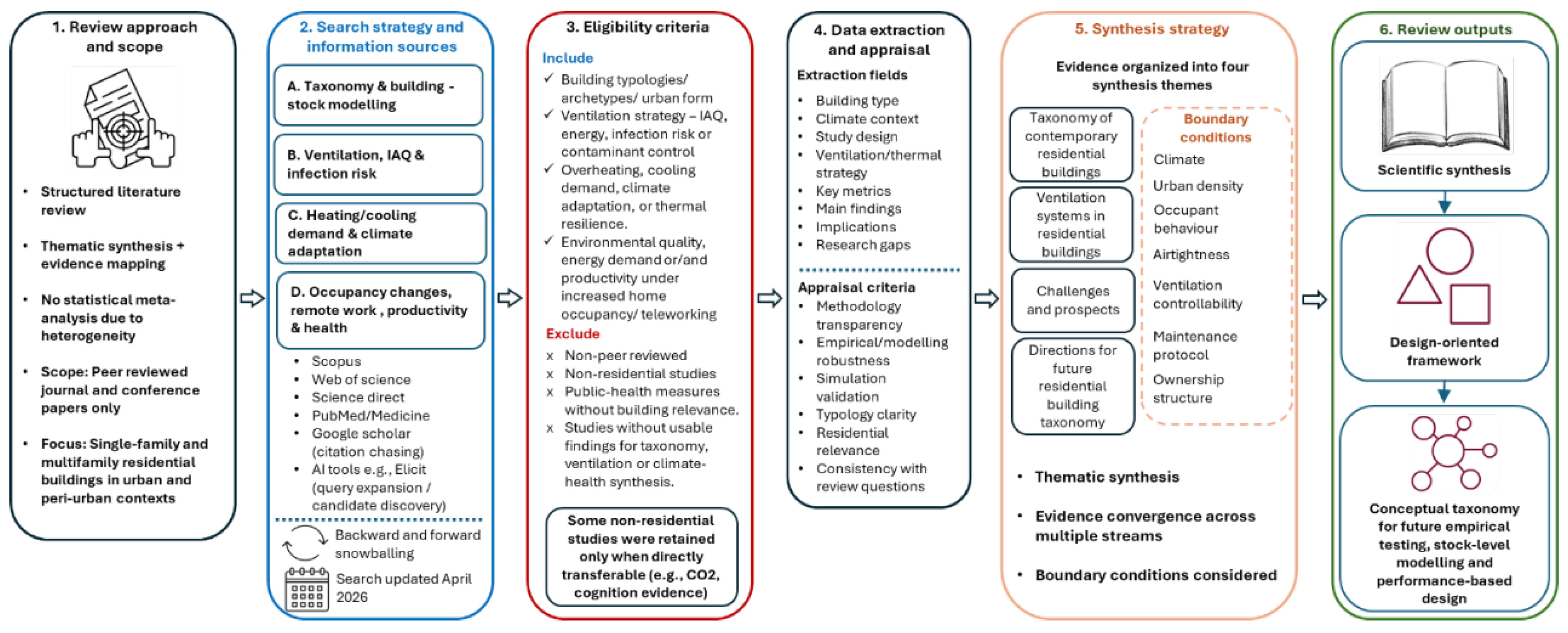
Table 1.
Summary of studies supporting the taxonomy of single-family residential buildings.
| Ref (s) | Taxonomic dimension | Main results | Implications | Gaps |
|---|---|---|---|---|
| [38,40] | Building-stock archetypes and modelling granularity | Bottom-up residential stock models require disaggregation by form, age, systems and occupancy variables; top-down models are less suitable when intervention-specific outcomes are required. | Single-family buildings should be treated as separate stock class because the intervention unit is often the individual dwelling, envelope, roof, HVAC system and occupant behaviour. | Useful for retrofit targeting and carbon assessment; however, these reviews did not provide a combined health-ventilation taxonomy or a universal threshold for single-family definitions. Such data is unavailable. |
| [42] | Urban morphology, compactness and surface exposure | Residential typology and associated urban morphology were shown to influence operational energy demand and building-integrated energy-production potential across European climates. | Detached and small-plot single-family forms should be classified by surface-to-volume ratio, exposure, plot density and roof geometry rather than by ownership alone. | Highly relevant to climate-change mitigation and cooling-demand transitions; infection-risk and hybrid-occupancy metrics were not integrated in the study. |
| [41,43] | Density, infrastructure and policy-linked typology | Residential density and housing typology were linked to dwelling operation, transportation, infrastructure and greenhouse-gas outcomes; housing policy can affect the distribution of single-family and multifamily stock. | Single-family classification should include settlement context, including suburban, peri-urban and low-density urban fringe conditions, because impacts extend beyond the building envelope. | Supports a multi-scale taxonomy for carbon and infrastructure resilience. Exact per-capita impacts cannot be universalised because results depend on geography, stock composition and mobility context. |
| [44] | Roof, plot and solar access | Housing-unit geometry and neighbourhood configuration influence solar potential. | Single-family buildings can be subclassified by roof orientation, shading, density and plot morphology to identify photovoltaic, solar-thermal, passive-solar and shading opportunities. | The taxonomy is relevant for renewable integration and low-carbon retrofit, but the study did not evaluate ventilation, overheating-health trade-offs or infectious-disease risk. |
| [59] | Housing attributes, values and household preference | Housing preferences were shown to be associated with values and dwelling attributes rather than purely economic descriptors. | Motivators for single-family living may include autonomy, privacy, spatial control and outdoor access; these should be treated as acceptability and governance variables. | Useful for linking building form to retrofit acceptability. Energy, IAQ, overheating and infection-risk metrics were unavailable in this housing-preference study. |
| [52] | Owner-occupied retrofit process | Homeowner energy retrofit in single-family owner-occupied dwellings was characterised as a dynamic socio-technical process rather than a one-time technical decision. | The single-family class has a relatively direct owner-to-intervention pathway, but intervention depth depends on finance, timing, competence, disruption and household priorities. | Important for retrofit governance and climate adaptation. Quantitative IAQ, overheating and infection-risk endpoints were unavailable. |
| [53] | Barriers, drivers and finance for energy renovation | A survey of Swedish single-family house owners examined perceived barriers, drivers and green-loan relevance in energy renovation decisions. | Single-family taxonomy should include ownership, income/finance, perceived barriers, renovation readiness and advisory support as operational sub-classes. | Relevant to Nordic and heating-climate retrofits. Generalisability beyond Sweden is uncertain and combined health-energy outcomes were not reported. |
| [3,51] | Overheating and thermal resilience | Dwelling geometry, fabric, ventilation opportunity, orientation and weather conditions influence overheating propensity; overheating is increasingly recognised in buildings without active cooling. | Single-family dwellings should be classified by envelope exposure, roof/loft condition, shading, ventilation potential and adaptive-cooling capacity. | Critical for climate-change adaptation and future cooling demand. Universal single-family overheating thresholds are unavailable because risk is climate-, design- and behaviour-dependent. |
| [12,13] | Occupancy transformation and home-working performance | COVID-19 changed residential occupancy schedules and activities; residential built-environment conditions influenced remote-work satisfaction and productivity. | Single-family classification should include daytime occupancy, workspace availability, acoustic/thermal controllability and ventilation controllability. | Relevant to post-pandemic residential functionality. The reviewed literature does not provide universal productivity metrics by single-family subtype. |
| [5,8] | Ventilation, air movement and infection-control mechanisms | Ventilation and indoor air movement were associated with airborne transmission mechanisms; effective ventilation, filtration, air disinfection and avoidance of recirculation were identified as engineering controls. | Single-family buildings should be subclassified by ventilation type, filtration capacity, room isolation potential, window-opening control and ability to separate infected occupants. | Taxonomy integrates health with building services. Residential infection-risk data specific to single-family subtypes remain limited, so quantitative subtype rankings are unavailable. |
Table 2.
Summary of scientific evidence supporting the taxonomy of multifamily residential buildings.
Table 2.
Summary of scientific evidence supporting the taxonomy of multifamily residential buildings.
| Ref (s) | Taxonomic dimension | Main results | Implications | Gaps |
|---|---|---|---|---|
| [38,45,46] | Heterogeneity-aware stock modelling | Building-stock modelling requires sufficient typological and performance detail to capture heterogeneity and support tailored retrofit or stock-level assessment. | Multifamily buildings should be separated from single-family buildings because shared systems, unit stacking, access type and collective governance create different modelling and intervention units. | Relevance lies in avoiding overly coarse archetypes. Research gaps remain in coupling stock models with IAQ, overheating, infection-risk and ownership-governance variables. |
| [41,42] | Compactness, shared envelope and operational energy | Multifamily and apartment typologies were shown to be important for operational energy and energy-carbon outcomes because morphology and compactness affect heat transfer and energy use. | Multifamily classification should include compactness, height, dwelling adjacency, shared-wall area and building-integrated energy-production potential. | Supports compact urban-energy strategies, but energy benefits cannot be assumed without climate, system, occupancy and ventilation assumptions. |
| [43] | High-density infrastructure and life-cycle effects | High- and low-density residential developments were compared across dwelling, utilities, roads, operations and transportation dimensions. | Multifamily buildings should be linked to neighbourhood density and infrastructure intensity, not only to building geometry. | Relevant to carbon and resilience planning. Findings are case-specific and cannot be directly transferred to all cities without local infrastructure and mobility data. |
| [37] | Stack effect, pressure distribution and high-rise form | Field measurements and airflow simulations identified pressure-distribution problems caused by stack effect in high-rise residential buildings. | High-rise multifamily buildings require sub-classification by height, vertical shafts, leakage distribution, elevator/stair cores and pressure-control strategies. | Essential for IAQ, smoke control, odour transfer and infection-risk pathways. The evidence is strongest for high-rise buildings in cold-season conditions; broader climate comparisons are limited. |
| [34] | Inter-zonal airflow and contaminant pathways | The review synthesised driving forces, measurement techniques and building-performance impacts of inter-zonal airflow in multi-unit residential buildings. | Multifamily taxonomy must include corridor, shaft, party-wall and service-penetration pathways that connect dwellings and common spaces. | Highly relevant to airborne contaminant control and pressure management. More comparable field data across climates, ventilation systems and construction eras are needed. |
| [35] | Suite-level airtightness and compartmentalisation | Field testing in newly constructed multi-unit residential buildings evaluated suite-level air leakage and compartmentalisation performance. | Multifamily classification should include suite airtightness, leakage distribution and compartmentalisation quality as core variables. | Supports performance-based classification beyond height or unit count. The research gap is the link between measured leakage, occupant exposure, energy use and health outcomes. |
| [36,55] | Pressurised corridor ventilation and system interactions | Studies of corridor pressurisation, compartmentalisation and ventilation systems show that system configuration can affect air and contaminant transport in multifamily buildings. | Multifamily classification should identify corridor-supply systems, suite exhaust, make-up air pathways, pressure differentials and maintenance regimes. | Directly relevant to infection-risk mitigation and IAQ. Longitudinal data that combine contaminant measurements, pressure data, energy use and occupant behaviour are still limited. |
| [64] | Photovoltaics in multi-unit residential buildings | The review identified opportunities and barriers for photovoltaic deployment on apartment buildings, including issues specific to multi-occupancy settings. | Multifamily buildings should be subclassified by roof access, roof-area allocation, metering, ownership model and benefit-sharing mechanism. | Relevance is strong for energy-carbon performance. Compared with single-family dwellings, renewable integration may be institutionally constrained even when roof potential exists. |
| [58] | Collective decision-making and renovation governance | Group decision-making can affect resident preferences for sustainable energy measures, while systemic policy and process barriers can reduce high-rise renovation quality. | Multifamily taxonomy should include owner association, rental, social housing, condominium and cooperative governance arrangements, as well as stakeholder coordination requirements. | Critical for retrofit feasibility and equity. More research is needed on how governance affects ventilation, overheating and health outcomes, not only energy measures. |
| [65] | Equity and justice in residential renovation | A systematic review identified social and resident dimensions of equitable energy renovation, including justice-oriented decision criteria. | Multifamily classification should consider distributive, procedural and recognition dimensions because benefits and burdens can differ among owners, tenants and vulnerable occupants. | Relevant to just climate adaptation and decarbonisation. Taxonomies that omit equity risk overestimating technically feasible but socially inaccessible interventions. |
| [3,51,66] | Overheating, urban heat and vulnerable exposure | Dwelling characteristics, urban heat island exposure and demographic vulnerability can interact to affect indoor heat exposure and heat-related risk. | Multifamily buildings should be classified by floor level, orientation, façade exposure, ventilation access, shading, cooling access and vulnerable occupancy patterns. | Strong relevance to climate adaptation. Comparative overheating data by multifamily subtype, tenancy and cooling access remain incomplete. |
| [12,13] | Transformed occupancy and productivity | Residential occupancy schedules and activities changed during COVID-19, and residential environmental conditions were associated with remote-work satisfaction and productivity. | Multifamily classification should include workspace adequacy, acoustic privacy, daylight access, balcony/common-space access and controllability of ventilation and temperature. | Relevant to hybrid work and prolonged exposure. Robust typology-specific productivity metrics comparing apartment subtypes are unavailable. |
| [5,7,8] | Ventilation and infection-control engineering | Ventilation, air movement, filtration and air disinfection were identified as key engineering controls for airborne transmission risk in indoor environments. | Multifamily classification should incorporate shared-air risks, filtration feasibility, ventilation effectiveness, maintenance reliability and ability to isolate or control airflow by unit. | Health-oriented taxonomy is essential, but quantitative infection-risk rankings across multifamily subtypes are unavailable because pathogen, occupancy and ventilation conditions vary strongly. |
Table 3.
Matrix comparing single-family and multifamily subtypes across density, aerodynamics, overheating, infection risk, and governance.
Table 3.
Matrix comparing single-family and multifamily subtypes across density, aerodynamics, overheating, infection risk, and governance.
| Building Class | Morphological Subtypes | Ventilation & Aerodynamic Profile | Overheating Vulnerability | Infection/ Contaminant Risk | Retrofit & Governance Complexity |
|---|---|---|---|---|---|
| Single-Family | Detached, Semi-Detached, Terraced, ADUs | High potential for natural cross-ventilation; entirely occupant-controlled. | High in detached (solar gains) and terraced (limited cross-ventilation). | Low inter-household risk; localized entirely to internal occupants. | Low governance friction; high per-unit cost for envelope upgrades. |
| Multifamily (Low/Mid) | Low-rise, Mid-rise apartment blocks | Mixed: Natural, exhaust-only, or decentralized MVHR. | High risk due to urban heat island and dense, trapped internal gains. | Moderate; risks transfer via shared corridors and poorly sealed party walls. | High governance friction (strata/associations); economies of scale for systems. |
| Multifamily (High-Rise) | Towers, High-density blocks | Dominated by stack effect; relies heavily on mechanical pressurization/exhaust. | Severe risk from high solar exposure (glazing) and trapped internal heat. | High risk of vertical inter-zonal transfer via shafts and stairwells. | Extreme complexity; requires specialized engineering for pressure management. |
| Social / Affordable | Varies (often Mid/High-Rise) | Frequently poorly maintained natural or outdated mechanical exhaust. | Critical risk due to lack of active cooling and poor envelope quality. | High risk due to overcrowding, poor ventilation, and baseline health vulnerabilities. | Dependent on public funding; high risk of split incentives between landlord and tenant. |
Table 4.
Evidence synthesis for ventilation systems in residential buildings.
| Ventilation strategy/topic | Ref(s) | Main results | Implications | Gaps |
|---|---|---|---|---|
| Functional objectives and metrics |
[31,33,69,70] |
Ventilation is linked to pollutant dilution, moisture control, odour removal, comfort and health. Ventilation rate, air change, CO2, humidity, pollutant concentration and health outcomes are related but not interchangeable metrics. | Both categories require pollutant- and moisture-based performance assessment. Single-family assessment can focus on whole-dwelling control and household maintenance; multifamily assessment must also include shared spaces and inter-zonal pathways. | A universal residential ventilation rate or metric that simultaneously predicts IAQ, health, infection risk, energy and comfort is not available in the reviewed literature. Future taxonomies should use multiple indicators rather than a single airflow metric. |
| Natural ventilation | [3,74,75,77,78] | Provide low-energy outdoor air and ventilative cooling, but performance depends on wind, temperature difference, façade geometry, occupant behaviour and external constraints. In air-conditioned residential bedrooms, additional ventilation may be required, and short-term natural ventilation can be inefficient and difficult to control. | Single-family dwellings usually offer more direct window control and crossflow potential. Multifamily dwellings may be constrained by single-sided layouts, height, wind exposure, stack effects, security, noise and limited occupant control over shared airflow paths. | Evidence is context specific. More data are needed on natural ventilation under heatwaves, polluted outdoor air, night-time security constraints and hybrid-working occupancy. |
| Mechanical exhaust systems | [33,34,79,92] | Exhaust systems can remove moisture and odours from kitchens and bathrooms but rely on make-up air. This may create uncontrolled airflow through leaks, corridors, shafts or adjacent units when pressure balance is poor. | In single-family dwellings, exhaust systems affect infiltration, radon entry, combustion safety and envelope moisture risk. In multifamily buildings, they may contribute to inter-suite transfer and corridor-to-suite airflow if not balanced with supply and compartmentalisation. | The evidence indicates that nominal extract flow alone is insufficient; pressure differentials, leakage paths and make-up air quality should be measured. Field evidence for long-term exhaust-only performance in occupied multifamily buildings remains limited. |
| Mechanical supply and pressurisation | [36,37,55,92] | Supply systems and corridor pressurisation can deliver make-up air and influence contaminant movement, but performance depends on leakage distribution, stack effect, fan operation and door/window operation. | Supply-only approaches may support filtration and positive pressure in single-family dwellings but can increase moisture exfiltration risk in cold climates. In multifamily buildings, pressurisation affects suite-corridor pressure relationships and contaminant transport. | Further studies are required to define robust pressure-management strategies across climates, building heights and airtightness levels. Data are unavailable for a universal pressurisation target applicable to all multifamily buildings. |
| Balanced ventilation with heat or energy recovery | [80,81,82,83] | Balanced systems can provide intentional outdoor-air supply and exhaust, filtration, pressure balance and heat or energy recovery. Field studies in recent homes reported improved pollutant removal when whole-house mechanical ventilation operated, while Passive House evidence emphasises the importance of installed-system quality and maintenance. | In single-family buildings, unit-level systems can be integrated with airtight envelopes, heat pumps and filtration. In multifamily buildings, centralised, semi-centralised and apartment-level systems differ in shaft requirements, commissioning, maintenance access and occupant control. | Performance can degrade through poor commissioning, filter neglect, frost protection issues, noise and user misunderstanding. More comparative field studies are needed for decentralised versus centralised multifamily heat-recovery systems. |
| Demand-controlled and smart ventilation | [68,84,85,86] | DCV can reduce unnecessary ventilation energy by responding to occupancy, CO2, humidity or other signals, but sensor choice and control logic determine whether IAQ is protected. CO2 control is not a complete proxy for all residential pollutants. | Single-family DCV can be tuned to one household and may integrate with heat recovery or heat-pump systems. Multifamily DCV must address shared services, apartment diversity, sensor maintenance and privacy/governance issues. | The reviewed evidence supports potential energy benefits but does not establish universal residential control rules. Infection-risk periods and remote-work occupancy can invalidate assumptions based on conventional schedules. |
| Hybrid and mixed-mode ventilation with ventilative cooling | [4,76,87,94] | Hybrid strategies can switch between natural and mechanical modes to balance IAQ, energy and thermal comfort. Ventilative cooling can reduce cooling demand, but outdoor air pollution and heatwave conditions can limit benefits. | Single-family buildings may use secure night ventilation, automated openings and mechanical boost. Multifamily buildings require careful design because façade access, safety, single-sided layouts, corridor pathways and wind/stack pressures can alter performance. | Hybrid ventilation needs pollution-aware, temperature-aware and occupant-aware controls. Evidence is still limited on reliable operation during heatwaves, wildfire smoke, high humidity and dense urban noise conditions. |
| Filtration and portable air cleaning |
[7,87,88,89] |
Portable and in-duct filtration can reduce particle exposure and contribute to equivalent clean-air delivery. Filtration is especially relevant for aerosols, PM2.5 and outdoor pollution, but it does not replace outdoor air for CO2, odour and moisture control. | Single-family dwellings can deploy room-level portable air cleaners or upgraded in-duct filters. Multifamily buildings may require filtration in apartments and shared spaces, with maintenance responsibility clearly allocated. | Noise, electricity use, device sizing, placement, filter replacement and occupant acceptance remain implementation barriers. Health-energy comparisons across filtration levels in real dwellings remain underdeveloped. |
| Single-family ventilation integration | [80,83,84,85] | Single-family studies indicate that mechanical ventilation, DCV, heat recovery and airtight-envelope strategies can improve control of IAQ and energy when systems are designed and operated correctly. | The single-family category supports household-level decisions on window operation, exhaust upgrades, balanced ventilation, filters, sensors and heat recovery, but it also places operation and maintenance responsibility on occupants. | Future studies should examine combined retrofit packages, including airtightness, heat pumps, heat recovery ventilation, filtration, solar control and remote-work occupancy. Data remain scarce for long-term maintenance and user behaviour in ordinary homes. |
| Multifamily ventilation, shafts and inter-zonal airflow | [34,35,36,37,55] | Multifamily performance is shaped by stack effect, wind, shafts, corridors, leakage paths, pressure differentials and compartmentalisation. Inter-zonal airflow can affect IAQ, odour transfer, energy use and contaminant transport. | Multifamily buildings require taxonomy dimensions beyond dwelling count, including height, shaft configuration, corridor type, leakage distribution, shared ventilation system and maintenance governance. | Long-term field evidence is still insufficient across climates, system types and height classes. Standardised methods for inter-zonal airflow, pressure mapping and contaminant transport are needed. |
| Ventilation and airborne infection risk | [5,6,7,8,67,71,91,93] | Evidence supports an association between ventilation, airflow and airborne infection transmission, and pandemic literature emphasises layered controls: ventilation, filtration, source control, avoiding recirculation and reducing crowding. | Single-family risk is often dominated by within-household exposure and isolation feasibility. Multifamily risk additionally includes shared spaces, corridors, lifts, laundry rooms and air transfer between dwellings or common areas. | The reviewed literature does not provide a universal residential ventilation threshold for infection prevention. Residential-specific studies linking system type, occupant behaviour, pathogen emission and measured infection outcomes are needed. |
| Measurement, simulation and risk assessment | [36,71,72,73] | Tracer-gas methods, CO2 monitoring, pressure measurements, multizone modelling, energy simulation, CFD and infection-risk models provide complementary evidence. Each method has assumptions and uncertainty. | Single-family studies can often characterise whole-dwelling air change, while multifamily studies must include inter-zonal exchange and pressure networks. Both categories require seasonal monitoring and occupant-behaviour data. | Integrated monitoring-modelling datasets remain limited. Comparable protocols are needed for ventilation, pollutants, energy, thermal comfort, filtration, acoustics and occupant use. |
| Performance gaps, maintenance and governance | [32,55,90,92] | Design intent can be undermined by poor commissioning, noise, user misunderstanding, filter neglect, sensor limitations, pressure imbalance and maintenance failures. Underperformance may remain hidden because residential systems are rarely monitored continuously. | Single-family systems depend on household maintenance and user understanding. Multifamily systems depend on building managers, landlords, housing associations, contractors and occupants, creating shared accountability challenges. | Future taxonomy should include governance and maintainability. More evidence is required on long-term reliability, commissioning quality, filter replacement behaviour, occupant interfaces and post-occupancy verification. |
Table 5.
Evidence synthesis: Challenges and prospects.
| Theme | Original subthemes integrated | Representative sources | Synthesised main results | Implications for residential building categories | Discussion and insights |
|---|---|---|---|---|---|
|
Climate change, heatwaves and annual energy-carbon resilience |
Climate change and heatwaves; winter-centric design versus annual heating-cooling balance; indoor overheating; passive and active cooling; decarbonisation, electrification and grid interaction; retrofit constraints; prospects and innovations. |
[3,4,27,28,29,96,97,98,100,105,107,108] |
Overheating is driven by climate, building fabric, solar exposure, ventilation availability, internal gains and occupant behaviour. Winter-focused efficiency strategies can increase summer vulnerability when solar control and ventilative or active cooling are absent. Electrified heating and cooling create new interactions with peak electricity demand, thermal storage, demand response and household energy affordability. |
Single-family buildings may have higher envelope and roof exposure, stronger potential for PV, heat pumps, shading and household-level demand response, and higher dependence on occupant behaviour. Multifamily buildings may benefit from compactness and shared plant but require coordinated facade, roof, ventilation, cooling, metering and governance strategies. |
No universal quantitative hierarchy of passive versus active cooling is available across climates and typologies. Future taxonomy should include overheating exposure, passive survivability, cooling access, peak-demand flexibility, operational carbon, retrofit feasibility and equity of cooling access. |
| Pandemic preparedness, airborne infection resilience, health and wellbeing | Pandemic preparedness; airborne infection resilience; residential health and wellbeing; energy poverty and vulnerable housing; ventilation-related innovation; retrofit and maintenance performance gaps. | [5,8,31,34,37,88,91,95,99,112,116,120] | Ventilation, air distribution, filtration, exposure duration and source control are central to infection-risk reduction. Indoor health resilience also depends on temperature, humidity, pollutant control, noise, light, dampness, overcrowding, affordability and maintenance. Air cleaning can supplement ventilation but cannot replace outdoor air for moisture, CO2 and many indoor pollutants. | Single-family dwellings can often adopt room-level interventions, but effectiveness depends on occupant behaviour and maintenance. Multifamily buildings require pressure management, compartmentalisation, shared-space ventilation, central-system commissioning and clear responsibility for maintenance and filter replacement. | Residential-specific infection-risk metrics by building category remain unavailable. Future taxonomy should include clean-air delivery, filtration readiness, inter-zonal airflow risk, shared-space exposure, controllability, maintenance accountability and vulnerability. |
| Remote and hybrid work, indoor environmental quality and residential productivity | Remote and hybrid work; IEQ, health, productivity and wellbeing; pandemic occupancy change; energy-carbon effects of teleworking; equity of space and control; research and performance gaps. | [9,10,11,12,16,19,48,111,117,118,119] | Hybrid work increases daytime occupancy, energy use, internal gains, ventilation needs and exposure duration. Home-working studies link spatial layout, dedicated workspace, acoustics, daylight, thermal comfort, ergonomics and IAQ with satisfaction, wellbeing and perceived productivity. Controlled office evidence supports ventilation-CO2-VOC-cognition relationships, but residential transfer requires caution. |
Single-family dwellings may more easily provide dedicated work zones, acoustic separation, zoning and household-level services, but larger conditioned areas can raise energy demand. Multifamily dwellings may have compactness advantages but can face limited space, neighbour noise, facade constraints and lower individual environmental control. | Residential dose-response evidence linking measured IEQ to productivity across dwelling types remains limited. Future taxonomy should include remote-work readiness, work-zone availability, acoustic privacy, daylight/glare control, stable ventilation, thermal zoning and the energy-carbon consequences of daytime conditioning. |
Note. IAQ = indoor environmental quality; PV = photovoltaics. The table synthesises peer-reviewed literature only. Where universal thresholds or direct comparative metrics are unavailable in the cited literature, this limitation is explicitly stated.
Table 6.
Future residential taxonomy and benchmark indicators.
| Proposed future class | Building category and implementation direction | Benchmark indicators | Thresholds / metrics to be developed | Evidence strength | Research needs |
|---|---|---|---|---|---|
| Adaptive performance residential class | All residential buildings; existing stocks should be screened by risk, while new buildings should be designed using adaptive attributes from the outset. | Structural class; physical subtype; ventilation pathway; overheating resilience; clean-air capacity; energy flexibility; remote-work readiness; vulnerability; retrofit feasibility. | Composite risk-classification score calibrated by climate, dwelling type, occupancy and governance. Universal thresholds are unavailable in the reviewed evidence. | Moderate. Supported by building-stock modelling and evidence-mapping literature [38,45,46] | Validate taxonomy against measured energy, IAQ, overheating, health and occupancy data across climates and building categories. |
| Climate-ready single-family dwelling | Detached, semi-detached and terraced dwellings; retrofit should prioritise passive cooling and solar control, while new design should integrate heatwave scenarios early. | Overheating hours; peak indoor operative temperature; heatwave survivability; solar-control capacity; secure ventilation potential; efficient cooling readiness. | Climate- and vulnerability-specific overheating limits; passive-survivability duration; cooling-demand intensity; combined passive-active cooling performance. | Moderate to strong. Supported by overheating reviews, simulations and monitoring studies [3,4,27,28] | Develop field-validated metrics for heating-dominated climates, vulnerable occupants and dwellings without active cooling. |
| Remote-work-ready single-family dwelling | Single-family dwellings with prolonged daytime occupancy; retrofit can use spatial zoning and controls, while new design should allocate adaptable work zones. | Daytime IAQ stability; CO2 patterns; daylight and glare control; acoustic privacy; thermal zoning; workspace ergonomics; reliable power and data access. | Home-specific IEQ-productivity thresholds are unavailable; metrics should be developed for residential cognitive performance, work satisfaction and long exposure duration. | Emerging to moderate. Supported by home-working and home IAQ studies [11,12,16,118] | Conduct longitudinal measured studies linking home IEQ, productivity, cognition, acoustics and energy use in single-family dwellings. |
| Resilient low-carbon single-family dwelling | Single-family dwellings with roof, envelope and ownership potential for heat pumps, PV, storage and demand response. | Heating demand; cooling demand; operational carbon; PV readiness; storage readiness; heat-pump flexibility; peak electricity demand; demand-response potential. | Flexibility capacity; load-shifting duration; comfort-safe demand response; carbon-intensity-responsive operation; whole-house peak-load benchmark. | Moderate. Supported by residential typology, solar-potential and building-to-grid literature [42,44,122,123] | Integrate heat pumps, PV, storage, ventilation, thermal comfort and IAQ in monitored single-family trials. |
| Retrofit-priority single-family dwelling | Older or poorly performing single-family dwellings with high heating demand, poor ventilation, overheating risk or vulnerable occupants. | Envelope condition; airtightness; ventilation adequacy; mould risk; heating/cooling demand; fossil-fuel dependence; occupant vulnerability; owner barriers. | Priority index combining technical risk, health risk, carbon impact, affordability and owner decision constraints. Universal cut-offs are unavailable. | Moderate. Supported by retrofit decision, equity and building-stock modelling studies [46,53,65]. | Develop decision-support tools that combine physical diagnostics with household capacity, affordability and disruption tolerance. |
| Healthy shared-service multifamily building | Low-, mid- and high-rise multifamily buildings; retrofit should begin with airflow diagnostics and maintenance audits, while new design should verify compartmentalisation and pressure control. | Suite ventilation; corridor pressure; inter-zonal airflow; shaft leakage; shared-space IAQ; filtration; maintenance accountability; commissioning records. | Suite-level airflow and pressure criteria; equivalent clean-air metrics for shared spaces; acceptable inter-zonal transfer index; maintenance reliability metrics. | Moderate. Supported by stack-effect, inter-zonal airflow and multifamily contaminant-transport studies [34,35,36,37] | Undertake long-term occupied-building studies of pressure, airflow, contaminant transfer and maintenance performance. |
| Heat-resilient urban apartment building | Urban mid-rise and high-rise apartments exposed to solar gains, limited ventilation opportunities and urban heat-island effects. | Indoor heat exposure; façade solar exposure; shading effectiveness; night-ventilation feasibility; cooling access; vulnerable occupant protection; peak cooling demand. | Apartment-level heatwave survivability metric; overheating thresholds by orientation, height, tenure and vulnerability; passive-cooling effectiveness under urban heat. | Moderate. Supported by residential overheating and high-rise airflow literature [27,28,37,113]. | Measure overheating in occupied apartments across height, orientation, tenure, cooling access and socio-economic vulnerability. |
| Managed low-carbon multifamily building | Multifamily buildings with shared services; retrofit should strengthen commissioning and maintenance accountability, while new buildings should integrate metering, feedback and low-carbon plant. | Central or semi-central heat recovery; district or heat-pump systems; fan energy; operational carbon; submetering; commissioning; maintenance response; peak demand. | System-level carbon intensity; fan-energy intensity; heat-recovery persistence; commissioning compliance; occupant-level control and feedback metrics. | Moderate. Supported by typology-energy and multifamily retrofit governance evidence [41,42,56,58,124] | Quantify how governance, maintenance and resident participation affect measured low-carbon retrofit outcomes. |
| Equity-priority multifamily building | Rental, social, affordable, overcrowded or vulnerable-occupant housing requiring targeted overheating, IAQ, mould and energy-poverty interventions. | Under-heating; under-cooling; overheating; mould risk; ventilation adequacy; filter/cooling affordability; energy burden; occupant vulnerability; resident agency. | Health-equity risk index; intervention-priority score; affordability-adjusted energy and ventilation performance metrics. | Emerging to moderate. Supported by energy renovation equity and high-rise retrofit literature [56,65] | Develop equity-centred post-occupancy studies that connect energy, IAQ, heat exposure, health and resident participation. |
| Mixed-use airflow-separated residential building | Buildings where dwellings share structure or services with retail, offices, parking, education, hospitality or other non-residential uses. | Airflow separation; pressure zoning; odour transfer; noise control; schedule separation; source control; filtration; shared shaft and riser risk. | Residential-non-residential airflow-transfer metric; pressure separation performance; odour and pollutant transfer indicators. Residential-specific thresholds are unavailable. | Limited. Mechanisms are supported by ventilation and inter-zonal airflow science, but residential mixed-use evidence is sparse [31,34] | Conduct field studies of mixed-use residential buildings with tracer-gas, pressure and pollutant monitoring. |
| Monitoring-ready learning residential building | Cross-cutting class for new and retrofitted dwellings; intended to support post-occupancy evaluation and adaptive operation. | Temperature; humidity; CO2; PM2.5; ventilation status; energy use; filter condition; occupant feedback; fault detection; data governance. | Sensor accuracy, sampling interval, alert thresholds, privacy-preserving data rules and actionable feedback metrics should be developed and validated. | Emerging. Supported by smart-ventilation, POE-oriented and home IAQ research [11,32,83] | Validate low-cost sensor networks, occupant feedback loops and privacy-preserving monitoring in occupied dwellings. |
Disclaimer/Publisher’s Note: The statements, opinions and data contained in all publications are solely those of the individual author(s) and contributor(s) and not of MDPI and/or the editor(s). MDPI and/or the editor(s) disclaim responsibility for any injury to people or property resulting from any ideas, methods, instructions or products referred to in the content. |
© 2026 by the authors. Licensee MDPI, Basel, Switzerland. This article is an open access article distributed under the terms and conditions of the Creative Commons Attribution (CC BY) license (http://creativecommons.org/licenses/by/4.0/).
Copyright: This open access article is published under a Creative Commons CC BY 4.0 license, which permit the free download, distribution, and reuse, provided that the author and preprint are cited in any reuse.


