

Submitted:
21 May 2026
Posted:
21 May 2026
You are already at the latest version
Abstract
Background: Childhood cancer survivors are more likely to develop cancer in adulthood than people of similar age in the general population. In Spain, there are no popula-tion-based studies on the risk of developing second cancers in people diagnosed with childhood cancer. The main objective of this study was to present recent survival rates fol-lowing a childhood cancer diagnosis in Spain and to investigate the risk of second malig-nant neoplasms (SMNs) in people diagnosed with childhood cancer between 1990 and 2009. Methods: This population-based registry study, devised by the Spanish Network of Cancer Registries (REDECAN), collected data on all malignancies and non-malignant neoplasms of the CNS diagnosed before age 15 years in populations covered by 12 cancer registries of Spain. Age-standardised incidence rates (ASIRw) for the period 2015–19 were calculated per million childhood-years. Five-year and 10-year age-adjusted observed sur-vival rates, for the periods 1990-1999 and 2000–2009 were estimated. The risk of develop-ing SMNs was calculated using standardized incidence ratio (SIR), excess absolute risk (EAR). Age-specific incidence rates of SMN were also calculated. Results: During the pe-riod 2015-2019, the ASIRw was 181.3 per million child-years. The 10-year childhood sur-vival rate for both sexes combined increased from 71.3% to 75.5% between the 1990s and the 2000s. The relative risk of a SMN in people with a first childhood cancer diagnosed between 1990 and 2009 was 5.67 at 20 years after the diagnosis of the first cancer. Conclu-sion: In the 2000s, the 10-year survival rate for childhood cancer in Spain was around 75%, but survivors faced a high risk of developing a second cancer for at least 20 years af-ter their initial diagnosis. Efforts to reduce treatment-related toxicity are essential to miti-gate this long-term risk without compromising survival outcomes.
Keywords:
childhood cancer
; incidence
; survival
; risk
; second neoplasms
; cancer registry
1. Introduction
Childhood cancer survival rates have increased substantially in recent decades thanks to improvements in treatment [1,2]. Currently, five-year survival rates exceed 80% in almost all European countries, as well as in the United States, Canada, Australia, New Zealand, and several Asian countries [2]. However, childhood cancer survivors experience adverse health effects attributable to either their cancer or its treatment [1,2,3]. Between them, childhood cancer survivors are more likely to develop cancer in adulthood than people of similar age in the general population, due to both host factors and cancer treatments [4,5,6,7]. Several studies have suggested that the risk of developing a second malignant neoplasm (SMN) in survivors at 3 or 5 years is 3 to 15 times higher than the incidence in the general population, and that the cumulative risk 20 years after the original diagnosis ranges from 2% to 12% [8,9]. However, due to changes in treatments, this risk may vary over time. On the other hand, although the main risk factor for a second cancer is treatment (especially high-dose radiotherapy and some chemotherapeutic agents), the risk can also vary depending on the patient's sex, age at diagnosis of the first cancer, and genetic predisposition to cancer [8,9,10]. In the survivor population, the incidence of second cancers does not stabilize over time. [11,12,13,14,15]
Since most children have had limited exposure to known environmental carcinogens and are expected to live for many years after cancer treatment, they offer an opportunity to gain knowledge about the mechanisms by which certain chemotherapeutic agents and radiation can induce neoplastic changes [16]. Furthermore, given all this evidence, it is necessary to emphasize the importance of ensuring continuous follow-up throughout the life of a childhood cancer survivor. The available information has largely derived from studies limited to second cancers diagnosed at least 5 years after the first diagnosis [17].
To our knowledge, this study provides, for the first time, a comprehensive population-based assessment of the risk of developing a second malignancy among childhood cancer survivors in Spain. In this article we present the incidence of childhood cancer in the period 2015-2019, the 5 and 10-year survival for childhood cancer between 1990 and 2019, and the incidence of second cancers in individuals diagnosed with childhood cancer between 1990 and 2009 in Spain. We also report on the most common second cancers that occur in this cohort twenty years after the diagnosis of childhood cancer.
2. Materials and Methods
Study design and data sources
In this retrospective cohort population-based cancer registry study, all Spanish population-based cancer registries pertaining to the Spanish Network of Cancer Registries (REDECAN) were invited to participate. Twelve registries participated, covering 14 provinces and two islands. Three independent analyses were performed: One on the incidence of childhood cancer (0 to 14 years) for the period 2015-2019, another on 5- and 10-year survival of childhood cancer for the periods 1990-1999 and 2000-2009, and finally, another on the risk of developing SMN in children with incident cancer during the period 1990-2009 and the sub-periods 1990-1999 and 2000-2009. Table A1 shows the registries included in each of the analyses as well as the periods covered for each of them. In 2000, the proportion of the Spanish child population (ages 0-14) covered by these registries was 31.5% and in 2017 it was 32.2%. The 0-14 age group represented 14.8% of all ages in 2000 and 14.9% in 2017.
All registries used the 3rd edition of the International Classification of Diseases for Oncology [18] for coding the tumor site, morphology, behavior, multiple primary tumors, and basis of diagnosis. Tumors were classified centrally according to the 3rd edition of the International Classification of Childhood Cancer (ICCC-3) [19]. This study includes all malignant tumors of any site, as well as intracranial and intraspinal tumors of benign and uncertain behavior diagnosed before the age of 15 in the study populations.
SMNs were defined as neoplasms on a new location, that were not direct spread or metastases of the primary neoplasm, or the neoplasms on the same location as the primary ones but of different histological type and they were selected based on the International Rules for Multiple Primary Cancers of 2004 [20]. Cancers diagnosed after the diagnosis of a SMN were not included in the analysis. SMN diagnosed within two months of the first cancer were not excluded, assuming that, virtually, all childhood cancers detected shortly after a first childhood cancer would have been diagnosed later anyway. Cancer data included individual records of cases with codes for the following variables: sex, age, date of incidence, and tumor sequence (i.e., the numerical order of occurrence of the neoplasm), site, morphology, behavior, most valid basis of diagnosis, data of last follow-up, and vital status.
Population estimates as of July 1 of each year during the study period for each province or island were obtained from the National Institute of Statistics (INE) [21].
Table 1 shows the participating registries, as well as the territory (province/s or island/s) covered by each of them, the population covered in 2000 and in 2017, the number of childhood cancers diagnosed by period, and the percentage of cases diagnosed only by death certificate (%DCO) and of cases with morphological verification (%MV) during the period 2015-2019. Data were obtained and analyzed from de-identified cases of the Spanish Network of Cancer Registries (REDECAN) joint database.
Procedures
All cases were extracted from the REDECAN joint database, which is systematically evaluated for data quality. All questionable cases and issues raised were referred to the contributing registries with a request for correction or a response. This iterative process results in an improvement in the overall quality of the data included in the analyses. Table 1 shows two quality indicators for each registry of the period 2015-2019: the proportion of morphologically verified cases and the proportion of cases registered solely from the death certificate.
Statistical Analysis
Incidence
To find out the recent incidence of childhood cancer in Spain, we calculated the absolute number of incident cases (cases) and the age-standardized incidence rates (ASIRw) using the World standard population [22] for children 0–14 years (Table A2) by sex, expressed per million child-years, for the period 2015-2019. We calculated the incidence sex ratios by dividing the number of incident cases in boys by the number of incident cases in girls.
Survival
We calculated 5-year and 10-year age-adjusted observed survival and their confidence intervals (95% CI), which in children corresponds very closely to relative survival since competing risks of death are negligible. Survival for the periods 1990-1999 and 2000–2009 was estimated from all cases diagnosed during these periods, irrespective of the potential follow-up, using the complete survival approach because almost all children had been followed up for at least 10 years by December 31, 2019. Survival estimates were calculated with the Kaplan-Meier method. In the survival analyses, cases registered solely from the death certificate and cases diagnosed incidentally by autopsy were excluded.
To ensure comparability between sexes and time periods, and with European figures for survival time analyses for a given cancer, we standardized by the age distribution of all European children diagnosed with cancer using the same weights as those used by Botta et al. [23] using four age classes (<1 year, 1–4 years, 5–9 years and 10–14 years) (Table A3).
We calculated survival for all tumors as a whole and for 15 specific categories of ICCC-3: Acute lymphoid leukaemias (ICCC category Ia), Acute myeloid leukaemias (Ib), Hodgkin lymphoma (IIa), Non-Hodgkin lymphoma except Burkitt lymphoma (IIb), Burkitt lymphoma (IIc), CNS and miscellaneous intracranial and intraspinal neoplasms (III), Ependymomas and choroid plexus tumor (IIIa), Astrocytomas (IIIb), Intracranial and intraspinal embryonal tumors (IIIc), Neuroblastoma and ganglioneuroblastoma (IVa), Retinoblastoma (V), Nephroblastoma and other non-epithelial renal tumors (VIa), Osteosarcomas (VIIIa), Ewing tumor and related sarcomas of bone (VIIIc), and Rhabdomyosarcomas (IXa). Non-melanoma skin cancers were not included because most cancer registries do not register these malignant neoplasms.
Risk of developing a second cancer
The standardized incidence ratio (SIR) was calculated as the ratio of the observed number of SMNs to the number expected if patients in the cohort had the same cancer rates as the general reference population. The observed number of cases included all SMNs diagnosed in each cohort (by sex and cancer type) during each defined time period. The expected number of cases was calculated by multiplying the cumulative observed person-years by the incidence rates for cancer site, sex, five-year age group, and calendar year in the general population. The rates of the general population were obtained from the population-based cancer registries that participated in the study.
In each patient, person-years at risk were defined as the period between the first childhood cancer diagnosis and the date of the second cancer diagnosis, the date of death, or the date of end of follow-up, whichever occurred first.
The SIR was calculated by sex, by period of the first diagnosis of childhood cancer (1990-1999, 2000-2009 and 1990-2009) and by time between the first and second cancer (<1 year, 1-4 years, 5-9 years and 10-19 years) for all tumors as a whole. The calculation for two different periods (1990-1999 and 2000-2009) was performed to observe possible differences in risk over time.
The SIR was also calculated based on the type of the first tumor (12 groups of the ICCC-3) for the 20-year period between the first and second cancer cases, by sex.
Finally, the SIR was also calculated based on the type of SMN according to 25 specific ICD-10 categories (Lip, oral cavity and pharynx (C00-14), esophagus (C15), stomach (C16), colon (C18), rectum (C19-C21), liver (C22), gallbladder and biliary tree (C23-C24), pancreas (C25), larynx (C32), trachea, lung and bronchus (C33-C34), skin melanoma (C43), breast (C50), cervix uteri (C53), corpus uteri (C54), ovary (C56), prostate (C61), testis (C62), kidney (C64), urinary bladder (C67, D09.0, D41.4), brain and central nervous system (C70-C72), thyroid (C73), Hodgkin’s lymphoma (C81), non-Hodgkin lymphoma (C82-C86,C88), myeloma (C90) and leukemia (C91-C95)), and a category called “Other” which covers all the rest of the types of malignant tumors, for the 20-year period between the first and second cancer and by sex. Non-melanoma skin cancers were not included because most cancer registries do not register these malignant neoplasms.
We included all secondary cancers, regardless of the time elapsed between the first and second cancers.
The assumption that the observed number of SMN followed a Poisson distribution was used to calculate 95% confidence intervals (95% CI). Results are considered statistically significant if 95%CI does not include 1.
The Excess Absolute Risk (EAR) was calculated by subtracting the expected number of SMNs from the observed number of SMNs and dividing the difference by the person-years at risk, expressing the number of cases in excess or deficit by 10,000 person-years at risk.
Finally, we calculated the observed age-specific incidence rates of SMNs in the childhood cancer cohort of the study and compared them with the age-specific incidence rates of the general population covered by the cancer registries in Spain.
All the analyses were computed using R software (version 4.5) [24].
3. Results
3.1. Incidence
31.56% of the childhood Spanish population aged 0–14 years (contributing 10,942,347 person-years) was covered by the registries included in the incidence calculations for the period 2015-2019 (Table 1 and Table A1). During this quinquennium, 1,910 childhood tumors were diagnosed in the population covered by this study. The ASIRw of childhood cancer in Spain during 2015–2019 was 181.3 cases per million person-years, with higher rates observed in boys (192,5) than in girls (170.1). The sex ratio of the number of cases was 1.20. Leukaemias were the ICCC-3 group with the highest incidence (53.4), followed by CNS neoplasms (45.2), lymphomas (23.7), and neuroblastoma (13.1). Table 2 shows the incidence of the 12 ICCC-3 groups by sex.
3.2. Survival
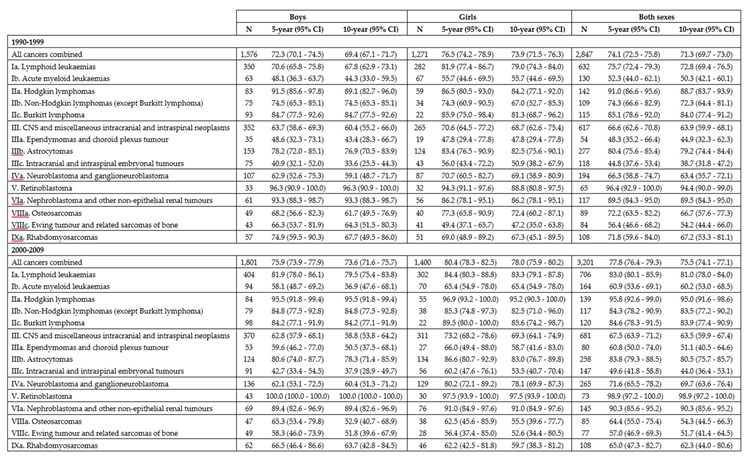
The 5-year age-standardized observed survival rate for all cancers and both sexes combined increased significantly from the period 1990-1999 (74.1; 95% CI: 72.5-75.8) to the period 2000-2009 (77.8; 95% CI: 76.4-79.3). In boys these values were 72.3 and 75.9, and in girls 76.5 and 80.4. The 10-year survival rates also increased between the two periods: 71.3 and 75.5 in both sexes combined, 69.4 and 73.6 in boys, and 73.9 and 78.0 in girls (Table 3 and Figure 1 and Figure 2).
For both sexes combined and the period 2000-2009, the highest 10-year survival rate was for Retinoblastoma (98.9), followed by Hodgkin lymphomas (95.0), Nephroblastoma and other non-epithelial renal tumors (90.3), Burkitt lymphomas (83.9), Non-Hodgkin lymphomas (83.5), Lymphoid leukaemias (81.0) and Astrocytomas (80.5). Below 80% were Neuroblastoma and ganglioneuroblastoma (69.7), CNS and miscellaneous intracranial and intraspinal neoplasms (63.5), Rhabdomyosarcomas (62.3), Acute myeloid leukaemias (60.2). The lowest rates corresponded to Osteosarcomas (54.3), Ewing tumor and related sarcomas of bone (51.7), Ependymomas and choroid plexus tumor (51.1), and Intracranial and intraspinal embryonal tumors (44.0) (Table 3).
Between the periods 1990-1999 and 2000-2009, 5-year survival rates increased significantly by an average of 3.7 percentage points across all cancers combined. By tumor type, only acute lymphoblastic leukemia showed a significant increase, but all other cancer types showed non-significant increases between 0.6% and 10.0%, except for three: Burkitt lymphoma (-0.5%), osteosarcomas (-7.8%), and rhabdomyosarcomas (-6.8%). Between the same two decades 1990-1999 and 2000-2009, 10-year survival rates increased by an average of 4.2% across all cancer types combined. Acute lymphoblastic leukemias, Hodgkin lymphomas and non-Hodgkin lymphomas showed significant increases. Across the three most common ICCC-3 groups combined (leukaemias, lymphomas, and CNS tumors) survival rates increased by 5.2% (Table 3).
3.2. Risk of developing a second malignant neoplasm
Table A4 shows the characteristics of childhood cancers included in the second neoplasms risk study, by period. Of the 3,834 children under 15 years of age diagnosed with cancer during 1990–2009, 62 (1.6%) were diagnosed with a SMN during 48,964.01 person-years of follow-up (median follow-up, 15.15 years; interquartile range [IQR], 4.51–20.00 years). The mean time between first and second diagnosis was 12.29 years (IQR, 7.70–18.25 years) for childhood patients diagnosed of first cancer between 1990 and 1999 and 7.85 years (IQR, 4.11–11.29 years) for childhood patients diagnosed of first cancer between 2000 and 2009. The mean time between first and second diagnosis in the second decade was shorter because childhood cancers in the second decade were followed for a shorter time (Table A4).
For both sexes combined, the SIR of a SMN in patients with any first childhood cancer diagnosed between 1990 and 2009 was 5.67 at 20 years after the diagnosis of the first cancer. The relative risk was 12.44 during the first year, 5.99 between the first and fourth years, 4.05 between the fifth and nineth years, and 5.60 between the tenth and nineteenth years after the diagnosis of the first cancer. These values were higher, although not statistically significant, for patients with their first childhood cancer in the period 2000–2009 than for patients with their first childhood cancer in the period 1990–1999 (Table 4).
Likewise, these risk values were higher, although not statistically significant, in women than in men 20 years after the diagnosis of the first cancer (6.34 versus 5.15), although they were lower in women during the first year after the diagnosis of the first cancer (4.51 vs 17.60). Similar patterns were observed in the ten-year periods of first diagnosis 1990-1999 and 2000-2009 (Table 4).
The EAR 20 years after the first diagnosis of childhood cancer was 10.43 per 10,000 person-years at risk. The excess was higher, although not statistically significant, in women (11.44) than in men (9.60), and in the 2000-2009 period group (12.04) than in the 1990-1999 period group (9.03) (Table 4).
According to age at first cancer diagnosis, all age groups showed significantly elevated SIRs: 6.30 for those aged 0 to 4 years, 5.19 for those aged 5 to 9 years, and 5.47 for those aged 10 to 14 years (Table 5).
The risk of developing a SMN of any type 20 years after the diagnosis of a childhood cancer varied according to the ICCC-3 group of the first childhood cancer (Table 6). Seven ICCC-3 groups presented significantly elevated SIRs: Other malignant epithelial neoplasms and malignant melanomas (7.52), CNS tumors (SIR=7.35), Bone tumors (6.87), Lymphomas (6.13), Soft tissue sarcomas and other extraosseous sarcomas (6.12), Neuroblastoma (6.02) and Leukaemias (4.91). The ICCC-3 groups with the highest EAR per 10,000 person-years were: Other malignant epithelial neoplasms and malignant melanomas (18.46), Bone tumors (16.63), CNS tumors (14.02), Lymphomas (13.56), and Soft tissue sarcomas and other extraosseous sarcomas (11.84). By sex, the statistically significant SIRs were higher in women for Leukaemias (6.28 vs 3.93), Lymphomas (7.87 vs 5.25), CNS tumors (9.05 vs 5.74) and Other malignant epithelial neoplasms and malignant melanomas, and in men for Bone tumors and Soft tissue sarcomas and other extraosseous sarcomas (Table 6).
The most common types of SMN with a statistically significant elevated SIR at 20 years of diagnosis were thyroid carcinomas (n=12, 19%, SIR=14.14), leukaemias (n=11, 18%, SIR=7.07), bone sarcomas (n=10, 16%, SIR=16.25), soft tissues sarcomas (n=6, 10%, SIR=13.98), brain and central nervous system tumors (n=5, 8%, SIR=5.14) and breast carcinomas (n=3, 5%, SIR=8.02). By sex, thyroid (33.37), soft tissue (11.73), bone (10.20) and leukaemias (8.27) in men, and soft tissue (17.29), breast (8.02), thyroid (7.82) and bone (6.86) showed significant increased SIRs (Table 7).
Finally, Figure 3 shows the observed age-specific incidence rates of SMN in the study cohort and the age-specific incidence rates of the general population covered by cancer registries in Spain. In all five-year age groups, the observed rates were clearly higher than expected.
4. Discussion
4.1. Incidence
Registration of non-malignant CNS tumors may have varied by registry, which may lead to a slight underestimation of the incidence of all cancers combined. The ASIRw of childhood cancer for both sexes combined in the period 2015-2019 in Spain was 181.3 per million person-years, a figure slightly higher than that obtained by Steliarova-Foucher et al. for Southern Europe during the 2001-2010 period (170.8) [25]. In our study, ASIRw were higher among boys than among girls, with a sex ratio (SR=1.13) similar to that observed in all regions of the world (SR=1.17) [25]. The sex-specific incidence varied according to the diagnostic group, with neuroblastomas, germ cell and gonadal tumors, and epithelial tumors being more common in girls. In Spain, leukaemias, followed by CNS neoplasms, and lymphomas, were the tumors with the highest ASIRw, following the same ranking observed in most regions of the world, with the exception of Africa, where lymphomas are more common than CNS tumors [25]. The remaining groups follow the same order as in Southern Europe [25] except for bone tumors (group VIII) and other malignant epithelial neoplasms (group XI) which rank 7th and 8th in Southern Europe, and 8th and 7th in Spain.
4.2. Survival
Five-year survival rate for all childhood cancer combined in Spain in 2000–2009 was 77.8% (95% CI 76.4–79.3), showing a significant increase of almost four percentage points compared with that of the period 1990–1999 (74.1%; 95% CI:72.5-75.8). Significant progress was observed over time in the most common type of cancer, lymphoid leukaemias. Survival remained stable for the other types of tumors although non-significant increases were observed in most of them (acute myeloid leukaemias, Hodgkin lymphomas, non-Hodgkin lymphomas (except Burkitt lymphoma), CNS tumors, neuroblastoma, retinoblastoma, nephroblastoma, and Ewing sarcoma). Only Burkitt lymphoma, osteosarcomas, and rhabdomyosarcomas showed decreases, although these were not statistically significant.
The 5-year survival rate for childhood cancer in Spain during the period 2000-2009 was 3.5 points lower than the estimated rate for Europe as a whole and 3.3 points lower than the estimated rate for Spain for the following five-year period 2010-2014 [23]. This would indicate that survival rates are still increasing. The increase of 5-year survival rate for all childhood cancer combined in Spain between 1990s and 2000s is similar than that observed in Europe between the periods 2004-2006 and 2010–14 where rates increased from 78% to 81%. En Europe, significant progress of survival over time was observed for almost all cancers, although remained stable for Burkitt lymphoma, non-Hodgkin lymphomas, osteosarcomas, Ewing sarcoma, and rhabdomyosarcomas.
Ten-year survival rates also showed a significant increase between the 1990s and the 2000s. For all tumors combined, the rate rose from 71.3% to 75.5%. The types of cancer with the most significant increases were lymphoid leukemias (from 72.8% to 81.0%), Hodgkin lymphomas (from 88.7% to 95.0%), and non-Hodgkin lymphomas (except Burkitt lymphoma) (from 72.3% to 83.5%). Although the rate for acute myeloid leukemias increased by 10 percentage points (from 50.3% to 60.2%), this increase was not statistically significant.
4.3. Risk of developing a second malignant neoplasm
To the best of our knowledge, this is the first study to analyze the risk of developing a SMN after childhood cancer in Spain. This study examines the risk of SMN in a Spanish population-based cohort of 3,834 childhood cancer survivors diagnosed between 1990 and 2009, with long-term follow-up of up to 20 years.
Most studies on secondary neoplasms exclude cancers diagnosed within the first two months [15,26], within the first six months [27,28], within the first three years [29,30,31], or within the first five years [16,17,32,33,34,35,36] after the original diagnosis to minimize selection bias, i.e., the misclassification of progression or recurrence of childhood cancer as a SMN. This is a subjective decision. We included these cancers because we wanted to estimate the overall risk of developing an SMN, and a significant proportion of second cancers occur during the first few years following the first cancer. Excluding these cancers would significantly underestimate the absolute risk estimate. Furthermore, the high quality of the registries allowed us to rely on the data regarding SMN. Therefore, in our study, the follow-up period for SMN began from the date of diagnosis of the first malignancy as Olsen and colleagues did in in the Nordic countries [7,14]. This allows us to understand the true risk of developing a SMN, regardless of the underlying causes.
The results of this study show an overall SIR for an SMN after 19 years from the first cancer of 5.67, being similar for both sexes. It is difficult to compare the SIR values with those of other studies, as they are influenced not only by patient characteristics, environmental factors and treatment of the first cancer, but also by the time period of the initial diagnosis, the inclusion or not of all tumors diagnosed after the first cancer, the age range included for the first cancer (0-14 or 0-19), the follow-up time of each study or the attained age during follow-up and the type of study. These factors partly explain why SIRs reported for SMN in people who have had childhood cancer vary so widely, ranging from 3 to 20 [11,14,17,27,31,32,36,37].
The SIRs for a SMN changed slightly with the calendar period of first childhood cancer diagnosis, with the highest risks observed for children diagnosed during the most recent diagnosis period (2000-2009) compared with the 1990-1999 period. However, although differences in risk were observed across all follow-up periods (0–, 1–4, 5–9, and 10–19 years), these differences in risk between the two time periods were not statistically significant, probably due to the small number of cases. This increase in the SIR occurred despite advances in radiation treatment during the 1990s and 2000s, and Olsen et al. had already suggested that these differences were likely due to the role of chemotherapeutic agents in the etiology of second cancers [14]. In fact, since the late 1990s, chemotherapy treatment was greatly intensified, and radiotherapy became more aggressive in some cancers. In the 1990s, treatments were not as aggressive, and patients who relapsed died quickly. Subsequently, relapses also began to be treated, and the intensity of treatments, and therefore the risk of SMNs, increased even further. However, we cannot rule out the possibility that a small portion of the excess SMTs is also due to improvements in diagnostic and recording procedures (e.g., neuroimaging studies).
Previous studies showed that relative risk of SMN decreases over time from the first cancer diagnosis, although it remains high decades after the diagnosis of childhood cancer [7,12,15,30,31,32,38]. In our study, the SIR decreases up to 9 years after the first cancer; however, the SIR between 10 and 19 years (5.60) is slightly higher, although not statistically significant, than between 5 and 9 years after the diagnosis of the first cancer. This is consistent with the fact that the relative risk remains elevated during decades, suggesting that the carcinogenic effects of childhood cancer treatment persist throughout life [14). Olsen and collaborators comment that the reduction of the relative risk as patients became older appeared to be a consequence of the age-dependent increase in background rates (unrelated to radiation treatment or chemotherapy), rather than a moderation of the carcinogenic effect associated with treatment for childhood cancer.
Conversely, in large and very long follow-up studies, the EAR attributable to the status of former childhood cancer patient increases throughout life (as the years pass since the diagnosis of the first cancer). Therefore, the number of patients with SMNs after childhood cancer continues to rise not only because of a growing number of long-term survivors but also because the average age of the childhood cancer survivor population will increase (Olsen, 2009). In our study, although the EAR decreases in the first few years after childhood cancer, the EAR during the first nine years after childhood cancer (7.85; 95% CI:4.65-12.09) is lower than the EAR between 10 and 19 years after childhood cancer (14.35; 95% CI:8.97-21.31).
A younger age at the time of diagnosis of the first cancer has been associated with a higher relative risk (RR) of developing SMNs [7,12,15,26,28,31,32,39]. In our study, although we observed elevated SIRs in all three age groups, the SIR for children aged 0 to 4 years (6.30; 95% CI: 3.94–9.55) was only slightly higher —and not statistically significant— compared with those diagnosed at ages 5 to 9 and 10 to 14 years.
Despite the small number of cases, the SIR for SMNs in our cohort was statistically elevated in seven of the twelve childhood cancer ICCC-3 groups as their first cancer (ranging from 4.91 for leukaemias to 7.52 for Other malignant epithelial neoplasms and malignant melanomas) and greater than 1.0—although not statistically significant—in three additional groups. ICCC-3 groups I to IV (leukaemias, lymphomas, CNS neoplasms and neuroblastomas) accounted for 69% of the SMNs.
In absolute numbers, the most SMNs common tumors according to the ICD-10 were thyroid (n=12), leukaemias (n=11), bone (n=10), soft tissue (n=6), central nervous system (n=5), and breast (n=3). The highest relative risk of second cancers was observed for bone sarcomas (SIR=16.74; 95% CI:7.74–30.0), thyroid carcinomas (SIR=14.14; 95% CI:7.27-24.77), and soft tissue sarcomas (SIR=13.98; 95% CI:5.03-30.63). These three types of second cancers are also among those that show higher SIRs in multiple studies [14]. Significantly elevations were also observed in breast cancer, other and unspecified malignancies, leukaemias, and CNS and miscellaneous intracranial and intraspinal neoplasms.
The main strength of this study lies in the fact that it is based on the most recent and high-quality population data available on the incidence and survival of childhood cancer, as well as on the risk of developing a second cancer after having suffered from childhood cancer in Spain. The use of data from high-quality cancer registries to identify and verify SMNs resulted in a virtually complete and unbiased report, avoiding potential selection biases due to nonparticipation, loss to follow-up, or differential reporting due to referral patterns among treatment centers. Follow-up through data linkage reduced the loss of subjects over time.
One limitation of this study is the relatively small numbers in some risk categories, which prevents a meaningful examination of some types of second cancers diagnoses.
Biases due to potentially better ascertainment of patients with a SMN compared with those with a single tumor, which constitutes a possible surveillance bias, could have resulted in an overestimation of relative risks. However, screening programs for asymptomatic adult childhood cancer survivors have not been common in Spain; therefore, this type of bias would be of minor importance.
Finally, for more than 50 years, SMNs in childhood cancer survivors has been recognized as a late sequela of treatment [40], and some studies have shown significant heterogeneity in relative risks according to treatments, with the highest-risk therapeutic group being those exposed to both, radiotherapy and chemotherapy [31]. A major limitation of this study is the lack of detailed treatment information, which precludes direct assessment of treatment-related risks. Nevertheless, the use of high-quality population-based registries ensures robust and generalizable estimates.
5. Conclusions
In the 2000s, the five-year survival rate for childhood cancer in Spain was almost 80%, but survivors had a high risk of developing a second cancer for at least 20 years after their first diagnosis. These findings highlight the need to balance treatment efficacy with long-term safety and to strengthen long-term follow-up strategies. Reducing treatment-related toxicity while maintaining survival gains should be a key priority in pediatric oncology.
Author Contributions
Conceptualization, J.G.; methodology, J.G., A.A. and R.C.; formal analysis, A.A.; investigation, J.G., R.C., A.A., J.B. and M.C.; resources (data acquisition and curation), N.J., A.S., M.G., J.B., P.G., A.B., M.Ga., X.A., A.V., I.M., A.O., S.S., J.T., M.J.S., M.P., and M.C.; writing—original draft preparation, J.G.; writing—review and editing, J.G., A.A., N.J., A.S., M.G., J.B., P.G., A.B., M.Ga., X.A., A.V., I.M., A.O., S.S., J.T., M.J.S., M.P., R.C. and M.C.; supervision, J.G., A.A., R.C. and M.C. All authors have read and agreed to the published version of the manuscript. The contribution of the members of the Spanish Network of Cancer Registries (REDECAN) have contributed to data acquisition and critical review of the manuscript.
Funding
This research received no external funding.
Institutional Review Board Statement
This study has been approved by the Ethics Committee of the Institut d’Investigació Sanitària Pere Virgili (IISPV) (reference number 236/2025).
Informed Consent Statement
This study was conducted using anonymized data obtained from the participating cancer registries, which are members of REDECAN. These cancer registries comply with the European and Spanish legislation on personal data protection and have data management policies in place to preserve patient confidentiality, including ethical approval from local obligatory bodies. No intervention was performed on human subjects. Informed consent is no required for this type of study.
Data Availability Statement
The data supporting this study have been anonymized. Results are available, always in aggregated form, upon request and formal agreement, provided that there are technical and legal guarantees regarding the protection of personal data and the specific permission of the cancer registries concerned.
Acknowledgments
The data used in this article were provided by 11 general population-based cancer registries, and a childhood population-based cancer registry, all of which are members of the Spanish Network of Cancer Registries (REDECAN). We acknowledge and appreciate these contributions to this paper and to cancer surveillance in general.
Conflicts of Interest
The authors declare no conflicts of interest. The funders had no role in the design of the study; in the collection, analyses, or interpretation of data; in the writing of the manuscript; or in the decision to publish the results.
Abbreviations
The following abbreviations are used in this manuscript:
| SMN | Second malignant neoplasm |
| ASIRw | Age-standardised incidence rate |
| SIR | Standardized incidence ratio |
| EAR | Excess absolute risk |
| ICCC-3 | International Classification of Childhood Cancer, 3rd edition |
Appendix A

Table A1.
Participating registries and data periods covered for each of the analyses.
| Registry | Incidence 2015-2019 |
Survival 1990-2009 |
Second neoplasms 1990-2009 |
|---|---|---|---|
| Asturias | 2015-2017 | 1991-1999; 2000-2009 | 1991-1999; 2000-2009 |
| Canary Islands | 2015-2019 | 1993-1999; 2000-2009 | 1993-1999; 2000-2009 |
| Castellón | 2015-2019 | 1990-1999; 2000-2009 | 2004-2009 |
| Salamanca | 2015-2019 | ||
| Basque country | 2015-2019 | 1990-1999; 2000-2009 | 1990-1999; 2000-2009 |
| Girona | 2015-2019 | 1994-1999; 2000-2009 | 1994-1999; 2000-2009 |
| Granada | 2015-2019 | 1990-1999; 2000-2009 | 1990-1999; 2000-2009 |
| La Rioja | 2015-2019 | 1993-1999; 2000-2009 | 1993-1999; 2000-2009 |
| Murcia | 2015-2019 | 1990-1999; 2000-2009 | 1990-1999; 2000-2009 |
| Navarra | 2015-2019 | 1990-1999; 2000-2009 | 1990-1999; 2000-2009 |
| Tarragona | 2015-2019 | 1990-1999; 2000-2009 | 1990-1999; 2000-2009 |
| Valencian Community (*) | 2015-2019 | 1990-1999; 2000-2009 |
(*) Monographic childhood cancer registry.
Table A2.
Weights of the World standard population used to calculate age-standardized incidence rates (ASIRw).
Table A2.
Weights of the World standard population used to calculate age-standardized incidence rates (ASIRw).
| Age group (years) |
World standard population weights |
|---|---|
| 0-4 | 12 |
| 5-9 | 10 |
| 10-14 | 9 |
| Total (0-14) | 31 |
Table A3.
Weights applied for age-standardization.
| Cancer | Age group | Weights | No. of cases |
|---|---|---|---|
| All cancers combined | 0 year | 0.106 | 7,620 |
| 1-4 years | 0.358 | 25,615 | |
| 5-9 years | 0.251 | 18,043 | |
| 10-14 years | 0.285 | 20,467 | |
| I(a) Lymphoid leukaemias | 0 year | 0.030 | 579 |
| 1-4 years | 0.496 | 9,542 | |
| 5-9 years | 0.292 | 5,605 | |
| 10-14 years | 0.182 | 3,495 | |
| I(b) Acute myeloid leukaemias | 0 year | 0.132 | 470 |
| 1-4 years | 0.344 | 1,232 | |
| 5-9 years | 0.221 | 788 | |
| 10-14 years | 0.303 | 1,080 | |
| II(a) Hodgkin lymphomas | 0 year | 0.001 | 2 |
| 1-4 years | 0.050 | 185 | |
| 5-9 years | 0.212 | 778 | |
| 10-14 years | 0.737 | 2,710 | |
| II(b) Non-Hodgkin lymphomas (except Burkitt lymphoma) | 0 year | 0.010 | 30 |
| 1-4 years | 0.174 | 514 | |
| 5-9 years | 0.341 | 1,007 | |
| 10-14 years | 0.475 | 1,401 | |
| II(c) Burkitt lymphoma | 0 year | 0.000 | 0.00 |
| 1-4 years | 0.232 | 435 | |
| 5-9 years | 0.456 | 856 | |
| 10-14 years | 0.312 | 586 | |
| III CNS and miscellaneous intracranial and intraspinal neoplasms | 0 year | 0.077 | 876 |
| 1-4 years | 0.336 | 3,803 | |
| 5-9 years | 0.333 | 3,781 | |
| 10-14 years | 0.254 | 2,883 | |
| III(a) Ependymomas | 0 year | 0.113 | 172 |
| 1-4 years | 0.475 | 719 | |
| 5-9 years | 0.225 | 341 | |
| 10-14 years | 0.187 | 284 | |
| III(b) Astrocytomas | 0 year | 0.062 | 200 |
| 1-4 years | 0.314 | 1,015 | |
| 5-9 years | 0.317 | 1,026 | |
| 10-14 years | 0.307 | 993 | |
| III(c) Intracranial and intraspinal embryonal tumours | 0 year | 0.091 | 329 |
| 1-4 years | 0.358 | 1,300 | |
| 5-9 years | 0.361 | 1,317 | |
| 10-14 years | 0.190 | 689 | |
| IV(a) Neuroblastoma and ganglioneuroblastoma | 0 year | 0.388 | 2,120 |
| 1-4 years | 0.486 | 2,656 | |
| 5-9 years | 0.102 | 559 | |
| 10-14 years | 0.024 | 133 | |
| V Retinoblastoma | 0 year | 0.441 | 872 |
| 1-4 years | 0.525 | 1,036 | |
| 5-9 years | 0.030 | 60 | |
| 10-14 years | 0.004 | 8 | |
| VI(a) Nephroblastoma and other nonepithelial renal tumours | 0 year | 0.146 | 591 |
| 1-4 years | 0.628 | 2,552 | |
| 5-9 years | 0.195 | 792 | |
| 10-14 years | 0.031 | 125 | |
| VIII(a) Osteosarcomas | 0 year | 0.001 | 1 |
| 1-4 years | 0.019 | 33 | |
| 5-9 years | 0.250 | 433 | |
| 10-14 years | 0.730 | 1,268 | |
| VIII(c) Ewing tumor and related sarcomas of bone | 0 year | 0.012 | 19 |
| 1-4 years | 0.090 | 145 | |
| 5-9 years | 0.297 | 477 | |
| 10-14 years | 0.601 | 964 | |
| IX(a) Rhabdomyosarcomas | 0 year | 0.076 | 190 |
| 1-4 years | 0.417 | 1,035 | |
| 5-9 years | 0.295 | 733 | |
| 10-14 years | 0.212 | 528 |
Weights are calculated as % in the EUROCARE-6 pool using the Childhood Cancer diagnosed in 2006-2013.
Table A4.
Characteristics of childhood cancers included in the second neoplasms risk study, by period.
Table A4.
Characteristics of childhood cancers included in the second neoplasms risk study, by period.
| 1990-1999 | 2000-2009 | ||||
|---|---|---|---|---|---|
|
Characteristic |
All (n= 1,843) |
Cases with SMN (n= 30) |
All (n= 1,991) |
Cases with SMN (n= 32) |
|
| Sex | |||||
| - Male | 1004 | 13 | 1160 | 19 | |
| - Female | 839 | 17 | 831 | 13 | |
| Original ICCC-3 diagnosis | |||||
| I – Leukaemia | 563 | 7 | 622 | 8 | |
| II- Lymphoma | 293 | 8 | 303 | 6 | |
| III – Central nervous system tumours | 310 | 4 | 296 | 6 | |
| IV – Sympathetic nervous system tumours | 128 | 2 | 181 | 2 | |
| V – Retinoblastoma | 43 | 1 | 43 | 0 | |
| VI – Renal tumours | 79 | 1 | 108 | 0 | |
| VII – Hepatic tumours | 23 | 0 | 24 | 0 | |
| VIII – Bone tumours | 125 | 3 | 113 | 2 | |
| IX – Soft tissue tumours | 130 | 3 | 146 | 2 | |
| X – Germ cell and other gonadal tumours | 44 | 1 | 60 | 0 | |
| XI –Carcinoma & malignant melanoma | 87 | 2 | 90 | 4 | |
| XII – Other & unspecified malignant tumours | 7 | 0 | 5 | 0 | |
| Mean age at original diagnosis (years) | 6.65 | 7.43 | 6.25 | 7.59 | |
| Mean age at diagnosis of SMN (years) | - | 19.73 | - | 15.44 | |
| Mean time from original diagnosis to SMN (years) | - | 12.29 | - | 7.85 | |
SMN: Second malignant neoplasm. ICCC-3: International Childhood Cancer Classification, 3rd edition.
References
- Hewitt, M.; Weiner, S.L.; Simone, J.V. (Eds.) Childhood cancer survivorship: improving care and quality of life; National Academic Press: Washington, DC., United States, 2003; pp. 49–89. [Google Scholar]
- Allemani, C.; Di Carlo, V.; Ssenyonga, N.; Baloch, F.K.; Kuehni, C.; Girardi, F.; Goić, C.; Sophiea, M.K.; Šekerija, M.; Espinoza-Vallejos, C.; Dadouli, K.; Sugiyama, H.; Galceran, J.; Cañete-Nieto, A.; Ragusa, R.; Moreno, F.; Stiller, C.; Coleman, M.P.; CONCORD Working Group. Progress towards the WHO Global Initiative for Childhood Cancer target of 60% 5-year survival for all childhood cancers combined, 1990–2019 (CONCORD-4): a Cancer Survival Index derived for 68 countries by analysis of individual records for 613 021 children from 307 population-based cancer registries. Lancet 2026, 407, 1335–1359. [Google Scholar] [CrossRef] [PubMed]
- Landier, W.; Bhatia, S. Cancer survivorship: a pediatric perspective. Oncologist 2008, 13, 1181–1192. [Google Scholar] [CrossRef] [PubMed]
- Meadows, A.T.; D’Angio, G.J.; Evans, A.E.; Harris, C.C.; Miller, R.W.; Mike, V. Oncogenesis and other late effects of cancer treatment in children. Radiology 1975, 114, 175–180. [Google Scholar] [CrossRef]
- Meadows, A.T.; D’Angio, G.J.; Miké, V.; Banfi, A.; Harris, C.; Jenkin, M.D.; Schwartz, A. Patterns of second malignant neoplasms in children. Cancer 1977, 40, 1903–1911. [Google Scholar] [CrossRef] [PubMed]
- Tucker, M.A.; Meadows, A.T.; Boice, J.D.; Stovall, M.; Oberlin, O.; Stone, B.J.; Birch, J.; Voûte, P.A.; Hoover, R.N.; Fraumeni, J.F. Leukemia after therapy with alkylating agents for childhood cancer. J. Natl. Cancer Inst. 1987, 78, 459–464. [Google Scholar] [CrossRef]
- Olsen, J.H.; Garwicz, S.; Hertz, H.; Jonmundson, G.; Langmark, F.; Lanning, M.; Lie, S.O.; Moe, P.J.; Møller, T.; Sankila, R.; Tulinius, H. Second malignant neoplasms after cancer in childhood or adolescence: Nordic Society of Paediatric Haematology and Oncology Association of the Nordic Cancer Registries. BMJ 1993, 307, 1030–1036. [Google Scholar] [CrossRef]
- Green, D.M. Late effects of treatment for cancer during childhood and adolescence. Curr. Probl. Cancer 2003, 27, 127–142. [Google Scholar] [CrossRef]
- Bhatia, S.; Sklar, C. Second cancers in survivors of childhood cancer. Nat. Rev. Cancer 2002, 2, 124–132. [Google Scholar] [CrossRef]
- Schwartz, C.L. Long-term survivors of childhood cancer: The late effects of therapy. Oncologist 1999, 4, 45–54. [Google Scholar] [CrossRef]
- Friedman, D.L.; Whitton, J.; Leisenring, W.; Mertens, A.C.; Hammond, S.; Stovall, M.; Donaldson, S.S.; Meadows, A.T.; Robison, L.L.; Neglia, J.P. Subsequent neoplasms in 5-year survivors of childhood cancer: The Childhood Cancer Survivor Study. J. Natl. Cancer Inst. 2010, 102, 1083–1095. [Google Scholar] [CrossRef]
- Neglia, J.P.; Friedman, D.L.; Yasui, Y.; Mertens, A.C.; Hammond, S.; Stovall, M.; Donaldson, S.S.; Meadows, A.T.; Robison, L.L. Second malignant neoplasms in five-year survivors of childhood cancer: Childhood Cancer Survivor Study. J. Natl. Cancer Inst. 2001, 93, 618–629. [Google Scholar] [CrossRef]
- Hijiya, N.; Hudson, M.M.; Lensing, S.; Zacher, M.; Onciu, M.; Behm, F.G.; Razzouk, B.I.; Ribeiro, R.C.; Rubnitz, J.E.; Sandlund, J.T.; Rivera, G.K.; Evans, W.E.; Relling, M.V.; Pui, C.H. Cumulative incidence of secondary neoplasms as a first event after childhood acute lymphoblastic leukemia. JAMA 2007, 297, 1207–1215. [Google Scholar] [CrossRef]
- Olsen, J.H.; Möller, T.; Anderson, H.; Langmark, F.; Sankila, R.; Tryggvadóttír, L.; Winther, J.F.; Rechnitzer, C.; Jonmundsson, G.; Christensen, J.; Garwicz, S. Lifelong cancer incidence in 47,697 patients treated for childhood cancer in the Nordic countries. J. Natl. Cancer Inst. 2009, 101, 806–13. [Google Scholar] [CrossRef]
- Youlden, D.R.; Baade, P.D.; Green, A.C.; Valery, P.C.; Moore, A.S.; Aitken, J.F. Second primary cancers in people who had cancer as children: an Australian Childhood Cancer Registry population-based study. Med. J. Aust. 2020, 212, 121–125. [Google Scholar] [CrossRef]
- Meadows, A.T.; Friedman, D.L.; Neglia, J.P.; Mertens, A.C.; Donaldson, S.S.; Stovall, M.; Hammond, S.; Yasui, Y.; Inskip, P.D. Second Neoplasms in Survivors of Childhood Cancer: Findings From the Childhood Cancer Survivor Study Cohort. J. Clin. Oncol. 2009, 27, 2356–2362. [Google Scholar] [CrossRef]
- Reulen, R.C.; Frobisher, C.; Winter, D.L.; Kelly, J.; Lancashire, E.R.; Stiller, C.A.; Pritchard-Jones, K.; Jenkinson, H.C.; Hawkins, M.M. British Childhood Cancer Survivor Study Steering Group. Long-term risks of subsequent primary neoplasms among survivors of childhood cancer. JAMA 2011, 305, 2311–9. [Google Scholar] [CrossRef] [PubMed]
- World Health Organization. International Classification of Diseases for Oncology, 3rd ed., 1st revision (ICD-O-3.1). World Health Organization. 2013; Available online: https://apps.who.int/iris/handle/10665/96612. (accessed on 15 April 2026).
- Steliarova-Foucher, E.; Stiller, C.; Lacour, B.; Kaatsch, P. International Classification of Childhood Cancer, third edition. Cancer 2005, 103, 1457–67. [Google Scholar] [CrossRef]
- International Association of Cancer Registries. International Rules for Multiple Primary Cancers (ICD-O third Edition). Lyon, International Agency for Research on Cancer Internal Report No. 2004/02, 2004. Available online: http://www.iacr.com.fr/images/doc/MPrules_july2004.pdf (accessed on 15 April 2026).
- Instituto Nacional de Estadística (INE). Estadística del Padrón continuo. Available online: https://www.ine.es (accessed on 15 April 2026).
- Segi, M.; Fujisaku, S.; Kurihara, M.; Narai, Y.; Sasajima, K. The age-adjusted death rates for malignant neoplasms in some selected sites in 23 countries in 1954–1955 and their geographical correlation. Tohoku J. Exp. Med. 1960, 72, 91–103. [Google Scholar] [CrossRef] [PubMed]
- Botta, L.; Gatta, G.; Capocaccia, R.; Stiller, Ch.; Cañete, A.; Dal Maso, L.; Innos, K.; Mihor, A.; Erdmann, F.; Spix, C.; Lacour, B.; Marcos-Gragera, R.; Murray, D.; Rossi, S.; EUROCARE-6 Working Group. Long-term survival and cure fraction estimates for childhood cancer in Europe (EUROCARE-6): results from a population based study. Lancet Oncol. 2022, 23, 1525–1536. [Google Scholar] [CrossRef] [PubMed]
- R Core Team. R: A Language and Environment for Statistical Computing. R Foundation for Statistical Computing, Vienna, Austria, 2024; Available online: https://www.R-project.org/ (accessed on 15 April 2026).
- Steliarova-Foucher, E.; Colombet, M.; Ries, L.A.G.; Moreno, F.; Dolya, A.; Bray, F.; Hesseling, P.; Shin, H.Y.; Stiller, C.A. IICC-3 contributors. International incidence of childhood cancer, 2001-10: a population-based registry study. Lancet Oncol. 2017, 18, 719–731. [Google Scholar] [CrossRef]
- Odani, S.; Nakata, K.; Inoue, M.; Kato, M.; Saito, M.K.; Morishima, T.; Hashii, Y.; Hara, J.; Kawa, K.; Miyashiro, I. Incidence of second primary cancers among survivors of childhood cancer: A population-based study, Osaka, Japan, 1975-2015. Cancer Sci. 2023, 114, 1142–1153. [Google Scholar] [CrossRef]
- Ju, H.Y.; Moon, E.-K.; Lim, J.; Park, B.K.; Shin, H.Y.; Won, Y.-J.; Park, H.J. Second malignant neoplasms after childhood cancer: A nationwide population-based study in Korea. PLoS ONE 2018, 13, e0207243. [Google Scholar] [CrossRef] [PubMed]
- Hammal, D.M.; Bell, C.L.; Craft, A.W.; Parker, L. Second primary tumors in children and young adults in the North of England (1968-99). Pediatr. Blood Cancer 2005, 45, 155–61. [Google Scholar] [CrossRef] [PubMed]
- Hawkins, M.M.; Draper, G.J.; Kingston, J.E. Incidence of second primary tumors among childhood cancer survivors. Br. J. Cancer 1987, 56, 399–47. [Google Scholar] [CrossRef] [PubMed]
- de Vathaire, F.; Hawkins, M.; Campbell, S.; Oberlin, O.; Raquin, M.A.; Schlienger, J.Y.; Shamsaldin, A.; Diallo, I.; Bell, J.; Grimaud, E.; Hardiman, C.; Lagrange, J.L.; Daly-Schveitzer, N.; Panis, X.; Zucker, J.M.; Sancho-Garnier, H.; Eschwège, F.; Chavaudra, J.; Lemerle, J. Second malignant neoplasms after a first cancer in childhood: temporal pattern of risk according to type of treatment. Br. J. Cancer 1999, 79, 1884–93. [Google Scholar] [CrossRef]
- Jenkinson, H.C.; Hawkins, M.M.; Stiller, C.A.; Winter, D.L.; Marsden, H.B.; Stevens, M.C.G. Long-term population-based risks of second malignant neoplasms after childhood cancer in Britain. Br. J. Cancer 2004, 91, 1905–10. [Google Scholar] [CrossRef]
- MacArthur, A.C.; Spinelli, J.J.; Rogers, P.C.; Goddard, K.J.; Phillips, N.; McBride, M.L. Risk of a second malignant neoplasm among 5-year survivors of cancer in childhood and adolescence in British Columbia, Canada. Pediatr. Blood Cancer 2007, 48, 453–9. [Google Scholar] [CrossRef]
- Frobisher, C.; Gurung, P.M.S.; Leiper, A.; Reulen, R.C.; Winter, D.L.; Taylor, A.J.; Lancashire, E.R.; Woodhouse, C.R.J.; Hawkins, M.M. Risk of bladder tumours after childhood cancer: the British Childhood Cancer Survivor Study. BJU Int. 2010, 106, 1060–9. [Google Scholar] [CrossRef]
- Armstrong, G.T.; Liu, W.; Leisenring, W.; Yasui, Y.; Hammond, S.; Bhatia, S.; Neglia, J.P.; Stovall, M.; Srivastava, D.; Robison, L.L. Occurrence of multiple subsequent neoplasms in long-term survivors of childhood cancer: a report from the childhood cancer survivor study. J. Clin. Oncol. 2011, 29, 3056–64. [Google Scholar] [CrossRef]
- Turcotte, L.M.; Liu, Q.; Yasui, Y.; Arnold, M.A.; Hammond, S.; Howell, R.M.; Smith, S.A.; Weathers, R.E.; Henderson, T.O.; Gibson, T.M.; Leisenring, W.; Armstrong, G.T.; Robison, L.L.; Neglia, J.P. Temporal Trends in Treatment and Subsequent Neoplasm Risk Among 5-Year Survivors of Childhood Cancer, 1970-2015. JAMA 2017, 317, 814–824. [Google Scholar] [CrossRef]
- Cardous-Ubbink, M.C.; Heinen, R.C.; Bakker, P.J.M.; van den Berg, H.; Oldenburger, F.; Caron, H.N.; Voûte, P.A.; van Leeuwen, F.E. Risk of second malignancies in long-term survivors of childhood cancer. Eur. J. Cancer 2007, 43, 351–62. [Google Scholar] [CrossRef]
- Ishida, Y.; Qiu, D.; Maeda, M.; Fujimoto, J.; Kigasawa, H.; Kobayashi, R.; Sato, M.; Okamura, J.; Yoshinaga, S.; Rikiishi, T.; Shichino, H.; Kiyotani, C.; Kudo, K.; Asami, K.; Hori, H.; Kawaguchi, H.; Inada, H.; Adachi, S.; Manabe, A.; Kuroda, T. Secondary cancers after a childhood cancer diagnosis: a nationwide hospital-based retrospective cohort study in Japan. Int. J. Clin. Oncol. 2016, 21, 506–16. [Google Scholar] [CrossRef]
- Jazbec, J.; Ećimović, P.; Jereb, B. Second neoplasms after treatment of childhood cancer in Slovenia. Pediatr. Blood Cancer 2004, 42, 574–81. [Google Scholar] [CrossRef]
- Garwicz, S.; Anderson, H.; Olsen, J.H.; Døllner, H.; Hertz, H.; Jonmundsson, G.; Langmark, F.; Lanning, M.; Möller, T.; Sankila, R.; Tulinius, H. Second malignant neoplasms after cancer in childhood and adolescence: a population-based case-control study in the 5 Nordic countries. The Nordic Society for Pediatric Hematology and Oncology. The Association of the Nordic Cancer Registries. Int J Cancer. 2000, 15(88), 672–8. [Google Scholar] [CrossRef]
- Li, F.P.; Cassady, J.B.; Jaffe, N. Risk of second tumors of childhood cancer. Cancer 1975, 35, 1230–1235. [Google Scholar] [CrossRef]
Figure 1.
Age-adjusted 5-year observed survival for all children (0-14 years) cancers combined and major ICCC entities for the follow-up periods 1990-1999 and 2000-2009.
Figure 1.
Age-adjusted 5-year observed survival for all children (0-14 years) cancers combined and major ICCC entities for the follow-up periods 1990-1999 and 2000-2009.
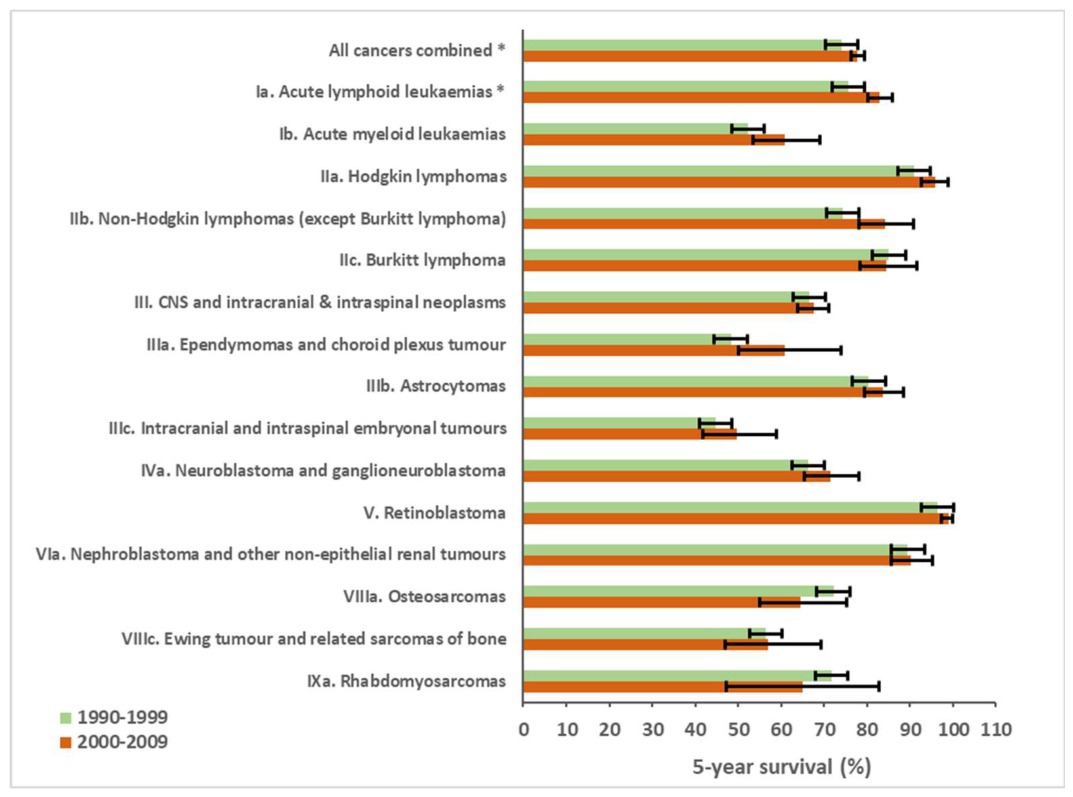
Figure 2.
Age-adjusted 10-year observed survival for all children (0-14 years) cancers combined and major ICCC entities for the follow-up periods 1990-1999 and 2000-2009.
Figure 2.
Age-adjusted 10-year observed survival for all children (0-14 years) cancers combined and major ICCC entities for the follow-up periods 1990-1999 and 2000-2009.
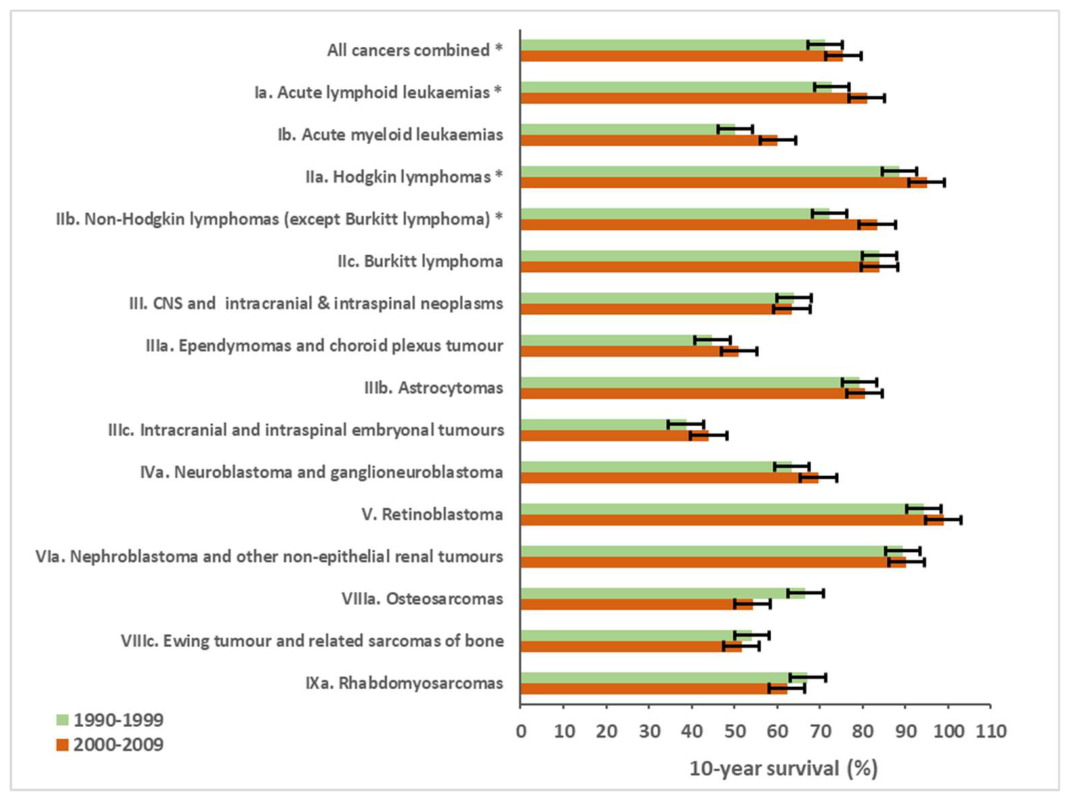
Figure 3.
Age-specific observed incidence rates (per 100.000 person-years) of second malignant neoplasms in the study cohort and age-specific incidence rates of the general population covered by cancer registries in Spain.
Figure 3.
Age-specific observed incidence rates (per 100.000 person-years) of second malignant neoplasms in the study cohort and age-specific incidence rates of the general population covered by cancer registries in Spain.
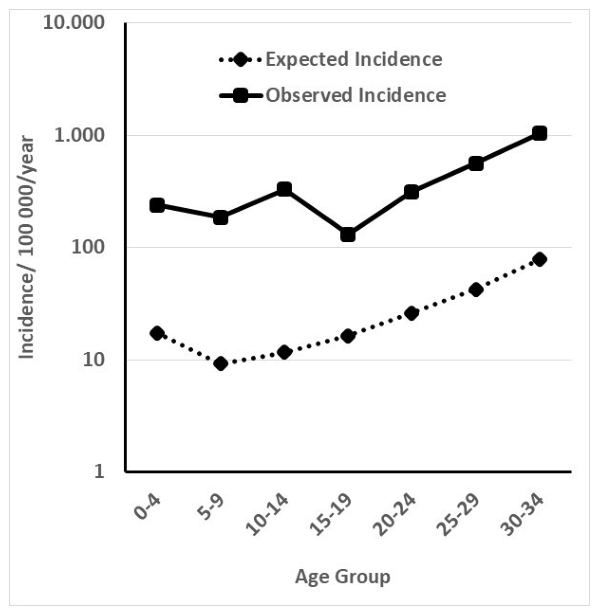
Table 1.
Numbers of children (0-14 years) diagnosed with cancer by province/island by period and quality indicators.
Table 1.
Numbers of children (0-14 years) diagnosed with cancer by province/island by period and quality indicators.
| Population | Tumours diagnosed (&) | %DCO ($) | %MV | |||||||
|---|---|---|---|---|---|---|---|---|---|---|
| Registry | Province/Island | 2000 | 2017 | 1990-99 | 2000-09 | 2010-19 | 2015-19 | 2015-2019 | 2015-2019 | |
| Asturias | Asturias | 112,979 | 113,196 | 182 | 172 | 176 | 70 | 0.0 | 95.7 | |
| Basque country | Álava/Araba | 35,314 | 48,767 | 67 | 77 | 72 | 44 | 0.0 | 84.1 | |
| Basque country | Guipúzcoa/Gipuzkoa | 83,378 | 104,376 | 158 | 148 | 199 | 103 | 0.0 | 96.1 | |
| Basque country | Vizcaya/Bizkaia | 130,222 | 153,571 | 264 | 236 | 318 | 175 | 1.1 | 95.4 | |
| Canary islands | Gran Canaria (island) | 127,628 | 114,239 | 148 | 200 | 203 | 111 | 0.0 | 87.4 | |
| Canary islands | Tenerife (island) | 116,242 | 122,165 | 125 | 172 | 183 | 91 | 0.0 | 90.1 | |
| Castellón | Castellón/Castelló | 68,392 | 87,712 | 123 | 107 | 153 | 84 | 1.2 | 89.3 | |
| Castilla y León | Salamanca | 43,310 | 39,091 | 0 | 0 | 72 | 42 | 0.0 | 95.2 | |
| Girona | Girona | 80,173 | 123,278 | 89 | 176 | 211 | 104 | 0.0 | 91.3 | |
| Granada | Granada | 142,945 | 141,506 | 201 | 218 | 250 | 129 | 0.0 | 95.3 | |
| La Rioja | La Rioja | 35,362 | 46,194 | 27 | 59 | 42 | 21 | 0.0 | 81.0 | |
| Murcia | Murcia | 204,515 | 257,748 | 359 | 348 | 468 | 225 | 0.0 | 95.6 | |
| Navarra | Navarra | 75,198 | 100,560 | 131 | 155 | 184 | 90 | 0.0 | 94.4 | |
| Tarragona | Tarragona | 86,242 | 127,606 | 156 | 188 | 210 | 103 | 0.0 | 86.4 | |
| Valencian community (*) | Alicante/Alacant | 222,660 | 271,751 | 347 | 392 | 421 | 218 | 0.5 | 89.9 | |
| Valencian community (*) | Valencia/València | 312,043 | 383,234 | 577 | 610 | 611 | 300 | 0.0 | 96.0 | |
| Total | 1,876,604 | 2,234,994 | 2,831 | 3,258 | 3,773 | 1,910 | 0,2% | 92.8 | ||
%DCO: Proportion of death certificate only cases. %MV: Proportion of microscopical verification cases. (*): Pediatric cancer registry (the rest of registries are general -all ages- cancer registries). (&) Incomplete periods: Asturias: 1991-2017, Canary Islands: 1993-2019, Castellón: 2004-2009, Girona: 1994-2019, La Rioja: 1993-2019, Salamanca: 2011-2019. ($) Total %DCO: 0.2 (by ICCC Group: Group I: 0.2%; Group III: 0.6%; all other groups: 0.0%).
Table 2.
Numbers of cases and age-standardized incidence rates of tumors in children aged 0–14 years, 2015-2019, by sex and main ICCC-3 diagnostic group.
Table 2.
Numbers of cases and age-standardized incidence rates of tumors in children aged 0–14 years, 2015-2019, by sex and main ICCC-3 diagnostic group.
| Boys | Girls | Boys & girls | SR | ||||
|---|---|---|---|---|---|---|---|
| TUMOR TYPE | Cases | ASIRw | Cases | ASIRw | Cases | ASIRw | |
| All cancers | 1,043 | 192.5 | 867 | 170.1 | 1,910 | 181.3 | 1.20 |
| I Leukaemias, myeloproliferative and myelodysplastic diseases | 306 | 58.5 | 235 | 48.3 | 541 | 53.4 | 1.30 |
| II Lymphomas and reticuloendothelial neoplasms | 187 | 31.8 | 88 | 15.7 | 275 | 23.7 | 2.13 |
| III CNS and miscellaneous Intracranial and Intraspinal neoplasms | 251 | 45.4 | 233 | 45.0 | 484 | 45.2 | 1.08 |
| IV Neuroblastoma and other peripheral nervous cell tumours | 51 | 11.4 | 63 | 14.8 | 114 | 13.1 | 0.81 |
| V Retinoblastoma | 21 | 4.8 | 23 | 5.5 | 44 | 5.1 | 0.91 |
| VI Renal tumours | 39 | 8.2 | 38 | 8.2 | 77 | 8.2 | 1.03 |
| VII Hepatic tumours | 14 | 2.8 | 12 | 2.5 | 26 | 2.7 | 1.17 |
| VIII Malignant bone tumours | 45 | 7.4 | 42 | 7.1 | 87 | 7.2 | 1.07 |
| IX Soft Tissue and other extraosseous sarcomas | 53 | 9.5 | 48 | 8.3 | 101 | 8.9 | 1.10 |
| X Germ cell tumours, trophoblastic tumours and neoplasms of gonads | 27 | 5.0 | 31 | 5.7 | 58 | 5.4 | 0.87 |
| XI Other malignant epithelial neoplasms and malignant melanomas | 45 | 7.1 | 50 | 8.0 | 95 | 7.5 | 0.90 |
| XII Other and unspecified malignant neoplasms | 4 | 0.7 | 4 | 1.0 | 8 | 0.8 | 1.00 |
Tumours classified by International Classification of Childhood Cancer, volume 3. Data are based on the Joint Dataset of the Spanish Network of Cancer Registries (REDECAN). ASIRw: Age-standardized incidence rate per million person-years (World Standard Population) (0-14 years). SR: sex ratio of cases.
Table 3.
Five and 10-year age-adjusted observed survival rates for all childhood (0-14 years) cancers by sex and period of diagnosis in Spain.
Table 3.
Five and 10-year age-adjusted observed survival rates for all childhood (0-14 years) cancers by sex and period of diagnosis in Spain.
 |
CI: Confidence interval. CNS tumors and All cancers combined: Include intracranial and intraspinal tumors of benign and uncertain behavior.
Table 4.
Risk of developing a second cancer 20 years after a childhood cancer diagnosis between 1990 and 2009, by time elapsed since the first cancer diagnosis and by sex.
Table 4.
Risk of developing a second cancer 20 years after a childhood cancer diagnosis between 1990 and 2009, by time elapsed since the first cancer diagnosis and by sex.
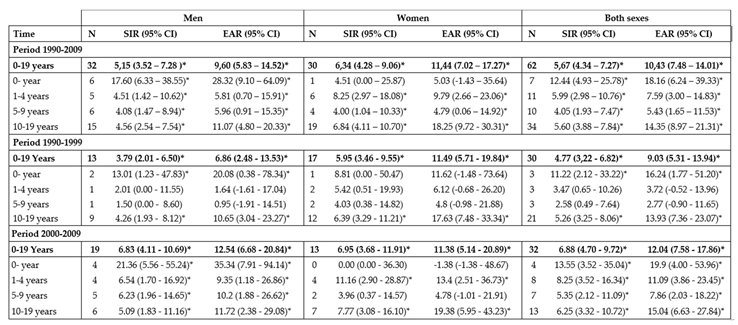 |
SIR: Standardised incidence ratio; EAR: Excess absolute risk; 95% CI: 95% Confidence interval.
Table 5.
Risk of developing a second cancer 20 years after a childhood (0-14 years) cancer diagnosis between 1990 and 2009, by age at diagnosis of first cancer and by sex.
Table 5.
Risk of developing a second cancer 20 years after a childhood (0-14 years) cancer diagnosis between 1990 and 2009, by age at diagnosis of first cancer and by sex.
 |
SIR: Standardised incidence ratio; EAR: Excess absolute risk; 95% CI: 95% Confidence interval.
Table 6.
Risk of developing a second cancer of any type 20 years after diagnosis of a specific childhood (0-14 years) cancer, by sex.
Table 6.
Risk of developing a second cancer of any type 20 years after diagnosis of a specific childhood (0-14 years) cancer, by sex.
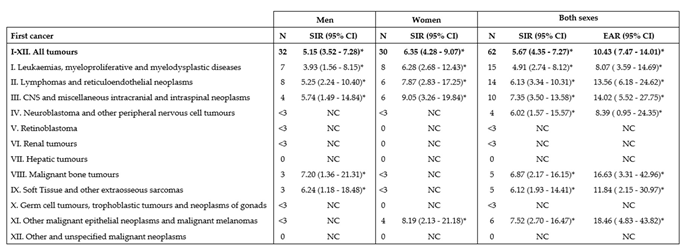 |
SIR: Standardized incidence ratio; EAR: Excess absolute risk; 95% CI: 95% Confidence interval; *: statistically significant; NC: Not calculated. CNS tumors and All cancers combined: Include intracranial and intraspinal tumors of benign and uncertain behavior.
Table 7.
Risk of developing a specific second cancer 20 years after diagnosis of a childhood (0-14 years) cancer, by sex.
Table 7.
Risk of developing a specific second cancer 20 years after diagnosis of a childhood (0-14 years) cancer, by sex.
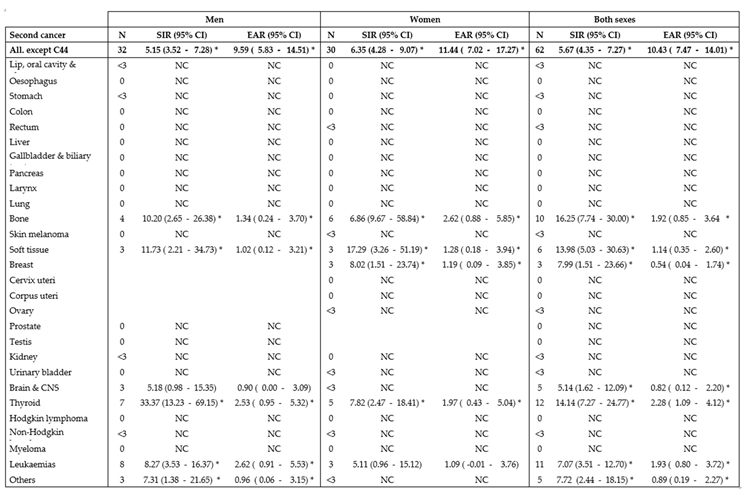 |
SIR: Standardised incidence ratio; EAR: Excess absolute risk; 95% CI: 95% Confidence interval; *: statistically significant; NC: Not calculated.
Disclaimer/Publisher’s Note: The statements, opinions and data contained in all publications are solely those of the individual author(s) and contributor(s) and not of MDPI and/or the editor(s). MDPI and/or the editor(s) disclaim responsibility for any injury to people or property resulting from any ideas, methods, instructions or products referred to in the content. |
© 2026 by the authors. Licensee MDPI, Basel, Switzerland. This article is an open access article distributed under the terms and conditions of the Creative Commons Attribution (CC BY) license.
Copyright: This open access article is published under a Creative Commons CC BY 4.0 license, which permit the free download, distribution, and reuse, provided that the author and preprint are cited in any reuse.


