

Submitted:
20 May 2026
Posted:
22 May 2026
You are already at the latest version
Abstract
Landmine contamination remains a critical barrier to post-conflict recovery, necessitating detection methods that are safe, scalable, and cost-effective. This study investigates drone-based detection of relevant plants in a mixed vegetation as required for future plant-based biodetection of explosive remnants derived from landmines. Field experiments were conducted in Ukraine and Denmark using oilseed radish and winter rapeseed as indicator biosensors due to their suitability for genetic modification and resilience in diverse climates. High-resolution RGB and multispectral imagery were collected under varying conditions, including flight altitude, time of day, and land preparation. We evaluated plant visibility at different altitudes and trained models to detect the plants and developed strategies to streamline annotation. Practical deployment challenges, such as seeding and growth of indicator plants in non-cultivated and hazardous soils are also considered. Our findings demonstrate the potential of aerial biosensor monitoring and offer insights into the development of plant-based landmine detection systems suitable for real-world applications.
Keywords:
drone-based imaging
; landmine detection
; plant detection
1. Introduction
Following years of relative peace in Europe, global initiatives primarily targeted post-conflict hazards elsewhere, with landmines being among the most persistent threats due to their ability to remain active for decades. Recent geopolitical developments have reintroduced warfare to the continent, resulting in widespread contamination by explosive remnants and other hazardous compounds. Current trends suggest that such conflicts may continue for the foreseeable future, underscoring the urgent need for cost-effective and rapid technologies to restore land safety.
In the early 2000s, the Danish biotechnology company Aresa Biodetection proposed an innovative approach: genetically modified plants capable of changing leaf color in response to nitrogen dioxide (N), a compound released during the degradation of explosives such as TNT [1]. This biological signaling mechanism aimed to enable visual identification of contaminated areas through the appearance of red pigmentation in plant foliage. Despite its promise, the technology was never widely deployed and was discontinued, partly due to limited technology for large-scale detection.
Today, the concept of using plants as living biosensors is gaining renewed attention under the emerging paradigm of phytodetection—the use of plants to detect and signal the presence of environmental hazards. Advances in plant bioengineering now allow more precise and robust control of genetically encoded responses to environmental stimuli. At the same time, progress in Unmanned Aerial Vehicle (UAV) technology, high-resolution RGB and multispectral imaging, and AI-based environmental analysis enables efficient monitoring over large areas. Together, these developments make phytodetection increasingly viable for deployment in complex real-world environments and for extracting actionable information from plant-based visual responses.
1.1. Related Work in Plant-Based Biosensing Approaches
Biodetection of chemical compounds using engineered microbes has a long and well-established history. Microbial whole-cell biosensors have undergone rapid development due to advances in synthetic biology, enabling high sensitivity, tunability, and adaptability across diverse chemical targets [2,3]. Recent work demonstrates that whole-cell systems can be engineered to detect structurally diverse compounds through innovative sensing architectures, such as metabolic auxotrophies coupled to fluorescent reporters, thereby overcoming several traditional limitations of transcription factor–based sensing systems [2]. Broader reviews similarly highlight significant progress in expanding microbial sensing repertoires, improving robustness under real-world conditions, and leveraging AI-driven protein design to accelerate the development of novel chemically responsive modules [3]. Complementary surveys describe the growing diversity in chassis organisms, transducer modalities, and encapsulation approaches that collectively expand the applicability of microbial biosensors across environmental, industrial, and diagnostic domains [4,5]. Despite these advances, microbial biosensors still face notable limitations in environmental durability, large-scale deployment feasibility, and long-distance detection capabilities—issues that remain major obstacles for applications such as landmine detection and environmental monitoring [6].
These constraints have motivated exploration of alternative biological platforms, particularly plants, which possess inherently broad and deep root systems, along with natural abilities to perceive and respond to chemical cues in soil. Early proof-of-concept studies, such as those conducted by Aresa Biodetection using engineered thale cress (Arabidopsis thaliana) [1], demonstrated that plants could be modified to serve as reporters for explosive residues in soil. However, widespread application was constrained by technological limitations in plant engineering and remote sensing capabilities at the time. In recent years, plant biotechnology has progressed substantially, with major increases in the number of species amenable to precise genetic engineering, improved transformation pipelines, and enhanced biological design frameworks supporting more sophisticated sensory and reporter constructs [7].
Parallel advances in sensor readout methodologies have further strengthened the case for plant-based biodetection systems. Nanotechnology-enabled biosensing platforms, including optical, electrochemical, thermal, and FRET-based nanobiosensors, now allow sensitive detection of chemical stressors, toxins, and pathogens directly within plant tissues [8]. These modalities can integrate with portable devices and AI-driven analytical pipelines, enhancing the feasibility of field deployment for agricultural and environmental applications. Combined with the emergence of hyperspectral reporters suitable for long-distance imaging, engineered plants represent a promising and scalable framework for mapping soil contaminants and other chemical hazards across large geographic areas [9].
1.2. Related Work on Plant Detection Using UAVs
UAV-based plant detection has become an essential component of modern precision agriculture, providing high-resolution aerial imagery for efficient crop monitoring, weed identification, and early stress detection [10]. In structured agricultural environments, deep learning models trained on RGB imagery have consistently demonstrated strong performance across a range of detection and classification tasks [11,12,13,14]. Additionally, multispectral imaging is increasingly used to enhance robustness to illumination variability and heterogeneous soil backgrounds. Spectral bands such as near-infrared and red-edge capture physiologically meaningful information related to plant vigor and biomass, improving model reliability. Integrating these multispectral inputs with convolutional neural networks has produced notable performance gains in weed detection and crop classification [15,16,17]. In parallel, stereo vision and 3D reconstruction techniques have been explored to mitigate occlusions in dense canopies, enabling more reliable discrimination of overlapping plants [18].
Hyperspectral imaging has enabled species-level discrimination in highly heterogeneous environments, where overlapping spectral signatures and complex canopy structures challenge conventional RGB-based approaches. Mangrove forests exemplify these conditions, as they exhibit dense multi-layered canopies, irregular plant spacing, and strong spectral variability. Under these conditions, Cao et al. demonstrated that combining UAV hyperspectral imagery with digital surface models significantly improves mangrove species classification [19]. Structural sensing has followed a similar trajectory, with UAV-based LiDAR providing detailed three-dimensional information capable of resolving individual trees despite substantial canopy occlusion, as shown by Yin and Wang [20].
Plant detection is particularly challenging in structurally complex natural habitats, including wetlands, riparian zones, and estuaries, due to dense vegetation, species heterogeneity, and frequent occlusion. UAV-based mapping of Phragmites australis in estuarine wetlands required machine learning classifiers that leveraged multispectral and canopy-height information to overcome these challenges [21]. Broader reviews of UAV-based invasive-species monitoring report similar challenges, emphasizing that the complexity of these ecosystems is further compounded by inconsistencies in sensor calibration, flight protocols, radiometric correction, and ground-reference data, which collectively hinder reproducibility and limit cross-study comparability [22].
Additional studies further illustrate the difficulty of invasive plant detection in unstructured conditions. Mapping fragmented canopies of Hakea sericea required object-oriented classification combined with high-resolution satellite data to address canopy variability and inconsistent lighting [23]. Work on Iris pseudacorus in wetland margins similarly showed that even high-resolution UAV imagery struggles with overlapping vegetation and mixed water–vegetation backgrounds [24]. In more extreme environments, such as high-altitude grasslands, detecting medicinal plants requires deep learning models capable of handling sparse, irregular, and visually similar vegetation [25]. Time-series UAV imagery has also shown promise for invasive plant monitoring, where temporal features help distinguish invasive growth patterns from native vegetation dynamics [26,27].
Research Gap and Contributions
Overall, existing research demonstrates that UAV-based plant detection performs reliably in structured agricultural environments but becomes significantly more challenging in semi-natural and heterogeneous settings, where increased structural complexity, species diversity, and occlusion reduce detection accuracy. These conditions often require the integration of multispectral, structural, and temporal data, along with more advanced machine learning approaches. Building on these insights, this work specifically addresses the challenges of detecting biosensor plants in unstructured field environments, where vegetation is irregular, background conditions are highly variable, and standard assumptions of precision agriculture no longer hold.
To advance the practical deployment of phytodetection systems, this study addresses the following research questions:
- How does UAV flight altitude affect image resolution and the detectability of individual plants in heterogeneous field conditions?
- Can semi-automated annotation strategies generate reliable training data for plant detection at scale?
- How effectively can deep learning models detect biosensor plants in unstructured, real-world environments using RGB imagery?
- To what extent can multispectral data improve the differentiation of plant responses compared to RGB-based approaches?
2. Materials and Methods
Effective deployment of genetically engineered plants for landmine detection requires careful consideration of both biological and operational factors. Conventional agricultural practices—such as soil tillage and direct seed placement—are unsuitable for this application because they would disturb the soil, compromise the primary goal of landmine detection, and are also dangerous for the operator who would carry out these tasks. Key uncertainties remain regarding the degree to which soil preparation should be minimized and whether herbicide application (e.g., glyphosate) could enhance germination without undermining experimental integrity. Furthermore, determining the optimal seeding density is essential to ensure adequate plant establishment and sufficient visibility for remote sensing. The following section describes the experimental design developed to address these challenges.
2.1. Overview of the Approach
To evaluate the feasibility of plant-based landmine detection, we conducted controlled field experiments in Denmark and Ukraine1. The primary focus was on oilseed radish and winter rapeseed due to their suitability for genetic modification and resilience under diverse conditions.
Experimental plots were prepared with varying soil treatments to simulate realistic environments. Typically, half of each field was treated with herbicide to suppress existing vegetation, while the other half remained untreated. In some cases, plots were tilled to examine the effect of soil preparation on germination. Seeds were distributed using three methods: tractor-mounted dispensers, manual broadcasting, and aerial seeding via drones.
Following germination, aerial imagery was acquired using drones equipped with RGB and multispectral sensors. The raw images were processed in Agisoft Metashape Professional (v2.2.1) [28] following a standard photogrammetric workflow: (i) photo alignment using high-accuracy settings to estimate camera positions and generate a sparse point cloud; (ii) dense point cloud reconstruction; and (iii) orthomosaic generation. Ground control points (GCPs) were employed to ensure consistent and accurate relative alignment among orthomosaics produced for each survey date.
For some orthomosaics, particularly those collected in areas with tall vegetation, dense point cloud generation was omitted because excessive canopy height introduced artifacts that degraded orthomosaic quality. In such cases, digital elevation models derived directly from tie points were used instead. The final orthomosaics were exported at spatial resolutions corresponding to the respective flight altitudes.
To prepare datasets for model training, orthomosaics were divided into smaller image tiles (e.g., 1024 × 1024 px), enabling efficient handling of large-scale data. Tiles were then selected based on the visual presence of plants, ensuring that the training data focused on regions containing relevant objects.
2.2. Plant Description
We employed two cover crops to assess both their ability to grow under diverse soil pre-treatment regimes (tillered, untillered and untillered with glyphosate pre-treatment) and the feasibility of developing algorithms for reliable detection. Winter rapeseed (Brassica napus) was chosen as it can be sown at the end of the agricultural season, which may facilitate detection due to reduced competition during autumn and winter sowing regimes. Furthermore, B. napus is amenable to the genetic transformations required to develop reliable biodetection plants [29].
Oilseed radish (Raphanus sativus var. oleiformis) was chosen as it is frequently sown as catch crop and known to supress weeds, with similar benefits as those of B. napus. While transformation of oilseed radish has not yet been demonstrated, transformation protocols have been developed for both white radish and daikon [30,31].
2.3. Test Sites in Ukraine
2.3.1. Test Site in the Kharkiv Region
In the Kharkiv region, the study was conducted over two spring growing seasons (2024 and 2025) and one autumn season (2024). The experiment was conducted on a field plot measuring 86 × 73 m (0.63 ha) (Figure 1). Test plots were arranged according to guidelines as two adjacent plots of 8 × 4 m. One replication consisted of two such plots in width, with 20 plots arranged along the field length. A 3-m-wide control strip was established along the center line between paired plots and cultivated every four weeks to suppress weeds.
In one part of the field, soil was treated two weeks before sowing with a non-selective systemic herbicide (Terraunt RK; isopropylamine salt of glyphosate) at a rate of 6 L h, while the other part remained untreated and served as a control for baseline germination under mixed vegetation. Oilseed radish and winter rapeseeds were sown manually (Figure 2). To reduce the influence of spatial heterogeneity in soil and vegetation, the experiment was conducted with five replications. Plant density was manipulated to assess germination and establishment under different management regimes. Oilseed radish and winter rapeseed were sown at four target densities corresponding to 1×, 4×, 7×, and 10× of the baseline rate, equivalent to 80, 320, 560, and 800 plants , respectively (Figure 2).
Since the Kharkiv region is in a high-risk frontline zone, the use of civilian drones is prohibited, so a Sony a6400 camera and a Broge V3 stick were used to photodocument the plant’s growth and development. To ensure accurate georeferencing of the photographed material to the terrain features, 26 GCPs were established on the experimental field, as well as 6 additional points on one specific plot, the coordinates of which were determined using a multi-band RTK GNSS receiver (EMLID REACH RS2). To conduct the imaging, the camera was mounted on a Broge V3 stick using a stabilizing clamp. Photography was carried out from a height of 5 meters at a camera tilt angle of 30 degrees. From May 1, 2025, to June 28, 2025, each experimental plot was photographed once per week.
2.3.2. Test Site in Zhytomyr Region
In the Zhytomyr region, oilseed radish and winter rapeseed were sown mechanically in the spring of 2024 and with the help of an agrodrone in the spring of 2025. In 2024, the field experiment was conducted on the field with a size of 36 × 54.3 m consisting of 24 plots in three replications for each crop. The experimental setup was implemented in the field and consisted of protective strips along with designated control zones (Figure 3). Oilseed radish and winter rapeseed were planted at four seeding densities (1×, 4×, 7×, and 10×), corresponding to 80, 320, 560, and 800 seeds , respectively. Each seeding density treatment was replicated three times to reduce the effect of spatial variability in soil and vegetation. Untreated plots served as negative controls to assess baseline germination in mixed vegetation, while glyphosate-treated plots represented positive (internal) germination controls. Protective strips (3 m wide) between experimental variants were maintained by tillage.
Prior to sowing, selected plots were treated with Raunap Max (glyphosate, 450 g glyphosate potassium salt) at a rate of 2 L h using a tractor-mounted boom sprayer (PLM, Poland) (Figure 3a). Sowing of both crops was performed on 1 June 2024 using mechanically spread, dyed seeds without soil embedding. Sowing was carried out in areas with long-term natural weed cover (>3 years) and in glyphosate-treated areas.
Figure 4.
Field operations during experiment establishment: (a) herbicide application on experimental plots; (b) seed coloring for improved visualization during sowing; (c) mechanical sowing of experimental crops according to the field layout (01/06/2024).
Figure 4.
Field operations during experiment establishment: (a) herbicide application on experimental plots; (b) seed coloring for improved visualization during sowing; (c) mechanical sowing of experimental crops according to the field layout (01/06/2024).
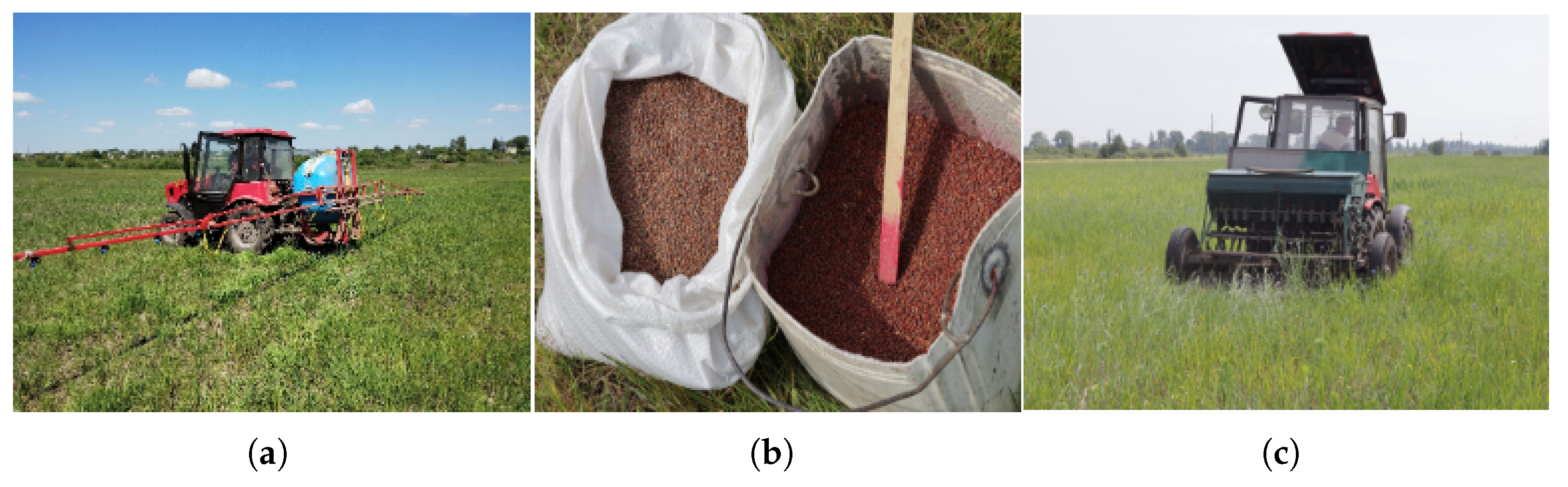
Crop emergence was first recorded on 4 June 2024 for oilseed radish and on 6 June 2024 for winter rapeseed. A second assessment was conducted on 15 June 2024, when both species had developed their first true leaves. Seedling emergence was uniform across all treatments, with no visible damage caused by crucifer flea beetles (Phyllotreta spp.), and early plant development corresponded to the normal species-specific growth pattern.
For aerial monitoring, GCPs were installed across the experimental area, and their coordinates were measured using a multiband RTK GNSS receiver (EMLID Reach RS2). Crop growth and spatial patterns were surveyed using a DJI Mavic 3 Multi-spectral drone twice a week from June to August 2024.
In 2025, the experiment was conducted on a 128.4 × 52.2 m field and included 16 variants arranged in three replicates (referred to as “repetitions” in Figure 5). Replicates were established as separate tiers without randomization due to constraints of drone-based sowing.
Part of the experimental area was treated with glyphosate prior to sowing. Herbicide application was carried out using an MS-A22 sprayer drone at 2 L h (working solution 7.5 L h), 4 m flight height, and 8 m flight speed, under low wind conditions (2 m ) (Figure 6). Weed vegetation height at treatment was 8–10 cm. Sowing was conducted 14 days after herbicide application.
Oilseed radish and winter rapeseed were sown at two densities selected from previous studies: 320 (4×) and 560 (7×) plants . Sowing was performed in three replicates using an XAG P100pro agricultural drone [32]. The seeding system was calibrated immediately before sowing. All plots were sown within 4.5 h under optimal weather conditions (22.6°C, 60% relative humidity, wind speed 1.1 m ).
GCPs were established using a Hi-Target V30Plus RTK GNSS re-ceiver to enable accurate georeferencing of aerial data. Crop establishment and develop-ment were monitored using a DJI Mavic 3 Multispectral drone.
2.4. Test Sites in Denmark
In Taastrup, two experimental fields were established, and three seeding trials were conducted between 2024 and 2025. The first field was seeded and monitored during three periods: Spring 2024 (21 May–4 July; Figure 7), Autumn 2024 (16 September–23 January), and Spring 2025 (24 April–20 June).
In all trials, two crop species—oilseed radish and winter rapeseed- were sown using a tractor equipped with a seed dispensing mechanism (Figure 8). Each field was divided into 40 plots, with seeds distributed at four densities (80, 320, 560, and 800 seeds/), replicated five times, resulting in 40 plots per field.
For Spring 2024 and Autumn 2024, each plot was further subdivided into three soil preparation treatments: control (untreated), tilled (soil turned over and prepared for planting), and sprayed (treated with herbicides) (Figure 9). In Spring 2025, the tilled treatment was omitted to assess plant growth under more realistic conditions.
Germination results varied across seasons and were assessed based on visual inspection: Spring 2024 showed good germination for oilseed radish but poor for winter rapeseed. Autumn 2024 exhibited satisfactory germination for both species. In Spring 2025, germination was acceptable in some plots with high seeding rates for oilseed radish, whereas winter rapeseed failed to establish. This period was characterized by drought, intense competition from tall grasses and thistles, and pest pressure (slugs).
2.5. Data Acquisition Using UAVs
Data collection typically began approximately one to two weeks after seeding, once initial germination was observed, and continued until plants reached maturity. A DJI Mavic 3M Pro UAV was employed, equipped with a 20 MP RGB camera and a 5 MP multispectral sensor capturing four bands: near-infrared (NIR), red, red edge, and green.
Flights were primarily conducted at an altitude of 12 m, which is the minimum permitted operational height for this UAV model. Additional low-altitude flights (3–4 m) were performed in selected trials to capture finescale details. Mission planning utilized DJI’s flight management software to ensure adequate image overlap for high-quality orthomosaic generation.
To assess environmental variability, some experiments included up to three flights per day under different times of day. Image datasets were processed using Agisoft Metashape to generate orthomosaics, which served as the basis for subsequent analysis and model development.
2.6. Annotation Strategy
Accurate annotation is essential for evaluating UAV-based plant detection models. Before introducing detection methods, we first outline the strategy used to generate reliable ground truth from orthomosaics. Manual labeling of entire orthomosaics is highly labor-intensive and prone to errors, particularly under conditions of irregular seeding and dense vegetation. To overcome these challenges, we adopted a semi-automated annotation pipeline based on the Iterative Co-teaching+ (ICoT+) framework [33]. This approach integrates domain knowledge with machine learning techniques to reduce label noise and streamline dataset preparation. Importantly, the pipeline is designed for image classification, enabling us to process full orthomosaics by classifying patches according to plant presence. Once patches containing target species are identified, these images can be selected for detailed manual annotation of exact plant locations, ensuring high-quality ground truth for subsequent detection model training.
The ICoT+ pipeline consists of three main stages:
- 1.
- Patch Generation and Initial Labeling: Orthomosaics are segmented into fixed-size image patches (e.g., px), ensuring that the target plants occupy most of the patch. Initial labels are assigned to these patches using prior knowledge of the seeding layout (referred to as the seeding map), which indicates the species sown in each area.
- 2.
- Noise Reduction via Clustering and Refinement: Initial labels may contain errors or noise because many plants do not mature at their sown positions. To address this, a clustering-based refinement step is applied. Image embeddings (e.g., ResNet18, DINOv2) are computed for each patch, and visually similar patches are grouped into clusters representing major classes.
- 3.
- Iterative Co-teaching+ Training: Clustering alone may still leave residual label noise. To further reduce this, an iterative learning strategy is employed where two networks are trained simultaneously under the Co-teaching+ paradigm [34,35], leveraging model disagreement to identify and filter mislabeled samples. After each training cycle, predictions are corrected using domain knowledge (seeding maps), and the dataset is retrained. This iterative process progressively enhances label quality while minimizing overfitting to noisy data.
3. Results
We conducted extensive seeding trials across multiple locations, soil preparation methods, seeding densities, and UAV flight altitudes, generating a large dataset under diverse environmental conditions. However, not all trials produced imagery suitable for systematic analysis. At operational altitudes (>12 m), individual plants could no longer be reliably distinguished by visual inspection, particularly in areas with dense vegetation. Shadows, overexposure, and blooming stages further obscured plant features. In tilled plots, plants were generally easier to identify and annotate due to reduced competition, whereas in untilled plots, visibility was significantly lower—conditions that closely resemble real deployment scenarios. Because of these constraints, we focused on two representative orthomosaics: one captured at low altitude (3 m) under controlled conditions (Taastrup, autumn 2024), where plants were clearly visible for benchmarking annotation quality, and another acquired at 12 m from an untilled Ukrainian field (Zhytomyr, spring 2025), which reflects realistic operational challenges.
This section presents the results following the progression of challenges addressed in the methodology. First, we analyze the impact of flight altitude on image resolution and plant detectability (Section 3.1), as this factor fundamentally constrains UAV-based monitoring. Next, we evaluate the performance of the semi-automated annotation strategy (ICoT+) under controlled conditions (Section 2.6), demonstrating its ability to generate reliable ground truth from high-resolution orthomosaics. We then report detection results using segmentation models applied to an orthomosaic from an untilled Ukrainian field (Section 3.3), representing a realistic deployment scenario. Finally, Section 3.4 explores the potential of multispectral data for plant differentiation.
3.1. Altitude Impact on Plant Detectability
Flight altitude strongly influences image resolution, which is determined by both the distance to the target and the camera specifications. In this study, a DJI Mavic 3M Pro equipped with a 20 MP RGB sensor was used. At 3 m altitude, the ground sampling distance (GSD) was 0.82 mm/px, while at 12 m it increased to 3.28 mm/px—a fourfold reduction in spatial detail. This change, driven by both altitude and fixed camera parameters, significantly affects the ability to distinguish individual plants.
At an altitude of 3 m, individual plants covered an average of 3,149 pixels (oilseed radish: 4,669 px; winter rapeseed: 1,701 px). At 12 m, this footprint decreased to roughly 200 pixels (oilseed radish: 313 px; winter rapeseed: 111 px), corresponding to an approximate 15-fold reduction in pixel coverage. This substantial decrease makes distinguishing single plants challenging at 12 m with the current sensor setup. Figure 10 highlights the scale of this difference. Using Equation (1) to quantify information loss, the average loss at 12 m is about 94%
At 3 m altitude, annotation is challenging due to overlapping vegetation, wind-induced motion, and partial occlusion. These factors complicate the creation of reliable ground truth data for training and evaluation. The problem is amplified at 12m: plants become too small to annotate consistently, and visual cues are often lost.
3.2. Evaluation of the Annotation Strategy
The semi-automated annotation approach was evaluated on a high-resolution orthomosaic captured at 3 m altitude under controlled conditions (Taastrup, autumn 2024, november 08). The orthomosaic was divided into non-overlapping tiles of size 224×224 pixels. Winter rapeseed and oilseed radish plants were annotated using a three-class labeling scheme comprising winter rapeseed (WR), oilseed radish (OR), and background. Initial tile-level labels were assigned automatically based on seeding map.
This initial labeling resulted in substantial noise (approx. 83.5%) due to discrepancies between planned and actual plant growth. After clustering and refinement, noise was reduced to 14%, and applying the iterative Co-teaching+ process further decreased residual noise to below 6%, significantly improving label quality (Figure 11).
After validating the approach on the 3 m orthomosaic, we extended testing to 12 m orthomosaics. At this operational altitude, only a few plants were visible per image, making the application of ICoT+ highly challenging. The method relies on easy-to-label samples for effective noise reduction, but when resolution is low and vegetation is dominated by non-target species, both Co-teaching+ and clustering fail to deliver reliable results (see examples in Figure 12). Dense weed cover, occlusions, and blurred plant boundaries further complicated annotation—even manual labeling was uncertain and often based on assumptions rather than clear visual evidence. For these cases, manual annotations is prefered for the 12 m orthomosaics.
3.3. Plant Detection in RGB
Plant detection was evaluated using an orthomosaic acquired from the Ukrainian test site (Section 2.3.2), where seeds were drone-seeded on ground without tillage. The field was divided into 12 m × 6 m patches. Two species—winter rapeseed and oilseed radish—were sown at two densities (320 and 560 seeds/).
Ground truth segmentation masks were manually created for selected patches. To improve model generalization, additional orthomosaic data from other sites was included in training. Images were cropped into 1024 × 1024 pixel tiles using a sliding grid with 20% overlap, generating up to 30 tiles per 12 m × 6 m patch. Segmentation models for winter rapeseed and oilseed radish were trained using the Ultralytics YOLOv11 medium-segmentation model [36], chosen for its balance of accuracy and speed. Predictions for individual tiles were merged into full-patch maps and compared against ground truth masks (Figure 13).
The training dataset consisted of random 1024 × 1024 crops from multiple orthomosaics. For WR, 364 annotated samples were used; for OR, 763 samples. Each model included two classes: the target species and a “not-target” class (188 samples for winter rapeseed, 138 for oilseed radish) to reduce false positives. Data were split into 80% training and 20% validation.
Overall plant growth was low across most patches, and in many areas, other vegetation dominated, making it difficult to visually identify the target species. In a few locations, individual plants grew significantly larger than average; these were easily detectable even at 12 m altitude. However, such cases were rare and did not represent the general field condition.
Oilseed radish presented additional challenges: during blooming, its leaves were largely obscured by stems and flowers, which created a dense overlay across the field. Since the goal of this experiment was to detect leaf’s rather than flowers, this observation highlights an important consideration for future studies—monitoring should occur before blooming to ensure leaf visibility.
Detection accuracy was limited under these conditions. Performance metrics (F1-score) varied across species and seeding rates, with slightly better results for oilseed radish at higher densities. However, occlusion by weeds, overexposion by light and blooming structures significantly reduced segmentation quality.
Although detection performance was modest, these results establish an important baseline for UAV-based plant monitoring under realistic conditions. The experiment highlights key limitations—such as low plant density, competition from weeds, and reduced image resolution—that strongly influence segmentation accuracy. Identifying these constraints early is critical for designing robust workflows. Ground truth generation was also challenging under these conditions, which likely contributed to lower model performance. Despite these limitations, the findings provide valuable insights into operational challenges and inform future optimization strategies for biosensor-based detection systems in untilled fields with broadcast seeding. Model performance metrics are summarized in Table 1, and representative detection outputs alongside ground truth are shown in Figure 13.
3.4. Multispectral Analysis
Landmine phytodetection relies on distinguishing plant types rather than geometric object boundaries, making spectral information more informative than purely spatial features. Consequently, multispectral UAV-borne imaging provides a richer representation than RGB imagery, particularly for target detection using traditional machine-learning approaches, due to the larger set of extractable spectral features and their discriminative relationships. This consideration is experimentally confirmed using image slices extracted from an orthomosaic acquired over the Taastrup test field (Nov08 2024, 3m altitude), by evaluating the statistical separability of target and background classes in both RGB and multispectral data (Figure 14).
The spectral band specifications of the onboard cameras of DJI Mavic 3M Pro UAV are listed in Table 2.
The statistical separability was evaluated using the Bhattacharyya metric b, which for normally distributed spectral features is expressed in Equation (2), where ; X and Y are the mean vectors of the target and background; ; and U and V are the covariance matrices of the target and background.
The average error of target recognition against the background is bounded from above by the Chernov boundary [37], as expressed in Equation (3), where p and q are the prior probabilities of the target and the background, respectively.
A lower bound for the error can be estimated using the Cauchy–Bunyakovsky–Schwarz inequality [38], as shown in Equation (4).
The intermediate relationship between recognition error and the Bhattacharyya distance can be estimated using the empirical approximation in Equation (5) [39].
The Bhattacharyya distance (Equation 2) and the error probabilities (Equations 3–5) were estimated for the test images in Figure 14, and the results are summarized in Table 3. Thus, the error probabilities of the spectral signatures’ separability are roughly twice as low for the multispectral test image as for a regular RGB one.
Another important aspect of the informativeness of a digital image is spatial resolution [40]. Unfortunately, the spatial resolution of an RGB camera is typically better than that of a multispectral camera with similar specifications, which can negate the spectral advantage of the latter. The pixel spatial resolution of the test images in Figure 14 was evaluated by extracting bidirectional edge spread functions (ESF) and parameterizing the corresponding modulation transfer functions (MTF) using special software [41]. The results are illustrated by Figure 15.
The acquired isotropic pixel resolution of the multispectral image is 1.58 times worse than that of the corresponding RGB image. This is probably what explains the comparable accuracy of target recognition in the test images.
The multispectral image (Figure 14b) was used to perform supervised classification for target detection. This classification can be considered binary, with target and background classes. The Maximum likelihood classifier was selected as the supervised classification method, since it is a well-established method in remote sensing classification [42,43]. For that classification, we prepared a labeled dataset consisting of 69 reference polygons, where pixels inside the polygons represent the target objects. This dataset was split into training and validation datasets at 80% and 20%, respectively. Besides the target samples, this dataset was also filled with the background samples, since the Maximum likelihood classifier requires training samples for each class. To refine the target-class samples, we applied an additional filtering to reduce the number of potentially incorrectly selected target samples. For this purpose, the multispectral image was divided into five clusters using the K-Means unsupervised classification method. The number of clusters was considered sufficient to represent the variety of objects presented in the image. Within the reference polygons, only pixels belonging to the dominant cluster (i.e., the cluster most frequently occurring inside the reference polygons) were used as target samples in the updated training dataset. Meanwhile, pixels associated with the other clusters were removed from the target samples. Next, the classifier was trained using the filtered training dataset and applied to the input multispectral image. As a result, a binary classification was obtained, distinguishing the target objects from the background. The resulting classification map is shown in Figure 16, illustrating the detected targets (white), background (black), and reference polygons (red).
The classification results were evaluated using the validation dataset described above. A polygon-based validation approach was applied, in which a reference polygon was considered correctly detected if more than 50% of its pixels were classified as the target class. Using this criterion, 62 of 69 reference polygons were correctly detected, corresponding to a detection rate of approximately 90%. However, even a visual analysis indicates that the obtained classification map has a high false positive rate. However, visual inspection indicates that the resulting classification map exhibits a high false positive rate, reflecting limited target discrimination performance. To further improve classification accuracy and reduce the false-alarm rate, the use of multi-source data is recommended. In particular, combining multispectral imagery with auxiliary data, such as thermal infrared imagery and magnetometer measurements [44], could significantly enhance target detection.
4. Discussion
Our experiments demonstrate that UAV-based monitoring of indicator plants for landmine phytodetection is feasible, but its performance is highly dependent on plant establishment, environmental conditions, and sensor limitations. The primary challenge throughout all trials was achieving sufficient plant germination in real-world environments. When plants failed to germinate or were suppressed by competing vegetation—as frequently occurred in broadcast-seeded plots without glyphosate treatment—detection performance deteriorated regardless of imaging modality or algorithmic sophistication. Conversely, herbicide-treated and, to a lesser extent, tilled plots produced more vigorous plant growth, enabling clearer visibility and more reliable annotation. This indicates that UAV-based workflows are highly dependent on agronomic conditions that promote plant dominance within the imagery. These findings align with the broader UAV-based vegetation monitoring literature, which typically reports strong performance in structured agricultural settings but offers limited evidence for success in unstructured, weed-dominated environments. Our results highlight the difficulty of translating methods validated in controlled crop fields to realistic broadcast-seeding scenarios.
Species-specific growth patterns also strongly influenced detectability. Oilseed radish was well-suited to broadcast seeding and often produced robust above-ground structures; however, its flowering stage frequently obscured leaves, which are essential for detecting color-based changes in genetically engineered biosensor plants. Winter rapeseed, by contrast, showed weaker establishment under several field conditions. Together, these observations emphasize that UAV monitoring must be timed carefully—preferably before blooming—and that species selection for future biosensor development should prioritize foliage visibility and resilience to competition. Seasonal environmental factors, including drought, pest damage (notably slug activity), and competition from tall grasses and thistles, further contributed to variability in establishment and underscore the need for more controlled agronomic strategies.
A major technical limitation was the spatial resolution imposed by the minimum operational flight altitude of the DJI Mavic 3M Pro. At 12 m, GSD increased to 3.28 mm/px, producing a 94% loss of pixel detail compared with 3 m flights and reducing individual plant footprints from thousands of pixels to only a few hundred. This loss made segmentation unreliable in most untilled and weed-dominated plots, where plants were small, partially occluded, and visually similar to the background. Although multispectral imaging improved spectral separability, its spatial resolution was lower than that of the RGB camera, limiting its advantage. These observations reinforce that spatial resolution—not spectral content—is the primary constraint in UAV-based detection of small, early-stage plants. This conclusion is consistent with earlier plant-detection studies that report strong performance only when plants occupy a sufficient number of pixels. The semi-automated annotation pipeline (ICoT+) performed well on high-resolution 3 m orthomosaics, reducing label noise from 83.5% to below 6%. However, its performance did not translate to 12 m data because the method relies on the existence of “easy” samples, which were largely absent at operational altitude. Under such conditions, clustering and Co-teaching+ were unable to separate target species from background vegetation. As a result, manual annotation remained the only reliable option for low-resolution orthomosaics. This highlights a key limitation in scaling training data generation for realistic UAV deployments. Despite these challenges, the experiments offer important insights for practical future deployment of biosensor-based landmine detection systems. Operational workflows must be adapted to overcome resolution and visibility constraints—for example, by flying at lower altitudes where permitted, using cameras with optical zoom, or integrating higher-resolution or hyperspectral sensors. Agronomic interventions such as glyphosate treatment or minimal soil preparation appear essential for ensuring adequate plant growth, while seeding density must be optimized to achieve sufficient visibility without introducing ecological disruption.
4.1. Limitations and Future Work
This study was constrained by several practical and environmental factors. Drone use was restricted in high-risk regions, limiting the availability of some aerial data in Ukraine. Plant establishment varied widely across seasons and sites, reducing the number of usable orthomosaics for systematic evaluation. The reliance on RGB and low-altitude multispectral imaging limited sensitivity to subtle plant-health signatures that hyperspectral sensors could potentially detect. Future research should prioritize (i) using higher-resolution or zoom-enabled UAV sensors; (ii) optimizing seeding regimes and field preparation techniques; and (iii) integrating multispectral and/or thermal data to enhance robustness in cluttered environments. Additionally, improvements in semi-automated annotation pipelines are needed to handle low-resolution imagery and noisy field conditions.
In terms of future work, we aim to extend the present approach by systematically investigating plant species selection for UAV-based phytodetection. Building on the techniques developed in this study, future experiments will compare candidate species under varying climatic, soil, and competition conditions to identify those that provide the most reliable visual signatures from aerial imagery
5. Conclusions
This study demonstrates that UAV-assisted remote sensing of indicator plants for landmine detection is feasible, but its success depends critically on biological, environmental, and operational factors. Across all trials, plant germination emerged as the primary bottleneck: broadcast seeding without glyphosate treatment resulted in poor germination and intense competition from existing vegetation, while herbicide application consistently improved visibility and detection potential. Oilseed radish adapted well to broadcast seeding but became visually obscured during blooming, whereas winter rapeseed showed limited establishment under several field conditions. These patterns underscore the need for carefully selected sowing strategies, flight timing before flowering, and agronomic preparation that promotes clear plant visibility.
From a technological perspective, spatial resolution was the dominant constraint. The minimum operational altitude of the DJI Mavic 3M Pro (12 m) reduced plant footprints significantly compared with 3 m flights, making individual plants difficult to distinguish in realistic, untilled environments. While multispectral imaging improved spectral separability, its lower spatial resolution limited its practical advantage. Specifically, the multispectral data exhibited a Bhattacharyya distance nearly twice that of RGB imagery, resulting in substantially lower theoretical classification error, yet modulation transfer function (MTF) analysis showed that multispectral spatial resolution was approximately 1.6 times worse than that of RGB. As a consequence, multispectral data improved class separability but did not overcome the fundamental spatial-resolution limitations imposed by sensor geometry and operational flight altitude. Consequently, annotation and detection were only reliable when high-resolution data or strong plant dominance were present. The semi-automated annotation pipeline (ICoT+) proved effective at 3 m but could not be applied to operational-altitude imagery due to insufficient visual cues.
Despite these challenges, the results provide a foundation for the future development of biosensor-based landmine detection systems. Achieving reliable UAV detection will require integrating improved plant engineering, optimized field preparation, and enhanced imaging solutions such as low-altitude flights, zoom-capable cameras, or high-resolution multispectral and hyperspectral sensors. Operational workflows will also benefit from timing flights before blooming, seeding at densities that ensure adequate plant presence, and using annotation tools capable of handling noisy, heterogeneous field imagery.
Overall, this work highlights both the promise and the limitations of UAV-based phytodetection under realistic conditions. While current performance remains constrained by plant establishment and image resolution, the findings point to clear pathways for improving robustness and scalability. With continued development of biosensor plants and advances in UAV sensing technologies, large-scale, cost-effective monitoring of contaminant-responsive vegetation remains an achievable goal for future humanitarian demining applications.
Author Contributions
Conceptualization, all authors; methodology, all authors; software, L.K., A.A., S.G.; investigation, X.X.; resources, R.L..; data curation, L.K., S.M., J.C., C.K., A.Z., F.M..; writing—original draft preparation, L.K., S.M., S.S., A.Z., A.A., S.G.; writing—review and editing, all authors; visualization, all authors; supervision, R.L., U.L., T.L., S.S.; project administration, T.L.; funding acquisition, T.M., J.A-R., U.L., R.L. All authors have read and agreed to the published version of the manuscript.
Funding
This research was funded by the Novo Nordisk Foundation (grants NNF24SA0090464 and NNF23SA0086872) led by our collaborator at University of Copenhagen, Department of Plant & Environmental Sciences.
Data Availability Statement
Data is available on Zenodo https://doi.org/10.5281/zenodo.18966943.
Conflicts of Interest
The authors declare no conflicts of interest.
Abbreviations
The following abbreviations are used in this manuscript:
| UAV | Unmanned Aerial Vehicle |
| YOLO | You Only Look Once |
| GCP | Ground control point |
| GSD | ground sampling distance |
| OR | Oilseed radish |
| WR | Winter rapeseed |
References
- Radio Free Europe/Radio Liberty. Danish Company Develops Unique Solution To Land Mine Problem. 2004. Available online: https://www.rferl.org/a/1052285.html (accessed on 12 November 2025).
- Hernández-Sancho, J.M.; Boudigou, A.; Alván-Vargas, M.V.G.; Freund, D.; Arnling Bååth, J.; Westh, P.; Jensen, K.; Noda-García, L.; Volke, D.C.; Nikel, P.I. A versatile microbial platform as a tunable whole-cell chemical sensor. Nature Communications 2024, 15, 8316. [Google Scholar] [CrossRef]
- Capin, J.; Chabert, E.; Zuñiga, A.; Bonnet, J. Microbial biosensors for diagnostics, surveillance and epidemiology: today’s achievements and tomorrow’s prospects. Microbial Biotechnology 2024, 17, e70047. [Google Scholar] [CrossRef] [PubMed]
- Mishra, P.; Saini, P. Microbial biosensors: design, types and applications. In Bioprospecting of Microbial Resources for Agriculture, Environment and Bio-Chemical Industry; Springer Nature: Cham, Switzerland, 2024; pp. 153–161. [Google Scholar] [CrossRef]
- Shi, X.R.; Zhang, Y.F.; Zhou, Y.; Zou, Z.P.; Ye, B.C. Engineered microbial sensors: providing a new paradigm for disease detection. Journal of Materials Chemistry B 2025, 13, 14535–14555. [Google Scholar] [CrossRef]
- Moraskie, M.; Roshid, M.H.O.; O’Connor, G.; Dikici, E.; Zingg, J.M.; Deo, S.; Daunert, S. Microbial whole-cell biosensors: current applications, challenges, and future perspectives. Biosensors and Bioelectronics 2021, 191, 113359. [Google Scholar] [CrossRef] [PubMed]
- Wang, Y.; Demirer, G.S. Synthetic Biology for Plant Genetic Engineering and Molecular Farming. Trends in Biotechnology 2023, 41, 1182–1198. [Google Scholar] [CrossRef]
- Chaturvedi, A.; Tripathi, D.; Ranjan, R. Nano-enabled biosensors in early detection of plant diseases. Frontiers in Nanotechnology 2025, 7, 1545792. [Google Scholar] [CrossRef]
- Chemla, Y.; Levin, I.; Fan, Y.; et al. Hyperspectral Reporters for Long-Distance and Wide-Area Detection of Gene Expression in Living Bacteria. Nature Biotechnology 2026, 44, 258–268. [Google Scholar] [CrossRef] [PubMed]
- Tsouros, D.C.; Bibi, S.; Sarigiannidis, P.G. A Review on UAV-Based Applications for Precision Agriculture. Information 2019, 10. [Google Scholar] [CrossRef]
- Kozhekin, M.V.; Genaev, M.A.; Komyshev, E.G.; Zavyalov, Z.A.; Afonnikov, D.A. Plant Detection in RGB Images from Unmanned Aerial Vehicles Using Segmentation by Deep Learning and an Impact of Model Accuracy on Downstream Analysis. Journal of Imaging 2025, 11. [Google Scholar] [CrossRef]
- Mhango, J.K.; Harris, E.W.; Green, R.; Monaghan, J.M. Mapping Potato Plant Density Variation Using Aerial Imagery and Deep Learning Techniques for Precision Agriculture. Remote Sensing 2021, 13. [Google Scholar] [CrossRef]
- Hosseiny, B.; Rastiveis, H.; Homayouni, S. An Automated Framework for Plant Detection Based on Deep Simulated Learning from Drone Imagery. Remote Sensing 2020, 12. [Google Scholar] [CrossRef]
- Peng, J.; Rezaei, E.E.; Zhu, W.; Wang, D.; Li, H.; Yang, B.; Sun, Z. Plant Density Estimation Using UAV Imagery and Deep Learning. Remote Sensing 2022, 14. [Google Scholar] [CrossRef]
- Osorio, K.; Puerto, A.; Pedraza, C.; Jamaica, D.; Rodríguez, L. A Deep Learning Approach for Weed Detection in Lettuce Crops Using Multispectral Images. AgriEngineering 2020, 2, 471–488. [Google Scholar] [CrossRef]
- Li, Z.; Xiao, Z.; Zhou, Y.; Bao, T. Typical Crop Classification of Agricultural Multispectral Remote Sensing Images by Fusing Multi-Attention Mechanism ResNet Networks. Sensors 2025, 25. [Google Scholar] [CrossRef]
- Zheng, Z.; Yuan, J.; Yao, W.; Kwan, P.; Yao, H.; Liu, Q.; Guo, L. Fusion of UAV-Acquired Visible Images and Multispectral Data by Applying Machine-Learning Methods in Crop Classification. Agronomy 2024, 14. [Google Scholar] [CrossRef]
- Ruigrok, T.; van Henten, E.J.; Kootstra, G. Stereo Vision for Plant Detection in Dense Scenes. Sensors 2024, 24, 1942. [Google Scholar] [CrossRef] [PubMed]
- Cao, J.; Leng, W.; Liu, K.; Shen, Y.; Song, X.; Liu, L. Object-based mangrove species classification using unmanned aerial vehicle hyperspectral images and digital surface models. Remote Sensing 2018, 10, 89. [Google Scholar] [CrossRef]
- Yin, D.; Wang, L. Individual mangrove tree measurement using UAV-based LiDAR data: Possibilities and challenges. Remote Sensing of Environment 2019, 223, 34–49. [Google Scholar] [CrossRef]
- Abeysinghe, T.; Milas, A.S.; Arend, K.; Merry, K. Mapping invasive Phragmites australis in the Old Woman Creek estuary using UAV remote sensing and machine learning classifiers. Remote Sensing 2019, 11, 1380. [Google Scholar] [CrossRef]
- Singh, K.K.; Surasinghe, T.D.; Frazier, A.E. Systematic Review and Best Practices for Drone Remote Sensing of Invasive Plants. Methods in Ecology and Evolution 2024, 15, 998–1015. [Google Scholar] [CrossRef]
- Alvarez-Taboada, F.; Paredes, C.; Julián-Pelaz, J. Mapping of the invasive species *Hakea sericea* using unmanned aerial vehicle (UAV) and WorldView-2 imagery and an object-oriented approach. Remote Sensing 2017, 9, 913. [Google Scholar] [CrossRef]
- Hill, D.J.; Tarasoff, C.; Whitworth, G.E.; Baron, J.; Bradshaw, J.L.; Church, J.S. Utility of unmanned aerial vehicles for mapping invasive plant species: a case study on yellow flag iris (Iris pseudacorus L.). International Journal of Remote Sensing 2017, 38, 2083–2105. [Google Scholar] [CrossRef]
- Ding, R.; Luo, J.; Wang, C.; Yu, L.; Yang, J.; Wang, M.; Zhong, S.; Gu, R. Identifying and Mapping Individual Medicinal Plant Lamiophlomis rotata at High Elevations by Using Unmanned Aerial Vehicles and Deep Learning. Plant Methods 2023, 19, 38. [Google Scholar] [CrossRef] [PubMed]
- Qian, W.; Huang, Y.; Liu, Q.; Fan, W.; Sun, Z.; Dong, H.; Wan, F.; Qiao, X. UAV and a Deep Convolutional Neural Network for Monitoring Invasive Alien Plants in the Wild. Comput. Electron. Agric. 2020, 175, 105519. [Google Scholar] [CrossRef]
- Guo, Y.; Zhao, Y.; Rothfus, T.A.; Avalos, A.S. A Novel Invasive Plant Detection Approach Using Time Series Images from Unmanned Aerial Systems Based on Convolutional and Recurrent Neural Networks. Neural Comput. Appl. 2022, 34, 20135–20147. [Google Scholar] [CrossRef]
- Agisoft LLC. Agisoft Metashape Professional, Version 2.x. 2025. Available online: https://www.agisoft.com (accessed on 12 November 2025).
- Lawrenson, T.; Youles, M.; Chhetry, M.; Clarke, M.; Harwood, W.; Hundleby, P. Efficient Targeted Mutagenesis in Brassica Crops Using CRISPR/Cas Systems. In Plant Genome Engineering; Yang, B.; Harwood, W.; Que, Q., Eds.; Humana: New York, NY, 2023; Vol. 2653, Methods in Molecular Biology. [CrossRef]
- Muto, N.; Komatsu, K.; Matsumoto, T. Efficient Agrobacterium-mediated genetic transformation method using hypocotyl explants of radish (Raphanus sativus L.), cultivar “Pirabikku”. Plant Biotechnol. 2021, 38, 457–461. [Google Scholar] [CrossRef] [PubMed]
- Yi, X.; Wang, C.; Yuan, X.; Zhang, M.; Zhang, C.; Qin, T.; Wang, H.; Xu, L.; Liu, L.; Wang, Y. Exploring an economic and highly efficient genetic transformation and genome-editing system for radish through developmental regulators and visible reporter. Plant J. 2024, 120, 1682–1692. [Google Scholar] [CrossRef]
- XAG Co; Ltd. XAG P100 Pro Agricultural Drone Specifications. 2026. Available online: https://www.xa.com/en/p100pro (accessed on 2026-04-13).
- Kiforenko, L.; Midtiby, H.S.; Ladig, R. Data Assisted Ground Truth Generation in Agricultural Orthomosaics. In Proceedings of the Proceedings of the 2026 International Conference on Unmanned Aircraft Systems (ICUAS), Accepted for publication. 2026. [Google Scholar]
- Han, B.; Yao, Q.; Yu, X.; Niu, G.; Xu, M.; Hu, W.; Tsang, I.W.; Sugiyama, M. Co-teaching: Robust Training of Deep Neural Networks with Extremely Noisy Labels. In Proceedings of the Advances in Neural Information Processing Systems, 2018; pp. 8527–8537. [Google Scholar]
- Yu, X.; Han, B.; Yao, J.; Niu, G.; Tsang, I.W.; Sugiyama, M. How does Disagreement Help Generalization against Label Corruption? In Proceedings of the Proceedings of the 36th International Conference on Machine Learning, 2019, Vol. 97, PMLR, pp. 7164–7173.
- Ultralytics. YOLOv11: Real-Time Object Detection and Segmentation Models. 2025. Available online: https://docs.ultralytics.com (accessed on 15 December 2025).
- Fukunaga, K. Introduction to Statistical Pattern Recognition, 2 ed.; Academic Press: San Diego, 1990; p. 592. [Google Scholar] [CrossRef]
- Tartakovsky, A.; Nikiforov, I.; Basseville, M. Sequential Analysis: Hypothesis Testing and Changepoint Detection; CRC Press: Boca Raton, 2014; p. 604. [Google Scholar] [CrossRef]
- Choi, E.; Lee, C. Estimation of classification error Based on the Bhattacharyya distance for Multimodal Data. In Proceedings of the Geoscience and Remote Sensing Symposium (IGARSS), 2001, Vol. 4, pp. 1874–1876. [CrossRef]
- Stankevich, S.A.; Piestova, I.O.; Lubskyi, M.S. Remote Sensing Imagery Spatial Resolution Enhancement. In Recognition and Perception of Images: Fundamentals and Applications; Abbasov, I.B., Ed.; John Wiley & Sons: Hoboken, 2021; pp. 327–360. [Google Scholar] [CrossRef]
- Stankevich, S.A. Evaluation of the Spatial Resolution of Digital Aerospace Image by the Bidirectional Point Spread Function Parameterization. In Advances in Intelligent Systems and Computing; Shkarlet, S., Morozov, A., Palagin, A., Eds.; Springer Nature: Cham, 2021; Vol. 1265, pp. 317–327. [Google Scholar] [CrossRef]
- Richards, J.A.; Jia, X. Remote Sensing Digital Image Analysis: An Introduction, 5th ed.; Springer, 2013. [Google Scholar] [CrossRef]
- Lu, D.; Weng, Q. A survey of image classification methods and techniques for improving classification performance. International Journal of Remote Sensing 2007, 28, 823–870. [Google Scholar] [CrossRef]
- Popov, M.; Stankevich, S.; Mosov, S.; Dugin, S.; Golubov, S.; Andreiev, A.; Lysenko, A.; Saprykin, I. Concept of a Geoinformation Platform for Landmines and Other Explosive Objects Detection and Mapping with UAV. Radioelectronic and Computer Systems 2024, 2024, 207–216. [Google Scholar] [CrossRef]
| 1 | The study is motivated by the ongoing humanitarian crisis in Ukraine and the need to develop solutions applicable to real-world contaminated areas. Initial experiments were conducted in Denmark due to geographical proximity and practical considerations |
| 2 |
Figure 1.
Experimental site in Selektsiyne village, Kharkiv region, Ukraine. (a) Scheme of the experimental plot overlaid on a satellite image. (b) View of the experimental site.
Figure 1.
Experimental site in Selektsiyne village, Kharkiv region, Ukraine. (a) Scheme of the experimental plot overlaid on a satellite image. (b) View of the experimental site.
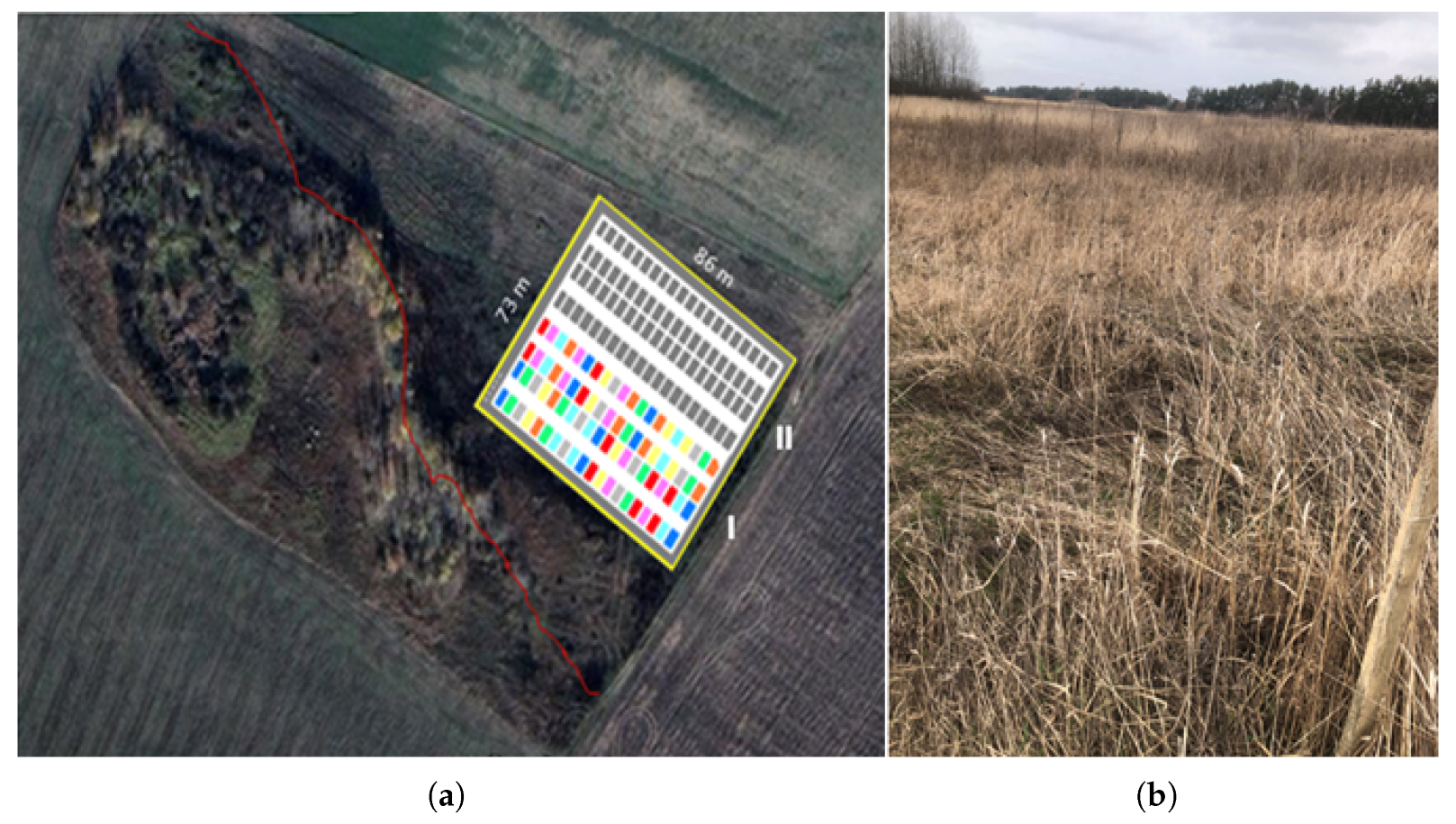
Figure 2.
(a) Schematic diagram of winter rapeseed (WR) and oilseed radish (OR) sowing at different planting densities. (b) Example of manual sowing (5/03/2025).
Figure 2.
(a) Schematic diagram of winter rapeseed (WR) and oilseed radish (OR) sowing at different planting densities. (b) Example of manual sowing (5/03/2025).
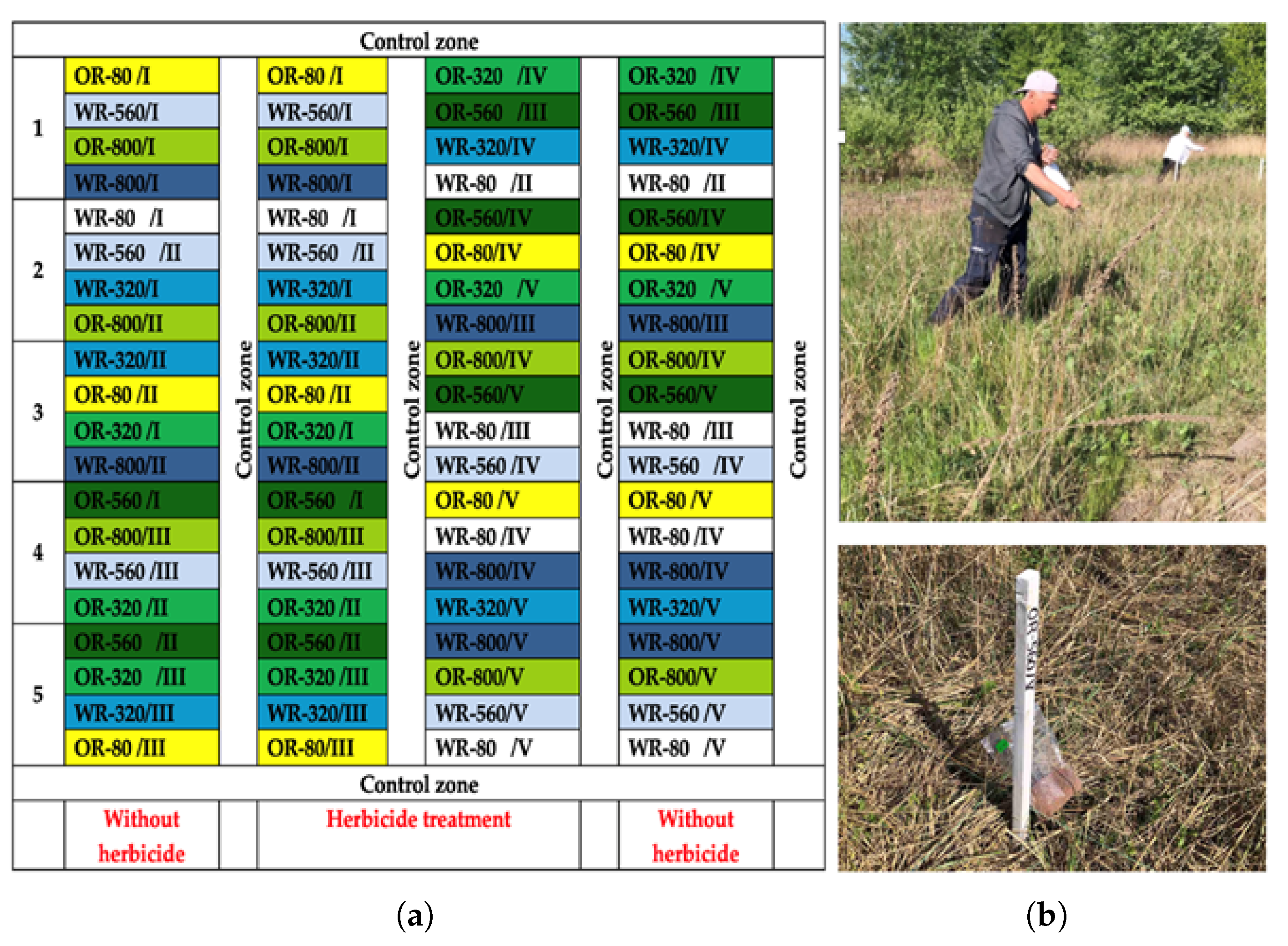
Figure 3.
Experimental design: (a) Layout of the field trials; (b) Experimental field showing loosening of protective zones between plots using a cultivator, followed by seed placement across the plot area.
Figure 3.
Experimental design: (a) Layout of the field trials; (b) Experimental field showing loosening of protective zones between plots using a cultivator, followed by seed placement across the plot area.
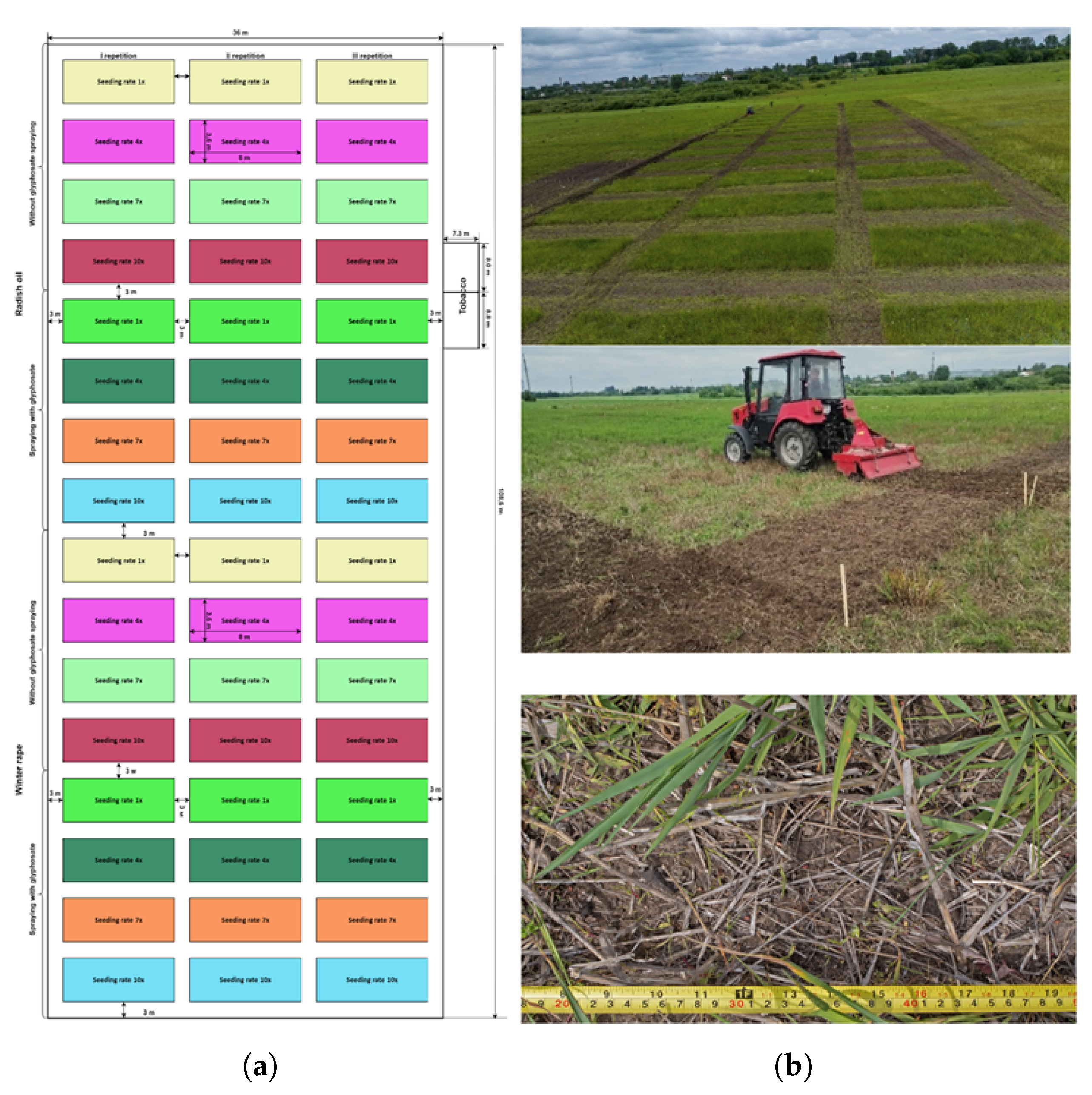
Figure 5.
Drone sowing layout of the experimental field showing plot arrangement and drone flight direction.
Figure 5.
Drone sowing layout of the experimental field showing plot arrangement and drone flight direction.
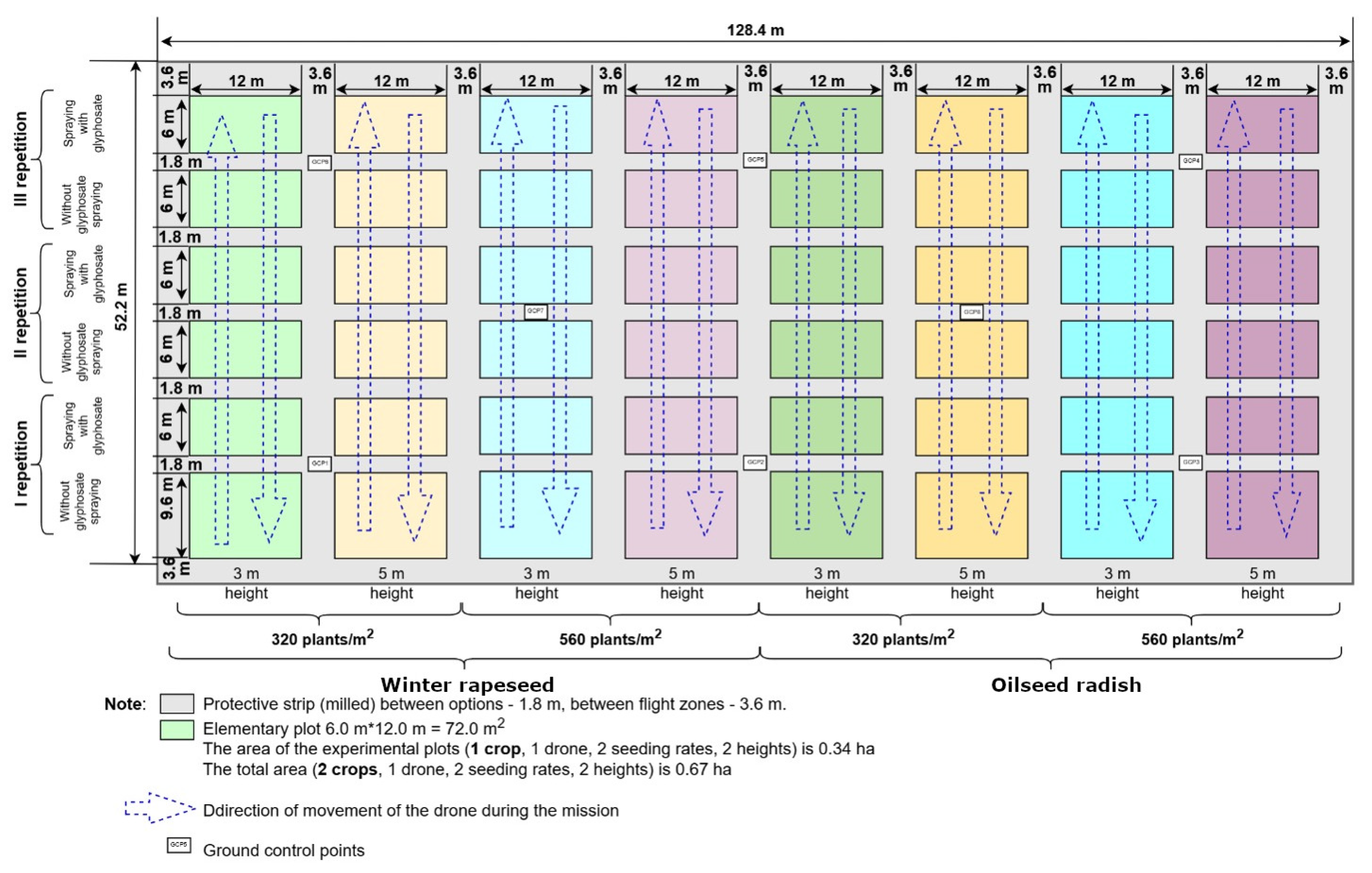
Figure 6.
(a) MC A22 drone used to spray liquid herbicide; (b) Seeding device of the XAG P100pro drone (with a medium-sized seed sowing cell); (c) XAG P100pro on seeding mission 31/05/2025.
Figure 6.
(a) MC A22 drone used to spray liquid herbicide; (b) Seeding device of the XAG P100pro drone (with a medium-sized seed sowing cell); (c) XAG P100pro on seeding mission 31/05/2025.
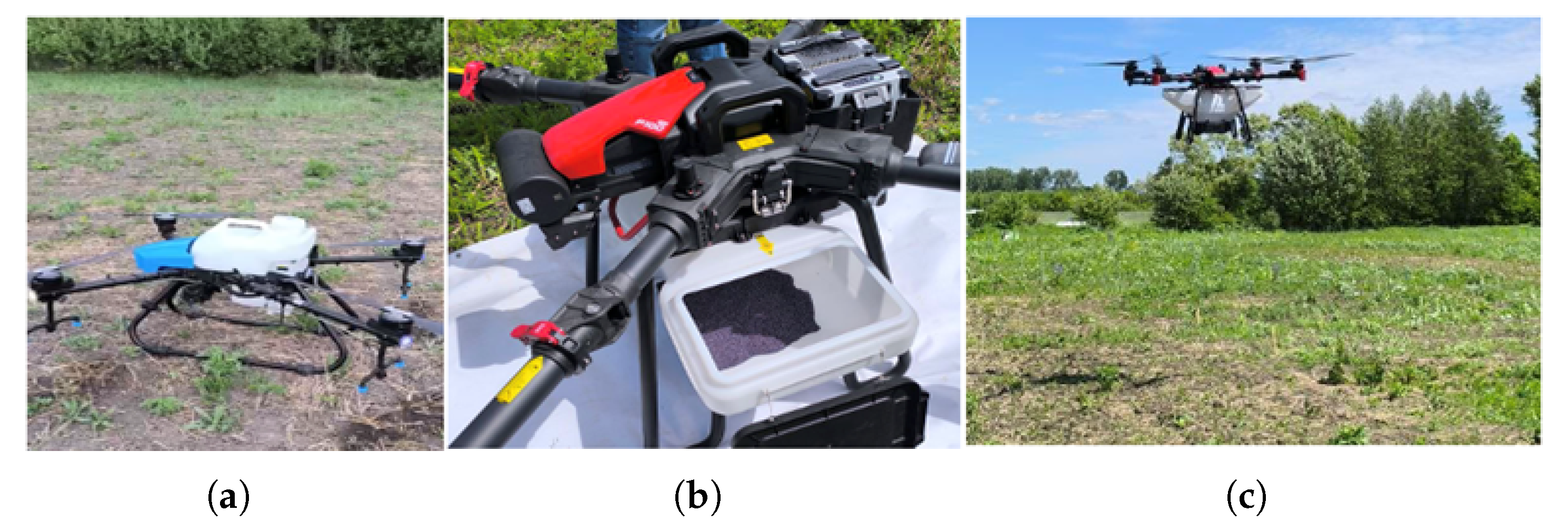
Figure 7.
Spring 2024 field example: (a) 21/05/2024, (b) 04/07/2024.
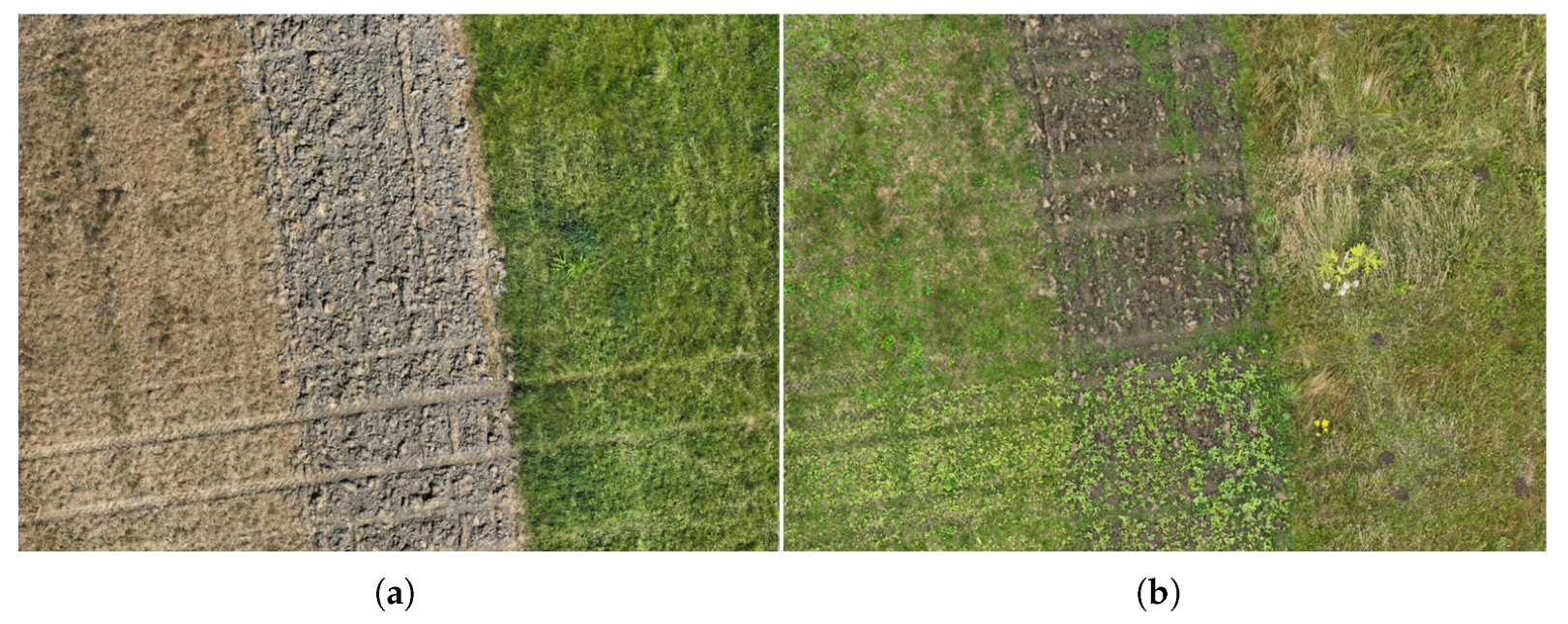
Figure 8.
Seeding process example: (a) Winter rapeseed; (b) Oilseed radish; (c) Seed dispensing unit.
Figure 8.
Seeding process example: (a) Winter rapeseed; (b) Oilseed radish; (c) Seed dispensing unit.
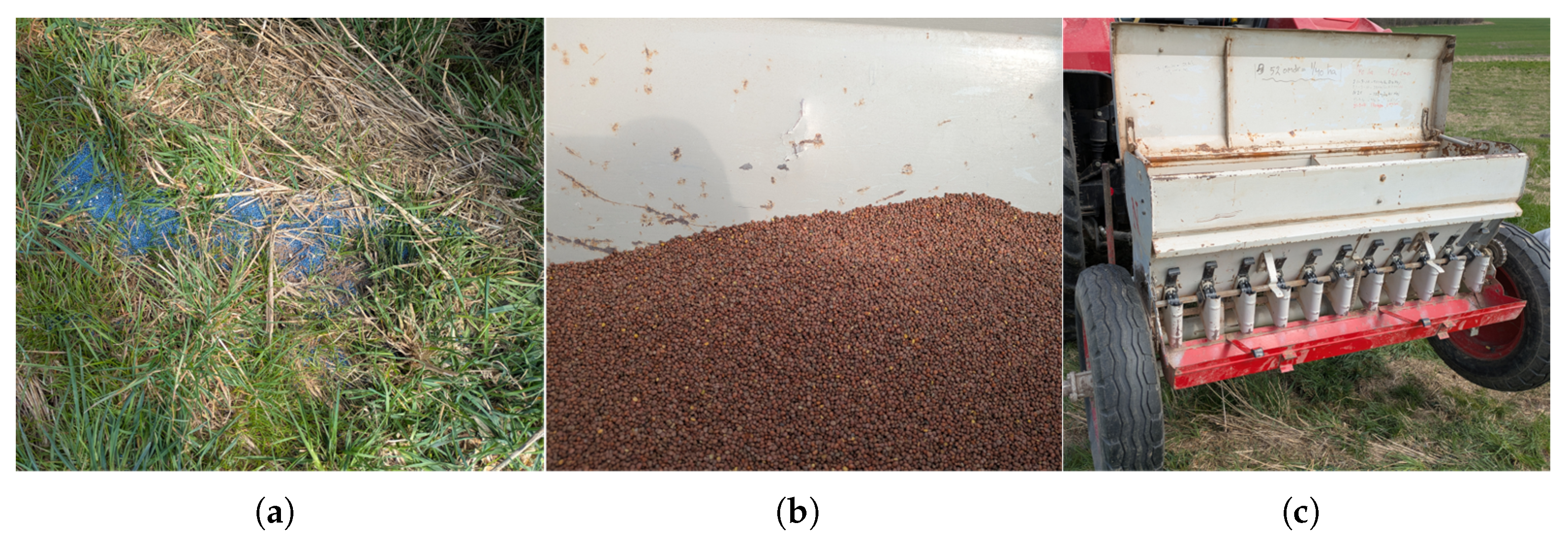
Figure 9.
Land preparations; (a) Control field; (b) Tilled field; (c) Sprayed field.
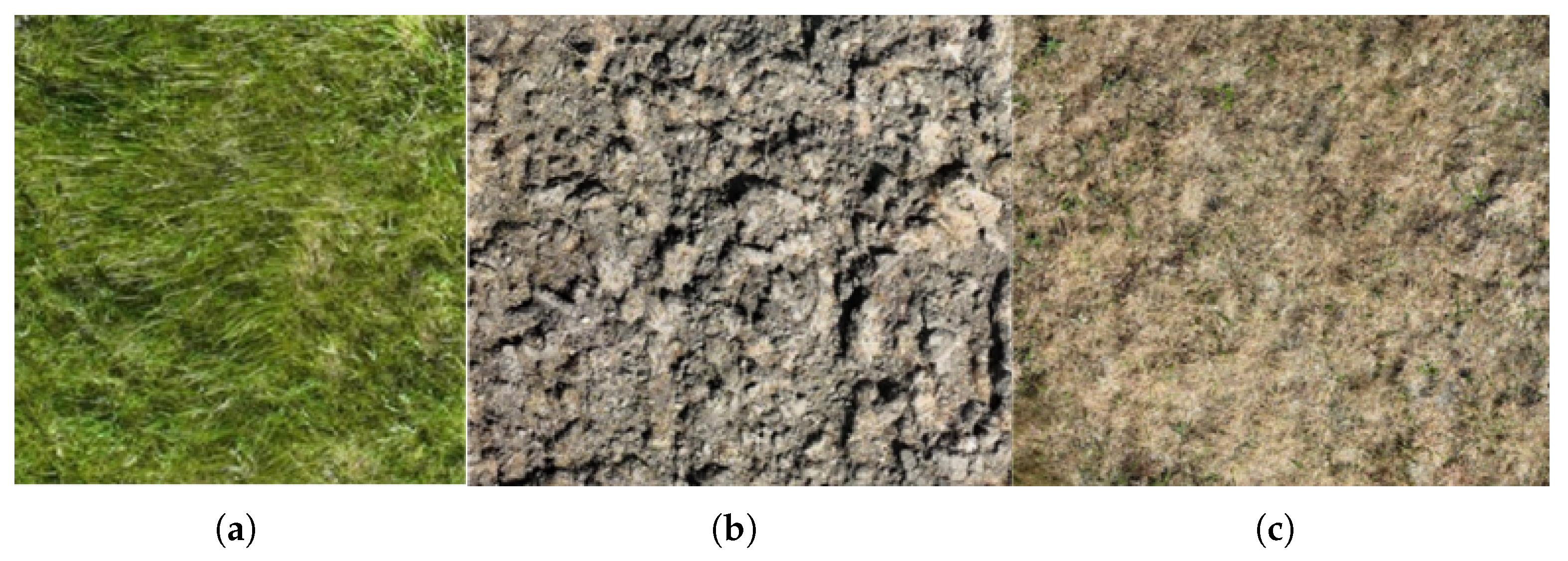
Figure 10.
Comparison of image resolution at 12 m (a) and 3 m (b) flight altitudes.
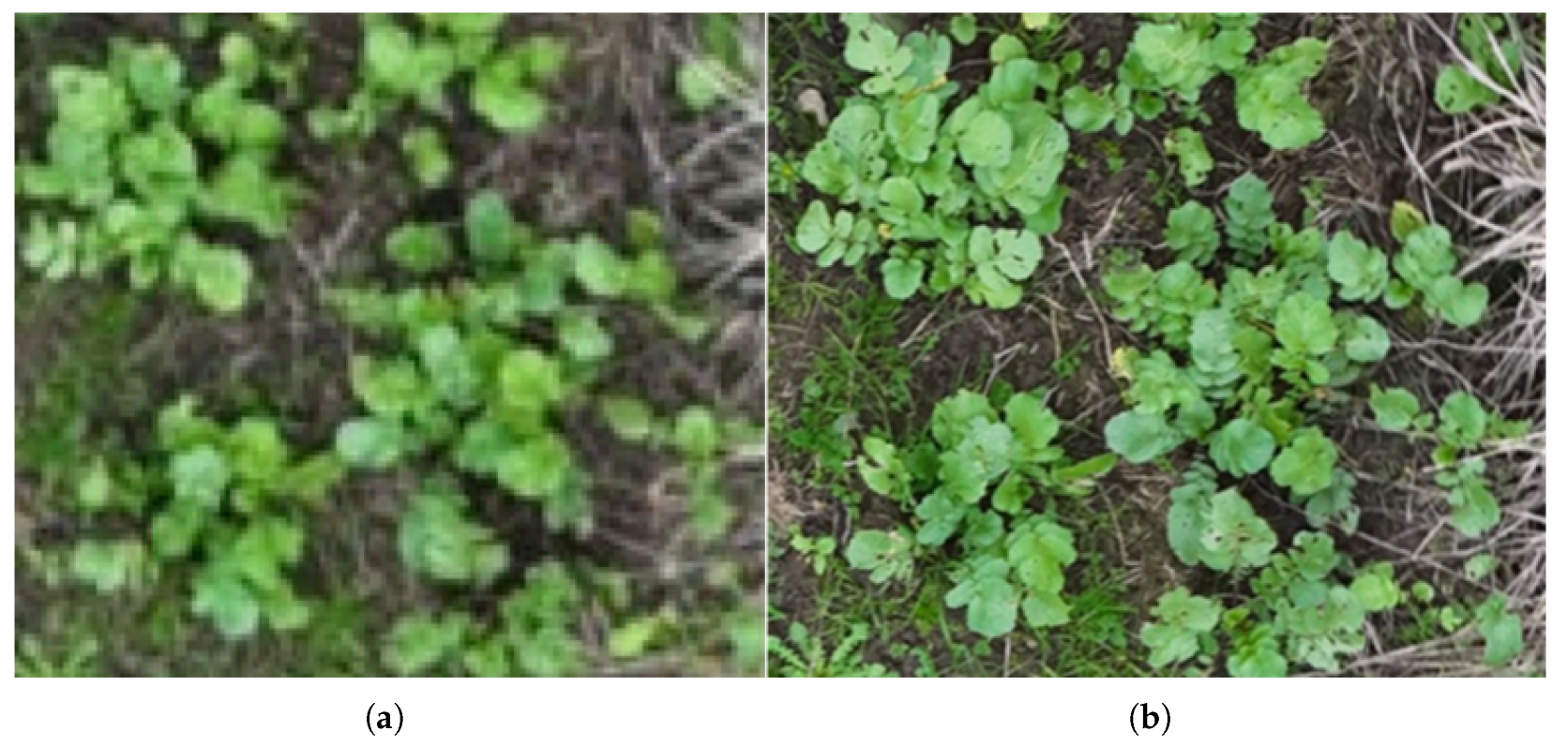
Figure 11.
ICoT+ pipeline output on 3m orthomosaic: (a) Ground truth map; (b) ICoT+ output: <6% incorrect patch labels. Blue denotes winter rapeseed, red oilseed radish, and green background.
Figure 11.
ICoT+ pipeline output on 3m orthomosaic: (a) Ground truth map; (b) ICoT+ output: <6% incorrect patch labels. Blue denotes winter rapeseed, red oilseed radish, and green background.
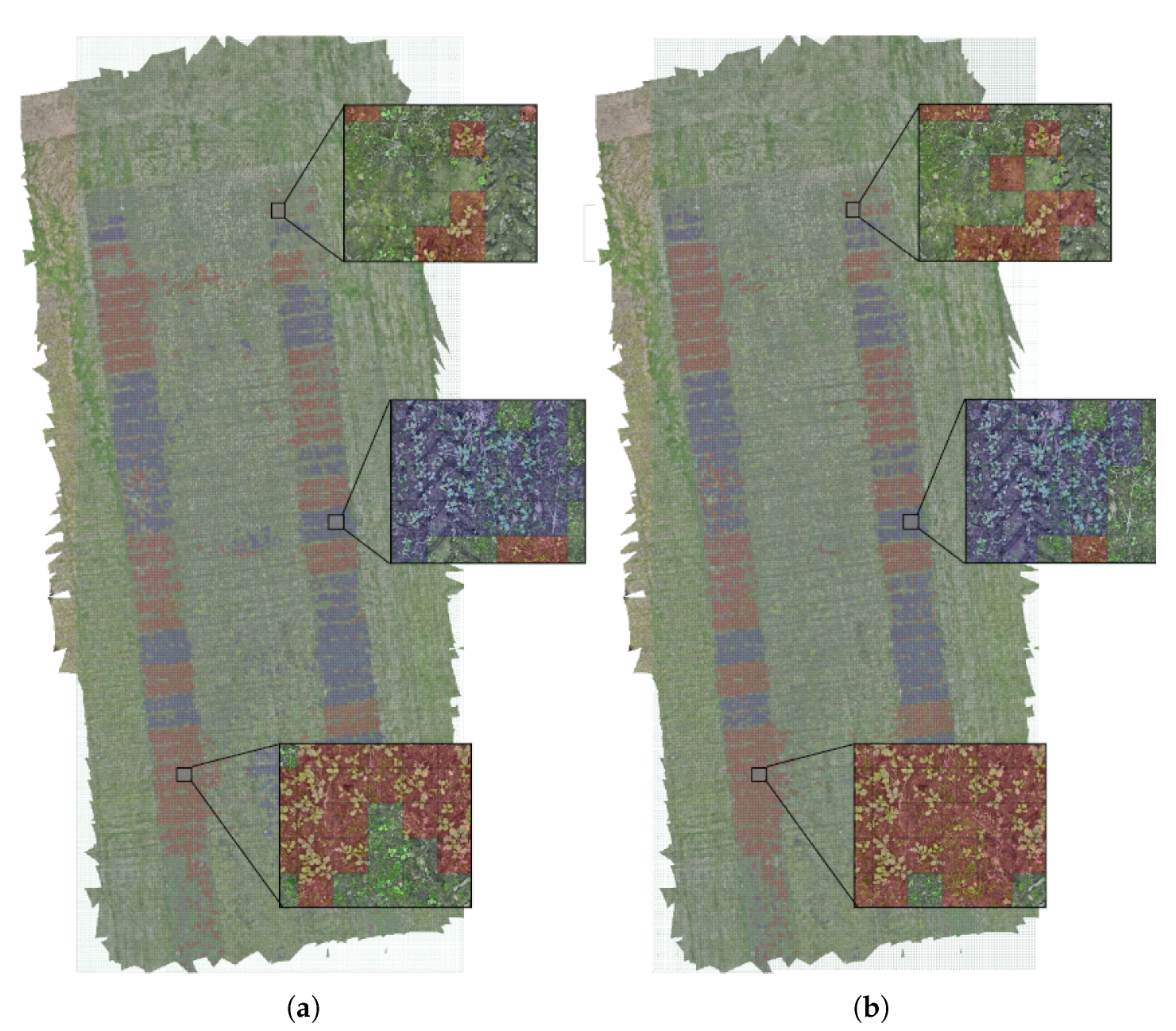
Figure 12.
Winter rapeseed in (a) mixed vegetation and (b) isolated stands.
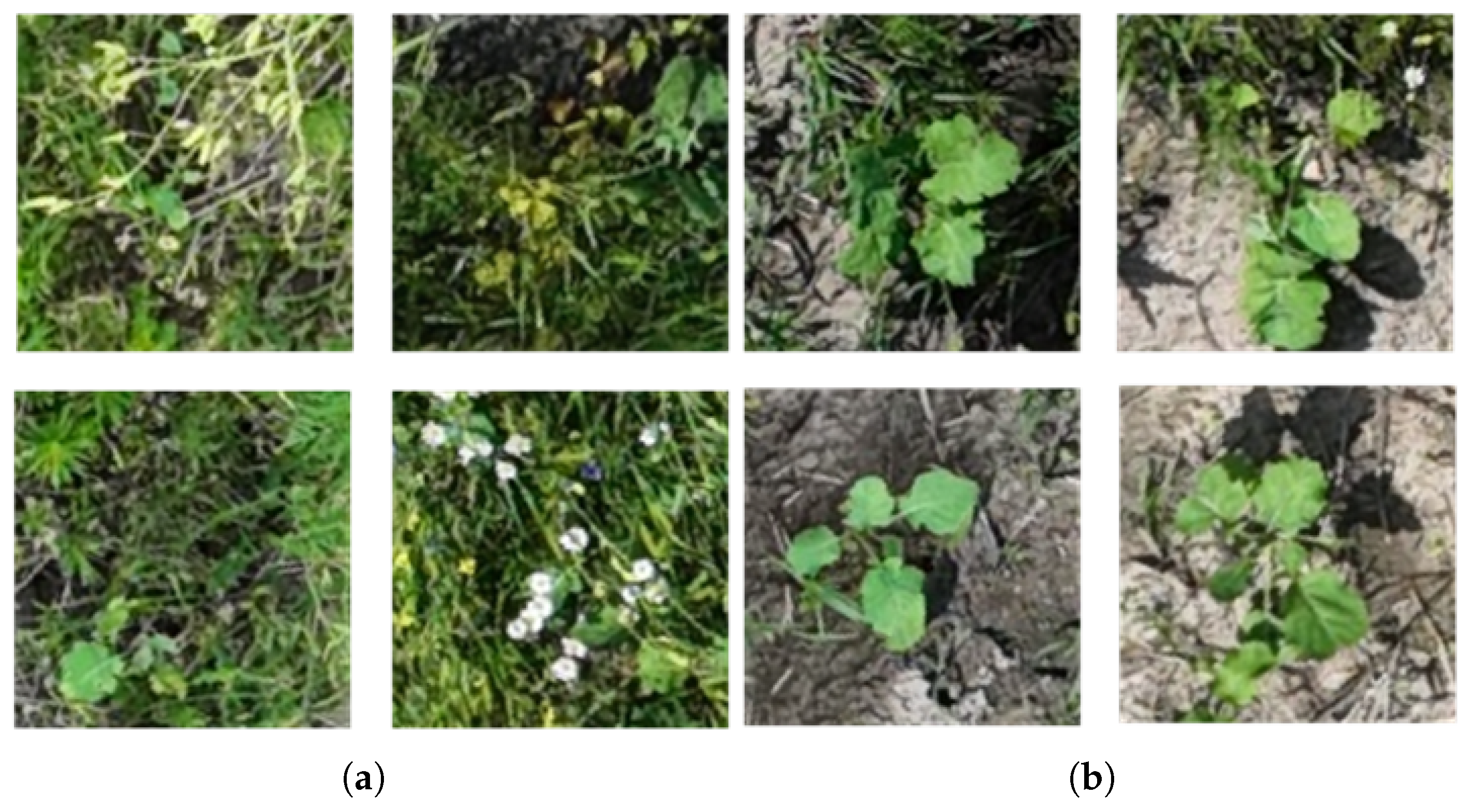
Figure 13.
Overview of the plant-detection workflow. The first two panels show the original orthomosaic and the selected sub-fields corresponding to areas seeded with winter rapeseed (WR, blue) and oilseed radish (OR, red) at varying densities. The third panel presents the manually generated ground-truth annotations for one sub-field. The final panel displays the YOLOv11 segmentation results for that same sub-field.
Figure 13.
Overview of the plant-detection workflow. The first two panels show the original orthomosaic and the selected sub-fields corresponding to areas seeded with winter rapeseed (WR, blue) and oilseed radish (OR, red) at varying densities. The third panel presents the manually generated ground-truth annotations for one sub-field. The final panel displays the YOLOv11 segmentation results for that same sub-field.
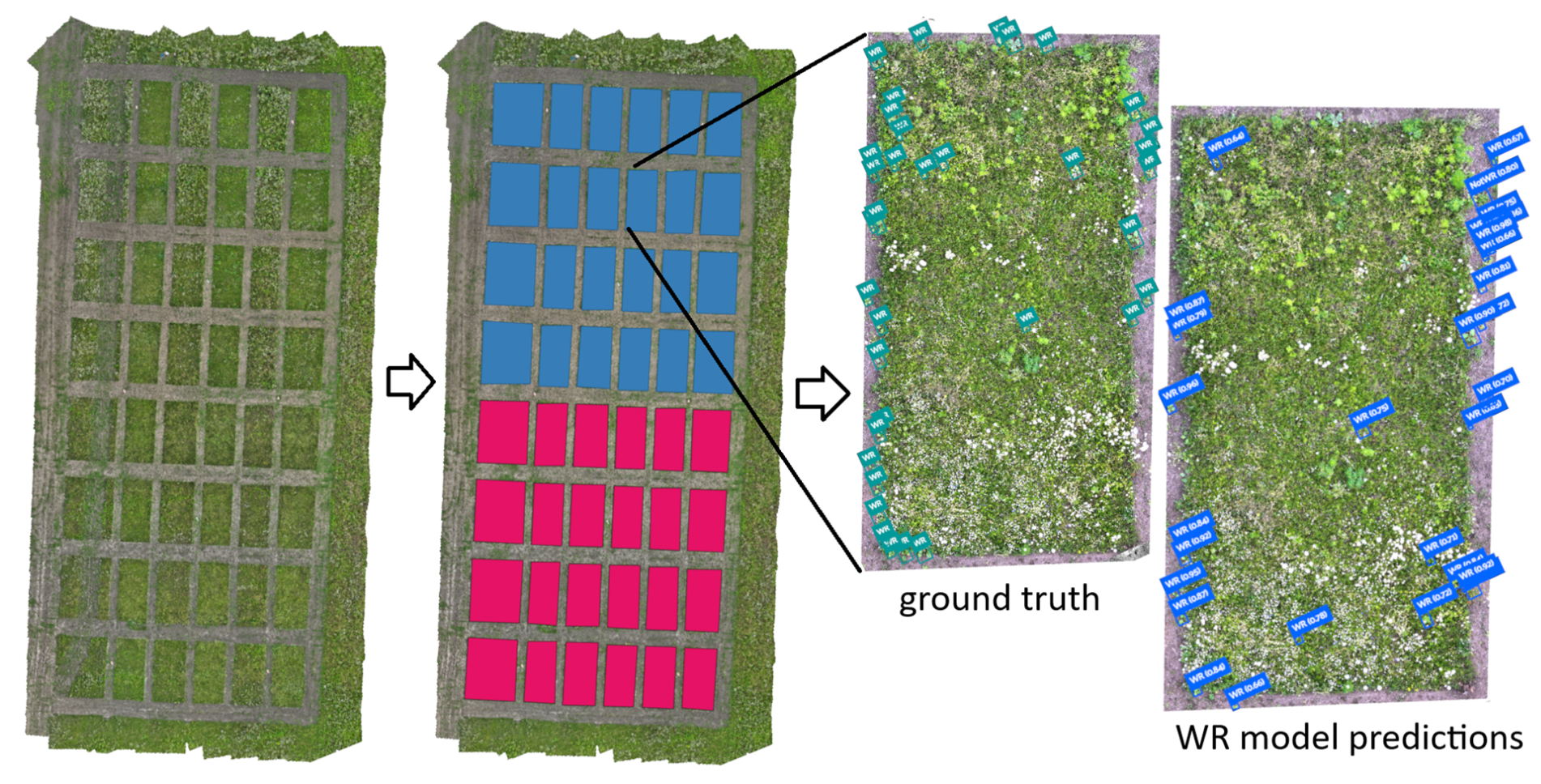
Figure 14.
Fragments of test images of plants for landmine phytodetection: (a) RGB, (b) multispectral.
Figure 14.
Fragments of test images of plants for landmine phytodetection: (a) RGB, (b) multispectral.
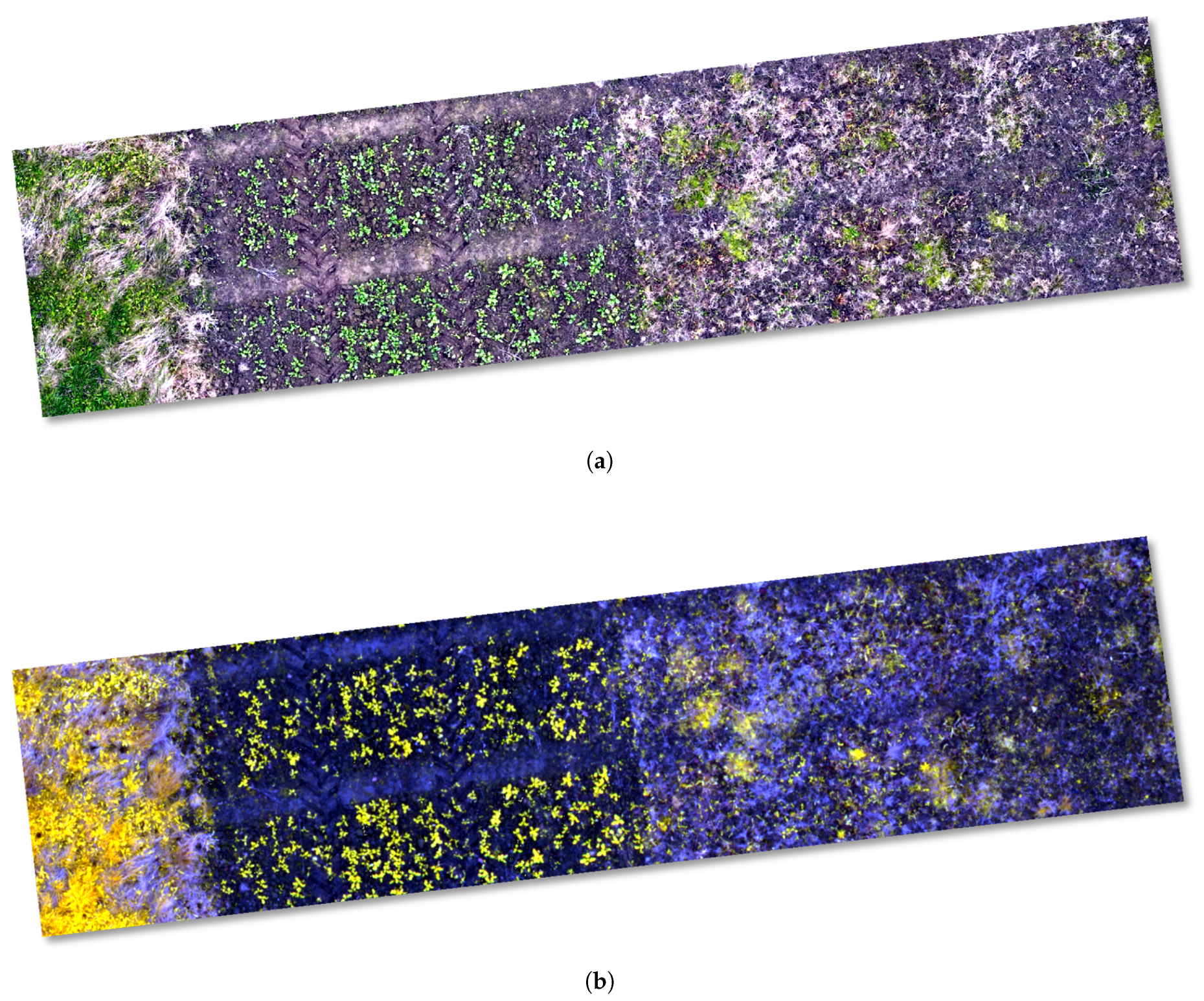
Figure 15.
Evaluation of the pixel resolution of test images: (a) RGB; (b) multispectral.
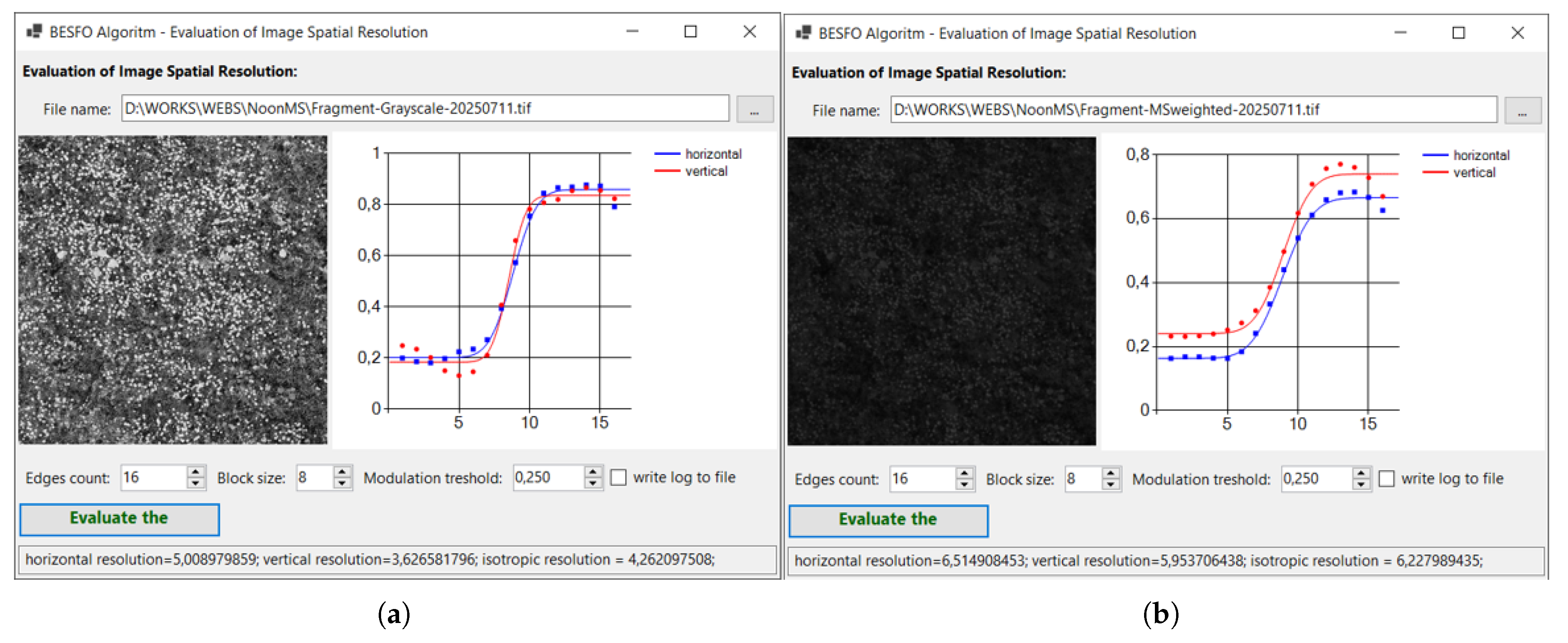
Figure 16.
Maximum Likelihood classification map for landmine phytodetection. White pixels — target class; black pixels — background; red polygons — reference data.
Figure 16.
Maximum Likelihood classification map for landmine phytodetection. White pixels — target class; black pixels — background; red polygons — reference data.
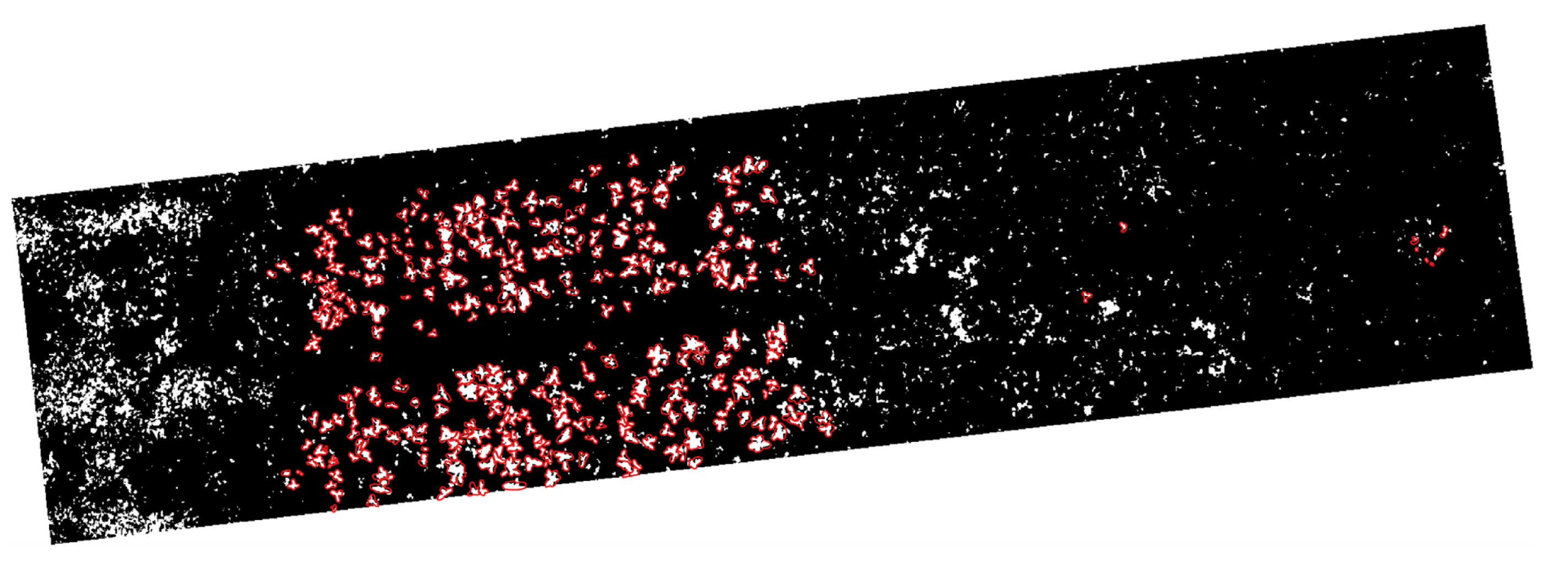

Table 1.
Detection performance across plant type, density, and glyphosate treatment. WR - winter rapeseed, OR- oilseed radish.
Table 1.
Detection performance across plant type, density, and glyphosate treatment. WR - winter rapeseed, OR- oilseed radish.
| Plant | Density | Glyphosate | Precision (%) | Recall (%) | F1 (%) |
|---|---|---|---|---|---|
| WR | 320 | + | 42 | 25 | 31 |
| WR | 320 | – | 23 | 34 | 28 |
| WR | 560 | + | 49 | 26 | 34 |
| WR | 560 | – | 36 | 56 | 44 |
| OR | 320 | + | 62 | 29 | 39 |
| OR | 320 | – | 42 | 14 | 21 |
| OR | 560 | + | 86 | 28 | 42 |
| OR | 560 | – | 78 | 12 | 21 |
Note: “+” indicates glyphosate applied; “–” indicates no glyphosate. The highest scores are highlighted.
Table 2.
Operational spectral bands of DJI Mavic 3M Pro UAV onboard cameras
| UAV onboard camera | Band operational wavelength, nm | ||||
|---|---|---|---|---|---|
| Blue | Green | Red | Red Edge | Near Infrared | |
| Regular RGB | 450–490 | 520–560 | 640–670 | – | – |
| Multispectral | – | 544–576 | 634–666 | 714–746 | 834–886 |
Disclaimer/Publisher’s Note: The statements, opinions and data contained in all publications are solely those of the individual author(s) and contributor(s) and not of MDPI and/or the editor(s). MDPI and/or the editor(s) disclaim responsibility for any injury to people or property resulting from any ideas, methods, instructions or products referred to in the content. |
© 2026 by the authors. Licensee MDPI, Basel, Switzerland. This article is an open access article distributed under the terms and conditions of the Creative Commons Attribution (CC BY) license (http://creativecommons.org/licenses/by/4.0/).
Copyright: This open access article is published under a Creative Commons CC BY 4.0 license, which permit the free download, distribution, and reuse, provided that the author and preprint are cited in any reuse.


