
Submitted:
19 May 2026
Posted:
21 May 2026
You are already at the latest version
Abstract
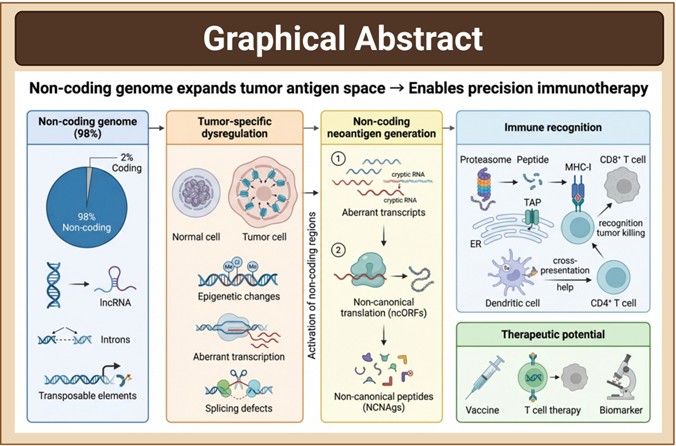
The non-coding regions (NCRs) of the genome, once called “dark matter” and considered useless, are now understood to be key to cancer immunity. While only 2% of the genome is protein-coding, some NCRs can produce small non-canonical peptides that originate from long non-coding RNAs (lncRNAs), untranslated regions, pseudogenes, transposable elements, or aberrant RNA transcripts. Recent advances in proteogenomics and immunopeptidomics have shown that these peptides can bind to major histocompatibility complex (MHC) molecules and be presented to the immune system, thereby constituting non-coding neoantigens (NCNAgs). Because they’re not typically found in healthy cells, the immune system can identify them as foreign. This helps CD8⁺ and CD4⁺ T cells recognize and destroy cancer cells. A similar mimicry at the viral level can activate the innate immune system via some of these signals. Compared with central immune tolerance observed for T antigens, NCNAgs show low expression in normal tissues and high antigenicity in tumors. Therefore, they are ideal candidates for cancer therapy. They could be used in personalized cancer vaccines, adoptive T-cell therapies, and as biomarkers that predict how well patients respond to immunotherapy. However, detecting these antigens is difficult, and limitations in current computational methods may lead to errors. Additionally, tumor heterogeneity, divergence in Human Leukocyte Antigen (HLA) types, and the risk of off-target effects complicate their use. Several emerging technologies, including AI-based prediction, ribosome profiling, and spatial multi-omics, are being applied to improve the accuracy of cancer inter-architecture mapping. In conclusion, targeting the non-coding genome may be a new approach in future cancer therapy.
Keywords:
non-coding neoantigens
; cancer immunotherapy
; immunopeptidomics
; proteogenomics
; tumor immunogenicity
; transposable elements
Copyright: This open access article is published under a Creative Commons CC BY 4.0 license, which permit the free download, distribution, and reuse, provided that the author and preprint are cited in any reuse.


