
Submitted:
18 May 2026
Posted:
19 May 2026
You are already at the latest version
Abstract
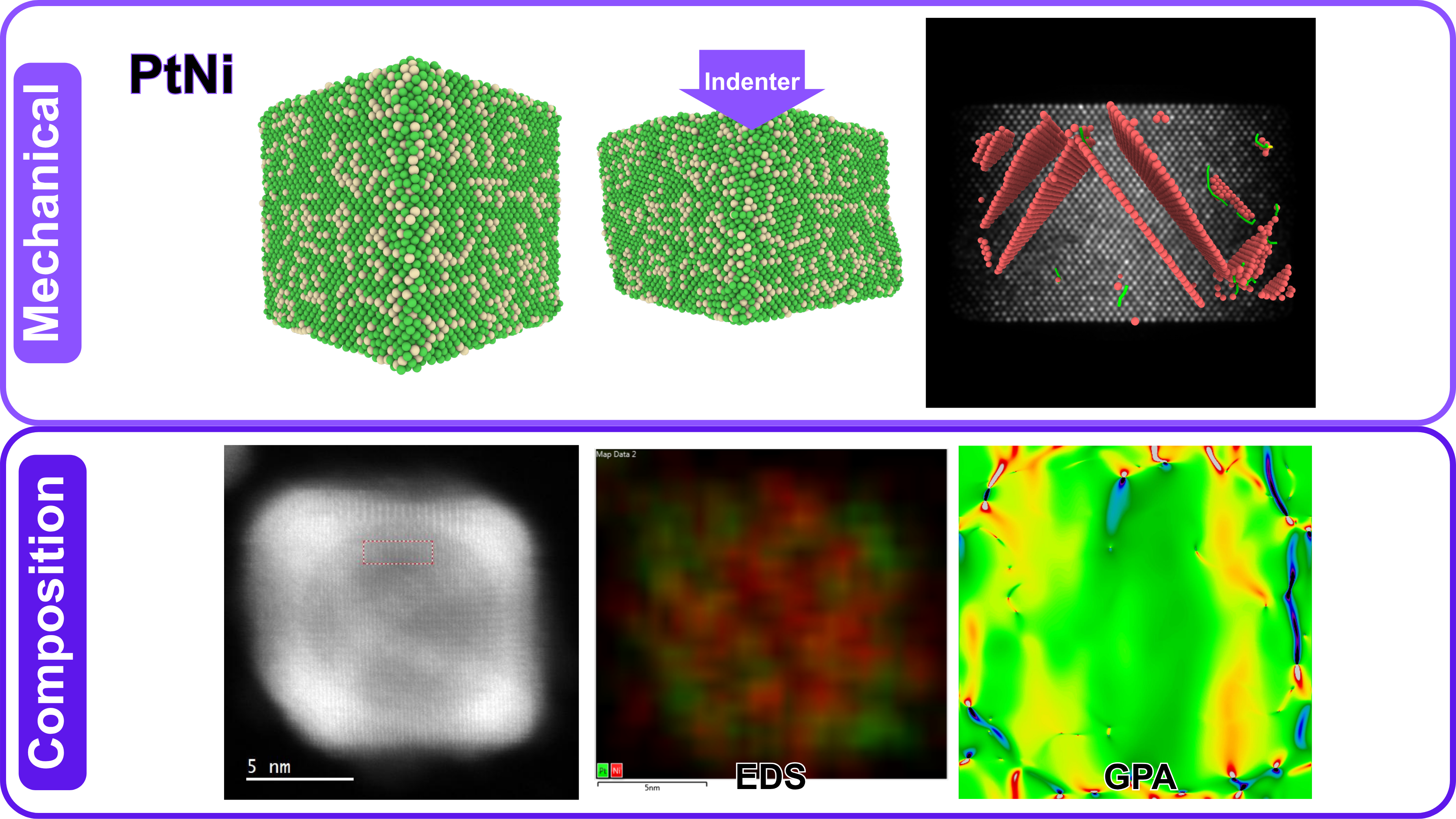
Understanding the mechanical behavior of bimetallic nanoparticles under compressive stress is relevant for the use of these nanostructures in catalysis and nanomechanics. In this work, we present molecular dynamics (MD) simulations of compressive deformation in Pt-Ni nanoparticles—and bulk systems for comparison—with varying compositions (PtxNi1−x) and local distributions, performed using LAMMPS. The simulations show that the mechanical response is governed by local strain fields, which influence both elastic and plastic regimes. Post-processing analysis was made using OVITO, simulated STEM imaging, and Geometric Phase Analysis (GPA), which allowed the obtention of high-resolution strain maps. Analysis of von Mises stress distribution allowed us to correlate composition and atomic ordering with the formation and evolution of dislocations in the nanoparticles. The intermetallic compound with x=0.5 exhibits superior mechanical performance under uniaxial compression, with enhanced elastic energy storage is in bulk. In polycrystalline nanoparticles, energy dissipation increased with decreasing average grain size, which is attributed to elevated plastic activity induced by the presence of multiple crystallographic orientations. GPA results show that it is possible to discriminate between compositions differing by as little as Δx = 0.1 based on local strain distributions, and the comparison with GPA performed on real STEM micrographs gives a fair agreement. GPA and atomistic stress maps reveal how strain fields evolve during compression and how they correlate with the development of plasticity. These findings highlight the critical role of local structural heterogeneities in dictating the mechanical behavior of nanoscale Pt-Ni systems, and give strong evidence on the capability of GPA to correlate local strain and composition in real high-resolution micrographs.
Keywords:
Pt-Ni nanoparticles
; molecular dynamics
; strain mapping
; GPA
; EDS
; LAMMPS
Copyright: This open access article is published under a Creative Commons CC BY 4.0 license, which permit the free download, distribution, and reuse, provided that the author and preprint are cited in any reuse.


