
Submitted:
17 May 2026
Posted:
18 May 2026
You are already at the latest version
Abstract
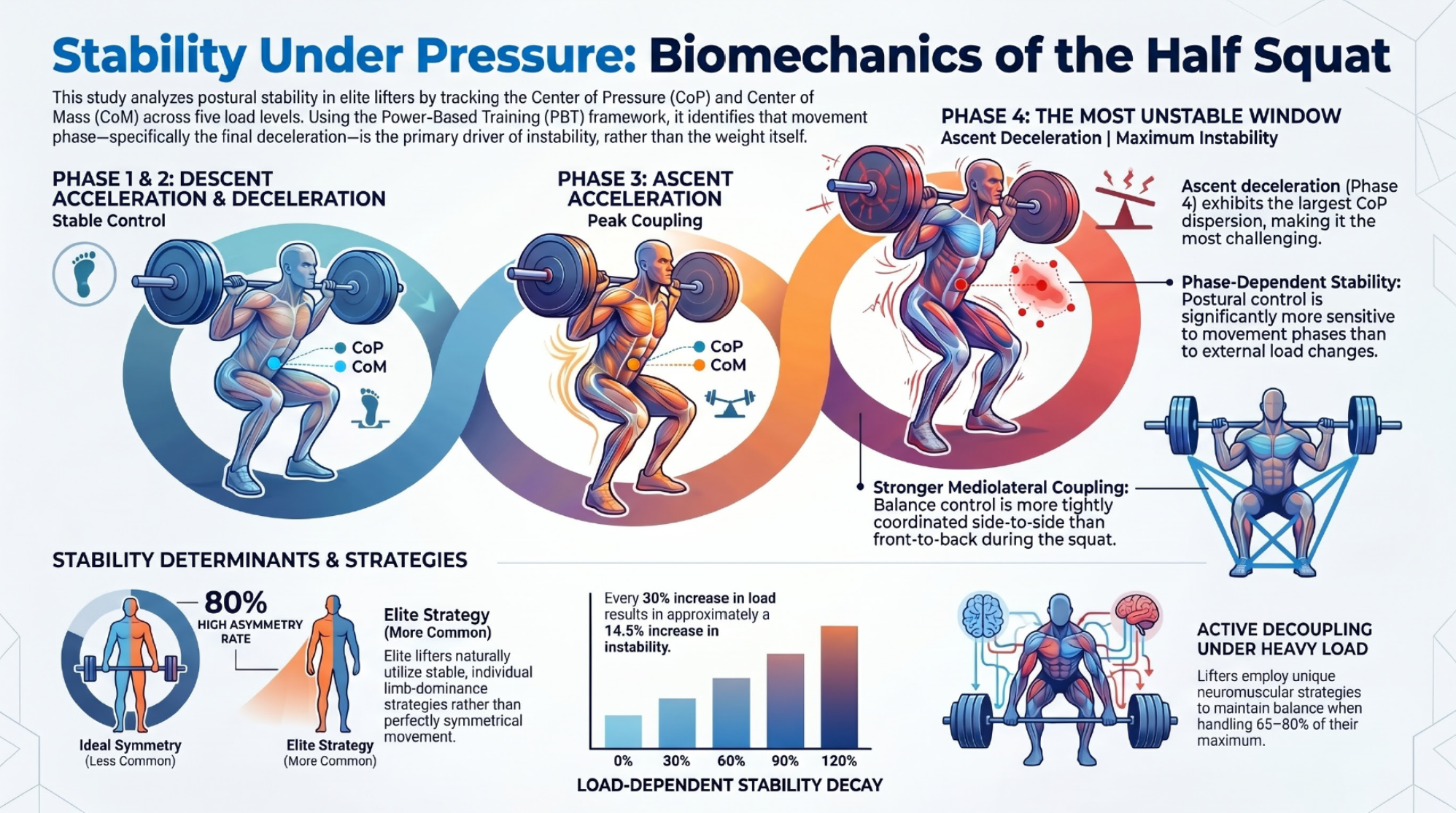
Traditional biomechanical research has focused on joint mechanics and the be-havior of the center of mass (CoM); however, the dynamics of the center of pressure (CoP) and the neuromuscular strategies that support stability under load remain un-derexplored. This study examined balance control during the back half squat by ana-lyzing the relationship between the CoM and the CoP in five experienced male weightlifters performing segmented squats at five load levels (20–80% 1RM). Vicon force platforms and motion capture systems were used to quantify the area of the 95% confidence ellipse. Due to the small sample size (n = 5), a dual inferential framework was used: frequentist repeated-measures ANOVA supplemented with unified adaptive Bayesian hierarchical modeling. The phase of the motion showed a strong effect on the stability of the CoP in both frames (frequentist: F(1.65, 6.59) = 19.44, p = 0.002, ηp² = .829; Bayesian: P(β_phase2 < 0) > 0.999). The external load was not significant in the frequentist analysis (p = 0.177), but the subsequent Bayesian analysis gave moderate evidence of a positive load effect (β_load = 0.059, 95% HDI [0.005, 0.115], P=0.981). The area of the CoM ellipse did not show significant effects in either frame. Limb asym-metries were substantial and stable (frequentist: 48.01 ± 30.13%; Bayesian: 69.48%, 95% HDI [55.86%, 81.44%], P(AI > 20%) = 1.000), with no condition-dependent modulation. CoP-CoM coupling was stronger in the mediolateral than the anteroposterior direction in both frames. These results suggest that phase is the main factor influencing pressure point stability, that loading may have a moderate positive effect detectable only with low-power probabilistic techniques, and that the dual framework improves the ro-bustness of conclusions in biomechanical research with small samples. Confirmatory studies with larger sample sizes are needed.
Keywords:
power-based training
; mechanical demand
; center of pressure
; center of mass
; total center of pressure
; postural control
; stability
Copyright: This open access article is published under a Creative Commons CC BY 4.0 license, which permit the free download, distribution, and reuse, provided that the author and preprint are cited in any reuse.


